

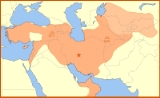
Great Seljuq Empire

Encyclopedia
The Great Seljuq Empire was a medieval Persianate
, Turko-Persian
Sunni Muslim
empire
, originating from the Qynyq branch of Oghuz Turks
. The Seljuq Empire controlled a vast area stretching from the Hindu Kush
to eastern Anatolia
and from Central Asia
to the Persian Gulf
. From their homelands near the Aral sea
, the Seljuqs advanced first into Khorasan
and then into mainland Persia before eventually conquering eastern Anatolia.
The Seljuq empire was founded by Tughril Beg in 1037 after the efforts by the founder of the Seljuq dynasty
, Seljuq Beg, back in the first quarter of the eleventh century. Seljuq Beg's father was in a higher position in the Oghuz Yabgu State
, and gave his name both to the state and the dynasty. The Seljuqs united the fractured political scene of the Eastern Islamic world and played a key role in the first
and second
crusades. Highly Persianized
in culture and language, the Seljuqs also played an important role in the development of the Turko-Persian tradition
, even exporting Persian culture to Anatolia. The Seljuqs conquest gave impetus to the progressive Turkicization of parts of Anatolia, Iran and the Caucasus. .
, Seljuq, who was reputed to have served in the Khazar army, under whom, circa 950 they migrated to Khwarezm
, near the city of Jend also called Khujand
, where they converted to Islam
.
Samanid Shahs against the Qarakhanids. The Samanids however fell to the Qarakhanids and the emergence of the Ghaznavids
and were involved in the power struggle in the region before establishing their own independent base.
s. Initially the Seljuqs were repulsed by Mahmud
and retired to Khwarezm
but Tughril and Chaghri led them to capture Merv
and Nishapur
(1028–1029). Later they repeatedly raided and traded territory with his successors across Khorasan
and Balkh
and even sacked Ghazni
in 1037. In 1039 at the Battle of Dandanaqan
, they decisively defeated Mas'ud I of the Ghaznavids
resulting in him abandoning most of his western territories to the Seljuqs. In 1055, Tughril captured Baghdad
from the Shi'a
Buyids
under a commission from the Abbassids.
and Georgia
in 1064 and invading the Byzantine Empire
in 1068, from which he annexed almost all of Anatolia
; Arslan's decisive victory at the Battle of Manzikert
(in 1071) effectively neutralized the Byzantine threat. He authorized his Turkmen generals to carve their own principalities out of formerly Byzantine Anatolia, as atabeg
s loyal to him. Within two years the Turkmens had established control as far as the Aegean Sea
under numerous "beghliks" (modern Turkish beyliks): the Saltukids in Northeastern Anatolia, Mengujekids in Eastern Anatolia, Artuqids in Southeastern Anatolia, Danishmendis in Central Anatolia, Rum Seljuqs
(Beghlik of Suleyman
, which later moved to Central Anatolia) in Western Anatolia and the Beylik of Tzachas of Smyrna in İzmir
(Smyrna
).
's successor Malik Shah and his two Persian viziers Nizām al-Mulk
and Tāj al-Mulk, the Seljuq state expanded in various directions, to former Iranian border before Arab invasion, so that it bordered China
in the East and the Byzantines
in the West.
He moved the capital from Rey
to Isfahan. The Iqta military system and the Nizāmīyyah University at Baghdad were established by Nizām al-Mulk, and the reign of Malikshāh was reckoned the golden age of "Great Seljuq". The Abbasid Caliph titled him "The Sultan of the East and West" in 1087. The Assassins (Hashshashin) of Hassan-e Sabāh
however started to become a force during his era and assassinated many leading figures in his administration.
and Iraq
, and included Anatolia
as well as parts of Central Asia
and modern Afghanistan
. The Seljuk rule was modelled after the tribal organization brought in by the nomadic conquerors and resembled a 'family federation' or 'appanage state'. Under this organization the leading member of the paramount family assigned family members portions of his domains as autonomous appanages.
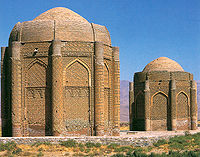
When Malikshāh I died in 1092, the empire split as his brother and four sons quarrelled over the apportioning of the empire among themselves. In Anatolia, Malikshāh I was succeeded by Kilij Arslan I
who founded the Sultanate of Rum
and in Syria
by his brother Tutush I
. In Persia he was succeeded by his son Mahmud I whose reign was contested by his other three brothers Barkiyaruq
in Iraq
, Muhammad I in Baghdad
and Ahmad Sanjar
in Khorasan
.
When Tutush I
died his sons Radwan
and Duqaq
inherited Aleppo
and Damascus
respectively and contested with each other as well further dividing Syria amongst emirs antagonistic towards each other.
In 1118, the third son Ahmad Sanjar
took over the empire. His nephew, the son of Muhammad I did not recognize his claim to the throne and Mahmud II proclaimed himself Sultan and established a capital in Baghdad, until 1131 when he was finally officially deposed by Ahmad Sanjar.
Elsewhere in nominal Seljuq territory were the Artuqids in northeastern Syria and northern Mesopotamia
. They controlled Jerusalem until 1098. In eastern Anatolia and northern Syria a state was founded by the Dānišmand dynasty, and contested land with the Sultanate of Rum
and Kerbogha
exercised greeted independence as the atabeg
of Mosul
.
. The Seljuqs easily defeated the untrained People's Crusade
arriving in 1096, but could not stop the progress of the army of the subsequent Princes' Crusade, which took important cities such as Nicaea, Iconium, Kayseri
, and Antioch
on its march to Jerusalem, and in 1099 finally successfully captured the Holy Land
, setting up the first Crusader States
. The Seljuqs had already lost Palestine
to the Fatimid
s, who had recaptured it just before its capture by the crusaders.
Ahmed Sanjar
had to contend with the revolts of Qarakhanids in Transoxiana
, Ghorids in Afghanistan
and Qarluks in modern Kyrghyzstan, even as the nomadic Kara-Khitais invaded the East, destroying the Seljuq vassal state of the Eastern Qarakhanids. At the Battle of Qatwan
in 1141, Sanjar lost all his eastern provinces up to the Syr Darya
, including the vassalage of Western Kara-Khanid to the Kara-Khitan.
During this time conflict with the Crusader States was also intermittent, and after the First Crusade increasingly independent atabegs would frequently ally with the crusader states against other atabegs as they vied with each other for territory. At Mosul, Zengi
succeeded Kerbogha
as atabeg and successfully began the process of consolidating the atabegs of Syria. In 1144 Zengi captured Edessa
, as the County of Edessa
had allied itself with the Ortoqids against him. This event triggered the launch of the Second Crusade. Nur ad-Din
, one of Zengi's sons who succeeded him as atabeg of Aleppo
, created an alliance in the region to oppose the Second Crusade, which landed in 1147.
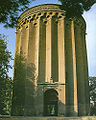
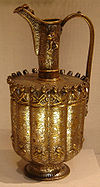
The Seljuqs were also patrons of art and literature. Under the Seljuqs universities were founded. Their reign is characterized by Persian
astronomers such as Omar Khayyám
, and the Persian
philosopher al-Ghazali
.
In 1153, the Oghuz Turks rebelled and captured Sanjar. He managed to escape three years later but died a year later. Despite several attempts to reunite the Seljuks by his successors, the Crusades prevented them from regaining their former empire. The atabegs, such as Zengids and Artuqids, were only nominally under the Seljuk Sultan, and generally controlled Syria independently. When Ahmed Sanjar died in 1156, it fractured the empire even further and rendered the atabegs effectively independent.
After the Second Crusade, Nur ad-Din's general Shirkuh
, who had established himself in Egypt
on Fatimid
land, was succeeded by Saladin
. In time, Saladin rebelled against Nur ad-Din
, and, upon his death, Saladin married his widow and captured most of Syria and created the Ayyubid dynasty.
On other fronts, the Kingdom of Georgia began to become a regional power and extended its borders at the expense of Great Seljuk. The same was true during the revival of the Armenian Kingdom of Cilicia
under Leo II of Armenia
in Anatolia. The Abbassid caliph An-Nasir
also began to reassert the authority of the caliph and allied himself with the Khwarezmshah Takash
.
For a brief period, Togrul III
was the Sultan of all Seljuq except for Anatolia. In 1194, however, Togrul was defeated by Takash
, the Shah of Khwarezmid Empire, and the Seljuq finally collapsed. Of the former Seljuq Empire, only the Sultanate of Rûm
in Anatolia
remained. As the dynasty declined in the middle of the thirteenth century, the Mongols
invaded Anatolia
in the 1260s and divided it into small emirate
s called the Anatolian beyliks. Eventually one of these, the Ottoman
, would rise to power and conquer the rest.
Persianate
A Persianate/Persified society is a society that is either based on, or strongly influenced by the Persian language, culture, literature, art, and/or identity....
, Turko-Persian
Turko-Persian tradition
The composite Turko-Persian tradition was a variant of Islamic culture. It was Persianate in that it was centered on a lettered tradition of Iranian origin; it was Turkic insofar as it was for many generations patronized by rulers of Turkic background; it was Islamic in that Islamic notions of...
Sunni Muslim
Islam
Islam . The most common are and . : Arabic pronunciation varies regionally. The first vowel ranges from ~~. The second vowel ranges from ~~~...
empire
Empire
The term empire derives from the Latin imperium . Politically, an empire is a geographically extensive group of states and peoples united and ruled either by a monarch or an oligarchy....
, originating from the Qynyq branch of Oghuz Turks
Oghuz Turks
The Turkomen also known as Oghuz Turks were a historical Turkic tribal confederation in Central Asia during the early medieval Turkic expansion....
. The Seljuq Empire controlled a vast area stretching from the Hindu Kush
Hindu Kush
The Hindu Kush is an mountain range that stretches between central Afghanistan and northern Pakistan. The highest point in the Hindu Kush is Tirich Mir in the Chitral region of Khyber-Pakhtunkhwa, Pakistan.It is the westernmost extension of the Pamir Mountains, the Karakoram Range, and is a...
to eastern Anatolia
Anatolia
Anatolia is a geographic and historical term denoting the westernmost protrusion of Asia, comprising the majority of the Republic of Turkey...
and from Central Asia
Central Asia
Central Asia is a core region of the Asian continent from the Caspian Sea in the west, China in the east, Afghanistan in the south, and Russia in the north...
to the Persian Gulf
Persian Gulf
The Persian Gulf, in Southwest Asia, is an extension of the Indian Ocean located between Iran and the Arabian Peninsula.The Persian Gulf was the focus of the 1980–1988 Iran-Iraq War, in which each side attacked the other's oil tankers...
. From their homelands near the Aral sea
Aral Sea
The Aral Sea was a lake that lay between Kazakhstan in the north and Karakalpakstan, an autonomous region of Uzbekistan, in the south...
, the Seljuqs advanced first into Khorasan
Greater Khorasan
Greater Khorasan or Ancient Khorasan is a historical region of Greater Iran mentioned in sources from Sassanid and Islamic eras which "frequently" had a denotation wider than current three provinces of Khorasan in Iran...
and then into mainland Persia before eventually conquering eastern Anatolia.
The Seljuq empire was founded by Tughril Beg in 1037 after the efforts by the founder of the Seljuq dynasty
Seljuq dynasty
The Seljuq ; were a Turco-Persian Sunni Muslim dynasty that ruled parts of Central Asia and the Middle East from the 11th to 14th centuries...
, Seljuq Beg, back in the first quarter of the eleventh century. Seljuq Beg's father was in a higher position in the Oghuz Yabgu State
Oghuz Yabgu State
Oguz Yabgu State , was a Turkic state, founded by Oguz Turks in 766 CE, located geographically in an area between the east coasts of Hazar Sea and Aral Sea...
, and gave his name both to the state and the dynasty. The Seljuqs united the fractured political scene of the Eastern Islamic world and played a key role in the first
First Crusade
The First Crusade was a military expedition by Western Christianity to regain the Holy Lands taken in the Muslim conquest of the Levant, ultimately resulting in the recapture of Jerusalem...
and second
Second Crusade
The Second Crusade was the second major crusade launched from Europe. The Second Crusade was started in response to the fall of the County of Edessa the previous year to the forces of Zengi. The county had been founded during the First Crusade by Baldwin of Boulogne in 1098...
crusades. Highly Persianized
Persianization
Persianization or Persianisation is a sociological process of cultural change in which something non-Persian becomes Persianate. It is a specific form of cultural assimilation that often includes linguistic assimilation...
in culture and language, the Seljuqs also played an important role in the development of the Turko-Persian tradition
Turko-Persian tradition
The composite Turko-Persian tradition was a variant of Islamic culture. It was Persianate in that it was centered on a lettered tradition of Iranian origin; it was Turkic insofar as it was for many generations patronized by rulers of Turkic background; it was Islamic in that Islamic notions of...
, even exporting Persian culture to Anatolia. The Seljuqs conquest gave impetus to the progressive Turkicization of parts of Anatolia, Iran and the Caucasus. .
Founder of the Dynasty
The apical ancestor of the Seljuqs was their BegBey
Bey is a title for chieftain, traditionally applied to the leaders of small tribal groups. Accoding to some sources, the word "Bey" is of Turkish language In historical accounts, many Turkish, other Turkic and Persian leaders are titled Bey, Beg, Bek, Bay, Baig or Beigh. They are all the same word...
, Seljuq, who was reputed to have served in the Khazar army, under whom, circa 950 they migrated to Khwarezm
Khwarezm
Khwarezm, or Chorasmia, is a large oasis region on the Amu Darya river delta in western Central Asia, which borders to the north the Aral Sea, to the east the Kyzylkum desert, to the south the Karakum desert and to the west the Ustyurt Plateau...
, near the city of Jend also called Khujand
Khujand
Khujand , also transliterated as Khudzhand, , formerly Khodjend or Khodzhent until 1936 and Leninabad until 1991, is the second-largest city of Tajikistan. It is situated on the Syr Darya River at the mouth of the Fergana Valley...
, where they converted to Islam
Islam
Islam . The most common are and . : Arabic pronunciation varies regionally. The first vowel ranges from ~~. The second vowel ranges from ~~~...
.
History
The Seljuqs were allied with the PersianPersian people
The Persian people are part of the Iranian peoples who speak the modern Persian language and closely akin Iranian dialects and languages. The origin of the ethnic Iranian/Persian peoples are traced to the Ancient Iranian peoples, who were part of the ancient Indo-Iranians and themselves part of...
Samanid Shahs against the Qarakhanids. The Samanids however fell to the Qarakhanids and the emergence of the Ghaznavids
Ghaznavid Empire
The Ghaznavids were a Persianate Muslim dynasty of Turkic slave origin which existed from 975 to 1187 and ruled much of Persia, Transoxania, and the northern parts of the Indian subcontinent. The Ghaznavid state was centered in Ghazni, a city in modern-day Afghanistan...
and were involved in the power struggle in the region before establishing their own independent base.
Tugrul and Chagri Beg
Tughril was the grandson of Seljuq and Chaghri was his brother, under whom the Seljuks wrested an empire from the GhaznavidGhaznavid Empire
The Ghaznavids were a Persianate Muslim dynasty of Turkic slave origin which existed from 975 to 1187 and ruled much of Persia, Transoxania, and the northern parts of the Indian subcontinent. The Ghaznavid state was centered in Ghazni, a city in modern-day Afghanistan...
s. Initially the Seljuqs were repulsed by Mahmud
Mahmud of Ghazni
Mahmud of Ghazni , actually ', was the most prominent ruler of the Ghaznavid dynasty who ruled from 997 until his death in 1030 in the eastern Iranian lands. Mahmud turned the former provincial city of Ghazni into the wealthy capital of an extensive empire which covered most of today's Iran,...
and retired to Khwarezm
Khwarezm
Khwarezm, or Chorasmia, is a large oasis region on the Amu Darya river delta in western Central Asia, which borders to the north the Aral Sea, to the east the Kyzylkum desert, to the south the Karakum desert and to the west the Ustyurt Plateau...
but Tughril and Chaghri led them to capture Merv
Merv
Merv , formerly Achaemenid Satrapy of Margiana, and later Alexandria and Antiochia in Margiana , was a major oasis-city in Central Asia, on the historical Silk Road, located near today's Mary in Turkmenistan. Several cities have existed on this site, which is significant for the interchange of...
and Nishapur
Nishapur
Nishapur or Nishabur , is a city in the Razavi Khorasan province in northeastern Iran, situated in a fertile plain at the foot of the Binalud Mountains, near the regional capital of Mashhad...
(1028–1029). Later they repeatedly raided and traded territory with his successors across Khorasan
Greater Khorasan
Greater Khorasan or Ancient Khorasan is a historical region of Greater Iran mentioned in sources from Sassanid and Islamic eras which "frequently" had a denotation wider than current three provinces of Khorasan in Iran...
and Balkh
Balkh
Balkh , was an ancient city and centre of Zoroastrianism in what is now northern Afghanistan. Today it is a small town in the province of Balkh, about 20 kilometers northwest of the provincial capital, Mazar-e Sharif, and some south of the Amu Darya. It was one of the major cities of Khorasan...
and even sacked Ghazni
Ghazni
For the Province of Ghazni see Ghazni ProvinceGhazni is a city in central-east Afghanistan with a population of about 141,000 people...
in 1037. In 1039 at the Battle of Dandanaqan
Battle of Dandanaqan
The Battle of Dandanaqan was fought in 1040 between the army of the Seljuqs and the Ghaznavid Empire. The battle ended with a Seljuq victory and brought down the Ghaznavid domination in the Khorasan.-Preparations:...
, they decisively defeated Mas'ud I of the Ghaznavids
Mas'ud I of Ghazni
Mas'ud I seized the throne of the Ghaznavid Empire upon the death of his father Mahmud from his younger twin Mohammad who had been nominated as the heir upon the death of their father Mahmud of Ghazni. His twin was blinded and imprisoned...
resulting in him abandoning most of his western territories to the Seljuqs. In 1055, Tughril captured Baghdad
Baghdad
Baghdad is the capital of Iraq, as well as the coterminous Baghdad Governorate. The population of Baghdad in 2011 is approximately 7,216,040...
from the Shi'a
Shi'a Islam
Shia Islam is the second largest denomination of Islam. The followers of Shia Islam are called Shi'ites or Shias. "Shia" is the short form of the historic phrase Shīʻatu ʻAlī , meaning "followers of Ali", "faction of Ali", or "party of Ali".Like other schools of thought in Islam, Shia Islam is...
Buyids
Buwayhid
The Buyid dynasty, also known as the Buyid Empire or the Buyids , also known as Buwaihids, Buyahids, or Buyyids, were a Shī‘ah Persian dynasty that originated from Daylaman in Gilan...
under a commission from the Abbassids.
Alp Arslan
Alp Arslan was the son of Chaghri Beg and expanded significantly upon Tughril's holdings by adding ArmeniaArmenia
Armenia , officially the Republic of Armenia , is a landlocked mountainous country in the Caucasus region of Eurasia...
and Georgia
Georgia (country)
Georgia is a sovereign state in the Caucasus region of Eurasia. Located at the crossroads of Western Asia and Eastern Europe, it is bounded to the west by the Black Sea, to the north by Russia, to the southwest by Turkey, to the south by Armenia, and to the southeast by Azerbaijan. The capital of...
in 1064 and invading the Byzantine Empire
Byzantine Empire
The Byzantine Empire was the Eastern Roman Empire during the periods of Late Antiquity and the Middle Ages, centred on the capital of Constantinople. Known simply as the Roman Empire or Romania to its inhabitants and neighbours, the Empire was the direct continuation of the Ancient Roman State...
in 1068, from which he annexed almost all of Anatolia
Anatolia
Anatolia is a geographic and historical term denoting the westernmost protrusion of Asia, comprising the majority of the Republic of Turkey...
; Arslan's decisive victory at the Battle of Manzikert
Battle of Manzikert
The Battle of Manzikert , was fought between the Byzantine Empire and Seljuq Turks led by Alp Arslan on August 26, 1071 near Manzikert...
(in 1071) effectively neutralized the Byzantine threat. He authorized his Turkmen generals to carve their own principalities out of formerly Byzantine Anatolia, as atabeg
Atabeg
Atabeg, Atabek, or Atabey is a hereditary title of nobility of Turkic origin, indicating a governor of a nation or province who was subordinate to a monarch and charged with raising the crown prince...
s loyal to him. Within two years the Turkmens had established control as far as the Aegean Sea
Aegean Sea
The Aegean Sea[p] is an elongated embayment of the Mediterranean Sea located between the southern Balkan and Anatolian peninsulas, i.e., between the mainlands of Greece and Turkey. In the north, it is connected to the Marmara Sea and Black Sea by the Dardanelles and Bosporus...
under numerous "beghliks" (modern Turkish beyliks): the Saltukids in Northeastern Anatolia, Mengujekids in Eastern Anatolia, Artuqids in Southeastern Anatolia, Danishmendis in Central Anatolia, Rum Seljuqs
Sultanate of Rûm
The Sultanate of Rum , also known as the Anatolian Seljuk State , was a Turkic state centered in in Anatolia, with capitals first at İznik and then at Konya. Since the court of the sultanate was highly mobile, cities like Kayseri and Sivas also functioned at times as capitals...
(Beghlik of Suleyman
Süleyman I of Rûm
Suleiman ibn Qutulmish founded an independent Seljuq Turkish state in Anatolia and ruled as Seljuq Sultan of Rûm from 1077 until his death in 1086....
, which later moved to Central Anatolia) in Western Anatolia and the Beylik of Tzachas of Smyrna in İzmir
Izmir
Izmir is a large metropolis in the western extremity of Anatolia. The metropolitan area in the entire Izmir Province had a population of 3.35 million as of 2010, making the city third most populous in Turkey...
(Smyrna
Smyrna
Smyrna was an ancient city located at a central and strategic point on the Aegean coast of Anatolia. Thanks to its advantageous port conditions, its ease of defence and its good inland connections, Smyrna rose to prominence. The ancient city is located at two sites within modern İzmir, Turkey...
).
Malik Shah I
Under Alp ArslanAlp Arslan
Alp Arslan was the third sultan of the Seljuq dynasty and great-grandson of Seljuk, the eponymous founder of the dynasty...
's successor Malik Shah and his two Persian viziers Nizām al-Mulk
Nizam al-Mulk
Abu Ali al-Hasan al-Tusi Nizam al-Mulk, better known as Khwaja Nizam al-Mulk Tusi ; born in 1018 – 14 October 1092) was a Persian scholar and vizier of the Seljuq Empire...
and Tāj al-Mulk, the Seljuq state expanded in various directions, to former Iranian border before Arab invasion, so that it bordered China
China
Chinese civilization may refer to:* China for more general discussion of the country.* Chinese culture* Greater China, the transnational community of ethnic Chinese.* History of China* Sinosphere, the area historically affected by Chinese culture...
in the East and the Byzantines
Byzantine Empire
The Byzantine Empire was the Eastern Roman Empire during the periods of Late Antiquity and the Middle Ages, centred on the capital of Constantinople. Known simply as the Roman Empire or Romania to its inhabitants and neighbours, the Empire was the direct continuation of the Ancient Roman State...
in the West.
He moved the capital from Rey
Rey, Iran
Rey or Ray , also known as Rhages and formerly as Arsacia, is the capital of Rey County, Tehran Province, Iran, and is the oldest existing city in the province....
to Isfahan. The Iqta military system and the Nizāmīyyah University at Baghdad were established by Nizām al-Mulk, and the reign of Malikshāh was reckoned the golden age of "Great Seljuq". The Abbasid Caliph titled him "The Sultan of the East and West" in 1087. The Assassins (Hashshashin) of Hassan-e Sabāh
Hassan-i-Sabah
Hassan-i Sabbāh was a Persian Nizārī Shi'a Ismā'īlī Muslim missionary who converted a community in the late 11th century in the heart of the Alborz Mountains of northern Iran. The place was called Alamut and was attributed to an ancient king of Daylam...
however started to become a force during his era and assassinated many leading figures in his administration.
Governance
The Seljuq power was at its zenith under Malikshāh I, and both the Qarakhanids and Ghaznavids had to acknowledge the overlordship of the Seljuqs. The Seljuq dominion was established over the ancient Sassanid domains, in IranIran
Iran , officially the Islamic Republic of Iran , is a country in Southern and Western Asia. The name "Iran" has been in use natively since the Sassanian era and came into use internationally in 1935, before which the country was known to the Western world as Persia...
and Iraq
Iraq
Iraq ; officially the Republic of Iraq is a country in Western Asia spanning most of the northwestern end of the Zagros mountain range, the eastern part of the Syrian Desert and the northern part of the Arabian Desert....
, and included Anatolia
Anatolia
Anatolia is a geographic and historical term denoting the westernmost protrusion of Asia, comprising the majority of the Republic of Turkey...
as well as parts of Central Asia
Central Asia
Central Asia is a core region of the Asian continent from the Caspian Sea in the west, China in the east, Afghanistan in the south, and Russia in the north...
and modern Afghanistan
Afghanistan
Afghanistan , officially the Islamic Republic of Afghanistan, is a landlocked country located in the centre of Asia, forming South Asia, Central Asia and the Middle East. With a population of about 29 million, it has an area of , making it the 42nd most populous and 41st largest nation in the world...
. The Seljuk rule was modelled after the tribal organization brought in by the nomadic conquerors and resembled a 'family federation' or 'appanage state'. Under this organization the leading member of the paramount family assigned family members portions of his domains as autonomous appanages.
Division of empire
- See also: Sultanate of RumSultanate of RûmThe Sultanate of Rum , also known as the Anatolian Seljuk State , was a Turkic state centered in in Anatolia, with capitals first at İznik and then at Konya. Since the court of the sultanate was highly mobile, cities like Kayseri and Sivas also functioned at times as capitals...
, AtabegAtabegAtabeg, Atabek, or Atabey is a hereditary title of nobility of Turkic origin, indicating a governor of a nation or province who was subordinate to a monarch and charged with raising the crown prince...
s
When Malikshāh I died in 1092, the empire split as his brother and four sons quarrelled over the apportioning of the empire among themselves. In Anatolia, Malikshāh I was succeeded by Kilij Arslan I
Kilij Arslan I
Kilij Arslan was the Seljuq Sultan of Rûm from 1092 until his death in 1107. He ruled the Sultanate during the time of the First Crusade and thus faced the brunt of the entire attack...
who founded the Sultanate of Rum
Sultanate of Rûm
The Sultanate of Rum , also known as the Anatolian Seljuk State , was a Turkic state centered in in Anatolia, with capitals first at İznik and then at Konya. Since the court of the sultanate was highly mobile, cities like Kayseri and Sivas also functioned at times as capitals...
and in Syria
Syria
Syria , officially the Syrian Arab Republic , is a country in Western Asia, bordering Lebanon and the Mediterranean Sea to the West, Turkey to the north, Iraq to the east, Jordan to the south, and Israel to the southwest....
by his brother Tutush I
Tutush I
Abu Sa'id Taj ad-Dawla Tutush I was the Seljuq ruler of Damascus from 1079 to 1095, succeeding Abaaq al-Khwarazmi. He finished the construction of the Citadel of Damascus, a project that had begun under the direction of Abaaq al Khwarizmi...
. In Persia he was succeeded by his son Mahmud I whose reign was contested by his other three brothers Barkiyaruq
Barkiyaruq
Abu al-Muzaffar Rukn ud-Dīn Barkyāruq bin Malikšāh was the sultan of Great Seljuq from 1094-1105.He was a son of Malik Shah I and participated in the succession wars against his three brothers, Mahmud I, Ahmed Sanjar, and Mehmed I....
in Iraq
Iraq
Iraq ; officially the Republic of Iraq is a country in Western Asia spanning most of the northwestern end of the Zagros mountain range, the eastern part of the Syrian Desert and the northern part of the Arabian Desert....
, Muhammad I in Baghdad
Baghdad
Baghdad is the capital of Iraq, as well as the coterminous Baghdad Governorate. The population of Baghdad in 2011 is approximately 7,216,040...
and Ahmad Sanjar
Ahmed Sanjar
Ahmad Sanjar Ahmad Sanjar Ahmad Sanjar (Mu'iz ud-Dīn Ahmad-e Sanjar; was the sultan of the Great Seljuq Empire from 1118 to 1153. He was initially the sultan of Khorasan until he gained the rest of the territory upon the death of Muhammad I....
in Khorasan
Greater Khorasan
Greater Khorasan or Ancient Khorasan is a historical region of Greater Iran mentioned in sources from Sassanid and Islamic eras which "frequently" had a denotation wider than current three provinces of Khorasan in Iran...
.
When Tutush I
Tutush I
Abu Sa'id Taj ad-Dawla Tutush I was the Seljuq ruler of Damascus from 1079 to 1095, succeeding Abaaq al-Khwarazmi. He finished the construction of the Citadel of Damascus, a project that had begun under the direction of Abaaq al Khwarizmi...
died his sons Radwan
Radwan
Fakhr al-Mulk Radwan was a Seljuq ruler of Aleppo from 1095 to 1113.He was the son of Tutush I and brother of Duqaq, but was raised by his tutor Janah ad-Dawla al-Husain. When Tutush died in 1096, Radwan inherited his Syrian possessions and ruled from Aleppo, though Janah ad-Dawla was in charge...
and Duqaq
Duqaq
Abu Nasr Shams al-Muluk Duqaq was the Seljuq ruler of Damascus from 1095 to 1104.Duqaq was a son of the Seljuq ruler of Syria, Tutush I, and Khatun Safwat al-Mulk, He was the brother of Radwan. When their father died in 1095, Radwan claimed Syria for himself, and Duqaq initially inherited...
inherited Aleppo
Aleppo
Aleppo is the largest city in Syria and the capital of Aleppo Governorate, the most populous Syrian governorate. With an official population of 2,301,570 , expanding to over 2.5 million in the metropolitan area, it is also one of the largest cities in the Levant...
and Damascus
Damascus
Damascus , commonly known in Syria as Al Sham , and as the City of Jasmine , is the capital and the second largest city of Syria after Aleppo, both are part of the country's 14 governorates. In addition to being one of the oldest continuously inhabited cities in the world, Damascus is a major...
respectively and contested with each other as well further dividing Syria amongst emirs antagonistic towards each other.
In 1118, the third son Ahmad Sanjar
Ahmed Sanjar
Ahmad Sanjar Ahmad Sanjar Ahmad Sanjar (Mu'iz ud-Dīn Ahmad-e Sanjar; was the sultan of the Great Seljuq Empire from 1118 to 1153. He was initially the sultan of Khorasan until he gained the rest of the territory upon the death of Muhammad I....
took over the empire. His nephew, the son of Muhammad I did not recognize his claim to the throne and Mahmud II proclaimed himself Sultan and established a capital in Baghdad, until 1131 when he was finally officially deposed by Ahmad Sanjar.
Elsewhere in nominal Seljuq territory were the Artuqids in northeastern Syria and northern Mesopotamia
Mesopotamia
Mesopotamia is a toponym for the area of the Tigris–Euphrates river system, largely corresponding to modern-day Iraq, northeastern Syria, southeastern Turkey and southwestern Iran.Widely considered to be the cradle of civilization, Bronze Age Mesopotamia included Sumer and the...
. They controlled Jerusalem until 1098. In eastern Anatolia and northern Syria a state was founded by the Dānišmand dynasty, and contested land with the Sultanate of Rum
Sultanate of Rûm
The Sultanate of Rum , also known as the Anatolian Seljuk State , was a Turkic state centered in in Anatolia, with capitals first at İznik and then at Konya. Since the court of the sultanate was highly mobile, cities like Kayseri and Sivas also functioned at times as capitals...
and Kerbogha
Kerbogha
Kerbogha was Atabeg of Mosul during the First Crusade and was renowned as a soldier. He was a Turk who owed his success to his military talent. In 1098, when he heard that the Crusaders had besieged Antioch, he gathered his troops and marched to relieve the city. By the time he arrived, around...
exercised greeted independence as the atabeg
Atabeg
Atabeg, Atabek, or Atabey is a hereditary title of nobility of Turkic origin, indicating a governor of a nation or province who was subordinate to a monarch and charged with raising the crown prince...
of Mosul
Mosul
Mosul , is a city in northern Iraq and the capital of the Ninawa Governorate, some northwest of Baghdad. The original city stands on the west bank of the Tigris River, opposite the ancient Assyrian city of Nineveh on the east bank, but the metropolitan area has now grown to encompass substantial...
.
The First Crusade
The fractured states of the Seljuqs were on the whole more concerned with consolidating their own territories and gaining control of their neighbours than with cooperating against the crusaders during the First CrusadeFirst Crusade
The First Crusade was a military expedition by Western Christianity to regain the Holy Lands taken in the Muslim conquest of the Levant, ultimately resulting in the recapture of Jerusalem...
. The Seljuqs easily defeated the untrained People's Crusade
People's Crusade
The People's Crusade is part of the First Crusade and lasted roughly six months from April 1096 to October. It is also known as the Peasants' Crusade or the Paupers' Crusade...
arriving in 1096, but could not stop the progress of the army of the subsequent Princes' Crusade, which took important cities such as Nicaea, Iconium, Kayseri
Kayseri
Kayseri is a large and industrialized city in Central Anatolia, Turkey. It is the seat of Kayseri Province. The city of Kayseri, as defined by the boundaries of Kayseri Metropolitan Municipality, is structurally composed of five metropolitan districts, the two core districts of Kocasinan and...
, and Antioch
Antioch
Antioch on the Orontes was an ancient city on the eastern side of the Orontes River. It is near the modern city of Antakya, Turkey.Founded near the end of the 4th century BC by Seleucus I Nicator, one of Alexander the Great's generals, Antioch eventually rivaled Alexandria as the chief city of the...
on its march to Jerusalem, and in 1099 finally successfully captured the Holy Land
Holy Land
The Holy Land is a term which in Judaism refers to the Kingdom of Israel as defined in the Tanakh. For Jews, the Land's identifiction of being Holy is defined in Judaism by its differentiation from other lands by virtue of the practice of Judaism often possible only in the Land of Israel...
, setting up the first Crusader States
Crusader states
The Crusader states were a number of mostly 12th- and 13th-century feudal states created by Western European crusaders in Asia Minor, Greece and the Holy Land , and during the Northern Crusades in the eastern Baltic area...
. The Seljuqs had already lost Palestine
Palestine
Palestine is a conventional name, among others, used to describe the geographic region between the Mediterranean Sea and the Jordan River, and various adjoining lands....
to the Fatimid
Fatimid
The Fatimid Islamic Caliphate or al-Fāṭimiyyūn was a Berber Shia Muslim caliphate first centered in Tunisia and later in Egypt that ruled over varying areas of the Maghreb, Sudan, Sicily, the Levant, and Hijaz from 5 January 909 to 1171.The caliphate was ruled by the Fatimids, who established the...
s, who had recaptured it just before its capture by the crusaders.
The Second Crusade
- See also: Second CrusadeSecond CrusadeThe Second Crusade was the second major crusade launched from Europe. The Second Crusade was started in response to the fall of the County of Edessa the previous year to the forces of Zengi. The county had been founded during the First Crusade by Baldwin of Boulogne in 1098...
, ZengiZengiImad ad-Din Zengi was the atabeg of Mosul, Aleppo, Hama and Edessa and founder of the Zengid dynasty, to which he gave his name.-Early life:...
, Nur ad-DinNur ad-DinNur ad-Din , also known as Nur ed-Din or Nur al-Din , full name Nur ad-Din Abu al-Qasim Mahmud ibn Imad ad-Din Zangi, was a member of the Turkish Zengid dynasty which ruled the Syrian province of the Seljuk Empire...
Ahmed Sanjar
Ahmed Sanjar
Ahmad Sanjar Ahmad Sanjar Ahmad Sanjar (Mu'iz ud-Dīn Ahmad-e Sanjar; was the sultan of the Great Seljuq Empire from 1118 to 1153. He was initially the sultan of Khorasan until he gained the rest of the territory upon the death of Muhammad I....
had to contend with the revolts of Qarakhanids in Transoxiana
Transoxiana
Transoxiana is the ancient name used for the portion of Central Asia corresponding approximately with modern-day Uzbekistan, Tajikistan, southern Kyrgystan and southwest Kazakhstan. Geographically, it is the region between the Amu Darya and Syr Darya rivers...
, Ghorids in Afghanistan
Afghanistan
Afghanistan , officially the Islamic Republic of Afghanistan, is a landlocked country located in the centre of Asia, forming South Asia, Central Asia and the Middle East. With a population of about 29 million, it has an area of , making it the 42nd most populous and 41st largest nation in the world...
and Qarluks in modern Kyrghyzstan, even as the nomadic Kara-Khitais invaded the East, destroying the Seljuq vassal state of the Eastern Qarakhanids. At the Battle of Qatwan
Battle of Qatwan
The Battle of Qatwan was fought in September 1141 between the Kara-Khitan Khanate and the Seljuq Empire and its vassal-state the Kara-Khanids. Following the Kara-Khanid defeat at Khujand, Mahmud summoned his overlord Ahmed Sanjar to protect Western Kara-Khanid from invasion.-Battle:On the Qatwan...
in 1141, Sanjar lost all his eastern provinces up to the Syr Darya
Syr Darya
The Syr Darya , also transliterated Syrdarya or Sirdaryo, is a river in Central Asia, sometimes known as the Jaxartes or Yaxartes from its Ancient Greek name . The Greek name is derived from Old Persian, Yakhsha Arta , a reference to the color of the river's water...
, including the vassalage of Western Kara-Khanid to the Kara-Khitan.
During this time conflict with the Crusader States was also intermittent, and after the First Crusade increasingly independent atabegs would frequently ally with the crusader states against other atabegs as they vied with each other for territory. At Mosul, Zengi
Zengi
Imad ad-Din Zengi was the atabeg of Mosul, Aleppo, Hama and Edessa and founder of the Zengid dynasty, to which he gave his name.-Early life:...
succeeded Kerbogha
Kerbogha
Kerbogha was Atabeg of Mosul during the First Crusade and was renowned as a soldier. He was a Turk who owed his success to his military talent. In 1098, when he heard that the Crusaders had besieged Antioch, he gathered his troops and marched to relieve the city. By the time he arrived, around...
as atabeg and successfully began the process of consolidating the atabegs of Syria. In 1144 Zengi captured Edessa
Siege of Edessa
The Siege of Edessa took place from November 28 to December 24, 1144, resulting in the fall of the capital of the crusader County of Edessa to Zengi, the atabeg of Mosul and Aleppo.- Background :...
, as the County of Edessa
County of Edessa
The County of Edessa was one of the Crusader states in the 12th century, based around Edessa, a city with an ancient history and an early tradition of Christianity....
had allied itself with the Ortoqids against him. This event triggered the launch of the Second Crusade. Nur ad-Din
Nur ad-Din
Nur ad-Din , also known as Nur ed-Din or Nur al-Din , full name Nur ad-Din Abu al-Qasim Mahmud ibn Imad ad-Din Zangi, was a member of the Turkish Zengid dynasty which ruled the Syrian province of the Seljuk Empire...
, one of Zengi's sons who succeeded him as atabeg of Aleppo
Aleppo
Aleppo is the largest city in Syria and the capital of Aleppo Governorate, the most populous Syrian governorate. With an official population of 2,301,570 , expanding to over 2.5 million in the metropolitan area, it is also one of the largest cities in the Levant...
, created an alliance in the region to oppose the Second Crusade, which landed in 1147.
Legacy
The Seljuqs were educated in the service of Muslim courts as slaves or mercenaries. The dynasty brought revival, energy, and reunion to the Islamic civilization hitherto dominated by Arabs and Persians. According to the Seljuqs, they brought to the Muslims "fighting spirit and fanatical aggression".The Seljuqs were also patrons of art and literature. Under the Seljuqs universities were founded. Their reign is characterized by Persian
Persian people
The Persian people are part of the Iranian peoples who speak the modern Persian language and closely akin Iranian dialects and languages. The origin of the ethnic Iranian/Persian peoples are traced to the Ancient Iranian peoples, who were part of the ancient Indo-Iranians and themselves part of...
astronomers such as Omar Khayyám
Omar Khayyám
Omar Khayyám was aPersian polymath: philosopher, mathematician, astronomer and poet. He also wrote treatises on mechanics, geography, mineralogy, music, climatology and theology....
, and the Persian
Persian people
The Persian people are part of the Iranian peoples who speak the modern Persian language and closely akin Iranian dialects and languages. The origin of the ethnic Iranian/Persian peoples are traced to the Ancient Iranian peoples, who were part of the ancient Indo-Iranians and themselves part of...
philosopher al-Ghazali
Al-Ghazali
Abu Hāmed Mohammad ibn Mohammad al-Ghazzālī , known as Algazel to the western medieval world, born and died in Tus, in the Khorasan province of Persia was a Persian Muslim theologian, jurist, philosopher, and mystic....
.
List of sultans of the Great Seljuq Empire
- Seljuq Beg (named after)
- Tughril (1037–1063) (the founder)
- Alp ArslanAlp ArslanAlp Arslan was the third sultan of the Seljuq dynasty and great-grandson of Seljuk, the eponymous founder of the dynasty...
(1063–1072) - Malik-Shah I (1072–1092)
- Mahmud (1092–1094)
- BarkiyaruqBarkiyaruqAbu al-Muzaffar Rukn ud-Dīn Barkyāruq bin Malikšāh was the sultan of Great Seljuq from 1094-1105.He was a son of Malik Shah I and participated in the succession wars against his three brothers, Mahmud I, Ahmed Sanjar, and Mehmed I....
(1094–1105) - Malik-Shah II (1105)
- Muhammad I (1105–1118)
- Ahmad Sanjar (1118–1153)
Conquest by Khwarezm and the Ayyubids
- See also:SaladinSaladinṢalāḥ ad-Dīn Yūsuf ibn Ayyūb , better known in the Western world as Saladin, was an Arabized Kurdish Muslim, who became the first Sultan of Egypt and Syria, and founded the Ayyubid dynasty. He led Muslim and Arab opposition to the Franks and other European Crusaders in the Levant...
, Ayyubid, Khwarezmid Empire
In 1153, the Oghuz Turks rebelled and captured Sanjar. He managed to escape three years later but died a year later. Despite several attempts to reunite the Seljuks by his successors, the Crusades prevented them from regaining their former empire. The atabegs, such as Zengids and Artuqids, were only nominally under the Seljuk Sultan, and generally controlled Syria independently. When Ahmed Sanjar died in 1156, it fractured the empire even further and rendered the atabegs effectively independent.
- Khorasani Seljuqs in KhorasanGreater KhorasanGreater Khorasan or Ancient Khorasan is a historical region of Greater Iran mentioned in sources from Sassanid and Islamic eras which "frequently" had a denotation wider than current three provinces of Khorasan in Iran...
and Transoxiana. Capital: MervMervMerv , formerly Achaemenid Satrapy of Margiana, and later Alexandria and Antiochia in Margiana , was a major oasis-city in Central Asia, on the historical Silk Road, located near today's Mary in Turkmenistan. Several cities have existed on this site, which is significant for the interchange of... - KermanKerman- Geological characteristics :For the Iranian paleontologists, Kerman has always been considered a fossil paradise. Finding new dinosaur footprints in 2005 has now revealed new hopes for paleontologists to better understand the history of this area.- Economy :...
i Seljuqs - Sultanate of Rum. (or Seljuqs of TurkeyTurkeyTurkey , known officially as the Republic of Turkey , is a Eurasian country located in Western Asia and in East Thrace in Southeastern Europe...
) Capital: IznikIznikİznik is a city in Turkey which is primarily known as the site of the First and Second Councils of Nicaea, the first and seventh Ecumenical councils in the early history of the Church, the Nicene Creed, and as the capital city of the Empire of Nicaea...
(Nicaea), later KonyaKonyaKonya is a city in the Central Anatolia Region of Turkey. The metropolitan area in the entire Konya Province had a population of 1,036,027 as of 2010, making the city seventh most populous in Turkey.-Etymology:...
(Iconium) - Atabeghlik of Salgur in IranIranIran , officially the Islamic Republic of Iran , is a country in Southern and Western Asia. The name "Iran" has been in use natively since the Sassanian era and came into use internationally in 1935, before which the country was known to the Western world as Persia...
- Atabeghlik of IldenizIldenizShams al-Din Ildeniz, Eldigüz or Shamseddin Eldeniz was an atabeg of the Seljuq empire and founder of the dynasty of Eldiguzids , which held sway over Caucasian Albania, Iranian Azerbaijan, and most of northwestern Persia from the second half of the 12th century to the early decades of the 13th.A...
in Iraq and Azerbaijan. Capital HamadanHamadan-Culture:Hamadan is home to many poets and cultural celebrities. The city is also said to be among the world's oldest continuously inhabited cities.Handicrafts: Hamadan has always been well known for handicrafts like leather, ceramic, and beautiful carpets.... - Atabeghlik of Bori in Syria. Capital: Damascus
- Atabeghlik of Zangi in Al JaziraAl-Jazira, MesopotamiaUpper Mesopotamia is the name used for the uplands and great outwash plain of northwestern Iraq and northeastern Syria and southeastern Turkey which is known by the traditional Arabic name of Al-Jazira , variously transliterated into Roman script as Djazirah, Djezirah and Jazirah...
(Northern MesopotamiaMesopotamiaMesopotamia is a toponym for the area of the Tigris–Euphrates river system, largely corresponding to modern-day Iraq, northeastern Syria, southeastern Turkey and southwestern Iran.Widely considered to be the cradle of civilization, Bronze Age Mesopotamia included Sumer and the...
). Capital: MosulMosulMosul , is a city in northern Iraq and the capital of the Ninawa Governorate, some northwest of Baghdad. The original city stands on the west bank of the Tigris River, opposite the ancient Assyrian city of Nineveh on the east bank, but the metropolitan area has now grown to encompass substantial... - Turcoman Beghliks: Danishmendis, Artuqids, Saltuqids and Mengujekids in Asia Minor
- Khwarezmshahs in TransoxianaTransoxianaTransoxiana is the ancient name used for the portion of Central Asia corresponding approximately with modern-day Uzbekistan, Tajikistan, southern Kyrgystan and southwest Kazakhstan. Geographically, it is the region between the Amu Darya and Syr Darya rivers...
, KhwarezmKhwarezmKhwarezm, or Chorasmia, is a large oasis region on the Amu Darya river delta in western Central Asia, which borders to the north the Aral Sea, to the east the Kyzylkum desert, to the south the Karakum desert and to the west the Ustyurt Plateau...
. Capital: Urganch
After the Second Crusade, Nur ad-Din's general Shirkuh
Shirkuh
Asad ad-Din Shirkuh bin Shadhi , also known as Shêrko or "Shêrgo" was an important Kurdish military commander, and uncle of Saladin....
, who had established himself in Egypt
Egypt
Egypt , officially the Arab Republic of Egypt, Arabic: , is a country mainly in North Africa, with the Sinai Peninsula forming a land bridge in Southwest Asia. Egypt is thus a transcontinental country, and a major power in Africa, the Mediterranean Basin, the Middle East and the Muslim world...
on Fatimid
Fatimid
The Fatimid Islamic Caliphate or al-Fāṭimiyyūn was a Berber Shia Muslim caliphate first centered in Tunisia and later in Egypt that ruled over varying areas of the Maghreb, Sudan, Sicily, the Levant, and Hijaz from 5 January 909 to 1171.The caliphate was ruled by the Fatimids, who established the...
land, was succeeded by Saladin
Saladin
Ṣalāḥ ad-Dīn Yūsuf ibn Ayyūb , better known in the Western world as Saladin, was an Arabized Kurdish Muslim, who became the first Sultan of Egypt and Syria, and founded the Ayyubid dynasty. He led Muslim and Arab opposition to the Franks and other European Crusaders in the Levant...
. In time, Saladin rebelled against Nur ad-Din
Nur ad-Din
Nur ad-Din , also known as Nur ed-Din or Nur al-Din , full name Nur ad-Din Abu al-Qasim Mahmud ibn Imad ad-Din Zangi, was a member of the Turkish Zengid dynasty which ruled the Syrian province of the Seljuk Empire...
, and, upon his death, Saladin married his widow and captured most of Syria and created the Ayyubid dynasty.
On other fronts, the Kingdom of Georgia began to become a regional power and extended its borders at the expense of Great Seljuk. The same was true during the revival of the Armenian Kingdom of Cilicia
Armenian Kingdom of Cilicia
The Armenian Kingdom of Cilicia , also known as the Cilician Armenia, Kingdom of Cilician Armenia or New Armenia, was an independent principality formed during the High Middle Ages by Armenian refugees fleeing the Seljuk invasion of Armenia...
under Leo II of Armenia
Leo II of Armenia
Leo II , also Leon II, Levon II or Lewon II was the tenth lord of Armenian Cilicia or “Lord of the Mountains” , and the first king of Armenian Cilicia .During his reign, Leo succeeded in establishing Cilician Armenia as a powerful and a unified Christian...
in Anatolia. The Abbassid caliph An-Nasir
An-Nasir
An-Nasir li-Din Allah was the 34th Abbasid Caliph in Baghdad from 1180 until his death. His laqab literally means The Victor for the Religion of God. He attempted to restore the Caliphate to its ancient dominant role and achieved a surprising amount of success, despite the fact that the...
also began to reassert the authority of the caliph and allied himself with the Khwarezmshah Takash
Takash
Ala ad-Din Tekish or Tekesh or Takesh was Khwarazm Shah from 1172 until his death. He was the son of Il-Arslan. His rule was contested by his brother, Sultan Shah, who held a principality in Khorasan...
.
For a brief period, Togrul III
Toghrul III of Seljuq
Toghrul III was the last sultan of the Great Seljuq Empire.The son of sultan Arslan Shah, he succeeded him in 1175 or 1176. In 1190 he tried to free itself from the tutelage of the Atabeg of Azerbaijan, Kizil Arslan, but he was overthrown and imprisoned by the latter, who proclaimed himself sultan...
was the Sultan of all Seljuq except for Anatolia. In 1194, however, Togrul was defeated by Takash
Takash
Ala ad-Din Tekish or Tekesh or Takesh was Khwarazm Shah from 1172 until his death. He was the son of Il-Arslan. His rule was contested by his brother, Sultan Shah, who held a principality in Khorasan...
, the Shah of Khwarezmid Empire, and the Seljuq finally collapsed. Of the former Seljuq Empire, only the Sultanate of Rûm
Sultanate of Rûm
The Sultanate of Rum , also known as the Anatolian Seljuk State , was a Turkic state centered in in Anatolia, with capitals first at İznik and then at Konya. Since the court of the sultanate was highly mobile, cities like Kayseri and Sivas also functioned at times as capitals...
in Anatolia
Anatolia
Anatolia is a geographic and historical term denoting the westernmost protrusion of Asia, comprising the majority of the Republic of Turkey...
remained. As the dynasty declined in the middle of the thirteenth century, the Mongols
Mongol Empire
The Mongol Empire , initially named as Greater Mongol State was a great empire during the 13th and 14th centuries...
invaded Anatolia
Anatolia
Anatolia is a geographic and historical term denoting the westernmost protrusion of Asia, comprising the majority of the Republic of Turkey...
in the 1260s and divided it into small emirate
Emirate
An emirate is a political territory that is ruled by a dynastic Muslim monarch styled emir.-Etymology:Etymologically emirate or amirate is the quality, dignity, office or territorial competence of any emir ....
s called the Anatolian beyliks. Eventually one of these, the Ottoman
Ottoman Empire
The Ottoman EmpireIt was usually referred to as the "Ottoman Empire", the "Turkish Empire", the "Ottoman Caliphate" or more commonly "Turkey" by its contemporaries...
, would rise to power and conquer the rest.
See also
- Artuqid
- Assassins (sect)
- AtabegAtabegAtabeg, Atabek, or Atabey is a hereditary title of nobility of Turkic origin, indicating a governor of a nation or province who was subordinate to a monarch and charged with raising the crown prince...
- Danishmend
- Ghaznavid EmpireGhaznavid EmpireThe Ghaznavids were a Persianate Muslim dynasty of Turkic slave origin which existed from 975 to 1187 and ruled much of Persia, Transoxania, and the northern parts of the Indian subcontinent. The Ghaznavid state was centered in Ghazni, a city in modern-day Afghanistan...
- Rahat al-sudurRahat al-sudurThe Rahat al-sudur wa-ayat al-surur or Rahat al-sudur , is a history of the Great Seljuq Empire, its breakup into minor beys and the subsequent Khwarazmian occupation, written by the Persian historian Muhammad bin Ali Rawandi and finished around 1204/1205. Rawandi was encouraged and supported in...
- Seljuq
- Seljuq architecture
- Seljuq dynastySeljuq dynastyThe Seljuq ; were a Turco-Persian Sunni Muslim dynasty that ruled parts of Central Asia and the Middle East from the 11th to 14th centuries...
- Sultanate of RûmSultanate of RûmThe Sultanate of Rum , also known as the Anatolian Seljuk State , was a Turkic state centered in in Anatolia, with capitals first at İznik and then at Konya. Since the court of the sultanate was highly mobile, cities like Kayseri and Sivas also functioned at times as capitals...
- Timeline of the Sultanate of Rûm
- Timeline of the Turks (500–1300)
- Seldschuken-Fürsten, list of Seljuq rulers in the German Wikipedia
- Turkic migrations