

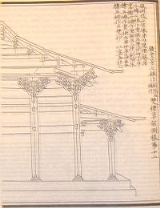
Chinese architecture

Encyclopedia

Architecture
Architecture is both the process and product of planning, designing and construction. Architectural works, in the material form of buildings, are often perceived as cultural and political symbols and as works of art...
that has taken shape in East Asia
East Asia
East Asia or Eastern Asia is a subregion of Asia that can be defined in either geographical or cultural terms...
over many centuries. The structural principles of Chinese
China
Chinese civilization may refer to:* China for more general discussion of the country.* Chinese culture* Greater China, the transnational community of ethnic Chinese.* History of China* Sinosphere, the area historically affected by Chinese culture...
architecture
Architecture
Architecture is both the process and product of planning, designing and construction. Architectural works, in the material form of buildings, are often perceived as cultural and political symbols and as works of art...
have remained largely unchanged, the main changes being only the decorative details. Since the Tang Dynasty
Tang Dynasty
The Tang Dynasty was an imperial dynasty of China preceded by the Sui Dynasty and followed by the Five Dynasties and Ten Kingdoms Period. It was founded by the Li family, who seized power during the decline and collapse of the Sui Empire...
, Chinese architecture has had a major influence on the architectural styles of Korea
Korea
Korea ) is an East Asian geographic region that is currently divided into two separate sovereign states — North Korea and South Korea. Located on the Korean Peninsula, Korea is bordered by the People's Republic of China to the northwest, Russia to the northeast, and is separated from Japan to the...
, Vietnam
Vietnam
Vietnam – sometimes spelled Viet Nam , officially the Socialist Republic of Vietnam – is the easternmost country on the Indochina Peninsula in Southeast Asia. It is bordered by China to the north, Laos to the northwest, Cambodia to the southwest, and the South China Sea –...
, and Japan
Japan
Japan is an island nation in East Asia. Located in the Pacific Ocean, it lies to the east of the Sea of Japan, China, North Korea, South Korea and Russia, stretching from the Sea of Okhotsk in the north to the East China Sea and Taiwan in the south...
.
The following article gives a cursory explanation of traditional Chinese architecture, before the introduction of Western building methods during the early 20th century. Throughout the 20th Century, however, Western-trained Chinese architects have attempted to combine traditional Chinese designs into modern architecture
Modern architecture
Modern architecture is generally characterized by simplification of form and creation of ornament from the structure and theme of the building. It is a term applied to an overarching movement, with its exact definition and scope varying widely...
(usually government), with only limited success. Moreover, the pressure for urban development throughout contemporary China
China
Chinese civilization may refer to:* China for more general discussion of the country.* Chinese culture* Greater China, the transnational community of ethnic Chinese.* History of China* Sinosphere, the area historically affected by Chinese culture...
required higher speed of construction and higher floor area ratio
Floor Area Ratio
The floor area ratio or floor space index is the ratio of the total floor area of buildings on a certain location to the size of the land of that location, or the limit imposed on such a ratio....
, which means that in the great cities the demand for traditional Chinese buildings, which are normally less than 3 levels, has declined in favor of modern architecture. However, the traditional skills of Chinese architecture, including major and minor carpentry
Carpentry
A carpenter is a skilled craftsperson who works with timber to construct, install and maintain buildings, furniture, and other objects. The work, known as carpentry, may involve manual labor and work outdoors....
, masonry
Masonry
Masonry is the building of structures from individual units laid in and bound together by mortar; the term masonry can also refer to the units themselves. The common materials of masonry construction are brick, stone, marble, granite, travertine, limestone; concrete block, glass block, stucco, and...
, and stonemasonry
Stonemasonry
The craft of stonemasonry has existed since the dawn of civilization - creating buildings, structures, and sculpture using stone from the earth. These materials have been used to construct many of the long-lasting, ancient monuments, artifacts, cathedrals, and cities in a wide variety of cultures...
, are still applied to the construction of vernacular architecture in the vast rural area in China.
Features

Architectural bilateral symmetry
An important feature in Chinese architecture is its emphasis on articulationArticulation (architecture)
Articulation, in art and architecture, is a method of styling the joints in the formal elements of architectural design. Through degrees of articulation, each part is united with the whole work by means of a joint in such a way that the joined parts are put together in styles ranging from...
and bilateral symmetry, which signifies balance. Bilateral symmetry and the articulation of buildings are found everywhere in Chinese architecture, from palace complexes to humble farmhouses. When possible, plans for renovation and extension of a house will often try to maintain this symmetry provided that there is enough capital to do so. Secondary elements are positioned either side of main structures as two wings to maintain overall bilateral symmetry.
In contrast to the buildings, Chinese gardens are a notable exception which tends to be asymmetrical. The principle underlying the garden's composition is to create enduring flow.
Enclosure
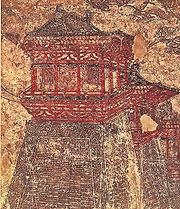
The use of open courtyards is a common feature in many types of Chinese architectures. This is best exemplified in the Siheyuan
Siheyuan
A siheyuan is a historical type of residence that was commonly found throughout China, most famously in Beijing. In English, siheyuan are sometimes referred to as Chinese quadrangles. The name literally means a courtyard surrounded by four buildings...
, which consists of an empty space surrounded by buildings connected with one another either directly or through verandas.
Although large open courtyards are less commonly found in southern Chinese architecture, the concept of a "open space" surrounded by buildings, which is seen in northern courtyard complexes, can be seen in the southern building structure known as the "sky well". This structure is essentially a relatively enclosed courtyard formed from the intersections of closely spaced buildings and offer small opening to the sky through the roof space from the floor up.
These enclosures serve in temperature regulation and in venting the building complexes. Northern courtyards are typically open and facing the south to allow the maximum exposure of the building windows and walls to the sun while keeping the cold northern winds out. Southern sky wells are relatively small and serves to collect rain water from the roof tops while restricting the amount of sunlight that enters the building. Sky wells also serve as vents for rising hot air, which draws cool air from the lowers stories of the house and allows for exchange of cool air with the outside.
Hierarchical
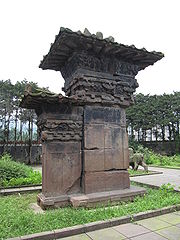
As well, building in the rear and more private parts of the property are held in higher esteem and reserve for elder members of the family or ancestral plaques than buildings near the front, which are typically for servants and hired help.
Front-facing buildings in the back of properties are used particularly for rooms of celebratory rites and for the placement of ancestral halls and plaques. In multiple courtyard complexes, central courtyards and their buildings are considered more important than peripheral ones, the latter typically being used as storage or servant's rooms or kitchens.
Horizontal emphasis
Classical Chinese buildings, especially those of the wealthy are built with an emphasis on breadth and less on height, with close heavy platform and a large roof that floats over this base, with the vertical walls not well emphasized. This contrasts Western architecture, which tends to grow in height and depth. Chinese architecture stresses the visual impact of the width of the buildings.The halls and palaces in the Forbidden City
Forbidden City
The Forbidden City was the Chinese imperial palace from the Ming Dynasty to the end of the Qing Dynasty. It is located in the middle of Beijing, China, and now houses the Palace Museum...
, for example, have rather low ceilings when compared to equivalent stately buildings in the West, but their external appearances suggest the all-embracing nature of imperial China. These ideas have found their way into modern Western architecture, for example through the work of Jørn Utzon
Jørn Utzon
Jørn Oberg Utzon, , AC was a Danish architect, most notable for designing the Sydney Opera House in Australia. When it was declared a World Heritage Site on 28 June 2007, Utzon became only the second person to have received such recognition for one of his works during his lifetime...
. This of course does not apply to pagoda
Pagoda
A pagoda is the general term in the English language for a tiered tower with multiple eaves common in Nepal, India, China, Japan, Korea, Vietnam and other parts of Asia. Some pagodas are used as Taoist houses of worship. Most pagodas were built to have a religious function, most commonly Buddhist,...
s, which are limited to religious building complexes.
Cosmological concepts
Chinese architecture from early times used concepts from Chinese cosmology such as feng shuiFeng shui
Feng shui ' is a Chinese system of geomancy believed to use the laws of both Heaven and Earth to help one improve life by receiving positive qi. The original designation for the discipline is Kan Yu ....
(geomancy) and Taoism
Taoism
Taoism refers to a philosophical or religious tradition in which the basic concept is to establish harmony with the Tao , which is the mechanism of everything that exists...
to organize construction and layout from common residences to imperial and religious structures. This includes the use of:
- Screen walls to face the main entrance of the house, which stems from the belief that evil things travel in straight lines.
- Talismans and imagery of good fortune:
- Door godDoor godA door god is a Chinese decoration placed on each side of an entry to a temple, home, business, etc., which is believed to keep evil spirits from entering....
s displayed on doorways to ward off evil and encourage the flow of good fortune - Three anthropomorphic figures representing Fu Lu ShouFu Lu ShouFu Lu Shou refers to the concept of Good Fortune , Prosperity , and Longevity . This Taoist concept is thought to date back to the Ming Dynasty, when the Fu Star, Lu Star and Shou Star were considered to be personified deities of these attributes respectively...
(福祿壽 fú-lù-shòu) stars are prominently displayed, sometimes with the proclamation "the threes star are present" (三星在 sān-xīng-zài) - Animals and fruits that symbolize good fortune and prosperity, such as batBatBats are mammals of the order Chiroptera "hand" and pteron "wing") whose forelimbs form webbed wings, making them the only mammals naturally capable of true and sustained flight. By contrast, other mammals said to fly, such as flying squirrels, gliding possums, and colugos, glide rather than fly,...
s and pomegranates, respectively. The association is often done through rebusRebusA rebus is an allusional device that uses pictures to represent words or parts of words. It was a favourite form of heraldic expression used in the Middle Ages to denote surnames, for example in its basic form 3 salmon fish to denote the name "Salmon"...
es.
- Door god
- Orienting the structure with its back to elevated landscape and ensuring that there is water in the front. Considerations are also made such that the generally windowless back of the structure faces the north, where the wind is coldest in the winter
- Ponds, pools, wells, and other water sources are usually built into the structure
The use of certain colors, numbers and the cardinal directions in traditional Chinese architecture reflected the belief in a type of immanence
Immanence
Immanence refers to philosophical and metaphysical theories of divine presence, in which the divine is seen to be manifested in or encompassing of the material world. It is often contrasted with theories of transcendence, in which the divine is seen to be outside the material world...
, where the nature of a thing could be wholly contained in its own form. Although the Western tradition gradually developed a body of architectural literature, little was written on the subject in China, and the earliest text, the Kaogongji
Kaogongji
Kaogong ji or The Records of Examination of Craftsman, sometimes translated as Book of Diverse Crafts, is a classic work on science and technology in Ancient China, compiled towards the end of the Spring and Autumn Period.- External links :...
, was never disputed. However, ideas about cosmic harmony and the order of the city were usually interpreted at their most basic level, so a reproduction of the "ideal" city never existed. Beijing
Beijing
Beijing , also known as Peking , is the capital of the People's Republic of China and one of the most populous cities in the world, with a population of 19,612,368 as of 2010. The city is the country's political, cultural, and educational center, and home to the headquarters for most of China's...
as reconstructed throughout the 15th and 16th century remains one of the best examples of traditional Chinese town planning.
Structure
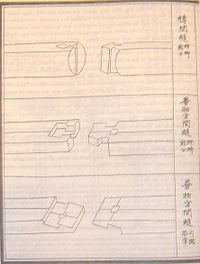
- Use of large structural timbers for primary support of the roof of a building. Wooden timber, usually large trimmed logs, are used as load-bearing columns and lateral beams for framing buildings and supporting the roofs. These structural timbers are prominently displayed in finished structures. However, it is not known how the ancient builders raised the huge wooden load bearing columns into position.
Although structural walls are also commonly found in Chinese architecture, most timber framed architecture are preferred when economically feasible.
- Timber frames are typically constructed with jointnary and doweling alone, seldom with the use of glue or nails. Structural stability is further ensured through the use of heavy beams and roofs, which weighs the structure down.
- Using even numbers of columns in a building structure to produce odd numbers of bays (間). With the inclusion of a main door to a building in the centre bay, symmetry is maintained
- The common use of curtain walls or door panels to delineate rooms or enclose a building, with the general deemphasis of load-bearing walls in most higher class construction
- Flat roofs are uncommon while gableGableA gable is the generally triangular portion of a wall between the edges of a sloping roof. The shape of the gable and how it is detailed depends on the structural system being used and aesthetic concerns. Thus the type of roof enclosing the volume dictates the shape of the gable...
d roofs are almost omnipresent in traditional Chinese architecture. Three main types of roofs are found- Straight inclined: Roofs with a single incline. These are the most economical type of roofing and are most prevalent in commoner architectures
- Multi-inclined: Roofs with 2 or more sections of incline. These roofs are used in higher class constructions, from the dwellings of wealthy commoners to palaces
- Sweeping: Roofs with a sweeping curvature that rises at the corners of the roof. The types of roof construction are usually reserved for temples and palaces although it may also be found in the homes of the wealthy. In the former cases, the ridges of the roof are usually highly decorated with ceramic figurines.
- The roof apex of a large hall is usually topped with a ridge of tiles for both decorative purposes but also to weight down the layers of roofing tiles for stability. These ridges are often well decorated, especially for religious or palatial structures. In some regions of China, the ridges are sometimes extended or incorporated from the walls of the building to form matouqiang (horse-head walls), which serve as a fire deterrent from drifting embers.
Materials and history
Songyue Pagoda
The Songyue Pagoda , constructed in 523 AD, is located at the Songyue Monastery on Mount Song, in Henan province, China. Built during the Northern Wei Dynasty, this pagoda is one of the few intact sixth-century pagodas in China and is also the earliest known Chinese brick pagoda...
built in 523 is the oldest extant pagoda in China
Chinese pagoda
Chinese Pagodas are a traditional part of Chinese architecture. In addition to religious use, since ancient times Chinese pagodas have been praised for the spectacular views which they offer, and many famous poems in Chinese history attest to the joy of scaling pagodas.-History:The pagoda is...
; its use of brick
Brick
A brick is a block of ceramic material used in masonry construction, usually laid using various kinds of mortar. It has been regarded as one of the longest lasting and strongest building materials used throughout history.-History:...
instead of wood had much to do with its endurance throughout the centuries. From the Tang Dynasty
Tang Dynasty
The Tang Dynasty was an imperial dynasty of China preceded by the Sui Dynasty and followed by the Five Dynasties and Ten Kingdoms Period. It was founded by the Li family, who seized power during the decline and collapse of the Sui Empire...
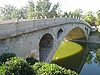
(618–907) onwards, brick and stone architecture gradually became more common and replaced wooden edifices. The earliest of this transition can be seen in building projects such as the Zhaozhou Bridge
Zhaozhou Bridge
The Anji Bridge is the world's oldest open-spandrel stone segmental arch bridge. Credited to the design of a craftsman named Li Chun, the bridge was constructed in the years 595-605 during the Sui Dynasty...
completed in 605 or the Xumi Pagoda
Xumi Pagoda
The Xumi Pagoda or Sumeru Pagoda, also known as Summer Pagoda is a Chinese pagoda of the Buddhist Kaiyuan Monastery west of Zhengding, Hebei province, China. This square-base stone and brick pagoda was built in the year 636 AD during the reign of Emperor Taizong of the Tang Dynasty...
built in 636, yet stone and brick architecture is known to have been used in subterranean tomb architecture of earlier dynasties.
In the early 20th century, there were no known fully wood-constructed Tang Dynasty buildings that still existed; the oldest so far discovered was the 1931 find of Guanyin Pavilion at Dule Monastery, dated 984 during the Song. This was until the architectural historians Liang Sicheng
Liang Sicheng
Liang Sicheng was the son of Liang Qichao, a well-known Chinese thinker in the late Qing Dynasty. Liang Sicheng returned to China from the United States after studying at the University of Pennsylvania...
(1901–1972), Lin Huiyin (1904–1955), Mo Zongjiang (1916–1999), and Ji Yutang (1902–c. 1960s) discovered that the Great East Hall of Foguang Temple
Foguang Temple
Foguang Temple is a Buddhist temple located five kilometres from Doucun, Wutai County, Shanxi Province of China. The major hall of the temple is the Great East Hall, built in 857 AD, during the Tang Dynasty . According to architectural records, it is the third earliest preserved timber structure...
on Mount Wutai in Shanxi
Shanxi
' is a province in Northern China. Its one-character abbreviation is "晋" , after the state of Jin that existed here during the Spring and Autumn Period....
was reliably dated to the year 857 in June 1937. The groundfloor dimensions for this monastic hall measures 34 by 17.66 m (111 ft by 57 ft). A year after the discovery at Foguang, the main hall of nearby Nanchan Temple
Nanchan Temple
Nanchan Temple is a Buddhist temple located near the town of Doucun on Wutaishan, Shanxi Province, China. Nanchan Temple was built in 782 CE during China's Tang Dynasty, and its Great Buddha Hall is currently China's oldest preserved timber building that is still extant, as wooden buildings are...
on Mount Wutai was reliably dated to the year 782, while a total of six Tang era wooden buildings have been found by the 21st century. The oldest existent fully wooden pagoda that has survived intact is the Pagoda of Fogong Temple
Pagoda of Fogong Temple
The Sakyamuni Pagoda of Fogong Temple of Ying County, Shanxi province, China, is a wooden Chinese pagoda built in 1056, during the Khitan-led Liao Dynasty. The pagoda was built by Emperor Daozong of Liao at the site of his grandmother's family home...
of the Liao Dynasty
Liao Dynasty
The Liao Dynasty , also known as the Khitan Empire was an empire in East Asia that ruled over the regions of Manchuria, Mongolia, and parts of northern China proper between 9071125...
, located in Ying County of Shanxi. While the East Hall of Foguang Temple features only seven types of bracket arms
Dougong
Dougong is a unique structural element of interlocking wooden brackets, one of the most important elements in traditional Chinese architecture....
in its construction, the 11th century Pagoda of Fogong Temple features a total of fifty-four.
The earliest walls and platforms in China were of rammed earth
Rammed earth
Rammed earth, also known as taipa , tapial , and pisé , is a technique for building walls using the raw materials of earth, chalk, lime and gravel. It is an ancient building method that has seen a revival in recent years as people seek more sustainable building materials and natural building methods...
construction, and over time, brick and stone became more frequently used. This can be seen in ancient sections of the Great Wall of China
Great Wall of China
The Great Wall of China is a series of stone and earthen fortifications in northern China, built originally to protect the northern borders of the Chinese Empire against intrusions by various nomadic groups...
, while the brick and stone Great Wall seen today is a renovation of the Ming Dynasty
Ming Dynasty
The Ming Dynasty, also Empire of the Great Ming, was the ruling dynasty of China from 1368 to 1644, following the collapse of the Mongol-led Yuan Dynasty. The Ming, "one of the greatest eras of orderly government and social stability in human history", was the last dynasty in China ruled by ethnic...
(1368–1644).
Classification by structure
Chinese language
The Chinese language is a language or language family consisting of varieties which are mutually intelligible to varying degrees. Originally the indigenous languages spoken by the Han Chinese in China, it forms one of the branches of Sino-Tibetan family of languages...
classifications for architecture include:
- 亭 ting (Chinese pavilionChinese pavilion.Chinese Pavilions are covered structures without surrounding walls and are a traditional part of Chinese architecture. While often found within temples, pavilions are not exclusively religious structures...
s) - 臺 tai (terraceTerrace (building)A terrace is an outdoor, occupiable extension of a building above ground level. Although its physical characteristics may vary to a great degree, a terrace will generally be larger than a balcony and will have an "open-top" facing the sky...
s) - 樓 lou (Multistory buildings)
- 閣 ge (Two-story pavilionsChinese pavilion.Chinese Pavilions are covered structures without surrounding walls and are a traditional part of Chinese architecture. While often found within temples, pavilions are not exclusively religious structures...
)
- 軒 (轩) xuan (Verandas with windows)VerandahA veranda or verandah is a roofed opened gallery or porch. It is also described as an open pillared gallery, generally roofed, built around a central structure...
- 塔 ta (Chinese pagodaChinese pagodaChinese Pagodas are a traditional part of Chinese architecture. In addition to religious use, since ancient times Chinese pagodas have been praised for the spectacular views which they offer, and many famous poems in Chinese history attest to the joy of scaling pagodas.-History:The pagoda is...
s) - 榭 xie (Pavilions or houses on terraces)
- 屋 wu (Rooms along roofed corridors)
- 斗拱 dougongDougongDougong is a unique structural element of interlocking wooden brackets, one of the most important elements in traditional Chinese architecture....
interlocking wooden bracketsBracket (architecture)A bracket is an architectural member made of wood, stone, or metal that overhangs a wall to support or carry weight. It may also support a statue, the spring of an arch, a beam, or a shelf. Brackets are often in the form of scrolls, and can be carved, cast, or molded. They can be entirely...
, often used in clusters to support roofs and add ornamentation. - 藻井 CaissonCaisson (Asian architecture)The Caisson , also referred to as a caisson ceiling, or spider web ceiling, in East Asian architecture is an architectural feature typically found in the ceiling of temples and palaces, usually at the centre and directly above the main throne, seat, or religious figure.The caisson is generally a...
domed or coffered ceiling
Commoner
The houses of commoners, be they bureaucrats, merchants or farmers, tended to follow a set pattern: the center of the building would be a shrine for the deities and the ancestors, which would also be used during festivities. On its two sides were bedrooms for the elders; the two wings of the building (known as "guardian dragons" by the Chinese) were for the junior members of the family, as well as the living room, the dining room, and the kitchen, although sometimes the living room could be very close to the center.Sometimes the extended families became so large that one or even two extra pairs of "wings" had to be built. This resulted in a U-shaped building, with a courtyard suitable for farm work; merchants and bureaucrats, however, preferred to close off the front with an imposing front gate. All buildings were legally regulated, and the law held that the number of storeys, the length of the building and the colours used depended on the owner's class. Some commoners living in areas plagued by bandits built communal fortresses called Tulou
Tulou
A tulou , or "earthen building", is a traditional communal residence in the Fujian province of Southern China, usually of a circular configuration surrounding a central shrine...
for protection.
Imperial
There were certain architectural features that were reserved solely for buildings built for the Emperor of ChinaEmperor of China
The Emperor of China refers to any sovereign of Imperial China reigning between the founding of Qin Dynasty of China, united by the King of Qin in 221 BCE, and the fall of Yuan Shikai's Empire of China in 1916. When referred to as the Son of Heaven , a title that predates the Qin unification, the...
. One example is the use of yellow roof tiles, yellow having been the Imperial color; yellow roof tiles still adorn most of the buildings within the Forbidden City
Forbidden City
The Forbidden City was the Chinese imperial palace from the Ming Dynasty to the end of the Qing Dynasty. It is located in the middle of Beijing, China, and now houses the Palace Museum...
. The Temple of Heaven
Temple of Heaven
The Temple of Heaven, literally the Altar of Heaven is a complex of Taoist buildings situated in the southeastern part of central Beijing. The complex was visited by the Emperors of the Ming and Qing dynasties for annual ceremonies of prayer to Heaven for good harvest...
, however, uses blue roof tiles to symbolize the sky. The roofs are almost invariably supported by bracket
Bracket (architecture)
A bracket is an architectural member made of wood, stone, or metal that overhangs a wall to support or carry weight. It may also support a statue, the spring of an arch, a beam, or a shelf. Brackets are often in the form of scrolls, and can be carved, cast, or molded. They can be entirely...
s ("dougong
Dougong
Dougong is a unique structural element of interlocking wooden brackets, one of the most important elements in traditional Chinese architecture....
"), a feature shared only with the largest of religious buildings. The wooden columns of the buildings, as well as the surface of the walls, tend to be red in color. Black is also a famous color often used in pagodas. It was believed that the gods are inspired by the black color to descend to the earth.
The Chinese five-clawed dragon, adopted by the first Ming emperor for his personal use, was used as decoration on the beams, pillars, and on the doors on Imperial architecture. Curiously, the dragon was never used on roofs of imperial buildings.
Only the buildings used by the imperial family were allowed to have nine jian (間, space between two columns); only the gates used by the Emperor
Emperor of China
The Emperor of China refers to any sovereign of Imperial China reigning between the founding of Qin Dynasty of China, united by the King of Qin in 221 BCE, and the fall of Yuan Shikai's Empire of China in 1916. When referred to as the Son of Heaven , a title that predates the Qin unification, the...
could have five arches, with the centre one, of course, being reserved for the Emperor himself. The ancient Chinese favored the color red
Red
Red is any of a number of similar colors evoked by light consisting predominantly of the longest wavelengths of light discernible by the human eye, in the wavelength range of roughly 630–740 nm. Longer wavelengths than this are called infrared , and cannot be seen by the naked eye...
. The buildings faced south because the north had a cold wind.
Beijing
Beijing
Beijing , also known as Peking , is the capital of the People's Republic of China and one of the most populous cities in the world, with a population of 19,612,368 as of 2010. The city is the country's political, cultural, and educational center, and home to the headquarters for most of China's...
became the capital of China after the Mongol invasion of the 13th century, completing the easterly migration of the Chinese capital begun since the Jin dynasty. The Ming
Ming Dynasty
The Ming Dynasty, also Empire of the Great Ming, was the ruling dynasty of China from 1368 to 1644, following the collapse of the Mongol-led Yuan Dynasty. The Ming, "one of the greatest eras of orderly government and social stability in human history", was the last dynasty in China ruled by ethnic...
uprising in 1368 reasserted Chinese authority and fixed Beijing as the seat of imperial power for the next five centuries. The Emperor and the Empress lived in palaces on the central axis of the Forbidden City
Forbidden City
The Forbidden City was the Chinese imperial palace from the Ming Dynasty to the end of the Qing Dynasty. It is located in the middle of Beijing, China, and now houses the Palace Museum...
, the Crown Prince
Crown Prince
A crown prince or crown princess is the heir or heiress apparent to the throne in a royal or imperial monarchy. The wife of a crown prince is also titled crown princess....
at the eastern side, and the concubines at the back (therefore the numerous imperial concubines were often referred to as "The Back Palace Three Thousand"). However, during the mid-Qing Dynasty
Qing Dynasty
The Qing Dynasty was the last dynasty of China, ruling from 1644 to 1912 with a brief, abortive restoration in 1917. It was preceded by the Ming Dynasty and followed by the Republic of China....
, the Emperor's residence was moved to the western side of the complex. It is misleading to speak of an axis in the Western sense of a visual perspective
Perspective (visual)
Perspective, in context of vision and visual perception, is the way in which objects appear to the eye based on their spatial attributes; or their dimensions and the position of the eye relative to the objects...
ordering facades, rather the Chinese axis is a line of privilege, usually built upon, regulating access - there are no vistas, but a series of gates and pavilions.
Numerology
Numerology
Numerology is any study of the purported mystical relationship between a count or measurement and life. It has many systems and traditions and beliefs...
heavily influenced Imperial Architecture, hence the use of nine in much of construction (nine being the greatest single digit number) and the reason why the Forbidden City in Beijing is said to have 9,999.9 rooms - just short of the mythical 10,000 rooms in heaven. The importance of the East (the direction of the rising sun) in orienting and siting Imperial buildings is a form of solar worship found in many ancient cultures, where there is the notion of Ruler being affiliated with the Sun.
The tombs and mausoleums of imperial family members, such as the 8th century Tang Dynasty
Tang Dynasty
The Tang Dynasty was an imperial dynasty of China preceded by the Sui Dynasty and followed by the Five Dynasties and Ten Kingdoms Period. It was founded by the Li family, who seized power during the decline and collapse of the Sui Empire...
tombs at the Qianling Mausoleum
Qianling Mausoleum
The Qianling Mausoleum is a Tang Dynasty tomb site located in Qian County, Shaanxi province, China, and is northwest from Xi'an, formerly the Tang capital. Built by 684 , the tombs of the mausoleum complex house the remains of various members of the royal Li family. This includes Emperor...
, can also be counted as part of the imperial tradition in architecture. These above-ground earthen mounds and pyramids had subterranean shaft-and-vault structures that were lined with brick walls since at least the Warring States (481–221 BCE).
Religious
Generally speaking, BuddhistBuddhism
Buddhism is a religion and philosophy encompassing a variety of traditions, beliefs and practices, largely based on teachings attributed to Siddhartha Gautama, commonly known as the Buddha . The Buddha lived and taught in the northeastern Indian subcontinent some time between the 6th and 4th...
architecture follows the imperial style. A large Buddhist monastery normally has a front hall, housing the statue of a Bodhisattva
Bodhisattva
In Buddhism, a bodhisattva is either an enlightened existence or an enlightenment-being or, given the variant Sanskrit spelling satva rather than sattva, "heroic-minded one for enlightenment ." The Pali term has sometimes been translated as "wisdom-being," although in modern publications, and...
, followed by a great hall, housing the statues of the Buddhas
Buddhahood
In Buddhism, buddhahood is the state of perfect enlightenment attained by a buddha .In Buddhism, the term buddha usually refers to one who has become enlightened...
. Accommodations for the monks and the nuns are located at the two sides. Some of the greatest examples of this come from the 18th century Puning Temple
Puning Temple
The Punning Temple , or Temple of Universal Peace of Chengde, Hebei province, China is a Qing Dynasty era Buddhist temple complex built in 1755, during the reign of the Qianlong Emperor to show the Qing's respect to the ethnic minorities...
and Putuo Zongcheng Temple
Putuo Zongcheng Temple
The Putuo Zongcheng Temple of Chengde, Hebei province, China is a Qing Dynasty era Buddhist temple complex built between 1767 and 1771, during the reign of the Qianlong Emperor . It is located near the Chengde Mountain Resort, which is south of the Putuo Zongcheng. Along with the equally famed...
. Buddhist monasteries sometimes also have pagoda
Pagoda
A pagoda is the general term in the English language for a tiered tower with multiple eaves common in Nepal, India, China, Japan, Korea, Vietnam and other parts of Asia. Some pagodas are used as Taoist houses of worship. Most pagodas were built to have a religious function, most commonly Buddhist,...
s, which may house the relics of the Gautama Buddha
Gautama Buddha
Siddhārtha Gautama was a spiritual teacher from the Indian subcontinent, on whose teachings Buddhism was founded. In most Buddhist traditions, he is regarded as the Supreme Buddha Siddhārtha Gautama (Sanskrit: सिद्धार्थ गौतम; Pali: Siddhattha Gotama) was a spiritual teacher from the Indian...
; older pagodas tend to be four-sided, while later pagodas usually have eight sides.
Daoist architecture, on the other hand, usually follows the commoners' style. The main entrance is, however, usually at the side, out of superstition
Superstition
Superstition is a belief in supernatural causality: that one event leads to the cause of another without any process in the physical world linking the two events....
about demon
Demon
call - 1347 531 7769 for more infoIn Ancient Near Eastern religions as well as in the Abrahamic traditions, including ancient and medieval Christian demonology, a demon is considered an "unclean spirit" which may cause demonic possession, to be addressed with an act of exorcism...
s which might try to enter the premise (see feng shui
Feng shui
Feng shui ' is a Chinese system of geomancy believed to use the laws of both Heaven and Earth to help one improve life by receiving positive qi. The original designation for the discipline is Kan Yu ....
.) In contrast to the Buddhists, in a Daoist temple the main deity is located in the main hall at the front, the lesser deities in the back hall and at the sides.
The tallest pre-modern building in China was built for both religious and martial purposes. The Liaodi Pagoda
Liaodi Pagoda
The Liaodi Pagoda of Kaiyuan Monastery, Dingzhou, Hebei Province, China is the tallest existing pre-modern Chinese pagoda and tallest brick pagoda in the world, built in the 11th century during the Song Dynasty . The pagoda stands at a height of , resting on a large platform with an octagonal base...
of 1055 AD stands at a height of 84 m (275 ft), and although it served as the crowning pagoda of the Kaiyuan
Kaiyuan
Kaiyuan may refer to:Places* Kaiyuan, Liaoning , a county-level city in Liaoning, China* Kaiyuan, Yunnan , a county-level city in Yunnan* Kaiyuan Subdistrict, Xiamen , a subdistrict in Siming District, Xiamen, Fujian...
monastery in old Dingzhou, Hebei
Hebei
' is a province of the People's Republic of China in the North China region. Its one-character abbreviation is "" , named after Ji Province, a Han Dynasty province that included what is now southern Hebei...
, it was also used as a military watchtower
Watchtower
A watchtower is a type of fortification used in many parts of the world. It differs from a regular tower in that its primary use is military, and from a turret in that it is usually a freestanding structure. Its main purpose is to provide a high, safe place from which a sentinel or guard may...
for Song Dynasty
Song Dynasty
The Song Dynasty was a ruling dynasty in China between 960 and 1279; it succeeded the Five Dynasties and Ten Kingdoms Period, and was followed by the Yuan Dynasty. It was the first government in world history to issue banknotes or paper money, and the first Chinese government to establish a...
soldiers to observe potential Liao Dynasty
Liao Dynasty
The Liao Dynasty , also known as the Khitan Empire was an empire in East Asia that ruled over the regions of Manchuria, Mongolia, and parts of northern China proper between 9071125...
enemy movements.
The architecture of the mosques and gongbei tomb shrines of China's Muslims
Islam in China
Throughout the history of Islam in China, Chinese Muslims have influenced the course of Chinese history. Chinese Muslims have been in China for the last 1,400 years of continuous interaction with Chinese society...
often combines traditional Chinese styles with Middle Eastern influences.
Urban planning
Chinese urban planning is based on fengshui geomancy and the well-field system of land division, both used since the Neolithic age. The basic well-field diagram is overlaid with the luoshu, a magic squareMagic square
In recreational mathematics, a magic square of order n is an arrangement of n2 numbers, usually distinct integers, in a square, such that the n numbers in all rows, all columns, and both diagonals sum to the same constant. A normal magic square contains the integers from 1 to n2...
divided into 9 sub-squares, and linked with Chinese numerology.
Miniature models
Although mostly only ruins of brickBrick
A brick is a block of ceramic material used in masonry construction, usually laid using various kinds of mortar. It has been regarded as one of the longest lasting and strongest building materials used throughout history.-History:...
and rammed earth
Rammed earth
Rammed earth, also known as taipa , tapial , and pisé , is a technique for building walls using the raw materials of earth, chalk, lime and gravel. It is an ancient building method that has seen a revival in recent years as people seek more sustainable building materials and natural building methods...
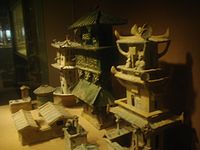
walls and towers from ancient China (i.e. before the 6th century AD) have survived, information on ancient Chinese architecture (especially wooden architecture) can be discerned from more or less realistic clay models of buildings
Scale model
A scale model is a physical model, a representation or copy of an object that is larger or smaller than the actual size of the object, which seeks to maintain the relative proportions of the physical size of the original object. Very often the scale model is used as a guide to making the object in...
created by the ancient Chinese as funerary items. This is similar to the paper joss
Joss paper
Joss paper , also known as ghost money, are sheets of paper and/or paper-crafts made into burnt offerings which are common in traditional Chinese religious practices including the veneration of the deceased on holidays and special occasions...
houses burned in some modern Chinese funerals. The following models were made during the Han Dynasty
Han Dynasty
The Han Dynasty was the second imperial dynasty of China, preceded by the Qin Dynasty and succeeded by the Three Kingdoms . It was founded by the rebel leader Liu Bang, known posthumously as Emperor Gaozu of Han. It was briefly interrupted by the Xin Dynasty of the former regent Wang Mang...
(202 BCE–AD 220):
During the Jin Dynasty (265–420) and the Six Dynasties
Six Dynasties
Six Dynasties is a collective noun for six Chinese dynasties during the periods of the Three Kingdoms , Jin Dynasty , and Southern and Northern Dynasties ....
, miniature models of buildings or entire architectural ensembles were often made to decorate the tops of the so-called "soul vases" (hunping
Hunping
A hunping is a ceramic funerary vessel often found in the tombs of the Han Dynasty and especially the Six Dynasties periods of China...
), found in many tombs of that period.
See also
- Architecture of the Song DynastyArchitecture of the Song DynastyThe architecture of the Song Dynasty was noted for its towering Buddhist pagodas, enormous stone and wooden bridges, lavish tombs, and palaces. Although literary works on architecture existed beforehand, architectural writing blossomed during the Song Dynasty, maturing into a more professional...
- Architecture of Hong KongArchitecture of Hong KongThe Architecture of Hong Kong features great emphasis on Contemporary architecture, specially Modernism, Postmodernism, Functionalism, etc. Due to the lack of available land, few historical buildings remain in the urban areas of Hong Kong. However, Hong Kong has become a centre for modern...
- Architecture of PenangArchitecture of PenangThe architecture of Penang reflects the 171 years of British presence on the island, coalescing with local, Chinese, Indian, Islamic and other elements to create a unique and distinctive brand of architecture. Along with Malacca, Penang is an architectural gem of Malaysia and Southeast Asia...
- Caisson (Asian architecture)Caisson (Asian architecture)The Caisson , also referred to as a caisson ceiling, or spider web ceiling, in East Asian architecture is an architectural feature typically found in the ceiling of temples and palaces, usually at the centre and directly above the main throne, seat, or religious figure.The caisson is generally a...
- Chinese artChinese artChinese art is visual art that, whether ancient or modern, originated in or is practiced in China or by Chinese artists or performers. Early so-called "stone age art" dates back to 10,000 BC, mostly consisting of simple pottery and sculptures. This early period was followed by a series of art...
- Chinese pagodas
- Architectural historyArchitectural HistoryArchitectural History is the main journal of the Society of Architectural Historians of Great Britain .The journal is published each autumn. The architecture of the British Isles is a major theme of the journal, although it includes more general papers on the history of architecture. Member of...
- Feng ShuiFeng shuiFeng shui ' is a Chinese system of geomancy believed to use the laws of both Heaven and Earth to help one improve life by receiving positive qi. The original designation for the discipline is Kan Yu ....
- Ancient Chinese wooden architectureAncient Chinese wooden architectureAncient Chinese wooden architecture is among the least studied of any of the world's great architectural traditions from the western point of view. Although Chinese architectural history reaches far back in time, descriptions of Chinese architecture are often confined to the well known Forbidden...
- Hakka architectureHakka architectureA Hakka walled village is a large multi-family communal living structure that is designed to be easily defensible. This building style is unique to the Hakka people found in southern China...
- HutongHutongHutongs are a type of narrow streets or alleys, most commonly associated with Beijing, China.In Beijing, hutongs are alleys formed by lines of siheyuan, traditional courtyard residences. Many neighbourhoods were formed by joining one siheyuan to another to form a hutong, and then joining one...
- Imperial roof decorationImperial roof decorationChinese imperial roof decoration or roof charms or roof-figures or or was only allowed on official buildings of the empire. Chinese roofs are typically of the hip roof type, with small gables...
- Imperial guardian lionsImperial guardian lionsChinese guardian lions, known as Shishi lions or Imperial guardian lion, and often incorrectly called "Foo Dogs" in the West, are a common representation of the lion in pre-modern China...
- Lingnan architecture
- PagodaPagodaA pagoda is the general term in the English language for a tiered tower with multiple eaves common in Nepal, India, China, Japan, Korea, Vietnam and other parts of Asia. Some pagodas are used as Taoist houses of worship. Most pagodas were built to have a religious function, most commonly Buddhist,...
- ShanghaiShanghaiShanghai is the largest city by population in China and the largest city proper in the world. It is one of the four province-level municipalities in the People's Republic of China, with a total population of over 23 million as of 2010...
- for a gallery of modern buildings - ShikumenShikumenShikumen , literally "stone gate", is an architectural style for residential buildings in Shanghai, China combining Western and Chinese elements that first appeared in the 1860s...
- SiheyuanSiheyuanA siheyuan is a historical type of residence that was commonly found throughout China, most famously in Beijing. In English, siheyuan are sometimes referred to as Chinese quadrangles. The name literally means a courtyard surrounded by four buildings...
- Walled villages of Hong KongWalled villages of Hong KongOnce common throughout China, walled villages can still be found in southern China and Hong Kong. Most of the walled villages in Hong Kong are located in the New Territories...
- Yu HaoYu HaoYu Hao was an eminent Chinese structural engineer and architect during the Song Dynasty period .-Legacy:Yu Hao was given the title of Master-Carpenter , for his architectural skill...
- Beijing city wallBeijing city wallThe city wall of Beijing was a fortification built around 1435. It was 23.5 km long. The thickness at ground level was 20m and the top 12m. The wall was 15m high, and it had nine gates. This wall stood for nearly 530 years, but in 1965 it was removed to give way to 2nd Ring Road and the loop...
- Precious Belt BridgePrecious Belt BridgeThe Precious Belt Bridge is a Chinese stone arch bridge located near the city of Suzhou, Jiangsu Province, China. The Precious Belt Bridge is located at the intersection of the Grand Canal and Dantai Lake, about 2.5 kilometer south east of Suzhou....
Further reading
- Fletcher, BanisterBanister FletcherSir Banister Flight Fletcher was an English architect and architectural historian, as was his father, also named Banister Fletcher....
; Cruickshank, Dan, Sir Banister Fletcher's a History of Architecture, Architectural Press, 20th edition, 1996 (first published 1896). ISBN 0750622679. Cf. Part Four, Chapter 24. - Sickman L and Soper A. The Art and Architecture of China (Penguin Books, 1956).
External links
- Yin Yu Tang: A Chinese Home To explore an in depth look into the ancient architecture of the Huang family’s domestic life in China, the Yin Yu Tang house offers an interactive view of the typical domestic architecture of the Qing dynasty.
- Herbert Offen Research Collection An excellent bibliography of publicly accessible books and manuscripts on Chinese architecture.
- Islamic Architecture in China Introduction to the Chinese Mosques in South, West, and North respectively
- Chinese Vernacular Architecture & General Chinese Architecture--Web Links Chinese Vernacular Architecture & General Chinese Architecture—Web Links
- Chinese Residential Houses Ten types of Chinese residential houses
- Asian Historical Architecture