

East-West Schism

Encyclopedia
The East–West Schism of 1054, sometimes known as the Great Schism, formally divided the State church of the Roman Empire
into Eastern (Greek) and Western (Latin) branches, which later became known as the Eastern Orthodox Church
and the Roman Catholic Church
, respectively. Relations between East and West had long been embittered by political and ecclesiastical differences
and theological disputes. Prominent among these were the issues of "filioque", whether leavened or unleavened bread
should be used in the Eucharist
, the Pope's claim to universal jurisdiction
, and the place of Constantinople in relation to the Pentarchy
.
Pope Leo IX
and Patriarch of Constantinople
Michael Cerularius heightened the conflict by suppressing Greek and Latin in their respective domains. In 1054, Roman legates
traveled to Cerularius to deny him the title Ecumenical Patriarch and to insist that he recognize the Church of Rome's claim to be the head and mother of the churches. Cerularius refused. The leader of the Latin contingent, Cardinal Humbert, excommunicated
Cerularius, while Cerularius in return excommunicated Cardinal Humbert and other legates.
The validity of the Western legates' act is doubtful, since Pope Leo had died, while Cerularius's excommunication applied only to the legates personally. Still, the Church split along doctrinal
, theological
, linguistic
, political
, and geographical
lines, and the fundamental breach has never been healed, with each side accusing the other of having fallen into heresy
and of having initiated the division. The Crusades
, the Massacre of the Latins
in 1182, the capture and sack of Constantinople in 1204, and the imposition of Latin Patriarchs made reconciliation more difficult. This included the taking of many precious religious artifacts and the destruction of the Library of Constantinople
.
On paper, at least from the Catholic viewpoint, the two churches were briefly reunited in 1274 (by the Second Council of Lyon
) and in 1439 (by the Council of Florence
), but in each case the councils were later repudiated by the Orthodox as a whole and never effected a reconciliation of the Eastern Orthodox with the Roman Catholic Church. In 1484, 31 years after the Fall of Constantinople
to the Ottoman Turks
, a Synod of Constantinople repudiated the Union of Florence, making official the position that had already been taken by Orthodox in general.
In 1965, the Pope Paul VI and the Ecumenical Patriarch of Constantinople Athenagoras I nullified the anathemas of 1054, although this was essentially a goodwill gesture and did not constitute any sort of reunion between churches. Contacts between the two sides continue: Every year a delegation from each joins in the other's celebration of its patronal feast, Saints Peter and Paul
(29 June) for Rome and Saint Andrew (30 November) for Constantinople, and there have been a number of visits by the head of each to the other. The efforts of the Ecumenical Patriarchs towards reconciliation with the Catholic Church have often been the target of sharp criticism from fellow Orthodox.
, part of the East (Western Anatolia) was in disagreement with Pope Victor I
over Quartodecimanism
, holding that Easter
(called Pascha in both Greek and Latin) should be celebrated at the full moon, like the Jewish Passover
, not on the following Sunday. See Easter controversy
for details.
") until after the First Council of Nicaea
(325).
The historian Will Durant
writes that, after Jerusalem, the church of Rome naturally became the primary church, the capital of Christianity. Rome had an early and significant Christian population. It was closely identified with Paul the Apostle, who preached and was martyr
ed there, and the Apostle Peter
, who was a martyr there as well; Peter was also considered chief among all the Apostles and the first Bishop of Rome. While the Eastern cities of Alexandria and Antioch produced theological works, the bishops of Rome focused on what Romans admittedly did best — administration.
In the early church, up until the ecumenical councils, Rome was regarded as an important center of Christianity
, especially since it was the capital of the Roman Empire. Bishops of churches in the eastern and southern Mediterranean generally recognized the persuasive leadership and authority of the Bishop of Rome. But these bishops did not acknowledge any juridical authority of Rome.
In the fourth century
, when the Roman emperors (reigning in Constantinople) were trying to control the Church, theological questions ran rampant throughout the Roman Empire. The influence of Greek speculative thought on Christian thinking led to all sorts of divergent and conflicting opinions. Theology was also used as a weapon against opponent bishops, because being branded a heretic
was the only sure way for a bishop to be removed by other bishops—incompetence was not sufficient grounds for removal.
often tried to adopt an imperious position over the other patriarchs. The opinion of the Bishop of Rome was often sought, especially when the patriarchs of the Eastern churches were locked in fractious dispute. The bishops of Rome never belonged to either the Antiochian or the Alexandrian schools of theology, and usually managed to steer a middle course between whatever extremes were being propounded by theologians of either school. Because Rome was remote from the centers of Christianity in the eastern empire, it was frequently hoped its bishop would be more impartial. For instance, in 431, Cyril, the patriarch of Alexandria, appealed to Pope Celestine I
, as well as the other patriarchs, charging Nestorius
with heresy, which was dealt with at the Council of Ephesus (431). However it was the Ecumenical council not the Pope that deposed Patriarch Nestorius.
The opinion of the bishop of Rome was always canvassed, and was often longed for. However the Bishop of Rome's opinion was not always accepted by all. For instance, the Tome of Leo of Rome was highly regarded, and formed the basis for the formulation of the Council of Chalcedon
(451). But it was not universally accepted and was even called "impious" and "blasphemous" by some. The next ecumenical council corrected a possible imbalance in Pope Leo's presentation. Although the Bishop of Rome was well respected even at this early date, the concept of the primacy of the Roman See and Papal Infallibility
were developed much later.
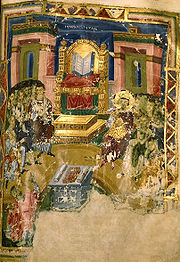 When the Roman Emperor Constantine the Great legalized Christianity, he summoned the First Ecumenical Council at Nicaea in 325 to resolve a number of issues which troubled the Church. The bishops at the council confirmed the position of the metropolitan sees of Rome and Alexandria as having authority outside their own province, and also the existing privileges of the churches in Antioch and the other provinces. Later, these sees were called Patriarchate
s and were given an order of precedence
: Rome
, though it was no longer capital of the empire, was given first place, then came Alexandria
and Antioch
. In a separate canon, the Council also approved the special honor given to Jerusalem
over other sees subject to the same metropolitan.
Soon, Constantine erected a new capital at Byzantium
, a strategically placed city on the Bosporus. Constantine named it "Nova Roma Constantinopolitana" (New Rome
City of Constantine),. Soon the local bishop's seat being established by Saint Andrew
was elevated to Patriarch under Constantine, as Metrophanes of Byzantium at the time occupied the bishops seat before the New Capital was established. Constantinople is often described as 'New Rome
', because it imitated Rome in many ways and became the new capital of the empire.
The Second Ecumenical Council, held at the new capital in 381, elevated the see of Constantinople to a position ahead of the other chief metropolitan sees, except that of Rome, which was stated to have the greatest honor. As the Pope was considered the first among equals
. Mentioning in particular the provinces of Asia, Pontus
and Thrace
, it decreed that the synod of each province should manage the ecclesiastical affairs of that province alone, except for the privileges already recognized for Alexandria
and Antioch
. In the Council of Chalcedon, held 70 years later, Constantinople was given power over Pontus and Thrace.
at Chalcedon
in 451 confirmed the authority already held by Constantinople. There were now five patriarchs presiding over the Church within the Byzantine Empire
, in the following order of precedence: the Patriarch of Rome, the Patriarch of Constantinople
, the Patriarch of Alexandria
, the Patriarch of Antioch
and the Patriarch of Jerusalem
(see Pentarchy
).
of 692 also led to pressure from the Eastern Empire to reject many Latin customs as non-Orthodox. The Latin practices that had developed in the Western branch of the Church that had got the attention of the other Patriarchates were condemned such as; the practice of celebrating Masses
on weekdays in Lent
(rather than having Pre-Sanctified Liturgies
); of fasting
on Saturdays throughout the year; of omitting the "Alleluia
" in Lent; of depicting Christ as a lamb
. Larger disputes were revealed regarding Eastern and Western attitudes toward celibacy
for priest
s and deacon
s, with the Council affirming the right of priests to marry and prescribing excommunication
for anyone who attempted to separate a clergyman from his wife, or for any cleric who abandoned his wife.
Pope Sergius I
protested against the council, and refused to sign the canons. At Sergius's
refusal, Justinian
dispatched a military delegation to Rome to induce Sergius
to sign; the imperial army at Ravenna, however, composed mainly of native Italians, rallied to support the Roman Pontiff, marching on Rome. Meanwhile, in Visigothic Spain
, the council was ratified by the Eighteenth Council of Toledo
at the urging of the king, Wittiza
, who was vilified by later chroniclers for his decision. Fruela I of Asturias
reversed the decision of Toledo sometime during his reign (757–768).
The Eastern Orthodox churches hold this council be part of the Fifth and Sixth Ecumenical Councils, adding its canons thereto.
famously divided the administration of the eastern and western portions of the Empire in the early 4th century, though subsequent leaders (including Constantine) aspired to and sometimes gained control of both regions. Theodosius the Great
, who established Christianity as the official religion of the Roman Empire, died in 395 and was the last Emperor to rule over a united Roman Empire. Following his death, the division into western and eastern halves, each under its own Emperor, became permanent. By the end of the 5th century, according to John Romanides the Western Roman Empire had been overrun by the Germanic tribes, while the Eastern Roman Empire (known also as the Byzantine Empire
) continued to thrive. Thus, the political unity of the Roman Empire was the first to fall. These Germanic tribes, particularly the Franks, influenced and changed the Latin Church.
In the West, as a practical matter, the collapse of civil government left the Church in charge in many areas, and bishops took to administering secular cities and domains. When royal and imperial rule reestablished itself, it had to contend with power wielded independently by the Church. In the East, however, imperial and, later, Islamic rule dominated the Eastern bishops.
, whilst that of the East was Greek
. Soon after the fall of the Western Empire, the number of individuals who spoke both Latin and Greek began to dwindle, and communication between East and West grew much more difficult. With linguistic unity gone, cultural unity began to crumble as well. The two halves of the Church were naturally divided along similar lines; they developed different rite
s and had different approaches to religious doctrines. Although the Great Schism was still centuries away, its outlines were already perceptible.
Following the Sack of Rome
by invading European Goths, Rome became increasingly isolated from the churches in the eastern and southern Mediterranean. This was a situation which suited and pleased many of the patriarchs and bishops of those churches.
According to John Romanides, the rise of the Frankish Empire
after the Goths
and the fall of the Western Roman Empire
saw the establishment of Frank Popes c. 700AD . These Frankish Popes were military leaders according to Saint Boniface
known to "shed the blood of Christians like that of the pagans."
The Eastern Orthodox theologian Romanides states that it was not until the rise of Charlemagne and his successors, and the influence of the Palatine School
established by the Englishman Alcuin (735-804), that the Church of Rome became almost exclusively committed to Augustinian theology.
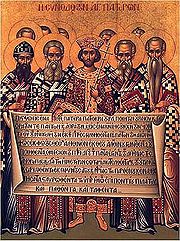 The primary causes of the Schism were disputes over conflicting claims of jurisdiction, in particular over papal authority
—Pope Leo IX
claimed he held authority over the four Eastern patriarch
s (see also Pentarchy
)—and over the insertion of the Filioque clause
into the Nicene Creed
by the Western patriarch in 1014. As also Pope Nicholas I
made it clear that he believed the power of the papacy extended "over all the earth, that is, over every church". Eastern Orthodox state that the 28th Canon of the Council of Chalcedon
explicitly proclaimed the equality of the Bishops of Rome and Constantinople, and that it established the highest court of ecclesiastical appeal in Constantinople.
Eastern Orthodox argue that the seventh canon of the Council of Ephesus explicitly prohibited modification of the Nicene Creed by any man (not by Ecumenical church council) drawn up by the first Ecumenical Council
in 325. The Council made this prohibition in light of the fact that the earlier second Ecumenical Council
, had already modified the Creed adopted at Nicaea, making additions such as "who proceeds from the Father". Eastern Orthodox theologians state this change of the wording of the churches' original creed, was done to address various teachings outside of the church in specific the Macedonius I of Constantinople
teaching which the council claimed was a distortion of the church's teaching on the Holy Spirit. This was not a change of the orthodoxy of the churches' original creed.
There were other less significant catalysts for the Schism however, including variance over liturgical
practices.
In Eastern Christendom the teaching of Papal Supremacy is called False Isidorean Decretals as it is based on the false documents of Christian canon law under the name Pseudo-Isidore
. The Orthodox East contests the teaching that Peter was the Patriarch of Rome as St. Irenaeus
says that Pope Linus
was the first bishop of Rome and Pope Cletus the second. It is generally conceded that St. Peter was bishop of Antioch who was then succeeded by Evodius and Ignatius
. The Eastern Orthodox do not hold the primacy of the Pope of Rome over the Eastern church; they teach that the Pope of Rome is the first among equals. The Seven Ecumenical Councils were held in the East and called by the Eastern Emperors, Roman pontiffs never presided over any of them.
and the replacing of him by Photius. The Pope in disagreement in 863 then held a synod at the Lateran
that reversed the Eastern Churches and the Emperor's action, and this was taken by the East as an unacceptable intervention of the Pope of Rome. The use of the Filioque was also condemned. Due to various conflicts arising during the replacement of Patriarch Ignatius of Constantinople by Photius, the Council of Constantinople 867 was convened via Photius, to address the question of Papal Supremacy over all of the churches and their patriarchs and the use of the Filioque. Pope Nicholas I was intervening in the appointing of Patriarchs in jurisdictions other than his own, (Patriarchs that were supposed to be equal to him) and in their confirmation process. At the time of the early church and these councils there were no other Patriarchs in the West other than Rome, whereas there were the four other Patriarchs of the East.
Pope Nicholas had attempted to remove Photius and reappoint Ignatius as the Patriarch of Constantinople by his own authority and decree. Thus the Pope was intervening in the matters of Imperial authority as well as the other churches of the East and their own internal councils and authorities, which they understood to be outside the Pope's own jurisdiction of Rome. The council of 867 was followed by the Council of Constantinople 869. The Council of Constantinople in 879 then restored the conclusions of the Council of 867. The Roman Catholic Church rejects the councils of 867 and 879 but accepts the council of 869. Pope Nicholas I
was deposed and the teaching of the Filioque was condemned in the council in 867. The Council at Constantinople in 867 excommunicated Pope Nicholas I
, who was then replaced by Pope Adrian II
(due to the death of Nicholas I), and rejected Nicholas' claims of primacy, his efforts to convert Bulgaria, and the addition of the Filioque in parts of the Latin Church.
were allied through the mediation of the Lombard
catepan of Italy, Argyrus, who had spent years in Constantinople, originally as a political prisoner.
Patriarch Michael I
ordered a letter to be written to the bishop of Trani in which he attacked the "Judaistic
" practices of the West, namely, the use of unleavened bread. The letter was to be sent by John to all the bishops of the West, including the Pope. John promptly complied, and the letter was passed to Humbert of Mourmoutiers
, the cardinal-bishop of Silva Candida, who translated the letter into Latin
and brought it to the Pope, who ordered a reply to be made to each charge and a defense of papal supremacy
to be laid out in a response.
Although he was hot-headed, Michael was convinced to cool the debate and thus attempt to prevent the impending breach. However, Humbert and the Pope made no concessions, and Humbert was sent with legatine powers to the imperial capital to resolve the questions raised, once and for all. Humbert, Frederick of Lorraine
, and Peter, Archbishop of Amalfi, arrived in April 1054 and were met with a hostile reception; they stormed out of the palace, leaving the papal response with Michael, who in turn was even more angered by their actions. The patriarch refused to recognize their authority or, practically, their existence. When Pope Leo died on 19 April 1054, the legates' authority legally ceased, but they effectively ignored this technicality.
In response to Michael's refusal to address the issues at hand, the legatine mission took the extreme measure of entering the church of the Hagia Sophia
during the Divine Liturgy and placing a bull of excommunication
on the altar.
The consummation of the East–West Schism is thus generally dated from the year 1054, when this sequence of events took place. However, these events only triggered the beginning of the schism, and it was not actually consummated by the seemingly mutual excommunications. The New Catholic Encyclopedia reports that the legates had been careful not to intimate that the bull of excommunication implied a general excommunication of the Byzantine Church. The bull excommunicated only Patriarch Michael I, Leo of Achrida, and their adherents. Thus, the New Catholic Encyclopedia argues that the dispute need not have produced a permanent schism any more than excommunication of any "contumacious bishop." The schism began to develop when all the other Eastern patriarchs supported Michael I. According to the New Catholic Encyclopedia, it was the support of Emperor Michael VI Stratiotikos that impelled them to support Michael I. Some have questioned the validity of the bull on the grounds that Pope Leo IX had died at that time and so the authority of the legates to issue such a bull is unclear.
The legates left for Rome two days after issuing the bull of excommunication, leaving behind a city near riot. The patriarch had the immense support of the people against the emperor, who had supported the legates to his own detriment. To assuage popular anger, the bull was burnt, and the legates were anathema
tized. Only the legates were anathematized and, in this case too, there was no explicit indication that the entire Western church was being anathematized.
The bull of excommunication issued against Patriarch Michael by the papal legates made 11 accusations against Michael and "the backers of his foolishness", beginning with that of promoting to the episcopacy men who have been castrated and of rebaptizing those already baptized in the name of the Trinity, and ending with the accusation of refusing communion and baptism to menstruating women and of refusing to be in communion with those who tonsure their heads and shave their beards. Denial of the procession of the Holy Spirit from the Son (with no mention of the Nicene Creed) is given seventh place in this list of eleven.
in Italy in 1089. This fluidity explains in part the different interpretations of the geographical line of division in the two maps given here, one drawn up in the West, the other in a country where Eastern Orthodoxy predominates. Areas such as the extreme south of Italy are interpreted variously as adhering to either East or West. And even in areas whose rulers took one position, there were some who gave their allegiance to the other side. An example is Kingdom of Hungary
, where the Roman Catholic Church was upheld by the crown from the time of Stephen I, but "monasteries and convents belonging to the Byzantine Church were founded sporadically in the eleventh century.
Efforts were made in subsequent centuries by Popes and Patriarchs to heal the rift between the churches. However, a number of factors and historical events worked to widen the separation over time.
captured and sacked Constantinople
in 1204, looting The Church of Holy Wisdom
and various other Orthodox holy sites, and converting them to Latin Catholic worship. Various holy artifacts from these Orthodox holy places were then taken to the West. The victors set up in what had been the empire's territory a number of feudal crusader states
, of which the most important was the Latin Empire
of Constantinople, thus initiating the period of Greek history known as Frangokratia
(dominion by the Franks). The break-up of the Byzantine Empire is seen as a factor that led to its conquest by Islam. The crusaders also appointed a Latin Patriarch of Constantinople
. An attempt by the Latin Empire to capture the city of Adrianople
, then a Bulgaria
n possession, was defeated in the Battle of Adrianople (1205)
.
In northern Europe, the Teutonic Knights
, after their successes in the northern crusades
, attempted to conquer also the Orthodox
Russia
n Republics of Pskov
and Novgorod
, an enterprise endorsed by Pope Gregory IX
. One of the major defeats they suffered was the Battle of the Ice
in 1242. Sweden
also undertook several campaigns against Orthodox Novgorod
. There were also conflicts between Catholic Poland
and Orthodox Russia. Such conflicts solidified the schism between East and West.
was convoked to act on a pledge by Byzantine emperor Michael VIII
to reunite the Western and Eastern churches. Wishing to end the Great Schism that divided Rome
and Constantinople
, Gregory X had sent an embassy to Michael VIII Palaeologus. On 29 June 1274, Gregory X celebrated a Mass
in St John's Church, where both sides took part. The council declared that the Roman church possessed “the supreme and full primacy and authority over the universal Catholic Church.” The council was seemingly a success, but did not provide a lasting solution to the schism; the Emperor was anxious to heal the schism, but the Eastern clergy proved to be obstinate. Michael VII's son and successor Andronicus II
repudiated the union.
In the 15th century, the eastern emperor John VIII Palaeologus, pressed hard by the Ottoman Turks
, was keen to ally himself with the West, and to do so he arranged with Pope Eugene IV
for discussions about reunion to be held again, this time at the Council of Ferrara-Florence. After several long discussions, the emperor managed to convince the Eastern representatives to accept the Western doctrines of Filioque, Purgatory and the supremacy of the Papacy. On 6 June 1439 an agreement was signed by all the Eastern bishops present but one, Mark of Ephesus
, who held that Rome continued in both heresy
and schism
. It seemed that the Great Schism had been ended. However, upon their return, the Eastern bishops found their agreement with the West broadly rejected by the populace and by civil authorities (with the notable exception of the Emperors of the East who remained committed to union until the Fall of Constantinople
two decades later). The union signed at Florence has never been accepted by the Eastern churches.
. But Orthodoxy was still very strong in Russia
which became autocephalous (since 1448, although this wasn't officially accepted by Constantinople until 1589); and thus Moscow
called itself the Third Rome
, as the cultural heir of Constantinople
.
Eastern Christians expressed a belief that the Fall of Constantinople was God's punishment for the Emperor and clergy accepting the West's doctrines of Filioque, Purgatory and the supremacy of the Papacy. The West did not fulfill its promise to the Eastern Emperor of troops and support if he agreed to the reconciliation. The Sack of Constantinople is still considered proof by the East that the West ultimately succeeded in its endeavor to destroy the East.
Under Ottoman rule, the Orthodox Church acquired power as an autonomous millet. The ecumenical patriarch was the religious and administrative ruler of the entire Rum Millet (Ottoman administrative unit), which encompassed all the Eastern Orthodox subjects of the Empire. Those appointed to the role were chosen by the Muslim State. In fact, Mehmed II
when he conquered the City formally assumed the legal function of the Byzantine Emperors, and the appointment of the patriarch Gennadius II. Mehmed and his agents did all they could to stamp out pro-Roman parties among the Greek Christians, and to that end Mehmed enormously strengthened the Greek church, as this helped to protect the Ottoman Sultunate from any united Christian foe.
As a result of the Ottoman conquest, the entire Orthodox communion of the Balkans and the Near East became suddenly isolated from the West. For the next four hundred years, it would be confined within the Islamic world, with which it had little in common religiously or culturally. The Russian Orthodox Church
and the Orthodox Churches from Wallachia
and Moldavia
were the only part of the Orthodox communion that remained outside the control of the Ottoman Empire.
contributed also to the growing authority of the Autocephalous Russian Church. In 1589, Metropolitan Job of Moscow became the first Patriarch of Moscow and All Rus'; making the Russian Church one of the five honorable Patriarchates.
However, in 1721 Tsar Peter I abolished completely the patriarchate and so the Church effectively became a department of the government, ruled by a Most Holy Synod composed of senior bishops and lay bureaucrats appointed by the Tsar himself. An independent (from the state) patriarchate was reestablished in 1917, but after the death in 1925 of Patriarch Tikhon of Moscow
, who had been persecuted by the Soviet authorities, the patriarchate remained vacant until 1943, when, during the Second World War, the Soviet government allowed somewhat greater freedom to the Church.
Since the beginnings of the Uniate movement, there have been periodic conflicts between the Orthodox and Uniate in Ukraine
and Belarus
, then under Polish
rule, and later also in Transylvania
(see the Romanian Church United with Rome). During Russia
's Time of Troubles
there was a plan
by the conquering Polish monarchy (of Latin Rite, not Uniate) to convert all of Russia to Roman Catholicism. The Russian national holiday, Unity Day
, was established due to this conflict. Patriarch Hermogenes
was martyred by the Poles and their supporters during this period (see also Polish-Lithuanian-Muscovite Commonwealth
).
Similar pressure was also used by the Orthodox against Eastern Catholic Churches such as the Ukrainian Greek Catholic Church
.
At a meeting in Balamand, Lebanon
in June 1993, the Joint International Commission for the Theological Dialogue between the Roman Catholic Church and the Orthodox Church the delegates of the Eastern Orthodox Churches declared "...and that what has been called 'uniatism' can no longer be accepted either as a method to be followed nor as a model of the unity our Churches are seeking" (section 12 of the document).
At the same time, the Commission stated:
which declared that "in the disposition of God the Roman church holds the preeminence of ordinary power over all the other churches". This council also affirmed the dogma of papal infallibility
, declaring that the infallibility of the Christian community extends to the pope himself, when he defines a doctrine concerning faith or morals to be held by the whole Church.
, known as Vatican II, was the issuance by Pope Paul VI and Orthodox Patriarch Athenagoras of a joint expression of regret for many of the past actions that had led up to the Great Schism between the Western and Eastern churches, expressed as the Catholic-Orthodox Joint Declaration of 1965
. At the same time, they lifted the mutual excommunications dating from the eleventh century.
for the first time, when he joined in the historic inter-religious day of prayer for peace at Assisi. Pope John Paul II and the Patriarch explicitly stated their mutual "desire to relegate the excommunications of the past to oblivion and to set out on the way to re-establishing full communion."
In May 1999, John Paul II was the first pope since the Great Schism to visit an Eastern Orthodox country: Romania
. Upon greeting John Paul II, the Romanian Patriarch Teoctist
stated: "The second millennium of Christian history began with a painful wounding of the unity of the Church; the end of this millennium has seen a real commitment to restoring Christian unity." Pope John Paul II visited other heavily Orthodox areas such as Ukraine
, despite lack of welcome at times, and he said that healing the divisions between Western and Eastern Christianity was one of his fondest wishes.
In June 2004, the Ecumenical Patriarch Bartholomew I's visit to Rome for the Feast of Saints Peter and Paul
(29 June) afforded him the opportunity for another personal meeting with Pope John Paul II, for conversations with the Pontifical Council for Promoting Christian Unity
and for taking part in the celebration for the feast day in St. Peter's Basilica
.
The Patriarch's partial participation in the Eucharistic liturgy at which the Pope presided followed the program of the past visits of Patriarch Dimitrios (1987) and Patriarch Bartholomew I himself: full participation in the Liturgy of the Word, joint proclamation by the Pope and by the Patriarch of the profession of faith according to the Nicene-Constantinopolitan Creed in Greek and as the conclusion, the final Blessing imparted by both the Pope and the Patriarch at the Altar of the Confessio. The Patriarch did not fully participate in the Liturgy of the Eucharist involving the consecration and distribution of the Eucharist
itself.
In accordance with the Roman Catholic Church's practice of including the clause when reciting the Creed in Latin, but not when reciting the Creed in Greek, Popes John Paul II and Benedict XVI have recited the Nicene Creed jointly with Patriarchs Demetrius I
and Bartholomew I in Greek without the Filioque clause.
Most of the ecclesiological issues seem to be within the realm of compromise and accommodation with the exception of the doctrines of Papal Primacy
and Papal supremacy
. The official Catholic teaching is that the Orthodox are schismatic meaning that there is nothing heretical about their theology, only their unwillingness to accept the supremacy of the Pope
which is presented in Catholic teaching as an ecclesiological issue, not a theological one. With respect to Primacy of the Pope, the two churches agree that the Pope, as Bishop of Rome, has primacy although they continue to have different interpretations of what that primacy entails. The Eastern Orthodox insist that the primacy is largely one of honor, the Pope being "first among equals
" primus inter pares. The Catholic Church, on the other hand, insists on the doctrine of Supremacy. It is widely understood that, if there is to be reconciliation, both sides will have to compromise on this doctrine. Although some commentators have proposed ways in which such compromise can be achieved, there is no official indication that such compromise is being contemplated.
From the perspective of the Catholic Church, the ecclesiological issues are the central issue which is why they characterize the split between the two churches as a schism. In their view, the Eastern Orthodox are very close to them in theology and the Catholic Church does not consider the Orthodox beliefs to be heretical. However, from the perspective of Orthodox theologians, there are theological issues that run much deeper than just the theology around the primacy and/or supremacy of the Pope. In fact, unlike the Catholics who do not generally consider the Orthodox heretical, and speak instead about the Eastern "schism", some prominent Orthodox theologians do consider the Catholic Church to be heretical on fundamental doctrinal issues of theology, such as the Filioque.
These doctrinal issues center around the Orthodox perception that the Catholic theologians lack the actual experience of God called theoria
and thereby fail to understand the importance of the Heart as Noetic or Intuitive faculty. It is what they consider to be the Catholic Church's reliance on pagan metaphysical philosophy and rational methods such as scholasticism
rather than on intuitive experience of God (theoria) that causes Orthodox to consider the Catholic Church heretical. Other points of doctrinal difference include a difference regarding human nature as well as a difference regarding original sin
, purgatory
and the nature of Hell
.
The most frequently discussed point of theological difference is embodied in the dispute regarding the inclusion of the Filioque in the Nicene Creed. In the view of the Roman Catholic Church, what it calls the legitimate complementarity of the expressions "from the Father" and "from the Father and the Son" does not, provided it does not become rigid, affect the identity of faith in the reality of the same mystery confessed. The Orthodox, on the other hand, view inclusion of the phrase to be almost heretical (see also the Trinity section).
More importantly, the Orthodox see the Filioque as just the tip of the iceberg and really just a symptom of a much more deeply rooted problem of theology, one so deeply rooted that they consider it to be heretical and even, by some characterizations, an inability to "see God" and know God. This heresy is allegedly rooted in Frankish paganism
, Arianism
, Platonist
and Aristotelian
philosophy and Thomist
rational and objective Scholasticism
. In opposition to what they characterize as pagan, heretical and "godless" foundations, the Orthodox rely on an intuitive and mystical knowledge and vision of God (Theoria
) based on Hesychasm
and noesis.
While Catholics accept the Eastern Orthodox intuitive and mystical understanding of God as valid, they consider it to be complementary to the rational and philosophical Scholasticism
of Thomas Aquinas
. Pope John Paul II has characterized the Western and Eastern approaches as operating as "two lungs" in the Body of Christ. In contrast, the Eastern Orthodox reject the rational and philosophical foundations of Western Christianity as pagan and heretical and assert that until the Western Church learns to see God and know God as the Eastern Church does, there cannot be even the remotest possibility of reconciliation.
Despite this pessimistic opinion of the prospects for reconciliation, Patriarchs of the Eastern Orthodox Church have shown a willingness to work with successive Popes of the Catholic Church in joint ecumenical efforts. A Joint Theological Commission meets regularly to identify areas where progress is needed in order to achieve reconciliation.
Jeffrey D. Finch claims that "the future of East-West rapprochement appears to be overcoming the modern polemics of neo-scholasticism and neo-Palamism".
.
In the Roman Catholic Church too, some writers can be found who speak pejorative
ly of the Eastern Orthodox Church and its theology, but these writers are marginal. The official view of the Catholic Church is that expressed in the Decree Unitatis redintegratio of the Second Vatican Council
:
The Roman Catholic Church's attitude was expressed by Pope John Paul II
in the image of the Church "breathing with her two lungs". He meant that there should be a combination of the more rational, juridical, organisation-minded "Latin" temperament with the intuitive, mystical and contemplative spirit found in the east.
. The influence of St Augustine and, by extension, that of Thomas Aquinas
in the western Mediterranean on this issue are not generally accepted in the Orthodox Church.
Various Orthodox theologians argue that the Filioque clause is symptomatic of this difference.
The "Filioque", Latin
for "and (from) the Son", was added in Western Christianity
to the Nicene-Constantinopolitan Creed. This insertion states that the Holy Spirit proceeds from the Son as well as from the Father. The doctrine expressed by this phrase inserted into the Nicene Creed is accepted by the Catholic Church, by Anglicanism
and by Protestant churches
in general. Christians of these groups generally include it when reciting the Nicene Creed. Nonetheless, these groups recognize that Filioque is not part of the original text established at the First Council of Constantinople
in 381 and they do not demand that others too should use it when saying the Creed. Indeed, the Roman Catholic Church does not add the phrase corresponding to Filioque (καὶ Υἱοῦ) to the Greek
text of the Creed, even in the liturgy
for Latin Rite Catholics.
At the 879–880 Council of Constantinople the Eastern Orthodox Church
anathematized the "Filioque" phrase, "as a novelty and augmentation of the Creed", and in their 1848 encyclical the Eastern Patriarchs spoke of it as a heresy. It was qualified as such by some of the Eastern Orthodox Church's saints, including Photios I of Constantinople, Mark of Ephesus
, Gregory Palamas
, who have been called the Three Pillars of Orthodoxy.
The Eastern church believes by the Western church inserting the Filioque unilaterally (without consulting or holding council with the East) into the Creed that the Western church broke communion with the East.
Orthodox theologians such as Vladimir Lossky
criticize the misguided focus of Western theology of God in 'God in uncreated essence', which he alleges is a modalistic and therefore a speculative expression of God that is indicative of the Sabellian
heresy. Orthodox theologian Michael Pomazansky
argues that, in order for the Holy Spirit to proceed from the Father and the Son in the Creed, there would have to be two sources in the deity (double procession), whereas in the one God there can only be one source of divinity, which is the Father hypostasis of the Trinity, not God's essence per se. In contrast, Bishop Kallistos Ware suggests that the problem is more one of semantics than of basic doctrinal differences.
Pope John Paul II recited the Nicene Creed several times with patriarchs of the Eastern Orthodox Church
in Greek
according to the original text. Popes John Paul II and Benedict XVI have recited the Nicene Creed jointly with Patriarchs Demetrius I
and Bartholomew I in Greek without the Filioque clause. The action of these patriarchs in reciting the Creed together with the Pope has been strongly criticized by some elements of Eastern Orthodoxy, such as the Metropolitan of Kalavryta, Greece.
, a noted modern Eastern Orthodox theologian, argues the difference in East and West is due to the Roman Catholic Church
's use of pagan metaphysical philosophy (and scholasticism
) rather than actual experience of God called theoria
, to validate the theological dogmas of Roman Catholic Christianity. For this reason, Lossky argues that Eastern Orthodox and Roman Catholics have become "different men". Other Eastern Orthodox theologians such as John Romanides and Metropolitan Hierotheos
of Nafpaktos have made similar pronouncements.
According to the Orthodox teachings, Theoria
can be achieved through ascetic practices like hesychasm
(see St John Climacus
), which was condemned as a heresy by Barlaam of Seminara.
Orthodox theologians charge that, in contrast to Orthodox theology, western theology is based on philosophical discourse which reduces humanity and nature to cold mechanical concepts. Orthodox theologians argue that the mind (reason, rationality) is the focus of Western theology, whereas in Eastern theology, the mind must be put in the heart, so they are united into what is called nous, this unity as heart is the focus of Eastern Orthodox Christianity involving the unceasing Prayer of the heart.
In Orthodox theology, in the Eastern ascetic traditions one of the goals of ascetic practice is to obtain sobriety of consciousness, awakeness (nepsis
). For humankind this is reached in the healing of whole person called the soul
, heart. When a person's heart is reconciled with their mind, this is referred to as a healing of the nous or the "eye, focus of the heart or soul". Part of this process is the healing and or reconciliation of humankind's reason
being called logos or dianoia with the heart, soul. While mankind's spirit and body are energies vivified by the soul, Orthodoxy teaches man's sin, suffering, sorrow is caused by his heart and mind being a duality and in conflict. According to Orthodox theology, lack of noetic understanding (sickness) can be neither circumvented nor satisfied by rational or discursive thought (i.e. systematization), and denying the needs of the human heart (a more Western expression would be the needs of the soul) causes various negative or destructive manifestations such as addiction, atheism and evil thoughts etc. A cleaned, healed or restored Nous creates the condition of sobriety
or nepsis of the mind.
Orthodox theologians assert that the theological division of East and West culminated into a direct theological conflict known as the Hesychasm controversy during several councils at Constantinople New Rome, between the years 1341–1351. They argue that this controversy highlighted the sharp contrast between what is embraced by the Roman Catholic Church as proper (or orthodox) theological dogma and how theology is validated and what is considered valid theology by the Eastern Orthodox. The essence of the disagreement is that in the East one cannot be a genuine true theologian or teach knowledge of God, without having experienced God, as is defined as the vision of God (theoria
). At the heart of the issue was the teaching of the Essence-Energies distinction
s (which states that while creation can never know God's uncreated essence, it can know His uncreated energies) by Gregory Palamas
. It is important to note also that the Roman Catholic Church
has explicitly taught that Hesychasm was a new phenomenon that was specific to the 13th century and a heresy. Which goes against Roman Catholic theology, which builds on the metaphysics
of Aristotle and the scholasticism
of Augustine and Thomas Aquinas
.
The Eastern Orthodox do not accept Augustine
's teaching of original sin
. As his interpretation of ancestral sin
is rejected in the East. Nor is Augustine's teaching accepted in its totality in the West. The Roman Catholic Church rejects traducianism
and affirms creationism
. Its teaching on original sin is largely based on but not identical with that of Augustine, and is opposed to the interpretation of Augustine advanced by Martin Luther
and John Calvin
. Its teaching departs from Augustine's ideas in some respects. The Eastern Church makes no use at all of Augustine. Another Orthodox view is expressed by Christos Yannaras
, who described Augustine as "the fount of every distortion and alteration in the Church's truth in the West".
What the Eastern Orthodox accepts is that ancestral sin corrupted their existence (their bodies and environment) that each person is born into and thus we are born into a corrupted existence (by the ancestral sin of Adam and Eve) and that "original sin is hereditary. It did not remain only Adam and Eve's. As life passes from them to all of their descendants, so does original sin. We all of us participate in original sin because we are all descended from the same forefather, Adam."
Both East and West hold that each person is not called to atone for the actual sin committed by Adam and Eve. Rather each person is called to overcome the corrupted world they are born into and seek salvation by way of the community established by God. By attaining the Holy Spirit which validates this community (church). Here the two churches greatly differ, as to the meaning of attaining the Holy Spirit, both having radically different meanings East and West.
The teaching of the Roman Catholic Church about original sin
is that all people inherit the sin of Adam, and the teaching of the Eastern Orthodox Church is that, as a result of Adam's sin, "hereditary sin flowed to his posterity; so that everyone who is born after the flesh bears this burden, and experiences the fruits of it in this present world."
According to the Western Church, "original sin does not have the character of a personal fault in any of Adam's descendants", and the Eastern Church teaches that "by these fruits and this burden we do not understand [actual] sin". The Orthodox and the Catholics believe that people inherit only the spiritual sickness (in which all suffer and sin) of Adam and Eve, caused by their ancestral sin (what has flowed to them), a sickness leaving them weakened in their powers, subject to ignorance, suffering and the domination of death, and inclined to sin.
John Cassian (ca. 360 – 435) , who is venerated as a saint by both the Eastern Orthodox and the Roman Catholic Church, is considered to be an early proponent of the view that in the sixteenth century became known as Semipelagianism
. Semipelagianism is a set of doctrines according to which, while admitting the need of divine grace
for salvation
, the first steps sometimes are in the power of the individual, without the need for grace, which intervenes only later. Cassian endeavored in his thirteenth chapter of Conferences section eleven to demonstrate from Biblical examples that God frequently awaits the good impulses of the natural will, before coming to its assistance with His supernatural grace. While the grace often preceded the will, as in the case of Matthew and Peter, he said, on the other hand the will frequently preceded the grace, as in the case of Zacchæus and the Good Thief on the Cross. Cassian's position has been described as a "middle way" between Pelagianism
, which taught that the will alone was sufficient to live a sinless life, and the view of Augustine of Hippo
, that emphasizes the absolute need for grace. Cassian's doctrine was against Augustine doctrine of predestination as well Calvinism
's predestination
, which Calvin stated he based on Augustine's.
The Eastern Orthodox agree that each individual must choose God by their own free will
and rejected Augustine's teaching of predestination
, interpreted as conflicting with free will, in which interpretation it is rejected also by the Roman Catholic Church.
The Roman Catholic Church teaches that, even after the Fall, man remains free, and that freedom in man is an "outstanding manifestation of the divine image". Cassian himself was never condemned: his first opponent, Prosper of Aquitaine
, held him in high esteem as a man of virtue and did not name him as author of the opinion that he was attacking. But the view that the first steps of salvation are in the power of the individual without any need of divine grace, a view expounded by Cassian and Faustus of Riez
, was condemned by the Latin church in the local Council of Orange in 529.
The doctrine upheld by the Eastern Orthodox Church, is that salvation involves man freely giving the assent of faith to the Word of God and cooperating with the prompting of the Holy Spirit preceding and preserving his assent and also man sometimes by his own volition
seeking salvation. This doctrine of synergy
is comparable to saving a drowning man by throwing a rope to him, which he must choose whether or not to grab in order to receive the help offered.
In the Eastern Orthodox Church, Cassian's doctrine is not referred to as Semipelagianism it is referred to as the theological doctrine of synergy
or cooperation between man's will and the will of God. The working together of the Holy Spirit and each person, towards the person's salvation.
Some Orthodox theologians also express the belief that the doctrine of Original Sin
has led western theology to develop the doctrine about the "Immaculate Conception
of the Virgin Mary" (which was defined by Pope Pius IX in 1854). Eastern theologians consider this doctrine to be wrong, since it claims that God Himself protected the Virgin Mary from the sickness of sin, so that she could give birth to Christ
, while they believe that the Virgin Mary was chosen to give birth to Christ
, because of her own desire to love God and follow God's will.
Another point of theological contention between the western and eastern churches, is the doctrine of purgatory
(as it was shown at the Second Council of Lyons and the Council of Ferrara-Florence). It was developed in time in western theology, according to which, "all who die in God's grace and friendship, but still imperfectly purified, are indeed assured of their eternal salvation; but after death they undergo purification, so as to achieve the holiness necessary to enter the joy of heaven." However, some eastern theologians, while agreeing that there is beyond death a state in which believers continue to be perfected and led to full divinization, consider that it is a state not of punishment but of growth; hold that suffering cannot purify sin, since they have a different view of sin and consider suffering as a result of a spiritual sickness. Western theology usually considers sin not only as a sickness that weakens and impedes, but also as something that merits punishment.
The Eastern Orthodox Church holds that "there is a state beyond death where believers continue to be perfected and led to full divinization". Although some Orthodox have described this intermediate state as "purgatory
", others distinguish it from aspects associated with it in the West: at the Council of Ferrara-Florence, the Orthodox Bishop and Saint Mark of Ephesus
argued that there are in it no purifying fires. This also involves, according to Eastern theologians, differences about the way Heaven and Hell are taught and experienced. The teachings of the Eastern Orthodox Church, do not reflect the commonly held beliefs Western Christians, i.e. there is no Wrathful God in the sky, neither is there a heaven up in the sky. Heaven, the Kingdom of God and eternal Damnation are both, being with and in the presence of God.
Eastern Orthodox consider the teaching of punishment in the after life by Western Christianity a corruption of the original teaching of the eternal fire. Including the ignorance of original transcribers whom completely misspoke and mistranslated many Greek concepts about the experience of God to the Holy and to the damned in eternity. The traditional Orthodox teaching is that "those who reject Christ will face punishment. According to the Confession of Dositheus, persons go immediately to joy in Christ or to the torments of punishment". " This is different from the West's teaching of Damnation.
In Orthodox doctrine there is no place without God. In eternity there is no hiding from God. In Catholic theology, God is present everywhere not only by his power but in himself. One burns because even though they have rejected God they are to be with God for all eternity. God's energies burn them. This is the teaching that to those that reject God, his love will be the fire that burns them (called the River of Fire). In Orthodoxy torment for the damned is not some created place called Hell, where people are without God. As the English word Hell
is not in the Greek bible, although the Greek word κόλασις, which now means "the situation of spiritual punishment after the last judgement of those who died without repenting of their sins" is found in the Greek Bible. The word Hades is not expressed as a place strictly of eternal damnation in the Greek bible either. It as the bosom of Abraham
is where both Lazarus
and the rich men existed; neither was in a separate place from God or one another.
While eastern theology considers the desire to sin, as the result of a spiritual sickness (caused by Adam and Eve's pride), which needs to be cured. One such theologian gives his interpretation of Western theology as follows: "According to the holy Fathers of the Church, there is not an uncreated Paradise and a created Hell, as the Franco-Latin tradition teaches". The eastern Church, believes that hell or eternal damnation and heaven exist and are the same place, which is being with God, and that the very same Divine love (God's uncreated energies) which is a source of bliss and consolation for the righteous (because they love God, His love is Heaven for them), is also a source of torment (or a "Lake of Fire") for sinners (because they don't love God, they will feel His love this way). The Western Church speaks of heaven and hell as states of existence rather than as places. Where as in Eastern Orthodoxy there is no Hell per se, there is damnation or punishment in eternity for the rejection of God's grace.
of the bishops resulting in the structure of the church being closer to a confederacy
in structure. The Orthodox have synod
s where the highest authorities in each Church community are brought together, but unlike Roman Catholicism no central individual or figure has the absolute and infallible last word on church doctrine. In practice, this has sometimes led to divisions among Greek, Russian, Bulgarian and Ukrainian Orthodox churches, as no central authority can serve as a rallying point for various internal disputes. The Second Vatican Council
has re-asserted the importance of collegiality to a degree that appears satisfying to most if not all ecclesial parties.
when speaking officially "from the chair of Peter (ex cathedra Petri)" on matters of faith and morals to be held by the whole Church, so that such definitions are irreformable "of themselves, and not by the consent of the Church" (ex sese et non ex consensu ecclesiae) and have a binding character for all (Catholic) Christians in the world; the pope's direct episcopal jurisdiction over all (Catholic) Christians in the world; the pope's authority to appoint (and so also to depose) the bishops of all (Catholic) Christian churches except in the territory of a patriarchate; and the affirmation that the legitimacy and authority of all (Catholic) Christian bishops in the world derive from their union with the Roman see and its bishop, the Supreme Pontiff, the unique Successor of Peter and Vicar of Christ on earth.
Principal among the ecclesiastical issues that separate the two churches is the meaning of papal primacy within any future unified church. The Orthodox insist that it should be a "primacy of honor", as in the ancient church and not a "primacy of authority", whereas the Catholics see the pontiff's role as requiring for its exercise power and authority the exact form of which is open to discussion with other Christians.
Leo IX sent a letter to Michael Cærularius, Patriarch of Constantinople
, in 1054, that cited a large portion of the Donation of Constantine
believing it genuine. The official status of this letter is acknowledged in the 1913 Catholic Encyclopedia, Volume 5, entry on Donation of Constantine, page 120:
Leo IX assured the Patriarch that the donation was completely genuine, not a fable or old wives tale, so only the apostolic successor to Peter possessed that primacy and was the rightful head of all the Church. The Patriarch rejected the claims of papal primacy, and subsequently the Catholic Church was split in two in the Great East-West Schism
of 1054.
in 2007 re-asserted the belief that the bishop of Rome is indeed the protos, although future discussions are to be held on the concrete ecclesiological exercise of papal primacy.
The Catholic Church allows its clergy to administer the sacraments of Penance, the Eucharist and Anointing of the Sick to members of the Eastern Orthodox Church, if these spontaneously ask for the sacraments and are properly disposed. It also allows Catholics who cannot approach a Catholic minister to receive these three sacraments from clergy of the Eastern Orthodox Church, whenever necessity requires or a genuine spiritual advantage commends it, and provided the danger of error or indifferentism is avoided. Catholic canon law allows marriage between a Catholic and an Orthodox. The Orthodox Church will only administer the sacraments to Christians who aren't Orthodox if there is an emergency.
The Code of Canons of the Eastern Churches authorizes the local Catholic bishop to permit a Catholic priest, of whatever rite, to bless the marriage of Orthodox faithful who being unable without great difficulty to approach a priest of their own Church, ask for this spontaneously. In exceptional circumstances Catholics may, in the absence of an authorized priest, marry before witnesses. If a priest who is not authorized for the celebration of the marriage is available, he should be called in, although the marriage is valid even without his presence. The Code of Canons of the Eastern Churches specifies that, in those exceptional circumstances, even a "non-Catholic" priest (and so not necessarily one belonging to an Eastern Church) may be called in.
State church of the Roman Empire
The state church of the Roman Empire was a Christian institution organized within the Roman Empire during the 4th century that came to represent the Empire's sole authorized religion. Both the Roman Catholic Church and the Eastern Orthodox churches claim to be the historical continuation of this...
into Eastern (Greek) and Western (Latin) branches, which later became known as the Eastern Orthodox Church
Eastern Orthodox Church
The Orthodox Church, officially called the Orthodox Catholic Church and commonly referred to as the Eastern Orthodox Church, is the second largest Christian denomination in the world, with an estimated 300 million adherents mainly in the countries of Belarus, Bulgaria, Cyprus, Georgia, Greece,...
and the Roman Catholic Church
Roman Catholic Church
The Catholic Church, also known as the Roman Catholic Church, is the world's largest Christian church, with over a billion members. Led by the Pope, it defines its mission as spreading the gospel of Jesus Christ, administering the sacraments and exercising charity...
, respectively. Relations between East and West had long been embittered by political and ecclesiastical differences
Roman Catholic-Eastern Orthodox ecclesiastical differences
Catholic–Orthodox ecclesiastical differences are differences between the organizational structure and governance of the Eastern Orthodox Church and that of the Roman Catholic Church...
and theological disputes. Prominent among these were the issues of "filioque", whether leavened or unleavened bread
Unleavened Bread
Unleavened Bread is a 1900 novel by American writer Robert Grant....
should be used in the Eucharist
Eucharist
The Eucharist , also called Holy Communion, the Sacrament of the Altar, the Blessed Sacrament, the Lord's Supper, and other names, is a Christian sacrament or ordinance...
, the Pope's claim to universal jurisdiction
Universal jurisdiction
Universal jurisdiction or universality principle is a principle in public international law whereby states claim criminal jurisdiction over persons whose alleged crimes were committed outside the boundaries of the prosecuting state, regardless of nationality, country of residence, or any other...
, and the place of Constantinople in relation to the Pentarchy
Pentarchy
Pentarchy is a term in the history of Christianity for the idea of universal rule over all Christendom by the heads of five major episcopal sees, or patriarchates, of the Roman Empire: Rome, Constantinople, Alexandria, Antioch, and Jerusalem...
.
Pope Leo IX
Pope Leo IX
Pope Saint Leo IX , born Bruno of Eguisheim-Dagsburg, was Pope from February 12, 1049 to his death. He was a German aristocrat and as well as being Pope was a powerful secular ruler of central Italy. He is regarded as a saint by the Roman Catholic Church, with the feast day of April 19...
and Patriarch of Constantinople
Patriarch of Constantinople
The Ecumenical Patriarch is the Archbishop of Constantinople – New Rome – ranking as primus inter pares in the Eastern Orthodox communion, which is seen by followers as the One, Holy, Catholic, and Apostolic Church....
Michael Cerularius heightened the conflict by suppressing Greek and Latin in their respective domains. In 1054, Roman legates
Papal legate
A papal legate – from the Latin, authentic Roman title Legatus – is a personal representative of the pope to foreign nations, or to some part of the Catholic Church. He is empowered on matters of Catholic Faith and for the settlement of ecclesiastical matters....
traveled to Cerularius to deny him the title Ecumenical Patriarch and to insist that he recognize the Church of Rome's claim to be the head and mother of the churches. Cerularius refused. The leader of the Latin contingent, Cardinal Humbert, excommunicated
Excommunication
Excommunication is a religious censure used to deprive, suspend or limit membership in a religious community. The word means putting [someone] out of communion. In some religions, excommunication includes spiritual condemnation of the member or group...
Cerularius, while Cerularius in return excommunicated Cardinal Humbert and other legates.
The validity of the Western legates' act is doubtful, since Pope Leo had died, while Cerularius's excommunication applied only to the legates personally. Still, the Church split along doctrinal
Doctrine
Doctrine is a codification of beliefs or a body of teachings or instructions, taught principles or positions, as the body of teachings in a branch of knowledge or belief system...
, theological
Theology
Theology is the systematic and rational study of religion and its influences and of the nature of religious truths, or the learned profession acquired by completing specialized training in religious studies, usually at a university or school of divinity or seminary.-Definition:Augustine of Hippo...
, linguistic
Linguistics
Linguistics is the scientific study of human language. Linguistics can be broadly broken into three categories or subfields of study: language form, language meaning, and language in context....
, political
Politics
Politics is a process by which groups of people make collective decisions. The term is generally applied to the art or science of running governmental or state affairs, including behavior within civil governments, but also applies to institutions, fields, and special interest groups such as the...
, and geographical
Geography
Geography is the science that studies the lands, features, inhabitants, and phenomena of Earth. A literal translation would be "to describe or write about the Earth". The first person to use the word "geography" was Eratosthenes...
lines, and the fundamental breach has never been healed, with each side accusing the other of having fallen into heresy
Heresy
Heresy is a controversial or novel change to a system of beliefs, especially a religion, that conflicts with established dogma. It is distinct from apostasy, which is the formal denunciation of one's religion, principles or cause, and blasphemy, which is irreverence toward religion...
and of having initiated the division. The Crusades
Crusades
The Crusades were a series of religious wars, blessed by the Pope and the Catholic Church with the main goal of restoring Christian access to the holy places in and near Jerusalem...
, the Massacre of the Latins
Massacre of the Latins
The Massacre of the Latins occurred in Constantinople, the capital of the Byzantine Empire, in May 1182. It was a large-scale massacre of the Roman Catholic or "Latin" merchants and their families, who at that time dominated the city's maritime trade and financial sector...
in 1182, the capture and sack of Constantinople in 1204, and the imposition of Latin Patriarchs made reconciliation more difficult. This included the taking of many precious religious artifacts and the destruction of the Library of Constantinople
Library of Constantinople
The Imperial Library of Constantinople, in the capital city of the Byzantine Empire, was the last of the great libraries of the ancient world. Long after the destruction of the Great Library of Alexandria and the other ancient libraries, it preserved the knowledge of the ancient Greeks and Romans...
.
On paper, at least from the Catholic viewpoint, the two churches were briefly reunited in 1274 (by the Second Council of Lyon
Second Council of Lyon
The Second Council of Lyon was the fourteenth ecumenical council of the Catholic Church, convoked on 31 March 1272 and convened in Lyon, France, in 1274. Pope Gregory X presided over the council, called to act on a pledge by Byzantine emperor Michael VIII to reunite the Eastern church with the West...
) and in 1439 (by the Council of Florence
Council of Florence
The Council of Florence was an Ecumenical Council of the Roman Catholic Church. It began in 1431 in Basel, Switzerland, and became known as the Council of Ferrara after its transfer to Ferrara was decreed by Pope Eugene IV, to convene in 1438...
), but in each case the councils were later repudiated by the Orthodox as a whole and never effected a reconciliation of the Eastern Orthodox with the Roman Catholic Church. In 1484, 31 years after the Fall of Constantinople
Fall of Constantinople
The Fall of Constantinople was the capture of the capital of the Byzantine Empire, which occurred after a siege by the Ottoman Empire, under the command of Ottoman Sultan Mehmed II, against the defending army commanded by Byzantine Emperor Constantine XI...
to the Ottoman Turks
Ottoman Empire
The Ottoman EmpireIt was usually referred to as the "Ottoman Empire", the "Turkish Empire", the "Ottoman Caliphate" or more commonly "Turkey" by its contemporaries...
, a Synod of Constantinople repudiated the Union of Florence, making official the position that had already been taken by Orthodox in general.
In 1965, the Pope Paul VI and the Ecumenical Patriarch of Constantinople Athenagoras I nullified the anathemas of 1054, although this was essentially a goodwill gesture and did not constitute any sort of reunion between churches. Contacts between the two sides continue: Every year a delegation from each joins in the other's celebration of its patronal feast, Saints Peter and Paul
Feast of Saints Peter and Paul
The Feast of Saints Peter and Paul, or the Solemnity of Saints Peter and Paul, is a liturgical feast in honour of the martyrdom in Rome of the apostles Saint Peter and Saint Paul, which is observed on 29 June...
(29 June) for Rome and Saint Andrew (30 November) for Constantinople, and there have been a number of visits by the head of each to the other. The efforts of the Ecumenical Patriarchs towards reconciliation with the Catholic Church have often been the target of sharp criticism from fellow Orthodox.
History
There was no single event that marked the breakdown. In the centuries immediately before the schism became definitive, a few short schisms between Constantinople and Rome were followed by reconciliations. Even during the period of Early ChristianityEarly Christianity
Early Christianity is generally considered as Christianity before 325. The New Testament's Book of Acts and Epistle to the Galatians records that the first Christian community was centered in Jerusalem and its leaders included James, Peter and John....
, part of the East (Western Anatolia) was in disagreement with Pope Victor I
Pope Victor I
Pope Saint Victor I was Pope from 189 to 199 .Pope Victor I was the first bishop of Rome born in the Roman Province of Africa: probably he was born in Leptis Magna . He was later canonized...
over Quartodecimanism
Quartodecimanism
Quartodecimanism refers to the custom of some early Christians celebrating Passover beginning with the eve of the 14th day of Nisan , which at dusk is Biblically the "Lord's passover".The modern Jewish Passover and Feast of Unleavened Bread is seven days, starting with the sunset at...
, holding that Easter
Easter
Easter is the central feast in the Christian liturgical year. According to the Canonical gospels, Jesus rose from the dead on the third day after his crucifixion. His resurrection is celebrated on Easter Day or Easter Sunday...
(called Pascha in both Greek and Latin) should be celebrated at the full moon, like the Jewish Passover
Passover
Passover is a Jewish holiday and festival. It commemorates the story of the Exodus, in which the ancient Israelites were freed from slavery in Egypt...
, not on the following Sunday. See Easter controversy
Easter controversy
The Easter controversy is a series of controversies about the proper date to celebrate the Christian holiday of Easter. To date, there are four distinct historical phases of the dispute and the dispute has yet to be resolved...
for details.
Rise of Constantinople
John Binns specifically writes that, after the fall and destruction of Jerusalem by the Romans, the natural learning centers of the Church were Antioch and Alexandria. Constantinople was not founded (that is, renamed from "ByzantiumByzantium
Byzantium was an ancient Greek city, founded by Greek colonists from Megara in 667 BC and named after their king Byzas . The name Byzantium is a Latinization of the original name Byzantion...
") until after the First Council of Nicaea
First Council of Nicaea
The First Council of Nicaea was a council of Christian bishops convened in Nicaea in Bithynia by the Roman Emperor Constantine I in AD 325...
(325).
The historian Will Durant
Will Durant
William James Durant was a prolific American writer, historian, and philosopher. He is best known for The Story of Civilization, 11 volumes written in collaboration with his wife Ariel Durant and published between 1935 and 1975...
writes that, after Jerusalem, the church of Rome naturally became the primary church, the capital of Christianity. Rome had an early and significant Christian population. It was closely identified with Paul the Apostle, who preached and was martyr
Martyr
A martyr is somebody who suffers persecution and death for refusing to renounce, or accept, a belief or cause, usually religious.-Meaning:...
ed there, and the Apostle Peter
Saint Peter
Saint Peter or Simon Peter was an early Christian leader, who is featured prominently in the New Testament Gospels and the Acts of the Apostles. The son of John or of Jonah and from the village of Bethsaida in the province of Galilee, his brother Andrew was also an apostle...
, who was a martyr there as well; Peter was also considered chief among all the Apostles and the first Bishop of Rome. While the Eastern cities of Alexandria and Antioch produced theological works, the bishops of Rome focused on what Romans admittedly did best — administration.
In the early church, up until the ecumenical councils, Rome was regarded as an important center of Christianity
Early centers of Christianity
Early Christianity spread from Western Asia, throughout the Roman Empire, and beyond into East Africa and South Asia, reaching as far as India. At first, this development was closely connected to centers of Hebrew faith, in the Holy Land and the Jewish diaspora...
, especially since it was the capital of the Roman Empire. Bishops of churches in the eastern and southern Mediterranean generally recognized the persuasive leadership and authority of the Bishop of Rome. But these bishops did not acknowledge any juridical authority of Rome.
In the fourth century
Christianity in the 4th century
Christianity in the 4th century was dominated by Constantine the Great, and the First Council of Nicea of 325, which was the beginning of the period of the First seven Ecumenical Councils and the attempt to reach an orthodox consensus and to establish a unified Christendom as the State church of...
, when the Roman emperors (reigning in Constantinople) were trying to control the Church, theological questions ran rampant throughout the Roman Empire. The influence of Greek speculative thought on Christian thinking led to all sorts of divergent and conflicting opinions. Theology was also used as a weapon against opponent bishops, because being branded a heretic
Heresy
Heresy is a controversial or novel change to a system of beliefs, especially a religion, that conflicts with established dogma. It is distinct from apostasy, which is the formal denunciation of one's religion, principles or cause, and blasphemy, which is irreverence toward religion...
was the only sure way for a bishop to be removed by other bishops—incompetence was not sufficient grounds for removal.
Primacy
The patriarchs of ConstantinopleConstantinople
Constantinople was the capital of the Roman, Eastern Roman, Byzantine, Latin, and Ottoman Empires. Throughout most of the Middle Ages, Constantinople was Europe's largest and wealthiest city.-Names:...
often tried to adopt an imperious position over the other patriarchs. The opinion of the Bishop of Rome was often sought, especially when the patriarchs of the Eastern churches were locked in fractious dispute. The bishops of Rome never belonged to either the Antiochian or the Alexandrian schools of theology, and usually managed to steer a middle course between whatever extremes were being propounded by theologians of either school. Because Rome was remote from the centers of Christianity in the eastern empire, it was frequently hoped its bishop would be more impartial. For instance, in 431, Cyril, the patriarch of Alexandria, appealed to Pope Celestine I
Pope Celestine I
Pope Saint Celestine I was elevated to the papacy in the year 422, on November 3 according to the Liber Pontificalis, but on April 10 according to Tillemont....
, as well as the other patriarchs, charging Nestorius
Nestorius
Nestorius was Archbishop of Constantinople from 10 April 428 to 22 June 431.Drawing on his studies at the School of Antioch, his teachings, which included a rejection of the long-used title of Theotokos for the Virgin Mary, brought him into conflict with other prominent churchmen of the time,...
with heresy, which was dealt with at the Council of Ephesus (431). However it was the Ecumenical council not the Pope that deposed Patriarch Nestorius.
The opinion of the bishop of Rome was always canvassed, and was often longed for. However the Bishop of Rome's opinion was not always accepted by all. For instance, the Tome of Leo of Rome was highly regarded, and formed the basis for the formulation of the Council of Chalcedon
Council of Chalcedon
The Council of Chalcedon was a church council held from 8 October to 1 November, 451 AD, at Chalcedon , on the Asian side of the Bosporus. The council marked a significant turning point in the Christological debates that led to the separation of the church of the Eastern Roman Empire in the 5th...
(451). But it was not universally accepted and was even called "impious" and "blasphemous" by some. The next ecumenical council corrected a possible imbalance in Pope Leo's presentation. Although the Bishop of Rome was well respected even at this early date, the concept of the primacy of the Roman See and Papal Infallibility
Papal infallibility
Papal infallibility is a dogma of the Catholic Church which states that, by action of the Holy Spirit, the Pope is preserved from even the possibility of error when in his official capacity he solemnly declares or promulgates to the universal Church a dogmatic teaching on faith or morals...
were developed much later.
Constantine
Patriarchate
A patriarchate is the office or jurisdiction of a patriarch. A patriarch, as the term is used here, is either* one of the highest-ranking bishops in Eastern Orthodoxy, earlier, the five that were included in the Pentarchy: Rome, Constantinople, Alexandria, Antioch, and Jerusalem, but now nine,...
s and were given an order of precedence
Order of precedence
An order of precedence is a sequential hierarchy of nominal importance of items. Most often it is used in the context of people by many organizations and governments...
: Rome
Rome
Rome is the capital of Italy and the country's largest and most populated city and comune, with over 2.7 million residents in . The city is located in the central-western portion of the Italian Peninsula, on the Tiber River within the Lazio region of Italy.Rome's history spans two and a half...
, though it was no longer capital of the empire, was given first place, then came Alexandria
Alexandria
Alexandria is the second-largest city of Egypt, with a population of 4.1 million, extending about along the coast of the Mediterranean Sea in the north central part of the country; it is also the largest city lying directly on the Mediterranean coast. It is Egypt's largest seaport, serving...
and Antioch
Antioch
Antioch on the Orontes was an ancient city on the eastern side of the Orontes River. It is near the modern city of Antakya, Turkey.Founded near the end of the 4th century BC by Seleucus I Nicator, one of Alexander the Great's generals, Antioch eventually rivaled Alexandria as the chief city of the...
. In a separate canon, the Council also approved the special honor given to Jerusalem
Jerusalem in Christianity
For Christians, Jerusalem's place in the ministry of Jesus and the Apostolic Age gives it great importance, in addition to its place in the Old Testament, the Hebrew Bible.-Jerusalem in the New Testament and early Christianity:...
over other sees subject to the same metropolitan.
Soon, Constantine erected a new capital at Byzantium
Byzantium
Byzantium was an ancient Greek city, founded by Greek colonists from Megara in 667 BC and named after their king Byzas . The name Byzantium is a Latinization of the original name Byzantion...
, a strategically placed city on the Bosporus. Constantine named it "Nova Roma Constantinopolitana" (New Rome
New Rome
The term "New Rome" has been used in the following contexts:* "Nova Roma" is traditionally reported to be the Latin name given by emperor Constantine the Great to the new imperial capital he founded in 324 at the city on the European coast of the Bosporus strait, known as Byzantium until then and...
City of Constantine),. Soon the local bishop's seat being established by Saint Andrew
Saint Andrew
Saint Andrew , called in the Orthodox tradition Prōtoklētos, or the First-called, is a Christian Apostle and the brother of Saint Peter. The name "Andrew" , like other Greek names, appears to have been common among the Jews from the 3rd or 2nd century BC. No Hebrew or Aramaic name is recorded for him...
was elevated to Patriarch under Constantine, as Metrophanes of Byzantium at the time occupied the bishops seat before the New Capital was established. Constantinople is often described as 'New Rome
New Rome
The term "New Rome" has been used in the following contexts:* "Nova Roma" is traditionally reported to be the Latin name given by emperor Constantine the Great to the new imperial capital he founded in 324 at the city on the European coast of the Bosporus strait, known as Byzantium until then and...
', because it imitated Rome in many ways and became the new capital of the empire.
The Second Ecumenical Council, held at the new capital in 381, elevated the see of Constantinople to a position ahead of the other chief metropolitan sees, except that of Rome, which was stated to have the greatest honor. As the Pope was considered the first among equals
Primus inter pares
Primus inter pares is Latin phrase describing the most senior person of a group sharing the same rank or office.When not used in reference to a specific title, it may indicate that the person so described is formally equal, but looked upon as an authority of special importance by their peers...
. Mentioning in particular the provinces of Asia, Pontus
Pontus
Pontus or Pontos is a historical Greek designation for a region on the southern coast of the Black Sea, located in modern-day northeastern Turkey. The name was applied to the coastal region in antiquity by the Greeks who colonized the area, and derived from the Greek name of the Black Sea: Πόντος...
and Thrace
Thrace
Thrace is a historical and geographic area in southeast Europe. As a geographical concept, Thrace designates a region bounded by the Balkan Mountains on the north, Rhodope Mountains and the Aegean Sea on the south, and by the Black Sea and the Sea of Marmara on the east...
, it decreed that the synod of each province should manage the ecclesiastical affairs of that province alone, except for the privileges already recognized for Alexandria
Alexandria
Alexandria is the second-largest city of Egypt, with a population of 4.1 million, extending about along the coast of the Mediterranean Sea in the north central part of the country; it is also the largest city lying directly on the Mediterranean coast. It is Egypt's largest seaport, serving...
and Antioch
Patriarch of Antioch
Patriarch of Antioch is a traditional title held by the Bishop of Antioch. As the traditional "overseer" of the first gentile Christian community, the position has been of prime importance in the church from its earliest period...
. In the Council of Chalcedon, held 70 years later, Constantinople was given power over Pontus and Thrace.
Council of Chalcedon
The Fourth Ecumenical CouncilCouncil of Chalcedon
The Council of Chalcedon was a church council held from 8 October to 1 November, 451 AD, at Chalcedon , on the Asian side of the Bosporus. The council marked a significant turning point in the Christological debates that led to the separation of the church of the Eastern Roman Empire in the 5th...
at Chalcedon
Chalcedon
Chalcedon , sometimes transliterated as Chalkedon) was an ancient maritime town of Bithynia, in Asia Minor, almost directly opposite Byzantium, south of Scutari . It is now a district of the city of Istanbul named Kadıköy...
in 451 confirmed the authority already held by Constantinople. There were now five patriarchs presiding over the Church within the Byzantine Empire
Byzantine Empire
The Byzantine Empire was the Eastern Roman Empire during the periods of Late Antiquity and the Middle Ages, centred on the capital of Constantinople. Known simply as the Roman Empire or Romania to its inhabitants and neighbours, the Empire was the direct continuation of the Ancient Roman State...
, in the following order of precedence: the Patriarch of Rome, the Patriarch of Constantinople
Patriarch of Constantinople
The Ecumenical Patriarch is the Archbishop of Constantinople – New Rome – ranking as primus inter pares in the Eastern Orthodox communion, which is seen by followers as the One, Holy, Catholic, and Apostolic Church....
, the Patriarch of Alexandria
Patriarch of Alexandria
The Patriarch of Alexandria is the Archbishop of Alexandria and Cairo, Egypt. Historically, this office has included the designation of Pope , and did so earlier than that of the Bishop of Rome...
, the Patriarch of Antioch
Patriarch of Antioch
Patriarch of Antioch is a traditional title held by the Bishop of Antioch. As the traditional "overseer" of the first gentile Christian community, the position has been of prime importance in the church from its earliest period...
and the Patriarch of Jerusalem
Greek Orthodox Patriarch of Jerusalem
The Greek Orthodox Patriarch of Jerusalem is the head bishop of the Orthodox Church of Jerusalem, ranking fourth of nine Patriarchs in the Eastern Orthodox Church. Since 2005, the Orthodox Patriarch of Jerusalem has been Theophilos III...
(see Pentarchy
Pentarchy
Pentarchy is a term in the history of Christianity for the idea of universal rule over all Christendom by the heads of five major episcopal sees, or patriarchates, of the Roman Empire: Rome, Constantinople, Alexandria, Antioch, and Jerusalem...
).
Council in Trullo
The West's rejection of the Quinisext CouncilQuinisext Council
The Quinisext Council was a church council held in 692 at Constantinople under Justinian II. It is often known as the Council in Trullo, because it was held in the same domed hall where the Sixth Ecumenical Council had met...
of 692 also led to pressure from the Eastern Empire to reject many Latin customs as non-Orthodox. The Latin practices that had developed in the Western branch of the Church that had got the attention of the other Patriarchates were condemned such as; the practice of celebrating Masses
Mass (liturgy)
"Mass" is one of the names by which the sacrament of the Eucharist is called in the Roman Catholic Church: others are "Eucharist", the "Lord's Supper", the "Breaking of Bread", the "Eucharistic assembly ", the "memorial of the Lord's Passion and Resurrection", the "Holy Sacrifice", the "Holy and...
on weekdays in Lent
Great Lent
Great Lent, or the Great Fast, is the most important fasting season in the church year in Eastern Christianity, which prepares Christians for the greatest feast of the church year, Pascha . In many ways Great Lent is similar to Lent in Western Christianity...
(rather than having Pre-Sanctified Liturgies
Liturgy of the Presanctified Gifts
The Liturgy of the Presanctified Gifts, informally Presanctified Liturgy, is an Eastern Christian liturgical service for the distribution of communion on the weekdays of Great Lent....
); of fasting
Fasting
Fasting is primarily the act of willingly abstaining from some or all food, drink, or both, for a period of time. An absolute fast is normally defined as abstinence from all food and liquid for a defined period, usually a single day , or several days. Other fasts may be only partially restrictive,...
on Saturdays throughout the year; of omitting the "Alleluia
Alleluia
The word "Alleluia" or "Hallelujah" , which at its most literal means "Praise Yah", is used in different ways in Christian liturgies....
" in Lent; of depicting Christ as a lamb
Lamb of God
The title Lamb of God appears in the Gospel of John, with the exclamation of John the Baptist: "Behold the Lamb of God who takes away the sin of the world" in John 1:29 when he sees Jesus....
. Larger disputes were revealed regarding Eastern and Western attitudes toward celibacy
Clerical celibacy
Clerical celibacy is the discipline by which some or all members of the clergy in certain religions are required to be unmarried. Since these religions consider deliberate sexual thoughts, feelings, and behavior outside of marriage to be sinful, clerical celibacy also requires abstension from these...
for priest
Priest
A priest is a person authorized to perform the sacred rites of a religion, especially as a mediatory agent between humans and deities. They also have the authority or power to administer religious rites; in particular, rites of sacrifice to, and propitiation of, a deity or deities...
s and deacon
Deacon
Deacon is a ministry in the Christian Church that is generally associated with service of some kind, but which varies among theological and denominational traditions...
s, with the Council affirming the right of priests to marry and prescribing excommunication
Excommunication
Excommunication is a religious censure used to deprive, suspend or limit membership in a religious community. The word means putting [someone] out of communion. In some religions, excommunication includes spiritual condemnation of the member or group...
for anyone who attempted to separate a clergyman from his wife, or for any cleric who abandoned his wife.
Pope Sergius I
Pope Sergius I
Pope Saint Sergius I was pope from 687 to 701. Selected to end a schism between Antipope Paschal and Antipope Theodore, Sergius I ended the last disputed sede vacante of the Byzantine Papacy....
protested against the council, and refused to sign the canons. At Sergius's
Pope Sergius I
Pope Saint Sergius I was pope from 687 to 701. Selected to end a schism between Antipope Paschal and Antipope Theodore, Sergius I ended the last disputed sede vacante of the Byzantine Papacy....
refusal, Justinian
Justinian II
Justinian II , surnamed the Rhinotmetos or Rhinotmetus , was the last Byzantine Emperor of the Heraclian Dynasty, reigning from 685 to 695 and again from 705 to 711...
dispatched a military delegation to Rome to induce Sergius
Pope Sergius I
Pope Saint Sergius I was pope from 687 to 701. Selected to end a schism between Antipope Paschal and Antipope Theodore, Sergius I ended the last disputed sede vacante of the Byzantine Papacy....
to sign; the imperial army at Ravenna, however, composed mainly of native Italians, rallied to support the Roman Pontiff, marching on Rome. Meanwhile, in Visigothic Spain
Hispania
Another theory holds that the name derives from Ezpanna, the Basque word for "border" or "edge", thus meaning the farthest area or place. Isidore of Sevilla considered Hispania derived from Hispalis....
, the council was ratified by the Eighteenth Council of Toledo
Eighteenth Council of Toledo
The Eighteenth Council of Toledo was the last of the councils of Toledo held in Visigothic Spain before the Moorish conquest and perhaps the last of the Siglo de Concilios, that is, the seventh century...
at the urging of the king, Wittiza
Wittiza
Wittiza was the Visigothic King of Hispania from 694 until his death, co-ruling with his father, Ergica, until 702 or 703.-Joint rule:...
, who was vilified by later chroniclers for his decision. Fruela I of Asturias
Fruela I of Asturias
Fruela I , called the Cruel, was the King of Asturias from 757 until his death, when he was assassinated. He was the eldest son of Alfonso I and continued the work of his father....
reversed the decision of Toledo sometime during his reign (757–768).
The Eastern Orthodox churches hold this council be part of the Fifth and Sixth Ecumenical Councils, adding its canons thereto.
Empires East and West
Disunion in the Roman Empire further contributed to disunion in the Church. The Emperor DiocletianDiocletian
Diocletian |latinized]] upon his accession to Diocletian . c. 22 December 244 – 3 December 311), was a Roman Emperor from 284 to 305....
famously divided the administration of the eastern and western portions of the Empire in the early 4th century, though subsequent leaders (including Constantine) aspired to and sometimes gained control of both regions. Theodosius the Great
Theodosius I
Theodosius I , also known as Theodosius the Great, was Roman Emperor from 379 to 395. Theodosius was the last emperor to rule over both the eastern and the western halves of the Roman Empire. During his reign, the Goths secured control of Illyricum after the Gothic War, establishing their homeland...
, who established Christianity as the official religion of the Roman Empire, died in 395 and was the last Emperor to rule over a united Roman Empire. Following his death, the division into western and eastern halves, each under its own Emperor, became permanent. By the end of the 5th century, according to John Romanides the Western Roman Empire had been overrun by the Germanic tribes, while the Eastern Roman Empire (known also as the Byzantine Empire
Byzantine Empire
The Byzantine Empire was the Eastern Roman Empire during the periods of Late Antiquity and the Middle Ages, centred on the capital of Constantinople. Known simply as the Roman Empire or Romania to its inhabitants and neighbours, the Empire was the direct continuation of the Ancient Roman State...
) continued to thrive. Thus, the political unity of the Roman Empire was the first to fall. These Germanic tribes, particularly the Franks, influenced and changed the Latin Church.
In the West, as a practical matter, the collapse of civil government left the Church in charge in many areas, and bishops took to administering secular cities and domains. When royal and imperial rule reestablished itself, it had to contend with power wielded independently by the Church. In the East, however, imperial and, later, Islamic rule dominated the Eastern bishops.
Language and culture
Many other factors caused the East and West to drift further apart. The dominant language of the West was LatinLatin
Latin is an Italic language originally spoken in Latium and Ancient Rome. It, along with most European languages, is a descendant of the ancient Proto-Indo-European language. Although it is considered a dead language, a number of scholars and members of the Christian clergy speak it fluently, and...
, whilst that of the East was Greek
Greek language
Greek is an independent branch of the Indo-European family of languages. Native to the southern Balkans, it has the longest documented history of any Indo-European language, spanning 34 centuries of written records. Its writing system has been the Greek alphabet for the majority of its history;...
. Soon after the fall of the Western Empire, the number of individuals who spoke both Latin and Greek began to dwindle, and communication between East and West grew much more difficult. With linguistic unity gone, cultural unity began to crumble as well. The two halves of the Church were naturally divided along similar lines; they developed different rite
Rite
A rite is an established, ceremonious, usually religious act. Rites in this sense fall into three major categories:* rites of passage, generally changing an individual's social status, such as marriage, baptism, or graduation....
s and had different approaches to religious doctrines. Although the Great Schism was still centuries away, its outlines were already perceptible.
Following the Sack of Rome
Sack of Rome (410)
The Sack of Rome occurred on August 24, 410. The city was attacked by the Visigoths, led by Alaric I. At that time, Rome was no longer the capital of the Western Roman Empire, replaced in this position initially by Mediolanum and then later Ravenna. Nevertheless, the city of Rome retained a...
by invading European Goths, Rome became increasingly isolated from the churches in the eastern and southern Mediterranean. This was a situation which suited and pleased many of the patriarchs and bishops of those churches.
According to John Romanides, the rise of the Frankish Empire
Frankish Empire
Francia or Frankia, later also called the Frankish Empire , Frankish Kingdom , Frankish Realm or occasionally Frankland, was the territory inhabited and ruled by the Franks from the 3rd to the 10th century...
after the Goths
Goths
The Goths were an East Germanic tribe of Scandinavian origin whose two branches, the Visigoths and the Ostrogoths, played an important role in the fall of the Roman Empire and the emergence of Medieval Europe....
and the fall of the Western Roman Empire
Western Roman Empire
The Western Roman Empire was the western half of the Roman Empire after its division by Diocletian in 285; the other half of the Roman Empire was the Eastern Roman Empire, commonly referred to today as the Byzantine Empire....
saw the establishment of Frank Popes c. 700AD . These Frankish Popes were military leaders according to Saint Boniface
Saint Boniface
Saint Boniface , the Apostle of the Germans, born Winfrid, Wynfrith, or Wynfryth in the kingdom of Wessex, probably at Crediton , was a missionary who propagated Christianity in the Frankish Empire during the 8th century. He is the patron saint of Germany and the first archbishop of Mainz...
known to "shed the blood of Christians like that of the pagans."
The Eastern Orthodox theologian Romanides states that it was not until the rise of Charlemagne and his successors, and the influence of the Palatine School
Scholae Palatinae
The Scholae Palatinae , were an elite military guard unit, usually ascribed to the Roman Emperor Constantine the Great as a replacement for the equites singulares Augusti, the cavalry arm of the Praetorian Guard...
established by the Englishman Alcuin (735-804), that the Church of Rome became almost exclusively committed to Augustinian theology.
Papal Supremacy and Pentarchy
Papal supremacy
Papal supremacy refers to the doctrine of the Roman Catholic Church that the pope, by reason of his office as Vicar of Christ and as pastor of the entire Christian Church, has full, supreme, and universal power over the whole Church, a power which he can always exercise unhindered: that, in brief,...
—Pope Leo IX
Pope Leo IX
Pope Saint Leo IX , born Bruno of Eguisheim-Dagsburg, was Pope from February 12, 1049 to his death. He was a German aristocrat and as well as being Pope was a powerful secular ruler of central Italy. He is regarded as a saint by the Roman Catholic Church, with the feast day of April 19...
claimed he held authority over the four Eastern patriarch
Patriarch
Originally a patriarch was a man who exercised autocratic authority as a pater familias over an extended family. The system of such rule of families by senior males is called patriarchy. This is a Greek word, a compound of πατριά , "lineage, descent", esp...
s (see also Pentarchy
Pentarchy
Pentarchy is a term in the history of Christianity for the idea of universal rule over all Christendom by the heads of five major episcopal sees, or patriarchates, of the Roman Empire: Rome, Constantinople, Alexandria, Antioch, and Jerusalem...
)—and over the insertion of the Filioque clause
Filioque clause
Filioque , Latin for "and the Son", is a phrase found in the form of Nicene Creed in use in the Latin Church. It is not present in the Greek text of the Nicene Creed as originally formulated at the First Council of Constantinople, which says only that the Holy Spirit proceeds "from the Father":The...
into the Nicene Creed
Nicene Creed
The Nicene Creed is the creed or profession of faith that is most widely used in Christian liturgy. It is called Nicene because, in its original form, it was adopted in the city of Nicaea by the first ecumenical council, which met there in the year 325.The Nicene Creed has been normative to the...
by the Western patriarch in 1014. As also Pope Nicholas I
Pope Nicholas I
Pope Nicholas I, , or Saint Nicholas the Great, reigned from April 24, 858 until his death. He is remembered as a consolidator of papal authority and power, exerting decisive influence upon the historical development of the papacy and its position among the Christian nations of Western Europe.He...
made it clear that he believed the power of the papacy extended "over all the earth, that is, over every church". Eastern Orthodox state that the 28th Canon of the Council of Chalcedon
Council of Chalcedon
The Council of Chalcedon was a church council held from 8 October to 1 November, 451 AD, at Chalcedon , on the Asian side of the Bosporus. The council marked a significant turning point in the Christological debates that led to the separation of the church of the Eastern Roman Empire in the 5th...
explicitly proclaimed the equality of the Bishops of Rome and Constantinople, and that it established the highest court of ecclesiastical appeal in Constantinople.
Eastern Orthodox argue that the seventh canon of the Council of Ephesus explicitly prohibited modification of the Nicene Creed by any man (not by Ecumenical church council) drawn up by the first Ecumenical Council
First Council of Nicaea
The First Council of Nicaea was a council of Christian bishops convened in Nicaea in Bithynia by the Roman Emperor Constantine I in AD 325...
in 325. The Council made this prohibition in light of the fact that the earlier second Ecumenical Council
First Council of Constantinople
The First Council of Constantinople is recognized as the Second Ecumenical Council by the Assyrian Church of the East, the Oriental Orthodox, the Eastern Orthodox, the Roman Catholics, the Old Catholics, and a number of other Western Christian groups. It was the first Ecumenical Council held in...
, had already modified the Creed adopted at Nicaea, making additions such as "who proceeds from the Father". Eastern Orthodox theologians state this change of the wording of the churches' original creed, was done to address various teachings outside of the church in specific the Macedonius I of Constantinople
Macedonius I of Constantinople
Macedonius was a Greek bishop of Constantinople from 342 up to 346, and from 351 until 360. He inspired the establishment of the Macedonians, a sect later declared heretical.-Biography:...
teaching which the council claimed was a distortion of the church's teaching on the Holy Spirit. This was not a change of the orthodoxy of the churches' original creed.
There were other less significant catalysts for the Schism however, including variance over liturgical
Liturgy
Liturgy is either the customary public worship done by a specific religious group, according to its particular traditions or a more precise term that distinguishes between those religious groups who believe their ritual requires the "people" to do the "work" of responding to the priest, and those...
practices.
In Eastern Christendom the teaching of Papal Supremacy is called False Isidorean Decretals as it is based on the false documents of Christian canon law under the name Pseudo-Isidore
Pseudo-Isidore
Pseudo-Isidore is the pseudonym given to the scholar or group of scholars responsible for the Pseudo-Isidorean Decretals, the most extensive and influential set of forgeries found in medieval Canon law. The authors were a group of Frankish clerics writing in the second quarter of the ninth century...
. The Orthodox East contests the teaching that Peter was the Patriarch of Rome as St. Irenaeus
Irenaeus
Saint Irenaeus , was Bishop of Lugdunum in Gaul, then a part of the Roman Empire . He was an early church father and apologist, and his writings were formative in the early development of Christian theology...
says that Pope Linus
Pope Linus
Pope Saint Linus was, according to several early sources, Bishop of the diocese of Rome after Saint Peter. This makes Linus the second Pope. According to other early sources Pope Clement I was the Pope after Peter...
was the first bishop of Rome and Pope Cletus the second. It is generally conceded that St. Peter was bishop of Antioch who was then succeeded by Evodius and Ignatius
Ignatius of Antioch
Ignatius of Antioch was among the Apostolic Fathers, was the third Bishop of Antioch, and was a student of John the Apostle. En route to his martyrdom in Rome, Ignatius wrote a series of letters which have been preserved as an example of very early Christian theology...
. The Eastern Orthodox do not hold the primacy of the Pope of Rome over the Eastern church; they teach that the Pope of Rome is the first among equals. The Seven Ecumenical Councils were held in the East and called by the Eastern Emperors, Roman pontiffs never presided over any of them.
Council of Constantinople in 867
At least three councils (867, 869, 879) were held in Constantinople over the deposition of Ignatius by Emperor Michael IIIMichael III
Michael III , , Byzantine Emperor from 842 to 867. Michael III was the third and traditionally last member of the Amorian-Phrygian Dynasty...
and the replacing of him by Photius. The Pope in disagreement in 863 then held a synod at the Lateran
Lateran
Lateran and Laterano are the shared names of several architectural projects throughout Rome. The properties were once owned by the Lateranus family of the former Roman Empire...
that reversed the Eastern Churches and the Emperor's action, and this was taken by the East as an unacceptable intervention of the Pope of Rome. The use of the Filioque was also condemned. Due to various conflicts arising during the replacement of Patriarch Ignatius of Constantinople by Photius, the Council of Constantinople 867 was convened via Photius, to address the question of Papal Supremacy over all of the churches and their patriarchs and the use of the Filioque. Pope Nicholas I was intervening in the appointing of Patriarchs in jurisdictions other than his own, (Patriarchs that were supposed to be equal to him) and in their confirmation process. At the time of the early church and these councils there were no other Patriarchs in the West other than Rome, whereas there were the four other Patriarchs of the East.
Pope Nicholas had attempted to remove Photius and reappoint Ignatius as the Patriarch of Constantinople by his own authority and decree. Thus the Pope was intervening in the matters of Imperial authority as well as the other churches of the East and their own internal councils and authorities, which they understood to be outside the Pope's own jurisdiction of Rome. The council of 867 was followed by the Council of Constantinople 869. The Council of Constantinople in 879 then restored the conclusions of the Council of 867. The Roman Catholic Church rejects the councils of 867 and 879 but accepts the council of 869. Pope Nicholas I
Pope Nicholas I
Pope Nicholas I, , or Saint Nicholas the Great, reigned from April 24, 858 until his death. He is remembered as a consolidator of papal authority and power, exerting decisive influence upon the historical development of the papacy and its position among the Christian nations of Western Europe.He...
was deposed and the teaching of the Filioque was condemned in the council in 867. The Council at Constantinople in 867 excommunicated Pope Nicholas I
Pope Nicholas I
Pope Nicholas I, , or Saint Nicholas the Great, reigned from April 24, 858 until his death. He is remembered as a consolidator of papal authority and power, exerting decisive influence upon the historical development of the papacy and its position among the Christian nations of Western Europe.He...
, who was then replaced by Pope Adrian II
Pope Adrian II
Pope Adrian II , , pope from December 14, 867 to December 14, 872, was a member of a noble Roman family, and became pope in 867, at an advanced age....
(due to the death of Nicholas I), and rejected Nicholas' claims of primacy, his efforts to convert Bulgaria, and the addition of the Filioque in parts of the Latin Church.
Other points of conflict
Many other issues increased tensions.- Emperor Leo III the IsaurianLeo III the IsaurianLeo III the Isaurian or the Syrian , was Byzantine emperor from 717 until his death in 741...
outlawed the veneration of icons in the 8th century. This policy, which came to be called IconoclasmIconoclasmIconoclasm is the deliberate destruction of religious icons and other symbols or monuments, usually with religious or political motives. It is a frequent component of major political or religious changes...
, was rejected by the West with the exception of Emperor Charlemagne, who commissioned the Libri CaroliniLibri CaroliniThe Libri Carolini , Opus Caroli regis contra synodum , also called Charlemagne's Books or simply the Carolines, are the work in four books composed on the command of Charlemagne, around 790, to refute the supposed conclusions of the Byzantine Second Council of Nicaea , particularly as...
which affirmed a condemnation of the veneration of icons. - The Western Church's insertion of "Filioque" into the LatinLatinLatin is an Italic language originally spoken in Latium and Ancient Rome. It, along with most European languages, is a descendant of the ancient Proto-Indo-European language. Although it is considered a dead language, a number of scholars and members of the Christian clergy speak it fluently, and...
version of the Nicene CreedNicene CreedThe Nicene Creed is the creed or profession of faith that is most widely used in Christian liturgy. It is called Nicene because, in its original form, it was adopted in the city of Nicaea by the first ecumenical council, which met there in the year 325.The Nicene Creed has been normative to the...
without holding a council with or gaining consent from the Eastern Churches. - In the East, the patriarch Photius responded to the practice of certain Frankish monks in Jerusalem who attempted to impose the practice of the Filioque on their Eastern brothers.
- Disputes in the BalkansBalkansThe Balkans is a geopolitical and cultural region of southeastern Europe...
, Southern Italy, and SicilySicilySicily is a region of Italy, and is the largest island in the Mediterranean Sea. Along with the surrounding minor islands, it constitutes an autonomous region of Italy, the Regione Autonoma Siciliana Sicily has a rich and unique culture, especially with regard to the arts, music, literature,...
over whether Rome or Constantinople had ecclesiastical jurisdiction. - In the East, endorsement of so-called CaesaropapismCaesaropapismCaesaropapism is the idea of combining the power of secular government with, or making it superior to, the spiritual authority of the Church; especially concerning the connection of the Church with government. The term caesaropapism was coined by Max Weber, who defined it as follows: “a secular,...
, subordination of the church to the religious claims of the dominant political order, was most fully evident in the Byzantine EmpireByzantine EmpireThe Byzantine Empire was the Eastern Roman Empire during the periods of Late Antiquity and the Middle Ages, centred on the capital of Constantinople. Known simply as the Roman Empire or Romania to its inhabitants and neighbours, the Empire was the direct continuation of the Ancient Roman State...
at the end of the first millennium, while in the West, where the decline of imperial authority left the Church a relatively independent political authority, there was growth of the power of the Papacy. - As a result of the Muslim conquestsMuslim conquestsMuslim conquests also referred to as the Islamic conquests or Arab conquests, began with the Islamic prophet Muhammad. He established a new unified polity in the Arabian Peninsula which under the subsequent Rashidun and Umayyad Caliphates saw a century of rapid expansion of Muslim power.They...
of the territories of the patriarchates of Alexandria, Antioch and Jerusalem, only two rival powerful centres of ecclesiastical authority, Constantinople and Rome, remained. - Certain liturgicalLiturgyLiturgy is either the customary public worship done by a specific religious group, according to its particular traditions or a more precise term that distinguishes between those religious groups who believe their ritual requires the "people" to do the "work" of responding to the priest, and those...
practices in the West that the East believed represented illegitimate innovation: the use of unleavened breadUnleavened BreadUnleavened Bread is a 1900 novel by American writer Robert Grant....
for the EucharistEucharistThe Eucharist , also called Holy Communion, the Sacrament of the Altar, the Blessed Sacrament, the Lord's Supper, and other names, is a Christian sacrament or ordinance...
, for example (see AzymiteAzymiteAzymites is a term of reproach used by the Orthodox churches since the eleventh century against the Latin Churches, who, together with the Armenians and the Maronites, celebrate the Eucharist with unleavened bread...
). - Celibacy among Western priestsClerical celibacyClerical celibacy is the discipline by which some or all members of the clergy in certain religions are required to be unmarried. Since these religions consider deliberate sexual thoughts, feelings, and behavior outside of marriage to be sinful, clerical celibacy also requires abstension from these...
(both monastic and parish), as opposed to the Eastern discipline whereby parish priests can be married men.
Mutual excommunication of 1054
Most of the direct causes of the Great Schism, however, are far less grandiose than the Filioque. The relations between the papacy and the Byzantine court were good in the years leading up to 1054. The emperor Constantine IX and the Pope Leo IXPope Leo IX
Pope Saint Leo IX , born Bruno of Eguisheim-Dagsburg, was Pope from February 12, 1049 to his death. He was a German aristocrat and as well as being Pope was a powerful secular ruler of central Italy. He is regarded as a saint by the Roman Catholic Church, with the feast day of April 19...
were allied through the mediation of the Lombard
Lombards
The Lombards , also referred to as Longobards, were a Germanic tribe of Scandinavian origin, who from 568 to 774 ruled a Kingdom in Italy...
catepan of Italy, Argyrus, who had spent years in Constantinople, originally as a political prisoner.
Patriarch Michael I
Michael I Cerularius
Michael I Cerularius , also known as Michael Keroularios or Patriarch Michael I, was the Ecumenical Patriarch of Constantinople from 1043 to 1059.-Biography:...
ordered a letter to be written to the bishop of Trani in which he attacked the "Judaistic
Judaizers
Judaizers is predominantly a Christian term, derived from the Greek verb ioudaïzō . This term is most widely known from the single use in the New Testament where Paul publicly challenges Peter for compelling Gentile believers to "judaize", also known as the Incident at Antioch.According to the...
" practices of the West, namely, the use of unleavened bread. The letter was to be sent by John to all the bishops of the West, including the Pope. John promptly complied, and the letter was passed to Humbert of Mourmoutiers
Humbert of Mourmoutiers
Humbert of Moyenmoutier was a French prelate, Roman Catholic cardinal and Benedictine oblate, given by his parents to the monastery of Moyenmoutier in Lorraine...
, the cardinal-bishop of Silva Candida, who translated the letter into Latin
Latin
Latin is an Italic language originally spoken in Latium and Ancient Rome. It, along with most European languages, is a descendant of the ancient Proto-Indo-European language. Although it is considered a dead language, a number of scholars and members of the Christian clergy speak it fluently, and...
and brought it to the Pope, who ordered a reply to be made to each charge and a defense of papal supremacy
Papal supremacy
Papal supremacy refers to the doctrine of the Roman Catholic Church that the pope, by reason of his office as Vicar of Christ and as pastor of the entire Christian Church, has full, supreme, and universal power over the whole Church, a power which he can always exercise unhindered: that, in brief,...
to be laid out in a response.
Although he was hot-headed, Michael was convinced to cool the debate and thus attempt to prevent the impending breach. However, Humbert and the Pope made no concessions, and Humbert was sent with legatine powers to the imperial capital to resolve the questions raised, once and for all. Humbert, Frederick of Lorraine
Pope Stephen IX
Pope Stephen IX was Pope from August 3, 1057 to March 1058.His baptismal name was Frederick of Lorraine , and he was a younger brother of Godfrey III, Duke of Lower Lorraine, who, as Marquis of Tuscany , played a prominent part in the politics of the period.Frederick, who had...
, and Peter, Archbishop of Amalfi, arrived in April 1054 and were met with a hostile reception; they stormed out of the palace, leaving the papal response with Michael, who in turn was even more angered by their actions. The patriarch refused to recognize their authority or, practically, their existence. When Pope Leo died on 19 April 1054, the legates' authority legally ceased, but they effectively ignored this technicality.
In response to Michael's refusal to address the issues at hand, the legatine mission took the extreme measure of entering the church of the Hagia Sophia
Hagia Sophia
Hagia Sophia is a former Orthodox patriarchal basilica, later a mosque, and now a museum in Istanbul, Turkey...
during the Divine Liturgy and placing a bull of excommunication
Excommunication
Excommunication is a religious censure used to deprive, suspend or limit membership in a religious community. The word means putting [someone] out of communion. In some religions, excommunication includes spiritual condemnation of the member or group...
on the altar.
The consummation of the East–West Schism is thus generally dated from the year 1054, when this sequence of events took place. However, these events only triggered the beginning of the schism, and it was not actually consummated by the seemingly mutual excommunications. The New Catholic Encyclopedia reports that the legates had been careful not to intimate that the bull of excommunication implied a general excommunication of the Byzantine Church. The bull excommunicated only Patriarch Michael I, Leo of Achrida, and their adherents. Thus, the New Catholic Encyclopedia argues that the dispute need not have produced a permanent schism any more than excommunication of any "contumacious bishop." The schism began to develop when all the other Eastern patriarchs supported Michael I. According to the New Catholic Encyclopedia, it was the support of Emperor Michael VI Stratiotikos that impelled them to support Michael I. Some have questioned the validity of the bull on the grounds that Pope Leo IX had died at that time and so the authority of the legates to issue such a bull is unclear.
The legates left for Rome two days after issuing the bull of excommunication, leaving behind a city near riot. The patriarch had the immense support of the people against the emperor, who had supported the legates to his own detriment. To assuage popular anger, the bull was burnt, and the legates were anathema
Anathema
Anathema originally meant something lifted up as an offering to the gods; it later evolved to mean:...
tized. Only the legates were anathematized and, in this case too, there was no explicit indication that the entire Western church was being anathematized.
The bull of excommunication issued against Patriarch Michael by the papal legates made 11 accusations against Michael and "the backers of his foolishness", beginning with that of promoting to the episcopacy men who have been castrated and of rebaptizing those already baptized in the name of the Trinity, and ending with the accusation of refusing communion and baptism to menstruating women and of refusing to be in communion with those who tonsure their heads and shave their beards. Denial of the procession of the Holy Spirit from the Son (with no mention of the Nicene Creed) is given seventh place in this list of eleven.
Aftermath of the mutual excommunications
At the time of the excommunications, many contemporary historians, including Byzantine chroniclers, did not consider the event significant. Francis Dvornik stated: "In spite of what happened in 1054, the faithful of both church remained long unaware of any change in their relations and acts of intercommunion were so numerous that 1054 as the date of the schism becomes inadmissible." Kallistos Ware agrees: "Even after 1054 friendly relations between East and West continued. The two parts of Christendom were not yet conscious of a great gulf of separation between them. … The dispute remained something of which ordinary Christians in the East and West were largely unaware." The Russian Church felt so little separated from the Western that it instituted a liturgical feast to commemorate the largely violent transfer of the relics of Saint Nicholas of Myra from Asia to BariBari
Bari is the capital city of the province of Bari and of the Apulia region, on the Adriatic Sea, in Italy. It is the second most important economic centre of mainland Southern Italy after Naples, and is well known as a port and university city, as well as the city of Saint Nicholas...
in Italy in 1089. This fluidity explains in part the different interpretations of the geographical line of division in the two maps given here, one drawn up in the West, the other in a country where Eastern Orthodoxy predominates. Areas such as the extreme south of Italy are interpreted variously as adhering to either East or West. And even in areas whose rulers took one position, there were some who gave their allegiance to the other side. An example is Kingdom of Hungary
Kingdom of Hungary
The Kingdom of Hungary comprised present-day Hungary, Slovakia and Croatia , Transylvania , Carpatho Ruthenia , Vojvodina , Burgenland , and other smaller territories surrounding present-day Hungary's borders...
, where the Roman Catholic Church was upheld by the crown from the time of Stephen I, but "monasteries and convents belonging to the Byzantine Church were founded sporadically in the eleventh century.
Efforts were made in subsequent centuries by Popes and Patriarchs to heal the rift between the churches. However, a number of factors and historical events worked to widen the separation over time.
Fourth Crusade and other military conflicts
The participants (crusaders and Venetians) in the Fourth CrusadeFourth Crusade
The Fourth Crusade was originally intended to conquer Muslim-controlled Jerusalem by means of an invasion through Egypt. Instead, in April 1204, the Crusaders of Western Europe invaded and conquered the Christian city of Constantinople, capital of the Eastern Roman Empire...
captured and sacked Constantinople
Constantinople
Constantinople was the capital of the Roman, Eastern Roman, Byzantine, Latin, and Ottoman Empires. Throughout most of the Middle Ages, Constantinople was Europe's largest and wealthiest city.-Names:...
in 1204, looting The Church of Holy Wisdom
Hagia Sophia
Hagia Sophia is a former Orthodox patriarchal basilica, later a mosque, and now a museum in Istanbul, Turkey...
and various other Orthodox holy sites, and converting them to Latin Catholic worship. Various holy artifacts from these Orthodox holy places were then taken to the West. The victors set up in what had been the empire's territory a number of feudal crusader states
Crusader states
The Crusader states were a number of mostly 12th- and 13th-century feudal states created by Western European crusaders in Asia Minor, Greece and the Holy Land , and during the Northern Crusades in the eastern Baltic area...
, of which the most important was the Latin Empire
Latin Empire
The Latin Empire or Latin Empire of Constantinople is the name given by historians to the feudal Crusader state founded by the leaders of the Fourth Crusade on lands captured from the Byzantine Empire. It was established after the capture of Constantinople in 1204 and lasted until 1261...
of Constantinople, thus initiating the period of Greek history known as Frangokratia
Frangokratia
The Frankokratia or Frangokratia , also known as Latinokratia is the period in Greek history after the Fourth Crusade , when a number of Western European Crusader states were established in Greece, on the territory of the dissolved Byzantine Empire .The term derives from the fact that Orthodox...
(dominion by the Franks). The break-up of the Byzantine Empire is seen as a factor that led to its conquest by Islam. The crusaders also appointed a Latin Patriarch of Constantinople
Latin Patriarch of Constantinople
The Latin Patriarch of Constantinople was an office established as a result of Crusader activity in the Near East. The title should not be confused with that of the Patriarch of Constantinople, an office which existed before and after....
. An attempt by the Latin Empire to capture the city of Adrianople
Edirne
Edirne is a city in Eastern Thrace, the northwestern part of Turkey, close to the borders with Greece and Bulgaria. Edirne served as the capital city of the Ottoman Empire from 1365 to 1453, before Constantinople became the empire's new capital. At present, Edirne is the capital of the Edirne...
, then a Bulgaria
Bulgaria
Bulgaria , officially the Republic of Bulgaria , is a parliamentary democracy within a unitary constitutional republic in Southeast Europe. The country borders Romania to the north, Serbia and Macedonia to the west, Greece and Turkey to the south, as well as the Black Sea to the east...
n possession, was defeated in the Battle of Adrianople (1205)
Battle of Adrianople (1205)
The Battle of Adrianople occurred on April 14, 1205 between Bulgarians under Tsar Kaloyan of Bulgaria, and Crusaders under Baldwin I. It was won by the Bulgarians after a skillful ambush using the help of their Cuman and Greek allies. Around 300 knights were killed, including Louis of Blois, Duke...
.
In northern Europe, the Teutonic Knights
Teutonic Knights
The Order of Brothers of the German House of Saint Mary in Jerusalem , commonly the Teutonic Order , is a German medieval military order, in modern times a purely religious Catholic order...
, after their successes in the northern crusades
Northern Crusades
The Northern Crusades or Baltic Crusades were crusades undertaken by the Christian kings of Denmark and Sweden, the German Livonian and Teutonic military orders, and their allies against the pagan peoples of Northern Europe around the southern and eastern shores of the Baltic Sea...
, attempted to conquer also the Orthodox
Eastern Orthodox Church
The Orthodox Church, officially called the Orthodox Catholic Church and commonly referred to as the Eastern Orthodox Church, is the second largest Christian denomination in the world, with an estimated 300 million adherents mainly in the countries of Belarus, Bulgaria, Cyprus, Georgia, Greece,...
Russia
Russia
Russia or , officially known as both Russia and the Russian Federation , is a country in northern Eurasia. It is a federal semi-presidential republic, comprising 83 federal subjects...
n Republics of Pskov
Pskov Republic
Pskov, known at various times as the Principality of Pskov or the Pskov Republic , was a medieval state on the south shore of Lake Pskov. The capital city, also named Pskov, was located at the southern end of the Peipus–Pskov Lake system at the southeast corner of Ugandi, about southwest of...
and Novgorod
Novgorod Republic
The Novgorod Republic was a large medieval Russian state which stretched from the Baltic Sea to the Ural Mountains between the 12th and 15th centuries, centred on the city of Novgorod...
, an enterprise endorsed by Pope Gregory IX
Pope Gregory IX
Pope Gregory IX, born Ugolino di Conti, was pope from March 19, 1227 to August 22, 1241.The successor of Pope Honorius III , he fully inherited the traditions of Pope Gregory VII and of his uncle Pope Innocent III , and zealously continued their policy of Papal supremacy.-Early life:Ugolino was...
. One of the major defeats they suffered was the Battle of the Ice
Battle of the Ice
The Battle of the Ice , also known as the Battle of Lake Peipus , was a battle between the Republic of Novgorod and the Livonian branch of the Teutonic Knights on April 5, 1242, at Lake Peipus...
in 1242. Sweden
Sweden
Sweden , officially the Kingdom of Sweden , is a Nordic country on the Scandinavian Peninsula in Northern Europe. Sweden borders with Norway and Finland and is connected to Denmark by a bridge-tunnel across the Öresund....
also undertook several campaigns against Orthodox Novgorod
Swedish-Novgorodian Wars
Swedish–Novgorodian Wars were a series of conflicts in the 12th and 13th centuries between the Republic of Novgorod and medieval Sweden over control of the Gulf of Finland, an area vital to the Hanseatic League and part of the Varangian-Byzantine trade route...
. There were also conflicts between Catholic Poland
Poland
Poland , officially the Republic of Poland , is a country in Central Europe bordered by Germany to the west; the Czech Republic and Slovakia to the south; Ukraine, Belarus and Lithuania to the east; and the Baltic Sea and Kaliningrad Oblast, a Russian exclave, to the north...
and Orthodox Russia. Such conflicts solidified the schism between East and West.
Reunion attempts
The Second Council of LyonSecond Council of Lyon
The Second Council of Lyon was the fourteenth ecumenical council of the Catholic Church, convoked on 31 March 1272 and convened in Lyon, France, in 1274. Pope Gregory X presided over the council, called to act on a pledge by Byzantine emperor Michael VIII to reunite the Eastern church with the West...
was convoked to act on a pledge by Byzantine emperor Michael VIII
Michael VIII Palaiologos
Michael VIII Palaiologos or Palaeologus reigned as Byzantine Emperor 1259–1282. Michael VIII was the founder of the Palaiologan dynasty that would rule the Byzantine Empire until the Fall of Constantinople in 1453...
to reunite the Western and Eastern churches. Wishing to end the Great Schism that divided Rome
Rome
Rome is the capital of Italy and the country's largest and most populated city and comune, with over 2.7 million residents in . The city is located in the central-western portion of the Italian Peninsula, on the Tiber River within the Lazio region of Italy.Rome's history spans two and a half...
and Constantinople
Constantinople
Constantinople was the capital of the Roman, Eastern Roman, Byzantine, Latin, and Ottoman Empires. Throughout most of the Middle Ages, Constantinople was Europe's largest and wealthiest city.-Names:...
, Gregory X had sent an embassy to Michael VIII Palaeologus. On 29 June 1274, Gregory X celebrated a Mass
Mass
Mass can be defined as a quantitive measure of the resistance an object has to change in its velocity.In physics, mass commonly refers to any of the following three properties of matter, which have been shown experimentally to be equivalent:...
in St John's Church, where both sides took part. The council declared that the Roman church possessed “the supreme and full primacy and authority over the universal Catholic Church.” The council was seemingly a success, but did not provide a lasting solution to the schism; the Emperor was anxious to heal the schism, but the Eastern clergy proved to be obstinate. Michael VII's son and successor Andronicus II
Andronikos II Palaiologos
Andronikos II Palaiologos , Latinized as Andronicus II Palaeologus, was Byzantine emperor from 1282 to 1328. He was the eldest surviving son of Michael VIII Palaiologos and Theodora Doukaina Vatatzina, grandniece of John III Doukas Vatatzes...
repudiated the union.
In the 15th century, the eastern emperor John VIII Palaeologus, pressed hard by the Ottoman Turks
Ottoman Turks
The Ottoman Turks were the Turkish-speaking population of the Ottoman Empire who formed the base of the state's military and ruling classes. Reliable information about the early history of Ottoman Turks is scarce, but they take their Turkish name, Osmanlı , from the house of Osman I The Ottoman...
, was keen to ally himself with the West, and to do so he arranged with Pope Eugene IV
Pope Eugene IV
Pope Eugene IV , born Gabriele Condulmer, was pope from March 3, 1431, to his death.-Biography:He was born in Venice to a rich merchant family, a Correr on his mother's side. Condulmer entered the Order of Saint Augustine at the monastery of St. George in his native city...
for discussions about reunion to be held again, this time at the Council of Ferrara-Florence. After several long discussions, the emperor managed to convince the Eastern representatives to accept the Western doctrines of Filioque, Purgatory and the supremacy of the Papacy. On 6 June 1439 an agreement was signed by all the Eastern bishops present but one, Mark of Ephesus
Mark of Ephesus
Mark of Ephesus , a 15th century Archbishop of Ephesus, is famous for his defense of Eastern Orthodoxy at the Council of Florence in spite of Byzantine Emperor John VIII Palaeologus and Pope Eugene IV...
, who held that Rome continued in both heresy
Heresy
Heresy is a controversial or novel change to a system of beliefs, especially a religion, that conflicts with established dogma. It is distinct from apostasy, which is the formal denunciation of one's religion, principles or cause, and blasphemy, which is irreverence toward religion...
and schism
Schism (religion)
A schism , from Greek σχίσμα, skhísma , is a division between people, usually belonging to an organization or movement religious denomination. The word is most frequently applied to a break of communion between two sections of Christianity that were previously a single body, or to a division within...
. It seemed that the Great Schism had been ended. However, upon their return, the Eastern bishops found their agreement with the West broadly rejected by the populace and by civil authorities (with the notable exception of the Emperors of the East who remained committed to union until the Fall of Constantinople
Fall of Constantinople
The Fall of Constantinople was the capture of the capital of the Byzantine Empire, which occurred after a siege by the Ottoman Empire, under the command of Ottoman Sultan Mehmed II, against the defending army commanded by Byzantine Emperor Constantine XI...
two decades later). The union signed at Florence has never been accepted by the Eastern churches.
Fall of Constantinople
In 1453, the Eastern Roman Empire fell to the Ottoman EmpireOttoman Empire
The Ottoman EmpireIt was usually referred to as the "Ottoman Empire", the "Turkish Empire", the "Ottoman Caliphate" or more commonly "Turkey" by its contemporaries...
. But Orthodoxy was still very strong in Russia
Russia
Russia or , officially known as both Russia and the Russian Federation , is a country in northern Eurasia. It is a federal semi-presidential republic, comprising 83 federal subjects...
which became autocephalous (since 1448, although this wasn't officially accepted by Constantinople until 1589); and thus Moscow
Moscow
Moscow is the capital, the most populous city, and the most populous federal subject of Russia. The city is a major political, economic, cultural, scientific, religious, financial, educational, and transportation centre of Russia and the continent...
called itself the Third Rome
Third Rome
The term Third Rome describes the idea that some European city, state, or country is the successor to the legacy of the Roman Empire and its successor state, the Byzantine Empire ....
, as the cultural heir of Constantinople
Constantinople
Constantinople was the capital of the Roman, Eastern Roman, Byzantine, Latin, and Ottoman Empires. Throughout most of the Middle Ages, Constantinople was Europe's largest and wealthiest city.-Names:...
.
Eastern Christians expressed a belief that the Fall of Constantinople was God's punishment for the Emperor and clergy accepting the West's doctrines of Filioque, Purgatory and the supremacy of the Papacy. The West did not fulfill its promise to the Eastern Emperor of troops and support if he agreed to the reconciliation. The Sack of Constantinople is still considered proof by the East that the West ultimately succeeded in its endeavor to destroy the East.
Under Ottoman rule, the Orthodox Church acquired power as an autonomous millet. The ecumenical patriarch was the religious and administrative ruler of the entire Rum Millet (Ottoman administrative unit), which encompassed all the Eastern Orthodox subjects of the Empire. Those appointed to the role were chosen by the Muslim State. In fact, Mehmed II
Mehmed II
Mehmed II , was Sultan of the Ottoman Empire for a short time from 1444 to September 1446, and later from...
when he conquered the City formally assumed the legal function of the Byzantine Emperors, and the appointment of the patriarch Gennadius II. Mehmed and his agents did all they could to stamp out pro-Roman parties among the Greek Christians, and to that end Mehmed enormously strengthened the Greek church, as this helped to protect the Ottoman Sultunate from any united Christian foe.
As a result of the Ottoman conquest, the entire Orthodox communion of the Balkans and the Near East became suddenly isolated from the West. For the next four hundred years, it would be confined within the Islamic world, with which it had little in common religiously or culturally. The Russian Orthodox Church
Russian Orthodox Church
The Russian Orthodox Church or, alternatively, the Moscow Patriarchate The ROC is often said to be the largest of the Eastern Orthodox churches in the world; including all the autocephalous churches under its umbrella, its adherents number over 150 million worldwide—about half of the 300 million...
and the Orthodox Churches from Wallachia
Wallachia
Wallachia or Walachia is a historical and geographical region of Romania. It is situated north of the Danube and south of the Southern Carpathians...
and Moldavia
Moldavia
Moldavia is a geographic and historical region and former principality in Eastern Europe, corresponding to the territory between the Eastern Carpathians and the Dniester river...
were the only part of the Orthodox communion that remained outside the control of the Ottoman Empire.
Rise of the Russian Orthodox Church
The growing might of the MoscowGrand Duchy of Moscow
The Grand Duchy of Moscow or Grand Principality of Moscow, also known in English simply as Muscovy , was a late medieval Rus' principality centered on Moscow, and the predecessor state of the early modern Tsardom of Russia....
contributed also to the growing authority of the Autocephalous Russian Church. In 1589, Metropolitan Job of Moscow became the first Patriarch of Moscow and All Rus'; making the Russian Church one of the five honorable Patriarchates.
However, in 1721 Tsar Peter I abolished completely the patriarchate and so the Church effectively became a department of the government, ruled by a Most Holy Synod composed of senior bishops and lay bureaucrats appointed by the Tsar himself. An independent (from the state) patriarchate was reestablished in 1917, but after the death in 1925 of Patriarch Tikhon of Moscow
Tikhon of Moscow
Saint Tikhon of Moscow , born Vasily Ivanovich Bellavin , was the 11th Patriarch of Moscow and All Russia of the Russian Orthodox Church during the early years of the Soviet Union, 1917 through 1925.-Early life:...
, who had been persecuted by the Soviet authorities, the patriarchate remained vacant until 1943, when, during the Second World War, the Soviet government allowed somewhat greater freedom to the Church.
The Uniate question
The Eastern Catholic Churches consider themselves to have reconciled the East and West Schism by keeping their prayers and rituals similar to those of Eastern Orthodoxy, while also accepting the primacy of the Bishop of Rome. Some Eastern Orthodox charge that joining in this unity comes at the expense of ignoring critical doctrinal differences and past atrocities.Since the beginnings of the Uniate movement, there have been periodic conflicts between the Orthodox and Uniate in Ukraine
Ukraine
Ukraine is a country in Eastern Europe. It has an area of 603,628 km², making it the second largest contiguous country on the European continent, after Russia...
and Belarus
Belarus
Belarus , officially the Republic of Belarus, is a landlocked country in Eastern Europe, bordered clockwise by Russia to the northeast, Ukraine to the south, Poland to the west, and Lithuania and Latvia to the northwest. Its capital is Minsk; other major cities include Brest, Grodno , Gomel ,...
, then under Polish
Poland
Poland , officially the Republic of Poland , is a country in Central Europe bordered by Germany to the west; the Czech Republic and Slovakia to the south; Ukraine, Belarus and Lithuania to the east; and the Baltic Sea and Kaliningrad Oblast, a Russian exclave, to the north...
rule, and later also in Transylvania
Transylvania
Transylvania is a historical region in the central part of Romania. Bounded on the east and south by the Carpathian mountain range, historical Transylvania extended in the west to the Apuseni Mountains; however, the term sometimes encompasses not only Transylvania proper, but also the historical...
(see the Romanian Church United with Rome). During Russia
Russia
Russia or , officially known as both Russia and the Russian Federation , is a country in northern Eurasia. It is a federal semi-presidential republic, comprising 83 federal subjects...
's Time of Troubles
Time of Troubles
The Time of Troubles was a period of Russian history comprising the years of interregnum between the death of the last Russian Tsar of the Rurik Dynasty, Feodor Ivanovich, in 1598, and the establishment of the Romanov Dynasty in 1613. In 1601-1603, Russia suffered a famine that killed one-third...
there was a plan
Polish-Muscovite War (1605–1618)
The Polish–Muscovite War took place in the early 17th century as a sequence of military conflicts and eastward invasions carried out by the Polish–Lithuanian Commonwealth, or the private armies and mercenaries led by the magnates , when the Russian Tsardom was torn into a series of civil wars, the...
by the conquering Polish monarchy (of Latin Rite, not Uniate) to convert all of Russia to Roman Catholicism. The Russian national holiday, Unity Day
Unity Day (Russia)
Unity Day, Day of People’s Unity or National Unity Day was celebrated in the Russian Empire until 1917 and in Russia from 2005. Held on November 4 , it commemorates the popular uprising which expelled the Polish-Lithuanian occupation force from Moscow in November 1612, and more generally the end...
, was established due to this conflict. Patriarch Hermogenes
Patriarch Hermogenes
Hermogenes, or Germogen , was the Patriarch of Moscow and all Russia from 1606. It was he who inspired the popular uprising that put an end to the Time of Troubles. Hermogenes was glorified by the Russian Orthodox Church in 1913...
was martyred by the Poles and their supporters during this period (see also Polish-Lithuanian-Muscovite Commonwealth
Polish-Lithuanian-Muscovite Commonwealth
The Polish–Lithuanian–Muscovite Commonwealth was a proposed state that would have been based on a personal union between the Polish–Lithuanian Commonwealth and the Tsardom of Russia...
).
Similar pressure was also used by the Orthodox against Eastern Catholic Churches such as the Ukrainian Greek Catholic Church
Ukrainian Greek Catholic Church
The Ukrainian Greek Catholic Church , Ukrainska Hreko-Katolytska Tserkva), is the largest Eastern Rite Catholic sui juris particular church in full communion with the Holy See, and is directly subject to the Pope...
.
At a meeting in Balamand, Lebanon
Lebanon
Lebanon , officially the Republic of LebanonRepublic of Lebanon is the most common term used by Lebanese government agencies. The term Lebanese Republic, a literal translation of the official Arabic and French names that is not used in today's world. Arabic is the most common language spoken among...
in June 1993, the Joint International Commission for the Theological Dialogue between the Roman Catholic Church and the Orthodox Church the delegates of the Eastern Orthodox Churches declared "...and that what has been called 'uniatism' can no longer be accepted either as a method to be followed nor as a model of the unity our Churches are seeking" (section 12 of the document).
At the same time, the Commission stated:
- Concerning the Eastern Catholic Churches, it is clear that they, as part of the Catholic Communion, have the right to exist and to act in response to the spiritual needs of their faithful.
- The Oriental Catholic Churches who have desired to re-establish full communion with the See of Rome and have remained faithful to it, have the rights and obligations which are connected with this communion.
First Vatican Council
The doctrine of papal primacy was further developed in 1870 at the First Vatican CouncilFirst Vatican Council
The First Vatican Council was convoked by Pope Pius IX on 29 June 1868, after a period of planning and preparation that began on 6 December 1864. This twentieth ecumenical council of the Roman Catholic Church, held three centuries after the Council of Trent, opened on 8 December 1869 and adjourned...
which declared that "in the disposition of God the Roman church holds the preeminence of ordinary power over all the other churches". This council also affirmed the dogma of papal infallibility
Papal infallibility
Papal infallibility is a dogma of the Catholic Church which states that, by action of the Holy Spirit, the Pope is preserved from even the possibility of error when in his official capacity he solemnly declares or promulgates to the universal Church a dogmatic teaching on faith or morals...
, declaring that the infallibility of the Christian community extends to the pope himself, when he defines a doctrine concerning faith or morals to be held by the whole Church.
Second Vatican Council
A major event of the Second Vatican CouncilSecond Vatican Council
The Second Vatican Council addressed relations between the Roman Catholic Church and the modern world. It was the twenty-first Ecumenical Council of the Catholic Church and the second to be held at St. Peter's Basilica in the Vatican. It opened under Pope John XXIII on 11 October 1962 and closed...
, known as Vatican II, was the issuance by Pope Paul VI and Orthodox Patriarch Athenagoras of a joint expression of regret for many of the past actions that had led up to the Great Schism between the Western and Eastern churches, expressed as the Catholic-Orthodox Joint Declaration of 1965
Catholic-Orthodox joint declaration of 1965
The Catholic-Orthodox Joint Declaration of 1965 was read out on 7 December 1965 simultaneously at a public meeting of the Second Vatican Council in Rome and at a special ceremony in Istanbul. It withdrew the exchange of excommunications between prominent ecclesiastics in the Roman see and the...
. At the same time, they lifted the mutual excommunications dating from the eleventh century.
Joint Theological Commission
The Joint International Commission for Theological Dialogue Between the Catholic Church and the Orthodox Church first met in Rhodes in 1980.Other moves toward reconciliation
In June 1995, Patriarch Bartholomew I, who was elected as the 273rd Ecumenical Patriarch of Constantinople in October 1991, visited the VaticanVatican City
Vatican City , or Vatican City State, in Italian officially Stato della Città del Vaticano , which translates literally as State of the City of the Vatican, is a landlocked sovereign city-state whose territory consists of a walled enclave within the city of Rome, Italy. It has an area of...
for the first time, when he joined in the historic inter-religious day of prayer for peace at Assisi. Pope John Paul II and the Patriarch explicitly stated their mutual "desire to relegate the excommunications of the past to oblivion and to set out on the way to re-establishing full communion."
In May 1999, John Paul II was the first pope since the Great Schism to visit an Eastern Orthodox country: Romania
Romania
Romania is a country located at the crossroads of Central and Southeastern Europe, on the Lower Danube, within and outside the Carpathian arch, bordering on the Black Sea...
. Upon greeting John Paul II, the Romanian Patriarch Teoctist
Teoctist Arapasu
Teoctist was the Patriarch of the Romanian Orthodox Church from 1986 to 2007.Teoctist served his first years as patriarch under the Romanian Communist regime, and was accused by some of collaboration...
stated: "The second millennium of Christian history began with a painful wounding of the unity of the Church; the end of this millennium has seen a real commitment to restoring Christian unity." Pope John Paul II visited other heavily Orthodox areas such as Ukraine
Ukraine
Ukraine is a country in Eastern Europe. It has an area of 603,628 km², making it the second largest contiguous country on the European continent, after Russia...
, despite lack of welcome at times, and he said that healing the divisions between Western and Eastern Christianity was one of his fondest wishes.
In June 2004, the Ecumenical Patriarch Bartholomew I's visit to Rome for the Feast of Saints Peter and Paul
Feast of Saints Peter and Paul
The Feast of Saints Peter and Paul, or the Solemnity of Saints Peter and Paul, is a liturgical feast in honour of the martyrdom in Rome of the apostles Saint Peter and Saint Paul, which is observed on 29 June...
(29 June) afforded him the opportunity for another personal meeting with Pope John Paul II, for conversations with the Pontifical Council for Promoting Christian Unity
Pontifical Council for Promoting Christian Unity
The Pontifical Council for Promoting Christian Unity origins are associated with the Second Vatican Council which met intermittently from 1962–1965.Pope John XXIII wanted the Catholic Church to engage in the contemporary ecumenical movement...
and for taking part in the celebration for the feast day in St. Peter's Basilica
St. Peter's Basilica
The Papal Basilica of Saint Peter , officially known in Italian as ' and commonly known as Saint Peter's Basilica, is a Late Renaissance church located within the Vatican City. Saint Peter's Basilica has the largest interior of any Christian church in the world...
.
The Patriarch's partial participation in the Eucharistic liturgy at which the Pope presided followed the program of the past visits of Patriarch Dimitrios (1987) and Patriarch Bartholomew I himself: full participation in the Liturgy of the Word, joint proclamation by the Pope and by the Patriarch of the profession of faith according to the Nicene-Constantinopolitan Creed in Greek and as the conclusion, the final Blessing imparted by both the Pope and the Patriarch at the Altar of the Confessio. The Patriarch did not fully participate in the Liturgy of the Eucharist involving the consecration and distribution of the Eucharist
Eucharist
The Eucharist , also called Holy Communion, the Sacrament of the Altar, the Blessed Sacrament, the Lord's Supper, and other names, is a Christian sacrament or ordinance...
itself.
In accordance with the Roman Catholic Church's practice of including the clause when reciting the Creed in Latin, but not when reciting the Creed in Greek, Popes John Paul II and Benedict XVI have recited the Nicene Creed jointly with Patriarchs Demetrius I
Patriarch Demetrius I of Constantinople
Demetrios I also Dimitrios I or Demetrius I, born Demetrios Papadopoulos was the Ecumenical Patriarch of Constantinople from July 16, 1972, to October 2, 1991. Before his election as Patriarch he served as Metropolitan Bishop of Imvros...
and Bartholomew I in Greek without the Filioque clause.
Criticism of reconciliation efforts
The efforts of Orthodox patriarchs towards reconciliation with the Catholic Church has been strongly criticized by some elements of Eastern Orthodoxy, such as the Metropolitan of Kalavryta, Greece, in November 2008. In 2010, Patriarch Bartholomew I issued an encyclical lauding the ongoing dialogue between the Orthodox Church and other Christian churches and criticizing those who are “unacceptably fanatical” in challenging such dialogue. The encyclical lamented that the dialogues between the two churches were being criticized in “an unacceptably fanatical way” by some who claim to be defenders of Orthodoxy despite the fact that these dialogues are being conducted “with the mutual agreement and participation of all local Orthodox Churches”. The Patriarch warned that "such opponents raise themselves above episcopal synods and risk creating schisms". He further accused some critics of distorting reality to “deceive and arouse the faithful” and of depicting theological dialogue not as a pan-Orthodox effort, but an effort of the Ecumenical Patriarchate alone. As an example, he pointed to "false rumors that union between the Roman Catholic and Orthodox Churches is imminent" claiming that the disseminators of such rumors were fully aware that "the differences discussed in these theological dialogues remain numerous and require lengthy debate". The Patriarch re-emphasized that "union is not decided by theological commissions but by Church Synods".Prospects for reconciliation
Despite efforts on the part of Catholic Popes and Orthodox Patriarchs to heal the schism, only limited progress towards reconciliation has been made over the last half century. One stumbling block is the fact that the Orthodox and the Catholics have different perceptions of the nature of the divide.Most of the ecclesiological issues seem to be within the realm of compromise and accommodation with the exception of the doctrines of Papal Primacy
Primacy of the Roman Pontiff
The primacy of the Bishop of Rome is an ecclesiastical doctrine held by some branches of Christianity, most notably the Catholic Church, the Eastern Orthodox Church and the Anglican Communion. The doctrine concerns the respect and authority that is due to the Bishop of Rome from bishops and their...
and Papal supremacy
Papal supremacy
Papal supremacy refers to the doctrine of the Roman Catholic Church that the pope, by reason of his office as Vicar of Christ and as pastor of the entire Christian Church, has full, supreme, and universal power over the whole Church, a power which he can always exercise unhindered: that, in brief,...
. The official Catholic teaching is that the Orthodox are schismatic meaning that there is nothing heretical about their theology, only their unwillingness to accept the supremacy of the Pope
Papal supremacy
Papal supremacy refers to the doctrine of the Roman Catholic Church that the pope, by reason of his office as Vicar of Christ and as pastor of the entire Christian Church, has full, supreme, and universal power over the whole Church, a power which he can always exercise unhindered: that, in brief,...
which is presented in Catholic teaching as an ecclesiological issue, not a theological one. With respect to Primacy of the Pope, the two churches agree that the Pope, as Bishop of Rome, has primacy although they continue to have different interpretations of what that primacy entails. The Eastern Orthodox insist that the primacy is largely one of honor, the Pope being "first among equals
First Among Equals
First Among Equals is a 1984 novel by British author Jeffrey Archer, which follows the careers and personal lives of four fictional British politicians from 1964 to 1991, with each vying to become Prime...
" primus inter pares. The Catholic Church, on the other hand, insists on the doctrine of Supremacy. It is widely understood that, if there is to be reconciliation, both sides will have to compromise on this doctrine. Although some commentators have proposed ways in which such compromise can be achieved, there is no official indication that such compromise is being contemplated.
From the perspective of the Catholic Church, the ecclesiological issues are the central issue which is why they characterize the split between the two churches as a schism. In their view, the Eastern Orthodox are very close to them in theology and the Catholic Church does not consider the Orthodox beliefs to be heretical. However, from the perspective of Orthodox theologians, there are theological issues that run much deeper than just the theology around the primacy and/or supremacy of the Pope. In fact, unlike the Catholics who do not generally consider the Orthodox heretical, and speak instead about the Eastern "schism", some prominent Orthodox theologians do consider the Catholic Church to be heretical on fundamental doctrinal issues of theology, such as the Filioque.
These doctrinal issues center around the Orthodox perception that the Catholic theologians lack the actual experience of God called theoria
Theoria
For other uses of the term "contemplation", see Contemplation Theoria is Greek for contemplation. It corresponds to the Latin word contemplatio, "looking at", "gazing at", "being aware of".- Introduction :...
and thereby fail to understand the importance of the Heart as Noetic or Intuitive faculty. It is what they consider to be the Catholic Church's reliance on pagan metaphysical philosophy and rational methods such as scholasticism
Scholasticism
Scholasticism is a method of critical thought which dominated teaching by the academics of medieval universities in Europe from about 1100–1500, and a program of employing that method in articulating and defending orthodoxy in an increasingly pluralistic context...
rather than on intuitive experience of God (theoria) that causes Orthodox to consider the Catholic Church heretical. Other points of doctrinal difference include a difference regarding human nature as well as a difference regarding original sin
Original sin
Original sin is, according to a Christian theological doctrine, humanity's state of sin resulting from the Fall of Man. This condition has been characterized in many ways, ranging from something as insignificant as a slight deficiency, or a tendency toward sin yet without collective guilt, referred...
, purgatory
Purgatory
Purgatory is the condition or process of purification or temporary punishment in which, it is believed, the souls of those who die in a state of grace are made ready for Heaven...
and the nature of Hell
Hell in Christian beliefs
Christian views on Hell vary, but in general traditionally agree that hell is a place or a state in which the souls of the unsaved suffer the consequences of sin....
.
The most frequently discussed point of theological difference is embodied in the dispute regarding the inclusion of the Filioque in the Nicene Creed. In the view of the Roman Catholic Church, what it calls the legitimate complementarity of the expressions "from the Father" and "from the Father and the Son" does not, provided it does not become rigid, affect the identity of faith in the reality of the same mystery confessed. The Orthodox, on the other hand, view inclusion of the phrase to be almost heretical (see also the Trinity section).
More importantly, the Orthodox see the Filioque as just the tip of the iceberg and really just a symptom of a much more deeply rooted problem of theology, one so deeply rooted that they consider it to be heretical and even, by some characterizations, an inability to "see God" and know God. This heresy is allegedly rooted in Frankish paganism
Frankish mythology
Frankish mythology comprises the mythology of the Germanic tribe of the Franks, from its roots in polytheistic Germanic paganism through the inclusion of Greco-Roman components in the Early Middle Ages. This mythology flourished among the Franks until the conversion of the Merovingian king Clovis I...
, Arianism
Arianism
Arianism is the theological teaching attributed to Arius , a Christian presbyter from Alexandria, Egypt, concerning the relationship of the entities of the Trinity and the precise nature of the Son of God as being a subordinate entity to God the Father...
, Platonist
Platonism
Platonism is the philosophy of Plato or the name of other philosophical systems considered closely derived from it. In a narrower sense the term might indicate the doctrine of Platonic realism...
and Aristotelian
Aristotelianism
Aristotelianism is a tradition of philosophy that takes its defining inspiration from the work of Aristotle. The works of Aristotle were initially defended by the members of the Peripatetic school, and, later on, by the Neoplatonists, who produced many commentaries on Aristotle's writings...
philosophy and Thomist
Thomas Aquinas
Thomas Aquinas, O.P. , also Thomas of Aquin or Aquino, was an Italian Dominican priest of the Catholic Church, and an immensely influential philosopher and theologian in the tradition of scholasticism, known as Doctor Angelicus, Doctor Communis, or Doctor Universalis...
rational and objective Scholasticism
Scholasticism
Scholasticism is a method of critical thought which dominated teaching by the academics of medieval universities in Europe from about 1100–1500, and a program of employing that method in articulating and defending orthodoxy in an increasingly pluralistic context...
. In opposition to what they characterize as pagan, heretical and "godless" foundations, the Orthodox rely on an intuitive and mystical knowledge and vision of God (Theoria
Theoria
For other uses of the term "contemplation", see Contemplation Theoria is Greek for contemplation. It corresponds to the Latin word contemplatio, "looking at", "gazing at", "being aware of".- Introduction :...
) based on Hesychasm
Hesychasm
Hesychasm is an eremitic tradition of prayer in the Eastern Orthodox Church, and some of the Eastern Catholic Churches, such as the Byzantine Rite, practised by the Hesychast Hesychasm is an eremitic tradition of prayer in the Eastern Orthodox Church, and some of the Eastern Catholic Churches,...
and noesis.
While Catholics accept the Eastern Orthodox intuitive and mystical understanding of God as valid, they consider it to be complementary to the rational and philosophical Scholasticism
Scholasticism
Scholasticism is a method of critical thought which dominated teaching by the academics of medieval universities in Europe from about 1100–1500, and a program of employing that method in articulating and defending orthodoxy in an increasingly pluralistic context...
of Thomas Aquinas
Thomas Aquinas
Thomas Aquinas, O.P. , also Thomas of Aquin or Aquino, was an Italian Dominican priest of the Catholic Church, and an immensely influential philosopher and theologian in the tradition of scholasticism, known as Doctor Angelicus, Doctor Communis, or Doctor Universalis...
. Pope John Paul II has characterized the Western and Eastern approaches as operating as "two lungs" in the Body of Christ. In contrast, the Eastern Orthodox reject the rational and philosophical foundations of Western Christianity as pagan and heretical and assert that until the Western Church learns to see God and know God as the Eastern Church does, there cannot be even the remotest possibility of reconciliation.
Despite this pessimistic opinion of the prospects for reconciliation, Patriarchs of the Eastern Orthodox Church have shown a willingness to work with successive Popes of the Catholic Church in joint ecumenical efforts. A Joint Theological Commission meets regularly to identify areas where progress is needed in order to achieve reconciliation.
Jeffrey D. Finch claims that "the future of East-West rapprochement appears to be overcoming the modern polemics of neo-scholasticism and neo-Palamism".
Theological issues
Some Eastern Orthodox theologians point to a number of theological issues outstanding. These issues have a long history as can be seen in the 11th Century works of Orthodox theologian and saint Nikitas StithatosNikitas Stithatos
Niketas Stethatos was a Byzantine mystic and theologian, and a critic of some Armenian and Latin customs. He is considered a saint by the Eastern Orthodox Church.-Hesychast controversy:...
.
In the Roman Catholic Church too, some writers can be found who speak pejorative
Pejorative
Pejoratives , including name slurs, are words or grammatical forms that connote negativity and express contempt or distaste. A term can be regarded as pejorative in some social groups but not in others, e.g., hacker is a term used for computer criminals as well as quick and clever computer experts...
ly of the Eastern Orthodox Church and its theology, but these writers are marginal. The official view of the Catholic Church is that expressed in the Decree Unitatis redintegratio of the Second Vatican Council
Second Vatican Council
The Second Vatican Council addressed relations between the Roman Catholic Church and the modern world. It was the twenty-first Ecumenical Council of the Catholic Church and the second to be held at St. Peter's Basilica in the Vatican. It opened under Pope John XXIII on 11 October 1962 and closed...
:
In the study of revelation East and West have followed different methods, and have developed differently their understanding and confession of God's truth. It is hardly surprising, then, if from time to time one tradition has come nearer to a full appreciation of some aspects of a mystery of revelation than the other, or has expressed it to better advantage. In such cases, these various theological expressions are to be considered often as mutually complementary rather than conflicting. Where the authentic theological traditions of the Eastern Church are concerned, we must recognize the admirable way in which they have their roots in Holy Scripture, and how they are nurtured and given expression in the life of the liturgy. They derive their strength too from the living tradition of the apostles and from the works of the Fathers and spiritual writers of the Eastern Churches. Thus they promote the right ordering of Christian life and, indeed, pave the way to a full vision of Christian truth.
The Roman Catholic Church's attitude was expressed by Pope John Paul II
Pope John Paul II
Blessed Pope John Paul II , born Karol Józef Wojtyła , reigned as Pope of the Catholic Church and Sovereign of Vatican City from 16 October 1978 until his death on 2 April 2005, at of age. His was the second-longest documented pontificate, which lasted ; only Pope Pius IX ...
in the image of the Church "breathing with her two lungs". He meant that there should be a combination of the more rational, juridical, organisation-minded "Latin" temperament with the intuitive, mystical and contemplative spirit found in the east.
Trinity
Eastern Orthodox charge that the Eastern and Western churches have different approaches to understanding the TrinityTrinity
The Christian doctrine of the Trinity defines God as three divine persons : the Father, the Son , and the Holy Spirit. The three persons are distinct yet coexist in unity, and are co-equal, co-eternal and consubstantial . Put another way, the three persons of the Trinity are of one being...
. The influence of St Augustine and, by extension, that of Thomas Aquinas
Thomas Aquinas
Thomas Aquinas, O.P. , also Thomas of Aquin or Aquino, was an Italian Dominican priest of the Catholic Church, and an immensely influential philosopher and theologian in the tradition of scholasticism, known as Doctor Angelicus, Doctor Communis, or Doctor Universalis...
in the western Mediterranean on this issue are not generally accepted in the Orthodox Church.
Various Orthodox theologians argue that the Filioque clause is symptomatic of this difference.
The "Filioque", Latin
Latin
Latin is an Italic language originally spoken in Latium and Ancient Rome. It, along with most European languages, is a descendant of the ancient Proto-Indo-European language. Although it is considered a dead language, a number of scholars and members of the Christian clergy speak it fluently, and...
for "and (from) the Son", was added in Western Christianity
Western Christianity
Western Christianity is a term used to include the Latin Rite of the Catholic Church and groups historically derivative thereof, including the churches of the Anglican and Protestant traditions, which share common attributes that can be traced back to their medieval heritage...
to the Nicene-Constantinopolitan Creed. This insertion states that the Holy Spirit proceeds from the Son as well as from the Father. The doctrine expressed by this phrase inserted into the Nicene Creed is accepted by the Catholic Church, by Anglicanism
Anglicanism
Anglicanism is a tradition within Christianity comprising churches with historical connections to the Church of England or similar beliefs, worship and church structures. The word Anglican originates in ecclesia anglicana, a medieval Latin phrase dating to at least 1246 that means the English...
and by Protestant churches
Protestantism
Protestantism is one of the three major groupings within Christianity. It is a movement that began in Germany in the early 16th century as a reaction against medieval Roman Catholic doctrines and practices, especially in regards to salvation, justification, and ecclesiology.The doctrines of the...
in general. Christians of these groups generally include it when reciting the Nicene Creed. Nonetheless, these groups recognize that Filioque is not part of the original text established at the First Council of Constantinople
First Council of Constantinople
The First Council of Constantinople is recognized as the Second Ecumenical Council by the Assyrian Church of the East, the Oriental Orthodox, the Eastern Orthodox, the Roman Catholics, the Old Catholics, and a number of other Western Christian groups. It was the first Ecumenical Council held in...
in 381 and they do not demand that others too should use it when saying the Creed. Indeed, the Roman Catholic Church does not add the phrase corresponding to Filioque (καὶ Υἱοῦ) to the Greek
Greek language
Greek is an independent branch of the Indo-European family of languages. Native to the southern Balkans, it has the longest documented history of any Indo-European language, spanning 34 centuries of written records. Its writing system has been the Greek alphabet for the majority of its history;...
text of the Creed, even in the liturgy
Liturgy
Liturgy is either the customary public worship done by a specific religious group, according to its particular traditions or a more precise term that distinguishes between those religious groups who believe their ritual requires the "people" to do the "work" of responding to the priest, and those...
for Latin Rite Catholics.
At the 879–880 Council of Constantinople the Eastern Orthodox Church
Eastern Orthodox Church
The Orthodox Church, officially called the Orthodox Catholic Church and commonly referred to as the Eastern Orthodox Church, is the second largest Christian denomination in the world, with an estimated 300 million adherents mainly in the countries of Belarus, Bulgaria, Cyprus, Georgia, Greece,...
anathematized the "Filioque" phrase, "as a novelty and augmentation of the Creed", and in their 1848 encyclical the Eastern Patriarchs spoke of it as a heresy. It was qualified as such by some of the Eastern Orthodox Church's saints, including Photios I of Constantinople, Mark of Ephesus
Mark of Ephesus
Mark of Ephesus , a 15th century Archbishop of Ephesus, is famous for his defense of Eastern Orthodoxy at the Council of Florence in spite of Byzantine Emperor John VIII Palaeologus and Pope Eugene IV...
, Gregory Palamas
Gregory Palamas
Gregory Palamas was a monk of Mount Athos in Greece and later the Archbishop of Thessaloniki known as a preeminent theologian of Hesychasm. The teachings embodied in his writings defending Hesychasm against the attack of Barlaam are sometimes referred to as Palamism, his followers as Palamites...
, who have been called the Three Pillars of Orthodoxy.
The Eastern church believes by the Western church inserting the Filioque unilaterally (without consulting or holding council with the East) into the Creed that the Western church broke communion with the East.
Orthodox theologians such as Vladimir Lossky
Vladimir Lossky
Vladimir Nikolayevich Lossky was an influential Eastern Orthodox theologian in exile from Russia. He emphasized theosis as the main principle of Orthodox Christianity....
criticize the misguided focus of Western theology of God in 'God in uncreated essence', which he alleges is a modalistic and therefore a speculative expression of God that is indicative of the Sabellian
Sabellianism
In Christianity, Sabellianism, is the nontrinitarian belief that the Heavenly Father, Resurrected Son and Holy Spirit are different modes or aspects of one God, as perceived by the believer, rather than three distinct persons in God Himself.The term Sabellianism comes from...
heresy. Orthodox theologian Michael Pomazansky
Michael Pomazansky
Protopresbyter Michael Pomazansky was a Russian theologian.He was born in the village of Korist, in the province of Volhynia. His father was Archpriest Ioann Pomazansky who was the son of Father Ioann Ambrosievich. Fr. Michael's mother, Vera Grigorievna, was the daughter of a protodeacon and later...
argues that, in order for the Holy Spirit to proceed from the Father and the Son in the Creed, there would have to be two sources in the deity (double procession), whereas in the one God there can only be one source of divinity, which is the Father hypostasis of the Trinity, not God's essence per se. In contrast, Bishop Kallistos Ware suggests that the problem is more one of semantics than of basic doctrinal differences.
Pope John Paul II recited the Nicene Creed several times with patriarchs of the Eastern Orthodox Church
Eastern Orthodox Church
The Orthodox Church, officially called the Orthodox Catholic Church and commonly referred to as the Eastern Orthodox Church, is the second largest Christian denomination in the world, with an estimated 300 million adherents mainly in the countries of Belarus, Bulgaria, Cyprus, Georgia, Greece,...
in Greek
Greek language
Greek is an independent branch of the Indo-European family of languages. Native to the southern Balkans, it has the longest documented history of any Indo-European language, spanning 34 centuries of written records. Its writing system has been the Greek alphabet for the majority of its history;...
according to the original text. Popes John Paul II and Benedict XVI have recited the Nicene Creed jointly with Patriarchs Demetrius I
Patriarch Demetrius I of Constantinople
Demetrios I also Dimitrios I or Demetrius I, born Demetrios Papadopoulos was the Ecumenical Patriarch of Constantinople from July 16, 1972, to October 2, 1991. Before his election as Patriarch he served as Metropolitan Bishop of Imvros...
and Bartholomew I in Greek without the Filioque clause. The action of these patriarchs in reciting the Creed together with the Pope has been strongly criticized by some elements of Eastern Orthodoxy, such as the Metropolitan of Kalavryta, Greece.
Experience of God (Theoria) vs Scholasticism
Vladimir LosskyVladimir Lossky
Vladimir Nikolayevich Lossky was an influential Eastern Orthodox theologian in exile from Russia. He emphasized theosis as the main principle of Orthodox Christianity....
, a noted modern Eastern Orthodox theologian, argues the difference in East and West is due to the Roman Catholic Church
Roman Catholic Church
The Catholic Church, also known as the Roman Catholic Church, is the world's largest Christian church, with over a billion members. Led by the Pope, it defines its mission as spreading the gospel of Jesus Christ, administering the sacraments and exercising charity...
's use of pagan metaphysical philosophy (and scholasticism
Scholasticism
Scholasticism is a method of critical thought which dominated teaching by the academics of medieval universities in Europe from about 1100–1500, and a program of employing that method in articulating and defending orthodoxy in an increasingly pluralistic context...
) rather than actual experience of God called theoria
Theoria
For other uses of the term "contemplation", see Contemplation Theoria is Greek for contemplation. It corresponds to the Latin word contemplatio, "looking at", "gazing at", "being aware of".- Introduction :...
, to validate the theological dogmas of Roman Catholic Christianity. For this reason, Lossky argues that Eastern Orthodox and Roman Catholics have become "different men". Other Eastern Orthodox theologians such as John Romanides and Metropolitan Hierotheos
Hierotheos (Vlachos)
Metropolitan Hierotheos is a Greek theologian.He was born in Ioannina, Greece in 1945. He graduated from the Theological School of the University of Thessaloniki and was ordained deacon in 1971 and priest in 1972...
of Nafpaktos have made similar pronouncements.
According to the Orthodox teachings, Theoria
Theoria
For other uses of the term "contemplation", see Contemplation Theoria is Greek for contemplation. It corresponds to the Latin word contemplatio, "looking at", "gazing at", "being aware of".- Introduction :...
can be achieved through ascetic practices like hesychasm
Hesychasm
Hesychasm is an eremitic tradition of prayer in the Eastern Orthodox Church, and some of the Eastern Catholic Churches, such as the Byzantine Rite, practised by the Hesychast Hesychasm is an eremitic tradition of prayer in the Eastern Orthodox Church, and some of the Eastern Catholic Churches,...
(see St John Climacus
John Climacus
Saint John Climacus , also known as John of the Ladder, John Scholasticus and John Sinaites, was a 7th century Christian monk at the monastery on Mount Sinai. He is revered as a saint by the Roman Catholic, Oriental Orthodox, Eastern Orthodox and Eastern Catholic churches.We have almost no...
), which was condemned as a heresy by Barlaam of Seminara.
The heart reconciled with the mind higher than reason alone
Orthodox theologians charge that, in contrast to Orthodox theology, western theology is based on philosophical discourse which reduces humanity and nature to cold mechanical concepts. Orthodox theologians argue that the mind (reason, rationality) is the focus of Western theology, whereas in Eastern theology, the mind must be put in the heart, so they are united into what is called nous, this unity as heart is the focus of Eastern Orthodox Christianity involving the unceasing Prayer of the heart.
Theological consequences of the division East and West
In Orthodox theology, in the Eastern ascetic traditions one of the goals of ascetic practice is to obtain sobriety of consciousness, awakeness (nepsis
Nepsis
Nepsis is an important idea in Orthodox Christian mystical theology. Nepsis is a state of watchfulness or sobriety that forms one dimension of the state of contemplative prayer...
). For humankind this is reached in the healing of whole person called the soul
Soul
A soul in certain spiritual, philosophical, and psychological traditions is the incorporeal essence of a person or living thing or object. Many philosophical and spiritual systems teach that humans have souls, and others teach that all living things and even inanimate objects have souls. The...
, heart. When a person's heart is reconciled with their mind, this is referred to as a healing of the nous or the "eye, focus of the heart or soul". Part of this process is the healing and or reconciliation of humankind's reason
Reason
Reason is a term that refers to the capacity human beings have to make sense of things, to establish and verify facts, and to change or justify practices, institutions, and beliefs. It is closely associated with such characteristically human activities as philosophy, science, language, ...
being called logos or dianoia with the heart, soul. While mankind's spirit and body are energies vivified by the soul, Orthodoxy teaches man's sin, suffering, sorrow is caused by his heart and mind being a duality and in conflict. According to Orthodox theology, lack of noetic understanding (sickness) can be neither circumvented nor satisfied by rational or discursive thought (i.e. systematization), and denying the needs of the human heart (a more Western expression would be the needs of the soul) causes various negative or destructive manifestations such as addiction, atheism and evil thoughts etc. A cleaned, healed or restored Nous creates the condition of sobriety
Sobriety
Sobriety is the condition of not having any measurable levels, or effects from, alcohol or other drugs that alter ones mood or behaviors. According to WHO "Lexicon of alcohol and drug terms..." sobriety is continued abstinence from alcohol and psychoactive drug use...
or nepsis of the mind.
The uncreated light
Orthodox theologians assert that the theological division of East and West culminated into a direct theological conflict known as the Hesychasm controversy during several councils at Constantinople New Rome, between the years 1341–1351. They argue that this controversy highlighted the sharp contrast between what is embraced by the Roman Catholic Church as proper (or orthodox) theological dogma and how theology is validated and what is considered valid theology by the Eastern Orthodox. The essence of the disagreement is that in the East one cannot be a genuine true theologian or teach knowledge of God, without having experienced God, as is defined as the vision of God (theoria
Theoria
For other uses of the term "contemplation", see Contemplation Theoria is Greek for contemplation. It corresponds to the Latin word contemplatio, "looking at", "gazing at", "being aware of".- Introduction :...
). At the heart of the issue was the teaching of the Essence-Energies distinction
Essence-Energies distinction
A real distinction between the essence and the energies of God is a central principle of Eastern Orthodox theology. Eastern Orthodox theology regards this distinction as more than a mere conceptual distinction...
s (which states that while creation can never know God's uncreated essence, it can know His uncreated energies) by Gregory Palamas
Gregory Palamas
Gregory Palamas was a monk of Mount Athos in Greece and later the Archbishop of Thessaloniki known as a preeminent theologian of Hesychasm. The teachings embodied in his writings defending Hesychasm against the attack of Barlaam are sometimes referred to as Palamism, his followers as Palamites...
. It is important to note also that the Roman Catholic Church
Roman Catholic Church
The Catholic Church, also known as the Roman Catholic Church, is the world's largest Christian church, with over a billion members. Led by the Pope, it defines its mission as spreading the gospel of Jesus Christ, administering the sacraments and exercising charity...
has explicitly taught that Hesychasm was a new phenomenon that was specific to the 13th century and a heresy. Which goes against Roman Catholic theology, which builds on the metaphysics
Metaphysics
Metaphysics is a branch of philosophy concerned with explaining the fundamental nature of being and the world, although the term is not easily defined. Traditionally, metaphysics attempts to answer two basic questions in the broadest possible terms:...
of Aristotle and the scholasticism
Scholasticism
Scholasticism is a method of critical thought which dominated teaching by the academics of medieval universities in Europe from about 1100–1500, and a program of employing that method in articulating and defending orthodoxy in an increasingly pluralistic context...
of Augustine and Thomas Aquinas
Thomas Aquinas
Thomas Aquinas, O.P. , also Thomas of Aquin or Aquino, was an Italian Dominican priest of the Catholic Church, and an immensely influential philosopher and theologian in the tradition of scholasticism, known as Doctor Angelicus, Doctor Communis, or Doctor Universalis...
.
Augustine's doctrine of original sin
The Eastern Orthodox do not accept Augustine
Augustine of Hippo
Augustine of Hippo , also known as Augustine, St. Augustine, St. Austin, St. Augoustinos, Blessed Augustine, or St. Augustine the Blessed, was Bishop of Hippo Regius . He was a Latin-speaking philosopher and theologian who lived in the Roman Africa Province...
's teaching of original sin
Original sin
Original sin is, according to a Christian theological doctrine, humanity's state of sin resulting from the Fall of Man. This condition has been characterized in many ways, ranging from something as insignificant as a slight deficiency, or a tendency toward sin yet without collective guilt, referred...
. As his interpretation of ancestral sin
Ancestral sin
Ancestral sin is the object of a Christian doctrine taught by the Eastern Orthodox Church. Some identify it as "inclination towards sin, a heritage from the sin of our progenitors". But most distinguish it from this tendency that remains even in baptized persons, since ancestral sin "is removed...
is rejected in the East. Nor is Augustine's teaching accepted in its totality in the West. The Roman Catholic Church rejects traducianism
Traducianism
In Christian theology, traducianism is a doctrine about the origin of the soul , in one of the biblical uses of word to mean the immaterial aspect of human beings . Traducianism means that this immaterial aspect is transmitted through natural generation along with the body, the material aspect of...
and affirms creationism
Creationism (soul)
Creationism is a doctrine held by some Christians that God creates a soul for each body that is generated...
. Its teaching on original sin is largely based on but not identical with that of Augustine, and is opposed to the interpretation of Augustine advanced by Martin Luther
Martin Luther
Martin Luther was a German priest, professor of theology and iconic figure of the Protestant Reformation. He strongly disputed the claim that freedom from God's punishment for sin could be purchased with money. He confronted indulgence salesman Johann Tetzel with his Ninety-Five Theses in 1517...
and John Calvin
John Calvin
John Calvin was an influential French theologian and pastor during the Protestant Reformation. He was a principal figure in the development of the system of Christian theology later called Calvinism. Originally trained as a humanist lawyer, he broke from the Roman Catholic Church around 1530...
. Its teaching departs from Augustine's ideas in some respects. The Eastern Church makes no use at all of Augustine. Another Orthodox view is expressed by Christos Yannaras
Christos Yannaras
Christos Yannaras is an important Greek philosopher and writer of more than 50 books, translated into many languages.- Biography :Christos Yannaras is Professor Emeritus of Philosophy at the Panteion University of Social and Political Sciences, Athens...
, who described Augustine as "the fount of every distortion and alteration in the Church's truth in the West".
Church teachings on original sin
What the Eastern Orthodox accepts is that ancestral sin corrupted their existence (their bodies and environment) that each person is born into and thus we are born into a corrupted existence (by the ancestral sin of Adam and Eve) and that "original sin is hereditary. It did not remain only Adam and Eve's. As life passes from them to all of their descendants, so does original sin. We all of us participate in original sin because we are all descended from the same forefather, Adam."
Both East and West hold that each person is not called to atone for the actual sin committed by Adam and Eve. Rather each person is called to overcome the corrupted world they are born into and seek salvation by way of the community established by God. By attaining the Holy Spirit which validates this community (church). Here the two churches greatly differ, as to the meaning of attaining the Holy Spirit, both having radically different meanings East and West.
The teaching of the Roman Catholic Church about original sin
Original sin
Original sin is, according to a Christian theological doctrine, humanity's state of sin resulting from the Fall of Man. This condition has been characterized in many ways, ranging from something as insignificant as a slight deficiency, or a tendency toward sin yet without collective guilt, referred...
is that all people inherit the sin of Adam, and the teaching of the Eastern Orthodox Church is that, as a result of Adam's sin, "hereditary sin flowed to his posterity; so that everyone who is born after the flesh bears this burden, and experiences the fruits of it in this present world."
According to the Western Church, "original sin does not have the character of a personal fault in any of Adam's descendants", and the Eastern Church teaches that "by these fruits and this burden we do not understand [actual] sin". The Orthodox and the Catholics believe that people inherit only the spiritual sickness (in which all suffer and sin) of Adam and Eve, caused by their ancestral sin (what has flowed to them), a sickness leaving them weakened in their powers, subject to ignorance, suffering and the domination of death, and inclined to sin.
Synergy and free will
John Cassian (ca. 360 – 435) , who is venerated as a saint by both the Eastern Orthodox and the Roman Catholic Church, is considered to be an early proponent of the view that in the sixteenth century became known as Semipelagianism
Semipelagianism
Semipelagianism is a Christian theological and soteriological school of thought on salvation; that is, the means by which humanity and God are restored to a right relationship. Semipelagian thought stands in contrast to the earlier Pelagian teaching about salvation , which had been dismissed as...
. Semipelagianism is a set of doctrines according to which, while admitting the need of divine grace
Divine grace
In Christian theology, grace is God’s gift of God’s self to humankind. It is understood by Christians to be a spontaneous gift from God to man - "generous, free and totally unexpected and undeserved" - that takes the form of divine favour, love and clemency. It is an attribute of God that is most...
for salvation
Salvation
Within religion salvation is the phenomenon of being saved from the undesirable condition of bondage or suffering experienced by the psyche or soul that has arisen as a result of unskillful or immoral actions generically referred to as sins. Salvation may also be called "deliverance" or...
, the first steps sometimes are in the power of the individual, without the need for grace, which intervenes only later. Cassian endeavored in his thirteenth chapter of Conferences section eleven to demonstrate from Biblical examples that God frequently awaits the good impulses of the natural will, before coming to its assistance with His supernatural grace. While the grace often preceded the will, as in the case of Matthew and Peter, he said, on the other hand the will frequently preceded the grace, as in the case of Zacchæus and the Good Thief on the Cross. Cassian's position has been described as a "middle way" between Pelagianism
Pelagianism
Pelagianism is a theological theory named after Pelagius , although he denied, at least at some point in his life, many of the doctrines associated with his name. It is the belief that original sin did not taint human nature and that mortal will is still capable of choosing good or evil without...
, which taught that the will alone was sufficient to live a sinless life, and the view of Augustine of Hippo
Augustine of Hippo
Augustine of Hippo , also known as Augustine, St. Augustine, St. Austin, St. Augoustinos, Blessed Augustine, or St. Augustine the Blessed, was Bishop of Hippo Regius . He was a Latin-speaking philosopher and theologian who lived in the Roman Africa Province...
, that emphasizes the absolute need for grace. Cassian's doctrine was against Augustine doctrine of predestination as well Calvinism
Calvinism
Calvinism is a Protestant theological system and an approach to the Christian life...
's predestination
Predestination (Calvinism)
The Calvinistic doctrine of predestination is a doctrine of Calvinism which deals with the question of the control God exercises over the world...
, which Calvin stated he based on Augustine's.
The Eastern Orthodox agree that each individual must choose God by their own free will
Free will
"To make my own decisions whether I am successful or not due to uncontrollable forces" -Troy MorrisonA pragmatic definition of free willFree will is the ability of agents to make choices free from certain kinds of constraints. The existence of free will and its exact nature and definition have long...
and rejected Augustine's teaching of predestination
Predestination
Predestination, in theology is the doctrine that all events have been willed by God. John Calvin interpreted biblical predestination to mean that God willed eternal damnation for some people and salvation for others...
, interpreted as conflicting with free will, in which interpretation it is rejected also by the Roman Catholic Church.
The Roman Catholic Church teaches that, even after the Fall, man remains free, and that freedom in man is an "outstanding manifestation of the divine image". Cassian himself was never condemned: his first opponent, Prosper of Aquitaine
Prosper of Aquitaine
Saint Prosper of Aquitaine , a Christian writer and disciple of Saint Augustine of Hippo, was the first continuator of Jerome's Universal Chronicle.- Life :...
, held him in high esteem as a man of virtue and did not name him as author of the opinion that he was attacking. But the view that the first steps of salvation are in the power of the individual without any need of divine grace, a view expounded by Cassian and Faustus of Riez
Faustus of Riez
Saint Faustus of Riez was an early Bishop of Riez in Southern Gaul , the best known and most distinguished defender of Semipelagianism.-Biography:...
, was condemned by the Latin church in the local Council of Orange in 529.
The doctrine upheld by the Eastern Orthodox Church, is that salvation involves man freely giving the assent of faith to the Word of God and cooperating with the prompting of the Holy Spirit preceding and preserving his assent and also man sometimes by his own volition
Volition
Volition may refer to:*Volition , the cognitive process by which an individual decides on and commits to a particular course of action...
seeking salvation. This doctrine of synergy
Synergy
Synergy may be defined as two or more things functioning together to produce a result not independently obtainable.The term synergy comes from the Greek word from , , meaning "working together".-Definitions and usages:...
is comparable to saving a drowning man by throwing a rope to him, which he must choose whether or not to grab in order to receive the help offered.
In the Eastern Orthodox Church, Cassian's doctrine is not referred to as Semipelagianism it is referred to as the theological doctrine of synergy
Synergy
Synergy may be defined as two or more things functioning together to produce a result not independently obtainable.The term synergy comes from the Greek word from , , meaning "working together".-Definitions and usages:...
or cooperation between man's will and the will of God. The working together of the Holy Spirit and each person, towards the person's salvation.
Immaculate Conception rejected by the East
Some Orthodox theologians also express the belief that the doctrine of Original Sin
Original sin
Original sin is, according to a Christian theological doctrine, humanity's state of sin resulting from the Fall of Man. This condition has been characterized in many ways, ranging from something as insignificant as a slight deficiency, or a tendency toward sin yet without collective guilt, referred...
has led western theology to develop the doctrine about the "Immaculate Conception
Immaculate Conception
The Immaculate Conception of Mary is a dogma of the Roman Catholic Church, according to which the Virgin Mary was conceived without any stain of original sin. It is one of the four dogmata in Roman Catholic Mariology...
of the Virgin Mary" (which was defined by Pope Pius IX in 1854). Eastern theologians consider this doctrine to be wrong, since it claims that God Himself protected the Virgin Mary from the sickness of sin, so that she could give birth to Christ
Christ
Christ is the English term for the Greek meaning "the anointed one". It is a translation of the Hebrew , usually transliterated into English as Messiah or Mashiach...
, while they believe that the Virgin Mary was chosen to give birth to Christ
Christ
Christ is the English term for the Greek meaning "the anointed one". It is a translation of the Hebrew , usually transliterated into English as Messiah or Mashiach...
, because of her own desire to love God and follow God's will.
Purgatory
Another point of theological contention between the western and eastern churches, is the doctrine of purgatory
Purgatory
Purgatory is the condition or process of purification or temporary punishment in which, it is believed, the souls of those who die in a state of grace are made ready for Heaven...
(as it was shown at the Second Council of Lyons and the Council of Ferrara-Florence). It was developed in time in western theology, according to which, "all who die in God's grace and friendship, but still imperfectly purified, are indeed assured of their eternal salvation; but after death they undergo purification, so as to achieve the holiness necessary to enter the joy of heaven." However, some eastern theologians, while agreeing that there is beyond death a state in which believers continue to be perfected and led to full divinization, consider that it is a state not of punishment but of growth; hold that suffering cannot purify sin, since they have a different view of sin and consider suffering as a result of a spiritual sickness. Western theology usually considers sin not only as a sickness that weakens and impedes, but also as something that merits punishment.
Bosom of Abraham
The Eastern Orthodox Church holds that "there is a state beyond death where believers continue to be perfected and led to full divinization". Although some Orthodox have described this intermediate state as "purgatory
Purgatory
Purgatory is the condition or process of purification or temporary punishment in which, it is believed, the souls of those who die in a state of grace are made ready for Heaven...
", others distinguish it from aspects associated with it in the West: at the Council of Ferrara-Florence, the Orthodox Bishop and Saint Mark of Ephesus
Mark of Ephesus
Mark of Ephesus , a 15th century Archbishop of Ephesus, is famous for his defense of Eastern Orthodoxy at the Council of Florence in spite of Byzantine Emperor John VIII Palaeologus and Pope Eugene IV...
argued that there are in it no purifying fires. This also involves, according to Eastern theologians, differences about the way Heaven and Hell are taught and experienced. The teachings of the Eastern Orthodox Church, do not reflect the commonly held beliefs Western Christians, i.e. there is no Wrathful God in the sky, neither is there a heaven up in the sky. Heaven, the Kingdom of God and eternal Damnation are both, being with and in the presence of God.
Damnation
Eastern Orthodox consider the teaching of punishment in the after life by Western Christianity a corruption of the original teaching of the eternal fire. Including the ignorance of original transcribers whom completely misspoke and mistranslated many Greek concepts about the experience of God to the Holy and to the damned in eternity. The traditional Orthodox teaching is that "those who reject Christ will face punishment. According to the Confession of Dositheus, persons go immediately to joy in Christ or to the torments of punishment". " This is different from the West's teaching of Damnation.
In Orthodox doctrine there is no place without God. In eternity there is no hiding from God. In Catholic theology, God is present everywhere not only by his power but in himself. One burns because even though they have rejected God they are to be with God for all eternity. God's energies burn them. This is the teaching that to those that reject God, his love will be the fire that burns them (called the River of Fire). In Orthodoxy torment for the damned is not some created place called Hell, where people are without God. As the English word Hell
Hell
In many religious traditions, a hell is a place of suffering and punishment in the afterlife. Religions with a linear divine history often depict hells as endless. Religions with a cyclic history often depict a hell as an intermediary period between incarnations...
is not in the Greek bible, although the Greek word κόλασις, which now means "the situation of spiritual punishment after the last judgement of those who died without repenting of their sins" is found in the Greek Bible. The word Hades is not expressed as a place strictly of eternal damnation in the Greek bible either. It as the bosom of Abraham
Bosom of Abraham
"Bosom of Abraham" refers to the place of comfort in sheol where the Jews said the righteous dead awaited Judgment Day.-Origin of the phrase:The word found in the Greek text for "bosom" is , meaning "lap" "bay"...
is where both Lazarus
Lazarus and Dives
The Parable of the rich man and Lazarus is a well known parable of Jesus which appears in one of the Four Gospels of the New Testament....
and the rich men existed; neither was in a separate place from God or one another.
While eastern theology considers the desire to sin, as the result of a spiritual sickness (caused by Adam and Eve's pride), which needs to be cured. One such theologian gives his interpretation of Western theology as follows: "According to the holy Fathers of the Church, there is not an uncreated Paradise and a created Hell, as the Franco-Latin tradition teaches". The eastern Church, believes that hell or eternal damnation and heaven exist and are the same place, which is being with God, and that the very same Divine love (God's uncreated energies) which is a source of bliss and consolation for the righteous (because they love God, His love is Heaven for them), is also a source of torment (or a "Lake of Fire") for sinners (because they don't love God, they will feel His love this way). The Western Church speaks of heaven and hell as states of existence rather than as places. Where as in Eastern Orthodoxy there is no Hell per se, there is damnation or punishment in eternity for the rejection of God's grace.
Ecclesiological issues
Many of the issues that currently separate the two churches are ecclesiological. Several of the issues mentioned below have been raised against the Western Church for centuries, as can be seen in The Byzantine Lists: Errors of the Latins, by Tia M. Kolbaba (University of Illinois Press, 2000), which treats of the Latins' prohibition of ordination of married men, the addition of Filioque to the creed, Lenten fasting different from that in the East, fasting on Saturday, azymes in the Eucharist, differences on baptism, marriage within forbidden degrees, failure to revere icons sufficiently, bishops wearing rings, insufficient reverence for the Virgin Mary, making the sign of the cross differently, various liturgical differences and many similar "errors". The Western Church only bars first cousins from marrying and often grants dispensations or exceptions to the rule, but the Orthodox Church bars second cousins and does not grant any dispensations.Ecclesiological structure
A major sticking point is the style of church government. The Orthodox Church has always maintained the original position of collegialityCollegiality
Collegiality is the relationship between colleagues.Colleagues are those explicitly united in a common purpose and respecting each other's abilities to work toward that purpose...
of the bishops resulting in the structure of the church being closer to a confederacy
Confederation
A confederation in modern political terms is a permanent union of political units for common action in relation to other units. Usually created by treaty but often later adopting a common constitution, confederations tend to be established for dealing with critical issues such as defense, foreign...
in structure. The Orthodox have synod
Synod
A synod historically is a council of a church, usually convened to decide an issue of doctrine, administration or application. In modern usage, the word often refers to the governing body of a particular church, whether its members are meeting or not...
s where the highest authorities in each Church community are brought together, but unlike Roman Catholicism no central individual or figure has the absolute and infallible last word on church doctrine. In practice, this has sometimes led to divisions among Greek, Russian, Bulgarian and Ukrainian Orthodox churches, as no central authority can serve as a rallying point for various internal disputes. The Second Vatican Council
Second Vatican Council
The Second Vatican Council addressed relations between the Roman Catholic Church and the modern world. It was the twenty-first Ecumenical Council of the Catholic Church and the second to be held at St. Peter's Basilica in the Vatican. It opened under Pope John XXIII on 11 October 1962 and closed...
has re-asserted the importance of collegiality to a degree that appears satisfying to most if not all ecclesial parties.
Papal privilege and authority
The Roman Catholic Church's current official teachings about papal privilege and power that are unacceptable to the Eastern Orthodox churches are the dogma of the pope's infallibilityPapal infallibility
Papal infallibility is a dogma of the Catholic Church which states that, by action of the Holy Spirit, the Pope is preserved from even the possibility of error when in his official capacity he solemnly declares or promulgates to the universal Church a dogmatic teaching on faith or morals...
when speaking officially "from the chair of Peter (ex cathedra Petri)" on matters of faith and morals to be held by the whole Church, so that such definitions are irreformable "of themselves, and not by the consent of the Church" (ex sese et non ex consensu ecclesiae) and have a binding character for all (Catholic) Christians in the world; the pope's direct episcopal jurisdiction over all (Catholic) Christians in the world; the pope's authority to appoint (and so also to depose) the bishops of all (Catholic) Christian churches except in the territory of a patriarchate; and the affirmation that the legitimacy and authority of all (Catholic) Christian bishops in the world derive from their union with the Roman see and its bishop, the Supreme Pontiff, the unique Successor of Peter and Vicar of Christ on earth.
Principal among the ecclesiastical issues that separate the two churches is the meaning of papal primacy within any future unified church. The Orthodox insist that it should be a "primacy of honor", as in the ancient church and not a "primacy of authority", whereas the Catholics see the pontiff's role as requiring for its exercise power and authority the exact form of which is open to discussion with other Christians.
Leo IX sent a letter to Michael Cærularius, Patriarch of Constantinople
Patriarch of Constantinople
The Ecumenical Patriarch is the Archbishop of Constantinople – New Rome – ranking as primus inter pares in the Eastern Orthodox communion, which is seen by followers as the One, Holy, Catholic, and Apostolic Church....
, in 1054, that cited a large portion of the Donation of Constantine
Donation of Constantine
The Donation of Constantine is a forged Roman imperial decree by which the emperor Constantine I supposedly transferred authority over Rome and the western part of the Roman Empire to the pope. During the Middle Ages, the document was often cited in support of the Roman Church's claims to...
believing it genuine. The official status of this letter is acknowledged in the 1913 Catholic Encyclopedia, Volume 5, entry on Donation of Constantine, page 120:
- "The first pope who used it in an official act and relied upon it, was Leo IX; in a letter of 1054 to Michael Cærularius, Patriarch of Constantinople, he cites the "Donatio" to show that the Holy See possessed both an earthly and a heavenly imperium, the royal priesthood."
Leo IX assured the Patriarch that the donation was completely genuine, not a fable or old wives tale, so only the apostolic successor to Peter possessed that primacy and was the rightful head of all the Church. The Patriarch rejected the claims of papal primacy, and subsequently the Catholic Church was split in two in the Great East-West Schism
East-West Schism
The East–West Schism of 1054, sometimes known as the Great Schism, formally divided the State church of the Roman Empire into Eastern and Western branches, which later became known as the Eastern Orthodox Church and the Roman Catholic Church, respectively...
of 1054.
Current status
The declaration of RavennaDeclaration of Ravenna
The Declaration of Ravenna is a Roman Catholic–Eastern Orthodox document issued in 2007 re-asserting that the bishop of Rome is indeed the Protos, although future discussions are to be held on the concrete ecclesiological exercise of papal primacy....
in 2007 re-asserted the belief that the bishop of Rome is indeed the protos, although future discussions are to be held on the concrete ecclesiological exercise of papal primacy.
Sacraments
Most Orthodox Churches do not require baptism in the case of a convert already baptized in the Catholic Church. Orthodox Churches will accept marriage between an Orthodox Christian and another Christian.The Catholic Church allows its clergy to administer the sacraments of Penance, the Eucharist and Anointing of the Sick to members of the Eastern Orthodox Church, if these spontaneously ask for the sacraments and are properly disposed. It also allows Catholics who cannot approach a Catholic minister to receive these three sacraments from clergy of the Eastern Orthodox Church, whenever necessity requires or a genuine spiritual advantage commends it, and provided the danger of error or indifferentism is avoided. Catholic canon law allows marriage between a Catholic and an Orthodox. The Orthodox Church will only administer the sacraments to Christians who aren't Orthodox if there is an emergency.
The Code of Canons of the Eastern Churches authorizes the local Catholic bishop to permit a Catholic priest, of whatever rite, to bless the marriage of Orthodox faithful who being unable without great difficulty to approach a priest of their own Church, ask for this spontaneously. In exceptional circumstances Catholics may, in the absence of an authorized priest, marry before witnesses. If a priest who is not authorized for the celebration of the marriage is available, he should be called in, although the marriage is valid even without his presence. The Code of Canons of the Eastern Churches specifies that, in those exceptional circumstances, even a "non-Catholic" priest (and so not necessarily one belonging to an Eastern Church) may be called in.
See also
- Western ChristianityWestern ChristianityWestern Christianity is a term used to include the Latin Rite of the Catholic Church and groups historically derivative thereof, including the churches of the Anglican and Protestant traditions, which share common attributes that can be traced back to their medieval heritage...
- Eastern ChristianityEastern ChristianityEastern Christianity comprises the Christian traditions and churches that developed in the Balkans, Eastern Europe, Asia Minor, the Middle East, Northeastern Africa, India and parts of the Far East over several centuries of religious antiquity. The term is generally used in Western Christianity to...
- Western Rite OrthodoxyWestern Rite OrthodoxyWestern Rite Orthodoxy or Western Orthodoxy or Orthodox Western Rite are terms used to describe congregations and groups which are in communion with Eastern Orthodox Churches or Oriental Orthodox Churches using traditional Western liturgies rather than adopting Eastern liturgies such as the Divine...
- Sobornost (theological journal)Sobornost (journal)Sobornost is a theological journal published by the Fellowship of St Alban and St Sergius. It publishes articles on "the life and thought of the Eastern Churches and their relationship with Western Christendom." In 1979, Sobornost incorporated the Eastern Churches Review....
- Library of ConstantinopleLibrary of ConstantinopleThe Imperial Library of Constantinople, in the capital city of the Byzantine Empire, was the last of the great libraries of the ancient world. Long after the destruction of the Great Library of Alexandria and the other ancient libraries, it preserved the knowledge of the ancient Greeks and Romans...
destroyed by Western Crusaders during the sack of Constantinople
External links
- Byzantium: The Great Schism, by Bp. Kallistos Ware
- Catholic Encyclopedia: The Eastern Schism
- Encyclopaedia Britannica: Schism of 1054
- Joint Catholic-Orthodox Declaration of Pope Paul VI and Ecumenical Patriarch Athenagoras I, 7 December 1965
- BBC Radio 4 round table: In Our Time: Schism (16 October 2003) (audio)
- Orthodox Church in the Philippines: East–West Schism
- The Great Schism from Orthodox SCOBA