
In Depth
See Also

Jerusalem

Jerusalem is Israel Israel

Israel , officially the State of Israel, is a country in Western Asia [i] on the so ... 

's capital Capital

In politics [i], a capital is the principal city [i] or town [i] associated with a country's government [i] ... 

 and largest city, with a population of 724,000 contained in 123 km. An ancient Middle East Middle East

The Middle East is a subcontinent [i] for the historical [i] and cultural [i] ... 

ern city on the watershed Drainage basin

A drainage basin is a region of land where water [i] from rain [i] or snow [i]melt drains downhill into ... 

 between the Mediterranean Sea Mediterranean Sea

The Mediterranean Sea is a part of the Atlantic Ocean [i] almost completely enclosed by land: on the nor ... 

 and the Dead Sea Dead Sea

The Dead Sea is both the lowest point in Eurasia [i] at 418 metres below sea level [i] ... 

 at an elevation of 650-840 metres , Jerusalem is located southeast of Tel Aviv Tel Aviv

Tel Aviv is the second largest city [i] in Israel [i] and is located on the coast [i] of the Mediterranean Sea [i] ... 

, south of Ramallah Ramallah

Ramallah is a Palestinian [i] city in the West Bank [i] of approximately 57,000 residents. ... 

, west of Jericho Jericho

Jericho is a town in the West Bank [i], near the Jordan River [i]. ... 

 and north of Bethlehem Bethlehem

Bethlehem is a city in the West Bank [i] under Palestinian Authority [i] considered a central hub of Pa ... 

. Jerusalem is the holiest city of Judaism Judaism

Judaism is the religion [i] of the Jew [i]ish people. ... 

  and some denominations of Christianity Christianity

Christianity is a monotheistic [i] religion [i] centered on Jesus of Nazareth [i] ... 

  and, after Mecca Mecca

Mecca or Makkah is the capital city of Saudi Arabia [i]'s Makkah province [i], in the historic ... 

 and Medina Medina

Medina is a city in the Hejaz [i] region of western Saudi Arabia [i]. ... 

, the third holiest city of Islam Islam

Islam is a monotheistic [i] religion [i] based upon the Qur'an [i], which adherents believe w ... 

 . A heterogeneous city, Jerusalem represents a wide range of national, religious, and socioeconomic groups.

Discussions

  Discussion Features

   Ask a question about 'Jerusalem'

   Start a new discussion about 'Jerusalem'

   Answer questions about 'Jerusalem'

   'Jerusalem' discussion forum

Timeline

701 BC   King Hezekiah of Judah Kingdom of Judah

Kingdom of Judah was one of the successor states to the "United Monarchy [i]" often known as the Kingdom of Israel [i] ... 

, backed by Egypt Ancient Egypt

Ancient Egypt was a long-lived ancient civilization [i] in north-eastern Africa [i]. ... 

, revolts against king Sennacherib Sennacherib

Sennacherib was the son of Sargon II [i], whom he succeeded on the throne of Assyria [i] . ... 

 of Assyria Assyria

Assyria in earliest historical times referred to a region on the Upper Tigris [i] river, named for its o ... 

. Sennacherib Sennacherib

Sennacherib was the son of Sargon II [i], whom he succeeded on the throne of Assyria [i] . ... 

 sacks many Palestinian Palestinian people

Palestinians are people with family origins mainly in Palestine [i]. ... 

 cities, but fails in his attempt to take Jerusalem.

607 BC   Death of Zhou Kuang Wang, King of the Zhou Dynasty Zhou Dynasty

The Zhou Dynasty... 

 of China China

China is a cultural region [i] and ancient civilization [i] in East Asia [i]. ... 

. Jerusalem's destruction according to some interpretations. Historians commonly believe the fall to be 587/586 BC.

600 BC   (LDS LDS

LDS is a three letter abbreviation [i] that can mean: ... 

) Lehi leads his family and some friends on pilgrimage from Jerusalem to the Americas Americas

he Americas are the lands of the Western hemisphere [i] or New World [i] consisting o ... 

.

597 BC   Babylonians capture Jerusalem, replace Jehoiachin with Zedekiah as king.

588 BC   Nebuchadrezzar II of Babylon Nebuchadrezzar II

Nebuchadrezzar II is perhaps the best known ruler of Babylon [i] in the Chaldean Dynasty [i]. ... 

 begins siege of Jerusalem; the opera Opera

Opera is a dramatic [i] art [i] form, originating in Italy [i], in which the emotional content or... 

 ''Nabucco'' sets the date at 587 BCE.

587 BC   Jerusalem falls to the Babylonians, ending the Kingdom of Judah Kingdom of Judah

Kingdom of Judah was one of the successor states to the "United Monarchy [i]" often known as the Kingdom of Israel [i] ... 

. The conquerors destroy the Jewish Judaism

Judaism is the religion [i] of the Jew [i]ish people. ... 

 Temple Solomon's Temple

Solomon's Temple, also known as the First Temple, was, according to the Bible [i], the first Jew [i] ... 

 of Jerusalem and exile the land's remaining inhabitants.

587 BC   Jerusalem falls to the Babylonians, ending the Kingdom of Judah Kingdom of Judah

Kingdom of Judah was one of the successor states to the "United Monarchy [i]" often known as the Kingdom of Israel [i] ... 

. The conquerors destroy the Jewish Judaism

Judaism is the religion [i] of the Jew [i]ish people. ... 

 Temple Solomon's Temple

Solomon's Temple, also known as the First Temple, was, according to the Bible [i], the first Jew [i] ... 

 of Jerusalem and exile the land's remaining inhabitants.

537 BC   Jew Jew

Jews are followers of Judaism [i] or, more generally, members of the Jewish people , an ethno [i] ... 

s transported to Babylon Babylon

Babylon was an ancient city in Mesopotamia, the ruins of which can be found in present-day Babil Province [i] ... 

 are allowed to return to Jerusalem, bringing to a close the Babylonian captivity; They had been exiled 70 years before hand, according to the prophecy of the Biblical Prophet Jeremiah Jeremiah

Jeremiah, was one of the "greater prophets" of the Old Testament [i], and the son of Hilkiah [i], a prie ... 

 (Jeremiah 25: 8-12)

165 BC   Judas Maccabaeus defeats the Seleucid Seleucid Empire

The Seleucid Empire was a Hellenistic [i] successor state of Alexander the Great [i] ... 

 rulers of Judea Judea

Judea or Judaea is a term used for the mountainous southern part of the historic Land of Israel [i] ... 

 in the Battle of Beth Zur, leading to the recapture of Jerusalem.

18   Caiaphas becomes the high priest of Jerusalem.

   More Events >>


Encyclopedia


Jerusalem is Israel Israel

Israel , officially the State of Israel, is a country in Western Asia [i] on the so ... 

's capital Capital

In politics [i], a capital is the principal city [i] or town [i] associated with a country's government [i] ... 

 and largest city, with a population of 724,000 contained in 123 km². An ancient Middle East Middle East

The Middle East is a subcontinent [i] for the historical [i] and cultural [i] ... 

ern city on the watershed Drainage basin

A drainage basin is a region of land where water [i] from rain [i] or snow [i]melt drains downhill into... 

 between the Mediterranean Sea Mediterranean Sea

The Mediterranean Sea is a part of the Atlantic Ocean [i] almost completely enclosed by land: on the nor... 

 and the Dead Sea Dead Sea

The Dead Sea is both the lowest point in Eurasia [i] at 418 metres below sea level [i] ... 

 at an elevation of 650-840 metres , Jerusalem is located southeast of Tel Aviv Tel Aviv

Tel Aviv is the second largest city [i] in Israel [i] and is located on the coast [i] of the Mediterranean Sea [i] ... 

, south of Ramallah Ramallah

Ramallah is a Palestinian [i] city in the West Bank [i] of approximately 57,000 residents. ... 

, west of Jericho Jericho

Jericho is a town in the West Bank [i], near the Jordan River [i]. ... 

 and north of Bethlehem Bethlehem

Bethlehem is a city in the West Bank [i] under Palestinian Authority [i] considered a central hub of Pa ... 

.

Jerusalem is the holiest city of Judaism Judaism

Judaism is the religion [i] of the Jew [i]ish people. ... 

  and some denominations of Christianity Christianity

Christianity is a monotheistic [i] religion [i] centered on Jesus of Nazareth [i] ... 

  and, after Mecca Mecca

Mecca or Makkah is the capital city of Saudi Arabia [i]'s Makkah province [i], in the historic ... 

 and Medina Medina

Medina is a city in the Hejaz [i] region of western Saudi Arabia [i].... 

, the third holiest city of Islam Islam

Islam is a monotheistic [i] religion [i] based upon the Qur'an [i], which adherents believe w ... 

 .
A heterogeneous city, Jerusalem represents a wide range of national, religious, and socioeconomic groups. The section called the "Old City" is surrounded by walls Jerusalem's Old City walls

Jerusalem [i]'s Old City Wall [i]s encompass an area of barely 1 km. ... 

 and consists of four quarters: Armenian, Christian, Jewish Jewish Quarter

The Jewish Quarter is one of the four traditional quarters of the Old City [i] of Jerusalem [i]. ... 

, and Muslim. The status of united Jerusalem as Israel's capital is not widely recognised by the international community , and Israel's annexation of East Jerusalem East Jerusalem

East Jerusalem is a disputed Middle East [i]ern place name.
... 

 is particularly controversial.

The current mayor of Jerusalem is Uri Lupolianski Uri Lupolianski

Uri Lupolianski is the current mayor of Jerusalem [i]. ... 

, the first Haredi to ever hold this position.

Name


The origin of the name of the city is uncertain. It is possible to understand the name as either "Heritage of Salem" or "Heritage of Peace" – a contraction of "heritage" and either Salem  or shalom Shalom

Shalom is a Hebrew [i] word meaning peace [i]. ... 

. "Shalem" is the name used in Genesis Genesis

Genesis is the first book of the Torah [i], the first book of the Tanakh [i] and also the first book of ... 

 14:18 for the city. Similarly the Amarna Letters Amarna letters

The designation Amarna letters denotes an archive of correspondence, mostly diplomatic, between the Egyptian [i] ... 

 call the city Urušalim in Akkadian Akkadian language

Akkadian was a Semitic [i] language spoken in ancient Mesopotamia [i], particularly by the Assyrians [i] ... 

, a cognate of the Hebrew Hebrew language

Hebrew is a Semitic language [i] of the Afro-Asiatic language family [i] ... 

 Ir Shalem . Some consider a connection between the name and Shalim - the deity personifying dusk known from Ugaritic Ugarit

Ugarit was an ancient cosmopolitan port city, sited on the Mediterranean coast of northern Syria [i] a ... 

 myths and offering lists. The ending -ayim or -im has the appearance of the Hebrew dual or pluralis. It has been argued that it is a dual form representing the fact that the city lies on two hills however the treatment of the ending as a suffix makes the rest of the name incomprehensible in Hebrew. A Midrashic interpretation comes from Genesis Rabba, which explains that Abraham came to "Shalem" after rescuing Lot. Upon arrival, he asked the king and high priest Melchizedek Melchizedek

Melchizedek or Malki-tzdek, sometimes written Malchizedek, Melchisedec, Melchisedec... 

 to bless him, and Melchizedek did so in the name of the Supreme God . According to exegetes, God immortalizes this encounter between Melchizedek and Abraham by renaming the city in honor of them: the name "Yeru" is placed in front of "Shalem". The plural ending implies the community of all believers in the One God who testify to the city's holiness.

History


Archaeological findings indicate the existence of a settlement in Jerusalem in the 3rd millennium BCE. The earliest written record of the city to Egyptian Egypt

[i] country in [[North Africa]... 

 records of the Bronze Age Bronze Age

... 

 in the 2nd millennium BCE.

The city is believed to have been first built and founded by Canaanite Canaan

Canaan .
Canaan is an ancient term for a region approximating present-day Israel [i] and Palestine [i] p... 

 peoples . During this Canaanite period, Jerusalem had the name Urušalim, meaning "the city of peace". From about 1600 to 1300 BCE, the city came under Egyptian Ancient Egypt

Ancient Egypt was a long-lived ancient civilization [i] in north-eastern Africa [i]. ... 

 suzerainty and was governed by Canaanite rulers who paid tribute to the Pharaohs. During this period, the city increasingly came under attacks from the Habiru, who possibly were the ancestors of the Hebrews.


According to Midrash, Jerusalem was founded by Shem and Eber, ancestors of Abraham Abraham

Abraham is regarded as the founding patriarch [i] of the Israelites [i] whom God chose to bless, and t ... 

. Further, the Bible Hebrew Bible

Hebrew Bible is a term that refers to the common portions of the Jew [i]ish and Christian [i] biblical canon [i] ... 

 mentions that the city was controlled by the Jebusites until its conquest by David David

King David was the second king of the united kingdom of Israel [i] . ... 

, at a date subsequently placed at about 1000 BCE.

David expanded the city to the south, and declared it the capital city of the united Kingdom of Israel. It thus became the capital of the Jewish kingdoms of Israel, Judah Kingdom of Judah

Kingdom of Judah was one of the successor states to the "United Monarchy [i]" often known as the Kingdom of Israel [i] ... 

 and Judea Iudaea Province

Iudaea was a Roman province [i] that extended over Judaea [i].
... 

 in the First Temple Solomon's Temple

Solomon's Temple, also known as the First Temple, was, according to the Bible [i], the first Jew [i] ... 

 and Second Temple Second Temple

The Second Temple was the reconstructed Temple in Jerusalem [i] which stood between 515 BCE [i] and 70 [i] ... 

 periods.

In about 960 BCE, Solomon Solomon

Solomon or Shlomo is a figure described in Middle East [i]ern scriptures as a wise ruler of an e ... 

 built the First Jewish Temple Temple in Jerusalem

The Temple in Jerusalem or the Holy Temple was built in ancient Jerusalem [i] in the 10th century BCE [i] ... 

. For about four centuries after the ten tribes Ten Lost Tribes

The phrase Ten Lost Tribes of Israel refers to the ancient Tribes of Israel [i] that disappeared from th ... 

 split off to form the northern Kingdom of Israel, Jerusalem served as the capital of the southern Kingdom of Judah Kingdom of Judah

Kingdom of Judah was one of the successor states to the "United Monarchy [i]" often known as the Kingdom of Israel [i] ... 

.

By the end of the First Temple period, Jerusalem was the sole acting religious shrine in the kingdom, and a center of regular pilgrimage. Historical records corroborate some of the Biblical history from around the 9th century BCE, and attest the significance of the Temple in Jewish religious life. In 597 BCE, the city was overcome by the Babylonians under Nebuchadrezzar Nebuchadrezzar II

Nebuchadrezzar II is perhaps the best known ruler of Babylon [i] in the Chaldean Dynasty [i]. ... 

, and in 586 BCE, the city's walls were ruined and the Temple was burnt. After several decades of captivity, the Jews were allowed by Cyrus II of Persia Cyrus the Great

Cyrus the Great [i], also known as Cyrus II of Persia and Cyr ... 

 to return to Judah and rebuild the city and the Temple. It continued to be the capital of Judah and center of Jewish worship for another four centuries under the Hasmonean Kingdom Hasmonean

The Hasmonean Kingdom in ancient Judea [i] and its ruling dynasty from 140 BCE [i] to 37 BCE [i] was es ... 

.


By 19 BCE, the Temple Mount Temple Mount

The Temple Mount or Noble Sanctuary is a hotly contested religious site in the Old City of Jerusalem [i] ... 

 was elevated and the Second Temple Second Temple

The Second Temple was the reconstructed Temple in Jerusalem [i] which stood between 515 BCE [i] and 70 [i] ... 

 was expanded under Herod the Great Herod the Great

Hordos , also known as Herod I or Herod the Great, was a Roman client- king [i] of Judaea [i] ... 

, a Jewish client-king under Roman Roman Empire

The Roman Empire was a phase of the ancient Roman [i] civilization characterized by an autocratic [i] ... 

 rule. In 6 CE, the city and Iudaea Province Iudaea Province

Iudaea was a Roman province [i] that extended over Judaea [i].
... 

 came under direct Roman rule. The Great Jewish Revolt First Jewish-Roman War

The first Jewish-Roman War [i], sometimes called The Great Revolt, was the first ... 

 resulted in the destruction of the Second Temple in 70 CE. The city served as the national capital again for almost 3 years during the Bar Kokhba's revolt Bar Kokhba's revolt

Bar Kokhbas revolt against the Roman Empire [i], also known as The Second Jewish-Roman War or T ... 

 against Rome; it was sacked in 135 CE. For almost two millennia thereafter, Jerusalem did not serve as the national capital of any independent state, until the renewed independence of Israel Israel

Israel , officially the State of Israel, is a country in Western Asia [i] on the so ... 

 in 1948.

The city remained under Roman Roman Empire

The Roman Empire was a phase of the ancient Roman [i] civilization characterized by an autocratic [i] ... 

 and Byzantine Byzantine Empire

Byzantine Empire is the term conventionally used since the 19th century [i] to describe the Greek-spea ... 

 rule, until it was taken by the advancing Muslim forces in 638. The rights of the non-Muslims under Islam were governed by the Pact of Umar, and Christians and Jews living in the city were granted autonomy in exchange for a required poll tax. Whereas the Byzantine Byzantine Empire

Byzantine Empire is the term conventionally used since the 19th century [i] to describe the Greek-spea ... 

 Christian authorities had not tolerated the presence of Jews within the walls of the city, the Muslim rulers allowed the reestablishment of a Jewish community.
After the treaty of Capitulation signed with the Byzantines, Umar ordered the Patriarch Sophronius Sophronius

Sophronius was the Patriarch of Jerusalem [i] from 634 [i] until his death.... 

 to guide him and those who accompanied him to the sanctuary of King David, where he later decided to build a mosque in front of the Rock.The mosque became known as Masjid Umar.


In 1099, the city was conquered by the First Crusade First Crusade

The First Crusade was launched in 1095 [i] by Pope Urban II [i] to regain control of the sacred city [i] ... 

rs, who slaughtered most of its Muslim and Jewish inhabitants. A series of conquests followed: in 1187 the city was taken from the Crusaders by Saladin Saladin

Saladin or Salah al-Din was a twelfth century Kurdish [i] Muslim [i] warrior from Tikrit [i], in... 

. From 1228 to 1244, it was given by Saladin's descendant al-Kamil Al-Kamil

al-Kamil Muhammad al-Malik was an Ayyubid [i] sultan [i] of Egypt [i], praised for defeating two crusade [i] ... 

 to the Holy Roman Emperor Frederick II Frederick II, Holy Roman Emperor

[i] to the title of [[King of the Romans]... 

.

Jerusalem fell again to the Ayyubids Ayyubid dynasty

The Ayyubid or Ayyoubid Dynasty was a Muslim [i] dynasty of Kurdish [i] origins which ruled Egypt [i] ... 

 of Egypt in 1244. The Ayyubids were replaced in 1260 by the Mamelukes Mamluk

A mamluk was a slave [i] soldier [i] who converted to Islam [i] and served the Muslim [i] caliph [i] ... 

, and in 1517, Jerusalem and its environs fell to the Ottoman Turks Ottoman Empire

The Ottoman Empire , is also sometimes known in the West [i] as the Turkish Empire. ... 

.

In 1917, the British Army British Army

The British Army is the land armed forces [i] branch of the British Armed Forces [i].... 

 led by General Allenby Edmund Allenby, 1st Viscount Allenby

Field Marshal [i] Edmund Henry Hynman Allenby, 1st Viscount Allenby, GCB [i], GCMG [i]... 

 captured the city. Under the League of Nations League of Nations

The League of Nations was an international organization [i] founded after the Paris Peace Conference of 1919 [i] ... 

 Mandate Palestine (mandate)

The Mandate for Palestine, also known as the Mandate of Palestine or British Mandate of Pal... 

, Britain was entrusted with establishing a Jewish National Home in Palestine. This period saw the construction of garden suburbs in the western part of the city and establishment of institutions of learning such as the Hebrew University Hebrew University of Jerusalem

The Hebrew University of Jerusalem [i] is one of Israel [i]'s oldest, largest, and most important instit ... 

, founded in 1925.

As the British Mandate of Palestine Palestine (mandate)

The Mandate for Palestine, also known as the Mandate of Palestine or British Mandate of Pal... 

 was expiring, the 1947 UN Partition Plan 1947 UN Partition Plan

On 29 November [i] 1947 [i] the United Nations Partition Plan for Palestine or United Nations General ... 

  recommended that "The City of Jerusalem shall be established as a corpus separatum under a special international regime and shall be administered by the United Nations." However, this plan was never implemented and at the end of the 1948-49 war, Jerusalem found itself divided between Israel and Jordan Jordan

Jordan , officially the Hashemite Kingdom of Jordan , is an Arab [i] country in the Middle East [i] ... 

 .

The 1949 cease-fire line 1949 Armistice Agreements

The 1949 Armistice Agreements are a set of agreements signed during 1949 [i] between Israel [i] and its ... 

 between Israel and Jordan, which was part of the Green Line, cut through the center of the city from 1949 until 1967, during which time west Jerusalem was part of Israel and East Jerusalem East Jerusalem

East Jerusalem is a disputed Middle East [i]ern place name.
... 

 was part of Jordan. From 1950 to 1967, the capital declared by Israel comprised of western Jerusalem. Ever since Israel captured Eastern Jerusalem from Jordan in the 1967 Six-Day War Six-Day War

The Six-Day War , also known as the 1967 Arab-Israeli War, Six Days' War, an-Naksah , ... 

, Israel has administered and has asserted sovereignty over the entire city. The international community has not accepted this claim.

Israel's 1980 declared Jerusalem to be the 'eternal, undivided' capital of Israel, while East Jerusalem is being claimed as the intended capital of a future Palestinian state. The status of the city and of its holy places is disputed.

Status of Jerusalem


Religious significance


Jerusalem plays an important role in three major religions Major religious groups

Major religions have been distinguished from minor religion [i]s using a variety of methods, though any ... 

: Judaism Religious significance of Jerusalem

The city of Jerusalem [i] is significant in a number of religious traditions, including Judaism [i], Christianity [i] ... 

, Christianity Religious significance of Jerusalem

The city of Jerusalem [i] is significant in a number of religious traditions, including Judaism [i], Christianity [i] ... 

, and Islam Religious significance of Jerusalem

The city of Jerusalem [i] is significant in a number of religious traditions, including Judaism [i], Christianity [i] ... 

, as well as in a number of smaller religious groups. A large number of places have religious significance for these religions, among which the Temple Mount Temple Mount

The Temple Mount or Noble Sanctuary is a hotly contested religious site in the Old City of Jerusalem [i] ... 

 and its Western Wall Western Wall

The Western Wall, or simply The Kotel, is a retaining wall [i] in Jerusalem [i] that dates from th... 

 for Jews, the Church of the Holy Sepulchre Church of the Holy Sepulchre

The Church of the Holy Sepulchre, called the Church of the Resurrection [i] ... 

 for Christians and the Al-Aqsa Mosque Al-Aqsa Mosque

The Al-Aqsa Mosque... 

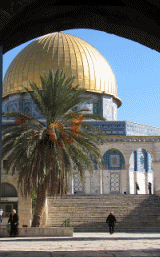
 and Dome of the Rock Dome of the Rock

The Dome of the Rock is a famous Islam [i]ic shrine in Jerusalem [i]. ... 

 for Muslims.

Jerusalem as the capital of Israel

Israel proclaimed Jerusalem as its capital Capital

In politics [i], a capital is the principal city [i] or town [i] associated with a country's government [i] ... 

 in 1950 and all the branches of Israeli government are seated in Jerusalem. In 1950, given that the city was divided between Israel and Jordan, this proclamation related only to western Jerusalem. Immediately after the Six Day War Six-Day War

The Six-Day War , also known as the 1967 Arab-Israeli War, Six Days' War, an-Naksah , ... 

 in 1967, Israeli legislation incorporated East Jerusalem into Israel, annexing it to the municipality of Jerusalem, and making it a de facto part of its capital. Israel enshrined the status of united Jerusalem, west and east, as its undivided capital, in Israel's 1980 . United Nations Security Council Resolution 478 declared that this law was 'null and void and must be rescinded forthwith' and advised member states to withdraw their diplomatic representation from the city as a punitive measure, which most of the few countries with embassies in Jerusalem did, relocating their embassies to Tel Aviv.

Most UN member states already located their embassy in Tel Aviv prior to Resolution 478. Currently, only two UN member states have located their embassies within the city limits of Jerusalem, Costa Rica and El Salvador, with the embassies of Bolivia and Paraguay to be found in Mevasseret Zion, a suburb of Jerusalem. On August 16, 2006, the newly elected Costa Rican president stated the intention to relocate its embassy to Tel Aviv. 9 days later, El Salvador followed with a similar statement.

Jerusalem is home to a number of key Israeli government buildings, including the Knesset Knesset

The Knesset is the legislature [i] of Israel [i]. ... 

, the Israeli Supreme Court and the houses of the President and Prime Minister. With the exception of the house of the premier, these buildings can be toured.

Much of the international community International community

The term "international community" is a phrase that can refer to either:
... 

 argues that Israel's annexation of the eastern part of Jerusalem after the Six-Day War Six-Day War

The Six-Day War , also known as the 1967 Arab-Israeli War, Six Days' War, an-Naksah , ... 

 was in violation of international law, and that the final issue of the status of East Jerusalem should be determined in future Israeli-Palestinian negotiations. Therefore, although all ambassadors and other official diplomats submit their accreditation to the President of Israel in his house at Jerusalem, nearly all countries maintain their embassies in Tel Aviv Tel Aviv

Tel Aviv is the second largest city [i] in Israel [i] and is located on the coast [i] of the Mediterranean Sea [i] ... 

, Israel's economic and financial center.

Palestinian claims


The Palestinian National Authority Palestinian National Authority

The Palestinian National Authority is an interim [i] administrative organization... 

 asserts that the capital of a future Palestinian state will be situated in East Jerusalem. According to the Oslo Agreements Oslo Accords

The Oslo Accords, officially called the Declaration of Principles on Interim Self-Government Arrangem... 

 the final status of Jerusalem should be determined by peaceful negotiation. The most notable "official" Palestinian Palestinian people

Palestinians are people with family origins mainly in Palestine [i]. ... 

 presence in the city is the Orient House Orient House

Orient House
was the PLO [i] headquarters in East Jerusalem [i] in the 1980's and 1990's. ... 

, which has been subject to strict monitoring by the Israeli authorities and since August 2001 has been occupied by the Israeli security services. The Palestinian flag has since been taken down from it.

Physical geography

Jerusalem is situated in , upon the southern spur of a plateau the eastern side of which slopes from 2,460 ft. above sea-level north of the Temple Mount Temple Mount

The Temple Mount or Noble Sanctuary is a hotly contested religious site in the Old City of Jerusalem [i] ... 

 to 2,130 ft. at the southeastern extremity. The western hill is about 2,500 ft. high and slopes southeast from the Judean plateau.

Topography

Jerusalem is surrounded upon all sides by valleys, of which those on the north are less pronounced than those on the other three sides. The principal two valleys start northwest of the present city. The first runs eastward with a slight southerly bend , then, deflecting directly south, the Kidron Kidron Valley

The Kidron Valley is valley near Jerusalem [i] which features significantly in the Bible [i]. ... 

  Valley or Wadi Sitti Maryam , divides the Mount of Olives Mount of Olives

The Mount of Olives is a mountain ridge to the east of Jerusalem [i].... 

 from the city. The second runs directly south on the western side of the city, turns eastward at its southeastern extremity, then runs directly east, and joins the first valley near Bir Ayyub . This valley is called the Valley of Hinnom Gehenna

Gehenna is a word tracing to Greek [i], ultimately from Ghinnm... 

 or Ge-Hinnom Gehenna

Gehenna is a word tracing to Greek [i], ultimately from Ghinnm... 

 in Hebrew, and Wadi al-Rababi in Arabic.

A third valley, commencing in the northwest where is now the Damascus Gate, ran south-southeasterly down to the Pool of Siloam Pool of Siloam

Pool of Siloam is a landmark located at the lower part of the southern slope of Ophel [i], the original ... 

, and divided the lower part into two hills . This is probably the later Tyropoeon valley. A fourth valley led from the western hill over to the Temple area: it is represented in modern Jerusalem by David Street. A fifth cut the eastern hill into a northern and a southern part. Later Jerusalem was thus built upon four spurs. Today, neighboring towns are Bethlehem Bethlehem

Bethlehem is a city in the West Bank [i] under Palestinian Authority [i] considered a central hub of Pa ... 

 and Beit Jala at the southern city border, Abu Dis and Ma'ale Adummim Ma'ale Adummim

The city of Ma'ale Adummim is a city and Israeli settlement [i] in the Judea [i] region of the West Bank [i]... 

 to the East, Mevaseret Zion to the West, Giv'at Ze'ev to the North.

Climate and environment


Jerusalem is situated at a relatively high altitude and experiences cold, wet winters with an average of 9 °C. The average annual precipitation is about 600 mm . Snowfalls, when occur, are generally mild. Summers in Jerusalem are dry and often hot with temperatures averaging around 26 °C.

There is almost no industrial pollution in Jerusalem. Most pollutants are the product of heavy bus and personal vehicle traffic, especially along the arterial roads, and a by-product from heavy building. With this exception, air pollution is low.

The building code in Jerusalem prescribes that all buildings should be covered with native Jerusalem stone Jerusalem stone

Jerusalem Stone is the trade name of stone quarried [i] in areas from the Jordan River [i] on the ... 

. Although this increases building costs somewhat, it gives the city a very distinct look in comparison with other cities. Since the 1950s only a small number of buildings have been constructed in Jerusalem which do not conform to this code.

With the exception of the central plateau, many neighborhoods are divided by deep valleys, which are the natural green areas of the city. To the west of the city is the larger Jerusalem Forest. Especially in open spaces near major roads, large parks were developed. To the east and the southeast of the Old City, where little grows without constant irrigation, promenades with parks were developed, which allow walkers to enjoy the view of the Old City, the Judean Desert, the irrigated vegetation, and - depending on location and weather conditions - the Dead Sea Dead Sea

The Dead Sea is both the lowest point in Eurasia [i] at 418 metres below sea level [i] ... 

 and Jordan Jordan

Jordan , officially the Hashemite Kingdom of Jordan , is an Arab [i] country in the Middle East [i] ... 

ian mountains.

People and culture


Demography


When it first appears in historical records, Jerusalem was inhabited by a Canaanite Canaan

Canaan .
Canaan is an ancient term for a region approximating present-day Israel [i] and Palestine [i] p... 

 tribe. The Bible specifies them as the Jebusites, and says they ruled it until its conquest by King David David

King David was the second king of the united kingdom of Israel [i] . ... 

. After taking control of the city from the Canaanites, Jews formed the majority of the population for 1,200 years, until Jerusalem's destruction by Rome in the second century. Subsequent demographic changes are uncertain, although the city's population probably attained a Muslim majority by the time of the Crusades Crusades

The Crusades were a series of military campaigns waged in the name of Christendom [i] This term refers t ... 

. An official 16th century survey confirms that the city was largely Muslim. By 1844, Jews were once again the largest single ethnic group in the city and formed a majority by the late 19th century.

As of May 24, 2006, Jerusalem's population is 724,000 , of which 65.0% were Jews , 32.0% Muslim and 2% Christian. 35% of the city's population were children under age of 15. In 2005, the city had 18,600 newborns. , and was later placed under IDF control during 2001. Ben Gurion International Airport Ben Gurion International Airport

Ben Gurion International Airport or Ben Gurion Airport , once widely known as Lod Airport, i... 

, 40 km northwest of the city, serves as the primary international air transport hub for both Jerusalem and Tel Aviv Tel Aviv

Tel Aviv is the second largest city [i] in Israel [i] and is located on the coast [i] of the Mediterranean Sea [i] ... 

.

Sports


The most popular sport in Jerusalem is football Football

Football is the name given to a number of different, but related, team sport [i]s. ... 

. The city has two major teams, the yellow Beitar Jerusalem FC Beitar Jerusalem FC

Beitar Jerusalem Football Club is the Israeli football [i] team with the largest following . ... 

 and the red Hapoel Jerusalem FC Hapoel Jerusalem FC

Hapoel "Peace" Jerusalem Football Club is an Israeli [i] football [i] club, and is based ... 

. Beitar plays in the Premier League, was 4 times Israeli champion and has won the national cup 5 times. Hapoel currently plays in the Leumit or second league and has won one national cup, in 1973. In basketball, however, Hapoel Jerusalem has the upperhand. In a league dominated by Maccabi Tel Aviv it never won a championship, yet twice won the Israeli Cup, in 1996 and 1997. In 2004 it won the European Europe

Europe is one of the seven traditional continent [i]s of the Earth [i]. ... 

 ULEB Cup.

A marathon is held in the streets of Jerusalem every year and the popular Jerusalem hike starts west of the city and ends in its streets. The municipality, universities, schools, clubs and businesses operate over a thousand sport facilities throughout the city. The largest sports facility is the Teddy Kollek Stadium Teddy Kollek Memorial Stadium

Teddy Kollek Memorial Stadium is a multi-use stadium [i] in Jerusalem [i], Israel [i]. ... 

 in Malcha Manahat

Manahat is a neighborhood in SW Jerusalem [i], Israel [i]. ... 

, a football stadium with 21,000 seats. Major basketball games are held at the Strauss Arena.

Education

  • Hebrew University of Jerusalem Hebrew University of Jerusalem

    The Hebrew University of Jerusalem [i] is one of Israel [i]'s oldest, largest, and most important instit ... 

  • Al-Quds University Al-Quds University

    Al-Quds University is the Arab university [i] in Jerusalem [i].... 

  • Jerusalem College of Technology
  • Bezalel Academy of Art and Design Bezalel Academy of Art and Design

    Bezalel Academy of Art and Design is Israel [i]'s national school of art [i]. ... 

  • Jerusalem Academy of Music and Dance
  • Mir yeshiva Mir yeshiva

    Mir yeshiva, commonly known as "the Mir", is the name of two major Haredi [i] yeshiva [i] ... 

  • Ohr Somayach, Jerusalem
  • Brisk yeshiva
  • Brigham Young University Jerusalem Center


Museums

  • Israel Museum Israel Museum

    Founded in 1965, The Israel Museum, Jerusalem located near the Knesset [i] in Jerusalem [i], Israel [i] ... 

  • Rockefeller Museum
  • Yad Vashem Yad Vashem

    Yad Vashem is Israel [i]'s official memorial to the victims of the Holocaust [i] established in 1953 [i] ... 

  • Ticho House


Born in Jerusalem

  • Saint Angelus
  • Fathi Arafat Fathi Arafat

    Fathi Arafat, born in Jerusalem [i], was a Palestinian [i] physician and the founder and long-term chair ... 

  • Suha Arafat Suha Arafat

    Suha Daoud Arafat, ne Suha Daoud Tawil, is the widow of the late Palestinian Authority [i] Pre ... 

  • Shlomo Zalman Auerbach Shlomo Zalman Auerbach

    Rabbi Shlomo Zalman Auerbach , was a renowned Rabbi [i], Posek [i] and Rosh Yeshiva [i] of the Kol Torah [i] ... 

  • Mili Avital Mili Avital

    Mili Avital is an Israel [i]i-American [i] actress [i]. ... 

  • Yosef Avni
  • Chaim Joseph David Azulai Chaim Joseph David Azulai

    Rabbi [i] Chaim Joseph David ben Isaac Zerachia Azulai, commonly known as the Chida, was a rabbinic [i] ... 

  • Yossi Banai Yossi Banai

    Yossi Banai was an Israeli [i] performer [i], singer [i] and dramatist [i].

... 


  • Mustafa Barghouti Mustafa Barghouti

    Mustafa Barghouti is a Palestinian [i] democracy activist. ... 

  • Elisha Ben Abuyah
  • Mordechai Eliyahu Mordechai Eliyahu

    Mordechai Eliyahu was a former Sephardi [i] Chief Rabbi [i] of Israel [i]. ... 

  • Saeb Erekat Saeb Erekat

    Saeb Erakat was the chief of the PLO [i] Steering and Monitoring Committee, from which he negotiated wit ... 

  • Yuval Gabay
  • Yehoram Gaon
  • Eliezer Goldberg Eliezer Goldberg

    Eliezer Goldberg is a former Israel [i]i Supreme Court [i] judge, and former State Comptroller [i] ... 

  • David Grossman
  • Eran Groumi
  • Mordechai Gur "Motta"
  • Michael Halika
  • Tzahi Hanegbi Tzachi Hanegbi

    Tzachi Hanegbi is an Israeli [i] politician [i]. ... 

  • Amira Hass Amira Hass

    Amira Hass is an Israel [i]i journalist [i] and author, mostly known for her columns in the daily newspa ... 

  • Abd al-Qadir al-Husayni Abd al-Qadir al-Husayni

    Abd al-Qadir al-Husayni was a Palestinian [i] nationalist and fighter who in late 1933 founded the secre ... 

  • Amin al-Husayni Mohammad Amin al-Husayni

    Mohammad Amin al-Husayni, the Mufti [i] of Jerusalem [i], was a Palestinian [i] Arab nationalist [i] ... 

  • Eliahu Inbal
  • Flavius Josephus Josephus

    Josephus , who became known, in his capacity as a Roman [i] citizen, as Flavius Josephus ... 

  • Yousef Al-Khalidi
  • George Khoury
  • Amos Kollek
  • Moshe Levinger
  • Isaac Luria Isaac Luria

    Rabbi [i] Isaac Luria was a Jewish [i] scholar and mystic. ... 

  • Raphael Maklouf
  • Uri Malmilian
  • Yoav Meiri
  • Dorrit Moussaieff Dorrit Moussaieff

    Dorrit Moussaieff, is a jewellery designer and businesswoman and the second and current wife of Ólafur Ragnar Grímsson [i] ... 

  • Shlomo Moussaieff
  • Al-Muqaddasi
  • Nathan
  • Solomon Solomon

    Solomon or Shlomo is a figure described in Middle East [i]ern scriptures as a wise ruler of an e ... 

  • Yitzh