
All Topics  
Banknote

 
Banknote

   Email Print
   Bookmark   Link


Banknote


A banknote (often known as a bill, paper money or simply a note) is a kind of negotiable instrument
Negotiable instrument

A negotiable instrument is a specialized type of "contract" for the payment of money that is unconditional and capable of transfer by negotiation....
, a promissory note
Promissory note

A promissory note, also referred to as a note payable in accounting, is a contract where one party makes an unconditional promise in writing to pay a sum of money to the other , either at a fixed or determinable future time or on demand of the payee, under specific terms....
 made by a bank
Bank

A bank is a financial institution whose primary activity is to act as a payment agent for customers and to borrow and lend money. It is an institution for receiving, keeping, and lending money....
 payable to the bearer on demand, used as money
Money

Money is anything that is generally accepted as payment for goods and services and repayment of debts. The main uses of money are as a medium of exchange, a unit of account, and a store of value....
, and in many jurisdictions is legal tender
Legal tender

Legal tender or forced tender is payment that, by law, cannot be refused in settlement of a debt.Legal tender is variously defined in different jurisdictions....
. Along with coin
Coin

A coin is a piece of hard material, usually metal or a metallic material, usually in the shape of a Disk , and most often issued by a government....
s, banknotes make up the cash or bearer forms of all modern money
Money

Money is anything that is generally accepted as payment for goods and services and repayment of debts. The main uses of money are as a medium of exchange, a unit of account, and a store of value....
. With the exception of non-circulating high-value or precious metal commemorative issues, coins are generally used for lower valued monetary units, while banknotes are used for higher values.

inally, precious and semi-precious metals were made into coins and were used to negotiate and settle trades.


Discussion
Ask a question about 'Banknote'
Start a new discussion about 'Banknote'
Answer questions from other users
Full Discussion Forum


Recent Posts


Encyclopedia


A banknote (often known as a bill, paper money or simply a note) is a kind of negotiable instrument
Negotiable instrument

A negotiable instrument is a specialized type of "contract" for the payment of money that is unconditional and capable of transfer by negotiation....
, a promissory note
Promissory note

A promissory note, also referred to as a note payable in accounting, is a contract where one party makes an unconditional promise in writing to pay a sum of money to the other , either at a fixed or determinable future time or on demand of the payee, under specific terms....
 made by a bank
Bank

A bank is a financial institution whose primary activity is to act as a payment agent for customers and to borrow and lend money. It is an institution for receiving, keeping, and lending money....
 payable to the bearer on demand, used as money
Money

Money is anything that is generally accepted as payment for goods and services and repayment of debts. The main uses of money are as a medium of exchange, a unit of account, and a store of value....
, and in many jurisdictions is legal tender
Legal tender

Legal tender or forced tender is payment that, by law, cannot be refused in settlement of a debt.Legal tender is variously defined in different jurisdictions....
. Along with coin
Coin

A coin is a piece of hard material, usually metal or a metallic material, usually in the shape of a Disk , and most often issued by a government....
s, banknotes make up the cash or bearer forms of all modern money
Money

Money is anything that is generally accepted as payment for goods and services and repayment of debts. The main uses of money are as a medium of exchange, a unit of account, and a store of value....
. With the exception of non-circulating high-value or precious metal commemorative issues, coins are generally used for lower valued monetary units, while banknotes are used for higher values.

Advantages

Originally, precious and semi-precious metals were made into coins and were used to negotiate and settle trades. Banknotes offer an alternative bearer form of money, but the advantages and disadvantages between the two forms of bearer money are complex and so in different circumstances the overall advantage can lie with either form.

The costs of using bearer money include:
  1. Manufacturing or issue costs. Coins are produced by industrial manufacturing methods that process the precious or semi-precious metals, and require additions of alloy for hardness and wear resistance. By contrast bank notes are printed paper (or polymer), and typically have a lower cost of issue, especially in larger denominations, compared to coin of the same value.
  2. Wear costs. Coins wear and lose mass over their economic life, and eventually are scrapped. Banknotes do not lose economic value by wear, since, even if they are in poor condition, they are still a legally valid claim on the issuing bank. However, banks of issue do have to pay the cost of replacing banknotes in poor condition.
  3. Opportunity cost of capital. Coins have economic value and are a form of non-financial capital, however they do not pay interest. Banknotes have economic value but are a form of financial capital, a loan to the issuing bank. The issuing bank invests its assets primarily in interest bearing loans and securities, but also needs to hold metallic reserves. Thus banknotes indirectly earn interest through the investments made by the issuing bank, but coins do not pay interest to anyone. This foregone interest is the most important economic advantage of banknotes over coins.
  4. Cost of transport. Coins can be expensive to transport for high value transactions, but banknotes can be issued in large denominations that are lighter than the equivalent value in coins.
  5. Cost of acceptance. Coins can be checked for authenticity by weighing and other forms of examination and testing. These costs can be significant, but good quality coin design and manufacturing can help reduce these costs. Banknotes also have an acceptance cost, the costs of checking the banknote's security features and confirming acceptability of the issuing bank.


The different advantages and disadvantages between coins and banknotes imply that there may be an ongoing role for both forms of bearer money, each being used where its advantages outweigh its disadvantages.

Convertibility

The ability to exchange a note for some other kind of value is called "convertibility". For example a US silver certificate was "payable in silver on demand" from the treasury until 1965. If a note is payable on demand for a fixed unit, it is said to be fully convertible to that unit. Limited convertibility occurs when there are restrictions in the time, place, manner or amount of exchange.

A common misconception is that a bank note that is physically inconvertible is necessarily unbacked. Most of the confusion centers around the failure to distinguish between two types of convertibility:
  1. Physical convertibility, where a unit of currency can be exchanged at the issuing bank for a given physical amount of something, and
  2. Financial convertibility, where a unit of currency can be exchanged at the issuing bank for a unit's worth of the bank's assets.


The importance of financial convertibility can be seen by imagining that people in a community one day find themselves with more paper currency than they wish to hold — for example, when the main shopping season has ended. If the paper currency is physically convertible (for one ounce of silver, let us suppose), people will return the unwanted paper currency to the bank in exchange for silver, but the bank could head off this demand for silver by selling some of its own bonds to the public in exchange for its own paper currency. For example, if the community has 100 units of unwanted paper money, and if people intend to redeem the unwanted 100 units for silver at the bank, the bank could simply sell 100 units worth of bonds or other assets in exchange for 100 units of its own paper currency. This will soak up the unwanted paper and head off people's desire to redeem the 100 units for silver.

Thus, by conducting this type of open market operation — selling bonds when there is excess currency and buying bonds when there is too little — the bank can maintain the value of the paper currency at one ounce of silver without ever redeeming any paper currency for silver. In fact, this is essentially what all modern central banks do, and the fact that their currencies might be physically inconvertible is made irrelevant by the maintenance of financial convertibility. Note that financial convertibility cannot be maintained unless the bank has sufficient assets to back the currency it has issued. Thus, it is an illusion that any physically inconvertible currency is necessarily also unbacked.

History

Paper money originated in two forms: drafts, which are receipts for value held on account, and "bills", which were issued with a promise to convert at a later date.

Money is based on the coming to pre-eminence of some commodity as payment. The oldest monetary basis was for agricultural capital: cattle and grain. In Ancient Mesopotamia
Mesopotamia

Mesopotamia is the area of the Tigris-Euphrates river system, along the Tigris and Euphrates rivers, largely corresponding to modern Iraq, as well as some parts of northeastern Syria, some parts of southeastern Turkey, and some parts of the Khuzestan Province of southwestern Iran....
, drafts were issued against stored grain as a unit of account. A "drachma" was a weight of grain. Japan
Japan

Japan is an island country in East Asia. Located in the Pacific Ocean, it lies to the east of the Sea of Japan, People's Republic of China, North Korea, South Korea and Russia, stretching from the Sea of Okhotsk in the north to the East China Sea and Taiwan in the south....
's feudal system was based on rice per year – koku
Koku

The is a unit of volume in Japan, equal to ten cubic shaku. In this definition, 3.5937 koku equal one cubic metre, i.e. 1 koku is approximately 278.3 litres....
.

At the same time, legal codes enforced the payment for injury in a standardized form, usually in precious metals. The development of money then comes from the role of agricultural capital and precious metals having a privileged place in the economy.

Such drafts were used for giro
Giro

A giro or giro transfer is a method of payment. It is the opposite of a cheque, which is given to a payee who deposits it in a bank. A giro is given by the payer to his bank, which transfers funds into the payee's bank account....
 systems of banking as early as Ptolemaic Egypt
Ptolemaic Egypt

Ptolemaic Egypt began when Ptolemy I Soter declared himself Pharaoh of Egypt in 305 BC and ended with the death of queen Cleopatra VII of Egypt and the Aegyptus in 30 BC....
 in the first century BC.

The perception of banknotes as money has evolved over time. Originally, money was based on precious metals. Banknotes were seen as essentially an I.O.U. or promissory note
Promissory note

A promissory note, also referred to as a note payable in accounting, is a contract where one party makes an unconditional promise in writing to pay a sum of money to the other , either at a fixed or determinable future time or on demand of the payee, under specific terms....
: a promise to pay someone in precious metal on presentation (see representative money
Representative money

Representative money or Symbolic money refers to money that consists of token coins, other physical tokens such as certificates, and even non-physical "digital certificates" that can be reliably exchanged for a fixed quantity of a commodity such as gold, silver or potentially water, Petroleum or food....
). With the gradual removal of precious metals from the monetary system, banknotes evolved to represent credit money
Credit money

Credit money is any future claim against a physical or legal person that can be used for the purchase of goods and services. Examples of credit money include personal IOU s, and in general any financial instrument which is not immediately repayable in specie, on demand....
, or (if backed by the credit of a government) also fiat money.

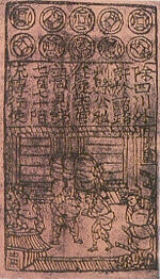
Jiao Zi

First banknotes in the world

The use of paper money as a circulating medium is intimately related to shortages of metal for coins. In ancient China coins were circular with a rectangular hole in the middle. Several coins could be strung together on a rope. Merchants in China, if they became rich enough, found that their strings of coins were too heavy to carry around easily. To solve this problem, coins were often left with a trustworthy person, and the merchant was given a slip of paper recording how much money he had with that person. If he showed the paper to that person he could regain his money. Eventually from this paper money "jiaozi
Jiaozi (currency)

Jiaozi is a form of banknote which appeared in 10th century Sichuan. Most numismatists generally regard it as the first paper money in history, a development of the Chinese Song Dynasty ....
" originated.

In the 600s there were local issues of paper currency in China and by 960 the Song Dynasty
Song Dynasty

The Song Dynasty was a ruling Chinese dynasty in China between 960–1279 AD; it succeeded the Five Dynasties and Ten Kingdoms Period, and was followed by the Yuan Dynasty....
, short of copper for striking coins, issued the first generally circulating notes. A note is a promise to redeem later for some other object of value, usually specie
Money

Money is anything that is generally accepted as payment for goods and services and repayment of debts. The main uses of money are as a medium of exchange, a unit of account, and a store of value....
. The issue of credit notes is often for a limited duration, and at some discount to the promised amount later. The jiaozi nevertheless did not replace coins during the Song Dynasty; paper money was used alongside the coins.

The successive Yuan Dynasty
Yuan Dynasty

The Yuan Dynasty , or Great Yuan Empire was both the continuation of the Mongol Empire and the Mongol founded historical state in Mongolia and China, lasting officially from 1271 to 1368....
 was the first dynasty in China to use paper currency as the predominant circulating medium. The founder of the Yuan Dynasty, Kublai Khan
Kublai Khan

Sorry, no overview for this topic
, issued paper money known as Chao
Chao (currency)

The Chao , was the official banknote of the Yuan Dynasty in China. Unlike the earlier paper money such as Jiaozi, it was the first paper currency to be used as the predominant circulating medium in the history of China....
 in his reign. The original notes during the Yuan Dynasty were restricted in area and duration as in the Song Dynasty, but in the later course of the dynasty, facing massive shortages of specie to fund their ruling in China, began printing paper money without restrictions on duration. By 1455, in an effort to rein in economic expansion and end hyperinflation
Hyperinflation

File:Bundesarchiv Bild 102-00104, Inflation, Tapezieren mit Geldscheinen.jpgIn economics, hyperinflation is inflation that is very high or "out of control", a condition in which prices increase rapidly as a currency loses its value....
, the new Ming Dynasty
Ming Dynasty

The Ming Dynasty , or Empire of the Great Ming , was the ruling Dynasties in Chinese history of China from 1368 to 1644, following the collapse of the Mongol-led Yuan Dynasty....
 ended paper money, and closed much of Chinese trade.

Ming Dynasty notes are the earliest surviving paper money, of which the 1 Kuan is the most common. The note, 220mm x 340mm, is also one of the world's largest banknotes.

Banknotes in Europe

In Europe
Europe

Europe is, conventionally, one of the world's seven continents. Comprising the westernmost peninsula of Eurasia, Europe is generally divided from Asia to its east by the water divide of the Ural Mountains, the Ural , the Caspian Sea, and by the Caucasus Mountains to the southeast....
 the first paper money consisted of paper 'coins' issued in Protestant Leyden (today, Leiden
Leiden

Media:Nl-Leiden.ogg is a city and municipality in the province of South Holland in the Netherlands and has 118,000 inhabitants. It forms a single urban area with Oegstgeest, Leiderdorp, Voorschoten, Valkenburg, Rijnsburg and Katwijk, with 254,000 inhabitants....
) in the Netherlands
Netherlands

The Netherlands is a country that is part of the Kingdom of the Netherlands. It is a parliamentary democratic constitutional monarchy. The Netherlands is located in North-West Europe, and bordered by the North Sea to the north and west, Belgium to the south, and Germany to the east....
 during the Spanish siege of 1574
Siege of Leiden

The Siege of Leiden occurred during the Eighty Years' War in 1573 and 1574, when the Spanish attempted to capture the rebellious city but ultimately failed....
. Over 5000 of the estimated 14,000 residents of Leyden died, mostly due to starvation. Even leather (often used to create emergency currency) was boiled and used to feed the people. So to create currency, the residents took covers and paper from hymnals and church missives and created paper planchets, which were struck using the same dies that were previously used to mint coins.

The first proper European banknotes were issued by Stockholms Banco
Stockholms Banco

Stockholms Banco in Sweden was the first European bank to print banknotes. The bank was founded in 1657 by Johan Palmstruch and began printing banknotes in 1661....
, a predecessor of the Bank of Sweden, in 1660, although the bank ran out of coins to redeem its notes in 1664 and ceased operating in that year.

Until Louis XIV, banknotes were issued by small creditors, had limited circulation, and were not backed by the authority of the state. Economist John Law
John Law (economist)

John Law was a Scotland economist who believed that money was only a means of exchange that did not constitute wealth in itself and that national wealth depended on trade....
 helped establish banknotes as formal currency, backed by capital consisting of French government bills and government accepted notes.

Banknotes in the Americas

Walletmpegman
In the early 1690s, the Massachusetts Bay Colony
Massachusetts Bay Colony

The Massachusetts Bay Colony was an English settlement on the east coast of North America in the 17th century, in New England, centered around the present-day cities of Salem, Massachusetts and Boston, Massachusetts....
 was the first of the Thirteen Colonies
Thirteen Colonies

The Thirteen Colonies were part of what became known as British America, a name that was used by Great Britain until the Treaty of Paris recognized the independence of the original thirteen United States of America in 1783....
 to issue permanently circulating banknotes. The use of fixed denominations and printed banknotes came into use in the 18th century
18th century

The 18th century lasted from 1701 to 1800 in the Gregorian calendar, in accordance with the Anno Domini/Common Era numbering system.However, historians sometimes specifically define the 18th century otherwise for the purposes of their work....
.

In the early 1700s
1700s

Events and trends*The Bonneville Slide blocked the Columbia River near the site of present-day Cascade Locks, Oregon with a land bridge 200 feet high....
 each of the thirteen colonies issued their own banknotes, called colonial scrip
Colonial Scrip

Colonial scrip was paper money fiat money as opposed to wiktionary:specie#noun issued by the Thirteen Colonies in the pre-revolution era, up until 1775....
. Later, the Continental Congress
Continental Congress

The Continental Congress was a convention of delegates from the Thirteen Colonies that became the governing body of the United States during the American Revolution....
 issued continental currency to support the Revolutionary War. The federal government of the United States
Federal government of the United States

The Federal Government of the United States is the central current reigning United States governmental body, established by the United States Constitution....
 did not print banknotes until 1862. However, almost immediately after adoption of the United States Constitution
United States Constitution

The Constitution of the United States of America is the supreme law of the United States. It is the foundation and source of the legal authority underlying the existence of the United States of America; the Federal Government of the United States; and all the State & local governments and Territorial Administrative bodies contained therein....
 in 1789, the United States Congress
United States Congress

The United States Congress is the Bicameralism legislature of the Federal government of the United States of the United States of America, consisting of two houses, the United States Senate and the United States House of Representatives....
 chartered the First Bank of the United States
First Bank of the United States

The First Bank of the United States was a bank chartered by the United States Congress on February 25, 1791. The charter was for 20 years. The Bank was created to handle the financial needs and requirements of the central government of the newly formed United States, which had previously been thirteen individual colonies with their own ban...
 and authorized it to issue banknotes. The bank served as quasi-central bank
Central bank

A central bank, reserve bank, or monetary authority is the entity responsible for the monetary policy of a country or of a group of member states....
 of the United States
United States

The United States of America is a Federal government constitutional republic comprising U.S. state and a federal district. The country is situated mostly in central North America, where its Contiguous United States and Washington, D.C., the Capital districts and territories, lie between the Pacific Ocean and Atlantic Oceans, Borders of the U...
. The bank closed in 1811 when Congress failed to renew its charter. In 1816, Congress chartered the Second Bank of the United States
Second Bank of the United States

The Second Bank of the United States was opened in January 1817, six years after the First Bank of the United States lost its charter. The Second Bank of the United States was headquartered in Carpenters' Hall, Philadelphia, the same as the First Bank, and had branches throughout the nation....
. When its charter expired in 1836, the bank continued to operate under a charter granted by the Commonwealth of Pennsylvania until 1841.

In the United States, public acceptance of banknotes in replacement of precious metals was hastened in part by Executive Order 6102
Executive Order 6102

Executive Order 6102 is an Executive order signed on April 5, 1933 by U.S. President Franklin Delano Roosevelt "forbidding the Hoarding of Gold Coin, Gold Bullion, and Gold Certificates."...
 in 1933. This order carried the threat of a maximum $10,000 fine and a maximum of ten years in prison for anyone who kept more than $100 of gold in preference to banknotes.

Issue of banknotes

Generally, a central bank
Central bank

A central bank, reserve bank, or monetary authority is the entity responsible for the monetary policy of a country or of a group of member states....
 or treasury is solely responsible within a state or currency union for the issue of banknotes. However, this is not always the case, and historically the paper currency of countries was often handled entirely by private banks. Thus, many different banks or institutions may have issued banknotes in a given country. In the United States, commercial banks were authorized to issue banknotes from 1863 to 1935. In the last of these series, the issuing bank would stamp its name and promise to pay, along with the signatures of its president and cashier on a preprinted note. By this time, the notes were standardized in appearance and not too different from the Federal Reserve Notes that circulated for most of the 20th century.

In a small number of countries, private banknote issue continues to this day. For example, by virtue of the complex constitutional setup in the United Kingdom
United Kingdom

The United Kingdom of Great Britain and Northern Ireland, commonly known as the United Kingdom , the UK or Britain,is a sovereign state located off the northwestern coast of continental Europe....
, certain commercial banks in two of the union's four constituent countries (Scotland
Scotland

conventional_long_name = ScotlandAlba|common_name= Scotland|image_flag = Flag of Scotland.svg|flag_width = 130px...
 and Northern Ireland
Northern Ireland

conventional_long_name = Northern Ireland|native_name= Tuaisceart ?ireannNorlin Airlann|motto =|image_map = Europe location N-IRL2.png...
) continue to print their own banknotes for domestic circulation, even though they are not fiat money or declared in law as legal tender
Legal tender

Legal tender or forced tender is payment that, by law, cannot be refused in settlement of a debt.Legal tender is variously defined in different jurisdictions....
 anywhere. The UK's central bank, the Bank of England
Bank of England

The Bank of England is the central bank of the United Kingdom and is the model on which most modern, large central banks have been based. Since 1946 it has been a Nationalisation institution....
, prints notes which are legal tender in England and Wales
England and Wales

England and Wales is a legal unit within the United Kingdom. It consists of England and Wales, two of the four countries of the United Kingdom....
; these notes are also usable as money (but not legal tender) in the rest of the UK (see Banknotes of the pound sterling).

In Hong Kong
Hong Kong

Hong Kong , officially the Hong Kong Special Administrative Region, is a territory located in Southern China in East Asia, bordering the province of Guangdong to the north and facing the South China Sea to the east, west and south....
, three commercial banks are licenced to issue Hong Kong dollar notes. As well as commercial issuers, other organisations may have note-issuing powers; for example, until 2002 the Singapore dollar
Singapore dollar

The dollar is the currency of Singapore. It is normally abbreviated with the dollar sign $, or alternatively S$ to distinguish it from other dollar-denominated currencies....
 was issued by the Board of Commissioners of Currency Singapore, a government agency which was later taken over by the Monetary Authority of Singapore
Monetary Authority of Singapore

File:SGcurrency.jpgThe Monetary Authority of Singapore is Singapore's central bank. It was set up in 1971 to oversee various monetary functions associated with banking as well as finance....
.

Materials used for banknotes


Paper banknotes


Most banknotes are made of dense 80 to 90 grams per square meter starch paper (see also paper
Paper

Paper is thin material mainly used for writing upon, printing upon or packaging. It is produced by pressing together moist fibers, typically cellulose pulp derived from wood, rags or grasses, and drying them into flexible sheets....
), sometimes mixed with linen
Linen

Linen is a textile made from the fibers of the flax plant, Linum usitatissimum. Linen is labor-intensive to manufacture, but when it is made into garments, it is valued for its exceptional coolness and freshness in hot weather....
, abaca, or other textile fibres. Generally, the paper used is different from ordinary paper: it is much more resilient, resists wear and tear, and also does not contain the usual agents that make ordinary paper glow slightly under ultraviolet
Ultraviolet

Ultraviolet light is electromagnetic radiation with a wavelength shorter than that of visible light, but longer than x-rays, in the range 400 nanometer to 10 nm, and energies from 3 Electron volt to 124 eV....
 light.

Early Chinese banknotes were printed on paper made of mulberry
Mulberry

Morus or Mulberry is a genus of 10?16 species of deciduous trees native to warm, temperate, and subtropical regions of Asia, Africa, Europe, and the Americas, with the majority of the species native to Asia....
 bark and this fibre is used in Japanese banknote paper today.

Unlike most printing and writing paper, banknote paper is impregnated with polyvinyl alcohol or gelatin to give it extra strength.

Most banknotes are made using the mould made process in which a watermark and thread is incorporated during the paper forming process.

The thread is a simple looking security component found in most banknotes. It is however often rather complex in construction comprising fluorescent, magnetic, metallic and micro print elements. By combining it with watermarking technology the thread can be made to surface periodically on one side only. This is known as windowed thread and further increases the counterfeit resistance of the banknote paper. This process was invented by Portals, part of the De La Rue
De La Rue

De La Rue plc is a United Kingdom security printing, papermaking and cash handling systems company headquartered in Basingstoke, Hampshire. It also has a factory on the Team Valley, Gateshead....
 group in the UK.

Recently this company has introduced many new features to the banknote world including Cornerstone, Platinum and Optiks, all registered trade marks of De La Rue
De La Rue

De La Rue plc is a United Kingdom security printing, papermaking and cash handling systems company headquartered in Basingstoke, Hampshire. It also has a factory on the Team Valley, Gateshead....
. Cornerstone uses watermarking to reduce the number of corner folds by strengthening this part of the note. Platinum is a special coating to reduce the dirt picked up by banknotes. Optiks is a new thread based security feature that creates a plastic window in the paper which is very hard to copy.

Durable banknote papers


Banknote paper with enhanced durability is a recent development, designed to meet the growing need for popular low-denomination banknotes to withstand extreme wear.

Improved protection against dirt: Manufacturers of banknote paper were quick to recognize the problems associated with dirt and developed a special paper with a thin layer of varnish on the surface to repel soiling. This layer is applied directly to the substrate. The thickness and structure of the paper remain unchanged, thereby preserving the natural feel. The so-called Durable Banknote Papers, which are available in the global banknote market under brand names, such as LongLife, Platinum, Marathon Coated, Diamone, and Flesure, protect banknotes from soiling and environmental influences, making it possible for them to remain in circulation for longer.

Increased mechanical stability: With new products, such as Synthec and Diamone Composite, banknote manufacturers have gone a step further and responded to the growing demand for higher mechanical stability of the paper—because the longer a banknote stays in circulation, the limper it becomes and the more easily it tears. Synthec substrate, for example, consists of 80 percent cotton fiber and 20 percent synthetic fiber, with the latter being longer and more flexible than the former. The synthetic fibers constitute a dense network within the cotton fiber structure, supporting the banknote like a kind of corset and increasing its mechanical stability. This practically doubles the useful life of the product. Synthec is much less sensitive to climate fluctuations than standard banknote paper. The synthetic fibers are incorporated in the banknote substrate at the sheet formation stage. This has the advantage that all established security features—such as three dimensional watermarks, fluorescent fibers, security threads, or the innovative new varifeye see-through window—can be integrated into the new Synthec substrate, just as they would be with the standard cotton substrate. Optically variable effect inks and foil elements, such as holograms, can be applied to this substrate in the same way as with traditional banknote paper. Public confidence in the established security features, built up over decades, remains intact. To ensure that the banknotes are also protected against dirt, they are given a standard coating of varnish. By the end of 2007, Synthec banknotes will be circulating in three countries, including an African country with different climate zones that has chosen Synthec as a substrate for its lowest-denomination note. In the south of the country conditions are tropical, with a rainy season that lasts for eight months, while the north is very arid and extremely hot, with temperatures reaching 41 degrees Celsius.

Counterfeiting and security measures on paper banknotes

The ease with which paper money can be created, by both legitimate authorities and counterfeiters, has led both to a temptation in times of crisis such as war or revolution to produce paper money which was not supported by precious metal or other goods, thus leading to hyperinflation and a loss of faith in the value of paper money, e.g. the Continental Currency produced by the Continental Congress
Continental Congress

The Continental Congress was a convention of delegates from the Thirteen Colonies that became the governing body of the United States during the American Revolution....
 during the American Revolution
American Revolution

The American Revolution refers to the political upheaval during the last half of the 18th century in which the Thirteen Colonies of North America overthrew the governance of the British Empire and then rejected the British monarchy to become the sovereign United States of America....
, the Assignat
Assignat

Assignats were paper money issued by the National Constituent Assembly in France during the French Revolution. The assignats were issued after the confiscation of church properties in 1790 because the government was bankrupt....
s produced during the French Revolution
French Revolution

The French Revolution was a period of political and social upheaval and radical change in the history of France, during which the French governmental structure, previously an absolute monarchy with feudalism for the aristocracy and Roman Catholic Church clergy, underwent radical change to forms based on Age of Enlightenment principles of cit...
, the paper currency produced by the Confederate States of America
Confederate States of America

The Confederate States of America formed as the government set up from 1861 to 1865 by eleven Southern United States U.S. state of the United States of America that had declared their secession from the U.S....
 and the Individual States of the Confederate States of America
Southern States Confederate Currency

The individual Confederate States of America issued many denominations of banknotes during the American Civil War. These notes supplemented the "federal" issues from the Confederate States of America dollar, and the bank notes that were in wide circulation at the time....
, the financing of World War I
World War I

World War I, or the First World War , was a global military conflict which involved the Great powers, organized into two opposing military alliances: the Allies of World War I and the Central Powers....
 by the Central Powers
Central Powers

The Central Powers was one of the two sides that participated in World War I, the other being the Allies of World War I....
 (by 1922 1 gold Austro-Hungarian krone
Austro-Hungarian krone

The Krone or korona was the official currency of the Austria-Hungary from 1892 until the dissolution of the empire in 1918. The subunit was one hundredth of the main unit, and it was called Heller in the Austrian and fill?r in the Hungarian part of the Empire....
 of 1914 was worth 14,400 paper Kronen), the devaluation of the Yugoslav Dinar
Yugoslav dinar

The dinar was the currency of the three Yugoslavia states: the Kingdom of Yugoslavia , the Socialist Federal Republic of Yugoslavia and the Federal Republic of Yugoslavia....
 in the 1990s, etc. Banknotes may also be overprinted to reflect political changes that occur faster than new currency can be printed.

In 1988, Austria
Austria

Austria , officially the Republic of Austria , is a landlocked country in Central Europe. It borders both Germany and the Czech Republic to the north, Slovakia and Hungary to the east, Slovenia and Italy to the south, and Switzerland and Liechtenstein to the west....
 produced the 5000 Schilling banknote (Mozart), which is the first foil application (Kinegram) to a paper banknote in the history of banknote printing. The application of optical features is now in common use throughout the world.

Many countries' banknotes now have embedded holograms.

Polymer banknotes

In 1983, Costa Rica
Costa Rica

Costa Rica, officially the Republic of Costa Rica is a country in Central America, bordered by Nicaragua to the north, Panama to the east and south, the Pacific Ocean to the west and south and the Caribbean Sea to the east....
 and Haiti
Haiti

Haiti , officially the Republic of Haiti , is a Haitian Creole language- and French language-speaking Caribbean country. Along with the Dominican Republic, it occupies the island of Hispaniola, in the Greater Antilles archipelago....
 issued the first Tyvek
Tyvek

Tyvek is a brand of flashspun high-density polyethylene fibers, a Chemical synthesis material; the name is a registered trademark of DuPont....
 and the Isle of Man
Isle of Man

The Isle of Man , or Mann , is a self-governing Crown dependency, located in the Irish Sea at the geographical centre of the British Isles....
 issued the first Bradvek
Bradvek

Bradvek was a form of Tyvek polymer, produced by Du Pont.It was used for printing one of the first polymer banknotes in 1983 for the Isle of Man by English securities printing house Bradbury Wilkinson....
 polymer (or plastic) banknotes; these were printed by the American Banknote Company and developed by DuPont
DuPont

E. I. du Pont de Nemours and Company is an United States chemical industry that was founded in July 1802 as a gunpowder mill by Eleuth?re Ir?n?e du Pont....
. In 1988, after significant research and development by the Commonwealth Scientific and Industrial Research Organisation
Commonwealth Scientific and Industrial Research Organisation

The Commonwealth Scientific and Industrial Research Organisation is the national government body for scientific research in Australia. It was founded in 1926 originally as the Advisory Council of Science and Industry....
 (CSIRO) and the Reserve Bank of Australia
Reserve Bank of Australia

File:Reserve Bank of Australia - Canberra.jpgThe Reserve Bank of Australia came into being on 14 January 1960 to operate as Australia's central bank and banknote issuing authority....
, Australia
Australia

Australia, officially the Commonwealth of Australia, is a country in the southern hemisphere comprising the Australia of the world's smallest continent, the major island of Tasmania, and numerous list of islands of Australia in the Indian Ocean and Pacific Oceans....
 produced the first polymer banknote
Polymer banknote

Polymer banknotes were developed by the Reserve Bank of Australia , Commonwealth Scientific and Industrial Research Organisation and The University of Melbourne and were first issued as currency in Australia in 1988....
 made from biaxially-oriented polypropylene (plastic), and in 1996 became the first country to have a full set of circulating polymer banknotes of all denominations. Since then, other countries to adopt circulating polymer banknotes include Bangladesh
Bangladesh

, officially the People's Republic of Bangladesh is a country in South Asia. It is bordered by India on all sides except for a small border with Burma to the far southeast and by the Bay of Bengal to the south....
, Brazil
Brazil

Brazil , officially the Federative Republic of Brazil , is a country in South America. It is the List of countries and outlying territories by total area country by geographical area, occupying nearly half of South America, the List of countries by population country, and the fourth most populous democracy in the world....
, Brunei
Brunei

Brunei Darussalam, officially the State of Brunei, Abode of Peace , is a country located on the north coast of the island of Borneo, in Southeast Asia....
, Chile
Chile

Chile, officially the Republic of Chile , is a country in South America occupying a long and narrow coastal strip wedged between the Andes mountains and the Pacific Ocean....
, Indonesia
Indonesia

The Republic of Indonesia , is a transcontinental country in Southeast Asia and Oceania. Comprising Islands of Indonesia, it is the world's largest Archipelago state....
, Israel
Israel

Israel officially the State of Israel , is a country in the Middle East located on the eastern shore of the Mediterranean Sea. It borders Lebanon in the north, Syria in the northeast, Jordan in the east, and Egypt on the southwest, and contains geographically diverse features within its relatively small area....
, Malaysia
Malaysia

Malaysia is a federation that consists of States of Malaysia in Southeast Asia with a total landmass of . The capital city is Kuala Lumpur, while Putrajaya is the seat of the federal government....
, Mexico
Mexico

The United Mexican States , commonly known as Mexico , is a federalism constitutionalism republic in North America. It is bordered on the north by the United States; on the south and west by the Pacific Ocean; on the southeast by Guatemala, Belize, and the Caribbean Sea; and on the east by the Gulf of Mexico....
, Nepal
Nepal

Nepal , officially the Federal Democratic Republic of Nepal, is a landlocked country in South Asia and is the world's youngest republic. It is bordered to the north by the People's Republic of China, and to the south, east, and west by India....
, New Zealand
New Zealand

New Zealand is an island country in the south-western Pacific Ocean comprising two main landmasses , and numerous Islands of New Zealand, most notably Stewart Island/Rakiura and the Chatham Islands....
, Papua and New Guinea, Romania
Romania

Romania is a country located in Southeastern Europe Central Europe, North of the Balkan Peninsula, on the Lower Danube, within and outside the Carpathian Mountains, bordering on the Black Sea....
, Singapore
Singapore

Singapore , officially the Republic of Singapore, is an island country microstate located at the southern tip of the Malay Peninsula. It lies 137 kilometres north of the equator, south of the Malaysian state of Johor and north of Indonesia's Riau Islands....
, the Solomon Islands
Solomon Islands

For the group of islands rather than the nation, see Solomon Islands .The Solomon Islands is a country in Melanesia, east of Papua New Guinea, consisting of nearly one thousand islands....
, Sri Lanka
Sri Lanka

Sri Lanka, officially the Democratic Socialist Republic of Sri Lanka is an island country in South Asia, located about off the southern coast of India....
, Thailand
Thailand

The Kingdom of Thailand is an independent country that lies in the heart of Southeast Asia. It is bordered to the north by Laos and Myanmar, to the east by Laos and Cambodia, to the south by the Gulf of Thailand and Malaysia, and to the west by the Andaman Sea and Myanmar....
, Viet Nam, Western Samoa and Zambia
Zambia

The Republic of Zambia is a landlocked country in Southern Africa. The neighbouring countries are the Democratic Republic of the Congo to the north, Tanzania to the north-east, Malawi to the east, Mozambique, Zimbabwe, Botswana, and Namibia to the south, and Angola to the west....
, with other countries issuing commemorative polymer notes, including China
China

China is a Culture of China, an ancient civilization, and, depending on perspective, a national or multinational entity extending over a large area in East Asia....
, Kuwait
Kuwait

The State of Kuwait is a sovereign Arab emirate on the coast of the Persian Gulf, enclosed by Saudi Arabia to the south and Iraq to the north and west....
, the Northern Bank
Northern Bank

'Northern Bank', is a commercial bank in Northern Ireland. It is one of the oldest banks in Ireland having been formed in 1824. The bank is considered as one of the "Big four banks" banks in Northern Ireland....
 of Northern Ireland
Northern Ireland

conventional_long_name = Northern Ireland|native_name= Tuaisceart ?ireannNorlin Airlann|motto =|image_map = Europe location N-IRL2.png...
, Taiwan
Taiwan

Taiwan is an island in East Asia. "Taiwan" is also commonly used to refer to the country governed by the Republic of China and to the ROC itself, which governs the island of Taiwan, Orchid Island and Green Island, Taiwan in the Pacific Ocean off the Taiwan coast, the Penghu islands in the Taiwan Strait, and Kinmen and the Matsu Islands...
 and Hong Kong. Other countries indicating plans to issue polymer banknotes include Nigeria
Nigeria

Nigeria, officially the Federal Republic of Nigeria, is a federation constitutional republic comprising States of Nigeria and one Federal Capital Territory, Nigeria....
. In 2005, Bulgaria
Bulgaria

The state of Bulgaria , Scientific transliteration Balgarija, officially the Republic of Bulgaria has played a significant role in the Balkans in south-eastern Europe for over fourteen centuries....
 issued the world's first hybrid paper-polymer banknote.

Polymer banknotes were developed to improve durability and prevent counterfeit
Counterfeit

A counterfeit is an imitation made usually with the intent to deceptively represent its content or origins, thus increasing sales appeal due to the reputation of the imitated product....
ing through incorporated security features, such as optically variable devices that are extremely difficult to reproduce.

The uptake of polymer banknotes has been strong with over 28 countries on all continents now using this innovative material. With strong durability and a high degree of security, polymer notes are becoming extremely popular. Countries such as Vietnam, Brunei, New Zealand, Papua New Guinea and Romania have all their circulating banknotes on polymer.

Other materials

Over the years, a number of materials other than paper have been used to print banknotes. This includes various textiles, including silk
Silk

Silk is a natural protein fiber, some forms of which can be weaving into textiles. The best-known type of silk is obtained from Pupa#Cocoons made by the larvae of the mulberry silkworm Bombyx mori reared in captivity ....
, and materials such as leather
Leather

Leather is a material created through the tanning of rawhides and skins of animals, primarily cattlehide. The tanning process converts the putrescible skin into a durable, long-lasting and versatile natural material for various uses....
.

Silk and other fibers have been commonly used in the manufacture of various banknote papers, intended to provide both additional durability and security. Crane and Company patented banknote paper with embedded silk threads in 1844 and has supplied paper to the United States Treasury since 1879. Banknotes printed on pure silk "paper" include "emergency money" (Notgeld) issues from a number of German towns in 1923 during a period of fiscal crisis and hyperinflation
Hyperinflation

File:Bundesarchiv Bild 102-00104, Inflation, Tapezieren mit Geldscheinen.jpgIn economics, hyperinflation is inflation that is very high or "out of control", a condition in which prices increase rapidly as a currency loses its value....
. Most notoriously, Bielefeld
Bielefeld

Bielefeld is a district-free town in the Regierungsbezirk Detmold in the north-east of North Rhine-Westphalia, Germany. It is located at on both the western and eastern slopes of the Teutoburg Forest....
 produced a number of silk, leather, velvet, linen and wood issues, and although these issues were produced primarily for collectors, rather than for circulation, they are in demand by collectors. Banknotes printed on cloth include a number of Communist Revolutionary issues in China from areas such as Xinjiang
Xinjiang

Xinjiang is an autonomous region of China of the People's Republic of China. It is a large, sparsely populated area, spanning over 1.6 million sq....
, or Sinkiang, in the United Islamic Republic of East Turkestan
Turkestan

Turkestan is a region in Central Asia, which today is largely inhabited by Turkic peoples. It has been referenced in many Turkic and Persian sagas and is an integral part of Turan ....
 in 1933. Emergency money was also printed in 1902 on khaki
Khaki

This article is about the textile. For the colour, see Khaki . Kaki, another name for the persimmon, is often misspelled "Khaki".Khaki is a type of textile or the Khaki ....
 shirt fabric during the Boer War
Second Boer War

The Second Boer War , commonly referred to as The Boer War and also known as the South African War , the Anglo-Boer War and in Afrikaans as the Boereoorlog or Tweede Vryheidsoorlog , was fought from 11 October 1899 until 31 May 1902, between the British Empire and the two independent Boer republics of the Orange Fre...
.

Leather banknotes (or coins) were issued in a number of siege
Siege

A siege is a military blockade of a city or fortress with the intent of conquering by Battle of attrition and/or assault. The term derives from sedere, Latin for "to sit." A siege occurs when an attacker encounters a city or fortress that cannot be easily taken by a coup de main and refuses to surrender ....
s, as well as in other times of emergency. During the Russian administration of Alaska
Alaska

Alaska is the largest U.S. state of the United States by area; it is situated in the northwest extremity of the North American continent, with Canada to the east, the Arctic Ocean to the north, and the Pacific Ocean to the west and south, with Russia further west across the Bering Strait....
, banknotes were printed on sealskin. A number of 19th century issues are known in Germanic and Baltic states, including the towns of Dorpat, Pernau, Reval, Werro and Woisek. In addition to the Bielefeld issues, other German leather Notgeld from 1923 is known from Borna
Borna

Borna is a town in the Free State of Saxony, Germany, capital of the Leipzig district. It is situated approx. 25 km southeast of Leipzig....
, Osterwieck, Paderborn and Pößneck.

Other issues from 1923 were printed on wood, which was also used in Canada
Canada

Canada is a country occupying most of northern North America, extending from the Atlantic Ocean in the east to the Pacific Ocean in the west and northward into the Arctic Ocean....
 in 1763-1764 during Pontiac's Rebellion
Pontiac's Rebellion

Pontiac's Rebellion was a war launched in 1763 by North American First Nations who were dissatisfied with Kingdom of Great Britain policies in the Great Lakes region after the British victory in the French and Indian War/Seven Years' War ....
, and by the Hudson's Bay Company
Hudson's Bay Company

The Hudson's Bay Company , abbreviated HBC, is the oldest commercial corporation in North America and is one of the oldest in the world. The company was incorporated by British royal charter in 1670 as The Governor and Company of Adventurers of England trading into Hudson's Bay; it is now domiciled in Canada and has adopted the mo...
. In 1848, in Bohemia
Bohemia

History...
, wooden checkerboard pieces were used as money.

Even playing cards were used for currency in France in the early 19th Century, and in French Canada from 1685 until 1757, in the Isle of Man
Isle of Man

The Isle of Man , or Mann , is a self-governing Crown dependency, located in the Irish Sea at the geographical centre of the British Isles....
 in the beginning of the 19th Century, and again in Germany after World War I
World War I

World War I, or the First World War , was a global military conflict which involved the Great powers, organized into two opposing military alliances: the Allies of World War I and the Central Powers....
.

Vending machines and banknotes

People are not the only economic actors who are required to accept banknotes. In the late twentieth century machines were designed to recognize banknotes of the smaller values long after they were designed to recognize coins distinct from slugs. This capability has become inescapable in economies where inflation
Inflation

In economics, inflation is a rise in the general price level of goods and services in an economy over a period of time. The term "inflation" once referred to increases in the money supply ; however, economic debates about the relationship between money supply and price levels have led to its primary use today in describing price inflatio...
 has not been followed by introduction of progressively larger coin denominations (such as the United States, where several attempts to introduce dollar coins in general circulation have largely failed). The existing infrastructure of such machines presents one of the difficulties in changing the design of these banknotes to make them less counterfeitable, that is, by adding additional features so easily discernible by people that they would immediately reject banknotes of inferior quality, for every machine in the country would have to be updated.

Destruction

Banknotes have a limited lifetime, after which they are collected for destruction, usually recycling or shredding. A banknote is removed from the money supply by banks or other financial institutions due to everyday wear and tear
Wear and tear

Wear and tear is a term for damage that naturally and inevitably occurs as a result of normal use or aging. It is used in a legal context for such areas as warranty contracts from manufacturers, which usually stipulate that damage due to wear and tear will not be covered....
 from its handling. Banknote bundles are passed through a sorting machine that determines whether a particular note needs to be shredded, or are removed from the supply chain by a human inspector if they are deemed unfit for continued use – for example, if they are mutilated or torn. Counterfeit banknotes are destroyed unless they are needed for evidentiary or forensic purposes.

Contaminated banknotes are also decommissioned. A Canadian government report indicates:

These are removed from circulation primarily to prevent the spread of diseases.

When taken out of circulation, Australian bank notes are melted down and mixed together to form plastic garbage bins.

Paper money collecting as a hobby

Banknote collecting, or Notaphily
Notaphily

Notaphily is the study of paper money or banknotes. A notaphilist is a collector of banknotes, paper money, paper currency or plastic notes....
, is a rapidly growing area of numismatics
Numismatics

Numismatics is the study or collection of currency, including coins, tokens, paper money, and related objects. While numismatists are often characterized as students or collectors of coins, the discipline also includes a much larger study of payment-media used to resolve debts and the exchange of Good s....
. Although generally not as widespread as coin and stamp collecting
Stamp collecting

Stamp collecting is the collecting of postage stamps and related objects, such as Cover . It is one of the world's most popular hobby, with estimates of the number of collectors ranging up to 20 million in the United States alone....
, the hobby is increasingly expanding. Prior to the 1990s, currency collecting was a relatively small adjunct to coin collecting, but the practice of currency auctions, combined with larger public awareness of paper money have caused a boom in interest and values of rare banknotes.

In the 1950s, Robert Friedberg published the landmark book Paper Money of the United States. Friedberg devised an organizing number system of all types of U.S. banknotes; the system is widely accepted among collectors and dealers to this day, and the volume has been regularly updated.

Another pioneer of cataloguing banknotes was Albert Pick, a well-known German notaphilist (born 15 May 1922 in Cologne) who published a number of catalogs of European paper money, and, in 1974, the first Standard Catalog of World Paper Money
Standard Catalog of World Paper Money

The Standard Catalog of World Paper Money is a very well-known catalogue of banknotes that is published by Krause Publications in three volumes....
. His collection of over 180,000 banknotes was eventually housed at the Bavarian Mortgages and Exchange Bank (Bayerischen Hypotheken- und Wechselbank, now HypoVereinsbank
HypoVereinsbank

Bayerische Hypo- und Vereinsbank Aktiengesellschaft is the second-largest private Germany financial institution and is the second-largest Germany retail bank, with a strong presence in Bavaria....
). This catalog underwent several incarnations, and currently is published as a three volume group. Volume I, called Specialized Issues, includes notes issued by local authorities, which circulated in a limited area. Volume II called General Issues covers notes issued on a national scope, dated 1368 through 1960. Volume III covers Modern Issues dated 1960 to present. Each of the volumes is updated regularly, with Volume III now updated every year, Volumes I and II every 3 or so years. While Pick no longer edits the catalogs (since 1994 the honor has passed to George S. Cuhaj), the catalogs are still commonly referred to as 'Pick Catalogs' and dealers and collectors alike refer to banknotes by their 'Pick number.' Current issues of the three volumes include:
  • Standard Catalog of World Paper Money: Specialized Issues (10th Ed. Vol. 1) by George S. Cuhaj. Paperback - 1200 pages. (January 2006).
  • Standard Catalog of World Paper Money: General Issues to 1368-1960 (11th Ed. Vol. 2) by George S. Cuhaj (Editor). (December 2006).
  • Standard Catalog of World Paper Money: Modern Issues, 1961-present (14th Ed. Vol. 3) by George S. Cuhaj. (June 2008).


For years, the mode of collecting banknotes was through a handful of mail order dealers who issued price lists and catalogs. In the early 1990s, it became more common for rare notes to be sold at various coin and currency shows via auction. The illustrated catalogs and "event nature" of the auction practice seemed to fuel a sharp rise in overall awareness of paper money in the numismatic community. Entire advanced collections are often sold at one time, and to this day single auctions can generate well in excess of $1 million dollars in gross sales. Today, eBay
EBay

eBay Inc. is an United States Internet company that manages eBay.com, an online auction and shopping website in which people and businesses buy and sell goods and services worldwide....
 has surpassed auctions in terms of highest volume of sales of banknotes. However, as of 2005, rare banknotes still sell for much less than comparable rare coins. There is wide consensus in the paper money collecting arena that this disparity is diminishing as paper money prices continue to rise at a rapid rate.

There are many different organisations and societies around the world for the hobby including the International Bank Note Society (IBNS).

See also

Category:Banknotes
  • Polymer banknotes
  • Gallery of banknotes
    Gallery of banknotes

    Sorry, no overview for this topic
  • Hell bank note — bank notes for use in the afterlife
  • List of motifs on banknotes
    List of motifs on banknotes

    This is a list of current motifs on the banknotes of different countries. The customary design of banknotes in most countries is a portrait of a notable citizen on the front and a different motif on the back - often something relating to that person....
  • Banking
  • Used notes
  • Counterfeit
    Counterfeit

    A counterfeit is an imitation made usually with the intent to deceptively represent its content or origins, thus increasing sales appeal due to the reputation of the imitated product....
    ing
  • Banknote counter
    Banknote counter

    A banknote counter is a device designed primarily to accurately count a quantity of banknotes. Additionally, a banknote counter may sort banknotes into batches and check for damaged or counterfeit notes....
  • Federal Reserve Note
    Federal Reserve Note

    A Federal Reserve Note is a type of banknote issued by the Federal Reserve System and is the only type of U.S. banknote that is still produced today....
  • United States Note
    United States Note

    A United States Note is a Fiat currency Banknote that was issued directly into circulation by the United States Department of the Treasury. These Bills of Credit were also known as Legal Tender Notes because of the inscription on each obverse face stating "This Note is a Legal Tender." Unlike other U.S....
  • Postal currency
    Postal currency

    Postal Currency, or Postage Currency, was a series of United States Postal Service notes printed in 5?, 10?, 25?, and 50? Denomination issued on August 21, 1862 and used until May 27, 1863....