


Nizari

Encyclopedia
The Shī‘a Imami Ismā‘īlī Tariqah also referred to as the Ismā‘īlī or Nizārī ( an-Nizāriyyūn), is a path (tariqah
Tariqah
A tariqa is an Islamic religious order. In Sufism one starts with Islamic law, the exoteric or mundane practice of Islam and then is initiated onto the mystical path of a tariqa. Through spiritual practices and guidance of a tariqa the aspirant seeks ḥaqīqah - ultimate truth.-Meaning:A tariqa is a...
) of Shī‘a Islām
Islam
Islam . The most common are and . : Arabic pronunciation varies regionally. The first vowel ranges from ~~. The second vowel ranges from ~~~...
, emphasizing social justice
Social justice
Social justice generally refers to the idea of creating a society or institution that is based on the principles of equality and solidarity, that understands and values human rights, and that recognizes the dignity of every human being. The term and modern concept of "social justice" was coined by...
, pluralism, and human reason
Reason
Reason is a term that refers to the capacity human beings have to make sense of things, to establish and verify facts, and to change or justify practices, institutions, and beliefs. It is closely associated with such characteristically human activities as philosophy, science, language, ...
within the framework of the mystical tradition of Islam. The Nizari are the second largest branch of Shia Islam and form the majority of the Ismā‘īlī
Ismaili
' is a branch of Shia Islam. It is the second largest branch of Shia Islam, after the Twelvers...
. There are an estimated 15 million Nizari Ismā‘īlīs residing in more than 25 countries and territories.
Nizari teachings affirm the Islamic tenet that "there is no god but the One God, and Muhammad
Muhammad
Muhammad |ligature]] at U+FDF4 ;Arabic pronunciation varies regionally; the first vowel ranges from ~~; the second and the last vowel: ~~~. There are dialects which have no stress. In Egypt, it is pronounced not in religious contexts...
is the prophet
Prophet
In religion, a prophet, from the Greek word προφήτης profitis meaning "foreteller", is an individual who is claimed to have been contacted by the supernatural or the divine, and serves as an intermediary with humanity, delivering this newfound knowledge from the supernatural entity to other people...
of God". Like all Shī‘a, Nizaris believe Muhammad's relative Ali
Ali
' |Ramaḍān]], 40 AH; approximately October 23, 598 or 600 or March 17, 599 – January 27, 661).His father's name was Abu Talib. Ali was also the cousin and son-in-law of the Islamic prophet Muhammad, and ruled over the Islamic Caliphate from 656 to 661, and was the first male convert to Islam...
was selected by divine decree to succeed the Prophet as Imam or spiritual leader of the Muslim community. This institution of the Imamate continues in an unbroken hereditary chain through Ali and Fatimah
Fatimah
Fatimah was a daughter of the Islamic prophet Muhammad from his first wife Khadijah bint Khuwaylid. She is regarded by Muslims as an exemplar for men and women. She remained at her father's side through the difficulties suffered by him at the hands of the Quraysh of Mecca...
, Muhammad's daughter, to the present day, under the aegis of His Highness Prince Shah Karim al-Husayni, the Aga Khan IV
Aga Khan IV
Prince Karim, Aga Khan IV, NPk, NI, KBE, CC, GCC, GCIH, GCM is the 49th and current Imam of the Shia Imami Nizari Ismaili Muslims. He has held this position under the title of Aga Khan since July 11, 1957, when, at the age of 20, he succeeded his grandfather, Sultan Mahomed Shah Aga Khan...
, the 49th Nizari Imam.
Human society is believed to be in a state of continuous flux, the role of the Imam is to find permanent solutions to issues, and challenges raised by increasingly rapid changes in the world; to care for the spiritual and material well being of their followers as well as humanity at large, and to safeguard the rights of the individual to spiritual, social, and scientific enquiry.
The Nizāriyyah are the spiritual descendants of the Fatimid Caliphate (909-1094 CE) and the subsequent "Assassins
Hashshashin
The Assassins were an order of Nizari Ismailis, particularly those of Persia that existed from around 1092 to 1265...
" of Alamūt
Alamut
Alamut was a mountain fortress located in the South Caspian province of Daylam near the Rudbar region in Iran, approximately 100 kilometres from present-day Tehran, Iran...
under Dā‘ī
Dawah
Da‘wah or Dawah usually denotes the preaching of Islam. Da‘wah literally means "issuing a summons" or "making an invitation", being the active participle of a verb meaning variously "to summon" or "to invite"...
Hassan aṣ-Ṣabbaḥ (1094-1124 CE).
God
Isma'ili Islam believes God is the One true and perfect reality from which all forms descend. The creator who is omniscient, omnipotent, and beyond the comprehension of human thought or sensory perception. God creates and sustains existence (time-space) through a series of radiations originating in the godhead. From God's own substance waves radiate out, yet God's own being never decreases, nor diminishes. Waves move further away from the source through the realities, but subsequently become less divine. This process is ongoing and never ceases. So in one sense God not merely created existence, but is constantly sustaining it, and by extension the ultimate revelation of existence is that God is the only true reality.The Arabic term for God
God
God is the English name given to a singular being in theistic and deistic religions who is either the sole deity in monotheism, or a single deity in polytheism....
is Allāh
Allah
Allah is a word for God used in the context of Islam. In Arabic, the word means simply "God". It is used primarily by Muslims and Bahá'ís, and often, albeit not exclusively, used by Arabic-speaking Eastern Catholic Christians, Maltese Roman Catholics, Eastern Orthodox Christians, Mizrahi Jews and...
, in Persian Khuda. Nizari use both; but their discourse often describes God as "that which cannot be reached by the boldness of thoughts", "Black Light", and "Luminous Night". Though this unknowable divinity can not be realized in this reality, God may be contemplated within it, meditation of the divine can reveal a glimpse (deedar) of what is yet to come. The idea of Kashf (unveiling), as opposed to Satr (hidden), to reach a hidden mystical knowledge or truth (haqq) concerning the human condition, and the discovery of a fuller life. Creation consists of two states: The intelligible (batin) which is pure, and thus permanent, fixed, and eternal which can be revealed through unveiling (kasf), and the sensible (zahir) which is mixed, and thus dissolves, and is impermanent, and finite which is itself veiled (satr). Isma'ili seek to be bestowed with the Tajallî, the transfiguration of the individuel through meditative contemplation. Tajallî is seen as a divinely ordained act of virtue, in which a human being can attain a direct perception of the divine gnosis
Gnosis
Gnosis is the common Greek noun for knowledge . In the context of the English language gnosis generally refers to the word's meaning within the spheres of Christian mysticism, Mystery religions and Gnosticism where it signifies 'spiritual knowledge' in the sense of mystical enlightenment.-Related...
(ma'rifat), which is beyond knowable forms involving the annihilation (fanâ') of the one to whom it is granted.
Qur'an
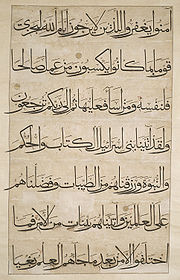
Religious text
Religious texts, also known as scripture, scriptures, holy writ, or holy books, are the texts which various religious traditions consider to be sacred, or of central importance to their religious tradition...
of Islam. Muslims believe that the verses of the Qur'an were revealed to Muhammad by God through the Arch-Angel Gabriel
Gabriel
In Abrahamic religions, Gabriel is an Archangel who typically serves as a messenger to humans from God.He first appears in the Book of Daniel, delivering explanations of Daniel's visions. In the Gospel of Luke Gabriel foretells the births of both John the Baptist and of Jesus...
between 610 CE and his death on June 8, 632 CE.
The Qur'an is divided into 114 sura
Sura
A sura is a division of the Qur'an, often referred to as a chapter. The term chapter is sometimes avoided, as the suras are of unequal length; the shortest sura has only three ayat while the longest contains 286 ayat...
s, or chapters, which combined, contain 6,666 āyāt
Ayah
Ayah or Aayah is the Arabic word for sign or proof:"These are the Ayat of Allah, which We recite to you with truth...
, or verses. The chronologically earlier suras, revealed at Mecca, are primarily concerned with ethical and spiritual topics. The later Medinan suras mostly discuss social and moral issues relevant to the Muslim community.
Naziri employ the science of Qu'ranic commentary and esoteric exegesis known as Ta'wil to reveal the batin (inner, esoteic), in addition to Tafsir
Tafsir
Tafseer is the Arabic word for exegesis or commentary, usually of the Qur'an. Ta'wīl is a subset of tafsir and refers to esoteric or mystical interpretation. An author of tafsir is a mufassir .- Etymology :...
to reveal the zahir (outer, exoteric), as tools of interpretation of scripture. Ta'wil stems from a Qur'anic word meaning "to return", "going back to" the original meaning of the Qur'an. While acknowledging the importance of both batin and zahir in religion, the batin (inner, esoteric) understandings of religion, informs how the Zahir (outer, exoteric) aspects of religion are practiced, but more importantly guides the believer on a spiritual journey that engages both the intellect ('aql) and the spirit (ruh) on a journey of discovery of the intangible truth (haq'iqq), with the ultimate destination being that of gnosis
Gnosis
Gnosis is the common Greek noun for knowledge . In the context of the English language gnosis generally refers to the word's meaning within the spheres of Christian mysticism, Mystery religions and Gnosticism where it signifies 'spiritual knowledge' in the sense of mystical enlightenment.-Related...
(ma'rifat).
The word Qur'an means "recitation". When Muslims speak in the abstract about "the Qur'an", they usually mean the scripture as recited rather than the printed work or any translation of it. For Isma'ili the Qu'ran is embodied most perfectly in the form of the Imam-i-Zaman, whose engagement of the Qu'ran through the use of Ta'wil and Tafsir is believed by Nizari to be "par excellence" due to divine inspiration.
Imāmate
A fundamental belief of the Imami Shi'a school is that the Prophet Muhammad, was imparted with a divine spark that dated back to the founding of the universe. This Nūr Dīn Muhammad (Light of Religion of Muhammad) had by divine decree been passed onto his son in law, Imam ‘AlīAli
' |Ramaḍān]], 40 AH; approximately October 23, 598 or 600 or March 17, 599 – January 27, 661).His father's name was Abu Talib. Ali was also the cousin and son-in-law of the Islamic prophet Muhammad, and ruled over the Islamic Caliphate from 656 to 661, and was the first male convert to Islam...
ibn Talib who had in turn passed it on to his descendants through the concept of nass; where divinely inspired, the Imām appoints his successor. Religious guidance can only come from the designate Imām
Imamah (Shi'a doctrine)
Imāmah is the Shia doctrine of religious, spiritual and political leadership of the Ummah. The Shīa believe that the A'immah are the true Caliphs or rightful successors of Muḥammad, and further that Imams are possessed of divine knowledge and authority as well as being part of the Ahl al-Bayt,...
, who remains a constant guide from God in the world. For Shia the Imāmate is a mercy, and a belief in humanity from God, who would never leave humanity without access to divine guidance and leadership. The term "Imām" takes on a different significance for the Shi‘a, whereas for Sunni an Imām is any member of a congregation who leads prayer.
For Isma'ili the chain of Imamate remains continuous until the end of the world, Imams may go in to satr (concealment, veiling) ushering in an age known as dawr al-satr (epoch of concealment) when the Imams remain hidden from the eyes of the bulk of their followers which may be generational; when safety is assured they re-emerge as kashf (manifest, unveiled), and usher in an age of dawr al-Kashf (epoch of unveiling). For Isma'ili the Imams do not manifest supernatural abilities, but rather exemplary qualities in dealing with the spiritual and material well being of their followers, they guard individual intellectual inquiry, and foster community cohesion.
Following is the list of continuous Imams since the first Imam Ali ibn Talib:
- 1. Imam Ali ibn Talib
- 2. Imam Hussain
- 3. Imam Zain ul Abideen
- 4. Imam Mohammad n Baqir
- 5. Imam Jaffer n Sadiq
- 6. Imam Ismail
- 7. Imam Mohammad bin Ismail
- 8. Imam Wafi Ahmed
- 9. Imam Taqqi Mohammad
- 10. Imam Razi u Ddin Abdullah
- 11. Imam Mohammad n Mehdi
- 12. Imam Qaim
- 13. Imam Mansoor
- 14. Imam Moez
- 15. Imam Azeez
- 16. Imam Hakim bi Amarillah
- 17. Imam Zahir
- 18. Imam Mustansirbillah (the first)
- 19. Imam Nizar (the first)
- 20. Imam Hadi
- 21. Imam Mohtaddi
- 22. Imam Qahir
- 23. Imam Ali Zikirah Assalam
- 24. Imam Aala Mohammad
- 25. Imam Jalal u Ddin Hassan
- 26. Imam Alla o Ddin Mohammad
- 27. Imam Rukun uddin Kher Shah
- 28. Imam Shams ilddin Mohammad
- 29. Imam Qasim Shah
- 30. Imam Islam Shah
- 31. Imam Mohammad ibn e Islam Shah
- 32. Imam Mustansirbillah (the second)
- 33. Imam Abdullsalam
- 34. Imam Ghareeb Merza
- 35. Imam Abi Al Zar Ali
- 36. Imam Murad Merza
- 37. Imam Zelfiquar Ali
- 38. Imam Noor u ddin Ali
- 39. Imam Khaleel ullah Ali
- 40. Imam Nizar (the second)
- 41. Imam Al Syed Ali
- 42. Imam Hassan Ali
- 43. Imam Qasim Ali
- 44. Imam Abi ul Hassan Ali
- 45. Imam Khaleel ullah Ali
- 46. Imam Shah Hassan Ali (The Aga Khan I)
- 47. Imam Shah Ali Shah (The Aga Khan II)
- 48. Imam Sultan Mohammad Shah (The Aga Khan III)
- 49. Imam Shah Karim (The Aga Khan IV)
Pillars of Islam
Isma'ilism holds that there are seven pillars in Islam, each of which possess both an exoteric outer (Zahir) expression, and an esoteric inner (Batin) expression.The Foundation:
The Shahādah
Shahada
The Shahada , means "to know and believe without suspicion, as if witnessed"/testification; it is the name of the Islamic creed. The shahada is the Muslim declaration of belief in the oneness of God and acceptance of Muhammad as God's prophet...
or profession of faith is not considered a Pillar as it is in other schools of Islam. Rather as the foundation upon which the Seven Pillars rest. The recitation of the shahādatayn (La ilaha illa Allah wa Muhammadun rasulu l-Lah) “There is no god but God and Muhammad is the messenger of God” confirms one as a Muslim. The Shia and Nizari add wa ‘Aliyun wali llah (علي ولي الله) "‘Alī is the guardian [appointed] of God" at the end of the shahādatayn, a confirmation one is a Mu'min "believer" under the guardianship (walayya) of the Imam and the esoteric inner path
Inner path
Inner path, in its generic meaning, is any sort of path that is "turned inward" or is contrasted with an "outer path".- Spiritual or religious :Inner path, as a spiritual or religious concept, is referred to in:* Spiritual paths...
(tariqah).
The Seven Pillars consist of:
- Walayah Guardianship ; cultivating a pure loving, affection, attachment and intimacy to God, manifested in the Prophets and the Imams by continually offering loyalty, allegiance, devotion and obedience to God, and those who manifest divine guardianship: the Prophets and Imams. For the Nizari, God is the true desire of every soul.
- Taharah Purity ; physical cleanliness, keeping a hygienic home, and personal presence, but also a purity of the heart and the soul.
- Salah Prayer Nizari Isma'ili as Imami Shia practice the Salaah according to the Ja‘farī madhhabMadhhabis a Muslim school of law or fiqh . In the first 150 years of Islam, there were many such "schools". In fact, several of the Sahābah, or contemporary "companions" of Muhammad, are credited with founding their own...
, which is performed to mark important festivals. Nizari more generally perform a ritual du‘a three times a day. The Nizari, like the Sufi, practice dhikrDhikrDhikr , plural ; ), is an Islamic devotional act, typically involving the repetition of the Names of God, supplications or formulas taken from hadith texts and verses of the Qur'an. Dhikr is usually done individually, but in some Sufi orders it is instituted as a ceremonial activity...
"remembrance" of God, the Prophets and the Imams, which can take the form of a melodic communal chant or can be performed in silence. - Zakah Charity ; Volunteering, and sharing of ones own knowledge or skills, as well as tithing. Nizari are encouraged to actively volunteer in the running of community spaces, and offering their specialized knowledge to the wider community, legal, medical, or more vocational expertise. Zakah also refers to tithing, Islamic tradition holds that Muhammad was designated to collect zakāt from believers, it is now the duty to pay the Imām or his representative; to be redistributed in local, and international development.
- SawmSawmSawm is an Arabic word for fasting regulated by Islamic jurisprudence. In the terminology of Islamic law, Sawm means to abstain from eating, drinking , having sex and anything against Islamic law...
Fasting ; Fasting during the month of RamadanRamadanRamadan is the ninth month of the Islamic calendar, which lasts 29 or 30 days. It is the Islamic month of fasting, in which participating Muslims refrain from eating, drinking, smoking and sex during daylight hours and is intended to teach Muslims about patience, spirituality, humility and...
and to mark the new moon is believed to be beneficial for those who are overwrought with the base ego; desire, rage, and the self. Isma'ili who are following the tariqah (path) seek to transcend the base ego so as to attain an inner being that is in harmony, they absorb food as nourishment for a healthy, peaceful, body and mind; as the more important fast is that of mind and heart, where one abstains from unworthy concerns and worldly thoughts, and can be broken by succumbing to the base ego, and its insatiable desires. - HajjHajjThe Hajj is the pilgrimage to Mecca, Saudi Arabia. It is one of the largest pilgrimages in the world, and is the fifth pillar of Islam, a religious duty that must be carried out at least once in their lifetime by every able-bodied Muslim who can afford to do so...
Pilgrimage ; The pilgrimage to Mecca at least once in an individual's life. For the Nizari, there is also a fuller discovery to be made regarding life. The Imams spirit, both a spiritual and physical glimpse (Deedar) aid them in transforming themselves into spiritual beings they cease to be ordinary people existing within the exoteric reality, but journey to and discover an inner reality of life. - JihadJihadJihad , an Islamic term, is a religious duty of Muslims. In Arabic, the word jihād translates as a noun meaning "struggle". Jihad appears 41 times in the Quran and frequently in the idiomatic expression "striving in the way of God ". A person engaged in jihad is called a mujahid; the plural is...
Struggle ; is a struggle against deeply personal and social vices, such as wrath, intolerance, envy, and that which removes one from the ease of the divine presence. The struggle may also take the form of a physical war against those that harm the peace, either militarily or through subterfuge, with the aim of restoring or creating a just society. Isma'ili are instructed to avoid provocation, and use of force only as a final resort, and only in self-defense.
Theology
Various rival approaches to the challenge that Greek rationalism posed to revelation permeated early Islamic society; the Ashʿari considered Kalam (reason) contradictory to Islam and philosophy (falsafa) as inherently antagonistic to faith, asserting the absolute supremacy of revelation, and the abandonment of reason in the spiritual space, and secular space (both of which are interconnected within orthodox Islam). The Mu'taziliMu'tazili
' is an Islamic school of speculative theology that flourished in the cities of Basra and Baghdad, both in present-day Iraq, during the 8th–10th centuries. The adherents of the Mu'tazili school are best known for their having asserted that, because of the perfect unity and eternal nature of God,...
took a less absolutist approach asserting the supremacy traditionalism, yet allowing for a limited role of reason (Kalam). Isma'ili adopted an altogether more philosophical approach in which only through reasoned discourse one could attain understanding of revelation, social structure, individualism and as well as the functioning of the natural world. For this reason Isma'ili produced a relatively scant collection of theological discourse in comparison to other Shia, and the Sunni. Yet they commanded a leading place in the development of philosophical discourse within the Islamic world.
While Nizari belong to the Imami or Ja‘fāriyya Madhab (school of Jurisprudence), founded by Imam Ja‘far as-Sadiq they adhere to sumpremacy of reason "Kalam", in the interpretation of scripture, and believe in the temporal relativism of understanding, as opposed to fiqh (traditional legalism), which adheres to an absolutism approach to revelation.
For Nizari reasoning is arrived at through a dialectic between revelation and human reasoning, based on a synergy of Islamic scripture and classical Greek philosophy, in particular Aristotelean
Aristotelianism
Aristotelianism is a tradition of philosophy that takes its defining inspiration from the work of Aristotle. The works of Aristotle were initially defended by the members of the Peripatetic school, and, later on, by the Neoplatonists, who produced many commentaries on Aristotle's writings...
reasoning and Platonic
Platonism
Platonism is the philosophy of Plato or the name of other philosophical systems considered closely derived from it. In a narrower sense the term might indicate the doctrine of Platonic realism...
metaphysics. It seeks to extend an understanding of religion and revelation to identify the outwardly apparent (zahir), and also to penetrate to the roots, to retrieve and disclose that which is the inner underlying (batin). This process of discovery engages both the intellect (‘aql) and the spirit (ruh), operating in an integral synergy to illuminate and disclose truths (haqa’iq) culminating in gnosis
Gnosis
Gnosis is the common Greek noun for knowledge . In the context of the English language gnosis generally refers to the word's meaning within the spheres of Christian mysticism, Mystery religions and Gnosticism where it signifies 'spiritual knowledge' in the sense of mystical enlightenment.-Related...
(ma'rifat).
History
Isma'ili history is often traced through the unbroken hereditary chain of Guardianship or (waliya), beginning with as Shia believe AliAli
' |Ramaḍān]], 40 AH; approximately October 23, 598 or 600 or March 17, 599 – January 27, 661).His father's name was Abu Talib. Ali was also the cousin and son-in-law of the Islamic prophet Muhammad, and ruled over the Islamic Caliphate from 656 to 661, and was the first male convert to Islam...
Ibn Talib being declared his successor as Imam by the Prophet Muhammad
Muhammad
Muhammad |ligature]] at U+FDF4 ;Arabic pronunciation varies regionally; the first vowel ranges from ~~; the second and the last vowel: ~~~. There are dialects which have no stress. In Egypt, it is pronounced not in religious contexts...
during his final pilgrimage to Mecca
Mecca
Mecca is a city in the Hijaz and the capital of Makkah province in Saudi Arabia. The city is located inland from Jeddah in a narrow valley at a height of above sea level...
, a journey referred to as The Farewell Pilgrimage
The Farewell Pilgrimage
The Farewell Pilgrimage was the last and only Hajj pilgrimage the Islamic prophet Muhammad participated in, in 632 CE .-Preparations:...
, and continuing in an unbroken chain to the current Imam His Highness Shah Karim Al-Husayni, the Aga Khan IV
Aga Khan IV
Prince Karim, Aga Khan IV, NPk, NI, KBE, CC, GCC, GCIH, GCM is the 49th and current Imam of the Shia Imami Nizari Ismaili Muslims. He has held this position under the title of Aga Khan since July 11, 1957, when, at the age of 20, he succeeded his grandfather, Sultan Mahomed Shah Aga Khan...
Their history includes the establishment of two states governed by their Imams, including the first Shia Empire, the Fatimid Empire, a considerable feat considering they are small minority of the Shia, who are in turn a minority within Islam, and the Nizari Ismaili state of Alamut
Alamut
Alamut was a mountain fortress located in the South Caspian province of Daylam near the Rudbar region in Iran, approximately 100 kilometres from present-day Tehran, Iran...
.
Contemporary Ismā'īlī
All Nizārī Ismā'īlī today accept His Highness Prince Shah Karim Al-Husayni, the Aga Khan IV as their Imām-I-Zaman (Imam of the Time). In Persian he is referred to religiously as Khudawand (Lord of the Time), in Arabic as Maulana (Master) or Hāzar Imām (Present Imam). Karim acceded his grandfather Sir Sultan Muhammad Shah Aga Khan IIIAga Khan III
Sir Sultan Muhammed Shah, Aga Khan III, GCSI, GCMG, GCIE, GCVO, PC was the 48th Imam of the Shia Ismaili Muslims. He was one of the founders and the first president of the All-India Muslim League, and served as President of the League of Nations from 1937-38. He was nominated to represent India to...
to the Imāmate in 1957, aged just 20, and still an undergraduate at Harvard University. He was referred to as "the Imam of the Atomic Age
Atomic Age
The Atomic Age, also known as the Atomic Era, is a phrase typically used to delineate the period of history following the detonation of the first nuclear bomb Trinity on July 16, 1945...
". The period following his accession can be characterized as one of rapid political and economic change. Planning of programs and institutions became increasingly difficult due to the rapid changes in newly emerging post colonial nations where many of his followers resided. Upon becoming Imām, Karim's immediate concern was the preparation of his followers, wherever they lived, for the changes that lay ahead. This rapidly evolving situation called for bold initiatives and new programs to reflect developing national aspirations, in the newly independent nations.
In Africa, Asia and the Middle East, a major objective of the Community's social welfare and economic programs, until the mid-fifties, had been to create a broad base of businessmen, agriculturists, and professionals. The educational facilities of the community tended to emphasize secondary-level education. With the coming of independence, each nation's economic aspirations took on new dimensions, focusing on industrialization and modernization of agriculture. The community's educational priorities had to be reassessed in the context of new national goals, and new institutions had to be created to respond to the growing complexity of the development process.
In 1972, under the regime of the then President Idi Amin
Idi Amin
Idi Amin Dada was a military leader and President of Uganda from 1971 to 1979. Amin joined the British colonial regiment, the King's African Rifles in 1946. Eventually he held the rank of Major General in the post-colonial Ugandan Army and became its Commander before seizing power in the military...
, Ismā'īlīs and other Asians were expelled from Uganda despite being citizens of the country and having lived there for generations. The Imam undertook urgent steps to facilitate the resettlement of Ismāʿīlīs displaced from Uganda, Tanzania, Kenya and also from Burma. Owing to his personal efforts most found homes, not only in Asia, but also in Europe and North America. Most of the basic resettlement problems were overcome remarkably rapidly. This was due to the adaptability of the Ismāʿīlīs themselves and in particular to their educational background and their linguistic abilities, as well as the efforts of the host countries and the moral and material support from Ismāʿīlī community programs.
In view of the importance that Islām places on maintaining a balance between the spiritual well-being of the individual and the quality of his life, the Imām's guidance deals with both aspects of the life of his followers. The Aga Khan has encouraged Ismā'īlī Muslims, settled in the industrialized world, to contribute towards the progress of communities in the developing world through various development programs. Indeed the Economist noted: that Isma'ili immigrant communities, integrated seamlessly as an immigrant community, and did better at attaining graduate and post graduate degrees, "far surpassing their native, Hindu, Sikh, fellow Muslims, and Chinese communities".
Silver Jubilee
From July 1982 to July 1983, to celebrate the present Aga Khan's Silver Jubilee, marking the 25th anniversary of his accession to the Imāmat, many new social and economic development projects were launched. These range from the establishment of the US$450 million international Aga Khan UniversityAga Khan University
The Aga Khan University is a coeducational research university spread over three continents. It was granted its charter in 1983 as Pakistan's first private, autonomous university. AKU was founded by His Highness the Aga Khan, and is part of the Aga Khan Development Network...
with its Faculty of Health Sciences and teaching hospital based in Karachi, the expansion of schools
Aga Khan Education Services
Aga Khan Education Services is one of four agencies of the Aga Khan Development Network supporting activities in the field of education...
for girls and medical centers
Aga Khan Health Services
The Aga Khan Health Services is an agency of the Aga Khan Development Network that supports activities in the health field, and manages more than 200 health facilities including a network of Aga Khan Hospitals....
in the Hunza region, one of the remote parts of Northern Pakistan bordering on China and Afghanistan, to the establishment of the Aga Khan Rural Support Program in Gujarat, India, and the extension of existing urban hospitals
Aga Khan Hospital
Aga Khan Hostpital may refer to:*Aga Khan Hospital, Dar es Salaam*Aga Khan Maternal and Child Care Centre, Hyderabad*Aga Khan Hospital for Women, Karimabad*Aga Khan Hospital, Kisumu*Aga Khan Hospital, Mombasa*Prince Aly Khan Hospital, Mumbai...
and primary health care centers in Tanzania and Kenya. These initiatives form part of an international network of institutions involved in fields that range from education, health and rural development, to architecture and the promotion of private sector enterprise and together make up the Aga Khan Development Network
Aga Khan Development Network
The Aga Khan Development Network is a group of private, non-denominational development agencies that seek to empower communities and individuals to improve living conditions and opportunities, in sub-Saharan Africa, Central and South Asia, and the Middle East...
.
It is this commitment to man's dignity and relief of humanity that inspires the Ismā'īlī Imāmat's philanthropic institutions. Giving of one's competence, sharing one's time, material or intellectual ability with those among whom one lives, for the relief of hardship, pain or ignorance is a deeply ingrained tradition which shapes the social conscience of the Ismā'īlī Muslim community.
Golden Jubilee
During his Golden Jubilee from 2007-2008 marking 50 years of Imamate the Aga Khan commissioned a number of projects, renowned Pritzker PrizePritzker Prize
The Pritzker Architecture Prize is awarded annually by the Hyatt Foundation to honour "a living architect whose built work demonstrates a combination of those qualities of talent, vision and commitment, which has produced consistent and significant contributions to humanity and the built...
winning Japanese architect Fumihiko Maki
Fumihiko Maki
is a Japanese architect and currently teaching at Keio University SFC.- Biography :After studying at the University of Tokyo he moved to the Cranbrook Academy of Art in Bloomfield Hills, Michigan, and then to Harvard Graduate School of Design. In 1956, he took a post as assistant professor of...
was commissioned to design a new kind of community structure resembling an embassy in Canada, The "Delegation of the Ismaili Imamat
Delegation of the Ismaili Imamat
The Delegation of the Ismaili Imamat in Ottawa, Ontario, Canada, a building of the Aga Khan Foundation Canada located between the Saudi Arabian embassy and the Lester B. Pearson Building on Sussex Drive...
" opened in 8 December 2008, the building will be composed of two large interconnected spaces an atrium and a courtyard. The atrium is an interior space to be used all year round. It is protected by a unique glass dome made of multi-faceted, angular planes assembled to create the effect of rock crystal the Aga Khan asked Maki to consider the qualities of "rock crystal" in his design, which during the Fatimid Empire was valued by the Imams. Within the glass dome is an inner layer of woven glass-fibre fabric which will appear to float and hover over the atrium. The Delegation building sits along sussex drive near the Canadian parliament. Future Delegation buildings are planned for other capitals, beginning with Lisbon, Portugal.
In addition to primary and secondary schools the Aga Khan Academies, were set up to equip future leaders in the developing world, with a leading standard education. The Aga Khan Museum, which will open in Toronto, Canada, will be the first museum dedicated to islamic civilization in the west, due for completion in 2011 it will be dedicated to the "acquisition, preservation and display of artefacts - from various periods and geographies - relating to the intellectual, cultural, artistic and religious heritage of Islamic communities". A series of new Isma'ili centre are underway, including Toronto, Ontario; Paris, France; Houston, Texas; Dushanbe and the Pamir; Tajikistan.
World Constitution
The present Aga Khan continued the practice of his predecessor and extended constitutions to Ismā'īlī communities in the US, Canada, several European countries, the Gulf, Syria and Iran following a process of consultation within each constituency. In 1986, he promulgated a World Constitution that, for the first time, brought the social governance of the worldwide Ismā'īlī community into a single structure with built-in flexibility to account for diverse circumstances of different regions. Served by volunteers appointed by and accountable to the Imām, the Constitution functions as an enabler to harness the best in individual creativity in an ethos of group responsibility to promote the common well-being.Like its predecessors, the present constitution is founded on adherence to the basic principles of Islam, belief in One God, and Muhammad as the seal of the prophets. And to each Ismā'īlī's spiritual allegiance to the Imām of the Time, which is separate from the secular allegiance that all Ismā'īlīs owe as citizens to their national entities. The present Imām and his predecessor emphasized every Ismāʿīlī's allegiance to his or her country as a fundamental obligation. These obligations are discharged not by passive affirmation but through responsible engagement and active commitment to uphold national integrity and contribute to peaceful development.
Places of Worship
Jama'at Khana (Arabic, Persian: جماعتِ خانة ), from the Arabic "Jamaat" (congregation), and the Persian "Khaneh" (house).Jama'at Khana are Isma'ili houses of prayer, study, and community. They usually contain separate spaces for prayer, and a social hall for community gatherings.
There are no principle architectural guidelines for Jama'at Khana although inspiration is drawn from Islamic architectural philosophy, and local architectural traditions to seamlessly, and discretely place them into the local architectural environment. Architectural forms and interior designs of Jamaat Khana vary from east to west, but are focussed on a minimalist design aesthetic.
Larger Jama'at Khana are referred to as "Darkhanas", or "Isma'ili Centers" in the west, and have been referred to as "Isma'ili Cathedrals" by observers. While containing prayer, and social infrastructure albeit on a larger scale, they may also contain auditoriums and lecture spaces, libraries, offices, and council chambers, as they act as the regional, or national governing centers for community administration.
Jama'at Khana, particularly the larger centers offer their spaces to the community at large, and arrange guided tours. However, during the obligatory prayer (Holy Du'a
Holy Du'a
Holy Du'ā is the mandatory Nizari Ismaili prayer recited three times a day, at dawn , sundown and evening . Only Nizari Ismailis are permitted to enter the Jamatkhana during the recitation the Holy Du'a, however it can be performed in one's home or any other place as well...
) only Isma'ili are allowed to enter the prayer hall (masjid).
Encyclopaedia of Ismailism by Mumtaz Ali Tajddin:
In the Ismaili tariqah, the guardian of each Jamatkhana is called mukhi (in the South-Asian tradition)or Sheikh (in the Arab tradition) there are also other names that are applied based on the cultural context of the Jamat, mukhi is a word derived from mukhiya means foremost. Since the Imam physically is not present all the times in the Jamatkhana, the Mukhi acts tangible symbol of the Imam's authority. In the big jamat, the Mukhi was assisted by a caretaker called tha'nak. Later, the office of kamadia (from kamdar means accountant) was created. The Mukhi and Kamadia are the traditional titles going back to the pre-Aga Khan period when they enjoyed considerable local power. Their responsibilities include officiating over the daily rituals in the Jamatkhana, but they are primarily lay officials. Since the wholesale reorganizations undertaken by the Imams, the local committees are now tied into an elaborately hierarchical administrative structure of boards and councils.
Symbols
The Fatimids adopted Green (akhdar) as the colour of their standard, which symbolized their allegiance to Hasdret Ali, who in order to thwart an assassination attempt once wrapped himself in a green coverlet in place of the Prophet Muhammad. When Hassan I Sabbah captured Alamut it is said he hoisted the green standard over the fortress, it was later reported that Hassan I sabbah prophesied that when the Hidden Imam made himself known he would hoist a red flag, which Hasan II did during his appearance. Following the destruction of Alamut Ismaili hoisted both green and red flags above the tombs of their Imams. Green and Red were unified in the 19th century into the Isma'ili flag known as "My Flag".The Fatimids also used a white standard with gold inlays, and the Caliph Imams often wore white with gold, as they do today. Isma'ili use a gold crest on white standard to symbolize the authority of Imamate, and often wear white in the presence of their Imam.
The heptagram
Heptagram
A heptagram or septegram is a seven-pointed star drawn with seven straight strokes.- Geometry :In general, a heptagram is any self-intersecting heptagon ....
(septegram) a seven pointed star is often used by Isma'ili as a symbol.
Marriage
Marriage ("ʿurs" عرس), is a legal contract ("Nikkah" النكاح) between a consenting adult man and a woman, it is not considered a sacrament in Islam as it is in Christianity. As a contract it allows both parties to add certain conditions.Nizari ideals of marriage envision a long term union and thus Nizari also reject short Nikah Mut'ah and Misyar temporary marriage contracts.
Nizari of either gender may marry with spouses from the Abrahamic faiths, Jews, Christians, Samaritans, as well as Zoroastrians. However an emphasis is placed on marrying within the community, or converting partners who are outside the fold, raising children of mixed unions as Isma'ili Muslim.
Since marriage is not considered a sacrament in Islam, Nizari Isma'ili consider secular court marriages in the west as valid legal contracts so long as they do not contradict Islamic principles (marriage with polytheists, homosexuality etc.) . However many Isma'ili couples in the west opt into both a court marriage to secure legal recognition, in addition to a Nikkah ceremony performed at a Jama'at Khana.
Offerings
NāndiNāndi
Nāndi is a Nizari Isma'ili ceremony during which food offered to the Imām-e Zamān is sold off at auction to people attending the Jamatkhana . The money obtained through the sale of Nāndi is sent to the Imām by a group of people from the Ismaili community given that responsibility...
is a ceremony in which food is symbolically offered to the Imām-e Zamān
Imamah (Shi'a Ismaili doctrine)
The Ismaili view on the Imamah differs from the Twelver Shi'a view, in particular because the Imam in Ismailism is the Noor of God . Ismailis believe that the Noor of God is present in the Imam, and that there is only a Ẓāhirī difference between each one...
, and is subsequently auctioned to the congregation. Money obtained are forwarded to the Imām by officials. The Ceremony is conducted by volunteers from the community. The food is prepared at home and is brought to the Jamāa't khāne, the Mukhi (congregation head) includes the food known as "Mehmāni" during a blessing at the end of prayers, informing the congregation that it has been offered to the Imām and the benefits of it are for the whole Jamāt. If no physical Mehmāni has been brought to the Jamātkhāne then a symbolic plate called the "Mehmāni plate" can be touched during the Du'a Karavi
Du'a karavi
Du‘ā' Karāwī is a Nizari Isma'ili ceremony during which the Ismaili asks God for His forgivness through the Imam of the Time. The Qur'an states that the Muslim must repent of their sins; it further stipulates that the believer must approach the presence of the Prophet Muhammad and seek forgiveness...
ceremony, this serves as a substitute for physical food.
The origins of Nāndi are said to be in the Prophet Muhammad
Muhammad
Muhammad |ligature]] at U+FDF4 ;Arabic pronunciation varies regionally; the first vowel ranges from ~~; the second and the last vowel: ~~~. There are dialects which have no stress. In Egypt, it is pronounced not in religious contexts...
's time when a similar practice occurred.
Calendar
Nizari use an arithmetic based Lunar calendar to calculate the year, unlike most Muslim communities who rely on visual sightings. The Isma'ili calendar was developed in the Middle Ages during the Faitmid Caliphate of Imam Al-Hakim.A lunar year contains about 354 11/30 days, Nizari Isma'ili employ a cycle of 11 leap years (kasibah) with 355 days in a 30 year cycle.
The odd numbered months contain 30 days and the even numbered months 29 days, the 12th and final month in a leap year contains 30 days.
Nizari use 2, 5, 7, 10, 13, 16, 18, 21, 24, 26, 29 respectively in their calculations.
International Development
The Aga Khan Development Network (AKDN) was set up by the Imamate and the Isma'ili community as a group of private, non-denominational development agencies that seek to empower communities and individuals regardless of ethnicity or religious affiliation, to seek to improve living conditions and opportunities within the developing world. It has active working relationships with NGO's like the UN, the EU, the Bill & Melinda Gates FoundationBill & Melinda Gates Foundation
The Bill & Melinda Gates Foundation is the largest transparently operated private foundation in the world, founded by Bill and Melinda Gates. It is "driven by the interests and passions of the Gates family"...
, and government bodies including the United States Agency for International Development
United States Agency for International Development
The United States Agency for International Development is the United States federal government agency primarily responsible for administering civilian foreign aid. President John F. Kennedy created USAID in 1961 by executive order to implement development assistance programs in the areas...
, Canadian International Development Agency
Canadian International Development Agency
The Canadian International Development Agency was formed in 1968 by the Canadian government. CIDA administers foreign aid programs in developing countries, and operates in partnership with other Canadian organizations in the public and private sectors as well as other international organizations...
, the United Kingdom's
United Kingdom
The United Kingdom of Great Britain and Northern IrelandIn the United Kingdom and Dependencies, other languages have been officially recognised as legitimate autochthonous languages under the European Charter for Regional or Minority Languages...
Department for International Development
Department for International Development
The Department For International Development is a United Kingdom government department with a Cabinet Minister in charge. It was separated from the Foreign and Commonwealth Office in 1997. The goal of the department is "to promote sustainable development and eliminate world poverty". The current...
, and Germany's
Germany
Germany , officially the Federal Republic of Germany , is a federal parliamentary republic in Europe. The country consists of 16 states while the capital and largest city is Berlin. Germany covers an area of 357,021 km2 and has a largely temperate seasonal climate...
Federal Ministry of Economic Cooperation and Development (Germany).
Agencies of the AKDN
- Aga Khan FoundationAga Khan FoundationThe Aga Khan Foundation is a private, not-for-profit international development agency, which was founded in 1967 by . AKF seeks to provide long-term solutions to problems of poverty, hunger, illiteracy and ill health in the poorest parts of South and Central Asia, Eastern and Western Africa, and...
(AKF) - Aga Khan Health ServicesAga Khan Health ServicesThe Aga Khan Health Services is an agency of the Aga Khan Development Network that supports activities in the health field, and manages more than 200 health facilities including a network of Aga Khan Hospitals....
(AKHS) - Aga Khan Agency for MicrofinanceAga Khan Agency for Microfinance-Meaning:Microfinance is the provision of a broad range of financial services, for those who often do not have access, such as - deposits, loans, payment services, money transfers and insurance products - to low-income households to help them raise their income levels and improve their quality of...
(AKAM) - Aga Khan Fund for Economic DevelopmentAga Khan Fund for Economic DevelopmentThe Aga Khan Fund for Economic Development ' is the sole for-profit agency of the Aga Khan Development Network and works in partnership with international organizations and governments to stimulate the private sectors of developing economies, with the aim of generating capital for investment...
(AKFED) - Aga Khan Planning and Building ServicesAga Khan Planning and Building ServicesThe Aga Khan Planning and Building Service was established in 1980 as an agency of the Aga Khan Development Network . The agency works to improve the built environment, particularly housing design and construction, village planning, natural hazard mitigation, environmental sanitation, water...
(AKPBS) - Focus Humanitarian AssistanceFocus Humanitarian AssistanceFocus Humanitarian Assistance is an international group of agencies established in Europe, North America and South Asia to complement the provision of emergency relief, principally in the developing world...
(FOCUS) - Aga Khan Education ServicesAga Khan Education ServicesAga Khan Education Services is one of four agencies of the Aga Khan Development Network supporting activities in the field of education...
(AKES) - Aga Khan Trust for CultureAga Khan Trust for CultureThe Aga Khan Trust for Culture is an agency of the Aga Khan Development Network . It focuses on the revitalization of communities in the Muslim world—physical, social, cultural, and economic...
(AKTC) - University of Central AsiaUniversity of Central AsiaThe University of Central Asia was founded in 2000 by the governments of Kazakhstan, Kyrgyzstan and Tajikistan, and His Highness the Aga Khan...
(UCA) - Aga Khan UniversityAga Khan UniversityThe Aga Khan University is a coeducational research university spread over three continents. It was granted its charter in 1983 as Pakistan's first private, autonomous university. AKU was founded by His Highness the Aga Khan, and is part of the Aga Khan Development Network...
(AKU)
See also
- IsmailiIsmaili' is a branch of Shia Islam. It is the second largest branch of Shia Islam, after the Twelvers...
- HashshashinHashshashinThe Assassins were an order of Nizari Ismailis, particularly those of Persia that existed from around 1092 to 1265...
- FatimidFatimidThe Fatimid Islamic Caliphate or al-Fāṭimiyyūn was a Berber Shia Muslim caliphate first centered in Tunisia and later in Egypt that ruled over varying areas of the Maghreb, Sudan, Sicily, the Levant, and Hijaz from 5 January 909 to 1171.The caliphate was ruled by the Fatimids, who established the...
- Aga KhanAga KhanAga Khan is the hereditary title of the Imam of the largest branch of the Ismā'īlī followers of the Shī‘a faith. They affirm the Imamat of the descendants of Ismail ibn Jafar, eldest son of Imam Ja'far al-Sadiq, while the larger Twelver branch of Shi`ism follows Ismail's younger brother Musa...
- Aga Khan Development NetworkAga Khan Development NetworkThe Aga Khan Development Network is a group of private, non-denominational development agencies that seek to empower communities and individuals to improve living conditions and opportunities, in sub-Saharan Africa, Central and South Asia, and the Middle East...
- BatiniyyaBatiniyyaBatiniyya is a pejorative term to refer to those groups, such as Alevism, Ismailism, and often Sufism, which distinguish between an inner, esoteric level of meaning in the Qur'an, in addition to the outer, exoteric level of meaning Zahiri...
- SufismSufismSufism or ' is defined by its adherents as the inner, mystical dimension of Islam. A practitioner of this tradition is generally known as a '...
- Shi'a Imam
- Shi'a in AfricaShi'a in AfricaThe population of Shi'a in Africa is composed of several, primarily heterodox, communities:*Syncretic Shia adherents in northern Nigeria....
- Jama'at Khana
- List of Ismaili imams
- KhojaKhojaThe Khojas are ethnic group of Shia Muslims. The word Khoja derives from Khwaja, a Persian title .In Pakistan, many Khojas migrated to and settled in the province of Sindh and especially in the city of Karachi. While in India, most Khojas live in the states of Gujarat, Maharashtra, Rajasthan and...
External links
- The Ismaili, The official website of the Isma'ili Muslim Community.
- Institute of Ismaili Studies, Promotes scholarship and learning on Islam, Shi'ism and the Ismaili Tariqah in particular.
- Aga Khan Development Network, a group of development agencies with mandates ranging from health and education to architecture, culture.
- Shia Imami Nizari Ismaili, Golden Jubilee of Aga Khan IV.
- Aga Khan University, Multinational University dedicated to addressing the medical needs of the developing world.
- First Ismaili Electronic Library and Database