


Chola Dynasty

Encyclopedia
The Chola dynasty was a Tamil
dynasty
which was one of the longest-ruling in some parts of southern India. The earliest datable references to this Tamil
dynasty are in inscriptions from the 3rd century BC left by Asoka, of Maurya Empire
; the dynasty continued to govern over varying territory until the 13th century AD.
The heartland of the Cholas was the fertile valley of the Kaveri River
, but they ruled a significantly larger area at the height of their power
from the later half of the 9th century till the beginning of the 13th century. The whole country south of the Tungabhadra was united and held as one state for a period of two centuries and more. Under Rajaraja Chola I
and his son Rajendra Chola I
, the dynasty became a military, economic and cultural power in South Asia
and South-east Asia. The power of the new empire was proclaimed to the eastern world by the celebrated expedition to the Ganges which Rajendra Chola I
undertook and by the overthrow after an unprecedented naval war of the maritime empire of Srivijaya
, as well as by the repeated embassies to China. During the period 1010–1200, the Chola territories stretched from the islands of the Maldives
in the south to as far north as the banks of the Godavari River
in Andhra Pradesh
. Rajaraja Chola conquered peninsular South India
, annexed parts of what is now Sri Lanka
and occupied the islands of the Maldives. Rajendra Chola sent a victorious expedition to North India that touched the river Ganges and defeated the Pala
ruler of Pataliputra, Mahipala
. He also successfully invaded kingdoms of the Malay Archipelago
. The Chola dynasty went into decline at the beginning of the 13th century with the rise of the Pandyas, who ultimately caused their downfall.
The Cholas left a lasting legacy. Their patronage of Tamil literature
and their zeal in building temples have resulted in some great works of Tamil literature and architecture. The Chola kings were avid builders and envisioned the temples in their kingdoms not only as places of worship but also as centres of economic activity. They pioneered a centralised form of government
and established a disciplined bureaucracy.
and in inscriptions. Later medieval Cholas
also claimed a long and ancient lineage to their dynasty. Mentions in the early Sangam literature
(c. 150 CE) indicate that the earliest kings of the dynasty antedated 100 CE. Parimelalagar, the annotator of the Tamil classic Tirukkural
, mentions that this could be the name of an ancient king.
The most commonly held view is that this is, like Cheras
and Pandyas, the name of the ruling family or clan of immemorial antiquity. The annotator Parimelazhagar writes "The charity of people with ancient lineage (such as the Cholas, the Pandyas and the Cheras) are forever generous in spite of their reduced means". Other names in common use for the Cholas are Killi (கிள்ளி), Valavan (வளவன்) and Sembiyan (செம்பியன்). Killi perhaps comes from the Tamil kil (கிள்) meaning dig or cleave and conveys the idea of a digger or a worker of the land. This word often forms an integral part of early Chola names like Nedunkilli
, Nalankilli
and so on, but almost drops out of use in later times. Valavan is most probably connected with 'valam' (வளம்) – fertility and means owner or ruler of a fertile country. Sembiyan is generally taken to mean a descendant of Shibi
– a legendary hero whose self-sacrifice in saving a dove from the pursuit of a falcon figures among the early Chola legends and forms the subject matter of the Sibi Jataka
among the Jataka
stories of Buddhism
. In Tamil lexicon Chola means Soazhi or Saei denoting a newly formed kingdom, in the lines of Pandya or the old country. Sora or Chozha in Tamil becomes Chola in Sanskrit
and Chola or Choda in Telugu
.
On the history of the early Cholas there is very little authentic written evidence available. Historians during the past 150 years have gleaned a lot of knowledge on the subject from a variety of sources such as ancient Tamil Sangam literature, oral traditions, religious texts, temple and copperplate inscriptions
. The main source for the available information of the early Cholas is the early Tamil literature of the Sangam Period. There are also brief notices on the Chola country and its towns, ports and commerce furnished by the Periplus of the Erythraean Sea
(Periplus Maris Erythraei). Periplus is a work by an anonymous Alexandrian
merchant, written in the time of Domitian
(81–96) and contains very little information of the Chola country. Writing half a century later, the geographer Ptolemy
gives more detail about the Chola country, its port and its inland cities. Mahavamsa
, a Buddhist text written down during the 5th century CE, recounts a number of conflicts between the inhabitants of Ceylon and Cholas in the 1st century BCE. Cholas are mentioned in the Pillars of Ashoka
(inscribed 273 BCE–232 BCE) inscriptions, where they are mentioned among the kingdoms which, though not subject to Ashoka, were on friendly terms with him.
of the Sangam literature, the interregnum between the fall of the Sangam Cholas and the rise of the medieval Cholas under Vijayalaya
(c. 848), the dynasty of Vijayalaya, and finally the Later Chola dynasty of Kulothunga Chola I from the third quarter of the 11th century.
. The internal chronology of this literature is still far from settled, and at present a connected account of the history of the period cannot be derived. The Sangam literature records the names of the kings and the princes, and of the poets who extolled them. Despite a rich literature that depicts the life and work of these people, these cannot be worked into connected history.
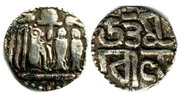 The Sangam literature also records legends about mythical Chola kings. These myths speak of the Chola king Kantaman, a supposed contemporary of the sage Agastya
, whose devotion brought the river Kaveri into existence.
Two names stand out prominently from among those Chola kings known to have existed, who feature in Sangam literature: Karikala Chola
and Kocengannan
. There is no sure means of settling the order of succession, of fixing their relations with one another and with many other princelings of about the same period. Urayur
(now in/part-of Thiruchirapalli) was their oldest capital. Kaveripattinam
also served as an early Chola capital. The Mahavamsa
mentions that an ethnic Tamil adventurer, a Chola prince known as Elara
, invaded the island around 235 BCE and that King Gajabahu visited Chera Cenguttuvan around 108 CE.
s dominate the Tamil country. An obscure dynasty, the Kalabhras
, invaded the Tamil country, displaced the existing kingdoms and ruled for around three centuries. They were displaced by the Pallavas and the Pandyas in the 6th century. Little is known of the fate of the Cholas during the succeeding three centuries until the accession of Vijayalaya in the second quarter of the 9th century.
Epigraphy
and literature provide a few faint glimpses of the transformations that came over this ancient line of kings during this long interval. What is certain is that when the power of the Cholas fell to its lowest ebb and that of the Pandyas and Pallavas rose to the north and south of them, this dynasty was compelled to seek refuge and patronage under their more successful rivals. The Cholas continued to rule over a diminished territory in the neighbourhood of Uraiyur, but only in a minor capacity. In spite of their reduced powers, the Pandayas and Pallavas accepted Chola princesses in marriage, possibly out of regard for their reputation. Numerous inscriptions of Pallavas of this period mention their having fought rulers of 'the Chola country'. Despite this loss in influence and power, it is unlikely that the Cholas lost total grip of the territory around Uraiyur, their old capital, as Vijayalaya, when he rose to prominence hailed from this geographical area.
Around the 7th century, a Chola kingdom flourished in present-day Andhra Pradesh. These Telugu Cholas
(or Chodas) traced their descent to the early Sangam Cholas. However, it is not known if they had any relation to the early Cholas. It is possible that a branch of the Tamil Cholas migrated north during the time of the Pallavas to establish a kingdom of their own, away from the dominating influences of the Pandyas and Pallavas. The Chinese
pilgrim Xuanzang
, who spent several months in Kanchipuram
during 639–640 writes about the 'kingdom of Culi-ya', in an apparent reference to the Telugu Chodas.
 While there is little reliable information on the Cholas during the period between the early Cholas and Vijayalaya dynasties, there is an abundance of materials from diverse sources on the Vijayalaya and the Later Chola dynasties. A large number of stone inscriptions by the Cholas themselves and by their rival kings, Pandyas and Chalukyas, and copper-plate grants, have been instrumental in constructing the history of Cholas of that period. Around 850, Vijayalaya rose from obscurity to take an opportunity arising out of a conflict between Pandyas and Pallavas, captured Thanjavur and eventually established the imperial line of the medieval Cholas.
The Chola dynasty was at the peak of its influence and power during the medieval period. Through their leadership and vision, kings such as the second Chola King Aditya I
who caused the demise of the Pallavas, defeated the Pandyas of Madurai
and occupied very large parts of the Kannada country and had marital ties with the Gangas
, way back in 885 AD, his son Parantaka I
, who conquered Sri Lanka
known as Ilangai way back in 925 AD, Sundara Chola, also known as Parantaka Chola II who regained territories from the Rashtrakutas and expanded the Chola dominions up to Bhatkal
in Kannada country, Rajaraja Chola I
and Rajendra Chola I
extended the Chola kingdom beyond the traditional limits of a Tamil kingdom. At its peak, the Chola Empire stretched from the island of Sri Lanka in the south to the Godavari
-Krishna
basin in the north, up to the Konkan coast in Bhatkal, the entire Malabar Coast in addition to Lakshadweep
, Maldives
and vast areas of Chera
country. The kingdoms of Deccan and the eastern coast were subordinates, feudatories of the Cholas or other kingdoms like the Chalukyas between 1000–1075 AD paid tribute to the Cholas. Rajendra Chola I completed the conquest of the island of Sri Lanka and captured the Sinhala king Mahinda V prisoner, in addition to his conquests of Rattapadi (territories of the Rashtrakutas, Chalukya country, Talakkad
, Kolar
(where the Kolaramma temple still has his portrait statue) in Kannada country . In addition Rajendra's territories included the area falling on the Ganges-Hooghly-Damodar basin, large parts of Burma, Thailand
, Indo-China Laos
, Kambodia, the Malay peninsula
and Indonesia
. The kingdoms along the east coast of India up to the river Ganges acknowledged Chola suzerainty. Chola navies invaded and conquered Srivijaya
in the Malayan archipelago.
The Western Chalukyas
under Satyasraya
and Somesvara I
tried to wriggle out of Chola domination from time to time, primarily due to the Chola influence in the Vengi
kingdom. The Western Chalukyas mounted several unsuccessful attempts to engage the Chola emperors in war and except for a brief occupation of Vengi territories between 1118–1126, all their other attempts ended in failure with successive Chola emperors routing the armies of the Chalukyas at various places in many wars. Cholas always successfully controlled the Chalukyas in the western Deccan by routing them in war constantly and levying tribute on them. It is also pertinent to note that even under the not so strong emperors of the Cholas like Kulothunga I, Vikrama Chola etc. the wars against the Chalukyas were mainly fought in Chalukya territories in Karnataka or in the Telugu country like Vengi, Kakinada or Anantapur or Gutti. In any case, in the internecine wars among the small Kannada kingdoms of the Kadambas, Hoysalas, Vaidumbas or Kalachuris, the Chalukya interference was to cause them dearly with these Kingdoms steadily increasing their stock and ultimately the Hoysalas, the Kakatiyas, the Kalachuris and the Seunas consuming the Chalukyas and sending them into oblivion. With the occupation of Dharwar in North Central Karnataka by the Hoysalas under Vishnuvardhana
where he based himself with his son Narasimha I
in-charge at the Hoysala capital Dwarasamudra around AD 1149, and with the Kalachuris occupying the Chalukyan capital for over 35 years from around 1150–1151 AD, the Chalukya kingdom was already starting to dissolve due to incompetency of its rulers after 1126 AD.
The Cholas under Kulothunga Chola III
even collaborated to the herald the dissolution of the Chalukyas by aiding Hoysalas under Veera Ballala II
, the son-in-law of the Chola monarch, and sounded the death-knell of the Western Chalukyas
in a series of wars with Somesvara IV
between 1185–1190 AD, the last Chalukya king whose territories did not even include the erstwhile Chalukyan capitals Badami, Manyakheta or Kalyani. That was the final dissolution of Chalukyan power though the Chalukyas existed only in name since 1135–1140. In contrast, the Cholas would be stable till 1215 AD, and finally getting consumed by the Pandiyan
empire and ceasing to exist by 1280 AD.
On the other hand, throughout the period from 1150–1280 AD, the staunchest opponents of the Cholas were Pandya princes who tried to win independence for their traditional territories. This period saw constant warfare between the Cholas and these antagonists. The Cholas also fought regular wars with the Easter Gangas
of Kalinga, protected Vengi though it remained largely independent under Chola control, and had domination of the entire eastern coast with their feudatories the Telugu Chodas, Velananti Cholas, Renandu Cholas etc. who also always aided the Cholas in their successful campaigns against the Chalukyas and levying tribute on the Kannada kingdoms and fought constantly with the Sinhala
s, who attempted to overthrow the Chola occupation of Lanka
, but till the time of the Later Chola king Kulottunga I the Cholas had firm control over Lanka
. In fact, a Later Chola king Rajadhiraja Chola II
was strong enough to prevail over a confederation of five Pandya princes who were aided by their traditional friend, the king of Lanka
, this once again gave control of Lanka
to the Cholas despite the fact that they were not strong under the resolute Rajadhiraja Chola II
. However, Rajadhiraja Chola II
's successor, the last great Chola monarch Kulottunga Chola III reinforced the hold of the Cholas by quelling rebellion and disturbances in Lanka
and Madurai, defeated Hoysala generals under Veera Ballala II in Karuvur, in addition to holding on to his traditional territories in Tamil country, Eastern Gangavadi, Draksharama, Vengi and Kalinga
. After this, he entered into a marital alliance with Veera Ballala II (with Ballala's marriage to a Chola princess) and his relationship with Hoysalas seems to have become friendlier.
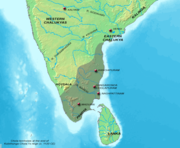 Marital and political alliances between the Eastern Chalukyas
began during the reign of Rajaraja following his invasion of Vengi. Rajaraja Chola's daughter married Chalukya prince Vimaladitya. Rajendra Chola's daughter was also married to an eastern Chalukya prince Rajaraja Narendra
.
Virarajendra Chola's son Athirajendra Chola
was assassinated in a civil disturbance in 1070, and Kulothunga Chola I
, the son of Rajaraja Narendra, ascended the Chola throne starting the Later Chola dynasty.
The Later Chola dynasty saw capable rulers in Kulothunga Chola I
, his son Vikrama Chola
, other successors like Rajaraja Chola II
, Rajadhiraja Chola II
and the great Kulothunga Chola III
, who conquered Kalinga
, Ilam
and Kataha. However, the rule of the later Cholas between 1218 AD, starting with Rajaraja Chola II
to the last emperor Rajendra Chola III
was not as strong as those of the emperors between 850–1215 AD. Around 1118, they lost control of Vengi to the Western Chalukya
and Gangavadi (southern Mysore districts) to the Hoysalas. However, these were only temporary setbacks, because immediately following the accession of king Vikrama Chola
, the son and successor of Kulothunga Chola I
, the Cholas lost no time in recovering the province of Vengi by defeating Chalukya Somesvara III and also recovering Gangavadi from the Hoysalas. The Chola Empire, though not as strong as between 850–1150, was still largely territorially intact under Raja Raja Chola II (1146–1175 AD) a fact attested by the construction and completion of the third grand Chola architectural marvel, the chariot-shaped Airavatesvara Temple
at Dharasuram on the outskirts of modern Kumbakonam. This temple is part of the World Heritage Sites trinity of the Great Living Chola Temples
, along with the Brihadeeswarar Temple
s of Thanjavur and Gangaikonda Cholapuram
, built by his predecessors Raja Raja Chola I and Rajendra Chola I, respectively. Chola administration and territorial integrity till the rule of Kulothunga Chola III
was stable and very prosperous up to 1215 AD, but during his rule itself, the decline of the Chola power started following his defeat by Maravarman Sundara Pandiyan II in 1215–16 AD. Subsequently, the Cholas also lost control of the island of Lanka and were driven out by the revival of Sinhala power.
In continuation of the decline, also marked by the resurgence of the Pandyas as the most powerful rulers in South India, a lack of a controlling central administration in its erstwhile-Pandyan territories prompted a number of claimants to the Pandya throne to cause a civil war in which the Sinhalas and the Cholas were involved by proxy. Details of the Pandyan civil war and the role played by the Cholas and Sinhalas, are present in the Mahavamsa
as well as the Pallavarayanpettai Inscriptions.
The Cholas, under Rajaraja Chola III
and later, his successor Rajendra Chola III
, were quite weak and therefore, experienced continuous trouble. One feudatory, the Kadava
chieftain Kopperunchinga I
, even held Rajaraja Chola III as hostage for sometime. At the close of the 12th century, the growing influence of the Hoysalas replaced the declining Chalukyas as the main player in the Kannada country, but they too faced constant trouble from the Seunas and the Kalachuris who were occupying Chalukya capital for those empires were their new rivals. So naturally, the Hoysalas found it convenient to have friendly relations with the Cholas from the time of Kulothunga Chola III
, who had defeated Hoysala Veera Ballala II, who had subsequent marital relations with the Chola monarch. This continued during the time of Rajaraja Chola III
the son and successor of Kulothunga Chola III
The Pandyas in the south had risen to the rank of a great power who ultimately banished the Hoysalas who were allies of the Cholas from Tamil country and subsequently causing the demise of the Cholas themselves in AD 1279. They first steadily gained control of the Tamil country as well as territories in Sri Lanka
, Chera country, Telugu country under Maravarman Sundara Pandiyan II and his able successor Jatavarman Sundara Pandyan
before inflicting several defeats on the joint forces of the Cholas under Rajaraja Chola III, his successor Rajendra Chola III and the Hoysalas under Someshwara, his son Ramanatha Rajendra III tried to survive by aligning with the Kadava Pallavas and the Hoysalas in turn in order to counter the constantly rising power of the Pandyans who were the major players in the Tamil country from AD 1215 and had intelligently consolidated their position in Madurai-Rameswaram-Ilam-Cheranadu and Kanniyakumari belt, and had been steadily increasing their territories in the Kaveri belt between Dindigul-Tiruchy-Karur-Satyamangalam as well as in the Kaveri Delta i.e. Thanjavur-Mayuram-Chidambaram-Vriddhachalam-Kanchi, finally marching all the way up to Arcot—Tirumalai-Nellore-Visayawadai-Vengi-Kalingam belt by 1250 AD.
The Pandyas steadily routed both the Hoysalas and the Cholas. They also dispossessed the Hoysalas, who had been overestimating their power by interfering in the politics of Tamil country by routing them under Jatavarman Sundara Pandiyan at Kannanur Kuppam and chased the Hoysalas back to the Mysore plateau and stopped the war only thereafter. At the close of Rajendra's reign, the Pandyan empire was at the height of prosperity and had taken the place of the Chola empire in the eyes of the foreign observers. The last recorded date of Rajendra III is 1279. There is no evidence that Rajendra was followed immediately by another Chola prince. The Hoysalas were routed from Kannanur Kuppam around 1279 by Kulasekhara Pandiyan and in the same war the last Chola emperor Rajendra III was routed and the Chola empire ceased to exist thereafter. Thus the Chola empire was completely overshadowed by the Pandyan empire and sank into obscurity and ceased to exist by the end of the 13th century.
, Nagapattinam District, Ariyalur District
, Perambalur district, Pudukkottai district
, Pichavaram Taluk and the Thanjavur District
in Tamil Nadu
and Karaikal District
in Karaikal
. The river Kaveri and its tributaries dominate this landscape of generally flat country that gradually slopes towards the sea, unbroken by major hills or valleys. The river Kaveri, also known as Ponni (golden) river, had a special place in the culture of Cholas. The annual floods in the Kaveri marked an occasion for celebration, Adiperukku
, in which the whole nation took part.
Kaveripoompattinam on the coast near the Kaveri delta was a major port town. Ptolemy knew of this and the other port town of Nagappattinam as the most important centres of Cholas. These two towns became hubs of trade and commerce and attracted many religious faiths, including Buddhism. Roman ships found their way into these ports. Roman coins dating from the early centuries of the common era have been found near the Kaveri delta.
The other major towns were Thanjavur, Uraiyur and Kudanthai, now known as Kumbakonam
. After Rajendra Chola moved his capital to Gangaikonda Cholapuram
, Thanjavur lost its importance. The later Chola kings moved around their capitals frequently and made cities such as Chidambaram
, Madurai
and Kanchipuram their regional capitals.
Between 980, and c. 1150, the Chola Empire comprised the entire south Indian peninsula, extending east to west from coast to coast, and bounded to the north by an irregular line along the Tungabhadra river and the Vengi frontier. Although Vengi had a separate political existence, it was closely connected to the Chola Empire and, for all practical purposes, the Chola dominion extended up to the banks of the Godavari river.
Thanjavur, and later, Gangaikonda Cholapuram were the imperial capitals. However both Kanchipuram and Madurai were considered to be regional capitals, in which occasional courts were held. The king was the supreme commander and a benevolent dictator. His administrative role consisted of issuing oral commands to responsible officers when representations were made to him. A powerful bureaucracy assisted the king in the tasks of administration and in executing his orders. Due to the lack of a legislature or a legislative system in the modern sense, the fairness of king's orders dependent on the goodness of the man and in his belief in Dharma—a sense of fairness and justice.
The Chola kings built temples and endowed them with great wealth. The temples acted not only as places of worship but also as centres of economic activity, benefiting their entire community.
Justice was mostly a local matter in the Chola Empire; minor disputes were settled at the village level. Punishment for minor crimes were in the form of fines or a direction for the offender to donate to some charitable endowment. Even crimes such as manslaughter or murder were punished with fines. Crimes of the state, such as treason, were heard and decided by the king himself; the typical punishment in these cases was either execution or the confiscation of property.
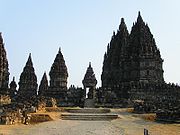 The Cholas excelled in foreign trade and maritime activity, extending their influence overseas to China and Southeast Asia. Towards the end of the 9th century, southern India had developed extensive maritime and commercial activity. The Cholas, being in possession of parts of both the west and the east coasts of peninsular India, were at the forefront of these ventures. The Tang dynasty
of China, the Srivijaya
empire in the Malayan archipelago under the Sailendras, and the Abbasid
Kalifat at Baghdad
were the main trading partners.
Chinese Song Dynasty
reports record that an embassy from Chulian (Chola) reached the Chinese court in the year 1077, and that the king of the Chulien at the time was called Ti-hua-kia-lo. It is possible that these syllables denote "Deva Kulo[tunga]" (Kulothunga Chola I). This embassy was a trading venture and was highly profitable to the visitors, who returned with '81,800 strings of copper coins in exchange for articles of tributes, including glass articles, and spices'.
A fragmentary Tamil inscription found in Sumatra
cites the name of a merchant guild Nanadesa Tisaiyayirattu Ainnutruvar (literally, "the five hundred from the four countries and the thousand directions"), a famous merchant guild in the Chola country. The inscription is dated 1088, indicating that there was an active overseas trade during the Chola period.
The quality of the inscriptions of the regime indicates a high level of literacy and education in the society. The text in these inscriptions was written by court poets and engraved by talented artisans. Education in the contemporary sense was not considered important; there is circumstantial evidence to suggest that some village councils organised schools to teach the basics of reading and writing to children, although there is no evidence of systematic educational system for the masses. Vocational education was through hereditary training in which the father passed on his skills to his sons. Tamil was the medium of education for the masses; Religious monasteries (matha or gatika) were centres of learning and received government support.
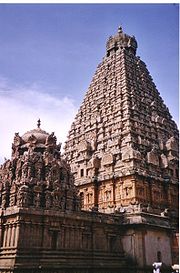 Under the Cholas, the Tamil country reached new heights of excellence in art
, religion
and literature
. In all of these spheres, the Chola period marked the culmination of movements that had begun in an earlier age under the Pallavas. Monumental architecture in the form of majestic temples and sculpture
in stone and bronze
reached a finesse never before achieved in India.
The Chola conquest of Kadaram (Kedah
) and Srivijaya, and their continued commercial contacts with the Chinese Empire
, enabled them to influence the local cultures. Many of the surviving examples of the Hindu cultural influence
found today throughout the Southeast Asia owe much to the legacy of the Cholas.
temples along the banks of the river Kaveri. These temples were not on a large scale until the end of the 10th century.
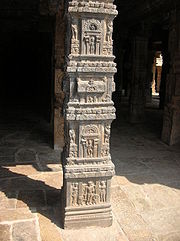 Temple building received great impetus from the conquests and the genius of Rajaraja Chola and his son Rajendra Chola I. The maturity and grandeur to which the Chola architecture had evolved found expression in the two temples of Thanjavur and Gangaikondacholapuram. The magnificent Siva temple of Thanjavur, completed around 1009, is a fitting memorial to the material achievements of the time of Rajaraja. The largest and tallest of all Indian temples of its time, it is at the apex of South Indian architecture.
The temple of Gangaikondacholisvaram at Gangaikondacholapuram, the creation of Rajendra Chola, was intended to excel its predecessor. Completed around 1030, only two decades after the temple at Thanjavur and in the same style, the greater elaboration in its appearance attests the more affluent state of the Chola Empire under Rajendra.
The Brihadisvara Temple at Thanjavur, the temple of Gangaikondacholisvaram at Gangaikondacholapuram and the Airavatesvara Temple
at Darasuram
were declared as World Heritage Site
s by the UNESCO
, and are referred to as the Great living Chola temples
.
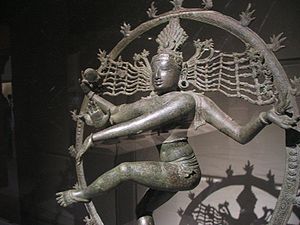
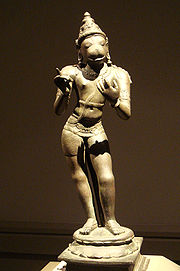
The Chola period is also remarkable for its sculptures and bronzes. Among the existing specimens in museums around the world and in the temples of South India may be seen many fine figures of Siva in various forms, such as Vishnu
and his consort Lakshmi
, and the Saivaite saints. Though conforming generally to the iconographic conventions established by long tradition, the sculptors worked with great freedom in the 11th and the 12th centuries to achieve a classic grace and grandeur. The best example of this can be seen in the form of Nataraja
the Divine Dancer.
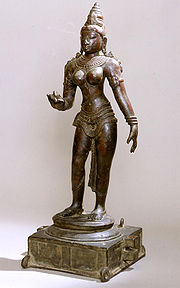
The revival of Hinduism from its nadir during the Kalabhras spurred the construction of numerous temples and these in turn generated Saiva and Vaishnava devotional literature. Jain and Buddhist authors flourished as well, although in fewer numbers than in previous centuries. Jivaka-chintamani by Tirutakkatevar and Sulamani by Tolamoli are among notable by non-Hindu authors. The art of Tirutakkatevar is marked by all the qualities of great poetry. It is considered as the model for Kamban for his masterpiece Ramavataram.
Kamban flourished during the reign of Kulothunga Chola III
. His Ramavatharam (also referred to as Kambaramayanam) is a great epic in Tamil literature, and although the author states that he followed Valmiki
's Ramayana
, it is generally accepted that his work is not a simple translation or adaptation of the Sanskrit epic: Kamban imports into his narration the colour and landscape of his own time; his description of Kosala
is an idealised account of the features of the Chola country.
Jayamkondar's masterpiece Kalingattuparani is an example of narrative poetry that draws a clear boundary between history and fictitious conventions. This describes the events during Kulothunga Chola I's war in Kalinga and depicts not only the pomp and circumstance of war, but the gruesome details of the field. The famous Tamil poet Ottakuttan was a contemporary of Kulothunga Chola I and served at the courts of three of Kulothunga's successors. Ottakuttan wrote Kulothunga Cholan Ula, a poem extolling the virtues of the Chola king.
The impulse to produce devotional religious literature continued into the Chola period and the arrangement of the Saiva canon into 11 books was the work of Nambi Andar Nambi, who lived close to the end of 10th century. However, relatively few Vaishnavite works were composed during the later Chola period, possibly because of the apparent animosity towards the Vaishnavites by the Later Chola monarchs.
 In general, Cholas were the adherents of Hinduism
. Throughout their history, they were not swayed by the rise of Buddhism and Jainism
as were the kings of the Pallava and Pandya dynasties. Even the early Cholas followed a version of the classical Hindu faith. There is evidence in Purananuru
for Karikala Chola's faith in Saivism in the Tamil country. Kocengannan, another early Chola, was celebrated in both Sangam literature and in the Saiva canon as a saint.
While the Cholas did build their largest and most important temple dedicated to Lord Shiva, it can be by no means concluded that either they were staunch Saivites or followers of Saivism only or that they were not favourably disposed to other faiths. This is borne out by the fact that the second Chola king Aditya I himself built quite a few temples for Siva and for Lord Vishnu. In AD 890, his inscriptions speak of his contributions to the construction of the Ranganatha Temple at Srirangapatnam (now in Mandya district of Karnataka) in the country of Western Gangas who were both his feudatories and had marital relations with him. Suring the time of Aditya I (871–903 AD) the Gangas of Kannada country had recognized his superiority which he acknowledged by marrying into that family and making grant contributions to the construction of the Sri Ranganatha temple at modern Srirangapatnam. Aditya I regularly gave many endowments to the Sri Ranganatha Temple at Srirangam around AD 896 and issued an inscriptional dictat pronouncing that the great temples of Siva and the Ranganatha temple at Srirangam to be the 'Kuladhanam' of the Chola emperors.
It was Aditya I's dictat which was faithfully carried out by his illustrious son Parantaka I and his successors wherein it was declared in edicts that the Siva Temple of Chidambaram (at that time the grand Siva temples of Tanjore and Gangaikonda Cholapuram were not in existence) and the Sri Ranganatha Swami temple of Srirangam were the 'Kuladhanams', i.e., tutelary (deities) treasures of the Chola emperors. This dictat was repeated around 300 years back when the last great Chola King, Kulothunga III, the builder of the great Sarabeswarar Temple at Tribhuvanam on the outskirts of Kumbakonam, hails Lord Ranganatha at Srirangam in an inscription in the Srirangam Koil, as his 'tutelary deity'. As per findings of Dr. Hultzsch, the great epigraphist, in this inscription acknowledgment is made to the earlier great Chola king Parantaka about declaring the Chidambaram (Siva) Koil and the Srirangam (Vishnu) Koil as 'Kuladhanams' of the Cholas – a pointer to the fact that the Cholas were secular and patronized equally all religions and sub-sects within the same religion. Another proof of this is the existence of as many as 40 Vaishnava Divyadesams out of 108 such temples in the Chola country, which are functioning and flourishing even today.
Chola king Sundara (Parantaka II) was a staunch devotee of the reclining Vishnu (Vadivu Azhagiya Nambi) at Anbil in the banks of Cauvery on the outskirts of Tiruchy, to whom he gave numerous gifts and embellishments, and prayed before him by keeping his sword before the deity, beforeo his proceeding for war for regaining the territories in and around Kanchi and Arcot from the waning Rashtrakutas and while leading expeditions against both Madurai and Ilam (Sri Lanka). Parantaka I
and Sundara Chola
endowed and built temples for Siva
and Vishnu. Rajaraja Chola I patronised Buddhists and provided for the construction of the Chudamani Vihara
(a Buddhist monastery) in Nagapattinam
at the request of the Srivijaya Sailendra king. While it is true that the biggest and grandest temples of the Cholas were dedicated to Lord Siva, all Chola kings especially from Aditya to Rajendra IV built great temples for Lord Vishnu and gave numerous grants and gifts to them.
During the period of Later Cholas, there were supposedly instances of intolerance towards Vaishnavites, especially towards Ramanuja
, the acharya of the Vaishnavites. Kulothunga Chola II
, a staunch Saivite, is said to have removed a statue of Vishnu from the Siva temple at Chidambaram, though there are no epigraphical evidences to support this theory. There is an inscription from 1160 that the custodians of Siva temples who had social intercourses with Vaishnavites would forfeit their property. However, this is more of a direction to the Saivite community by its religious heads than any kind of dictat by a Chola emperor. While Chola kings built their largest temples for Siva and even while emperors like Raja Raja Chola I held titles like 'Sivapadasekharan', in none of their inscriptions did the Chola emperors proclaim that their clan only and solely followed Saivism or that Saivism was the state religion during their rule.
 The history of the Chola dynasty has inspired many Tamil authors to produce literary and artistic creations during the last several decades. These works of popular literature have helped continue the memory of the great Cholas in the minds of the Tamil people. The most important work of this genre is the popular Ponniyin Selvan
(The son of Ponni), a historical novel in Tamil
written by Kalki Krishnamurthy
. Written in five volumes, this narrates the story of Rajaraja Chola. Ponniyin Selvan deals with the events leading up to the ascension of Uttama Chola to the Chola throne. Kalki had utilised the confusion in the succession to the Chola throne after the demise of Sundara Chola. This book was serialised in the Tamil periodical Kalki during the mid 1950s. The serialisation lasted for nearly five years and every week its publication was awaited with great interest.
Kalki's earlier historical romance Parthiban Kanavu
deals with the fortunes of an imaginary Chola prince Vikraman, who was supposed to have lived as a feudatory of the Pallava king Narasimhavarman I
during the 7th century. The period of the story lies within the interregnum during which the Chola in eclipse before Vijayalaya Chola revived their fortunes. Parthiban Kanavu was also serialised in the Kalki weekly during the early 1950s.
Sandilyan
, another popular Tamil novelist, wrote Kadal Pura in the 1960s. It was serialised in the Tamil weekly Kumudam
. Kadal Pura is set during the period when Kulothunga Chola I was in exile from the Vengi kingdom, after he was denied the throne. Kadal Pura speculates the whereabouts of Kulothunga during this period. Sandilyan's earlier work Yavana Rani
written in the early 1960s is based on the life of Karikala Chola. More recently, Balakumaran
wrote the novel Udaiyar
based on the circumstances surrounding Rajaraja Chola's construction of the Brihadisvara Temple in Thanjavur.
There were stage productions based on the life of Rajaraja Chola during the 1950s and in 1973 Shivaji Ganesan acted in a screen adaptation of a play titled Rajaraja Cholan
. The Cholas are featured in the History of the World
board game, produced by Avalon Hill
.
Tamil people
Tamil people , also called Tamils or Tamilians, are an ethnic group native to Tamil Nadu, India and the north-eastern region of Sri Lanka. Historic and post 15th century emigrant communities are also found across the world, notably Malaysia, Singapore, Mauritius, South Africa, Australia, Canada,...
dynasty
Dynasty
A dynasty is a sequence of rulers considered members of the same family. Historians traditionally consider many sovereign states' history within a framework of successive dynasties, e.g., China, Ancient Egypt and the Persian Empire...
which was one of the longest-ruling in some parts of southern India. The earliest datable references to this Tamil
Tamil people
Tamil people , also called Tamils or Tamilians, are an ethnic group native to Tamil Nadu, India and the north-eastern region of Sri Lanka. Historic and post 15th century emigrant communities are also found across the world, notably Malaysia, Singapore, Mauritius, South Africa, Australia, Canada,...
dynasty are in inscriptions from the 3rd century BC left by Asoka, of Maurya Empire
Maurya Empire
The Maurya Empire was a geographically extensive Iron Age historical power in ancient India, ruled by the Mauryan dynasty from 321 to 185 BC...
; the dynasty continued to govern over varying territory until the 13th century AD.
The heartland of the Cholas was the fertile valley of the Kaveri River
Kaveri River
The Kaveri , also spelled Cauvery in English, is a large Indian river. The origin of the river is traditionally placed at Talakaveri, Kodagu in the Western Ghats in Karnataka, flows generally south and east through Karnataka and Tamil Nadu and across the southern Deccan plateau through the...
, but they ruled a significantly larger area at the height of their power
Great power
A great power is a nation or state that has the ability to exert its influence on a global scale. Great powers characteristically possess military and economic strength and diplomatic and cultural influence which may cause small powers to consider the opinions of great powers before taking actions...
from the later half of the 9th century till the beginning of the 13th century. The whole country south of the Tungabhadra was united and held as one state for a period of two centuries and more. Under Rajaraja Chola I
Rajaraja Chola I
Raja Raja Chola I born Arunmozhi Thevar , popularly known as Raja Raja the Great, is one of the greatest emperors of the Tamil Chola Empire of India who ruled between 985 and 1014 CE...
and his son Rajendra Chola I
Rajendra Chola I
Rajendra Chola I was the son of Rajaraja Chola I and was one of the greatest rulers of Tamil Chola dynasty of India. He succeeded his father in 1014 CE as the Chola emperor...
, the dynasty became a military, economic and cultural power in South Asia
South Asia
South Asia, also known as Southern Asia, is the southern region of the Asian continent, which comprises the sub-Himalayan countries and, for some authorities , also includes the adjoining countries to the west and the east...
and South-east Asia. The power of the new empire was proclaimed to the eastern world by the celebrated expedition to the Ganges which Rajendra Chola I
Rajendra Chola I
Rajendra Chola I was the son of Rajaraja Chola I and was one of the greatest rulers of Tamil Chola dynasty of India. He succeeded his father in 1014 CE as the Chola emperor...
undertook and by the overthrow after an unprecedented naval war of the maritime empire of Srivijaya
Srivijaya
Srivijaya was a powerful ancient thalassocratic Malay empire based on the island of Sumatra, modern day Indonesia, which influenced much of Southeast Asia. The earliest solid proof of its existence dates from the 7th century; a Chinese monk, I-Tsing, wrote that he visited Srivijaya in 671 for 6...
, as well as by the repeated embassies to China. During the period 1010–1200, the Chola territories stretched from the islands of the Maldives
Maldives
The Maldives , , officially Republic of Maldives , also referred to as the Maldive Islands, is an island nation in the Indian Ocean formed by a double chain of twenty-six atolls oriented north-south off India's Lakshadweep islands, between Minicoy Island and...
in the south to as far north as the banks of the Godavari River
Godavari River
The Godavari is a river that runs from western to southern India and is considered to be one of the big river basins in India. With a length of 1465 km, it is the second longest river in India , that runs within the country and also the longest river in South India...
in Andhra Pradesh
Andhra Pradesh
Andhra Pradesh , is one of the 28 states of India, situated on the southeastern coast of India. It is India's fourth largest state by area and fifth largest by population. Its capital and largest city by population is Hyderabad.The total GDP of Andhra Pradesh is $100 billion and is ranked third...
. Rajaraja Chola conquered peninsular South India
South India
South India is the area encompassing India's states of Andhra Pradesh, Karnataka, Kerala and Tamil Nadu as well as the union territories of Lakshadweep and Pondicherry, occupying 19.31% of India's area...
, annexed parts of what is now Sri Lanka
Sri Lanka
Sri Lanka, officially the Democratic Socialist Republic of Sri Lanka is a country off the southern coast of the Indian subcontinent. Known until 1972 as Ceylon , Sri Lanka is an island surrounded by the Indian Ocean, the Gulf of Mannar and the Palk Strait, and lies in the vicinity of India and the...
and occupied the islands of the Maldives. Rajendra Chola sent a victorious expedition to North India that touched the river Ganges and defeated the Pala
Pala Empire
The Pāla Empire was one of the major middle kingdoms of India existed from 750–1174 CE. It was ruled by a Buddhist dynasty from Bengal in the eastern region of the Indian subcontinent, all the rulers bearing names ending with the suffix Pala , which means protector. The Palas were often described...
ruler of Pataliputra, Mahipala
Mahipala
Mahipala I is considered the second founder of the Pala dynasty. Gopala I established the dynastic rule of the Palas in the middle of the 8th century CE. The Pala Dynasty ruled Bengal and Bihar for about four centuries from the middle of the 8th century CE...
. He also successfully invaded kingdoms of the Malay Archipelago
Malay Archipelago
The Malay Archipelago refers to the archipelago between mainland Southeastern Asia and Australia. The name was derived from the anachronistic concept of a Malay race....
. The Chola dynasty went into decline at the beginning of the 13th century with the rise of the Pandyas, who ultimately caused their downfall.
The Cholas left a lasting legacy. Their patronage of Tamil literature
Chola Literature
Chola literature, written in Tamil, is the literature created during the period of Chola reign in South India between the 9th and the 13th centuries CE...
and their zeal in building temples have resulted in some great works of Tamil literature and architecture. The Chola kings were avid builders and envisioned the temples in their kingdoms not only as places of worship but also as centres of economic activity. They pioneered a centralised form of government
Chola Government
The Chola government during the imperial period was marked for its uniqueness and innovativeness. Cholas were the first dynasty who tried to bring the entire South India under a common rule and to a great extent succeeded in their efforts...
and established a disciplined bureaucracy.
Origins
There is very little information available regarding the origin of the Chola Dynasty. The antiquity of this dynasty is evident from the mentions in ancient Tamil literatureSangam literature
Sangam literature refers to a body of classical Tamil literature created between the years c. 600 BCE to 300 CE. This collection contains 2381 poems composed by 473 poets, some 102 of whom remain anonymous The period during which these poems were composed is commonly referred to as the Sangam...
and in inscriptions. Later medieval Cholas
Medieval Cholas
Medieval Cholas rose to prominence during the middle of the 9th century C.E. and established the greatest empire South India had seen. They successfully united the South India under their rule and through their naval strength extended their influence in the Southeast Asian countries such as Srivijaya...
also claimed a long and ancient lineage to their dynasty. Mentions in the early Sangam literature
Sangam literature
Sangam literature refers to a body of classical Tamil literature created between the years c. 600 BCE to 300 CE. This collection contains 2381 poems composed by 473 poets, some 102 of whom remain anonymous The period during which these poems were composed is commonly referred to as the Sangam...
(c. 150 CE) indicate that the earliest kings of the dynasty antedated 100 CE. Parimelalagar, the annotator of the Tamil classic Tirukkural
Tirukkuṛaḷ
Tirukkuṛaḷ , sometimes spelt 'Thirukkural, is a classic of couplets or Kurals or aphorisms celebrated by Tamils. It was authored by Thiruvalluvar, a poet who is said to have lived anytime between the 2nd and 6th centuries AD. Although the exact period of its composition is still disputed,...
, mentions that this could be the name of an ancient king.
The most commonly held view is that this is, like Cheras
Chera dynasty
Chera Dynasty in South India is one of the most ancient ruling dynasties in India. Together with the Cholas and the Pandyas, they formed the three principle warring Iron Age Tamil kingdoms in southern India...
and Pandyas, the name of the ruling family or clan of immemorial antiquity. The annotator Parimelazhagar writes "The charity of people with ancient lineage (such as the Cholas, the Pandyas and the Cheras) are forever generous in spite of their reduced means". Other names in common use for the Cholas are Killi (கிள்ளி), Valavan (வளவன்) and Sembiyan (செம்பியன்). Killi perhaps comes from the Tamil kil (கிள்) meaning dig or cleave and conveys the idea of a digger or a worker of the land. This word often forms an integral part of early Chola names like Nedunkilli
Nedunkilli
Nedunkilli was a Tamil king of the Early Cholas mentioned in Sangam Literature. Nedunkilli is mentioned in context with a civil war between him and another Chola Nalankilli. We have no definite details about this Chola or his reign...
, Nalankilli
Nalankilli
Nalankilli was one of the Tamil king's of the Early Cholas mentioned in Sangam Literature. Nalankilli is mentioned in context with a civil war between him and another Chola Nedunkilli. We have no definite details about this Chola or his reign...
and so on, but almost drops out of use in later times. Valavan is most probably connected with 'valam' (வளம்) – fertility and means owner or ruler of a fertile country. Sembiyan is generally taken to mean a descendant of Shibi
Shibi
King Shibi Chakravarti is a famous king in Hindu mythology and Buddhist Jataka Tales. Sibi was the son of Usinara a famous king of Chandravamsa...
– a legendary hero whose self-sacrifice in saving a dove from the pursuit of a falcon figures among the early Chola legends and forms the subject matter of the Sibi Jataka
Sibi Jataka
Sibi Jataka is one of the Jataka tales detailing episodes of the various incarnations of Buddha. Each Jataka tale illustrates the Buddhist ideals of Dharma and sacrifice in various forms...
among the Jataka
Jataka
The Jātakas refer to a voluminous body of literature native to India concerning the previous births of the Buddha....
stories of Buddhism
Buddhism
Buddhism is a religion and philosophy encompassing a variety of traditions, beliefs and practices, largely based on teachings attributed to Siddhartha Gautama, commonly known as the Buddha . The Buddha lived and taught in the northeastern Indian subcontinent some time between the 6th and 4th...
. In Tamil lexicon Chola means Soazhi or Saei denoting a newly formed kingdom, in the lines of Pandya or the old country. Sora or Chozha in Tamil becomes Chola in Sanskrit
Sanskrit
Sanskrit , is a historical Indo-Aryan language and the primary liturgical language of Hinduism, Jainism and Buddhism.Buddhism: besides Pali, see Buddhist Hybrid Sanskrit Today, it is listed as one of the 22 scheduled languages of India and is an official language of the state of Uttarakhand...
and Chola or Choda in Telugu
Telugu language
Telugu is a Central Dravidian language primarily spoken in the state of Andhra Pradesh, India, where it is an official language. It is also spoken in the neighbouring states of Chattisgarh, Karnataka, Maharashtra, Orissa and Tamil Nadu...
.
On the history of the early Cholas there is very little authentic written evidence available. Historians during the past 150 years have gleaned a lot of knowledge on the subject from a variety of sources such as ancient Tamil Sangam literature, oral traditions, religious texts, temple and copperplate inscriptions
Copper-plate grant
One of the most important sources of history in the Indian subcontinent are the royal records of grants engraved on copper-plates...
. The main source for the available information of the early Cholas is the early Tamil literature of the Sangam Period. There are also brief notices on the Chola country and its towns, ports and commerce furnished by the Periplus of the Erythraean Sea
Periplus of the Erythraean Sea
The Periplus of the Erythraean Sea or Periplus of the Red Sea is a Greco-Roman periplus, written in Greek, describing navigation and trading opportunities from Roman Egyptian ports like Berenice along the coast of the Red Sea, and others along Northeast Africa and India...
(Periplus Maris Erythraei). Periplus is a work by an anonymous Alexandrian
Alexandrian
Alexandrian is either:* an adjective referring to a place called Alexandria, as in Alexandrian text-type* a person from and/or inhabiting a city called Alexandria...
merchant, written in the time of Domitian
Domitian
Domitian was Roman Emperor from 81 to 96. Domitian was the third and last emperor of the Flavian dynasty.Domitian's youth and early career were largely spent in the shadow of his brother Titus, who gained military renown during the First Jewish-Roman War...
(81–96) and contains very little information of the Chola country. Writing half a century later, the geographer Ptolemy
Ptolemy
Claudius Ptolemy , was a Roman citizen of Egypt who wrote in Greek. He was a mathematician, astronomer, geographer, astrologer, and poet of a single epigram in the Greek Anthology. He lived in Egypt under Roman rule, and is believed to have been born in the town of Ptolemais Hermiou in the...
gives more detail about the Chola country, its port and its inland cities. Mahavamsa
Mahavamsa
The Mahavamsa is a historical poem written in the Pali language, of the kings of Sri Lanka...
, a Buddhist text written down during the 5th century CE, recounts a number of conflicts between the inhabitants of Ceylon and Cholas in the 1st century BCE. Cholas are mentioned in the Pillars of Ashoka
Pillars of Ashoka
The pillars of Ashoka are a series of columns dispersed throughout the northern Indian subcontinent, erected or at least inscribed by the Mauryan king Ashoka during his reign in the 3rd century BCE. Originally, there must have been many pillars but only nineteen survive with inscriptions. Many are...
(inscribed 273 BCE–232 BCE) inscriptions, where they are mentioned among the kingdoms which, though not subject to Ashoka, were on friendly terms with him.
History
The history of the Cholas falls into four periods: the early CholasEarly Cholas
The Early Cholas of the pre and post Sangam period were one of the three main kingdoms of the ancient Tamil country. Their early capitals were Urayur and Kaveripattinam...
of the Sangam literature, the interregnum between the fall of the Sangam Cholas and the rise of the medieval Cholas under Vijayalaya
Vijayalaya Chola
Vijayalaya was the Chola king of South India Thanjavur during c. 848 C.E. and re-established the Chola dynastic rule.-Dark age of Cholas:The ancient Chola kingdom once famous in Tamil literature and in the writings of Greek merchants and geographers faded in to darkness after c 300 C.E. Cholas...
(c. 848), the dynasty of Vijayalaya, and finally the Later Chola dynasty of Kulothunga Chola I from the third quarter of the 11th century.
Early Cholas
The earliest Chola kings for whom there is tangible evidence are mentioned in the Sangam literature. Scholars generally agree that this literature belongs to the first few centuries of the common eraCommon Era
Common Era ,abbreviated as CE, is an alternative designation for the calendar era originally introduced by Dionysius Exiguus in the 6th century, traditionally identified with Anno Domini .Dates before the year 1 CE are indicated by the usage of BCE, short for Before the Common Era Common Era...
. The internal chronology of this literature is still far from settled, and at present a connected account of the history of the period cannot be derived. The Sangam literature records the names of the kings and the princes, and of the poets who extolled them. Despite a rich literature that depicts the life and work of these people, these cannot be worked into connected history.
Agastya
Agastya was a Tamil/Vedic Siddhar or sage. Agastya and his clan are also generally credited with uncovering many mantras of the Rig Veda, the earliest and most revered Hindu scripture, in the sense of first having the mantras revealed in his mind by the Supreme Brahman...
, whose devotion brought the river Kaveri into existence.
Two names stand out prominently from among those Chola kings known to have existed, who feature in Sangam literature: Karikala Chola
Karikala Chola
Karikala Chola or Karikala Chozhan was one of the great Tamil kings of Early Chola during the Sangam period. He was the son of Ilamcetcenni and ruled around 270 BC....
and Kocengannan
Kocengannan
Kocengannan was one of the Tamil king's of the Early Cholas mentioned in Sangam Literature. The only surviving details about his reign come from the fragmentary poems of Sangam in the Purananuru poems...
. There is no sure means of settling the order of succession, of fixing their relations with one another and with many other princelings of about the same period. Urayur
Urayur
Urayur , located near the city of Tiruchirapalli in Tamil Nadu, India, was the capital of the early Cholas, who were one of the three main kingdoms of the ancient Tamil country. Sometimes spelled as Uraiyur, this location is also known as Thirukkozhi, Nikalaapuri, Uranthai, and Kozhiyur. It has a...
(now in/part-of Thiruchirapalli) was their oldest capital. Kaveripattinam
Kaveripattinam
Kaveripattinam is a panchayat town in Krishnagiri district in the Indian state of Tamil Nadu. It is approximately 100 km from Bangalore. The town is very green because of the KRP Dam nearby. Kaveripattinam is famous for its cultivation of mangoes. There are lot of mango pulp industries, milk...
also served as an early Chola capital. The Mahavamsa
Mahavamsa
The Mahavamsa is a historical poem written in the Pali language, of the kings of Sri Lanka...
mentions that an ethnic Tamil adventurer, a Chola prince known as Elara
Elara (King)
Elara , also known as Ellalan and Élaezha Chola , was a Chola king from the Chola Kingdom, in present day South India, who ruled Sri Lanka from 205 BC to 161 BC from the ancient capital of Anuradhapura. Often referred to as 'the Just King'. The Tamil name Elalan means, 'the one who rules the Ellai...
, invaded the island around 235 BCE and that King Gajabahu visited Chera Cenguttuvan around 108 CE.
Interregnum
There is not much information about the transition period of around three centuries from the end of the Sangam age (c. 300) to that in which the Pandyas and PallavaPallava
The Pallava dynasty was a Tamil dynasty which ruled the northern Tamil Nadu region and the southern Andhra Pradesh region with their capital at Kanchipuram...
s dominate the Tamil country. An obscure dynasty, the Kalabhras
Kalabhras
The Kalabhras dynasty ruled over the entire Ancient Tamil country between the 3rd and the 6th century in an era of South Indian history called the Kalabhra interregnum. The Kalabhras displaced the kingdoms of the early Cholas, early Pandayan and Chera dynasties. Information about its origin and...
, invaded the Tamil country, displaced the existing kingdoms and ruled for around three centuries. They were displaced by the Pallavas and the Pandyas in the 6th century. Little is known of the fate of the Cholas during the succeeding three centuries until the accession of Vijayalaya in the second quarter of the 9th century.
Epigraphy
Epigraphy
Epigraphy Epigraphy Epigraphy (from the , literally "on-writing", is the study of inscriptions or epigraphs as writing; that is, the science of identifying the graphemes and of classifying their use as to cultural context and date, elucidating their meaning and assessing what conclusions can be...
and literature provide a few faint glimpses of the transformations that came over this ancient line of kings during this long interval. What is certain is that when the power of the Cholas fell to its lowest ebb and that of the Pandyas and Pallavas rose to the north and south of them, this dynasty was compelled to seek refuge and patronage under their more successful rivals. The Cholas continued to rule over a diminished territory in the neighbourhood of Uraiyur, but only in a minor capacity. In spite of their reduced powers, the Pandayas and Pallavas accepted Chola princesses in marriage, possibly out of regard for their reputation. Numerous inscriptions of Pallavas of this period mention their having fought rulers of 'the Chola country'. Despite this loss in influence and power, it is unlikely that the Cholas lost total grip of the territory around Uraiyur, their old capital, as Vijayalaya, when he rose to prominence hailed from this geographical area.
Around the 7th century, a Chola kingdom flourished in present-day Andhra Pradesh. These Telugu Cholas
Telugu Cholas
Many Telugu Choda kingdoms ruled over many regions including the cities on the banks of Krishna River in the period between the seventh and the thirteenth century. It is not known much about these family origins. Some of them claimed descent from the legendary Tamil Karikala Chola . Telugu Cholas...
(or Chodas) traced their descent to the early Sangam Cholas. However, it is not known if they had any relation to the early Cholas. It is possible that a branch of the Tamil Cholas migrated north during the time of the Pallavas to establish a kingdom of their own, away from the dominating influences of the Pandyas and Pallavas. The Chinese
China
Chinese civilization may refer to:* China for more general discussion of the country.* Chinese culture* Greater China, the transnational community of ethnic Chinese.* History of China* Sinosphere, the area historically affected by Chinese culture...
pilgrim Xuanzang
Xuanzang
Xuanzang was a famous Chinese Buddhist monk, scholar, traveler, and translator who described the interaction between China and India in the early Tang period...
, who spent several months in Kanchipuram
Kanchipuram
Kanchipuram, or Kanchi, is a temple city and a municipality in Kanchipuram district in the Indian state of Tamil Nadu. It is a temple town and the headquarters of Kanchipuram district...
during 639–640 writes about the 'kingdom of Culi-ya', in an apparent reference to the Telugu Chodas.
Medieval Cholas
The Chola dynasty was at the peak of its influence and power during the medieval period. Through their leadership and vision, kings such as the second Chola King Aditya I
Aditya I
Aditya I , the son of Vijayalaya, was the first great Chola king of South India who extended the Chola dominions by the conquest of the Pallavas.- Pallava Civil War :...
who caused the demise of the Pallavas, defeated the Pandyas of Madurai
Madurai
Madurai is the third largest city in the Indian state of Tamil Nadu and one of the oldest continuously inhabited cities in the world. It served as the capital city of the Pandyan Kingdom. It is the administrative headquarters of Madurai District and is famous for its temples built by Pandyan and...
and occupied very large parts of the Kannada country and had marital ties with the Gangas
Gangas
The Western Ganga Dynasty was an important ruling dynasty of ancient Karnataka in India. They are known as Western Gangas to distinguish them from the Eastern Gangas who in later centuries ruled over modern Orissa...
, way back in 885 AD, his son Parantaka I
Parantaka I
Parantaka Chola I ruled the Chola kingdom in southern India for forty-eight years. The best part of his reign was marked by increasing success and prosperity.-The Invasion of the Pandya Kingdom:...
, who conquered Sri Lanka
Sri Lanka
Sri Lanka, officially the Democratic Socialist Republic of Sri Lanka is a country off the southern coast of the Indian subcontinent. Known until 1972 as Ceylon , Sri Lanka is an island surrounded by the Indian Ocean, the Gulf of Mannar and the Palk Strait, and lies in the vicinity of India and the...
known as Ilangai way back in 925 AD, Sundara Chola, also known as Parantaka Chola II who regained territories from the Rashtrakutas and expanded the Chola dominions up to Bhatkal
Bhatkal
Bhatkal is also known as Batecala in some historical text especially in Portuguese history.Once ruled by Jain King Bhattakalanka and thus the name. Bhatkal is a port town in Uttara Kannada district of Karnataka, India 126 km from Karwar. The town lies on NH-17 running between Mumbai and Mangalore...
in Kannada country, Rajaraja Chola I
Rajaraja Chola I
Raja Raja Chola I born Arunmozhi Thevar , popularly known as Raja Raja the Great, is one of the greatest emperors of the Tamil Chola Empire of India who ruled between 985 and 1014 CE...
and Rajendra Chola I
Rajendra Chola I
Rajendra Chola I was the son of Rajaraja Chola I and was one of the greatest rulers of Tamil Chola dynasty of India. He succeeded his father in 1014 CE as the Chola emperor...
extended the Chola kingdom beyond the traditional limits of a Tamil kingdom. At its peak, the Chola Empire stretched from the island of Sri Lanka in the south to the Godavari
Godavari River
The Godavari is a river that runs from western to southern India and is considered to be one of the big river basins in India. With a length of 1465 km, it is the second longest river in India , that runs within the country and also the longest river in South India...
-Krishna
Krishna
Krishna is a central figure of Hinduism and is traditionally attributed the authorship of the Bhagavad Gita. He is the supreme Being and considered in some monotheistic traditions as an Avatar of Vishnu...
basin in the north, up to the Konkan coast in Bhatkal, the entire Malabar Coast in addition to Lakshadweep
Lakshadweep
Lakshadweep , formerly known as the Laccadive, Minicoy, and Amindivi Islands, is a group of islands in the Laccadive Sea, 200 to 440 km off the coast of the South West Indian state of Kerala...
, Maldives
Maldives
The Maldives , , officially Republic of Maldives , also referred to as the Maldive Islands, is an island nation in the Indian Ocean formed by a double chain of twenty-six atolls oriented north-south off India's Lakshadweep islands, between Minicoy Island and...
and vast areas of Chera
Chera dynasty
Chera Dynasty in South India is one of the most ancient ruling dynasties in India. Together with the Cholas and the Pandyas, they formed the three principle warring Iron Age Tamil kingdoms in southern India...
country. The kingdoms of Deccan and the eastern coast were subordinates, feudatories of the Cholas or other kingdoms like the Chalukyas between 1000–1075 AD paid tribute to the Cholas. Rajendra Chola I completed the conquest of the island of Sri Lanka and captured the Sinhala king Mahinda V prisoner, in addition to his conquests of Rattapadi (territories of the Rashtrakutas, Chalukya country, Talakkad
Talakkad
Talakkad is a village in Malappuram district in the state of Kerala, India.-Demographics: India census, Talakkad had a population of 30577 with 14269 males and 16308 females....
, Kolar
Kolar
Kolara is a city in the South Indian state of Karnataka. It is the headquarters of Kolar District. It is known for being one of the gold mining sites in India....
(where the Kolaramma temple still has his portrait statue) in Kannada country . In addition Rajendra's territories included the area falling on the Ganges-Hooghly-Damodar basin, large parts of Burma, Thailand
Thailand
Thailand , officially the Kingdom of Thailand , formerly known as Siam , is a country located at the centre of the Indochina peninsula and Southeast Asia. It is bordered to the north by Burma and Laos, to the east by Laos and Cambodia, to the south by the Gulf of Thailand and Malaysia, and to the...
, Indo-China Laos
Laos
Laos Lao: ສາທາລະນະລັດ ປະຊາທິປະໄຕ ປະຊາຊົນລາວ Sathalanalat Paxathipatai Paxaxon Lao, officially the Lao People's Democratic Republic, is a landlocked country in Southeast Asia, bordered by Burma and China to the northwest, Vietnam to the east, Cambodia to the south and Thailand to the west...
, Kambodia, the Malay peninsula
Malay Peninsula
The Malay Peninsula or Thai-Malay Peninsula is a peninsula in Southeast Asia. The land mass runs approximately north-south and, at its terminus, is the southern-most point of the Asian mainland...
and Indonesia
Indonesia
Indonesia , officially the Republic of Indonesia , is a country in Southeast Asia and Oceania. Indonesia is an archipelago comprising approximately 13,000 islands. It has 33 provinces with over 238 million people, and is the world's fourth most populous country. Indonesia is a republic, with an...
. The kingdoms along the east coast of India up to the river Ganges acknowledged Chola suzerainty. Chola navies invaded and conquered Srivijaya
Srivijaya
Srivijaya was a powerful ancient thalassocratic Malay empire based on the island of Sumatra, modern day Indonesia, which influenced much of Southeast Asia. The earliest solid proof of its existence dates from the 7th century; a Chinese monk, I-Tsing, wrote that he visited Srivijaya in 671 for 6...
in the Malayan archipelago.
The Western Chalukyas
Western Chalukyas
The Western Chalukya Empire ruled most of the western Deccan, South India, between the 10th and 12th centuries. This dynasty is sometimes called the Kalyani Chalukya after its regal capital at Kalyani, today's Basavakalyan in Karnataka and alternatively the Later Chalukya from its theoretical...
under Satyasraya
Satyasraya
Satyasraya , also known as Sattiga or Irivabedanga, was the king of the revived Western Chalukyas. Towards the end of his rule with the great Chola Rajaraja Chola I and had to face disastrous consequences of entering into a war with the Cholas which greatly endangered his own survival as well as...
and Somesvara I
Somesvara I
Somesvara I succeeded his father Jayasimha II as the Western Chalukya king. He was one of the greatest kings of the later Chalukya Dynasty. In spite of many reverses he managed to safeguard the integrity of the Chalukya kingdom. He founded the city of Kalyani, present day Basavakalyana and moved...
tried to wriggle out of Chola domination from time to time, primarily due to the Chola influence in the Vengi
Vengi
The Vengi kingdom extended from the Godavari River in the north to Mount Mahendragiri in the southeast and to just south of the banks of River Krishna in the south of India. This area was part of Kalinga until that kingdom was conquered by Emperor Ashoka of the Mauryan Empire in the mid 3rd century...
kingdom. The Western Chalukyas mounted several unsuccessful attempts to engage the Chola emperors in war and except for a brief occupation of Vengi territories between 1118–1126, all their other attempts ended in failure with successive Chola emperors routing the armies of the Chalukyas at various places in many wars. Cholas always successfully controlled the Chalukyas in the western Deccan by routing them in war constantly and levying tribute on them. It is also pertinent to note that even under the not so strong emperors of the Cholas like Kulothunga I, Vikrama Chola etc. the wars against the Chalukyas were mainly fought in Chalukya territories in Karnataka or in the Telugu country like Vengi, Kakinada or Anantapur or Gutti. In any case, in the internecine wars among the small Kannada kingdoms of the Kadambas, Hoysalas, Vaidumbas or Kalachuris, the Chalukya interference was to cause them dearly with these Kingdoms steadily increasing their stock and ultimately the Hoysalas, the Kakatiyas, the Kalachuris and the Seunas consuming the Chalukyas and sending them into oblivion. With the occupation of Dharwar in North Central Karnataka by the Hoysalas under Vishnuvardhana
Vishnuvardhana
Vishnuvardhana was an emperor of the Hoysala Empire in present day Indian state of Karnataka. Vishnuvardhana took the first step in consolidating the Hoysala Empire in South India through a series of battles against his overlords, the Western Chalukya empire...
where he based himself with his son Narasimha I
Narasimha I
Narasimha I was a ruler of the Hoysala Empire. Apart from his victory over his overlord Chalukya Tailapa III which paved way for declaration of independence by his successor, his importance to historians is considered little....
in-charge at the Hoysala capital Dwarasamudra around AD 1149, and with the Kalachuris occupying the Chalukyan capital for over 35 years from around 1150–1151 AD, the Chalukya kingdom was already starting to dissolve due to incompetency of its rulers after 1126 AD.
The Cholas under Kulothunga Chola III
Kulothunga Chola III
Kulothunga Chola III was the ruler of the Chola empire from 1178 to 1218 AD, after succeeding Rajadhiraja Chola II. Kulothunga Chola III gained success in war against his traditional foes. He gained victories in war against the Pandyas of Madurai, Cheras of Venad, Hoysalas of Mysore, the Sinhala...
even collaborated to the herald the dissolution of the Chalukyas by aiding Hoysalas under Veera Ballala II
Veera Ballala II
Veera Ballala II was the greatest monarch of the Hoysala Empire. This is proven by his successes against the Seuna, Southern Kalachuri, and the waning Kalyani Chalukya dynasties. He caused the demise of the Kalyani Chalukya dynasty. His period also saw prolific literary activity in Kannada. He...
, the son-in-law of the Chola monarch, and sounded the death-knell of the Western Chalukyas
Western Chalukyas
The Western Chalukya Empire ruled most of the western Deccan, South India, between the 10th and 12th centuries. This dynasty is sometimes called the Kalyani Chalukya after its regal capital at Kalyani, today's Basavakalyan in Karnataka and alternatively the Later Chalukya from its theoretical...
in a series of wars with Somesvara IV
Somesvara IV
Somesvara IV was the last king of the Western Chalukya empire. He made a brief attempt to revive the Chalukya kingdom by defeating the waning Kalachuri kingdom. He managed to capture Basavakalyana but failed to prevent the other feudatories, the Seuna, Hoysala and the Kakatiya dynasty from...
between 1185–1190 AD, the last Chalukya king whose territories did not even include the erstwhile Chalukyan capitals Badami, Manyakheta or Kalyani. That was the final dissolution of Chalukyan power though the Chalukyas existed only in name since 1135–1140. In contrast, the Cholas would be stable till 1215 AD, and finally getting consumed by the Pandiyan
Pandiyan
Pandiyan may refer to:*Any of the kings of the Pandyan Dynasty, which ruled South India from pre-historic times until end of the 15th century*Pandiyan - Tamil actor...
empire and ceasing to exist by 1280 AD.
On the other hand, throughout the period from 1150–1280 AD, the staunchest opponents of the Cholas were Pandya princes who tried to win independence for their traditional territories. This period saw constant warfare between the Cholas and these antagonists. The Cholas also fought regular wars with the Easter Gangas
Gangas
The Western Ganga Dynasty was an important ruling dynasty of ancient Karnataka in India. They are known as Western Gangas to distinguish them from the Eastern Gangas who in later centuries ruled over modern Orissa...
of Kalinga, protected Vengi though it remained largely independent under Chola control, and had domination of the entire eastern coast with their feudatories the Telugu Chodas, Velananti Cholas, Renandu Cholas etc. who also always aided the Cholas in their successful campaigns against the Chalukyas and levying tribute on the Kannada kingdoms and fought constantly with the Sinhala
Sinhalese people
The Sinhalese are an Indo-Aryan ethnic group,forming the majority of Sri Lanka,constituting 74% of the Sri Lankan population.They number approximately 15 million worldwide.The Sinhalese identity is based on language, heritage and religion. The Sinhalese speak Sinhala, an Indo-Aryan language and the...
s, who attempted to overthrow the Chola occupation of Lanka
Lanka
Sri Lanka is the name given in Hindu mythology to the island fortress capital of the legendary king Ravana in the great Hindu epics, the Ramayana and the Mahabharata...
, but till the time of the Later Chola king Kulottunga I the Cholas had firm control over Lanka
Lanka
Sri Lanka is the name given in Hindu mythology to the island fortress capital of the legendary king Ravana in the great Hindu epics, the Ramayana and the Mahabharata...
. In fact, a Later Chola king Rajadhiraja Chola II
Rajadhiraja Chola II
Rajadhiraja Chola II reigned as the Chola king succeeding Rajaraja Chola II. According to historian N. Sethuraman, Rajadhiraja was not the direct descendant of Rajaraja Chola II but was a son of his sister...
was strong enough to prevail over a confederation of five Pandya princes who were aided by their traditional friend, the king of Lanka
Lanka
Sri Lanka is the name given in Hindu mythology to the island fortress capital of the legendary king Ravana in the great Hindu epics, the Ramayana and the Mahabharata...
, this once again gave control of Lanka
Lanka
Sri Lanka is the name given in Hindu mythology to the island fortress capital of the legendary king Ravana in the great Hindu epics, the Ramayana and the Mahabharata...
to the Cholas despite the fact that they were not strong under the resolute Rajadhiraja Chola II
Rajadhiraja Chola II
Rajadhiraja Chola II reigned as the Chola king succeeding Rajaraja Chola II. According to historian N. Sethuraman, Rajadhiraja was not the direct descendant of Rajaraja Chola II but was a son of his sister...
. However, Rajadhiraja Chola II
Rajadhiraja Chola II
Rajadhiraja Chola II reigned as the Chola king succeeding Rajaraja Chola II. According to historian N. Sethuraman, Rajadhiraja was not the direct descendant of Rajaraja Chola II but was a son of his sister...
's successor, the last great Chola monarch Kulottunga Chola III reinforced the hold of the Cholas by quelling rebellion and disturbances in Lanka
Lanka
Sri Lanka is the name given in Hindu mythology to the island fortress capital of the legendary king Ravana in the great Hindu epics, the Ramayana and the Mahabharata...
and Madurai, defeated Hoysala generals under Veera Ballala II in Karuvur, in addition to holding on to his traditional territories in Tamil country, Eastern Gangavadi, Draksharama, Vengi and Kalinga
Kalinga
Kalinga is a landlocked province of the Philippines in the Cordillera Administrative Region in Luzon. Its capital is Tabuk and borders Mountain Province to the south, Abra to the west, Isabela to the east, Cagayan to the northeast, and Apayao to the north...
. After this, he entered into a marital alliance with Veera Ballala II (with Ballala's marriage to a Chola princess) and his relationship with Hoysalas seems to have become friendlier.
Later Cholas (1070–1279 AD)
Eastern Chalukyas
Eastern Chalukyas were a South Indian dynasty whose kingdom was located in the present day Andhra Pradesh. Their capital was Vengi and their dynasty lasted for around 500 years from the 7th century until c. 1130 C.E. when the Vengi kingdom merged with the Chola empire...
began during the reign of Rajaraja following his invasion of Vengi. Rajaraja Chola's daughter married Chalukya prince Vimaladitya. Rajendra Chola's daughter was also married to an eastern Chalukya prince Rajaraja Narendra
Rajaraja Narendra
Rajaraja Narendra was the Eastern Chalukya king of the Vengi kingdom in South India. Rajaraja was related to the Cholas of Tanjavur by marital and political links. Rajaraja Narendra established the city Rajahmahendravaram. His period was famous for the Social and Cultural heritage...
.
Virarajendra Chola's son Athirajendra Chola
Athirajendra Chola
Athirajendra Chola reigned for a very short period of few months as the Chola king succeeding his father Virarajendra Chola. His reign was marked by civil unrest, possibly religious in nature, in which he was killed...
was assassinated in a civil disturbance in 1070, and Kulothunga Chola I
Kulothunga Chola I
Kō Rājakēsarivarman Abaya Kulōthunga Chōla was one of the greatest kings of the Chola Empire. He was one of the sovereigns who bore the title Kulottunga, literally meaning the exalter of his race.-Early life:...
, the son of Rajaraja Narendra, ascended the Chola throne starting the Later Chola dynasty.
The Later Chola dynasty saw capable rulers in Kulothunga Chola I
Kulothunga Chola I
Kō Rājakēsarivarman Abaya Kulōthunga Chōla was one of the greatest kings of the Chola Empire. He was one of the sovereigns who bore the title Kulottunga, literally meaning the exalter of his race.-Early life:...
, his son Vikrama Chola
Vikrama Chola
Kōpparakēsarivarman Vikrama Chola was a 12th century king of the Chola empire. He succeeded his father Kulothunga Chola I to the throne in 1120 C.E. A insscription of his from Sidlaghatta in Karnataka mentions the Saka date 1042...
, other successors like Rajaraja Chola II
Rajaraja Chola II
Rajaraja Chola II succeeded his father Kulothunga Chola II to the Chola throne in 1150 C.E. He was made his heir apparent and coregent in 1146 C.E and so the inscriptions of Rajaraja II count his reign from 1146 C.E...
, Rajadhiraja Chola II
Rajadhiraja Chola II
Rajadhiraja Chola II reigned as the Chola king succeeding Rajaraja Chola II. According to historian N. Sethuraman, Rajadhiraja was not the direct descendant of Rajaraja Chola II but was a son of his sister...
and the great Kulothunga Chola III
Kulothunga Chola III
Kulothunga Chola III was the ruler of the Chola empire from 1178 to 1218 AD, after succeeding Rajadhiraja Chola II. Kulothunga Chola III gained success in war against his traditional foes. He gained victories in war against the Pandyas of Madurai, Cheras of Venad, Hoysalas of Mysore, the Sinhala...
, who conquered Kalinga
Kalinga
Kalinga is a landlocked province of the Philippines in the Cordillera Administrative Region in Luzon. Its capital is Tabuk and borders Mountain Province to the south, Abra to the west, Isabela to the east, Cagayan to the northeast, and Apayao to the north...
, Ilam
Eelam
Eelam also spelled Eezham, Ilam or Izham in English is the native Tamil name for the South Asian island state of Sri Lanka. Eelam is also a name for the spurge , toddy and gold. The exact etymology and the original meaning of the word are not clearly known, although there are number of...
and Kataha. However, the rule of the later Cholas between 1218 AD, starting with Rajaraja Chola II
Rajaraja Chola II
Rajaraja Chola II succeeded his father Kulothunga Chola II to the Chola throne in 1150 C.E. He was made his heir apparent and coregent in 1146 C.E and so the inscriptions of Rajaraja II count his reign from 1146 C.E...
to the last emperor Rajendra Chola III
Rajendra Chola III
Rajendra Chola III was the son of Rajaraja Chola III who came to the Chola throne in 1246 CE. Although his father Rajaraja III was still alive, Rajendra began to take effective control over the administration...
was not as strong as those of the emperors between 850–1215 AD. Around 1118, they lost control of Vengi to the Western Chalukya
Western Chalukyas
The Western Chalukya Empire ruled most of the western Deccan, South India, between the 10th and 12th centuries. This dynasty is sometimes called the Kalyani Chalukya after its regal capital at Kalyani, today's Basavakalyan in Karnataka and alternatively the Later Chalukya from its theoretical...
and Gangavadi (southern Mysore districts) to the Hoysalas. However, these were only temporary setbacks, because immediately following the accession of king Vikrama Chola
Vikrama Chola
Kōpparakēsarivarman Vikrama Chola was a 12th century king of the Chola empire. He succeeded his father Kulothunga Chola I to the throne in 1120 C.E. A insscription of his from Sidlaghatta in Karnataka mentions the Saka date 1042...
, the son and successor of Kulothunga Chola I
Kulothunga Chola I
Kō Rājakēsarivarman Abaya Kulōthunga Chōla was one of the greatest kings of the Chola Empire. He was one of the sovereigns who bore the title Kulottunga, literally meaning the exalter of his race.-Early life:...
, the Cholas lost no time in recovering the province of Vengi by defeating Chalukya Somesvara III and also recovering Gangavadi from the Hoysalas. The Chola Empire, though not as strong as between 850–1150, was still largely territorially intact under Raja Raja Chola II (1146–1175 AD) a fact attested by the construction and completion of the third grand Chola architectural marvel, the chariot-shaped Airavatesvara Temple
Airavatesvara Temple
Airavatesvara Temple is a Hindu temple of Dravidian architecture located in the town of Darasuram, near Kumbakonam in the South Indian state of Tamil Nadu...
at Dharasuram on the outskirts of modern Kumbakonam. This temple is part of the World Heritage Sites trinity of the Great Living Chola Temples
Great Living Chola Temples
The Great Living Chola Temples are temples built during the Chola rule in the south of India. These temples are the Brihadisvara Temple at Thanjavur, the Temple of Gangaikondacholisvaram and the Airavatesvara Temple at Darasuram...
, along with the Brihadeeswarar Temple
Brihadeeswarar temple
The Peruvudaiyar Koyil , also known as Rajarajeswaram, at Thanjavur in the Indian state of Tamil Nadu, is the world's first complete granite temple and a brilliant example of the major heights achieved by Cholas kingdom Vishwakarmas in Tamil architecture. It is a tribute and a reflection of the...
s of Thanjavur and Gangaikonda Cholapuram
Gangaikonda Cholapuram
Gangaikonda Cholapuram was erected as the capital of the Cholas by Rajendra Chola I, the son and successor of Rajaraja Chola, the great Chola who conquered a large area in South India at the beginning of the 11th century C.E. It occupies an important place in the history of India. As the capital...
, built by his predecessors Raja Raja Chola I and Rajendra Chola I, respectively. Chola administration and territorial integrity till the rule of Kulothunga Chola III
Kulothunga Chola III
Kulothunga Chola III was the ruler of the Chola empire from 1178 to 1218 AD, after succeeding Rajadhiraja Chola II. Kulothunga Chola III gained success in war against his traditional foes. He gained victories in war against the Pandyas of Madurai, Cheras of Venad, Hoysalas of Mysore, the Sinhala...
was stable and very prosperous up to 1215 AD, but during his rule itself, the decline of the Chola power started following his defeat by Maravarman Sundara Pandiyan II in 1215–16 AD. Subsequently, the Cholas also lost control of the island of Lanka and were driven out by the revival of Sinhala power.
In continuation of the decline, also marked by the resurgence of the Pandyas as the most powerful rulers in South India, a lack of a controlling central administration in its erstwhile-Pandyan territories prompted a number of claimants to the Pandya throne to cause a civil war in which the Sinhalas and the Cholas were involved by proxy. Details of the Pandyan civil war and the role played by the Cholas and Sinhalas, are present in the Mahavamsa
Mahavamsa
The Mahavamsa is a historical poem written in the Pali language, of the kings of Sri Lanka...
as well as the Pallavarayanpettai Inscriptions.
The Cholas, under Rajaraja Chola III
Rajaraja Chola III
Rajaraja Chola III succeeded Kulothunga Chola III on the Chola throne in July 1216 CE. Rajaraja came to the throne of a kingdom much reduced in size as well as influence...
and later, his successor Rajendra Chola III
Rajendra Chola III
Rajendra Chola III was the son of Rajaraja Chola III who came to the Chola throne in 1246 CE. Although his father Rajaraja III was still alive, Rajendra began to take effective control over the administration...
, were quite weak and therefore, experienced continuous trouble. One feudatory, the Kadava
Kadava
Kadava was the name of a Tamil ruling dynasty who ruled parts of the Tamil country during the thirteenth and the fourteenth century CE. Kadavas were related to the Pallava dynasty and ruled from Kudalur near Cuddalore in Tamil Nadu.The Kadava kingdom was at the height of their power briefly...
chieftain Kopperunchinga I
Kopperunchinga I
Kopperunchinga I was a Kadava chieftain who played a major role in the political affairs of the Tamil country. At one time an official in the service of the Chola king Kulothunga Chola III , Kopperunchinga utilised the opportunity arising out of the Pandyan invasion of the Chola country to become...
, even held Rajaraja Chola III as hostage for sometime. At the close of the 12th century, the growing influence of the Hoysalas replaced the declining Chalukyas as the main player in the Kannada country, but they too faced constant trouble from the Seunas and the Kalachuris who were occupying Chalukya capital for those empires were their new rivals. So naturally, the Hoysalas found it convenient to have friendly relations with the Cholas from the time of Kulothunga Chola III
Kulothunga Chola III
Kulothunga Chola III was the ruler of the Chola empire from 1178 to 1218 AD, after succeeding Rajadhiraja Chola II. Kulothunga Chola III gained success in war against his traditional foes. He gained victories in war against the Pandyas of Madurai, Cheras of Venad, Hoysalas of Mysore, the Sinhala...
, who had defeated Hoysala Veera Ballala II, who had subsequent marital relations with the Chola monarch. This continued during the time of Rajaraja Chola III
Rajaraja Chola III
Rajaraja Chola III succeeded Kulothunga Chola III on the Chola throne in July 1216 CE. Rajaraja came to the throne of a kingdom much reduced in size as well as influence...
the son and successor of Kulothunga Chola III
Kulothunga Chola III
Kulothunga Chola III was the ruler of the Chola empire from 1178 to 1218 AD, after succeeding Rajadhiraja Chola II. Kulothunga Chola III gained success in war against his traditional foes. He gained victories in war against the Pandyas of Madurai, Cheras of Venad, Hoysalas of Mysore, the Sinhala...
The Pandyas in the south had risen to the rank of a great power who ultimately banished the Hoysalas who were allies of the Cholas from Tamil country and subsequently causing the demise of the Cholas themselves in AD 1279. They first steadily gained control of the Tamil country as well as territories in Sri Lanka
Sri Lanka
Sri Lanka, officially the Democratic Socialist Republic of Sri Lanka is a country off the southern coast of the Indian subcontinent. Known until 1972 as Ceylon , Sri Lanka is an island surrounded by the Indian Ocean, the Gulf of Mannar and the Palk Strait, and lies in the vicinity of India and the...
, Chera country, Telugu country under Maravarman Sundara Pandiyan II and his able successor Jatavarman Sundara Pandyan
Jatavarman Sundara Pandyan
Jatavarman Sundara Pandyan I was king and Lord Emperor of the Pandyan dynasty, ruling regions of Tamilakkam Jatavarman Sundara Pandyan I was king and Lord Emperor of the Pandyan dynasty, ruling regions of Tamilakkam Jatavarman Sundara Pandyan I was king and Lord Emperor of the Pandyan...
before inflicting several defeats on the joint forces of the Cholas under Rajaraja Chola III, his successor Rajendra Chola III and the Hoysalas under Someshwara, his son Ramanatha Rajendra III tried to survive by aligning with the Kadava Pallavas and the Hoysalas in turn in order to counter the constantly rising power of the Pandyans who were the major players in the Tamil country from AD 1215 and had intelligently consolidated their position in Madurai-Rameswaram-Ilam-Cheranadu and Kanniyakumari belt, and had been steadily increasing their territories in the Kaveri belt between Dindigul-Tiruchy-Karur-Satyamangalam as well as in the Kaveri Delta i.e. Thanjavur-Mayuram-Chidambaram-Vriddhachalam-Kanchi, finally marching all the way up to Arcot—Tirumalai-Nellore-Visayawadai-Vengi-Kalingam belt by 1250 AD.
The Pandyas steadily routed both the Hoysalas and the Cholas. They also dispossessed the Hoysalas, who had been overestimating their power by interfering in the politics of Tamil country by routing them under Jatavarman Sundara Pandiyan at Kannanur Kuppam and chased the Hoysalas back to the Mysore plateau and stopped the war only thereafter. At the close of Rajendra's reign, the Pandyan empire was at the height of prosperity and had taken the place of the Chola empire in the eyes of the foreign observers. The last recorded date of Rajendra III is 1279. There is no evidence that Rajendra was followed immediately by another Chola prince. The Hoysalas were routed from Kannanur Kuppam around 1279 by Kulasekhara Pandiyan and in the same war the last Chola emperor Rajendra III was routed and the Chola empire ceased to exist thereafter. Thus the Chola empire was completely overshadowed by the Pandyan empire and sank into obscurity and ceased to exist by the end of the 13th century.
Chola country
According to Tamil tradition, the old Chola country comprised the region that includes the modern-day Tiruchirapalli District, Tiruvarur DistrictTiruvarur District
Tiruvarur district is one of the 30 districts in the Tamil Nadu state of India. The district occupies an area of 2161 km². It is lies between Nagapattinam district on the east and Thanjavur district on the west, and is bounded by the Palk Strait on the south...
, Nagapattinam District, Ariyalur District
Ariyalur district
Ariyalur is an administrative district in the state of Tamil Nadu in India. The district headquarters are located at Ariyalur...
, Perambalur district, Pudukkottai district
Pudukkottai District
Pudukkottai District is a district of Tamil Nadu state in southern India. The city of Pudukkottai is the district headquarters...
, Pichavaram Taluk and the Thanjavur District
Thanjavur District
Thanjavur District is one of the 32 districts of the state of Tamil Nadu, in southeastern India. Its headquarters is Thanjavur.-Geography:...
in Tamil Nadu
Tamil Nadu
Tamil Nadu is one of the 28 states of India. Its capital and largest city is Chennai. Tamil Nadu lies in the southernmost part of the Indian Peninsula and is bordered by the union territory of Pondicherry, and the states of Kerala, Karnataka, and Andhra Pradesh...
and Karaikal District
Karaikal district
Karaikal district is one of the four regions of the Union Territory of Pondicherry in India.Karaikal town about 16 km. north of Nagappattinam and 9 km.south of Tarangambadi is the regional headquarters...
in Karaikal
Karaikal
Karaikal is a major port city of east coast of India and a municipality in Karaikal district in the Union Territory of Pondicherry, India. Several explanations are offered for the word 'Karaikal'. The imperial Gazetteer gives it the meaning 'fish pass'. According to Julien vinson the town is said...
. The river Kaveri and its tributaries dominate this landscape of generally flat country that gradually slopes towards the sea, unbroken by major hills or valleys. The river Kaveri, also known as Ponni (golden) river, had a special place in the culture of Cholas. The annual floods in the Kaveri marked an occasion for celebration, Adiperukku
Adiperukku
Adiperukku is a Tamil festival celebrated on the 18th day of the Tamil month of Adi . In 2011, it was on August 3. The festival pays tribute to water's life-sustaining properties...
, in which the whole nation took part.
Kaveripoompattinam on the coast near the Kaveri delta was a major port town. Ptolemy knew of this and the other port town of Nagappattinam as the most important centres of Cholas. These two towns became hubs of trade and commerce and attracted many religious faiths, including Buddhism. Roman ships found their way into these ports. Roman coins dating from the early centuries of the common era have been found near the Kaveri delta.
The other major towns were Thanjavur, Uraiyur and Kudanthai, now known as Kumbakonam
Kumbakonam
Kumbakonam , also spelt as Coombaconum in the records of British India , is a town and a special grade municipality in the Thanjavur district in the southeast Indian state of Tamil Nadu. Located 40 kilometres from Thanjavur and 272 kilometres from Chennai, it is the headquarters of the Kumbakonam...
. After Rajendra Chola moved his capital to Gangaikonda Cholapuram
Gangaikonda Cholapuram
Gangaikonda Cholapuram was erected as the capital of the Cholas by Rajendra Chola I, the son and successor of Rajaraja Chola, the great Chola who conquered a large area in South India at the beginning of the 11th century C.E. It occupies an important place in the history of India. As the capital...
, Thanjavur lost its importance. The later Chola kings moved around their capitals frequently and made cities such as Chidambaram
Chidambaram
Chidambaram is a fast growing industrial city in Eastern part of Tamil Nadu and the taluk headquarters of the Cuddalore district. It is located in 58 km from Pondicherry, 60 km from Karaikal, and 240 km south of Chennai by rail...
, Madurai
Madurai
Madurai is the third largest city in the Indian state of Tamil Nadu and one of the oldest continuously inhabited cities in the world. It served as the capital city of the Pandyan Kingdom. It is the administrative headquarters of Madurai District and is famous for its temples built by Pandyan and...
and Kanchipuram their regional capitals.
Nature of government
In the age of the Cholas, the whole of South India was, for the first time, brought under a single government, when a serious attempt was made to face and solve the problems of public administration. The Cholas' system of government was monarchical, as in the Sangam age. However, there was little in common between the local chiefdoms of the earlier time and the imperial-like states of Rajaraja Chola and his successors.Between 980, and c. 1150, the Chola Empire comprised the entire south Indian peninsula, extending east to west from coast to coast, and bounded to the north by an irregular line along the Tungabhadra river and the Vengi frontier. Although Vengi had a separate political existence, it was closely connected to the Chola Empire and, for all practical purposes, the Chola dominion extended up to the banks of the Godavari river.
Thanjavur, and later, Gangaikonda Cholapuram were the imperial capitals. However both Kanchipuram and Madurai were considered to be regional capitals, in which occasional courts were held. The king was the supreme commander and a benevolent dictator. His administrative role consisted of issuing oral commands to responsible officers when representations were made to him. A powerful bureaucracy assisted the king in the tasks of administration and in executing his orders. Due to the lack of a legislature or a legislative system in the modern sense, the fairness of king's orders dependent on the goodness of the man and in his belief in Dharma—a sense of fairness and justice.
The Chola kings built temples and endowed them with great wealth. The temples acted not only as places of worship but also as centres of economic activity, benefiting their entire community.
Local government
Every village was a self-governing unit. A number of villages constituted a larger entity known as a Kurram, Nadu or Kottram, depending on the area. A number of Kurrams constituted a valanadu. These structures underwent constant change and refinement throughout the Chola period.Justice was mostly a local matter in the Chola Empire; minor disputes were settled at the village level. Punishment for minor crimes were in the form of fines or a direction for the offender to donate to some charitable endowment. Even crimes such as manslaughter or murder were punished with fines. Crimes of the state, such as treason, were heard and decided by the king himself; the typical punishment in these cases was either execution or the confiscation of property.
Foreign trade
Tang Dynasty
The Tang Dynasty was an imperial dynasty of China preceded by the Sui Dynasty and followed by the Five Dynasties and Ten Kingdoms Period. It was founded by the Li family, who seized power during the decline and collapse of the Sui Empire...
of China, the Srivijaya
Srivijaya
Srivijaya was a powerful ancient thalassocratic Malay empire based on the island of Sumatra, modern day Indonesia, which influenced much of Southeast Asia. The earliest solid proof of its existence dates from the 7th century; a Chinese monk, I-Tsing, wrote that he visited Srivijaya in 671 for 6...
empire in the Malayan archipelago under the Sailendras, and the Abbasid
Abbasid
The Abbasid Caliphate or, more simply, the Abbasids , was the third of the Islamic caliphates. It was ruled by the Abbasid dynasty of caliphs, who built their capital in Baghdad after overthrowing the Umayyad caliphate from all but the al-Andalus region....
Kalifat at Baghdad
Baghdad
Baghdad is the capital of Iraq, as well as the coterminous Baghdad Governorate. The population of Baghdad in 2011 is approximately 7,216,040...
were the main trading partners.
Chinese Song Dynasty
Song Dynasty
The Song Dynasty was a ruling dynasty in China between 960 and 1279; it succeeded the Five Dynasties and Ten Kingdoms Period, and was followed by the Yuan Dynasty. It was the first government in world history to issue banknotes or paper money, and the first Chinese government to establish a...
reports record that an embassy from Chulian (Chola) reached the Chinese court in the year 1077, and that the king of the Chulien at the time was called Ti-hua-kia-lo. It is possible that these syllables denote "Deva Kulo[tunga]" (Kulothunga Chola I). This embassy was a trading venture and was highly profitable to the visitors, who returned with '81,800 strings of copper coins in exchange for articles of tributes, including glass articles, and spices'.
A fragmentary Tamil inscription found in Sumatra
Sumatra
Sumatra is an island in western Indonesia, westernmost of the Sunda Islands. It is the largest island entirely in Indonesia , and the sixth largest island in the world at 473,481 km2 with a population of 50,365,538...
cites the name of a merchant guild Nanadesa Tisaiyayirattu Ainnutruvar (literally, "the five hundred from the four countries and the thousand directions"), a famous merchant guild in the Chola country. The inscription is dated 1088, indicating that there was an active overseas trade during the Chola period.
Chola society
There is little information on the size and the density of the population during the Chola reign. The stability in the core Chola region enabled the people to lead a productive and contented life. There is only one recorded instance of civil disturbance during the entire period of Chola reign. However, there were reports of widespread famine caused by natural calamities.The quality of the inscriptions of the regime indicates a high level of literacy and education in the society. The text in these inscriptions was written by court poets and engraved by talented artisans. Education in the contemporary sense was not considered important; there is circumstantial evidence to suggest that some village councils organised schools to teach the basics of reading and writing to children, although there is no evidence of systematic educational system for the masses. Vocational education was through hereditary training in which the father passed on his skills to his sons. Tamil was the medium of education for the masses; Religious monasteries (matha or gatika) were centres of learning and received government support.
Cultural contributions
Art
Art is the product or process of deliberately arranging items in a way that influences and affects one or more of the senses, emotions, and intellect....
, religion
Religion
Religion is a collection of cultural systems, belief systems, and worldviews that establishes symbols that relate humanity to spirituality and, sometimes, to moral values. Many religions have narratives, symbols, traditions and sacred histories that are intended to give meaning to life or to...
and literature
Literature
Literature is the art of written works, and is not bound to published sources...
. In all of these spheres, the Chola period marked the culmination of movements that had begun in an earlier age under the Pallavas. Monumental architecture in the form of majestic temples and sculpture
Sculpture
Sculpture is three-dimensional artwork created by shaping or combining hard materials—typically stone such as marble—or metal, glass, or wood. Softer materials can also be used, such as clay, textiles, plastics, polymers and softer metals...
in stone and bronze
Bronze
Bronze is a metal alloy consisting primarily of copper, usually with tin as the main additive. It is hard and brittle, and it was particularly significant in antiquity, so much so that the Bronze Age was named after the metal...
reached a finesse never before achieved in India.
The Chola conquest of Kadaram (Kedah
Kedah
Kedah is a state of Malaysia, located in the northwestern part of Peninsular Malaysia. The state covers a total area of over 9,000 km², and it consists of the mainland and Langkawi. The mainland has a relatively flat terrain, which is used to grow rice...
) and Srivijaya, and their continued commercial contacts with the Chinese Empire
Mid-Imperial China
Mid-Imperial China begins with the reunification of China by the short-lived Sui dynasty in 589. The Sui replaced the nine-rank system with the imperial examination and embarked on major public works such as connecting the various canals to form the Grand Canal...
, enabled them to influence the local cultures. Many of the surviving examples of the Hindu cultural influence
Hinduism in Southeast Asia
Hinduism in Southeast Asia gave birth to the former Champa civilization in southern parts of Central Vietnam, Funan in Cambodia, the Khmer Empire in Indochina, Langkasuka Kingdom, Gangga Negara and Old Kedah in the Malay Peninsular, the Srivijayan kingdom on Sumatra, the Singhasari kingdom and the...
found today throughout the Southeast Asia owe much to the legacy of the Cholas.
Art
The Cholas continued the temple-building traditions of the Pallava dynasty and contributed significantly to the Dravidian temple design. They built a number of SivaShiva
Shiva is a major Hindu deity, and is the destroyer god or transformer among the Trimurti, the Hindu Trinity of the primary aspects of the divine. God Shiva is a yogi who has notice of everything that happens in the world and is the main aspect of life. Yet one with great power lives a life of a...
temples along the banks of the river Kaveri. These temples were not on a large scale until the end of the 10th century.
The temple of Gangaikondacholisvaram at Gangaikondacholapuram, the creation of Rajendra Chola, was intended to excel its predecessor. Completed around 1030, only two decades after the temple at Thanjavur and in the same style, the greater elaboration in its appearance attests the more affluent state of the Chola Empire under Rajendra.
The Brihadisvara Temple at Thanjavur, the temple of Gangaikondacholisvaram at Gangaikondacholapuram and the Airavatesvara Temple
Airavatesvara Temple
Airavatesvara Temple is a Hindu temple of Dravidian architecture located in the town of Darasuram, near Kumbakonam in the South Indian state of Tamil Nadu...
at Darasuram
Darasuram
Darasuram or Dharasuram is a panchayat town located 3 kilometres from Kumbakonam in Thanjavur district, Tamil Nadu, India. According to the 2001 census, the town had a population of 13,027. The town is known for the Airavateswara temple constructed by the Rajaraja Chola II in the 12th century AD...
were declared as World Heritage Site
World Heritage Site
A UNESCO World Heritage Site is a place that is listed by the UNESCO as of special cultural or physical significance...
s by the UNESCO
UNESCO
The United Nations Educational, Scientific and Cultural Organization is a specialized agency of the United Nations...
, and are referred to as the Great living Chola temples
Great Living Chola Temples
The Great Living Chola Temples are temples built during the Chola rule in the south of India. These temples are the Brihadisvara Temple at Thanjavur, the Temple of Gangaikondacholisvaram and the Airavatesvara Temple at Darasuram...
.
The Chola period is also remarkable for its sculptures and bronzes. Among the existing specimens in museums around the world and in the temples of South India may be seen many fine figures of Siva in various forms, such as Vishnu
Vishnu
Vishnu is the Supreme god in the Vaishnavite tradition of Hinduism. Smarta followers of Adi Shankara, among others, venerate Vishnu as one of the five primary forms of God....
and his consort Lakshmi
Lakshmi
Lakshmi or Lakumi is the Hindu goddess of wealth, prosperity , light, wisdom, fortune, fertility, generosity and courage; and the embodiment of beauty, grace and charm. Representations of Lakshmi are also found in Jain monuments...
, and the Saivaite saints. Though conforming generally to the iconographic conventions established by long tradition, the sculptors worked with great freedom in the 11th and the 12th centuries to achieve a classic grace and grandeur. The best example of this can be seen in the form of Nataraja
Nataraja
Nataraja or Nataraj , The Lord of Dance; Tamil: கூத்தன் ;Telugu:నటరాజ is a depiction of the Hindu god Shiva as the cosmic dancer Koothan who performs his divine dance to destroy a weary universe and make preparations for god Brahma to start the process of creation...
the Divine Dancer.
Literature
The age of the Imperial Cholas (850–1200) was the golden age of Tamil culture, marked by the importance of literature. Chola inscriptions cite many works, the majority of which have been lost.The revival of Hinduism from its nadir during the Kalabhras spurred the construction of numerous temples and these in turn generated Saiva and Vaishnava devotional literature. Jain and Buddhist authors flourished as well, although in fewer numbers than in previous centuries. Jivaka-chintamani by Tirutakkatevar and Sulamani by Tolamoli are among notable by non-Hindu authors. The art of Tirutakkatevar is marked by all the qualities of great poetry. It is considered as the model for Kamban for his masterpiece Ramavataram.
Kamban flourished during the reign of Kulothunga Chola III
Kulothunga Chola III
Kulothunga Chola III was the ruler of the Chola empire from 1178 to 1218 AD, after succeeding Rajadhiraja Chola II. Kulothunga Chola III gained success in war against his traditional foes. He gained victories in war against the Pandyas of Madurai, Cheras of Venad, Hoysalas of Mysore, the Sinhala...
. His Ramavatharam (also referred to as Kambaramayanam) is a great epic in Tamil literature, and although the author states that he followed Valmiki
Valmiki
Valmiki is celebrated as the poet harbinger in Sanskrit literature. He is the author of the epic Ramayana, based on the attribution in the text of the epic itself. He is revered as the Adi Kavi, which means First Poet, for he discovered the first śloka i.e...
's Ramayana
Ramayana
The Ramayana is an ancient Sanskrit epic. It is ascribed to the Hindu sage Valmiki and forms an important part of the Hindu canon , considered to be itihāsa. The Ramayana is one of the two great epics of India and Nepal, the other being the Mahabharata...
, it is generally accepted that his work is not a simple translation or adaptation of the Sanskrit epic: Kamban imports into his narration the colour and landscape of his own time; his description of Kosala
Kosala
Kosala was an ancient Indian region, corresponding roughly in area with the region of Awadh in present day Uttar Pradesh. According to the Buddhist text Anguttara Nikaya and the Jaina text, the Bhagavati Sutra, Kosala was one of the Solasa Mahajanapadas in 6th century BCE and its cultural and...
is an idealised account of the features of the Chola country.
Jayamkondar's masterpiece Kalingattuparani is an example of narrative poetry that draws a clear boundary between history and fictitious conventions. This describes the events during Kulothunga Chola I's war in Kalinga and depicts not only the pomp and circumstance of war, but the gruesome details of the field. The famous Tamil poet Ottakuttan was a contemporary of Kulothunga Chola I and served at the courts of three of Kulothunga's successors. Ottakuttan wrote Kulothunga Cholan Ula, a poem extolling the virtues of the Chola king.
The impulse to produce devotional religious literature continued into the Chola period and the arrangement of the Saiva canon into 11 books was the work of Nambi Andar Nambi, who lived close to the end of 10th century. However, relatively few Vaishnavite works were composed during the later Chola period, possibly because of the apparent animosity towards the Vaishnavites by the Later Chola monarchs.
Religion
Hinduism
Hinduism is the predominant and indigenous religious tradition of the Indian Subcontinent. Hinduism is known to its followers as , amongst many other expressions...
. Throughout their history, they were not swayed by the rise of Buddhism and Jainism
Jainism
Jainism is an Indian religion that prescribes a path of non-violence towards all living beings. Its philosophy and practice emphasize the necessity of self-effort to move the soul towards divine consciousness and liberation. Any soul that has conquered its own inner enemies and achieved the state...
as were the kings of the Pallava and Pandya dynasties. Even the early Cholas followed a version of the classical Hindu faith. There is evidence in Purananuru
Purananuru
Purananuru is a Tamil poetic work in the Pathinenmaelkanakku anthology of Tamil literature, belonging to the Sangam period corresponding to between 200 BCE – 100 CE. Purananuru is part of the Ettuthokai anthology which is the oldest available collection of poems of Sangam literature in Tamil....
for Karikala Chola's faith in Saivism in the Tamil country. Kocengannan, another early Chola, was celebrated in both Sangam literature and in the Saiva canon as a saint.
While the Cholas did build their largest and most important temple dedicated to Lord Shiva, it can be by no means concluded that either they were staunch Saivites or followers of Saivism only or that they were not favourably disposed to other faiths. This is borne out by the fact that the second Chola king Aditya I himself built quite a few temples for Siva and for Lord Vishnu. In AD 890, his inscriptions speak of his contributions to the construction of the Ranganatha Temple at Srirangapatnam (now in Mandya district of Karnataka) in the country of Western Gangas who were both his feudatories and had marital relations with him. Suring the time of Aditya I (871–903 AD) the Gangas of Kannada country had recognized his superiority which he acknowledged by marrying into that family and making grant contributions to the construction of the Sri Ranganatha temple at modern Srirangapatnam. Aditya I regularly gave many endowments to the Sri Ranganatha Temple at Srirangam around AD 896 and issued an inscriptional dictat pronouncing that the great temples of Siva and the Ranganatha temple at Srirangam to be the 'Kuladhanam' of the Chola emperors.
It was Aditya I's dictat which was faithfully carried out by his illustrious son Parantaka I and his successors wherein it was declared in edicts that the Siva Temple of Chidambaram (at that time the grand Siva temples of Tanjore and Gangaikonda Cholapuram were not in existence) and the Sri Ranganatha Swami temple of Srirangam were the 'Kuladhanams', i.e., tutelary (deities) treasures of the Chola emperors. This dictat was repeated around 300 years back when the last great Chola King, Kulothunga III, the builder of the great Sarabeswarar Temple at Tribhuvanam on the outskirts of Kumbakonam, hails Lord Ranganatha at Srirangam in an inscription in the Srirangam Koil, as his 'tutelary deity'. As per findings of Dr. Hultzsch, the great epigraphist, in this inscription acknowledgment is made to the earlier great Chola king Parantaka about declaring the Chidambaram (Siva) Koil and the Srirangam (Vishnu) Koil as 'Kuladhanams' of the Cholas – a pointer to the fact that the Cholas were secular and patronized equally all religions and sub-sects within the same religion. Another proof of this is the existence of as many as 40 Vaishnava Divyadesams out of 108 such temples in the Chola country, which are functioning and flourishing even today.
Chola king Sundara (Parantaka II) was a staunch devotee of the reclining Vishnu (Vadivu Azhagiya Nambi) at Anbil in the banks of Cauvery on the outskirts of Tiruchy, to whom he gave numerous gifts and embellishments, and prayed before him by keeping his sword before the deity, beforeo his proceeding for war for regaining the territories in and around Kanchi and Arcot from the waning Rashtrakutas and while leading expeditions against both Madurai and Ilam (Sri Lanka). Parantaka I
Parantaka I
Parantaka Chola I ruled the Chola kingdom in southern India for forty-eight years. The best part of his reign was marked by increasing success and prosperity.-The Invasion of the Pandya Kingdom:...
and Sundara Chola
Parantaka Chola II
Parantaka Chola II ruled for approximately twelve years. Parantaka II was also known by the name Madhurantakan Sundara Chola. He was the son of Arinjaya Chola. His mother’s name was Kalyani, a princes from the clan of Vaidumbas...
endowed and built temples for Siva
Shiva
Shiva is a major Hindu deity, and is the destroyer god or transformer among the Trimurti, the Hindu Trinity of the primary aspects of the divine. God Shiva is a yogi who has notice of everything that happens in the world and is the main aspect of life. Yet one with great power lives a life of a...
and Vishnu. Rajaraja Chola I patronised Buddhists and provided for the construction of the Chudamani Vihara
Chudamani Vihara
Chudamani Vihara was a Buddhist vihara in Nagapattinam, Tamil Nadu, India. Chudamani Vihara was constructed in 1006 CE by the Srivijayan king Sri Vijaya Soolamanivarman with the patronage of Rajaraja Chola. The vihara building survived in dilapidated condition till 1867, when Jesuit missionaries...
(a Buddhist monastery) in Nagapattinam
Nagapattinam
Nagapattinam is a town in the Indian state of Tamil Nadu and the administrative headquarters of Nagapattinam District. It is a prominent seaport on the east coast of India and an important centre of trade and commerce.The town of Nagapattinam dates back to the Sangam period...
at the request of the Srivijaya Sailendra king. While it is true that the biggest and grandest temples of the Cholas were dedicated to Lord Siva, all Chola kings especially from Aditya to Rajendra IV built great temples for Lord Vishnu and gave numerous grants and gifts to them.
During the period of Later Cholas, there were supposedly instances of intolerance towards Vaishnavites, especially towards Ramanuja
Ramanuja
Ramanuja ; traditionally 1017–1137, also known as Ramanujacharya, Ethirajar , Emperumannar, Lakshmana Muni, was a theologian, philosopher, and scriptural exegete...
, the acharya of the Vaishnavites. Kulothunga Chola II
Kulothunga Chola II
Kulothunga Chola II was a 12th century king of the Chola Dynasty of the Tamil people of South India. He succeeded his father Vikrama Chola to the throne in 1135 CE. Vikrama Chola made Kulothunga his heir apparent and coregent in 1133 CE, so the inscriptions of Kulothunga II count his reign from...
, a staunch Saivite, is said to have removed a statue of Vishnu from the Siva temple at Chidambaram, though there are no epigraphical evidences to support this theory. There is an inscription from 1160 that the custodians of Siva temples who had social intercourses with Vaishnavites would forfeit their property. However, this is more of a direction to the Saivite community by its religious heads than any kind of dictat by a Chola emperor. While Chola kings built their largest temples for Siva and even while emperors like Raja Raja Chola I held titles like 'Sivapadasekharan', in none of their inscriptions did the Chola emperors proclaim that their clan only and solely followed Saivism or that Saivism was the state religion during their rule.
In popular culture
Ponniyin Selvan
Ponniyin Selvan is a 2400 page 20th-century Tamil historical novel written by Kalki Krishnamurthy. Written in 5 volumes, this narrates the story of Arulmozhivarman , one of the kings of the Chola Dynasty during the 10th-11th century CE period.-Historical background:Ponniyin Selvan is a historical...
(The son of Ponni), a historical novel in Tamil
Tamil language
Tamil is a Dravidian language spoken predominantly by Tamil people of the Indian subcontinent. It has official status in the Indian state of Tamil Nadu and in the Indian union territory of Pondicherry. Tamil is also an official language of Sri Lanka and Singapore...
written by Kalki Krishnamurthy
Kalki Krishnamurthy
Kalki was the pen name of R. Krishnamurthy , a noted Tamil writer, film & music critic, Indian independence activist and journalist from Tamil Nadu, India.- Biography:...
. Written in five volumes, this narrates the story of Rajaraja Chola. Ponniyin Selvan deals with the events leading up to the ascension of Uttama Chola to the Chola throne. Kalki had utilised the confusion in the succession to the Chola throne after the demise of Sundara Chola. This book was serialised in the Tamil periodical Kalki during the mid 1950s. The serialisation lasted for nearly five years and every week its publication was awaited with great interest.
Kalki's earlier historical romance Parthiban Kanavu
Parthiban Kanavu
Parthiban Kanavu is a famous Tamil novel written by Kalki Krishnamurthy.-Plot summary:This novel deals with the attempts of the son of Chola king Parthiban, Vikraman, to attain independence from the Pallava ruler, Narasimhavarman.The Cholas remain vassals of the Pallavas...
deals with the fortunes of an imaginary Chola prince Vikraman, who was supposed to have lived as a feudatory of the Pallava king Narasimhavarman I
Narasimhavarman I
Narasimhavarman I was a Tamil king of the Pallava dynasty who ruled South India from 630–668 CE. He shared his father Mahendravarman I's love of art and completed the work started by Mahendravarman in Mahabalipuram....
during the 7th century. The period of the story lies within the interregnum during which the Chola in eclipse before Vijayalaya Chola revived their fortunes. Parthiban Kanavu was also serialised in the Kalki weekly during the early 1950s.
Sandilyan
Sandilyan
Sandilyan or Chandilyan is the Pen name of Bhashyam Iyengar, a noted Tamil writer of Historical fiction. He is known for his historical romance and adventure novels, often set in the times of the Chola and Pandya empires.-Early life:...
, another popular Tamil novelist, wrote Kadal Pura in the 1960s. It was serialised in the Tamil weekly Kumudam
Kumudam
Kumudam is a Tamil language weekly magazines published in Chennai, India. The group also publishes other Tamil magazines including Kumudam Reporter, Kumudam Snehidi, Kumudam Bhakti, Kumudam Jothidam, Kumudam Theeranadhi. At the sametime kumudam group started a telugu spiritual magazine called...
. Kadal Pura is set during the period when Kulothunga Chola I was in exile from the Vengi kingdom, after he was denied the throne. Kadal Pura speculates the whereabouts of Kulothunga during this period. Sandilyan's earlier work Yavana Rani
Yavana Rani
Yavana Rani is a Tamil language historical novel written by Sandilyan. Its title translates to "Greek Queen" in English. The story is based on ancient Tamil poetry. It is a love story set around 2000 years ago, focusing on the Commander-in-chief of the Chola Army...
written in the early 1960s is based on the life of Karikala Chola. More recently, Balakumaran
Balakumaran
Balakumaran is a famous Tamil writer, author of over 150 novels, 100 short stories, and dialogue/screenplay writer for over 14 films. He has also contributed to Tamil periodicals such as Kalki, Ananda Vikatan and Kumudam. His writings are noted for a distinct philosophical and religious tone. He...
wrote the novel Udaiyar
Udaiyar
Udayar is a Tamil novel written by Balakumaran.Udayar is a south Indian title. The story is written in six volumes, and is a sequel to Ponniyin Selvan depicting Rajaraja Chola's rule and the construction of the big temple at Tanjore circa 1000 CE. The story's first part was published in a weekly...
based on the circumstances surrounding Rajaraja Chola's construction of the Brihadisvara Temple in Thanjavur.
There were stage productions based on the life of Rajaraja Chola during the 1950s and in 1973 Shivaji Ganesan acted in a screen adaptation of a play titled Rajaraja Cholan
Rajaraja Cholan
Rajaraja Cholan is a 1973 Tamil film about the life of the Chola king Rajaraja Chola. The film has Sivaji Ganesan playing the title role. The film was the first CinemaScope film to be released in Tamil. Sivaji Ganesan's portrayal as Rajaraja Chola was critically acclaimed.-Cast:* Sivaji Ganesan as...
. The Cholas are featured in the History of the World
History of the World (board game)
This article is about the board game. For a description of the world's history, see History of the world. For the Mel Brooks movie of similar name see History of the World, Part I....
board game, produced by Avalon Hill
Avalon Hill
Avalon Hill was a game company that specialized in wargames and strategic board games. Its logo contained its initials "AH", and it was often referred to by this abbreviation. It also published the occasional miniature wargaming rules, role-playing game, and had a popular line of sports simulations...
.
See also
- History of Tamil NaduHistory of Tamil NaduThe region of Tamil Nadu in modern India has been under continuous human habitation since prehistoric times, and the history of Tamil Nadu and the civilization of the Tamil people are among the oldest in the world. Throughout its history, spanning the early Paleolithic age to modern times, this...
- Tamil and Sanskrit inscriptions in MalaysiaTamil and Sanskrit inscriptions in MalaysiaA good number of Tamil inscriptions, as well as Hindu and Buddhist icons emanating from South India, have been found in Southeast Asia . On the Malay Peninsula, inscriptions have been found at Takuapa, not far from the Vishnuite statues of Khao Phra Narai in Southern Thailand...