


Economy of the Song Dynasty

Encyclopedia

Song Dynasty
The Song Dynasty was a ruling dynasty in China between 960 and 1279; it succeeded the Five Dynasties and Ten Kingdoms Period, and was followed by the Yuan Dynasty. It was the first government in world history to issue banknotes or paper money, and the first Chinese government to establish a...
(960–1279) of China
China
Chinese civilization may refer to:* China for more general discussion of the country.* Chinese culture* Greater China, the transnational community of ethnic Chinese.* History of China* Sinosphere, the area historically affected by Chinese culture...
was marked by commercial expansion, financial prosperity, increased international trade-contacts, and a revolution in agricultural productivity. Private finance grew, stimulating the development of a country-wide market network which linked the coastal province with the interior. The Song economy gave rise to an enormous population explosion, stemming from increased agricultural cultivation in the 10th to 11th centuries that doubled China's overall population, which rose above 100 million people (compared to the earlier Tang
Tang Dynasty
The Tang Dynasty was an imperial dynasty of China preceded by the Sui Dynasty and followed by the Five Dynasties and Ten Kingdoms Period. It was founded by the Li family, who seized power during the decline and collapse of the Sui Empire...
, with some 50 million people).
Under the Song dynasty there was also a notable increase in commercial contacts with the outside world, with merchants engaging in overseas trade through investments in trading vessels, which undertook trade at ports as far away as East Africa
East Africa
East Africa or Eastern Africa is the easterly region of the African continent, variably defined by geography or geopolitics. In the UN scheme of geographic regions, 19 territories constitute Eastern Africa:...
. This period also witnessed the development of the world's first banknote
Banknote
A banknote is a kind of negotiable instrument, a promissory note made by a bank payable to the bearer on demand, used as money, and in many jurisdictions is legal tender. In addition to coins, banknotes make up the cash or bearer forms of all modern fiat money...
, or printed paper money (see Jiaozi
Jiaozi (currency)
Jiaozi is a form of banknote which appeared around 10th century in the Sichuan capital of Chengdu, China. Most numismatists generally regard it as the first paper money in history, a development of the Chinese Song Dynasty ....
, Huizi
Huizi (currency)
The Huizi , issued in the year 1160, was the official banknote of the Chinese Southern Song Dynasty. It has the highest amount of issuance among various banknote types during the Song Dynasty.-See also:* Economy of Song Dynasty...
), which was established on a massive scale. Combined with a unified tax system and efficient trade routes by road and canal, this meant the development of a truly nationwide market in China. Although much of the revenue in the central government's treasury was consumed by the needs of the military, the taxes imposed on the rising commercial base in China refilled the monetary coffers of the Song government. For certain production items and marketed goods, the Song government imposed monopolies in order to boost revenues and secure resources that were vital to the empire's security, such as chemical components for gunpowder
Gunpowder
Gunpowder, also known since in the late 19th century as black powder, was the first chemical explosive and the only one known until the mid 1800s. It is a mixture of sulfur, charcoal, and potassium nitrate - with the sulfur and charcoal acting as fuels, while the saltpeter works as an oxidizer...
.
Agriculture
There was a massive expansion of ploughland during the Song dynasty. The government encouraged people to reclaim barren lands and put them under cultivation. Anyone who opened up new lands and paid taxes were granted permanent possession of the new land. Under this policy, the cultivated land in the Song Dynasty is estimated to have reached a peak number of 720 million muChinese units of measurement
Chinese units of measurement are the customary and traditional units of measure used in China. In the People's Republic of China, the units were re-standardised during the late 20th century to make them approximate SI units. Many of the units were formerly based on the number 16 instead of 10...
, and was not surpassed by later Ming and Qing Dynasties.
Irrigation of arable land was also greatly fostered during this period. Prominent statesman and economist Wang Anshi
Wang Anshi
Wang Anshi was a Chinese economist, statesman, chancellor and poet of the Song Dynasty who attempted controversial, major socioeconomic reforms...
issued the Law and Decree on Irrigation in 1069 that encouraged expansion of the irrigation system in China. By 1076, about 10,800 irrigation projects were completed, which irrigated more than 36 million mu of public and private land. Major irrigation projects included dredging the Yellow River at northern China and artificial silt land in the Lake Tai valley. As a result of this policy, the crop in China tripled. Agricultural yields were about 2 tan (a unit of about 110 pounds or 49.9 kg) of grain per mu during the Song Dynasty, compared with 1 tan during the early Han and 1.5 tan during the late Tang.
The economic development of China under the Song dynasty was marked by improvements in farm tools, seeds, and fertilizers. The Song government inherited the curved iron plough invented in the Tang Dynasty
Tang Dynasty
The Tang Dynasty was an imperial dynasty of China preceded by the Sui Dynasty and followed by the Five Dynasties and Ten Kingdoms Period. It was founded by the Li family, who seized power during the decline and collapse of the Sui Empire...
(618–907) as described in detail in Lu Guimeng's The Classic of the Plough. The Song Dynasty improved on the Tang Dynasty curved iron plough and invented a special steel plough design specificily for reclaiming wasteland. The wasteland plough was not made of iron, but of stronger steel, the blade was shorter but thicker, and particularly effective in cutting through reeds and roots in wetlands in the Huai River
Huai River
The Huai River is a major river in China. The Huai River is located about mid-way between the Yellow River and Yangtze River, the two largest rivers in China, and like them runs from west to east...
valley. A tool designed to facilitate seedling called "seedling horse" was invented in Song Dynasty; it was made of jujube
Jujube
Ziziphus zizyphus , commonly called jujube , red date, Chinese date, Korean date, or Indian date is a species of Ziziphus in the buckthorn family Rhamnaceae, used primarily as a fruiting shade tree.-Distribution:Its precise natural distribution is uncertain due to extensive cultivation,...
wood and paulownia wood. Song Dynasty farms used bamboo water wheel
Water wheel
A water wheel is a machine for converting the energy of free-flowing or falling water into useful forms of power. A water wheel consists of a large wooden or metal wheel, with a number of blades or buckets arranged on the outside rim forming the driving surface...
s to harness the flow energy of rivers to raise water for irrigation of farmland.
The water wheel was about 30 chi
Chinese units of measurement
Chinese units of measurement are the customary and traditional units of measure used in China. In the People's Republic of China, the units were re-standardised during the late 20th century to make them approximate SI units. Many of the units were formerly based on the number 16 instead of 10...
in diameter, with ten bamboo watering tubes fastened at its perimeter. Some farmers even used three stage watering wheels to lift water to a height of over 30 chi.
High yield Champa
Champa
The kingdom of Champa was an Indianized kingdom that controlled what is now southern and central Vietnam from approximately the 7th century through to 1832.The Cham people are remnants...
paddy seeds, Korean yellow paddy, Indian green pea, and Middle East watermelon
Watermelon
Watermelon is a vine-like flowering plant originally from southern Africa. Its fruit, which is also called watermelon, is a special kind referred to by botanists as a pepo, a berry which has a thick rind and fleshy center...
were introduced into China during this period, greatly enhancing the variety of farm produce. Song farmers emphasized the importance of night soil
Night soil
Night soil is a euphemism for human excrement collected at night from cesspools, privies, etc. and sometimes used as a fertilizer. Night soil is produced as a result of a waste management system in areas without community infrastructure such as a sewage treatment facility, or individual septic...
as fertilizer
Fertilizer
Fertilizer is any organic or inorganic material of natural or synthetic origin that is added to a soil to supply one or more plant nutrients essential to the growth of plants. A recent assessment found that about 40 to 60% of crop yields are attributable to commercial fertilizer use...
. They understood that using night soil could transform barren wasteland into fertile farmland. Chen Pu wrote in his Book of Agriculture of 1149: "The common saying that farmland becomes exhausted after seeding three to five years is not right, if frequently top up with new soil and cure with night soil, then the land becomes more fertile".
Economic Crops

Hainan
Hainan is the smallest province of the People's Republic of China . Although the province comprises some two hundred islands scattered among three archipelagos off the southern coast, of its land mass is Hainan Island , from which the province takes its name...
Island into central China. Cotton flowers were collected, pits removed, beaten loose with bamboo bows, and drawn into yarns and weaved into cloth called "jibei"." The cotton jibei made in Hainan has great variety, the cloth has great width, often dyed into brilliant colors, stitching up two pieces make a bedspread, stitching four pieces make a curtain Hemp
Hemp
Hemp is mostly used as a name for low tetrahydrocannabinol strains of the plant Cannabis sativa, of fiber and/or oilseed varieties. In modern times, hemp has been used for industrial purposes including paper, textiles, biodegradable plastics, construction, health food and fuel with modest...
was also widely planted and made into linen. Independent mulberry farms flourished in the Mount Dongting region in Suzhou
Suzhou
Suzhou , previously transliterated as Su-chou, Suchow, and Soochow, is a major city located in the southeast of Jiangsu Province in Eastern China, located adjacent to Shanghai Municipality. The city is situated on the lower reaches of the Yangtze River and on the shores of Taihu Lake and is a part...
. The mulberry farmers did not make a living on farmland, but instead they grew mulberry trees and bred silkworm to harvest silk.
Sugarcane
Sugarcane
Sugarcane refers to any of six to 37 species of tall perennial grasses of the genus Saccharum . Native to the warm temperate to tropical regions of South Asia, they have stout, jointed, fibrous stalks that are rich in sugar, and measure two to six metres tall...
first appeared in China during the Warring States Period
Warring States Period
The Warring States Period , also known as the Era of Warring States, or the Warring Kingdoms period, covers the Iron Age period from about 475 BC to the reunification of China under the Qin Dynasty in 221 BC...
. During the Song Dynasty, Lake Tai valley was famous for the sugarcane cultivated. Song writer Wang Zhuo described in great detail the method of cultivating sugarcane and how to make cane sugar flour from sugarcane in his monography "Classic of Sugar" in 1154, the first book about sugar technology in China.
Tea
Tea
Tea is an aromatic beverage prepared by adding cured leaves of the Camellia sinensis plant to hot water. The term also refers to the plant itself. After water, tea is the most widely consumed beverage in the world...
plantation in the Song Dynasty was three times the size that it was during the Tang Dynasty. According to a survey in 1162, tea plantations were spread across 66 prefectures in 244 counties. The Beiyuan Plantation (North Park Plantation) was an imperial tea plantation in Fujian prefecture. It produced more than forty varieties of tribute tea for the imperial court. Only the very tip of tender tea leaves were picked, processed and pressed into tea cakes, embossed with dragon pattern, known as "dragon tea cakes".
With the growth of cities, high value vegetable farms sprung up in the suburbs. In southern China, on average one mu of paddy farm land supported one man, while in the north about three mu for one man, while one mu of vegetable farm supported three men.
Flower nurseries also flourished. Peony
Peony
Peony or paeony is a name for plants in the genus Paeonia, the only genus in the flowering plant family Paeoniaceae. They are native to Asia, southern Europe and western North America...
was the favorite of the rich and powerful. Up to ninety varieties of peony were cultivated. Jasmine and crabapple from Persia were also cultivated.
Organization, investment, and trade
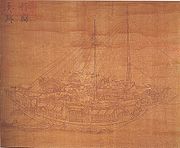
...set up partnerships and joint stock companiesJoint stock companyA joint-stock company is a type of corporation or partnership involving two or more individuals that own shares of stock in the company...
, with a separation of owners (shareholders) and managers. In the large cities, merchants were organized into guildGuildA guild is an association of craftsmen in a particular trade. The earliest types of guild were formed as confraternities of workers. They were organized in a manner something between a trade union, a cartel, and a secret society...
s according to the type of product sold; they periodically set prices and arranged sales from wholesalers to shop owners. When the government requisitioned goods or assessed taxes, it dealt with the guild heads.
Although large government run industries and large privately-owned enterprises dominated the market system of urban China during the Song period, there was a plethora of small private businesses and entrepreneurs throughout the large suburbs and rural areas that thrived off the economic boom of the period. There was even a large black market in China during the Song period, which was actually enhanced once the Jurchens
Jurchens
The Jurchens were a Tungusic people who inhabited the region of Manchuria until the 17th century, when they adopted the name Manchu...
conquered northern China and established the Jin Dynasty. For example, around 1160 AD there was an annual black market smuggling of some 70 to 80 thousand cattle. There were multitudes of successful small kiln
Kiln
A kiln is a thermally insulated chamber, or oven, in which a controlled temperature regime is produced. Uses include the hardening, burning or drying of materials...
s and pottery shops owned by local families, along with oil presses, wine-making shops, small local paper-making businesses, etc. There was also room for small economic success with the "inn keeper, the petty diviner, the drug seller, the cloth trader," and many others.

Suzhou
Suzhou , previously transliterated as Su-chou, Suchow, and Soochow, is a major city located in the southeast of Jiangsu Province in Eastern China, located adjacent to Shanghai Municipality. The city is situated on the lower reaches of the Yangtze River and on the shores of Taihu Lake and is a part...
often specialized in raising bombyx mori
Bombyx mori
The silkworm is the larva or caterpillar of the domesticated silkmoth, Bombyx mori . It is an economically important insect, being a primary producer of silk...
to produce silk
Silk
Silk is a natural protein fiber, some forms of which can be woven into textiles. The best-known type of silk is obtained from the cocoons of the larvae of the mulberry silkworm Bombyx mori reared in captivity...
wares, while in Fujian
Fujian
' , formerly romanised as Fukien or Huguing or Foukien, is a province on the southeast coast of mainland China. Fujian is bordered by Zhejiang to the north, Jiangxi to the west, and Guangdong to the south. Taiwan lies to the east, across the Taiwan Strait...
, Sichuan
Sichuan
' , known formerly in the West by its postal map spellings of Szechwan or Szechuan is a province in Southwest China with its capital in Chengdu...
, and Guangdong
Guangdong
Guangdong is a province on the South China Sea coast of the People's Republic of China. The province was previously often written with the alternative English name Kwangtung Province...
farmers often grew sugarcane. In order to ensure the prosperity of rural areas, technical applications for public works projects and improved agricultural techniques were essential. The vast irrigation system of China had to be furnished with multitudes of wheelwright
Wheelwright
A wheelwright is a person who builds or repairs wheels. The word is the combination of "wheel" and the archaic word "wright", which comes from the Old English word "wryhta", meaning a worker or maker...
s mass-producing standardized waterwheels and square-pallet chain pumps that could lift water from lower planes to higher irrigation planes.
For clothing, silken robes
Han Chinese clothing
Hanfu or Han Chinese Clothing, also sometimes known as Hanzhuang , Huafu , and sometimes referred in English sources simply as Silk Robe or Chinese Silk Robe refers to the historical dress of the Han Chinese people, which was worn for millennia before the conquest by the Manchus and the...
were worn by the wealthy and elite while hemp
Hemp
Hemp is mostly used as a name for low tetrahydrocannabinol strains of the plant Cannabis sativa, of fiber and/or oilseed varieties. In modern times, hemp has been used for industrial purposes including paper, textiles, biodegradable plastics, construction, health food and fuel with modest...
and ramie
Ramie
Ramie is a flowering plant in the nettle family Urticaceae, native to eastern Asia. It is a herbaceous perennial growing to 1–2.5 m tall; the leaves are heart-shaped, 7–15 cm long and 6–12 cm broad, and white on the underside with dense small hairs—this gives it a silvery appearance;...
was worn by the poor; by the late Song period cotton clothes were also in use. Shipment of all these materials and goods was aided by the 10th century innovation of the canal pound lock in China; the Song scientist and statesman Shen Kuo
Shen Kuo
Shen Kuo or Shen Gua , style name Cunzhong and pseudonym Mengqi Weng , was a polymathic Chinese scientist and statesman of the Song Dynasty...
(1031–1095) wrote that the building of pound lock gates at Zhenzhou (presumably Kuozhou along the Yangtze) during the 1020s and 1030s freed up the use of five hundred working laborers at the canal each year, amounting to the saving of up to 1,250,000 strings of cash annually. He wrote that the old method of hauling boats over limited the size of the cargo to 300 tan of rice per vessel (roughly 17 t (17,000 kg)), but after the pound locks were introduced, boats carrying 400 tan (roughly 22 t (22,000 kg)) could then be used. Shen wrote that by his time (c. 1080) government boats could carry cargo weights of up to 700 tan (39 t (39,000 kg)), while private boats could hold as much as 800 bags, each weighing 2 tan (i.e. a total of 88 t (88,000 kg)).
Foreign trade
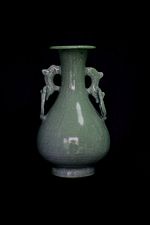
Grand Canal of China
The Grand Canal in China, also known as the Beijing-Hangzhou Grand Canal is the longest canal or artificial river in the world. Starting at Beijing, it passes through Tianjin and the provinces of Hebei, Shandong, Jiangsu and Zhejiang to the city of Hangzhou...
, the Yangzi River
Yangtze River
The Yangtze, Yangzi or Cháng Jiāng is the longest river in Asia, and the third-longest in the world. It flows for from the glaciers on the Tibetan Plateau in Qinghai eastward across southwest, central and eastern China before emptying into the East China Sea at Shanghai. It is also one of the...
, its tributaries and lakes, and other canal systems trumped the commercial gains of overseas trade, there were still many large seaports during the Song period that bolstered the economy, such as Quanzhou
Quanzhou
Quanzhou is a prefecture-level city in Fujian province, People's Republic of China. It borders all other prefecture-level cities in Fujian but two and faces the Taiwan Strait...
, Fuzhou
Fuzhou
Fuzhou is the capital and one of the largest cities in Fujian Province, People's Republic of China. Along with the many counties of Ningde, those of Fuzhou are considered to constitute the Mindong linguistic and cultural area....
, Guangzhou
Guangzhou
Guangzhou , known historically as Canton or Kwangchow, is the capital and largest city of the Guangdong province in the People's Republic of China. Located in southern China on the Pearl River, about north-northwest of Hong Kong, Guangzhou is a key national transportation hub and trading port...
, and Xiamen
Xiamen
Xiamen , also known as Amoy , is a major city on the southeast coast of the People's Republic of China. It is administered as a sub-provincial city of Fujian province with an area of and population of 3.53 million...
. These seaports, now heavily connected to the hinterland via canal, lake, and river traffic, acted as a long string of large market centers for the sale of cash crops produced in the interior. The high demand in China for foreign luxury goods and spices coming from the East Indies facilitated the growth of Chinese maritime trade abroad during the Song period. Along with the mining industry, the shipbuilding industry of Fujian
Fujian
' , formerly romanised as Fukien or Huguing or Foukien, is a province on the southeast coast of mainland China. Fujian is bordered by Zhejiang to the north, Jiangxi to the west, and Guangdong to the south. Taiwan lies to the east, across the Taiwan Strait...
province during the Song period increased its production exponentially as maritime trade was given more importance and as the province's population growth began to increase dramatically. The Song capital at Hangzhou
Hangzhou
Hangzhou , formerly transliterated as Hangchow, is the capital and largest city of Zhejiang Province in Eastern China. Governed as a sub-provincial city, and as of 2010, its entire administrative division or prefecture had a registered population of 8.7 million people...
had a large canal that connected its waterways directly to the seaport at Mingzhou (modern Ningbo
Ningbo
Ningbo is a seaport city of northeastern Zhejiang province, Eastern China. Holding sub-provincial administrative status, the municipality has a population of 7,605,700 inhabitants at the 2010 census whom 3,089,180 in the built up area made of 6 urban districts. It lies south of the Hangzhou Bay,...
), the center where many of the foreign imported goods were shipped out to the rest of the country. Despite the installation of fire stations and a large fire fighting force, fires continued to threaten the city of Hangzhou and the various businesses within it. In safeguarding stored supplies and providing rented space for merchants and shopkeepers to keep their surplus goods safe from city fires, the rich families of Hangzhou, palace eunuchs, and empresses had large warehouse
Warehouse
A warehouse is a commercial building for storage of goods. Warehouses are used by manufacturers, importers, exporters, wholesalers, transport businesses, customs, etc. They are usually large plain buildings in industrial areas of cities and towns. They usually have loading docks to load and unload...
s built near the northeast walls; these warehouses were surrounded by channels of water on all sides and were heavily guarded by hired night watchmen. Shipbuilders generated means of employment for many skilled craftsmen, while sailors for ship crews found many opportunities of employment as more families had enough capital to purchase boats and invest in commercial trading abroad. Foreigners and merchants from abroad had an impact on the economy from within China as well. For example, many Muslims went to Song China not only to trade, but dominated the import and export industry and in some cases became officials of economic regulations. For Chinese maritime merchants, however, there was risk involved in such long overseas ventures to foreign trade posts and seaports as far away as Egypt
Egypt
Egypt , officially the Arab Republic of Egypt, Arabic: , is a country mainly in North Africa, with the Sinai Peninsula forming a land bridge in Southwest Asia. Egypt is thus a transcontinental country, and a major power in Africa, the Mediterranean Basin, the Middle East and the Muslim world...
. In order to reduce the risk of losing money instead of gaining it on maritime trade missions abroad:
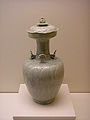
[Song era] investors usually divided their investment among many ships, and each ship had many investors behind it. One observer thought eagerness to invest in overseas trade was leading to an outflow of copper cash. He wrote, "People along the coast are on intimate terms with the merchants who engage in overseas trade, either because they are fellow-countrymen or personal acquaintances...[They give the merchants] money to take with them on their ships for purchase and return conveyance of foreign goods. They invest from ten to a hundred strings of cash, and regularly make profits of several hundred percent."

Zhu Yu (author)
Zhu Yu was an author of the Chinese Song Dynasty . He retired in Huang Gang of the Hubei province, bought a country house and named it "Pingzhou". He called himself "Expert Vegetable Grower of Pingzhou ". Between 1111 and 1117 AD, Zhu Yu wrote the book Pingzhou Ketan , published in 1119 AD...
wrote in his Pingzhou Ketan (萍洲可談; Pingzhou Table Talks) of 1119 AD about the organization, maritime practices, and government standards of seagoing vessels, their merchants, and sailing crews. His book stated:
According to government regulations concerning seagoing ships, the larger ones can carry several hundred men, and the smaller ones may have more than a hundred men on board. One of the most important merchants is chosen to be Leader (Gang Shou), another is Deputy Leader (Fu Gang Shou), and a third is Business Manager (Za Shi). The Superintendent of Merchant Shipping gives them an unofficially sealed red certificate permitting them to use the light bamboo for punishing their company when necessary. Should anyone die at sea, his property becomes forfeit to the government...The ship's pilots are acquainted with the configuration of the coasts; at night they steer by the stars, and in the day-time by the sun. In dark weather they look at the south-pointing needle (i.e. the magnetic compassCompassA compass is a navigational instrument that shows directions in a frame of reference that is stationary relative to the surface of the earth. The frame of reference defines the four cardinal directions – north, south, east, and west. Intermediate directions are also defined...
). They also use a line a hundred feet long with a hook at the end which they let down to take samples of mud from the sea-bottom; by its (appearance and) smell they can determine their whereabouts.
Foreign travelers to China often made remarks on the economic strength of the country. The later Muslim Moroccan Berber
Berber people
Berbers are the indigenous peoples of North Africa west of the Nile Valley. They are continuously distributed from the Atlantic to the Siwa oasis, in Egypt, and from the Mediterranean to the Niger River. Historically they spoke the Berber language or varieties of it, which together form a branch...
traveler Ibn Batutta (1304–1377) wrote about many of his travel experiences in places across the Eurasian world, including China at the farthest eastern extremity. After describing lavish Chinese ships holding palatial cabins and saloons, along with the life of Chinese ship crews and captains, Batutta wrote: "Among the inhabitants of China there are those who own numerous ships, on which they send their agents to foreign places. For nowhere in the world are there to be found people richer than the Chinese".
Salaries and Income
Wealthy landholders were still typically those who were able to educate their sons to the highest degree. Hence small groups of prominent families in any given local county would gain national spotlight for having sons travel far off to be educated and appointed as ministers of the state. Yet downward social mobility was always an issue with the matter of divided inheritance. Suggesting ways to increase a family's property, Yuan CaiYuan Cai
Yuan Cai was a Song dynasty scholar and official, best known for penning the Yuan shi shi fan, a manual of advice addressed to family heads on the subject of how to handle their responsibilities....
(1140–1190) wrote in the late 12th century that those who obtained office with decent salaries should not convert it to gold and silver, but instead could watch their values grow with investment:
For instance, if he had 100,000 strings worth of gold and silver and used this money to buy productive property, in a year he would gain 10,000 strings; after ten years or so, he would have regained the 100,000 strings and what would be divided among the family would be interest. If it were invested in a pawn brokingPawnbrokerA pawnbroker is an individual or business that offers secured loans to people, with items of personal property used as collateral...
business, in three years the interest would equal the capital. He would still have the 100,000 strings, and the rest, being interest, could be divided. Moreover, it could be doubled again in another three years, ad infinitum.
Shen Kuo
Shen Kuo
Shen Kuo or Shen Gua , style name Cunzhong and pseudonym Mengqi Weng , was a polymathic Chinese scientist and statesman of the Song Dynasty...
(1031–1095), a minister of finance, was of the same opinion; in his understanding of the velocity of circulation, he stated in 1077:
The utility of money derives from circulation and loan-making. A village of ten households may have 100,000 coins. If the cash is stored in the household of one individual, even after a century, the sum remains 100,000. If the coins are circulated through business transactions so that every individual of the ten households can enjoy the utility of the 100,000 coins, then the utility will amount to that of 1,000,000 cash. If circulation continues without stop, the utility of the cash will be beyond enumeration.
Considerable scholarship has been concentrated on researching the level of living standards during the Song Dynasty
Song Dynasty
The Song Dynasty was a ruling dynasty in China between 960 and 1279; it succeeded the Five Dynasties and Ten Kingdoms Period, and was followed by the Yuan Dynasty. It was the first government in world history to issue banknotes or paper money, and the first Chinese government to establish a...
. A recent study by economic historian Cheng Minsheng estimated the average income for lower-class laborers during the Song Dynasty as 100 wen a day, about 5 times the estimated subsistence level of 20 wen a day and a very high level for preindustrial economies. Per capita consumption of grain and silk respectively was estimated by Cheng to be around 8 jin (about 400 g each) a day and 2 bolts a year, respectively.
Steel and iron industries
Industrial Revolution
The Industrial Revolution was a period from the 18th to the 19th century where major changes in agriculture, manufacturing, mining, transportation, and technology had a profound effect on the social, economic and cultural conditions of the times...
. For example the historian Robert Hartwell has estimated that per capita iron
Iron
Iron is a chemical element with the symbol Fe and atomic number 26. It is a metal in the first transition series. It is the most common element forming the planet Earth as a whole, forming much of Earth's outer and inner core. It is the fourth most common element in the Earth's crust...
output rose sixfold between 806 and 1078, such that, by 1078 China was producing 127000000 kg (125,000 t) in weight of iron per year. However, historian Donald Wagner questions Hartwell's method used to estimate these figures (i.e. by using Song tax and quota receipts).
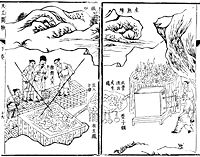
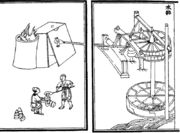
In the smelting process of using huge bellows
Bellows
A bellows is a device for delivering pressurized air in a controlled quantity to a controlled location.Basically, a bellows is a deformable container which has an outlet nozzle. When the volume of the bellows is decreased, the air escapes through the outlet...
driven by waterwheels, massive amounts of charcoal were used in the production process, leading to a wide range of deforestation in northern China. However, by the end of the 11th century the Chinese discovered that using bituminous coke
Coke (fuel)
Coke is the solid carbonaceous material derived from destructive distillation of low-ash, low-sulfur bituminous coal. Cokes from coal are grey, hard, and porous. While coke can be formed naturally, the commonly used form is man-made.- History :...
could replace the role of charcoal, hence many acres of forested land in northern China were spared from the steel
Steel
Steel is an alloy that consists mostly of iron and has a carbon content between 0.2% and 2.1% by weight, depending on the grade. Carbon is the most common alloying material for iron, but various other alloying elements are used, such as manganese, chromium, vanadium, and tungsten...
and iron industry with this switch of resources. Iron and steel of this period were used to mass produce ploughs, hammers, needles, pins, nails for ships, musical cymbals, chains for suspension bridges, Buddhist statues, and other routine items for an indigenous mass market. Iron was also a necessary manufacturing component for the production processes of salt and copper. Many newly constructed canal
Canal
Canals are man-made channels for water. There are two types of canal:#Waterways: navigable transportation canals used for carrying ships and boats shipping goods and conveying people, further subdivided into two kinds:...
s linked the major iron and steel production centers to the capital city's main market. This was also extended to trade with the outside world, which greatly expanded with the high level of Chinese maritime activity abroad during the Southern Song period.
Through many written petitions to the central government by regional administrators of the Song Empire, historical scholars can piece evidence together to appropriate the size and scope of the Chinese iron industry during the Song era. The famed magistrate Bao Qingtian
Bao Qingtian
Bao Zheng was a much-praised official who served during the reign of Emperor Renzong of Northern Song Dynasty in ancient China. Culturally, Bao Zheng today is respected as the symbol of justice in China...
(999–1062) wrote of the iron industry at Hancheng, Tongzhou Prefecture, along the Yellow River
Yellow River
The Yellow River or Huang He, formerly known as the Hwang Ho, is the second-longest river in China and the sixth-longest in the world at the estimated length of . Originating in the Bayan Har Mountains in Qinghai Province in western China, it flows through nine provinces of China and empties into...
in what is today eastern Shaanxi
Shaanxi
' is a province in the central part of Mainland China, and it includes portions of the Loess Plateau on the middle reaches of the Yellow River in addition to the Qinling Mountains across the southern part of this province...
province, with iron smelting households that were overseen by government regulators. He wrote that 700 such households were acting as iron smelters, with 200 having the most adequate amount of government support, such as charcoal supplies and skilled craftsmen (the iron households hired local unskilled labor themselves). Bao's complaint to the throne was that government laws against private smelting in Shaanxi hindered profits of the industry, so the government finally heeded his plea and lifted the ban on private smelting for Shaanxi in 1055. The result of this was an increase in profit (with lower prices for iron) as well as production; 100,000 jin (60 tonne
Tonne
The tonne, known as the metric ton in the US , often put pleonastically as "metric tonne" to avoid confusion with ton, is a metric system unit of mass equal to 1000 kilograms. The tonne is not an International System of Units unit, but is accepted for use with the SI...
s) of iron was produced annually in Shaanxi in the 1040s AD, increasing to 600,000 jin (360 tonnes) produced annually by the 1110s, furbished by the revival of the Shaanxi mining
Mining
Mining is the extraction of valuable minerals or other geological materials from the earth, from an ore body, vein or seam. The term also includes the removal of soil. Materials recovered by mining include base metals, precious metals, iron, uranium, coal, diamonds, limestone, oil shale, rock...
industry in 1112. Although the iron smelters of Shaanxi were managed and supplied by the government, there were many independent smelters operated and owned by rich families. While acting as governor of Xuzhou
Xuzhou
Xuzhou , otherwise known as Pengcheng in ancient times, is a major city in and the fourth largest prefecture-level city of Jiangsu province, People's Republic of China...
in 1078, the famous Song poet and statesman Su Shi
Su Shi
Su Shi , was a writer, poet, artist, calligrapher, pharmacologist, gastronome, and statesman of the Song Dynasty, and one of the major poets of the Song era. His courtesy name was Zizhan and his pseudonym was Dongpo Jushi , and he is often referred to as Su Dongpo...
(1037–1101) wrote that in the Liguo Industrial Prefecture under his administered region, there were 36 iron smelters run by different local families, each employing a work force of several hundred people to mine ore, produce their own charcoal, and smelt iron.
Gunpowder production
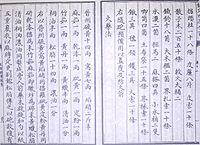
Sulfur
Sulfur or sulphur is the chemical element with atomic number 16. In the periodic table it is represented by the symbol S. It is an abundant, multivalent non-metal. Under normal conditions, sulfur atoms form cyclic octatomic molecules with chemical formula S8. Elemental sulfur is a bright yellow...
, which the Chinese called 'vitriol liquid', was extracted from pyrite
Pyrite
The mineral pyrite, or iron pyrite, is an iron sulfide with the formula FeS2. This mineral's metallic luster and pale-to-normal, brass-yellow hue have earned it the nickname fool's gold because of its resemblance to gold...
and used for pharmaceutical purposes as well as for the creation of gunpowder. This was done by roasting iron pyrites, converting the sulphide to oxide
Oxide
An oxide is a chemical compound that contains at least one oxygen atom in its chemical formula. Metal oxides typically contain an anion of oxygen in the oxidation state of −2....
, as the ore was piled up with coal briquettes in an earthenware furnace with a type of still-head to send the sulfur over as vapour, after which it would solidify and crystallize. The historical text of the Song Shi (History of the Song, compiled in 1345 AD) stated that the major producer of sulfur in the Tang and Song dynasties was the Jin Zhou sub-provincial administrative region (modern Linfen
Linfen
-Administrative divisions:The prefecture-level city of Linfen is divided in one district, two cities and fourteen counties. The information here presented uses the metric system and data from 2010 Census.-Pollution:...
in southern Shanxi
Shanxi
' is a province in Northern China. Its one-character abbreviation is "晋" , after the state of Jin that existed here during the Spring and Autumn Period....
). The bureaucrats appointed to the region managed the industrial processing and sale of it, and the amount created and distributed from the years 996 to 997 alone was 405,000 jin (roughly 200 tons). It was recorded that in 1076 AD the Song Dynasty government held a strict commercial monopoly on sulfur production, and if dye
Dye
A dye is a colored substance that has an affinity to the substrate to which it is being applied. The dye is generally applied in an aqueous solution, and requires a mordant to improve the fastness of the dye on the fiber....
houses and government workshops sold their products to private dealers in the black market, they were subject to meted penalties by government authorities. Even before this point, in 1067 AD, the Song government had issued an edict that the people living in Shanxi
Shanxi
' is a province in Northern China. Its one-character abbreviation is "晋" , after the state of Jin that existed here during the Spring and Autumn Period....
and Hebei
Hebei
' is a province of the People's Republic of China in the North China region. Its one-character abbreviation is "" , named after Ji Province, a Han Dynasty province that included what is now southern Hebei...
were forbidden to sell foreigners any products containing saltpetre
Potassium nitrate
Potassium nitrate is a chemical compound with the formula KNO3. It is an ionic salt of potassium ions K+ and nitrate ions NO3−.It occurs as a mineral niter and is a natural solid source of nitrogen. Its common names include saltpetre , from medieval Latin sal petræ: "stone salt" or possibly "Salt...
and sulfur. This act by the Song government displayed their fears of the grave potential of gunpowder weapons being developed by Song China's territorial enemies as well (i.e. the Tanguts and Khitans).
Since Jin Zhou was in close proximity to the Song capital at Kaifeng
Kaifeng
Kaifeng , known previously by several names , is a prefecture-level city in east-central Henan province, Central China. Nearly 5 million people live in the metropolitan area...
, the latter became the largest producer of gunpowder during the Northern Song period. With enhanced sulfur from pyrite instead of natural sulfur (along with enhanced potassium nitrate
Potassium nitrate
Potassium nitrate is a chemical compound with the formula KNO3. It is an ionic salt of potassium ions K+ and nitrate ions NO3−.It occurs as a mineral niter and is a natural solid source of nitrogen. Its common names include saltpetre , from medieval Latin sal petræ: "stone salt" or possibly "Salt...
), the Chinese were able to shift the use of gunpowder from an incendiary
Incendiary ammunition
-World War I:One of the first uses of incendiary ammunition occurred in World War I. At the time, phosphorus—the primary ingredient in the incendiary charge—ignited upon firing, leaving a trail of blue smoke. They were also known as 'smoke tracer' for this reason. The effective range of...
use into an explosive one for early artillery. There were large manufacturing plants in the Song Dynasty for the purpose of making 'fire-weapons' employing the use of gunpowder, such as fire lance
Fire lance
The fire lance or fire spear is one of the first gunpowder weapons in the world.- Description :The earliest fire lances were spear-like weapons combining a bamboo tube containing gunpowder and projectiles tied to a Chinese spear. Upon firing, the charge ejected a small projectile or poison dart...
s and fire arrow
Fire Arrow
Fire arrows are an early form of gun powder rocket which were attached to a stick. The Chinese are credited with the first use of fire arrows in a military application, they may have developed fire arrows from their use of fireworks.- Design :...
s. While engaged in a war with the Mongols, in 1259 the official Li Zengbo wrote in his Ko Zhai Za Gao, Xu Gao Hou that the city of Qingzhou
Qingzhou
Qingzhou , formerly Yidu County , is a county-level city, which is located in the west of Weifang City, Shandong Province, China. Qingzhou is a dynamic industry city, and also grows a great number of farm products...
was manufacturing one to two thousand strong iron-cased bomb shells a month, dispatching to Xiangyang and Yingzhou about ten to twenty thousand such bombs at a time. One of the main armories and arsenals for the storage of gunpowder and weapons was located at Weiyang
Weiyang Palace
Weiyang Palace was a palace complex, located near the city of Chang'an . Built in 200 BC at the request of Han Gaozu, under the supervision of his prime minister Xiao He, it served as the administrative centre and imperial residence of the Western Han Dynasty, as well as the Western Jin dynasty...
, which accidentally caught fire and produced a massive explosion in 1280 AD.
Commerce
Brocade
Brocade is a class of richly decorative shuttle-woven fabrics, often made in colored silks and with or without gold and silver threads. The name, related to the same root as the word "broccoli," comes from Italian broccato meaning "embossed cloth," originally past participle of the verb broccare...
workshops in the eastern provinces and in the capital city of Kaifeng
Kaifeng
Kaifeng , known previously by several names , is a prefecture-level city in east-central Henan province, Central China. Nearly 5 million people live in the metropolitan area...
. However, at the same time the government established strict legal prohibition on the merchant trade of privately produced silk in Sichuan
Sichuan
' , known formerly in the West by its postal map spellings of Szechwan or Szechuan is a province in Southwest China with its capital in Chengdu...
province. This prohibition dealt an economic blow to Sichuan that caused a small rebellion (which was subdued), yet in the Song Dynasty Sichuan was well known for its independent industries producing timber and cultivated oranges
Orange (fruit)
An orange—specifically, the sweet orange—is the citrus Citrus × sinensis and its fruit. It is the most commonly grown tree fruit in the world....
. The reforms of the Chancellor
Chancellor of China
The Chancellor , variously translated as Prime Minister, Chancellor of State, Premier or Chief Councillor, was a generic name given to the highest-ranking official in the imperial government in ancient China...
Wang Anshi
Wang Anshi
Wang Anshi was a Chinese economist, statesman, chancellor and poet of the Song Dynasty who attempted controversial, major socioeconomic reforms...
(1021–1086) sparked heated debate amongst ministers of court when he nationalised the industries manufacturing, processing, and distributing tea, salt, and wine. The state monopoly on Sichuan tea was the prime source of revenue for the state's purchase of horses in Qinghai
Qinghai
Qinghai ; Oirat Mongolian: ; ; Salar:) is a province of the People's Republic of China, named after Qinghai Lake...
for the Song army's cavalry forces. The restrictions on the private manufacture and trade of salt were even criticized in a famous poem by Su Shi
Su Shi
Su Shi , was a writer, poet, artist, calligrapher, pharmacologist, gastronome, and statesman of the Song Dynasty, and one of the major poets of the Song era. His courtesy name was Zizhan and his pseudonym was Dongpo Jushi , and he is often referred to as Su Dongpo...
, and while the opposing politically-charged faction at court gained advantage and lost favor, Wang Anshi's reforms were continually abandoned and reinstated. Despite this political quarrel, the Song Empire's main source of revenue continued to come from state-managed monopolies and indirect tax
Indirect tax
The term indirect tax has more than one meaning.In the colloquial sense, an indirect tax is a tax collected by an intermediary from the person who bears the ultimate economic burden of the tax...
es. As for private entrepreneurship, great profits could still be pursued by the merchants in the luxury item trades and specialized regional production. For example, the silk producers of Raoyang County, Shenzhou Prefecture, southern Hebei
Hebei
' is a province of the People's Republic of China in the North China region. Its one-character abbreviation is "" , named after Ji Province, a Han Dynasty province that included what is now southern Hebei...
province were especially known for producing silken headwear for the Song emperor and high court officials in the capital.
Copper resources and receipts of deposit
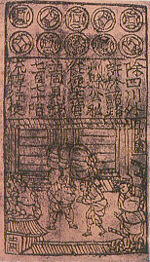
Banknote
A banknote is a kind of negotiable instrument, a promissory note made by a bank payable to the bearer on demand, used as money, and in many jurisdictions is legal tender. In addition to coins, banknotes make up the cash or bearer forms of all modern fiat money...
goes back to the earlier Tang Dynasty
Tang Dynasty
The Tang Dynasty was an imperial dynasty of China preceded by the Sui Dynasty and followed by the Five Dynasties and Ten Kingdoms Period. It was founded by the Li family, who seized power during the decline and collapse of the Sui Empire...
(618–907), when the government outlawed the use of bolts of silk as currency, which increased the use of copper coinage as money. By the year 1085 the output of copper currency was driven to a rate of 6 billion coins a year up from 5.86 billion in 1080 (compared to just 327 million coins minted annually in the Tang Dynasty's prosperous Tianbao period
Chinese era name
A Chinese era name is the regnal year, reign period, or regnal title used when traditionally numbering years in an emperor's reign and naming certain Chinese rulers . Some emperors have several era names, one after another, where each beginning of a new era resets the numbering of the year back...
of 742–755, and only 220 million coins minted annually from 118 BC to 5 AD
Economy of the Han Dynasty
The Han Dynasty of ancient China experienced contrasting periods of economic prosperity and decline. It is normally divided into three periods: Western Han , the Xin Dynasty , and Eastern Han . The Xin Dynasty, established by the former regent Wang Mang, formed a brief interregnum between lengthy...
during the Han Dynasty
Han Dynasty
The Han Dynasty was the second imperial dynasty of China, preceded by the Qin Dynasty and succeeded by the Three Kingdoms . It was founded by the rebel leader Liu Bang, known posthumously as Emperor Gaozu of Han. It was briefly interrupted by the Xin Dynasty of the former regent Wang Mang...
). The expansion of the economy was unprecedented in China: the output of coinage currency in the earlier year of 997 AD, which was only 800 million coins a year. In 1120 alone, the Song government collected 18000000 ounces (510,291.4 kg) of silver in taxes.
With many 9th century Tang era merchants avoiding the weight and bulk of so many copper coins in each transaction, this led them to using trading receipts from deposit shops where goods or money were left previously. Merchants would deposit copper currency into the stores of wealthy families and prominent wholesalers, whereupon they would receive receipts that could be cashed in a number of nearby towns by accredited persons. Since the 10th century, the early Song government began issuing their own receipts of deposit, yet this was restricted mainly to their monopolized salt industry and trade. China's first official regional paper-printed money can be traced back to the year 1024, in Sichuan
Sichuan
' , known formerly in the West by its postal map spellings of Szechwan or Szechuan is a province in Southwest China with its capital in Chengdu...
province. Robert Temple says that the Sichuan bills can be traced back to 1023; before that year, sixteen private businesses or 'bank
Bank
A bank is a financial institution that serves as a financial intermediary. The term "bank" may refer to one of several related types of entities:...
s' issued notes of exchange, but in that year the Song government took over this enterprise under an official agency.
Although the output of copper currency had expanded immensely by 1085, some fifty copper mines were shut down between the years 1078 and 1085. Although there were on average more copper mines found in Northern Song China than in the previous Tang Dynasty, this case was reversed during the Southern Song with a sharp decline and depletion of mined copper deposits by 1165. Even though copper cash was abundant in the late 11th century, Chancellor Wang Anshi's tax substitution for corvée
Corvée
Corvée is unfree labour, often unpaid, that is required of people of lower social standing and imposed on them by the state or a superior . The corvée was the earliest and most widespread form of taxation, which can be traced back to the beginning of civilization...
labor and government takeover of agricultural finance loans meant that people now had to find additional cash, driving up the price of copper money which would become scarce. To make matters worse, large amounts of government-issued copper currency exited the country via international trade, while the Liao Dynasty
Liao Dynasty
The Liao Dynasty , also known as the Khitan Empire was an empire in East Asia that ruled over the regions of Manchuria, Mongolia, and parts of northern China proper between 9071125...
and Western Xia
Western Xia
The Western Xia Dynasty or the Tangut Empire, was known to the Tanguts and the Tibetans as Minyak.The state existed from 1038 to 1227 AD in what are now the northwestern Chinese provinces of Ningxia, Gansu, eastern Qinghai, northern Shaanxi, northeastern Xinjiang, southwest Inner Mongolia, and...
actively pursued the exchange of their iron-minted coins for Song copper coins. As evidenced by an 1103 decree, the Song government became cautious about its outflow of iron currency into the Liao Empire when it ordered that the iron was to be alloyed with tin in the smelting process, thus depriving the Liao of a chance to melt down the currency to make iron weapons.
The government attempted to prohibit the use of copper currency in border regions and in seaports, but the Song-issued copper coin became common in the Liao, Western Xia, Japanese, and Southeast Asian economies. The Song government would turn to other types of material for its currency in order to ease the demand on the government mint, including the issuing of iron coinage and paper banknotes. In the year 976, the percentage of issued currency using copper coinage was 65%; after 1135, this had dropped significantly to 54%, a government attempt to debase the copper currency.
The world's first paper money

Woodblock printing
Woodblock printing is a technique for printing text, images or patterns used widely throughout East Asia and originating in China in antiquity as a method of printing on textiles and later paper....
). Even before this point, the Song government was amassing large amounts of paper tribute
Tribute
A tribute is wealth, often in kind, that one party gives to another as a sign of respect or, as was often the case in historical contexts, of submission or allegiance. Various ancient states, which could be called suzerains, exacted tribute from areas they had conquered or threatened to conquer...
. It was recorded that each year before 1101 AD, the prefecture of Xinan (modern Xi-xian, Anhui
Anhui
Anhui is a province in the People's Republic of China. Located in eastern China across the basins of the Yangtze River and the Huai River, it borders Jiangsu to the east, Zhejiang to the southeast, Jiangxi to the south, Hubei to the southwest, Henan to the northwest, and Shandong for a tiny...
) alone would send 1,500,000 sheets of paper in seven different varieties to the capital at Kaifeng. In that year of 1101, the Emperor Huizong of Song decided to lessen the amount of paper taken in the tribute quota, because it was causing detrimental effects and creating heavy burdens on the people of the region. However, the government still needed masses of paper product for the exchange certificates and the state's new issuing of paper money. For the printing of paper money alone, the Song court established several government-run factories in the cities of Huizhou
Huizhou
Huizhou , historically known as Waichow, is a city located in central Guangdong province of the People's Republic of China. Part of the Pearl River Delta, Huizhou borders the provincial capital of Guangzhou to the west, Shaoguan to the north, Heyuan to the northeast, Shanwei to the east, Shenzhen...
, Chengdu
Chengdu
Chengdu , formerly transliterated Chengtu, is the capital of Sichuan province in Southwest China. It holds sub-provincial administrative status...
, Hangzhou
Hangzhou
Hangzhou , formerly transliterated as Hangchow, is the capital and largest city of Zhejiang Province in Eastern China. Governed as a sub-provincial city, and as of 2010, its entire administrative division or prefecture had a registered population of 8.7 million people...
, and Anqi. The size of the workforce employed in these paper money factories were quite large, as it was recorded in 1175 AD that the factory at Hangzhou alone employed more than a thousand workers a day. However, the government issues of paper money were not yet nationwide standards of currency at that point; issues of banknotes were limited to regional zones of the empire, and were valid for use only in a designated and temporary limit of 3-year's time. The geographic limitation changed between the years 1265 and 1274, when the late Southern Song government finally produced a nationwide standard currency of paper money, once its widespread circulation was backed by gold or silver. The range of varying values for these banknotes was perhaps from one string of cash to one hundred at the most. Ever since 1107, the government printed money in no less than six ink colors and printed notes with intricate designs and sometimes even with mixture of unique fiber in the paper to avoid counterfeiting.
The subsequent Yuan
Yuan Dynasty
The Yuan Dynasty , or Great Yuan Empire was a ruling dynasty founded by the Mongol leader Kublai Khan, who ruled most of present-day China, all of modern Mongolia and its surrounding areas, lasting officially from 1271 to 1368. It is considered both as a division of the Mongol Empire and as an...
, Ming
Ming Dynasty
The Ming Dynasty, also Empire of the Great Ming, was the ruling dynasty of China from 1368 to 1644, following the collapse of the Mongol-led Yuan Dynasty. The Ming, "one of the greatest eras of orderly government and social stability in human history", was the last dynasty in China ruled by ethnic...
, and Qing
Qing Dynasty
The Qing Dynasty was the last dynasty of China, ruling from 1644 to 1912 with a brief, abortive restoration in 1917. It was preceded by the Ming Dynasty and followed by the Republic of China....
dynasties would issue their own paper money as well. Even the Southern Song's contemporary of the Jin Dynasty to the north caught on to this trend and issued their own paper money. At the archeological dig at Jehol there was a printing plate found that dated to the year 1214, which produced notes that measured 10 cm by 19 cm in size and were worth a hundred strings of 80 cash coins. This Jurchen
Jurchens
The Jurchens were a Tungusic people who inhabited the region of Manchuria until the 17th century, when they adopted the name Manchu...
-Jin issued paper money bore a serial number
Serial number
A serial number is a unique number assigned for identification which varies from its successor or predecessor by a fixed discrete integer value...
, the number of the series, and a warning label that counterfeiters would be decapitated, and the denouncer rewarded with three hundred strings of cash.
Urban employment and businesses

Along the Temple Eastgate Avenue...are to be found shops specializing in cloth caps with pointed tails, belts and waiststraps, books, caps and flowers as well as the vegetarian tea meal of the Ding family...South of the temple are the brothels of Manager's Alley...The nuns and the brocade workers live in Embroidery Alley...On the north is Small Sweetwater Alley...There are a particularly large number of Southern restaurants inside the alley, as well as a plethora of brothels.
Similarly, in the "Pleasure District" along the Horse Guild Avenue, near a Zoroastrian temple
Zoroastrianism
Zoroastrianism is a religion and philosophy based on the teachings of prophet Zoroaster and was formerly among the world's largest religions. It was probably founded some time before the 6th century BCE in Greater Iran.In Zoroastrianism, the Creator Ahura Mazda is all good, and no evil...
in Kaifeng, West quotes the same source, Dongjing meng Hua lu:
In addition to the household gates and shops that line the two sides of New Fengqiu Gate Street...military encampments of the various brigades and columns [of the Imperial Guard] are situated in facing pairs along approximately ten li of the approach to the gate. Other wards, alleys, and confined open spaces crisscross the area, numbering in the tens of thousands—none knows their real number. In every single place, the gates are squeezed up against each other, each with its own tea wards, wineshops, stages, and food and drink. Normally the small business households of the marketplace simply purchase [prepared] food and drink at food stores; they do not cook at home. For northern food there are the Shi Feng style dried meat cubes...made of various stewed items...for southern food, the House of Jin at Temple Bridge...and the House of Zhou at Ninebends...are acknowledged to be the finest. The night markets close after the third watch only to reopen at the fifth.
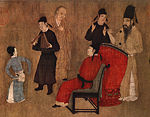
Chinese jade
Chinese jade is any of the carved-jade objects produced in China from the Neolithic Period onward. The Chinese regarded carved-jade objects as intrinsically valuable...
, rhinocerous horn, gold and silver, hair ornaments, combs, caps, scarves, and aromatic incense thrived in the marketplaces.
Foreign Trade
The Song Dynasty actively promoted overseas trade. About fifty countries carried out overseas trade with the Song Dynasty, among them Ceylon, LangkasukaLangkasuka
Langkasuka was an ancient Hindu Malay kingdom located in the Malay Peninsula...
, Mait
Mait
Mait is an Estonian masculine given name.People named Mait include:*Mait Aadna ,*Mait Klaassen , veterinary scientist and politician*Mait Kõiv , historian*Mait Künnap , tennis player...
, Samboja
Srivijaya
Srivijaya was a powerful ancient thalassocratic Malay empire based on the island of Sumatra, modern day Indonesia, which influenced much of Southeast Asia. The earliest solid proof of its existence dates from the 7th century; a Chinese monk, I-Tsing, wrote that he visited Srivijaya in 671 for 6...
, Borneo
Borneo
Borneo is the third largest island in the world and is located north of Java Island, Indonesia, at the geographic centre of Maritime Southeast Asia....
, Kelantan
Kelantan
Kelantan is a state of Malaysia. The capital and royal seat is Kota Bharu. The Arabic honorific of the state is Darul Naim, ....
, Champa
Champa
The kingdom of Champa was an Indianized kingdom that controlled what is now southern and central Vietnam from approximately the 7th century through to 1832.The Cham people are remnants...
, Chenla
Chenla
Chenla is the Chinese designation for Cambodia after the fall of Funan. That name was still used in the 13th century by the Chinese envoy Zhou Daguan, author of the Manners and Customs of Cambodia...
, Bengtrao, Java
Java
Java is an island of Indonesia. With a population of 135 million , it is the world's most populous island, and one of the most densely populated regions in the world. It is home to 60% of Indonesia's population. The Indonesian capital city, Jakarta, is in west Java...
, India
India
India , officially the Republic of India , is a country in South Asia. It is the seventh-largest country by geographical area, the second-most populous country with over 1.2 billion people, and the most populous democracy in the world...
, Calicut, Lambri, Bengal
Bengal
Bengal is a historical and geographical region in the northeast region of the Indian Subcontinent at the apex of the Bay of Bengal. Today, it is mainly divided between the sovereign land of People's Republic of Bangladesh and the Indian state of West Bengal, although some regions of the previous...
, Kurum, Gujara, Mecca
Mecca
Mecca is a city in the Hijaz and the capital of Makkah province in Saudi Arabia. The city is located inland from Jeddah in a narrow valley at a height of above sea level...
, Egypt
Egypt
Egypt , officially the Arab Republic of Egypt, Arabic: , is a country mainly in North Africa, with the Sinai Peninsula forming a land bridge in Southwest Asia. Egypt is thus a transcontinental country, and a major power in Africa, the Mediterranean Basin, the Middle East and the Muslim world...
, Baghdad
Baghdad
Baghdad is the capital of Iraq, as well as the coterminous Baghdad Governorate. The population of Baghdad in 2011 is approximately 7,216,040...
, Iraq
Iraq
Iraq ; officially the Republic of Iraq is a country in Western Asia spanning most of the northwestern end of the Zagros mountain range, the eastern part of the Syrian Desert and the northern part of the Arabian Desert....
, Aman
Aman
-External links:*...
, the Almoravid dynasty, Sicily
Sicily
Sicily is a region of Italy, and is the largest island in the Mediterranean Sea. Along with the surrounding minor islands, it constitutes an autonomous region of Italy, the Regione Autonoma Siciliana Sicily has a rich and unique culture, especially with regard to the arts, music, literature,...
, Morocco
Morocco
Morocco , officially the Kingdom of Morocco , is a country located in North Africa. It has a population of more than 32 million and an area of 710,850 km², and also primarily administers the disputed region of the Western Sahara...
, Tanzania, Somalia
Somalia
Somalia , officially the Somali Republic and formerly known as the Somali Democratic Republic under Socialist rule, is a country located in the Horn of Africa. Since the outbreak of the Somali Civil War in 1991 there has been no central government control over most of the country's territory...
, Ryukyu, Korea
Korea
Korea ) is an East Asian geographic region that is currently divided into two separate sovereign states — North Korea and South Korea. Located on the Korean Peninsula, Korea is bordered by the People's Republic of China to the northwest, Russia to the northeast, and is separated from Japan to the...
, and Japan
Japan
Japan is an island nation in East Asia. Located in the Pacific Ocean, it lies to the east of the Sea of Japan, China, North Korea, South Korea and Russia, stretching from the Sea of Okhotsk in the north to the East China Sea and Taiwan in the south...
. Pearls, ivory, rhinocero horns, frankincense, agalloch eaglewood, coral, agate, hawksbill turtle shell, gardenia, and rose were imported from the Arabs and Samboja, herbal medicine from Java, costusroot from Foloan (Kuala Sungai Berang) cotton cloth, cotton yarn from Mait, and ginseng, silver, copper, and quick silver from Korea.
To promote overseas trade and maximize government profits in control of imported goods, in 971 the government established a Maritime Trade Supervisorate at Guangzhou, in 999 established a second one at Hangzhou
Hangzhou
Hangzhou , formerly transliterated as Hangchow, is the capital and largest city of Zhejiang Province in Eastern China. Governed as a sub-provincial city, and as of 2010, its entire administrative division or prefecture had a registered population of 8.7 million people...
, a third at Mingzhou (now Ningbo
Ningbo
Ningbo is a seaport city of northeastern Zhejiang province, Eastern China. Holding sub-provincial administrative status, the municipality has a population of 7,605,700 inhabitants at the 2010 census whom 3,089,180 in the built up area made of 6 urban districts. It lies south of the Hangzhou Bay,...
city), followed by Quanzhou
Quanzhou
Quanzhou is a prefecture-level city in Fujian province, People's Republic of China. It borders all other prefecture-level cities in Fujian but two and faces the Taiwan Strait...
(Zaitung) in 1079, Huating County (now part of Shanghai
Shanghai
Shanghai is the largest city by population in China and the largest city proper in the world. It is one of the four province-level municipalities in the People's Republic of China, with a total population of over 23 million as of 2010...
) in 1113, and Jiangyin
Jiangyin
Jiangyin is a city in China's Jiangsu province on the Yangtze River. It has population of 1.2 million . The total GDP reached RMB 171.3 billion yuan in 2009, an increase of 11.6% from 2008. The GDP per capita reached RMB 142,572 yuan...
in 1145. Initially the Maritime Trade Supervisorate was subordinate under the Department of Transportation or prefecture official, later made into a separate agency with its own supervisor. The roles of the Maritime Trade Supervisorate included:
- Taxation of imported goods, tax rate varied over the Song Dynasty, from 10% to as high as 40%; however, during the reign of Emperor Shenzong (1048–1085), the tax rate for imports was lowered to 6.67%. The tax was goods in kind, not money.
- Government purchase and sale of imported goods. In 976, all imported goods from overseas merchants had to be sold only to the government, private sales was prohibited, penalty for violation depended on the quantity of goods involved, and the highest penalty was tattooing of the face and forced labor. Later the 100% rule was relaxed somewhat. The Maritime Trade Superisorate purchased a portion of the finest quality goods, for example 60% for pearls, 40% for rhinocero horn; the low quality leftover goods were allowed to be traded in the market. The purchase rate applied to after tax goods, then paid in money, not according to market price, but according to a government-accessed "fare value". In the Southern Song Dynasty, the Maritime Trade Supervisorates were short of funds and were not paid on time, causing huge losses in profits for overseas merchants; the volume of incoming ships also dropped.
- Issue foreign trade permits for local merchants.
See also
- History of economics
- History of banking in ChinaHistory of banking in ChinaThe history of banking in China includes the business of dealing with money and credit transactions in China.- Early Chinese banks :Chinese financial institutions were conducting all major banking functions, including the acceptance of deposits, the making of loans, issuing notes, money exchange,...
- Economic history of ChinaEconomic history of ChinaChina's economic system before the late-1990s, with state ownership of certain industries and central control over planning and the financial system, has enabled the government to mobilize whatever surplus was available and greatly increase the proportion of the national economic output devoted to...
- Economy of the Han DynastyEconomy of the Han DynastyThe Han Dynasty of ancient China experienced contrasting periods of economic prosperity and decline. It is normally divided into three periods: Western Han , the Xin Dynasty , and Eastern Han . The Xin Dynasty, established by the former regent Wang Mang, formed a brief interregnum between lengthy...
- Taxation in premodern ChinaTaxation in premodern ChinaIn the premodern era of Chinese history, taxation by the various dynasties that ruled China varied greatly. Overall, the most important source of state revenue was the tax on agriculture, or land tax. During some dynasties, the government also imposed state monopolies which became important sources...