


Walk to Canossa

Encyclopedia
Henry IV, Holy Roman Emperor
Henry IV was King of the Romans from 1056 and Holy Roman Emperor from 1084 until his forced abdication in 1105. He was the third emperor of the Salian dynasty and one of the most powerful and important figures of the 11th century...
of the Holy Roman Empire
Holy Roman Empire
The Holy Roman Empire was a realm that existed from 962 to 1806 in Central Europe.It was ruled by the Holy Roman Emperor. Its character changed during the Middle Ages and the Early Modern period, when the power of the emperor gradually weakened in favour of the princes...
from Speyer
Speyer
Speyer is a city of Rhineland-Palatinate, Germany with approximately 50,000 inhabitants. Located beside the river Rhine, Speyer is 25 km south of Ludwigshafen and Mannheim. Founded by the Romans, it is one of Germany's oldest cities...
to the fortress at Canossa
Canossa Castle
The Castle of Canossa is a castle in Canossa, province of Reggio Emilia, northern Italy.It is especially known as the seat of the Walk to Canossa, the meeting of Emperor Henry IV and Pope Gregory VII during the Investiture Controversy .- History :...
in Emilia Romagna and to the events surrounding his journey, which took place in and around January 1077.
Historical background
When, in his early papacyPope
The Pope is the Bishop of Rome, a position that makes him the leader of the worldwide Catholic Church . In the Catholic Church, the Pope is regarded as the successor of Saint Peter, the Apostle...
, Gregory VII
Pope Gregory VII
Pope St. Gregory VII , born Hildebrand of Sovana , was Pope from April 22, 1073, until his death. One of the great reforming popes, he is perhaps best known for the part he played in the Investiture Controversy, his dispute with Henry IV, Holy Roman Emperor affirming the primacy of the papal...
attempted to enact reforms to the investiture
Investiture
Investiture, from the Latin is a rather general term for the formal installation of an incumbent...
process, he was met by much resistance from the Holy Roman Emperor Henry IV. Henry insisted that he reserved the traditionally established right of previous emperors to "invest" bishop
Bishop
A bishop is an ordained or consecrated member of the Christian clergy who is generally entrusted with a position of authority and oversight. Within the Catholic Church, Eastern Orthodox, Oriental Orthodox Churches, in the Assyrian Church of the East, in the Independent Catholic Churches, and in the...
s and other clergy
Clergy
Clergy is the generic term used to describe the formal religious leadership within a given religion. A clergyman, churchman or cleric is a member of the clergy, especially one who is a priest, preacher, pastor, or other religious professional....
men, despite the papal decree. Henry renounced Gregory as pope; in return, Gregory excommunicated
Excommunication
Excommunication is a religious censure used to deprive, suspend or limit membership in a religious community. The word means putting [someone] out of communion. In some religions, excommunication includes spiritual condemnation of the member or group...
and deposed Henry, in the Lenten synod of 1076, at Rome. He stated furthermore that, one year from that day, the excommunication would become permanent and irrevocable.
Journey
Violence had already broken out at LangensalzaFirst Battle of Langensalza
The First Battle of Langensalza was fought on 9 June 1075 between forces of German King Henry IV and several rebellious Saxon noblemen on the River Unstrut near Langensalza. The battle was a complete success for Henry, resulting in the subjugation of Saxony shortly before the Investiture...
on 9 June 1075, suppressed by Henry. Now the patriarch of Aquileia
Patriarch of Aquileia
The Patriarch of Aquileia was an office in the Roman Catholic Church. During the Middle Ages the Patriarchate of Aquileia was a temporal state in Northern Italy. The Patriarchate of Aquileia as a church office was suppressed in 1752....
and the papal legate met with German princes at Oppenheim
Oppenheim
Oppenheim is a town in the Mainz-Bingen district in Rhineland-Palatinate, Germany. The town is well known as a wine town, the site of the German Winegrowing Museum and particularly for the wines from the Oppenheimer Krötenbrunnen vineyards.- Location :...
, 16 October 1076, and swore an oath not to recognize Henry unless the ban were lifted. Fearing further rebellion among the German aristocracy, Henry felt he had to have his excommunication lifted. On the suggestion of his adversaries, he arranged to meet with the pope in Augsburg
Augsburg
Augsburg is a city in the south-west of Bavaria, Germany. It is a university town and home of the Regierungsbezirk Schwaben and the Bezirk Schwaben. Augsburg is an urban district and home to the institutions of the Landkreis Augsburg. It is, as of 2008, the third-largest city in Bavaria with a...
.
Gregory's route
Gregory, however, feared that Henry would bring his army and attempt to remove the pope from power. He spent some time on his journey northward from RomeRome
Rome is the capital of Italy and the country's largest and most populated city and comune, with over 2.7 million residents in . The city is located in the central-western portion of the Italian Peninsula, on the Tiber River within the Lazio region of Italy.Rome's history spans two and a half...
in Italian towns that owed fealty to the Holy Roman Empire
Holy Roman Empire
The Holy Roman Empire was a realm that existed from 962 to 1806 in Central Europe.It was ruled by the Holy Roman Emperor. Its character changed during the Middle Ages and the Early Modern period, when the power of the emperor gradually weakened in favour of the princes...
, trying to gain support among the people and assessing his strengths among the churchmen.
While still in the northern reaches of present-day Italy
Italy
Italy , officially the Italian Republic languages]] under the European Charter for Regional or Minority Languages. In each of these, Italy's official name is as follows:;;;;;;;;), is a unitary parliamentary republic in South-Central Europe. To the north it borders France, Switzerland, Austria and...
, he met Matilda
Matilda of Tuscany
Matilda of Tuscany was an Italian noblewoman, the principal Italian supporter of Pope Gregory VII during the Investiture Controversy. She is one of the few medieval women to be remembered for her military accomplishments...
, Countess of Tuscany
Tuscany
Tuscany is a region in Italy. It has an area of about 23,000 square kilometres and a population of about 3.75 million inhabitants. The regional capital is Florence ....
. She offered to bring him to a location safe from attack by Henry. They traveled together to the fortress at Canossa and shut themselves inside.
Henry's route
Henry commenced his trip in SpeyerSpeyer
Speyer is a city of Rhineland-Palatinate, Germany with approximately 50,000 inhabitants. Located beside the river Rhine, Speyer is 25 km south of Ludwigshafen and Mannheim. Founded by the Romans, it is one of Germany's oldest cities...
and travelling southward from Germany
Germany
Germany , officially the Federal Republic of Germany , is a federal parliamentary republic in Europe. The country consists of 16 states while the capital and largest city is Berlin. Germany covers an area of 357,021 km2 and has a largely temperate seasonal climate...
, he found his position precarious. He was still popular among the common people, but his nobles were still threatening to elect a new king. He had to secure his position in the church before the rapidly approaching deadline given by the pope.
Once he crossed the Alps
Alps
The Alps is one of the great mountain range systems of Europe, stretching from Austria and Slovenia in the east through Italy, Switzerland, Liechtenstein and Germany to France in the west....
by the Mont Cenis
Mont Cenis
Mont Cenis is a massif and pass in Savoie in France which forms the limit between the Cottian and Graian Alps.A road over the pass was built between 1803 and 1810 by Napoleon...
pass, Henry took on the behavior of penitence. He wore a hair-shirt
Cilice
A cilice was originally a garment or undergarment made of coarse cloth or animal hair used in some religious traditions to induce some degree of discomfort or pain as a sign of repentance and atonement...
, the traditional clothing of monk
Monk
A monk is a person who practices religious asceticism, living either alone or with any number of monks, while always maintaining some degree of physical separation from those not sharing the same purpose...
s at the time, and allegedly walked barefoot. Many of his entourage also supposedly removed their shoes. In these conditions he crossed the Alps
Alps
The Alps is one of the great mountain range systems of Europe, stretching from Austria and Slovenia in the east through Italy, Switzerland, Liechtenstein and Germany to France in the west....
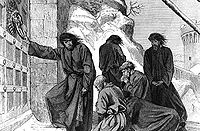
, a long and harsh journey in late January. On 25 January 1077 he reached the gates of Canossa.
At the fortress
Cilice
A cilice was originally a garment or undergarment made of coarse cloth or animal hair used in some religious traditions to induce some degree of discomfort or pain as a sign of repentance and atonement...
and fasted
Fasting
Fasting is primarily the act of willingly abstaining from some or all food, drink, or both, for a period of time. An absolute fast is normally defined as abstinence from all food and liquid for a defined period, usually a single day , or several days. Other fasts may be only partially restrictive,...
. Although no contemporary sources report this, it has since been speculated that Henry spent much of his time during these three days in the village at the foot of the hill.
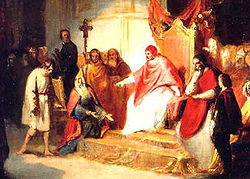
On 28 January the gates were opened for Henry and he was allowed to enter the fortress. Contemporary accounts report that he knelt before Pope Gregory and begged his forgiveness. Gregory absolved Henry and invited him back into the Church. That evening, Gregory, Henry, and Matilda
Matilda of Tuscany
Matilda of Tuscany was an Italian noblewoman, the principal Italian supporter of Pope Gregory VII during the Investiture Controversy. She is one of the few medieval women to be remembered for her military accomplishments...
shared communion
Eucharist
The Eucharist , also called Holy Communion, the Sacrament of the Altar, the Blessed Sacrament, the Lord's Supper, and other names, is a Christian sacrament or ordinance...
in the Cathedral of Saint Nicholas inside the fortress, signaling the official end of Henry's excommunication.
Henry quickly returned to his empire, but Gregory remained with Matilda
Matilda of Tuscany
Matilda of Tuscany was an Italian noblewoman, the principal Italian supporter of Pope Gregory VII during the Investiture Controversy. She is one of the few medieval women to be remembered for her military accomplishments...
at the fortress and in other locations in Tuscany for several months. Later historians speculated upon a romantic or sexual relationship between the two (an accusation sometimes raised by Protestant historians in the 17th century) although if there was ever any evidence for this it has not survived.
Historical impact
The immediate effects of the Canossa meeting were limited. Although Henry was restored to the Church, any expectations that the Pope would restore support of Henry's right to the throne were soon dashed: in March, a small group of powerful Saxon and South German territorial magnates, including the archbishops of Salzburg, Mainz and Magdeburg and several bishops, met at Forchheim and, on the assumption that Henry had irretrievably lost the imperial dignity, repudiated the Salian dynastySalian dynasty
The Salian dynasty was a dynasty in the High Middle Ages of four German Kings , also known as the Frankish dynasty after the family's origin and role as dukes of Franconia...
's claim to pass the imperial crown by heredity and, in the words of Bruno of Merseburg
Bruno the Saxon
Bruno the Saxon was a German chronicler of the eleventh century and author of the "Historia de Bello Saxonico" or History of the Saxon Wars. Little is known of his life...
, present in his bishop's entourage
Medieval household
The medieval household was, like modern households, the centre of family life for all classes of European society. Yet in contrast to the household of today, it consisted of many more individuals than the nuclear family...
, declared "that the son of a king, even if he should be preeminently worthy, should become king by a spontaneous election". The Pope confirmed the agreement. His deposition still in effect, Henry was forced into civil war with Duke Rudolph of Swabia. Gregory levied a second excommunication against Henry, who ultimately won the civil war, invaded Rome, and forced Gregory to flee, replacing him with Antipope Clement III
Antipope Clement III
Guibert or Wibert of Ravenna was a cleric made antipope in 1080 due to perceived abuses of Pope Gregory VII during the Investiture Controversy, a title that lasted to his death....
.
The meaning in the greater history of Germany and Europe
Europe
Europe is, by convention, one of the world's seven continents. Comprising the westernmost peninsula of Eurasia, Europe is generally 'divided' from Asia to its east by the watershed divides of the Ural and Caucasus Mountains, the Ural River, the Caspian and Black Seas, and the waterways connecting...
, however, was much more significant. During the Protestant Reformation
Protestant Reformation
The Protestant Reformation was a 16th-century split within Western Christianity initiated by Martin Luther, John Calvin and other early Protestants. The efforts of the self-described "reformers", who objected to the doctrines, rituals and ecclesiastical structure of the Roman Catholic Church, led...
in the 16th century, Henry was exalted as a defender of the rights of both Germans and opponents of the Pope. Many German Lutherans
Lutheranism
Lutheranism is a major branch of Western Christianity that identifies with the theology of Martin Luther, a German reformer. Luther's efforts to reform the theology and practice of the church launched the Protestant Reformation...
considered him the "first Protestant" and looked to his example for guidance in their struggle against what they saw as a tyrannical and unjust institution.
Later in German history the event took on a more secular meaning: it came to stand for Germany's refusal to be subjected to any outside power (although still especially, but not exclusively, the Roman Catholic Church
Roman Catholic Church
The Catholic Church, also known as the Roman Catholic Church, is the world's largest Christian church, with over a billion members. Led by the Pope, it defines its mission as spreading the gospel of Jesus Christ, administering the sacraments and exercising charity...
). Otto von Bismarck
Otto von Bismarck
Otto Eduard Leopold, Prince of Bismarck, Duke of Lauenburg , simply known as Otto von Bismarck, was a Prussian-German statesman whose actions unified Germany, made it a major player in world affairs, and created a balance of power that kept Europe at peace after 1871.As Minister President of...
, during his so-called "Kulturkampf
Kulturkampf
The German term refers to German policies in relation to secularity and the influence of the Roman Catholic Church, enacted from 1871 to 1878 by the Prime Minister of Prussia, Otto von Bismarck. The Kulturkampf did not extend to the other German states such as Bavaria...
," assured his countrymen that "We will not go to Canossa – neither in body nor in spirit!" That is, Germany would stand for itself and not abide any outside interference in its politics, religion or culture.
On the other side, Canossa is remembered in Italy by Benedetto Croce
Benedetto Croce
Benedetto Croce was an Italian idealist philosopher, and occasionally also politician. He wrote on numerous topics, including philosophy, history, methodology of history writing and aesthetics, and was a prominent liberal, although he opposed laissez-faire free trade...
as the first concrete victory after the fall of the Roman Empire of the Pope, who, for the 19th-century historian, represented the Italian people, against the domination of the Germans. Croce considered Canossa as the initial retreat from Italy of the Holy Roman Empire
Holy Roman Empire
The Holy Roman Empire was a realm that existed from 962 to 1806 in Central Europe.It was ruled by the Holy Roman Emperor. Its character changed during the Middle Ages and the Early Modern period, when the power of the emperor gradually weakened in favour of the princes...
, starting the Italian Renaissance
Italian Renaissance
The Italian Renaissance began the opening phase of the Renaissance, a period of great cultural change and achievement in Europe that spanned the period from the end of the 13th century to about 1600, marking the transition between Medieval and Early Modern Europe...
in which the Germans lost control of northern Italy by the 15th century.
"Going to Canossa"
Today, "Canossa" refers to an act of penance or submission. To "go to Canossa" is an expression – used often in German: "nach Canossa gehen", in Danish, Norwegian and Swedish: "Canossavandring" or "Kanossagang", in French: "aller à Canossa", in Italian: "andare a Canossa", and in Slovenian: "pot v Canosso" – to describe doing penance, often with the connotation that it is unwilling or coerced. Adolf HitlerAdolf Hitler
Adolf Hitler was an Austrian-born German politician and the leader of the National Socialist German Workers Party , commonly referred to as the Nazi Party). He was Chancellor of Germany from 1933 to 1945, and head of state from 1934 to 1945...
, for instance, used the expression to describe his meetings with Bavaria
Bavaria
Bavaria, formally the Free State of Bavaria is a state of Germany, located in the southeast of Germany. With an area of , it is the largest state by area, forming almost 20% of the total land area of Germany...
n Minister President Heinrich Held
Heinrich Held
Heinrich Held was a Catholic politician and Minister President of Bavaria. He was forced out of office by the Nazi takeover in Germany in 1933.-Life:...
after being released from Landsberg Prison
Landsberg Prison
Landsberg Prison is a penal facility located in the town of Landsberg am Lech in the southwest of the German state of Bavaria, about west of Munich and south of Augsburg....
, in his bid to have the ban on the Nazi Party lifted.