


Stamp mill

Encyclopedia
A stamp mill is a type of mill machine that crushes material by pounding rather than grinding, either for further processing or for extraction of metallic ores. Breaking material down is a type of unit operation
.
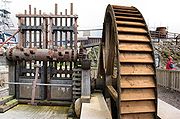 Cornish stamps are stamp mills that were developed in Cornwall
for use in tin
mining in around 1850. Cornish stamps were used to crush small lumps of ore
into sand like material. Constructed from heavy timber or iron lifters with iron "heads" at the bottom were raised by cam
s on a rotating axle, and fell on the ore and water mixture, fed into a box beneath. The heads normally weighed between 4 and 8 cwt
each, and were usually arranged in sets of four, in timber frames. Small stamps were commonly powered by water wheel
s and larger ones by steam engines.
Californian stamps were based on Cornish stamps and were used in the California
n gold mines. They were more rapid in action, and the heads and lifters were made to rotate so that they wore more evenly. The other advantage of the Californian stamp was that a single head could crush 1.5 tons of ore as opposed to the Cornish stamps which could only crush 1 ton.
(iron
-shod wood
in some cases) stamps, loosely held vertically in a frame, in which the stamps can slide up and down. They are lifted by cam
s on a horizontal rotating shaft
. On modern mills, the cam is arranged to lift the stamp from the side, so that it causes the stamp to rotate. This evens the wear on the shoe at the foot of the stamp. As the cam moves from under the stamp, the stamp falls onto the ore below, crushing the rock, and the lifting process is repeated at the next pass of the cam.
Each one frame and stamp set is sometimes called a "battery" or, confusingly, a "stamp" and mills are sometimes categorised by how many stamps they have, i.e. a "10 stamp mill" has 10 sets. They usually are arranged linearly, but when a mill is enlarged, a new line of them may be constructed rather than extending the line. Abandoned mill sites (as documented by industrial archaeologists
) will usually have linear rows of foundation sets as their most prominent visible feature as the overall apparatus can exceed 20 feet in height, requiring large foundations. Stamps are usually arranged in sets of five.
Some ore processing applications used large quantities of water so some stamp mills are located near natural or artificial bodies of water. For example, the Redridge Steel Dam
was built to supply stamp mills with process water.
s, cam
s, and hammers - were already known by the Greeks
in Hellenistic times
. Ancient
cams are in evidence in early water-powered automata
from the third century BC. A passage in the Natural History
of the Roman
scholar Pliny
(NH 18.97) indicates that water-driven pestles had become fairly widespread in Italy by the first century AD: "The greater part of Italy uses an unshod pestle and also wheels which water turns as it flows past, and a trip-hammer [mola]". These trip-hammers were used for the pounding and hulling of grain
. Grain-pounders with pestles, as well as ordinary watermill
s, are also attested as late as the middle of the fifth century in a monastery
founded by Romanus of Condat
in the remote Jura
region, indicating that the knowledge of trip hammers continued into the early Middle Ages
. Apart from agricultural processing, archaeological evidence also strongly suggests the existence of trip hammers in Roman metal working. In Ickham
in Kent
, a large metal hammer-head with mechanical deformations was excavated in an area where several Roman water-mills and metal waste dumps have also been traced.
The widest application of stamp mills, however, seems to have occurred in Roman mining, where ore
from deep veins was first crushed into small pieces for further processing. Here, the regularity and spacing of large indentations on stone anvil
s indicate the use of cam-operated ore stamps, much like the devices of later medieval
mining. Such mechanically deformed anvils have been found at numerous Roman silver and gold mining sites in Western Europe
, including at Dolaucothi (Wales
), and on the Iberian peninsula
, where the datable examples are from the 1st and 2nd century AD. At Dolaucothi, these stamp mills were hydraulic-driven and possibly also at other Roman mining sites, where the large scale use of the hushing and ground sluicing technique
meant that large amounts of water were directly available for powering the machines.
Stamp mills were used by miners
in Samarkand
as early as 973. They were used in medieval Persia to crush mineral ore
s. By the 11th century, stamp mills were in widespread use throughout the medieval Islamic world
, from Islamic Spain
and North Africa in the west to Central Asia
in the east.
Water-powered and mechanised trip hammers reappeared in medieval Europe
by the 12th century. Their use was described in medieval written sources of Styria (in modern-day Austria), written in 1135 and another in 1175 AD. Both texts mentioned the use of vertical stamp mills for ore-crushing. Medieval French sources of the years 1116 and 1249 both record the use of mechanised trip hammers used in the forging of wrought iron
. Medieval European trip hammers by the 15th century were most often in the shape of the vertical pestle stamp-mill. The well-known Renaissance
artist and inventor Leonardo da Vinci
often sketched trip hammers for use in forges and even file-cutting machinery, those of the vertical pestle stamp-mill type. The oldest depicted European illustration of a martinet
forge-hammer is perhaps the Historia de Gentibus Septentrionalibus of Olaus Magnus
, dated to 1565 AD. In this woodcut image, there is the scene of three martinets and a waterwheel working wood and leather bellows of the Osmund
bloomery
furnace. The recumbrent hammer was first depicted in European artwork in an illustration by Sandrart and Zonca (dated 1621 AD).
Water-powered stamp mills are illustrated in book 8 of Georg Agricola
's De Re Metallica
, published in 1556. The mills Agricola shows were largely wooden construction, excepting the use of iron
shoes on the end of each stamp. The camshaft
was set directly on the axle
of the waterwheel, and stamps were typically arranged in gangs of three, with each wheel driving one or two gangs.
The first stamp mill in the U.S. was built in 1829 at the Capps mine near Charlotte, North Carolina
. They were common in gold
, silver
and copper
mining regions of the US in the latter 19th and early 20th centuries, in operations where the ore was crushed as a prelude to extracting the metals. They were superseded in the second half of the 19th century in many applications by more efficient methods. However their simplicity meant that they were used in remote areas for ore processing well into the 20th century. (19th century advertisements for some mills highlighted that they could be broken down, packed in by mule in pieces, and assembled on site with only simple tools)
for preparing the paper-stuff (pulp), before the invention of the Hollander beater
. They were used in mining
for breaking ore
, and in oil-seed
processing for prior to pressing the oil from the milled seeds. Early mills were water powered but mills can be steam, water, or electric powered.
A stamping mill may refer to a factory that performs stamping.
Unit operation
In chemical engineering and related fields, a unit operation is a basic step in a process.Unit operation involves bringing a physical change such as separation, crystallization, evaporation, filtration etc.. For example in milk processing, homogenization, pasteurization, chilling, and packaging are...
.
Usage
Cornwall
Cornwall is a unitary authority and ceremonial county of England, within the United Kingdom. It is bordered to the north and west by the Celtic Sea, to the south by the English Channel, and to the east by the county of Devon, over the River Tamar. Cornwall has a population of , and covers an area of...
for use in tin
Tin
Tin is a chemical element with the symbol Sn and atomic number 50. It is a main group metal in group 14 of the periodic table. Tin shows chemical similarity to both neighboring group 14 elements, germanium and lead and has two possible oxidation states, +2 and the slightly more stable +4...
mining in around 1850. Cornish stamps were used to crush small lumps of ore
Ore
An ore is a type of rock that contains minerals with important elements including metals. The ores are extracted through mining; these are then refined to extract the valuable element....
into sand like material. Constructed from heavy timber or iron lifters with iron "heads" at the bottom were raised by cam
Cam
A cam is a rotating or sliding piece in a mechanical linkage used especially in transforming rotary motion into linear motion or vice-versa. It is often a part of a rotating wheel or shaft that strikes a lever at one or more points on its circular path...
s on a rotating axle, and fell on the ore and water mixture, fed into a box beneath. The heads normally weighed between 4 and 8 cwt
Hundredweight
The hundredweight or centum weight is a unit of mass defined in terms of the pound . The definition used in Britain differs from that used in North America. The two are distinguished by the terms long hundredweight and short hundredweight:* The long hundredweight is defined as 112 lb, which...
each, and were usually arranged in sets of four, in timber frames. Small stamps were commonly powered by water wheel
Water wheel
A water wheel is a machine for converting the energy of free-flowing or falling water into useful forms of power. A water wheel consists of a large wooden or metal wheel, with a number of blades or buckets arranged on the outside rim forming the driving surface...
s and larger ones by steam engines.
Californian stamps were based on Cornish stamps and were used in the California
California
California is a state located on the West Coast of the United States. It is by far the most populous U.S. state, and the third-largest by land area...
n gold mines. They were more rapid in action, and the heads and lifters were made to rotate so that they wore more evenly. The other advantage of the Californian stamp was that a single head could crush 1.5 tons of ore as opposed to the Cornish stamps which could only crush 1 ton.
Arrangement
A stamp mill consists of a set of heavy steelSteel
Steel is an alloy that consists mostly of iron and has a carbon content between 0.2% and 2.1% by weight, depending on the grade. Carbon is the most common alloying material for iron, but various other alloying elements are used, such as manganese, chromium, vanadium, and tungsten...
(iron
Iron
Iron is a chemical element with the symbol Fe and atomic number 26. It is a metal in the first transition series. It is the most common element forming the planet Earth as a whole, forming much of Earth's outer and inner core. It is the fourth most common element in the Earth's crust...
-shod wood
Wood
Wood is a hard, fibrous tissue found in many trees. It has been used for hundreds of thousands of years for both fuel and as a construction material. It is an organic material, a natural composite of cellulose fibers embedded in a matrix of lignin which resists compression...
in some cases) stamps, loosely held vertically in a frame, in which the stamps can slide up and down. They are lifted by cam
Cam
A cam is a rotating or sliding piece in a mechanical linkage used especially in transforming rotary motion into linear motion or vice-versa. It is often a part of a rotating wheel or shaft that strikes a lever at one or more points on its circular path...
s on a horizontal rotating shaft
Camshaft
A camshaft is a shaft to which a cam is fastened or of which a cam forms an integral part.-History:An early cam was built into Hellenistic water-driven automata from the 3rd century BC. The camshaft was later described in Iraq by Al-Jazari in 1206. He employed it as part of his automata,...
. On modern mills, the cam is arranged to lift the stamp from the side, so that it causes the stamp to rotate. This evens the wear on the shoe at the foot of the stamp. As the cam moves from under the stamp, the stamp falls onto the ore below, crushing the rock, and the lifting process is repeated at the next pass of the cam.
Each one frame and stamp set is sometimes called a "battery" or, confusingly, a "stamp" and mills are sometimes categorised by how many stamps they have, i.e. a "10 stamp mill" has 10 sets. They usually are arranged linearly, but when a mill is enlarged, a new line of them may be constructed rather than extending the line. Abandoned mill sites (as documented by industrial archaeologists
Industrial archaeology
Industrial archaeology, like other branches of archaeology, is the study of material culture from the past, but with a focus on industry. Strictly speaking, industrial archaeology includes sites from the earliest times to the most recent...
) will usually have linear rows of foundation sets as their most prominent visible feature as the overall apparatus can exceed 20 feet in height, requiring large foundations. Stamps are usually arranged in sets of five.
Some ore processing applications used large quantities of water so some stamp mills are located near natural or artificial bodies of water. For example, the Redridge Steel Dam
Redridge Steel Dam
The Redridge Steel Dam is a steel dam across the Salmon Trout River in Redridge, Houghton County, Michigan. Completed in 1901, it is a flat slab buttress dam constructed of steel, a relatively rare material for construction of dams, which are typically earthenworks or masonry...
was built to supply stamp mills with process water.
History
The main components for water-powered stamp mills - water wheelWater wheel
A water wheel is a machine for converting the energy of free-flowing or falling water into useful forms of power. A water wheel consists of a large wooden or metal wheel, with a number of blades or buckets arranged on the outside rim forming the driving surface...
s, cam
Cam
A cam is a rotating or sliding piece in a mechanical linkage used especially in transforming rotary motion into linear motion or vice-versa. It is often a part of a rotating wheel or shaft that strikes a lever at one or more points on its circular path...
s, and hammers - were already known by the Greeks
Ancient Greece
Ancient Greece is a civilization belonging to a period of Greek history that lasted from the Archaic period of the 8th to 6th centuries BC to the end of antiquity. Immediately following this period was the beginning of the Early Middle Ages and the Byzantine era. Included in Ancient Greece is the...
in Hellenistic times
Hellenistic civilization
Hellenistic civilization represents the zenith of Greek influence in the ancient world from 323 BCE to about 146 BCE...
. Ancient
Ancient history
Ancient history is the study of the written past from the beginning of recorded human history to the Early Middle Ages. The span of recorded history is roughly 5,000 years, with Cuneiform script, the oldest discovered form of coherent writing, from the protoliterate period around the 30th century BC...
cams are in evidence in early water-powered automata
Automaton
An automaton is a self-operating machine. The word is sometimes used to describe a robot, more specifically an autonomous robot. An alternative spelling, now obsolete, is automation.-Etymology:...
from the third century BC. A passage in the Natural History
Natural History
Natural history is the scientific study of plants or animals.Natural History may also refer to:In science and medicine:* Natural History , Naturalis Historia, a 1st-century work by Pliny the Elder...
of the Roman
Ancient Rome
Ancient Rome was a thriving civilization that grew on the Italian Peninsula as early as the 8th century BC. Located along the Mediterranean Sea and centered on the city of Rome, it expanded to one of the largest empires in the ancient world....
scholar Pliny
Pliny the Elder
Gaius Plinius Secundus , better known as Pliny the Elder, was a Roman author, naturalist, and natural philosopher, as well as naval and army commander of the early Roman Empire, and personal friend of the emperor Vespasian...
(NH 18.97) indicates that water-driven pestles had become fairly widespread in Italy by the first century AD: "The greater part of Italy uses an unshod pestle and also wheels which water turns as it flows past, and a trip-hammer [mola]". These trip-hammers were used for the pounding and hulling of grain
GRAIN
GRAIN is a small international non-profit organisation that works to support small farmers and social movements in their struggles for community-controlled and biodiversity-based food systems. Our support takes the form of independent research and analysis, networking at local, regional and...
. Grain-pounders with pestles, as well as ordinary watermill
Watermill
A watermill is a structure that uses a water wheel or turbine to drive a mechanical process such as flour, lumber or textile production, or metal shaping .- History :...
s, are also attested as late as the middle of the fifth century in a monastery
Monastery
Monastery denotes the building, or complex of buildings, that houses a room reserved for prayer as well as the domestic quarters and workplace of monastics, whether monks or nuns, and whether living in community or alone .Monasteries may vary greatly in size – a small dwelling accommodating only...
founded by Romanus of Condat
Romanus of Condat
Saint Romanus of Condat is a saint of the fifth century. At the age of thirty five he decided to live as a hermit in the area of Condat. His younger brother Lupicinus followed him there. They became leaders of a community of monks that included Saint Eugendus.Romanus and Lupicinus founded...
in the remote Jura
Jura mountains
The Jura Mountains are a small mountain range located north of the Alps, separating the Rhine and Rhone rivers and forming part of the watershed of each...
region, indicating that the knowledge of trip hammers continued into the early Middle Ages
Middle Ages
The Middle Ages is a periodization of European history from the 5th century to the 15th century. The Middle Ages follows the fall of the Western Roman Empire in 476 and precedes the Early Modern Era. It is the middle period of a three-period division of Western history: Classic, Medieval and Modern...
. Apart from agricultural processing, archaeological evidence also strongly suggests the existence of trip hammers in Roman metal working. In Ickham
Ickham
Ickham is a village within the civil parish of Ickham and Well, five miles east of Canterbury in Kent, South East England.The village is centred around a single road with many old and well preserved houses, with the 13th-century Parish Church of St John the Evangelist in the midst...
in Kent
Kent
Kent is a county in southeast England, and is one of the home counties. It borders East Sussex, Surrey and Greater London and has a defined boundary with Essex in the middle of the Thames Estuary. The ceremonial county boundaries of Kent include the shire county of Kent and the unitary borough of...
, a large metal hammer-head with mechanical deformations was excavated in an area where several Roman water-mills and metal waste dumps have also been traced.
The widest application of stamp mills, however, seems to have occurred in Roman mining, where ore
Ore
An ore is a type of rock that contains minerals with important elements including metals. The ores are extracted through mining; these are then refined to extract the valuable element....
from deep veins was first crushed into small pieces for further processing. Here, the regularity and spacing of large indentations on stone anvil
Anvil
An anvil is a basic tool, a block with a hard surface on which another object is struck. The inertia of the anvil allows the energy of the striking tool to be transferred to the work piece. In most cases the anvil is used as a forging tool...
s indicate the use of cam-operated ore stamps, much like the devices of later medieval
Middle Ages
The Middle Ages is a periodization of European history from the 5th century to the 15th century. The Middle Ages follows the fall of the Western Roman Empire in 476 and precedes the Early Modern Era. It is the middle period of a three-period division of Western history: Classic, Medieval and Modern...
mining. Such mechanically deformed anvils have been found at numerous Roman silver and gold mining sites in Western Europe
Western Europe
Western Europe is a loose term for the collection of countries in the western most region of the European continents, though this definition is context-dependent and carries cultural and political connotations. One definition describes Western Europe as a geographic entity—the region lying in the...
, including at Dolaucothi (Wales
Wales
Wales is a country that is part of the United Kingdom and the island of Great Britain, bordered by England to its east and the Atlantic Ocean and Irish Sea to its west. It has a population of three million, and a total area of 20,779 km²...
), and on the Iberian peninsula
Iberian Peninsula
The Iberian Peninsula , sometimes called Iberia, is located in the extreme southwest of Europe and includes the modern-day sovereign states of Spain, Portugal and Andorra, as well as the British Overseas Territory of Gibraltar...
, where the datable examples are from the 1st and 2nd century AD. At Dolaucothi, these stamp mills were hydraulic-driven and possibly also at other Roman mining sites, where the large scale use of the hushing and ground sluicing technique
Hushing
Hushing is an ancient and historic mining method using a flood or torrent of water to reveal mineral veins. The method was applied in several ways, both in prospecting for ores, and for their exploitation. Mineral veins are often hidden below soil and sub-soil, which must be stripped away to...
meant that large amounts of water were directly available for powering the machines.
Stamp mills were used by miners
Mining
Mining is the extraction of valuable minerals or other geological materials from the earth, from an ore body, vein or seam. The term also includes the removal of soil. Materials recovered by mining include base metals, precious metals, iron, uranium, coal, diamonds, limestone, oil shale, rock...
in Samarkand
Samarkand
Although a Persian-speaking region, it was not united politically with Iran most of the times between the disintegration of the Seleucid Empire and the Arab conquest . In the 6th century it was within the domain of the Turkic kingdom of the Göktürks.At the start of the 8th century Samarkand came...
as early as 973. They were used in medieval Persia to crush mineral ore
Ore
An ore is a type of rock that contains minerals with important elements including metals. The ores are extracted through mining; these are then refined to extract the valuable element....
s. By the 11th century, stamp mills were in widespread use throughout the medieval Islamic world
Islamic Golden Age
During the Islamic Golden Age philosophers, scientists and engineers of the Islamic world contributed enormously to technology and culture, both by preserving earlier traditions and by adding their own inventions and innovations...
, from Islamic Spain
Al-Andalus
Al-Andalus was the Arabic name given to a nation and territorial region also commonly referred to as Moorish Iberia. The name describes parts of the Iberian Peninsula and Septimania governed by Muslims , at various times in the period between 711 and 1492, although the territorial boundaries...
and North Africa in the west to Central Asia
Central Asia
Central Asia is a core region of the Asian continent from the Caspian Sea in the west, China in the east, Afghanistan in the south, and Russia in the north...
in the east.
Water-powered and mechanised trip hammers reappeared in medieval Europe
Middle Ages
The Middle Ages is a periodization of European history from the 5th century to the 15th century. The Middle Ages follows the fall of the Western Roman Empire in 476 and precedes the Early Modern Era. It is the middle period of a three-period division of Western history: Classic, Medieval and Modern...
by the 12th century. Their use was described in medieval written sources of Styria (in modern-day Austria), written in 1135 and another in 1175 AD. Both texts mentioned the use of vertical stamp mills for ore-crushing. Medieval French sources of the years 1116 and 1249 both record the use of mechanised trip hammers used in the forging of wrought iron
Wrought iron
thumb|The [[Eiffel tower]] is constructed from [[puddle iron]], a form of wrought ironWrought iron is an iron alloy with a very low carbon...
. Medieval European trip hammers by the 15th century were most often in the shape of the vertical pestle stamp-mill. The well-known Renaissance
Renaissance
The Renaissance was a cultural movement that spanned roughly the 14th to the 17th century, beginning in Italy in the Late Middle Ages and later spreading to the rest of Europe. The term is also used more loosely to refer to the historical era, but since the changes of the Renaissance were not...
artist and inventor Leonardo da Vinci
Leonardo da Vinci
Leonardo di ser Piero da Vinci was an Italian Renaissance polymath: painter, sculptor, architect, musician, scientist, mathematician, engineer, inventor, anatomist, geologist, cartographer, botanist and writer whose genius, perhaps more than that of any other figure, epitomized the Renaissance...
often sketched trip hammers for use in forges and even file-cutting machinery, those of the vertical pestle stamp-mill type. The oldest depicted European illustration of a martinet
Martinet
The martinet is a punitive device traditionally used in France and other parts of Europe. The word also has other usages . It is also a term for a type of hammer in French, a diminutive of marteau , "hammer".-Object:...
forge-hammer is perhaps the Historia de Gentibus Septentrionalibus of Olaus Magnus
Olaus Magnus
Olaus Magnus was a Swedish ecclesiastic and writer, who did pioneering work for the interest of Nordic people. He was reported as born in October 1490 in Östergötland, and died on August 1, 1557. Magnus, Latin for the Swedish Stor “great”, is a Latin family name taken personally, and not a...
, dated to 1565 AD. In this woodcut image, there is the scene of three martinets and a waterwheel working wood and leather bellows of the Osmund
Osmund
Osmund , Count of Sées was an early Norman nobleman and member of the English clergy; he eventually served as Lord Chancellor and Bishop of Salisbury.-Life:...
bloomery
Bloomery
A bloomery is a type of furnace once widely used for smelting iron from its oxides. The bloomery was the earliest form of smelter capable of smelting iron. A bloomery's product is a porous mass of iron and slag called a bloom. This mix of slag and iron in the bloom is termed sponge iron, which...
furnace. The recumbrent hammer was first depicted in European artwork in an illustration by Sandrart and Zonca (dated 1621 AD).
Water-powered stamp mills are illustrated in book 8 of Georg Agricola
Georg Agricola
Georgius Agricola was a German scholar and scientist. Known as "the father of mineralogy", he was born at Glauchau in Saxony. His real name was Georg Pawer; Agricola is the Latinised version of his name, Pawer meaning "farmer"...
's De Re Metallica
De re metallica
De re metallica is a book cataloguing the state of the art of mining, refining, and smelting metals, published in 1556. The author was Georg Bauer, whose pen name was the Latinized Georgius Agricola...
, published in 1556. The mills Agricola shows were largely wooden construction, excepting the use of iron
Iron
Iron is a chemical element with the symbol Fe and atomic number 26. It is a metal in the first transition series. It is the most common element forming the planet Earth as a whole, forming much of Earth's outer and inner core. It is the fourth most common element in the Earth's crust...
shoes on the end of each stamp. The camshaft
Camshaft
A camshaft is a shaft to which a cam is fastened or of which a cam forms an integral part.-History:An early cam was built into Hellenistic water-driven automata from the 3rd century BC. The camshaft was later described in Iraq by Al-Jazari in 1206. He employed it as part of his automata,...
was set directly on the axle
Axle
An axle is a central shaft for a rotating wheel or gear. On wheeled vehicles, the axle may be fixed to the wheels, rotating with them, or fixed to its surroundings, with the wheels rotating around the axle. In the former case, bearings or bushings are provided at the mounting points where the axle...
of the waterwheel, and stamps were typically arranged in gangs of three, with each wheel driving one or two gangs.
The first stamp mill in the U.S. was built in 1829 at the Capps mine near Charlotte, North Carolina
Charlotte, North Carolina
Charlotte is the largest city in the U.S. state of North Carolina and the seat of Mecklenburg County. In 2010, Charlotte's population according to the US Census Bureau was 731,424, making it the 17th largest city in the United States based on population. The Charlotte metropolitan area had a 2009...
. They were common in gold
Gold
Gold is a chemical element with the symbol Au and an atomic number of 79. Gold is a dense, soft, shiny, malleable and ductile metal. Pure gold has a bright yellow color and luster traditionally considered attractive, which it maintains without oxidizing in air or water. Chemically, gold is a...
, silver
Silver
Silver is a metallic chemical element with the chemical symbol Ag and atomic number 47. A soft, white, lustrous transition metal, it has the highest electrical conductivity of any element and the highest thermal conductivity of any metal...
and copper
Copper
Copper is a chemical element with the symbol Cu and atomic number 29. It is a ductile metal with very high thermal and electrical conductivity. Pure copper is soft and malleable; an exposed surface has a reddish-orange tarnish...
mining regions of the US in the latter 19th and early 20th centuries, in operations where the ore was crushed as a prelude to extracting the metals. They were superseded in the second half of the 19th century in many applications by more efficient methods. However their simplicity meant that they were used in remote areas for ore processing well into the 20th century. (19th century advertisements for some mills highlighted that they could be broken down, packed in by mule in pieces, and assembled on site with only simple tools)
Other stamping mills
Stamp mills were used in early paper makingPaper
Paper is a thin material mainly used for writing upon, printing upon, drawing or for packaging. It is produced by pressing together moist fibers, typically cellulose pulp derived from wood, rags or grasses, and drying them into flexible sheets....
for preparing the paper-stuff (pulp), before the invention of the Hollander beater
Hollander beater
A Hollander beater is a machine developed by the Dutch in 1680 to produce paper pulp from cellulose containing plant fibers. It replaced stamp mills for preparing pulp because the Hollander could produce in one day the same quantity of pulp it would take a stamp mill eight days to prepare.However,...
. They were used in mining
Mining
Mining is the extraction of valuable minerals or other geological materials from the earth, from an ore body, vein or seam. The term also includes the removal of soil. Materials recovered by mining include base metals, precious metals, iron, uranium, coal, diamonds, limestone, oil shale, rock...
for breaking ore
Ore
An ore is a type of rock that contains minerals with important elements including metals. The ores are extracted through mining; these are then refined to extract the valuable element....
, and in oil-seed
Cooking oil
Cooking oil is purified fat of plant origin, which is usually liquid at room temperature ....
processing for prior to pressing the oil from the milled seeds. Early mills were water powered but mills can be steam, water, or electric powered.
A stamping mill may refer to a factory that performs stamping.
See also
- Ball millBall millA ball mill is a type of grinder used to grind materials into extremely fine powder for use in mineral dressing processes, paints, pyrotechnics, and ceramics.-Description:...
- a horizontal cylinder containing metal balls to crush the material - Hammer mill - A more modern device that also can crush material to fines.
- Stamp sandStamp sandStamp sand is a coarse sand left over from the processing of ore in a stamp mill. In the United States, the most well-known deposits of stamp sand are in the Copper Country of northern Michigan, where it is black or dark grey, and may contain hazardous concentrations of trace metals.In the 19th...
- the product of ore mills
External links
- Paymaster Stamp Mill near Lewiston, CaliforniaLewiston, CaliforniaLewiston is a census-designated place in Trinity County, California, United States. The population was 1,193 at the 2010 census, down from 1,305 at the 2000 census.-Geography:Lewiston is located at ....
- 30 stamp mill near Cordova, Ontario
- Mining History Illustrations 5 cutaway drawings of mills produced by the Joshua Hendy Iron WorksJoshua Hendy Iron WorksThe Joshua Hendy Iron Works was an American engineering company that existed from the 1850s to the late 1940s. It was at one time a world leader in mining technology and its equipment was used to build the Panama Canal, amongst other major projects...
Company during the early 1900s. - Western Museum of Mining and Industry The historic "yellow jacket" stamp mill is located here. It is open year round, and operated several times per year for visitors.