
All Topics  
Tower of London

 
Tower of London

   Email Print
   Bookmark   Link


Tower of London


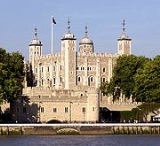
Her Majesty's Royal Palace and Fortress, more commonly known as the Tower of London (and historically as The Tower), is a historic monument in central London
Central London

The term Central London refers to the districts of London which are considered closest to the centre. There is no conventional definition, nor any official one, for the entire area that can be called "central London"....
, England
England

native_name =|conventional_long_name = England|common_name = England|image_flag = Flag of England.svg|image_coat = England COA.svg|symbol_type = Royal Coat of Arms...
, on the north bank of the River Thames
River Thames

The Thames is a major river flowing through southern England. While best known because its lower reaches flow through central London, the river flows through several other towns and cities, including Oxford, Reading, Berkshire and Windsor, Berkshire....
. It is located within the London Borough of Tower Hamlets
London Borough of Tower Hamlets

The London Borough of Tower Hamlets is a London borough to the east of the City of London, England and north of the River Thames in East London, England, taking in much of the East End of London....
 and is separated from the eastern edge of the City of London
City of London

The City of London is a geographically small city status in the United Kingdom within Greater London, England. It is the historic core of London around which, along with Westminster, the modern conurbation grew....
 by the open space known as Tower Hill
Tower Hill

Tower Hill is an elevated spot north-west of the Tower of London, just outside the limits of the City of London in the London Borough of Tower Hamlets....
.

The Tower of London is often identified with the White Tower
White Tower (Tower of London)

The White Tower is a central tower at the Tower of London. The great central keep was started in 1078 by William the Conqueror who ordered the White Tower to be built inside the south-east angle of The City walls, adjacent to the River Thames....
, the original stark square fortress built by William the Conqueror
William I of England

William I , better known as William the Conqueror , was Duke of Normandy from 1035 and English monarchy from later 1066 to his death. William is sometimes also referred to as "William II" in relation to his position as the second Duke of Normandy of that name....
 in 1078.


Discussion
Ask a question about 'Tower of London'
Start a new discussion about 'Tower of London'
Answer questions from other users
Full Discussion Forum


Recent Posts


Timeline

1067   Work begins on the building of the Tower of London.

1078   William the Conqueror ordered the White Tower to be built

1279   The Royal Mint of England moves into the Tower of London.

1465   Former King Henry VI of England is captured by Yorkist forces and imprisoned in the Tower of London. Queen consort Margaret of Anjou and the Prince of Wales Edward of Westminster had fled to France.

1471   Henry VI of England is murdered in the Tower of London and Edward IV becomes sole King of England.

1478   George, Duke of Clarence, convicted of treason against his older brother Edward IV of England, is privately executed in the Tower of London.

1483   King Edward V of England and his younger brother Richard, Duke of York reside in the Tower of London. Later this year rumors of their murders start circulating. By December the rumors have reached France. This is the beginning of the mystery concerning the fates of the two Princes in the Tower.

1483   Execution of William Hastings, 1st Baron Hastings, the first recorded execution at the Tower of London.

1499   Pretender to the throne Perkin Warbeck is hanged for reportedly attempting to escape from the Tower of London. In 1497 he invaded England claiming to be the lost son of King Edward IV of England.

1499   Edward, Earl of Warwick is executed for reportedly attempting to escape from the Tower of London. He was the last male member of the House of York.


Encyclopedia


Her Majesty's Royal Palace and Fortress, more commonly known as the Tower of London (and historically as The Tower), is a historic monument in central London
Central London

The term Central London refers to the districts of London which are considered closest to the centre. There is no conventional definition, nor any official one, for the entire area that can be called "central London"....
, England
England

native_name =|conventional_long_name = England|common_name = England|image_flag = Flag of England.svg|image_coat = England COA.svg|symbol_type = Royal Coat of Arms...
, on the north bank of the River Thames
River Thames

The Thames is a major river flowing through southern England. While best known because its lower reaches flow through central London, the river flows through several other towns and cities, including Oxford, Reading, Berkshire and Windsor, Berkshire....
. It is located within the London Borough of Tower Hamlets
London Borough of Tower Hamlets

The London Borough of Tower Hamlets is a London borough to the east of the City of London, England and north of the River Thames in East London, England, taking in much of the East End of London....
 and is separated from the eastern edge of the City of London
City of London

The City of London is a geographically small city status in the United Kingdom within Greater London, England. It is the historic core of London around which, along with Westminster, the modern conurbation grew....
 by the open space known as Tower Hill
Tower Hill

Tower Hill is an elevated spot north-west of the Tower of London, just outside the limits of the City of London in the London Borough of Tower Hamlets....
.

The Tower of London is often identified with the White Tower
White Tower (Tower of London)

The White Tower is a central tower at the Tower of London. The great central keep was started in 1078 by William the Conqueror who ordered the White Tower to be built inside the south-east angle of The City walls, adjacent to the River Thames....
, the original stark square fortress built by William the Conqueror
William I of England

William I , better known as William the Conqueror , was Duke of Normandy from 1035 and English monarchy from later 1066 to his death. William is sometimes also referred to as "William II" in relation to his position as the second Duke of Normandy of that name....
 in 1078. However, the tower as a whole is a complex of several buildings set within two concentric rings of defensive walls and a moat
Moat

A moat is deep, broad trench, usually filled with water, that surrounds a structure, installation, or town, normally to provide it with a preliminary line of Defense ....
.

The tower's primary function was a fortress, a royal palace, and a prison (particularly for high status and royal prisoners, such as the Princes in the Tower
Princes in the Tower

The Princes in the Tower, Edward V of England and his brother, Richard of Shrewsbury, 1st Duke of York , were two sons of Edward IV of England and Elizabeth Woodville....
 and the future Queen Elizabeth I
Elizabeth I of England

Elizabeth I was List of English monarchs and Queen of Ireland from 17 November 1558 until her death. Sometimes called The Virgin Queen, Gloriana, or Good Queen Bess, Elizabeth was the fifth and last monarch of the House of Tudor....
). This last use has led to the phrase "sent to the Tower" (meaning "imprisoned"). It has also served as a place of execution and torture
Torture

Torture, according to the United Nations Convention Against Torture, is:In addition to state-sponsored torture, individuals or groups may be motivated to inflict torture on others for similar reasons to those of a state; however, the motive for torture can also be for the sadism gratification of the torturer, as was the case in the Moors M...
, an armoury
Armory (military)

File:Armeria001.JPGAn armory is a military depot used for the storage of weapons and ammunition. The term may also apply to an area within a building, used for the storage of weapons....
, a treasury
Treasury

A treasury is any place where the currency or items of high monetary value are kept. The term was first used in Classical antiquity times to describe the votive buildings erected to house Sacrifice, such as the Siphnian Treasury in Delphi or many similar buildings erected in Olympia, Greece by competing city-states to impress others during t...
, a zoo
Zoo

A Zoology garden, abbreviated to zoo, is an institution in which living animals are exhibited in captivity. In addition to their status as tourist attractions and recreational facilities, modern zoos may engage in captive breeding programs, conservation study, and educational outreach....
, the Royal Mint
Royal Mint

The Royal Mint of the United Kingdom is the body permitted to manufacture, or mint , Coins of the pound sterling in the United Kingdom. The Mint originated over 1,100 years ago, but has functioned since 1975 as a Trading Fund, operating in much the same way as a government-owned company....
, a public records office, an observatory
Observatory

An observatory is a location used for observing terrestrial and/or celestial events. Astronomy, climatology/meteorology, geology, oceanography and volcanology are examples of disciplines for which observatories have been constructed....
, and since 1303, the home of the Crown Jewels of the United Kingdom
Crown Jewels of the United Kingdom

The collective term Crown Jewels denotes the regalia and vestments worn by the sovereign of the United Kingdom during the coronation ceremony and at various other state functions....
.

Location

Tower of London From Swissre
The Tower is located in the London Borough of Tower Hamlets
London Borough of Tower Hamlets

The London Borough of Tower Hamlets is a London borough to the east of the City of London, England and north of the River Thames in East London, England, taking in much of the East End of London....
, at the eastern boundary of the City of London
City of London

The City of London is a geographically small city status in the United Kingdom within Greater London, England. It is the historic core of London around which, along with Westminster, the modern conurbation grew....
 financial district, adjacent to the River Thames
River Thames

The Thames is a major river flowing through southern England. While best known because its lower reaches flow through central London, the river flows through several other towns and cities, including Oxford, Reading, Berkshire and Windsor, Berkshire....
 and Tower Bridge
Tower Bridge

Tower Bridge is a combined bascule bridge and suspension bridge in London, England, over the River Thames. It is close to the Tower of London, which gives it its name....
. Between the river and the Tower is Tower Wharf, a freely accessible walkway with views of the river, tower and bridge, together with HMS Belfast and London City Hall on the opposite bank.

The nearest public transport locations are:
  • Tower Hill tube station
    Tower Hill tube station

    Tower Hill is a London Underground station at Tower Hill, London in the London Borough of Tower Hamlets.The station is in Travelcard Zone 1 and near the Tower of London....
     (London Underground
    London Underground

    The London Underground is a metro system serving a large part of Greater London and neighbouring areas of Essex, Hertfordshire and Buckinghamshire in the UK....
     District and Circle lines);
  • Tower Gateway DLR station
    Tower Gateway DLR station

    Tower Gateway is a Docklands Light Railway station near the Tower of London. It is in Travelcard Zone 1. It adjoins the tracks to Fenchurch Street railway station and is on the site of the closed Minories railway station....
     (Docklands Light Railway
    Docklands Light Railway

    The Docklands Light Railway is a light rail system serving the redeveloped London Docklands area of East London, England....
    );(closed until end of September)
  • Fenchurch Street railway station
    Fenchurch Street railway station

    Fenchurch Street is a railway station in the south eastern corner of the City of London close to the Tower of London and two miles east of Charing Cross....
     (National Rail
    National Rail

    National Rail is a title used by the Association of Train Operating Companies. ATOC is an unincorporated association whose membership consists of the passenger Train Operating Company of Great Britain which now run the passenger services previously provided by the British Railways Board ....
    );
  • Tower Millennium Pier
    Tower Millennium Pier

    Tower Millennium Pier is a pier on the River Thames, in London, United Kingdom. It is operated by London River Services and served by various river transport and cruise operators....
     (river cruise boats);
  • St Katherine's Dock (Thames Clipper
    Thames Clipper

    Thames Clipper is a Water taxi service operating in London on the River Thames. The company offers commuter services between eastern and central London, as well as tourist services under licence from London River Services....
     commuter boats).


Construction History


The White Tower

Tower of London   White Tower March 2006
At the centre of the Tower of London stands the Norman White Tower
White Tower (Tower of London)

The White Tower is a central tower at the Tower of London. The great central keep was started in 1078 by William the Conqueror who ordered the White Tower to be built inside the south-east angle of The City walls, adjacent to the River Thames....
 built in 1078 by William the Conqueror (reigned 1066-87) inside the southeast angle of the city walls
London Wall

London Wall was the defensive wall built by the Ancient Romes around Roman London, their strategically important port town on the River Thames in England....
, adjacent to the Thames. This was as much to protect the Normans
Normans

The Normans were the people who gave their names to Normandy, a region in northern France. They descended from Viking conquerors of the territory and the native population of mostly Frankish and Gallo-Roman stock....
 from the people of the City of London as to protect London from outside invaders. William appointed Gundulf, Bishop of Rochester
Bishop of Rochester

The Bishop of Rochester, Kent is the Ordinary of the Church of England Diocese of Rochester in the Province of Canterbury.The diocese covers the west of the County of Kent....
, as the architect
Architect

An architect is trained and licenced in planning and designing buildings, and participates in supervising the construction of a building. Etymologically, architect derives from the Latin architectus, itself derived from the Greek arkhitekton , i.e....
. Fine Caen stone
Caen stone

Caen stone or Pierre de Caen, is a light creamy-yellow Jurassic limestone quarried in northwestern France near the city of Caen.It was used in the construction of the late eleventh century austere Norman Romanesque Church of Saint-?tienne, at the Abbaye-aux-Hommes , that was founded by William the Conqueror....
, imported from France, was used for the corners of the building and as door and window dressings, though Kent
Kent

Kent is a Counties of England in southeast England, and is one of the home counties. It borders East Sussex, Surrey and Greater London and has a defined boundary with Essex in the middle of the River Thames estuary....
ish ragstone was used for the bulk of the edifice. According to legend the mortar used in its construction was tempered by the blood of beasts. Another legend ascribed the Tower not to William but to the Romans. William Shakespeare
William Shakespeare

William Shakespeare was an English people poet and playwright, widely regarded as the greatest writer in the English language and the world's preeminent dramatist....
 in his play Richard III
Richard III (play)

Richard III is a Shakespearean history play by William Shakespeare, believed to have been written in approximately 1591, depicting the Machiavellian rise to power and subsequent short reign of Richard III of England....
 stated that it was built by Julius Caesar
Julius Caesar

'Gaius Julius Caesar' , July 13, 100 BC ? March 15, 44 BC,) was a Roman Republic military and political leader. He played a critical role in the transformation of the Roman Republic into the Roman Empire....
.

The White Tower is 90 feet (27 m) high and the walls vary from 15 feet (4.5 m) thick at the base to almost 11 feet (3.3 m) in the upper parts. Above the battlements rise four turrets; three of them are square, but the one on the northeast is circular, in order to accommodate a spiral staircase. This turret was briefly used as the first royal observatory in the reign of Charles II
Charles II of England

Charles II was the Monarchy of Kingdom of England, Kingdom of Scotland, and Kingdom of Ireland.His father Charles I of England Regicide#The regicide of Charles I of England at Palace of Whitehall on 30 January 1649, at the climax of the English Civil War....
. Completing the defences to the south of the Tower was the bailey
Bailey

Bailey may refer to:*"Bailey", the outer wall of a castle, or the area within these walls ; see Motte-and-bailey*Bailey is also a name. Either for a boy or girl :]...
.

In the 1190s, King Richard the Lionheart
Richard I of England

Richard I was King of England from 6 July 1189 until his death in 1199. He also ruled as Duke of Normandy, Duke of Aquitaine, Duke of Gascony, Lord of Ireland, Cyprus, Count of Anjou, Count of Nantes and Brittany at various times during the same period....
 (reigned 1189-99) enclosed the White Tower with a curtain wall
Curtain wall (fortification)

A curtain wall is a type of defensive wall forming part of the defences of some medieval castles.The curtain wall surrounded and protected the interior courtyard, or bailey, of a castle....
, and had a moat dug around it filled with water from the Thames. Richard utilised the pre-existing Roman city wall, to the east, as part of the circuit. Part of the wall he built was incorporated into the later circuit wall of Henry III and is still extant, running between the Bloody Tower and the Bell Tower, the latter of which also dates to his reign. In 1240 Henry III
Henry III of England

Henry III was the son and successor of John of England as King of England, reigning for fifty-six years from 1216 to his death. His contemporaries knew him as Henry of Winchester....
 had the exterior of the building whitewashed, which is how it got its name.

The Inmost Ward

In the early thirteenth century Henry III (reigned 1216-72) transformed the Tower into a major royal residence and had palatial buildings constructed within the Inner Bailey to the south of the White Tower. This Inmost Ward was entered by the now ruined Coldharbour Gate to the NW and bounded by a wall, fortified by the Wakefield Tower to the SW, the Lanthorn Tower to the SE, and the now ruined Wardrobe Tower to the NE. The well appointed Wakefield Tower and the Lanthorn Tower were integral parts of this new royal palace, and adjoined the now demolished Great Hall situated between them. The Tower remained a royal residence until the time of Oliver Cromwell
Oliver Cromwell

Oliver Cromwell was an English people Military history of the United Kingdom and Politics of England leader best known for his involvement in making England into a republican Commonwealth and for his later role as Lord Protector of England, Scotland, and Ireland....
, who demolished some of the old palatial buildings.

The Inner Ward

Toweroflondon2
The White Tower and Inmost Ward are situated in the Inner Ward, defended by a massive curtain wall, built by Henry III from 1238 onwards. In order to extend the circuit the city wall to the east was broken down, despite the protests of the citizens of London and even supernatural warnings, according to chronicler Matthew Paris
Matthew Paris

Matthew Paris was a Benedictine monk, English historians in the Middle Ages, artist in illuminated manuscripts and cartographer, based at St Albans Cathedral in Hertfordshire....
. The wall has thirteen towers:

  • Wakefield Tower - the largest of the towers in the curtain wall. According to tradition this was where the imprisoned King Henry VI was murdered as he knelt at prayer.
  • Lanthorn Tower
  • Salt Tower
    Salt Tower

    File:Salt Tower.jpgThe Salt Tower is a tower located at the Tower of London, built by Henry III of England in about 1235. John of Scotland, King of Scotland, was imprisoned here from 1296 to 1299 and during the reign of Elizabeth I of England several Jesuit priests were held here....
  • Broad Arrow Tower
  • Constable Tower
  • Martin Tower. The Crown Jewels were kept here from 1669 until 1842. This was the scene of the attempted theft of the jewels by Colonel Blood
    Colonel Blood

    Colonel Blood may mean:*Colonel James Blood, former Commander of the Missouri Civil War Union Units and the second husband of Victoria Woodhull...
     in 1671.
  • Brick Tower
  • Bowyer Tower
  • Flint Tower
  • Deveraux Tower
  • Beauchamp Tower (pronounced 'Beecham')
  • Bell Tower - the oldest tower in the circuit, built in the 1190s as part of the fortification of Richard I and later incorporated into that of Henry III. Named after the curfew bell which has been rung from this tower for over 500 years.
  • Bloody Tower (or the Garden Tower), so named after a legend that the Princes in the Tower
    Princes in the Tower

    The Princes in the Tower, Edward V of England and his brother, Richard of Shrewsbury, 1st Duke of York , were two sons of Edward IV of England and Elizabeth Woodville....
     were murdered there.


The Outer Ward

Between 1275 and 1285 by Edward I
Edward I of England

Edward I , popularly known as Longshanks, the English Justinian, and the Hammer of the Scots , was a House of Plantagenet King of England who achieved historical fame by conquering large parts of Wales and almost succeeding in doing the same to Scotland....
 (reigned 1272-1307) built an outer curtain wall, completely enclosing the inner wall and thus creating a concentric double defence. He filled in the moat and built a new moat around the new outer wall. The space between the walls is called the Outer Ward. The wall has five towers facing the river:
  • Byward Tower
  • St Thomas's Tower, built between 1275-1279 by Edward I to provide additional royal accommodation for the King.
  • Cradle Tower
  • Well Tower
  • Develin Tower


On the north face of the outer wall are three semicircular bastions, the Brass Mount, the North Bastion and Legge's Mount.

The water entrance to the Tower is often referred to as Traitor's Gate because prisoners accused of treason such as Queen Anne Boleyn and Sir Thomas More
Thomas More

Saint Thomas More was an English lawyer, author, and statesman who in his lifetime gained a reputation as a leading Renaissance humanist scholar, and occupied many public offices, including Lord Chancellor ....
 are said to have passed through it. Traitor's Gate cuts through St Thomas's Tower and replaced Henry III's watergate in the Bloody Tower behind it. Behind Traitors Gate in the pool was an engine used to raise water to a cistern located on the roof of the White Tower. The engine was originally powered by the force of the tide or by horsepower and eventually by steampower; this was adapted around 1724 to drive machinery for boring gun barrels. It was removed in the 1860s. The Tudor Timber Framing seen above the great arch of Traitor's Gate dates from 1532 and was restored in the 19th century.

The Western Entrance and Moat

Toweroflondon
A ditch or moat, now dry, encircles the whole, crossed at the southwestern angle by a stone bridge, leading to the Byward Tower from the Middle Tower - a gateway which had formerly an outwork, called the Lion Tower.

The Tower today is principally a tourist attraction. Besides the buildings themselves, the British Crown Jewels, a fine armour collection from the Royal Armouries
Royal Armouries

The Royal Armouries houses the United Kingdom national collection of arms and armour. It is the oldest museum in the United Kingdom and one of the oldest museums in the world....
, and a remnant of the wall of the Roman
Roman Britain

Roman Britain refers to those parts of the island of Great Britain controlled by the Roman Empire between AD 43 and 410. The Romans referred to their province as Britannia....
 fortress are on display.

The tower is manned by the Yeomen Warders
Yeomen Warders

"Beefeater" redirects here. For other uses, see Beefeater .The Yeomen Warders of Her Majesty's Royal Palace and Fortress the Tower of London, popularly known as the Beefeaters, are ceremonial guardians of the Tower of London....
 (known as Beefeaters), who act as tour guides, provide security, and are a tourist attraction in their own right. Every evening, the warders participate in the Ceremony of the Keys
Ceremony of the Keys

Ceremonies known as the Ceremony of the Keys are held in at least two locations in the United Kingdom: London, and Edinburgh, as well as Gibraltar....
 as the Tower is secured for the night.

Menagerie

A Royal Menagerie
Zoo

A Zoology garden, abbreviated to zoo, is an institution in which living animals are exhibited in captivity. In addition to their status as tourist attractions and recreational facilities, modern zoos may engage in captive breeding programs, conservation study, and educational outreach....
 was established at the tower in the 13th century, possibly as early as 1204 during the reign of King John, and probably stocked with animals from an earlier menagerie started in 1125 by Henry I
Henry I of England

Henry I was the fourth son of William I the Conqueror. He succeeded his elder brother William II of England as King of England in 1100 and defeated his eldest brother, Robert Curthose, to become Duke of Normandy in 1106....
 at his palace in Woodstock
Woodstock, Oxfordshire

Woodstock is a small town in Oxfordshire, England which is home to Blenheim Palace, a UNESCO World Heritage Site, where Winston Churchill was born in 1874....
, near Oxford
Oxford

Oxford is a City status in the United Kingdom, and the county town of Oxfordshire, in South East England. It has a population of 151,000. The rivers River Cherwell and River Thames run through Oxford and meet south of the city centre....
; William of Malmesbury
William of Malmesbury

William of Malmesbury , English historians in the Middle Ages, was born about the year 1080/1095, in Wiltshire. His father was Normans and his mother English....
 reported that Henry had lion
Lion

The lion is a member of the family Felidae and one of four big cats in the genus Panthera. With exceptionally large males exceeding 250 kg in weight, it is the second-largest living cat after the tiger....
s, leopard
Leopard

The leopard is a member of the Felidae biological family and the smallest of the four "Panthera" in the genus Panthera; the other three are the tiger, lion and jaguar....
s, lynx
Lynx

A lynx is any of four medium-sized wild Felidae. All are members of the genus Lynx, but there is considerable confusion about the best way to classify felids at present, and some authorities classify them as part of the genus Felis....
es and camel
Camel

Camels are even-toed ungulates within the genus Camelus. The dromedary, one-humped or Arabian camel has a single hump and is well known for its healthy low fat milk, and the Bactrian camel has two humps....
s among other animals there. Its year of origin is often stated as 1235, when Henry III
Henry III of England

Henry III was the son and successor of John of England as King of England, reigning for fifty-six years from 1216 to his death. His contemporaries knew him as Henry of Winchester....
 received a wedding gift of three leopards (so recorded, although they may have been lions) from Frederick II, Holy Roman Emperor
Frederick II, Holy Roman Emperor

Frederick II , of the House of Hohenstaufen dynasty, was an Kingdom of Italy pretender to the title of King of the Romans from 1212 and unopposed holder of that monarchy from 1215....
. In 1264, they were moved to the Bulwark, which was duly renamed the Lion Tower, near the main western entrance. It was opened as an occasional public spectacle in the reign of Elizabeth I
Elizabeth I of England

Elizabeth I was List of English monarchs and Queen of Ireland from 17 November 1558 until her death. Sometimes called The Virgin Queen, Gloriana, or Good Queen Bess, Elizabeth was the fifth and last monarch of the House of Tudor....
. A lion skull was radiocarbon dated to between 1280 and 1385, making it the earliest medieval big cat known in Britain.

The menagerie was open to the public by the 18th century; admission was a sum of three half-pence or the supply of a cat or dog for feeding to the lions. This was where William Blake
William Blake

William Blake was an English people English poetry, Painting, and printmaker. Largely unrecognized during his lifetime, Blake is now considered a seminal figure in the history of both poetry and the visual arts of the Romanticism....
 saw the tiger
Tiger

The tiger is a member of the Felidae family; the largest of the four "big cats" in the genus Panthera. Native to much of eastern and southern Asia, the tiger is an apex predator and an Carnivore#Obligate carnivores....
 which may have inspired his poem The Tyger
The Tyger

"The Tyger" is a famous poem by the English poetry William Blake. The poem was published as part of his collection Songs of Experience in 1794. It is one of Blake's best known and most analyzed poems....
. The menagerie's last director, Alfred Cops, who took over in 1822, found the collection in a dismal state but restocked it and issued an illustrated scientific catalogue. Partly for commercial reasons and partly for animal welfare
Animal welfare

Animal welfare refers to the viewpoint that it is morally acceptable for humans to use nonhuman animals for food, in Animal testing, as clothing, and in entertainment, so long as unnecessary suffering is avoided....
, the animals were moved to the Zoological Society of London's London Zoo
London Zoo

Zoological Society of London London Zoo is the world's oldest scientific zoo. It was opened in London on April 27 1828, and was originally intended to be used as a collection for science....
 when it opened. The last of the animals left in 1835, and most of the Lion Tower was demolished soon after, although Lion Gate remains.

Ravens

White Tower (july 2003)
It had been thought that there have been at least six ravens
Common Raven

The Common Raven , also known as the Northern Raven, is a large all-black passerine bird in the Corvidae. Found across the northern hemisphere, it is the most widely distributed of all Corvidae....
 in residence at the tower for centuries. It was said that Charles II
Charles II of England

Charles II was the Monarchy of Kingdom of England, Kingdom of Scotland, and Kingdom of Ireland.His father Charles I of England Regicide#The regicide of Charles I of England at Palace of Whitehall on 30 January 1649, at the climax of the English Civil War....
 ordered their removal following complaints from John Flamsteed
John Flamsteed

John Flamsteed Fellow of the Royal Society was an England astronomer and the first Astronomer Royal....
, the Royal Astronomer. However, they were not removed because Charles was then told of the legend that if the ravens ever leave the Tower of London, the White Tower, the monarchy
Monarchy

A monarchy is a form of government in which supreme power is absolutely or nominally lodged in an individual, who is the head of state, often for Life tenure or until abdication, and "is wholly set apart from all other members of the state." The person who heads a monarchy is called a monarch....
, and the entire kingdom
Monarchy

A monarchy is a form of government in which supreme power is absolutely or nominally lodged in an individual, who is the head of state, often for Life tenure or until abdication, and "is wholly set apart from all other members of the state." The person who heads a monarchy is called a monarch....
 would fall (the London Stone
London Stone

The London Stone is a Rock that is said to be the place from which the Roman Empires measured all distances in Britannia. It is set within a stone surround and iron grill on Cannon Street, in the City of London....
 has a similar legend). Charles, following the time of the English Civil War
English Civil War

The English Civil War was a series of armed conflicts and political machinations between Roundhead and Cavalier. The First English Civil War and Second English Civil War civil wars pitted the supporters of Charles I of England against the supporters of the Long Parliament, while the Third English Civil War saw fighting between supporters...
, superstition or not, was not prepared to take the chance, and instead had the observatory moved to Greenwich
Greenwich

'Greenwich' is a district in south-east London, England, on the south bank of the River Thames in the London Borough of Greenwich. It is best known for its maritime history and as giving its name to the Greenwich Meridian and Greenwich Mean Time....
.


The earliest known reference to a tower raven is a picture in the newspaper The Pictorial World in 1885. This and scattered subsequent references to the tower ravens, both literary and visual, which appear in the late nineteenth to early twentieth century place them near the monument commemorating those beheaded at the tower, popularly known as the “scaffold.” This strongly suggests that the ravens, which are notorious for gathering at gallows, were originally used to dramatize tales of imprisonment and execution at the tower told by the Yeomen Warders
Yeomen Warders

"Beefeater" redirects here. For other uses, see Beefeater .The Yeomen Warders of Her Majesty's Royal Palace and Fortress the Tower of London, popularly known as the Beefeaters, are ceremonial guardians of the Tower of London....
 to tourists. There is evidence that the original ravens were donated to the tower by the Earls of Dunraven
Earl of Dunraven and Mount-Earl

Earl of Dunraven and Mount-Earl is a title in the Peerage of Ireland. It was created, along with the subsidiary title of Viscount Adare, on February 5, 1822, for Valentine Richard Quin....
, perhaps because of their association with the Celtic
Celtic mythology

Celts mythology is the mythology of Celtic polytheism, apparently the religion of the Iron Age Celts. Like other Iron Age Europeans, the early Celts maintained a polytheistic mythology and religious structure....
 raven-god Bran. However wild ravens, which were once abundant in London and often seen around meat markets (such as nearby Eastcheap
Eastcheap

Eastcheap is a road in the City of London. Its name derives from cheap, market, with the prefix "East" distinguishing it from the other former City of London market of 'Westcheap' ....
) feasting for scraps, could have roosted at the tower in earlier times.

During the Second World War most of the Tower's ravens perished through shock during bombing raids, leaving a sole survivor named 'Grip'. There is evidence that the ravens were used as unofficial spotters for enemy planes and bombs during the Blitz. Before the tower reopened to the public on 1 January 1946, care was taken to ensure that a new set of ravens was in place.

The ravens' wings are clipped to prevent them from flying away, though they are free to roam the tower grounds, and they are cared for by the Ravenmaster, a duty given to one of the Yeomen Warders. The ravens' names/gender/age are (as of November 2006):

  • Gwylum (male, 18 years old)
  • Thor (male, 15 years old)
  • Hugin (female, 11 years old)
  • Munin (female, 11 years old)
  • Branwen (female, 3 years old)
  • Bran (male, 3 years old)
  • Gundulf (male, 1 year old)
  • Baldrick (male, 1 year old)
  • Fleur (female, 4 years old)


The oldest raven ever to serve at the Tower of London was called Jim Crow, who died at the age of 44.

In 2006, ahead of the H5N1
H5N1

Influenza A virus subtype H5N1, also known as "bird flu," A or simply H5N1, is a subtype of the Influenzavirus A which can cause illness in humans and many other animal species....
 avian influenza scare, the ravens were moved indoors; as of June 2006, they are once again free to roam about the grounds within the tower complex.

Prisoners

Towrlndn
The first prisoner was Ranulf Flambard
Ranulf Flambard

Ranulf Flambard, also known as Ralph Flambard or Ranulph Flambard and sometimes Ranulf Passiflamme, was a medieval Normans Bishop of Durham and an influential government minister of King William II of England of England....
 in 1100 who, as Bishop of Durham, was found guilty of extortion
Extortion

Extortion, outwresting, or exaction is a crime, which occurs, when a person unlawfully obtains either money, property or services from a person, entity, or institution, through coercion....
. He had been responsible for various improvements to the design of the tower after the first architect Gundulf moved back to Rochester. He escaped from the White Tower by climbing down a rope, which had been smuggled into his cell in a wine casket.

Other prisoners include:
  • Gruffydd ap Llywelyn Fawr
    Gruffydd ap Llywelyn Fawr

    Gruffydd ap Llywelyn was the illegitimate son of Llywelyn the Great . As far as is known, he was Llywelyn's eldest son....
     (c. 1200 1 March, 1244) a Welsh prince, the eldest but illegitimate son of Llywelyn the Great
    Llywelyn the Great

    Llywelyn the Great , ), full name Llywelyn ab Iorwerth, was a Prince of Kingdom of Gwynedd in north Wales and eventually de facto ruler over most of Wales....
     ("Llywelyn Fawr"). He fell to his death whilst trying to escape from a cell in the Tower.


  • John Balliol King of Scotland
    John of Scotland

    John de Balliol was Elective kingshiped King of the Scots from 1292 to 1296....
     - after being forced to abdicate the crown of Scotland by Edward I
    Edward I of England

    Edward I , popularly known as Longshanks, the English Justinian, and the Hammer of the Scots , was a House of Plantagenet King of England who achieved historical fame by conquering large parts of Wales and almost succeeding in doing the same to Scotland....
     he was imprisoned in the Tower from 1296 to 1299.


  • David II King of Scotland
    David II of Scotland

    Daibhidh a Briuis , anglicised as David II , was King of Scotland between 7 June 1329 and 22 February 1371....


  • John II King of France
    John II of France

    John II , called John the Good , was Count of Anjou, Count of Maine, and Duke of Normandy from 1332, Count of Poitiers from 1344, Duke of Aquitaine from 1345, and King of France from 1350 until his death, as well as Duke of Burgundy from 1361 to 1363....


  • Henry Laurens
    Henry Laurens

    Henry Laurens was an United States merchant and rice planter from South Carolina who became a political leader during the American Revolutionary War....
    , the third President of the Continental Congress
    Second Continental Congress

    The Second Continental Congress was a convention of delegates from the Thirteen Colonies that met beginning in May 10, 1775, in Philadelphia, Pennsylvania, soon after shooting in the American Revolutionary War had begun....
     of Colonial America
    Thirteen Colonies

    The Thirteen Colonies were part of what became known as British America, a name that was used by Great Britain until the Treaty of Paris recognized the independence of the original thirteen United States of America in 1783....
    .


  • Domhnáill Ballaugh Ó Catháin, the last chieftain of Clan Ó Catháin
    O'Cahan

    O'Cahan is the name of a significant clan in Ulster, a province of Ireland. It has been angiclized to O'Kane and Kane. They are descended from E?gan mac N?ill, son of Niall of the Nine Hostages....
     died in the Tower in 1626.


  • Charles I de Valois, Duke of Orléans was one of the many French noblemen wounded in the Battle of Agincourt
    Battle of Agincourt

    The Battle of Agincourt was an English victory against a much larger French army in the Hundred Years' War. The battle occurred on Friday 25 October 1415 ...
     on 25 October, 1415. Captured and taken to England as a hostage, he remained in captivity for twenty-five years, at various places including Wallingford Castle
    Wallingford Castle

    The remains of Wallingford Castle, once an important royal castle and defensive stronghold, are situated in Wallingford in the England county of Oxfordshire , adjacent to the River Thames....
    . Charles is remembered as an accomplished poet owing to the more than five hundred extant poems he produced, most written while a prisoner.


  • St. Thomas More
    Thomas More

    Saint Thomas More was an English lawyer, author, and statesman who in his lifetime gained a reputation as a leading Renaissance humanist scholar, and occupied many public offices, including Lord Chancellor ....
     was imprisoned on 17 April 1535. He was executed on 6 July 1535 and his body was buried at the Tower of London.


  • Henry VI of England
    Henry VI of England

    Henry VI was Kingdom of England 1422?1461 and then 1470?1471, and King of France as the de jure monarch from 1422 to 1429....
     was imprisoned in the Tower, where he was murdered on 21 May 1471. Popular legend has accused Richard, Duke of Gloucester
    Richard III of England

    Richard III was List of the monarchs of the Kingdom of England of Kingdom of England from 1483 until his death. He was the last king from the House of York, and his defeat at the Battle of Bosworth Field marked the culmination of the Wars of the Roses and the end of the Plantagenet dynasty....
     of his murder. Each year on the anniversary of Henry VI's death, the Provosts of Eton College
    Eton College

    Eton College, also known as Eton, is a world-famous British independent school for boys, founded in 1440 by Henry VI of England. It was founded as the King's College of Our Lady of Eton beside Windsor....
     and King's College, Cambridge
    King's College, Cambridge

    King's College, Cambridge is a constituent college of the University of Cambridge. Formally The King's College of Our Lady and St. Nicholas in Cambridge, it is referred to as King's within the university....
    , lay roses and lilies on the altar which stands where he died.


  • Edward V of England and his brother Richard of Shrewsbury, also known as the Princes in the Tower
    Princes in the Tower

    The Princes in the Tower, Edward V of England and his brother, Richard of Shrewsbury, 1st Duke of York , were two sons of Edward IV of England and Elizabeth Woodville....
    .


  • Margaret of Anjou
    Margaret of Anjou

    Margaret of Anjou was the Queen consort of Henry VI of England from 1445 to 1471 and led the House of Lancaster in the Wars of the Roses. Due to the king's frequent bouts of insanity, Margaret virtually ruled the kingdom in lieu of her husband....
    , consort of Henry VI.


  • Sir William de la Pole
    William de la Pole

    William de la Pole is the name of several prominent English noblemen:*William de la Pole *William de la Pole, 1st Duke of Suffolk ...
    . A distant relative of King Henry VIII
    Henry VIII of England

    Henry VIII was King of England from 21 April 1509 until his death. He was also Lordship of Ireland and claimant to the Early Modern France. Henry was the second monarch of the House of Tudor, succeeding his father, Henry VII of England....
    , he was incarcerated at the Tower for 37 years (1502-1539) for allegedly plotting against Henry VII, thus becoming the longest-held prisoner.


  • Edward Seymour, 1st Duke of Somerset
    Edward Seymour, 1st Duke of Somerset

    Edward Seymour, 1st Duke of Somerset was Lord Protector of England in the period between the death of Henry VIII of England in 1547 and his own indictment in 1549....
    , and his steward Sir John Thynne
    John Thynne

    Sir John Thynne was steward to Edward Seymour, 1st Duke of Somerset and a member of parliament. He was the builder of Longleat House and his descendants became Marquess of Bath....
    .


  • Anne Boleyn
    Anne Boleyn

    Anne Boleyn was List of English consorts as the Wives of Henry VIII of Henry VIII of England. She was also Earl of Pembroke in her own right. Henry's marriage to Anne, and her subsequent execution, made her a key figure in the political and religious upheaval that was the start of the English Reformation....
    , Queen of England, imprisoned on 2 May 1536 on charges of adultery, treason, and incest.


  • The future Queen Elizabeth I
    Elizabeth I of England

    Elizabeth I was List of English monarchs and Queen of Ireland from 17 November 1558 until her death. Sometimes called The Virgin Queen, Gloriana, or Good Queen Bess, Elizabeth was the fifth and last monarch of the House of Tudor....
    , imprisoned for two months in 1554 for her alleged involvement in Wyatt's Rebellion
    Wyatt's rebellion

    Wyatt's Rebellion was a Popular revolt in late medieval Europe in Kingdom of England in 1554, named after Thomas Wyatt the younger, one of its leaders....
    .


  • John Gerard, S.J.
    John Gerard, S.J.

    John Gerard, S.J. was an English people Jesuit priest, operating covertly during a period in which the Catholic Church was subject to persecution in England....
    , an English Jesuit priest operating undercover during the reign of Queen Elizabeth I, when Catholics were being persecuted. He was captured and tortured and incarcerated in the Salt Tower before making a daring escape by rope across the moat.


  • Sir Walter Raleigh spent thirteen years (1603-1616) imprisoned at the Tower but was able to live in relative comfort in the Bloody Tower with his wife and two children. For some of the time he even grew tobacco on Tower Green, just outside his apartment. While imprisoned, he wrote The History of the World.


  • Nicholas Woodcock
    Nicholas Woodcock

    Nicholas Woodcock was an early 17th century English mariner who served aboard ships sailing north to Spitsbergen....
     spent sixteen months in the "gatehouse and tower" for piloting the first Spanish whaleship to Spitsbergen
    Spitsbergen

    Spitsbergen is a Norway island, the largest island of the Svalbard archipelago in the Arctic Ocean. The island of Spitsbergen covers approximately 39,044 km? ....
     in 1612.


  • Niall Garve O'Donnell
    Niall Garve O'Donnell

    Niall Garbh O Domhnaill anglicised as Niall Garve O'Donnell . He is best known for siding with the English against his kinsman Hugh Roe O'Donnell during the Nine Years' War in the 1590s....
    , an Irish nobleman, a one-time ally of the English against his cousin, Red Hugh O'Donnell.


  • Guy Fawkes
    Guy Fawkes

    Guy Fawkes or Guido Fawkes was a member of a group of Roman Catholic restorationists from England that planned the Gunpowder Plot. The plot's aim was to displace Protestant rule by blowing up the Houses of Parliament while King James I of England and the entire Protestant and even most of the Catholic aristocracy and nobility were i...
    , famous for his part in the Gunpowder Plot, was brought to the Tower to be interrogated by a council of the King's Ministers. However, he was not executed at the tower. When he confessed, he was sentenced to be hanged, drawn and quartered
    Hanged, drawn and quartered

    To be hanged, drawn and quartered was the sentence once ordained in England for the crime of high treason. It is considered by many to be the epitome of cruel and unusual punishment, and was reserved only for this most serious crime, which was deemed more heinous than murder and other Capital punishment....
     in the Old Palace Yard at Westminster; however, he escaped his fate by jumping off the scaffold at the gallows which in turn broke his neck and killed him.


  • Johan Anders Jägerhorn
    Johan Anders Jägerhorn

    Johan Anders J?gerhorn af Spurila was a Finnish Finnish nobility born in 8 April 1757 in Helsinki county. He was the eldest son of lieutenant colonel Fredrik Anders J?gerhorn and Ulrika Sofia Brunow....
    , a Swedish officer from Finland, Lord Edward FitzGerald
    Lord Edward FitzGerald

    Lord Edward FitzGerald was an Irish aristocrat and revolutionary. He was the fifth son of the James FitzGerald, 1st Duke of Leinster and the Lady Emily Lennox and, was born at Carton House, near Dublin....
    's friend, participating in the Irish independence movement. He spent two years in the Tower (1799-1801), but was released because of Russian interests.


  • Lord George Gordon
    Lord George Gordon

    Lord George Gordon was a politician in the United Kingdom best known for lending his name to the so-called "Gordon Riots" of 1780. A colourful personality, he was born into the Scottish nobility and became a member of parliament for Ludgershall ....
    , instigator of the Gordon Riots
    Gordon Riots

    The Gordon Riots refers to a number of events in a predominantly Protestant religious uprising in London, England, in 1780, aimed against the Papists Act 1778, "relieving his Majesty's subjects, of the Catholic Religion, from certain penalties and disabilities imposed upon them during the reign of William III of England." The uprising then...
     in 1780, spent 6 months in the Tower while awaiting trial on the charge of high treason.


  • Rudolf Hess
    Rudolf Hess

    Rudolf Walter Richard Hess was a prominent figure in Nazi Germany, acting as Adolf Hitler's Deputy F?hrer in the Nazi Party. On the eve of war with the Soviet Union, he flew solo to Scotland in an attempt to negotiate peace with the United Kingdom, but instead was arrested....
    , deputy leader of the German Nazi Party, the last State prisoner to be held in the tower, in May 1941.


  • The Kray twins
    Kray twins

    Reginald "Reggie" Kray and Ronald "Ronnie" Kray were identical twin brothers, and the foremost organised crime leaders dominating London's East End during the 1950s and 1960s....
    , were among the last prisoners to be held, for a few days in 1952, for failing to report for national service
    National service

    National service is a common name for mandatory or voluntary government service programs . National service was common in the 20th century, and many young people spent one or more years in such programs....
    .


Torture

Inside the torture chamber
Torture chamber

A Torture chamber is a place where torture is carried out....
s of the tower various implements of torture were used such as the Scavenger’s daughter, a kind of compression device, and the Rack
Rack (torture)

The rack is a torture device that consists of an oblong rectangular, usually wooden frame, slightly raised from the ground, with a roller at one, or both, ends, having at one end a fixed bar to which the legs were fastened, and at the other a movable bar to which the hands were tied....
, also known as the Duke of Exeter's Daughter
Duke of Exeter's daughter

The Duke of Exeter's daughter was a torture rack used in the Tower of London. Its first employment is said to have been due to John Holland, 2nd Duke of Exeter, the constable of the Tower in 1447, whence it got its name....
.

Anne Askew
Anne Askew

Anne Askew was an England poet and Protestant who was persecuted as a heresy. She is the only woman on record to have been tortured in the Tower of London, before being burnt at the stake....
 is the only woman on record to have been tortured in the tower, after being taken there in 1546 on a charge of heresy
Heresy

Heresy is an introduced change to some system of belief, especially a religion, that conflicts with the previously established canon of that belief....
. Sir Anthony Kingston, the Constable of the Tower of London, was ordered to torture Anne in an attempt to force her to name other Protestants. Anne was put on the Rack. Kingston was so impressed with the way Anne behaved that he refused to carry on torturing her, and Henry VIII's Lord Chancellor had to take over.

Executions

Lower-class criminals were usually executed by hanging at one of the public execution sites outside the Tower. High-profile convicts, such as Sir Thomas More
Thomas More

Saint Thomas More was an English lawyer, author, and statesman who in his lifetime gained a reputation as a leading Renaissance humanist scholar, and occupied many public offices, including Lord Chancellor ....
, were publicly beheaded on Tower Hill. Seven nobles (five of them ladies) were beheaded privately on Tower Green
Tower Green

Tower Green is a space within the Tower of London where two English people Queens consort and five other British nobility were execution by Decapitation....
, inside the complex, and then buried in the "Chapel Royal
Chapel Royal

A Chapel Royal is a department of the Ecclesiastical Household of the Monarchy in right of each of the Commonwealth realms, formally known as the royal Free Chapel of the Household....
 of St. Peter ad Vincula" (Latin for "in chains," making him an appropriate patron saint for prisoners) next to the Green. Some of the nobles who were executed outside the Tower are also buried in that chapel. () The names of the seven beheaded on Tower Green for treason alone are:
  • William Hastings, 1st Baron Hastings
    William Hastings, 1st Baron Hastings

    William Hastings, 1st Baron Hastings became one of the great powers of the England realm during the reign of Edward IV of England, but was executed to prevent him from opposing the usurpation of his one-time companion, Richard III of England....
     (1483)
  • Anne Boleyn
    Anne Boleyn

    Anne Boleyn was List of English consorts as the Wives of Henry VIII of Henry VIII of England. She was also Earl of Pembroke in her own right. Henry's marriage to Anne, and her subsequent execution, made her a key figure in the political and religious upheaval that was the start of the English Reformation....
     (1536)
  • Margaret Pole, Countess of Salisbury (1541)
  • Catherine Howard
    Catherine Howard

    Katherine Howard , also spelled Catherine or Katheryn, was the fifth Wives of Henry VIII of Henry VIII of England , and sometimes known by his reference to her as his "rose without a thorn"....
     (1542)
  • Jane Boleyn, Viscountess Rochford
    Jane Boleyn, Viscountess Rochford

    Jane Boleyn, Viscountess Rochford was an England noblewoman who lived in the reign of Henry VIII. She was a sister-in-law of Henry's second wife Anne Boleyn and lady-in-waiting to his fifth wife Catherine Howard, with whom she was Execution ....
     (1542)
  • Lady Jane Grey
    Lady Jane Grey

    Lady Jane Grey , also known as Queen Jane of England, was a claimant to the Kingdom of England and Monarchy of Ireland, who was de facto monarch of England for just over a week in 1553....
     (1554)
  • Robert Devereux, 2nd Earl of Essex
    Robert Devereux, 2nd Earl of Essex

    Robert Devereux, 2nd Earl of Essex , a favourite of Queen Elizabeth I of England, is the best-known of the many holders of the title "Earl of Essex." He was a military hero and royal favourite, but following a poor campaign against Irish rebels during the Nine Years War in 1599, he defied the Queen and was executed for treason....
     (1601)


Traitors Gate
George, Duke of Clarence, the brother of Edward IV of England
Edward IV of England

Edward IV was Kingdom of England from 4 March 1461 until 2 October 1470, and again from 11 April 1471 until his death....
, was executed for treason in the Tower in February 1478, but not by beheading (and probably not by being drowned in a butt of Malmsey wine, despite what Shakespeare
William Shakespeare

William Shakespeare was an English people poet and playwright, widely regarded as the greatest writer in the English language and the world's preeminent dramatist....
 wrote).

When Edward IV died, he left two young sons behind: the Princes in the Tower
Princes in the Tower

The Princes in the Tower, Edward V of England and his brother, Richard of Shrewsbury, 1st Duke of York , were two sons of Edward IV of England and Elizabeth Woodville....
. His brother Richard, the Duke of Gloucester, was made Regent until the older of his two sons, Edward V, should come of age. According to Thomas More
Thomas More

Saint Thomas More was an English lawyer, author, and statesman who in his lifetime gained a reputation as a leading Renaissance humanist scholar, and occupied many public offices, including Lord Chancellor ....
's History of Richard III
Richard III of England

Richard III was List of the monarchs of the Kingdom of England of Kingdom of England from 1483 until his death. He was the last king from the House of York, and his defeat at the Battle of Bosworth Field marked the culmination of the Wars of the Roses and the end of the Plantagenet dynasty....
, Richard hired men to kill them, and, one night, the two Princes were smothered with their pillows. Many years later, bones were found buried at the foot of a stairway in the Tower, which are thought to be those of the princes. Richard was crowned King Richard III of England.

The last execution at the Tower was that of German spy Josef Jakobs
Josef Jakobs

Corporal Josef Jakobs was a German spy, who was executed by firing squad in the Tower of London during the Second World War after conviction under the Treachery Act 1940....
 on 14 August 1941 by firing squad formed from the Scots Guards
Scots Guards

The Scots Guards is a regiment of the Guards Division of the British Army, whose origins lie in the personal bodyguard of King Charles I of England and Scotland....
.

Recent history

The military use of the Tower as a fortification, like that of other such castle
Castle

A castle is a defensive structure seen as one of the main symbols of the Middle Ages. The term has a history of scholarly debate surrounding its exact meaning, but it is usually regarded as being distinct from the general terms fort or fortress in that it describes a residence of a monarch or noble and commands a specific defensive territor...
s, became obsolete with the introduction of artillery
Artillery

Artillery is a military Combat Arms which employs any apparatus, machine, an assortment of tools or instruments, a system or systems used as weapons for the discharge of large projectiles in combat as a major contribution of fire power within the overall military capability of an armed force....
, and the moat was drained in 1830. However the Tower did serve as the headquarters of the Board of Ordnance
Board of Ordnance

The Board of Ordnance was a United Kingdom government body responsible for the supply of armaments and munitions to the Royal Navy and British Army....
 until 1855, and the Tower was still occasionally used as a prison, even through both World Wars. In 1780, the Tower held its only American prisoner, former President of the Continental Congress
President of the Continental Congress

The President of the Continental Congress was the presiding officer of the Continental Congress, the convention of delegates that emerged as the first national government of the United States during the American Revolution....
, Henry Laurens
Henry Laurens

Henry Laurens was an United States merchant and rice planter from South Carolina who became a political leader during the American Revolutionary War....
. In World War I
World War I

World War I, or the First World War , was a global military conflict which involved the Great powers, organized into two opposing military alliances: the Allies of World War I and the Central Powers....
, eleven German spies were shot in the Tower. Irish rebel Roger Casement
Roger Casement

Roger David Casement , , was an Ireland patriot, poet, revolutionary and Irish nationalism. He was a United Kingdom consul by profession famous for his reports and activities against human rights abuses in the Congo Free State and Peru, but better known for his dealings with Germany before Ireland's Easter Rising in 1916....
 was imprisoned in the Tower during his trial on treason charges in 1916.

Bloodytower Interior
In 1942, Adolf Hitler
Adolf Hitler

Adolf Hitler was an Austrian-born Germany politician and the leader of the National Socialist German Workers Party , popularly known as the Nazi Party....
's deputy, Rudolf Hess
Rudolf Hess

Rudolf Walter Richard Hess was a prominent figure in Nazi Germany, acting as Adolf Hitler's Deputy F?hrer in the Nazi Party. On the eve of war with the Soviet Union, he flew solo to Scotland in an attempt to negotiate peace with the United Kingdom, but instead was arrested....
, was imprisoned in the tower for four days. During this time, RAF Wing Commander
Wing Commander (rank)

Wing Commander is a Officer #Commissioned officers Military rank in the Royal Air Force and the air forces of many other Commonwealth of Nations countries....
 George Salaman
George Salaman

George Salaman was an England businessman, friend of Winston Churchill, and Royal Air Force Wing Commander during the World War II....
 was placed in the same cell undercover, impersonating a Luftwaffe
Luftwaffe

is a generic German term for an air force. It is also the official name for two of the four historic German air forces, the Wehrmacht air arm founded in 1933 and disbanded in 1946; and the current Bundeswehr air arm founded in 1956....
 officer, to spy on Hess. Although acting covertly and not held as a true inmate, Salaman remains the last Englishman to be locked in the Tower of London. The tower was used as a prison for German prisoners of war throughout the conflict.

Waterloo Barracks, the location of the Crown Jewels, remained in use as a base for the 1st Battalion Royal Fusilier
Fusilier

Fusilier was originally the name of a soldier armed with a light flintlock musket called the fusil. The word was first used around 1680, and has later developed into a regimental designation....
s (City of London Regiment)
into the 1950s; during 1952, the Kray twins
Kray twins

Reginald "Reggie" Kray and Ronald "Ronnie" Kray were identical twin brothers, and the foremost organised crime leaders dominating London's East End during the 1950s and 1960s....
 were briefly held there for failing to report for national service, making them among the last prisoners of the Tower; the last British citizen held for any length of time was the traitorous Army officer Norman Baillie-Stewart
Norman Baillie-Stewart

Norman Baillie-Stewart was a United Kingdom army officer known as The Officer in the Tower when he was imprisoned in the Tower of London....
 from 1933 to 1937.

Although it is no longer a royal residence, the Tower officially remains a royal palace and maintains a permanent guard: this is found by the unit forming the Queen's Guard
Queen's Guard

File:Stjamessentry.jpgThe Queen's Guard and Queen's Life Guard are the names given to contingents of infantry and cavalry soldiers charged with guarding the official List of British Royal Residences in London....
 at Buckingham Palace
Buckingham Palace

Buckingham Palace is the official London residence of the British monarch. Located in the City of Westminster, the palace is a setting for state occasions and royal entertaining, and a major tourist attraction....
. Two sentries are maintained during the hours that the Tower is open, with one stationed outside the Jewel House and one outside the Queen's House.

In 1974, there was a bomb explosion in the Mortar
Mortar (weapon)

A mortar is a Muzzleloader indirect fire weapon that fires shell at low velocities, short ranges, and high-arcing Ballistics trajectories. It typically has a barrel length less than 15 times its caliber....
 Room in the White tower leaving one person dead and 35 injured. No one claimed responsibility for the blast, however the police were investigating suspicions that the IRA
Provisional Irish Republican Army

The Provisional Irish Republican Army , is an Irish republican paramilitary organisation that considers itself a direct continuation of the Irish Republican Army that fought in the Irish War of Independence....
 was behind it.

In 2007 Moira Cameron
Moira Cameron

Moira Cameron is a Yeomen Warders, also known as a 'Beefeater', at the Tower of London. On 1 July 2007, she became the first female to hold such a position in the 522-year history of the unit....
 became the first female Beefeater in history to go on duty at the Tower of London. Cameron beat five men to the job as a Yeomen Warder.

The Tower was featured in the BBC documentary series Tales from the Palaces
Tales from the Palaces

Tales from the Palaces is a ten-part series filmed over a year with the conservation teams inside Britain's Historic Royal Palaces: Hampton Court Palace, The Tower of London, Kensington Palace, The Banqueting House, Whitehall and Kew Palace....


Administration

The Tower of London and its surrounding area has always had a separate administration from the adjacent City of London
City of London

The City of London is a geographically small city status in the United Kingdom within Greater London, England. It is the historic core of London around which, along with Westminster, the modern conurbation grew....
. It was under the jurisdiction of Constable of the Tower
Constable of the Tower

The Constable of the Tower is the governor of the Tower of London. The office is currently occupied by General Sir Roger Wheeler Order of the Bath Order of the British Empire, who commenced in the post on 3 October 2001....
 who also held authority over the Tower liberties
Liberties of the Tower of London

The Liberties of the Tower, or the Tower Liberty was an area adjoining the Tower of London, which was outside the jurisdiction of either the City of London or the County of Middlesex....
 until 1894. In addition the Constable was ex-officio Lord Lieutenant
Lord Lieutenant

The title Lord Lieutenant is given to the British monarch's personal representatives in the United Kingdom, usually in a county or similar circumscription, with varying tasks throughout history....
 of the Tower division
Tower division

The Tower Division was a Liberty , a historical form of local government, in the Historic counties of England of Middlesex, England. It was also known as the Tower Hamlets, and took its name from being under the special jurisdiction of the Constable of the Tower of London....
 of Middlesex
Middlesex

Middlesex , from the Old English Middelseaxe , is one of the 39 Historic counties of England of England and the List of counties of England by area in 1831....
 until 1889 and head of the Tower Hamlets Militia
Militia

The term militia is commonly used today to refer to a military force composed of ordinary citizens to provide defense, emergency law enforcement, or paramilitary service, in times of emergency without being paid a regular salary or committed to a fixed term of service....
 until 1871. Today the Tower is within the boundaries of the London Borough of Tower Hamlets
London Borough of Tower Hamlets

The London Borough of Tower Hamlets is a London borough to the east of the City of London, England and north of the River Thames in East London, England, taking in much of the East End of London....
.

Yeomen Warders


The tower is fully staffed with 35 Yeomen Warders
Yeomen Warders

"Beefeater" redirects here. For other uses, see Beefeater .The Yeomen Warders of Her Majesty's Royal Palace and Fortress the Tower of London, popularly known as the Beefeaters, are ceremonial guardians of the Tower of London....
 (also known as Beefeaters), at all times, the most senior is titled the Chief Yeoman Warder, and his second-in-command is titled the Yeoman Gaoler, they answer to the Constable of the Tower
Constable of the Tower

The Constable of the Tower is the governor of the Tower of London. The office is currently occupied by General Sir Roger Wheeler Order of the Bath Order of the British Empire, who commenced in the post on 3 October 2001....
. Yeomen Warders have served as defenders of the Crown Jewels
Crown Jewels of the United Kingdom

The collective term Crown Jewels denotes the regalia and vestments worn by the sovereign of the United Kingdom during the coronation ceremony and at various other state functions....
, prison guards, and, since the time of Queen Victoria, tour guides to visitors, and they have become a tourist attraction in their own right, something the warders themselves acknowledge. The current role of the Yeoman Warder is that of tour guides, and, should the need arise, prison guards.

Crown Jewels

The Crown Jewels have been kept at the Tower of London since 1303, after they were stolen from Westminster Abbey
Westminster Abbey

The Collegiate Church of St Peter at Westminster, which is almost always referred to popularly and informally as Westminster Abbey, is a large, mainly Gothic architecture Church , in Westminster, London, just to the west of the Palace of Westminster....
. It is thought that most, if not all, were recovered shortly afterwards. After the coronation of Charles II
Charles II of England

Charles II was the Monarchy of Kingdom of England, Kingdom of Scotland, and Kingdom of Ireland.His father Charles I of England Regicide#The regicide of Charles I of England at Palace of Whitehall on 30 January 1649, at the climax of the English Civil War....
, they were locked away and shown for a viewing fee paid to a custodian. However, this arrangement ended when Colonel Thomas Blood
Thomas Blood

Colonel Thomas Blood was an Ireland colonel best known for attempting to steal the Crown Jewels of the United Kingdom of England from the Tower of London in 1671....
 stole the Crown Jewels after having bound and gagged the custodian. Thereafter, the Crown Jewels were kept in a part of the Tower known as Jewel House, where armed guards defended them. They were temporarily taken out of the Tower during World War II
World War II

World War II, or the Second World War , was a global military conflict which involved a Participants in World War II, including all of the great powers, organised into two opposing military alliances: the Allies of World War II and the Axis powers....
 and reportedly were secretly kept in the basement vaults of the Sun Life Insurance company in Montreal
Montreal

Montreal, or Montr?al, is the largest city in the Provinces and territories of Canada of Quebec and the List of largest cities and second largest cities by country List of the 100 largest municipalities in Canada by population....
, Canada, along with the gold bullion of the Bank of England
Bank of England

The Bank of England is the central bank of the United Kingdom and is the model on which most modern, large central banks have been based. Since 1946 it has been a Nationalisation institution....
.

Ghosts

The Tower of London is reputedly the most haunted building in England. The ghost of Queen Anne Boleyn
Anne Boleyn

Anne Boleyn was List of English consorts as the Wives of Henry VIII of Henry VIII of England. She was also Earl of Pembroke in her own right. Henry's marriage to Anne, and her subsequent execution, made her a key figure in the political and religious upheaval that was the start of the English Reformation....
, beheaded in 1536 for treason against King Henry VIII, has allegedly been seen haunting the chapel of St Peter-ad-Vincula, where she is buried, and walking around the White Tower carrying her head under her arm. Other ghosts include Henry VI
Henry VI of England

Henry VI was Kingdom of England 1422?1461 and then 1470?1471, and King of France as the de jure monarch from 1422 to 1429....
, Lady Jane Grey
Lady Jane Grey

Lady Jane Grey , also known as Queen Jane of England, was a claimant to the Kingdom of England and Monarchy of Ireland, who was de facto monarch of England for just over a week in 1553....
, Margaret Pole
Margaret Pole, 8th Countess of Salisbury

Margaret Pole , 8th Countess of Salisbury was an England peerage, the daughter of the George Plantagenet, 1st Duke of Clarence, a brother of Edward IV of England and Richard III of England....
, and the Princes in the Tower
Princes in the Tower

The Princes in the Tower, Edward V of England and his brother, Richard of Shrewsbury, 1st Duke of York , were two sons of Edward IV of England and Elizabeth Woodville....
. In January 1816 a sentry on guard outside the Jewel House witnessed an inexplicable apparition of a bear advancing towards him. The sentry reportedly died of fright a few days later.

In fiction

Tokugawa Hidetada
Tokugawa Hidetada

was the second shogun of the Tokugawa shogunate, who ruled from 1605 until his abdication in 1623. He was the third son of Tokugawa Ieyasu, the first shogun of the Tokugawa bakufu....
 to John Saris
John Saris

File:King_James_I_Japanese_suit_of_armour.jpgJohn Saris was the captain of the first English voyage to Japan, in 1613, on board The Clove ....
 for King James I
James I of England

James VI and I was List of monarchs of Scotland as James VI, and List of English monarchs and King of Ireland as James I. He ruled in Kingdom of Scotland as James VI from 24 July 1567, when he was only one year old, succeeding his mother Mary I of Scotland....
 in 1613, now in the White Tower of the Tower of London.]]
  • The Tower of London, as a place of death, darkness and treachery, is most famously evoked in William Shakespeare's play, Richard III
    Richard III (play)

    Richard III is a Shakespearean history play by William Shakespeare, believed to have been written in approximately 1591, depicting the Machiavellian rise to power and subsequent short reign of Richard III of England....
    , where it forms the backdrop of Richard's seizure of the throne and the scene of the notorious murder of the Princes in the Tower
    Princes in the Tower

    The Princes in the Tower, Edward V of England and his brother, Richard of Shrewsbury, 1st Duke of York , were two sons of Edward IV of England and Elizabeth Woodville....
    , and other victims (see above). A classic film version of this is Richard III
    Richard III (1955 film)

    Richard III is a 1955 in film Cinema of the United Kingdom Shakespeare on screen#Richard III of William Shakespeare's Shakespearean history Richard III , including elements of Henry VI, Part 3....
     (1955) with Laurence Olivier
    Laurence Olivier

    Laurence Kerr Olivier, Baron Olivier, Order of Merit was an English people Stage actor, Theatre director, and Theatrical producer. He is one of the most famous and revered actors of the 20th century, along with his contemporaries John Gielgud, Peggy Ashcroft and Ralph Richardson....
     in the title role. This story is also reprised in the historical horror film Tower of London
    Tower of London (1939 film)

    Tower of London black-and-white historical film released by Universal Pictures and directed by Rowland V. Lee. It stars Basil Rathbone as the future Richard III of England, and Boris Karloff as his fictitious club foot executioner Mord....
     (1939) and its 1962 remake
    Tower of London (1962 film)

    Tower of London is a 1962 in film historical drama and horror film, starring Vincent Price and Michael Pate. The film is a remake of the Tower of London of the same name, starring Basil Rathbone and Boris Karloff....
    .
  • The Tower of London (1840) by William Harrison Ainsworth
    William Harrison Ainsworth

    William Harrison Ainsworth was an England historical novelist born in Manchester. He trained as a lawyer, but the legal profession had no attraction for him....
     though written in fictional form, contrives to give a detailed account of the history and architecture of the Tower. He however included extensive underground passages and dungeons which did not actually exist.
  • The Tower is the setting for Gilbert and Sullivan
    Gilbert and Sullivan

    'Gilbert and Sullivan' refers to the Victorian era partnership of librettist W. S. Gilbert and composer Arthur Sullivan . Together, they wrote fourteen comic operas between 1871 and 1896, of which H.M.S....
    's 1888 light opera The Yeomen of the Guard
    The Yeomen of the Guard

    The Yeomen of the Guard, or The Merryman and his Maid, is a Savoy Opera, with music by Arthur Sullivan and libretto by W. S. Gilbert. It premiered at the Savoy Theatre on 3 October 1888, and ran for 423 performances....
    .
  • Apparitions of Anne Boleyn at the Tower are the theme of the song "With Her Head Tucked Underneath Her Arm
    With Her Head Tucked Underneath Her Arm

    With Her Head Tucked Underneath Her Arm is a darkly humorous song, written in 1934 by R. P. Weston and Bert Lee, originally performed by Stanley Holloway....
    ".
  • The Mad Hatter Mystery
    The Mad Hatter Mystery

    The Mad Hatter Mystery, first published in 1933, is a detective story by John Dickson Carr featuring his series detective Gideon Fell. This novel is a mystery novel of the type known as a whodunnit....
    , a detective novel by John Dickson Carr
    John Dickson Carr

    John Dickson Carr was an United States author of detective stories, who also published under the pen names Carter Dickson, Carr Dickson and Roger Fairbairn....
    , where the Tower serves as scene of a murder (Harper & Row Inc., New York, 1933, 1961).
  • The Tower Of London features frequently, and is described in exhaustive detail, in Neal Stephenson
    Neal Stephenson

    Neal Town Stephenson is an American writer, known for his speculative fiction works, which have been variously categorized science fiction, historical fiction, maximalism, cyberpunk, and postcyberpunk....
    's Baroque Cycle, especially The System of the World
    The System of the World (novel)

    The System of the World, a novel by Neal Stephenson, is the third and final volume in The Baroque Cycle.The title allusion to the third volume of Isaac Newton's Philosophiae Naturalis Principia Mathematica, which bears the same name....
    , in which the tower is the setting for one of the series' grandest set pieces.
  • The Tower Of London also features in the 2005 Christmas special of the long-running BBC television science fiction
    Science fiction

    Science fiction is a broad genre of fiction that often involves speculations based on current or future science or technology. Science fiction is found in books, art, television, films, games, theatre, and other media....
     series Doctor Who
    Doctor Who

    Doctor Who is a British Science fiction on television programme produced by the BBC. The programme depicts the adventures of a mysterious alien Time travel known as "Doctor " who travels in his space and time-ship, the TARDIS, which normally appears from the exterior to be a blue 1950s police box....
    , in which it was the secret headquarters of fictional military organisation UNIT
    Unit

    Unit may refer to:In mathematics:* Unit vector, a vector with length equal to 1* Unit circle, the circle with radius equal to 1, centered at the origin...
    .
  • The Tower is the setting for the final battle in the anime version of Hellsing
    Hellsing

    is a Japanese manga series written and illustrated by Kouta Hirano. It first premiered in Young King Ours in 1997 and ended in September 2008. The individual chapters are collected and published in tankobon volumes by Shonen Gahosha, with 9 volumes released as of October 2008....
    , where Alucard faces against Incognito.
  • The Tower is the setting for Johnny English
    Johnny English

    Johnny English is a British film comedy film parodying the James Bond secret agent genre, released in 2003. It starred Rowan Atkinson as the incompetent United Kingdom spy of the title, with John Malkovich, Natalie Imbruglia and Ben Miller....
     when the crown jewels are stolen by Pascal Sauvage.


Transport


External links

  • by W. J. Loftie
    W. J. Loftie

    William John Loftie was a British clergyman and writer, on the history of London, travel, art and architecture....
    , circa 1904, from Project Gutenberg
    Project Gutenberg

    Project Gutenberg, abbreviated as PG, is a volunteer effort to digitize, archive and distribute cultural works, as founder Michael Hart said "To encourage the creation and distribution of eBooks."....
  • Virtual Reality image of the Tower at Night