

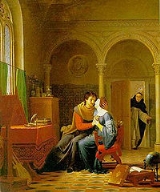
Peter Abelard

Encyclopedia
Peter Abelard (ˈæb.ə.lɑːrd, a.beˈlaːʁ, Latin: Petrus Abaelardus or Abailard; French: Pierre Abélard) (1079 – April 21, 1142) was a medieval French
scholastic
philosopher, theologian and preeminent logician. The story of his affair with and love for Héloïse has become legendary. The Chambers Biographical Dictionary describes him as "the keenest thinker and boldest theologian of the 12th Century".
, about 10 miles east of Nantes
, in Brittany
, the eldest son of a minor noble Breton
family. As a boy, he learned quickly. Being encouraged by his father, he studied the liberal arts
and excelled at the art of dialectic
(a branch of philosophy
), which, at that time, consisted chiefly of the logic of Aristotle
transmitted through Latin
channels. Instead of entering a military career, as his father had done, Abelard became an academic. During his early academic pursuits, Abelard wandered throughout France, debating and learning, so as (in his own words) "he became such an one as the Peripatetics." The nominalist Roscellinus
of Compiègne
was his teacher during this period.
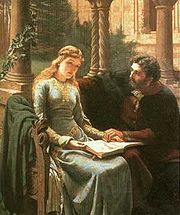 Abelard's travels finally brought him to Paris while still in his teens. There, in the great cathedral school
of Notre-Dame de Paris, he was taught for a while by William of Champeaux
, the disciple of Anselm of Laon
(not to be confused with Saint Anselm
) a leading proponent of Realism
. It was during this time that he changed his surname to "Abélard", sometimes written "Abailard" or "Abaelardus". He was soon able to defeat the master in argument, resulting in a long duel that ended in the downfall of the philosophic theory of Realism
, till then dominant in the early Middle Ages
(to be replaced by Abelard's Conceptualism
, or by Nominalism
, the principal rival of Realism prior to Abelard). First, against opposition from the metropolitan teacher, while yet only twenty-two, Abelard set up a school of his own at Melun
, then, for more direct competition, he moved to Corbeil
, nearer Paris.
The success of his teaching was notable, though for a time he had to give it up, the strain proving too great for his constitution. On his return, after 1108, he found William lecturing at Saint-Victor, just outside the Ile-de-la-cite, and there they once again became rivals. Abelard was once more victorious, and now stood supreme. William was only temporarily able to prevent him from lecturing in Paris. From Melun, where he had resumed teaching, Abelard went on to the capital, and set up his school on the heights of Montagne Sainte-Geneviève
, overlooking Notre-Dame. From his success in dialectic, he next turned to theology
and attended the lectures of Anselm at Laon
. His triumph was complete; the pupil was able to give lectures, without previous training or special study, which were acknowledged superior to those of the master. Abelard was now at the height of his fame. He stepped into the chair at Notre-Dame, being also nominated canon, about the year 1115.
Distinguished in figure and manners, Abelard was seen surrounded by crowds – it is said thousands of students – drawn from all countries by the fame of his teaching. Enriched by the offerings of his pupils, and entertained with universal admiration, he came, as he says, to think himself the only undefeated philosopher in the world. But a change in his fortunes was at hand. In his devotion to science, he had always lived a very regular life, enlivened only by philosophical debate: now, at the height of his fame, he encountered romance.
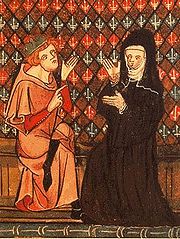 Living within the precincts of Notre-Dame, under the care of her uncle, the canon Fulbert, was Héloïse. She was remarkable for her knowledge of classical letters
, which extended beyond Latin
to Greek
and Hebrew
. Abélard sought a place in Fulbert's house, and then seduced Héloïse. The affair interfered with his career, and Abélard himself boasted of his conquest. Once Fulbert found out, they were separated, but met in secret. Héloïse became pregnant and was sent by Abélard to Brittany, where she gave birth to a son she named Astrolabe after the scientific instrument
.
To appease Fulbert, Abélard proposed a secret marriage in order not to mar his career prospects. Héloïse initially opposed it, but the couple married. When Fulbert publicly disclosed the marriage, and Héloïse denied it, she went to the convent of Argenteuil
at Abélard's urging. Fulbert, believing that Abélard wanted to be rid of Héloïse, had him castrated
, effectively ending Abélard's romantic career. Héloïse was forced to become a nun
. Héloïse sent letters to Abélard, questioning why she must submit to a religious life for which she had no calling.
According to historian Constant Mews
in his The Lost Love Letters of Héloïse and Abélard, a set of 113 anonymous love letters found in a 15th century manuscript represent the correspondence exchanged by Héloïse and Abelard during the earlier phase of their affair. These are not to be confused with the accepted letters of Abélard and Héloïse which were written nearly fifteen years after their romance ended.
, and having gradually turned again to study, he gave in to urgent entreaties, and reopened his school at an unknown priory. His lectures, now framed in a devotional spirit, were once again heard by crowds of students, and his old influence seemed to have returned, but he still had many enemies against whom he could make less vigorous opposition.
No sooner had he published his theological lectures (the Theologia 'Summi Boni) than his adversaries picked up on his rationalistic interpretation of the Trinitarian dogma. Charging him with the heresy of Sabellius
in a provincial synod
held at Soissons
in 1121, they obtained through irregular procedures an official condemnation of his teaching, and he was made to burn his book before being shut up in the convent of St. Medard at Soissons.
Life in his own monastery proved no more congenial than before. For this Abélard himself was partly responsible. He took a sort of malicious pleasure in irritating the monks. As if for the sake of a joke, he cited Bede
to prove that Dionysius the Areopagite
had been Bishop of Corinth, while they relied upon the statement of the Abbot Hilduin
that he had been Bishop of Athens. When this historical heresy led to the inevitable persecution, Abélard wrote a letter to the Abbot Adam in which he preferred to the authority of Bede that of Eusebius of Caesarea
's Historia Ecclesiastica
and St. Jerome
, according to whom Dionysius, Bishop of Corinth
, was distinct from Dionysius the Areopagite, bishop of Athens and founder of the abbey, though, in deference to Bede, he suggested that the Areopagite might also have been bishop of Corinth.
Life in the monastery grew intolerable for Abélard, and he was finally allowed to leave. In a deserted place near Nogent-sur-Seine
, he built a cabin of stubble and reeds, and became a hermit
. When his retreat became known, students flocked from Paris, and covered the wilderness around him with their tents and huts. When he began to teach again, he found consolation and in gratitude he consecrated the new Oratory of the Paraclete
.
Fearing new persecution, Abélard left the Oratory to find another refuge, accepting an invitation to preside over the Abbey of Saint-Gildas-de-Rhuys
on the far-off shore of Lower Brittany. The region was inhospitable, the domain a prey to outlaws, the house itself savage and disorderly. Yet for nearly ten years he continued to struggle against fate before he left.
The misery of those years was lightened because he had been able, on the breaking up of Héloïse's convent at Argenteuil, to establish her as head of a new religious house at the deserted Paraclete, and in the capacity of spiritual director he often was called to revisit the spot thus made doubly dear to him.
During this time Héloïse had lived respectably and grown in stature within the religious community, where she would eventually become abbess.
Living on for some time apart (unknown exactly where), after his flight from the Abbey of St Gildas, Abélard wrote, among other things, his famous Historia Calamitatum
. This moved Héloïse to write her first Letter, which remains an unsurpassed utterance of human passion and womanly devotion; the first being followed by the two other Letters, in which she finally accepted the part of resignation, which, now as a brother to a sister, Abélard commended to her.
Astrolabe, the son of Abelard and Héloïse, is mentioned by Peter the Venerable of Cluny, where Abelard spent his last years, when Peter the Venerable wrote to Heloise: "I will gladly do my best to obtain a prebend in one of the great churches for your Astrolabe, who is also ours for your sake". A 'Petrus Astralabius' is recorded at the Cathedral of Nantes
in 1150, and the same name appears at the Cistercian abbey at Hauterive
in what is now Switzerland, but it is uncertain whether this is the same man. However, Astrolabe is recorded as dying at Paraclete on October 29 or 30, year unknown, appearing in the necrology as "Petrus Astralabius magistri nostri Petri filius"."
By 1136, when he was heard by John of Salisbury, Abélard returned to the site of his early triumphs, lecturing on Mount St. Genevieve, but only for a brief time: a last trial awaited him. As far back as the Paraclete days, his chief enemy had been Bernard of Clairvaux
, in whom was incarnated the principle of fervent and unhesitating faith, to which rational inquiry like Abélard's was sheer revolt, and now the uncompromising Bernard moved to crush the growing evil in the person of the boldest offender.
In 1141, after preliminary negotiations, in which Bernard was roused by Abélard's steadfastness to put forth all his strength, a council met at Sens
, before which Abélard, formally arraigned upon a number of heretical charges, prepared to plead his cause. When, however, Bernard had opened the case, Abélard appealed to Rome. Bernard, who had power to get a condemnation passed at the council, did not rest until a second condemnation was procured at Rome in the following year.
, and there he lingered only a few months before the approach of death. Removed by friends, for the relief of his sufferings, to the priory of St. Marcel, near Chalon-sur-Saône
, Abélard died. He is said to have uttered the last words "I don't know", before expiring. He died from a combination of fever and a skin disorder, most likely scurvy.
First buried at St. Marcel, his remains were soon carried off secretly to the Paraclete, and given over to the loving care of Héloïse, who in time came herself to rest beside them in 1163. Their tomb is found in the Cimetière du Père Lachaise in Paris.
, and now are presumed to lie in the well-known tomb in the cemetery of Père Lachaise in eastern Paris. The transfer of their remains there in 1817 is considered to have considerably contributed to the popularity of that cemetery, at the time still far outside the built-up area of Paris. By tradition, lovers or lovelorn singles leave letters at the crypt, in tribute to the couple or in hope of finding true love.
 There is dissent as to their actual resting place. The Oratory of the Paraclete
claims Abélard and Héloïse are buried on their site and that what exists in Père-Lachaise is merely a monument, or cenotaph
. According to Père-Lachaise, the remains of both lovers were transferred from the Oratory in the early 19th century and reburied in the famous crypt on their grounds. There are still others who believe that while Abelard is buried in the tomb at Père-Lachaise, Heloïse's remains are elsewhere.
He helped to establish the ascendancy of the philosophical authority of Aristotle
which became firmly established in the half-century after his death. It was at this time that the completed Organon
, and gradually all the other works of the Greek thinker, first came to be available in the schools. Before his time Plato
's authority was the basis for the prevailing Realism. As regards his so-called Conceptualism and his attitude to the question of universals (see Scholasticism
).
Outside of his dialectic, it was in ethics that Abelard showed greatest activity of philosophical thought. He laid particular stress upon the subjective intention as determining, if not the moral character, at least the moral value, of human action. His thought in this direction, anticipating something of modern speculation, is the more remarkable because his scholastic successors accomplished least in the field of morals, hardly venturing to bring the principles and rules of conduct under pure philosophical discussion, even after the great ethical inquiries of Aristotle became fully known to them.
Pope Innocent III
accepted Abelard's doctrine of Limbo, which amended Augustine of Hippo's doctrine of Original Sin. The Vatican accepted the view that unbaptized babies did not, as at first believed, go straight to Hell but to a special area of Limbo
("limbus infantium"). They would therefore feel no pain and remain in a state of natural bliss. Supernatural bliss, however, is not available to unbaptized children because they cannot experience beatific vision
.
He is also closely associated with the moral influence theory of atonement.
Cousin's collection gave extracts from the theological work Sic et Non
("Yes and No") which is an assemblage of opposite opinions on doctrinal points culled from the Fathers as a basis for discussion, the main interest in which lies in the fact that there is no attempt to reconcile the different opinions. Cousin's collection also includes the Dialectica, commentaries on logical works of Aristotle, Porphyry and Boethius
, and a fragment, De Generibus et Speciebus.
The last-named work, and also the psychological treatise De Intellectibus, published separately by Cousin (in Fragmens Philosophiques, vol. ii.), are now considered upon internal evidence not to be by Abelard himself, but only to have sprung out of his school. A genuine work, the Glossulae super Porphyrium, from which Charles de Rémusat
has given extracts in his classical monograph Abélard (1845), was published in 1930.
Logica nostrorum petitioni sociorum (Logic in response to the request of our comrades) ca. 1124-1125
Tractatus de intellectibus (A treatise on understanding) before 1128
Sic et Non
(A list of quotations from Christian authorities on philosophical and theological questions); an English translation: Throop, Priscilla, trans., YES AND NO: Peter Abelard's SIC ET NON, Charlotte, VT: MedievalMS, 2007. Theologia 'Summi Boni', Theologia christiana, and Theologia 'scholarium. His main work on systematic theology written between 1120 and 1140, and appeared in a number of versions under a number of titles (shown in chronological order).Dialogue of a Philosopher with a Jew and a Christian, 1136–1139
Ethics or Know Yourself (Ethica or Scito Te Ipsum), before 1140
Historia calamitatum
(The history of my calamities), Autobiography in epistolary form. Available at Fordham Medieval Sourcebook http://www.fordham.edu/halsall/basis/abelard-histcal.html
Abelard & Heloise: The Letters and other Writings, translated with introduction and notes, by William Levitan
, 2007, ISBN 978-0-87220-875-9.
. Abelard composed some celebrated love songs for Héloïse that are now lost, and which have not been identified in the anonymous repertoire. Héloïse praised these songs in a letter: "The great charm and sweetness in language and music, and a soft attractiveness of the melody obliged even the unlettered".
Abelard later composed a hymn book for the religious community that Héloïse joined. This hymn book, written after 1130, differed from contemporary hymnals, such as that of Bernard of Clairvaux
, in that Abelard used completely new and homogeneous material. They were grouped by metre, which meant that comparatively few melodies could be used. Only one melody from this hymnal survives, O quanta qualia.
Abelard also left six biblical planctus
(lament
s), which were very original and influenced the subsequent development of the lai
, a song form that flourished in northern Europe in the 13th and 14th centuries.
Melodies that have survived have been praised as "flexible, expressive melodies [that] show an elegance and technical adroitness that are very similar to the qualities that have been long admired in Abelard's poetry."
}
}}
French people
The French are a nation that share a common French culture and speak the French language as a mother tongue. Historically, the French population are descended from peoples of Celtic, Latin and Germanic origin, and are today a mixture of several ethnic groups...
scholastic
Scholasticism
Scholasticism is a method of critical thought which dominated teaching by the academics of medieval universities in Europe from about 1100–1500, and a program of employing that method in articulating and defending orthodoxy in an increasingly pluralistic context...
philosopher, theologian and preeminent logician. The story of his affair with and love for Héloïse has become legendary. The Chambers Biographical Dictionary describes him as "the keenest thinker and boldest theologian of the 12th Century".
Youth
Abelard, originally called "Pierre le Pallet", was born in the little village of Le PalletLe Pallet
Le Pallet is a commune in the Loire-Atlantique département in western France.It lies on the Sèvre Nantaise river.-Notable people:Le Pallet is notable as the birthplace of Peter Abelard , the medieval scholastic philosopher, theologian and preeminent logician. Abelard is best known for the story of...
, about 10 miles east of Nantes
Nantes
Nantes is a city in western France, located on the Loire River, from the Atlantic coast. The city is the 6th largest in France, while its metropolitan area ranks 8th with over 800,000 inhabitants....
, in Brittany
Brittany
Brittany is a cultural and administrative region in the north-west of France. Previously a kingdom and then a duchy, Brittany was united to the Kingdom of France in 1532 as a province. Brittany has also been referred to as Less, Lesser or Little Britain...
, the eldest son of a minor noble Breton
Brittany
Brittany is a cultural and administrative region in the north-west of France. Previously a kingdom and then a duchy, Brittany was united to the Kingdom of France in 1532 as a province. Brittany has also been referred to as Less, Lesser or Little Britain...
family. As a boy, he learned quickly. Being encouraged by his father, he studied the liberal arts
Liberal arts
The term liberal arts refers to those subjects which in classical antiquity were considered essential for a free citizen to study. Grammar, Rhetoric and Logic were the core liberal arts. In medieval times these subjects were extended to include mathematics, geometry, music and astronomy...
and excelled at the art of dialectic
Dialectic
Dialectic is a method of argument for resolving disagreement that has been central to Indic and European philosophy since antiquity. The word dialectic originated in Ancient Greece, and was made popular by Plato in the Socratic dialogues...
(a branch of philosophy
Philosophy
Philosophy is the study of general and fundamental problems, such as those connected with existence, knowledge, values, reason, mind, and language. Philosophy is distinguished from other ways of addressing such problems by its critical, generally systematic approach and its reliance on rational...
), which, at that time, consisted chiefly of the logic of Aristotle
Aristotle
Aristotle was a Greek philosopher and polymath, a student of Plato and teacher of Alexander the Great. His writings cover many subjects, including physics, metaphysics, poetry, theater, music, logic, rhetoric, linguistics, politics, government, ethics, biology, and zoology...
transmitted through Latin
Latin
Latin is an Italic language originally spoken in Latium and Ancient Rome. It, along with most European languages, is a descendant of the ancient Proto-Indo-European language. Although it is considered a dead language, a number of scholars and members of the Christian clergy speak it fluently, and...
channels. Instead of entering a military career, as his father had done, Abelard became an academic. During his early academic pursuits, Abelard wandered throughout France, debating and learning, so as (in his own words) "he became such an one as the Peripatetics." The nominalist Roscellinus
Roscellinus
Roscellinus, also called Roscelin of Compiègne or in Latin Roscellinus Compendiensis and Rucelinus , was a French philosopher and theologian, often regarded as the founder of nominalism .-Biography:...
of Compiègne
Compiègne
Compiègne is a city in northern France. It is designated municipally as a commune within the département of Oise.The city is located along the Oise River...
was his teacher during this period.
Rise to fame
Cathedral school
Cathedral schools began in the Early Middle Ages as centers of advanced education, some of them ultimately evolving into medieval universities. Throughout the Middle Ages and beyond, they were complemented by the monastic schools...
of Notre-Dame de Paris, he was taught for a while by William of Champeaux
William of Champeaux
Guillaume de Champeaux , also known as William of Champeaux or Guglielmus de Campellis , was a French philosopher and theologian.He was born at Champeaux near Melun...
, the disciple of Anselm of Laon
Anselm of Laon
Anselm of Laon was a French theologian and founder of a school of scholars who helped to pioneer biblical hermeneutics.Remembered in the century after his death as "Anselmus" or "Anselm", his name was more properly "Ansellus" or, in Modern French, "Anseau."Born of very humble parents at Laon...
(not to be confused with Saint Anselm
Anselm of Canterbury
Anselm of Canterbury , also called of Aosta for his birthplace, and of Bec for his home monastery, was a Benedictine monk, a philosopher, and a prelate of the church who held the office of Archbishop of Canterbury from 1093 to 1109...
) a leading proponent of Realism
Philosophical realism
Contemporary philosophical realism is the belief that our reality, or some aspect of it, is ontologically independent of our conceptual schemes, linguistic practices, beliefs, etc....
. It was during this time that he changed his surname to "Abélard", sometimes written "Abailard" or "Abaelardus". He was soon able to defeat the master in argument, resulting in a long duel that ended in the downfall of the philosophic theory of Realism
Philosophical realism
Contemporary philosophical realism is the belief that our reality, or some aspect of it, is ontologically independent of our conceptual schemes, linguistic practices, beliefs, etc....
, till then dominant in the early Middle Ages
Middle Ages
The Middle Ages is a periodization of European history from the 5th century to the 15th century. The Middle Ages follows the fall of the Western Roman Empire in 476 and precedes the Early Modern Era. It is the middle period of a three-period division of Western history: Classic, Medieval and Modern...
(to be replaced by Abelard's Conceptualism
Conceptualism
Conceptualism is a philosophical theory that explains universality of particulars as conceptualized frameworks situated within the thinking mind. Intermediate between Nominalism and Realism, the conceptualist view approaches the metaphysical concept of universals from a perspective that denies...
, or by Nominalism
Nominalism
Nominalism is a metaphysical view in philosophy according to which general or abstract terms and predicates exist, while universals or abstract objects, which are sometimes thought to correspond to these terms, do not exist. Thus, there are at least two main versions of nominalism...
, the principal rival of Realism prior to Abelard). First, against opposition from the metropolitan teacher, while yet only twenty-two, Abelard set up a school of his own at Melun
Melun
Melun is a commune in the Seine-et-Marne department in the Île-de-France region in north-central France. Located in the south-eastern suburbs of Paris, Melun is the capital of the department, as the seat of an arrondissement...
, then, for more direct competition, he moved to Corbeil
Corbeil
- Places :* Corbeil, Ontario, Canada* Corbeil-Essonnes, Essonne, France, a commune in the southern suburbs of Paris* The Corbeil Cathedral* Corbeil, Marne, France, a commune in north-eastern France...
, nearer Paris.
The success of his teaching was notable, though for a time he had to give it up, the strain proving too great for his constitution. On his return, after 1108, he found William lecturing at Saint-Victor, just outside the Ile-de-la-cite, and there they once again became rivals. Abelard was once more victorious, and now stood supreme. William was only temporarily able to prevent him from lecturing in Paris. From Melun, where he had resumed teaching, Abelard went on to the capital, and set up his school on the heights of Montagne Sainte-Geneviève
Montagne Sainte-Geneviève
The Montagne Sainte-Geneviève is a hill on the left Bank of the Seine in the 5th arrondissement of Paris.On the top of the Montagne, one can visit the Panthéon or the Bibliothèque Sainte-Geneviève, which is often full of students from La Sorbonne and other nearby universities...
, overlooking Notre-Dame. From his success in dialectic, he next turned to theology
Theology
Theology is the systematic and rational study of religion and its influences and of the nature of religious truths, or the learned profession acquired by completing specialized training in religious studies, usually at a university or school of divinity or seminary.-Definition:Augustine of Hippo...
and attended the lectures of Anselm at Laon
Laon
Laon is the capital city of the Aisne department in Picardy in northern France.-History:The hilly district of Laon, which rises a hundred metres above the otherwise flat Picardy plain, has always held strategic importance...
. His triumph was complete; the pupil was able to give lectures, without previous training or special study, which were acknowledged superior to those of the master. Abelard was now at the height of his fame. He stepped into the chair at Notre-Dame, being also nominated canon, about the year 1115.
Distinguished in figure and manners, Abelard was seen surrounded by crowds – it is said thousands of students – drawn from all countries by the fame of his teaching. Enriched by the offerings of his pupils, and entertained with universal admiration, he came, as he says, to think himself the only undefeated philosopher in the world. But a change in his fortunes was at hand. In his devotion to science, he had always lived a very regular life, enlivened only by philosophical debate: now, at the height of his fame, he encountered romance.
Héloïse
Classics
Classics is the branch of the Humanities comprising the languages, literature, philosophy, history, art, archaeology and other culture of the ancient Mediterranean world ; especially Ancient Greece and Ancient Rome during Classical Antiquity Classics (sometimes encompassing Classical Studies or...
, which extended beyond Latin
Latin
Latin is an Italic language originally spoken in Latium and Ancient Rome. It, along with most European languages, is a descendant of the ancient Proto-Indo-European language. Although it is considered a dead language, a number of scholars and members of the Christian clergy speak it fluently, and...
to Greek
Greek language
Greek is an independent branch of the Indo-European family of languages. Native to the southern Balkans, it has the longest documented history of any Indo-European language, spanning 34 centuries of written records. Its writing system has been the Greek alphabet for the majority of its history;...
and Hebrew
Hebrew language
Hebrew is a Semitic language of the Afroasiatic language family. Culturally, is it considered by Jews and other religious groups as the language of the Jewish people, though other Jewish languages had originated among diaspora Jews, and the Hebrew language is also used by non-Jewish groups, such...
. Abélard sought a place in Fulbert's house, and then seduced Héloïse. The affair interfered with his career, and Abélard himself boasted of his conquest. Once Fulbert found out, they were separated, but met in secret. Héloïse became pregnant and was sent by Abélard to Brittany, where she gave birth to a son she named Astrolabe after the scientific instrument
Astrolabe
An astrolabe is an elaborate inclinometer, historically used by astronomers, navigators, and astrologers. Its many uses include locating and predicting the positions of the Sun, Moon, planets, and stars, determining local time given local latitude and longitude, surveying, triangulation, and to...
.
To appease Fulbert, Abélard proposed a secret marriage in order not to mar his career prospects. Héloïse initially opposed it, but the couple married. When Fulbert publicly disclosed the marriage, and Héloïse denied it, she went to the convent of Argenteuil
Argenteuil
Argenteuil is a commune in the northwestern suburbs of Paris, France. It is located from the center of Paris. Argenteuil is a sub-prefecture of the Val-d'Oise department, the seat of the arrondissement of Argenteuil....
at Abélard's urging. Fulbert, believing that Abélard wanted to be rid of Héloïse, had him castrated
Castration
Castration is any action, surgical, chemical, or otherwise, by which a male loses the functions of the testicles or a female loses the functions of the ovaries.-Humans:...
, effectively ending Abélard's romantic career. Héloïse was forced to become a nun
Nun
A nun is a woman who has taken vows committing her to live a spiritual life. She may be an ascetic who voluntarily chooses to leave mainstream society and live her life in prayer and contemplation in a monastery or convent...
. Héloïse sent letters to Abélard, questioning why she must submit to a religious life for which she had no calling.
According to historian Constant Mews
Constant Mews
Constant Mews , D. Phil is Professor of Medieval Thought and Director, Centre for Studies in Religion and Theology, Monash University, Melbourne. He is an authority on medieval religious thought, especially on the medieval philosopher and theologian, Peter Abelard, and on interfaith dialogue...
in his The Lost Love Letters of Héloïse and Abélard, a set of 113 anonymous love letters found in a 15th century manuscript represent the correspondence exchanged by Héloïse and Abelard during the earlier phase of their affair. These are not to be confused with the accepted letters of Abélard and Héloïse which were written nearly fifteen years after their romance ended.
Later life
It was in the Abbey of Saint-Denis that Abélard, now aged 40, sought to bury himself as a monk with his woes out of sight. Finding no respite in the cloisterCloister
A cloister is a rectangular open space surrounded by covered walks or open galleries, with open arcades on the inner side, running along the walls of buildings and forming a quadrangle or garth...
, and having gradually turned again to study, he gave in to urgent entreaties, and reopened his school at an unknown priory. His lectures, now framed in a devotional spirit, were once again heard by crowds of students, and his old influence seemed to have returned, but he still had many enemies against whom he could make less vigorous opposition.
No sooner had he published his theological lectures (the Theologia 'Summi Boni) than his adversaries picked up on his rationalistic interpretation of the Trinitarian dogma. Charging him with the heresy of Sabellius
Sabellianism
In Christianity, Sabellianism, is the nontrinitarian belief that the Heavenly Father, Resurrected Son and Holy Spirit are different modes or aspects of one God, as perceived by the believer, rather than three distinct persons in God Himself.The term Sabellianism comes from...
in a provincial synod
Synod
A synod historically is a council of a church, usually convened to decide an issue of doctrine, administration or application. In modern usage, the word often refers to the governing body of a particular church, whether its members are meeting or not...
held at Soissons
Soissons
Soissons is a commune in the Aisne department in Picardy in northern France, located on the Aisne River, about northeast of Paris. It is one of the most ancient towns of France, and is probably the ancient capital of the Suessiones...
in 1121, they obtained through irregular procedures an official condemnation of his teaching, and he was made to burn his book before being shut up in the convent of St. Medard at Soissons.
Life in his own monastery proved no more congenial than before. For this Abélard himself was partly responsible. He took a sort of malicious pleasure in irritating the monks. As if for the sake of a joke, he cited Bede
Bede
Bede , also referred to as Saint Bede or the Venerable Bede , was a monk at the Northumbrian monastery of Saint Peter at Monkwearmouth, today part of Sunderland, England, and of its companion monastery, Saint Paul's, in modern Jarrow , both in the Kingdom of Northumbria...
to prove that Dionysius the Areopagite
Dionysius the Areopagite
Dionysius the Areopagite was a judge of the Areopagus who, as related in the Acts of the Apostles, , was converted to Christianity by the preaching of the Apostle Paul during the Areopagus sermon...
had been Bishop of Corinth, while they relied upon the statement of the Abbot Hilduin
Hilduin
Hilduin was Bishop of Paris, chaplain to Louis I, reforming Abbot of the Abbey of St. Denis and an author.-Background:...
that he had been Bishop of Athens. When this historical heresy led to the inevitable persecution, Abélard wrote a letter to the Abbot Adam in which he preferred to the authority of Bede that of Eusebius of Caesarea
Eusebius of Caesarea
Eusebius of Caesarea also called Eusebius Pamphili, was a Roman historian, exegete and Christian polemicist. He became the Bishop of Caesarea in Palestine about the year 314. Together with Pamphilus, he was a scholar of the Biblical canon...
's Historia Ecclesiastica
Church History (Eusebius)
The Church History of Eusebius, the bishop of Caesarea was a 4th-century pioneer work giving a chronological account of the development of Early Christianity from the 1st century to the 4th century. It was written in Koine Greek, and survives also in Latin, Syriac and Armenian manuscripts...
and St. Jerome
Jerome
Saint Jerome was a Roman Christian priest, confessor, theologian and historian, and who became a Doctor of the Church. He was the son of Eusebius, of the city of Stridon, which was on the border of Dalmatia and Pannonia...
, according to whom Dionysius, Bishop of Corinth
Dionysius, Bishop of Corinth
Saint Dionysius, Bishop of Corinth lived about the year 171. His feast day is commemorated on April 8.The date is fixed by the fact that he wrote to Pope St Soter. Eusebius in his Chronicle placed his "floruit" in the eleventh year of the Emperor Marcus Aurelius...
, was distinct from Dionysius the Areopagite, bishop of Athens and founder of the abbey, though, in deference to Bede, he suggested that the Areopagite might also have been bishop of Corinth.
Life in the monastery grew intolerable for Abélard, and he was finally allowed to leave. In a deserted place near Nogent-sur-Seine
Nogent-sur-Seine
Nogent-sur-Seine is a commune in the Aube department in north-central France.-Population:-Personalities:Camille Claudel lived in Nogent-sur-Seine with her family from 1876 to 1879....
, he built a cabin of stubble and reeds, and became a hermit
Hermit
A hermit is a person who lives, to some degree, in seclusion from society.In Christianity, the term was originally applied to a Christian who lives the eremitic life out of a religious conviction, namely the Desert Theology of the Old Testament .In the...
. When his retreat became known, students flocked from Paris, and covered the wilderness around him with their tents and huts. When he began to teach again, he found consolation and in gratitude he consecrated the new Oratory of the Paraclete
Oratory of the Paraclete
The Oratory of the Paraclete is a Benedictine monastery founded by Peter Abelard in Ferreux-Quincey, France, after he left the Abbey of St. Denis about 1121....
.
Fearing new persecution, Abélard left the Oratory to find another refuge, accepting an invitation to preside over the Abbey of Saint-Gildas-de-Rhuys
Saint-Gildas-de-Rhuys
Saint-Gildas-de-Rhuys is a commune in the Morbihan department of Brittany in north-western France.Its French name refers to Saint Gildas, who was a monk at Rhuys.-References:* * -External links:* *...
on the far-off shore of Lower Brittany. The region was inhospitable, the domain a prey to outlaws, the house itself savage and disorderly. Yet for nearly ten years he continued to struggle against fate before he left.
The misery of those years was lightened because he had been able, on the breaking up of Héloïse's convent at Argenteuil, to establish her as head of a new religious house at the deserted Paraclete, and in the capacity of spiritual director he often was called to revisit the spot thus made doubly dear to him.
During this time Héloïse had lived respectably and grown in stature within the religious community, where she would eventually become abbess.
Living on for some time apart (unknown exactly where), after his flight from the Abbey of St Gildas, Abélard wrote, among other things, his famous Historia Calamitatum
Historia Calamitatum
Historia Calamitatum , also known as Abaelardi ad Amicum Suum Consolatoria, is an autobiographical work in Latin by Peter Abelard, one of medieval France's most important intellectuals and a pioneer of scholastic philosophy. It is one of the first autobiographicalworks in medieval Western Europe,...
. This moved Héloïse to write her first Letter, which remains an unsurpassed utterance of human passion and womanly devotion; the first being followed by the two other Letters, in which she finally accepted the part of resignation, which, now as a brother to a sister, Abélard commended to her.
Astrolabe, the son of Abelard and Héloïse, is mentioned by Peter the Venerable of Cluny, where Abelard spent his last years, when Peter the Venerable wrote to Heloise: "I will gladly do my best to obtain a prebend in one of the great churches for your Astrolabe, who is also ours for your sake". A 'Petrus Astralabius' is recorded at the Cathedral of Nantes
Nantes
Nantes is a city in western France, located on the Loire River, from the Atlantic coast. The city is the 6th largest in France, while its metropolitan area ranks 8th with over 800,000 inhabitants....
in 1150, and the same name appears at the Cistercian abbey at Hauterive
Hauterive, Fribourg
Hauterive is a municipality in the district of Sarine in the canton of Fribourg in Switzerland. It was created from the union in 2001 of the villages of Posieux and Ecuvillens....
in what is now Switzerland, but it is uncertain whether this is the same man. However, Astrolabe is recorded as dying at Paraclete on October 29 or 30, year unknown, appearing in the necrology as "Petrus Astralabius magistri nostri Petri filius"."
By 1136, when he was heard by John of Salisbury, Abélard returned to the site of his early triumphs, lecturing on Mount St. Genevieve, but only for a brief time: a last trial awaited him. As far back as the Paraclete days, his chief enemy had been Bernard of Clairvaux
Bernard of Clairvaux
Bernard of Clairvaux, O.Cist was a French abbot and the primary builder of the reforming Cistercian order.After the death of his mother, Bernard sought admission into the Cistercian order. Three years later, he was sent to found a new abbey at an isolated clearing in a glen known as the Val...
, in whom was incarnated the principle of fervent and unhesitating faith, to which rational inquiry like Abélard's was sheer revolt, and now the uncompromising Bernard moved to crush the growing evil in the person of the boldest offender.
In 1141, after preliminary negotiations, in which Bernard was roused by Abélard's steadfastness to put forth all his strength, a council met at Sens
Sens
Sens is a commune in the Yonne department in Burgundy in north-central France.Sens is a sub-prefecture of the department. It is crossed by the Yonne and the Vanne, which empties into the Yonne here.-History:...
, before which Abélard, formally arraigned upon a number of heretical charges, prepared to plead his cause. When, however, Bernard had opened the case, Abélard appealed to Rome. Bernard, who had power to get a condemnation passed at the council, did not rest until a second condemnation was procured at Rome in the following year.
Death
Meanwhile, on his way to urge his plea in person in Rome, Abélard remained at the abbey of ClunyCluny
Cluny or Clungy is a commune in the Saône-et-Loire department in the region of Bourgogne in eastern France. It is 20 km northwest of Mâcon.The town grew up around the Benedictine Cluny Abbey, founded by Duke William I of Aquitaine in 910...
, and there he lingered only a few months before the approach of death. Removed by friends, for the relief of his sufferings, to the priory of St. Marcel, near Chalon-sur-Saône
Chalon-sur-Saône
Chalon-sur-Saône is a commune in the Saône-et-Loire department in the region of Bourgogne in eastern France.It is a sub-prefecture of the department. It is the largest city in the department; however, the department capital is the smaller city of Mâcon....
, Abélard died. He is said to have uttered the last words "I don't know", before expiring. He died from a combination of fever and a skin disorder, most likely scurvy.
First buried at St. Marcel, his remains were soon carried off secretly to the Paraclete, and given over to the loving care of Héloïse, who in time came herself to rest beside them in 1163. Their tomb is found in the Cimetière du Père Lachaise in Paris.
Disputed resting place/lovers' pilgrimage
The bones of the pair were moved more than once afterwards, but they were preserved even through the vicissitudes of the French RevolutionFrench Revolution
The French Revolution , sometimes distinguished as the 'Great French Revolution' , was a period of radical social and political upheaval in France and Europe. The absolute monarchy that had ruled France for centuries collapsed in three years...
, and now are presumed to lie in the well-known tomb in the cemetery of Père Lachaise in eastern Paris. The transfer of their remains there in 1817 is considered to have considerably contributed to the popularity of that cemetery, at the time still far outside the built-up area of Paris. By tradition, lovers or lovelorn singles leave letters at the crypt, in tribute to the couple or in hope of finding true love.
Oratory of the Paraclete
The Oratory of the Paraclete is a Benedictine monastery founded by Peter Abelard in Ferreux-Quincey, France, after he left the Abbey of St. Denis about 1121....
claims Abélard and Héloïse are buried on their site and that what exists in Père-Lachaise is merely a monument, or cenotaph
Cenotaph
A cenotaph is an "empty tomb" or a monument erected in honour of a person or group of people whose remains are elsewhere. It can also be the initial tomb for a person who has since been interred elsewhere. The word derives from the Greek κενοτάφιον = kenotaphion...
. According to Père-Lachaise, the remains of both lovers were transferred from the Oratory in the early 19th century and reburied in the famous crypt on their grounds. There are still others who believe that while Abelard is buried in the tomb at Père-Lachaise, Heloïse's remains are elsewhere.
Philosophical work
The general importance of Abelard lies in his having fixed more decisively than anyone before him the scholastic manner of philosophizing, with the object of giving a formally rational expression to received ecclesiastical doctrine. Though his own particular interpretations may have been condemned, they were conceived in essentially the same spirit as the general scheme of thought afterwards elaborated in the 13th century with approval from the heads of the Church.He helped to establish the ascendancy of the philosophical authority of Aristotle
Aristotle
Aristotle was a Greek philosopher and polymath, a student of Plato and teacher of Alexander the Great. His writings cover many subjects, including physics, metaphysics, poetry, theater, music, logic, rhetoric, linguistics, politics, government, ethics, biology, and zoology...
which became firmly established in the half-century after his death. It was at this time that the completed Organon
Organon
The Organon is the name given by Aristotle's followers, the Peripatetics, to the standard collection of his six works on logic:* Categories* On Interpretation* Prior Analytics* Posterior Analytics...
, and gradually all the other works of the Greek thinker, first came to be available in the schools. Before his time Plato
Plato
Plato , was a Classical Greek philosopher, mathematician, student of Socrates, writer of philosophical dialogues, and founder of the Academy in Athens, the first institution of higher learning in the Western world. Along with his mentor, Socrates, and his student, Aristotle, Plato helped to lay the...
's authority was the basis for the prevailing Realism. As regards his so-called Conceptualism and his attitude to the question of universals (see Scholasticism
Scholasticism
Scholasticism is a method of critical thought which dominated teaching by the academics of medieval universities in Europe from about 1100–1500, and a program of employing that method in articulating and defending orthodoxy in an increasingly pluralistic context...
).
Outside of his dialectic, it was in ethics that Abelard showed greatest activity of philosophical thought. He laid particular stress upon the subjective intention as determining, if not the moral character, at least the moral value, of human action. His thought in this direction, anticipating something of modern speculation, is the more remarkable because his scholastic successors accomplished least in the field of morals, hardly venturing to bring the principles and rules of conduct under pure philosophical discussion, even after the great ethical inquiries of Aristotle became fully known to them.
Pope Innocent III
Pope Innocent III
Pope Innocent III was Pope from 8 January 1198 until his death. His birth name was Lotario dei Conti di Segni, sometimes anglicised to Lothar of Segni....
accepted Abelard's doctrine of Limbo, which amended Augustine of Hippo's doctrine of Original Sin. The Vatican accepted the view that unbaptized babies did not, as at first believed, go straight to Hell but to a special area of Limbo
Limbo
In the theology of the Catholic Church, Limbo is a speculative idea about the afterlife condition of those who die in original sin without being assigned to the Hell of the damned. Limbo is not an official doctrine of the Roman Catholic Church or any other...
("limbus infantium"). They would therefore feel no pain and remain in a state of natural bliss. Supernatural bliss, however, is not available to unbaptized children because they cannot experience beatific vision
Beatific vision
The beatific vision - in Christian theology is the ultimate direct self communication of God to the individual person, when she or he reaches, as a member of redeemed humanity in the communion of saints, perfect salvation in its entirety, i.e. heaven...
.
He is also closely associated with the moral influence theory of atonement.
Reception
Abelard was an enormous influence on his contemporaries and the course of medieval thought, but he has been known in modern times mainly for his connection with Héloïse. It was not till the 19th century, when Cousin in 1836 issued the collection entitled Ouvrages inedits d'Abelard, that his philosophical performance could be judged at first hand. Only one of his strictly philosophical works, the ethical treatise Scito te ipsum, had been published earlier, in 1721.Cousin's collection gave extracts from the theological work Sic et Non
Sic et Non
Sic et Non, an early scholastic text whose title translates from Medieval Latin as "Yes and No," was written by Pierre Abélard. In the work, Abélard juxtaposes apparently contradictory quotations from the Church Fathers on many of the traditional topics of Christian theology...
("Yes and No") which is an assemblage of opposite opinions on doctrinal points culled from the Fathers as a basis for discussion, the main interest in which lies in the fact that there is no attempt to reconcile the different opinions. Cousin's collection also includes the Dialectica, commentaries on logical works of Aristotle, Porphyry and Boethius
Anicius Manlius Severinus Boethius
Anicius Manlius Severinus Boëthius, commonly called Boethius was a philosopher of the early 6th century. He was born in Rome to an ancient and important family which included emperors Petronius Maximus and Olybrius and many consuls. His father, Flavius Manlius Boethius, was consul in 487 after...
, and a fragment, De Generibus et Speciebus.
The last-named work, and also the psychological treatise De Intellectibus, published separately by Cousin (in Fragmens Philosophiques, vol. ii.), are now considered upon internal evidence not to be by Abelard himself, but only to have sprung out of his school. A genuine work, the Glossulae super Porphyrium, from which Charles de Rémusat
Charles de Rémusat
Charles François Marie, Comte de Rémusat , was a French politician and writer.-Biography:He was born in Paris. His father, Auguste Laurent, Comte de Rémusat, of a good family of Toulouse, was chamberlain to Napoleon Bonaparte, but acquiesced in the restoration and became prefect first of Haute...
has given extracts in his classical monograph Abélard (1845), was published in 1930.
Primary Works
Sic et Non
Sic et Non, an early scholastic text whose title translates from Medieval Latin as "Yes and No," was written by Pierre Abélard. In the work, Abélard juxtaposes apparently contradictory quotations from the Church Fathers on many of the traditional topics of Christian theology...
(A list of quotations from Christian authorities on philosophical and theological questions); an English translation: Throop, Priscilla, trans., YES AND NO: Peter Abelard's SIC ET NON, Charlotte, VT: MedievalMS, 2007. Theologia 'Summi Boni', Theologia christiana, and Theologia 'scholarium. His main work on systematic theology written between 1120 and 1140, and appeared in a number of versions under a number of titles (shown in chronological order).
Historia Calamitatum
Historia Calamitatum , also known as Abaelardi ad Amicum Suum Consolatoria, is an autobiographical work in Latin by Peter Abelard, one of medieval France's most important intellectuals and a pioneer of scholastic philosophy. It is one of the first autobiographicalworks in medieval Western Europe,...
(The history of my calamities), Autobiography in epistolary form. Available at Fordham Medieval Sourcebook http://www.fordham.edu/halsall/basis/abelard-histcal.html
William Levitan
William Levitan is professor of Classics at Grand Valley State University in Michigan. He received his Ph.D. from the University of Texas at Austin. He was one of the founding members of the Classics department at Grand Valley and the first department chair...
, 2007, ISBN 978-0-87220-875-9.
Music
Abelard was also long known as an important poet and composerComposer
A composer is a person who creates music, either by musical notation or oral tradition, for interpretation and performance, or through direct manipulation of sonic material through electronic media...
. Abelard composed some celebrated love songs for Héloïse that are now lost, and which have not been identified in the anonymous repertoire. Héloïse praised these songs in a letter: "The great charm and sweetness in language and music, and a soft attractiveness of the melody obliged even the unlettered".
Abelard later composed a hymn book for the religious community that Héloïse joined. This hymn book, written after 1130, differed from contemporary hymnals, such as that of Bernard of Clairvaux
Bernard of Clairvaux
Bernard of Clairvaux, O.Cist was a French abbot and the primary builder of the reforming Cistercian order.After the death of his mother, Bernard sought admission into the Cistercian order. Three years later, he was sent to found a new abbey at an isolated clearing in a glen known as the Val...
, in that Abelard used completely new and homogeneous material. They were grouped by metre, which meant that comparatively few melodies could be used. Only one melody from this hymnal survives, O quanta qualia.
Abelard also left six biblical planctus
Planctus
A planctus is a lament or dirge, a song or poem expressing grief or mourning. It became a popular literary form in the Middle Ages, when they were written in Latin and in the vernacular . The most common planctus is to mourn the death of a famous person, but a number of other varieties have been...
(lament
Lament
A lament or lamentation is a song, poem, or piece of music expressing grief, regret, or mourning.-History:Many of the oldest and most lasting poems in human history have been laments. Laments are present in both the Iliad and the Odyssey, and laments continued to be sung in elegiacs accompanied by...
s), which were very original and influenced the subsequent development of the lai
Lai
A lai is a lyrical, narrative poem written in octosyllabic couplets that often deals with tales of adventure and romance.Lais were mainly composed in France and Germany, during the 13th and 14th centuries. A Provençal term for a similar kind of poem is descort.The English term lay is a...
, a song form that flourished in northern Europe in the 13th and 14th centuries.
Melodies that have survived have been praised as "flexible, expressive melodies [that] show an elegance and technical adroitness that are very similar to the qualities that have been long admired in Abelard's poetry."
Cultural references
- Helen WaddellHelen WaddellHelen Jane Waddell was an Irish poet, translator and playwright.-Biography:She was born in Tokyo, the tenth and youngest child of Hugh Waddell, a Presbyterian minister and missionary who was lecturing in the Imperial University. She spent the first eleven years of her life in Japan before her...
's novel "Peter Abelard" (1933) is loosely based on Abelard and Héloïse. The novel was the basis of the play "Abelard and Héloïse" (1970) by Ronald Millar. - Alexander PopeAlexander PopeAlexander Pope was an 18th-century English poet, best known for his satirical verse and for his translation of Homer. He is the third-most frequently quoted writer in The Oxford Dictionary of Quotations, after Shakespeare and Tennyson...
's poem "Eloisa to AbelardEloisa to AbelardPublished in 1717, Eloisa to Abelard is a poem by Alexander Pope . It is an Ovidian heroic epistle inspired by the 12th-century story of Héloïse's illicit love for, and secret marriage to, her teacher Pierre Abélard, perhaps the most popular teacher and philosopher in Paris, and the brutal...
" (1717) is written from the point of view of Héloïse in her convent. Line 209 of the poem is also the source of the movie title "Eternal Sunshine of the Spotless MindEternal Sunshine of the Spotless MindEternal Sunshine of the Spotless Mind is a 2004 American romantic science fiction film about an estranged couple who have each other erased from their memories, scripted by Charlie Kaufman and directed by the French director, Michel Gondry. The film uses elements of science fiction, psychological...
." - Abelard and Héloïse are referenced throughout Robertson DaviesRobertson DaviesWilliam Robertson Davies, CC, OOnt, FRSC, FRSL was a Canadian novelist, playwright, critic, journalist, and professor. He was one of Canada's best-known and most popular authors, and one of its most distinguished "men of letters", a term Davies is variously said to have gladly accepted for himself...
's novel The Rebel AngelsThe Rebel AngelsThe Rebel Angels is Canadian author Robertson Davies's most noted novel, after those that form his Deptford Trilogy.First published by Macmillan of Canada in 1981, The Rebel Angels is the first of the three connected novels of Davies' Cornish Trilogy...
. - Abelard is referenced in Charles Williams's novel The Place of the LionThe Place of the LionThe Place of the Lion is a fantasy novel written by Charles Williams. The novel was first published in 1931.Platonic archetypes begin to appear throughout England, wreaking havoc and drawing to the surface the spiritual strengths and flaws of individual characters.-Critical reception:Boucher and...
. - Howard BrentonHoward Brenton-Early years:Brenton was born in Portsmouth, Hampshire, son of Methodist minister Donald Henry Brenton and his wife Rose Lilian . He was educated at Chichester High School For Boys and read English Literature at St Catharine's College, Cambridge. In 1964 he was awarded the Chancellor's Gold Medal...
's play In Extremis: The Story Of Abelard And HeloiseIn Extremis (play)In Extremis: The Story of Abelard & Heloise is a play by Howard Brenton on the story of Heloise and Abelard, which premiered at the Globe Theatre on 27 August 2006 with a 15 performance run. The play was directed by John Dove with design by Michael Taylor, and music by William Lyons...
was premiered at Shakespeare's GlobeShakespeare's GlobeShakespeare's Globe is a reconstruction of the Globe Theatre, an Elizabethan playhouse in the London Borough of Southwark, located on the south bank of the River Thames, but destroyed by fire in 1613, rebuilt 1614 then demolished in 1644. The modern reconstruction is an academic best guess, based...
in 2006. - Anne CarsonAnne CarsonAnne Carson is a Canadian poet, essayist, translator and professor of Classics. Carson lived in Montreal for several years and taught at McGill University, the University of Michigan, and at Princeton University from 1980-1987....
's 2005 collection Decreation includes a screenplay about Abelard and Héloise. - Enrico Garzilli's musical "Rage of the Heart" is about Abelard and his love for Héloïse.
- In Dodie Smith's novel I Capture the Castle, the heroine has a dog named Héloïse and a cat named Abelard.
- Henry MillerHenry MillerHenry Valentine Miller was an American novelist and painter. He was known for breaking with existing literary forms and developing a new sort of 'novel' that is a mixture of novel, autobiography, social criticism, philosophical reflection, surrealist free association, and mysticism, one that is...
uses Abelard's "Foreword to Historia Calamitatum" as the motto of Tropic of CapricornTropic of Capricorn (novel)Tropic of Capricorn is a semi-autobiographical novel by Henry Miller, first published in Paris in 1938. The novel was subsequently banned in the United States until a 1961 Justice Department ruling declared that its contents were not obscene. It is a sequel to Miller's 1934 work, the Tropic of...
(1938). - J. D. SalingerJ. D. SalingerJerome David Salinger was an American author, best known for his 1951 novel The Catcher in the Rye, as well as his reclusive nature. His last original published work was in 1965; he gave his last interview in 1980....
refers to Abelard in De Daumier-Smith's Blue PeriodDe Daumier-Smith's Blue Period"De Daumier-Smith's Blue Period" is a short story that is part of the Nine Stories collection by J. D. Salinger. It was published in 1952.It is the story of a talented young man who moves to Montreal to become an instructor for a correspondence art academy. He had recently moved to New York with...
(1952). - Spanish singer and songwriter Joaquín Sabina refers to the couple in the song "Pájaros de Portugal".
- Stealing HeavenStealing HeavenStealing Heaven is a 1988 film, a costume drama based on the French 12th century medieval romance of Peter Abelard and Héloïse and on a historical novel by Marion Meade...
(1988) starring Derek de LintDerek de LintDick Hein de Lint is a Dutch film and television actor.De Lint was born in The Hague. In 1977, he played the character Alex in the film Soldier of Orange, directed by Paul Verhoeven. In 1986 he played the role of Anton Steenwijk in The Assault, which won the Academy Award for Best Foreign Language...
and Kim ThomsonKim ThomsonKim Thomson is an English actress who has appeared on stage, television and film since the early 1980s in both the United Kingdom and the United States.-Early life:...
is a based on Marion Meade's 1979 novel about the couple. - The letters of Abelard and Héloïse are discussed several times in the Sopranos episode "A Sentimental Education." (2004)
- Mark TwainMark TwainSamuel Langhorne Clemens , better known by his pen name Mark Twain, was an American author and humorist...
's The Innocents Abroad tells a satirical version of the Abelard and Héloïse story. - Richard ShindellRichard ShindellRichard Shindell is an American folk songwriter. Shindell grew up in Port Washington, New York. He currently lives in Buenos Aires, Argentina, with his wife, a university professor, and their children....
mentions Abelard in his song "Nora". - John CusackJohn CusackJohn Paul Cusack is an American film actor and screenwriter. He has appeared in more than 50 films, including The Journey of Natty Gann, Say Anything..., Grosse Point Blank, The Thin Red Line, Stand by Me, Con Air, Being John Malkovich, High Fidelity, Serendipity, Runaway Jury, The Ice Harvest,...
's character stages a Abelard and Héloïse street puppet show in Being John MalkovichBeing John MalkovichBeing John Malkovich is a 1999 American black comedy-fantasy film written by Charlie Kaufman and directed by Spike Jonze. It stars John Cusack, Cameron Diaz, Catherine Keener, and John Malkovich, who plays a fictional version of himself...
. - Josh RitterJosh RitterJosh Ritter is an American singer-songwriter, guitarist and author who performs and records with The Royal City Band. Ritter is known for his distinctive Americana style and narrative lyrics. In 2006 he was named one of the "100 Greatest Living Songwriters" by Paste magazine.- Early life :Josh...
mentions Abelard in his song "Bright Smiles" (2003). - Cole PorterCole PorterCole Albert Porter was an American composer and songwriter. Born to a wealthy family in Indiana, he defied the wishes of his domineering grandfather and took up music as a profession. Classically trained, he was drawn towards musical theatre...
mentions Abelard and Eloise in his song "Just One of Those Things" - Leonard CohenLeonard CohenLeonard Norman Cohen, is a Canadian singer-songwriter, musician, poet and novelist. Cohen published his first book of poetry in Montreal in 1956 and his first novel in 1963. His work often explores religion, isolation, sexuality and interpersonal relationships...
writes a few paragraphs about Heloise in his first novel 'The Favourite Game' (1963) - The Scritti PolittiScritti PolittiScritti Politti are a British band, originally formed in 1977 in Leeds, Yorkshire, England. Although there have been various changes to the line-up, Cardiff-born singer-songwriter Green Gartside was the founding member of the band and the only member to have remained throughout the group's...
song "The World You Know" (from the album Anomie & Bonhomie (1999)) contains the couplet "I'll tell you who we are // Héloïse and Abelard". - Antoine Audouard's novel "Adieu, mon unique" (2000) (English transl.: "Farewell, my only one") tells the story of Abelard and Héloïse from the perspective of a third fictive character.
- A Fine FrenzyA Fine FrenzyAlison Sudol , known professionally as A Fine Frenzy , is a US alternative singer and songwriter and pianist. Her debut album, One Cell in the Sea, was released on July 17, 2007, and peaked at number 91 on the Billboard 200 chart...
's song "The World Without" (2007) makes a reference of Abelard and Héloïse. - John FlanaganJohn Flanagan (author)John Flanagan is an Australian fantasy author. She lives in Sydney, Australia with her husband. Her best known work is the Ranger's Apprentice novel series, which is about a boy named Will who is taken as an apprentice Ranger to the grim and mysterious Halt. They meet up with many new people,...
's series "Ranger's ApprenticeRanger's ApprenticeRanger's Apprentice is a series of fantasy novels written by Australian author John Flanagan. The first novel in the series, titled The Ruins of Gorlan, was released in Australia on 1 November 2004 and in the United States on 16 June 2005. As of 2011 all eleven books have been released in Australia...
" contains a horse named Abelard. - Abaelards Liebe, a German language novel by Luise RinserLuise RinserLuise Rinser was a German writer.-Early life and education:...
, depicts the love story of Heloise and Abelard from the perspective of their son, Astrolabe. - Stephen DeCesare's musical "Forever, Heloise" based on the real love story of Abelard and Heloise.
- David MorrellDavid MorrellDavid Morrell is a Canadian-American novelist, best known for his debut 1972 novel First Blood, which would later become the successful Rambo film franchise starring Sylvester Stallone. He has written 28 novels, and his work has been translated into 26 languages...
's book Brotherhood of the Rose mentions Abelárd and Héloïse and their relation as the base for the 'Abelárd Convention', the premise for the safehouses run jointly by several different national security agencies as neutral grounds.
External links
- Abelard: Logic, Semantics, Ontology and His Theories of the Copula
- Abelard's Logical Works: Editions, Translations, Selected Texts with a list of English translations of the logical works
- Selected bibliography on the Logic and Ontology of Abelard: A - J
- Selected bibliography on the Logic and Ontology of Abelard: K - Z
- "Peter Abelard" article by Kevin Guilfoy in the Internet Encyclopedia of PhilosophyInternet Encyclopedia of PhilosophyThe Internet Encyclopedia of Philosophy is a free online encyclopedia on philosophical topics and philosophers founded by James Fieser in 1995. The current general editors are James Fieser and Bradley Dowden...
- Abelard and Heloise from In Our Time (BBC Radio 4)In Our Time (BBC Radio 4)In Our Time is a live BBC radio discussion series exploring the history of ideas, presented by Melvyn Bragg since 15 October 1998.. It is one of BBC radio's most successful discussion programmes, acknowledged to have "transformed the landscape for serious ideas at peak listening time"...
- Le Pallet, birthplace of Pierre Abélard, in pictures
- Peter King, Abelard biography
- The Love Letters of Abelard and Heloise. Trans. by Anonymous (1901).
- Pierre (Peter) Abelard of Le Pallet, introduction Short biography of Pierre (Peter) Abélard, with summary of heresies used to accuse and try him at Sens in 1140; links to explanations; relevant bibliography
- Abelard, Peter in the Christian Cyclopedia
- HAVPCD168 – Abelard: Hymns and Sequences for Heloise
- Audio recording of The Letters of Abelard and Heloise on Librivox
}
}}