

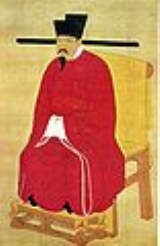
Emperor Shenzong of Song

Encyclopedia
Emperor Shenzong of Song (Chinese: 宋神宗, Pinyin: Sòng Shénzōng) (May 25, 1048 – April 1, 1085) was the sixth emperor of the Chinese Song Dynasty. His personal name was Zhao Xu. He reigned from 1067 to 1085.
The periods within his reign are Xī Níng (熙寧; "Peaceful Prosperity") 1068–1077, and Yuán Fēng (元豐; "Primary Abundance") 1078–1085.
During his reign, Shenzong became interested in Wang Anshi
's policies and appointed Wang as Chancellor. Wang implemented his famous reforms aimed at improving the situation for the peasant
ry and unemployed, which some have seen as a forerunner of the modern welfare state
. These acts became the hallmark reform of Shenzong's reign.
Shenzong's other notable act as emperor was his attempt to weaken the formative nation of Xi Xia by invading and expelling the Xi Xia forces from Gansu
. Shenzong's army was initially quite successful at these campaigns, but during the battle for the city of Yongle, in 1082, Shenzong's forces were defeated. As a result, Xi Xia grew more powerful and subsequently continued to be a thorn in the side of the Song dynasty over the ensuing decades.
During Shenzong's reign Sima Guang
, a minister interested in the history of the previous 1000 years, wrote a very influential history book: "A Comprehensive Mirror for Aid in Government" . This book records historical events from the Zhou Dynasty
to the Song Dynasty. Another notable literary achievement which occurred during his reign was the compilation of the Seven Military Classics
, including the alleged forgery of the Questions and Replies between Tang Taizong and Li Weigong.
Shenzong died in 1085 at the age of 36 and was succeeded by his son. His temple name
means "Divine Ancestor".
The periods within his reign are Xī Níng (熙寧; "Peaceful Prosperity") 1068–1077, and Yuán Fēng (元豐; "Primary Abundance") 1078–1085.
During his reign, Shenzong became interested in Wang Anshi
Wang Anshi
Wang Anshi was a Chinese economist, statesman, chancellor and poet of the Song Dynasty who attempted controversial, major socioeconomic reforms...
's policies and appointed Wang as Chancellor. Wang implemented his famous reforms aimed at improving the situation for the peasant
Peasant
A peasant is an agricultural worker who generally tend to be poor and homeless-Etymology:The word is derived from 15th century French païsant meaning one from the pays, or countryside, ultimately from the Latin pagus, or outlying administrative district.- Position in society :Peasants typically...
ry and unemployed, which some have seen as a forerunner of the modern welfare state
Welfare state
A welfare state is a "concept of government in which the state plays a key role in the protection and promotion of the economic and social well-being of its citizens. It is based on the principles of equality of opportunity, equitable distribution of wealth, and public responsibility for those...
. These acts became the hallmark reform of Shenzong's reign.
Shenzong's other notable act as emperor was his attempt to weaken the formative nation of Xi Xia by invading and expelling the Xi Xia forces from Gansu
Gansu
' is a province located in the northwest of the People's Republic of China.It lies between the Tibetan and Huangtu plateaus, and borders Mongolia, Inner Mongolia, and Ningxia to the north, Xinjiang and Qinghai to the west, Sichuan to the south, and Shaanxi to the east...
. Shenzong's army was initially quite successful at these campaigns, but during the battle for the city of Yongle, in 1082, Shenzong's forces were defeated. As a result, Xi Xia grew more powerful and subsequently continued to be a thorn in the side of the Song dynasty over the ensuing decades.
During Shenzong's reign Sima Guang
Sima Guang
Sīmǎ Guāng was a Chinese historian, scholar, and high chancellor of the Song Dynasty, jinshi 1038.-Life, profession, and works:...
, a minister interested in the history of the previous 1000 years, wrote a very influential history book: "A Comprehensive Mirror for Aid in Government" . This book records historical events from the Zhou Dynasty
Zhou Dynasty
The Zhou Dynasty was a Chinese dynasty that followed the Shang Dynasty and preceded the Qin Dynasty. Although the Zhou Dynasty lasted longer than any other dynasty in Chinese history, the actual political and military control of China by the Ji family lasted only until 771 BC, a period known as...
to the Song Dynasty. Another notable literary achievement which occurred during his reign was the compilation of the Seven Military Classics
Seven Military Classics
The Seven Military Classics of China were seven important military texts of ancient China which included Sun-tzu's The Art of War. The texts were canonized under this name during the 11th century AD, and from the Song Dynasty onwards were included in most military encyclopedias...
, including the alleged forgery of the Questions and Replies between Tang Taizong and Li Weigong.
Shenzong died in 1085 at the age of 36 and was succeeded by his son. His temple name
Temple name
Temple names are commonly used when naming most Chinese, Korean , and Vietnamese royalty. They should not be confused with era names. Compared to posthumous names, the use of temple names is more exclusive...
means "Divine Ancestor".
See also
- Wang AnshiWang AnshiWang Anshi was a Chinese economist, statesman, chancellor and poet of the Song Dynasty who attempted controversial, major socioeconomic reforms...
- Shen KuoShen KuoShen Kuo or Shen Gua , style name Cunzhong and pseudonym Mengqi Weng , was a polymathic Chinese scientist and statesman of the Song Dynasty...
- List of Song Emperors
- Song dynastySong DynastyThe Song Dynasty was a ruling dynasty in China between 960 and 1279; it succeeded the Five Dynasties and Ten Kingdoms Period, and was followed by the Yuan Dynasty. It was the first government in world history to issue banknotes or paper money, and the first Chinese government to establish a...
- Seven Military ClassicsSeven Military ClassicsThe Seven Military Classics of China were seven important military texts of ancient China which included Sun-tzu's The Art of War. The texts were canonized under this name during the 11th century AD, and from the Song Dynasty onwards were included in most military encyclopedias...
- Xi Xia
- Questions and Replies