
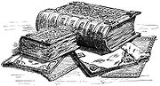
Domesday Book now held at The National Archives,
KewKew is a place in the London Borough of Richmond upon Thames in South West London. Kew is best known for being the location of the Royal Botanic Gardens, now a World Heritage Site, which includes Kew Palace...
,
Richmond upon ThamesRichmond is a town in southwest London, England and is part of the London Borough of Richmond upon Thames. It is located west-southwest of Charing Cross....
in South West London, is the record of the great survey of much of
EnglandEngland is a country that is part of the United Kingdom. It shares land borders with Scotland to the north and Wales to the west; the Irish Sea is to the north west, the Celtic Sea to the south west, with the North Sea to the east and the English Channel to the south separating it from continental...
and parts of
WalesWales is a country that is part of the United Kingdom and the island of Great Britain, bordered by England to its east and the Atlantic Ocean and Irish Sea to its west. It has a population of three million, and a total area of 20,779 km²...
completed in 1086. The survey was executed for
William I of EnglandWilliam I , also known as William the Conqueror , was the first Norman King of England from Christmas 1066 until his death. He was also Duke of Normandy from 3 July 1035 until his death, under the name William II...
(William the Conqueror): "While spending the
ChristmasChristmas or Christmas Day is an annual holiday generally celebrated on December 25 by billions of people around the world. It is a Christian feast that commemorates the birth of Jesus Christ, liturgically closing the Advent season and initiating the season of Christmastide, which lasts twelve days...
of 1085 in
GloucesterGloucester is a city, district and county town of Gloucestershire in the South West region of England. Gloucester lies close to the Welsh border, and on the River Severn, approximately north-east of Bristol, and south-southwest of Birmingham....
, William had deep speech with his counsellors and sent men all over England to each shire to find out what or how much each landholder had in land and livestock, and what it was worth"
(Anglo-Saxon ChronicleThe Anglo-Saxon Chronicle is a collection of annals in Old English chronicling the history of the Anglo-Saxons. The original manuscript of the Chronicle was created late in the 9th century, probably in Wessex, during the reign of Alfred the Great...
).
One of the main purposes of the survey was to determine who held what and what taxes had been liable under
Edward the ConfessorEdward the Confessor also known as St. Edward the Confessor , son of Æthelred the Unready and Emma of Normandy, was one of the last Anglo-Saxon kings of England and is usually regarded as the last king of the House of Wessex, ruling from 1042 to 1066....
; the judgment of the Domesday assessors was final—whatever the book said about who held the material wealth or what it was worth, was the law, and there was no appeal. It was written in
LatinLatin is an Italic language originally spoken in Latium and Ancient Rome. It, along with most European languages, is a descendant of the ancient Proto-Indo-European language. Although it is considered a dead language, a number of scholars and members of the Christian clergy speak it fluently, and...
, although there were some vernacular words inserted for native terms with no previous Latin equivalent, and the text was highly abbreviated. Richard FitzNigel, writing around the year 1179, stated that the book was known by the English as "Domesday", that is the
Day of JudgmentThe Last Judgment, Final Judgment, Day of Judgment, Judgment Day, or The Day of the Lord in Christian theology, is the final and eternal judgment by God of every nation. The concept is found in all the Canonical gospels, particularly the Gospel of Matthew. It will purportedly take place after the...
"for as the sentence of that strict and terrible last account cannot be evaded by any skilful subterfuge, so when this book is appealed to ... its sentence cannot be put quashed or set aside with impunity. That is why we have called the book 'the Book of Judgment' ... because its decisions, like those of the Last Judgment, are unalterable."
In August 2006 a limited online version of
Domesday Book was made available by the
United Kingdom'sThe United Kingdom of Great Britain and Northern IrelandIn the United Kingdom and Dependencies, other languages have been officially recognised as legitimate autochthonous languages under the European Charter for Regional or Minority Languages...
National Archives, charging users £2 per page to view the manuscript. In 2011, the
Domesday Map site made the manuscript freely available for the first time.
Composition
Domesday Book is really two independent works. One, known as
Little Domesday, covers
NorfolkNorfolk is a low-lying county in the East of England. It has borders with Lincolnshire to the west, Cambridgeshire to the west and southwest and Suffolk to the south. Its northern and eastern boundaries are the North Sea coast and to the north-west the county is bordered by The Wash. The county...
,
SuffolkSuffolk is a non-metropolitan county of historic origin in East Anglia, England. It has borders with Norfolk to the north, Cambridgeshire to the west and Essex to the south. The North Sea lies to the east...
and
EssexEssex is a ceremonial and non-metropolitan county in the East region of England, and one of the home counties. It is located to the northeast of Greater London. It borders with Cambridgeshire and Suffolk to the north, Hertfordshire to the west, Kent to the South and London to the south west...
. The other,
Great Domesday, covers much of the remainder of
EnglandEngland is a country that is part of the United Kingdom. It shares land borders with Scotland to the north and Wales to the west; the Irish Sea is to the north west, the Celtic Sea to the south west, with the North Sea to the east and the English Channel to the south separating it from continental...
and parts of Wales, except for lands in the north that later became
WestmorlandWestmorland is an area of North West England and one of the 39 historic counties of England. It formed an administrative county from 1889 to 1974, after which the entirety of the county was absorbed into the new county of Cumbria.-Early history:...
,
CumberlandCumberland is a historic county of North West England, on the border with Scotland, from the 12th century until 1974. It formed an administrative county from 1889 to 1974 and now forms part of Cumbria....
,
NorthumberlandNorthumberland is the northernmost ceremonial county and a unitary district in North East England. For Eurostat purposes Northumberland is a NUTS 3 region and is one of three boroughs or unitary districts that comprise the "Northumberland and Tyne and Wear" NUTS 2 region...
and the
County Palatine of DurhamThe County Palatine of Durham was an area in the North of England that was controlled by the Bishop of Durham.-Liberty of Durham:The territory was originally the Liberty of Durham under the control of the Bishop of Durham. The liberty was also known variously as the "Liberty of St Cuthbert's...
. There are also no surveys of
LondonThe City of London is a small area within Greater London, England. It is the historic core of London around which the modern conurbation grew and has held city status since time immemorial. The City’s boundaries have remained almost unchanged since the Middle Ages, and it is now only a tiny part of...
,
WinchesterWinchester is a historic cathedral city and former capital city of England. It is the county town of Hampshire, in South East England. The city lies at the heart of the wider City of Winchester, a local government district, and is located at the western end of the South Downs, along the course of...
and some other towns. The omission of these two major cities is probably due to their size and complexity. Most of Cumberland and Westmorland are missing because they were not conquered until some time after the survey, and
County DurhamCounty Durham is a ceremonial county and unitary district in north east England. The county town is Durham. The largest settlement in the ceremonial county is the town of Darlington...
is lacking as the Bishop of Durham (William de St-Calais) had the exclusive right to tax Durham; parts of the north east of England were covered by the 1183
Boldon BookThe Boldon Book contains the results of a survey of the bishopric of Durham that was completed on the orders of Hugh du Puiset, Bishop of Durham, in 1183, designed to assist the administration of the vast diocesan estates...
, which listed those areas liable to tax by the Bishop of Durham. The omission of the other counties has not been fully explained.
Despite its name,
Little Domesday was actually larger as it is far more detailed, down to numbers of livestock. It has been suggested that
Little Domesday represents a first attempt, and that it was found impossible, or at least inconvenient, to complete the work on the same scale for
Great Domesday.
For both volumes, the contents of the returns were entirely rearranged and classified according to
fiefA fee was the central element of feudalism and consisted of heritable lands granted under one of several varieties of feudal tenure by an overlord to a vassal who held it in fealty in return for a form of feudal allegiance and service, usually given by the...
s, rather than geographically. Instead of appearing by hundred or by township, holdings appear under the names of the landholders (
tenentes), i.e. those who held the lands directly of the crown in fee.
In each county, the list opened with the holdings of the king himself (which had possibly formed the subject of separate inquiry). These were followed by those of the churchmen and religious houses in order of status (for example, the
Archbishop of CanterburyThe Archbishop of Canterbury is the senior bishop and principal leader of the Church of England, the symbolic head of the worldwide Anglican Communion, and the diocesan bishop of the Diocese of Canterbury. In his role as head of the Anglican Communion, the archbishop leads the third largest group...
is always listed before other bishops), the lay
tenants-in-chiefIn medieval and early modern European society the term tenant-in-chief, sometimes vassal-in-chief, denoted the nobles who held their lands as tenants directly from king or territorial prince to whom they did homage, as opposed to holding them from another nobleman or senior member of the clergy....
again in approximate order of status (
aristocrats) and lastly the king's serjeants (
servientes) and
EnglishThe English are a nation and ethnic group native to England, who speak English. The English identity is of early mediaeval origin, when they were known in Old English as the Anglecynn. England is now a country of the United Kingdom, and the majority of English people in England are British Citizens...
thegnThe term thegn , from OE þegn, ðegn "servant, attendant, retainer", is commonly used to describe either an aristocratic retainer of a king or nobleman in Anglo-Saxon England, or as a class term, the majority of the aristocracy below the ranks of ealdormen and high-reeves...
s who retained land.
In some counties, one or more principal towns formed the subject of a separate section: in some the clamores (disputed titles to land) were similarly treated separately. This principle applies more specially to the larger volume: in the smaller one the system is more confused, the execution less perfect.
Domesday names a total of 13,418 places. Apart from the wholly rural portions, which constitute its bulk,
Domesday contains entries of interest concerning most of the towns, which were probably made because of their bearing on the fiscal rights of the crown therein. These include fragments of
custumalA custumal is a medieval English document, usually edited and composed over time, that stipulates the economic, political, and social customs of a manor or town...
s (older customary agreements), records of the military service due, of markets,
mintsA mint is an industrial facility which manufactures coins for currency.The history of mints correlates closely with the history of coins. One difference is that the history of the mint is usually closely tied to the political situation of an era...
, and so forth. From the towns, from the counties as wholes, and from many of its ancient Lordships, the crown was entitled to archaic dues in kind, such as
honeyHoney is a sweet food made by bees using nectar from flowers. The variety produced by honey bees is the one most commonly referred to and is the type of honey collected by beekeepers and consumed by humans...
.
The information of most general interest found in the great record is that on political, personal, ecclesiastical and social history, which only occurs sporadically and, as it were, by accident. Much of this was used by E. A. Freeman for his work on the Norman Conquest.
Survey
From the
Anglo-Saxon ChronicleThe Anglo-Saxon Chronicle is a collection of annals in Old English chronicling the history of the Anglo-Saxons. The original manuscript of the Chronicle was created late in the 9th century, probably in Wessex, during the reign of Alfred the Great...
it is known that the planning for the survey was conducted in 1085, and from the
colophonIn publishing, a colophon is either:* A brief description of publication or production notes relevant to the edition, in modern books usually located at the reverse of the title page, but can also sometimes be located at the end of the book, or...
of the book it is known that the survey was completed in 1086. It is not known when exactly
Domesday Book was compiled, but the entire copy of Great Domesday appears to have been copied out by one person on parchment (prepared sheepskin), although six scribes seem to have been used for Little Domesday. Writing in 2000, David Roffe argued that the inquest (the survey) and the construction of the book were two distinct exercises; the latter being completed, if not started, by
William IIWilliam II , the third son of William I of England, was King of England from 1087 until 1100, with powers over Normandy, and influence in Scotland. He was less successful in extending control into Wales...
following his assumption of the English throne and quashing of the rebellion that followed and based on, though not consequent on, the findings of the inquest.
Most shires were visited by a group of royal officers (
legati), who held a public inquiry, probably in the great assembly known as the shire court, which was attended by representatives of every township as well as of the local lords. The unit of inquiry was the Hundred (a subdivision of the county, which then was an administrative entity), and the return for each Hundred was sworn to by twelve local jurors, half of them English and half of them
NormansThe Normans were the people who gave their name to Normandy, a region in northern France. They were descended from Norse Viking conquerors of the territory and the native population of Frankish and Gallo-Roman stock...
.
What is believed to be a full transcript of these original returns is preserved for several of the
CambridgeshireCambridgeshire is a county in England, bordering Lincolnshire to the north, Norfolk to the northeast, Suffolk to the east, Essex and Hertfordshire to the south, and Bedfordshire and Northamptonshire to the west...
Hundreds and is of great illustrative importance. The
Inquisitio Eliensis is a record of the lands of Ely Abbey; and the
Exon Domesday (so called from the preservation of the volume at
ExeterExeter is a historic city in Devon, England. It lies within the ceremonial county of Devon, of which it is the county town as well as the home of Devon County Council. Currently the administrative area has the status of a non-metropolitan district, and is therefore under the administration of the...
), which covers
CornwallCornwall is a unitary authority and ceremonial county of England, within the United Kingdom. It is bordered to the north and west by the Celtic Sea, to the south by the English Channel, and to the east by the county of Devon, over the River Tamar. Cornwall has a population of , and covers an area of...
,
DevonDevon is a large county in southwestern England. The county is sometimes referred to as Devonshire, although the term is rarely used inside the county itself as the county has never been officially "shired", it often indicates a traditional or historical context.The county shares borders with...
,
DorsetDorset , is a county in South West England on the English Channel coast. The county town is Dorchester which is situated in the south. The Hampshire towns of Bournemouth and Christchurch joined the county with the reorganisation of local government in 1974...
,
SomersetThe ceremonial and non-metropolitan county of Somerset in South West England borders Bristol and Gloucestershire to the north, Wiltshire to the east, Dorset to the south-east, and Devon to the south-west. It is partly bounded to the north and west by the Bristol Channel and the estuary of the...
,
WiltshireWiltshire is a ceremonial county in South West England. It is landlocked and borders the counties of Dorset, Somerset, Hampshire, Gloucestershire, Oxfordshire and Berkshire. It contains the unitary authority of Swindon and covers...
(however only one manor of Wiltshire is included and parts of Devon, Dorset and Somerset are also wanting) also all contain the full details supplied by the original returns.
Through comparison of what details are recorded in which counties, six "circuits" can be determined (plus a seventh circuit for the Little Domesday shires).
- Berkshire
Berkshire is a historic county in the South of England. It is also often referred to as the Royal County of Berkshire because of the presence of the royal residence of Windsor Castle in the county; this usage, which dates to the 19th century at least, was recognised by the Queen in 1957, and...
, HampshireHampshire is a county on the southern coast of England in the United Kingdom. The county town of Hampshire is Winchester, a historic cathedral city that was once the capital of England. Hampshire is notable for housing the original birthplaces of the Royal Navy, British Army, and Royal Air Force...
, KentKent is a county in southeast England, and is one of the home counties. It borders East Sussex, Surrey and Greater London and has a defined boundary with Essex in the middle of the Thames Estuary. The ceremonial county boundaries of Kent include the shire county of Kent and the unitary borough of...
, SurreySurrey is a county in the South East of England and is one of the Home Counties. The county borders Greater London, Kent, East Sussex, West Sussex, Hampshire and Berkshire. The historic county town is Guildford. Surrey County Council sits at Kingston upon Thames, although this has been part of...
, SussexSussex , from the Old English Sūþsēaxe , is an historic county in South East England corresponding roughly in area to the ancient Kingdom of Sussex. It is bounded on the north by Surrey, east by Kent, south by the English Channel, and west by Hampshire, and is divided for local government into West...
- Cornwall
Cornwall is a unitary authority and ceremonial county of England, within the United Kingdom. It is bordered to the north and west by the Celtic Sea, to the south by the English Channel, and to the east by the county of Devon, over the River Tamar. Cornwall has a population of , and covers an area of...
, DevonDevon is a large county in southwestern England. The county is sometimes referred to as Devonshire, although the term is rarely used inside the county itself as the county has never been officially "shired", it often indicates a traditional or historical context.The county shares borders with...
, DorsetDorset , is a county in South West England on the English Channel coast. The county town is Dorchester which is situated in the south. The Hampshire towns of Bournemouth and Christchurch joined the county with the reorganisation of local government in 1974...
, SomersetThe ceremonial and non-metropolitan county of Somerset in South West England borders Bristol and Gloucestershire to the north, Wiltshire to the east, Dorset to the south-east, and Devon to the south-west. It is partly bounded to the north and west by the Bristol Channel and the estuary of the...
, WiltshireWiltshire is a ceremonial county in South West England. It is landlocked and borders the counties of Dorset, Somerset, Hampshire, Gloucestershire, Oxfordshire and Berkshire. It contains the unitary authority of Swindon and covers...
(Exeter Domesday)
- Bedfordshire
Bedfordshire is a ceremonial county of historic origin in England that forms part of the East of England region.It borders Cambridgeshire to the north-east, Northamptonshire to the north, Buckinghamshire to the west and Hertfordshire to the south-east....
, BuckinghamshireBuckinghamshire is a ceremonial and non-metropolitan home county in South East England. The county town is Aylesbury, the largest town in the ceremonial county is Milton Keynes and largest town in the non-metropolitan county is High Wycombe....
, CambridgeshireCambridgeshire is a county in England, bordering Lincolnshire to the north, Norfolk to the northeast, Suffolk to the east, Essex and Hertfordshire to the south, and Bedfordshire and Northamptonshire to the west...
, HertfordshireHertfordshire is a ceremonial and non-metropolitan county in the East region of England. The county town is Hertford.The county is one of the Home Counties and lies inland, bordered by Greater London , Buckinghamshire , Bedfordshire , Cambridgeshire and...
, MiddlesexMiddlesex is one of the historic counties of England and the second smallest by area. The low-lying county contained the wealthy and politically independent City of London on its southern boundary and was dominated by it from a very early time...
- Leicestershire
Leicestershire is a landlocked county in the English Midlands. It takes its name from the heavily populated City of Leicester, traditionally its administrative centre, although the City of Leicester unitary authority is today administered separately from the rest of Leicestershire...
, NorthamptonshireNorthamptonshire is a landlocked county in the English East Midlands, with a population of 629,676 as at the 2001 census. It has boundaries with the ceremonial counties of Warwickshire to the west, Leicestershire and Rutland to the north, Cambridgeshire to the east, Bedfordshire to the south-east,...
, OxfordshireOxfordshire is a county in the South East region of England, bordering on Warwickshire and Northamptonshire , Buckinghamshire , Berkshire , Wiltshire and Gloucestershire ....
, StaffordshireStaffordshire is a landlocked county in the West Midlands region of England. For Eurostat purposes, the county is a NUTS 3 region and is one of four counties or unitary districts that comprise the "Shropshire and Staffordshire" NUTS 2 region. Part of the National Forest lies within its borders...
, WarwickshireWarwickshire is a landlocked non-metropolitan county in the West Midlands region of England. The county town is Warwick, although the largest town is Nuneaton. The county is famous for being the birthplace of William Shakespeare...
- Cheshire
Cheshire is a ceremonial county in North West England. Cheshire's county town is the city of Chester, although its largest town is Warrington. Other major towns include Widnes, Congleton, Crewe, Ellesmere Port, Runcorn, Macclesfield, Winsford, Northwich, and Wilmslow...
, GloucestershireGloucestershire is a county in South West England. The county comprises part of the Cotswold Hills, part of the flat fertile valley of the River Severn, and the entire Forest of Dean....
, HerefordshireHerefordshire is a historic and ceremonial county in the West Midlands region of England. For Eurostat purposes it is a NUTS 3 region and is one of three counties that comprise the "Herefordshire, Worcestershire and Gloucestershire" NUTS 2 region. It also forms a unitary district known as the...
, ShropshireShropshire is a county in the West Midlands region of England. For Eurostat purposes, the county is a NUTS 3 region and is one of four counties or unitary districts that comprise the "Shropshire and Staffordshire" NUTS 2 region. It borders Wales to the west...
, WorcestershireWorcestershire is a non-metropolitan county, established in antiquity, located in the West Midlands region of England. For Eurostat purposes it is a NUTS 3 region and is one of three counties that comprise the "Herefordshire, Worcestershire and Warwickshire" NUTS 2 region...
— the MarchesThe Welsh Marches is a term which, in modern usage, denotes an imprecisely defined area along and around the border between England and Wales in the United Kingdom. The precise meaning of the term has varied at different periods...
- Derbyshire
Derbyshire is a county in the East Midlands of England. A substantial portion of the Peak District National Park lies within Derbyshire. The northern part of Derbyshire overlaps with the Pennines, a famous chain of hills and mountains. The county contains within its boundary of approx...
, HuntingdonshireHuntingdonshire is a local government district of Cambridgeshire, covering the area around Huntingdon. Traditionally it is a county in its own right...
, LincolnshireLincolnshire is a county in the east of England. It borders Norfolk to the south east, Cambridgeshire to the south, Rutland to the south west, Leicestershire and Nottinghamshire to the west, South Yorkshire to the north west, and the East Riding of Yorkshire to the north. It also borders...
, NottinghamshireNottinghamshire is a county in the East Midlands of England, bordering South Yorkshire to the north-west, Lincolnshire to the east, Leicestershire to the south, and Derbyshire to the west...
, YorkshireYorkshire is a historic county of northern England and the largest in the United Kingdom. Because of its great size in comparison to other English counties, functions have been increasingly undertaken over time by its subdivisions, which have also been subject to periodic reform...
Purpose
For the object of the survey, there are three sources of information:
- The passage in the Anglo-Saxon Chronicle, which tells us why it was ordered:
- The list of questions which the jurors were asked, as preserved in the Inquisitio Eliensis
- The contents of Domesday Book and the allied records mentioned above.
Although these can by no means be reconciled in every detail, it is now generally recognised that the primary object of the survey was to ascertain and record the fiscal rights of the king. These were mainly:
- the national land-tax (geldum), paid on a fixed assessment,
- certain miscellaneous dues, and
- the proceeds of the crown lands.
After a great political convulsion such as the Norman conquest, and the wholesale confiscation of landed estates which followed it, it was in William's interest to make sure that the rights of the crown, which he claimed to have inherited, had not suffered in the process. More especially was this the case as his Norman followers were disposed to evade the liabilities of their English predecessors. The
successful trialThe Trial of Penenden Heath occurred in the decade after Norman Conquest of England in 1066, probably in 1072, and involved a dispute between Odo Bishop of Bayeux, half-brother of William the Conqueror and Lanfranc, Archbishop of Canterbury and others....
of Odo de Bayeux at
Penenden Heath Penenden Heath is a suburb in the town of Maidstone in Kent, England.As the name suggests it is nucleated around a former heath .-History:...
less than a decade after the conquest was one example of the growing discontent at the Norman land-grab that had occurred in the years following the invasion. The survey has since been viewed in the context that William required certainty and a definitive reference point as to property holdings across the nation so that it might be used as evidence in disputes and purported authority for crown ownership.
The Domesday survey therefore recorded the names of the new holders of lands and the assessments on which their tax was to be paid. But it did more than this; by the king's instructions it endeavoured to make a national valuation list, estimating the annual value of all the land in the country, (1) at the time of
Edward the ConfessorEdward the Confessor also known as St. Edward the Confessor , son of Æthelred the Unready and Emma of Normandy, was one of the last Anglo-Saxon kings of England and is usually regarded as the last king of the House of Wessex, ruling from 1042 to 1066....
's death, (2) when the new owners received it, (3) at the time of the survey, and further, it reckoned, by command, the potential value as well. It is evident that William desired to know the financial resources of his kingdom, and it is probable that he wished to compare them with the existing assessment, which was one of considerable antiquity, though there are traces that it had been occasionally modified. The great bulk of
Domesday Book is devoted to the somewhat arid details of the assessment and valuation of rural estates, which were as yet the only important source of national wealth. After stating the assessment of the
manorManorialism, an essential element of feudal society, was the organizing principle of rural economy that originated in the villa system of the Late Roman Empire, was widely practiced in medieval western and parts of central Europe, and was slowly replaced by the advent of a money-based market...
, the record sets forth the amount of
arable landIn geography and agriculture, arable land is land that can be used for growing crops. It includes all land under temporary crops , temporary meadows for mowing or pasture, land under market and kitchen gardens and land temporarily fallow...
, and the number of plough teams (each reckoned at eight oxen) available for working it, with the additional number (if any) that might be employed; then the river-meadows, woodland, pasture, fisheries (i.e.
fishing weirA fishing weir, or fish weir, is an obstruction placed in tidal waters or wholly or partially across a river, which is designed to hinder the passage of fish. Traditionally they were built from wood or stones. They can be used to trap fish...
s),
water-millsA watermill is a structure that uses a water wheel or turbine to drive a mechanical process such as flour, lumber or textile production, or metal shaping .- History :...
,
salt-pansSalt evaporation ponds, also called salterns or salt pans, are shallow artificial ponds designed to produce salts from sea water or other brines. The seawater or brine is fed into large ponds and water is drawn out through natural evaporation which allows the salt to be subsequently harvested...
(if by the sea) and other subsidiary sources of revenue; the peasants are enumerated in their several classes; and finally the annual value of the whole, past and present, is roughly estimated.
It is obvious that, both in its values and in its measurements, the survey's reckoning is very crude.
The rearrangement, on a feudal basis, of the original returns enabled the Conqueror and his officers to see with ease the extent of a baron's possessions; but it also had the effect of showing how far he had engaged under-tenants, and who those under-tenants were. This was of great importance to William, not only for military reasons, but also because of his firm resolve to make the under-tenants (though the "men" of their lords) swear allegiance directly to himself. As
Domesday Book normally records only the Christian name of an under-tenant, it is not possible to search for the surnames of families claiming a Norman origin; but much has been done, and is still being done, to identify the under-tenants, the great bulk of whom bear foreign Christian names.
To a large extent, it comes down to the king's knowing where he should look when he needed to raise money. It therefore includes sources of income but not sinks of expenditure such as castles, unless their mention is needed to explain discrepancies between pre-and post-Conquest holdings. Typically, this happened in a town, where separately-recorded properties had been demolished to make way for a castle.
Subsequent history
Domesday Book was originally preserved in the royal treasury at Winchester (the Norman kings' capital). It was originally referred to as the
Book of Winchester, and refers to itself as such in a late edition. When the treasury moved to
WestminsterThe Palace of Westminster, also known as the Houses of Parliament or Westminster Palace, is the meeting place of the two houses of the Parliament of the United Kingdom—the House of Lords and the House of Commons...
, probably under
Henry IIHenry II ruled as King of England , Count of Anjou, Count of Maine, Duke of Normandy, Duke of Aquitaine, Duke of Gascony, Count of Nantes, Lord of Ireland and, at various times, controlled parts of Wales, Scotland and western France. Henry, the great-grandson of William the Conqueror, was the...
, the book went with it. In the
Dialogus de scaccario (temp. Hen. II.) it is spoken of as a record from the arbitrament of which there was no appeal (from which its popular name of
Domesday is said to be derived). In the Middle Ages its evidence was frequently invoked in the law-courts; and even now there are certain cases in which appeal is made to its testimony.
It remained in Westminster until the days of
Queen VictoriaVictoria was the monarch of the United Kingdom of Great Britain and Ireland from 20 June 1837 until her death. From 1 May 1876, she used the additional title of Empress of India....
, being preserved from 1696 onwards in the
Chapter HouseA chapter house or chapterhouse is a building or room attached to a cathedral or collegiate church in which meetings are held. They can also be found in medieval monasteries....
, and only removed in special circumstances, such as when it was sent to
SouthamptonSouthampton is the largest city in the county of Hampshire on the south coast of England, and is situated south-west of London and north-west of Portsmouth. Southampton is a major port and the closest city to the New Forest...
for
photozincographic reproductionIn the 1860s the first facsimile of the Domesday Book was created by the process of photozincography , and was executed under the directorship of Henry James at the Southampton offices of the Ordnance Survey.-Initial stages:...
.
Domesday Book was eventually placed in the
Public Record OfficeThe Public Record Office of the United Kingdom is one of the three organisations that make up the National Archives...
, London; it can be now seen in a glass case in the museum at The National Archives in Kew, which is in the London Borough of Richmond upon Thames in South West London. In 1869 it received a modern binding. Most recently, the two books were rebound for its ninth centenary in 1986, when
Great Domesday was divided into two volumes and
Little Domesday was divided into three volumes. The ancient Domesday chest, in which it used to be kept, is also preserved in the building at Kew.
The printing of
Domesday, in "record type", was begun by the government in 1773, and the book was published, in two volumes, in 1783; in 1811 a volume of indexes was added, and in 1816 a supplementary volume, separately indexed, containing
- The Exon Domesday—for the south-western counties
- The Inquisitio Eliensis
- The Liber Winton—surveys of Winchester late in the 12th century.
- The Boldon Buke
The Boldon Book contains the results of a survey of the bishopric of Durham that was completed on the orders of Hugh du Puiset, Bishop of Durham, in 1183, designed to assist the administration of the vast diocesan estates...
—a survey of the bishopric of Durham a century later than Domesday.
Photographic facsimilesIn the 1860s the first facsimile of the Domesday Book was created by the process of photozincography , and was executed under the directorship of Henry James at the Southampton offices of the Ordnance Survey.-Initial stages:...
of
Domesday Book, for each county separately, were published in 1861-1863, also by the government. Today,
Domesday Book is available in numerous editions, usually separated by county and available with other
local historyLocal history is the study of the history of a relatively small geographic area; typically a specific settlement, parish or county. English local history came to the fore with the antiquarians of the 19th century and was particularly emphasised by the creation of the Victoria County History series...
resources.
In 1986, the
BBCThe British Broadcasting Corporation is a British public service broadcaster. Its headquarters is at Broadcasting House in the City of Westminster, London. It is the largest broadcaster in the world, with about 23,000 staff...
released the
BBC Domesday ProjectThe BBC Domesday Project was a partnership between Acorn Computers Ltd, Philips, Logica and the BBC to mark the 900th anniversary of the original Domesday Book, an 11th century census of England...
, the results of a project to create a survey to mark the 900th anniversary of the original
Domesday Book. In August 2006 the contents of Domesday went
online, with an English translation of the book's Latin. Visitors to the website are able to look up a place name and see the index entry made for the manor, town, city or village. They can also, for a fee, download the relevant page.
Importance
The importance of
Domesday Book for understanding the period in which it was written is difficult to overstate. As H. C. Darby noted, anyone who uses it "can have nothing but admiration for what is the oldest 'public record' in England and probably the most remarkable statistical document in the history of Europe. The continent has no document to compare with this detailed description covering so great a stretch of territory. And the geographer, as he turns over the folios, with their details of population and of arable, woodland, meadow and other resources, cannot but be excited at the vast amount of information that passes before his eyes." Or, as the author of the
eleventh edition of the Encyclopædia BritannicaThe Encyclopædia Britannica Eleventh Edition is a 29-volume reference work, an edition of the Encyclopædia Britannica. It was developed during the encyclopaedia's transition from a British to an American publication. Some of its articles were written by the best-known scholars of the time...
article noted, "To the topographer, as to the genealogist, its evidence is of primary importance, as it not only contains the earliest survey of each township or manor, but affords, in the majority of cases, a clue to its subsequent descent."
On the other hand, Darby points out that "when this great wealth of data is examined more closely, perplexities and difficulties arise." One problem is that the clerks who compiled this document "were but human; they were frequently forgetful or confused." The use of
roman numeralsThe numeral system of ancient Rome, or Roman numerals, uses combinations of letters from the Latin alphabet to signify values. The numbers 1 to 10 can be expressed in Roman numerals as:...
also led to countless mistakes. Darby states, "Anyone who attempts an arithmetical exercise in Roman numerals soon sees something of the difficulties that faced the clerks." But more important are the numerous obvious omissions, and ambiguities in the presentation of the material. Darby first cites
F. W. Maitland'sFrederic William Maitland was an English jurist and historian, generally regarded as the modern father of English legal history.-Biography:...
comment following his compilation of a table of statistics from material taken from the
Domesday Book survey, "it will be remembered that, as matters now stand, two men not unskilled in Domesday might add up the number of hides in a county and arrive at very different results because they would hold different opinions as to the meanings of certain formulas which are not uncommon", then after adding that "each county presents its own problems" Darby concedes that "it would be more correct to speak not of 'the Domesday geography of England', but of 'the geography of Domesday Book'. The two may not be quite the same thing, and how near the record was to reality we can never know."
See also
- :Category:Places listed in the Domesday Book
- Medieval demography
This article discusses human demography in Europe during the Middle Ages, including population trends and movements. Demographic changes helped to shape and define the Middle Ages...
- Quia Emptores
Quia Emptores of 1290 was a statute passed by Edward I of England that prevented tenants from alienating their lands to others by subinfeudation, instead requiring all tenants wishing to alienate their land to do so by substitution...
- Publications of the Domesday book since 1086
The Domesday Book is the record of the great survey of England completed in 1086, executed for William I of England. This article is about the various ways the Domesday Book was published, beginning in the eighteenth century...
- Photozincography of the Domesday Book
In the 1860s the first facsimile of the Domesday Book was created by the process of photozincography , and was executed under the directorship of Henry James at the Southampton offices of the Ordnance Survey.-Initial stages:...
- Cestui que
Further reading
- Darby, Henry C. & Campbell, Eila M. J. (1961) The Domesday Geography of South Eastern England
- Darby, Henry C. & Maxwell, I. S. (1962) The Domesday Geography of Northern England
- Darby, Henry C. & Finn, R. Welldon (1967) The Domesday Geography of South West England
- Darby, Henry C. (1971) The Domesday Geography of Eastern England, 3rd ed.
- Darby, Henry C. & Terrett, I. B. (1971) The Domesday Geography of Midland England, 2nd ed.
- McDonald, John & Snooks, G. D. (1985) "Were the Tax Assessments of Domesday England Artificial?: the Case of Essex", in: The Economic History Review, New series, Vol. 38, No. 3, [Aug. 1985], pp. 352–72
- Snooks, Graeme D. and McDonald, John. Domesday Economy: A New Approach to Anglo-Norman History. Oxford: Clarendon Press, 1986 ISBN 0198285248
- Hamshere, J. D. (1987) "Regressing Domesday Book: Tax Assessments of Domesday England, in: The Economic History Review, New series, Vol. 40, No. 2. [May 1987], pp. 247-51
- Leaver, R. A. (1988) "Five Hides in Ten Counties: a Contribution to the Domesday Regression Debate", in: The Economic History Review, New series, Vol. 41, No. 4, [Nov. 1988], pp. 525–42
- Bridbury, A. R. (1990) "Domesday Book: a Re-interpretation", in: English Historical Review, Vol. 105, No. 415. [Apr. 1990], pp. 284–309
- Volumes of the Phillimore series, one for each county (e.g. Thorn, C. et al. (eds.) (1979) Cornwall. Chichester: Phillimore) which contain the Latin in facsimile with an English translation.
External links
- Search and read more about Domesday book on The National Archives
The National Archives is a UK government department and an executive agency of the Secretary of State for Justice. It is "the UK government's official archive, containing 1,000 years of history"...
website, home of Domesday book.
- Electronic Edition of Domesday Book, complete text available at the UK Data Archive
The UK Data Archive is a national centre of expertise in data archiving in the United Kingdom . It houses the largest collection of digital data in the social sciences and humanities in the UK....
.
- Searchable index of landholders in 1066 and 1087, Prosopography of Anglo-Saxon England
The Prosopography of Anglo-Saxon England is a major research project based at King's College London in the Department of History and the Centre for Computing in the Humanities, and at the Department of Anglo-Saxon, Norse and Celtic, University of Cambridge.From 2000, PASE has been funded by the...
(PASE) project.
- Focus on Domesday, from Learning Curve. Annotated sample page.
- Secrets of the Norman Invasion Domesday analysis of wasted manors.
- Domesday Book place-name forms All the original spellings of English place-names in Domesday Book (link to pdf file).
- Domesday Book Online Simple to use directory with interactive map of England in Norman times
- Commercial site with extracts from Domesday Book Domesday Book entries including translations for each settlement.
- Domesday Map interactive map, listing details of each manor or holdings of each tenant, plus high-resolution images of the original manuscript.