


El Cid

Encyclopedia
Rodrigo Díaz de Vivar (AD. 1043 – July 10, 1099), known as El Cid Campeador (el θið kampeaˈðor, "The lord-master of military arts"), was a Castilian
nobleman, military leader, and diplomat. Exiled from the court of the Spanish Emperor
Alfonso VI of León and Castile, El Cid went on to command a Moorish force consisting of Muladi
s, Berber
s, Arab
s and Malian
s, under Yusuf al-Mu'taman ibn Hud, Moorish king of the northeast Al-Andalus
city of Zaragoza
, and his successor, Al-Mustain II
.
After the Christian defeat at the Battle of Sagrajas, El Cid was recalled to service by Alfonso VI, and commanded a combined Christian and Moorish army, which he used to create his own fiefdom in the Moorish Mediterranean
coastal city of Valencia.
Rodrigo Díaz was educated in the royal court of Castile
and became the alférez
, the chief general, of Alfonso VI, and his most valuable asset in the fight against the Moors
.
or sayyid
, which means "Lord" or "The Master". The title Campeador means "champion" or "challenger" in Spanish. Because of his exceeding prowess in arms, he was the natural challenger in single combats.
In Spanish warfare, it was common for leaders of armies to pit two Champions against each other (similar to the story of David and Goliath) to determine the outcome of the conflict. This way neither side would lose a great number of men.
The Cid was the champion of King Alfonso IV of Castile. He had gained the title of "Campeador" when he fought on behalf of Alfonso against the forces of Granada. He defeated his enemy disastrously, gathered much treasure, and captured Count García Ordóñez, leader of the Granadian army. He pulled Ordóñez' beard in the ultimate insult of those days, then returned to Burgos, the Castilian capital.
, also known as Castillona de Bivar, a small town about six miles north of Burgos
, the capital of Castile
. His father, Diego Laínez, was a courtier
, bureaucrat
, and cavalry
man who had fought in several battles. Despite the fact that El Cid's mother's family was aristocratic, in later years the peasants would consider him one of their own. However, his relatives were not major court officials; documents show that El Cid's paternal grandfather, Lain, confirmed only five documents of Ferdinand I's, his maternal grandfather, Rodrigo Alvarez, certified only two of Sancho II's, and El Cid's own father confirmed only one.
 As a young adult in 1057, Rodrigo fought against the Moorish stronghold of Zaragoza
, making its emir
al-Muqtadir
a vassal of Sancho. In the spring of 1063, Rodrigo fought in the Battle of Graus
, where Ferdinand's half-brother, Ramiro I of Aragon
, was laying siege to the Moorish town of Cinca which was in Zaragozan lands. Al-Muqtadir, accompanied by Castilian troops including El Cid, fought against the Aragonese. The party would emerge victorious; Ramiro I was killed and the Aragonese fled the field. One legend has said that during the conflict, El Cid killed an Aragonese knight
in single combat
, thereby receiving the honorific title Campeador.
When Ferdinand died, Sancho continued to enlarge his territory, conquering both Christian
and the Moorish cities of Zamora
and Badajoz
. When Sancho learned that Alfonso was planning on overthrowing him in order to gain his territory, Sancho sent Cid to bring Alfonso back so that Sancho could speak to him.
; In any case, since Sancho died unmarried and childless, all of his power passed to his brother Alfonso.
Almost immediately, Alfonso returned from exile in Toledo and took his seat as king of Castile and León. He was deeply suspected in Castile, probably correctly, of having been involved in Sancho's murder. According to the epic of El Cid, the Castilian nobility led by El Cid and a dozen "oath-helpers" forced Alfonso to swear
publicly in front of Santa Gadea
(Saint Agatha) Church in Burgos
on holy relics multiple times that he did not participate in the plot to kill his brother. This is widely reported as truth, but contemporary documents on the lives of both Rodrigo Diaz and Alfonso VI of Castile and León do not mention any such event. El Cid's position as armiger regis was taken away and given to El Cid's enemy, Count García Ordóñez
.
(1079), El Cid rallied his troops and turned the battle into a rout of Emir Abdulallh of Granada
and his ally García Ordóñez. However, El Cid's unauthorized expedition into Granada greatly angered Alfonso, and May 8, 1080, was the last time El Cid confirmed a document in King Alfonso's court. This is the generally given reason for El Cid's exile, although several others are plausible and may have been contributing factors: jealous nobles turning Alfonso against El Cid, Alfonso's own animosity towards El Cid, and an accusation of pocketing some of the tribute from Seville.
At first he went to Barcelona, where Ramón Berenguer II
(1076–1082) and Berenguer Ramón II
(1076–1097) refused his offer of service. Then he journeyed to the Taifa of Zaragoza
where he received a warmer welcome by its diverse and well cultured inhabitants.
According to Moorish accounts:
However, the exile was not the end of El Cid, either physically or as an important figure. In 1081, El Cid, went on to offer his services to the Moorish king of the northeast Al-Andalus
city of Zaragoza
, Yusuf al-Mu'taman ibn Hud, and served both him and his successor, Al-Mustain II
. He was given the title El Cid (The Master) and served as a leading figure in a vibrant Moorish force consisting of Muladi
s, Berber
s, Arab
s and Malian
s.
O'Callaghan writes:
In 1086, the Almoravid invasion of the Iberian Peninsula
through and around Gibraltar
began. The Almoravids, Berber
residents of present-day North Africa
, led by Yusuf ibn Tashfin
, were asked to help defend the divided Moors
from Alfonso
. El Cid had probably commanded a large Moorish force during the great Battle of Sagrajas, which took place in 1086, near the Taifa of Badajoz
. The Almoravid and Andalusian
Taifa
s, including the armies of Badajoz
, Málaga
, Granada
, Tortosa
and Seville
, defeated a combined army of León
, Aragón
and Castile
.
Terrified after his crushing defeat, Alfonso recalled from exile the best Christian general: El Cid. It has been shown that El Cid was at court on July 1087; however, what happened after that is unclear.
coastal city of Valencia. Several obstacles lay in his way. First was Berenguer Ramón II, who ruled nearby Barcelona
. In May 1090, El Cid defeated and captured Berenguer in the Battle of Tébar (nowadays Pinar de Tévar, near Monroyo
, Teruel). Berenguer was later released and his nephew Ramón Berenguer III married El Cid's youngest daughter Maria to ward against future conflicts.
Along the way to Valencia, El Cid also conquered other towns, many of which were near Valencia, such as Castejón and Alucidia.
El Cid gradually came to have more influence on Valencia, then ruled by al-Qadir. In October 1092 an uprising occurred in Valencia inspired by the city's chief judge Ibn Jahhaf and the Almoravids. El Cid began a siege of Valencia. A December 1093 attempt to break the siege failed. By the time the siege ended in May 1094, El Cid had carved out his own principality on the coast of the Mediterranean. Officially El Cid ruled in the name of Alfonso; in reality, El Cid was fully independent. The city was both Christian and Muslim, and both Moors and Christians served in the army and as administrators.
lived peacefully in Valencia for three years until the Almoravids besieged the city. El Cid was fighting one of the men when he was shot in the heart with an arrow. Valencia's troops were losing spirit when Jimena thought if she set the corpse of El Cid atop his horse Babieca, the morale of Valencia's troops would soar. Alfonso ordered the city burned to prevent it from falling into the hands of the Almoravids
. Valencia was captured by Masdali on May 5, 1102 and it did not become a Christian city again for over 125 years. Jimena fled to Burgos with her husband's body. Originally buried in Castile in the monastery of San Pedro de Cardeña, his body now lies at the center of the Burgos Cathedral
.
and Greek
authors on military themes be read aloud to him and his troops, for both entertainment and inspiration before battle. El Cid's army had a novel approach to planning strategy as well, holding what might be called brainstorming
sessions before each battle to discuss tactics. They frequently used unexpected strategies, engaging in what modern generals would call psychological warfare
— waiting for the enemy to be paralyzed with terror and then attacking them suddenly; distracting the enemy with a small group of soldiers, etc. (El Cid used this distraction in capturing the town of Castejón as depicted in Cantar de Mio Cid
(The Song of my Cid)). El Cid accepted or included suggestions from his troops. In The Song the man who served him as his closest adviser was his vassal and kinsman Álvar Fáñez "Minaya" (meaning "My brother", a compound word of Spanish possessive Mi (My) and Anaia, the basque word for brother), although the historical Álvar Fáñez remained in Castile with Alfonso VI.
Taken together, these practices imply an educated and intelligent commander who was able to attract and inspire good subordinates, and who would have attracted considerable loyalty from his followers, including those who were not Christian. It is these qualities, coupled with El Cid's legendary martial abilities, which have fueled his reputation as an outstanding battlefield commander.
. According to this story, Rodrigo's godfather, Pedro El Grande, was a monk at a Carthusian
monastery
. Pedro's coming-of-age gift to El Cid was his pick of a horse from an Andalusian
herd. El Cid picked a horse that his godfather thought was a weak, poor choice, causing the monk to exclaim "Babieca!" (stupid!) Hence, it became the name of El Cid's horse. Another legend states that in a competition of battle to become King Sancho's "Campeador", or champion, a knight on horseback wished to challenge El Cid. The King wished a fair fight and gave El Cid his finest horse, Babieca, or Bavieca. This version says Babieca was raised in the royal stables of Seville and was a highly trained and loyal war horse, not a foolish stallion. The name in this instance could suggest that the horse came from the Babia region in León, Spain
. In the poem Carmen Campidoctoris
, Babieca appears as a gift from "a barbarian" to El Cid, so its name could also be derived from "Barbieca", or "horse of the barbarian".
Regardless, Babieca became a great warhorse, famous to the Christian
s, feared by El Cid's enemies, and loved by El Cid, who allegedly requested that Babieca be buried with him in the monastery of San Pedro de Cardeña. His name is mentioned in several tales and historical documents about El Cid, including The Lay of El Cid.
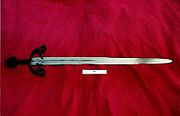 A weapon traditionally identified as El Cid's sword
, Tizona
, used to be displayed in the Army Museum (Museo del Ejército) in Toledo. In 1999, a small sample of the blade underwent metallurgical analysis which confirmed that the blade was made in Moorish Córdoba
in the eleventh century and contained amounts of Damascus steel
.
In 2007 the Autonomous Community of Castile and León
bought the sword for 1.6 million Euro
s, and it is currently on display at the Museum of Burgos
.
El Cid also had a sword called Colada
.
. The Historia Roderici
calls her a daughter of a Count Diego of Oviedo
, a person unknown to contemporary records, while later poetic sources name her father as an otherwise unknown Count Gomez de Gormaz.
Tradition states that when El Cid first laid eyes on her, he was enamored of her great beauty. Together El Cid and Jimena had three children. Their daughters Cristina and María both married into the high nobility; Cristina to Ramiro
, Lord of Monzón
, grandson of García Sánchez III of Navarre via an illegitimate son; María, first (it is said) to a prince of Aragon (presumably the son of Peter I
) and second to Ramón Berenguer III
, count of Barcelona
. El Cid's son Diego Rodríguez was killed while fighting against the invading Muslim Almoravids from North Africa
at the Battle of Consuegra
(1097).
El Cid's own marriage and those of his daughters raised his status by connecting him to the peninsular royalty; even today, most European monarchs and many commoners of European ancestry descend from El Cid, through Cristina's son, King García Ramírez of Navarre and to a lesser extent via a granddaughter Jimena of Barcelona, who married into the Counts of Foix
.
Kingdom of Castile
Kingdom of Castile was one of the medieval kingdoms of the Iberian Peninsula. It emerged as a political autonomous entity in the 9th century. It was called County of Castile and was held in vassalage from the Kingdom of León. Its name comes from the host of castles constructed in the region...
nobleman, military leader, and diplomat. Exiled from the court of the Spanish Emperor
Imperator totius Hispaniae
Imperator totius Hispaniae is a Latin title meaning "Emperor of all Spain". In Spain in the Middle Ages, the title "emperor" was used under a variety of circumstances from the ninth century onwards, but its usage peaked, as a formal and practical title, between 1086 and 1157...
Alfonso VI of León and Castile, El Cid went on to command a Moorish force consisting of Muladi
Muladi
The Muladi were Muslims of ethnic Iberian descent or of mixed Arab, Berber and European origin, who lived in Al-Andalus during the Middle Ages. They were also called "Musalima" .-Etymology:...
s, Berber
Berber people
Berbers are the indigenous peoples of North Africa west of the Nile Valley. They are continuously distributed from the Atlantic to the Siwa oasis, in Egypt, and from the Mediterranean to the Niger River. Historically they spoke the Berber language or varieties of it, which together form a branch...
s, Arab
Arab
Arab people, also known as Arabs , are a panethnicity primarily living in the Arab world, which is located in Western Asia and North Africa. They are identified as such on one or more of genealogical, linguistic, or cultural grounds, with tribal affiliations, and intra-tribal relationships playing...
s and Malian
Malian
Malian may refer to:* Something of, from, or related to Mali, a country in West Africa.* A person from Mali or of Malian descent. For information about the Malian people, see Demographics of Mali and Culture of Mali. For specific persons, see List of Malians....
s, under Yusuf al-Mu'taman ibn Hud, Moorish king of the northeast Al-Andalus
Al-Andalus
Al-Andalus was the Arabic name given to a nation and territorial region also commonly referred to as Moorish Iberia. The name describes parts of the Iberian Peninsula and Septimania governed by Muslims , at various times in the period between 711 and 1492, although the territorial boundaries...
city of Zaragoza
Zaragoza
Zaragoza , also called Saragossa in English, is the capital city of the Zaragoza Province and of the autonomous community of Aragon, Spain...
, and his successor, Al-Mustain II
Al-Mustain II
Al-Mustain II, Ahmad ibn Yusuf was the final member of the Banu Hud family to rule Zaragoza. He ruled from 1085-1110. He was the son of Al-Mustain II, Ahmad ibn Yusuf....
.
After the Christian defeat at the Battle of Sagrajas, El Cid was recalled to service by Alfonso VI, and commanded a combined Christian and Moorish army, which he used to create his own fiefdom in the Moorish Mediterranean
Mediterranean Sea
The Mediterranean Sea is a sea connected to the Atlantic Ocean surrounded by the Mediterranean region and almost completely enclosed by land: on the north by Anatolia and Europe, on the south by North Africa, and on the east by the Levant...
coastal city of Valencia.
Rodrigo Díaz was educated in the royal court of Castile
Kingdom of Castile
Kingdom of Castile was one of the medieval kingdoms of the Iberian Peninsula. It emerged as a political autonomous entity in the 9th century. It was called County of Castile and was held in vassalage from the Kingdom of León. Its name comes from the host of castles constructed in the region...
and became the alférez
Alférez
Alférez is a junior officer rank also used in Spain, Argentina, Chile and Uruguay. The variant Alferes is used in Portugal and was formerly also used in Brazil. A naval variant, Frigate Alférez, is used in Spain, Dominican Republic and Peru. "Alférez" is often translated as ensign...
, the chief general, of Alfonso VI, and his most valuable asset in the fight against the Moors
Moors
The description Moors has referred to several historic and modern populations of the Maghreb region who are predominately of Berber and Arab descent. They came to conquer and rule the Iberian Peninsula for nearly 800 years. At that time they were Muslim, although earlier the people had followed...
.
Title
The name El Cid (el 'θid) comes from the Spanish or Arabic article el (meaning "the"), and the dialectal Arabic word سيد sîdiSidi
Sidi is a masculine title of respect, meaning "my master" in Western Arabic language and Egyptian Arabic equivalent to modern popular usage of the English Mr....
or sayyid
Sayyid
Sayyid is an honorific title, it denotes males accepted as descendants of the Islamic prophet Muhammad through his grandsons, Hasan ibn Ali and Husain ibn Ali, sons of the prophet's daughter Fatima Zahra and his son-in-law Ali ibn Abi Talib.Daughters of sayyids are given the titles Sayyida,...
, which means "Lord" or "The Master". The title Campeador means "champion" or "challenger" in Spanish. Because of his exceeding prowess in arms, he was the natural challenger in single combats.
In Spanish warfare, it was common for leaders of armies to pit two Champions against each other (similar to the story of David and Goliath) to determine the outcome of the conflict. This way neither side would lose a great number of men.
The Cid was the champion of King Alfonso IV of Castile. He had gained the title of "Campeador" when he fought on behalf of Alfonso against the forces of Granada. He defeated his enemy disastrously, gathered much treasure, and captured Count García Ordóñez, leader of the Granadian army. He pulled Ordóñez' beard in the ultimate insult of those days, then returned to Burgos, the Castilian capital.
Life and career
Origins
El Cid was born 1043 AD in VivarVivar del Cid
Vivar or Vivar del Cid is a village of 140 inhabitants, part of the municipality of Quintanilla Vivar, located 7 kilometers away from Burgos, Spain.It was the birthplace of Rodrigo Díaz de Vivar, El Cid.-Celebrations:*San Antonio de Padua...
, also known as Castillona de Bivar, a small town about six miles north of Burgos
Burgos
Burgos is a city of northern Spain, historic capital of Castile. It is situated at the edge of the central plateau, with about 178,966 inhabitants in the city proper and another 20,000 in its suburbs. It is the capital of the province of Burgos, in the autonomous community of Castile and León...
, the capital of Castile
Kingdom of Castile
Kingdom of Castile was one of the medieval kingdoms of the Iberian Peninsula. It emerged as a political autonomous entity in the 9th century. It was called County of Castile and was held in vassalage from the Kingdom of León. Its name comes from the host of castles constructed in the region...
. His father, Diego Laínez, was a courtier
Noble court
The court of a monarch, or at some periods an important nobleman, is a term for the extended household and all those who regularly attended on the ruler or central figure...
, bureaucrat
Bureaucracy
A bureaucracy is an organization of non-elected officials of a governmental or organization who implement the rules, laws, and functions of their institution, and are occasionally characterized by officialism and red tape.-Weberian bureaucracy:...
, and cavalry
Cavalry
Cavalry or horsemen were soldiers or warriors who fought mounted on horseback. Cavalry were historically the third oldest and the most mobile of the combat arms...
man who had fought in several battles. Despite the fact that El Cid's mother's family was aristocratic, in later years the peasants would consider him one of their own. However, his relatives were not major court officials; documents show that El Cid's paternal grandfather, Lain, confirmed only five documents of Ferdinand I's, his maternal grandfather, Rodrigo Alvarez, certified only two of Sancho II's, and El Cid's own father confirmed only one.
Service under Sancho II
Taifa of Zaragoza
The taifa of Zaragoza was an independent Muslim state in Moorish Al-Andalus, present day eastern Spain, which was established in 1018 as one of the taifa kingdoms, which emerged in the 11th century following the destruction of the Caliphate of Córdoba in the Moorish Iberian Peninsula.During the...
, making its emir
Emir
Emir , meaning "commander", "general", or "prince"; also transliterated as Amir, Aamir or Ameer) is a title of high office, used throughout the Muslim world...
al-Muqtadir
Ahmad al-Muqtadir
Ahmad ibn Sulayman al-Muqtadir was a member of the Banu Hud family who ruled the Islamic taifa of Zaragoza, in what is now Spain, from 1049 to 1082. He was the son of the previous ruler, Al-Mustain I, Sulayman ibn Hud al-Judhami.-References:*...
a vassal of Sancho. In the spring of 1063, Rodrigo fought in the Battle of Graus
Battle of Graus
The Battle of Graus was a battle of the Reconquista, traditionally said to have taken place on 8 May 1063. Antonio Ubieto Arteta, in his Historia de Aragón, re-dated the battle to 1069. The late twelfth-century Chronica naierensis dates the encounter to 1070...
, where Ferdinand's half-brother, Ramiro I of Aragon
Ramiro I of Aragon
Ramiro I was de facto the first King of Aragon from 1035 until his death. Apparently born before 1007, he was the illegitimate son of Sancho III of Navarre by his mistress Sancha de Aybar...
, was laying siege to the Moorish town of Cinca which was in Zaragozan lands. Al-Muqtadir, accompanied by Castilian troops including El Cid, fought against the Aragonese. The party would emerge victorious; Ramiro I was killed and the Aragonese fled the field. One legend has said that during the conflict, El Cid killed an Aragonese knight
Knight
A knight was a member of a class of lower nobility in the High Middle Ages.By the Late Middle Ages, the rank had become associated with the ideals of chivalry, a code of conduct for the perfect courtly Christian warrior....
in single combat
Single combat
Single combat is a fight between two single warriors which takes place in the context of a battle between two armies, with the two often considered the champions of their respective sides...
, thereby receiving the honorific title Campeador.
When Ferdinand died, Sancho continued to enlarge his territory, conquering both Christian
Christian
A Christian is a person who adheres to Christianity, an Abrahamic, monotheistic religion based on the life and teachings of Jesus of Nazareth as recorded in the Canonical gospels and the letters of the New Testament...
and the Moorish cities of Zamora
Zamora, Spain
Zamora is a city in Castile and León, Spain, the capital of the province of Zamora. It lies on a rocky hill in the northwest, near the frontier with Portugal and crossed by the Duero river, which is some 50 km downstream as it reaches the Portuguese frontier...
and Badajoz
Badajoz
Badajoz is the capital of the Province of Badajoz in the autonomous community of Extremadura, Spain, situated close to the Portuguese border, on the left bank of the river Guadiana, and the Madrid–Lisbon railway. The population in 2007 was 145,257....
. When Sancho learned that Alfonso was planning on overthrowing him in order to gain his territory, Sancho sent Cid to bring Alfonso back so that Sancho could speak to him.
Service under Alfonso VI
Sancho was assassinated in 1072, as the result of a pact between his brother Alfonso and his sister UrracaUrraca of Zamora
Urraca was a Leonese infanta, one of the five children of Ferdinand I the Great, who received the city of Zamora as her inheritance and exercised palatine authority in it...
; In any case, since Sancho died unmarried and childless, all of his power passed to his brother Alfonso.
Almost immediately, Alfonso returned from exile in Toledo and took his seat as king of Castile and León. He was deeply suspected in Castile, probably correctly, of having been involved in Sancho's murder. According to the epic of El Cid, the Castilian nobility led by El Cid and a dozen "oath-helpers" forced Alfonso to swear
Oath
An oath is either a statement of fact or a promise calling upon something or someone that the oath maker considers sacred, usually God, as a witness to the binding nature of the promise or the truth of the statement of fact. To swear is to take an oath, to make a solemn vow...
publicly in front of Santa Gadea
Santa Gadea
Santa Gadea is the name of a church dedicated to Saint Agatha in Burgos, Spain. The church is famous in history and literature for being the site where Rodrigo Díaz de Vivar at the behest of the Castilian Cortes, forced Alfonso VI to swear an oath that he was not an accomplice in the death of his...
(Saint Agatha) Church in Burgos
Burgos
Burgos is a city of northern Spain, historic capital of Castile. It is situated at the edge of the central plateau, with about 178,966 inhabitants in the city proper and another 20,000 in its suburbs. It is the capital of the province of Burgos, in the autonomous community of Castile and León...
on holy relics multiple times that he did not participate in the plot to kill his brother. This is widely reported as truth, but contemporary documents on the lives of both Rodrigo Diaz and Alfonso VI of Castile and León do not mention any such event. El Cid's position as armiger regis was taken away and given to El Cid's enemy, Count García Ordóñez
García Ordóñez
García Ordóñez , called de Nájera or de Cabra and in the epic literature Crispus or el Crespo de Grañón, was a Castilian magnate who ruled the Rioja from Nájera from 1080 until his death. He is famous in literature as the rival of Rodrigo Díaz de Vivar, the Cid, whose high position at court he...
.
Exile
In the Battle of CabraBattle of Cabra
The Battle of Cabra took place in 1079 in modern-day Spain. It resulted in a victory for El Cid who routed the combined armies of Emir Abd Allah of Granada and his ally García Ordóñez...
(1079), El Cid rallied his troops and turned the battle into a rout of Emir Abdulallh of Granada
Granada
Granada is a city and the capital of the province of Granada, in the autonomous community of Andalusia, Spain. Granada is located at the foot of the Sierra Nevada mountains, at the confluence of three rivers, the Beiro, the Darro and the Genil. It sits at an elevation of 738 metres above sea...
and his ally García Ordóñez. However, El Cid's unauthorized expedition into Granada greatly angered Alfonso, and May 8, 1080, was the last time El Cid confirmed a document in King Alfonso's court. This is the generally given reason for El Cid's exile, although several others are plausible and may have been contributing factors: jealous nobles turning Alfonso against El Cid, Alfonso's own animosity towards El Cid, and an accusation of pocketing some of the tribute from Seville.
At first he went to Barcelona, where Ramón Berenguer II
Ramon Berenguer II, Count of Barcelona
Ramon Berenguer II the Towhead or Cap de estopes was Count of Barcelona from 1076 until his death...
(1076–1082) and Berenguer Ramón II
Berenguer Ramon II, Count of Barcelona
Berenguer Ramon II the Fratricide was Count of Barcelona from 1076 to 1097. He was the son of Ramon Berenguer I, and initially ruled jointly with his twin brother Ramon Berenguer II....
(1076–1097) refused his offer of service. Then he journeyed to the Taifa of Zaragoza
Taifa of Zaragoza
The taifa of Zaragoza was an independent Muslim state in Moorish Al-Andalus, present day eastern Spain, which was established in 1018 as one of the taifa kingdoms, which emerged in the 11th century following the destruction of the Caliphate of Córdoba in the Moorish Iberian Peninsula.During the...
where he received a warmer welcome by its diverse and well cultured inhabitants.
According to Moorish accounts:
AndalusianAndalusianThe adjective Andalusian can refer to:*Andalusia, a region in Spain*Al-Andalus, a historical state on the Iberian Peninsula*Andalusian people, an ethnic group or nation in Spain centered in the Andalusia region...
KnightKnightA knight was a member of a class of lower nobility in the High Middle Ages.By the Late Middle Ages, the rank had become associated with the ideals of chivalry, a code of conduct for the perfect courtly Christian warrior....
s found El Cid their foe ill, thirsty and exiled from the court of AlfonsoAlfonsoAlfonso , Alfons , Afonso , Affonso , Alphonse, Alfonse , Αλφόνσος , Alphonsus , Alphons , Alfonsu in ,...
, he was presented before the elderly Yusuf al-Mu'taman ibn Hud and accepted command of the forces of the Taifa of ZaragozaTaifa of ZaragozaThe taifa of Zaragoza was an independent Muslim state in Moorish Al-Andalus, present day eastern Spain, which was established in 1018 as one of the taifa kingdoms, which emerged in the 11th century following the destruction of the Caliphate of Córdoba in the Moorish Iberian Peninsula.During the...
as their Master.
However, the exile was not the end of El Cid, either physically or as an important figure. In 1081, El Cid, went on to offer his services to the Moorish king of the northeast Al-Andalus
Al-Andalus
Al-Andalus was the Arabic name given to a nation and territorial region also commonly referred to as Moorish Iberia. The name describes parts of the Iberian Peninsula and Septimania governed by Muslims , at various times in the period between 711 and 1492, although the territorial boundaries...
city of Zaragoza
Zaragoza
Zaragoza , also called Saragossa in English, is the capital city of the Zaragoza Province and of the autonomous community of Aragon, Spain...
, Yusuf al-Mu'taman ibn Hud, and served both him and his successor, Al-Mustain II
Al-Mustain II
Al-Mustain II, Ahmad ibn Yusuf was the final member of the Banu Hud family to rule Zaragoza. He ruled from 1085-1110. He was the son of Al-Mustain II, Ahmad ibn Yusuf....
. He was given the title El Cid (The Master) and served as a leading figure in a vibrant Moorish force consisting of Muladi
Muladi
The Muladi were Muslims of ethnic Iberian descent or of mixed Arab, Berber and European origin, who lived in Al-Andalus during the Middle Ages. They were also called "Musalima" .-Etymology:...
s, Berber
Berber people
Berbers are the indigenous peoples of North Africa west of the Nile Valley. They are continuously distributed from the Atlantic to the Siwa oasis, in Egypt, and from the Mediterranean to the Niger River. Historically they spoke the Berber language or varieties of it, which together form a branch...
s, Arab
Arab
Arab people, also known as Arabs , are a panethnicity primarily living in the Arab world, which is located in Western Asia and North Africa. They are identified as such on one or more of genealogical, linguistic, or cultural grounds, with tribal affiliations, and intra-tribal relationships playing...
s and Malian
Malian
Malian may refer to:* Something of, from, or related to Mali, a country in West Africa.* A person from Mali or of Malian descent. For information about the Malian people, see Demographics of Mali and Culture of Mali. For specific persons, see List of Malians....
s.
O'Callaghan writes:
That kingdom was divided between al-Mutamin (1081–1085) who ruled ZaragozaZaragozaZaragoza , also called Saragossa in English, is the capital city of the Zaragoza Province and of the autonomous community of Aragon, Spain...
proper, and his brother al-Mundhir, who ruled LéridaLleidaLleida is a city in the west of Catalonia, Spain. It is the capital city of the province of Lleida, as well as the largest city in the province and it had 137,387 inhabitants , including the contiguous municipalities of Raimat and Sucs. The metro area has about 250,000 inhabitants...
and TortosaTortosa-External links:* *** * * *...
. El Cid entered al-Mutamin's service and successfully defended Zaragoza against the assaults of al-Mundhir, Sancho I of Aragón, and Ramón Berenguer II, whom he held captive briefly in 1082. In 1084, El Cid and the Moorish armies defeated Sancho of Aragon at the Battle of MorellaBattle of MorellaThe Battle of Morella , southwest of Tortosa, was fought between Sancho Ramírez, King of Aragon and Navarre, and Yusuf al-Mu'tamin, King of Zaragoza, while the former was engaged in a campaign of conquest against the latter...
near TortosaTortosa-External links:* *** * * *...
. He was then troubled by the fierce conflicts between the MuladiMuladiThe Muladi were Muslims of ethnic Iberian descent or of mixed Arab, Berber and European origin, who lived in Al-Andalus during the Middle Ages. They were also called "Musalima" .-Etymology:...
s of BadajozBadajozBadajoz is the capital of the Province of Badajoz in the autonomous community of Extremadura, Spain, situated close to the Portuguese border, on the left bank of the river Guadiana, and the Madrid–Lisbon railway. The population in 2007 was 145,257....
and the Arabs of SevilleSevilleSeville is the artistic, historic, cultural, and financial capital of southern Spain. It is the capital of the autonomous community of Andalusia and of the province of Seville. It is situated on the plain of the River Guadalquivir, with an average elevation of above sea level...
.
In 1086, the Almoravid invasion of the Iberian Peninsula
Iberian Peninsula
The Iberian Peninsula , sometimes called Iberia, is located in the extreme southwest of Europe and includes the modern-day sovereign states of Spain, Portugal and Andorra, as well as the British Overseas Territory of Gibraltar...
through and around Gibraltar
Gibraltar
Gibraltar is a British overseas territory located on the southern end of the Iberian Peninsula at the entrance of the Mediterranean. A peninsula with an area of , it has a northern border with Andalusia, Spain. The Rock of Gibraltar is the major landmark of the region...
began. The Almoravids, Berber
Berber people
Berbers are the indigenous peoples of North Africa west of the Nile Valley. They are continuously distributed from the Atlantic to the Siwa oasis, in Egypt, and from the Mediterranean to the Niger River. Historically they spoke the Berber language or varieties of it, which together form a branch...
residents of present-day North Africa
North Africa
North Africa or Northern Africa is the northernmost region of the African continent, linked by the Sahara to Sub-Saharan Africa. Geopolitically, the United Nations definition of Northern Africa includes eight countries or territories; Algeria, Egypt, Libya, Morocco, South Sudan, Sudan, Tunisia, and...
, led by Yusuf ibn Tashfin
Yusuf ibn Tashfin
Yusef ibn Tashfin also, Tashafin, or Teshufin; or Yusuf; was a king of the Almoravid empire, he founded the city of Marrakech and led the Muslim forces in the Battle of Zallaqa....
, were asked to help defend the divided Moors
Moors
The description Moors has referred to several historic and modern populations of the Maghreb region who are predominately of Berber and Arab descent. They came to conquer and rule the Iberian Peninsula for nearly 800 years. At that time they were Muslim, although earlier the people had followed...
from Alfonso
Alfonso
Alfonso , Alfons , Afonso , Affonso , Alphonse, Alfonse , Αλφόνσος , Alphonsus , Alphons , Alfonsu in ,...
. El Cid had probably commanded a large Moorish force during the great Battle of Sagrajas, which took place in 1086, near the Taifa of Badajoz
Taifa of Badajoz
The Taifa of Badajoz was a medieval Muslim kingdom in what is now parts of Portugal and Spain and centred on the city of Badajoz which exists today as the first city of Extremadura, in Spain....
. The Almoravid and Andalusian
Andalusian
The adjective Andalusian can refer to:*Andalusia, a region in Spain*Al-Andalus, a historical state on the Iberian Peninsula*Andalusian people, an ethnic group or nation in Spain centered in the Andalusia region...
Taifa
Taifa
In the history of the Iberian Peninsula, a taifa was an independent Muslim-ruled principality, usually an emirate or petty kingdom, though there was one oligarchy, of which a number formed in the Al-Andalus after the final collapse of the Umayyad Caliphate of Córdoba in 1031.-Rise:The origins of...
s, including the armies of Badajoz
Badajoz
Badajoz is the capital of the Province of Badajoz in the autonomous community of Extremadura, Spain, situated close to the Portuguese border, on the left bank of the river Guadiana, and the Madrid–Lisbon railway. The population in 2007 was 145,257....
, Málaga
Málaga
Málaga is a city and a municipality in the Autonomous Community of Andalusia, Spain. With a population of 568,507 in 2010, it is the second most populous city of Andalusia and the sixth largest in Spain. This is the southernmost large city in Europe...
, Granada
Granada
Granada is a city and the capital of the province of Granada, in the autonomous community of Andalusia, Spain. Granada is located at the foot of the Sierra Nevada mountains, at the confluence of three rivers, the Beiro, the Darro and the Genil. It sits at an elevation of 738 metres above sea...
, Tortosa
Tortosa
-External links:* *** * * *...
and Seville
Seville
Seville is the artistic, historic, cultural, and financial capital of southern Spain. It is the capital of the autonomous community of Andalusia and of the province of Seville. It is situated on the plain of the River Guadalquivir, with an average elevation of above sea level...
, defeated a combined army of León
Kingdom of León
The Kingdom of León was an independent kingdom situated in the northwest region of the Iberian Peninsula. It was founded in AD 910 when the Christian princes of Asturias along the northern coast of the peninsula shifted their capital from Oviedo to the city of León...
, Aragón
Kingdom of Aragon
The Kingdom of Aragon was a medieval and early modern kingdom in the Iberian Peninsula, corresponding to the modern-day autonomous community of Aragon, in Spain...
and Castile
Kingdom of Castile
Kingdom of Castile was one of the medieval kingdoms of the Iberian Peninsula. It emerged as a political autonomous entity in the 9th century. It was called County of Castile and was held in vassalage from the Kingdom of León. Its name comes from the host of castles constructed in the region...
.
Terrified after his crushing defeat, Alfonso recalled from exile the best Christian general: El Cid. It has been shown that El Cid was at court on July 1087; however, what happened after that is unclear.
Conquest of Valencia
Around this time, El Cid, with a combined Christian and Moorish army, began maneuvering in order to create his own fiefdom in the Moorish MediterraneanMediterranean Sea
The Mediterranean Sea is a sea connected to the Atlantic Ocean surrounded by the Mediterranean region and almost completely enclosed by land: on the north by Anatolia and Europe, on the south by North Africa, and on the east by the Levant...
coastal city of Valencia. Several obstacles lay in his way. First was Berenguer Ramón II, who ruled nearby Barcelona
Barcelona
Barcelona is the second largest city in Spain after Madrid, and the capital of Catalonia, with a population of 1,621,537 within its administrative limits on a land area of...
. In May 1090, El Cid defeated and captured Berenguer in the Battle of Tébar (nowadays Pinar de Tévar, near Monroyo
Monroyo
Monroyo or Mont-roig de Tastavins is a municipality located in the Matarraña/Matarranya comarca, province of Teruel, Aragon, Spain. According to the 2004 census , the municipality has a population of 324 inhabitants....
, Teruel). Berenguer was later released and his nephew Ramón Berenguer III married El Cid's youngest daughter Maria to ward against future conflicts.
Along the way to Valencia, El Cid also conquered other towns, many of which were near Valencia, such as Castejón and Alucidia.
El Cid gradually came to have more influence on Valencia, then ruled by al-Qadir. In October 1092 an uprising occurred in Valencia inspired by the city's chief judge Ibn Jahhaf and the Almoravids. El Cid began a siege of Valencia. A December 1093 attempt to break the siege failed. By the time the siege ended in May 1094, El Cid had carved out his own principality on the coast of the Mediterranean. Officially El Cid ruled in the name of Alfonso; in reality, El Cid was fully independent. The city was both Christian and Muslim, and both Moors and Christians served in the army and as administrators.
Death
El Cid and his wife Jimena DíazJimena Díaz
Doña Ximena Díaz was the wife of El Cid from 1074 and her husband's successor as ruler of Valencia from 1099 to 1102.-References:*...
lived peacefully in Valencia for three years until the Almoravids besieged the city. El Cid was fighting one of the men when he was shot in the heart with an arrow. Valencia's troops were losing spirit when Jimena thought if she set the corpse of El Cid atop his horse Babieca, the morale of Valencia's troops would soar. Alfonso ordered the city burned to prevent it from falling into the hands of the Almoravids
Almoravids
The Almoravids were a Berber dynasty of Morocco, who formed an empire in the 11th-century that stretched over the western Maghreb and Al-Andalus. Their capital was Marrakesh, a city which they founded in 1062 C.E...
. Valencia was captured by Masdali on May 5, 1102 and it did not become a Christian city again for over 125 years. Jimena fled to Burgos with her husband's body. Originally buried in Castile in the monastery of San Pedro de Cardeña, his body now lies at the center of the Burgos Cathedral
Burgos Cathedral
The Burgos Cathedral is a Gothic-style Roman Catholic cathedral in Burgos, Spain. It is dedicated to the Virgin Mary and is famous for its vast size and unique architecture. Its construction began in 1221, and was in use nine years later, although work continued on and off for two hundred years...
.
Battle tactics
During his campaigns, El Cid often ordered that books by classic RomanAncient Rome
Ancient Rome was a thriving civilization that grew on the Italian Peninsula as early as the 8th century BC. Located along the Mediterranean Sea and centered on the city of Rome, it expanded to one of the largest empires in the ancient world....
and Greek
Greek literature
Greek literature refers to writings composed in areas of Greek influence, typically though not necessarily in one of the Greek dialects, throughout the whole period in which the Greek-speaking people have existed.-Ancient Greek literature :...
authors on military themes be read aloud to him and his troops, for both entertainment and inspiration before battle. El Cid's army had a novel approach to planning strategy as well, holding what might be called brainstorming
Brainstorming
Brainstorming is a group creativity technique by which a group tries to find a solution for a specific problem by gathering a list of ideas spontaneously contributed by its members...
sessions before each battle to discuss tactics. They frequently used unexpected strategies, engaging in what modern generals would call psychological warfare
Psychological warfare
Psychological warfare , or the basic aspects of modern psychological operations , have been known by many other names or terms, including Psy Ops, Political Warfare, “Hearts and Minds,” and Propaganda...
— waiting for the enemy to be paralyzed with terror and then attacking them suddenly; distracting the enemy with a small group of soldiers, etc. (El Cid used this distraction in capturing the town of Castejón as depicted in Cantar de Mio Cid
Cantar de Mio Cid
El Cantar de Myo Çid , also known in English as The Lay of the Cid and The Poem of the Cid is the oldest preserved Spanish epic poem...
(The Song of my Cid)). El Cid accepted or included suggestions from his troops. In The Song the man who served him as his closest adviser was his vassal and kinsman Álvar Fáñez "Minaya" (meaning "My brother", a compound word of Spanish possessive Mi (My) and Anaia, the basque word for brother), although the historical Álvar Fáñez remained in Castile with Alfonso VI.
Taken together, these practices imply an educated and intelligent commander who was able to attract and inspire good subordinates, and who would have attracted considerable loyalty from his followers, including those who were not Christian. It is these qualities, coupled with El Cid's legendary martial abilities, which have fueled his reputation as an outstanding battlefield commander.
Babieca
Babieca or Bavieca was El Cid's warhorse. Several stories exist about El Cid and Babieca. One well-known legend about El Cid describes how he acquired the stallionStallion
A Stallion is a male horse.Stallion may also refer to:* Stallion , an American pop rock group* Stallion , a figure in the Gobot toyline* Stallion , a character in the console role-playing game series...
. According to this story, Rodrigo's godfather, Pedro El Grande, was a monk at a Carthusian
Carthusian
The Carthusian Order, also called the Order of St. Bruno, is a Roman Catholic religious order of enclosed monastics. The order was founded by Saint Bruno of Cologne in 1084 and includes both monks and nuns...
monastery
Monastery
Monastery denotes the building, or complex of buildings, that houses a room reserved for prayer as well as the domestic quarters and workplace of monastics, whether monks or nuns, and whether living in community or alone .Monasteries may vary greatly in size – a small dwelling accommodating only...
. Pedro's coming-of-age gift to El Cid was his pick of a horse from an Andalusian
Andalusian horse
The Andalusian, also known as the Pure Spanish Horse or PRE , is a horse breed developed in the Iberian Peninsula. Its ancestors have been present on the Iberian Peninsula for thousands of years. The Andalusian has been recognized as an individual breed since the 15th century, and its conformation...
herd. El Cid picked a horse that his godfather thought was a weak, poor choice, causing the monk to exclaim "Babieca!" (stupid!) Hence, it became the name of El Cid's horse. Another legend states that in a competition of battle to become King Sancho's "Campeador", or champion, a knight on horseback wished to challenge El Cid. The King wished a fair fight and gave El Cid his finest horse, Babieca, or Bavieca. This version says Babieca was raised in the royal stables of Seville and was a highly trained and loyal war horse, not a foolish stallion. The name in this instance could suggest that the horse came from the Babia region in León, Spain
León (province)
León is a province of northwestern Spain, in the northwestern part of the autonomous community of Castile and León.About one quarter of its population of 500,200 lives in the capital, León. The weather is cold and dry during the winter....
. In the poem Carmen Campidoctoris
Carmen Campidoctoris
The Carmen Campidoctoris is an anonymous medieval Latin epic poem, consisting in 128 sapphic-adonic verses in 32 stanzas, with one line from an unfinished thirty-third...
, Babieca appears as a gift from "a barbarian" to El Cid, so its name could also be derived from "Barbieca", or "horse of the barbarian".
Regardless, Babieca became a great warhorse, famous to the Christian
Christian
A Christian is a person who adheres to Christianity, an Abrahamic, monotheistic religion based on the life and teachings of Jesus of Nazareth as recorded in the Canonical gospels and the letters of the New Testament...
s, feared by El Cid's enemies, and loved by El Cid, who allegedly requested that Babieca be buried with him in the monastery of San Pedro de Cardeña. His name is mentioned in several tales and historical documents about El Cid, including The Lay of El Cid.
Swords
Sword
A sword is a bladed weapon used primarily for cutting or thrusting. The precise definition of the term varies with the historical epoch or the geographical region under consideration...
, Tizona
Tizona
Tizona is the name of the sword carried by El Cid which was used to fight the Moors in Spain according to the Cantar de mio CidThe name Tizón translates to burning stick, firebrand....
, used to be displayed in the Army Museum (Museo del Ejército) in Toledo. In 1999, a small sample of the blade underwent metallurgical analysis which confirmed that the blade was made in Moorish Córdoba
Córdoba, Spain
-History:The first trace of human presence in the area are remains of a Neanderthal Man, dating to c. 32,000 BC. In the 8th century BC, during the ancient Tartessos period, a pre-urban settlement existed. The population gradually learned copper and silver metallurgy...
in the eleventh century and contained amounts of Damascus steel
Damascus steel
Damascus steel was a term used by several Western cultures from the Medieval period onward to describe a type of steel used in swordmaking from about 300 BCE to 1700 CE. These swords are characterized by distinctive patterns of banding and mottling reminiscent of flowing water...
.
In 2007 the Autonomous Community of Castile and León
Castile and León
Castile and León is an autonomous community in north-western Spain. It was so constituted in 1983 and it comprises the historical regions of León and Old Castile...
bought the sword for 1.6 million Euro
Euro
The euro is the official currency of the eurozone: 17 of the 27 member states of the European Union. It is also the currency used by the Institutions of the European Union. The eurozone consists of Austria, Belgium, Cyprus, Estonia, Finland, France, Germany, Greece, Ireland, Italy, Luxembourg,...
s, and it is currently on display at the Museum of Burgos
Burgos
Burgos is a city of northern Spain, historic capital of Castile. It is situated at the edge of the central plateau, with about 178,966 inhabitants in the city proper and another 20,000 in its suburbs. It is the capital of the province of Burgos, in the autonomous community of Castile and León...
.
El Cid also had a sword called Colada
Colada
Colada is one of the two best-known swords, along with Tizona, of El Cid Campeador. Won in combat from the Count of Barcelona, the sword was presented to his sons in law. According to the heroic verses of the Cantar de mio Cid, after his sons-in-law beat his daughters and then abandoned them on...
.
Marriage and family
El Cid was married in July 1075 to Alfonso's kinswoman Jimena DíazJimena Díaz
Doña Ximena Díaz was the wife of El Cid from 1074 and her husband's successor as ruler of Valencia from 1099 to 1102.-References:*...
. The Historia Roderici
Historia Roderici
The Historia Roderici , originally Gesta Roderici Campi Docti and sometimes in Spanish Crónica latina del Cid , is an anonymous Latin prose history of the Castilian folk hero Rodrigo Díaz, better known as El Cid Campeador.It is generally written in a simple, unadorned Latin by...
calls her a daughter of a Count Diego of Oviedo
Oviedo
Oviedo is the capital city of the Principality of Asturias in northern Spain. It is also the name of the municipality that contains the city....
, a person unknown to contemporary records, while later poetic sources name her father as an otherwise unknown Count Gomez de Gormaz.
Tradition states that when El Cid first laid eyes on her, he was enamored of her great beauty. Together El Cid and Jimena had three children. Their daughters Cristina and María both married into the high nobility; Cristina to Ramiro
Ramiro Sánchez, Lord of Monzón
Ramiro Sánchez of Monzón was a noble kinsman of the kings of Navarre, and lord of the town of Monzón, Spain.His father was Sancho Garcés, an illegitimate son of king García Sánchez III of Navarre...
, Lord of Monzón
Monzón
Monzón is a small town in the autonomous community of Aragon, Spain. It has a population of 17,050. It is located in the northeast and adjoins the rivers Cinca and Sosa.-Historical overview:...
, grandson of García Sánchez III of Navarre via an illegitimate son; María, first (it is said) to a prince of Aragon (presumably the son of Peter I
Peter I of Aragon and Navarre
Peter I was the King of Aragon and Navarre for a decade from 1094 until his death. He was the son and successor of Sancho V Ramírez by his first wife, Isabella of Urgell. He was named in honour of Saint Peter, because of his father's special devotion to the Holy See, to which he had made his...
) and second to Ramón Berenguer III
Ramon Berenguer III, Count of Barcelona
Ramon Berenguer III the Great was the count of Barcelona, Girona, and Ausona from 1082 , Besalú from 1111, Cerdanya from 1117, and Provence, in the Holy Roman Empire, from 1112, all until his death in Barcelona in 1131...
, count of Barcelona
Barcelona
Barcelona is the second largest city in Spain after Madrid, and the capital of Catalonia, with a population of 1,621,537 within its administrative limits on a land area of...
. El Cid's son Diego Rodríguez was killed while fighting against the invading Muslim Almoravids from North Africa
North Africa
North Africa or Northern Africa is the northernmost region of the African continent, linked by the Sahara to Sub-Saharan Africa. Geopolitically, the United Nations definition of Northern Africa includes eight countries or territories; Algeria, Egypt, Libya, Morocco, South Sudan, Sudan, Tunisia, and...
at the Battle of Consuegra
Battle of Consuegra
The Battle of Consuegra was fought on August 15, 1097 near the village of Consuegra in the province of Castile-La Mancha between the Castilian and Leonese army of Alfonso VI and the Almoravids under Yusuf ibn Tashfin. The battle soon turned into Almoravid victory and the son of El Cid, Diego...
(1097).
El Cid's own marriage and those of his daughters raised his status by connecting him to the peninsular royalty; even today, most European monarchs and many commoners of European ancestry descend from El Cid, through Cristina's son, King García Ramírez of Navarre and to a lesser extent via a granddaughter Jimena of Barcelona, who married into the Counts of Foix
Foix
Foix is a commune, the capital of the Ariège department in southwestern France. It is the least populous administrative centre of a department in all of France, although it is only very slightly smaller than Privas...
.