
See Also

Supernova

A supernova is a stellar explosion Explosion

An explosion is a sudden increase in volume [i] and release of energy [i] in a violent manner, usually w ... 

 which produces an extremely bright object made of plasma Plasma

Plasma may refer to: * Plasma [i], an ionized gas ... 

 that declines to invisibility over weeks or months. A supernova releases more than about 1017 times the Sun's energy output, briefly outshining its entire host galaxy Galaxy

A galaxy is a huge gravitationally bound [i] system of star [i]s, interstellar gas and dust [i] ... 

. There are several different types of supernovae and two possible routes to their formation. A massive star Star

A star is a massive, compact body of plasma [i] in outer space [i] that is held together by its ... 

 may cease to generate fusion Nuclear fusion

In physics [i], nuclear fusion is the process by which multiple nuclei [i] join together ... 

 energy from fusing the nuclei Atomic nucleus

The nucleus of an atom [i] is the very dense region in its center consisting of proton [i]s and neutron [i] ... 

 of atom Atom

In chemistry [i] and physics [i], an atom is the smallest possible particle of a chemical element [i] t ... 

s in its core, and collapse under the force of its own gravity Gravitation

In physics [i], gravitation or gravity is the tendency of objects with mass [i] to accelerate [i] ... 

 to form a neutron star Neutron star

A neutron star is one of the few possible endpoints [i] of stellar evolution [i]. ... 

 or black hole Black hole

A black hole is an object predicted by general relativity [i] with a gravitational field so strong that ... 

.

Discussions

  Discussion Features

   Ask a question about 'Supernova'

   Start a new discussion about 'Supernova'

   Answer questions about 'Supernova'

   'Supernova' discussion forum

Timeline

185   Chinese astronomers note in the ''Astrological Annals of the Houhanshu'' sight supernova now identified as RCW 86, the earliest identified supernova.

185   Chinese astronomers Astronomer

An astronomer or astrophysicist is a person whose area of interest is astronomy [i] or astrophysics [i] ... 

 observe a supernova.

352   Earliest sighting of a supernova occurs in China China

China is a cultural region [i] and ancient civilization [i] in East Asia [i]. ... 

.

1006   The brightest supernova ever recorded, SN 1006 SN 1006

SN 1006 was a Supernova [i] that occurred in the year 1006 AD. ... 

, is observed in the constellation of Lupus.

1181   Chinese and Japanese astronomers observe what has since come to be understood as a supernova. One of only eight supernovae in the Milky Way Milky Way

The Milky Way , is a barred spiral galaxy [i] which forms part of the Local Group [i]. ... 

 observed in recorded history, it appeared in the constellation Constellation

A constellation is any one of the 88 areas into which the sky - or the celestial sphere [i] - is divided ... 

 Cassiopeia Cassiopeia (constellation)

Cassiopeia is a northern constellation [i] which Greek mythology [i] considered to represent a vain quee ... 

 and was visible in the night sky for about 185 days. The radio source 3C58 3C58

3C58 is a pulsar [i] and surrounding synchrotron nebula within the Milky Way [i] that is possibly associ ... 

 is thought to be the remnant from this event.

1572   Tycho Brahe Tycho Brahe

Tycho Brahe , born Tyge Ottesen Brahe , was a Danish [i] nobleman [i] best know ... 

 observes the supernova SN 1572 SN 1572

SN 1572 or Tycho's Nova was a supernova [i] in the constellation Cassiopeia [i], one of ... 

 in Cassiopeia Cassiopeia (constellation)

Cassiopeia is a northern constellation [i] which Greek mythology [i] considered to represent a vain quee ... 

1604   Supernova 1604 SN 1604

Supernova 1604, also known as Kepler's Supernova or Kepler's Star, was a supernova [i] in th ... 

 is observed. As of this writing, this was the last supernova to be observed in the Milky Way Milky Way

The Milky Way , is a barred spiral galaxy [i] which forms part of the Local Group [i]. ... 

.


Encyclopedia


A supernova is a stellar explosion Explosion

An explosion is a sudden increase in volume [i] and release of energy [i] in a violent manner, usually w ... 

 which produces an extremely bright object made of plasma Plasma

Plasma may refer to:
  • Plasma [i], an ionized gas

... 

 that declines to invisibility over weeks or months. A supernova releases more than about 1017 times the Sun's energy output, briefly outshining its entire host galaxy Galaxy

A galaxy is a huge gravitationally bound [i] system of star [i]s, interstellar gas and dust [i] ... 

.

There are several different types of supernovae and two possible routes to their formation. A massive star Star

A star is a massive, compact body of plasma [i] in outer space [i] that is held together by its ... 

 may cease to generate fusion Nuclear fusion

In physics [i], nuclear fusion is the process by which multiple nuclei [i] join together ... 

 energy from fusing the nuclei Atomic nucleus

The nucleus of an atom [i] is the very dense region in its center consisting of proton [i]s and neutron [i] ... 

 of atom Atom

In chemistry [i] and physics [i], an atom is the smallest possible particle of a chemical element [i] t ... 

s in its core, and collapse under the force of its own gravity Gravitation

In physics [i], gravitation or gravity is the tendency of objects with mass [i] to accelerate [i] ... 

 to form a neutron star Neutron star

A neutron star is one of the few possible endpoints [i] of stellar evolution [i]. ... 

 or black hole Black hole

A black hole is an object predicted by general relativity [i] with a gravitational field so strong that ... 

. Alternatively, a white dwarf star may accumulate material from a companion star until it nears its Chandrasekhar limit and undergoes runaway nuclear fusion in its interior, completely disrupting it. Note that this second type of supernova should not be confused with a surface thermonuclear Nuclear fusion

In physics [i], nuclear fusion is the process by which multiple nuclei [i] join together ... 

 explosion on a white dwarf, which is called a nova Nova

A nova is a cataclysmic nuclear explosion caused by the accretion [i] of hydrogen onto the surface of a ... 

. In either type of supernova, the resulting explosion expels much or all of the stellar material with great force.

The explosion drives a blast wave Shock wave

A shock wave is a type of propagating disturbance.... 

 into the surrounding space Outer space

Outer space, also simply called space, refers to the relatively empty regions of the universe [i] ou... 

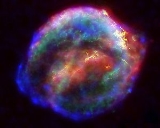
, forming a supernova remnant Supernova remnant

A supernova remnant is the structure resulting from the gigantic explosion of a star in a supernova [i] ... 

. One example of this process is the remnant of SN 1604 SN 1604

Supernova 1604, also known as Kepler's Supernova or Kepler's Star, was a supernova [i] in th ... 

, shown to the right.

"Nova" is Latin Latin

Latin is an ancient Indo-European language [i] originally spoken in Latium [i], ... 

 for "new", referring to what appears to be a very bright new star Star

A star is a massive, compact body of plasma [i] in outer space [i] that is held together by its ... 

 shining in the celestial sphere Celestial sphere

In astronomy [i] and navigation [i], the celestial sphere is an imaginary [i] rotating [i] ... 

; the prefix "super" distinguishes this from an ordinary nova Nova

A nova is a cataclysmic nuclear explosion caused by the accretion [i] of hydrogen onto the surface of a ... 

, which also involves a star increasing in brightness, though to a lesser extent and through a different mechanism. However, the name is inappropriate as it signals the end of a star .

Observation history

In 185 AD, Chinese China

China is a cultural region [i] and ancient civilization [i] in East Asia [i]. ... 

 astronomers recorded the appearance of a bright star in the sky, and observed that it took about eight months to fade from the sky. It was observed to sparkle like a star and did not move across the heavens like a comet Comet

A comet is a small body in the solar system that orbits the Sun [i] and exhibits a coma [i] and/ ... 

. These observations are consistent with the appearance of a supernova, and this is believed to be the oldest recorded by humankind. SN 185 may also have been recorded in Roman Roman Empire

The Roman Empire was a phase of the ancient Roman [i] civilization characterized by an autocratic [i] ... 

 literature. The gaseous shell RCW 86 is suspected as being the remnant of this event, and recent X-ray studies show a good match for the expected age.

In 393 A.D., the Chinese recorded the appearance of another "guest star", SN 393, in the modern constellation Scorpius Scorpius

Scorpius is one of the constellation [i]s of the zodiac [i]. ... 

. Additional unconfirmed supernovae events may have been observed in 369 A.D., 386 A.D., 437 A.D, 827 A.D. and 902 A.D. However these have not yet been associated with a supernova remnant, and so they remain only candidates. Over a span of about 2,000 years, Chinese astronomers would record a total of twenty such events, including later explosions noted by Islamic, European and possibly India India

India , officially the Republic of India, is a country in South Asia [i]. ... 

n and other observers.

The supernova SN 1006 SN 1006

SN 1006 was a Supernova [i] that occurred in the year 1006 AD. ... 

 appeared in the southern constellation of Lupus during the year 1006 A.D. This was the brightest recorded star ever to appear in the night sky, and its presence was noted in China, Egypt, Iraq, Italy, Japan and Switzerland. It may also have been noted in France, Syria and North America. Egyptian physician and astrologer Ali bin Ridwan gave the brightness of this star as one-quarter the brightess of the Moon. Modern astronomers have discovered the faint remnant of this explosion and determined that it was only 7,100 light years from the Earth.


Supernova SN 1054 was another widely-observed event, with Arab, Chinese and Japanese astronomers recording the star's appearance in 1054 A.D. It may also have been recorded by the Anasazi Ancient Pueblo Peoples

Ancient Pueblo People or Ancestral Puebloans are preferred terms for the cultural group of people ... 

 indians as a petroglyph Petroglyph

Petroglyphs are * Cave painting [i]
... 

. This explosion appeared in the constellation Taurus, where it produced the Crab Nebula Crab Nebula

The Crab Nebula (catalogue designations M1 [i], NGC 1952 [i] ... 

 remnant. At its peak, the luminosity of SN 1054 may have been four times as bright as Venus Venus

Venus is the second-closest planet [i] to the Sun [i], orbiting it every 224.7 Earth days. ... 

, and it remained visible for 23 days.

Curiously there are fewer records of supernova SN 1181 SN 1181

First observed between August 4 and August 6, 1181, Chinese and Japanese astronomers recorded the [[supernova]... 

,
which occured in the constellation Cassiopeia just over a century after SN 1054. It was noted by Chinese and Japanese astronomers, however. The pulsar Pulsar

Pulsars are rotating neutron star [i]s which emit detectable electromagnetic radiation [i] in the form o ... 

 3C58 3C58

3C58 is a pulsar [i] and surrounding synchrotron nebula within the Milky Way [i] that is possibly associ ... 

 may be the left-over remnant from this event.

The Danish Denmark

The Kingdom of Denmark is the smallest and southernmost of the Nordic countries [i].... 

 astronomer Tycho Brahe Tycho Brahe

Tycho Brahe , born Tyge Ottesen Brahe , was a Danish [i] nobleman [i] best know ... 

 was noted for his careful observations of the night sky from his observatory on the island of Hven Hven

Hven or Ven is a small Swedish [i] island in the resund [i] strait, between Scania [i] ... 

. In 1572 he noted the appearance of a new star , also in the constellation Cassiopeia. Later called SN 1572 SN 1572

SN 1572 or Tycho's Nova was a supernova [i] in the constellation Cassiopeia [i], one of ... 

, this
supernova was associated with a remnant during the 1960s.

A common belief in Europe during this period was the Aristotelian Aristotle

Aristotle was an ancient Greek [i] philosopher [i], a student of Plato [i] ... 

 idea that the world beyond the Moon and planets was immutible. So observers argued that the phenomenon was something in the Earth's atmosphere. However Tycho noted that the object remained stationary from night to night—never changing its parallax Parallax

Parallax, or more accurately motion parallax is the change of angular position [i]... 

—so it must lay far away. He published his observations in the small book De Stella Nova in 1573. It is from the title of this book that we derive the modern word nova for cataclysmic variable stars.

The last supernova to be seen in the Milky Way Milky Way

The Milky Way , is a barred spiral galaxy [i] which forms part of the Local Group [i]. ... 

 galaxy was SN 1604 SN 1604

Supernova 1604, also known as Kepler's Supernova or Kepler's Star, was a supernova [i] in th ... 

, which was observed October 9, 1604. Several people noted the sudden appearance of this star, but it was Johannes Kepler Johannes Kepler

Johannes Kepler , a key figure in the scientific revolution [i], was a German [i] mathematician [i] ... 

 who became noted for his systematic study of the object. He published his observations in the work De Stella nova in pede Serpentarii. Galileo Galileo Galilei

Galileo Galilei was an Italian [i] physicist [i], astronomer [i], astrologer [i] and philosopher [i] ... 

, like Tycho before him, tried in vain to measure the parallax of this new star, and then argued against the Aristotellian view of an immutable heavens. The remnant of this supernova was identified in 1941 at the Mt. Wilson observatory Mount Wilson Observatory

The Mount Wilson Observatory is an astronomical observatory [i] in Los Angeles County, California [i]. ... 

.

| image = | epoch = J2000.0 [i]
... 

, discovered by Ernst Hartwig.
  • 1987 – Supernova 1987A SN 1987A

    SN 1987A was a supernova [i] in the outskirts of the Tarantula Nebula [i] in the Large Magellanic Cloud [i] ... 

     in the Large Magellanic Cloud Large Magellanic Cloud

    The Large Magellanic Cloud is a dwarf galaxy [i] that orbits our own galaxy [i], the Milky Way [i]. ... 

    ; observed within hours of its start, it was the first opportunity for modern theories of supernova formation to be tested against observations.
  • 2006 – SNLS-03D3bb in a forming galaxy; observed in real time, it poses several major physical questions as it seems more massive than the Chandrasekhar limit would allow.
  • Cassiopeia A Cassiopeia A

    Cassiopeia A is a supernova remnant [i] in the constellation Cassiopeia [i] and the brightest ... 

     – Supernova in Cassiopeia, not observed on Earth, but estimated to be ~300 years old. Is the brightest remnant in the radio band.


Supernovae often leave behind supernova remnants Supernova remnant

A supernova remnant is the structure resulting from the gigantic explosion of a star in a supernova [i] ... 

; the study of these objects has helped to increase knowledge of supernovae.

Supernova hunting


The explosion of supernovae in other galaxies cannot be predicted with any meaningful accuracy. When they are discovered, they are already in progress. Most uses for supernovae — as standard candles, for instance — require an observation of their peak luminosity. It is therefore important to discover them well before they reach their maximum. Amateur astronomers Amateur astronomy

Amateur astronomy, a subset of astronomy [i], is a hobby [i] whose participants enjoy studying celestial ... 

, who greatly outnumber professional astronomers, have played an important role in finding supernovae, typically by looking at some of the closer galaxies through an optical telescope Optical telescope

An optical telescope is a telescope [i] which is used to gather, and focus [i] light [i], for direc ... 

 and comparing them to earlier photographs. Towards the end of the 20th century, astronomers increasingly turned to computer-controlled telescopes and CCDs Charge-coupled device

A charge-coupled device is an consisting of an integrated circuit [i] containing an array of linked, o ... 

 for hunting supernovae. While such systems are popular with amateurs, there are also larger installations like the Katzman Automatic Imaging Telescope.

Supernova searches fall into two regimes: high redshift and low redshift, with the boundary falling somewhere around a redshift of z = 0.2. High redshift searches for supernovae involve the observation of Type Ia supernova light curves for use as standard or calibrated candles to generate Hubble diagrams and make cosmological predictions. At low redshift, supernova spectroscopy is more practical than at high redshift, and these data can be used to study the physics and environments of supernovae. Low redshift observations also anchor the low redshift end of the Hubble curve.

Naming of supernovae

Supernova discoveries are reported to the International Astronomical Union International Astronomical Union

The International Astronomical Union unites national astronomical [i] societies from around th ... 

's Central Bureau for Astronomical Telegrams which sends out a circular with the name it assigns to it. The name is formed by the year of discovery, immediately followed by a one or two-letter designation. The first 26 supernovae of the year get an upper case letter from A A

The letter A is the first letter in the Latin alphabet [i]. Its name in English [i] is ... 

to Z Z

The letter Z is the twenty-sixth and last letter in the Latin Alphabet [i].
... 

. Afterward, pairs of lower-case letters are used, starting with aa, ab, and so on. Four historical supernovae are known simply by the year they occurred ; starting with 1885, the letters are used, even if there was only one supernova that year —this last happened with SN 1947A. The standard abbreviation "SN" is an optional prefix. Professional and amateur astronomers currently find between 300 and 400 supernovae a year. For example, the last supernova of 2005 was SN 2005nc, indicating that it was the 341st supernova found in 2005 .

Classification

As part of the attempt to understand supernovae, astronomers have classified them according to the lines of different chemical elements that appear in their spectra Spectroscopy

Spectroscopy is the study of matter by investigating light, sound, or particles that is emitted, absorbe... 

. The first element for a division is the presence or absence of a line from hydrogen Hydrogen

|-
| Triple point [i] || 13.8033 K, 7.042 kPa
... 

. If a supernova's spectrum contains a hydrogen line, it is classified Type II, otherwise it is Type I. Among those groups, there are subdivisions according to the presence of other lines and the shape of the light curve of the supernova.

Spectral classification


Type INo hydrogen Balmer lines
Type IaSingly-ionized silicon Silicon

Silicon is the chemical element [i] in the periodic table [i] that has the symbol Si and atomic number [i] ... 

  line at 615.0 nm
Type IbNon-ionized helium Helium

|-
| 3He || 0.000137%* || colspan="4" | He is stable [i] with 1 neutron [i]
... 

  line at 587.6 nm
Type IcWeak or no helium lines
Type IIHas hydrogen Balmer lines
Type II-PLuminosity plateau
Type II-LLinear decline in luminosity

Type Ia

Type Ia supernovae lack helium Helium

|-
| 3He || 0.000137%* || colspan="4" | He is stable [i] with 1 neutron [i]
... 

 and present a silicon Silicon

Silicon is the chemical element [i] in the periodic table [i] that has the symbol Si and atomic number [i] ... 

 absorption line in their spectra near peak light. The most commonly accepted theory of this type of supernovae is that they are the result of a carbon Carbon

Carbon is a chemical element [i] in the periodic table [i] that has the symbol [i] C' ... 

-oxygen Oxygen

Oxygen is a chemical element [i] with the chemical symbol O and atomic number [i] 8.... 

 white dwarf accreting matter from a nearby companion star, typically a red giant Red giant

According to the Hertzsprung-Russell diagram [i], a red giant is a large non-main sequence [i] star [i] ... 

, until it nears the Chandrasekhar limit. The current view is that this limit is never actually attained, so that the process of collapse is never initiated. Instead, the increase in pressure raises the temperature near the center, and a period of convection Convection

Convection is the transfer of potential energy, for example heat [i], by currents within liquids and gas ... 

 lasting approximately 100 years begins. At some point in this simmering phase, a deflagration Deflagration

Deflagration is a process of subsonic combustion [i] that usually propagates through thermal conductivity [i] ... 

 flame Flame

A flame is the product of a highly exothermic [i] reaction a self-sustaining oxidation [i] reaction [i]... 

 front powered by carbon fusion Nuclear fusion

In physics [i], nuclear fusion is the process by which multiple nuclei [i] join together ... 

 is born, although the details of the ignition—the location and number of points where the flame begins—is still unknown. Oxygen fusion is initiated shortly thereafter, but this fuel is not consumed as completely as carbon. The flame accelerates dramatically, through the Rayleigh-Taylor instability Rayleigh-Taylor instability

The Rayleigh-Taylor instability, or RT instability, occurs any time a dense [i], heavy fluid [i] ... 

 and interactions with turbulence Turbulence

In fluid dynamics [i], turbulence or turbulent flow is a flow regime characterized by chaotic, stochastic [i] ... 

. It is still a matter of considerable debate as to whether this flame transitions from a subsonic deflagration Deflagration

Deflagration is a process of subsonic combustion [i] that usually propagates through thermal conductivity [i] ... 

 into a supersonic detonation Detonation

Detonation is a process of supersonic combustion [i] in which a shock wave [i] is propagated forward due ... 

. Regardless of the exact details of nuclear burning, it is generally accepted that a substantial fraction of the carbon and oxygen in the white dwarf is burned into heavier elements within a period of only a few seconds, raising the internal temperature to billions of degrees.

This energy release from thermonuclear burning is more than enough to unbind the star; that is, the individual particles making up the white dwarf gain enough kinetic energy that they are all able to fly apart from each other. The star explodes violently and releases a shock wave Shock wave

A shock wave is a type of propagating disturbance.... 

 in which matter is typically ejected at speeds on the order of 10,000 km/s, or roughly 3% of the speed of light. The energy released in the explosion also causes an extreme increase in luminosity. The typical absolute magnitude of Type Ia supernovae is -19.5 , with little variation.

The theory of this type of supernovae is similar to that of nova Nova

A nova is a cataclysmic nuclear explosion caused by the accretion [i] of hydrogen onto the surface of a ... 

e, in which a white dwarf accretes matter more slowly and does not approach the Chandrasekhar limit. In the case of a nova, the infalling matter causes a hydrogen fusion surface explosion that does not disrupt the star.

Type Ia supernovae have a characteristic light curve, their graph of luminosity as a function of time after the explosion. Near the time of maximum luminosity, the spectrum contains lines of intermediate-mass elements from oxygen Oxygen

Oxygen is a chemical element [i] with the chemical symbol O and atomic number [i] 8.... 

 to calcium; these are the main constituents of the outer layers of the star. Months after the explosion, when the outer layers have expanded to the point of transparency, the spectrum is dominated by light emitted by material near the core of the star, heavy elements synthesized during the explosion, most prominently iron-group elements. The radioactive decay Radioactive decay

Radioactive decay is the set of various processes by which unstable atomic nuclei [i] ... 

 of Nickel Nickel

Nickel is a metallic chemical element [i] in the periodic table [i] that has the symbol Ni and atomic number [i] ... 

-56 through Cobalt Cobalt

Cobalt is a hard, lustrous, silver-gray metal [i], a chemical element [i]. ... 

-56 to Iron Iron

Iron is a chemical element [i] with the symbol Fe and atomic number [i] 26. ... 

-56 produces high-energy photon Photon

In modern physics [i], the photon is the elementary particle [i] responsible for electromagnetic phenomena [i] ... 

s which dominate the energy output of the ejecta at intermediate to late times.

Unlike the other types of supernovae, Type Ia supernovae generally occur in all types of galaxies Galaxy

A galaxy is a huge gravitationally bound [i] system of star [i]s, interstellar gas and dust [i] ... 

, including elliptical Elliptical galaxy

An elliptical galaxy is a type of galaxy [i] in the Hubble sequence [i] characteri ... 

s. They show no preference for regions of current stellar formation.

The similarity in the shapes of the luminosity profiles of all known Type Ia supernovae has led to their use as a standard candle in extragalactic astronomy. The cause of this similarity in the luminosity curve is still an open question. In 1998, observations of Type Ia supernovae indicated the unexpected result that the universe Universe

The term universe has a variety of meanings, based on the context in which it is used.... 

 seems to undergo an accelerating expansion.

Type Ib and Ic


The early spectra of Types Ib and Ic do not show lines of hydrogen nor the strong silicon absorption feature near 615 nanometers. These events, like supernovae of Type II, are probably massive stars running out of fuel at their centers; however, the progenitors of Types Ib and Ic have lost most of their envelopes due to strong stellar winds or interaction with a companion. Type Ib supernovae are thought to be the result of a Wolf-Rayet star Wolf-Rayet star

Wolf-Rayet stars are evolved, massive star [i]s, and are losing their mass rapidly by means of a very st ... 

 collapsing. There is some evidence that Type Ic supernovae may be the progenitors of gamma ray bursts Gamma ray burst

Gamma-ray bursts are the most luminous events known in the Universe [i] since the Big Bang [i]. ... 

, though it is also thought that any core-collapse supernova could be a GRB dependent upon the geometry of the explosion.

Type II


Stars far more massive than the sun evolve in much more complex fashions. In the core of the sun, hydrogen is fused into helium, releasing energy which heats the sun's core, and providing pressure which supports the sun's layers against collapse . The helium produced in the core accumulates there since temperatures in the core are not yet high enough to cause it to fuse. Eventually, as the hydrogen at the core is exhausted, fusion begins to slow down and gravity begins to cause the core to contract. This contraction raises the temperature high enough to initiate a shorter phase of helium fusion, which accounts for less than 10% of the star's total lifetime. In stars with less than eight solar masses, the carbon produced by helium fusion does not fuse, and the star gradually cools to become a white dwarf. White dwarf stars, if they have a near companion, may then become Type Ia supernovae.

A much larger star, however, is massive enough to create temperatures and pressures needed to cause the carbon in the core to begin to fuse once the star contracts at the end of the helium-burning stage. The cores of these massive stars become layered like onions as progressively heavier atomic nuclei build up at the center, with an outermost layer of hydrogen gas, surrounding a layer of hydrogen fusing into helium, surrounding a layer of helium fusing into carbon , surrounding layers that fuse to progressively heavier elements. As a star this massive evolves, it undergoes repeated stages where fusion in the core stops, and the core collapses until the pressure and temperature is sufficient to begin the next stage of fusion, reigniting to halt collapse.
Core collapse
The factor limiting this process is the amount of energy that is released through fusion, which is dependent on the binding energy Binding energy

Binding energy is the energy [i] required to disassemble a whole into separate parts. ... 

 of these atomic nuclei. Each additional step produces progressively heavier nuclei, which release progressively less energy when fusing, until iron Iron

Iron is a chemical element [i] with the symbol Fe and atomic number [i] 26. ... 

 is produced. As iron has the highest binding energy Binding energy

Binding energy is the energy [i] required to disassemble a whole into separate parts. ... 

 per nucleon of all the stable elements, it cannot produce energy when fused, and an iron core grows. This iron core is under huge gravitational pressure. As there is no fusion to further raise the star's temperature to support it against collapse, it is supported only by degeneracy pressure of electrons Electron

The electron is a fundamental [i] subatomic particle [i] that carries an electric charge [i]... 

. When the core's size exceeds the Chandrasekhar limit, degeneracy pressure can no longer support it, and catastrophic collapse ensues.

As the core collapses, it heats up, producing high energy gamma rays Gamma ray

Gamma rays are an energetic form of electromagnetic radiation [i] produced by radioactive decay [i] or ... 

 which decompose iron nuclei into helium nuclei and free neutrons . As the core's density increases, it becomes energetically favorable for electron Electron

The electron is a fundamental [i] subatomic particle [i] that carries an electric charge [i]... 

s and proton Proton

In physics [i], the proton is a subatomic particle [i] with an electric charge [i] of one positive fundamental unit [i] ... 

s to merge via inverse beta decay Beta decay

In nuclear physics [i], beta decay is a type of radioactive [i] decay in which a beta particle [i] is e ... 

, producing neutron Neutron

In physics [i], the neutron is a subatomic particle [i] with no net electric charge [i] and a mass [i] o ... 

s and neutrino Neutrino

The neutrino is an elementary particle [i]. ... 

s. The neutrinos escape from the core, carrying away energy and further accelerating the collapse, which proceeds in milliseconds as the core detaches from the outer layers of the star. Some of these neutrinos are absorbed by the star's outer layers, beginning the supernova explosion. For Type II supernovae, the collapse is eventually halted by short-range repulsive neutron-neutron interactions mediated by the strong force, as well as by degeneracy pressure of neutrons Neutron

In physics [i], the neutron is a subatomic particle [i] with no net electric charge [i] and a mass [i] o ... 

, at a density comparable to that of an atomic nucleus . Once collapse stops, the infalling matter rebounds, producing a shock wave which blows off the rest of the star's material.

The core collapse phase is known to be so dense and energetic that only neutrino Neutrino

The neutrino is an elementary particle [i]. ... 

s are able to escape. Most of gravitational potential energy of the collapse gets converted to a ten second neutrino burst, releasing about 1046 joules . Of this energy, about 1044 J is reabsorbed by the star producing an explosion. The energy per particle in a supernova is typically one to one hundred and fifty picojoules . The neutrinos produced by a supernova have been actually observed in the case of Supernova 1987A SN 1987A

SN 1987A was a supernova [i] in the outskirts of the Tarantula Nebula [i] in the Large Magellanic Cloud [i] ... 

 leading astronomers to conclude that the core collapse picture is basically correct. Several currently operational neutrino detectors have established a Supernova Early Warning System, which will attempt to notify the astronomical community in the event of a supernova in the Milky Way Galaxy Milky Way

The Milky Way , is a barred spiral galaxy [i] which forms part of the Local Group [i]. ... 

.
Type II supernovae and theoretical models
The per-particle energy involved in a supernova is small enough that the predictions gained from the Standard Model Standard Model

The Standard Model of particle physics [i] is a theory which describes the strong [i] ... 

 of particle physics are likely to be basically correct, but the high densities may include corrections to the Standard Model. In particular, Earth-based particle accelerator Particle accelerator

A particle accelerator is a device that uses electric [i] and/or magnetic field [i]s to p ... 

s can produce particle interactions which are of much higher energy than are found in supernovae, but these experiments involve individual particles interacting with individual particles, and it is likely that the high densities within the supernova will produce novel effects. The interactions between neutrinos and the other particles in the supernova take place with the weak nuclear force Weak interaction

The weak interaction is one of the four fundamental interaction [i]s of nature. ... 

 which is believed to be well understood. However, the interactions between the protons and neutrons involve the strong nuclear force which is much less well understood.

The major unsolved problem with Type II supernovae is that it is not understood how the burst of neutrinos transfers its energy to the rest of the star producing the shock wave which causes the star to explode. From the above discussion, only one percent of the energy needs to be transferred to produce an explosion, but getting that one percent of transfer has proven very difficult. In the 1990's, one model for doing this involved convective overturn, which suggests that convection, either from neutrinos from below, or infalling matter from above, completes the process of destroying the progenitor star. Heavier elements than iron are formed during this explosion by neutron capture, and from the pressure of the neutrinos pressing into the boundary of the "neutrinosphere", seeding the surrounding space with a cloud of gas and dust which is richer in heavy elements than the one the star originally formed from.

Neutrino physics, which is modeled by the Standard Model, is crucial to the understanding of this process. The other crucial area of investigation is the hydrodynamics Hydrodynamics

Hydrodynamics is fluid dynamics [i] applied to liquid [i]s, such as water [i], alcohol [i], oil [i] ... 

 of the plasma that makes up the dying star, how it behaves during the core collapse determines when and how the "shock wave" forms and when and how it "stalls" and is reenergized. Computer models have been very successful at calculating the behavior of Type II supernovae once the shock has been formed. By ignoring the first second of the explosion, and assuming that an explosion is started, astrophysicists have been able to make detailed predictions about the elements produced by the supernova and of the expected light curve from the supernova.
Sub-types of Type II supernovae
Type II supernovae can be further classified based on the shape of their light curves into Type II-P and Type II-L. Type II-P reach a "plateau" in their light curve while II-Ls have a "linear" decrease in their light curve, where it is "linear" in magnitude versus time, or exponential Exponential function

The exponential function is one of the most important function [i]s in mathematics [i]. ... 

 in luminosity versus time. This is believed to result from differences in the envelope of the stars. II-Ps have a large hydrogen envelope that traps energy released in the form of gamma rays and releases it slowly, while II-Ls are believed to have much smaller envelopes converting less of the gamma ray energy into light visible to us.

One can also sub-divide supernovae of Type II based on their spectra. While most Type II supernova show very broad emission lines which indicate expansion velocities of many thousands of km/s, some have relatively narrow features which may be produced by the interaction of the ejecta with circumstellar material; these are called Type IIn, where the "n" stands for "narrow".

A few supernovae, such as SN 1987K and SN 1993J, appear to change types: they show lines of hydrogen at early times, but, over a period of weeks to months, become dominated by lines of helium. The term "Type IIb" is used to describe the combination of features normally associated with Types II and Ib. These are likely massive stars which have lost most, but not all, of their hydrogen envelopes. As the ejecta expand, the hydrogen layer quickly becomes optically thin and reveals the deeper layers.
Hypernovae
The core collapse of sufficiently massive stars may not be halted by neutron degeneracy pressure. In these cases, the core collapses to directly form a black hole Black hole

A black hole is an object predicted by general relativity [i] with a gravitational field so strong that ... 

, perhaps producing a hypernova Hypernova

Hypernova refers to an exceptionally large star that collapses at the end of its lifespan —for exa... 

 explosion. In the proposed hypernova mechanism two extremely energetic jets of plasma are emitted from the star's rotational poles at nearly light speed. These jets emit intense gamma ray Gamma ray

Gamma rays are an energetic form of electromagnetic radiation [i] produced by radioactive decay [i] or ... 

s, and are one of many candidate explanations for gamma ray burst Gamma ray burst

Gamma-ray bursts are the most luminous events known in the Universe [i] since the Big Bang [i]. ... 

s. The cutoff point for neutron star vs. black hole formation is not precisely known, but is expected to be in the range of 25 to 50 times the mass of the Sun.

Type I versus Type II supernovae

A fundamental difference between Type I and Type II supernovae is the source of energy for the radiation emitted near the peak of the light curve. The progenitors of Type II supernovae are stars with extended envelopes that can attain a degree of transparency with a relatively small amount of expansion. Most of the energy powering emission at peak light is derived from the shock wave that heats and ejects the envelope. The progenitors of Type I supernovae, on the other hand, are compact objects much smaller than Sol that must expand enormously before becoming transparent. Heat from the explosion is dissipated in the expansion and is not available for light production. The radiation emitted by Type I supernovae is thus entirely attributable to the decay of radionuclide Radionuclide

Atoms of chemical elements may have many isotopes with the same atomic numbers but different atomic weights /... 

s produced in the explosion, principally Nickel Nickel

Nickel is a metallic chemical element [i] in the periodic table [i] that has the symbol Ni and atomic number [i] ... 

-56 and its daughter Cobalt Cobalt

Cobalt is a hard, lustrous, silver-gray metal [i], a chemical element [i]. ... 

-56 . Gamma rays emitted during the decays are absorbed by the ejected material, heating it to incandescence. As the material ejected by a Type II supernova expands and cools, radioactive decay eventually takes over as the main energy source for light emission in this case also. A bright Type Ia supernova may expel 0.5-1.0 solar mass of Nickel-56, while a Type Ib, Ic or Type II supernova probably ejects closer to 0.1 solar mass of Nickel-56.

Interstellar impact


Supernovae as a source of heavy elements

Supernovae are the main source of all the elements Chemical element

A chemical element, often called simply an element, is a substance [i] that can... 

 heavier than oxygen Oxygen

Oxygen is a chemical element [i] with the chemical symbol O and atomic number [i] 8.... 

. These elements are produced by fusion , and by nucleosynthesis during the supernova explosion for elements heavier than iron. The only competing process for producing elements heavier than iron is the s-process in large, old red giant stars, which produces these elements much more slowly, and which cannot produce elements heavier than lead Lead

Lead is a chemical element [i] in the periodic table [i] that has the symbol Pb and atomic number [i] ... 

.

Supernovae generate tremendous temperatures, and under the right conditions, the fusion reactions that take place during the peak moments of a supernova can produce some of the heaviest elements, such as plutonium Plutonium

Plutonium is a radioactive [i], metal [i]lic chemical element [i].... 

 and californium.

Role of supernovae in stellar evolution

In standard astronomy, the Big Bang produced hydrogen Hydrogen

|-
| Triple point [i] || 13.8033 K, 7.042 kPa
... 

, helium Helium

|-
| 3He || 0.000137%* || colspan="4" | He is stable [i] with 1 neutron [i]
... 

, and traces of lithium Lithium

|-
| colspan="6" align="center" | 6Li content may be as low as 3.75% innatural samples.... 

, while all heavier elements are synthesized in stars and supernovae.
Supernovae tend to enrich the surrounding interstellar medium Interstellar medium

The interstellar medium is the name astronomers [i] give to the tenous gas and dust that perva ... 

 with metals, which for astronomers means all of the elements other than hydrogen Hydrogen

|-
| Triple point [i] || 13.8033 K, 7.042 kPa
... 

 and helium Helium

|-
| 3He || 0.000137%* || colspan="4" | He is stable [i] with 1 neutron [i]
... 

 and is a different definition than that used in chemistry Chemistry

Chemistry is the science [i] of matter [i] at the atom [i]ic to molecular [i] scale, dealing primarily ... 

.

These injected elements ultimately enriching the molecular clouds that are the sites of star formation. Thus, each stellar generation has a slightly different composition, going from an almost pure mixture of hydrogen Hydrogen

|-
| Triple point [i] || 13.8033 K, 7.042 kPa
... 

 and helium to a more metal-rich composition. Supernovae are the dominant mechanism for distributing these heavier elements, which are formed in a star during its period of nuclear fusion, throughout space. The different abundances of elements in the material that forms a star have important influences on the star's life, and may decisively influence the possibility of having planet Planet

The International Astronomical Union [i] , the official scientific [i] body for astronomical [i] nomenclature [i]... 

s orbiting it.

Evidence from daughter products of short-lived radioactive isotopes shows that a nearby supernova helped determine the composition of the Solar System Solar System

The Solar System or solar system is the stellar system [i] comprising the Sun [i] and ... 

 4.5 billion years ago. Supernova production of heavy elements over astronomic periods of time ultimately made the chemistry of life Biochemistry

Biochemistry is the study of the chemical processes and chemical transformations in living organism [i]s ... 

 on Earth Earth

Earth is the third planet [i] in the solar system [i] in terms of distance from the Sun [i], and the fi ... 

 possible.

Impact of supernovae on Earth

A near-Earth supernova is an explosion resulting from the death of a star Star

A star is a massive, compact body of plasma [i] in outer space [i] that is held together by its ... 

 that occurs close enough to the Earth Earth

Earth is the third planet [i] in the solar system [i] in terms of distance from the Sun [i], and the fi ... 

  to have noticeable effects on its biosphere Biosphere

The biosphere is the outermost part of the planet [i]'s shell — including air [i] ... 

. Gamma ray Gamma ray

Gamma rays are an energetic form of electromagnetic radiation [i] produced by radioactive decay [i] or ... 

s are responsible for most of the adverse effects a supernova can have on a living terrestrial planet Terrestrial planet

A terrestrial planet or telluric planet is a planet [i] that is primarily composed of silicate [i] ... 

. In Earth's case, gamma rays induce a chemical reaction Chemical reaction

A chemical reaction is a process that results in the interconversion of chemical substance [i]s . ... 

 in the upper atmosphere Earth's atmosphere

Earth's atmosphere is a layer of gases surrounding the planet Earth [i] and retained by the Earth's gravity [i]... 

, converting ozone Ozone

Ozone is a triatomic molecule [i], consisting of three oxygen atom [i]s. ... 

 into nitrous oxide Nitrous oxide

Nitrous oxide, also known as dinitrogen oxide or dinitrogen monoxide, is a chemical compound [i] ... 

, depleting the ozone layer Ozone layer

The ozone layer, or ozonosphere layer , is that part of the Earth's atmosphere [i] which contains ... 

 enough to expose the surface to harmful solar Sun

|+ The Sun   |+
|-
... 

 and cosmic radiation. The gamma ray burst from a nearby supernova explosion has been proposed as the cause of the Ordovician extinction, which resulted in the death of nearly 60% of the oceanic life on Earth.

Speculation as to the effects of a nearby supernova on Earth often focuses on large stars, such as Betelgeuse Betelgeuse

Betelgeuse is a semiregular variable star [i] located 427 light-year [i]s away . ... 

, a red supergiant four hundred and twenty-seven light years from Earth which is a type II supernova candidate. Several prominent stars within a few light centuries from Sol are candidates for becoming supernovae in as little as a millenium. Though spectacular, these "predictable" supernovae are thought to have little potential to affect Earth. Type Ia supernovae, though, are thought to be potentially the most dangerous if they occur close enough to the Earth. Because Type Ia supernovae arise from dim, common white dwarf stars, it is likely that a supernova that could affect the Earth will occur unpredictably and take place in a star system that is not well studied. One theory suggests that a Type Ia supernova would have to be closer than a thousand parsec Parsec

The parsec is a unit [i] of length used in astronomy [i] ... 

s to affect the Earth.

Recent estimates predict that a Type II supernova would have to be closer than eight parsecs to destroy half of the Earth's ozone layer Ozone layer

The ozone layer, or ozonosphere layer , is that part of the Earth's atmosphere [i] which contains ... 

. Such estimates are mostly concerned with atmospheric modeling and considered only the known radiation flux from SN 1987A SN 1987A

SN 1987A was a supernova [i] in the outskirts of the Tarantula Nebula [i] in the Large Magellanic Cloud [i] ... 

, a Type II supernova in the Large Magellanic Cloud Large Magellanic Cloud

The Large Magellanic Cloud is a dwarf galaxy [i] that orbits our own galaxy [i], the Milky Way [i]. ... 

. Estimates of the rate of supernova occurrence within 10 parsecs of the Earth vary from once every 100 million years to once every one to ten billion years.

In 1996, astronomers at the University of Illinois at Urbana-Champaign University of Illinois at Urbana-Champaign

The University of Illinois at Urbana-Champaign, also known as UIUC and the U of I, is the fl... 

 theorized that traces of past supernovae might be detectable on Earth in the form of metal isotope signatures in rock strata. Subsequently, iron-60 Iron

Iron is a chemical element [i] with the symbol Fe and atomic number [i] 26. ... 

 enrichment has been reported in deep-sea rock of the Pacific Ocean by researchers from the Technical University of Munich Technical University of Munich

name = Technical University of Munich
... 

.

See also

  • Accelerating universe
  • Dwarf nova
  • Nova Nova

    A nova is a cataclysmic nuclear explosion caused by the accretion [i] of hydrogen onto the surface of a ... 

  • Red giant Red giant

    According to the Hertzsprung-Russell diagram [i], a red giant is a large non-main sequence [i] star [i] ... 

  • Timeline of white dwarfs, neutron stars, and supernovae

Further reading

Filippenko, . "Optical Spectra of Supernovae". Annual Review of Astronomy and Astrophysics Volume 35, 1997, pp. 309-355 - an article describing spectral classes of supernovae.

A popular-science account is included in Ken Croswell's The Alchemy of the Heavens.

References


External links

  • - a searchable catalog at Sternberg Astronomical Institute, Moscow University
  • , a list of supernovae reported since 1885
  • The SNEWS project uses neutrino Neutrino

    The neutrino is an elementary particle [i]. ... 

     detectors to build a network that will provide advance notice of a supernova explosion
  • A on SNEWS
  • A technical article on Type Ia supernovae
  • A article on a mechanism of explosion of Type Ia supernovae
  • Another good of supernova events
  • An on the connection between Supernovae and neutrino Neutrino

    The neutrino is an elementary particle [i]. ... 

    s
  • A mpeg  of a supernova explosion
  • A explaining the supernova process using Lite Brite Lite-Brite

    Lite-Brite is an electric [i] toy [i] introduced in 1967 by Hasbro [i]. ... 

     diagrams
  • - a project that attempts to find and catalog Type Ia supernovae in nearby galaxies to better understand the phenomenon
  • Jul 25, 2006