
All Topics  
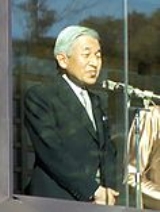
Emperor of Japan

 
Emperor of Japan

   Email Print
   Bookmark   Link


Emperor of Japan


The of Japan
Japan

Japan is an island country in East Asia. Located in the Pacific Ocean, it lies to the east of the Sea of Japan, People's Republic of China, North Korea, South Korea and Russia, stretching from the Sea of Okhotsk in the north to the East China Sea and Taiwan in the south....
 is the symbol of the state and of the unity of the Japanese people. He is the head of the Japanese Imperial Family
Imperial House of Japan

The , also referred to as the Imperial Family, or the Yamato Dynasty, comprises those members of the extended family of the reigning Emperor of Japan who undertake official and public duties....
. Under Japan's present constitution, the Emperor is the "symbol of the state and the unity of the people," and is a ceremonial figurehead in a constitutional monarchy
Constitutional monarchy

A constitutional monarchy is a form of constitutional government, where in either an elected or hereditary monarch is the head of state, unlike in an absolute monarchy, wherein the king or the queen is the sole source of political power, as he or she is not legally bound by the constitution....
 (see Politics of Japan
Politics of Japan

The politics of Japan is in a framework of a parliamentary system representative democracy monarchy, where the Prime Minister of Japan is the head of government, and of a multi-party system....
). The Emperor of Japan is the only current head of state entitled "Emperor
Emperor

An emperor is a monarch, usually the sovereign ruler of an empire or another type of imperial realm. Empress is the female equivalent. As a title, "empress" may indicate the wife of an emperor or a woman who rules in her own right ....
". The Imperial House of Japan is the oldest continuing hereditary monarchy in the world.


Discussion
Ask a question about 'Emperor of Japan'
Start a new discussion about 'Emperor of Japan'
Answer questions from other users
Full Discussion Forum


Timeline

806   Emperor Heizei succeeds Emperor Kammu as Emperor of Japan.

809   Emperor Saga succeeds Emperor Heizei as emperor of Japan.

833   Emperor Nimmyo succeeds Emperor Junna as emperor of Japan

850   Emperor Montoku succeeds Emperor Nimmyo as Emperor of Japan.

876   Emperor Seiwa is succeeded by Emperor Yozei as emperor of Japan.

884   Emperor Yozei, emperor of Japan, is deposed and succeeded by his paternal great-uncle Emperor Koko.

897   End of the reign of Emperor Uda, emperor of Japan. He is succeeded by Emperor Daigo.

946   End of the reign of Emperor Suzaku, emperor of Japan

984   End of the reign of Emperor En'yu, emperor of Japan

986   End of the reign of Emperor Kazan, emperor of Japan


Encyclopedia


The of Japan
Japan

Japan is an island country in East Asia. Located in the Pacific Ocean, it lies to the east of the Sea of Japan, People's Republic of China, North Korea, South Korea and Russia, stretching from the Sea of Okhotsk in the north to the East China Sea and Taiwan in the south....
 is the symbol of the state and of the unity of the Japanese people. He is the head of the Japanese Imperial Family
Imperial House of Japan

The , also referred to as the Imperial Family, or the Yamato Dynasty, comprises those members of the extended family of the reigning Emperor of Japan who undertake official and public duties....
. Under Japan's present constitution, the Emperor is the "symbol of the state and the unity of the people," and is a ceremonial figurehead in a constitutional monarchy
Constitutional monarchy

A constitutional monarchy is a form of constitutional government, where in either an elected or hereditary monarch is the head of state, unlike in an absolute monarchy, wherein the king or the queen is the sole source of political power, as he or she is not legally bound by the constitution....
 (see Politics of Japan
Politics of Japan

The politics of Japan is in a framework of a parliamentary system representative democracy monarchy, where the Prime Minister of Japan is the head of government, and of a multi-party system....
). The Emperor of Japan is the only current head of state entitled "Emperor
Emperor

An emperor is a monarch, usually the sovereign ruler of an empire or another type of imperial realm. Empress is the female equivalent. As a title, "empress" may indicate the wife of an emperor or a woman who rules in her own right ....
". The Imperial House of Japan is the oldest continuing hereditary monarchy in the world. In Nihonshoki it is said that the Empire of Japan was founded in 660 BC by Emperor Jimmu. The current emperor is His Imperial Majesty the Emperor Akihito
Akihito

is the current of Japan, and the 125th Emperor according to Japan's list of Emperors of Japan. He acceded to the throne in 1989, and is the List of longest reigning current monarchs monarch or lifelong leader....
, who has been on the Chrysanthemum Throne since his father Hirohito
Hirohito

, also known as , was the 124th Emperor of Japan of Japan according to the traditional order, reigning from 25 December 1926 until his death in 1989....
 died in 1989.

The role of the emperor of Japan has historically alternated between that of a supreme-rank cleric
Cleric

A cleric , clergyman , or churchman is a member of the clergy of a religion, especially one who is a priest, preacher, or other religious professional....
 with largely symbolic powers and that of an actual imperial ruler. Contrary to Western monarchs
Emperor

An emperor is a monarch, usually the sovereign ruler of an empire or another type of imperial realm. Empress is the female equivalent. As a title, "empress" may indicate the wife of an emperor or a woman who rules in her own right ....
, the role had rarely been assumed on the field since the establishment of the first shogunate. Japanese emperors have nearly always been controlled by external political forces, to varying degrees.

Since the mid-nineteenth century, the Imperial Palace has been called "Kyujo", then Kokyo
Kokyo

is the imperial main residence of the Emperor of Japan. It is a large park-like area located in Chiyoda, Tokyo close to Tokyo Station and contains various buildings such as the main palace and the private residences of the imperial family....
, and located on the former site of Edo Castle
Edo Castle

, also known as , is a flatland castle that was built in 1457 by Ota Dokan. It is located in Chiyoda, Tokyo in Tokyo, then known as Edo, Toshima District, Musashi Province....
 in the heart of Tokyo
Tokyo

, officially , is one of the 47 prefectures of Japan of Japan and located on the eastern side of the main island Honshu. The twenty-three special wards of Tokyo, each governed as a city, cover the area that was once the Tokyo City in the eastern part of the prefecture, and total over 8 million people....
. Earlier emperors resided in Kyoto
Kyoto

Sorry, no overview for this topic
 for nearly eleven centuries.

Role

Unlike most constitutional monarchies, the Emperor is not even the nominal chief executive. Rather, the Constitution of Japan
Constitution of Japan

The has been the founding legal document of Japan since 1947. The constitution provides for a parliamentary system of government and guarantees certain fundamental rights....
 explicitly vests executive power in the Cabinet
Cabinet of Japan

The is the executive branch of the government of Japan. It consists of the Prime Minister of Japan and up to fourteen other members, called Minister of State....
 and the Prime Minister
Prime Minister of Japan

The is the usual English-language term used for the head of government of Japan, although the literal translation of the Japanese name for the office is Prime Minister of the Cabinet....
. He has no reserve powers related to government. The few duties he performs are closely regulated by the constitution. For example, while formally the Emperor's duties include appointing the Prime Minister to office, the Constitution requires him to appoint the candidate "designated by the Diet
Diet of Japan

The is Japan's bicameral legislature. It is composed of a lower house, called the House of Representatives of Japan, and an upper house, called the House of Councillors....
" without being given the avenue to decline appointment. This is in marked contrast to his status under the Meiji Constitution
Meiji Constitution

The , more commonly known as the 'Imperial' or 'Meiji Constitution', was the fundamental law of the Empire of Japan from 29 November 1890 until 2 May 1947....
, which recognised the emperor as the embodiment of all sovereign power of the realm.

History

Although the emperor has been a symbol of continuity with the past, the degree of power exercised by the emperor of Japan has varied considerably throughout Japanese history.

Origin

The earliest emperor recorded in Kojiki
Kojiki

, is the oldest surviving book in Japan. The body of the Kojiki is written in Chinese language, but it includes numerous Japanese names and some phrases....
 and Nihon Shoki
Nihon Shoki

The , sometimes translated as The Chronicles of Japan, is the second oldest book of classical Japanese history of Japan. It is more elaborate and detailed than the Kojiki, the oldest, and has proven to be an important tool for historians and archaeologists as it includes the most complete extant historical record of ancient Japan....
 is Emperor Jimmu
Emperor Jimmu

; also known as: Kamuyamato Iwarebiko; given name: Wakamikenu no Mikoto or Sano no Mikoto, was the mythical founder of Japan and is the first emperor named in the traditional lists of emperors....
. The key to knowing the origin of the Japanese imperial line may lie within the ancient imperial tombs known as kofun
Kofun

are megalithic tombs or tumulus in Japan, constructed between early 3rd century and early 7th century. They gave their name to the Kofun period . Most of the Kofun have a keyhole-shaped mound , which was unique to ancient Japan....
. However, since the Meiji period
Meiji period

The , or Meiji era, denotes the 45-year reign of the Meiji Emperor, running, in the Gregorian calendar, from 23 October 1868 to 30 July 1912. During this time, Japan started its modernization and rose to world power status....
, the Imperial Household Agency
Imperial Household Agency

The is a government agency of Japan in charge of the state matters concerning Imperial Household of Japan and also keeping the Privy Seal of Japan and the State Seal of Japan....
 has refused to open the kofun to the public or to archaeologists, citing their desire not to disturb the spirits of the past emperors as justification for their refusal. But in December 2006, the Imperial Household Agency reversed its position and decided to allow researchers to enter some of the kofun with certain restrictions.

House of Fujiwara, etc.

There have been six non-imperial families who have controlled Japanese emperors: the Soga
Soga clan

The was one of the most powerful clans in Asuka period Japan and played a major role in the spread of Buddhism in that country from Korea. The Soga Clan is a descendant of Takenouchi no Sukune....
 (530s-645), the Fujiwara (850s-1070), the Taira
Taira clan

The was a major Japanese clan in historical Japan.In reference to History of Japan, along with Minamoto, Taira was a hereditary clan name bestowed by the emperors of the Heian Period to certain ex-members of the imperial family when they became subjects....
 (for a relatively short period), the Minamoto
Minamoto clan

was one of the honorary surnames bestowed by the Emperors of Japan of the Heian Period on those of their sons and grandsons who were not considered eligible for the throne....
 (and Kamakura bakufu) (1192-1333), the Ashikaga
Ashikaga shogunate

The was a feudal military dictatorship ruled by the shoguns of the Ashikaga family.This period is also known as the Muromachi period and gets its name from the Muromachi street of Kyoto where the third shogun Yoshimitsu established his residence....
 (1336-1565) and the Tokugawa
Tokugawa shogunate

The Tokugawa shogunate, also known as the , and the , was a feudalism regime of Japan established by Tokugawa Ieyasu and ruled by the shoguns of the Tokugawa family....
 (1603-1867). However, every shogun from the Minamoto, Ashikaga and Tokugawa families had to be officially recognized by the emperors, who were still the source of sovereignty, although they could not exercise their powers independently from the Shogunate.

Disputes

The growth of the samurai
Samurai

is the term for the military nobility of Pre-industrial society Japan. According to translator William Scott Wilson: "In Chinese, the character ? was originally a verb meaning to wait upon or accompany a person in the upper ranks of society, and this is also true of the original term in Japanese, saburau....
 class from the 10th century gradually weakened the power of the imperial family over the nation, leading to a time of instability. Cloistered emperors have been known to come into conflict with the reigning emperor from time to time; a notable example is the Hogen Rebellion
Hogen Rebellion

The Hogen Rebellion was a Japanese civil war fought in 1156 over Emperors of Japan succession and control of the Fujiwara Regents clan of regents....
 of 1156, in which former Emperor Sutoku
Emperor Sutoku

Emperor Sutoku was the 75th Emperor of Japan of Japan, according to the traditional order of succession. His reign spanned the years from 1123 through 1142....
 attempted to seize power from the then current Emperor Go-Shirakawa
Emperor Go-Shirakawa

Emperor Go-Shirakawa was the 77th Emperor of Japan of Japan, according to the traditional order of succession. His reign spanned the years from 1155 through 1158....
, both of whom were supported by different clans of samurai. Other instances, such as Emperor Go-Toba
Emperor Go-Toba

was the 82nd Emperor of Japan of Japan, according to the traditional order of succession. His reign spanned the years from 1183 through 1198....
's 1221 rebellion against the Kamakura shogunate
Kamakura shogunate

The Kamakura shogunate was a feudal military dictatorship in Japan headed by the shoguns from 1185 to 1333. It was based in Kamakura, Kanagawa....
 and the 1336 Kemmu Restoration
Kemmu restoration

The is the short period of Japanese history between the Kamakura period and the Muromachi period. It represents the effort made by Emperor Go-Daigo to bring the Imperial House and the nobility it represented back into power, thus restoring a civilian government after almost a century and a half of military rule....
 under Emperor Go-Daigo
Emperor Go-Daigo

Emperor Go-Daigo was the 96th Emperor of Japan of Japan, according to the traditional order of succession. Post-Meiji period historians construe the years of his reign spanning 1318 through 1339; however, pre-Meiji accounts of his reign considered the years of his reign to last only between 1318 and 1332, when he was said to have be...
, show the power struggle between the Imperial House and the military governments of Japan.

Territorial Matters

Up to recent centuries, Japan's territory did not include several remote regions of its modern-day territory. The name Nippon came into use only many centuries after the start of the current imperial line. Centralized government really only began to appear shortly before and during the time of Prince Shotoku
Prince Shotoku

, also known as , was a regent and a politician of the Asuka period in Japan. His existence, however, is disputed....
. The emperor was more like a revered embodiment of divine harmony rather than the head of an actual governing administration. In Japan it has always been easy for ambitious lords to hold actual power, as such positions have not been inherently contradictory to the emperor's position. Parliamentary government today continues a similar coexistence with the emperor as have various shoguns, regents, warlords, guardians, etc.

Historically the titles of Tenno in Japanese have never included territorial designations as is the case with many European monarchs. The position of emperor is a territory-independent phenomenon - the emperor is the emperor, even if he has followers only in one province (as was the case sometimes with the southern and northern courts).

Shoguns

From 1192 to 1867, sovereignty of the state was exercised by the shogun
Shogun

is a military rank and historical title for Hereditary Commanders in Chief of the Armed Forces of Japan. The Japanese word for "general", it is made up of two kanji characters: sho, meaning "commander", "general", or "admiral", and gun meaning military troops or warriors....
s, or their shikken
Shikken

The was the regent for the shogun in the Kamakura shogunate in Japan. The post was monopolized by the Hojo clan, and this system only existed once in Japanese history, between 1203 and 1333....
 regents (1203-1333), whose authority was conferred by Imperial warrant. When Portuguese
Portugal

Portugal , officially the Portuguese Republic , is a country on the Iberian Peninsula. Located in southwestern Europe, Portugal is the westernmost country of mainland Europe and is bordered by the Atlantic Ocean to the west and south and by Spain to the north and east....
 explorers first contacted Japan (see Nanban period), they gave analogy to the relationship between emperor and shogun to that of the Pope
Pope

The Pope is the Bishop of Rome, the leader of the Roman Catholic Church and head of state of Vatican City. The current pope is Pope Benedict XVI, who was elected April 19, 2005 in Papal conclave, 2005....
 (godly, but with little political power) and king or Holy Roman Emperor
Holy Roman Emperor

Image:HRR 14Jh.jpgThe Roman of the Emperor's title was a reflection of the translatio imperii principle that regarded the Holy Roman Emperors as the inheritors of the title of Emperor of the Western Roman Empire, a title left unclaimed in the West after the death of Julius Nepos in 480....
 (earthly, but with a relatively large amount of political power) though this in itself can be considered inaccurate as, like the Emperor, Popes have wielded varying degrees of power throughout their history. For example, the regent Toyotomi Hideyoshi
Toyotomi Hideyoshi

was a Sengoku period daimyo who unified Japan. He succeeded his former liege lord, Oda Nobunaga, and brought an end to the Sengoku period. The period of his rule is often called the Momoyama period, after Hideyoshi's castle....
 was recorded by the missionaries as "Emperor Taicosama" (from Taiko
Sessho and Kampaku

In Japan, Sessho was a title given to a regent who was named to assist either a child Emperor of Japan before his coming of age, or an Japanese empresses....
 and the honorific sama
Japanese titles

Japanese uses a broad array of honorifics for addressing or referring to people with respect. In Japanese language, these forms of address follow a person's name in the manner of a suffix....
).

Meiji restoration

The Meiji restoration was in fact a kind of revolution, with the domains of Satsuma and Choshu uniting to topple the Tokugawa Shogunate. Emperor Meiji's father, Emperor Komei
Emperor Komei

was the 121st Emperor of Japan of Japan, according to the traditional order of succession. He reigned from March 10, 1846 to January 30, 1867....
, had begun to assert himself politically after Commodore Matthew Perry's ships visited Edo. By the early 1860s, the dynamic between the imperial court and the Shogunate had changed drastically. Ironically, Komei had asserted himself against the Shogunate because he and the other nobles were upset at the failure of the Shogunate to expel the barbarian interlopers. Disaffected domains and ronin began to rally to the call of sonno joi
Sonno joi

is a Japanese political philosophy and a social movement derived from Neo-Confucianism; it became a political slogan in the 1850s and 1860s in the movement to overthrow the Tokugawa bakufu....
, or "respect the emperor, expel the barbarians." Satsuma and Choshu used this turmoil to move against their historic enemy, and won an important military victory outside of Kyoto against Tokugawa forces.

In 1868 an imperial "restoration" was declared, and the Shogunate was stripped of its powers. The new constitution officially gave executive powers to the Emperor. Article 4 prescribed that "The Emperor is the head of the Empire, combining in Himself the rights of sovereignty, and exercises them, according to the provisions of the present Constitution" while, according to article 6 "The Emperor gives sanction to laws and orders them to be promulgated and executed" and article 11, "The Emperor has the supreme command of the Army and the Navy." During the Showa era, the liaison conference created in 1937 also made the Emperor the leader of the Imperial General Headquarters
Imperial General Headquarters

The as part of the Supreme War Council was established in 1893 to coordinate efforts between the Imperial Japanese Army and Imperial Japanese Navy during wartime....
.

Addressing and naming

There are two Japanese words equivalent to the English word "emperor": tenno (??, lit. "heaven ruler"), which is used exclusively to refer to an emperor of Japan, and kotei (??, the title used for Chinese emperors), which is used primarily to describe non-Japanese emperors. Sumeramikoto (lit. "heavenly ruler above the clouds") was also used in Old Japanese
Old Japanese language

is the oldest attested stage of the Japanese language....
. The term tenno was used by the emperors up until the Middle Ages; then, following a period of disuse, it was used again from the 19th century. In English
English language

English is a West Germanic language that originated in Anglo-Saxon England and has lingua franca status in many parts of the world as a result of the military, economic, scientific, political and cultural influence of the British Empire in the 18th, 19th and early 20th centuries and that of the United States from the mid 20th century onwa...
, the term mikado (?? or ? or ???), literally meaning "Exalted (or Honorable) Gate" (i.e. the gate of the imperial place), was once used (as in The Mikado
The Mikado

The Mikado or, The Town of Titipu is a comic opera in two acts, with music by Arthur Sullivan and libretto by W. S. Gilbert, their ninth of fourteen Gilbert and Sullivan....
, a 19th century operetta
Operetta

Operetta is a genre of light opera, light in terms both of music and subject matter. It is also closely related, in English-language works, to forms of musical theatre....
), but this term is now obsolete. (Compare Sublime Porte, an old term for the Ottoman government, and Pharaoh
Pharaoh

Pharaoh is a title used in many modern discussions of the ancient Egyptian rulers of all periods. In antiquity this title began to be used for the ruler who was the religious and political leader of united ancient Egypt, only during the New Kingdom, specifically, during the middle of the Eighteenth dynasty of Egypt....
, meaning "Great House").

Traditionally, the Japanese considered it disrespectful to call any person his given name and more so for person of noble rank. This convention is more relaxed in modern age and now it is acceptable among friends to use first name but use of family name is still common. In case of imperial family, it is still unacceptable. Since Emperor Meiji, it has been customary to have one era per emperor and to rename each emperor after his death using the name of the era over which he presided, plus the word Tenno. Prior to Emperor Meiji
Emperor Meiji

The or Meiji the Great was the 122nd Emperor of Japan of Japan according to the traditional order of succession, reigning from 3 February 1867 until his death....
, the names of the eras were changed more frequently, and the posthumous names of the emperors were chosen in a different manner.

Outside of Japan, beginning with Emperor Showa, the emperors are often referred to by their given names, both whilst alive and posthumously. For example, the previous emperor is usually called Hirohito
Hirohito

, also known as , was the 124th Emperor of Japan of Japan according to the traditional order, reigning from 25 December 1926 until his death in 1989....
 in English, although he was never referred to as Hirohito in Japan and was renamed Showa Tenno after his death, which is the only name that Japanese speakers currently use when referring to him.

The current emperor on the throne is typically referred to by the title Tenno Heika (????, lit. "His Majesty the Emperor") or Kinjo Heika (????, lit. "his current majesty") when speaking Japanese. Other terms used to refer to the emperor in Japanese include Heika and Okami, but these are much less typical than Tenno Heika or Kinjo Heika in ordinary conversation. The current emperor will be renamed Heisei Tenno (????, lit. "Heisei Emperor") after his death and will then be referred to exclusively by that name in Japanese. Non-Japanese speakers typically refer to him now as Akihito, or Emperor Akihito, and will likely continue to do so after his death.

Origin of the title

The ruler of Japan was known as either ????/?? (Yamato-okimi, Grand King of Yamato
Yamato Province

was a Provinces of Japan of Japan, located in Kinai, corresponding to present-day Nara Prefecture in Honshu. It was also called . At first, the name was written with one different character , and for about ten years after 737, this was revised to use more desirable characters ....
), ??/??? (Wa-o/Wakoku-o, King of Wa, used externally), or ????? (ame-no-shita shiroshimesu okimi or sumera no mikoto, Grand King who rules all under heaven, used internally) in Japanese and Chinese sources prior to the 7th century. The oldest documented use of the word "tenno" is on a wooden slat, or mokkan, that was unearthed in Asuka-mura, Nara Prefecture
Asuka, Nara

is a villages of Japan located in Takaichi District, Nara, Nara Prefecture, Japan.As of September 1, 2007, the village has an estimated population of 6,146 and a population density of 255.23 persons per km?....
 in 1998 and dated back to the reign of Emperor Temmu
Emperor Temmu

was the 40th emperor of Japan, according to the traditional order of succession. He ruled from 672 until his death in 686....
 and Empress Jito
Empress Jito

was the 41st Emperors of Japan of Japan, according to the traditional order of succession. She was the fourth woman to ascend the Chrysanthemum Throne....
.

Marriage traditions

Throughout history, contrary to any sort of harem
Harem

Harem refers to the sphere of women in a usually polygyny household and their quarters which is enclosed and forbidden to men. It originated in the Near East and came to the Western world via the Ottoman Empire....
 practice of not recognizing a chief wife and just keeping an assortment of female chattel, Japanese emperors and noblemen appointed the position of chief wife.

The Japanese imperial dynasty consistently practiced official polygamy
Polygamy

The term polygamy is used in related ways in social anthropology, sociobiology, and sociology. Polygamy can be defined as any "Types of marriages in which a person [has] more than one spouse."...
, a practice that only ended in the Taisho period
Taisho period

The , or Taisho era, is a period in the history of Japan dating from July 30, 1912 to December 25, 1926, coinciding with the reign of the Taisho Emperor....
 (1912-1926). Besides the empress, the emperor could take, and nearly always took, several secondary consorts ("concubines") of various hierarchical degrees. Concubines were allowed also to other dynasts (shinno, o). After a decision decreed by Emperor Ichijo
Emperor Ichijo

Emperor Ichijo was the 66th Emperor of Japan of Japan, according to the traditional order of succession. He ruled from 986 to 1011....
, some emperors even had two empresses simultaneously (kogo
KOGO

KOGO is a talk radio radio station in San Diego, California. One of seven San Diego owned and operated Clear Channel Communications radio stations, KOGO's main focus is local and radio syndication talk shows....
 and chugu are the two separate titles for that situation). With the help of all this polygamy, the imperial clan thus was capable of producing more offspring. (Sons by secondary consorts were usually recognized as imperial princes, too, and could be recognized as heir to the throne if the empress did not give birth to an heir.)

Of the eight female tenno (reigning empress) of Japan, none married or gave birth after ascending the throne. Some of them, being widows, had produced children prior to their reigns.

In the succession, children of the empress were preferred over sons of secondary consorts. Thus it was significant which quarters had preferential opportunities in providing chief wives to imperial princes, i.e. supplying future empresses.

Apparently the oldest tradition of official marriages within the imperial dynasty were marriages between dynasty members, even half-siblings or uncle and niece. Such marriages were deemed to preserve better the imperial blood or were aimed at producing children symbolic of a reconciliation between two branches of the imperial dynasty. Daughters of others than imperials remained concubines, until Emperor Shomu
Emperor Shomu

Emperor Shomu was the 45th Emperor of Japan of Japan, according to the traditional order of succession. His reign spanned the years 724 through 749....
--in what was specifically reported as the first elevation of its kind--elevated his Fujiwara consort to chief wife.

Japanese monarchs have been, as much as others elsewhere, dependent on making alliances with powerful chiefs and other monarchs. Many such alliances were sealed by marriages. The specific feature in Japan has been the fact that these marriages have been soon incorporated as elements of tradition which controlled the marriages of later generations, though the original practical alliance had lost its real meaning. A repeated pattern has been an imperial son-in-law under the influence of his powerful non-imperial father-in-law.

Beginning from the 7th and 8th centuries, emperors primarily took women of the Fujiwara clan as their highest wives - the most probable mothers of future monarchs. This was cloaked as a tradition of marriage between heirs of two kami
Kami

is the Japanese language word for the spirits within objects in the Shinto faith. The oldest surviving record of their creation is in the Kojiki of 712....
s, Shinto
Shinto

is the former state religion of Japan and remains the most common name for the nation's non-Buddhist ethnic religion practices. It was formed from disparate local mythologies, beginning with the Kojiki of 712, into an imperial cult called State Shinto that solidified in the Meiji period....
 gods: descendants of Amaterasu
Amaterasu

, or is in Japanese mythology a Solar deity and perhaps the most important Shinto . Her name, Amaterasu, means literally " illuminates Heaven"....
 with descendants of the family kami of the Fujiwara. (Originally, the Fujiwara were descended from relatively minor nobility, thus their kami is an unremarkable one in the Japanese myth world.) To produce imperial children, heirs of the nation, with two-side descent from the two kamis, was regarded as desirable - or at least it suited powerful Fujiwara lords, who thus received preference in the imperial marriage market. The reality behind such marriages was an alliance between an imperial prince and a Fujiwara lord, his father-in-law or grandfather, the latter with his resources supporting the prince to the throne and most often controlling the government. These arrangements created the tradition of regents (Sessho and Kampaku
Sessho and Kampaku

In Japan, Sessho was a title given to a regent who was named to assist either a child Emperor of Japan before his coming of age, or an Japanese empresses....
), with these positions allowed to be held only by a Fujiwara sekke lord.

Earlier, the emperors had married women from families of the government-holding Soga
Soga clan

The was one of the most powerful clans in Asuka period Japan and played a major role in the spread of Buddhism in that country from Korea. The Soga Clan is a descendant of Takenouchi no Sukune....
 lords, and women of the imperial clan itself, i.e. various-degree cousins and often even their own sisters (half-sisters). Several imperials of the 5th and 6th centuries were children of a couple of half-siblings. These marriages often were alliance or succession devices: the Soga lord ensured the domination of a prince, to be put as puppet to the throne; or a prince ensured the combination of two imperial descents, to strengthen his own and his children's claim to the throne. Marriages were also a means to seal a reconciliation between two imperial branches.

After a couple of centuries, emperors could no longer take anyone from outside such families as primary wife, no matter what the expediency of such a marriage and power or wealth brought by such might have been. Only very rarely was a prince without a mother of descent from such families allowed to ascend the throne. The earlier necessity and expediency had mutated into a strict tradition that did not allow for current expediency or necessity, but only dictated that daughters of a restricted circle of families were eligible brides, because they had produced eligible brides for centuries. Tradition had become more forceful than law.

Fujiwara women were often Empresses, and concubines came from less exalted noble families. In the last thousand years, sons of an imperial male and a Fujiwara woman have been preferred in the succession.

The five Fujiwara families, Ichijo, Kujo, Nijo, Konoe and Takatsukasa, were the primary source of imperial brides from the 8th century to the 19th century, even more often than daughters of the imperial clan itself. Fujiwara daughters were thus the usual empresses and mothers of emperors.

The acceptable source of imperial wives, brides for the emperor and crown prince, were even legislated into the Meiji
Meiji period

The , or Meiji era, denotes the 45-year reign of the Meiji Emperor, running, in the Gregorian calendar, from 23 October 1868 to 30 July 1912. During this time, Japan started its modernization and rose to world power status....
-era imperial house laws (1889), which stipulated that daughters of Sekke (the five main branches of the higher Fujiwara) and daughters of the imperial clan itself were primarily acceptable brides.

Since that law was repealed in the aftermath of World War II
World War II

World War II, or the Second World War , was a global military conflict which involved a Participants in World War II, including all of the great powers, organised into two opposing military alliances: the Allies of World War II and the Axis powers....
, the present Emperor Akihito became the first crown prince for over a thousand years to have an empress outside the previously eligible circle.

Succession

The Japanese imperial dynasty bases its position in the expression that it has reigned "since time immemorial
Time immemorial

Time immemorial is a phrase meaning time extending beyond the reach of memory, record, or tradition. The implication is that the subject referred to is, or can be regarded as, indefinitely ancient....
". It is true that its origins are buried under mists of time: there are no records to show an existence of any early emperor who is known to have not been a descendant of other, yet earlier emperors. There is suspicion that Emperor Keitai
Emperor Keitai

Keitai , also known as Keitai okimi, was the 26th emperor of Japan, according to the traditional order of succession. No firm dates can be assigned to this emperor's life or reign....
 (flourished in the early 500s B.C.) may have been an unrelated outsider, though the sources state that he was a male-line descendant of Emperor Ojin
Emperor Ojin

was the 15th imperial ruler of Japan, according to the traditional order of succession. No firm dates can be assigned to this emperor's life or reign....
. However, his descendants, including his successors, were according to records descended from from at least one and probably several imperial princesses of the older lineage. The tradition built by those legends has chosen to recognize just the putative male ancestry as valid for legitimizing his succession, not giving any weight to ties through the said princesses. Millennia ago, the Japanese imperial family developed its own peculiar system of hereditary succession. It has been non-primogenitural, more or less agnatic, based mostly on rotation. Today, Japan uses strict agnatic primogeniture
Primogeniture

Primogeniture is the common law right of the firstborn son to inherit the entire Estate , to the exclusion of younger siblings. It is the tradition brought by the Normans to England in 1066....
 - in other words, pure Salic law
Salic law

Salic law was an important body of traditional law codified for governing the Salian Franks in the early Middle Ages during the reign of King Clovis I in the 6th century....
. It was adopted from Prussia
Prussia

Prussia was, most recently, a historic state originating out of the Duchy of Prussia and the Margraviate of Brandenburg. This state had for centuries substantial influence on Germany and European history....
, by which Japan was greatly influenced in the 1870s.

Strict agnatic primogeniture is, however, directly contradictory to several old Japanese traditions of imperial succession.

The controlling principles and their interaction were apparently very complex and sophisticated, leading to even idiosyncratic outcomes. Some chief principles apparent in the succession have been:
  • Women were allowed to succeed (but there existed no known children of theirs whose father did not also happen to be an agnate of the imperial house, thus there is neither a precedent that a child of an imperial woman with a non-imperial man could inherit, nor a precedent forbidding it of children of empresses). However, female accession was clearly much more rare than male.
  • Adoption was possible and a much used way to increase the number of succession-entitled heirs (however, the adopted child had to be a child of another member agnate of the imperial house).
  • Abdication was used very often, and in fact occurred more often than death on the throne. In those days, the emperor's chief task was priestly (or godly), containing so many repetitive rituals that it was deemed that after a service of around ten years, the incumbent deserved pampered retirement as an honored former emperor.
  • Primogeniture
    Primogeniture

    Primogeniture is the common law right of the firstborn son to inherit the entire Estate , to the exclusion of younger siblings. It is the tradition brought by the Normans to England in 1066....
     was not used - rather, in the early days, the imperial house practised something resembling a system of rotation. Very often a brother (or sister) followed the elder sibling even in the case of the predecessor leaving children. The "turn" of the next generation came more often after several individuals of the senior generation. Rotation went often between two or more of the branches of the imperial house, thus more or less distant cousins succeeded each other. Emperor Go-Saga
    Emperor Go-Saga

    Emperor Go-Saga was the 88th Emperor of Japan of Japan, according to the traditional order of succession. This reign spanned the years 1242 through 1246....
     even decreed an official alternation between heirs of his two sons, which system continued for a couple of centuries (leading finally to shogun-induced (or utilized) strife between these two branches, the "southern" and "northern" emperors). Towards the end, the alternates were very distant cousins counted in degrees of male descent (but all that time, intermarriages occurred within the imperial house, thus they were close cousins if female ties are counted). During the past five hundred years, however, probably due to Confucian
    Confucianism

    Confucianism is a China Ethics and Philosophy developed from the teachings of the Chinese philosopher Confucius . It focuses on human morality and right action....
     influence, inheritance by sons - but not always, or even most often, the eldest son - has been the norm.


Historically, the succession to Japan's Chrysanthemum Throne has always passed to descendants in male line from the imperial lineage. Generally they have been males, though of the over one hundred monarchs there have been nine women (one pre-historical and eight historical) as Emperor on eleven occasions. See of the Yamato dynasty.

Over a thousand years ago, a tradition started that an emperor should ascend relatively young. A dynast who had passed his toddler years was regarded suitable and old enough. Reaching the age of legal majority was not a requirement. Thus, a multitude of Japanese emperors have ascended as children, as young as 6 or 8 years old. The high-priestly duties were deemed possible for a walking child. A reign of around ten years was regarded a sufficient service. Being a child was apparently a fine property, to endure tedious duties and to tolerate subjugation to political power-brokers, as well as sometimes to cloak the real powerful members of the imperial dynasty. Almost all Japanese empresses and dozens of emperors abdicated, and lived the rest of their lives in pampered retirement, wielding influence behind the scenes. Several emperors abdicated to their entitled retirement while still in their teens. These traditions show in Japanese folklore, theater, literature and other forms of culture, where the emperor is usually described or depicted as an adolescent.

Before the Meiji Restoration
Meiji Restoration

The , also known as the Meiji Ishin, Revolution, or Renewal, was a chain of events that led to enormous changes in Japan's political and social structure....
, Japan had eleven reigns of female tenno
Japanese imperial succession controversy

The Japanese imperial succession controversy refers to desires to change the laws of succession to the Japanese Imperial Throne, which is currently limited to males of the imperial family....
, or reigning empresses, all of them daughters of the male line of the Imperial House. None ascended purely as a wife or as a widow of an emperor. Imperial daughters and granddaughters, however, usually ascended the throne as a sort of a "stop gap" measure - if a suitable male was not available or some imperial branches were in rivalry so that a compromise was needed. Over half of Japanese empresses and many emperors abdicated once a suitable male descendant was considered to be old enough to rule (just past toddlerhood, in some cases). Four empresses, Empress Suiko
Empress Suiko

=GenealogyBefore her ascension to the Chrysanthemum Throne, her personal name was Mikekashiya-hime-no-mikoto., also called Toyomike Kashikiya hime no Mikoto....
, Empress Kogyoku
Empress Kogyoku

Empress Kogyoku , also Empress Saimei was the 35th and 37th sovereign empress of Japan, according to the traditional order of succession....
 (also Empress Saimei) and Empress Jito
Empress Jito

was the 41st Emperors of Japan of Japan, according to the traditional order of succession. She was the fourth woman to ascend the Chrysanthemum Throne....
, as well as the mythical empress Jingu kogo, were widows of deceased emperors and princesses of the blood imperial in their own right. One, Empress Gemmei
Empress Gemmei

was the 43rd Emperor of Japan of Japan, according to the traditional order of succession. This sovereign is sometimes identified as Empress Genmyo....
, was the widow of a crown prince and a princess of the blood imperial. The other four, Empress Gensho
Empress Gensho

Empress Gensho was the 44th imperial ruler of Japan, according to the traditional order of succession. She was the sixth woman to ascend the Chrysanthemum Throne....
, Empress Koken
Empress Koken

Empress Shotoku was both the 46th and the 48th Emperors of Japan of Japan, according to the traditional order of succession. The period in which she was the reigning sovereign stretched from 749 through the year of her death in 770....
 (also Empress Shotoku), Empress Meisho
Empress Meisho

Empress Meisho was the 109th Emperor of Japan of Japan, according to the traditional order of succession. She was the seventh woman to ascend the Chrysanthemum Throne....
 and Empress Go-Sakuramachi
Empress Go-Sakuramachi

Empress Go-Sakuramachi was the 117th Emperor of Japan of Japan, according to the traditional order of succession. She is the last woman ever to reign as Empress regnant, out of eight in the history of Japan....
, were unwed daughters of previous emperors. None of these empresses married or gave birth after ascending the throne.

Article 2 of the 1889 Meiji Constitution
Meiji Constitution

The , more commonly known as the 'Imperial' or 'Meiji Constitution', was the fundamental law of the Empire of Japan from 29 November 1890 until 2 May 1947....
 (the Constitution of the Empire of Japan) stated, "The Imperial Throne shall be succeeded to by imperial male descendants, according to the provisions of the Imperial House Law." The 1889 Imperial Household Law fixed the succession on male descendants of the imperial line, and specifically excluded female descendants from the succession. In the event of a complete failure of the main line, the throne would pass to the nearest collateral branch, again in the male line. If the empress did not give birth to an heir, the emperor could take a concubine, and the son he had by that concubine would be recognized as heir to the throne. This law, which was promulgated on the same day as the Meiji Constitution
Meiji Constitution

The , more commonly known as the 'Imperial' or 'Meiji Constitution', was the fundamental law of the Empire of Japan from 29 November 1890 until 2 May 1947....
, enjoyed co-equal status with that constitution.

Article 2 of the Constitution of Japan
Constitution of Japan

The has been the founding legal document of Japan since 1947. The constitution provides for a parliamentary system of government and guarantees certain fundamental rights....
, promulgated in 1947 by influence of the US occupation administration and still in force, provides that "The Imperial Throne shall be dynastic and succeeded to in accordance with the Imperial Household Law passed by the Diet." The Imperial Household Law
Imperial Household Law

is a statute in Japanese law that governs the line of imperial succession, the membership of the Imperial House of Japan, and several other matters pertaining to the administration of the Imperial Household....
 of 16 January 1947, enacted by the ninety-second and last session of the Imperial Diet, retained the exclusion on female dynasts found in the 1889 law. The government of Prime Minister Yoshida Shigeru hastily cobbled together the legislation to bring the Imperial Household in compliance with the American-written Constitution of Japan
Constitution of Japan

The has been the founding legal document of Japan since 1947. The constitution provides for a parliamentary system of government and guarantees certain fundamental rights....
 that went into effect in May 1947. In an effort to control the size of the imperial family, the law stipulates that only legitimate male descendants in the male line can be dynasts; that imperial princes and princesses lose their status as Imperial Family members if they marry outside the Imperial Family; and that the Emperor and other members of the Imperial Family may not adopt children. It also prevented branches, other than the branch descending from Taisho, from being imperial princes any longer.

Current status
Succession is now regulated by laws passed by the Japanese Diet
Diet of Japan

The is Japan's bicameral legislature. It is composed of a lower house, called the House of Representatives of Japan, and an upper house, called the House of Councillors....
. The current law excludes women from the succession. A change to this law had been considered until Princess Kiko
Princess Akishino

, formerly is the wife of Prince Akishino, who is the second son of the Akihito and the Empress Michiko of Japan of Japan. The daughter of a university professor, she became the second commoner to marry into the imperial family; her mother-in-law, the Empress, was the first in 1959....
 gave birth to a son
Prince Hisahito of Akishino

, currently third in line to the Japanese throne, is the third child of the Prince Akishino and Princess Akishino, and their first son.He was born at 8:27 a.m....
.

Until the birth of Prince Hisahito
Prince Hisahito of Akishino

, currently third in line to the Japanese throne, is the third child of the Prince Akishino and Princess Akishino, and their first son.He was born at 8:27 a.m....
, son of Prince Akishino
Prince Akishino

Fumihito, Prince Akishino is a member of the Imperial Household of Japan. He is the second son of the Emperor Akihito and the Empress Michiko and currently second in line to the Chrysanthemum throne....
, on September 6, 2006, there was a potential succession
Order of succession

An order of succession is a formula or algorithm that determines who inherits an office upon the death, resignation, or removal of its current occupant....
 problem, since Prince Akishino was the only male child to be born into the imperial family since 1965. Following the birth of Princess Aiko
Aiko, Princess Toshi

, born December 1, 2001, is the first child of Their Imperial Highnesses Naruhito, Crown Prince of Japan, heir apparent to the Japanese throne, and Masako, Crown Princess of Japan....
, there was some public debate about amending the current Imperial Household Law to allow women to succeed to the throne. This creates a logistical challenge as well as political: any change in the law would most likely mean a revision to allow the succession of the first born rather than the first-born son; however, the current emperor is not the first born--he has elder sisters. In January 2005 Prime Minister Junichiro Koizumi
Junichiro Koizumi

is a Japanese politician who served as Prime Minister of Japan of Japan from 2001 to 2006. He is going to retire from politics when his term in parliament ends....
 appointed a special panel composed of judges, university professors, and civil servants to study changes to the Imperial Household Law and to make recommendations to the government.

The panel dealing with the succession issue recommended on October 25, 2005 amending the law to allow females of the male line of imperial descent to ascend the Japanese throne. On January 20, 2006, Prime Minister
Prime minister

A prime minister is the most senior minister of Cabinet in the Executive branch of government in a parliamentary system. The position is usually held by, but need not always be held by, a politician....
 Junichiro Koizumi
Junichiro Koizumi

is a Japanese politician who served as Prime Minister of Japan of Japan from 2001 to 2006. He is going to retire from politics when his term in parliament ends....
 devoted part of his annual keynote speech to the controversy, pledging to submit a bill allowing women to ascend the throne to ensure that the succession continues in the future in a stable manner. However, shortly after the announcement that Princess Kiko
Princess Akishino

, formerly is the wife of Prince Akishino, who is the second son of the Akihito and the Empress Michiko of Japan of Japan. The daughter of a university professor, she became the second commoner to marry into the imperial family; her mother-in-law, the Empress, was the first in 1959....
 was pregnant with her third child, Koizumi suspended such plans. Her son, Prince Hisahito
Prince Hisahito of Akishino

, currently third in line to the Japanese throne, is the third child of the Prince Akishino and Princess Akishino, and their first son.He was born at 8:27 a.m....
, is the third in line to the throne under the current law of succession. On January 3, 2007, Prime Minister
Prime minister

A prime minister is the most senior minister of Cabinet in the Executive branch of government in a parliamentary system. The position is usually held by, but need not always be held by, a politician....
 Shinzo Abe
Shinzo Abe

was the 90th Prime Minister of Japan, elected by a special session of the Diet of Japan on 26 September 2006. He was Japan's youngest post-World War II prime minister and the first born after the war....
 announced that he would drop the proposal to alter the Imperial Household Law
Imperial Household Law

is a statute in Japanese law that governs the line of imperial succession, the membership of the Imperial House of Japan, and several other matters pertaining to the administration of the Imperial Household....
.

See also

  • Controversies regarding the role of the Emperor of Japan
    Controversies regarding the role of the Emperor of Japan

    There have been several controversies regarding the role and the status of the Emperor of Japan. This is due in part to the variety of roles the Emperor has historically filled, as well as the competition for power with other parts of Japanese society at several points in history....
  • Shogun
    Shogun

    is a military rank and historical title for Hereditary Commanders in Chief of the Armed Forces of Japan. The Japanese word for "general", it is made up of two kanji characters: sho, meaning "commander", "general", or "admiral", and gun meaning military troops or warriors....
  • Bakufu
  • Cloistered rule
    Cloistered rule

    The Insei system , or cloistered rule, was a specific form of government in Japan, in which the Tenno abdicated, but kept exerting power and influence....
  • History of Japan
    History of Japan

    The written history of Japan begins with brief references of Twenty-Four Histories, a collection of Chinese historical texts, in the 1st century AD....
  • List of Emperors of Japan
    List of Emperors of Japan

    The following is a traditional list of Emperor of Japan. Dates for the first 28 emperors, and especially the first 16, are based on the Japanese era name system....
  • Lists of incumbents
  • Imperial Household of Japan
  • Ningen-sengen
    Ningen-sengen

    On January 1, 1946, the Hirohito issued the and the , commonly known collectively as the ....
  • Japanese Imperial succession controversy
    Japanese imperial succession controversy

    The Japanese imperial succession controversy refers to desires to change the laws of succession to the Japanese Imperial Throne, which is currently limited to males of the imperial family....
  • Japanese nationalism
    Japanese nationalism

    encompasses a broad range of ideas and sentiments harbored by the Japanese people over the last two centuries regarding their native country, its cultural nature, political form and historical destiny....
  • Imperial Regalia of Japan
    Imperial Regalia of Japan

    The , also known as the Three Sacred Treasures of Japan, consist of the sword, Kusanagi , the gemstone or necklace of jewels, Magatama#Yasakani no Magatama , and the mirror Yata no kagami ....
  • Tenno beach
    Tenno Beach

    Tenno Beach, or Emperor Beach, is located on the southeast side of the Izu peninsula, Japan. Together with the country-house and garden, owned by the family of the Emperor of Japan, it covers several tens of square kilometers....


External links

  • , accompanied with the regents and shoguns during their reign and a genealogical tree of the imperial family
  • , explanation of the title of emperor in the context of western terminology