Speyer

Encyclopedia
Speyer is a city of Rhineland-Palatinate
, Germany with approximately 50,000 inhabitants. Located beside the river Rhine, Speyer is 25 km south of Ludwigshafen and Mannheim
. Founded by the Roman
s, it is one of Germany's oldest cities. The first known names were Noviomagus and Civitas Nemetum, after the Teutonic tribe, Nemetes
, settled in the area. Around the year 500 the name Spira first appeared in written documents. Spire, Spira, and Espira are still names used for Speyer in the French, Italian, and Spanish languages.
Speyer is dominated by the Speyer Cathedral
, a number of churches and the Altpörtel (old gate). In the cathedral, beneath the high altar, are the tombs of eight Holy Roman emperors and German kings.
, 20 km downstream. The Neckar valley stretches southeast towards the Danube
. To the west, the low hills between the Palatinate Forest and Hunsrück
mountains made for easy access in the direction of modern-day Kaiserslautern
and beyond. Several ferries across the Rhine near Speyer in the medieval era bear witness to its importance as a crossroads.
 5,000-year-old evidence of permanent agricultural settlements around Speyer shows that these advantages did not escape the attention of Neolithic
, Bronze Age
, Hallstatt culture
and La Tène culture
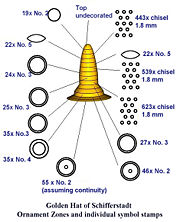
peoples. One of the most renowned finds from around 1500 BC is the Golden Hat of Schifferstadt
, discovered in a field about 10 km northwest of Speyer, and now on display in the Historical Museum of Speyer. In the second millennium BC, the area of Speyer was settled by the Celtic Mediomatrici
. A Celtic grave from around 50 – 20 BC was unearthed in Johannesstrasse. It is considered to be exceptional because Celtic grave sites were very rare in the Palatinate and Upper Rhine area at the time it was made.
by the Romans in 50 B.C. the Rhine became part of the border of the Roman Empire
. The Romans erected camps and forts along the river from the Alps
down to the North Sea
. One of these camps was at Speyer, built around 10 BC for a 500-man–strong infantry group and also intended as a base for further conquests on the east side of the Rhine. The decisive factor for the location were the wedge-shaped high river banks, of which the tip pointed far east into the floodplain
of the Rhine. Thus a settlement safe from floods became possible right by the river. Due to the river's extensive meandering such possibilities were very rare between Basel and Mainz. The first fort was erected in the eastern section of the Maximilianstrasse between the Kleine Pfaffengasse and the Grosse Himmelsgasse. The southern moat was located along the Kleine Pfaffengasse.
With the consent of the Romans under Emperor Augustus
the Germanic tribe of Nemetes
settled in the region of Speyer; other Germanic tribes from across the Rhine, the Vangiones
and Triboci
settled in the neighbouring regions of Rheingau and Alsace
.
The first fort was soon replaced by a second one around 10 B.C., its northern wall corresponding with the former southern wall of the old fort. Remains of this fort were found in the Jewish quarter. Its southern wall is assumed to have bordered directly at the edge of the high bank, along which, in those days, the Rhine was flowing. To the west and to the north the fortifications were made of a system of walls and moats. The erection of the second fort corresponds with the reorganization of the Roman Rhine frontier after the disaster in the Battle of the Teutoburg Forest
.The vicinity to the east and west of the forts attracted civilian settlements (Vicus
) which were the impetus for the development of Speyer as a town. The main vicus stretched to the west from Herdstrasse probably as far as Zeppelinstrasse and a smaller one in the east in the area south of the cathedral. As of 30 A.D. there were a number of representative buildings forming a "U" like a market forum, indicating that the vicus very likely already had market rights (ius nundinarum).
 Around the same time a third fort was built a little further inland from the Rhine between the middle-section of Maximilianstrasse and Ludwigstrasse. The reason might have been a flood, lack of space or the need for a renewal. It seems that this last fort was considerably larger the two former ones. This fort existed at least until 74 when the auxiliary troops were moved into the newly conquered territories east of the Rhine. Speyer was no longer a border post and lost its military significance. As of 83 it was part of the Roman province of Germania superior
. The fort was given up, the vicus was granted self government and became the capital of the Nemetes area, ‘Civitas Nemetum’, covering the western Rhine plain of the Palatinate and northern Alsace. Around AD 150, the town appeared as Noviomagus (New field) on the world map of the Greek Claudius Ptolemaios
. The same name is mentioned at the beginning of the 3rd century in the Antonine Itinerary
, a road handbook of the Roman Empire and on the Tabula Peutingeriana
, a road map from the 3rd century. The name can also be found on milestones along the Rhine. A representative town and an administrative regional centre emerged at a central point of the Roman Rhine valley road. Two main streets crossed in the centre of Speyer. The decumanus, (east-west-street) was 6 – 8 m wide, leading from the cathedral area along today’s Kleine Pfaffengasse past the Königsplatz further to the west. Its whole length was lined with colonnade
s. A second main street started around the Hagedorngasse and crossed the decumanus south of today’s Kaufhof (department store). Strong foundations found in the area of the Königsplatz are considered to be remnants of a forum
with a temple. The size of a part of a Jupiter (mythology)
pillar is similar to a large pillar found in Mainz. Other findings show there was a market place, wide, public buildings, living quarters, temples and a theatre. It is practically impossible to do any digging below street level without hitting on remnants of this era. The numerous finds, for example the oldest preserved and still sealed wine bottle in Germany, can be seen in the Museum of Palatinate History(Historisches Museum der Pfalz).
The economic basis for Speyer’s bishops were their possessions, substantial estates, customs and ferry levies as well as the prerogative of coinage received in the 10th century. The immunity privilege granted to church and bishops in 969 by Emperor Otto the Great and confirmed by Henry IV in 1061 placed Speyer under the protection, control and rule of the bishops. The year 1024 marked a decisive event in the history of the town. In Oppenheim near Mainz
Konrad II
, a Salian from the Speyer district (see Salian emperors
), was elected king of Germany, drawing Speyer into the centre of imperial politics and making it the spiritual centre of the Salian kingdom.
Nothing more could express this importance than the construction of the cathedral. The laying of the foundation stone was the decisive impetus for the further development of the town. The cathedral was consecrated in 1061 although only completed in 1111. It was the largest church of its time and, in its monumentality and significance, symbolized Imperial power and Christianity. It became the burial place of eight German Emperors and Kings. With the Abbey of Cluny in ruins, the Speyer Cathedral
remains the largest Romanesque church to this very day.
A number of events, decisions and meetings in the following centuries underlined the significance of Speyer in the history of medieval Europe: Henry IV
’s departure for Canossa in 1077, the preachings of Bernard of Clairvaux
and the beginning of the Second Crusade
at Christmas 1141, the extradition of Richard the Lionheart to Henry VI in 1193 or Frederick II
’s first journey through Germany in the year 1213.
In 1294 the Emperor granted Speyer the rights of free imperial city
, ending the rule of the bishops.
emerged in Speyer at the instigation of the bishop, though Jews believe they were there since pre-Christian times. In 1084 Bishop Rudiger Huzmann invited Jews to move to Speyer and settled them in the former suburb of Altspeyer (the area of today's train station) which he had surrounded by a wall for their protection. Along with this invitation the bishop granted the Jews rights and privileges which went well beyond contemporary practice. They were confirmed by Emperor Henry IV in 1090 and became an example for Jews' privileges in many cities of the empire. A Jewish quarter soon also developed next to the bishops’ district near the cathedral. Its centre, the Jews’ Court (Judenhof), contained men’s and women’s synagogue and the mikveh. The ruins of the Speyer Synagogue are the oldest visible remnants of such a building in central Europe. The mikveh, first mentioned in 1126, has remained almost unchanged to this day and is still supplied by fresh groundwater
.
For two centuries the Speyer Jewish community was among the most important of the Empire and, in spite of pogroms, persecution and expulsion, had considerable influence on Ashkenazi culture
and the spiritual and cultural life of the town. Nevertheless, anti-Semitism
and persecution was no less virulent in Speyer than in other places and the Jewish community shared the fate of most others.
The Yiddish
surnames of Spira
, Shapira
and Shapiro
possibly derive from Shpira (שפירא), the Hebrew name of Speyer.
in the 1st century AD Speyer was no longer a border town. Flourishing times for Speyer continued after the collapse of the Danube border between 166 and 170 in spite of increasing incursions by Germanic tribes across the Limes. For a while the Romans managed to ward off the attacks of the Alemanni which first appeared in 213.
But as of 260 the Limes could no longer contain the constant onslaught of the Alemanni. The Romans retreated back across the Rhine; Speyer once more became a border town and took in people fleeing from the east. The Alemanni managed to cross the Rhine repeatedly, usually in winter, and in a raid in 275 the town was all but destroyed. Traces of the fires are still visible on excavation sites but it is not known what happened to the population. In 286 Diocletian
had the northern provinces reorganized; civil and military administration were separated and settlements rebuilt.
By the 4th century AD the settlement had recovered and a garrison was established. In 352 the Alemanni led by Chnodomar attacked along the whole Rhine front and conquered the territory to the west of the river. The Romans under Constantine II
and Julian
re-established the Rhine border in a the campaigns of 355. Yet the raids of the Alemanni continued. The settlement was not rebuilt. Instead, Valentinian I
had the Rhine frontier fortified and small units, each with their own names, posted in garrisons along the river. In Speyer this happened at least by 369 and it was now called Nemetae. The troops posted in Speyer are listed in a military handbook (notitia dignitatum) as Vindices and the garrison remained at least until 422/423. As a refuge for the inhabitants a stronghold was built on the cathedral hill around 370 with walls 2.5 m strong. Its northern section ran parallel to the northern side of the later cathedral. The southern section corresponded with the outline of the high banks of the Rhine, today the southern wall of the historical museum where a harbour was constructed. During excavations in the 1980s remnants of boats were found there. Other findings within the fortified area indicate that an early Christian community existed within these walls. A first Bishop of Speyer is mentioned for the year 343. The grave sites found in the area indicate that the population outside the fort was still heathen. It also seems that some Alemanni were allowed to settle in the area with the consent of the Romans.
In the beginning of the 5th century AD the whole Roman Rhine border disintegrated under the onslaught of Germanic tribes pushing across the river. In 406, pursued by Huns
, Germanic Suebi
, Vandals
and Sarmatian
Alans
set over
the river and also overran Speyer on their way into Gaul
. A richly endowed grave of a prince found in Altlussheim near Speyer attests to the presence of Alans, Huns or Eastern Germanic tribes at that time. This invasion was not the immediate end of Roman life and culture in the area west of the Rhine. It is assumed that Romans and Romanized country folk left sooner and that people in the towns held out longer. The Romans tried to hold the border by handing its defence to Germanic Foederati
, friendly tribes who settled in the areas west of the Rhine. In the province of Germania superior
in the area of Speyer these were the Franks
, but they also were unable to prevent invasions such as in 406.
Initially, the tribes crossing the Rhine continued further west into Gaul. As of 450 the acquisition of land for farms can be observed around Speyer. Three such settlements were found at the Woogbach and in the Rosssprung area. From 454 on, the Romans gave up holding the Rhine as a border and the troops of the Speyer garrison were integrated into the Roman army. Immigration of Germanic peoples increased. Thus, the decline of Roman lifestyle between Speyer and Strasbourg
proceeded much faster than further north between Worms
and Cologne
.
Around 475 there was a new small settlement called Winternheim, 2 km south of the fort, right at the edge of the high banks of the Rhine. Surprisingly, this site contained finds from the northern Germanic tribe of the Saxons
. Because of similar finds further north near Mainz and Trier
it is assumed, that tribes other than Alamanni settled in the area. Winternheim, probably a village of weavers, existed until the 12th. Century and had its own parish church, St. Ulric. Around the same time another settlement, Altspeyer, developed in the area of today’s main train station, also called Villa Spira. The fort most likely still existed around 500 but the extent of the Romanized population is not known. The population change is reflected in the name of Speyer: antique Noviomagus / Nemetum became medieval Spira, indicating that Latin was no longer spoken.
496/497 and another one near Strasbourg
in 506 the Franks under their king Chlodwig (Clovis I
) beat the Alamanni and Speyer became part of the Frankish Kingdom. The administration was reorganized and Romanized civil servants and bishops from southern Gaul were transferred to the Rhine. The new administrative unit of Speyer was similar to that of the civitas Nemetum.
In 346 AD Speyer was mentioned for the first time as a diocesan town, but Christianity had been suppressed by the heathen Alemanni. Under the Franks, whose king Chlodwig had converted, the diocese was re-established in the 5th. century and extended to territories east of the Rhine. Travel routes opened to the west and trade also picked up.
The first churches and monasteries were built in the 6th and 7th centuries, among them not only the earliest verifiable church of St. Germain, but also a bishop’s church, of which the patrons saints Maria and Stephen were named in 662/664. Bishop Hilderic of Speyer is mentioned in the records as a participant of the synod
of Paris in 614. St. Germain was to the south of Speyer outside the town and, considering the time, was quite large (length: 19.7 m, width 15.5 m), but its purpose is not quite clear. Another church was St. Stephen on the site of the modern day state archives south of the cathedral, also outside the town. For some time it was the predecessor of the cathedral and the burial site of the bishops. A fourth church was St. Maximus of which the site is not known.
With the establishment of a bishopric and the construction of a bishops castle Speyer became a centre of worldly and spiritual power. Around 650 the Frankish king Sigebert III
renewed the tithe
from all royal estates in the district for the Speyer church under bishop Principus. The church was also freed of taxes to the county. In 664/666 Sigeberts son, Childeric II
, granted ‘’immunity’ to the church of Speyer under bishop Dagobert I. This included a number of income sources and was confirmed to bishop Freido on 25 June 782 by Charlemagne
during the Saxon wars
.
The granting of privileges was to become an important means of kings and emperors to create loyal supports across the country against the local nobility. The increasing power of the bishops in turn created growing tensions with the ascending bourgeoisie
and the county nobility and the emperors. The resulting feuds would shape the history of Speyer for almost 6 centuries.
The Carolingians built an imperial palace
in Speyer and Charlemagne came for several visits. In 838 Louis the Pious
held court, starting a series of 50 imperial diets
in Speyer.
.
Lord of the town was the district count (Gaugraf) commissioned by the king. But power gradually shifted to the bishops because of various rights and privileges granted by the king. In Carolingian times Speyer was of no great importance. The Kings only spent a short time there, e. g. Charlemagne in August 774, Lothair I
in 841 or Louis the German
in 842, but the power of the church in Speyer continued to grow. Apart from the royal privileges, the economic basis for Speyer’s bishops were their possessions, substantial estates, customs and ferry levies as well as the prerogative of coinage received in the 10th century. 8 km around Speyer the bishop owned a complete circle of possessions.
According to scriptures, through the times, there were several cathedrals in Speyer. The first one was built by Dagobert I
around 636 for the bishops of Speyer. In the end of the 8. century St. Stephan was either renewed or totally reconstructed. For 782 there is mention of a cathedral with the traditional name “Church of St. Mary or St. Stephan”. In 846 bishop Gebhard (846–880) consecrated a second cathedral. For 858 there is mention of a “cathedral of the sacred virgin Mary, which stands in the town of Speyer”, “cathedral of sacred Maria, built in the town of Speyer”, or “the before mentioned sacred cathedral”. Other scriptures of 853/54 mention a “cathedral of Speyer”. Therefore the existence of a Carolingian cathedral in Speyer is assumed but remnants were never found.
When Louis the pious
died, the empire was partitioned among his three sons. According to the Treaty of Verdun
in 843 Speyer became part East Francia under Louis the German
. In the following years Speyer bishops participated in numerous synods and engaged in negotiations in Paris and Rome at the request of the emperor. In 891 bishop Gebhard I received an endowment from King Arnulf
for the cathedral foundation. Arnulf died without an heir and kingship passed to the Franconian duke Conrad I
. The first major conflict between bishop and count is known to have occurred during Conrad’s reign in 913. Einhard I of Speyer and other bishops supported Conrad I in a struggle with opposing dukes. District count Werner V, progenitor of the Salian dynasty
tended to expand his territories at the expense of the church, had the bishop Einhard blinded on 12 March 913. The bishop never recovered and died in 918.
Conrad I was followed by the Saxons
Henry I in 919 and Otto I
.
On 13 March 949, the Salian Conrad the Red
, duke of Lorraine and count of Speyergau, son of Werner V and son-in-law of Otto I, granted bishop Reginald I rights and possessions which included important sources of income for the church, e. g. the right to mint coins, half of the toll
, market fees, the “salt penny”, wine tax and other taxes. This decisively strengthened the position of the bishop because already three years before he had received jurisdictional and commercial rights and other taxes. Speyer effectively came under the reign of the bishop. It is also considered a landmark in the urban development of Speyer, that the content of the charter of 949 was made public to the clergy as well as to the towns people. The bishops were also in control of the Speyer Rhine ferries.
Yet, the increase of power had not ended. Otto I also counted on the support of the bishops, expanding a kind of imperial church system. On his campaign in Italy 969, on which he was accompanied by the Speyer bishop Ottgar, he granted ecclesiastical immunity to the church and bishops of Speyer including an own jurisdiction, total control of the mint and tolls. This privilege was confirmed by Henry IV
in 1061 placing Speyer firmly under the protection, control and rule of the bishops. Until the 12th. century Speyer became one of the most important mints in the empire.
Bishop Balderich (970–986), a renowned academic of his time, founded the Speyer cathedral school
after the example of the Abbey of Saint Gall, which was to become one of the most important school in the empire. Bishops and students from this school more and more often took on the roles of an imperial stewards
and this reflected the political importance of Speyer, not the modern meaning of the term.
The first wall of the yet small town is confirmed in 969 which was built at the instigation of the bishop. The town covered the area of around 8 – 14 ha between the cathedral and today's Dreifaltigkeitskirche and Webergasse. The suburbs, the nearby village of Altspeyer and the immediate vicinity of Speyer was also under the jurisdiction of the bishop. On the north-eastern side a harbour area grew at the mouth of the Speyerbach with adjoining market areas. The economy was picking up, yet the urban development of the town in jumps and strides could not be foreseen. In a dedication to his teacher and predecessor, bishop Balderich (970–986), a pupil of the cathedral school (973–981) and later bishop of Speyer, the poet Walter of Speyer
called Speyer a “vaccina” (cow town). Ottonian Speyer was still largely an agricultural settlement. In 980 the bishop recruited 20 armed horsemen for Otto’s I campaign in Italy. Worms, e. g. recruited 40, Mainz and Strasbourg even 100 each.
A cathedral school was established in 983.
At the funeral of Henry V
, only 150 years later, the English monk Ordericus Vitalis wrote of Speyer as metropolis Germaniae (metropolis of Germany).
 The Speyer cathedral chapter (Domkapitel, capitulum) was an ecclesiastical corporate body of approximately 30 canons, or clergy ordained for religious duties in the church. The chapter mainly assisted the bishop to govern the diocese, but formed a body distinct from the him, with the authority to make its own statutes and regulations. The chapter elected the bishop and ruled the diocese during episcopal vacancies. The chapter eventually became wholly aristocratic in composition and in 1484 the pope decreed that only members of the nobility or aristocracy were to be admitted. The nobility of the city strove to have a family member in the chapter.
The chapter owned property and appointed officials to administer its possessions which were not under the control of the bishop. Henry III, who made several donations of property to the chapter in 1041 and 1046, even specified with the first of these that the bishop was to be excluded from its administration. Each capitular canon (Domkapitular or Domherr, canonicus capitularis) had the right to a prebend (Pfründe) or income and was required to reside near the cathedral church, unless granted leave. Each canon had to perform his duties personally, including choir service. Head of the chapter was originally the cathedral provost (Dompropst, praepositus), the highest dignitary after the bishop. From the end of the 12th century, leadership passed to the cathedral dean (Domdekan, decanus). The chapter was an important factor in the city's economy because it operated various administrative departments (cellar, barn, granary, portal, factory, ornaments, bakery), staffed by cathedral vicars (Domvikare, vicarii) who carried out their duties under the supervision of a capitular canon. There were approximately seventy vicars associated with the Speyer cathedral.
Library of the cathedral chapter
Three libraries were associated with the cathedral: the cathedral library, comprising liturgical books and books forming part of the cathedral treasure, such as the codex aureus, the palace library of the bishop (as of c. 1381 in Udenheim) and the library of the cathedral chapter, the largest of the three. In August 1552 Speyer was occupied by troops of the margrave
of Brandenburg-Kulmbach. They plundered the cathedral and its associated buildings. The margrave had in mind to hand the books to his stepfather and had them brought to the nearby house of the Deutsche Orden. But the books were saved for the library owing the hurried departure of the troops on 24 August. All the known and extant copies of the Notitia Dignitatum
, a unique document of the Roman imperial chanceries and one of the very few surviving documents of Roman government, are derived, either directly or indirectly, from the Codex Spirensis which is known to have existed in the library of the cathedral chapter. The codex contained a collection of documents (of which the Notitia was the last and largest document, occupying 164 pages) that brought together several previous documents of which one was of the 9th century. It was lost before 1672.
held in this century, 5 took place in Speyer. Since Luther’s posting of his 95 Theses
and the Diet of Worms of 1521 creed, reformation and uprisings had become the dominating issues of domestic politics. With this background the Imperial Diet of 1526 convened for the first time in Speyer. As always for the host town of Diets, accommodation and provision for several thousand guests, the elector of Saxony alone travelling with 700 guests and 400 horses, were a challenge for the council, inhabitants and landlords. On the other hand, such events provided a town with considerable earnings.
After the grand opening on 25 June 1526 with processions of princes and envoys to the cathedral and the ceremonious high mass, and after two months of much deliberation, the Diet decided upon matters which happened to be of great importance for Speyer: the Imperial Regiment and the Imperial Chamber Court (Reichskammergericht
), next to the Emperor the highest ranking representatives of state power, were both moved to Speyer the following year.
Yet the pressing questions of religion remained unsolved. The ambiguous resolution of the Diet that each estate should behave as it saw fit before God and the Emperor, favoured the expansion of Luther’s doctrines.
In March 1529 the Imperial Diet again met in Speyer (see Second Diet of Speyer
). The argument about religion, conscience and obedience divided the Imperial estates. On 19 April a majority decided to rescind the Imperial resolution of the last Diet in 1526 and to reconfirm the Edict of Worms, passed by the Diet of Worms
in 1521, imposing the Imperial ban on Luther and his followers.
This resolution outraged the participating evangelical princes and Imperial towns. On 20 April, they drew up a letter of protest which was rejected by the Diet but then delivered to Emperor Charles V. This Protestation at Speyer
sealed the schism of the Christian church and is considered the birth of Protestantism. From this time on the adherents of the reformation movement were called Protestants.
.
In the turmoil of the Thirty Years’ War Speyer, walled but hardly able to defend itself, found itself in the range of the often embattled fortresses of Frankenthal
, Friedrichsburg, Philippsburg
and Landau
. Thus the town took on the roles of refuge, military hospital, supply post and troop camp. In addition, it was occupied by Spanish, Swedish, French and Imperial troops in quick succession and it was only in 1650 that the last armies left the town, leaving behind debts, hunger and disease.
Again in 1688 troops stood at the gates of Speyer, this time from France. In the “War of the Palatine Succession” (1688–1697) – also called the “War of the Grand Alliance
”, the “Nine Years’ War” or occasionally, the “War of the League of Augsburg” the town experienced the greatest and most far-reaching destruction in its history by General Melac: the expulsion of its inhabitants and the whole town put to the torch, including the cathedral with the tombs of the ancient emperors, churches, monasteries, and guild halls. Over 700 houses were destroyed and many towers and gates of the town fortifications were blown up.
The Baroque buildings of Trinity Church, the town hall and the town store (Old Mint) were erected in the decades of reconstruction which started in 1698.
After the town had been occupied by Austrian troops, it was taken by French revolutionary forces in 1792 and remained under French suzerainty as a district capital in the department of Mont Tonnèrre (Donnersberg).
With the Napoleonic occupation of large parts of Germany, the achievements of the French Revolution were also granted to the citizens of Speyer. Also, in 1804, the Napoleonic code
(Code Civil) was introduced in all German areas to the west of the Rhine annexed by France. Even after the fall of Napoleon and the return of the Palatinate to Germany, the code stayed in place until the introduction of the unified German Civil Code (BGB) in 1900.
The Wars of Liberation against Napoleon
and the restructuring of the European states at the Vienna Congress in 1815 again changed the structures of power in the Palatinate and Speyer. Once again it stood in the limelight of “big politics” when Tsar Alexander I of Russia
, Emperor Francis I of Austria, and King Frederick William III of Prussia
met in Speyer at the allied headquarters on 27 June 1815.
after the Congress of Vienna
as compensation for Salzburg, which had been ceded to Austria. It was only on 1 January 1838 that the name “Pfalz” (Palatinate) was officially introduced for the area.
This growth in administrative importance brought numerous authorities and thus people into the plagued town which had suffered from depopulation during the occupations. In the first half of the 19th century the population doubled. A number of construction projects brought business and prosperity and the first residential quarters appeared outside the ancient city walls. The Rhine harbour was extended by 1837 and by 1847 Speyer had been linked to the railway network. There are social and charitable institutions such as work and educational institutions for girls, a charity club for the Jewish community and a hospital. Regarding education, the town has numerous educational institutions making it the best-structured school system in the Palatinate.
Apart from the modern legal system introduced by the French, the Palatinate population had become accustomed to more liberal attitudes than their German compatriots to the east of the Rhine. This continuously lead to tensions with the Bavarian king and government. The initially liberal minded king failed in reinstating press censorship, which he himself had abolished just shortly before. Thus, the liberal and democratic trends of the ‘Vormärz
’ (March, 1848) turned Speyer into a regional centre for newspapers and the press with such renowned publications as the “Speyerer Anzeigeblatt” and the “Neue Speyerer Zeitung”. Renowned sons of the town at this time included the artist Anselm Feuerbach (*1829), the poet Martin Greif (*1839) and the artist Hans Purrmann (*1880).
After the Revolution of 1848 had been crushed many of its proponents fled the country and many others preferred to emigrate. With the administration dependent on Bavaria the Restoration and petty bourgeois mentality had quite a level playing field in Speyer. The liberal Speyer papers soon perished. In Munich, the Palatinate was considered to be defiant and the reins were held very tightly, to be somewhat loosened only towards the end of the century.
 The Wilhelmian era provided Speyer with numerous stately new buildings: In commemoration of the Protestation of 1529 the neogothic Gedächtniskirche, or Memorial Church (height: 105 m), begun in 1890, was consecrated in 1904, with financial support from Emperor William II
and from Protestants all around the world. The event gave cause for considerable criticism in a town characterized by a Catholic cathedral and bishop. In reaction, only a few metres away, the Catholics built the twin-tower Saint-Joseph’s Church (height 92,5m). Together with the 4 towers of the cathedral and the Altpörtel these two churches dominate the skyline of Speyer.
Between 1906 and 1910 the Historical Museum of the Palatinate was erected. With the neighbouring building of the district archives, the Protestant Consistory, the Humanistic Grammar School and the Bishop’s seat built around the same time, the cathedral square received a character which it has kept to this very day. Another building worth mentioning of the Wilhelmian period is the train station.
With the end of World War I and the occupation of the west bank of the Rhine in 1918, French troops once again occupied the town.
As early as the end of 1918 the French occupational forces under General Gérard supported a movement under the leadership of Ludwig Haass, which called itself “Free Palatinate”. This was one of several separatist movements in the French occupation zone on the left bank of the Rhine. In early summer of 1919 the Free Palatinate attempted a putsch in Speyer for an autonomous Palatinate. This attempt failed miserably, especially because of the resistance of the deputy chief administrator, Friedrich von Chlingensperg (1860–1944), who could count on the support of the majority of the Palatinate parties. After a few hours the poorly planned coup was aborted.
However, the call for a free Palatinate was not yet dead and Speyer was to remain the focus of such endeavours. Only a few years later, voices were again raised to separate the Palatinate from Bavaria. Among these was former prime minister Johannes Hoffman, who unsuccessfully tried to separate the Palatinate from Bavaria and form an independent state within the Empire on 24 October 1923, while Munich was being rocked by civil-war-like conditions.
At the same time more radical separatist groups were forming with the goodwill of the French, who still occupied the left bank of the Rhine. In a coup in Aachen on 21 October 1923 under Hans Adam Dorten, the “Rhenisch Republic” was proclaimed in the north of the occupation zone. Starting in November 1923, separatists occupied several towns in the Palatinate and also raised the green, white and red flag. On 10 November the rebels stormed the government building in Speyer.
The leader of the separatists was Franz Josef Heinz (1884–1924) from Orbis near Kirchheimbolanden, member of the district council for the Deutsche Volkspartei (DVP). He proclaimed the “Autonomous Republic of the Palatinate”. While the new government was getting itself established, resistance was already being organised on the opposite side of the Rhine. On the evening of 9 January 1924, 20 men who had crossed over the frozen Rhine stormed the “Wittelsbach Court”, a hotel-restaurant in Speyer, where Heinz was dining and shot him, an aide and an uninvolved third person. A monument still exists in the Speyer cemetery to two of the paid murderers who died in a shoot-out after the assassination.
In 1929 and still under French occupation the town celebrated the 400th anniversary of the Protestation. The following year Speyer celebrated the 900th anniversary of the founding of the cathedral under Bavarian suzerainty.
The seizure of power
and the "Gleichschaltung
" (forcing into line) by the Nazis in 1933 also took place in Speyer. The Speyer Synagogue was burnt down 9 November 1938 (on the night known as Kristallnacht
) and totally removed soon after. With the beginning of the “Thousand Year Reich”, once again the Jewish population was expelled from Speyer and most of them were killed. Speyer escaped the great bombing raids of World War II; one of the few bombs falling on the town destroyed the train station. Speyer was taken by the American army, but not before the bridge over the Rhine was blown up by the retreating German army. Until the founding of the Federal Republic of Germany in 1949, Speyer was in the French occupation zone and once again became a garrison town of the French. General Charles de Gaulle
took a military parade in front of the cathedral. With its establishment on 30 August 1946, Speyer became part of the new federal state of Rhineland-Palatinate
(Rheinland-Pfalz).
In the economic upswing of the 1950s and 1960s Speyer expanded considerably: new residential and commercial areas were developed, schools, administrative buildings and hospitals were built. After much debate, the main street (Maximilianstrasse) along with some smaller side streets was turned into a pedestrian zone.
For the 2000-year celebration in 1990 the main street, the cathedral district and some parts of the medieval town were elaborately renovated with a new design and Speyer has developed into one of Germany’s important tourist centres.
with: Spalding
, United Kingdom, since 1956 Chartres
, France, since 1959 Kursk
, Russia, since 1989 Ravenna
, Italy, since 1989 Gniezno
, Poland, since 1992 Yavne
, Israel, since 1998 Rusizi, Rwanda, since 2001 Tønsberg
, Norway
Rhineland-Palatinate
Rhineland-Palatinate is one of the 16 states of the Federal Republic of Germany. It has an area of and about four million inhabitants. The capital is Mainz. English speakers also commonly refer to the state by its German name, Rheinland-Pfalz ....
, Germany with approximately 50,000 inhabitants. Located beside the river Rhine, Speyer is 25 km south of Ludwigshafen and Mannheim
Mannheim
Mannheim is a city in southwestern Germany. With about 315,000 inhabitants, Mannheim is the second-largest city in the Bundesland of Baden-Württemberg, following the capital city of Stuttgart....
. Founded by the Roman
Ancient Rome
Ancient Rome was a thriving civilization that grew on the Italian Peninsula as early as the 8th century BC. Located along the Mediterranean Sea and centered on the city of Rome, it expanded to one of the largest empires in the ancient world....
s, it is one of Germany's oldest cities. The first known names were Noviomagus and Civitas Nemetum, after the Teutonic tribe, Nemetes
Nemetes
The Nemetes , by modern authors sometimes improperly called Nemeti, were an ancient Germanic tribe living by the Rhine between the Palatinate and Lake Constance where Ariovistus had led them, the Suebi and other allied Germanic peoples in the second quarter of the 1st century BC...
, settled in the area. Around the year 500 the name Spira first appeared in written documents. Spire, Spira, and Espira are still names used for Speyer in the French, Italian, and Spanish languages.
Speyer is dominated by the Speyer Cathedral
Speyer Cathedral
The Speyer Cathedral, officially the Imperial Cathedral Basilica of the Assumption and St Stephen, in Latin: Domus sanctae Mariae Spirae in Speyer, Germany, is the seat of the Roman Catholic Bishop of Speyer and is suffragan to the Archdiocese of Bamberg. The cathedral, which is dedicated to St...
, a number of churches and the Altpörtel (old gate). In the cathedral, beneath the high altar, are the tombs of eight Holy Roman emperors and German kings.
Before the arrival of the Romans
An important factor in the establishment of a settlement at Speyer was its location on the main European traffic routes along the Rhine. There were only very few locations along the Rhine between Basel and Mainz where banks are high enough to be safe from floods, yet still be close to the river. Another advantage was the nearby confluence of the NeckarNeckar
The Neckar is a long river, mainly flowing through the southwestern state of Baden-Württemberg, but also a short section through Hesse, in Germany. The Neckar is a major right tributary of the River Rhine...
, 20 km downstream. The Neckar valley stretches southeast towards the Danube
Danube
The Danube is a river in the Central Europe and the Europe's second longest river after the Volga. It is classified as an international waterway....
. To the west, the low hills between the Palatinate Forest and Hunsrück
Hunsrück
The Hunsrück is a low mountain range in Rhineland-Palatinate, Germany. It is bounded by the river valleys of the Moselle , the Nahe , and the Rhine . The Hunsrück is continued by the Taunus mountains on the eastern side of the Rhine. In the north behind the Moselle it is continued by the Eifel...
mountains made for easy access in the direction of modern-day Kaiserslautern
Kaiserslautern
Kaiserslautern is a city in southwest Germany, located in the Bundesland of Rhineland-Palatinate at the edge of the Palatinate forest . The historic centre dates to the 9th century. It is from Paris, from Frankfurt am Main, and from Luxembourg.Kaiserslautern is home to 99,469 people...
and beyond. Several ferries across the Rhine near Speyer in the medieval era bear witness to its importance as a crossroads.
Neolithic
The Neolithic Age, Era, or Period, or New Stone Age, was a period in the development of human technology, beginning about 9500 BC in some parts of the Middle East, and later in other parts of the world. It is traditionally considered as the last part of the Stone Age...
, Bronze Age
Bronze Age
The Bronze Age is a period characterized by the use of copper and its alloy bronze as the chief hard materials in the manufacture of some implements and weapons. Chronologically, it stands between the Stone Age and Iron Age...
, Hallstatt culture
Hallstatt culture
The Hallstatt culture was the predominant Central European culture from the 8th to 6th centuries BC , developing out of the Urnfield culture of the 12th century BC and followed in much of Central Europe by the La Tène culture.By the 6th century BC, the Hallstatt culture extended for some...
and La Tène culture
La Tène culture
The La Tène culture was a European Iron Age culture named after the archaeological site of La Tène on the north side of Lake Neuchâtel in Switzerland, where a rich cache of artifacts was discovered by Hansli Kopp in 1857....
peoples. One of the most renowned finds from around 1500 BC is the Golden Hat of Schifferstadt
Golden Hat of Schifferstadt
The Golden Hat of Schifferstadt was discovered in a field near the town of Schifferstadt in Southwest Germany in 1835. It is a Bronze Age artefact made of thin sheet gold and served as the external decoration of a head-dress, probably of an organic material, with a brim and a chin-strap.- Cultural...
, discovered in a field about 10 km northwest of Speyer, and now on display in the Historical Museum of Speyer. In the second millennium BC, the area of Speyer was settled by the Celtic Mediomatrici
Mediomatrici
The Mediomatrici were an ancient Celtic people of Gaul, who belong to the division of Belgica. Julius Caesar shows their position in a general way when he says that the Rhine flows along the territories of the Sequani, Mediomatrici, Triboci or Tribocci, and Treviri. Ptolemy places the Mediomatrici...
. A Celtic grave from around 50 – 20 BC was unearthed in Johannesstrasse. It is considered to be exceptional because Celtic grave sites were very rare in the Palatinate and Upper Rhine area at the time it was made.
Roman times
After the conquest of GaulGaul
Gaul was a region of Western Europe during the Iron Age and Roman era, encompassing present day France, Luxembourg and Belgium, most of Switzerland, the western part of Northern Italy, as well as the parts of the Netherlands and Germany on the left bank of the Rhine. The Gauls were the speakers of...
by the Romans in 50 B.C. the Rhine became part of the border of the Roman Empire
Roman Empire
The Roman Empire was the post-Republican period of the ancient Roman civilization, characterised by an autocratic form of government and large territorial holdings in Europe and around the Mediterranean....
. The Romans erected camps and forts along the river from the Alps
Alps
The Alps is one of the great mountain range systems of Europe, stretching from Austria and Slovenia in the east through Italy, Switzerland, Liechtenstein and Germany to France in the west....
down to the North Sea
North Sea
In the southwest, beyond the Straits of Dover, the North Sea becomes the English Channel connecting to the Atlantic Ocean. In the east, it connects to the Baltic Sea via the Skagerrak and Kattegat, narrow straits that separate Denmark from Norway and Sweden respectively...
. One of these camps was at Speyer, built around 10 BC for a 500-man–strong infantry group and also intended as a base for further conquests on the east side of the Rhine. The decisive factor for the location were the wedge-shaped high river banks, of which the tip pointed far east into the floodplain
Floodplain
A floodplain, or flood plain, is a flat or nearly flat land adjacent a stream or river that stretches from the banks of its channel to the base of the enclosing valley walls and experiences flooding during periods of high discharge...
of the Rhine. Thus a settlement safe from floods became possible right by the river. Due to the river's extensive meandering such possibilities were very rare between Basel and Mainz. The first fort was erected in the eastern section of the Maximilianstrasse between the Kleine Pfaffengasse and the Grosse Himmelsgasse. The southern moat was located along the Kleine Pfaffengasse.
With the consent of the Romans under Emperor Augustus
Augustus
Augustus ;23 September 63 BC – 19 August AD 14) is considered the first emperor of the Roman Empire, which he ruled alone from 27 BC until his death in 14 AD.The dates of his rule are contemporary dates; Augustus lived under two calendars, the Roman Republican until 45 BC, and the Julian...
the Germanic tribe of Nemetes
Nemetes
The Nemetes , by modern authors sometimes improperly called Nemeti, were an ancient Germanic tribe living by the Rhine between the Palatinate and Lake Constance where Ariovistus had led them, the Suebi and other allied Germanic peoples in the second quarter of the 1st century BC...
settled in the region of Speyer; other Germanic tribes from across the Rhine, the Vangiones
Vangiones
The Vangiones appear first in history as an ancient Germanic tribe of unknown provenience. They threw in their lot with Ariovistus in his bid of 58 BC to invade Gaul through the Doubs river valley and lost to Julius Caesar in a battle probably near Belfort...
and Triboci
Triboci
In classical antiquity, the Triboci or Tribocci were a Germanic people of eastern Gaul, inhabiting much of what is now Alsace.-Name:Besides the forms Triboci and Tribocci, Schneider has the form “Triboces” in the accusative plural. Pliny has Tribochi, and Strabo . In the passage of Caesar, it is...
settled in the neighbouring regions of Rheingau and Alsace
Alsace
Alsace is the fifth-smallest of the 27 regions of France in land area , and the smallest in metropolitan France. It is also the seventh-most densely populated region in France and third most densely populated region in metropolitan France, with ca. 220 inhabitants per km²...
.
The first fort was soon replaced by a second one around 10 B.C., its northern wall corresponding with the former southern wall of the old fort. Remains of this fort were found in the Jewish quarter. Its southern wall is assumed to have bordered directly at the edge of the high bank, along which, in those days, the Rhine was flowing. To the west and to the north the fortifications were made of a system of walls and moats. The erection of the second fort corresponds with the reorganization of the Roman Rhine frontier after the disaster in the Battle of the Teutoburg Forest
Battle of the Teutoburg Forest
The Battle of the Teutoburg Forest took place in 9 CE, when an alliance of Germanic tribes led by Arminius of the Cherusci ambushed and decisively destroyed three Roman legions, along with their auxiliaries, led by Publius Quinctilius Varus.Despite numerous successful campaigns and raids by the...
.The vicinity to the east and west of the forts attracted civilian settlements (Vicus
Vicus (Rome)
In ancient Rome, the vicus was a neighborhood. During the Republican era, the four regiones of the city of Rome were subdivided into vici. In the 1st century BC, Augustus reorganized the city for administrative purposes into 14 regions, comprising 265 vici. Each vicus had its own board of...
) which were the impetus for the development of Speyer as a town. The main vicus stretched to the west from Herdstrasse probably as far as Zeppelinstrasse and a smaller one in the east in the area south of the cathedral. As of 30 A.D. there were a number of representative buildings forming a "U" like a market forum, indicating that the vicus very likely already had market rights (ius nundinarum).
Germania Superior
Germania Superior , so called for the reason that it lay upstream of Germania Inferior, was a province of the Roman Empire. It comprised an area of western Switzerland, the French Jura and Alsace regions, and southwestern Germany...
. The fort was given up, the vicus was granted self government and became the capital of the Nemetes area, ‘Civitas Nemetum’, covering the western Rhine plain of the Palatinate and northern Alsace. Around AD 150, the town appeared as Noviomagus (New field) on the world map of the Greek Claudius Ptolemaios
Ptolemy
Claudius Ptolemy , was a Roman citizen of Egypt who wrote in Greek. He was a mathematician, astronomer, geographer, astrologer, and poet of a single epigram in the Greek Anthology. He lived in Egypt under Roman rule, and is believed to have been born in the town of Ptolemais Hermiou in the...
. The same name is mentioned at the beginning of the 3rd century in the Antonine Itinerary
Antonine Itinerary
The Antonine Itinerary is a register of the stations and distances along the various roads of the Roman empire, containing directions how to get from one Roman settlement to another...
, a road handbook of the Roman Empire and on the Tabula Peutingeriana
Tabula Peutingeriana
The Tabula Peutingeriana is an itinerarium showing the cursus publicus, the road network in the Roman Empire. The original map of which this is a unique copy was last revised in the fourth or early fifth century. It covers Europe, parts of Asia and North Africa...
, a road map from the 3rd century. The name can also be found on milestones along the Rhine. A representative town and an administrative regional centre emerged at a central point of the Roman Rhine valley road. Two main streets crossed in the centre of Speyer. The decumanus, (east-west-street) was 6 – 8 m wide, leading from the cathedral area along today’s Kleine Pfaffengasse past the Königsplatz further to the west. Its whole length was lined with colonnade
Colonnade
In classical architecture, a colonnade denotes a long sequence of columns joined by their entablature, often free-standing, or part of a building....
s. A second main street started around the Hagedorngasse and crossed the decumanus south of today’s Kaufhof (department store). Strong foundations found in the area of the Königsplatz are considered to be remnants of a forum
Forum (Roman)
A forum was a public square in a Roman municipium, or any civitas, reserved primarily for the vending of goods; i.e., a marketplace, along with the buildings used for shops and the stoas used for open stalls...
with a temple. The size of a part of a Jupiter (mythology)
Jupiter (mythology)
In ancient Roman religion and myth, Jupiter or Jove is the king of the gods, and the god of the sky and thunder. He is the equivalent of Zeus in the Greek pantheon....
pillar is similar to a large pillar found in Mainz. Other findings show there was a market place, wide, public buildings, living quarters, temples and a theatre. It is practically impossible to do any digging below street level without hitting on remnants of this era. The numerous finds, for example the oldest preserved and still sealed wine bottle in Germany, can be seen in the Museum of Palatinate History(Historisches Museum der Pfalz).
Emperors and Bishops
In 346 AD Speyer was mentioned for the first time as a diocesan town, the first churches and monasteries were built in the 6th and 7th centuries, among them not only the earliest verifiable church of St. Germain, but also a bishop’s church, of which the patrons saints Maria and Stephen were named in 662/664.The economic basis for Speyer’s bishops were their possessions, substantial estates, customs and ferry levies as well as the prerogative of coinage received in the 10th century. The immunity privilege granted to church and bishops in 969 by Emperor Otto the Great and confirmed by Henry IV in 1061 placed Speyer under the protection, control and rule of the bishops. The year 1024 marked a decisive event in the history of the town. In Oppenheim near Mainz
Mainz
Mainz under the Holy Roman Empire, and previously was a Roman fort city which commanded the west bank of the Rhine and formed part of the northernmost frontier of the Roman Empire...
Konrad II
Conrad II, Holy Roman Emperor
Conrad II was Holy Roman Emperor from 1027 until his death.The son of a mid-level nobleman in Franconia, Count Henry of Speyer and Adelaide of Alsace, he inherited the titles of count of Speyer and of Worms as an infant when Henry died at age twenty...
, a Salian from the Speyer district (see Salian emperors
Salian dynasty
The Salian dynasty was a dynasty in the High Middle Ages of four German Kings , also known as the Frankish dynasty after the family's origin and role as dukes of Franconia...
), was elected king of Germany, drawing Speyer into the centre of imperial politics and making it the spiritual centre of the Salian kingdom.
Nothing more could express this importance than the construction of the cathedral. The laying of the foundation stone was the decisive impetus for the further development of the town. The cathedral was consecrated in 1061 although only completed in 1111. It was the largest church of its time and, in its monumentality and significance, symbolized Imperial power and Christianity. It became the burial place of eight German Emperors and Kings. With the Abbey of Cluny in ruins, the Speyer Cathedral
Speyer Cathedral
The Speyer Cathedral, officially the Imperial Cathedral Basilica of the Assumption and St Stephen, in Latin: Domus sanctae Mariae Spirae in Speyer, Germany, is the seat of the Roman Catholic Bishop of Speyer and is suffragan to the Archdiocese of Bamberg. The cathedral, which is dedicated to St...
remains the largest Romanesque church to this very day.
A number of events, decisions and meetings in the following centuries underlined the significance of Speyer in the history of medieval Europe: Henry IV
Henry IV, Holy Roman Emperor
Henry IV was King of the Romans from 1056 and Holy Roman Emperor from 1084 until his forced abdication in 1105. He was the third emperor of the Salian dynasty and one of the most powerful and important figures of the 11th century...
’s departure for Canossa in 1077, the preachings of Bernard of Clairvaux
Bernard of Clairvaux
Bernard of Clairvaux, O.Cist was a French abbot and the primary builder of the reforming Cistercian order.After the death of his mother, Bernard sought admission into the Cistercian order. Three years later, he was sent to found a new abbey at an isolated clearing in a glen known as the Val...
and the beginning of the Second Crusade
Second Crusade
The Second Crusade was the second major crusade launched from Europe. The Second Crusade was started in response to the fall of the County of Edessa the previous year to the forces of Zengi. The county had been founded during the First Crusade by Baldwin of Boulogne in 1098...
at Christmas 1141, the extradition of Richard the Lionheart to Henry VI in 1193 or Frederick II
Frederick II, Holy Roman Emperor
Frederick II , was one of the most powerful Holy Roman Emperors of the Middle Ages and head of the House of Hohenstaufen. His political and cultural ambitions, based in Sicily and stretching through Italy to Germany, and even to Jerusalem, were enormous...
’s first journey through Germany in the year 1213.
In 1294 the Emperor granted Speyer the rights of free imperial city
Free Imperial City
In the Holy Roman Empire, a free imperial city was a city formally ruled by the emperor only — as opposed to the majority of cities in the Empire, which were governed by one of the many princes of the Empire, such as dukes or prince-bishops...
, ending the rule of the bishops.
Jews
In the shadows of these historical events the first Jewish communityJewish community of Speyer
The history of the Jews in Speyer, Germany, reaches back over 1,000 years.In the Middle Ages the city of Speyer, Germany, was home to one of the most significant Jewish communities in the Holy Roman Empire. After many ups and downs throughout history the community was totally wiped out 1940 in the...
emerged in Speyer at the instigation of the bishop, though Jews believe they were there since pre-Christian times. In 1084 Bishop Rudiger Huzmann invited Jews to move to Speyer and settled them in the former suburb of Altspeyer (the area of today's train station) which he had surrounded by a wall for their protection. Along with this invitation the bishop granted the Jews rights and privileges which went well beyond contemporary practice. They were confirmed by Emperor Henry IV in 1090 and became an example for Jews' privileges in many cities of the empire. A Jewish quarter soon also developed next to the bishops’ district near the cathedral. Its centre, the Jews’ Court (Judenhof), contained men’s and women’s synagogue and the mikveh. The ruins of the Speyer Synagogue are the oldest visible remnants of such a building in central Europe. The mikveh, first mentioned in 1126, has remained almost unchanged to this day and is still supplied by fresh groundwater
Groundwater
Groundwater is water located beneath the ground surface in soil pore spaces and in the fractures of rock formations. A unit of rock or an unconsolidated deposit is called an aquifer when it can yield a usable quantity of water. The depth at which soil pore spaces or fractures and voids in rock...
.
For two centuries the Speyer Jewish community was among the most important of the Empire and, in spite of pogroms, persecution and expulsion, had considerable influence on Ashkenazi culture
Ashkenazi Jews
Ashkenazi Jews, also known as Ashkenazic Jews or Ashkenazim , are the Jews descended from the medieval Jewish communities along the Rhine in Germany from Alsace in the south to the Rhineland in the north. Ashkenaz is the medieval Hebrew name for this region and thus for Germany...
and the spiritual and cultural life of the town. Nevertheless, anti-Semitism
Anti-Semitism
Antisemitism is suspicion of, hatred toward, or discrimination against Jews for reasons connected to their Jewish heritage. According to a 2005 U.S...
and persecution was no less virulent in Speyer than in other places and the Jewish community shared the fate of most others.
The Yiddish
Yiddish language
Yiddish is a High German language of Ashkenazi Jewish origin, spoken throughout the world. It developed as a fusion of German dialects with Hebrew, Aramaic, Slavic languages and traces of Romance languages...
surnames of Spira
Spira
Spira may refer to:People:* Chaim Elazar Spira, Munkacs Rebbe* Elijah Spira* Fred Spira , Innovator and Executive in the Photographic Industry* Harry Spira* Jonathan Spira* Nathan Nata Spira...
, Shapira
Shapira
Shapira is a surname, and may refer to:* Anita Shapira* Avraham Shapira, rabbi* Benjamin Shapira, Israeli biochemist.* Berechiah Berak ben Isaac Eisik Shapira, 17th-century rabbi* David Shapira* Haim-Moshe Shapira, Israeli politician...
and Shapiro
Shapiro
Shapiro, and its variations such as Shapira, Schapiro and Chapiro , is a Yiddish surname.-Etymology:One theory suggests that it derives from Shpira, the Hebrew/Yiddish name for Spira , the medieval name of Speyer, Germany. The Jewish community of Speyer was an important centre in the development of...
possibly derive from Shpira (שפירא), the Hebrew name of Speyer.
Speyer in the migration period
Roman Speyer was not spared from upheavals in the migration period. With the completion of the LimesLimes Germanicus
The Limes Germanicus was a line of frontier fortifications that bounded the ancient Roman provinces of Germania Inferior, Germania Superior and Raetia, dividing the Roman Empire and the unsubdued Germanic tribes from the years 83 to about 260 AD...
in the 1st century AD Speyer was no longer a border town. Flourishing times for Speyer continued after the collapse of the Danube border between 166 and 170 in spite of increasing incursions by Germanic tribes across the Limes. For a while the Romans managed to ward off the attacks of the Alemanni which first appeared in 213.
But as of 260 the Limes could no longer contain the constant onslaught of the Alemanni. The Romans retreated back across the Rhine; Speyer once more became a border town and took in people fleeing from the east. The Alemanni managed to cross the Rhine repeatedly, usually in winter, and in a raid in 275 the town was all but destroyed. Traces of the fires are still visible on excavation sites but it is not known what happened to the population. In 286 Diocletian
Diocletian
Diocletian |latinized]] upon his accession to Diocletian . c. 22 December 244 – 3 December 311), was a Roman Emperor from 284 to 305....
had the northern provinces reorganized; civil and military administration were separated and settlements rebuilt.
By the 4th century AD the settlement had recovered and a garrison was established. In 352 the Alemanni led by Chnodomar attacked along the whole Rhine front and conquered the territory to the west of the river. The Romans under Constantine II
Constantine II (emperor)
Constantine II , was Roman Emperor from 337 to 340. Co-emperor alongside his brothers, his short reign saw the beginnings of conflict emerge between the sons of Constantine the Great, and his attempt to exert his perceived rights of primogeniture ended up causing his death in a failed invasion of...
and Julian
Julian
Julian is a common male given name in Britain, United States, Ireland, Germany, Poland, the Netherlands, France , Spain, Latin America and elsewhere....
re-established the Rhine border in a the campaigns of 355. Yet the raids of the Alemanni continued. The settlement was not rebuilt. Instead, Valentinian I
Valentinian I
Valentinian I , also known as Valentinian the Great, was Roman emperor from 364 to 375. Upon becoming emperor he made his brother Valens his co-emperor, giving him rule of the eastern provinces while Valentinian retained the west....
had the Rhine frontier fortified and small units, each with their own names, posted in garrisons along the river. In Speyer this happened at least by 369 and it was now called Nemetae. The troops posted in Speyer are listed in a military handbook (notitia dignitatum) as Vindices and the garrison remained at least until 422/423. As a refuge for the inhabitants a stronghold was built on the cathedral hill around 370 with walls 2.5 m strong. Its northern section ran parallel to the northern side of the later cathedral. The southern section corresponded with the outline of the high banks of the Rhine, today the southern wall of the historical museum where a harbour was constructed. During excavations in the 1980s remnants of boats were found there. Other findings within the fortified area indicate that an early Christian community existed within these walls. A first Bishop of Speyer is mentioned for the year 343. The grave sites found in the area indicate that the population outside the fort was still heathen. It also seems that some Alemanni were allowed to settle in the area with the consent of the Romans.
In the beginning of the 5th century AD the whole Roman Rhine border disintegrated under the onslaught of Germanic tribes pushing across the river. In 406, pursued by Huns
Huns
The Huns were a group of nomadic people who, appearing from east of the Volga River, migrated into Europe c. AD 370 and established the vast Hunnic Empire there. Since de Guignes linked them with the Xiongnu, who had been northern neighbours of China 300 years prior to the emergence of the Huns,...
, Germanic Suebi
Suebi
The Suebi or Suevi were a group of Germanic peoples who were first mentioned by Julius Caesar in connection with Ariovistus' campaign, c...
, Vandals
Vandals
The Vandals were an East Germanic tribe that entered the late Roman Empire during the 5th century. The Vandals under king Genseric entered Africa in 429 and by 439 established a kingdom which included the Roman Africa province, besides the islands of Sicily, Corsica, Sardinia and the Balearics....
and Sarmatian
Sarmatians
The Iron Age Sarmatians were an Iranian people in Classical Antiquity, flourishing from about the 5th century BC to the 4th century AD....
Alans
Alans
The Alans, or the Alani, occasionally termed Alauni or Halani, were a group of Sarmatian tribes, nomadic pastoralists of the 1st millennium AD who spoke an Eastern Iranian language which derived from Scytho-Sarmatian and which in turn evolved into modern Ossetian.-Name:The various forms of Alan —...
set over
Crossing of the Rhine
31 December 406, is the often-repeated date of the crossing of the Rhine by a mixed group of barbarians that included Vandals, Alans and Suebi...
the river and also overran Speyer on their way into Gaul
Gaul
Gaul was a region of Western Europe during the Iron Age and Roman era, encompassing present day France, Luxembourg and Belgium, most of Switzerland, the western part of Northern Italy, as well as the parts of the Netherlands and Germany on the left bank of the Rhine. The Gauls were the speakers of...
. A richly endowed grave of a prince found in Altlussheim near Speyer attests to the presence of Alans, Huns or Eastern Germanic tribes at that time. This invasion was not the immediate end of Roman life and culture in the area west of the Rhine. It is assumed that Romans and Romanized country folk left sooner and that people in the towns held out longer. The Romans tried to hold the border by handing its defence to Germanic Foederati
Foederati
Foederatus is a Latin term whose definition and usage drifted in the time between the early Roman Republic and the end of the Western Roman Empire...
, friendly tribes who settled in the areas west of the Rhine. In the province of Germania superior
Germania Superior
Germania Superior , so called for the reason that it lay upstream of Germania Inferior, was a province of the Roman Empire. It comprised an area of western Switzerland, the French Jura and Alsace regions, and southwestern Germany...
in the area of Speyer these were the Franks
Franks
The Franks were a confederation of Germanic tribes first attested in the third century AD as living north and east of the Lower Rhine River. From the third to fifth centuries some Franks raided Roman territory while other Franks joined the Roman troops in Gaul. Only the Salian Franks formed a...
, but they also were unable to prevent invasions such as in 406.
Initially, the tribes crossing the Rhine continued further west into Gaul. As of 450 the acquisition of land for farms can be observed around Speyer. Three such settlements were found at the Woogbach and in the Rosssprung area. From 454 on, the Romans gave up holding the Rhine as a border and the troops of the Speyer garrison were integrated into the Roman army. Immigration of Germanic peoples increased. Thus, the decline of Roman lifestyle between Speyer and Strasbourg
Strasbourg
Strasbourg is the capital and principal city of the Alsace region in eastern France and is the official seat of the European Parliament. Located close to the border with Germany, it is the capital of the Bas-Rhin département. The city and the region of Alsace are historically German-speaking,...
proceeded much faster than further north between Worms
Worms, Germany
Worms is a city in Rhineland-Palatinate, Germany, on the Rhine River. At the end of 2004, it had 85,829 inhabitants.Established by the Celts, who called it Borbetomagus, Worms today remains embattled with the cities Trier and Cologne over the title of "Oldest City in Germany." Worms is the only...
and Cologne
Cologne
Cologne is Germany's fourth-largest city , and is the largest city both in the Germany Federal State of North Rhine-Westphalia and within the Rhine-Ruhr Metropolitan Area, one of the major European metropolitan areas with more than ten million inhabitants.Cologne is located on both sides of the...
.
Around 475 there was a new small settlement called Winternheim, 2 km south of the fort, right at the edge of the high banks of the Rhine. Surprisingly, this site contained finds from the northern Germanic tribe of the Saxons
Saxons
The Saxons were a confederation of Germanic tribes originating on the North German plain. The Saxons earliest known area of settlement is Northern Albingia, an area approximately that of modern Holstein...
. Because of similar finds further north near Mainz and Trier
Trier
Trier, historically called in English Treves is a city in Germany on the banks of the Moselle. It is the oldest city in Germany, founded in or before 16 BC....
it is assumed, that tribes other than Alamanni settled in the area. Winternheim, probably a village of weavers, existed until the 12th. Century and had its own parish church, St. Ulric. Around the same time another settlement, Altspeyer, developed in the area of today’s main train station, also called Villa Spira. The fort most likely still existed around 500 but the extent of the Romanized population is not known. The population change is reflected in the name of Speyer: antique Noviomagus / Nemetum became medieval Spira, indicating that Latin was no longer spoken.
Emperors, Bishops and urban citizens
In the battle ZülpichBattle of Tolbiac
The Battle of Tolbiac was fought between the Franks under Clovis I and the Alamanni, traditionally set in 496. The site of "Tolbiac", or "Tulpiacum" is usually given as Zülpich, North Rhine-Westphalia, about 60km east of the present German-Belgian frontier, which is not implausible...
496/497 and another one near Strasbourg
Strasbourg
Strasbourg is the capital and principal city of the Alsace region in eastern France and is the official seat of the European Parliament. Located close to the border with Germany, it is the capital of the Bas-Rhin département. The city and the region of Alsace are historically German-speaking,...
in 506 the Franks under their king Chlodwig (Clovis I
Clovis I
Clovis Leuthwig was the first King of the Franks to unite all the Frankish tribes under one ruler, changing the leadership from a group of royal chieftains, to rule by kings, ensuring that the kingship was held by his heirs. He was also the first Catholic King to rule over Gaul . He was the son...
) beat the Alamanni and Speyer became part of the Frankish Kingdom. The administration was reorganized and Romanized civil servants and bishops from southern Gaul were transferred to the Rhine. The new administrative unit of Speyer was similar to that of the civitas Nemetum.
In 346 AD Speyer was mentioned for the first time as a diocesan town, but Christianity had been suppressed by the heathen Alemanni. Under the Franks, whose king Chlodwig had converted, the diocese was re-established in the 5th. century and extended to territories east of the Rhine. Travel routes opened to the west and trade also picked up.
The first churches and monasteries were built in the 6th and 7th centuries, among them not only the earliest verifiable church of St. Germain, but also a bishop’s church, of which the patrons saints Maria and Stephen were named in 662/664. Bishop Hilderic of Speyer is mentioned in the records as a participant of the synod
Synod
A synod historically is a council of a church, usually convened to decide an issue of doctrine, administration or application. In modern usage, the word often refers to the governing body of a particular church, whether its members are meeting or not...
of Paris in 614. St. Germain was to the south of Speyer outside the town and, considering the time, was quite large (length: 19.7 m, width 15.5 m), but its purpose is not quite clear. Another church was St. Stephen on the site of the modern day state archives south of the cathedral, also outside the town. For some time it was the predecessor of the cathedral and the burial site of the bishops. A fourth church was St. Maximus of which the site is not known.
With the establishment of a bishopric and the construction of a bishops castle Speyer became a centre of worldly and spiritual power. Around 650 the Frankish king Sigebert III
Sigebert III
Sigebert III was the king of Austrasia from 634 to his death; probably on 1 February 656, or maybe as late as 660. He was the eldest son of Dagobert I....
renewed the tithe
Tithe
A tithe is a one-tenth part of something, paid as a contribution to a religious organization or compulsory tax to government. Today, tithes are normally voluntary and paid in cash, cheques, or stocks, whereas historically tithes were required and paid in kind, such as agricultural products...
from all royal estates in the district for the Speyer church under bishop Principus. The church was also freed of taxes to the county. In 664/666 Sigeberts son, Childeric II
Childeric II
Childeric II was the king of Austrasia from 662 and of Neustria and Burgundy from 673 until his death, making him sole King of the Franks for the final two years of his life. He was the second eldest son of Clovis II. His elder brother Chlothar III was briefly sole king from 661, but gave...
, granted ‘’immunity’ to the church of Speyer under bishop Dagobert I. This included a number of income sources and was confirmed to bishop Freido on 25 June 782 by Charlemagne
Charlemagne
Charlemagne was King of the Franks from 768 and Emperor of the Romans from 800 to his death in 814. He expanded the Frankish kingdom into an empire that incorporated much of Western and Central Europe. During his reign, he conquered Italy and was crowned by Pope Leo III on 25 December 800...
during the Saxon wars
Saxon Wars
The Saxon Wars were the campaigns and insurrections of the more than thirty years from 772, when Charlemagne first entered Saxony with the intent to conquer, to 804, when the last rebellion of disaffected tribesmen was crushed. In all, eighteen battles were fought in what is now northwestern Germany...
.
The granting of privileges was to become an important means of kings and emperors to create loyal supports across the country against the local nobility. The increasing power of the bishops in turn created growing tensions with the ascending bourgeoisie
Bourgeoisie
In sociology and political science, bourgeoisie describes a range of groups across history. In the Western world, between the late 18th century and the present day, the bourgeoisie is a social class "characterized by their ownership of capital and their related culture." A member of the...
and the county nobility and the emperors. The resulting feuds would shape the history of Speyer for almost 6 centuries.
The Carolingians built an imperial palace
Kaiserpfalz
The term Kaiserpfalz or Königspfalz refers to a number of castles across the Holy Roman Empire which served as temporary, secondary seats of power for the Holy Roman Emperor in the Early and High Middle Ages...
in Speyer and Charlemagne came for several visits. In 838 Louis the Pious
Louis the Pious
Louis the Pious , also called the Fair, and the Debonaire, was the King of Aquitaine from 781. He was also King of the Franks and co-Emperor with his father, Charlemagne, from 813...
held court, starting a series of 50 imperial diets
Reichstag (Holy Roman Empire)
The Imperial Diet was the Diet, or general assembly, of the Imperial Estates of the Holy Roman Empire.During the period of the Empire, which lasted formally until 1806, the Diet was not a parliament in today's sense; instead, it was an assembly of the various estates of the realm...
in Speyer.
Bishops as lords of the town
See also Bishopric of SpeyerBishopric of Speyer
The Bishopric of Speyer was a state, ruled by Prince-Bishops, in what is today the German state of Rhineland-Palatinate. It was secularized in 1803...
.
Lord of the town was the district count (Gaugraf) commissioned by the king. But power gradually shifted to the bishops because of various rights and privileges granted by the king. In Carolingian times Speyer was of no great importance. The Kings only spent a short time there, e. g. Charlemagne in August 774, Lothair I
Lothair I
Lothair I or Lothar I was the Emperor of the Romans , co-ruling with his father until 840, and the King of Bavaria , Italy and Middle Francia...
in 841 or Louis the German
Louis the German
Louis the German , also known as Louis II or Louis the Bavarian, was a grandson of Charlemagne and the third son of the succeeding Frankish Emperor Louis the Pious and his first wife, Ermengarde of Hesbaye.He received the appellation 'Germanicus' shortly after his death in recognition of the fact...
in 842, but the power of the church in Speyer continued to grow. Apart from the royal privileges, the economic basis for Speyer’s bishops were their possessions, substantial estates, customs and ferry levies as well as the prerogative of coinage received in the 10th century. 8 km around Speyer the bishop owned a complete circle of possessions.
According to scriptures, through the times, there were several cathedrals in Speyer. The first one was built by Dagobert I
Dagobert I
Dagobert I was the king of Austrasia , king of all the Franks , and king of Neustria and Burgundy . He was the last Merovingian dynast to wield any real royal power...
around 636 for the bishops of Speyer. In the end of the 8. century St. Stephan was either renewed or totally reconstructed. For 782 there is mention of a cathedral with the traditional name “Church of St. Mary or St. Stephan”. In 846 bishop Gebhard (846–880) consecrated a second cathedral. For 858 there is mention of a “cathedral of the sacred virgin Mary, which stands in the town of Speyer”, “cathedral of sacred Maria, built in the town of Speyer”, or “the before mentioned sacred cathedral”. Other scriptures of 853/54 mention a “cathedral of Speyer”. Therefore the existence of a Carolingian cathedral in Speyer is assumed but remnants were never found.
When Louis the pious
Louis the Pious
Louis the Pious , also called the Fair, and the Debonaire, was the King of Aquitaine from 781. He was also King of the Franks and co-Emperor with his father, Charlemagne, from 813...
died, the empire was partitioned among his three sons. According to the Treaty of Verdun
Treaty of Verdun
The Treaty of Verdun was a treaty between the three surviving sons of Louis the Pious, the son and successor of Charlemagne, which divided the Carolingian Empire into three kingdoms...
in 843 Speyer became part East Francia under Louis the German
Louis the German
Louis the German , also known as Louis II or Louis the Bavarian, was a grandson of Charlemagne and the third son of the succeeding Frankish Emperor Louis the Pious and his first wife, Ermengarde of Hesbaye.He received the appellation 'Germanicus' shortly after his death in recognition of the fact...
. In the following years Speyer bishops participated in numerous synods and engaged in negotiations in Paris and Rome at the request of the emperor. In 891 bishop Gebhard I received an endowment from King Arnulf
Arnulf of Carinthia
Arnulf of Carinthia was the Carolingian King of East Francia from 887, the disputed King of Italy from 894 and the disputed Holy Roman Emperor from February 22, 896 until his death.-Birth and Illegitimacy:...
for the cathedral foundation. Arnulf died without an heir and kingship passed to the Franconian duke Conrad I
Conrad I of Germany
Conrad I , called the Younger, was Duke of Franconia from 906 and King of Germany from 911 to 918, the only king of the Conradine dynasty...
. The first major conflict between bishop and count is known to have occurred during Conrad’s reign in 913. Einhard I of Speyer and other bishops supported Conrad I in a struggle with opposing dukes. District count Werner V, progenitor of the Salian dynasty
Salian dynasty
The Salian dynasty was a dynasty in the High Middle Ages of four German Kings , also known as the Frankish dynasty after the family's origin and role as dukes of Franconia...
tended to expand his territories at the expense of the church, had the bishop Einhard blinded on 12 March 913. The bishop never recovered and died in 918.
Conrad I was followed by the Saxons
Saxons
The Saxons were a confederation of Germanic tribes originating on the North German plain. The Saxons earliest known area of settlement is Northern Albingia, an area approximately that of modern Holstein...
Henry I in 919 and Otto I
Otto I, Holy Roman Emperor
Otto I the Great , son of Henry I the Fowler and Matilda of Ringelheim, was Duke of Saxony, King of Germany, King of Italy, and "the first of the Germans to be called the emperor of Italy" according to Arnulf of Milan...
.
On 13 March 949, the Salian Conrad the Red
Conrad, Duke of Lorraine
Conrad the Red was a Duke of Lorraine from the Salian dynasty.He was the son of Werner V, Count of the Nahegau, Speyergau, and Wormsgau. His mother was a sister of Conrad I of Germany. In 941, he succeeded his father in his counties and obtained an additional territory, the Niddagau...
, duke of Lorraine and count of Speyergau, son of Werner V and son-in-law of Otto I, granted bishop Reginald I rights and possessions which included important sources of income for the church, e. g. the right to mint coins, half of the toll
Toll
The word toll has several meanings.Road transportation infrastructure* "Toll" is sometimes used as a synonym for tariff** Toll road, a road for which road usage tolls are charged...
, market fees, the “salt penny”, wine tax and other taxes. This decisively strengthened the position of the bishop because already three years before he had received jurisdictional and commercial rights and other taxes. Speyer effectively came under the reign of the bishop. It is also considered a landmark in the urban development of Speyer, that the content of the charter of 949 was made public to the clergy as well as to the towns people. The bishops were also in control of the Speyer Rhine ferries.
Yet, the increase of power had not ended. Otto I also counted on the support of the bishops, expanding a kind of imperial church system. On his campaign in Italy 969, on which he was accompanied by the Speyer bishop Ottgar, he granted ecclesiastical immunity to the church and bishops of Speyer including an own jurisdiction, total control of the mint and tolls. This privilege was confirmed by Henry IV
Henry IV, Holy Roman Emperor
Henry IV was King of the Romans from 1056 and Holy Roman Emperor from 1084 until his forced abdication in 1105. He was the third emperor of the Salian dynasty and one of the most powerful and important figures of the 11th century...
in 1061 placing Speyer firmly under the protection, control and rule of the bishops. Until the 12th. century Speyer became one of the most important mints in the empire.
Bishop Balderich (970–986), a renowned academic of his time, founded the Speyer cathedral school
Cathedral school
Cathedral schools began in the Early Middle Ages as centers of advanced education, some of them ultimately evolving into medieval universities. Throughout the Middle Ages and beyond, they were complemented by the monastic schools...
after the example of the Abbey of Saint Gall, which was to become one of the most important school in the empire. Bishops and students from this school more and more often took on the roles of an imperial stewards
Steward (office)
A steward is an official who is appointed by the legal ruling monarch to represent him or her in a country, and may have a mandate to govern it in his or her name; in the latter case, it roughly corresponds with the position of governor or deputy...
and this reflected the political importance of Speyer, not the modern meaning of the term.
The first wall of the yet small town is confirmed in 969 which was built at the instigation of the bishop. The town covered the area of around 8 – 14 ha between the cathedral and today's Dreifaltigkeitskirche and Webergasse. The suburbs, the nearby village of Altspeyer and the immediate vicinity of Speyer was also under the jurisdiction of the bishop. On the north-eastern side a harbour area grew at the mouth of the Speyerbach with adjoining market areas. The economy was picking up, yet the urban development of the town in jumps and strides could not be foreseen. In a dedication to his teacher and predecessor, bishop Balderich (970–986), a pupil of the cathedral school (973–981) and later bishop of Speyer, the poet Walter of Speyer
Walter of Speyer
Walter of Speyer was a German bishop and poet.-External links:*...
called Speyer a “vaccina” (cow town). Ottonian Speyer was still largely an agricultural settlement. In 980 the bishop recruited 20 armed horsemen for Otto’s I campaign in Italy. Worms, e. g. recruited 40, Mainz and Strasbourg even 100 each.
A cathedral school was established in 983.
At the funeral of Henry V
Henry V, Holy Roman Emperor
Henry V was King of Germany and Holy Roman Emperor , the fourth and last ruler of the Salian dynasty. Henry's reign coincided with the final phase of the great Investiture Controversy, which had pitted pope against emperor...
, only 150 years later, the English monk Ordericus Vitalis wrote of Speyer as metropolis Germaniae (metropolis of Germany).
Speyer cathedral chapter
The chapter owned property and appointed officials to administer its possessions which were not under the control of the bishop. Henry III, who made several donations of property to the chapter in 1041 and 1046, even specified with the first of these that the bishop was to be excluded from its administration. Each capitular canon (Domkapitular or Domherr, canonicus capitularis) had the right to a prebend (Pfründe) or income and was required to reside near the cathedral church, unless granted leave. Each canon had to perform his duties personally, including choir service. Head of the chapter was originally the cathedral provost (Dompropst, praepositus), the highest dignitary after the bishop. From the end of the 12th century, leadership passed to the cathedral dean (Domdekan, decanus). The chapter was an important factor in the city's economy because it operated various administrative departments (cellar, barn, granary, portal, factory, ornaments, bakery), staffed by cathedral vicars (Domvikare, vicarii) who carried out their duties under the supervision of a capitular canon. There were approximately seventy vicars associated with the Speyer cathedral.
Library of the cathedral chapter
Three libraries were associated with the cathedral: the cathedral library, comprising liturgical books and books forming part of the cathedral treasure, such as the codex aureus, the palace library of the bishop (as of c. 1381 in Udenheim) and the library of the cathedral chapter, the largest of the three. In August 1552 Speyer was occupied by troops of the margrave
Margrave
A margrave or margravine was a medieval hereditary nobleman with military responsibilities in a border province of a kingdom. Border provinces usually had more exposure to military incursions from the outside, compared to interior provinces, and thus a margrave usually had larger and more active...
of Brandenburg-Kulmbach. They plundered the cathedral and its associated buildings. The margrave had in mind to hand the books to his stepfather and had them brought to the nearby house of the Deutsche Orden. But the books were saved for the library owing the hurried departure of the troops on 24 August. All the known and extant copies of the Notitia Dignitatum
Notitia Dignitatum
The Notitia Dignitatum is a unique document of the Roman imperial chanceries. One of the very few surviving documents of Roman government, it details the administrative organisation of the eastern and western empires, listing several thousand offices from the imperial court down to the provincial...
, a unique document of the Roman imperial chanceries and one of the very few surviving documents of Roman government, are derived, either directly or indirectly, from the Codex Spirensis which is known to have existed in the library of the cathedral chapter. The codex contained a collection of documents (of which the Notitia was the last and largest document, occupying 164 pages) that brought together several previous documents of which one was of the 9th century. It was lost before 1672.
Imperial Diet and Reformation
In the first half of the 16th century Speyer once again became the focus of German history. For one, this is expressed in the fact that of 30 Imperial DietsReichstag (Holy Roman Empire)
The Imperial Diet was the Diet, or general assembly, of the Imperial Estates of the Holy Roman Empire.During the period of the Empire, which lasted formally until 1806, the Diet was not a parliament in today's sense; instead, it was an assembly of the various estates of the realm...
held in this century, 5 took place in Speyer. Since Luther’s posting of his 95 Theses
95 Theses
The Ninety-Five Theses on the Power and Efficacy of Indulgences , commonly known as , was written by Martin Luther, 1517 and is widely regarded as the primary catalyst for the Protestant Reformation...
and the Diet of Worms of 1521 creed, reformation and uprisings had become the dominating issues of domestic politics. With this background the Imperial Diet of 1526 convened for the first time in Speyer. As always for the host town of Diets, accommodation and provision for several thousand guests, the elector of Saxony alone travelling with 700 guests and 400 horses, were a challenge for the council, inhabitants and landlords. On the other hand, such events provided a town with considerable earnings.
After the grand opening on 25 June 1526 with processions of princes and envoys to the cathedral and the ceremonious high mass, and after two months of much deliberation, the Diet decided upon matters which happened to be of great importance for Speyer: the Imperial Regiment and the Imperial Chamber Court (Reichskammergericht
Reichskammergericht
The Reichskammergericht or Imperial Chamber Court was one of two highest judicial institutions in the Holy Roman Empire, the other one being the Aulic Council in Vienna. It was founded in 1495 by the Imperial Diet in Worms...
), next to the Emperor the highest ranking representatives of state power, were both moved to Speyer the following year.
Yet the pressing questions of religion remained unsolved. The ambiguous resolution of the Diet that each estate should behave as it saw fit before God and the Emperor, favoured the expansion of Luther’s doctrines.
In March 1529 the Imperial Diet again met in Speyer (see Second Diet of Speyer
Second Diet of Speyer
The Diet of Speyer or the Diet of Spires was a diet of the Holy Roman Empire in 1529 in the Imperial City of Speyer . The diet condemned the results of the Diet of Speyer of 1526 and prohibited future reformation...
). The argument about religion, conscience and obedience divided the Imperial estates. On 19 April a majority decided to rescind the Imperial resolution of the last Diet in 1526 and to reconfirm the Edict of Worms, passed by the Diet of Worms
Diet of Worms
The Diet of Worms 1521 was a diet that took place in Worms, Germany, and is most memorable for the Edict of Worms , which addressed Martin Luther and the effects of the Protestant Reformation.It was conducted from 28 January to 25 May 1521, with Emperor Charles V presiding.Other Imperial diets at...
in 1521, imposing the Imperial ban on Luther and his followers.
This resolution outraged the participating evangelical princes and Imperial towns. On 20 April, they drew up a letter of protest which was rejected by the Diet but then delivered to Emperor Charles V. This Protestation at Speyer
Protestation at Speyer
On April 19, 1529 six Fürsten and 14 Imperial Free Cities, representing the Protestant minority, petitioned the Reichstag at Speyer against the Reichsacht against Martin Luther, as well as the proscription of his works and teachings, and called for the unhindered spread of the "evangelical" On...
sealed the schism of the Christian church and is considered the birth of Protestantism. From this time on the adherents of the reformation movement were called Protestants.
Destruction and decline
The Imperial town of Speyer chose to side with the Protestants and the 17th century was distinguished by its alliance with the Protestant Union and by the influence of the Catholic League personified by the Bishop of SpeyerBishopric of Speyer
The Bishopric of Speyer was a state, ruled by Prince-Bishops, in what is today the German state of Rhineland-Palatinate. It was secularized in 1803...
.
In the turmoil of the Thirty Years’ War Speyer, walled but hardly able to defend itself, found itself in the range of the often embattled fortresses of Frankenthal
Frankenthal
Frankenthal is a town in southwestern Germany, in the state of Rhineland-Palatinate.- History :Frankenthal was first mentioned in 772. In 1119 an Augustinian monastery was built here, the ruins of which — known, after the founder, as the Erkenbertruine — still stand today in the town...
, Friedrichsburg, Philippsburg
Philippsburg
Philippsburg is a town in Germany, in the district of Karlsruhe in Baden-Württemberg.-History:Before 1632, Philippsburg was known as "Udenheim".The city was a possession of the Bishop of Speyer from 1371–1718...
and Landau
Landau
Landau or Landau in der Pfalz is an autonomous city surrounded by the Südliche Weinstraße district of southern Rhineland-Palatinate, Germany. It is a university town , a long-standing cultural centre, and a market and shopping town, surrounded by vineyards and wine-growing villages of the...
. Thus the town took on the roles of refuge, military hospital, supply post and troop camp. In addition, it was occupied by Spanish, Swedish, French and Imperial troops in quick succession and it was only in 1650 that the last armies left the town, leaving behind debts, hunger and disease.
Again in 1688 troops stood at the gates of Speyer, this time from France. In the “War of the Palatine Succession” (1688–1697) – also called the “War of the Grand Alliance
War of the Grand Alliance
The Nine Years' War – often called the War of the Grand Alliance, the War of the Palatine Succession, or the War of the League of Augsburg – was a major war of the late 17th century fought between King Louis XIV of France, and a European-wide coalition, the Grand Alliance, led by the Anglo-Dutch...
”, the “Nine Years’ War” or occasionally, the “War of the League of Augsburg” the town experienced the greatest and most far-reaching destruction in its history by General Melac: the expulsion of its inhabitants and the whole town put to the torch, including the cathedral with the tombs of the ancient emperors, churches, monasteries, and guild halls. Over 700 houses were destroyed and many towers and gates of the town fortifications were blown up.
The Baroque buildings of Trinity Church, the town hall and the town store (Old Mint) were erected in the decades of reconstruction which started in 1698.
After the town had been occupied by Austrian troops, it was taken by French revolutionary forces in 1792 and remained under French suzerainty as a district capital in the department of Mont Tonnèrre (Donnersberg).
With the Napoleonic occupation of large parts of Germany, the achievements of the French Revolution were also granted to the citizens of Speyer. Also, in 1804, the Napoleonic code
Napoleonic code
The Napoleonic Code — or Code Napoléon — is the French civil code, established under Napoléon I in 1804. The code forbade privileges based on birth, allowed freedom of religion, and specified that government jobs go to the most qualified...
(Code Civil) was introduced in all German areas to the west of the Rhine annexed by France. Even after the fall of Napoleon and the return of the Palatinate to Germany, the code stayed in place until the introduction of the unified German Civil Code (BGB) in 1900.
The Wars of Liberation against Napoleon
Napoleon I of France
Napoleon Bonaparte was a French military and political leader during the latter stages of the French Revolution.As Napoleon I, he was Emperor of the French from 1804 to 1815...
and the restructuring of the European states at the Vienna Congress in 1815 again changed the structures of power in the Palatinate and Speyer. Once again it stood in the limelight of “big politics” when Tsar Alexander I of Russia
Alexander I of Russia
Alexander I of Russia , served as Emperor of Russia from 23 March 1801 to 1 December 1825 and the first Russian King of Poland from 1815 to 1825. He was also the first Russian Grand Duke of Finland and Lithuania....
, Emperor Francis I of Austria, and King Frederick William III of Prussia
Frederick William III of Prussia
Frederick William III was king of Prussia from 1797 to 1840. He was in personal union the sovereign prince of the Principality of Neuchâtel .-Early life:...
met in Speyer at the allied headquarters on 27 June 1815.
Citizens and civil servants
In 1816 Speyer became capital of the district of the Palatinate. The area had been given to the Kingdom of BavariaKingdom of Bavaria
The Kingdom of Bavaria was a German state that existed from 1806 to 1918. The Bavarian Elector Maximilian IV Joseph of the House of Wittelsbach became the first King of Bavaria in 1806 as Maximilian I Joseph. The monarchy would remain held by the Wittelsbachs until the kingdom's dissolution in 1918...
after the Congress of Vienna
Congress of Vienna
The Congress of Vienna was a conference of ambassadors of European states chaired by Klemens Wenzel von Metternich, and held in Vienna from September, 1814 to June, 1815. The objective of the Congress was to settle the many issues arising from the French Revolutionary Wars, the Napoleonic Wars,...
as compensation for Salzburg, which had been ceded to Austria. It was only on 1 January 1838 that the name “Pfalz” (Palatinate) was officially introduced for the area.
This growth in administrative importance brought numerous authorities and thus people into the plagued town which had suffered from depopulation during the occupations. In the first half of the 19th century the population doubled. A number of construction projects brought business and prosperity and the first residential quarters appeared outside the ancient city walls. The Rhine harbour was extended by 1837 and by 1847 Speyer had been linked to the railway network. There are social and charitable institutions such as work and educational institutions for girls, a charity club for the Jewish community and a hospital. Regarding education, the town has numerous educational institutions making it the best-structured school system in the Palatinate.
Apart from the modern legal system introduced by the French, the Palatinate population had become accustomed to more liberal attitudes than their German compatriots to the east of the Rhine. This continuously lead to tensions with the Bavarian king and government. The initially liberal minded king failed in reinstating press censorship, which he himself had abolished just shortly before. Thus, the liberal and democratic trends of the ‘Vormärz
Vormärz
' is the time period leading up to the failed March 1848 revolution in the German Confederation. Also known as the Age of Metternich, it was a period of Austrian and Prussian police states and vast censorship in response to calls for liberalism...
’ (March, 1848) turned Speyer into a regional centre for newspapers and the press with such renowned publications as the “Speyerer Anzeigeblatt” and the “Neue Speyerer Zeitung”. Renowned sons of the town at this time included the artist Anselm Feuerbach (*1829), the poet Martin Greif (*1839) and the artist Hans Purrmann (*1880).
After the Revolution of 1848 had been crushed many of its proponents fled the country and many others preferred to emigrate. With the administration dependent on Bavaria the Restoration and petty bourgeois mentality had quite a level playing field in Speyer. The liberal Speyer papers soon perished. In Munich, the Palatinate was considered to be defiant and the reins were held very tightly, to be somewhat loosened only towards the end of the century.
The 20th century
William II, German Emperor
Wilhelm II was the last German Emperor and King of Prussia, ruling the German Empire and the Kingdom of Prussia from 15 June 1888 to 9 November 1918. He was a grandson of the British Queen Victoria and related to many monarchs and princes of Europe...
and from Protestants all around the world. The event gave cause for considerable criticism in a town characterized by a Catholic cathedral and bishop. In reaction, only a few metres away, the Catholics built the twin-tower Saint-Joseph’s Church (height 92,5m). Together with the 4 towers of the cathedral and the Altpörtel these two churches dominate the skyline of Speyer.
Between 1906 and 1910 the Historical Museum of the Palatinate was erected. With the neighbouring building of the district archives, the Protestant Consistory, the Humanistic Grammar School and the Bishop’s seat built around the same time, the cathedral square received a character which it has kept to this very day. Another building worth mentioning of the Wilhelmian period is the train station.
With the end of World War I and the occupation of the west bank of the Rhine in 1918, French troops once again occupied the town.
As early as the end of 1918 the French occupational forces under General Gérard supported a movement under the leadership of Ludwig Haass, which called itself “Free Palatinate”. This was one of several separatist movements in the French occupation zone on the left bank of the Rhine. In early summer of 1919 the Free Palatinate attempted a putsch in Speyer for an autonomous Palatinate. This attempt failed miserably, especially because of the resistance of the deputy chief administrator, Friedrich von Chlingensperg (1860–1944), who could count on the support of the majority of the Palatinate parties. After a few hours the poorly planned coup was aborted.
However, the call for a free Palatinate was not yet dead and Speyer was to remain the focus of such endeavours. Only a few years later, voices were again raised to separate the Palatinate from Bavaria. Among these was former prime minister Johannes Hoffman, who unsuccessfully tried to separate the Palatinate from Bavaria and form an independent state within the Empire on 24 October 1923, while Munich was being rocked by civil-war-like conditions.
At the same time more radical separatist groups were forming with the goodwill of the French, who still occupied the left bank of the Rhine. In a coup in Aachen on 21 October 1923 under Hans Adam Dorten, the “Rhenisch Republic” was proclaimed in the north of the occupation zone. Starting in November 1923, separatists occupied several towns in the Palatinate and also raised the green, white and red flag. On 10 November the rebels stormed the government building in Speyer.
The leader of the separatists was Franz Josef Heinz (1884–1924) from Orbis near Kirchheimbolanden, member of the district council for the Deutsche Volkspartei (DVP). He proclaimed the “Autonomous Republic of the Palatinate”. While the new government was getting itself established, resistance was already being organised on the opposite side of the Rhine. On the evening of 9 January 1924, 20 men who had crossed over the frozen Rhine stormed the “Wittelsbach Court”, a hotel-restaurant in Speyer, where Heinz was dining and shot him, an aide and an uninvolved third person. A monument still exists in the Speyer cemetery to two of the paid murderers who died in a shoot-out after the assassination.
In 1929 and still under French occupation the town celebrated the 400th anniversary of the Protestation. The following year Speyer celebrated the 900th anniversary of the founding of the cathedral under Bavarian suzerainty.
The seizure of power
Machtergreifung
Machtergreifung is a German word meaning "seizure of power". It is normally used specifically to refer to the Nazi takeover of power in the democratic Weimar Republic on 30 January 1933, the day Hitler was sworn in as Chancellor of Germany, turning it into the Nazi German dictatorship.-Term:The...
and the "Gleichschaltung
Gleichschaltung
Gleichschaltung , meaning "coordination", "making the same", "bringing into line", is a Nazi term for the process by which the Nazi regime successively established a system of totalitarian control and tight coordination over all aspects of society. The historian Richard J...
" (forcing into line) by the Nazis in 1933 also took place in Speyer. The Speyer Synagogue was burnt down 9 November 1938 (on the night known as Kristallnacht
Kristallnacht
Kristallnacht, also referred to as the Night of Broken Glass, and also Reichskristallnacht, Pogromnacht, and Novemberpogrome, was a pogrom or series of attacks against Jews throughout Nazi Germany and parts of Austria on 9–10 November 1938.Jewish homes were ransacked, as were shops, towns and...
) and totally removed soon after. With the beginning of the “Thousand Year Reich”, once again the Jewish population was expelled from Speyer and most of them were killed. Speyer escaped the great bombing raids of World War II; one of the few bombs falling on the town destroyed the train station. Speyer was taken by the American army, but not before the bridge over the Rhine was blown up by the retreating German army. Until the founding of the Federal Republic of Germany in 1949, Speyer was in the French occupation zone and once again became a garrison town of the French. General Charles de Gaulle
Charles de Gaulle
Charles André Joseph Marie de Gaulle was a French general and statesman who led the Free French Forces during World War II. He later founded the French Fifth Republic in 1958 and served as its first President from 1959 to 1969....
took a military parade in front of the cathedral. With its establishment on 30 August 1946, Speyer became part of the new federal state of Rhineland-Palatinate
Rhineland-Palatinate
Rhineland-Palatinate is one of the 16 states of the Federal Republic of Germany. It has an area of and about four million inhabitants. The capital is Mainz. English speakers also commonly refer to the state by its German name, Rheinland-Pfalz ....
(Rheinland-Pfalz).
In the economic upswing of the 1950s and 1960s Speyer expanded considerably: new residential and commercial areas were developed, schools, administrative buildings and hospitals were built. After much debate, the main street (Maximilianstrasse) along with some smaller side streets was turned into a pedestrian zone.
For the 2000-year celebration in 1990 the main street, the cathedral district and some parts of the medieval town were elaborately renovated with a new design and Speyer has developed into one of Germany’s important tourist centres.
Timeline
- In 10 BC, the first RomanAncient RomeAncient Rome was a thriving civilization that grew on the Italian Peninsula as early as the 8th century BC. Located along the Mediterranean Sea and centered on the city of Rome, it expanded to one of the largest empires in the ancient world....
military camp is established (situated between the town hall and the episcopal palace). - In 150, the town appears as Noviomagus on the world map of the Greek Ptolemaios
- In 346, a bishop for the town is mentioned for the first time.
- In 1030, emperor Conrad IIConrad II, Holy Roman EmperorConrad II was Holy Roman Emperor from 1027 until his death.The son of a mid-level nobleman in Franconia, Count Henry of Speyer and Adelaide of Alsace, he inherited the titles of count of Speyer and of Worms as an infant when Henry died at age twenty...
starts the construction of Speyer CathedralSpeyer CathedralThe Speyer Cathedral, officially the Imperial Cathedral Basilica of the Assumption and St Stephen, in Latin: Domus sanctae Mariae Spirae in Speyer, Germany, is the seat of the Roman Catholic Bishop of Speyer and is suffragan to the Archdiocese of Bamberg. The cathedral, which is dedicated to St...
, today one of the UNESCOUNESCOThe United Nations Educational, Scientific and Cultural Organization is a specialized agency of the United Nations...
World Heritage Sites. - In 1076, emperor Henry IVHenry IV, Holy Roman EmperorHenry IV was King of the Romans from 1056 and Holy Roman Emperor from 1084 until his forced abdication in 1105. He was the third emperor of the Salian dynasty and one of the most powerful and important figures of the 11th century...
embarks from Speyer, his favourite town, for CanossaCanossaCanossa is a comune and castle town in Emilia-Romagna, famous as the site where Holy Roman Emperor Henry IV did penance in 1077, standing three days bare-headed in the snow, in order to reverse his excommunication by Pope Gregory VII...
. - In 1084, establishment of the first Jewish communityJewish community of SpeyerThe history of the Jews in Speyer, Germany, reaches back over 1,000 years.In the Middle Ages the city of Speyer, Germany, was home to one of the most significant Jewish communities in the Holy Roman Empire. After many ups and downs throughout history the community was totally wiped out 1940 in the...
in Speyer - In 1294, the bishop lost most of his previous rights, and from now on Speyer is a Free Imperial CityFree Imperial CityIn the Holy Roman Empire, a free imperial city was a city formally ruled by the emperor only — as opposed to the majority of cities in the Empire, which were governed by one of the many princes of the Empire, such as dukes or prince-bishops...
of the Holy Roman EmpireHoly Roman EmpireThe Holy Roman Empire was a realm that existed from 962 to 1806 in Central Europe.It was ruled by the Holy Roman Emperor. Its character changed during the Middle Ages and the Early Modern period, when the power of the emperor gradually weakened in favour of the princes...
. - In 1349, the Jewish community of Speyer is totally wiped out
- Between 1527 and 1689, Speyer is the seat of the Imperial Chamber CourtReichskammergerichtThe Reichskammergericht or Imperial Chamber Court was one of two highest judicial institutions in the Holy Roman Empire, the other one being the Aulic Council in Vienna. It was founded in 1495 by the Imperial Diet in Worms...
. - In 1526, at the First Diet of SpeyerFirst Diet of SpeyerThe Diet of Speyer or the Diet of Spires was a diet of the Holy Roman Empire in 1526 in the Imperial City of Speyer . The diet's ambiguous edict resulted in a temporary suspension of the Edict of Worms and aided the expansion of Protestantism...
, interim toleration of Lutheran teaching and worship is decreed. - In 1529, at the Second Diet of SpeyerSecond Diet of SpeyerThe Diet of Speyer or the Diet of Spires was a diet of the Holy Roman Empire in 1529 in the Imperial City of Speyer . The diet condemned the results of the Diet of Speyer of 1526 and prohibited future reformation...
, the Lutheran states of the empire protested against the anti-ReformationProtestant ReformationThe Protestant Reformation was a 16th-century split within Western Christianity initiated by Martin Luther, John Calvin and other early Protestants. The efforts of the self-described "reformers", who objected to the doctrines, rituals and ecclesiastical structure of the Roman Catholic Church, led...
resolutions (19 April 1529 Protestation at SpeyerProtestation at SpeyerOn April 19, 1529 six Fürsten and 14 Imperial Free Cities, representing the Protestant minority, petitioned the Reichstag at Speyer against the Reichsacht against Martin Luther, as well as the proscription of his works and teachings, and called for the unhindered spread of the "evangelical" On...
, hence the term Protestantism.) - In 1689, the city was heavily damaged by French troops.
- Between 1792 and 1814, Speyer was under French jurisdiction.
- In 1816, Speyer became the seat of administration of the Palatinate and of the government of the Rhine District of BavariaBavariaBavaria, formally the Free State of Bavaria is a state of Germany, located in the southeast of Germany. With an area of , it is the largest state by area, forming almost 20% of the total land area of Germany...
(later called the Bavarian Palatinate), and remained so until the end of World War II. - Between 1883 and 1904, the Memorial Church is built in remembrance of the Protestation of 1529.
- In 1947, the State Academy of Administrative Science was founded (later renamed German University of Administrative Sciences Speyer).
- In 1990, Speyer celebrated its 2000th anniversary.
Twin towns – sister cities
Speyer is twinnedTown twinning
Twin towns and sister cities are two of many terms used to describe the cooperative agreements between towns, cities, and even counties in geographically and politically distinct areas to promote cultural and commercial ties.- Terminology :...
with: Spalding
Spalding, Lincolnshire
Spalding is a market town with a population of 30,000 on the River Welland in the South Holland district of Lincolnshire, England. Little London is a hamlet directly south of Spalding on the B1172 road....
, United Kingdom, since 1956 Chartres
Chartres
Chartres is a commune and capital of the Eure-et-Loir department in northern France. It is located southwest of Paris.-Geography:Chartres is built on the left bank of the Eure River, on a hill crowned by its famous cathedral, the spires of which are a landmark in the surrounding country...
, France, since 1959 Kursk
Kursk
Kursk is a city and the administrative center of Kursk Oblast, Russia, located at the confluence of the Kur, Tuskar, and Seym Rivers. The area around Kursk was site of a turning point in the Russian-German struggle during World War II and the site of the largest tank battle in history...
, Russia, since 1989 Ravenna
Ravenna
Ravenna is the capital city of the Province of Ravenna in the Emilia-Romagna region of Italy and the second largest comune in Italy by land area, although, at , it is little more than half the size of the largest comune, Rome...
, Italy, since 1989 Gniezno
Gniezno
Gniezno is a city in central-western Poland, some 50 km east of Poznań, inhabited by about 70,000 people. One of the Piasts' chief cities, it was mentioned by 10th century A.D. sources as the capital of Piast Poland however the first capital of Piast realm was most likely Giecz built around...
, Poland, since 1992 Yavne
Yavne
Yavne is a city in the Central District of Israel. According to the Israel Central Bureau of Statistics , at the end of 2009 the city had a population of 33,000.-History:...
, Israel, since 1998 Rusizi, Rwanda, since 2001 Tønsberg
Tønsberg
is a city and municipality in Vestfold county, southern Norway, located around north-east of Sandefjord. The administrative centre of the municipality is the city of Tønsberg....
, Norway
Notable natives
- Johann Joachim BecherJ. J. Becher-Further reading:*Anthony Endres, Neoclassical Microeconomic Theory: The Founding Austrian Version .*Erik Grimmer-Solem, The Rise of Historical Economics and Social Reform in Germany 1864-1894....
(1635–1682) - Anselm FeuerbachAnselm FeuerbachAnselm Feuerbach was a German painter. He was the leading classicist painter of the German 19th-century school.-Biography:...
(1829–1880) - Carl Jakob Adolf Christian GerhardtCarl Jakob Adolf Christian GerhardtCarl Jakob Adolf Christian Gerhardt ; was a German internist born in Speyer....
(1832–1902) - George WaldbottGeorge WaldbottGeorge L. Waldbott, M.D. , was an American physician, scientist, and leading activist against fluoridation.George Waldbott, the son of Leo Waldbott and Hermine Rosenberger, was born in 1898 in Speyer, Germany. Both his parents were Jewish. Waldbott studied medicine in Heidelberg and graduated as a...
(1898–1982) - Karl HaasKarl HaasKarl Haas was a German-American classical music radio host, whose distinctively sonorous voice and humanistic approach to making music appreciation contagious made him well-received by many...
(1913–2005) - Henry VillardHenry VillardHenry Villard was an American journalist and financier who was an early president of the Northern Pacific Railway....
(1835–1900) - Hans PurrmannHans PurrmannHans Marsilius Purrmann was a German artist. He was born in Speyer where he also grew up. He completed an apprenticeship as a scene painter and interior decorator, and subsequently studied in Karlsruhe and Munich before going to Paris in 1906. It was here he became a student and later a friend of...
(1880–1966) - Alfred Cahn (born 1922)
- Gabriel KneyGabriel KneyGabriel Kney is a renowned Canadian builder of pipe organs based in London, Ontario.Kney was born in Speyer-am-Rhein, Germany...
(born 1929) - Christoph BechmannChristoph BechmannChristoph Bechmann is a field hockey player from Germany, who was a member of the Men's National Team that won the bronze medal at the 2004 Summer Olympics in Athens, Greece....
(born 1971) - Elias HarrisElias HarrisElias Harris is a German college basketball player from Speyer, Rhineland-Palatinate. He is currently a sophomore at Gonzaga University in Washington state in the U.S. and he is also a member of the German national basketball team.-Junior career:...
(born 1989), German international basketball player - Edgar Stern (born 1926), Author of The Peppermint Train, A Journey Through a Jewish-German Childhood
External links
- speyer.de the city website (partly in English)
- museum.speyer.de Historical Museum of the Palatinate
- dom-speyer.de website of Speyer Cathedral
- Model Map of Medieval Speyer
- Speyer, its cathedral and the library of its chapter
- Technical (Transport) Museum
- www.historische-fuehrung-speyer.de: living history in past times
- www.speyer-tour.de: Guided tours through Speyer