


Somnath

Encyclopedia
The Somnath Temple located in the Prabhas Kshetra
near Veraval
in Saurashtra, on the western coast of Gujarat, India
, is one of the twelve Jyotirlinga
shrines of the God Shiva
. Somnath means "The Protector of (the) Moon God". The Somnath Temple is known as "the Shrine Eternal", having been destroyed six times and rebuilt six times. Most recently it was rebuilt in November 1947, when Sardar Vallabhbhai Patel
visited the area for the integration of Junagadh and mooted a plan for restoration. After Patel's death, the rebuilding continued under K. M. Munshi, another minister of the Government of India.
or the Moon God built the temple in gold, Ravana
in silver, and Shri Krishna
in wood. Soma was cursed by his father-in-law Daksha
to wane because Soma loved only one of his wives, all of whom happened to be Daksha's daughters. His other wives complained about this negligent behavior of Soma to their father Daksha, and thus the curse.
He then built a Shivlinga at the Prabhas tirth (a Hindu pilgrimage) and prayed to Lord Shiva
who removed the curse partially because asked upon by Soma's one wife (the one that he loved more than others). Thus, causing the periodic waning of moon.
Pleased by the prayers Soma (Moon god), Lord Shiva decided to rest in that Lingam till eternity, and thus the Jyotirlingam.
The second temple, built by the Yadava kings of Vallabhi
in Gujarat, replaced the first one on the same site around 649 CE.
In 725 CE Junayad, the Arab
governor of Sind
, sent his armies to destroy the second temple. The Gurjara Pratihara king Nagabhata II
constructed the third temple in 815
, a large structure of red sandstone.
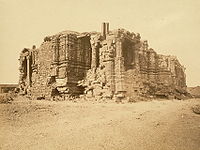 In 1024 CE, the temple was once again destroyed by Mahmud Ghazni
who raided the temple from across the Thar Desert. The temple was rebuilt by the Gujjar
Paramara
King Bhoj of Malwa and the Solanki
king Bhimadev I of Anhilwara, Gujrat (present day Patan
) between 1026 and 1042. The wooden structure was replaced by Kumarpal
(r.1143-72), who built the temple of stone.
In 1296 CE, the temple was once again destroyed by Sultan Allauddin Khilji's army. According to Taj-ul-Ma'sir of Hasan Nizami, Raja Karan of Gujarat was defeated and forced to flee, "fifty thousand infidels were dispatched to hell by the sword" and "more than twenty thousand slaves, and cattle beyond all calculation fell into the hands of the victors". The temple was rebuilt by Mahipala Deva, the Chudasama
king of Saurashtra in 1308 AD and the Linga was installed by his son Khengar sometime between 1326 and 1351 AD.
In 1375 CE, the temple was once again destroyed by Muzaffar Shah I, the Sultan of Gujarat.
In 1451 CE, the temple was once again destroyed by Mahmud Begda, the Sultan of Gujarat.
In 1701 CE, the temple was once again destroyed by Mughal Emperor Aurangzeb. Aurangzeb built a mosque on the site of the Somnath temple, using some columns from the temple, whose Hindu sculptural motifs remained visible.
Later on a joint effort of Peshwa of Pune, Raja Bhonsle of Nagpur, Chhatrapati Bhonsle of Kolhapur, Queen Ahilyabai Holkar of Indore & Shrimant Patilbuwa Shinde of Gwalior rebuilt the temple in 1783 AD at a site adjacent to the ruined temple which was already converted to a mosque.
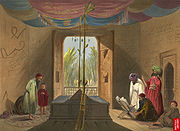 The following extract is from “Wonders of Things Created, and marvels of Things Existing” by Zakariya al-Qazwini
, a 13th century Arab geographer
. It contains the description of Somnath temple and its destruction:
 Before independence
, Prabhas Pattan
was part of the princely state
of Junagadh
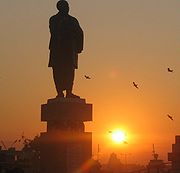
. After integration of Jungadh in to Union of India, the Deputy Prime Minister of India, Sardar Vallabhbhai Patel
came to Junagadh on November 12, 1947 to direct the stabilization of the state by the Indian Army and at the same time ordered the reconstruction of the Somanath temple.
When Sardar Patel, K. M. Munshi and other leaders of the Congress went to Gandhi with the proposal of reconstructing the Somnath temple, Gandhi blessed the move,but suggested that the funds for the construction should be collected from the public and the temple should not be funded by the state. He expressed that he was proud to associate himself to the project of renovation of the temple But soon both Gandhi and Sardar Patel died and the task of reconstruction of the temple continued under K. M. Munshi, who was the Minister for Food and Civil Supplies in the Nehru Government.
The ruins were pulled down in October 1950 and the mosque present at that site was shifted few miles away. In May 1951, Rajendra Prasad, the first President of the Republic of India, invited by K M Munshi, performed the installation ceremony for the temple. Rajendra Prasad said in his address "It is my view that the reconstruction of the Somnath Temple will be complete on that day when not only a magnificent edifice will arise on this foundation, but the mansion of India's prosperity will be really that prosperity of which the ancient temple of Somnath was a symbol.". He added "The Somnath temple signifies that the power of reconstruction is always greater than the power of destruction"
This episode created a serious rift between the then Prime Minister Jawaharlal Nehru
, who saw the movement for reconstruction of the temple as an attempt at Hindu revivalism and the President Rajendra Prasad and Union Minister K. M. Munshi, who saw in its reconstruction, the fruits of freedom and the reversal of past injustice done to Hindus.
The present temple, which was built by Patel and Munshi, is managed by Shree Somnath Trust.
, Gujarat's master masons.
The temple is situated at such a place that there is no land in straight-line between Somnath seashore till Antarctica, such an inscription in Sanskrit
is found on the Arrow-Pillar called Baan-Stambh erected on the sea-protection wall at the Somnath Temple. This Baan-Stambh mentions that it stands at a point on the Indian landmass, which happens to be the first point on land in the north to the south-pole
on that particular longitude.
(Ruler of North India: Ujjain/ Gwalior/ Mathura) victoriously brought the Three Silver Gates from Lahore, after defeating Muhammad Shah of Lahore. After refusal from Pundits of Guzrath and the then ruler Gaekwad to put them back on Somnath temple, these silver gates were placed in temples of Ujjain
. Today they can be seen in Two Temples of India Mahakaleshwar Jyotirlinga Mandir & Gopal Mandir of Ujjain.
In 1842, Edward Law, 1st Earl of Ellenborough
issued his famous 'Proclamation of the Gates' in which he ordered the British army in Afghanistan to return via Ghazni and bring back to India the sandalwood gates from the tomb of Mahmud of Ghazni in Ghazni, Afghanistan. These were believed to have been taken by Mahmud from Somnath. There was a debate in the House of Commons in London in 1843 on the question of the gates of the Somanatha temple. After much cross-fire between the British Government and the opposition, the gates were uprooted and brought back in triumph. But on arrival, they were found to be of replicas of the original. So they were placed in a store-room in the Agra Fort
where they still lie to the present day.
In the 19th Century novel, The Moonstone
by Wilkie Collins
, the diamond of the title is presumed to have been stolen from the temple at Somnath and, according to the historian Romila Thapar
, reflects the interest aroused in Britain by the gates.
Prabhas Patan
Prabhas Patan, known popularly as Somnath Patan, is situated in Gujarat , 7 km. from Veraval. This is a place of pilgrimage, or Tirtha, of the most popular Jyotirlinga of Lord Shiva, i.e., Somanath....
near Veraval
Veraval
Veraval is a city and a municipality in Junagadh district in the Indian state of Gujarat. It is located 6 km from Somnath.- History :...
in Saurashtra, on the western coast of Gujarat, India
India
India , officially the Republic of India , is a country in South Asia. It is the seventh-largest country by geographical area, the second-most populous country with over 1.2 billion people, and the most populous democracy in the world...
, is one of the twelve Jyotirlinga
Jyotirlinga
A Jyotirlinga or Jyotirling or Jyotirlingam is a shrine where Lord Shiva, an aspect of God in Hinduism is worshipped in the form of a Jyotirlingam or "Lingam of light." There are twelve traditional Jyotirlinga shrines in India....
shrines of the God Shiva
Shiva
Shiva is a major Hindu deity, and is the destroyer god or transformer among the Trimurti, the Hindu Trinity of the primary aspects of the divine. God Shiva is a yogi who has notice of everything that happens in the world and is the main aspect of life. Yet one with great power lives a life of a...
. Somnath means "The Protector of (the) Moon God". The Somnath Temple is known as "the Shrine Eternal", having been destroyed six times and rebuilt six times. Most recently it was rebuilt in November 1947, when Sardar Vallabhbhai Patel
Sardar Vallabhbhai Patel
Vallabhbhai Jhaverbhai Patel was an Indian barrister and statesman, one of the leaders of the Indian National Congress and one of the founding fathers of India...
visited the area for the integration of Junagadh and mooted a plan for restoration. After Patel's death, the rebuilding continued under K. M. Munshi, another minister of the Government of India.
Significance
According to the legend, SomaChandra
In Hinduism, Chandra is a lunar deity and a Graha. Chandra is also identified with the Vedic Lunar deity Soma . The Soma name refers particularly to the juice of sap in the plants and thus makes the Moon the lord of plants and vegetation. He is described as young, beautiful, fair; two-armed and...
or the Moon God built the temple in gold, Ravana
Ravana
' is the primary antagonist character of the Hindu legend, the Ramayana; who is the great king of Lanka. In the classic text, he is mainly depicted negatively, kidnapping Rama's wife Sita, to claim vengeance on Rama and his brother Lakshmana for having cut off the nose of his sister...
in silver, and Shri Krishna
Krishna
Krishna is a central figure of Hinduism and is traditionally attributed the authorship of the Bhagavad Gita. He is the supreme Being and considered in some monotheistic traditions as an Avatar of Vishnu...
in wood. Soma was cursed by his father-in-law Daksha
Daksha
In Hinduism, Daksha, "the skilled one", is an ancient creator god, one of the Prajapatis, the Rishis and the Adityas. Daksha is said to be the son of Aditi and Brahma...
to wane because Soma loved only one of his wives, all of whom happened to be Daksha's daughters. His other wives complained about this negligent behavior of Soma to their father Daksha, and thus the curse.
He then built a Shivlinga at the Prabhas tirth (a Hindu pilgrimage) and prayed to Lord Shiva
Shiva
Shiva is a major Hindu deity, and is the destroyer god or transformer among the Trimurti, the Hindu Trinity of the primary aspects of the divine. God Shiva is a yogi who has notice of everything that happens in the world and is the main aspect of life. Yet one with great power lives a life of a...
who removed the curse partially because asked upon by Soma's one wife (the one that he loved more than others). Thus, causing the periodic waning of moon.
Pleased by the prayers Soma (Moon god), Lord Shiva decided to rest in that Lingam till eternity, and thus the Jyotirlingam.
Timeline
The first temple of Somnath is said to have existed before the beginning of the common era.The second temple, built by the Yadava kings of Vallabhi
Vallabhi
Vallabhi is an ancient city located in Saurashtra peninsula in Gujarat, in western India, near Bhavnagar. Also known as Vallabhipura, it was the capital of the ancient Maitraka dynasty.- Origins and history :...
in Gujarat, replaced the first one on the same site around 649 CE.
In 725 CE Junayad, the Arab
Arab
Arab people, also known as Arabs , are a panethnicity primarily living in the Arab world, which is located in Western Asia and North Africa. They are identified as such on one or more of genealogical, linguistic, or cultural grounds, with tribal affiliations, and intra-tribal relationships playing...
governor of Sind
History of Sindh
Sindh is one of the provinces of Pakistan. Sindh was home to one of the world's oldest civilizations, the Indus Valley civilization.-Paleolithic and Mesolithic era:...
, sent his armies to destroy the second temple. The Gurjara Pratihara king Nagabhata II
Nagabhata II
Nagabhata II ascended the throne of the Gurjara-Pratihara dynasty after his father Vatsaraja. His mother was queen Sundari-Devi. He was designated with imperial titles - Paramabhattaraka, Maharajadhiraja, and Paramesvara after conquest of Kannauj.-Reign:Nagabhata II finds a mention in the Gwalior...
constructed the third temple in 815
815
Year 815 was a common year starting on Monday of the Julian calendar.- Europe :* Bulgaria and the Byzantine Empire sign the Treaty of 815 in Constantinople....
, a large structure of red sandstone.
Mahmud of Ghazni
Mahmud of Ghazni , actually ', was the most prominent ruler of the Ghaznavid dynasty who ruled from 997 until his death in 1030 in the eastern Iranian lands. Mahmud turned the former provincial city of Ghazni into the wealthy capital of an extensive empire which covered most of today's Iran,...
who raided the temple from across the Thar Desert. The temple was rebuilt by the Gujjar
Gujjar
The Gurjar are an ethnic group in India, Pakistan and Afghanistan. Alternative spellings include Gurjara, Gujar, Gurjjara and Gūrjara. The spelling Gurjara or Gurjar is preferable to the rest....
Paramara
Paramara
Paramara is a Maratha, Gurjar,& Rajput clan of India.The Paramara clan belongs to the Agnivansha of Rajputs ancient Kshatriyas...
King Bhoj of Malwa and the Solanki
Solanki
The Solanki was a royal Hindu Indian dynasty that ruled parts of western and central India between the 10th to 13th centuries. A number of scholars including V. A. Smith assign them Gurjar origin....
king Bhimadev I of Anhilwara, Gujrat (present day Patan
Patan, Gujarat
Patan was a capital of Gujarat in medieval times. It is the administrative seat of Patan District in the Indian state of Gujarat and administered by municipality. The city contains many Hindu and Jain temples as well as few mosques, dargahs and rojas...
) between 1026 and 1042. The wooden structure was replaced by Kumarpal
Kumarpal
Kumarpal was a famous ruler of the Solanki dynasty of Gujarat at Anahilavada, India. During his reign, Jainism became prominent in Gujarat. He was a devoted disciple of the great Jain polymath Acharya Hemachandra. Kumarpal was responsible for restoring ruined Somnath. He also built several...
(r.1143-72), who built the temple of stone.
In 1296 CE, the temple was once again destroyed by Sultan Allauddin Khilji's army. According to Taj-ul-Ma'sir of Hasan Nizami, Raja Karan of Gujarat was defeated and forced to flee, "fifty thousand infidels were dispatched to hell by the sword" and "more than twenty thousand slaves, and cattle beyond all calculation fell into the hands of the victors". The temple was rebuilt by Mahipala Deva, the Chudasama
Chudasama
The Chudasama are a Rajput clan found in the state of Gujarat in India. The Chudasama dynasty,originally of Abhira clan from Sindh. The disambiguition of the name Chudasama means, Chuda-Sama, 'Chuda' is an Indian word used for big bangles which are normally worn on the wrist of Indian women and...
king of Saurashtra in 1308 AD and the Linga was installed by his son Khengar sometime between 1326 and 1351 AD.
In 1375 CE, the temple was once again destroyed by Muzaffar Shah I, the Sultan of Gujarat.
In 1451 CE, the temple was once again destroyed by Mahmud Begda, the Sultan of Gujarat.
In 1701 CE, the temple was once again destroyed by Mughal Emperor Aurangzeb. Aurangzeb built a mosque on the site of the Somnath temple, using some columns from the temple, whose Hindu sculptural motifs remained visible.
Later on a joint effort of Peshwa of Pune, Raja Bhonsle of Nagpur, Chhatrapati Bhonsle of Kolhapur, Queen Ahilyabai Holkar of Indore & Shrimant Patilbuwa Shinde of Gwalior rebuilt the temple in 1783 AD at a site adjacent to the ruined temple which was already converted to a mosque.
Zakariya al-Qazwini
Zakariya al-Qazwini
Abu Yahya Zakariya' ibn Muhammad al-Qazwini , was a Persian physician, astronomer, geographer and proto-science fiction writer....
, a 13th century Arab geographer
Geographer
A geographer is a scholar whose area of study is geography, the study of Earth's natural environment and human society.Although geographers are historically known as people who make maps, map making is actually the field of study of cartography, a subset of geography...
. It contains the description of Somnath temple and its destruction:
“Somnath: celebrated city of India, situated on the shore of the sea, and washed by its waves. Among the wonders of that place was the temple in which was placed the idol called Somnath. This idol was in the middle of the temple without anything to support it from below, or to suspend it from above. It was held in the highest honor among the Hindus, and whoever beheld it floating in the air was struck with amazement, whether he was a Musulman or an infidelInfidelAn infidel is one who has no religious beliefs, or who doubts or rejects the central tenets of a particular religion – especially in reference to Christianity or Islam....
. The Hindus used to go on pilgrimage to it whenever there was an eclipse of the moon, and would then assemble there to the number of more than a hundred thousand."
“When the Sultan Yaminu-d Daula Mahmud Bin Subuktigin went to wage religious war against India, he made great efforts to capture and destroy Somnat, in the hope that the Hindus would then become Muhammadans. As a result thousands of Hindus were forcibly converted to Islam. He arrived there in the middle of Zi-l k’ada, 416 A.H. (December, 1025 A.D.). “The king looked upon the idol with wonder, and gave orders for the seizing of the spoil, and the appropriation of the treasures. There were many idols of gold and silver and vessels set with jewels, all of which had been sent there by the greatest personages in India. The value of the things found in the temples of the idols exceeded twenty thousand dinars."
Restoration of temple after Independence
Partition of India
The Partition of India was the partition of British India on the basis of religious demographics that led to the creation of the sovereign states of the Dominion of Pakistan and the Union of India on 14 and 15...
, Prabhas Pattan
Prabhas Patan
Prabhas Patan, known popularly as Somnath Patan, is situated in Gujarat , 7 km. from Veraval. This is a place of pilgrimage, or Tirtha, of the most popular Jyotirlinga of Lord Shiva, i.e., Somanath....
was part of the princely state
Princely state
A Princely State was a nominally sovereign entitity of British rule in India that was not directly governed by the British, but rather by an Indian ruler under a form of indirect rule such as suzerainty or paramountcy.-British relationship with the Princely States:India under the British Raj ...
of Junagadh
Junagadh
Junagadh is the headquarters of Junagadh district in the Indian state of Gujarat. The city is the 7th largest in Gujarat. The city is located at the foot of the Girnar hills, 355 km south west of state capital Gandhinagar and Ahmedabad. The city is in western India. Literally translated,...
. After integration of Jungadh in to Union of India, the Deputy Prime Minister of India, Sardar Vallabhbhai Patel
Sardar Vallabhbhai Patel
Vallabhbhai Jhaverbhai Patel was an Indian barrister and statesman, one of the leaders of the Indian National Congress and one of the founding fathers of India...
came to Junagadh on November 12, 1947 to direct the stabilization of the state by the Indian Army and at the same time ordered the reconstruction of the Somanath temple.
When Sardar Patel, K. M. Munshi and other leaders of the Congress went to Gandhi with the proposal of reconstructing the Somnath temple, Gandhi blessed the move,but suggested that the funds for the construction should be collected from the public and the temple should not be funded by the state. He expressed that he was proud to associate himself to the project of renovation of the temple But soon both Gandhi and Sardar Patel died and the task of reconstruction of the temple continued under K. M. Munshi, who was the Minister for Food and Civil Supplies in the Nehru Government.
The ruins were pulled down in October 1950 and the mosque present at that site was shifted few miles away. In May 1951, Rajendra Prasad, the first President of the Republic of India, invited by K M Munshi, performed the installation ceremony for the temple. Rajendra Prasad said in his address "It is my view that the reconstruction of the Somnath Temple will be complete on that day when not only a magnificent edifice will arise on this foundation, but the mansion of India's prosperity will be really that prosperity of which the ancient temple of Somnath was a symbol.". He added "The Somnath temple signifies that the power of reconstruction is always greater than the power of destruction"
This episode created a serious rift between the then Prime Minister Jawaharlal Nehru
Jawaharlal Nehru
Jawaharlal Nehru , often referred to with the epithet of Panditji, was an Indian statesman who became the first Prime Minister of independent India and became noted for his “neutralist” policies in foreign affairs. He was also one of the principal leaders of India’s independence movement in the...
, who saw the movement for reconstruction of the temple as an attempt at Hindu revivalism and the President Rajendra Prasad and Union Minister K. M. Munshi, who saw in its reconstruction, the fruits of freedom and the reversal of past injustice done to Hindus.
The present temple, which was built by Patel and Munshi, is managed by Shree Somnath Trust.
Architecture
The present temple is built in the Chalukya style of temple architecture or Kailash Mahameru Prasad Style and reflects the skill of the Sompura SalatsSalat (disambiguation)
Salat may refer to:* Salah or Salat, the five daily prayers practised by Muslims* Salat , the universal Sufi prayer* Salat, Kulpahar, an Indian village* Salat , a river in south-west France...
, Gujarat's master masons.
The temple is situated at such a place that there is no land in straight-line between Somnath seashore till Antarctica, such an inscription in Sanskrit
Sanskrit
Sanskrit , is a historical Indo-Aryan language and the primary liturgical language of Hinduism, Jainism and Buddhism.Buddhism: besides Pali, see Buddhist Hybrid Sanskrit Today, it is listed as one of the 22 scheduled languages of India and is an official language of the state of Uttarakhand...
is found on the Arrow-Pillar called Baan-Stambh erected on the sea-protection wall at the Somnath Temple. This Baan-Stambh mentions that it stands at a point on the Indian landmass, which happens to be the first point on land in the north to the south-pole
South Pole
The South Pole, also known as the Geographic South Pole or Terrestrial South Pole, is one of the two points where the Earth's axis of rotation intersects its surface. It is the southernmost point on the surface of the Earth and lies on the opposite side of the Earth from the North Pole...
on that particular longitude.
'Proclamation of the Gates' Incident
In 1782-83 AD, Shreenath Mahadaji ShindeMahadaji Shinde
Mahadaji Shinde , was a Maratha ruler of the state of Gwalior in central India. Mahadaji was instrumental in resurrecting Maratha power after the debacle of the Third Battle of Panipat in 1761, and rose to become a trusted lieutenant of the Peshwa, leader of the Maratha Confederacy, as well as the...
(Ruler of North India: Ujjain/ Gwalior/ Mathura) victoriously brought the Three Silver Gates from Lahore, after defeating Muhammad Shah of Lahore. After refusal from Pundits of Guzrath and the then ruler Gaekwad to put them back on Somnath temple, these silver gates were placed in temples of Ujjain
Ujjain
Ujjain , is an ancient city of Malwa region in central India, on the eastern bank of the Kshipra River , today part of the state of Madhya Pradesh. It is the administrative centre of Ujjain District and Ujjain Division.In ancient times the city was called Ujjayini...
. Today they can be seen in Two Temples of India Mahakaleshwar Jyotirlinga Mandir & Gopal Mandir of Ujjain.
In 1842, Edward Law, 1st Earl of Ellenborough
Edward Law, 1st Earl of Ellenborough
Edward Law, 1st Earl of Ellenborough GCB, PC was a British Tory politician. He was four times President of the Board of Control and also served as Governor-General of India between 1842 and 1844.-Background and education:...
issued his famous 'Proclamation of the Gates' in which he ordered the British army in Afghanistan to return via Ghazni and bring back to India the sandalwood gates from the tomb of Mahmud of Ghazni in Ghazni, Afghanistan. These were believed to have been taken by Mahmud from Somnath. There was a debate in the House of Commons in London in 1843 on the question of the gates of the Somanatha temple. After much cross-fire between the British Government and the opposition, the gates were uprooted and brought back in triumph. But on arrival, they were found to be of replicas of the original. So they were placed in a store-room in the Agra Fort
Agra Fort
Agra Fort, is a monument situated at Agra, is a UNESCO World Heritage site located in Agra, Uttar Pradesh, India. It is about 2.5 km northwest of its more famous sister monument, the Taj Mahal...
where they still lie to the present day.
In the 19th Century novel, The Moonstone
The Moonstone
The Moonstone by Wilkie Collins is a 19th-century British epistolary novel, generally considered the first detective novel in the English language. The story was originally serialized in Charles Dickens' magazine All the Year Round. The Moonstone and The Woman in White are considered Wilkie...
by Wilkie Collins
Wilkie Collins
William Wilkie Collins was an English novelist, playwright, and author of short stories. He was very popular during the Victorian era and wrote 30 novels, more than 60 short stories, 14 plays, and over 100 non-fiction pieces...
, the diamond of the title is presumed to have been stolen from the temple at Somnath and, according to the historian Romila Thapar
Romila Thapar
Romila Thapar is an Indian historian whose principal area of study is ancient India.-Work:After graduating from Panjab University, Thapar earned her doctorate under A. L. Basham at the School of Oriental and African Studies, the University of London in 1958...
, reflects the interest aroused in Britain by the gates.