

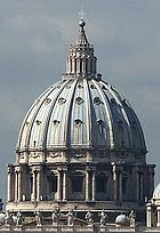
Dome

Encyclopedia
Architecture
Architecture is both the process and product of planning, designing and construction. Architectural works, in the material form of buildings, are often perceived as cultural and political symbols and as works of art...
that resembles the hollow upper half of a sphere
Sphere
A sphere is a perfectly round geometrical object in three-dimensional space, such as the shape of a round ball. Like a circle in two dimensions, a perfect sphere is completely symmetrical around its center, with all points on the surface lying the same distance r from the center point...
. Dome structures made of various materials have a long architectural lineage extending into prehistory.
Corbel domes
Corbel arch
A corbel arch is an arch-like construction method that uses the architectural technique of corbeling to span a space or void in a structure, such as an entranceway in a wall or as the span of a bridge...
and true domes have been found in the ancient Middle East in modest buildings and tombs. The construction of the first technically advanced true domes in Europe began in the Roman Architectural Revolution
Roman Architectural Revolution
The Roman Architectural Revolution, also known as the concrete Revolution, is a term used to describe the widespread use in Roman architecture of the previously little-used architectural forms of the arch, vault and dome...
, when they were frequently used by the Romans to shape large interior spaces of temples
Roman temple
Ancient Roman temples are among the most visible archaeological remains of Roman culture, and are a significant source for Roman architecture. Their construction and maintenance was a major part of ancient Roman religion. The main room housed the cult image of the deity to whom the temple was...
and public buildings, such as the Pantheon
Pantheon, Rome
The Pantheon ,Rarely Pantheum. This appears in Pliny's Natural History in describing this edifice: Agrippae Pantheum decoravit Diogenes Atheniensis; in columnis templi eius Caryatides probantur inter pauca operum, sicut in fastigio posita signa, sed propter altitudinem loci minus celebrata.from ,...
. This tradition continued unabated after the adoption of Christianity
Christianity
Christianity is a monotheistic religion based on the life and teachings of Jesus as presented in canonical gospels and other New Testament writings...
in the Byzantine (East Roman)
Byzantine architecture
Byzantine architecture is the architecture of the Byzantine Empire. The empire gradually emerged as a distinct artistic and cultural entity from what is today referred to as the Roman Empire after AD 330, when the Roman Emperor Constantine moved the capital of the Roman Empire east from Rome to...
religious and secular architecture, culminating in the revolutionary pendentive dome
Pendentive
A pendentive is a constructive device permitting the placing of a circular dome over a square room or an elliptical dome over a rectangular room. The pendentives, which are triangular segments of a sphere, taper to points at the bottom and spread at the top to establish the continuous circular or...
of the 6th century church Hagia Sophia
Hagia Sophia
Hagia Sophia is a former Orthodox patriarchal basilica, later a mosque, and now a museum in Istanbul, Turkey...
. Squinches, the technique of making a transition from a square shaped room to a circular dome, was most likely invented by the ancient Persians. The Sassanid Empire
Sassanid Empire
The Sassanid Empire , known to its inhabitants as Ērānshahr and Ērān in Middle Persian and resulting in the New Persian terms Iranshahr and Iran , was the last pre-Islamic Persian Empire, ruled by the Sasanian Dynasty from 224 to 651...
initiated the construction of the first large-scale domes in Persia, with such royal buildings as the Palace of Ardashir
Palace of Ardashir
Castle of Ardeshir e Babakan , also known as the Atash-kadeh آتشکده, is a castle located on the slopes of the mountain on which Ghal'eh Dokhtar is situated on. Built in AD 224 by Ardashir I of the Sassanian Empire, it is located two kilometres north of the ancient city of Gor, i.e...
, Sarvestan
Sarvestan
Sarvestan + estan; also Romanized as Sarvestān and Sarvistān) is a city in and the capital of Sarvestan County, Fars Province, Iran. At the 2006 census, its population was 16,846, in 4,094 families....
and Ghal'eh Dokhtar
Ghal'eh Dokhtar
Ghal'eh Dokhtar or Qala-e-Dokhtar, also known as The Maiden Castle, is a castle made by Ardashir I, in present day Fars, Iran, in 209 AD. It is located on a mountain slope near the Firouzabad-Shiraz road....
. With the Muslim conquest of the Sassanid Empire, the Persian architectural style
Iranian architecture
Iranian architecture or Persian architecture is the architecture of Iran . It has a continuous history from at least 5000 BCE to the present, with characteristic examples distributed over a vast area from Turkey to North India and the borders of China and from the Caucasus to Zanzibar...
became a major influence on Muslim societies. Indeed the use of domes as a feature of Islamic architecture
Islamic architecture
Islamic architecture encompasses a wide range of both secular and religious styles from the foundation of Islam to the present day, influencing the design and construction of buildings and structures in Islamic culture....
has gotten its roots from Persia (see gonbad
Gonbad
In traditional Persian architecture, a dome is referred to as a gonbad . It is known as Gumbaz, in India.The history of designing gonbads dates back to pre-Islamic Persia. The Parthians in particular were very keen in using such structures in their designs...
, gongbei).
An original tradition of using multiple domes was developed in the church architecture in Russia
Russia
Russia or , officially known as both Russia and the Russian Federation , is a country in northern Eurasia. It is a federal semi-presidential republic, comprising 83 federal subjects...
, which had adopted Orthodox Christianity
Orthodox Christianity
The term Orthodox Christianity may refer to:* the Eastern Orthodox Church and its various geographical subdivisions...
from Byzantium. Russian domes are often gilded
Gilding
The term gilding covers a number of decorative techniques for applying fine gold leaf or powder to solid surfaces such as wood, stone, or metal to give a thin coating of gold. A gilded object is described as "gilt"...
or brightly painted, and typically have a carcass and an outer shell made of wood or metal. The onion dome
Onion dome
An onion dome is a dome whose shape resembles the onion, after which they are named. Such domes are often larger in diameter than the drum upon which they are set, and their height usually exceeds their width...
became another distinctive feature in the Russian architecture
Russian architecture
Russian architecture follows a tradition whose roots were established in the Eastern Slavic state of Kievan Rus'. After the fall of Kiev, Russian architectural history continued in the principalities of Vladimir-Suzdal, Novgorod, the succeeding states of the Tsardom of Russia, the Russian Empire,...
, often in combination with the tented roof
Tented roof
A tented roof is a type of roof widely used in 16th and 17th century Russian architecture for churches. It is like a polygonal spire but differs in purpose in that it is typically used to roof the main internal space of a church, rather than an auxiliary structure...
.
Domes in Western Europe became popular again during the Renaissance
Renaissance architecture
Renaissance architecture is the architecture of the period between the early 15th and early 17th centuries in different regions of Europe, demonstrating a conscious revival and development of certain elements of ancient Greek and Roman thought and material culture. Stylistically, Renaissance...
period, reaching a zenith in popularity during the early 18th century Baroque period
Baroque architecture
Baroque architecture is a term used to describe the building style of the Baroque era, begun in late sixteenth century Italy, that took the Roman vocabulary of Renaissance architecture and used it in a new rhetorical and theatrical fashion, often to express the triumph of the Catholic Church and...
. Reminiscent of the Roman senate
Roman Senate
The Senate of the Roman Republic was a political institution in the ancient Roman Republic, however, it was not an elected body, but one whose members were appointed by the consuls, and later by the censors. After a magistrate served his term in office, it usually was followed with automatic...
, during the 19th century they became a feature of grand civic architecture. As a domestic feature the dome is less common, tending only to be a feature of the grandest houses and palaces during the Baroque period.
Construction of domes in the Muslim world
Muslim world
The term Muslim world has several meanings. In a religious sense, it refers to those who adhere to the teachings of Islam, referred to as Muslims. In a cultural sense, it refers to Islamic civilization, inclusive of non-Muslims living in that civilization...
reached its peak during the 16th – 18th centuries, when the Ottoman
Ottoman Empire
The Ottoman EmpireIt was usually referred to as the "Ottoman Empire", the "Turkish Empire", the "Ottoman Caliphate" or more commonly "Turkey" by its contemporaries...
, Safavid
Safavid dynasty
The Safavid dynasty was one of the most significant ruling dynasties of Iran. They ruled one of the greatest Persian empires since the Muslim conquest of Persia and established the Twelver school of Shi'a Islam as the official religion of their empire, marking one of the most important turning...
and Mughal Empires, ruling an area of the World compromising North Africa, the Middle East and South- and Central Asia, applied lofty domes to their religious buildings to create a sense of heavenly transcendence. The Sultan Ahmed Mosque
Sultan Ahmed Mosque
The Sultan Ahmed Mosque is a historical mosque in Istanbul, the largest city in Turkey and the capital of the Ottoman Empire . The mosque is popularly known as the Blue Mosque for the blue tiles adorning the walls of its interior....
, the Shah Mosque
Shah Mosque
Imam Mosque, is a mosque in Isfahan, Iran standing in south side of Naghsh-i Jahan Square.Built during the Safavid period, it is an excellent example of Islamic architecture of Iran, and regarded as one of the masterpieces of Persian Architecture. The Shah Mosque of Esfahan is one of the...
and the Badshahi Mosque
Badshahi Mosque
The Badshahi Mosque or the 'King's Mosque' in Lahore, commissioned by the sixth Mughal Emperor Aurangzeb in 1671 and completed in 1673, is the second largest mosque in Pakistan and South Asia and the fifth largest mosque in the world...
are primary examples of this style of architecture.
Many domes, particularly those from the Renaissance and Baroque periods of architecture, are crowned by a lantern or cupola
Cupola
In architecture, a cupola is a small, most-often dome-like, structure on top of a building. Often used to provide a lookout or to admit light and air, it usually crowns a larger roof or dome....
, a Medieval innovation which not only serves to admit light and vent air, but gives an extra dimension to the decorated interior of the dome.
Characteristics
A dome can be thought of as an archArch
An arch is a structure that spans a space and supports a load. Arches appeared as early as the 2nd millennium BC in Mesopotamian brick architecture and their systematic use started with the Ancient Romans who were the first to apply the technique to a wide range of structures.-Technical aspects:The...
which has been rotated around its central vertical axis. Thus domes, like arches, have a great deal of structural strength when properly built and can span large open spaces without interior supports. Corbel
Corbel arch
A corbel arch is an arch-like construction method that uses the architectural technique of corbeling to span a space or void in a structure, such as an entranceway in a wall or as the span of a bridge...
domes achieve their shape by extending each horizontal layer of stones inward slightly farther than the previous, lower, one until they meet at the top. These are sometimes called false domes. True, or real, domes are formed with increasingly inward-angled layers of voussoir
Voussoir
A voussoir is a wedge-shaped element, typically a stone, used in building an arch or vault.Although each unit in an arch or vault is a voussoir, two units are of distinct functional importance: the keystone and the springer. The keystone is the center stone or masonry unit at the apex of an arch. A...
s which have ultimately turned 90 degrees from the base of the dome to the top.
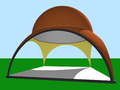
Lintel (architecture)
A lintel can be a load-bearing building component, a decorative architectural element, or a combined ornamented structural item. It is often found over portals, doors, and windows.-Structural uses:...
across the corners of the walls to create an octagonal base. Another is to use arches called squinch
Squinch
A squinch in architecture is a construction filling in the upper angles of a square room so as to form a base to receive an octagonal or spherical dome...
s to span the corners, which can support more weight. The invention of pendentives superseded the squinch technique. Pendentives are triangular sections of a sphere used to transition from the flat surfaces of supporting walls to the round base of a dome.
Domes can be divided into two kinds: simple and compound, depending on the use of pendentive
Pendentive
A pendentive is a constructive device permitting the placing of a circular dome over a square room or an elliptical dome over a rectangular room. The pendentives, which are triangular segments of a sphere, taper to points at the bottom and spread at the top to establish the continuous circular or...
s. In the case of the simple dome, the pendentives are part of the same sphere as the dome itself; however, such domes are rare. In the case of the more common compound dome, the pendentives are part of the surface of a larger sphere below that of the dome itself and form a circular base for either the dome or a drum section.
Drums, also called tholobate
Tholobate
A tholobate or drum, in architecture, is the upright part of a building on which a dome is raised. It is generally in the shape of a cylinder or a polygonal prism....
s or tambour
Tambour
In classical architecture, a tambour is the inverted bell of the Corinthian capital around which are carved acanthus leaves for decoration....
s, are cylindrical or polygonal walls supporting a dome which may contain windows.
Domes have been constructed from a wide variety of building material
Building material
Building material is any material which is used for a construction purpose. Many naturally occurring substances, such as clay, sand, wood and rocks, even twigs and leaves have been used to construct buildings. Apart from naturally occurring materials, many man-made products are in use, some more...
s over the centuries: from mud to stone, wood, brick, concrete, metal, glass and plastic.
Early history and primitive domes
Prehistory
Prehistory is the span of time before recorded history. Prehistory can refer to the period of human existence before the availability of those written records with which recorded history begins. More broadly, it refers to all the time preceding human existence and the invention of writing...
to modern times constructed domed dwellings using local materials. Although it is not known when the first dome was created, sporadic examples of early domed structures have been discovered.
The earliest discovered may be four small dwellings made of Mammoth
Mammoth
A mammoth is any species of the extinct genus Mammuthus. These proboscideans are members of Elephantidae, the family of elephants and mammoths, and close relatives of modern elephants. They were often equipped with long curved tusks and, in northern species, a covering of long hair...
tusks and bones. The first was found by a farmer in Mezhirich
Mezhirich
Mezhyrich is a village in central Ukraine. It is located in the Kanivskyi Raion of the Cherkasy Oblast , approximately 22 km from the region's administrative center, Kaniv, near the point where the Rosava River flows into the Ros'.-Pre-historic finds:In 1965, a farmer dug up the lower jawbone of...
, Ukraine, in 1965 while he was digging in his cellar and archaeologists unearthed three more. They date from 19,280 - 11,700 BC.
In modern times
Modern history
Modern history, or the modern era, describes the historical timeline after the Middle Ages. Modern history can be further broken down into the early modern period and the late modern period after the French Revolution and the Industrial Revolution...
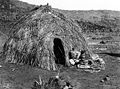
, the creation of relatively simple dome-like structures has been documented among various indigenous peoples around the world. The Wigwam
Wigwam
A wigwam or wickiup is a domed room dwelling used by certain Native American tribes. The term wickiup is generally used to label these kinds of dwellings in American Southwest and West. Wigwam is usually applied to these structures in the American Northeast...
was made by Native Americans
Indigenous peoples of the Americas
The indigenous peoples of the Americas are the pre-Columbian inhabitants of North and South America, their descendants and other ethnic groups who are identified with those peoples. Indigenous peoples are known in Canada as Aboriginal peoples, and in the United States as Native Americans...
using arched branches or poles covered with grass or hides. The Efé people of central Africa construct similar structures
Hut (dwelling)
A hut is a small and crude shelter, usually used for dwelling. Its design favors local techniques and materials to allow for swift and inexpensive construction.-Modern use:...
, using leaves as shingles. Another example is the Igloo
Igloo
An igloo or snowhouse is a type of shelter built of snow, originally built by the Inuit....
, a shelter built from blocks of compact snow and used by the Inuit
Inuit
The Inuit are a group of culturally similar indigenous peoples inhabiting the Arctic regions of Canada , Denmark , Russia and the United States . Inuit means “the people” in the Inuktitut language...
people, among others. The Himba
Himba
The Himba are an ethnic group of about 20,000 to 50,000 people living in northern Namibia, in the Kunene region . Recently they have built two villages in Kamanjab which have become tourist destinations...
people of Namibia
Namibia
Namibia, officially the Republic of Namibia , is a country in southern Africa whose western border is the Atlantic Ocean. It shares land borders with Angola and Zambia to the north, Botswana to the east and South Africa to the south and east. It gained independence from South Africa on 21 March...
construct "desert igloos" of wattle and daub
Wattle and daub
Wattle and daub is a composite building material used for making walls, in which a woven lattice of wooden strips called wattle is daubed with a sticky material usually made of some combination of wet soil, clay, sand, animal dung and straw...
for use as temporary shelters at seasonal cattle camps, and as permanent homes by the poor.
Mesopotamia
Mesopotamia is a toponym for the area of the Tigris–Euphrates river system, largely corresponding to modern-day Iraq, northeastern Syria, southeastern Turkey and southwestern Iran.Widely considered to be the cradle of civilization, Bronze Age Mesopotamia included Sumer and the...
may explain the existence of domes in both China
China
Chinese civilization may refer to:* China for more general discussion of the country.* Chinese culture* Greater China, the transnational community of ethnic Chinese.* History of China* Sinosphere, the area historically affected by Chinese culture...
and the West
Western world
The Western world, also known as the West and the Occident , is a term referring to the countries of Western Europe , the countries of the Americas, as well all countries of Northern and Central Europe, Australia and New Zealand...
in the first millennium BC. Another explanation, however, is that the use of the dome shape in construction did not have a single point of origin and was common in virtually all cultures long before domes were constructed with enduring materials.
The recent discoveries of seal
Cylinder seal
A cylinder seal is a cylinder engraved with a 'picture story', used in ancient times to roll an impression onto a two-dimensional surface, generally wet clay. Cylinder seals were invented around 3500 BC in the Near East, at the contemporary site of Susa in south-western Iran and at the early site...
impressions in the ancient site of Chogha Mish
Chogha Mish
Tappeh-ye Choghā Mīsh dating back to 6800 BC, is the site of a Chalcolithic settlement in Western Iran, located in the Khuzistan Province on the Susiana Plain...
(c. 6800 to 3000 BC), located in the Susiana plains of Iran
Iran
Iran , officially the Islamic Republic of Iran , is a country in Southern and Western Asia. The name "Iran" has been in use natively since the Sassanian era and came into use internationally in 1935, before which the country was known to the Western world as Persia...
, show the extensive use of dome structures in mud-brick and adobe
Adobe
Adobe is a natural building material made from sand, clay, water, and some kind of fibrous or organic material , which the builders shape into bricks using frames and dry in the sun. Adobe buildings are similar to cob and mudbrick buildings. Adobe structures are extremely durable, and account for...
buildings. Other examples of mud-brick buildings, which also seemed to employ the "true" dome technique have been excavated at Tell Arpachiyah
Tell Arpachiyah
Tell Arpachiyah was an Ancient Near Eastprehistoric site about 4 miles from Nineveh. The proper name of the site is Tepe Reshwa.-History:The site was occupied in the Halaf and Ubaid periods. It appears...
, a Mesopotamian site of the Halaf
Tell Halaf
Tell Halaf is an archaeological site in the Al Hasakah governorate of northeastern Syria, near the Turkish border, just opposite Ceylanpınar. It was the first find of a Neolithic culture, subsequently dubbed the Halaf culture, characterized by glazed pottery painted with geometric and animal designs...
(c. 6100 to 5400 BC) and Ubaid
Ubaid period
The Ubaid period is a prehistoric period of Mesopotamia. The tell of al-`Ubaid west of nearby Ur in southern Iraq's Dhi Qar Governorate has given its name to the prehistoric Pottery Neolithic to Chalcolithic culture, which represents the earliest settlement on the alluvial plain of southern...
(ca. 5300 to 4000 BC) cultures. Excavations at Tell al-Rimah
Tell al-Rimah
Tell al-Rimah was the Ancient Near East city of Karana or Qattara in the Sinjar region west of Nineveh.-History:...
have revealed brick domical vaults from about 2000 BC. At the Sumer
Sumer
Sumer was a civilization and historical region in southern Mesopotamia, modern Iraq during the Chalcolithic and Early Bronze Age....
ian Royal Cemetery of Ur
Ur
Ur was an important city-state in ancient Sumer located at the site of modern Tell el-Muqayyar in Iraq's Dhi Qar Governorate...
, a "complete rubble dome built over a timber centring" was found among the chambers of the tombs for Meskalamdug
Meskalamdug
Meskalamdug was an early ruler of Ur who does not appear in the Sumerian king list.His tomb, discovered by English archaeologist Sir Leonard Wooley in the Royal Cemetery of Ur in 1924, contained numerous gold artifacts including a golden helmet with an inscription of the king's name. His wife's...
and Puabi
Puabi
Puabi , also called Shubad in Sumerian, was an important person in the Sumerian city of Ur, during the First Dynasty of Ur . Commonly labeled as a "queen", her status is somewhat in dispute. Several cylinder seals in her tomb identify her by the title "nin" or "eresh", a Sumerian word which can...
, dating to around 2500 BC. Set in mud mortar, it was a "true dome with pendentives rounding off the angles of the square chamber." Other small domes can be inferred from the remaining ground plans, such as one in the courtyard of Ur-Nammu
Ur-Nammu
Ur-Nammu founded the Sumerian 3rd dynasty of Ur, in southern Mesopotamia, following several centuries of Akkadian and Gutian rule...
's ziggurat, and in later shrines and temples of the 14th century BC.
Corbelled beehive domes were used as granaries in Ancient Egypt
Ancient Egypt
Ancient Egypt was an ancient civilization of Northeastern Africa, concentrated along the lower reaches of the Nile River in what is now the modern country of Egypt. Egyptian civilization coalesced around 3150 BC with the political unification of Upper and Lower Egypt under the first pharaoh...
from the first dynasty
First dynasty of Egypt
The first dynasty of Ancient Egypt is often combined with the Dynasty II under the group title, Early Dynastic Period of Egypt...
, in mastaba
Mastaba
A mastaba, or "pr-djt" , is a type of ancient Egyptian tomb in the form of a flat-roofed, rectangular structure with outward sloping sides that marked the burial site of many eminent Egyptians of Egypt's ancient period...
s of the Old Kingdom
Old Kingdom
Old Kingdom is the name given to the period in the 3rd millennium BC when Egypt attained its first continuous peak of civilization in complexity and achievement – the first of three so-called "Kingdom" periods, which mark the high points of civilization in the lower Nile Valley .The term itself was...
, as pressure-relieving devices in private brick pyramids of the New Kingdom
New Kingdom
The New Kingdom of Egypt, also referred to as the Egyptian Empire is the period in ancient Egyptian history between the 16th century BC and the 11th century BC, covering the Eighteenth, Nineteenth, and Twentieth Dynasties of Egypt....
, and as kilns and cellars. Examples have been found in brick and in stone.
Ancient tombs
Beehive tomb
A beehive tomb, also known as a tholos tomb , is a burial structure characterized by its false dome created by the superposition of successively smaller rings of mudbricks or, more often, stones...
have been found from Oman to Portugal with stone corbel
Corbel arch
A corbel arch is an arch-like construction method that uses the architectural technique of corbeling to span a space or void in a structure, such as an entranceway in a wall or as the span of a bridge...
domes. The "Hafeet graves", also called "Mezyat graves", were structures built above ground, dating to the Bronze Age
Bronze Age
The Bronze Age is a period characterized by the use of copper and its alloy bronze as the chief hard materials in the manufacture of some implements and weapons. Chronologically, it stands between the Stone Age and Iron Age...
period between 3200 and 2700 BC in an area straddling the borders between Oman
Oman
Oman , officially called the Sultanate of Oman , is an Arab state in southwest Asia on the southeast coast of the Arabian Peninsula. It is bordered by the United Arab Emirates to the northwest, Saudi Arabia to the west, and Yemen to the southwest. The coast is formed by the Arabian Sea on the...
, UAE, and Bahrain
Bahrain
' , officially the Kingdom of Bahrain , is a small island state near the western shores of the Persian Gulf. It is ruled by the Al Khalifa royal family. The population in 2010 stood at 1,214,705, including 235,108 non-nationals. Formerly an emirate, Bahrain was declared a kingdom in 2002.Bahrain is...
. Similar above-ground tombs made of corbelled stone domes have been found in the fourth cataract region
Cataracts of the Nile
The cataracts of the Nile are shallow lengths of the Nile between Aswan and Khartoum where the surface of the water is broken by many small boulders and stones protruding out of the river bed, as well as many rocky islets. Aswan is also the Southern boundary of Upper Egypt...
of Nubia
Nubia
Nubia is a region along the Nile river, which is located in northern Sudan and southern Egypt.There were a number of small Nubian kingdoms throughout the Middle Ages, the last of which collapsed in 1504, when Nubia became divided between Egypt and the Sennar sultanate resulting in the Arabization...
with dates beginning in the second millennium BC. Examples on the Mediterranean island of Sardinia
Sardinia
Sardinia is the second-largest island in the Mediterranean Sea . It is an autonomous region of Italy, and the nearest land masses are the French island of Corsica, the Italian Peninsula, Sicily, Tunisia and the Spanish Balearic Islands.The name Sardinia is from the pre-Roman noun *sard[],...
have been dated to 2500 BC. The so-called Treasury of Atreus, a large Mycenaean tomb
Mycenaean chamber tomb
The term chamber tomb is used to refer to a form of mortuary architecture in use in the Late Bronze Age of the areas under the cultural influence of the Aegean. This is based on a previous form of architecture made by the Akkadians, specifically those located in Old Babylonia. This progenitor to...
covered with a mound of earth, dates to around 1330 BC. However, small corbel domes functioning as dwellings for poorer people appear to have remained the norm throughout the ancient Near East until the introduction of the monumental dome in the Roman period.
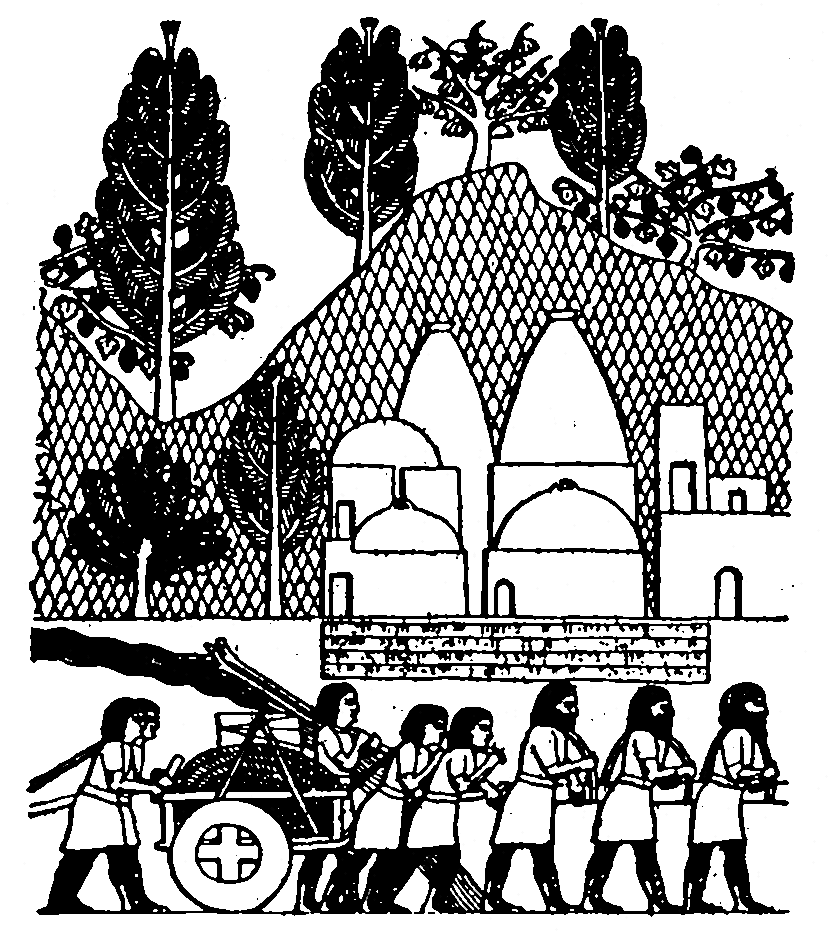
A Neo-Assyrian bas-relief
Relief
Relief is a sculptural technique. The term relief is from the Latin verb levo, to raise. To create a sculpture in relief is thus to give the impression that the sculpted material has been raised above the background plane...
from Kuyunjik
Nineveh
Nineveh was an ancient Assyrian city on the eastern bank of the Tigris River, and capital of the Neo Assyrian Empire. Its ruins are across the river from the modern-day major city of Mosul, in the Ninawa Governorate of Iraq....
depicts domed buildings, although remains of such a structure in that ancient city have yet to be identified, perhaps due to the impermanent nature of sun-dried mudbrick
Mudbrick
A mudbrick is a firefree brick, made of a mixture of clay, mud, sand, and water mixed with a binding material such as rice husks or straw. They use a stiff mixture and let them dry in the sun for 25 days....
construction. However, because the relief depicts the Assyrian overland transport of a carved stone statue, the background buildings most likely refer to a foreign village, such as those at the foothills of the Lebanese mountains
Mount Lebanon
Mount Lebanon , as a geographic designation, is a Lebanese mountain range, averaging above 2,200 meters in height and receiving a substantial amount of precipitation, including snow, which averages around four meters deep. It extends across the whole country along about , parallel to the...
. The relief dates to the 8th century BC, while the use of domical structures in the Syria
Syria
Syria , officially the Syrian Arab Republic , is a country in Western Asia, bordering Lebanon and the Mediterranean Sea to the West, Turkey to the north, Iraq to the east, Jordan to the south, and Israel to the southwest....
n region may go back as far as the fourth millennium BC.
Wooden domes were evidently used in Etruria
Etruria
Etruria—usually referred to in Greek and Latin source texts as Tyrrhenia—was a region of Central Italy, an area that covered part of what now are Tuscany, Latium, Emilia-Romagna, and Umbria. A particularly noteworthy work dealing with Etruscan locations is D. H...
on the Italian peninsula from archaic times. Reproductions were preserved as rock-cut Etruscan tombs produced until the Roman Imperial period
Roman Empire
The Roman Empire was the post-Republican period of the ancient Roman civilization, characterised by an autocratic form of government and large territorial holdings in Europe and around the Mediterranean....
, and paintings at Pompeii show examples of them in the third style and later. Wooden domes may also have been used in ancient Greece, over buildings such as the Tholos of Epidaurus
Epidaurus
Epidaurus was a small city in ancient Greece, at the Saronic Gulf. Two modern towns bear the name Epidavros : Palaia Epidavros and Nea Epidavros. Since 2010 they belong to the new municipality of Epidavros, part of the peripheral unit of Argolis...
, which is typically depicted with a conical roof. Evidence for such wooden domes over round buildings in Ancient Greece, if they existed, has not survived and the issue is much debated.
Rock-cut tombs in Alexandria
Alexandria
Alexandria is the second-largest city of Egypt, with a population of 4.1 million, extending about along the coast of the Mediterranean Sea in the north central part of the country; it is also the largest city lying directly on the Mediterranean coast. It is Egypt's largest seaport, serving...
suggest the possible use of domed ceilings in the architecture of Ptolemaic Egypt
Ptolemaic Kingdom
The Ptolemaic Kingdom in and around Egypt began following Alexander the Great's conquest in 332 BC and ended with the death of Cleopatra VII and the Roman conquest in 30 BC. It was founded when Ptolemy I Soter declared himself Pharaoh of Egypt, creating a powerful Hellenistic state stretching from...
. The earliest evidence of a Hellenistic
Hellenistic period
The Hellenistic period or Hellenistic era describes the time which followed the conquests of Alexander the Great. It was so named by the historian J. G. Droysen. During this time, Greek cultural influence and power was at its zenith in Europe and Asia...
dome is at the North Baths of Morgantina in Sicily
Sicily
Sicily is a region of Italy, and is the largest island in the Mediterranean Sea. Along with the surrounding minor islands, it constitutes an autonomous region of Italy, the Regione Autonoma Siciliana Sicily has a rich and unique culture, especially with regard to the arts, music, literature,...
, dated to the mid third century BC. The dome measured 5.75 meters in diameter over the circular hot room of the baths. It was made of terracotta tubes partially inserted into each other and arranged in parallel arches, which were then completely covered with mortar. It is also the earliest known example of this technique of tubular vault construction. A Hellenistic bathing complex in nearby Syracuse may also have used domes like these to cover its circular rooms. Another dome with the same parallel arch construction but more refined technique has been identified in the tepidarium
Tepidarium
The tepidarium was the warm bathroom of the Roman baths heated by a hypocaust or underfloor heating system.The specialty of a tepidarium is the pleasant feeling of constant radiant heat which directly affects the human body from the walls and floor.There is an interesting example at Pompeii; this...
at a Roman era bathing complex in Cabrera del Mar, Spain, and dated to the middle of the second century BC.
Roman and Byzantine domes
Paganism
Paganism is a blanket term, typically used to refer to non-Abrahamic, indigenous polytheistic religious traditions....
period are essentially found in three environments: baths
Thermae
In ancient Rome, thermae and balnea were facilities for bathing...
, villas and palaces, and tombs. Oculi
Oculus
An Oculus, circular window, or rain-hole is a feature of Classical architecture since the 16th century. They are often denoted by their French name, oeil de boeuf, or "bull's-eye". Such circular or oval windows express the presence of a mezzanine on a building's façade without competing for...
are common features. The Romans also used semi-dome
Semi-dome
A semi-dome, also called a "half-dome", is the term in architecture for half a dome , used to cover a semi-circular area. Similar structures occur in nature.-Architecture:...
s, half a dome "cut" vertically, in niches
Niche (architecture)
A niche in classical architecture is an exedra or an apse that has been reduced in size, retaining the half-dome heading usual for an apse. Nero's Domus Aurea was the first semi-private dwelling that possessed rooms that were given richly varied floor plans, shaped with niches and exedras;...
and the exedra
Exedra
In architecture, an exedra is a semicircular recess or plinth, often crowned by a semi-dome, which is sometimes set into a building's facade. The original Greek sense was applied to a room that opened onto a stoa, ringed with curved high-backed stone benches, a suitable place for a philosophical...
s of basilica
Basilica
The Latin word basilica , was originally used to describe a Roman public building, usually located in the forum of a Roman town. Public basilicas began to appear in Hellenistic cities in the 2nd century BC.The term was also applied to buildings used for religious purposes...
s.
The octagonal Tower of the Winds
Tower of the Winds
The Tower of the Winds, also called horologion , is an octagonal Pentelic marble clocktower on the Roman agora in Athens. The structure features a combination of sundials, a water clock and a wind vane...
in Athens
Athens
Athens , is the capital and largest city of Greece. Athens dominates the Attica region and is one of the world's oldest cities, as its recorded history spans around 3,400 years. Classical Athens was a powerful city-state...
, built by Antigonus of Cyrrhestus
Andronicus of Cyrrhus
Andronicus of Cyrrhus or Andronicus Cyrrhestes,son of Hermias, was a Greek astronomer who flourished about 100 BC....
, has a flat, monolithic, stone dome. Varro's
Marcus Terentius Varro
Marcus Terentius Varro was an ancient Roman scholar and writer. He is sometimes called Varro Reatinus to distinguish him from his younger contemporary Varro Atacinus.-Biography:...
book on agriculture, written about the same time, describes an aviary
Aviary
An aviary is a large enclosure for confining birds. Unlike cages, aviaries allow birds a larger living space where they can fly; hence, aviaries are also sometimes known as flight cages...
with a wooden dome decorated with the eight winds which is compared by analogy to the eight winds depicted on the Tower of the Winds. This aviary with its wooden dome may represent a fully developed type. Wooden domes in general would have allowed for very wide spans. Their earlier use may have inspired the development and introduction of large stone domes of previously unprecedented size. Complex wooden forms were also necessary for centering and support, the construction of which seems to have eventually become more efficient and standardized.
Roman baths played a leading role in the development of domed construction in general, and monumental domes in particular. Modest domes in baths dating from the 2nd and 1st centuries BC are seen in Pompeii
Pompeii
The city of Pompeii is a partially buried Roman town-city near modern Naples in the Italian region of Campania, in the territory of the comune of Pompei. Along with Herculaneum, Pompeii was destroyed and completely buried during a long catastrophic eruption of the volcano Mount Vesuvius spanning...
, in the frigidaria
Frigidarium
A frigidarium is a large cold pool of Roman baths. It would be entered after the Caldarium and the Tepidarium, which were used to open the pores of the skin. The cold water would close the pores. There would be a small pool of cold water or sometimes a large Swimming pool...
of the Terme Stabiane and the Terme del Foro. According to Vitruvius
Vitruvius
Marcus Vitruvius Pollio was a Roman writer, architect and engineer, active in the 1st century BC. He is best known as the author of the multi-volume work De Architectura ....
, the temperature and humidity of domed tepidaria
Tepidarium
The tepidarium was the warm bathroom of the Roman baths heated by a hypocaust or underfloor heating system.The specialty of a tepidarium is the pleasant feeling of constant radiant heat which directly affects the human body from the walls and floor.There is an interesting example at Pompeii; this...
could be regulated by raising or lowering bronze discs located under the oculus. Domes were particularly well suited to the hot rooms
Caldarium
right|thumb|230px|Caldarium from the Roman Baths at [[Bath, England]]. The floor has been removed to reveal the empty space where the hot air flowed through to heat the floor....
of baths circular in plan to facilitate even heating from the walls. However, the extensive use of domes did not occur before the 1st century AD.
The first known large Roman dome is the so-called "Temple of Mercury" in Baiae
Baiae
Baiae , a frazione of the comune of Bacoli) in the Campania region of Italy was a Roman seaside resort on the Bay of Naples. It was said to have been named after Baius, who was supposedly buried there. Baiae was for several hundred years a fashionable resort, especially towards the end of the Roman...
, a concrete
Roman concrete
Roman concrete was a material used in construction during the late Roman Republic through the whole history of the Roman Empire. Roman concrete was based on a hydraulic-setting cement with many material qualities similar to modern Portland cement...
bath hall dating from the age of Augustus
Augustus
Augustus ;23 September 63 BC – 19 August AD 14) is considered the first emperor of the Roman Empire, which he ruled alone from 27 BC until his death in 14 AD.The dates of his rule are contemporary dates; Augustus lived under two calendars, the Roman Republican until 45 BC, and the Julian...
(27 BC - AD 14). There are five openings in the dome: a circular oculus and four square skylights. The dome has a span of 21.5 meters and is the largest known dome to have been built before that of the Pantheon
Pantheon, Rome
The Pantheon ,Rarely Pantheum. This appears in Pliny's Natural History in describing this edifice: Agrippae Pantheum decoravit Diogenes Atheniensis; in columnis templi eius Caryatides probantur inter pauca operum, sicut in fastigio posita signa, sed propter altitudinem loci minus celebrata.from ,...
. It is also the earliest preserved concrete dome.
The mortar and aggregate of Roman concrete was built up in horizontal layers laid by hand against wooden form-work with the thickness of the layers determined by the length of the workday, rather than being poured into a mold as concrete is today. Roman concrete domes were thus built similarly to the earlier corbel domes of the Mediterranean region, although they have different structural characteristics. The dry concrete mixtures used by the Romans were compacted with rams to eliminate voids, and added animal blood acted as a water reducer.
While there are earlier examples in the Republican period
Roman Republic
The Roman Republic was the period of the ancient Roman civilization where the government operated as a republic. It began with the overthrow of the Roman monarchy, traditionally dated around 508 BC, and its replacement by a government headed by two consuls, elected annually by the citizens and...
and early Imperial period, the growth of domed construction increases under Emperor Nero, the Flavians
Flavian dynasty
The Flavian dynasty was a Roman Imperial Dynasty, which ruled the Roman Empire between 69 and 96 AD, encompassing the reigns of Vespasian , and his two sons Titus and Domitian . The Flavians rose to power during the civil war of 69, known as the Year of the Four Emperors...
, and during the 2nd century AD. The opulent palace architecture of the Emperor Nero (54-68 AD) marks an important development. There is evidence of a dome in his Domus Transitoria
Domus Transitoria
The Domus Transitoria was Roman Emperor Nero's palace on Palatine Hill destroyed by the Great Fire of Rome in 64 AD. Marble and other parts salvaged from the ruins later became part of the Domus Aurea, the Roman Emperor's official residence...
at the intersection of two corridors, resting on four large piers
Pier (architecture)
In architecture, a pier is an upright support for a superstructure, such as an arch or bridge. Sections of wall between openings function as piers. The simplest cross section of the pier is square, or rectangular, although other shapes are also common, such as the richly articulated piers of Donato...
, which may have had an oculus at the center. In Nero's Domus Aurea
Domus Aurea
The Domus Aurea was a large landscaped portico villa, designed to take advantage of artificially created landscapes built in the heart of Ancient Rome by the Emperor Nero after the Great Fire of Rome had cleared away the aristocratic dwellings on the slopes of the Palatine...
, or "Golden House", the walls of a large octagonal room transition to an octagonal domical vault, which then transitions to a dome with an oculus. This octagonal and semicircular dome is made of concrete and the oculus is made of brick. The radial walls of the surrounding rooms buttress the dome, allowing the octagonal walls directly beneath it to contain large openings under flat arch
Jack arch
A jack arch is a structural element in masonry construction that provides support at openings in the masonry. Alternate names are "flat arch" and "straight arch"....
es and for the room itself to be unusually well-lit. Another dome, made of wood, is reported in contemporary sources to have covered a dining hall in the palace, and may have been fitted such that perfume might spray from the ceiling. The dome perpetually rotated on its base in imitation of the sky. The expensive and lavish decoration of the palace caused such scandal that it was demolished soon after Nero's death and public buildings such as the Baths of Titus
Baths of Titus
The Baths of Titus were public baths built in Rome in 81 by Emperor Titus.The baths sat in the base of the Esquiline hill, an area of parkland and luxury estates which had been taken over by Nero for his Golden House or Domus Aurea...
and the Colosseum
Colosseum
The Colosseum, or the Coliseum, originally the Flavian Amphitheatre , is an elliptical amphitheatre in the centre of the city of Rome, Italy, the largest ever built in the Roman Empire...
were built in its place.
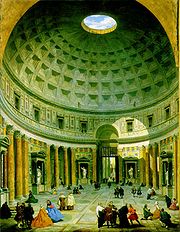
The most famous and best preserved Roman dome - and the largest - is that of the Pantheon
Pantheon, Rome
The Pantheon ,Rarely Pantheum. This appears in Pliny's Natural History in describing this edifice: Agrippae Pantheum decoravit Diogenes Atheniensis; in columnis templi eius Caryatides probantur inter pauca operum, sicut in fastigio posita signa, sed propter altitudinem loci minus celebrata.from ,...
, a temple in Rome built by Emperor Hadrian
Hadrian
Hadrian , was Roman Emperor from 117 to 138. He is best known for building Hadrian's Wall, which marked the northern limit of Roman Britain. In Rome, he re-built the Pantheon and constructed the Temple of Venus and Roma. In addition to being emperor, Hadrian was a humanist and was philhellene in...
as part of the Baths of Agrippa
Baths of Agrippa
The Baths of Agrippa were a structure of ancient Rome, built by Marcus Vipsanius Agrippa, the first of the great thermae constructed in the city. In their first form, constructed at the same time as the Pantheon and on axis with it, as a balaneion , they were apparently a hot-air bath with a cold...
. Dating from the 2nd century, it is an unreinforced concrete dome 43.4 meters wide resting on a circular wall, or rotunda
Rotunda (architecture)
A rotunda is any building with a circular ground plan, sometimes covered by a dome. It can also refer to a round room within a building . The Pantheon in Rome is a famous rotunda. A Band Rotunda is a circular bandstand, usually with a dome...
, 6 meters thick. This rotunda, made of brick-faced concrete, contains a large number of relieving arches
Discharging arch
A discharging arch or relieving arch is an arch built over a lintel or architrave to take off the super incumbent weight. The earliest example is found in the Great Pyramid, over the lintels of the entrance passage to the tomb: it consisted of two stones only, resting one against the other...
and is not solid. Seven interior niches and the entrance way divide the wall structurally into eight virtually independent piers. These openings and additional voids account for a quarter of the rotunda wall's volume. The only opening in the dome is the brick-lined oculus at the top, nine meters in diameter, which provides light and ventilation for the interior. The shallow coffer
Coffer
A coffer in architecture, is a sunken panel in the shape of a square, rectangle, or octagon in a ceiling, soffit or vault...
ing in the dome accounts for a less than five percent reduction in the dome's mass, and is mostly decorative. The aggregate material hand-placed in the concrete is heaviest at the base of the dome and changes to lighter materials as the height increases, dramatically reducing the stresses in the finished structure. In fact, many commentators cite the Pantheon as an example of the revolutionary
Roman Architectural Revolution
The Roman Architectural Revolution, also known as the concrete Revolution, is a term used to describe the widespread use in Roman architecture of the previously little-used architectural forms of the arch, vault and dome...
possibilities for monolithic architecture
Monolithic architecture
Monolithic architecture is a style of construction in which a building is carved, cast or excavated from a single piece of material. The most basic form of monolithic architecture is the monolith, such as the monolithic churches of Lalibela, Ethiopia or the Pancha Rathas in India.Buildings with a...
provided by the use of Roman pozzolana
Pozzolana
Pozzolana, also known as pozzolanic ash , is a fine, sandy volcanic ash. Pozzolanic ash was first discovered and dug in Italy, at Pozzuoli. It was later discovered at a number of other sites as well...
concrete. However, vertical cracks seem to have developed very early, such that in practice the dome acts as an array of arches with a common keystone, rather than as a single unit. The exterior step-rings used to compress the "haunches" of the dome, which would not be necessary if the dome acted as a monolithic structure
Monolithic dome
A monolithic dome is a structure cast in a one-piece form. The form may be permanent or temporary and may or may not remain part of the finished structure....
, may be an acknowledgement of this by the builders themselves. Such buttressing was common in Roman arch construction. It remained the largest dome in the world for more than a millennium and is still the world's largest unreinforced concrete dome.
Segmental domes, made of radially concave wedges or of alternating concave and flat wedges, also appear under Hadrian in the 2nd century and most preserved examples of this style date from this period. Hadrian's Villa
Hadrian's Villa
The Hadrian's Villa is a large Roman archaeological complex at Tivoli, Italy.- History :The villa was constructed at Tibur as a retreat from Rome for Roman Emperor Hadrian during the second and third decades of the 2nd century AD...
has examples at the Piazza D'Oro and in the semidome of the Serapeum. Recorded details of the decoration of the segmental dome at the Piazza D'Oro suggests it was made to evoke a billowing tent, perhaps in imitation of the canopies used by Hellenistic kings
Hellenistic civilization
Hellenistic civilization represents the zenith of Greek influence in the ancient world from 323 BCE to about 146 BCE...
. Other examples exist at the Hadrianic baths of Otricoli
Otricoli
Otricoli is a town and comune in the province of Terni, Umbria, Italy. It is located on the Via Flaminia, near the east bank of the Tiber, 44 miles north of Rome and 12 miles south of Narni.-History and landmarks:...
and the so-called "Temple of Venus" at Baiae. This style of dome required complex centering and radially-oriented formwork to create its tight curves.
In the 3rd century, Imperial mausolea began to be built as domed rotundas rather than tumulus
Tumulus
A tumulus is a mound of earth and stones raised over a grave or graves. Tumuli are also known as barrows, burial mounds, Hügelgrab or kurgans, and can be found throughout much of the world. A tumulus composed largely or entirely of stones is usually referred to as a cairn...
structures or other types, following similar monuments by private citizens. Pagan and Christian
Christian
A Christian is a person who adheres to Christianity, an Abrahamic, monotheistic religion based on the life and teachings of Jesus of Nazareth as recorded in the Canonical gospels and the letters of the New Testament...
domed mausolea from this time can be differentiated in that the structures of the buildings also reflect their religious functions. The pagan buildings are typically two story, dimly lit, free-standing structures with a lower crypt area for the remains and an upper area for devotional sacrifice. Christian domed mausolea contain a single well-lit space and are usually attached to a church. Examples from the 3rd century are the brick domes of the Mausoleum of Galerius, the Mausoleum of Diocletian, and the mausoleum at Tor de' Schiavi
Villa Gordiani
Villa Gordiani is a park along the Via Prenestina, in Rome, Italy. It is home to several ancient Romans remains, traditionally identified with the villa of the Gordian imperial family, which included three Romans emperors of the 3rd century, Gordian I, Gordian II and Gordian III.-History:The...
.
In the 4th century, Roman domes proliferated due to changes in the way domes were constructed, including advances in centering
Centring
Centring , or centering , is the structure upon which the stones of arches or vault are laid during construction. Once the arch is complete, it supports itself, but until the keystone is inserted, it has no strength and needs the centring to keep the voussoirs in their correct relative...
techniques and the use of brick ribbing
Rib vault
The intersection of two or three barrel vaults produces a rib vault or ribbed vault when they are edged with an armature of piped masonry often carved in decorative patterns; compare groin vault, an older form of vault construction...
. The so-called "Temple of Minerva Medica
Temple of Minerva Medica (nymphaeum)
The nymphaeum called the Temple of Minerva Medica is a ruin of late Imperial Rome, between the via Labicana and Aurelian Walls and just inside the line of the Anio Vetus. Once part of the Horti Liciniani on the Esquiline Hill, it now faces the modern Via Giolitti...
", for example, used brick ribs along with step-rings and lightweight pumice aggregate concrete to form a decagon
Decagon
In geometry, a decagon is any polygon with ten sides and ten angles, and usually refers to a regular decagon, having all sides of equal length and each internal angle equal to 144°...
al dome. The material of choice in construction gradually transitioned during the 4th and 5th centuries from stone or concrete to lighter brick in thin shells. The use of ribs stiffened the structure, allowing domes to be thinner with less massive supporting walls. Windows were often used in these walls and replaced the oculus as a source of light, although buttressing was sometimes necessary to compensate for large openings. The Mausoleum of Santa Costanza
Santa Costanza
Santa Costanza is a 4th century church in Rome, Italy, on the Via Nomentana, which runs north-east out of the city, still under its ancient name. According to the traditional view, it was built under Constantine I as a mausoleum for his daughter Constantina who died in 354 AD...
has windows beneath the dome and nothing but paired columns beneath that, using a surrounding barrel vault
Barrel vault
A barrel vault, also known as a tunnel vault or a wagon vault, is an architectural element formed by the extrusion of a single curve along a given distance. The curves are typically circular in shape, lending a semi-cylindrical appearance to the total design...
to buttress the structure.
Christian mausolea and shrine
Shrine
A shrine is a holy or sacred place, which is dedicated to a specific deity, ancestor, hero, martyr, saint, daemon or similar figure of awe and respect, at which they are venerated or worshipped. Shrines often contain idols, relics, or other such objects associated with the figure being venerated....
s developed into the "centralized church" type, often with a dome over a raised central space. The Church of the Holy Sepulchre
Church of the Holy Sepulchre
The Church of the Holy Sepulchre, also called the Church of the Resurrection by Eastern Christians, is a church within the walled Old City of Jerusalem. It is a few steps away from the Muristan....
in Jerusalem, for example, was likely built with a wooden dome over the shrine by the end of the 4th century. The octagonal "Domus Aurea
Domus Aurea (Antioch)
Domus Aurea or the Great Church in Antioch was the cathedral where the Patriarch of Antioch preached. It was one of the churches whose construction was started during the reign of Constantine the Great. It is thought to have been sited on an island where the Imperial Palace of Antioch used to...
", or "Golden Octagon", built in 327 at the imperial palace of Antioch
Antioch
Antioch on the Orontes was an ancient city on the eastern side of the Orontes River. It is near the modern city of Antakya, Turkey.Founded near the end of the 4th century BC by Seleucus I Nicator, one of Alexander the Great's generals, Antioch eventually rivaled Alexandria as the chief city of the...
likewise had a domical roof, presumably of wood and covered with gilded lead.
Centralized buildings of circular or octagonal plan also became used for baptistries and reliquaries
Reliquary
A reliquary is a container for relics. These may be the physical remains of saints, such as bones, pieces of clothing, or some object associated with saints or other religious figures...
due to the suitability of those shapes for assembly around a single object. Baptisteries began to be built in the manner of domed mausolea during the 4th century in Italy. The octagonal Lateran baptistery
Lateran Baptistery
The domed octagonal Lateran Baptistery stands somewhat apart from the Basilica di San Giovanni in Laterano, Rome, to which it has become joined by later construction. This baptistery was founded by Pope Sixtus III in 440, perhaps on an earlier structure, for a legend grew up that Constantine the...
or the baptistery of the Holy Sepulchre may have been the first, and the style spread during the 5th century.
The Church of the Holy Apostles
Church of the Holy Apostles
The Church of the Holy Apostles , also known as the Imperial Polyandreion, was a Christian church built in Constantinople, capital of the Eastern Roman Empire, in 550. It was second only to the Church of the Holy Wisdom among the great churches of the capital...
, or Apostoleion, begun by Constantine in the new capital city of Constantinople
Constantinople
Constantinople was the capital of the Roman, Eastern Roman, Byzantine, Latin, and Ottoman Empires. Throughout most of the Middle Ages, Constantinople was Europe's largest and wealthiest city.-Names:...
, combined the congregational basilica with the centralized shrine. With a similar plan to that of the Church of Saint Simeon Stylites, four naves projected from a central rotunda containing Constantine's tomb and spaces for the tombs of the twelve Apostles. Above the center may have been a clerestory
Clerestory
Clerestory is an architectural term that historically denoted an upper level of a Roman basilica or of the nave of a Romanesque or Gothic church, the walls of which rise above the rooflines of the lower aisles and are pierced with windows. In modern usage, clerestory refers to any high windows...
with a wooden dome roofed with bronze sheeting and gold accents.
With the end of the Western Roman Empire
Western Roman Empire
The Western Roman Empire was the western half of the Roman Empire after its division by Diocletian in 285; the other half of the Roman Empire was the Eastern Roman Empire, commonly referred to today as the Byzantine Empire....
, domes became a signature feature of the church architecture of the surviving Eastern Roman
Byzantine Empire
The Byzantine Empire was the Eastern Roman Empire during the periods of Late Antiquity and the Middle Ages, centred on the capital of Constantinople. Known simply as the Roman Empire or Romania to its inhabitants and neighbours, the Empire was the direct continuation of the Ancient Roman State...
- or "Byzantine" - Empire. The square bay with an overhead sail vault or dome on pendentives became the basic unit of architecture in the early Byzantine centuries, found in a variety of combinations. By the 5th century, structures with small-scale domed cross plans existed across the Christian world. Examples include the Mausoleum of Galla Placidia
Mausoleum of Galla Placidia
The Mausoleum of Galla Placidia is a Roman building in Ravenna, Italy. It was listed with seven other structures in Ravenna in the World Heritage List in 1996...
, the martyrium attached to the Basilica of San Simpliciano
Basilica of San Simpliciano
The Basilica of San Simpliciano is a church in the centre of Milan, northern Italy, the second oldest in the form of a Latin cross, first erected by Saint Ambrose. It is dedicated to Saint Simplician, bishop of Milan.-History:...
, and churches in Macedonia
Macedonia (region)
Macedonia is a geographical and historical region of the Balkan peninsula in southeastern Europe. Its boundaries have changed considerably over time, but nowadays the region is considered to include parts of five Balkan countries: Greece, the Republic of Macedonia, Bulgaria, Albania, Serbia, as...
and on the coast of Asia Minor
Anatolia
Anatolia is a geographic and historical term denoting the westernmost protrusion of Asia, comprising the majority of the Republic of Turkey...
.
The first known domed basilica may have been a church at Meriamlik in southern Turkey, dated from 471-494, although the ruins do not provide a definitive answer. It is possible earlier examples existed in Constantinople, where it has been suggested that the plan for the Meriamlik church itself was designed, but no domed basilica has been found there before the 6th century. The Church of St. Polyeuctus
Church of St. Polyeuctus
The Church of St. Polyeuctus was an ancient Byzantine church in Constantinople built by the noblewoman Anicia Juliana and dedicated to Saint Polyeuctus. Intended as an assertion of Juliana's own imperial lineage, it was a lavishly decorated building, and the largest church of the city before the...
in Constantinople (524-527) was apparently built as a large and lavish domed basilica similar to the Meriamlik church of fifty years before and to the later Hagia Irene
Hagia Irene
Hagia Irene or Hagia Eirene , often erroneously rendered in English as St Irene, is a former Eastern Orthodox church located in the outer courtyard of Topkapı Palace in Istanbul, Turkey. It is open as a museum every day except Monday but requires special permission for admission.-Church:The...
of Emperor Justinian, by Anicia Juliana
Anicia Juliana
Anicia Juliana was a Roman imperial princess, the daughter of the Western Roman Emperor Olybrius, of the Anicii, by Placidia the younger, daughter of Emperor Valentinian III and Licinia Eudoxia....
, the last descendent of the former Imperial House.

Justinian I
Justinian I ; , ; 483– 13 or 14 November 565), commonly known as Justinian the Great, was Byzantine Emperor from 527 to 565. During his reign, Justinian sought to revive the Empire's greatness and reconquer the lost western half of the classical Roman Empire.One of the most important figures of...
used the domed cross unit on a monumental scale, in keeping with Justinian's emphasis on bold architectural innovation. His church architecture emphasized the central dome. Centrally planned domed churches had been built since the 4th century for very particular functions, such as palace churches or martyria, with a slight widening of use around 500 AD, but Justinian's architects make the domed brick-vaulted central plan standard throughout the Roman east. This divergence with the Roman west from the second third of the 6th century may be considered the beginning of "Byzantine" architecture.
The earliest existing of Justinian's domed buildings is the central plan Church of Saints Sergius and Bacchus
Little Hagia Sophia
Little Hagia Sophia , formerly the Church of the Saints Sergius and Bacchus , is a former Eastern Orthodox church dedicated to Saints Sergius and Bacchus in Constantinople, later converted into a mosque during the Ottoman Empire....
in Constantinople
Constantinople
Constantinople was the capital of the Roman, Eastern Roman, Byzantine, Latin, and Ottoman Empires. Throughout most of the Middle Ages, Constantinople was Europe's largest and wealthiest city.-Names:...
, completed by 536. The dome rests on an octagonal base created by eight arches on piers and is divided into sixteen sections. Those sections above the flat sides of the octagon are flat and contain a window at their base, alternating with sections from the corners of the octagon which are scalloped, creating an unusual kind of pumpkin dome.
After the Nika Revolt
Nika riots
The Nika riots , or Nika revolt, took place over the course of a week in Constantinople in AD 532. It was the most violent riot that Constantinople had ever seen to that point, with nearly half the city being burned or destroyed and tens of thousands of people killed.-Background:The ancient Roman...
destroyed much of the city of Constantinople in 532, Justinian had the opportunity to rebuild. Both the churches of Hagia Irene
Hagia Irene
Hagia Irene or Hagia Eirene , often erroneously rendered in English as St Irene, is a former Eastern Orthodox church located in the outer courtyard of Topkapı Palace in Istanbul, Turkey. It is open as a museum every day except Monday but requires special permission for admission.-Church:The...
("Divine Peace") and Hagia Sophia
Hagia Sophia
Hagia Sophia is a former Orthodox patriarchal basilica, later a mosque, and now a museum in Istanbul, Turkey...
("Divine Wisdom") were burnt down. Both had been basilica plan churches and both were rebuilt as domed basilicas, although the Hagia Sophia was on a much grander scale.
Built by Anthemius of Tralles
Anthemius of Tralles
Anthemius of Tralles was a Greek professor of Geometry in Constantinople and architect, who collaborated with Isidore of Miletus to build the church of Hagia Sophia by the order of Justinian I. Anthemius came from an educated family, one of five sons of Stephanus of Tralles, a physician...
and Isidore of Miletus
Isidore of Miletus
Isidore of Miletus was one of the two main Byzantine architects that Emperor Justinian I commissioned to design the church of Hagia Sophia in Constantinople from 532-537A.D.-Summary:...
in Constantinople between 532 and 537, the Hagia Sophia has been called the greatest building in the world. It is an original and innovative design with no known precedents in the way it covers a basilica plan with dome and semi-domes. Periodic earthquakes in the region have caused three partial collapses of the dome and necessitated repairs. The precise shape of the original central dome completed in 537 was significantly different than the current one and, according to contemporary accounts, much bolder. Byzantine chronicler John Malalas
John Malalas
John Malalas or Ioannes Malalas was a Greek chronicler from Antioch. Malalas is probably a Syriac word for "rhetor", "orator"; it is first applied to him by John of Damascus .-Life:Malalas was educated in Antioch, and probably was a jurist there, but moved to...
reports that the original dome was 20 byzantine feet lower than its replacement. One theory is that the original dome continued the curve of the pendentives, creating a massive sail vault pierced with a ring of windows. A more recent theory raises the shallow cap of this dome (the portion above what are today the pendentives) on a relatively short recessed drum containing the windows, which is mentioned in an account by Procopius
Procopius
Procopius of Caesarea was a prominent Byzantine scholar from Palestine. Accompanying the general Belisarius in the wars of the Emperor Justinian I, he became the principal historian of the 6th century, writing the Wars of Justinian, the Buildings of Justinian and the celebrated Secret History...
. This first dome partially collapsed in 558 and the design was then revised to the present profile. The current central dome is about 32 meters wide. It contains 40 ribs which radiate from the center of the dome and 40 windows at the base of the dome between the ribs. The dome and pendentives are supported by four large arches springing from four piers. Additionally, two huge semi-domes of similar proportion are placed on opposite sides of the central dome, which themselves contain smaller semi-domes between an additional four piers. The brick dome also incorporated a wooden tension ring at its base to resist outward thrust and interrupt cracking, and iron cramps between the marble blocks of its cornice.
The octagonal Basilica of San Vitale
Basilica of San Vitale
The Church of San Vitale — styled an "ecclesiastical basilica" in the Roman Catholic Church, though it is not of architectural basilica form — is a church in Ravenna, Italy, one of the most important examples of early Christian Byzantine Art and architecture in western Europe...
in Ravenna
Ravenna
Ravenna is the capital city of the Province of Ravenna in the Emilia-Romagna region of Italy and the second largest comune in Italy by land area, although, at , it is little more than half the size of the largest comune, Rome...
, Italy, was completed in 547 and contains a terracotta dome. Hollow amphora
Amphora
An amphora is a type of vase-shaped, usually ceramic container with two handles and a long neck narrower than the body...
e were fitted inside one another to provide a lightweight structure and avoid additional buttressing. The amphorae were arranged in a continuous spiral, which required minimal centering and formwork, but was not strong enough for large spans. The dome was covered with a timber roof, which would be the favored practice for later medieval architects in Italy although it was unusual at the time.
Justinian also tore down the aging Church of the Holy Apostles
Church of the Holy Apostles
The Church of the Holy Apostles , also known as the Imperial Polyandreion, was a Christian church built in Constantinople, capital of the Eastern Roman Empire, in 550. It was second only to the Church of the Holy Wisdom among the great churches of the capital...
and rebuilt it on a grander scale between 536 and 550. The original building was a cruciform
Cruciform
Cruciform means having the shape of a cross or Christian cross.- Cruciform architectural plan :This is a common description of Christian churches. In Early Christian, Byzantine and other Eastern Orthodox forms of church architecture this is more likely to mean a tetraconch plan, a Greek cross,...
basilica with a central domed mausoleum. Justinian's replacement was likewise cruciform but with a central dome and four flanking domes. The central dome over the crossing
Crossing (architecture)
A crossing, in ecclesiastical architecture, is the junction of the four arms of a cruciform church.In a typically oriented church , the crossing gives access to the nave on the west, the transept arms on the north and south, and the choir on the east.The crossing is sometimes surmounted by a tower...
had pendentives and windows in its base, while the four domes over the arms of the cross had pendentives but no windows. Justinian's Basilica of St. John
Basilica of St. John
The Basilica of St. John was a basilica in Ephesus. It was constructed by Justinian I in the 6th century. It stands over the believed burial site of John the Apostle...
at Ephesus and Venice's St Mark's Basilica
St Mark's Basilica
The Patriarchal Cathedral Basilica of Saint Mark is the cathedral church of the Roman Catholic Archdiocese of Venice, northern Italy. It is the most famous of the city's churches and one of the best known examples of Byzantine architecture...
are derivative of this design. More loosely, the Cathedral of St. Front
Périgueux Cathedral
Périgueux Cathedral may refer either to the present Roman Catholic cathedral in the city of Périgueux, France, dedicated to Saint Front , which has been the cathedral since 1669, or to its predecessor, still in operation as a church, dedicated to Saint Stephen .The cathedral, in either...
and the Basilica of Saint Anthony of Padua
Basilica of Saint Anthony of Padua
The Pontifical Basilica of Saint Anthony of Padua is a Roman Catholic church and minor basilica in Padua, northern Italy. Although the Basilica is visited as a place of pilgrimage by people from all over the world, it is not the titular cathedral of the city, a title belonging to the...
are also derived from this church.
With the decline in the empire's resources following losses in population
Plague of Justinian
The Plague of Justinian was a pandemic that afflicted the Eastern Roman Empire , including its capital Constantinople, in 541–542 AD. It was one of the greatest plagues in history. The most commonly accepted cause of the pandemic is bubonic plague, which later became infamous for either causing or...
and territory, domes in Byzantine architecture were used as part of more modest new buildings. The large-scale churches of Byzantium were, however, kept in good repair. The upper portion of the Church of Hagia Irene was thoroughly rebuilt after an earthquake in 740. The nave was re-covered with an elliptical domical vault hidden externally by a low cylinder on the roof, in place of the earlier barrel vaulted ceiling, and the original central dome from the Justinian era was replaced with one raised upon a high windowed drum. The barrel vaults supporting these two new domes were also extended out over the side aisles, creating cross-domed units. These units became a standard element on a smaller scale in later Byzantine church architecture.
The Nea Ekklesia
Nea Ekklesia
The Nea Ekklēsia was a church built by Byzantine Emperor Basil I the Macedonian in Constantinople between the years 876–80. It was the first monumental church built in the Byzantine capital after the Hagia Sophia in the 6th century, and marks the beginning of middle period of Byzantine...
of Emperor Basil I
Basil I
Basil I, called the Macedonian was a Byzantine emperor of probable Armenian descent who reigned from 867 to 886. Born a simple peasant in the Byzantine theme of Macedonia, he rose in the imperial court, and usurped the imperial throne from Emperor Michael III...
was built in Constantinople around 880 as part of a substantial building renovation and construction program during his reign. It had five domes, which are known from literary sources, but different arrangements for them have been proposed under at least four different plans. One has the domes arranged in a cruciform pattern like those of the contemporaneous Church of St. Andrew at Peristerai
Peristeri
Peristeri is a suburban municipality in Athens, Greece, located about 5 km NW of the downtown area. The municipality is bordered by the Cephissus/Cephissos River, Athinon Avenue , Chaidari in the west and Petroupoli in the northwest, with a size of around...
or the much older Church of the Holy Apostles in Constantinople. Others arrange them in a quincunx
Quincunx
A quincunx is a geometric pattern consisting of five points arranged in a cross, that is five coplanar points, four of them forming a square or rectangle and a fifth at its center...
pattern, with four minor domes in the corners of a square and a larger fifth in the center, as part of a cross-domed or cross-in-square plan.
The Cross-in-square
Cross-in-square
The term cross-in-square or crossed-dome denotes the dominant architectural form of middle- and late-period Byzantine churches. The first cross-in-square churches were probably built in the late 8th century, and the form has remained in use throughout the Orthodox world until the present day...
plan, with a single dome at the crossing or five domes in a quincunx pattern, became widely popular in the Middle Byzantine period. This type of plan, with four columns supporting the dome at the crossing, was best suited for domes less than 7 meters wide and, from the tenth to the 14th centuries, a typical Byzantine dome measured less than 6 meters in diameter. For domes beyond that width, however, variations in the plan were required such as using piers in place of the columns and incorporating further buttressing around the core of the building.
.jpg)
The domed-octagon plan is a variant of the cross-in-square plan. The earliest extant example is the katholikon
Katholikon
A Katholikon or Catholicon is the major temple of a monastery, or diocese in the Eastern Orthodox Church. The name derives from the fact that it is the largest temple where all gather together to celebrate the major feast days of the liturgical year. At other times, the smaller temples or...
at the monastery of Hosios Loukas
Hosios Loukas
Hosios Loukas is an historic walled monastery situated near the town of Distomo, in Boeotia, Greece. It is one of the most important monuments of Middle Byzantine architecture and art, and has been listed on UNESCO's World Heritage Sites, along with the monasteries of Nea Moni and Daphnion.-...
, built in the first half of the 11th century. Its square crossing bay is defined by four L-shaped piers which transition by conical squinches to an octagonal drum for the 9 meter wide dome. The smaller monastic church at Daphni
Daphni Monastery
Dafní or Daphní is a monastery 11 km north-west of downtown Athens in Chaidari, south of Athinon Avenue . It is situated near the forest of the same name, on the Sacred Way that led to Eleusis...
, c. 1080, uses a simpler version of this plan.
Another variant of the cross-in-square, the "so-called atrophied Greek cross plan", also provides greater support than the typical cross-in-square by using piers set securely into the corners of the square naos. This design was used in the Chora Church
Chora Church
The Church of the Holy Saviour in Chora is considered to be one of the most beautiful examples of a Byzantine church. The church is situated in Istanbul, in the Edirnekapı neighborhood, which lies in the western part of the municipality of Fatih...
of Constantinople in the 12th century after the previous cross-in-square structure was destroyed by an earthquake.
Byzantine domed buildings typically incorporated wooden tension rings at several levels within the structures, a technique frequently attributed as the later invention of Filippo Brunelleschi
Filippo Brunelleschi
Filippo Brunelleschi was one of the foremost architects and engineers of the Italian Renaissance. He is perhaps most famous for inventing linear perspective and designing the dome of the Florence Cathedral, but his accomplishments also included bronze artwork, architecture , mathematics,...
. Metal clamps between stone cornice blocks, metal tie rods, and metal chains were also used to stabilize domed construction. Timber belts at the bases of domes help to stabilize the walls below them during earthquakes, but the domes themselves remain vulnerable to collapse. The technique of using double shells for domes, although revived in the Renaissance, originated in Byzantine practice.
Byzantine domes and techniques of religious architecture spread to the surrounding Christian nations, such as Georgia
Georgia (country)
Georgia is a sovereign state in the Caucasus region of Eurasia. Located at the crossroads of Western Asia and Eastern Europe, it is bounded to the west by the Black Sea, to the north by Russia, to the southwest by Turkey, to the south by Armenia, and to the southeast by Azerbaijan. The capital of...
and Armenia
Armenia
Armenia , officially the Republic of Armenia , is a landlocked mountainous country in the Caucasus region of Eurasia...
. Armenia
Armenia
Armenia , officially the Republic of Armenia , is a landlocked mountainous country in the Caucasus region of Eurasia...
n church domes were initially wooden structures. Etchmiadzin Cathedral (c. 483) originally had a wooden dome covered by a wooden pyramidal roof before this was replaced with stone construction in 618. Churches with stone domes became the standard type after the 7th century, perhaps benefiting from a possible exodus of stonecutters
Stonemasonry
The craft of stonemasonry has existed since the dawn of civilization - creating buildings, structures, and sculpture using stone from the earth. These materials have been used to construct many of the long-lasting, ancient monuments, artifacts, cathedrals, and cities in a wide variety of cultures...
from Syria, but the long traditions of wooden construction carried over stylistically. Some examples in stone as late as the 12th century are detailed imitations of clearly wooden prototypes.
Chinese domes
Very little has survived of ancient Chinese architectureChinese architecture
Chinese architecture refers to a style of architecture that has taken shape in East Asia over many centuries. The structural principles of Chinese architecture have remained largely unchanged, the main changes being only the decorative details...
, due to the extensive use of timber as a building material. Brick and stone vaults used in tomb construction have survived, and the corbeled dome was used, rarely, in tombs and temples. The earliest true domes found in Chinese tombs were shallow cloister vaults, called simian jieding, derived from the Han use of barrel vaulting
Barrel vault
A barrel vault, also known as a tunnel vault or a wagon vault, is an architectural element formed by the extrusion of a single curve along a given distance. The curves are typically circular in shape, lending a semi-cylindrical appearance to the total design...
. Unlike the cloister vaults of western Europe, the corners are rounded off as they rise.
A model of a tomb found with a shallow true dome from the late Han Dynasty
Han Dynasty
The Han Dynasty was the second imperial dynasty of China, preceded by the Qin Dynasty and succeeded by the Three Kingdoms . It was founded by the rebel leader Liu Bang, known posthumously as Emperor Gaozu of Han. It was briefly interrupted by the Xin Dynasty of the former regent Wang Mang...
(206 BC – 220 AD) can be seen at the Kuangchow Museum (Canton). Another, the Lei Cheng Uk Han Tomb
Lei Cheng Uk Han Tomb Museum
The Lei Cheng Uk Han Tomb Museum is composed of an ancient brick tomb and of an exhibition hall adjacent to it. It is located at 41 Tonkin Street, in Cheung Sha Wan, Sham Shui Po District, in the northwestern part of the Kowloon Peninsula of Hong Kong.-The tomb:According to the structure,...
, found in Hong Kong in 1955, has a design common among Eastern Han Dynasty (25 AD - 220 AD) tombs in South China: a barrel vaulted entrance leading to a domed front hall with barrel vaulted chambers branching from it in a cross shape. It is the only such tomb that has been found in Hong Kong and is exhibited as part of the Hong Kong Museum of History
Hong Kong Museum of History
The Hong Kong Museum of History is a museum which preserves Hong Kong's historical and cultural heritage. It is located next to the Hong Kong Science Museum....
.
During the Three Kingdoms
Three Kingdoms
The Three Kingdoms period was a period in Chinese history, part of an era of disunity called the "Six Dynasties" following immediately the loss of de facto power of the Han Dynasty rulers. In a strict academic sense it refers to the period between the foundation of the state of Wei in 220 and the...
period (220 – 280), the "cross-joint dome" (siyuxuanjinshi) was developed under the Wu
Eastern Wu
Eastern Wu, also known as Sun Wu, was one the three states competing for control of China during the Three Kingdoms period after the fall of the Han Dynasty. It was based in the Jiangnan region of China...
and Western Jin dynasties, with arcs building out from the corners of a square room until they met and joined at the center. These domes were stronger, had a steeped angle, and could cover larger areas than the shallow cloister vaults. There are also corbel vaults used, called diese, although these are the weakest type. Some tombs of the Song Dynasty
Song Dynasty
The Song Dynasty was a ruling dynasty in China between 960 and 1279; it succeeded the Five Dynasties and Ten Kingdoms Period, and was followed by the Yuan Dynasty. It was the first government in world history to issue banknotes or paper money, and the first Chinese government to establish a...
(960 - 1279) have beehive domes.
Arabic and Western-European domes
Seventeen years after the last Western Roman EmperorRoman Emperor
The Roman emperor was the ruler of the Roman State during the imperial period . The Romans had no single term for the office although at any given time, a given title was associated with the emperor...
was deposed, Theodoric the Great
Theodoric the Great
Theodoric the Great was king of the Ostrogoths , ruler of Italy , regent of the Visigoths , and a viceroy of the Eastern Roman Empire...
was the Ostrogothic
Ostrogothic Kingdom
The Kingdom established by the Ostrogoths in Italy and neighbouring areas lasted from 493 to 553. In Italy the Ostrogoths replaced Odoacer, the de facto ruler of Italy who had deposed the last emperor of the Western Roman Empire in 476. The Gothic kingdom reached its zenith under the rule of its...
king of Italy. His building projects largely continued existing architectural conventions. His Arian Baptistry
Arian Baptistry
The Arian Baptistry in Ravenna, Italy was erected by the Ostrogothic King Theodoric the Great between the end of the 5th century and the beginning of the sixth century, at the same time as the Basilica of Sant' Apollinare Nuovo....
in Ravenna (c. 500), for example, closely echoes the Baptistry of Neon
Baptistry of Neon
The Baptistry of Neon is a religious building in Ravenna, central Italy. The most ancient monument remaining in the city, it was partly erected on the site of a Roman bath...
built before it. Both baptistries are octagonal buildings with pyramid
Pyramid
A pyramid is a structure whose outer surfaces are triangular and converge at a single point. The base of a pyramid can be trilateral, quadrilateral, or any polygon shape, meaning that a pyramid has at least three triangular surfaces...
al roofs concealing interior domes.
The Mausoleum of Theodoric
Mausoleum of Theodoric
The Mausoleum of Theodoric is an ancient monument just outside Ravenna, Italy. It was built in 520 AD by Theodoric the Great as his future tomb.-Description:...
, however, was understood by contemporaries to be remarkable. Begun in 520, the 36 feet (11 m) dome over the mausoleum was carved out of a single 440 ton slab of limestone
Limestone
Limestone is a sedimentary rock composed largely of the minerals calcite and aragonite, which are different crystal forms of calcium carbonate . Many limestones are composed from skeletal fragments of marine organisms such as coral or foraminifera....
and positioned some time between 522 and 526. The twelve brackets carved as part of the dome's exterior are thought to have been used to maneuver the piece into place. The choice of large limestone blocks for the structure is significant as the most common construction material in the West at that time was brick. It is likely that foreign artisans were brought to Ravenna to build the structure; possibly from Syria
Syria
Syria , officially the Syrian Arab Republic , is a country in Western Asia, bordering Lebanon and the Mediterranean Sea to the West, Turkey to the north, Iraq to the east, Jordan to the south, and Israel to the southwest....
, where such stonework was used in contemporary buildings.
The Syria
Syria
Syria , officially the Syrian Arab Republic , is a country in Western Asia, bordering Lebanon and the Mediterranean Sea to the West, Turkey to the north, Iraq to the east, Jordan to the south, and Israel to the southwest....
and Palestine
Palestine
Palestine is a conventional name, among others, used to describe the geographic region between the Mediterranean Sea and the Jordan River, and various adjoining lands....
area has a long tradition of domical architecture, including wooden domes in shapes described as "conoid", or similar to pine cones. When the Arab Muslim
Arab Muslims
Arab Muslims are adherents of the religion of Islam who identify linguistically, culturally, or genealogically as Arabs. They greatly outnumber other ethnic groups in the Middle East. Muslims who are not Arabs are called mawali by Arab Muslims....
forces conquered the region
Muslim conquest of Syria
The Muslim conquest of Syria occurred in the first half of the 7th century, and refers to the region known as the Bilad al-Sham, the Levant, or Greater Syria...
, they employed local craftsmen for their buildings and, by the end of the 7th century, the dome had begun to become an architectural symbol of Islam
Islam
Islam . The most common are and . : Arabic pronunciation varies regionally. The first vowel ranges from ~~. The second vowel ranges from ~~~...
. The rapidity of this adoption was likely aided by the Arab religious traditions, which predate Islam
Islam
Islam . The most common are and . : Arabic pronunciation varies regionally. The first vowel ranges from ~~. The second vowel ranges from ~~~...
, of both domed structures to cover the burial places of ancestors and the use of a round tabernacle tent with a dome-like top made of red leather for housing idols
Cult image
In the practice of religion, a cult image is a human-made object that is venerated for the deity, spirit or daemon that it embodies or represents...
.
The Dome of the Rock
Dome of the Rock
The Dome of the Rock is a shrine located on the Temple Mount in the Old City of Jerusalem. The structure has been refurbished many times since its initial completion in 691 CE at the order of Umayyad Caliph Abd al-Malik...
in Jerusalem, the earliest surviving Islamic building
Islamic architecture
Islamic architecture encompasses a wide range of both secular and religious styles from the foundation of Islam to the present day, influencing the design and construction of buildings and structures in Islamic culture....
, was completed in 691 by Umayyad
Umayyad
The Umayyad Caliphate was the second of the four major Arab caliphates established after the death of Muhammad. It was ruled by the Umayyad dynasty, whose name derives from Umayya ibn Abd Shams, the great-grandfather of the first Umayyad caliph. Although the Umayyad family originally came from the...
caliph Abd Al-Malik. Its design was that of a ciborium
Ciborium (architecture)
In ecclesiastical architecture, a ciborium is a canopy or covering supported by columns, freestanding in the sanctuary, that stands over and covers the altar in a basilica or other church. It may also be known by the more general term of baldachin, though ciborium is often considered more correct...
, or reliquary, such as those common to Byzantine martyria and the major Christian churches of the city. The dome, a double shell design made of wood, is 20.44 meters in diameter and 30 meters high. It is currently covered in gilded aluminum. Several restorations since 1958 to address structural damage have resulted in the extensive replacement of tiles, mosaics, ceilings, and walls such that "nearly everything that one sees in this marvelous building was put there in the second half of the twentieth century", but without significant change to its original form and structure.
Byzantine workmen built the Umayyad Mosque
Umayyad Mosque
The Umayyad Mosque, also known as the Great Mosque of Damascus or formerly the Basilica of Saint John the Baptist , is located in the old city of Damascus, is one of the largest and oldest mosques in the world...
of Damascus
Damascus
Damascus , commonly known in Syria as Al Sham , and as the City of Jasmine , is the capital and the second largest city of Syria after Aleppo, both are part of the country's 14 governorates. In addition to being one of the oldest continuously inhabited cities in the world, Damascus is a major...
and its hemispherical dome for Sherif al Walid in 705. The dome rests upon an octagonal base formed by squinches.
Italian church architecture from the late sixth century to the end of the eighth century is influenced less by the trends of Constantinople than by a variety of Eastern provincial plans. With the crowning of Charlemagne
Charlemagne
Charlemagne was King of the Franks from 768 and Emperor of the Romans from 800 to his death in 814. He expanded the Frankish kingdom into an empire that incorporated much of Western and Central Europe. During his reign, he conquered Italy and was crowned by Pope Leo III on 25 December 800...
as a new Roman Emperor
Holy Roman Emperor
The Holy Roman Emperor is a term used by historians to denote a medieval ruler who, as German King, had also received the title of "Emperor of the Romans" from the Pope...
, these influences were largely replaced in a revival of earlier Western building traditions. Occasional exceptions include examples of early quincunx churches at Milan
Milan
Milan is the second-largest city in Italy and the capital city of the region of Lombardy and of the province of Milan. The city proper has a population of about 1.3 million, while its urban area, roughly coinciding with its administrative province and the bordering Province of Monza and Brianza ,...
and near Cassino
Cassino
Cassino is a comune in the province of Frosinone, Italy, at the southern end of the region of Lazio.Cassino is located at the foot of Monte Cairo near the confluence of the Rapido and Liri rivers...
.
Charlemagne built the Palatine Chapel
Palatine Chapel in Aachen
The Palatine Chapel is an Early Medieval chapel that is the remaining component of Charlemagne's Palace of Aachen. Although the palace no longer exists, the chapel has been incorporated into the Aachen Cathedral, Germany. It is the city's major landmark and the central monument of the Carolingian...
at his palace at Aachen between 789 and its consecration in 805. The architect is thought to be Odo of Metz
Odo of Metz
Eudes of Metz was an architect who lived during Charlemagne's reign in the Carolingian Empire, and is the earliest known architect born north of the Alps....
, although the quality of the ashlar
Ashlar
Ashlar is prepared stone work of any type of stone. Masonry using such stones laid in parallel courses is known as ashlar masonry, whereas masonry using irregularly shaped stones is known as rubble masonry. Ashlar blocks are rectangular cuboid blocks that are masonry sculpted to have square edges...
construction has led to speculation about the work of outside masons. The chapel's domed octagon design was influenced by Byzantine models such as the Basilica of San Vitale
Basilica of San Vitale
The Church of San Vitale — styled an "ecclesiastical basilica" in the Roman Catholic Church, though it is not of architectural basilica form — is a church in Ravenna, Italy, one of the most important examples of early Christian Byzantine Art and architecture in western Europe...
in Ravenna, the Church of Sergius and Bacchus
Little Hagia Sophia
Little Hagia Sophia , formerly the Church of the Saints Sergius and Bacchus , is a former Eastern Orthodox church dedicated to Saints Sergius and Bacchus in Constantinople, later converted into a mosque during the Ottoman Empire....
in Constantinople, and perhaps the Chrysotriklinos
Chrysotriklinos
The Chrysotriklinos , latinized as Chrysotriclinus or Chrysotriclinium, was the main reception and ceremonial hall of the Great Palace of Constantinople from its construction, in the late 6th century, until the 10th century...
, or "golden reception hall", of the Great Palace of Constantinople
Great Palace of Constantinople
The Great Palace of Constantinople — also known as the Sacred Palace — was the large Imperial Byzantine palace complex located in the south-eastern end of the peninsula now known as "Old Istanbul", modern Turkey...
. The octagonal domical vault measures 16.5 meters wide and 38 meters high. It was the largest dome north of the Alps at that time.
The dome of the Great Mosque of Kairouan (also called the Mosque of Uqba) built in the first half of the 9th century, has a ribbed hemispherical dome which rests on an octogonal drum with slightly concave sides.
The Great Mosque of Córdoba, begun in 785 under the last of the Umayyad caliphs, was enlarged by Al-Hakam II
Al-Hakam II
Al-Hakam II was the second Caliph of Cordoba, in Al-Andalus , and son of Abd-ar-rahman III . He ruled from 961 to 976....
between 961 and 976 to include four domes and a remodeled mihrab. The central dome, in front of the mihrab area, transitions from a square bay with decorative squinches to eight overlapping and intersecting arches which surround and support a scalloped dome.
Southern Italy, Sicily
Sicily
Sicily is a region of Italy, and is the largest island in the Mediterranean Sea. Along with the surrounding minor islands, it constitutes an autonomous region of Italy, the Regione Autonoma Siciliana Sicily has a rich and unique culture, especially with regard to the arts, music, literature,...
, and Venice
Venice
Venice is a city in northern Italy which is renowned for the beauty of its setting, its architecture and its artworks. It is the capital of the Veneto region...
served as outposts of Middle Byzantine architectural influence in Italy. That southern Italy was reconquered and ruled by a Byzantine governor from about 970 to 1071 explains the relatively large number of small and rustic Middle Byzantine-style churches found there, including the Cattolica
Cattolica di Stilo
The Cattolica di Stilo is a Byzantine church in the comune of Stilo, Calabria, southern Italy. It is a national monument.-History:The Cattolica was built in the 9th century, when Calabria was part of the Byzantine Empire. The name derives from the Greek word katholiki, which referred to the...
in Stilo
Stilo
Stilo is a town and comune in the province of Reggio Calabria, in the Calabria region of southern Italy. It is located 151 km from Reggio Calabria....
and S. Marco in Rossano
Rossano
Rossano is a town and comune in Southern Italy, in the province of Cosenza . The city is situated on an eminence c. 3. km from the Gulf of Taranto. The town is known for its marble and alabaster quarries....
. Both are cross-in-square churches with five small domes on drums in a quincunx pattern and date either to the period of Byzantine rule or after. The church architecture of Sicily has fewer examples, having been conquered by Muslims in 827, but quincunx churches exist with single domes on tall central drums with either Byzantine pendentives or Islamic squinches. Very little architecture from the Islamic period survives on the island. The domed basilicas built in Sicily after the Norman Conquest
Norman conquest of southern Italy
The Norman conquest of southern Italy spanned the late eleventh and much of the twelfth centuries, involving many battles and many independent players conquering territories of their own...
of 1091, however, incorporate distinctly Islamic architectural elements. They include hemispherical domes positioned directly in front of apses, similar to the common positioning in mosques of domes directly in front of mihrab
Mihrab
A mihrab is semicircular niche in the wall of a mosque that indicates the qibla; that is, the direction of the Kaaba in Mecca and hence the direction that Muslims should face when praying...
s, and the domes use squinches supported on four points, as do the domes of Islamic North Africa and Egypt. In other cases, domes with tall drums, engaged columns, and blind arcades exhibit Byzantine influences.
Venice's close mercantile links to the Byzantine empire resulted in the architecture of that city and its vicinity being a blend of Byzantine and northern Italian influences, although nothing from the ninth and tenth centuries has survived except for the foundations of the first St. Mark's Basilica. The current St Mark's Basilica was built between 1063 and 1072, replacing an earlier church while replicating its Greek cross plan. Five domes vault the interior (one each over the four arms of the cross and one in the center). These domes were built in the Byzantine style, in imitation of the now lost Church of the Holy Apostles
Church of the Holy Apostles
The Church of the Holy Apostles , also known as the Imperial Polyandreion, was a Christian church built in Constantinople, capital of the Eastern Roman Empire, in 550. It was second only to the Church of the Holy Wisdom among the great churches of the capital...
in Constantinople. Mounted over pendentives, each dome has a ring of windows at its base. Much higher wooden outer domes with lead roofing and cupolas were added between 1210 and 1270, allowing the church to be seen from a great distance. In addition to allowing for a more imposing exterior, building two distinct shells in a dome improved weather protection. However, it was a rare practice before the 11th century.
Domes in Romanesque architecture
Romanesque architecture
Romanesque architecture is an architectural style of Medieval Europe characterised by semi-circular arches. There is no consensus for the beginning date of the Romanesque architecture, with proposals ranging from the 6th to the 10th century. It developed in the 12th century into the Gothic style,...
are generally found within crossing tower
Crossing (architecture)
A crossing, in ecclesiastical architecture, is the junction of the four arms of a cruciform church.In a typically oriented church , the crossing gives access to the nave on the west, the transept arms on the north and south, and the choir on the east.The crossing is sometimes surmounted by a tower...
s at the intersection of a church's nave
Nave
In Romanesque and Gothic Christian abbey, cathedral basilica and church architecture, the nave is the central approach to the high altar, the main body of the church. "Nave" was probably suggested by the keel shape of its vaulting...
and transept
Transept
For the periodical go to The Transept.A transept is a transverse section, of any building, which lies across the main body of the building. In Christian churches, a transept is an area set crosswise to the nave in a cruciform building in Romanesque and Gothic Christian church architecture...
, which conceal the domes externally. The precise form of these differ from region to region. Romanesque domes are typically octagonal in plan, possibly due to their use of corner squinches to translate a square bay into a suitable octagonal base. They appear "in connection with basilicas almost throughout Europe" between 1050 and 1100.
Being a part of the Holy Roman Empire
Holy Roman Empire
The Holy Roman Empire was a realm that existed from 962 to 1806 in Central Europe.It was ruled by the Holy Roman Emperor. Its character changed during the Middle Ages and the Early Modern period, when the power of the emperor gradually weakened in favour of the princes...
, the architecture of northern Italy developed differently than the rest of the Italian peninsula, especially after 1100. Churches were designed with vaulting from the outset, rather than as colonnaded basilicas with timber roofs, and many have octagonal domes with squinches over their crossings or choirs.
The earliest use of the octagonal cloister vault within an external housing at the crossing of a cruciform church may be at Acqui Cathedral
Acqui Cathedral
Acqui Cathedral is a Roman Catholic cathedral in the city of Acqui Terme, in the province of Alessandria and the region of Piedmont, Italy. It is the seat of the Bishop of Acqui.-History and description:...
in Acqui Terme
Acqui Terme
Acqui Terme is a city and comune of Piedmont, northern Italy, in the province of Alessandria. It is c. 35 km SSW of Alessandria...
, Italy, which was completed in 1067. This becomes increasingly popular as a Romanesque feature over the course of the next fifty years. The first Lombard
Lombardy
Lombardy is one of the 20 regions of Italy. The capital is Milan. One-sixth of Italy's population lives in Lombardy and about one fifth of Italy's GDP is produced in this region, making it the most populous and richest region in the country and one of the richest in the whole of Europe...
church to have a lantern tower
Lantern (disambiguation)
A lantern is a portable lighting device used to illuminate broad areas.Lantern may also refer to:* Lantern , an album by the band Clogs*The Lantern, a student-run newspaper at The Ohio State University...
, concealing an octagonal cloister vault, was San Nazaro
San Nazaro in Brolo
The basilica of San Nazaro in Brolo or San Nazaro Maggiore is a church in Milan, northern Italy.-History:The church was built by St. Ambrose starting from 382 on the road that connected Milan to Rome...
in Milan
Milan
Milan is the second-largest city in Italy and the capital city of the region of Lombardy and of the province of Milan. The city proper has a population of about 1.3 million, while its urban area, roughly coinciding with its administrative province and the bordering Province of Monza and Brianza ,...
, just after 1075. Many other churches followed suit in the next few decades, such as the Basilica of San Michele Maggiore
San Michele Maggiore
The Basilica of San Michele Maggiore is a church of Pavia, one of the most striking example of Lombard-Romanesque style. It dates from the 11th and 12th centuries.-History:...
in Pavia
Pavia
Pavia , the ancient Ticinum, is a town and comune of south-western Lombardy, northern Italy, 35 km south of Milan on the lower Ticino river near its confluence with the Po. It is the capital of the province of Pavia. It has a population of c. 71,000...
and the Basilica of Sant'Ambrogio
Basilica of Sant'Ambrogio
The Basilica of Sant'Ambrogio is a church in Milan, northern Italy.-History:One of the most ancient churches in Milan, it was built by St. Ambrose in 379-386, in an area where numerous martyrs of the Roman persecutions had been buried. The first name of the church was in fact Basilica...
in Milan
Milan
Milan is the second-largest city in Italy and the capital city of the region of Lombardy and of the province of Milan. The city proper has a population of about 1.3 million, while its urban area, roughly coinciding with its administrative province and the bordering Province of Monza and Brianza ,...
.
Pisa Cathedral, built between 1063 and 1118, includes a high elliptical
Ellipse
In geometry, an ellipse is a plane curve that results from the intersection of a cone by a plane in a way that produces a closed curve. Circles are special cases of ellipses, obtained when the cutting plane is orthogonal to the cone's axis...
dome at the crossing of its nave
Nave
In Romanesque and Gothic Christian abbey, cathedral basilica and church architecture, the nave is the central approach to the high altar, the main body of the church. "Nave" was probably suggested by the keel shape of its vaulting...
and transept
Transept
For the periodical go to The Transept.A transept is a transverse section, of any building, which lies across the main body of the building. In Christian churches, a transept is an area set crosswise to the nave in a cruciform building in Romanesque and Gothic Christian church architecture...
. The dome was one of the first in Romanesque architecture
Romanesque architecture
Romanesque architecture is an architectural style of Medieval Europe characterised by semi-circular arches. There is no consensus for the beginning date of the Romanesque architecture, with proposals ranging from the 6th to the 10th century. It developed in the 12th century into the Gothic style,...
and is considered the masterpiece
Masterpiece
Masterpiece in modern usage refers to a creation that has been given much critical praise, especially one that is considered the greatest work of a person's career or to a work of outstanding creativity, skill or workmanship....
of Romanesque domes. Rising 48 meters above a rectangular bay, the shape of the dome was unique at the time. The rectangular bay's dimensions are 18 meters by 13.5 meters. Squinches were used at the corners to create an elongated octagon and corbelling used to create an oval base for the dome. The tambour on which the dome rests dates to between 1090 and 1100, and it is likely that the dome itself was built at this time. There is evidence that the builders did not originally plan for the dome and decided on the novel shape to accommodate the rectangular crossing bay, which would make an octagonal cloister vault very difficult. Additionally, the dome may have originally been covered by a lantern tower which was removed in the 1300s, exposing the dome, to reduce weight on foundations not designed to support it. This would have been done no later than 1383, when the Gothic
Gothic architecture
Gothic architecture is a style of architecture that flourished during the high and late medieval period. It evolved from Romanesque architecture and was succeeded by Renaissance architecture....
loggetta on the exterior of the dome was added, along with the buttressing arches on which it rests.
An aspiring competitor to Pisa, the city of Florence took the opposite side in the conflict between Pope and Emperor
Guelphs and Ghibellines
The Guelphs and Ghibellines were factions supporting the Pope and the Holy Roman Emperor, respectively, in central and northern Italy. During the 12th and 13th centuries, the split between these two parties was a particularly important aspect of the internal policy of the Italian city-states...
, siding with the Pope
Pope
The Pope is the Bishop of Rome, a position that makes him the leader of the worldwide Catholic Church . In the Catholic Church, the Pope is regarded as the successor of Saint Peter, the Apostle...
in Rome. This was reflected architecturally in the "proto-renaissance" style of its buildings. The eight-sided Florence Baptistery, with its large octagonal cloister vault beneath a pyramidal roof, was likely built between 1059 and 1128, with the dome and attic built between 1090 and 1128. The lantern above the dome is dated to 1150. It takes inspiration from the Pantheon
Pantheon, Rome
The Pantheon ,Rarely Pantheum. This appears in Pliny's Natural History in describing this edifice: Agrippae Pantheum decoravit Diogenes Atheniensis; in columnis templi eius Caryatides probantur inter pauca operum, sicut in fastigio posita signa, sed propter altitudinem loci minus celebrata.from ,...
in Rome for its oculus and much of its interior decoration, although the pointed dome is structurally similar to other Lombard domes, such as that of the later Cremona Baptistery
Cremona Baptistery
The Cremona Baptistery is a religious edifice in Cremona, northern Italy. It is annexed to the city's Cathedral.Built in 1167, it is characterized by an octagonal plan, a reference to the cult of St...
.
The renovation of Speyer Cathedral
Speyer Cathedral
The Speyer Cathedral, officially the Imperial Cathedral Basilica of the Assumption and St Stephen, in Latin: Domus sanctae Mariae Spirae in Speyer, Germany, is the seat of the Roman Catholic Bishop of Speyer and is suffragan to the Archdiocese of Bamberg. The cathedral, which is dedicated to St...
, the largest of the Imperial Cathedrals
Imperial Cathedrals
Imperial Cathedral in its original context means a cathedral linked to the german emperors.The Romanesque cathedrals on the Rhine in Mainz, Worms and Speyer are called Imperial Cathedrals....
of the Holy Roman Empire and the burial church of the Salian dynasty
Salian dynasty
The Salian dynasty was a dynasty in the High Middle Ages of four German Kings , also known as the Frankish dynasty after the family's origin and role as dukes of Franconia...
, by the Emperor Henry IV
Henry IV, Holy Roman Emperor
Henry IV was King of the Romans from 1056 and Holy Roman Emperor from 1084 until his forced abdication in 1105. He was the third emperor of the Salian dynasty and one of the most powerful and important figures of the 11th century...
, was begun around 1080, soon after Henry had returned from a trip to Canossa
Walk to Canossa
The Walk to Canossa refers to both the trek itself of Henry IV of the Holy Roman Empire from Speyer to the fortress at Canossa in Emilia Romagna and to the events surrounding his journey, which took place in and around January 1077.-Historical background:When, in his early...
in northern Italy. Although the church had only just been consecrated in 1061, Henry called upon craftsmen from across the empire for its renovation. The redesign included two octagonal cloister vaults within crossing towers, one at the east crossing with an external dwarf gallery and one at the west end. This was very soon imitated elsewhere and became the model for later Rhenish
Rhineland
Historically, the Rhinelands refers to a loosely-defined region embracing the land on either bank of the River Rhine in central Europe....
octagonal crossing domes, such as those of Worms Cathedral
Worms Cathedral
Cathedral of St Peter is a church in Worms, southern Germany. It was the seat of the Catholic Prince-Bishopric of Worms until its extinction in 1800.It is a basilica with four round towers, two large domes, and a choir at each end...
(c. 1120 - 1181) and Mainz Cathedral
Mainz Cathedral
Mainz Cathedral or St. Martin's Cathedral is located near the historical center and pedestrianized market square of the city of Mainz, Germany...
(c. 1081 - 1239).
The Crusades
Crusades
The Crusades were a series of religious wars, blessed by the Pope and the Catholic Church with the main goal of restoring Christian access to the holy places in and near Jerusalem...
, beginning in 1095, also appear to have had an impact on domed architecture in Western Europe, particularly in the areas around the Mediterranean Sea
Mediterranean Sea
The Mediterranean Sea is a sea connected to the Atlantic Ocean surrounded by the Mediterranean region and almost completely enclosed by land: on the north by Anatolia and Europe, on the south by North Africa, and on the east by the Levant...
. The Dome of the Rock and the Al-Aqsa Mosque
Al-Aqsa Mosque
Al-Aqsa Mosque also known as al-Aqsa, is the third holiest site in Sunni Islam and is located in the Old City of Jerusalem...
on the Temple Mount
Temple Mount
The Temple Mount, known in Hebrew as , and in Arabic as the Haram Ash-Sharif , is one of the most important religious sites in the Old City of Jerusalem. It has been used as a religious site for thousands of years...
of Jerusalem were taken to represent the Temple of Solomon
Solomon's Temple
Solomon's Temple, also known as the First Temple, was the main temple in ancient Jerusalem, on the Temple Mount , before its destruction by Nebuchadnezzar II after the Siege of Jerusalem of 587 BCE....
and the Palace of Solomon, respectively. The Knights Templar
Knights Templar
The Poor Fellow-Soldiers of Christ and of the Temple of Solomon , commonly known as the Knights Templar, the Order of the Temple or simply as Templars, were among the most famous of the Western Christian military orders...
, headquartered at the site, built a series of centrally-planned churches throughout Europe modeled on the Church of the Holy Sepulchre, with the Dome of the Rock also an influence.
Medieval churches in southwest France at Solignac
Solignac
Solignac is a commune in the Haute-Vienne department in the Limousin region in west-central France.-Geography:The village lies on the right bank of the Briance, which flows westward through the commune.Inhabitants are known as Solignacois....
, Souillac
Souillac, Lot
Souillac is a commune in the Lot department in south-western France, on the river Dordogne. It is the site of the new Brive – Souillac Airport, that opened in 2010. The abbey has famous Romanesque carvings....
, and Périgueux
Périgueux Cathedral
Périgueux Cathedral may refer either to the present Roman Catholic cathedral in the city of Périgueux, France, dedicated to Saint Front , which has been the cathedral since 1669, or to its predecessor, still in operation as a church, dedicated to Saint Stephen .The cathedral, in either...
have five domes in a cruciform arrangement similar to that of St. Mark's Basilica. Dozens of other Romanesque churches in the region have a single nave with domed roofs. The earliest may be Angoulême Cathedral, built from 1105 to 1128. Its long nave is covered by four stone domes on pendentives, springing from French pointed arches, the last of which covers the crossing and is surmounted by a stone lantern. Cahors Cathedral (c.1100-1119) covers its nave with two large domes in the same manner and influenced the later building at Souillac. The cathedral of S. Front at Périgueux
Périgueux Cathedral
Périgueux Cathedral may refer either to the present Roman Catholic cathedral in the city of Périgueux, France, dedicated to Saint Front , which has been the cathedral since 1669, or to its predecessor, still in operation as a church, dedicated to Saint Stephen .The cathedral, in either...
was built c. 1125-1150. The use of pendentives to support domes in this region is a possible indication of close cultural links to the Byzantine Empire. There are also examples of French Romanesque churches with oval plan domes, such as the churches at Saint-Martin-de-Gurson, Dordogne
Saint-Martin-de-Gurson
Saint-Martin-de-Gurson is a commune in the Dordogne department in Aquitaine in southwestern France.-Population:-References:*...
and Balzac, Charente
Balzac, Charente
Balzac is a commune in the Charente department in southwestern France.-Population:-References:*...
.
During the Reconquista
Reconquista
The Reconquista was a period of almost 800 years in the Middle Ages during which several Christian kingdoms succeeded in retaking the Muslim-controlled areas of the Iberian Peninsula broadly known as Al-Andalus...
, the Kingdom of León
Kingdom of León
The Kingdom of León was an independent kingdom situated in the northwest region of the Iberian Peninsula. It was founded in AD 910 when the Christian princes of Asturias along the northern coast of the peninsula shifted their capital from Oviedo to the city of León...
in northern Spain built three churches famous for their domed crossing towers, called "cimborios", as it acquired new territories. The Cathedral of Zamora, the Cathedral of Salamanca
Old Cathedral, Salamanca
The Old Cathedral is one of two cathedrals in Salamanca, Spain, the other being the New Cathedral of Salamanca....
, and the collegiate church of Toro
Colegiata de Santa María la Mayor (Toro)
The Collegiate church of Santa María la Mayor is a church in Toro, province of Zamora, Spain.-Construction:...
were built around the middle of the 12th century. All three buildings have stone umbrella domes with sixteen ribs over windowed drums of either one or two stories, springing from pendentives. All three also have four small round towers engaged externally to the drums of the domes on their diagonal sides. The architectural influences at work here have been much debated, with proposed origins ranging from Jerusalem, Islamic Spain, the Limousin
Limousin (province)
Limousin is one of the traditional provinces of France around the city of Limoges. Limousin lies in the foothills of the western edge of the Massif Central, with cold weather in the winter...
region in western France, or a mixture of sources.
Another unusual Spanish example from the late 12th or early 13th century is the dome of The Church of the Holy Sepulchre in Torres Del Río
Torres Del Río
Torres del Río is a town and municipality located in the province and autonomous community of Navarre, northern Spain.This town is located by the Linares River opposite Sansol. It is known for its Templar octagonal Romanesque church, formally related to those of Segovia and Eunate.-External...
, on the Way of St. James
Way of St. James
The Way of St. James or St. James' Way is the pilgrimage route to the Cathedral of Santiago de Compostela in Galicia in northwestern Spain, where tradition has it that the remains of the apostle Saint James are buried....
. The Way, a major pilgrimage route through northern Spain to the reputed burial place of St. James the Greater, attracted pilgrims from throughout Europe, especially after pilgrimage to Jerusalem was cut off. The difficulty of travel to Jerusalem for pilgrimage prompted some new churches to be built as a form of substitute, evoking the central plan and dome of Jerusalem's Church of the Holy Sepulchre
Church of the Holy Sepulchre
The Church of the Holy Sepulchre, also called the Church of the Resurrection by Eastern Christians, is a church within the walled Old City of Jerusalem. It is a few steps away from the Muristan....
with their own variant. The dome in this case, however, is most evocative of the central mihrab dome of the Great Mosque of Cordoba. Over an octagonal room, the stone dome is formed by sixteen ribs, eight of which intersect with one another in a star pattern to define a smaller octagon at the center of the dome.
The domed "Decagon" nave of St. Gereon's Basilica
St. Gereon's Basilica
St. Gereon's Basilica is a Roman Catholic church in Cologne, Germany, dedicated to Saint Gereon, and designated a minor basilica on June 25, 1920. The first mention of a church at the site, dedicated to St. Gereon, appears in 612...
in Cologne
Cologne
Cologne is Germany's fourth-largest city , and is the largest city both in the Germany Federal State of North Rhine-Westphalia and within the Rhine-Ruhr Metropolitan Area, one of the major European metropolitan areas with more than ten million inhabitants.Cologne is located on both sides of the...
, Germany, a ten-sided space in an oval shape, was built between 1219 and 1227 upon the remaining low walls of a 4th century Roman martyrium. The ribbed dome rises four stories and 34.55 meters above the floor, covering an oval area 21 meters long and 16.9 meters wide. It is unique among the twelve Romanesque churches of Cologne
Twelve romanesque churches of Cologne
The twelve Romanesque churches of Cologne are twelve landmark churches in the Old town of Cologne, Germany. All twelve churches are Roman Catholic.- Churches :The twelve churches are1:* St. Andreas in Altstadt-Nord, est. 974...
, and in European architecture in general, and may have been the largest dome built in this period in Western Europe until the completion of the dome of Florence Cathedral.
Gothic
Gothic architecture
Gothic architecture is a style of architecture that flourished during the high and late medieval period. It evolved from Romanesque architecture and was succeeded by Renaissance architecture....
domes are uncommon due to the use of ribbed vaulting
Rib vault
The intersection of two or three barrel vaults produces a rib vault or ribbed vault when they are edged with an armature of piped masonry often carved in decorative patterns; compare groin vault, an older form of vault construction...
, and with the crossing usually focused instead by a tall steeple
Steeple
Steeple may refer to:Placenames* Steeple, County Antrim, a townland in County Antrim, Northern Ireland* Steeple, Dorset, a hamlet in south Dorset, England* Steeple, Essex, a very small village in south Essex, England...
, but there are examples of small octagonal domes at cathedral crossings as the style developed from Romanesque. Spaces of circular or octagonal plan were sometimes covered with vaults of a "double chevet" style, similar to the chevet apse vaulting in Gothic cathedrals. The crossing of Saint Nicholas at Blois is an example. Timber star vault
Vault (architecture)
A Vault is an architectural term for an arched form used to provide a space with a ceiling or roof. The parts of a vault exert lateral thrust that require a counter resistance. When vaults are built underground, the ground gives all the resistance required...
s such as those over York Minster
York Minster
York Minster is a Gothic cathedral in York, England and is one of the largest of its kind in Northern Europe alongside Cologne Cathedral. The minster is the seat of the Archbishop of York, the second-highest office of the Church of England, and is the cathedral for the Diocese of York; it is run by...
's octagonal Chapter house
Chapter house
A chapter house or chapterhouse is a building or room attached to a cathedral or collegiate church in which meetings are held. They can also be found in medieval monasteries....
(ca. 1286-1296) and the elongated octagon plan of Wells Cathedral
Wells Cathedral
Wells Cathedral is a Church of England cathedral in Wells, Somerset, England. It is the seat of the Bishop of Bath and Wells, who lives at the adjacent Bishop's Palace....
's Lady Chapel (ca.1320-1340) imitated much heavier stone vaulting. The wooden vaulting over the crossing of Ely Cathedral
Ely Cathedral
Ely Cathedral is the principal church of the Diocese of Ely, in Cambridgeshire, England, and is the seat of the Bishop of Ely and a suffragan bishop, the Bishop of Huntingdon...
in England was built after the original crossing tower collapsed in 1322. It was conceived by Alan of Walsingham
Alan of Walsingham
Alan of Walsingham , also known as Alan de Walsingham, was an English architect, first heard of in 1314 as a junior monk at Ely, distinguished by his skill in goldsmith's work, and for his acquaintance with the principles of mechanics....
and designed by master carpenter William Hurley. Eight hammer vaults
Hammerbeam roof
Hammerbeam roof, in architecture, is the name given to an open timber roof, typical of English Gothic architecture, using short beams projecting from the wall.- Design :...
extend from eight piers over the 22 meter wide octagonal crossing and meet at the base of a large octagonal lantern, which is covered by a star vault.
Star-shaped domes are also found at the Moorish
Moors
The description Moors has referred to several historic and modern populations of the Maghreb region who are predominately of Berber and Arab descent. They came to conquer and rule the Iberian Peninsula for nearly 800 years. At that time they were Muslim, although earlier the people had followed...
palace of the Alhambra
Alhambra
The Alhambra , the complete form of which was Calat Alhambra , is a palace and fortress complex located in the Granada, Andalusia, Spain...
in Granada, Spain, which contains domed audience halls built to mirror the heavenly constellations. The Hall of the Abencerrajes (c. 1333-1391) and the Hall of the two Sisters (c. 1333-1354) are extraordinarily developed examples of muqarnas
Muqarnas
Muqarnas is a type of corbel used as a decorative device in traditional Islamic architecture. The term is similar to mocárabe, but mocárabe only refers to designs with formations resembling stalactites, by the use of elements known as alveole.Muqarnas takes the form of small pointed niches,...
domes, taking the tradition of the squinch in Islamic architecture from a functional element in the zone of transition to a highly ornamental covering for the dome itself. The structural elements of these two domes are actually brick vaulting, but these are completely covered by the intricate mocárabe
Mocárabe
Mocárabe, Honeycomb work, or Stalactite work is an ornamental design used in certain types of Islamic architecture that spread throughout the Islamic world in the 12th century. The design consists of a complex array of vertical prisms resembling stalactites...
stalactites. The lacy and star-shaped crossing dome of Burgos Cathedral
Burgos Cathedral
The Burgos Cathedral is a Gothic-style Roman Catholic cathedral in Burgos, Spain. It is dedicated to the Virgin Mary and is famous for its vast size and unique architecture. Its construction began in 1221, and was in use nine years later, although work continued on and off for two hundred years...
(1567) may have been inspired by these examples, in addition to that built over the cathedral's octagonal Chapel of the Condestable (1482–94) in the Gothic style.
If an external lantern tower was removed from Pisa Cathedral in the 1300s, exposing the dome, one reason may have been to stay current with more recent projects in the region, such as the domed cathedrals of Siena and Florence. The dome of Siena Cathedral had an exposed profile as early as 1224. Set over an irregular 17.7 meter wide hexagon with squinches to form an irregular twelve-sided base
Dodecagon
In geometry, a dodecagon is any polygon with twelve sides and twelve angles.- Regular dodecagon :It usually refers to a regular dodecagon, having all sides of equal length and all angles equal to 150°...
, the dome of Siena Cathedral has two shells and was completed in 1264. No large dome had ever before been built over a hexagonal crossing. The dome was originally topped with a copper orb, similar to that over Pisa's dome today, but this was replaced in 1385 by a cupola surmounted by a smaller sphere and cross. The current lantern dates from the 17th century and the current outer dome is a 19th century replacement. Rapid progress on a radical expansion of the cathedral which would have involved replacing the existing dome with a larger one was halted not long after the city was struck with an outbreak of the Black Death
Black Death
The Black Death was one of the most devastating pandemics in human history, peaking in Europe between 1348 and 1350. Of several competing theories, the dominant explanation for the Black Death is the plague theory, which attributes the outbreak to the bacterium Yersinia pestis. Thought to have...
in 1348.
It was only a few years after the city of Siena had decided to abandon the massive expansion and redesign of their Cathedral in 1355 that Florence decided to greatly expand theirs. A plan for the dome of Florence Cathedral was settled by 1357. However, in 1368 the plan was altered at the east end to increase the scale of the octagonal dome, widening it from 62 to 72 braccia, with the intent to surpass the domes of Pisa and Siena. The scale of this new dome was so ambitious that experts for the Opera del Duomo, the board supervising the construction, expressed the opinion as early as 1394 that the dome could not be accomplished. The enlarged dome would span the entire 42 meter width of the three aisled nave, just 2 meters less than that of the Roman Pantheon
Pantheon, Rome
The Pantheon ,Rarely Pantheum. This appears in Pliny's Natural History in describing this edifice: Agrippae Pantheum decoravit Diogenes Atheniensis; in columnis templi eius Caryatides probantur inter pauca operum, sicut in fastigio posita signa, sed propter altitudinem loci minus celebrata.from ,...
, the largest dome in the world. And because the distance between the angles of the octagonal dome were even farther apart at 45.5 meters, the average span would be marginally wider. At 144 braccia, the height of the dome would evoke the holy number of the Heavenly Jerusalem
New Jerusalem
In the book of Ezekiel, the Prophecy of New Jerusalem is Ezekiel's prophetic vision of a city to be established to the south of the Temple Mount that will be inhabited by the twelve tribes of Israel in the...
mentioned in the Book of Revelation
Book of Revelation
The Book of Revelation is the final book of the New Testament. The title came into usage from the first word of the book in Koine Greek: apokalupsis, meaning "unveiling" or "revelation"...
. By 1413, with the exception of one of the three apses, the east end of the church had been completed up to the windowed octagonal drum but the problem of building the huge dome did not yet have a solution. In 1417, the master builder
Master Builder
Master Builder can refer to:* Master builder, also "master mason", a central figure leading construction projects in pre-modern times .* The Master Builder, a play by Henrik Ibsen....
in charge of the project retired and a competition for dome designs was begun in August of 1418.
Persian and Timurid domes
Persian architectureIranian architecture
Iranian architecture or Persian architecture is the architecture of Iran . It has a continuous history from at least 5000 BCE to the present, with characteristic examples distributed over a vast area from Turkey to North India and the borders of China and from the Caucasus to Zanzibar...
likely inherited an architectural tradition of dome-building dating back to the earliest Mesopotamian domes.
The remains of a large domed circular hall measuring 17 meters in diameter in the Parthian
Parthian Empire
The Parthian Empire , also known as the Arsacid Empire , was a major Iranian political and cultural power in ancient Persia...
capital city of Nyssa
Nisa, Turkmenistan
Nisa was an ancient city, located near modern-day Bagir village, 18 km northwest of Ashgabat, Turkmenistan.Nisa is described by some as one of the first capitals of the Parthians. It was traditionally founded by Arsaces I Nisa (also Parthaunisa) was an ancient city, located near modern-day...
has been dated to perhaps the first century AD. It "shows the existence of a monumental domical tradition in Central Asia which had hitherto been unknown and which seems to have preceded Roman Imperial monuments or at least to have grown independently from them."
Ruins of the Palace of Ardashir
Palace of Ardashir
Castle of Ardeshir e Babakan , also known as the Atash-kadeh آتشکده, is a castle located on the slopes of the mountain on which Ghal'eh Dokhtar is situated on. Built in AD 224 by Ardashir I of the Sassanian Empire, it is located two kilometres north of the ancient city of Gor, i.e...
and Ghal'eh Dokhtar
Ghal'eh Dokhtar
Ghal'eh Dokhtar or Qala-e-Dokhtar, also known as The Maiden Castle, is a castle made by Ardashir I, in present day Fars, Iran, in 209 AD. It is located on a mountain slope near the Firouzabad-Shiraz road....
in Fars Province, built by Ardashir I
Ardashir I
Ardashir I was the founder of the Sassanid Empire, was ruler of Istakhr , subsequently Fars Province , and finally "King of Kings of Sassanid Empire " with the overthrow of the Parthian Empire...
(224 - 240), demonstrate the use of the dome by the Sassanid Empire
Sassanid Empire
The Sassanid Empire , known to its inhabitants as Ērānshahr and Ērān in Middle Persian and resulting in the New Persian terms Iranshahr and Iran , was the last pre-Islamic Persian Empire, ruled by the Sasanian Dynasty from 224 to 651...
in what is today Iran
Iran
Iran , officially the Islamic Republic of Iran , is a country in Southern and Western Asia. The name "Iran" has been in use natively since the Sassanian era and came into use internationally in 1935, before which the country was known to the Western world as Persia...
. The structures have the earliest known examples of the Persian use of conical squinch
Squinch
A squinch in architecture is a construction filling in the upper angles of a square room so as to form a base to receive an octagonal or spherical dome...
es to transition from a square room to the circular base of a dome. The large brick dome of the Sarvestan Palace
Sarvestan Palace
The Sassanid Palace at Sarvestan is a Sassanid-era building in the Iranian province of Sarvestan, some 90 km southeast from the city of Shiraz. The palace was built in the 5th century AD, and was either a gubernatorial residence or a Zoroastrian fire temple.-History:The Sarvestan Palace was built...
, also in Fars but later in date, shows more elaborate decoration and four windows between the corner squinches. The building may have been a Fire temple
Fire temple
A fire temple in Zoroastrianism is the place of worship for Zoroastrians. Zoroastrians revere fire in any form. In the Zoroastrian religion, fire , together with clean water , are agents of ritual purity...
, many of which had a central domed chamber. Such Zoroastrian
Zoroastrianism
Zoroastrianism is a religion and philosophy based on the teachings of prophet Zoroaster and was formerly among the world's largest religions. It was probably founded some time before the 6th century BCE in Greater Iran.In Zoroastrianism, the Creator Ahura Mazda is all good, and no evil...
fire temples, square domed buildings with entrances at the axes, inspired the forms of early mosques after the Islamic conquest of the empire.
During the early Islam
Islam
Islam . The most common are and . : Arabic pronunciation varies regionally. The first vowel ranges from ~~. The second vowel ranges from ~~~...
ic period, domed mausolea contributed greatly to the development and spread of the dome in Persia. By the 10th century, domed tombs had been built for Abbasid caliphs and Shiite martyrs. Pilgrimage
Pilgrimage
A pilgrimage is a journey or search of great moral or spiritual significance. Typically, it is a journey to a shrine or other location of importance to a person's beliefs and faith...
to these sites may have helped to spread the form. The Samanid Mausoleum
Samanid mausoleum
The Samanid mausoleum is located in the historical urban nucleus of the city of Bukhara, in a park laid out on the site of an ancient cemetery...
in Transoxiana
Transoxiana
Transoxiana is the ancient name used for the portion of Central Asia corresponding approximately with modern-day Uzbekistan, Tajikistan, southern Kyrgystan and southwest Kazakhstan. Geographically, it is the region between the Amu Darya and Syr Darya rivers...
dates to no later than 943 and is the first to have squinches create a regular octagon as a base for the dome, which then became the standard practice. The Arab-Ata Mausoleum
Arab-Ata Mausoleum
- Site Description :Built on top of a tepa, or triangular-shaped hill, in the 10th Century, the mausoleum fills an important gap in understanding the evolution of mausoleum architecture in Central Asia.- World Heritage Status :...
, also in Transoxiana, may be dated to 977-78 and uses muqarnas
Muqarnas
Muqarnas is a type of corbel used as a decorative device in traditional Islamic architecture. The term is similar to mocárabe, but mocárabe only refers to designs with formations resembling stalactites, by the use of elements known as alveole.Muqarnas takes the form of small pointed niches,...
between the squinches for a more unified transition to the dome. Cylindrical or polygonal plan tower tombs with conical roofs over domes also exist beginning in the 11th century. The earliest known masonry double shell domes are those of a pair of brick tower tombs from the 11th century in Kharraqan, Iran. The domes may have been modeled on earlier wooden double shell domes, such as that of the Dome of the Rock
Dome of the Rock
The Dome of the Rock is a shrine located on the Temple Mount in the Old City of Jerusalem. The structure has been refurbished many times since its initial completion in 691 CE at the order of Umayyad Caliph Abd al-Malik...
. It is also possible, because the upper portions of both of the outer shells are missing, that some portion of the outer domes may have been wooden. These brick mausoleum domes were built without the use of centering, a technique developed in Persia.
The Il-Khanate period
Ilkhanate
The Ilkhanate, also spelled Il-khanate , was a Mongol khanate established in Azerbaijan and Persia in the 13th century, considered a part of the Mongol Empire...
provided several innovations to dome-building that eventually enabled the Persians to construct much taller structures. These changes later paved the way for Safavid architecture. The taller proportions resulted primarily from the increased height of the zone of transition, with the addition of a sixteen-sided section above the main zone of muqarnas squinches. The pinnacle of Il-Khanate architecture was reached with the construction of the Mausoleum of Öljaitü
Soltaniyeh
Soltaniyeh is a city in and capital of Soltaniyeh District of Abhar County, Zanjan Province, Iran. At the 2006 census, its population was 5,684, in 1,649 families. Soltaniyeh, located some to the north-west of Tehran, used to be the capital of Mongol Ilkhanid rulers of Persia in the 14th century....
(1302–1312) in Zanjan
Zanjan (city)
Zanjan is the capital of Zanjan Province in northwestern Iran. It is an Azeri inhabited city. It lies 298 km north-west of Tehran on the main highway to Tabriz and Turkey and approximately 125 km from the Caspian Sea...
, Iran, which is topped by a dome that measures 50 m in height and 25 m in diameter, making it the 3rd largest and tallest masonry dome ever erected. The thin, double-shelled dome was reinforced by arches between the layers.
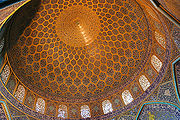
Safavid dynasty
The Safavid dynasty was one of the most significant ruling dynasties of Iran. They ruled one of the greatest Persian empires since the Muslim conquest of Persia and established the Twelver school of Shi'a Islam as the official religion of their empire, marking one of the most important turning...
, when Shah Abbas
Abbas I of Persia
Shāh ‘Abbās the Great was Shah of Iran, and generally considered the greatest ruler of the Safavid dynasty. He was the third son of Shah Mohammad....
, in 1598 initiated the reconstruction of Isfahan, with the Naqsh-e Jahan Square as the centerpiece of his new capital. Architecturally, they borrowed heavily from Il-Khanate designs, but artistically, they elevated the designs to a new level. The distinct feature of Persian domes, which separates them from those domes constructed in the Christian world or the Ottoman and Mughal empires, was the colorful tiles, with which they covered the exterior of their domes, as they would on the interior. These domes soon numbered dozens in Isfahan, and the distinct, blue- colored shape would dominate the skyline of the city. Reflecting the light of the sun, these domes appeared like glittering turquoise gem
Turquoise
Turquoise is an opaque, blue-to-green mineral that is a hydrous phosphate of copper and aluminium, with the chemical formula CuAl648·4. It is rare and valuable in finer grades and has been prized as a gem and ornamental stone for thousands of years owing to its unique hue...
and could be seen from miles away by travelers following the Silk road
Silk Road
The Silk Road or Silk Route refers to a historical network of interlinking trade routes across the Afro-Eurasian landmass that connected East, South, and Western Asia with the Mediterranean and European world, as well as parts of North and East Africa...
through Persia. This very distinct style of architecture was inherited to them from the Seljuq dynasty
Seljuq dynasty
The Seljuq ; were a Turco-Persian Sunni Muslim dynasty that ruled parts of Central Asia and the Middle East from the 11th to 14th centuries...
, who for centuries had used it in their mosque building throughout Central-Asia, but it was perfected during the Safavids when they invented the haft- rangi, or seven- colour style of tile burning, a process that enabled them to apply more colours to each tile, creating richer patterns, sweeter to the eye. The colours that the Persians favoured where golden, white and turquoise patterns on a dark- blue background. The extensive inscription bands of calligraphy and arabesque on most of the major buildings where carefully planned and executed by Ali Reza Abbasi
Reza Abbasi
Riza Abbasi, Riza yi-Abbasi or Reza-e Abbasi, رضا عباسی in Persian, usually "Riza" or Reza Abbasi also Aqa Riza or Āqā Riżā Kāshānī was the leading Persian miniaturist of the Isfahan School during the later Safavid period, spending most of his career working for Shah Abbas I...
, who was appointed head of the royal library and Master calligrapher at the Shah's court in 1598, while Shaykh Bahai
Shaykh Bahai
Muhammad ibn Thalib ibn Abd Allah ibn Ni`mat Allah ibn Sadr ad-Din ibn Shaykh Baha' ad-Din ash-Shirazi was a 15th century Persian physician from Shiraz, Iran....
oversaw the construction projects. Reaching at total height of 53 meters, and with a diameter of 25 m at the base of the dome, the dome of Masjed-e Shah (Shah Mosque
Shah Mosque
Imam Mosque, is a mosque in Isfahan, Iran standing in south side of Naghsh-i Jahan Square.Built during the Safavid period, it is an excellent example of Islamic architecture of Iran, and regarded as one of the masterpieces of Persian Architecture. The Shah Mosque of Esfahan is one of the...
) would become the largest in the city when it was finished in 1629. It was built as a double- shelled dome, with 14 m spanning between the two layers, and resting on a sixteen-sided dome-chamber.
The Il-Khanate legacy also laid the groundwork for a separate brand of architectural style, the Timurid Islamic architecture, which later also became an inspiration to Mughal architects. During the 14th and 15th century, Timur
Timur
Timur , historically known as Tamerlane in English , was a 14th-century conqueror of West, South and Central Asia, and the founder of the Timurid dynasty in Central Asia, and great-great-grandfather of Babur, the founder of the Mughal Dynasty, which survived as the Mughal Empire in India until...
and his successors adorned Samarkand
Samarkand
Although a Persian-speaking region, it was not united politically with Iran most of the times between the disintegration of the Seleucid Empire and the Arab conquest . In the 6th century it was within the domain of the Turkic kingdom of the Göktürks.At the start of the 8th century Samarkand came...
and other Central-Asian cities with spectacular and stately edifices. The Sanctuary of Ahmed Yasawi, situated in southern Kazakhstan
Kazakhstan
Kazakhstan , officially the Republic of Kazakhstan, is a transcontinental country in Central Asia and Eastern Europe. Ranked as the ninth largest country in the world, it is also the world's largest landlocked country; its territory of is greater than Western Europe...
was never finished, but has got the largest existing brick dome in Central Asia, measuring 18.2 m in diameter. The dome exterior is covered with hexagonal green glazed tiles with gold patterns.
Russian domes
.jpg)
Saint Sophia Cathedral in Novgorod
The Cathedral of St. Sophia in the Kremlin in Veliky Novgorod is the cathedral church of the Archbishop of Novgorod and the mother church of the Novgorodian Eparchy.-History:...
(989) and the 25-domed stone Desyatinnaya Church in Kiev
Kiev
Kiev or Kyiv is the capital and the largest city of Ukraine, located in the north central part of the country on the Dnieper River. The population as of the 2001 census was 2,611,300. However, higher numbers have been cited in the press....
(989-996). The number of domes typically has a symbolical meaning in Russian architecture
Russian architecture
Russian architecture follows a tradition whose roots were established in the Eastern Slavic state of Kievan Rus'. After the fall of Kiev, Russian architectural history continued in the principalities of Vladimir-Suzdal, Novgorod, the succeeding states of the Tsardom of Russia, the Russian Empire,...
, for example 13 domes symbolize Christ
Christ
Christ is the English term for the Greek meaning "the anointed one". It is a translation of the Hebrew , usually transliterated into English as Messiah or Mashiach...
with 12 Apostles, while 25 domes means the same with an additional 12 Prophets of the Old Testament
Old Testament
The Old Testament, of which Christians hold different views, is a Christian term for the religious writings of ancient Israel held sacred and inspired by Christians which overlaps with the 24-book canon of the Masoretic Text of Judaism...
. The multiple domes of Russian churches were often comparatively smaller than Byzantine
Byzantine
Byzantine usually refers to the Roman Empire during the Middle Ages.Byzantine may also refer to:* A citizen of the Byzantine Empire, or native Greek during the Middle Ages...
domes.
The earliest stone churches in Russia featured Byzantine style domes, however by the Early Modern era the onion dome
Onion dome
An onion dome is a dome whose shape resembles the onion, after which they are named. Such domes are often larger in diameter than the drum upon which they are set, and their height usually exceeds their width...
had become the predominant form in traditional Russian architecture
Russian architecture
Russian architecture follows a tradition whose roots were established in the Eastern Slavic state of Kievan Rus'. After the fall of Kiev, Russian architectural history continued in the principalities of Vladimir-Suzdal, Novgorod, the succeeding states of the Tsardom of Russia, the Russian Empire,...
. The onion dome
Onion dome
An onion dome is a dome whose shape resembles the onion, after which they are named. Such domes are often larger in diameter than the drum upon which they are set, and their height usually exceeds their width...
is a dome whose shape resembles an onion
Onion
The onion , also known as the bulb onion, common onion and garden onion, is the most widely cultivated species of the genus Allium. The genus Allium also contains a number of other species variously referred to as onions and cultivated for food, such as the Japanese bunching onion The onion...
, after which they are named. Such domes are often larger in diameter than the drum upon which they are set, and their height usually exceeds their width. The whole bulbous structure tapers smoothly to a point. Though the earliest preserved Russian domes of such type date from the 16th century, illustrations from older chronicles indicate that they were at least used since the late 13th century. Like tented roofs, which were combined with and sometimes replaced domes in Russian architecture since the 16th century, onion domes initially were used only in wooden churches and were introduced into stone architecture much later, where their carcasses continued to be made either of wood or metal on top of masonry drums.
Russian domes are often gilded
Gilding
The term gilding covers a number of decorative techniques for applying fine gold leaf or powder to solid surfaces such as wood, stone, or metal to give a thin coating of gold. A gilded object is described as "gilt"...
or brightly painted. A dangerous technique of chemical gilding
Gilding
The term gilding covers a number of decorative techniques for applying fine gold leaf or powder to solid surfaces such as wood, stone, or metal to give a thin coating of gold. A gilded object is described as "gilt"...
using mercury
Mercury (element)
Mercury is a chemical element with the symbol Hg and atomic number 80. It is also known as quicksilver or hydrargyrum...
had been applied on some occasions until the mid-19th century, most notably in the giant dome of Saint Isaac's Cathedral
Saint Isaac's Cathedral
Saint Isaac's Cathedral or Isaakievskiy Sobor in Saint Petersburg, Russia is the largest Russian Orthodox cathedral in the city...
. The more modern and safe method of gold
Gold
Gold is a chemical element with the symbol Au and an atomic number of 79. Gold is a dense, soft, shiny, malleable and ductile metal. Pure gold has a bright yellow color and luster traditionally considered attractive, which it maintains without oxidizing in air or water. Chemically, gold is a...
electroplating
Electroplating
Electroplating is a plating process in which metal ions in a solution are moved by an electric field to coat an electrode. The process uses electrical current to reduce cations of a desired material from a solution and coat a conductive object with a thin layer of the material, such as a metal...
was applied for the first time in gilding the domes of the Cathedral of Christ the Saviour in Moscow
Moscow
Moscow is the capital, the most populous city, and the most populous federal subject of Russia. The city is a major political, economic, cultural, scientific, religious, financial, educational, and transportation centre of Russia and the continent...
, the tallest Eastern Orthodox church in the world.
Italian Renaissance and Ottoman domes
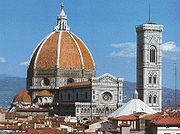
Filippo Brunelleschi
Filippo Brunelleschi was one of the foremost architects and engineers of the Italian Renaissance. He is perhaps most famous for inventing linear perspective and designing the dome of the Florence Cathedral, but his accomplishments also included bronze artwork, architecture , mathematics,...
and Lorenzo Ghiberti
Lorenzo Ghiberti
Lorenzo Ghiberti , born Lorenzo di Bartolo, was an Italian artist of the early Renaissance best known for works in sculpture and metalworking.-Early life:...
were made joint leaders of the project to build the dome for Florence Cathedral in 1420. Brunelleschi's plan to use suspended scaffolding for the workers won out over alternatives such as building a provisional stone support column in the center of the crossing or filling the space with earth. The octagonal brick domical vault was built between 1420 and 1436, with Ghiberti resigning in 1433. The lantern surmounting the dome, also designed by Brunelleschi, was not begun until 1446, after his death. It was completed in 1467. He had also planned for a two-story external gallery and cornice to be built at the top of the drum where a strip of unclad masonry can be seen today. Although a portion of it was constructed on the southeast side beginning in 1508, work stopped after the visual effect was criticized by Michelangelo
Michelangelo
Michelangelo di Lodovico Buonarroti Simoni , commonly known as Michelangelo, was an Italian Renaissance painter, sculptor, architect, poet, and engineer who exerted an unparalleled influence on the development of Western art...
. The dome is 42 meters wide and made of two shells. A stairway winds between them. Eight white stone external ribs mark the edges of the eight sides, next to the red tile roofing, and extend from the base of the dome to the base of the cupola. Each of the eight sides of the dome also conceal a pair of intermediate stone ribs which are connected to the main ribs by means of a series of masonry rings. A temporary wooden tension ring still exists near the bottom of the dome. Three horizontal chains of sandstone blocks notched together and reinforced with lead-coated iron cramps also extend the entire circumference of the dome: one at the base (where radial struts from this chain protrude to the exterior), one a third of the way up the dome, and one two thirds of the way up the dome. It was the largest dome built in Western Europe since the Pantheon, and remains the largest masonry dome ever built.
Brunelleschi's plan for the dome of the Pazzi Chapel
Pazzi Chapel
The Pazzi Chapel is a religious building in Florence, central Italy, considered to be one of the masterpieces of Renaissance architecture. It is located in the "first cloister" of the Basilica di Santa Croce.- History :...
in Florence's Basilica of Santa Croce (1430–1452) illustrates the Renaissance enthusiasm for geometry and for the circle as geometry's supreme form. Twelve ribs between twelve circular windows converge on a small oculus. The circular dome rests on pendentives decorated with circular medallions of Florentine ceramic
Ceramic
A ceramic is an inorganic, nonmetallic solid prepared by the action of heat and subsequent cooling. Ceramic materials may have a crystalline or partly crystalline structure, or may be amorphous...
. This emphasis on geometric essentials would be very influential. The dome of San Sisto in Piacenza (1499–1514) is likewise circular and also includes pendentives with circular medallions.
Among the Renaissance domes with a ribbed or spoked wheel design include that of the Certosa di Pavia
Certosa di Pavia
The Certosa di Pavia Gra-Car , Shrine of the Blessed Virgin Mary Mother of Grace, is a monastery and complex in Lombardy, northern Italy, situated near a small town of the same name in the Province of Pavia, 8 km north of Pavia...
(1396–1473) and the Madonna di Campagna in Piacenza (1522–1528).
The first church with an oval dome in the Renaissance period was the Sant'Andrea in Via Flaminia
Sant'Andrea in Via Flaminia
Sant'Andrea in Via Flaminia is a Roman Catholic church dedicated to St Andrew the Apostle in Rome, Italy. The edifice is also known as Sant'Andrea del Vignola, after its architect Giacomo Barozzi da Vignola....
, built from 1550 to 1554 by Vignola
Giacomo Barozzi da Vignola
Giacomo Barozzi da Vignola was one of the great Italian architects of 16th century Mannerism. His two great masterpieces are the Villa Farnese at Caprarola and the Jesuits' Church of the Gesù in Rome...
. The transverse section of the dome is a semi-oval and the longitudinal section is a semicircle. Julius III
Pope Julius III
Pope Julius III , born Giovanni Maria Ciocchi del Monte, was Pope from 7 February 1550 to 1555....
commissioned the dome. Use of the oval dome subsequently spread quickly through Italy, Spain, France, and central Europe.
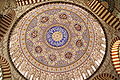
Istanbul
Istanbul , historically known as Byzantium and Constantinople , is the largest city of Turkey. Istanbul metropolitan province had 13.26 million people living in it as of December, 2010, which is 18% of Turkey's population and the 3rd largest metropolitan area in Europe after London and...
) from 1550 to 1557, has a main dome 53 meters high with a diameter of 26.5 meters. At the time it was built, the dome was the highest in the Ottoman Empire
Ottoman Empire
The Ottoman EmpireIt was usually referred to as the "Ottoman Empire", the "Turkish Empire", the "Ottoman Caliphate" or more commonly "Turkey" by its contemporaries...
when measured from sea level, but lower from the floor of the building and smaller in diameter than that of the nearby Hagia Sophia.
The Selimiye Mosque
Selimiye Mosque
The Selimiye Mosque is an Ottoman mosque in the city of Edirne, Turkey. The mosque was commissioned by Sultan Selim II and was built by architect Mimar Sinan between 1569 and 1575...
in the city of Edirne, Turkey, was the first structure built by the Ottomans which had a larger dome than that of the Hagia Sophia. The dome sits on an octagonal base and has an internal diameter of 31.25 meters. Designed and built by architect Mimar Sinan between 1568 and 1574, when he finished it he was 86 years old, and he considered the mosque to be his masterpiece.
The double shell dome of St. Peter's Basilica
St. Peter's Basilica
The Papal Basilica of Saint Peter , officially known in Italian as ' and commonly known as Saint Peter's Basilica, is a Late Renaissance church located within the Vatican City. Saint Peter's Basilica has the largest interior of any Christian church in the world...
was completed in 1590. Slightly smaller in diameter than those of the Pantheon and Florence Cathedral, the inner dome is hemispherical, while the outer ribbed dome is vertically oval. The outside of the drum is decorated with pairs of columns between the large windows. Its internal diameter is 41.47 meters (136.1 ft) and its external height from the ground to the top of the cross is 136.57 meters (448.1 ft). The dome remains the tallest in the world. The style of the church ushered in what would become known as Baroque architecture
Baroque architecture
Baroque architecture is a term used to describe the building style of the Baroque era, begun in late sixteenth century Italy, that took the Roman vocabulary of Renaissance architecture and used it in a new rhetorical and theatrical fashion, often to express the triumph of the Catholic Church and...
, and the dome in particular would have great influence on subsequent designs.
South-Asian and Mughal domes
Another distinctive sub-style is the architecture of the Mughal EmpireMughal Empire
The Mughal Empire , or Mogul Empire in traditional English usage, was an imperial power from the Indian Subcontinent. The Mughal emperors were descendants of the Timurids...
in South Asia
South Asia
South Asia, also known as Southern Asia, is the southern region of the Asian continent, which comprises the sub-Himalayan countries and, for some authorities , also includes the adjoining countries to the west and the east...
in the 16th century and a fusion of Arabic, and Persian elements. Considered the finest example of Mughal architecture
Mughal architecture
Mughal architecture, an amalgam of Islamic, Persian, Turkish and Indian architecture, is the distinctive style developed by the Mughals in the 16th, 17th and 18th centuries in what is now India, Pakistan, Bangladesh and Afghanistan. It is symmetrical and decorative in style.The Mughal dynasty was...
, the Taj Mahal is a mausoleum which combines elements of Persian, Indian, and Islamic architecture. Its large marble dome, often called an onion dome or amrud (guava dome), is about 35 meters high and sits on a cylindrical drum about 7 meters high. The Taj Mahal, the "teardrop on eternity," was completed in 1648 by emperor Shah Jahan in memory of his wife Mumtaz Mahal
Mumtaz Mahal
Mumtaz Mahal born as Arjumand Banu Begum was a Mughal Empress and chief consort of emperor Shah Jahan...
. The extensive use of precious and semiprecious stones as inlay and the vast quantity of white marble required nearly bankrupted the empire. The Taj Mahal is completely symmetric except for Shah Jahan's sarcophagus
Sarcophagus
A sarcophagus is a funeral receptacle for a corpse, most commonly carved or cut from stone. The word "sarcophagus" comes from the Greek σαρξ sarx meaning "flesh", and φαγειν phagein meaning "to eat", hence sarkophagus means "flesh-eating"; from the phrase lithos sarkophagos...
, which is placed off center in the crypt room below the main floor. This symmetry extended to the building of an entire mirror mosque in red sandstone
Sandstone
Sandstone is a sedimentary rock composed mainly of sand-sized minerals or rock grains.Most sandstone is composed of quartz and/or feldspar because these are the most common minerals in the Earth's crust. Like sand, sandstone may be any colour, but the most common colours are tan, brown, yellow,...
to complement the Mecca-facing mosque place to the west of the main structure.
The Badshahi Mosque
Badshahi Mosque
The Badshahi Mosque or the 'King's Mosque' in Lahore, commissioned by the sixth Mughal Emperor Aurangzeb in 1671 and completed in 1673, is the second largest mosque in Pakistan and South Asia and the fifth largest mosque in the world...
in Pakistan remained the largest mosque ever built until the Grand Mosque
Masjid al-Haram
Al-Masjid al-Ḥarām is the largest mosque in the world. Located in the city of Mecca, it surrounds the Kaaba, the place which Muslims worldwide turn towards while performing daily prayers and is Islam's holiest place...
in Mecca
Mecca
Mecca is a city in the Hijaz and the capital of Makkah province in Saudi Arabia. The city is located inland from Jeddah in a narrow valley at a height of above sea level...
was constructed in 1986. It has three domes, the largest of which is the central one which reaches 15 m in height and has a diameter of 21.5 m at the central bulging.
The non-Mughal Gol Gumbaz
Gol Gumbaz
Gol Gumbaz is the mausoleum of Mohammed Adil Shah, Sultan of Bijapur. The tomb, located in Bijapur, Karnataka in southern India, was completed in 1656 by the architect Yaqut of Dabul...
in the Deccan, however, retained the claim to being the largest dome in India and in fact the second largest in the world. The internal diameter of the hemispherical dome is 124 feet and it rises 175 feet above the floor over a square chamber 135 feet wide.
Early modern period domes
St. Paul's Cathedral in London was rebuilt from 1677 to 1708. The crossing dome, designed in several stages by Sir Christopher Wren, had its initiation with the first plans for modifying Old St. Paul'sOld St Paul's Cathedral
Old St Paul's Cathedral is a name used to refer to the medieval cathedral of the City of London which until 1666 stood on the site of the present St Paul's Cathedral. Built between 1087 and 1314 and dedicated to St Paul, the cathedral was the fourth church on the site at Ludgate Hill...
, even before the fire of 1666. It was the first church dome ever raised in England: "a form of church building," John Evelyn
John Evelyn
John Evelyn was an English writer, gardener and diarist.Evelyn's diaries or Memoirs are largely contemporaneous with those of the other noted diarist of the time, Samuel Pepys, and cast considerable light on the art, culture and politics of the time John Evelyn (31 October 1620 – 27 February...
recorded in his diary, "not as yet known in England, but of wonderful grace." When finished, the dome was three layers: an inner dome with an oculus, a decorative outer wood dome covered in lead roofing, and a structural brick cone in between. The brick cone ends in a small dome, which supports the cupola and outer roof and the decorated underside of which can be seen through the inner dome's oculus. It rises 365 feet (108 m) to the cross at its summit, but is evocative of the much smaller Tempietto by Bramante.
Adjacent to a hospital and retirement home for injured war veterans, the royal chapel of Les Invalides
Les Invalides
Les Invalides , officially known as L'Hôtel national des Invalides , is a complex of buildings in the 7th arrondissement of Paris, France, containing museums and monuments, all relating to the military history of France, as well as a hospital and a retirement home for war veterans, the building's...
in Paris, France, was begun in 1679 and completed in 1708. The dome was one of many inspired by that of St. Peter's Basilica and it is an outstanding example of French Baroque architecture
French Baroque architecture
French Baroque is a form of Baroque architecture that evolved in France during the reigns of Louis XIII , Louis XIV and Louis XV...
. In 1861 the body of Napoleon Bonaparte was moved from St. Helena to the most prominent location under the dome.
The Sanctuary of Vicoforte
Sanctuary of Vicoforte
The Santuario di Vicoforte is a monumental church located in the commune of Vicoforte, province of Cuneo, Piedmont, northern Italy. It is known for having the largest elliptical cupola in Europe.- History :...
in northwest Italy was originally meant to be the official dynastic mausoleum of the Savoia family
House of Savoy
The House of Savoy was formed in the early 11th century in the historical Savoy region. Through gradual expansion, it grew from ruling a small county in that region to eventually rule the Kingdom of Italy from 1861 until the end of World War II, king of Croatia and King of Armenia...
, which had governed Piedmont
Piedmont
Piedmont is one of the 20 regions of Italy. It has an area of 25,402 square kilometres and a population of about 4.4 million. The capital of Piedmont is Turin. The main local language is Piedmontese. Occitan is also spoken by a minority in the Occitan Valleys situated in the Provinces of...
and southwest France since the 15th century, but problems with uneven settlement due to the soil led to a halt in construction and the mausoleum was built elsewhere
Basilica of Superga
The Basilica of Superga is a church in the vicinity of Turin.It was built from 1717 to 1731 for Victor Amadeus II of Savoy by Filippo Juvarra, at the top of the hill of Superga, to fulfill a vow the duke had made during the Battle of Turin...
. After efforts of compensate for the settlement, construction was resumed to complete the building as a basilica. The oval
Oval
An oval is any curve resembling an egg or an ellipse, such as a Cassini oval. The term does not have a precise mathematical definition except in one area oval , but it may also refer to:* A sporting arena of oval shape** a cricket field...
dome, very close to an ellipse
Ellipse
In geometry, an ellipse is a plane curve that results from the intersection of a cone by a plane in a way that produces a closed curve. Circles are special cases of ellipses, obtained when the cutting plane is orthogonal to the cone's axis...
, was completed in 1731 and is the largest masonry dome of its kind in the world. It measures 37.15 meters by 24.8 meters at its base and is pierced by eight oval windows and a central oval oculus with a cupola. Although iron rings were used as part of the original construction at three levels to hold the dome together, cracks developed in the dome as the foundation settled further over the centuries. Additional reinforcement was added from 1985-1987 to halt their spread.
Modern period domes
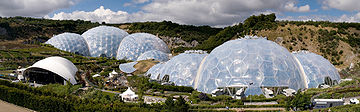
Cast iron
Cast iron is derived from pig iron, and while it usually refers to gray iron, it also identifies a large group of ferrous alloys which solidify with a eutectic. The color of a fractured surface can be used to identify an alloy. White cast iron is named after its white surface when fractured, due...
and wrought iron
Wrought iron
thumb|The [[Eiffel tower]] is constructed from [[puddle iron]], a form of wrought ironWrought iron is an iron alloy with a very low carbon...
to be produced both in larger quantities and at relatively low prices during the Industrial Revolution
Industrial Revolution
The Industrial Revolution was a period from the 18th to the 19th century where major changes in agriculture, manufacturing, mining, transportation, and technology had a profound effect on the social, economic and cultural conditions of the times...
. Iron was used in place of wood where fire resistance was a priority. In Russia, which had large supplies of iron, some of the earliest examples of the material's architectural use can be found. Andrey Voronikhin
Andrey Voronikhin
Andrey Nikiforovich Voronikhin was a Russian architect and painter. As a representative of classicism he was also one of the founders of the monumental Russian Empire style...
built a large wrought iron dome over Kazan Cathedral in Saint Petersburg. Built between 1806 and 1811, the 17.7 meter wide outer dome of the cathedral was one of the earliest iron domes.
Although iron production in France lagged behind Britain, the government was eager to foster the development of its domestic iron industry. In 1808, the government of Napoleon approved a plan to replace the burnt down wooden dome of the Halle au Blé granary in Paris with a dome of iron and glass, the "earliest example of metal with glass in a dome". The dome was 37 meters in diameter and used 51 cast iron ribs to converge on a wrought iron compression ring 11 meters wide containing a glass and wrought iron skylight. The outer surface of the dome was covered with copper, with additional windows cut near the dome's base to admit more light during an 1838 modification.
An early example from Britain is the fanciful iron-framed dome over the central building of the Royal Pavilion
Royal Pavilion
The Royal Pavilion is a former royal residence located in Brighton, England. It was built in three campaigns, beginning in 1787, as a seaside retreat for George, Prince of Wales, from 1811 Prince Regent. It is often referred to as the Brighton Pavilion...
in Brighton, begun in 1815 by John Nash
John Nash (architect)
John Nash was a British architect responsible for much of the layout of Regency London.-Biography:Born in Lambeth, London, the son of a Welsh millwright, Nash trained with the architect Sir Robert Taylor. He established his own practice in 1777, but his career was initially unsuccessful and...
, the personal architect of King George IV
George IV of the United Kingdom
George IV was the King of the United Kingdom of Great Britain and Ireland and also of Hanover from the death of his father, George III, on 29 January 1820 until his own death ten years later...
.
In 1828, the eastern crossing tower of Mainz Cathedral
Mainz Cathedral
Mainz Cathedral or St. Martin's Cathedral is located near the historical center and pedestrianized market square of the city of Mainz, Germany...
was rebuilt by Georg Moller
Georg Moller
Georg Moller was an architect and a town planner who worked in the South of Germany, mostly in the region today known as Hessen.- Life and family background :...
with a wrought iron dome.
Saint Isaac's Cathedral
Saint Isaac's Cathedral
Saint Isaac's Cathedral or Isaakievskiy Sobor in Saint Petersburg, Russia is the largest Russian Orthodox cathedral in the city...
, in Saint Petersburg, was built by 1842 with one of the largest domes in Europe. A cast iron dome nearly 26 meters wide, it had a technically advanced triple-shell design with iron trusses reminiscent of St. Paul's Cathedral in London.
The Neoclassical
Neoclassicism
Neoclassicism is the name given to Western movements in the decorative and visual arts, literature, theatre, music, and architecture that draw inspiration from the "classical" art and culture of Ancient Greece or Ancient Rome...
style popular at this time was challenged in the middle of the nineteenth century by a Gothic Revival
Gothic Revival architecture
The Gothic Revival is an architectural movement that began in the 1740s in England...
in architecture, in what has been termed the "Battle of the Styles
Battle of the Styles
The Battle of the Styles is a term used to refer to the conflict between supporters of the Gothic style and the Classical style in architecture. In Britain this led to public debates between Decimus Burton and Augustus Pugin. In France it led to controversy over the work of Viollet-le-Duc...
". This lasted from about 1840 to the beginning of the twentieth century, with various styles within Classicism, such as Renaissance, Baroque, and Rococo revivals, also vying for popularity. The last three decades of this period included unusual combinations of these styles.
The current dome over the United States Capitol building, although painted white and crowning a masonry building, is also made of cast iron. The dome was built between 1855 to 1866, replacing a lower wooden dome with copper roofing from 1824. It was completed just two years after the Old St. Louis County Courthouse, which has the first cast iron dome built in the United States. The initial design of the capitol dome was influenced by a number of European church domes, particularly St. Paul's
St Paul's Cathedral
St Paul's Cathedral, London, is a Church of England cathedral and seat of the Bishop of London. Its dedication to Paul the Apostle dates back to the original church on this site, founded in AD 604. St Paul's sits at the top of Ludgate Hill, the highest point in the City of London, and is the mother...
in London, St. Peter's
St. Peter's Basilica
The Papal Basilica of Saint Peter , officially known in Italian as ' and commonly known as Saint Peter's Basilica, is a Late Renaissance church located within the Vatican City. Saint Peter's Basilica has the largest interior of any Christian church in the world...
in Rome, the Panthéon
Panthéon, Paris
The Panthéon is a building in the Latin Quarter in Paris. It was originally built as a church dedicated to St. Genevieve and to house the reliquary châsse containing her relics but, after many changes, now functions as a secular mausoleum containing the remains of distinguished French citizens...
in Paris, Les Invalides
Les Invalides
Les Invalides , officially known as L'Hôtel national des Invalides , is a complex of buildings in the 7th arrondissement of Paris, France, containing museums and monuments, all relating to the military history of France, as well as a hospital and a retirement home for war veterans, the building's...
in Paris, and St. Isaac’s Cathedral
Saint Isaac's Cathedral
Saint Isaac's Cathedral or Isaakievskiy Sobor in Saint Petersburg, Russia is the largest Russian Orthodox cathedral in the city...
in St. Petersburg. The architect, Thomas U. Walter
Thomas U. Walter
Thomas Ustick Walter of Philadelphia, Pennsylvania was an American architect, the dean of American architecture between the 1820 death of Benjamin Latrobe and the emergence of H.H. Richardson in the 1870s...
, designed a double dome interior based on that of the Panthéon in Paris.
The British Museum Library constructed a new reading room
British Museum Reading Room
The British Museum Reading Room, situated in the centre of the Great Court of the British Museum, used to be the main reading room of the British Library. In 1997, this function moved to the new British Library building at St Pancras, London, but the Reading Room remains in its original form inside...
in the courtyard of its museum building between 1854 and 1857. The round room, about 42.6 meters in diameter and inspired by the Pantheon, was surmounted by a dome with a ring of windows at the base and an oculus at the top. Hidden iron framing supported a suspended ceiling made of papier-mâché
Papier-mâché
Papier-mâché , alternatively, paper-mache, is a composite material consisting of paper pieces or pulp, sometimes reinforced with textiles, bound with an adhesive, such as glue, starch, or wallpaper paste....
. Inspired by the prestigious British Museum reading room, the first iron dome in Canada was built in the early 1870s over the reading room of the Library of Parliament
Library of Parliament
The Library of Parliament is the main information repository and research resource for the Parliament of Canada...
building in Ottawa
Ottawa
Ottawa is the capital of Canada, the second largest city in the Province of Ontario, and the fourth largest city in the country. The city is located on the south bank of the Ottawa River in the eastern portion of Southern Ontario...
. Unlike the British Museum room, the library, which opened in 1876, uses the Gothic style. The dome of the Thomas Jefferson Building
Thomas Jefferson Building
The oldest of the three United States Library of Congress buildings, the Thomas Jefferson Building was built between 1890 and 1897. It is known for its classicizing facade and elaborately decorated interior. John L. Smithmeyer and Paul J...
of the Library of Congress
Library of Congress
The Library of Congress is the research library of the United States Congress, de facto national library of the United States, and the oldest federal cultural institution in the United States. Located in three buildings in Washington, D.C., it is the largest library in the world by shelf space and...
, also inspired by the reading room dome at the British Museum, was built between 1889 and 1897 in a classical style. It is 100 feet wide and rises 195 feet above the floor on eight piers. The dome has a relatively low external profile to avoid overshadowing the nearby United States Capitol dome.
The Hungarian Parliament Building
Hungarian Parliament Building
The Hungarian Parliament Building is the seat of the National Assembly of Hungary, one of Europe's oldest legislative buildings, a notable landmark of Hungary and a popular tourist destination of Budapest. It lies in Lajos Kossuth Square, on the bank of the Danube, in Budapest...
was built in the Gothic style, although most of the 1882 design competition entries used Neo-Renaissance, and it includes a domed central hall. The large, ribbed, egg-shaped dome topped with a spire was influenced by the dome of the Maria vom Siege church in Vienna. It has a sixteen sided outer shell with an iron skeleton that rises 96 meters high, and an inner shell star vault supported on sixteen stone pillars. The Dome Hall is used to display the coronation crown of Hungary and statuary of monarchs and statesmen. The dome was structurally complete by the end of 1895.
The large domes of the 19th century also included hothouses
Greenhouse
A greenhouse is a building in which plants are grown. These structures range in size from small sheds to very large buildings...
, winter garden
Winter garden
The origin of the winter garden dates back to the 17th to 19th centuries where European nobility would construct large conservatories that would house tropical and subtropical plants and would act as an extension of their living space. Many of these would be attached to their main palaces...
s, arcades
Arcade (architecture)
An arcade is a succession of arches, each counterthrusting the next, supported by columns or piers or a covered walk enclosed by a line of such arches on one or both sides. In warmer or wet climates, exterior arcades provide shelter for pedestrians....
, and exhibition buildings
Convention center
A convention center is a large building that is designed to hold a convention, where individuals and groups gather to promote and share common interests. Convention centers typically offer sufficient floor area to accommodate several thousand attendees...
, as well as functional structures such as gasometers and locomotive sheds
Motive power depot
Motive power depot, usually abbreviated to MPD, is a name given to places where locomotives are stored when not being used, and also repaired and maintained. They were originally known as "running sheds", "engine sheds", or, for short, just sheds. Facilities are provided for refuelling and...
. Excluding those metal domes which simply imitated multi-shell masonry, metal framed domes such as the elliptical dome of Royal Albert Hall
Royal Albert Hall
The Royal Albert Hall is a concert hall situated on the northern edge of the South Kensington area, in the City of Westminster, London, England, best known for holding the annual summer Proms concerts since 1941....
in London (57 to 67 meters in diameter) and the circular dome of Halle au Blé in Paris may represent the chief 19th century development of the simple domed form. The "first fully triangulated framed dome" was built in Berlin in 1863 by Johann Wilhelm Schwedler
Johann Wilhelm Schwedler
Johann Wilhelm Schwedler was a German civil engineer and civil servant who designed many bridges and public buildings and invented the Schwedler truss and the Schwedler cupola.-Life and career:...
and, by the start of the 20th century, similarly triangulated frame domes had become fairly common.
The final development of the masonry dome may have been the work of the Guastavino family, who perfected a traditional Spanish and Italian technique
Catalan vault
The Catalan vault, also called the Catalan turn or Catalan arch or a timbrel vault, is a type of low arch made of plain bricks often used to make a structural floor surface...
for light, center-less vaulting using layers of tiles
Guastavino tile
Guastavino tile is the "Tile Arch System" patented in the US in 1885 by Valencian architect and builder Rafael Guastavino...
in fast-setting cement set flat against the surface of the curve, rather than perpendicular to it. The father and son team worked on the eastern seaboard of the United States in the late 19th and early 20th centuries. The father, Rafael Guastavino
Rafael Guastavino
Rafael Guastavino Moreno was a Valencian architect and builder, creator of the Guastavino tile, a "Tile Arch System" patented in the US in 1885. It is a technique for constructing robust, self-supporting arches and architectural vaults using interlocking terracotta tiles and layers of mortar...
, innovated with the use of Portland cement
Portland cement
Portland cement is the most common type of cement in general use around the world because it is a basic ingredient of concrete, mortar, stucco and most non-specialty grout...
as the mortar, rather than the traditional lime and gypsum mortars, which allowed mild steel bar to be used to counteract tension forces. The family built vaults in hundreds of buildings, including the domes of the Basilica of St. Lawrence in Asheville, North Carolina, and St. Francis de Sales Roman Catholic Church
St. Francis de Sales Roman Catholic Church (Philadelphia)
thumb|300px|St. Francis de Sales ChurchSt. Francis de Sales Roman Catholic Church, founded in 1890, is a Catholic church at 4625 Springfield Avenue in University City, Philadelphia, Pennsylvania, part of the Roman Catholic Archdiocese of Philadelphia. Its cornerstone laid in 1907, the Guastavino...
in Philadelphia, Pennsylvania. The dome over the crossing of the Cathedral of St. John the Divine in New York City
New York City
New York is the most populous city in the United States and the center of the New York Metropolitan Area, one of the most populous metropolitan areas in the world. New York exerts a significant impact upon global commerce, finance, media, art, fashion, research, technology, education, and...
was built by the son in 1909. A part-spherical dome, it measures 30 meters in diameter from the top of its merging pendentives, where steel rods embedded in concrete act as a restraining ring. With an average thickness 1/250th of its span, and steel rods also embedded within the pendentives, the dome "looked forward to modern shell construction in reinforced concrete."
The thin domical shell was further developed with the construction of two domes in Jena
Jena
Jena is a university city in central Germany on the river Saale. It has a population of approx. 103,000 and is the second largest city in the federal state of Thuringia, after Erfurt.-History:Jena was first mentioned in an 1182 document...
, Germany in the early 1920s. To build a rigid planetarium
Planetarium
A planetarium is a theatre built primarily for presenting educational and entertaining shows about astronomy and the night sky, or for training in celestial navigation...
dome, Walther Bauersfeld
Walther Bauersfeld
Walther Bauersfeld was a German engineer, employed by the Zeiss Corporation, who, on a suggestion by the German astronomer Max Wolf, started work on the first projection planetarium in 1912. This work was stopped by military needs during World War I, but resumed after the war...
constructed a triangulated frame of light steel bars and mesh with a domed formwork suspended below it. By spraying a thin layer of concrete onto both the formwork and the frame, he created a 16 meter wide dome that was just 30 millimeters thick. The second dome was still thinner at 40 meters wide and 60 millimeters thick. These are considered the first geodesic dome
Geodesic dome
A geodesic dome is a spherical or partial-spherical shell structure or lattice shell based on a network of great circles on the surface of a sphere. The geodesics intersect to form triangular elements that have local triangular rigidity and also distribute the stress across the structure. When...
s. The term was coined later by Buckminster Fuller
Buckminster Fuller
Richard Buckminster “Bucky” Fuller was an American systems theorist, author, designer, inventor, futurist and second president of Mensa International, the high IQ society....
, who invented them independently and received a patent in 1954. Geodesic domes have been used for radar enclosures, greenhouses, housing, and weather stations. The U.S. Pavilion
Montreal Biosphère
The Biosphère is a museum in Montreal dedicated to the environment. It is located at Parc Jean-Drapeau, on Île Sainte-Hélène in the former pavilion of the United States for the 1967 World Fair Expo 67.- Expo 67 :...
at Expo 67
Expo 67
The 1967 International and Universal Exposition or Expo 67, as it was commonly known, was the general exhibition, Category One World's Fair held in Montreal, Quebec, Canada, from April 27 to October 29, 1967. It is considered to be the most successful World's Fair of the 20th century, with the...
in Montreal, Canada, was enclosed by a 76.5 meter wide and 60 meter tall dome made of steel pipes and acrylic panels. It is used today as a water monitoring center.
In the 20th century, thin "eggshell" domes of pre-stressed concrete
Prestressed concrete
Prestressed concrete is a method for overcoming concrete's natural weakness in tension. It can be used to produce beams, floors or bridges with a longer span than is practical with ordinary reinforced concrete...
by architect-engineers such as Pier Luigi Nervi
Pier Luigi Nervi
Pier Luigi Nervi was an Italian engineer. He studied at the University of Bologna and qualified in 1913. Dr. Nervi taught as a professor of engineering at Rome University from 1946-61...
opened new directions in fluid vaulted spaces enclosed beneath freeform domed space which now might be supported merely at points rather than in the traditional constricting ring.
Tensegrity
Tensegrity
Tensegrity, tensional integrity or floating compression, is a structural principle based on the use of isolated components in compression inside a net of continuous tension, in such a way that the compressed members do not touch each other and the prestressed tensioned members delineate the...
domes, patented by Buckminster Fuller in 1962, are fabric-covered structures consisting of radial trusses made from steel cables under tension with vertical steel pipes spreading the cables into the truss form. They have been made circular, elliptical, and other shapes to cover stadiums from Korea to Florida.
Many sports stadium
Stadium
A modern stadium is a place or venue for outdoor sports, concerts, or other events and consists of a field or stage either partly or completely surrounded by a structure designed to allow spectators to stand or sit and view the event.)Pausanias noted that for about half a century the only event...
s are domed, especially in climates that have widely variable summer and winter weather. The first such stadium was the Astrodome in Houston, Texas
Houston, Texas
Houston is the fourth-largest city in the United States, and the largest city in the state of Texas. According to the 2010 U.S. Census, the city had a population of 2.1 million people within an area of . Houston is the seat of Harris County and the economic center of , which is the ...
.
While the first permanent domed membrane structures were the radar domes
Radome
A radome is a structural, weatherproof enclosure that protects a microwave or radar antenna. The radome is constructed of material that minimally attenuates the electromagnetic signal transmitted or received by the antenna. In other words, the radome is transparent to radar or radio waves...
designed and built by Walter Bird after World War II, the cable-restrained and air-supported tension membrane structure designed by David Geiger
David H. Geiger
David H. Geiger was an engineer who invented the air-supported fabric roof system that was used at about half the domed stadiums in the U.S...
to cover the United States pavilion at Expo '70
Expo '70
was a World's Fair held in Suita, Osaka, Japan between March 15 and September 13, 1970. The theme of the Expo was "Progress and Harmony for Mankind." In Japanese Expo '70 is often referred to as Ōsaka Banpaku...
was a landmark construction. Its low expense led to the development of permanent versions using teflon-coated fiberglass and within 15 years the majority of the domed stadiums around the world used this system, including the Silverdome
Silverdome
The Silverdome is an indoor sporting and entertainment venue located in Launceston, Tasmania built in 1984. The Silverdome was built at an estimated cost of A$4 million, as the Tasmanian Government "proposed a world class facility" to replace the run down velodrome in the Launceston suburb of St...
in Pontiac, Michigan.
A major improvement to the domed stadium was accomplished with the construction of SkyDome, now Rogers Centre
Rogers Centre
Rogers Centre is a multi-purpose stadium, in Downtown Toronto, Ontario, Canada, situated next to the CN Tower, near the shores of Lake Ontario. Opened in 1989, it is home to the Toronto Blue Jays of Major League Baseball and the Toronto Argonauts of the Canadian Football League...
, in Toronto
Toronto
Toronto is the provincial capital of Ontario and the largest city in Canada. It is located in Southern Ontario on the northwestern shore of Lake Ontario. A relatively modern city, Toronto's history dates back to the late-18th century, when its land was first purchased by the British monarchy from...
, Ontario
Ontario
Ontario is a province of Canada, located in east-central Canada. It is Canada's most populous province and second largest in total area. It is home to the nation's most populous city, Toronto, and the nation's capital, Ottawa....
, the first domed stadium with a retractable roof.
Symbolism
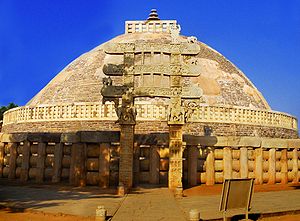
Stupa
A stupa is a mound-like structure containing Buddhist relics, typically the remains of Buddha, used by Buddhists as a place of worship....
s of India
India
India , officially the Republic of India , is a country in South Asia. It is the seventh-largest country by geographical area, the second-most populous country with over 1.2 billion people, and the most populous democracy in the world...
to the tholos tombs
Beehive tomb
A beehive tomb, also known as a tholos tomb , is a burial structure characterized by its false dome created by the superposition of successively smaller rings of mudbricks or, more often, stones...
of Iberia
Iberian Peninsula
The Iberian Peninsula , sometimes called Iberia, is located in the extreme southwest of Europe and includes the modern-day sovereign states of Spain, Portugal and Andorra, as well as the British Overseas Territory of Gibraltar...
. By Hellenistic and Roman times, the domical tholos had become the customary cemetery symbol.
In the process of transforming the hut
Hut (dwelling)
A hut is a small and crude shelter, usually used for dwelling. Its design favors local techniques and materials to allow for swift and inexpensive construction.-Modern use:...
shape from its original pliable materials into more difficult stone construction, the dome had also become associated with celestial and cosmic significance, as evident from decoration such as stars and celestial chariots on the ceilings of domed tombs. This cosmological thinking was not limited to domed ceilings, being part of a symbolic association between any house, tomb, or sanctuary and the universe as a whole, but it popularized the use of the domical shape.
A distinct symbolism of the heavenly or cosmic tent stemming from the royal audience tents of Achaemenid
Achaemenid Empire
The Achaemenid Empire , sometimes known as First Persian Empire and/or Persian Empire, was founded in the 6th century BCE by Cyrus the Great who overthrew the Median confederation...
and Indian rulers was adopted by Roman rulers in imitation of Alexander the Great, becoming the imperial baldachin
Baldachin
A baldachin, or baldaquin , is a canopy of state over an altar or throne. It had its beginnings as a cloth canopy, but in other cases it is a sturdy, permanent architectural feature, particularly over high altars in cathedrals, where such a structure is more correctly called a ciborium when it is...
. This probably began with Nero
Nero
Nero , was Roman Emperor from 54 to 68, and the last in the Julio-Claudian dynasty. Nero was adopted by his great-uncle Claudius to become his heir and successor, and succeeded to the throne in 54 following Claudius' death....
, whose "Golden House
Domus Aurea
The Domus Aurea was a large landscaped portico villa, designed to take advantage of artificially created landscapes built in the heart of Ancient Rome by the Emperor Nero after the Great Fire of Rome had cleared away the aristocratic dwellings on the slopes of the Palatine...
" also made the dome an essential feature of palace architecture.
The Christian use of domes acknowledged these symbolic associations. The traditional mortuary symbolism led the dome to be used in Christian central-type martyria
Martyrium (architecture)
A martyrium is a structure built at "a site which bears witness to the Christian faith, either by referring to an event in Christ's life or Passion, or by sheltering the grave of a martyr"....
in the Syria
Syria
Syria , officially the Syrian Arab Republic , is a country in Western Asia, bordering Lebanon and the Mediterranean Sea to the West, Turkey to the north, Iraq to the east, Jordan to the south, and Israel to the southwest....
n area, the growing popularity of which spread the form. The spread and popularity of the cult of relic
Relic
In religion, a relic is a part of the body of a saint or a venerated person, or else another type of ancient religious object, carefully preserved for purposes of veneration or as a tangible memorial...
s also transformed the domed central-type martyria into the domed churches of mainstream Christianity. In Italy in the 4th century, baptisteries began to be built like domed mausolea and martyria, which spread in the 5th century. This reinforced the theological emphasis on baptism as a re-experience of the death and resurrection of Jesus Christ. The dual sepulchral and heavenly symbolism was adopted by early Christians in both the use of domes in architecture and in the ciborium
Ciborium (architecture)
In ecclesiastical architecture, a ciborium is a canopy or covering supported by columns, freestanding in the sanctuary, that stands over and covers the altar in a basilica or other church. It may also be known by the more general term of baldachin, though ciborium is often considered more correct...
, a domical canopy like the baldachin used as a ritual covering for relics or the church alter. The celestial symbolism of the dome, however, was the preeminent one by the Christian era.
Literary evidence exists that the idea of the cosmic temple had been applied to the Christian basilica by the end of the 4th century, in the form of a speech by Eusebius
Eusebius of Caesarea
Eusebius of Caesarea also called Eusebius Pamphili, was a Roman historian, exegete and Christian polemicist. He became the Bishop of Caesarea in Palestine about the year 314. Together with Pamphilus, he was a scholar of the Biblical canon...
on a church in Tyre. However, it is only in the mid 6th century that the earliest literary evidence of a cosmological interpretation of a domed church building exists, in the form of a hymn composed for the cathedral church of Edessa
Edessa, Greece
Edessa , is a city in northern Greece and the capital of the Pella regional unit, in the Central Macedonia region of Greece. It was also the capital of the defunct province of the same name.-Name:...
. Kathleen E. McVey traces this to a blending by Jacob of Serugh
Jacob of Serugh
Jacob of Serugh , also called Mar Jacob, was one of the foremost Syriac poet-theologians among the Syriac, perhaps only second in stature to Ephrem the Syrian and equal to Narsai. Where his predecessor Ephrem is known as the 'Harp of the Spirit', Jacob is the 'Flute of the Spirit'...
of the two major but contradictory schools of biblical exegesis
Exegesis
Exegesis is a critical explanation or interpretation of a text, especially a religious text. Traditionally the term was used primarily for exegesis of the Bible; however, in contemporary usage it has broadened to mean a critical explanation of any text, and the term "Biblical exegesis" is used...
at the time: the building-as-microcosm tradition of the Antioch school combined with the Alexandrian view of the cosmos and firmament as composed of spheres and hemispheres, which was rejected by the Antioch school.
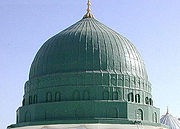
Otto Demus
Otto Demus was an Austrian art historian and Byzantinist. He is considered a member of the Vienna School of Art History....
writes that Middle Byzantine churches were decorated in a systematic manner and can be seen as having three zones of decoration, with the holiest at the top. This uppermost zone contained the dome, drum and apse. The dome was reserved for an image of Christ called the "Pantokrator" (meaning "ruler of all"), usually as a bust in a roundrel, the drum usually contained images of angels or prophets, and the semi-dome of the apse usually depicted the Virgin Mary, typically holding the Christ child and flanked by angels.
According to Oleg Grabar
Oleg Grabar
Oleg Grabar was a French-born art historian and archeologist, who spent most of his career in the United States, as a leading figure in the field of Islamic art and architecture.-Academic career:...
, the domes of the Islamic world, which rejected such imagery, continued the other traditions. Muslim royalty built palatial pleasure domes in continuation of the Roman and Persian imperial models, although many have not survived, and domed mausoleums from Merv
Merv
Merv , formerly Achaemenid Satrapy of Margiana, and later Alexandria and Antiochia in Margiana , was a major oasis-city in Central Asia, on the historical Silk Road, located near today's Mary in Turkmenistan. Several cities have existed on this site, which is significant for the interchange of...
to India
Mughal Empire
The Mughal Empire , or Mogul Empire in traditional English usage, was an imperial power from the Indian Subcontinent. The Mughal emperors were descendants of the Timurids...
developed the form. In the early centuries of Islam, domes were closely associated with royalty. A dome built in front of the mihrab of a mosque, for example, was at least initially meant to emphasize the place of a prince during royal ceremonies. Over time such domes became primarily focal points for decoration or the direction of prayer. The use of domes in mausoleums can likewise reflect royal patronage or be seen as representing the honor and prestige which domes symbolized, rather than having any specific funerary meaning.
Oleg Grabar characterizes forms in Islamic architecture as having relatively low levels of symbolism. While conceding this in a general sense, Yasser Tabbaa maintains that certain forms were initially very highly symbolic and only lost such associations over time. The phenomenon of muqarnas
Muqarnas
Muqarnas is a type of corbel used as a decorative device in traditional Islamic architecture. The term is similar to mocárabe, but mocárabe only refers to designs with formations resembling stalactites, by the use of elements known as alveole.Muqarnas takes the form of small pointed niches,...
domes, in particular, is an example. Tabbaa explains the development and spread of muqarnas domes throughout the Islamic world beginning in the early 11th century as the visual expression of a theological idea of the universe propounded by the Ash'ari
Ash'ari
The Ashʿari theology is a school of early Muslim speculative theology founded by the theologian Abu al-Hasan al-Ash'ari...
tes (a modification of the Atomism
Atomism
Atomism is a natural philosophy that developed in several ancient traditions. The atomists theorized that the natural world consists of two fundamental parts: indivisible atoms and empty void.According to Aristotle, atoms are indestructible and immutable and there are an infinite variety of shapes...
of Aristotle
Aristotle
Aristotle was a Greek philosopher and polymath, a student of Plato and teacher of Alexander the Great. His writings cover many subjects, including physics, metaphysics, poetry, theater, music, logic, rhetoric, linguistics, politics, government, ethics, biology, and zoology...
with Occasionalism
Occasionalism
Occasionalism is a philosophical theory about causation which says that created substances cannot be efficient causes of events. Instead, all events are taken to be caused directly by God...
), which rose to prominence in Baghdad
Baghdad
Baghdad is the capital of Iraq, as well as the coterminous Baghdad Governorate. The population of Baghdad in 2011 is approximately 7,216,040...
at this time. Only later was the style used in a purely decorative manner.
Influential domes
Domes that have been disproportionately influential in later architecture are those of the PantheonPantheon, Rome
The Pantheon ,Rarely Pantheum. This appears in Pliny's Natural History in describing this edifice: Agrippae Pantheum decoravit Diogenes Atheniensis; in columnis templi eius Caryatides probantur inter pauca operum, sicut in fastigio posita signa, sed propter altitudinem loci minus celebrata.from ,...
in Rome, Hagia Sophia
Hagia Sophia
Hagia Sophia is a former Orthodox patriarchal basilica, later a mosque, and now a museum in Istanbul, Turkey...
in Constantinople (modern Istanbul), and the Dome of the Rock
Dome of the Rock
The Dome of the Rock is a shrine located on the Temple Mount in the Old City of Jerusalem. The structure has been refurbished many times since its initial completion in 691 CE at the order of Umayyad Caliph Abd al-Malik...
in Jerusalem. In Western architecture, the most influential domes built after the early Renaissance exploit of Brunelleschi
Filippo Brunelleschi
Filippo Brunelleschi was one of the foremost architects and engineers of the Italian Renaissance. He is perhaps most famous for inventing linear perspective and designing the dome of the Florence Cathedral, but his accomplishments also included bronze artwork, architecture , mathematics,...
's Florentine dome have been those of St. Peter's Basilica
St. Peter's Basilica
The Papal Basilica of Saint Peter , officially known in Italian as ' and commonly known as Saint Peter's Basilica, is a Late Renaissance church located within the Vatican City. Saint Peter's Basilica has the largest interior of any Christian church in the world...
in Rome and Jules Hardouin-Mansart's dome at Les Invalides
Les Invalides
Les Invalides , officially known as L'Hôtel national des Invalides , is a complex of buildings in the 7th arrondissement of Paris, France, containing museums and monuments, all relating to the military history of France, as well as a hospital and a retirement home for war veterans, the building's...
in Paris. The dome of St. Paul's Cathedral in London was the inspiration for the United States Capitol
United States Capitol
The United States Capitol is the meeting place of the United States Congress, the legislature of the federal government of the United States. Located in Washington, D.C., it sits atop Capitol Hill at the eastern end of the National Mall...
in Washington, which in turn inspired domes of most of the US state capitols.
Onion dome
The onion dome or bulbous dome is a bulbous shape tapering smoothly to a point, strongly resembling an onion, after which they are named, and exemplified by Saint Basil's CathedralSaint Basil's Cathedral
The Cathedral of the Protection of Most Holy Theotokos on the Moat , popularly known as Saint Basil's Cathedral , is a Russian Orthodox church erected on the Red Square in Moscow in 1555–61. Built on the order of Ivan the Terrible to commemorate the capture of Kazan and Astrakhan, it marks the...
in Moscow
Moscow
Moscow is the capital, the most populous city, and the most populous federal subject of Russia. The city is a major political, economic, cultural, scientific, religious, financial, educational, and transportation centre of Russia and the continent...
and the Taj Mahal
Taj Mahal
The Taj Mahal is a white Marble mausoleum located in Agra, India. It was built by Mughal emperor Shah Jahan in memory of his third wife, Mumtaz Mahal...
. They are found mostly in eastern architecture, particularly in Russia
Russia
Russia or , officially known as both Russia and the Russian Federation , is a country in northern Eurasia. It is a federal semi-presidential republic, comprising 83 federal subjects...
, Turkey
Turkey
Turkey , known officially as the Republic of Turkey , is a Eurasian country located in Western Asia and in East Thrace in Southeastern Europe...
, India
India
India , officially the Republic of India , is a country in South Asia. It is the seventh-largest country by geographical area, the second-most populous country with over 1.2 billion people, and the most populous democracy in the world...
, and the Middle East
Middle East
The Middle East is a region that encompasses Western Asia and Northern Africa. It is often used as a synonym for Near East, in opposition to Far East...
. An onion dome is a type of architectural dome usually associated with Russian Orthodox churches. Such a dome is larger in diameter than the drum it is set upon and its height usually exceeds its width. It is also a common feature among Catholic churches in the south of Germany, Austria, and Switzerland.
Bulbous domes became popular in the second half of the 15th century in the Low Countries
Low Countries
The Low Countries are the historical lands around the low-lying delta of the Rhine, Scheldt, and Meuse rivers, including the modern countries of Belgium, the Netherlands, Luxembourg and parts of northern France and western Germany....
of Northern Europe, possibly inspired by the finials of minarets
Minarets
Minarets may refer to:*Minarets, an architectural feature of Islamic mosques*Minarets, California, a former town in California*Minarets , mountain peaks in the Sierra Nevada Mountains of California*Minarets , a song by Dave Matthews...
in Egypt and Syria. They were developed in the 16th and 17th centuries in Holland before spreading to Germany, becoming a popular element of the baroque architecture of Central Europe. German bulbous domes were also influenced by Russian and Eastern European examples.
Corbel dome
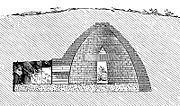
Cantilever
A cantilever is a beam anchored at only one end. The beam carries the load to the support where it is resisted by moment and shear stress. Cantilever construction allows for overhanging structures without external bracing. Cantilevers can also be constructed with trusses or slabs.This is in...
ed, or corbel
Corbel
In architecture a corbel is a piece of stone jutting out of a wall to carry any superincumbent weight. A piece of timber projecting in the same way was called a "tassel" or a "bragger". The technique of corbelling, where rows of corbels deeply keyed inside a wall support a projecting wall or...
ed, toward the center until meeting at the top. A famous example is the Mycenaean Treasury of Atreus.
Geodesic dome
Geodesic domes are the upper portion of geodesic spheres. They are composed of a framework of triangles in a polyhedronPolyhedron
In elementary geometry a polyhedron is a geometric solid in three dimensions with flat faces and straight edges...
pattern.
Oval dome
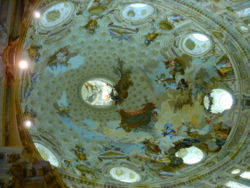
Renaissance
The Renaissance was a cultural movement that spanned roughly the 14th to the 17th century, beginning in Italy in the Late Middle Ages and later spreading to the rest of Europe. The term is also used more loosely to refer to the historical era, but since the changes of the Renaissance were not...
and Baroque
Baroque
The Baroque is a period and the style that used exaggerated motion and clear, easily interpreted detail to produce drama, tension, exuberance, and grandeur in sculpture, painting, literature, dance, and music...
domes are of this type, notably those of Bernini and Borromini
Francesco Borromini
Francesco Borromini, byname of Francesco Castelli was an architect from Ticino who, with his contemporaries, Gian Lorenzo Bernini and Pietro da Cortona, was a leading figure in the emergence of Roman Baroque architecture.A keen student of the architecture of Michelangelo and the ruins of...
. The largest oval dome was built in the basilica of Vicoforte
Vicoforte
Vicoforte is a comune in the Province of Cuneo in Italy. It is located in Val Corsaglia above sea level, 32 km east of Cuneo and 6 km from Mondovì....
by Francesco Gallo.
Parabolic dome
A parabolic dome is a unique structure, in which bending stress due to the UDL of its dead load is zero. Hence it was widely used in buildings in ancient times, before the advent of composite structures. However if a point load is applied on the apex of a parabolic dome, the bending stress becomes infinite. Hence it is found in most ancient structures, the apex of the dome is stiffened or the shape modified to avoid the infinite stress.Polygonal dome
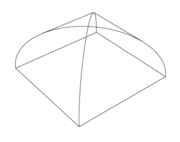
Thomas Jefferson
Thomas Jefferson was the principal author of the United States Declaration of Independence and the Statute of Virginia for Religious Freedom , the third President of the United States and founder of the University of Virginia...
, the third president of the United States, installed an octagonal dome above the West front of his plantation house, Monticello
Monticello
Monticello is a National Historic Landmark just outside Charlottesville, Virginia, United States. It was the estate of Thomas Jefferson, the principal author of the United States Declaration of Independence, third President of the United States, and founder of the University of Virginia; it is...
.
Sail dome
Also called sail vaults, pendentive domes, or Byzantine domes, this type can be thought of as pendentives which, rather than merely touching each other to form a circular base for a drum or compound dome, smoothly continue their curvature to form the dome itself. The dome gives the impression of a square sail pinned down at each corner and billowing upward.Saucer dome
A saucer dome is the architectural term used for a low pitched shallow dome which is described geometrically as having a circular base and a segmental (less than a semicircle) section. A section across the longer axis results in a low dome, capping the volume. A very low dome is a saucer dome. Many of the largest existing domes are of this shape.Gaining in popularity from the 18th century onwards, the saucer dome is often a feature of interior design
Interior design
Interior design describes a group of various yet related projects that involve turning an interior space into an effective setting for the range of human activities are to take place there. An interior designer is someone who conducts such projects...
. When viewed from below it resembles the shallow concave shape of a saucer
Saucer
A saucer is a small type of dishware, a plate that is specifically used with and for supporting a cup – a cylindrical cup intended for coffee or a half-sphere teacup for tea. Additionally, the saucer is a distant cousin to the plate. The saucer has a raised centre with a depression sized to fit a...
. The dome itself, being often contained in the space between ceiling
Ceiling
A ceiling is an overhead interior surface that covers the upper limit of a room. It is generally not a structural element, but a finished surface concealing the underside of the floor or roof structure above....
and attic
Attic
An attic is a space found directly below the pitched roof of a house or other building . Attic is generally the American/Canadian reference to it...
, may be invisible externally. These domes are usually decorated internally by ornate plaster
Plaster
Plaster is a building material used for coating walls and ceilings. Plaster starts as a dry powder similar to mortar or cement and like those materials it is mixed with water to form a paste which liberates heat and then hardens. Unlike mortar and cement, plaster remains quite soft after setting,...
-work, occasionally they are fresco
Fresco
Fresco is any of several related mural painting types, executed on plaster on walls or ceilings. The word fresco comes from the Greek word affresca which derives from the Latin word for "fresh". Frescoes first developed in the ancient world and continued to be popular through the Renaissance...
ed.
They are seen occasionally externally in Byzantine
Byzantine architecture
Byzantine architecture is the architecture of the Byzantine Empire. The empire gradually emerged as a distinct artistic and cultural entity from what is today referred to as the Roman Empire after AD 330, when the Roman Emperor Constantine moved the capital of the Roman Empire east from Rome to...
churches and Ottoman mosques. Most of the mosques in India
India
India , officially the Republic of India , is a country in South Asia. It is the seventh-largest country by geographical area, the second-most populous country with over 1.2 billion people, and the most populous democracy in the world...
, Pakistan
Pakistan
Pakistan , officially the Islamic Republic of Pakistan is a sovereign state in South Asia. It has a coastline along the Arabian Sea and the Gulf of Oman in the south and is bordered by Afghanistan and Iran in the west, India in the east and China in the far northeast. In the north, Tajikistan...
, Iran
Iran
Iran , officially the Islamic Republic of Iran , is a country in Southern and Western Asia. The name "Iran" has been in use natively since the Sassanian era and came into use internationally in 1935, before which the country was known to the Western world as Persia...
and Afghanistan
Afghanistan
Afghanistan , officially the Islamic Republic of Afghanistan, is a landlocked country located in the centre of Asia, forming South Asia, Central Asia and the Middle East. With a population of about 29 million, it has an area of , making it the 42nd most populous and 41st largest nation in the world...
have these type of domes.
Umbrella dome
Also called pumpkin, melon, scalloped, or parachute domes, these are a type of dome segmented by ribs radiating from the center of the dome to the base. The material between the ribs arches from one to the other, transferring the downward force to them. The central dome of the Hagia Sophia uses this method, allowing a ring of windows to be placed between the ribs at the base of the dome. The central dome of St. Peter's Basilica also uses this method.See also
- Vault (architecture)Vault (architecture)A Vault is an architectural term for an arched form used to provide a space with a ceiling or roof. The parts of a vault exert lateral thrust that require a counter resistance. When vaults are built underground, the ground gives all the resistance required...
- Geodesic domeGeodesic domeA geodesic dome is a spherical or partial-spherical shell structure or lattice shell based on a network of great circles on the surface of a sphere. The geodesics intersect to form triangular elements that have local triangular rigidity and also distribute the stress across the structure. When...
- Monolithic domeMonolithic domeA monolithic dome is a structure cast in a one-piece form. The form may be permanent or temporary and may or may not remain part of the finished structure....
- List of celebrated domes
- List of world's largest domes
- List of Domes in France
- GonbadGonbadIn traditional Persian architecture, a dome is referred to as a gonbad . It is known as Gumbaz, in India.The history of designing gonbads dates back to pre-Islamic Persia. The Parthians in particular were very keen in using such structures in their designs...