

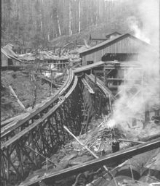
Sawmill

Encyclopedia
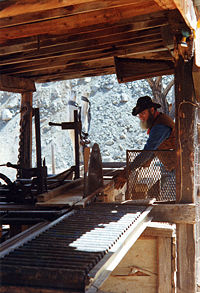
Logging
Logging is the cutting, skidding, on-site processing, and loading of trees or logs onto trucks.In forestry, the term logging is sometimes used in a narrow sense concerning the logistics of moving wood from the stump to somewhere outside the forest, usually a sawmill or a lumber yard...
are cut into board
Lumber
Lumber or timber is wood in any of its stages from felling through readiness for use as structural material for construction, or wood pulp for paper production....
s.
Sawmill process
A sawmill's basic operation is much like those of hundreds of years ago; a log enters on one end and dimensional lumber exits on the other end.- LoggingLoggingLogging is the cutting, skidding, on-site processing, and loading of trees or logs onto trucks.In forestry, the term logging is sometimes used in a narrow sense concerning the logistics of moving wood from the stump to somewhere outside the forest, usually a sawmill or a lumber yard...
fells the trees, and log buckingLog buckingthumb|right|Bucker measuring and swamping or knot bumpingthumb|right|Bucker - Making the CutBucking is the process of cutting a felled and delimbed tree into logs...
cuts them to length. - Logs are taken by truck, rail or river to the sawmill.
- Logs are scaledLog ScalerThe log scaler is an occupation in the timber industry. The Log Scaler measures the cut trees to determine the scale and quality of the wood to be used for manufacturing...
either on the way to the mill or upon arrival at the mill. - Decking is the process for sorting the logs by species, size and end use (lumber, plywoodPlywoodPlywood is a type of manufactured timber made from thin sheets of wood veneer. It is one of the most widely used wood products. It is flexible, inexpensive, workable, re-usable, and can usually be locally manufactured...
, chips). - Debarking removes bark from the logs.
- The head sawHead sawA head saw, framesaw, gang saw or head rig, is the saw that makes the initial cuts in a log at a sawmill, turning a log into cants, or planks, of wood.-History:...
, head rig or primary saw, breaks the log into cants (unfinished logs to be further processed) and flitches (unfinished planks) with a smooth edge. - Depending upon the species and quality of the log, the cants will either be further broken down by a resaw or a gang edger into multiple flitches and/or boards
- EdgingLumber edgerA lumber edger is a saw used to straighten and smooth rough lumber or bowed stock by making a cut along the sides of the boards. The result of this process is dimensional lumber....
will take the flitch and trim off all irregular edges leaving four-sided lumberLumberLumber or timber is wood in any of its stages from felling through readiness for use as structural material for construction, or wood pulp for paper production....
. - Trimming squares the ends at typical lumber lengths.
- Drying removes naturally occurring moisture from the lumber. This can be done with kilns or air-dried.
- Planing smooths the surface of the lumber leaving a uniform width and thickness.
- Shipping transports the finished lumber to market.
History
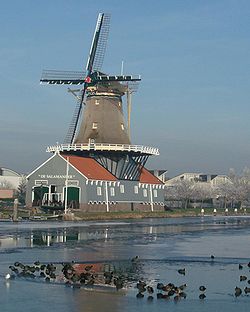


Hierapolis sawmill
The Hierapolis sawmill was a Roman water-powered stone sawmill at Hierapolis, Asia Minor . Dating to the second half of the 3rd century AD, the sawmill is the earliest known machine to combine a crank with a connecting rod....
, a Roman water-powered stone saw mill at Hierapolis
Hierapolis
Hierapolis was the ancient Greco-Roman city which sat on top of hot springs located in south western Turkey near Denizli....
, Asia Minor
Asia Minor
Asia Minor is a geographical location at the westernmost protrusion of Asia, also called Anatolia, and corresponds to the western two thirds of the Asian part of Turkey...
(modern-day Turkey
Turkey
Turkey , known officially as the Republic of Turkey , is a Eurasian country located in Western Asia and in East Thrace in Southeastern Europe...
) dating to the second half of the 3rd century AD is the earliest sawmill. It is also the earliest known machine to incorporate a crank
Crank (mechanism)
A crank is an arm attached at right angles to a rotating shaft by which reciprocating motion is imparted to or received from the shaft. It is used to change circular into reciprocating motion, or reciprocating into circular motion. The arm may be a bent portion of the shaft, or a separate arm...
and connecting rod
Connecting rod
In a reciprocating piston engine, the connecting rod or conrod connects the piston to the crank or crankshaft. Together with the crank, they form a simple mechanism that converts linear motion into rotating motion....
mechanism.
Water-powered stone sawmills working with cranks and connecting rods, but without gear train
Gear train
A gear train is formed by mounting gears on a frame so that the teeth of the gears engage. Gear teeth are designed to ensure the pitch circles of engaging gears roll on each other without slipping, this provides a smooth transmission of rotation from one gear to the next.The transmission of...
, are archaeologically attested for the 6th century AD at the Eastern Roman
Byzantine Empire
The Byzantine Empire was the Eastern Roman Empire during the periods of Late Antiquity and the Middle Ages, centred on the capital of Constantinople. Known simply as the Roman Empire or Romania to its inhabitants and neighbours, the Empire was the direct continuation of the Ancient Roman State...
cities Gerasa and Ephesus
Ephesus
Ephesus was an ancient Greek city, and later a major Roman city, on the west coast of Asia Minor, near present-day Selçuk, Izmir Province, Turkey. It was one of the twelve cities of the Ionian League during the Classical Greek era...
.
The earliest literary reference to a working sawmill comes from a Roman
Roman Empire
The Roman Empire was the post-Republican period of the ancient Roman civilization, characterised by an autocratic form of government and large territorial holdings in Europe and around the Mediterranean....
poet, Ausonius
Ausonius
Decimius Magnus Ausonius was a Latin poet and rhetorician, born at Burdigala .-Biography:Decimius Magnus Ausonius was born in Bordeaux in ca. 310. His father was a noted physician of Greek ancestry and his mother was descended on both sides from long-established aristocratic Gallo-Roman families...
who wrote an epic poem about the river Moselle
Moselle
Moselle is a department in the east of France named after the river Moselle.- History :Moselle is one of the original 83 departments created during the French Revolution on March 4, 1790...
in Germany
Germany
Germany , officially the Federal Republic of Germany , is a federal parliamentary republic in Europe. The country consists of 16 states while the capital and largest city is Berlin. Germany covers an area of 357,021 km2 and has a largely temperate seasonal climate...
in the late 4th century AD. At one point in the poem he describes the shrieking sound of a watermill cutting marble
Marble
Marble is a metamorphic rock composed of recrystallized carbonate minerals, most commonly calcite or dolomite.Geologists use the term "marble" to refer to metamorphosed limestone; however stonemasons use the term more broadly to encompass unmetamorphosed limestone.Marble is commonly used for...
. Marble sawmills also seem to be indicated by the Christian saint Gregory of Nyssa
Gregory of Nyssa
St. Gregory of Nyssa was a Christian bishop and saint. He was a younger brother of Basil the Great and a good friend of Gregory of Nazianzus. His significance has long been recognized in the Eastern Orthodox, Oriental Orthodox, Eastern Catholic and Roman Catholic branches of Christianity...
from Anatolia
Anatolia
Anatolia is a geographic and historical term denoting the westernmost protrusion of Asia, comprising the majority of the Republic of Turkey...
around 370/390 AD, demonstrating a diversified use of water-power in many parts of the Roman Empire
Roman Empire
The Roman Empire was the post-Republican period of the ancient Roman civilization, characterised by an autocratic form of government and large territorial holdings in Europe and around the Mediterranean....
.
Sawmills became widespread in medieval
Middle Ages
The Middle Ages is a periodization of European history from the 5th century to the 15th century. The Middle Ages follows the fall of the Western Roman Empire in 476 and precedes the Early Modern Era. It is the middle period of a three-period division of Western history: Classic, Medieval and Modern...
Europe again, as one was sketched by Villard de Honnecourt
Villard de Honnecourt
Villard de Honnecourt was a 13th-century artist from Picardy in northern France. He is known to history only through a surviving portfolio of 33 sheets of parchment containing about 250 drawings dating from the 1220s/1240s, now in the Bibliothèque Nationale, Paris...
in c. 1250. They are claimed to have been introduced to Madeira
Madeira
Madeira is a Portuguese archipelago that lies between and , just under 400 km north of Tenerife, Canary Islands, in the north Atlantic Ocean and an outermost region of the European Union...
following its discovery in c. 1420 and spread widely in Europe in the 16th century.
By the 11th century, hydropower
Hydropower
Hydropower, hydraulic power, hydrokinetic power or water power is power that is derived from the force or energy of falling water, which may be harnessed for useful purposes. Since ancient times, hydropower has been used for irrigation and the operation of various mechanical devices, such as...
ed sawmills were in widespread use in the medieval Islamic world, from Islamic Spain
Al-Andalus
Al-Andalus was the Arabic name given to a nation and territorial region also commonly referred to as Moorish Iberia. The name describes parts of the Iberian Peninsula and Septimania governed by Muslims , at various times in the period between 711 and 1492, although the territorial boundaries...
and North Africa
North Africa
North Africa or Northern Africa is the northernmost region of the African continent, linked by the Sahara to Sub-Saharan Africa. Geopolitically, the United Nations definition of Northern Africa includes eight countries or territories; Algeria, Egypt, Libya, Morocco, South Sudan, Sudan, Tunisia, and...
in the west to Central Asia
Central Asia
Central Asia is a core region of the Asian continent from the Caspian Sea in the west, China in the east, Afghanistan in the south, and Russia in the north...
in the east.
The sawmill was also described by the Dutchman Cornelis Corneliszoon
Cornelis Corneliszoon
Cornelis Corneliszoon van Uitgeest, or Krelis Lootjes was a Dutch windmill owner from Uitgeest who invented the wind-powered sawmill, which made the conversion of log timber into planks 30 times faster than before.-Biography:...
(1550–1607) by applying a crankshaft
Crankshaft
The crankshaft, sometimes casually abbreviated to crank, is the part of an engine which translates reciprocating linear piston motion into rotation...
onto a windmill, which converted a turning motion into an up-an-down motion. Corneliszoon patented the sawmill on December 15, 1593 and the crank
Crank (mechanism)
A crank is an arm attached at right angles to a rotating shaft by which reciprocating motion is imparted to or received from the shaft. It is used to change circular into reciprocating motion, or reciprocating into circular motion. The arm may be a bent portion of the shaft, or a separate arm...
on December 6, 1597. He built the first sawmill there in 1594.
Prior to the invention of the sawmill, boards were rived and planed, or more often sawn by two men with a whipsaw, using saddleblocks to hold the log, and a saw pit
Saw pit
A saw pit or sawpit is a pit over which lumber is positioned to be sawed with a long two-handled saw by two men, one standing above the timber and the other below. It was used for producing sawn planks from tree trunks, which could then be cut down into boards, pales, posts, etc. Many towns,...
for the pitman who worked below. Sawing was slow, and required strong and hearty men. The topsawer had to be the stronger of the two because the saw was pulled in turn by each man, and the lower had the advantage of gravity. The topsawyer also had to guide the saw so that the board was of even thickness. This was often done by following a chalkline.
Early sawmills simply adapted the whipsaw to mechanical power, generally driven by a water wheel
Water wheel
A water wheel is a machine for converting the energy of free-flowing or falling water into useful forms of power. A water wheel consists of a large wooden or metal wheel, with a number of blades or buckets arranged on the outside rim forming the driving surface...
to speed up the process. The circular motion of the wheel was changed to back-and-forth motion of the saw blade by a connecting rod
Connecting rod
In a reciprocating piston engine, the connecting rod or conrod connects the piston to the crank or crankshaft. Together with the crank, they form a simple mechanism that converts linear motion into rotating motion....
known as a pitman arm
Pitman arm
The Pitman arm is a steering component in an automobile or truck.The Pitman arm is a linkage attached to the steering gear sector shaft, that converts the angular motion of the sector shaft into the linear motion needed to steer the wheels. The Pitman arm is supported by the sector shaft and...
(thus introducing a term used in many mechanical applications).
Generally, only the saw was powered, and the logs had to be loaded and moved by hand. An early improvement was the development of a movable carriage, also water powered, to move the log steadily through the saw blade.
A type of sawmill without a crank is known from Germany called a "knock and drop" or "drop mill": "The oldest sawmills in the Black Forest are "drop sawmills" also referred to as "knock and drop sawmills". They have all disappeared in Europe except for three in the Black Forest, one of which is in the Open Air Museum in Gutach. In these drop sawmills, the frame carrying the saw blade is knocked upwards by cams as the shaft turns. These cams are let into the shaft on which the waterwheel sits. When the frame carrying the saw blade is in the topmost position it drops by its own weight, making a loud knocking noise, and in so doing it cuts the trunk. From 1800 onwards.”
A small mill such as this would be the center of many rural communities in wood-exporting regions such as the Baltic countries
Baltic countries
The term Baltic states refers to the Baltic territories which gained independence from the Russian Empire in the wake of World War I: primarily the contiguous trio of Estonia, Latvia, Lithuania ; Finland also fell within the scope of the term after initially gaining independence in the 1920s.The...
and Canada
Canada
Canada is a North American country consisting of ten provinces and three territories. Located in the northern part of the continent, it extends from the Atlantic Ocean in the east to the Pacific Ocean in the west, and northward into the Arctic Ocean...
. The output of such mills would be quite low, perhaps only 500 boards per day. They would also generally only operate during the winter, the peak logging season.
In the United States
United States
The United States of America is a federal constitutional republic comprising fifty states and a federal district...
, the sawmill was introduced soon after the colonisation of Virginia
Virginia
The Commonwealth of Virginia , is a U.S. state on the Atlantic Coast of the Southern United States. Virginia is nicknamed the "Old Dominion" and sometimes the "Mother of Presidents" after the eight U.S. presidents born there...
by recruiting skilled men from Hamburg
Hamburg
-History:The first historic name for the city was, according to Claudius Ptolemy's reports, Treva.But the city takes its modern name, Hamburg, from the first permanent building on the site, a castle whose construction was ordered by the Emperor Charlemagne in AD 808...
.
Later the metal parts were obtained from the Netherlands
Netherlands
The Netherlands is a constituent country of the Kingdom of the Netherlands, located mainly in North-West Europe and with several islands in the Caribbean. Mainland Netherlands borders the North Sea to the north and west, Belgium to the south, and Germany to the east, and shares maritime borders...
, where the technology was far ahead of that in England
England
England is a country that is part of the United Kingdom. It shares land borders with Scotland to the north and Wales to the west; the Irish Sea is to the north west, the Celtic Sea to the south west, with the North Sea to the east and the English Channel to the south separating it from continental...
, where the sawmill remained largely unknown until the late 18th century. The arrival of a sawmill was a large and stimulative step in the growth of a frontier community.
Early mills were taken to the forest, where a temporary shelter was built, and the logs were skidded to the nearby mill by horse or ox teams, often when there was some snow to provide lubrication. As mills grew larger, they were usually established in more permanent facilities on a river, and the logs were floated down to them by log drivers.
The next improvement was the use of circular saw blades, and soon thereafter, the use of gangsaws, which added additional blades so that a log would be reduced to boards in one quick step. Circular saw blades were extremely expensive and highly subject to damage by overheating or dirty logs. A new kind of technician arose, the sawfiler
Sawfiler
A saw filer or saw doctor is a person who maintains and repairs saws in a saw mill. A saw filer's work area in the mill is called the filing room....
. Sawfilers were highly skilled in metalworking. Their main job was to set and sharpen teeth. The craft also involved learning how to hammer a saw, whereby a saw is deformed with a hammer and anvil to counteract the forces of heat and cutting. The circular saw was a later introduction, perhaps invented in England in the late 18th century, but perhaps in 17th century Holland (Netherlands
Netherlands
The Netherlands is a constituent country of the Kingdom of the Netherlands, located mainly in North-West Europe and with several islands in the Caribbean. Mainland Netherlands borders the North Sea to the north and west, Belgium to the south, and Germany to the east, and shares maritime borders...
). Modern circular saw
Circular saw
The circular saw is a machine using a toothed metal cutting disc or blade. The term is also loosely used for the blade itself. The blade is a tool for cutting wood or other materials and may be hand-held or table-mounted. It can also be used to make narrow slots...
blades have replaceable teeth, but still need to be hammered.
The introduction of steam power in the 19th century created many new possibilities for mills. They could be built away from water and could be far more mechanized. Scrap lumber from the mill provided a ready fuel source for firing the boiler. Efficiency was increased, but the capital cost of a new mill increased dramatically as well.
In addition, the use of steam or gasoline-powered traction engine
Traction engine
A traction engine is a self-propelled steam engine used to move heavy loads on roads, plough ground or to provide power at a chosen location. The name derives from the Latin tractus, meaning 'drawn', since the prime function of any traction engine is to draw a load behind it...
s also allowed the entire sawmill to be mobile.
By 1900, the largest sawmill in the world was operated by the Atlantic Lumber Company in Georgetown, South Carolina
Georgetown, South Carolina
Georgetown is the third oldest city in the U.S. state of South Carolina and the county seat of Georgetown County, in the Low Country. Located on Winyah Bay at the confluence of the Great Pee Dee River, Waccamaw River, and Sampit River, Georgetown is the second largest seaport in South Carolina,...
, using logs floated down the Pee Dee River
Pee Dee River
The Pee Dee River, also known as the Great Pee Dee River, is a river in North Carolina and South Carolina. It originates in the Appalachian Mountains in North Carolina, where its upper course above the mouth of the Uwharrie River is known as the Yadkin River. It is extensively dammed for flood...
from as far as the edge of the Appalachian Mountains
Appalachian Mountains
The Appalachian Mountains #Whether the stressed vowel is or ,#Whether the "ch" is pronounced as a fricative or an affricate , and#Whether the final vowel is the monophthong or the diphthong .), often called the Appalachians, are a system of mountains in eastern North America. The Appalachians...
in North Carolina
North Carolina
North Carolina is a state located in the southeastern United States. The state borders South Carolina and Georgia to the south, Tennessee to the west and Virginia to the north. North Carolina contains 100 counties. Its capital is Raleigh, and its largest city is Charlotte...
.
A restoration project for Sturgeon's Mill in Northern California is underway, restoring one of the last steam-powered lumber mills still using its original equipment.
Current trends
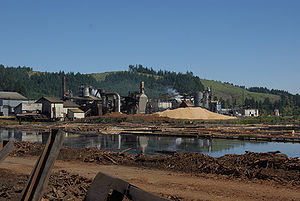
Computer
A computer is a programmable machine designed to sequentially and automatically carry out a sequence of arithmetic or logical operations. The particular sequence of operations can be changed readily, allowing the computer to solve more than one kind of problem...
ized. The cost of a new facility with 2 mmfbm/day capacity is up to CDN
CDN
-Places:* Canada , a North American country consisting of ten provinces and three territories* Côte-des-Neiges, a neighborhood in Montreal, Quebec-Technology:...
$120,000,000. A modern operation will produce between 100 mmfbm and 700 mmfbm annually.
Small gasoline-powered sawmills run by local entrepreneurs served many communities in the early twentieth century, and specialty markets still today.
A trend is the small portable sawmill
Portable sawmill
Portable sawmills became popular in the United States starting in the 1970s, when the 1973 energy crisis and the back to the land movement had led to renewed interest in small woodlots and in self-sufficiency.- History :...
for personal or even professional use. Many different models have emerged with different designs and functions. They are especially suitable for producing limited volumes of boards, or specialty milling such as oversized timber.
Technology has changed sawmill operations significantly in recent years, emphasizing increasing profits through waste minimization and increased energy efficiency as well as improving operator safety. The once-ubiquitous rusty, steel conical
Cone (geometry)
A cone is an n-dimensional geometric shape that tapers smoothly from a base to a point called the apex or vertex. Formally, it is the solid figure formed by the locus of all straight line segments that join the apex to the base...
sawdust burners have for the most part vanished, as the sawdust and other mill waste is now processed into particleboard and related products, or used to heat wood-drying kilns. Co-generation facilities will produce power for the operation and may also feed superfluous energy onto the grid. While the bark may be ground for landscaping barkdust
Barkdust
In agriculture, gardening, and landscaping, barkdust is a form of mulch produced out of chipped or shredded tree bark. Coarser forms of barkdust may be known as bark nuggets...
, it may also be burned for heat. Sawdust may make particle board or be pressed into wood pellets for pellet stoves. The larger pieces of wood that won't make lumber are chipped into wood chips and provide a source of supply for paper mills. Wood by-products of the mills will also make oriented strand board
Oriented strand board
Oriented strand board, also known as OSB and SmartPly , is an engineered wood product formed by layering strands of wood in specific orientations. In appearance, it may have a rough and variegated surface with the individual strips Oriented strand board, also known as OSB (UK) and SmartPly (UK &...
(OSB) paneling for building construction, a cheaper alternative to plywood for paneling.
See also
- Band sawBand sawA bandsaw is a power tool which uses a blade consisting of a continuous band of metal with teeth along one edge to cut various workpieces. The band usually rides on two wheels rotating in the same plane, although some small bandsaws have three wheels. Bandsawing produces uniform cutting action as a...
- Circular sawCircular sawThe circular saw is a machine using a toothed metal cutting disc or blade. The term is also loosely used for the blade itself. The blade is a tool for cutting wood or other materials and may be hand-held or table-mounted. It can also be used to make narrow slots...
- Log buckingLog buckingthumb|right|Bucker measuring and swamping or knot bumpingthumb|right|Bucker - Making the CutBucking is the process of cutting a felled and delimbed tree into logs...
- LoggingLoggingLogging is the cutting, skidding, on-site processing, and loading of trees or logs onto trucks.In forestry, the term logging is sometimes used in a narrow sense concerning the logistics of moving wood from the stump to somewhere outside the forest, usually a sawmill or a lumber yard...
- Portable sawmillPortable sawmillPortable sawmills became popular in the United States starting in the 1970s, when the 1973 energy crisis and the back to the land movement had led to renewed interest in small woodlots and in self-sufficiency.- History :...
- Saw pitSaw pitA saw pit or sawpit is a pit over which lumber is positioned to be sawed with a long two-handled saw by two men, one standing above the timber and the other below. It was used for producing sawn planks from tree trunks, which could then be cut down into boards, pales, posts, etc. Many towns,...
- SawfilerSawfilerA saw filer or saw doctor is a person who maintains and repairs saws in a saw mill. A saw filer's work area in the mill is called the filing room....
- Wood dryingWood dryingWood drying reduces the moisture content of wood before its use.There are two main reasons for drying wood:...
External links
- Steam powered saw mills
- The basics of sawmill (German)
- Nineteenth century sawmill demonstration
- Database of worldwide sawmills
- Reynolds Bros Mill, northern foothills of Adirondack Mountains, New York State
- L. Cass Bowen Mill, Skerry, New York