
All Topics  
Murasaki Shikibu

 
Murasaki Shikibu

   Email Print
   Bookmark   Link


Murasaki Shikibu


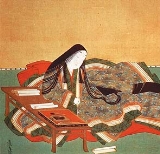
Murasaki Shikibu (???; c. 973–c. 1014 or 1025), or Lady Murasaki as she is often known in English, was a Japan
Japan

Japan is an island country in East Asia. Located in the Pacific Ocean, it lies to the east of the Sea of Japan, People's Republic of China, North Korea, South Korea and Russia, stretching from the Sea of Okhotsk in the north to the East China Sea and Taiwan in the south....
ese novelist, poet
Poet

A poet is a person who writes poetry....
, and a maid of honor of the imperial court
Emperor of Japan

The of Japan is the symbol of the state and of the unity of the Japanese people. He is the head of the Imperial House of Japan. Under Japan's present constitution, the Emperor is the "symbol of the state and the unity of the people," and is a ceremonial figurehead in a constitutional monarchy ....
 during the Heian period
Heian period

The is the last division of classical History of Japan, running from 794 to 1185. It is the period in Japanese history when Confucianism and other Chinese culture were at their height....
.


Discussion
Ask a question about 'Murasaki Shikibu'
Start a new discussion about 'Murasaki Shikibu'
Answer questions from other users
Full Discussion Forum


Quotations


Unforgettably horrible is the naked body. It really does not have the slightest charm. Category:Authors Category:Japanese poets


Encyclopedia


Murasaki Shikibu
Kyotorozanji
Murasaki Shikibu (???; c. 973–c. 1014 or 1025), or Lady Murasaki as she is often known in English, was a Japan
Japan

Japan is an island country in East Asia. Located in the Pacific Ocean, it lies to the east of the Sea of Japan, People's Republic of China, North Korea, South Korea and Russia, stretching from the Sea of Okhotsk in the north to the East China Sea and Taiwan in the south....
ese novelist, poet
Poet

A poet is a person who writes poetry....
, and a maid of honor of the imperial court
Emperor of Japan

The of Japan is the symbol of the state and of the unity of the Japanese people. He is the head of the Imperial House of Japan. Under Japan's present constitution, the Emperor is the "symbol of the state and the unity of the people," and is a ceremonial figurehead in a constitutional monarchy ....
 during the Heian period
Heian period

The is the last division of classical History of Japan, running from 794 to 1185. It is the period in Japanese history when Confucianism and other Chinese culture were at their height....
. She is best known as the author of The Tale of Genji
The Tale of Genji

is a classic work of Japanese literature attributed to the Japanese noblewoman Murasaki Shikibu in the early eleventh century, around the peak of the Heian Period....
, written in Japanese
Japanese language

IPA: [n?iho?go] is a language spoken by over 130 million people in Japan and in Japanese emigrant communities. It is related to the Ryukyuan languages....
 between about 1000 and 1008, one of the earliest novels in human history.

"Murasaki Shikibu" was not her real name, which is unknown. Some scholars have postulated that her given name might have been Fujiwara Takako, recorded as a name of a lady-in-waiting ranked shoji on the 29th day of the 1st month, Kanko
Kanko

was a after Choho and before Chowa. This period spanned the years from 1004 through 1012. The reigning emperors were and ....
 4 (February 19, 1007) according to Mido Kampaku Ki, a diary written by Fujiwara no Michinaga
Fujiwara no Michinaga

Fujiwara no Michinaga represents the highpoint of the Fujiwara regents' control over the government of Japan.Michinaga exerted de facto reign over Japan in the early 11th century....
. Her own diary, The Murasaki Shikibu Diary
The Murasaki Shikibu Diary

The Murasaki Shikibu Diary is a record of the daily life of Lady Murasaki Shikibu, the author of the The Tale of Genji. It covers the period from autumn of 1008, when Empress Akiko was ready to give birth, to the New Year's festivities of 1010 A.D....
, states that she was nicknamed "Murasaki" ("purple wisteria blossom") at court, after a character in The Tale of Genji
The Tale of Genji

is a classic work of Japanese literature attributed to the Japanese noblewoman Murasaki Shikibu in the early eleventh century, around the peak of the Heian Period....
. "Shikibu" refers to her father's position in the Bureau of Ceremony (shikibu-sho
Shikibu-sho

The was one of the divisions of the Japanese government , instituted in the Asuka period and formalized during the Heian period This Imperial ministry was concerned primarily with administrative matters....
).

Biography

Lady Murasaki Shikibu was born about 973 in Kyoto, Japan. She was born in a family of minor nobility and a member of the northern branch of the Fujiwara clan
Fujiwara family

The Fujiwara clan , descending from the Nakatomi clan, was a powerful family of regents in Japan that monopolized the regent positions, Sessho and Kampaku....
.

Murasaki's mother died while she was a child, so Murasaki was raised, contrary to customs of the time, by her father Fujiwara no Tametoki
Fujiwara no Tametoki

was a Japanese poet, scholar of Chinese language and the father of Murasaki Shikibu . He served as the governor of Echizen Province, during which time he had a daughter Murasaki in 970 or 973....
, a scholar and officer of the imperial court. During Heian
Heian period

The is the last division of classical History of Japan, running from 794 to 1185. It is the period in Japanese history when Confucianism and other Chinese culture were at their height....
-era Japan, couples lived separately and children were raised by the mother and her family. Also contrary to customs of the time, her father gave her a male education. Men were taught kanji
Kanji

are the Chinese characters that are used in the modern Japanese language logogram along with hiragana , katakana , Arabic numerals, and the occasional use of the Latin alphabet....
 and classical Chinese
Classical Chinese

Classical Chinese or Literary Chinese is a traditional style of written Chinese based on the grammar and vocabulary of ancient Chinese, making it different from any Chinese spoken language....
 literature as the requisite culture, while women were taught kana
Kana

Kana are the Syllabary Japanese language scripts, as opposed to the Logogram Chinese characters known in Japan as kanji and the Roman alphabet known as romaji....
 and poetry
Poetry

Poetry is a form of literature art in which language is used for its aesthetics and evocative qualities in addition to, or in lieu of, its apparent meaning ....
. Her father praised her intelligence and ability, but lamented that she was "born a woman". She was married in her early 20s and had one child, Daini no Sanmi, who was a poet in her own right.

At the royal court, she was the lady-in-waiting for Empress Shoshi (Akiko) and may have been hired by Fujiwara no Michinaga
Fujiwara no Michinaga

Fujiwara no Michinaga represents the highpoint of the Fujiwara regents' control over the government of Japan.Michinaga exerted de facto reign over Japan in the early 11th century....
 to serve the Empress.

Murasaki died either in 1014, when records show that her father suddenly returned to Kyoto
Kyoto

Sorry, no overview for this topic
 from his governor's mansion, or between 1025 and 1031, when she would have been in her mid-50s, fairly old by Heian standards.

Three works are attributed to Murasaki, the most important being The Tale of Genji
The Tale of Genji

is a classic work of Japanese literature attributed to the Japanese noblewoman Murasaki Shikibu in the early eleventh century, around the peak of the Heian Period....
. The Murasaki Shikibu Diary
The Murasaki Shikibu Diary

The Murasaki Shikibu Diary is a record of the daily life of Lady Murasaki Shikibu, the author of the The Tale of Genji. It covers the period from autumn of 1008, when Empress Akiko was ready to give birth, to the New Year's festivities of 1010 A.D....
 and The Murasaki Shikibu Collection were arranged and published posthumously. The collection is a compilation of 128 poems written by Murasaki.

Legacy and influence


Murasaki is considered one of the greatest writers of Japanese literature. Statues in her honour have been erected throughout Japan, her works are a staple part of the education curriculum in Japan. The 2000 yen
Banknotes of the Japanese yen

The banknotes of the Japanese yen are part of the physical form of Japan's currency. The issuance of the Japanese yen banknotes began in 1872, two years after the currency was introduced....
 note was issued in commemoration to her and her greatest epic work, The Tale of Genji.

A fictionalized biography of Murasaki called The Tale of Murasaki: A Novel was written by Liza Dalby
Liza Dalby

Liza Crihfield Dalby is an United States anthropologist and novelist specializing in Japanese culture.She is a 1972 graduate of Swarthmore College, receiving her Masters in 1974 and her Ph.D....
. Another fictionalized biography of Murasaki Shikibu is an Italian novel by Gabriella Magrini: Mille Autunni, vita di Murasaki Dama di Corte, Edizione Frassinelli 1985; translated into French under the title La dame de Kyoto, Editions Belfond, 1987, ISBN 2 7144 1973 9. A fictitious descendant of Lady Murasaki is a major character in the Thomas Harris novel and subsequent horror film Hannibal Rising.

See also

  • Sei Shonagon
    Sei Shonagon

    Sei Shonagon , was a Japanese author and a court lady who served the Empress Teishi /Empress Sadako around the year 1000 during the middle Heian Period, and is best known as the author of The Pillow Book ....
     - court rival and fellow contemporary diarist
  • Ono no Takamura
    Ono no Takamura

    was an early Heian period scholar and poet.He is a descendant of Ono no Imoko who served Kenzuishi, and his father was Ono no Minemori. He is the grandfather of Ono no Michikaze, one of the ....
     - an earlier Japanese poet whose grave is situated across from Lady Murasaki's


External links