

Olaf II of Norway

Encyclopedia
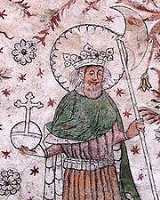
Olaf II Haraldsson was King of Norway from 1015 to 1028. He was posthumously given the title Rex Perpetuus Norvegiae
(Norway's Eternal King) and canonised in Nidaros
(Trondheim
) by Bishop Grimkell
, one year after his death in the Battle of Stiklestad
on 29 July 1030. Enshrined in Nidaros Cathedral
. Olaf's local canonisation was in 1164 confirmed by Pope
Alexander III
, making him a universally recognized saint of the Catholic Church. The exact position of Saint Olaf's grave in Nidaros has been unknown since 1568, due to the Lutheran iconoclasm in 1536-37. Saint Olaf has today a prominent legal as well as cultural position in the country. He is symbolised by the axe in Norway's coat of arms
, and the Olsok
(29th July) is still his day of celebration. The Order of St. Olav is named after him.
name is Ólafr Haraldsson. He was during his lifetime known as Olaf digre (modern orthography). Today, he is commonly referred to as Olav den hellige (Bokmål
; Olaf the Holy) or Heilag-Olav (Nynorsk
; the Holy Olaf) in honour of his sainthood.
Olaf Haraldsson had the given name Óláfr in Old Norse
. (Etymology: Anu – "forefather", Leifr – "heir".) Olav is the modern equivalent in Norwegian
, formerly often spelt Olaf. His name in Icelandic
is Ólafur, in Faroese
Ólavur, in Danish
Oluf, in Swedish
Olof. Olave was the traditional spelling in England, preserved in the name of medieval churches dedicated to him. Other names, such as Oláfr hinn helgi, Olavus rex, and Olaf are used interchangeably (see the Heimskringla
of Snorri Sturluson
). He is sometimes referred to as Rex Perpetuus Norvegiae
(Norway's Eternal King), a designation which goes back to the thirteenth century. The term Ola Nordmann
as epithet of the archetypal Norwegian may originate in this tradition, as the name Olav for centuries was the most common male name in Norway.
. His mother was Åsta Gudbrandsdatter
, and his father was Harald Grenske
, great-great-grandchild of Harald Fairhair
, the first king of Norway. Harald Grenske died when Åsta Gudbrandsdatter was pregnant with Olaf. She later married Sigurd Syr
, with whom she had other children including Harald Hardrada who would reign as a future king of Norway.
's Heimskringla
, from c. 1230. That saga cannot be taken as an accurate source for Olaf's life, but most of the following description is based on the narrative there.
 About 1008, Olaf landed on Estonia
n island Saaremaa
(Osilia). The Osilians, taken by surprise, had at first agreed to pay the demands made by Olaf, but then gathered an army during the negotiations and attacked the Norwegians. Olaf nevertheless won the battle.
As a teenager he went to the Baltic
, then to Denmark
and later to England
.
Olaf saw it as his call to unite Norway into one kingdom, as his ancestor Harald I of Norway
largely succeeded. On the way home he wintered with Duke Richard II of Normandy. This region had been conquered by the Norseman in the year 881. Duke Richard was himself an ardent Christian
, and the Normans
had also previously converted to Christianity. Before leaving, Olaf was baptized in Rouen
.
Olaf returned to Norway in 1015 and declared himself king, obtaining the support of the five petty kings
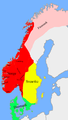
of the Uplands. Norway during the reign of St. Olaf (1015–1028) showing areas under the control of hereditary chieftains (petty kingdoms). In 1016 he defeated Earl Sweyn
, hitherto the virtual ruler of Norway, at the Battle of Nesjar
. He founded the town Borg by the waterfall Sarpsfossen, later to be known as Sarpsborg
in Østfold
county, Norway
. Within a few years he had won more power than had been enjoyed by any of his predecessors on the throne.
He had annihilated the petty kings of the South, subdued the aristocracy, enforced the acceptance of Christianity
throughout the kingdom, asserted his suzerainty
in the Orkney Islands
, and conducted a successful raid on Denmark. He made peace with King Olof Skötkonung of Sweden through Þorgnýr the Lawspeaker
, and was for some time engaged to his daughter, Princess Ingegerd Olofsdotter, though without Olof's approval.
In 1019 Olaf married Astrid Olofsdotter
, Olof's illegitimate daughter and half-sister of his former fiancée. Their daughter Wulfhild married Ordulf, Duke of Saxony
in 1042. Numerous royal, grand ducal and ducal lines are descended from Ordulf and Wulfrid, including the House of Saxe-Coburg and Gotha
. Maud of Wales
, daughter of King Edward VII of the United Kingdom
, was the mother of King Olav V of Norway
, so Olav and his son Harald V
, the present king of Norway, are thus descended from Olaf.
But Olaf's success was short-lived. In 1026 he lost the Battle of the Helgeå
, and in 1029 the Norwegian nobles, seething with discontent, supported the invasion of King Canute the Great
of Denmark. Olaf was driven into exile in Kievan Rus. During the exile he stayed some time in Sweden
in the province of Nerike where, according to local legend, he baptized many locals. In 1030, Canute's Norwegian vassal king, Jarl Håkon Eiriksson
, was lost at sea. Olaf seized the opportunity to win back the kingdom, but he fell at the Battle of Stiklestad
, where some of his own subjects from central Norway were arrayed against him.
Canute, though distracted by the task of administrating England, managed to rule Norway for five years after Stiklestad, with his son Svein as viceroy. However, when Olaf's illegitimate son Magnus
(dubbed 'the Good') laid claim to the Norwegian throne, Canute had to yield.
. The cult of Olaf not only unified the country, it also fulfilled the conversion of the nation, something for which the king had fought so hard. While divisive in life, in death Olaf wielded a unifying power no foreign monarch could hope to undo.
Owing to Olaf's later status as the patron saint of Norway, and to his importance in later medieval historiography and in Norwegian folklore, it is difficult to assess the character of the historical Olaf. Judging from the bare outlines of known historical facts, he appears, more than anything else, as a fairly unsuccessful ruler, who had his power based on some sort of alliance with the much more powerful King Canute the Great
; who was driven into exile when he claimed a power of his own; and whose attempt at a reconquest was swiftly crushed.
This calls for an explanation of the status he gained after his death. Three factors are important: his role in the Christianization of Norway, the various dynastic relationships among the ruling families, and the needs for legitimization in a later period.
(c. 920–961) had been Christians; and Olav's main opponent, Canute the Great
, was a Christian ruler. What seems clear is that Olav made efforts to establish a church organization on a broader scale than before, among other things by importing bishops from England, Normandy and Germany, and that he tried to enforce Christianity also in the inland areas, which had the least communication with the rest of Europe, and which economically were more strongly based on agriculture, so that the inclination to hold on to the former fertility cult would have been stronger than in the more diversified and expansive western parts of the country.
Although Olav was certainly not the first to introduce Christianity to Norway, he established the first codification of the faith in 1024, thus laying the basis for the Church of Norway. So high did Olaf's legal arrangements for the Church of Norway come to stand in the eyes of the Norwegian people and clergy, that when Pope Gregory VII
attempted to make clerical celibacy binding on the priests of Western Europe in 1074–5, the Norwegians largely ignored this, since there was no mention of clerical celibacy in Olaf's legal code for their Church. Only after Norway was made a metropolitan province with its own archbishop in 1153 —which made the Norwegian church, on the one hand, more independent of its king, but, on the other hand, more directly responsible to the Pope — did canon law
gain a greater predominance in the life and jurisdiction of the Norwegian church.
Sigrid Undset
noted that Olaf was baptized in Rouen
, the capital of Normandy
, and suggested that Olaf used priests of Norman descent for his missionaries. These priests would be of Norwegian descent, could speak the language, and shared the culture of the people they were to convert. Since the Normans themselves had only been in Normandy for about two generations, these priests might, at least in some cases, be distant cousins of their new parishioners and thus less likely to be killed when Olaf and his army departed. The few surviving manuscripts and the printed missal
used in Archdiocese of Nidaros show a clear dependence on the missals used in Normandy.
, assumed power in Norway, and eventually also in Denmark. Numerous churches in Denmark were dedicated to Olaf during his reign, and the sagas give glimpses of similar efforts to promote the cult of his deceased father on the part of the young king. This would become typical in the Scandinavian monarchies. It should be remembered that in pagan times the Scandinavian kings derived their right to rule from their claims of descent from the Norse god Odin
, or in the case of the kings of the Swedes at Old Uppsala, from Freyr
. In Christian times this legitimation of a dynasty's right to rule and its national prestige would be based on its descent from a saintly king. Thus the kings of Norway promoted the cult of St. Olaf, the kings of Sweden the cult of St. Erik and the kings of Denmark the cult of St. Canute, just as in England the Norman and Plantagenet kings similarly promoted the cult of St. Edward the Confessor at Westminster Abbey
, their coronation church.
and beatification
of Olaf on August 3, 1031. Grimkell later became the first bishop of Sigtuna
in Sweden.
At this time, local bishops and their people recognized and proclaimed a person a saint, and a formal canonization
procedure through the papal curia
was not customary; in Olaf's case, this did not happen until 1888.
Grimkell was later appointed bishop in the diocese of Selsey
in the south-east of England. This is probably the reason why the earliest traces of a liturgical cult of St Olaf are found in England. An office, or prayer service, for St Olaf is found in the so-called Leofric collectar (c. 1050), which was bequeathed in his last will and testament by Bishop Leofric of Exeter
to Exeter Cathedral
. This English cult seems to have been short-lived.
Adam of Bremen
, writing around 1070, mentions pilgrimage to Saint Olav's shrine
in Nidaros
, but this is the only firm trace we have of a cult of St. Olaf in Norway before the middle of the twelfth century. By this time he was also being referred to as Norway's Eternal King. In 1152/3, Nidaros was separated from Lund as the archbishopric of Nidaros. It is likely that whatever formal or informal — which, we do not know — veneration of Olav as a saint there may have been in Nidaros prior to this, was emphasised and formalized on this occasion.
During the visit of the papal legate, Nicholas Brekespear (later Pope Adrian IV
), the poem Geisli ("the ray of sun") was recited. In this poem, we hear for the first time of miracles performed by St. Olaf. One is the killing and throwing onto the mountain of a still visible sea serpent. One of these took place on the day of his death, when a blind man got his eyesight back again after having rubbed his eyes with hands that were stained with the blood from the saint.
The texts which were used for the liturgical celebration of St. Olaf during most of the Middle Ages were probably compiled or written by Eystein Erlendsson, the second Archbishop of Nidaros (1161–1189). The nine miracles reported in Geisli form the core of the catalogue of miracles in this office.
The celebration of St. Olaf was widespread in the Nordic countries. Apart from the early traces of a cult in England, there are only scattered references to him outside of the Nordic area. Several churches in England were dedicated to him (often as St Olave). St Olave's Church, York
is referred to in the Anglo Saxon Chronicle for 1055 as the place of burial of its founder Earl Siward. This is generally accepted to be the earliest datable church foundation to Olaf and is further evidence of a cult of St Olaf in the early 1050s in England. St Olave Hart Street
in the City of London
is the burial place of Samuel Pepys
and his wife. Another south of London Bridge
gave its name to Tooley Street
and to the St Olave's Poor Law
Union, later to become the Metropolitan Borough of Bermondsey
: its workhouse in Rotherhithe
became the St Olave's Hospital
, now an old-people's home a few hundred metres from St Olaf's Church, which is the Norwegian Church in London. It also led to the naming of St Olave's Grammar School
, which was established in 1571 and up until 1968 was situated in Tooley Street. In 1968 the school was moved to Orpington, Kent.
St. Olaf was also, together with the Mother of God, the patron saint of the chapel of the Varangians
, the Scandinavian warriors who served as the bodyguard of the Byzantine
emperor. This church is believed to have been located near the church of Hagia Irene
in Constantinople. The icon of the Madonna Nicopeiahttp://www.umbc.edu/MA/index/number1/fenl1/fe1_8.htm, presently in St. Mark's Basilica in Venice, which is believed to have been one traditionally carried into combat by the Byzantine military forces, is believed to have been kept in this chapel in times of peace. Thus St. Olaf was also the last saint to be venerated by both the Western and Eastern churches before the Great Schism
.
There is also an altar dedicated to St. Olaf in the church of Sant'Ambrogio e Carlo al Corso in Rome with a painting of the saint given to Pope Leo XIII in 1893 on the occasion of the golden jubilee of his ordination as a bishop by Wilhelm Wedel-Jarlsberg
as its altarpiece.
Recently the pilgrimage
route to Nidaros Cathedral
, the site of St. Olav's tomb, has been reinstated. The route is known as Saint Olav's Way. The main route, which is approximately 640 km long, starts in the ancient part of Oslo
and heads North, along Lake Mjosa, up the Gudbrandsdal
Valley, over Dovrefjell
and down the Orkdal
Valley to end at Nidaros Cathedral in Trondheim
. There is a Pilgrim's Office in Oslo which gives advice to Pilgrims, and a Pilgrim Centre in Trondheim, under the aegis of the Cathedral, which awards certificates to successful Pilgrims upon the completion of their journey. But, the relics of St. Olaf is no longer in the Nidaros Cathedral. They rest in St. Olaf's Cathedral in Oslo.
On 29 July the Faroe Islands celebrates Ólavsøka
(Saint Olaf celebration), the National Day also, when they remember Saint Olaf, the king who Christianized the islands.
Let us all rejoice in the Lord on the feast of blessed Olav, Norway's eternal king. The angels exult over his martyrdom and praise the Son of God.
Opening Prayer (Collect):
Almighty, eternal God, you are the crown of kings and the triumph of martyrs. We know that your blessed martyr, Olav, intercedes for us before your face. We praise your greatness in his death and we pray you, give us the crown of life that you have promised those who love you, through our Lord Jesus Christ, your Son, who lives and reigns with you and the Holy Spirit, one God, forever and ever.
Old Testament Reading: Wisdom of Solomon 10: 10–14.
Responsory Psalm: Psalm 31 (30): 1–7 with the response: "Into your hands, Lord, I commend my spirit."
Epistle: James 1: 2–4, 12.
Allelua Verse:
Alleluia. Holy Olav, you who rejoice with the angels of heaven, pray for us that we may be worthy to present our sacrifice of praise before the Lord. Alleluia.
Gospel: Matthew 16:24–28
Prayer over the Offerings (Secret):
Almighty God, in awe we call upon your inscrutable might. Make holy these created things which you have chosen so that they may become the body and blood of Christ, your Son. Through the intercession of the holy Olav, king and martyr, let them for the salvation of body and soul. Through Christ our Lord.
Communion Verse:
Great is his glory through your saving help. With glory and honor will you clothe him, Lord.
Closing Prayer (Postcommunion):
We who have been fed at the table of the Lamb implore you, almighty God, through the intercession of your blessed martyr Olav let us always stand under the protection of your Son who redeemed us by his death on the cross, he who lives and reigns from eternity to eternity.
.jpg)
Rex Perpetuus Norvegiae
Rex Perpetuus Norvegiae , i.e. Norway's Eternal King) is an in the 12th century appearing term for Olaf the Holy.-Background:In written sources, the term Perpetuus rex Norvegiæ appears only in Historia Norvegiæ from the second part of the 12th century.The 1163 Succession Law stated that all kings...
(Norway's Eternal King) and canonised in Nidaros
Nidaros
Nidaros or Niðarós was during the Middle Ages, the old name of Trondheim, Norway . Until the Reformation, Nidaros remained the centre of the spiritual life of the country...
(Trondheim
Trondheim
Trondheim , historically, Nidaros and Trondhjem, is a city and municipality in Sør-Trøndelag county, Norway. With a population of 173,486, it is the third most populous municipality and city in the country, although the fourth largest metropolitan area. It is the administrative centre of...
) by Bishop Grimkell
Grimketel
-Life:Little is known of Grimketel's background. There was some speculation that he was taken over to Norway by Olav Haraldsson in 1017 to evangilize the country. After Cnut defeated and killed Olav, Grimkel, was asked to go to Trondheim and officially declare Olav Haraldsson a saint.Cnut is said...
, one year after his death in the Battle of Stiklestad
Battle of Stiklestad
The Battle of Stiklestad in 1030 is one of the most famous battles in the history of Norway. In this battle, King Olaf II of Norway was killed. He was later canonized...
on 29 July 1030. Enshrined in Nidaros Cathedral
Nidaros Cathedral
Nidaros Cathedral is a Church of Norway cathedral located in the city of Trondheim in Sør-Trøndelag county, Norway. It was the cathedral of the Roman Catholic Archdiocese of Nidaros from its establishment in 1152 until its abolition in 1537. Since the Reformation, it has been the cathedral of the...
. Olaf's local canonisation was in 1164 confirmed by Pope
Pope
The Pope is the Bishop of Rome, a position that makes him the leader of the worldwide Catholic Church . In the Catholic Church, the Pope is regarded as the successor of Saint Peter, the Apostle...
Alexander III
Pope Alexander III
Pope Alexander III , born Rolando of Siena, was Pope from 1159 to 1181. He is noted in history for laying the foundation stone for the Notre Dame de Paris.-Church career:...
, making him a universally recognized saint of the Catholic Church. The exact position of Saint Olaf's grave in Nidaros has been unknown since 1568, due to the Lutheran iconoclasm in 1536-37. Saint Olaf has today a prominent legal as well as cultural position in the country. He is symbolised by the axe in Norway's coat of arms
Coat of arms of Norway
The coat of arms of Norway is a crowned, golden lion rampant holding an axe with an argent blade, on a crowned, triangular and red escutcheon. Its elements originate from personal insignias for the royal house in the High Middle Ages, thus being among the oldest in Europe...
, and the Olsok
Olsok
Olsok is now the Norwegian name for 29 July, traditionally the date of the death of King Olaf II Haraldsson of Norway in the Battle of Stiklestad, east of Nidaros , Norway, in 1030...
(29th July) is still his day of celebration. The Order of St. Olav is named after him.
Name
Olaf II's Old NorseOld Norse
Old Norse is a North Germanic language that was spoken by inhabitants of Scandinavia and inhabitants of their overseas settlements during the Viking Age, until about 1300....
name is Ólafr Haraldsson. He was during his lifetime known as Olaf digre (modern orthography). Today, he is commonly referred to as Olav den hellige (Bokmål
Bokmål
Bokmål is one of two official Norwegian written standard languages, the other being Nynorsk. Bokmål is used by 85–90% of the population in Norway, and is the standard most commonly taught to foreign students of the Norwegian language....
; Olaf the Holy) or Heilag-Olav (Nynorsk
Nynorsk
Nynorsk or New Norwegian is one of two official written standards for the Norwegian language, the other being Bokmål. The standard language was created by Ivar Aasen during the mid-19th century, to provide a Norwegian alternative to the Danish language which was commonly written in Norway at the...
; the Holy Olaf) in honour of his sainthood.
Olaf Haraldsson had the given name Óláfr in Old Norse
Old Norse
Old Norse is a North Germanic language that was spoken by inhabitants of Scandinavia and inhabitants of their overseas settlements during the Viking Age, until about 1300....
. (Etymology: Anu – "forefather", Leifr – "heir".) Olav is the modern equivalent in Norwegian
Norwegian language
Norwegian is a North Germanic language spoken primarily in Norway, where it is the official language. Together with Swedish and Danish, Norwegian forms a continuum of more or less mutually intelligible local and regional variants .These Scandinavian languages together with the Faroese language...
, formerly often spelt Olaf. His name in Icelandic
Icelandic language
Icelandic is a North Germanic language, the main language of Iceland. Its closest relative is Faroese.Icelandic is an Indo-European language belonging to the North Germanic or Nordic branch of the Germanic languages. Historically, it was the westernmost of the Indo-European languages prior to the...
is Ólafur, in Faroese
Faroese language
Faroese , is an Insular Nordic language spoken by 48,000 people in the Faroe Islands and about 25,000 Faroese people in Denmark and elsewhere...
Ólavur, in Danish
Danish language
Danish is a North Germanic language spoken by around six million people, principally in the country of Denmark. It is also spoken by 50,000 Germans of Danish ethnicity in the northern parts of Schleswig-Holstein, Germany, where it holds the status of minority language...
Oluf, in Swedish
Swedish language
Swedish is a North Germanic language, spoken by approximately 10 million people, predominantly in Sweden and parts of Finland, especially along its coast and on the Åland islands. It is largely mutually intelligible with Norwegian and Danish...
Olof. Olave was the traditional spelling in England, preserved in the name of medieval churches dedicated to him. Other names, such as Oláfr hinn helgi, Olavus rex, and Olaf are used interchangeably (see the Heimskringla
Heimskringla
Heimskringla is the best known of the Old Norse kings' sagas. It was written in Old Norse in Iceland by the poet and historian Snorri Sturluson ca. 1230...
of Snorri Sturluson
Snorri Sturluson
Snorri Sturluson was an Icelandic historian, poet, and politician. He was twice elected lawspeaker at the Icelandic parliament, the Althing...
). He is sometimes referred to as Rex Perpetuus Norvegiae
Rex Perpetuus Norvegiae
Rex Perpetuus Norvegiae , i.e. Norway's Eternal King) is an in the 12th century appearing term for Olaf the Holy.-Background:In written sources, the term Perpetuus rex Norvegiæ appears only in Historia Norvegiæ from the second part of the 12th century.The 1163 Succession Law stated that all kings...
(Norway's Eternal King), a designation which goes back to the thirteenth century. The term Ola Nordmann
Ola Nordmann
Ola Nordmann is a name for the typical Norwegian person, a personification of the whole population in general.-As a national personification:The media often uses "Ola Nordmann" to describe trends in the population....
as epithet of the archetypal Norwegian may originate in this tradition, as the name Olav for centuries was the most common male name in Norway.
Background
Olaf was born in RingerikeRingerike
oskar er kjempe kulRingerike is a municipality in Buskerud county, Norway. It is part of the traditional region of Ringerike...
. His mother was Åsta Gudbrandsdatter
Åsta Gudbrandsdatter
Åsta Gudbrandsdatter was the mother of two Norwegian kings, King Olaf II of Norway and King Harald III of Norway.According to the sagas, Åsta Gudbrandsdatter was from Vestfold. Åsta's father was Gudbrand Kula from Oppland...
, and his father was Harald Grenske
Harald Grenske
Harald Grenske was the petty king in Vestfold in Norway.Harald Grenske was the son of Gudrød Bjørnsson. Gudrød was a grandson of Harald Fairhair and the king of Vestfold. Harald's cognomen Grenske is due to his being raised in the district of Grenland, Norway. When Harald was only 11 years old,...
, great-great-grandchild of Harald Fairhair
Harald I of Norway
Harald Fairhair or Harald Finehair , , son of Halfdan the Black, was the first king of Norway.-Background:Little is known of the historical Harald...
, the first king of Norway. Harald Grenske died when Åsta Gudbrandsdatter was pregnant with Olaf. She later married Sigurd Syr
Sigurd Syr
Sigurd Syr Halfdansson was a petty king in northern Ostlandet in Norway.Sigurd was subking of Ringerike, an ancient territory in the county of Buskerud, southern Norway. Through his marriage with Åsta Gudbrandsdatter, he was the stepfather of King Olav II of Norway and father of King Harald III...
, with whom she had other children including Harald Hardrada who would reign as a future king of Norway.
Reign
Olaf was the subject of several biographies, both hagiographies and sagas, in the Middle Ages, and many of the historical facts concerning his reign are disputed. The best known description is the one in Snorri SturlusonSnorri Sturluson
Snorri Sturluson was an Icelandic historian, poet, and politician. He was twice elected lawspeaker at the Icelandic parliament, the Althing...
's Heimskringla
Heimskringla
Heimskringla is the best known of the Old Norse kings' sagas. It was written in Old Norse in Iceland by the poet and historian Snorri Sturluson ca. 1230...
, from c. 1230. That saga cannot be taken as an accurate source for Olaf's life, but most of the following description is based on the narrative there.
Estonia
Estonia , officially the Republic of Estonia , is a state in the Baltic region of Northern Europe. It is bordered to the north by the Gulf of Finland, to the west by the Baltic Sea, to the south by Latvia , and to the east by Lake Peipsi and the Russian Federation . Across the Baltic Sea lies...
n island Saaremaa
Saaremaa
Saaremaa is the largest island in Estonia, measuring 2,673 km². The main island of Saare County, it is located in the Baltic Sea, south of Hiiumaa island, and belongs to the West Estonian Archipelago...
(Osilia). The Osilians, taken by surprise, had at first agreed to pay the demands made by Olaf, but then gathered an army during the negotiations and attacked the Norwegians. Olaf nevertheless won the battle.
As a teenager he went to the Baltic
Baltic region
The terms Baltic region, Baltic Rim countries, and Baltic Rim refer to slightly different combinations of countries in the general area surrounding the Baltic Sea.- Etymology :...
, then to Denmark
Denmark
Denmark is a Scandinavian country in Northern Europe. The countries of Denmark and Greenland, as well as the Faroe Islands, constitute the Kingdom of Denmark . It is the southernmost of the Nordic countries, southwest of Sweden and south of Norway, and bordered to the south by Germany. Denmark...
and later to England
England
England is a country that is part of the United Kingdom. It shares land borders with Scotland to the north and Wales to the west; the Irish Sea is to the north west, the Celtic Sea to the south west, with the North Sea to the east and the English Channel to the south separating it from continental...
.
Olaf saw it as his call to unite Norway into one kingdom, as his ancestor Harald I of Norway
Harald I of Norway
Harald Fairhair or Harald Finehair , , son of Halfdan the Black, was the first king of Norway.-Background:Little is known of the historical Harald...
largely succeeded. On the way home he wintered with Duke Richard II of Normandy. This region had been conquered by the Norseman in the year 881. Duke Richard was himself an ardent Christian
Christian
A Christian is a person who adheres to Christianity, an Abrahamic, monotheistic religion based on the life and teachings of Jesus of Nazareth as recorded in the Canonical gospels and the letters of the New Testament...
, and the Normans
Normans
The Normans were the people who gave their name to Normandy, a region in northern France. They were descended from Norse Viking conquerors of the territory and the native population of Frankish and Gallo-Roman stock...
had also previously converted to Christianity. Before leaving, Olaf was baptized in Rouen
Rouen
Rouen , in northern France on the River Seine, is the capital of the Haute-Normandie region and the historic capital city of Normandy. Once one of the largest and most prosperous cities of medieval Europe , it was the seat of the Exchequer of Normandy in the Middle Ages...
.
Olaf returned to Norway in 1015 and declared himself king, obtaining the support of the five petty kings
Petty kingdom
A petty kingdom is one of a number of small kingdoms, described as minor or "petty" by contrast to an empire or unified kingdom that either preceded or succeeded it...
of the Uplands. Norway during the reign of St. Olaf (1015–1028) showing areas under the control of hereditary chieftains (petty kingdoms). In 1016 he defeated Earl Sweyn
Sveinn Hákonarson
Sveinn Hákonarson was an earl of the house of Hlaðir and co-ruler of Norway from 1000 to c. 1015. He was the son of earl Hákon Sigurðarson. He is first mentioned in connection with the battle of Hjörungavágr, where the Heimskringla says he commanded 60 ships...
, hitherto the virtual ruler of Norway, at the Battle of Nesjar
Battle of Nesjar
Battle of Nesjar was a sea battle off the coast of Norway in 1016. It was a primary event in the reign of King Olav Haraldsson . Sigvatr Þórðarson composed the poem Nesjavísur in memory of the battle....
. He founded the town Borg by the waterfall Sarpsfossen, later to be known as Sarpsborg
Sarpsborg
is a city and municipality in Østfold county, Norway. The administrative centre of the municipality is the city of Sarpsborg.Sarpsborg is part of the fifth largest urban area in Norway when paired with neighbouring Fredrikstad...
in Østfold
Østfold
is a county in southeastern Norway, bordering Akershus and southwestern Sweden , while Buskerud and Vestfold is on the other side of the bay. The seat of the county administration is Sarpsborg, and Fredrikstad is the largest city.Many manufacturing facilities are situated here. Moss and...
county, Norway
Norway
Norway , officially the Kingdom of Norway, is a Nordic unitary constitutional monarchy whose territory comprises the western portion of the Scandinavian Peninsula, Jan Mayen, and the Arctic archipelago of Svalbard and Bouvet Island. Norway has a total area of and a population of about 4.9 million...
. Within a few years he had won more power than had been enjoyed by any of his predecessors on the throne.
He had annihilated the petty kings of the South, subdued the aristocracy, enforced the acceptance of Christianity
Christianity
Christianity is a monotheistic religion based on the life and teachings of Jesus as presented in canonical gospels and other New Testament writings...
throughout the kingdom, asserted his suzerainty
Suzerainty
Suzerainty occurs where a region or people is a tributary to a more powerful entity which controls its foreign affairs while allowing the tributary vassal state some limited domestic autonomy. The dominant entity in the suzerainty relationship, or the more powerful entity itself, is called a...
in the Orkney Islands
Orkney Islands
Orkney also known as the Orkney Islands , is an archipelago in northern Scotland, situated north of the coast of Caithness...
, and conducted a successful raid on Denmark. He made peace with King Olof Skötkonung of Sweden through Þorgnýr the Lawspeaker
Þorgnýr the Lawspeaker
Þorgnýr the Lawspeaker is the name of one of at least three generations of lawspeakers by the name Þorgnýr, who appear in the Heimskringla by the Icelandic scholar and chieftain Snorri Sturluson, and in the less known Styrbjarnar þáttr Svíakappa and Hróa þáttr heimska...
, and was for some time engaged to his daughter, Princess Ingegerd Olofsdotter, though without Olof's approval.
In 1019 Olaf married Astrid Olofsdotter
Astrid Olofsdotter
Astrid Olofsdotter was the Queen Consort of King Olav II of Norway.-Biography:...
, Olof's illegitimate daughter and half-sister of his former fiancée. Their daughter Wulfhild married Ordulf, Duke of Saxony
Ordulf, Duke of Saxony
Ordulf was the duke of Saxony from 1059, when he succeeded his father Bernard II, until his death. He was a member of the Billung family.-Reign:...
in 1042. Numerous royal, grand ducal and ducal lines are descended from Ordulf and Wulfrid, including the House of Saxe-Coburg and Gotha
House of Saxe-Coburg and Gotha
The House of Saxe-Coburg and Gotha is a German dynasty, the senior line of the Saxon House of Wettin that ruled the Ernestine duchies, including the duchy of Saxe-Coburg and Gotha....
. Maud of Wales
Maud of Wales
Princess Maud of Wales was Queen of Norway as spouse of King Haakon VII. She was a member of the British Royal Family as the youngest daughter of Edward VII and Alexandra of Denmark and granddaughter of Queen Victoria and also of Christian IX of Denmark. She was the younger sister of George V...
, daughter of King Edward VII of the United Kingdom
Edward VII of the United Kingdom
Edward VII was King of the United Kingdom and the British Dominions and Emperor of India from 22 January 1901 until his death in 1910...
, was the mother of King Olav V of Norway
Olav V of Norway
Olav V was the king of Norway from 1957 until his death. A member of the House of Schleswig-Holstein-Sonderburg-Glücksburg, Olav was born in the United Kingdom as the son of King Haakon VII of Norway and Queen Maud of Norway...
, so Olav and his son Harald V
Harald V of Norway
Harald V is the king of Norway. He succeeded to the throne of Norway upon the death of his father Olav V on 17 January 1991...
, the present king of Norway, are thus descended from Olaf.
But Olaf's success was short-lived. In 1026 he lost the Battle of the Helgeå
Battle of the Helgeå
Battle of the Helgeå was a naval engagement which took place during 1026, between joint Danish and English forces and a combined Norwegian and Swedish force, at the estuary of a river called Helgeå in Sweden.King Olaf II of Norway and King Anund Jakob of Sweden took advantage of the commitment...
, and in 1029 the Norwegian nobles, seething with discontent, supported the invasion of King Canute the Great
Canute the Great
Cnut the Great , also known as Canute, was a king of Denmark, England, Norway and parts of Sweden. Though after the death of his heirs within a decade of his own and the Norman conquest of England in 1066, his legacy was largely lost to history, historian Norman F...
of Denmark. Olaf was driven into exile in Kievan Rus. During the exile he stayed some time in Sweden
Sweden
Sweden , officially the Kingdom of Sweden , is a Nordic country on the Scandinavian Peninsula in Northern Europe. Sweden borders with Norway and Finland and is connected to Denmark by a bridge-tunnel across the Öresund....
in the province of Nerike where, according to local legend, he baptized many locals. In 1030, Canute's Norwegian vassal king, Jarl Håkon Eiriksson
Håkon Eiriksson
Håkon Eiriksson was Earl of Lade and king of Norway as a vassal under Knut the Great.Håkon Eiriksson was from a dynasty of Norwegian rulers in the eastern part of Trondheim, bordering the Trondheimsfjord. He was the son of Eirik Håkonson, ruler of Norway and earl of Northumbria...
, was lost at sea. Olaf seized the opportunity to win back the kingdom, but he fell at the Battle of Stiklestad
Battle of Stiklestad
The Battle of Stiklestad in 1030 is one of the most famous battles in the history of Norway. In this battle, King Olaf II of Norway was killed. He was later canonized...
, where some of his own subjects from central Norway were arrayed against him.
Canute, though distracted by the task of administrating England, managed to rule Norway for five years after Stiklestad, with his son Svein as viceroy. However, when Olaf's illegitimate son Magnus
Magnus I of Norway
Magnus I , known as the Good or the Noble, was the King of Norway from 1035 to 1047 and the King of Denmark from 1042 to 1047. He was an illegitimate son of king Olaf II of Norway, but fled with his mother in 1028 when his father was dethroned. In 1035 he returned to Norway and was crowned king at...
(dubbed 'the Good') laid claim to the Norwegian throne, Canute had to yield.
Sainthood
Olaf, a rather harsh ruler and prone to rough treatment of his enemies, ironically became Norway's patron saint. His canonization was performed only a year after his death by bishop GrimkellGrimketel
-Life:Little is known of Grimketel's background. There was some speculation that he was taken over to Norway by Olav Haraldsson in 1017 to evangilize the country. After Cnut defeated and killed Olav, Grimkel, was asked to go to Trondheim and officially declare Olav Haraldsson a saint.Cnut is said...
. The cult of Olaf not only unified the country, it also fulfilled the conversion of the nation, something for which the king had fought so hard. While divisive in life, in death Olaf wielded a unifying power no foreign monarch could hope to undo.
Owing to Olaf's later status as the patron saint of Norway, and to his importance in later medieval historiography and in Norwegian folklore, it is difficult to assess the character of the historical Olaf. Judging from the bare outlines of known historical facts, he appears, more than anything else, as a fairly unsuccessful ruler, who had his power based on some sort of alliance with the much more powerful King Canute the Great
Canute the Great
Cnut the Great , also known as Canute, was a king of Denmark, England, Norway and parts of Sweden. Though after the death of his heirs within a decade of his own and the Norman conquest of England in 1066, his legacy was largely lost to history, historian Norman F...
; who was driven into exile when he claimed a power of his own; and whose attempt at a reconquest was swiftly crushed.
This calls for an explanation of the status he gained after his death. Three factors are important: his role in the Christianization of Norway, the various dynastic relationships among the ruling families, and the needs for legitimization in a later period.
Conversion of Norway
Olaf and Olaf Tryggvasson together were the driving force behind Norway's final conversion to Christianity. However, large stone crosses and other Christian symbols suggest that at least the coastal areas of Norway were deeply influenced by Christianity long before Olav's time; with one exception, all the rulers of Norway back to Håkon the GoodHaakon I of Norway
Haakon I , , given the byname the Good, was the third king of Norway and the youngest son of Harald Fairhair and Thora Mosterstang.-Early life:...
(c. 920–961) had been Christians; and Olav's main opponent, Canute the Great
Canute the Great
Cnut the Great , also known as Canute, was a king of Denmark, England, Norway and parts of Sweden. Though after the death of his heirs within a decade of his own and the Norman conquest of England in 1066, his legacy was largely lost to history, historian Norman F...
, was a Christian ruler. What seems clear is that Olav made efforts to establish a church organization on a broader scale than before, among other things by importing bishops from England, Normandy and Germany, and that he tried to enforce Christianity also in the inland areas, which had the least communication with the rest of Europe, and which economically were more strongly based on agriculture, so that the inclination to hold on to the former fertility cult would have been stronger than in the more diversified and expansive western parts of the country.
Although Olav was certainly not the first to introduce Christianity to Norway, he established the first codification of the faith in 1024, thus laying the basis for the Church of Norway. So high did Olaf's legal arrangements for the Church of Norway come to stand in the eyes of the Norwegian people and clergy, that when Pope Gregory VII
Pope Gregory VII
Pope St. Gregory VII , born Hildebrand of Sovana , was Pope from April 22, 1073, until his death. One of the great reforming popes, he is perhaps best known for the part he played in the Investiture Controversy, his dispute with Henry IV, Holy Roman Emperor affirming the primacy of the papal...
attempted to make clerical celibacy binding on the priests of Western Europe in 1074–5, the Norwegians largely ignored this, since there was no mention of clerical celibacy in Olaf's legal code for their Church. Only after Norway was made a metropolitan province with its own archbishop in 1153 —which made the Norwegian church, on the one hand, more independent of its king, but, on the other hand, more directly responsible to the Pope — did canon law
Canon law (Catholic Church)
The canon law of the Catholic Church, is a fully developed legal system, with all the necessary elements: courts, lawyers, judges, a fully articulated legal code and principles of legal interpretation. It lacks the necessary binding force present in most modern day legal systems. The academic...
gain a greater predominance in the life and jurisdiction of the Norwegian church.
Sigrid Undset
Sigrid Undset
Sigrid Undset was a Norwegian novelist who was awarded the Nobel Prize for Literature in 1928.-Biography:Undset was born in Kalundborg, Denmark, but her family moved to Norway when she was two years old. In 1924, she converted to Catholicism and became a lay Dominican...
noted that Olaf was baptized in Rouen
Rouen
Rouen , in northern France on the River Seine, is the capital of the Haute-Normandie region and the historic capital city of Normandy. Once one of the largest and most prosperous cities of medieval Europe , it was the seat of the Exchequer of Normandy in the Middle Ages...
, the capital of Normandy
Normandy
Normandy is a geographical region corresponding to the former Duchy of Normandy. It is in France.The continental territory covers 30,627 km² and forms the preponderant part of Normandy and roughly 5% of the territory of France. It is divided for administrative purposes into two régions:...
, and suggested that Olaf used priests of Norman descent for his missionaries. These priests would be of Norwegian descent, could speak the language, and shared the culture of the people they were to convert. Since the Normans themselves had only been in Normandy for about two generations, these priests might, at least in some cases, be distant cousins of their new parishioners and thus less likely to be killed when Olaf and his army departed. The few surviving manuscripts and the printed missal
Missal
A missal is a liturgical book containing all instructions and texts necessary for the celebration of Mass throughout the year.-History:Before the compilation of such books, several books were used when celebrating Mass...
used in Archdiocese of Nidaros show a clear dependence on the missals used in Normandy.
Olaf's dynasty
For various reasons, most importantly the death of King Canute the Great in 1035, but perhaps even a certain discontent among Norwegian nobles with the Danish rule in the years after Olaf's death in 1030, his illegitimate son with the concubine Alvhild, Magnus the GoodMagnus I of Norway
Magnus I , known as the Good or the Noble, was the King of Norway from 1035 to 1047 and the King of Denmark from 1042 to 1047. He was an illegitimate son of king Olaf II of Norway, but fled with his mother in 1028 when his father was dethroned. In 1035 he returned to Norway and was crowned king at...
, assumed power in Norway, and eventually also in Denmark. Numerous churches in Denmark were dedicated to Olaf during his reign, and the sagas give glimpses of similar efforts to promote the cult of his deceased father on the part of the young king. This would become typical in the Scandinavian monarchies. It should be remembered that in pagan times the Scandinavian kings derived their right to rule from their claims of descent from the Norse god Odin
Odin
Odin is a major god in Norse mythology and the ruler of Asgard. Homologous with the Anglo-Saxon "Wōden" and the Old High German "Wotan", the name is descended from Proto-Germanic "*Wodanaz" or "*Wōđanaz"....
, or in the case of the kings of the Swedes at Old Uppsala, from Freyr
Freyr
Freyr is one of the most important gods of Norse paganism. Freyr was highly associated with farming, weather and, as a phallic fertility god, Freyr "bestows peace and pleasure on mortals"...
. In Christian times this legitimation of a dynasty's right to rule and its national prestige would be based on its descent from a saintly king. Thus the kings of Norway promoted the cult of St. Olaf, the kings of Sweden the cult of St. Erik and the kings of Denmark the cult of St. Canute, just as in England the Norman and Plantagenet kings similarly promoted the cult of St. Edward the Confessor at Westminster Abbey
Westminster Abbey
The Collegiate Church of St Peter at Westminster, popularly known as Westminster Abbey, is a large, mainly Gothic church, in the City of Westminster, London, United Kingdom, located just to the west of the Palace of Westminster. It is the traditional place of coronation and burial site for English,...
, their coronation church.
Saint Olaf
Among the bishops that Olaf brought with him from England, was Grimkell (Grimkillus). He was probably the only one of the missionary bishops who was left in the country at the time of Olaf's death, and he stood behind the translationTranslation
Translation is the communication of the meaning of a source-language text by means of an equivalent target-language text. Whereas interpreting undoubtedly antedates writing, translation began only after the appearance of written literature; there exist partial translations of the Sumerian Epic of...
and beatification
Beatification
Beatification is a recognition accorded by the Catholic Church of a dead person's entrance into Heaven and capacity to intercede on behalf of individuals who pray in his or her name . Beatification is the third of the four steps in the canonization process...
of Olaf on August 3, 1031. Grimkell later became the first bishop of Sigtuna
Sigtuna
Sigtuna is a locality situated in Sigtuna Municipality, Stockholm County, Sweden with 18 inhabitants in 2005. It is the namesake of the municipality even though the seat is in Märsta....
in Sweden.
At this time, local bishops and their people recognized and proclaimed a person a saint, and a formal canonization
Canonization
Canonization is the act by which a Christian church declares a deceased person to be a saint, upon which declaration the person is included in the canon, or list, of recognized saints. Originally, individuals were recognized as saints without any formal process...
procedure through the papal curia
Curia
A curia in early Roman times was a subdivision of the people, i.e. more or less a tribe, and with a metonymy it came to mean also the meeting place where the tribe discussed its affairs...
was not customary; in Olaf's case, this did not happen until 1888.
Grimkell was later appointed bishop in the diocese of Selsey
Selsey Abbey
Selsey Abbey was almost certainly built at Church Norton, Selsey, Sussex, England. It was founded in 683AD, and became the seat of the Sussex bishopric, until it was moved in 1075AD to Chichester.-Historical Context :...
in the south-east of England. This is probably the reason why the earliest traces of a liturgical cult of St Olaf are found in England. An office, or prayer service, for St Olaf is found in the so-called Leofric collectar (c. 1050), which was bequeathed in his last will and testament by Bishop Leofric of Exeter
Exeter
Exeter is a historic city in Devon, England. It lies within the ceremonial county of Devon, of which it is the county town as well as the home of Devon County Council. Currently the administrative area has the status of a non-metropolitan district, and is therefore under the administration of the...
to Exeter Cathedral
Exeter Cathedral
Exeter Cathedral, the Cathedral Church of Saint Peter at Exeter, is an Anglican cathedral, and the seat of the Bishop of Exeter, in the city of Exeter, Devon in South West England....
. This English cult seems to have been short-lived.
Adam of Bremen
Adam of Bremen
Adam of Bremen was a German medieval chronicler. He lived and worked in the second half of the eleventh century. He is most famous for his chronicle Gesta Hammaburgensis Ecclesiae Pontificum .-Background:Little is known of his life other than hints from his own chronicles...
, writing around 1070, mentions pilgrimage to Saint Olav's shrine
St. Olav's shrine
St. Olav’s Shrine was the resting place of the earthly remains of St. Olav, Norway’s patron saint, behind the high altar of Nidaros Cathedral in Trondheim, Norway, from the mid 11th century. For nearly five centuries the shrine was of major religious value to Norway and the other Nordic countries,...
in Nidaros
Nidaros
Nidaros or Niðarós was during the Middle Ages, the old name of Trondheim, Norway . Until the Reformation, Nidaros remained the centre of the spiritual life of the country...
, but this is the only firm trace we have of a cult of St. Olaf in Norway before the middle of the twelfth century. By this time he was also being referred to as Norway's Eternal King. In 1152/3, Nidaros was separated from Lund as the archbishopric of Nidaros. It is likely that whatever formal or informal — which, we do not know — veneration of Olav as a saint there may have been in Nidaros prior to this, was emphasised and formalized on this occasion.
During the visit of the papal legate, Nicholas Brekespear (later Pope Adrian IV
Pope Adrian IV
Pope Adrian IV , born Nicholas Breakspear or Breakspeare, was Pope from 1154 to 1159.Adrian IV is the only Englishman who has occupied the papal chair...
), the poem Geisli ("the ray of sun") was recited. In this poem, we hear for the first time of miracles performed by St. Olaf. One is the killing and throwing onto the mountain of a still visible sea serpent. One of these took place on the day of his death, when a blind man got his eyesight back again after having rubbed his eyes with hands that were stained with the blood from the saint.
The texts which were used for the liturgical celebration of St. Olaf during most of the Middle Ages were probably compiled or written by Eystein Erlendsson, the second Archbishop of Nidaros (1161–1189). The nine miracles reported in Geisli form the core of the catalogue of miracles in this office.
The celebration of St. Olaf was widespread in the Nordic countries. Apart from the early traces of a cult in England, there are only scattered references to him outside of the Nordic area. Several churches in England were dedicated to him (often as St Olave). St Olave's Church, York
St Olave's Church, York
St Olave's is an Anglican church in York, England. It is situated on Marygate by St Mary's Abbey.The church is situated within St Mary's Abbey walls, which was ruined in the Dissolution of the Monasteries. It is dedicated to St Olaf, patron saint of Norway...
is referred to in the Anglo Saxon Chronicle for 1055 as the place of burial of its founder Earl Siward. This is generally accepted to be the earliest datable church foundation to Olaf and is further evidence of a cult of St Olaf in the early 1050s in England. St Olave Hart Street
St Olave Hart Street
St Olave Hart Street is a Church of England church in the City of London, located on the corner of Hart Street and Seething Lane near Fenchurch Street railway station....
in the City of London
City of London
The City of London is a small area within Greater London, England. It is the historic core of London around which the modern conurbation grew and has held city status since time immemorial. The City’s boundaries have remained almost unchanged since the Middle Ages, and it is now only a tiny part of...
is the burial place of Samuel Pepys
Samuel Pepys
Samuel Pepys FRS, MP, JP, was an English naval administrator and Member of Parliament who is now most famous for the diary he kept for a decade while still a relatively young man...
and his wife. Another south of London Bridge
London Bridge
London Bridge is a bridge over the River Thames, connecting the City of London and Southwark, in central London. Situated between Cannon Street Railway Bridge and Tower Bridge, it forms the western end of the Pool of London...
gave its name to Tooley Street
Tooley Street
Tooley Street is a road in South London connecting London Bridge to St Saviour's Dock; it runs past Tower Bridge on the Southwark side of the River Thames, and forms part of the A200 road. - St Olave :...
and to the St Olave's Poor Law
Poor Law
The English Poor Laws were a system of poor relief which existed in England and Wales that developed out of late-medieval and Tudor-era laws before being codified in 1587–98...
Union, later to become the Metropolitan Borough of Bermondsey
Metropolitan Borough of Bermondsey
The Metropolitan Borough of Bermondsey was a Metropolitan borough in the County of London, created in 1900 by the London Government Act 1899. It was abolished and its area became part of the London Borough of Southwark in 1965.-History:...
: its workhouse in Rotherhithe
Rotherhithe
Rotherhithe is a residential district in inner southeast London, England and part of the London Borough of Southwark. It is located on a peninsula on the south bank of the Thames, facing Wapping and the Isle of Dogs on the north bank, and is a part of the Docklands area...
became the St Olave's Hospital
St Olave's Hospital
St Olave's Hospital was a general hospital serving the Rotherhithe area of London until its closure in 1985.-History:Built originally as the Rotherhithe Infirmary in Deptford Lower Road , Rotherhithe, London in the early 1870s on land adjoining Rotherhithe Workhouse, the buildings became the...
, now an old-people's home a few hundred metres from St Olaf's Church, which is the Norwegian Church in London. It also led to the naming of St Olave's Grammar School
St Olave's Grammar School
St Olave's and St Saviour's Grammar School is a super-selective boys' secondary school in Orpington, Greater London, England. The school is consistently one of the top achieving state schools in the UK and it was The Sunday Times State School of the Year in 2008...
, which was established in 1571 and up until 1968 was situated in Tooley Street. In 1968 the school was moved to Orpington, Kent.
St. Olaf was also, together with the Mother of God, the patron saint of the chapel of the Varangians
Varangians
The Varangians or Varyags , sometimes referred to as Variagians, were people from the Baltic region, most often associated with Vikings, who from the 9th to 11th centuries ventured eastwards and southwards along the rivers of Eastern Europe, through what is now Russia, Belarus and Ukraine.According...
, the Scandinavian warriors who served as the bodyguard of the Byzantine
Byzantine Empire
The Byzantine Empire was the Eastern Roman Empire during the periods of Late Antiquity and the Middle Ages, centred on the capital of Constantinople. Known simply as the Roman Empire or Romania to its inhabitants and neighbours, the Empire was the direct continuation of the Ancient Roman State...
emperor. This church is believed to have been located near the church of Hagia Irene
Hagia Irene
Hagia Irene or Hagia Eirene , often erroneously rendered in English as St Irene, is a former Eastern Orthodox church located in the outer courtyard of Topkapı Palace in Istanbul, Turkey. It is open as a museum every day except Monday but requires special permission for admission.-Church:The...
in Constantinople. The icon of the Madonna Nicopeiahttp://www.umbc.edu/MA/index/number1/fenl1/fe1_8.htm, presently in St. Mark's Basilica in Venice, which is believed to have been one traditionally carried into combat by the Byzantine military forces, is believed to have been kept in this chapel in times of peace. Thus St. Olaf was also the last saint to be venerated by both the Western and Eastern churches before the Great Schism
East–West Schism
The East–West Schism of 1054, sometimes known as the Great Schism, formally divided the State church of the Roman Empire into Eastern and Western branches, which later became known as the Eastern Orthodox Church and the Roman Catholic Church, respectively...
.
There is also an altar dedicated to St. Olaf in the church of Sant'Ambrogio e Carlo al Corso in Rome with a painting of the saint given to Pope Leo XIII in 1893 on the occasion of the golden jubilee of his ordination as a bishop by Wilhelm Wedel-Jarlsberg
Wilhelm Wedel-Jarlsberg
Wilhelm Christian Wedel-Jarlsberg was a Norwegian nobleman. He was the son of Baron Herman Wedel-Jarlsberg and Edle Frederikke Rosenørn Lehn. He was made a Chamberlain of the Pope in 1882....
as its altarpiece.
Recently the pilgrimage
Pilgrimage
A pilgrimage is a journey or search of great moral or spiritual significance. Typically, it is a journey to a shrine or other location of importance to a person's beliefs and faith...
route to Nidaros Cathedral
Nidaros Cathedral
Nidaros Cathedral is a Church of Norway cathedral located in the city of Trondheim in Sør-Trøndelag county, Norway. It was the cathedral of the Roman Catholic Archdiocese of Nidaros from its establishment in 1152 until its abolition in 1537. Since the Reformation, it has been the cathedral of the...
, the site of St. Olav's tomb, has been reinstated. The route is known as Saint Olav's Way. The main route, which is approximately 640 km long, starts in the ancient part of Oslo
Oslo
Oslo is a municipality, as well as the capital and most populous city in Norway. As a municipality , it was established on 1 January 1838. Founded around 1048 by King Harald III of Norway, the city was largely destroyed by fire in 1624. The city was moved under the reign of Denmark–Norway's King...
and heads North, along Lake Mjosa, up the Gudbrandsdal
Gudbrandsdal
The Gudbrandsdalen is a valley and traditional district in the Norwegian county of Oppland. The valley is oriented in a north-westerly direction from Lillehammer at Mjøsa, extending 230 km toward Romsdal...
Valley, over Dovrefjell
Dovrefjell
Dovrefjell is a mountain range in central Norway that forms a natural barrier between Eastern Norway and Trøndelag, the area around Trondheim. As a result, it has been heavily trafficked during and probably preceding historical times...
and down the Orkdal
Orkdal
Orkdal is a municipality in Sør-Trøndelag county, Norway. It is part of the Orkdalen region. The administrative centre of the municipality is the village of Orkanger. Other villages in the municipality include Kjøra, Geitastrand, Gjølme, Thamshavn, Fannrem, Vormstad, Svorkmo, and...
Valley to end at Nidaros Cathedral in Trondheim
Trondheim
Trondheim , historically, Nidaros and Trondhjem, is a city and municipality in Sør-Trøndelag county, Norway. With a population of 173,486, it is the third most populous municipality and city in the country, although the fourth largest metropolitan area. It is the administrative centre of...
. There is a Pilgrim's Office in Oslo which gives advice to Pilgrims, and a Pilgrim Centre in Trondheim, under the aegis of the Cathedral, which awards certificates to successful Pilgrims upon the completion of their journey. But, the relics of St. Olaf is no longer in the Nidaros Cathedral. They rest in St. Olaf's Cathedral in Oslo.
On 29 July the Faroe Islands celebrates Ólavsøka
Ólavsøka
Ólavsøka is a national holiday of the Faroe Islands, celebrated on July 29. It is the day when Løgting, the Faroese Parliament, opens its session....
(Saint Olaf celebration), the National Day also, when they remember Saint Olaf, the king who Christianized the islands.
Propers of the Mass for the Feast of St. Olaf
Entrance Verse:Let us all rejoice in the Lord on the feast of blessed Olav, Norway's eternal king. The angels exult over his martyrdom and praise the Son of God.
Opening Prayer (Collect):
Almighty, eternal God, you are the crown of kings and the triumph of martyrs. We know that your blessed martyr, Olav, intercedes for us before your face. We praise your greatness in his death and we pray you, give us the crown of life that you have promised those who love you, through our Lord Jesus Christ, your Son, who lives and reigns with you and the Holy Spirit, one God, forever and ever.
Old Testament Reading: Wisdom of Solomon 10: 10–14.
Responsory Psalm: Psalm 31 (30): 1–7 with the response: "Into your hands, Lord, I commend my spirit."
Epistle: James 1: 2–4, 12.
Allelua Verse:
Alleluia. Holy Olav, you who rejoice with the angels of heaven, pray for us that we may be worthy to present our sacrifice of praise before the Lord. Alleluia.
Gospel: Matthew 16:24–28
Prayer over the Offerings (Secret):
Almighty God, in awe we call upon your inscrutable might. Make holy these created things which you have chosen so that they may become the body and blood of Christ, your Son. Through the intercession of the holy Olav, king and martyr, let them for the salvation of body and soul. Through Christ our Lord.
Communion Verse:
Great is his glory through your saving help. With glory and honor will you clothe him, Lord.
Closing Prayer (Postcommunion):
We who have been fed at the table of the Lamb implore you, almighty God, through the intercession of your blessed martyr Olav let us always stand under the protection of your Son who redeemed us by his death on the cross, he who lives and reigns from eternity to eternity.
Other instances of St Olaf
- St. Olaf CollegeSt. Olaf CollegeSt. Olaf College is a coeducational, residential, four-year, private liberal arts college in Northfield, Minnesota, United States. It was founded in 1874 by a group of Norwegian-American immigrant pastors and farmers, led by Pastor Bernt Julius Muus. The college is named after Olaf II of Norway,...
was founded by Norwegian immigrant Bernt Julius MuusBernt Julius MuusBernt Julius Muus was a Norwegian-American Lutheran minister and church leader. He helped found St. Olaf College.-Background:Muus was born in the parish Snaasen in Throndhjems Stift in Snåsa, Nord-Trøndelag, Norway...
in Northfield, MinnesotaNorthfield, MinnesotaAs of the census of 2000, there were 17,147 people, 4,909 households, and 3,210 families residing in the city. The population density was 2,452.2 people per square mile . There were 5,119 housing units at an average density of 732.1 per square mile...
, in 1874. - St Olav's ChurchSt Olav TallinnSt. Olaf’s Church or St. Olav's Church in Tallinn, Estonia, is believed to have been built in the 12th century and to have been the centre for old Tallinn's Scandinavian community prior to the conquest of Tallinn by Denmark in 1219. Its dedication relates to King Olaf II of Norway...
is the tallest church in TallinnTallinnTallinn is the capital and largest city of Estonia. It occupies an area of with a population of 414,940. It is situated on the northern coast of the country, on the banks of the Gulf of Finland, south of Helsinki, east of Stockholm and west of Saint Petersburg. Tallinn's Old Town is in the list...
, EstoniaEstoniaEstonia , officially the Republic of Estonia , is a state in the Baltic region of Northern Europe. It is bordered to the north by the Gulf of Finland, to the west by the Baltic Sea, to the south by Latvia , and to the east by Lake Peipsi and the Russian Federation . Across the Baltic Sea lies...
, and between 1549 and 1625 was the tallest building in the world. - The coat of armsCoat of armsA coat of arms is a unique heraldic design on a shield or escutcheon or on a surcoat or tabard used to cover and protect armour and to identify the wearer. Thus the term is often stated as "coat-armour", because it was anciently displayed on the front of a coat of cloth...
of the Church of NorwayChurch of NorwayThe Church of Norway is the state church of Norway, established after the Lutheran reformation in Denmark-Norway in 1536-1537 broke the ties to the Holy See. The church confesses the Lutheran Christian faith...
contains two axes, the instruments of Saint Olav's martyrdom. - The oldest picture of St. Olav is painted on a column in the Church of the NativityChurch of the NativityThe Church of the Nativity in Bethlehem is one of the oldest continuously operating churches in the world. The structure is built over the cave that tradition marks as the birthplace of Jesus of Nazareth, and thus it is considered sacred by Christians...
in Bethlehem. - The only country which keeps July 29 as a holiday is the Faroe IslandsFaroe IslandsThe Faroe Islands are an island group situated between the Norwegian Sea and the North Atlantic Ocean, approximately halfway between Scotland and Iceland. The Faroe Islands are a self-governing territory within the Kingdom of Denmark, along with Denmark proper and Greenland...
; see ÓlavsøkaÓlavsøkaÓlavsøka is a national holiday of the Faroe Islands, celebrated on July 29. It is the day when Løgting, the Faroese Parliament, opens its session....
. - The Royal Norwegian Order of St. OlavThe Royal Norwegian Order of St. OlavThe Royal Norwegian Order of St. Olav is a Norwegian order of chivalry that was instituted by King Oscar I of Norway and Sweden on August 21, 1847, as a distinctly Norwegian order. It is named after King Olav II, known for posterity as St. Olav. Nobility was abolished in Norway in 1821...
was founded in 1847 by Oscar IOscar I of SwedenOscar I was King of Sweden and Norway from 1844 to his death. When, in August 1810, his father Jean-Baptiste Bernadotte was elected Crown Prince of Sweden, Oscar and his mother moved from Paris to Stockholm . Oscar's father was the first ruler of the current House of Bernadotte...
, king of Norway and Sweden, in memory of this king. - Saint Olaf Catholic Church http://saintolaf.org/ in downtown Minneapolis and the statue of the saint from the sanctuary.http://saintolaf.org/wp-content/uploads/2.jpg
- The Tower of St. OlavTower of St. OlavThe Tower of St. Olav is the one remaining tower of Vyborg Castle. It is a symbol and an architectural landmark of the city of Vyborg.- History :...
is the only remaining tower of the Vyborg Castle - T.S.C Sint Olof is a Dutch student organisation with St. Olav as its patron.

See also
- Legendary Saga of St. OlafLegendary Saga of St. OlafThe Legendary Saga of St. Olaf or Helgisaga Óláfs konungs Haraldssonar is one of the kings' sagas, a 13th century biography of the 11th century Saint Olaf II of Norway. It is based heavily on the largely lost Oldest Saga of St. Olaf. The composition is primitive and clumsy and the saga essentially...
- Oldest Saga of St. OlafOldest Saga of St. OlafThe Oldest Saga of St. Olaf or the First Saga of St. Olaf is one of the kings' sagas. It is the earliest Norse biography of King Óláfr Haraldsson. Early scholars judged it to be among the very first sagas written, perhaps around 1160, but later scholarship has moved the date up to the end of the...
- Separate Saga of St. OlafSeparate Saga of St. OlafThe Separate Saga of St. Olaf is one of the kings' sagas. It was written about King Olaf II of Norway , later Saint Olaf , patron saint of Norway.-History:...
- HeimskringlaHeimskringlaHeimskringla is the best known of the Old Norse kings' sagas. It was written in Old Norse in Iceland by the poet and historian Snorri Sturluson ca. 1230...
(contains a history of Olaf's life) - Olavsfestival
- ÓlavsøkaÓlavsøkaÓlavsøka is a national holiday of the Faroe Islands, celebrated on July 29. It is the day when Løgting, the Faroese Parliament, opens its session....
- OlsokOlsokOlsok is now the Norwegian name for 29 July, traditionally the date of the death of King Olaf II Haraldsson of Norway in the Battle of Stiklestad, east of Nidaros , Norway, in 1030...
- Saint Olaf College
- St Olaves, a village in Norfolk, England
- St. Olave's Church (disambiguation)
- Saint Olave's Grammar School
- OlavinlinnaOlavinlinnaOlavinlinna is a 15th century three-tower castle located in Savonlinna, Finland. It is the northernmost medieval stone fortress still standing.- Construction :...
(medieval castle in SavonlinnaSavonlinnaSavonlinna is a town and a municipality of inhabitants in the southeast of Finland, in the heart of the Saimaa lake region. The Finnish name of the town means "Castle of Savonia" and the Swedish name means "Newcastle".- History :...
) - Rauðúlfs þáttrRauðúlfs þáttrRauðúlfs þáttr is a short allegorical story preserved in Iceland in a number of medieval manuscripts. The author is unknown but was apparently a 12th–13th century ecclesiastical person...
, a short allegorical story involving St. Olaf - Nidaros CathedralNidaros CathedralNidaros Cathedral is a Church of Norway cathedral located in the city of Trondheim in Sør-Trøndelag county, Norway. It was the cathedral of the Roman Catholic Archdiocese of Nidaros from its establishment in 1152 until its abolition in 1537. Since the Reformation, it has been the cathedral of the...
Note
- Eysteinn ErlendssonEysteinn ErlendssonEysteinn Erlendsson was Archbishop of Nidaros from 1161 to his death in 1188.-Background:...
is commonly believed to have written Et Miracula Beati Olaui. This hagiographical work written in the Latin language is about the history and work of St. Olaf, with particular emphasis on his missionary work. - Texts of the Roman Sacramentary and Lectionary of the Roman Catholic Diocese of OsloRoman Catholic Diocese of OsloThe Roman Catholic Diocese of Oslo is an exempt diocese located in the city of Oslo in Norway.-History:* 1070?: Established as Diocese of Oslo* 1537: Suppressed...
translated from the Norwegian into English and English translation copyrighted by Arvid Nybroten.
Other sources
- Hoftun, Oddgeir Kristningsprosessens og herskermaktens ikonografi i nordisk middelalder (Oslo. 2008) ISBN 978-82-560-1619-8
- Rumar, Lars Helgonet i Nidaros : Olavskult och kristnande i Norden [Stockholm. 1997) ISBN 91-88366-31-6.
- Passio Olavi Lidingssoga og undergjerningane åt den Heilage Ola (Oslo. 1970) ISBN 82-521-4397-0
- Inger Ekrem ; Lars Boje Mortensen ; Karen Skovgaard-Petersen Olavslegenden Og Den Latinske Historieskrivning I 1100-tallets Norge (Museum Tusculanum Press. 2000) ISBN 978-87-7289-616-8
- Myklebus, Morten Olaf Viking & Saint (Norwegian Council for Cultural Afffairs. 1997) ISBN978-8278760048