


Ancient philosophy

Encyclopedia
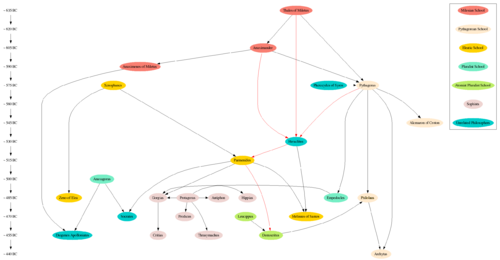
This page lists some links to ancient philosophy. In Western philosophy
, the spread of Christianity
through the Roman Empire
marked the ending of Hellenistic philosophy
and ushered in the beginnings of Medieval philosophy
, whereas in Eastern philosophy
, the spread of Islam
through the Arab Empire
marked the end of Old Iranian philosophy and ushered in the beginnings of early Islamic philosophy
.
, including Japan
, Korea
, and Vietnam
.
. Even though this period - known in its earlier part as the Spring and Autumn period and the Warring States period - in its latter part was fraught with chaos and bloody battles, it is also known as the Golden Age of Chinese philosophy
because a broad range of thoughts and ideas were developed and discussed freely. The thoughts and ideas discussed and refined during this period have profoundly influenced lifestyles and social consciousness
up to the present day in East Asian countries. The intellectual
society of this era was characterized by itinerant scholars, who were often employed by various state rulers as advisers on the methods of government
, war
, and diplomacy
. This period ended with the rise of the Qin Dynasty
and the subsequent purge
of dissent. The Book of Han
lists ten major schools, they are:
, who implemented Legalism as the official philosophy, quashed Mohist and Confucianist schools. Legalism remained influential until the emperors of the Han Dynasty
adopted Daoism and later Confucianism as official doctrine. These latter two became the determining forces of Chinese thought until the introduction of Buddhism.
Confucianism was particularly strong during the Han Dynasty, whose greatest thinker was Dong Zhongshu
, who integrated Confucianism with the thoughts of the Zhongshu School and the theory of the Five Elements. He also was a promoter of the New Text school, which considered Confucius as a divine figure and a spiritual ruler of China, who foresaw and started the evolution of the world towards the Universal Peace. In contrast, there was an Old Text school that advocated the use of Confucian works written in ancient language (from this comes the denomination Old Text) that were so much more reliable. In particular, they refuted the assumption of Confucius as a godlike figure and considered him as the greatest sage, but simply a human and mortal
The 3rd and 4th centuries saw the rise of the Xuanxue
(mysterious learning), also called Neo-Taoism. The most important philosophers of this movement were Wang Bi
, Xiang Xiu
and Guo Xiang
. The main question of this school was whether Being came before Not-Being (in Chinese, ming and wuming). A peculiar feature of these Taoist thinkers, like the Seven Sages of the Bamboo Grove
, was the concept of feng liu (lit. wind and flow), a sort of romantic spirit which encouraged following the natural and instinctive impulse.
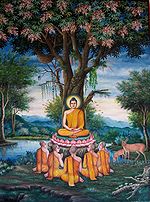
Buddhism
arrived in China around the 1st century AD, but it was not until the Northern and Southern
, Sui
and Tang
Dynasties that it gained considerable influence and acknowledgement. At the beginning, it was considered a sort of Taoist sect, and there was even a theory about Laozi
, founder of Taoism, who went to India and taught his philosophy to Buddha
. Mahayana Buddhism was far more successful in China than its rival Hinayana
, and both Indian schools and local Chinese sects arose from the 5th century. Two chiefly important monk philosophers were Sengzhao
and Daosheng. But probably the most influential and original of these schools was the Chan sect, which had an even stronger impact in Japan as the Zen
sect.
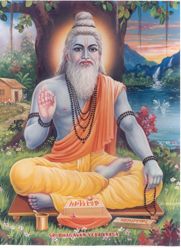 Indian philosophy begins with the Vedas
where questions related to laws of nature, the origin of the universe and the place of man in it are asked. In the famous Rigvedic
Hymn of Creation the poet says:
"Whence all creation had its origin,
he, whether he fashioned it or whether he did not,
he, who surveys it all from highest heaven,
he knows--or maybe even he does not know."
In the Vedic
view, creation is ascribed to the self-consciousness of the primeval being (Purusha). This leads to the inquiry into the one being that underlies the diversity of empirical phenomena and the origin of all things. Cosmic order is termed rta and causal law by karma. Nature (prakriti) is taken to have three qualities (sattva
, rajas
, and tamas
).
and Buddhism
are continuation of the Sramana school of thought. The Sramanas cultivated a pessimistic worldview of the samsara as full of suffering and advocated renunciation and austerities. They laid stress on philosophical concepts like Ahimsa, Karma, Jnana, Samsara and Moksa.
The Six schools of Indian philosophy
are:
Other traditions of Indian philosophy include:
(Sanskrit: चार्वाक), also known as Lokāyata, is a system of Hindu philosophy that assumes various forms of philosophical skepticism and religious indifference.It is named after its founder, Cārvāka, author of the Bārhaspatya-sūtras.
In overviews of Hindu philosophy, Cārvāka is classified as a "faithless" (nāstika
) system, the same classification as is given to Buddhism and Jainism.It is characterized as a materialistic and atheistic school of thought. While this branch of Indian philosophy is not considered to be part of the six orthodox schools of Hindu philosophy, it is noteworthy as evidence of a materialistic movement within Hinduism.
The Cārvāka school of philosophy had a variety of atheistic, materialistic, and naturalistic beliefs.
The Carvaka believed there was no afterlife, no life after death
Springing forth from these elements itself
solid knowledge is destroyed
when they are destroyed—
after death no intelligence remains.
Naturalism
The Carvaka believed in a form of naturalism, that is that all things happen by nature, and come from nature (not from any deity or Supreme Being).
Fire is hot, water cold,
refreshingly cool is the breeze of morning;
By whom came this variety?
They were born of their own nature.
That the pleasure arising to man
from contact with sensible objects,
is to be relinquished because accompanied by pain—
such is the reasoning of fools.
The kernels of the paddy, rich with finest white grains,
What man, seeking his own true interest,
would fling them away
because of a covering of husk and dust?
While life remains, let a man live happily,
let him feed on butter though he runs in debt;
When once the body becomes ashes,
how can it ever return again?
The three authors of the Vedas were buffoons, knaves, and demons.
All the well-known formulae of the pandits, jarphari, turphari, etc.
and all the obscene rites for the queen commanded in Aswamedha,
these were invented by buffoons, and so all the various kinds of presents to the priests,
while the eating of flesh was similarly commanded by night-prowling demons.
, Dualism (philosophy of mind)
While there are ancient relations between the Indian Vedas
and the Iranian Avesta
, the two main families of the Indo-Iranian philosophical traditions were characterized by fundamental differences in their implications for the human being's position in society and their view on the role of man in the universe. The first charter of human rights
by Cyrus the Great
as understood in the Cyrus cylinder
is often seen as a reflection of the questions and thoughts expressed by Zarathustra and developed in Zoroastrian
schools of thought of the Achaemenid Era
of Iranian history.
Iranian philosophy appears and is treated in various ways. Two eminent examples are:
, Christian philosophy
Western philosophy
Western philosophy is the philosophical thought and work of the Western or Occidental world, as distinct from Eastern or Oriental philosophies and the varieties of indigenous philosophies....
, the spread of Christianity
Christianity
Christianity is a monotheistic religion based on the life and teachings of Jesus as presented in canonical gospels and other New Testament writings...
through the Roman Empire
Roman Empire
The Roman Empire was the post-Republican period of the ancient Roman civilization, characterised by an autocratic form of government and large territorial holdings in Europe and around the Mediterranean....
marked the ending of Hellenistic philosophy
Hellenistic philosophy
Hellenistic philosophy is the period of Western philosophy that was developed in the Hellenistic civilization following Aristotle and ending with the beginning of Neoplatonism.-Pythagoreanism:...
and ushered in the beginnings of Medieval philosophy
Medieval philosophy
Medieval philosophy is the philosophy in the era now known as medieval or the Middle Ages, the period roughly extending from the fall of the Western Roman Empire in the fifth century AD to the Renaissance in the sixteenth century...
, whereas in Eastern philosophy
Eastern philosophy
Eastern philosophy includes the various philosophies of Asia, including Chinese philosophy, Iranian philosophy, Japanese philosophy, Indian philosophy and Korean philosophy...
, the spread of Islam
Spread of Islam
The Spread of Islam started shortly after the death of the Islamic prophet Muhammad in 632 AD. During his lifetime, the community of Muhammad, the ummah, was established in the Arabian Peninsula by means of conversion to Islam and conquering of territory, and oftentimes the conquered had to either...
through the Arab Empire
Caliphate
The term caliphate, "dominion of a caliph " , refers to the first system of government established in Islam and represented the political unity of the Muslim Ummah...
marked the end of Old Iranian philosophy and ushered in the beginnings of early Islamic philosophy
Early Islamic philosophy
Early Islamic philosophy or classical Islamic philosophy is a period of intense philosophical development beginning in the 2nd century AH of the Islamic calendar and lasting until the 6th century AH...
.
Ancient Chinese philosophy
Chinese philosophy is the dominant philosophical thought in China and other countries within the sinosphereSinosphere
In areal linguistics, Sinosphere refers to a grouping of countries and regions that are currently inhabited with a majority of Chinese population or were historically under Chinese cultural influence...
, including Japan
Japan
Japan is an island nation in East Asia. Located in the Pacific Ocean, it lies to the east of the Sea of Japan, China, North Korea, South Korea and Russia, stretching from the Sea of Okhotsk in the north to the East China Sea and Taiwan in the south...
, Korea
Korea
Korea ) is an East Asian geographic region that is currently divided into two separate sovereign states — North Korea and South Korea. Located on the Korean Peninsula, Korea is bordered by the People's Republic of China to the northwest, Russia to the northeast, and is separated from Japan to the...
, and Vietnam
Vietnam
Vietnam – sometimes spelled Viet Nam , officially the Socialist Republic of Vietnam – is the easternmost country on the Indochina Peninsula in Southeast Asia. It is bordered by China to the north, Laos to the northwest, Cambodia to the southwest, and the South China Sea –...
.
Hundred Schools of Thought
The Hundred Schools of Thought were philosophers and schools that flourished from 770 to 221 BC, an era of great cultural and intellectual expansion in ChinaChina
Chinese civilization may refer to:* China for more general discussion of the country.* Chinese culture* Greater China, the transnational community of ethnic Chinese.* History of China* Sinosphere, the area historically affected by Chinese culture...
. Even though this period - known in its earlier part as the Spring and Autumn period and the Warring States period - in its latter part was fraught with chaos and bloody battles, it is also known as the Golden Age of Chinese philosophy
Chinese philosophy
Chinese philosophy is philosophy written in the Chinese tradition of thought. The majority of traditional Chinese philosophy originates in the Spring and Autumn and Warring States era, during a period known as the "Hundred Schools of Thought", which was characterized by significant intellectual and...
because a broad range of thoughts and ideas were developed and discussed freely. The thoughts and ideas discussed and refined during this period have profoundly influenced lifestyles and social consciousness
Social consciousness
Social consciousness is consciousness shared within a society. It can also be defined as social awareness; to be aware of the problems that different societies and communities face on a day-to-day basis; to be conscious of the difficulties and hardships of society.- Theory :Many studies have been...
up to the present day in East Asian countries. The intellectual
Intellectual
An intellectual is a person who uses intelligence and critical or analytical reasoning in either a professional or a personal capacity.- Terminology and endeavours :"Intellectual" can denote four types of persons:...
society of this era was characterized by itinerant scholars, who were often employed by various state rulers as advisers on the methods of government
Government
Government refers to the legislators, administrators, and arbitrators in the administrative bureaucracy who control a state at a given time, and to the system of government by which they are organized...
, war
War
War is a state of organized, armed, and often prolonged conflict carried on between states, nations, or other parties typified by extreme aggression, social disruption, and usually high mortality. War should be understood as an actual, intentional and widespread armed conflict between political...
, and diplomacy
Diplomacy
Diplomacy is the art and practice of conducting negotiations between representatives of groups or states...
. This period ended with the rise of the Qin Dynasty
Qin Dynasty
The Qin Dynasty was the first imperial dynasty of China, lasting from 221 to 207 BC. The Qin state derived its name from its heartland of Qin, in modern-day Shaanxi. The strength of the Qin state was greatly increased by the legalist reforms of Shang Yang in the 4th century BC, during the Warring...
and the subsequent purge
Burning of books and burying of scholars
Burning of the books and burying of the scholars is a phrase that refers to a policy and a sequence of events in the Qin Dynasty of Ancient China, between the period of 213 and 206 BC. During these events, the Hundred Schools of Thought were pruned; legalism survived...
of dissent. The Book of Han
Book of Han
The Book of Han, Hanshu or History of the Former Han Dynasty |Fan Ye]] . Various scholars have estimated that the earliest material covered in the book dates back to between 206 and 202 BCE...
lists ten major schools, they are:
- ConfucianismConfucianismConfucianism is a Chinese ethical and philosophical system developed from the teachings of the Chinese philosopher Confucius . Confucianism originated as an "ethical-sociopolitical teaching" during the Spring and Autumn Period, but later developed metaphysical and cosmological elements in the Han...
, which teaches that human beings are teachable, improvable and perfectible through personal and communal endeavour especially including self-cultivation and self-creation. A main idea of Confucianism is the cultivation of virtue and the development of moral perfection. Confucianism holds that one should give up one's life, if necessary, either passively or actively, for the sake of upholding the cardinal moral values of ren and yi. - LegalismLegalism (Chinese philosophy)In Chinese history, Legalism was one of the main philosophic currents during the Warring States Period, although the term itself was invented in the Han Dynasty and thus does not refer to an organized 'school' of thought....
, which maintained that human nature was incorrigibly selfish; accordingly, the only way to preserve the social order was to impose discipline from above, and to see to a strict enforcement of laws. The Legalists exalted the state above all, seeking its prosperity and martial prowess over the welfare of the common people. - TaoismTaoismTaoism refers to a philosophical or religious tradition in which the basic concept is to establish harmony with the Tao , which is the mechanism of everything that exists...
, a philosophy which emphasizes the Three Jewels of the Tao: compassionCompassionCompassion is a virtue — one in which the emotional capacities of empathy and sympathy are regarded as a part of love itself, and a cornerstone of greater social interconnection and humanism — foundational to the highest principles in philosophy, society, and personhood.There is an aspect of...
, moderationModerationModeration is the process of eliminating or lessening extremes. It is used to ensure normality throughout the medium on which it is being conducted...
, and humilityHumilityHumility is the quality of being modest, and respectful. Humility, in various interpretations, is widely seen as a virtue in many religious and philosophical traditions, being connected with notions of transcendent unity with the universe or the divine, and of egolessness.-Term:The term "humility"...
, while Taoist thought generally focuses on natureNatureNature, in the broadest sense, is equivalent to the natural world, physical world, or material world. "Nature" refers to the phenomena of the physical world, and also to life in general...
, the relationship between humanity and the cosmos; healthHealthHealth is the level of functional or metabolic efficiency of a living being. In humans, it is the general condition of a person's mind, body and spirit, usually meaning to be free from illness, injury or pain...
and longevityLongevityThe word "longevity" is sometimes used as a synonym for "life expectancy" in demography or known as "long life", especially when it concerns someone or something lasting longer than expected ....
; and wu weiWu weiWu wei is an important concept of Taoism , that involves knowing when to act and when not to act. Another perspective to this is that "Wu Wei" means...
(action through inaction). Harmony with the UniverseUniverseThe Universe is commonly defined as the totality of everything that exists, including all matter and energy, the planets, stars, galaxies, and the contents of intergalactic space. Definitions and usage vary and similar terms include the cosmos, the world and nature...
, or the source thereof (Tao), is the intended result of many Taoist rules and practices. - MohismMohismMohism or Moism was a Chinese philosophy developed by the followers of Mozi , 470 BC–c.391 BC...
, which advocated the idea of universal love: Mozi believed that "everyone is equal before heaven", and that people should seek to imitate heaven by engaging in the practice of collective love. His epistemology can be regarded as primitive materialist empiricismEmpiricismEmpiricism is a theory of knowledge that asserts that knowledge comes only or primarily via sensory experience. One of several views of epistemology, the study of human knowledge, along with rationalism, idealism and historicism, empiricism emphasizes the role of experience and evidence,...
; he believed that human cognition ought to be based on one's perceptions – one's sensory experiences, such as sight and hearing – instead of imagination or internal logic, elements founded on the human capacity for abstraction. Mozi advocated frugality, condemning the Confucian emphasis on ritual and music, which he denounced as extravagant. - Naturalism, the School of NaturalistsSchool of NaturalistsThe School of Naturalists or the School of Yin-yang was a Warring States era philosophy that synthesized the concepts of yin-yang and the Five Elements; Zou Yan is considered the founder of this school...
or the Yin-yang school, which synthesized the concepts of yin-yang and the Five ElementsFive elements (Chinese philosophy)The Wu Xing, also known as the Five Phases, the Five Agents, the Five Movements, and the Five Steps/Stages, are chiefly an ancient mnemonic device, in many traditional Chinese fields....
; Zou YanZou YanZou Yan was the representative thinker of the Yin and Yang during the Hundred Schools of Thought era in Chinese philosophy. Zou Yan was a noted scholar of the Jixia Academy in the state of Qi...
is considered the founder of this school. - Agrarianism, or the School of Agrarianism, which advocated peasant utopian communalismCommunalismCommunalism is a term with three distinct meanings according to the Random House Unabridged Dictionary'.'These include "a theory of government or a system of government in which independent communes participate in a federation". "the principles and practice of communal ownership"...
and egalitarianismEgalitarianismEgalitarianism is a trend of thought that favors equality of some sort among moral agents, whether persons or animals. Emphasis is placed upon the fact that equality contains the idea of equity of quality...
. The Agrarians believed that Chinese society should be modeled around that of the early sage king Shen Nong, a folk hero which was portrayed in Chinese literature as "working in the fields, along with everyone else, and consulting with everyone else when any decision had to be reached." - The Logicians or the School of Names, which focused on definitionDefinitionA definition is a passage that explains the meaning of a term , or a type of thing. The term to be defined is the definiendum. A term may have many different senses or meanings...
and logicLogicIn philosophy, Logic is the formal systematic study of the principles of valid inference and correct reasoning. Logic is used in most intellectual activities, but is studied primarily in the disciplines of philosophy, mathematics, semantics, and computer science...
. It is said to have parallels with that of the Ancient Greek sophists or dialecticianDialecticianA dialectician is a philosopher who views the world in terms of complementary opposites and the interactions thereof. In popular usage, the central feature of dialectic is the concept of "thesis, antithesis, synthesis" - when an idea or phenomenon arises, it carries within itself the seed of its...
s. The most notable Logician was Gongsun LongziGongsun LongziGongsun Long was a member of the School of Names of ancient Chinese philosophy. He also ran a school and enjoyed the support of rulers, and supported peaceful means of resolving disputes in contrast to the wars which were common in the period...
. - The School of DiplomacySchool of DiplomacyThe School of Diplomacy , or "School of Vertical and Horizontal" Alliances was a political and diplomatic clique during the Warring States Period of Chinese history...
or School of Vertical and Horizontal [Alliances], which focused on practical matters instead of any moral principle, so it stressed political and diplomatic tactics, and debate and lobbying skill. Scholars from this school were good orators, debaters and tacticians. - The Miscellaneous School, which integrated teachings from different schools; for instance, Lü BuweiLü BuweiLü Buwei , Lord Wenxin 文信侯 was a Warring States Period merchant who schemed his way into governing the State of Qin. He served as Chancellor of China for King Zhuangxiang of Qin, and as regent and Chancellor for the king's young son Zheng, who became Qin Shi Huang, the first Emperor of China...
found scholars from different schools to write a book called Lüshi ChunqiuLüshi ChunqiuThe Lüshi Chunqiu is an encyclopedic Chinese classic text compiled around 239 BCE under the patronage of the Qin Dynasty Chancellor Lü Buwei...
cooperatively. This school tried to integrate the merits of various schools and avoid their perceived flaws. - The School of "Minor-talks", which was not a unique school of thought, but a philosophy constructed of all the thoughts which were discussed by and originated from normal people on the street.
- Another group is the School of the Military that studied strategy and the philosophy of warPhilosophy of warThe philosophy of war examines war beyond the typical questions of weaponry and strategy, inquiring into such things as the meaning and etiology of war, the relationship between war and human nature, and the ethics of war...
; Sunzi and Sun BinSun BinSun Bin was a military strategist who lived during the Warring States Period of Chinese history. An alleged descendant of Sun Tzu, Sun Bin was tutored in military strategy by the hermit Guiguzi...
were influential leaders. However, this school was not one of the "Ten Schools" defined by Hanshu.
Early Imperial China
The founder of the Qin DynastyQin Dynasty
The Qin Dynasty was the first imperial dynasty of China, lasting from 221 to 207 BC. The Qin state derived its name from its heartland of Qin, in modern-day Shaanxi. The strength of the Qin state was greatly increased by the legalist reforms of Shang Yang in the 4th century BC, during the Warring...
, who implemented Legalism as the official philosophy, quashed Mohist and Confucianist schools. Legalism remained influential until the emperors of the Han Dynasty
Han Dynasty
The Han Dynasty was the second imperial dynasty of China, preceded by the Qin Dynasty and succeeded by the Three Kingdoms . It was founded by the rebel leader Liu Bang, known posthumously as Emperor Gaozu of Han. It was briefly interrupted by the Xin Dynasty of the former regent Wang Mang...
adopted Daoism and later Confucianism as official doctrine. These latter two became the determining forces of Chinese thought until the introduction of Buddhism.
Confucianism was particularly strong during the Han Dynasty, whose greatest thinker was Dong Zhongshu
Dong Zhongshu
Dong Zhongshu was a Han Dynasty Chinese scholar. He is traditionally associated with the promotion of Confucianism as the official ideology of the Chinese imperial state.-History:...
, who integrated Confucianism with the thoughts of the Zhongshu School and the theory of the Five Elements. He also was a promoter of the New Text school, which considered Confucius as a divine figure and a spiritual ruler of China, who foresaw and started the evolution of the world towards the Universal Peace. In contrast, there was an Old Text school that advocated the use of Confucian works written in ancient language (from this comes the denomination Old Text) that were so much more reliable. In particular, they refuted the assumption of Confucius as a godlike figure and considered him as the greatest sage, but simply a human and mortal
The 3rd and 4th centuries saw the rise of the Xuanxue
Xuanxue
Xuanxue , Neo-Taoism, or Neo-Daoism is the focal school of thought in Chinese philosophy from the third to sixth century CE. Xuanxue philosophers combined elements of Confucianism and Taoism to reinterpret the Yijing, Daodejing, and Zhuangzi.The name compounds xuan 玄 "black, dark; mysterious,...
(mysterious learning), also called Neo-Taoism. The most important philosophers of this movement were Wang Bi
Wang Bi
Wang Bi , style name Fusi , was a Chinese neotaoist philosopher.-Biography:Wang Bi's most important works are commentaries on Laozi's Dao De Jing and the I Ching. The text of the Dao De Jing that appeared with his commentary was widely considered as the best copy of this work until the discovery of...
, Xiang Xiu
Xiang Xiu
Xiang Xiu is one of the Seven Sages of the Bamboo Grove.His most famous contribution is a commentary on the Zhuangzi, which was later used and amended by Guo Xiang. After his friend Xi Kang was killed by the ruling Jin dynasty, Xiang carefully interpreted his previous antagonistic words to the...
and Guo Xiang
Guo Xiang
Guo Xiang , is credited with the first and most important revision of the text known as the Zhuangzi which, along with the Laozi, forms the textual and philosophical basis of the Taoist school of thought...
. The main question of this school was whether Being came before Not-Being (in Chinese, ming and wuming). A peculiar feature of these Taoist thinkers, like the Seven Sages of the Bamboo Grove
Seven Sages of the Bamboo Grove
The Seven Sages of the Bamboo Grove were a group of Chinese Taoist Qingtan scholars, writers, and musicians who came together in the 3rd century CE. Although the individual members all existed, their interconnection is not entirely certain...
, was the concept of feng liu (lit. wind and flow), a sort of romantic spirit which encouraged following the natural and instinctive impulse.
Buddhism
Buddhism
Buddhism is a religion and philosophy encompassing a variety of traditions, beliefs and practices, largely based on teachings attributed to Siddhartha Gautama, commonly known as the Buddha . The Buddha lived and taught in the northeastern Indian subcontinent some time between the 6th and 4th...
arrived in China around the 1st century AD, but it was not until the Northern and Southern
Southern and Northern Dynasties
The Southern and Northern Dynasties was a period in the history of China that lasted from 420 to 589 AD. Though an age of civil war and political chaos, it was also a time of flourishing arts and culture, advancement in technology, and the spreading of Mahayana Buddhism and Daoism...
, Sui
Sui Dynasty
The Sui Dynasty was a powerful, but short-lived Imperial Chinese dynasty. Preceded by the Southern and Northern Dynasties, it ended nearly four centuries of division between rival regimes. It was followed by the Tang Dynasty....
and Tang
Tang Dynasty
The Tang Dynasty was an imperial dynasty of China preceded by the Sui Dynasty and followed by the Five Dynasties and Ten Kingdoms Period. It was founded by the Li family, who seized power during the decline and collapse of the Sui Empire...
Dynasties that it gained considerable influence and acknowledgement. At the beginning, it was considered a sort of Taoist sect, and there was even a theory about Laozi
Laozi
Laozi was a mystic philosopher of ancient China, best known as the author of the Tao Te Ching . His association with the Tao Te Ching has led him to be traditionally considered the founder of Taoism...
, founder of Taoism, who went to India and taught his philosophy to Buddha
Buddha
In Buddhism, buddhahood is the state of perfect enlightenment attained by a buddha .In Buddhism, the term buddha usually refers to one who has become enlightened...
. Mahayana Buddhism was far more successful in China than its rival Hinayana
Hinayana
Hīnayāna is a Sanskrit and Pāli term literally meaning: the "Inferior Vehicle", "Deficient Vehicle", the "Abandoned Vehicle", or the "Defective Vehicle". The term appeared around the 1st or 2nd century....
, and both Indian schools and local Chinese sects arose from the 5th century. Two chiefly important monk philosophers were Sengzhao
Sengzhao
Sengzhao , from Jingzhao, was a Buddhist Chinese philosopher and the first disciple of Kumārajīva. He helped translate Indian treatises and also wrote his own. These form the only source of study for early Chinese Mādhyamika Buddhism...
and Daosheng. But probably the most influential and original of these schools was the Chan sect, which had an even stronger impact in Japan as the Zen
Zen
Zen is a school of Mahāyāna Buddhism founded by the Buddhist monk Bodhidharma. The word Zen is from the Japanese pronunciation of the Chinese word Chán , which in turn is derived from the Sanskrit word dhyāna, which can be approximately translated as "meditation" or "meditative state."Zen...
sect.
Philosophers
- TaoismTaoismTaoism refers to a philosophical or religious tradition in which the basic concept is to establish harmony with the Tao , which is the mechanism of everything that exists...
- LaoziLaoziLaozi was a mystic philosopher of ancient China, best known as the author of the Tao Te Ching . His association with the Tao Te Ching has led him to be traditionally considered the founder of Taoism...
- ZhuangziZhuangziZhuangzi was an influential Chinese philosopher who lived around the 4th century BCE during the Warring States Period, a period corresponding to the philosophical summit of Chinese thought — the Hundred Schools of Thought, and is credited with writing—in part or in whole—a work known by his name,...
- Zhang DaolingZhang DaolingZhang Ling , style name Fuhan , was an Eastern Han Dynasty Taoist hermit who founded the Way of the Celestial Masters sect of Taoism, which is also known as the Way of the Five Pecks of Rice....
- Zhang Jue
- Ge HongGe HongGe Hong , courtesy name Zhichuan , was a minor southern official during the Jìn Dynasty of China, best known for his interest in Daoism, alchemy, and techniques of longevity...
- Chen Tuan
- Laozi
- ConfucianismConfucianismConfucianism is a Chinese ethical and philosophical system developed from the teachings of the Chinese philosopher Confucius . Confucianism originated as an "ethical-sociopolitical teaching" during the Spring and Autumn Period, but later developed metaphysical and cosmological elements in the Han...
- ConfuciusConfuciusConfucius , literally "Master Kong", was a Chinese thinker and social philosopher of the Spring and Autumn Period....
- MenciusMenciusMencius was a Chinese philosopher who was arguably the most famous Confucian after Confucius himself.-Life:Mencius, also known by his birth name Meng Ke or Ko, was born in the State of Zou, now forming the territory of the county-level city of Zoucheng , Shandong province, only thirty kilometres ...
- Xun ZiXun ZiXun Zi was a Chinese Confucian philosopher who lived during the Warring States Period and contributed to one of the Hundred Schools of Thought. Xun Zi believed man's inborn tendencies need to be curbed through education and ritual, counter to Mencius's view that man is innately good...
- Confucius
- LegalismLegalism (Chinese philosophy)In Chinese history, Legalism was one of the main philosophic currents during the Warring States Period, although the term itself was invented in the Han Dynasty and thus does not refer to an organized 'school' of thought....
- Li SiLi SiLi Si was the influential Prime Minister of the feudal state and later of the dynasty of Qin, between 246 BC and 208 BC. A famous Legalist, he was also a notable calligrapher. Li Si served under two rulers: Qin Shi Huang, king of Qin and later First Emperor of China—and his son, Qin Er Shi...
- Li Kui
- Han FeiHan FeiHan Fei was a Chinese philosopher who, along with Li Si, Gongsun Yang, Shen Dao and Shen Buhai, developed the doctrine of the School of Law or Legalism...
- Shang YangShang YangShang Yang was an important statesman of the State of Qin during the Warring States Period of Chinese history. Born Wei Yang in the State of Wei, with the support of Duke Xiao of Qin Yang enacted numerous reforms in Qin...
- Shen BuhaiShen BuhaiShen Buhai was a Chinese bureaucrat who was the Chancellor of Han under Marquis Zhao of Han from 351 BC to 337 BC. Shen was born in the State of Zheng; he was likely to have been a minor official for the State of Zheng. After Han conquered Zheng in 375 BC, he rose up in the ranks of the Han...
- Shen DaoShen DaoShen Dao was an itinerant Chinese philosopher from Zhao, who was a scholar at the Jixia Academy in Qi. He is usually referred to as Shenzi 慎子.-Overview:...
- Li Si
- MohismMohismMohism or Moism was a Chinese philosophy developed by the followers of Mozi , 470 BC–c.391 BC...
- MoziMoziMozi |Lat.]] as Micius, ca. 470 BC – ca. 391 BC), original name Mo Di , was a Chinese philosopher during the Hundred Schools of Thought period . Born in Tengzhou, Shandong Province, China, he founded the school of Mohism, and argued strongly against Confucianism and Daoism...
- Song Xing
- Logicians
- Deng XiDeng XiDeng Xi was a Chinese lawyer and rhetorician who has been called the founding father of the Chinese logical tradition. He is regarded as one of the School of Names.-Biography:...
- Hui ShiHui ShiHui Shi , or Huizi , was a Chinese philosopher during the Warring States Period. He was a representative of the School of Names , and is famous for ten paradoxes about the relativity of time and space, for instance, "I set off for Yue today and came there yesterday."-Works mentioning Hui Shi:The...
- Gongsun Long
- Deng Xi
- Logicians
- Mozi
- Agrarianism
- Xu Xing
- NaturalismSchool of NaturalistsThe School of Naturalists or the School of Yin-yang was a Warring States era philosophy that synthesized the concepts of yin-yang and the Five Elements; Zou Yan is considered the founder of this school...
- Zou YanZou YanZou Yan was the representative thinker of the Yin and Yang during the Hundred Schools of Thought era in Chinese philosophy. Zou Yan was a noted scholar of the Jixia Academy in the state of Qi...
- Zou Yan
- Neotaoism
- Wang BiWang BiWang Bi , style name Fusi , was a Chinese neotaoist philosopher.-Biography:Wang Bi's most important works are commentaries on Laozi's Dao De Jing and the I Ching. The text of the Dao De Jing that appeared with his commentary was widely considered as the best copy of this work until the discovery of...
- Guo XiangGuo XiangGuo Xiang , is credited with the first and most important revision of the text known as the Zhuangzi which, along with the Laozi, forms the textual and philosophical basis of the Taoist school of thought...
- Xiang XiuXiang XiuXiang Xiu is one of the Seven Sages of the Bamboo Grove.His most famous contribution is a commentary on the Zhuangzi, which was later used and amended by Guo Xiang. After his friend Xi Kang was killed by the ruling Jin dynasty, Xiang carefully interpreted his previous antagonistic words to the...
- Wang Bi
- School of DiplomacySchool of DiplomacyThe School of Diplomacy , or "School of Vertical and Horizontal" Alliances was a political and diplomatic clique during the Warring States Period of Chinese history...
- GuiguziGuiguziWang Xu , better known by his pseudonym Guiguzi , is an ancient Chinese philosopher from the Warring States Period of Chinese history. He was the founder of the School of Diplomacy of the Hundred Schools of Thought during that period...
- Su QinSu QinSu Qin , was an influential political strategist during the Warring States Period of Chinese history . He was born in Chengxuan Village, Luoyang in present day Henan Province. According to legend Su Qin was a disciple of Gui Guzi, the founder of the School of Diplomacy...
- Zhang YiZhang YiZhang Yi may refer to:*Zhang Yi , strategist during the Warring States Period*Zhang Yi , official of Shu Han during the Three Kingdoms period*Zhang Yi , general of Shu Han during the Three Kingdoms period...
- Yue YiYue YiYue Yi was an officer of the State of Yan during the Warring State period, also known as Lord Guojun. He was the son of the prime minister of the small nation of Zhongshan, but when Zhongshan was destroyed by Zhao's King Wuling, he was forced to wander from country to country...
- Li YijiLi YijiLi Yiji was an advisor to Liu Bang during the Chu–Han contention.-Biography:Li Yiji was from Gaoyang, Chenliu . He joined Liu Bang around 207 BC during the insurrection against the Qin Dynasty...
- Guiguzi
- School of the Military
- Sunzi
- Sun BinSun BinSun Bin was a military strategist who lived during the Warring States Period of Chinese history. An alleged descendant of Sun Tzu, Sun Bin was tutored in military strategy by the hermit Guiguzi...
- ZenZenZen is a school of Mahāyāna Buddhism founded by the Buddhist monk Bodhidharma. The word Zen is from the Japanese pronunciation of the Chinese word Chán , which in turn is derived from the Sanskrit word dhyāna, which can be approximately translated as "meditation" or "meditative state."Zen...
- LinjiLinjiLínjì Yìxuán was the founder of the Linji school of Chán Buddhism during Tang Dynasty China. Linji was born into a family named Xing in Caozhou , which he left at a young age to study Buddhism in many places....
- Tung-shanTung-shanLiang-chieh of Tung-shan , often referred to simply as Tung-Shan or Dongshan Liangjie , was a Ch'an master of 9th century China. Along with his pupil Ts'ao-shan Pen-chi, he is best known for founding the Ts'ao-tung, or later Sōtō, school of Ch'an...
- Yunmen WenyanYunmen WenyanYúnmén Wényǎn , , was a major Chinese Zen master in Tang-era China...
- Linji
Ancient Greek philosophy
Presocratic philosophers
- Milesian SchoolMilesian schoolThe Milesian school was a school of thought founded in the 6th century BC. The ideas associated with it are exemplified by three philosophers from the Ionian town of Miletus, on the Aegean coast of Anatolia: Thales, Anaximander, and Anaximenes...
- ThalesThalesThales of Miletus was a pre-Socratic Greek philosopher from Miletus in Asia Minor, and one of the Seven Sages of Greece. Many, most notably Aristotle, regard him as the first philosopher in the Greek tradition...
(624 BC–ca. 546 BC) - AnaximanderAnaximanderAnaximander was a pre-Socratic Greek philosopher who lived in Miletus, a city of Ionia; Milet in modern Turkey. He belonged to the Milesian school and learned the teachings of his master Thales...
(610-546 BC) - Anaximenes of MiletusAnaximenes of MiletusAnaximenes of Miletus was an Archaic Greek Pre-Socratic philosopher active in the latter half of the 6th century BC. One of the three Milesian philosophers, he is identified as a younger friend or student of Anaximander. Anaximenes, like others in his school of thought, practiced material monism...
(c. 585-c. 525 BC)
- PythagoreansPythagoreanismPythagoreanism was the system of esoteric and metaphysical beliefs held by Pythagoras and his followers, the Pythagoreans, who were considerably influenced by mathematics. Pythagoreanism originated in the 5th century BCE and greatly influenced Platonism...
- PythagorasPythagorasPythagoras of Samos was an Ionian Greek philosopher, mathematician, and founder of the religious movement called Pythagoreanism. Most of the information about Pythagoras was written down centuries after he lived, so very little reliable information is known about him...
(582-496 BC) - PhilolausPhilolausPhilolaus was a Greek Pythagorean and Presocratic philosopher. He argued that all matter is composed of limiting and limitless things, and that the universe is determined by numbers. He is credited with originating the theory that the earth was not the center of the universe.-Life:Philolaus is...
(470-380 BC) - Alcmaeon of CrotonAlcmaeon of CrotonAlcmaeon of Croton was one of the most eminent natural philosophers and medical theorists of antiquity. His father's name was Peirithus . He is said by some to have been a pupil of Pythagoras, and he may have been born around 510 BC...
- ArchytasArchytasArchytas was an Ancient Greek philosopher, mathematician, astronomer, statesman, and strategist. He was a scientist of the Pythagorean school and famous for being the reputed founder of mathematical mechanics, as well as a good friend of Plato....
(428-347 BC)
- HeraclitusHeraclitusHeraclitus of Ephesus was a pre-Socratic Greek philosopher, a native of the Greek city Ephesus, Ionia, on the coast of Asia Minor. He was of distinguished parentage. Little is known about his early life and education, but he regarded himself as self-taught and a pioneer of wisdom...
(535-475 BC)
- Eleatic School
- XenophanesXenophanesof Colophon was a Greek philosopher, theologian, poet, and social and religious critic. Xenophanes life was one of travel, having left Ionia at the age of 25 he continued to travel throughout the Greek world for another 67 years. Some scholars say he lived in exile in Siciliy...
(570-470 BC) - ParmenidesParmenidesParmenides of Elea was an ancient Greek philosopher born in Elea, a Greek city on the southern coast of Italy. He was the founder of the Eleatic school of philosophy. The single known work of Parmenides is a poem, On Nature, which has survived only in fragmentary form. In this poem, Parmenides...
(510-440 BC) - Zeno of EleaZeno of EleaZeno of Elea was a pre-Socratic Greek philosopher of southern Italy and a member of the Eleatic School founded by Parmenides. Aristotle called him the inventor of the dialectic. He is best known for his paradoxes, which Bertrand Russell has described as "immeasurably subtle and profound".- Life...
(490-430 BC) - Melissus of SamosMelissus of SamosMelissus of Samos was the third and last member of the ancient school of Eleatic philosophy, whose other members included Zeno and Parmenides. Little is known about his life except that he was the commander of the Samian fleet shortly before the Peloponnesian War. Melissus’ contribution to...
(c 470 BC–unknown)
- PluralistsPluralist SchoolThe Pluralist School was a school of pre-Socratic philosophers who attempted to reconcile Parmenides' rejection of change with the apparently changing world of sense experience. The school consisted of Anaxagoras, Archelaus, and Empedocles. It can also be said to have included the Atomists,...
- EmpedoclesEmpedoclesEmpedocles was a Greek pre-Socratic philosopher and a citizen of Agrigentum, a Greek city in Sicily. Empedocles' philosophy is best known for being the originator of the cosmogenic theory of the four Classical elements...
(490-430 BC) - AnaxagorasAnaxagorasAnaxagoras was a Pre-Socratic Greek philosopher. Born in Clazomenae in Asia Minor, Anaxagoras was the first philosopher to bring philosophy from Ionia to Athens. He attempted to give a scientific account of eclipses, meteors, rainbows, and the sun, which he described as a fiery mass larger than...
(500-428 BC)
- AtomistsAtomismAtomism is a natural philosophy that developed in several ancient traditions. The atomists theorized that the natural world consists of two fundamental parts: indivisible atoms and empty void.According to Aristotle, atoms are indestructible and immutable and there are an infinite variety of shapes...
- LeucippusLeucippusLeucippus or Leukippos was one of the earliest Greeks to develop the theory of atomism — the idea that everything is composed entirely of various imperishable, indivisible elements called atoms — which was elaborated in greater detail by his pupil and successor, Democritus...
(first half of 5th century BC) - DemocritusDemocritusDemocritus was an Ancient Greek philosopher born in Abdera, Thrace, Greece. He was an influential pre-Socratic philosopher and pupil of Leucippus, who formulated an atomic theory for the cosmos....
(460-370 BC) - Metrodorus of ChiosMetrodorus of ChiosMetrodorus of Chios was a Greek Presocratic philosopher, belonging to the school of Democritus, and an important forerunner of Epicurus....
(4th century BC)
- Pherecydes of SyrosPherecydes of SyrosPherecydes of Syros was a Greek thinker from the island of Syros, of the 6th century BC. Pherecydes authored the Pentemychos or Heptamychos, one of the first attested prose works in Greek literature, which formed an important bridge between mythic and pre-Socratic thought.- Life :Very little is...
(6th century BC)
- SophistsSophismSophism in the modern definition is a specious argument used for deceiving someone. In ancient Greece, sophists were a category of teachers who specialized in using the tools of philosophy and rhetoric for the purpose of teaching aretê — excellence, or virtue — predominantly to young statesmen and...
- ProtagorasProtagorasProtagoras was a pre-Socratic Greek philosopher and is numbered as one of the sophists by Plato. In his dialogue Protagoras, Plato credits him with having invented the role of the professional sophist or teacher of virtue...
(490-420 BC) - GorgiasGorgiasGorgias ,Greek sophist, pre-socratic philosopher and rhetorician, was a native of Leontini in Sicily. Along with Protagoras, he forms the first generation of Sophists. Several doxographers report that he was a pupil of Empedocles, although he would only have been a few years younger...
(487-376 BC) - AntiphonAntiphon (person)Antiphon the Sophist lived in Athens probably in the last two decades of the 5th century BC. There is an ongoing controversy over whether he is one and the same with Antiphon of the Athenian deme Rhamnus in Attica , the earliest of the ten Attic orators...
(480-411 BC) - ProdicusProdicusProdicus of Ceos was a Greek philosopher, and part of the first generation of Sophists. He came to Athens as ambassador from Ceos, and became known as a speaker and a teacher. Plato treats him with greater respect than the other sophists, and in several of the Platonic dialogues Socrates appears...
(465/450-after 399 BC) - HippiasHippiasHippias of Elis was a Greek Sophist, and a contemporary of Socrates. With an assurance characteristic of the later sophists, he claimed to be regarded as an authority on all subjects, and lectured on poetry, grammar, history, politics, mathematics, and much else...
(middle of the 5th century BC) - ThrasymachusThrasymachusThrasymachus was a sophist of Ancient Greece best known as a character in Plato's Republic.-Life, date, and career:...
(459-400 BC) - CalliclesCalliclesCallicles is a character in Plato’s dialogue Gorgias. He is an Athenian citizen, who is a student of the sophist Gorgias. In the dialogue, he argues the position of an oligarchic, proto-"Nietzschean" amoralism: it is natural and just for the strong to dominate the weak and that it is unfair for...
- CritiasCritiasCritias , born in Athens, son of Callaeschrus, was an uncle of Plato, and a leading member of the Thirty Tyrants, and one of the most violent. He was an associate of Socrates, a fact that did not endear Socrates to the Athenian public. He was noted in his day for his tragedies, elegies and prose...
- LycophronLycophronLycophron was a Hellenistic Greek tragic poet, grammarian, and commentator on comedy, to whom the poem Alexandra is attributed .-Life and miscellaneous works:...
- Diogenes of Apollonia (c. 460 BC-unknown)
Classical Greek philosophers
- SocratesSocratesSocrates was a classical Greek Athenian philosopher. Credited as one of the founders of Western philosophy, he is an enigmatic figure known chiefly through the accounts of later classical writers, especially the writings of his students Plato and Xenophon, and the plays of his contemporary ...
(469-399 BC) - Euclid of MegaraEuclid of MegaraEuclid of Megara was a Greek Socratic philosopher who founded the Megarian school of philosophy. He was a pupil of Socrates in the late 5th century BCE, and was present at his death. He held the supreme good to be one, eternal and unchangeable, and denied the existence of anything contrary to the...
(450-380 BC) - AntisthenesAntisthenesAntisthenes was a Greek philosopher and a pupil of Socrates. Antisthenes first learned rhetoric under Gorgias before becoming an ardent disciple of Socrates. He adopted and developed the ethical side of Socrates' teachings, advocating an ascetic life lived in accordance with virtue. Later writers...
(445-360 BC) - AristippusAristippusAristippus of Cyrene, , was the founder of the Cyrenaic school of Philosophy. He was a pupil of Socrates, but adopted a very different philosophical outlook, teaching that the goal of life was to seek pleasure by adapting circumstances to oneself and by maintaining proper control over both...
(435-356 BC) - PlatoPlatoPlato , was a Classical Greek philosopher, mathematician, student of Socrates, writer of philosophical dialogues, and founder of the Academy in Athens, the first institution of higher learning in the Western world. Along with his mentor, Socrates, and his student, Aristotle, Plato helped to lay the...
(428-347 BC) - SpeusippusSpeusippusSpeusippus was an ancient Greek philosopher. Speusippus was Plato's nephew by his sister Potone. After Plato's death, Speusippus inherited the Academy and remained its head for the next eight years. However, following a stroke, he passed the chair to Xenocrates. Although the successor to Plato...
(407-339 BC) - Diogenes of SinopeDiogenes of SinopeDiogenes the Cynic was a Greek philosopher and one of the founders of Cynic philosophy. Also known as Diogenes of Sinope , he was born in Sinope , an Ionian colony on the Black Sea , in 412 or 404 BCE and died at Corinth in 323 BCE.Diogenes of Sinope was a controversial figure...
(400-325 BC) - XenocratesXenocratesXenocrates of Chalcedon was a Greek philosopher, mathematician, and leader of the Platonic Academy from 339/8 to 314/3 BC. His teachings followed those of Plato, which he attempted to define more closely, often with mathematical elements...
(396-314 BC) - AristotleAristotleAristotle was a Greek philosopher and polymath, a student of Plato and teacher of Alexander the Great. His writings cover many subjects, including physics, metaphysics, poetry, theater, music, logic, rhetoric, linguistics, politics, government, ethics, biology, and zoology...
(384-322 BC) - StilpoStilpoStilpo was a Greek philosopher of the Megarian school. He was a contemporary of Theophrastus, Diodorus Cronus, and Crates of Thebes. None of his writings survive, he was interested in logic and dialectic, and he argued that the universal is fundamentally separated from the individual and concrete...
(380-300 BC) - TheophrastusTheophrastusTheophrastus , a Greek native of Eresos in Lesbos, was the successor to Aristotle in the Peripatetic school. He came to Athens at a young age, and initially studied in Plato's school. After Plato's death he attached himself to Aristotle. Aristotle bequeathed to Theophrastus his writings, and...
(370-288 BC)
Hellenistic philosophy
- PyrrhoPyrrhoPyrrho , a Greek philosopher of classical antiquity, is credited as being the first Skeptic philosopher and the inspiration for the school known as Pyrrhonism, founded by Aenesidemus in the 1st century BC.- Life :Pyrrho was from Elis, on the Ionian Sea...
(365-275 BC) - EpicurusEpicurusEpicurus was an ancient Greek philosopher and the founder of the school of philosophy called Epicureanism.Only a few fragments and letters remain of Epicurus's 300 written works...
(341-270 BC), see: EpicureanismEpicureanismEpicureanism is a system of philosophy based upon the teachings of Epicurus, founded around 307 BC. Epicurus was an atomic materialist, following in the steps of Democritus. His materialism led him to a general attack on superstition and divine intervention. Following Aristippus—about whom... - Metrodorus of Lampsacus (the younger) (331–278 BC)
- Zeno of CitiumZeno of CitiumZeno of Citium was a Greek philosopher from Citium . Zeno was the founder of the Stoic school of philosophy, which he taught in Athens from about 300 BC. Based on the moral ideas of the Cynics, Stoicism laid great emphasis on goodness and peace of mind gained from living a life of virtue in...
(333-263 BC) - CleanthesCleanthesCleanthes , of Assos, was a Greek Stoic philosopher and the successor to Zeno as the second head of the Stoic school in Athens. Originally a boxer, he came to Athens where he took up philosophy, listening to Zeno's lectures. He supported himself by working as water-carrier at night. After the...
(331-232 BC) - TimonTimon (philosopher)Timon of Phlius was a Greek skeptic philosopher, a pupil of Pyrrho, and a celebrated writer of satirical poems called Silloi . He was born in Phlius, moved to Megara, and then he returned home and married. He next went to Elis with his wife, and heard Pyrrho, whose tenets he adopted...
(320-230 BC) - ArcesilausArcesilausArcesilaus was a Greek philosopher and founder of the Second or Middle Academy—the phase of Academic skepticism. Arcesilaus succeeded Crates as the sixth head of the Academy c. 264 BC. He did not preserve his thoughts in writing, so his opinions can only be gleaned second-hand from what is...
(316-232 BC) - MenippusMenippusMenippus of Gadara, was a Cynic and satirist. His works, which are all lost, were an important influence on Varro and Lucian. The Menippean satire genre is named after him.-Life:...
(3rd century BC) - ArchimedesArchimedesArchimedes of Syracuse was a Greek mathematician, physicist, engineer, inventor, and astronomer. Although few details of his life are known, he is regarded as one of the leading scientists in classical antiquity. Among his advances in physics are the foundations of hydrostatics, statics and an...
(c. 287-212 BC) - ChrysippusChrysippusChrysippus of Soli was a Greek Stoic philosopher. He was a native of Soli, Cilicia, but moved to Athens as a young man, where he became a pupil of Cleanthes in the Stoic school. When Cleanthes died, around 230 BC, Chrysippus became the third head of the school...
(280-207 BC) - CarneadesCarneadesCarneades was an Academic skeptic born in Cyrene. By the year 159 BC, he had started to refute all previous dogmatic doctrines, especially Stoicism, and even the Epicureans whom previous skeptics had spared. As head of the Academy, he was one of three philosophers sent to Rome in 155 BC where his...
(214-129 BC) - Clitomachus (187-109 BC)
- Metrodorus of StratoniceaMetrodorus of StratoniceaMetrodorus of Stratonikeia was at first a disciple of the Epicurean school, but afterwards attached himself to Carneades. His defection from the Epicurean school is almost unique. It is explained by Cicero as being due to his theory that the scepticism of Carneades was merely a means of attacking...
(late 2nd century BC) - Philo of LarissaPhilo of LarissaPhilo of Larissa, was a Greek philosopher. He was a pupil of Clitomachus, whom he succeeded as head of the Academy. During the Mithradatic wars which would see the destruction of the Academy, he travelled to Rome where Cicero heard him lecture. None of his writings survive...
(160-80 BC) - PosidoniusPosidoniusPosidonius "of Apameia" or "of Rhodes" , was a Greek Stoic philosopher, politician, astronomer, geographer, historian and teacher native to Apamea, Syria. He was acclaimed as the greatest polymath of his age...
(135-51 BC) - Antiochus of AscalonAntiochus of AscalonAntiochus , of Ascalon, , was an Academic philosopher. He was a pupil of Philo of Larissa at the Academy, but he diverged from the Academic skepticism of Philo and his predecessors...
(130-68 BC) - AenesidemusAenesidemusAenesidemus was a Greek sceptical philosopher, born in Knossos on the island of Crete. He lived in the 1st century BC, taught in Alexandria and flourished shortly after the life of Cicero...
(1st century BC) - Philo of Alexandria (30 BC–45 AD)
- AgrippaAgrippa the ScepticAgrippa was a Skeptic philosopher who probably lived towards the end of the 1st century AD. He is regarded as the author of "five grounds of doubt" or tropes , which are purported to establish the impossibility of certain knowledge.-The Five Tropes:...
(1st century AD)
Hellenistic schools of thought
- Cynicism
- EclecticismEclecticismEclecticism is a conceptual approach that does not hold rigidly to a single paradigm or set of assumptions, but instead draws upon multiple theories, styles, or ideas to gain complementary insights into a subject, or applies different theories in particular cases.It can sometimes seem inelegant or...
- EpicureanismEpicureanismEpicureanism is a system of philosophy based upon the teachings of Epicurus, founded around 307 BC. Epicurus was an atomic materialist, following in the steps of Democritus. His materialism led him to a general attack on superstition and divine intervention. Following Aristippus—about whom...
- Neo-Platonism
- Peripatetic School
- SkepticismSkepticismSkepticism has many definitions, but generally refers to any questioning attitude towards knowledge, facts, or opinions/beliefs stated as facts, or doubt regarding claims that are taken for granted elsewhere...
- StoicismStoicismStoicism is a school of Hellenistic philosophy founded in Athens by Zeno of Citium in the early . The Stoics taught that destructive emotions resulted from errors in judgment, and that a sage, or person of "moral and intellectual perfection," would not suffer such emotions.Stoics were concerned...
- SophismSophismSophism in the modern definition is a specious argument used for deceiving someone. In ancient Greece, sophists were a category of teachers who specialized in using the tools of philosophy and rhetoric for the purpose of teaching aretê — excellence, or virtue — predominantly to young statesmen and...
Ancient Indian philosophy
The ancient Indian philosophy is a fusion of two ancient traditions : Sramana tradition and Vedic tradition.Vedic philosophy
Vedas
The Vedas are a large body of texts originating in ancient India. Composed in Vedic Sanskrit, the texts constitute the oldest layer of Sanskrit literature and the oldest scriptures of Hinduism....
where questions related to laws of nature, the origin of the universe and the place of man in it are asked. In the famous Rigvedic
Rigveda
The Rigveda is an ancient Indian sacred collection of Vedic Sanskrit hymns...
Hymn of Creation the poet says:
"Whence all creation had its origin,
he, whether he fashioned it or whether he did not,
he, who surveys it all from highest heaven,
he knows--or maybe even he does not know."
In the Vedic
Historical Vedic religion
The religion of the Vedic period is a historical predecessor of Hinduism. Its liturgy is reflected in the mantra portion of the four Vedas, which are compiled in Sanskrit. The religious practices centered on a clergy administering rites...
view, creation is ascribed to the self-consciousness of the primeval being (Purusha). This leads to the inquiry into the one being that underlies the diversity of empirical phenomena and the origin of all things. Cosmic order is termed rta and causal law by karma. Nature (prakriti) is taken to have three qualities (sattva
Sattva
In Hindu philosophy, sattva is the most rarefied of the three gunas in Samkhya, sāttvika "pure", rājasika "dim", and tāmasika "dark". Importantly, no value judgement is entailed as all guna are indivisible and mutually qualifying...
, rajas
Rajas
Rajas ) is, in the Samkhya school of Hindu philosophy, one of the three gunas. Of these, rajas, is responsible for motion, energy and preservation...
, and tamas
Tamas (philosophy)
In the Samkhya school of philosophy, tamas is one of the three gunas , the other two being rajas and sattva or purity). Tamas is the template for inertia or resistance to action...
).
- VedasVedasThe Vedas are a large body of texts originating in ancient India. Composed in Vedic Sanskrit, the texts constitute the oldest layer of Sanskrit literature and the oldest scriptures of Hinduism....
- Upanishads
- Hindu philosophyHindu philosophyHindu philosophy is divided into six schools of thought, or , which accept the Vedas as supreme revealed scriptures. Three other schools do not accept the Vedas as authoritative...
Sramana Philosophy
JainismJainism
Jainism is an Indian religion that prescribes a path of non-violence towards all living beings. Its philosophy and practice emphasize the necessity of self-effort to move the soul towards divine consciousness and liberation. Any soul that has conquered its own inner enemies and achieved the state...
and Buddhism
Buddhism
Buddhism is a religion and philosophy encompassing a variety of traditions, beliefs and practices, largely based on teachings attributed to Siddhartha Gautama, commonly known as the Buddha . The Buddha lived and taught in the northeastern Indian subcontinent some time between the 6th and 4th...
are continuation of the Sramana school of thought. The Sramanas cultivated a pessimistic worldview of the samsara as full of suffering and advocated renunciation and austerities. They laid stress on philosophical concepts like Ahimsa, Karma, Jnana, Samsara and Moksa.
Classical Indian philosophy
In classical times, these inquiries were systematized in six schools of philosophy. Some of the questions asked were:- What is the ontological nature of consciousness?
- How is cognition itself experienced?
- Is mind (chit) intentional or not?
- Does cognition have its own structure?
The Six schools of Indian philosophy
Indian philosophy
India has a rich and diverse philosophical tradition dating back to ancient times. According to Radhakrishnan, the earlier Upanisads constitute "...the earliest philosophical compositions of the world."...
are:
- NyayaNyaya' is the name given to one of the six orthodox or astika schools of Hindu philosophy—specifically the school of logic...
- VaisheshikaVaisheshikaVaisheshika or ' is one of the six Hindu schools of philosophy of India. Historically, it has been closely associated with the Hindu school of logic, Nyaya....
- SamkhyaSamkhyaSamkhya, also Sankhya, Sāṃkhya, or Sāṅkhya is one of the six schools of Hindu philosophy and classical Indian philosophy. Sage Kapila is traditionally considered as the founder of the Samkhya school, although no historical verification is possible...
- YogaYogaYoga is a physical, mental, and spiritual discipline, originating in ancient India. The goal of yoga, or of the person practicing yoga, is the attainment of a state of perfect spiritual insight and tranquility while meditating on Supersoul...
- MimamsaMimamsa' , a Sanskrit word meaning "investigation" , is the name of an astika school of Hindu philosophy whose primary enquiry is into the nature of dharma based on close hermeneutics of the Vedas...
(Purva Mimamsa) - VedantaVedantaVedānta was originally a word used in Hindu philosophy as a synonym for that part of the Veda texts known also as the Upanishads. The name is a morphophonological form of Veda-anta = "Veda-end" = "the appendix to the Vedic hymns." It is also speculated that "Vedānta" means "the purpose or goal...
(Uttara Mimamsa)
Other traditions of Indian philosophy include:
- Hindu philosophyHindu philosophyHindu philosophy is divided into six schools of thought, or , which accept the Vedas as supreme revealed scriptures. Three other schools do not accept the Vedas as authoritative...
- Buddhist philosophyBuddhist philosophyBuddhist philosophy deals extensively with problems in metaphysics, phenomenology, ethics, and epistemology.Some scholars assert that early Buddhist philosophy did not engage in ontological or metaphysical speculation, but was based instead on empirical evidence gained by the sense organs...
- Jain philosophyJain philosophyJain philosophy deals extensively with the problems of metaphysics, reality, cosmology, ontology, epistemology and divinity. Jainism is essentially a transtheistic religion of ancient India. It is a continuation of the ancient tradition which co-existed with the Vedic tradition since ancient...
- SikhSikhismSikhism is a monotheistic religion founded during the 15th century in the Punjab region, by Guru Nanak Dev and continued to progress with ten successive Sikh Gurus . It is the fifth-largest organized religion in the world and one of the fastest-growing...
philosophy - CārvākaCarvaka' , also known as ', is a system of Indian philosophy that assumes various forms of philosophical skepticism and religious indifference. It seems named after , the probable author of the and probably a follower of Brihaspati, who founded the ' philosophy.In overviews of Indian philosophy, Cārvāka...
(atheist) philosophy
Buddhism
- BuddhaBuddhaIn Buddhism, buddhahood is the state of perfect enlightenment attained by a buddha .In Buddhism, the term buddha usually refers to one who has become enlightened...
, Buddhist philosophyBuddhist philosophyBuddhist philosophy deals extensively with problems in metaphysics, phenomenology, ethics, and epistemology.Some scholars assert that early Buddhist philosophy did not engage in ontological or metaphysical speculation, but was based instead on empirical evidence gained by the sense organs...
Cārvāka
CārvākaCarvaka
' , also known as ', is a system of Indian philosophy that assumes various forms of philosophical skepticism and religious indifference. It seems named after , the probable author of the and probably a follower of Brihaspati, who founded the ' philosophy.In overviews of Indian philosophy, Cārvāka...
(Sanskrit: चार्वाक), also known as Lokāyata, is a system of Hindu philosophy that assumes various forms of philosophical skepticism and religious indifference.It is named after its founder, Cārvāka, author of the Bārhaspatya-sūtras.
In overviews of Hindu philosophy, Cārvāka is classified as a "faithless" (nāstika
Nastika
Āstika exists") and Nāstika are technical terms in Hinduism used to classify philosophical schools and persons, according to whether they accept the authority of the Vedas as supreme revealed scriptures, or not, respectively...
) system, the same classification as is given to Buddhism and Jainism.It is characterized as a materialistic and atheistic school of thought. While this branch of Indian philosophy is not considered to be part of the six orthodox schools of Hindu philosophy, it is noteworthy as evidence of a materialistic movement within Hinduism.
The Cārvāka school of philosophy had a variety of atheistic, materialistic, and naturalistic beliefs.
The Carvaka believed there was no afterlife, no life after death
Springing forth from these elements itself
solid knowledge is destroyed
when they are destroyed—
after death no intelligence remains.
Naturalism
The Carvaka believed in a form of naturalism, that is that all things happen by nature, and come from nature (not from any deity or Supreme Being).
Fire is hot, water cold,
refreshingly cool is the breeze of morning;
By whom came this variety?
They were born of their own nature.
Sensual indulgence
Unlike many of the Indian philosophies of the time, the Carvaka believed there was nothing wrong with sensual indulgence, and that it was the only enjoyment to be pursued.That the pleasure arising to man
from contact with sensible objects,
is to be relinquished because accompanied by pain—
such is the reasoning of fools.
The kernels of the paddy, rich with finest white grains,
What man, seeking his own true interest,
would fling them away
because of a covering of husk and dust?
While life remains, let a man live happily,
let him feed on butter though he runs in debt;
When once the body becomes ashes,
how can it ever return again?
Religion is invented by man
The Carvaka believed that religion was invented and made up by men, having no divine authority.The three authors of the Vedas were buffoons, knaves, and demons.
All the well-known formulae of the pandits, jarphari, turphari, etc.
and all the obscene rites for the queen commanded in Aswamedha,
these were invented by buffoons, and so all the various kinds of presents to the priests,
while the eating of flesh was similarly commanded by night-prowling demons.
Ancient Indian philosophers
- AsangaAsangaAsaṅga was a major exponent of the Yogācāra tradition in India, also called Vijñānavāda. Traditionally, he and his half-brother Vasubandhu are regarded as the founders of this school...
(c. 300), exponent of the YogacaraYogacaraYogācāra is an influential school of Buddhist philosophy and psychology emphasizing phenomenology and ontology through the interior lens of meditative and yogic practices. It developed within Indian Mahāyāna Buddhism in about the 4th century CE... - Bhartrihari (c 450–510 AD), early figure in Indic linguistic theory
- BodhidharmaBodhidharmaBodhidharma was a Buddhist monk who lived during the 5th/6th century AD. He is traditionally credited as the transmitter of Ch'an to China, and regarded as the first Chinese patriarch...
(c. 440–528 AD), founder of the ZenZenZen is a school of Mahāyāna Buddhism founded by the Buddhist monk Bodhidharma. The word Zen is from the Japanese pronunciation of the Chinese word Chán , which in turn is derived from the Sanskrit word dhyāna, which can be approximately translated as "meditation" or "meditative state."Zen...
school of BuddhismBuddhismBuddhism is a religion and philosophy encompassing a variety of traditions, beliefs and practices, largely based on teachings attributed to Siddhartha Gautama, commonly known as the Buddha . The Buddha lived and taught in the northeastern Indian subcontinent some time between the 6th and 4th... - ChanakyaChanakyaChānakya was a teacher to the first Maurya Emperor Chandragupta , and the first Indian emperor generally considered to be the architect of his rise to power. Traditionally, Chanakya is also identified by the names Kautilya and VishnuGupta, who authored the ancient Indian political treatise...
(c.350 - c.275 BC), author of ArthashastraArthashastraThe Arthashastra is an ancient Indian treatise on statecraft, economic policy and military strategy which identifies its author by the names Kautilya and , who are traditionally identified with The Arthashastra (IAST: Arthaśāstra) is an ancient Indian treatise on statecraft, economic policy and...
, professor (acharyaAcharyaIn Indian religions and society, an acharya is a guide or instructor in religious matters; founder, or leader of a sect; or a highly learned man or a title affixed to the names of learned men...
) of political science at the Takshashila University - DignāgaDignagaDignāga was an Indian scholar and one of the Buddhist founders of Indian logic.He was born into a Brahmin family in Simhavakta near Kanchi Kanchipuram), and very little is known of his early years, except that he took as his spiritual preceptor Nagadatta of the Vatsiputriya school, before being...
(c. 500), one of the founders of Buddhist school of Indian logicIndian logicThe development of Indian logic dates back to the anviksiki of Medhatithi Gautama the Sanskrit grammar rules of Pāṇini ; the Vaisheshika school's analysis of atomism ; the analysis of inference by Gotama , founder of the Nyaya school of Hindu philosophy; and the tetralemma of Nagarjuna...
. - Gautama BuddhaGautama BuddhaSiddhārtha Gautama was a spiritual teacher from the Indian subcontinent, on whose teachings Buddhism was founded. In most Buddhist traditions, he is regarded as the Supreme Buddha Siddhārtha Gautama (Sanskrit: सिद्धार्थ गौतम; Pali: Siddhattha Gotama) was a spiritual teacher from the Indian...
(563 BC - 483 BC), founder of Buddhist school of thought - GotamaGotamaThe Sanskrit name Gautama or Gautam is a common Indian first name. It may refer to:*Gautama Buddha, the founder of Buddhism and descendant of Rishi Angirasa and Rishi Gautama....
(c. 2nd–3rd century AD), wrote the Nyaya SutrasNyaya SutrasThe Nyāya Sūtras are an ancient Indian text on of philosophy composed by ' . The sutras contain five chapters, each with two sections...
, considered to be the foundation of the NyayaNyaya' is the name given to one of the six orthodox or astika schools of Hindu philosophy—specifically the school of logic...
school. - HaribhadraHaribhadraHaribhadra Suri was a Svetambara mendicant Jain leader and author.-History:There are multiple contradictory dates assigned to his birth. These include 459, 478, and 529. However, given his familiarity with Dharmakirti, a more likely choice would be sometime after 650...
(8th Century CE), a Jaina thinker, author and great proponent of anekāntavādaAnekantavada' is one of the most important and fundamental doctrines of Jainism. It refers to the principles of pluralism and multiplicity of viewpoints, the notion that truth and reality are perceived differently from diverse points of view, and that no single point of view is the complete truth.Jains...
and classical yoga, as a soteriological system of meditation in Jaina context. His works include and Yogabindu. - Hemacandra (1089–1172 CE) - a Jaina thinker, author, historian, grammarian and logician. His works include Yogaśāstra and Trishashthishalakapurushacharitra.
- Jaimini, author of Purva Mimamsa SutrasPurva Mimamsa SutrasThe Mimamsa Sutra or the Purva Mimamsa Sutras , written by Rishi Jaimini is one of the most important ancient Hindu philosophical texts. It forms the basis of Mimamsa, the earliest of the six orthodox schools of Indian philosophy...
- KanadaKanadaIt has been claimed that Kashyapa, later known as Kanada was a Hindu sage and philosopher who founded the philosophical school of Vaisheshika. He talked of Dvyanuka and tryanuka...
(c. 600 BC), founded the philosophical school of VaisheshikaVaisheshikaVaisheshika or ' is one of the six Hindu schools of philosophy of India. Historically, it has been closely associated with the Hindu school of logic, Nyaya....
, gave theory of atomismAtomismAtomism is a natural philosophy that developed in several ancient traditions. The atomists theorized that the natural world consists of two fundamental parts: indivisible atoms and empty void.According to Aristotle, atoms are indestructible and immutable and there are an infinite variety of shapes... - Kapila (c. 500 BC), proponent of the SamkhyaSamkhyaSamkhya, also Sankhya, Sāṃkhya, or Sāṅkhya is one of the six schools of Hindu philosophy and classical Indian philosophy. Sage Kapila is traditionally considered as the founder of the Samkhya school, although no historical verification is possible...
system of philosophy - KundakundaKundakundaKundakunda is a celebrated Jain Acharya, Jain scholar monk, 2nd century CE, composer of spiritual classics such as: Samayasara, Niyamasara, Pancastikayasara, Pravacanasara, Atthapahuda and Barasanuvekkha. He occupies the highest place in the tradition of the Jain acharyas.He belonged to the Mula...
(2nd Century CE), exponent of Jain mysticism and Jain nayas dealing with the nature of the soul and its contamination by matter, author of PañcāstikāyasāraPancastikayasaraPañcastikayasara, or the essence of reality, is a Digambara text by Kundakunda is part of his trilogy, known as the prahbrta-traya or the nataka-traya. Kundakunda explains the Jaina concepts of Ontology and Ethics...
(Essence of the Five Existents), the Pravacanasāra (Essence of the Scripture) and the SamayasāraSamayasara' is a famous Jain text by Acharya Kundakunda.Its ten chapters discuss the nature of jiva , its attachment to karmas and moksha....
(Essence of the Doctrine) - LonkāSthanakvasiSthānakavāsī is a sect of Jainism founded by a merchant named Lavaji about 1653 CE that believes that God is nirakar "without form", and hence do not pray to any statue...
(15th century CE) – His opposition to idol worship and rituals eventually led to establishment of non-iconic sects of SthanakvasiSthanakvasiSthānakavāsī is a sect of Jainism founded by a merchant named Lavaji about 1653 CE that believes that God is nirakar "without form", and hence do not pray to any statue...
and Terapanthi. - NagarjunaNagarjunaNāgārjuna was an important Buddhist teacher and philosopher. Along with his disciple Āryadeva, he is credited with founding the Mādhyamaka school of Mahāyāna Buddhism...
(c. 150 - 250 AD), the founder of the MadhyamakaMadhyamakaMadhyamaka refers primarily to a Mahāyāna Buddhist school of Buddhist philosophy systematized by Nāgārjuna. Nāgārjuna may have arrived at his positions from a desire to achieve a consistent exegesis of the Buddha's doctrine as recorded in the āgamas...
(Middle Path) school of Mahāyāna Buddhism. - Pāṇini (520–460 BC), grammarian, author of Ashtadhyayi
- PatañjaliPatañjaliPatañjali is the compiler of the Yoga Sūtras, an important collection of aphorisms on Yoga practice. According to tradition, the same Patañjali was also the author of the Mahābhāṣya, a commentary on Kātyāyana's vārttikas on Pāṇini's Aṣṭādhyāyī as well as an unspecified work of medicine .In...
(between 200 BC and 400 AD), developed the philosophy of Raja YogaRaja YogaRāja Yoga is concerned principally with the cultivation of the mind using meditation to further one's acquaintance with reality and finally achieve liberation.Raja yoga was first described in the Yoga Sutras of Patanjali, and is part of the Samkhya tradition.In the context of Hindu...
in his Yoga Sutras. - PingalaPingalaPingala is the traditional name of the author of the ' , the earliest known Sanskrit treatise on prosody.Nothing is known about Piṅgala himself...
(c. 500 BC), author of the Chandas shastra - Adi ShankaraAdi ShankaraAdi Shankara Adi Shankara Adi Shankara (IAST: pronounced , (Sanskrit: , ) (788 CE - 820 CE), also known as ' and ' was an Indian philosopher from Kalady of present day Kerala who consolidated the doctrine of advaita vedānta...
(788-820 AD), the first philosopher to consolidate the doctrine of Advaita VedantaAdvaita VedantaAdvaita Vedanta is considered to be the most influential and most dominant sub-school of the Vedānta school of Hindu philosophy. Other major sub-schools of Vedānta are Dvaita and ; while the minor ones include Suddhadvaita, Dvaitadvaita and Achintya Bhedabheda...
, a sub-school of VedantaVedantaVedānta was originally a word used in Hindu philosophy as a synonym for that part of the Veda texts known also as the Upanishads. The name is a morphophonological form of Veda-anta = "Veda-end" = "the appendix to the Vedic hymns." It is also speculated that "Vedānta" means "the purpose or goal... - Siddhasena DivākaraSiddhasen DiwakarSiddhasen Diwakar was a highly intelligent Jain acharya of his time. Siddhasen could study the scriptures and realize their truth in a short time. In due course he became the best known Jain scholar of the time. He was like the illuminating lamp of the Jain order and therefore came to be known...
(5th Century CE), Jain logician and author of important works in Sanskrit and Prakrit, such as, Nyāyāvatāra (on Logic) and Sanmatisūtra (dealing with the seven Jaina standpoints, knowledge and the objects of knowledge) - SyntipasSyntipasSyntipas was an Indian philosopher and writer supposed to have lived around 100 BC, and the reputed author of a collection of tales known generally in Europe as The Story of the Seven Wise Masters....
(c. 100 BC), author of The Story of the Seven Wise Masters. - TiruvalluvarTiruvalluvarThiruvalluvar , or Tiruvalluvar, was a celebrated Tamil poet whose contribution to Tamil literature is the Thirukkural, a work on ethics. Thiruvalluvar is thought to have lived sometime between the 2nd century BC and the 8th century AD. This estimate is based on linguistic analysis of his writings,...
(between 100 BC and 300 AD), author of Thirukkural, one of the greatest ethical works in Tamil languageTamil languageTamil is a Dravidian language spoken predominantly by Tamil people of the Indian subcontinent. It has official status in the Indian state of Tamil Nadu and in the Indian union territory of Pondicherry. Tamil is also an official language of Sri Lanka and Singapore... - Umāsvāti or Umasvami (2nd Century CE), author of first Jain work in Sanskrit, TattvārthasūtraTattvartha SutraTattvartha Sutra is a Jain text written by Acharya Umaswati. It was an attempt to bring together the different elements of the Jain path, epistemological, metaphysical, cosmological, ethical and practical, otherwise unorganized around the scriptures in an unsystematic format...
, expounding the Jain philosophyJain philosophyJain philosophy deals extensively with the problems of metaphysics, reality, cosmology, ontology, epistemology and divinity. Jainism is essentially a transtheistic religion of ancient India. It is a continuation of the ancient tradition which co-existed with the Vedic tradition since ancient...
in a most systematized form acceptable to all sects of Jainism. - VasubandhuVasubandhuVasubandhu was an Indian Buddhist monk, and along with his half-brother Asanga, one of the main founders of the Indian Yogācāra school. However, some scholars consider Vasubandhu to be two distinct people. Vasubandhu is one of the most influential figures in the entire history of Buddhism...
(c. 300 AD), one of the main founders of the Indian YogacaraYogacaraYogācāra is an influential school of Buddhist philosophy and psychology emphasizing phenomenology and ontology through the interior lens of meditative and yogic practices. It developed within Indian Mahāyāna Buddhism in about the 4th century CE...
school. - VyasaVyasaVyasa is a central and revered figure in most Hindu traditions. He is also sometimes called Veda Vyasa , or Krishna Dvaipayana...
(c. 3000 BC), author of several important works in Hindu philosophyHindu philosophyHindu philosophy is divided into six schools of thought, or , which accept the Vedas as supreme revealed scriptures. Three other schools do not accept the Vedas as authoritative... - YajnavalkyaYajnavalkyaYajnavalkya of Mithila was a legendary sage of Vedic India, credited with the authorship of the Shatapatha Brahmana , besides Yogayajnavalkya Samhita and the Yājñavalkya Smṛti...
(Prehistoric), linked to philosophical teachings of the Brhadaranyaka Upanishad, and the apophatic teaching of 'neti netiNeti netiIn Hinduism, and in particular Jnana Yoga and Advaita Vedanta, neti neti may be a chant or mantra, meaning "not this, not this", or "neither this, nor that"...
' etc. - Yaśovijaya GaṇiYasovijayaYaśovijaya , a seventeenth century Jain philosopher-monk was one of India’s greatest philosopher and logician. He was a thinker, prolific writer and commentator who had a strong and lasting influence on Jainism...
(1624–88 CE) – Jain logician and considered last intellectual giant to contribute to Jaina philosophy.
Ancient Iranian philosophy
See also: DualismDualism
Dualism denotes a state of two parts. The term 'dualism' was originally coined to denote co-eternal binary opposition, a meaning that is preserved in metaphysical and philosophical duality discourse but has been diluted in general or common usages. Dualism can refer to moral dualism, Dualism (from...
, Dualism (philosophy of mind)
Dualism (philosophy of mind)
In philosophy of mind, dualism is a set of views about the relationship between mind and matter, which begins with the claim that mental phenomena are, in some respects, non-physical....
While there are ancient relations between the Indian Vedas
Vedas
The Vedas are a large body of texts originating in ancient India. Composed in Vedic Sanskrit, the texts constitute the oldest layer of Sanskrit literature and the oldest scriptures of Hinduism....
and the Iranian Avesta
Avesta
The Avesta is the primary collection of sacred texts of Zoroastrianism, composed in the Avestan language.-Early transmission:The texts of the Avesta — which are all in the Avestan language — were composed over the course of several hundred years. The most important portion, the Gathas,...
, the two main families of the Indo-Iranian philosophical traditions were characterized by fundamental differences in their implications for the human being's position in society and their view on the role of man in the universe. The first charter of human rights
Human rights
Human rights are "commonly understood as inalienable fundamental rights to which a person is inherently entitled simply because she or he is a human being." Human rights are thus conceived as universal and egalitarian . These rights may exist as natural rights or as legal rights, in both national...
by Cyrus the Great
Cyrus the Great
Cyrus II of Persia , commonly known as Cyrus the Great, also known as Cyrus the Elder, was the founder of the Achaemenid Empire. Under his rule, the empire embraced all the previous civilized states of the ancient Near East, expanded vastly and eventually conquered most of Southwest Asia and much...
as understood in the Cyrus cylinder
Cyrus cylinder
The Cyrus Cylinder is an ancient clay cylinder, now broken into several fragments, on which is written a declaration in Akkadian cuneiform script in the name of the Achaemenid king Cyrus the Great. It dates from the 6th century BC and was discovered in the ruins of Babylon in Mesopotamia in 1879...
is often seen as a reflection of the questions and thoughts expressed by Zarathustra and developed in Zoroastrian
Zoroastrianism
Zoroastrianism is a religion and philosophy based on the teachings of prophet Zoroaster and was formerly among the world's largest religions. It was probably founded some time before the 6th century BCE in Greater Iran.In Zoroastrianism, the Creator Ahura Mazda is all good, and no evil...
schools of thought of the Achaemenid Era
Achaemenid Empire
The Achaemenid Empire , sometimes known as First Persian Empire and/or Persian Empire, was founded in the 6th century BCE by Cyrus the Great who overthrew the Median confederation...
of Iranian history.
Schools of thought
- Zoroastrianism
- Zarathustra
- JamaspJamaspJamasp was an Iranian philosopher in the time of Zarathustra.Jamasp was the Grand Vizier of Gushtasp.The book Jamasp Namag is about him.More info needed.-Sources:...
- Ostanes
- Mardan-Farrux OhrmazddadanShikand-gumanic VicharShikand-gumanic Vichar is a Zoroastrian theology book of 9th century Iran, written by Mardan-Farrukh. Part apology, part polemic, the book contains nascent elements of an academic discipline: comparative religion.-The Author:...
- Adurfarnbag Farroxzadan
- Adurbad Emedan
- Azar KayvanAzar KayvanĀzar Kayvān , was a Zoroastrian high priest of Istakhr and native of Fars who emigrated to the Gujarat in Mughal India during the reign of the Emperor Akbar and became the founder of a Zoroastrian school of ishraqiyyun or Illuminationists...
- AvestaAvestaThe Avesta is the primary collection of sacred texts of Zoroastrianism, composed in the Avestan language.-Early transmission:The texts of the Avesta — which are all in the Avestan language — were composed over the course of several hundred years. The most important portion, the Gathas,...
- GathasGathasThe Gathas are 17 hymns believed to have been composed by Zarathusthra himself. They are the most sacred texts of the Zoroastrian faith.-Structure and organization:...
- Mazdakism
- MazdakMazdakMazdak was a proto-socialist Persian reformer and religious activist who gained influence under the reign of the Sassanian Shahanshah Kavadh I...
- Mazdak the Elder
- Mazdak
- Manichaeism
- ManiMani (prophet)Mani , of Iranian origin was the prophet and the founder of Manichaeism, a gnostic religion of Late Antiquity which was once widespread but is now extinct...
- Mani
- ZurvanismZurvanismZurvanism is a now-extinct branch of Zoroastrianism that had the divinity Zurvan as its First Principle . Zurvanism is also known as Zurvanite Zoroastrianism....
- Aesthetic Zurvanism
- Materialist Zurvanism
- Fatalistic Zurvanism
- Other ancient philosophers
- AnacharsisAnacharsisAnacharsis was a Scythian philosopher who travelled from his homeland on the northern shores of the Black Sea to Athens in the early 6th century BCE and made a great impression as a forthright, outspoken "barbarian", apparently a forerunner of the Cynics, though none of his works have...
- Anacharsis
Philosophy and the Empire
- Political Philosophy
- Tansar
- University of Gundishapur
- BorzouyeBurzoeBorzūya was a Persian physician in the late Sassanid era, at the time of Khosrow I.He translated the Indian Panchatantra from Sanskrit into the Middle Persian language of Pahlavi. But both his translation and the original Sanskrit version he worked from are lost...
- Bakhtshooa GondishapuriBukhtishuBakhtshooa Gondishapoori were Persian Nestorian Christian physicians from the 7th, 8th, and 9th centuries, spanning 6 generations and 250 years. Some of them served as the personal physicians of Caliphs. Jurjis son of Bukht-Yishu was awarded 10,000 dinars by al-Mansur after attending to his malady...
- Borzouye
- Emperor Khosrau'sKhosrau IKhosrau I , also known as Anushiravan the Just or Anushirawan the Just Khosrau I (also called Chosroes I in classical sources, most commonly known in Persian as Anushirvan or Anushirwan, Persian: انوشيروان meaning the immortal soul), also known as Anushiravan the Just or Anushirawan the Just...
philosophical discourses- Paul the PersianPaul the PersianPaul the Persian or Paulus Persa was a 6th-century Persian philosopher who worked at the court of the Sassanid king Khosrau I. and figure in the Church of the East . He wrote several treatises and commentaries on Aristotle, which had some influence on medieval Islamic philosophy...
- Paul the Persian
Continuation in Iranian philosophy
- Persian Illuminationism
- Suhrawardi
- School of Isfahan
- Mir DamadMir DamadMir Damad , known also as Mir Mohammad Baqer Esterabadi, or Asterabadi, was an Iranian philosopher in the Neoplatonizing Islamic Peripatetic traditions of Avicenna and Suhrawardi, a scholar of the traditional Islamic sciences, and foremost figure , of the cultural renaissance of Iran undertaken...
- Mir Damad
- Transcendent Philosophy
- Sadr Shirazi
In Western literature and culture
In addition to many remarkable reflections in Ancient and Medieval European literature, such as those related to Zoroastrian and Manichaean ideas and challenges, in recent Western literatureWestern literature
Western literature refers to the literature written in the languages of Europe, including the ones belonging to the Indo-European language family as well as several geographically or historically related languages such as Basque, Hungarian, and so forth...
Iranian philosophy appears and is treated in various ways. Two eminent examples are:
- Thus Spoke ZarathustraThus Spoke ZarathustraThus Spoke Zarathustra: A Book for All and None is a philosophical novel by German philosopher Friedrich Nietzsche, composed in four parts between 1883 and 1885...
by the German philosopher Friedrich NietzscheFriedrich NietzscheFriedrich Wilhelm Nietzsche was a 19th-century German philosopher, poet, composer and classical philologist... - CreationCreation (novel)Creation is an epic historical fiction novel by Gore Vidal which was published in 1981. In 2002, he published a restored version, adding four chapters that a previous editor had cut...
by the American thinker Gore VidalGore VidalGore Vidal is an American author, playwright, essayist, screenwriter, and political activist. His third novel, The City and the Pillar , outraged mainstream critics as one of the first major American novels to feature unambiguous homosexuality...
Early Roman and Christian philosophy
See also: Jewish philosophyJewish philosophy
Jewish philosophy , includes all philosophy carried out by Jews, or, in relation to the religion of Judaism. Jewish philosophy, until modern Enlightenment and Emancipation, was pre-occupied with attempts to reconcile coherent new ideas into the tradition of Rabbinic Judaism; thus organizing...
, Christian philosophy
Christian philosophy
Christian philosophy may refer to any development in philosophy that is characterised by coming from a Christian tradition.- Origins of Christian philosophy :...
Philosophers during Roman times
- CiceroCiceroMarcus Tullius Cicero , was a Roman philosopher, statesman, lawyer, political theorist, and Roman constitutionalist. He came from a wealthy municipal family of the equestrian order, and is widely considered one of Rome's greatest orators and prose stylists.He introduced the Romans to the chief...
(106-43 BC) - LucretiusLucretiusTitus Lucretius Carus was a Roman poet and philosopher. His only known work is an epic philosophical poem laying out the beliefs of Epicureanism, De rerum natura, translated into English as On the Nature of Things or "On the Nature of the Universe".Virtually no details have come down concerning...
(94-55 BC) - SenecaSeneca the YoungerLucius Annaeus Seneca was a Roman Stoic philosopher, statesman, dramatist, and in one work humorist, of the Silver Age of Latin literature. He was tutor and later advisor to emperor Nero...
(4 BC–65 AD) - Paul of TarsusPaul of TarsusPaul the Apostle , also known as Saul of Tarsus, is described in the Christian New Testament as one of the most influential early Christian missionaries, with the writings ascribed to him by the church forming a considerable portion of the New Testament...
(c. 6BC-c. 67AD) - Musonius RufusMusonius RufusGaius Musonius Rufus, was a Roman Stoic philosopher of the 1st century AD. He taught philosophy in Rome during the reign of Nero, as consequence of which he was sent into exile in 65 AD, only returning to Rome under Galba...
(30 AD–100 AD) - PlutarchPlutarchPlutarch then named, on his becoming a Roman citizen, Lucius Mestrius Plutarchus , c. 46 – 120 AD, was a Greek historian, biographer, essayist, and Middle Platonist known primarily for his Parallel Lives and Moralia...
(45-120 AD) - EpictetusEpictetusEpictetus was a Greek sage and Stoic philosopher. He was born a slave at Hierapolis, Phrygia , and lived in Rome until banishment when he went to Nicopolis in northwestern Greece where he lived the rest of his life. His teachings were noted down and published by his pupil Arrian in his Discourses...
(55-135 AD) - Marcus Aurelius (121-180 AD)
- Clement of AlexandriaClement of AlexandriaTitus Flavius Clemens , known as Clement of Alexandria , was a Christian theologian and the head of the noted Catechetical School of Alexandria. Clement is best remembered as the teacher of Origen...
(150-215 AD) - Alcinous (philosopher)Alcinous (philosopher)__FORCETOC__Alcinous , or Alcinoos, or Alkinoos, was a Middle Platonist philosopher. He probably lived in the 2nd century AD, although nothing is known about his life. He is the author of The Handbook of Platonism, an epitome of Middle Platonism intended as a manual for teachers...
(2nd century AD) - Sextus EmpiricusSextus EmpiricusSextus Empiricus , was a physician and philosopher, and has been variously reported to have lived in Alexandria, Rome, or Athens. His philosophical work is the most complete surviving account of ancient Greek and Roman skepticism....
(3rd century AD) - Alexander of AphrodisiasAlexander of AphrodisiasAlexander of Aphrodisias was a Peripatetic philosopher and the most celebrated of the Ancient Greek commentators on the writings of Aristotle. He was a native of Aphrodisias in Caria, and lived and taught in Athens at the beginning of the 3rd century, where he held a position as head of the...
(3rd century AD) - Ammonius SaccasAmmonius SaccasAmmonius Saccas was a Greek philosopher from Alexandria who was often referred to as one of the founders of Neoplatonism. He is mainly known as the teacher of Plotinus, whom he taught for eleven years from 232 to 243. He was undoubtably the biggest influence on Plotinus in his development of...
(3rd century AD) - PlotinusPlotinusPlotinus was a major philosopher of the ancient world. In his system of theory there are the three principles: the One, the Intellect, and the Soul. His teacher was Ammonius Saccas and he is of the Platonic tradition...
(205-270 AD) - PorphyryPorphyry (philosopher)Porphyry of Tyre , Porphyrios, AD 234–c. 305) was a Neoplatonic philosopher who was born in Tyre. He edited and published the Enneads, the only collection of the work of his teacher Plotinus. He also wrote many works himself on a wide variety of topics...
(232-304 AD) - Iamblichus (242-327 AD)
- ThemistiusThemistiusThemistius , named , was a statesman, rhetorician, and philosopher. He flourished in the reigns of Constantius II, Julian, Jovian, Valens, Gratian, and Theodosius I; and he enjoyed the favour of all those emperors, notwithstanding their many differences, and the fact that he himself was not a...
(317-388 AD) - Augustine of HippoAugustine of HippoAugustine of Hippo , also known as Augustine, St. Augustine, St. Austin, St. Augoustinos, Blessed Augustine, or St. Augustine the Blessed, was Bishop of Hippo Regius . He was a Latin-speaking philosopher and theologian who lived in the Roman Africa Province...
(354-430 AD) - ProclusProclusProclus Lycaeus , called "The Successor" or "Diadochos" , was a Greek Neoplatonist philosopher, one of the last major Classical philosophers . He set forth one of the most elaborate and fully developed systems of Neoplatonism...
(411-485 AD) - Philoponus of AlexandriaJohn PhiloponusJohn Philoponus , also known as John the Grammarian or John of Alexandria, was a Christian and Aristotelian commentator and the author of a considerable number of philosophical treatises and theological works...
(490-570 AD) - DamasciusDamasciusDamascius , known as "the last of the Neoplatonists," was the last scholarch of the School of Athens. He was one of the pagan philosophers persecuted by Justinian in the early 6th century, and was forced for a time to seek refuge in the Persian court, before being allowed back into the empire...
(462-540 AD) - BoethiusAnicius Manlius Severinus BoethiusAnicius Manlius Severinus Boëthius, commonly called Boethius was a philosopher of the early 6th century. He was born in Rome to an ancient and important family which included emperors Petronius Maximus and Olybrius and many consuls. His father, Flavius Manlius Boethius, was consul in 487 after...
(472-524 AD) - Simplicius of CiliciaSimplicius of CiliciaSimplicius of Cilicia, was a disciple of Ammonius Hermiae and Damascius, and was one of the last of the Neoplatonists. He was among the pagan philosophers persecuted by Justinian in the early 6th century, and was forced for a time to seek refuge in the Persian court, before being allowed back into...
(490-560 AD)