


Oxford

Encyclopedia
The city
of Oxford is the county town
of Oxfordshire
, England
. The city, made prominent by its medieval university, has a population of just under 165,000, with 153,900 living within the district boundary. It lies about 50 miles (80 km) north-west of London. The rivers Cherwell
and Thames
run through Oxford and meet south of the city centre. For a distance of some 10 miles (16.1 km) along the river, in the vicinity of Oxford, the Thames is known as the Isis
.
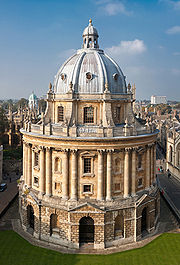
Buildings in Oxford demonstrate an example of every English architectural period since the arrival of the Saxons
, including the iconic, mid-18th century Radcliffe Camera
. Oxford is known as the "city of dreaming spires", a term coined by poet Matthew Arnold
in reference to the harmonious architecture of Oxford's university buildings. The University of Oxford
is the oldest university in the English-speaking world
.
 Oxford was first settled in Saxon
times, and was initially known as "Oxenaforda", meaning "Ford
of the Ox
en"; fords were more common than bridges at that time. It began with the foundation of an oxen crossing in the early 900 AD period. In the 10th century Oxford became an important military frontier town between the kingdoms of Mercia
and Wessex
and was on several occasions raided by Danes.
Oxford was heavily damaged during the Norman Invasion
of 1066. Following the conquest, the town was assigned a governor, Robert D'Oyly
, who ordered the construction of Oxford Castle
to confirm Norman authority over the area. The castle has never been used for military purposes and its remains survive to this day. D'Oyly set up a monastic community in the castle consisting of a chapel and living quarters for monks (St George in the Castle). The community never grew large but it earned its place in history as one of the oldest places of formal education in Oxford. It is there that in 1139 Geoffrey of Monmouth
wrote his History of the Kings of Britain, a compilation of Arthurian legends.
In 1191, a city charter stated in Latin
,
Oxford's prestige was enhanced by its charter granted by King Henry II
, granting its citizens the same privileges and exemptions as those enjoyed by the capital of the kingdom; and various important religious houses were founded in or near the city. A grandson of King John established Rewley Abbey for the Cistercian Order; and friars of various orders (Dominican
s, Franciscan
s, Carmelites, Augustinians, and Trinitarian
s), all had houses at Oxford of varying importance. Parliaments were often held in the city during the 13th century. The Provisions of Oxford
were instigated by a group of barons led by Simon de Montfort
; these documents are often regarded as England's first written constitution.
The University of Oxford is first mentioned in 12th century records. As the University took shape, friction between the hundreds of students living where and how they pleased led to a decree that all undergraduates would have to reside in approved halls. Of the hundreds of Aularian houses that sprang up across the city, only St Edmund Hall (c 1225) remains. What put an end to the halls was the emergence of colleges. Oxford's earliest colleges were University College
(1249), Balliol
(1263) and Merton
(1264). These colleges were established at a time when Europeans were starting to translate the writings of Greek philosophers. These writings challenged European ideology – inspiring scientific discoveries and advancements in the arts – as society began to see itself in a new way. These colleges at Oxford were supported by the Church in the hope of reconciling Greek Philosophy
and Christian Theology
. The relationship between "town and gown
" has often been uneasy – as many as 93 students and townspeople were killed in the St Scholastica Day Riot of 1355.
The sweating sickness
epidemic in 1517 was particularly devastating to Oxford and Cambridge
where it killed half of both cities' populations, including many students and dons.
Christ Church Cathedral, Oxford is unique in combining a college chapel and a cathedral in one foundation. Originally the Priory Church of St Frideswide, the building was extended and incorporated into the structure of the Cardinal's College shortly before its refounding as Christ Church in 1546, since when it has functioned as the cathedral of the Diocese
of Oxford.
The Oxford Martyrs
were tried for heresy in 1555 and subsequently burnt at the stake, on what is now Broad Street, for their religious beliefs and teachings. The three martyrs were the bishops Hugh Latimer
and Nicholas Ridley
, and the Archbishop Thomas Cranmer
. The Martyrs' Memorial
stands nearby, round the corner to the North on St. Giles.
During the English Civil War
, Oxford housed the court of Charles I
in 1642, after the king was expelled from London, although there was strong support in the town for the Parliamentarian
cause. The town yielded to Parliamentarian forces under General Fairfax
in the Siege of Oxford
of 1646. It later housed the court of Charles II
during the Great Plague of London
in 1665–66. Although reluctant to do so, he was forced to evacuate when the plague got too close. The city suffered two serious fires in 1644 and 1671.
In 1790, the Oxford Canal
connected the city with Coventry
. The Duke's Cut was completed by the Duke of Marlborough
in 1789 to link the new canal with the River Thames; and in 1796 the Oxford Canal company built its own link to the Thames, at Isis Lock. In 1844, the Great Western Railway
linked Oxford with London via Didcot and Reading, and other rail routes soon followed.
In the 19th century, the controversy surrounding the Oxford Movement
in the Anglican Church drew attention to the city as a focus of theological thought.
Oxford Town Hall
was built by Henry T. Hare; the foundation stone was laid on 6 July 1893 and opened by the future King Edward VII
on 12 May 1897. The site has been the seat of local government since the Guild Hall of 1292 and though Oxford is a city and a Lord Mayor
alty, the building is still called by its traditional name of "Town Hall".
By the early 20th century, Oxford was experiencing rapid industrial and population growth, with the printing and publishing industries becoming well established by the 1920s. Also during that decade, the economy and society of Oxford underwent a huge transformation as William Morris
established the Morris Motor Company
to mass produce cars in Cowley
, on the south-eastern edge of the city. By the early 1970s over 20,000 people worked in Cowley at the huge Morris Motors and Pressed Steel Fisher plants. By this time Oxford was a city of two halves: the university city to the west of Magdalen Bridge and the car town to the east. This led to the witticism that "Oxford is the left bank of Cowley". Cowley suffered major job losses in the 1980s and 1990s during the decline of British Leyland, but is now producing the successful Mini for BMW
on a smaller site. A large area of the original car manufacturing facility at Cowley was demolished in the 1990s and is now the site of the Oxford Business Park
.
The influx of migrant labour to the car plants and hospitals, recent immigration from south Asia, and a large student population, have given Oxford a notable cosmopolitan character, especially in the Headington
and Cowley Road areas with their many bars, cafes, restaurants, clubs, ethnic shops and fast food outlets. Oxford is one of the most diverse small cities in Britain with the most recent population estimates for 2005. showing that 27% of the population were from ethnic minority groups, including 16.2% from non-white ethnic minority ethnic groups (ONS). These figures do not take into account more recent international migration into the city, with over 10,000 people from overseas registering for National Insurance Numbers in Oxford in 2005/06 and 2006/07.
On 6 May 1954, Roger Bannister
, a 25 year old medical student, ran the first authenticated four-minute mile
at the Iffley Road
running track in Oxford. Although he had previously studied at Oxford University, Bannister was studying at St Mary's Hospital Medical School
in London at the time.
Oxford's second university, Oxford Brookes University
, formerly the Oxford School of Art, then Oxford Polytechnic, based at Headington Hill
, was given its charter in 1991 and has been voted for the last ten years the best new university in the UK. It was named to honour the school's founding principal, John Henry Brookes.
("Cfb" by the Köppen system
). Precipitation
is uniformly distributed throughout the year and is provided mostly by weather systems that arrive from the Atlantic. The lowest temperature ever recorded in Oxford was -16.6 °C in January 1982. The highest temperature ever recorded in Oxford is 35.6 °C (96 °F) in August 2003 during the 2003 European heat wave
.
The average conditions below are from the Radcliffe Meteorological Station. It boasts the longest series of temperature and rainfall records for one site in Britain. These records are continuous from January, 1815. Irregular observations of rainfall, cloud and temperature exist from 1767.
, survived until 1889. In the 16th century brewing and malting appear to have been the most popular trades in the city. There were breweries in Brewers Street and Paradise Street, near the Castle Mill Stream
.
The development of Oxford's railway links after the 1840s and the rapid expansion of Oxford supported expansion of the brewing trade in Oxford. As well as expanding the market for Oxford's brewers, railways enabled brewers further from the city to compete for a share of its market. By 1874 there were nine breweries in Oxford and 13 brewers' agents in Oxford shipping beer in from elsewhere. The nine breweries were: Flowers & Co in Cowley Road, Hall's St Giles Brewery, Hall's Swan Brewery (see below), Hanley's City Brewery in Queen Street
, Le Mills's Brewery in St. Ebbes, Morrell's
Lion Brewery in St Thomas Street (see below), Simonds's Brewery in Queen Street, Weaving's Eagle Brewery (by 1869 the Eagle Steam Brewery) in Park End Street
and Wootten and Cole's St. Clement's
Brewery.
The Swan's Nest Brewery, later the Swan Brewery, was established by the early 18th century in Paradise Street, and in 1795 was acquired by William Hall. The brewery became known as Hall's Oxford Brewery, which acquired other local breweries. Hall's Brewery was acquired by Samuel Allsopp & Sons
in 1926, after which it ceased brewing in Oxford.
Morrell's, the Oxford based regional brewery was founded in 1743 by Richard Tawney. He formed a partnership in 1782 with Mark and James Morrell, who eventually became the owners. After an acrimonious family dispute this much-loved brewery was closed in 1998, the beer brand names being taken over by the Thomas Hardy Burtonwood brewery, while the 132 tied pubs were bought by Michael Cannon, owner of the American hamburger chain Fuddruckers
, through a new company, Morrells of Oxford. The new owners sold most of the pubs on to Greene King in 2002. The Lion Brewery was converted into luxury apartments in 2002.
had a bell-foundry
in Oxford between 1786 and 1854.
Outside the City Centre:
, both of which offer views over the spires of the city. Many tourists shop at the historic Covered Market. In the summer punting
on the Thames/Isis and the Cherwell is popular.
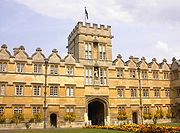
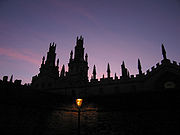
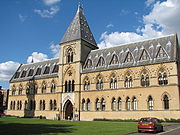
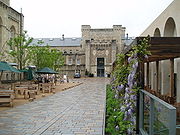
is one of the most famous universities in the world, and leading academics come to Oxford from all over the world.
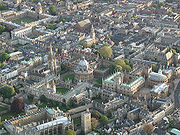
The city centre is relatively small, and is centred on Carfax
, a cross-roads which forms the junction of Cornmarket Street
(pedestrianised), Queen Street
(semi-pedestrianised), St Aldate's
and The High
. Cornmarket Street and Queen Street are home to Oxford's various chain stores, as well as a small number of independent retailers, one of the longest established of which is Boswells, which was founded in 1738. St Aldate's has few shops but has several local government buildings, including the Town Hall, the city police station and local council offices. The High (the word street is traditionally omitted) is the longest of the four streets and has a number of independent and high-end chain stores, but mostly University and College buildings.
There are two small shopping centres in the city centre: The Clarendon Centre and The Westgate Centre. The Westgate Centre is named for the original West Gate in the city wall, and is located at the west end of Queen Street. It is quite small and contains a number of chain stores and a supermarket. The Westgate Shopping Centre is to undergo a large and controversial refurbishment; the plans involve tripling the size of the centre to 750000 sq ft (69,677.3 m²), a new 1,335 space underground car park and 90 new shops and bars, including a 230000 sq ft (21,367.7 m²) John Lewis
department store. There is to be a new and improved transport system, a complete refurbishment of the existing centre and the surrounding Bonn Square area. The development plans include a number of new homes, and completion is expected in 2011, although this is being delayed due to the current financial climate.
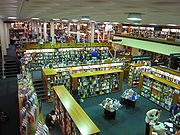
Blackwell's Bookshop is a large bookshop which claims the largest single room devoted to book sales in the whole of Europe, the cavernous Norrington Room (10,000 sq ft).
One of the key elements is the pedestrianisation of Queen Street
, with bus stops removed next summer to make way for the eventual complete removal of buses from the street.
Pedestrianisation schemes in George Street
and Magdalen Street
should follow in the summer of 2010, with the removal of traffic from Broad Street
the same year a possibility.
In 2011, highways engineers plan to remodel the Frideswide Square
junctions near the railway station, removing traffic lights and introducing roundabouts to improve the traffic flow.
 In addition to the larger airports in the region, Oxford is served by nearby London Oxford Airport, in Kidlington
. The airport is also home to Oxford Aviation Academy
, an airline pilot flight training centre, and several private jet companies.
and Stagecoach Oxfordshire. Other operators include Thames Travel
, Arriva Shires & Essex
and several smaller companies.
Oxford has 5 park and ride
sites with bus links to the city centre:
There are also bus services to the John Radcliffe Hospital
(from Thornhill/Water Eaton) and to the Churchill and Nuffield Hospitals (from Thornhill).
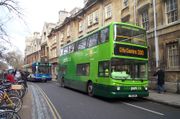
Hybrid
buses, which use battery power with a small diesel generator, began to be used in Oxford on 15 July 2010, on Stagecoach Oxfordshire's Route 1 (Cowley, Blackbird Leys), followed by other routes.
offers a frequent coach service to London. The Oxford Espress [sic] is operated by the Oxford Bus Company
. Oxford Tube is operated by Stagecoach Oxfordshire. The Oxford Bus Company also runs the Airline services to Heathrow and Gatwick airports.
There is a bus station at Gloucester Green
, used mainly by the London and airport buses, National Express
coaches, and other long-distance buses including route X5
to Cambridge
.
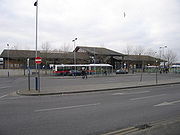 In 1844, the Great Western Railway
linked Oxford with London (Paddington) via and ; in 1851, the London and North Western Railway
opened their own route from Oxford to London (Euston)
, via Bicester
, and Watford
; and in 1864 a third route, also to Paddington, running via , and , was provided; this was shortened in 1906 by the opening of a direct route between High Wycombe and London (Paddington) via . The distance from Oxford to London was 78 miles (125.5 km) via Bletchley; 63.5 miles (102.2 km) via Didcot and Reading; 63.25 miles (101.8 km) via Thame and Maidenhead; and 55.75 miles (89.7 km) via Denham. Of these, only the original route via Didcot is still in use for its full length, although portions of each of the others remain.
There were also routes to the north and west. The line to was opened in 1850, and was extended to Birmingham
in 1852; a route to Worcester
opened in 1853. A branch to Witney
was opened in 1862, which was extended to in 1873. The line to Witney and Fairford closed in 1962, but the others remain open.
Oxford has had three main railway stations. The first was opened at Grandpont in 1844, but this was a terminus, inconvenient for routes to the north; it was replaced by the present station
on Park End Street
in 1852 with the opening of the Birmingham route. Another terminus, at Rewley Road
, was opened in 1851 to serve the Bletchley route; this station closed in 1951. There have also been a number of local railway stations, all of which are now closed.
Oxford railway station
is half a mile (about 1 km) west of the city centre. The station is served by numerous routes, including CrossCountry
services to as far away as Manchester
and Edinburgh
, First Great Western
(who operate the station) services to London and other destinations and occasional Chiltern Railways
services to Birmingham
. The present station opened in 1852. Oxford is the junction for a short branch line to Bicester, which is being extended to form the East-West Rail Link to Milton Keynes, providing a passenger route avoiding London.
, with this section of the river being called The Isis
; the Oxford-Burcot Commission
in the 17th century attempted to improve navigation to Oxford. Iffley Lock
and Osney Lock
lie within the bounds of the city. In the eighteenth century the Oxford Canal
was built to connect Oxford with the Midlands.
Commercial traffic has given way to recreational use of the river and canal. Oxford was the original base of Salters Steamers
and there is a regular service from Folly Bridge
downstream to Abingdon
and beyond.
that consists of the A34, the A40
, A4142 and the A423
. It is mostly dual carriageway and was completed in 1966.
The main roads that lead out of Oxford are:
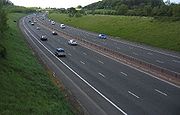
opened in 1967) and went from London to Waterstock
where the A40 continued to Oxford. When the M40 extension to Birmingham was completed in January 1991, a mile of the old motorway became a spur as the extension curved sharply north. The M40 comes no closer than 10 miles (16.1 km) away from the city centre, curving to the east of Otmoor
. The M40 meets the A34 to the north of Oxford, the latter now being in two parts, the A34 restarting near Solihull, while the A41 (which previous passed through Banbury
and Warwick
) restarts in the same area.
and St Edward's, both HMC
schools, were traditionally single-sex schools. Examination results in state-run Oxford schools are consistently below the national average and regional average. However, results in the city are improving with 44% of pupils gaining 5 grades A*-C in 2006.
and Oxford Brookes University
as well as Ruskin College, Oxford is also now home to the international headquarters of SAE Institute
, the worlds largest creative media college.
national radio stations, Oxford and the surrounding area has several local stations, including BBC Oxford
, Heart Thames Valley
, Glide FM and Jack FM
on 106.8 along with Oxide: Oxford Student Radio (which went on terrestrial radio at 87.7 MHz FM in late May 2005). A local TV station, Six TV
: The Oxford Channel was also available but closed in April 2009. The city is home to a BBC TV newsroom which produces an opt-out from the main South Today
programme broadcast from Southampton
.
Popular local papers include The Oxford Times
(compact; weekly), its sister papers The Oxford Mail (tabloid; daily) and The Oxford Star (tabloid; free and delivered), and Oxford Journal
(tabloid; weekly free pick-up). Oxford is also home to several advertising agencies.
Daily Information
(known locally as Daily Info) is an events and advertising news sheet which has been published since 1964 and now provides a connected website.
Nightshift
is a monthly local free magazine that has covered the Oxford music scene since 1991.
Recently (2003) DIY grassroots non-corporate media has begun to spread. Independent and community newspapers include the Jericho Echo and Oxford Prospect.
Oxford appears in the following works:
, who hail from nearby Abingdon, though other well known local bands include Supergrass
, Ride
, Swervedriver
, Talulah Gosh
and more recently, Young Knives, Foals and Stornoway
. These and many other bands from over 30 years of the Oxford music scene's history feature in the documentary film Anyone Can Play Guitar
.
In 1997, Oxford played host to Radio 1
's Sound City, with acts such as Bentley Rhythm Ace
, Embrace, Spiritualized
and DJ Shadow
playing in various venues around the city.
are currently in League Two
, the fourth tier of league football, and have enjoyed great success in the past in the upper reaches of the football league. They were elected to the Football League in 1962, reached the Third Division
after three years and the Second Division
after six, and most notably reached the First Division
in 1985 – a mere 23 years after joining the Football League. They spent three seasons in the top flight, winning the Football League Cup
a year after promotion. The next 18 years saw them decline gradually (though a brief respite in 1996 saw them win promotion to the new (post Premier League) Division One in 1996 and stay there for three years. They suffered relegation to the Football Conference
in 2006, staying there for four seasons before returning to the Football League in 2010. They play at the Kassam Stadium
(named after former chairman Firoz Kassam
), which is situated near the Blackbird Leys
housing estate and has been their home since relocation from the Manor Ground in 2001.
Oxford City F.C.
is a semi-professional football club, separate from Oxford United. It plays in the Southern Football League Premier Division.
Oxford Harlequins RFC is the city's main rugby team and plays in the National 3 South West league.
Oxford Cheetahs
motorcycle speedway
team has raced at Cowley Stadium on and off since 1939. The Cheetahs competed in the Speedway Elite League
and then the Speedway Conference League
until 2007, when stadium landlords Greyhound Racing Association
apparently doubled the rent. Speedway is not currently running in Oxford.
There are several field hockey clubs based in Oxford. The Oxford Hockey Club (formed after a merger of City of Oxford HC and Rover Oxford HC in 2011) plays most of its home games on the pitch at Oxford Brookes University, Headington Campus, and also uses the pitches at Headington Girls' School and Iffley Road. Oxford Hawks has two astroturf pitches at Banbury Road North, by Cutteslowe Park to the north of the city.
Oxford City Stars
is the local Ice Hockey Team which plays at Oxford Ice Rink
. There is a senior/adults’ team and a junior/children’s team.
Oxford is also home to the Oxford City Rowing Club which is situated near Donnington Bridge.
with:
City status in the United Kingdom
City status in the United Kingdom is granted by the British monarch to a select group of communities. The holding of city status gives a settlement no special rights other than that of calling itself a "city". Nonetheless, this appellation carries its own prestige and, consequently, competitions...
of Oxford is the county town
County town
A county town is a county's administrative centre in the United Kingdom or Ireland. County towns are usually the location of administrative or judicial functions, or established over time as the de facto main town of a county. The concept of a county town eventually became detached from its...
of Oxfordshire
Oxfordshire
Oxfordshire is a county in the South East region of England, bordering on Warwickshire and Northamptonshire , Buckinghamshire , Berkshire , Wiltshire and Gloucestershire ....
, England
England
England is a country that is part of the United Kingdom. It shares land borders with Scotland to the north and Wales to the west; the Irish Sea is to the north west, the Celtic Sea to the south west, with the North Sea to the east and the English Channel to the south separating it from continental...
. The city, made prominent by its medieval university, has a population of just under 165,000, with 153,900 living within the district boundary. It lies about 50 miles (80 km) north-west of London. The rivers Cherwell
River Cherwell
The River Cherwell is a river which flows through the Midlands of England. It is a major tributary of the River Thames.The general course of the River Cherwell is north to south and the 'straight-line' distance from its source to the Thames is about...
and Thames
River Thames
The River Thames flows through southern England. It is the longest river entirely in England and the second longest in the United Kingdom. While it is best known because its lower reaches flow through central London, the river flows alongside several other towns and cities, including Oxford,...
run through Oxford and meet south of the city centre. For a distance of some 10 miles (16.1 km) along the river, in the vicinity of Oxford, the Thames is known as the Isis
The Isis
The Isis is the name given to the part of the River Thames above Iffley Lock which flows through the city of Oxford. The name is especially used in the context of rowing at the University of Oxford...
.
Buildings in Oxford demonstrate an example of every English architectural period since the arrival of the Saxons
History of Anglo-Saxon England
Anglo-Saxon England refers to the period of the history of that part of Britain, that became known as England, lasting from the end of Roman occupation and establishment of Anglo-Saxon kingdoms in the 5th century until the Norman conquest of England in 1066 by William the Conqueror...
, including the iconic, mid-18th century Radcliffe Camera
Radcliffe Camera
The Radcliffe Camera is a building in Oxford, England, designed by James Gibbs in the English Palladian style and built in 1737–1749 to house the Radcliffe Science Library.-History:...
. Oxford is known as the "city of dreaming spires", a term coined by poet Matthew Arnold
Matthew Arnold
Matthew Arnold was a British poet and cultural critic who worked as an inspector of schools. He was the son of Thomas Arnold, the famed headmaster of Rugby School, and brother to both Tom Arnold, literary professor, and William Delafield Arnold, novelist and colonial administrator...
in reference to the harmonious architecture of Oxford's university buildings. The University of Oxford
University of Oxford
The University of Oxford is a university located in Oxford, United Kingdom. It is the second-oldest surviving university in the world and the oldest in the English-speaking world. Although its exact date of foundation is unclear, there is evidence of teaching as far back as 1096...
is the oldest university in the English-speaking world
English-speaking world
The English-speaking world consists of those countries or regions that use the English language to one degree or another. For more information, please see:Lists:* List of countries by English-speaking population...
.
History
Anglo-Saxons
Anglo-Saxon is a term used by historians to designate the Germanic tribes who invaded and settled the south and east of Great Britain beginning in the early 5th century AD, and the period from their creation of the English nation to the Norman conquest. The Anglo-Saxon Era denotes the period of...
times, and was initially known as "Oxenaforda", meaning "Ford
Ford (crossing)
A ford is a shallow place with good footing where a river or stream may be crossed by wading or in a vehicle. A ford is mostly a natural phenomenon, in contrast to a low water crossing, which is an artificial bridge that allows crossing a river or stream when water is low.The names of many towns...
of the Ox
Ox
An ox , also known as a bullock in Australia, New Zealand and India, is a bovine trained as a draft animal. Oxen are commonly castrated adult male cattle; castration makes the animals more tractable...
en"; fords were more common than bridges at that time. It began with the foundation of an oxen crossing in the early 900 AD period. In the 10th century Oxford became an important military frontier town between the kingdoms of Mercia
Mercia
Mercia was one of the kingdoms of the Anglo-Saxon Heptarchy. It was centred on the valley of the River Trent and its tributaries in the region now known as the English Midlands...
and Wessex
Wessex
The Kingdom of Wessex or Kingdom of the West Saxons was an Anglo-Saxon kingdom of the West Saxons, in South West England, from the 6th century, until the emergence of a united English state in the 10th century, under the Wessex dynasty. It was to be an earldom after Canute the Great's conquest...
and was on several occasions raided by Danes.
Oxford was heavily damaged during the Norman Invasion
Norman conquest of England
The Norman conquest of England began on 28 September 1066 with the invasion of England by William, Duke of Normandy. William became known as William the Conqueror after his victory at the Battle of Hastings on 14 October 1066, defeating King Harold II of England...
of 1066. Following the conquest, the town was assigned a governor, Robert D'Oyly
Robert D'Oyly
Robert D'Oyly was a Norman nobleman who accompanied William the Conqueror on the Norman Conquest, his invasion of England. He died in 1091.-Background:Robert was the son of Walter D'Oyly and elder brother to Nigel D'Oyly...
, who ordered the construction of Oxford Castle
Oxford Castle
Oxford Castle is a large, partly ruined Norman medieval castle situated on the west edge of Oxford in Oxfordshire, England. The original moated, wooden motte and bailey castle was replaced with stone in the 11th century and played an important role in the conflict of the Anarchy...
to confirm Norman authority over the area. The castle has never been used for military purposes and its remains survive to this day. D'Oyly set up a monastic community in the castle consisting of a chapel and living quarters for monks (St George in the Castle). The community never grew large but it earned its place in history as one of the oldest places of formal education in Oxford. It is there that in 1139 Geoffrey of Monmouth
Geoffrey of Monmouth
Geoffrey of Monmouth was a cleric and one of the major figures in the development of British historiography and the popularity of tales of King Arthur...
wrote his History of the Kings of Britain, a compilation of Arthurian legends.
In 1191, a city charter stated in Latin
Latin
Latin is an Italic language originally spoken in Latium and Ancient Rome. It, along with most European languages, is a descendant of the ancient Proto-Indo-European language. Although it is considered a dead language, a number of scholars and members of the Christian clergy speak it fluently, and...
,
Oxford's prestige was enhanced by its charter granted by King Henry II
Henry II of England
Henry II ruled as King of England , Count of Anjou, Count of Maine, Duke of Normandy, Duke of Aquitaine, Duke of Gascony, Count of Nantes, Lord of Ireland and, at various times, controlled parts of Wales, Scotland and western France. Henry, the great-grandson of William the Conqueror, was the...
, granting its citizens the same privileges and exemptions as those enjoyed by the capital of the kingdom; and various important religious houses were founded in or near the city. A grandson of King John established Rewley Abbey for the Cistercian Order; and friars of various orders (Dominican
Dominican Order
The Order of Preachers , after the 15th century more commonly known as the Dominican Order or Dominicans, is a Catholic religious order founded by Saint Dominic and approved by Pope Honorius III on 22 December 1216 in France...
s, Franciscan
Franciscan
Most Franciscans are members of Roman Catholic religious orders founded by Saint Francis of Assisi. Besides Roman Catholic communities, there are also Old Catholic, Anglican, Lutheran, ecumenical and Non-denominational Franciscan communities....
s, Carmelites, Augustinians, and Trinitarian
Trinitarian Order
The Order of the Holy Trinity is a Catholic religious order that was founded in the area of Cerfroid, some 80 km northeast of Paris, at the end of the twelfth century. The founder was St. John de Matha, whose feast day is celebrated on 17 December...
s), all had houses at Oxford of varying importance. Parliaments were often held in the city during the 13th century. The Provisions of Oxford
Provisions of Oxford
The Provisions of Oxford are often regarded as England's first written constitution ....
were instigated by a group of barons led by Simon de Montfort
Simon de Montfort, 6th Earl of Leicester
Simon de Montfort, 6th Earl of Leicester, 1st Earl of Chester , sometimes referred to as Simon V de Montfort to distinguish him from other Simon de Montforts, was an Anglo-Norman nobleman. He led the barons' rebellion against King Henry III of England during the Second Barons' War of 1263-4, and...
; these documents are often regarded as England's first written constitution.
The University of Oxford is first mentioned in 12th century records. As the University took shape, friction between the hundreds of students living where and how they pleased led to a decree that all undergraduates would have to reside in approved halls. Of the hundreds of Aularian houses that sprang up across the city, only St Edmund Hall (c 1225) remains. What put an end to the halls was the emergence of colleges. Oxford's earliest colleges were University College
University College, Oxford
.University College , is a constituent college of the University of Oxford in England. As of 2009 the college had an estimated financial endowment of £110m...
(1249), Balliol
Balliol College, Oxford
Balliol College , founded in 1263, is one of the constituent colleges of the University of Oxford in England but founded by a family with strong Scottish connections....
(1263) and Merton
Merton College, Oxford
Merton College is one of the constituent colleges of the University of Oxford in England. Its foundation can be traced back to the 1260s when Walter de Merton, chancellor to Henry III and later to Edward I, first drew up statutes for an independent academic community and established endowments to...
(1264). These colleges were established at a time when Europeans were starting to translate the writings of Greek philosophers. These writings challenged European ideology – inspiring scientific discoveries and advancements in the arts – as society began to see itself in a new way. These colleges at Oxford were supported by the Church in the hope of reconciling Greek Philosophy
Greek philosophy
Ancient Greek philosophy arose in the 6th century BCE and continued through the Hellenistic period, at which point Ancient Greece was incorporated in the Roman Empire...
and Christian Theology
Christian theology
- Divisions of Christian theology :There are many methods of categorizing different approaches to Christian theology. For a historical analysis, see the main article on the History of Christian theology.- Sub-disciplines :...
. The relationship between "town and gown
Town and gown
Town and gown are two distinct communities of a university town; "town" being the non-academic population and "gown" metonymically being the university community, especially in ancient seats of learning such as Oxford, Cambridge, Durham and St Andrews, although the term is also used to describe...
" has often been uneasy – as many as 93 students and townspeople were killed in the St Scholastica Day Riot of 1355.
The sweating sickness
Sweating sickness
Sweating sickness, also known as "English sweating sickness" or "English sweate" , was a mysterious and highly virulent disease that struck England, and later continental Europe, in a series of epidemics beginning in 1485. The last outbreak occurred in 1551, after which the disease apparently...
epidemic in 1517 was particularly devastating to Oxford and Cambridge
Cambridge
The city of Cambridge is a university town and the administrative centre of the county of Cambridgeshire, England. It lies in East Anglia about north of London. Cambridge is at the heart of the high-technology centre known as Silicon Fen – a play on Silicon Valley and the fens surrounding the...
where it killed half of both cities' populations, including many students and dons.
Christ Church Cathedral, Oxford is unique in combining a college chapel and a cathedral in one foundation. Originally the Priory Church of St Frideswide, the building was extended and incorporated into the structure of the Cardinal's College shortly before its refounding as Christ Church in 1546, since when it has functioned as the cathedral of the Diocese
Diocese
A diocese is the district or see under the supervision of a bishop. It is divided into parishes.An archdiocese is more significant than a diocese. An archdiocese is presided over by an archbishop whose see may have or had importance due to size or historical significance...
of Oxford.
The Oxford Martyrs
Oxford Martyrs
The Oxford Martyrs were tried for heresy in 1555 and subsequently burnt at the stake in Oxford, England, for their religious beliefs and teachings....
were tried for heresy in 1555 and subsequently burnt at the stake, on what is now Broad Street, for their religious beliefs and teachings. The three martyrs were the bishops Hugh Latimer
Hugh Latimer
Hugh Latimer was a Fellow of Clare College, Cambridge, Bishop of Worcester before the Reformation, and later Church of England chaplain to King Edward VI. In 1555, under Queen Mary, he was burnt at the stake, becoming one of the three Oxford Martyrs of Anglicanism.-Life:Latimer was born into a...
and Nicholas Ridley
Nicholas Ridley (martyr)
Nicholas Ridley was an English Bishop of London. Ridley was burned at the stake, as one of the Oxford Martyrs, during the Marian Persecutions, for his teachings and his support of Lady Jane Grey...
, and the Archbishop Thomas Cranmer
Thomas Cranmer
Thomas Cranmer was a leader of the English Reformation and Archbishop of Canterbury during the reigns of Henry VIII, Edward VI and, for a short time, Mary I. He helped build a favourable case for Henry's divorce from Catherine of Aragon which resulted in the separation of the English Church from...
. The Martyrs' Memorial
Martyrs' Memorial
The Martyrs' Memorial is a stone monument positioned at the intersection of St Giles', Magdalen Street and Beaumont Street in Oxford, England just outside Balliol College...
stands nearby, round the corner to the North on St. Giles.
During the English Civil War
English Civil War
The English Civil War was a series of armed conflicts and political machinations between Parliamentarians and Royalists...
, Oxford housed the court of Charles I
Charles I of England
Charles I was King of England, King of Scotland, and King of Ireland from 27 March 1625 until his execution in 1649. Charles engaged in a struggle for power with the Parliament of England, attempting to obtain royal revenue whilst Parliament sought to curb his Royal prerogative which Charles...
in 1642, after the king was expelled from London, although there was strong support in the town for the Parliamentarian
Roundhead
"Roundhead" was the nickname given to the supporters of the Parliament during the English Civil War. Also known as Parliamentarians, they fought against King Charles I and his supporters, the Cavaliers , who claimed absolute power and the divine right of kings...
cause. The town yielded to Parliamentarian forces under General Fairfax
Thomas Fairfax, 3rd Lord Fairfax of Cameron
Thomas Fairfax, 3rd Lord Fairfax of Cameron was a general and parliamentary commander-in-chief during the English Civil War...
in the Siege of Oxford
Siege of Oxford
The Siege of Oxford was a Parliamentarian victory late in the First English Civil War. Whereas the title of the event may suggest a single siege, there were in fact three individual engagements that took place over a period of three years....
of 1646. It later housed the court of Charles II
Charles II of England
Charles II was monarch of the three kingdoms of England, Scotland, and Ireland.Charles II's father, King Charles I, was executed at Whitehall on 30 January 1649, at the climax of the English Civil War...
during the Great Plague of London
Great Plague of London
The Great Plague was a massive outbreak of disease in the Kingdom of England that killed an estimated 100,000 people, 20% of London's population. The disease is identified as bubonic plague, an infection by the bacterium Yersinia pestis, transmitted through a flea vector...
in 1665–66. Although reluctant to do so, he was forced to evacuate when the plague got too close. The city suffered two serious fires in 1644 and 1671.
In 1790, the Oxford Canal
Oxford Canal
The Oxford Canal is a narrow canal in central England linking Oxford with Coventry via Banbury and Rugby. It connects with the River Thames at Oxford, to the Grand Union Canal at the villages of Braunston and Napton-on-the-Hill, and to the Coventry Canal at Hawkesbury Junction in Bedworth just...
connected the city with Coventry
Coventry
Coventry is a city and metropolitan borough in the county of West Midlands in England. Coventry is the 9th largest city in England and the 11th largest in the United Kingdom. It is also the second largest city in the English Midlands, after Birmingham, with a population of 300,848, although...
. The Duke's Cut was completed by the Duke of Marlborough
George Spencer, 4th Duke of Marlborough
George Spencer, 4th Duke of Marlborough KG, PC, FRS , styled Marquess of Blandford until 1758, was a British courtier and politician...
in 1789 to link the new canal with the River Thames; and in 1796 the Oxford Canal company built its own link to the Thames, at Isis Lock. In 1844, the Great Western Railway
Great Western Railway
The Great Western Railway was a British railway company that linked London with the south-west and west of England and most of Wales. It was founded in 1833, received its enabling Act of Parliament in 1835 and ran its first trains in 1838...
linked Oxford with London via Didcot and Reading, and other rail routes soon followed.
In the 19th century, the controversy surrounding the Oxford Movement
Oxford Movement
The Oxford Movement was a movement of High Church Anglicans, eventually developing into Anglo-Catholicism. The movement, whose members were often associated with the University of Oxford, argued for the reinstatement of lost Christian traditions of faith and their inclusion into Anglican liturgy...
in the Anglican Church drew attention to the city as a focus of theological thought.
Oxford Town Hall
Oxford Town Hall
The Oxford Town Hall is located on St Aldate's in the centre of Oxford, England. The site was previously occupied by Oxford Guildhall. It is a meeting place for local government in the city and also houses the Museum of Oxford. In addition, it can be hired for events...
was built by Henry T. Hare; the foundation stone was laid on 6 July 1893 and opened by the future King Edward VII
Edward VII of the United Kingdom
Edward VII was King of the United Kingdom and the British Dominions and Emperor of India from 22 January 1901 until his death in 1910...
on 12 May 1897. The site has been the seat of local government since the Guild Hall of 1292 and though Oxford is a city and a Lord Mayor
Lord Mayor
The Lord Mayor is the title of the Mayor of a major city, with special recognition.-Commonwealth of Nations:* In Australia it is a political position. Australian cities with Lord Mayors: Adelaide, Brisbane, Darwin, Hobart, Melbourne, Newcastle, Parramatta, Perth, Sydney, and Wollongong...
alty, the building is still called by its traditional name of "Town Hall".
By the early 20th century, Oxford was experiencing rapid industrial and population growth, with the printing and publishing industries becoming well established by the 1920s. Also during that decade, the economy and society of Oxford underwent a huge transformation as William Morris
William Morris, 1st Viscount Nuffield
William Richard Morris, 1st Viscount Nuffield GBE, CH , known as Sir William Morris, Bt, between 1929 and 1934 and as The Lord Nuffield between 1934 and 1938, was a British motor manufacturer and philanthropist...
established the Morris Motor Company
Morris Motor Company
The Morris Motor Company was a British car manufacturing company. After the incorporation of the company into larger corporations, the Morris name remained in use as a marque until 1984 when British Leyland's Austin Rover Group decided to concentrate on the more popular Austin marque...
to mass produce cars in Cowley
Cowley, Oxford
Cowley in Oxford, England, is a residential and industrial area that forms a small conurbation within greater Oxford. Cowley's neighbours are central Oxford to the northwest, Rose Hill and Blackbird Leys to the south, New Headington to the north and the villages of Horspath and Garsington across...
, on the south-eastern edge of the city. By the early 1970s over 20,000 people worked in Cowley at the huge Morris Motors and Pressed Steel Fisher plants. By this time Oxford was a city of two halves: the university city to the west of Magdalen Bridge and the car town to the east. This led to the witticism that "Oxford is the left bank of Cowley". Cowley suffered major job losses in the 1980s and 1990s during the decline of British Leyland, but is now producing the successful Mini for BMW
BMW
Bayerische Motoren Werke AG is a German automobile, motorcycle and engine manufacturing company founded in 1916. It also owns and produces the Mini marque, and is the parent company of Rolls-Royce Motor Cars. BMW produces motorcycles under BMW Motorrad and Husqvarna brands...
on a smaller site. A large area of the original car manufacturing facility at Cowley was demolished in the 1990s and is now the site of the Oxford Business Park
Oxford Business Park
The Oxford Business Park is a business park of at Cowley on the eastern edge of Oxford, England. The park is immediately adjacent to the Oxford Ring Road....
.
The influx of migrant labour to the car plants and hospitals, recent immigration from south Asia, and a large student population, have given Oxford a notable cosmopolitan character, especially in the Headington
Headington
Headington is a suburb of Oxford, England. It is at the top of Headington Hill overlooking the city in the Thames Valley below. The life of the large residential area is centred upon London Road, the main road between London and Oxford.-History:...
and Cowley Road areas with their many bars, cafes, restaurants, clubs, ethnic shops and fast food outlets. Oxford is one of the most diverse small cities in Britain with the most recent population estimates for 2005. showing that 27% of the population were from ethnic minority groups, including 16.2% from non-white ethnic minority ethnic groups (ONS). These figures do not take into account more recent international migration into the city, with over 10,000 people from overseas registering for National Insurance Numbers in Oxford in 2005/06 and 2006/07.
On 6 May 1954, Roger Bannister
Roger Bannister
Sir Roger Gilbert Bannister, CBE is an English former athlete best known for running the first recorded mile in less than 4 minutes...
, a 25 year old medical student, ran the first authenticated four-minute mile
Four-minute mile
In the sport of athletics, the four-minute mile is the act of completing the mile run in less than four minutes. It was first achieved in 1954 by Roger Bannister in 3:59.4. The 'four minute barrier' has since been broken by many male athletes, and is now the standard of all male professional...
at the Iffley Road
Iffley Road
Iffley Road is a major arterial road in Oxford, England. It leads from The Plain, near Magdalen Bridge, south-east towards the village of Iffley. While it becomes Henley Avenue at Iffley Turn, and then Rose Hill, many people will refer to the whole stretch from the ring road to The Plain as Iffley...
running track in Oxford. Although he had previously studied at Oxford University, Bannister was studying at St Mary's Hospital Medical School
St Mary's Hospital Medical School
St Mary's is the youngest of the constituent schools of Imperial College, London, founded in 1854 as part of the new hospital in Paddington. During its existence in the 1980s and 90s, it was the most popular medical school in the country, with an application to place ratio of 27:1 in 1996.St Mary's...
in London at the time.
Oxford's second university, Oxford Brookes University
Oxford Brookes University
Oxford Brookes University is a new university in Oxford, England. It was named to honour the school's founding principal, John Brookes. It has been ranked as the best new university by the Sunday Times University Guide 10 years in a row...
, formerly the Oxford School of Art, then Oxford Polytechnic, based at Headington Hill
Headington Hill
Headington Hill is a hill in the east of Oxford, England, in the suburb of Headington. The Headington Road road goes up the hill leading out of the city...
, was given its charter in 1991 and has been voted for the last ten years the best new university in the UK. It was named to honour the school's founding principal, John Henry Brookes.
Geography
Oxford's latitude and longitude are 51°45′07"N 1°15′28"W or (at Carfax Tower, which is usually considered the centre).Location
Climate
Oxford has a maritime temperate climateOceanic climate
An oceanic climate, also called marine west coast climate, maritime climate, Cascadian climate and British climate for Köppen climate classification Cfb and subtropical highland for Köppen Cfb or Cwb, is a type of climate typically found along the west coasts at the middle latitudes of some of the...
("Cfb" by the Köppen system
Köppen climate classification
The Köppen climate classification is one of the most widely used climate classification systems. It was first published by Crimea German climatologist Wladimir Köppen in 1884, with several later modifications by Köppen himself, notably in 1918 and 1936...
). Precipitation
Precipitation (meteorology)
In meteorology, precipitation In meteorology, precipitation In meteorology, precipitation (also known as one of the classes of hydrometeors, which are atmospheric water phenomena is any product of the condensation of atmospheric water vapor that falls under gravity. The main forms of precipitation...
is uniformly distributed throughout the year and is provided mostly by weather systems that arrive from the Atlantic. The lowest temperature ever recorded in Oxford was -16.6 °C in January 1982. The highest temperature ever recorded in Oxford is 35.6 °C (96 °F) in August 2003 during the 2003 European heat wave
2003 European heat wave
The 2003 European heat wave was the hottest summer on record in Europe since at least 1540. France was hit especially hard. The heat wave led to health crises in several countries and combined with drought to create a crop shortfall in Southern Europe...
.
The average conditions below are from the Radcliffe Meteorological Station. It boasts the longest series of temperature and rainfall records for one site in Britain. These records are continuous from January, 1815. Irregular observations of rainfall, cloud and temperature exist from 1767.
Economy
The Oxford suburb of Cowley has a long history of carmaking and a major production site for Mini cars.Brewing
There is a long history of brewing in Oxford. Several of the colleges had private breweries, one of which, at BrasenoseBrasenose College, Oxford
Brasenose College, originally Brazen Nose College , is one of the constituent colleges of the University of Oxford in the United Kingdom. As of 2006, it has an estimated financial endowment of £98m...
, survived until 1889. In the 16th century brewing and malting appear to have been the most popular trades in the city. There were breweries in Brewers Street and Paradise Street, near the Castle Mill Stream
Castle Mill Stream
Castle Mill Stream is a backwater of the River Thames in the west of Oxford, England. It is 5.5 km long.-Course:The stream leaves the main course of the Thames at the south end of Port Meadow, immediately upstream of Medley Footbridge. It then flows under the Cherwell Valley railway line and turns...
.
The development of Oxford's railway links after the 1840s and the rapid expansion of Oxford supported expansion of the brewing trade in Oxford. As well as expanding the market for Oxford's brewers, railways enabled brewers further from the city to compete for a share of its market. By 1874 there were nine breweries in Oxford and 13 brewers' agents in Oxford shipping beer in from elsewhere. The nine breweries were: Flowers & Co in Cowley Road, Hall's St Giles Brewery, Hall's Swan Brewery (see below), Hanley's City Brewery in Queen Street
Queen Street, Oxford
Queen Street is a shopping street in central Oxford, England. It is one-way for buses and taxis, two-way for cyclists outside main shopping hours, and forbidden for cars. It runs west from the centre of Oxford at Carfax...
, Le Mills's Brewery in St. Ebbes, Morrell's
Morrells Brewing Company
Morrells Brewing Company was a brewery in Oxford, England, which operated under that name between 1782 and 1998. The brewery was founded in 1743 by Richard Tawney. He formed a partnership in 1782 with Mark and James Morrell, who eventually became the owners. Morrells' range of ales included...
Lion Brewery in St Thomas Street (see below), Simonds's Brewery in Queen Street, Weaving's Eagle Brewery (by 1869 the Eagle Steam Brewery) in Park End Street
Park End Street
Park End Street is a street in central Oxford, England, to the west of the centre of the city, close to the railway station at its western end.-Location:...
and Wootten and Cole's St. Clement's
St Clement's, Oxford
St Clement's is a district in Oxford, England, on the east bank of the River Cherwell. Its main road, St Clement's Street , links The Plain near Magdalen Bridge with London Place at the foot of Headington Hill at the junction with Marston Road to the north...
Brewery.
The Swan's Nest Brewery, later the Swan Brewery, was established by the early 18th century in Paradise Street, and in 1795 was acquired by William Hall. The brewery became known as Hall's Oxford Brewery, which acquired other local breweries. Hall's Brewery was acquired by Samuel Allsopp & Sons
Samuel Allsopp & Sons
Samuel Allsopp & Sons was one of the largest brewery companies operating in Burton upon Trent, England.Allsopp’s origins go back to the 1740s, when Benjamin Wilson, an innkeeper-brewer of Burton, brewed beer for his own premises and sold some to other innkeepers...
in 1926, after which it ceased brewing in Oxford.
Morrell's, the Oxford based regional brewery was founded in 1743 by Richard Tawney. He formed a partnership in 1782 with Mark and James Morrell, who eventually became the owners. After an acrimonious family dispute this much-loved brewery was closed in 1998, the beer brand names being taken over by the Thomas Hardy Burtonwood brewery, while the 132 tied pubs were bought by Michael Cannon, owner of the American hamburger chain Fuddruckers
Fuddruckers
Fuddruckers is an American fast casual, franchised, restaurant chain that specializes in hamburgers. In 2011 Fuddruckers had 56 company-operated restaurants and 129 franchises across the United States with one in Saskatchewan, Canada and four in Puerto Rico...
, through a new company, Morrells of Oxford. The new owners sold most of the pubs on to Greene King in 2002. The Lion Brewery was converted into luxury apartments in 2002.
Bellfounding
The Taylor family of LoughboroughLoughborough
Loughborough is a town within the Charnwood borough of Leicestershire, England. It is the seat of Charnwood Borough Council and is home to Loughborough University...
had a bell-foundry
Bellfounding
Bellfounding is the casting of bells in a foundry for use in churches, clocks, and public buildings. A practitioner of the craft is called a bellmaker or bellfounder. The process in Europe dates to the 4th or 5th century. In early times, when a town produced a bell it was a momentous occasion in...
in Oxford between 1786 and 1854.
Shopping
- Broad StreetBroad Street, OxfordBroad Street is a wide street in central Oxford, England, located just north of the old city wall.The street is known for its bookshops, including the original Blackwell's bookshop at number 50, located here due to the University...
- Clarendon Shopping CentreClarendon Shopping CentreThe Clarendon Shopping Centre is a shopping centre in central Oxford, England. It is located to the west of Cornmarket Street and to the north of Queen Street. It is accessible from both of these streets and is in the form of an L-shape between them...
- Cornmarket StreetCornmarket StreetCornmarket Street is a major shopping street and pedestrian precinct in Oxford, England that runs north-south between Carfax Tower and Magdalen Street.Retailers in Cornmarket include:* Austin Reed...
- George StreetGeorge Street, OxfordGeorge Street is a street in central Oxford, England. It is a shopping street running east-west. Its eastern end meets Broad Street at a crossroads with Cornmarket Street to the south and Magdalen Street to the north...
- Golden CrossGolden Cross, OxfordGolden Cross is a shopping arcade in central Oxford, England. The original structure on the site dates from 1193, when it was called Maugershall after the then owner, and consisted of shops with an inn on the upper storeys...
- The High StreetHigh Street, OxfordThe High Street in Oxford, England runs between Carfax, generally recognized as the centre of the city, and Magdalen Bridge to the east. Locally the street is often known as The High. It forms a gentle curve and is the subject of many prints, paintings, photographs, etc...
- Little Clarendon StreetLittle Clarendon StreetLittle Clarendon Street is a short shopping street in north-west Oxford. It runs east-west between the south end of Woodstock Road opposite St Giles' Church to the east and Walton Street to the west...
- Queen Street, OxfordQueen Street, OxfordQueen Street is a shopping street in central Oxford, England. It is one-way for buses and taxis, two-way for cyclists outside main shopping hours, and forbidden for cars. It runs west from the centre of Oxford at Carfax...
- The Covered Market
- Turl Street
- Westgate Shopping CentreWestgate Shopping Centre, OxfordWestgate Shopping Centre is a shopping centre in central Oxford, England.- Overview :Westgate is located at the west end of Queen Street, where the west gate of the city of Oxford used to be situated. A car park, including a multistory section, is attached to the shopping centre, with access from...
- Oxford CastleOxford CastleOxford Castle is a large, partly ruined Norman medieval castle situated on the west edge of Oxford in Oxfordshire, England. The original moated, wooden motte and bailey castle was replaced with stone in the 11th century and played an important role in the conflict of the Anarchy...
- Gloucester GreenGloucester GreenGloucester Green is a square in central Oxford, England, and the site of the city's bus station. It lies between George Street to the south and Beaumont Street to the north. To the west is Worcester Street and to the east is Gloucester Street....
Outside the City Centre:
- Banbury RoadBanbury RoadBanbury Road is a major arterial road in Oxford, England, running from St Giles' at the south end, north towards Banbury through the leafy suburb of North Oxford and Summertown, with its local shopping centre. Parallel and to the west is the Woodstock Road, which it meets at the junction with St...
, Summertown, Oxford - Botley RoadBotley RoadBotley Road is the main arterial road into Oxford, England from the west. It stretches between Botley, on the Oxford Ring Road to the west of the city, and Frideswide Square at the junction with Oxford railway station, close to central Oxford....
, Oxford - Cowley Retail Park, Cowley, Oxford
- Cowley Road, OxfordCowley Road, OxfordCowley Road is an arterial road in the city of Oxford, England, following a southeasterly route from the city centre at The Plain roundabout near Magdalen Bridge, through the inner city area of East Oxford, and into the industrial suburb of Cowley...
- Iffley Road, Oxford
- London Road, Headington, Oxford
- North ParadeNorth ParadeNorth Parade, or more formally North Parade Avenue, is a short shopping street in north Oxford, England. It runs between Winchester Road to the west and Banbury Road to the east...
, Oxford - St Clement's, OxfordSt Clement's, OxfordSt Clement's is a district in Oxford, England, on the east bank of the River Cherwell. Its main road, St Clement's Street , links The Plain near Magdalen Bridge with London Place at the foot of Headington Hill at the junction with Marston Road to the north...
- Templars Square shopping centre, Cowley, Oxford
- Walton Street, Jericho, Oxford
- New Botley
Theatres and cinemas
- Burton Taylor TheatreBurton Taylor TheatreThe Burton Taylor Studio is a 50-seater studio theatre owned by Oxford University. It is situated on Gloucester Street off Beaumont Street in Oxford, United Kingdom close to the Oxford Playhouse, a larger professional theatre, which manages the Burton Taylor Studio on behalf of the University...
, Worcester Street - New TheatreNew Theatre OxfordThe New Theatre Oxford is the main commercial theatre in Oxford, England and has a capacity of 1,800 people....
, George Street - Odeon CinemaOdeon CinemasOdeon Cinemas is a British chain of cinemas, one of the largest in Europe. It is owned by Odeon & UCI Cinemas Group whose ultimate parent is Terra Firma Capital Partners.-History:Odeon Cinemas was created in 1928 by Oscar Deutsch...
, George Street - Odeon Cinema, Magdalen StreetMagdalen StreetMagdalen Street is a short shopping street in central Oxford, England, just north of the original north gate in the city walls.At the southern end, Magdalen Street meets Cornmarket Street continuing to the south, Broad Street to the east and George Street to the west. At the northern end it...
- Old Fire Station Theatre, George Street
- Oxford Playhouse, Beaumont StreetBeaumont StreetBeaumont Street is a street in the centre of Oxford, England.The street was laid out from 1828 to 1837 with elegant terraced houses in the Regency style. Before that, it was the location of Beaumont Palace, now noted by a plaque near the junction with Walton Street...
- Pegasus Theatre, Magdalen Road
- O'Reilly Theatre, Blackhall Road
- Phoenix PicturehousePicturehouse CinemasPicturehouse Cinemas is a network of art house cinemas in the United Kingdom. it has 19 sites, all in England and Scotland.The first Picturehouse opened in Oxford in 1989, but many of its cinemas operated independently before being adopted by City Screen Ltd., the official trading name of the...
, Walton StreetWalton StreetWalton Street is on the eastern edge of the Jericho district of central Oxford, England.- Overview :The street runs north from the western end of Beaumont Street and northern end of Worcester Street by the main entrance of Worcester College. Somerville College, one of the former women's colleges,... - Ultimate Picture Palace, Cowley Road
- Vue CinemaVue (cinema)Vue Entertainment , formerly known as SBC International Cinemas, is a cinema company in the UK and the Republic of Ireland. The company was formed in May 2003 when SBC acquired 36 Warner Village cinemas. There are now 69 Vue cinemas, with 654 screens totaling 140,500 seats, including the rebranded...
, Grenoble Road
Landmarks
Oxford has numerous major tourist attractions, many belonging to the university and colleges. As well as several famous institutions, the town centre is home to Carfax Tower and the University Church of St Mary the VirginUniversity Church of St Mary the Virgin
The University Church of St Mary the Virgin is the largest of Oxford's parish churches and the centre from which the University of Oxford grew...
, both of which offer views over the spires of the city. Many tourists shop at the historic Covered Market. In the summer punting
Punt (boat)
A punt is a flat-bottomed boat with a square-cut bow, designed for use in small rivers or other shallow water. Punting refers to boating in a punt. The punter generally propels the punt by pushing against the river bed with a pole...
on the Thames/Isis and the Cherwell is popular.
The University of Oxford
The University of OxfordUniversity of Oxford
The University of Oxford is a university located in Oxford, United Kingdom. It is the second-oldest surviving university in the world and the oldest in the English-speaking world. Although its exact date of foundation is unclear, there is evidence of teaching as far back as 1096...
is one of the most famous universities in the world, and leading academics come to Oxford from all over the world.
The city centre
As well as being a major draw for tourists (9.1 million in 2008, similar in 2009), Oxford city centre has many shops, several theatres, and an ice rink. The historic buildings make this location a popular target for film and TV crews.The city centre is relatively small, and is centred on Carfax
Carfax, Oxford
Carfax is located at the conjunction of St Aldate's , Cornmarket Street , Queen Street and the High Street in Oxford, England. It is considered to be the centre of the city, and is at...
, a cross-roads which forms the junction of Cornmarket Street
Cornmarket Street
Cornmarket Street is a major shopping street and pedestrian precinct in Oxford, England that runs north-south between Carfax Tower and Magdalen Street.Retailers in Cornmarket include:* Austin Reed...
(pedestrianised), Queen Street
Queen Street, Oxford
Queen Street is a shopping street in central Oxford, England. It is one-way for buses and taxis, two-way for cyclists outside main shopping hours, and forbidden for cars. It runs west from the centre of Oxford at Carfax...
(semi-pedestrianised), St Aldate's
St Aldate's, Oxford
St Aldate's is a street in central Oxford, England. It is named after Saint Aldate of whom little is known, although it has also been suggested that the name is a corruption of 'old gate', referring to the south gate in the former city walls. St Aldate's Church is on the west side of the street, in...
and The High
High Street, Oxford
The High Street in Oxford, England runs between Carfax, generally recognized as the centre of the city, and Magdalen Bridge to the east. Locally the street is often known as The High. It forms a gentle curve and is the subject of many prints, paintings, photographs, etc...
. Cornmarket Street and Queen Street are home to Oxford's various chain stores, as well as a small number of independent retailers, one of the longest established of which is Boswells, which was founded in 1738. St Aldate's has few shops but has several local government buildings, including the Town Hall, the city police station and local council offices. The High (the word street is traditionally omitted) is the longest of the four streets and has a number of independent and high-end chain stores, but mostly University and College buildings.
There are two small shopping centres in the city centre: The Clarendon Centre and The Westgate Centre. The Westgate Centre is named for the original West Gate in the city wall, and is located at the west end of Queen Street. It is quite small and contains a number of chain stores and a supermarket. The Westgate Shopping Centre is to undergo a large and controversial refurbishment; the plans involve tripling the size of the centre to 750000 sq ft (69,677.3 m²), a new 1,335 space underground car park and 90 new shops and bars, including a 230000 sq ft (21,367.7 m²) John Lewis
John Lewis Partnership
The John Lewis Partnership is an employee-owned UK partnership which operates John Lewis department stores, Waitrose supermarkets and a number of other services...
department store. There is to be a new and improved transport system, a complete refurbishment of the existing centre and the surrounding Bonn Square area. The development plans include a number of new homes, and completion is expected in 2011, although this is being delayed due to the current financial climate.
Blackwell's Bookshop is a large bookshop which claims the largest single room devoted to book sales in the whole of Europe, the cavernous Norrington Room (10,000 sq ft).
Other attractions
- Ashmolean MuseumAshmolean MuseumThe Ashmolean Museum on Beaumont Street, Oxford, England, is the world's first university museum...
- Bodleian LibraryBodleian LibraryThe Bodleian Library , the main research library of the University of Oxford, is one of the oldest libraries in Europe, and in Britain is second in size only to the British Library...
- Christ Church Cathedral, OxfordChrist Church Cathedral, OxfordChrist Church Cathedral is the cathedral of the diocese of Oxford, which consists of the counties of Oxfordshire, Buckinghamshire and Berkshire. It is also, uniquely, the chapel of Christ Church, a college of the University of Oxford.-History:...
- The Headington SharkThe Headington SharkThe Headington Shark is a sculpture situated at 2 New High Street, Headington, Oxford, England, depicting a shark embedded head-first in the roof of the house.-Appearance:The shark first appeared on 9 August 1986...
- Modern Art OxfordModern Art OxfordModern Art Oxford is an art gallery established in 1965 in Oxford, England. From 1965 to 2002, it was called The Museum of Modern Art, Oxford.-Foundation:...
- Museum of the History of Science
- Oxford Botanic Garden
- Pitt Rivers MuseumPitt Rivers MuseumThe Pitt Rivers Museum is a museum displaying the archaeological and anthropological collections of the University of Oxford in Oxford, England. The museum is located to the east of the Oxford University Museum of Natural History, and can only be accessed through that building.The museum was...
- Sheldonian TheatreSheldonian TheatreThe Sheldonian Theatre, located in Oxford, England, was built from 1664 to 1668 after a design by Christopher Wren for the University of Oxford. The building is named after Gilbert Sheldon, chancellor of the university at the time and the project's main financial backer...
- St. Mary The Virgin Church
Parks and nature walks
Oxford is a very green city, with several parks and nature walks within the ring road, as well as several sites just outside the ring road. In total, 28 Nature Reserves exist within or just outside of Oxford ring road, including:- University ParksUniversity ParksThe Oxford University Parks, more normally the University Parks, or just The Parks to members of the local community, is one large parkland area slightly northeast of the Oxford city centre in England...
- MesopotamiaMesopotamia, OxfordMesopotamia is a narrow island that forms part of the University Parks, Oxford, England. It lies between the upper and lower levels of the River Cherwell...
- Rock Edge Nature ReserveRock Edge Nature ReserveRock Edge Nature Reserve is a small nature park in an area that was once a lime stone quarry in Oxford, England. The local geology is made up of an old tropical coral reef, with coral outcrops surrounded by old sand bottom beds, similar to what is found in the waters around Bahamas today.A small...
- Lye ValleyLye ValleyThe Lye Valley Nature Reserve is a 4.5 hectare site east of the Churchill Hospital in Headington, Oxford, managed by Oxford City Council. It covers the northern part of a Site of Special Scientific Interest designated in 1987...
- South ParksSouth Park, OxfordSouth Park is a park on Headington Hill in east Oxford, England. It is the largest park within Oxford city limits. A good view of the city centre with its historic spires and towers of Oxford University can be obtained at the park's highest point, a favourite location for photographers.The park is...
- C. S. Lewis Nature Reserve
- Shotover Nature ReserveShotoverShotover is a hill and forest in Oxfordshire, England.Shotover Hill is east of Oxford. Its highest point is above sea level.-Early history:The toponym may be derived from the Old English scoet ofer, meaning "steep slope"...
- Port Meadow
Urban redevelopment
The Westgate redevelopment is just part of a wider scheme proposed by the city council. This scheme includes a total redesign of the centre of Oxford to "pedestrianise" the city. The scheme, entitled Transform Oxford, is only a blueprint for public consultation at this stage, but county council officials are confident it will go ahead.One of the key elements is the pedestrianisation of Queen Street
Queen Street, Oxford
Queen Street is a shopping street in central Oxford, England. It is one-way for buses and taxis, two-way for cyclists outside main shopping hours, and forbidden for cars. It runs west from the centre of Oxford at Carfax...
, with bus stops removed next summer to make way for the eventual complete removal of buses from the street.
Pedestrianisation schemes in George Street
George Street, Oxford
George Street is a street in central Oxford, England. It is a shopping street running east-west. Its eastern end meets Broad Street at a crossroads with Cornmarket Street to the south and Magdalen Street to the north...
and Magdalen Street
Magdalen Street
Magdalen Street is a short shopping street in central Oxford, England, just north of the original north gate in the city walls.At the southern end, Magdalen Street meets Cornmarket Street continuing to the south, Broad Street to the east and George Street to the west. At the northern end it...
should follow in the summer of 2010, with the removal of traffic from Broad Street
Broad Street, Oxford
Broad Street is a wide street in central Oxford, England, located just north of the old city wall.The street is known for its bookshops, including the original Blackwell's bookshop at number 50, located here due to the University...
the same year a possibility.
In 2011, highways engineers plan to remodel the Frideswide Square
Frideswide Square
Frideswide Square is a square to the west of central Oxford, England. The square is named after the patron saint of Oxford, St Frideswide.The "square" is actually triangular in shape. Immediately to the north, the modern Saïd Business School of Oxford University dominates the square, established in...
junctions near the railway station, removing traffic lights and introducing roundabouts to improve the traffic flow.
Air
Kidlington
Kidlington is a large village and civil parish between the River Cherwell and the Oxford Canal, north of Oxford and southwest of Bicester.-History:...
. The airport is also home to Oxford Aviation Academy
Oxford Aviation Academy
Oxford Aviation Academy is an aviation training organisation. It includes the former Oxford Aviation Training - a commercial pilot training school based at Oxford Airport in the United Kingdom and Phoenix Goodyear Airport in the United States; the former SAS Flight Academy, the former GECAT and the...
, an airline pilot flight training centre, and several private jet companies.
Buses
The bus services are mainly provided by the Oxford Bus CompanyOxford Bus Company
Oxford Bus Company is a bus operator serving the city and surrounding area of Oxford, England and is the trading name of City of Oxford Motor Services Ltd. It is now a subsidiary of the Go-Ahead Group...
and Stagecoach Oxfordshire. Other operators include Thames Travel
Thames Travel
Thames Travel is a bus operator based in Wallingford, Oxfordshire, in England. It is the third largest bus company in the county It operates a fleet of around 34 vehicles, and employs 75 staff. Running services across the Thames region, the company carries approximately 1.25 million passengers a year...
, Arriva Shires & Essex
Arriva Shires & Essex
Arriva Shires & Essex is a division of Arriva, with operations in Essex, Hertfordshire, Bedfordshire, Buckinghamshire and London. It is one of many private operators of London Buses. Until 2002 its operations included Colchester...
and several smaller companies.
Oxford has 5 park and ride
Park and ride
Park and ride facilities are car parks with connections to public transport that allow commuters and other people wishing to travel into city centres to leave their vehicles and transfer to a bus, rail system , or carpool for the rest of their trip...
sites with bus links to the city centre:
- Pear Tree (bus 300)
- Redbridge (bus 300)
- SeacourtSeacourtSeacourt is a deserted medieval village near Botley in Oxfordshire. It was part of Berkshire until the 1974 boundary changes transferred it to Oxfordshire.-Toponym:...
(bus 400) - Thornhill (bus 400)
- Water Eaton (bus 500)
There are also bus services to the John Radcliffe Hospital
John Radcliffe Hospital
The John Radcliffe Hospital is a large tertiary teaching hospital in Oxford, England.It is the main teaching hospital for Oxford University and Oxford Brookes University. As such, it is a well-developed centre of medical research. It also incorporates the Medical School of the University of Oxford....
(from Thornhill/Water Eaton) and to the Churchill and Nuffield Hospitals (from Thornhill).
Hybrid
Hybrid electric vehicle
A hybrid electric vehicle is a type of hybrid vehicle and electric vehicle which combines a conventional internal combustion engine propulsion system with an electric propulsion system. The presence of the electric powertrain is intended to achieve either better fuel economy than a conventional...
buses, which use battery power with a small diesel generator, began to be used in Oxford on 15 July 2010, on Stagecoach Oxfordshire's Route 1 (Cowley, Blackbird Leys), followed by other routes.
Coach
The Oxford to London coach routeOxford to London coach route
The Oxford to London coach route is an express coach route between Oxford and London along the M40 motorway. The Oxford Tube, which is operated by Stagecoach runs 5 coaches an hour via Lewknor, Hillingdon in west London, Shepherd's Bush and terminates in Buckingham Palace Road, Victoria...
offers a frequent coach service to London. The Oxford Espress [sic] is operated by the Oxford Bus Company
Oxford Bus Company
Oxford Bus Company is a bus operator serving the city and surrounding area of Oxford, England and is the trading name of City of Oxford Motor Services Ltd. It is now a subsidiary of the Go-Ahead Group...
. Oxford Tube is operated by Stagecoach Oxfordshire. The Oxford Bus Company also runs the Airline services to Heathrow and Gatwick airports.
There is a bus station at Gloucester Green
Gloucester Green
Gloucester Green is a square in central Oxford, England, and the site of the city's bus station. It lies between George Street to the south and Beaumont Street to the north. To the west is Worcester Street and to the east is Gloucester Street....
, used mainly by the London and airport buses, National Express
National Express
National Express Coaches, more commonly known as National Express, is a brand and company, owned by the National Express Group, under which the majority of long distance bus and coach services in Great Britain are operated,...
coaches, and other long-distance buses including route X5
Stagecoach bus route X5
Stagecoach bus route X5 is an inter-urban bus service linking Oxford and Cambridge via Bicester, Buckingham, Milton Keynes, Bedford and St Neots. The route started in 1995 with an hourly service which was increased to half-hourly in 2005 and new vehicles were introduced in 2009. It has since won...
to Cambridge
Cambridge
The city of Cambridge is a university town and the administrative centre of the county of Cambridgeshire, England. It lies in East Anglia about north of London. Cambridge is at the heart of the high-technology centre known as Silicon Fen – a play on Silicon Valley and the fens surrounding the...
.
Rail
Great Western Railway
The Great Western Railway was a British railway company that linked London with the south-west and west of England and most of Wales. It was founded in 1833, received its enabling Act of Parliament in 1835 and ran its first trains in 1838...
linked Oxford with London (Paddington) via and ; in 1851, the London and North Western Railway
London and North Western Railway
The London and North Western Railway was a British railway company between 1846 and 1922. It was created by the merger of three companies – the Grand Junction Railway, the London and Birmingham Railway and the Manchester and Birmingham Railway...
opened their own route from Oxford to London (Euston)
Euston railway station
Euston railway station, also known as London Euston, is a central London railway terminus in the London Borough of Camden. It is the sixth busiest rail terminal in London . It is one of 18 railway stations managed by Network Rail, and is the southern terminus of the West Coast Main Line...
, via Bicester
Bicester Town railway station
Bicester Town is the smaller of two railway stations serving the town of Bicester in Oxfordshire. The larger is . Bicester Town station is miles north-east of . It is operated by Chiltern Railways.-History:...
, and Watford
Watford Junction railway station
On 23 January 1975, an express train from Manchester to Euston derailed just south of Watford Junction after striking some stillages that had fallen on to the track. It then collided with a sleeper service from Euston to Glasgow. The driver of the Manchester train was killed, and eight passengers...
; and in 1864 a third route, also to Paddington, running via , and , was provided; this was shortened in 1906 by the opening of a direct route between High Wycombe and London (Paddington) via . The distance from Oxford to London was 78 miles (125.5 km) via Bletchley; 63.5 miles (102.2 km) via Didcot and Reading; 63.25 miles (101.8 km) via Thame and Maidenhead; and 55.75 miles (89.7 km) via Denham. Of these, only the original route via Didcot is still in use for its full length, although portions of each of the others remain.
There were also routes to the north and west. The line to was opened in 1850, and was extended to Birmingham
Birmingham Snow Hill station
Birmingham Snow Hill is a railway station and tram stop in the centre of Birmingham, England, on the site of an earlier, much larger station built by the former Great Western Railway . It is the second most important railway station in the city, after Birmingham New Street station...
in 1852; a route to Worcester
Worcester Shrub Hill railway station
Worcester Shrub Hill railway station is one of two railway stations serving the city of Worcester in Worcestershire, England. It is managed by London Midland, and it is also served by First Great Western....
opened in 1853. A branch to Witney
Witney railway station (goods)
Witney goods railway station served the Oxfordshire town of Witney on the Oxford, Witney and Fairford Railway line. It consisted of seven sidings, a goods shed, a wooden parcel office and a cattle dock...
was opened in 1862, which was extended to in 1873. The line to Witney and Fairford closed in 1962, but the others remain open.
Oxford has had three main railway stations. The first was opened at Grandpont in 1844, but this was a terminus, inconvenient for routes to the north; it was replaced by the present station
Oxford railway station
Oxford railway station is a mainline railway station serving the city of Oxford, England. It is about west of the city centre, northwest of Frideswide Square and the eastern end of Botley Road, and on the line linking with . It is also on the line for trains between and Hereford via...
on Park End Street
Park End Street
Park End Street is a street in central Oxford, England, to the west of the centre of the city, close to the railway station at its western end.-Location:...
in 1852 with the opening of the Birmingham route. Another terminus, at Rewley Road
Oxford Rewley Road railway station
Oxford Rewley Road railway station was a railway station serving the city of Oxford, England, located immediately to the north of what is now Frideswide Square on the site of the Saïd Business School. It was the terminus of the Buckinghamshire Railway, which was worked, and later absorbed, by the...
, was opened in 1851 to serve the Bletchley route; this station closed in 1951. There have also been a number of local railway stations, all of which are now closed.
Oxford railway station
Oxford railway station
Oxford railway station is a mainline railway station serving the city of Oxford, England. It is about west of the city centre, northwest of Frideswide Square and the eastern end of Botley Road, and on the line linking with . It is also on the line for trains between and Hereford via...
is half a mile (about 1 km) west of the city centre. The station is served by numerous routes, including CrossCountry
CrossCountry
CrossCountry is the brand name of XC Trains Ltd., a British train operating company owned by Arriva...
services to as far away as Manchester
Manchester
Manchester is a city and metropolitan borough in Greater Manchester, England. According to the Office for National Statistics, the 2010 mid-year population estimate for Manchester was 498,800. Manchester lies within one of the UK's largest metropolitan areas, the metropolitan county of Greater...
and Edinburgh
Edinburgh
Edinburgh is the capital city of Scotland, the second largest city in Scotland, and the eighth most populous in the United Kingdom. The City of Edinburgh Council governs one of Scotland's 32 local government council areas. The council area includes urban Edinburgh and a rural area...
, First Great Western
First Great Western
First Great Western is the operating name of First Greater Western Ltd, a British train operating company owned by FirstGroup that serves Greater London, the South East, South West and West Midlands regions of England, and South Wales....
(who operate the station) services to London and other destinations and occasional Chiltern Railways
Chiltern Railways
Chiltern Railways is a British train operating company. It was set up at the privatisation of British Rail in 1996, and operates local passenger trains from Marylebone station in London to Aylesbury and main-line trains on the Chiltern Main Line to Birmingham Snow Hill with its associated branches...
services to Birmingham
Birmingham
Birmingham is a city and metropolitan borough in the West Midlands of England. It is the most populous British city outside the capital London, with a population of 1,036,900 , and lies at the heart of the West Midlands conurbation, the second most populous urban area in the United Kingdom with a...
. The present station opened in 1852. Oxford is the junction for a short branch line to Bicester, which is being extended to form the East-West Rail Link to Milton Keynes, providing a passenger route avoiding London.
River and canal
Oxford was historically an important port on the River ThamesRiver Thames
The River Thames flows through southern England. It is the longest river entirely in England and the second longest in the United Kingdom. While it is best known because its lower reaches flow through central London, the river flows alongside several other towns and cities, including Oxford,...
, with this section of the river being called The Isis
The Isis
The Isis is the name given to the part of the River Thames above Iffley Lock which flows through the city of Oxford. The name is especially used in the context of rowing at the University of Oxford...
; the Oxford-Burcot Commission
Oxford-Burcot Commission
The Oxford-Burcot Commission was the first Commission concerned with the management of the River Thames, appointed by an Act of Parliament of 1605 by James I to make the stretch of river from Burcot to Oxford navigable. The Commission took responsibility for the management of the River Thames...
in the 17th century attempted to improve navigation to Oxford. Iffley Lock
Iffley Lock
Iffley Lock is a lock on the River Thames in England near the village of Iffley, Oxfordshire. It is on the southern outskirts of Oxford. The original lock was built by the Oxford-Burcot Commission in 1631 and the Thames Navigation Commission replaced this in 1793...
and Osney Lock
Osney Lock
Osney Lock is a lock on the River Thames in Oxfordshire, England. It is close to Oxford where the village or island of Osney is next to the river.The first lock was built of stone by Daniel Harris for the Thames Navigation Commission in 1790....
lie within the bounds of the city. In the eighteenth century the Oxford Canal
Oxford Canal
The Oxford Canal is a narrow canal in central England linking Oxford with Coventry via Banbury and Rugby. It connects with the River Thames at Oxford, to the Grand Union Canal at the villages of Braunston and Napton-on-the-Hill, and to the Coventry Canal at Hawkesbury Junction in Bedworth just...
was built to connect Oxford with the Midlands.
Commercial traffic has given way to recreational use of the river and canal. Oxford was the original base of Salters Steamers
Salters Steamers
Salters Steamers, formerly known as Salter Bros, is an old family firm based around boating on the River Thames, originally established in 1858. The company runs passenger services in summer along the whole length of the River Thames between Oxford and Staines. They also hire boats from Oxford ,...
and there is a regular service from Folly Bridge
Folly Bridge
Folly Bridge is a stone bridge over the River Thames carrying the Abingdon Road, south from the centre of Oxford, England. It was erected 1825–27, to designs of a little-known architect, Ebenezer Perry , who practiced in London....
downstream to Abingdon
Abingdon, Oxfordshire
Abingdon or archaically Abingdon-on-Thames is a market town and civil parish in Oxfordshire, England. It is the seat of the Vale of White Horse district. Previously the county town of Berkshire, Abingdon is one of several places that claim to be Britain's oldest continuously occupied town, with...
and beyond.
A roads
The city has a ring roadOxford Ring Road
The Oxford ring road is a ring road around the city of Oxford, England. It is a dual carriageway for most of its length apart from a short section to the North between the Woodstock and Banbury Roads....
that consists of the A34, the A40
A40 road
The A40 is a major trunk road connecting London to Fishguard, Wales and officially called The London to Fishguard Trunk Road in all legal documents and Acts...
, A4142 and the A423
A423 road
The A423 road is a primary A road in England which leads from central Banbury to the A45 near Coventry. It starts in Banbury town centre as Southam Road and goes through the Southam Road Industrial Estate, then just north of Banbury it crosses over the M40, from there it passes close to several...
. It is mostly dual carriageway and was completed in 1966.
The main roads that lead out of Oxford are:
- A34 – which leads to BicesterBicesterBicester is a town and civil parish in the Cherwell district of northeastern Oxfordshire in England.This historic market centre is one of the fastest growing towns in Oxfordshire Development has been favoured by its proximity to junction 9 of the M40 motorway linking it to London, Birmingham and...
, the M40 north, Birmingham and Manchester to the north (although since the M40's completion it has disappeared north of Oxford and only re-emerged some 50 miles (80.5 km) northwards at SolihullSolihullSolihull is a town in the West Midlands of England with a population of 94,753. It is a part of the West Midlands conurbation and is located 9 miles southeast of Birmingham city centre...
), and DidcotDidcotDidcot is a town and civil parish in Oxfordshire about south of Oxford. Until 1974 it was in Berkshire, but was transferred to Oxfordshire in that year, and from Wallingford Rural District to the district of South Oxfordshire...
, NewburyNewbury, BerkshireNewbury is a civil parish and the principal town in the west of the county of Berkshire in England. It is situated on the River Kennet and the Kennet and Avon Canal, and has a town centre containing many 17th century buildings. Newbury is best known for its racecourse and the adjoining former USAF...
and WinchesterWinchesterWinchester is a historic cathedral city and former capital city of England. It is the county town of Hampshire, in South East England. The city lies at the heart of the wider City of Winchester, a local government district, and is located at the western end of the South Downs, along the course of...
to the south. Since the completion of the Newbury by-pass in 1998, the A34 has been entirely grade separated dual carriageway all the way from Bicester to Winchester. - A40 – which leads to London and High WycombeHigh WycombeHigh Wycombe , commonly known as Wycombe and formally called Chepping Wycombe or Chipping Wycombe until 1946,is a large town in Buckinghamshire, England. It is west-north-west of Charing Cross in London; this figure is engraved on the Corn Market building in the centre of the town...
(as well as the M40 motorwayM40 motorwayThe M40 motorway is a motorway in the British transport network that forms a major part of the connection between London and Birmingham. Part of this road forms a section of the unsigned European route E05...
south) to the east, and CheltenhamCheltenhamCheltenham , also known as Cheltenham Spa, is a large spa town and borough in Gloucestershire, on the edge of the Cotswolds in the South-West region of England. It is the home of the flagship race of British steeplechase horse racing, the Gold Cup, the main event of the Cheltenham Festival held...
, GloucesterGloucesterGloucester is a city, district and county town of Gloucestershire in the South West region of England. Gloucester lies close to the Welsh border, and on the River Severn, approximately north-east of Bristol, and south-southwest of Birmingham....
and south Wales to the west. - A44A44 roadThe A44 is a major road in the United Kingdom that runs from Oxford in southern England to Aberystwyth in west Wales.-History:The original route of the A44 was Chipping Norton to Aberystwyth. No changes were made to the route of the A44 in the early years...
– which begins in Oxford and leads to WorcesterWorcesterThe City of Worcester, commonly known as Worcester, , is a city and county town of Worcestershire in the West Midlands of England. Worcester is situated some southwest of Birmingham and north of Gloucester, and has an approximate population of 94,000 people. The River Severn runs through the...
, HerefordHerefordHereford is a cathedral city, civil parish and county town of Herefordshire, England. It lies on the River Wye, approximately east of the border with Wales, southwest of Worcester, and northwest of Gloucester...
and AberystwythAberystwythAberystwyth is a historic market town, administrative centre and holiday resort within Ceredigion, Wales. Often colloquially known as Aber, it is located at the confluence of the rivers Ystwyth and Rheidol....
. - A420A420 roadThe A420 is a road between Bristol and Oxford in England. Between Swindon and Oxford it is a primary route.-Present route:Since the opening of the M4 motorway, the road is in two sections. The first section begins on Old Market Street near the centre of Bristol, it passes through Kingswood before...
– which also begins in Oxford and leads to BristolBristolBristol is a city, unitary authority area and ceremonial county in South West England, with an estimated population of 433,100 for the unitary authority in 2009, and a surrounding Larger Urban Zone with an estimated 1,070,000 residents in 2007...
passing SwindonSwindonSwindon is a large town within the borough of Swindon and ceremonial county of Wiltshire, in South West England. It is midway between Bristol, west and Reading, east. London is east...
and ChippenhamChippenhamChippenham may be:* Chippenham, Wiltshire* Chippenham * Chippenham, Cambridgeshire-See also:* Virginia State Route 150, also known as Chippenham Parkway, USA* Cippenham, Berkshire, UK...
.
Motorway
The city is served by the M40 motorway, which connects London to Birmingham. The M40 approached Oxford in 1974 (the first section through BuckinghamshireBuckinghamshire
Buckinghamshire is a ceremonial and non-metropolitan home county in South East England. The county town is Aylesbury, the largest town in the ceremonial county is Milton Keynes and largest town in the non-metropolitan county is High Wycombe....
opened in 1967) and went from London to Waterstock
Waterstock
Waterstock is village and civil parish on the River Thame about west of the town of Thame in Oxfordshire. The parish is bounded to the north and west by the river, to the south largely by the A418 main road, and to the east largely by the minor road between Tiddington and Ickford Bridge across the...
where the A40 continued to Oxford. When the M40 extension to Birmingham was completed in January 1991, a mile of the old motorway became a spur as the extension curved sharply north. The M40 comes no closer than 10 miles (16.1 km) away from the city centre, curving to the east of Otmoor
Otmoor
Otmoor or Ot Moor is an area of wetland and wet grassland in Oxfordshire, England, located halfway between Oxford and Bicester. It is about above sea level, and has an area of approximately ....
. The M40 meets the A34 to the north of Oxford, the latter now being in two parts, the A34 restarting near Solihull, while the A41 (which previous passed through Banbury
Banbury
Banbury is a market town and civil parish on the River Cherwell in the Cherwell District of Oxfordshire. It is northwest of London, southeast of Birmingham, south of Coventry and north northwest of the county town of Oxford...
and Warwick
Warwick
Warwick is the county town of Warwickshire, England. The town lies upon the River Avon, south of Coventry and just west of Leamington Spa and Whitnash with which it is conjoined. As of the 2001 United Kingdom census, it had a population of 23,350...
) restarts in the same area.
Schools
Oxford is home to wide range of schools many of which receive pupils from around the world. Three are University choral foundations, established to educate the boy choristers of the chapel choirs, and have kept the tradition of single sex education. Leading independent schools Magdalen College SchoolMagdalen College School, Oxford
Magdalen College School is an independent school for boys aged 7 to 18 and girls in the sixth form, located on The Plain in Oxford, England. It was founded as part of Magdalen College, Oxford by William Waynflete in 1480....
and St Edward's, both HMC
Headmasters' and Headmistresses' Conference
The Headmasters' and Headmistresses' Conference is an association of the headmasters or headmistressess of 243 leading day and boarding independent schools in the United Kingdom, Crown Dependencies and the Republic of Ireland...
schools, were traditionally single-sex schools. Examination results in state-run Oxford schools are consistently below the national average and regional average. However, results in the city are improving with 44% of pupils gaining 5 grades A*-C in 2006.
Tertiary
There are two universities in Oxford; the University of OxfordUniversity of Oxford
The University of Oxford is a university located in Oxford, United Kingdom. It is the second-oldest surviving university in the world and the oldest in the English-speaking world. Although its exact date of foundation is unclear, there is evidence of teaching as far back as 1096...
and Oxford Brookes University
Oxford Brookes University
Oxford Brookes University is a new university in Oxford, England. It was named to honour the school's founding principal, John Brookes. It has been ranked as the best new university by the Sunday Times University Guide 10 years in a row...
as well as Ruskin College, Oxford is also now home to the international headquarters of SAE Institute
SAE Institute
The SAE Institute is a private college founded in 1976 by Sound Engineer, Record Producer and businessman Tom Misner. The first school was opened 1977 in Sydney,...
, the worlds largest creative media college.
Media
As well as the BBCBBC
The British Broadcasting Corporation is a British public service broadcaster. Its headquarters is at Broadcasting House in the City of Westminster, London. It is the largest broadcaster in the world, with about 23,000 staff...
national radio stations, Oxford and the surrounding area has several local stations, including BBC Oxford
BBC Oxford
BBC Oxford is the name given to the sub-opt out region serving Oxford and the surrounding areas. Its services include:*BBC Oxford News, the local news service called BBC Oxford on screen...
, Heart Thames Valley
Heart Thames Valley
Heart Thames Valley is an Independent Local Radio Station serving Berkshire, Oxfordshire, north Hampshire and parts of west Buckinghamshire from studios in Reading, southern England...
, Glide FM and Jack FM
106 Jack FM (Oxfordshire)
106 Jack FM is an English language adult hits format radio station that broadcasts on 106.8 MHz FM in Oxford, Oxfordshire, United Kingdom. The station is branded as Jack FM...
on 106.8 along with Oxide: Oxford Student Radio (which went on terrestrial radio at 87.7 MHz FM in late May 2005). A local TV station, Six TV
Six TV
Six TV was the sixth free to air terrestrial television channel in the UK, broadcast in Oxford, Southampton, Reading and Portsmouth. It operated under a set of Restricted Service Licences and broadcast on UHF channel 47 in Oxford and UHF channel 29 in Southampton...
: The Oxford Channel was also available but closed in April 2009. The city is home to a BBC TV newsroom which produces an opt-out from the main South Today
South Today
South Today is the BBC's regional television news programme for East Dorset, Hampshire, the Isle of Wight, Berkshire, West Sussex and the western fringes of Surrey...
programme broadcast from Southampton
Southampton
Southampton is the largest city in the county of Hampshire on the south coast of England, and is situated south-west of London and north-west of Portsmouth. Southampton is a major port and the closest city to the New Forest...
.
Popular local papers include The Oxford Times
The Oxford Times
The Oxford Times is a weekly newspaper, published each Thursday in Oxford, England. It is published from a large production facility at Osney Mead, west Oxford, and is owned by Newsquest, the UK subsidiary of US-based Gannett Company....
(compact; weekly), its sister papers The Oxford Mail (tabloid; daily) and The Oxford Star (tabloid; free and delivered), and Oxford Journal
Oxford Journal
The Oxford Journal is a free newspaper distributed throughout the city of Oxford and county of Oxfordshire, UK. It is published by TriMedia, who also publish other free newspapers including the Oxfordshire Guardian, Basingstoke Observer, Oxford Property Weekly and Auto Weekly Papers.-Early...
(tabloid; weekly free pick-up). Oxford is also home to several advertising agencies.
Daily Information
Daily Information
Daily Information is a printed information sheet in Oxford, England, displayed especially around the University colleges and departments, but also in local businesses. It has been in continuous existence since 28 September 1964, mostly as a brightly coloured A2 sheet...
(known locally as Daily Info) is an events and advertising news sheet which has been published since 1964 and now provides a connected website.
Nightshift
Nightshift (Oxford Music Magazine)
Nightshift is a free monthly music magazine in Oxford, England. Distributed via music venues, pubs, and shops, it provides music news, gig listings, and reviews for the city and surrounding area.- History :...
is a monthly local free magazine that has covered the Oxford music scene since 1991.
Recently (2003) DIY grassroots non-corporate media has begun to spread. Independent and community newspapers include the Jericho Echo and Oxford Prospect.
Literature and film
Well-known Oxford-based authors include:- Oscar WildeOscar WildeOscar Fingal O'Flahertie Wills Wilde was an Irish writer and poet. After writing in different forms throughout the 1880s, he became one of London's most popular playwrights in the early 1890s...
a nineteenth century poet and author who attended Oxford from 1874 to 1878. - John Buchan, 1st Baron TweedsmuirJohn Buchan, 1st Baron TweedsmuirJohn Buchan, 1st Baron Tweedsmuir was a Scottish novelist, historian and Unionist politician who served as Governor General of Canada, the 15th since Canadian Confederation....
attended Brasenose College. Best known for his The Thirty-nine Steps, authored 32 novels and many more volumes of history, poetry and essays. - Susan CooperSusan CooperSusan Mary Cooper is an English author best known for The Dark Is Rising, an award-winning five-volume saga set in and around England and Wales. The books incorporate traditional British mythology, such as Arthurian and other Welsh elements with original material ; these books were adapted into a...
who is best known for her The Dark Is Rising SequenceThe Dark is Rising SequenceThe Dark Is Rising is the name of a five-book series of children's contemporary fantasy novels by Susan Cooper, published in 1965–1977, which depicts the struggle between the forces of good, called The Light, and the forces of evil, known as The Dark... - Lewis CarrollLewis CarrollCharles Lutwidge Dodgson , better known by the pseudonym Lewis Carroll , was an English author, mathematician, logician, Anglican deacon and photographer. His most famous writings are Alice's Adventures in Wonderland and its sequel Through the Looking-Glass, as well as the poems "The Hunting of the...
(real name Charles Lutwidge Dodgson), Student and Mathematical Lecturer of Christ ChurchChrist Church, OxfordChrist Church or house of Christ, and thus sometimes known as The House), is one of the largest constituent colleges of the University of Oxford in England...
. - Colin DexterColin DexterNorman Colin Dexter, OBE, is an English crime writer, known for his Inspector Morse novels which were written between 1975 and 1999 and adapted as a television series from 1987 to 2000.-Early life and career:...
who wrote and set his Inspector MorseInspector MorseInspector Morse is a fictional character in the eponymous series of detective novels by British author Colin Dexter, as well as the 33-episode 1987–2000 television adaptation of the same name, in which the character was portrayed by John Thaw. Morse is a senior CID officer with the Thames Valley...
detective novels in Oxford. Colin Dexter still lives in Oxford. - John DonaldsonJohn Donaldson (author)John Donaldson , also known as Jon Inglis, was a British author and poet most particularly associated in later life with Oxford, England.- Life :...
(d.1989), a poet resident in Oxford in later life. - Siobhan DowdSiobhan DowdSiobhan Dowd was a British writer and activist.-Biography:Siobhan Dowd was born in London to Irish parents...
Oxford resident; who was an undergraduate at Lady Margaret Hall, OxfordLady Margaret Hall, OxfordLady Margaret Hall is one of the constituent colleges of the University of Oxford in England, located at the end of Norham Gardens in north Oxford. As of 2006 the college had an estimated financial endowment of £34m....
. - Kenneth GrahameKenneth GrahameKenneth Grahame was a Scottish writer, most famous for The Wind in the Willows , one of the classics of children's literature. He also wrote The Reluctant Dragon; both books were later adapted into Disney films....
educated at St. Edward's School, Oxford - Michael InnesJ. I. M. StewartJohn Innes Mackintosh Stewart was a Scottish novelist and academic. He is equally well-known for the works of literary criticism and contemporary novels published under his real name and for the crime fiction published under the pseudonym of Michael Innes...
(J. I. M. Stewart), of Christ Church. - P. D. JamesP. D. JamesPhyllis Dorothy James, Baroness James of Holland Park, OBE, FRSA, FRSL , commonly known as P. D. James, is an English crime writer and Conservative life peer in the House of Lords, most famous for a series of detective novels starring policeman and poet Adam Dalgliesh.-Life and career:James...
who lives part-time in Oxford. - T. E. LawrenceT. E. LawrenceLieutenant Colonel Thomas Edward Lawrence, CB, DSO , known professionally as T. E. Lawrence, was a British Army officer renowned especially for his liaison role during the Arab Revolt against Ottoman Turkish rule of 1916–18...
, "Lawrence of Arabia", Oxford resident, undergraduate at JesusJesus College, OxfordJesus College is one of the colleges of the University of Oxford in England. It is in the centre of the city, on a site between Turl Street, Ship Street, Cornmarket Street and Market Street...
, postgraduate at MagdalenMagdalen College, OxfordMagdalen College is one of the constituent colleges of the University of Oxford in England. As of 2006 the college had an estimated financial endowment of £153 million. Magdalen is currently top of the Norrington Table after over half of its 2010 finalists received first-class degrees, a record...
. - C. S. LewisC. S. LewisClive Staples Lewis , commonly referred to as C. S. Lewis and known to his friends and family as "Jack", was a novelist, academic, medievalist, literary critic, essayist, lay theologian and Christian apologist from Belfast, Ireland...
, Fellow of Magdalen. - Alex Ryan, formerly an Oxford resident for many years.
- Iris MurdochIris MurdochDame Iris Murdoch DBE was an Irish-born British author and philosopher, best known for her novels about political and social questions of good and evil, sexual relationships, morality, and the power of the unconscious...
, Fellow of St Anne's. - Iain PearsIain PearsIain Pears is an English art historian, novelist and journalist. He was educated at Warwick School, Warwick, Wadham College and Wolfson College, Oxford. Before writing, he worked as a reporter for the BBC, Channel 4 and ZDF and correspondent for Reuters from 1982 to 1990 in Italy, France, UK and...
, undergraduate at Wadham College and Oxford resident, whose novel An Instance of the FingerpostAn Instance of the FingerpostAn Instance of the Fingerpost is a 1997 historical mystery novel by Iain Pears.-Synopsis:A murder in 17th-century Oxford is related from the contradictory points of view of four of the characters, all of them unreliable narrators...
is set in the city. - Philip PullmanPhilip PullmanPhilip Pullman CBE, FRSL is an English writer from Norwich. He is the best-selling author of several books, most notably his trilogy of fantasy novels, His Dark Materials, and his fictionalised biography of Jesus, The Good Man Jesus and the Scoundrel Christ...
who was an undergraduate at ExeterExeter College, OxfordExeter College is one of the constituent colleges of the University of Oxford in England and the fourth oldest college of the University. The main entrance is on the east side of Turl Street...
. - Dorothy L. SayersDorothy L. SayersDorothy Leigh Sayers was a renowned English crime writer, poet, playwright, essayist, translator and Christian humanist. She was also a student of classical and modern languages...
who was an undergraduate at SomervilleSomerville College, OxfordSomerville College is one of the constituent colleges of the University of Oxford in England, and was one of the first women's colleges to be founded there...
. - J. R. R. TolkienJ. R. R. TolkienJohn Ronald Reuel Tolkien, CBE was an English writer, poet, philologist, and university professor, best known as the author of the classic high fantasy works The Hobbit, The Lord of the Rings, and The Silmarillion.Tolkien was Rawlinson and Bosworth Professor of Anglo-Saxon at Pembroke College,...
, undergraduate at Exeter and later professor of English at Merton - John WainJohn WainJohn Barrington Wain was an English poet, novelist, and critic, associated with the literary group "The Movement". For most of his life, Wain worked as a freelance journalist and author, writing and reviewing for newspapers and the radio. He seems to have married in 1947, since C. S...
, undergraduate at St John's and later Professor of Poetry at Oxford University 1973–78 - Charles Williams, editor at Oxford University PressOxford University PressOxford University Press is the largest university press in the world. It is a department of the University of Oxford and is governed by a group of 15 academics appointed by the Vice-Chancellor known as the Delegates of the Press. They are headed by the Secretary to the Delegates, who serves as...
. - Brian AldissBrian AldissBrian Wilson Aldiss, OBE is an English author of both general fiction and science fiction. His byline reads either Brian W. Aldiss or simply Brian Aldiss. Greatly influenced by science fiction pioneer H. G. Wells, Aldiss is a vice-president of the international H. G. Wells Society...
who lives in Oxford.
Oxford appears in the following works:
- "The Scarlet PimpernelThe Scarlet PimpernelThe Scarlet Pimpernel is a play and adventure novel by Baroness Emmuska Orczy, set during the Reign of Terror following the start of the French Revolution. The story is a precursor to the "disguised superhero" tales such as Zorro and Batman....
" - "Harry PotterHarry PotterHarry Potter is a series of seven fantasy novels written by the British author J. K. Rowling. The books chronicle the adventures of the adolescent wizard Harry Potter and his best friends Ron Weasley and Hermione Granger, all of whom are students at Hogwarts School of Witchcraft and Wizardry...
" (all the films to date) - Jude the ObscureJude the ObscureJude the Obscure, the last of Thomas Hardy's novels, began as a magazine serial and was first published in book form in 1895. The book was burned publicly by William Walsham How, Bishop of Wakefield, in that same year. Its hero, Jude Fawley, is a working-class young man who dreams of becoming a...
(1895) by Thomas HardyThomas HardyThomas Hardy, OM was an English novelist and poet. While his works typically belong to the Naturalism movement, several poems display elements of the previous Romantic and Enlightenment periods of literature, such as his fascination with the supernatural.While he regarded himself primarily as a...
(in which Oxford is thinly disguised as "Christminster"). - Zuleika DobsonZuleika DobsonZuleika Dobson, full title Zuleika Dobson, or, an Oxford love story, is a 1911 novel by Max Beerbohm, a satire of undergraduate life at Oxford. It was his only novel, but was nonetheless very successful...
(1911) by Max BeerbohmMax BeerbohmSir Henry Maximilian "Max" Beerbohm was an English essayist, parodist and caricaturist best known today for his 1911 novel Zuleika Dobson.-Early life:...
. - Gaudy NightGaudy NightGaudy Night is a mystery novel by Dorothy L. Sayers, the tenth in her popular series about aristocratic sleuth Lord Peter Wimsey, and the third featuring crime writer Harriet Vane....
(1935) by Dorothy L. Sayers. - Brideshead RevisitedBrideshead RevisitedBrideshead Revisited, The Sacred & Profane Memories of Captain Charles Ryder is a novel by English writer Evelyn Waugh, first published in 1945. Waugh wrote that the novel "deals with what is theologically termed 'the operation of Grace', that is to say, the unmerited and unilateral act of love by...
(1945) by Evelyn WaughEvelyn WaughArthur Evelyn St. John Waugh , known as Evelyn Waugh, was an English writer of novels, travel books and biographies. He was also a prolific journalist and reviewer...
. - A Question of UpbringingA Question of UpbringingA Question of Upbringing is the opening novel in Anthony Powell's masterpiece, A Dance to the Music of Time, a twelve-volume cycle spanning much of the 20th century....
(1951 ) by Anthony PowellAnthony PowellAnthony Dymoke Powell CH, CBE was an English novelist best known for his twelve-volume work A Dance to the Music of Time, published between 1951 and 1975.... - Second Generation (1964 novel) by Raymond WilliamsRaymond WilliamsRaymond Henry Williams was a Welsh academic, novelist and critic. He was an influential figure within the New Left and in wider culture. His writings on politics, culture, the mass media and literature are a significant contribution to the Marxist critique of culture and the arts...
- Young Sherlock HolmesYoung Sherlock HolmesYoung Sherlock Holmes is a 1985 mystery/adventure film directed by Barry Levinson, produced by Steven Spielberg and written by Chris Columbus, based on characters by Sir Arthur Conan Doyle...
(1985) by Steven SpielbergSteven SpielbergSteven Allan Spielberg KBE is an American film director, screenwriter, producer, video game designer, and studio entrepreneur. In a career of more than four decades, Spielberg's films have covered many themes and genres. Spielberg's early science-fiction and adventure films were seen as an... - Where The Rivers Meet (1988) trilogy set in Oxford by John WainJohn WainJohn Barrington Wain was an English poet, novelist, and critic, associated with the literary group "The Movement". For most of his life, Wain worked as a freelance journalist and author, writing and reviewing for newspapers and the radio. He seems to have married in 1947, since C. S...
- All Souls (1989) by Javier MaríasJavier MaríasJavier Marías is a Spanish novelist. He is also a translator and columnist.-Life:Javier Marías was born in Madrid. His father was the philosopher Julián Marías, who was briefly imprisoned and then banned from teaching for opposing Franco...
- The Children of MenThe Children of MenThe Children of Men is a dystopian novel by P. D. James that was published in 1992. Set in England in 2021, it centres on the results of mass infertility...
(1992) by P. D. James. - Doomsday BookDoomsday Book (novel)Doomsday Book is a 1992 science fiction novel by American author Connie Willis. The novel won both the Hugo and Nebula Awards, and was shortlisted for other awards...
(1992) by Connie WillisConnie WillisConstance Elaine Trimmer Willis is an American science fiction writer. She has won eleven Hugo Awards and seven Nebula Awards. Willis most recently won a Hugo Award for Blackout/All Clear... - His Dark MaterialsHis Dark MaterialsHis Dark Materials is a trilogy of fantasy novels by Philip Pullman comprising Northern Lights , The Subtle Knife , and The Amber Spyglass...
(1995 onwards) by Philip Pullman - "Tomorrow Never DiesTomorrow Never DiesTomorrow Never Dies is the eighteenth spy film in the James Bond series, and the second to star Pierce Brosnan as the fictional MI6 agent James Bond. Bruce Feirstein wrote the screenplay, and it was directed by Roger Spottiswoode. It follows Bond as he tries to stop a media mogul from engineering...
" (1997) - "The SaintThe Saint (film)The Saint is a 1997 film based on the character of Simon Templar created by Leslie Charteris in 1928 for a series of books published as "The Saint." The film stars Val Kilmer, Elisabeth Shue and Rade Šerbedžija...
" (1997) - "102 Dalmatians102 Dalmatians102 Dalmatians is a 2000 live-action film, produced by Walt Disney Pictures and starring Glenn Close as Cruella de Vil. It is the sequel to 101 Dalmatians, a live-action remake of the 1961 Disney animated feature of the same name. In the film, Cruella de Vil attempts to steal puppies for her...
" (2000) - Endymion SpringEndymion SpringEndymion Spring is a children's fantasy novel by English-Canadian author Matthew Skelton. It was first published in 2006.-Origins and publishing history:...
(2006) by Matthew Skelton - Here, There Be Dragons (2006) and the rest of The Chronicles of the Imaginarium Geographica by James A. OwenJames A. OwenJames A. Owen is an American comic book creator, publisher and writer. He is best known for his creator-owned comic book series Starchild and as the author of The Chronicles of the Imaginarium Geographica novel series, that began with Here, There Be Dragons in 2006.-Life and career:Owen...
- The Oxford MurdersThe Oxford Murders (film)The Oxford Murders is a 2008 film directed by Álex de la Iglesia. This thriller film is adapted from the novel of the same name by the Argentine mathematician and writer Guillermo Martínez. The film stars Elijah Wood, John Hurt and the Spanish actress Leonor Watling.-Plot:It is 1993...
(2008) - The Oxford Virus (2010) by Adam Kolczynski
- Mr. Nice (2010) The story of Howard MarksHoward MarksDennis Howard Marks is a Welsh author and former drug smuggler who achieved notoriety as an international cannabis smuggler through high-profile court cases, supposed connections with groups such as the CIA, the IRA, MI6, and the Mafia, and his eventual conviction at the hands of the American Drug...
Music
Oxford, and its surrounding towns and villages, have produced many successful bands and musicians. The most notable Oxford act is RadioheadRadiohead
Radiohead are an English rock band from Abingdon, Oxfordshire, formed in 1985. The band consists of Thom Yorke , Jonny Greenwood , Ed O'Brien , Colin Greenwood and Phil Selway .Radiohead released their debut single "Creep" in 1992...
, who hail from nearby Abingdon, though other well known local bands include Supergrass
Supergrass
Supergrass was an English alternative rock band from Oxford. The band consisted of brothers Gaz and Rob Coombes , Mick Quinn and Danny Goffey ....
, Ride
Ride (band)
Ride were a British alternative rock band that formed in 1988 in Oxford, England, consisting of Andy Bell, Mark Gardener, Laurence "Loz" Colbert, and Steve Queralt. The band were initially part of the "shoegazing" scene. Following the break-up of the band in 1996, members moved on to various other...
, Swervedriver
Swervedriver
Swervedriver are an English alternative rock band from Oxford. The band went on hiatus in 1998 before reforming in 2008 for a world tour, which included a performance at the high-profile Coachella Festival...
, Talulah Gosh
Talulah Gosh
Talulah Gosh were a guitar-pop group from Oxford, England and one of the leading bands of the twee pop movement, taking their name from the headline of an NME interview with Clare Grogan. They supposedly formed when Amelia Fletcher and Elizabeth Price, both wearing Pastels badges, met at a club in...
and more recently, Young Knives, Foals and Stornoway
Stornoway (band)
Stornoway is a British alternative indie folk band from the Cowley area of Oxford. It consists of singer and guitarist Brian Briggs; multi-instrumentalists Jon Ouin and Oli Steadman, and the latter's brother Rob on drums. The band is usually joined by trumpeter Adam Briggs and violinist Rahul Satija...
. These and many other bands from over 30 years of the Oxford music scene's history feature in the documentary film Anyone Can Play Guitar
Anyone Can Play Guitar (film)
Anyone Can Play Guitar is a documentary film made by Jon Spira, examining the music scene in Oxford over the period starting 1978, but focusing on 1984–2007...
.
In 1997, Oxford played host to Radio 1
BBC Radio 1
BBC Radio 1 is a British national radio station operated by the British Broadcasting Corporation which also broadcasts internationally, specialising in current popular music and chart hits throughout the day. Radio 1 provides alternative genres after 7:00pm including electronic dance, hip hop, rock...
's Sound City, with acts such as Bentley Rhythm Ace
Bentley Rhythm Ace
Bentley Rhythm Ace are a duo formed in Birmingham, England in 1997, consisting of Mike Stokes and Richard March.-Career:The band was formed in Birmingham by Richard March, formerly with the group Pop Will Eat Itself, and Mike Stokes, with guest appearances by James Atkin, a member of indie band EMF...
, Embrace, Spiritualized
Spiritualized
Spiritualized are an English space rock band formed in 1990 in Rugby, Warwickshire by Jason Pierce after the demise of his previous outfit, space-rockers Spacemen 3...
and DJ Shadow
DJ Shadow
Joshua Paul Davis better known as DJ Shadow is an American music producer, DJ and songwriter. He is considered a prominent figure in the development of instrumental hip hop and first gained notice with the release of his highly acclaimed debut album Endtroducing....., which was constructed...
playing in various venues around the city.
Sport
Oxford UnitedOxford United F.C.
Oxford United Football Club is an English association football club based in Oxford, Oxfordshire. The club play in League Two, following promotion from the Conference National in May 2010. The club had been a non-League side since their relegation from the Football League in the 2005–06 season. The...
are currently in League Two
Football League Two
Football League Two is the third-highest division of The Football League and fourth-highest division overall in the English football league system....
, the fourth tier of league football, and have enjoyed great success in the past in the upper reaches of the football league. They were elected to the Football League in 1962, reached the Third Division
Football League Third Division
The Football League Third Division was the 3 tier of English Football from 1920 until 1992 when after the formation of the Football Association Premier League saw the league renamed The Football League Division Two...
after three years and the Second Division
Football League Second Division
From 1892 until 1992, the Football League Second Division was the second highest division overall in English football.This ended with the creation of the FA Premier League, prior to the start of the 1992–93 season, which caused an administrative split between The Football League and the teams...
after six, and most notably reached the First Division
Football League First Division
The First Division was a division of The Football League between 1888 and 2004 and the highest division in English football until the creation of the Premier League in 1992. The secondary tier in English football has since become known as the Championship....
in 1985 – a mere 23 years after joining the Football League. They spent three seasons in the top flight, winning the Football League Cup
Football League Cup
The Football League Cup, commonly known as the League Cup or, from current sponsorship, the Carling Cup, is an English association football competition. Like the FA Cup, it is played on a knockout basis...
a year after promotion. The next 18 years saw them decline gradually (though a brief respite in 1996 saw them win promotion to the new (post Premier League) Division One in 1996 and stay there for three years. They suffered relegation to the Football Conference
Football Conference
The Football Conference is a football league in England which consists of three divisions called Conference National, Conference North, and Conference South. Some Football Conference clubs are fully professional, such as Luton Town, but most of them are semi-professional...
in 2006, staying there for four seasons before returning to the Football League in 2010. They play at the Kassam Stadium
Kassam Stadium
The Kassam Stadium is the home of Oxford United Football Club, and is named after the ground's owner, and former chairman of the club, Firoz Kassam....
(named after former chairman Firoz Kassam
Firoz Kassam
Firoz Kassam is a Tanzanian-born, businessman. He is the former owner of Oxford United F.C.He was born in Tanzania ofPakistani parents and came to Britain as a student during the 1970s....
), which is situated near the Blackbird Leys
Blackbird Leys
Blackbird Leys is a civil parish and ward in Oxford, England, and is one of the largest council estates in Europe. According to the 2001 census, the ward had a population of 5,803. Unlike most parts of the City of Oxford, the area has a civil parish. The parish was created in 1990. Its 2001 parish...
housing estate and has been their home since relocation from the Manor Ground in 2001.
Oxford City F.C.
Oxford City F.C.
Oxford City Football Club is an English football club, currently playing in the Southern Football League Premier Division after gaining promotion via the Division One South & West playoffs...
is a semi-professional football club, separate from Oxford United. It plays in the Southern Football League Premier Division.
Oxford Harlequins RFC is the city's main rugby team and plays in the National 3 South West league.
Oxford Cheetahs
Oxford Cheetahs
The Oxford Cheetahs were a British Speedway team based in Oxford, England. From 1972 to 1975 they were known as Oxford Rebels, which was the name the team took to White City in 1976 as White City Rebels. The new Oxford team, in the National League, took back the name of Cheetahs...
motorcycle speedway
Motorcycle speedway
Motorcycle speedway, usually referred to as speedway, is a motorcycle sport involving four and sometimes up to six riders competing over four anti-clockwise laps of an oval circuit. Speedway motorcycles use only one gear and have no brakes and racing takes place on a flat oval track usually...
team has raced at Cowley Stadium on and off since 1939. The Cheetahs competed in the Speedway Elite League
Speedway Elite League
The Elite League is the top division of Speedway league competition in the United Kingdom and is governed by the Speedway Control Bureau , in conjunction with the British Speedway Promoters' Association . It is sponsored by Sky Sports...
and then the Speedway Conference League
Speedway Conference League
The Conference League was the third and lowest division of motorcycle speedway racing in the United Kingdom governed by the Speedway Control Board , in conjunction with the British Speedway Promoters' Association . The other leagues being the Elite League and Premier League. The League consisted of...
until 2007, when stadium landlords Greyhound Racing Association
Greyhound Racing Association
The Greyhound Racing Association is a private company involved in the management of sports venues.It currently operates five sites:*Oxford Stadium*Wimbledon Stadium, London*Hall Green Stadium, Birmingham*Perry Barr Stadium, Birmingham...
apparently doubled the rent. Speedway is not currently running in Oxford.
There are several field hockey clubs based in Oxford. The Oxford Hockey Club (formed after a merger of City of Oxford HC and Rover Oxford HC in 2011) plays most of its home games on the pitch at Oxford Brookes University, Headington Campus, and also uses the pitches at Headington Girls' School and Iffley Road. Oxford Hawks has two astroturf pitches at Banbury Road North, by Cutteslowe Park to the north of the city.
Oxford City Stars
Oxford City Stars
The Oxford City Stars are an ice hockey team based in Oxford, England. They currently play in the English National League, South. A second team was formed in the summer of 2010 and they compete in the English National League South Division 2.-1984-1999:...
is the local Ice Hockey Team which plays at Oxford Ice Rink
Oxford Ice Rink
Oxford Ice Rink is a 56 × 26m ice rink located on Oxpens Road in Oxford, England. It is a ten-minute walk from Oxford city centre and railway station....
. There is a senior/adults’ team and a junior/children’s team.
Oxford is also home to the Oxford City Rowing Club which is situated near Donnington Bridge.
International relations
Oxford is twinnedTown twinning
Twin towns and sister cities are two of many terms used to describe the cooperative agreements between towns, cities, and even counties in geographically and politically distinct areas to promote cultural and commercial ties.- Terminology :...
with:
| Bonn Bonn Bonn is the 19th largest city in Germany. Located in the Cologne/Bonn Region, about 25 kilometres south of Cologne on the river Rhine in the State of North Rhine-Westphalia, it was the capital of West Germany from 1949 to 1990 and the official seat of government of united Germany from 1990 to 1999.... , Germany Grenoble Grenoble Grenoble is a city in southeastern France, at the foot of the French Alps where the river Drac joins the Isère. Located in the Rhône-Alpes region, Grenoble is the capital of the department of Isère... , France Leiden, Netherlands |
León León, Nicaragua León is a department in northwestern Nicaragua . It is also the second largest city in Nicaragua, after Managua. It was founded by the Spaniards as Santiago de los Caballeros de León and rivals Granada, Nicaragua, in the number of historic Spanish colonial homes and churches... , Nicaragua Perm Perm Perm is a city and the administrative center of Perm Krai, Russia, located on the banks of the Kama River, in the European part of Russia near the Ural Mountains. From 1940 to 1957 it was named Molotov .... , Russia Umeå Umeå - Transport :The road infrastructure in Umeå is well-developed, with two European highways passing through the city. About 4 km from the city centre is the Umeå City Airport... , Sweden Saskatoon Saskatoon Saskatoon is a city in central Saskatchewan, Canada, on the South Saskatchewan River. Residents of the city of Saskatoon are called Saskatonians. The city is surrounded by the Rural Municipality of Corman Park No. 344.... , Canada |
See also
- Bishop of OxfordBishop of OxfordThe Bishop of Oxford is the diocesan bishop of the Church of England Diocese of Oxford in the Province of Canterbury; his seat is at Christ Church Cathedral, Oxford...
- Earl of OxfordEarl of OxfordEarl of Oxford is a dormant title in the Peerage of England, held for several centuries by the de Vere family from 1141 until the death of the 20th earl in 1703. The Veres were also hereditary holders of the office of master or Lord Great Chamberlain from 1133 until the death of the 18th Earl in 1625...
- List of Oxford architects
- OxfamOxfamOxfam is an international confederation of 15 organizations working in 98 countries worldwide to find lasting solutions to poverty and related injustice around the world. In all Oxfam’s actions, the ultimate goal is to enable people to exercise their rights and manage their own lives...
- Oxford bagsOxford bagsOxford bags were a loose-fitting baggy form of trousers favoured by members of the University of Oxford, especially undergraduates, in England during the early 20th century from the 1920s to around the 1950s...
- Oxford comma
External links
- Oxford – 1911 Encyclopædia Britannica article
- Oxford City Council official website
- Oxford From Above BBC program