
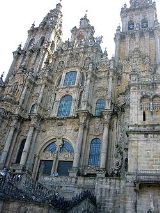
Santiago de Compostela Cathedral is situated in
Santiago de CompostelaSantiago de Compostela is the capital of the autonomous community of Galicia and a UNESCO World Heritage Site. Located in the north west of Spain in the Province of A Coruña, it was a "European City of Culture" for the year 2000...
in Galicia,
SpainSpain , officially the Kingdom of Spain , is a country located in southwestern Europe on the Iberian Peninsula.
[The Spanish constitution does not establish any official denomination of the country, even though España , Estado español and Nación española are used interchangeably...]
. The cathedral is the reputed burial-place of Saint James the Greater, one of the apostles of Jesus Christ. It is the destination of the
Way of St. JamesThe Way of St. James or St. James' Way is the pilgrimage to the Cathedral of Santiago de Compostela in Galicia in northwestern Spain, where tradition has it that the remains of the apostle Saint James are buried....
(popularly known by its local denominations:
GalicianGalician is a language of the Western Ibero-Romance branch, spoken in Galicia, an autonomous community located in northwestern Spain, as well as in small bordering zones in the neighbouring autonomous communities of Asturias and Castile and León and in Northern Portugal.Galician and Portuguese...
Camiño de Santiago,
PortuguesePortuguese is a Romance language that originated in what is now Galicia and northern Portugal. It is derived from the Latin spoken by the romanized Pre-Roman peoples of the Iberian Peninsula around 2000 years ago...
Caminho de Santiago,
SpanishSpanish or Castilian is a Romance language in the Ibero-Romance group that originated in northern Spain and gradually spread in the Kingdom of Castile, evolving into the principal language of government and trade in the Iberian peninsula...
Camino de Santiago,
FrenchFrench is a Romance language globally spoken by about 65 million people as a first language , by 50 million as a second language, and by about another 200 million people as an acquired foreign language, with significant speakers in 57 countries. Most native speakers of the language live in France,...
Chemin de St. Jacques,
GermanGerman is a West Germanic language, thus related to and classified alongside English and Dutch. It is one of the world's major languages and the most widely spoken first language in the European Union. Around the world, German is spoken by approximately 105 million native speakers and also by...
Jakobsweg, and so on), a major historical
pilgrimageIn religion and spirituality, a pilgrimage is a long journey or search of great moral significance. Sometimes, it is a journey to a shrine of importance to a person's beliefs and faith. Members of many major religions participate in pilgrimages...
route since the
Middle AgesThe Middle Ages of European history is a period of European history covering roughly a millennium in the 5th century through 16th centuries. More specific starting and ending points are sometimes adopted by scholars to suit their respective specializations or current focus...
.
History
According to legend, the apostle Saint James the Greater brought the Message of Christ to the
CeltCelts is a modern term used to describe any of the European peoples who spoke, or speak, a Celtic language...
s in the Iberian Peninsula. In 44 AD he was beheaded in
JerusalemJerusalem is the capital of Israel and its largest city in both population and area, with a population of 747,600 residents over an area of if disputed East Jerusalem is included...
. His remains were later brought back to Galicia,
SpainSpain , officially the Kingdom of Spain , is a country located in southwestern Europe on the Iberian Peninsula.
[The Spanish constitution does not establish any official denomination of the country, even though España , Estado español and Nación española are used interchangeably...]
. Following Roman persecutions of Spanish Christians, his tomb was abandoned in the 3rd century. Still according to legend, this tomb was rediscovered in 814 AD by Pelayo, a hermit, after witnessing strange lights in the night sky. Bishop Theodemir of Iria recognized this as a miracle and informed the Asturian king
Alfonso IIAlfonso II , called the Chaste, was the king of Asturias from 791 to his death, the son of Fruela I and the Basque Munia.He was born in Oviedo in 759 or 760. He was put under the guardianship of his aunt Adosinda after his father's death, but one tradition relates his being put in the monastery of...
(791-842). The king ordered the construction of a chapel on the site. Legend has it that the king became the first pilgrim to this shrine. This was followed by a first church in 829 AD and again in 899 AD by a pre-Romanesque church, at the order of king
Alfonso III of LeónAlfonso III , called the Great, was the king of León, Galicia and Asturias from 866 until his death. He was the son and successor of Ordoño I....
, causing the gradual development of a major place of pilgrimage. In 997 this early church was reduced to ashes by
Al-Mansur Ibn Abi AamirAbu Aamir Muhammad Ibn Abdullah Ibn Abi Aamir, Al-Hajib Al-Mansur
أبو عامر محمد بن عبد الله بن أبي عامر الحاجب المنصور , better known as Almanzor, was the de facto ruler of Muslim Al-Andalus in the late 10th to early 11th centuries...
(938-1002), army commander of the
caliphThe Caliph is the head of state in a Caliphate, and the title for the leader of the Islamic Ummah, an Islamic community ruled by the Shari'ah. It is a transliterated version of the Arabic word which means "successor" or "representative"...
of
Córdoba, Spain||-||-||}Córdoba is a city in Andalusia, southern Spain, and the capital of the province of Córdoba. Located at 37.88° North, 4.77° West, on the Guadalquivir river, it was founded in ancient Roman times as Corduba by Claudius Marcellus...
. The gates and the bells, carried by Christian captives to Córdoba, were added to the
Aljama MosqueThe Mezquita of Córdoba or Cordova is a Roman Catholic cathedral originally built as a mosque in the Andalusian city of Córdoba, Spain. It is regarded as perhaps the most accomplished monument of the Umayyad dynasty of Córdoba...
. When Córdoba was taken by king
Ferdinand III of CastileSaint Ferdinand III , was the King of Castile from 1217 and King of Galicia and Leon from 1230. He was the son of Alfonso IX of León and Berenguela of Castile. Through his second marriage he was also Count of Aumale. He finished the work done by his maternal grandfather Alfonso VIII and...
in 1236, these same gates and bells were then transported by Muslim captives to
ToledoToledo is a municipality located in central Spain, 70 km south of Madrid. It is the capital of the province of Toledo and of the autonomous community of Castile-La Mancha...
, to be inserted in the
cathedral Santa MariaThe Cathedral of Saint Mary of Toledo, also called Primate Cathedral of Toledo, is a church in Spain. The seat of the Archdiocese of Toledo, it is one of the three 13th century High Gothic cathedrals in Spain and is considered to be the pinnacle of the Gothic style in Spain...
.
Construction of the present cathedral began in 1075 under the reign of
Alfonso VI of CastileAlfonso VI , nicknamed the Brave or the Valiant, was King of León from 1065, king of King of Castile and de facto King of Galicia from 1072, and self-proclaimed "Emperor of all Spain"...
(1040-1109) and the patronage of bishop Diego Peláez. It was built according to the same plan as the monastic brick church of Saint Sernin in Toulouse, probably the greatest Romanesque edifice in France. It was built mostly in
graniteGranite is a common and widely occurring type of intrusive, felsic, igneous rock. Granite has a medium to coarse texture, occasionally with some individual crystals larger than the groundmass forming a rock known as porphyry. Granites can be pink to dark gray or even black, depending on their...
. Construction was halted several times and, according to the
Liber Sancti Iacobi, the last stone was laid in 1122. But by then, the construction of the cathedral was certainly not finished. The cathedral was consecrated in 1128 in the presence of king
Alfonso IX of LeonAlfonso IX , was king of León and Galicia, from the death of his father Ferdinand II in 1188 until his own death...
.
According to the
Codex CalixtinusThe Codex Calixtinus is a 12th century illuminated manuscript formerly attributed to Pope Callixtus II, though now believed to have been arranged by the French scholar Aymeric Picaud. The principal author is actually given as 'Scriptor I'....
the architects were "Bernard the elder, a wonderful master", his assistant Robertus Galperinus and, later possibly, "Esteban, master of the cathedral works". In the last stage "Bernard, the younger" was finishing the building, while Galperinus was in charge of the coordination. He also constructed a monumental fountain in front of the north portal in 1122.
The church became an episcopal see in 1075 and, due to its growing importance as a place of pilgrimage, it was soon raised to an archiepiscopal see by pope Urban II in 1100. A university was added in 1495.
The cathedral has been embellished and expanded between the 16th and the 18th century.
Façades
At the front of the cathedral, a golden
mollusc shellA scallop is a marine bivalve mollusc of the family Pectinidae. Scallops are a cosmopolitan family, found in all of the world's oceans. Many scallops are highly prized as a food source...
adorns the altar. A steady stream of pilgrims still queue there to kiss the shell, as another sign of homage.
Western façade
The western façade (or Fachada da Praza do Obradoiro) is flanked by two medieval towers, 76 m high. The left tower (
Torre da Carraca) shows a statue of Zebedee, father of St. James; the right tower (
Torre das Campás) shows the statue of Maria salome, his mother. The façade was built in Late Baroque style (the
ChurrigueresqueChurrigueresque refers to a Spanish Baroque style of elaborate sculptural architectural ornament which emerged as a manner of stucco decoration in Spain in the late 1600s and was used up to about 1750, marked by extreme, expressive and florid decorative detailing, normally found above the entrance...
style) by Fernando Casas y Nóvoa between 1738 and 1750. The gable in the centre shows a statue of St. James the Great, with below his two disciples Athanasius and Theodomir, dressed as pilgrims. They are flanking a representation of the tomb of St. James, with above the star that led to its discovery.
The cathedral's facade (
illustration, right) gains from forming part of an extended architectural composition on the
Praza do Obradoiro (lit. Workshop Square), a grand square surrounded by public buildings.
The ground rises to the cathedral, which is reached by a magnificent quadruple flight of steps, flanked by statues of
DavidDavid was the second king of the united Kingdom of Israel according to the Bible. He is depicted as a righteous king, although not without fault, as well as an acclaimed warrior, musician and poet .The biblical chronology sets his life c.1037–970 BCE, his reign over Judah c.1007–1000 BCE,...
and Solomon.
Access to the staircase is through some fine wrought-iron gates, and in the centre, on the level of the Plaza, is the entrance to a Romanesque chapel, the
Igrexa Baixa ("Lower Church"), constructed under the portico and contemporary with the cathedral.
To the north and south, and in a line with the west front, are dependent buildings of the 18th century, grouping well with it.
Those to the south contain a light and elegant arcade to the upper windows, and serve as a screen to the late
GothicGothic architecture is a style of architecture which flourished during the high and late medieval period. It evolved from Romanesque architecture and was succeeded by Renaissance architecture....
cloisters, built in 1533 by Fonseca, afterwards Archbishop of Toledo. They are said to be the largest in Spain. The north side of the cathedral is in the rich Spanish Baroque style called Churrigueresque. This is the palace of Gelmirez, originally from the 12th century.
This façade is illustrated on the
Spanish euro coinsSpanish euro coins feature three different designs for each of the three series of coins. The minor series of 1, 2 and 5 cent coins were designed by Garcilaso Rollán, the middle series of 10, 20, and 50 cent coins by Begoña Castellanos and the two major coins feature the portrait or effigy of King...
of 1c., 2c. and 5c.
Northern façade
The northern façade leads into the
Praza da Immaculada. Here ended the Way of St. James, coming from France, ending at the Francigena (also called Gate of Paradise), the Romanesque portal built in 1122 by Bernard, treasurer of the church. This gate was demolished in the 17th century.
On top of the façade stands a statue of St. James from the 18th century, with two kings at his feet in a praying position : Alfonso II the Great (866-910) and
Ordoño II of LeónOrdoño II was king of Galicia from 910 and king of Galicia and León from 914 until his death. He was the second son of the King Alfonso III the Great and his wife, Jimena of Navarre....
(873-924). In the centre stands the statue of Faith.
Eastern façade
The eastern façade at the
Praza da Quintana offers a completely different view. It has two main portals : the Holy Door and the Royal Door. The Holy Door opens only during a Holy Year, the year when 25 July (the saint's day of St. James) falls on a Sunday. It is accessible during those years via a smaller gated door, dedicated to St. Pelayo (St. Paio) (discoverer of the tomb of St. James). This privilege of holding a Holy Year dates from the 12th century and was granted by
Pope Callixtus IIBlessed Pope Callixtus II , born Guy de Vienne, the fourth son of William I, Count of Burgundy , was elected Pope on February 1 1119, after the death of Pope Gelasius II . His pontificate was shaped by the Investiture Controversy, which he was able to settle through the Concordat of Worms...
in 1119 and confirmed with the papal bull "
Regis Aeterni" by
Pope Alexander IIIPope Alexander III , born Rolando of Siena, was Pope from 1159 to 1181. He is noted in history for laying the foundation stone for the Notre Dame de Paris.-Church career:...
in 1179. This privilege elevated Santiago de Compostela to the same saint status as Rome and Jerusalem.
This Baroque façade was built by Fernandez Lechuga in 1611, reusing the statues of the prophets and the patriarchs sculpted by Master Mateo. Again one finds above the door statues of St. James and his two disciples.
The Royal Door derives its name from the royal escutcheon above the door.
Southern façade
The southern façade is situated at the
Praza das Praterias where, in times past, silver jewels were sold. This square is confined on two sides by the cathedral and the monastery. Adjacent is the city hall in the Rajoy palace. On the right side is the Baroque Clock Tower (
Torre del Reloj) by Domindo de Andrade, dating from the 17th century. On the left is the Treasure Tower.
This
Porta das Prateirias one of the best preserved portals. It leads to the south transept. This two-arched Romanesque portal shows us a series of juxtaposed scenes in bas-relief, sculpted between 1112 and 1117. These sculptors came from
ConquesConques is a commune in the Aveyron department in south-western France.-Geography:The village is located at the confluence of the Dourdou and Ouche rivers. It is built on a hillside and has classic narrow Medieval streets. As a result, large vehicles cannot enter the historic town centre but...
(in the French Pyrenees),
ToulouseToulouse is a city in southwest France on the banks of the River Garonne, 590 km away from Paris and half-way between the Atlantic Ocean and the Mediterranean Sea. With 1,102,882 inhabitants as of Jan...
,
MoissacMoissac is a town and commune of the Tarn-et-Garonne département, in south-western France. It is on the ancient pilgrimage route of Santiago de Compostela...
, Loarre and
JacaJaca is a city of northeastern Spain near the border with France, in the midst of the Pyrenees in the province of Huesca...
, resulting in a happy synthesis of their artistic traditions. Parts from the west façade and reliefs from the north portal were probably later integrated in this portal.
The two
tympanumsIn architecture, a tympanum is the semi-circular or triangular decorative wall surface over an entrance bounded by a lintel and arch. It often contains sculptures or other ornaments...
give a disparate impression. The left tympanum shows us the
Temptation of Christ in the desert. It is depicted in different fragments, giving a rather motley impression. On the right side of this tympanum one sees a half-dressed
Woman Taken in Adultery with the skull of her lover in her lap (attributed to the Master of the Platerias). This probably refers to a legend from the
Order of the Knights TemplarThe Poor Fellow-Soldiers of Christ and of the Temple of Solomon , commonly known as the Knights Templar or the Order of the Temple , were among the most famous of the Western Christian military orders...
or maybe a legend with Cathar origin. The right tympanum shows at its centre the flagellation of Christ; at the left side : the crowning with the Crown of Thorns and the healing of the blind; in the upper part : the Epiphany (rather damaged).
The
friezethumb|Frieze of the [[Tower of the Winds]], AthensIn architecture the frieze is the wide central section part of an entablature and may be plain or—in the Ionic or Corinthian order—decorated with bas-reliefs. Even when neither columns nor pilasters are expressed, on an astylar wall it lies upon...
shows figures from a
Transfiguration : Christ, Abraham (rather unusual), scenes from the Old Testament and four angels with trumpets.
The left
pierA pier is a raised walkway over water, supported by widely spread piles or pillars. The lighter structure of a pier allows tides and currents to flow almost unhindered, whereas the more solid foundations of a quay or the closely-spaced piles of a wharf can act as breakwaters, and are consequently...
shows (starting at the bottom) King David playing the
luteLute can refer generally to any plucked string instrument with a neck and a deep round back, or more specifically to an instrument from the family of European lutes....
(attributed to the Master of the Praterias), the
Creation of Adam and
Christ blessing King David. These sculptures attest to a high degree of artistic quality, especially Adam with his right hand over his heart. They probably were taken from the ancient Romanesque northern portal and date from the last decade of the 11th century.
At the left side of the
vestibuleA vestibule is a lobby, entrance hall, or passage between the entrance and the interior of a building.The same term can apply to structures in modern or ancient roman architecture. In modern architecture vestibule typically refers to a small room or hall between an entrance and the interior of...
:
Adam and Eve, driven from Paradise (originating from the north portal).
Interior
The cathedral is 97 m long and 22 m high. It preserves its original barrel-vaulted cruciform
RomanesqueRomanesque architecture is an architectural style of Medieval Europe, characterised by semi-circular arches, and evolving into the Gothic style, characterised by pointed arches, beginning in the 12th century...
interior. It consists of a
naveIn Romanesque and Gothic Christian abbey, cathedral basilica and church architecture, the nave is the central approach to the high altar. "Nave" was probably suggested by the keel shape of its vaulting...
, two lateral aisles, a wide
transeptFull descriptions of the elements of a Gothic floorplan are found at the entry Cathedral diagram.
For the periodical go to The Transept....
and a choir with radiating chapels. Compared with many other important churches, the interior of this cathedral gives a first impression of austerity until one enters further and sees the magnificent organ and the exuberance of the choir. This cathedral, through its monumental dimensions, is the largest Romanesque church in Spain and even one of the largest in Europe.
The Pórtico da Gloria
Perhaps the chief beauty of the cathedral, however, is the 12th century
Portico da Gloria, behind the western facade. This
Portico da Gloria in the narthex of the west portal is a remains from the Romanesque period. It is a masterwork of
RomanesqueRomanesque architecture is an architectural style of Medieval Europe, characterised by semi-circular arches, and evolving into the Gothic style, characterised by pointed arches, beginning in the 12th century...
sculpture built between 1168 and 1188 by Master Mateo at the request of king
Ferdinand II of LeonFerdinand II was King of León and Galicia from 1157 to his death.Born in Toledo, Castile, he was the son of King Alfonso VII of Castile and León and of Berenguela, of the House of Barcelona. At his father's death, he received the León and Galicia, whil ehis brother Sancho receiving Castile and...
. The vigorous naturalism of the figures in this triple portal is an expression of an art form, varied in its details, workmanship and polychromy(of which faint traces of colour remain). The shafts, tympana and archivolts of the three doorways which open onto the nave and the two aisles are a mass of strong and nervous sculpture representing the
Last JudgmentThe concept of a Last Judgment is found in all Abrahamic religions and elsewhere like Zoroastrianism and Duat.In Islam, the Last Judgment is referred to as "the Day of Standing" and God Almighty, will judge all Creation....
.
The central tympanum gives us an image of Christ in Majesty as Judge and Redeemer, showing His wounds in His feet and hands, accompanied by the
tetramorphA tetramorph is a symbolic arrangement of four differing elements. The term is derived from the Greek tetra, meaning four, and morph, shape....
. He is surrounded on both sides by a
retinueA retinue is a body of persons "retained" in the service of a noble or royal personage, a suite of "retainers."-Etymology:...
of angels carrying the symbols of the Passion. In the
archivoltAn archivolt is an ornamental molding or band following the curve of the underside of an arch. It is composed of bands of ornamental moldings surrounding an arched opening, corresponding to the architrave in the case of a rectangular opening...
are represented the 24 Elders of the
ApocalypseApocalypse is a term applied to the disclosure to certain privileged persons of something hidden from the majority of humankind. Today the term is often used to refer to the end of the world, which may be a shortening of the phrase apokalupsis eschaton which literally means "revelation at the end...
, who are tuning their musical instruments.
The column statues represent the apostles with their attribute, prophets and Old Testament figures with their name on a book or parchment. These were all polychromed. Noteworthy is the faint smile of the prophet Daniel looking at the angel of
ReimsThe city of Rheims , in English and in French, lies in the Champagne-Ardenne region in north-eastern France 129 km east-northeast of Paris....
.
The middle pier represents Saint James, his face conveying an ecstatic serenity. The text scroll in his hand shows the words
Misit me Dominus (the Lord sent me). below him is the
Tree of JesseThe Tree of Jesse refers to a passage in the Biblical Book of Isaiah which describes metaphorically the descent of the Messiah from Jesse of Bethlehem, through his son David. It is accepted by Christians as pertaining to Jesus, and is often represented in art, particularly in that of the Medieval...
(the lineage leading to Christ), while above is a representation of the
TrinityThe Christian doctrine of the Trinity teaches the unity of Father, Son, and Holy Spirit as three persons in one Godhead. The doctrine states that God is the Triune God, existing as three persons, or in the Greek hypostases, but one being. Each of the persons is understood as having the one...
. It is customary for the pilgrims to touch the left foot of this statue, signifying that they have reached their destination. So many pilgrims have laid their hands on the pillar to rest their weary bones, that a groove has been worn in the stone.
The lateral portals are dedicated to the rival churches : on the left to the Jews and on the right to the unbelievers.
The right tympanym is divided in three parts and is dedicated to the salvation of the souls. In the centre Christ and St Michael, flanked by Hell (represented by demons) and Heaven (represented by children). The
purgatoryPurgatory is the condition or process of purification in which the souls of those who die in a state of grace are made ready for Heaven. This is an idea that has ancient roots and is well-attested in early Christian literature, while the conception of purgatory as a geographically situated place is...
is shown on the side.
The left tympanum shows scenes from the Old Testament.
Demons are represented at the bottom of the
pórtico, signifying that Glory crushes sin.
Behind the portico stands the statue of Maestro Mateo, the master architect and sculptor put in charge of the cathedral building programme in the 12th century by Fernando II. It is said that whoever butts their head three times against the statue will be given a portion of Mateo's genius and perhaps enhanced memory. There is usually a long line of visitors waiting to bump their head against the statue.
The sculptures in this portico have been a point of reference for Galician sculpture until the 15th century.
The nave
The barrel-vaulted
naveIn Romanesque and Gothic Christian abbey, cathedral basilica and church architecture, the nave is the central approach to the high altar. "Nave" was probably suggested by the keel shape of its vaulting...
and the groin-vaulted
aisleAn aisle is, in general, a space for walking with rows of seats on either side or with rows of seats on one side and a wall on the other. Aisles can be seen in airplanes, certain types of buildings such as churches, Cathedrals...
s consist of eleven
bayA bay is an area of water mostly surrounded or otherwise demarcated by land. Bays generally have calmer waters than the surrounding sea, due to the surrounding land blocking some waves and often reducing winds....
s, while the wide
transeptFull descriptions of the elements of a Gothic floorplan are found at the entry Cathedral diagram.
For the periodical go to The Transept....
consists of six bays. Every clustered pier is flanked by semi-columns, three of which carry the cross vaults of the side aisles and the truss of the arched vaults, while the fourth reaches to the spring of the vault. Lit galleries run, at a remarkable height, above the side aisles around the church.
The
choirA choir, chorale, or chorus is a musical ensemble of singers. Choral music, in turn, is the music written specifically for such an ensemble to perform.A body of singers who perform together is called a choir or chorus...
is covered by three bays and surrounded with an
ambulatoryThe ambulatory is the covered passage around a cloister. The term is sometimes applied to the procession way around the east end of a cathedral or large church and behind the high altar.-Architectural context:Aisles that line the nave extend through the transept and continue in a half-circle that...
and five radiating chapels. The vault of the apse is pierced by round windows, forming a
clerestoryClerestory is an architectural term denoting an upper level of a Roman basilica or of the nave of a Romanesque or Gothic church, the walls of which rise above the rooflines of the lower aisles and are pierced with windows...
. The choir displays a surprising exuberance in this Romanesque setting. An enormous baldachin, with a sumptuous decorated statue of Saint James from the 13th century, rises above the main altar. The pilgrims are allowed to kiss the saint's mantle via a narrow passage behind the altar.
In the choir aisle one remarks the beautiful lattice work and the vault of the Mondragon chapel (1521). The radiating chapels constitute a museum of paintings, retables, reliquaries and sculptures, accumulated throughout the centuries. In the
Capela do Relicario ("Chapel of the Reliquary") is a gold crucifix, dated 874, containing an alleged piece of the
True CrossThe True Cross is the name for physical remnants which, by a Christian tradition, are believed to be from the actual cross upon which Jesus was crucified.According to post-Nicene historians, Socrates Scholasticus and others, the Empress Helena The True Cross is the name for physical remnants which,...
.
Crypt
The crypt, below the main altar, shows the substructure of the 9th century church. This was the final destination of the pilgrims. The crypt houses the relics of Saint James and two of his disciples : Saint Theodorus and Saint Athanasius. The silver reliquary (by José Losada, 1886) was put in the crypt at the end of the 19th century, after authentification of the relics by
Pope Leo XIIIPope Leo XIII , born Count Vincenzo Gioacchino Raffaele Luigi Pecci, was the 257th Pope of the Roman Catholic Church, reigning from 1878 to 1903, succeeding Pope Pius IX. Reigning until the age of 93, he was the oldest pope, and had the third longest pontificate, behind Pius IX and John Paul II...
in 1884.
In the course of time, the burial place of the saint had been almost forgotten. Because of regular Dutch and English incursions, the relics had been transferred in 1589 from their place under the main altar to a safer place. There were rediscovered in January 1879.
Botafumeiro
A dome above the crossing contains the pulley mechanism to swing the "
BotafumeiroThe Botafumeiro is a famous thurible found in the Santiago de Compostela Cathedral . Incense is burned in this swinging metal container, or "incensory"...
", which is a famous
thuribleA thurible is a metal censer suspended from chains, in which incense is burned during worship services. It is used in the Anglican/Episcopal, Eastern Orthodox, Lutheran, Old Catholic, and Roman Catholic churches, as well as in Christian and non-Christian Gnostic Churches and in the practice of...
found in this church. This thurible was created by the goldsmith José Losada in 1851. The Santiago de Compostela Botafumeiro is the largest
censerCensers are any type of vessels made for burning incense. These vessels vary greatly in size, form, and material of construction. They may consist of simple earthenware bowls or fire pots to intricately carved silver or gold vessels, small table top objects a few centimetres tall to as many as...
in the world, weighing 80 kg and measuring 1.60 m in height. It is normally on exhibition in the library of the cathedral, but during certain important religious high days it is attached to the pulley mechanism, filled with 40 kg of charcoal and incense. In the Jubilee Years, whenever St James's Day falls on a Sunday, the Botafumeiro is also attached in all the Pilgrims' Masses. Eight red-robed
tiraboleiros pull the ropes and bring it into a swinging motion almost to the roof of the transept, reaching speeds of 60 km/h and dispensing thick clouds of
incenseIncense is composed of aromatic biotic materials, which release fragrant smoke when burned. The term incense refers to the substance itself, rather than to the odor that it produces....
. One explanation of this custom, which originated more than 700 years ago--although incense has been used in Catholic ritual from the earliest times--is that it assisted in masking the stench emanating from hundreds of unwashed pilgrims.
Other burials
- Fructuosus of Braga
Saint Fructuosus of Braga was the Bishop of Dumio and Archbishop of Braga , a great founder of monasteries, who died April 16, 665. He was the son of a Visigothic dux in the region of Bierzo and he accompanied his father at a young age on certain official trips over his estates...
- Rosalía de Castro
Rosalía Castro de Murguía, better known as Rosalía de Castro , was a Galician romanticist writer and poet....
- Alfonso Daniel Rodríguez Castelao
Alfonso Daniel Rodríguez Castelao , most commonly known as simply Castelao, was a Galician writer in Galician language and one of the main symbols of Galician nationalism...
, at the Panteón de Galegos Ilustres ("Pantheon of Illustrious Galicians"), Bonaval.
External links