
All Topics  
Abacus

 
Abacus

   Email Print
   Bookmark   Link


Abacus


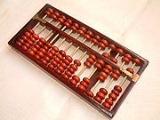
An abacus, also called a counting frame, is a calculating tool used primarily in parts of Asia for performing arithmetic processes. Today, abacuses are often constructed as a bamboo frame with beads sliding on wires, but originally they were beans or stones moved in grooves in sand or on tablets of wood, stone, or metal. The abacus was in use centuries before the adoption of the written modern numeral system and is still widely used by merchants, traders and clerks in Asia
Asia

Asia is the world's largest and most populous continent. It covers 8.6% of the Earth's total surface area and, with over 4 billion people, it contains more than 60% of the world's current human population....
, Africa
Africa

Africa is the world's second-largest and second most-populous continent, after Asia. At about 30.2 million km? including adjacent islands, it covers 6% of the Earth's total surface area and 20.4% of the total land area....
, and elsewhere.

The user of an abacus is called an abacist who slides the beads of the abacus by hand.

use of the word abacus dates before 1387 AD, when a Middle English
Middle English

Middle English is the name given by historical linguistics to the diverse forms of the English language spoken between the Norman conquest of England of 1066 and about 1470, when the #Chancery Standard, a form of London-based English, began to become widespread, a process aided by the introduction of the printing press into England by William...
 work borrowed the word from Latin
Latin

Latin is an Italic language, historically spoken in Latium and Ancient Rome. Through the Military history of the Roman Empire, Latin spread throughout the Mediterranean and a large part of Europe....
 to describe a sandboard abacus.


Discussion
Ask a question about 'Abacus'
Start a new discussion about 'Abacus'
Answer questions from other users
Full Discussion Forum


Encyclopedia


An abacus, also called a counting frame, is a calculating tool used primarily in parts of Asia for performing arithmetic processes. Today, abacuses are often constructed as a bamboo frame with beads sliding on wires, but originally they were beans or stones moved in grooves in sand or on tablets of wood, stone, or metal. The abacus was in use centuries before the adoption of the written modern numeral system and is still widely used by merchants, traders and clerks in Asia
Asia

Asia is the world's largest and most populous continent. It covers 8.6% of the Earth's total surface area and, with over 4 billion people, it contains more than 60% of the world's current human population....
, Africa
Africa

Africa is the world's second-largest and second most-populous continent, after Asia. At about 30.2 million km? including adjacent islands, it covers 6% of the Earth's total surface area and 20.4% of the total land area....
, and elsewhere.

The user of an abacus is called an abacist who slides the beads of the abacus by hand.

Etymology

The use of the word abacus dates before 1387 AD, when a Middle English
Middle English

Middle English is the name given by historical linguistics to the diverse forms of the English language spoken between the Norman conquest of England of 1066 and about 1470, when the #Chancery Standard, a form of London-based English, began to become widespread, a process aided by the introduction of the printing press into England by William...
 work borrowed the word from Latin
Latin

Latin is an Italic language, historically spoken in Latium and Ancient Rome. Through the Military history of the Roman Empire, Latin spread throughout the Mediterranean and a large part of Europe....
 to describe a sandboard abacus. The Latin word came from abakos, Hebrew
Hebrew language

Hebrew is a Semitic languages of the Afro-Asiatic languages. Modern Hebrew is spoken by more than seven million people in Israel and Classical Hebrew is used for prayer or study in Jews communities around the world....
 abaq, "dust". The preferred plural of abacus is a subject of disagreement, but both abacuses, and abaci are in use.

Mesopotamian abacus

The period 2700–2300 BC saw the first appearance of the Sumer
Sumer

Sumer was a civilization and a historical region located in Southern Iraq , known as the Cradle of civilization. It lasted from the first settlement of Eridu in the Ubaid period through the Uruk period and the Dynastic periods until the rise of Babylon in the early 2nd millennium BC....
ian abacus, a table of successive columns which delimited the successive orders of magnitude of their sexagesimal
Sexagesimal

Sexagesimal is a numeral system with 60 as the radix. It originated with the ancient Sumerians in the 3rd millennium BC, was transmitted to the Babylonia, and is still used?in modified form?for measuring time, angles, and geographic coordinates....
 number system.

Babylon
Babylon

Babylon was a city-state of ancient Mesopotamia, sometimes considered an empire, the remains of which can be found in present-day Al Hillah, Babil Governorate, Iraq, about 85 kilometers south of Baghdad....
ians may have used the abacus for the operations of addition
Addition

Addition is the mathematics process of putting things together. The plus sign "+" means that numbers are added together. For example, in the picture on the right, there are 3 + 2 apples?meaning three apples and two other apples?which is the same as five apples, since 3 + 2 = 5....
 and subtraction
Subtraction

Subtraction is one of the four basic arithmetic operations; it is the inverse of addition, meaning that if we start with any number and add any number and then subtract the same number we added, we return to the number we started with....
. However, this primitive device proved difficult to use for more complex calculations. Some scholars point to a character from the Babylonian cuneiform
Cuneiform

Cuneiform can refer to:*Cuneiform script, an ancient writing system originating in Mesopotamia in the 4th millennium BC*Cuneiform , three bones in the human foot...
 which may have been derived from a representation of the abacus.

Egyptian abacus

The use of the abacus in Ancient Egypt
Ancient Egypt

Ancient Egypt was an Ancient history civilization in eastern North Africa, concentrated along the lower reaches of the Nile in what is now the modern nation of Egypt....
 is mentioned by the Greek historian Crabertotous, who writes that the manner of this disk's usage by the Egyptians was opposite in direction when compared with the Greek method. Archaeologists have found ancient disks of various sizes that are thought to have been used as counters. However, wall depictions of this instrument have not been discovered.. casting some doubt over the extent to which this instrument was used.

Iranian Persian abacus

During the Achaemenid Persian Empire, around 600 BC, Iranians first began to use the abacus. Under Parthian
Parthian

Parthian may be:A demonym "of Parthia", a region of north-eastern Iran* Parthian language, a now-extinct Middle Iranian language* Parthian shot, an archery skill famously employed by Parthian horsemen...
 and Sassanian Iran
Iran

Iran , officially the Islamic Republic of Iran and formerly known internationally as Persian Empire until 1935, is a country in Central Eurasia, located on the northeastern shore of the Persian Gulf and the southern shore of the Caspian Sea....
ian empires, scholars concentrated on exchanging knowledge and inventions by the countries around them – India
India

India, officially the Republic of India , is a country in South Asia. It is the List of countries and outlying territories by total area country by geographical area, the List of countries by population country, and the most populous liberal democracy in the world....
, China
China

China is a Culture of China, an ancient civilization, and, depending on perspective, a national or multinational entity extending over a large area in East Asia....
, and the Roman Empire
Roman Empire

The Roman Empire was the Roman Republic phase of the Ancient Rome, characterised by an autocracy form of government and large territorial holdings in Europe and around the Mediterranean....
, when it is thought to be expanded over the other countries.

Greek abacus

The earliest archaeological evidence for the use of the Greek abacus dates to the 5th century BC. The Greek abacus was a table of wood, pre-set with small counters in wood or metal for mathematical calculations. This Greek abacus saw use in Ancient Rome and, until the French Revolution, the Western Christian world.

A tablet found on the Salamis
Salamis Island

Salamis is the largest Greece island in the Saronic Gulf, about 1 nautical mile off-coast from Piraeus and about 16 km west of Athens. Due to its roughly crescent shape, the island is also locally known as Koulouri, after the koulouri....
 in 1846 AD dates back to 300 BC. It is a slab of white marble 149 cm long, 75 cm wide, and 4.5 cm thick, on which are 5 groups of markings. In the center of the tablet is a set of 5 parallel lines equally divided by a vertical line, capped with a semicircle at the intersection of the bottom-most horizontal line and the single vertical line. Below these lines is a wide space with a horizontal crack dividing it. Below this crack is another group of eleven parallel lines, again divided into two sections by a line perpendicular to them, but with the semicircle at the top of the intersection; the third, sixth and ninth of these lines are marked with a cross where they intersect with the vertical line.

Roman abacus

Romanabacusrecon
The normal method of calculation in ancient Rome, was by moving counters on a smooth table. Originally pebbles, calculi, were used. Later, and in medieval Europe, jeton
Jeton

Jetons were token or coin-like medals produced across Europe from the 13th through the 17th centuries. They were produced as counters for use in calculation on a lined board similar to an abacus....
s were manufactured. Marked lines indicated units, fives, tens etc. as in the Roman numeral system. This system of 'counter casting' continued into the late Roman empire and in medieval Europe, and persisted in limited use into the nineteenth century.

Writing in the 1st century BC, Horace refers to the wax abacus, a board covered with a thin layer of black wax on which columns and figures were inscribed using a stylus.

One example of archaeological evidence of the Roman abacus
Roman abacus

The Ancient Rome developed the Roman hand abacus, a portable, but less capable, base-10 version of the previous Babylonian abacus. It was the first portable calculating device for engineers, merchants and presumably tax collectors....
, shown here in reconstruction, dates to the 1st century AD. It has eight long grooves containing up to five beads in each and eight shorter grooves having either one or no beads in each. The groove marked I indicates units, X tens, and so on up to millions. The beads in the shorter grooves denote fives – five units, five tens etc., essentially in a bi-quinary coded decimal
Bi-quinary coded decimal

Bi-quinary coded decimal is a numeral system used in many abacuses and in some early computers, including the Colossus_computer. The term bi-quinary indicates that the code comprises both a two-state and a five-state component....
 system, obviously related to the Roman numerals
Roman numerals

Roman numerals are a numeral system of ancient Rome based on letters of the alphabet, which are combined to signify the sum of their values. The system is decimal but not directly Positional notation and does not include a zero....
. The short grooves on the right may have been used for marking Roman ounces.

Chinese abacus

Abacus 6
The earliest known written documentation of the Chinese abacus dates to the 14th century AD.

The top of the abacus is called the heaven and the bottom is called the earth.

The Chinese abacus, known as the suànpán, is typically 20 cm tall and comes in various widths depending on the operator. It usually has more than seven rods. There are two beads on each rod in the upper deck and five beads each in the bottom for both decimal
Decimal

The decimal numeral system has 10 as its Base . It is the most widely used numeral system....
 and hexadecimal
Hexadecimal

In mathematics and computer science, hexadecimal is a numeral system with a radix, or base, of 16. It uses sixteen distinct symbols, most often the symbols 09 to represent values zero to nine, and A, B, C, D, E, F to represent values ten to fifteen....
 computation. Modern abacuses have one bead on the top deck and four beads on the bottom deck. The beads are usually rounded and made of a hardwood
Hardwood

The term hardwood is used to describe wood from non-monocot flowering plant trees and for those trees themselves. These are usually broad-leaved; in temperate and boreal latitudes they are mostly deciduous, but in tropics and subtropics mostly evergreen....
. The beads are counted by moving them up or down towards the beam. If you move them toward the beam, you count their value. If you move away, you don't count their value. The suanpan can be reset to the starting position instantly by a quick jerk along the horizontal axis to spin all the beads away from the horizontal beam at the center.

Suanpans can be used for functions other than counting. Unlike the simple counting board used in elementary schools, very efficient suanpan techniques have been developed to do multiplication
Multiplication

Multiplication is the Operation of scaling one number by another. It is one of the four basic operations in elementary arithmetic .Multiplication is defined for Natural number in terms of repeated addition; for example, 4 multiplied by 3 can be calculated by adding 3 copies of 4 together:...
, division
Division (mathematics)

In mathematics, especially in elementary arithmetic, division is an arithmetic operation which is the inverse of multiplication.Specifically, if c times b equals a, written:...
, addition
Addition

Addition is the mathematics process of putting things together. The plus sign "+" means that numbers are added together. For example, in the picture on the right, there are 3 + 2 apples?meaning three apples and two other apples?which is the same as five apples, since 3 + 2 = 5....
, subtraction
Subtraction

Subtraction is one of the four basic arithmetic operations; it is the inverse of addition, meaning that if we start with any number and add any number and then subtract the same number we added, we return to the number we started with....
, square root
Square root

In mathematics, a square root of a number x is a number r such that r2 = x, or, in other words, a number r whose square is x....
 and cube root
Cube root

In mathematics, a cube root of a number, denoted or x1/3, is a number a such that a3 = x. All real numbers have exactly one real number cube root and a pair of complex conjugate roots, and all nonzero complex numbers have three distinct complex cube roots....
 operations at high speed. There are schools teaching students how to use it.

In the famous long scroll Along the River During the Qingming Festival painted by Zhang Zeduan
Zhang Zeduan

Zhang Zeduan , alias Zheng Dao, was a famous Chinese painter during the twelfth century, during the transitional period from the Northern Song to the Southern Song Dynasty, and was instrumental in the early history of the Chinese art style known as Shan shui....
 (1085–1145 AD) during the Song Dynasty
Song Dynasty

The Song Dynasty was a ruling Chinese dynasty in China between 960–1279 AD; it succeeded the Five Dynasties and Ten Kingdoms Period, and was followed by the Yuan Dynasty....
 (960–1297 AD), a suanpan is clearly seen lying beside an account book and doctor's prescriptions on the counter of an apothecary
Apothecary

Apothecary is a historical name for a medicine who formulates and dispenses materia medica to physicians, surgery and patients ? a role now served by a pharmacist ....
's (Feibao).

The similarity of the Roman abacus
Roman abacus

The Ancient Rome developed the Roman hand abacus, a portable, but less capable, base-10 version of the previous Babylonian abacus. It was the first portable calculating device for engineers, merchants and presumably tax collectors....
 to the Chinese one suggests that one could have inspired the other, as there is some evidence of a trade relationship between the Roman Empire
Roman Empire

The Roman Empire was the Roman Republic phase of the Ancient Rome, characterised by an autocracy form of government and large territorial holdings in Europe and around the Mediterranean....
 and China. However, no direct connection can be demonstrated, and the similarity of the abaci may be coincidental, both ultimately arising from counting with five fingers per hand. Where the Roman model (like most modern Japanese) has 4 plus 1 bead per decimal place, the standard suanpan has 5 plus 2, allowing use with a hexadecimal
Hexadecimal

In mathematics and computer science, hexadecimal is a numeral system with a radix, or base, of 16. It uses sixteen distinct symbols, most often the symbols 09 to represent values zero to nine, and A, B, C, D, E, F to represent values ten to fifteen....
 numeral system. Instead of running on wires as in the Chinese and Japanese models, the beads of Roman model run in grooves, presumably making arithmetic calculations much slower.

Another possible source of the suanpan is Chinese counting rods
Counting rods

Counting rods are small bars, typically 3-14 cm long, used by mathematicians for calculation in China, Japan, Korea, and Vietnam. They are placed either horizontally or vertically to represent any number and any fraction....
, which operated with a decimal system
Decimal system

Decimal system may refer to:* The decimal number system, used in mathematics for writing numbers and performing arithmetic.* The Dewey Decimal Classification, a subject classification system used in libraries....
 but lacked the concept of zero
0 (number)

0 is both a number and the numerical digit used to represent that number in numeral system. It plays a central role in mathematics as the additive identity of the integers, real numbers, and many other algebraic structures....
 as a place holder. The zero was probably introduced to the Chinese in the Tang Dynasty
Tang Dynasty

The Tang Dynasty was an Dynasties in Chinese history preceded by the Sui Dynasty and followed by the Five Dynasties and Ten Kingdoms Period. It was founded by the Li family, who seized power during the decline and collapse of the Sui Empire....
 (618-907 AD) when travel in the Indian Ocean
Indian Ocean

The Indian Ocean is the third largest of the world's oceanic divisions, covering about 20% of the water on the Earth's surface. It is bounded on the north by Asia ; on the west by Africa; on the east by Indochina, the Sunda Islands, and Australia; and on the south by the Southern Ocean ....
 and the Middle East
Middle East

File:GreaterMiddleEast1.pngThe Middle East is a region that spans southwestern Asia, western Asia, and northeastern Africa. It has no clear boundaries, often used as a synonym to Near East, in opposition to Far East....
 would have provided direct contact with India
India

India, officially the Republic of India , is a country in South Asia. It is the List of countries and outlying territories by total area country by geographical area, the List of countries by population country, and the most populous liberal democracy in the world....
, allowing them to acquire the concept of zero and the decimal point from Indian merchants and mathematicians.

Indian abacus

First century sources, such as the Abhidharmakosa describe the knowledge and use of abacus in India
India

India, officially the Republic of India , is a country in South Asia. It is the List of countries and outlying territories by total area country by geographical area, the List of countries by population country, and the most populous liberal democracy in the world....
. Around the 5th century, Indian clerks were already finding new ways of recording the contents of the Abacus. Hindu texts used the term shunya (zero) to indicate the empty column on the abacus..

Japanese abacus

Soroban
In Japanese, the abacus is called soroban
Soroban

The is an abacus developed in Japan. It is derived from the suanpan, imported from China to Japan via Korea around 1600. Like the suanpan, the soroban is still used today, despite the proliferation of practical and affordable pocket electronic calculators....
 (lit. "Counting tray"), imported from China around 1600. The 1/4 abacus appeared circa 1930, and it is preferred and still manufactured in Japan today even with the proliferation, practicality, and affordability of pocket electronic calculators. The use of the soroban is still taught in Japanese primary schools as a part of mathematics
Mathematics

Mathematics is the study of quantity, structure, space, change, and related topics of pattern and form. Mathematicians seek out patterns whether found in numbers, space, natural science, computers, imaginary abstractions, or elsewhere....
.

Korean abacus

The Chinese abacus migrated from China to Korea
Korea

Korea is a geographic area composed of two sovereign countries, a civilization, and a former state situated on the Korean Peninsula in East Asia....
 around the year 1400 AD. Koreans call it jupan, supan or jusan.

Native American abaci

Quipu
Some sources mention the use of an abacus called a nepohualtzintzin in ancient Mayan culture. This Mesoamerican abacus used a 5-digit base-20 system. The word Nepohualtzintzin comes from the Nahuatl and it is formed by the roots; Ne - personal -; pohual or pohualli - the account -; and tzintzin - small similar elements. And its complete meaning is taken as: counting with small similar elements by somebody. Its use was taught in the "Kalmekak" to the "temalpouhkeh", who were students dedicated to take the accounts of skies, from childhood. Unfortunately the Nepohualtzintzin and its teaching were among the victims of the conquering destruction, when a diabolic origin was attributed to them after observing the tremendous properties of representation, precision and speed of calculations. But now we know with certainty that it is a concrete example of the great scientific and technological development that the majority of the native cultures already had in those times.

This arithmetic tool is based on the vigesimal system (base 20). For the aztec the count by 20s was completely natural, since the use of "huaraches" (native sandals) allowed them to also use the toes for their calculations. In this way, the amount of 20 meant to them a complete human being. The Nepohualtzintzin is divided in two main parts separated by a bar or intermediate cord. In the left part there are four beads, which in the first row have unitary values (1, 2, 3, and 4), and in the right side there are three beads with values of 5, 10, and 15 respectively. In order to know the value of the respective beads of the upper rows, it is enough to multiply by 20 (by each row), the value of the corresponding account in the first row.

Altogether, there are 13 rows with 7 beads in each one, which makes up 91 beads in each Nepohualtzintzin. This is a basic number to understand the close relation conceived between the exact accounts and the natural phenomena. This is so that one Nepohualtzintzin (91) represents the number of days that a season of the year lasts, two Nepohualtzitzin (182) is the number of days of the corn’s cycle, from its sowing to its harvest, three Nepohualtzintzin (273) is the number of days of a baby’s gestation, and four Nepohualtzintzin complete a cycle and form a year. It is worth to mention that in the Nepohualtzintzin, amounts in the rank from 10 to the 18 can be calculated, with floating point, which allows calculating stellar as well as infinitesimal amounts with absolute precision.

The rediscovering of the Nepohualtzintzin is due to the teacher David Esparza Hidalgo, who in his wandering by all Mexico has found diverse engravings and paintings of this instrument and has reconstructed several of them made in gold, jade, incrustations of shell, etc. There have been also found very old Nepohualtzintzin attributed to the Olmeca culture, and even some bracelets of Mayan origin, as well as a diversity of forms and materials in other cultures. This gives us an idea of the so early epochs in which our ancestors already had the sufficient knowledge to devise and to handle a device of such complexity, and the notion of the extension of its use in their daily activities.

The quipu
Quipu

Quipu or khipu were recording devices used in the Inca Empire and its predecessor societies in the Andes region. A quipu usually consisted of colored spun and plied thread or strings from llama or alpaca hair....
 of the Inca
Inca

The Inca civilization began as a tribe in the Cuzco area, where the legendary first Sapa Inca, Manco Capac founded the Kingdom of Cuzco around 1200....
s was a system of knotted cords used to record numerical data, like advanced tally sticks – but not used to perform calculations. Calculations were carried out using a yupana (quechua
Quechua

Quechua is a Native American language of South America. It was already widely spoken across the Central Andes long before the time of the Inca Empire, who established it as the official language of administration for their Empire, and is still spoken today in various regional forms by some 10 million people through much of South America, in...
 for "counting tool"; see figure) which was still in use after the conquest of Peru. The working principle of a yupana is unknown, but in 2001 an explanation of the mathematical basis of these instruments was proposed. By comparing the form of several yupanas, researchers found that calculations were based using the Fibonacci sequence 1, 1, 2, 3, 5 and powers of 10, 20 and 40 as place values for the different fields in the instrument. Using the Fibonacci sequence would keep the number of grains within any one field at minimum.

Russian abacus

Schoty Abacus
The Russian abacus, the schoty, usually has a single slanted deck, with ten beads on each wire (except one wire which has four beads, for quarter-ruble fractions. This wire is usually near the user). (Older models have another 4-bead wire for quarter-kopeks, which were minted until 1916.) The Russian abacus is often used vertically, with wires from left to right in the manner of a book. The wires are usually bowed to bulge upward in the center, in order to keep the beads pinned to either of the two sides. It is cleared when all the beads are moved to the right. During manipulation, beads are moved to the left. For easy viewing, the middle 2 beads on each wire (the 5th and 6th bead) usually are of a different colour than the other eight beads. Likewise, the left bead of the thousands wire (and the million wire, if present) may have a different color.

The Russian abacus was in use in all shops and markets throughout the former Soviet Union
Commonwealth of Independent States

The Commonwealth of Independent States is a regional organization whose participating countries are former Soviet Republics.The CIS is comparable to a confederation similar to the original European Community....
, and the usage of it was taught in most schools until the 1990s. Today it is regarded as an archaism and replaced by microcalculator. The use of calculators has been taught since the 1990s.

The Russian abacus was brought to France around 1820 by the mathematician Jean-Victor Poncelet
Jean-Victor Poncelet

Jean-Victor Poncelet was a French people engineer and mathematician who served most notably as the commandant general of the ?cole Polytechnique....
, who served in Napoleon's army and had been a prisoner of war in Russia. The abacus had fallen out of use in western Europe in the 16th century with the rise of decimal notation and algorism
Algorism

Algorism is the technique of performing basic arithmetic by writing numbers in place value form and applying a set of memorized rules and mathematical table to the digits....
ic methods. To Poncelet's French contemporaries, it was something new. Poncelet used it, not for any applied purpose, but as a teaching and demonstation aid.

School abacus

Kugleramme
Around the world, abaci have been used in pre-schools and elementary schools as an aid in teaching the numeral system
Numeral system

A numeral system is a writing system for expressing numerals , and a mathematical notation for representing numbers of a given set, using graphemes or symbols in a consistent manner....
 and arithmetic
Arithmetic

Arithmetic or arithmetics is the oldest and most elementary branch of mathematics, used by almost everyone, for tasks ranging from simple day-to-day counting to advanced science and business calculations....
.

In Western countries, a bead frame similar to the Russian abacus but with straight wires and a vertical frame has been common (see image). It is still often seen as a plastic or wooden toy.

The type of abacus shown here is often used to represent numbers without the use of place value. Each bead and each wire has the same value and used in this way it can represent numbers up to 100.

Abaci in Medieval pictures


Uses by the blind

An adapted abacus, invented by Tim Cranmer, called a Cranmer abacus is still commonly used by individuals who are blind
Blindness

Blindness is the condition of lacking visual perception due to physiological or neurological factors.Various scales have been developed to describe the extent of vision loss and define "blindness." Total blindness is the complete lack of form and visual light perception and is clinically recorded as "NLP," an abbreviation for "no ligh...
. A piece of soft fabric or rubber is placed behind the beads so that they do not move inadvertently. This keeps the beads in place while the users feel or manipulate them. They use an abacus to perform the mathematical functions multiplication
Multiplication

Multiplication is the Operation of scaling one number by another. It is one of the four basic operations in elementary arithmetic .Multiplication is defined for Natural number in terms of repeated addition; for example, 4 multiplied by 3 can be calculated by adding 3 copies of 4 together:...
, division
Division (mathematics)

In mathematics, especially in elementary arithmetic, division is an arithmetic operation which is the inverse of multiplication.Specifically, if c times b equals a, written:...
, addition
Addition

Addition is the mathematics process of putting things together. The plus sign "+" means that numbers are added together. For example, in the picture on the right, there are 3 + 2 apples?meaning three apples and two other apples?which is the same as five apples, since 3 + 2 = 5....
, subtraction
Subtraction

Subtraction is one of the four basic arithmetic operations; it is the inverse of addition, meaning that if we start with any number and add any number and then subtract the same number we added, we return to the number we started with....
, square root
Square root

In mathematics, a square root of a number x is a number r such that r2 = x, or, in other words, a number r whose square is x....
 and cubic root.

Although blind students have benefited from talking calculators, the abacus is still very often taught to these students in early grades, both in public schools and state schools for the blind. The abacus teaches mathematical skills that can never be replaced with talking calculators and is an important learning tool for blind students. Blind students also complete mathematical assignments using a braille-writer and Nemeth code
Nemeth Braille

The Nemeth Braille Code for Mathematics is a Braille code for encoding mathematical and scientific notation linearly using standard six-dot Braille cells for tactile reading by the visually impaired....
 (a type of braille code for mathematics) but large multiplication and long division problems can be long and difficult. The abacus gives blind and visually impaired students a tool to compute mathematical problems that equals the speed and mathematical knowledge required by their sighted peers using pencil and paper. Many blind people find this number machine a very useful tool throughout life.

See also

  • Abacus logic
    Abacus logic

    In logic, an abacus is an instrument, often called the "logical machine", analogous to the mathematical abacus arithmetic. It is based on the principle of truth tables....
  • Abacus system
    Abacus system

    The abacus system of mental calculation is a system where users mentally visualize an abacus to do calculations. No physical abacus is used; only the answers are written down....
  • Chisanbop
  • Napier's bones
    Napier's bones

    Napier's bones is an abacus created by John Napier for calculation of products and quotients of numbers that was based on Arab mathematics and lattice multiplication used by Fibonacci writing in the Liber Abaci....
  • Sand table
    Sand table

    Sand table is a somewhat generic name for using constrained sand for modeling or educational purposes. The original version of a sand table seems to be the abax used by early Greek students....
  • Suanpan
  • Soroban
    Soroban

    The is an abacus developed in Japan. It is derived from the suanpan, imported from China to Japan via Korea around 1600. Like the suanpan, the soroban is still used today, despite the proliferation of practical and affordable pocket electronic calculators....


Further reading

  • .
  • .


External links


Tutorials


Abacus curiosities


  • at cut-the-knot
    Cut-the-knot

    Cut-the-knot is an educational website maintained by Alexander Bogomolny and devoted to popular exposition of a great variety of topics in mathematics....


Groups


Teaching