

Invasion

Encyclopedia
An invasion is a military offensive
consisting of all, or large parts of the armed forces
of one geopolitical
entity aggressively entering territory controlled by another such entity
, generally with the objective of either conquering, liberating or re-establishing control or authority over a territory, forcing the partition of a country, altering the established government
or gaining concessions from said government, or a combination thereof. An invasion can be the cause of a war
, be a part of a larger strategy to end a war, or it can constitute an entire war in itself. Due to the large scale of the operations associated with invasions, they are usually strategic
in planning and execution.
endeavor of substantial magnitude; because the goals of an invasion are usually large-scale and long-term, a sizeable force is needed to hold territory, and protect the interests of the invading entity. Smaller-scale, tactical
cross-border
actions, such as skirmishes
, sortie
s, raids
, infiltration
s or guerrilla warfare
, are not generally considered invasions. A military endeavor to take back territory that is tenuously held by an initial invader during the course of war is instead generally called a counter-offensive
.
Military operations that occur within the territory of a single geopolitical entity are sometimes termed "invasions" if armed forces enter into a well defined part of that territory that, at the time of the operation, was completely under the control of armed forces of another faction in a civil war
or insurrection. For example, many such operations of both the American Revolutionary War
and the American Civil War
are called invasions even though they did not involve entry of armies from foreign nations.
The term does not imply the presence or lack of justification for the action, and the morality or immorality of a military operation does not determine whether it is so termed. For example, two sets of World War II military operations—by Germans against Poland in 1939 and by Allies against Nazi controlled France in 1944—are often called the Invasion of Poland
and Invasion of Normandy, respectively. Both military operations are properly called invasions because they involved an outside force entering territory not under its authority or control at the time.
evidence indicates that invasions have been frequent occurrences since prehistory
. In antiquity, before radio
communication
s and fast transportation, the only way to ensure adequate reinforcements was to move armies as one massive force. This, by its very nature, led to the strategy of invasion. With invasion came cultural exchanges
in government, religion
, philosophy
, and technology
that shaped the development of much of the ancient world.
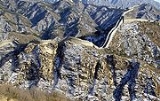
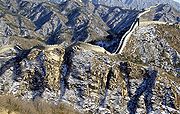 States with potentially hostile neighbors typically adopt defensive measures
to delay or forestall an invasion. In addition to utilizing geographical barriers such as river
s, marsh
es, or rugged terrain
, these measures have historically included fortification
s. Such a defense can be intended to actively prevent invading forces from entering the country by means of an extended and well-defended barrier; the Great Wall of China
, Hadrian's Wall
, and the Danewerk are famous examples. Such barriers have also included trench
lines and, in more modern times, minefields, camera
s, and motion-sensitive
sensor
s. However, these barriers can require a large military force to provide the defense, as well as maintain the equipment and positions, which can impose a great economic
burden on the country. Some of those same techniques can also be turned against defenders, used to keep them from escape or resupply. During Operation Starvation
, Allied forces
used airdropped mines to severely disrupt Japanese
logistical operations within their own borders.
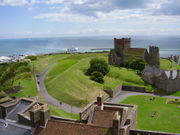 Alternatively, the fortifications can be built up at a series of sites, such as castle
s or forts placed near a border. These structures are designed to delay an invasion long enough for the defending nation to mobilize an army of size sufficient for defense or, in some cases, counter-invasion—such as, for example, the Maginot Line
. Forts can be positioned so that the garrison
s can interdict the supply lines of the invaders. The theory behind these spaced forts is that the invader cannot afford to bypass these defenses, and so must lay siege
to the structures.
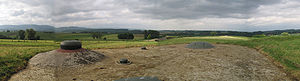 In modern times, the notion of constructing large-scale static defenses to combat land-based threats has largely become obsolete. The use of precision air campaigns and large-scale mechanization
have made lighter, more mobile defenses desirable to military planners. The obsolescence of large fortifications was displayed by the failure of the Maginot Line
in the beginning of World War Two. Nations defending against modern invasions normally use large population centers such as cities
or town
s as defensive points. The invader must capture these points to destroy the defender's ability to wage war. The defender uses mobile armored
and infantry
divisions to protect these points, but the defenders are still very mobile and can normally retreat. A prominent example of the use of cities as fortifications can be seen in the Iraqi Army's stands in the 2003 invasion of Iraq
at Baghdad
, Tikrit
and Basra
in the major combat in the Second Gulf War. A defender can also use these mobile assets to precipitate a counteroffensive like the Soviet
Red Army
at the Battle of Kursk
or the Northern Alliance in Afghanistan
.
However, static emplacements remain useful in both defense against naval attacks and defense against air attacks
. Naval mine
s are still an inexpensive but effective way to defend port
s and choke off supply lines. Large static air defense systems that combine antiaircraft guns with missile launchers
are still the best way to defend against air attacks. Such systems were used effectively by the North Vietnam
ese around Hanoi
. Also, the United States
has invested considerable time and money into the construction of a National Missile Defense
system, a static defense grid intended to intercept nuclear intercontinental ballistic missile
s.
Island nation
s, such as the United Kingdom
or Japan
, and continental states with extensive coast
s, such as the United States, have utilized a significant naval
presence to forestall an invasion of their country, rather than fortifying their border areas. A successful naval defense, however, usually requires a preponderance of naval power and the ability to sustain and service that defense force.
In particularly large nations, the defending force may also retreat
in order to facilitate a counterattack
by drawing the invaders deeper into hostile territory. One effect of this tactic is that the invading force becomes too spread out, making supply difficult and making the lines more susceptible to attack. This tactic, although costly, helped the Soviets stop the German advance at Stalingrad
. It can also cause the invading force to extend too far, allowing a pincer movement
to cut them off from reinforcements. This was the cause of the British defeat at the Battle of Cowpens
during the American Revolutionary War
. Finally, sending too many reinforcements can leave too few defenders in the attackers' territory, allowing a counter-invasion from other areas, as happened in the Second Punic War
.
into an area using existing land connections, usually crossing border
s or otherwise defined zones, such as a demilitarized zone
, overwhelming defensive emplacements and structures. Although this tactic often results in a quick victory, troop movements are relatively slow and subject to disruption by terrain and weather. Furthermore, it is hard to conceal plans for this method of invasion, as most geopolitical entities take defensive positions in areas that are most vulnerable to the methods mentioned above.
In modern warfare, invasion by land often takes place after, or sometimes during, attacks on the target by other means. Air strikes and cruise missile
s launched from ships at sea are a common method of "softening" the target. Other, more subtle, preparations may involve secretly garnering popular support, assassinating
potentially threatening political or military figures, and closing off supply lines where they cross into neighboring countries. In some cases, those other means of attack eliminate the need for ground assault; the 1945 atomic-bombing of Hiroshima and Nagasaki ultimately made it unnecessary for the Allies to invade the Japanese home islands with infantry troops. In cases such as this, while some ground troops are still needed to occupy the conquered territory, they are allowed to enter under the terms of a treaty
and as such are no longer invaders. As unmanned, long-range combat evolves, the instances of basic overland invasion become fewer; often the conventional fighting is effectively over before the infantry arrives in the role of peacekeepers (see "Applications in fourth generation warfare" in this article).
, for cases in which there is no other method to enter the territory in question. Arguments in favor of this method usually consist of the ability to perform a surprise attack from sea, or that naval defenses of the area in question are inadequate to repel such an attack. However, the large amount of specialized equipment, such as amphibious vehicle
s and the difficulty of establishing defenses—usually with a resulting high casualty count
—in exchange for a relatively small gain, are often used as arguments against such an invasion method. Underwater hazards and a lack of good cover are very common problems during invasions from the sea. At the Battle of Tarawa
, Marine
landing craft became hung up on a coral reef
and were shelled
from the beach. Other landers were sunk before they could reach the shore, and the tank
s they were carrying were stranded in the water. Most of the few survivors of the first wave ended up pinned down on the beach. The island was conquered but at a heavy cost, and the loss of life sparked mass protests from civilians in the United States.
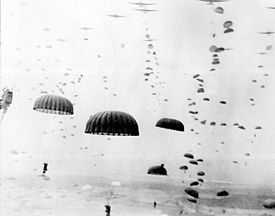 Invasion by air is an invention of the 20th century and modern warfare
. The idea involves sending military units into a territory by aircraft
. The aircraft either land, allowing the military units to debark and attempt their objective, or the troops exit the aircraft while still in the air, using parachute
s or similar devices to land in the territory being invaded. Many times air assaults have been used to pave the way for a ground- or sea-based invasion, by taking key positions deep behind enemy lines such as bridges and crossroads, but an entirely air-based invasion has never succeeded. Two immediate problems are resupply and reinforcement. A large airborne force cannot be adequately supplied without meeting up with ground forces; an airborne force too small simply places themselves into an immediate envelopment situation. Arguments in favor of this method generally relate to the ability to target specific areas that may not necessarily be easily accessible by land or sea, a greater chance of surprising the enemy and overwhelming defensive structures, and, in many cases, the need for a reduced number of forces due to the element of surprise. Arguments against this method typically involve capacity to perform such an invasion—such as the sheer number of planes that would be needed to carry a sufficient number of troops—and the need for a high level of intelligence
in order for the invasion to be successful.
The closest examples to a true air invasion are the Battle of Crete
, Operation Thursday (the Chindits
second operation during the Burma Campaign
) and Operation Market Garden
. The latter was an assault on the German-occupied Netherlands
conducted in September 1944. Nearly 35,000 men were dropped by parachute and glider
into enemy territory in an attempt to capture bridges from the Germans and make way for the Allies' advance. However, even with such a massive force taking the Germans completely by surprise, the assault was a tactical failure and after 9 days of fighting the Allies managed only to escape back to their own lines, having sustained over 18,000 casualties. In the 21st century, as vast improvements are made in anti-aircraft defenses, it seems that the air invasion is a strategy whose time may never come.
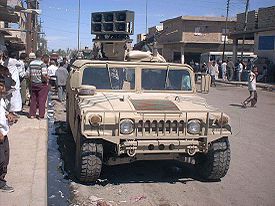 Once political boundaries and military lines have been breached, pacification
of the region is the final, and arguably the most important, goal of the invading force. After the defeat of the regular military, or when one is lacking, continued opposition to an invasion often comes from civilian or paramilitary resistance movement
s. Complete pacification of an occupied country can be difficult, and usually impossible, but popular support is vital to the success of any invasion.
Media propaganda
such as leaflets, books, and radio broadcasts can be used to encourage resistance fighters to surrender and to dissuade others from joining their cause. Pacification, often referred to as "the winning of hearts and minds", reduces the desire for civilians to take up resistance. This may be accomplished through reeducation, allowing conquered citizens to participate in their government, or, especially in impoverished or besieged areas, simply by providing food, water, and shelter. Sometimes displays of military might are used; invading forces may assemble and parade through the streets of conquered towns, attempting to demonstrate the futility of any further fighting. These displays may also include public executions
of enemy soldiers, resistance fighters, and other conspirators. Particularly in antiquity, the death or imprisonment of a popular leader was sometimes enough to bring about a quick surrender. However, this has often had the unintended effect of creating martyr
s around which popular resistance can rally. An example of which was Sir William Wallace
, who, centuries after his execution by the English, is still a symbol of Scottish
nationalism.
Many factors need to be taken into account when deciding which tactics to use during occupation; when the wrong decisions are made, it can lead to years (or even centuries) of continued resistance. The problems caused by continued resistance may be minimal if the conquered territory is only needed for a short-term tactical purpose, but can become extremely difficult if the intent is to colonize
the area or hold the land indefinitely.
Historic alternatives to pacification have included voluntary and involuntary relocation, as well as the eradication of the local population.
, Xerxes I
spent three years amassing supplies from all over Asia; Herodotus
wrote that the Persian army was so large it "drank the rivers dry".
In most invasions, even in modern times, many fresh supplies are gathered from the invaded territories themselves. Before the laws of war
, invaders often relied heavily on the supplies they would win by conquering towns along the way. During the Second Punic War
, for example, Hannibal
diverted his army to conquer cities simply to gather supplies; his strategy in crossing the Alps
necessitated traveling with as few provisions as possible, expecting the Roman
stores to sustain them when they had breached the border. The scorched earth
tactics used in Russia forced Napoleon
to withdraw his forces due to lack of food and shelter. Today, the Law of land warfare forbids looting
and the confiscation of private property, but local supplies, particularly perishables, are still purchased when possible for use by occupying forces, and airplanes often use parachutes to drop supplies to besieged forces. Even as rules become stricter, the necessities of war become more numerous; in addition to food, shelter, and ammunition, today's militaries require fuel, batteries, spare mechanical parts, electronic equipment, and many other things. In the United States, the Defense Logistics Agency
employs over 22,000 civilians with the sole task of logistics support, and 30,000 soldiers graduate from the U.S. Army Logistics Management College
each year.
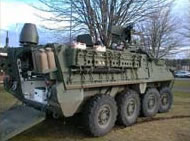 Another consideration is the importance of leadership being able to communicate with the invasion force. In ancient times, this often meant that a king needed to lead his armies in person to be certain his commands were followed, as in the case of Alexander the Great. At that time, the skills needed to lead troops in battle were as important as the skills needed to run a country during peacetime. When it was necessary for the king to be elsewhere, messengers would relay updates back to the rear, often on horseback or, in cases such as the Battle of Marathon
, with swift runners.
When possible, sloop
s and cutters were used to relay information by sea. The HMS Pickle
brought Britain the first news that Nelson
had defeated the French forces at the Battle of Trafalgar
.
The development of Morse Code
, and later voice communications by radio and satellite, have allowed even small units of skirmishers to remain in contact with the larger invasion force, to verify orders or call for artillery support and air strikes. These communications were critical to the German blitzkrieg
strategy, as infantry commanders relayed defensive positions to tanks and bombers.
". In this case, one or more combatant groups are controlled not by a centralized state government but by independent leadership, and these groups may be made up of civilians, foreign agents, mercenaries
, politicians, religious leaders, and members of the regular military. These groups act in smaller numbers, are not confined by borders, and do not necessarily depend on the direct support of the state. Groups such as these are not easily defeated by straightforward invasion, or even constant occupation; the country's regular army may be defeated, the government may be replaced, but asymmetric warfare
on the part of these groups can be continued indefinitely. Because regular armed forces units do not have the flexibility and independence of small covert cells, many believe that the concept of a powerful occupying force actually creates a disadvantage.
An opposing theory holds that, in response to extremist ideology and unjust governments, an invasion can change the government and reeducate the people, making prolonged resistance unlikely and averting future violence. This theory acknowledges that these changes may take time—generations, in some cases—but holds that immediate benefits may still be won by reducing membership in, and choking the supply lines of, these covert cells. Proponents of the invasion strategy in such conflicts maintain the belief that a strong occupying force can still succeed in its goals on a tactical level, building upon numerous small victories, similar to a war of attrition.
Contemporary debate on this issue is still fresh; neither side can claim to know for certain which strategies will ultimately be effective in defeating non-state combatants. Opponents of the invasion strategy point to a lack of examples in which occupying or peacekeeping
forces have met with conclusive success. They also cite continuing conflicts such as Northern Ireland
, Israel
, Chechnya
, and Iraq
, as well as examples which they claim ultimately proved to be failures, such as Lebanon
, and Afghanistan
. Supporters of the invasion strategy hold that it is too soon to call those situations failures, and that patience is needed to see the plan through. Some say that the invasions themselves have, in fact, been successful, but that political opponents and the international media skew the facts for sensationalism or political gain.
, often accompanied by requirements to pay reparations
or tribute
to the victor. In other cases the results of a successful invasion may simply be a return to the status quo
; this can be seen in wars of attrition
, when the destruction of personnel and supplies is the main strategic objective, or where a nation previously subdued and currently occupied by an aggressive third party is restored to control of its own affairs (i.e. Western Europe following the Normandy landings in 1944, or Kuwait following the defeat of Iraq in 1991). In some cases, the invasion may be strategically limited to a geographical area, which is carved into a separate state as with the Bangladesh Liberation War
in 1971.
, at the peak of second
and third generation warfare
. The vast numbers of the armies involved combined with innovative tactics and technology lent themselves to invasions on a scale that had not been seen before and have not been seen since.
The largest land invasion in history was 1941's Operation Barbarossa
, in which 3,900,000 German
troops blitzkrieg
ed into the Soviet Union
. Initially the Germans advanced with great ease and nearly captured Moscow
, also laying siege to Leningrad, but soon found themselves fighting the harsh Russian winter as well as stiffer Soviet resistance, and their advance ground to a halt at Stalingrad
in early 1943.
In the largest amphibious invasion in history, 156,215 Allied troops landed at Normandy to retake France from the occupying German forces. Though it was costly in terms of men and materials, the invasion advanced the Western Front
and forced Germany to redirect its forces from the Russian
and Italian
fronts. In hindsight, the operation is also credited with defining the Western boundary of Soviet communism
; had the Allies not advanced, it is conceivable that the Soviet Union would have controlled more of Europe than it eventually did.
, during the course of conquering much of what is now known as the Middle East
, defeated the Kingdom of Israel in 722 BC and sent its inhabitants into exile. This presaged future Greek and Roman conquest and, later, the Arab conquests and the Crusades
. To this day, the region remains contested.
Persian invasion of Greece
In 480 BC, Xerxes I of Persia
moved his armies against the loose confederation of city-state
s in what is modern-day Greece. One of the most famous battles of the war, fought at Thermopylae
, is an early example of using a chokepoint
to tactical advantage. Although Xerxes' army was vast—modern estimates put it at 1,000,000—the defending Greeks were able to hold their ground for days by using a narrow mountain pass to slow the Persian advance. The invasion also demonstrates the importance of communication and supply routes; although Xerxes' land battles were almost all Persian victories, the Greeks managed to cut off his naval support and the Persians were forced to withdraw. The invasion served to unify the various city-states, bringing about the formation of the Greek nation.
, conquering Babylon
, and taking control of the Persian Empire. Alexander's influence in mixing cultures led to the Hellenistic Age
of Mesopotamia
and North Africa.
Roman invasion of Britain
The main invasion force under Aulus Plautius
sailed in three divisions, and is generally believed to have landed at Richborough
in Kent
, although parts may have landed elsewhere (see Site of the Claudian invasion of Britain
). The army was composed of four legions
. The Britons
, led by Togodumnus
and Caratacus
of the Catuvellauni, were reluctant to fight a pitched battle, relying instead on guerrilla tactics
. However, Plautius defeated first Caratacus, then Togodumnus, on the rivers Medway
and Thames
. Vespasian
took a force westwards subduing tribes and capturing oppida
as he went, going at least as far as Exeter
and probably reaching Bodmin
. Roman province
was established in the conquered territory and Plautius became governor of the new province.
The Arab conquests
Following the Islam
ic prophet
Muhammad
's unification of the Arabian peninsula
in 632, his successors, the Caliph
s began a series of invasions of the Middle East, North Africa, Southern Europe, and South Asia. Lasting slightly more than a century, these conquests brought much of the ancient world under Arab rule.
Viking invasions
In 793 a Viking
raid on Christian
monastery at Lindisfarne in north-east England
caused much consternation throughout the Christian west, and is now often taken as the beginning of the age of Viking raids. Vikings were Scandinavia
n warrior
s, pirates and traders who raided the coasts of Britain
, Ireland
and mainland Europe as far as Al-Andalus
and Italy
from the late 8th–11th century. They also plundered all the coasts of the Baltic Sea
, ascending the rivers of Eastern Europe as far as the Black Sea
and Persia. The Varangians
are believed to be Vikings originally raiding the Rus
, who in turn were retained as mercenaries for protection against invaders.
Hungarian invasions of Europe
Around 896, probably under the leadership of Árpád
, Hungarians (Magyars) crossed the Carpathians
and entered the Carpathian Basin. Almost every year after 900 they led raids against the Catholic West and Byzantine East. In 907 they defeated the Bavarians near Bratislava
, destroying their army and laying Great Moravia
, Germany
, France
and Italy
open to Magyar raids. These raids were fast and devastating. The Magyars defeated Louis the Child
's united Frankish
Imperial Army near Augsburg
in 910. From 917-925, Magyars raided through Basle, Alsace
, Burgundy, Saxony
, and Provence
. In 937, they raided France as far west as Reims
and Italy as far as Otranto
in the south. Magyar expansion was checked at the Battle of Lechfeld
in 955, although raids on the Byzantine Empire
continued until 970.
The Norman invasion of England
The 1066 invasion of England
by William the Conqueror
, and the decisive battle which won the war, the Battle of Hastings
, were to have profound effects on the historical and societal development of Britain, and the English language
.
The Crusades
In a series of nine different major invasions from 1095 to 1291, the Catholic Church
and various European states attempted to liberate the Holy Land
for Christendom
from its Muslim
conquerors, with varied success until the fall of Acre
in 1291. As Jerusalem changed hands and Europe
an forces moved back and forth, in-roads to the Levant
were reestablished and the cultures mixed on a large scale for the first time in centuries.
orchestrated a series of invasions that united much of Asia. Relying heavily on cavalry, the Mongol hordes were able to travel quickly yet were well-supplied. The Mongol Empire
reached its largest extent by 1279, considered the largest contiguous empire in history, composed of 35 million km² (13.8 million miles²) of territory stretched across the continent, though the empire was already fragmented by this time. His eastward invasion of China created the Yuan Dynasty
, and his westward invasion of Kievan Rus'
further linked Europe and Asia by reestablishing the Silk Road
.
Mongol invasion of Europe
The 13th century, when the Mongol Empire
came to power, is often called the "Age
of the Mongols". Mongol armies expanded westward under the command of Batu Khan
. Their western conquests included almost all of Russia
(save Novgorod, which became a vassal), half of Hungary
, and Poland
. Mongolian records indicate that Batu Khan was planning a complete conquest of the remaining European powers, beginning with a winter attack on Austria
, Italy
and Germany
, when he was recalled to Mongolia
upon the death of Great Khan Ögedei
.
descent Timur the Lame
conquered much of western and central Asia
. In 1398, Timur invaded India on the pretext that the Muslim sultans of Delhi were too much tolerant to their Hindu
subjects. He subjugated Multan
and Dipalpur
in modern day Pakistan
and in modern day India
left Delhi
in such ruin that it is said for two months "not a bird moved wing in the city".
Spanish Conquest of the Aztec Empire
The last of the Aztec
empire was destroyed at Tenochtitlan in 1521, by a combination of Spanish
and native forces. Aided by at least 20,000 local Tlaxcala
n warriors, Hernán Cortés
marched into the city. Although he and his men were expelled, they returned with ships and laid siege to the capital. Though an epidemic of smallpox
took its toll on the Aztecs, Cortes' conquest was the culmination of Spanish strategy in the Americas: He used promises to gain native allies, and he combined superior technology with patience while he struck at Tenochtitlan from the sea. This opened the door to Spanish colonization of mainland Mesoamerica
n cultures.
Somali invasion of the Ethiopian Empire
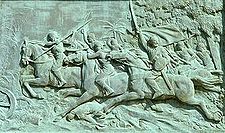 In the year 1529, the Adal Sultanate
of Somalia, declared war on the Ethiopian Empire
. The Imam Ahmad ibn Ibrihim al-Ghazi
(nicknamed Gurey in Somali and Gragn in Amharic (ግራኝ Graññ), both meaning "the left-handed") came close to extinguishing the ancient realm of Ethiopia, and converting all of its subjects to Islam; the intervention of the European Cristóvão da Gama
, son of the famous navigator Vasco da Gama
, helped Christians. And the Ottomans
aided the Somalis. However, both polities exhausted their resources and manpower in this conflict, allowing the northward migration of the Oromo
into their present homelands to the north and west of Addis Ababa. Some historians also argue that this conflict proved, through their use on both sides, the value of firearms such as the matchlock musket
, cannons, and the arquebus
over traditional weapons.
, with the ambition of conquering Ming
China, invaded Korea with his daimyō
and their troops in 1592 and again in 1597. Japanese prevailed on land, but following several defeats by Korean and Ming China forces and Hideyoshi's death, Japanese troops were withdrawn in 1598.
Manchu invasion of China
The fall of the Ming Dynasty
was a protracted affair, its roots beginning as early as 1600 with the emergence of the Manchu
under Nurhaci
. Under the brilliant commander, Yuan Chonghuan
, the Ming was able to repeatedly fight off the Manchus, notably in 1626 at Ning-yuan and in 1628. On May 26, 1644, Beijing fell to a rebel army led by Li Zicheng. Seizing their chance, the Manchus crossed the Great Wall after Ming border general Wu Sangui
opened the gates at Shanhai Pass
, and quickly overthrew Li's short-lived Shun Dynasty
. Despite the loss of Beijing
and the death of the emperor, Ming power was by no means destroyed. Nanjing, Fujian, Guangdong, Shanxi, and Yunnan were all strongholds of Ming resistance. Each bastion of resistance was individually defeated by the Qing
until 1662, when the last real hopes of a Ming revival died with the Yongli emperor, Zhu Youlang. Complete pacification of China would not be complete until 1683.
, also sometimes referred as the Turkish wars, marked an essential part of the history of southeastern Europe. The Ottoman Empire
, leading Islamic state at that time, started its westward expansion into the European continent in the middle of the 14th century, until it was stopped by the Holy League
, an alliance of Habsburg
, Hungarian, German and Polish forces, at the Battle of Vienna
in 1683.
Dutch invasion of England
The Glorious Revolution is the overthrow of King James II of England
by a union of English Parliamentarians with the Dutch stadtholder
William III of Orange-Nassau (William of Orange). William's successful invasion of England with a Dutch fleet and army led to his ascending the English throne as William III of England
jointly with his wife Mary II of England
. The Revolution permanently ended any chance of Catholicism becoming re-established in England. It has been argued that James's overthrow began modern English parliamentary democracy: never since has the monarch held absolute power, and the Bill of Rights 1689
has become one of the most important documents in the political history of Britain.
led his Grande Armée into Russia. At that point, his invasion force of 691,500 men was the largest ever assembled, and for several weeks the Russian Army
could do nothing but retreat and try to buy time. The first major battle between the two armies, at the Russian defenses of Borodino
, was one of the bloodiest single days in human history, with estimates of at least 65,000 dead. But although the Russian retreat allowed the French to capture Moscow
, they were left depleted and without shelter or supplies. Napoleon was forced to withdraw. Although this invasion was not the end of Napoleon, it is credited with fostering a powerful patriotism in Russia
that would lead to the strengthening of the nation in the 19th and 20th centuries.
European colonialism and imperialism
In the late 15th century, the Christian nations
of Western Europe
began the modern age of colonialism
with the "Age of Discovery
", led by the Spanish colonization of the Americas
and Portuguese Empire
in the Americas and along the coasts of Africa
, the Middle East
, India
, and East Asia
. The Roman Catholic Church
played a role in their overseas activities, and the enormous trade profits and riches from gold
and silver
mines allowed them to finance costly religious war
s in Europe. During the 16th and 17th centuries, Britain
, France
and Holland
established their own overseas empires in direct competition with each other as well as the earlier Iberian
ones, while the land-based Russian Empire
expanded across northern and Central Asia
. These activities resulted in the invasions of the Indian subcontinent
to set up the extensive European colonies in India, as well as the invasion of Africa called the Scramble for Africa
and the colonization of the East Indies
. In the late 19th century, the Germans, Italians
and the Belgian
s also joined in, beginning the third wave of invasions that would subdue native peoples and economies, and expand European-controlled territory over the majority of the globe.
Decolonization
began in the 19th century and picked up pace only after World War II
left the European empires weakened and struggling to subdue the native resistance across the vast expanses of their empires. Debates upon the negative vs. positive impact and evaluation of colonialism and colonization
—such as those of colonial Christianization
, genocide
, third world debt
, slavery
, abolition of slavery
, infrastructure
s and medical advances —upon the colonizer and the colonized continue to shape global and national politics to this day.
Nazi invasion of the Soviet Union
The Eastern Front of the European Theatre of World War II
encompassed the conflict in central
and eastern Europe
from June 22, 1941 to May 9, 1945. It was the largest theatre of war in history in terms of numbers of soldiers, equipment and casualties and was notorious for its unprecedented ferocity, destruction, and immense loss of life. The fighting involved millions of German and Soviet
troops along a broad front hundreds of kilometres long. It was by far the deadliest single theatre of World War II
. Scholars now believe that as many as 27 million Soviet citizens died during the war, including some 8.7 million soldiers who fell in battle against Hitler's armies or died in POW camps. Millions of civilians died from starvation
, exposure, atrocities, and massacres.
Soviet Empire
The USSR, which had grafted onto the Russian Soviet Federative Socialist Republic
several countries that had had short-lived independence (Ukraine
, Georgia
, Armenia
, Azerbaijan
, and the lands of Central Asia
), never reconciled itself to having lost West Ukraine
, West Belarus
, Bessarabia
, and the three Baltic states
(territories which formerly belonged to the Russian Empire
) in the course of 1919-21. Thus they aimed to annex these territories as well as to obtain a buffer zone from Finland
in 1939-40 (see Soviet-Finnish War). After the Soviet invasion of Poland
following the corresponding German invasion
that marked the start of World War II
in 1939, the Soviet Union
annexed eastern parts (so-called "Kresy
") of the Second Polish Republic
(see Molotov-Ribbentrop Pact
). In 1940 the Soviet Union annexed Estonia
, Latvia
, Lithuania
, Bessarabia
and Bukovina
(see Occupation of Baltic states).
During the Cold War
, the term Eastern Bloc
(or Soviet Bloc) was used to refer to the Soviet Union
and countries it controlled in Central
and Eastern Europe
(Bulgaria
, Czechoslovakia
, East Germany, Hungary
, Poland
, Romania
). Hungary
was invaded by the Soviet Army in 1956 after it had overthrown its pro-Soviet government and replaced it with one that sought a more democratic communist path independent of Moscow; when Polish communist leaders tried to elect Władysław Gomułka as First Secretary they were issued an ultimatum by Soviet military that occupied Poland
ordering them to withdraw election of Gomulka for the First Secretary or be "crushed by Soviet tanks". Czechoslovakia
was invaded in 1968 after a period of liberalization known as the Prague Spring
. The latter invasion was codified in formal Soviet policy as the Brezhnev Doctrine
. In 1979 the Soviet Union invaded Afghanistan
to ensure that a pro-Soviet regime would be in power in the country (see Soviet war in Afghanistan
). Poland was afraid of getting invaded by the USSR during the early 1980s due to the strikes associated with Solidarity which called for an end to the communist government there.
Offensive (military)
An offensive is a military operation that seeks through aggressive projection of armed force to occupy territory, gain an objective or achieve some larger strategic, operational or tactical goal...
consisting of all, or large parts of the armed forces
Armed forces
The armed forces of a country are its government-sponsored defense, fighting forces, and organizations. They exist to further the foreign and domestic policies of their governing body, and to defend that body and the nation it represents from external aggressors. In some countries paramilitary...
of one geopolitical
Geopolitics
Geopolitics, from Greek Γη and Πολιτική in broad terms, is a theory that describes the relation between politics and territory whether on local or international scale....
entity aggressively entering territory controlled by another such entity
Entity
An entity is something that has a distinct, separate existence, although it need not be a material existence. In particular, abstractions and legal fictions are usually regarded as entities. In general, there is also no presumption that an entity is animate.An entity could be viewed as a set...
, generally with the objective of either conquering, liberating or re-establishing control or authority over a territory, forcing the partition of a country, altering the established government
Government
Government refers to the legislators, administrators, and arbitrators in the administrative bureaucracy who control a state at a given time, and to the system of government by which they are organized...
or gaining concessions from said government, or a combination thereof. An invasion can be the cause of a war
War
War is a state of organized, armed, and often prolonged conflict carried on between states, nations, or other parties typified by extreme aggression, social disruption, and usually high mortality. War should be understood as an actual, intentional and widespread armed conflict between political...
, be a part of a larger strategy to end a war, or it can constitute an entire war in itself. Due to the large scale of the operations associated with invasions, they are usually strategic
Strategy
Strategy, a word of military origin, refers to a plan of action designed to achieve a particular goal. In military usage strategy is distinct from tactics, which are concerned with the conduct of an engagement, while strategy is concerned with how different engagements are linked...
in planning and execution.
Definition
The term invasion usually denotes a strategicMilitary strategy
Military strategy is a set of ideas implemented by military organizations to pursue desired strategic goals. Derived from the Greek strategos, strategy when it appeared in use during the 18th century, was seen in its narrow sense as the "art of the general", 'the art of arrangement' of troops...
endeavor of substantial magnitude; because the goals of an invasion are usually large-scale and long-term, a sizeable force is needed to hold territory, and protect the interests of the invading entity. Smaller-scale, tactical
Military tactics
Military tactics, the science and art of organizing an army or an air force, are the techniques for using weapons or military units in combination for engaging and defeating an enemy in battle. Changes in philosophy and technology over time have been reflected in changes to military tactics. In...
cross-border
Border
Borders define geographic boundaries of political entities or legal jurisdictions, such as governments, sovereign states, federated states and other subnational entities. Some borders—such as a state's internal administrative borders, or inter-state borders within the Schengen Area—are open and...
actions, such as skirmishes
Skirmisher
Skirmishers are infantry or cavalry soldiers stationed ahead or alongside a larger body of friendly troops. They are usually placed in a skirmish line to harass the enemy.-Pre-modern:...
, sortie
Sortie
Sortie is a term for deployment or dispatch of one military unit, be it an aircraft, ship, or troops from a strongpoint. The sortie, whether by one or more aircraft or vessels, usually has a specific mission....
s, raids
Raid (military)
Raid, also known as depredation, is a military tactic or operational warfare mission which has a specific purpose and is not normally intended to capture and hold terrain, but instead finish with the raiding force quickly retreating to a previous defended position prior to the enemy forces being...
, infiltration
Infiltration tactics
In warfare, infiltration tactics involve small, lightly equipped infantry forces attacking enemy rear areas while bypassing enemy front line strongpoints and isolating them for attack by follow-up troops with heavier weapons.-Development during World War I:...
s or guerrilla warfare
Guerrilla warfare
Guerrilla warfare is a form of irregular warfare and refers to conflicts in which a small group of combatants including, but not limited to, armed civilians use military tactics, such as ambushes, sabotage, raids, the element of surprise, and extraordinary mobility to harass a larger and...
, are not generally considered invasions. A military endeavor to take back territory that is tenuously held by an initial invader during the course of war is instead generally called a counter-offensive
Counter-offensive
A counter-offensive is the term used by the military to describe large-scale, usually strategic offensive operations by forces that had successfully halted an enemy's offensive, while occupying defensive positions....
.
Military operations that occur within the territory of a single geopolitical entity are sometimes termed "invasions" if armed forces enter into a well defined part of that territory that, at the time of the operation, was completely under the control of armed forces of another faction in a civil war
Civil war
A civil war is a war between organized groups within the same nation state or republic, or, less commonly, between two countries created from a formerly-united nation state....
or insurrection. For example, many such operations of both the American Revolutionary War
American Revolutionary War
The American Revolutionary War , the American War of Independence, or simply the Revolutionary War, began as a war between the Kingdom of Great Britain and thirteen British colonies in North America, and ended in a global war between several European great powers.The war was the result of the...
and the American Civil War
American Civil War
The American Civil War was a civil war fought in the United States of America. In response to the election of Abraham Lincoln as President of the United States, 11 southern slave states declared their secession from the United States and formed the Confederate States of America ; the other 25...
are called invasions even though they did not involve entry of armies from foreign nations.
The term does not imply the presence or lack of justification for the action, and the morality or immorality of a military operation does not determine whether it is so termed. For example, two sets of World War II military operations—by Germans against Poland in 1939 and by Allies against Nazi controlled France in 1944—are often called the Invasion of Poland
Invasion of Poland (1939)
The Invasion of Poland, also known as the September Campaign or 1939 Defensive War in Poland and the Poland Campaign in Germany, was an invasion of Poland by Germany, the Soviet Union, and a small Slovak contingent that marked the start of World War II in Europe...
and Invasion of Normandy, respectively. Both military operations are properly called invasions because they involved an outside force entering territory not under its authority or control at the time.
History
ArchaeologicalArchaeology
Archaeology, or archeology , is the study of human society, primarily through the recovery and analysis of the material culture and environmental data that they have left behind, which includes artifacts, architecture, biofacts and cultural landscapes...
evidence indicates that invasions have been frequent occurrences since prehistory
Prehistory
Prehistory is the span of time before recorded history. Prehistory can refer to the period of human existence before the availability of those written records with which recorded history begins. More broadly, it refers to all the time preceding human existence and the invention of writing...
. In antiquity, before radio
Radio
Radio is the transmission of signals through free space by modulation of electromagnetic waves with frequencies below those of visible light. Electromagnetic radiation travels by means of oscillating electromagnetic fields that pass through the air and the vacuum of space...
communication
Communication
Communication is the activity of conveying meaningful information. Communication requires a sender, a message, and an intended recipient, although the receiver need not be present or aware of the sender's intent to communicate at the time of communication; thus communication can occur across vast...
s and fast transportation, the only way to ensure adequate reinforcements was to move armies as one massive force. This, by its very nature, led to the strategy of invasion. With invasion came cultural exchanges
Cultural diffusion
In cultural anthropology and cultural geography, cultural diffusion, as first conceptualized by Alfred L. Kroeber in his influential 1940 paper Stimulus Diffusion, or trans-cultural diffusion in later reformulations, is the spread of cultural items—such as ideas, styles, religions, technologies,...
in government, religion
Religion
Religion is a collection of cultural systems, belief systems, and worldviews that establishes symbols that relate humanity to spirituality and, sometimes, to moral values. Many religions have narratives, symbols, traditions and sacred histories that are intended to give meaning to life or to...
, philosophy
Philosophy
Philosophy is the study of general and fundamental problems, such as those connected with existence, knowledge, values, reason, mind, and language. Philosophy is distinguished from other ways of addressing such problems by its critical, generally systematic approach and its reliance on rational...
, and technology
Technology
Technology is the making, usage, and knowledge of tools, machines, techniques, crafts, systems or methods of organization in order to solve a problem or perform a specific function. It can also refer to the collection of such tools, machinery, and procedures. The word technology comes ;...
that shaped the development of much of the ancient world.
Defenses
Defense (military)
Defense has several uses in the sphere of military application.Personal defense implies measures taken by individual soldiers in protecting themselves whether by use of protective materials such as armor, or field construction of trenches or a bunker, or by using weapons that prevent the enemy...
to delay or forestall an invasion. In addition to utilizing geographical barriers such as river
River
A river is a natural watercourse, usually freshwater, flowing towards an ocean, a lake, a sea, or another river. In a few cases, a river simply flows into the ground or dries up completely before reaching another body of water. Small rivers may also be called by several other names, including...
s, marsh
Marsh
In geography, a marsh, or morass, is a type of wetland that is subject to frequent or continuous flood. Typically the water is shallow and features grasses, rushes, reeds, typhas, sedges, other herbaceous plants, and moss....
es, or rugged terrain
Terrain
Terrain, or land relief, is the vertical and horizontal dimension of land surface. When relief is described underwater, the term bathymetry is used...
, these measures have historically included fortification
Fortification
Fortifications are military constructions and buildings designed for defence in warfare and military bases. Humans have constructed defensive works for many thousands of years, in a variety of increasingly complex designs...
s. Such a defense can be intended to actively prevent invading forces from entering the country by means of an extended and well-defended barrier; the Great Wall of China
Great Wall of China
The Great Wall of China is a series of stone and earthen fortifications in northern China, built originally to protect the northern borders of the Chinese Empire against intrusions by various nomadic groups...
, Hadrian's Wall
Hadrian's Wall
Hadrian's Wall was a defensive fortification in Roman Britain. Begun in AD 122, during the rule of emperor Hadrian, it was the first of two fortifications built across Great Britain, the second being the Antonine Wall, lesser known of the two because its physical remains are less evident today.The...
, and the Danewerk are famous examples. Such barriers have also included trench
Trench warfare
Trench warfare is a form of occupied fighting lines, consisting largely of trenches, in which troops are largely immune to the enemy's small arms fire and are substantially sheltered from artillery...
lines and, in more modern times, minefields, camera
Closed-circuit television
Closed-circuit television is the use of video cameras to transmit a signal to a specific place, on a limited set of monitors....
s, and motion-sensitive
Motion detection
Motion detection is a process of confirming a change in position of an object relative to its surroundings or the change in the surroundings relative to an object. This detection can be achieved by both mechanical and electronic methods...
sensor
Sensor
A sensor is a device that measures a physical quantity and converts it into a signal which can be read by an observer or by an instrument. For example, a mercury-in-glass thermometer converts the measured temperature into expansion and contraction of a liquid which can be read on a calibrated...
s. However, these barriers can require a large military force to provide the defense, as well as maintain the equipment and positions, which can impose a great economic
Economics
Economics is the social science that analyzes the production, distribution, and consumption of goods and services. The term economics comes from the Ancient Greek from + , hence "rules of the house"...
burden on the country. Some of those same techniques can also be turned against defenders, used to keep them from escape or resupply. During Operation Starvation
Operation Starvation
Operation Starvation was an American naval mining operation conducted in World War II by the Army Air Force, in which vital water routes and ports of Japan were mined by air in order to disrupt enemy shipping.-Operation:...
, Allied forces
Allies of World War II
The Allies of World War II were the countries that opposed the Axis powers during the Second World War . Former Axis states contributing to the Allied victory are not considered Allied states...
used airdropped mines to severely disrupt Japanese
Empire of Japan
The Empire of Japan is the name of the state of Japan that existed from the Meiji Restoration on 3 January 1868 to the enactment of the post-World War II Constitution of...
logistical operations within their own borders.
Castle
A castle is a type of fortified structure built in Europe and the Middle East during the Middle Ages by European nobility. Scholars debate the scope of the word castle, but usually consider it to be the private fortified residence of a lord or noble...
s or forts placed near a border. These structures are designed to delay an invasion long enough for the defending nation to mobilize an army of size sufficient for defense or, in some cases, counter-invasion—such as, for example, the Maginot Line
Maginot Line
The Maginot Line , named after the French Minister of War André Maginot, was a line of concrete fortifications, tank obstacles, artillery casemates, machine gun posts, and other defences, which France constructed along its borders with Germany and Italy, in light of its experience in World War I,...
. Forts can be positioned so that the garrison
Garrison
Garrison is the collective term for a body of troops stationed in a particular location, originally to guard it, but now often simply using it as a home base....
s can interdict the supply lines of the invaders. The theory behind these spaced forts is that the invader cannot afford to bypass these defenses, and so must lay siege
Siege
A siege is a military blockade of a city or fortress with the intent of conquering by attrition or assault. The term derives from sedere, Latin for "to sit". Generally speaking, siege warfare is a form of constant, low intensity conflict characterized by one party holding a strong, static...
to the structures.
Mechanized Warfare
Mechanized Warfare is the sixth studio album released by American power metal band Jag Panzer, released in 2001. This album is more progressive than the band's previous work...
have made lighter, more mobile defenses desirable to military planners. The obsolescence of large fortifications was displayed by the failure of the Maginot Line
Maginot Line
The Maginot Line , named after the French Minister of War André Maginot, was a line of concrete fortifications, tank obstacles, artillery casemates, machine gun posts, and other defences, which France constructed along its borders with Germany and Italy, in light of its experience in World War I,...
in the beginning of World War Two. Nations defending against modern invasions normally use large population centers such as cities
City
A city is a relatively large and permanent settlement. Although there is no agreement on how a city is distinguished from a town within general English language meanings, many cities have a particular administrative, legal, or historical status based on local law.For example, in the U.S...
or town
Town
A town is a human settlement larger than a village but smaller than a city. The size a settlement must be in order to be called a "town" varies considerably in different parts of the world, so that, for example, many American "small towns" seem to British people to be no more than villages, while...
s as defensive points. The invader must capture these points to destroy the defender's ability to wage war. The defender uses mobile armored
Armoured warfare
Armoured warfare or tank warfare is the use of armoured fighting vehicles in modern warfare. It is a major component of modern methods of war....
and infantry
Infantry
Infantrymen are soldiers who are specifically trained for the role of fighting on foot to engage the enemy face to face and have historically borne the brunt of the casualties of combat in wars. As the oldest branch of combat arms, they are the backbone of armies...
divisions to protect these points, but the defenders are still very mobile and can normally retreat. A prominent example of the use of cities as fortifications can be seen in the Iraqi Army's stands in the 2003 invasion of Iraq
2003 invasion of Iraq
The 2003 invasion of Iraq , was the start of the conflict known as the Iraq War, or Operation Iraqi Freedom, in which a combined force of troops from the United States, the United Kingdom, Australia and Poland invaded Iraq and toppled the regime of Saddam Hussein in 21 days of major combat operations...
at Baghdad
Baghdad
Baghdad is the capital of Iraq, as well as the coterminous Baghdad Governorate. The population of Baghdad in 2011 is approximately 7,216,040...
, Tikrit
Tikrit
Tikrit is a town in Iraq, located 140 km northwest of Baghdad on the Tigris river . The town, with an estimated population in 2002 of about 260,000 is the administrative center of the Salah ad Din Governorate.-Ancient times:...
and Basra
Basra
Basra is the capital of Basra Governorate, in southern Iraq near Kuwait and Iran. It had an estimated population of two million as of 2009...
in the major combat in the Second Gulf War. A defender can also use these mobile assets to precipitate a counteroffensive like the Soviet
Soviet Union
The Soviet Union , officially the Union of Soviet Socialist Republics , was a constitutionally socialist state that existed in Eurasia between 1922 and 1991....
Red Army
Red Army
The Workers' and Peasants' Red Army started out as the Soviet Union's revolutionary communist combat groups during the Russian Civil War of 1918-1922. It grew into the national army of the Soviet Union. By the 1930s the Red Army was among the largest armies in history.The "Red Army" name refers to...
at the Battle of Kursk
Battle of Kursk
The Battle of Kursk took place when German and Soviet forces confronted each other on the Eastern Front during World War II in the vicinity of the city of Kursk, in the Soviet Union in July and August 1943. It remains both the largest series of armored clashes, including the Battle of Prokhorovka,...
or the Northern Alliance in Afghanistan
Afghanistan
Afghanistan , officially the Islamic Republic of Afghanistan, is a landlocked country located in the centre of Asia, forming South Asia, Central Asia and the Middle East. With a population of about 29 million, it has an area of , making it the 42nd most populous and 41st largest nation in the world...
.
However, static emplacements remain useful in both defense against naval attacks and defense against air attacks
Anti-aircraft warfare
NATO defines air defence as "all measures designed to nullify or reduce the effectiveness of hostile air action." They include ground and air based weapon systems, associated sensor systems, command and control arrangements and passive measures. It may be to protect naval, ground and air forces...
. Naval mine
Naval mine
A naval mine is a self-contained explosive device placed in water to destroy surface ships or submarines. Unlike depth charges, mines are deposited and left to wait until they are triggered by the approach of, or contact with, an enemy vessel...
s are still an inexpensive but effective way to defend port
Port
A port is a location on a coast or shore containing one or more harbors where ships can dock and transfer people or cargo to or from land....
s and choke off supply lines. Large static air defense systems that combine antiaircraft guns with missile launchers
Transporter erector launcher
A transporter erector launcher is a vehicle with an integrated prime mover that can carry, elevate to firing position and launch one or more missiles. Such vehicles exist for both surface-to-air missiles and surface-to-surface missiles...
are still the best way to defend against air attacks. Such systems were used effectively by the North Vietnam
North Vietnam
The Democratic Republic of Vietnam , was a communist state that ruled the northern half of Vietnam from 1954 until 1976 following the Geneva Conference and laid claim to all of Vietnam from 1945 to 1954 during the First Indochina War, during which they controlled pockets of territory throughout...
ese around Hanoi
Hanoi
Hanoi , is the capital of Vietnam and the country's second largest city. Its population in 2009 was estimated at 2.6 million for urban districts, 6.5 million for the metropolitan jurisdiction. From 1010 until 1802, it was the most important political centre of Vietnam...
. Also, the United States
United States
The United States of America is a federal constitutional republic comprising fifty states and a federal district...
has invested considerable time and money into the construction of a National Missile Defense
National Missile Defense
National missile defense is a generic term for a type of missile defense intended to shield an entire country against incoming missiles, such as intercontinental ballistic missile or other ballistic missiles. Interception might be by anti-ballistic missiles or directed-energy weapons such as lasers...
system, a static defense grid intended to intercept nuclear intercontinental ballistic missile
Intercontinental ballistic missile
An intercontinental ballistic missile is a ballistic missile with a long range typically designed for nuclear weapons delivery...
s.
Island nation
Island nation
An island country is a state whose primary territory consists of one or more islands or parts of islands. As of 2011, 47 of the 193 UN member states are island countries.-Politics:...
s, such as the United Kingdom
United Kingdom
The United Kingdom of Great Britain and Northern IrelandIn the United Kingdom and Dependencies, other languages have been officially recognised as legitimate autochthonous languages under the European Charter for Regional or Minority Languages...
or Japan
Japan
Japan is an island nation in East Asia. Located in the Pacific Ocean, it lies to the east of the Sea of Japan, China, North Korea, South Korea and Russia, stretching from the Sea of Okhotsk in the north to the East China Sea and Taiwan in the south...
, and continental states with extensive coast
Coast
A coastline or seashore is the area where land meets the sea or ocean. A precise line that can be called a coastline cannot be determined due to the dynamic nature of tides. The term "coastal zone" can be used instead, which is a spatial zone where interaction of the sea and land processes occurs...
s, such as the United States, have utilized a significant naval
Navy
A navy is the branch of a nation's armed forces principally designated for naval and amphibious warfare; namely, lake- or ocean-borne combat operations and related functions...
presence to forestall an invasion of their country, rather than fortifying their border areas. A successful naval defense, however, usually requires a preponderance of naval power and the ability to sustain and service that defense force.
In particularly large nations, the defending force may also retreat
Withdrawal (military)
A withdrawal is a type of military operation, generally meaning retreating forces back while maintaining contact with the enemy. A withdrawal may be undertaken as part of a general retreat, to consolidate forces, to occupy ground that is more easily defended, or to lead the enemy into an ambush...
in order to facilitate a counterattack
Counterattack
A counterattack is a tactic used in response against an attack. The term originates in military strategy. The general objective is to negate or thwart the advantage gained by the enemy in attack and the specific objectives are usually to regain lost ground or to destroy attacking enemy units.It is...
by drawing the invaders deeper into hostile territory. One effect of this tactic is that the invading force becomes too spread out, making supply difficult and making the lines more susceptible to attack. This tactic, although costly, helped the Soviets stop the German advance at Stalingrad
Battle of Stalingrad
The Battle of Stalingrad was a major battle of World War II in which Nazi Germany and its allies fought the Soviet Union for control of the city of Stalingrad in southwestern Russia. The battle took place between 23 August 1942 and 2 February 1943...
. It can also cause the invading force to extend too far, allowing a pincer movement
Pincer movement
The pincer movement or double envelopment is a military maneuver. The flanks of the opponent are attacked simultaneously in a pinching motion after the opponent has advanced towards the center of an army which is responding by moving its outside forces to the enemy's flanks, in order to surround it...
to cut them off from reinforcements. This was the cause of the British defeat at the Battle of Cowpens
Battle of Cowpens
The Battle of Cowpens was a decisive victory by Patriot Revolutionary forces under Brigadier General Daniel Morgan, in the Southern campaign of the American Revolutionary War...
during the American Revolutionary War
American Revolutionary War
The American Revolutionary War , the American War of Independence, or simply the Revolutionary War, began as a war between the Kingdom of Great Britain and thirteen British colonies in North America, and ended in a global war between several European great powers.The war was the result of the...
. Finally, sending too many reinforcements can leave too few defenders in the attackers' territory, allowing a counter-invasion from other areas, as happened in the Second Punic War
Second Punic War
The Second Punic War, also referred to as The Hannibalic War and The War Against Hannibal, lasted from 218 to 201 BC and involved combatants in the western and eastern Mediterranean. This was the second major war between Carthage and the Roman Republic, with the participation of the Berbers on...
.
Methods
There are many different methods by which an invasion can take place, each method having arguments both in their favor and against. These include invasion by land, sea, or air, or any combination of these methods.Invasion by land
Invasion over land is the straightforward entry of armed forcesArmed forces
The armed forces of a country are its government-sponsored defense, fighting forces, and organizations. They exist to further the foreign and domestic policies of their governing body, and to defend that body and the nation it represents from external aggressors. In some countries paramilitary...
into an area using existing land connections, usually crossing border
Border
Borders define geographic boundaries of political entities or legal jurisdictions, such as governments, sovereign states, federated states and other subnational entities. Some borders—such as a state's internal administrative borders, or inter-state borders within the Schengen Area—are open and...
s or otherwise defined zones, such as a demilitarized zone
Demilitarized zone
In military terms, a demilitarized zone is an area, usually the frontier or boundary between two or more military powers , where military activity is not permitted, usually by peace treaty, armistice, or other bilateral or multilateral agreement...
, overwhelming defensive emplacements and structures. Although this tactic often results in a quick victory, troop movements are relatively slow and subject to disruption by terrain and weather. Furthermore, it is hard to conceal plans for this method of invasion, as most geopolitical entities take defensive positions in areas that are most vulnerable to the methods mentioned above.
In modern warfare, invasion by land often takes place after, or sometimes during, attacks on the target by other means. Air strikes and cruise missile
Cruise missile
A cruise missile is a guided missile that carries an explosive payload and is propelled, usually by a jet engine, towards a land-based or sea-based target. Cruise missiles are designed to deliver a large warhead over long distances with high accuracy...
s launched from ships at sea are a common method of "softening" the target. Other, more subtle, preparations may involve secretly garnering popular support, assassinating
Assassination
To carry out an assassination is "to murder by a sudden and/or secret attack, often for political reasons." Alternatively, assassination may be defined as "the act of deliberately killing someone, especially a public figure, usually for hire or for political reasons."An assassination may be...
potentially threatening political or military figures, and closing off supply lines where they cross into neighboring countries. In some cases, those other means of attack eliminate the need for ground assault; the 1945 atomic-bombing of Hiroshima and Nagasaki ultimately made it unnecessary for the Allies to invade the Japanese home islands with infantry troops. In cases such as this, while some ground troops are still needed to occupy the conquered territory, they are allowed to enter under the terms of a treaty
Treaty
A treaty is an express agreement under international law entered into by actors in international law, namely sovereign states and international organizations. A treaty may also be known as an agreement, protocol, covenant, convention or exchange of letters, among other terms...
and as such are no longer invaders. As unmanned, long-range combat evolves, the instances of basic overland invasion become fewer; often the conventional fighting is effectively over before the infantry arrives in the role of peacekeepers (see "Applications in fourth generation warfare" in this article).
Invasion by sea
Invasion by sea is the use of a body of water to facilitate the entry of armed forces into an area, often a landmass adjoining the body of water or an island. This is generally used either in conjunction with another method of invasion, and especially before the invention of flightAviation history
The history of aviation has extended over more than two thousand years from the earliest attempts in kites and gliders to powered heavier-than-air, supersonic and hypersonic flight.The first form of man-made flying objects were kites...
, for cases in which there is no other method to enter the territory in question. Arguments in favor of this method usually consist of the ability to perform a surprise attack from sea, or that naval defenses of the area in question are inadequate to repel such an attack. However, the large amount of specialized equipment, such as amphibious vehicle
Amphibious vehicle
An amphibious vehicle , is a vehicle or craft, that is a means of transport, viable on land as well as on water – just like an amphibian....
s and the difficulty of establishing defenses—usually with a resulting high casualty count
Casualty (person)
A casualty is a person who is the victim of an accident, injury, or trauma. The word casualties is most often used by the news media to describe deaths and injuries resulting from wars or disasters...
—in exchange for a relatively small gain, are often used as arguments against such an invasion method. Underwater hazards and a lack of good cover are very common problems during invasions from the sea. At the Battle of Tarawa
Battle of Tarawa
The Battle of Tarawa, code named Operation Galvanic, was a battle in the Pacific Theater of World War II, largely fought from November 20 to November 23, 1943. It was the first American offensive in the critical central Pacific region....
, Marine
United States Marine Corps
The United States Marine Corps is a branch of the United States Armed Forces responsible for providing power projection from the sea, using the mobility of the United States Navy to deliver combined-arms task forces rapidly. It is one of seven uniformed services of the United States...
landing craft became hung up on a coral reef
Coral reef
Coral reefs are underwater structures made from calcium carbonate secreted by corals. Coral reefs are colonies of tiny living animals found in marine waters that contain few nutrients. Most coral reefs are built from stony corals, which in turn consist of polyps that cluster in groups. The polyps...
and were shelled
Shell (projectile)
A shell is a payload-carrying projectile, which, as opposed to shot, contains an explosive or other filling, though modern usage sometimes includes large solid projectiles properly termed shot . Solid shot may contain a pyrotechnic compound if a tracer or spotting charge is used...
from the beach. Other landers were sunk before they could reach the shore, and the tank
Tank
A tank is a tracked, armoured fighting vehicle designed for front-line combat which combines operational mobility, tactical offensive, and defensive capabilities...
s they were carrying were stranded in the water. Most of the few survivors of the first wave ended up pinned down on the beach. The island was conquered but at a heavy cost, and the loss of life sparked mass protests from civilians in the United States.
Invasion by air
Modern warfare
Modern warfare, although present in every historical period of military history, is generally used to refer to the concepts, methods and technologies that have come into use during and after the Second World War and the Korean War...
. The idea involves sending military units into a territory by aircraft
Aircraft
An aircraft is a vehicle that is able to fly by gaining support from the air, or, in general, the atmosphere of a planet. An aircraft counters the force of gravity by using either static lift or by using the dynamic lift of an airfoil, or in a few cases the downward thrust from jet engines.Although...
. The aircraft either land, allowing the military units to debark and attempt their objective, or the troops exit the aircraft while still in the air, using parachute
Parachute
A parachute is a device used to slow the motion of an object through an atmosphere by creating drag, or in the case of ram-air parachutes, aerodynamic lift. Parachutes are usually made out of light, strong cloth, originally silk, now most commonly nylon...
s or similar devices to land in the territory being invaded. Many times air assaults have been used to pave the way for a ground- or sea-based invasion, by taking key positions deep behind enemy lines such as bridges and crossroads, but an entirely air-based invasion has never succeeded. Two immediate problems are resupply and reinforcement. A large airborne force cannot be adequately supplied without meeting up with ground forces; an airborne force too small simply places themselves into an immediate envelopment situation. Arguments in favor of this method generally relate to the ability to target specific areas that may not necessarily be easily accessible by land or sea, a greater chance of surprising the enemy and overwhelming defensive structures, and, in many cases, the need for a reduced number of forces due to the element of surprise. Arguments against this method typically involve capacity to perform such an invasion—such as the sheer number of planes that would be needed to carry a sufficient number of troops—and the need for a high level of intelligence
Espionage
Espionage or spying involves an individual obtaining information that is considered secret or confidential without the permission of the holder of the information. Espionage is inherently clandestine, lest the legitimate holder of the information change plans or take other countermeasures once it...
in order for the invasion to be successful.
The closest examples to a true air invasion are the Battle of Crete
Battle of Crete
The Battle of Crete was a battle during World War II on the Greek island of Crete. It began on the morning of 20 May 1941, when Nazi Germany launched an airborne invasion of Crete under the code-name Unternehmen Merkur...
, Operation Thursday (the Chindits
Chindits
The Chindits were a British India "Special Force" that served in Burma and India in 1943 and 1944 during the Burma Campaign in World War II. They were formed into long range penetration groups trained to operate deep behind Japanese lines...
second operation during the Burma Campaign
Burma Campaign
The Burma Campaign in the South-East Asian Theatre of World War II was fought primarily between British Commonwealth, Chinese and United States forces against the forces of the Empire of Japan, Thailand, and the Indian National Army. British Commonwealth land forces were drawn primarily from...
) and Operation Market Garden
Operation Market Garden
Operation Market Garden was an unsuccessful Allied military operation, fought in the Netherlands and Germany in the Second World War. It was the largest airborne operation up to that time....
. The latter was an assault on the German-occupied Netherlands
Netherlands
The Netherlands is a constituent country of the Kingdom of the Netherlands, located mainly in North-West Europe and with several islands in the Caribbean. Mainland Netherlands borders the North Sea to the north and west, Belgium to the south, and Germany to the east, and shares maritime borders...
conducted in September 1944. Nearly 35,000 men were dropped by parachute and glider
Military glider
Military gliders have been used by the military of various countries for carrying troops and heavy equipment to a combat zone, mainly during the Second World War. These engineless aircraft were towed into the air and most of the way to their target by military transport planes, e.g...
into enemy territory in an attempt to capture bridges from the Germans and make way for the Allies' advance. However, even with such a massive force taking the Germans completely by surprise, the assault was a tactical failure and after 9 days of fighting the Allies managed only to escape back to their own lines, having sustained over 18,000 casualties. In the 21st century, as vast improvements are made in anti-aircraft defenses, it seems that the air invasion is a strategy whose time may never come.
Pacification
Peace
Peace is a state of harmony characterized by the lack of violent conflict. Commonly understood as the absence of hostility, peace also suggests the existence of healthy or newly healed interpersonal or international relationships, prosperity in matters of social or economic welfare, the...
of the region is the final, and arguably the most important, goal of the invading force. After the defeat of the regular military, or when one is lacking, continued opposition to an invasion often comes from civilian or paramilitary resistance movement
Resistance movement
A resistance movement is a group or collection of individual groups, dedicated to opposing an invader in an occupied country or the government of a sovereign state. It may seek to achieve its objects through either the use of nonviolent resistance or the use of armed force...
s. Complete pacification of an occupied country can be difficult, and usually impossible, but popular support is vital to the success of any invasion.
Media propaganda
Propaganda
Propaganda is a form of communication that is aimed at influencing the attitude of a community toward some cause or position so as to benefit oneself or one's group....
such as leaflets, books, and radio broadcasts can be used to encourage resistance fighters to surrender and to dissuade others from joining their cause. Pacification, often referred to as "the winning of hearts and minds", reduces the desire for civilians to take up resistance. This may be accomplished through reeducation, allowing conquered citizens to participate in their government, or, especially in impoverished or besieged areas, simply by providing food, water, and shelter. Sometimes displays of military might are used; invading forces may assemble and parade through the streets of conquered towns, attempting to demonstrate the futility of any further fighting. These displays may also include public executions
Capital punishment
Capital punishment, the death penalty, or execution is the sentence of death upon a person by the state as a punishment for an offence. Crimes that can result in a death penalty are known as capital crimes or capital offences. The term capital originates from the Latin capitalis, literally...
of enemy soldiers, resistance fighters, and other conspirators. Particularly in antiquity, the death or imprisonment of a popular leader was sometimes enough to bring about a quick surrender. However, this has often had the unintended effect of creating martyr
Martyr
A martyr is somebody who suffers persecution and death for refusing to renounce, or accept, a belief or cause, usually religious.-Meaning:...
s around which popular resistance can rally. An example of which was Sir William Wallace
William Wallace
Sir William Wallace was a Scottish knight and landowner who became one of the main leaders during the Wars of Scottish Independence....
, who, centuries after his execution by the English, is still a symbol of Scottish
Scotland
Scotland is a country that is part of the United Kingdom. Occupying the northern third of the island of Great Britain, it shares a border with England to the south and is bounded by the North Sea to the east, the Atlantic Ocean to the north and west, and the North Channel and Irish Sea to the...
nationalism.
Many factors need to be taken into account when deciding which tactics to use during occupation; when the wrong decisions are made, it can lead to years (or even centuries) of continued resistance. The problems caused by continued resistance may be minimal if the conquered territory is only needed for a short-term tactical purpose, but can become extremely difficult if the intent is to colonize
Colonisation
Colonization occurs whenever any one or more species populate an area. The term, which is derived from the Latin colere, "to inhabit, cultivate, frequent, practice, tend, guard, respect", originally related to humans. However, 19th century biogeographers dominated the term to describe the...
the area or hold the land indefinitely.
Historic alternatives to pacification have included voluntary and involuntary relocation, as well as the eradication of the local population.
Logistics
Without a steady flow of supplies, an invading force will soon find itself retreating. Before his invasion of GreeceAncient Greece
Ancient Greece is a civilization belonging to a period of Greek history that lasted from the Archaic period of the 8th to 6th centuries BC to the end of antiquity. Immediately following this period was the beginning of the Early Middle Ages and the Byzantine era. Included in Ancient Greece is the...
, Xerxes I
Xerxes I of Persia
Xerxes I of Persia , Ḫšayāršā, ), also known as Xerxes the Great, was the fifth king of kings of the Achaemenid Empire.-Youth and rise to power:...
spent three years amassing supplies from all over Asia; Herodotus
Herodotus
Herodotus was an ancient Greek historian who was born in Halicarnassus, Caria and lived in the 5th century BC . He has been called the "Father of History", and was the first historian known to collect his materials systematically, test their accuracy to a certain extent and arrange them in a...
wrote that the Persian army was so large it "drank the rivers dry".
In most invasions, even in modern times, many fresh supplies are gathered from the invaded territories themselves. Before the laws of war
Laws of war
The law of war is a body of law concerning acceptable justifications to engage in war and the limits to acceptable wartime conduct...
, invaders often relied heavily on the supplies they would win by conquering towns along the way. During the Second Punic War
Second Punic War
The Second Punic War, also referred to as The Hannibalic War and The War Against Hannibal, lasted from 218 to 201 BC and involved combatants in the western and eastern Mediterranean. This was the second major war between Carthage and the Roman Republic, with the participation of the Berbers on...
, for example, Hannibal
Hannibal Barca
Hannibal, son of Hamilcar Barca Hannibal's date of death is most commonly given as 183 BC, but there is a possibility it could have taken place in 182 BC. was a Carthaginian military commander and tactician. He is generally considered one of the greatest military commanders in history...
diverted his army to conquer cities simply to gather supplies; his strategy in crossing the Alps
Alps
The Alps is one of the great mountain range systems of Europe, stretching from Austria and Slovenia in the east through Italy, Switzerland, Liechtenstein and Germany to France in the west....
necessitated traveling with as few provisions as possible, expecting the Roman
Roman Republic
The Roman Republic was the period of the ancient Roman civilization where the government operated as a republic. It began with the overthrow of the Roman monarchy, traditionally dated around 508 BC, and its replacement by a government headed by two consuls, elected annually by the citizens and...
stores to sustain them when they had breached the border. The scorched earth
Scorched earth
A scorched earth policy is a military strategy or operational method which involves destroying anything that might be useful to the enemy while advancing through or withdrawing from an area...
tactics used in Russia forced Napoleon
Napoleon I of France
Napoleon Bonaparte was a French military and political leader during the latter stages of the French Revolution.As Napoleon I, he was Emperor of the French from 1804 to 1815...
to withdraw his forces due to lack of food and shelter. Today, the Law of land warfare forbids looting
Looting
Looting —also referred to as sacking, plundering, despoiling, despoliation, and pillaging—is the indiscriminate taking of goods by force as part of a military or political victory, or during a catastrophe, such as during war, natural disaster, or rioting...
and the confiscation of private property, but local supplies, particularly perishables, are still purchased when possible for use by occupying forces, and airplanes often use parachutes to drop supplies to besieged forces. Even as rules become stricter, the necessities of war become more numerous; in addition to food, shelter, and ammunition, today's militaries require fuel, batteries, spare mechanical parts, electronic equipment, and many other things. In the United States, the Defense Logistics Agency
Defense Logistics Agency
The Defense Logistics Agency is an agency in the United States Department of Defense, with more than 26,000 civilian and military personnel throughout the world...
employs over 22,000 civilians with the sole task of logistics support, and 30,000 soldiers graduate from the U.S. Army Logistics Management College
U.S. Army Logistics Management College
The United States Army Logistics Management College , a subordinate school of the United States Army Combined Arms Support Command, is located at Fort Lee, Virginia....
each year.
Communication
Battle of Marathon
The Battle of Marathon took place in 490 BC, during the first Persian invasion of Greece. It was fought between the citizens of Athens, aided by Plataea, and a Persian force commanded by Datis and Artaphernes. It was the culmination of the first attempt by Persia, under King Darius I, to subjugate...
, with swift runners.
When possible, sloop
Sloop
A sloop is a sail boat with a fore-and-aft rig and a single mast farther forward than the mast of a cutter....
s and cutters were used to relay information by sea. The HMS Pickle
HMS Pickle
Eight ships of the Royal Navy have been named HMS Pickle:*The first Pickle was a 10-gun topsail schooner purchased in 1800, originally named Sting, and renamed in 1802...
brought Britain the first news that Nelson
Horatio Nelson, 1st Viscount Nelson
Horatio Nelson, 1st Viscount Nelson, 1st Duke of Bronté, KB was a flag officer famous for his service in the Royal Navy, particularly during the Napoleonic Wars. He was noted for his inspirational leadership and superb grasp of strategy and unconventional tactics, which resulted in a number of...
had defeated the French forces at the Battle of Trafalgar
Battle of Trafalgar
The Battle of Trafalgar was a sea battle fought between the British Royal Navy and the combined fleets of the French Navy and Spanish Navy, during the War of the Third Coalition of the Napoleonic Wars ....
.
The development of Morse Code
Morse code
Morse code is a method of transmitting textual information as a series of on-off tones, lights, or clicks that can be directly understood by a skilled listener or observer without special equipment...
, and later voice communications by radio and satellite, have allowed even small units of skirmishers to remain in contact with the larger invasion force, to verify orders or call for artillery support and air strikes. These communications were critical to the German blitzkrieg
Blitzkrieg
For other uses of the word, see: Blitzkrieg Blitzkrieg is an anglicized word describing all-motorised force concentration of tanks, infantry, artillery, combat engineers and air power, concentrating overwhelming force at high speed to break through enemy lines, and, once the lines are broken,...
strategy, as infantry commanders relayed defensive positions to tanks and bombers.
Applications regarding non-state combatants
In the 20th and 21st centuries, questions arose regarding the effectiveness of the invasion strategy in neutralizing non-state combatants, a type of warfare sometimes referred to as "fourth generation warfareFourth generation warfare
Fourth generation warfare is conflict characterized by a blurring of the lines between war and politics, soldier and civilian.The term was first used in 1989 by a team of United States analysts, including William S. Lind, to describe warfare's return to a decentralized form...
". In this case, one or more combatant groups are controlled not by a centralized state government but by independent leadership, and these groups may be made up of civilians, foreign agents, mercenaries
Mercenary
A mercenary, is a person who takes part in an armed conflict based on the promise of material compensation rather than having a direct interest in, or a legal obligation to, the conflict itself. A non-conscript professional member of a regular army is not considered to be a mercenary although he...
, politicians, religious leaders, and members of the regular military. These groups act in smaller numbers, are not confined by borders, and do not necessarily depend on the direct support of the state. Groups such as these are not easily defeated by straightforward invasion, or even constant occupation; the country's regular army may be defeated, the government may be replaced, but asymmetric warfare
Asymmetric warfare
Asymmetric warfare is war between belligerents whose relative military power differs significantly, or whose strategy or tactics differ significantly....
on the part of these groups can be continued indefinitely. Because regular armed forces units do not have the flexibility and independence of small covert cells, many believe that the concept of a powerful occupying force actually creates a disadvantage.
An opposing theory holds that, in response to extremist ideology and unjust governments, an invasion can change the government and reeducate the people, making prolonged resistance unlikely and averting future violence. This theory acknowledges that these changes may take time—generations, in some cases—but holds that immediate benefits may still be won by reducing membership in, and choking the supply lines of, these covert cells. Proponents of the invasion strategy in such conflicts maintain the belief that a strong occupying force can still succeed in its goals on a tactical level, building upon numerous small victories, similar to a war of attrition.
Contemporary debate on this issue is still fresh; neither side can claim to know for certain which strategies will ultimately be effective in defeating non-state combatants. Opponents of the invasion strategy point to a lack of examples in which occupying or peacekeeping
Peacekeeping
Peacekeeping is an activity that aims to create the conditions for lasting peace. It is distinguished from both peacebuilding and peacemaking....
forces have met with conclusive success. They also cite continuing conflicts such as Northern Ireland
The Troubles
The Troubles was a period of ethno-political conflict in Northern Ireland which spilled over at various times into England, the Republic of Ireland, and mainland Europe. The duration of the Troubles is conventionally dated from the late 1960s and considered by many to have ended with the Belfast...
, Israel
Al-Aqsa Intifada
The Second Intifada, also known as the Al-Aqsa Intifada and the Oslo War, was the second Palestinian uprising, a period of intensified Palestinian-Israeli violence, which began in late September 2000...
, Chechnya
Second Chechen War
The Second Chechen War, in a later phase better known as the War in the North Caucasus, was launched by the Russian Federation starting 26 August 1999, in response to the Invasion of Dagestan by the Islamic International Peacekeeping Brigade ....
, and Iraq
Casualties of the conflict in Iraq since 2003
Casualties of the conflict in Iraq since 2003 have come in many forms, and the accuracy of the information available on different types of Iraq War casualties varies greatly.The table below...
, as well as examples which they claim ultimately proved to be failures, such as Lebanon
Multinational Force in Lebanon
The Multinational Force in Lebanon was an international peacekeeping force created in 1982 and sent to Lebanon to oversee the withdrawal of the Palestine Liberation Organization...
, and Afghanistan
Soviet war in Afghanistan
The Soviet war in Afghanistan was a nine-year conflict involving the Soviet Union, supporting the Marxist-Leninist government of the Democratic Republic of Afghanistan against the Afghan Mujahideen and foreign "Arab–Afghan" volunteers...
. Supporters of the invasion strategy hold that it is too soon to call those situations failures, and that patience is needed to see the plan through. Some say that the invasions themselves have, in fact, been successful, but that political opponents and the international media skew the facts for sensationalism or political gain.
Outcomes
The outcomes of an invasion may vary according to the objectives of both invaders and defenders, the success of the invasion and the defense, and the presence or absence of an agreed settlement between the warring parties. The most common outcome is the loss of territory, generally accompanied by a change in government and often the loss of direct control of that government by the losing faction. This sometimes results in the transformation of that country into a client stateClient state
Client state is one of several terms used to describe the economic, political and/or military subordination of one state to a more powerful state in international affairs...
, often accompanied by requirements to pay reparations
War reparations
War reparations are payments intended to cover damage or injury during a war. Generally, the term war reparations refers to money or goods changing hands, rather than such property transfers as the annexation of land.- History :...
or tribute
Tribute
A tribute is wealth, often in kind, that one party gives to another as a sign of respect or, as was often the case in historical contexts, of submission or allegiance. Various ancient states, which could be called suzerains, exacted tribute from areas they had conquered or threatened to conquer...
to the victor. In other cases the results of a successful invasion may simply be a return to the status quo
Status quo
Statu quo, a commonly used form of the original Latin "statu quo" – literally "the state in which" – is a Latin term meaning the current or existing state of affairs. To maintain the status quo is to keep the things the way they presently are...
; this can be seen in wars of attrition
Attrition warfare
Attrition warfare is a military strategy in which a belligerent side attempts to win a war by wearing down its enemy to the point of collapse through continuous losses in personnel and matériel....
, when the destruction of personnel and supplies is the main strategic objective, or where a nation previously subdued and currently occupied by an aggressive third party is restored to control of its own affairs (i.e. Western Europe following the Normandy landings in 1944, or Kuwait following the defeat of Iraq in 1991). In some cases, the invasion may be strategically limited to a geographical area, which is carved into a separate state as with the Bangladesh Liberation War
Bangladesh Liberation War
The Bangladesh Liberation War was an armed conflict pitting East Pakistan and India against West Pakistan. The war resulted in the secession of East Pakistan, which became the independent nation of Bangladesh....
in 1971.
Record-setting invasions
Many records for invasions were set during World War IIWorld War II
World War II, or the Second World War , was a global conflict lasting from 1939 to 1945, involving most of the world's nations—including all of the great powers—eventually forming two opposing military alliances: the Allies and the Axis...
, at the peak of second
Second generation warfare
Second generation warfare is a term created by the U.S. military in 1989, referring to the tactics of warfare used after the invention of the rifled musket and breech-loading weapons and continuing through the development of the machine gun and indirect fire....
and third generation warfare
Third generation warfare
Third generation warfare is a term created by the U.S. military in 1989, referring to the tactics of warfare used after the Wehrmacht's development of the blitzkrieg....
. The vast numbers of the armies involved combined with innovative tactics and technology lent themselves to invasions on a scale that had not been seen before and have not been seen since.
The largest land invasion in history was 1941's Operation Barbarossa
Operation Barbarossa
Operation Barbarossa was the code name for Germany's invasion of the Soviet Union during World War II that began on 22 June 1941. Over 4.5 million troops of the Axis powers invaded the USSR along a front., the largest invasion in the history of warfare...
, in which 3,900,000 German
Nazi Germany
Nazi Germany , also known as the Third Reich , but officially called German Reich from 1933 to 1943 and Greater German Reich from 26 June 1943 onward, is the name commonly used to refer to the state of Germany from 1933 to 1945, when it was a totalitarian dictatorship ruled by...
troops blitzkrieg
Blitzkrieg
For other uses of the word, see: Blitzkrieg Blitzkrieg is an anglicized word describing all-motorised force concentration of tanks, infantry, artillery, combat engineers and air power, concentrating overwhelming force at high speed to break through enemy lines, and, once the lines are broken,...
ed into the Soviet Union
Soviet Union
The Soviet Union , officially the Union of Soviet Socialist Republics , was a constitutionally socialist state that existed in Eurasia between 1922 and 1991....
. Initially the Germans advanced with great ease and nearly captured Moscow
Battle of Moscow
The Battle of Moscow is the name given by Soviet historians to two periods of strategically significant fighting on a sector of the Eastern Front during World War II. It took place between October 1941 and January 1942. The Soviet defensive effort frustrated Hitler's attack on Moscow, capital of...
, also laying siege to Leningrad, but soon found themselves fighting the harsh Russian winter as well as stiffer Soviet resistance, and their advance ground to a halt at Stalingrad
Battle of Stalingrad
The Battle of Stalingrad was a major battle of World War II in which Nazi Germany and its allies fought the Soviet Union for control of the city of Stalingrad in southwestern Russia. The battle took place between 23 August 1942 and 2 February 1943...
in early 1943.
In the largest amphibious invasion in history, 156,215 Allied troops landed at Normandy to retake France from the occupying German forces. Though it was costly in terms of men and materials, the invasion advanced the Western Front
Western Front (World War II)
The Western Front of the European Theatre of World War II encompassed, Denmark, Norway, Luxembourg, Belgium, the Netherlands, France, and West Germany. The Western Front was marked by two phases of large-scale ground combat operations...
and forced Germany to redirect its forces from the Russian
Eastern Front (World War II)
The Eastern Front of World War II was a theatre of World War II between the European Axis powers and co-belligerent Finland against the Soviet Union, Poland, and some other Allies which encompassed Northern, Southern and Eastern Europe from 22 June 1941 to 9 May 1945...
and Italian
Allied invasion of Italy
The Allied invasion of Italy was the Allied landing on mainland Italy on September 3, 1943, by General Harold Alexander's 15th Army Group during the Second World War. The operation followed the successful invasion of Sicily during the Italian Campaign...
fronts. In hindsight, the operation is also credited with defining the Western boundary of Soviet communism
Communism
Communism is a social, political and economic ideology that aims at the establishment of a classless, moneyless, revolutionary and stateless socialist society structured upon common ownership of the means of production...
; had the Allies not advanced, it is conceivable that the Soviet Union would have controlled more of Europe than it eventually did.
Assyrian invasion of the Kingdom of Israel
Sargon IISargon II
Sargon II was an Assyrian king. Sargon II became co-regent with Shalmaneser V in 722 BC, and became the sole ruler of the kingdom of Assyria in 722 BC after the death of Shalmaneser V. It is not clear whether he was the son of Tiglath-Pileser III or a usurper unrelated to the royal family...
, during the course of conquering much of what is now known as the Middle East
Middle East
The Middle East is a region that encompasses Western Asia and Northern Africa. It is often used as a synonym for Near East, in opposition to Far East...
, defeated the Kingdom of Israel in 722 BC and sent its inhabitants into exile. This presaged future Greek and Roman conquest and, later, the Arab conquests and the Crusades
Crusades
The Crusades were a series of religious wars, blessed by the Pope and the Catholic Church with the main goal of restoring Christian access to the holy places in and near Jerusalem...
. To this day, the region remains contested.
Persian invasion of GreeceBattle of ThermopylaeThe Battle of Thermopylae was fought between an alliance of Greek city-states, led by King Leonidas of Sparta, and the Persian Empire of Xerxes I over the course of three days, during the second Persian invasion of Greece. It took place simultaneously with the naval battle at Artemisium, in August...
In 480 BC, Xerxes I of PersiaXerxes I of Persia
Xerxes I of Persia , Ḫšayāršā, ), also known as Xerxes the Great, was the fifth king of kings of the Achaemenid Empire.-Youth and rise to power:...
moved his armies against the loose confederation of city-state
City-state
A city-state is an independent or autonomous entity whose territory consists of a city which is not administered as a part of another local government.-Historical city-states:...
s in what is modern-day Greece. One of the most famous battles of the war, fought at Thermopylae
Battle of Thermopylae
The Battle of Thermopylae was fought between an alliance of Greek city-states, led by King Leonidas of Sparta, and the Persian Empire of Xerxes I over the course of three days, during the second Persian invasion of Greece. It took place simultaneously with the naval battle at Artemisium, in August...
, is an early example of using a chokepoint
Choke point
In military strategy, a choke point is a geographical feature on land such as a valley, defile or a bridge, or at sea such as a strait which an armed force is forced to pass, sometimes on a substantially narrower front, and therefore greatly decreasing its combat power, in order to reach its...
to tactical advantage. Although Xerxes' army was vast—modern estimates put it at 1,000,000—the defending Greeks were able to hold their ground for days by using a narrow mountain pass to slow the Persian advance. The invasion also demonstrates the importance of communication and supply routes; although Xerxes' land battles were almost all Persian victories, the Greeks managed to cut off his naval support and the Persians were forced to withdraw. The invasion served to unify the various city-states, bringing about the formation of the Greek nation.
Macedonian conquest of the Persian Empire
In 323 BC, Alexander the Great led his army into Persia, defeating Darius IIIDarius III of Persia
Darius III , also known by his given name of Codomannus, was the last king of the Achaemenid Empire of Persia from 336 BC to 330 BC....
, conquering Babylon
Babylon
Babylon was an Akkadian city-state of ancient Mesopotamia, the remains of which are found in present-day Al Hillah, Babil Province, Iraq, about 85 kilometers south of Baghdad...
, and taking control of the Persian Empire. Alexander's influence in mixing cultures led to the Hellenistic Age
Hellenistic civilization
Hellenistic civilization represents the zenith of Greek influence in the ancient world from 323 BCE to about 146 BCE...
of Mesopotamia
Mesopotamia
Mesopotamia is a toponym for the area of the Tigris–Euphrates river system, largely corresponding to modern-day Iraq, northeastern Syria, southeastern Turkey and southwestern Iran.Widely considered to be the cradle of civilization, Bronze Age Mesopotamia included Sumer and the...
and North Africa.
Roman invasion of BritainRoman conquest of BritainThe Roman conquest of Britain was a gradual process, beginning effectively in AD 43 under Emperor Claudius, whose general Aulus Plautius served as first governor of Britannia. Great Britain had already frequently been the target of invasions, planned and actual, by forces of the Roman Republic and...
The main invasion force under Aulus PlautiusAulus Plautius
Aulus Plautius was a Roman politician and general of the mid-1st century. He began the Roman conquest of Britain in 43, and became the first governor of the new province, serving from 43 to 47.-Career:...
sailed in three divisions, and is generally believed to have landed at Richborough
Richborough
Richborough is a settlement north of Sandwich on the east coast of the county of Kent, England. Richborough lies close to the Isle of Thanet....
in Kent
Kent
Kent is a county in southeast England, and is one of the home counties. It borders East Sussex, Surrey and Greater London and has a defined boundary with Essex in the middle of the Thames Estuary. The ceremonial county boundaries of Kent include the shire county of Kent and the unitary borough of...
, although parts may have landed elsewhere (see Site of the Claudian invasion of Britain
Site of the Claudian invasion of Britain
The site of the Claudian invasion of Britain in AD 43 is a matter of some controversy. Although it is generally believed that the force left from Gesoriacum , it is possible that part of the fleet sailed from near the mouth of the Rhine. And while Rutupiæ is often stated as the site of the landing...
). The army was composed of four legions
Roman legion
A Roman legion normally indicates the basic ancient Roman army unit recruited specifically from Roman citizens. The organization of legions varied greatly over time but they were typically composed of perhaps 5,000 soldiers, divided into maniples and later into "cohorts"...
. The Britons
Brython
The Britons were the Celtic people culturally dominating Great Britain from the Iron Age through the Early Middle Ages. They spoke the Insular Celtic language known as British or Brythonic...
, led by Togodumnus
Togodumnus
Togodumnus was a historical king of the British Catuvellauni tribe at the time of the Roman conquest. He can probably be identified with the legendary British king Guiderius....
and Caratacus
Caratacus
Caratacus was a first century British chieftain of the Catuvellauni tribe, who led the British resistance to the Roman conquest....
of the Catuvellauni, were reluctant to fight a pitched battle, relying instead on guerrilla tactics
Guerrilla warfare
Guerrilla warfare is a form of irregular warfare and refers to conflicts in which a small group of combatants including, but not limited to, armed civilians use military tactics, such as ambushes, sabotage, raids, the element of surprise, and extraordinary mobility to harass a larger and...
. However, Plautius defeated first Caratacus, then Togodumnus, on the rivers Medway
River Medway
The River Medway, which is almost entirely in Kent, England, flows for from just inside the West Sussex border to the point where it enters the Thames Estuary....
and Thames
River Thames
The River Thames flows through southern England. It is the longest river entirely in England and the second longest in the United Kingdom. While it is best known because its lower reaches flow through central London, the river flows alongside several other towns and cities, including Oxford,...
. Vespasian
Vespasian
Vespasian , was Roman Emperor from 69 AD to 79 AD. Vespasian was the founder of the Flavian dynasty, which ruled the Empire for a quarter century. Vespasian was descended from a family of equestrians, who rose into the senatorial rank under the Emperors of the Julio-Claudian dynasty...
took a force westwards subduing tribes and capturing oppida
Oppidum
Oppidum is a Latin word meaning the main settlement in any administrative area of ancient Rome. The word is derived from the earlier Latin ob-pedum, "enclosed space," possibly from the Proto-Indo-European *pedóm-, "occupied space" or "footprint."Julius Caesar described the larger Celtic Iron Age...
as he went, going at least as far as Exeter
Exeter
Exeter is a historic city in Devon, England. It lies within the ceremonial county of Devon, of which it is the county town as well as the home of Devon County Council. Currently the administrative area has the status of a non-metropolitan district, and is therefore under the administration of the...
and probably reaching Bodmin
Bodmin
Bodmin is a civil parish and major town in Cornwall, England, United Kingdom. It is situated in the centre of the county southwest of Bodmin Moor.The extent of the civil parish corresponds fairly closely to that of the town so is mostly urban in character...
. Roman province
Roman province
In Ancient Rome, a province was the basic, and, until the Tetrarchy , largest territorial and administrative unit of the empire's territorial possessions outside of Italy...
was established in the conquered territory and Plautius became governor of the new province.
The Arab conquestsMuslim conquestsMuslim conquests also referred to as the Islamic conquests or Arab conquests, began with the Islamic prophet Muhammad. He established a new unified polity in the Arabian Peninsula which under the subsequent Rashidun and Umayyad Caliphates saw a century of rapid expansion of Muslim power.They...
Following the IslamIslam
Islam . The most common are and . : Arabic pronunciation varies regionally. The first vowel ranges from ~~. The second vowel ranges from ~~~...
ic prophet
Prophet
In religion, a prophet, from the Greek word προφήτης profitis meaning "foreteller", is an individual who is claimed to have been contacted by the supernatural or the divine, and serves as an intermediary with humanity, delivering this newfound knowledge from the supernatural entity to other people...
Muhammad
Muhammad
Muhammad |ligature]] at U+FDF4 ;Arabic pronunciation varies regionally; the first vowel ranges from ~~; the second and the last vowel: ~~~. There are dialects which have no stress. In Egypt, it is pronounced not in religious contexts...
's unification of the Arabian peninsula
Arabian Peninsula
The Arabian Peninsula is a land mass situated north-east of Africa. Also known as Arabia or the Arabian subcontinent, it is the world's largest peninsula and covers 3,237,500 km2...
in 632, his successors, the Caliph
Caliph
The Caliph is the head of state in a Caliphate, and the title for the ruler of the Islamic Ummah, an Islamic community ruled by the Shari'ah. It is a transcribed version of the Arabic word which means "successor" or "representative"...
s began a series of invasions of the Middle East, North Africa, Southern Europe, and South Asia. Lasting slightly more than a century, these conquests brought much of the ancient world under Arab rule.
Viking invasionsViking AgeViking Age is the term for the period in European history, especially Northern European and Scandinavian history, spanning the late 8th to 11th centuries. Scandinavian Vikings explored Europe by its oceans and rivers through trade and warfare. The Vikings also reached Iceland, Greenland,...
In 793 a VikingViking
The term Viking is customarily used to refer to the Norse explorers, warriors, merchants, and pirates who raided, traded, explored and settled in wide areas of Europe, Asia and the North Atlantic islands from the late 8th to the mid-11th century.These Norsemen used their famed longships to...
raid on Christian
Christian
A Christian is a person who adheres to Christianity, an Abrahamic, monotheistic religion based on the life and teachings of Jesus of Nazareth as recorded in the Canonical gospels and the letters of the New Testament...
monastery at Lindisfarne in north-east England
England
England is a country that is part of the United Kingdom. It shares land borders with Scotland to the north and Wales to the west; the Irish Sea is to the north west, the Celtic Sea to the south west, with the North Sea to the east and the English Channel to the south separating it from continental...
caused much consternation throughout the Christian west, and is now often taken as the beginning of the age of Viking raids. Vikings were Scandinavia
Scandinavia
Scandinavia is a cultural, historical and ethno-linguistic region in northern Europe that includes the three kingdoms of Denmark, Norway and Sweden, characterized by their common ethno-cultural heritage and language. Modern Norway and Sweden proper are situated on the Scandinavian Peninsula,...
n warrior
Warrior
A warrior is a person skilled in combat or warfare, especially within the context of a tribal or clan-based society that recognizes a separate warrior class.-Warrior classes in tribal culture:...
s, pirates and traders who raided the coasts of Britain
Great Britain
Great Britain or Britain is an island situated to the northwest of Continental Europe. It is the ninth largest island in the world, and the largest European island, as well as the largest of the British Isles...
, Ireland
Ireland
Ireland is an island to the northwest of continental Europe. It is the third-largest island in Europe and the twentieth-largest island on Earth...
and mainland Europe as far as Al-Andalus
Al-Andalus
Al-Andalus was the Arabic name given to a nation and territorial region also commonly referred to as Moorish Iberia. The name describes parts of the Iberian Peninsula and Septimania governed by Muslims , at various times in the period between 711 and 1492, although the territorial boundaries...
and Italy
Italy
Italy , officially the Italian Republic languages]] under the European Charter for Regional or Minority Languages. In each of these, Italy's official name is as follows:;;;;;;;;), is a unitary parliamentary republic in South-Central Europe. To the north it borders France, Switzerland, Austria and...
from the late 8th–11th century. They also plundered all the coasts of the Baltic Sea
Baltic Sea
The Baltic Sea is a brackish mediterranean sea located in Northern Europe, from 53°N to 66°N latitude and from 20°E to 26°E longitude. It is bounded by the Scandinavian Peninsula, the mainland of Europe, and the Danish islands. It drains into the Kattegat by way of the Øresund, the Great Belt and...
, ascending the rivers of Eastern Europe as far as the Black Sea
Black Sea
The Black Sea is bounded by Europe, Anatolia and the Caucasus and is ultimately connected to the Atlantic Ocean via the Mediterranean and the Aegean seas and various straits. The Bosphorus strait connects it to the Sea of Marmara, and the strait of the Dardanelles connects that sea to the Aegean...
and Persia. The Varangians
Varangians
The Varangians or Varyags , sometimes referred to as Variagians, were people from the Baltic region, most often associated with Vikings, who from the 9th to 11th centuries ventured eastwards and southwards along the rivers of Eastern Europe, through what is now Russia, Belarus and Ukraine.According...
are believed to be Vikings originally raiding the Rus
Kievan Rus'
Kievan Rus was a medieval polity in Eastern Europe, from the late 9th to the mid 13th century, when it disintegrated under the pressure of the Mongol invasion of 1237–1240....
, who in turn were retained as mercenaries for protection against invaders.
Hungarian invasions of EuropeHungarian invasions of EuropeThis article describes Hungarian invasions of Europe.Three groups invaded Europe during the ninth and tenth centuries. The Vikings, the Muslims and the Hungarians...
Around 896, probably under the leadership of ÁrpádÁrpád
Árpád was the second Grand Prince of the Hungarians . Under his rule the Hungarian people settled in the Carpathian basin. The dynasty descending from him ruled the Hungarian tribes and later the Kingdom of Hungary until 1301...
, Hungarians (Magyars) crossed the Carpathians
Carpathian Mountains
The Carpathian Mountains or Carpathians are a range of mountains forming an arc roughly long across Central and Eastern Europe, making them the second-longest mountain range in Europe...
and entered the Carpathian Basin. Almost every year after 900 they led raids against the Catholic West and Byzantine East. In 907 they defeated the Bavarians near Bratislava
Bratislava
Bratislava is the capital of Slovakia and, with a population of about 431,000, also the country's largest city. Bratislava is in southwestern Slovakia on both banks of the Danube River. Bordering Austria and Hungary, it is the only national capital that borders two independent countries.Bratislava...
, destroying their army and laying Great Moravia
Great Moravia
Great Moravia was a Slavic state that existed in Central Europe and lasted for nearly seventy years in the 9th century whose creators were the ancestors of the Czechs and Slovaks. It was a vassal state of the Germanic Frankish kingdom and paid an annual tribute to it. There is some controversy as...
, Germany
Germany
Germany , officially the Federal Republic of Germany , is a federal parliamentary republic in Europe. The country consists of 16 states while the capital and largest city is Berlin. Germany covers an area of 357,021 km2 and has a largely temperate seasonal climate...
, France
France
The French Republic , The French Republic , The French Republic , (commonly known as France , is a unitary semi-presidential republic in Western Europe with several overseas territories and islands located on other continents and in the Indian, Pacific, and Atlantic oceans. Metropolitan France...
and Italy
Italy
Italy , officially the Italian Republic languages]] under the European Charter for Regional or Minority Languages. In each of these, Italy's official name is as follows:;;;;;;;;), is a unitary parliamentary republic in South-Central Europe. To the north it borders France, Switzerland, Austria and...
open to Magyar raids. These raids were fast and devastating. The Magyars defeated Louis the Child
Louis the Child
Louis the Child , sometimes called Louis IV or Louis III, was the last Carolingian ruler of East Francia....
's united Frankish
Franks
The Franks were a confederation of Germanic tribes first attested in the third century AD as living north and east of the Lower Rhine River. From the third to fifth centuries some Franks raided Roman territory while other Franks joined the Roman troops in Gaul. Only the Salian Franks formed a...
Imperial Army near Augsburg
Augsburg
Augsburg is a city in the south-west of Bavaria, Germany. It is a university town and home of the Regierungsbezirk Schwaben and the Bezirk Schwaben. Augsburg is an urban district and home to the institutions of the Landkreis Augsburg. It is, as of 2008, the third-largest city in Bavaria with a...
in 910. From 917-925, Magyars raided through Basle, Alsace
Alsace
Alsace is the fifth-smallest of the 27 regions of France in land area , and the smallest in metropolitan France. It is also the seventh-most densely populated region in France and third most densely populated region in metropolitan France, with ca. 220 inhabitants per km²...
, Burgundy, Saxony
Saxony
The Free State of Saxony is a landlocked state of Germany, contingent with Brandenburg, Saxony Anhalt, Thuringia, Bavaria, the Czech Republic and Poland. It is the tenth-largest German state in area, with of Germany's sixteen states....
, and Provence
Provence
Provence ; Provençal: Provença in classical norm or Prouvènço in Mistralian norm) is a region of south eastern France on the Mediterranean adjacent to Italy. It is part of the administrative région of Provence-Alpes-Côte d'Azur...
. In 937, they raided France as far west as Reims
Reims
Reims , a city in the Champagne-Ardenne region of France, lies east-northeast of Paris. Founded by the Gauls, it became a major city during the period of the Roman Empire....
and Italy as far as Otranto
Otranto
Otranto is a town and comune in the province of Lecce , in a fertile region once famous for its breed of horses.It is located on the east coast of the Salento peninsula. The Strait of Otranto, to which the city gives its name, connects the Adriatic Sea with the Ionian Sea and Italy with Albania...
in the south. Magyar expansion was checked at the Battle of Lechfeld
Battle of Lechfeld
The Battle of Lechfeld , often seen as the defining event for holding off the incursions of the Hungarians into Western Europe, was a decisive victory by Otto I the Great, King of the Germans, over the Hungarian leaders, the harka Bulcsú and the chieftains Lél and Súr...
in 955, although raids on the Byzantine Empire
Byzantine Empire
The Byzantine Empire was the Eastern Roman Empire during the periods of Late Antiquity and the Middle Ages, centred on the capital of Constantinople. Known simply as the Roman Empire or Romania to its inhabitants and neighbours, the Empire was the direct continuation of the Ancient Roman State...
continued until 970.
The Norman invasion of EnglandNorman conquest of EnglandThe Norman conquest of England began on 28 September 1066 with the invasion of England by William, Duke of Normandy. William became known as William the Conqueror after his victory at the Battle of Hastings on 14 October 1066, defeating King Harold II of England...
The 1066 invasion of EnglandEngland
England is a country that is part of the United Kingdom. It shares land borders with Scotland to the north and Wales to the west; the Irish Sea is to the north west, the Celtic Sea to the south west, with the North Sea to the east and the English Channel to the south separating it from continental...
by William the Conqueror
William I of England
William I , also known as William the Conqueror , was the first Norman King of England from Christmas 1066 until his death. He was also Duke of Normandy from 3 July 1035 until his death, under the name William II...
, and the decisive battle which won the war, the Battle of Hastings
Battle of Hastings
The Battle of Hastings occurred on 14 October 1066 during the Norman conquest of England, between the Norman-French army of Duke William II of Normandy and the English army under King Harold II...
, were to have profound effects on the historical and societal development of Britain, and the English language
English language
English is a West Germanic language that arose in the Anglo-Saxon kingdoms of England and spread into what was to become south-east Scotland under the influence of the Anglian medieval kingdom of Northumbria...
.
The CrusadesCrusadesThe Crusades were a series of religious wars, blessed by the Pope and the Catholic Church with the main goal of restoring Christian access to the holy places in and near Jerusalem...
In a series of nine different major invasions from 1095 to 1291, the Catholic ChurchRoman Catholic Church
The Catholic Church, also known as the Roman Catholic Church, is the world's largest Christian church, with over a billion members. Led by the Pope, it defines its mission as spreading the gospel of Jesus Christ, administering the sacraments and exercising charity...
and various European states attempted to liberate the Holy Land
Holy Land
The Holy Land is a term which in Judaism refers to the Kingdom of Israel as defined in the Tanakh. For Jews, the Land's identifiction of being Holy is defined in Judaism by its differentiation from other lands by virtue of the practice of Judaism often possible only in the Land of Israel...
for Christendom
Christendom
Christendom, or the Christian world, has several meanings. In a cultural sense it refers to the worldwide community of Christians, adherents of Christianity...
from its Muslim
Muslim
A Muslim, also spelled Moslem, is an adherent of Islam, a monotheistic, Abrahamic religion based on the Quran, which Muslims consider the verbatim word of God as revealed to prophet Muhammad. "Muslim" is the Arabic term for "submitter" .Muslims believe that God is one and incomparable...
conquerors, with varied success until the fall of Acre
Acre, Israel
Acre , is a city in the Western Galilee region of northern Israel at the northern extremity of Haifa Bay. Acre is one of the oldest continuously inhabited sites in the country....
in 1291. As Jerusalem changed hands and Europe
Europe
Europe is, by convention, one of the world's seven continents. Comprising the westernmost peninsula of Eurasia, Europe is generally 'divided' from Asia to its east by the watershed divides of the Ural and Caucasus Mountains, the Ural River, the Caspian and Black Seas, and the waterways connecting...
an forces moved back and forth, in-roads to the Levant
Levant
The Levant or ) is the geographic region and culture zone of the "eastern Mediterranean littoral between Anatolia and Egypt" . The Levant includes most of modern Lebanon, Syria, Jordan, Israel, the Palestinian territories, and sometimes parts of Turkey and Iraq, and corresponds roughly to the...
were reestablished and the cultures mixed on a large scale for the first time in centuries.
Genghis Khan's invasions of China
From 1206 until his death in 1227, Genghis KhanGenghis Khan
Genghis Khan , born Temujin and occasionally known by his temple name Taizu , was the founder and Great Khan of the Mongol Empire, which became the largest contiguous empire in history after his death....
orchestrated a series of invasions that united much of Asia. Relying heavily on cavalry, the Mongol hordes were able to travel quickly yet were well-supplied. The Mongol Empire
Mongol Empire
The Mongol Empire , initially named as Greater Mongol State was a great empire during the 13th and 14th centuries...
reached its largest extent by 1279, considered the largest contiguous empire in history, composed of 35 million km² (13.8 million miles²) of territory stretched across the continent, though the empire was already fragmented by this time. His eastward invasion of China created the Yuan Dynasty
Yuan Dynasty
The Yuan Dynasty , or Great Yuan Empire was a ruling dynasty founded by the Mongol leader Kublai Khan, who ruled most of present-day China, all of modern Mongolia and its surrounding areas, lasting officially from 1271 to 1368. It is considered both as a division of the Mongol Empire and as an...
, and his westward invasion of Kievan Rus'
Kievan Rus'
Kievan Rus was a medieval polity in Eastern Europe, from the late 9th to the mid 13th century, when it disintegrated under the pressure of the Mongol invasion of 1237–1240....
further linked Europe and Asia by reestablishing the Silk Road
Silk Road
The Silk Road or Silk Route refers to a historical network of interlinking trade routes across the Afro-Eurasian landmass that connected East, South, and Western Asia with the Mediterranean and European world, as well as parts of North and East Africa...
.
Mongol invasion of EuropeMongol invasion of EuropeThe resumption of the Mongol invasion of Europe, during which the Mongols attacked medieval Rus' principalities and the powers of Poland and Hungary, was marked by the Mongol invasion of Rus starting in 21 December 1237...
The 13th century, when the Mongol EmpireMongol Empire
The Mongol Empire , initially named as Greater Mongol State was a great empire during the 13th and 14th centuries...
came to power, is often called the "Age
of the Mongols". Mongol armies expanded westward under the command of Batu Khan
Batu Khan
Batu Khan was a Mongol ruler and founder of the Ulus of Jochi , the sub-khanate of the Mongol Empire. Batu was a son of Jochi and grandson of Genghis Khan. His ulus was the chief state of the Golden Horde , which ruled Rus and the Caucasus for around 250 years, after also destroying the armies...
. Their western conquests included almost all of Russia
Russia
Russia or , officially known as both Russia and the Russian Federation , is a country in northern Eurasia. It is a federal semi-presidential republic, comprising 83 federal subjects...
(save Novgorod, which became a vassal), half of Hungary
Hungary
Hungary , officially the Republic of Hungary , is a landlocked country in Central Europe. It is situated in the Carpathian Basin and is bordered by Slovakia to the north, Ukraine and Romania to the east, Serbia and Croatia to the south, Slovenia to the southwest and Austria to the west. The...
, and Poland
Poland
Poland , officially the Republic of Poland , is a country in Central Europe bordered by Germany to the west; the Czech Republic and Slovakia to the south; Ukraine, Belarus and Lithuania to the east; and the Baltic Sea and Kaliningrad Oblast, a Russian exclave, to the north...
. Mongolian records indicate that Batu Khan was planning a complete conquest of the remaining European powers, beginning with a winter attack on Austria
Austria
Austria , officially the Republic of Austria , is a landlocked country of roughly 8.4 million people in Central Europe. It is bordered by the Czech Republic and Germany to the north, Slovakia and Hungary to the east, Slovenia and Italy to the south, and Switzerland and Liechtenstein to the...
, Italy
Italy
Italy , officially the Italian Republic languages]] under the European Charter for Regional or Minority Languages. In each of these, Italy's official name is as follows:;;;;;;;;), is a unitary parliamentary republic in South-Central Europe. To the north it borders France, Switzerland, Austria and...
and Germany
Germany
Germany , officially the Federal Republic of Germany , is a federal parliamentary republic in Europe. The country consists of 16 states while the capital and largest city is Berlin. Germany covers an area of 357,021 km2 and has a largely temperate seasonal climate...
, when he was recalled to Mongolia
Mongolia
Mongolia is a landlocked country in East and Central Asia. It is bordered by Russia to the north and China to the south, east and west. Although Mongolia does not share a border with Kazakhstan, its western-most point is only from Kazakhstan's eastern tip. Ulan Bator, the capital and largest...
upon the death of Great Khan Ögedei
Ögedei Khan
Ögedei Khan, born Ögedei was the third son of Genghis Khan and second Great Khan of the Mongol Empire by succeeding his father...
.
Timur invasion of India
During the late 14th century, Islamic warlord of Turco-MongolTurco-Mongol
Turko-Mongol is a modern designation for various nomads who were subjects of the Mongol Empire. Being progressively Turkicized in terms of language and identity following the Mongol conquests, they derived their ethnic and cultural origins from steppes of Central Asia...
descent Timur the Lame
Timur
Timur , historically known as Tamerlane in English , was a 14th-century conqueror of West, South and Central Asia, and the founder of the Timurid dynasty in Central Asia, and great-great-grandfather of Babur, the founder of the Mughal Dynasty, which survived as the Mughal Empire in India until...
conquered much of western and central Asia
Central Asia
Central Asia is a core region of the Asian continent from the Caspian Sea in the west, China in the east, Afghanistan in the south, and Russia in the north...
. In 1398, Timur invaded India on the pretext that the Muslim sultans of Delhi were too much tolerant to their Hindu
Hindu
Hindu refers to an identity associated with the philosophical, religious and cultural systems that are indigenous to the Indian subcontinent. As used in the Constitution of India, the word "Hindu" is also attributed to all persons professing any Indian religion...
subjects. He subjugated Multan
Multan
Multan , is a city in the Punjab Province of Pakistan and capital of Multan District. It is located in the southern part of the province on the east bank of the Chenab River, more or less in the geographic centre of the country and about from Islamabad, from Lahore and from Karachi...
and Dipalpur
Dipalpur
Dipalpur is a town in Okara District of the Punjab and headquarters of Depalpur Tehsil, assumed to be largest tehsil of Pakistan. It is situated 25 kilometres from the district capital Okara on a bank of the Beas River in Bari Doab...
in modern day Pakistan
Pakistan
Pakistan , officially the Islamic Republic of Pakistan is a sovereign state in South Asia. It has a coastline along the Arabian Sea and the Gulf of Oman in the south and is bordered by Afghanistan and Iran in the west, India in the east and China in the far northeast. In the north, Tajikistan...
and in modern day India
India
India , officially the Republic of India , is a country in South Asia. It is the seventh-largest country by geographical area, the second-most populous country with over 1.2 billion people, and the most populous democracy in the world...
left Delhi
Delhi
Delhi , officially National Capital Territory of Delhi , is the largest metropolis by area and the second-largest by population in India, next to Mumbai. It is the eighth largest metropolis in the world by population with 16,753,265 inhabitants in the Territory at the 2011 Census...
in such ruin that it is said for two months "not a bird moved wing in the city".
Spanish Conquest of the Aztec EmpireSiege of TenochtitlanThe siege of Tenochtitlan, the capital of the Aztec Empire, came about in 1521 through the manipulation of local factions and divisions by Spanish conquistador Hernán Cortés...
The last of the AztecAztec
The Aztec people were certain ethnic groups of central Mexico, particularly those groups who spoke the Nahuatl language and who dominated large parts of Mesoamerica in the 14th, 15th and 16th centuries, a period referred to as the late post-classic period in Mesoamerican chronology.Aztec is the...
empire was destroyed at Tenochtitlan in 1521, by a combination of Spanish
Spanish Empire
The Spanish Empire comprised territories and colonies administered directly by Spain in Europe, in America, Africa, Asia and Oceania. It originated during the Age of Exploration and was therefore one of the first global empires. At the time of Habsburgs, Spain reached the peak of its world power....
and native forces. Aided by at least 20,000 local Tlaxcala
Tlaxcala (Nahua state)
Tlaxcala was a pre-Columbian city state of central Mexico.Tlaxcala was a confederation of four altepetl — Ocotelolco, Quiahuiztlan, Tepeticpac and Tizatlan — which each took turns providing a ruler for Tlaxcala as a whole.-History:Tlaxcala was never conquered by the Aztec empire, but was...
n warriors, Hernán Cortés
Hernán Cortés
Hernán Cortés de Monroy y Pizarro, 1st Marquis of the Valley of Oaxaca was a Spanish Conquistador who led an expedition that caused the fall of the Aztec Empire and brought large portions of mainland Mexico under the rule of the King of Castile in the early 16th century...
marched into the city. Although he and his men were expelled, they returned with ships and laid siege to the capital. Though an epidemic of smallpox
Smallpox
Smallpox was an infectious disease unique to humans, caused by either of two virus variants, Variola major and Variola minor. The disease is also known by the Latin names Variola or Variola vera, which is a derivative of the Latin varius, meaning "spotted", or varus, meaning "pimple"...
took its toll on the Aztecs, Cortes' conquest was the culmination of Spanish strategy in the Americas: He used promises to gain native allies, and he combined superior technology with patience while he struck at Tenochtitlan from the sea. This opened the door to Spanish colonization of mainland Mesoamerica
Mesoamerica
Mesoamerica is a region and culture area in the Americas, extending approximately from central Mexico to Belize, Guatemala, El Salvador, Honduras, Nicaragua, and Costa Rica, within which a number of pre-Columbian societies flourished before the Spanish colonization of the Americas in the 15th and...
n cultures.
Somali invasion of the Ethiopian EmpireEthiopian-Adal WarThe Ethiopian–Adal War was a military conflict between the Ethiopian Empire and the Adal Sultanate from 1529 until 1559. The Imam Ahmad ibn Ibrihim al-Ghazi came close to extinguishing the ancient realm of Ethiopia, and converting all of its subjects to Islam; the intervention of the...
Adal Sultanate
The Adal Sultanate or the Kingdom of Adal was a medieval multi-ethnic Muslim state located in the Horn of Africa.-Overview:...
of Somalia, declared war on the Ethiopian Empire
Ethiopian Empire
The Ethiopian Empire also known as Abyssinia, covered a geographical area that the present-day northern half of Ethiopia and Eritrea covers, and included in its peripheries Zeila, Djibouti, Yemen and Western Saudi Arabia...
. The Imam Ahmad ibn Ibrihim al-Ghazi
Ahmad ibn Ibrihim al-Ghazi
Ahmad ibn Ibrahim al-Ghazi "the Conqueror" was an Imam and General of Adal who invaded Ethiopia and defeated several Ethiopian emperors, wreaking much damage on that kingdom...
(nicknamed Gurey in Somali and Gragn in Amharic (ግራኝ Graññ), both meaning "the left-handed") came close to extinguishing the ancient realm of Ethiopia, and converting all of its subjects to Islam; the intervention of the European Cristóvão da Gama
Cristovão da Gama
Cristóvão da Gama was a Portuguese soldier, who led a Portuguese army of 400 musketeers on a crusade in Ethiopia and Somalia against the far larger Somali Muslim army of Imam Ahmad ibn Ibrihim al-Ghazi aided by the Ottoman Empire...
, son of the famous navigator Vasco da Gama
Vasco da Gama
Vasco da Gama, 1st Count of Vidigueira was a Portuguese explorer, one of the most successful in the Age of Discovery and the commander of the first ships to sail directly from Europe to India...
, helped Christians. And the Ottomans
Ottoman Empire
The Ottoman EmpireIt was usually referred to as the "Ottoman Empire", the "Turkish Empire", the "Ottoman Caliphate" or more commonly "Turkey" by its contemporaries...
aided the Somalis. However, both polities exhausted their resources and manpower in this conflict, allowing the northward migration of the Oromo
Oromo
The Oromo are an ethnic group found in Ethiopia, northern Kenya, .and parts of Somalia. With 30 million members, they constitute the single largest ethnic group in Ethiopia and approximately 34.49% of the population according to the 2007 census...
into their present homelands to the north and west of Addis Ababa. Some historians also argue that this conflict proved, through their use on both sides, the value of firearms such as the matchlock musket
Musket
A musket is a muzzle-loaded, smooth bore long gun, fired from the shoulder. Muskets were designed for use by infantry. A soldier armed with a musket had the designation musketman or musketeer....
, cannons, and the arquebus
Arquebus
The arquebus , or "hook tube", is an early muzzle-loaded firearm used in the 15th to 17th centuries. The word was originally modeled on the German hakenbüchse; this produced haquebute...
over traditional weapons.
Japanese invasions of Korea
During the Japanese invasions of Korea (1592–1598), the Japanese warlord Toyotomi HideyoshiToyotomi Hideyoshi
was a daimyo warrior, general and politician of the Sengoku period. He unified the political factions of Japan. He succeeded his former liege lord, Oda Nobunaga, and brought an end to the Sengoku period. The period of his rule is often called the Momoyama period, named after Hideyoshi's castle...
, with the ambition of conquering Ming
Ming Dynasty
The Ming Dynasty, also Empire of the Great Ming, was the ruling dynasty of China from 1368 to 1644, following the collapse of the Mongol-led Yuan Dynasty. The Ming, "one of the greatest eras of orderly government and social stability in human history", was the last dynasty in China ruled by ethnic...
China, invaded Korea with his daimyō
Daimyo
is a generic term referring to the powerful territorial lords in pre-modern Japan who ruled most of the country from their vast, hereditary land holdings...
and their troops in 1592 and again in 1597. Japanese prevailed on land, but following several defeats by Korean and Ming China forces and Hideyoshi's death, Japanese troops were withdrawn in 1598.
Manchu invasion of ChinaQing DynastyThe Qing Dynasty was the last dynasty of China, ruling from 1644 to 1912 with a brief, abortive restoration in 1917. It was preceded by the Ming Dynasty and followed by the Republic of China....
The fall of the Ming DynastyMing Dynasty
The Ming Dynasty, also Empire of the Great Ming, was the ruling dynasty of China from 1368 to 1644, following the collapse of the Mongol-led Yuan Dynasty. The Ming, "one of the greatest eras of orderly government and social stability in human history", was the last dynasty in China ruled by ethnic...
was a protracted affair, its roots beginning as early as 1600 with the emergence of the Manchu
Manchu
The Manchu people or Man are an ethnic minority of China who originated in Manchuria . During their rise in the 17th century, with the help of the Ming dynasty rebels , they came to power in China and founded the Qing Dynasty, which ruled China until the Xinhai Revolution of 1911, which...
under Nurhaci
Nurhaci
Nurhaci was an important Jurchen chieftain who rose to prominence in the late sixteenth century in what is today Northeastern China...
. Under the brilliant commander, Yuan Chonghuan
Yuan Chonghuan
Yuan Chonghuan was a famed patriot and military commander of the Ming Dynasty who battled the Manchus in Liaoning. A commander of Cantonese origin, Yuan Chonghuan was known to have excelled in artillery warfare and successfully incorporated Western tactics with those of the East...
, the Ming was able to repeatedly fight off the Manchus, notably in 1626 at Ning-yuan and in 1628. On May 26, 1644, Beijing fell to a rebel army led by Li Zicheng. Seizing their chance, the Manchus crossed the Great Wall after Ming border general Wu Sangui
Wu Sangui
Wu Sangui was a Ming Chinese general who was instrumental in the succession of rule to the Qing Dynasty in 1644...
opened the gates at Shanhai Pass
Shanhai Pass
Shanhai Pass , or Shanhaiguan, along with Jiayu Pass and Juyong Pass, is one of the major passes of the Great Wall of China It is located in Shanhaiguan District, Qinhuangdao, Hebei. In 1961, Shanhaiguan became a site of China First Class National Cultural Site.It is a popular tourist destination,...
, and quickly overthrew Li's short-lived Shun Dynasty
Shun Dynasty
The Shun Dynasty was an imperial dynasty created in the brief lapse from Ming to Qing rule in China. The dynasty was founded in Xi'an on 8 February 1644, the first day of the lunar year, by Li Zicheng, the leader of a large peasant rebellion. Li, however, only went by the title of King, not Emperor...
. Despite the loss of Beijing
Beijing
Beijing , also known as Peking , is the capital of the People's Republic of China and one of the most populous cities in the world, with a population of 19,612,368 as of 2010. The city is the country's political, cultural, and educational center, and home to the headquarters for most of China's...
and the death of the emperor, Ming power was by no means destroyed. Nanjing, Fujian, Guangdong, Shanxi, and Yunnan were all strongholds of Ming resistance. Each bastion of resistance was individually defeated by the Qing
Qing Dynasty
The Qing Dynasty was the last dynasty of China, ruling from 1644 to 1912 with a brief, abortive restoration in 1917. It was preceded by the Ming Dynasty and followed by the Republic of China....
until 1662, when the last real hopes of a Ming revival died with the Yongli emperor, Zhu Youlang. Complete pacification of China would not be complete until 1683.
Ottoman invasions of Europe
The Ottoman wars in EuropeOttoman wars in Europe
The wars of the Ottoman Empire in Europe are also sometimes referred to as the Ottoman Wars or as Turkish Wars, particularly in older, European texts.- Rise :...
, also sometimes referred as the Turkish wars, marked an essential part of the history of southeastern Europe. The Ottoman Empire
Ottoman Empire
The Ottoman EmpireIt was usually referred to as the "Ottoman Empire", the "Turkish Empire", the "Ottoman Caliphate" or more commonly "Turkey" by its contemporaries...
, leading Islamic state at that time, started its westward expansion into the European continent in the middle of the 14th century, until it was stopped by the Holy League
Holy League
Holy League may refer to:* Holy League , AKA "League of Venice", alliance of several opponents of French hegemony in Italy, arranged by Pope Alexander VI...
, an alliance of Habsburg
Habsburg
The House of Habsburg , also found as Hapsburg, and also known as House of Austria is one of the most important royal houses of Europe and is best known for being an origin of all of the formally elected Holy Roman Emperors between 1438 and 1740, as well as rulers of the Austrian Empire and...
, Hungarian, German and Polish forces, at the Battle of Vienna
Battle of Vienna
The Battle of Vienna took place on 11 and 12 September 1683 after Vienna had been besieged by the Ottoman Empire for two months...
in 1683.
Dutch invasion of EnglandGlorious RevolutionThe Glorious Revolution, also called the Revolution of 1688, is the overthrow of King James II of England by a union of English Parliamentarians with the Dutch stadtholder William III of Orange-Nassau...
The Glorious Revolution is the overthrow of King James II of EnglandJames II of England
James II & VII was King of England and King of Ireland as James II and King of Scotland as James VII, from 6 February 1685. He was the last Catholic monarch to reign over the Kingdoms of England, Scotland, and Ireland...
by a union of English Parliamentarians with the Dutch stadtholder
Stadtholder
A Stadtholder A Stadtholder A Stadtholder (Dutch: stadhouder [], "steward" or "lieutenant", literally place holder, holding someones place, possibly a calque of German Statthalter, French lieutenant, or Middle Latin locum tenens...
William III of Orange-Nassau (William of Orange). William's successful invasion of England with a Dutch fleet and army led to his ascending the English throne as William III of England
William III of England
William III & II was a sovereign Prince of Orange of the House of Orange-Nassau by birth. From 1672 he governed as Stadtholder William III of Orange over Holland, Zeeland, Utrecht, Guelders, and Overijssel of the Dutch Republic. From 1689 he reigned as William III over England and Ireland...
jointly with his wife Mary II of England
Mary II of England
Mary II was joint Sovereign of England, Scotland, and Ireland with her husband and first cousin, William III and II, from 1689 until her death. William and Mary, both Protestants, became king and queen regnant, respectively, following the Glorious Revolution, which resulted in the deposition of...
. The Revolution permanently ended any chance of Catholicism becoming re-established in England. It has been argued that James's overthrow began modern English parliamentary democracy: never since has the monarch held absolute power, and the Bill of Rights 1689
Bill of Rights 1689
The Bill of Rights or the Bill of Rights 1688 is an Act of the Parliament of England.The Bill of Rights was passed by Parliament on 16 December 1689. It was a re-statement in statutory form of the Declaration of Right presented by the Convention Parliament to William and Mary in March 1689 ,...
has become one of the most important documents in the political history of Britain.
French invasion of Russia
In 1812, NapoleonNapoleon I of France
Napoleon Bonaparte was a French military and political leader during the latter stages of the French Revolution.As Napoleon I, he was Emperor of the French from 1804 to 1815...
led his Grande Armée into Russia. At that point, his invasion force of 691,500 men was the largest ever assembled, and for several weeks the Russian Army
Military history of Imperial Russia
The Military history of the Russian Empire encompasses the history of armed conflict in which the Empire participated. This history stretches from its creation in 1721 by Peter the Great, until the Russian Revolution , which led to the establishment of the Soviet Union...
could do nothing but retreat and try to buy time. The first major battle between the two armies, at the Russian defenses of Borodino
Battle of Borodino
The Battle of Borodino , fought on September 7, 1812, was the largest and bloodiest single-day action of the French invasion of Russia and all Napoleonic Wars, involving more than 250,000 troops and resulting in at least 70,000 casualties...
, was one of the bloodiest single days in human history, with estimates of at least 65,000 dead. But although the Russian retreat allowed the French to capture Moscow
Moscow
Moscow is the capital, the most populous city, and the most populous federal subject of Russia. The city is a major political, economic, cultural, scientific, religious, financial, educational, and transportation centre of Russia and the continent...
, they were left depleted and without shelter or supplies. Napoleon was forced to withdraw. Although this invasion was not the end of Napoleon, it is credited with fostering a powerful patriotism in Russia
Russia
Russia or , officially known as both Russia and the Russian Federation , is a country in northern Eurasia. It is a federal semi-presidential republic, comprising 83 federal subjects...
that would lead to the strengthening of the nation in the 19th and 20th centuries.
European colonialism and imperialismImperialismImperialism, as defined by Dictionary of Human Geography, is "the creation and/or maintenance of an unequal economic, cultural, and territorial relationships, usually between states and often in the form of an empire, based on domination and subordination." The imperialism of the last 500 years,...
In the late 15th century, the Christian nations
Christendom
Christendom, or the Christian world, has several meanings. In a cultural sense it refers to the worldwide community of Christians, adherents of Christianity...
of Western Europe
Western Europe
Western Europe is a loose term for the collection of countries in the western most region of the European continents, though this definition is context-dependent and carries cultural and political connotations. One definition describes Western Europe as a geographic entity—the region lying in the...
began the modern age of colonialism
Colonialism
Colonialism is the establishment, maintenance, acquisition and expansion of colonies in one territory by people from another territory. It is a process whereby the metropole claims sovereignty over the colony and the social structure, government, and economics of the colony are changed by...
with the "Age of Discovery
Age of Discovery
The Age of Discovery, also known as the Age of Exploration and the Great Navigations , was a period in history starting in the early 15th century and continuing into the early 17th century during which Europeans engaged in intensive exploration of the world, establishing direct contacts with...
", led by the Spanish colonization of the Americas
Spanish colonization of the Americas
Colonial expansion under the Spanish Empire was initiated by the Spanish conquistadores and developed by the Monarchy of Spain through its administrators and missionaries. The motivations for colonial expansion were trade and the spread of the Christian faith through indigenous conversions...
and Portuguese Empire
Portuguese Empire
The Portuguese Empire , also known as the Portuguese Overseas Empire or the Portuguese Colonial Empire , was the first global empire in history...
in the Americas and along the coasts of Africa
Africa
Africa is the world's second largest and second most populous continent, after Asia. At about 30.2 million km² including adjacent islands, it covers 6% of the Earth's total surface area and 20.4% of the total land area...
, the Middle East
Middle East
The Middle East is a region that encompasses Western Asia and Northern Africa. It is often used as a synonym for Near East, in opposition to Far East...
, India
India
India , officially the Republic of India , is a country in South Asia. It is the seventh-largest country by geographical area, the second-most populous country with over 1.2 billion people, and the most populous democracy in the world...
, and East Asia
East Asia
East Asia or Eastern Asia is a subregion of Asia that can be defined in either geographical or cultural terms...
. The Roman Catholic Church
Roman Catholic Church
The Catholic Church, also known as the Roman Catholic Church, is the world's largest Christian church, with over a billion members. Led by the Pope, it defines its mission as spreading the gospel of Jesus Christ, administering the sacraments and exercising charity...
played a role in their overseas activities, and the enormous trade profits and riches from gold
Gold
Gold is a chemical element with the symbol Au and an atomic number of 79. Gold is a dense, soft, shiny, malleable and ductile metal. Pure gold has a bright yellow color and luster traditionally considered attractive, which it maintains without oxidizing in air or water. Chemically, gold is a...
and silver
Silver
Silver is a metallic chemical element with the chemical symbol Ag and atomic number 47. A soft, white, lustrous transition metal, it has the highest electrical conductivity of any element and the highest thermal conductivity of any metal...
mines allowed them to finance costly religious war
Religious war
A religious war; Latin: bellum sacrum; is a war caused by, or justified by, religious differences. It can involve one state with an established religion against another state with a different religion or a different sect within the same religion, or a religiously motivated group attempting to...
s in Europe. During the 16th and 17th centuries, Britain
British Empire
The British Empire comprised the dominions, colonies, protectorates, mandates and other territories ruled or administered by the United Kingdom. It originated with the overseas colonies and trading posts established by England in the late 16th and early 17th centuries. At its height, it was the...
, France
French colonial empires
The French colonial empire was the set of territories outside Europe that were under French rule primarily from the 17th century to the late 1960s. In the 19th and 20th centuries, the colonial empire of France was the second-largest in the world behind the British Empire. The French colonial empire...
and Holland
Dutch Empire
The Dutch Empire consisted of the overseas territories controlled by the Dutch Republic and later, the modern Netherlands from the 17th to the 20th century. The Dutch followed Portugal and Spain in establishing an overseas colonial empire, but based on military conquest of already-existing...
established their own overseas empires in direct competition with each other as well as the earlier Iberian
Iberian Peninsula
The Iberian Peninsula , sometimes called Iberia, is located in the extreme southwest of Europe and includes the modern-day sovereign states of Spain, Portugal and Andorra, as well as the British Overseas Territory of Gibraltar...
ones, while the land-based Russian Empire
Russian Empire
The Russian Empire was a state that existed from 1721 until the Russian Revolution of 1917. It was the successor to the Tsardom of Russia and the predecessor of the Soviet Union...
expanded across northern and Central Asia
Central Asia
Central Asia is a core region of the Asian continent from the Caspian Sea in the west, China in the east, Afghanistan in the south, and Russia in the north...
. These activities resulted in the invasions of the Indian subcontinent
Indian subcontinent
The Indian subcontinent, also Indian Subcontinent, Indo-Pak Subcontinent or South Asian Subcontinent is a region of the Asian continent on the Indian tectonic plate from the Hindu Kush or Hindu Koh, Himalayas and including the Kuen Lun and Karakoram ranges, forming a land mass which extends...
to set up the extensive European colonies in India, as well as the invasion of Africa called the Scramble for Africa
Scramble for Africa
The Scramble for Africa, also known as the Race for Africa or Partition of Africa was a process of invasion, occupation, colonization and annexation of African territory by European powers during the New Imperialism period, between 1881 and World War I in 1914...
and the colonization of the East Indies
East Indies
East Indies is a term used by Europeans from the 16th century onwards to identify what is now known as Indian subcontinent or South Asia, Southeastern Asia, and the islands of Oceania, including the Malay Archipelago and the Philippines...
. In the late 19th century, the Germans, Italians
History of Italy as a monarchy and in the World Wars
This articles covers the history of Italy as a monarchy and in the World Wars.-Italian unification :Modern Italy became a nation-state during the Risorgimento on March 17, 1861 when most of the states of the Italian Peninsula and the Kingdom of the Two Sicilies were united under king Victor...
and the Belgian
Belgian colonial empire
The Belgian colonial empire consisted of three colonies possessed by Belgium between 1901 and 1962: Belgian Congo , Rwanda and Burundi...
s also joined in, beginning the third wave of invasions that would subdue native peoples and economies, and expand European-controlled territory over the majority of the globe.
Decolonization
Decolonization
Decolonization refers to the undoing of colonialism, the unequal relation of polities whereby one people or nation establishes and maintains dependent Territory over another...
began in the 19th century and picked up pace only after World War II
World War II
World War II, or the Second World War , was a global conflict lasting from 1939 to 1945, involving most of the world's nations—including all of the great powers—eventually forming two opposing military alliances: the Allies and the Axis...
left the European empires weakened and struggling to subdue the native resistance across the vast expanses of their empires. Debates upon the negative vs. positive impact and evaluation of colonialism and colonization
Impact and evaluation of colonialism and colonization
Colonialism is the policy or practice of acquiring full or partial political control over another country, occupying it with settlers, and exploiting it economically. Historically, this has often involved killing or subjugating the indigenous population...
—such as those of colonial Christianization
Christianization
The historical phenomenon of Christianization is the conversion of individuals to Christianity or the conversion of entire peoples at once...
, genocide
Genocides in history
Genocide is the deliberate and systematic destruction, in whole or in part, of an ethnic, racial, religious, or national group. It is defined in Article 2 of the Convention on the Prevention and Punishment of the Crime of Genocide as "any of the following acts committed with intent to destroy, in...
, third world debt
Developing countries' debt
The debt of developing countries is external debt incurred by governments of developing countries, generally in quantities beyond the governments' political ability to repay...
, slavery
Slavery
Slavery is a system under which people are treated as property to be bought and sold, and are forced to work. Slaves can be held against their will from the time of their capture, purchase or birth, and deprived of the right to leave, to refuse to work, or to demand compensation...
, abolition of slavery
Abolitionism
Abolitionism is a movement to end slavery.In western Europe and the Americas abolitionism was a movement to end the slave trade and set slaves free. At the behest of Dominican priest Bartolomé de las Casas who was shocked at the treatment of natives in the New World, Spain enacted the first...
, infrastructure
Infrastructure
Infrastructure is basic physical and organizational structures needed for the operation of a society or enterprise, or the services and facilities necessary for an economy to function...
s and medical advances —upon the colonizer and the colonized continue to shape global and national politics to this day.
Nazi invasion of the Soviet UnionEastern Front (World War II)The Eastern Front of World War II was a theatre of World War II between the European Axis powers and co-belligerent Finland against the Soviet Union, Poland, and some other Allies which encompassed Northern, Southern and Eastern Europe from 22 June 1941 to 9 May 1945...
The Eastern Front of the European Theatre of World War IIEuropean Theatre of World War II
The European Theatre of World War II was a huge area of heavy fighting across Europe from Germany's invasion of Poland on September 1, 1939 until the end of the war with the German unconditional surrender on May 8, 1945...
encompassed the conflict in central
Central Europe
Central Europe or alternatively Middle Europe is a region of the European continent lying between the variously defined areas of Eastern and Western Europe...
and eastern Europe
Eastern Europe
Eastern Europe is the eastern part of Europe. The term has widely disparate geopolitical, geographical, cultural and socioeconomic readings, which makes it highly context-dependent and even volatile, and there are "almost as many definitions of Eastern Europe as there are scholars of the region"...
from June 22, 1941 to May 9, 1945. It was the largest theatre of war in history in terms of numbers of soldiers, equipment and casualties and was notorious for its unprecedented ferocity, destruction, and immense loss of life. The fighting involved millions of German and Soviet
Red Army
The Workers' and Peasants' Red Army started out as the Soviet Union's revolutionary communist combat groups during the Russian Civil War of 1918-1922. It grew into the national army of the Soviet Union. By the 1930s the Red Army was among the largest armies in history.The "Red Army" name refers to...
troops along a broad front hundreds of kilometres long. It was by far the deadliest single theatre of World War II
World War II
World War II, or the Second World War , was a global conflict lasting from 1939 to 1945, involving most of the world's nations—including all of the great powers—eventually forming two opposing military alliances: the Allies and the Axis...
. Scholars now believe that as many as 27 million Soviet citizens died during the war, including some 8.7 million soldiers who fell in battle against Hitler's armies or died in POW camps. Millions of civilians died from starvation
Starvation
Starvation is a severe deficiency in caloric energy, nutrient and vitamin intake. It is the most extreme form of malnutrition. In humans, prolonged starvation can cause permanent organ damage and eventually, death...
, exposure, atrocities, and massacres.
Soviet EmpireSoviet EmpireDuring the Cold War, the informal term "Soviet Empire" referred to the Soviet Union's influence over a number of smaller nations who were nominally independent but subject to direct military force if they tried to leave the Soviet system; see Hungarian Revolution of 1956 and Prague Spring.Though...
The USSR, which had grafted onto the Russian Soviet Federative Socialist RepublicRussian Soviet Federative Socialist Republic
The Russian Soviet Federative Socialist Republic , commonly referred to as Soviet Russia, Bolshevik Russia, or simply Russia, was the largest, most populous and economically developed republic in the former Soviet Union....
several countries that had had short-lived independence (Ukraine
Ukraine
Ukraine is a country in Eastern Europe. It has an area of 603,628 km², making it the second largest contiguous country on the European continent, after Russia...
, Georgia
Democratic Republic of Georgia
The Democratic Republic of Georgia , 1918–1921, was the first modern establishment of a Republic of Georgia.The DRG was created after the collapse of the Russian Empire that began with the Russian Revolution of 1917...
, Armenia
Armenia
Armenia , officially the Republic of Armenia , is a landlocked mountainous country in the Caucasus region of Eurasia...
, Azerbaijan
Azerbaijan
Azerbaijan , officially the Republic of Azerbaijan is the largest country in the Caucasus region of Eurasia. Located at the crossroads of Western Asia and Eastern Europe, it is bounded by the Caspian Sea to the east, Russia to the north, Georgia to the northwest, Armenia to the west, and Iran to...
, and the lands of Central Asia
Soviet Central Asia
Soviet Central Asia refers to the section of Central Asia formerly controlled by the Soviet Union, as well as the time period of Soviet administration . In terms of area, it is nearly synonymous with Russian Turkestan, the name for the region during the Russian Empire...
), never reconciled itself to having lost West Ukraine
Ukraine
Ukraine is a country in Eastern Europe. It has an area of 603,628 km², making it the second largest contiguous country on the European continent, after Russia...
, West Belarus
West Belarus
West Belarus is the name used in reference to the territory of modern Belarus which belonged to the Second Polish Republic between 1919 and 1939. The area of West Belarus was annexed into the Belarusian Soviet Socialist Republic following staged elections soon after the Nazi-Soviet Invasion of...
, Bessarabia
Bessarabia
Bessarabia is a historical term for the geographic region in Eastern Europe bounded by the Dniester River on the east and the Prut River on the west....
, and the three Baltic states
Baltic states
The term Baltic states refers to the Baltic territories which gained independence from the Russian Empire in the wake of World War I: primarily the contiguous trio of Estonia, Latvia, Lithuania ; Finland also fell within the scope of the term after initially gaining independence in the 1920s.The...
(territories which formerly belonged to the Russian Empire
Russian Empire
The Russian Empire was a state that existed from 1721 until the Russian Revolution of 1917. It was the successor to the Tsardom of Russia and the predecessor of the Soviet Union...
) in the course of 1919-21. Thus they aimed to annex these territories as well as to obtain a buffer zone from Finland
Finland
Finland , officially the Republic of Finland, is a Nordic country situated in the Fennoscandian region of Northern Europe. It is bordered by Sweden in the west, Norway in the north and Russia in the east, while Estonia lies to its south across the Gulf of Finland.Around 5.4 million people reside...
in 1939-40 (see Soviet-Finnish War). After the Soviet invasion of Poland
Soviet invasion of Poland (1939)
The 1939 Soviet invasion of Poland was a Soviet military operation that started without a formal declaration of war on 17 September 1939, during the early stages of World War II. Sixteen days after Nazi Germany invaded Poland from the west, the Soviet Union did so from the east...
following the corresponding German invasion
Invasion of Poland (1939)
The Invasion of Poland, also known as the September Campaign or 1939 Defensive War in Poland and the Poland Campaign in Germany, was an invasion of Poland by Germany, the Soviet Union, and a small Slovak contingent that marked the start of World War II in Europe...
that marked the start of World War II
World War II
World War II, or the Second World War , was a global conflict lasting from 1939 to 1945, involving most of the world's nations—including all of the great powers—eventually forming two opposing military alliances: the Allies and the Axis...
in 1939, the Soviet Union
Soviet Union
The Soviet Union , officially the Union of Soviet Socialist Republics , was a constitutionally socialist state that existed in Eurasia between 1922 and 1991....
annexed eastern parts (so-called "Kresy
Kresy
The Polish term Kresy refers to a land considered by Poles as historical eastern provinces of their country. Today, it makes western Ukraine, western Belarus, as well as eastern Lithuania, with such major cities, as Lviv, Vilnius, and Hrodna. This territory belonged to the Polish-Lithuanian...
") of the Second Polish Republic
Second Polish Republic
The Second Polish Republic, Second Commonwealth of Poland or interwar Poland refers to Poland between the two world wars; a period in Polish history in which Poland was restored as an independent state. Officially known as the Republic of Poland or the Commonwealth of Poland , the Polish state was...
(see Molotov-Ribbentrop Pact
Molotov-Ribbentrop Pact
The Molotov–Ribbentrop Pact, named after the Soviet foreign minister Vyacheslav Molotov and the German foreign minister Joachim von Ribbentrop, was an agreement officially titled the Treaty of Non-Aggression between Germany and the Soviet Union and signed in Moscow in the late hours of 23 August 1939...
). In 1940 the Soviet Union annexed Estonia
Estonia
Estonia , officially the Republic of Estonia , is a state in the Baltic region of Northern Europe. It is bordered to the north by the Gulf of Finland, to the west by the Baltic Sea, to the south by Latvia , and to the east by Lake Peipsi and the Russian Federation . Across the Baltic Sea lies...
, Latvia
Latvia
Latvia , officially the Republic of Latvia , is a country in the Baltic region of Northern Europe. It is bordered to the north by Estonia , to the south by Lithuania , to the east by the Russian Federation , to the southeast by Belarus and shares maritime borders to the west with Sweden...
, Lithuania
Lithuania
Lithuania , officially the Republic of Lithuania is a country in Northern Europe, the biggest of the three Baltic states. It is situated along the southeastern shore of the Baltic Sea, whereby to the west lie Sweden and Denmark...
, Bessarabia
Bessarabia
Bessarabia is a historical term for the geographic region in Eastern Europe bounded by the Dniester River on the east and the Prut River on the west....
and Bukovina
Bukovina
Bukovina is a historical region on the northern slopes of the northeastern Carpathian Mountains and the adjoining plains.-Name:The name Bukovina came into official use in 1775 with the region's annexation from the Principality of Moldavia to the possessions of the Habsburg Monarchy, which became...
(see Occupation of Baltic states).
During the Cold War
Cold War
The Cold War was the continuing state from roughly 1946 to 1991 of political conflict, military tension, proxy wars, and economic competition between the Communist World—primarily the Soviet Union and its satellite states and allies—and the powers of the Western world, primarily the United States...
, the term Eastern Bloc
Eastern bloc
The term Eastern Bloc or Communist Bloc refers to the former communist states of Eastern and Central Europe, generally the Soviet Union and the countries of the Warsaw Pact...
(or Soviet Bloc) was used to refer to the Soviet Union
Soviet Union
The Soviet Union , officially the Union of Soviet Socialist Republics , was a constitutionally socialist state that existed in Eurasia between 1922 and 1991....
and countries it controlled in Central
Central Europe
Central Europe or alternatively Middle Europe is a region of the European continent lying between the variously defined areas of Eastern and Western Europe...
and Eastern Europe
Eastern Europe
Eastern Europe is the eastern part of Europe. The term has widely disparate geopolitical, geographical, cultural and socioeconomic readings, which makes it highly context-dependent and even volatile, and there are "almost as many definitions of Eastern Europe as there are scholars of the region"...
(Bulgaria
Bulgaria
Bulgaria , officially the Republic of Bulgaria , is a parliamentary democracy within a unitary constitutional republic in Southeast Europe. The country borders Romania to the north, Serbia and Macedonia to the west, Greece and Turkey to the south, as well as the Black Sea to the east...
, Czechoslovakia
Czechoslovakia
Czechoslovakia or Czecho-Slovakia was a sovereign state in Central Europe which existed from October 1918, when it declared its independence from the Austro-Hungarian Empire, until 1992...
, East Germany, Hungary
Hungary
Hungary , officially the Republic of Hungary , is a landlocked country in Central Europe. It is situated in the Carpathian Basin and is bordered by Slovakia to the north, Ukraine and Romania to the east, Serbia and Croatia to the south, Slovenia to the southwest and Austria to the west. The...
, Poland
Poland
Poland , officially the Republic of Poland , is a country in Central Europe bordered by Germany to the west; the Czech Republic and Slovakia to the south; Ukraine, Belarus and Lithuania to the east; and the Baltic Sea and Kaliningrad Oblast, a Russian exclave, to the north...
, Romania
Romania
Romania is a country located at the crossroads of Central and Southeastern Europe, on the Lower Danube, within and outside the Carpathian arch, bordering on the Black Sea...
). Hungary
Hungary
Hungary , officially the Republic of Hungary , is a landlocked country in Central Europe. It is situated in the Carpathian Basin and is bordered by Slovakia to the north, Ukraine and Romania to the east, Serbia and Croatia to the south, Slovenia to the southwest and Austria to the west. The...
was invaded by the Soviet Army in 1956 after it had overthrown its pro-Soviet government and replaced it with one that sought a more democratic communist path independent of Moscow; when Polish communist leaders tried to elect Władysław Gomułka as First Secretary they were issued an ultimatum by Soviet military that occupied Poland
Poland
Poland , officially the Republic of Poland , is a country in Central Europe bordered by Germany to the west; the Czech Republic and Slovakia to the south; Ukraine, Belarus and Lithuania to the east; and the Baltic Sea and Kaliningrad Oblast, a Russian exclave, to the north...
ordering them to withdraw election of Gomulka for the First Secretary or be "crushed by Soviet tanks". Czechoslovakia
Czechoslovakia
Czechoslovakia or Czecho-Slovakia was a sovereign state in Central Europe which existed from October 1918, when it declared its independence from the Austro-Hungarian Empire, until 1992...
was invaded in 1968 after a period of liberalization known as the Prague Spring
Prague Spring
The Prague Spring was a period of political liberalization in Czechoslovakia during the era of its domination by the Soviet Union after World War II...
. The latter invasion was codified in formal Soviet policy as the Brezhnev Doctrine
Brezhnev Doctrine
The Brezhnev Doctrine was a Soviet Union foreign policy, first and most clearly outlined by S. Kovalev in a September 26, 1968 Pravda article, entitled “Sovereignty and the International Obligations of Socialist Countries.” Leonid Brezhnev reiterated it in a speech at the Fifth Congress of the...
. In 1979 the Soviet Union invaded Afghanistan
Afghanistan
Afghanistan , officially the Islamic Republic of Afghanistan, is a landlocked country located in the centre of Asia, forming South Asia, Central Asia and the Middle East. With a population of about 29 million, it has an area of , making it the 42nd most populous and 41st largest nation in the world...
to ensure that a pro-Soviet regime would be in power in the country (see Soviet war in Afghanistan
Soviet war in Afghanistan
The Soviet war in Afghanistan was a nine-year conflict involving the Soviet Union, supporting the Marxist-Leninist government of the Democratic Republic of Afghanistan against the Afghan Mujahideen and foreign "Arab–Afghan" volunteers...
). Poland was afraid of getting invaded by the USSR during the early 1980s due to the strikes associated with Solidarity which called for an end to the communist government there.
See also
- AggressionAggressionIn psychology, as well as other social and behavioral sciences, aggression refers to behavior between members of the same species that is intended to cause humiliation, pain, or harm. Ferguson and Beaver defined aggressive behavior as "Behavior which is intended to increase the social dominance of...
- CombatCombatCombat, or fighting, is a purposeful violent conflict meant to establish dominance over the opposition, or to terminate the opposition forever, or drive the opposition away from a location where it is not wanted or needed....
- Invasion literatureInvasion literatureInvasion literature was a historical literary genre most notable between 1871 and the First World War . The genre first became recognizable starting in Britain in 1871 with The Battle of Dorking, a fictional account of an invasion of England by Germany...
- List of invasions
- Military occupationMilitary occupationMilitary occupation occurs when the control and authority over a territory passes to a hostile army. The territory then becomes occupied territory.-Military occupation and the laws of war:...
- Military ruleMilitary occupationMilitary occupation occurs when the control and authority over a territory passes to a hostile army. The territory then becomes occupied territory.-Military occupation and the laws of war:...
- Power projectionPower projectionPower projection is a term used in military and political science to refer to the capacity of a state to conduct expeditionary warfare, i.e. to intimidate other nations and implement policy by means of force, or the threat thereof, in an area distant from its own territory.This ability is a...
- SovereigntySovereigntySovereignty is the quality of having supreme, independent authority over a geographic area, such as a territory. It can be found in a power to rule and make law that rests on a political fact for which no purely legal explanation can be provided...
- WarWarWar is a state of organized, armed, and often prolonged conflict carried on between states, nations, or other parties typified by extreme aggression, social disruption, and usually high mortality. War should be understood as an actual, intentional and widespread armed conflict between political...