
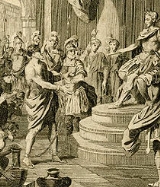
Caratacus was a first century
BritishThe British Iron Age is a conventional name used in the archaeology of Great Britain, referring to the prehistoric and protohistoric phases of the Iron-Age culture of the main island and the smaller islands, typically excluding prehistoric Ireland, and which had an independent Iron Age culture of...
chieftain of the
CatuvellauniThe Catuvellauni were a tribe or state of south-eastern Britain before the Roman conquest.The fortunes of the Catuvellauni and their kings before the conquest can be traced through numismatic evidence and scattered references in classical histories. They are mentioned by Dio Cassius, who implies...
tribe, who led the British resistance to the Roman conquest.
Before the Roman invasion Caratacus participated in battles which expanded the territory of his tribe. His success only led to Roman invasion, nominally in support of his defeated enemies. Resisting the Romans, he mixed guerrilla warfare with set-piece battles, but was unsuccessful in the latter. After his final defeat he fled to the territory of Queen
CartimanduaCartimandua or Cartismandua was a queen of the Brigantes, a Celtic people in what is now Northern England, in the 1st century. She came to power around the time of the Roman conquest of Britain, and formed a large tribal agglomeration that became loyal to Rome...
, who captured him and handed him over to the Romans. He was sentenced to death as a military prisoner, but made a speech before his execution that persuaded the Emperor
ClaudiusClaudius , was Roman Emperor from 41 to 54. A member of the Julio-Claudian dynasty, he was the son of Drusus and Antonia Minor. He was born at Lugdunum in Gaul and was the first Roman Emperor to be born outside Italy...
to spare him.
The legendary
WelshWelsh mythology, the remnants of the mythology of the pre-Christian Britons, has come down to us in much altered form in medieval Welsh manuscripts such as the Red Book of Hergest, the White Book of Rhydderch, the Book of Aneirin and the Book of Taliesin....
character
Caradog ap BranCaradog ap Bran is the son of the British king Bran the Blessed in Welsh mythology and literature, who appears most prominently in the second branch of the Mabinogi, the tale of Branwen ferch Llŷr. He is further mentioned in the Welsh Triads and in certain medieval Welsh genealogies...
and the legendary British king
ArvirargusArvirargus was a legendary, and possibly historical, British king of the 1st century AD. A shadowy historical Arviragus is known only from a cryptic reference in a satirical poem by Juvenal, in which a giant turbot presented to the Roman emperor Domitian is said to be an omen that "you will...
may be based upon Caratacus. Caratacus's speech to Claudius has been a common subject in art.
Claudian Invasion
Caratacus is named by
Dio CassiusLucius Cassius Dio Cocceianus , known in English as Cassius Dio, Dio Cassius, or Dio was a Roman consul and a noted historian writing in Greek...
as a son of the Catuvellaunian king
CunobelinusCunobeline or Cunobelinus was a historical king in pre-Roman Britain, known from passing mentions by classical historians Suetonius and Dio Cassius, and from his many inscribed coins...
. Based on coin distribution Caratacus appears to have been the protégé of his uncle
EpaticcusEpaticcus or Epaticcu was a brother of Cunobelinus, king of the Catuvellauni, a tribe of Iron Age Britain.Coins bearing his name begin to appear in the northern lands of the neighbouring Atrebates tribe and their capital, Calleva Atrebatum , probably fell to him around AD 25...
, who expanded Catuvellaunian power westwards into the territory of the
AtrebatesThe Atrebates were a Belgic tribe of Gaul and Britain before the Roman conquests.- Name of the tribe :Cognate with Old Irish aittrebaid meaning 'inhabitant', Atrebates comes from proto-Celtic *ad-treb-a-t-es, 'inhabitants'. The Celtic root is treb- 'building', 'home' The Atrebates (singular...
. After Epaticcus died ca. 35, the Atrebates, under
VericaVerica was a British client king of the Roman Empire in the years preceding the Claudian invasion of 43 AD.From his coinage, he appears to have been king of the Atrebates tribe and a son of Commius. He succeeded his elder brother Eppillus as king in about 15 AD, reigning at Calleva Atrebatum,...
, regained some of their territory, but it appears Caratacus completed the conquest, as Dio tells us Verica was ousted, fled to
RomeAncient Rome was a thriving civilization that grew on the Italian Peninsula as early as the 8th century BC. Located along the Mediterranean Sea and centered on the city of Rome, it expanded to one of the largest empires in the ancient world....
and appealed to the
emperorThe Roman emperor was the ruler of the Roman State during the imperial period . The Romans had no single term for the office although at any given time, a given title was associated with the emperor...
ClaudiusClaudius , was Roman Emperor from 41 to 54. A member of the Julio-Claudian dynasty, he was the son of Drusus and Antonia Minor. He was born at Lugdunum in Gaul and was the first Roman Emperor to be born outside Italy...
for help. This was the excuse used by Claudius to launch his
invasion of BritainThe Roman conquest of Britain was a gradual process, beginning effectively in AD 43 under Emperor Claudius, whose general Aulus Plautius served as first governor of Britannia. Great Britain had already frequently been the target of invasions, planned and actual, by forces of the Roman Republic and...
in the summer of 43.
Cunobelinus had died some time before the invasion. According to established history, Caratacus and his brother
TogodumnusTogodumnus was a historical king of the British Catuvellauni tribe at the time of the Roman conquest. He can probably be identified with the legendary British king Guiderius....
led the initial defence of the country against
Aulus PlautiusAulus Plautius was a Roman politician and general of the mid-1st century. He began the Roman conquest of Britain in 43, and became the first governor of the new province, serving from 43 to 47.-Career:...
's four
legionsA Roman legion normally indicates the basic ancient Roman army unit recruited specifically from Roman citizens. The organization of legions varied greatly over time but they were typically composed of perhaps 5,000 soldiers, divided into maniples and later into "cohorts"...
, thought to have been around 40,000 men, primarily using
guerrillaGuerrilla warfare is a form of irregular warfare and refers to conflicts in which a small group of combatants including, but not limited to, armed civilians use military tactics, such as ambushes, sabotage, raids, the element of surprise, and extraordinary mobility to harass a larger and...
tactics. They lost much of the south-east after being defeated in two crucial battles on the rivers
MedwayThe River Medway, which is almost entirely in Kent, England, flows for from just inside the West Sussex border to the point where it enters the Thames Estuary....
and
ThamesThe River Thames flows through southern England. It is the longest river entirely in England and the second longest in the United Kingdom. While it is best known because its lower reaches flow through central London, the river flows alongside several other towns and cities, including Oxford,...
. Togodumnus was killed and the Catuvellauni's territories were conquered. An alternative reading of Dio's history of the invasion suggests that Togodumnus may actually have been acting in support of the Roman troops, against his brother Caratacus, and that he survived the battles of the River Thames, providing the later Roman administration with valued assistance. Dr Miles Russell of
Bournemouth UniversityBournemouth University is a university in and around the large south coast town of Bournemouth, UK...
has further suggested that Togodumnus and Tiberius Claudius Togidubnus, postulated resident of the late 1st century AD palace at
Fishbourne-United Kingdom:* Fishbourne, Isle of Wight, a village* Fishbourne, West Sussex, a village.* Fishbourne Roman Palace, an archaeological site in West Sussex....
may well have been one and the same. Claudius was present in August when his legions marched into
CamulodunumCamulodunum is the Roman name for the ancient settlement which is today's Colchester, a town in Essex, England. Camulodunum is claimed to be the oldest town in Britain as recorded by the Romans, existing as a Celtic settlement before the Roman conquest, when it became the first Roman town, and...
(
ColchesterColchester is an historic town and the largest settlement within the borough of Colchester in Essex, England.At the time of the census in 2001, it had a population of 104,390. However, the population is rapidly increasing, and has been named as one of Britain's fastest growing towns. As the...
), the capital of the Catuvellauni, but Caratacus survived and carried on the resistance further west.
Resistance to Rome
We next hear of Caratacus in
TacitusPublius Cornelius Tacitus was a senator and a historian of the Roman Empire. The surviving portions of his two major works—the Annals and the Histories—examine the reigns of the Roman Emperors Tiberius, Claudius, Nero and those who reigned in the Year of the Four Emperors...
's
AnnalsThe Annals by Tacitus is a history of the reigns of the four Roman Emperors succeeding Caesar Augustus. The surviving parts of the Annals extensively cover most of the reigns of Tiberius and Nero. The title Annals was probably not given by Tacitus, but derives from the fact that he treated this...
, leading the
SiluresThe Silures were a powerful and warlike tribe of ancient Britain, occupying approximately the counties of Monmouthshire, Breconshire and Glamorganshire of present day South Wales; and possibly Gloucestershire and Herefordshire of present day England...
and
OrdovicesThe Ordovices were one of the Celtic tribes living in Great Britain, before the Roman invasion of Britain. Its tribal lands were located in present day Wales and England between the Silures to the south and the Deceangli to the north-east...
of Roman Wales against Plautius' successor as governor,
Publius Ostorius ScapulaPublius Ostorius Scapula was a Roman statesman and general who governed Britain from 47 until his death, and was responsible for the defeat and capture of Caratacus.-Career:...
. Finally, in 51, Scapula managed to defeat Caratacus in a set-piece battle somewhere in Ordovician territory (see the
Battle of Caer CaradocThe Battle of Caer Caradoc was the final battle in Caratacus's resistance to Roman rule. Fought in 50, the Romans defeated the Britons and thus secured the southern areas of the province of Britannia....
), capturing Caratacus' wife and daughter and receiving the surrender of his brothers. Caratacus himself escaped, and fled north to the lands of the
BrigantesThe Brigantes were a Celtic tribe who in pre-Roman times controlled the largest section of what would become Northern England, and a significant part of the Midlands. Their kingdom is sometimes called Brigantia, and it was centred in what was later known as Yorkshire...
(modern
YorkshireYorkshire is a historic county of northern England and the largest in the United Kingdom. Because of its great size in comparison to other English counties, functions have been increasingly undertaken over time by its subdivisions, which have also been subject to periodic reform...
) where the Brigantian queen,
CartimanduaCartimandua or Cartismandua was a queen of the Brigantes, a Celtic people in what is now Northern England, in the 1st century. She came to power around the time of the Roman conquest of Britain, and formed a large tribal agglomeration that became loyal to Rome...
, handed him over to the Romans in chains. This was one of the factors that led to two Brigantian revolts against Cartimandua and her Roman allies, once later in the 50s and once in 69, led by
VenutiusVenutius was a 1st century king of the Brigantes in northern Britain at the time of the Roman conquest. Some have suggested he may have belonged to the Carvetii, a tribe which probably formed part of the Brigantes confederation....
, who had once been Cartimandua's husband. With the capture of Caratacus, much of southern Britain from the
HumberThe Humber is a large tidal estuary on the east coast of Northern England. It is formed at Trent Falls, Faxfleet, by the confluence of the tidal River Ouse and the tidal River Trent. From here to the North Sea, it forms part of the boundary between the East Riding of Yorkshire on the north bank...
to the Severn was pacified and garrisoned throughout the 50s.
Legend places Caratacus' last stand at
British CampThe Herefordshire Beacon is one of the hills of the Malvern Hills.The name Malvern of the nearby town is probably derived from the Welsh moel fryn or "bare hill"....
in the
Malvern HillsThe Malvern Hills are a range of hills in the English counties of Worcestershire, Herefordshire and a small area of northern Gloucestershire, dominating the surrounding countryside and the towns and villages of the district of Malvern...
, but the description of
TacitusPublius Cornelius Tacitus was a senator and a historian of the Roman Empire. The surviving portions of his two major works—the Annals and the Histories—examine the reigns of the Roman Emperors Tiberius, Claudius, Nero and those who reigned in the Year of the Four Emperors...
makes this unlikely:
Although the Severn is visible from British Camp, it is nowhere near it, so this battle must have taken place elsewhere. A number of locations have been suggested, including a site near
Brampton BryanBrampton Bryan is a small village and civil parish situated in north Herefordshire, England close to the Shropshire and Welsh borders.Brampton Bryan lies mid-way between Leintwardine and Knighton on the A4113 road. The village has had a complex history and its buildings reflect this...
.
Captive in Rome
After his capture, Caratacus was sent to Rome as a war prize, presumably to be killed after a
triumphal paradeThe Roman triumph was a civil ceremony and religious rite of ancient Rome, held to publicly celebrate and sanctify the military achievement of an army commander who had won great military successes, or originally and traditionally, one who had successfully completed a foreign war. In Republican...
. Although a captive, he was allowed to speak to the
Roman senateThe Senate of the Roman Republic was a political institution in the ancient Roman Republic, however, it was not an elected body, but one whose members were appointed by the consuls, and later by the censors. After a magistrate served his term in office, it usually was followed with automatic...
. Tacitus records a version of his speech in which he says that his stubborn resistance made Rome's glory in defeating him all the greater:
He made such an impression that he was pardoned and allowed to live in peace in Rome. After his liberation, according to Dio Cassius, Caratacus was so impressed by the city of Rome that he said "And can you, then, who have got such possessions and so many of them, covet our poor tents?"
Caratacus' name
Caratacus' name appears as both
Caratacus and
Caractacus in manuscripts of Tacitus, and as
Καράτακος and
Καρτάκης in manuscripts of Dio. Older reference works tend to favour the spelling "Caractacus", but modern scholars agree, based on
historical linguisticsHistorical linguistics is the study of language change. It has five main concerns:* to describe and account for observed changes in particular languages...
and source criticism, that the original Brythonic form was
*Caratācos, pronounced karaˈtaːkos, which gives the attested names
Caradog in
WelshWelsh is a member of the Brythonic branch of the Celtic languages spoken natively in Wales, by some along the Welsh border in England, and in Y Wladfa...
and
Carthach in
IrishIrish , also known as Irish Gaelic, is a Goidelic language of the Indo-European language family, originating in Ireland and historically spoken by the Irish people. Irish is now spoken as a first language by a minority of Irish people, as well as being a second language of a larger proportion of...
.
Medieval Welsh traditions
Caratacus' memory may have been preserved in medieval Welsh tradition. A
genealogy in the Welsh Harleian MS 3859The Harleian genealogies are a collection of Old Welsh genealogies preserved in British Library, Harleian MS 3859. Part of the Harleian Collection, the manuscript, which also contains the Annales Cambriae and a version of the Historia Brittonum, has been dated to c. 1100, although a date of c.1200...
(ca. 1100) includes the generations "Caratauc map Cinbelin map Teuhant", corresponding, via established processes of language change, to "Caratacus, son of Cunobelinus, son of
TasciovanusTasciovanus was a historical king of the Catuvellauni tribe before the Roman conquest of Britain.-History:Tasciovanus is known only through numismatic evidence. He appears to have become king of the Catuvellauni ca. 20 BC, ruling from Verlamion...
", preserving the names of the three historical figures in correct relationship.
Caratacus does not appear in Geoffrey of Monmouth's
History of the Kings of Britain (1136), although he appears to correspond to Arviragus, the younger son of Kymbelinus, who continues to resist the Roman invasion after the death of his older brother Guiderius. In Welsh versions his name is Gweirydd, son of Cynfelyn, and his brother is called Gwydyr; the name Arviragus is taken from a poem by
JuvenalThe Satires are a collection of satirical poems by the Latin author Juvenal written in the late 1st and early 2nd centuries AD.Juvenal is credited with sixteen known poems divided among five books; all are in the Roman genre of satire, which, at its most basic in the time of the author, comprised a...
.
Caradog, son of Bran, who appears in medieval Welsh literature, has also been identified with Caratacus, although nothing in the medieval legend corresponds except his name. He appears in the
MabinogionThe Mabinogion is the title given to a collection of eleven prose stories collated from medieval Welsh manuscripts. The tales draw on pre-Christian Celtic mythology, international folktale motifs, and early medieval historical traditions...
as a son of
Bran the BlessedBrân the Blessed is a giant and king of Britain in Welsh mythology. He appears in several of the Welsh Triads, but his most significant role is in the Second Branch of the Mabinogi, Branwen ferch Llŷr. He is a son of Llŷr and Penarddun, and the brother of Brânwen, Manawydan, Nisien and Efnysien...
, who is left in charge of Britain while his father makes war in
IrelandIreland is an island to the northwest of continental Europe. It is the third-largest island in Europe and the twentieth-largest island on Earth...
, but is overthrown by Caswallawn (the historical
CassivellaunusCassivellaunus was an historical British chieftain who led the defence against Julius Caesar's second expedition to Britain in 54 BC. The first British person whose name is recorded, Cassivellaunus led an alliance of tribes against Roman forces, but eventually surrendered after his location was...
, who lived a century earlier than Caratacus). The
Welsh TriadsThe Welsh Triads are a group of related texts in medieval manuscripts which preserve fragments of Welsh folklore, mythology and traditional history in groups of three. The triad is a rhetorical form whereby objects are grouped together in threes, with a heading indicating the point of likeness...
agree that he was Bran's son, and name two sons, Cawrdaf and Eudaf.
Modern traditions
Caradog only began to be identified with Caratacus after the rediscovery of the works of Tacitus, and new material appeared based on this identification. An 18th century tradition, popularised by the Welsh antiquarian and forger
Iolo MorganwgEdward Williams, better known by his bardic name Iolo Morganwg , was an influential Welsh antiquarian, poet, collector, and literary forger. He was widely considered a leading collector and expert on medieval Welsh literature in his day, but after his death it was revealed that he had forged a...
, credits Caradog, on his return from imprisonment in Rome, with the introduction of Christianity to Britain. Iolo also makes the legendary king Coel Hen a son of Caradog's son Cyllen.
Another tradition, which has remained popular among
British IsraelitesBritish Israelism is the belief that people of Western European descent, particularly those in Great Britain, are the direct lineal descendants of the Ten Lost Tribes of Israel. The concept often includes the belief that the British Royal Family is directly descended from the line of King David...
and others, makes Caratacus already a Christian before he came to Rome, Christianity having been brought to Britain by either
Joseph of ArimatheaJoseph of Arimathea was, according to the Gospels, the man who donated his own prepared tomb for the burial of Jesus after Jesus' Crucifixion. He is mentioned in all four Gospels.-Gospel references:...
or
St. PaulPaul the Apostle , also known as Saul of Tarsus, is described in the Christian New Testament as one of the most influential early Christian missionaries, with the writings ascribed to him by the church forming a considerable portion of the New Testament...
, and identifies a number of early Christians as his relatives.
One is
Pomponia GraecinaPomponia Graecina was a noble Roman woman of the 1st century who was related to the Julio-Claudian dynasty. She was the wife of Aulus Plautius, the general who led the Roman conquest of Britain in 43, and was renowned as one of the few people who dared to publicly mourn the death of a kinswoman...
, wife of
Aulus PlautiusAulus Plautius was a Roman politician and general of the mid-1st century. He began the Roman conquest of Britain in 43, and became the first governor of the new province, serving from 43 to 47.-Career:...
, the conqueror of Britain, who as Tacitus relates, was accused of following a "foreign superstition", generally considered to be Christianity. Tacitus describes her as the "wife of the Plautius who returned from Britain with an ovation", which led
John LingardDr. John Lingard was an English Catholic priest, born in St Thomas Street in Central Winchester to recusant parents and the author of The History Of England, From the First Invasion by the Romans to the Accession of Henry VIII, an 8-volume work published in 1819...
(1771–1851) to conclude, in his
History and Antiquities of the Anglo-Saxon Church, that she was British; however, this conclusion is a misinterpretation of what Tacitus wrote. An
ovationThe ovation was a lower form of the Roman triumph. Ovations were granted, when war was not declared between enemies on the level of states, when an enemy was considered basely inferior or when the general conflict was resolved with little to no bloodshed or danger to the army itself.The general...
was a military parade in honour of a victorious general, so the person who "returned from Britain with an ovation" is clearly Plautius, not Pomponia. This has not prevented the error being repeated and disseminated widely.
Another is
Claudia RufinaClaudia Rufina was a woman of British descent who lived in Rome circa 90 AD and was known to the poet Martial. Martial refers to her in Epigrams XI:53, describing her as "caeruleis [...] Britannis edita" , and praising her for her beauty, education and fertility.She is...
, a historical British woman known to the poet
MartialMarcus Valerius Martialis , was a Latin poet from Hispania best known for his twelve books of Epigrams, published in Rome between AD 86 and 103, during the reigns of the emperors Domitian, Nerva and Trajan...
. Martial describes Claudia's marriage to a man named Pudens, almost certainly
Aulus PudensAulus Pudens was a native of Umbria and a centurion in the Roman army in the late 1st century. He was a friend of the poet Martial, who addressed several of his Epigrams to him...
, an
UmbriaUmbria is a region of modern central Italy. It is one of the smallest Italian regions and the only peninsular region that is landlocked.Its capital is Perugia.Assisi and Norcia are historical towns associated with St. Francis of Assisi, and St...
n
centurionA centurion was a professional officer of the Roman army .Centurion may also refer to:-Military:* Centurion tank, British battle tank* HMS Centurion, name of several ships and a shore base of the British Royal Navy...
and friend of the poet who appears regularly in his
Epigrams. It has been argued since the 17th century that this pair may be the same as the Claudia and Pudens mentioned as members of the Roman Christian community in
2 TimothyThe three pastoral epistles are books of the canonical New Testament: the First Epistle to Timothy the Second Epistle to Timothy , and the Epistle to Titus. They are presented as letters from Paul of Tarsus...
in the
New TestamentThe New Testament is the second major division of the Christian biblical canon, the first such division being the much longer Old Testament....
. Some go further, claiming that Claudia was Caratacus' daughter, and that the historical
Pope LinusPope Saint Linus was, according to several early sources, Bishop of the diocese of Rome after Saint Peter. This makes Linus the second Pope. According to other early sources Pope Clement I was the Pope after Peter...
, who is described as the "brother of Claudia" in an early church document, was Caratacus' son. Pudens is identified with
St. PudensSaint Pudens was an early Christian saint and martyr. 100px| left| thumb| Russian [[icon]].He is mentioned as a layman of the Roman Church in 2 Timothy 4:21. According to tradition, he lodged Saint Peter and was baptised by him, and was martyred under Nero...
, and it is claimed that the basilica of
Santa PudenzianaThe basilica of Santa Pudenziana is a 4th century church in Rome, dedicated to Saint Pudentiana, sister of Saint Praxedis and daughter of Saint Pudens. It is the national church of the Philippines....
in Rome, and with which St. Pudens is associated, was once called the
Palatium Britannicum and was the home of Caratacus and his family.
This theory was popularised in a 1961 book called
The Drama of the Lost DisciplesThe Drama of the Lost Disciples is a 1961 book by George Jowett, a former bodybuilder and fitness instructor, which purports to trace several of Christ's disciples and other associates, including Joseph of Arimathea, St. Paul, St...
by George Jowett, but Jowett did not originate it. He cites renaissance historians such as Archbishop
James UssherJames Ussher was Church of Ireland Archbishop of Armagh and Primate of All Ireland between 1625–56...
,
Caesar BaroniusCesare Baronio was an Italian Cardinal and ecclesiastical historian...
and
John HardyngJohn Hardyng , English chronicler, was born in the north.As a boy he entered the service of Sir Henry Percy , with whom he was present at the Battle of Shrewsbury . He then passed into the service of Sir Robert Umfraville, under whom he was constable of Warkworth Castle, Northumberland, and Kyme...
, as well as classical writers like
CaesarGaius Julius Caesar was a Roman general and statesman and a distinguished writer of Latin prose. He played a critical role in the gradual transformation of the Roman Republic into the Roman Empire....
,
TacitusPublius Cornelius Tacitus was a senator and a historian of the Roman Empire. The surviving portions of his two major works—the Annals and the Histories—examine the reigns of the Roman Emperors Tiberius, Claudius, Nero and those who reigned in the Year of the Four Emperors...
and Juvenal, although his classical cites at least are wildly inaccurate, many of his assertions are unsourced, and many of his identifications entirely speculative. He also regularly cites
St. Paul in Britain, an 1860 book by
R. W. MorganRichard Williams Morgan was a Welsh clergyman and author. He was born in Llangynfely, Cardiganshire and educated at Saint David's College in Lampeter...
, and advocates other tenets of British Israelism, in particular that the British are descended from the
lost tribes of IsraelThe Ten Lost Tribes of Israel refers to those tribes of ancient Israel that formed the Kingdom of Israel and which disappeared from Biblical and all other historical accounts after the kingdom was destroyed in about 720 BC by ancient Assyria...
.
In the Arts
- Caratacus ('Caratach') is anachronistically depicted as Boudica
Boudica , also known as Boadicea and known in Welsh as "Buddug" was queen of the British Iceni tribe who led an uprising against the occupying forces of the Roman Empire....
's general in John FletcherJohn Fletcher may refer to:*Sir John Aubrey-Fletcher, 7th Baronet , British soldier and cricketer*John Gould Fletcher , Pulitzer Prize winner*John Fletcher Hurst , Methodist bishop...
's play BonducaBonduca is a Jacobean tragi-comedy in the Beaumont and Fletcher canon, generally judged by scholars to be the work of John Fletcher alone. It was acted by the King's Men c. 1613, and published in 1647 in the first Beaumont and Fletcher folio....
(1613).
- Caratacus is the subject of William Mason
William Mason was an English poet, editor and gardener.He was born in Hull and educated at Hull Grammar School and St John's College, Cambridge. He was ordained in 1754 and held a number of posts in the church....
's 1759 lyric poem of the same name and the 1776 play based on it.
- Caractacus is referenced in a line of the "Modern Major General's Song", the well-known libretto
A libretto is the text used in an extended musical work such as an opera, operetta, masque, oratorio, cantata, or musical. The term "libretto" is also sometimes used to refer to the text of major liturgical works, such as mass, requiem, and sacred cantata, or even the story line of a...
from Gilbert and Sullivan'sGilbert and Sullivan refers to the Victorian-era theatrical partnership of the librettist W. S. Gilbert and the composer Arthur Sullivan . The two men collaborated on fourteen comic operas between 1871 and 1896, of which H.M.S...
comic opera The Pirates of PenzanceThe Pirates of Penzance; or, The Slave of Duty is a comic opera in two acts, with music by Arthur Sullivan and libretto by W. S. Gilbert. The opera's official premiere was at the Fifth Avenue Theatre in New York City on 31 December 1879, where the show was well received by both audiences...
.
- Caractacus is the title of a cantata
A cantata is a vocal composition with an instrumental accompaniment, typically in several movements, often involving a choir....
by Edward ElgarSir Edward William Elgar, 1st Baronet OM, GCVO was an English composer, many of whose works have entered the British and international classical concert repertoire. Among his best-known compositions are orchestral works including the Enigma Variations, the Pomp and Circumstance Marches, concertos...
in 1897-8 devoted to the defeat and capture of the king by the RomansAncient Rome was a thriving civilization that grew on the Italian Peninsula as early as the 8th century BC. Located along the Mediterranean Sea and centered on the city of Rome, it expanded to one of the largest empires in the ancient world....
. It was first performed at the LeedsLeeds is a city and metropolitan borough in West Yorkshire, England. In 2001 Leeds' main urban subdivision had a population of 443,247, while the entire city has a population of 798,800 , making it the 30th-most populous city in the European Union.Leeds is the cultural, financial and commercial...
choral festival in 1898.
- The name Caractacus appears under a poem in The Mysteries of Udolpho
The Mysteries of Udolpho, by Ann Radcliffe, was published in four volumes on 8 May 1794 by G. G. and J. Robinson of London. The firm paid her £500 for the manuscript. The contract is housed at the University of Virginia Library. Her fourth and most popular novel, The Mysteries of Udolpho follows...
by Ann RadcliffeAnne Radcliffe was an English author, and considered the pioneer of the gothic novel . Her style is romantic in its vivid descriptions of landscapes, and long travel scenes, yet the Gothic element is obvious through her use of the supernatural...
.
- Caractacus is the subject of a Victorian poem called Caractacus the Briton by William Stewart Ross, published 1881 in a collection titled Lays of Romance and Chivalry
- The defeat of Caratacus by the Romans is the subject of Henry Treece
Henry Treece was a British poet and writer, who worked also as a teacher, and editor. He is perhaps best remembered now as a historical novelist, particularly as a children's historical novelist, although he also wrote some adult historical novels.-Life and work:Treece was born in Wednesbury,...
's 1952 adult novel, The Dark Island, the second book in his Celtic Tetralogy. As well, a poem titled Caratacus appears in Treece's Exiles, a collection of poetry published in the same year.
- Caractacus briefly appears as a minor character in the Robert Graves
Robert von Ranke Graves 24 July 1895 – 7 December 1985 was an English poet, translator and novelist. During his long life he produced more than 140 works...
novel, Claudius the God. In the television adaptationI, Claudius is a 1976 BBC Television adaptation of Robert Graves' I, Claudius and Claudius the God. Written by Jack Pulman, it proved one of the corporation's most successful drama serials of all time...
of Graves's novels, he is portrayed in a brief, non-speaking appearance, by Peter Bowles-Early life:Bowles was born in London, England, the son of Sarah Jane and Herbert Reginald Bowles. His father was a chauffeur and butler at a stately home in Warwickshire; but, upon the outbreak of World War II, he was seconded to work as an engineer at Rolls-Royce and moved the family to Nottingham...
.
- Caratacus' capture and life as a captive in Rome is told from the point of view of his fictional daughter, Eigon, in Barbara Erskine
Barbara Erskine is an English novelist.-Biography:Erskine owns homes in Hereford and Colchester, England. Erskine's first novel was published in 1986...
's time-slip novel, The Warrior's Princess, pub. 2008.
- Caratacus is a major character in Douglas Jackson's novel Claudius, pub. 2009, the sequel to Caligula (2008).
- Australian singer Rolf Harris
Rolf Harris, CBE, AM is an Australian musician, singer-songwriter, composer, painter and television personality.Born in Perth, Western Australia, Harris was a champion swimmer before studying art. He moved to England in 1952, where he started to appear on television programmes on which he drew the...
recorded a song called "The Court Of King Caractacus" in 1964; it was a hit in Australia and also charted in the US and UK.
- Ian Fleming
Ian Lancaster Fleming was a British author, journalist and Naval Intelligence Officer.Fleming is best known for creating the fictional British spy James Bond and for a series of twelve novels and nine short stories about the character, one of the biggest-selling series of fictional books of...
, in his novel Chitty Chitty Bang Bang, named the family patriarch "Caractacus PottsCaractacus Potts is one of the main characters in the family film Chitty Chitty Bang Bang. He is an eccentric inventor who lives with his twin eight-year-old children, Jeremy & Jemima, and Grandpa Potts, on the Potts' hilltop farm...
", and in the story, explains the significance of the name to his readers.
- Caradoc (Caratacus) is a major character in author Pauline Gedge
Pauline Gedge is a Canadian novelist best known for her historical fiction trilogies, Lords of the Two Lands and The King’s Men. She also writes science fiction, fantasy and horror. Her 13 novels have sold more than six million copies in 18 languages. -Life and career:Pauline Gedge was born...
's 1978 novel, The Eagle and The Raven.
- Caratacus appears in several volumes of Simon Scarrow
Simon Scarrow is a UK-based author, born in Nigeria and now based in Norfolk. He completed a master's degree at the University of East Anglia after working at the Inland Revenue, and then went into teaching as a lecturer, firstly at East Norfolk Sixth Form College, then at City College Norwich.He...
's Eagle seriesThe Eagle Series is a military fiction series written by Simon Scarrow. The books describe the lives of two soldiers in the Roman army- Quintus Licinius Cato and Lucius Cornelius Macro. The first 5 books in the series are set in Roman Britain, between the years AD 42 and 44. The Eagle's Prophecy...
, including Under the Eagle, The Eagle's Conquest, When the Eagle Hunts, The Eagle and the Wolves and The Eagle's Prey.
- The story of Caratacus is dramatized in the "Onslaught" episode of The Roman Invasion of Britain (2010) by the Smithsonian Channel
- The third track of Mandalaband's (see David Rohl
New Chronology is the term used to describe an alternative Chronology of the ancient Near East developed by English Egyptologist David Rohl and other researchers beginning with A Test of Time: The Bible - from Myth to History in 1995...
) 2011 album AD - Sangreal, titled Palatium Britannicum, refers to Caractacus extensively in the lyrics.
Further reading
- Leonard Cottrell, The Roman Invasion of Britain, Barnes & Noble. New York, 1992
- Sheppard Frere
Professor Sheppard Sunderland Frere, CBE, FSA, FBA is a former British historian and archaeologist who studied the Roman Empire.-Biography:...
, Britannia: a History of Roman Britain, Pimlico, 1991
External links