


Second Polish Republic

Encyclopedia

Poland
Poland , officially the Republic of Poland , is a country in Central Europe bordered by Germany to the west; the Czech Republic and Slovakia to the south; Ukraine, Belarus and Lithuania to the east; and the Baltic Sea and Kaliningrad Oblast, a Russian exclave, to the north...
between the two world war
World war
A world war is a war affecting the majority of the world's most powerful and populous nations. World wars span multiple countries on multiple continents, with battles fought in multiple theaters....
s; a period in Polish history
History of Poland
The History of Poland is rooted in the arrival of the Slavs, who gave rise to permanent settlement and historic development on Polish lands. During the Piast dynasty Christianity was adopted in 966 and medieval monarchy established...
in which Poland was restored as an independent state. Officially known as the Republic of Poland or the Commonwealth of Poland , the Polish state was created in 1918
Polish Independence Day
National Independence Day is a public holiday in Poland celebrated every year on 11 November to commemorate the anniversary of Poland's assumption of independent statehood in 1918 after 123 years of partition by Russia, Prussia and Austria....
in the aftermath
Aftermath of World War I
The fighting in World War I ended in western Europe when the Armistice took effect at 11:00 am GMT on November 11, 1918, and in eastern Europe by the early 1920s. During and in the aftermath of the war the political, cultural, and social order was drastically changed in Europe, Asia and Africa,...
of World War I
World War I
World War I , which was predominantly called the World War or the Great War from its occurrence until 1939, and the First World War or World War I thereafter, was a major war centred in Europe that began on 28 July 1914 and lasted until 11 November 1918...
. It continued to exist until 1939, despite both internal and external pressures, when Poland was invaded by Nazi Germany
Nazi Germany
Nazi Germany , also known as the Third Reich , but officially called German Reich from 1933 to 1943 and Greater German Reich from 26 June 1943 onward, is the name commonly used to refer to the state of Germany from 1933 to 1945, when it was a totalitarian dictatorship ruled by...
, the Soviet Union
Soviet Union
The Soviet Union , officially the Union of Soviet Socialist Republics , was a constitutionally socialist state that existed in Eurasia between 1922 and 1991....
, and the Slovak Republic, marking the beginning of World War II
World War II
World War II, or the Second World War , was a global conflict lasting from 1939 to 1945, involving most of the world's nations—including all of the great powers—eventually forming two opposing military alliances: the Allies and the Axis...
.
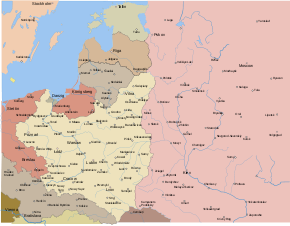
When the borders of the state were fixed in 1922 after several regional conflicts, the Republic bordered Czechoslovakia
Czechoslovakia
Czechoslovakia or Czecho-Slovakia was a sovereign state in Central Europe which existed from October 1918, when it declared its independence from the Austro-Hungarian Empire, until 1992...
, Germany
Germany
Germany , officially the Federal Republic of Germany , is a federal parliamentary republic in Europe. The country consists of 16 states while the capital and largest city is Berlin. Germany covers an area of 357,021 km2 and has a largely temperate seasonal climate...
, Free City of Danzig
Free City of Danzig
The Free City of Danzig was a semi-autonomous city-state that existed between 1920 and 1939, consisting of the Baltic Sea port of Danzig and surrounding areas....
, Lithuania
Lithuania
Lithuania , officially the Republic of Lithuania is a country in Northern Europe, the biggest of the three Baltic states. It is situated along the southeastern shore of the Baltic Sea, whereby to the west lie Sweden and Denmark...
, Latvia
Latvia
Latvia , officially the Republic of Latvia , is a country in the Baltic region of Northern Europe. It is bordered to the north by Estonia , to the south by Lithuania , to the east by the Russian Federation , to the southeast by Belarus and shares maritime borders to the west with Sweden...
, Romania
Romania
Romania is a country located at the crossroads of Central and Southeastern Europe, on the Lower Danube, within and outside the Carpathian arch, bordering on the Black Sea...
, and the Soviet Union
Soviet Union
The Soviet Union , officially the Union of Soviet Socialist Republics , was a constitutionally socialist state that existed in Eurasia between 1922 and 1991....
, plus a tiny strip of the coastline of the Baltic Sea
Baltic Sea
The Baltic Sea is a brackish mediterranean sea located in Northern Europe, from 53°N to 66°N latitude and from 20°E to 26°E longitude. It is bounded by the Scandinavian Peninsula, the mainland of Europe, and the Danish islands. It drains into the Kattegat by way of the Øresund, the Great Belt and...
, around the city of Gdynia
Gdynia
Gdynia is a city in the Pomeranian Voivodeship of Poland and an important seaport of Gdańsk Bay on the south coast of the Baltic Sea.Located in Kashubia in Eastern Pomerania, Gdynia is part of a conurbation with the spa town of Sopot, the city of Gdańsk and suburban communities, which together...
, which itself was built in the 1930s. Furthermore, in the period March 1939 – August 1939, Poland bordered then-Hungarian
Hungary
Hungary , officially the Republic of Hungary , is a landlocked country in Central Europe. It is situated in the Carpathian Basin and is bordered by Slovakia to the north, Ukraine and Romania to the east, Serbia and Croatia to the south, Slovenia to the southwest and Austria to the west. The...
province of Carpathian Ruthenia
Carpathian Ruthenia
Carpathian Ruthenia is a region in Eastern Europe, mostly located in western Ukraine's Zakarpattia Oblast , with smaller parts in easternmost Slovakia , Poland's Lemkovyna and Romanian Maramureş.It is...
. It had an area of 388,634 km² (sixth largest in Europe, in the fall of 1938, after the annexation of Zaolzie
Zaolzie
Zaolzie is the Polish name for an area now in the Czech Republic which was disputed between interwar Poland and Czechoslovakia. The name means "lands beyond the Olza River"; it is also called Śląsk zaolziański, meaning "trans-Olza Silesia". Equivalent terms in other languages include Zaolší in...
, the area grew to 389,720 km².), and 27.2 million inhabitants according to the 1921 census
Polish census of 1921
The Polish census of 1921 or First General Census in Poland was the first census in the Second Polish Republic, performed on September 30, 1921 by the Main Bureau of Statistics ....
. In 1939, just before the outbreak of World War II
World War II
World War II, or the Second World War , was a global conflict lasting from 1939 to 1945, involving most of the world's nations—including all of the great powers—eventually forming two opposing military alliances: the Allies and the Axis...
, it had an estimated 35.1 million inhabitants. Almost a third of these were of minority group
Minority group
A minority is a sociological group within a demographic. The demographic could be based on many factors from ethnicity, gender, wealth, power, etc. The term extends to numerous situations, and civilizations within history, despite the misnomer of minorities associated with a numerical statistic...
s: 13.9% Ukrainians
Ukraine
Ukraine is a country in Eastern Europe. It has an area of 603,628 km², making it the second largest contiguous country on the European continent, after Russia...
; 10% Jews; 3.1% Belarus
Belarus
Belarus , officially the Republic of Belarus, is a landlocked country in Eastern Europe, bordered clockwise by Russia to the northeast, Ukraine to the south, Poland to the west, and Lithuania and Latvia to the northwest. Its capital is Minsk; other major cities include Brest, Grodno , Gomel ,...
ians; 2.3% Germans
Germans
The Germans are a Germanic ethnic group native to Central Europe. The English term Germans has referred to the German-speaking population of the Holy Roman Empire since the Late Middle Ages....
; and 3.4% percent Czechs, Lithuanians
Lithuanians
Lithuanians are the Baltic ethnic group native to Lithuania, where they number around 2,765,600 people. Another million or more make up the Lithuanian diaspora, largely found in countries such as the United States, Brazil, Canada, Colombia, Russia, United Kingdom and Ireland. Their native language...
and Russians
Russians
The Russian people are an East Slavic ethnic group native to Russia, speaking the Russian language and primarily living in Russia and neighboring countries....
. At the same time significant number of ethnic Poles lived outside the country borders (see Poles in the former Soviet Union).
The Second Polish Republic is often associated with times of great adversity, of troubles and of triumph. Having to deal with the economic difficulties and destruction of World War I
World War I
World War I , which was predominantly called the World War or the Great War from its occurrence until 1939, and the First World War or World War I thereafter, was a major war centred in Europe that began on 28 July 1914 and lasted until 11 November 1918...
and numerous other conflicts, which took place on Polish territory until 1921 (see Polish–Ukrainian War, Greater Poland Uprising (1918–1919)
Greater Poland Uprising (1918–1919)
The Greater Poland Uprising of 1918–1919, or Wielkopolska Uprising of 1918–1919 or Posnanian War was a military insurrection of Poles in the Greater Poland region against Germany...
, Polish–Czechoslovak War
Polish–Czechoslovak War
The Poland–Czechoslovakia war, also known mostly in Czech sources as the Seven-day war was a military confrontation between Czechoslovakia and Poland over the territory of Cieszyn Silesia in 1919....
, Silesian Uprisings
Silesian Uprisings
The Silesian Uprisings were a series of three armed uprisings of the Poles and Polish Silesians of Upper Silesia, from 1919–1921, against German rule; the resistance hoped to break away from Germany in order to join the Second Polish Republic, which had been established in the wake of World War I...
, Polish–Lithuanian War
Polish–Lithuanian War
The Polish–Lithuanian War was an armed conflict between newly independent Lithuania and Poland in the aftermath of World War I. The conflict primarily concerned territorial control of the Vilnius Region, including Vilnius , and the Suwałki Region, including the towns of Suwałki, Augustów, and Sejny...
), followed by the Soviet invasion during the Polish–Soviet War, and then surrounded by increasingly hostile neighbors such as Nazi Germany
Nazi Germany
Nazi Germany , also known as the Third Reich , but officially called German Reich from 1933 to 1943 and Greater German Reich from 26 June 1943 onward, is the name commonly used to refer to the state of Germany from 1933 to 1945, when it was a totalitarian dictatorship ruled by...
, the Republic managed not only to endure, but to expand. Lacking an overseas empire (see: Maritime and Colonial League
Maritime and Colonial League
The Maritime and Colonial League was a mass Polish social organization, created in 1930 out of the Maritime and River League . In the late 1930s it was directed by general Mariusz Zaruski and its purpose was to educate the Polish nation about maritime issues...
, Morska Wola
Morska Wola
Morska Wola was a Polish settlement, located in Brazil, in the state of Paraná. It was founded by the Maritime and Colonial League in 1934. The League purchased land from local Indian tribes and carried out an extensive promotional campaign in Poland, trying to lure settlers...
), Poland nevertheless maintained a slow but steady level of economic development. The cultural hubs of interbellum Poland: Warsaw
Warsaw
Warsaw is the capital and largest city of Poland. It is located on the Vistula River, roughly from the Baltic Sea and from the Carpathian Mountains. Its population in 2010 was estimated at 1,716,855 residents with a greater metropolitan area of 2,631,902 residents, making Warsaw the 10th most...
, Kraków
Kraków
Kraków also Krakow, or Cracow , is the second largest and one of the oldest cities in Poland. Situated on the Vistula River in the Lesser Poland region, the city dates back to the 7th century. Kraków has traditionally been one of the leading centres of Polish academic, cultural, and artistic life...
, Poznań
Poznan
Poznań is a city on the Warta river in west-central Poland, with a population of 556,022 in June 2009. It is among the oldest cities in Poland, and was one of the most important centres in the early Polish state, whose first rulers were buried at Poznań's cathedral. It is sometimes claimed to be...
, Wilno
Vilnius
Vilnius is the capital of Lithuania, and its largest city, with a population of 560,190 as of 2010. It is the seat of the Vilnius city municipality and of the Vilnius district municipality. It is also the capital of Vilnius County...
and Lwów
Lviv
Lviv is a city in western Ukraine. The city is regarded as one of the main cultural centres of today's Ukraine and historically has also been a major Polish and Jewish cultural center, as Poles and Jews were the two main ethnicities of the city until the outbreak of World War II and the following...
raised themselves to the level of major European cities. They were also the sites of internationally acclaimed universities and other institutions of higher education. By 1939, the Republic had become "one of Europe's major powers".
The beginnings
Occupied by GermanGerman Empire
The German Empire refers to Germany during the "Second Reich" period from the unification of Germany and proclamation of Wilhelm I as German Emperor on 18 January 1871, to 1918, when it became a federal republic after defeat in World War I and the abdication of the Emperor, Wilhelm II.The German...
and Austro-Hungarian armies in the summer of 1915
Eastern Front (World War I)
The Eastern Front was a theatre of war during World War I in Central and, primarily, Eastern Europe. The term is in contrast to the Western Front. Despite the geographical separation, the events in the two theatres strongly influenced each other...
, the formerly Russian-ruled part of what was considered Poland
Congress Poland
The Kingdom of Poland , informally known as Congress Poland , created in 1815 by the Congress of Vienna, was a personal union of the Russian parcel of Poland with the Russian Empire...
was proposed to become a German puppet state
Kingdom of Poland (1916–1918)
The Kingdom of Poland, also informally called the Regency Kingdom of Poland , was a proposed puppet state during World War I by Germany and Austria-Hungary in 1916 after their conquest of the former Congress Poland from Russia...
by the occupying powers on November 5, 1916, with a governing Council of State and (from October 15, 1917) a Regency Council
Regency Council
right|thumb|Regency Council: Ostrowski, Kakowski, LubomirskiThe Regency Council of the Kingdom of Poland was a semi-independent and temporary highest authority during World War I, formed by Germany and Austria-Hungary in the occupied Polish territories in September 1917. It was supposed to stay...
(Rada Regencyjna Królestwa Polskiego) to administer the country under German auspices (see also Mitteleuropa
Mitteleuropa
Mitteleuropa is the German term equal to Central Europe. The word has political, geographic and cultural meaning. While it describes a geographical location, it also is the word denoting a political concept of a German-dominated and exploited Central European union that was put into motion during...
) pending the election of a king.
Shortly before the end of World War I, on October 7, 1918, the Regency Council dissolved the Council of State
Council of State
The Council of State is a unique governmental body in a country or subdivision thereoff, though its nature may range from the formal name for the cabinet to a non-executive advisory body surrounding a head of state. It is sometimes regarded as the equivalent of a privy council.-Modern:*Belgian...
and announced its intention to restore Polish independence. With the notable exception of the Marxist
Marxism
Marxism is an economic and sociopolitical worldview and method of socioeconomic inquiry that centers upon a materialist interpretation of history, a dialectical view of social change, and an analysis and critique of the development of capitalism. Marxism was pioneered in the early to mid 19th...
-oriented Social Democratic Party of the Kingdom of Poland and Lithuania (SDKPiL), most political parties supported this move. On October 23 the Council appointed a new government under Józef Świeżyński
Józef Swiezynski
Józef Świeżyński was the prime minister of the Kingdom of Poland for a short time — from October 23, 1918 to November 5, 1918.- Citations :...
and began conscription into the Polish Army.
On November 5, in Lublin
Lublin
Lublin is the ninth largest city in Poland. It is the capital of Lublin Voivodeship with a population of 350,392 . Lublin is also the largest Polish city east of the Vistula river...
, the first Soviet of Delegates was created. On November 6 the Communists
Communism
Communism is a social, political and economic ideology that aims at the establishment of a classless, moneyless, revolutionary and stateless socialist society structured upon common ownership of the means of production...
announced the creation of a Republic of Tarnobrzeg
Republic of Tarnobrzeg
The Republic of Tarnobrzeg was a short-lived entity, proclaimed November 6, 1918 in the Polish town of Tarnobrzeg. Its main founders were two socialist activists - Tomasz Dabal and Father Eugeniusz Okon, a Roman Catholic priest....
. The same day, a Provisional People's Government of the Republic of Poland was created in Lublin under the Socialist, Ignacy Daszyński
Ignacy Daszynski
Ignacy Ewaryst Daszyński was a Polish politician, journalist and Prime Minister of the Polish government created in Lublin in 1918....
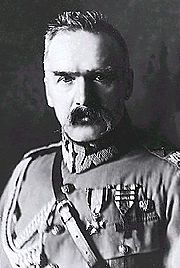
. On November 10, Józef Piłsudski, newly freed from imprisonment by the German authorities at Magdeburg
Magdeburg
Magdeburg , is the largest city and the capital city of the Bundesland of Saxony-Anhalt, Germany. Magdeburg is situated on the Elbe River and was one of the most important medieval cities of Europe....
, returned to Warsaw. Next day, due to his popularity and support from most political parties, the Regency Council
Regency Council
right|thumb|Regency Council: Ostrowski, Kakowski, LubomirskiThe Regency Council of the Kingdom of Poland was a semi-independent and temporary highest authority during World War I, formed by Germany and Austria-Hungary in the occupied Polish territories in September 1917. It was supposed to stay...
appointed Piłsudski Commander in Chief of the Polish Armed Forces. On November 14, the Council dissolved itself and transferred all its authority to Piłsudski as Chief of State (Naczelnik Państwa). After consultation with Piłsudski, Daszyński's government dissolved itself and a new government was created under Jędrzej Moraczewski
Jedrzej Moraczewski
Jędrzej Moraczewski was a Polish socialist politician who served as first Prime Minister of Poland , from November 1918 to January 1919....
.
Centers of government that were at that time created in Galicia (formerly Austrian-ruled southern Poland) included National Council of the Principality of Cieszyn (created in November 1918), Republic of Zakopane
Republic of Zakopane
The Republic of Zakopane or Commonwealth of Zakopane refers to the area of the city of Zakopane and a few nearby villages that created its own "parliament" on October 13, 1918, whose main goal was to join the forming independent state of Poland...
and Polish Liquidation Committee
Polish Liquidation Committee
The Polish Liquidation Committee was a temporary Polish government body in Galicia formed towards the end of World War I. Created on October 28, 1918, with its seat in Kraków, the Committee was headed by Wincenty Witos and Ignacy Daszyński...
(created on October 28). Soon afterward, a conflict broke out in Lwów between forces of the Military Committee of Ukrainians and the Polish irregular units of students and children, known as Lwów Eaglets
Lwów Eaglets
Lwów Eaglets is a term of affection applied to the Polish teenagers who defended the city of Lviv in Eastern Galicia, during the Polish-Ukrainian War .-Background:...
, who were later supported by the Polish Army (see Battle of Lwów (1918)
Battle of Lwów (1918)
Battle of Lviv begun on 1 November 1918 and lasted till May 1919 and was a six months long conflict between the forces of the West Ukrainian People's Republic and local Polish civilian population assisted later by regular Polish Army forces for the control...
, Battle of Przemyśl (1918). Meanwhile, in western Poland, another conflict began - see Greater Poland Uprising (1918–1919)
Greater Poland Uprising (1918–1919)
The Greater Poland Uprising of 1918–1919, or Wielkopolska Uprising of 1918–1919 or Posnanian War was a military insurrection of Poles in the Greater Poland region against Germany...
.
In 1918, Italy
Italy
Italy , officially the Italian Republic languages]] under the European Charter for Regional or Minority Languages. In each of these, Italy's official name is as follows:;;;;;;;;), is a unitary parliamentary republic in South-Central Europe. To the north it borders France, Switzerland, Austria and...
was the first country in Europe to recognise Poland’s sovereignty.
Timeline (1918–1939)
- October 31, 1918–1919: Polish-Ukrainian WarPolish-Ukrainian WarThe Polish–Ukrainian War of 1918 and 1919 was a conflict between the forces of the Second Polish Republic and West Ukrainian People's Republic for the control over Eastern Galicia after the dissolution of Austria-Hungary.-Background:...
. - November 11, 1918: Polish Independence DayPolish Independence DayNational Independence Day is a public holiday in Poland celebrated every year on 11 November to commemorate the anniversary of Poland's assumption of independent statehood in 1918 after 123 years of partition by Russia, Prussia and Austria....
, Warsaw is free from German troops of the Ober OstOber OstOber Ost is short for Oberbefehlshaber der gesamten Deutschen Streitkräfte im Osten, which is a German term meaning "Supreme Commander of All German Forces in the East" during World War I. In practice it refers not only to said commander, but also to his governing military staff and the district...
. - December 27, 1918–1919 Greater Poland UprisingGreater Poland Uprising (1918–1919)The Greater Poland Uprising of 1918–1919, or Wielkopolska Uprising of 1918–1919 or Posnanian War was a military insurrection of Poles in the Greater Poland region against Germany...
. - 1918–1939: Border conflicts between Poland and CzechoslovakiaBorder conflicts between Poland and CzechoslovakiaBorder conflicts between Poland and Czechoslovakia began in 1918 between the Second Polish Republic and First Czechoslovak Republic, both freshly created states. The conflicts centered on the disputed areas of Cieszyn Silesia, Orava Territory and Spiš...
. - January 23 – 30, 1919: Polish–Czechoslovak WarPolish–Czechoslovak WarThe Poland–Czechoslovakia war, also known mostly in Czech sources as the Seven-day war was a military confrontation between Czechoslovakia and Poland over the territory of Cieszyn Silesia in 1919....
. - January 26, 1919: ElectionsPolish legislative election, 1919The Polish legislative election, 1919 took place on 26 January and were the first election in the Second Polish Republic. The elections, based on universal suffrage and proportional representation, produced a parliament balanced between Right, Left and Center...
to the SejmSejmThe Sejm is the lower house of the Polish parliament. The Sejm is made up of 460 deputies, or Poseł in Polish . It is elected by universal ballot and is presided over by a speaker called the Marshal of the Sejm ....
. - June 28, 1919: Treaty of VersaillesTreaty of VersaillesThe Treaty of Versailles was one of the peace treaties at the end of World War I. It ended the state of war between Germany and the Allied Powers. It was signed on 28 June 1919, exactly five years after the assassination of Archduke Franz Ferdinand. The other Central Powers on the German side of...
(Articles 87–93) and Little Treaty of VersaillesLittle Treaty of VersaillesLittle Treaty of Versailles or the Polish Minority Treaty was one of the bilateral Minority Treaties signed between minor powers and the League of Nations in the aftermath of the First World War. The Polish treaty was signed on 28 June 1919, the same day as the main Treaty of Versailles was signed...
, establish Poland as a sovereign and independent state on the international arena. - 1919–1921: Polish-Soviet WarPolish-Soviet WarThe Polish–Soviet War was an armed conflict between Soviet Russia and Soviet Ukraine and the Second Polish Republic and the Ukrainian People's Republic—four states in post–World War I Europe...
, Miracle of the Vistula, Treaty of Riga. - 1920: Polish–Lithuanian WarPolish–Lithuanian WarThe Polish–Lithuanian War was an armed conflict between newly independent Lithuania and Poland in the aftermath of World War I. The conflict primarily concerned territorial control of the Vilnius Region, including Vilnius , and the Suwałki Region, including the towns of Suwałki, Augustów, and Sejny...
. - 1919 - 1921: Silesian UprisingsSilesian UprisingsThe Silesian Uprisings were a series of three armed uprisings of the Poles and Polish Silesians of Upper Silesia, from 1919–1921, against German rule; the resistance hoped to break away from Germany in order to join the Second Polish Republic, which had been established in the wake of World War I...
. - July 15, 1920: Land Reform.
- March 17, 1921: March Constitution.
- 1921: alliances with France and Romania.
- March 24, 1922: annexationAnnexationAnnexation is the de jure incorporation of some territory into another geo-political entity . Usually, it is implied that the territory and population being annexed is the smaller, more peripheral, and weaker of the two merging entities, barring physical size...
of Vilnius RegionVilnius regionVilnius Region , refers to the territory in the present day Lithuania, that was originally inhabited by ethnic Baltic tribes and was a part of Lithuania proper, but came under East Slavic and Polish cultural influences over time,...
from LithuaniaLithuaniaLithuania , officially the Republic of Lithuania is a country in Northern Europe, the biggest of the three Baltic states. It is situated along the southeastern shore of the Baltic Sea, whereby to the west lie Sweden and Denmark... - November 2 – 12, 1922: ElectionsPolish legislative election, 1922The Polish legislative election, 1922 lasted from 2 to 12 November and was the second election in the Second Polish Republic. The elections were won by Polish Right party, National Populist Association , however it did not obtain a majority - it got only 98 out of 444 seats...
to the Sejm and to the Senat. - December 16, 1922: assassination of President Gabriel NarutowiczGabriel NarutowiczGabriel Narutowicz was a Lithuanian-born professor of hydroelectric engineering at Switzerland's Zurich Polytechnic, and Poland's Minister of Public Works , Minister of Foreign Affairs , and the first president of the Second Polish Republic....
. - 1924: Władysław Grabski's monetary reform in Poland, Bank of PolandBank of PolandBank Polski is the name of two former banks in Poland, each of which acted as a central bank. The first was founded by Franciszek Ksawery Drucki-Lubecki in 1828 in Congress Poland and functioned until 1885, when it was absorbed by the State Bank of the Russian Empire.The second was founded in 1924...
. - December 20, 1922 to May 1926: President Stanisław Wojciechowski.
- May 12 – 14, 1926: Coup of May, beginning of SanacjaSanacjaSanation was a Polish political movement that came to power after Józef Piłsudski's May 1926 Coup d'État. Sanation took its name from his watchword—the moral "sanation" of the Polish body politic...
government. - 4 December 1926: Roman DmowskiRoman DmowskiRoman Stanisław Dmowski was a Polish politician, statesman, and chief ideologue and co-founder of the National Democracy political movement, which was one of the strongest political camps of interwar Poland.Though a controversial personality throughout his life, Dmowski was instrumental in...
, Obóz Wielkiej PolskiObóz Wielkiej PolskiCamp of Great Poland was a far-right, nationalist political organization of National Democracy in interwar Poland.-History:Camp of Great Poland was founded on 4 December 1926 in Poznań by National Populist Union and other organizations of right-wing National Democracy political camp, led by Roman...
, EndecjaEndecjaNational Democracy was a Polish right-wing nationalist political movement active from the latter 19th century to the end of the Second Polish Republic in 1939. A founder and principal ideologue was Roman Dmowski...
. - 1928: Piłsudski's nonpartisan Bloc for Cooperation with the Government.
- November 16, 1930: Polish legislative electionPolish legislative election, 1930Polish legislative election, 1930, also known as the Brest elections , were the elections to the Sejm on 16 November 1930. The pro-Sanacja Bezpartyjny Blok Współpracy z Rządem party took 56% of the votes...
. - July 25, 1932: non-aggression pact with Soviet UnionSoviet-Polish Non-Aggression PactThe Soviet–Polish Non-Aggression Pact ) was an international treaty of non-aggression signed in 1932 by representatives of Poland and the USSR. The pact was unilaterally broken by the Soviet Union on September 17, 1939, during the Nazi and Soviet invasion of Poland.-Background:After the...
. - January 26, 1934: non-aggression pact with GermanyGerman-Polish Non-Aggression PactThe German–Polish Non-Aggression Pact was an international treaty between Nazi Germany and the Second Polish Republic signed on January 26, 1934. In it, both countries pledged to resolve their problems through bilateral negotiations and to forgo armed conflict for a period of ten years...
. - April 23, 1935: April Constitution.
- May 12, 1935: death of Józef Piłsudski.
- 1930s: GdyniaGdyniaGdynia is a city in the Pomeranian Voivodeship of Poland and an important seaport of Gdańsk Bay on the south coast of the Baltic Sea.Located in Kashubia in Eastern Pomerania, Gdynia is part of a conurbation with the spa town of Sopot, the city of Gdańsk and suburban communities, which together...
, Centralny Okreg PrzemyslowyCentralny Okreg PrzemyslowyThe Central Industrial District , is an industrial region in Poland. It was one of the biggest economic projects of the Second Polish Republic. The 5-year long project was initiated by a famous Polish economist, deputy Prime Minister and Minister of the Treasury, Eugeniusz Kwiatkowski...
, Eugeniusz KwiatkowskiEugeniusz KwiatkowskiEugeniusz Kwiatkowski was a Polish politician and economist, Deputy Prime Minister of Poland, government minister and manager of the Second Polish Republic....
. - February 2, 1937: creation of the Obóz Zjednoczenia NarodowegoObóz Zjednoczenia NarodowegoObóz Zjednoczenia Narodowego was a Polish political party founded in 1937 by leaders in the Sanation movement.A year after the 1935 death of Poland's Chief of State Marshal Józef Piłsudski, in mid-1936, one of his followers, Marshal Edward Rydz-Śmigły, attempted to unite the various Sanation...
political party. - October 1938: annexation of ZaolzieZaolzieZaolzie is the Polish name for an area now in the Czech Republic which was disputed between interwar Poland and Czechoslovakia. The name means "lands beyond the Olza River"; it is also called Śląsk zaolziański, meaning "trans-Olza Silesia". Equivalent terms in other languages include Zaolší in...
, Górna OrawaGórna OrawaGorna Orawa , is northern part of the historical region of Orava , with the capital in Trstená. In the interbellum period, reborn Poland and newly created Czechoslovakia wanted to gain control over this province and by the decision of the Western Powers, it became part of Czechoslovakia...
, JaworzynaJaworzynaJaworzyna may refer to the following places:*Jaworzyna, Łódź Voivodeship *Polish name for Tatranská Javorina in Slovakia...
from Czechoslovakia. - January 2, 1939: death of Roman DmowskiRoman DmowskiRoman Stanisław Dmowski was a Polish politician, statesman, and chief ideologue and co-founder of the National Democracy political movement, which was one of the strongest political camps of interwar Poland.Though a controversial personality throughout his life, Dmowski was instrumental in...
. - March 31, 1939: military guarantees from United Kingdom and France.
- August 23, 1939: non-aggression pactNon-aggression pactA non-aggression pact is an international treaty between two or more states/countries agreeing to avoid war or armed conflict between them and resolve their disputes through peaceful negotiations...
between Soviet Union and Germany: Ribbentrop-Molotow Pact with a secret military alliance protocol targeting Poland (among several other Eastern European countries). - August 25, 1939: Anglo-Polish military alliance.
- September 1 – October 6, 1939: Invasion of Poland.
Dissolution (1939)
The beginning of the Second World War put an end to the Second Polish Republic. The Invasion of PolandInvasion of Poland (1939)
The Invasion of Poland, also known as the September Campaign or 1939 Defensive War in Poland and the Poland Campaign in Germany, was an invasion of Poland by Germany, the Soviet Union, and a small Slovak contingent that marked the start of World War II in Europe...
began 1 September 1939, one week after the signing of the secret Molotov-Ribbentrop Pact
Molotov-Ribbentrop Pact
The Molotov–Ribbentrop Pact, named after the Soviet foreign minister Vyacheslav Molotov and the German foreign minister Joachim von Ribbentrop, was an agreement officially titled the Treaty of Non-Aggression between Germany and the Soviet Union and signed in Moscow in the late hours of 23 August 1939...
. On that day, Poland was attacked by Nazi Germany
Nazi Germany
Nazi Germany , also known as the Third Reich , but officially called German Reich from 1933 to 1943 and Greater German Reich from 26 June 1943 onward, is the name commonly used to refer to the state of Germany from 1933 to 1945, when it was a totalitarian dictatorship ruled by...
and Slovakia (see: Slovak invasion of Poland (1939)
Slovak invasion of Poland (1939)
The Slovak invasion of Poland occurred during Nazi Germany's invasion of Poland in 1939. The recently-created Slovak Republic joined the attack, and the Slovak field army contributed over 50,000 soldiers in three divisions...
), and on September 17, the Soviets
Soviet Union
The Soviet Union , officially the Union of Soviet Socialist Republics , was a constitutionally socialist state that existed in Eurasia between 1922 and 1991....
attacked
Soviet invasion of Poland
Soviet invasion of Poland can refer to:* the second phase of the Polish-Soviet War of 1920 when Soviet armies marched on Warsaw, Poland* Soviet invasion of Poland of 1939 when Soviet Union allied with Nazi Germany attacked Second Polish Republic...
eastern Poland
Kresy
The Polish term Kresy refers to a land considered by Poles as historical eastern provinces of their country. Today, it makes western Ukraine, western Belarus, as well as eastern Lithuania, with such major cities, as Lviv, Vilnius, and Hrodna. This territory belonged to the Polish-Lithuanian...
. Organized Polish resistance ended on October 6, 1939 (see Battle of Kock
Battle of Kock
There were at least three important battles fought in the vicinity of Kock, Poland:* Battle of Kock fought during the Napoleonic Wars* Battle of Kock during the Invasion of Poland* Battle of Kock fought during Operation Tempest: World War II...
), with Germany and the Soviet Union occupying most of the conutry (with the exception of the area of Wilno
Vilnius region
Vilnius Region , refers to the territory in the present day Lithuania, that was originally inhabited by ethnic Baltic tribes and was a part of Lithuania proper, but came under East Slavic and Polish cultural influences over time,...
, which was annexed by Lithuania, and areas along southern border, seized by Slovakia). Poland did not surrender, but continued fighting as Polish Government in Exile
Polish government in Exile
The Polish government-in-exile, formally known as the Government of the Republic of Poland in Exile , was the government in exile of Poland formed in the aftermath of the Invasion of Poland of September 1939, and the subsequent occupation of Poland by Nazi Germany and the Soviet Union, which...
and the Polish Underground State. After signing the German–Soviet Treaty of Friendship, Cooperation and Demarcation, Polish areas occupied by Nazi Germany were either directly annexed to the Third Reich, or became part of the so-called General Government
General Government
The General Government was an area of Second Republic of Poland under Nazi German rule during World War II; designated as a separate region of the Third Reich between 1939–1945...
. Soviet Union, after rigged Elections to the People's Assemblies of Western Ukraine and Western Belarus
Elections to the People's Assemblies of Western Ukraine and Western Belarus
Elections to the People's Assemblies of Western Ukraine and Western Belarus, which took place on October 22, 1939, were an attempt to legitimate territorial gains of the Soviet Union, at the expense of the Second Polish Republic...
, annexed eastern Poland either to Byelorussian Soviet Socialist Republic, or Ukrainian Soviet Socialist Republic.
Politics and government
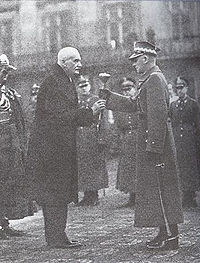
Parliamentary system
A parliamentary system is a system of government in which the ministers of the executive branch get their democratic legitimacy from the legislature and are accountable to that body, such that the executive and legislative branches are intertwined....
from 1919 (see Small Constitution of 1919
Small Constitution of 1919
The Small Constitution of 1919 was the "Legislative Sejm's ordinance of February 20, 1919, entrusting Józef Piłsudski with the further execution of the office of Chief of State" . The legislation was published as Dz. Pr. P.P...
) to 1926, with the President having limited powers. The Parliament elected him, and he could appoint the Prime Minister as well as the government with the Sejm
Sejm
The Sejm is the lower house of the Polish parliament. The Sejm is made up of 460 deputies, or Poseł in Polish . It is elected by universal ballot and is presided over by a speaker called the Marshal of the Sejm ....
's (lower house's) approval, but he could only dissolve the Sejm with the Senate's consent. Moreover, his power to pass decrees was limited by the requirement that the Prime Minister and the appropriate other Minister had to verify his decrees with their signatures.
The major political parties at this time were the National Democrats and other right-wing groups, various Peasant Parties, Christian Democrats
Polish Christian Democratic Party
Polish Christian Democratic Party , was a political party of Polish right wing christian democracy faction existing in the first year of the Second Polish Republic. It leader and main activist was Wojciech Korfanty....
, Polish Socialist Party
Polish Socialist Party
The Polish Socialist Party was one of the most important Polish left-wing political parties from its inception in 1892 until 1948...
, and political groups of ethnic minorities (German: German Social Democratic Party of Poland
German Social Democratic Party of Poland
German Social Democratic Party was a political party in Poland, founded on March 26, 1922.-Foundation:The party emerged out of a fusion of the Oberschlesien organizations of the Social Democratic Party of Germany and the Independent Social Democratic Party of Germany and the Teschener-Schlesien...
, Jewish: General Jewish Labour Bund in Poland
General Jewish Labour Bund in Poland
The General Jewish Labour Bund in Poland was a Jewish socialist party in Poland which promoted the political, cultural and social autonomy of Jewish workers, sought to combat antisemitism and was generally opposed to Zionism.-Creation of the Polish Bund:...
, United Jewish Socialist Workers Party
United Jewish Socialist Workers Party
United Jewish Socialist Workers Party was a political party in Poland and certain regions of the Russian Empire . Its followers were generally known simply for the first portion of the name Fareynikte - 'United'. Politically the party favored national personal autonomy for the Jewish community...
, and Ukrainian: Ukrainian National Democratic Alliance
Ukrainian National Democratic Alliance
The Ukrainian National Democratic Alliance, was the largest Ukrainian political party in the Second Polish Republic, active in territory that is currently Western Ukraine. It dominated the mainstream political life of the Ukrainian minority in Poland, which with almost 14% of Poland's population...
). Frequently changing governments (see Polish legislative election, 1919
Polish legislative election, 1919
The Polish legislative election, 1919 took place on 26 January and were the first election in the Second Polish Republic. The elections, based on universal suffrage and proportional representation, produced a parliament balanced between Right, Left and Center...
, Polish legislative election, 1922
Polish legislative election, 1922
The Polish legislative election, 1922 lasted from 2 to 12 November and was the second election in the Second Polish Republic. The elections were won by Polish Right party, National Populist Association , however it did not obtain a majority - it got only 98 out of 444 seats...
) and other negative publicity which the politicians received (such as accusations of corruption or 1919 Polish coup attempt
1919 Polish coup attempt
The Polish Coup of early January 1919 was an unsuccessful coup d'etat in Poland. On January 4-5, 1919, right-wing National Democrats attempted to overthrow the government of Jędrzej Moraczewski and Józef Piłsudski. The coup's leaders included Marian Januszajtis-Żegota and Prince Eustachy...
), made them increasingly unpopular. Major politicians at this time included peasant activist Wincenty Witos
Wincenty Witos
Wincenty Witos was a prominent member of the Polish People's Party from 1895, and leader of its "Piast" faction from 1913. He was a member of parliament in the Galician Sejm from 1908–1914, and an envoy to Reichsrat in Vienna from 1911 to 1918...
(Prime Minister three times) and right-wing Roman Dmowski
Roman Dmowski
Roman Stanisław Dmowski was a Polish politician, statesman, and chief ideologue and co-founder of the National Democracy political movement, which was one of the strongest political camps of interwar Poland.Though a controversial personality throughout his life, Dmowski was instrumental in...
.
By contrast, Marshal Józef Pilsudski led an intentionally modest life, writing historical books for a living. After he took power by a military coup in May 1926, he emphasized that he wanted to heal the Polish society and politics of excessive partisan politics. His regime, accordingly, was called Sanacja in Polish. The 1928 parliamentary elections
Polish legislative election, 1928
The Polish legislative election, 1928 lasted from 4 to 11 March and was the third election in the Second Polish Republic. Bezpartyjny Blok Współpracy z Rządem ) - a coalition of the Sanacja faction - won the highest number of seats The Polish legislative election, 1928 lasted from 4 to 11 March and...
were still considered free and fair, although the pro-Pilsudski Nonpartisan Bloc for Cooperation with the Government won them. The following three parliamentary elections (in 1930
Polish legislative election, 1930
Polish legislative election, 1930, also known as the Brest elections , were the elections to the Sejm on 16 November 1930. The pro-Sanacja Bezpartyjny Blok Współpracy z Rządem party took 56% of the votes...
, 1935
Polish legislative election, 1935
The Polish legislative election, 1935 took place on 8 to 15 September of that year. It was the next to last election held in the Second Polish Republic....
and 1938
Polish legislative election, 1938
The Polish legislative election, 1938 was held on 6 to 11 November of that year. It was the last election in the Second Polish Republic. This election was held under the April Constitution of 1935, which was written to favor the Sanation movement....
) were manipulated, with opposition activists being sent to Bereza Kartuska prison
Bereza Kartuska prison
The Bereza Kartuska detention camp was a Polish prison, principally for political prisoners of the sanacja regime, that was operated in 1934–39 at Bereza Kartuska in the former Polesie Province ....
(see also Brest trials
Brest trials
The Brest trials were among the most famous trials conducted under the Second Polish Republic. Lasting from October 26, 1931 to January 13, 1932, they were held at the Warsaw Regional Court where leaders of the Centrolew, a "Center-Left" anti-Sanation-government political-opposition movement,...
). As a result, pro-government party Camp of National Unity won huge majorities in them. Pilsudski died just after an authoritarian constitution was approved in the spring of 1935.
During the last four years of the Second Polish Republic, the major politicians included President Ignacy Mościcki
Ignacy Moscicki
Ignacy Mościcki was a Polish chemist, politician, and President of Poland . He was the longest-serving President of Poland .-Life:...
, Foreign Minister Józef Beck
Józef Beck
' was a Polish statesman, diplomat, military officer, and close associate of Józef Piłsudski...
and the Commander-in-Chief of the Polish Army, and Edward Rydz-Śmigły. The country was divided into 104 electoral districts, and those politicians who were forced to leave Poland, founded Front Morges
Front Morges
Front Morges was a political alliance of centrist political parties of interwar Poland . It was founded in 1936 in the Swiss village of Morges by general Władysław Sikorski and former Polish Prime Minister Ignacy Paderewski. Prominent activists included Józef Haller, Wojciech Korfanty, and Karol...
in 1936. The government that ruled Second Polish Republic in its final years is frequently referred to as Piłsudski's colonels.
Presidents
- Gabriel NarutowiczGabriel NarutowiczGabriel Narutowicz was a Lithuanian-born professor of hydroelectric engineering at Switzerland's Zurich Polytechnic, and Poland's Minister of Public Works , Minister of Foreign Affairs , and the first president of the Second Polish Republic....
– 9 December 1922 – 16 December 1922 - Stanisław Wojciechowski – 20 December 1922 – 14 May 1926
- Ignacy MościckiIgnacy MoscickiIgnacy Mościcki was a Polish chemist, politician, and President of Poland . He was the longest-serving President of Poland .-Life:...
– 1 June 1926 – 30 September 1939 - Bolesław Wieniawa-Długoszowski – 1 October 1939
Prime ministers
- Jędrzej MoraczewskiJedrzej MoraczewskiJędrzej Moraczewski was a Polish socialist politician who served as first Prime Minister of Poland , from November 1918 to January 1919....
– 18 November 1918 – 16 January 1919 - Ignacy PaderewskiIgnacy Jan PaderewskiIgnacy Jan Paderewski GBE was a Polish pianist, composer, diplomat, politician, and the second Prime Minister of the Republic of Poland.-Biography:...
– 18 January 1919 – 27 November 1919 - Leopold SkulskiLeopold SkulskiLeopold Skulski was prime minister of Poland from 1919 to 1920.He was involved in politics from at least the mid 1910s, and served as mayor of Łódź between 1917 an 1919. He became a deputy in the Polish parliament after the 1919 elections, and on 13 December 1919 he became the Prime Minister of...
– 13 December 1919 – 9 June 1920 - Władysław Grabski – 27 June 1920 – 24 July 1920
- Wincenty WitosWincenty WitosWincenty Witos was a prominent member of the Polish People's Party from 1895, and leader of its "Piast" faction from 1913. He was a member of parliament in the Galician Sejm from 1908–1914, and an envoy to Reichsrat in Vienna from 1911 to 1918...
– 24 July 1920 – 13 September 1921 - Antoni PonikowskiAntoni PonikowskiAntoni Ponikowski was a Polish academician and politician who served as prime minister in 1918 and from 1921 to 1922....
– 19 September 1921 – 5 March 1922 - Antoni Ponikowski – 10 March 1922 – 6 June 1922
- Artur ŚliwińskiArtur SliwinskiArtur Śliwiński was the Prime Minister of Poland from 28 June – 7 July 1922. In 1915 he had presided over the National Central Committee, which sought Polish independence from Russia....
– 28 June 1922 – 7 July 1922 - Wojciech KorfantyWojciech KorfantyWojciech Korfanty , born Adalbert Korfanty, was a Polish nationalist activist, journalist and politician, serving as member of the German parliaments Reichstag and Prussian Landtag, and later on, in the Polish Sejm...
– 14 July 1922 – 31 July 1922 - Julian NowakJulian NowakJulian Ignacy Nowak was a Polish microbiologist and politician who served as prime minister in 1922.Nowak studied medicine at the Jagiellonian University in 1886–1893, and was a professor there since 1899. In 1921–1922 he was a rector of the university. Being a conservative politician, he served...
– 31 July 1922 – 14 December 1922 - Władysław Sikorski – 16 December 1922 – 26 May 1923
- Wincenty WitosWincenty WitosWincenty Witos was a prominent member of the Polish People's Party from 1895, and leader of its "Piast" faction from 1913. He was a member of parliament in the Galician Sejm from 1908–1914, and an envoy to Reichsrat in Vienna from 1911 to 1918...
– 28 May 1923 – 14 December 1923 - Władysław Grabski – 19 December 1923 – 14 November 1925
- Aleksander SkrzyńskiAleksander SkrzynskiAleksander Józef Skrzyński |Galicia]] – 25 September 1931 in Łąkociny near Ostrów Wielkopolski, Poland) was a Polish politician who served as the country's prime minister from 1925 to 1926...
– 20 November 1925 – 5 May 1926 - Wincenty WitosWincenty WitosWincenty Witos was a prominent member of the Polish People's Party from 1895, and leader of its "Piast" faction from 1913. He was a member of parliament in the Galician Sejm from 1908–1914, and an envoy to Reichsrat in Vienna from 1911 to 1918...
– 10 May 1926 – 14 May 1926 - Kazimierz BartelKazimierz BartelKazimierz Władysław Bartel was a Polish mathematician and politician who served as Prime Minister of Poland three times between 1926 and 1930....
– 15 May 1926 – 4 June 1926 - Kazimierz Bartel – 8 June 1926 – 24 September 1926
- Kazimierz Bartel – 27 September 1926 – 30 September 1926
- Józef Piłsudski – 2 October 1926 – 27 June 1928
- Kazimierz Bartel – 27 June 1928 – 13 April 1929
- Kazimierz ŚwitalskiKazimierz SwitalskiCol. Kazimierz Stanisław Świtalski was a Polish officer, politician, and a Prime Minister of Poland.-Biographical note:Before the World War I he joined the Związek Walki Czynnej, an underground organisation formed by Józef Piłsudski. In 1914 Świtalski joined the Polish Legions and in 1918 the...
– 14 April 1929 – 7 December 1929 - Kazimierz Bartel – 29 December 1929 – 15 March 1930
- Walery Sławek – 29 March 1930 – 23 August 1930
- Józef Piłsudski – 25 August 1930 – 4 December 1930
- Walery Sławek – 4 December 1930 – 26 May 1931
- Aleksander PrystorAleksander PrystorAleksander Błażej Prystor was a Polish politician, soldier and activist who served as Prime Minister of Poland from 1931 to 1933.He was a member of the Combat Organization of the Polish Socialist Party and in 1908 took part in the Bezdany raid....
– 27 May 1931 – 9 May 1933 - Janusz JędrzejewiczJanusz JedrzejewiczJanusz Jędrzejewicz was a Polish politician and educator, a leader of the Sanacja political group, and Prime Minister of Poland from 1933 to 1934.-Life:...
– 10 May 1933 – 13 May 1934 - Leon Kozłowski – 15 May 1934 – 28 March 1935
- Walery Sławek – 28 March 1935 – 12 October 1935
- Marian Zyndram-Kościałkowski – 13 October 1935 – 15 May 1936
- Felicjan Sławoj Składkowski – 15 May 1936 – 30 September 1939
Economy
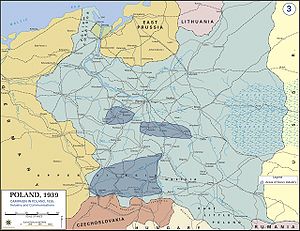
German mark
The Deutsche Mark |mark]], abbreviated "DM") was the official currency of West Germany and Germany until the adoption of the euro in 2002. It is commonly called the "Deutschmark" in English but not in German. Germans often say "Mark" or "D-Mark"...
, the Russian ruble
Russian ruble
The ruble or rouble is the currency of the Russian Federation and the two partially recognized republics of Abkhazia and South Ossetia. Formerly, the ruble was also the currency of the Russian Empire and the Soviet Union prior to their breakups. Belarus and Transnistria also use currencies with...
, the Austrian crown, the Polish marka
Polish marka
The marka was the currency of the Kingdom of Poland and of the Republic of Poland between 1917 and 1924...
and the Ostrubel
German ostruble
Ostruble is the name given to a currency denominated in kopeck and ruble, which was issued by Germany in 1916 for use in the eastern areas under German occupation . It was initially equal to the Russian ruble. The reason for the issue was a shortage of rubles...
) and with little or no direct infrastructural links. The situation was so bad that neighboring industrial centers as well as major cities lacked direct railroad links, because they had been parts of different nations. For example, in the 1920s there was no direct railroad connection between Warsaw and Kraków, and the line was not completed until 1934.
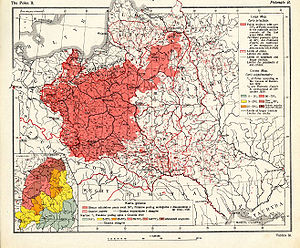
On top of this was the massive destruction left after both World War I and the Polish Soviet War. There was also a great economic disparity between the eastern (commonly called Poland B) and western (called Poland A) parts of the country, with the western half, especially areas that had belonged to the German Empire
German Empire
The German Empire refers to Germany during the "Second Reich" period from the unification of Germany and proclamation of Wilhelm I as German Emperor on 18 January 1871, to 1918, when it became a federal republic after defeat in World War I and the abdication of the Emperor, Wilhelm II.The German...
being much more developed and prosperous. Frequent border closures and a customs war
German–Polish customs war
The German–Polish customs war was a political and economic conflict between the Second Polish Republic and the Weimar Republic, which began in June 1925 and ended officially in March 1934...
with Germany also had negative economic impacts on Poland. In 1924 prime minister and economic minister Władysław Grabski introduced the złoty as a single common currency for Poland (it replaced the Polish marka
Polish marka
The marka was the currency of the Kingdom of Poland and of the Republic of Poland between 1917 and 1924...
), which remained one of the most stable currencies of Central Europe. The currency helped Poland to bring under control the massive hyperinflation, the only country in Europe which was able to do this without foreign loans or aid.
The basis of Poland's gradual recovery after the Great Depression
Great Depression
The Great Depression was a severe worldwide economic depression in the decade preceding World War II. The timing of the Great Depression varied across nations, but in most countries it started in about 1929 and lasted until the late 1930s or early 1940s...
were mass economic development plans (see Four Year Plan
Four Year Plan (Poland)
Four Year Plan was a short-term national investment plan, created by Eugeniusz Kwiatkowski, deputy Prime Minister and Minister of the Treasury in the government of the Second Polish Republic...
, which oversaw the building of three key infrastructural elements. The first was the establishment of the Gdynia
Gdynia
Gdynia is a city in the Pomeranian Voivodeship of Poland and an important seaport of Gdańsk Bay on the south coast of the Baltic Sea.Located in Kashubia in Eastern Pomerania, Gdynia is part of a conurbation with the spa town of Sopot, the city of Gdańsk and suburban communities, which together...
seaport, which allowed Poland to completely bypass Gdańsk
Free City of Danzig
The Free City of Danzig was a semi-autonomous city-state that existed between 1920 and 1939, consisting of the Baltic Sea port of Danzig and surrounding areas....
(which was under heavy German pressure to boycott Polish coal exports). The second was construction of the 500-kilometer rail connection between Upper Silesia
Upper Silesia
Upper Silesia is the southeastern part of the historical and geographical region of Silesia. Since the 9th century, Upper Silesia has been part of Greater Moravia, the Duchy of Bohemia, the Piast Kingdom of Poland, again of the Lands of the Bohemian Crown and the Holy Roman Empire, as well as of...
and Gdynia, called Polish Coal Trunk-Line
Polish Coal Trunk-Line
The Coal Trunk-Line is one of the most important rail connections in Poland.It crosses the central part of the country, from the coal mines and steelworks of Upper Silesia in the South to the Baltic Sea port of Gdynia in the North. The line is used mostly by freight trains: passenger connections...
, which served freight trains with coal. The third was the creation of a central industrial district, named COP – Central Industrial Region (Centralny Okręg Przemysłowy). Unfortunately, these developments were interrupted and largely destroyed by the German and Soviet invasion and the start of World War II. Among other achievements of interbellum Poland there are Stalowa Wola
Stalowa Wola
Stalowa Wola is the largest city and capital of Stalowa Wola County with a population of 64,353 inhabitants, as of June 2008. It is located in southeastern Poland in the Subcarpathian Voivodeship...
(a brand new city, built in a forest around a steel mill), Mościce
Moscice
Mościce is an industrial borough of the city of Tarnów in Poland, previously an industrial suburb. Located to the west of the city centre at the Biała river, it houses one of the largest and the first nitrate factory in Europe....
(now a district of Tarnow
Tarnów
Tarnów is a city in southeastern Poland with 115,341 inhabitants as of June 2009. The city has been situated in the Lesser Poland Voivodeship since 1999, but from 1975 to 1998 it was the capital of the Tarnów Voivodeship. It is a major rail junction, located on the strategic east-west connection...
, with a large nitrate factory), and creation of a central bank
Bank of Poland
Bank Polski is the name of two former banks in Poland, each of which acted as a central bank. The first was founded by Franciszek Ksawery Drucki-Lubecki in 1828 in Congress Poland and functioned until 1885, when it was absorbed by the State Bank of the Russian Empire.The second was founded in 1924...
. There were several trade fairs, with the most popular being Poznań International Fair
Poznan International Fair
The Poznań International Fair is the biggest industrial fair in Poland. It is held on the Poznań fairground in Poland. Poznań International Fair is located in the centre of the city opposite the main railway station - Poznań Główny, in the centre of Poland and in the centre of...
, Lwów's Targi Wschodnie
Targi Wschodnie
Targi Wschodnie was a major trade fair in interbellum Poland. It was established in 1921 and held in Lwów , and was designed to attract business people from Poland, Romania and the Soviet Union...
, and Wilno's Targi Północne. Polish Radio had ten stations (see Radio stations in interwar Poland
Radio stations in interwar Poland
The pioneers of radio in Poland were army officers — Poles who served in German, Austrian and Russian armies in the World War I. In the fall of 1918, shortly after the war, these experts started organizing Polish radio. On November 4, 1918 in Kraków, a field station, previously used by Austrian...
), with the eleventh one planned to be opened in the autumn of 1939.
Interbellum Poland was also a country with numerous social problems. Unemployment was high, and poverty was widespread, which resulted in several cases of social unrest, such as 1923 Kraków riot
1923 Kraków riot
1923 Kraków riot refers to a riot that took place during a strike on 6 November 1923 in Kraków, Poland. The riot is also called 1923 Kraków uprising, particularly by the Marxist sources.-Background:...
, and 1937 peasant strike in Poland
1937 peasant strike in Poland
1937 peasant strike in Poland, also known in some Polish sources as the Great Peasant Uprising was a mass strike and demonstration of peasants organized by the People's Party and aimed at the ruling sanacja government. It was the largest political protest in the Second Polish Republic, taking...
. There were conflicts with national minorities, such as Pacification of Ukrainians in Eastern Galicia (1930)
Pacification of Ukrainians in Eastern Galicia (1930)
Pacification of Ukrainians refers to the punitive action by police and military of the Second Polish Republic against the Ukrainian minority in Poland in September–November 1930 in response to a wave of more than 2,200 acts of sabotage against Polish property in the region...
, relations with Polish neighbors were sometimes complicated (see Soviet raid on Stołpce
Soviet raid on Stołpce
Soviet raid on Stołpce refers to the events of the night of August 3/4, 1924, when a group of 150 Soviet agents, commanded by Lieutnant Boryshkevich, raided the town of Stołpce , which back then was a railroad border crossing between Second Polish Republic, and Soviet Union...
, Polish–Czechoslovak border conflicts, 1938 Polish ultimatum to Lithuania
1938 Polish ultimatum to Lithuania
The 1938 Polish ultimatum to Lithuania was an ultimatum delivered to Lithuania by Poland on March 17, 1938. The Lithuanian government had steadfastly refused to have any diplomatic relations with Poland after 1920, protesting the annexation by Poland of the Vilnius Region. As pre-World War II...
). On top of this, there were natural disasters, such as 1934 flood in Poland
1934 flood in Poland
1934 flood in Poland was the biggest flood in the Second Polish Republic. It began with heavy rains in the Dunajec river basin, which took place between 13 and 17 July 1934. In the following days, the flood spread to the basins of the Raba, Wisłoka, and Skawa, all of which are tributaries to the...
.
Transport
According to the 1939 Statistical Yearbook of Poland, total length of railways of Poland (as for December 31, 1937) was 20 118 kilometers. Rail density was 5.2 km. per 100 km2. Railways were very dense in western part of the country, and in the east, especially Polesie, rail was non-existent in some counties. During the interbellum period, Polish government constructed several new lines, mainly in central part of the country (see also Polish State Railroads Summer 1939). Construction of Warszawa Główna railway station was never finished due to the war, and Polish railroads were famous for their punctuality (see LuxtorpedaLuxtorpeda
Luxtorpeda was a common name of a famous Polish train, which ran on some of the most important rail routes of Poland in the 1930s. A Luxtorpeda consisted of a single, first-class only railcar, with its own internal combustion engine.- Name :...
, Strzała Bałtyku, Latający Wilnianin
Latajacy Wilnianin
Latający Wilnianin was the popular name of a passenger train which in the interbellum period linked Warsaw with Wilno . Another name for that train was Gwiazda Północy ....
).
In the interbellum, road network of Poland was dense, but the quality of the roads was very poor - only 7% of all roads was paved and ready for automobile use, and none of the major cities were connected with each other by a good-quality highway. In the mid-1930s, Poland had 340,000 kilometers of roads, but only 58,000 had hard surface (gravel, cobblestone
Cobblestone
Cobblestones are stones that were frequently used in the pavement of early streets. "Cobblestone" is derived from the very old English word "cob", which had a wide range of meanings, one of which was "rounded lump" with overtones of large size...
or sett
Sett (paving)
A sett, usually the plural setts and in some places called a Belgian block, often incorrectly called "cobblestone", is a broadly rectangular quarried stone used originally for paving roads, today a decorative stone paving used in landscape architecture...
), and 2,500 were modern, with asphalt or concrete surface. In different parts of the country, there were sections of paved roads, which suddenly ended, and were followed by dirt roads. Poor condition of roads was the result of both long-lasting foreign dominance, and inadequate funding. On January 29, 1931, Polish Parliament created State Road Fund, whose purpose was to collect money for construction and conservation of roads. The government drafted a 10-year plan, with road priorities: a highway from Wilno, through Warsaw and Cracow, to Zakopane (called Marshall Pilsudski Highway), asphalt highways from Warsaw to Poznań and Łódź, as well as Warsaw ring road. However, the plan turned out to be too ambitious, as there was not enough money in the national budget. In January 1938, Polish Road Congress estimated that Poland should spend on roads three times more money to keep up with Western Europe.
In 1939, before the outbreak of the war, LOT Polish Airlines
LOT Polish Airlines
Polskie Linie Lotnicze LOT S.A. , trading as LOT Polish Airlines, is the flag carrier of Poland. Based in Warsaw, LOT was established in 1929, making it one of the world's oldest airlines still in operation. Using a fleet of 55 aircraft, LOT operates a complex network to 60 destinations in Europe,...
, which was established in 1929, had its hub at Warsaw Okęcie Airport. At that time LOT maintaned several services, both domestic and international. Warsaw had regular domestic connections with Gdynia-Rumia
Gdynia
Gdynia is a city in the Pomeranian Voivodeship of Poland and an important seaport of Gdańsk Bay on the south coast of the Baltic Sea.Located in Kashubia in Eastern Pomerania, Gdynia is part of a conurbation with the spa town of Sopot, the city of Gdańsk and suburban communities, which together...
, Danzig-Langfuhr
Gdansk
Gdańsk is a Polish city on the Baltic coast, at the centre of the country's fourth-largest metropolitan area.The city lies on the southern edge of Gdańsk Bay , in a conurbation with the city of Gdynia, spa town of Sopot, and suburban communities, which together form a metropolitan area called the...
, Katowice-Muchowiec
Katowice-Muchowiec Airport
Katowice-Muchowiec Airport is a general aviation airport in the Muchowiec neighborhood of Katowice, Poland.It has one inoperative concrete runway, RWY 05/23 with the dimensions of 1109 x 30 metres . There is a displaced threshold length of 221 meters on both RWY 05 and RWY 23, yielding a...
, Kraków-Rakowice-Czyżyny
Kraków-Rakowice-Czyzyny Airport
Kraków-Rakowice-Czyżyny Airport is a disused airport in Kraków, Poland, one of the oldest permanent airfields in Europe, open for occasional traffic by certain types of aircraft...
, Lwów-Skniłów
Lviv International Airport
Lviv International Airport is an airport in Lviv, Ukraine. In 2010, the airport carried 481,900 passengers. The airport is located from downtown Lviv. Facilities at the airport include a café and shop as well as bus services to the city.-Future expansion:...
, Poznań-Ławica, and Wilno-Porubanek
Vilnius
Vilnius is the capital of Lithuania, and its largest city, with a population of 560,190 as of 2010. It is the seat of the Vilnius city municipality and of the Vilnius district municipality. It is also the capital of Vilnius County...
. Furthermore, in cooperation with Air France
Air France
Air France , stylised as AIRFRANCE, is the French flag carrier headquartered in Tremblay-en-France, , and is one of the world's largest airlines. It is a subsidiary of the Air France-KLM Group and a founding member of the SkyTeam global airline alliance...
, LARES
TAROM
S.C. Compania Națională de Transporturi Aeriene Române TAROM S.A., doing business as TAROM Romanian Air Transport, is the flag carrier and oldest currently operating airline of Romania. The brand name is an acronym for...
, Lufthansa
Lufthansa
Deutsche Lufthansa AG is the flag carrier of Germany and the largest airline in Europe in terms of overall passengers carried. The name of the company is derived from Luft , and Hansa .The airline is the world's fourth-largest airline in terms of overall passengers carried, operating...
, and Malev
Malév Hungarian Airlines
Malév Hungarian Airlines is the flag carrier and principal airline of Hungary. It has its head office in the Lurdy House in Budapest, with its main operations at Budapest Ferenc Liszt International Airport. From there, the airline flies to 50 cities in 34 countries worldwide using a fleet of 22...
, international connections were maintained with Athens
Athens
Athens , is the capital and largest city of Greece. Athens dominates the Attica region and is one of the world's oldest cities, as its recorded history spans around 3,400 years. Classical Athens was a powerful city-state...
, Beirut
Beirut
Beirut is the capital and largest city of Lebanon, with a population ranging from 1 million to more than 2 million . Located on a peninsula at the midpoint of Lebanon's Mediterranean coastline, it serves as the country's largest and main seaport, and also forms the Beirut Metropolitan...
, Berlin
Berlin
Berlin is the capital city of Germany and is one of the 16 states of Germany. With a population of 3.45 million people, Berlin is Germany's largest city. It is the second most populous city proper and the seventh most populous urban area in the European Union...
, Bucharest
Bucharest
Bucharest is the capital municipality, cultural, industrial, and financial centre of Romania. It is the largest city in Romania, located in the southeast of the country, at , and lies on the banks of the Dâmbovița River....
, Budapest
Budapest
Budapest is the capital of Hungary. As the largest city of Hungary, it is the country's principal political, cultural, commercial, industrial, and transportation centre. In 2011, Budapest had 1,733,685 inhabitants, down from its 1989 peak of 2,113,645 due to suburbanization. The Budapest Commuter...
, Helsinki
Helsinki
Helsinki is the capital and largest city in Finland. It is in the region of Uusimaa, located in southern Finland, on the shore of the Gulf of Finland, an arm of the Baltic Sea. The population of the city of Helsinki is , making it by far the most populous municipality in Finland. Helsinki is...
, Kaunas
Kaunas
Kaunas is the second-largest city in Lithuania and has historically been a leading centre of Lithuanian economic, academic, and cultural life. Kaunas was the biggest city and the center of a powiat in Trakai Voivodeship of the Grand Duchy of Lithuania since 1413. During Russian Empire occupation...
, London
London
London is the capital city of :England and the :United Kingdom, the largest metropolitan area in the United Kingdom, and the largest urban zone in the European Union by most measures. Located on the River Thames, London has been a major settlement for two millennia, its history going back to its...
, Paris
Paris
Paris is the capital and largest city in France, situated on the river Seine, in northern France, at the heart of the Île-de-France region...
, Prague
Prague
Prague is the capital and largest city of the Czech Republic. Situated in the north-west of the country on the Vltava river, the city is home to about 1.3 million people, while its metropolitan area is estimated to have a population of over 2.3 million...
, Riga
Riga
Riga is the capital and largest city of Latvia. With 702,891 inhabitants Riga is the largest city of the Baltic states, one of the largest cities in Northern Europe and home to more than one third of Latvia's population. The city is an important seaport and a major industrial, commercial,...
, Rome
Rome
Rome is the capital of Italy and the country's largest and most populated city and comune, with over 2.7 million residents in . The city is located in the central-western portion of the Italian Peninsula, on the Tiber River within the Lazio region of Italy.Rome's history spans two and a half...
, Tallinn
Tallinn
Tallinn is the capital and largest city of Estonia. It occupies an area of with a population of 414,940. It is situated on the northern coast of the country, on the banks of the Gulf of Finland, south of Helsinki, east of Stockholm and west of Saint Petersburg. Tallinn's Old Town is in the list...
, and Zagreb
Zagreb
Zagreb is the capital and the largest city of the Republic of Croatia. It is in the northwest of the country, along the Sava river, at the southern slopes of the Medvednica mountain. Zagreb lies at an elevation of approximately above sea level. According to the last official census, Zagreb's city...
.
Demographics

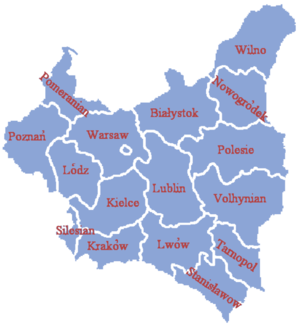
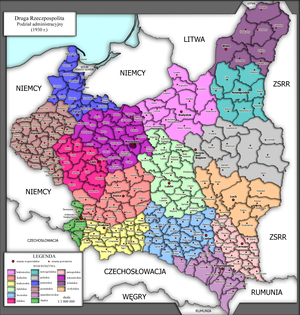
Polish census of 1921
The Polish census of 1921 or First General Census in Poland was the first census in the Second Polish Republic, performed on September 30, 1921 by the Main Bureau of Statistics ....
allocates 30.8% of the population in the minority. This was further exacerbated with the Polish victory in the Polish-Soviet War
Polish-Soviet War
The Polish–Soviet War was an armed conflict between Soviet Russia and Soviet Ukraine and the Second Polish Republic and the Ukrainian People's Republic—four states in post–World War I Europe...
, and the large territorial gains in the east, made by Poland as a consequence. According to the 1931 Polish Census (as cited by Norman Davies
Norman Davies
Professor Ivor Norman Richard Davies FBA, FRHistS is a leading English historian of Welsh descent, noted for his publications on the history of Europe, Poland, and the United Kingdom.- Academic career :...
), 68.9% of the population was Polish, 13.9% were Ukrainians, around 10% Jewish, 3.1% Belarusians, 2.3% Germans and 2.8% - others, including Lithuanians
Lithuanians
Lithuanians are the Baltic ethnic group native to Lithuania, where they number around 2,765,600 people. Another million or more make up the Lithuanian diaspora, largely found in countries such as the United States, Brazil, Canada, Colombia, Russia, United Kingdom and Ireland. Their native language...
, Czechs and Armenians
Armenians
Armenian people or Armenians are a nation and ethnic group native to the Armenian Highland.The largest concentration is in Armenia having a nearly-homogeneous population with 97.9% or 3,145,354 being ethnic Armenian....
. Also, there were smaller communities of Russians
Russians
The Russian people are an East Slavic ethnic group native to Russia, speaking the Russian language and primarily living in Russia and neighboring countries....
, and Gypsies. The situation of minorities was a complex subject and changed during the period.
Poland was also a nation of many religions. In 1921, 16,057,229 Poles (approx. 62.5%) were Roman (Latin) Catholics
Roman Catholic Church
The Catholic Church, also known as the Roman Catholic Church, is the world's largest Christian church, with over a billion members. Led by the Pope, it defines its mission as spreading the gospel of Jesus Christ, administering the sacraments and exercising charity...
, 3,031,057 citizens of Poland (approx. 11.8%) were Eastern Rite Catholics
Eastern Rite Catholic Churches
The Eastern Catholic Churches are autonomous, self-governing particular churches in full communion with the Bishop of Rome, the Pope. Together with the Latin Church, they compose the worldwide Catholic Church...
(mostly Ukrainian Greek Catholics
Ukrainian Greek Catholic Church
The Ukrainian Greek Catholic Church , Ukrainska Hreko-Katolytska Tserkva), is the largest Eastern Rite Catholic sui juris particular church in full communion with the Holy See, and is directly subject to the Pope...
and Armenian Rite Catholics
Armenian Catholic Church
|- |The Armenian Catholic Church is an Eastern Catholic Church sui juris in union with the other Eastern Rite, Oriental Rite and Latin Rite Catholics who accept the Bishop of Rome as spiritual leader of the Church. It is regulated by Eastern canon law...
), 2,815,817 (approx. 10.95%) were Greek Orthodox
Russian Orthodox Church
The Russian Orthodox Church or, alternatively, the Moscow Patriarchate The ROC is often said to be the largest of the Eastern Orthodox churches in the world; including all the autocephalous churches under its umbrella, its adherents number over 150 million worldwide—about half of the 300 million...
, 2,771,949 (approx. 10.8%) were Jewish
Judaism
Judaism ) is the "religion, philosophy, and way of life" of the Jewish people...
, and 940,232 (approx. 3.7%) were Protestants (mostly Lutheran Evangelical
Lutheranism
Lutheranism is a major branch of Western Christianity that identifies with the theology of Martin Luther, a German reformer. Luther's efforts to reform the theology and practice of the church launched the Protestant Reformation...
). By 1931 Poland
Poland
Poland , officially the Republic of Poland , is a country in Central Europe bordered by Germany to the west; the Czech Republic and Slovakia to the south; Ukraine, Belarus and Lithuania to the east; and the Baltic Sea and Kaliningrad Oblast, a Russian exclave, to the north...
had the second largest Jewish population in the world, with one-fifth of all the world's Jews residing within its borders (approx. 3,136,000).
Population
| Date | Population | Percentage of rural population |
Population density Population density Population density is a measurement of population per unit area or unit volume. It is frequently applied to living organisms, and particularly to humans... (per km²) |
|---|---|---|---|
| 30 September 1921 (census) | 27,177,000 | 75,4% | 69,9 |
| 9 December 1931 (census) | 32,348,000 | 72,6% | 82,6 |
| 31 December 1938 (estimate) | 34,849,000 | 70% | 89,7 |
- Largest cities in early 1939:
- WarsawWarsawWarsaw is the capital and largest city of Poland. It is located on the Vistula River, roughly from the Baltic Sea and from the Carpathian Mountains. Its population in 2010 was estimated at 1,716,855 residents with a greater metropolitan area of 2,631,902 residents, making Warsaw the 10th most...
– 1,289,000 - Łódź – 672,000
- Lwów – 318,000
- PoznańPoznanPoznań is a city on the Warta river in west-central Poland, with a population of 556,022 in June 2009. It is among the oldest cities in Poland, and was one of the most important centres in the early Polish state, whose first rulers were buried at Poznań's cathedral. It is sometimes claimed to be...
– 272,000 - KrakówKrakówKraków also Krakow, or Cracow , is the second largest and one of the oldest cities in Poland. Situated on the Vistula River in the Lesser Poland region, the city dates back to the 7th century. Kraków has traditionally been one of the leading centres of Polish academic, cultural, and artistic life...
– 259,000 - Wilno – 209,000
- Bydgoszcz – 141,000
- CzęstochowaCzestochowaCzęstochowa is a city in south Poland on the Warta River with 240,027 inhabitants . It has been situated in the Silesian Voivodeship since 1999, and was previously the capital of Częstochowa Voivodeship...
– 138,000 - KatowiceKatowiceKatowice is a city in Silesia in southern Poland, on the Kłodnica and Rawa rivers . Katowice is located in the Silesian Highlands, about north of the Silesian Beskids and about southeast of the Sudetes Mountains.It is the central district of the Upper Silesian Metropolis, with a population of 2...
– 134,000 - SosnowiecSosnowiecSosnowiec is a city in Zagłębie Dąbrowskie in southern Poland, near Katowice. It is one of the central districts of the Upper Silesian Metropolitan Union - a metropolis with a combined population of over two million people located in the Silesian Highlands, on the Brynica river .It is situated in...
– 130,000 - LublinLublinLublin is the ninth largest city in Poland. It is the capital of Lublin Voivodeship with a population of 350,392 . Lublin is also the largest Polish city east of the Vistula river...
– 122,000 - GdyniaGdyniaGdynia is a city in the Pomeranian Voivodeship of Poland and an important seaport of Gdańsk Bay on the south coast of the Baltic Sea.Located in Kashubia in Eastern Pomerania, Gdynia is part of a conurbation with the spa town of Sopot, the city of Gdańsk and suburban communities, which together...
– 120,000 - ChorzówChorzówChorzów is a city in Silesia in southern Poland, near Katowice. Chorzów is one of the central districts of the Upper Silesian Metropolitan Union - a metropolis with a population of 2 million...
– 110,000 - Białystok – 107,000
- Warsaw
Administrative division
The Administrative division of Second Polish RepublicAdministrative division of Second Polish Republic
Administrative division of Second Polish Republic became an issue immediately after Poland regained independence in the aftermath of the First World War, 1918...
was based on the three tier system. On the lowest rung were the gminy, which were little more than local town and village governments. These were then grouped together into powiaty which were then arranged into wojewodstwa.
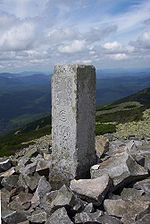
| Polish voivodeships in the interbellum (data as per April 1, 1937) |
||||
| car plates (since 1937) |
Voivodeship Separate city |
Capital | Area in 1,000 km² (1930) |
Population in 1,000 (1931) |
|---|---|---|---|---|
| 00–19 | City of Warsaw | Warsaw | 0.14 | 1,179.5 |
| 85–89 | warszawskie | Warsaw | 31.7 | 2,460.9 |
| 20–24 | białostockie | Białystok | 26.0 | 1,263.3 |
| 25–29 | kieleckie | Kielce Kielce Kielce ) is a city in central Poland with 204,891 inhabitants . It is also the capital city of the Świętokrzyskie Voivodeship since 1999, previously in Kielce Voivodeship... |
22.2 | 2,671.0 |
| 30–34 | krakowskie Kraków Voivodeship Kraków Voivodeship, refers to several historical Voivodeships of Poland in the surrounding regions, with the city of Kraków as its capital.- Kraków Voivodeship 1975-1998 :... |
Kraków Kraków Kraków also Krakow, or Cracow , is the second largest and one of the oldest cities in Poland. Situated on the Vistula River in the Lesser Poland region, the city dates back to the 7th century. Kraków has traditionally been one of the leading centres of Polish academic, cultural, and artistic life... |
17.6 | 2,300.1 |
| 35–39 | lubelskie | Lublin Lublin Lublin is the ninth largest city in Poland. It is the capital of Lublin Voivodeship with a population of 350,392 . Lublin is also the largest Polish city east of the Vistula river... |
26.6 | 2,116.2 |
| 40–44 | lwowskie Lwów Voivodeship Lwów Voivodeship was an administrative unit of interwar Poland . According to Nazis and Soviets it ceased to exist in September 1939, following German and Soviet aggression on Poland . The Polish underground administration existed till August 1944.-Population:Its capital, biggest and most... |
Lwów | 28.4 | 3,126.3 |
| 45–49 | łódzkie | Łódź | 20.4 | 2,650.1 |
| 50–54 | nowogródzkie | Nowogródek | 23.0 | 1,057.2 |
| 55–59 | poleskie Polesie Voivodeship Polesie Voivodeship was an administrative unit of interwar Poland . It ceased to exist in September 1939, following German and Soviet aggression on Poland .-Population:... |
Brześć nad Bugiem | 36.7 | 1,132.2 |
| 60–64 | pomorskie | Toruń Torun Toruń is an ancient city in northern Poland, on the Vistula River. Its population is more than 205,934 as of June 2009. Toruń is one of the oldest cities in Poland. The medieval old town of Toruń is the birthplace of the astronomer Nicolaus Copernicus.... |
25.7 | 1,884.4 |
| 65–69 | poznańskie | Poznań Poznan Poznań is a city on the Warta river in west-central Poland, with a population of 556,022 in June 2009. It is among the oldest cities in Poland, and was one of the most important centres in the early Polish state, whose first rulers were buried at Poznań's cathedral. It is sometimes claimed to be... |
28.1 | 2,339.6 |
| 70–74 | stanisławowskie | Stanisławów Ivano-Frankivsk Ivano-Frankivsk is a historic city located in the western Ukraine. It is the administrative centre of the Ivano-Frankivsk Oblast , and is designated as its own separate raion within the oblast, municipality.... |
16.9 | 1,480.3 |
| 75–79 | śląskie | Katowice Katowice Katowice is a city in Silesia in southern Poland, on the Kłodnica and Rawa rivers . Katowice is located in the Silesian Highlands, about north of the Silesian Beskids and about southeast of the Sudetes Mountains.It is the central district of the Upper Silesian Metropolis, with a population of 2... |
5.1 | 1,533.5 |
| 80–84 | tarnopolskie Tarnopol Voivodeship Tarnopol Voivodeship was an administrative region of interwar Poland with an area of 16,500 km², 17 counties, and capital in Tarnopol... |
Tarnopol | 16.5 | 1,600.4 |
| 90–94 | wileńskie | Wilno | 29.0 | 1,276.0 |
| 95–99 | wołyńskie | Łuck Lutsk Lutsk is a city located by the Styr River in northwestern Ukraine. It is the administrative center of the Volyn Oblast and the administrative center of the surrounding Lutskyi Raion within the oblast... |
35.7 | 2,085.6 |
On April 1, 1938, borders of several western and central Voivodeships changed considerably. For more information, see Territorial changes of Polish Voivodeships on April 1, 1938
Territorial changes of Polish Voivodeships on April 1, 1938
On April 1, 1938, borders of several western and central Voivodeships changed considerably. This included such Voivodeships as Pomerania, Poznan, Warsaw, Lodz, Bialystok, Lublin and Kielce. Pomerania gained most, while Bialystok lost most...
.
Geography of the Second Polish Republic
Second Polish Republic was mainly flat, with average elevation of 223 meters above sea level (after World War II and its border changes, the average elevation of Poland decreased to 173 meters). Only 13% of territory, along the southern border, was higher than 300 meters. The highest elevation was Mount Rysy, which rises 2,499 meters in the TatraTatra Mountains
The Tatra Mountains, Tatras or Tatra , are a mountain range which forms a natural border between Slovakia and Poland, and are the highest mountain range in the Carpathian Mountains...
Range of the Carpathians, 95 kilometers south of Kraków
Kraków
Kraków also Krakow, or Cracow , is the second largest and one of the oldest cities in Poland. Situated on the Vistula River in the Lesser Poland region, the city dates back to the 7th century. Kraków has traditionally been one of the leading centres of Polish academic, cultural, and artistic life...
. Between October 1938 and September 1939, the highest elevation was Lodowy Szczyt (known in the Slovakian language as Ľadový štít), which rises 2,627 meters above sea level. The biggest lake was Lake Narach.
Country's total area, after annexation of Zaolzie
Zaolzie
Zaolzie is the Polish name for an area now in the Czech Republic which was disputed between interwar Poland and Czechoslovakia. The name means "lands beyond the Olza River"; it is also called Śląsk zaolziański, meaning "trans-Olza Silesia". Equivalent terms in other languages include Zaolší in...
, was 389,720 km²., it extended 903 kilometers from north to south and 894 kilometers from east to west. On January 1, 1938, total length of boundaries was 5 529 km., including:
- 140 kilometers of coastline (out of which 71 kilometers were made by the Hel PeninsulaHel PeninsulaHel Peninsula |Nehrung]]) is a 35-km-long sand bar peninsula in northern Poland separating the Bay of Puck from the open Baltic Sea. It is located in Puck County of the Pomeranian Voivodeship.- Geography :...
), - 1412 kilometers with Soviet Union,
- 948 kilometers with Czechoslovakia (until 1938),
- 1912 kilometers with Germany (together with East PrussiaEast PrussiaEast Prussia is the main part of the region of Prussia along the southeastern Baltic Coast from the 13th century to the end of World War II in May 1945. From 1772–1829 and 1878–1945, the Province of East Prussia was part of the German state of Prussia. The capital city was Königsberg.East Prussia...
), - 1081 kilometers with other countries (Lithuania, Romania, Latvia, Danzig).
Among major cities of the Second Polish Republic, the warmest yearly average temperature was in Kraków (9.1 C in 1938) and the coldest in Wilno (7.6 C in 1938).
Extreme points
- Northernmost point: N55*51'8,45" (N55,852250*); Przeświata River in Somino, located in the Braslaw county of the Wilno VoivodeshipWilno VoivodeshipThe Wilno Voivodeship was one of Voivodeships in the Second Polish Republic, with the capital in Wilno. It was created in 1926 and populated predominantly by Poles with notable minorities of Belarusians, Jews, and Lithuanians....
- Southernmost point: N47*43'31,8" (N47,725492*); spring of Manczin River located in the KosówKosówKosów may refer to:*Polish name for Kosiv in Ukraine*Kosów, Łódź Voivodeship *Kosów, Piaseczno County in Masovian Voivodeship *Kosów Lacki, a town in Masovian Voivodeship, Poland...
county of the Stanisławów Voivodeship - Easternmost point: E28*21'44,3" (E28,362371*); Spasibiorki (near railway to Połock) located in the DzisnaDzisnaDzisna , is a town in the Vitsebsk Voblast of Belarus. It's located on the left bank of the Daugava River, near the confluence of Dysna. It has 2,700 inhabitants . The towns population has declined over the years; early in the 20th century it had close to 10,000 inhabitants....
county of the Wilno VoivodeshipWilno VoivodeshipThe Wilno Voivodeship was one of Voivodeships in the Second Polish Republic, with the capital in Wilno. It was created in 1926 and populated predominantly by Poles with notable minorities of Belarusians, Jews, and Lithuanians.... - Westernmost point: E15*47'12,4" (E15,786773*); Mukocinek near Warta River and Meszyn Lake located in the MiędzychódMiedzychódMiędzychód is a town in Greater Poland Voivodeship, Poland, about 75 km west of Poznań. It is the capital of Międzychód County. Population is 10,920 .-Notable residents:* Manuel Joël , philosopher...
county of the Poznań VoivodeshipPoznan Voivodeship-1975 to 1998:From 1975 to 1998, Poznań Voivodeship was a unit of administrative division and local government in Poland, superseded by Greater Poland Voivodeship.Capital city: Poznań.Major cities and towns :...
Drainage
Almost 75% of the territory of interbellum Poland was drained northward into the Baltic Sea by the VistulaVistula
The Vistula is the longest and the most important river in Poland, at 1,047 km in length. The watershed area of the Vistula is , of which lies within Poland ....
(total area of drainage basin
Drainage basin
A drainage basin is an extent or an area of land where surface water from rain and melting snow or ice converges to a single point, usually the exit of the basin, where the waters join another waterbody, such as a river, lake, reservoir, estuary, wetland, sea, or ocean...
of the Vistula within boundaries of the Second Polish Republic was 180 300 km².), the Niemen (51 600 km².), the Odra (46 700 km².) and the Daugava (10 400 km².). The remaining part of the country was drained southward, into the Black Sea
Black Sea
The Black Sea is bounded by Europe, Anatolia and the Caucasus and is ultimately connected to the Atlantic Ocean via the Mediterranean and the Aegean seas and various straits. The Bosphorus strait connects it to the Sea of Marmara, and the strait of the Dardanelles connects that sea to the Aegean...
, by the rivers that drain into the Dnieper (Pripyat
Pripyat River
The Pripyat River or Prypiat River is a river in Eastern Europe, approximately long. It flows east through Ukraine, Belarus, and Ukraine again, draining into the Dnieper....
, Horyn and Styr, all together 61 500 km².) as well as Dniester
Dniester
The Dniester is a river in Eastern Europe. It runs through Ukraine and Moldova and separates most of Moldova's territory from the breakaway de facto state of Transnistria.-Names:...
(41 400 km².)
External links
- Borders, Google Earth