

Bukovina

Encyclopedia
Bukovina is a historical region on the northern slopes of the northeastern Carpathian Mountains
and the adjoining plains.
from the Principality of Moldavia to the possessions of the Habsburg Monarchy
, which became Austrian Empire
in 1804, and Austria-Hungary
in 1867.
The official German
name, die Bukowina, of the province under Austrian rule (1775–1918), was derived from the Polish
form Bukowina, which in turn was derived from the Ukrainian word, Буковина (Bukovyna), and the common Slavic
form of buk, meaning beech
tree (бук [buk] as, for example, in Ukrainian
or, even, Buche in German). Another German name for the region, das Buchenland, is mostly used in poetry, and means "beech land", or "the land of beech trees". In Romanian, in literary or poetic contexts, the name Țara Fagilor ("the land of beech trees") is sometimes used.
During the Middle Ages, part of the region was the northwestern third of "Țara de Sus" (Upper Country in Romanian), part of the Moldavian Principality
, as opposed to "Țara de Jos" (Lower Country). The region became the cradle of the Moldavian Principality, and remained its political center until 1564, when its capital was moved from Suceava
to Iași
.
From the 10th to the 12th centuries, it formed part of Kyievan Rus'
and later was a land of transition between the Principality of Halychyna (Galicia
) and the Principality of Moldavia before falling uner Polish rule and later forming part of the Habsburg Empire and eventually the Austro-Hungarian Empire.
Nowadays in Ukraine the name is unofficial, but is common when referring to the Chernivtsi Oblast
as over 2/3 of the oblast
is the northern part of Bukovina. In Romania the term Northern Bucovina is sometimes synonymous to the entire Chernivtsi Oblast of Ukraine, and (Southern) Bucovina to Suceava County
of Romania (although 10% of the present day Suceava County
covers territory outside of the historical Bukovina.)
In English, an alternate form is The Bukovina, increasingly an archaism, which, however, is found in older literature.
age, Bukovina was populated by the Cucuteni-Trypillian
culture of early settler
s (4500 BC – 3000 BC), which was overrun, around 2000 BC, by the migration of Indo-Europeans
.
Starting with the 2nd millennium BC
, it was inhabited by the Dacian tribes
, such as Costoboci
and Carpians
, and for a period, cohabitated by the Celto-Germanic tribe of Bastarnae
. From approx. 70 BC to 44 BC, the region was incorporated in the Dacian polity of Burebista
.
When the Dacian Kingdom of Decebal, which included the territories just on the other side of the Carpathian Mountains from what is today Bukovina, fell to the Romans in 106, the area came under linguistic and cultural influence of the Roman Empire
.
In the 3rd century (240s–270s) the region was plundered by the Goths
, in the 4th century by the Huns
(370s–380s), and in the 6th century (560s–570s) by the Avars
.
Beginning with the 6th century, Slavic populations
entered the region and influenced the language and agricultural methods (e.g. burning the forests to increase the cultivated land) of the locals.
In 797 the Avars
, who settled in today's Hungary
and collected regular tribute from the peasants all over south-eastern Europe, were defeated by Charlemagne
.
According to medieval Kievan sources, until the 10th century the territory had been part of White Croatia
and later under the Kievan Rus'
, and in 12th to early 14th century, Principality of Halych-Volhynia
, included parts of the region.
The villages of the Campulung
Valley formed a "republic" that preserved its autonomy even under the Principality of Moldavia, which acquired independence in 1359.
 In the mid-14th century, the Moldavian state appeared, eventually expanding its territory all the way to the Black Sea
. Bukovina and neighboring regions were the nucleus of the Moldavian Principality, with the city of Suceava
as its capital from 1388 (after Baia
and Siret
). The name of Moldavia
(Moldova) is derived from a river (Moldova River
) flowing in Bukovina.
In the 15th century, Pokuttya
, the region immediately to the north, became the subject of disputes between the Principality of Moldavia and the Polish Kingdom. Pokuttya was inhabited by Ruthenians (predecessors of modern Ukrainians) and Hutsuls; the latter also reside in western Bukovina. In 1497 a battle took place at the Cosmin Forest
(the hilly forests separating Chernivtsi
and Siret
valleys), at which Stephen III of Moldavia (Stephen the Great)
, managed to defeat the much-stronger but demoralized army of King John I Albert of Poland
. The battle is known in Polish popular culture as "the battle when the knights have perished".
In this period, the patronage of Stephen the Great and his successors on the throne of Moldavia saw the construction of the famous painted monasteries of Moldoviţa
, Suceviţa
, Putna
, Humor, Voroneţ, Dragomirna
, Arbore
, and others. With their renowned exterior fresco
es, these monasteries remain some of the greatest cultural treasures of Romania
; some of them are World Heritage Site
s, part of the painted churches of northern Moldavia
. Stephen also settled the first Ruthenia
ns in Bukovina with the hope of having a loyal and more numerous population that would contribute with taxes. In Suceava
, in the 16th century, two percent of the population (i.e. about 500–1000 people) was Ruthenian.
In 1513, Moldavia started to pay annual tribute to the Ottoman Empire
, but remained autonomous and was governed as before by a native Voivod / Prince, also known as Domnitor
or Hospodar
(Lord in English).
In May, 1600 Mihai Viteazul (Michael the Brave), united the two Romanian principalities and Transylvania under his leadership.
For short periods of time (during wars), the Polish Kingdom occupied parts of northern Moldavia. However, the old border was re-established every time after, as for example on 14 October 1703 the Polish delegate Martin Chometowski acknowledges "Between us and Wallachia
(i.e. Moldavia) God himself set Dniester
as the border" (Inter nos et Valachiam ipse Deus flumine Tyras dislimitavit).
In the course of the Russo-Turkish War of 1768–1774
, the Ottoman armies were defeated by the Russian Empire
, that occupied the region during 15 December 1769 – September 1774, and previously during 14 September–October 1739. Bukovina was the reward the Habsburgs received for aiding the Ottomans in that war. Prince Grigore III Ghica
of Moldavia
protested and was prepared to take action to recover the territory, but was assassinated, and a Greek-Phanariot foreigner was put on the throne of Moldavia
by the Ottomans.
 The Austrian Empire
occupied Bukovina in October 1774. Following the first partition of Poland in 1772, the Austrians claimed that they needed it for a road between Galicia and Transylvania. Bukovina was formally annexed in January 1775. On 2 July 1776, at Palamutka, Austrians and Ottomans signed a border convention, Austrians giving back 59 of the previously occupied villages, and remaining with 278 villages.
Bukovina was a closed military district (1775–1786), then the largest district, Kreis
Czernowitz (after its capital Czernowitz) of the Austrian constituent Kingdom of Galicia and Lodomeria (1787–1849), and, finally, on 4 March 1849, became a separate Austrian Kronland
'crown land' under a Landespräsident (not a Statthalter, as in other crown lands) and declared Herzogtum Bukowina (nominal duchy, as part of the official full style of the Austrian Emperors). In 1860 it was again amalgamated with Galicia, but reinstated as a separate province once again 26 February 1861, a status that would last until 1918.
In 1849 Bukovina got a representative assembly, the Landtag (diet). The Moldavian
nobility had traditionally formed the ruling class in that territory. In 1867 it remained part of the Cisleithania
n or Austrian territories of the Austro-Hungarian Empire
until 1918.
According to the 1775 Austrian census, the province had the total population of 86,000, made up mostly of Romanians (Moldovans), and up to 10,000 Slavs (Polish, Ruthenians and Hutzuls). During the 19th century the Austrian Empire policies encouraged the influx of many immigrants such as Germans, Poles, Jews, Hungarians, and Ukrainians
(that time referred to as Ruthenians
) from Galicia. By 1900 the Romanian population decreased to roughly 40% of Bukovina, with significant Ukrainian (including Hutzuls) (especially in villages in the northern half), German
, Jewish, Polish
(especially in towns), and Hungarian (several villages) minorities. To reflect this ethnicity shift, in 1843 the Ruthenian language
was recognized, along with the Romanian language
, as 'the language of the people and of the Church in Bukovina'.
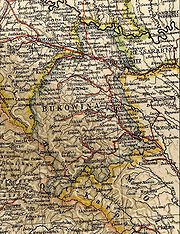 The 1871 and 1904 jubilees held at Putna Monastery
, near the tomb of Ştefan cel Mare
, have constituted tremendous moments for Romanian national identity in Bukovina. Since gaining its independence, Romania
envisioned to incorporate this historic province which, as a core of Moldavian Principality, was of a great historic significance to its history and contained many prominent monuments of its art
and architecture.
Despite the influx of migrants encouraged under the Austrian rule, Romanians continued to be the largest ethnic group in the province until 1880, when Ruthenians (Ukrainians) outnumbered the Romanians 5:4. According to the 1880 census there were 239,690 Ruthenians and Hutzuls, or roughly 41.5% of the population of the region, while Romanians were second with 190,005 people or 33%, a ratio that remained unchanged until World War I
. Ruthenian is an archaic name for Ukrainian
, while the Hutsuls are a regional Ukrainian subgroup.
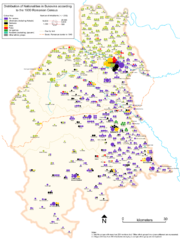
Under Austrian rule Bukovina remained ethnically mixed: predominantly Romanian
in the south, Ukrainian
(commonly referred to as Ruthenians
in the Empire) in the north, with small numbers of Hungarian Székely
, Slovak
and Polish
peasants, and Germans
, Poles
and Jews
in the towns. The 1910 census counted 800,198 people, of which: Ruthenian
38.88%, Romanian
34.38%, German
21.24%, Jews
12.86%, Polish 4.55%, Hungarian 1.31%, Slovak
0.08%, Slovene 0.02%, Italian
0.02%, and a few Croat, Romani, Serbian
, and Turkish
. Romanians
were still present in all settlements of the region, but their number decreased in the villages in the north. Many of Bukovina's Germans, and a few Romanians, emigrated in 19th and 20th century to North America.
In 1783, by an imperial decree Greek Orthodox eparchies in Bukovina and Dalmatia
form an Archbishopric with its seat in Czernowitz, later raised to the rank of Metropolitanate. Some friction appeared in time between the Serb archbishops, and the Romanians complaining that Old Slavonic is favored to Romanian
, and that family names are being slavicized
. In spite of Romanian-Slav frictions over the influence in the local Orthodox clerical hierarchy, there was no Romanian-Ukrainian inter-ethnic tension, and both cultures developed in educational and public life. Moreover, at the end of the 19th century, the development of Ukrainian culture in Bukovina surpassed Galicia and the rest of Ukraine with a network of Ukrainian educational facilities.
In the early 20th century, a group of scholars surrounding the Austrian Archduke Franz Ferdinand created a plan (that never came to pass) of United States of Greater Austria
. The specific proposal was published in Aurel C. Popovici's book “Die Vereinigten Staaten von Groß-Österreich“ [The United States of Greater Austria], Leipzig, 1906. According to it, most of Bukovina (including Czernowitz) would form, with Transylvania
, a Romanian state, while the north-western portion (Zastavna, Kozman, Waschkoutz, Wiznitz, Gura Putilei, and Seletin districts) would form with the bigger part of Galicia a Ukrainian state, both in a federation with 13 other states under the Austrian crown.
 In World War I
, several battles were fought in Bukovina between the Austro-Hungarian
, German
, and Russian armies, which resulted in the Russian army being driven out in 1917.
With the collapse of Austria-Hungary
in 1918, both the local Romanian National Council and the Ukrainian National Council based in Galicia claimed the region. A Constituent Assembly on 14/27 October 1918 formed an Executive Committee, to whom the Austrian governor of the province handed power. The Executive Committee called a General Congress of Bukovina for 15/28 November 1918, where 74 Romanians, 13 Ruthenians, 7 Germans, and 6 Poles were elected (this is the linguistic composition, and Jews were not recorded as a separate group). A popular enthusiasm sprang throughout the region, and a large number of people gathered in the city to wait for the resolution of the Congress.
The Congress elected the Romanian Bukovinian politician Iancu Flondor
as chairman, and voted for the union with the Kingdom of Romania
, with the support of the Romanian, German, Jewish, and Polish representatives, and the opposition of the Ukrainian ones. The reasons stated were that, until its takeover by the Habsburg in 1775, Bukovina was the heart of the Principality of Moldavia, where the "gropniţele domneşti" (voivods' burial sites) are located, and "dreptul de liberă hotărâre de sine" (right of self-determination).
After an official request by Iancu Flondor
, Romanian troops swiftly moved in to take over the territory, against Ukrainian protest. Although local Ukrainians attempted to incorporate parts of northern Bukovina into the short-lived West Ukrainian People's Republic, this attempt was defeated by the Polish and Romanian troops. Romanian control of the province was recognized internationally in the Treaty of St. Germain in 1919.
During the interwar period
Romanian authorities directed Rumanization policies at the Ukrainian population of the region. Romanian language
was introduced into ethnic minority schools in 1923, and by 1926 all Ukrainian schools in Bukovina were closed.
At the same time, the Ukrainian enrollment in the Cernăuţi University
fell from 239 out of 1671, in 1914, to 155 out of 3,247, in 1933, while Romanian enrollment in the same period increased several times to 2,117 out of 3,247. This was partly due to some extent to attempts to switch to mostly Romanian language, but chiefly to the fact that the university was one of only five in Romania, and was considered prestigious.
In the decade following 1928, as Romania tried to improve its relations with the Soviet Union
, Ukrainian culture was given some limited means to redevelop, though the gains were sharply reversed in 1938.
According to the 1930 Romanian census, Romanians
made up almost 45% of the total population of Bukovina and Ruthenians (Ukrainians) 29.2%. However, in the northern part of the region, Romanians made up only 32.6% of the population, with Ukrainians slightly outnumbering Romanians.
 Following the Ribbentrop-Molotov Pact, the June 1940 Soviet Ultimatum demanded from Romania
the northern part of Bukovina, a region bordering Galicia (the latter annexed by the Soviet Union
at 1939 Poland's partition in 1939
). The Soviet demand for Bukovina surprised Nazi Germany
, though it did not formally oppose it. In the first Soviet ultimatum addressed to the Romanian government, the partly Ukrainian populated northern Bukovina was "demanded" as a minor "reparation for the great loss produced to the Soviet Union and Bassarabia's population by twenty-two years of Romanian domination of Bassarabia". On 28 June 1940, the Romanian government evacuated Northern Bukovina, and the Red Army
moved in, with the new Soviet-Romanian border being traced less than 20 kilometers north of Putna Monastery
.
In 1940, Chernivtsi Oblast
(⅔ of which is Northern Bukovina) had a population of circa 805,000, out of which 47.5% were Ukrainians and 28.3% were Romanians, with Germans, Jews, Poles, Hungarians and Russians comprising the rest. The strong Ukrainian presence was the official motivation for inclusion of the region into the Ukrainian SSR
and not into the newly-formed Moldavian SSR
. Whether the region would have been included in the Ukrainian SSR
, if the commission presiding over the division had been led by someone else than the Ukrainian communist leader Nikita Khrushchev
, remains a matter of debate among scholars. In fact, some territories with a mostly Romanian population (e.g. Hertza Region
) were allotted to the Ukrainian SSR.
In the course of the 1941 attack on the Soviet Union
by the Axis forces, the Romanian Third Army
led by General Petre Dumitrescu
(operating in the north) and the Fourth Romanian Army
(operating in the south) re-occupied Northern Bukovina, as well as Hertsa district, and Bassarabia, during June–July 1941. However, then it continued the war, and occupied during 1941–1944 proper Soviet territories in the south of Ukrainian SSR
—the Odessa Oblast
, and parts of Mykolaiv
and Vinnytsia
oblast
s.
During 1940–1950, major demographic changes occurred in northern Bukovina. These demographic shifts are explained by several separate but concurrent phenomena:
In the first year of Soviet occupation, the population of the region decreased by more than 250,000. According to NKVD
orders, tens of thousands of Romanian families were deported to Siberia
during this period, with 12,191 people deported on 2 August 1940 (less than a month after the occupation), and another 2,057 persons deported to Siberia in December 1940, together with their families. The largest action took place on 13 June 1941, when about 13,000 people were deported to Siberia and Kazakhstan.
Until the repatriation convention of 15 April 1941, NKVD troops killed hundreds of Romanian peasants of Northern Bukovina as they tried to cross the border into Romania in order to escape from Soviet authorities. This culminated on 1 April 1941 with the Fântâna Albă massacre.
Almost the entire German population of northern Bukovina was forcibly resettled in 1940–1941 (Umsiedlung) to the Reichland, during 15 September 1940 – 15 November 1940. About 45,000 ethnic Germans had left Northern Bukovina by November 1940. This figure, higher than the size of the German minority, included also a couple thousand Romanians, Ukrainian, etc., posing as Germans to flee the Soviet rule.
In July 1941, the new Romanian military government counted at least 36,000 missing persons.
drove the Axis forces out and re-established the Soviet control over the territory. Romania was forced to formally cede the northern part of Bukovina to the USSR by the 1947 Paris peace treaty. The territory became part of the Ukrainian SSR
as Chernivtsi Oblast
(province
). After the war the Soviet
government deported or killed about 41,000 Romanians
. As a result of killings and mass deportations, entire villages, mostly inhabited by Romanians, were abandoned (Albovat, Frunza, I.G.Duca, Buci—completely erased, Prisaca, Tanteni and Vicov—destroyed to a large extent). Men of military age (and sometimes above) were conscripted into the Soviet Army. That did not protect them, however, from being arrested and deported for being "anti-Soviet elements".
As a reaction, partisan groups (composed of both Romanians and Ukrainians) began to operate against the Soviets in the woods around Chernivtsi
, Crasna and Codrii Cosminului. In Crasna (in the former Storozhynets county) villagers attacked Soviet soldiers who were sent to "temporarily resettle" them, since they feared deportation. This resulted in dead and wounded among the villagers, who had no firearms.
Spring 1945 saw the formation of transports of Polish repatriates who (voluntarily or by coercion) had decided to leave. Between March 1945 and July 1946, 10,490 inhabitants left northern Bukovina for Poland, including 8,140 Poles, 2,041 Jews and 309 of other nationalities.
Overall, between 1930 (last Romanian census) and 1959 (first Soviet census), the population of northern Bukovina decreased by 31,521 people. According to official data from those two censuses, the Romanian population had decreased by 75,752 people, and the Jewish population by 46,632, while the Ukrainian and Russian populations increased by 135,161 and 4,322 people, respectively.
After 1944, the human and economic connections between the northern (Soviet) and southern (Romanian) parts of Bukovina were severed. While the northern part is the nucleus of the Ukrainian Chernivtsi Oblast
, the southern part is tightly integrated with the other Romanian historic regions.
This dramatic change in Bukovina's ethnic composition changed the proportion of Romanians from an overwhelming absolute majority (more than 85% before 1774) to a plurality majority (40.5% in 1869) and then a minority (33.4% in 1880).
According to the census data of Austria-Hungary
, the population of Bukovina was:
 The present demographic situation in Bukovina hardly resembles the one of the times of the Austrian Empire
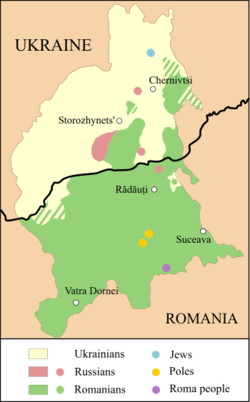
. The northern (Ukrainian) and southern (Romanian) parts became significantly dominated by their Ukrainian and Romanian majorities, respectively, with the representation of other ethnic groups being decreased significantly.
According to the Ukrainian Census (2001)
data, the Ukrainians
represent about 75% (689,100) of the population of Chernivtsi Oblast
, which is the closest, although not an exact, approximation of the territory of the historic Northern Bukovina. The census also identified a fall in the Romanian
and Moldovan
populations to 12.5% (114,600) and 7.3% (67,200), respectively. Russians
are the next largest ethnic group with 4.1%, while Poles
, Belarusians
, and Jews
comprise the rest 1.2%. The languages of the population closely reflect the ethnic composition, with over 90% within each of the major ethnic groups declaring their national language as the mother tongue (Ukrainian
, Romanian
, and Russian
, respectively).
The fact that Romanians
and Moldovans
were presented as separate categories in the census results, has been criticized by the Romanian Community of Ukraine - Interregional Union, which complains that this old Soviet-era practice, results in the Romanian population being undercounted, as being divided between Romanians
and Moldovans
.
A compact Romanian
majority inhabits the southern part of Chernivtsi region, in Hertsa
, Novoselytsia
, Hlyboka
, and Storozhynets
raion
s (districts). In Putyla
and Vyzhnytsia
raions Ukrainians
Hutsuls
form the majority. In the other five districts, and the city of Chernivtsi
, non-Hutsul Ukrainians
are in the majority.
The southern, or Romanian Bukovina has a significant Romanian majority (97.5%), largest minority group being the Ukrainians, who make up 1.2% of the population (2002 census). The Romanian 2002 census was subject to a criticism of undercounting of ethnic minorities in Romania brought up by the Ukrainian communities inside and outside Romania
.
Carpathian Mountains
The Carpathian Mountains or Carpathians are a range of mountains forming an arc roughly long across Central and Eastern Europe, making them the second-longest mountain range in Europe...
and the adjoining plains.
Name
The name Bukovina came into official use in 1775 with the region's annexationGrigore III Ghica
Grigore III Ghica was twice the Prince of Moldavia between 29 March 1764 – 3 February 1767 and September 1774 – 10 October 1777 and of Wallachia: 28 October 1768 – November 1769....
from the Principality of Moldavia to the possessions of the Habsburg Monarchy
Habsburg Monarchy
The Habsburg Monarchy covered the territories ruled by the junior Austrian branch of the House of Habsburg , and then by the successor House of Habsburg-Lorraine , between 1526 and 1867/1918. The Imperial capital was Vienna, except from 1583 to 1611, when it was moved to Prague...
, which became Austrian Empire
Austrian Empire
The Austrian Empire was a modern era successor empire, which was centered on what is today's Austria and which officially lasted from 1804 to 1867. It was followed by the Empire of Austria-Hungary, whose proclamation was a diplomatic move that elevated Hungary's status within the Austrian Empire...
in 1804, and Austria-Hungary
Austria-Hungary
Austria-Hungary , more formally known as the Kingdoms and Lands Represented in the Imperial Council and the Lands of the Holy Hungarian Crown of Saint Stephen, was a constitutional monarchic union between the crowns of the Austrian Empire and the Kingdom of Hungary in...
in 1867.
The official German
German language
German is a West Germanic language, related to and classified alongside English and Dutch. With an estimated 90 – 98 million native speakers, German is one of the world's major languages and is the most widely-spoken first language in the European Union....
name, die Bukowina, of the province under Austrian rule (1775–1918), was derived from the Polish
Polish language
Polish is a language of the Lechitic subgroup of West Slavic languages, used throughout Poland and by Polish minorities in other countries...
form Bukowina, which in turn was derived from the Ukrainian word, Буковина (Bukovyna), and the common Slavic
Slavic languages
The Slavic languages , a group of closely related languages of the Slavic peoples and a subgroup of Indo-European languages, have speakers in most of Eastern Europe, in much of the Balkans, in parts of Central Europe, and in the northern part of Asia.-Branches:Scholars traditionally divide Slavic...
form of buk, meaning beech
Beech
Beech is a genus of ten species of deciduous trees in the family Fagaceae, native to temperate Europe, Asia and North America.-Habit:...
tree (бук [buk] as, for example, in Ukrainian
Ukrainian language
Ukrainian is a language of the East Slavic subgroup of the Slavic languages. It is the official state language of Ukraine. Written Ukrainian uses a variant of the Cyrillic alphabet....
or, even, Buche in German). Another German name for the region, das Buchenland, is mostly used in poetry, and means "beech land", or "the land of beech trees". In Romanian, in literary or poetic contexts, the name Țara Fagilor ("the land of beech trees") is sometimes used.
During the Middle Ages, part of the region was the northwestern third of "Țara de Sus" (Upper Country in Romanian), part of the Moldavian Principality
Moldavia
Moldavia is a geographic and historical region and former principality in Eastern Europe, corresponding to the territory between the Eastern Carpathians and the Dniester river...
, as opposed to "Țara de Jos" (Lower Country). The region became the cradle of the Moldavian Principality, and remained its political center until 1564, when its capital was moved from Suceava
Suceava
Suceava is the Suceava County seat in Bukovina, Moldavia region, in north-eastern Romania. The city was the capital of the Principality of Moldavia from 1388 to 1565.-History:...
to Iași
Iasi
Iași is the second most populous city and a municipality in Romania. Located in the historical Moldavia region, Iași has traditionally been one of the leading centres of Romanian social, cultural, academic and artistic life...
.
From the 10th to the 12th centuries, it formed part of Kyievan Rus'
Kievan Rus'
Kievan Rus was a medieval polity in Eastern Europe, from the late 9th to the mid 13th century, when it disintegrated under the pressure of the Mongol invasion of 1237–1240....
and later was a land of transition between the Principality of Halychyna (Galicia
Galicia
-Geographic regions:* Galicia , an autonomous community in northwestern Spain** Gallaecia, a province of the Roman Empire** Kingdom of Galicia, a medieval kingdom**Nueva Galicia :*** Nueva Galicia, a region of New Spain, now in Mexico...
) and the Principality of Moldavia before falling uner Polish rule and later forming part of the Habsburg Empire and eventually the Austro-Hungarian Empire.
Nowadays in Ukraine the name is unofficial, but is common when referring to the Chernivtsi Oblast
Chernivtsi Oblast
Chernivtsi Oblast is an oblast in western Ukraine, bordering on Romania and Moldova. It has a large variety of landforms: the Carpathian Mountains and picturesque hills at the foot of the mountains gradually change to a broad partly forested plain situated between the Dniester and Prut rivers....
as over 2/3 of the oblast
Oblast
Oblast is a type of administrative division in Slavic countries, including some countries of the former Soviet Union. The word "oblast" is a loanword in English, but it is nevertheless often translated as "area", "zone", "province", or "region"...
is the northern part of Bukovina. In Romania the term Northern Bucovina is sometimes synonymous to the entire Chernivtsi Oblast of Ukraine, and (Southern) Bucovina to Suceava County
Suceava County
Suceava is a county of Romania, in the historical region of Moldavia and few villages in Transylvania, with the capital city at Suceava.- Demographics :...
of Romania (although 10% of the present day Suceava County
Suceava County
Suceava is a county of Romania, in the historical region of Moldavia and few villages in Transylvania, with the capital city at Suceava.- Demographics :...
covers territory outside of the historical Bukovina.)
In English, an alternate form is The Bukovina, increasingly an archaism, which, however, is found in older literature.
Before the 14th century
During the NeolithicNeolithic
The Neolithic Age, Era, or Period, or New Stone Age, was a period in the development of human technology, beginning about 9500 BC in some parts of the Middle East, and later in other parts of the world. It is traditionally considered as the last part of the Stone Age...
age, Bukovina was populated by the Cucuteni-Trypillian
Cucuteni culture
The Cucuteni-Trypillian culture, also known as Cucuteni culture , Trypillian culture or Tripolye culture , is a late Neolithic archaeological culture which flourished between ca...
culture of early settler
Settler
A settler is a person who has migrated to an area and established permanent residence there, often to colonize the area. Settlers are generally people who take up residence on land and cultivate it, as opposed to nomads...
s (4500 BC – 3000 BC), which was overrun, around 2000 BC, by the migration of Indo-Europeans
Proto-Indo-Europeans
The Proto-Indo-Europeans were the speakers of the Proto-Indo-European language , a reconstructed prehistoric language of Eurasia.Knowledge of them comes chiefly from the linguistic reconstruction, along with material evidence from archaeology and archaeogenetics...
.
Starting with the 2nd millennium BC
2nd millennium BC
The 2nd millennium BC marks the transition from the Middle to the Late Bronze Age.Its first half is dominated by the Middle Kingdom of Egypt and Babylonia. The alphabet develops. Indo-Iranian migration onto the Iranian plateau and onto the Indian subcontinent propagates the use of the chariot...
, it was inhabited by the Dacian tribes
Dacians
The Dacians were an Indo-European people, very close or part of the Thracians. Dacians were the ancient inhabitants of Dacia...
, such as Costoboci
Costoboci
The Costoboci were an ancient people located, during the Roman imperial era, between the Carpathian Mountains and the river Dniester.The Costoboci invaded the Roman empire in AD 170 or 171, pillaging its Balkan provinces as far as central Greece, until they were driven out by Romans...
and Carpians
Carpians
The Carpi or Carpiani were an ancient people that resided, between not later than ca. AD 140 and until at least AD 318, in the former Principality of Moldavia ....
, and for a period, cohabitated by the Celto-Germanic tribe of Bastarnae
Bastarnae
The Bastarnae or Basternae were an ancient Germanic tribe,, who between 200 BC and 300 AD inhabited the region between the eastern Carpathian mountains and the Dnieper river...
. From approx. 70 BC to 44 BC, the region was incorporated in the Dacian polity of Burebista
Burebista
Burebista was a king of the Getae and Dacians, who unified for the first time their tribes and ruled them between 82 BC and 44 BC. He led plunder and conquest raids across Central and Southeastern Europe, subjugating most of the neighbouring tribes...
.
When the Dacian Kingdom of Decebal, which included the territories just on the other side of the Carpathian Mountains from what is today Bukovina, fell to the Romans in 106, the area came under linguistic and cultural influence of the Roman Empire
Roman Empire
The Roman Empire was the post-Republican period of the ancient Roman civilization, characterised by an autocratic form of government and large territorial holdings in Europe and around the Mediterranean....
.
In the 3rd century (240s–270s) the region was plundered by the Goths
Goths
The Goths were an East Germanic tribe of Scandinavian origin whose two branches, the Visigoths and the Ostrogoths, played an important role in the fall of the Roman Empire and the emergence of Medieval Europe....
, in the 4th century by the Huns
Huns
The Huns were a group of nomadic people who, appearing from east of the Volga River, migrated into Europe c. AD 370 and established the vast Hunnic Empire there. Since de Guignes linked them with the Xiongnu, who had been northern neighbours of China 300 years prior to the emergence of the Huns,...
(370s–380s), and in the 6th century (560s–570s) by the Avars
Eurasian Avars
The Eurasian Avars or Ancient Avars were a highly organized nomadic confederacy of mixed origins. They were ruled by a khagan, who was surrounded by a tight-knit entourage of nomad warriors, an organization characteristic of Turko-Mongol groups...
.
Beginning with the 6th century, Slavic populations
Slavic peoples
The Slavic people are an Indo-European panethnicity living in Eastern Europe, Southeast Europe, North Asia and Central Asia. The term Slavic represents a broad ethno-linguistic group of people, who speak languages belonging to the Slavic language family and share, to varying degrees, certain...
entered the region and influenced the language and agricultural methods (e.g. burning the forests to increase the cultivated land) of the locals.
In 797 the Avars
Eurasian Avars
The Eurasian Avars or Ancient Avars were a highly organized nomadic confederacy of mixed origins. They were ruled by a khagan, who was surrounded by a tight-knit entourage of nomad warriors, an organization characteristic of Turko-Mongol groups...
, who settled in today's Hungary
Hungary
Hungary , officially the Republic of Hungary , is a landlocked country in Central Europe. It is situated in the Carpathian Basin and is bordered by Slovakia to the north, Ukraine and Romania to the east, Serbia and Croatia to the south, Slovenia to the southwest and Austria to the west. The...
and collected regular tribute from the peasants all over south-eastern Europe, were defeated by Charlemagne
Charlemagne
Charlemagne was King of the Franks from 768 and Emperor of the Romans from 800 to his death in 814. He expanded the Frankish kingdom into an empire that incorporated much of Western and Central Europe. During his reign, he conquered Italy and was crowned by Pope Leo III on 25 December 800...
.
According to medieval Kievan sources, until the 10th century the territory had been part of White Croatia
White Croatia
White Croatia is a vaguely defined area, said to lie somewhere in Central Europe, near Bavaria, beyond Hungary on south of Poland and west of Ukraine, and adjacent to the Frankish Empire from which the part of White Croats crossed the Carpathians and migrated in the 7th century into Dalmatia...
and later under the Kievan Rus'
Kievan Rus'
Kievan Rus was a medieval polity in Eastern Europe, from the late 9th to the mid 13th century, when it disintegrated under the pressure of the Mongol invasion of 1237–1240....
, and in 12th to early 14th century, Principality of Halych-Volhynia
Halych-Volhynia
The Kingdom of Galicia–Volhynia or Kingdom of Rus or Galicia–Vladimir was a Ruthenian state in the regions of Galicia and Volhynia during 1199–1349. Along with Novgorod and Vladimir-Suzdal, it was one of the three most important powers to emerge from the collapse of Kievan Rus'...
, included parts of the region.
The villages of the Campulung
Câmpulung Moldovenesc
Câmpulung Moldovenesc is a city located in Suceava County, which is in the historical Bukovina region of Moldavia in North Eastern Romania...
Valley formed a "republic" that preserved its autonomy even under the Principality of Moldavia, which acquired independence in 1359.
Moldavian Principality
Black Sea
The Black Sea is bounded by Europe, Anatolia and the Caucasus and is ultimately connected to the Atlantic Ocean via the Mediterranean and the Aegean seas and various straits. The Bosphorus strait connects it to the Sea of Marmara, and the strait of the Dardanelles connects that sea to the Aegean...
. Bukovina and neighboring regions were the nucleus of the Moldavian Principality, with the city of Suceava
Suceava
Suceava is the Suceava County seat in Bukovina, Moldavia region, in north-eastern Romania. The city was the capital of the Principality of Moldavia from 1388 to 1565.-History:...
as its capital from 1388 (after Baia
Baia
Baia is a commune in the Suceava County, Romania with a population of 6,793 . It is composed of two villages, Baia and Bogata. Located on the Moldova River, it was one of the earliest urban settlements in Moldavia, originally inhabited by Germans...
and Siret
Siret
Siret is a town in Romania, Suceava County, one of the oldest towns in, and a former capital of, the former principality of Moldavia. It is located 2 km from the border with Ukraine, being one of the main border passing points in the North of the country, having both a road border post and a...
). The name of Moldavia
Moldavia
Moldavia is a geographic and historical region and former principality in Eastern Europe, corresponding to the territory between the Eastern Carpathians and the Dniester river...
(Moldova) is derived from a river (Moldova River
Moldova River
The Moldova River is a river in Romania, in the historical region of Moldavia. The river rises from the Obcina Feredeu Mountains of Bukovina in Suceava County and joins the Siret River near the city of Roman in Neamţ County....
) flowing in Bukovina.
In the 15th century, Pokuttya
Pokuttya
Pokuttya or Pokuttia is a historical area of East-Central Europe, between upper Prut and Cheremosh rivers, in modern Ukraine. Historically it was a culturally distinct area inhabitated by Ukrainians and Romanians on the previously unpopulated borderlands between the lands of Lviv and Halych...
, the region immediately to the north, became the subject of disputes between the Principality of Moldavia and the Polish Kingdom. Pokuttya was inhabited by Ruthenians (predecessors of modern Ukrainians) and Hutsuls; the latter also reside in western Bukovina. In 1497 a battle took place at the Cosmin Forest
Battle of the Cosmin Forest
The Battle of the Cosmin Forest was fought between the Moldavian Prince, Ştefan cel Mare , and King John I of Poland of the Kingdom of Poland...
(the hilly forests separating Chernivtsi
Chernivtsi
Chernivtsi is the administrative center of Chernivtsi Oblast in southwestern Ukraine. The city is situated on the upper course of the River Prut, a tributary of the Danube, in the northern part of the historic region of Bukovina, which is currently divided between Romania and Ukraine...
and Siret
Siret
Siret is a town in Romania, Suceava County, one of the oldest towns in, and a former capital of, the former principality of Moldavia. It is located 2 km from the border with Ukraine, being one of the main border passing points in the North of the country, having both a road border post and a...
valleys), at which Stephen III of Moldavia (Stephen the Great)
Stephen III of Moldavia
Stephen III of Moldavia was Prince of Moldavia between 1457 and 1504 and the most prominent representative of the House of Mușat.During his reign, he strengthened Moldavia and maintained its independence against the ambitions of Hungary, Poland, and the...
, managed to defeat the much-stronger but demoralized army of King John I Albert of Poland
John I Albert of Poland
John I Albert was King of Poland and Duke of Głogów .-Life:John was the third son of Casimir IV Jagiellon, King of Poland, and Elisabeth of Austria, daughter of Albert II of Germany. As crown prince, he distinguished himself by his brilliant victory over the Tatars at Kopersztyn...
. The battle is known in Polish popular culture as "the battle when the knights have perished".
In this period, the patronage of Stephen the Great and his successors on the throne of Moldavia saw the construction of the famous painted monasteries of Moldoviţa
Moldovita
The Moldovița Monastery is a Romanian Orthodox monastery situated in the commune of Vatra Moldoviței, Suceava County, Moldavia, Romania. The Monastery of Moldovița was built in 1532 by Petru Rareș, who was Stefan the Great's illegitimate son...
, Suceviţa
Sucevita
Sucevița is a commune in Suceava County, Romania. It is composed of two villages, Sucevița and Voievodeasa.Sucevița Monastery is located in the commune....
, Putna
Putna
Putna can refer to several entities in Romania:* Putna, Suceava, a commune in Suceava County* Putna, a village in Prigor Commune, Caraş-Severin County* Putna, a village in Boloteşti Commune, Vrancea County* the Putna Monastery...
, Humor, Voroneţ, Dragomirna
Dragomirna
The Dragomirna Monastery was built during the first three decades of the 17th century, 15 km from Suceava, in Mitocu Dragomirnei commune. It is the tallest medieval monastery in Bucovina and renowned in Orthodox architecture for its unique proportions and intricate details, mostly carved into...
, Arbore
Arbore
Arbore is a commune located in Suceava County, Romania. It is composed of three villages: Arbore, Bodnăreni and Clit.-Church of Arbore:Arbore is best known for its church, dedicated to Saint John the Baptist. Its painted church was the first Moldavian painted church to be included on the UNESCO...
, and others. With their renowned exterior fresco
Fresco
Fresco is any of several related mural painting types, executed on plaster on walls or ceilings. The word fresco comes from the Greek word affresca which derives from the Latin word for "fresh". Frescoes first developed in the ancient world and continued to be popular through the Renaissance...
es, these monasteries remain some of the greatest cultural treasures of Romania
Romania
Romania is a country located at the crossroads of Central and Southeastern Europe, on the Lower Danube, within and outside the Carpathian arch, bordering on the Black Sea...
; some of them are World Heritage Site
World Heritage Site
A UNESCO World Heritage Site is a place that is listed by the UNESCO as of special cultural or physical significance...
s, part of the painted churches of northern Moldavia
Painted churches of northern Moldavia
The Churches of Moldavia are eight Romanian Orthodox churches in Suceava County, Romania in northern Moldavia, built approximately between 1487 and 1583.Since 1993, they have been listed by UNESCO as a World Heritage Site...
. Stephen also settled the first Ruthenia
Ruthenia
Ruthenia is the Latin word used onwards from the 13th century, describing lands of the Ancient Rus in European manuscripts. Its geographic and culturo-ethnic name at that time was applied to the parts of Eastern Europe. Essentially, the word is a false Latin rendering of the ancient place name Rus...
ns in Bukovina with the hope of having a loyal and more numerous population that would contribute with taxes. In Suceava
Suceava
Suceava is the Suceava County seat in Bukovina, Moldavia region, in north-eastern Romania. The city was the capital of the Principality of Moldavia from 1388 to 1565.-History:...
, in the 16th century, two percent of the population (i.e. about 500–1000 people) was Ruthenian.
In 1513, Moldavia started to pay annual tribute to the Ottoman Empire
Ottoman Empire
The Ottoman EmpireIt was usually referred to as the "Ottoman Empire", the "Turkish Empire", the "Ottoman Caliphate" or more commonly "Turkey" by its contemporaries...
, but remained autonomous and was governed as before by a native Voivod / Prince, also known as Domnitor
Domnitor
Domnitor was the official title of the ruler of the United Principalities of Wallachia and Moldavia between 1859 and 1866....
or Hospodar
Hospodar
Hospodar or gospodar is a term of Slavonic origin, meaning "lord" or "master".The rulers of Wallachia and Moldavia were styled hospodars in Slavic writings from the 15th century to 1866. Hospodar was used in addition to the title voivod...
(Lord in English).
In May, 1600 Mihai Viteazul (Michael the Brave), united the two Romanian principalities and Transylvania under his leadership.
For short periods of time (during wars), the Polish Kingdom occupied parts of northern Moldavia. However, the old border was re-established every time after, as for example on 14 October 1703 the Polish delegate Martin Chometowski acknowledges "Between us and Wallachia
Vlachs
Vlach is a blanket term covering several modern Latin peoples descending from the Latinised population in Central, Eastern and Southeastern Europe. English variations on the name include: Walla, Wlachs, Wallachs, Vlahs, Olahs or Ulahs...
(i.e. Moldavia) God himself set Dniester
Dniester
The Dniester is a river in Eastern Europe. It runs through Ukraine and Moldova and separates most of Moldova's territory from the breakaway de facto state of Transnistria.-Names:...
as the border" (Inter nos et Valachiam ipse Deus flumine Tyras dislimitavit).
In the course of the Russo-Turkish War of 1768–1774
Russo-Turkish War, 1768-1774
The Russo-Turkish War of 1768–1774 was a decisive conflict that brought Southern Ukraine, Northern Caucasus, and Crimea within the orbit of the Russian Empire.-Background:...
, the Ottoman armies were defeated by the Russian Empire
Russian Empire
The Russian Empire was a state that existed from 1721 until the Russian Revolution of 1917. It was the successor to the Tsardom of Russia and the predecessor of the Soviet Union...
, that occupied the region during 15 December 1769 – September 1774, and previously during 14 September–October 1739. Bukovina was the reward the Habsburgs received for aiding the Ottomans in that war. Prince Grigore III Ghica
Grigore III Ghica
Grigore III Ghica was twice the Prince of Moldavia between 29 March 1764 – 3 February 1767 and September 1774 – 10 October 1777 and of Wallachia: 28 October 1768 – November 1769....
of Moldavia
Moldavia
Moldavia is a geographic and historical region and former principality in Eastern Europe, corresponding to the territory between the Eastern Carpathians and the Dniester river...
protested and was prepared to take action to recover the territory, but was assassinated, and a Greek-Phanariot foreigner was put on the throne of Moldavia
Moldavia
Moldavia is a geographic and historical region and former principality in Eastern Europe, corresponding to the territory between the Eastern Carpathians and the Dniester river...
by the Ottomans.
Austrian Empire
Habsburg Monarchy
The Habsburg Monarchy covered the territories ruled by the junior Austrian branch of the House of Habsburg , and then by the successor House of Habsburg-Lorraine , between 1526 and 1867/1918. The Imperial capital was Vienna, except from 1583 to 1611, when it was moved to Prague...
occupied Bukovina in October 1774. Following the first partition of Poland in 1772, the Austrians claimed that they needed it for a road between Galicia and Transylvania. Bukovina was formally annexed in January 1775. On 2 July 1776, at Palamutka, Austrians and Ottomans signed a border convention, Austrians giving back 59 of the previously occupied villages, and remaining with 278 villages.
Bukovina was a closed military district (1775–1786), then the largest district, Kreis
Kreis
Kreis is the German word for circle, and also refers to a type of country subdivision.*In Germany, a Kreis is a district or county*In Prussia, a Kreis was a district or county...
Czernowitz (after its capital Czernowitz) of the Austrian constituent Kingdom of Galicia and Lodomeria (1787–1849), and, finally, on 4 March 1849, became a separate Austrian Kronland
Kronland
Kronland may refer to:* the German name of Lanškroun, a town in the Czech Republic* a "crown land", a constituent territory of Cisleithania, the Austrian half of former Austria–Hungary...
'crown land' under a Landespräsident (not a Statthalter, as in other crown lands) and declared Herzogtum Bukowina (nominal duchy, as part of the official full style of the Austrian Emperors). In 1860 it was again amalgamated with Galicia, but reinstated as a separate province once again 26 February 1861, a status that would last until 1918.
In 1849 Bukovina got a representative assembly, the Landtag (diet). The Moldavian
Moldovans
Moldovans or Moldavians are the largest population group of Moldova...
nobility had traditionally formed the ruling class in that territory. In 1867 it remained part of the Cisleithania
Cisleithania
Cisleithania was a name of the Austrian part of Austria-Hungary, the Dual Monarchy created in 1867 and dissolved in 1918. The name was used by politicians and bureaucrats, but it had no official status...
n or Austrian territories of the Austro-Hungarian Empire
Austria-Hungary
Austria-Hungary , more formally known as the Kingdoms and Lands Represented in the Imperial Council and the Lands of the Holy Hungarian Crown of Saint Stephen, was a constitutional monarchic union between the crowns of the Austrian Empire and the Kingdom of Hungary in...
until 1918.
According to the 1775 Austrian census, the province had the total population of 86,000, made up mostly of Romanians (Moldovans), and up to 10,000 Slavs (Polish, Ruthenians and Hutzuls). During the 19th century the Austrian Empire policies encouraged the influx of many immigrants such as Germans, Poles, Jews, Hungarians, and Ukrainians
Ukrainians
Ukrainians are an East Slavic ethnic group native to Ukraine, which is the sixth-largest nation in Europe. The Constitution of Ukraine applies the term 'Ukrainians' to all its citizens...
(that time referred to as Ruthenians
Ruthenians
The name Ruthenian |Rus']]) is a culturally loaded term and has different meanings according to the context in which it is used. Initially, it was the ethnonym used for the East Slavic peoples who lived in Rus'. Later it was used predominantly for Ukrainians...
) from Galicia. By 1900 the Romanian population decreased to roughly 40% of Bukovina, with significant Ukrainian (including Hutzuls) (especially in villages in the northern half), German
Germany
Germany , officially the Federal Republic of Germany , is a federal parliamentary republic in Europe. The country consists of 16 states while the capital and largest city is Berlin. Germany covers an area of 357,021 km2 and has a largely temperate seasonal climate...
, Jewish, Polish
Poland
Poland , officially the Republic of Poland , is a country in Central Europe bordered by Germany to the west; the Czech Republic and Slovakia to the south; Ukraine, Belarus and Lithuania to the east; and the Baltic Sea and Kaliningrad Oblast, a Russian exclave, to the north...
(especially in towns), and Hungarian (several villages) minorities. To reflect this ethnicity shift, in 1843 the Ruthenian language
Ruthenian language
Ruthenian, or Old Ruthenian , is a term used for the varieties of Eastern Slavonic spoken in the Grand Duchy of Lithuania and later in the East Slavic territories of the Polish–Lithuanian Commonwealth....
was recognized, along with the Romanian language
Romanian language
Romanian Romanian Romanian (or Daco-Romanian; obsolete spellings Rumanian, Roumanian; self-designation: română, limba română ("the Romanian language") or românește (lit. "in Romanian") is a Romance language spoken by around 24 to 28 million people, primarily in Romania and Moldova...
, as 'the language of the people and of the Church in Bukovina'.
Late-19th to early-20th centuries
Putna Monastery
The Putna monastery is a Romanian Orthodox monastery, one of the most important cultural, religious and artistic centers established in medieval Moldavia; as with many others, it was built and dedicated by Prince Stephen the Great. Putna was founded on the lands perambulated by the Putna...
, near the tomb of Ştefan cel Mare
Stephen III of Moldavia
Stephen III of Moldavia was Prince of Moldavia between 1457 and 1504 and the most prominent representative of the House of Mușat.During his reign, he strengthened Moldavia and maintained its independence against the ambitions of Hungary, Poland, and the...
, have constituted tremendous moments for Romanian national identity in Bukovina. Since gaining its independence, Romania
Kingdom of Romania
The Kingdom of Romania was the Romanian state based on a form of parliamentary monarchy between 13 March 1881 and 30 December 1947, specified by the first three Constitutions of Romania...
envisioned to incorporate this historic province which, as a core of Moldavian Principality, was of a great historic significance to its history and contained many prominent monuments of its art
Art of Romania
Art of Romania encompasses the artists and artistic movements in Romania.-Romanian contemporary and modern artists:* Almaşan Virgil* Adela Andea* George Apostu* Corneliu Baba* Calin Baban* Sabin Bălaşa* Horia Bernea* Traian Brădean...
and architecture.
Despite the influx of migrants encouraged under the Austrian rule, Romanians continued to be the largest ethnic group in the province until 1880, when Ruthenians (Ukrainians) outnumbered the Romanians 5:4. According to the 1880 census there were 239,690 Ruthenians and Hutzuls, or roughly 41.5% of the population of the region, while Romanians were second with 190,005 people or 33%, a ratio that remained unchanged until World War I
World War I
World War I , which was predominantly called the World War or the Great War from its occurrence until 1939, and the First World War or World War I thereafter, was a major war centred in Europe that began on 28 July 1914 and lasted until 11 November 1918...
. Ruthenian is an archaic name for Ukrainian
Ukrainians
Ukrainians are an East Slavic ethnic group native to Ukraine, which is the sixth-largest nation in Europe. The Constitution of Ukraine applies the term 'Ukrainians' to all its citizens...
, while the Hutsuls are a regional Ukrainian subgroup.
Under Austrian rule Bukovina remained ethnically mixed: predominantly Romanian
Romanians
The Romanians are an ethnic group native to Romania, who speak Romanian; they are the majority inhabitants of Romania....
in the south, Ukrainian
Ukrainians
Ukrainians are an East Slavic ethnic group native to Ukraine, which is the sixth-largest nation in Europe. The Constitution of Ukraine applies the term 'Ukrainians' to all its citizens...
(commonly referred to as Ruthenians
Ruthenians
The name Ruthenian |Rus']]) is a culturally loaded term and has different meanings according to the context in which it is used. Initially, it was the ethnonym used for the East Slavic peoples who lived in Rus'. Later it was used predominantly for Ukrainians...
in the Empire) in the north, with small numbers of Hungarian Székely
Székely
The Székelys or Székely , sometimes also referred to as Szeklers , are a subgroup of the Hungarian people living mostly in the Székely Land, an ethno-cultural region in eastern Transylvania, Romania...
, Slovak
Slovaks
The Slovaks, Slovak people, or Slovakians are a West Slavic people that primarily inhabit Slovakia and speak the Slovak language, which is closely related to the Czech language.Most Slovaks today live within the borders of the independent Slovakia...
and Polish
Poland
Poland , officially the Republic of Poland , is a country in Central Europe bordered by Germany to the west; the Czech Republic and Slovakia to the south; Ukraine, Belarus and Lithuania to the east; and the Baltic Sea and Kaliningrad Oblast, a Russian exclave, to the north...
peasants, and Germans
Germans
The Germans are a Germanic ethnic group native to Central Europe. The English term Germans has referred to the German-speaking population of the Holy Roman Empire since the Late Middle Ages....
, Poles
Poles
thumb|right|180px|The state flag of [[Poland]] as used by Polish government and diplomatic authoritiesThe Polish people, or Poles , are a nation indigenous to Poland. They are united by the Polish language, which belongs to the historical Lechitic subgroup of West Slavic languages of Central Europe...
and Jews
Jews
The Jews , also known as the Jewish people, are a nation and ethnoreligious group originating in the Israelites or Hebrews of the Ancient Near East. The Jewish ethnicity, nationality, and religion are strongly interrelated, as Judaism is the traditional faith of the Jewish nation...
in the towns. The 1910 census counted 800,198 people, of which: Ruthenian
Ruthenians
The name Ruthenian |Rus']]) is a culturally loaded term and has different meanings according to the context in which it is used. Initially, it was the ethnonym used for the East Slavic peoples who lived in Rus'. Later it was used predominantly for Ukrainians...
38.88%, Romanian
Romanians
The Romanians are an ethnic group native to Romania, who speak Romanian; they are the majority inhabitants of Romania....
34.38%, German
Ethnic German
Ethnic Germans historically also ), also collectively referred to as the German diaspora, refers to people who are of German ethnicity. Many are not born in Europe or in the modern-day state of Germany or hold German citizenship...
21.24%, Jews
Jews
The Jews , also known as the Jewish people, are a nation and ethnoreligious group originating in the Israelites or Hebrews of the Ancient Near East. The Jewish ethnicity, nationality, and religion are strongly interrelated, as Judaism is the traditional faith of the Jewish nation...
12.86%, Polish 4.55%, Hungarian 1.31%, Slovak
Slovaks
The Slovaks, Slovak people, or Slovakians are a West Slavic people that primarily inhabit Slovakia and speak the Slovak language, which is closely related to the Czech language.Most Slovaks today live within the borders of the independent Slovakia...
0.08%, Slovene 0.02%, Italian
Italian people
The Italian people are an ethnic group that share a common Italian culture, ancestry and speak the Italian language as a mother tongue. Within Italy, Italians are defined by citizenship, regardless of ancestry or country of residence , and are distinguished from people...
0.02%, and a few Croat, Romani, Serbian
Serbs
The Serbs are a South Slavic ethnic group of the Balkans and southern Central Europe. Serbs are located mainly in Serbia, Montenegro and Bosnia and Herzegovina, and form a sizable minority in Croatia, the Republic of Macedonia and Slovenia. Likewise, Serbs are an officially recognized minority in...
, and Turkish
Turkish people
Turkish people, also known as the "Turks" , are an ethnic group primarily living in Turkey and in the former lands of the Ottoman Empire where Turkish minorities had been established in Bulgaria, Cyprus, Bosnia and Herzegovina, Georgia, Greece, Kosovo, Macedonia, and Romania...
. Romanians
Romanians
The Romanians are an ethnic group native to Romania, who speak Romanian; they are the majority inhabitants of Romania....
were still present in all settlements of the region, but their number decreased in the villages in the north. Many of Bukovina's Germans, and a few Romanians, emigrated in 19th and 20th century to North America.
In 1783, by an imperial decree Greek Orthodox eparchies in Bukovina and Dalmatia
Dalmatia
Dalmatia is a historical region on the eastern coast of the Adriatic Sea. It stretches from the island of Rab in the northwest to the Bay of Kotor in the southeast. The hinterland, the Dalmatian Zagora, ranges from fifty kilometers in width in the north to just a few kilometers in the south....
form an Archbishopric with its seat in Czernowitz, later raised to the rank of Metropolitanate. Some friction appeared in time between the Serb archbishops, and the Romanians complaining that Old Slavonic is favored to Romanian
Romanian language
Romanian Romanian Romanian (or Daco-Romanian; obsolete spellings Rumanian, Roumanian; self-designation: română, limba română ("the Romanian language") or românește (lit. "in Romanian") is a Romance language spoken by around 24 to 28 million people, primarily in Romania and Moldova...
, and that family names are being slavicized
Slavic peoples
The Slavic people are an Indo-European panethnicity living in Eastern Europe, Southeast Europe, North Asia and Central Asia. The term Slavic represents a broad ethno-linguistic group of people, who speak languages belonging to the Slavic language family and share, to varying degrees, certain...
. In spite of Romanian-Slav frictions over the influence in the local Orthodox clerical hierarchy, there was no Romanian-Ukrainian inter-ethnic tension, and both cultures developed in educational and public life. Moreover, at the end of the 19th century, the development of Ukrainian culture in Bukovina surpassed Galicia and the rest of Ukraine with a network of Ukrainian educational facilities.
In the early 20th century, a group of scholars surrounding the Austrian Archduke Franz Ferdinand created a plan (that never came to pass) of United States of Greater Austria
United States of Greater Austria
The United States of Greater Austria was an idea created by a group of scholars surrounding the Austrian Archduke Franz Ferdinand that never came to pass...
. The specific proposal was published in Aurel C. Popovici's book “Die Vereinigten Staaten von Groß-Österreich“ [The United States of Greater Austria], Leipzig, 1906. According to it, most of Bukovina (including Czernowitz) would form, with Transylvania
Transylvania
Transylvania is a historical region in the central part of Romania. Bounded on the east and south by the Carpathian mountain range, historical Transylvania extended in the west to the Apuseni Mountains; however, the term sometimes encompasses not only Transylvania proper, but also the historical...
, a Romanian state, while the north-western portion (Zastavna, Kozman, Waschkoutz, Wiznitz, Gura Putilei, and Seletin districts) would form with the bigger part of Galicia a Ukrainian state, both in a federation with 13 other states under the Austrian crown.
Kingdom of Romania
World War I
World War I , which was predominantly called the World War or the Great War from its occurrence until 1939, and the First World War or World War I thereafter, was a major war centred in Europe that began on 28 July 1914 and lasted until 11 November 1918...
, several battles were fought in Bukovina between the Austro-Hungarian
Austria-Hungary
Austria-Hungary , more formally known as the Kingdoms and Lands Represented in the Imperial Council and the Lands of the Holy Hungarian Crown of Saint Stephen, was a constitutional monarchic union between the crowns of the Austrian Empire and the Kingdom of Hungary in...
, German
German Empire
The German Empire refers to Germany during the "Second Reich" period from the unification of Germany and proclamation of Wilhelm I as German Emperor on 18 January 1871, to 1918, when it became a federal republic after defeat in World War I and the abdication of the Emperor, Wilhelm II.The German...
, and Russian armies, which resulted in the Russian army being driven out in 1917.
With the collapse of Austria-Hungary
Austria-Hungary
Austria-Hungary , more formally known as the Kingdoms and Lands Represented in the Imperial Council and the Lands of the Holy Hungarian Crown of Saint Stephen, was a constitutional monarchic union between the crowns of the Austrian Empire and the Kingdom of Hungary in...
in 1918, both the local Romanian National Council and the Ukrainian National Council based in Galicia claimed the region. A Constituent Assembly on 14/27 October 1918 formed an Executive Committee, to whom the Austrian governor of the province handed power. The Executive Committee called a General Congress of Bukovina for 15/28 November 1918, where 74 Romanians, 13 Ruthenians, 7 Germans, and 6 Poles were elected (this is the linguistic composition, and Jews were not recorded as a separate group). A popular enthusiasm sprang throughout the region, and a large number of people gathered in the city to wait for the resolution of the Congress.
The Congress elected the Romanian Bukovinian politician Iancu Flondor
Iancu Flondor
Iancu Flondor was an Austro-Hungarian-born Romanian activist who advocated Bukovina's unifion with the Kingdom of Romania....
as chairman, and voted for the union with the Kingdom of Romania
Kingdom of Romania
The Kingdom of Romania was the Romanian state based on a form of parliamentary monarchy between 13 March 1881 and 30 December 1947, specified by the first three Constitutions of Romania...
, with the support of the Romanian, German, Jewish, and Polish representatives, and the opposition of the Ukrainian ones. The reasons stated were that, until its takeover by the Habsburg in 1775, Bukovina was the heart of the Principality of Moldavia, where the "gropniţele domneşti" (voivods' burial sites) are located, and "dreptul de liberă hotărâre de sine" (right of self-determination).
After an official request by Iancu Flondor
Iancu Flondor
Iancu Flondor was an Austro-Hungarian-born Romanian activist who advocated Bukovina's unifion with the Kingdom of Romania....
, Romanian troops swiftly moved in to take over the territory, against Ukrainian protest. Although local Ukrainians attempted to incorporate parts of northern Bukovina into the short-lived West Ukrainian People's Republic, this attempt was defeated by the Polish and Romanian troops. Romanian control of the province was recognized internationally in the Treaty of St. Germain in 1919.
During the interwar period
Interwar period
Interwar period can refer to any period between two wars. The Interbellum is understood to be the period between the end of the Great War or First World War and the beginning of the Second World War in Europe....
Romanian authorities directed Rumanization policies at the Ukrainian population of the region. Romanian language
Romanian language
Romanian Romanian Romanian (or Daco-Romanian; obsolete spellings Rumanian, Roumanian; self-designation: română, limba română ("the Romanian language") or românește (lit. "in Romanian") is a Romance language spoken by around 24 to 28 million people, primarily in Romania and Moldova...
was introduced into ethnic minority schools in 1923, and by 1926 all Ukrainian schools in Bukovina were closed.
At the same time, the Ukrainian enrollment in the Cernăuţi University
Chernivtsi University
The Chernivtsi National University is the leading Ukrainian institution for higher education in northern Bukovina, in Chernivtsi, a city in southwest Ukraine....
fell from 239 out of 1671, in 1914, to 155 out of 3,247, in 1933, while Romanian enrollment in the same period increased several times to 2,117 out of 3,247. This was partly due to some extent to attempts to switch to mostly Romanian language, but chiefly to the fact that the university was one of only five in Romania, and was considered prestigious.
In the decade following 1928, as Romania tried to improve its relations with the Soviet Union
Soviet Union
The Soviet Union , officially the Union of Soviet Socialist Republics , was a constitutionally socialist state that existed in Eurasia between 1922 and 1991....
, Ukrainian culture was given some limited means to redevelop, though the gains were sharply reversed in 1938.
According to the 1930 Romanian census, Romanians
Romanians
The Romanians are an ethnic group native to Romania, who speak Romanian; they are the majority inhabitants of Romania....
made up almost 45% of the total population of Bukovina and Ruthenians (Ukrainians) 29.2%. However, in the northern part of the region, Romanians made up only 32.6% of the population, with Ukrainians slightly outnumbering Romanians.
Second World War
Romania
Romania is a country located at the crossroads of Central and Southeastern Europe, on the Lower Danube, within and outside the Carpathian arch, bordering on the Black Sea...
the northern part of Bukovina, a region bordering Galicia (the latter annexed by the Soviet Union
Soviet Union
The Soviet Union , officially the Union of Soviet Socialist Republics , was a constitutionally socialist state that existed in Eurasia between 1922 and 1991....
at 1939 Poland's partition in 1939
Invasion of Poland (1939)
The Invasion of Poland, also known as the September Campaign or 1939 Defensive War in Poland and the Poland Campaign in Germany, was an invasion of Poland by Germany, the Soviet Union, and a small Slovak contingent that marked the start of World War II in Europe...
). The Soviet demand for Bukovina surprised Nazi Germany
Nazi Germany
Nazi Germany , also known as the Third Reich , but officially called German Reich from 1933 to 1943 and Greater German Reich from 26 June 1943 onward, is the name commonly used to refer to the state of Germany from 1933 to 1945, when it was a totalitarian dictatorship ruled by...
, though it did not formally oppose it. In the first Soviet ultimatum addressed to the Romanian government, the partly Ukrainian populated northern Bukovina was "demanded" as a minor "reparation for the great loss produced to the Soviet Union and Bassarabia's population by twenty-two years of Romanian domination of Bassarabia". On 28 June 1940, the Romanian government evacuated Northern Bukovina, and the Red Army
Red Army
The Workers' and Peasants' Red Army started out as the Soviet Union's revolutionary communist combat groups during the Russian Civil War of 1918-1922. It grew into the national army of the Soviet Union. By the 1930s the Red Army was among the largest armies in history.The "Red Army" name refers to...
moved in, with the new Soviet-Romanian border being traced less than 20 kilometers north of Putna Monastery
Putna Monastery
The Putna monastery is a Romanian Orthodox monastery, one of the most important cultural, religious and artistic centers established in medieval Moldavia; as with many others, it was built and dedicated by Prince Stephen the Great. Putna was founded on the lands perambulated by the Putna...
.
In 1940, Chernivtsi Oblast
Chernivtsi Oblast
Chernivtsi Oblast is an oblast in western Ukraine, bordering on Romania and Moldova. It has a large variety of landforms: the Carpathian Mountains and picturesque hills at the foot of the mountains gradually change to a broad partly forested plain situated between the Dniester and Prut rivers....
(⅔ of which is Northern Bukovina) had a population of circa 805,000, out of which 47.5% were Ukrainians and 28.3% were Romanians, with Germans, Jews, Poles, Hungarians and Russians comprising the rest. The strong Ukrainian presence was the official motivation for inclusion of the region into the Ukrainian SSR
Ukrainian SSR
The Ukrainian Soviet Socialist Republic or in short, the Ukrainian SSR was a sovereign Soviet Socialist state and one of the fifteen constituent republics of the Soviet Union lasting from its inception in 1922 to the breakup in 1991...
and not into the newly-formed Moldavian SSR
Moldavian SSR
The Moldavian Soviet Socialist Republic , commonly abbreviated to Moldavian SSR or MSSR, was one of the 15 republics of the Soviet Union...
. Whether the region would have been included in the Ukrainian SSR
Ukrainian SSR
The Ukrainian Soviet Socialist Republic or in short, the Ukrainian SSR was a sovereign Soviet Socialist state and one of the fifteen constituent republics of the Soviet Union lasting from its inception in 1922 to the breakup in 1991...
, if the commission presiding over the division had been led by someone else than the Ukrainian communist leader Nikita Khrushchev
Nikita Khrushchev
Nikita Sergeyevich Khrushchev led the Soviet Union during part of the Cold War. He served as First Secretary of the Communist Party of the Soviet Union from 1953 to 1964, and as Chairman of the Council of Ministers, or Premier, from 1958 to 1964...
, remains a matter of debate among scholars. In fact, some territories with a mostly Romanian population (e.g. Hertza Region
Hertza region
Hertza region is the territory of an administrative district of Hertsa in the southern part of Chernivtsi Oblast in southwestern Ukraine, on the Romanian border...
) were allotted to the Ukrainian SSR.
In the course of the 1941 attack on the Soviet Union
Operation Barbarossa
Operation Barbarossa was the code name for Germany's invasion of the Soviet Union during World War II that began on 22 June 1941. Over 4.5 million troops of the Axis powers invaded the USSR along a front., the largest invasion in the history of warfare...
by the Axis forces, the Romanian Third Army
Romanian Third Army
The 3rd Army was a field army of the Romanian Land Forces active from the 19th century to the 1990s. It that fought as part of the German Army Group B during World War II, in Ukraine, Crimea, and the Caucasus...
led by General Petre Dumitrescu
Petre Dumitrescu
Petre Dumitrescu was a Romanian general during World War II, who led the Romanian Third Army on its campaign against the Red Army in the eastern front.-Early life and military career:...
(operating in the north) and the Fourth Romanian Army
Fourth Army (Romania)
The Fourth Army was a field army of the Romanian Land Forces active from the 19th century to the 1990s.-History:The Fourth Army fought in the Romanian Campaign of World War I, under the command of General Prezan...
(operating in the south) re-occupied Northern Bukovina, as well as Hertsa district, and Bassarabia, during June–July 1941. However, then it continued the war, and occupied during 1941–1944 proper Soviet territories in the south of Ukrainian SSR
Ukrainian SSR
The Ukrainian Soviet Socialist Republic or in short, the Ukrainian SSR was a sovereign Soviet Socialist state and one of the fifteen constituent republics of the Soviet Union lasting from its inception in 1922 to the breakup in 1991...
—the Odessa Oblast
Odessa Oblast
Odesa Oblast, also written as Odessa Oblast , is the southernmost and largest oblast of south-western Ukraine. The administrative center of the oblast is the city of Odessa.-History:...
, and parts of Mykolaiv
Mykolaiv Oblast
Mykolaiv Oblast is an oblast of Ukraine. The administrative center of the oblast is the city of Mykolayiv.-Geography:The Mykolaiv Oblast is located in the southern half of Ukraine...
and Vinnytsia
Vinnytsia Oblast
Vinnytsia Oblast is an oblast of Ukraine. Its administrative center is Vinnytsia.-Geography:The area of the region is 26,500 km²; its population is 1.7 million....
oblast
Oblast
Oblast is a type of administrative division in Slavic countries, including some countries of the former Soviet Union. The word "oblast" is a loanword in English, but it is nevertheless often translated as "area", "zone", "province", or "region"...
s.
During 1940–1950, major demographic changes occurred in northern Bukovina. These demographic shifts are explained by several separate but concurrent phenomena:
- fleeing of a part of the population to Romania (mainly, but not exclusively, ethnic Romanians)
- repatriation of Germans, Hungarians and Poles
- systematic repression, mass deportation and exterminations by the Soviet regime (again mainly, although not exclusively, directed against Romanians)
- deportation of the Jewish population by the Romanian authorities to the Romanian and German run extermination camps.
In the first year of Soviet occupation, the population of the region decreased by more than 250,000. According to NKVD
NKVD
The People's Commissariat for Internal Affairs was the public and secret police organization of the Soviet Union that directly executed the rule of power of the Soviets, including political repression, during the era of Joseph Stalin....
orders, tens of thousands of Romanian families were deported to Siberia
Siberia
Siberia is an extensive region constituting almost all of Northern Asia. Comprising the central and eastern portion of the Russian Federation, it was part of the Soviet Union from its beginning, as its predecessor states, the Tsardom of Russia and the Russian Empire, conquered it during the 16th...
during this period, with 12,191 people deported on 2 August 1940 (less than a month after the occupation), and another 2,057 persons deported to Siberia in December 1940, together with their families. The largest action took place on 13 June 1941, when about 13,000 people were deported to Siberia and Kazakhstan.
Until the repatriation convention of 15 April 1941, NKVD troops killed hundreds of Romanian peasants of Northern Bukovina as they tried to cross the border into Romania in order to escape from Soviet authorities. This culminated on 1 April 1941 with the Fântâna Albă massacre.
Almost the entire German population of northern Bukovina was forcibly resettled in 1940–1941 (Umsiedlung) to the Reichland, during 15 September 1940 – 15 November 1940. About 45,000 ethnic Germans had left Northern Bukovina by November 1940. This figure, higher than the size of the German minority, included also a couple thousand Romanians, Ukrainian, etc., posing as Germans to flee the Soviet rule.
In July 1941, the new Romanian military government counted at least 36,000 missing persons.
After the war
In 1944 the Red ArmyRed Army
The Workers' and Peasants' Red Army started out as the Soviet Union's revolutionary communist combat groups during the Russian Civil War of 1918-1922. It grew into the national army of the Soviet Union. By the 1930s the Red Army was among the largest armies in history.The "Red Army" name refers to...
drove the Axis forces out and re-established the Soviet control over the territory. Romania was forced to formally cede the northern part of Bukovina to the USSR by the 1947 Paris peace treaty. The territory became part of the Ukrainian SSR
Ukrainian SSR
The Ukrainian Soviet Socialist Republic or in short, the Ukrainian SSR was a sovereign Soviet Socialist state and one of the fifteen constituent republics of the Soviet Union lasting from its inception in 1922 to the breakup in 1991...
as Chernivtsi Oblast
Chernivtsi Oblast
Chernivtsi Oblast is an oblast in western Ukraine, bordering on Romania and Moldova. It has a large variety of landforms: the Carpathian Mountains and picturesque hills at the foot of the mountains gradually change to a broad partly forested plain situated between the Dniester and Prut rivers....
(province
Oblast
Oblast is a type of administrative division in Slavic countries, including some countries of the former Soviet Union. The word "oblast" is a loanword in English, but it is nevertheless often translated as "area", "zone", "province", or "region"...
). After the war the Soviet
Soviet Union
The Soviet Union , officially the Union of Soviet Socialist Republics , was a constitutionally socialist state that existed in Eurasia between 1922 and 1991....
government deported or killed about 41,000 Romanians
Romanians
The Romanians are an ethnic group native to Romania, who speak Romanian; they are the majority inhabitants of Romania....
. As a result of killings and mass deportations, entire villages, mostly inhabited by Romanians, were abandoned (Albovat, Frunza, I.G.Duca, Buci—completely erased, Prisaca, Tanteni and Vicov—destroyed to a large extent). Men of military age (and sometimes above) were conscripted into the Soviet Army. That did not protect them, however, from being arrested and deported for being "anti-Soviet elements".
As a reaction, partisan groups (composed of both Romanians and Ukrainians) began to operate against the Soviets in the woods around Chernivtsi
Chernivtsi
Chernivtsi is the administrative center of Chernivtsi Oblast in southwestern Ukraine. The city is situated on the upper course of the River Prut, a tributary of the Danube, in the northern part of the historic region of Bukovina, which is currently divided between Romania and Ukraine...
, Crasna and Codrii Cosminului. In Crasna (in the former Storozhynets county) villagers attacked Soviet soldiers who were sent to "temporarily resettle" them, since they feared deportation. This resulted in dead and wounded among the villagers, who had no firearms.
Spring 1945 saw the formation of transports of Polish repatriates who (voluntarily or by coercion) had decided to leave. Between March 1945 and July 1946, 10,490 inhabitants left northern Bukovina for Poland, including 8,140 Poles, 2,041 Jews and 309 of other nationalities.
Overall, between 1930 (last Romanian census) and 1959 (first Soviet census), the population of northern Bukovina decreased by 31,521 people. According to official data from those two censuses, the Romanian population had decreased by 75,752 people, and the Jewish population by 46,632, while the Ukrainian and Russian populations increased by 135,161 and 4,322 people, respectively.
After 1944, the human and economic connections between the northern (Soviet) and southern (Romanian) parts of Bukovina were severed. While the northern part is the nucleus of the Ukrainian Chernivtsi Oblast
Chernivtsi Oblast
Chernivtsi Oblast is an oblast in western Ukraine, bordering on Romania and Moldova. It has a large variety of landforms: the Carpathian Mountains and picturesque hills at the foot of the mountains gradually change to a broad partly forested plain situated between the Dniester and Prut rivers....
, the southern part is tightly integrated with the other Romanian historic regions.
Historical population
The ethnic composition of Bukovina changed dramatically after 1774, when the Austrian Empire occupied the region. The population of Bukovina increased steadily, primarily through immigration, which Austrian authorities encouraged in order to develop the economy. In 1774 the Romanians constituted an overwhelming majority, roughly 64,000 (85%) of the 75,000 total population, while about 8,000 (10%) were Ruthenians/Ukrainians and 3,000 (4%) others. By 1810 the Romanian share had fallen from 85% to 75% and in 1848 to only 55%. In the same period, the Ukrainian population rose from 8,000 in 1774 to 108,907 in 1848 and the Jewish population from 526 in 1774 to 11,600 in 1848.This dramatic change in Bukovina's ethnic composition changed the proportion of Romanians from an overwhelming absolute majority (more than 85% before 1774) to a plurality majority (40.5% in 1869) and then a minority (33.4% in 1880).
According to the census data of Austria-Hungary
Austria-Hungary
Austria-Hungary , more formally known as the Kingdoms and Lands Represented in the Imperial Council and the Lands of the Holy Hungarian Crown of Saint Stephen, was a constitutional monarchic union between the crowns of the Austrian Empire and the Kingdom of Hungary in...
, the population of Bukovina was:
| Year | Romanians | Ukrainians | Other | |||
|---|---|---|---|---|---|---|
| 1774 | 64,000 | 85.33% | 8,000 | 10.66% | 3,000 | 4.0% |
| 1786 | 91,823 | 67.8% | 31,671 | 23.4% | 12,000 | 8.8% |
| 1848 | 209,293 | 55.4% | 108,907 | 28.8% | 59,381 | 15.8% |
| 1869 | 207,000 | 40.5% | 186,000 | 36.4% | 118,364 | 23.1% |
| 1880 | 190,005 | 33.4% | 239,960 | 42.2% | 138,758 | 24.4% |
| 1890 | 208,301 | 32.4% | 268,367 | 41.8% | 165,827 | 25.8% |
| 1900 | 229,018 | 31.4% | 297,798 | 40.8% | 203,379 | 27.8% |
| 1910 | 273,254 | 34.1% | 305,101 | 38.4% | 216,574 | 27.2% |
Current population
Austrian Empire
The Austrian Empire was a modern era successor empire, which was centered on what is today's Austria and which officially lasted from 1804 to 1867. It was followed by the Empire of Austria-Hungary, whose proclamation was a diplomatic move that elevated Hungary's status within the Austrian Empire...
. The northern (Ukrainian) and southern (Romanian) parts became significantly dominated by their Ukrainian and Romanian majorities, respectively, with the representation of other ethnic groups being decreased significantly.
According to the Ukrainian Census (2001)
Ukrainian Census (2001)
The first Ukrainian Census was carried out by State Statistics Committee of Ukraine on 5 December 2001, twelve years after the last Soviet Union census in 1989....
data, the Ukrainians
Ukrainians
Ukrainians are an East Slavic ethnic group native to Ukraine, which is the sixth-largest nation in Europe. The Constitution of Ukraine applies the term 'Ukrainians' to all its citizens...
represent about 75% (689,100) of the population of Chernivtsi Oblast
Chernivtsi Oblast
Chernivtsi Oblast is an oblast in western Ukraine, bordering on Romania and Moldova. It has a large variety of landforms: the Carpathian Mountains and picturesque hills at the foot of the mountains gradually change to a broad partly forested plain situated between the Dniester and Prut rivers....
, which is the closest, although not an exact, approximation of the territory of the historic Northern Bukovina. The census also identified a fall in the Romanian
Romanians
The Romanians are an ethnic group native to Romania, who speak Romanian; they are the majority inhabitants of Romania....
and Moldovan
Moldovans
Moldovans or Moldavians are the largest population group of Moldova...
populations to 12.5% (114,600) and 7.3% (67,200), respectively. Russians
Russians
The Russian people are an East Slavic ethnic group native to Russia, speaking the Russian language and primarily living in Russia and neighboring countries....
are the next largest ethnic group with 4.1%, while Poles
Poles
thumb|right|180px|The state flag of [[Poland]] as used by Polish government and diplomatic authoritiesThe Polish people, or Poles , are a nation indigenous to Poland. They are united by the Polish language, which belongs to the historical Lechitic subgroup of West Slavic languages of Central Europe...
, Belarusians
Belarusians
Belarusians ; are an East Slavic ethnic group who populate the majority of the Republic of Belarus. Introduced to the world as a new state in the early 1990s, the Republic of Belarus brought with it the notion of a re-emerging Belarusian ethnicity, drawn upon the lines of the Old Belarusian...
, and Jews
Jews
The Jews , also known as the Jewish people, are a nation and ethnoreligious group originating in the Israelites or Hebrews of the Ancient Near East. The Jewish ethnicity, nationality, and religion are strongly interrelated, as Judaism is the traditional faith of the Jewish nation...
comprise the rest 1.2%. The languages of the population closely reflect the ethnic composition, with over 90% within each of the major ethnic groups declaring their national language as the mother tongue (Ukrainian
Ukrainian language
Ukrainian is a language of the East Slavic subgroup of the Slavic languages. It is the official state language of Ukraine. Written Ukrainian uses a variant of the Cyrillic alphabet....
, Romanian
Romanian language
Romanian Romanian Romanian (or Daco-Romanian; obsolete spellings Rumanian, Roumanian; self-designation: română, limba română ("the Romanian language") or românește (lit. "in Romanian") is a Romance language spoken by around 24 to 28 million people, primarily in Romania and Moldova...
, and Russian
Russian language
Russian is a Slavic language used primarily in Russia, Belarus, Uzbekistan, Kazakhstan, Tajikistan and Kyrgyzstan. It is an unofficial but widely spoken language in Ukraine, Moldova, Latvia, Turkmenistan and Estonia and, to a lesser extent, the other countries that were once constituent republics...
, respectively).
The fact that Romanians
Romanians
The Romanians are an ethnic group native to Romania, who speak Romanian; they are the majority inhabitants of Romania....
and Moldovans
Moldovans
Moldovans or Moldavians are the largest population group of Moldova...
were presented as separate categories in the census results, has been criticized by the Romanian Community of Ukraine - Interregional Union, which complains that this old Soviet-era practice, results in the Romanian population being undercounted, as being divided between Romanians
Romanians
The Romanians are an ethnic group native to Romania, who speak Romanian; they are the majority inhabitants of Romania....
and Moldovans
Moldovans
Moldovans or Moldavians are the largest population group of Moldova...
.
A compact Romanian
Romanians
The Romanians are an ethnic group native to Romania, who speak Romanian; they are the majority inhabitants of Romania....
majority inhabits the southern part of Chernivtsi region, in Hertsa
Hertsaivskyi Raion
Hertsa Raion is an administrative raion in the southern part of Chernivtsi Oblast in western Ukraine, on the Romanian border. The region has an area of 308.7 km² and 32,000 inhabitants, and centers on the city of Hertsa...
, Novoselytsia
Novoselytskyi Raion
Novoselytsia Raion is a raion in Chernivtsi Oblast, in the west of Ukraine. The center of the raion is the town of Novoselytsia....
, Hlyboka
Hlybotskyi Raion
Hlyboka Raion is an administrative district of Chernivtsi Oblast in western Ukraine. The population of the raion as of 2001 is 72,682 inhabitants , its area covers 686 km2. The administrative center is the town of Hlyboka. There are 37 villages in the raion.In Hlybotskyi Raion there are 46...
, and Storozhynets
Storozhynetskyi Raion
Storozhynets Raion is a raion in Chernivtsi Oblast, in the southwest of Ukraine, administrative center is Storozhynets. It borders with Romania from south, Vyzhnytsia Raion from west, Kitsman Raion from north, municipality of Chernivtsi and Hlyboka Raion from east.According to the 2001 Ukrainian...
raion
Raion
A raion is a type of administrative unit of several post-Soviet countries. The term, which is from French rayon 'honeycomb, department,' describes both a type of a subnational entity and a division of a city, and is commonly translated in English as "district"...
s (districts). In Putyla
Putylskyi Raion
Putyla Raion is an administrative raion in the southern part of Chernivtsi Oblast in western Ukraine, on the Romanian border. The region has an area of 884 km² and 25,300 inhabitants, and centers on the city of Putyla.-External links:*...
and Vyzhnytsia
Vyzhnytskyi Raion
Vyzhnytsia Raion is an administrative raion in the southern part of Chernivtsi Oblast in western Ukraine, on the Romanian border. The region has an area of 903.4 km² and 59,993 inhabitants, and centers on the city of Vyzhnytsia....
raions Ukrainians
Ukrainians
Ukrainians are an East Slavic ethnic group native to Ukraine, which is the sixth-largest nation in Europe. The Constitution of Ukraine applies the term 'Ukrainians' to all its citizens...
Hutsuls
Hutsuls
Hutsuls are an ethno-cultural group of Ukrainian highlanders who for centuries have inhabited the Carpathian mountains, mainly in Ukraine, the northern extremity of Romania .-Etymology:...
form the majority. In the other five districts, and the city of Chernivtsi
Chernivtsi
Chernivtsi is the administrative center of Chernivtsi Oblast in southwestern Ukraine. The city is situated on the upper course of the River Prut, a tributary of the Danube, in the northern part of the historic region of Bukovina, which is currently divided between Romania and Ukraine...
, non-Hutsul Ukrainians
Ukrainians
Ukrainians are an East Slavic ethnic group native to Ukraine, which is the sixth-largest nation in Europe. The Constitution of Ukraine applies the term 'Ukrainians' to all its citizens...
are in the majority.
The southern, or Romanian Bukovina has a significant Romanian majority (97.5%), largest minority group being the Ukrainians, who make up 1.2% of the population (2002 census). The Romanian 2002 census was subject to a criticism of undercounting of ethnic minorities in Romania brought up by the Ukrainian communities inside and outside Romania
Romania
Romania is a country located at the crossroads of Central and Southeastern Europe, on the Lower Danube, within and outside the Carpathian arch, bordering on the Black Sea...
.
Northern Bukovina
- Berehomet (Romanian: Berhomete pe Siret)
- BoyanyBoyanyBoiany is a village in the Chernivtsi Oblast of western Ukraine. It is located in the Novoselytsia Raion close to Sadagura in the historic region of Bukovina....
(Romanian: Boian) - ChornivkaChornivkaChornivka is a village in the Chernivtsi Oblast of western Ukraine. It is located in the Novoselytsky Raion in the historic region of Bukovina , approximately 22 km from the oblast capital, Chernivtsi....
(Romanian: Cernauca) - ChernivtsiChernivtsiChernivtsi is the administrative center of Chernivtsi Oblast in southwestern Ukraine. The city is situated on the upper course of the River Prut, a tributary of the Danube, in the northern part of the historic region of Bukovina, which is currently divided between Romania and Ukraine...
(Romanian: Cernăuţi, German: Czernowitz) - Hlyboka (Romanian: Adâncata)
- KitsmanKitsmanKitsman is a city located in the Chernivtsi Oblast of western Ukraine. It is the administrative center of Kitsman Raion, and is located at around . The town is about northwest from Chernivtsi on the road to Zalishchyky....
(Romanian: Cozmeni; German: Kotzman) - Krasnoyilsk (Romanian: Crasna)
- Luzhany (Romanian: Lujeni)
- MikhalchaMikhalchaMikhalcha is a town located in the Chernivtsi Oblast of western Ukraine. It is located in the Storozhynetskyi Raion to the southwest of Chernivtsi city....
(Romanian: Mihalcea) - Nepolokivtsi (Romanian: Nepolocăuţi/Grigore-Ghica Vodă)
- NovoselytsiaNovoselytsiaNovoselytsia or Noua Suliță is a city in Chernivtsi Oblast of Ukraine. Population is 8,400 ....
(Romanian: Suliţa-Târg/Suliţa Nouă/Nouă Suliţi) - Putyla (Romanian: Putila)
- SadhoraSadhoraSadhora is now a microraion of Chernivtsi city, which is located 6km from the city center. Previously, it was an independent town.-History:During the Russo-Turkish War, 1768-1774, the commander-in-chief of the Russian army in Moldavia and Wallachia took measures to enhance the economic and...
(Romanian: Sădăgura; Polish: Sadagóra) - Storozhynets (Romanian: Storojineţ)
- VashkivtsiVashkivtsiVashkivtsi is a city in Chernivtsi Oblast of Ukraine. Population is 5,987 ....
(Romanian: Văşcăuţi; German: Waschkautz) - Voloka, Hlybotskyi Raion (Romanian: Voloca; Ukrainian: Волока)
- VyzhnytsiaVyzhnytsiaVyzhnytsia is a town located on the Cheremosh River in the Chernivtsi Oblast of western Ukraine. It is the administrative center of Vyzhnytsia Raion.-Notable People from Vyzhnytsia:* Gerard Ciołek, architect* Menachem Mendel Hager, first Vizhnitser Rebbe...
(Romanian: Vijniţa; German: Wiznitz) - ZastavnaZastavnaZastavna is a city in Chernivtsi Oblast of Ukraine. The city is the administrative center of Zastavna Raion. Population is 8,866 ....
(Romanian: Zastavna)
Southern Bukovina
- CajvanaCajvanaCajvana is a town in Suceava County, southern Bukovina, Romania. One village, Codru, is administered by the town. Cajvana was severely affected by the European floods in 2005.-References:...
(Ukrainian: Кажване, Kazhvane) - Câmpulung MoldovenescCâmpulung MoldovenescCâmpulung Moldovenesc is a city located in Suceava County, which is in the historical Bukovina region of Moldavia in North Eastern Romania...
(Ukrainian: Кимпулунґ, Kympulung; historic Довгопілля, Dovhopillya) - FrasinFrasinFrasin is a town located in Suceava County, Romania. It administers three villages: Bucşoaia, Doroteia and Plutoniţa.-References:...
(Ukrainian: Фрасин, Frasyn) - Gura HumoruluiGura HumoruluiGura Humorului is a town located in northern Romania, Suceava County in southern Bukovina. Until 1918 it was in the Austro-Hungarian Empire, and formed a shtetl...
(Ukrainian: Ґура-Гумора, Gura-Humora) - MilişăuţiMilisautiMilișăuți is a town located in Suceava County, Romania. The town administers three villages: Bădeuți, Gara and Lunca. Iaslovăţ village was also part of Milişăuţi until 2002, when it was split off to form a separate commune.-References:...
(Ukrainian: Милишівці, Mylyshivtsi) - RădăuţiRadautiRădăuţi is a municipality in Suceava County, Romania with a population of 27,759 inhabitants.-Geography and demographics:Rădăuţi is situated in Bucovina, northern Moldavia, on a plain between the Suceava and Suceviţa rivers, north from Suceava, at 375 m altitude...
(Ukrainian: Радівці, Radivtsi; German: Radautz) - SiretSiretSiret is a town in Romania, Suceava County, one of the oldest towns in, and a former capital of, the former principality of Moldavia. It is located 2 km from the border with Ukraine, being one of the main border passing points in the North of the country, having both a road border post and a...
(Ukrainian: Сирет, Syret) - SolcaSolcaSolca is a town in Suceava County, Bukovina, Romania, with a population around 2,500 inhabitants. Its name is derived from that of the river flowing through it, in turn derived from Slavic sol — in reference to the area's salty springs....
(Ukrainian: Солька, Sol'ka) - SuceavaSuceavaSuceava is the Suceava County seat in Bukovina, Moldavia region, in north-eastern Romania. The city was the capital of the Principality of Moldavia from 1388 to 1565.-History:...
(Ukrainian: Сучава, Suchava; historic Сочава, Sochava) - Vatra DorneiVatra DorneiVatra Dornei is a city and a spa and ski resort in the north of Romania, in Suceava County. The city administers three villages: Argestru, Roşu and Todireni.Until the 1950s it had a mixed population of Romanians, Ukrainians, Jews and Germans...
(Ukrainian: Ватра Дорни, Vatra Dorny) - Vicovu de SusVicovu de SusVicovu de Sus is a town in northern Suceava County, on the border with Ukraine. The town administers one village, Bivolărie.-History:It was bought by Ştefan cel Mare for Putna Monastery in the year 1466...
(Ukrainian: Верхнє Викове, Verkhnye Vykove)
See also
- Moldavian Principality
- Galicia (Central Europe)
- Székelys of BukovinaSzékelys of BukovinaThe Székelys of Bukovina are a small Hungarian ethnic community with a complex history. They live today in the Tolna and Baranya counties of Hungary, in Hunedoara County in Romania and in the Serbian province of Vojvodina.-Origins:...