

European Theatre of World War II

Encyclopedia
Europe
Europe is, by convention, one of the world's seven continents. Comprising the westernmost peninsula of Eurasia, Europe is generally 'divided' from Asia to its east by the watershed divides of the Ural and Caucasus Mountains, the Ural River, the Caspian and Black Seas, and the waterways connecting...
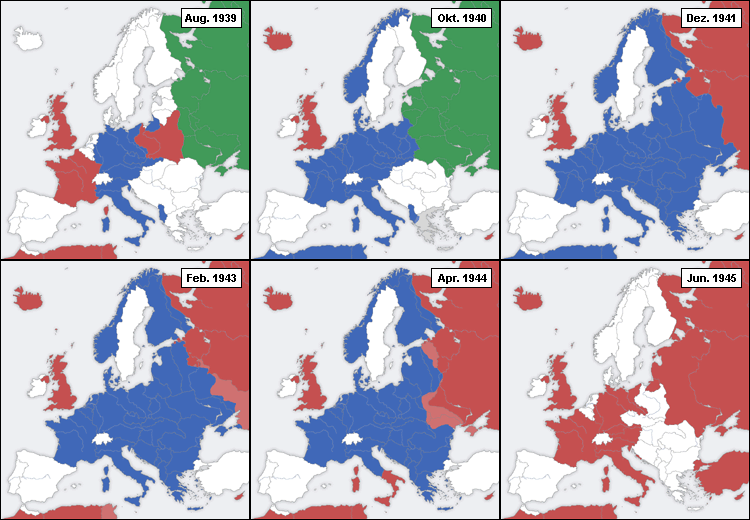
from Germany's
Nazi Germany
Nazi Germany , also known as the Third Reich , but officially called German Reich from 1933 to 1943 and Greater German Reich from 26 June 1943 onward, is the name commonly used to refer to the state of Germany from 1933 to 1945, when it was a totalitarian dictatorship ruled by...
invasion of Poland
Invasion of Poland (1939)
The Invasion of Poland, also known as the September Campaign or 1939 Defensive War in Poland and the Poland Campaign in Germany, was an invasion of Poland by Germany, the Soviet Union, and a small Slovak contingent that marked the start of World War II in Europe...
on September 1, 1939 until the end of the war
End of World War II in Europe
The final battles of the European Theatre of World War II as well as the German surrender to the Western Allies and the Soviet Union took place in late April and early May 1945.-Timeline of surrenders and deaths:...
with the German unconditional surrender
Unconditional surrender
Unconditional surrender is a surrender without conditions, in which no guarantees are given to the surrendering party. In modern times unconditional surrenders most often include guarantees provided by international law. Announcing that only unconditional surrender is acceptable puts psychological...
on May 8, 1945 (V-E Day
Victory in Europe Day
Victory in Europe Day commemorates 8 May 1945 , the date when the World War II Allies formally accepted the unconditional surrender of the armed forces of Nazi Germany and the end of Adolf Hitler's Third Reich. The formal surrender of the occupying German forces in the Channel Islands was not...
). The Allied forces
Allies of World War II
The Allies of World War II were the countries that opposed the Axis powers during the Second World War . Former Axis states contributing to the Allied victory are not considered Allied states...
fought the Axis powers
Axis Powers
The Axis powers , also known as the Axis alliance, Axis nations, Axis countries, or just the Axis, was an alignment of great powers during the mid-20th century that fought World War II against the Allies. It began in 1936 with treaties of friendship between Germany and Italy and between Germany and...
in three sub-theatres
Theater (warfare)
In warfare, a theater, is defined as an area or place within which important military events occur or are progressing. The entirety of the air, land, and sea area that is or that may potentially become involved in war operations....
: the Eastern Front
Eastern Front (World War II)
The Eastern Front of World War II was a theatre of World War II between the European Axis powers and co-belligerent Finland against the Soviet Union, Poland, and some other Allies which encompassed Northern, Southern and Eastern Europe from 22 June 1941 to 9 May 1945...
, the Western Front
Western Front (World War II)
The Western Front of the European Theatre of World War II encompassed, Denmark, Norway, Luxembourg, Belgium, the Netherlands, France, and West Germany. The Western Front was marked by two phases of large-scale ground combat operations...
, and the Mediterranean Theatre.
Preceding events
Germany was defeated in World War IWorld War I
World War I , which was predominantly called the World War or the Great War from its occurrence until 1939, and the First World War or World War I thereafter, was a major war centred in Europe that began on 28 July 1914 and lasted until 11 November 1918...
, and the Treaty of Versailles
Treaty of Versailles
The Treaty of Versailles was one of the peace treaties at the end of World War I. It ended the state of war between Germany and the Allied Powers. It was signed on 28 June 1919, exactly five years after the assassination of Archduke Franz Ferdinand. The other Central Powers on the German side of...
placed punitive conditions on the country
Country
A country is a region legally identified as a distinct entity in political geography. A country may be an independent sovereign state or one that is occupied by another state, as a non-sovereign or formerly sovereign political division, or a geographic region associated with a previously...
, including significant financial reparations, the loss of territory (some only temporarily), war guilt, military weakening and limitation, and economic weakening. Germany was humiliated in front of the world and had to pay very large war reparations. Many Germans blamed their country's post-war economic collapse and hyperinflation
Hyperinflation
In economics, hyperinflation is inflation that is very high or out of control. While the real values of the specific economic items generally stay the same in terms of relatively stable foreign currencies, in hyperinflationary conditions the general price level within a specific economy increases...
on the treaty's conditions. These resentments contributed to the political instability which made it possible for Adolf Hitler
Adolf Hitler
Adolf Hitler was an Austrian-born German politician and the leader of the National Socialist German Workers Party , commonly referred to as the Nazi Party). He was Chancellor of Germany from 1933 to 1945, and head of state from 1934 to 1945...
and his National Socialist Party
National Socialist German Workers Party
The National Socialist German Workers' Party , commonly known in English as the Nazi Party, was a political party in Germany between 1920 and 1945. Its predecessor, the German Workers' Party , existed from 1919 to 1920...
to come to power, with Hitler's appointment as Chancellor of Germany in 1933.
Meanwhile, in Italy, fascist party leader Benito Mussolini
Benito Mussolini
Benito Amilcare Andrea Mussolini was an Italian politician who led the National Fascist Party and is credited with being one of the key figures in the creation of Fascism....
came to power as Prime Minister of Italy
Prime minister of Italy
The Prime Minister of Italy is the head of government of the Italian Republic...
in 1923, after the March on Rome
March on Rome
The March on Rome was a march by which Italian dictator Benito Mussolini's National Fascist Party came to power in the Kingdom of Italy...
had turned the country into a fascist state and overthrew the government. Both leaders and parties had a strong sense of nationalism
Nationalism
Nationalism is a political ideology that involves a strong identification of a group of individuals with a political entity defined in national terms, i.e. a nation. In the 'modernist' image of the nation, it is nationalism that creates national identity. There are various definitions for what...
and turned their respective countries into totalitarian and repressive
Political repression
Political repression is the persecution of an individual or group for political reasons, particularly for the purpose of restricting or preventing their ability to take political life of society....
states.
After Hitler
Adolf Hitler
Adolf Hitler was an Austrian-born German politician and the leader of the National Socialist German Workers Party , commonly referred to as the Nazi Party). He was Chancellor of Germany from 1933 to 1945, and head of state from 1934 to 1945...
took Germany out of the League of Nations
League of Nations
The League of Nations was an intergovernmental organization founded as a result of the Paris Peace Conference that ended the First World War. It was the first permanent international organization whose principal mission was to maintain world peace...
, Mussolini and Hitler formed the Rome-Berlin axis, under a treaty known as the Pact of Steel
Pact of Steel
The Pact of Steel , known formally as the Pact of Friendship and Alliance between Germany and Italy, was an agreement between Fascist Italy and Nazi Germany signed on May 22, 1939, by the foreign ministers of each country and witnessed by Count Galeazzo Ciano for Italy and Joachim von Ribbentrop...
. Later, Japan would also join as an Axis power under the rule of Hideki Tojo
Hideki Tōjō
Hideki Tōjō was a general of the Imperial Japanese Army , the leader of the Taisei Yokusankai, and the 40th Prime Minister of Japan during most of World War II, from 17 October 1941 to 22 July 1944...
. Japan and Germany had already signed the Anti-Comintern Pact
Anti-Comintern Pact
The Anti-Comintern Pact was an Anti-Communist pact concluded between Nazi Germany and the Empire of Japan on November 25, 1936 and was directed against the Communist International ....
in 1939, to counter the Soviet Union
Soviet Union
The Soviet Union , officially the Union of Soviet Socialist Republics , was a constitutionally socialist state that existed in Eurasia between 1922 and 1991....
's communism
Communism
Communism is a social, political and economic ideology that aims at the establishment of a classless, moneyless, revolutionary and stateless socialist society structured upon common ownership of the means of production...
"threat". Other smaller powers also later joined the Axis through pacts.
Outbreak of war in Europe

Nazi Germany
Nazi Germany , also known as the Third Reich , but officially called German Reich from 1933 to 1943 and Greater German Reich from 26 June 1943 onward, is the name commonly used to refer to the state of Germany from 1933 to 1945, when it was a totalitarian dictatorship ruled by...
and the Soviet Union
Soviet Union
The Soviet Union , officially the Union of Soviet Socialist Republics , was a constitutionally socialist state that existed in Eurasia between 1922 and 1991....
were sworn enemies, but following the Munich Agreement
Munich Agreement
The Munich Pact was an agreement permitting the Nazi German annexation of Czechoslovakia's Sudetenland. The Sudetenland were areas along Czech borders, mainly inhabited by ethnic Germans. The agreement was negotiated at a conference held in Munich, Germany, among the major powers of Europe without...
, which effectively handed over Czechoslovakia
Czechoslovakia
Czechoslovakia or Czecho-Slovakia was a sovereign state in Central Europe which existed from October 1918, when it declared its independence from the Austro-Hungarian Empire, until 1992...
(a French and Soviet ally, and the only remaining presidential democracy in Central Europe) to Germany, political realities allowed the Soviet Union to sign a non-aggression pact
Non-aggression pact
A non-aggression pact is an international treaty between two or more states/countries agreeing to avoid war or armed conflict between them and resolve their disputes through peaceful negotiations...
(the Molotov-Ribbentrop Pact
Molotov-Ribbentrop Pact
The Molotov–Ribbentrop Pact, named after the Soviet foreign minister Vyacheslav Molotov and the German foreign minister Joachim von Ribbentrop, was an agreement officially titled the Treaty of Non-Aggression between Germany and the Soviet Union and signed in Moscow in the late hours of 23 August 1939...
) including a secret clause partitioning Poland, the Baltic Republics
Baltic states
The term Baltic states refers to the Baltic territories which gained independence from the Russian Empire in the wake of World War I: primarily the contiguous trio of Estonia, Latvia, Lithuania ; Finland also fell within the scope of the term after initially gaining independence in the 1920s.The...
and Finland between the two spheres of interests.
Full-scale war in Europe began at dawn on September 1, 1939, when Germany used her newly formed Blitzkrieg
Blitzkrieg
For other uses of the word, see: Blitzkrieg Blitzkrieg is an anglicized word describing all-motorised force concentration of tanks, infantry, artillery, combat engineers and air power, concentrating overwhelming force at high speed to break through enemy lines, and, once the lines are broken,...
tactics and military strength to invade Poland
Invasion of Poland (1939)
The Invasion of Poland, also known as the September Campaign or 1939 Defensive War in Poland and the Poland Campaign in Germany, was an invasion of Poland by Germany, the Soviet Union, and a small Slovak contingent that marked the start of World War II in Europe...
, to which both Britain and France had pledged protection and independence guarantees. On September 3, 1939, Britain and France declared war on Germany and British troops were sent to France, however neither French nor British troops gave any significant assistance to the Poles during the entire invasion, and the German-French border, excepting the Saar Offensive
Saar Offensive
The Saar Offensive was a French operation into Saarland on the German 1st Army defence sector in the early stages of World War II. The purpose of the attack was to assist Poland, which was then under attack...
, remained mostly calm.
On September 17, the Soviet forces attacked. The Polish government evacuated the country for Romania. Poland fell within five weeks, with her last large operational units surrendering on October 5 after the Battle of Kock
Battle of Kock (1939)
The Battle of Kock, was the final battle in the Invasion of Poland at the beginning of World War II. It took place between 2–5 October 1939, near the town of Kock, in Poland....
. As the Polish September Campaign ended, Hitler offered to Britain and France peace on the basis of recognition of German European continental dominance. On October 12, the United Kingdom formally refused.
Despite the quick campaign in the east, along the Franco-German frontier the war settled into a quiet period. This relatively non-confrontational and mostly non-fighting period between the major powers lasted until May 10, 1940, and was known as the Phoney War.
Germany assumes dominance in northern Europe
Baltic states
The term Baltic states refers to the Baltic territories which gained independence from the Russian Empire in the wake of World War I: primarily the contiguous trio of Estonia, Latvia, Lithuania ; Finland also fell within the scope of the term after initially gaining independence in the 1920s.The...
felt they had no choice but to permit Soviet bases and troops on their territory. The Baltic Republics were occupied
Occupation of Baltic Republics
The occupation of the Baltic states refers to the military occupation of the three Baltic states: Estonia, Latvia and Lithuania by the Soviet Union under the auspices of the Molotov–Ribbentrop Pact on 14 June 1940 followed by their incorporation into the USSR as constituent republics, unrecognised...
by the Soviet army in June 1940, and finally annexed to the Soviet Union in August 1940.
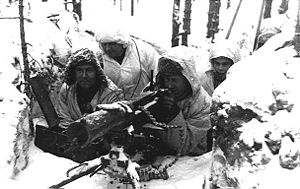
The Soviet Union wanted to annex Finland and offered a union agreement, but Finland rejected it, which caused Soviet Union to attack against Finland on November 30. This began the Winter War
Winter War
The Winter War was a military conflict between the Soviet Union and Finland. It began with a Soviet offensive on 30 November 1939 – three months after the start of World War II and the Soviet invasion of Poland – and ended on 13 March 1940 with the Moscow Peace Treaty...
. After over three months of hard fighting, and heavy losses, the Soviet Union gave up the attempted invasion. In the Moscow Peace Treaty
Moscow Peace Treaty (1940)
The Moscow Peace Treaty was signed by Finland and the Soviet Union on 12 March 1940, and the ratifications were exchanged on 21 March. It marked the end of the 105-day Winter War. The treaty ceded parts of Finland to the Soviet Union. However, it preserved Finland's independence, ending the Soviet...
, March 12, 1940, Finland ceded 10% of her territory. The Finns were embittered over having lost more land in the peace than on the battle fields, and over the perceived lack of world sympathy.
War comes to the west
Belgium
Belgium , officially the Kingdom of Belgium, is a federal state in Western Europe. It is a founding member of the European Union and hosts the EU's headquarters, and those of several other major international organisations such as NATO.Belgium is also a member of, or affiliated to, many...
, the Netherlands
Netherlands
The Netherlands is a constituent country of the Kingdom of the Netherlands, located mainly in North-West Europe and with several islands in the Caribbean. Mainland Netherlands borders the North Sea to the north and west, Belgium to the south, and Germany to the east, and shares maritime borders...
, Luxembourg
Luxembourg
Luxembourg , officially the Grand Duchy of Luxembourg , is a landlocked country in western Europe, bordered by Belgium, France, and Germany. It has two principal regions: the Oesling in the North as part of the Ardennes massif, and the Gutland in the south...
, and French Third Republic
France
The French Republic , The French Republic , The French Republic , (commonly known as France , is a unitary semi-presidential republic in Western Europe with several overseas territories and islands located on other continents and in the Indian, Pacific, and Atlantic oceans. Metropolitan France...
that bypassed French fortifications along the Maginot Line
Maginot Line
The Maginot Line , named after the French Minister of War André Maginot, was a line of concrete fortifications, tank obstacles, artillery casemates, machine gun posts, and other defences, which France constructed along its borders with Germany and Italy, in light of its experience in World War I,...
. After overrunning Holland, Belgium, and Luxembourg, Germany turned against France, entering the country through the Ardennes
Ardennes
The Ardennes is a region of extensive forests, rolling hills and ridges formed within the Givetian Ardennes mountain range, primarily in Belgium and Luxembourg, but stretching into France , and geologically into the Eifel...
on May 13—the French had made the fatal mistake of leaving this area almost totally undefended, believing its terrain to be impassable for tanks and other vehicles. Most Allied forces were in Flanders
Flanders
Flanders is the community of the Flemings but also one of the institutions in Belgium, and a geographical region located in parts of present-day Belgium, France and the Netherlands. "Flanders" can also refer to the northern part of Belgium that contains Brussels, Bruges, Ghent and Antwerp...
, anticipating a re-run of the World War I
World War I
World War I , which was predominantly called the World War or the Great War from its occurrence until 1939, and the First World War or World War I thereafter, was a major war centred in Europe that began on 28 July 1914 and lasted until 11 November 1918...
Schlieffen Plan
Schlieffen Plan
The Schlieffen Plan was the German General Staff's early 20th century overall strategic plan for victory in a possible future war in which the German Empire might find itself fighting on two fronts: France to the west and Russia to the east...
, and were cut off from the French mainland. As a result of this, and also the superior German communications and tactics, the Battle of France
Battle of France
In the Second World War, the Battle of France was the German invasion of France and the Low Countries, beginning on 10 May 1940, which ended the Phoney War. The battle consisted of two main operations. In the first, Fall Gelb , German armoured units pushed through the Ardennes, to cut off and...
was shorter than virtually all prewar Allied thought could have conceived. It lasted six weeks, including the Luftwaffe
Luftwaffe
Luftwaffe is a generic German term for an air force. It is also the official name for two of the four historic German air forces, the Wehrmacht air arm founded in 1935 and disbanded in 1946; and the current Bundeswehr air arm founded in 1956....
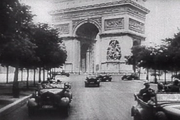
bombing of Paris June 3, after which France surrendered on June 22. In order to further the humiliation of the French people and the country itself, Hitler arranged for the surrender document to be signed in the same railway coach where the German surrender had been signed in 1918. The surrender divided France into two parts; the Northern part occupied by Germany, and a southern part under French control, based at Vichy
Vichy
Vichy is a commune in the department of Allier in Auvergne in central France. It belongs to the historic province of Bourbonnais.It is known as a spa and resort town and was the de facto capital of Vichy France during the World War II Nazi German occupation from 1940 to 1944.The town's inhabitants...
and referred to as Vichy France
Vichy France
Vichy France, Vichy Regime, or Vichy Government, are common terms used to describe the government of France that collaborated with the Axis powers from July 1940 to August 1944. This government succeeded the Third Republic and preceded the Provisional Government of the French Republic...
, a rump state allied and friendly to Germany. Many French soldiers, as well as those of other occupied countries, escaped to Britain. The General de Gaulle
Charles de Gaulle
Charles André Joseph Marie de Gaulle was a French general and statesman who led the Free French Forces during World War II. He later founded the French Fifth Republic in 1958 and served as its first President from 1959 to 1969....
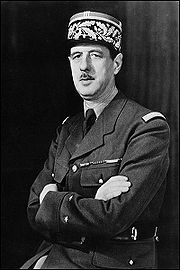
proclaimed himself the legitimate leader of the Free French organization and vowed to continue to fight. On June 10 Italy declared war on both France and the United Kingdom
United Kingdom
The United Kingdom of Great Britain and Northern IrelandIn the United Kingdom and Dependencies, other languages have been officially recognised as legitimate autochthonous languages under the European Charter for Regional or Minority Languages...
.
Vyacheslav Molotov
Vyacheslav Molotov
Vyacheslav Mikhailovich Molotov was a Soviet politician and diplomat, an Old Bolshevik and a leading figure in the Soviet government from the 1920s, when he rose to power as a protégé of Joseph Stalin, to 1957, when he was dismissed from the Presidium of the Central Committee by Nikita Khrushchev...
, the Foreign Policy Minister of the U.S.S.R., which was tied with Soviet-German non-aggression treaty
Molotov-Ribbentrop Pact
The Molotov–Ribbentrop Pact, named after the Soviet foreign minister Vyacheslav Molotov and the German foreign minister Joachim von Ribbentrop, was an agreement officially titled the Treaty of Non-Aggression between Germany and the Soviet Union and signed in Moscow in the late hours of 23 August 1939...
, congratulated the Germans: "We hand over the most cordial congratulations by the Soviet government on the occasion of splendid success of German Wehrmacht. Guderian
Heinz Guderian
Heinz Wilhelm Guderian was a German general during World War II. He was a pioneer in the development of armored warfare, and was the leading proponent of tanks and mechanization in the Wehrmacht . Germany's panzer forces were raised and organized under his direction as Chief of Mobile Forces...
's tanks broke through to the sea near Abbeville
Abbeville
Abbeville is a commune in the Somme department in Picardie in northern France.-Location:Abbeville is located on the Somme River, from its modern mouth in the English Channel, and northwest of Amiens...
, powered by Soviet fuel, the German bombs, that razed Rotterdam
Rotterdam
Rotterdam is the second-largest city in the Netherlands and one of the largest ports in the world. Starting as a dam on the Rotte river, Rotterdam has grown into a major international commercial centre...
to the ground, were filled with Soviet pyroxylin, and bullet cases, which hit the British soldiers retreating from Dunkirk, were cast of Soviet cupronickel
Cupronickel
Cupronickel or copper-nickel or "cupernickel" is an alloy of copper that contains nickel and strengthening elements, such as iron and manganese. Cupronickel is highly resistant to corrosion in seawater, because its electrode potential is adjusted to be neutral with regard to seawater...
alloy..." http://www.hro.org/editions/karta/nr1/lozinsk.htm
Later, on April 24, 1941, the U.S.S.R. gave full diplomatic recognition to the Vichy government situated in the non-occupied zone in France.
Thus, the fall of France left Britain and its Empire to stand alone. The British Prime Minister, Neville Chamberlain
Neville Chamberlain
Arthur Neville Chamberlain FRS was a British Conservative politician who served as Prime Minister of the United Kingdom from May 1937 to May 1940. Chamberlain is best known for his appeasement foreign policy, and in particular for his signing of the Munich Agreement in 1938, conceding the...
, resigned during the battle and was replaced by Winston Churchill
Winston Churchill
Sir Winston Leonard Spencer-Churchill, was a predominantly Conservative British politician and statesman known for his leadership of the United Kingdom during the Second World War. He is widely regarded as one of the greatest wartime leaders of the century and served as Prime Minister twice...
. Fortunately for Britain, much of its army escaped capture
Operation Dynamo
The Dunkirk evacuation, commonly known as the Miracle of Dunkirk, code-named Operation Dynamo by the British, was the evacuation of Allied soldiers from the beaches and harbour of Dunkirk, France, between 26 May and the early hours of 3 June 1940, because the British, French and Belgian troops were...
from the northern French port of Dunkirk, where hundreds (if not thousands) of tiny civilian boats were used to ferry troops from the beaches to the waiting warships. There is much debate over whether German Panzer divisions could have defeated these soldiers alone if they had pressed forward, since the tank divisions were overextended and would require extensive refitting; in any case, Hitler elected to follow the advice of the leader of German air forces Hermann Göring
Hermann Göring
Hermann Wilhelm Göring, was a German politician, military leader, and a leading member of the Nazi Party. He was a veteran of World War I as an ace fighter pilot, and a recipient of the coveted Pour le Mérite, also known as "The Blue Max"...
and allow the Luftwaffe
Luftwaffe
Luftwaffe is a generic German term for an air force. It is also the official name for two of the four historic German air forces, the Wehrmacht air arm founded in 1935 and disbanded in 1946; and the current Bundeswehr air arm founded in 1956....
alone to attack the Allied forces until German infantry was able to advance, giving the British a window for the evacuation. Later, many of the evacuated troops would form an important part and the center of the army that landed at Normandy
Normandy
Normandy is a geographical region corresponding to the former Duchy of Normandy. It is in France.The continental territory covers 30,627 km² and forms the preponderant part of Normandy and roughly 5% of the territory of France. It is divided for administrative purposes into two régions:...
on D-Day
D-Day
D-Day is a term often used in military parlance to denote the day on which a combat attack or operation is to be initiated. "D-Day" often represents a variable, designating the day upon which some significant event will occur or has occurred; see Military designation of days and hours for similar...
.
The British rejected several covert German attempts to negotiate a peace. Germany massed their air force in northern German-occupied France to prepare the way for a possible invasion, codenamed Operation Seelöwe (Sea Lion), deeming that air superiority was essential for the invasion. The operations of the Luftwaffe against the Royal Air Force
Royal Air Force
The Royal Air Force is the aerial warfare service branch of the British Armed Forces. Formed on 1 April 1918, it is the oldest independent air force in the world...
became known as the Battle of Britain
Battle of Britain
The Battle of Britain is the name given to the World War II air campaign waged by the German Air Force against the United Kingdom during the summer and autumn of 1940...
. Initially the Luftwaffe concentrated on destroying the R.A.F. on the ground and in the air. They later switched to bombing major and large industrial British cities in the Blitz
The Blitz
The Blitz was the sustained strategic bombing of Britain by Nazi Germany between 7 September 1940 and 10 May 1941, during the Second World War. The city of London was bombed by the Luftwaffe for 76 consecutive nights and many towns and cities across the country followed...
, in an attempt to draw R.A.F. fighters out and defeat them completely. Neither approach was successful in reducing the R.A.F. to the point where air superiority could be obtained, and plans for an invasion were suspended by September 1940.
During the Blitz, all of Britain's major industrial, cathderal, and political cites were heavily bombed. London suffered particularly, being bombed each night for several months. Other targets included Birmingham
Birmingham
Birmingham is a city and metropolitan borough in the West Midlands of England. It is the most populous British city outside the capital London, with a population of 1,036,900 , and lies at the heart of the West Midlands conurbation, the second most populous urban area in the United Kingdom with a...
and Coventry
Coventry
Coventry is a city and metropolitan borough in the county of West Midlands in England. Coventry is the 9th largest city in England and the 11th largest in the United Kingdom. It is also the second largest city in the English Midlands, after Birmingham, with a population of 300,848, although...
, and strategically important cities, such as the naval base at Plymouth
Plymouth
Plymouth is a city and unitary authority area on the coast of Devon, England, about south-west of London. It is built between the mouths of the rivers Plym to the east and Tamar to the west, where they join Plymouth Sound...
and the port of Kingston upon Hull
Kingston upon Hull
Kingston upon Hull , usually referred to as Hull, is a city and unitary authority area in the ceremonial county of the East Riding of Yorkshire, England. It stands on the River Hull at its junction with the Humber estuary, 25 miles inland from the North Sea. Hull has a resident population of...
. With no land forces in direct conflict in Europe, the war in the air attracted worldwide attention even as sea units fought the Battle of the Atlantic and a number of British commando
Commando
In English, the term commando means a specific kind of individual soldier or military unit. In contemporary usage, commando usually means elite light infantry and/or special operations forces units, specializing in amphibious landings, parachuting, rappelling and similar techniques, to conduct and...
raids hit targets in occupied Europe. Churchill famously said of the R.A.F. personnel who fought in the battle: "Never in the field of human conflict was so much owed by so many to so few".—
The war in the air
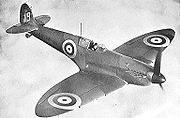
Prewar doctrine had held that waves of bombers hitting enemy cities would cause mass panic and the rapid collapse of the enemy. As a result, the Royal Air Force
Royal Air Force
The Royal Air Force is the aerial warfare service branch of the British Armed Forces. Formed on 1 April 1918, it is the oldest independent air force in the world...
had built up a large strategic bomber force. By way of contrast, Nazi German air force doctrine was almost totally dedicated to supporting the army. Therefore, German bombers were smaller than their British equivalents, and Germany never developed a fully successful four engined heavy bomber
Heinkel He 177
The Heinkel He 177 Greif was the only operational long-range bomber to be operated by the Luftwaffe. Starting its existence as Germany's first purpose-built heavy bomber just before the war, and built in large numbers during World War II, it was also mistakenly tasked, right from its beginnings,...
equivalent to the Lancaster
Avro Lancaster
The Avro Lancaster is a British four-engined Second World War heavy bomber made initially by Avro for the Royal Air Force . It first saw active service in 1942, and together with the Handley Page Halifax it was one of the main heavy bombers of the RAF, the RCAF, and squadrons from other...
or B-17.
The main concentration of German raids on British cities was from September 7, 1940 until May 10, 1941. After that most of the strength of the Luftwaffe was diverted to the war against the Soviet Union. German raids continued on a smaller and less destructive scale for the rest of the war, and later the V1 Flying Bomb and V-2
V-2 rocket
The V-2 rocket , technical name Aggregat-4 , was a ballistic missile that was developed at the beginning of the Second World War in Germany, specifically targeted at London and later Antwerp. The liquid-propellant rocket was the world's first long-range combat-ballistic missile and first known...
ballistic missile were both used against Britain. However, the balance of bomb tonnage being dropped shifted greatly in favour of the RAF as Bomber Command
RAF Bomber Command
RAF Bomber Command controlled the RAF's bomber forces from 1936 to 1968. During World War II the command destroyed a significant proportion of Nazi Germany's industries and many German cities, and in the 1960s stood at the peak of its postwar military power with the V bombers and a supplemental...
gained in strength. By 1942, Bomber Command could put 1,000 bombers over one German city. From 1942 onwards, the efforts of Bomber Command were supplemented by the Eighth Air Force
Eighth Air Force
The Eighth Air Force is a numbered air force of the United States Air Force Global Strike Command . It is headquartered at Barksdale Air Force Base, Louisiana....
of the United States Army Air Forces
United States Army Air Forces
The United States Army Air Forces was the military aviation arm of the United States of America during and immediately after World War II, and the direct predecessor of the United States Air Force....
. Bomber Command raided by night and the US forces by day. On February 14, 1945, a raid on Dresden
Bombing of Dresden in World War II
The Bombing of Dresden was a military bombing by the British Royal Air Force and the United States Army Air Force and as part of the Allied forces between 13 February and 15 February 1945 in the Second World War...
produced one of the most devastating fires in history. A firestorm was created in the city, and between 18,000 to 25,000 people were killed. Only the raids on Hamburg
Bombing of Hamburg in World War II
The Allied bombing of Hamburg during World War II included numerous strategic bombing missions and diversion/nuisance raids. As a large port and industrial center, Hamburg's shipyards, U-boat pens, and the Hamburg-Harburg area oil refineries were attacked throughout the war...
(July 24, 1943 – July 29, 1943), the March 9–10, 1945 firebombing of Tokyo
Bombing of Tokyo in World War II
The bombing of Tokyo, often referred to as a "firebombing", was conducted by the United States Army Air Forces during the Pacific campaigns of World War II. The U.S. mounted a small-scale raid on Tokyo in April 1942, with large morale effects...
and the nuclear attacks on Hiroshima
Hiroshima
is the capital of Hiroshima Prefecture, and the largest city in the Chūgoku region of western Honshu, the largest island of Japan. It became best known as the first city in history to be destroyed by a nuclear weapon when the United States Army Air Forces dropped an atomic bomb on it at 8:15 A.M...
(August 6, 1945) and Nagasaki (August 9, 1945) killed more people through a single attack.
The Mediterranean and Balkans
Italy had invaded AlbaniaAlbania
Albania , officially known as the Republic of Albania , is a country in Southeastern Europe, in the Balkans region. It is bordered by Montenegro to the northwest, Kosovo to the northeast, the Republic of Macedonia to the east and Greece to the south and southeast. It has a coast on the Adriatic Sea...
on April 7, 1939 and had officially annexed it. Mussolini's regime declared war on Britain and France on June 10, 1940, and invaded Greece on October 28. However, Italian forces were unable to match the Nazi successes in northwest Europe.
The Italian Regia Aeronautica
Regia Aeronautica
The Italian Royal Air Force was the name of the air force of the Kingdom of Italy. It was established as a service independent of the Royal Italian Army from 1923 until 1946...
began the long and unsuccessful siege of Malta
Siege of Malta (1940)
The Siege of Malta was a military campaign in the Mediterranean Theatre of the Second World War. From 1940-1942, the fight for the control of the strategically important island of Malta pitted the air forces and navies of Fascist Italy and Nazi Germany against the Royal Air Force and the Royal...
on June 12. Even the surrender of France did not greatly assist the Axis forces. The naval Battle of the Mediterranean
Battle of the Mediterranean
The Battle of the Mediterranean was the name given to the naval campaign fought in the Mediterranean Sea during World War II, from 10 June 1940-2 May 1945....
was a disaster for the Italian Regia Marina
Regia Marina
The Regia Marina dates from the proclamation of the Kingdom of Italy in 1861 after Italian unification...
and the Vichy French navy, which were effectively destroyed as fighting forces by the Royal Navy
Royal Navy
The Royal Navy is the naval warfare service branch of the British Armed Forces. Founded in the 16th century, it is the oldest service branch and is known as the Senior Service...
and the Royal Australian Navy
Royal Australian Navy
The Royal Australian Navy is the naval branch of the Australian Defence Force. Following the Federation of Australia in 1901, the ships and resources of the separate colonial navies were integrated into a national force: the Commonwealth Naval Forces...
during 1940, most notably in the attack on Mers-el-Kebir
Destruction of the French Fleet at Mers-el-Kebir
The Attack on Mers-el-Kébir, part of Operation Catapult and also known as the Battle of Mers-el-Kébir, was a naval engagement fought at Mers-el-Kébir on the coast of what was then French Algeria on 3 July 1940...
(July 3) and the Battle of Taranto
Battle of Taranto
The naval Battle of Taranto took place on the night of 11–12 November 1940 during the Second World War. The Royal Navy launched the first all-aircraft ship-to-ship naval attack in history, flying a small number of obsolescent biplane torpedo bombers from an aircraft carrier in the Mediterranean Sea...
(November 11).
Not only did the Italians fail to conquer Greece, but under the supervision of Greece's dictator, Prime Minister Ioannis Metaxas
Ioannis Metaxas
Ioannis Metaxas was a Greek general, politician, and dictator, serving as Prime Minister of Greece from 1936 until his death in 1941...
, the Greeks successfully counterattacked into Albania, from November 14.
The Kingdom of Yugoslavia
Kingdom of Yugoslavia
The Kingdom of Yugoslavia was a state stretching from the Western Balkans to Central Europe which existed during the often-tumultuous interwar era of 1918–1941...
was lacking true leadership of a king and instead ruled by a regency headed by Prince Pavle Karađorđević
Prince Paul of Yugoslavia
Prince Paul of Yugoslavia, also known as Paul Karađorđević , was Regent of the Kingdom of Yugoslavia during the minority of King Peter II. Peter was the eldest son of his first cousin Alexander I...
, signed the Tripartite Treaty on March 25, 1941. The regency did this because they were promised by Hitler that if they joined and let the Axis attack Greece through their territory Yugoslavia would be given areas of Northern Greece including Salonika. However, soon afterwards, after public demonstrations, a March 27 coup d'état
Coup d'état
A coup d'état state, literally: strike/blow of state)—also known as a coup, putsch, and overthrow—is the sudden, extrajudicial deposition of a government, usually by a small group of the existing state establishment—typically the military—to replace the deposed government with another body; either...
was made by Army General Dušan Simović
Dušan Simovic
Dušan T. Simović was a Yugoslav general who served as chief of the air force and commander-in-chief of the Royal Yugoslav Army and as the Prime Minister of Yugoslavia.-Life and career:...
which took control away from the regency and distanced Yugoslavia from the fascists.
The imminent Greek victory over Italy prompted German intervention. On April 6, 1941 German forces, supported by the Italians, Hungarians and the Bulgarians, engaged in combat with the Greeks and simultaneously invaded Yugoslavia. British, Australian and New Zealand forces were hastily dispatched from Egypt
Egypt
Egypt , officially the Arab Republic of Egypt, Arabic: , is a country mainly in North Africa, with the Sinai Peninsula forming a land bridge in Southwest Asia. Egypt is thus a transcontinental country, and a major power in Africa, the Mediterranean Basin, the Middle East and the Muslim world...
to Greece, but the Allies lacked a co-ordinated strategy, were comprehensively beaten and evacuated to Crete
Crete
Crete is the largest and most populous of the Greek islands, the fifth largest island in the Mediterranean Sea, and one of the thirteen administrative regions of Greece. It forms a significant part of the economy and cultural heritage of Greece while retaining its own local cultural traits...
. Advancing rapidly, Axis forces captured Athens
Athens
Athens , is the capital and largest city of Greece. Athens dominates the Attica region and is one of the world's oldest cities, as its recorded history spans around 3,400 years. Classical Athens was a powerful city-state...
, Greece's capital on April 27, 1941 effectively placing most of the country under occupation.
After the mainland was conquered, Germany invaded Crete in what is known as the Battle of Crete
Battle of Crete
The Battle of Crete was a battle during World War II on the Greek island of Crete. It began on the morning of 20 May 1941, when Nazi Germany launched an airborne invasion of Crete under the code-name Unternehmen Merkur...
(May 20, 1941 – June 1, 1941). Instead of an amphibious
Amphibious vehicle
An amphibious vehicle , is a vehicle or craft, that is a means of transport, viable on land as well as on water – just like an amphibian....
assault as expected, the Germans mounted a large airborne invasion. The paratroopers (Fallschirmjäger) suffered severe losses and large scale airborne operations were given up after that. However, the Germans eventually prevailed on Crete. Most of the Allied forces were evacuated to Egypt — joining King George II of Greece
George II of Greece
George II reigned as King of Greece from 1922 to 1924 and from 1935 to 1947.-Early life, first period of kingship and exile:George was born at the royal villa at Tatoi, near Athens, the eldest son of King Constantine I of Greece and his wife, Princess Sophia of Prussia...
and the exiled Greek government of Emmanouil Tsouderos
Emmanouil Tsouderos
Emmanouil Tsouderos was a political and financial figure of modern Greece, serving as Prime Minister of the Greek government in exile during World War II.-Early life:...
— on June 1, 1941.
Once the Balkans were secure, the largest land operation in history was launched, when Germany attacked the Soviet Union. The Balkans campaign delayed the invasion, and subsequent resistance movements in Albania
Military history of Albania during World War II
The Albanian Resistance of World War II was a movement of largely Communist persuasion directed against the occupying Italian and then German forces in Albania, which led to the successful liberation of the country in 1944....
, Yugoslavia and Greece
Greek Resistance
The Greek Resistance is the blanket term for a number of armed and unarmed groups from across the political spectrum that resisted the Axis Occupation of Greece in the period 1941–1944, during World War II.-Origins:...
tied up valuable Axis forces. This provided much needed and possibly decisive relief for the Soviets.
The Eastern Front
On June 22, 1941, Germany launched an invasion against the Soviet Union, code-named Operation BarbarossaOperation Barbarossa
Operation Barbarossa was the code name for Germany's invasion of the Soviet Union during World War II that began on 22 June 1941. Over 4.5 million troops of the Axis powers invaded the USSR along a front., the largest invasion in the history of warfare...
. This invasion, the biggest in recorded history, started the most bloody conflict the world has ever seen; the Axis-Soviet War.
The Eastern Front was by far the largest and bloodiest theatre of World War II. It is generally accepted as being the costliest conflict in human history, with over 30 million dead as a result. It involved more land combat than all other World War II theatres combined. The distinctly brutal nature of warfare on the Eastern Front was exemplified by an often willful disregard for human life by both sides.
The leader of the USSR, Joseph Stalin
Joseph Stalin
Joseph Vissarionovich Stalin was the Premier of the Soviet Union from 6 May 1941 to 5 March 1953. He was among the Bolshevik revolutionaries who brought about the October Revolution and had held the position of first General Secretary of the Communist Party of the Soviet Union's Central Committee...
, had been warned repeatedly by outside sources and his own intelligence network of the impending invasion, but he ignored the warnings due to conflicting information presented to him by the Soviet intelligence. Moreover, on the very night of the invasion Soviet troops received a directive undersigned by Marshal
Marshal
Marshal , is a word used in several official titles of various branches of society. The word is an ancient loan word from Old French, cf...
Timoshenko and General of the Army
General of the Army
General of the Army is a military rank used in some countries to denote a senior military leader, usually a General in command of a nation's Army. It may also be the title given to a General who commands an Army in the field....
Georgi Zhukov that commanded: "do not answer to any provocations" and "do not undertake any actions without specific orders". The early weeks of the invasion were devastating for the Soviet Army. Enormous numbers of Soviet troops were encircled in pockets and fell into Nazi German hands. In addition to German troops, a few Italian, Hungarian and Romanian troops were also involved in the campaign. Finland also sent troops, but oddly, the Finns initially declared neutrality, however with both German and Soviet troops on her soil, Finland was well prepared to join forces with Germany when the Soviet Union attacked on June 25. The following conflict from 1941–1944 is sometimes referred to as the Continuation War
Continuation War
The Continuation War was the second of two wars fought between Finland and the Soviet Union during World War II.At the time of the war, the Finnish side used the name to make clear its perceived relationship to the preceding Winter War...
, as in the continuation of the Winter War
Winter War
The Winter War was a military conflict between the Soviet Union and Finland. It began with a Soviet offensive on 30 November 1939 – three months after the start of World War II and the Soviet invasion of Poland – and ended on 13 March 1940 with the Moscow Peace Treaty...
.
Operation Barbarossa suffered from several fundamental flaws. The most serious of these was the logistical situation of the attack. The sheer vastness of the distances in the Soviet Union meant that Germany could only advance so far before outrunning their supply chains. By the time the German attack froze to a halt before Moscow on December 5, 1941, it literally could not go any further. There simply were not enough supplies reaching the front to conduct proper defensive operations, let alone a proper offense. The timetable that Barbarossa was planned to assumed that the Soviets would collapse before the Russian winter hit. The failure of that to happen also fatally affected Nazi German plans. Had Hitler not invaded Greece and Yugoslavia earlier in the year, the invasion would have proceeded at that time, and the Soviet Union might have collapsed.
During their long retreat, the Soviets employed a scorched earth
Scorched earth
A scorched earth policy is a military strategy or operational method which involves destroying anything that might be useful to the enemy while advancing through or withdrawing from an area...
policy. They burnt crops and destroyed utilities as they withdrew before Germany. That helped to contribute to the logistical problems that Germany experienced. More importantly for them, the Soviets also succeeded in a massive and unprecedented removal of their industry from the threatened war zone to protected areas in the East.
The extension of the campaign beyond the length that Germany expected meant that the German Army suffered hundreds of thousands of casualties in the bitter cold of the Russian winter, and from the counterattacks of Soviet units.
Even with their advance having ground to a halt due to a lack of supplies and the onset of winter, Germany had conquered a vast amount of territory, including two-fifths of the Soviet economy. Dislodging them proved difficult and eventually cost the Soviet Union dearly.
A few months after the invasion began, German troops laid siege to Leningrad (known as the Siege of Leningrad
Siege of Leningrad
The Siege of Leningrad, also known as the Leningrad Blockade was a prolonged military operation resulting from the failure of the German Army Group North to capture Leningrad, now known as Saint Petersburg, in the Eastern Front theatre of World War II. It started on 8 September 1941, when the last...
) from the North by Finnish forces, and from the South by the German Wehrmacht. Finland's C-in-C Mannerheim
Carl Gustaf Emil Mannerheim
Baron Carl Gustaf Emil Mannerheim was the military leader of the Whites in the Finnish Civil War, Commander-in-Chief of Finland's Defence Forces during World War II, Marshal of Finland, and a Finnish statesman. He was Regent of Finland and the sixth President of Finland...
had halted at the River Svir and refrained from attacking the city. Hitler had ordered that the city of Leningrad must "vanish from the surface of the earth", with its entire population exterminated. Rather than storming the city, the Wehrmacht was ordered to blockade Leningrad so as to starve the city to death, while attacking it with bombers and artillery. About one million civilians died in the Leningrad siege – 800,000 by starvation. The siege lasted for 872 days. During the winter, the only way into the city was across Lake Ladoga
Lake Ladoga
Lake Ladoga is a freshwater lake located in the Republic of Karelia and Leningrad Oblast in northwestern Russia, not far from Saint Petersburg. It is the largest lake in Europe, and the 14th largest lake by area in the world.-Geography:...
, between the German and Finnish lines.

Operation Blue
Case Blue , later renamed Operation Braunschweig, was the German Armed Forces name for its plan for a 1942 strategic summer offensive in southern Russia between 28 June and November 1942....
of 1942 decided to focus on the war in the south, with the target being the oil fields of the Caucasus
Caucasus
The Caucasus, also Caucas or Caucasia , is a geopolitical region at the border of Europe and Asia, and situated between the Black and the Caspian sea...
. In a major blunder, Hitler split Army Group South into two subgroups, Army Group A which would attack the Caucasus and Army Group B which would advance towards the city of Stalingrad (now Volgograd
Volgograd
Volgograd , formerly called Tsaritsyn and Stalingrad is an important industrial city and the administrative center of Volgograd Oblast, Russia. It is long, north to south, situated on the western bank of the Volga River...
).
Indecision by Hitler, dissent among the higher ranked Nazi German officers, and extended supply lines combined in a prolonged battle in the streets of Stalingrad. Germany eventually occupied over 90% of the city, but in an attempt to defeat the remaining Soviet defenders almost all German soldiers in the area were funnelled into the ruins of the city. Months of bitter hand-to-hand combat in the ruins of the city depleted the German forces, leaving only weak Romania
Romania
Romania is a country located at the crossroads of Central and Southeastern Europe, on the Lower Danube, within and outside the Carpathian arch, bordering on the Black Sea...
n and Hungarian forces to guard the flanks of the Stalingrad army group. In Operation Uranus
Operation Uranus
Operation Uranus was the codename of the Soviet strategic operation in World War II which led to the encirclement of the German Sixth Army, the Third and Fourth Romanian armies, and portions of the German Fourth Panzer Army. The operation formed part of the ongoing Battle of Stalingrad, and was...
, the Soviets easily defeated these minor Axis forces as they performed a massive encirclement operation. The German troops remaining in the city were trapped – cut off from their supply lines and starving, they were ordered by Hitler to fight to the last man, and they displayed incredible fortitude and bravery under unbearable conditions.
Starved of food, fuel, ammunition, and clothes, the pocket was gradually reduced, with the last portion surrendering on February 2, 1943. In a cynical attempt to prevent the surrender, Hitler promoted Friedrich Paulus
Friedrich Paulus
Friedrich Wilhelm Ernst Paulus was an officer in the German military from 1910 to 1945. He attained the rank of Generalfeldmarschall during World War II, and is best known for having commanded the Sixth Army's assault on Stalingrad during Operation Blue in 1942...
, commander of the 6th Army to Field Marshal
Field Marshal
Field Marshal is a military rank. Traditionally, it is the highest military rank in an army.-Etymology:The origin of the rank of field marshal dates to the early Middle Ages, originally meaning the keeper of the king's horses , from the time of the early Frankish kings.-Usage and hierarchical...
, because no German of that rank had ever surrendered. Heavy losses affected both sides in the Battle of Stalingrad
Battle of Stalingrad
The Battle of Stalingrad was a major battle of World War II in which Nazi Germany and its allies fought the Soviet Union for control of the city of Stalingrad in southwestern Russia. The battle took place between 23 August 1942 and 2 February 1943...
, one of the bloodiest battles in history. About 1.5 million people perished in this battle, including 100,000 civilians in the city.
After Stalingrad, the initiative had passed from Germany but had not yet been seized by the Soviets. A desperate counterattack
Third Battle of Kharkov
The Third Battle of Kharkov was a series of offensive operations on the Eastern Front of World War II, undertaken by the German Army Group South against the Red Army, around the city of Kharkov , between 19 February and 15 March 1943...
in the spring of 1943 by forces of Field Marshal Erich von Manstein
Erich von Manstein
Erich von Manstein was a field marshal in World War II. He became one of the most prominent commanders of Germany's World War II armed forces...
temporarily halted the Soviet advance, and led to the largest tank battle in history, at Kursk. Kursk
Battle of Kursk
The Battle of Kursk took place when German and Soviet forces confronted each other on the Eastern Front during World War II in the vicinity of the city of Kursk, in the Soviet Union in July and August 1943. It remains both the largest series of armored clashes, including the Battle of Prokhorovka,...
was the last major offensive by the German Army on the eastern front. The Soviets had intelligence of what was to come and prepared massive defences in huge depth in the Kursk salient. They stopped the German armoured thrusts after a maximum penetration of just over 30 miles (48.3 km). After Kursk the Red Army never ceased being on the offensive until Berlin was captured in May 1945.
More Soviet citizens died during World War II than those of all other countries combined. Nazi ideology considered Slavs to be "subhuman" and German forces committed ethnically targeted mass murder. Civilians were rounded up and burned alive or shot in squads in many cities conquered by the Nazis. Approximately 27 million Soviets, among them more than 20 million civilians in Soviet cities and areas, were killed in the Nazi invasion of the Soviet Union.
At least 7 million Red Army troops died facing the Germans and their allies in the Eastern Front. The Axis forces themselves had lost over 6 million troops, whether by combat or by wounds, disease, starvation or exposure; another several hundred thousand were seized as POWs and over half died in Soviet gulags because of disease, starvation, or shortage of supplies.
Lend-Lease
Lend-Lease
Lend-Lease was the program under which the United States of America supplied the United Kingdom, the Soviet Union, China, Free France, and other Allied nations with materiel between 1941 and 1945. It was signed into law on March 11, 1941, a year and a half after the outbreak of war in Europe in...
supplies from the United Kingdom and the United States made very important impact for Soviet military forces. Supply convoys sailed to Soviet ports that were patrolled by Nazi U-boats. Allied activities before D-Day may have tied up only a few divisions in actual fighting, but many more were forced to guard lonely coasts against raids that never came or to man antiaircraft guns throughout Europe.
Allied invasion of Italy
Successes in the North African desert left the Allies in complete control of the Mediterranean's southern shore and allowed the Allied Forces Headquarters to start planning an attack into what Winston ChurchillWinston Churchill
Sir Winston Leonard Spencer-Churchill, was a predominantly Conservative British politician and statesman known for his leadership of the United Kingdom during the Second World War. He is widely regarded as one of the greatest wartime leaders of the century and served as Prime Minister twice...
referred to as the "soft underbelly" of Europe.
The Allies first action was the capture of the island of Sicily
Sicily
Sicily is a region of Italy, and is the largest island in the Mediterranean Sea. Along with the surrounding minor islands, it constitutes an autonomous region of Italy, the Regione Autonoma Siciliana Sicily has a rich and unique culture, especially with regard to the arts, music, literature,...
, called Operation Husky, on July 10, 1943. This brought to the fore a growing dissatisfaction with Mussolini. On July 29, 1943, the King of Italy fired Mussolini, and placed him under house arrest in an isolated mountain resort. His replacement, General Pietro Badoglio
Pietro Badoglio
Pietro Badoglio, 1st Duke of Addis Abeba, 1st Marquess of Sabotino was an Italian soldier and politician...
, negotiated an armistice with the Allies on September 8, 1943.
Germany moved quickly into the confused situation, disarming Italian formations, taking military control of Italian areas, and preparing to defend Italy on her own.
Allied troops landed on mainland southwestern Italy on September 3, 1943, crossing from Sicily. Further landings were made at Salerno and Taranto
Operation Slapstick
Operation Slapstick was the code name for a British landing from the sea at the Italian port of Taranto during the Second World War. The operation, one of three landings during the Allied invasion of Italy, was undertaken by the British 1st Airborne Division in September 1943.Planned at short...
on September 9. For more information see: Allied invasion of Italy
Allied invasion of Italy
The Allied invasion of Italy was the Allied landing on mainland Italy on September 3, 1943, by General Harold Alexander's 15th Army Group during the Second World War. The operation followed the successful invasion of Sicily during the Italian Campaign...
. This led Italy, already angry at its former leader Mussolini, to join the Western Allies.
A German commando raid Operation Eiche, led by Otto Skorzeny
Otto Skorzeny
Otto Skorzeny was an SS-Obersturmbannführer in the German Waffen-SS during World War II. After fighting on the Eastern Front, he was chosen as the field commander to carry out the rescue mission that freed the deposed Italian dictator Benito Mussolini from captivity...
, rescued the imprisoned Mussolini. The Germans installed him as the "Head of State" and "Minister of Foreign Affairs" of a Nazi puppet state
Puppet state
A puppet state is a nominal sovereign of a state who is de facto controlled by a foreign power. The term refers to a government controlled by the government of another country like a puppeteer controls the strings of a marionette...
in northern Italy called the Italian Social Republic
Italian Social Republic
The Italian Social Republic was a puppet state of Nazi Germany led by the "Duce of the Nation" and "Minister of Foreign Affairs" Benito Mussolini and his Republican Fascist Party. The RSI exercised nominal sovereignty in northern Italy but was largely dependent on the Wehrmacht to maintain control...
.
Germany had built a number of defensive lines through the mountains; the main one was called the Winter Line
Winter Line
The Winter Line was a series of German military fortifications in Italy, constructed during World War II by Organisation Todt. The primary Gustav Line ran across Italy from just north of where the Garigliano River flows into the Tyrrhenian Sea in the west, through the Apennine Mountains to the...
. The Allies came up against this in the winter of 1943 and were unable to break through. Amphibious landings
Operation Shingle
Operation Shingle , during the Italian Campaign of World War II, was an Allied amphibious landing against Axis forces in the area of Anzio and Nettuno, Italy. The operation was commanded by Major General John P. Lucas and was intended to outflank German forces of the Winter Line and enable an...
at Anzio
Anzio
Anzio is a city and comune on the coast of the Lazio region of Italy, about south of Rome.Well known for its seaside harbour setting, it is a fishing port and a departure point for ferries and hydroplanes to the Pontine Islands of Ponza, Palmarola and Ventotene...
were made in an attempt to bypass the line: however the landing forces were contained by the Germans, and the Gustav Line (the core part of the Winter Line defences) remained intact. Finally, the line was broken in May 1944, in the fourth major attempt in four months to open the road to Rome dominated by the strategically positioned and historic Benedictine Abbey at Monte Cassino
Battle of Monte Cassino
The Battle of Monte Cassino was a costly series of four battles during World War II, fought by the Allies against Germans and Italians with the intention of breaking through the Winter Line and seizing Rome.In the beginning of 1944, the western half of the Winter Line was being anchored by Germans...
.
The Allies finally liberated Rome on June 4, 1944, two days before the landings in Normandy. Germany made a fighting withdrawal to the Gothic Line
Gothic Line
The Gothic Line formed Field Marshal Albert Kesselring's last major line of defence in the final stages of World War II along the summits of the Apennines during the fighting retreat of German forces in Italy against the Allied Armies in Italy commanded by General Sir Harold Alexander.Adolf Hitler...
north of Florence
Florence
Florence is the capital city of the Italian region of Tuscany and of the province of Florence. It is the most populous city in Tuscany, with approximately 370,000 inhabitants, expanding to over 1.5 million in the metropolitan area....
. From September 10, 1944 till the end of the year Allied forces attacked the line and in some of the fiercest fighting of the war, broke the Gothic defences but failed to break through to the Lombardy Plain. The offensive by Allied and some Italian forces resumed when the weather permitted in early April 1945 and continued until Germany surrendered in Italy on April 29, 1945 two days after Mussolini's Allied capture and one day before Hitler's suicide.
Allied invasion of occupied France
Simultaneously with the fall of Rome came the long-awaited invasion of France. Operation OverlordOperation Overlord
Operation Overlord was the code name for the Battle of Normandy, the operation that launched the invasion of German-occupied western Europe during World War II by Allied forces. The operation commenced on 6 June 1944 with the Normandy landings...
put over 180,000 troops ashore in Normandy
Normandy
Normandy is a geographical region corresponding to the former Duchy of Normandy. It is in France.The continental territory covers 30,627 km² and forms the preponderant part of Normandy and roughly 5% of the territory of France. It is divided for administrative purposes into two régions:...
on June 6, 1944, creating a beachhead that would eventually result in over 3 million Allied soldiers on Germany's western front. A long grinding campaign two months long followed as American, British, Australian and Canadian forces were slowly built up in the bridgehead, and German forces slowly worn down. When the breakout finally did come it was spectacular, with Allied troops very quickly capturing ground on the way to Germany. Many German forces that had been fighting in Normandy were trapped in the Falaise pocket.
July 20 Plot
On 20 July 1944, an attempt was made to assassinate Adolf Hitler, Führer of the Third Reich, inside his Wolf's Lair field headquarters near Rastenburg, East Prussia. The plot was the culmination of the efforts of several groups in the German Resistance to overthrow the Nazi-led German government...
, occurring on July 20, 1944. Orchestrated by Claus von Stauffenberg and involving among others Erwin Rommel
Erwin Rommel
Erwin Johannes Eugen Rommel , popularly known as the Desert Fox , was a German Field Marshal of World War II. He won the respect of both his own troops and the enemies he fought....
and Alfred Delp
Alfred Delp
Alfred Delp was a German Jesuit priest who was executed for his resistance to the Nazi régime in Germany.- Early life and education :...
, the plot had intended to place a time bomb in a position to kill Hitler but a number of unscheduled factors and operation failures led to its failure. Hitler
Adolf Hitler
Adolf Hitler was an Austrian-born German politician and the leader of the National Socialist German Workers Party , commonly referred to as the Nazi Party). He was Chancellor of Germany from 1933 to 1945, and head of state from 1934 to 1945...
was only slightly injured.
Operation Overlord
Operation Overlord
Operation Overlord was the code name for the Battle of Normandy, the operation that launched the invasion of German-occupied western Europe during World War II by Allied forces. The operation commenced on 6 June 1944 with the Normandy landings...
was complemented by an invasion of southern France on August 15, 1944 codenamed Operation Dragoon
Operation Dragoon
Operation Dragoon was the Allied invasion of southern France on August 15, 1944, during World War II. The invasion was initiated via a parachute drop by the 1st Airborne Task Force, followed by an amphibious assault by elements of the U.S. Seventh Army, followed a day later by a force made up...
. By September 1944 three Allied Army Groups were in line against German formations in the west. There was optimism that the war in Europe might be over by the end of 1944.
An attempt was made to force the situation with Operation Market Garden
Operation Market Garden
Operation Market Garden was an unsuccessful Allied military operation, fought in the Netherlands and Germany in the Second World War. It was the largest airborne operation up to that time....
(September 17, 1944 – September 25, 1944). The Allies attempted to capture bridges with an airborne assault, to open the way into Germany and liberate the northern Netherlands. Since heavier German forces than intelligence had predicted were present, the British 1st Airborne Division
British 1st Airborne Division
The 1st Airborne Division was a division of the British airborne forces during the Second World War. The division was formed in 1941, after British Prime Minister Winston Churchill demanded an airborne force...
was almost completely destroyed, and the operation failed.
The weather of 1944 combined with a poor situation for the Allies led to a stagnant situation on the western front. The Americans continued to grind away at the defenders in the Battle of Hurtgen Forest
Battle of Hurtgen Forest
The Battle of Hürtgen Forest is the name given to the series of fierce battles fought between U.S. and German forces during World War II in the Hürtgen Forest, which became the longest battle on German ground during World War II, and the longest single battle the U.S. Army has ever fought...
(September 19, 1944 – February 10, 1945). As long as Germany stayed on the defence, the Allies were hard-pressed to advance rapidly.
That changed when Germany mounted a major counteroffensive on December 16, 1944. The Ardennes offensive, also called the Battle of the Bulge
Battle of the Bulge
The Battle of the Bulge was a major German offensive , launched toward the end of World War II through the densely forested Ardennes mountain region of Wallonia in Belgium, hence its French name , and France and...
, drove back and surrounded some small American units. The Allied forces were eventually successful in driving back Germany, in what turned out to be their last major advance of the war. The battle officially ended on January 27, 1945.
The final obstacle to the Allies was the Rhine. It was crossed in March 1945, and the way lay open to the center of Germany. The last major German forces in the west were encircled and trapped in the Ruhr
Ruhr
The Ruhr is a medium-size river in western Germany , a right tributary of the Rhine.-Description:The source of the Ruhr is near the town of Winterberg in the mountainous Sauerland region, at an elevation of approximately 2,200 feet...
.
End of the war in Europe
- see also Victory in Europe DayVictory in Europe DayVictory in Europe Day commemorates 8 May 1945 , the date when the World War II Allies formally accepted the unconditional surrender of the armed forces of Nazi Germany and the end of Adolf Hitler's Third Reich. The formal surrender of the occupying German forces in the Channel Islands was not...
, Victory Day (Eastern Front), Western Front (World War II)Western Front (World War II)The Western Front of the European Theatre of World War II encompassed, Denmark, Norway, Luxembourg, Belgium, the Netherlands, France, and West Germany. The Western Front was marked by two phases of large-scale ground combat operations...
.

Milan
Milan is the second-largest city in Italy and the capital city of the region of Lombardy and of the province of Milan. The city proper has a population of about 1.3 million, while its urban area, roughly coinciding with its administrative province and the bordering Province of Monza and Brianza ,...
, Mussolini was captured by Italian Partisans. He was trying to flee Italy to Switzerland and was travelling with a German anti-air battalion. On April 28, Mussolini and several of the other Fascists captured with him were taken to Dongo
Dongo
Dongo is a comune in the Province of Como in the Italian region Lombardy. It lies on the northwestern shore of Lake Como between Gravedona and Musso at the mouth of the Albano...
and executed by squad shooting. The bodies were then taken to Milan and unceremoniously strung up in front of a filling station.
Hitler, learning of Mussolini's death, realised that the end had finally come. He remained in Berlin, the last Nazi held city and the crumbling Nazi Empire's capital, even as the city was encircled and trapped by the Soviets and the Battle of Berlin
Battle of Berlin
The Battle of Berlin, designated the Berlin Strategic Offensive Operation by the Soviet Union, was the final major offensive of the European Theatre of World War II....
raged. On April 30, Adolf Hitler, with his wife of one day, Eva Braun, committed suicide in his bunker
Führerbunker
The Führerbunker was located beneath Hitler's New Reich Chancellery in Berlin, Germany. It was part of a subterranean bunker complex which was constructed in two major phases, one part in 1936 and the other in 1943...
to avoid capture by Soviet troops. In his last will and testament
Last will and testament of Adolf Hitler
The last will and testament of Adolf Hitler was dictated by Hitler to his secretary Traudl Junge in his Berlin Führerbunker on April 29, 1945, the day he and Eva Braun married. They committed suicide the next day , two days before the surrender of Berlin to the Soviets on May 2, and just over a...
, Hitler appointed Grand Admiral Karl Dönitz
Karl Dönitz
Karl Dönitz was a German naval commander during World War II. He started his career in the German Navy during World War I. In 1918, while he was in command of , the submarine was sunk by British forces and Dönitz was taken prisoner...
as the new German leader. But Germany lasted only 7 days longer under the "Flensburg government
Flensburg government
The Flensburg Government , also known as the Flensburg Cabinet and the Dönitz Government , was the short-lived administration that attempted to rule the Third Reich during most of May 1945 at the end of World War II in Europe...
" of Dönitz. He surrendered unconditionally to the Americans, British, and Soviets on May 8, 1945 ("VE Day").
In late July and August 1945 the Potsdam Conference
Potsdam Conference
The Potsdam Conference was held at Cecilienhof, the home of Crown Prince Wilhelm Hohenzollern, in Potsdam, occupied Germany, from 16 July to 2 August 1945. Participants were the Soviet Union, the United Kingdom, and the United States...
finally disbanded, denazified
Denazification
Denazification was an Allied initiative to rid German and Austrian society, culture, press, economy, judiciary, and politics of any remnants of the National Socialist ideology. It was carried out specifically by removing those involved from positions of influence and by disbanding or rendering...
and demilitarized the former Nazi German state and reversed all German annexations and occupied territories.
See also
| Atlas of Battle Fronts from July 1943 to May 1945 at half-month intervals Atlas of the World Battle Fronts The public domain document Atlas of the World Battle Fronts in Semimonthly Phases to August 15 1945 was produced for the Chief of Staff of the United States Army in 1945.... |
||
|---|---|---|
 1943-07-01 |
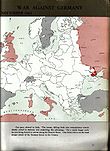 1943-11-01 |
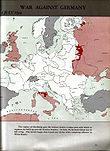 1944-07-01 |
 1944-09-01 |
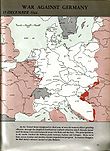 1944-12-01 |
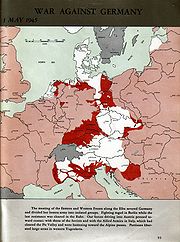 1945-05-01 |
- European-African-Middle Eastern Campaign MedalEuropean-African-Middle Eastern Campaign MedalThe European-African-Middle Eastern Campaign Medal is a military decoration of the United States armed forces which was first created on November 6, 1942 by issued by President Franklin D. Roosevelt...
- Mediterranean Theatre of Operations
- Pacific WarPacific WarThe Pacific War, also sometimes called the Asia-Pacific War refers broadly to the parts of World War II that took place in the Pacific Ocean, its islands, and in East Asia, then called the Far East...
Further reading
- Churchill, Winston (1948–1953), The Second World War, 6 vols.
- Keegan, John (1989). The Second World War, Hutchinson. ISBN 0-09-174011-8.
- Lee, Loyd E. ed. World War II in Europe, Africa, and the Americas, with General Sources: A Handbook of Literature and Research (1997)
- Murray, Williamson and Millett, Allan R. (2000). A War to Be Won: Fighting the Second World War, Harvard University Press. ISBN 0-674-00163-X.
- Overy, Richard (1995). Why the Allies Won Pimlico. ISBN 0-7126-7453-5.
- Smith, J. Douglas and Richard Jensen. (2002) World War II on the Web: A Guide to the Very Best Sites
- Weinberg, Gerhard L. (2005). A World at Arms: A Global History of World War II, Cambridge University Press. ISBN 0-521-44317-2.