


Intercontinental ballistic missile

Encyclopedia
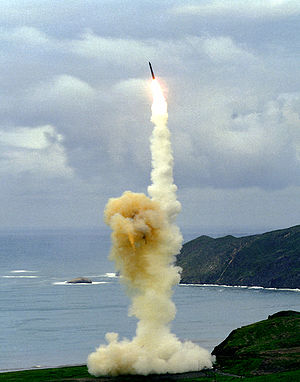
Ballistic missile
A ballistic missile is a missile that follows a sub-orbital ballistic flightpath with the objective of delivering one or more warheads to a predetermined target. The missile is only guided during the relatively brief initial powered phase of flight and its course is subsequently governed by the...
with a long range
Range of a projectile
right|thumb|250 px|The path of this projectile launched from a height y0 has a range d.In physics, assuming a flat Earth with a uniform gravity field, a projectile launched with specific initial conditions will have a predictable range. As in Trajectory of a projectile, we will use:The following...
(greater than 5,500 km or 3,500 miles) typically designed for nuclear weapons delivery
Nuclear weapons delivery
Nuclear weapons delivery is the technology and systems used to place a nuclear weapon at the position of detonation, on or near its target. Several methods have been developed to carry out this task....
(delivering one or more nuclear warheads
Nuclear weapon
A nuclear weapon is an explosive device that derives its destructive force from nuclear reactions, either fission or a combination of fission and fusion. Both reactions release vast quantities of energy from relatively small amounts of matter. The first fission bomb test released the same amount...
). Most modern designs support multiple independently targetable reentry vehicle
Multiple independently targetable reentry vehicle
A multiple independently targetable reentry vehicle warhead is a collection of nuclear weapons carried on a single intercontinental ballistic missile or a submarine-launched ballistic missile . Using a MIRV warhead, a single launched missile can strike several targets, or fewer targets redundantly...
s (MIRVs), allowing a single missile to carry several warheads, each of which can strike a different target.
Early ICBMs had limited accuracy that allowed them to be used only against the largest targets, cities. They were seen as a "safe" basing option, one that would keep the deterrent force close to home where it would be difficult to attack. Attacks against military targets, if desired, still demanded the use of a manned bomber
Bomber
A bomber is a military aircraft designed to attack ground and sea targets, by dropping bombs on them, or – in recent years – by launching cruise missiles at them.-Classifications of bombers:...
. Second and third generation designs dramatically improved accuracy to the point where even the smallest point targets can be successfully attacked. Similar evolution in size has allowed similar missiles to be placed on submarine
Submarine
A submarine is a watercraft capable of independent operation below the surface of the water. It differs from a submersible, which has more limited underwater capability...
s, where they are known as submarine launched ballistic missiles, or SLBMs. Submarines are an even safer basing option than land-based missiles, able to move about the ocean at will. This evolution in capability has pushed the manned bomber from the front-line deterrant force in all forces but the United States, and land-based ICBMs have similarly given way largely to SLBMs.
ICBMs are differentiated by having greater range and speed than other ballistic missiles: intermediate-range ballistic missile
Intermediate-range ballistic missile
An intermediate-range ballistic missile is a ballistic missile with a range of 3,000–5,500 km , between a medium-range ballistic missile and an intercontinental ballistic missile...
s (IRBMs), medium-range ballistic missile
Medium-range ballistic missile
A medium-range ballistic missile , is a type of ballistic missile with medium range, this last classification depending on the standards of certain organizations. Within the U.S. Department of Defense, a medium range missile is defined by having a maximum range of between 1,000 and 3,000 km1...
s (MRBMs), short-range ballistic missile
Short-range ballistic missile
A short-range ballistic missile is a ballistic missile with a range of about 1,000 km or less. They are usually capable of carrying nuclear weapons. In potential regional conflicts, these missiles would be used because of the short distances between some countries and their relative low cost...
s (SRBMs)—these shorter range ballistic missiles are known collectively as theatre ballistic missile
Theatre ballistic missile
A theatre ballistic missile is any ballistic missile with a range between and , used against targets "in-theatre". Its range is thus between that of tactical and intercontinental ballistic missiles. The term is a relatively new one, encompassing the former categories of short-range ballistic...
s. There is no single, standardized definition of what ranges would be categorized as intercontinental, intermediate, medium, or short. Additionally, ICBMs are generally considered to be nuclear only; although several conceptual designs of conventionally-armed missiles have been considered, the launch of such a weapon would be such a threat that it would demand a nuclear response, eliminates any military value of such a weapon.
World War II
The development of the world's first practical design for an ICBM, A9/10, intended for use in bombing New York and other American cities, was undertaken in Nazi GermanyNazi Germany
Nazi Germany , also known as the Third Reich , but officially called German Reich from 1933 to 1943 and Greater German Reich from 26 June 1943 onward, is the name commonly used to refer to the state of Germany from 1933 to 1945, when it was a totalitarian dictatorship ruled by...
by the team of Wernher von Braun
Wernher von Braun
Wernher Magnus Maximilian, Freiherr von Braun was a German rocket scientist, aerospace engineer, space architect, and one of the leading figures in the development of rocket technology in Nazi Germany during World War II and in the United States after that.A former member of the Nazi party,...
under Projekt Amerika. The ICBM A9/A10 rocket initially was intended to be guided by radio, but was changed to be a piloted craft after the failure of Operation Elster
Operation Elster
Operation Elster was a Nazi German mission to gather intelligence on and sabotage the Manhattan Project during World War II. The mission was commenced in 1944 with Nazi agents sailing from Kiel, Germany on the U-1230, coming ashore in Maine on November 30, 1944...
. The second stage of the A9/A10 rocket was tested a few times in January and February 1945. The progenitor of the A9/A10 was the German V-2 rocket
V-2 rocket
The V-2 rocket , technical name Aggregat-4 , was a ballistic missile that was developed at the beginning of the Second World War in Germany, specifically targeted at London and later Antwerp. The liquid-propellant rocket was the world's first long-range combat-ballistic missile and first known...
, also designed by von Braun and widely used at the end of World War II
World War II
World War II, or the Second World War , was a global conflict lasting from 1939 to 1945, involving most of the world's nations—including all of the great powers—eventually forming two opposing military alliances: the Allies and the Axis...
to bomb British and Belgian cities. All of these rockets used liquid propellants. Following the war, von Braun and other leading German scientists were relocated to the United States to work directly for the U.S. Army through Operation Paperclip
Operation Paperclip
Operation Paperclip was the Office of Strategic Services program used to recruit the scientists of Nazi Germany for employment by the United States in the aftermath of World War II...
, developing the IRBMs, ICBMs, and launchers
Launch vehicle
In spaceflight, a launch vehicle or carrier rocket is a rocket used to carry a payload from the Earth's surface into outer space. A launch system includes the launch vehicle, the launch pad and other infrastructure....
.
Cold War
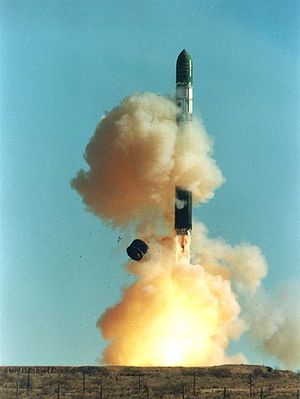
In the immediate post-war era, the US and USSR both started rocket research programs based on the German wartime designs, especially the V-2. In the US, each branch of the military started its own programs, leading to considerable duplication of effort. In the USSR, rocket research was centrally organized, although several teams worked on different designs. Early designs from both countries were short-range missiles, like the V-2, but improvements quickly followed.The U.S. initiated ICBM research in 1946 with the MX-774 project. This was a three-stage effort with the ICBM development not starting until the third stage. However, funding was cut after only three partially successful launches in 1948 of the second stage design, used to test variations on the V-2 design. With overwhelming air superiority and truly intercontinental bombers, the newly-forming US Air Force did not take the problem of ICBM development seriously. Things changed in 1953 with the Soviet testing of their first hydrogen bomb, but it was not until 1954 that the Atlas missile program was given the highest national priority. The Atlas A first flew on 11 June 1957.
The USSR faced different strategic concerns, and early development was focused on missiles able to attack European targets. This changed in 1953 when Sergey Korolyov
Sergey Korolyov
Sergei Pavlovich Korolev ; died 14 January 1966 in Moscow, Russia) was the lead Soviet rocket engineer and spacecraft designer in the Space Race between the United States and the Soviet Union during the 1950s and 1960s...
was directed to start development of a true ICBM able to deliver newly developed hydrogen bombs. Given steady funding throughout, the R-7
R-7 Semyorka
The R-7 was a Soviet missile developed during the Cold War, and the world's first intercontinental ballistic missile. The R-7 made 28 launches between 1957 and 1961, but was never deployed operationally. A derivative, the R-7A, was deployed from 1960 to 1968...
developed with some speed, and was successfully tested in August 1957 and, on October 4, 1957, placed the first artificial satellite in space, Sputnik. Testing of the R-7 ended in January 1958, but the missile was not considered ready for military service.
The first armed version of the Atlas, the Atlas D, was declared operational in January 1959 at Vandenberg, although it had not yet flown. The first test flight was carried out on 9 July 1959, and the missile was accepted for service on 1 September. Soviet developments quickly followed; the improved R-7A was first flown in December 1959, and declared fully operational in September 1960. The R-7 and Atlas each required a large launch facility, making them vulnerable to attack, and could not be kept in a ready state.
These early ICBMs also formed the basis of many space launch systems. Examples include Atlas, Redstone
Redstone (rocket family)
The Redstone family of rockets consisted of a number of American ballistic missiles, sounding rockets and expendable launch vehicles operational during the 1950s and 60s. The first member of the family was the PGM-11 Redstone missile, from which all other members were derived. The first large U.S...
, Titan
Titan (rocket family)
Titan was a family of U.S. expendable rockets used between 1959 and 2005. A total of 368 rockets of this family were launched, including all the Project Gemini manned flights of the mid-1960s...
, R-7, and Proton, which was derived from the earlier ICBMs but never deployed as an ICBM. The Eisenhower administration supported the development of solid-fueled missiles such as the LGM-30 Minuteman
LGM-30 Minuteman
The LGM-30 Minuteman is a U.S. nuclear missile, a land-based intercontinental ballistic missile . As of 2010, the version LGM-30G Minuteman-III is the only land-based ICBM in service in the United States...
, Polaris
UGM-27 Polaris
The Polaris missile was a two-stage solid-fuel nuclear-armed submarine-launched ballistic missile built during the Cold War by Lockheed Corporation of California for the United States Navy....
and Skybolt. Modern ICBMs tend to be smaller than their ancestors, due to increased accuracy and smaller and lighter warheads, and use solid fuels, making them less useful as orbital launch vehicles.
The Western view of the deployment of these systems was governed by the strategic theory of Mutual Assured Destruction
Mutual assured destruction
Mutual Assured Destruction, or mutually assured destruction , is a doctrine of military strategy and national security policy in which a full-scale use of high-yield weapons of mass destruction by two opposing sides would effectively result in the complete, utter and irrevocable annihilation of...
. In the 1950s and 1960s, development began on Anti-Ballistic Missile
Anti-ballistic missile
An anti-ballistic missile is a missile designed to counter ballistic missiles .A ballistic missile is used to deliver nuclear, chemical, biological or conventional warheads in a ballistic flight trajectory. The term "anti-ballistic missile" describes any antimissile system designed to counter...
systems by both the U.S. and USSR; these systems were restricted by the 1972 ABM treaty
Anti-Ballistic Missile Treaty
The Anti-Ballistic Missile Treaty was a treaty between the United States and the Soviet Union on the limitation of the anti-ballistic missile systems used in defending areas against missile-delivered nuclear weapons....
. The first successful ABM test were conducted by the USSR in 1961, that later deployed a fully operating system defending Moscow in the 1970s (see Moscow ABM system).
The 1972 SALT
Strategic Arms Limitation Talks
The Strategic Arms Limitation Treaty refers to two rounds of bilateral talks and corresponding international treaties involving the United States and the Soviet Union—the Cold War superpowers—on the issue of armament control. There were two rounds of talks and agreements: SALT I and SALT...
treaty froze the number of ICBM launchers of both the USA and the USSR at existing levels, and allowed new submarine-based SLBM
Submarine-launched ballistic missile
A submarine-launched ballistic missile is a ballistic missile capable of delivering a nuclear warhead that can be launched from submarines. Modern variants usually deliver multiple independently targetable reentry vehicles each of which carries a warhead and allows a single launched missile to...
launchers only if an equal number of land-based ICBM launchers were dismantled. Subsequent talks, called SALT II, were held from 1972 to 1979 and actually reduced the number of nuclear warheads held by the USA and USSR. SALT II was never ratified by the United States Senate
United States Senate
The United States Senate is the upper house of the bicameral legislature of the United States, and together with the United States House of Representatives comprises the United States Congress. The composition and powers of the Senate are established in Article One of the U.S. Constitution. Each...
, but its terms were nevertheless honored by both sides until 1986, when the Reagan administration "withdrew" after accusing the USSR of violating the pact.
In the 1980s, President Ronald Reagan
Ronald Reagan
Ronald Wilson Reagan was the 40th President of the United States , the 33rd Governor of California and, prior to that, a radio, film and television actor....
launched the Strategic Defense Initiative
Strategic Defense Initiative
The Strategic Defense Initiative was proposed by U.S. President Ronald Reagan on March 23, 1983 to use ground and space-based systems to protect the United States from attack by strategic nuclear ballistic missiles. The initiative focused on strategic defense rather than the prior strategic...
as well as the MX and Midgetman
MGM-134 Midgetman
The MGM-134A Midgetman, also known as the Small Intercontinental Ballistic Missile , was an intercontinental ballistic missile developed by the United States of America.-Overview:...
ICBM programs.
Post–Cold War
In 1991, the United States and the Soviet UnionSoviet Union
The Soviet Union , officially the Union of Soviet Socialist Republics , was a constitutionally socialist state that existed in Eurasia between 1922 and 1991....
agreed in the START I
START I
START was a bilateral treaty between the United States of America and the Union of Soviet Socialist Republics on the Reduction and Limitation of Strategic Offensive Arms. The treaty was signed on 31 July 1991 and entered into force on 5 December 1994...
treaty to reduce their deployed ICBMs and attributed warheads.
, all five of the nations with permanent seats on the United Nations Security Council
United Nations Security Council
The United Nations Security Council is one of the principal organs of the United Nations and is charged with the maintenance of international peace and security. Its powers, outlined in the United Nations Charter, include the establishment of peacekeeping operations, the establishment of...
have operational ICBM systems: all have submarine-launched missiles, and Russia, the United States and China also have land-based missiles. In addition, Russia and China have mobile land-based missiles.
India is reported to be developing a new variant of the Agni missile, called the Agni V, which is reported to have a strike range of more than 6,000 km. There is also speculation that India may be developing the Surya missile
Surya missile
The Surya missile was speculated to be an ICBM being developed by India. The first report about the Surya missile was published by The Nonproliferation Review in 1995.-History:...
, with a possible range of 10,000-16,000 kms.
It is speculated by some intelligence agencies that North Korea
North Korea
The Democratic People’s Republic of Korea , , is a country in East Asia, occupying the northern half of the Korean Peninsula. Its capital and largest city is Pyongyang. The Korean Demilitarized Zone serves as the buffer zone between North Korea and South Korea...
is developing an ICBM; two tests of somewhat different developmental missiles in 1998 and 2006 were not fully successful. On April 5, 2009, North Korea launched a missile. They claimed that it was to launch a satellite, but there is no proof to back up that claim.
Pakistan, is also said to be seeking ICBM capability and the development of a 7000 km range ICBM called Taimur is said to be under development.
Most countries in the early stages of developing ICBMs have used liquid propellants, with the known exceptions being the planned South African RSA-4 ICBM and the now in service Israeli Jericho 3.
Flight phases
The following flight phases can be distinguished:- boost phaseBoost phaseThe boost phase is the portion of the flight of a ballistic missile or space vehicle during which the booster and sustainer engines operate until it reaches peak velocity. This phase can take 3 to 4 minutes , the altitude at the end of this phase is 150–200 km, and the typical burn-out speed...
: 3 to 5 minutes (shorter for a solid rocketSolid rocketA solid rocket or a solid-fuel rocket is a rocket engine that uses solid propellants . The earliest rockets were solid-fuel rockets powered by gunpowder; they were used by the Chinese in warfare as early as the 13th century and later by the Mongols, Arabs, and Indians.All rockets used some form of...
than for a liquid-propellant rocketLiquid rocket propellantsThe highest specific impulse chemical rockets use liquid propellants. This type of propellant has a long history going back to the first rockets and is still in use, for example in the Space Shuttle and Ariane 5.-Early development:...
); altitude at the end of this phase is typically 150 to 400 km depending on the trajectory chosen, typical burnout speed is 7 km/s. - midcourse phase: approx. 25 minutes—sub-orbital spaceflightSub-orbital spaceflightA sub-orbital space flight is a spaceflight in which the spacecraft reaches space, but its trajectory intersects the atmosphere or surface of the gravitating body from which it was launched, so that it does not complete one orbital revolution....
in an elliptic flightpathElliptic orbitIn astrodynamics or celestial mechanics an elliptic orbit is a Kepler orbit with the eccentricity less than 1; this includes the special case of a circular orbit, with eccentricity equal to zero. In a stricter sense, it is a Kepler orbit with the eccentricity greater than 0 and less than 1 . In a...
; the flightpath is part of an ellipseEllipseIn geometry, an ellipse is a plane curve that results from the intersection of a cone by a plane in a way that produces a closed curve. Circles are special cases of ellipses, obtained when the cutting plane is orthogonal to the cone's axis...
with a vertical major axis; the apogee (halfway through the midcourse phase) is at an altitude of approximately 1,200 km; the semi-major axisSemi-major axisThe major axis of an ellipse is its longest diameter, a line that runs through the centre and both foci, its ends being at the widest points of the shape...
is between 3,186 km and 6,372 km; the projection of the flightpath on the Earth's surface is close to a great circleGreat circleA great circle, also known as a Riemannian circle, of a sphere is the intersection of the sphere and a plane which passes through the center point of the sphere, as opposed to a general circle of a sphere where the plane is not required to pass through the center...
, slightly displaced due to earth rotation during the time of flight; the missile may release several independent warheads, and penetration aidPenetration aidA penetration aid is a device or tactic used to increase an intercontinental ballistic missile warhead's chances of penetrating a target's defenses...
s such as metallic-coated balloons, aluminum chaffChaff (radar countermeasure)Chaff, originally called Window by the British, and Düppel by the Second World War era German Luftwaffe , is a radar countermeasure in which aircraft or other targets spread a cloud of small, thin pieces of aluminium, metallized glass fibre or plastic, which either appears as a cluster of secondary...
, and full-scale warhead decoyDecoyA decoy is usually a person, device or event meant as a distraction, to conceal what an individual or a group might be looking for. Decoys have been used for centuries most notably in game hunting, but also in wartime and in the committing or resolving of crimes.-Duck decoy:The term duck decoy may...
s. - reentryAtmospheric reentryAtmospheric entry is the movement of human-made or natural objects as they enter the atmosphere of a celestial body from outer space—in the case of Earth from an altitude above the Kármán Line,...
phase (starting at an altitude of 100 km): 2 minutes—impact is at a speed of up to 4 km/s (for early ICBMs less than 1 km/s); see also maneuverable reentry vehicleManeuverable reentry vehicleThe maneuverable reentry vehicle is a type of ballistic missile warhead capable of shifting targets in flight...
.
Modern ICBMs
Multiple independently targetable reentry vehicle
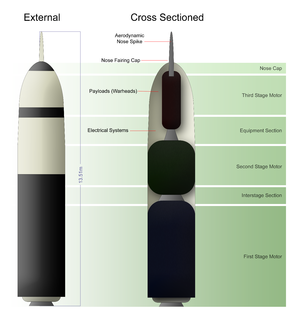
A multiple independently targetable reentry vehicle warhead is a collection of nuclear weapons carried on a single intercontinental ballistic missile or a submarine-launched ballistic missile . Using a MIRV warhead, a single launched missile can strike several targets, or fewer targets redundantly...
s (MIRVs), each of which carries a separate nuclear
Nuclear weapon
A nuclear weapon is an explosive device that derives its destructive force from nuclear reactions, either fission or a combination of fission and fusion. Both reactions release vast quantities of energy from relatively small amounts of matter. The first fission bomb test released the same amount...
warhead, allowing a single missile to hit multiple targets. MIRV was an outgrowth of the rapidly shrinking size and weight of modern warheads and the Strategic Arms Limitation Treaties which imposed limitations on the number of launch vehicles (SALT I and SALT II). It has also proved to be an "easy answer" to proposed deployments of ABM
Anti-ballistic missile
An anti-ballistic missile is a missile designed to counter ballistic missiles .A ballistic missile is used to deliver nuclear, chemical, biological or conventional warheads in a ballistic flight trajectory. The term "anti-ballistic missile" describes any antimissile system designed to counter...
systems—it is far less expensive to add more warheads to an existing missile system than to build an ABM system capable of shooting down the additional warheads; hence, most ABM system proposals have been judged to be impractical. The first operational ABM systems were deployed in the U.S. during 1970s. Safeguard ABM
Safeguard Program
The Safeguard Program was a United States Army anti-ballistic missile system developed during the late 1960s. Safeguard was designed to protect U.S. ICBM missile sites from counterforce attack, thus preserving the option of an unimpeded retaliatory strike. Safeguard used much of the same technology...
facility was located in North Dakota and was operational from 1975–1976. The USSR deployed its Galosh ABM system around Moscow in the 1970s, which remains in service. Israel deployed a national ABM system based on the Arrow missile in 1998, but it is mainly designed to intercept shorter-ranged theater ballistic missiles, not ICBMs. The U.S. Alaska-based National missile defense
National Missile Defense
National missile defense is a generic term for a type of missile defense intended to shield an entire country against incoming missiles, such as intercontinental ballistic missile or other ballistic missiles. Interception might be by anti-ballistic missiles or directed-energy weapons such as lasers...
system attained initial operational capability in 2004.
ICBMs can be deployed from multiple platforms:
- in missile silos, which offer some protection from military attack (including, the designers hope, some protection from a nuclear first strikeFirst strikeIn nuclear strategy, a first strike is a preemptive surprise attack employing overwhelming force. First strike capability is a country's ability to defeat another nuclear power by destroying its arsenal to the point where the attacking country can survive the weakened retaliation while the opposing...
) - on submarineSubmarineA submarine is a watercraft capable of independent operation below the surface of the water. It differs from a submersible, which has more limited underwater capability...
s: submarine-launched ballistic missileSubmarine-launched ballistic missileA submarine-launched ballistic missile is a ballistic missile capable of delivering a nuclear warhead that can be launched from submarines. Modern variants usually deliver multiple independently targetable reentry vehicles each of which carries a warhead and allows a single launched missile to...
s (SLBMs); most or all SLBMs have the long range of ICBMs (as opposed to IRBMs) - on heavy trucks; this applies to one version of the RT-2UTTH Topol MRT-2UTTH Topol MThe RT-2UTTKh «Topol-M» is one of the most recent intercontinental ballistic missiles to be deployed by Russia , and the first to be developed after the dissolution of the Soviet Union....
which may be deployed from a self-propelled mobile launcherMobile launcher vehicleA mobile launcher vehicle is a type of military vehicle on a multi-wheel-drive or tracked chassis carrying one or more ground-to-ground or ground-to-air explosive missiles, along with the personnel and equipment needed to prepare, organize, and execute a launch of such missiles.Purpose of...
, capable of moving through roadless terrain, and launching a missile from any point along its route - mobile launchers on rails; this applies, for example, to РТ-23УТТХ "Молодец" (RT-23UTTH "Molodets"RT-23 MolodetsThe RT-23 was a Soviet ICBM developed and produced by the Yuzhnoye Design Bureau before 1991. It is cold launched, and comes in silo and railway car based variants...
—SS-24 "Sсаlреl")
The last three kinds are mobile and therefore hard to find.
During storage, one of the most important features of the missile is its serviceability. One of the key features of the first computer-controlled
Embedded system
An embedded system is a computer system designed for specific control functions within a larger system. often with real-time computing constraints. It is embedded as part of a complete device often including hardware and mechanical parts. By contrast, a general-purpose computer, such as a personal...
ICBM, the Minuteman missile, was that it could quickly and easily use its computer to test itself.
In flight, a booster pushes the warhead and then falls away. Most modern boosters are solid-fueled rocket motors
Solid rocket
A solid rocket or a solid-fuel rocket is a rocket engine that uses solid propellants . The earliest rockets were solid-fuel rockets powered by gunpowder; they were used by the Chinese in warfare as early as the 13th century and later by the Mongols, Arabs, and Indians.All rockets used some form of...
, which can be stored easily for long periods of time. Early missiles used liquid-fueled rocket motors
Liquid rocket
A liquid-propellant rocket or a liquid rocket is a rocket engine that uses propellants in liquid form. Liquids are desirable because their reasonably high density allows the volume of the propellant tanks to be relatively low, and it is possible to use lightweight pumps to pump the propellant from...
. Many liquid-fueled ICBMs could not be kept fuelled all the time as the cryogenic liquid oxygen boiled off and caused ice formation, and therefore fueling the rocket was necessary before launch. This procedure was a source of significant operational delay, and might allow the missiles to be destroyed by enemy counterparts before they could be used. To resolve this problem the British invented the missile silo that protected the missile from a first strike
First strike
In nuclear strategy, a first strike is a preemptive surprise attack employing overwhelming force. First strike capability is a country's ability to defeat another nuclear power by destroying its arsenal to the point where the attacking country can survive the weakened retaliation while the opposing...
and also hid fuelling operations underground.
Once the booster falls away, the warhead continues on an unpowered ballistic trajectory, much like an artillery shell or cannon ball. The warhead is encased in a cone-shaped reentry vehicle and is difficult to detect in this phase of flight as there is no rocket exhaust or other emissions to mark its position to defenders. The high speeds of the warheads make them difficult to intercept and allow for little warning striking targets anywhere in the world within minutes.
Many authorities say that missiles also release aluminized balloons, electronic noisemakers, and other items intended to confuse interception devices and radars (see penetration aid
Penetration aid
A penetration aid is a device or tactic used to increase an intercontinental ballistic missile warhead's chances of penetrating a target's defenses...
).
As the nuclear warhead reenters the Earth's atmosphere its high speed causes friction with the air, leading to a dramatic rise in temperature which would destroy it if it were not shielded in some way. As a result, warhead components are contained within an aluminium
Aluminium
Aluminium or aluminum is a silvery white member of the boron group of chemical elements. It has the symbol Al, and its atomic number is 13. It is not soluble in water under normal circumstances....
honeycomb substructure, sheathed in pyrolytic graphite-epoxy resin composite, with a heat-shield layer on top which is constructed out of 3-Dimensional Quartz Phenolic
3-Dimensional Quartz Phenolic
3-Dimensional Quartz Phenolic is a phenolic-based material composed of a quartz cloth material woven into a seamless sock shape cloth impregnated with a phenolic resin and hot-pressed. When cured, 3DQP can be machined in the same way as metals and is tough and fire-resistant...
.
Accuracy is crucial, because doubling the accuracy decreases the needed warhead energy by a factor of four. Accuracy is limited by the accuracy of the navigation system and the available geophysical information.
Strategic missile systems are thought to use custom integrated circuit
Integrated circuit
An integrated circuit or monolithic integrated circuit is an electronic circuit manufactured by the patterned diffusion of trace elements into the surface of a thin substrate of semiconductor material...
s designed to calculate navigation
Navigation
Navigation is the process of monitoring and controlling the movement of a craft or vehicle from one place to another. It is also the term of art used for the specialized knowledge used by navigators to perform navigation tasks...
al differential equation
Differential equation
A differential equation is a mathematical equation for an unknown function of one or several variables that relates the values of the function itself and its derivatives of various orders...
s thousands to millions of times per second in order to reduce navigational errors caused by calculation alone. These circuits are usually a network of binary addition circuits that continually recalculate the missile's position. The inputs to the navigation circuit are set by a general purpose computer according to a navigational input schedule loaded into the missile before launch.
One particular weapon developed by the Soviet Union (FOBS) had a partial orbit
Orbit
In physics, an orbit is the gravitationally curved path of an object around a point in space, for example the orbit of a planet around the center of a star system, such as the Solar System...
al trajectory, and unlike most ICBMs its target could not be deduced from its orbital flight path. It was decommissioned in compliance with arms control agreements, which address the maximum range of ICBMs and prohibit orbital or fractional-orbital weapons.
Low-flying guided cruise missile
Cruise missile
A cruise missile is a guided missile that carries an explosive payload and is propelled, usually by a jet engine, towards a land-based or sea-based target. Cruise missiles are designed to deliver a large warhead over long distances with high accuracy...
s are an alternative to ballistic missile
Ballistic missile
A ballistic missile is a missile that follows a sub-orbital ballistic flightpath with the objective of delivering one or more warheads to a predetermined target. The missile is only guided during the relatively brief initial powered phase of flight and its course is subsequently governed by the...
s.
Land-based ICBMs
The United States currently operates 450 ICBMs in three USAF bases. The only model deployed is LGM-30G Minuteman-III.
All previous USAF Minuteman II missiles have been destroyed in accordance with START, and their launch silos have been sealed or sold to the public. To comply with the START II
START II
START II was a bilateral treaty between the United States of America and Russia on the Reduction and Limitation of Strategic Offensive Arms. It was signed by United States President George H. W...
most U.S. multiple independently targetable reentry vehicles, or MIRVs, have been eliminated and replaced with single warhead missiles. The powerful MIRV-capable Peacekeeper missiles were phased out in 2005. However, since the abandonment of the START II treaty, the U.S. is said to be considering retaining 800 warheads on an existing 450 missiles.
China has developed several long range ICBMs.
Israel is suspected of deploying the nuclear armed Jericho 3 ICBM. India
India
India , officially the Republic of India , is a country in South Asia. It is the seventh-largest country by geographical area, the second-most populous country with over 1.2 billion people, and the most populous democracy in the world...
is also slated to test the Agni V ICBM in the first quarter of 2012. Agni V is expected to be fully operational in 2014.
Submarine-launched
All current designs of submarineSubmarine
A submarine is a watercraft capable of independent operation below the surface of the water. It differs from a submersible, which has more limited underwater capability...
launched ballistic missiles have intercontinental range. Current operators of such missiles are the United States
United States
The United States of America is a federal constitutional republic comprising fifty states and a federal district...
, Russia
Russia
Russia or , officially known as both Russia and the Russian Federation , is a country in northern Eurasia. It is a federal semi-presidential republic, comprising 83 federal subjects...
, United Kingdom
United Kingdom
The United Kingdom of Great Britain and Northern IrelandIn the United Kingdom and Dependencies, other languages have been officially recognised as legitimate autochthonous languages under the European Charter for Regional or Minority Languages...
, France
France
The French Republic , The French Republic , The French Republic , (commonly known as France , is a unitary semi-presidential republic in Western Europe with several overseas territories and islands located on other continents and in the Indian, Pacific, and Atlantic oceans. Metropolitan France...
, China
People's Republic of China
China , officially the People's Republic of China , is the most populous country in the world, with over 1.3 billion citizens. Located in East Asia, the country covers approximately 9.6 million square kilometres...
, India
India
India , officially the Republic of India , is a country in South Asia. It is the seventh-largest country by geographical area, the second-most populous country with over 1.2 billion people, and the most populous democracy in the world...
.
See also
- Air Force Space CommandAir Force Space CommandAir Force Space Command is a major command of the United States Department of the Air Force, with its headquarters at Peterson Air Force Base, Colorado. AFSPC supports U.S. military operations worldwide through the use of many different types of satellite, launch and cyber operations....
- Anti-ballistic missileAnti-ballistic missileAn anti-ballistic missile is a missile designed to counter ballistic missiles .A ballistic missile is used to deliver nuclear, chemical, biological or conventional warheads in a ballistic flight trajectory. The term "anti-ballistic missile" describes any antimissile system designed to counter...
- Anti-Ballistic Missile TreatyAnti-Ballistic Missile TreatyThe Anti-Ballistic Missile Treaty was a treaty between the United States and the Soviet Union on the limitation of the anti-ballistic missile systems used in defending areas against missile-delivered nuclear weapons....
- Atmospheric reentryAtmospheric reentryAtmospheric entry is the movement of human-made or natural objects as they enter the atmosphere of a celestial body from outer space—in the case of Earth from an altitude above the Kármán Line,...
- CountermeasureCountermeasureA countermeasure is a measure or action taken to counter or offset another one. As a general concept it implies precision, and is any technological or tactical solution or system designed to prevent an undesirable outcome in the process...
- Dense Pack
- Fractional Orbital Bombardment SystemFractional Orbital Bombardment SystemThe Fractional Orbital Bombardment System was a Soviet ICBM program in the 1960s that after launch would go into a low Earth orbit and would then de-orbit for an attack. It had no range limit and the orbital flight path would not reveal the target location...
- France and weapons of mass destructionFrance and weapons of mass destructionFrance is known to have an arsenal of weapons of mass destruction. France is one of the five "Nuclear Weapons States" under the Nuclear Non-Proliferation Treaty; but is not known to possess or develop any chemical or biological weapons. France was the fourth country to test an independently...
- General Bernard Adolph Schriever
- Heavy ICBMHeavy ICBMHeavy ICBM is a term that was created in the 1970s to describe a class of Soviet ICBMs . They were characterized by a heavy throw-weight of 5 to 9 metric tons and a length of over 35 meters, and were thus capable of delivering a large number of warheads in a single MIRV missile.This term usually...
- High-alert nuclear weaponHigh-alert nuclear weaponHigh-alert nuclear weapon commonly refers to a launch-ready ballistic missile armed with a nuclear warhead whose launch can be ordered and executed within 15 minutes or less...
- People's Republic of China and weapons of mass destruction
- India and weapons of mass destructionIndia and weapons of mass destructionIndia possesses nuclear weapons and maintains short- and intermediate-range ballistic missiles, nuclear-capable aircraft, surface ships, and submarines under development as possible delivery systems and platforms...
- Israel and weapons of mass destructionIsrael and weapons of mass destructionIsrael is widely believed to possess weapons of mass destruction, and to be one of four nuclear-armed countries not recognized as a Nuclear Weapons State by the Nuclear Non-Proliferation Treaty...
- Pakistan and weapons of mass destructionPakistan and weapons of mass destructionPakistan began focusing on nuclear weapons development in January 1972 under the leadership of Prime Minister Zulfiqar Ali Bhutto, who delegated the program to the Chairman of PAEC Munir Ahmad Khan...
- List of ICBMs
- Missile Defense AgencyMissile Defense AgencyThe Missile Defense Agency is the section of the United States government's Department of Defense responsible for developing a layered defense against ballistic missiles. The agency has its origins in the Strategic Defense Initiative, which was established in 1983 and was headed by Lt...
- Nuclear disarmamentNuclear disarmamentNuclear disarmament refers to both the act of reducing or eliminating nuclear weapons and to the end state of a nuclear-free world, in which nuclear weapons are completely eliminated....
- Nuclear navyNuclear navyNuclear navy, or nuclear powered navy consists of ships powered by relatively small onboard nuclear reactors known as naval reactors. The concept was revolutionary for naval warfare when first proposed, as it meant that these vessels did not need to stop for fuel like their conventional...
- Nuclear warfareNuclear warfareNuclear warfare, or atomic warfare, is a military conflict or political strategy in which nuclear weaponry is detonated on an opponent. Compared to conventional warfare, nuclear warfare can be vastly more destructive in range and extent of damage...
- Nuclear weaponNuclear weaponA nuclear weapon is an explosive device that derives its destructive force from nuclear reactions, either fission or a combination of fission and fusion. Both reactions release vast quantities of energy from relatively small amounts of matter. The first fission bomb test released the same amount...
- Russia and weapons of mass destructionRussia and weapons of mass destructionRussia possesses the largest stockpiles of weapons of mass destruction in the world. The country declared an arsenal of 39,967 tons of chemical weapons in 1997, of which 48% have been destroyed. The Federation of American Scientists, a renowned organization for assessing nuclear weapon...
- SLBM
- Strike Force (France)
- SubmarineSubmarineA submarine is a watercraft capable of independent operation below the surface of the water. It differs from a submersible, which has more limited underwater capability...
- Throw-weightThrow-weightThrow-weight is a measure of the effective weight of ballistic missile payloads. It is measured in kilograms or metric tons. Throw-weight equals the total weight of a missile's warheads, reentry vehicles, self-contained dispensing mechanisms, penetration aids, and guidance systems — generally all...
- United Kingdom and weapons of mass destructionUnited Kingdom and weapons of mass destructionThe United Kingdom possesses, or has possessed, a variety of weapons of mass destruction, including nuclear, biological, and chemical weapons. The United Kingdom is one of the five official nuclear weapon states under the Nuclear Non-Proliferation Treaty and has an independent nuclear deterrent...
- United States and weapons of mass destructionUnited States and weapons of mass destructionThe United States is known to have possessed three types of weapons of mass destruction: nuclear weapons, chemical weapons and biological weapons. The U.S. is the only country to have used nuclear weapons in combat. The U.S. also used chemical weapons in World War I...
External links
- Ballistic missile characters
- Estimated Strategic Nuclear Weapons Inventories (September 2004)
- Intercontinental Ballistic and Cruise Missiles
- "A Tale of Two Airplanes" by Kingdon R. "King" Hawes, Lt Col, USAF (Ret.)