
All Topics  
Civil war


   Email Print
   Bookmark   Link


Civil war


A civil war is a war
War

...
 between organized groups to take control of a nation or region, or to change government policies. It is high-intensity conflict, often involving regular armed forces
Regular Army

In contemporary use, the term Regular Army refers to the full-time active component of the United States Army, as opposed to the United States Army Reserve or the Army National Guard....
, that is sustained, organized and large-scale. Civil wars result in large numbers of casualties
Casualty (person)

A casualty is a person who is the victim of an accident, injury, or Physical trauma. The word casualties is most often used by the news media to describe deaths and injuries resulting from wars or disasters....
 and the expenditure of large amounts of resource.


Discussion
Ask a question about 'Civil war'
Start a new discussion about 'Civil war'
Answer questions from other users
Full Discussion Forum


Timeline

836 BC   Civil war breaks out in Egypt.

192   Civil war again strikes Rome (192-193).

618   A civil war begins in Medina.

831   Louis the Pious reinstated following the end of the first Civil war of his reign

1215   King John rejects the Magna Carta, leading to an English civil war (the First Barons' War).

1570   The assassination of regent James Stewart, Earl of Moray throws Scotland into civil war.

1850   United States Senator Daniel Webster gives his "Seventh of March" speech in which he endorses the Compromise of 1850 in order to prevent a possible civil war.

1865   American Civil War: Battle of Palmito Ranch - In far south Texas, more than a month after Confederate General Lee's surrender, the last land battle of the civil war ends with a Confederate victory.

1914   Demonstrations in Ulster suggesting civil war.

1927   Civil war ends in Nicaragua


Encyclopedia


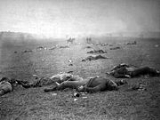
Battle of Gettysburg
A civil war is a war
War

...
 between organized groups to take control of a nation or region, or to change government policies. It is high-intensity conflict, often involving regular armed forces
Regular Army

In contemporary use, the term Regular Army refers to the full-time active component of the United States Army, as opposed to the United States Army Reserve or the Army National Guard....
, that is sustained, organized and large-scale. Civil wars result in large numbers of casualties
Casualty (person)

A casualty is a person who is the victim of an accident, injury, or Physical trauma. The word casualties is most often used by the news media to describe deaths and injuries resulting from wars or disasters....
 and the expenditure of large amounts of resource. A civil war involves two-sided violence; for example, a massacre of civilians by the state is not a civil war. Similarly, less intense forms of societal conflict, such as riot
Riot

A riot is a form of civil disorder characterized by disorganized groups lashing out in a sudden and intense rash of violence, vandalism or other crime....
s or social movement
Social movement

Social movements are a type of Group action . They are large wiktionary:informal groupings of individuals and/or organizations focused on specific politics or social issues, in other words, on carrying out, resisting or undoing a social change....
s, are excluded from the definition.

Civil wars since the end of World War II
World War II

World War II, or the Second World War , was a global military conflict which involved a Participants in World War II, including all of the great powers, organised into two opposing military alliances: the Allies of World War II and the Axis powers....
 have lasted on average just over four years, a dramatic rise from the one-and-a-half year average of the 1900-1944 period. While the rate of emergence of new civil wars has been relatively steady since the mid-1800s, the increasing length of those wars resulted in increasing numbers of wars ongoing at any one time. For example, there were no more than five civil wars underway simultaneously in the first half of the twentieth century, while over 20 concurrent civil wars were occurring at the end of the Cold War
Cold War

The Cold War was the continuing state of conflict, tension and competition that existed between a number of world powers, including the United States, the Soviet Union, People's Republic of China, France, United Kingdom and those countries' respective allies from the mid-1940s to the early 1990s....
, before a significant decrease as conflicts strongly associated with the superpower rivalry came to an end. Since 1945, civil wars have resulted in the deaths of over 25 million people, as well as the forced displacement
Forced migration

Forced migration refers to the coerced movement of a person or persons away from their home or home region. It often connotes violent coercion, and is used interchangeably with the terms "displacement" or forced displacement....
 of millions more. Civil wars have further resulted in economic collapse; Burma (Myanmar), Uganda
Uganda

The Republic of Uganda is a landlocked country in East Africa. It is bordered on the east by Kenya, on the north by Sudan, on the west by the Democratic Republic of the Congo, on the southwest by Rwanda, and on the south by Tanzania....
 and Angola
Angola

Angola, officially the Republic of Angola , is a country in south-central Africa bordering Namibia to the south, Democratic Republic of the Congo to the north, and Zambia to the east, and with a west coast along the Atlantic Ocean....
 are examples of nations that were considered to have promising futures before being engulfed in civil wars.

Scholars of war divide theories on the causes of civil war into either greed versus grievance. Roughly stated: are conflicts caused by who people are, whether that be defined in terms of ethnicity, religion or other social affiliation, or do conflicts begin because it is in the economic best interests of individuals and groups to start them? Scholarly analysis supports the conclusion that economic and structural factors are more important than those of identity in predicting occurrences of civil war.

Definition

James Fearon
James Fearon

James D. Fearon PhD , a graduate of Harvard, Johns Hopkins and Cornell Law School, is Theodore and Francis Geballe Professor of Political Science and Chair of the Department of Political Science at Stanford University, known for his work on the theory of civil wars, international bargaining, war's inefficiency puzzle and audience costs....
, a scholar of civil wars at Stanford University
Stanford University

Leland Stanford Junior University, commonly referred to as Stanford University or Stanford, is a private university research university located in Stanford, California, California, United States....
, states that "a civil war is a violent conflict within a country fought by organized groups that aim to take power at the center or in a region, or to change government policies". Ann Hironaka further specifies that one side of a civil war is the state
State

A state is a political Social contract with effective sovereignty over a geographic area and representing a population. These may be nation states, State or multinational states....
. The intensity at which a civil disturbance becomes a civil war is contested by academics. Some political scientists define as civil war as having more than 1000 casualties, while others further specify that at least 100 must come from each side. The Correlates of War
Correlates of War

The Correlates of War project is an academic study of the history of warfare. It was started in 1963 at the University of Michigan by political scientist J....
, a dataset widely used by scholars of conflict, classifies civil wars as having over 1000 war-related casualties per year of conflict. This rate is a small fraction of the millions killed in the Second Sudanese Civil War
Second Sudanese Civil War

The Second Sudanese Civil War started in 1983, although it was largely a continuation of the First Sudanese Civil War of 1955 to 1972. It took place, for the most part, in southern Sudan and was one of the longest lasting and deadliest wars of the later 20th century....
 and Cambodian Civil War
Cambodian Civil War

The Cambodian Civil War was a conflict that pitted the forces of the Communist Party of Kampuchea and their allies the Democratic Republic of Vietnam and the National Front for the Liberation of South Vietnam against the government forces of Cambodia , which were supported by the United States and the Republic of Vietnam ....
, for example, but excludes several highly publicized conflicts, such as The Troubles
The Troubles

The Troubles was a period of ethno-political conflict in Northern Ireland which spilled over at various times into England, the Republic of Ireland and Continental Europe....
 of Northern Ireland
Northern Ireland

conventional_long_name = Northern Ireland|native_name= Tuaisceart ?ireannNorlin Airlann|motto =|image_map = Europe location N-IRL2.png...
 and the struggle of the African National Congress
African National Congress

The African National Congress has been South Africa's governing party, supported by its tripartite alliance with the Congress of South African Trade Unions and the South African Communist Party , since the establishment of non-racial democracy in May 1994....
 in Apartheid
History of South Africa in the apartheid era

Apartheid ? meaning separateness in Dutch language ? was a system of legal racial segregation enforced by the National Party government in South Africa between 1948 and 1994....
-era South Africa
South Africa

The Republic of South Africa, also known by Official names of South Africa, is a country located at the southern tip of the continent of Africa....
.

Based on the 1000 casualties per year criterion, there were 213 civil wars from 1816 to 1997, 104 of which occurred from 1944 to 1997. If one uses the less-stringent 1000 casualties total criterion, there were over 90 civil wars between 1945 and 2007, with 20 ongoing civil wars as of 2007.

Further definitions

Battle Tewkesbury
The Geneva Conventions
Geneva Conventions

The Geneva Conventions consist of four treaties formulated in Geneva, Switzerland, that set the standards for international law for humanitarian concerns....
 do not specifically define the term 'civil war'. They do, however, describe the criteria for acts qualifying as "armed conflict not of an international character", which includes civil wars. Among the conditions listed are four requirements:

  • The party in revolt must be in possession of a part of the national territory.
  • The insurgent
    Insurgent

    Insurgent, insurgents or insurgency can refer to:*The act of Insurgency*Iraqi insurgency, uprising in Iraq*USS Insurgent , US Navy ship...
     civil authority must exercise de facto authority over the population within the determinate portion of the national territory.
  • The insurgents must have some amount of recognition as a belligerent.
  • The legal Government is "obliged to have recourse to the regular military forces against insurgents organized as military."


Causes of civil war in the Collier-Hoeffler Model

A comprehensive studies of civil war was carried out by a team from the World Bank
World Bank

The World Bank is a bank that provides financial and technical assistance to developing countries for development programs with the stated goal of reducing poverty....
 in the early 2000s. The study framework, which came to be called the Collier-Hoeffler Model, examined 78 five-year increments when civil war occurred from 1960 to 1999, as well as 1167 five-year increments of "no civil war" for comparison, and subjected the data set to regression analysis
Regression analysis

In statistics, regression analysis is a collective name for techniques for the modeling and analysis of numerical data consisting of values of a dependent variable and of one or more independent variables ....
 to see the effect of various factors. The factors that were shown to have a statistically-significant effect on the chance that a civil war would occur in any given five-year period were:

Availability of finance
Childrenmining 300
A high proportion of primary commodities
Commodity

A commodity is anything for which there is demand, but which is supplied without qualitative product differentiation across a market. It is a product that is the same no matter who produces it, such as petroleum, notebook paper, or milk....
 in national exports significantly increases the risk of a conflict. A country at "peak danger", with commodities comprising 32% of gross domestic product
Gross domestic product

File:GDP nominal per capita world map IMF 2008.pngThe gross domestic product or gross domestic income is one of the measures of national income and output for a given country's economy....
, has a 22% of falling into civil war in a given five-year period, while a country with no primary commodity exports has a 1% risk. When disaggregated, only petroleum
Petroleum

Petroleum or crude oil is a naturally occurring, flammable liquid found in rock formations in the Earth consisting of a complex mixture of hydrocarbons of various molecular weights, plus other organic compounds....
 and non-petroleum groupings showed different results: a country with relatively low levels of dependence on petroleum exports is at slightly less risk, while a high-level of dependence on oil as an export results in slightly more risk of a civil war than national dependence on another primary commodity. The authors of the study interpreted this as being the result of the ease by which primary commodities may be extorted or captured compared to other forms of wealth, e.g. it is easy to capture and control the output of a gold mine or oil field compared to a sector of garment manufacturing or hospitality services.

A second source of finance is national diaspora
Diaspora

The term diaspora refers to the movement of any population sharing common ethnicity identity who were either forced to leave or voluntarily left their Settler territory, and became residents in areas often far removed from the former....
s, which can fund rebellions and insurgencies from abroad. The study found that statistically switching the size of a country's diaspora from the smallest found in the study to the largest resulted in a sixfold increase in the chance of a civil war.

volunteers during the 1947-1948 civil war
1947–1948 Civil War in Mandatory Palestine

The 1947?1948 Civil War in Mandatory Palestine lasted from 30 November 1947, the date of the United Nations vote in favour of the termination of the British Mandate of Palestine and the UN Partition Plan, to the termination of the British Mandate itself on 14 May 1948....
 in the British Mandate of Palestine]] Opportunity cost of rebellion Higher male secondary school enrollment, per capita income and economic growth rate all had significant effects on reducing the chance of civil war. Specifically, a male secondary school enrollment 10% above the average reduced the chance of a conflict by about 3%, while a growth rate 1% higher than the study average resulted in a decline in the chance of a civil war of about 1%. The study interpreted these three factors as proxies for earnings foregone by rebellion, and therefore that lower foregone earnings encourages rebellion. Phrased another way: young males (who make up the vast majority of combatants in civil wars) are less likely to join a rebellion if they are getting an education and/or have a comfortable salary, and can reasonably assume that they will prosper in the future.

Low per capita income has been proposed as a cause for grievance, prompting armed rebellion. However, for this to be true, one would expect economic inequality to also be a significant factor in rebellions, which it is not. The study therefore concluded that the economic model of opportunity cost
Opportunity cost

Opportunity cost or economic opportunity loss is the value of the next best alternative foregone as the result of making a decision. Opportunity cost analysis is an important part of a company's decision-making processes but is not treated as an actual cost in any financial statement....
 better explained the findings.

Military advantage High levels of population dispersion and, to a lesser extent, the presence of mountainous terrain increased the chance of conflict. Both of these factors favor rebels, as a population dispersed outward toward the borders is harder to control than one concentrated in a central region, while mountains offer terrain where rebels can seek sanctuary.

Grievance Most proxies for "grievance" - the theory that civil wars begin because of issues of identity, rather than economics - were statistically insignificant, including economic equality, political rights, ethnic polarization and religious fractionalization. Only ethnic dominance, the case where the largest ethnic group comprises a majority of the population, increased the risk of civil war. A country characterized by ethnic dominance has nearly twice the chance of a civil war. However, the combined effects of ethnic and religious fractionalization, i.e. the more chance that any two randomly chosen people will be from separate ethnic or religious groups the less chance of a civil war, were also significant and positive, as long as the country avoided ethnic dominance. The study interpreted this as stating that minority groups are more likely to rebel if they feel that they are being dominated, but that rebellions are more likely to occur the more homogeneous the population and thus more cohesive the rebels. These two factors may thus be seen as mitigating each other in many cases.

Population size The various factors contributing to the risk of civil war rise increase with population size. The risk of a civil war rises approximately proportionately with the size of a country's population.

Time The more time that has elapsed since the last civil war, the less likely it is that a conflict will recur. The study had two possible explanations for this: one opportunity-based and the other grievance-based. The elapsed time may represent the depreciation
Depreciation

Depreciation is a term used in accounting, economics and finance to spread the cost of an asset over the span of several years.In simple words we can say that depreciation is the reduction in the value of an asset due to usage, passage of time, wear and tear, technological outdating or obsolescence, depletion, inadequacy, rot, rust, decay o...
 of whatever capital
Capital (economics)

In economics, capital or capital goods or real capital refers to factors of production used to create goods or services that are not themselves significantly consumed in the production process....
 the rebellion was fought over and thus increase the opportunity cost of restarting the conflict. Alternatively, elapsed time may represent the gradual process of healing of old hatreds. The study found that the presence of diaspora substantially reduced the positive effect of time, as the funding from diasporas offsets the depreciation of rebellion-specific capital.

Duration of civil wars

Ann Hironaka, author of Neverending Wars, divides the modern history of civil wars into the pre-nineteenth century, nineteenth century to early twentieth century, and late twentieth century. In nineteenth century Europe, the length of civil wars fell significantly, largely due to the nature of the conflicts as battles for the power center of the state, the strength of centralized governments, and the normally quick and decisive intervention by other states to support the government. Following World War II
World War II

World War II, or the Second World War , was a global military conflict which involved a Participants in World War II, including all of the great powers, organised into two opposing military alliances: the Allies of World War II and the Axis powers....
 the duration of civil wars grew past the norm of the pre-nineteenth century, largely due to weakness of the many postcolonial states and the intervention by major powers on both sides of conflict. The most obvious commonality to civil wars are that they occur in fragile state
Fragile state

A fragile state is a low income country characterized by weak state capacity and/or weak state legitimacy.While many countries are making progress towards achieving the Millennium Development Goals, a group of 35 to 50 countries is falling behind....
s.

Civil wars in the 19th and early 20th centuries

Civil wars through the nineteenth century to early twentieth century tended to be short; the average length of a civil war between 1900 and 1944 was one and half years. The state itself was the obvious center of authority in the majority of cases, and the civil wars were thus fought for control of the state. This meant that whoever had control of the capital and the military could normally crush resistance. If a rebellion failed to quickly seize the capital and control of the military for itself, it was normally doomed to a quick destruction. For example, the fighting associated with the 1871 Paris Commune
Paris Commune

The Paris Commune was a government that briefly ruled Paris from March 28 to May 28, 1871. It existed before the split between Anarchism and Socialism, and is hailed by both as the first seizure of power by the working class....
 occurred almost entirely in Paris
Paris

Paris is the Capital of France and the country's largest city. It is situated on the river Seine, in northern France, at the heart of the ?le-de-France Regions of France ....
, and ended quickly once the military sided with the government.

The power of non-state actors resulted in a lower value placed on sovereignty
Sovereignty

File:Leviathan gr.jpgSovereignty is the exclusive right to control a government, a State, a people, or oneself. A sovereign is a supreme lawmaking authority....
 in the eighteenth and nineteenth century, which further reduced the number of civil wars. For example, the pirates of the Barbary Coast
Barbary Coast

The Barbary Coast, or Barbary, was the term used by European ethnic groupss from the 16th until the 19th century to refer to the middle and western coastal regions of North Africa?what is now Morocco, Algeria, Tunisia, and Libya....
 were recognized as de facto states because of their military power. The Barbary pirates thus had no need to rebel against the Ottoman Empire
Ottoman Empire

The Ottoman Empire , also known by its contemporaries as the Turkish Empire or Turkey , was an empire that lasted from 1299?1923. It was Treaty of Lausanne by the Republic of Turkey, which was officially proclaimed on October 29, 1923....
, who were their nominal state government, to gain recognition for their sovereignty. Conversely, states such as Virginia
Virginia

The Commonwealth of Virginia is an United States U.S. state on the East Coast of the United States of the Southern United States. The state is known as the "Old Dominion" and sometimes as "Mother of Presidents", because it is the birthplace of Lists of United States Presidents by place of birth#By state....
 and Massachusetts
Massachusetts

The Commonwealth of Massachusetts is a U.S. state located in the New England region of the Northeastern United States United States. It borders Rhode Island and Connecticut to the south, New York to the west, and Vermont and New Hampshire to the north....
 in the United States of America
United States

The United States of America is a Federal government constitutional republic comprising U.S. state and a federal district. The country is situated mostly in central North America, where its Contiguous United States and Washington, D.C., the Capital districts and territories, lie between the Pacific Ocean and Atlantic Oceans, Borders of the U...
 did not have sovereign status, but had significant political and economic independence coupled with weak federal control, reducing the incentive to secede.

The two major global ideologies, monarchism
Monarchism

Monarchism is the advocacy of the establishment, preservation, or restoration of a monarchy as a form of government in a nation. A monarchist is an individual who supports this form of government out of principle, independent from the person, the Monarch....
 and democracy
Democracy

Democracy is a form of government in which power is held directly or indirectly by citizens under a free electoral system. It is derived from the Greek language d?????at?a , "popular government" which was coined from d???? , "people" and ???t?? , "rule, strength" in the middle of the 5th-4th century BC to denote the political syst...
, led to several civil wars. However, a bi-polar world, divided between the two ideologies, did not develop, largely due the dominance of monarchists through most of the period. The monarchists would thus normally intervene in other countries to stop democratic movements taking control and forming democratic governments, which were seen by monarchists as being both dangerous and unpredictable. The Great Powers
Great power

A great power is a nation or state that has the ability to exert its influence on a global scale. Great powers characteristically possess economics, military, diplomacy, and soft power strength, which may cause other, smaller nations to consider the opinions of great powers before taking actions of their own....
, defined in the 1815 Congress of Vienna
Congress of Vienna

The Congress of Vienna was a conference of ambassadors of European states chaired by the Austrian statesman Klemens Wenzel von Metternich, and held in Vienna from September, 1814 to June, 1815....
 as the United Kingdom
United Kingdom

The United Kingdom of Great Britain and Northern Ireland, commonly known as the United Kingdom , the UK or Britain,is a sovereign state located off the northwestern coast of continental Europe....
, Habsburg Austria
Austrian Empire

The Austrian Empire was a periodization successor state empire founded on a remnant of the Holy Roman Empire centered on what is today's Austria that officially lasted from 1804 to 1867....
, Prussia
Prussia

Prussia was, most recently, a historic state originating out of the Duchy of Prussia and the Margraviate of Brandenburg. This state had for centuries substantial influence on Germany and European history....
, France
France

France , officially the French Republic , is a country whose Metropolitan France is located in Western Europe and that also comprises various Overseas departments and territories of France....
, and Russia
Russia

Russia , or the Russian Federation , is a list of countries spanning more than one continent country extending over much of northern Eurasia....
, would frequently coordinate interventions in other nations' civil wars, nearly always on the side of the incumbent government. Given the military strength of the Great Powers, these interventions were nearly always decisive and quickly ended the civil wars.

Pipistrellobombing
There were several exceptions from the general rule of quick civil wars during this period. The American Civil War
American Civil War

The American Civil War , also known as the War Between the States and several Naming the American Civil War, was a civil war in the United States....
 (1861-1865) was unusual for at least two reasons: it was fought around regional identities, rather than political ideologies, and it was ended through a war of attrition
Attrition warfare

Attrition warfare is a military tactic in which a belligerent attempts to win a war by wearing down its Enemy to the point of collapse through continuous losses in personnel and mat?riel....
, rather than over a decisive battle over control of the capital, as was the norm. The Spanish Civil War
Spanish Civil War

The Spanish Civil War was a major conflict in Spain that started after an attempted coup d'?tat by a group of Spanish Army generals, supported by the conservative Spanish Confederation of the Autonomous Right , Carlist groups and the fascistic Falange, against the government of the Second Spanish Republic, then under the leadership of pr...
 (1936-1939) was exceptional because both sides of the war received support from intervening great powers: Germany
Germany

Germany , officially the Federal Republic of Germany , is a country in Central Europe. It is bordered to the north by the North Sea, Denmark, and the Baltic Sea; to the east by Poland and the Czech Republic; to the south by Austria and Switzerland; and to the west by France, Luxembourg, Belgium, and the Netherlands....
, Italy
Italy

Italy , officially the Italian Republic , is a country located on the Italian Peninsula in Southern Europe and on the two largest islands in the Mediterranean Sea, Sicily and Sardinia....
 and Portugal
Portugal

Portugal , officially the Portuguese Republic , is a country on the Iberian Peninsula. Located in southwestern Europe, Portugal is the westernmost country of mainland Europe and is bordered by the Atlantic Ocean to the west and south and by Spain to the north and east....
 supported opposition leader Francisco Franco
Francisco Franco

Francisco Paulino Hermenegildo Te?dulo Franco y Bahamonde, Salgado y Pardo de Andrade , commonly known as Francisco Franco or Francisco Franco y Bahamonde was the dictator and Head of State of Spain from October 1936, and de facto regent of the nominally restored Kingdom of Spain from 1947 until his death in 1975....
, while France
France

France , officially the French Republic , is a country whose Metropolitan France is located in Western Europe and that also comprises various Overseas departments and territories of France....
 and Russia
Russia

Russia , or the Russian Federation , is a list of countries spanning more than one continent country extending over much of northern Eurasia....
 supported the government
Second Spanish Republic

The Second Spanish Republic was the system of government in Spain between April 14 1931, when King of Spain Alfonso XIII of Spain left the country following local and municipal elections in which republican candidates won the majority of votes in urban areas and April 1 1939, when the last of the Republican forces surrendered to Nationalist...
.

Civil wars since 1945

In the 1990s, about twenty civil wars were occurring concurrently during an average year, a rate about ten times the historical average since the 19th century. However, the rate of new civil wars had not increased appreciably; the drastic rise in the number of ongoing wars after World War II
World War II

World War II, or the Second World War , was a global military conflict which involved a Participants in World War II, including all of the great powers, organised into two opposing military alliances: the Allies of World War II and the Axis powers....
 was a result of the tripling of the average duration of civil wars to over four years. This increase was a result of the increased number of states, the fragility of states
Fragile state

A fragile state is a low income country characterized by weak state capacity and/or weak state legitimacy.While many countries are making progress towards achieving the Millennium Development Goals, a group of 35 to 50 countries is falling behind....
 formed after 1945, the decline in interstate war, and the Cold War rivalry.

Following World War II, the major European powers divested themselves of their colonies at an increasing rate: the number of ex-colonial states jumped from about 30 to almost 120 after the war. The rate of state formation leveled off in the 1980s, at which point few colonies remained. More states also meant more states in which to have long civil wars. Hironaka statistically measures the impact of the increased number of ex-colonial states as increasing the post-WWII incidence of civil wars by +165% over the pre-1945 number.

, 1918]] While the new ex-colonial states appeared to follow the blueprint of the idealized state - centralized government, territory enclosed by defined borders, and citizenry with defined rights -, as well as accessories such as a national flag, an anthem, a seat at the United Nations
United Nations

The United Nations is an international organization whose stated aims are to facilitate cooperation in international law, international security, economic development, Social change, human rights and achieving world peace....
 and an official economic policy, they were in actuality far weaker than the Western states they were modeled after. In Western states, the structure of governments closely matched states' actual capabilities, which had been arduously developed over centuries. The development of strong administrative structures, in particular those related to extraction of taxes, is closely associated with the intense warfare between predatory European states in the seventeenth and eighteenth century, or in Charles Tilly
Charles Tilly

Charles Tilly was an United States sociology, political science, and historian who has written books on the relationship between politics and society....
's famous formulation: "War made the state and the state made war". For example, the formation of the modern states of Germany
Germany

Germany , officially the Federal Republic of Germany , is a country in Central Europe. It is bordered to the north by the North Sea, Denmark, and the Baltic Sea; to the east by Poland and the Czech Republic; to the south by Austria and Switzerland; and to the west by France, Luxembourg, Belgium, and the Netherlands....
 and Italy
Italy

Italy , officially the Italian Republic , is a country located on the Italian Peninsula in Southern Europe and on the two largest islands in the Mediterranean Sea, Sicily and Sardinia....
 in the nineteenth century is closely associated with the wars of expansion and consolidation led by Prussia
Prussia

Prussia was, most recently, a historic state originating out of the Duchy of Prussia and the Margraviate of Brandenburg. This state had for centuries substantial influence on Germany and European history....
 and Sardinia
Sardinia

Sardinia is the Mediterranean islands#By area island in the Mediterranean Sea . The area of Sardinia is . The island is surrounded by the France island of Corsica, the Italian Peninsula, Tunisia and the Balearic Islands....
, respectively. The Western process of forming effective and impersonal bureaucracies, developing efficient tax systems, and integrating national territory continued into the twentieth century; as late as World War I
World War I

World War I, or the First World War , was a global military conflict which involved the Great powers, organized into two opposing military alliances: the Allies of World War I and the Central Powers....
, some French military conscripts from rural regions were unable to name the country they were fighting for. Nevertheless, Western states that survived into the latter half of the twentieth century were considered "strong" by simple reason that they had managed to develop the institutional structures and military capability required to survive predation by their fellow states.

rebels in Ethiopia
Ethiopia

Ethiopia , officially the Federal Democratic Republic of Ethiopia, is a landlocked country situated in the Horn of Africa. Ethiopia is bordered by Eritrea to the north, Sudan to the west, Kenya to the south, Somalia to the east and Djibouti to the northeast....
, 2006]] In sharp contrast, decolonization
Decolonization

Decolonisation refers to the undoing of colonialism, the establishment of governance or authority through the creation of settlements by another country or jurisdiction....
 was an entirely different process of state formation. Most imperial powers had not foreseen a need to prepare their colonies for independence; for example, Britain had given limited self-rule to India
India

India, officially the Republic of India , is a country in South Asia. It is the List of countries and outlying territories by total area country by geographical area, the List of countries by population country, and the most populous liberal democracy in the world....
 and Sri Lanka
Sri Lanka

Sri Lanka, officially the Democratic Socialist Republic of Sri Lanka is an island country in South Asia, located about off the southern coast of India....
, while treating British Somaliland
British Somaliland

British Somaliland was a British Empire protectorate in the north part of the Horn of Africa. The protectorate incorporated most of what is identified as Maakhir, Puntland, and Somaliland....
 as little more than a trading post, while all major decisions for French colonies were made in Paris and Belgium
Belgium

* A small German-speaking Community of Belgium exists in eastern Wallonia. Belgium's linguistic diversity and related political and cultural conflicts are reflected in the history of Belgium and a complex Communities and regions of Belgium....
 prohibited any self-government up until it suddenly granted independence to its colonies in 1960. Like Western states of previous centuries, the new ex-colonies lacked autonomous bureaucracies, which would make decisions based on the benefit to society as a whole, rather than respond to corruption
Corruption

Corruption is essentially termed as an "impairment of integrity, virtue or moral principle; depravity, decay, and/or an inducement to wrong by improper or unlawful means, a departure from the original or from what is pure or correct, and/or an agency or influence that corrupts."...
 and nepotism
Nepotism

Nepotism is the showing of favoritism toward relatives or friends based upon that relationship, rather than on an objective evaluation of ability or suitability....
 to favor a particular interest group. In such a situation, factions manipulate the state to benefit themselves or, alternatively, state leaders use the bureaucracy to further their own self-interest. The lack of credible governance was compounded by the fact that most colonies were economic loss-makers at independence, lacking both a productive economic base and a taxation system to effectively extract resources from economic activity. Among the rare states profitable at decolonization was India, to which scholars credibly argue that Uganda
Uganda

The Republic of Uganda is a landlocked country in East Africa. It is bordered on the east by Kenya, on the north by Sudan, on the west by the Democratic Republic of the Congo, on the southwest by Rwanda, and on the south by Tanzania....
, Malaysia
Malaysia

Malaysia is a federation that consists of States of Malaysia in Southeast Asia with a total landmass of . The capital city is Kuala Lumpur, while Putrajaya is the seat of the federal government....
 and Angola
Angola

Angola, officially the Republic of Angola , is a country in south-central Africa bordering Namibia to the south, Democratic Republic of the Congo to the north, and Zambia to the east, and with a west coast along the Atlantic Ocean....
 may be included. Neither did imperial powers make territorial integration a priority, and may have discouraged nascent nationalism as a danger to their rule. Many newly independent states thus found themselves impoverished, with minimal administrative capacity in a fragmented society, while faced with the expectation of immediately meeting the demands of a modern state. Such states are considered "weak" or "fragile"
Fragile state

A fragile state is a low income country characterized by weak state capacity and/or weak state legitimacy.While many countries are making progress towards achieving the Millennium Development Goals, a group of 35 to 50 countries is falling behind....
. The "strong"-"weak" categorization is not the same as "Western"-"non-Western", as some Latin American states like Argentina
Argentina

Argentina, officially the Argentine Republic , is a country in South America, constituted as a federation of 23 provinces and an autonomous city....
 and Brazil
Brazil

Brazil , officially the Federative Republic of Brazil , is a country in South America. It is the List of countries and outlying territories by total area country by geographical area, occupying nearly half of South America, the List of countries by population country, and the fourth most populous democracy in the world....
 and Middle Eastern states like Egypt
Egypt

Egypt is a country mainly in North Africa, with the Sinai Peninsula forming a land bridge in Western Asia. Covering an area of about , Egypt borders the Mediterranean Sea to the north, the Gaza Strip and Israel to the northeast, the Red Sea to the east, Sudan to the south and Libya to the west....
 and Israel
Israel

Israel officially the State of Israel , is a country in the Middle East located on the eastern shore of the Mediterranean Sea. It borders Lebanon in the north, Syria in the northeast, Jordan in the east, and Egypt on the southwest, and contains geographically diverse features within its relatively small area....
 are considered to have "strong" administrative structures and economic infrastructure.

army and US Marines
United States Marine Corps

The United States Marine Corps is a branch of the United States Armed Forces responsible for providing Military power projection from the sea, using the mobility of the United States Navy to rapidly deliver Marine Air-Ground Task Force....
, 1982. The Lebanese Civil War
Lebanese Civil War

conflict=Lebanese Civil War |date=1984 - 1990|place=Lebanon|result=Taif Agreement|combatant1=|combatant2=|commander1=|commander2=|strength1=|strength2=...
 (1975–1990) was characterized by multiple foreign interventions.]] Historically, the international community would have targeted weak states for territorial absorption or colonial domination or, alternatively, such states would fragment into pieces small enough to be effectively administered and secured by a local power. However, international norms towards sovereignty changed in the wake of WWII in ways that support and maintain the existence of weak states. Weak states are given de jure
De jure

De jure is an expression that means "concerning law", as contrasted with de facto, which means "concerning fact".The terms de jure and de facto are used instead of "in principle" and "in practice", respectively, when one is describing politics or legal situations....
 sovereignty equal to that of other states, even when they do not have de facto
De facto

De facto is a Latin expression that means "concerning the fact" or in practice but not necessarily ordained by law. It is commonly used in contrast to de jure when referring to matters of law, governance, or technique that are found in the common experience as created or developed without or contrary to a regulation....
 sovereignty or control of their own territory, including the privileges of international diplomatic recognition and an equal vote in the United Nations. Further, the international community offers development aid
Development aid

Development aid or development cooperation is aid given by governmental and economic agencies to support the economic, social and political International development of developing countries....
 to weak states, which helps maintain the facade of a functioning modern state by giving the appearance that the state is capable of fulfilling its implied responsibilities of control and order. The formation of a strong international law
International law

Public international law concerns the structure and conduct of states and intergovernmental organizations. To a lesser degree, international law also may affect multinational corporations and individuals, an impact increasingly evolving beyond domestic legal interpretation and enforcement....
 regime and norms against territorial aggression is strongly associated with the dramatic drop in the number of interstate wars, though it has also been attributed to the effect of the Cold War or to the changing nature of economic development. Consequently, military aggression that results in territorial annexation became increasingly likely to prompt international condemnation, diplomatic censure, a reduction in international aid or the introduction of economic sanction, or, as in the case of 1990 invasion of Kuwait
Invasion of Kuwait

The Invasion of Kuwait, also known as the Iraq-Kuwait War, was a major conflict between the Republic of Iraq and the State of Kuwait which resulted in the seven-month long Iraqi occupation of Kuwait which subsequently led to direct Persian Gulf War by United States-led forces in the Persian Gulf War....
 by Iraq
Iraq

Iraq , officially the Republic of Iraq , is a country in Western Asia spanning most of the northwestern end of the Zagros Mountains, the eastern part of the Syrian Desert and the northern part of the Arabian Desert....
, international military intervention to reverse the territorial aggression. Similarly, the international community has largely refused to recognize secessionist regions, while keeping some states such as Cyprus
Cyprus

Cyprus , officially the Republic of Cyprus , is an island country situated in the eastern Mediterranean Sea, east of Greece, west of Lebanon, Syria, and Israel, south of Turkey and north of Egypt....
 and Taiwan
Taiwan

Taiwan is an island in East Asia. "Taiwan" is also commonly used to refer to the country governed by the Republic of China and to the ROC itself, which governs the island of Taiwan, Orchid Island and Green Island, Taiwan in the Pacific Ocean off the Taiwan coast, the Penghu islands in the Taiwan Strait, and Kinmen and the Matsu Islands...
 in diplomatic recognition limbo. While there is not a large body of academic work examining the relationship, Hironaka's statistical study found a correlation that suggests that every major international anti-secessionist declaration increased the number of ongoing civil wars by +10%, or a total +114% from 1945-1997. The diplomatic and legal protection given by the international community, as well as economic support to weak governments and discouragement of secession, thus had the unintended effect of encouraging civil wars.

Spartacus Ii
There has been an enormous amount of international intervention in civil wars since 1945 that served to extend wars. While intervention has been practiced since the international system has existed, its nature changed substantially. It became common for both the state and opposition group to receive foreign support, allowing wars to continue well past the point when domestic resources had been exhausted. Superpowers, such as the European Great Powers, had always felt no compunction in intervening in civil wars that affected their interests, while distant regional powers such as the United States could declare the interventionist Monroe Doctrine
Monroe Doctrine

The Monroe Doctrine is a United States policy introduced on December 2, 1823, which said that further efforts by European governments to colonize land or interfere with states in the Americas would be viewed by the United States of America as acts of aggression requiring US intervention....
 of 1821 for events in its Central American "backyard". However, the large population of weak states after 1945 allowed intervention by former colonial powers, regional powers and neighboring states who themselves often had scarce resources. On average, a civil war with interstate intervention was 300% longer than those without. When disaggregated, a civil war with intervention on only one side is 156% longer, while intervention on both sides lengthens the average civil war by an addition 92%. If one of the intervening states was a superpower, a civil war is extended a further 72%; a conflict such as the Angolan Civil War
Angolan Civil War

The Angolan Civil War began in Angola after the end of the Angolan War of Independence from Portugal in 1975. The war ultimately evolved into a prominent Cold War conflict, featuring two warring Angolan factions, the Communist MPLA, which was supported by the Soviet Union, and the anti-Communist UNITA, which gained support from the United Sta...
, in which there is two-sided foreign intervention, including by a superpower (actually, two superpowers in the case of Angola), would be 538% longer on average than a civil war without any international intervention.

Effect of the Cold War

The Cold War
Cold War

The Cold War was the continuing state of conflict, tension and competition that existed between a number of world powers, including the United States, the Soviet Union, People's Republic of China, France, United Kingdom and those countries' respective allies from the mid-1940s to the early 1990s....
 (1945-1989) provided a global network of material and ideological support that perpetuated civil wars, which were mainly fought in ex-colonial weak states, rather than the relatively strong states that were aligned with the Warsaw Pact
Warsaw Pact

The Warsaw Pact was an organization of communist states in Central Europe and Eastern Europe. The treaty was signed in Warsaw, Poland on May 14, 1955 and official copies were made in Russian language, Polish language, Czech language and German language....
 and North Atlantic Treaty Organization. In some cases, superpowers would superimpose Cold War ideology onto local conflicts, while in others local actors using Cold War ideology would attract the attention of a superpower. Using a separate statistical evaluation than used above for interventions, civil wars that included pro- or anti-communist forces lasted 141% longer than the average non-Cold War conflict, while a Cold War civil war that attracted superpower intervention resulted in wars typically lasting over three times as long as other civil wars. Conversely, the end of the Cold War marked by the fall of the Berlin Wall
Berlin Wall

The Berlin Wall was a physical separation barrier separating West Berlin from the German Democratic Republic , including East Berlin. The longer inner German border demarcated the border between East and West Germany....
 in 1989 resulted in a reduction in the duration of Cold War civil wars of 92% or, phrased another way, a roughly ten-fold increase in the rate of resolution of Cold War civil wars. Lengthy Cold War-associated civil conflicts that ground to a halt include the wars of Guatemala
Guatemalan Civil War

The Guatemalan Civil War, the longest civil war in Latin American history, ran from 1960 to 1996, and had a profound impact on Guatemala....
 (1960-1996), El Salvador (1979–1991), Nicaragua
History of Nicaragua

Nicaragua is the largest nation in Central America, but also the least densely populated with a demographic similar in size to its smaller neighbors. It is located about midway between Mexico and Colombia, bordered by Honduras to the north and Costa Rica to the south....
 (1970-1990) and Peru
Internal conflict in Peru

It has been estimated that nearly 70,000 people died in the internal conflict in Peru that started in 1980 and, although still ongoing, had greatly wound down by 2000....
 (1980-2000).

See also

  • List of civil wars
    List of civil wars

    This is a list of civil wars....
  • The Logic of Violence in Civil War
    The Logic of Violence in Civil War

    The Logic of Violence in Civil War is a book which challenges the conventional view of violence in civil wars as irrational. The main argument is that violence only emerges in those disputed territories, and it is generally driven not by the conflict itself, but by previous rancors and enmities among the population....
  • Wars of national liberation
    Wars of national liberation

    Wars of national liberation are conflicts fought by Indigenous peoples military groups against an empire power in the name of self-determination, thus attempting to remove that power's influence, in particular during the decolonization period....


Bibliography

  • Ali, Taisier Mohamed Ahmed and Robert O. Matthews, eds. Civil Wars in Africa: roots and resolution (1999), 322 pages
  • Mats Berdal and David M. Malone, Greed and Grievance: Economic Agendas in Civil Wars (Lynne Rienner, 2000).
  • Paul Collier, Breaking the Conflict Trap: civil war and development policy World Bank (2003) - 320 pages
  • Stathis Kalyvas, "'New' and 'Old' Civil Wars: A Valid Distinction?" World Politics 54, no. 1 (2001): 99-118.
  • David Lake and Donald Rothchild, eds. The International Spread of Ethnic Conflict: Fear, Diffusion, and Escalation (Princeton University Press, 1996).
  • Roy Licklider, "The Consequences of Negotiated Settlements in Civil Wars, 1945--1993," American Political Science Review 89, no. 3 (summer 1995): pp 681-690.
  • Andrew Mack, "Civil War: Academic Research and the Policy Community," Journal of Peace Research 39, no. 5 (2002): pp. 515-525.
  • David M. Malone and Mats R. Berdal. Greed and Grievance: economic agendas in civil wars (2000), 251 pages
  • David T. Mason and Patrick 3. Fett, "How Civil Wars End: A Rational Choice Approach," Journal of Conflict Resolution 40, no. 4 (fall 1996): 546-568.
  • Patrick M. Regan. Civil Wars and Foreign Powers: Outside Intervention in Intrastate Conflict (2000) 172 pages
  • Stephen John et al, eds. Ending Civil Wars: The Implementation of Peace Agreements (2002), 729 pages
  • Monica Duffy Toft, The Geography of Ethnic Violence: Identity, Interests, and the Indivisibility of Territory (Princeton NJ: Princeton University Press, 2003). ISBN 0-691-12383-7.
  • Barbara F. Walter, Committing to Peace: The Successful Settlement of Civil Wars (Princeton University Press, 2002),
  • Elisabeth Jean Wood; "Civil Wars: What We Don't Know," Global Governance, Vol. 9, 2003 pp 247+


External links

, BBC News
BBC News

BBC News, formerly BBC News and Current Affairs, is the department within the BBC responsible for the corporation's news-gathering and production of news programmes on BBC television, radio and online....
, 20 April 2006