


Mercenary

Encyclopedia
Protocol I
Protocol I is a 1977 amendment protocol to the Geneva Conventions relating to the protection of victims of international armed conflicts. It reaffirms the international laws of the original Geneva Conventions of 1949, but adds clarifications and new provisions to accommodate developments in modern...
defines a mercenary as being "motivated to take part in the hostilities essentially by the desire for private gain and, in fact, is promised, by or on behalf of a party to the conflict, material compensation substantially in excess of that promised or paid to combatants of similar ranks and functions in the armed forces of that Party".
As a result of the assumption that a mercenary is essentially motivated by money, the term mercenary usually carries negative connotations. There is a blur in the distinction between a mercenary and a foreign volunteer, when the primary motive of a soldier in a foreign army is uncertain. For instance, the French Foreign Legion
French Foreign Legion
The French Foreign Legion is a unique military service wing of the French Army established in 1831. The foreign legion was exclusively created for foreign nationals willing to serve in the French Armed Forces...
and the Gurkhas of the British
British Army
The British Army is the land warfare branch of Her Majesty's Armed Forces in the United Kingdom. It came into being with the unification of the Kingdom of England and Scotland into the Kingdom of Great Britain in 1707. The new British Army incorporated Regiments that had already existed in England...
and Indian
Indian Army
The Indian Army is the land based branch and the largest component of the Indian Armed Forces. With about 1,100,000 soldiers in active service and about 1,150,000 reserve troops, the Indian Army is the world's largest standing volunteer army...
armies are not mercenaries under the laws of war
Laws of war
The law of war is a body of law concerning acceptable justifications to engage in war and the limits to acceptable wartime conduct...
, since although they may meet many of the requirements of Article 47 of Protocol I
Protocol I
Protocol I is a 1977 amendment protocol to the Geneva Conventions relating to the protection of victims of international armed conflicts. It reaffirms the international laws of the original Geneva Conventions of 1949, but adds clarifications and new provisions to accommodate developments in modern...
to the Geneva Conventions
Geneva Conventions
The Geneva Conventions comprise four treaties, and three additional protocols, that establish the standards of international law for the humanitarian treatment of the victims of war...
, they are exempt under clauses 47(a)(c)(d)(e)&(f); some journalists describe them as mercenaries nevertheless.
Laws of war
The Protocol Additional GC 1977 (APGC77) provides the most widely accepted international definition of a mercenary, though not endorsed by some countries, including the United States. The Protocol Additional to the Geneva Conventions of 12 August 1949, and relating to the Protection of Victims of International Armed Conflicts, (Protocol IProtocol I
Protocol I is a 1977 amendment protocol to the Geneva Conventions relating to the protection of victims of international armed conflicts. It reaffirms the international laws of the original Geneva Conventions of 1949, but adds clarifications and new provisions to accommodate developments in modern...
), 8 June 1977 states:
All the criteria (a – f) must be met, according to the Geneva Convention, for a combatant to be described as a mercenary.
According to the GC III
Third Geneva Convention
The Third Geneva Convention, relative to the treatment of prisoners of war, is one of the four treaties of the Geneva Conventions. It was first adopted in 1929, but was significantly updated in 1949...
, a captured soldier must be treated as a lawful combatant
Combatant
A combatant is someone who takes a direct part in the hostilities of an armed conflict. If a combatant follows the law of war, then they are considered a privileged combatant, and upon capture they qualify as a prisoner of war under the Third Geneva Convention...
and, therefore, as a protected person with prisoner-of-war status until facing a competent tribunal
Competent tribunal
Competent Tribunal is a term used Article 5 paragraph 2 of the Third Geneva Convention, which states:-ICRC commentary on competent tribunals:...
(GC III Art 5). That tribunal, using criteria in APGC77 or some equivalent domestic law, may decide that the soldier is a mercenary. At that juncture, the mercenary soldier becomes an unlawful combatant
Unlawful combatant
An unlawful combatant or unprivileged combatant/belligerent is a civilian who directly engages in armed conflict in violation of the laws of war. An unlawful combatant may be detained or prosecuted under the domestic law of the detaining state for such action.The Geneva Conventions apply in wars...
but still must be "treated with humanity and, in case of trial, shall not be deprived of the rights of fair and regular trial", being still covered by GC IV
Fourth Geneva Convention
The Geneva Convention relative to the Protection of Civilian Persons in Time of War, commonly referred to as the Fourth Geneva Convention and abbreviated as GCIV, is one of the four treaties of the Geneva Conventions. It was adopted in August 1949, and defines humanitarian protections for civilians...
Art 5. The only possible exception to GC IV Art 5 is when he is a national of the authority imprisoning him, in which case he would not be a mercenary soldier as defined in APGC77 Art 47.d.
If, after a regular trial, a captured soldier is found to be a mercenary, then he can expect treatment as a common criminal and may face execution. As mercenary soldiers may not qualify as PoWs, they cannot expect repatriation at war's end. The best known post-World-War-II example of this was on 28 June 1976 when, at the end of the Luanda Trial
Luanda Trial
The Luanda Trial was a trial held in Luanda, Angola in June and July 1976 by the Popular Movement for the Liberation of Angola , recently victorious in the Angolan War of Independence, to prosecute thirteen foreign mercenaries who had served its defeated rival, the National Liberation Front of...
' an Angolan court sentenced three Britons and an American to death, and nine other mercenaries to prison terms ranging from 16 to 30 years. The four mercenaries sentenced to death were shot by a firing squad on 10 July 1976.
The legal status of civilian contractors depends upon the nature of their work and their nationalities with respect to that of the combatants. If they have not "in fact, taken a direct part in the hostilities" (APGC77 Art 47.b), they are not mercenaries but civilians who have non-combat support roles and are entitled to protection under the Third Geneva Convention (GCIII 4.1.4).
On 4 December 1989 the United Nations passed resolution 44/34, the International Convention against the Recruitment, Use, Financing and Training of Mercenaries. It entered into force on 20 October 2001 and is usually known as the UN Mercenary Convention. Article 1 contains the definition of a mercenary. Article 1.1 is similar to Article 47 of Protocol I, however Article 1.2 broadens the definition to include a non-national recruited to overthrow a "Government or otherwise undermining the constitutional order of a State; or Undermin[e] the territorial integrity of a State;" and "Is motivated to take part therein essentially by the desire for significant private gain and is prompted by the promise or payment of material compensation..." – under Article 1.2 a person does not have to take a direct part in the hostilities in a planned coup d'état to be a mercenary.
Critics have argued that the convention and APGC77 Art. 47 are designed to cover the activities of mercenaries in post-colonial Africa and do not address adequately the use of private military companies (PMCs)
Private military company
A private military company or provides military and security services. These combatants are commonly known as mercenaries, though modern-day PMCs refer to their staff as security contractors, private military contractors or private security contractors, and refer to themselves as private military...
by sovereign states.
The situation during the Iraq War and the continuing occupation of Iraq after the United Nations Security Council sanctioned
United Nations Security Council Resolution 1546
United Nations Security Council Resolution 1546, adopted unanimously on June 8, 2004, after reaffirming previous resolutions on Iraq, the Council endorsed the formation of the Iraqi Interim Government, welcomed the end of the occupation and determined the status of the multinational force and its...
hand-over of power to the Iraqi government shows the difficulty of defining a mercenary soldier. While the United States governed Iraq, no U.S. citizen working as an armed guard could be classified as a mercenary, because he was a national of a Party to the conflict (APGC77 Art 47.d). With the hand-over of power to the Iraqi government, if one does not consider
Consider
Consider can refer to:* Consider , a capability in some MUDs*Consider magazine, a student run publication at the University of Michigan* Consider This, an album by country music singer Aaron Pritchett...
the coalition forces to be continuing parties to the conflict in Iraq, but that their soldiers are sent by a State which is not a Party to the conflict on official duty as a member of its armed forces (APGC77 Art 47.f), then, unless U.S. citizens working as armed guards are lawfully certified residents of Iraq, i.e., a resident of territory controlled by a Party to the conflict (APGC77 Art 47.d), and they are involved with a fire-fight in the continuing conflict, they are mercenary soldiers. However, those who acknowledge the United States and other coalition forces as continuing parties to the conflict might insist that U.S. armed guards cannot be called mercenaries (APGC77 Art 47.d).
National laws
The laws of some countries forbid their citizens to fight in foreign wars unless they are under the control of their own national armed forces.France
In 2003, France criminalized mercenary activities, as defined by the protocol to the Geneva convention for French citizens, permanent residents and legal entities (Penal Code, L436-1, L436-2, L436-3, L436-4, L436-5). This law does not prevent French citizens from serving as volunteers in foreign forces. The law applies to military activities with a specifically mercenary motive or with a mercenary level of remuneration.
South Africa
In 1998 South Africa passed the "Foreign Military Assistance Act" that banned citizens and residents from any involvement in foreign wars, except in humanitarian operations, unless a government committee approved its deployment. In 2005, the legislation was reviewed by the government because of South African citizens working as security guards in Iraq
Iraq
Iraq ; officially the Republic of Iraq is a country in Western Asia spanning most of the northwestern end of the Zagros mountain range, the eastern part of the Syrian Desert and the northern part of the Arabian Desert....
during the American Iraq occupation and the consequences of the mercenary soldier sponsorship case against Mark Thatcher
Mark Thatcher
Sir Mark Thatcher, 2nd Baronet is the son of Sir Denis Thatcher and Baroness Thatcher, the former British Prime Minister, and twin brother of Carol Thatcher...
for the "possible funding and logistical assistance in relation to an alleged attempted coup in Equatorial Guinea
Equatorial Guinea
Equatorial Guinea, officially the Republic of Equatorial Guinea where the capital Malabo is situated.Annobón is the southernmost island of Equatorial Guinea and is situated just south of the equator. Bioko island is the northernmost point of Equatorial Guinea. Between the two islands and to the...
" organized by Simon Mann
Simon Mann
Simon Francis Mann is a British mercenary and former British Army officer. He had been serving a 34-year prison sentence in Equatorial Guinea for his role in a failed coup d'état in 2004, before receiving a presidential pardon on humanitarian grounds on 2 November 2009.Mann was extradited from...
.
United Kingdom
The United Kingdom passed a Foreign Enlistment Act in 1819, and then the Foreign Enlistment Act 1870
Foreign Enlistment Act 1870
The Foreign Enlistment Act 1870 is an Act of Parliament of the Parliament of the United Kingdom that seeks to regulate mercenary activities of British citizens.It received the royal assent on 9 August 1870.-Background:...
, making it unlawful for British subjects to join the armed forces of any state warring with another state at peace with Britain. In the Greek War of Independence
Greek War of Independence
The Greek War of Independence, also known as the Greek Revolution was a successful war of independence waged by the Greek revolutionaries between...
, British volunteers fought with the Greek rebels, which could have been unlawful; it was unclear whether or not the Greek rebels were a "state" per the Foreign Enlistment Act, but the law was clarified, saying that the rebels were a state. In 1896 a Privy Council
Privy council
A privy council is a body that advises the head of state of a nation, typically, but not always, in the context of a monarchic government. The word "privy" means "private" or "secret"; thus, a privy council was originally a committee of the monarch's closest advisors to give confidential advice on...
report noted that there had been no prosecutions under the Foreign Enlistment Acts and considered them unenforceable.
The British government considered using the Act against British subjects fighting for the International Brigade
International Brigades
The International Brigades were military units made up of volunteers from different countries, who traveled to Spain to defend the Second Spanish Republic in the Spanish Civil War between 1936 and 1939....
in the Spanish Civil War
Spanish Civil War
The Spanish Civil WarAlso known as The Crusade among Nationalists, the Fourth Carlist War among Carlists, and The Rebellion or Uprising among Republicans. was a major conflict fought in Spain from 17 July 1936 to 1 April 1939...
and the FNLA
National Liberation Front of Angola
The National Front for the Liberation of Angola was a militant organization that fought for Angolan independence from Portugal in the war of independence under the leadership of Holden Roberto. The FNLA became a political party in 1992....
in the Angolan Civil War
Angolan Civil War
The Angolan Civil War was a major civil conflict in the Southern African state of Angola, beginning in 1975 and continuing, with some interludes, until 2002. The war began immediately after Angola became independent from Portugal in November 1975. Prior to this, a decolonisation conflict had taken...
; nothing happened.
United States
The Anti-Pinkerton Act of 1893
Anti-Pinkerton Act
The Anti-Pinkerton Act was a law passed by the U.S. Congress in 1893 to limit the government's ability to hire strikebreakers. It is contained within and specifically restricts the government from hiring employees of Pinkerton or similar organizations....
forbade the U.S. Government from using Pinkerton National Detective Agency
Pinkerton National Detective Agency
The Pinkerton National Detective Agency, usually shortened to the Pinkertons, is a private U.S. security guard and detective agency established by Allan Pinkerton in 1850. Pinkerton became famous when he claimed to have foiled a plot to assassinate president-elect Abraham Lincoln, who later hired...
employees, or similar private police companies. In 1977, the US Fifth Circuit Court of Appeals interpreted this statute as forbidding the US Government's employing companies offering mercenary, quasi-military forces for hire. United States ex rel. Weinberger v. Equifax, 557 F.2d 456, 462 (5th Cir. 1977), cert. denied, 434 U.S. 1035 (1978). There is a disagreement over whether or not this proscription is limited to the use of such forces as strikebreakers, because it is stated thus:
In the 7 June 1978 Letter to the Heads of Federal Departments and Agencies, the Comptroller General interpreted this decision in a way that carved out an exemption for "Guard and Protective Services".
A US Department of Defense interim rule (effective 16 June 2006) revises DoD Instruction 3020.41 to authorize contractors, other than private security contractors, to use deadly force against enemy armed forces only in self-defense. 71 Fed. Reg. 34826. Per that interim rule, private security contractors are authorized to use deadly force when protecting their client's assets and persons, consistent with their contract's mission statement
Statement
Statement may refer to:* A kind of expression in language *Statement , declarative sentence that is either true or false*Statement , the smallest standalone element of an imperative programming language...
. (one interpretation is that this authorizes contractors to engage in combat on behalf of the US Government). It is the combatant commander's responsibility to ensure that private security contract mission statements do not authorize performance of inherently Governmental military functions, i.e. preemptive attacks or assaults or raids, et cetera.
Otherwise, civilians with US Armed Forces lose their law of war protection from direct attack, if and for such time as they directly participate in hostilities. On 18 August 2006, the US Comptroller General rejected bid protest arguments that US Army contracts violated the Anti-Pinkerton Act by requiring that contractors provide armed convoy escort vehicles and labor, weapons, and equipment for internal security operations at Victory Base Complex, Iraq. The Comptroller General reasoned the act was unviolated, because the contracts did not require contractors to provide quasi-military forces as strikebreakers. Yet, on 1 June 2007, the Washington Post reported: "A federal judge yesterday ordered the military to temporarily refrain from awarding the largest security contract in Iraq. The order followed an unusual series of events set off when a U.S. Army veteran, Brian X. Scott, filed a protest against the government practice of hiring what he calls mercenaries, according to sources familiar with the matter." Though Scott had filed the protest at the Court of Federal Claims, the court order was the result of other bidders intervening in the case. Scott did not submit a bid, however, when the bidders who did submit a bid tried to protest at GAO, their GAO bid protests were dismissed due to the fact that Scott had filed a case at the court and deprived GAO of further jurisdiction in the matter. Scott's case had been dismissed at GAO and was eventually dismissed at the court. The court order was in response to one of the legitimate contractors and Brian X. Scott had no role in obtaining that order.
The contract, worth about $400 million, calls for a private company to provide intelligence services to the US Army and security for the Army Corps of Engineers on reconstruction work in Iraq. The case, which is being heard by the US Court of Federal Claims, puts on trial one of the most controversial and least understood aspects of the Iraq war: the outsourcing of military security to an estimated 20,000 armed contractors.
Gurkha and French Foreign Legion
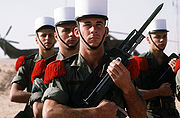
Gurkha
Gurkha are people from Nepal who take their name from the Gorkha District. Gurkhas are best known for their history in the Indian Army's Gorkha regiments, the British Army's Brigade of Gurkhas and the Nepalese Army. Gurkha units are closely associated with the kukri, a forward-curving Nepalese knife...
regiments of the British
British Army
The British Army is the land warfare branch of Her Majesty's Armed Forces in the United Kingdom. It came into being with the unification of the Kingdom of England and Scotland into the Kingdom of Great Britain in 1707. The new British Army incorporated Regiments that had already existed in England...
and Indian
Indian Army
The Indian Army is the land based branch and the largest component of the Indian Armed Forces. With about 1,100,000 soldiers in active service and about 1,150,000 reserve troops, the Indian Army is the world's largest standing volunteer army...
armies, and the French Foreign Legion
French Foreign Legion
The French Foreign Legion is a unique military service wing of the French Army established in 1831. The foreign legion was exclusively created for foreign nationals willing to serve in the French Armed Forces...
.
Foreign nationals recruited from countries of the Commonwealth of Nations
Commonwealth of Nations
The Commonwealth of Nations, normally referred to as the Commonwealth and formerly known as the British Commonwealth, is an intergovernmental organisation of fifty-four independent member states...
in the British Army
British Army
The British Army is the land warfare branch of Her Majesty's Armed Forces in the United Kingdom. It came into being with the unification of the Kingdom of England and Scotland into the Kingdom of Great Britain in 1707. The new British Army incorporated Regiments that had already existed in England...
swear allegiance to the British monarch and are liable to operate in any unit. Gurkhas however operate in dedicated Gurkha units of the British Army (specifically units that are administered by the Brigade of Gurkhas
Brigade of Gurkhas
The Brigade of Gurkhas is the collective term for units of the current British Army that are composed of Nepalese soldiers. The brigade, which is 3,640 strong, draws its heritage from Gurkha units that originally served in the British Indian Army prior to Indian independence, and prior to that of...
; however, although they are nationals of Nepal, a country that is not part of the Commonwealth, they still swear allegiance to the British monarch and abide the rules and regulations under which all British soldiers serve; similar rules apply to Gurkhas of the Indian Army
Indian Army
The Indian Army is the land based branch and the largest component of the Indian Armed Forces. With about 1,100,000 soldiers in active service and about 1,150,000 reserve troops, the Indian Army is the world's largest standing volunteer army...
. French Foreign Legionnaires are formed units of the French Foreign Legion
French Foreign Legion
The French Foreign Legion is a unique military service wing of the French Army established in 1831. The foreign legion was exclusively created for foreign nationals willing to serve in the French Armed Forces...
, which deploys and fights as an organized unit of the French Army
French Army
The French Army, officially the Armée de Terre , is the land-based and largest component of the French Armed Forces.As of 2010, the army employs 123,100 regulars, 18,350 part-time reservists and 7,700 Legionnaires. All soldiers are professionals, following the suspension of conscription, voted in...
. This means that as members of the armed forces of Britain, India, and France these soldiers are not mercenary soldiers per APGC77 Art 47.e and APGC77 Art 47.f.
Private military companies (PMCs)/ Private Security Companies (PSCs)
There is a distinction between "Private Military Contractors" and "Mercenaries," however in the days of modern combat and warfare the distinction is becoming more distorted. Private military contractors are considered mercenaries due to the concept of their armed security services being contracted; or rather, purchased, when in fact they are subject to government regulation and prosecution to ensure their standards of conduct are acceptable and comply with international war law, as well as that of the country the Private Military Company resides in. Mercenaries, are not restricted to or forced to abide by international war laws or government regulation of any kind, "Standards of conduct" are non-existent to mercenaries. Mercenaries are also unrestricted as to who can hire them, PMCs and PSCs are contracted only to official governments, mercenaries in Africa have been known to; on occasion, associate themselves with resistance movements and groups. The classic "Mercenary" is only well known in Africa, as the wars and conflicts are consistent, and never ending, another reason is that due to the experience of most African fighters and soldiers, a mercenary in Africa is essentially the equivalent of a medieval knight fighting against peasants.The private military company
Private military company
A private military company or provides military and security services. These combatants are commonly known as mercenaries, though modern-day PMCs refer to their staff as security contractors, private military contractors or private security contractors, and refer to themselves as private military...
(PMC) is the contemporary strand of the mercenary trade, providing logistics
Logistics
Logistics is the management of the flow of goods between the point of origin and the point of destination in order to meet the requirements of customers or corporations. Logistics involves the integration of information, transportation, inventory, warehousing, material handling, and packaging, and...
, soldiers, military training, and other services. Thus, PMC contractors are civilians (in governmental, international, and civil organizations) authorized to accompany an army to the field; hence, the term civilian contractor. Nevertheless, PMCs may use armed force, hence defined as: "legally established enterprises that make a profit, by either providing services involving the potential exercise of [armed] force in a systematic way and by military means, and/or by the transfer of that potential to clients through training and other practices, such as logistics support, equipment procurement, and intelligence gathering".
Private paramilitary forces are functionally mercenary armies, not security guards or advisors; however, national governments reserve the right to control the number, nature, and armaments of such private armies, arguing that, provided they are not pro-actively employed in front-line combat, they are not mercenaries. That said, PMC "civilian contractors" have poor repute among professional government soldiers and officers – the US Military Command have questioned their war zone behavior. In September 2005, Brigadier General Karl Horst, deputy commander of the Third Infantry Division charged with Baghdad security after the 2003 invasion, said of DynCorp and other PMCs in Iraq: These guys run loose in this country and do stupid stuff. There's no authority over them, so you can't come down on them hard when they escalate force... They shoot people, and someone else has to deal with the aftermath. It happens all over the place.
If PMC employees participate in pro-active combat, the press calls them mercenaries, and the PMCs mercenary companies. In the 1990s, the media identified four mercenary companies:
- Executive OutcomesExecutive OutcomesExecutive Outcomes was a private military company founded in South Africa by former Lieutenant-Colonel of the South African Defence Force Eeben Barlow in 1989. It later became part of the South African-based holding company Strategic Resource Corporation....
– Angola, Sierra Leone, and other locations worldwide (closed 31 December 1998) - Sandline InternationalSandline InternationalSandline International was a private military company based in London, established in the early 1990s. It was involved in conflicts in Papua New Guinea in 1997 causing the Sandline affair, in 1998 in Sierra Leone and in Liberia in 2003 Sandline International was a private military company based...
– Papua New Guinea, Sierra Leone (closed 16 April 2004) - Gurkha Security Guards, Ltd – Sierra Leone.
- DynCorp InternationalDynCorp InternationalDynCorp International is a United States-based private military contractor. Begun as an aviation company, the company now also provides air operations support, training and mentoring, international development, intelligence training and support, contingency operations, security, and operations and...
– Bosnia, Somalia, Angola, Haiti, Colombia, Kosovo, Kuwait, Afghanistan (active)
In 2004 the PMC business was boosted, because the US and Coalition governments hired them for security in Iraq. In March 2004, four Blackwater USA
Blackwater USA
Xe Services LLC, better known by its former names, Blackwater USA and Blackwater Worldwide, is a private military company founded in 1997 by Erik Prince and Al Clark.. Xe is currently the largest of the U.S. State Department's three private security contractors...
employees escorting food supplies and other equipment were attacked and killed in Fallujah
Fallujah
Fallujah is a city in the Iraqi province of Al Anbar, located roughly west of Baghdad on the Euphrates. Fallujah dates from Babylonian times and was host to important Jewish academies for many centuries....
, in a videotaped attack; the killings and subsequent dismemberment were a cause for the First Battle of Fallujah
Operation Vigilant Resolve
As part of the occupation of Iraq, the First Battle of Fallujah, codenamed Operation Vigilant Resolve, was an unsuccessful attempt by the United States Military to capture the city of Fallujah in April 2004....
. Afghan war operations also boosted the business.
In 2006, a U.S. congressional report listed a number of PMCs and other enterprises that have signed contracts to carry out anti-narcotics operations and related activities as part of Plan Colombia
Plan Colombia
The term Plan Colombia is most often used to refer to U.S. legislation aimed at curbing drug smuggling and combating a left-wing insurgency by supporting different activities in Colombia....
. DynCorp was among those contracted by the State Department, while others signed contracts with the Defense Department. Other companies from different countries, including Israel
Israel
The State of Israel is a parliamentary republic located in the Middle East, along the eastern shore of the Mediterranean Sea...
, have also signed contracts with the Colombian Defense Ministry to carry out security or military activities.
The United Nations disapproves of PMCs (still, the UN hired Executive Outcomes for African logistic support work). The question is whether or not PMC soldiers are as accountable for their war zone actions as are the Bosniak armed forces. A common argument for using PMCs (used by the PMCs themselves), is that PMCs may be able to help combat genocide
Genocide
Genocide is defined as "the deliberate and systematic destruction, in whole or in part, of an ethnic, racial, religious, or national group", though what constitutes enough of a "part" to qualify as genocide has been subject to much debate by legal scholars...
and civilian slaughter where the UN is unwilling or unable to intervene.
In February 2002, a British Foreign and Commonwealth Office
Foreign and Commonwealth Office
The Foreign and Commonwealth Office, commonly called the Foreign Office or the FCO is a British government department responsible for promoting the interests of the United Kingdom overseas, created in 1968 by merging the Foreign Office and the Commonwealth Office.The head of the FCO is the...
(FCO) report about PMCs noted that the demands of the military service from the UN and international civil organizations might mean that it is cheaper to pay PMCs than use soldiers. Yet, after considering using PMCs to support UN operations, the UN Secretary General, Kofi Annan
Kofi Annan
Kofi Atta Annan is a Ghanaian diplomat who served as the seventh Secretary-General of the UN from 1 January 1997 to 31 December 2006...
, decided against it.
In October 2007, the United Nations released a two-year study that stated, that although hired as "security guards", private contractors were performing military duties. The report found that the use of contractors such as Blackwater was a "new form of mercenary activity" and illegal under International law
International law
Public international law concerns the structure and conduct of sovereign states; analogous entities, such as the Holy See; and intergovernmental organizations. To a lesser degree, international law also may affect multinational corporations and individuals, an impact increasingly evolving beyond...
. Many countries, including the United States and the United Kingdom, are not signatories to the 1989 United Nations Mercenary Convention banning the use of mercenaries.
Ancient Egypt
An early recorded use of foreign auxiliaries dates back to Ancient EgyptAncient Egypt
Ancient Egypt was an ancient civilization of Northeastern Africa, concentrated along the lower reaches of the Nile River in what is now the modern country of Egypt. Egyptian civilization coalesced around 3150 BC with the political unification of Upper and Lower Egypt under the first pharaoh...
, the thirteenth century BC, when Pharaoh
Pharaoh
Pharaoh is a title used in many modern discussions of the ancient Egyptian rulers of all periods. The title originates in the term "pr-aa" which means "great house" and describes the royal palace...
Ramesses II
Ramesses II
Ramesses II , referred to as Ramesses the Great, was the third Egyptian pharaoh of the Nineteenth dynasty. He is often regarded as the greatest, most celebrated, and most powerful pharaoh of the Egyptian Empire...
used 11,000 mercenaries during his battles. A long established foreign corps in the Egyptian forces were the Medjay
Medjay
The Medjay –from mDA, represents the name Ancient Egyptians gave to a region in northern Sudan–where an ancient people of Nubia inhabited...
– a generic term given to tribal scouts and light infantry recruited from Nubia serving from the late period of the Old Kingdom
Old Kingdom
Old Kingdom is the name given to the period in the 3rd millennium BC when Egypt attained its first continuous peak of civilization in complexity and achievement – the first of three so-called "Kingdom" periods, which mark the high points of civilization in the lower Nile Valley .The term itself was...
through that of the New Kingdom
New Kingdom
The New Kingdom of Egypt, also referred to as the Egyptian Empire is the period in ancient Egyptian history between the 16th century BC and the 11th century BC, covering the Eighteenth, Nineteenth, and Twentieth Dynasties of Egypt....
. Other warriors recruited from outside the borders of Egypt included Libyan, Syrian and Canaanite contingents under the New Kingdom and Sherdens from Sardinia who appear in their distinctive horned helmets on wall paintings as body guards for Ramesses II. Celtic
Celtic
The words Celt and Celtic can refer to:In ethno-linguistics:*Celts, a people of the Celtic nations*Celts , the modern Celtic identity*Celtic languages...
mercenaries were greatly employed in the Greek
Ancient Greece
Ancient Greece is a civilization belonging to a period of Greek history that lasted from the Archaic period of the 8th to 6th centuries BC to the end of antiquity. Immediately following this period was the beginning of the Early Middle Ages and the Byzantine era. Included in Ancient Greece is the...
world (leading to the sack of Delphi and the Celtic settlement of Galatia
Galatia
Ancient Galatia was an area in the highlands of central Anatolia in modern Turkey. Galatia was named for the immigrant Gauls from Thrace , who settled here and became its ruling caste in the 3rd century BC, following the Gallic invasion of the Balkans in 279 BC. It has been called the "Gallia" of...
). The Greek rulers of Ptolemaic Egypt
Ptolemaic Egypt
Ptolemaic Egypt began when Ptolemy I Soter invaded Egypt and declared himself Pharaoh of Egypt in 305 BC and ended with the death of queen Cleopatra VII of Egypt and the Roman conquest in 30 BC. The Ptolemaic Kingdom was a powerful Hellenistic state, extending from southern Syria in the east, to...
, too, used Celtic mercenaries.
20th century
In the 20th century, mercenaries in conflicts on the continent of Africa have in several cases brought about a swift end to bloody civil war by comprehensively defeating the rebel forces. There have been a number of unsavory incidents in the brushfire wars of Africa, some involving recruitment of naïve European and American men "looking for adventure".Many of the adventurers in Africa who have been described as mercenaries were in fact ideologically motivated to support particular governments, and would not fight "for the highest bidder". An example of this was the British South Africa Police
British South Africa Police
The British South Africa Police was the police force of the British South Africa Company of Cecil Rhodes which became the national police force of Southern Rhodesia and its successor after 1965, Rhodesia...
(BSAP), a paramilitary, mounted infantry force formed by the British South Africa Company
British South Africa Company
The British South Africa Company was established by Cecil Rhodes through the amalgamation of the Central Search Association and the Exploring Company Ltd., receiving a royal charter in 1889...
of Cecil Rhodes in 1889/1890 that evolved and continued until 1980.
Notorious mercenaries include:
- Mike HoareMike HoareThomas Michael Hoare is an Irish mercenary leader known for military activities in Africa and his failed attempt to conduct a coup d'état in the Seychelles.-Early life and military career:...
who was involved in the Congo CrisisCongo CrisisThe Congo Crisis was a period of turmoil in the First Republic of the Congo that began with national independence from Belgium and ended with the seizing of power by Joseph Mobutu...
in the early 1960s and a failed coup in Seychelles in 1978. - Bob DenardBob DenardColonel Bob Denard , born Gilbert Bourgeaud, was a French soldier and mercenary. He was known for having done various jobs in support of Françafrique for Jacques Foccart, in charge of French president Charles de Gaulle's policy in Africa...
who was involved in numerous African campaigns in many countries, often with the covert support of France. However, his particular specialty was intervening in the ComorosComorosThe Comoros , officially the Union of the Comoros is an archipelago island nation in the Indian Ocean, located off the eastern coast of Africa, on the northern end of the Mozambique Channel, between northeastern Mozambique and northwestern Madagascar...
. The last time was in 1995, when he staged a coup which failed (the military of the French Government intervened to oust Denard). - Simon MannSimon MannSimon Francis Mann is a British mercenary and former British Army officer. He had been serving a 34-year prison sentence in Equatorial Guinea for his role in a failed coup d'état in 2004, before receiving a presidential pardon on humanitarian grounds on 2 November 2009.Mann was extradited from...
who was involved with Executive OutcomesExecutive OutcomesExecutive Outcomes was a private military company founded in South Africa by former Lieutenant-Colonel of the South African Defence Force Eeben Barlow in 1989. It later became part of the South African-based holding company Strategic Resource Corporation....
ventures in AngolaAngolaAngola, officially the Republic of Angola , is a country in south-central Africa bordered by Namibia on the south, the Democratic Republic of the Congo on the north, and Zambia on the east; its west coast is on the Atlantic Ocean with Luanda as its capital city...
and Sierra LeoneSierra LeoneSierra Leone , officially the Republic of Sierra Leone, is a country in West Africa. It is bordered by Guinea to the north and east, Liberia to the southeast, and the Atlantic Ocean to the west and southwest. Sierra Leone covers a total area of and has an estimated population between 5.4 and 6.4...
(see below). In 2004 he was found guilty in ZimbabweZimbabweZimbabwe is a landlocked country located in the southern part of the African continent, between the Zambezi and Limpopo rivers. It is bordered by South Africa to the south, Botswana to the southwest, Zambia and a tip of Namibia to the northwest and Mozambique to the east. Zimbabwe has three...
of "attempting to buy weapons" (BBC 27 August) allegedly for a coup in Equatorial GuineaEquatorial GuineaEquatorial Guinea, officially the Republic of Equatorial Guinea where the capital Malabo is situated.Annobón is the southernmost island of Equatorial Guinea and is situated just south of the equator. Bioko island is the northernmost point of Equatorial Guinea. Between the two islands and to the...
(see below).
Congo Crisis
The Congo Crisis
Congo Crisis
The Congo Crisis was a period of turmoil in the First Republic of the Congo that began with national independence from Belgium and ended with the seizing of power by Joseph Mobutu...
(1960–1965) was a period of turmoil in the First Republic of the Congo
Republic of the Congo (Léopoldville)
The Republic of the Congo was an independent republic established following the independence granted to the former colony of the Belgian Congo in 1960...
that began with national independence from Belgium
Belgium
Belgium , officially the Kingdom of Belgium, is a federal state in Western Europe. It is a founding member of the European Union and hosts the EU's headquarters, and those of several other major international organisations such as NATO.Belgium is also a member of, or affiliated to, many...
and ended with the seizing of power by Joseph Mobutu. During the crisis mercenaries were employed by various factions, and also at times helped the United Nations and other peace keepers.
In 1960 and 1961 Mike Hoare
Mike Hoare
Thomas Michael Hoare is an Irish mercenary leader known for military activities in Africa and his failed attempt to conduct a coup d'état in the Seychelles.-Early life and military career:...
worked as a mercenary commanding an English speaking unit called "4 Commando" supporting a faction in Katanga
Katanga Province
Katanga Province is one of the provinces of the Democratic Republic of the Congo. Between 1971 and 1997, its official name was Shaba Province. Under the new constitution, the province was to be replaced by four smaller provinces by February 2009; this did not actually take place.Katanga's regional...
, a province trying to break away from the newly independent Congo
Republic of the Congo (Léopoldville)
The Republic of the Congo was an independent republic established following the independence granted to the former colony of the Belgian Congo in 1960...
.
In 1964. Congolese Prime Minister Moïse Tshombe
Moise Tshombe
Moïse Kapenda Tshombe was a Congolese politician.- Biography :He was the son of a successful Congolese businessman and was born in Musumba, Congo. He received his education from an American missionary school and later trained as an accountant...
hired "Colonel" Mike Hoare to lead a military unit called "5 Commando" made up of about 300 men most of whom were from South Africa. The unit's mission was to fight a breakaway rebel group called Simbas
Simba Rebellion
The Simba Rebellion was a 1964 rebellion in the former Republic of the Congo which began as a result of alleged abuses by the Congolese central government...
. Later Hoare and his mercenaries worked in concert with Belgian
Belgium
Belgium , officially the Kingdom of Belgium, is a federal state in Western Europe. It is a founding member of the European Union and hosts the EU's headquarters, and those of several other major international organisations such as NATO.Belgium is also a member of, or affiliated to, many...
paratrooper
Paratrooper
Paratroopers are soldiers trained in parachuting and generally operate as part of an airborne force.Paratroopers are used for tactical advantage as they can be inserted into the battlefield from the air, thereby allowing them to be positioned in areas not accessible by land...
s, Cuba
Cuba
The Republic of Cuba is an island nation in the Caribbean. The nation of Cuba consists of the main island of Cuba, the Isla de la Juventud, and several archipelagos. Havana is the largest city in Cuba and the country's capital. Santiago de Cuba is the second largest city...
n exile pilots, and CIA hired mercenaries who attempted to save 1,600 civilians (mostly Europeans and missionaries
Missionary
A missionary is a member of a religious group sent into an area to do evangelism or ministries of service, such as education, literacy, social justice, health care and economic development. The word "mission" originates from 1598 when the Jesuits sent members abroad, derived from the Latin...
) in Stanleyville
Kisangani
Kisangani is the capital of Orientale Province in the Democratic Republic of the Congo. It is the 3rd largest urbanized city in the country and the largest of the cities that lie in the tropical woodlands of the Congo....
from the Simba rebels in Operation Dragon Rouge. This operation saved many lives; however, the Operation damaged the reputation of Tshombe as it saw the return of white mercenaries to the Congo soon after independence. The mercenary raid was a factor in Tshombe's loss of support from Joseph Mobutu. Later, in 1966 and 1967, some former Tshombe mercenaries staged the Mercenaries' Mutinies.
At the same time Bob Denard commanded the French speaking "6 Commando", "Black Jack" Schramme
Jean Schramme
Jean Schramme was a Belgian mercenary and farmer, owner of an estate of about 15 square kilometres, and boss of about 1000 indigenous workers....
commanded "10 Commando" and William "Rip" Robertson commanded a company of anti-Castro Cuban exiles.
Biafra
Mercenaries fought for the Biafra
Biafra
Biafra, officially the Republic of Biafra, was a secessionist state in south-eastern Nigeria that existed from 30 May 1967 to 15 January 1970, taking its name from the Bight of Biafra . The inhabitants were mostly the Igbo people who led the secession due to economic, ethnic, cultural and religious...
ns in the Fourth Commando Brigade during the Nigerian Civil War
Nigerian Civil War
The Nigerian Civil War, also known as the Nigerian-Biafran War, 6 July 1967–15 January 1970, was a political conflict caused by the attempted secession of the southeastern provinces of Nigeria as the self-proclaimed Republic of Biafra...
, (1967–1970). Other mercenaries flew aircraft for the Biafrans. In October 1966, for example, a Royal Air Burundi
Royal Air Burundi
Royal Air Burundi was an airline from Ruanda-Urundi and was based in Usumbura.The airline was formed in 1962 to perform non-scheduled passenger flights utilising a Lockheed L.049 Constellation, which was obtained from Las Vegas Hacienda. The national airline of newly-independent Burundi made...
DC-4M Argonaut
Canadair North Star
The Canadair North Star was a 1940s Canadian development of the Douglas C-54 / DC-4 aircraft. Instead of radial piston engines found on the Douglas design, Canadair employed Rolls-Royce Merlin engines in order to achieve a 35 mph faster cruising speed. The prototype flew on 15 July 1946 and...
, flown by mercenary Heinrich Wartski, also known as Henry Wharton, crashlanded in Cameroon
Cameroon
Cameroon, officially the Republic of Cameroon , is a country in west Central Africa. It is bordered by Nigeria to the west; Chad to the northeast; the Central African Republic to the east; and Equatorial Guinea, Gabon, and the Republic of the Congo to the south. Cameroon's coastline lies on the...
with military supplies destined for Biafra.
In May 1969, Carl Gustaf von Rosen
Carl Gustaf von Rosen
Count Carl Gustaf Ericsson von Rosen was a Swedish pioneer aviator. He flew relief missions in a number of conflicts as well as combat missions for Finland and Biafran rebels...
formed a squadron of five light aircraft known as the Babies of Biafra, which attacked and destroyed Nigerian jet aircraft on the ground and delivered food aid
Aid
In international relations, aid is a voluntary transfer of resources from one country to another, given at least partly with the objective of benefiting the recipient country....
. Von Rosen was assisted by ex-RCAF fighter pilot Lynn Garrison
Lynn Garrison
Lynn Garrison is a Canadian pilot and political adviser. He was an RCAF fighter pilot from the 403 City of Calgary Squadron, commercial pilot, film producer, director and mercenary...
.
Angola
In the mid-1970s John Banks, a Briton, recruited mercenaries to fight for the National Front for the Liberation of Angola (FNLA) against the Popular Movement for the Liberation of Angola (MPLA) in the civil war
Angolan Civil War
The Angolan Civil War was a major civil conflict in the Southern African state of Angola, beginning in 1975 and continuing, with some interludes, until 2002. The war began immediately after Angola became independent from Portugal in November 1975. Prior to this, a decolonisation conflict had taken...
that broke out when Angola gained independence from Portugal in 1975. When captured, John Derek Barker's role as a leader of mercenaries in Northern Angola led the judges to send him to face the firing squad. Nine others were imprisoned. Three more were executed: American Daniel Gearhart was sentenced to death for advertising himself as a mercenary in an American newspaper; Andrew McKenzie and Costas Georgiou
Costas Georgiou
Costas Georgiou was a Greek Cypriot mercenary executed following the Luanda Trial for activities during the civil war phase of the Angolan War of Independence.-Early life:...
(the self styled "Colonel Callan"), who had both served in the British army, were sentenced to death for murder.
Executive Outcomes
Executive Outcomes
Executive Outcomes was a private military company founded in South Africa by former Lieutenant-Colonel of the South African Defence Force Eeben Barlow in 1989. It later became part of the South African-based holding company Strategic Resource Corporation....
employees, Captains Daniele Zanata and Raif St Clair (who was also involved in the aborted Seychelles Coup of 1981), fought on behalf of the MPLA against UNITA
UNITA
The National Union for the Total Independence of Angola is the second-largest political party in Angola. Founded in 1966, UNITA fought with the Popular Movement for the Liberation of Angola in the Angolan War for Independence and then against the MPLA in the ensuing civil war .The war was one...
in the 1990s in violation of the Lusaka Protocol
Lusaka Protocol
The Lusaka Protocol, signed in Lusaka, Zambia on October 31, 1994, attempted to end the Angolan Civil War by integrating and disarming UNITA and national reconciliation. Both sides signed a ceasefire as part of the protocol on November 20.-Negotiation:...
.
Sierra Leone
American Robert C. MacKenzie
Robert C. MacKenzie
Robert Callen MacKenzie was an American professional soldier whose career included service as an infantryman in the United States Army during the Vietnam War, the C Squadron 22 SAS, the South African Defence Force, and the Transkei Defence Force.As a contributing editor for unconventional...
was killed in the Malal Hills in February 1995, while commanding Gurkha Security Guards (GSG) in Sierra Leone
Sierra Leone
Sierra Leone , officially the Republic of Sierra Leone, is a country in West Africa. It is bordered by Guinea to the north and east, Liberia to the southeast, and the Atlantic Ocean to the west and southwest. Sierra Leone covers a total area of and has an estimated population between 5.4 and 6.4...
. GSG pulled out soon afterwards and was replaced by Executive Outcomes
Executive Outcomes
Executive Outcomes was a private military company founded in South Africa by former Lieutenant-Colonel of the South African Defence Force Eeben Barlow in 1989. It later became part of the South African-based holding company Strategic Resource Corporation....
. Both were employed by the Sierra Leone government as military advisers and to train the government soldiers. It has been alleged that the firms provided soldiers who took an active part in the fighting against the Revolutionary United Front
Revolutionary United Front
The Revolutionary United Front was a rebel army that fought a failed eleven-year war in Sierra Leone, starting in 1991 and ending in 2002. It later developed into a political party, which existed until 2007...
(RUF).
In 2000, the Australian Broadcasting Corporation's (ABC-TV) international affairs program "Foreign Correspondent" broadcast a special report "Sierra Leone: Soldiers of Fortune", focussing on former 32BN and Recce members who operated in Sierra Leone while serving for SANDF. Officers like De Jesus Antonio, TT D Abreu Capt Ndume and Da Costa were the forefront because of their combat and language skills and also the exploits of South African pilot Neall Ellis and his MI-24 Hind gunship. The report also investigated the failures of the UN Peacekeeping Force, and the involvement of mercenaries/private military contractors in providing vital support to UN operations and British military Special Operations in Sierra Leone in 1999–2000.
Synopsis and transcript at: http://www.abc.net.au/foreign/s220036.htm
Equatorial Guinea
A fictional portrait of mercenary operations in the 1970s is Frederick Forsyth
Frederick Forsyth
Frederick Forsyth, CBE is an English author and occasional political commentator. He is best known for thrillers such as The Day of the Jackal, The Odessa File, The Fourth Protocol, The Dogs of War, The Devil's Alternative, The Fist of God, Icon, The Veteran, Avenger, The Afghan and The Cobra.-...
's book, The Dogs of War, which was set on the island of Malabo
Malabo
Malabo is the capital of Equatorial Guinea, located on the northern coast of Bioko Island on the rim of a sunken volcano....
– renamed "Zangaro" in the novel – and given a platinum deposit. Since the discovery of oil there in the mid-1990s, it does not need a fictional platinum deposit for it to be of interest to financiers and mercenaries. In August 2004 there was a plot, which later became known as the "Wonga Coup", to overthrow the government of Equatorial Guinea
Equatorial Guinea
Equatorial Guinea, officially the Republic of Equatorial Guinea where the capital Malabo is situated.Annobón is the southernmost island of Equatorial Guinea and is situated just south of the equator. Bioko island is the northernmost point of Equatorial Guinea. Between the two islands and to the...
in Malabo
Malabo
Malabo is the capital of Equatorial Guinea, located on the northern coast of Bioko Island on the rim of a sunken volcano....
. Currently eight South African apartheid-era soldiers, organise by Neves Matias (former Recce major and De Jesus Antonio former Captain in 2sai BN) with (the leader of whom is Nick du Toit
Nick du Toit
Nick du Toit is a former South African arms dealer, former mercenary and former army officer of 32 Battalion and the 5th Reconnaissance Commando. He was implicated in the plot to overthrow Teodoro Obiang of Equatorial Guinea....
) and five local men are in Black Beach prison on the island. They are accused of being an advanced guard for a coup to place Severo Moto in power. Six Armenian aircrew, also convicted of involvement in the plot, were released in 2004 after receiving a presidential pardon. CNN reported on 25 August, that:
- Defendant Nick du ToitNick du ToitNick du Toit is a former South African arms dealer, former mercenary and former army officer of 32 Battalion and the 5th Reconnaissance Commando. He was implicated in the plot to overthrow Teodoro Obiang of Equatorial Guinea....
said he was introduced to Thatcher in South Africa last year by Simon Mann, the leader of 70 men arrested in Zimbabwe in March suspected of being a group of mercenaries heading to Equatorial Guinea.
It was not planned, allegedly, by Simon Mann (a founder of Executive Outcomes) a former SAS
Special Air Service
Special Air Service or SAS is a corps of the British Army constituted on 31 May 1950. They are part of the United Kingdom Special Forces and have served as a model for the special forces of many other countries all over the world...
officer. On 27 August 2004 he was found guilty in Zimbabwe of purchasing arms, allegedly for use in the plot (he admitted trying to procure dangerous weapons, but said that they were to guard a diamond mine in DR Congo). It is alleged that there is a paper trail from him which implicates Sir Mark Thatcher, Lord Archer and Ely Calil
Ely Calil
Ely Calil is a Lebanese businessman holding a British citizenship. He is one of the richest men in Britain; The Sunday Times Magazine estimated his wealth in 2010 to be around £350 million...
(a Lebanese-British oil trader).
The BBC
BBC
The British Broadcasting Corporation is a British public service broadcaster. Its headquarters is at Broadcasting House in the City of Westminster, London. It is the largest broadcaster in the world, with about 23,000 staff...
reported in an article entitled "Q&A: Equatorial Guinea coup plot":
- The BBC's Newsnight television programme saw the financial records of Simon Mann's companies showing large payments to Nick du Toit and also some $2m coming in – though the source of this funding they say is largely untraceable.
The BBC reported on 10 September 2004 that in Zimbabwe:
- [Simon Mann], the British leader of a group of 67 alleged mercenaries accused of plotting a coup in Equatorial Guinea has been sentenced to seven years in jail... The other passengers got 12 months in jail for breaking immigration laws while the two pilots got 16 months...The court also ordered the seizure of Mann's $3m Boeing 727 and $180,000 found on board.
Libya
Muammar Gaddafi
Muammar Gaddafi
Muammar Muhammad Abu Minyar Gaddafi or "September 1942" 20 October 2011), commonly known as Muammar Gaddafi or Colonel Gaddafi, was the official ruler of the Libyan Arab Republic from 1969 to 1977 and then the "Brother Leader" of the Libyan Arab Jamahiriya from 1977 to 2011.He seized power in a...
in Libya was reported to have been using mercenary soldiers during the 2011 Libyan civil war
2011 Libyan civil war
The 2011 Libyan civil war was an armed conflict in the North African state of Libya, fought between forces loyal to Colonel Muammar Gaddafi and those seeking to oust his government. The war was preceded by protests in Benghazi beginning on 15 February 2011, which led to clashes with security...
, including Tuaregs from various nations in Africa. Many of them had been part of his Islamic Legion
Islamic Legion
The Islamic Legion was a Libyan-sponsored pan-Arab paramilitary force, created in 1972...
created in 1972. Reports say around 800 had been recruited from Niger, Mali, Algeria, Ghana and Burkina Faso. In addition, small numbers of Eastern European mercenaries have also turned up supporting the Gaddafi regime. Most sources have described these troops as professional Serbian veterans of the Yugoslavia conflict
Yugoslav wars
The Yugoslav Wars were a series of wars, fought throughout the former Yugoslavia between 1991 and 1995. The wars were complex: characterized by bitter ethnic conflicts among the peoples of the former Yugoslavia, mostly between Serbs on the one side and Croats and Bosniaks on the other; but also...
, including snipers, pilots and helicopter experts. Certain observers, however, speculate that they may be from Poland or Belarus. The latter has denied the claims outright; the former is currently investigating them. Although the Serbian government has denied that any of their nationals are currently serving as mercenary soldiers in North Africa, five such men have been captured by anti-Gaddafi rebels in Tripoli
Tripoli
Tripoli is the capital and largest city in Libya. It is also known as Western Tripoli , to distinguish it from Tripoli, Lebanon. It is affectionately called The Mermaid of the Mediterranean , describing its turquoise waters and its whitewashed buildings. Tripoli is a Greek name that means "Three...
and several others have also allegedly fought during the Second Battle of Benghazi
Second Battle of Benghazi
The Second Battle of Benghazi was a battle in the 2011 Libyan civil war between army units and militiamen loyal to Libyan leader Muammar Gaddafi and anti-Gaddafi forces...
. Most recently, a number of unidentified South African mercenaries were hired to smuggle Gaddafi and his sons to exile in Niger. Their attempts were thwarted by NATO air activity shortly before the gruesome death of Libya's ousted strongman. Numerous reports have indicated that the team was still protecting Saif al-Islam Gaddafi shortly before his recent apprehension.
18th to 19th centuries
In 18th and early 19th centuries, the imperial Mughal power was crumbling and other powers, including the Sikh Misls and Maratha chiefs, were emerging. At this time, a number of mercenaries, arriving from several countries found employment in India. Some of the mercenaries emerged to become independent or independent rulers.Warring States
Mercenaries were regularly used by the kingdoms of the Warring States period of China. Military advisers and generals trained through the works of Mohisim and Sun Tzu would regularly offer their services to kings and dukes.After the Qin conquest of the Warring States, the Qin and later Han Empires would also employ mercenaries – ranging from nomadic horse archers in the Northern steppes or soldiers from the Yue kingdoms of the South. The 7th century Tang Dynasty was also prominent for its use of mercenaries, when they hired Tibetan and Uighur soldiers against invasion from the Göktürks and other steppe civilizations.
15th to 18th centuries
The Saika mercenary group of the Kii ProvinceKii Province
, or , was a province of Japan in the part of Honshū that is today Wakayama Prefecture, as well as the southern part of Mie Prefecture. Kii bordered Ise, Izumi, Kawachi, Shima, and Yamato Provinces. The Kii Peninsula takes its name from this province....
, Japan, played a significant role during the Siege of Ishiyama Hongan-ji
Siege of Ishiyama Hongan-ji
The , taking place from 1570 to 1580 in Sengoku period Japan, was an eleven-year campaign by warlord Oda Nobunaga against a network of fortifications, temples, and communities belonging to the Ikkō-ikki, a powerful faction of religious zealots. It centered on attempts to take down the Ikki's...
that took place between August 1570 to August 1580. The Saikashuu were famed for the support of Ikkō
Ikko
Ikkō-shu is usually viewed as a small, militant, offshoot from Jodo Shinshu Buddhism though the name has a complex history.Originally Ikkō-shu was a small antinomian sect founded by Ikkō Shunjo and similar to Ippen's Ji-shu...
Buddhist sect movements and greatly impeded the advance of Oda Nobunaga
Oda Nobunaga
was the initiator of the unification of Japan under the shogunate in the late 16th century, which ruled Japan until the Meiji Restoration in 1868. He was also a major daimyo during the Sengoku period of Japanese history. His opus was continued, completed and finalized by his successors Toyotomi...
's forces.
Ninja were peasant farmers who learned the art of war to combat the daimyo
Daimyo
is a generic term referring to the powerful territorial lords in pre-modern Japan who ruled most of the country from their vast, hereditary land holdings...
's samurai. They were hired out by many as mercenaries to perform capture, infiltration and retrieval, and, most famously, assassinations. Ninjas possibly originated around the 14th century, but were not widely known or used till the 15th century and carried on being hired till the mid 18th century.
20th century
In the warlordWarlord
A warlord is a person with power who has both military and civil control over a subnational area due to armed forces loyal to the warlord and not to a central authority. The term can also mean one who espouses the ideal that war is necessary, and has the means and authority to engage in war...
period of China, many American and English mercenaries thrived such as Homer Lea
Homer Lea
Homer Lea , was an American adventurer and author. He is today best known for his involvement with Chinese reform and revolutionary movements in the early twentieth century as close advisor to Dr. Sun Yat-sen during the 1911 Chinese Republican revolution that overthrew the Manchu Dynasty...
, Philo Norton McGriffin, Morris "Two Gun" Cohen
Morris Cohen (adventurer)
Morris Abraham "Two-Gun" Cohen was a British mercenary of Jewish origin who became aide-de-camp to the Chinese leader Sun Yat-sen and a major-general in the Chinese army.-Early years:...
, and Francis Arthur "One Armed" Sutton
Francis Arthur Sutton
Major General Francis Arthur Sutton M.C. was an English born adventurer known as "One Arm Sutton" after losing part of an arm by a hand grenade at the Battle of Gallipoli. He built railways in Mexico and Argentina. Sutton held a commission in the Royal Engineers during World War I. He also mined...
.
During the early stages of the Second Sino-Japanese War
Second Sino-Japanese War
The Second Sino-Japanese War was a military conflict fought primarily between the Republic of China and the Empire of Japan. From 1937 to 1941, China fought Japan with some economic help from Germany , the Soviet Union and the United States...
, a number of foreign pilots served in the Chinese Air Force, most famously in the 14th Squadron, a light bombardment unit often called the International Squadron, which was briefly active in February and March 1938.
The United States could not become overtly involved in the conflict, due to Congressional restrictions, yet felt an obligation to assist the Chinese in stopping Japanese aggression. So in 1941 the Roosevelt administration authorized the formation of three American Volunteer Group
American Volunteer Group
The American Volunteer Groups were volunteer air units organized by the United States government to aid the Nationalist government of China against Japan in the Second Sino-Japanese War...
s, of which the 1st AVG was deployed to Burma and China and became famous as the Flying Tigers
Flying Tigers
The 1st American Volunteer Group of the Chinese Air Force in 1941–1942, famously nicknamed the Flying Tigers, was composed of pilots from the United States Army , Navy , and Marine Corps , recruited under presidential sanction and commanded by Claire Lee Chennault. The ground crew and headquarters...
. The pilots earned $600–$750 basic pay per month, plus $500 for each Japanese aircraft confirmed destroyed in the air or on the ground. The 2nd AVG, a bomber group, was recruited in November 1941 but aborted following the Japanese attack on Pearl Harbor
Pearl Harbor
Pearl Harbor, known to Hawaiians as Puuloa, is a lagoon harbor on the island of Oahu, Hawaii, west of Honolulu. Much of the harbor and surrounding lands is a United States Navy deep-water naval base. It is also the headquarters of the U.S. Pacific Fleet...
.
Classic era
Many GreekGreeks
The Greeks, also known as the Hellenes , are a nation and ethnic group native to Greece, Cyprus and neighboring regions. They also form a significant diaspora, with Greek communities established around the world....
mercenaries fought for the Persian Empire during the early classic era. For example:
- Xerxes I, king of Persia, who invaded GreeceGreeceGreece , officially the Hellenic Republic , and historically Hellas or the Republic of Greece in English, is a country in southeastern Europe....
in 484 BC employed Greek mercenaries. - In AnabasisAnabasis (Xenophon)Anabasis is the most famous work, in seven books, of the Greek professional soldier and writer Xenophon. The journey it narrates is his best known accomplishment and "one of the great adventures in human history," as Will Durant expressed the common assessment.- The account :Xenophon accompanied...
, XenophonXenophonXenophon , son of Gryllus, of the deme Erchia of Athens, also known as Xenophon of Athens, was a Greek historian, soldier, mercenary, philosopher and a contemporary and admirer of Socrates...
recounts how Cyrus the YoungerCyrus the YoungerCyrus the Younger, son of Darius II of Persia and Parysatis, was a Persian prince and general. The time of his birth is unknown, but he died in 401 B.C. The history of Cyrus and of the retreat of the Greeks is told by Xenophon in his Anabasis. Another account, probably from Sophaenetus of...
hired a large army of Greek mercenaries (the "Ten ThousandTen Thousand (Greek)The Ten Thousand were a group of mercenary units, mainly Greek, drawn up by Cyrus the Younger to attempt to wrest the throne of the Persian Empire from his brother, Artaxerxes II...
") in 401 BC to seize the throne of Persia from his brother, Artaxerxes II. Though Cyrus' army was victorious at the Battle of CunaxaBattle of CunaxaThe Battle of Cunaxa was fought in 401 BC between Cyrus the Younger and his elder brother Arsaces, who had inherited the Persian throne as Artaxerxes II in 404 BC. The great battle of the revolt of Cyrus took place 70 km north of Babylon, at Cunaxa , on the left bank of the Euphrates River...
, Cyrus himself was killed in battle and the expedition rendered moot. Stranded deep in enemy territory, the Spartan general ClearchusClearchus of SpartaClearchus or Clearch , the son of Rhamphias, was a Spartan general and mercenary.Born about the middle of the 5th century BC, Clearchus was sent with a fleet to the Hellespont in 411 and became governor of Byzantium, of which town he was proxenus...
and most of the other Greek generals were subsequently killed by treachery. Xenophon played an instrumental role in encouraging "The Ten Thousand" Greek army to march north to the Black SeaBlack SeaThe Black Sea is bounded by Europe, Anatolia and the Caucasus and is ultimately connected to the Atlantic Ocean via the Mediterranean and the Aegean seas and various straits. The Bosphorus strait connects it to the Sea of Marmara, and the strait of the Dardanelles connects that sea to the Aegean...
in an epic fighting retreat. - Memnon of RhodesMemnon of RhodesMemnon of Rhodes was the commander of the Greek mercenaries working for the Persian king Darius III when Alexander the Great of Macedonia invaded Persia in 334 BC. He commanded the mercenaries at the Battle of the Granicus River, where his troops were massacred by the victorious Macedonians...
(380 – 333 BC): was the commander of the Greek mercenaries working for the Persian King Darius III when Alexander the Great of MacedonMacedonMacedonia or Macedon was an ancient kingdom, centered in the northeastern part of the Greek peninsula, bordered by Epirus to the west, Paeonia to the north, the region of Thrace to the east and Thessaly to the south....
ia invaded Persia in 334 BC and won the Battle of the Granicus River. Alexander also employed Greek mercenaries during his campaigns. These were men who fought for him directly and not those who fought in city-state units attached to his army. - CarthageCarthageCarthage , implying it was a 'new Tyre') is a major urban centre that has existed for nearly 3,000 years on the Gulf of Tunis, developing from a Phoenician colony of the 1st millennium BC...
contracted Balearic IslandsBalearic IslandsThe Balearic Islands are an archipelago of Spain in the western Mediterranean Sea, near the eastern coast of the Iberian Peninsula.The four largest islands are: Majorca, Minorca, Ibiza and Formentera. The archipelago forms an autonomous community and a province of Spain with Palma as the capital...
shepherds as slingshootersSling (weapon)A sling is a projectile weapon typically used to throw a blunt projectile such as a stone or lead "sling-bullet". It is also known as the shepherd's sling....
during the Punic WarsPunic WarsThe Punic Wars were a series of three wars fought between Rome and Carthage from 264 B.C.E. to 146 B.C.E. At the time, they were probably the largest wars that had ever taken place...
against Rome. The vast majority of the Carthaginian military – except the highest officers, the navy, and the home guardSacred Band of CarthageThe Sacred Band of Carthage is the name used by Greek historians to refer to an infantry unit of Carthaginian foot citizens that served in Carthaginian armies during the fourth century BC...
– were mercenaries. - Members of independent ThracianThraciansThe ancient Thracians were a group of Indo-European tribes inhabiting areas including Thrace in Southeastern Europe. They spoke the Thracian language – a scarcely attested branch of the Indo-European language family...
tribes such as the BessiBessiThe Bessi were an independent Thracian tribe who lived in a territory ranging from Moesia to Mount Rhodope in southern Thrace, but are often mentioned as dwelling about Haemus, the mountain range that separates Moesia from Thrace and from Mount Rhodope to the northern part of Hebrus...
and DiiDiiThe Dii were an independent Thracian tribe, swordsmen, who lived among the foothills of Mount Rhodope in Thrace. They often joined the ranks of organized armies as mercenaries or volunteers...
often joined the ranks of large organized armies as mercenaries. - The Sons of MarsMamertinesThe Mamertines were mercenaries of Italian origin who had been hired from their home in Campania by Agathocles, the king of Syracuse. After Syracuse lost the Third Sicilian War, the city of Messana was ceded to Carthage in 307 BC. When Agathocles died in 289 BC he left many of his mercenaries idle...
were Italian mercenaries used by the Greek kings of SyracuseSyracuse, ItalySyracuse is a historic city in Sicily, the capital of the province of Syracuse. The city is notable for its rich Greek history, culture, amphitheatres, architecture, and as the birthplace of the preeminent mathematician and engineer Archimedes. This 2,700-year-old city played a key role in...
until after the Punic WarsPunic WarsThe Punic Wars were a series of three wars fought between Rome and Carthage from 264 B.C.E. to 146 B.C.E. At the time, they were probably the largest wars that had ever taken place...
. - CeltCeltThe Celts were a diverse group of tribal societies in Iron Age and Roman-era Europe who spoke Celtic languages.The earliest archaeological culture commonly accepted as Celtic, or rather Proto-Celtic, was the central European Hallstatt culture , named for the rich grave finds in Hallstatt, Austria....
ic mercenaries were a staple of many ancient armies. The king of Bythnia hired Galatians to his armies and gave them a parcel of land, which became GalatiaGalatiaAncient Galatia was an area in the highlands of central Anatolia in modern Turkey. Galatia was named for the immigrant Gauls from Thrace , who settled here and became its ruling caste in the 3rd century BC, following the Gallic invasion of the Balkans in 279 BC. It has been called the "Gallia" of...
, after their defeat, brought on by their raids and warfare against the various cities in the regions. There were also the semi-mythic amsaigAmsaigThe Amsaig were mercenaries of Cúchulainn. Their name in Irish means 'Wildmen', and was used later as amsach, again referring to mercenaries....
, noted foremost as the mercenaries of Cu Chullain, but the term advanced later as a term for various Gaelic mercenaries. Another figure in oral legend, Milesius was given the princess ScotaScotaScota, in Irish mythology, Scottish mythology, and pseudohistory, is the name given to two different mythological daughters of two different Egyptian Pharaohs to whom the Gaels traced their ancestry, allegedly explaining the name Scoti, applied by the Romans to Irish raiders, and later to the Irish...
after conducting a successful campaign for Ancient EgyptAncient EgyptAncient Egypt was an ancient civilization of Northeastern Africa, concentrated along the lower reaches of the Nile River in what is now the modern country of Egypt. Egyptian civilization coalesced around 3150 BC with the political unification of Upper and Lower Egypt under the first pharaoh...
.
In the late Roman Empire
Roman Empire
The Roman Empire was the post-Republican period of the ancient Roman civilization, characterised by an autocratic form of government and large territorial holdings in Europe and around the Mediterranean....
, it became increasingly difficult for Emperors and generals to raise military units from the citizenry for various reasons: lack of manpower, lack of time available for training, lack of materials, and, inevitably, political considerations. Therefore, beginning in the late 4th century, the empire often contracted whole bands of barbarian
Barbarian
Barbarian and savage are terms used to refer to a person who is perceived to be uncivilized. The word is often used either in a general reference to a member of a nation or ethnos, typically a tribal society as seen by an urban civilization either viewed as inferior, or admired as a noble savage...
s either within the legions
Roman legion
A Roman legion normally indicates the basic ancient Roman army unit recruited specifically from Roman citizens. The organization of legions varied greatly over time but they were typically composed of perhaps 5,000 soldiers, divided into maniples and later into "cohorts"...
or as autonomous foederati
Foederati
Foederatus is a Latin term whose definition and usage drifted in the time between the early Roman Republic and the end of the Western Roman Empire...
. The barbarians were Romanized
Romanization
In linguistics, romanization or latinization is the representation of a written word or spoken speech with the Roman script, or a system for doing so, where the original word or language uses a different writing system . Methods of romanization include transliteration, for representing written...
and surviving veterans were established in areas requiring population. The Varangian Guard of the Byzantine Empire
Byzantine Empire
The Byzantine Empire was the Eastern Roman Empire during the periods of Late Antiquity and the Middle Ages, centred on the capital of Constantinople. Known simply as the Roman Empire or Romania to its inhabitants and neighbours, the Empire was the direct continuation of the Ancient Roman State...
is the best known formation made up of barbarian mercenaries (see next section).
Medieval warfare
Byzantine Emperors followed the Roman practice and contracted foreigners especially for their personal corpsCorps
A corps is either a large formation, or an administrative grouping of troops within an armed force with a common function such as Artillery or Signals representing an arm of service...
guard called the Varangian Guard. They were chosen among war-prone peoples, of whom the Varangians (Vikings) were preferred. Their mission was to protect the Emperor and Empire and since they did not have links to the Greeks, they were expected to be ready to suppress rebellions. One of the most famous guards was the future king Harald III of Norway, also known as Harald Hardrada ("Hard-counsel"), who arrived in Constantinople in 1035 and was employed as a Varangian Guard. He participated in eighteen battles and became Akolythos, the commander of the Guard, before returning home in 1043. He was killed at the Battle of Stamford Bridge
Battle of Stamford Bridge
The Battle of Stamford Bridge took place at the village of Stamford Bridge, East Riding of Yorkshire in England on 25 September 1066, between an English army under King Harold Godwinson and an invading Norwegian force led by King Harald Hardrada of Norway and the English king's brother Tostig...
in 1066 when his army was defeated by an English army commanded by King Harold Godwinson
Harold Godwinson
Harold Godwinson was the last Anglo-Saxon King of England.It could be argued that Edgar the Atheling, who was proclaimed as king by the witan but never crowned, was really the last Anglo-Saxon king...
.
In England at the time of the Norman Conquest, Flemings (natives of Flanders) formed a substantial mercenary element in the forces of William the Conqueror with many remaining in England as settlers under the Normans. Contingents of mercenary Flemish soldiers were to form significant forces in England throughout the time of the Norman and early Plantagenet dynasties (11th and 12th centuries). A prominent example of these were the Flemings that fought during the English civil wars, known as the Anarchy
The Anarchy
The Anarchy or The Nineteen-Year Winter was a period of English history during the reign of King Stephen, which was characterised by civil war and unsettled government...
or the Nineteen-Year Winter (AD 1135 to 1154), under the command of William of Ypres
William of Ypres
William of Ypres , styled count of Flanders, was King Stephen of England's chief lieutenant during the English civil wars of 1139–54...
, who was King Stephen
Stephen of England
Stephen , often referred to as Stephen of Blois , was a grandson of William the Conqueror. He was King of England from 1135 to his death, and also the Count of Boulogne by right of his wife. Stephen's reign was marked by the Anarchy, a civil war with his cousin and rival, the Empress Matilda...
's chief lieutenant from 1139 to 1154 and who was made Earl of Kent by Stephen.
In Italy, the condottiero was a military chief offering his troops, the condottieri
Condottieri
thumb|Depiction of [[Farinata degli Uberti]] by [[Andrea del Castagno]], showing a 15th century condottiero's typical attire.Condottieri were the mercenary soldier leaders of the professional, military free companies contracted by the Italian city-states and the Papacy, from the late Middle Ages...
, to city-state
City-state
A city-state is an independent or autonomous entity whose territory consists of a city which is not administered as a part of another local government.-Historical city-states:...
s. During the ages of the Taifa
Taifa
In the history of the Iberian Peninsula, a taifa was an independent Muslim-ruled principality, usually an emirate or petty kingdom, though there was one oligarchy, of which a number formed in the Al-Andalus after the final collapse of the Umayyad Caliphate of Córdoba in 1031.-Rise:The origins of...
kingdoms of the Iberian peninsula, Christian knights like El Cid
El Cid
Rodrigo Díaz de Vivar , known as El Cid Campeador , was a Castilian nobleman, military leader, and diplomat...
could fight for some Muslim ruler against his Christian or Muslim enemies. The Almogavars
Almogavars
The almogavars were a class of soldiers from the Crown of Aragon, well-known during the Christian Reconquista of the Iberian Peninsula. They were much employed as mercenaries in Italy, Latin Greece and the Levant during the 13th and 14th centuries.-History:The Almogavars came mainly from the...
originally fought for Catalonia
Catalonia
Catalonia is an autonomous community in northeastern Spain, with the official status of a "nationality" of Spain. Catalonia comprises four provinces: Barcelona, Girona, Lleida, and Tarragona. Its capital and largest city is Barcelona. Catalonia covers an area of 32,114 km² and has an...
and Aragon
Aragon
Aragon is a modern autonomous community in Spain, coextensive with the medieval Kingdom of Aragon. Located in northeastern Spain, the Aragonese autonomous community comprises three provinces : Huesca, Zaragoza, and Teruel. Its capital is Zaragoza...
, but as the Catalan Company
Catalan Company
The Catalan Company of the East , officially the Magnas Societas Catalanorum, sometimes called the Grand Company and widely known as the Catalan Company, was a free company of mercenaries founded by Roger de Flor in the early 14th-century...
, they followed Roger de Flor
Roger de Flor
Roger de Flor , also known as Ruggero/Ruggiero da Fiore or Rutger von Blum or Ruggero Flores, was a military adventurer active in Sicily, Italy and the Byzantine Empire...
in the service of the Byzantine Empire
Byzantine Empire
The Byzantine Empire was the Eastern Roman Empire during the periods of Late Antiquity and the Middle Ages, centred on the capital of Constantinople. Known simply as the Roman Empire or Romania to its inhabitants and neighbours, the Empire was the direct continuation of the Ancient Roman State...
. Catalan and German mercenaries also had prominent role in the Serbian victory over Bulgarians in the Battle of Velbuzd
Battle of Velbužd
The Battle of Velbazhd is a battle which took place between Bulgarian and Serbian armies on 28 July 1330, near the town of Velbazhd ....
in 1330.
During the later Middle Ages, Free Companies (or Free Lances) were formed, consisting of companies of mercenary troops. Nation-states lacked the funds needed to maintain standing forces, so they tended to hire free companies to serve in their armies during wartime. Such companies typically formed at the ends of periods of conflict, when men-at-arms were no longer needed by their respective governments. The veteran soldiers thus looked for other forms of employment, often becoming mercenaries. Free Companies would often specialize in forms of combat that required longer periods of training that was not available in the form of a mobilized militia. The White Company
White Company
The White Company was a 14th Century Italian mercenary Company of Adventure , led from its arrival in Italy in 1361 to 1365 by the German Albert Sterz and later by the Englishman John Hawkwood...
commanded by Sir John Hawkwood
John Hawkwood
Sir John Hawkwood was an English mercenary or condottiero who was active in 14th century Italy. The French chronicler Jean Froissart knew him as Jean Haccoude and Italians as Giovanni Acuto...
is the best known English Free Company of the 14th century. A Welshman Owain Lawgoch
Owain Lawgoch
Owain Lawgoch, , full name Owain ap Thomas ap Rhodri , was a Welsh soldier who served in Spain, France, Alsace and Switzerland. He led a Free Company fighting for the French against the English in the Hundred Years' War...
(Owain of the Red Hand) formed a free company and fought for the French against the English during the Hundred Years War, before being assassinated by a Scot by the name of Jon Lamb under the orders of the English Crown in 1378 during the siege of Mortagne.
See also: Bertrand du Guesclin
Bertrand du Guesclin
Bertrand du Guesclin , known as the Eagle of Brittany or the Black Dog of Brocéliande, was a Breton knight and French military commander during the Hundred Years' War. He was Constable of France from 1370 to his death...
, Scottish clan
Scottish clan
Scottish clans , give a sense of identity and shared descent to people in Scotland and to their relations throughout the world, with a formal structure of Clan Chiefs recognised by the court of the Lord Lyon, King of Arms which acts as an authority concerning matters of heraldry and Coat of Arms...
.
15th and 16th centuries
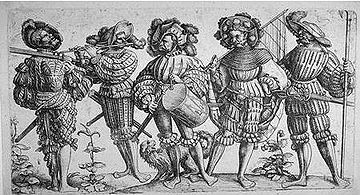
Pier Gerlofs Donia
Pier Gerlofs Donia was a Frisian warrior, pirate, and rebel. He is best known by his West Frisian nickname "Grutte Pier" , or by the Dutch translations "Grote Pier" and "Lange Pier", or, in Latin, "Pierius Magnus", which referred to his legendary size and strength. His life is mostly shrouded in...
, a Frisia
Frisia
Frisia is a coastal region along the southeastern corner of the North Sea, i.e. the German Bight. Frisia is the traditional homeland of the Frisians, a Germanic people who speak Frisian, a language group closely related to the English language...
n freedom fighter, led a group of mercenaries, the Arumer Black Heap. They fought (mainly), against other mercenaries. Swiss mercenaries
Swiss mercenaries
Swiss mercenaries were notable for their service in foreign armies, especially the armies of the Kings of France, throughout the Early Modern period of European history, from the Later Middle Ages into the Age of the European Enlightenment...
were sought during the late 15th and early 16th centuries as being an effective fighting force, until their somewhat rigid battle formations became vulnerable to arquebuses and artillery
Artillery
Originally applied to any group of infantry primarily armed with projectile weapons, artillery has over time become limited in meaning to refer only to those engines of war that operate by projection of munitions far beyond the range of effect of personal weapons...
being developed at the same time. See Swiss Guard
Swiss Guard
Swiss Guards or Schweizergarde is the name given to the Swiss soldiers who have served as bodyguards, ceremonial guards, and palace guards at foreign European courts since the late 15th century. They have had a high reputation for discipline, as well as loyalty to their employers...
.
It was then that the German landsknecht
Landsknecht
Landsknechte were European, predominantly German mercenary pikemen and supporting foot soldiers from the late 15th to the late 16th century, and achieved the reputation for being the universal mercenary of Early modern Europe.-Etymology:The term is from German, Land "land, country" + Knecht...
s, colorful mercenaries with a redoubtable reputation, took over the Swiss forces' legacy and became the most formidable force of the late 15th and throughout the 16th century, being hired by all the powers in Europe and often fighting at opposite
Opposite
Opposite may refer to:* Opposite , a word that means the opposite of a word* Botany: "Opposite" is a kind of arrangement of leaves* Additive inverse, in mathematics, taking the negative of a number...
sides. Sir Thomas More
Thomas More
Sir Thomas More , also known by Catholics as Saint Thomas More, was an English lawyer, social philosopher, author, statesman and noted Renaissance humanist. He was an important councillor to Henry VIII of England and, for three years toward the end of his life, Lord Chancellor...
in his Utopia advocated the use of mercenaries in preference to citizens. The barbarian mercenaries employed by the Utopians are thought to be inspired by the Swiss mercenaries.
At approximately the same period, Niccolò Machiavelli
Niccolò Machiavelli
Niccolò di Bernardo dei Machiavelli was an Italian historian, philosopher, humanist, and writer based in Florence during the Renaissance. He is one of the main founders of modern political science. He was a diplomat, political philosopher, playwright, and a civil servant of the Florentine Republic...
argued against the use of mercenary armies in his masterpiece The Prince
The Prince
The Prince is a political treatise by the Italian diplomat, historian and political theorist Niccolò Machiavelli. From correspondence a version appears to have been distributed in 1513, using a Latin title, De Principatibus . But the printed version was not published until 1532, five years after...
. His rationale was that since the sole motivation of mercenaries is their pay, they will not be inclined to take the kind of risks that can turn the tide of a battle, but may cost them their lives. He also noted that a mercenary who failed was obviously no good, but one who succeeded may be even more dangerous. He astutely pointed out that a successful mercenary army no longer needs its employer if it is more militarily powerful than its supposed superior. This explained the frequent, violent betrayals that characterized mercenary/client relations in Italy, because neither side trusted the other. He believed that citizens with a real attachment to their home country will be more motivated to defend it and thus make much better soldiers.
17th and 18th centuries
During the 17th and 18th century extensive use was made of foreign recruits in the now regimented and highly drilled armies of Europe, beginning in a systematized way with the Thirty Years' WarThirty Years' War
The Thirty Years' War was fought primarily in what is now Germany, and at various points involved most countries in Europe. It was one of the most destructive conflicts in European history....
. According to Geoffrey Parker
Geoffrey Parker (historian)
Noel Geoffrey Parker is a leading hispanist and expert on military history. His best known book is Military Revolution: Military Innovation and the Rise of the West, 1500-1800, first published by Cambridge University Press in 1988. A fellow of the British Academy, he holds his BA, MA, Ph.D. and...
, "Between 1618 and 1640 some 40,000 Scotsmen – perhaps 15% of the total adult males in the kingdom – crossed to Europe to fight in the Thirty Years' War."
After the signing of the Treaty of Limerick
Treaty of Limerick
The Treaty of Limerick ended the Williamite war in Ireland between the Jacobites and the supporters of William of Orange. It concluded the Siege of Limerick. The treaty really consisted of two treaties which were signed on 3 October 1691. Reputedly they were signed on the Treaty Stone, an...
(1691) the soldiers of the Irish Army who left Ireland for France took part in what is known as the Flight of the Wild Geese
Flight of the Wild Geese
The Flight of the Wild Geese refers to the departure of an Irish Jacobite army under the command of Patrick Sarsfield from Ireland to France, as agreed in the Treaty of Limerick on October 3, 1691, following the end of the Williamite War in Ireland...
. Subsequently, many made a living from working as mercenaries for continental armies, the most famous of whom was Patrick Sarsfield
Patrick Sarsfield, 1st Earl of Lucan
Patrick Sarsfield , created the first Earl of Lucan, Irish Jacobite and soldier, belonged to an Anglo-Norman family long settled in Ireland.-Background:...
, who, having fallen mortally wounded at the Battle of Landen
Battle of Landen
The Battle of Landen , in the current Belgian province of Flemish Brabant, was a battle in the Nine Years' War, fought in present-day Belgium on 29 July 1693 between the French army of Marshal Luxembourg and the Allied army of King William III of England...
fighting for the French, said "If this was only for Ireland".
About a third of the infantry regiments of the French Royal Army prior to the French Revolution
French Revolution
The French Revolution , sometimes distinguished as the 'Great French Revolution' , was a period of radical social and political upheaval in France and Europe. The absolute monarchy that had ruled France for centuries collapsed in three years...
were recruited from outside France. The largest single group were the twelve Swiss regiments (including the Swiss Guard
Swiss Guard
Swiss Guards or Schweizergarde is the name given to the Swiss soldiers who have served as bodyguards, ceremonial guards, and palace guards at foreign European courts since the late 15th century. They have had a high reputation for discipline, as well as loyalty to their employers...
). Other units were German and one Irish Brigade
Irish Brigade (French)
The Irish Brigade was a brigade in the French army composed of Irish exiles, led by Robert Reid. It was formed in May 1690 when five Jacobite regiments were sent from Ireland to France in return for a larger force of French infantry who were sent to fight in the Williamite war in Ireland...
(the "Wild Geese") had originally been made up of Irish volunteers. By 1789 difficulties in obtaining genuinely Irish recruits had led to German and other foreigners making up the bulk of the rank and file. The officers however continued to be drawn from long established Franco-Irish families. During the reign of Louis XV there were also a Scottish (Royal-Écossais), a Swedish (Royal-Suédois), an Italian (Royal-Italien) and a Walloon (Horion-Liegeois) regiments recruited outside the borders of France. The foreign infantry regiments comprised about 20,000 men in 1733, rising to 48,000 at the time of the Seven Years' War
Seven Years' War
The Seven Years' War was a global military war between 1756 and 1763, involving most of the great powers of the time and affecting Europe, North America, Central America, the West African coast, India, and the Philippines...
and being reduced in numbers thereafter.
In Italy, during inter-family conflicts such as the Wars of Castro
Wars of Castro
The Wars of Castro is a term referring to a series of events in the mid-17th century revolving around the ancient city of Castro , which eventually resulted in the city's destruction on 2 September 1649...
, mercenaries were widely used to supplement the much smaller forces loyal to particular families. Often these were further supplemented by troops loyal to particular duchies which had sided with one or more of the belligerents.
During the American Revolution, King George III of England, hired German mercenary soldiers from some of the German principalities to supplement his Royal Army. Although the German mercenaries came from a number of states, the majority came from the German state of Hesse-Kassel. This resulted in their American opponents referring to all of King George's German mercenaries as "Hessians", whether the Germans were actually from Hesse-Kassel or not.
The Spanish Army also made use of permanently established foreign regiments. These comprised three Irish regiments (Irlanda, Hiberni and Ultonia); one Italian (Naples) and five Swiss (Wimpssen, Reding, Betschart, Traxer and Preux). In addition one regiment of the Royal Guard
Spanish Royal Guard
The Royal Guard is an independent unit of the Spanish Armed Forces dedicated to the military protection of H.M. the King of Spain and the members of the Spanish Royal Family. It currently has a strength of 1,900 troops. While the guard does participate in parades and other ceremonial events, it...
was recruited from Walloons
Walloon Guards
The Walloon Guards were an infantry corps originally recruited in the region now known as Belgium, mainly in Catholic Wallonia, for the Spanish Army...
. The last of these foreign regiments was disbanded in 1815, following recruiting difficulties during the Napoleonic Wars
Napoleonic Wars
The Napoleonic Wars were a series of wars declared against Napoleon's French Empire by opposing coalitions that ran from 1803 to 1815. As a continuation of the wars sparked by the French Revolution of 1789, they revolutionised European armies and played out on an unprecedented scale, mainly due to...
. One complication arising from the use of non-national troops occurred at the Battle of Bailén
Battle of Bailén
The Battle of Bailén was contested in 1808 between the Spanish Army of Andalusia, led by Generals Francisco Castaños and Theodor von Reding, and the Imperial French Army's II corps d'observation de la Gironde under General Pierre Dupont de l'Étang...
in 1808 when the "red Swiss" (so-called from their uniforms) of the invading French Army clashed bloodily with "blue Swiss" in the Spanish service.
19th and 20th centuries
The Atholl HighlandersAtholl Highlanders
The Atholl Highlanders is a Scottish infantry regiment. Based in Blair Atholl, the regiment is not part of the British Army. Instead, the regiment is in the private employ of the Duke of Atholl, making it the United Kingdom's, and indeed Europe's, only legal private army.-77th Foot:The name Atholl...
, a private Scottish infantry regiment of the Duke of Atholl
Duke of Atholl
Duke of Atholl, alternatively Duke of Athole, named after Atholl in Scotland, is a title in the Peerage of Scotland held by the head of Clan Murray...
, was formed in 1839 purely for ceremonial purposes. It was granted official regimental status by Queen Victoria in 1845 and is the only remaining legal private army in Europe.
Popular Culture
- Professional Soldier – Directed by Tay GarnettTay GarnettTay Garnett was an American film director and writer.Born in Los Angeles, California, Garnett served as a naval aviator in World War I and entered films as a screenwriter in 1920. He was a gagwriter for Mack Sennett and Hal Roach, then joined Pathé and began to direct films in 1928...
, with the story written by Damon RunyonDamon RunyonAlfred Damon Runyon was an American newspaperman and writer.He was best known for his short stories celebrating the world of Broadway in New York City that grew out of the Prohibition era. To New Yorkers of his generation, a "Damon Runyon character" evoked a distinctive social type from the...
features ex-US Marine Victor McLaglenVictor McLaglenVictor Andrew de Bier Everleigh McLaglen was an English boxer and World War I veteran who became a successful film actor.Towards the end of his life he was naturalised as a U.S. citizen.-Early life:...
hired to kidnap young prince Freddie BartholomewFreddie BartholomewFrederick Cecil Bartholomew , known for his acting work as Freddie Bartholomew, was an English-American child actor. One of the most famous child actors of all time, he became very popular in 1930s Hollywood films...
but changing his mind and giving his employers notice that their services are no longer required by mowing them down with a water-cooled Maxim gunMaxim gunThe Maxim gun was the first self-powered machine gun, invented by the American-born British inventor Sir Hiram Maxim in 1884. It has been called "the weapon most associated with [British] imperial conquest".-Functionality:...
fired from the hip.
- The General Died at DawnThe General Died at DawnThe General Died at Dawn is a 1936 film that tells the story of a mercenary who meets a beautiful girl while trying to keep arms from getting to a vicious warlord in war-torn China. The movie was written by Charles G. Booth and Clifford Odets, and directed by Lewis Milestone.It stars Gary Cooper,...
– A film which tells the story of a mercenary who meets a beautiful girl while trying to keep arms from getting to a vicious warlordWarlordA warlord is a person with power who has both military and civil control over a subnational area due to armed forces loyal to the warlord and not to a central authority. The term can also mean one who espouses the ideal that war is necessary, and has the means and authority to engage in war...
in war-torn China. The movie was written by Charles G. Booth and Clifford OdetsClifford OdetsClifford Odets was an American playwright, screenwriter, socialist, and social protester.-Early life:Odets was born in Philadelphia to Romanian- and Russian-Jewish immigrant parents, Louis Odets and Esther Geisinger, and raised in Philadelphia and the Bronx, New York. He dropped out of high...
, and directed by Lewis MilestoneLewis MilestoneLewis Milestone was a Russian-American motion picture director. He is known for directing Two Arabian Knights and All Quiet on the Western Front , both of which received Academy Awards for Best Director...
. It stars Gary CooperGary CooperFrank James Cooper, known professionally as Gary Cooper, was an American film actor. He was renowned for his quiet, understated acting style and his stoic, but at times intense screen persona, which was particularly well suited to the many Westerns he made...
, Madeleine CarrollMadeleine CarrollEdith Madeleine Carroll was an English actress, popular in the 1930s and 1940s.-Early life:Carroll was born at 32 Herbert Street in West Bromwich, England. She graduated from the University of Birmingham, England with a B.A. degree...
and Akim TamiroffAkim TamiroffAkim Mikhailovich Tamiroff was an Armenian actor. He won the first Golden Globe Award for Best Supporting Actor.Tamiroff was born in Tiflis, Russian Empire , of Armenian ethnicity. He trained at the Moscow Art Theatre drama school. He arrived in the U.S. in 1923 on a tour with a troupe of actors...
.
- Flying TigersFlying TigersThe 1st American Volunteer Group of the Chinese Air Force in 1941–1942, famously nicknamed the Flying Tigers, was composed of pilots from the United States Army , Navy , and Marine Corps , recruited under presidential sanction and commanded by Claire Lee Chennault. The ground crew and headquarters...
(1942) and God is My Co-PilotGod is My Co-PilotGod Is My Co-Pilot may refer to:*God is My Co-Pilot a book by Gen. Robert Lee Scott Jr., USAF *God is My Co-Pilot a 1945 film based on the above book*God Is My Co-Pilot a band from New York City...
(1945) based on the memoirs of Robert L. Scott concern the adventues of the American Volunteer GroupAmerican Volunteer GroupThe American Volunteer Groups were volunteer air units organized by the United States government to aid the Nationalist government of China against Japan in the Second Sino-Japanese War...
of pilots who flew P-40s for China against the Japanese prior to Pearl HarborPearl HarborPearl Harbor, known to Hawaiians as Puuloa, is a lagoon harbor on the island of Oahu, Hawaii, west of Honolulu. Much of the harbor and surrounding lands is a United States Navy deep-water naval base. It is also the headquarters of the U.S. Pacific Fleet...
- For Whom the Bell TollsFor Whom the Bell Tolls (film)For Whom the Bell Tolls is a 1943 film in Technicolor based on the novel of the same name by Ernest Hemingway. It stars Gary Cooper, Ingrid Bergman, Akim Tamiroff and Katina Paxinou. This was Ingrid Bergman's first technicolor film. Hemingway handpicked Cooper and Bergman for their roles. The film...
(1943) – Based on the novel by Ernest HemingwayErnest HemingwayErnest Miller Hemingway was an American author and journalist. His economic and understated style had a strong influence on 20th-century fiction, while his life of adventure and his public image influenced later generations. Hemingway produced most of his work between the mid-1920s and the...
, Gary CooperGary CooperFrank James Cooper, known professionally as Gary Cooper, was an American film actor. He was renowned for his quiet, understated acting style and his stoic, but at times intense screen persona, which was particularly well suited to the many Westerns he made...
is a mercenary who finds meaning to life fighting in the Spanish Civil WarSpanish Civil WarThe Spanish Civil WarAlso known as The Crusade among Nationalists, the Fourth Carlist War among Carlists, and The Rebellion or Uprising among Republicans. was a major conflict fought in Spain from 17 July 1936 to 1 April 1939...
alongside Ingrid BergmanIngrid BergmanIngrid Bergman was a Swedish actress who starred in a variety of European and American films. She won three Academy Awards, two Emmy Awards, and the Tony Award for Best Actress. She is ranked as the fourth greatest female star of American cinema of all time by the American Film Institute...
- China – Alan LaddAlan Ladd-Early life:Ladd was born in Hot Springs, Arkansas. He was the only child of Ina Raleigh Ladd and Alan Ladd, Sr. He was of English ancestry. His father died when he was four, and his mother relocated to Oklahoma City where she married Jim Beavers, a housepainter...
is a mercenary who finds meaning to life fighting against the Japanese in China before Pearl HarborPearl HarborPearl Harbor, known to Hawaiians as Puuloa, is a lagoon harbor on the island of Oahu, Hawaii, west of Honolulu. Much of the harbor and surrounding lands is a United States Navy deep-water naval base. It is also the headquarters of the U.S. Pacific Fleet...
alongside Loretta YoungLoretta YoungLoretta Young was an American actress. Starting as a child actress, she had a long and varied career in film from 1917 to 1953...
- The Seven SamuraiThe Seven Samuraiis a 1954 Japanese adventure drama film co-written, edited, and directed by Akira Kurosawa. The film takes place in 1587 during the Warring States Period of Japan...
and The Magnificent SevenThe Magnificent SevenThe Magnificent Seven is an American Western film directed by John Sturges, and released in 1960. It is a fictional tale of a group of seven American gunmen who are hired to protect a small agricultural village in Mexico from a group of marauding Mexican bandits...
are both fictional accounts that deal with seven unemployed samuraiSamuraiis the term for the military nobility of pre-industrial Japan. According to translator William Scott Wilson: "In Chinese, the character 侍 was originally a verb meaning to wait upon or accompany a person in the upper ranks of society, and this is also true of the original term in Japanese, saburau...
/gunslingerGunslingerGunfighter, also gunslinger , is a 20th century word, used in cinema or literature, referring to men in the American Old West who had gained a reputation as being dangerous with a gun...
s who agree to protect an impoverished village from 40 bandits for sub-minimal wages
- Hell and High WaterHell and High Water (film)Hell and High Water is a 1954 Cold War drama film starring Richard Widmark, Bella Darvi and Victor Francen. The film was made to showcase CinemaScope being used in the confined sets of a submarine.Before the credits, an off-screen, voice-over narrates:...
– Samuel FullerSamuel FullerSamuel Michael Fuller was an American screenwriter, novelist, and film director known for low-budget genre movies with controversial themes.-Personal life:...
's account of a former submarine commander Richard WidmarkRichard WidmarkRichard Weedt Widmark was an American film, stage and television actor.He was nominated for an Academy Award for his role as the villainous Tommy Udo in his debut film, Kiss of Death...
leading a team of naval mercenaries, an atomic scientist, and his daughter on a secret mission to the Arctic Circle to stop a Red Chinese plan to atomic bomb Korea using a captured American B-29. In addition to its topicality of the Soviet H-Bomb, the film was made to showcase CinemascopeCinemaScopeCinemaScope was an anamorphic lens series used for shooting wide screen movies from 1953 to 1967. Its creation in 1953, by the president of 20th Century-Fox, marked the beginning of the modern anamorphic format in both principal photography and movie projection.The anamorphic lenses theoretically...
being used in the confined sets of a submarineSubmarineA submarine is a watercraft capable of independent operation below the surface of the water. It differs from a submersible, which has more limited underwater capability...
.
- Soldier of FortuneSoldier of Fortune (film)Soldier of Fortune is a 1955 adventure film about the rescue of an American held prisoner in the People's Republic of China in the 1950s. It was directed by Edward Dmytryk, starred Clark Gable and Susan Hayward and was written by Ernest K...
– Based on the novel by Ernest K. GannErnest K. GannErnest Kellogg Gann was an American aviator, author, filmmaker, sailor, fisherman and conservationist.-Early life:...
. Clark GableClark GableWilliam Clark Gable , known as Clark Gable, was an American film actor most famous for his role as Rhett Butler in the 1939 Civil War epic film Gone with the Wind, in which he starred with Vivien Leigh...
is hired by Susan HaywardSusan HaywardSusan Hayward was an American actress.After working as a fashion model in New York, Hayward travelled to Hollywood in 1937 when open auditions were held for the leading role in Gone with the Wind . Although she was not selected, she secured a film contract, and played several small supporting...
to locate and free her husband from a prison in Red China.
- The Professionals – Richard BrooksRichard BrooksRichard Brooks was an American screenwriter, film director, novelist and occasional film producer.-Early life and career:...
' film tells a fictional tale of 4 specialists (automatic weapons (Lee MarvinLee MarvinLee Marvin was an American film actor. Known for his gravelly voice, white hair and 6' 2" stature, Marvin at first did supporting roles, mostly villains, soldiers and other hardboiled characters, but after winning an Academy Award for Best Actor for his dual roles in Cat Ballou , he landed more...
, explosives (Burt LancasterBurt LancasterBurton Stephen "Burt" Lancaster was an American film actor noted for his athletic physique and distinctive smile...
, tracker (Woody StrodeWoody StrodeWoodrow Wilson Woolwine "Woody" Strode was a decathlete and football star who went on to become a pioneering black American film actor. He was nominated for a Golden Globe award for best supporting actor for his role in Spartacus in 1960...
), and mule skinner (Robert RyanRobert RyanRobert Bushnell Ryan was an American actor who often played hardened cops and ruthless villains.-Early life and career:...
)) who are hired by a big businessman (Ralph BellamyRalph BellamyRalph Bellamy was an American actor whose career spanned sixty-two years.-Early life:He was born Ralph Rexford Bellamy in Chicago, Illinois, the son of Lilla Louise , a native of Canada, and Charles Rexford Bellamy. He ran away from home when he was fifteen and managed to get into a road show...
to rescue his kidnapped wife (Claudia CardinaleClaudia CardinaleClaudia Cardinale is an Italian actress, and has appeared in some of the most prominent European films of the 1960s and 1970s. The majority of Cardinale's films have been either Italian or French...
) from a MexicanMexicoThe United Mexican States , commonly known as Mexico , is a federal constitutional republic in North America. It is bordered on the north by the United States; on the south and west by the Pacific Ocean; on the southeast by Guatemala, Belize, and the Caribbean Sea; and on the east by the Gulf of...
bandit (Jack PalanceJack PalanceJack Palance , was an American actor. During half a century of film and television appearances, Palance was nominated for three Academy Awards, all as Best Actor in a Supporting Role, winning in 1991 for his role in City Slickers.-Early life:Palance, one of five children, was born Volodymyr...
) at the beginning of the 20th century.
- Africa AddioAfrica AddioAfrica Addio is a 1966 Italian documentary about the end of the colonial era in Africa. The film was released in a shorter format under the names "Africa Blood and Guts" in the USA and "Farewell Africa" in the UK...
/Africa-Blood and Guts -A documentary by the team behind Mondo CaneMondo caneMondo cane is a documentary written and directed by Italian filmmakers Paolo Cavara, Franco Prosperi and Gualtiero Jacopetti. The film consists of a series of travelogue vignettes that provide glimpses into cultural practices around the world with the intention to shock or surprise Western film...
that filmed Africa in the early 1960s and featured mercenaires in the Congo CrisisCongo CrisisThe Congo Crisis was a period of turmoil in the First Republic of the Congo that began with national independence from Belgium and ended with the seizing of power by Joseph Mobutu...
- Dark of the SunDark of the SunDark of the Sun is a 1968 adventure-war film starring Rod Taylor, Yvette Mimieux, Jim Brown, and Peter Carsten...
/The Mercenaries – Based on the novel by Wilbur SmithWilbur SmithWilbur Addison Smith is a best-selling novelist. His writings include 16th and 17th century tales about the founding of the southern territories of Africa and the subsequent adventures and international intrigues relevant to these settlements. His books often fall into one of three series...
originally titled Last Train From Katanga about mercenaries in the Congo CrisisCongo CrisisThe Congo Crisis was a period of turmoil in the First Republic of the Congo that began with national independence from Belgium and ended with the seizing of power by Joseph Mobutu...
and KatangaState of KatangaKatanga was a breakaway state proclaimed on 11 July 1960 separating itself from the newly independent Democratic Republic of the Congo. In revolt against the new government of Patrice Lumumba in July, Katanga declared independence under Moise Tshombe, leader of the local CONAKAT party...
excitingly directed by Jack CardiffJack CardiffJack Cardiff, OBE, BSC was a British cinematographer, director and photographer.His career spanned the development of cinema, from silent film, through early experiments in Technicolor to filmmaking in the 21st century...
starring Rod Taylor and Jim BrownJim BrownJames Nathaniel "Jim" Brown is an American former professional football player who has also made his mark as an actor. He is best known for his exceptional and record-setting nine-year career as a running back for the NFL Cleveland Browns from 1957 to 1965. In 2002, he was named by Sporting News...
, a score by Jacques LoussierJacques LoussierJacques Loussier is a French pianist and composer. He is well-known for his jazz interpretations in trio formation of many of Johann Sebastian Bach's works, such as the Goldberg Variations.-Early life and education :...
, and filmed in JamaicaJamaicaJamaica is an island nation of the Greater Antilles, in length, up to in width and 10,990 square kilometres in area. It is situated in the Caribbean Sea, about south of Cuba, and west of Hispaniola, the island harbouring the nation-states Haiti and the Dominican Republic...
.
- Seduto Alla Sua Destra/Black Jesus – A fictionalised story based on Patrice LumumbaPatrice LumumbaPatrice Émery Lumumba was a Congolese independence leader and the first legally elected Prime Minister of the Republic of the Congo after he helped win its independence from Belgium in June 1960. Only ten weeks later, Lumumba's government was deposed in a coup during the Congo Crisis...
, played by Woody StrodeWoody StrodeWoodrow Wilson Woolwine "Woody" Strode was a decathlete and football star who went on to become a pioneering black American film actor. He was nominated for a Golden Globe award for best supporting actor for his role in Spartacus in 1960...
, who is captured by mercenaries.
- El Mercenario/The Last Mercenary – A fictionalised account produced by and starring Ray DantonRay DantonRay Danton , also known as Raymond Danton, was a radio, film, stage, and television actor, director, and producer whose most famous role was The Rise and Fall of Legs Diamond...
as a mercenary who travels from the CongoRepublic of the Congo (Léopoldville)The Republic of the Congo was an independent republic established following the independence granted to the former colony of the Belgian Congo in 1960...
to work in BrazilBrazilBrazil , officially the Federative Republic of Brazil , is the largest country in South America. It is the world's fifth largest country, both by geographical area and by population with over 192 million people...
.
- Sette Baschi RossiSette baschi rossiSette baschi rossi also known as The Red Berets, Seven Red Berets and Congo Hell is a 1969 Italian West German co-production about a fictional group of mercenaries filmed in Ethiopia produced and directed by screenwriter Mario Siciliano in his debut as a director...
/The Red Berets/Congo Hell – Fictionalised account of mercenaries somewhere in sub-Sahara Africa that was the directing debut of Mario Siciliano.
- The Last GrenadeThe Last GrenadeThe Last Grenade is a 1970 British war film directed by Gordon Flemyng and starring Stanley Baker and Alex Cord as two soldiers of fortune, formerly comrades, who now find themselves on opposite sides...
– Fictionalised account of mercenaries beginning in Africa then travelling to the New TerritoriesNew TerritoriesNew Territories is one of the three main regions of Hong Kong, alongside Hong Kong Island and the Kowloon Peninsula. It makes up 86.2% of Hong Kong's territory. Historically, it is the region described in The Convention for the Extension of Hong Kong Territory...
of Hong Kong and later Red China. Only the characters are based on John Sherlock's 1964 novel The Ordeal of Major Grigsby featuring a cast of Stanley BakerStanley BakerSir Stanley Baker was a Welsh actor and film producer.-Early career:William Stanley Baker was born in Ferndale, Rhondda Valley, Wales. In the mid-1930s his parents moved to London, where Baker spent most of his formative years...
, Alex CordAlex CordAlex Cord is an American actor who is perhaps best known for portraying the role of Archangel on the television series Airwolf.-Biography:...
, Richard AttenboroughRichard AttenboroughRichard Samuel Attenborough, Baron Attenborough , CBE is a British actor, director, producer and entrepreneur. As director and producer he won two Academy Awards for the 1982 film Gandhi...
, John ThawJohn ThawJohn Edward Thaw, CBE was an English actor, who appeared in a range of television, stage and cinema roles, his most popular being police and legal dramas such as Redcap, The Sweeney, Inspector Morse and Kavanagh QC.-Early life:Thaw came from a working class background, having been born in Gorton,...
, and Honor BlackmanHonor BlackmanHonor Blackman is an English actress, known for the roles of Cathy Gale in The Avengers and Bond girl Pussy Galore in Goldfinger .-Early life:...
.
- The Last ValleyThe Last ValleyThe Last Valley is a 1970 historical drama film directed by James Clavell. Set during the Thirty Years War, it stars Michael Caine as the leader of a band of mercenaries, and Omar Sharif as a teacher fleeing from the violence endemic to Germany during this period...
– A band of unemployed mercenaries take over an isolated valley during the Thirty Years' WarThirty Years' WarThe Thirty Years' War was fought primarily in what is now Germany, and at various points involved most countries in Europe. It was one of the most destructive conflicts in European history....
. The film stars Michael CaineMichael CaineSir Michael Caine, CBE is an English actor. He won Academy Awards for best supporting actor in both Hannah and Her Sisters and The Cider House Rules ....
and Omar SharifOmar SharifOmar Sharif is an Egyptian actor who has starred in Hollywood films including Lawrence of Arabia, Doctor Zhivago and Funny Girl. He has been nominated for an Academy Award and has won two Golden Globe Awards.-Early life:...
.
- The Man Who Would Be KingThe Man Who Would Be KingFor the 1975 film based on this story, see The Man Who Would Be King "The Man Who Would Be King" is a short story by Rudyard Kipling. It is about two British adventurers in British India who become kings of Kafiristan, a remote part of Afghanistan...
– A John HustonJohn HustonJohn Marcellus Huston was an American film director, screenwriter and actor. He wrote most of the 37 feature films he directed, many of which are today considered classics: The Maltese Falcon , The Treasure of the Sierra Madre , Key Largo , The Asphalt Jungle , The African Queen , Moulin Rouge...
film based on the story by Rudyard KiplingRudyard KiplingJoseph Rudyard Kipling was an English poet, short-story writer, and novelist chiefly remembered for his celebration of British imperialism, tales and poems of British soldiers in India, and his tales for children. Kipling received the 1907 Nobel Prize for Literature...
. Two Victorian EraVictorian eraThe Victorian era of British history was the period of Queen Victoria's reign from 20 June 1837 until her death on 22 January 1901. It was a long period of peace, prosperity, refined sensibilities and national self-confidence...
ex-British Army sergeants played by Sean ConnerySean ConnerySir Thomas Sean Connery , better known as Sean Connery, is a Scottish actor and producer who has won an Academy Award, two BAFTA Awards and three Golden Globes Sir Thomas Sean Connery (born 25 August 1930), better known as Sean Connery, is a Scottish actor and producer who has won an Academy...
and Michael CaineMichael CaineSir Michael Caine, CBE is an English actor. He won Academy Awards for best supporting actor in both Hannah and Her Sisters and The Cider House Rules ....
go beyond the Northwest FrontierNorthwest FrontierNorth West Frontier is a 1959 British adventure film starring Kenneth More and Lauren Bacall. The film was directed by J. Lee Thompson from a screenplay by Robin Estridge and also features Wilfrid Hyde-White, Herbert Lom and I. S...
with 20 rifles to hire themselves out to local warlordWarlordA warlord is a person with power who has both military and civil control over a subnational area due to armed forces loyal to the warlord and not to a central authority. The term can also mean one who espouses the ideal that war is necessary, and has the means and authority to engage in war...
s in search of adventure, treasure, and destinyDestinyDestiny or fate refers to a predetermined course of events. It may be conceived as a predetermined future, whether in general or of an individual...
.
- High Velocity – Fictionalised account of former Vietnam WarVietnam WarThe Vietnam War was a Cold War-era military conflict that occurred in Vietnam, Laos, and Cambodia from 1 November 1955 to the fall of Saigon on 30 April 1975. This war followed the First Indochina War and was fought between North Vietnam, supported by its communist allies, and the government of...
veterans played by Ben GazzaraBen Gazzara-Early life:Gazzara was born Biagio Anthony Gazzara in New York City, the son of Italian immigrants Angelina and Antonio Gazzara, who was a laborer and carpenter. Gazzara grew up on New York's tough Lower East Side. He actually lived on E. 29th Street and participated in the drama program at...
and Paul WinfieldPaul WinfieldPaul Edward Winfield was an American television, film, and stage actor. He was known for his portrayal of a Louisiana sharecropper who struggles to support his family during the Great Depression in the landmark film Sounder which earned him an Academy Award nomination. Winfield also portrayed Dr....
living and working in the PhilippinesPhilippinesThe Philippines , officially known as the Republic of the Philippines , is a country in Southeast Asia in the western Pacific Ocean. To its north across the Luzon Strait lies Taiwan. West across the South China Sea sits Vietnam...
.
- The Wild GeeseThe Wild GeeseThe Wild Geese is a British 1978 film about a group of mercenaries in Africa. It stars Richard Burton, Roger Moore, Richard Harris and Hardy Krüger...
– The film, starring Richard BurtonRichard BurtonRichard Burton, CBE was a Welsh actor. He was nominated seven times for an Academy Award, six of which were for Best Actor in a Leading Role , and was a recipient of BAFTA, Golden Globe and Tony Awards for Best Actor. Although never trained as an actor, Burton was, at one time, the highest-paid...
, Roger MooreRoger MooreSir Roger George Moore KBE , is an English actor, perhaps best known for portraying British secret agent James Bond in seven films from 1973 to 1985. He also portrayed Simon Templar in the long-running British television series The Saint.-Early life:Moore was born in Stockwell, London...
, Richard HarrisRichard HarrisRichard St John Harris was an Irish actor, singer-songwriter, theatrical producer, film director and writer....
and Hardy KrügerHardy KrügerHardy Krüger is a German actor. He is thought of as one of the greatest German actors of the 1960s. He was born in Wedding, Berlin, German Reich...
, shows the recruitment, training, and deployment of a 50 man force who rescue a moderate African leader based on Moise TshombeMoise TshombeMoïse Kapenda Tshombe was a Congolese politician.- Biography :He was the son of a successful Congolese businessman and was born in Musumba, Congo. He received his education from an American missionary school and later trained as an accountant...
in an unnamed sub-Saharan African nation. Daniel Carney's book has a screenplay by Reginald RoseReginald RoseReginald Rose was an American film and television writer most widely known for his work in the early years of television drama. Rose's work is marked by its treatment of controversial social and political issues...
, an exciting score by Roy BuddRoy BuddRoy Frederick Budd , was a British jazz musician and composer, known for his film scores.Born in Mitcham, Surrey, Budd became interested in music from an early age and had built up a vast musical repertoire by the age of eight...
, Mike HoareMike HoareThomas Michael Hoare is an Irish mercenary leader known for military activities in Africa and his failed attempt to conduct a coup d'état in the Seychelles.-Early life and military career:...
acts as technical adviser and is directed by Andrew V. McLaglen, son of Victor.
- Scorticateli Vivi/The Wild Geese Attack/Skin 'Em Alive/Duri a morire/Tough To Kill – An Italian action film which concerns a group of mercenaries in an unspecified African country who turn on each other. Many action setpieceSetpieceIn film production, a setpiece is a scene or sequence of scenes the execution of which requires serious logistical planning and considerable expenditure of money. The term setpiece is often used more broadly to describe any important dramatic or comedic highpoint in a film or story, particularly...
s from The Red Berets reappear in the film that was made by the same director.
- The Warriors – The plot of the film which was adapted from the novel by Sol YurickSol Yurick-Biography:He was born in 1925 to a working class family of politically active Jewish immigrants. At the age of 14, Yurick became disillusioned with politics after the Hitler-Stalin pact. He enlisted during World War II, where he trained as a surgical technician. He studied at New York University...
is loosely based on Xenophon's Anabasis
- Cuba (1979 film) – Ex-SASSpecial Air ServiceSpecial Air Service or SAS is a corps of the British Army constituted on 31 May 1950. They are part of the United Kingdom Special Forces and have served as a model for the special forces of many other countries all over the world...
Major Sean ConnerySean ConnerySir Thomas Sean Connery , better known as Sean Connery, is a Scottish actor and producer who has won an Academy Award, two BAFTA Awards and three Golden Globes Sir Thomas Sean Connery (born 25 August 1930), better known as Sean Connery, is a Scottish actor and producer who has won an Academy...
and ex-RAF pilot Denholm Elliot are hired by the Fulgencio BatistaFulgencio BatistaFulgencio Batista y Zaldívar was the United States-aligned Cuban President, dictator and military leader who served as the leader of Cuba from 1933 to 1944 and from 1952 to 1959, before being overthrown as a result of the Cuban Revolution....
regime to put down Fidel CastroFidel CastroFidel Alejandro Castro Ruz is a Cuban revolutionary and politician, having held the position of Prime Minister of Cuba from 1959 to 1976, and then President from 1976 to 2008. He also served as the First Secretary of the Communist Party of Cuba from the party's foundation in 1961 until 2011...
's Cuban revolutionCuban RevolutionThe Cuban Revolution was an armed revolt by Fidel Castro's 26th of July Movement against the regime of Cuban dictator Fulgencio Batista between 1953 and 1959. Batista was finally ousted on 1 January 1959, and was replaced by a revolutionary government led by Castro...
in 1959. It was directed by Richard LesterRichard LesterRichard Lester is an American film director based in Britain. Lester is notable for his work with The Beatles in the 1960s and his work on the Superman film series in the 1980s.-Early years and television:...
.
- The Dogs of WarThe Dogs of War (film)The Dogs of War is a 1980 war film based upon the novel The Dogs of War by Frederick Forsyth, directed by John Irvin. It stars Christopher Walken and Tom Berenger as part of a small, international unit of mercenary soldiers privately hired to depose President Kimba of a fictional "Republic of...
– Based on Frederick ForsythFrederick ForsythFrederick Forsyth, CBE is an English author and occasional political commentator. He is best known for thrillers such as The Day of the Jackal, The Odessa File, The Fourth Protocol, The Dogs of War, The Devil's Alternative, The Fist of God, Icon, The Veteran, Avenger, The Afghan and The Cobra.-...
's novel of a mercenary operation led by Christopher WalkenChristopher WalkenChristopher Walken is an American stage and screen actor. He has appeared in more than 100 movies and television shows, including Joe Dirt, Annie Hall, The Deer Hunter, The Prophecy trilogy, The Dogs of War, Sleepy Hollow, Brainstorm, The Dead Zone, A View to a Kill, At Close Range, King of New...
that proceeds from Central America to the planning, preparation, and execution of a mercenary operation in Sub-Saharan Africa. Director John IrvinJohn IrvinJohn Irvin is an English film director. Born in Newcastle upon Tyne, he began his career by directing a number of documentaries and television works, including the BBC adaptation of John le Carré's Tinker, Tailor, Soldier, Spy...
's erudite film begins with a quote from Shakespere's Julius CaesarJulius CaesarGaius Julius Caesar was a Roman general and statesman and a distinguished writer of Latin prose. He played a critical role in the gradual transformation of the Roman Republic into the Roman Empire....
and ends with A.E. Housman's poem Epitaph For an Army of Mercenaries being sung over the end titles.
- Uncommon ValorUncommon ValorUncommon Valor is a 1983 action/war film written by Joe Gayton and directed by Ted Kotcheff, about a Marine officer who puts together a team to try to rescue his son, who he believes is among those still held in Laos after the Vietnam War...
– Gene HackmanGene HackmanEugene Allen "Gene" Hackman is an American actor and novelist.Nominated for five Academy Awards, winning two, Hackman has also won three Golden Globes and two BAFTAs in a career that spanned five decades. He first came to fame in 1967 with his performance as Buck Barrow in Bonnie and Clyde...
recruits former soldiers to rescue POWs, including his own son, from a prison camp in LaosLaosLaos Lao: ສາທາລະນະລັດ ປະຊາທິປະໄຕ ປະຊາຊົນລາວ Sathalanalat Paxathipatai Paxaxon Lao, officially the Lao People's Democratic Republic, is a landlocked country in Southeast Asia, bordered by Burma and China to the northwest, Vietnam to the east, Cambodia to the south and Thailand to the west...
.
- Under FireUnder Fire (film)Under Fire is a 1983 political film set during the last days of the Somoza regime in 1979 Nicaragua. It stars Nick Nolte, Gene Hackman and Joanna Cassidy. The story is fictional, but was inspired by actual events, namely the murder of ABC reporter Bill Stewart by Somoza forces...
– A fictional account of a comedy relief mercenary in NicaraguaNicaraguaNicaragua is the largest country in the Central American American isthmus, bordered by Honduras to the north and Costa Rica to the south. The country is situated between 11 and 14 degrees north of the Equator in the Northern Hemisphere, which places it entirely within the tropics. The Pacific Ocean...
meeting journalist Nick NolteNick NolteNicholas King "Nick" Nolte is an American actor whose career has spanned over five decades, peaking in the 1990s when his commercial success made him one of the most popular celebrities of that decade.-Early life:...
.
- Code Name: Wild Geese – Lewis CollinsLewis CollinsLewis Collins is an English actor best known for his tough-guy role as Bodie in The Professionals. He was educated at Bidston Primary and Grange School in Birkenhead. He started out as a ladies' hairdresser before playing drums and guitar in pop groups. He had a number of other jobs before...
and Lee Van CleefLee Van CleefLee Van Cleef was an American film actor who appeared mostly in Western and action pictures. His sharp features and piercing eyes led to his being cast as a villain in scores of films such as High Noon, The Man Who Shot Liberty Valance and The Good The Bad and the Ugly.-Early life:Van Cleef was...
in a fictionalised account of mercenaries in the Far East
- Commando Leopard – Lewis CollinsLewis CollinsLewis Collins is an English actor best known for his tough-guy role as Bodie in The Professionals. He was educated at Bidston Primary and Grange School in Birkenhead. He started out as a ladies' hairdresser before playing drums and guitar in pop groups. He had a number of other jobs before...
again is a mercenary up against rival mercenaries led by Klaus KinskiKlaus KinskiKlaus Kinski, born Klaus Günter Karl Nakszynski , was a German actor. He appeared in more than 130 films, and is perhaps best-remembered as a leading role actor in Werner Herzog films: Aguirre, the Wrath of God , Nosferatu the Vampyre , Woyzeck , Fitzcarraldo and Cobra Verde .-Early...
- Flesh & BloodFlesh & Blood (film)Flesh & Blood is a 1985 film directed by Paul Verhoeven. It is set in the year 1501 in Italy, and follows a group of mercenaries as they loot, rape and kill....
– The story of an insurgent mercenary band in RenaissanceRenaissanceThe Renaissance was a cultural movement that spanned roughly the 14th to the 17th century, beginning in Italy in the Late Middle Ages and later spreading to the rest of Europe. The term is also used more loosely to refer to the historical era, but since the changes of the Renaissance were not...
ItalyItalyItaly , officially the Italian Republic languages]] under the European Charter for Regional or Minority Languages. In each of these, Italy's official name is as follows:;;;;;;;;), is a unitary parliamentary republic in South-Central Europe. To the north it borders France, Switzerland, Austria and...
, featuring Rutger Hauer as the band's leader.
- McBainMcBain (film)McBain is a 1991 action film written and directed by James Glickenhaus. It is about an ex-soldier who reunites his old army buddies in order to get revenge on a Colombian dictator who killed his old friend, a freedom fighter. McBain starred Christopher Walken, María Conchita Alonso and Michael...
– The film is about an ex-soldier, Robert Mcbain (Christopher WalkenChristopher WalkenChristopher Walken is an American stage and screen actor. He has appeared in more than 100 movies and television shows, including Joe Dirt, Annie Hall, The Deer Hunter, The Prophecy trilogy, The Dogs of War, Sleepy Hollow, Brainstorm, The Dead Zone, A View to a Kill, At Close Range, King of New...
), who reunites his old army buddies in order to get revenge on a Colombian dictator who killed his old friend, a freedom fighter.
- Men of WarMen of War (film)Men of War is a 1994 American action drama directed by Perry Lang and starring Dolph Lundgren as a former Special Ops soldier who leads a group of mercenaries to a treasure island in the South China Sea.-Plot:...
– John SaylesJohn SaylesJohn Thomas Sayles is an American independent film director, screenwriter and author.-Early life:Sayles was born in Schenectady, New York, the son of Mary , a teacher, and Donald John Sayles, a school administrator. He was raised Catholic and took to labeling himself "a Catholic atheist"...
wrote a film about a group of mercenaries led by Dolph LundgrenDolph LundgrenDolph Lundgren is a Swedish actor, director, and martial artist. He belongs to a generation of film actors who epitomise the movie action hero stereotype including Sylvester Stallone, Arnold Schwarzenegger, Bruce Willis, Chuck Norris, Steven Seagal and Jean-Claude Van Damme.A graduate in chemical...
who are sent to an unnamed Asian country on behalf of big businessBig BusinessBig business is a term used to describe large corporations, in either an individual or collective sense. The term first came into use in a symbolic sense subsequent to the American Civil War, particularly after 1880, in connection with the combination movement that began in American business at...
interests, When they empathise with the locals, their employers have to hire another mercenary group to destroy them.
- The SubstituteThe SubstituteThe Substitute is a 1996 action-crime-thriller film directed by Robert Mandel and starring Tom Berenger, Ernie Hudson, Marc Anthony, William Forsythe, Raymond Cruz, and Luis Guzmán.-Plot:...
– Tom BerengerTom BerengerTom Berenger is an American actor known mainly for his roles in action films.-Early life:Berenger was born as Thomas Michael Moore in Chicago to an Irish Catholic family. Berenger's father was a printer for the Chicago Sun-Times. Berenger has a sister, Susan...
stars as the head of a crew of mercenaries who finds himself teaching as a substitute teacherSubstitute teacherA substitute teacher is a person who teaches a school class when the regular teacher is unavailable; e.g., because of illness, personal leave, or other reasons. "Substitute teacher" is the most commonly used phrase in the United States, Canada and Ireland, while supply teacher is the most commonly...
in a tough American high school by day and fighting a drug ring in his off time.
- RoninRonin (film)Ronin is a 1998 action-thriller film directed by John Frankenheimer and written by J.D. Zeik and David Mamet. It stars Robert De Niro and Jean Reno as two of several former special forces and intelligence agents who team up to steal a mysterious, heavily guarded suitcase while navigating a maze of...
– Robert De NiroRobert De NiroRobert De Niro, Jr. is an American actor, director and producer. His first major film roles were in Bang the Drum Slowly and Mean Streets, both in 1973...
, Jean RenoJean RenoJean Reno is a French actor. Working in French, English, Spanish and Italian, he has appeared not only in numerous successful Hollywood productions such as The Pink Panther, Godzilla, The Da Vinci Code, Mission: Impossible, Ronin and Couples Retreat, but also in European productions such as the...
, Natascha McElhoneNatascha McElhoneNatascha McElhone is an English actress of stage, screen and television, best known for her roles in Ronin, The Truman Show and Solaris. McElhone also plays a leading role in the Showtime series Californication....
, Sean BeanSean BeanShaun Mark "Sean" Bean is an English film and stage actor. Bean is best known for playing Boromir in The Lord of the Rings Trilogy and, previously, British Colonel Richard Sharpe in the ITV television series Sharpe...
and Stellan SkarsgårdStellan SkarsgårdStellan John Skarsgård is a Swedish actor, known internationally for his film roles in Angels & Demons, Breaking the Waves, The Hunt for Red October, Ronin, Good Will Hunting, Pirates of the Caribbean: Dead Man's Chest, Pirates of the Caribbean: At World's End, Dominion: Prequel to the Exorcist,...
plays mercenaries.
- Tomorrow Never DiesTomorrow Never DiesTomorrow Never Dies is the eighteenth spy film in the James Bond series, and the second to star Pierce Brosnan as the fictional MI6 agent James Bond. Bruce Feirstein wrote the screenplay, and it was directed by Roger Spottiswoode. It follows Bond as he tries to stop a media mogul from engineering...
– Gotz OttoGötz OttoGötz Otto is a German actor known for his very tall stature. He is 198 cm tall and is often characterised by bleached blonde hair in his films....
, portrays as Richard Stamper, a mercenary hired by Dr. Elliot CarverElliot CarverElliot Carver is a fictional character and the main antagonist in the James Bond film Tomorrow Never Dies. In the film, he is portrayed by Welsh actor Jonathan Pryce. Screenwriter Bruce Feirstein modelled the character on Robert Maxwell, but many viewers analysed Carver as a satirical take on...
, who is planning the manipulationManipulation-As underhand influence:*Crowd manipulation*Data manipulation*Market manipulation*Media manipulation*Parental manipulation*Psychological manipulation-In a physical context:*Card manipulation*Coin manipulation*Hat manipulation*Joint manipulation...
process of World War III.
- Enemy of the State – National Security AgencyNational Security AgencyThe National Security Agency/Central Security Service is a cryptologic intelligence agency of the United States Department of Defense responsible for the collection and analysis of foreign communications and foreign signals intelligence, as well as protecting U.S...
official Thomas Reynolds (Jon VoightJon VoightJonathan Vincent "Jon" Voight is an American actor. He has received an Academy Award, out of four nominations, and three Golden Globe Awards, out of nine nominations. Voight is the father of actress Angelina Jolie....
) hires mercenaries played by Jake BuseyJake BuseyWilliam Jacob "Jake" Busey is an American actor, musician and film producer. He is sometimes credited as "Jacob Busey" or "William Busey".-Personal life:...
, Scott CaanScott CaanScott Andrew Caan is an American actor. He stars in the CBS television series Hawaii Five-0, for which he was nominated for a Golden Globe award. He is the son of actor James Caan.-Early life:...
, Barry PepperBarry PepperBarry Robert Pepper is a Canadian actor. He is best known for playing roles like Sergeant Michael Strank in the Clint Eastwood film, Flags of Our Fathers, Private Daniel Jackson in Saving Private Ryan, Roger Maris in 61*, Ned Pepper in True Grit and for his recent role as Robert F...
, and Bodhi ElfmanBodhi ElfmanBodhi Elfman , also known as Bodhi Pine Elfman, is an American actor.-Career:Elfman has had film roles in Mercury Rising, Collateral, Godzilla and Armageddon, and smaller parts in The Mod Squad, Keeping the Faith and Gone in 60 Seconds.Elfman starred in the UPN television series Freedom, alongside...
to serve with an NSA team to recover a video from a lawyer named, Robert Clayton Dean (Will SmithWill SmithWillard Christopher "Will" Smith, Jr. , also known by his stage name The Fresh Prince, is an American actor, producer, and rapper. He has enjoyed success in television, film and music. In April 2007, Newsweek called him the most powerful actor in Hollywood...
) by any means necessary.
- The Fifth ElementThe Fifth ElementThe Fifth Element is a 1997 French science fiction film directed, co-written, and based on a story by Luc Besson, starring Bruce Willis, Gary Oldman, and Milla Jovovich...
– The central plot involves the taxi-driver (and former special forces Major) named Korben Dallas, (Bruce WillisBruce WillisWalter Bruce Willis , better known as Bruce Willis, is an American actor, producer, and musician. His career began in television in the 1980s and has continued both in television and film since, including comedic, dramatic, and action roles...
), when a young woman (Jovovich) falls into his taxicab. Upon learning of her significance, Dallas must join efforts with the girl and a priest (Holm) to recover four mystical stones which are the key to defending the EarthEarthEarth is the third planet from the Sun, and the densest and fifth-largest of the eight planets in the Solar System. It is also the largest of the Solar System's four terrestrial planets...
and the universeUniverseThe Universe is commonly defined as the totality of everything that exists, including all matter and energy, the planets, stars, galaxies, and the contents of intergalactic space. Definitions and usage vary and similar terms include the cosmos, the world and nature...
from an impending attack of pure evil and destruction.
- SaviorSavior (film)Savior is a 1998 war film starring Dennis Quaid, Stellan Skarsgård, Nastassja Kinski, and Nataša Ninković. It is about an American mercenary escorting a Serbian woman and her newborn child to a United Nations safe zone during the Bosnian War and Bosnian Genocide.- Plot :Joshua Rose , a State...
– American Regular ArmyRegular ArmyThe Regular Army of the United States was and is the successor to the Continental Army as the country's permanent, professional military establishment. Even in modern times the professional core of the United States Army continues to be called the Regular Army...
officer Dennis QuaidDennis QuaidDennis William Quaid is an American actor known for his comedic and dramatic roles. First gaining widespread attention in the 1980s, his career rebounded in the 1990s after he overcame an addiction to drugs and an eating disorder...
loses his wife and child in a terrorist bomb attack in Paris that leads him to plot revengeRevengeRevenge is a harmful action against a person or group in response to a grievance, be it real or perceived. It is also called payback, retribution, retaliation or vengeance; it may be characterized, justly or unjustly, as a form of justice.-Function in society:Some societies believe that the...
, escape prosecution by joining the French Foreign LegionFrench Foreign LegionThe French Foreign Legion is a unique military service wing of the French Army established in 1831. The foreign legion was exclusively created for foreign nationals willing to serve in the French Armed Forces...
then leaving to become a mercenary in BosniaBosnia and HerzegovinaBosnia and Herzegovina , sometimes called Bosnia-Herzegovina or simply Bosnia, is a country in Southern Europe, on the Balkan Peninsula. Bordered by Croatia to the north, west and south, Serbia to the east, and Montenegro to the southeast, Bosnia and Herzegovina is almost landlocked, except for the...
where he rediscovers his lost humanity.
- Jurassic Park 3 – 3 mercenaries named Cooper, Nash, and Udesky are infiltrating the island of Isla Sorna to find a missing boy named Eric Kirby only to be eaten by a Spinosaurus and a pack of Velociraptors
- Atlantis: The Lost EmpireAtlantis: The Lost EmpireAtlantis: The Lost Empire is a 2001 American animated film produced by Walt Disney Feature Animation. Written by Tab Murphy, directed by Gary Trousdale and Kirk Wise, and produced by Don Hahn, it is the first science fiction film in the Disney animated features canon and the 41st overall. The film...
- The main antagonist, Lyle T. Rourke turns out to be a ruthless mercenary who is out to steal a crystal from Atlantis to make tons of money only to be crystallized and shattered into a million pieces at the end.
- The Chronicles of RiddickThe Chronicles of RiddickThe Chronicles of Riddick is a 2004 American science fiction film which follows the adventures of Richard B. Riddick, as he attempts to elude capture after the events depicted in the 2000 film Pitch Black, and details his meeting with Jack and Imam, his escape from the prison planet Crematoria, and...
– A trilogy that contains numerous mercenary/bounty hunter characters, most notably William J Johns and Toombs.
- Man on FireMan on Fire (2004 film)Man on Fire is a 2004 American thriller film, based on the 1980 novel of the same name by A. J. Quinnell. Another film based on the same novel was also filmed in 1987....
– Denzel WashingtonDenzel WashingtonDenzel Hayes Washington Jr. is an American actor, screenwriter, director, and film producer. He first rose to prominence when he joined the cast of the medical drama, St. Elsewhere, playing Dr...
plays a former mercenary hired as a bodyguard for a young girl in Mexico City who subsequently gets kidnapped. Christopher WalkenChristopher WalkenChristopher Walken is an American stage and screen actor. He has appeared in more than 100 movies and television shows, including Joe Dirt, Annie Hall, The Deer Hunter, The Prophecy trilogy, The Dogs of War, Sleepy Hollow, Brainstorm, The Dead Zone, A View to a Kill, At Close Range, King of New...
plays his buddy and fellow mercenary who currently runs a bodyguard service in Ciudad Juarez.
- Blood DiamondBlood Diamond (film)Blood Diamond is a 2006 political thriller film co-produced and directed by Edward Zwick and starring Leonardo DiCaprio, Jennifer Connelly and Djimon Hounsou...
– Leonardo DiCaprioLeonardo DiCaprioLeonardo Wilhelm DiCaprio is an American actor and film producer. He has received many awards, including a Golden Globe Award for Best Actor for his performance in The Aviator , and has been nominated by the Academy Awards, Screen Actors Guild and the British Academy of Film and Television...
plays a mercenary and diamond smuggler who attempts to obtain the diamond from Djimon HounsouDjimon HounsouDjimon Diaw Hounsou is a Beninese actor and model. As an actor, Hounsou has been nominated for two Academy Awards.-Early life:Djimon Hounsou was born in Cotonou, Benin, in 1964, to lbertine and Pierre Hounsou, a cook. He emigrated to Lyon in France at the age of thirteen with his brother, Edmond....
's character. The film also extensively shows mercenaries role in African conflicts.
- SyrianaSyrianaSyriana is a 2005 geopolitical thriller film written and directed by Stephen Gaghan, and executive produced by George Clooney, who also stars in the film with an ensemble cast. Gaghan's screenplay is loosely adapted from Robert Baer's memoir See No Evil...
– Agent Bob Barnes travels to Lebanon and obtains safe passage from a Hezbollah leader, and hires a mercenary named Mussawi (Mark StrongMark StrongMark Strong is an English actor, with a body of work in both films and television. He has performed in films as varied as Body of Lies, Syriana, The Young Victoria, Sherlock Holmes, RocknRolla, Stardust, and Kick-Ass...
) to help kidnap and murder Nasir, but Mussawi has now become an Iranian agent and has Barnes kidnapped instead.
- The Star WarsStar WarsStar Wars is an American epic space opera film series created by George Lucas. The first film in the series was originally released on May 25, 1977, under the title Star Wars, by 20th Century Fox, and became a worldwide pop culture phenomenon, followed by two sequels, released at three-year...
series, particularly the Expanded UniverseExpanded UniverseThe term Expanded Universe is generally used to denote the 'extension' of a media franchise with other media...
, features many mercenary and bounty hunter style characters, such as Kyle KatarnKyle KatarnKyle Katarn is a fictional character in the Star Wars universe, the protagonist of the video game Star Wars: Dark Forces and its sequels....
and the infamous Boba FettBoba FettBoba Fett is a character in Star Wars. A bounty hunter hired by Darth Vader to find the Millennium Falcon, he is a minor villain in both Star Wars Episode V: The Empire Strikes Back and Star Wars Episode VI: Return of the Jedi....
.
- OutpostOutpost (film)-Plot:In a seedy bar in a town ravaged by war, scientist and businessman Hunt hires mercenary and former Royal Marine D.C. to assemble a crack team of ex-soldiers to protect him on a dangerous journey into no-man's land...
– Ray StevensonRay StevensonRaymond Leslie "Ray" Stevenson was a writer and political activist in Canada. He was an executive member of the International Council for Friendship and Solidarity with Soviet People and Associate Editor of Northstar Compass - the organization's organ publication. Stevenson wrote articles for and...
plays a mercenary who is hired to protect a mysterious businessman in a war-torn eastern-bloc country with a crack team of ex-soldiers.
- RamboRambo (film)Rambo is a 2008 German/American Action film starring Sylvester Stallone returning and reprising his famous role as legendary Cold War/Vietnam veteran John Rambo. Stallone also co-wrote and directed the film. It is the fourth and most recent installment in the Rambo franchise, twenty years since...
– John RamboJohn RamboJohn Rambo is an iconic fictional character and the basis of the Rambo saga. He first appeared in the 1972 novel First Blood by David Morrell, but later became more famous in the film series, played by Sylvester Stallone...
, the main protagonist of the series, played by Sylvester StalloneSylvester StalloneMichael Sylvester Gardenzio Stallone , commonly known as Sylvester Stallone, and nicknamed Sly Stallone, is an American actor, filmmaker, screenwriter, film director and occasional painter. Stallone is known for his machismo and Hollywood action roles. Two of the notable characters he has portrayed...
joins a team of mercenaries, on a mission to save a group of volunteered missionaries, who are held captive in Burma.
- Babylon A.D. – Vin DieselVin DieselVin Diesel is an American actor, writer, director and producer. He became known in the early 2000s, appearing in several successful Hollywood films, including The Fast and the Furious and xXx...
stars as a mercenary hired to protect a mysterious girl named Aurora to New York.
- Predators – Royce, the protagonist of the movie, is a mercenary.
- The ExpendablesThe Expendables (2010 film)The Expendables is a 2010 American ensemble action film written by David Callaham and Sylvester Stallone, and directed by Stallone. Filming began on March 28, 2009, in Rio de Janeiro, New Orleans, and Los Angeles, and the film was released in theaters on August 13, 2010 in North America.The film is...
– An ensemble action-war film about a group of elite mercenaries who are sent on a mission to overthrow a dictator in a South American country. Starring Sylvester StalloneSylvester StalloneMichael Sylvester Gardenzio Stallone , commonly known as Sylvester Stallone, and nicknamed Sly Stallone, is an American actor, filmmaker, screenwriter, film director and occasional painter. Stallone is known for his machismo and Hollywood action roles. Two of the notable characters he has portrayed...
, Jason StathamJason StathamJason Statham born 12 September1967) is an English actor and former diver, known for his roles in the Guy Ritchie crime films Revolver, Snatch and Lock, Stock and Two Smoking Barrels...
, Jet LiJet LiThe fame gained by his sports winnings led to a career as a martial arts film star, beginning in mainland China and then continuing into Hong Kong. Li acquired his screen name in 1982 in the Philippines when a publicity company thought his real name was too hard to pronounce...
, Mickey RourkeMickey RourkePhilip Andre "Mickey" Rourke, Jr. is an American actor, screenwriter and retired boxer, who has appeared primarily as a leading man in action, drama, and thriller films....
, Randy CoutureRandy CoutureRandy Duane Couture is a retired American mixed martial artist, Greco-Roman wrestler, actor, a three-time former heavyweight champion, two-time former light-heavyweight champion, former interim light heavyweight champion and UFC 13 tournament winner of the Ultimate Fighting Championship...
, Steve AustinStone Cold Steve AustinSteve Austin , better known by his ring name "Stone Cold" Steve Austin, is an American film and television actor and retired professional wrestler...
, Terry CrewsTerry CrewsTerrence Alan "Terry" Crews is an American actor, comedian, voice artist and a former player in the National Football League....
, Bruce WillisBruce WillisWalter Bruce Willis , better known as Bruce Willis, is an American actor, producer, and musician. His career began in television in the 1980s and has continued both in television and film since, including comedic, dramatic, and action roles...
and Arnold SchwarzeneggerArnold SchwarzeneggerArnold Alois Schwarzenegger is an Austrian-American former professional bodybuilder, actor, businessman, investor, and politician. Schwarzenegger served as the 38th Governor of California from 2003 until 2011....
.
- Green ZoneGreen Zone (film)Green Zone is a 2010 American war thriller film written by Brian Helgeland and directed by Paul Greengrass. The film was inspired by the non-fiction 2006 book Imperial Life in the Emerald City by journalist Rajiv Chandrasekaran, which documented life in the Green Zone, Baghdad...
– Matt DamonMatt DamonMatthew Paige "Matt" Damon is an American actor, screenwriter, and philanthropist whose career was launched following the success of the film Good Will Hunting , from a screenplay he co-wrote with friend Ben Affleck...
, portrays as Roy Miller, a US Army Chief Warrant OfficerChief Warrant OfficerChief warrant officer is a military rank used by the Canadian Forces and the Israel Defence Forces.-Canada:In the Canadian Forces, a chief warrant officer or CWO is the most senior non-commissioned member rank in the Canadian Army and the Royal Canadian Air Force...
going mercenary by orders of special operations to hunt for WMDs in Iraq and is the main protagonist in the film.
- MercenariesMercenaries (film)Mercenaries is an action-adventure war film directed by Paris Leonti, his second film after Daylight Robbery. Aimed at a UK release date in January 2012, and an international release following, the film stars Billy Zane, Rob James-Collier and Kirsty Mitchell...
– A war drama film starring Billy ZaneBilly ZaneWilliam George "Billy" Zane, Jr. is an American actor, producer and director. He is probably best known for his roles as Caledon Hockley in Titanic, The Phantom from The Phantom, John Wheeler in Twin Peaks and Mr...
and Kirsty Mitchell about a squad of Mercenaries sent to the Balkans to rescue the US ambassador and his aid.
- Stargate SG-1Stargate SG-1Stargate SG-1 is a Canadian-American adventure and military science fiction television series and part of Metro-Goldwyn-Mayer's Stargate franchise. The show, created by Brad Wright and Jonathan Glassner, is based on the 1994 feature film Stargate by Dean Devlin and Roland Emmerich...
– The Special ForceSpecial forcesSpecial forces, or special operations forces are terms used to describe elite military tactical teams trained to perform high-risk dangerous missions that conventional units cannot perform...
Unit, SG-1Stargate SG-1Stargate SG-1 is a Canadian-American adventure and military science fiction television series and part of Metro-Goldwyn-Mayer's Stargate franchise. The show, created by Brad Wright and Jonathan Glassner, is based on the 1994 feature film Stargate by Dean Devlin and Roland Emmerich...
, squad was sometimes paid large sums of money, benefits, and resources from different types of alien governments for many top-secret missions.
See also
- Mercenary WarMercenary WarThe Mercenary War — also called the Libyan War and the Truceless War by Polybius — was an uprising of mercenary armies formerly employed by Carthage, backed by Libyan settlements revolting against Carthaginian control....
(c.CircaCirca , usually abbreviated c. or ca. , means "approximately" in the English language, usually referring to a date...
240 BC) – also called the Libyan War and the Truceless War by PolybiusPolybiusPolybius , Greek ) was a Greek historian of the Hellenistic Period noted for his work, The Histories, which covered the period of 220–146 BC in detail. The work describes in part the rise of the Roman Republic and its gradual domination over Greece...
– was an uprising of mercenary armies formerly in the employ of CarthageCarthageCarthage , implying it was a 'new Tyre') is a major urban centre that has existed for nearly 3,000 years on the Gulf of Tunis, developing from a Phoenician colony of the 1st millennium BC...
, backed by Libyan settlements revolting against Carthaginian control. - Spetsialnoye NazranieSpetsialnoye Nazranie BratvaThe Spetsialnoye Nazranie Bratva of Eastern Europe and West Asia was founded in 1974 and means troops of special purpose in English. KGB Chairman Yuri Andropov authorized the formation of group Alfa on 28 July 1974 via a unique, hand-written letter...
- Mercenaries: Playground of DestructionMercenaries: Playground of DestructionMercenaries: Playground of Destruction is a third-person shooter video game developed by Pandemic Studios and published on January 11, 2005 by LucasArts for PlayStation 2 and Xbox...
shows mercenaries fighting in North Korea - International Peace Operations AssociationInternational Peace Operations AssociationThe International Stability Operations Association , formerly known as the International Peace Operations Association , is a 501 non-profit trade association. Founded in April 2001, IPOA was created to support the private military industry and is based in Washington, D.C....
- Private defense agencyPrivate defense agencyA private defense agency is a conceptualized agency that provides personal protection and military defense services voluntarily through the free market. A PDA is not a private contractor of the state and is not subsidised in any way through taxation or immunities, nor does it rely on conscription...
- Shadow CompanyShadow CompanyShadow Company is a documentary directed by Nick Bicanic and Jason Bourque and narrated by Gerard Butler. It is an introduction to the mercenary and private military company industry, concentrating on the role the industry has been playing in recent conflicts...
is an award winning film supported by both Amnesty InternationalAmnesty InternationalAmnesty International is an international non-governmental organisation whose stated mission is "to conduct research and generate action to prevent and end grave abuses of human rights, and to demand justice for those whose rights have been violated."Following a publication of Peter Benenson's...
and Blackwater WorldwideBlackwater WorldwideXe Services LLC, better known by its former names, Blackwater USA and Blackwater Worldwide, is a private military company founded in 1997 by Erik Prince and Al Clark.. Xe is currently the largest of the U.S. State Department's three private security contractors...
as a "balanced" documentary presenting the history, range and modern issues surrounding the existence and use of mercenaries/PMCs - Blackwater WatchBlackwater WatchBlackwater Watch is a non-profit, non-governmental watchdog organization derived from North Carolina Stop Torture Now in 2007 to monitor Blackwater Worldwide, plus private armies and mercenaries with respect to human rights, legal immunity, cronyism, war profiteering, lobbying, war, and...
- CondottieriCondottierithumb|Depiction of [[Farinata degli Uberti]] by [[Andrea del Castagno]], showing a 15th century condottiero's typical attire.Condottieri were the mercenary soldier leaders of the professional, military free companies contracted by the Italian city-states and the Papacy, from the late Middle Ages...
, mercenaries of the Middle Ages, particularly fighting for the Italian city-states - Private military companyPrivate military companyA private military company or provides military and security services. These combatants are commonly known as mercenaries, though modern-day PMCs refer to their staff as security contractors, private military contractors or private security contractors, and refer to themselves as private military...
- Mercenary Soldiers' Revolt in BrazilIrish and German Mercenary Soldiers' RevoltThe Irish and German' Revolt was a revolt of German and Irish peoples in 1828 during the Argentina-Brazil War of 1825–1828. The immigrants, who were recruited in their homelands to come to Brazil, discovered that the promises made to them by the Brazilian government were not fulfilled. In the...
- GallowglassGallowglassThe gallowglass or galloglass – from , gallóglach – were an elite class of mercenary warrior who came from Norse-Gaelic clans in the Hebrides and Highlands of Scotland between the mid 13th century and late 16th century...
- Mercenaries in popular cultureMercenaries in popular cultureMercenaries in popular culture. Like piracy, the mercenary ethos resonates with idealized adventure, mystery, and danger, and appears frequently in popular culture...
- Sandline InternationalSandline InternationalSandline International was a private military company based in London, established in the early 1990s. It was involved in conflicts in Papua New Guinea in 1997 causing the Sandline affair, in 1998 in Sierra Leone and in Liberia in 2003 Sandline International was a private military company based...
- CorsairCorsairCorsairs were privateers, authorized to conduct raids on shipping of a nation at war with France, on behalf of the French Crown. Seized vessels and cargo were sold at auction, with the corsair captain entitled to a portion of the proceeds...
- Garde ÉcossaiseGarde ÉcossaiseThe Garde Écossaise was an elite Scottish military unit founded in 1418 by the Valois Charles VII of France, to be personal bodyguards to the French monarchy. They were assimilated into the Maison du Roi and later formed the first Company of the Garde du Corps du Roi...
- Swiss GuardSwiss GuardSwiss Guards or Schweizergarde is the name given to the Swiss soldiers who have served as bodyguards, ceremonial guards, and palace guards at foreign European courts since the late 15th century. They have had a high reputation for discipline, as well as loyalty to their employers...
- Filibuster (military)Filibuster (military)A filibuster, or freebooter, is someone who engages in an unauthorized military expedition into a foreign country to foment or support a revolution...
- Metal Gear Solid 4: Guns of the PatriotsMetal Gear Solid 4: Guns of the Patriotsis a video game developed by Kojima Productions for the PlayStation 3 console. The game was directed by Hideo Kojima and made its worldwide release on June 12, 2008, ten years after the release of Metal Gear Solid and twenty years after the North American release of Metal Gear.Guns of the Patriots...
deals heavily with company-owned militia that can be bought and sold in the "Global War Economy" - Boba FettBoba FettBoba Fett is a character in Star Wars. A bounty hunter hired by Darth Vader to find the Millennium Falcon, he is a minor villain in both Star Wars Episode V: The Empire Strikes Back and Star Wars Episode VI: Return of the Jedi....
, a character in the Star WarsStar WarsStar Wars is an American epic space opera film series created by George Lucas. The first film in the series was originally released on May 25, 1977, under the title Star Wars, by 20th Century Fox, and became a worldwide pop culture phenomenon, followed by two sequels, released at three-year...
fictional universeFictional universeA fictional universe is a self-consistent fictional setting with elements that differ from the real world. It may also be called an imagined, constructed or fictional realm ....
. - Former Army RangersUnited States Army RangersUnited States Army Rangers are elite members of the United States Army. Rangers have served in recognized U.S. Army Ranger units or have graduated from the U.S. Army's Ranger School...
Elliot Salem and Tyson Rios are two mercenaries in the Army of TwoArmy of TwoArmy of Two is a third person shooter video game developed and published by Electronic Arts. It was released on March 4, 2008 for the Xbox 360 and PlayStation 3 consoles. The game is centered upon two mercenaries fighting through war, political turmoil, and a conspiracy from 1993 to 2009...
. - State of Play (film)State of Play (film)State of Play is a 2009 French-British-American political thriller film. It is an adaptation of the six-part British television serial of the same name which first aired on BBC One in 2003. The plot of the six-hour serial was condensed to fit a two-hour movie format, with the location changed to...
Further reading
General- Brooks, Doug/ Rathgeber, Shawn Lee: The Industry Role in Regulating Private Security Companies, Canadian Consortium on Human Security – Security Privatization: Challenges and Opportunities, Vol. 6.3, University of British Columbia, March 2008.
- Photos and documents about the 1981 Bayou of Pigs mercenary plot in the Caribbean, on Stewart Bell's Website
- Kennedy, Bruce. Soldiers of misfortune a CNN Interactive special on mercenaries
- Arnold, Guy. Mercenaries: The Scourge of the Third World. Palgrave Macmillan, 1999. ISBN 9780312222031
- Pelton, Robert Young. Hunter Hammer and Heaven, Journeys to Three World's Gone Mad, ISBN 1-58574-416-6
- Scahill, JeremyJeremy ScahillJeremy Scahill is an American investigative journalist and author whose work focuses on the use of private military companies. He is the author of the best-selling book Blackwater: The Rise of the World's Most Powerful Mercenary Army, winner of a George Polk Book Award. He also serves as a...
. Blackwater: The Rise of the World's Most Powerful Mercenary ArmyBlackwater: The Rise of the World's Most Powerful Mercenary ArmyBlackwater: The Rise of the World's Most Powerful Mercenary Army is a book written by independent journalist Jeremy Scahill, published by Nation Books in 2007, as a history and analysis of Blackwater USA, now Xe Services...
, Nation Books, 2007. ISBN 1-56025-979-5 - Machiavelli, Niccolò. The PrinceThe PrinceThe Prince is a political treatise by the Italian diplomat, historian and political theorist Niccolò Machiavelli. From correspondence a version appears to have been distributed in 1513, using a Latin title, De Principatibus . But the printed version was not published until 1532, five years after...
. 1532. Ch. 12. - Woolley, Peter J. “Soldiers of Fortune,” The Common ReviewThe Common ReviewThe Common Review is the quarterly magazine of the Great Books Foundation. The magazine specializes in nonfiction essays and articles "about the books and ideas that matter", as well as reviews of new books, letters, and editorials. The magazine has been twice nominated for the Utne Independent...
, v. 5, no. 4(2007), pp. 46–48. Review essay.
Status in International Law
- Mancini, Marina; Private Military and Security Company Employees: Are They the Mercenaries of the Twenty-first Century?, EUI Working Paper AEL 2010/5, European University Institute, San Domenico di Fiesole, 2010, ISSN 1831-4066.
- Fallah, Katherine; Corporate Actors: the Legal Status of Mercenaries in Armed Conflict, International Review of the Red Cross, (2006)
- Lieblich, Eliav; The Status of mercenaries in International Armed Conflict as a case of politicization of International Humanitarian Law, Bucerius Law Journal, (2009)
- Thomson, Janice E. Mercenaries, pirates, and sovereigns: state-building and extraterritorial violence in early modern Europe Princeton University Press, 1994. ISBN 1-4008-0801-4 Describes the building of the modern state system through the states' "monopolization of extraterritorial violence."
- Mercenaries: Report of the Special Rapporteur (1998) website called Human Rights system
- PMCs Monitor: An International Organization which advocates for tighter rules
- United Nations Working Group on the use of mercenaries as a means of violating human rights and impeding the exercise of the rights of peoples to self-determination
PMCs
- Pelton, Robert Young; Licensed to Kill: Hired Guns in the War on Terror, Crown, (2006), ISBN 1400097819
- Mercenary / Private Military Companies (PMCs): Links for mercenary related articles
- Corporate Mercenaries: War on WantWar on WantWar on Want is an anti-poverty charity based in London, England. It seeks to highlight the needs of poverty-stricken areas around the world and lobbies governments and international agencies to tackle problems as well as raising public awareness of the concerns of developing nations while...
's report on the threat of private military companies, November 2006 - José Alvear Restrepo Lawyers' Collective; Private Security Transnational Enterprises in Colombia February, 2008
- The Security Contracting Network is resource and community of security contracting professionals.
Other
- Military science in western Europe in the sixteenth century. Prologue:The nature of armies in the 16th century (pdf): A given army often included numerous nationalities and languages. The normal Landsknecht regiment included one interpreter per 400 men, and interpreters were commonly budgeted for in the staffs of the field armies of the French, and of German reiter regiments as well. Fluency in multiple languages was a valuable skill for a captain, given that it was not uncommon for armies to consist of a majority of foreign nationals.