


Capital punishment

Encyclopedia
Capital punishment, the death penalty, or execution is the sentence of death upon a person by the state as a punishment for an offence. Crimes that can result in a death penalty are known as capital crimes or capital offences. The term capital originates from the Latin
capitalis, literally "regarding the head". Hence a capital crime was originally one punished by severing the head
from the body.
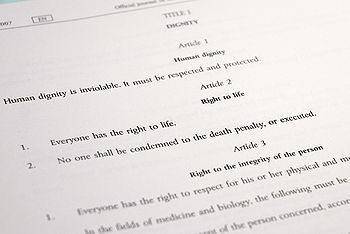
Capital punishment has in the past been practiced by most societies (one notable exception being Kievan Rus), although currently only 58 nations actively practice it, with 96 countries having abolished it (the remainder having not used it for 10 years or allowing it only in exceptional circumstances such as wartime). It is a matter of active controversy in various countries and states, and positions can vary within a single political ideology or cultural region. In the European Union
member states, Article 2 of the Charter of Fundamental Rights of the European Union
prohibits the use of capital punishment.
Amnesty International
considered most countries abolitionist. The UN General Assembly has adopted, in 2007 and 2008, non-binding resolutions calling for a global moratorium on executions
, with a view to eventual abolition. Although many nations have abolished capital punishment, over 60% of the world's population live in countries where executions take place, inasmuch as the People's Republic of China, India, the United States of America and Indonesia, the four most populous countries in the world, continue to apply the death penalty (although in India and Indonesia it is used only rarely). Each of these four nations voted against the General Assembly resolutions.
, espionage
, treason
, or as part of military justice. In some countries sexual crimes, such as rape
, adultery
, incest
and sodomy
, carry the death penalty, as do religious crimes such as apostasy
in Islamic nations (the formal renunciation of the state religion
). In many countries that use the death penalty, drug trafficking is also a capital offense. In China, human trafficking and serious cases of corruption
are punished by the death penalty. In militaries around the world courts-martial have imposed death sentences for offenses such as cowardice
, desertion
, insubordination
, and mutiny
.
The use of formal execution extends to the beginning of recorded history. Most historical records and various primitive tribal practices indicate that the death penalty was a part of their justice system. Communal punishment for wrongdoing generally included compensation by the wrongdoer, corporal punishment
, shunning
, banishment
and execution. Usually, compensation and shunning were enough as a form of justice. The response to crime committed by neighbouring tribes or communities included formal apology, compensation or blood feud
s.
A blood feud
or vendetta
occurs when arbitration between families or tribes fails or an arbitration system is non-existent. This form of justice was common before the emergence of an arbitration system based on state or organised religion. It may result from crime, land disputes or a code of honour. "Acts of retaliation underscore the ability of the social collective to defend itself and demonstrate to enemies (as well as potential allies) that injury to property, rights, or the person will not go unpunished." However, in practice, it is often difficult to distinguish between a war of vendetta and one of conquest.
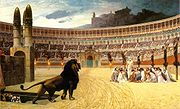
Severe historical penalties include breaking wheel
, boiling to death
, flaying
, slow slicing, disembowelment
, crucifixion
, impalement
, crushing (including crushing by elephant
), stoning
, execution by burning
, dismemberment
, sawing, decapitation
, scaphism
, necklacing
or blowing from a gun
.
 Elaborations of tribal arbitration of feud
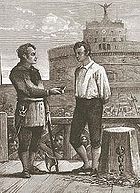
s included peace settlements often done in a religious context and compensation system. Compensation was based on the principle of substitution which might include material (for example, cattle, slave) compensation, exchange of brides or grooms, or payment of the blood debt. Settlement rules could allow for animal blood to replace human blood, or transfers of property or blood money
or in some case an offer of a person for execution. The person offered for execution did not have to be an original perpetrator of the crime because the system was based on tribes, not individuals. Blood feuds could be regulated at meetings, such as the Viking
thing
s. Systems deriving from blood feuds may survive alongside more advanced legal systems or be given recognition by courts (for example, trial by combat
). One of the more modern refinements of the blood feud is the duel
.
 In certain parts of the world, nations in the form of ancient republics, monarchies or tribal oligarchies emerged. These nations were often united by common linguistic, religious or family ties. Moreover, expansion of these nations often occurred by conquest of neighbouring tribes or nations. Consequently, various classes of royalty, nobility, various commoners and slave emerged. Accordingly, the systems of tribal arbitration were submerged into a more unified system of justice which formalised the relation between the different "classes" rather than "tribes". The earliest and most famous example is Code of Hammurabi
which set the different punishment and compensation according to the different class/group of victims and perpetrators. The Torah
(Jewish Law), also known as the Pentateuch (the first five books of the Christian Old Testament
), lays down the death penalty for murder, kidnapping
, magic
, violation of the Sabbath
, blasphemy
, and a wide range of sexual crimes, although evidence suggests that actual executions were rare.
A further example comes from Ancient Greece
, where the Athenian legal system was first written down by Draco in about 621 BC: the death penalty was applied for a particularly wide range of crimes, though Solon
later repealed Draco's code and published new laws, retaining only Draco's homicide statutes. The word draconian derives from Draco's laws. The Romans
also used death penalty for a wide range of offenses.
Islam
on the whole accepts capital punishment, The Abbasid
Caliph
s in Baghdad
, such as Al-Mu'tadid
, were often cruel in their punishments. however it should be noted mercy
is considered preferable, and that in Sharia law the victim's family can choose to spare the life of the killer, which is not uncommon. In the One Thousand and One Nights, also known as the Arabian Nights, the fictional storyteller Sheherazade
is portrayed as being the "voice of sanity and mercy", with her philosophical position being generally opposed to punishment by death. She expresses this through several of her tales, including "The Merchant and the Jinni", "The Fisherman and the Jinni
", "The Three Apples", and "The Hunchback".
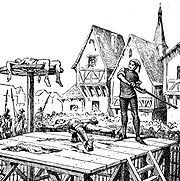 Similarly, in medieval
and early modern Europe, before the development of modern prison
systems, the death penalty was also used as a generalised form of punishment. During the reign of Henry VIII
, as many as 72,000 people are estimated to have been executed.
By 1820 in Britain, there were 160 crimes that were punishable by death, including crimes such as shoplifting, petty theft, stealing cattle, or cutting down trees in public place. The severity of the so-called Bloody Code, however, was often tempered by juries who refused to convict, or judges, in the case of petty theft, who arbitrarily set the value stolen at below the statutory level for a capital crime.
Although many are executed in China each year in the present day, there was a time in Tang Dynasty
China when the death penalty was abolished. This was in the year 747, enacted by Emperor Xuanzong of Tang
(r. 712–756). When abolishing the death penalty Xuanzong ordered his officials to refer to the nearest regulation by analogy when sentencing those found guilty of crimes for which the prescribed punishment was execution. Thus depending on the severity of the crime a punishment of severe scourging with the thick rod or of exile to the remote Lingnan region might take the place of capital punishment. However the death penalty was restored only 12 years later in 759 in response to the An Lushan Rebellion. At this time in China only the emperor had the authority to sentence criminals to execution. Under Xuanzong
capital punishment was relatively infrequent, with only 24 executions in the year 730 and 58 executions in the year 736.
The two most common forms of execution in China in the Tang period were strangulation and decapitation, which were the prescribed methods of execution for 144 and 89 offenses respectively. Strangulation was the prescribed sentence for lodging an accusation against one's parents or grandparents with a magistrate, scheming to kidnap a person and sell them into slavery and opening a coffin while desecrating a tomb. Decapitation was the method of execution prescribed for more serious crimes such as treason and sedition. Interestingly, and despite the great discomfort involved, most Chinese during the Tang preferred strangulation to decaptitation, as a result of the traditional Chinese belief that the body is a gift from the parents and that it is therefore disrespectful to one's ancestors to die without returning one's body to the grave intact.
Some further forms of capital punishment were practiced in Tang China, of which the first two that follow at least were extralegal. The first of these was scourging to death with the thick rod which was common throughout the Tang especially in cases of gross corruption. The second was truncation, in which the convicted person was cut in two at the waist with a fodder knife and then left to bleed to death. A further form of execution called Ling Chi (slow slicing), or death by/of a thousand cuts, was used in China from the close of the Tang dynasty (around 900) to its abolition in 1905.
When a minister of the fifth grade or above received a death sentence the emperor might grant him a special dispensation allowing him to commit suicide in lieu of execution. Even when this privilege was not granted, the law required that the condemned minister be provided with food and ale by his keepers and transported to the execution ground in a cart rather than having to walk there.
Nearly all executions under the Tang took place in public as a warning to the population. The heads of the executed were displayed on poles or spears. When local authorities decapitated a convicted criminal, the head was boxed and sent to the capital as proof of identity and that the execution had taken place.
In Tang China, when a person was sentenced to decapitation for rebellion or sedition, punishment was also imposed on their relatives, whether or not the relatives were guilty of participation in the crime. In such cases fathers of the convicted under 79 years of age and sons aged over 15 were strangled. Sons under 15, daughters, mothers, wives, concubines, grandfathers, grandsons, brothers and sisters were enslaved and uncles and nephews were banished to the remotest reaches of the empire. Sometimes the tombs of the family's ancestors were levelled, the ancestors' coffins were destroyed and their bones scattered.
 Despite its wide use, calls for reform were not unknown. The 12th century Sephardic legal scholar, Moses Maimonides
, wrote, "It is better and more satisfactory to acquit a thousand guilty persons than to put a single innocent man to death." He argued that executing an accused criminal on anything less than absolute certainty would lead to a slippery slope of decreasing burdens of proof, until we would be convicting merely "according to the judge's caprice." His concern was maintaining popular respect for law, and he saw errors of commission as much more threatening than errors of omission.
The last several centuries have seen the emergence of modern nation-states. Almost fundamental to the concept of nation state is the idea of citizenship
. This caused justice to be increasingly associated with equality and universality, which in Europe saw an emergence of the concept of natural rights. Another important aspect is that emergence of standing police forces and permanent penitential institutions. The death penalty became an increasingly unnecessary deterrent
in prevention of minor crimes such as theft. The argument that deterrence, rather than retribution, is the main justification for punishment is a hallmark of the rational choice theory
and can be traced to Cesare Beccaria
whose well-known treatise On Crimes and Punishments (1764), condemned torture
and the death penalty and Jeremy Bentham
who twice critiqued the death penalty. Additionally, in countries like Britain, law enforcement officials became alarmed when juries tended to acquit non-violent felons rather than risk a conviction that could result in execution. Moving executions there inside prisons and away from public view was prompted by official recognition of the phenomenon reported first by Beccaria in Italy and later by Charles Dickens
and Karl Marx
of increased violent criminality at the times and places of executions.
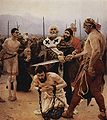 The 20th century was the bloodiest in human history. Tens of millions were killed in wars between nation-states as well as genocide perpetrated by nation states against political opponents (both perceived and actual), ethnic and religious minorities; the Turkish assault on the Armenians, Hitler's destruction of the European Jews, the Khmer Rouge
decimation of Cambodia
, the massacre of the Tutsi
s in Rwanda
, to cite four of the most notorious examples. A large part of execution was summary execution of enemy combatants. Also, modern military organisations employed capital punishment as a means of maintaining military discipline. The Soviets, for example, executed 158,000 soldiers for desertion during World War II
. In the past, cowardice
, absence without leave, desertion
, insubordination
, looting
, shirking under enemy fire and disobeying orders were often crimes punishable by death (see decimation
and running the gauntlet
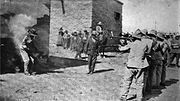
). One method of execution since firearms came into common use has almost invariably been firing squad.
Various authoritarian states— for example those with fascist or communist governments— employed the death penalty as a potent means of political oppression. According to Robert Conquest
, the leading expert on Stalin's purges, more than 1,000,000 Soviet citizens were executed during the Great Terror
of 1937-38, almost all by a bullet to the back of the head. Mao Zedong
publicly stated that "800,000" people had been executed after the Communist Party's victory
in 1949. Partly as a response to such excesses, civil rights organizations have started to place increasing emphasis on the concept of human rights
and abolition of the death penalty.
Among countries around the world, almost all European and many Pacific Area states (including Australia, New Zealand and Timor Leste), and Canada have abolished capital punishment. In Latin America, most states have completely abolished the use of capital punishment, while some countries, such as Brazil, allow for capital punishment only in exceptional situations, such as treason committed during wartime. The United States
(the federal government and 34 of the states), Guatemala, most of the Caribbean and the majority of democracies in Asia (for example, Japan and India) and Africa (for example, Botswana and Zambia) retain it. South Africa, which is probably the most developed African nation, and which has been a democracy since 1994, does not have the death penalty. This fact is currently quite controversial in that country, due to the high levels of violent crime, including murder and rape.
, public executions were a very solemn and sorrowful occasion, sometimes attended by large crowds, who also listened to a Gospel message and remarks by local preachers and politicians. The Connecticut Courant
records one such public execution on December 1, 1803, saying, "The assembly conducted through the whole in a very orderly and solemn manner, so much so, as to occasion an observing gentleman acquainted with other countries as well as this, to say that such an assembly, so decent and solemn, could not be collected anywhere but in New England."
Trends in most of the world have long been to move to less painful, or more humane, executions. France developed the guillotine
for this reason in the final years of the 18th century while Britain banned drawing and quartering
in the early 19th century. Hanging
by turning the victim off a ladder or by kicking a stool or a bucket, which causes death by suffocation, was replaced by long drop "hanging" where the subject is dropped a longer distance to dislocate the neck and sever the spinal cord
. Shah of Persia introduced throat-cutting and blowing from a gun
as quick and painless alternatives to more tormentous methods of executions used at that time. In the U.S., the electric chair
and the gas chamber
were introduced as more humane alternatives to hanging, but have been almost entirely superseded by lethal injection
, which in turn has been criticised as being too painful. Nevertheless, some countries still employ slow hanging methods, beheading by sword and even stoning
, although the latter is rarely employed.
abolished the death penalty in 818 under the influence of Shinto and it lasted until 1156. Therefore, capital punishment was not employed for 338 years in ancient Japan.
In England, a public statement of opposition was included in The Twelve Conclusions of the Lollards
, written in 1395. Sir Thomas More's Utopia
, published in 1516, debated the benefits of the death penalty in dialogue form, coming to no firm conclusion. More recent opposition to the death penalty stemmed from the book of the Italian Cesare Beccaria Dei Delitti e Delle Pene ("On Crimes and Punishments"), published in 1764. In this book, Beccaria aimed to demonstrate not only the injustice, but even the futility from the point of view of social welfare
, of torture
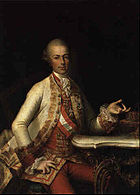
and the death penalty. Influenced by the book, Grand Duke Leopold II
of Habsburg, famous enlightened monarch and future Emperor of Austria, abolished the death penalty in the then-independent Grand Duchy of Tuscany
, the first permanent abolition in modern times. On November 30, 1786, after having de facto blocked capital executions (the last was in 1769), Leopold promulgated the reform of the penal code that abolished the death penalty and ordered the destruction of all the instruments for capital execution in his land. In 2000 Tuscany's regional authorities instituted an annual holiday on November 30 to commemorate the event. The event is commemorated on this day by 300 cities around the world celebrating Cities for Life Day
.
 The Roman Republic
banned capital punishment in 1849. Venezuela followed suit and abolished the death penalty in 1863 and San Marino did so in 1865. The last execution in San Marino had taken place in 1468. In Portugal, after legislative proposals in 1852 and 1863, the death penalty was abolished in 1867.
Since the Second World War, and the recognition of The Universal Declaration of Human Rights, Israel was the first independent state to outlaw the death penalty in 1954, thus reversing the British Mandate Law. In the United Kingdom, it was abolished for murder (leaving only treason
, piracy with violence, arson in royal dockyards
and a number of wartime military offences as capital crimes) for a five year experiment in 1965 and permanently in 1969, the last execution having taken place in 1964. It was abolished for all peacetime offences in 1998.
Abolition occurred in Canada in 1976, in France in 1981, and in Australia in 1973 (although the state of Western Australia retained the penalty until 1984). In 1977, the United Nations General Assembly affirmed in a formal resolution that throughout the world, it is desirable to "progressively restrict the number of offenses for which the death penalty might be imposed, with a view to the desirability of abolishing this punishment".
In the United States, Michigan was the first state to ban the death penalty, on 18 May 1846. The death penalty was declared unconstitutional between 1972 and 1976 based on the Furman v. Georgia
case, but the 1976 Gregg v. Georgia
case once again permitted the death penalty under certain circumstances. Further limitations were placed on the death penalty in Atkins v. Virginia
(death penalty unconstitutional for persons suffering from mental retardation) and Roper v. Simmons
(death penalty unconstitutional if defendant was under age 18 at the time the crime was committed). Currently, as of March 9, 2011, 16 states of the U.S. and the District of Columbia ban capital punishment, with Illinois the most recent state to ban the practice. A 2010 Gallup poll shows that 64% of Americans support the death penalty for someone convicted of murder, down from 65% in 2006 and 68% in 2001. Of the states where the death penalty is permitted, California
has the largest number of inmates on death row
, while Texas has been the most active in carrying out executions (approximately one third of all executions since the practice was reinstated).
The latest country to abolish the death penalty for all crimes was Gabon
, in February 2010. Human rights activists oppose the death penalty, calling it "cruel, inhuman, and degrading punishment". Amnesty International
considers it to be "the ultimate denial of Human Rights".
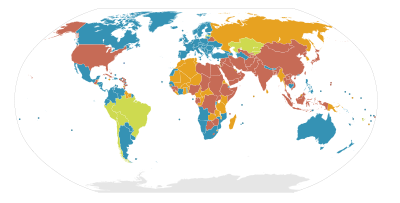
Since World War II
there has been a trend toward abolishing the death penalty. In 1977, 16 countries were abolitionist. According to information published by Amnesty International in 2011, 96 countries had abolished capital punishment altogether, 9 had done so for all offences except under special circumstances, and 34 had not used it for at least 10 years or were under a moratorium. The other 58 retained the death penalty in active use.
According to Amnesty International, at least 23 countries were known to have had executions carried out in 2010. In addition, there are countries which do not publish information on the use of capital punishment, most significantly China, which is estimated to execute hundreds of people each year. At least 17,000 people worldwide were under sentence of death at the beginning of 2010.
Sources of the population data:
The use of the death penalty is becoming increasingly restrained in some retentionist countries including Taiwan
and Singapore
. Indonesia has carried out very few executions in the past few years. Singapore, Japan, Taiwan, South Korea and the United States are the only developed countries
that have retained the death penalty. The death penalty was overwhelmingly practiced in poor and authoritarian states, which often employed the death penalty as a tool of political oppression. During the 1980s, the democratisation of Latin America swelled the rank of abolitionist countries. This was soon followed by the fall of communism
in Central
and Eastern Europe
, which then aspired to enter the EU. In these countries, the public support for the death penalty varies but is generally supported.
The European Union
and the Council of Europe
both strictly require member states not to practice the death penalty (see Capital punishment in Europe
). On the other hand, rapid industrialisation in Asia has been increasing the number of developed retentionist countries. In these countries, the death penalty enjoys strong public support, and the matter receives little attention from the government or the media; in China
there is a small but growing movement to abolish the death penalty altogether. This trend has been followed by some African and Middle Eastern countries where support for the death penalty is high.
The state of Israel
retains the death penalty only for Nazis convicted of crimes against humanity. The only execution in Israeli history occurred in 1961, when Adolf Eichmann
, one of the principal organizers of the Holocaust, was put to death after his trial in Jerusalem.
Some countries have resumed practicing the death penalty after having suspended executions for long periods. The United States suspended executions in 1972 but resumed them in 1976, then again on 25 September 2007 to 16 April 2008; there was no execution in India between 1995 and 2004; and Sri Lanka
declared an end to its moratorium
on the death penalty on 20 November 2004, although it has not yet performed any executions. The Philippines
re-introduced the death penalty in 1993 after abolishing it in 1987, but abolished it again in 2006.
For further information about capital punishment in individual countries or regions, see: Australia
· Canada
· People's Republic of China
(excluding Hong Kong and Macau) · Europe
· India
· Iran
· Iraq
· Japan
· New Zealand
·Pakistan
· Philippines
· Russia
· Singapore
· Taiwan
· United Kingdom
· United States
 Afghanistan
 Bangladesh
 Brunei
 People's Republic of China
 Republic of China Also available on Chinese Wikisource.
 Egypt
Egypt
 Indonesia
 Iran
Iran
 Iraq
Iraq
 Kuwait
 Laos
Laos
 Malaysia
 Oman
Oman
 Pakistan
 Saudi Arabia
 Singapore
 Somalia
 Sri Lanka
 Thailand
 Vietnam
 United Arab Emirates
 United States
 Zimbabwe
offenders (criminals aged under 18 years at the time of their crime) has become increasingly rare. Since 1990, nine countries have executed offenders who were juveniles at the time of their crimes: The People's Republic of China
(PRC), Democratic Republic of the Congo
, Iran
, Nigeria
, Pakistan
, Saudi Arabia
, Sudan
, the United States
and Yemen
. The PRC, Pakistan, the United States and Yemen have since raised the minimum age to 18. Amnesty International has recorded 61 verified executions since then, in several countries, of both juveniles and adults who had been convicted of committing their offenses as juveniles. The PRC does not allow for the execution of those under 18, but child executions have reportedly taken place.
Starting in 1642 within British America
, an estimated 365 juvenile offenders were executed by the states and federal government of the United States. The United States Supreme Court abolished capital punishment for offenders under the age of 16 in Thompson v. Oklahoma
(1988), and for all juveniles in Roper v. Simmons
(2005). In addition, in 2002, the United States Supreme Court declared unconstitutional the execution of individuals with mental retardation
, in Atkins v. Virginia
.
Between 2005 and May 2008, Iran, Pakistan, Saudi Arabia, Sudan and Yemen were reported to have executed child offenders, the most being from Iran.
The United Nations
Convention on the Rights of the Child
, which forbids capital punishment for juveniles under article 37(a), has been signed by all countries and ratified
, except for Somalia
and the United States (notwithstanding the latter's Supreme Court decisions abolishing the practice). The UN Sub-Commission on the Promotion and Protection of Human Rights maintains that the death penalty for juveniles has become contrary to a jus cogens of customary international law
. A majority of countries are also party to the U.N. International Covenant on Civil and Political Rights
(whose Article 6.5 also states that "Sentence of death shall not be imposed for crimes committed by persons below eighteen years of age...").
In Japan, the minimum age for the death penalty is 18 as mandated by the internationals standards. But under Japanese law, anyone under 20 is considered a juvenile. There are three men currently on death row for crimes they committed at age 18 or 19.
and International Covenant on Civil and Political Rights
, is currently the world's biggest executioner of juvenile offenders, for which it has received international condemnation; the country's record is the focus of the Stop Child Executions Campaign
.
Iran accounts for two-thirds of the global total of such executions, and currently has roughly 140 people on death row for crimes committed as juveniles (up from 71 in 2007). The past executions of Mahmoud Asgari, Ayaz Marhoni
and Makwan Moloudzadeh became international symbols of Iran's child capital punishment and the judicial system that hands down such sentences.
, then stoned
to death in front of more than 1,000 people. The stoning occurred after she had allegedly pleaded guilty to adultery
in a shariah court in Kismayo, a city controlled by the ICU. According to a local leader associated with the ICU, she had stated that she wanted shariah law to apply. However, other sources state that the victim had been crying, that she begged for mercy and had to be forced into the hole before being buried up to her neck in the ground. Amnesty International later learned that the girl was in fact 13 years old and had been arrested by the al-Shabab militia after she had reported being gang-raped by three men.
However, Somalia's recently established Transitional Federal Government
announced in November 2009 that it plans to ratify the Convention on the Rights of the Child
. This move was lauded by UNICEF as a welcome attempt to secure children's rights in the country.
ing for example), makes sure that convicted criminals do not offend again and is a just penalty for atrocious crimes such as child murder
s, serial killer
s or torture murderers
. Opponents of capital punishment argue that not all people affected by murder desire a death penalty, that execution discriminates against minorities and the poor, and that it encourages a "culture of violence" and that it violates human rights
.
It is frequently argued that capital punishment leads to miscarriage of justice
through the wrongful execution of innocent persons. Many people have been proclaimed innocent victims of the death penalty.
Some have claimed that as many as 39 executions have been carried out in the face of compelling evidence of innocence or serious doubt about guilt from in the US from 1992 through 2004. Newly available DNA evidence prevented the pending execution of more than 15 death row
inmates during the same period in the U.S, but DNA evidence is only available in a fraction of capital cases. However, since the death penalty reinstatement in the United States during the 1970s, no inmate executed has been granted posthumous pardon. (Overall, the Innocence Project has exonerated more than 250 inmates through February 2010.)
case, the Greyhound bus beheading
, Port Arthur massacre and Bali bombings
, though none of these events or similar events actually caused the death penalty to be re-instated. Between 2000 and 2010, support for the return of capital punishment in Canada dropped from 44% to 40%, and opposition to it returning rose from 43% to 46%. The Canadian government currently "has absolutely no plans to reinstate capital punishment."
Abolition was often adopted due to political change, as when countries shifted from authoritarianism to democracy, or when it became an entry condition for the European Union. The United States is a notable exception: some states have had bans on capital punishment for decades (the earliest is Michigan
, where it was abolished in 1846), while others actively use it today. The death penalty there remains a contentious issue which is hotly debated. Elsewhere, however, it is rare for the death penalty to be abolished as a result of an active public discussion of its merits.
In abolitionist countries, debate is sometimes revived by particularly brutal murders, though few countries have brought it back after abolishing it. However, a spike in serious, violent crimes, such as murders or terrorist attacks, has prompted some countries (such as Sri Lanka and Jamaica) to effectively end the moratorium on the death penalty. In retentionist countries, the debate is sometimes revived when a miscarriage of justice has occurred, though this tends to cause legislative efforts to improve the judicial process rather than to abolish the death penalty.
A Gallup International poll from 2000 said that "Worldwide support was expressed in favor of the death penalty, with just more than half (52%) indicating that they were in favour of this form of punishment."
A number of other polls and studies have been done in recent years with various results.
In a poll completed by Gallup in October 2009, 65% of Americans supported the death penalty for persons convicted of murder, while 31% were against and 5% did not have an opinion.
In the U.S., surveys have long shown a majority in favor of capital punishment. An ABC News
survey in July 2006 found 65 percent in favour of capital punishment, consistent with other polling since 2000. About half the American public says the death penalty is not imposed frequently enough and 60 percent believe it is applied fairly, according to a Gallup poll from May 2006. Yet surveys also show the public is more divided when asked to choose between the death penalty and life without parole
, or when dealing with juvenile offenders. Roughly six in 10 tell Gallup they do not believe capital punishment deters murder and majorities believe at least one innocent person has been executed in the past five years.
, the Supreme Court held that the Eighth Amendment prohibits the state from carrying out the death penalty on an individual who is insane, and that properly raised issues of execution-time sanity must be determined in a proceeding satisfying the minimum requirements of due process. In Atkins v. Virginia
, the Supreme Court addressed whether the Eighth Amendment prohibits the execution of mentally retarded persons. The Court noted that a "national consensus" had developed against it. While such executions are still permitted for people with marginal retardation, evidence of retardation is allowed as a mitigating circumstance. However, a recent case of Teresa Lewis
who was the first woman executed in Virginia since 1912, proved to be very controversial because Governor Bob McDonnell
refused to commute her sentence to life imprisonment, even though she had an IQ of 70.
introduced a resolution
during the General Assembly's 62nd sessions in 2007 calling for a universal ban. The approval of a draft resolution by the Assembly's third committee, which deals with human rights issues, voted 99 to 52, with 33 abstentions, in favour of the resolution on 15 November 2007 and was put to a vote in the Assembly on December 18.
Again in 2008, a large majority of states from all regions adopted a second resolution calling for a moratorium on the use of the death penalty in the UN General Assembly (Third Committee) on 20 November. 105 countries voted in favour of the draft resolution, 48 voted against and 31 abstained.
A range of amendments proposed by a small minority of pro-death penalty countries were overwhelmingly defeated. It had in 2007 passed a non-binding resolution (by 104 to 54, with 29 abstentions) by asking its member states for "a moratorium on executions with a view to abolishing the death penalty".
 A number of regional conventions prohibit the death penalty, most notably, the Sixth Protocol (abolition in time of peace) and the 13th Protocol (abolition in all circumstances) to the European Convention on Human Rights
. The same is also stated under the Second Protocol in the American Convention on Human Rights
, which, however has not been ratified by all countries in the Americas, most notably Canada and the United States. Most relevant operative international treaties do not require its prohibition for cases of serious crime, most notably, the International Covenant on Civil and Political Rights
. This instead has, in common with several other treaties, an optional protocol prohibiting capital punishment and promoting its wider abolition.
Several international organizations have made the abolition of the death penalty (during time of peace) a requirement of membership, most notably the European Union
(EU) and the Council of Europe
. The EU and the Council of Europe are willing to accept a moratorium
as an interim measure. Thus, while Russia is a member of the Council of Europe, and practices the death penalty in law, it has not made public use of it since becoming a member of the Council.
Other states, while having abolished de jure
the death penalty in time of peace and de facto
in all circumstances, have not ratified Protocol no.13 yet and therefore have no international obligation to refrain from using the death penalty in time of war or imminent threat of war (Armenia, Latvia, Poland and Spain). Italy is the most recent to ratify it, on March 3, 2009.
Turkey
has recently, as a move towards EU membership, undergone a reform of its legal system. Previously there was a de facto moratorium on the death penalty in Turkey as the last execution took place in 1984. The death penalty was removed from peacetime law in August 2002, and in May 2004 Turkey amended its constitution in order to remove capital punishment in all circumstances. It ratified Protocol no. 13 to the European Convention on Human Rights in February 2006. As a result, Europe is a continent free of the death penalty in practice, all states but Russia, which has entered a moratorium, having ratified the Sixth Protocol to the European Convention on Human Rights, with the sole exception of Belarus
, which is not a member of the Council of Europe. The Parliamentary Assembly of the Council of Europe
has been lobbying for Council of Europe observer states who practice the death penalty, the U.S. and Japan, to abolish it or lose their observer status. In addition to banning capital punishment for EU member states, the EU has also banned detainee transfers in cases where the receiving party may seek the death penalty.
Among non-governmental organizations (NGOs), Amnesty International and Human Rights Watch
are noted for their opposition to capital punishment. A number of such NGOs, as well as trade unions, local councils and bar associations formed a World Coalition Against the Death Penalty
in 2002.
, the individual believer, and the time period.
states:
Chapter 26, the final chapter of the Dhammapada, states, "Him I call a brahmin
who has put aside weapons and renounced violence toward all creatures. He neither kills nor helps others to kill." These sentences are interpreted by many Buddhists (especially in the West) as an injunction against supporting any legal measure which might lead to the death penalty. However, as is often the case with the interpretation of scripture, there is dispute on this matter. Historically, most states where the official religion is Buddhism
have imposed capital punishment for some offenses. One notable exception is the abolition of the death penalty by the Emperor Saga
of Japan in 818. This lasted until 1165, although in private manors executions continued to be conducted as a form of retaliation. Japan
still imposes the death penalty, although some recent justice ministers have refused to sign death warrants, citing their Buddhist beliefs as their reason. Other Buddhist-majority states vary in their policy. For example, Bhutan
has abolished the death penalty, but Thailand
still retains it, although Buddhism
is the official religion in both.
and as contrary to Christ's message of forgiveness
, to enthusiastic support based primarily on Old Testament
law.
Among the teachings of Jesus Christ in the Gospel of Luke
and the Gospel of Matthew
, the message to his followers that one should "Turn the other cheek
" and his example in the story Pericope Adulterae, in which Jesus intervenes in the stoning
of an adulteress, are generally accepted as his condemnation of physical retaliation
(though most scholars agree that the latter passage was "certainly not part of the original text of St John's Gospel") More militant
Christians consider Romans 13:3–4
to support the death penalty. Many Christians have believed that Jesus' doctrine of peace speaks only to personal ethics and is distinct from civil government's duty to punish crime.
In the Old Testament
, Leviticus provides a list of transgressions in which execution is recommended. Christian positions on these passages vary. The sixth commandment
(fifth in the Roman Catholic
and Lutheran churches) is translated as "Thou shalt not kill" by some denominations and as "Thou shalt not murder" by others. As some denominations do not have a hard-line stance on the subject, Christians of such denominations are free to make a personal decision.
, a Doctor of the Church
, accepts the death penalty as a deterrent and prevention method but not as a means of vengeance. (See Aquinas on the death penalty.) The Roman Catechism
states this teaching thus:
In Evangelium Vitae
, Pope John Paul II
suggested that capital punishment should be avoided unless it is the only way to defend society from the offender in question, opining that punishment "ought not go to the extreme of executing the offender except in cases of absolute necessity: in other words, when it would not be possible otherwise to defend society. Today however, as a result of steady improvements in the organization of the penal system, such cases are very rare, if not practically non-existent." The most recent edition of the Catechism of the Catholic Church
restates this view. That the assessment of the contemporary situation advanced by John Paul II is not binding on the faithful was confirmed by Cardinal Ratzinger when he wrote in 2004 that,
While all Catholics must therefore hold that "the infliction of capital punishment is not contrary to the teaching of the Catholic Church, and the power of the State to visit upon culprits the penalty of death derives much authority from revelation and from the writings of theologians", the matter of "the advisability of exercising that power is, of course, an affair to be determined upon other and various considerations."
or Quaker Church is one of the earliest American opponents of capital punishment and unequivocally opposes execution in all its forms.
, along with other Methodist churches, also condemns capital punishment, saying that it cannot accept retribution or social vengeance as a reason for taking human life. The Church also holds that the death penalty falls unfairly and unequally upon marginalised persons including the poor, the uneducated, ethnic and religious minorities, and persons with mental and emotional illnesses. The General Conference
of the United Methodist Church calls for its bishop
s to uphold opposition to capital punishment and for governments to enact an immediate moratorium on carrying out the death penalty sentence.
) neither promotes nor opposes capital punishment, although the church's founder, Joseph Smith, Jr., supported it. However, today the church officially state it is a "matter to be decided solely by the prescribed processes of civil law."
, the former Reorganized Church of Jesus Christ of Latter Day Saints (RLDS), is opposed to capital punishment. The first stand against capital punishment was taken by the church's Presiding High Council
in 1995. This was followed by a resolution of the World Conference
in 2000. This resolution, WC 1273, states:
, including Martin Luther
and John Calvin
, followed the traditional reasoning in favour of capital punishment, and the Lutheran Church's Augsburg Confession
explicitly defended it. Some Protestant groups have cited Genesis 9:5–6, Romans 13:3–4, and
Latin
Latin is an Italic language originally spoken in Latium and Ancient Rome. It, along with most European languages, is a descendant of the ancient Proto-Indo-European language. Although it is considered a dead language, a number of scholars and members of the Christian clergy speak it fluently, and...
capitalis, literally "regarding the head". Hence a capital crime was originally one punished by severing the head
Decapitation
Decapitation is the separation of the head from the body. Beheading typically refers to the act of intentional decapitation, e.g., as a means of murder or execution; it may be accomplished, for example, with an axe, sword, knife, wire, or by other more sophisticated means such as a guillotine...
from the body.
Capital punishment has in the past been practiced by most societies (one notable exception being Kievan Rus), although currently only 58 nations actively practice it, with 96 countries having abolished it (the remainder having not used it for 10 years or allowing it only in exceptional circumstances such as wartime). It is a matter of active controversy in various countries and states, and positions can vary within a single political ideology or cultural region. In the European Union
European Union
The European Union is an economic and political union of 27 independent member states which are located primarily in Europe. The EU traces its origins from the European Coal and Steel Community and the European Economic Community , formed by six countries in 1958...
member states, Article 2 of the Charter of Fundamental Rights of the European Union
Charter of Fundamental Rights of the European Union
The Charter of Fundamental Rights of the European Union enshrines certain political, social, and economic rights for European Union citizens and residents, into EU law. It was drafted by the European Convention and solemnly proclaimed on 7 December 2000 by the European Parliament, the Council of...
prohibits the use of capital punishment.
Amnesty International
Amnesty International
Amnesty International is an international non-governmental organisation whose stated mission is "to conduct research and generate action to prevent and end grave abuses of human rights, and to demand justice for those whose rights have been violated."Following a publication of Peter Benenson's...
considered most countries abolitionist. The UN General Assembly has adopted, in 2007 and 2008, non-binding resolutions calling for a global moratorium on executions
UN moratorium on the death penalty
The UN moratorium on the death penalty were two proposals by Italy and Chile supported by several countries and NGOs before the General Assembly of the United Nations that called for general suspension of capital punishment throughout the world...
, with a view to eventual abolition. Although many nations have abolished capital punishment, over 60% of the world's population live in countries where executions take place, inasmuch as the People's Republic of China, India, the United States of America and Indonesia, the four most populous countries in the world, continue to apply the death penalty (although in India and Indonesia it is used only rarely). Each of these four nations voted against the General Assembly resolutions.
History
Execution of criminals and political opponents has been used by nearly all societies—both to punish crime and to suppress political dissent. In most places that practice capital punishment it is reserved for murderMurder
Murder is the unlawful killing, with malice aforethought, of another human being, and generally this state of mind distinguishes murder from other forms of unlawful homicide...
, espionage
Espionage
Espionage or spying involves an individual obtaining information that is considered secret or confidential without the permission of the holder of the information. Espionage is inherently clandestine, lest the legitimate holder of the information change plans or take other countermeasures once it...
, treason
Treason
In law, treason is the crime that covers some of the more extreme acts against one's sovereign or nation. Historically, treason also covered the murder of specific social superiors, such as the murder of a husband by his wife. Treason against the king was known as high treason and treason against a...
, or as part of military justice. In some countries sexual crimes, such as rape
Rape
Rape is a type of sexual assault usually involving sexual intercourse, which is initiated by one or more persons against another person without that person's consent. The act may be carried out by physical force, coercion, abuse of authority or with a person who is incapable of valid consent. The...
, adultery
Adultery
Adultery is sexual infidelity to one's spouse, and is a form of extramarital sex. It originally referred only to sex between a woman who was married and a person other than her spouse. Even in cases of separation from one's spouse, an extramarital affair is still considered adultery.Adultery is...
, incest
Incest
Incest is sexual intercourse between close relatives that is usually illegal in the jurisdiction where it takes place and/or is conventionally considered a taboo. The term may apply to sexual activities between: individuals of close "blood relationship"; members of the same household; step...
and sodomy
Sodomy
Sodomy is an anal or other copulation-like act, especially between male persons or between a man and animal, and one who practices sodomy is a "sodomite"...
, carry the death penalty, as do religious crimes such as apostasy
Apostasy
Apostasy , 'a defection or revolt', from ἀπό, apo, 'away, apart', στάσις, stasis, 'stand, 'standing') is the formal disaffiliation from or abandonment or renunciation of a religion by a person. One who commits apostasy is known as an apostate. These terms have a pejorative implication in everyday...
in Islamic nations (the formal renunciation of the state religion
State religion
A state religion is a religious body or creed officially endorsed by the state...
). In many countries that use the death penalty, drug trafficking is also a capital offense. In China, human trafficking and serious cases of corruption
Political corruption
Political corruption is the use of legislated powers by government officials for illegitimate private gain. Misuse of government power for other purposes, such as repression of political opponents and general police brutality, is not considered political corruption. Neither are illegal acts by...
are punished by the death penalty. In militaries around the world courts-martial have imposed death sentences for offenses such as cowardice
Cowardice
Cowardice is the perceived failure to demonstrate sufficient mental robustness and courage in the face of a challenge. Under many military codes of justice, cowardice in the face of combat is a crime punishable by death...
, desertion
Desertion
In military terminology, desertion is the abandonment of a "duty" or post without permission and is done with the intention of not returning...
, insubordination
Insubordination
Insubordination is the act of willfully disobeying an authority. Refusing to perform an action that is unethical or illegal is not insubordination; neither is refusing to perform an action that is not within the scope of authority of the person issuing the order.Insubordination is typically a...
, and mutiny
Mutiny
Mutiny is a conspiracy among members of a group of similarly situated individuals to openly oppose, change or overthrow an authority to which they are subject...
.
The use of formal execution extends to the beginning of recorded history. Most historical records and various primitive tribal practices indicate that the death penalty was a part of their justice system. Communal punishment for wrongdoing generally included compensation by the wrongdoer, corporal punishment
Corporal punishment
Corporal punishment is a form of physical punishment that involves the deliberate infliction of pain as retribution for an offence, or for the purpose of disciplining or reforming a wrongdoer, or to deter attitudes or behaviour deemed unacceptable...
, shunning
Shunning
Shunning can be the act of social rejection, or mental rejection. Social rejection is when a person or group deliberately avoids association with, and habitually keeps away from an individual or group. This can be a formal decision by a group, or a less formal group action which will spread to all...
, banishment
Exile
Exile means to be away from one's home , while either being explicitly refused permission to return and/or being threatened with imprisonment or death upon return...
and execution. Usually, compensation and shunning were enough as a form of justice. The response to crime committed by neighbouring tribes or communities included formal apology, compensation or blood feud
Feud
A feud , referred to in more extreme cases as a blood feud, vendetta, faida, or private war, is a long-running argument or fight between parties—often groups of people, especially families or clans. Feuds begin because one party perceives itself to have been attacked, insulted or wronged by another...
s.
A blood feud
Feud
A feud , referred to in more extreme cases as a blood feud, vendetta, faida, or private war, is a long-running argument or fight between parties—often groups of people, especially families or clans. Feuds begin because one party perceives itself to have been attacked, insulted or wronged by another...
or vendetta
Feud
A feud , referred to in more extreme cases as a blood feud, vendetta, faida, or private war, is a long-running argument or fight between parties—often groups of people, especially families or clans. Feuds begin because one party perceives itself to have been attacked, insulted or wronged by another...
occurs when arbitration between families or tribes fails or an arbitration system is non-existent. This form of justice was common before the emergence of an arbitration system based on state or organised religion. It may result from crime, land disputes or a code of honour. "Acts of retaliation underscore the ability of the social collective to defend itself and demonstrate to enemies (as well as potential allies) that injury to property, rights, or the person will not go unpunished." However, in practice, it is often difficult to distinguish between a war of vendetta and one of conquest.
Severe historical penalties include breaking wheel
Breaking wheel
The breaking wheel, also known as the Catherine wheel or simply the wheel, was a torture device used for capital punishment in the Middle Ages and early modern times for public execution by bludgeoning to death...
, boiling to death
Boiling to death
Death by boiling is a method of execution in which a person is killed by being immersed in a boiling liquid such as water or oil. While not as common as other methods of execution, boiling to death has been used in many parts of Europe and Asia...
, flaying
Flaying
Flaying is the removal of skin from the body. Generally, an attempt is made to keep the removed portion of skin intact.-Scope:An animal may be flayed in preparation for human consumption, or for its hide or fur; this is more commonly called skinning....
, slow slicing, disembowelment
Disembowelment
Disembowelment is the removal of some or all of the organs of the gastrointestinal tract , usually through a horizontal incision made across the abdominal area. Disembowelment may result from an accident, but has also been used as a method of torture and execution...
, crucifixion
Crucifixion
Crucifixion is an ancient method of painful execution in which the condemned person is tied or nailed to a large wooden cross and left to hang until dead...
, impalement
Impalement
Impalement is the traumatic penetration of an organism by an elongated foreign object such as a stake, pole, or spear, and this usually implies complete perforation of the central mass of the impaled body...
, crushing (including crushing by elephant
Crushing by elephant
Execution by elephant was a common method of capital punishment in South and Southeast Asia, and particularly in India. Asian Elephants were used to crush, dismember, or torture captives in public executions. The animals were trained and versatile, both able to kill victims immediately or to...
), stoning
Stoning
Stoning, or lapidation, is a form of capital punishment whereby a group throws stones at a person until the person dies. No individual among the group can be identified as the one who kills the subject, yet everyone involved plainly bears some degree of moral culpability. This is in contrast to the...
, execution by burning
Execution by burning
Death by burning is death brought about by combustion. As a form of capital punishment, burning has a long history as a method in crimes such as treason, heresy, and witchcraft....
, dismemberment
Dismemberment
Dismemberment is the act of cutting, tearing, pulling, wrenching or otherwise removing, the limbs of a living thing. It may be practiced upon human beings as a form of capital punishment, as a result of a traumatic accident, or in connection with murder, suicide, or cannibalism...
, sawing, decapitation
Decapitation
Decapitation is the separation of the head from the body. Beheading typically refers to the act of intentional decapitation, e.g., as a means of murder or execution; it may be accomplished, for example, with an axe, sword, knife, wire, or by other more sophisticated means such as a guillotine...
, scaphism
Scaphism
Scaphism, also known as the boats, was an ancient Persian method of execution designed to inflict torturous death. The name comes from the Greek word skaphe, meaning "scooped out"....
, necklacing
Necklacing
Necklacing is the practice of summary execution and torture carried out by forcing a rubber tyre, filled with petrol, around a victim's chest and arms, and setting it on fire...
or blowing from a gun
Blowing from a gun
Blowing from a gun is a method of execution in which the victim is tied to the mouth of a cannon and the cannon is fired. This method of execution was used by British troops during the Indian Rebellion of 1857...
.
Feud
A feud , referred to in more extreme cases as a blood feud, vendetta, faida, or private war, is a long-running argument or fight between parties—often groups of people, especially families or clans. Feuds begin because one party perceives itself to have been attacked, insulted or wronged by another...
s included peace settlements often done in a religious context and compensation system. Compensation was based on the principle of substitution which might include material (for example, cattle, slave) compensation, exchange of brides or grooms, or payment of the blood debt. Settlement rules could allow for animal blood to replace human blood, or transfers of property or blood money
Blood money (term)
Blood money is money or some sort of compensation paid by an offender or his family group to the family or kin group of the victim.-Particular examples and uses:...
or in some case an offer of a person for execution. The person offered for execution did not have to be an original perpetrator of the crime because the system was based on tribes, not individuals. Blood feuds could be regulated at meetings, such as the Viking
Viking
The term Viking is customarily used to refer to the Norse explorers, warriors, merchants, and pirates who raided, traded, explored and settled in wide areas of Europe, Asia and the North Atlantic islands from the late 8th to the mid-11th century.These Norsemen used their famed longships to...
thing
Thing (assembly)
A thing was the governing assembly in Germanic and introduced into some Celtic societies, made up of the free people of the community and presided by lawspeakers, meeting in a place called a thingstead...
s. Systems deriving from blood feuds may survive alongside more advanced legal systems or be given recognition by courts (for example, trial by combat
Trial by combat
Trial by combat was a method of Germanic law to settle accusations in the absence of witnesses or a confession, in which two parties in dispute fought in single combat; the winner of the fight was proclaimed to be right. In essence, it is a judicially sanctioned duel...
). One of the more modern refinements of the blood feud is the duel
Duel
A duel is an arranged engagement in combat between two individuals, with matched weapons in accordance with agreed-upon rules.Duels in this form were chiefly practised in Early Modern Europe, with precedents in the medieval code of chivalry, and continued into the modern period especially among...
.
Code of Hammurabi
The Code of Hammurabi is a well-preserved Babylonian law code, dating to ca. 1780 BC . It is one of the oldest deciphered writings of significant length in the world. The sixth Babylonian king, Hammurabi, enacted the code, and partial copies exist on a human-sized stone stele and various clay...
which set the different punishment and compensation according to the different class/group of victims and perpetrators. The Torah
Torah
Torah- A scroll containing the first five books of the BibleThe Torah , is name given by Jews to the first five books of the bible—Genesis , Exodus , Leviticus , Numbers and Deuteronomy Torah- A scroll containing the first five books of the BibleThe Torah , is name given by Jews to the first five...
(Jewish Law), also known as the Pentateuch (the first five books of the Christian Old Testament
Old Testament
The Old Testament, of which Christians hold different views, is a Christian term for the religious writings of ancient Israel held sacred and inspired by Christians which overlaps with the 24-book canon of the Masoretic Text of Judaism...
), lays down the death penalty for murder, kidnapping
Kidnapping
In criminal law, kidnapping is the taking away or transportation of a person against that person's will, usually to hold the person in false imprisonment, a confinement without legal authority...
, magic
Magic (paranormal)
Magic is the claimed art of manipulating aspects of reality either by supernatural means or through knowledge of occult laws unknown to science. It is in contrast to science, in that science does not accept anything not subject to either direct or indirect observation, and subject to logical...
, violation of the Sabbath
Shabbat
Shabbat is the seventh day of the Jewish week and a day of rest in Judaism. Shabbat is observed from a few minutes before sunset on Friday evening until a few minutes after when one would expect to be able to see three stars in the sky on Saturday night. The exact times, therefore, differ from...
, blasphemy
Blasphemy
Blasphemy is irreverence towards religious or holy persons or things. Some countries have laws to punish blasphemy, while others have laws to give recourse to those who are offended by blasphemy...
, and a wide range of sexual crimes, although evidence suggests that actual executions were rare.
A further example comes from Ancient Greece
Ancient Greece
Ancient Greece is a civilization belonging to a period of Greek history that lasted from the Archaic period of the 8th to 6th centuries BC to the end of antiquity. Immediately following this period was the beginning of the Early Middle Ages and the Byzantine era. Included in Ancient Greece is the...
, where the Athenian legal system was first written down by Draco in about 621 BC: the death penalty was applied for a particularly wide range of crimes, though Solon
Solon
Solon was an Athenian statesman, lawmaker, and poet. He is remembered particularly for his efforts to legislate against political, economic and moral decline in archaic Athens...
later repealed Draco's code and published new laws, retaining only Draco's homicide statutes. The word draconian derives from Draco's laws. The Romans
Ancient Rome
Ancient Rome was a thriving civilization that grew on the Italian Peninsula as early as the 8th century BC. Located along the Mediterranean Sea and centered on the city of Rome, it expanded to one of the largest empires in the ancient world....
also used death penalty for a wide range of offenses.
Islam
Islam
Islam . The most common are and . : Arabic pronunciation varies regionally. The first vowel ranges from ~~. The second vowel ranges from ~~~...
on the whole accepts capital punishment, The Abbasid
Abbasid
The Abbasid Caliphate or, more simply, the Abbasids , was the third of the Islamic caliphates. It was ruled by the Abbasid dynasty of caliphs, who built their capital in Baghdad after overthrowing the Umayyad caliphate from all but the al-Andalus region....
Caliph
Caliph
The Caliph is the head of state in a Caliphate, and the title for the ruler of the Islamic Ummah, an Islamic community ruled by the Shari'ah. It is a transcribed version of the Arabic word which means "successor" or "representative"...
s in Baghdad
Baghdad
Baghdad is the capital of Iraq, as well as the coterminous Baghdad Governorate. The population of Baghdad in 2011 is approximately 7,216,040...
, such as Al-Mu'tadid
Al-Mu'tadid
Al-Mu'tadid was the Abbasid Caliph in Baghdad from 892 to 902. As the son and heir of the powerful vizier and virtual regent Al-Muwaffaq , Mu'tadid was already in possession of supreme power even before he was appointed Caliph, and continued as Caliph to ably administer the Government...
, were often cruel in their punishments. however it should be noted mercy
Mercy
Mercy is broad term that refers to benevolence, forgiveness and kindness in a variety of ethical, religious, social and legal contexts.The concept of a "Merciful God" appears in various religions from Christianity to...
is considered preferable, and that in Sharia law the victim's family can choose to spare the life of the killer, which is not uncommon. In the One Thousand and One Nights, also known as the Arabian Nights, the fictional storyteller Sheherazade
Shéhérazade
Shéhérazade is the title of two works by the French composer Maurice Ravel.Shéhérazade, ouverture de féerie, written in 1898 but unpublished, is a work for orchestra intended as the overture for an opera of the same name...
is portrayed as being the "voice of sanity and mercy", with her philosophical position being generally opposed to punishment by death. She expresses this through several of her tales, including "The Merchant and the Jinni", "The Fisherman and the Jinni
The Fisherman and the Jinni
The Fisherman and the Jinni is the second top-level story told by Shahrazad in the One Thousand and One Nights.-Synopsis:There was an old, poor fisherman who cast his net four times a day and only four times. One day he went to the shore and cast his net. When he tried to pull it up, he found it...
", "The Three Apples", and "The Hunchback".
Middle age
Middle age is the period of age beyond young adulthood but before the onset of old age. Various attempts have been made to define this age, which is around the third quarter of the average life span of human beings....
and early modern Europe, before the development of modern prison
Prison
A prison is a place in which people are physically confined and, usually, deprived of a range of personal freedoms. Imprisonment or incarceration is a legal penalty that may be imposed by the state for the commission of a crime...
systems, the death penalty was also used as a generalised form of punishment. During the reign of Henry VIII
Henry VIII of England
Henry VIII was King of England from 21 April 1509 until his death. He was Lord, and later King, of Ireland, as well as continuing the nominal claim by the English monarchs to the Kingdom of France...
, as many as 72,000 people are estimated to have been executed.
By 1820 in Britain, there were 160 crimes that were punishable by death, including crimes such as shoplifting, petty theft, stealing cattle, or cutting down trees in public place. The severity of the so-called Bloody Code, however, was often tempered by juries who refused to convict, or judges, in the case of petty theft, who arbitrarily set the value stolen at below the statutory level for a capital crime.
Although many are executed in China each year in the present day, there was a time in Tang Dynasty
Tang Dynasty
The Tang Dynasty was an imperial dynasty of China preceded by the Sui Dynasty and followed by the Five Dynasties and Ten Kingdoms Period. It was founded by the Li family, who seized power during the decline and collapse of the Sui Empire...
China when the death penalty was abolished. This was in the year 747, enacted by Emperor Xuanzong of Tang
Emperor Xuanzong of Tang
Emperor Xuanzong of Tang , also commonly known as Emperor Ming of Tang , personal name Li Longji , known as Wu Longji from 690 to 705, was the seventh emperor of the Tang dynasty in China, reigning from 712 to 756. His reign of 43 years was the longest during the Tang Dynasty...
(r. 712–756). When abolishing the death penalty Xuanzong ordered his officials to refer to the nearest regulation by analogy when sentencing those found guilty of crimes for which the prescribed punishment was execution. Thus depending on the severity of the crime a punishment of severe scourging with the thick rod or of exile to the remote Lingnan region might take the place of capital punishment. However the death penalty was restored only 12 years later in 759 in response to the An Lushan Rebellion. At this time in China only the emperor had the authority to sentence criminals to execution. Under Xuanzong
Emperor Xuanzong of Tang
Emperor Xuanzong of Tang , also commonly known as Emperor Ming of Tang , personal name Li Longji , known as Wu Longji from 690 to 705, was the seventh emperor of the Tang dynasty in China, reigning from 712 to 756. His reign of 43 years was the longest during the Tang Dynasty...
capital punishment was relatively infrequent, with only 24 executions in the year 730 and 58 executions in the year 736.
The two most common forms of execution in China in the Tang period were strangulation and decapitation, which were the prescribed methods of execution for 144 and 89 offenses respectively. Strangulation was the prescribed sentence for lodging an accusation against one's parents or grandparents with a magistrate, scheming to kidnap a person and sell them into slavery and opening a coffin while desecrating a tomb. Decapitation was the method of execution prescribed for more serious crimes such as treason and sedition. Interestingly, and despite the great discomfort involved, most Chinese during the Tang preferred strangulation to decaptitation, as a result of the traditional Chinese belief that the body is a gift from the parents and that it is therefore disrespectful to one's ancestors to die without returning one's body to the grave intact.
Some further forms of capital punishment were practiced in Tang China, of which the first two that follow at least were extralegal. The first of these was scourging to death with the thick rod which was common throughout the Tang especially in cases of gross corruption. The second was truncation, in which the convicted person was cut in two at the waist with a fodder knife and then left to bleed to death. A further form of execution called Ling Chi (slow slicing), or death by/of a thousand cuts, was used in China from the close of the Tang dynasty (around 900) to its abolition in 1905.
When a minister of the fifth grade or above received a death sentence the emperor might grant him a special dispensation allowing him to commit suicide in lieu of execution. Even when this privilege was not granted, the law required that the condemned minister be provided with food and ale by his keepers and transported to the execution ground in a cart rather than having to walk there.
Nearly all executions under the Tang took place in public as a warning to the population. The heads of the executed were displayed on poles or spears. When local authorities decapitated a convicted criminal, the head was boxed and sent to the capital as proof of identity and that the execution had taken place.
In Tang China, when a person was sentenced to decapitation for rebellion or sedition, punishment was also imposed on their relatives, whether or not the relatives were guilty of participation in the crime. In such cases fathers of the convicted under 79 years of age and sons aged over 15 were strangled. Sons under 15, daughters, mothers, wives, concubines, grandfathers, grandsons, brothers and sisters were enslaved and uncles and nephews were banished to the remotest reaches of the empire. Sometimes the tombs of the family's ancestors were levelled, the ancestors' coffins were destroyed and their bones scattered.
Maimonides
Moses ben-Maimon, called Maimonides and also known as Mūsā ibn Maymūn in Arabic, or Rambam , was a preeminent medieval Jewish philosopher and one of the greatest Torah scholars and physicians of the Middle Ages...
, wrote, "It is better and more satisfactory to acquit a thousand guilty persons than to put a single innocent man to death." He argued that executing an accused criminal on anything less than absolute certainty would lead to a slippery slope of decreasing burdens of proof, until we would be convicting merely "according to the judge's caprice." His concern was maintaining popular respect for law, and he saw errors of commission as much more threatening than errors of omission.
The last several centuries have seen the emergence of modern nation-states. Almost fundamental to the concept of nation state is the idea of citizenship
Citizenship
Citizenship is the state of being a citizen of a particular social, political, national, or human resource community. Citizenship status, under social contract theory, carries with it both rights and responsibilities...
. This caused justice to be increasingly associated with equality and universality, which in Europe saw an emergence of the concept of natural rights. Another important aspect is that emergence of standing police forces and permanent penitential institutions. The death penalty became an increasingly unnecessary deterrent
Deterrence (legal)
Deterrence is the use of punishment as a threat to deter people from committing a crime. Deterrence is often contrasted with retributivism, which holds that punishment is a necessary consequence of a crime and should be calculated based on the gravity of the wrong done.- Categories :Deterrence can...
in prevention of minor crimes such as theft. The argument that deterrence, rather than retribution, is the main justification for punishment is a hallmark of the rational choice theory
Rational choice theory (criminology)
In criminology, the rational choice theory adopts a utilitarian belief that man is a reasoning actor who weighs means and ends, costs and benefits, and makes a ra...
and can be traced to Cesare Beccaria
Cesare, Marquis of Beccaria
Cesare, Marquis of Beccaria-Bonesana was an Italian jurist, philosopher and politician best known for his treatise On Crimes and Punishments , which condemned torture and the death penalty, and was a founding work in the field of penology.-Birth and education:Beccaria was born in Milan on March...
whose well-known treatise On Crimes and Punishments (1764), condemned torture
Torture
Torture is the act of inflicting severe pain as a means of punishment, revenge, forcing information or a confession, or simply as an act of cruelty. Throughout history, torture has often been used as a method of political re-education, interrogation, punishment, and coercion...
and the death penalty and Jeremy Bentham
Jeremy Bentham
Jeremy Bentham was an English jurist, philosopher, and legal and social reformer. He became a leading theorist in Anglo-American philosophy of law, and a political radical whose ideas influenced the development of welfarism...
who twice critiqued the death penalty. Additionally, in countries like Britain, law enforcement officials became alarmed when juries tended to acquit non-violent felons rather than risk a conviction that could result in execution. Moving executions there inside prisons and away from public view was prompted by official recognition of the phenomenon reported first by Beccaria in Italy and later by Charles Dickens
Charles Dickens
Charles John Huffam Dickens was an English novelist, generally considered the greatest of the Victorian period. Dickens enjoyed a wider popularity and fame than had any previous author during his lifetime, and he remains popular, having been responsible for some of English literature's most iconic...
and Karl Marx
Karl Marx
Karl Heinrich Marx was a German philosopher, economist, sociologist, historian, journalist, and revolutionary socialist. His ideas played a significant role in the development of social science and the socialist political movement...
of increased violent criminality at the times and places of executions.
Khmer Rouge
The Khmer Rouge literally translated as Red Cambodians was the name given to the followers of the Communist Party of Kampuchea, who were the ruling party in Cambodia from 1975 to 1979, led by Pol Pot, Nuon Chea, Ieng Sary, Son Sen and Khieu Samphan...
decimation of Cambodia
Cambodia
Cambodia , officially known as the Kingdom of Cambodia, is a country located in the southern portion of the Indochina Peninsula in Southeast Asia...
, the massacre of the Tutsi
Tutsi
The Tutsi , or Abatutsi, are an ethnic group in Central Africa. Historically they were often referred to as the Watussi or Watusi. They are the second largest caste in Rwanda and Burundi, the other two being the Hutu and the Twa ....
s in Rwanda
Rwanda
Rwanda or , officially the Republic of Rwanda , is a country in central and eastern Africa with a population of approximately 11.4 million . Rwanda is located a few degrees south of the Equator, and is bordered by Uganda, Tanzania, Burundi and the Democratic Republic of the Congo...
, to cite four of the most notorious examples. A large part of execution was summary execution of enemy combatants. Also, modern military organisations employed capital punishment as a means of maintaining military discipline. The Soviets, for example, executed 158,000 soldiers for desertion during World War II
World War II
World War II, or the Second World War , was a global conflict lasting from 1939 to 1945, involving most of the world's nations—including all of the great powers—eventually forming two opposing military alliances: the Allies and the Axis...
. In the past, cowardice
Cowardice
Cowardice is the perceived failure to demonstrate sufficient mental robustness and courage in the face of a challenge. Under many military codes of justice, cowardice in the face of combat is a crime punishable by death...
, absence without leave, desertion
Desertion
In military terminology, desertion is the abandonment of a "duty" or post without permission and is done with the intention of not returning...
, insubordination
Insubordination
Insubordination is the act of willfully disobeying an authority. Refusing to perform an action that is unethical or illegal is not insubordination; neither is refusing to perform an action that is not within the scope of authority of the person issuing the order.Insubordination is typically a...
, looting
Looting
Looting —also referred to as sacking, plundering, despoiling, despoliation, and pillaging—is the indiscriminate taking of goods by force as part of a military or political victory, or during a catastrophe, such as during war, natural disaster, or rioting...
, shirking under enemy fire and disobeying orders were often crimes punishable by death (see decimation
Decimation (Roman Army)
Decimation |ten]]") was a form of military discipline used by officers in the Roman Army to punish mutinous or cowardly soldiers. The word decimation is derived from Latin meaning "removal of a tenth".-Procedure:...
and running the gauntlet
Running the gauntlet
Running the gauntlet is a form of physical punishment wherein a captive is compelled to run between two rows—a gauntlet—of soldiers who strike him as he passes.-Etymology:...
). One method of execution since firearms came into common use has almost invariably been firing squad.
Various authoritarian states— for example those with fascist or communist governments— employed the death penalty as a potent means of political oppression. According to Robert Conquest
Robert Conquest
George Robert Ackworth Conquest CMG is a British historian who became a well-known writer and researcher on the Soviet Union with the publication in 1968 of The Great Terror, an account of Stalin's purges of the 1930s...
, the leading expert on Stalin's purges, more than 1,000,000 Soviet citizens were executed during the Great Terror
The Great Terror
The Great Terror is a book by British historian Robert Conquest, published in 1968. It gave rise to an alternate title of the period in Soviet history known as the Great Purge. The complete title of the book is The Great Terror: Stalin's Purge of the Thirties...
of 1937-38, almost all by a bullet to the back of the head. Mao Zedong
Mao Zedong
Mao Zedong, also transliterated as Mao Tse-tung , and commonly referred to as Chairman Mao , was a Chinese Communist revolutionary, guerrilla warfare strategist, Marxist political philosopher, and leader of the Chinese Revolution...
publicly stated that "800,000" people had been executed after the Communist Party's victory
Chinese Revolution
The Chinese Revolution in 1949 refers to the final stage of military conflict in the Chinese Civil War. In some anti-revisionist communist media and historiography, as well as the official media of the Communist Party of China, this period is known as the War of Liberation .- Historical background...
in 1949. Partly as a response to such excesses, civil rights organizations have started to place increasing emphasis on the concept of human rights
Human rights
Human rights are "commonly understood as inalienable fundamental rights to which a person is inherently entitled simply because she or he is a human being." Human rights are thus conceived as universal and egalitarian . These rights may exist as natural rights or as legal rights, in both national...
and abolition of the death penalty.
Among countries around the world, almost all European and many Pacific Area states (including Australia, New Zealand and Timor Leste), and Canada have abolished capital punishment. In Latin America, most states have completely abolished the use of capital punishment, while some countries, such as Brazil, allow for capital punishment only in exceptional situations, such as treason committed during wartime. The United States
Capital punishment in the United States
Capital punishment in the United States, in practice, applies only for aggravated murder and more rarely for felony murder. Capital punishment was a penalty at common law, for many felonies, and was enforced in all of the American colonies prior to the Declaration of Independence...
(the federal government and 34 of the states), Guatemala, most of the Caribbean and the majority of democracies in Asia (for example, Japan and India) and Africa (for example, Botswana and Zambia) retain it. South Africa, which is probably the most developed African nation, and which has been a democracy since 1994, does not have the death penalty. This fact is currently quite controversial in that country, due to the high levels of violent crime, including murder and rape.
Movements towards humane execution
In early New EnglandNew England
New England is a region in the northeastern corner of the United States consisting of the six states of Maine, New Hampshire, Vermont, Massachusetts, Rhode Island, and Connecticut...
, public executions were a very solemn and sorrowful occasion, sometimes attended by large crowds, who also listened to a Gospel message and remarks by local preachers and politicians. The Connecticut Courant
The Hartford Courant
The Hartford Courant is the largest daily newspaper in the U.S. state of Connecticut, and is a morning newspaper for most of the state north of New Haven and east of Waterbury...
records one such public execution on December 1, 1803, saying, "The assembly conducted through the whole in a very orderly and solemn manner, so much so, as to occasion an observing gentleman acquainted with other countries as well as this, to say that such an assembly, so decent and solemn, could not be collected anywhere but in New England."
Trends in most of the world have long been to move to less painful, or more humane, executions. France developed the guillotine
Guillotine
The guillotine is a device used for carrying out :executions by decapitation. It consists of a tall upright frame from which an angled blade is suspended. This blade is raised with a rope and then allowed to drop, severing the head from the body...
for this reason in the final years of the 18th century while Britain banned drawing and quartering
Hanged, drawn and quartered
To be hanged, drawn and quartered was from 1351 a penalty in England for men convicted of high treason, although the ritual was first recorded during the reigns of King Henry III and his successor, Edward I...
in the early 19th century. Hanging
Hanging
Hanging is the lethal suspension of a person by a ligature. The Oxford English Dictionary states that hanging in this sense is "specifically to put to death by suspension by the neck", though it formerly also referred to crucifixion and death by impalement in which the body would remain...
by turning the victim off a ladder or by kicking a stool or a bucket, which causes death by suffocation, was replaced by long drop "hanging" where the subject is dropped a longer distance to dislocate the neck and sever the spinal cord
Spinal cord
The spinal cord is a long, thin, tubular bundle of nervous tissue and support cells that extends from the brain . The brain and spinal cord together make up the central nervous system...
. Shah of Persia introduced throat-cutting and blowing from a gun
Blowing from a gun
Blowing from a gun is a method of execution in which the victim is tied to the mouth of a cannon and the cannon is fired. This method of execution was used by British troops during the Indian Rebellion of 1857...
as quick and painless alternatives to more tormentous methods of executions used at that time. In the U.S., the electric chair
Electric chair
Execution by electrocution, usually performed using an electric chair, is an execution method originating in the United States in which the condemned person is strapped to a specially built wooden chair and electrocuted through electrodes placed on the body...
and the gas chamber
Gas chamber
A gas chamber is an apparatus for killing humans or animals with gas, consisting of a sealed chamber into which a poisonous or asphyxiant gas is introduced. The most commonly used poisonous agent is hydrogen cyanide; carbon dioxide and carbon monoxide have also been used...
were introduced as more humane alternatives to hanging, but have been almost entirely superseded by lethal injection
Lethal injection
Lethal injection is the practice of injecting a person with a fatal dose of drugs for the express purpose of causing the immediate death of the subject. The main application for this procedure is capital punishment, but the term may also be applied in a broad sense to euthanasia and suicide...
, which in turn has been criticised as being too painful. Nevertheless, some countries still employ slow hanging methods, beheading by sword and even stoning
Stoning
Stoning, or lapidation, is a form of capital punishment whereby a group throws stones at a person until the person dies. No individual among the group can be identified as the one who kills the subject, yet everyone involved plainly bears some degree of moral culpability. This is in contrast to the...
, although the latter is rarely employed.
Abolitionism
The death penalty was banned in China between 747 and 759. In Japan, Emperor SagaEmperor Saga
was the 52nd emperor of Japan, according to the traditional order of succession. Saga's reign spanned the years from 809 through 823.-Traditional narrative:...
abolished the death penalty in 818 under the influence of Shinto and it lasted until 1156. Therefore, capital punishment was not employed for 338 years in ancient Japan.
In England, a public statement of opposition was included in The Twelve Conclusions of the Lollards
The Twelve Conclusions of the Lollards
The Twelve Conclusions of the Lollards is a Middle English religious text containing statements by followers of the English medieval sect, the Lollards, followers of John Wycliffe. The Conclusions were written in 1395...
, written in 1395. Sir Thomas More's Utopia
Utopia (book)
Utopia is a work of fiction by Thomas More published in 1516...
, published in 1516, debated the benefits of the death penalty in dialogue form, coming to no firm conclusion. More recent opposition to the death penalty stemmed from the book of the Italian Cesare Beccaria Dei Delitti e Delle Pene ("On Crimes and Punishments"), published in 1764. In this book, Beccaria aimed to demonstrate not only the injustice, but even the futility from the point of view of social welfare
Social policy
Social policy primarily refers to guidelines, principles, legislation and activities that affect the living conditions conducive to human welfare. Thus, social policy is that part of public policy that has to do with social issues...
, of torture
Torture
Torture is the act of inflicting severe pain as a means of punishment, revenge, forcing information or a confession, or simply as an act of cruelty. Throughout history, torture has often been used as a method of political re-education, interrogation, punishment, and coercion...
and the death penalty. Influenced by the book, Grand Duke Leopold II
Leopold II, Holy Roman Emperor
Leopold II , born Peter Leopold Joseph Anton Joachim Pius Gotthard, was Holy Roman Emperor and King of Hungary and Bohemia from 1790 to 1792, Archduke of Austria and Grand Duke of Tuscany from 1765 to 1790. He was a son of Emperor Francis I and his wife, Empress Maria Theresa...
of Habsburg, famous enlightened monarch and future Emperor of Austria, abolished the death penalty in the then-independent Grand Duchy of Tuscany
Grand Duchy of Tuscany
The Grand Duchy of Tuscany was a central Italian monarchy that existed, with interruptions, from 1569 to 1859, replacing the Duchy of Florence. The grand duchy's capital was Florence...
, the first permanent abolition in modern times. On November 30, 1786, after having de facto blocked capital executions (the last was in 1769), Leopold promulgated the reform of the penal code that abolished the death penalty and ordered the destruction of all the instruments for capital execution in his land. In 2000 Tuscany's regional authorities instituted an annual holiday on November 30 to commemorate the event. The event is commemorated on this day by 300 cities around the world celebrating Cities for Life Day
Cities for Life Day
On the Cities for Life Day, November 30, cities around the world celebrate the first abolition of the death penalty by a European state, decreed by Peter Leopold Joseph of Habsburg-Lorraine in 1786 for his Grand Duchy of Tuscany...
.
Roman Republic (19th century)
The Roman Republic was a state declared on February 9, 1849, when the government of Papal States was temporarily substituted by a republican government due to Pope Pius IX's flight to Gaeta. The republic was led by Carlo Armellini, Giuseppe Mazzini and Aurelio Saffi...
banned capital punishment in 1849. Venezuela followed suit and abolished the death penalty in 1863 and San Marino did so in 1865. The last execution in San Marino had taken place in 1468. In Portugal, after legislative proposals in 1852 and 1863, the death penalty was abolished in 1867.
Since the Second World War, and the recognition of The Universal Declaration of Human Rights, Israel was the first independent state to outlaw the death penalty in 1954, thus reversing the British Mandate Law. In the United Kingdom, it was abolished for murder (leaving only treason
Treason
In law, treason is the crime that covers some of the more extreme acts against one's sovereign or nation. Historically, treason also covered the murder of specific social superiors, such as the murder of a husband by his wife. Treason against the king was known as high treason and treason against a...
, piracy with violence, arson in royal dockyards
Arson in royal dockyards
Arson in royal dockyards was among the last offences that were punishable by execution in the United Kingdom. It remained a capital offence even after the death penalty was abolished for murder in 1965, although John the Painter seems to be the only one ever actually executed for it, in 1777...
and a number of wartime military offences as capital crimes) for a five year experiment in 1965 and permanently in 1969, the last execution having taken place in 1964. It was abolished for all peacetime offences in 1998.
Abolition occurred in Canada in 1976, in France in 1981, and in Australia in 1973 (although the state of Western Australia retained the penalty until 1984). In 1977, the United Nations General Assembly affirmed in a formal resolution that throughout the world, it is desirable to "progressively restrict the number of offenses for which the death penalty might be imposed, with a view to the desirability of abolishing this punishment".
In the United States, Michigan was the first state to ban the death penalty, on 18 May 1846. The death penalty was declared unconstitutional between 1972 and 1976 based on the Furman v. Georgia
Furman v. Georgia
Furman v. Georgia, was a United States Supreme Court decision that ruled on the requirement for a degree of consistency in the application of the death penalty. The case led to a de facto moratorium on capital punishment throughout the United States, which came to an end when Gregg v. Georgia was...
case, but the 1976 Gregg v. Georgia
Gregg v. Georgia
Gregg v. Georgia, Proffitt v. Florida, Jurek v. Texas, Woodson v. North Carolina, and Roberts v. Louisiana, 428 U.S. 153 , reaffirmed the United States Supreme Court's acceptance of the use of the death penalty in the United States, upholding, in particular, the death sentence imposed on Troy Leon...
case once again permitted the death penalty under certain circumstances. Further limitations were placed on the death penalty in Atkins v. Virginia
Atkins v. Virginia
Atkins v. Virginia, , is a case in which the Supreme Court of the United States ruled 6-3 that executing the mentally retarded violates the Eighth Amendment's ban on cruel and unusual punishments.-The case:...
(death penalty unconstitutional for persons suffering from mental retardation) and Roper v. Simmons
Roper v. Simmons
Roper v. Simmons, was a decision in which the Supreme Court of the United States held that it is unconstitutional to impose capital punishment for crimes committed while under the age of 18. The 5-4 decision overruled the Court's prior ruling upholding such sentences on offenders above or at the...
(death penalty unconstitutional if defendant was under age 18 at the time the crime was committed). Currently, as of March 9, 2011, 16 states of the U.S. and the District of Columbia ban capital punishment, with Illinois the most recent state to ban the practice. A 2010 Gallup poll shows that 64% of Americans support the death penalty for someone convicted of murder, down from 65% in 2006 and 68% in 2001. Of the states where the death penalty is permitted, California
California
California is a state located on the West Coast of the United States. It is by far the most populous U.S. state, and the third-largest by land area...
has the largest number of inmates on death row
Death row
Death row signifies the place, often a section of a prison, that houses individuals awaiting execution. The term is also used figuratively to describe the state of awaiting execution , even in places where no special facility or separate unit for condemned inmates exists.After individuals are found...
, while Texas has been the most active in carrying out executions (approximately one third of all executions since the practice was reinstated).
The latest country to abolish the death penalty for all crimes was Gabon
Gabon
Gabon , officially the Gabonese Republic is a state in west central Africa sharing borders with Equatorial Guinea to the northwest, Cameroon to the north, and with the Republic of the Congo curving around the east and south. The Gulf of Guinea, an arm of the Atlantic Ocean is to the west...
, in February 2010. Human rights activists oppose the death penalty, calling it "cruel, inhuman, and degrading punishment". Amnesty International
Amnesty International
Amnesty International is an international non-governmental organisation whose stated mission is "to conduct research and generate action to prevent and end grave abuses of human rights, and to demand justice for those whose rights have been violated."Following a publication of Peter Benenson's...
considers it to be "the ultimate denial of Human Rights".
Global distribution
Since World War II
World War II
World War II, or the Second World War , was a global conflict lasting from 1939 to 1945, involving most of the world's nations—including all of the great powers—eventually forming two opposing military alliances: the Allies and the Axis...
there has been a trend toward abolishing the death penalty. In 1977, 16 countries were abolitionist. According to information published by Amnesty International in 2011, 96 countries had abolished capital punishment altogether, 9 had done so for all offences except under special circumstances, and 34 had not used it for at least 10 years or were under a moratorium. The other 58 retained the death penalty in active use.
According to Amnesty International, at least 23 countries were known to have had executions carried out in 2010. In addition, there are countries which do not publish information on the use of capital punishment, most significantly China, which is estimated to execute hundreds of people each year. At least 17,000 people worldwide were under sentence of death at the beginning of 2010.
| Rank | Country | Number executed in 2010 | per 10M |
|---|---|---|---|
| 1 |
People's Republic of China Capital punishment in the People's Republic of China Capital punishment in the People's Republic of China is currently administered for a variety of crimes, but the vast majority of executions are for cases of either aggravated murder or large scale drug trafficking... |
Officially not released. In the thousands, may be up to 5000. | 37.3 or less |
| 2 |
Iran Capital punishment in Iran Capital punishment is legal and applied in Iran. In theory the possibility of capital punishment applies for the following crimes: murder, rape, adultery, pedophilia, sodomy, drug trafficking, moharebeh and mofsed-e-filarz... |
252+ | 33.5+ |
3  |
North Korea Capital punishment in North Korea Capital punishment is a legal form of punishment in North Korea and is used for many offences, such as armed robbery, murder, embezzlement, treason, espionage, drugs trafficking and manufacturing, tax fraud, mutiny, desertion, political dissidence, defection, consumption of media not approved by... |
60+ | 24.9+ |
4  |
Yemen Yemen The Republic of Yemen , commonly known as Yemen , is a country located in the Middle East, occupying the southwestern to southern end of the Arabian Peninsula. It is bordered by Saudi Arabia to the north, the Red Sea to the west, and Oman to the east.... |
53+ | 22.5+ |
| 5 |
United States Capital punishment in the United States Capital punishment in the United States, in practice, applies only for aggravated murder and more rarely for felony murder. Capital punishment was a penalty at common law, for many felonies, and was enforced in all of the American colonies prior to the Declaration of Independence... |
46 | 1.5 |
| 6 |
Saudi Arabia Capital punishment in Saudi Arabia Saudi Arabia is one of the leading countries with use of the capital punishment and number of executions worldwide. In 2010, there were 26 reported executions in the country.-Methods and scope:... |
27+ | 9.9+ |
| 7 | Libya Libya Libya is an African country in the Maghreb region of North Africa bordered by the Mediterranean Sea to the north, Egypt to the east, Sudan to the southeast, Chad and Niger to the south, and Algeria and Tunisia to the west.... |
18+ | 27.3+ |
8  |
Syria Syria Syria , officially the Syrian Arab Republic , is a country in Western Asia, bordering Lebanon and the Mediterranean Sea to the West, Turkey to the north, Iraq to the east, Jordan to the south, and Israel to the southwest.... |
17+ | 7.6+ |
| 9 |
Bangladesh Bangladesh Bangladesh , officially the People's Republic of Bangladesh is a sovereign state located in South Asia. It is bordered by India on all sides except for a small border with Burma to the far southeast and by the Bay of Bengal to the south... |
9+ | 0.6+ |
| 10 |
Somalia Capital punishment in Somalia -Methods:The sole method of execution in Somalia is a firing squad. However, in certain cases of adultery and homosexuality, the method is stoning.-Capital crimes:Capital Crimes in Somalia include:* Murder* Rape* Sodomy* Kidnapping* Homosexuality* Adultery... |
8+ | 8.5+ |
11  |
Sudan Sudan Sudan , officially the Republic of the Sudan , is a country in North Africa, sometimes considered part of the Middle East politically. It is bordered by Egypt to the north, the Red Sea to the northeast, Eritrea and Ethiopia to the east, South Sudan to the south, the Central African Republic to the... |
6+ | 1.9+ |
12  |
Palestinian Authority | 5 | 12.7 |
| 13 |
Egypt | 4 | 0.5 |
14  |
Equatorial Guinea Equatorial Guinea Equatorial Guinea, officially the Republic of Equatorial Guinea where the capital Malabo is situated.Annobón is the southernmost island of Equatorial Guinea and is situated just south of the equator. Bioko island is the northernmost point of Equatorial Guinea. Between the two islands and to the... |
4 | 59.2 |
| 15 |
Taiwan Capital punishment in Taiwan Capital punishment is a legal form of punishment in the Republic of China . Before 2000, Taiwan had a relatively high execution rate when some strict laws were still in effect in the harsh political environment... |
4 | 1.7 |
16  |
Belarus Capital punishment in Belarus The provision for Capital Punishment in Belarus has been a part of the country since gaining independence from the Soviet Union. The current national constitution prescribes this punishment for "grave crimes." Later laws have clarified the specific crimes for which capital punishment can be used... |
2 | 2.1 |
17  |
Japan Capital punishment in Japan Capital punishment is legal in Japan. The only crimes for which capital punishment is statutory are homicide and treason. Between 1946 and 1993, Japanese courts sentenced 766 people to death , 608 of whom were executed... |
2 | 0.2 |
| 18 |
Iraq Capital punishment in Iraq Capital punishment in Iraq was commonly used by the government of Saddam Hussein.After the invasion of Iraq in 2003, the U.S. administrator, L... |
1+ | 0.3+ |
| 19 |
Malaysia Capital punishment in Malaysia Capital punishment in Malaysia applies to murder, drug trafficking, treason, and waging war against Yang di-Pertuan Agong . Recently, the law has been extended to include acts of terrorism. Any terrorists, and anyone who aids terrorists, financially or otherwise, are liable to face the death... |
1+ | 0.4+ |
20  |
Bahrain Bahrain ' , officially the Kingdom of Bahrain , is a small island state near the western shores of the Persian Gulf. It is ruled by the Al Khalifa royal family. The population in 2010 stood at 1,214,705, including 235,108 non-nationals. Formerly an emirate, Bahrain was declared a kingdom in 2002.Bahrain is... |
1 | 8.1 |
21  |
Botswana Botswana Botswana, officially the Republic of Botswana , is a landlocked country located in Southern Africa. The citizens are referred to as "Batswana" . Formerly the British protectorate of Bechuanaland, Botswana adopted its new name after becoming independent within the Commonwealth on 30 September 1966... |
1 | 4.9 |
| 22 |
Singapore Capital punishment in Singapore Capital punishment is a legal form of punishment in Singapore. The city-state had the highest per-capita execution rate in the world between 1994 and 1999, estimated by the United Nations to be 1.357 executions per hundred thousand of population during that period. The next highest was Turkmenistan... |
unknown | unknown |
| 23 |
Vietnam Capital punishment in Vietnam Capital punishment is a legal form of punishment in Vietnam. Capital punishment is a special penalty only applied for persons who commit serious crimes. The death penalty cannot be applied to juvenile offenders, pregnant women and women nursing children under 36 months old at the time the crime... |
unknown | unknown |
Sources of the population data:
The use of the death penalty is becoming increasingly restrained in some retentionist countries including Taiwan
Taiwan
Taiwan , also known, especially in the past, as Formosa , is the largest island of the same-named island group of East Asia in the western Pacific Ocean and located off the southeastern coast of mainland China. The island forms over 99% of the current territory of the Republic of China following...
and Singapore
Singapore
Singapore , officially the Republic of Singapore, is a Southeast Asian city-state off the southern tip of the Malay Peninsula, north of the equator. An island country made up of 63 islands, it is separated from Malaysia by the Straits of Johor to its north and from Indonesia's Riau Islands by the...
. Indonesia has carried out very few executions in the past few years. Singapore, Japan, Taiwan, South Korea and the United States are the only developed countries
Developed country
A developed country is a country that has a high level of development according to some criteria. Which criteria, and which countries are classified as being developed, is a contentious issue...
that have retained the death penalty. The death penalty was overwhelmingly practiced in poor and authoritarian states, which often employed the death penalty as a tool of political oppression. During the 1980s, the democratisation of Latin America swelled the rank of abolitionist countries. This was soon followed by the fall of communism
Communism
Communism is a social, political and economic ideology that aims at the establishment of a classless, moneyless, revolutionary and stateless socialist society structured upon common ownership of the means of production...
in Central
Central Europe
Central Europe or alternatively Middle Europe is a region of the European continent lying between the variously defined areas of Eastern and Western Europe...
and Eastern Europe
Eastern Europe
Eastern Europe is the eastern part of Europe. The term has widely disparate geopolitical, geographical, cultural and socioeconomic readings, which makes it highly context-dependent and even volatile, and there are "almost as many definitions of Eastern Europe as there are scholars of the region"...
, which then aspired to enter the EU. In these countries, the public support for the death penalty varies but is generally supported.
The European Union
European Union
The European Union is an economic and political union of 27 independent member states which are located primarily in Europe. The EU traces its origins from the European Coal and Steel Community and the European Economic Community , formed by six countries in 1958...
and the Council of Europe
Council of Europe
The Council of Europe is an international organisation promoting co-operation between all countries of Europe in the areas of legal standards, human rights, democratic development, the rule of law and cultural co-operation...
both strictly require member states not to practice the death penalty (see Capital punishment in Europe
Capital punishment in Europe
The death penalty has been abolished in almost all European countries . The moratorium on the death penalty is enshrined in both the Charter of Fundamental Rights of the European Union and the European Convention on Human Rights of the Council of Europe, and thus considered a central value...
). On the other hand, rapid industrialisation in Asia has been increasing the number of developed retentionist countries. In these countries, the death penalty enjoys strong public support, and the matter receives little attention from the government or the media; in China
China
Chinese civilization may refer to:* China for more general discussion of the country.* Chinese culture* Greater China, the transnational community of ethnic Chinese.* History of China* Sinosphere, the area historically affected by Chinese culture...
there is a small but growing movement to abolish the death penalty altogether. This trend has been followed by some African and Middle Eastern countries where support for the death penalty is high.
The state of Israel
Israel
The State of Israel is a parliamentary republic located in the Middle East, along the eastern shore of the Mediterranean Sea...
retains the death penalty only for Nazis convicted of crimes against humanity. The only execution in Israeli history occurred in 1961, when Adolf Eichmann
Adolf Eichmann
Adolf Otto Eichmann was a German Nazi and SS-Obersturmbannführer and one of the major organizers of the Holocaust...
, one of the principal organizers of the Holocaust, was put to death after his trial in Jerusalem.
Some countries have resumed practicing the death penalty after having suspended executions for long periods. The United States suspended executions in 1972 but resumed them in 1976, then again on 25 September 2007 to 16 April 2008; there was no execution in India between 1995 and 2004; and Sri Lanka
Sri Lanka
Sri Lanka, officially the Democratic Socialist Republic of Sri Lanka is a country off the southern coast of the Indian subcontinent. Known until 1972 as Ceylon , Sri Lanka is an island surrounded by the Indian Ocean, the Gulf of Mannar and the Palk Strait, and lies in the vicinity of India and the...
declared an end to its moratorium
Moratorium (law)
A moratorium is a delay or suspension of an activity or a law. In a legal context, it may refer to the temporary suspension of a law to allow a legal challenge to be carried out....
on the death penalty on 20 November 2004, although it has not yet performed any executions. The Philippines
Philippines
The Philippines , officially known as the Republic of the Philippines , is a country in Southeast Asia in the western Pacific Ocean. To its north across the Luzon Strait lies Taiwan. West across the South China Sea sits Vietnam...
re-introduced the death penalty in 1993 after abolishing it in 1987, but abolished it again in 2006.
For further information about capital punishment in individual countries or regions, see: Australia
Capital punishment in Australia
Capital punishment has been formally abolished in Australia. It was last used in 1967, when Ronald Ryan was hanged in Victoria. Ryan was the last of 114 people executed in the 20th century and prior to his execution Queensland and New South Wales had already abolished the death penalty for murder....
· Canada
Capital punishment in Canada
Capital punishment in Canada dates back to 1749. Before Canada eliminated the death penalty for murder on July 14, 1976, 1,481 people were sentenced to death, with 710 executed. Of those executed, 697 were men and 13 were women. The only method used in Canada for capital punishment in nonmilitary...
· People's Republic of China
Capital punishment in the People's Republic of China
Capital punishment in the People's Republic of China is currently administered for a variety of crimes, but the vast majority of executions are for cases of either aggravated murder or large scale drug trafficking...
(excluding Hong Kong and Macau) · Europe
Capital punishment in Europe
The death penalty has been abolished in almost all European countries . The moratorium on the death penalty is enshrined in both the Charter of Fundamental Rights of the European Union and the European Convention on Human Rights of the Council of Europe, and thus considered a central value...
· India
Capital punishment in India
Capital punishment in India is a legal but rarely carried out sentence.-Law:The Supreme Court of India ruled in 1983 that the death penalty should be imposed only in "the rarest of rare cases." Capital crimes are murder, gang robbery with murder, abetting the suicide of a child or insane person,...
· Iran
Capital punishment in Iran
Capital punishment is legal and applied in Iran. In theory the possibility of capital punishment applies for the following crimes: murder, rape, adultery, pedophilia, sodomy, drug trafficking, moharebeh and mofsed-e-filarz...
· Iraq
Capital punishment in Iraq
Capital punishment in Iraq was commonly used by the government of Saddam Hussein.After the invasion of Iraq in 2003, the U.S. administrator, L...
· Japan
Capital punishment in Japan
Capital punishment is legal in Japan. The only crimes for which capital punishment is statutory are homicide and treason. Between 1946 and 1993, Japanese courts sentenced 766 people to death , 608 of whom were executed...
· New Zealand
Capital punishment in New Zealand
Capital punishment in New Zealand first appeared in a codified form when New Zealand became a British territory in 1840, and was first employed in 1842. It was last used in 1957, abolished for murder in 1961, and abolished altogether, including for treason, in 1989. During the period that it was in...
·Pakistan
Capital punishment in Pakistan
Capital punishment is legal in Pakistan. At least 241 people were sentenced to death in Pakistan in 2005, and at least 31 were executed - the fifth highest number in the world...
· Philippines
Capital punishment in the Philippines
Capital punishment in the Philippines has a varied history and was abolished on June 24, 2006 .Filipinos have mixed opinions about the death penalty, with many opposing it on religious and humanitarian grounds, while others advocate it as a way of deterring crimes.-Spanish and American...
· Russia
Capital punishment in Russia
Capital punishment in Russia is currently under question, albeit legally allowed . There exists both an implicit moratorium established by the President and an explicit one, established by the nation's highest court. Russia has not executed anyone since 1996, and the regulations of the Council of...
· Singapore
Capital punishment in Singapore
Capital punishment is a legal form of punishment in Singapore. The city-state had the highest per-capita execution rate in the world between 1994 and 1999, estimated by the United Nations to be 1.357 executions per hundred thousand of population during that period. The next highest was Turkmenistan...
· Taiwan
Capital punishment in Taiwan
Capital punishment is a legal form of punishment in the Republic of China . Before 2000, Taiwan had a relatively high execution rate when some strict laws were still in effect in the harsh political environment...
· United Kingdom
Capital punishment in the United Kingdom
Capital punishment in the United Kingdom was used from the creation of the state in 1707 until the practice was abolished in the 20th century. The last executions in the United Kingdom, by hanging, took place in 1964, prior to capital punishment being abolished for murder...
· United States
Capital punishment in the United States
Capital punishment in the United States, in practice, applies only for aggravated murder and more rarely for felony murder. Capital punishment was a penalty at common law, for many felonies, and was enforced in all of the American colonies prior to the Declaration of Independence...
Execution for drug-related offences
Some countries that retain the death penalty for murder and other violent crimes do not execute offenders for drug-related crimes. The following is a list of countries that currently have statutory provisions for the death penalty for drug-related offences. Afghanistan Bangladesh Brunei People's Republic of China Republic of China Also available on Chinese Wikisource. Egypt Indonesia Iran Iraq Kuwait Laos Malaysia Oman Pakistan Saudi Arabia Singapore Somalia Sri Lanka Thailand Vietnam United Arab Emirates United States ZimbabweJuvenile offenders
The death penalty for juvenileAdolescence
Adolescence is a transitional stage of physical and mental human development generally occurring between puberty and legal adulthood , but largely characterized as beginning and ending with the teenage stage...
offenders (criminals aged under 18 years at the time of their crime) has become increasingly rare. Since 1990, nine countries have executed offenders who were juveniles at the time of their crimes: The People's Republic of China
People's Republic of China
China , officially the People's Republic of China , is the most populous country in the world, with over 1.3 billion citizens. Located in East Asia, the country covers approximately 9.6 million square kilometres...
(PRC), Democratic Republic of the Congo
Democratic Republic of the Congo
The Democratic Republic of the Congo is a state located in Central Africa. It is the second largest country in Africa by area and the eleventh largest in the world...
, Iran
Iran
Iran , officially the Islamic Republic of Iran , is a country in Southern and Western Asia. The name "Iran" has been in use natively since the Sassanian era and came into use internationally in 1935, before which the country was known to the Western world as Persia...
, Nigeria
Nigeria
Nigeria , officially the Federal Republic of Nigeria, is a federal constitutional republic comprising 36 states and its Federal Capital Territory, Abuja. The country is located in West Africa and shares land borders with the Republic of Benin in the west, Chad and Cameroon in the east, and Niger in...
, Pakistan
Pakistan
Pakistan , officially the Islamic Republic of Pakistan is a sovereign state in South Asia. It has a coastline along the Arabian Sea and the Gulf of Oman in the south and is bordered by Afghanistan and Iran in the west, India in the east and China in the far northeast. In the north, Tajikistan...
, Saudi Arabia
Saudi Arabia
The Kingdom of Saudi Arabia , commonly known in British English as Saudi Arabia and in Arabic as as-Sa‘ūdiyyah , is the largest state in Western Asia by land area, constituting the bulk of the Arabian Peninsula, and the second-largest in the Arab World...
, Sudan
Sudan
Sudan , officially the Republic of the Sudan , is a country in North Africa, sometimes considered part of the Middle East politically. It is bordered by Egypt to the north, the Red Sea to the northeast, Eritrea and Ethiopia to the east, South Sudan to the south, the Central African Republic to the...
, the United States
United States
The United States of America is a federal constitutional republic comprising fifty states and a federal district...
and Yemen
Yemen
The Republic of Yemen , commonly known as Yemen , is a country located in the Middle East, occupying the southwestern to southern end of the Arabian Peninsula. It is bordered by Saudi Arabia to the north, the Red Sea to the west, and Oman to the east....
. The PRC, Pakistan, the United States and Yemen have since raised the minimum age to 18. Amnesty International has recorded 61 verified executions since then, in several countries, of both juveniles and adults who had been convicted of committing their offenses as juveniles. The PRC does not allow for the execution of those under 18, but child executions have reportedly taken place.
Starting in 1642 within British America
British America
For American people of British descent, see British American.British America is the anachronistic term used to refer to the territories under the control of the Crown or Parliament in present day North America , Central America, the Caribbean, and Guyana...
, an estimated 365 juvenile offenders were executed by the states and federal government of the United States. The United States Supreme Court abolished capital punishment for offenders under the age of 16 in Thompson v. Oklahoma
Thompson v. Oklahoma
Thompson v. Oklahoma, 487 U.S. 815 , was the first case since the moratorium on capital punishment was lifted in the United States in which the U.S. Supreme Court overturned the death sentence of a minor on grounds of "cruel and unusual punishment."...
(1988), and for all juveniles in Roper v. Simmons
Roper v. Simmons
Roper v. Simmons, was a decision in which the Supreme Court of the United States held that it is unconstitutional to impose capital punishment for crimes committed while under the age of 18. The 5-4 decision overruled the Court's prior ruling upholding such sentences on offenders above or at the...
(2005). In addition, in 2002, the United States Supreme Court declared unconstitutional the execution of individuals with mental retardation
Mental retardation
Mental retardation is a generalized disorder appearing before adulthood, characterized by significantly impaired cognitive functioning and deficits in two or more adaptive behaviors...
, in Atkins v. Virginia
Atkins v. Virginia
Atkins v. Virginia, , is a case in which the Supreme Court of the United States ruled 6-3 that executing the mentally retarded violates the Eighth Amendment's ban on cruel and unusual punishments.-The case:...
.
Between 2005 and May 2008, Iran, Pakistan, Saudi Arabia, Sudan and Yemen were reported to have executed child offenders, the most being from Iran.
The United Nations
United Nations
The United Nations is an international organization whose stated aims are facilitating cooperation in international law, international security, economic development, social progress, human rights, and achievement of world peace...
Convention on the Rights of the Child
Convention on the Rights of the Child
The United Nations Convention on the Rights of the Child is a human rights treaty setting out the civil, political, economic, social, health and cultural rights of children...
, which forbids capital punishment for juveniles under article 37(a), has been signed by all countries and ratified
Ratification
Ratification is a principal's approval of an act of its agent where the agent lacked authority to legally bind the principal. The term applies to private contract law, international treaties, and constitutionals in federations such as the United States and Canada.- Private law :In contract law, the...
, except for Somalia
Somalia
Somalia , officially the Somali Republic and formerly known as the Somali Democratic Republic under Socialist rule, is a country located in the Horn of Africa. Since the outbreak of the Somali Civil War in 1991 there has been no central government control over most of the country's territory...
and the United States (notwithstanding the latter's Supreme Court decisions abolishing the practice). The UN Sub-Commission on the Promotion and Protection of Human Rights maintains that the death penalty for juveniles has become contrary to a jus cogens of customary international law
Customary international law
Customary international law are those aspects of international law that derive from custom. Along with general principles of law and treaties, custom is considered by the International Court of Justice, jurists, the United Nations, and its member states to be among the primary sources of...
. A majority of countries are also party to the U.N. International Covenant on Civil and Political Rights
International Covenant on Civil and Political Rights
The International Covenant on Civil and Political Rights is a multilateral treaty adopted by the United Nations General Assembly on December 16, 1966, and in force from March 23, 1976...
(whose Article 6.5 also states that "Sentence of death shall not be imposed for crimes committed by persons below eighteen years of age...").
In Japan, the minimum age for the death penalty is 18 as mandated by the internationals standards. But under Japanese law, anyone under 20 is considered a juvenile. There are three men currently on death row for crimes they committed at age 18 or 19.
Iran
Iran, despite its ratification of the Convention on the Rights of the ChildConvention on the Rights of the Child
The United Nations Convention on the Rights of the Child is a human rights treaty setting out the civil, political, economic, social, health and cultural rights of children...
and International Covenant on Civil and Political Rights
International Covenant on Civil and Political Rights
The International Covenant on Civil and Political Rights is a multilateral treaty adopted by the United Nations General Assembly on December 16, 1966, and in force from March 23, 1976...
, is currently the world's biggest executioner of juvenile offenders, for which it has received international condemnation; the country's record is the focus of the Stop Child Executions Campaign
Stop Child Executions Campaign
Stop Child Executions is a non-profit organization co-founded by Nazanin Afshin-Jam that aims to put an end to executions of minors in Iran. The organization campaigns to raise awareness about the issue and to put pressure on the government of the Islamic Republic of Iran, both in Iran and...
.
Iran accounts for two-thirds of the global total of such executions, and currently has roughly 140 people on death row for crimes committed as juveniles (up from 71 in 2007). The past executions of Mahmoud Asgari, Ayaz Marhoni
Mahmoud Asgari and Ayaz Marhoni
Mahmoud Asgari, 16, and Ayaz Marhoni, 18, were Iranian teenagers from the province of Khorasan who were publicly hanged in Edalat Square in Mashhad, northeast Iran, on July 19, 2005. They were executed after being convicted by the court of having raped a 13-year old boy. The case attracted...
and Makwan Moloudzadeh became international symbols of Iran's child capital punishment and the judicial system that hands down such sentences.
Somalia
There is evidence that child executions are taking place in the parts of Somalia controlled by the Islamic Courts Union (ICU). In October 2008, a girl, Aisho Ibrahim Dhuhulow was buried up to her neck at a football stadiumSoccer-specific stadium
Soccer-specific stadium is a term used mainly in the United States, Canada, Australia and South Korea coined by Lamar Hunt, to refer to a sports stadium either purpose built or fundamentally redesigned for soccer and whose primary function is to host soccer matches, as opposed to a multipurpose...
, then stoned
Stoning
Stoning, or lapidation, is a form of capital punishment whereby a group throws stones at a person until the person dies. No individual among the group can be identified as the one who kills the subject, yet everyone involved plainly bears some degree of moral culpability. This is in contrast to the...
to death in front of more than 1,000 people. The stoning occurred after she had allegedly pleaded guilty to adultery
Adultery
Adultery is sexual infidelity to one's spouse, and is a form of extramarital sex. It originally referred only to sex between a woman who was married and a person other than her spouse. Even in cases of separation from one's spouse, an extramarital affair is still considered adultery.Adultery is...
in a shariah court in Kismayo, a city controlled by the ICU. According to a local leader associated with the ICU, she had stated that she wanted shariah law to apply. However, other sources state that the victim had been crying, that she begged for mercy and had to be forced into the hole before being buried up to her neck in the ground. Amnesty International later learned that the girl was in fact 13 years old and had been arrested by the al-Shabab militia after she had reported being gang-raped by three men.
However, Somalia's recently established Transitional Federal Government
Transitional Federal Government
The Transitional Federal Government is the current internationally recognized government of the Republic of Somalia. It was established as one of the Transitional Federal Institutions of government as defined in the Transitional Federal Charter adopted in November 2004 by the Transitional...
announced in November 2009 that it plans to ratify the Convention on the Rights of the Child
Convention on the Rights of the Child
The United Nations Convention on the Rights of the Child is a human rights treaty setting out the civil, political, economic, social, health and cultural rights of children...
. This move was lauded by UNICEF as a welcome attempt to secure children's rights in the country.
Methods
The following methods of execution permitted for use in 2010:- Beheading (Saudi ArabiaCapital punishment in Saudi ArabiaSaudi Arabia is one of the leading countries with use of the capital punishment and number of executions worldwide. In 2010, there were 26 reported executions in the country.-Methods and scope:...
, Qatar) - Electric chairElectric chairExecution by electrocution, usually performed using an electric chair, is an execution method originating in the United States in which the condemned person is strapped to a specially built wooden chair and electrocuted through electrodes placed on the body...
(as an option in AlabamaCapital punishment in AlabamaCapital punishment is legal in Alabama, as it is in most U.S. states. Capital punishment dates back to 1812, when present-day Alabama was still part of the Mississippi Territory....
, Tennessee, VirginiaCapital punishment in VirginiaCapital punishment is legal in the U.S. State of Virginia. In what is now the Commonwealth of Virginia, the first execution in the future United States was carried out in 1608. It was the first of 1,384 executions, the highest total of any state in the Union...
, South Carolina, FloridaCapital punishment in FloridaCapital punishment is legal in the U.S. state of Florida. Florida was the first state to reintroduce the death penalty after the Supreme Court of the United States struck down all statutes in the country in the 1972 Furman v. Georgia decision, and the first to perform a post-Furman involuntary...
and Kentucky in the USA) - Gas chamberGas chamberA gas chamber is an apparatus for killing humans or animals with gas, consisting of a sealed chamber into which a poisonous or asphyxiant gas is introduced. The most commonly used poisonous agent is hydrogen cyanide; carbon dioxide and carbon monoxide have also been used...
(CaliforniaCapital punishment in CaliforniaCapital punishment is a legal form of punishment in the U.S. state of California. The first recorded execution in the area that is now California took place on April 11, 1878 when four Native Americans were shot in San Diego County for conspiracy to commit murder. These were the first of 709...
, Missouri and Arizona in the USA) - HangingHangingHanging is the lethal suspension of a person by a ligature. The Oxford English Dictionary states that hanging in this sense is "specifically to put to death by suspension by the neck", though it formerly also referred to crucifixion and death by impalement in which the body would remain...
(AfghanistanCapital punishment in AfghanistanCapital punishment in Afghanistan is legal. The following is a list of recent state executions carried out by the Government of Afghanistan:*June 2011 - Two mass killers executed by hanging in Kabul...
, IranCapital punishment in IranCapital punishment is legal and applied in Iran. In theory the possibility of capital punishment applies for the following crimes: murder, rape, adultery, pedophilia, sodomy, drug trafficking, moharebeh and mofsed-e-filarz...
, IraqCapital punishment in IraqCapital punishment in Iraq was commonly used by the government of Saddam Hussein.After the invasion of Iraq in 2003, the U.S. administrator, L...
, JapanCapital punishment in JapanCapital punishment is legal in Japan. The only crimes for which capital punishment is statutory are homicide and treason. Between 1946 and 1993, Japanese courts sentenced 766 people to death , 608 of whom were executed...
, MongoliaCapital punishment in MongoliaCapital punishment remains in force in Mongolia, one of 58 countries listed by Amnesty International as maintaining the death penalty in practice...
, MalaysiaCapital punishment in MalaysiaCapital punishment in Malaysia applies to murder, drug trafficking, treason, and waging war against Yang di-Pertuan Agong . Recently, the law has been extended to include acts of terrorism. Any terrorists, and anyone who aids terrorists, financially or otherwise, are liable to face the death...
, PakistanCapital punishment in PakistanCapital punishment is legal in Pakistan. At least 241 people were sentenced to death in Pakistan in 2005, and at least 31 were executed - the fifth highest number in the world...
, Palestine, Lebanon, Yemen, Egypt, IndiaCapital punishment in IndiaCapital punishment in India is a legal but rarely carried out sentence.-Law:The Supreme Court of India ruled in 1983 that the death penalty should be imposed only in "the rarest of rare cases." Capital crimes are murder, gang robbery with murder, abetting the suicide of a child or insane person,...
, Burma, SingaporeCapital punishment in SingaporeCapital punishment is a legal form of punishment in Singapore. The city-state had the highest per-capita execution rate in the world between 1994 and 1999, estimated by the United Nations to be 1.357 executions per hundred thousand of population during that period. The next highest was Turkmenistan...
, Sri LankaCapital punishment in Sri LankaCapital punishment is legal in Sri Lanka. However, since June 23, 1976, there have been no executions, although death sentences were handed down continuously by the High and Supreme Courts for murder and drug trafficking convictions. These were automatically commuted to life in prison...
, Zimbabwe, South KoreaCapital punishment in South KoreaCapital punishment is a legal form of punishment in South Korea and death sentences are still handed down, most recently on April 21, 2009, when Kang Ho-sun was convicted for the murder of ten people...
, Malawi, Liberia, Chad, WashingtonCapital punishment in WashingtonCapital punishment is a legal form of punishment in the U.S. state of Washington. A total of 110 executions have been carried out in the state and its predecessor territories since 1849. All but three were by hanging.-History:...
in the USA,) - Lethal injectionLethal injectionLethal injection is the practice of injecting a person with a fatal dose of drugs for the express purpose of causing the immediate death of the subject. The main application for this procedure is capital punishment, but the term may also be applied in a broad sense to euthanasia and suicide...
(GuatemalaCapital punishment in GuatemalaCapital Punishment is legal in Guatemala. A moratorioum was placed on it from 2000–2010, but the ban was lifted by President Alvaro. He stated he would not pardon persons sentenced to death, and that executions would resume. Currently, the method of execution is by lethal injection...
, Thailand, the People's Republic of ChinaCapital punishment in the People's Republic of ChinaCapital punishment in the People's Republic of China is currently administered for a variety of crimes, but the vast majority of executions are for cases of either aggravated murder or large scale drug trafficking...
, VietnamCapital punishment in VietnamCapital punishment is a legal form of punishment in Vietnam. Capital punishment is a special penalty only applied for persons who commit serious crimes. The death penalty cannot be applied to juvenile offenders, pregnant women and women nursing children under 36 months old at the time the crime...
, all states in the USA that are using capital punishment) - ShootingExecution by shootingExecution by shooting is a form of capital punishment whereby an executed person is shot by one or more firearms. It is the most common method of execution worldwide, used in about 70 countries, with execution by firing squad being one particular form...
(the People's Republic of ChinaCapital punishment in the People's Republic of ChinaCapital punishment in the People's Republic of China is currently administered for a variety of crimes, but the vast majority of executions are for cases of either aggravated murder or large scale drug trafficking...
, Republic of China, VietnamCapital punishment in VietnamCapital punishment is a legal form of punishment in Vietnam. Capital punishment is a special penalty only applied for persons who commit serious crimes. The death penalty cannot be applied to juvenile offenders, pregnant women and women nursing children under 36 months old at the time the crime...
, BelarusCapital punishment in BelarusThe provision for Capital Punishment in Belarus has been a part of the country since gaining independence from the Soviet Union. The current national constitution prescribes this punishment for "grave crimes." Later laws have clarified the specific crimes for which capital punishment can be used...
, Lebanon, CubaCapital punishment in CubaThe use of capital punishment in Cuba has declined in recent years, although sources suggest over 4,000 people have been executed on the island since the Cuban Revolution, essentially all through firing squad...
, Grenada, North KoreaCapital punishment in North KoreaCapital punishment is a legal form of punishment in North Korea and is used for many offences, such as armed robbery, murder, embezzlement, treason, espionage, drugs trafficking and manufacturing, tax fraud, mutiny, desertion, political dissidence, defection, consumption of media not approved by...
, Indonesia)
Debate
Advocates of the death penalty argue that it deters crime, is a good tool for police and prosecutors (in plea bargainPlea bargain
A plea bargain is an agreement in a criminal case whereby the prosecutor offers the defendant the opportunity to plead guilty, usually to a lesser charge or to the original criminal charge with a recommendation of a lighter than the maximum sentence.A plea bargain allows criminal defendants to...
ing for example), makes sure that convicted criminals do not offend again and is a just penalty for atrocious crimes such as child murder
Child murder
The murder of children is considered an abhorrent crime in much of the world; they are perceived within their communities and the state at large as being vulnerable, and therefore especially susceptible to abduction and murder. The protection of children from abuse and possible death often involves...
s, serial killer
Serial killer
A serial killer, as typically defined, is an individual who has murdered three or more people over a period of more than a month, with down time between the murders, and whose motivation for killing is usually based on psychological gratification...
s or torture murderers
Torture murder
Torture murder is a loosely defined term to describe a murder where death has been preceded by the torture of the victim. In many legal jurisdictions a murder involving "exceptional brutality or cruelty" will involve a harsher sentence.-Punishment:...
. Opponents of capital punishment argue that not all people affected by murder desire a death penalty, that execution discriminates against minorities and the poor, and that it encourages a "culture of violence" and that it violates human rights
Human rights
Human rights are "commonly understood as inalienable fundamental rights to which a person is inherently entitled simply because she or he is a human being." Human rights are thus conceived as universal and egalitarian . These rights may exist as natural rights or as legal rights, in both national...
.
It is frequently argued that capital punishment leads to miscarriage of justice
Miscarriage of justice
A miscarriage of justice primarily is the conviction and punishment of a person for a crime they did not commit. The term can also apply to errors in the other direction—"errors of impunity", and to civil cases. Most criminal justice systems have some means to overturn, or "quash", a wrongful...
through the wrongful execution of innocent persons. Many people have been proclaimed innocent victims of the death penalty.
Some have claimed that as many as 39 executions have been carried out in the face of compelling evidence of innocence or serious doubt about guilt from in the US from 1992 through 2004. Newly available DNA evidence prevented the pending execution of more than 15 death row
Death row
Death row signifies the place, often a section of a prison, that houses individuals awaiting execution. The term is also used figuratively to describe the state of awaiting execution , even in places where no special facility or separate unit for condemned inmates exists.After individuals are found...
inmates during the same period in the U.S, but DNA evidence is only available in a fraction of capital cases. However, since the death penalty reinstatement in the United States during the 1970s, no inmate executed has been granted posthumous pardon. (Overall, the Innocence Project has exonerated more than 250 inmates through February 2010.)
Public opinion
In Canada, Australia, New Zealand, Latin America, and Western Europe, the death penalty is a controversial issue. However certain cases of mass murder, terrorism, and child murder occasionally cause waves of support for reinstitution, such as the Robert PicktonRobert Pickton
Robert William "Willie" Pickton of Port Coquitlam, British Columbia, Canada is a former pig farmer and serial killer convicted of the second-degree murders of six women. He is also charged in the deaths of an additional twenty women, many of them prostitutes and drug users from Vancouver's...
case, the Greyhound bus beheading
Murder of Tim McLean
The murder of Tim McLean occurred on the evening of July 30, 2008. McLean, a 22-year-old Canadian man, was stabbed, beheaded and cannibalized while riding a Greyhound Canada bus about west of Portage La Prairie, Manitoba traveling the Trans Canada Highway...
, Port Arthur massacre and Bali bombings
Bali bombings
Bali bombings can refer to either of two separate incidents on the Indonesian island of Bali:* The 2002 Bali bombings, occurred on 12 October 2002 in the tourist district of Kuta on the Indonesian island of Bali...
, though none of these events or similar events actually caused the death penalty to be re-instated. Between 2000 and 2010, support for the return of capital punishment in Canada dropped from 44% to 40%, and opposition to it returning rose from 43% to 46%. The Canadian government currently "has absolutely no plans to reinstate capital punishment."
Abolition was often adopted due to political change, as when countries shifted from authoritarianism to democracy, or when it became an entry condition for the European Union. The United States is a notable exception: some states have had bans on capital punishment for decades (the earliest is Michigan
Michigan
Michigan is a U.S. state located in the Great Lakes Region of the United States of America. The name Michigan is the French form of the Ojibwa word mishigamaa, meaning "large water" or "large lake"....
, where it was abolished in 1846), while others actively use it today. The death penalty there remains a contentious issue which is hotly debated. Elsewhere, however, it is rare for the death penalty to be abolished as a result of an active public discussion of its merits.
In abolitionist countries, debate is sometimes revived by particularly brutal murders, though few countries have brought it back after abolishing it. However, a spike in serious, violent crimes, such as murders or terrorist attacks, has prompted some countries (such as Sri Lanka and Jamaica) to effectively end the moratorium on the death penalty. In retentionist countries, the debate is sometimes revived when a miscarriage of justice has occurred, though this tends to cause legislative efforts to improve the judicial process rather than to abolish the death penalty.
A Gallup International poll from 2000 said that "Worldwide support was expressed in favor of the death penalty, with just more than half (52%) indicating that they were in favour of this form of punishment."
A number of other polls and studies have been done in recent years with various results.
In a poll completed by Gallup in October 2009, 65% of Americans supported the death penalty for persons convicted of murder, while 31% were against and 5% did not have an opinion.
In the U.S., surveys have long shown a majority in favor of capital punishment. An ABC News
ABC News
ABC News is the news gathering and broadcasting division of American broadcast television network ABC, a subsidiary of The Walt Disney Company...
survey in July 2006 found 65 percent in favour of capital punishment, consistent with other polling since 2000. About half the American public says the death penalty is not imposed frequently enough and 60 percent believe it is applied fairly, according to a Gallup poll from May 2006. Yet surveys also show the public is more divided when asked to choose between the death penalty and life without parole
Life imprisonment
Life imprisonment is a sentence of imprisonment for a serious crime under which the convicted person is to remain in jail for the rest of his or her life...
, or when dealing with juvenile offenders. Roughly six in 10 tell Gallup they do not believe capital punishment deters murder and majorities believe at least one innocent person has been executed in the past five years.
Diminished capacity
In the United States, there has been an evolving debate as to whether capital punishment should apply to persons with diminished mental capacity. In Ford v. WainwrightFord v. Wainwright
Ford v. Wainwright, ', was the case in which the United States Supreme Court upheld the common law rule that the insane cannot be executed; therefore the petitioner is entitled to a competency evaluation and to an evidentiary hearing in court on the question of his competency to be...
, the Supreme Court held that the Eighth Amendment prohibits the state from carrying out the death penalty on an individual who is insane, and that properly raised issues of execution-time sanity must be determined in a proceeding satisfying the minimum requirements of due process. In Atkins v. Virginia
Atkins v. Virginia
Atkins v. Virginia, , is a case in which the Supreme Court of the United States ruled 6-3 that executing the mentally retarded violates the Eighth Amendment's ban on cruel and unusual punishments.-The case:...
, the Supreme Court addressed whether the Eighth Amendment prohibits the execution of mentally retarded persons. The Court noted that a "national consensus" had developed against it. While such executions are still permitted for people with marginal retardation, evidence of retardation is allowed as a mitigating circumstance. However, a recent case of Teresa Lewis
Teresa Lewis
Teresa Wilson Bean Lewis was an American who was the only woman on death row in Virginia prior to her execution. She was sentenced to death by lethal injection for using sex and money to arrange for the murders of her husband and stepson in October 2002...
who was the first woman executed in Virginia since 1912, proved to be very controversial because Governor Bob McDonnell
Bob McDonnell
Robert Francis "Bob" McDonnell is an American politician who has been the 71st Governor of Virginia since January 2010. A former lieutenant colonel in the United States Army, McDonnell served in the Virginia House of Delegates from 1993 to 2006 and served as Attorney General of Virginia from 2006...
refused to commute her sentence to life imprisonment, even though she had an IQ of 70.
International organisations
The United NationsUnited Nations
The United Nations is an international organization whose stated aims are facilitating cooperation in international law, international security, economic development, social progress, human rights, and achievement of world peace...
introduced a resolution
UN moratorium on the death penalty
The UN moratorium on the death penalty were two proposals by Italy and Chile supported by several countries and NGOs before the General Assembly of the United Nations that called for general suspension of capital punishment throughout the world...
during the General Assembly's 62nd sessions in 2007 calling for a universal ban. The approval of a draft resolution by the Assembly's third committee, which deals with human rights issues, voted 99 to 52, with 33 abstentions, in favour of the resolution on 15 November 2007 and was put to a vote in the Assembly on December 18.
Again in 2008, a large majority of states from all regions adopted a second resolution calling for a moratorium on the use of the death penalty in the UN General Assembly (Third Committee) on 20 November. 105 countries voted in favour of the draft resolution, 48 voted against and 31 abstained.
A range of amendments proposed by a small minority of pro-death penalty countries were overwhelmingly defeated. It had in 2007 passed a non-binding resolution (by 104 to 54, with 29 abstentions) by asking its member states for "a moratorium on executions with a view to abolishing the death penalty".
European Convention on Human Rights
The Convention for the Protection of Human Rights and Fundamental Freedoms is an international treaty to protect human rights and fundamental freedoms in Europe. Drafted in 1950 by the then newly formed Council of Europe, the convention entered into force on 3 September 1953...
. The same is also stated under the Second Protocol in the American Convention on Human Rights
American Convention on Human Rights
The American Convention on Human Rights is an international human rights instrument.It was adopted by the nations of the Americas meeting in San José, Costa Rica, in 22 November 1969...
, which, however has not been ratified by all countries in the Americas, most notably Canada and the United States. Most relevant operative international treaties do not require its prohibition for cases of serious crime, most notably, the International Covenant on Civil and Political Rights
International Covenant on Civil and Political Rights
The International Covenant on Civil and Political Rights is a multilateral treaty adopted by the United Nations General Assembly on December 16, 1966, and in force from March 23, 1976...
. This instead has, in common with several other treaties, an optional protocol prohibiting capital punishment and promoting its wider abolition.
Several international organizations have made the abolition of the death penalty (during time of peace) a requirement of membership, most notably the European Union
European Union
The European Union is an economic and political union of 27 independent member states which are located primarily in Europe. The EU traces its origins from the European Coal and Steel Community and the European Economic Community , formed by six countries in 1958...
(EU) and the Council of Europe
Council of Europe
The Council of Europe is an international organisation promoting co-operation between all countries of Europe in the areas of legal standards, human rights, democratic development, the rule of law and cultural co-operation...
. The EU and the Council of Europe are willing to accept a moratorium
Moratorium (law)
A moratorium is a delay or suspension of an activity or a law. In a legal context, it may refer to the temporary suspension of a law to allow a legal challenge to be carried out....
as an interim measure. Thus, while Russia is a member of the Council of Europe, and practices the death penalty in law, it has not made public use of it since becoming a member of the Council.
Other states, while having abolished de jure
De jure
De jure is an expression that means "concerning law", as contrasted with de facto, which means "concerning fact".De jure = 'Legally', De facto = 'In fact'....
the death penalty in time of peace and de facto
De facto
De facto is a Latin expression that means "concerning fact." In law, it often means "in practice but not necessarily ordained by law" or "in practice or actuality, but not officially established." It is commonly used in contrast to de jure when referring to matters of law, governance, or...
in all circumstances, have not ratified Protocol no.13 yet and therefore have no international obligation to refrain from using the death penalty in time of war or imminent threat of war (Armenia, Latvia, Poland and Spain). Italy is the most recent to ratify it, on March 3, 2009.
Turkey
Turkey
Turkey , known officially as the Republic of Turkey , is a Eurasian country located in Western Asia and in East Thrace in Southeastern Europe...
has recently, as a move towards EU membership, undergone a reform of its legal system. Previously there was a de facto moratorium on the death penalty in Turkey as the last execution took place in 1984. The death penalty was removed from peacetime law in August 2002, and in May 2004 Turkey amended its constitution in order to remove capital punishment in all circumstances. It ratified Protocol no. 13 to the European Convention on Human Rights in February 2006. As a result, Europe is a continent free of the death penalty in practice, all states but Russia, which has entered a moratorium, having ratified the Sixth Protocol to the European Convention on Human Rights, with the sole exception of Belarus
Belarus
Belarus , officially the Republic of Belarus, is a landlocked country in Eastern Europe, bordered clockwise by Russia to the northeast, Ukraine to the south, Poland to the west, and Lithuania and Latvia to the northwest. Its capital is Minsk; other major cities include Brest, Grodno , Gomel ,...
, which is not a member of the Council of Europe. The Parliamentary Assembly of the Council of Europe
Parliamentary Assembly of the Council of Europe
The Parliamentary Assembly of the Council of Europe , which held its first session in Strasbourg on 10 August 1949, can be considered the oldest international parliamentary assembly with a pluralistic composition of democratically elected members of parliament established on the basis of an...
has been lobbying for Council of Europe observer states who practice the death penalty, the U.S. and Japan, to abolish it or lose their observer status. In addition to banning capital punishment for EU member states, the EU has also banned detainee transfers in cases where the receiving party may seek the death penalty.
Among non-governmental organizations (NGOs), Amnesty International and Human Rights Watch
Human Rights Watch
Human Rights Watch is an international non-governmental organization that conducts research and advocacy on human rights. Its headquarters are in New York City and it has offices in Berlin, Beirut, Brussels, Chicago, Geneva, Johannesburg, London, Los Angeles, Moscow, Paris, San Francisco, Tokyo,...
are noted for their opposition to capital punishment. A number of such NGOs, as well as trade unions, local councils and bar associations formed a World Coalition Against the Death Penalty
World Coalition Against the Death Penalty
The World Coalition Against the Death Penalty is an alliance of NGOs, bar associations, local bodies and unions whose aim is to strengthen the international dimension of the fight against the death penalty....
in 2002.
Religious views
The world's major religions have mixed opinions on the death penalty, depending on the sectSect
A sect is a group with distinctive religious, political or philosophical beliefs. Although in past it was mostly used to refer to religious groups, it has since expanded and in modern culture can refer to any organization that breaks away from a larger one to follow a different set of rules and...
, the individual believer, and the time period.
Buddhism
There is disagreement among Buddhists as to whether or not Buddhism forbids the death penalty. The first of the Five Precepts (Panca-sila) is to abstain from destruction of life. Chapter 10 of the DhammapadaDhammapada
The Dhammapada is a versified Buddhist scripture traditionally ascribed to the Buddha himself. It is one of the best-known texts from the Theravada canon....
states:
"Everyone fears punishment; everyone fears death, just as you do. Therefore you do not kill or cause to be killed."
Chapter 26, the final chapter of the Dhammapada, states, "Him I call a brahmin
Brahmin
Brahmin Brahman, Brahma and Brahmin.Brahman, Brahmin and Brahma have different meanings. Brahman refers to the Supreme Self...
who has put aside weapons and renounced violence toward all creatures. He neither kills nor helps others to kill." These sentences are interpreted by many Buddhists (especially in the West) as an injunction against supporting any legal measure which might lead to the death penalty. However, as is often the case with the interpretation of scripture, there is dispute on this matter. Historically, most states where the official religion is Buddhism
Buddhism
Buddhism is a religion and philosophy encompassing a variety of traditions, beliefs and practices, largely based on teachings attributed to Siddhartha Gautama, commonly known as the Buddha . The Buddha lived and taught in the northeastern Indian subcontinent some time between the 6th and 4th...
have imposed capital punishment for some offenses. One notable exception is the abolition of the death penalty by the Emperor Saga
Emperor Saga
was the 52nd emperor of Japan, according to the traditional order of succession. Saga's reign spanned the years from 809 through 823.-Traditional narrative:...
of Japan in 818. This lasted until 1165, although in private manors executions continued to be conducted as a form of retaliation. Japan
Japan
Japan is an island nation in East Asia. Located in the Pacific Ocean, it lies to the east of the Sea of Japan, China, North Korea, South Korea and Russia, stretching from the Sea of Okhotsk in the north to the East China Sea and Taiwan in the south...
still imposes the death penalty, although some recent justice ministers have refused to sign death warrants, citing their Buddhist beliefs as their reason. Other Buddhist-majority states vary in their policy. For example, Bhutan
Bhutan
Bhutan , officially the Kingdom of Bhutan, is a landlocked state in South Asia, located at the eastern end of the Himalayas and bordered to the south, east and west by the Republic of India and to the north by the People's Republic of China...
has abolished the death penalty, but Thailand
Thailand
Thailand , officially the Kingdom of Thailand , formerly known as Siam , is a country located at the centre of the Indochina peninsula and Southeast Asia. It is bordered to the north by Burma and Laos, to the east by Laos and Cambodia, to the south by the Gulf of Thailand and Malaysia, and to the...
still retains it, although Buddhism
Buddhism
Buddhism is a religion and philosophy encompassing a variety of traditions, beliefs and practices, largely based on teachings attributed to Siddhartha Gautama, commonly known as the Buddha . The Buddha lived and taught in the northeastern Indian subcontinent some time between the 6th and 4th...
is the official religion in both.
Christianity
Views on the death penalty in Christianity run a spectrum of opinions, from complete condemnation of the punishment, seeing it as a form of revengeRevenge
Revenge is a harmful action against a person or group in response to a grievance, be it real or perceived. It is also called payback, retribution, retaliation or vengeance; it may be characterized, justly or unjustly, as a form of justice.-Function in society:Some societies believe that the...
and as contrary to Christ's message of forgiveness
Forgiveness
Forgiveness is typically defined as the process of concluding resentment, indignation or anger as a result of a perceived offense, difference or mistake, or ceasing to demand punishment or restitution. The Oxford English Dictionary defines forgiveness as 'to grant free pardon and to give up all...
, to enthusiastic support based primarily on Old Testament
Old Testament
The Old Testament, of which Christians hold different views, is a Christian term for the religious writings of ancient Israel held sacred and inspired by Christians which overlaps with the 24-book canon of the Masoretic Text of Judaism...
law.
Among the teachings of Jesus Christ in the Gospel of Luke
Gospel of Luke
The Gospel According to Luke , commonly shortened to the Gospel of Luke or simply Luke, is the third and longest of the four canonical Gospels. This synoptic gospel is an account of the life and ministry of Jesus of Nazareth. It details his story from the events of his birth to his Ascension.The...
and the Gospel of Matthew
Gospel of Matthew
The Gospel According to Matthew is one of the four canonical gospels, one of the three synoptic gospels, and the first book of the New Testament. It tells of the life, ministry, death, and resurrection of Jesus of Nazareth...
, the message to his followers that one should "Turn the other cheek
Turn the other cheek
Turning the other cheek is a phrase in Christian doctrine that refers to responding to an aggressor without violence. The phrase originates from the Sermon on the Mount in the New Testament.In the Sermon on the Mount in the Gospel of Matthew, Jesus says:...
" and his example in the story Pericope Adulterae, in which Jesus intervenes in the stoning
Stoning
Stoning, or lapidation, is a form of capital punishment whereby a group throws stones at a person until the person dies. No individual among the group can be identified as the one who kills the subject, yet everyone involved plainly bears some degree of moral culpability. This is in contrast to the...
of an adulteress, are generally accepted as his condemnation of physical retaliation
Retaliation
To retaliate is to take revenge.Retaliation or Retaliate may also refer to:*Retaliate , an album by Misery Index*Retaliate , an album by Angerfist*Retaliation...
(though most scholars agree that the latter passage was "certainly not part of the original text of St John's Gospel") More militant
Militant
The word militant, which is both an adjective and a noun, usually is used to mean vigorously active, combative and aggressive, especially in support of a cause, as in 'militant reformers'. It comes from the 15th century Latin "militare" meaning "to serve as a soldier"...
Christians consider Romans 13:3–4
Epistle to the Romans
The Epistle of Paul to the Romans, often shortened to Romans, is the sixth book in the New Testament. Biblical scholars agree that it was composed by the Apostle Paul to explain that Salvation is offered through the Gospel of Jesus Christ...
to support the death penalty. Many Christians have believed that Jesus' doctrine of peace speaks only to personal ethics and is distinct from civil government's duty to punish crime.
In the Old Testament
Old Testament
The Old Testament, of which Christians hold different views, is a Christian term for the religious writings of ancient Israel held sacred and inspired by Christians which overlaps with the 24-book canon of the Masoretic Text of Judaism...
, Leviticus provides a list of transgressions in which execution is recommended. Christian positions on these passages vary. The sixth commandment
Ten Commandments
The Ten Commandments, also known as the Decalogue , are a set of biblical principles relating to ethics and worship, which play a fundamental role in Judaism and most forms of Christianity. They include instructions to worship only God and to keep the Sabbath, and prohibitions against idolatry,...
(fifth in the Roman Catholic
Roman Catholic Church
The Catholic Church, also known as the Roman Catholic Church, is the world's largest Christian church, with over a billion members. Led by the Pope, it defines its mission as spreading the gospel of Jesus Christ, administering the sacraments and exercising charity...
and Lutheran churches) is translated as "Thou shalt not kill" by some denominations and as "Thou shalt not murder" by others. As some denominations do not have a hard-line stance on the subject, Christians of such denominations are free to make a personal decision.
Roman Catholic Church
St. Thomas AquinasThomas Aquinas
Thomas Aquinas, O.P. , also Thomas of Aquin or Aquino, was an Italian Dominican priest of the Catholic Church, and an immensely influential philosopher and theologian in the tradition of scholasticism, known as Doctor Angelicus, Doctor Communis, or Doctor Universalis...
, a Doctor of the Church
Roman Catholic Church
The Catholic Church, also known as the Roman Catholic Church, is the world's largest Christian church, with over a billion members. Led by the Pope, it defines its mission as spreading the gospel of Jesus Christ, administering the sacraments and exercising charity...
, accepts the death penalty as a deterrent and prevention method but not as a means of vengeance. (See Aquinas on the death penalty.) The Roman Catechism
Roman Catechism
During the Catholic Counter-Reformation, the Council of Trent commissioned the Roman Catechism to expound doctrine and to improve the theological understanding of the clergy...
states this teaching thus:
Another kind of lawful slaying belongs to the civil authorities, to whom is entrusted power of life and death, by the legal and judicious exercise of which they punish the guilty and protect the innocent. The just use of this power, far from involving the crime of murder, is an act of paramount obedience to this Commandment which prohibits murder. The end of the Commandment is the preservation and security of human life. Now the punishments inflicted by the civil authority, which is the legitimate avenger of crime, naturally tend to this end, since they give security to life by repressing outrage and violence. Hence these words of David: In the morning I put to death all the wicked of the land, that I might cut off all the workers of iniquity from the city of the Lord.
In Evangelium Vitae
Evangelium Vitae
Evangelium Vitae is the name of the encyclical written by Pope John Paul II which expresses the position of the Catholic Church regarding the value and inviolability of human life...
, Pope John Paul II
Pope John Paul II
Blessed Pope John Paul II , born Karol Józef Wojtyła , reigned as Pope of the Catholic Church and Sovereign of Vatican City from 16 October 1978 until his death on 2 April 2005, at of age. His was the second-longest documented pontificate, which lasted ; only Pope Pius IX ...
suggested that capital punishment should be avoided unless it is the only way to defend society from the offender in question, opining that punishment "ought not go to the extreme of executing the offender except in cases of absolute necessity: in other words, when it would not be possible otherwise to defend society. Today however, as a result of steady improvements in the organization of the penal system, such cases are very rare, if not practically non-existent." The most recent edition of the Catechism of the Catholic Church
Catechism of the Catholic Church
The Catechism of the Catholic Church is the official text of the teachings of the Catholic Church. A provisional, "reference text" was issued by Pope John Paul II on October 11, 1992 — "the thirtieth anniversary of the opening of the Second Vatican Ecumenical Council" — with his apostolic...
restates this view. That the assessment of the contemporary situation advanced by John Paul II is not binding on the faithful was confirmed by Cardinal Ratzinger when he wrote in 2004 that,
if a Catholic were to be at odds with the Holy Father on the application of capital punishment or on the decision to wage war, he would not for that reason be considered unworthy to present himself to receive Holy Communion. While the Church exhorts civil authorities to seek peace, not war, and to exercise discretion and mercy in imposing punishment on criminals, it may still be permissible to take up arms to repel an aggressor or to have recourse to capital punishment. There may be a legitimate diversity of opinion even among Catholics about waging war and applying the death penalty, but not however with regard to abortion and euthanasia.
While all Catholics must therefore hold that "the infliction of capital punishment is not contrary to the teaching of the Catholic Church, and the power of the State to visit upon culprits the penalty of death derives much authority from revelation and from the writings of theologians", the matter of "the advisability of exercising that power is, of course, an affair to be determined upon other and various considerations."
Quakers
The Religious Society of FriendsReligious Society of Friends
The Religious Society of Friends, or Friends Church, is a Christian movement which stresses the doctrine of the priesthood of all believers. Members are known as Friends, or popularly as Quakers. It is made of independent organisations, which have split from one another due to doctrinal differences...
or Quaker Church is one of the earliest American opponents of capital punishment and unequivocally opposes execution in all its forms.
Southern Baptist
Southern Baptists support the fair and equitable use of capital punishment for those guilty of murder or treasonous acts, so long as it does not constitute as an act of personal revenge or discrimination.Anglican and Episcopalian
The Lambeth Conference of Anglican bishops condemned the death penalty in 1988:United Methodist Church
The United Methodist ChurchUnited Methodist Church
The United Methodist Church is a Methodist Christian denomination which is both mainline Protestant and evangelical. Founded in 1968 by the union of The Methodist Church and the Evangelical United Brethren Church, the UMC traces its roots back to the revival movement of John and Charles Wesley...
, along with other Methodist churches, also condemns capital punishment, saying that it cannot accept retribution or social vengeance as a reason for taking human life. The Church also holds that the death penalty falls unfairly and unequally upon marginalised persons including the poor, the uneducated, ethnic and religious minorities, and persons with mental and emotional illnesses. The General Conference
General conference (United Methodist Church)
The General Conference of The United Methodist Church is the denomination's top legislative body for all matters affecting the United Methodist connection...
of the United Methodist Church calls for its bishop
Bishop
A bishop is an ordained or consecrated member of the Christian clergy who is generally entrusted with a position of authority and oversight. Within the Catholic Church, Eastern Orthodox, Oriental Orthodox Churches, in the Assyrian Church of the East, in the Independent Catholic Churches, and in the...
s to uphold opposition to capital punishment and for governments to enact an immediate moratorium on carrying out the death penalty sentence.
The Evangelical Lutheran Church in America
In a 1991 social policy statement, the ELCA officially took a stand to oppose the death penalty. It states that revenge is a primary motivation for capital punishment policy and that true healing can only take place through repentance and forgiveness.The Church of Jesus Christ of Latter-day Saints
The Church of Jesus Christ of Latter-day Saints (also called MormonsMormons
The Mormons are a religious and cultural group related to Mormonism, a religion started by Joseph Smith during the American Second Great Awakening. A vast majority of Mormons are members of The Church of Jesus Christ of Latter-day Saints while a minority are members of other independent churches....
) neither promotes nor opposes capital punishment, although the church's founder, Joseph Smith, Jr., supported it. However, today the church officially state it is a "matter to be decided solely by the prescribed processes of civil law."
Community of Christ
Community of ChristCommunity of Christ
The Community of Christ, known from 1872 to 2001 as the Reorganized Church of Jesus Christ of Latter Day Saints , is an American-based international Christian church established in April 1830 that claims as its mission "to proclaim Jesus Christ and promote communities of joy, hope, love, and peace"...
, the former Reorganized Church of Jesus Christ of Latter Day Saints (RLDS), is opposed to capital punishment. The first stand against capital punishment was taken by the church's Presiding High Council
Presiding High Council
In the Latter Day Saint movement, there are two Presiding High Councils, one said to be "standing," and the other "traveling." The Traveling High Council is generally known as the Quorum of Twelve Apostles...
in 1995. This was followed by a resolution of the World Conference
World Conference (Community of Christ)
World Conference is the highest legislative body in the Community of Christ and is empowered to act for the entire church. It operates according to a principle known as "common consent" and is presided over by the First Presidency...
in 2000. This resolution, WC 1273, states:
Other Protestants
Several key leaders early in the Protestant ReformationProtestant Reformation
The Protestant Reformation was a 16th-century split within Western Christianity initiated by Martin Luther, John Calvin and other early Protestants. The efforts of the self-described "reformers", who objected to the doctrines, rituals and ecclesiastical structure of the Roman Catholic Church, led...
, including Martin Luther
Martin Luther
Martin Luther was a German priest, professor of theology and iconic figure of the Protestant Reformation. He strongly disputed the claim that freedom from God's punishment for sin could be purchased with money. He confronted indulgence salesman Johann Tetzel with his Ninety-Five Theses in 1517...
and John Calvin
John Calvin
John Calvin was an influential French theologian and pastor during the Protestant Reformation. He was a principal figure in the development of the system of Christian theology later called Calvinism. Originally trained as a humanist lawyer, he broke from the Roman Catholic Church around 1530...
, followed the traditional reasoning in favour of capital punishment, and the Lutheran Church's Augsburg Confession
Augsburg Confession
The Augsburg Confession, also known as the "Augustana" from its Latin name, Confessio Augustana, is the primary confession of faith of the Lutheran Church and one of the most important documents of the Lutheran reformation...
explicitly defended it. Some Protestant groups have cited Genesis 9:5–6, Romans 13:3–4, and