
All Topics  
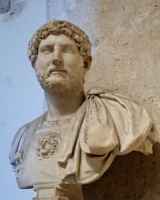
Hadrian

 
Hadrian

   Email Print
   Bookmark   Link


Hadrian


Publius Aelius Hadrianus (January 24, 76 – July 10, 138), as emperor Imperator Caesar Divi Traiani filius Traianus Hadrianus Augustus, and Divus Hadrianus after his apotheosis
Apotheosis

Apotheosis refers to the exaltation of a subject to divinity level. The term has meanings in theology, where it refers to a belief, and in art, where it refers to a genre....
, known as Hadrian in English
English language

English is a West Germanic language that originated in Anglo-Saxon England and has lingua franca status in many parts of the world as a result of the military, economic, scientific, political and cultural influence of the British Empire in the 18th, 19th and early 20th centuries and that of the United States from the mid 20th century onwa...
, was emperor
Roman Emperor

The Roman Emperor was the ruler of the Roman Empire during the imperial period . The Romans had no single term for the office: Latin language titles such as imperator , Augustus , Caesar and princeps were all associated with it....
 of Rome
Roman Empire

The Roman Empire was the Roman Republic phase of the Ancient Rome, characterised by an autocracy form of government and large territorial holdings in Europe and around the Mediterranean....
 from AD 117 to 138, as well as a Stoic
Stoicism

Stoicism was a school of Hellenistic philosophy founded in Athens by Zeno of Citium in the early third century B.C. The stoics considered passionate emotions to be the result of errors in judgment, and that a Sage , or person of "moral and intellectual perfection," would not have such emotions....
 and Epicurean
Epicureanism

Epicureanism is a system of philosophy based upon the teachings of Epicurus , founded around 307 BC. Epicurus was an atomism materialism, following in the steps of Democritus....
 philosopher. A member of the gens
Gens

In ancient Rome, a gens was a clan, caste, or group of families, that shared a common name and a belief in a common ancestor. In the Roman naming convention, the second name was the name of the gens to which the person belonged....
 Aelia
Aelius

Aelius was the nomen of the ancient Rome gens Aelia_gens. Among its members was the Roman Emperor Hadrian.* Publius Aelius Paetus , consul 337 BC...
, Hadrian was the third of the so-called Five Good Emperors
Five Good Emperors

The Five Good Emperors is a term that refers to five consecutive emperors of the Roman Empire who represented a line of virtuous and just rule ? Nerva, Trajan, Hadrian, Antoninus Pius, and Marcus Aurelius....
, or the second of the recently proposed Ulpio-Aelian dynasty.


Discussion
Ask a question about 'Hadrian'
Start a new discussion about 'Hadrian'
Answer questions from other users
Full Discussion Forum


Timeline

112   Hadrian succeeds Gaius Julius Cassius Steirieus as archon of Athens.

117   Trajan subdued a Judean revolt, then fell seriously ill, leaving Hadrian in command of the east.

118   Roman Emperor Hadrian is also a Roman Consul.

119   Roman Emperor Hadrian stations the Legio VI ''Victrix'' in Roman Britain, to assist in quelling a local rebellion.

120   Emperor Hadrian visits Britain

121   Hadrian fixes the border between Roman Britain and Caledonia on a line running from the River Tyne to the Solway Firth.

122   Hadrian orders that a 72-mile (115-kilometer) wall be built in northern Britain. Hadrian's Wall, as it comes to be known, is intended to keep the Caledonians, Picts and other tribes at bay.

123   Roman Emperor Hadrian's villa at Tivoli was built.

124   Hadrian begins to rebuild the Olympeion in Athens.

125   Construction of the Pantheon (Rome) as it stands today by Hadrian.


Encyclopedia


Publius Aelius Hadrianus (January 24, 76 – July 10, 138), as emperor Imperator Caesar Divi Traiani filius Traianus Hadrianus Augustus, and Divus Hadrianus after his apotheosis
Apotheosis

Apotheosis refers to the exaltation of a subject to divinity level. The term has meanings in theology, where it refers to a belief, and in art, where it refers to a genre....
, known as Hadrian in English
English language

English is a West Germanic language that originated in Anglo-Saxon England and has lingua franca status in many parts of the world as a result of the military, economic, scientific, political and cultural influence of the British Empire in the 18th, 19th and early 20th centuries and that of the United States from the mid 20th century onwa...
, was emperor
Roman Emperor

The Roman Emperor was the ruler of the Roman Empire during the imperial period . The Romans had no single term for the office: Latin language titles such as imperator , Augustus , Caesar and princeps were all associated with it....
 of Rome
Roman Empire

The Roman Empire was the Roman Republic phase of the Ancient Rome, characterised by an autocracy form of government and large territorial holdings in Europe and around the Mediterranean....
 from AD 117 to 138, as well as a Stoic
Stoicism

Stoicism was a school of Hellenistic philosophy founded in Athens by Zeno of Citium in the early third century B.C. The stoics considered passionate emotions to be the result of errors in judgment, and that a Sage , or person of "moral and intellectual perfection," would not have such emotions....
 and Epicurean
Epicureanism

Epicureanism is a system of philosophy based upon the teachings of Epicurus , founded around 307 BC. Epicurus was an atomism materialism, following in the steps of Democritus....
 philosopher. A member of the gens
Gens

In ancient Rome, a gens was a clan, caste, or group of families, that shared a common name and a belief in a common ancestor. In the Roman naming convention, the second name was the name of the gens to which the person belonged....
 Aelia
Aelius

Aelius was the nomen of the ancient Rome gens Aelia_gens. Among its members was the Roman Emperor Hadrian.* Publius Aelius Paetus , consul 337 BC...
, Hadrian was the third of the so-called Five Good Emperors
Five Good Emperors

The Five Good Emperors is a term that refers to five consecutive emperors of the Roman Empire who represented a line of virtuous and just rule ? Nerva, Trajan, Hadrian, Antoninus Pius, and Marcus Aurelius....
, or the second of the recently proposed Ulpio-Aelian dynasty. His reign had a faltering beginning, a glorious middle, and a tragic conclusion.The Roman Empire reached its peak geographical size under Hadrian's rule, in the year 125
125

Events...
.

Hadrian was born Publius Aelius Hadrianus in Italica
Italica

The city of Italica was founded in 206 BC by the Roman general Publius Cornelius Scipio Africanus in order to settle Roman soldiers wounded in the Battle of Ilipa, where the Carthaginian army was defeated during the Second Punic War....
 or, less probably, in Rome
Rome

Rome is the capital city of Italy and Lazio, and is Italy's largest and most populous city, with 2,724,347 residents in an urban area of some ....
, from a well-established family which had originated in Picenum
Picenum

Picenum was a region of Ancient Rome Italy. Picenum was the birthplace of such notables as Pompey the Great and his father Pompeius Strabo. It was situated in what is now the region of Marche in modern Italy....
 in Italy
Italy

Italy , officially the Italian Republic , is a country located on the Italian Peninsula in Southern Europe and on the two largest islands in the Mediterranean Sea, Sicily and Sardinia....
 and had subsequently settled in Italica
Italica

The city of Italica was founded in 206 BC by the Roman general Publius Cornelius Scipio Africanus in order to settle Roman soldiers wounded in the Battle of Ilipa, where the Carthaginian army was defeated during the Second Punic War....
, Hispania Baetica
Hispania Baetica

Hispania Baetica was one of three Imperial Roman provincesin Hispania, . Hispania Baetica was bordered to the west by Lusitania , and to the northeast by Hispania Tarraconensis....
 (the republican Hispania
Hispania

Hispania was the name given by the Ancient Rome to the whole of the Iberian Peninsula . When Rome was a Roman Republic, Hispania was divided into Roman provinces: Hispania Citerior and Hispania Ulterior....
 Ulterior), near the present day location of Seville, Spain. His predecessor Trajan
Trajan

Marcus Ulpius Nerva Traianus, commonly known as Trajan , was a Roman Emperors who reigned from 98 until his death in 117. Born Marcus Ulpius Traianus into a nonpatrician family in the Hispania Baetica province , Trajan rose to prominence during the reign of emperor Domitian, serving as a general in the Roman army along the Limes G...
 was a maternal cousin of Hadrian's father. Trajan never officially designated a successor, but, according to his wife, Pompeia Plotina
Pompeia Plotina

Pompeia Plotina Claudia Phoebe Piso or Pompeia Plotina was a Roman Empress and wife of Roman Emperor Trajan. She was renowned for her interest in philosophy, and her virtue, dignity and simplicity....
, Trajan named Hadrian emperor immediately before his death. Trajan's wife was well-disposed toward Hadrian: Hadrian may well have owed his succession to her.

Hadrian's presumed indebtedness to Plotina was widely regarded as the reason for Hadrian's succession. However, there is evidence that he accomplished his succession on his own governing and leadership merits while Trajan was still alive. For example, between the years AD 100–108 Trajan gave several public examples of his personal favour towards Hadrian, such as betrothing him to his grandniece, Vibia Sabina
Vibia Sabina

Vibia Sabina was a Roman Empress, wife and third cousin to Roman Emperor Hadrian. She was the daughter to Salonina Matidia, niece of Roman Emperor Trajan and Lucius Vibius Sabinus, a man of consular rank....
, designating him quaestor Imperatoris, comes Augusti, giving him Nerva's diamond "as hope of succession", proposing him for consul suffectus, and other gifts and distinctions. The young Hadrian was Trajan's only direct male family/marriage/bloodline. The support of Plotina and of L. Licinius Sura
Lucius Licinius Sura

Lucius Licinius Sura was an influential Ancient Rome Roman Senate from Tarraco, a close friend of the Emperor Trajan and three times consul - in a period when three consulates were very rare for non-members of the Imperial family - in AD 93 , 102 and 107....
 (died in AD 108) were nonetheless extremely important for Hadrian, already in this early epoch.

Early life

Although it was an accepted part of Hadrian's personal history that Hadrian was born in Italica
Italica

The city of Italica was founded in 206 BC by the Roman general Publius Cornelius Scipio Africanus in order to settle Roman soldiers wounded in the Battle of Ilipa, where the Carthaginian army was defeated during the Second Punic War....
 located in the province called Hispania Baetica
Hispania Baetica

Hispania Baetica was one of three Imperial Roman provincesin Hispania, . Hispania Baetica was bordered to the west by Lusitania , and to the northeast by Hispania Tarraconensis....
 (the southernmost Roman province in the Iberian Peninsula
Iberian Peninsula

The Iberian Peninsula, or Iberia, is located in the extreme southwest of Europe and includes modern-day Spain, Portugal, Andorra and Gibraltar and a very small area of France....
, comprising modern Spain
Spain

Spain or the Kingdom of Spain , is a country located in Southern Europe on the Iberian Peninsula.The Spanish constitution does not establish any official denomination of the country, even though Espa?a , Estado espa?ol and Naci?n espa?ola are used interchangeably....
 and Portugal
Portugal

Portugal , officially the Portuguese Republic , is a country on the Iberian Peninsula. Located in southwestern Europe, Portugal is the westernmost country of mainland Europe and is bordered by the Atlantic Ocean to the west and south and by Spain to the north and east....
), he himself stated in his autobiography, now lost, that he was born in Rome on 24 January 76 of a family originally Italian, but Hispanian for many generations. However, this may be made up so Hadrian would look like a pure-bred Roman instead of being from the provinces. His father was the Hispano-Roman Publius Aelius Hadrianus Afer
Publius Aelius Hadrianus Afer

Publius Aelius Hadrianus Afer was a Roman who lived in the 1st century. Afer was originally from Spain; however, he was of Ancient Rome descent....
, who as a senator
Roman Senate

The Senate of the Roman Republic was a political institution in the ancient Roman Republic. According to the Greek historian Polybius, our principal source on the Constitution of the Roman Republic, the Roman Senate was the predominant branch of government....
 of praetor
Praetor

Praetor was a Title#Titles_for_heads_of_state granted by the government of Ancient Rome to men acting in one of two official capacities: the commander of an army, either before it was mustered or more typically in the field, or an elected Magistratus assigned duties that varied depending on the historical period....
ian rank would spend much of his time in Rome. Hadrian’s forefathers came from Hadria, modern Atri
Atri, Italy

Atri is a comune in the Province of Teramo in the Abruzzo region of Italy. It has a population of over 11,500 . Atri is the setting of the story The Bell of Atri....
, an ancient town of Picenum in Italy, but the family had settled in Italica
Italica

The city of Italica was founded in 206 BC by the Roman general Publius Cornelius Scipio Africanus in order to settle Roman soldiers wounded in the Battle of Ilipa, where the Carthaginian army was defeated during the Second Punic War....
 in Hispania Baetica soon after its founding by Scipio Africanus
Scipio Africanus

Publius Cornelius Scipio Africanus also known as Scipio Africanus, Scipio the Elder, and Africanus the Elder was a general in the Second Punic War and statesman of the Roman Republic....
. Afer was a paternal cousin of the future Emperor Trajan
Trajan

Marcus Ulpius Nerva Traianus, commonly known as Trajan , was a Roman Emperors who reigned from 98 until his death in 117. Born Marcus Ulpius Traianus into a nonpatrician family in the Hispania Baetica province , Trajan rose to prominence during the reign of emperor Domitian, serving as a general in the Roman army along the Limes G...
. His mother was Domitia Paulina
Paulina

Paulina or Paullina was the name shared by three relatives of the Roman Emperor Hadrian: his mother, his elder sister and his niece....
 who came from Gades (Cádiz
Cádiz

C?diz is a city and port in southwestern Spain. It is the capital of the province of C?diz, one of eight which make up the Autonomous communities of Spain of Andalusia....
). Paulina was a daughter of a distinguished Hispano-Roman Senatorial family. Hadrian’s elder sister and only sibling was Aelia Domitia Paulina
Paulina

Paulina or Paullina was the name shared by three relatives of the Roman Emperor Hadrian: his mother, his elder sister and his niece....
, married with the triple consul Lucius Julius Ursus Servianus
Lucius Julius Ursus Servianus

Lucius Julius Ursus Servianus was a Spanish Roman Empire politician. According to an inscription found, his full name is Gaius Julius Servilius Ursus Servianus, however in Augustan History, he is known as Lucius Julius Ursus Servianus....
, his niece was Julia Serviana Paulina
Paulina

Paulina or Paullina was the name shared by three relatives of the Roman Emperor Hadrian: his mother, his elder sister and his niece....
 and his great-nephew was Gnaeus Pedanius Fuscus Salinator, from Barcino
Barcino

Barcino may refer to:*Barcelona, Spain - Barcino in Latin*Barcino, Poland...
. His parents died in 86 when Hadrian was ten, and the boy then became a ward of both Trajan and Publius Acilius Attianus
Publius Acilius Attianus

Publius Acilius Attianus was a powerful Roman official who played a significant though obscure role in the transfer of the imperial power from Trajan to Hadrian....
 (who was later Trajan’s Praetorian Prefect). Hadrian was schooled in various subjects particular to young aristocrats of the day, and was so fond of learning Greek
Greece

Greece , officially the Hellenic Republic , is a country in southeastern Europe, situated on the southern end of the Balkans. It has borders with Albania, Bulgaria and the former Yugoslav Republic of Macedonia to the north, and Turkey to the east....
 literature that he was nicknamed Graeculus ("Little Greek").

Hadrian visited Italica
Italica

The city of Italica was founded in 206 BC by the Roman general Publius Cornelius Scipio Africanus in order to settle Roman soldiers wounded in the Battle of Ilipa, where the Carthaginian army was defeated during the Second Punic War....
 when (or never left it until) he was 14, when he was recalled by Trajan who thereafter looked after his development. He never returned to Italica although it was later made a colonia
Colonia (Roman)

A Roman colonia was originally a Roman Empire outpost established in conquered territory to secure it. Eventually, however, the term came to denote the highest status of Roman city....
 in his honour. His first military service was as a tribune
Tribune

Tribune was a title shared by 10 elected officials in the Roman Republic. Tribunes had the power to convene the Plebeian Council and to act as its president, which also gave them the exclusive right to propose legislation before it....
 of the Legio II Adiutrix
Legio II Adiutrix

Legio secunda Adiutrix , was a Roman legion levied by emperor Vespasian in 70, from Roman navy marines of the classis Ravennatis. There are still records of II Adiutrix in the Rhine border in the beginning of the 4th century....
. Later, he was to be transferred to the Legio I Minervia
Legio I Minervia

Legio prima Minervia was a Roman legion levied by emperor Domitian in 82, for the campaign against the Germanic tribe of the Chatti. Its cognomen is related to the goddess Minerva, the legion's protector....
 in Germany
Germany

Germany , officially the Federal Republic of Germany , is a country in Central Europe. It is bordered to the north by the North Sea, Denmark, and the Baltic Sea; to the east by Poland and the Czech Republic; to the south by Austria and Switzerland; and to the west by France, Luxembourg, Belgium, and the Netherlands....
. When Nerva
Nerva

Marcus Cocceius Nerva was a Roman Emperor who reigned from AD 96 until his death in 98. Nerva acceded to this position at the advanced age of 65, after a lifetime of imperial service under Nero and the rulers of the Flavian dynasty--Vespasian, Titus and Domitian....
 died in 98, Hadrian rushed to inform Trajan personally. He later became legate
Legatus

A legatus was a general in the Roman army, equivalent to a modern general officer. Being of Roman senate rank, his immediate superior was the dux, and he outranked all military tribunes....
 of a legion
Roman legion

The Roman Legion is a term that can apply both as a translation of legio to the entire Roman army and also, more narrowly , to the heavy infantry that was the basic military unit of the Roman army in the period of the late Roman Republic and the Roman Empire....
 in Upper Pannonia
Pannonia

Pannonia is an ancient province of the Roman Empire bounded north and east by the Danube, coterminous westward with Noricum and upper Italy, and southward with Dalmatia and upper Moesia....
 and eventually governor of said province. He was also archon
Archon

Archon is a Greek language word that means "ruler", frequently used as the title of a specific public office. It is the masculine present participle of the verb stem ???-, meaning "to rule", derived from the same root as monarch, hierarchy and anarchism....
 in Athens
Athens

Athens , the Capital and largest city of Greece, dominates the Attica periphery; as one of the List of cities by time of continuous habitation, its recorded history spans around 3,400 years....
 for a brief time, and was elected an Athenian citizen.

His career before becoming emperor follows: decemvir stlitibus iudicandis - sevir turmae equitum Romanorum - praefectus Urbi feriarum Latinarum - tribunus militum legionis II Adiutricis Piae Fidelis (95, in Pannonia Inferior) - tribunus militum legionis V Macedonicae (96, in Moesia Inferior) - tribunus militum legionis XXII Primigeniae Piae Fidelis (97, in Germania Superior) - quaestor (101) - ab actis senatus - tribunus plebis (105) - praetor (106) - legatus legionis I Minerviae Piae Fidelis (106, in Germania Inferior) - legatus Augusti pro praetore Pannoniae Inferioris (107) - consul suffectus (108) - septemvir epulonum (before 112) - sodalis Augustalis (before 112) - archon Athenis (112/13) - legatus Syriae (117).

Hadrian was active in the wars against the Dacia
Dacia

In ancient geography, Dacia was the land of the Dacians. It was named by the ancient Greeks "Getae". Dacia was a large district of East-Central Europe, bounded on the north by the Carpathian Mountains, on the south by the Danube, on the west by the Tisia or Tisza, on the east by the Tyras or Dniester, now in eastern Moldova....
ns (as legate of the V Macedonica
Legio V Macedonica

Legio quinta Macedonica was a Roman legion. It was probably originally levied by consul Gaius Vibius Pansa Caetronianus and Augustus in 43 BC, and it existed in Moesia at least until 5th century....
) and reputedly won awards from Trajan for his successes. Due to an absence of military action in his reign, Hadrian's military skill is not well attested; however, his keen interest and knowledge of the army and his demonstrated skill of administration show possible strategic talent.

Hadrian joined Trajan's expedition against Parthia as a legate on Trajan’s staff. Neither during the initial victorious phase, nor during the second phase of the war when rebellion swept Mesopotamia did Hadrian do anything of note. However when the governor of Syria
Syria (Roman province)

Syria was a Roman province, annexed in 64 BC by Pompey, as a consequence of his military presence after pursuing victory in the Third Mithridatic War....
 had to be sent to sort out renewed troubles in Dacia, Hadrian was appointed as a replacement, giving him an independent command. Trajan, seriously ill by that time, decided to return to Rome while Hadrian remained in Syria
Syria (Roman province)

Syria was a Roman province, annexed in 64 BC by Pompey, as a consequence of his military presence after pursuing victory in the Third Mithridatic War....
 to guard the Roman rear. Trajan only got as far as Selinus before he became too ill to go further. While Hadrian may have been the obvious choice as successor, he had never been adopted as Trajan's heir. As Trajan lay dying, nursed by his wife, Plotina (a supporter of Hadrian), he at last adopted Hadrian as heir. Since the document was signed by Plotina, it has been suggested that Trajan may have already been dead.

Emperor


Securing power

Mauzoleum Hadriana
Hadrian quickly secured the support of the legions — one potential opponent, Lusius Quietus
Lusius Quietus

Lusius Quietus was a Ancient Rome general and governor of Iudaea Province in 117....
, was instantly dismissed. The Senate's endorsement followed when possibly falsified papers of adoption from Trajan were presented (although he had been the ward of Trajan
Trajan

Marcus Ulpius Nerva Traianus, commonly known as Trajan , was a Roman Emperors who reigned from 98 until his death in 117. Born Marcus Ulpius Traianus into a nonpatrician family in the Hispania Baetica province , Trajan rose to prominence during the reign of emperor Domitian, serving as a general in the Roman army along the Limes G...
). The rumor of a falsified document of adoption carried little weight — Hadrian's legitimacy arose from the endorsement of the Senate and the Syrian armies.

Hadrian did not at first go to Rome — he was busy sorting out the East and suppressing the Jewish revolt that had broken out under Trajan, then moving on to sort out the Danube
Danube

The Danube is the longest river in the European Union and Europe's second longest river after the Volga.The river originates in the Black Forest in Germany as the much smaller Brigach and Breg River rivers which join at the eponymously named German town Donaueschingen, after which it is known as the Danube and flows eastwards for a distance...
 frontier. Instead, Attianus, Hadrian's former guardian, was put in charge in Rome. There he "discovered" a plot involving four leading Senators including Lusius Quietus and demanded of the Senate their deaths. There was no question of a trial — they were hunted down and killed out of hand. Because Hadrian was not in Rome at the time, he was able to claim that Attianus had acted on his own initiative. According to Elizabeth Speller the real reason for their deaths was that they were Trajan's men.

Hadrian and the military
Despite his own great stature as a military administrator, Hadrian's reign was marked by a general lack of major military conflicts, apart from the Second Roman-Jewish War. He surrendered Trajan's conquests in Mesopotamia
Mesopotamia

Mesopotamia is the area of the Tigris-Euphrates river system, along the Tigris and Euphrates rivers, largely corresponding to modern Iraq, as well as some parts of northeastern Syria, some parts of southeastern Turkey, and some parts of the Khuzestan Province of southwestern Iran....
, considering them to be indefensible. There was almost a war with Parthia
Parthia

Parthia is a region of north-eastern Iran, best known for having been the political and cultural base of the Arsacid dynasty, after which the Arsacid Empire is then also known as the 'Parthian Empire'....
 around 121, but the threat was averted when Hadrian succeeded in negotiating a peace.

The peace policy was strengthened by the erection of permanent fortifications along the empire's borders (limites, sl.
Grammatical number

In linguistics, grammatical number is a grammatical category of nouns, pronouns, and adjective and verb agreement that expresses count distinctions ....
 limes). The most famous of these is the massive Hadrian's Wall
Hadrian's Wall

Hadrian's Wall is a Rock and Sod fortification built by the Roman Empire across the width of what is now northern England. Begun in AD 122, during the rule of emperor Hadrian, it was the middle of three such fortifications built across Great Britain, the first being from the River Clyde to the River Forth under Agricola and the last the Ant...
 in Great Britain
Great Britain

Great Britain is an island lying to the northwest of Continental Europe. It is the List of islands by area, and the largest in Europe. With a population of 58.9 million people it is List of islands by population....
, and the Danube
Danube

The Danube is the longest river in the European Union and Europe's second longest river after the Volga.The river originates in the Black Forest in Germany as the much smaller Brigach and Breg River rivers which join at the eponymously named German town Donaueschingen, after which it is known as the Danube and flows eastwards for a distance...
 and Rhine
Rhine

File:Swiss Grand Canyon.jpgThe Rhine is one of the longest and most important rivers in Europe, at , with an average discharge of more than ....
 borders were strengthened with a series of mostly wooden fortification
Fortification

Fortifications are military constructions and buildings designed for defense in warfare and military bases. Humans have constructed defensive works for many thousands of years, in a variety of increasingly complex designs....
s, forts, outpost
Outpost

Outpost may refer to:* Cyberian Outpost, an online vendor of discount computerware* Israeli outpost, small Israeli settlements* Outpost Magazine, a monthly magazine published by Americans for a Safe Israel...
s and watchtowers, the latter specifically improving communications and local area security. To maintain morale and keep the troops from getting restive, Hadrian established intensive drill routines, and personally inspected the armies. Although his coins showed military images almost as often as peaceful ones, Hadrian's policy was peace through strength, even threat.

Cultural pursuits and patronage

Hadrian has been described, by Ronald Syme among others, as the most versatile of all the Roman Emperors. He also liked to display a knowledge of all intellectual and artistic fields. Above all, Hadrian patronized the arts: Hadrian's Villa
Hadrian's Villa

The Hadrian's Villa is a large Roman Empire archaeological complex at Tivoli, Italy, Italy....
 at Tibur (Tivoli
Tivoli, Italy

Tivoli, the classical Tibur, is an ancient Italy town in Lazio, about 30 km from Rome, at the falls of the Aniene river, where it issues from the Sabine hills....
) was the greatest Roman example of an Alexandria
Alexandria

Alexandria , with a population of 4.1 million, is the second-largest city in Egypt, and is the country's largest seaport, serving about 80% of Egypt's imports and exports....
n garden, recreating a sacred landscape, lost in large part to the despoliation of the ruins by the Cardinal d'Este
Ippolito II d'Este

Ippolito d'Este was an Italian cardinal . He was a member of the House of Este, and nephew of the other Ippolito d'Este, also a cardinal....
 who had much of the marble removed to build Villa d'Este
Villa d'Este

The Villa d'Este is a villa situated at Tivoli, Italy, near Rome. Listed as a World Heritage Sites, it is a masterpiece of Italy architecture and especially garden design....
. In Rome
Rome

Rome is the capital city of Italy and Lazio, and is Italy's largest and most populous city, with 2,724,347 residents in an urban area of some ....
, the Pantheon
Pantheon, Rome

The Pantheon is a building in Rome which was originally built as a temple to all the gods of Ancient Rome, and rebuilt circa 126 AD during Hadrian's reign....
, originally built by Agrippa
Marcus Vipsanius Agrippa

Marcus Vipsanius Agrippa was a Roman statesman and general. He was a close friend, son-in-law, lieutenant and minister to Octavian, the future emperor Caesar Augustus....
 but destroyed by fire in 80, was rebuilt under Hadrian in the domed form it retains to this day. It is among the best preserved of Rome's ancient buildings and was highly influential to many of the great architects of the Italian Renaissance
Italian Renaissance

The Italian Renaissance began the opening phase of the Renaissance, a period of great cultural change and achievement in Europe that spanned the period from the end of the 13th century to about 1600, marking the transition between Medieval and Early Modern Europe....
 and Baroque
Baroque

In the the arts, the Baroque was a Western cultural Epoch , starting roughly at the beginning of the 17th century in Rome, Italy. It was exemplified by drama and grandeur in Baroque sculpture, Baroque painting, literature, Baroque dance, and Baroque music....
 periods.

From well before his reign, Hadrian displayed a keen interest in architecture, but it seems that his eagerness was not always well received. For example, Apollodorus of Damascus
Apollodorus of Damascus

Apollodorus of Damascus was a History of Greece or History of Syria engineer, architect, designer and sculptor who flourished during the 2nd century AD....
, famed architect of the Forum of Trajan, dismissed his designs. When Trajan
Trajan

Marcus Ulpius Nerva Traianus, commonly known as Trajan , was a Roman Emperors who reigned from 98 until his death in 117. Born Marcus Ulpius Traianus into a nonpatrician family in the Hispania Baetica province , Trajan rose to prominence during the reign of emperor Domitian, serving as a general in the Roman army along the Limes G...
, predecessor to Hadrian, consulted Apollodorus about an architectural problem, Hadrian interrupted to give advice, to which Apollodorus replied, "Go away and draw your pumpkins. You know nothing about these problems." "Pumpkins" refers to Hadrian's drawings of domes like the Serapeum in his Villa. It is rumored that once Hadrian succeeded Trajan to become emperor, he had Apollodorus exiled and later put to death. It is very possible that this later story was a later attempt to defame his character, as Hadrian, though popular among a great many across the empire, was not universally admired, either in his lifetime or afterward.

Hadrian wrote poetry in both Latin and Greek; one of the few surviving examples is a Latin poem he reportedly composed on his deathbed (see below). He also wrote an autobiography – not, apparently, a work of great length or revelation, but designed to scotch various rumours or explain his various actions. The work is lost but was apparently used by the writer — whether Marius Maximus
Marius Maximus

Marius Maximus was a Roman biographer, writing in Latin, who in the early decades of the 3rd century AD wrote a series of biographies of twelve Emperors, imitating and continuing Suetonius....
 or someone else – on whom the Historia Augusta principally relied for its vita of Hadrian: at least, a number of statements in the vita have been identified (by Ronald Syme
Ronald Syme

Sir Ronald Syme, Order of Merit , Fellow of the British Academy was a New Zealand-born historian and classics....
 and others) as probably ultimately stemming from the autobiography.

Hadrian was a passionate hunter, already from the time of his youth according to one source. In northwest Asia, he founded and dedicated a city to commemorate a she-bear he killed. It is documented that in Egypt he and his beloved Antinous
Antinous

For the constellation, see Antinous ; for the asteroid, see 1863 Antinous; for the mythological figure, see Antinous son of EupeithesAntino?s or Antino?s , was a member of the Roman Emperor Hadrian's entourage, to whom he was beloved....
 killed a lion. In Rome, eight reliefs featuring Hadrian in different stages of hunting on a building that began as a monument celebrating a kill.

Another of Hadrian's contributions to "popular" culture was the beard, which symbolised his philhellenism. Except for Nero
Nero

Nero Claudius Caesar Augustus Germanicus , born Lucius Domitius Ahenobarbus, also called Nero Claudius Caesar Drusus Germanicus, was the fifth and final Roman emperor of the Julio-Claudian dynasty....
 (also a great lover of Greek culture), all Roman emperors before Hadrian were clean shaven. Most of the emperors after Hadrian would be portrayed with beards. Their beards, however, were not worn out of an appreciation for Greek culture but because the beard had, thanks to Hadrian, become fashionable.

Hadrian was a humanist
Humanism

Humanism is a broad category of ethics that affirm the dignity and worth of all people, based on the ability to determine right and wrong by appealing to universal human qualities, particularly rationalism, without resorting to the supernatural or alleged divine authority from religious texts....
 and deeply Hellenophile
Hellenistic civilization

File:Diadochen1.pngHellenistic civilization represents the zenith of Ancient Greece influence in the Classical Antiquity from 323 BC to about 146 BC ....
 in all his tastes. He favoured the doctrines of the philosophers Epictetus
Epictetus

Epictetus was a Ancient Greece Stoicism philosophy. He was probably born a slave at Hierapolis, Phrygia , and lived in Rome until his exile to Nicopolis in northwestern Greece, where he lived most of his life and died....
, Heliodorus and Favorinus
Favorinus

Favorinus of Arelata was a Hellenistic sophist and philosopher who flourished during the reign of Hadrian.He was of Gauls ancestry, born in Arelate ....
, but was generally considered an Epicurean, as were some of his friends such as Caius Bruttius Praesens
Caius Bruttius Praesens

Caius or Gaius Bruttius Praesens Lucius Fulvius Rusticus was an important Roman senator of the reigns of Roman emperors Trajan, Hadrian and Antoninus Pius....
. At home he attended to social needs. Hadrian mitigated but did not abolish slavery, had the legal code humanized and forbade torture. He built libraries, aqueducts
Roman aqueduct

Romans constructed numerous aqueducts to supply water to cities and industrial sites. These aqueducts were amongst the greatest engineering feats of the ancient world, and set a standard not equaled for over a thousand years after the fall of Rome....
, baths and theaters. Hadrian is considered by many historians to have been wise and just: Schiller called him "the Empire's first servant", and British historian Edward Gibbon
Edward Gibbon

Edward Gibbon was an English historian and Member of Parliament. His most important work, The History of the Decline and Fall of the Roman Empire, was published in six volumes between 1776 and 1788....
 admired his "vast and active genius", as well as his "equity and moderation". In 1776, he stated that Hadrian's epoch was part of the "happiest era of human history".

While visiting Greece in 125, Hadrian attempted to create a kind of provincial parliament
Parliament

A parliament is a legislature, especially in those countries whose system of government is based on the Westminster system modeled after that of the United Kingdom....
 to bind all the semi-autonomous former city states across all Greece and Ionia
Ionia

Ionia is an ancient region of central coastal Anatolia in present-day Turkey, the region nearest Izmir, which was historically Smyrna. It consisted of the northernmost territories of the Ionian League of Hellenes settlements....
 (in Asia Minor). This parliament, known as the Panhellenion
Panhellenion

The Panhellenion or Panhellenium was an institution established in the year AD131/2 by the Roman Emperor Hadrian while he was touring the Roman Greece....
, failed despite spirited efforts to instill cooperation among the Hellenes.

Hadrian was especially famous for his relationship with a Greek youth, Antinous
Antinous

For the constellation, see Antinous ; for the asteroid, see 1863 Antinous; for the mythological figure, see Antinous son of EupeithesAntino?s or Antino?s , was a member of the Roman Emperor Hadrian's entourage, to whom he was beloved....
, whom he met in Bithynia
Bithynia

Bithynia was an ancient region, kingdom and Roman province in the northwest of Asia Minor, adjoining the Propontis, the Thrace Bosporus and the Euxine ....
 in 124 when the boy was thirteen or fourteen. While touring Egypt in 130, Antinous mysteriously drowned in the Nile
Nile

The Nile is a major north-flowing river in Africa, generally regarded as the List of rivers by length in the world.The Nile has two major tributary, the White Nile and Blue Nile, the latter being the source of most of the Nile's water and silt, but the former being the longer of the two....
. Deeply saddened, Hadrian founded the Egyptian city of Antinopolis
Antinopolis

Antinopolis was a city founded at an older Egyptian village by the Roman Empire emperor Hadrian to commemorate his deified young eromenos, Antinous, on the east bank of the Nile, not far from the site in Upper Egypt where Antinous drowned in 130 A.D....
, and had Antinous deified - an unprecedented honour for one not of the ruling family.

Hadrian died at his villa in Baiae
Baiae

Baiae is a frazione of the comune of Bacoli, in the Campania region of Italy on the Bay of Naples. It was named after Baius, who was supposedly buried there....
. He was buried in a mausoleum
Mausoleum

A mausoleum is an external free-standing building constructed as a monument enclosing the interment space or burial chamber of a deceased person or persons....
 on the western bank of the Tiber
Tiber

The Tiber is the third-longest river in Italy, rising in the Apennine mountains in Emilia-Romagna and flowing 406 kilometres through Umbria and Lazio to the Tyrrhenian Sea....
, in Rome
Rome

Rome is the capital city of Italy and Lazio, and is Italy's largest and most populous city, with 2,724,347 residents in an urban area of some ....
, a building later transformed into a papal fortress, Castel Sant'Angelo
Castel Sant'Angelo

The Mausoleum of Hadrian, usually known as the Castel Sant'Angelo, is a towering cylindrical building in Rome, initially commissioned by the Roman Emperor Hadrian as a mausoleum for himself and his family....
. The dimensions of his mausoleum, in its original form, were deliberately designed to be slightly larger than the earlier Mausoleum of Augustus.

According to Cassius Dio a gigantic equestrian statue was erected to Hadrian after his death. "It was so large that the bulkiest man could walk through the eye of each horse, yet because of the extreme height of the foundation persons passing along on the ground below believe that the horses themselves as well as Hadrian are very small."

Hadrian's travels


Purpose

Aureus   Adriano   Ric 0144
The Stoic-Epicurean Emperor traveled broadly, inspecting and correcting the legions in the field. Even prior to becoming emperor, he had traveled abroad with the Roman military, giving him much experience in the matter. More than half his reign was spent outside of Italy. Other emperors often left Rome to simply go to war, returning soon after conflicts concluded. A previous emperor, Nero
Nero

Nero Claudius Caesar Augustus Germanicus , born Lucius Domitius Ahenobarbus, also called Nero Claudius Caesar Drusus Germanicus, was the fifth and final Roman emperor of the Julio-Claudian dynasty....
, once traveled through Greece and was condemned for his self indulgence. Hadrian, by contrast, traveled as a fundamental part of his governing, and made this clear to the Roman senate and the people. He was able to do this because at Rome he possessed a loyal supporter within the upper echelons of Roman society, a military veteran by the name of Marcius Turbo
Marcius Turbo

Introduction/Overview During the reigns of Emperor Trajan and Emperor Hadrian, the Roman Empire reached its zenith in terms of size, wealth, stability and tranquility....
. Also, there are hints within certain sources that he also employed a secret police
Secret police

Secret police are a police agency which operates in secrecy to maintain national security against internal threats to the state.Secret police forces are typically associated with totalitarianism regimes, as they are often used to maintain the political power of the state rather than uphold the rule of law....
 force, the frumentarii
Frumentarii

We have two main sources of information about the frumentarii, inscriptions on gravestones etc. and anecdotes where the actions of individual frumentarii are mentioned by historians....
, to exert control and influence in case anything should go wrong while he journeyed abroad.

Hadrian's visits were marked by handouts which often contained instructions for the construction of new public buildings. Hadrian was willful of strengthening the Empire from within through improved infrastructure, as opposed to conquering or annexing perceived enemies. This was often the purpose of his journeys; commissioning new structures, projects and settlements. His almost evangelical belief in Greek culture strengthened his views: like many emperors before him, Hadrian's will was almost always obeyed. His traveling court was large, including administrators and likely architect
Architect

An architect is trained and licenced in planning and designing buildings, and participates in supervising the construction of a building. Etymologically, architect derives from the Latin architectus, itself derived from the Greek arkhitekton , i.e....
s and builder
Builder

Builder can mean any of the following:*General contractor or Subcontractor that specializes in building*Construction worker who specializes in building work...
s. The burden on the areas he passed through were sometimes great. While his arrival usually brought some benefits it is possible that those who had to carry the burden were of different class to those who reaped the benefits. For example, huge amounts of provisions were requisitioned during his visit to Egypt
Egypt

Egypt is a country mainly in North Africa, with the Sinai Peninsula forming a land bridge in Western Asia. Covering an area of about , Egypt borders the Mediterranean Sea to the north, the Gaza Strip and Israel to the northeast, the Red Sea to the east, Sudan to the south and Libya to the west....
, this suggests that the burden on the mainly subsistence farmers
Subsistence agriculture

Subsistence agriculture is self-sufficiency farming in which farmers grow only enough food to feed their family and pay taxes. The typical subsistence farm has a range of crops and animals needed by the family to eat during the year....
 must have been intolerable, causing some measure of starvation
Starvation

Starvation is a severe reduction in vitamin, nutrient, and energy intake, and is the most extreme form of malnutrition. In humans, prolonged starvation causes permanent organ damage and, eventually, death....
 and hardship. At the same time, as in later times all the way through the European Renaissance, kings were welcomed into their cities or lands, and the financial burden was completely on them, and only indirectly on the poorer class.

Hadrian's first tour came in 121 and was initially aimed at covering his back to allow himself the freedom to concern himself with his general cultural aims. He traveled north, towards Germania
Germania

Germania was the Latin language exonym for a geographical area of land on the east bank of the River Rhine , which included regions of Sarmatia as well as an area under Ancient Rome control on the west bank of the Rhine....
 and inspected the Rhine-Danube frontier, allocating funds to improve the defenses. However it was a voyage to the Empire's very frontiers that represented his perhaps most significant visit; upon hearing of a recent revolt, he journeyed to Britannia.

Britannia

Hadrianus Gate
Prior to Hadrian's arrival on Great Britain there had been a major rebellion in Britannia
Roman Britain

Roman Britain refers to those parts of the island of Great Britain controlled by the Roman Empire between AD 43 and 410. The Romans referred to their province as Britannia....
, spanning roughly two years (119–121). It was here where in 122 he initiated the building of Hadrian's Wall
Hadrian's Wall

Hadrian's Wall is a Rock and Sod fortification built by the Roman Empire across the width of what is now northern England. Begun in AD 122, during the rule of emperor Hadrian, it was the middle of three such fortifications built across Great Britain, the first being from the River Clyde to the River Forth under Agricola and the last the Ant...
 (the exact Latin name of which is unknown). The purpose of the wall is academically debated. In 1893, Haverfield stated categorically that the Wall was a means of military defence. This prevailing, early 20th century view was challenged by Collingwood
Collingwood

Collingwood may refer to:...
 in 1922. Since then, other points of view have been put forwards; the wall has been seen as a marker to the limits of Romanitas, as a monument to Hadrian to gain glory in lieu of military campaigns, as work to keep the Army busy and prevent mutiny and waste through boredom, or to safeguard the frontier province of Britannia, by preventing future small scale invasions and unwanted immigration from the northern country of Caledonia
Caledonia

Caledonia is the Latin name given by the Ancient Rome to the land in today's Scotland north of their Roman provinces of Roman Britain, beyond the Frontiers of the Roman Empire of their Roman Empire....
 (now modern day Scotland
Scotland

conventional_long_name = ScotlandAlba|common_name= Scotland|image_flag = Flag of Scotland.svg|flag_width = 130px...
). Caledonia was inhabited by tribes known to the Romans as Caledonians
Caledonians

The Caledonians , or Caledonian Confederacy, is a name given by historians to a group of the Indigenous peoples of Scotland during the Iron Age that the Romans initially included as Brython, but later distinguished as the Picts....
. Hadrian realized that the Caledonians would refuse to cohabitate with the Romans. He also was aware that although Caledonia was valuable, the harsh terrain and highlands made its conquest costly and unprofitable for the Empire at large. Thus, he decided instead on building a wall. Unlike the Germanic limes
Limes Germanicus

The Limes Germanicus was a remarkable line of frontier forts that bounded the ancient Roman provinces of Germania Superior and Raetia, and divided the Roman Empire and the unsubdued Germanic tribes, from the years 83 to 260....
, built of wood palisades, the lack of suitable wood in the area required a stone construction; nevertheless, the Western third of the wall, from modern-day Carlisle to the River Irthing, was built of turf because of the lack of suitable building stone. This problem also led to the narrowing of the width of the wall, from the original 12 feet to 7, saving masonry. Hadrian is perhaps most famous for the construction of this wall whose ruins still span many miles and to date bear his name. In many ways it represents Hadrian's will to improve and develop within the Empire
Roman Empire

The Roman Empire was the Roman Republic phase of the Ancient Rome, characterised by an autocracy form of government and large territorial holdings in Europe and around the Mediterranean....
, rather than waging wars and conquering.

Under him, a shrine was erected in York
York

York is a walled city, sited at the confluence of the rivers River Ouse, Yorkshire and River Foss in North Yorkshire, England. The city status in the United Kingdom is noted for its rich heritage and it has played an important role throughout much of its almost 2,000 year existence....
 to Britain as a Goddess, and coins were struck which introduced a female figure as the personification of Britain, labeled BRITANNIA
Britannia

Britannia was the term originally used by the Roman Empire to refer to the island of Great Britain. The term was later used to describe a Roman province covering much of the island, apart from the area beyond the Antonine Wall belonging to the Picts in the north, which was known as Caledonia....
. By the end of 122 he had concluded his visit to Britannia, and from there headed south by sea to Mauretania
Mauretania

In Antiquity, Mauretania was originally an independent Berber people monarchy on the Mediterranean coast of north Africa , corresponding to western Algeria, northern Morocco and Spain Plazas de soberan?a....
.

Parthia and Anatolia

In 123, he arrived in Mauretania
Mauretania

In Antiquity, Mauretania was originally an independent Berber people monarchy on the Mediterranean coast of north Africa , corresponding to western Algeria, northern Morocco and Spain Plazas de soberan?a....
 where he personally led a campaign against local rebels. However this visit was to be short, as reports came through that the Eastern nation of Parthia
Parthia

Parthia is a region of north-eastern Iran, best known for having been the political and cultural base of the Arsacid dynasty, after which the Arsacid Empire is then also known as the 'Parthian Empire'....
 was again preparing for war, as a result Hadrian quickly headed eastwards. On his journey east it is known that at some point he visited Cyrene
Cyrene, Libya

Cyrene was an ancient Greece colony in present-day Libya, the oldest and most important of the five Greek cities in the region. It gave eastern Libya the classical name Cyrenaica that it has retained to modern times....
 during which he personally made available funds for the training of the young men of well bred families for the Roman military. This might well have been a stop off during his journey East. Cyrene had already benefited from his generosity when he in 119 had provided funds for the rebuilding of public buildings destroyed in the recent Jewish revolt.

When Hadrian arrived on the Euphrates
Euphrates

The Euphrates is the western of the two great rivers that define Mesopotamia which flows from Anatolia....
, he characteristically solved the problem through a negotiated settlement with the Parthian king Osroes I. He then proceeded to check the Roman defenses before setting off West along the coast of the Black Sea
Black Sea

The Black Sea is an inland sea sea bounded by southeastern Europe, the Caucasus and the Anatolia and is ultimately connected to the Atlantic Ocean via the Mediterranean Sea and Aegean Seas and various straits....
. He probably spent the winter in Nicomedia
Nicomedia

Nicomedia was founded by Nicomedes I of Bithynia at the head of the Gulf of Astacus which opens to the Propontis. In earlier antiquity, the city was called Astacus or Olbia ....
, the main city of Bithynia
Bithynia

Bithynia was an ancient region, kingdom and Roman province in the northwest of Asia Minor, adjoining the Propontis, the Thrace Bosporus and the Euxine ....
. As Nicomedia had been hit by an earthquake only shortly prior to his stay, Hadrian was generous in providing funds for rebuilding. Thanks to his generosity he was acclaimed as the chief restorer of the province as a whole. It is more than possible that Hadrian visited Claudiopolis
Claudiopolis

Claudiopolis is the name of a number of ancient cities named after Roman emperor Claudius, or another person bearing that name , notably:*Bithynium, now Bolu, Bolu Province, Anatolia, Turkey...
 and there espied the beautiful Antinous
Antinous

For the constellation, see Antinous ; for the asteroid, see 1863 Antinous; for the mythological figure, see Antinous son of EupeithesAntino?s or Antino?s , was a member of the Roman Emperor Hadrian's entourage, to whom he was beloved....
, a young boy who was destined to become the emperor's beloved
Intimate relationship

An intimate relationship is a particularly close interpersonal relationship. It is a relationship in which the participants know or trust one another very well or are confidants of one another, or a relationship in which there is physical intimacy or emotional intimacy....
. Sources say nothing about when Hadrian met Antinous, however, there are depictions of Antinous that shows him as a young man of 20 or so. As this was shortly before Antinous's drowning in 130 Antinous would more likely have been a youth of 13 or 14. It is possible that Antinous may have been sent to Rome to be trained as page
Page (servant)

A page or page boy is a traditionally young male domestic worker....
 to serve the emperor and only gradually did he rise to the status of imperial favorite.

After meeting Antinous, Hadrian traveled through Anatolia
Anatolia

Anatolia or Asia Minor is a region of Western Asia, comprising most of the modern Republic of Turkey. It is a geographic region bounded by the Black Sea to the north, the Caucasus to the northeast, the Aegean Sea to the west, the Mediterranean Sea to the south, and the Iranian plateau to the east and southeast....
. The route he took is uncertain. Various incidents are described such as his founding of a city within Mysia, Hadrianutherae, after a successful boar hunt. (The building of the city was probably more than a mere whim — lowly populated wooded areas such as the location of the new city were already ripe for development). Some historians dispute whether Hadrian did in fact commission the city's construction at all. At about this time, plans to build a temple in Asia minor were written up. The new temple would be dedicated to Trajan and Hadrian and built with dazzling white marble.

Greece

Athenstemplezeus
Pantheon Agrippa
The climax of this tour was the destination that the hellenophile Hadrian must all along have had in mind, Greece. He arrived in the autumn of 124 in time to participate in the Eleusinian Mysteries
Eleusinian Mysteries

The Eleusinian Mysteries were initiation ceremony held every year for the Cult of Demeter and Persephone based at Eleusis in ancient Greece. Of all the mysteries celebrated in ancient times, these were held to be the ones of greatest importance....
. By tradition at one stage in the ceremony the initiates were supposed to carry arms but this was waived to avoid any risk to the emperor among them. At the Athenians' request he conducted a revision of their constitution — among other things a new phyle
Phyle

Phyle is an ancient Greek term for clan or tribe. They were usually ruled by a basileus. Some of them can be classified by their geographic location: the Geleontes, the Argadeis, the Hopletes, and the Agikoreis, in Ionia ; the Hylleans, the Pamphyles, the Dymanes, in the Dorian region....
 (tribe) was added bearing his name.

During the winter he toured the Peloponnese
Peloponnese

The Peloponnese or Peloponnesus is a large peninsula and Regions of Greece in southern Greece, forming the part of the country south of the Gulf of Corinth....
. His exact route is uncertain, however Pausanias
Pausanias (geographer)

Pausanias was a Roman Greece traveller and geographer of the 2nd century AD, who lived in the times of Hadrian, Antoninus Pius and Marcus Aurelius....
 reports of tell-tale signs, such as temples built by Hadrian and the statue of the emperor built by the grateful citizens of Epidaurus
Epidaurus

Epidaurus was a small city in ancient Greece, at the Saronic Gulf. The modern town Epidavros , part of the prefecture of Argolis, was built near the ancient site....
 in thanks to their "restorer". He was especially generous to Mantinea which supports the theory that Antinous was in fact already Hadrian's lover because of the strong link between Mantinea and Antinous's home in Bithynia
Bithynia

Bithynia was an ancient region, kingdom and Roman province in the northwest of Asia Minor, adjoining the Propontis, the Thrace Bosporus and the Euxine ....
.

By March 125, Hadrian had reached Athens
Athens

Athens , the Capital and largest city of Greece, dominates the Attica periphery; as one of the List of cities by time of continuous habitation, its recorded history spans around 3,400 years....
 presiding over the festival of Dionysia
Dionysia

The Dionysia was a large religious festival in ancient Athens in honor of the god Dionysus, the central event of which was the performance of tragedy and, since 487 BC, Greek comedy....
. The building program that Hadrian initiated was substantial. Various rulers had done work on building the Temple of Olympian Zeus
Temple of Olympian Zeus

The Temple of Olympian Zeus , also known as the Olympieion, is a colossal ruined temple in the centre of the Greece capital Athens that was dedicated to Zeus, king of the Twelve Olympians....
 — it was Hadrian who ensured that the job would be finished. He also initiated the construction of several public buildings on his own whim and even organized the building of an aqueduct.

Return to Italy

On his return to Italy, Hadrian made a detour to Sicily
Sicily

Sicily is an Autonomous regions with special statute of Italy. Of all the regions of Italy, Sicily covers the largest land area at 25,708 km? and currently has just over five million inhabitants....
. Coins celebrate him as the restorer of the island though there is no record of what he did to earn this accolade.

Back in Rome he was able to see for himself the completed work of rebuilding the Pantheon
Pantheon, Rome

The Pantheon is a building in Rome which was originally built as a temple to all the gods of Ancient Rome, and rebuilt circa 126 AD during Hadrian's reign....
. Also completed by then was Hadrian's villa nearby at Tibur a pleasant retreat by the Sabine Hills for whenever Rome became too much for him. At the beginning of March 127 Hadrian set off for a tour of Italy. Once again, historians are able to reconstruct his route by evidence of his hand-outs rather than the historical records. For instance, in that year he restored the Picentine earth goddess Cupra
Cupra

Cupra is the name of two ancient Italy municipia in Picenum.1. Cupra Maritima , on the Adriatic coast, 48 m. S.S.E. of Ancona, erected in the neighborhood of an ancient temple of the Sabine goddess Cupra, which was restored by Hadrian in A.D....
 in the town of Cupra Maritima. At some unspecified time he improved the drainage of the Fucine lake
Fucine Lake

The Fucine Lake was a large lake in central Italy. It was drained in 1875....
. Less welcome than such largesse was his decision to divide Italy into 4 regions under imperial legates with consular rank. Being effectively reduced to the status of mere provinces did not go down well and this innovation did not long outlive Hadrian.

Hadrian fell ill around this time, though the nature of his sickness is not known. Whatever the illness was, it did not stop him from setting off in the spring of 128 to visit Africa
Africa

Africa is the world's second-largest and second most-populous continent, after Asia. At about 30.2 million km? including adjacent islands, it covers 6% of the Earth's total surface area and 20.4% of the total land area....
. His arrival began with the good omen of rain ending a drought
Drought

A drought is an extended period of months or years when a region notes a deficiency in its water supply. Generally, this occurs when a region receives consistently below average precipitation ....
. Along with his usual role as benefactor and restorer he found time to inspect the troops and his speech to the troops survives to this day. Hadrian returned to Italy in the summer of 128 but his stay was brief before setting off on another tour that would last three years.

Greece, Asia and Egypt

In September 128 Hadrian again attended the Eleusinian mysteries. This time his visit to Greece seems to have concentrated on Athens and Sparta — the two ancient rivals for dominance of Greece. Hadrian had played with the idea of focusing his Greek revival round Amphictyonic League
Amphictyonic League

In the Archaic period in Greece, an amphictyony or Amphictyonic League was an association of ancient Greek tribes formed in the dim past, before the rise of the Greek polis....
 based in Delphi but he by now had decided on something far grander. His new Panhellenion was going to be a council that would bring together Greek cities wherever they might be found. The meeting place was to be the new temple to Zeus in Athens. Having set in motion the preparations — deciding whose claim to be a Greek city was genuine would in itself take time — Hadrian set off for Ephesus
Ephesus

Ephesus was an ancient Greek city on the west coast of Anatolia, in the region known as Ionia during the period known as Classical Greece. It was one of the twelve cities of the Ionian League....
.

In October 130, while Hadrian and his entourage were sailing on the Nile
Nile

The Nile is a major north-flowing river in Africa, generally regarded as the List of rivers by length in the world.The Nile has two major tributary, the White Nile and Blue Nile, the latter being the source of most of the Nile's water and silt, but the former being the longer of the two....
, Antinous
Antinous

For the constellation, see Antinous ; for the asteroid, see 1863 Antinous; for the mythological figure, see Antinous son of EupeithesAntino?s or Antino?s , was a member of the Roman Emperor Hadrian's entourage, to whom he was beloved....
 drowned, for unknown reasons, though accident, suicide, murder or religious sacrifice have all been postulated. The emperor was grief stricken. He ordered Antinous
Antinous

For the constellation, see Antinous ; for the asteroid, see 1863 Antinous; for the mythological figure, see Antinous son of EupeithesAntino?s or Antino?s , was a member of the Roman Emperor Hadrian's entourage, to whom he was beloved....
 deified, and cities were named after the boy, medals struck with his effigy, and statues erected to him in all parts of the empire. Temples were built for his worship in Bithynia, Mantineia in Arcadia, and Athens, festivals celebrated in his honour and oracles delivered in his name. The city of Antinopolis
Antinopolis

Antinopolis was a city founded at an older Egyptian village by the Roman Empire emperor Hadrian to commemorate his deified young eromenos, Antinous, on the east bank of the Nile, not far from the site in Upper Egypt where Antinous drowned in 130 A.D....
 or Antinoe was founded on the ruins of Besa where he died (Cassius Dio, LIX.11; Historia Augusta, Hadrian).

Greece, Judaea, Illyricum

Hadrian’s movements subsequent to the founding of Antinopolis
Antinopolis

Antinopolis was a city founded at an older Egyptian village by the Roman Empire emperor Hadrian to commemorate his deified young eromenos, Antinous, on the east bank of the Nile, not far from the site in Upper Egypt where Antinous drowned in 130 A.D....
 on October 30, 130 are obscure. Whether or not he returned to Rome, he spent the winter of 131–32 in Athens and probably remained in Greece or further East because of the Jewish rebellion which broke out in Judaea in 132 (see below). Inscriptions make it clear that he took the field in person against the rebels with his army in 133; he then returned to Rome, probably in that year and almost certainly (judging again from inscriptions) via Illyricum
Illyricum

Illyricum can refer to:* Illyricum * Diocese of Illyricum* Praetorian prefecture of Illyricum...
.

Second Roman-Jewish War


In 130, Hadrian visited the ruins of Jerusalem
Jerusalem

Jerusalem is the capital of Israel and its List of Israeli cities in both population and area, with a population of 747,600 residents over an area of if Positions on Jerusalem East Jerusalem is included....
, in Judaea, left after the First Roman-Jewish War of 66–73. He promised to rebuild the city, but in doing so renamed it Aelia Capitolina
Aelia Capitolina

Aelia Capitolina was a city built by the emperor Hadrian, and occupied by a Roman colony, on the site of Jerusalem, which was still in ruins from the First Jewish-Roman War in 70 A.D.....
 after both himself and Jupiter Capitolinus, the chief Roman deity. A new temple dedicated to the worship of Jupiter was also built on the ruins of the old Jewish Second Temple
Second Temple

The Second Temple was the reconstructed Temple in Jerusalem which stood between 516 BCE and 70 CE. During this time, it was the center of Judaism worship, which focused on the sacrifices known as the korbanot....
, which had been destroyed in 70. In addition, Hadrian abolished circumcision
History of male circumcision

It has been variously proposed that male circumcision began as a religion sacrifice, as a rite of passage marking a boy's entrance into adulthood, as a form of magical thinking to ensure virility, as a means of suppressing sexual pleasure, as an aid to hygiene where regular bathing was impractical, as a means of marking those of lower socia...
, which was considered by Romans and Greeks as a form of bodily mutilation
Mutilation

Mutilation or maiming is an act or physical injury that degrades the appearance or function of the body, usually without causing death....
 and hence "barbaric". These anti-Jewish policies of Hadrian triggered in Judaea a massive Jewish uprising, led by Simon bar Kokhba
Simon bar Kokhba

Simon bar Kokhba was the Jewish leader who led what is known as Bar Kokhba's revolt against the Roman Empire in 132 Common Era, establishing an independent Jewish state of Israel which he ruled for three years as Nasi ....
 and Akiba ben Joseph. Following the outbreak of the revolt, Hadrian called his general Sextus Julius Severus
Sextus Julius Severus

Sextus Julius Severus was an accomplished Roman Empire General of the 2nd century.Julius Severus served as Roman governor of Moesia; he was appointed Roman governor of Roman Britain around 131....
 from Britain
Roman Britain

Roman Britain refers to those parts of the island of Great Britain controlled by the Roman Empire between AD 43 and 410. The Romans referred to their province as Britannia....
, and troops were brought from as far as the Danube
Danube

The Danube is the longest river in the European Union and Europe's second longest river after the Volga.The river originates in the Black Forest in Germany as the much smaller Brigach and Breg River rivers which join at the eponymously named German town Donaueschingen, after which it is known as the Danube and flows eastwards for a distance...
. Roman losses were very heavy, and it is believed that an entire legion, the XXII Deiotariana
Legio XXII Deiotariana

Legio vigesima secunda Deiotariana was a Roman legion, levied approximately in 48 BC and possibly destroyed in the Bar Kokhba revolt of 132–135....
 was destroyed. Indeed, Roman losses were so heavy that Hadrian's report to the Roman Senate
Roman Senate

The Senate of the Roman Republic was a political institution in the ancient Roman Republic. According to the Greek historian Polybius, our principal source on the Constitution of the Roman Republic, the Roman Senate was the predominant branch of government....
 omitted the customary salutation "I and the legions are well". However, Hadrian's army eventually put down the rebellion in 135, after three years of fighting. According to Cassius Dio, during the war 580,000 Jews were killed, 50 fortified towns and 985 villages razed. The final battle took place in Beitar, a fortified city 10 km. southwest of Jerusalem. The city only fell after a lengthy siege, and Hadrian did not allow the Jews to bury their dead. According to the Babylonian Talmud
Talmud

The Talmud is a record of rabbinic discussions pertaining to Halakha, Jewish ethics, customs, and history. It is a central text of mainstream Judaism....
, after the war Hadrian continued the persecution of Jews. He attempted to root out Judaism
Judaism

Judaism is a set of beliefs and practices originating in the Hebrew Bible , as later further explored and explained in the Talmud and other texts....
, which he saw as the cause of continuous rebellions, prohibited the Torah
Torah

The term "Torah" , or Five Books of Moses or Pentateuch, refers to the entirety of Judaism's founding Halakha and ethical religious texts....
 law, the Hebrew calendar
Hebrew calendar

The Hebrew calendar or Jewish calendar is a lunisolar calendar used by Jews, now predominantly for religious purposes. It is used to reckon the Jewish New Year and dates for Jewish holidays, and also to determine appropriate Torah reading of Torah portions, Yahrzeits , and daily Psalm reading, among many ceremonial uses....
 and executed Judaic scholars (see Ten Martyrs
Ten Martyrs

The Ten Martyrs refers to a group of ten rabbis living during the era of the Mishnah who were martyred by the Roman Empire in the period after the Siege of Jerusalem ....
). The sacred scroll was ceremonially burned on the Temple Mount
Temple Mount

The Temple Mount , also known as Mount Moriah and by Muslims as the Noble Sanctuary , is a religious site in the Old City of Jerusalem of Jerusalem....
. In an attempt to erase the memory of Judaea, he renamed the province Syria Palaestina (after the Philistines
Philistines

The Philistines were a ethnic group who occupied the southern coast of Canaan, their territory being named Philistia in later contexts....
), and Jews were forbidden from entering its rededicated capital. When Jewish sources mention Hadrian it is always with the epitaph "may his bones be crushed" (???? ?????), an expression never used even with respect to Vespasian
Vespasian

Titus Flavius Vespasianus, commonly known as Vespasian , was a Roman Emperor who reigned from 69 A.D. until his death in 79 A.D. Vespasian was the founder of the short lived Flavian dynasty, which ruled the Roman Empire between 69 A.D....
 or Titus
Titus

Titus Flavius Vespasianus, commonly known as Titus , was a Roman Emperor who briefly reigned from 79 until his death in 81. Titus was the second emperor of the Flavian dynasty, which ruled the Roman Empire between 69 and 96, encompassing the reigns of Titus's father Vespasian , Titus himself and his younger brother Domitian ....
 who destroyed the Second Temple
Second Temple

The Second Temple was the reconstructed Temple in Jerusalem which stood between 516 BCE and 70 CE. During this time, it was the center of Judaism worship, which focused on the sacrifices known as the korbanot....
.

Final years


Succession

Hadrian spent the final years of his life at Rome. In 134, he took an Imperial salutation
Salutation

Salutation may refer to:*Salutation , a portion of written correspondance*Salutation , a technique for identifying resources...
 or the end of the Second Jewish War (which was not actually concluded until the following year). In 136, he dedicated a new Temple of Venus and Roma
Temple of Venus and Roma

The Temple of Venus and Roma was the largest known Roman temple in Ancient Rome. Located at the far east side of the Forum Romanum near the Colosseum, it was dedicated to the goddesses Venus #Epithets and Roma Aeterna ....
 on the former site of Nero
Nero

Nero Claudius Caesar Augustus Germanicus , born Lucius Domitius Ahenobarbus, also called Nero Claudius Caesar Drusus Germanicus, was the fifth and final Roman emperor of the Julio-Claudian dynasty....
's Golden House.

About this time, suffering from poor health, he turned to the problem of the succession. In 136 he adopted one of the ordinary consuls
Roman consul

Consul was the highest elected political office of the Roman Republic and the Roman Empire.During the time of ancient Rome as a Republic, the Consuls were the highest civil and military magistrates, serving as the head of government for the Republic....
 of that year, Lucius Ceionius Commodus, who took the name Lucius Aelius Caesar
Lucius Aelius

Lucius Aelius Verus Caesar became the adopted son and intended successor, of Roman Emperor Hadrian , but never attained the throne.Aelius was born with the name Lucius Ceionius Commodus Verus....
. He was both the stepson and son-in-law of Gaius Avidius Nigrinus, one of the "four consulars" executed in 118, but was himself in delicate health. Granted tribunician power and the governorship of Pannonia
Pannonia

Pannonia is an ancient province of the Roman Empire bounded north and east by the Danube, coterminous westward with Noricum and upper Italy, and southward with Dalmatia and upper Moesia....
, Aelius Caesar held a further consulship in 137, but died on January 1, 138.

Following the death of Aelius Caesar, Hadrian next adopted Titus Aurelius Fulvus Boionius Arrius Antoninus (the future emperor Antoninus Pius
Antoninus Pius

Titus Aurelius Fulvus Boionius Arrius Antoninus , generally known in English as Antoninus Pius was Roman Emperors from 138 to 161. He was the fourth of the Five Good Emperors and a member of the Aurelii....
), who had served as one of the four imperial legates of Italy (a post created by Hadrian) and as proconsul
Proconsul

Ancient RomeIn the Roman Republic, a proconsul was a promagistrate who, after serving as consul, spent a year as a Roman governor of a Roman province....
 of Asia. On 25 February 138 Antoninus received tribunician power and imperium
Imperium

Imperium in a broad sense translates as 'Power '. In ancient Rome the concept applied to people and meant something like 'power status' or 'authority' or could be used with a geographical connotation and meant something like 'territory'....
. Moreover, to ensure the future of the dynasty, Hadrian required Antoninus to adopt both Lucius Ceionius Commodus (son of the deceased Aelius Caesar) and Marcus Annius Verus (who was the grandson of an influential senator of the same name
Marcus Annius Verus

Marcus Annius Verus was a Ancient Rome man who lived in the 1st century and 2nd century. He was the son of an elder Annius Verus, who gained the rank of senator and praetor....
 who had been Hadrian’s close friend; Annius was already betrothed to Aelius Caesar’s daughter Ceionia Fabia). Hadrian’s precise intentions in this arrangement are debatable. Though the consensus is that he wanted Annius Verus (who would later become the Emperor Marcus Aurelius
Marcus Aurelius

Marcus Aurelius Antoninus Augustus was Roman Emperor from 161 to his death in 180. He was the last of the "Five Good Emperors", and is also considered one of the most important stoicism philosophy....
) to succeed Antoninus, it has also been argued that he actually intended Ceionius Commodus, the son of his own adopted son, to succeed, but was constrained to show favour simultaneously to Annius Verus because of his strong connections to the Hispano-Narbonensian nexus of senatorial families of which Hadrian himself was a part. It may well not have been Hadrian, but rather Antoninus Pius — who was Annius Verus’s uncle – who advanced the latter to the principal position. The fact that Annius would divorce Ceionia Fabia and re-marry to Antoninus' daughter Annia Faustina points in the same direction. When he eventually became Emperor, Marcus Aurelius would co-opt Ceionius Commodus as his co-Emperor (under the name of Lucius Verus
Lucius Verus

Lucius Aurelius Verus , born as Lucius Ceionius Commodus, known simply as Lucius Verus, was Roman Emperors with Marcus Aurelius , from 161 until his death....
) on his own initiative.

The ancient sources present Hadrian's last few years as marked by conflict and unhappiness. The adoption of Aelius Caesar proved unpopular, not least with Hadrian's brother-in-law Lucius Julius Ursus Servianus
Lucius Julius Ursus Servianus

Lucius Julius Ursus Servianus was a Spanish Roman Empire politician. According to an inscription found, his full name is Gaius Julius Servilius Ursus Servianus, however in Augustan History, he is known as Lucius Julius Ursus Servianus....
 and Servianus' grandson Gnaeus Pedanius Fuscus Salinator. Servianus, though now far too old, had stood in line of succession at the beginning of the reign; Fuscus is said to have had designs on the imperial power for himself, and in 137 he may have attempted a coup
Coup d'état

A coup d??tat , often simply called a coup, is the sudden unconstitutional overthrow of a government by a part of the state establishment – usually the military – to replace the branch of the stricken government, either with another civil government or with a military government....
 in which his grandfather was implicated. Whatever the truth, Hadrian ordered that both be put to death. Servianus is reported to have prayed before his execution that Hadrian would "long for death but be unable to die". The prayer was fulfilled; as Hadrian suffered from his final, protracted illness, he had to be prevented from suicide
Suicide

Suicide is the intentional taking of one's own life. Many dictionaries also note the metaphorical sense of "willful destruction of one's self-interest"....
 on several occasions.

Death

Hadrian died in 138 on the tenth day of July, in his villa
Roman villa

A Roman villa is a villa that was built or lived in during the Roman republic and the Roman Empire. A villa was originally a Rome country house built for the upper class....
 at Baiae
Baiae

Baiae is a frazione of the comune of Bacoli, in the Campania region of Italy on the Bay of Naples. It was named after Baius, who was supposedly buried there....
 at age 62. The cause of death is believed to have been heart failure. Dio Cassius
Dio Cassius

Lucius Cassius Dio Cocceianus , known in English language as Cassius Dio, Dio Cassius, or Dio was a noted Roman Empire historian and public servant....
 and the Historia Augusta record details of his failing health, and a study published in 1980 drew attention to classical sculptures of Hadrian that show he had diagonal earlobe creases – a characteristic associated with coronary heart disease
Coronary heart disease

Coronary artery disease is the end result of the accumulation of atheroma within the walls of the Coronary circulation that supply the myocardium with oxygen and nutrients....
.

Hadrian was buried first at Puteoli, near Baiae, on an estate which had once belonged to Cicero
Cicero

Marcus Tullius Cicero was a Ancient Rome philosopher, statesman, lawyer, political theorist, and Constitution of the Roman Republic. Cicero is widely considered one of Rome's greatest rhetoric and prose stylists....
. Soon after, his remains were transferred to Rome and buried in the Gardens of Domitia, close by the almost-complete mausoleum. Upon the completion of the Tomb of Hadrian in Rome
Rome

Rome is the capital city of Italy and Lazio, and is Italy's largest and most populous city, with 2,724,347 residents in an urban area of some ....
 in 139 by his successor Antoninus Pius
Antoninus Pius

Titus Aurelius Fulvus Boionius Arrius Antoninus , generally known in English as Antoninus Pius was Roman Emperors from 138 to 161. He was the fourth of the Five Good Emperors and a member of the Aurelii....
, his body was cremated, and his ashes were placed there together with those of his wife Vibia Sabina
Vibia Sabina

Vibia Sabina was a Roman Empress, wife and third cousin to Roman Emperor Hadrian. She was the daughter to Salonina Matidia, niece of Roman Emperor Trajan and Lucius Vibius Sabinus, a man of consular rank....
 and his first adopted son, Lucius Aelius
Lucius Aelius

Lucius Aelius Verus Caesar became the adopted son and intended successor, of Roman Emperor Hadrian , but never attained the throne.Aelius was born with the name Lucius Ceionius Commodus Verus....
, who also died in 138. Antoninus also had him deified in 139 and given a temple
Temple of Hadrian

The Temple of Hadrian is a temple to the deified Hadrian on the Campus Martius in Rome, built by his adoptive son and successor Antoninus Pius in 145 and now incorporated into a later building in the Piazza di Pietra ....
 on the Campus Martius
Campus Martius

The Campus Martius , was a publicly owned area of ancient Rome about 2 km? in extent. In the Middle Ages it was the most populous area of Rome....
.

Poem by Hadrian
According to the Historia Augusta Hadrian composed shortly before his death the following poem:

Animula, vagula, blandula
Hospes comesque corporis
Quae nunc abibis in loca
Pallidula, rigida, nudula,
Nec, ut soles, dabis iocos...


P. Aelius Hadrianus Imp.

Little soul, roamer and charmer
Body's guest and companion
Who soon will depart to places
Darkish, chilly and misty
An end to all your jokes...

Primary sources

  • Cassius Dio or Dio Cassius Roman History. Translated by
  • Scriptores Historiae Augustae, Augustan History. Translated by
  • Aurelius Victor
    Aurelius Victor

    Sextus Aurelius Victor was an historian and politician of the Roman Empire.Aurelius Victor was the author of a History of Rome from Augustus to Julian the Apostate , published ca....
    , Caesares, XIV. Latin
  • Anon., Excerpta of Aurelius Victor
    Aurelius Victor

    Sextus Aurelius Victor was an historian and politician of the Roman Empire.Aurelius Victor was the author of a History of Rome from Augustus to Julian the Apostate , published ca....
    : Epitome de Caesaribus
    Epitome de Caesaribus

    The Epitome de Caesaribus is the name for a Latin historical work, written at the end of the 4th century.It is a brief account of the reigns of the emperors from Augustus to Theodosius the Great....
    , XIII. Latin
Inscriptions:
  • Smallwood, E.M., Documents Illustrating the Principates of Nerva Trajan and Hadrian, Cambridge, 1966.


Secondary sources

  • Edward Gibbon
    Edward Gibbon

    Edward Gibbon was an English historian and Member of Parliament. His most important work, The History of the Decline and Fall of the Roman Empire, was published in six volumes between 1776 and 1788....
    , The Decline and Fall of the Roman Empire, vol. I, 1776. The Online Library of Liberty
Reprinted in

Further reading

  • Bernard W. Henderson, Life and Principate of the Emperor Hadrian, 1923;


External links

  • Quicktime VR, Rome
  • , August 2, 2007 (between 13 and 16 feet in height, four to five meters), with
  • , 24 July – 26 October 2008: "Hadrian, Empire and Conflict". Curator: Thorsten Opper
  • : a review by Tom Holland of the Hadrian Exhibition at the British Museum, , August 6 2008.