

City

Encyclopedia
Town
A town is a human settlement larger than a village but smaller than a city. The size a settlement must be in order to be called a "town" varies considerably in different parts of the world, so that, for example, many American "small towns" seem to British people to be no more than villages, while...
within general English language
English language
English is a West Germanic language that arose in the Anglo-Saxon kingdoms of England and spread into what was to become south-east Scotland under the influence of the Anglian medieval kingdom of Northumbria...
meanings, many cities have a particular administrative, legal, or historical status based on local law.
For example, in the U.S. state of Massachusetts
Massachusetts
The Commonwealth of Massachusetts is a state in the New England region of the northeastern United States of America. It is bordered by Rhode Island and Connecticut to the south, New York to the west, and Vermont and New Hampshire to the north; at its east lies the Atlantic Ocean. As of the 2010...
an article of incorporation approved by the local state legislature distinguishes a city government from a town. In the United Kingdom
United Kingdom
The United Kingdom of Great Britain and Northern IrelandIn the United Kingdom and Dependencies, other languages have been officially recognised as legitimate autochthonous languages under the European Charter for Regional or Minority Languages...
and parts of the Commonwealth of Nations
Commonwealth of Nations
The Commonwealth of Nations, normally referred to as the Commonwealth and formerly known as the British Commonwealth, is an intergovernmental organisation of fifty-four independent member states...
, a city is traditionally a settlement with a royal charter
Royal Charter
A royal charter is a formal document issued by a monarch as letters patent, granting a right or power to an individual or a body corporate. They were, and are still, used to establish significant organizations such as cities or universities. Charters should be distinguished from warrants and...
. Historically, in Europe, a city was understood to be an urban settlement with a cathedral
Cathedral
A cathedral is a Christian church that contains the seat of a bishop...
.
Cities generally have complex systems for sanitation
Sanitation
Sanitation is the hygienic means of promoting health through prevention of human contact with the hazards of wastes. Hazards can be either physical, microbiological, biological or chemical agents of disease. Wastes that can cause health problems are human and animal feces, solid wastes, domestic...
, utilities, land usage, housing
House
A house is a building or structure that has the ability to be occupied for dwelling by human beings or other creatures. The term house includes many kinds of different dwellings ranging from rudimentary huts of nomadic tribes to free standing individual structures...
, and transportation. The concentration of development greatly facilitates interaction between people and businesses, benefiting both parties in the process. A big city or metropolis usually has associated suburb
Suburb
The word suburb mostly refers to a residential area, either existing as part of a city or as a separate residential community within commuting distance of a city . Some suburbs have a degree of administrative autonomy, and most have lower population density than inner city neighborhoods...
s and exurbs. Such cities are usually associated with metropolitan areas and urban areas, creating numerous business commuters traveling to urban centers for employment
Employment
Employment is a contract between two parties, one being the employer and the other being the employee. An employee may be defined as:- Employee :...
. Once a city expands far enough to reach another city, this region can be deemed a conurbation
Conurbation
A conurbation is a region comprising a number of cities, large towns, and other urban areas that, through population growth and physical expansion, have merged to form one continuous urban and industrially developed area...
or megalopolis
Megalopolis (city type)
A megalopolis is typically defined as a chain of roughly adjacent metropolitan areas. The term was used by Oswald Spengler in his 1918 book, The Decline of the West, and Lewis Mumford in his 1938 book, The Culture of Cities, which described it as the first stage in urban overdevelopment and...
.
Origins
There is insufficient evidence to assert what conditions gave rise to the first cities. Some theorists, however, have speculated on what they consider appropriate pre-conditions, and basic mechanisms that might have been important driving forces.Theories
Agricultural primacy
The conventional view holds that cities first formed after the Neolithic revolutionNeolithic Revolution
The Neolithic Revolution was the first agricultural revolution. It was the transition from hunting and gathering to agriculture and settlement. Archaeological data indicates that various forms of plants and animal domestication evolved independently in 6 separate locations worldwide circa...
. The Neolithic revolution brought agriculture
Agriculture
Agriculture is the cultivation of animals, plants, fungi and other life forms for food, fiber, and other products used to sustain life. Agriculture was the key implement in the rise of sedentary human civilization, whereby farming of domesticated species created food surpluses that nurtured the...
, which made denser human populations possible, thereby supporting city development. The advent of farming encouraged hunter-gatherers to abandon nomadic lifestyles and to settle near others who lived by agricultural production. The increased population-density encouraged by farming and the increased output of food per unit of land created conditions that seem more suitable for city-like activities. In his book, Cities and Economic Development, Paul Bairoch
Paul Bairoch
Born of Jewish parents who emigrated from Poland, Paul Bairoch was one of the great post-war economic historians who specialized in global economic history, urban history and historical demography...
takes up this position in his argument that agricultural activity appears necessary before true cities can form.
According to Vere Gordon Childe
Vere Gordon Childe
Vere Gordon Childe , better known as V. Gordon Childe, was an Australian archaeologist and philologist who specialised in the study of European prehistory. A vocal socialist, Childe accepted the socio-economic theory of Marxism and was an early proponent of Marxist archaeology...
, for a settlement to qualify as a city, it must have enough surplus of raw materials to support trade. Bairoch points out that, due to sparse population densities that would have persisted in pre-Neolithic, hunter-gatherer societies, the amount of land that would be required to produce enough food for subsistence and trade for a large population would make it impossible to control the flow of trade. To illustrate this point, Bairoch offers an example: "Western Europe during the pre-Neolithic, [where] the density must have been less than 0.1 person per square kilometer". Using this population density as a base for calculation, and allotting 10% of food towards surplus for trade and assuming that city dwellers do no farming, he calculates that "in order to maintain a city with a population of 1,000, and without taking the cost of transportation into account, an area of 100,000 square kilometers would have been required. When the cost of transportation is taken into account, the figure rises to 200,000 square kilometers...". Bairoch noted that this is roughly the size of Great Britain
Great Britain
Great Britain or Britain is an island situated to the northwest of Continental Europe. It is the ninth largest island in the world, and the largest European island, as well as the largest of the British Isles...
.
Urban primacy
Theorist Jane JacobsJane Jacobs
Jane Jacobs, was an American-Canadian writer and activist with primary interest in communities and urban planning and decay. She is best known for The Death and Life of Great American Cities , a powerful critique of the urban renewal policies of the 1950s in the United States...
claims that city-formation preceded the birth of agriculture though offers no support for this theory. Unfortunately, Jacobs does not lend her theory to any reasonably strict definition of a city, but her account suggestively or vaguely contrasts what could be thought of as primitive city-like activity to the activity occurring in neighboring hunter-gatherer settlements. To argue this view, she suggests a fictitious scenario where a valued natural resource leads to primitive economic activity - she takes obsidian
Obsidian
Obsidian is a naturally occurring volcanic glass formed as an extrusive igneous rock.It is produced when felsic lava extruded from a volcano cools rapidly with minimum crystal growth...
as an example. The stock of obsidian is controlled and traded with neighboring hunting groups. Hunters who do not control the stock travel great distances to barter what they have, valuing obsidian because it "makes the sharpest tools to be had". This activity brings more people to the center as jobs are created and goods are being traded. Among the goods traded are seeds of all different sorts, stored in unprecedented combinations. In various ways, some accidental, the seeds are sown, and the variation in yields are observed more readily than they would be in the wild. The seeds that yield the most grain are noticed and trading them begins to occur within the city. Owing to this local dealing, the city dwellers find that their grain yields are the best, and for the first time make deliberate and conscious selection. The choices made now become purposeful, and they are made among various strains of already cultivated crosses, and their crosses, mutants and hybrids.
Causes of establishment
Theorists have suggested many possible reasons for why people would have originally decided to come together to form dense populations. In his book City Economics, Brendan O'Flaherty asserts "Cities could persist—as they have for thousands of years—only if their advantages offset the disadvantages" . O'Flaherty illustrates two similar attracting advantages known as increasing returns to scale and economies of scaleEconomies of scale
Economies of scale, in microeconomics, refers to the cost advantages that an enterprise obtains due to expansion. There are factors that cause a producer’s average cost per unit to fall as the scale of output is increased. "Economies of scale" is a long run concept and refers to reductions in unit...
, which are concepts normally associated with firm
Firm
A firm is a business.Firm or The Firm may also refer to:-Organizations:* Hooligan firm, a group of unruly football fans* The Firm, Inc., a talent management company* Fair Immigration Reform Movement...
s. Their applications are seen in more basic economic systems as well. Increasing returns to scale occurs when "doubling all inputs more than doubles the output [and] an activity has economies of scale if doubling output less than doubles cost" . To offer an example of these concepts, O'Flaherty makes use of "one of the oldest reasons why cities were built: military protection" . In this example, the inputs are anything that would be used for protection (e.g.: a wall) and the output is the area protected and everything of value contained in it. O'Flaherty then asks that we suppose that the area to be protected is square and each hectare inside it has the same value of protection. The advantage is expressed as:
 , where O is the output (area protected) and s stands for the length of a side. This equation shows that output is proportional to the square of the length of a side.
The inputs depend on the length of the perimeter:
 , where I stands for the quantity of inputs. This equation shows that the perimeter is proportional to the length of a side.
So there are increasing returns to scale:
 . This equation (solving for
  in (1) and substituting in (2)) shows that with twice the inputs, you produce quadruple the output.
Also, economies of scale:
 . This equation (solving for
  in equation (3)) shows that the same output requires less input.
"Cities, then, economize on protection, and so protection against marauding barbarian armies is one reason why people have come together to live in cities..." .
Similarly, "Are Cities Dying?", a paper by Harvard economist Edward L. Glaeser
Edward Glaeser
Edward Ludwig "Ed" Glaeser is an economist at Harvard University. He was educated at The Collegiate School in New York City before obtaining his B.A. in economics from Princeton University and his Ph.D. in economics from the University of Chicago...
, delves into similar reasons for city formation: reduced transport costs for goods, people, and ideas. Discussing the benefits of proximity, Glaeser claims that if you double a city size, workers have a ten-percent increase in earnings. Glaeser furthers his argument by stating that bigger cities do not pay more for equal productivity than in a smaller city, so it is reasonable to assume that workers become more productive if they move to a city twice the size as they initially worked in. However, the workers do not benefit much from the ten-percent wage increase, because it is recycled back into the higher cost of living in a bigger city. They do gain other benefits from living in cities, though.
Geography

Grid plan
The grid plan, grid street plan or gridiron plan is a type of city plan in which streets run at right angles to each other, forming a grid...
, used for thousands of years in China
China
Chinese civilization may refer to:* China for more general discussion of the country.* Chinese culture* Greater China, the transnational community of ethnic Chinese.* History of China* Sinosphere, the area historically affected by Chinese culture...
, independently invented by Alexander the Great's city-planner Dinocrates of Rhodes and favoured by the Romans, while almost a rule in parts of pre-Columbian America. Derry
Derry
Derry or Londonderry is the second-biggest city in Northern Ireland and the fourth-biggest city on the island of Ireland. The name Derry is an anglicisation of the Irish name Doire or Doire Cholmcille meaning "oak-wood of Colmcille"...
begun in 1613, was the first planned city in Ireland, with the walls being completed five years later. The central diamond within a walled city with four gates was thought to be a good design for defence. The grid pattern was widely copied in the colonies of British North America.
The Ancient Greeks often gave their colonies around the Mediterranean a grid plan. One of the best examples is the city of Priene
Priene
Priene was an ancient Greek city of Ionia at the base of an escarpment of Mycale, about north of the then course of the Maeander River, from today's Aydin, from today's Söke and from ancient Miletus...
. This city had different specialized districts, much as is seen in modern city planning today. Fifteen centuries earlier, the Indus Valley Civilization
Indus Valley Civilization
The Indus Valley Civilization was a Bronze Age civilization that was located in the northwestern region of the Indian subcontinent, consisting of what is now mainly modern-day Pakistan and northwest India...
was using grids in such cities as Mohenjo-Daro
Mohenjo-daro
Mohenjo-daro is an archeological site situated in what is now the province of Sindh, Pakistan. Built around 2600 BC, it was one of the largest settlements of the ancient Indus Valley Civilization, and one of the world's earliest major urban settlements, existing at the same time as the...
. In medieval times there was evidence of a preference for linear planning. Good examples are the cities established by various rulers in the south of France and city expansions in old Dutch and Flemish cities.
Grid plans were popular among planners in the 19th century, particularly after the redesign of Paris. They cut through the meandering, organic streets that followed old paths. The United States imposed grid plans in new territories and towns, as the American West was rapidly established, in places such as Salt Lake City and San Francisco.
Other forms may include a radial structure, in which main roads converge on a central point. This was often a historic form, the effect of successive growth over long time with concentric traces of town walls and citadel
Citadel
A citadel is a fortress for protecting a town, sometimes incorporating a castle. The term derives from the same Latin root as the word "city", civis, meaning citizen....
s. In more recent history, such forms were supplemented by ring-roads that take traffic
Traffic
Traffic on roads may consist of pedestrians, ridden or herded animals, vehicles, streetcars and other conveyances, either singly or together, while using the public way for purposes of travel...
around the outskirts of a town. Many Dutch cities are structured this way: a central square surrounded by concentric canals. Every city expansion would imply a new circle (canals together with town walls). In cities such as Amsterdam
Amsterdam
Amsterdam is the largest city and the capital of the Netherlands. The current position of Amsterdam as capital city of the Kingdom of the Netherlands is governed by the constitution of August 24, 1815 and its successors. Amsterdam has a population of 783,364 within city limits, an urban population...
, Haarlem
Haarlem
Haarlem is a municipality and a city in the Netherlands. It is the capital of the province of North Holland, the northern half of Holland, which at one time was the most powerful of the seven provinces of the Dutch Republic...
, and also Moscow
Moscow
Moscow is the capital, the most populous city, and the most populous federal subject of Russia. The city is a major political, economic, cultural, scientific, religious, financial, educational, and transportation centre of Russia and the continent...
, this pattern is still clearly visible.
History
Towns and cities have a long history, although opinions vary on whether any particular ancientAncient history
Ancient history is the study of the written past from the beginning of recorded human history to the Early Middle Ages. The span of recorded history is roughly 5,000 years, with Cuneiform script, the oldest discovered form of coherent writing, from the protoliterate period around the 30th century BC...
settlement can be considered to be a city. A city formed as central places of trade for the benefit of the members living in close proximity to others facilitates interaction of all kinds. These interactions generate both positive and negative externalities between others' actions. Benefits include reduced transport costs, exchange of ideas, sharing of natural resources, large local markets, and later in their development, amenities such as running water
Running Water
Running Water may be:* Running Water, Tennessee, former name of Whiteside, Tennessee* Running Water, South Dakota, a community in Bon Homme County, South Dakota* "Running Water" from the 1983 album The Present...
and sewage
Sewage
Sewage is water-carried waste, in solution or suspension, that is intended to be removed from a community. Also known as wastewater, it is more than 99% water and is characterized by volume or rate of flow, physical condition, chemical constituents and the bacteriological organisms that it contains...
disposal. Possible costs would include higher rate of crime, higher mortality rates, higher cost of living, worse pollution
Pollution
Pollution is the introduction of contaminants into a natural environment that causes instability, disorder, harm or discomfort to the ecosystem i.e. physical systems or living organisms. Pollution can take the form of chemical substances or energy, such as noise, heat or light...
, traffic and high commuting times. Cities will grow when the benefits of proximity between people and firms are higher than the cost.
The first true towns are sometimes considered to be large settlements where the inhabitants were no longer simply farmers of the surrounding area, but began to take on specialized occupations, and where trade, food storage and power was centralized. In 1950 Gordon Childe attempted to define a historic city with 10 general metrics. These are:
- Size and density of the population should be above normal.
- Differentiation of the population. Not all residents grow their own food, leading to specialists.
- Payment of taxes to a deity or king.
- Monumental public buildings.
- Those not producing their own food are supported by the king.
- Systems of recording and practical science.
- A system of writing.
- Development of symbolic art.
- Trade and import of raw materials.
- Specialist craftsmen from outside the kin-group.
This categorisation is descriptive, and it is used as a general touchstone when considering ancient cities, although not all have each of its characteristics.
One characteristic that can be used to distinguish a small city from a large town is organized government. A town accomplishes common goals through informal agreements between neighbors or the leadership of a chief. A city has professional administrators, regulations, and some form of taxation (food and other necessities or means to trade for them) to feed the government workers. The governments may be based on heredity, religion, military power, work projects (such as canal building), food distribution, land ownership, agriculture, commerce, manufacturing, finance, or a combination of those. Societies that live in cities are often called civilization
Civilization
Civilization is a sometimes controversial term that has been used in several related ways. Primarily, the term has been used to refer to the material and instrumental side of human cultures that are complex in terms of technology, science, and division of labor. Such civilizations are generally...
s.
Ancient times
Early cities developed in a number of regions of the ancient world. MesopotamiaMesopotamia
Mesopotamia is a toponym for the area of the Tigris–Euphrates river system, largely corresponding to modern-day Iraq, northeastern Syria, southeastern Turkey and southwestern Iran.Widely considered to be the cradle of civilization, Bronze Age Mesopotamia included Sumer and the...
can claim the earliest cities, particularly Eridu
Eridu
Eridu is an ancient Sumerian city in what is now Tell Abu Shahrain, Dhi Qar Governorate, Iraq. Eridu was considered the earliest city in southern Mesopotamia, and is one of the oldest cities in the world...
, Uruk
Uruk
Uruk was an ancient city of Sumer and later Babylonia, situated east of the present bed of the Euphrates river, on the ancient dry former channel of the Euphrates River, some 30 km east of modern As-Samawah, Al-Muthannā, Iraq.Uruk gave its name to the Uruk...
, and Ur
Ur
Ur was an important city-state in ancient Sumer located at the site of modern Tell el-Muqayyar in Iraq's Dhi Qar Governorate...
. After Mesopotamia, this culture arose in Syria and Anatolia, as shown by the city of Çatalhöyük
Çatalhöyük
Çatalhöyük was a very large Neolithic and Chalcolithic settlement in southern Anatolia, which existed from approximately 7500 BCE to 5700 BCE...
(7500-5700BC). It is the largest Neolithic site found to date. Although it has sometimes been claimed that ancient Egypt
Egypt
Egypt , officially the Arab Republic of Egypt, Arabic: , is a country mainly in North Africa, with the Sinai Peninsula forming a land bridge in Southwest Asia. Egypt is thus a transcontinental country, and a major power in Africa, the Mediterranean Basin, the Middle East and the Muslim world...
lacked urbanism, several types of urban settlements were found in ancient times.
The Indus Valley Civilization and ancient China are two other areas with major indigenous urban traditions. Among the early Old World cities, Mohenjo-daro
Mohenjo-daro
Mohenjo-daro is an archeological site situated in what is now the province of Sindh, Pakistan. Built around 2600 BC, it was one of the largest settlements of the ancient Indus Valley Civilization, and one of the world's earliest major urban settlements, existing at the same time as the...
of the Indus Valley Civilization in present-day Pakistan
Pakistan
Pakistan , officially the Islamic Republic of Pakistan is a sovereign state in South Asia. It has a coastline along the Arabian Sea and the Gulf of Oman in the south and is bordered by Afghanistan and Iran in the west, India in the east and China in the far northeast. In the north, Tajikistan...
, existing from about 2600 BC to 1900 BC, was one of the largest, with an estimated population of 40,000 or more. At a somewhat later time, a distinctive urban tradition developed in the Khmer region of Cambodia
Cambodia
Cambodia , officially known as the Kingdom of Cambodia, is a country located in the southern portion of the Indochina Peninsula in Southeast Asia...
, where Angkor
Angkor
Angkor is a region of Cambodia that served as the seat of the Khmer Empire, which flourished from approximately the 9th to 15th centuries. The word Angkor is derived from the Sanskrit nagara , meaning "city"...
grew into one of the largest cities (in area) of the world.
In the ancient Americas, early urban traditions developed in the Andes
Andes
The Andes is the world's longest continental mountain range. It is a continual range of highlands along the western coast of South America. This range is about long, about to wide , and of an average height of about .Along its length, the Andes is split into several ranges, which are separated...
and Mesoamerica
Mesoamerica
Mesoamerica is a region and culture area in the Americas, extending approximately from central Mexico to Belize, Guatemala, El Salvador, Honduras, Nicaragua, and Costa Rica, within which a number of pre-Columbian societies flourished before the Spanish colonization of the Americas in the 15th and...
. In the Andes, the first urban centers developed in the Norte Chico civilization
Norte Chico civilization
The Norte Chico civilization was a complex pre-Columbian society that included as many as 30 major population centers in what is now the Norte Chico region of north-central coastal Peru...
(also Caral
Caral
Caral was a large settlement in the Supe Valley, near Supe, Barranca province, Peru, some 200 km north of Lima. Caral is the most ancient city of the Americas, and is a well-studied site of the Caral civilization or Norte Chico civilization.- History :...
or Caral-Supe civilization), Chavin
Chavín culture
The Chavín were a civilization that developed in the northern Andean highlands of Peru from 900 BC to 200 BC. They extended their influence to other civilizations along the coast. The Chavín were located in the Mosna Valley where the Mosna and Huachecsa rivers merge...
and Moche
Moche
'The Moche civilization flourished in northern Peru from about 100 AD to 800 AD, during the Regional Development Epoch. While this issue is the subject of some debate, many scholars contend that the Moche were not politically organized as a monolithic empire or state...
cultures, followed by major cities in the Huari
Huari Culture
The Wari were a Middle Horizon civilization that flourished in the south-central Andes and coastal area of modern-day Peru, from about CE 500 to 1000...
, Chimu and Inca cultures. The Norte Chico civilization included as many as 30 major population centers in what is now the Norte Chico region of north-central coastal Peru
Peru
Peru , officially the Republic of Peru , is a country in western South America. It is bordered on the north by Ecuador and Colombia, on the east by Brazil, on the southeast by Bolivia, on the south by Chile, and on the west by the Pacific Ocean....
. It is the oldest known civilization in the Americas, flourishing between the 30th century BC and the 18th century BC.
Mesoamerica saw the rise of early urbanism in several cultural regions, including the Preclassic Maya
Maya city
A Maya city was a centre of population of the pre-Columbian Maya civilization of Mesoamerica. It served the specialised roles of administration, commerce, manufacturing and religion that characterised ancient cities worldwide...
, the Zapotec
Zapotec civilization
The Zapotec civilization was an indigenous pre-Columbian civilization that flourished in the Valley of Oaxaca of southern Mesoamerica. Archaeological evidence shows their culture goes back at least 2500 years...
of Oaxaca, and Teotihuacan
Teotihuacan
Teotihuacan – also written Teotihuacán, with a Spanish orthographic accent on the last syllable – is an enormous archaeological site in the Basin of Mexico, just 30 miles northeast of Mexico City, containing some of the largest pyramidal structures built in the pre-Columbian Americas...
in central Mexico. Later cultures such as the Aztec
Aztec
The Aztec people were certain ethnic groups of central Mexico, particularly those groups who spoke the Nahuatl language and who dominated large parts of Mesoamerica in the 14th, 15th and 16th centuries, a period referred to as the late post-classic period in Mesoamerican chronology.Aztec is the...
drew on these earlier urban traditions.
This roster of early urban traditions is notable for its diversity. Excavations at early urban sites show that some cities were sparsely populated political capitals, others were trade centers, and still other cities had a primarily religious focus. Some cities had large dense populations, whereas others carried out urban activities in the realms of politics or religion without having large associated populations. Theories that attempt to explain ancient urbanism by a single factor, such as economic benefit, fail to capture the range of variation documented by archaeologists.
The growth of the population of ancient civilizations, the formation of ancient empire
Empire
The term empire derives from the Latin imperium . Politically, an empire is a geographically extensive group of states and peoples united and ruled either by a monarch or an oligarchy....
s concentrating political power, and the growth in commerce and manufacturing led to ever greater capital cities and centres of commerce and industry, with Alexandria
Alexandria
Alexandria is the second-largest city of Egypt, with a population of 4.1 million, extending about along the coast of the Mediterranean Sea in the north central part of the country; it is also the largest city lying directly on the Mediterranean coast. It is Egypt's largest seaport, serving...
, Antioch
Antioch
Antioch on the Orontes was an ancient city on the eastern side of the Orontes River. It is near the modern city of Antakya, Turkey.Founded near the end of the 4th century BC by Seleucus I Nicator, one of Alexander the Great's generals, Antioch eventually rivaled Alexandria as the chief city of the...
and Seleucia
Seleucia on the Tigris
Seleucia , also known as Seleucia on the Tigris, was one of the great cities of the world during Hellenistic and Roman times. It stood in Mesopotamia, on the west bank of the Tigris River, opposite the smaller town of Ctesiphon, in present day Babil Governorate, Iraq.-Seleucid empire:Seleucia,...
of the Hellenistic civilization
Hellenistic civilization
Hellenistic civilization represents the zenith of Greek influence in the ancient world from 323 BCE to about 146 BCE...
, Pataliputra (now Patna
Patna
Paṭnā , is the capital of the Indian state of Bihar and the second largest city in Eastern India . Patna is one of the oldest continuously inhabited places in the world...
) in India, Chang'an
Chang'an
Chang'an is an ancient capital of more than ten dynasties in Chinese history, today known as Xi'an. Chang'an literally means "Perpetual Peace" in Classical Chinese. During the short-lived Xin Dynasty, the city was renamed "Constant Peace" ; yet after its fall in AD 23, the old name was restored...
(now Xi'an
Xi'an
Xi'an is the capital of the Shaanxi province, and a sub-provincial city in the People's Republic of China. One of the oldest cities in China, with more than 3,100 years of history, the city was known as Chang'an before the Ming Dynasty...
) in China, Carthage
Carthage
Carthage , implying it was a 'new Tyre') is a major urban centre that has existed for nearly 3,000 years on the Gulf of Tunis, developing from a Phoenician colony of the 1st millennium BC...
, ancient Rome
Rome
Rome is the capital of Italy and the country's largest and most populated city and comune, with over 2.7 million residents in . The city is located in the central-western portion of the Italian Peninsula, on the Tiber River within the Lazio region of Italy.Rome's history spans two and a half...
, its eastern successor Constantinople (later Istanbul
Istanbul
Istanbul , historically known as Byzantium and Constantinople , is the largest city of Turkey. Istanbul metropolitan province had 13.26 million people living in it as of December, 2010, which is 18% of Turkey's population and the 3rd largest metropolitan area in Europe after London and...
), and successive Chinese, Indian and Muslim
Muslim world
The term Muslim world has several meanings. In a religious sense, it refers to those who adhere to the teachings of Islam, referred to as Muslims. In a cultural sense, it refers to Islamic civilization, inclusive of non-Muslims living in that civilization...
capitals approaching or exceeding the half-million population level.
Keith Hopkins estimates that ancient Rome
Rome
Rome is the capital of Italy and the country's largest and most populated city and comune, with over 2.7 million residents in . The city is located in the central-western portion of the Italian Peninsula, on the Tiber River within the Lazio region of Italy.Rome's history spans two and a half...
had a population of about a million people by the end of the 1st century BC, after growing continually during the 3rd, 2nd, and 1st centuries BC. Alexandria's population was also close to Rome's population at around the same time, the historian Rostovtzeff estimates a total population close to a million based on a census dated from 32 AD that counted 180,000 adult male citizens in Alexandria. Similar administrative, commercial, industrial and ceremonial centres emerged in other areas, most notably medieval Baghdad
Baghdad
Baghdad is the capital of Iraq, as well as the coterminous Baghdad Governorate. The population of Baghdad in 2011 is approximately 7,216,040...
, which according to George Modelski
George Modelski
George Modelski is Professor of Political Science Emeritus in the University of Washington. Modelski has done work on long-term processes in global politics and economics, as well as the world urban macrodynamics and world system evolution.-Books:*Globalization as Evolutionary Process: Modeling...
, later became the first city to exceed a population of one million by the 8th century instead of Rome.
While David Kessler and Peter Temin
Peter Temin
Dr. Peter Temin is a widely cited economist and economic historian, currently Gray Professor Emeritus of Economics, MIT and former head of the Economics Department....
consider ancient Rome to be the largest city before 19th century London, George Modelski considers medieval Baghdad, with an estimated population of 1.2 million at its peak, to be the largest city before 19th century London. Others estimate that Baghdad's population may have been as large as 2 million in the 9th century.
Agriculture was practiced in sub-Saharan Africa
Africa
Africa is the world's second largest and second most populous continent, after Asia. At about 30.2 million km² including adjacent islands, it covers 6% of the Earth's total surface area and 20.4% of the total land area...
since the third millennium BC. Because of this, cities were able to develop as centers of non-agricultural activity. Exactly when this first happened is still a topic of archeological and historical investigation. Western scholarship has tended to focus on cities in Europe and Mesopotamia, but emerging archeological evidence indicates that urbanization occurred south of the Sahara well before the influence of Arab urban culture
Urban culture
Urban culture is the culture of towns and cities. In the United States, Urban culture may also sometimes be used as a euphemistic reference to contemporary African American culture.- African American culture :...
. The oldest sites documented thus far are from around 500 AD including Awdaghust, Kumbi-Saleh the ancient capital of Ghana, and Maranda a center located on a trade rout between Egypt and Gao.
Cities of Late Antiquity underwent transformations as the urban power base shrank and was transferred to the local bishop
Bishop
A bishop is an ordained or consecrated member of the Christian clergy who is generally entrusted with a position of authority and oversight. Within the Catholic Church, Eastern Orthodox, Oriental Orthodox Churches, in the Assyrian Church of the East, in the Independent Catholic Churches, and in the...
(see Late Roman Empire). Cities essentially disappeared, earliest in Roman Britain
Roman Britain
Roman Britain was the part of the island of Great Britain controlled by the Roman Empire from AD 43 until ca. AD 410.The Romans referred to the imperial province as Britannia, which eventually comprised all of the island of Great Britain south of the fluid frontier with Caledonia...
and Germania
Germania
Germania was the Greek and Roman geographical term for the geographical regions inhabited by mainly by peoples considered to be Germani. It was most often used to refer especially to the east of the Rhine and north of the Danube...
and latest in the Eastern Roman Empire and Visigothic Spain.
Middle Ages
During the European Middle Ages, a town was as much a political entity as a collection of houses. City residence brought freedom from customary rural obligations to lord and community: "Stadtluft macht freiStadtluft macht frei
Stadtluft macht frei , or Stadtluft macht frei nach Jahr und Tag , is a German saying describing a principle of law in the Middle Ages...
" ("City air makes you free") was a saying in Germany. In Continental Europe
Continental Europe
Continental Europe, also referred to as mainland Europe or simply the Continent, is the continent of Europe, explicitly excluding European islands....
cities with a legislature of their own were not unheard of, the laws for towns as a rule other than for the countryside, the lord of a town often being another than for surrounding land. In the Holy Roman Empire
Holy Roman Empire
The Holy Roman Empire was a realm that existed from 962 to 1806 in Central Europe.It was ruled by the Holy Roman Emperor. Its character changed during the Middle Ages and the Early Modern period, when the power of the emperor gradually weakened in favour of the princes...
some cities had no other lord than the emperor. In Italy medieval commune
Medieval commune
Medieval communes in the European Middle Ages had sworn allegiances of mutual defense among the citizens of a town or city. They took many forms, and varied widely in organization and makeup. Communes are first recorded in the late 11th and early 12th centuries, thereafter becoming a widespread...
s had quite a statelike power.
In exceptional cases like Venice
Venice
Venice is a city in northern Italy which is renowned for the beauty of its setting, its architecture and its artworks. It is the capital of the Veneto region...
, Genoa
Genoa
Genoa |Ligurian]] Zena ; Latin and, archaically, English Genua) is a city and an important seaport in northern Italy, the capital of the Province of Genoa and of the region of Liguria....
or Lübeck
Lübeck
The Hanseatic City of Lübeck is the second-largest city in Schleswig-Holstein, in northern Germany, and one of the major ports of Germany. It was for several centuries the "capital" of the Hanseatic League and, because of its Brick Gothic architectural heritage, is listed by UNESCO as a World...
, cities themselves became powerful states, sometimes taking surrounding areas under their control or establishing extensive maritime empires. Similar phenomena existed elsewhere, as in the case of Sakai
Sakai, Osaka
is a city in Osaka Prefecture, Japan. It has been one of the largest and most important seaports of Japan since the Medieval era.Following the February 2005 annexation of the town of Mihara, from Minamikawachi District, the city has grown further and is now the fourteenth most populous city in...
, which enjoyed a considerable autonomy in late medieval Japan.
Early modern
While the city-stateCity-state
A city-state is an independent or autonomous entity whose territory consists of a city which is not administered as a part of another local government.-Historical city-states:...
s, or poleis
Polis
Polis , plural poleis , literally means city in Greek. It could also mean citizenship and body of citizens. In modern historiography "polis" is normally used to indicate the ancient Greek city-states, like Classical Athens and its contemporaries, so polis is often translated as "city-state."The...
, of the Mediterranean and Baltic Sea
Baltic Sea
The Baltic Sea is a brackish mediterranean sea located in Northern Europe, from 53°N to 66°N latitude and from 20°E to 26°E longitude. It is bounded by the Scandinavian Peninsula, the mainland of Europe, and the Danish islands. It drains into the Kattegat by way of the Øresund, the Great Belt and...
languished from the 16th century, Europe's larger capitals benefited from the growth of commerce following the emergence of an Atlantic
Atlantic Ocean
The Atlantic Ocean is the second-largest of the world's oceanic divisions. With a total area of about , it covers approximately 20% of the Earth's surface and about 26% of its water surface area...
trade. By the early 19th century, London
London
London is the capital city of :England and the :United Kingdom, the largest metropolitan area in the United Kingdom, and the largest urban zone in the European Union by most measures. Located on the River Thames, London has been a major settlement for two millennia, its history going back to its...
had become the largest city in the world with a population of over a million, while Paris rivaled the well-developed regionally traditional capital cities of Baghdad, Beijing, Istanbul and Kyoto
Kyoto
is a city in the central part of the island of Honshū, Japan. It has a population close to 1.5 million. Formerly the imperial capital of Japan, it is now the capital of Kyoto Prefecture, as well as a major part of the Osaka-Kobe-Kyoto metropolitan area.-History:...
.
During the Spanish colonization of the Americas
Americas
The Americas, or America , are lands in the Western hemisphere, also known as the New World. In English, the plural form the Americas is often used to refer to the landmasses of North America and South America with their associated islands and regions, while the singular form America is primarily...
the old Roman city concept was extensively used. Cities were founded in the middle of the newly conquered territories, and were bound to several laws about administration, finances and urbanism.
Most towns remained far smaller places, so that in 1500 only some two dozen places in the world contained more than 100,000 inhabitants: as late as 1700 there were fewer than forty, a figure which would rise thereafter to 300 in 1900. A small city of the early modern period might contain as few as 10,000 inhabitants, a town far fewer still.
Industrial age
The growth of modern industryIndustry
Industry refers to the production of an economic good or service within an economy.-Industrial sectors:There are four key industrial economic sectors: the primary sector, largely raw material extraction industries such as mining and farming; the secondary sector, involving refining, construction,...
from the late 18th century onward led to massive urbanization
Urbanization
Urbanization, urbanisation or urban drift is the physical growth of urban areas as a result of global change. The United Nations projected that half of the world's population would live in urban areas at the end of 2008....
and the rise of new great cities, first in Europe and then in other regions, as new opportunities brought huge numbers of migrants from rural communities into urban areas. In the United States from 1860 to 1910, the invention of railroads reduced transportation costs, and large manufacturing centers began to emerge, thus allowing migration from rural to city areas. However, cities during those periods of time were deadly places to live in, due to health problems resulting from contaminated water and air, and communicable diseases. In the Great Depression
Great Depression
The Great Depression was a severe worldwide economic depression in the decade preceding World War II. The timing of the Great Depression varied across nations, but in most countries it started in about 1929 and lasted until the late 1930s or early 1940s...
of the 1930s cities were hard hit by unemployment
Cities in the Great Depression
Throughout the industrial world, cities in the Great Depression were hit hard, beginning in 1929 and lasting through most of the 1930s. Worst hit were ports and cities dependent on heavy industry, such as steel and automobiles. Service-oriented cities were less hurt...
, especially those with a base in heavy industry. In the U.S. urbanization rate increased forty to eighty percent during 1900-1990. Today the world's population is slightly over half urban, with millions still streaming annually into the growing cities of Asia
Asia
Asia is the world's largest and most populous continent, located primarily in the eastern and northern hemispheres. It covers 8.7% of the Earth's total surface area and with approximately 3.879 billion people, it hosts 60% of the world's current human population...
, Africa and Latin America
Latin America
Latin America is a region of the Americas where Romance languages – particularly Spanish and Portuguese, and variably French – are primarily spoken. Latin America has an area of approximately 21,069,500 km² , almost 3.9% of the Earth's surface or 14.1% of its land surface area...
.
External effects
Modern cities are known for creating their own microclimateMicroclimate
A microclimate is a local atmospheric zone where the climate differs from the surrounding area. The term may refer to areas as small as a few square feet or as large as many square miles...
s. This is due to the large clustering of heat absorbent surfaces that heat up in sunlight
Sunlight
Sunlight, in the broad sense, is the total frequency spectrum of electromagnetic radiation given off by the Sun. On Earth, sunlight is filtered through the Earth's atmosphere, and solar radiation is obvious as daylight when the Sun is above the horizon.When the direct solar radiation is not blocked...
and that channel rain
Rain
Rain is liquid precipitation, as opposed to non-liquid kinds of precipitation such as snow, hail and sleet. Rain requires the presence of a thick layer of the atmosphere to have temperatures above the melting point of water near and above the Earth's surface...
water into underground ducts.
Waste
Waste
Waste is unwanted or useless materials. In biology, waste is any of the many unwanted substances or toxins that are expelled from living organisms, metabolic waste; such as urea, sweat or feces. Litter is waste which has been disposed of improperly...
and sewage are two major problems for cities, as is air pollution
Air pollution
Air pollution is the introduction of chemicals, particulate matter, or biological materials that cause harm or discomfort to humans or other living organisms, or cause damage to the natural environment or built environment, into the atmosphere....
coming from various forms of combustion, including fireplaces, wood or coal-burning stoves, other heating systems, and internal combustion engine
Internal combustion engine
The internal combustion engine is an engine in which the combustion of a fuel occurs with an oxidizer in a combustion chamber. In an internal combustion engine, the expansion of the high-temperature and high -pressure gases produced by combustion apply direct force to some component of the engine...
s. The impact of cities on places elsewhere, be it hinterlands or places far away, is considered in the notion of city footprinting
Ecological footprint
The ecological footprint is a measure of human demand on the Earth's ecosystems. It is a standardized measure of demand for natural capital that may be contrasted with the planet's ecological capacity to regenerate. It represents the amount of biologically productive land and sea area necessary to...
(ecological footprint).
Other negative external effects include health consequences such as communicable diseases, crime, and high traffic and commuting times. Cities cause more interaction with more people than rural areas, thus a higher probability to contracting contagious diseases. However, many inventions such as inoculations, vaccines, and water filtration systems have also lowered health concerns. Crime
Crime
Crime is the breach of rules or laws for which some governing authority can ultimately prescribe a conviction...
is also a concern in the cities. Studies have shown that crime rates in cities are higher and the chance of punishment after getting caught is lower. In cases such as burglary, the higher concentration of people in cities create more items of higher value worth the risk of crime. The high concentration of people also makes using auto mobiles inconvenient and pedestrian traffic is more prominent in metropolitan areas than a rural or suburban one.
Cities also generate positive external effects. The close physical proximity facilitates knowledge spillover
Knowledge spillover
Knowledge spillover is an exchange of ideas among individuals. In knowledge management economics, a knowledge spillover is a non-rival knowledge market externality that has a spillover effect of stimulating technological improvements in a neighbor through one's own innovation...
s, helping people and firms exchange information and generate new ideas. A thicker labor market allows for better skill matching between firms and individuals. Another positive external effect of cities comes from the diverse social opportunities created when people of different backgrounds are brought together. Larger cities typically offer a wider variety of social interests and activities, letting people of all backgrounds find something they can be involved in.
Cities may, however, also have a positive influence on the environment. UN Habitat
Habitat
* Habitat , a place where a species lives and grows*Human habitat, a place where humans live, work or play** Space habitat, a space station intended as a permanent settlement...
stated in its reports that city living can be the best solution for dealing with the rising population numbers (and thus still be a good approach on dealing with overpopulation) This is because cities concentrate human activity into one place, making the environmental damage on other places smaller., letting the cities have a positive influence; however, can only be achieved if urban planning
Urban planning
Urban planning incorporates areas such as economics, design, ecology, sociology, geography, law, political science, and statistics to guide and ensure the orderly development of settlements and communities....
is improved and if the city services are properly maintained.
Distinction between cities and towns
The difference between towns and cities is differently understood in different parts of the world. Indeed, some languages other than English use a single word for both concepts. Iberian languages typically use a three-way designation (Catalan: “poble”, “vila”, “ciutat”; Galician: “aldea”, “vila”, “cidade”; Portuguese: “aldeia”, “vila”, “cidade”; Spanish: “pueblo”, “villa”, “ciudad”—respectively “village”, “town”, “city”); Italian: “villaggio”, "paese" “città”—respectively “village”, "town", “city”; , but other Romance languagesRomance languages
The Romance languages are a branch of the Indo-European language family, more precisely of the Italic languages subfamily, comprising all the languages that descend from Vulgar Latin, the language of ancient Rome...
don’t (French: “village”, “ville”).
Even within the English-speaking world there is no one standard definition of a city: the term may be used either for a town possessing city status; for an urban locality exceeding an arbitrary population size; for a town dominating other towns with particular regional economic or administrative significance. In British English, city is reserved for very large settlements and smaller historic settlements with a Cathedral (e.g. Lichfield), while smaller settlements without a Cathedral are called towns, and smaller still are villages and hamlets. In the US city is used for much smaller settlements.
Although city can refer to an agglomeration
Agglomeration
In the study of human settlements, an urban agglomeration is an extended city or town area comprising the built-up area of a central place and any suburbs linked by continuous urban area. In France, INSEE the French Statistical Institute, translate it as "Unité urbaine" which means continuous...
including suburban and satellite areas, the term is not usually applied to a conurbation (cluster) of distinct urban places, nor for a wider metropolitan area
Metropolitan area
The term metropolitan area refers to a region consisting of a densely populated urban core and its less-populated surrounding territories, sharing industry, infrastructure, and housing. A metropolitan area usually encompasses multiple jurisdictions and municipalities: neighborhoods, townships,...
including more than one city, each acting as a focus for parts of the area. And the word "town" (also "downtown") may mean the center of the city.
Australia
Australia's most populous urban areas are Sydney, MelbourneMelbourne
Melbourne is the capital and most populous city in the state of Victoria, and the second most populous city in Australia. The Melbourne City Centre is the hub of the greater metropolitan area and the Census statistical division—of which "Melbourne" is the common name. As of June 2009, the greater...
, Brisbane
Brisbane
Brisbane is the capital and most populous city in the Australian state of Queensland and the third most populous city in Australia. Brisbane's metropolitan area has a population of over 2 million, and the South East Queensland urban conurbation, centred around Brisbane, encompasses a population of...
, Perth
Perth, Western Australia
Perth is the capital and largest city of the Australian state of Western Australia and the fourth most populous city in Australia. The Perth metropolitan area has an estimated population of almost 1,700,000....
and Adelaide
Adelaide
Adelaide is the capital city of South Australia and the fifth-largest city in Australia. Adelaide has an estimated population of more than 1.2 million...
.
In informal Australian English
Australian English
Australian English is the name given to the group of dialects spoken in Australia that form a major variety of the English language....
, the word "city" has several related meanings and usages. It may refer to: the capital
Capital City
Capital City was a television show produced by Euston Films which focused on the lives of investment bankers in London living and working on the corporate trading floor for the fictional international bank Shane-Longman....
of a state or territory; any large settlement; a local government area
Local Government Area
A local government area is an administrative division of a country that a local government is responsible for. The size of an LGA varies by country but it is generally a subdivision of a state, province, division, or territory....
(LGA) or; a central business district
Central business district
A central business district is the commercial and often geographic heart of a city. In North America this part of a city is commonly referred to as "downtown" or "city center"...
(CBD). For instance, within the wider urban area known as Perth
Perth, Western Australia
Perth is the capital and largest city of the Australian state of Western Australia and the fourth most populous city in Australia. The Perth metropolitan area has an estimated population of almost 1,700,000....
, Australia's fourth most populous urban area, the City of Perth
City of Perth
The City of Perth is a local government area and body, within the Perth Metropolitan Area, which is the capital of Western Australia. The local government body is commonly known as Perth City Council. The city covers the Perth central business district and surrounding suburbs...
is a relatively small LGA, which also includes the Perth CBD. Similarly, residents of Sydney might speak of travelling to the CBD as "going to the city".
Official definitions of cities vary significantly from one part of Australia to another. For instance, in New South Wales
New South Wales
New South Wales is a state of :Australia, located in the east of the country. It is bordered by Queensland, Victoria and South Australia to the north, south and west respectively. To the east, the state is bordered by the Tasman Sea, which forms part of the Pacific Ocean. New South Wales...
, a city must have a population of at least 10,000. However, for various reasons, some local governments do not seek or receive city status: for instance, Sutherland Shire
Sutherland Shire
The Sutherland Shire is a Local Government Area in the Southern Sydney region of Sydney, Australia. Geographically, it is the area to the south of Botany Bay and the Georges River...
– in Sydney's south eastern suburbs – has a population of 220,000 (2010) which exceeds that of the City of Sydney
City of Sydney
The City of Sydney is the Local Government Area covering the Sydney central business district and surrounding inner city suburbs of the greater metropolitan area of Sydney, Australia...
proper (180,000). By contrast, other states utilise quite different official definitions. For example, while the Castlemaine
Castlemaine, Victoria
Castlemaine is a city in Victoria, Australia, in the Goldfields region of Victoria about 120 kilometres northwest by road from Melbourne, and about 40 kilometres from the major provincial centre of Bendigo. It is the administrative and economic centre of the Shire of Mount Alexander. The...
and Portland
Portland, Victoria
The city of Portland is the oldest European settlement in what is now the state of Victoria, Australia. It is the main urban centre of the Shire of Glenelg. It is located on Portland Bay.-History:...
in Victoria were at one time officially "Cities" (in the sense of LGAs), both are now officially the centres of "Shires" and have populations of less than 10,000.
Azerbaijan
Azerbaijan recognizes 69 urban settlements as cities. The largest, with just over two million inhabitants, is the capital BakuBaku
Baku , sometimes spelled as Baki or Bakou, is the capital and largest city of Azerbaijan, as well as the largest city on the Caspian Sea and of the Caucasus region. It is located on the southern shore of the Absheron Peninsula, which projects into the Caspian Sea. The city consists of two principal...
.
See: List of cities in Azerbaijan
Belarus
In the BelarusBelarus
Belarus , officially the Republic of Belarus, is a landlocked country in Eastern Europe, bordered clockwise by Russia to the northeast, Ukraine to the south, Poland to the west, and Lithuania and Latvia to the northwest. Its capital is Minsk; other major cities include Brest, Grodno , Gomel ,...
ian language two words mean "city" or "town" - "горад" (horad) and "места" (miesta), where "horad" translated as "fortifying miesta", or "stronghold". The term "miesta" translated as "town without fortifying" and meaning modern town. In the contemporary Belarusian language term "horad" is used more often, in spite of lexical inexactitude of this term. The smallest population of a city of Belaruse officially not named "horad" or "miesta" it is used a name "urban-type settlement" ("паселішча гарадскога тыпу", "paselyscha haradskoha typu") and also (informal or with historical sense) "мястэчка" ("miastechka").
Belgium
Brazil
Brazil
Brazil , officially the Federative Republic of Brazil , is the largest country in South America. It is the world's fifth largest country, both by geographical area and by population with over 192 million people...
is divided into states and these into municipalities
Municipality
A municipality is essentially an urban administrative division having corporate status and usually powers of self-government. It can also be used to mean the governing body of a municipality. A municipality is a general-purpose administrative subdivision, as opposed to a special-purpose district...
(municípios); there is no county
County
A county is a jurisdiction of local government in certain modern nations. Historically in mainland Europe, the original French term, comté, and its equivalents in other languages denoted a jurisdiction under the sovereignty of a count A county is a jurisdiction of local government in certain...
or equivalent level. Brazilian law defines a "city" (cidade) as the urban seat of a municipality and establishes no difference between cities and towns; all it takes for an urban area to be legally called a "city" is to be the seat of a municipality, and some of them are semi-rural settlements with a very small population. Municipalities always have the same name as their corresponding cities, and the terms município and cidade are often used interchangeably, even by the government itself, although this is not technically correct. However, except for the Federal District
Brazilian Federal District
The Federal District is set apart for Brasília, the capital of Brazil. Located in a region called Planalto Central, or Central Plateau, the Federal District is divided in 29 administrative regions. Brasilia - place where the three branches of the Federal Government are located - is the main...
(the area of the national capital city, Brasília
Brasília
Brasília is the capital city of Brazil. The name is commonly spelled Brasilia in English. The city and its District are located in the Central-West region of the country, along a plateau known as Planalto Central. It has a population of about 2,557,000 as of the 2008 IBGE estimate, making it the...
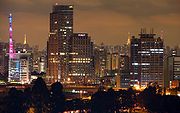
), which has special status and no municipalities, all land in Brazil is in the territory of some municipality. Thus, even in the country's remotest wilderness areas, one is still technically under the jurisdiction of a "city," or at least of its government. Brazil's largest cities are São Paulo
São Paulo
São Paulo is the largest city in Brazil, the largest city in the southern hemisphere and South America, and the world's seventh largest city by population. The metropolis is anchor to the São Paulo metropolitan area, ranked as the second-most populous metropolitan area in the Americas and among...
and Rio de Janeiro
Rio de Janeiro
Rio de Janeiro , commonly referred to simply as Rio, is the capital city of the State of Rio de Janeiro, the second largest city of Brazil, and the third largest metropolitan area and agglomeration in South America, boasting approximately 6.3 million people within the city proper, making it the 6th...
, both located on the heavily urbanized South East coast.
Bulgaria
In BulgariaBulgaria
Bulgaria , officially the Republic of Bulgaria , is a parliamentary democracy within a unitary constitutional republic in Southeast Europe. The country borders Romania to the north, Serbia and Macedonia to the west, Greece and Turkey to the south, as well as the Black Sea to the east...
the word "град" (grad) means city or town, although the word "градче" (gradche) can be used for small cities or towns.
The Council of Ministers has the right to give or withdraw the status of the territorial unit and the president sets the name. In 2005 it was introduced that in order for a village to become a city it has to have developed social and technical infrastructure and have a population of more than 3500 people (in the resort cities - more than 1000).
There are settlements with a city status for historical and cultural reasons (Melnik
Melnik, Bulgaria
Melnik is a town in Blagoevgrad Province, southwestern Bulgaria, in the southwestern Pirin Mountains, about 440 m above sea level. The town is an architectural reserve and 96 of its buildings are cultural monuments...
with a population of 358), or for political reasons (Pravets
Pravets
Pravets is a town in central western Bulgaria, located approximately 60 km from the capital Sofia.Pravets has a population of 4,512 people. Mountains surround it, which allows for a mild climate with rare winds. In the outskirts there is a small lake used for fishing and recreation...
, Kableshkovo
Kableshkovo
Kableshkovo is a small town in the Pomorie Municipality, Bulgaria. As of 2005 the population is 2 866. A small but modern sports complex of PFC Naftex Burgas is under construction. It will include two football terrains and an attached hotel...
, etc.).
Canada
In Canada, the granting of city status is handled by the individual provinces and territoriesProvinces and territories of Canada
The provinces and territories of Canada combine to make up the world's second-largest country by area. There are ten provinces and three territories...
. Therefore, city status definitions and criteria vary widely across the country. In British Columbia
British Columbia
British Columbia is the westernmost of Canada's provinces and is known for its natural beauty, as reflected in its Latin motto, Splendor sine occasu . Its name was chosen by Queen Victoria in 1858...
and Saskatchewan
Saskatchewan
Saskatchewan is a prairie province in Canada, which has an area of . Saskatchewan is bordered on the west by Alberta, on the north by the Northwest Territories, on the east by Manitoba, and on the south by the U.S. states of Montana and North Dakota....
, towns can become cities after they reach a population of 5,000 people, but the threshold is 10,000 in Alberta
Alberta
Alberta is a province of Canada. It had an estimated population of 3.7 million in 2010 making it the most populous of Canada's three prairie provinces...
, New Brunswick
New Brunswick
New Brunswick is one of Canada's three Maritime provinces and is the only province in the federation that is constitutionally bilingual . The provincial capital is Fredericton and Saint John is the most populous city. Greater Moncton is the largest Census Metropolitan Area...
, and Ontario
Ontario
Ontario is a province of Canada, located in east-central Canada. It is Canada's most populous province and second largest in total area. It is home to the nation's most populous city, Toronto, and the nation's capital, Ottawa....
. In Manitoba
Manitoba
Manitoba is a Canadian prairie province with an area of . The province has over 110,000 lakes and has a largely continental climate because of its flat topography. Agriculture, mostly concentrated in the fertile southern and western parts of the province, is vital to the province's economy; other...
, an urban municipality may not be named as a city unless its population meets or exceeds 7,500 people.
Although it has numerous cities in the traditional sense of the term, Ontario also sometimes confers city status on primarily rural areas whose municipalities have been merged into a former county government. Nova Scotia
Nova Scotia
Nova Scotia is one of Canada's three Maritime provinces and is the most populous province in Atlantic Canada. The name of the province is Latin for "New Scotland," but "Nova Scotia" is the recognized, English-language name of the province. The provincial capital is Halifax. Nova Scotia is the...
has abolished city status altogether, replacing it with regional municipality
Regional municipality
A regional municipality is a type of Canadian municipal government similar to and at the same municipal government level as a county, although the specific structure and servicing responsibilities may vary from place to place...
status.
In Quebec
Quebec
Quebec or is a province in east-central Canada. It is the only Canadian province with a predominantly French-speaking population and the only one whose sole official language is French at the provincial level....
, there is no legal distinction between a city and a town, as both have the legal status of ville. The province formerly differentiated between ville (town) and cité (city), but no longer does so.
China (People's Republic of China)
A city is an administrative division in Mainland ChinaMainland China
Mainland China, the Chinese mainland or simply the mainland, is a geopolitical term that refers to the area under the jurisdiction of the People's Republic of China . According to the Taipei-based Mainland Affairs Council, the term excludes the PRC Special Administrative Regions of Hong Kong and...
. There are three types of cities: a municipality
Direct-controlled municipality
A direct-controlled municipality is the highest level classification for cities used by unitary state, with status equal to that of the provinces in the respective countries...
is a provincial-level division (e.g. Shanghai or Beijing); a prefecture-level city
Prefecture-level city
A prefectural level city , prefectural city or prefectural level municipality is an administrative division of the People's Republic of China, ranking below a province and above a county in China's administrative structure. Prefectural level cities form the second level of the administrative...
is governed by provinces
Province (China)
A province, in the context of Chinese government, is a translation of sheng formally provincial level divisions, which is an administrative division. Provinces, municipalities, autonomous regions, and the special administrative regions, make up the four types of province of administrative division...
or autonomous regions; and a county-level city
County-level city
A county-level city is a county-level administrative division of mainland China. County-level cities are usually governed by prefecture-level divisions, but a few are governed directly by province-level divisions....
is a sub-unit of a prefecture-level administrative division.
There is a formal definition of city in China provided by the Chinese government, commonly seen in maps and textbooks. A minimum 100,000 non-agricultural population in an urbanized area, usually the administrative centre of a county(县, "xian"), is required to establish it in an administrative sense as a city(市, "shi"). By its non-agricultural population is a city classified: 100,000-200,000 a small city, 200,000-500,000 a medium city, 500,000-1,000,000 a large city and >1,000,000 an extra-large city(特大城市). Also, there is an administrative definition based on the city boundary too and a city has its legal city limits. In 1998, there were 668 cities in China. China has the largest urban population in the world although half of its population still lives in rural areas.
Chile
Chile
Chile ,officially the Republic of Chile , is a country in South America occupying a long, narrow coastal strip between the Andes mountains to the east and the Pacific Ocean to the west. It borders Peru to the north, Bolivia to the northeast, Argentina to the east, and the Drake Passage in the far...
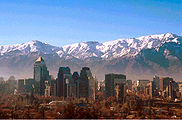
's Department of National Statistics defines a city (ciudad in Spanish) as an urban entity with more than 5,000 inhabitants. A town (pueblo), is an urban entity with 2,001 to 5,000 persons, however, if the area has some economic activity, the designation may include populations as small as 1,001. The department also defines Major Cities as provincial or regional capitals with populations of 100,001 to 500,000; Great Urban Areas which comprise several entities without any appreciable limit between them and populations which total between 500,001 and 1,000,000. A Metropolis is the largest urban area in the country where there are more than one million inhabitants. The "urban entity" is defined as a concentration of habitations with more than 2,000 persons living in them, or more than 1,000 persons if more than half of those persons are in some way gainfully employed. Tourist and recreation
Recreation
Recreation is an activity of leisure, leisure being discretionary time. The "need to do something for recreation" is an essential element of human biology and psychology. Recreational activities are often done for enjoyment, amusement, or pleasure and are considered to be "fun"...
areas with more than 250 living units may be considered as urban areas.
Denmark
DenmarkDenmark
Denmark is a Scandinavian country in Northern Europe. The countries of Denmark and Greenland, as well as the Faroe Islands, constitute the Kingdom of Denmark . It is the southernmost of the Nordic countries, southwest of Sweden and south of Norway, and bordered to the south by Germany. Denmark...
abolished the legal distinction between borough (købstad in Danish) and town (by) with the administrative reform in 1970. Before that time boroughs were chartered towns exempt from the county jurisdiction.
Egypt
In EgyptEgypt
Egypt , officially the Arab Republic of Egypt, Arabic: , is a country mainly in North Africa, with the Sinai Peninsula forming a land bridge in Southwest Asia. Egypt is thus a transcontinental country, and a major power in Africa, the Mediterranean Basin, the Middle East and the Muslim world...
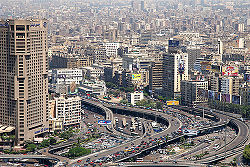
the word "مدينة" (madina) means city or town and there is no distinction between the two.
France
The French word for city is the same for townTown
A town is a human settlement larger than a village but smaller than a city. The size a settlement must be in order to be called a "town" varies considerably in different parts of the world, so that, for example, many American "small towns" seem to British people to be no more than villages, while...
: it is ville for both of them. In France
France
The French Republic , The French Republic , The French Republic , (commonly known as France , is a unitary semi-presidential republic in Western Europe with several overseas territories and islands located on other continents and in the Indian, Pacific, and Atlantic oceans. Metropolitan France...
, there is no distinction between a town and a city. There is only a difference between a city or town (ville), a village
Village
A village is a clustered human settlement or community, larger than a hamlet with the population ranging from a few hundred to a few thousand , Though often located in rural areas, the term urban village is also applied to certain urban neighbourhoods, such as the West Village in Manhattan, New...
(village) which is smaller (around 50 to 2000 inhabitants), and a hamlet
Hamlet (place)
A hamlet is usually a rural settlement which is too small to be considered a village, though sometimes the word is used for a different sort of community. Historically, when a hamlet became large enough to justify building a church, it was then classified as a village...
(hameau) which does not have more than around 50 inhabitants. French people usually make a difference between a city that has more than around 10000 inhabitants (city) and one that has less than around 10000 (town). Anyway, it is very subjective. The number of inhabitants that is supposed to have a city or a village to be considered as one may vary among individuals. But they usually say petite ville (literally "small city", or town) for the littlest city, and ville (city) for the bigger ones. The term métropole (metropolis
Metropolis
A metropolis is a very large city or urban area which is a significant economic, political and cultural center for a country or region, and an important hub for regional or international connections and communications...
) or grande ville (big city) can be used for the biggest cities.
Germany
The German word for both "town" and "city" is Stadt, while a city with more than 100,000 inhabitants is called a Großstadt (big city). On the other hand, most towns are communities belonging to a Landkreis (county or rural district), but there are some cities, usually with at least 50,000 inhabitants, that are counties by themselves (kreisfreie Städte). In 2006, there were 82 cities with more than 100,000 inhabitants in Germany. Germany's largest cities are BerlinBerlin
Berlin is the capital city of Germany and is one of the 16 states of Germany. With a population of 3.45 million people, Berlin is Germany's largest city. It is the second most populous city proper and the seventh most populous urban area in the European Union...
, Hamburg
Hamburg
-History:The first historic name for the city was, according to Claudius Ptolemy's reports, Treva.But the city takes its modern name, Hamburg, from the first permanent building on the site, a castle whose construction was ordered by the Emperor Charlemagne in AD 808...
, Munich
Munich
Munich The city's motto is "" . Before 2006, it was "Weltstadt mit Herz" . Its native name, , is derived from the Old High German Munichen, meaning "by the monks' place". The city's name derives from the monks of the Benedictine order who founded the city; hence the monk depicted on the city's coat...
, Cologne
Cologne
Cologne is Germany's fourth-largest city , and is the largest city both in the Germany Federal State of North Rhine-Westphalia and within the Rhine-Ruhr Metropolitan Area, one of the major European metropolitan areas with more than ten million inhabitants.Cologne is located on both sides of the...
and Frankfurt am Main while the largest urban area is in the Rhine-Ruhr
Rhine-Ruhr
The Rhine-Ruhr metropolitan region is the largest metropolitan region in Germany with about 10,100,000 inhabitants. It is of polycentric nature and the only megacity in Germany. It covers an area of 7,110 square kilometers and lies entirely within the federal state of North Rhine-Westphalia...
region around such cities as Dortmund
Dortmund
Dortmund is a city in Germany. It is located in the Bundesland of North Rhine-Westphalia, in the Ruhr area. Its population of 585,045 makes it the 7th largest city in Germany and the 34th largest in the European Union....
, Duisburg
Duisburg
- History :A legend recorded by Johannes Aventinus holds that Duisburg, was built by the eponymous Tuisto, mythical progenitor of Germans, ca. 2395 BC...
and Essen
Essen
- Origin of the name :In German-speaking countries, the name of the city Essen often causes confusion as to its origins, because it is commonly known as the German infinitive of the verb for the act of eating, and/or the German noun for food. Although scholars still dispute the interpretation of...
. Berlin and Frankfurt are characterized as world cities
World city (disambiguation)
A world city is a city deemed to be an important node point in the global economic system.World city may also refer to:* World city , the fusion of all urban areas and megalopolises into a single continuous worldwide city...
or global cities
Global city
A global city is a city that is deemed to be an important node in the global economic system...
.
India
Indonesia
Ireland
The five cities in the Republic of IrelandRepublic of Ireland
Ireland , described as the Republic of Ireland , is a sovereign state in Europe occupying approximately five-sixths of the island of the same name. Its capital is Dublin. Ireland, which had a population of 4.58 million in 2011, is a constitutional republic governed as a parliamentary democracy,...
are Cork
Cork (city)
Cork is the second largest city in the Republic of Ireland and the island of Ireland's third most populous city. It is the principal city and administrative centre of County Cork and the largest city in the province of Munster. Cork has a population of 119,418, while the addition of the suburban...
, Dublin, Galway
Galway
Galway or City of Galway is a city in County Galway, Republic of Ireland. It is the sixth largest and the fastest-growing city in Ireland. It is also the third largest city within the Republic and the only city in the Province of Connacht. Located on the west coast of Ireland, it sits on the...
, Limerick
Limerick
Limerick is the third largest city in the Republic of Ireland, and the principal city of County Limerick and Ireland's Mid-West Region. It is the fifth most populous city in all of Ireland. When taking the extra-municipal suburbs into account, Limerick is the third largest conurbation in the...
, and Waterford
Waterford
Waterford is a city in the South-East Region of Ireland. It is the oldest city in the country and fifth largest by population. Waterford City Council is the local government authority for the city and its immediate hinterland...
. Kilkenny
Kilkenny
Kilkenny is a city and is the county town of the eponymous County Kilkenny in Ireland. It is situated on both banks of the River Nore in the province of Leinster, in the south-east of Ireland...
does not have an autonomous city council, but is considered a city for historic reasons having been granted a royal charter
Royal Charter
A royal charter is a formal document issued by a monarch as letters patent, granting a right or power to an individual or a body corporate. They were, and are still, used to establish significant organizations such as cities or universities. Charters should be distinguished from warrants and...
in 1601.
Italy
In Italy a city is called città, a noun derived from the LatinLatin
Latin is an Italic language originally spoken in Latium and Ancient Rome. It, along with most European languages, is a descendant of the ancient Proto-Indo-European language. Although it is considered a dead language, a number of scholars and members of the Christian clergy speak it fluently, and...
civitas. The status of "city" is granted by the President of the Republic with Presidential Decree Law. The largest and most important cities in the country, such as Rome, Milan
Milan
Milan is the second-largest city in Italy and the capital city of the region of Lombardy and of the province of Milan. The city proper has a population of about 1.3 million, while its urban area, roughly coinciding with its administrative province and the bordering Province of Monza and Brianza ,...
, Naples
Naples
Naples is a city in Southern Italy, situated on the country's west coast by the Gulf of Naples. Lying between two notable volcanic regions, Mount Vesuvius and the Phlegraean Fields, it is the capital of the region of Campania and of the province of Naples...
and Turin
Turin
Turin is a city and major business and cultural centre in northern Italy, capital of the Piedmont region, located mainly on the left bank of the Po River and surrounded by the Alpine arch. The population of the city proper is 909,193 while the population of the urban area is estimated by Eurostat...
, are called aree metropolitane (metropolitan areas) because they include several minor cities and towns in their areas. In the coat of arms, a golden crown tower stands for a city.
Mexico
The Mexican population is increasingly urban with close to 75% of the population living in cities. The five largest metropolitan areas of MexicoMetropolitan areas of Mexico
Metropolitan areas in Mexico have been traditionally defined as the group of municipalities that heavily interact with each other, usually around a core city...
(Greater Mexico City
Greater Mexico City
Greater Mexico City refers to the conurbation around Mexico City, officially called Mexico City Metropolitan Area , constituted by the Federal District—itself composed of 16 boroughs—and 41 adjacent municipalities of the states of Mexico and Hidalgo...
, Greater Guadalajara, Greater Monterrey, Greater Puebla and Greater Tijuana) are home to 30% of the country's population.
In 2004, a joint effort between CONAPO (National Council of Population), INEGI and the Secretariat of Social Development (SEDESOL) agreed to define metropolitan areas as either:
- The group of two or more municipalities in which a city with a population of at least 50,000 is located whose urban area extends over the limit of the municipality that originally contained the core city incorporating either physically or under its area of direct influence other adjacent predominantly urban municipalities all of which have a high degree of social and economic integration or are relevant for urban politics and administration.
- A single municipality in which a city of a population of at least one million is located and fully contained, (that is, it does not transcend the limits of a single municipality).
Netherlands
In the NetherlandsNetherlands
The Netherlands is a constituent country of the Kingdom of the Netherlands, located mainly in North-West Europe and with several islands in the Caribbean. Mainland Netherlands borders the North Sea to the north and west, Belgium to the south, and Germany to the east, and shares maritime borders...
a city is called stad, in common with other Germanic languages. In the Dutch language there is no distinction between town and city (both are stad). Small settlements are distinguished similarly as in English, being called dorp (village) or gehucht (hamlet). In medieval times, a settlement had to achieve city-rights
City rights in the Netherlands
City rights are a medieval phenomenon in the history of the Low Countries. A liegelord, usually a count, duke or similar member of high nobility, granted a settlement he owned certain town privileges that settlements without city rights did not have....
to be called a stad. In modern times, there is no Dutch law saying what can be called a city or not, although generally places with more than 50,000 inhabitants are called a city. Settlements between 20,000 and 50,000 are most often called kleine stad or stadje, which literally means "little city". Settlements under about 20,000 may be called dorp, "village". The four largest cities are Amsterdam, Rotterdam
Rotterdam
Rotterdam is the second-largest city in the Netherlands and one of the largest ports in the world. Starting as a dam on the Rotte river, Rotterdam has grown into a major international commercial centre...
, The Hague
The Hague
The Hague is the capital city of the province of South Holland in the Netherlands. With a population of 500,000 inhabitants , it is the third largest city of the Netherlands, after Amsterdam and Rotterdam...
and Utrecht
Utrecht (city)
Utrecht city and municipality is the capital and most populous city of the Dutch province of Utrecht. It is located in the eastern corner of the Randstad conurbation, and is the fourth largest city of the Netherlands with a population of 312,634 on 1 Jan 2011.Utrecht's ancient city centre features...
, which together form the heart of the Randstad
Randstad
Image:Randstad_with_scale.png|400px|thumb|right|Clickable schematic map of the Randstadcircle 528 380 26 Schipholrect 426 356 498 436 Haarlemmermeerrect 399 166 479 245 Velsencircle 250 716 32 Delftcircle 220 642 60 The Hague...
metropolitan conurbation.
New Zealand
In New Zealand, a local authority may be proclaimed a city only if it meets certain criteria. Specifically, "a city [...] must have a minimum population of 50,000, be predominantly urban in character, be a distinct entity and a major centre of activity within the region." Some early settlements, such as NelsonNelson, New Zealand
Nelson is a city on the eastern shores of Tasman Bay, and is the economic and cultural centre of the Nelson-Tasman region. Established in 1841, it is the second oldest settled city in New Zealand and the oldest in the South Island....
and Christchurch
Christchurch
Christchurch is the largest city in the South Island of New Zealand, and the country's second-largest urban area after Auckland. It lies one third of the way down the South Island's east coast, just north of Banks Peninsula which itself, since 2006, lies within the formal limits of...
, were proclaimed cities by royal charter
Royal Charter
A royal charter is a formal document issued by a monarch as letters patent, granting a right or power to an individual or a body corporate. They were, and are still, used to establish significant organizations such as cities or universities. Charters should be distinguished from warrants and...
. Later, laws established criteria for a town to meet before it could officially be proclaimed a city, and these criteria have changed over time. , 13 of New Zealand's 67 territorial authorities will be officially styled cities.
In informal usage, a city is simply a large, important urban centre, regardless of the composition of its local government (which may be a combination of one or more cities or districts). For example, Gisborne
Gisborne, New Zealand
-Economy:The harbour was host to many ships in the past and had developed as a river port to provide a more secure location for shipping compared with the open roadstead of Poverty Bay which can be exposed to southerly swells. A meat works was sited beside the harbour and meat and wool was shipped...
, which purports to be the first city to see the sun, has a population of only 44,500 (2006), many of whom live outside the Gisborne urban area; it is, therefore, administered by a district council, not a city council. Some city councils, such as Christchurch and Dunedin, also administer large areas of rural hinterland; the communities in these areas, such as the towns of Akaroa
Akaroa
Akaroa is a village on Banks Peninsula in the Canterbury region of the South Island of New Zealand, situated within a harbour of the same name—the name Akaroa is Kāi Tahu Māori for 'Long Harbour'.- Overview :...
and Middlemarch
Middlemarch, New Zealand
Middlemarch is a small town within the limits of Dunedin city in New Zealand with 300 inhabitants. It lies some 80km to the west of the city centre, at the foot of the Rock and Pillar Range of hills in the broad Strath-Taieri valley, through which flows the middle reaches of the Taieri...
, are not often thought of as part of their cities, except for certain legal and administrative purposes. Meanwhile, the cities of Wellington and Auckland are generally regarded as single cities, despite Wellington's and, until recently, Auckland's being divided into several local government areas.
Statistics New Zealand
Statistics New Zealand
Statistics New Zealand is the national statistical office of New Zealand.-Organisation:New Zealand's Minister of Statistics is Maurice Williamson who serves as a member of the New Zealand House of Representatives and holds several other posts within government...
has introduced the concept of main urban areas, which have a minimum population of 30,000. The 16 main urban areas identified in 2001 and 2006 correspond closely to the urban settlements traditionally regarded as cities.
Norway
In NorwayNorway
Norway , officially the Kingdom of Norway, is a Nordic unitary constitutional monarchy whose territory comprises the western portion of the Scandinavian Peninsula, Jan Mayen, and the Arctic archipelago of Svalbard and Bouvet Island. Norway has a total area of and a population of about 4.9 million...
a city is called by and is derived from the Norse word býr meaning "a place with many buildings". Both cities and towns can be referred to as by; however, in recent years, storby (lit. large city) has been used for larger settlements. The status of "town" is granted by the local authorities if a request for city status has been made and the area has a population of at least 5000. An area with a population of at least 50,000 is counted as a "city". Since 1997, cities no longer have special administrative functions.
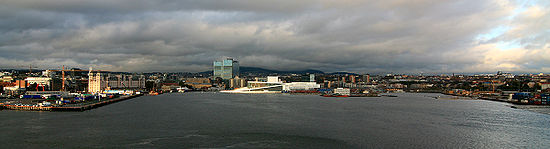
Pakistan
There has traditionally been no formal distinction between "City" or "Town" in Pakistan, although informal distinctions and status has been as common as in any other country. Several cities in what is now Pakistan were traditionally recognized as cities; in some cases for centuries; LahoreLahore
Lahore is the capital of the Pakistani province of Punjab and the second largest city in the country. With a rich and fabulous history dating back to over a thousand years ago, Lahore is no doubt Pakistan's cultural capital. One of the most densely populated cities in the world, Lahore remains a...
, Multan
Multan
Multan , is a city in the Punjab Province of Pakistan and capital of Multan District. It is located in the southern part of the province on the east bank of the Chenab River, more or less in the geographic centre of the country and about from Islamabad, from Lahore and from Karachi...
and Peshawar
Peshawar
Peshawar is the capital of Khyber-Pakhtunkhwa and the administrative center and central economic hub for the Federally Administered Tribal Areas of Pakistan....
are examples. After independence and the rapid increase in population that followed caused Karachi
Karachi
Karachi is the largest city, main seaport and the main financial centre of Pakistan, as well as the capital of the province of Sindh. The city has an estimated population of 13 to 15 million, while the total metropolitan area has a population of over 18 million...
to become the nation's largest city, while the rapid industrialisation in the north of the country resulted in new towns increasing greatly in population; such as Sialkot
Sialkot
Sialkot is a city in Pakistan situated in the north-east of the Punjab province at the foothills of snow-covered peaks of Kashmir near the Chenab river. It is the capital of Sialkot District. The city is about north-west of Lahore and only a few kilometers from Indian-controlled Jammu.The...
and Faisalabad
Faisalabad
Faisalabad , formerly known as Lyallpur, is the third largest metropolis in Pakistan, the second largest in the province of Punjab after Lahore, and a major industrial center in the heart of Pakistan. Before the foundation of the city in 1880, the area was very thinly populated. The population has...
,these two cities grow in population also because of agriculture,social development and high rate of natural increase, whilst Rawalpindi
Rawalpindi
Rawalpindi , locally known as Pindi, is a city in the Pothohar region of Pakistan near Pakistan's capital city of Islamabad, in the province of Punjab. Rawalpindi is the fourth largest city in Pakistan after Karachi, Lahore and Faisalabad...
, traditionally a garrison town became a large city due to the decision to build a new capital nearby. In 2001, a new Act formalised the distinction, by granting the 10 largest cities and metropolitan areas the status of city district
City Districts of Pakistan
A City District in Pakistan is a district that consists primarily or entirely of a major city or large metropolitan area. While there are 117 Districts, there are only ten City Districts...
, which for the first time gave areas the status of cities.
Philippines
Congress is the lone legislative entity that can incorporate cities. ProvincialSangguniang Panlalawigan
The Sangguniang Panlalawigan is the legislature of all provinces in the Philippines. It passes ordinances and resolutions for the effective administration of the province...
and municipal councils
Sangguniang Bayan
The Sangguniang Bayan is the legislature of municipal governments in the Philippines. It passes ordinances and resolutions for the effective administration of the municipality...
can pass resolutions indicating a desire to have a certain area (usually an already-existing municipality or a cluster of barangays) declared a city after the requirements for becoming a city are met. As per Republic Act No. 9009, these requirements include the following:
- locally generated income of at least PHPPhilippine pesoThe peso is the currency of the Philippines. It is subdivided into 100 centavos . Before 1967, the language used on the banknotes and coins was English and so "peso" was the name used...
100 million (based on constant prices in the year 2000) for the last two consecutive years, as certified by the Department of Finance, AND - a population of 150,000 or more, as certified by the National Statistics Office (NSO); OR a contiguous territory of 100 square kilometers, as certified by the Land Management BureauBureau of Lands Management (Philippines)The Philippines' Land Management Bureau , abbreviated as LMB, is an agency of the Philippine government under the Department of Environment and Natural Resources responsible for administering, surveying, managing, and disposing Alienable and Disposable lands and other government lands not placed...
, with contiguity not being a requisite for areas that are on two or more islandIslandAn island or isle is any piece of sub-continental land that is surrounded by water. Very small islands such as emergent land features on atolls can be called islets, cays or keys. An island in a river or lake may be called an eyot , or holm...
s.
Poland
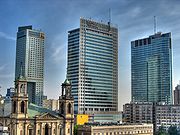
Poland
Poland , officially the Republic of Poland , is a country in Central Europe bordered by Germany to the west; the Czech Republic and Slovakia to the south; Ukraine, Belarus and Lithuania to the east; and the Baltic Sea and Kaliningrad Oblast, a Russian exclave, to the north...
the word miasto serves for both town and city. Miasto is the term applied purely on the basis of the administrative decision of the central government, and specifically means either:
- a county (gminaGminaThe gmina is the principal unit of administrative division of Poland at its lowest uniform level. It is often translated as "commune" or "municipality." As of 2010 there were 2,479 gminas throughout the country...
or powiatPowiatA powiat is the second-level unit of local government and administration in Poland, equivalent to a county, district or prefecture in other countries. The term powiat is most often translated into English as "county", although other terms are also sometimes used...
) with a city charter; - a city within a county, created by granting a city charter to a smaller town within a county.
These formal distinctions may differentiate larger towns from smaller ones (such as status as a separate powiat, or the conferring of the title prezydent on the mayor
Mayor
In many countries, a Mayor is the highest ranking officer in the municipal government of a town or a large urban city....
rather than burmistrz), but none of these is universally recognized as equivalent to the English city/town distinction.
Poland's largest cities are: Warsaw
Warsaw
Warsaw is the capital and largest city of Poland. It is located on the Vistula River, roughly from the Baltic Sea and from the Carpathian Mountains. Its population in 2010 was estimated at 1,716,855 residents with a greater metropolitan area of 2,631,902 residents, making Warsaw the 10th most...
, Łódź, Kraków
Kraków
Kraków also Krakow, or Cracow , is the second largest and one of the oldest cities in Poland. Situated on the Vistula River in the Lesser Poland region, the city dates back to the 7th century. Kraków has traditionally been one of the leading centres of Polish academic, cultural, and artistic life...
, Gdańsk
Gdansk
Gdańsk is a Polish city on the Baltic coast, at the centre of the country's fourth-largest metropolitan area.The city lies on the southern edge of Gdańsk Bay , in a conurbation with the city of Gdynia, spa town of Sopot, and suburban communities, which together form a metropolitan area called the...
, Poznań
Poznan
Poznań is a city on the Warta river in west-central Poland, with a population of 556,022 in June 2009. It is among the oldest cities in Poland, and was one of the most important centres in the early Polish state, whose first rulers were buried at Poznań's cathedral. It is sometimes claimed to be...
, Wrocław.
Portugal
As in Spanish, in PortuguesePortuguese language
Portuguese is a Romance language that arose in the medieval Kingdom of Galicia, nowadays Galicia and Northern Portugal. The southern part of the Kingdom of Galicia became independent as the County of Portugal in 1095...
there is a traditional distinction between cities — cidades — and towns — vilas. The difference is defined by law, and a city must have:
- at least 8,000 electors (more or less 10,000 inhabitants)
- at least half of the following services:
- hospital
- pharmacy
- fire department
- theatre / cultural house
- museum
- library
- hotel services
- basic and secondary schools
- public transport
- gardens / urban parks
In special cases, some towns may be granted the status of city if they possess historical, cultural or architectonic importance.
The Portuguese urban settlements heraldry
Heraldry
Heraldry is the profession, study, or art of creating, granting, and blazoning arms and ruling on questions of rank or protocol, as exercised by an officer of arms. Heraldry comes from Anglo-Norman herald, from the Germanic compound harja-waldaz, "army commander"...
reflects the difference between cities, towns and villages, with the coat of arms
Coat of arms
A coat of arms is a unique heraldic design on a shield or escutcheon or on a surcoat or tabard used to cover and protect armour and to identify the wearer. Thus the term is often stated as "coat-armour", because it was anciently displayed on the front of a coat of cloth...
of a city bearing a crown with 5 towers, the coat of arms of a town bearing a crown with 4 towers, while the coat of arms of a village bears a crown with 3 towers. This difference between cities, towns and villages is still in use in other Portuguese speaking countries, but not in Brazil.
There is also the notion of grande área metropolitana (great metropolitan area). There are two main metropolitan areas: Lisbon (the capital), in the centre of the country and Porto
Porto
Porto , also known as Oporto in English, is the second largest city in Portugal and one of the major urban areas in the Iberian Peninsula. Its administrative limits include a population of 237,559 inhabitants distributed within 15 civil parishes...
in the North. Lisbon Metropolitan Area
Lisbon Metropolitan Area
Lisbon Metropolitan Area is a territorial zone that includes 18 municipalities in Portugal. The smaller Grande Lisboa area is a subregion of the NUTS II Lisbon Region by its own right....
has a population that exceeds 3 million. Greater Metropolitan Area of Porto
Greater Metropolitan Area of Porto
The Greater Metropolitan Area of Porto is a metropolitan area in coastal northern Portugal which covers 16 municipalities, including the City of Porto, making up the second biggest urban area in the country...
has over 2 million inhabitants, although it is part of the Portuguese Northwestern Agglomeration that has, also, about 3 million inhabitants.
Romania
Cities and towns in Romania can have the status either of municipiu or oraş. Smaller villages that do not apply to the city status are called comuna/comune (f., sing./pl.) and sat/sate (m., sing./pl.). By 2001 law, published on July 24, 2001 (M.O. number 408), there are 172 cities in Romania, and the minimum requirements for a settlement to be acknowledge as a iii-3rd rank city status are:- Population: over 5,000 citizens
- Non-agricultural related activities: 75% people
- Network of drinking water coverage for homes: 70% of street covering
- Network of liquid waste recycle from homes: 55% of street covering
- Waste water recycling facility
- Water access-points for fire related incidents: 60% of the street covering
- Paved streets or more: 50%
- Hospital seats: 7 every 1000th citizen
- Medical health care: 1.8 doctors per 1000th citizen
- Hotel rooms: 50 seats
- Public and permanent waste disposal
- Primary school for children and a complementary school or at least one high school.
- Cultural facilities: One free-access library, one show room, one public gym
- One public garden : 10 sqm / citizen
In respect to the density of the cities, if it is more than 25 km to the next city, there are further benefits the mayor can access, fundings included.
A municipality is the next status after city-status by the same law, and Romania has 82 municipalities, plus the Municipality of Bucharest
Bucharest
Bucharest is the capital municipality, cultural, industrial, and financial centre of Romania. It is the largest city in Romania, located in the southeast of the country, at , and lies on the banks of the Dâmbovița River....
.
South Korea

South Korea
The Republic of Korea , , is a sovereign state in East Asia, located on the southern portion of the Korean Peninsula. It is neighbored by the People's Republic of China to the west, Japan to the east, North Korea to the north, and the East China Sea and Republic of China to the south...
has a system of dividing into metropolitan cities, provinces, a special city (Seoul) and one specially self-governing province (Jeju-do
Jeju-do
Jeju-do is the only special autonomous province of South Korea, situated on and coterminous with the country's largest island. Jeju-do lies in the Korea Strait, southwest of Jeollanam-do Province, of which it was a part before it became a separate province in 1946...
). In South Korea, cities should have a population of more than 150,000, and if a city has more than 500,000, it would be divided into 2 districts and then sub-communities follow as a name of dong with similar system of normal cities. Additionally, if a city's population is over 1,000,000, then it would be promoted to metropolitan city.
Seoul is the world's second largest metropolitan area.
Sweden
SwedenSweden
Sweden , officially the Kingdom of Sweden , is a Nordic country on the Scandinavian Peninsula in Northern Europe. Sweden borders with Norway and Finland and is connected to Denmark by a bridge-tunnel across the Öresund....
canceled the official legal term City (in Swedish: stad) in the year 1971. Only the word municipality
Municipality
A municipality is essentially an urban administrative division having corporate status and usually powers of self-government. It can also be used to mean the governing body of a municipality. A municipality is a general-purpose administrative subdivision, as opposed to a special-purpose district...
(in Swedish: kommun) prevails, making no legal difference between Stockholm
Stockholm
Stockholm is the capital and the largest city of Sweden and constitutes the most populated urban area in Scandinavia. Stockholm is the most populous city in Sweden, with a population of 851,155 in the municipality , 1.37 million in the urban area , and around 2.1 million in the metropolitan area...
and a countryside municipality. Before that there were a number of terms like "stad"/Town, "köping"/large village etc. The definition of City/Town (stad) was merely that it was given such a title. Since the 1980s some municipalities (13 out of 290) being "stad" before 1971, again call themselves town (stad), but only in tourist advertising. This has no legal or administrative significance whatsoever, and the municipalities have to use the word "kommun" by law. In other cases the seat of the municipality is called "town".
Today's Swedish terminology makes no distinction between city and town; both concepts translate to the single word "stad", but sometimes town can be rendered "småstad". Statistics Sweden defines a "stad" as an urban area
Urban areas in Sweden
Urban area is a common English translation of the Swedish term tätort. The official term in English, used by Statistics Sweden, is, however, locality. There are 1,940 localities in Sweden . They could be compared with census-designated places in the United States.A tätort in Sweden has a minimum of...
(in Swedish: tätort) of at least 10,000 inhabitants.
Turkey
There are some definitions of city in Turkey. Older definition which defines the city as a settlement with more than 20 000 inhabitants is out of use and a city is usually defined as the administrative center of a province There are 81 provincial centers in Turkey. Nevertheless, some of the district centers are more populous and more developed than the provincial centers.
But in 1984, the metropolitan center concept was introduced. According to definition (revised as of 2004) a metropolitan center is a city with more than 750 000 inhabitants. At present 16 of the provincial centers are metropolitan centers.
Ukraine
There is no difference in the Ukrainian language between the notions of "town" and "city". Both these words are translated into Ukrainian as "місто" ("misto"). In articles of Wikipedia only the term "city" is used for every Ukrainian locality named "місто". The smallest population of a city of Ukraine can be about 10,000. For towns which officially are not named "місто" it is used a name "urban-type settlement" ("селище міського типу", "selyshche mis'koho typu") and also (informal) "містечко" ("mistechko"), the latter Ukrainian word is related to the word "місто" and can be translated as "small town".United Kingdom
In the United Kingdom (UK), a city is a town which has been known as a city since time immemorialTime immemorial
Time immemorial is a phrase meaning time extending beyond the reach of memory, record, or tradition, indefinitely ancient, "ancient beyond memory or record"...
, or which has received city status by letters patent
Letters patent
Letters patent are a type of legal instrument in the form of a published written order issued by a monarch or president, generally granting an office, right, monopoly, title, or status to a person or corporation...
—which are normally granted on the basis of: Population (>300,000), metropolitan character, governance, importance and / or a Royal connection. In England and Wales, prior to 1907 the criterion was simply the establishment of an Anglican Cathedral. For example the small town of Ripon
Ripon
Ripon is a cathedral city, market town and successor parish in the Borough of Harrogate, North Yorkshire, England, located at the confluence of two streams of the River Ure in the form of the Laver and Skell. The city is noted for its main feature the Ripon Cathedral which is architecturally...
was granted city status in 1836 to coincide with the creation of the Diocese of Ripon, but also in recognition of its long-standing role as a supplier of spur
Spur
A spur is a metal tool designed to be worn in pairs on the heels of riding boots for the purpose of directing a horse to move forward or laterally while riding. It is usually used to refine the riding aids and to back up the natural aids . The spur is used in every equestrian discipline...
s to royalty. In the United Kingdom, when people talk about cities, they generally include the suburbs in that. Some cathedral cities, such as St David's in Wales
Wales
Wales is a country that is part of the United Kingdom and the island of Great Britain, bordered by England to its east and the Atlantic Ocean and Irish Sea to its west. It has a population of three million, and a total area of 20,779 km²...
and Wells
Wells
Wells is a cathedral city and civil parish in the Mendip district of Somerset, England, on the southern edge of the Mendip Hills. Although the population recorded in the 2001 census is 10,406, it has had city status since 1205...
in England
England
England is a country that is part of the United Kingdom. It shares land borders with Scotland to the north and Wales to the west; the Irish Sea is to the north west, the Celtic Sea to the south west, with the North Sea to the east and the English Channel to the south separating it from continental...
, are quite small, and may not be known as cities in common parlance. Preston
City of Preston, Lancashire
The City of Preston is a city and non-metropolitan district in Lancashire, England. It is located on the north bank of the River Ribble, and was granted city status in 2002, becoming England's 50th city in the 50th year of Queen Elizabeth II's reign...
became England's newest city in the year 2002 to mark the Queen's jubilee, as did Newport
Newport
Newport is a city and unitary authority area in Wales. Standing on the banks of the River Usk, it is located about east of Cardiff and is the largest urban area within the historic county boundaries of Monmouthshire and the preserved county of Gwent...
in Wales, Stirling
Stirling
Stirling is a city and former ancient burgh in Scotland, and is at the heart of the wider Stirling council area. The city is clustered around a large fortress and medieval old-town beside the River Forth...
in Scotland
Scotland
Scotland is a country that is part of the United Kingdom. Occupying the northern third of the island of Great Britain, it shares a border with England to the south and is bounded by the North Sea to the east, the Atlantic Ocean to the north and west, and the North Channel and Irish Sea to the...
, and Lisburn
Lisburn
DemographicsLisburn Urban Area is within Belfast Metropolitan Urban Area and is classified as a Large Town by the . On census day there were 71,465 people living in Lisburn...
and Newry
Newry
Newry is a city in Northern Ireland. The River Clanrye, which runs through the city, formed the historic border between County Armagh and County Down. It is from Belfast and from Dublin. Newry had a population of 27,433 at the 2001 Census, while Newry and Mourne Council Area had a population...
in Northern Ireland
Northern Ireland
Northern Ireland is one of the four countries of the United Kingdom. Situated in the north-east of the island of Ireland, it shares a border with the Republic of Ireland to the south and west...
. However, major towns such as Reading
Reading, Berkshire
Reading is a large town and unitary authority area in England. It is located in the Thames Valley at the confluence of the River Thames and River Kennet, and on both the Great Western Main Line railway and the M4 motorway, some west of London....
, Northampton
Northampton
Northampton is a large market town and local government district in the East Midlands region of England. Situated about north-west of London and around south-east of Birmingham, Northampton lies on the River Nene and is the county town of Northamptonshire. The demonym of Northampton is...
, Luton
Luton
Luton is a large town and unitary authority of Bedfordshire, England, 30 miles north of London. Luton and its near neighbours, Dunstable and Houghton Regis, form the Luton/Dunstable Urban Area with a population of about 250,000....
, Swindon
Swindon
Swindon is a large town within the borough of Swindon and ceremonial county of Wiltshire, in South West England. It is midway between Bristol, west and Reading, east. London is east...
and Milton Keynes
Milton Keynes
Milton Keynes , sometimes abbreviated MK, is a large town in Buckinghamshire, in the south east of England, about north-west of London. It is the administrative centre of the Borough of Milton Keynes...
all harbour populations between 170,000 and 215,000 inhabitants but are not officially cited as cities.
The situation in London is a historical anomaly: the City of Westminster
City of Westminster
The City of Westminster is a London borough occupying much of the central area of London, England, including most of the West End. It is located to the west of and adjoining the ancient City of London, directly to the east of the Royal Borough of Kensington and Chelsea, and its southern boundary...
and the City of London are geographically small but historically significant parts of the Greater London
Greater London
Greater London is the top-level administrative division of England covering London. It was created in 1965 and spans the City of London, including Middle Temple and Inner Temple, and the 32 London boroughs. This territory is coterminate with the London Government Office Region and the London...
conurbation that have independent city status.
A Review of Scotland's Cities led to the Fair City of Perth, Scotland
Perth, Scotland
Perth is a town and former city and royal burgh in central Scotland. Located on the banks of the River Tay, it is the administrative centre of Perth and Kinross council area and the historic county town of Perthshire...
, losing city status. By both legal and traditional definition, a town may be of any size, but must contain a market place
Market
A market is one of many varieties of systems, institutions, procedures, social relations and infrastructures whereby parties engage in exchange. While parties may exchange goods and services by barter, most markets rely on sellers offering their goods or services in exchange for money from buyers...
. A village must contain a church. A small village without a church is called a hamlet
Hamlet (place)
A hamlet is usually a rural settlement which is too small to be considered a village, though sometimes the word is used for a different sort of community. Historically, when a hamlet became large enough to justify building a church, it was then classified as a village...
.
The UK's five largest cities are generally considered to be London
London
London is the capital city of :England and the :United Kingdom, the largest metropolitan area in the United Kingdom, and the largest urban zone in the European Union by most measures. Located on the River Thames, London has been a major settlement for two millennia, its history going back to its...
, Birmingham
Birmingham
Birmingham is a city and metropolitan borough in the West Midlands of England. It is the most populous British city outside the capital London, with a population of 1,036,900 , and lies at the heart of the West Midlands conurbation, the second most populous urban area in the United Kingdom with a...
, Leeds
Leeds
Leeds is a city and metropolitan borough in West Yorkshire, England. In 2001 Leeds' main urban subdivision had a population of 443,247, while the entire city has a population of 798,800 , making it the 30th-most populous city in the European Union.Leeds is the cultural, financial and commercial...
, Manchester
Manchester
Manchester is a city and metropolitan borough in Greater Manchester, England. According to the Office for National Statistics, the 2010 mid-year population estimate for Manchester was 498,800. Manchester lies within one of the UK's largest metropolitan areas, the metropolitan county of Greater...
and Glasgow
Glasgow
Glasgow is the largest city in Scotland and third most populous in the United Kingdom. The city is situated on the River Clyde in the country's west central lowlands...
, but this is based on the population of the conurbation as a whole. In terms of formal city boundaries, the largest include Bristol
Bristol
Bristol is a city, unitary authority area and ceremonial county in South West England, with an estimated population of 433,100 for the unitary authority in 2009, and a surrounding Larger Urban Zone with an estimated 1,070,000 residents in 2007...
, Cardiff
Cardiff
Cardiff is the capital, largest city and most populous county of Wales and the 10th largest city in the United Kingdom. The city is Wales' chief commercial centre, the base for most national cultural and sporting institutions, the Welsh national media, and the seat of the National Assembly for...
, Edinburgh
Edinburgh
Edinburgh is the capital city of Scotland, the second largest city in Scotland, and the eighth most populous in the United Kingdom. The City of Edinburgh Council governs one of Scotland's 32 local government council areas. The council area includes urban Edinburgh and a rural area...
, Liverpool
Liverpool
Liverpool is a city and metropolitan borough of Merseyside, England, along the eastern side of the Mersey Estuary. It was founded as a borough in 1207 and was granted city status in 1880...
and Sheffield
Sheffield
Sheffield is a city and metropolitan borough of South Yorkshire, England. Its name derives from the River Sheaf, which runs through the city. Historically a part of the West Riding of Yorkshire, and with some of its southern suburbs annexed from Derbyshire, the city has grown from its largely...
.
United States
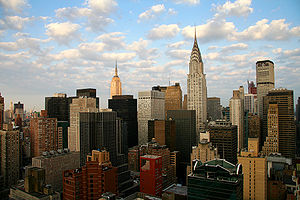
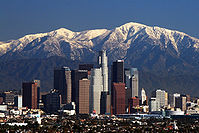
Town of Hempstead, New York
Hempstead is one of the three towns in Nassau County, New York, United States, occupying the southwest part of the county. There are twenty-two incorporated villages completely or partially in the town. Hempstead's combined population was 759,757 at the 2010 Census, the majority of the population...
, with a population of 755,785 in 2004 or Cary, North Carolina with a population of 112,414 in 2006 ) and some very small cities (such as Woodland Mills, Tennessee
Woodland Mills, Tennessee
Woodland Mills is a city in Obion County, Tennessee, United States. The population was 296 at the 2000 census. It is part of the Union City, TN–KY Micropolitan Statistical Area.-Geography:Woodland Mills is located at ....
, with a population of 296 in 2000), and the line between town and city, if it exists at all, varies from state to state. The lack of a clear-cut definition of a city in the United States can lead to some counter-intuitive labeling; for example, before it was dissolved in 2002 Maza, North Dakota
Maza, North Dakota
As of the census of 2000, there were 5 people, 3 households, and 2 families residing in the city. The population density was 0.6 people per square mile . There were 5 housing units at an average density of 0.6/sq mi...
, with only 5 inhabitants, was a city as by North Dakota
North Dakota
North Dakota is a state located in the Midwestern region of the United States of America, along the Canadian border. The state is bordered by Canada to the north, Minnesota to the east, South Dakota to the south and Montana to the west. North Dakota is the 19th-largest state by area in the U.S....
law any incorporated location is deemed a city regardless of size. California
California
California is a state located on the West Coast of the United States. It is by far the most populous U.S. state, and the third-largest by land area...
has both towns and cities but the terms "town" and "city" are considered synonymous. The nation's top five largest cities are New York City
New York City
New York is the most populous city in the United States and the center of the New York Metropolitan Area, one of the most populous metropolitan areas in the world. New York exerts a significant impact upon global commerce, finance, media, art, fashion, research, technology, education, and...
, Los Angeles
Los Ángeles
Los Ángeles is the capital of the province of Biobío, in the commune of the same name, in Region VIII , in the center-south of Chile. It is located between the Laja and Biobío rivers. The population is 123,445 inhabitants...
, Chicago
Chicago
Chicago is the largest city in the US state of Illinois. With nearly 2.7 million residents, it is the most populous city in the Midwestern United States and the third most populous in the US, after New York City and Los Angeles...
, Houston, and Philadelphia.
In some U.S. states, any incorporated town is also called a city. If a distinction is being made between towns and cities, exactly what that distinction is often depends on the context. The context will differ depending on whether the issue is the legal authority it possesses, the availability of shopping and entertainment, and the scope of the group of places under consideration. Intensifiers such as "small town" and "big city" are also common, though the converse of each is rarely used.
Some states make a distinction between villages
Village (United States)
In the United States, the meaning of "village" varies by geographic area and legal jurisdiction. In many areas, "village" is a term, sometimes informal, for a type of administrative division at the local government level...
and other forms of municipalities. In some cases, villages combine with larger other communities to form larger towns; a well-known example of an urban village is New York City's famed Greenwich Village
Greenwich Village
Greenwich Village, , , , .in New York often simply called "the Village", is a largely residential neighborhood on the west side of Lower Manhattan in New York City. A large majority of the district is home to upper middle class families...
, which started as a quiet country settlement but was absorbed by the growing city. The word has often been co-opted by enterprising developers to make their projects sound welcoming and friendly.
In Illinois
Illinois
Illinois is the fifth-most populous state of the United States of America, and is often noted for being a microcosm of the entire country. With Chicago in the northeast, small industrial cities and great agricultural productivity in central and northern Illinois, and natural resources like coal,...
, cities must have a minimum population of 2,500 but in Nebraska, cities must have a minimum of only 800 residents. In Oregon
Oregon
Oregon is a state in the Pacific Northwest region of the United States. It is located on the Pacific coast, with Washington to the north, California to the south, Nevada on the southeast and Idaho to the east. The Columbia and Snake rivers delineate much of Oregon's northern and eastern...
, Kansas
Kansas
Kansas is a US state located in the Midwestern United States. It is named after the Kansas River which flows through it, which in turn was named after the Kansa Native American tribe, which inhabited the area. The tribe's name is often said to mean "people of the wind" or "people of the south...
, Kentucky
Kentucky
The Commonwealth of Kentucky is a state located in the East Central United States of America. As classified by the United States Census Bureau, Kentucky is a Southern state, more specifically in the East South Central region. Kentucky is one of four U.S. states constituted as a commonwealth...
, North Dakota, Minnesota
Minnesota
Minnesota is a U.S. state located in the Midwestern United States. The twelfth largest state of the U.S., it is the twenty-first most populous, with 5.3 million residents. Minnesota was carved out of the eastern half of the Minnesota Territory and admitted to the Union as the thirty-second state...
, and Iowa
Iowa
Iowa is a state located in the Midwestern United States, an area often referred to as the "American Heartland". It derives its name from the Ioway people, one of the many American Indian tribes that occupied the state at the time of European exploration. Iowa was a part of the French colony of New...
, all incorporated municipalities are cities. In Ohio
Ohio
Ohio is a Midwestern state in the United States. The 34th largest state by area in the U.S.,it is the 7th‑most populous with over 11.5 million residents, containing several major American cities and seven metropolitan areas with populations of 500,000 or more.The state's capital is Columbus...
, a municipality automatically becomes a city if it has 5,000 residents counted in a federal census but it reverts to a village if its population drops below 5,000. In Nebraska
Nebraska
Nebraska is a state on the Great Plains of the Midwestern United States. The state's capital is Lincoln and its largest city is Omaha, on the Missouri River....
, 5,000 residents is the minimum for a city of the first class while 800 is the minimum for a city of the second class. The Constitution of Idaho
Idaho
Idaho is a state in the Rocky Mountain area of the United States. The state's largest city and capital is Boise. Residents are called "Idahoans". Idaho was admitted to the Union on July 3, 1890, as the 43rd state....
makes no distinction between incorporated towns or cities.
In all of the New England
New England
New England is a region in the northeastern corner of the United States consisting of the six states of Maine, New Hampshire, Vermont, Massachusetts, Rhode Island, and Connecticut...
states, city status is conferred by the form of government, not population. Town government has a board of selectmen or Town Council for the executive
Executive (government)
Executive branch of Government is the part of government that has sole authority and responsibility for the daily administration of the state bureaucracy. The division of power into separate branches of government is central to the idea of the separation of powers.In many countries, the term...
branch, and a town meeting
Town meeting
A town meeting is a form of direct democratic rule, used primarily in portions of the United States since the 17th century, in which most or all the members of a community come together to legislate policy and budgets for local government....
for the legislative branch, but unlike the US Government, the executive acts only as an administrative body and cannot override the will of town meeting. New England cities, on the other hand, have a mayor for the executive, and a legislature referred to as either the city council or the board of aldermen.
In Virginia
Virginia
The Commonwealth of Virginia , is a U.S. state on the Atlantic Coast of the Southern United States. Virginia is nicknamed the "Old Dominion" and sometimes the "Mother of Presidents" after the eight U.S. presidents born there...
, all incorporated municipalities designated as cities are independent
Independent city
An independent city is a city that does not form part of another general-purpose local government entity. These type of cities should not be confused with city-states , which are fully sovereign cities that are not part of any other sovereign state.-Historical precursors:In the Holy Roman Empire,...
of the adjacent or surrounding county while a town is an incorporated municipality which remains a part of an adjacent or surrounding county. The largest incorporated municipalities by population are all cities, although some smaller cities have a smaller population than some towns. For example, the smallest city of Norton
Norton, Virginia
Norton is an independent city within the confines of Wise County in the Commonwealth of Virginia. As of the 2010 Census, the city population was 3,958, making it the smallest city in the state by population...
has a population of 3,904 and the largest town of Blacksburg
Blacksburg, Virginia
Blacksburg is an incorporated town located in Montgomery County, Virginia, United States, with a population of 42,620 at the 2010 census. Blacksburg, Christiansburg, and Radford are the three principal jurisdictions of the Blacksburg-Christiansburg-Radford Metropolitan Statistical Area which...
has a population of 39,573. The other U.S. independent cities are Baltimore, Maryland; St. Louis, Missouri
St. Louis, Missouri
St. Louis is an independent city on the eastern border of Missouri, United States. With a population of 319,294, it was the 58th-largest U.S. city at the 2010 U.S. Census. The Greater St...
; and Carson City, Nevada
Carson City, Nevada
The Consolidated Municipality of Carson City is the capital of the state of Nevada. The words Consolidated Municipality refer to a series of changes in 1969 which abolished Ormsby County and merged all the settlements contained within its borders into Carson City. Since that time Carson City has...
.
In Pennsylvania, municipalites with more than 10 persons can incorporate as a borough. Any township or borough with a population of at least 10,000 can ask the state legislature to charter as a city. In Pennsylvania, a village is simply an unincorporated community within a township. Parker, Pennsylvania
Parker, Pennsylvania
Parker is a city located in Armstrong County, Pennsylvania, United States. It is located in the extreme northwestern portion of the county. The population was 799 at the 2000 census. The city was named for John Parker, a lead surveyor of Lawrenceburg....
is known as the smallest city in the United States.
Venezuela
Venezuela's Department of National Statistics defines a city (ciudad in SpanishSpanish language
Spanish , also known as Castilian , is a Romance language in the Ibero-Romance group that evolved from several languages and dialects in central-northern Iberia around the 9th century and gradually spread with the expansion of the Kingdom of Castile into central and southern Iberia during the...
) as an urban entity with more than 5,000 inhabitants. A town (pueblo), is an urban entity with 2,001 to 5,000 persons.
Global cities
A global city, also known as a world city, is a prominent centre of tradeTrade
Trade is the transfer of ownership of goods and services from one person or entity to another. Trade is sometimes loosely called commerce or financial transaction or barter. A network that allows trade is called a market. The original form of trade was barter, the direct exchange of goods and...
, bank
Bank
A bank is a financial institution that serves as a financial intermediary. The term "bank" may refer to one of several related types of entities:...
ing, finance
Finance
"Finance" is often defined simply as the management of money or “funds” management Modern finance, however, is a family of business activity that includes the origination, marketing, and management of cash and money surrogates through a variety of capital accounts, instruments, and markets created...
, innovation, and markets. The term "global city", as opposed to megacity
Megacity
A megacity is usually defined as a metropolitan area with a total population in excess of 10 million people. Some definitions also set a minimum level for population density . A megacity can be a single metropolitan area or two or more metropolitan areas that converge. The terms conurbation,...
, was coined by Saskia Sassen
Saskia Sassen
Saskia Sassen is a Dutch sociologist noted for her analyses of globalization and international human migration. She is currently Robert S. Lynd Professor of Sociology at Columbia University and Centennial visiting Professor at the London School of Economics. Sassen coined the term global city...
in a seminal 1991 work. Whereas "megacity" refers to any city of enormous size, a global city is one of enormous power or influence. Global cities, according to Sassen, have more in common with each other than with other cities in their host nations. Notable examples of such cities include Beijing
Beijing
Beijing , also known as Peking , is the capital of the People's Republic of China and one of the most populous cities in the world, with a population of 19,612,368 as of 2010. The city is the country's political, cultural, and educational center, and home to the headquarters for most of China's...
, Chicago
Chicago
Chicago is the largest city in the US state of Illinois. With nearly 2.7 million residents, it is the most populous city in the Midwestern United States and the third most populous in the US, after New York City and Los Angeles...
, Hong Kong
Hong Kong
Hong Kong is one of two Special Administrative Regions of the People's Republic of China , the other being Macau. A city-state situated on China's south coast and enclosed by the Pearl River Delta and South China Sea, it is renowned for its expansive skyline and deep natural harbour...
, London
London
London is the capital city of :England and the :United Kingdom, the largest metropolitan area in the United Kingdom, and the largest urban zone in the European Union by most measures. Located on the River Thames, London has been a major settlement for two millennia, its history going back to its...
, Los Angeles
Los Ángeles
Los Ángeles is the capital of the province of Biobío, in the commune of the same name, in Region VIII , in the center-south of Chile. It is located between the Laja and Biobío rivers. The population is 123,445 inhabitants...
, Mumbai
Mumbai
Mumbai , formerly known as Bombay in English, is the capital of the Indian state of Maharashtra. It is the most populous city in India, and the fourth most populous city in the world, with a total metropolitan area population of approximately 20.5 million...
, New York City
New York City
New York is the most populous city in the United States and the center of the New York Metropolitan Area, one of the most populous metropolitan areas in the world. New York exerts a significant impact upon global commerce, finance, media, art, fashion, research, technology, education, and...
, Paris
Paris
Paris is the capital and largest city in France, situated on the river Seine, in northern France, at the heart of the Île-de-France region...
, São Paulo
São Paulo
São Paulo is the largest city in Brazil, the largest city in the southern hemisphere and South America, and the world's seventh largest city by population. The metropolis is anchor to the São Paulo metropolitan area, ranked as the second-most populous metropolitan area in the Americas and among...
, Shanghai
Shanghai
Shanghai is the largest city by population in China and the largest city proper in the world. It is one of the four province-level municipalities in the People's Republic of China, with a total population of over 23 million as of 2010...
, Singapore
Singapore
Singapore , officially the Republic of Singapore, is a Southeast Asian city-state off the southern tip of the Malay Peninsula, north of the equator. An island country made up of 63 islands, it is separated from Malaysia by the Straits of Johor to its north and from Indonesia's Riau Islands by the...
, and Tokyo
Tokyo
, ; officially , is one of the 47 prefectures of Japan. Tokyo is the capital of Japan, the center of the Greater Tokyo Area, and the largest metropolitan area of Japan. It is the seat of the Japanese government and the Imperial Palace, and the home of the Japanese Imperial Family...
.
The notion of global cities is rooted in the concentration of power
Power (sociology)
Power is a measurement of an entity's ability to control its environment, including the behavior of other entities. The term authority is often used for power perceived as legitimate by the social structure. Power can be seen as evil or unjust, but the exercise of power is accepted as endemic to...
and capabilities within all cities. The city is seen as a container where skills and resources are concentrated: the better able a city is to concentrate its skills and resources, the more successful and powerful the city. This makes the city itself more powerful in the sense that it can influence what is happening around the world. Following this view of cities, it is possible to rank the world's cities hierarchically.
Critics of the notion point to the different realms of power. The term global city is heavily influenced by economic factors and, thus, may not account for places that are otherwise significant. For example, cities like Istanbul, Jerusalem, Karbala
Karbala
Karbala is a city in Iraq, located about southwest of Baghdad. Karbala is the capital of Karbala Governorate, and has an estimated population of 572,300 people ....
, Lisbon
Lisbon
Lisbon is the capital city and largest city of Portugal with a population of 545,245 within its administrative limits on a land area of . The urban area of Lisbon extends beyond the administrative city limits with a population of 3 million on an area of , making it the 9th most populous urban...
, Mashhad
Mashhad
Mashhad , is the second largest city in Iran and one of the holiest cities in the Shia Muslim world. It is also the only major Iranian city with an Arabic name. It is located east of Tehran, at the center of the Razavi Khorasan Province close to the borders of Afghanistan and Turkmenistan. Its...
, Mecca
Mecca
Mecca is a city in the Hijaz and the capital of Makkah province in Saudi Arabia. The city is located inland from Jeddah in a narrow valley at a height of above sea level...
, and Rome are powerful in religious
Religion
Religion is a collection of cultural systems, belief systems, and worldviews that establishes symbols that relate humanity to spirituality and, sometimes, to moral values. Many religions have narratives, symbols, traditions and sacred histories that are intended to give meaning to life or to...
and historical
History
History is the discovery, collection, organization, and presentation of information about past events. History can also mean the period of time after writing was invented. Scholars who write about history are called historians...
terms but would not be considered "global cities." Additionally, it has been questioned whether the city itself can be regarded as an actor.
In 1995, Kanter argued that successful cities can be identified by three elements: good thinkers (concepts), good makers (competence) or good traders (connections
City network
City networks are the connections between cities.These networks can be of different nature and of different importance. In modern conceptions of cities, these networks play an important role in understanding the nature of cities. City networks can be physical connections to other places, such as...
). The interplay of these three elements, Kanter argued, means that good cities are not planned but managed.
Inner city
In the United States, United Kingdom and Ireland, the term "inner city" is sometimes used with the connotation of being an area, perhaps a ghettoGhetto
A ghetto is a section of a city predominantly occupied by a group who live there, especially because of social, economic, or legal issues.The term was originally used in Venice to describe the area where Jews were compelled to live. The term now refers to an overcrowded urban area often associated...
, where people are less wealthy and where there is more crime. These connotations are less common in other Western countries, as deprived areas are located in varying parts of other Western cities. In fact, with the gentrification
Gentrification
Gentrification and urban gentrification refer to the changes that result when wealthier people acquire or rent property in low income and working class communities. Urban gentrification is associated with movement. Consequent to gentrification, the average income increases and average family size...
of some formerly run-down central city areas the reverse connotation can apply. In Australia, for example, the term "outer suburban" applied to a person implies a lack of sophistication. In Paris, the inner city is the richest part of the metropolitan area, where housing is the most expensive, and where elites and high-income individuals dwell. In the developing world, economic modernization brings poor newcomers from the countryside to build haphazardly at the edge of current settlement (see favelas, shack
Shack
A shack is a type of small house, usually in a state of disrepair. The word may derive from the Nahuatl word xacalli or "adobe house" by way of Mexican Spanish xacal/jacal, which has the same meaning as "shack". It was a common usage among people of Mexican ancestry throughout the U.S...
s and shanty towns).
The United States, in particular, has a culture of anti-urbanism that dates back to colonial times. The American City Beautiful architecture movement of the late 19th century was a reaction to perceived urban decay
Urban decay
Urban decay is the process whereby a previously functioning city, or part of a city, falls into disrepair and decrepitude...
and sought to provide stately civic buildings and boulevards to inspire civic pride in the motley residents of the urban core. Modern anti-urban attitudes are to be found in the United States in the form of a planning profession that continues to develop land on a low-density suburban basis, where access to amenities, work and shopping is provided almost exclusively by car rather than by foot or transit.
However, there is a growing movement in North America called "New Urbanism
New urbanism
New Urbanism is an urban design movement, which promotes walkable neighborhoods that contain a range of housing and job types. It arose in the United States in the early 1980s, and has gradually continued to reform many aspects of real estate development, urban planning, and municipal land-use...
" that calls for a return to traditional city planning methods where mixed-use zoning allows people to walk from one type of land-use to another. The idea is that housing, shopping, office space, and leisure facilities are all provided within walking distance of each other, thus reducing the demand for road-space and also improving the efficiency and effectiveness of mass transit.
21st century
There is a debate about whether technology and instantaneous communicationCommunication
Communication is the activity of conveying meaningful information. Communication requires a sender, a message, and an intended recipient, although the receiver need not be present or aware of the sender's intent to communicate at the time of communication; thus communication can occur across vast...
s are making cities obsolete, or reinforcing the importance of big cities as centres of the knowledge economy
Knowledge economy
The knowledge economy is a term that refers either to an economy of knowledge focused on the production and management of knowledge in the frame of economic constraints, or to a knowledge-based economy. In the second meaning, more frequently used, it refers to the use of knowledge technologies to...
. Knowledge-based development of cities, globalization of innovation networks, and broadband services are driving forces of a new city planning paradigm towards intelligent cities
Intelligent cities
The term intelligent city has been used with various meanings. At least five different descriptions of what an intelligent city is can be found in the literature:...
. Intelligent / smart cities use technology and communication to create more efficient agglomerations in terms of competitiveness, innovation, environment, energy, utilities, governance, and delivery of services to the citizen. Some companies are building brand new masterplanned
Land use planning
Land-use planning is the term used for a branch of public policy encompassing various disciplines which seek to order and regulate land use in an efficient and ethical way, thus preventing land-use conflicts. Governments use land-use planning to manage the development of land within their...
cities from scratch on greenfield
Greenfield land
Greenfield land is a term used to describe undeveloped land in a city or rural area either used for agriculture, landscape design, or left to naturally evolve...
sites.
- Gujarat International Finance Tec-CityGujarat International Finance Tec-CityGujarat International Finance Tech-City or GIFT is an under-construction city in the Indian state of Gujarat. It will be built on of land...
, IndiaIndiaIndia , officially the Republic of India , is a country in South Asia. It is the seventh-largest country by geographical area, the second-most populous country with over 1.2 billion people, and the most populous democracy in the world... - Nano CityNano cityNano City was a project proposed by the Haryana government and Sabeer Bhatia to build a city similar to Silicon Valley in northern India...
, IndiaIndiaIndia , officially the Republic of India , is a country in South Asia. It is the seventh-largest country by geographical area, the second-most populous country with over 1.2 billion people, and the most populous democracy in the world... - PutrajayaPutrajayaPutrajaya is a planned city, located 25km south of Kuala Lumpur, that serves as the federal administrative centre of Malaysia. The seat of government was shifted in 1999 from Kuala Lumpur to Putrajaya, due to the overcrowding and congestion in the Kuala Lumpur areas...
, Malaysia - King Abdullah Economic CityKing Abdullah Economic CityKing Abdullah Economic City is a megaproject announced in 2005 by Abdullah bin Abdulaziz Al Saud, the king of Saudi Arabia.-Overview:...
, Saudi ArabiaSaudi ArabiaThe Kingdom of Saudi Arabia , commonly known in British English as Saudi Arabia and in Arabic as as-Sa‘ūdiyyah , is the largest state in Western Asia by land area, constituting the bulk of the Arabian Peninsula, and the second-largest in the Arab World... - Sejong CitySejong CityIn early 2007, the Government of Republic of Korea decided to create a special administrative district housing nine ministries and four national agencies currently located in Seoul out of part of the present Chungcheongnam-do province, near Daejeon. The new district will be named Sejong Special...
, South KoreaSouth KoreaThe Republic of Korea , , is a sovereign state in East Asia, located on the southern portion of the Korean Peninsula. It is neighbored by the People's Republic of China to the west, Japan to the east, North Korea to the north, and the East China Sea and Republic of China to the south... - Songdo International Business District, South KoreaSouth KoreaThe Republic of Korea , , is a sovereign state in East Asia, located on the southern portion of the Korean Peninsula. It is neighbored by the People's Republic of China to the west, Japan to the east, North Korea to the north, and the East China Sea and Republic of China to the south...
- Dubai WaterfrontDubai WaterfrontThe Dubai Waterfront was expected to become the largest waterfront and largest man-made development in the world. The project is a conglomeration of canals and artificial archipelago; it will occupy the last remaining Persian Gulf coastline of Dubai, the most populous emirate of the United Arab...
, United Arab EmiratesUnited Arab EmiratesThe United Arab Emirates, abbreviated as the UAE, or shortened to "the Emirates", is a state situated in the southeast of the Arabian Peninsula in Western Asia on the Persian Gulf, bordering Oman, and Saudi Arabia, and sharing sea borders with Iraq, Kuwait, Bahrain, Qatar, and Iran.The UAE is a... - Dubai World CentralDubai World CentralDubai World Central is the company under which a number of planned projects are being constructed in Dubai, in the United Arab Emirates. According to the commercial website, the eight project companies that form this brand are:...
, United Arab EmiratesUnited Arab EmiratesThe United Arab Emirates, abbreviated as the UAE, or shortened to "the Emirates", is a state situated in the southeast of the Arabian Peninsula in Western Asia on the Persian Gulf, bordering Oman, and Saudi Arabia, and sharing sea borders with Iraq, Kuwait, Bahrain, Qatar, and Iran.The UAE is a... - Masdar CityMasdar CityMasdar is a project in Abu Dhabi, in the United Arab Emirates. Its core is a planned city, which is being built by the Abu Dhabi Future Energy Company, a subsidiary of Mubadala Development Company, with the majority of seed capital provided by the government of Abu Dhabi...
, United Arab EmiratesUnited Arab EmiratesThe United Arab Emirates, abbreviated as the UAE, or shortened to "the Emirates", is a state situated in the southeast of the Arabian Peninsula in Western Asia on the Persian Gulf, bordering Oman, and Saudi Arabia, and sharing sea borders with Iraq, Kuwait, Bahrain, Qatar, and Iran.The UAE is a...
See also
- Adjectivals and demonyms for citiesAdjectivals and demonyms for citiesThe following is a list of adjectival forms of cities in English and their demonymic equivalents, which denote the people or the inhabitants of these cities....
- Bibliography of suburbsBibliography of suburbsThousands of books and articles have been written on the subject of suburbs and suburban living as a worldwide phenomenon. This is a selected bibliography drawn from the recommended readings of various scholars. Titles are listed by subject region and focus....
- City regions
- Developed environmentsDeveloped environmentsDeveloped environments are environments in geography. Different kinds of developed lands are developed environments. The main developed environments are Urban, Suburban, Rural and Exurban communities....
- EkisticsEkisticsThe term Ekistics applies to the science of human settlements. It includes regional, city, community planning and dwelling design...
- Environmental racismEnvironmental racismEnvironmental racism is a sociological term referring to policies and regulations that disproportionately burden minority communities with negative environmental impacts....
- HomelessnessHomelessnessHomelessness describes the condition of people without a regular dwelling. People who are homeless are unable or unwilling to acquire and maintain regular, safe, and adequate housing, or lack "fixed, regular, and adequate night-time residence." The legal definition of "homeless" varies from country...
- Large Cities Climate Leadership GroupLarge Cities Climate Leadership GroupThe Large Cities Climate Leadership Group, now officially known as the C40 is a group of cities working to reduce urban carbon emissions and to adapt to climate change. It believes it has an important role to play as cities contain around 50% of the world population, consume 75% of the world's...
- Lists of cities
- Lost cityLost cityA "Lost City" is a term that is generally considered to refer to a well-populated area which fell into terminal decline, became extensively or completely uninhabited, and whose location has been forgotten. Some lost cities whose locations have been rediscovered have been studied extensively by...
- Names of European cities in different languagesNames of European cities in different languagesMany cities in Europe have different names in different languages. Some cities have also undergone name changes for political or other reasons. This article attempts to give all known different names for all major cities that are geographically or historically and culturally in Europe...
- Principles of Intelligent UrbanismPrinciples of Intelligent UrbanismPrinciples of Intelligent Urbanism is a theory of urban planning composed of a set of ten axioms intended to guide the formulation of city plans and urban designs. They are intended to reconcile and integrate diverse urban planning and management concerns...
- Shrinking citiesShrinking citiesShrinking cities are cities that are experiencing acute population loss. Deindustrialisation and out-migration are some of the common reasons that cities shrink. In the United States, this problem is most commonly associated with the Rust Belt, while parts of Eastern Europe also experience similar...
- Suburbs
- Urban geographyUrban geographyUrban geography is the study of areas which have a high concentration of buildings and infrastructure. These are areas where the majority of economic activities are in the secondary sector and tertiary sectors...
- Urban sociologyUrban sociologyUrban sociology is the sociological study of social life and human interaction in metropolitan areas. It is a normative discipline of sociology seeking to study the structures, processes, changes and problems of an urban area and by doing so providing inputs for planning and policy making. Like...
- Urban streetUrban streetThere are many factors that make urban streets unique and different from rural or suburban streets. Urban streets have a larger number of pedestrians and bicyclists and are located near businesses and commercial buildings...
Further reading
- Berger, Alan S., The City: Urban Communities and Their Problems, Dubuque, Iowa : William C. Brown, 1978.
- Glaeser, Edward, Triumph of the City, Penguin, 2011
External links
- Geopolis - research group that studies the world's urbanization, Université Paris Diderot, France