


Communism

Encyclopedia
Communism is a social
, political and economic
ideology that aims at the establishment of a classless
, moneyless, revolutionary
and stateless
socialist society
structured
upon common ownership
of the means of production
. This movement, in its Marxist-Leninist interpretations, significantly influenced the history of the 20th century, which saw intense rivalry between the "socialist world" (socialist state
s ruled by Communist parties
) and the "western world" (countries with market economies
and Liberal democratic government), culminating in the Cold War
between the Eastern bloc
and the "Free World
".
In Marxist theory
, communism is a specific stage of historical development that inevitably emerges from the development of the productive forces
that leads to a superabundance of material wealth, allowing for distribution based on need
and social relations based on freely associated individuals
. The exact definition of communism varies, and it is often mistakenly, in general political discourse, used interchangeably with socialism
; however, Marxist theory contends that socialism is just a transitional stage on the road to communism. Leninists
revised this theory by introducing the notion of a vanguard party
to lead the proletarian revolution and to hold all political power after the revolution, "in the name of the workers" and with worker participation
, in a transitional stage between capitalism
and socialism.
Communists such as council communists and non-Marxist libertarian communists and anarcho-communist oppose the idea of a vanguard party and a transition stage, and advocate for the construction of full communism to begin immediately upon the abolition of capitalism. There is a very wide range of theories amongst those particular communists in regards to how to build the types of institutions that would replace the various economic engines (such as food distribution, education, and hospitals) as they exist under capitalist systems—or even whether to do so at all. Some of these communists have specific plans for the types of administrative bodies that would replace the current ones, while always qualifying that these bodies would be decentralised
and worker-owned, just as they currently are within the activist movements themselves. Others have no concrete set of post-revolutionary blueprints at all, claiming instead that they simply trust that the world's workers and poor will figure out proper modes of distribution and wide-scale production, and also coordination, entirely on their own, without the need for any structured "replacements" for capitalist state-based
control.
In the modern lexicon of what many sociologists and political commentators refer to as the "political mainstream", communism is often used to refer to the policies of states run by communist parties
, regardless of the practical content of the actual economic system
they may preside over. Examples of this include the policies of the Socialist Republic of Vietnam where the economic system incorporates "doi moi", the People's Republic of China
(PRC, or simply "China") where the economic system incorporates "socialist market economy
", and the economic system of the Soviet Union which was described as "state capitalist" by non-Leninist socialists and later by communists who increasingly opposed the post-Stalin era Soviet model as it progressed over the course of the 20th century (e.g. Maoists, Trotskyists and libertarian communists)—and even at one point by Vladimir Lenin
himself.
In the schema of historical materialism
, communism is the idea of a free society with no division or alienation, where mankind is free from oppression and scarcity. A communist society would have no governments, countries, or class divisions. In Marxist theory
, the dictatorship of the proletariat
is the intermediate system between capitalism
and communism, when the government is in the process of changing the means of ownership from privatism
to collective ownership. In political science
, the term "communism" is sometimes used to refer to communist state
s, a form of government
in which the state
operates under a one-party system
and declares allegiance to Marxism-Leninism
or a derivative thereof.
In modern usage, the word "communism" is still often used to refer to the policies of self-declared socialist governments comprising one-party states which were single legal political party systems operating under centrally planned economies
and a state ownership of the means of production
, with the state, in turn, claiming that it represented the interests of the working class
es. A significant sector of the modern communist movement alleges that these states never made an attempt to transition to a communist society, while others even argue that they never achieved a legitimate socialism. Most of these governments based their ideology on Marxism-Leninism
, but they did not call the system they had set up "communism", nor did they even necessarily claim at all times that the ideology was the sole driving force behind their policies: Mao Zedong
, for example, pursued New Democracy
, and Lenin in the early 1920s enacted war communism
; later, the Vietnamese enacted doi moi, and the Chinese switched to socialism with Chinese characteristics. The governments labeled by other governments as "communist" generally claimed that they had set up a transitional socialist system. This system is sometimes referred to as state socialism
or by other similar names.
"Pure communism" is a term sometimes used to refer to the stage in history after socialism, although just as many communists use simply the term "communism" to refer to that stage. The classless, stateless society that is meant to characterise this communism is one where decisions on what to produce and what policies to pursue are made in the best interests of the whole of society—a sort of 'of, by, and for the working class', rather than a rich class controlling the wealth and everyone else working for them on a wage
basis. In this communism the interests of every member of society is given equal weight to the next, in the practical decision-making process
in both the political and economic spheres of life. Karl Marx, as well as some other communist philosophers, deliberately never provided a detailed description as to how communism would function as a social system, nor the precise ways in which the working class could or should rise up, nor any other material specifics of exactly how to get to communism from capitalism. In the Communist Manifesto, Marx does lay out a 10-point plan advising the redistribution of land and production to begin the transition to communism, but he ensured that even this was very general and all-encompassing. It has always been presumed that Marx intended these theories to read this way specifically so that later theorists in specific situations could adapt communism to their own localities and conditions.
and marginalised by the bourgeoisie
(wealthy class), to overthrow the capitalist system in a wide-ranging social revolution
. The revolution, in the theory of most individuals and groups espousing communist revolution
, usually involves an armed
rebellion
. The revolution espoused can be explained by theorists in many different ways, and usually depends on the environment in which the particular communism theory originates. For example, the Chinese Revolution
involved military combat between the Chinese Red and the Chinese Nationalist Armies
, while the Vietnamese Revolution
was characterised by guerilla warfare between the heavily-backed Vietnam People's Army
and various Western armies, culminating in the Vietnam War
which ended in 1975. Meanwhile, the Cuban Revolution
was essentially a coup
that did not involve intensive wide-scale military conflict between Fulgencio Batista
's soldiers and those of Fidel Castro
and Che Guevara
. In fact, Castro initially did not believe that a vanguard party
was necessary in Cuba's case, a view boosted by Batista's unpopularity at the time of the actual armed conflict between the two sides. Regardless of the specific form a communist revolution takes, its aim is for the working class to replace the exploiter class as the ruling class to establish a society without class divisions, called socialism, as a prelude to attempting to achieve the final stage of communism.
as the original, hunter-gatherer
state of humankind from which it arose. For Marx, only after humanity was capable of producing surplus
, did private property develop. The idea of a classless society first emerged in Ancient Greece
. Plato
in his The Republic described it as a state where people shared all their property, wives, and children: "The private and individual is altogether banished from life and things which are by nature private, such as eyes and ears and hands, have become common, and in some way see and hear and act in common, and all men express praise and fell joy and sorrow on the same occasions."
In the history of Western thought, certain elements of the idea of a society based on common ownership of property can be traced back to ancient times
. Examples include the Spartacus
slave revolt
in Rome. The 5th century Mazdak
movement in what is now Iran
has been described as "communistic" for challenging the enormous privileges of the noble classes and the clergy, criticizing the institution of private property and for striving for an egalitarian society.
At one time or another, various small communist communities existed, generally under the inspiration of Scripture. In the medieval
Christian church
, for example, some monastic
communities and religious order
s shared their land and other property (see Religious
and Christian communism
). These groups often believed that concern with private property
was a distraction from religious service to God and neighbour.
Communist thought has also been traced back to the work of 16th century English writer Thomas More
. In his treatise Utopia
(1516), More portrayed a society based on common ownership
of property, whose rulers administered it through the application of reason. In the 17th century, communist thought surfaced again in England. In England, a Puritan
religious group
known as the "Diggers" advocated the abolition of private ownership of land. Eduard Bernstein
, in his 1895 Cromwell and Communism argued that several groupings in the English Civil War
, especially the Diggers espoused clear communistic, agrarian ideals, and that Oliver Cromwell
's attitude to these groups was at best ambivalent and often hostile. Criticism of the idea of private property continued into the Age of Enlightenment
of the 18th century, through such thinkers as Jean Jacques Rousseau in France. Later, following the upheaval of the French Revolution
, communism emerged as a political doctrine. François Noël Babeuf
, in particular, espoused the goals of common ownership of land and total economic and political equality among citizens.
Various social reformers in the early 19th century founded communities based on common ownership. But unlike many previous communist communities, they replaced the religious emphasis with a rational and philanthropic basis. Notable among them were Robert Owen
, who founded New Harmony
in Indiana (1825), and Charles Fourier
, whose followers organized other settlements in the United States such as Brook Farm
(1841–47). Later in the 19th century, Karl Marx described these social reformers as "utopian socialists
" to contrast them with his program of "scientific socialism
" (a term coined by Friedrich Engels
). Other writers described by Marx as "utopian socialists" included Saint-Simon
.
In its modern form, communism grew out of the socialist movement of 19th century Europe. As the Industrial Revolution
advanced, socialist critics blamed capitalism for the misery of the proletariat
—a new class of urban factory workers who laboured under often-hazardous conditions. Foremost among these critics were Marx and his associate Friedrich Engels. In 1848, Marx and Engels offered a new definition of communism and popularized the term in their famous pamphlet The Communist Manifesto
. Engels, who lived in Manchester
, observed the organization of the Chartist
movement (see History of British socialism), while Marx departed from his university comrades to meet the proletariat in France and Germany.
.jpg) In the late 19th century, Russian Marxism developed a distinct character. The first major figure of Russian Marxism was Georgi Plekhanov
In the late 19th century, Russian Marxism developed a distinct character. The first major figure of Russian Marxism was Georgi Plekhanov
. Underlying the work of Plekhanov was the assumption that Russia, less urbanized and industrialized than Western Europe, had many years to go before society would be ready for proletarian revolution to occur, and a transitional period of a bourgeois democratic regime would be required to replace Tsar
ism with a socialist and later communist society. (EB)
In Russia, the 1917 October Revolution
was the first time any party with an avowedly Marxist orientation, in this case the Bolshevik Party
, seized state power
. The assumption of state power by the Bolsheviks generated a great deal of practical and theoretical debate within the Marxist movement. Marx predicted that socialism and communism would be built upon foundations laid by the most advanced capitalist development. Russia, however, was one of the poorest countries in Europe with an enormous, largely illiterate peasantry and a minority of industrial workers. Marx had explicitly stated that Russia might be able to skip the stage of bourgeoisie capitalism. Other socialists also believed that a Russian revolution
could be the precursor of workers' revolutions in the West.
The moderate Menshevik
s opposed Lenin's Bolshevik plan for socialist revolution
before capitalism was more fully developed. The Bolsheviks' successful rise to power was based upon the slogans such as "Peace, bread, and land" which tapped the massive public desire for an end to Russian involvement in the First World War
, the peasants' demand for land reform
, and popular support for the Soviets
.
The usage of the terms "communism" and "socialism" shifted after 1917, when the Bolsheviks changed their name to Communist Party and installed a single party regime devoted to the implementation of socialist policies under Leninism
. The Second International
had dissolved in 1916 over national divisions, as the separate national parties that composed it did not maintain a unified front against the war
, instead generally supporting their respective nation's role. Lenin thus created the Third International (Comintern) in 1919 and sent the Twenty-one Conditions
, which included democratic centralism
, to all European socialist parties
willing to adhere. In France, for example, the majority of the French Section of the Workers' International (SFIO) party split in 1921 to form the French Section of the Communist International
(SFIC). Henceforth, the term "Communism" was applied to the objective of the parties founded under the umbrella of the Comintern. Their program called for the uniting of workers of the world for revolution, which would be followed by the establishment of a dictatorship of the proletariat
as well as the development of a socialist economy
. Ultimately, if their program held, there would develop a harmonious classless society, with the withering away of the state
.
 During the Russian Civil War
(1918–1922), the Bolsheviks nationalized
all productive property and imposed a policy of war communism
, which put factories and railroads under strict government control, collected and rationed food, and introduced some bourgeois management of industry. After three years of war and the 1921 Kronstadt rebellion
, Lenin declared the New Economic Policy
(NEP) in 1921, which was to give a "limited place for a limited time to capitalism." The NEP lasted until 1928, when Joseph Stalin
achieved party leadership, and the introduction of the first Five Year Plan spelled the end of it. Following the Russian Civil War, the Bolsheviks, in 1922, formed the Union of Soviet Socialist Republics (USSR), or Soviet Union, from the former Russian Empire
.
Following Lenin's democratic centralism, the communist parties were organized on a hierarchical basis, with active cells of members as the broad base; they were made up only of elite cadres approved by higher members of the party as being reliable and completely subject to party discipline
.
Following World War II
, Communists consolidated power in Central
and Eastern Europe
, and in 1949, the Communist Party of China
(CPC), led by Mao Zedong
, established the People's Republic of China
, which would follow its own ideological path of Communist development following the Sino-Soviet split
. Cuba
, North Korea
, Vietnam
, Laos
, Cambodia
, Angola
, and Mozambique
were among the other countries in the Third World
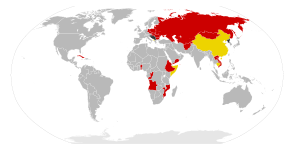
that adopted or imposed a Communist government at some point. By the early 1980s almost one-third of the world's population lived in Communist state
s, including the former Soviet Union and PRC.
Communist states such as the Soviet Union and PRC succeeded in becoming industrial and technological powers, challenging the capitalists' powers in the arms race
and space race
.
 By virtue of the Soviet Union's victory in the Second World War
in 1945, the Red Army
occupied nations not only in Central
and Eastern Europe
, but also in East Asia
; consequently, communism as a movement spread to many new countries. This expansion of communism both in Europe and Asia gave rise to a few different branches of its own, such as Maoism
.
Communism had been vastly strengthened by the winning of many new nations into the sphere of Soviet influence
and strength in Central and Eastern Europe. Governments modelled on Soviet Communism took power with Soviet assistance in Bulgaria
, Czechoslovakia
, East Germany, Poland
, Hungary
and Romania
. A Communist government was also created under Marshal Tito in Yugoslavia
, but Tito's independent policies led to the expulsion of Yugoslavia
from the Cominform
, which had replaced the Comintern
. Titoism
, a new branch in the world Communist movement, was labelled "deviationist
". Albania
also became an independent Communist nation after World War II.
By 1950, the Chinese Communists
held all of Mainland China
, thus controlling the most populous nation in the world. Other areas where rising Communist strength provoked dissension and in some cases led to actual fighting through conventional and guerrilla warfare
include the Korean War
, Laos
, many nations of the Middle East
and Africa
, and notably succeeded in the case of the Vietnam War
against the military power
of the United States and its allies. With varying degrees of success, Communists attempted to unite with nationalist
and socialist
forces against what they saw as Western
imperialism
in these poor countries.
With the exception of the contribution in World War II
by the Soviet Union, China, and the Italian resistance movement
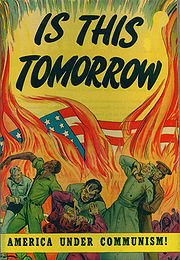
, communism was seen as a rival, and a threat to western democracies and capitalism for most of the 20th century. This rivalry peaked during the Cold War
, as the world's two remaining superpowers, the United States and the Soviet Union, polarized most of the world into two camps of nations. This was characterized in the West as The Free World vs. Behind the Iron Curtain. It supported the spread of their respective economic and political systems (capitalism and communism) and strengthened their military powers. As a result, the camps developed new weapon systems, stockpiled nuclear weapon
s, and competed in space exploration.
Near the beginning of the Cold War, on February 9, 1950, Senator Joseph McCarthy
from Wisconsin
accused 205 Americans working in the State Department
of being "card-carrying communists". The fear of communism in the U.S. spurred McCarthyism
, aggressive investigations and the red-baiting
, blacklist
ing, jailing and deportation of persons suspected of following communist or other left-wing ideologies. Many famous actors and writers were placed on a blacklist from 1950 to 1954, which meant they would not be hired and would be subject to public disdain.
became leader of the Soviet Union and relaxed central control, in accordance with reform policies of glasnost
(openness) and perestroika
(restructuring). The Soviet Union did not intervene as Poland
, East Germany, Czechoslovakia
, Bulgaria
, Romania
, and Hungary
all abandoned Communist rule by 1990. In 1991, the Soviet Union dissolved
.
By the beginning of the 21st century, states controlled by communist parties under a single-party system include the People's Republic of China
, Cuba
, Laos
, Vietnam
, and informally North Korea
. Communist parties, or their descendant parties, remain politically important in many countries. President Dimitris Christofias
of Cyprus
is a member of the Progressive Party of Working People
, but the country is not run under single-party rule. In South Africa
, the Communist Party is a partner in the ANC
-led government. In India
, communists lead the governments of three states
, with a combined population of more than 115 million. In Nepal
, communists hold a majority in the parliament
. In Brazil, the PCdoB
is a part of the parliamentary coalition led by the ruling democratic socialist Workers' Party and is represented in the executive cabinet
of Dilma Rousseff
.
The People's Republic of China has reassessed many aspects of the Maoist legacy; it, along with Laos, Vietnam, and, to a lesser degree Cuba, has reduced state control of the economy in order to stimulate growth. Chinese economic reform
s started in 1978 under the leadership of Deng Xiaoping
; since then, China has managed to bring down the poverty rate from 53% in the Mao era to just 6% in 2001. The People's Republic of China runs Special Economic Zone
s dedicated to market-oriented enterprise, free from central government
control. Several other communist states have also attempted to implement market-based reforms, including Vietnam.
 Theories within Marxism as to why communism in Central and Eastern Europe was not achieved after socialist revolutions pointed to such elements as the pressure of external capitalist states, the relative backwardness of the societies in which the revolutions occurred, and the emergence of a bureaucratic stratum or class that arrested or diverted the transition press in its own interests. (Scott and Marshall, 2005) Marxist critics of the Soviet Union, most notably Trotsky, referred to the Soviet system
, along with other Communist states, as "degenerated
" or "deformed workers' state
s", arguing that the Soviet system fell far short of Marx's communist ideal and he claimed the working class
was politically dispossessed. The ruling stratum of the Soviet Union was held to be a bureaucratic caste
, but not a new ruling class
, despite their political control. Anarchists who adhere to Participatory economics
claim that the Soviet Union became dominated by powerful intellectual elites who in a capitalist system crown the proletariat's labour on behalf of the bourgeoisie.
Non-Marxists, in contrast, have often applied the term to any society ruled by a communist party and to any party aspiring to create a society similar to such existing nation-states. In the social sciences
, societies ruled by communist parties are distinct for their single party control and their socialist economic bases. While some social and political scientists applied the concept of "totalitarianism
" to these societies, others identified possibilities for independent political activity within them, and stressed their continued evolution up to the point of the dissolution of the Soviet Union and its allies in Central Europe
during the late 1980s and early 1990s.
, the collective philosophies of the German philosophers Karl Marx
. Marxism-Leninism
is the synthesis of Vladimir Lenin
's contributions to Marxism, such as how a revolutionary party should be organised; Trotskyism
is Leon Trotsky
's conception of Marxism, influenced by Lenin, and meanwhile, Maoism
is Mao Zedong
's interpretation of Marxism to suit the conditions of China at that time, and is fairly heavy on the need for agrarian worker support as the engine for the revolution, rather than workers in the urban areas, which were still very small at that point.
Self-identified communists hold a variety of views, including Marxism-Leninism
, Trotskyism
, council communism
, Luxemburgism
, anarchist communism
, Christian communism
, and various currents of left communism
. However, the offshoots of the Marxist-Leninist interpretations of Marxism
are the best-known of these and had been a driving force in international relations
during the last quarter of the 19th century and most of the 20th century up to around 1989 and what historians refer to as "the collapse of communism." However, other forms of communism worldwide continue to exist in the ideologies of various individual labor movement trade union
s worldwide, particularly in Europe
and the Third World
, and also in communist parties
that continue to espouse the ultimate need for communist revolution
.
Most communists today tend to agree that the remaining communist state
s, such as China, Vietnam and especially North Korea
(which has replaced Marxism-Leninism
with Juche
as its official ideology), have nothing to do with communism, whether as practised currently within leftist resistance movements and parties, or in terms of the ideologies and programmes held by those movements.
A diverse range of theories persist amongst prominent globally known people such as Slavoj Zizek
, Michael Parenti
, Alain Badiou
and other radical left
thinkers who proclaim themselves communists; they and others like them are examples of present-day well-known figures in the modern communist movement.
Like other socialists, Marx and Engels
sought an end to capitalism and the systems which they perceived to be responsible for the exploitation of workers. Whereas earlier socialists often favored longer-term social reform
, Marx and Engels believed that popular revolution was all but inevitable, and the only path to socialism and communism.
According to the Marxist argument for communism, the main characteristic of human life in class society
is alienation
; and communism is desirable because it entails the full realization of human freedom. Marx here follows Georg Wilhelm Friedrich Hegel
in conceiving freedom not merely as an absence of restraints but as action with content. According to Marx, communism's outlook on freedom was based on an agent, obstacle, and goal. The agent is the common/working people; the obstacles are class divisions, economic inequalities, unequal life-chances
, and false consciousness; and the goal is the fulfilment of human needs including satisfying work, and fair share of the product.
They believed that communism allowed people to do what they want, but also put humans in such conditions and such relations with one another that they would not wish to exploit, or have any need to. Whereas for Hegel the unfolding of this ethical life in history is mainly driven by the realm of ideas, for Marx, communism emerged from material forces, particularly the development of the means of production
.
Marxism holds that a process of class conflict
and revolutionary struggle will result in victory for the proletariat
and the establishment of a communist society
in which private property and ownership
is abolished over time and the means of production and subsistence belong to the community. (Private property and ownership, in this context, means ownerships of the means of production
, not private possessions). Marx himself wrote little about life under communism, giving only the most general indication as to what constituted a communist society. It is clear that it entails abundance in which there is little limit to the projects that humans may undertake. In the popular slogan that was adopted by the communist movement
, communism was a world in which each gave according to their abilities, and received according to their needs. The German Ideology
(1845) was one of Marx's few writings to elaborate on the communist future:
Marx's lasting vision was to add this vision to a theory of how society was moving in a law-governed way towards communism, and, with some tension, a political theory that explained why revolutionary activity was required to bring it about.
In the late 19th century, the terms "socialism" and "communism" were often used interchangeably. However, Marx and Engels argued that communism would not emerge from capitalism in a fully developed state
, but would pass through a "first phase" in which most productive property was owned in common, but with some class differences remaining. The "first phase" would eventually evolve into a "higher phase" in which class differences were eliminated, and a state was no longer needed. Lenin frequently used the term "socialism" to refer to Marx and Engels' supposed "first phase" of communism and used the term "communism" interchangeably with Marx and Engels' "higher phase" of communism.
These later aspects, particularly as developed by Vladimir Lenin
, provided the underpinning for the mobilizing features of 20th century communist parties.
is the political movement developed by Vladimir Lenin, which has become the foundation for the organizational structure of most major communist parties. Leninists advocate the creation of a vanguard party led by professional revolutionaries in order to lead the working class revolution. Leninists believe that socialism will not arise spontaneously through the natural decay of capitalism and that workers are unable to organize and develop socialist consciousness without the guidance of the Vanguard party. After taking power, Vanguard parties seek to create a socialist state dominated by the Vanguard party in order to direct social development and defend against counterrevolutionary insurrection. The mode of industrial organization championed by Leninism and Marxism-Leninism is the capitalist model of scientific management pioneered by Fredrick Taylor.
Marxism-Leninism
is a version of Leninism merged with classical Marxism
adopted by the Soviet Union and most communist parties across the world today. It shaped the Soviet Union and influenced communist parties worldwide. It was heralded as a possibility of building communism via a massive program of industrialization and collectivisation. Despite the fall of the Soviet Union and the 'Eastern Bloc' (meaning communist countries of Eastern and Central Europe), many communist parties of the world today still lay claim to uphold the Marxist-Leninist banner. Marxism-Leninism expands on Marxists thoughts by bringing the theories to what Lenin and other Communists considered, the age of capitalist imperialism, and a renewed focus on party building, the development of a socialist state
, and democratic centralism as an organizational principle.
Lenin adapted Marx's urban revolution to Russia's agricultural conditions, sparking the "revolutionary nationalism of the poor". The pamphlet What is to be Done? (1902), proposed that the (urban) proletariat
can successfully achieve revolutionary consciousness only under the leadership of a vanguard party
of professional revolutionaries
—who can achieve aims only with internal democratic centralism
in the party; tactical and ideological policy decisions are agreed via democracy, and every member must support and promote the agreed party policy.
To wit, capitalism
can be overthrown only with revolution
—because attempts to reform capitalism from within (Fabianism) and from without (democratic socialism
) will fail because of its inherent contradictions. The purpose of a Leninist revolutionary vanguard party
is the forceful deposition
of the incumbent government; assume power (as agent of the proletariat) and establish a dictatorship of the proletariat
government. Moreover, as the government, the vanguard party must educate
the proletariat—to dispel the societal false consciousness of religion
and nationalism
that are culturally instilled by the bourgeoisie
in facilitating exploitation
. The dictatorship of the proletariat is governed with a de-centralized direct democracy
practised via soviets
(councils) where the workers exercise political power (cf. soviet democracy
); the fifth chapter of State & Revolution, describes it:
The Bolshevik
government was hostile to nationalism, especially to Russian nationalism
, the "Great Russian chauvinism", as an obstacle to establishing the proletarian dictatorship. The revolutionary elements of Leninism—the disciplined vanguard party, a dictatorship of the proletariat, and class war.
was the political system
of the Soviet Union and the countries within the Soviet sphere of influence during the leadership of Joseph Stalin
. The term usually defines the style of a government rather than an ideology. The ideology was officially Marxism-Leninism theory, reflecting that Stalin himself was not a theoretician, in contrast to Marx and Lenin, and prided himself on maintaining the legacy of Lenin as a founding father for the Soviet Union and the future Socialist world. Stalinism is an interpretation of their ideas, and a certain political regime claiming to apply those ideas in ways fitting the changing needs of Soviet society, as with the transition from "socialism at a snail's pace" in the mid-twenties to the rapid industrialization of the Five-Year Plans.
The main contributions of Stalin to communist theory were:
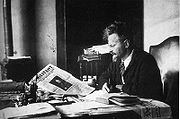 Trotskyism is the branch of Marxism that was developed by Leon Trotsky
. It supports the theory of permanent revolution
and world revolution
instead of the two stage theory
and socialism in one country
. It supported proletarian internationalism
and another Communist revolution in the Soviet Union, which, under the leadership of Stalin, Trotsky claimed had become a degenerated worker's state, rather than the dictatorship of the proletariat
.
Trotsky and his supporters organized into the Left Opposition
and their platform became known as Trotskyism
. Stalin eventually succeeded in gaining control of the Soviet regime and Trotskyist attempts to remove Stalin from power resulted in Trotsky's exile from the Soviet Union in 1929. During Trotsky's exile, world communism fractured into two distinct branches: Marxism-Leninism
and Trotskyism
. Trotsky later founded the Fourth International
, a Trotskyist rival to the Comintern
, in 1938.
Trotskyist ideas have continually found a modest echo among political movement
s in some countries in Latin America
and Asia
, especially in Argentina
, Brazil
, Bolivia
and Sri Lanka
. Many Trotskyist organizations are also active in more stable, developed countries in North America
and Western Europe
. Trotsky's politics differed sharply from those of Stalin and Mao, most importantly in declaring the need for an international proletarian revolution (rather than socialism in one country) and unwavering support for a true dictatorship of the proletariat based on democratic principles.
However, as a whole, Trotsky's theories and attitudes were never accepted in worldwide mainstream Communist circles after Trotsky's expulsion, either within or outside of the Soviet bloc
. This remained the case even after the Secret Speech and subsequent events critics claim exposed the fallibility of Stalin.
is the Marxist-Leninist trend of Communism associated with Mao Zedong
and was mostly practiced within China. Khrushchev's reforms heightened ideological differences between China and the Soviet Union, which became increasingly apparent in the 1960s. Parties and groups that supported the Communist Party of China
(CPC) in their criticism against the new Soviet leadership proclaimed themselves as 'anti-revisionist' and denounced the CPSU
and the parties aligned with it as revisionist
"capitalist-roaders." The Sino-Soviet Split resulted in divisions amongst communist parties around the world. Notably, the Party of Labour of Albania sided with the People's Republic of China
. Effectively, the CPC
under Mao's leadership became the rallying forces of a parallel international Communist tendency.
Definitions of Maoism vary. Within the Chinese context, Maoism can refer to Mao's belief in the mobilization of the masses, particularly in large-scale political movements; it can also refer to the egalitarianism
that was seen during Mao's era as opposed to the free-market ideology of Deng Xiaoping
; some scholars additionally define personality cults and political sloganeering as "Maoist" practices. Contemporary Maoists in China criticize the social inequalities created by a capitalist and 'revisionist' Communist party.
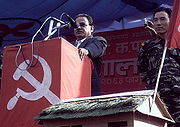 Prachanda Path
Prachanda Path refers to the ideological line of the Unified Communist Party of Nepal. This thought is an extension of Marxism
, Leninism
and Maoism
, totally based on home-ground politics of Nepal
. The doctrine came into existence after it was realized that the ideology of Marxism, Leninism and Maoism could not be practiced completely as it was done in the past. And an ideology suitable, based on the ground reality of Nepalese politics was adopted by the party.
Hoxhaism
Another variant of anti-revisionist
Marxism-Leninism
appeared after the ideological row
between the Communist Party of China
and the Party of Labour of Albania in 1978. The Albanians rallied a new separate international tendency, which would demarcate itself by a strict defence of the legacy of Joseph Stalin and fierce criticism of virtually all other Communist groupings as revisionism
. Critical of the United States
, the Soviet Union, and China, Enver Hoxha
declared the latter two to be social-imperialist and condemned the Soviet invasion of Czechoslovakia by withdrawing from the Warsaw Pact
in response. Hoxha declared Albania to be the world's only Marxist-Leninist state after 1978. The Albanians were able to win over a large share of the Maoists, mainly in Latin America
such as the Popular Liberation Army, but also had a significant international following in general. This tendency has occasionally been labelled as 'Hoxhaism' after him.
After the fall of the Communist government in Albania, the pro-Albanian parties are grouped around an international conference
and the publication 'Unity and Struggle'.
Titoism
Elements of Titoism are characterized by policies and practices based on the principle that in each country, the means of attaining ultimate communist goals must be dictated by the conditions of that particular country, rather than by a pattern set in another country. During Tito's era, this specifically meant that the communist goal should be pursued independently of (and often in opposition to) the policies of the Soviet Union. The term was originally meant as a pejorative
, and was labelled by Moscow as a heresy during the period of tensions between the Soviet Union and Yugoslavia known as the Informbiro
period from 1948 to 1955.
Unlike the rest of Central and Eastern Europe, which fell under Stalin's influence post–World War II, Yugoslavia, due to the strong leadership of Marshal Tito
and the fact that the Yugoslav Partisans liberated Yugoslavia with only limited help from the Red Army
, remained independent from Moscow. It became the only country in the Balkans
to resist pressure from Moscow to join the Warsaw Pact
and remained "socialist, but independent" until the collapse of Soviet socialism in the late 1980s and early 1990s. Throughout his time in office, Tito prided himself on Yugoslavia's independence from Russia, with Yugoslavia never accepting full membership of the Comecon
and Tito's open rejection of many aspects of Stalinism as the most obvious manifestations of this.
an communist parties to develop a theory and practice of social transformation that was more relevant in a Western European democracy and less aligned to the influence or control of the Soviet Union. Parties such as the Italian Communist Party
(PCI), the French Communist Party
(PCF), and the Communist Party of Spain (PCE), were politically active and electorally significant in their respective countries).
The main theoretical foundation of Eurocommunism was Antonio Gramsci
's writing about Marxist theory which questioned the sectarianism of the Left and encouraged communist parties to develop social alliances to win hegemonic
support for social reforms. Eurocommunist parties expressed their fidelity to democratic
institutions more clearly than before and attempted to widen their appeal by embracing public sector
middle-class workers, new social movements
such as feminism
and gay liberation
and more publicly questioning the Soviet Union. Early inspirations can also be found in the Austromarxism
and its seeking of a "third" democratic "way" to socialism.
aspects of Marxism
. Early currents of libertarian Marxism, known as left communism
, emerged in opposition to Marxism–Leninism and its derivatives, such as Stalinism
, Maoism
, and Trotskyism
. Libertarian Marxism is also critical of reformist positions, such as those held by social democrats. Libertarian Marxist currents often draw from Marx and Engels' later works, specifically the Grundrisse
and The Civil War in France
; emphasizing the Marxist belief in the ability of the working class
to forge its own destiny without the need for a revolutionary party or state
to mediate or aid its liberation. Along with anarchism
, Libertarian Marxism is one of the main currents of libertarian socialism
.
Libertarian Marxism includes such currents as Luxemburgism
, council communism
, left communism
, Socialisme ou Barbarie
, the Johnson-Forest tendency
, world socialism, Lettrism
/Situationism and operaismo/autonomism
, and New Left
. Libertarian Marxism has often had a strong influence on both post-left and social anarchists
. Notable theorists of libertarian Marxism have included Anton Pannekoek, Raya Dunayevskaya
, CLR James, Antonio Negri
, Cornelius Castoriadis
, Maurice Brinton
, Guy Debord
, Daniel Guérin
, Ernesto Screpanti
and Raoul Vaneigem
.
and the Netherlands
in the 1920s. Its primary organization was the Communist Workers Party of Germany
(KAPD). Council communism continues today as a theoretical and activist position within both left-wing Marxism
and libertarian socialism
.
The central argument of council communism, in contrast to those of social democracy
and Leninist
Communism, is that democratic workers' councils arising in the factories and municipalities are the natural form of working class organisation and governmental power. This view is opposed to both the reformist and the Leninist ideologies
, with their stress on, respectively, parliament
s and institutional
government (i.e., by applying social reforms), on the one hand, and vanguard parties
and participative democratic centralism
on the other).
The core principle of council communism is that the government
and the economy
should be managed by workers' councils composed of delegate
s elected at workplaces and recallable
at any moment. As such, council communists oppose state-run
authoritarian
"State socialism
"/"State capitalism
". They also oppose the idea of a "revolutionary party", since council communists believe that a revolution led by a party will necessarily produce a party dictatorship. Council communists support a worker's democracy, which they want to produce through a federation of workers' councils.

s at certain periods, from a position that is asserted to be more authentically Marxist
and proletarian
than the views of Leninism
held by the Communist International
after its first and during its second congress.
Left Communists see themselves to the left of Leninists (whom they tend to see as 'left of capital', not socialist
s), anarchist communists
(some of whom they consider internationalist socialists) as well as some other revolutionary socialist tendencies (for example De Leonists
, who they tend to see as being internationalist socialists only in limited instances).
Although she died before left communism became a distinct tendency, Rosa Luxemburg
has heavily influenced most left communists, both politically and theoretically. Proponents of left communism have included Amadeo Bordiga
, Herman Gorter
, Anton Pannekoek
, Otto Rühle
, Karl Korsch
, Sylvia Pankhurst
and Paul Mattick
.
Prominent left communist groups existing today include the International Communist Party
, the International Communist Current
and the Internationalist Communist Tendency.
wildcat strikes of May 1968 in France.
With their ideas rooted in Marxism
and the 20th century European artistic avant-garde
s, they advocated experiences of life being alternative to those admitted by the capitalist order
, for the fulfillment of human primitive desires and the pursuing of a superior passional quality. For this purpose they suggested and experimented with the construction of situations, namely the setting up of environments favorable for the fulfillment of such desires. Using methods drawn from the arts, they developed a series of experimental fields of study for the construction of such situations, like unitary urbanism
and psychogeography
.
They fought against the main obstacle on the fulfillment of such superior passional living, identified by them in advanced capitalism
. Their theoretical work peaked on the highly influential book The Society of the Spectacle
by Guy Debord
. Debord argued in 1967 that spectacular features like mass media
and advertising
have a central role in an advanced capitalist society, which is to show a fake reality in order to mask the real capitalist degradation of human life. To overthrow such a system, the Situationist International supported the May '68 revolts, and asked the workers to occupy the factories
and to run them with direct democracy
, through workers' councils composed by instantly revocable delegates.
After publishing in the last issue of the magazine an analysis of the May 1968 revolts, and the strategies that will need to be adopted in future revolutions, the SI was dissolved in 1972.
. As an identifiable theoretical system it first emerged in Italy in the 1960s
from workerist (operaismo) communism. Later, post-Marxist
and anarchist tendencies became significant after influence from the Situationists, the failure of Italian far-left movements in the 1970s, and the emergence of a number of important theorists including Antonio Negri
, who had contributed to the 1969 founding of Potere Operaio
, Mario Tronti, Paolo Virno
, etc.
Through translations made available by Danilo Montaldi and others, the Italian autonomists drew upon previous activist research in the United States by the Johnson-Forest Tendency
and in France by the group Socialisme ou Barbarie
.
It influenced the German and Dutch Autonomen, the worldwide Social Centre movement, and today is influential in Italy, France, and to a lesser extent the English-speaking countries. Those who describe themselves as autonomists now vary from Marxists to post-structuralists
and anarchists. The Autonomist Marxist and Autonomen movements provided inspiration to some on the revolutionary left in English speaking countries, particularly among anarchists, many of whom have adopted autonomist tactics. Some English-speaking anarchists even describe themselves as Autonomists. The Italian operaismo movement also influenced Marxist academics such as Harry Cleaver
, John Holloway
, Steve Wright, and Nick Dyer-Witheford.
, but non-Marxist versions of communism (such as Christian communism
and anarchist communism
) also exist.
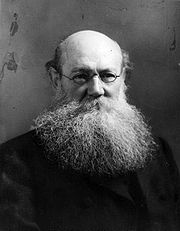 Anarchist communism (also known as libertarian communism) is a theory of anarchism
which advocates the abolition of the state
, private property
, and capitalism
in favour of common ownership
of the means of production
, direct democracy
and a horizontal network of voluntary association
s and workers' council
s with production and consumption based on the guiding principle: "from each according to his ability, to each according to his need
".
Anarcho-communism differs from marxism rejecting its view about the need for a State Socialism phase before building communism. The main anarcho-communist theorist Peter Kropotkin
argued "that a revolutionary society should “transform itself immediately into a communist society,”, that is, should go immediately into what Marx had regarded as the “more advanced,” completed, phase of communism." In this way it tries to avoid the reappearence of "class divisions and the need for a state to oversee everything".
Some forms of anarchist communism such as insurrectionary anarchism
are egoist
and strongly influenced by radical individualism
, believing that anarchist communism does not require a communitarian nature at all. Most anarcho-communists view anarcho-communism as a way of reconciling the opposition between the individual and society
To date in human history, the best known examples of an anarchist communist society, established around the ideas as they exist today, that received worldwide attention and knowledge in the historical canon, are the anarchist territories during the Spanish Revolution
and the Free Territory during the Russian Revolution. Through the efforts and influence of the Spanish Anarchists during the Spanish Revolution
within the Spanish Civil War
, starting in 1936 anarchist communism existed in most of Aragon, parts of the Levante and Andalusia, as well as in the stronghold of Anarchist Catalonia
before being brutally crushed by the combined forces of the authoritarian regime that won the war, Hitler, Mussolini, Spanish Communist Party repression (backed by the USSR) as well as economic and armaments blockades from the capitalist countries and the Spanish Republic itself. During the Russian Revolution, anarchists such as Nestor Makhno
worked to create and defend—through the Revolutionary Insurrectionary Army of Ukraine
—anarchist communism in the Free Territory of the Ukraine from 1919 before being conquered by the Bolsheviks in 1921.
is a form of religious communism centred on Christianity. It is a theological and political theory based upon the view that the teachings of Jesus Christ
urge Christians to support communism as the ideal social system
. Christian communists trace the origins of their practice to teachings in the New Testament
, such as this one from Acts of the Apostles
at chapter 2 and verses 42, 44, and 45:
Christian communism can be seen as a radical form of Christian socialism
. Also, because many Christian communists have formed independent stateless communes in the past, there is also a link between Christian communism and Christian anarchism
. Christian communists may not agree with various parts of Marxism
, but they share some of the political goals of Marxists, for example replacing capitalism with socialism
, which should in turn be followed by communism at a later point in the future. However, Christian communists sometimes disagree with Marxists (and particularly with Leninists
) on the way a socialist or communist society should be organized.
, slow or stagnant technological advance, reduced incentives, reduced prosperity, feasibility, and its social and political effects.
Part of this criticism extends to the policies adopted by one-party states ruled by communist parties (known as "communist state
s"). Some scholars are specially focused on their human rights
records which are claimed to be responsible for famines, purges and warfare resulting in deaths far in excess of previous empires, capitalist or other regimes. The Council of Europe
in Resolution 1481
and international declarations such as the Prague Declaration on European Conscience and Communism
and the Declaration on Crimes of Communism
have condemned some of the actions that resulted in these deaths as crimes.
Stéphane Courtois
argues that Communism and National Socialism are slightly different totalitarian systems, and that communism is responsible for the murder of almost 100 million people in the 20th century, but two of the main Black Books contributors, Nicolas Werth and Jean-Louis Margolin, disagreed and publicly disassociated themselves from Courtois's statements.
Social
The term social refers to a characteristic of living organisms...
, political and economic
Economy
An economy consists of the economic system of a country or other area; the labor, capital and land resources; and the manufacturing, trade, distribution, and consumption of goods and services of that area...
ideology that aims at the establishment of a classless
Classless society
Classless society refers to a society in which no one is born into a social class. Such distinctions of wealth, income, education, culture, or social network might arise and would only be determined by individual experience and achievement in such a society.Since these distinctions are difficult to...
, moneyless, revolutionary
Revolutionary
A revolutionary is a person who either actively participates in, or advocates revolution. Also, when used as an adjective, the term revolutionary refers to something that has a major, sudden impact on society or on some aspect of human endeavor.-Definition:...
and stateless
Stateless society
A stateless society is a society that is not governed by a state. In stateless societies, there is little concentration of authority; most positions of authority that do exist are very limited in power and are generally not permanently held positions; and social bodies that resolve disputes through...
socialist society
Socialist society
Socialist society may refer to one of the following.*A society based on socialism; inclusive collaborative decision-making*The societies of the Communist states*Socialist Society; a periodical*Socialist society...
structured
Base and superstructure
In Marxist theory, human society consists of two parts: the base and superstructure; the base comprehends the forces and relations of production — employer-employee work conditions, the technical division of labour, and property relations — into which people enter to produce the necessities and...
upon common ownership
Common ownership
Common ownership is a principle according to which the assets of an enterprise or other organization are held indivisibly rather than in the names of the individual members or by a public institution such as a governmental body. It is therefore in contrast to public ownership...
of the means of production
Means of production
Means of production refers to physical, non-human inputs used in production—the factories, machines, and tools used to produce wealth — along with both infrastructural capital and natural capital. This includes the classical factors of production minus financial capital and minus human capital...
. This movement, in its Marxist-Leninist interpretations, significantly influenced the history of the 20th century, which saw intense rivalry between the "socialist world" (socialist state
Socialist state
A socialist state generally refers to any state constitutionally dedicated to the construction of a socialist society. It is closely related to the political strategy of "state socialism", a set of ideologies and policies that believe a socialist economy can be established through government...
s ruled by Communist parties
Communist party
A political party described as a Communist party includes those that advocate the application of the social principles of communism through a communist form of government...
) and the "western world" (countries with market economies
Market economy
A market economy is an economy in which the prices of goods and services are determined in a free price system. This is often contrasted with a state-directed or planned economy. Market economies can range from hypothetically pure laissez-faire variants to an assortment of real-world mixed...
and Liberal democratic government), culminating in the Cold War
Cold War
The Cold War was the continuing state from roughly 1946 to 1991 of political conflict, military tension, proxy wars, and economic competition between the Communist World—primarily the Soviet Union and its satellite states and allies—and the powers of the Western world, primarily the United States...
between the Eastern bloc
Eastern bloc
The term Eastern Bloc or Communist Bloc refers to the former communist states of Eastern and Central Europe, generally the Soviet Union and the countries of the Warsaw Pact...
and the "Free World
Free World
The Free World is a Cold War-era term often used to describe states not under the rule of the Soviet Union, its Eastern European allies, China, Vietnam, Cuba, and other communist nations. The term often referred to states such as the United States, Canada, and Western European states such as the...
".
In Marxist theory
Marxism
Marxism is an economic and sociopolitical worldview and method of socioeconomic inquiry that centers upon a materialist interpretation of history, a dialectical view of social change, and an analysis and critique of the development of capitalism. Marxism was pioneered in the early to mid 19th...
, communism is a specific stage of historical development that inevitably emerges from the development of the productive forces
Productive forces
Productive forces, "productive powers" or "forces of production" [in German, Produktivkräfte] is a central idea in Marxism and historical materialism....
that leads to a superabundance of material wealth, allowing for distribution based on need
From each according to his ability, to each according to his need
From each according to his ability, to each according to his need is a slogan popularised by Karl Marx in his 1875 Critique of the Gotha Program. In German, "Jeder nach seinen Fähigkeiten, jedem nach seinen Bedürfnissen!"...
and social relations based on freely associated individuals
Free association (communism and anarchism)
In the anarchist, Marxist and socialist sense, free association is a kind of relation between individuals where there is no state, social class or authority, in a society that had abolished the private property of means of production...
. The exact definition of communism varies, and it is often mistakenly, in general political discourse, used interchangeably with socialism
Socialism
Socialism is an economic system characterized by social ownership of the means of production and cooperative management of the economy; or a political philosophy advocating such a system. "Social ownership" may refer to any one of, or a combination of, the following: cooperative enterprises,...
; however, Marxist theory contends that socialism is just a transitional stage on the road to communism. Leninists
Leninism
In Marxist philosophy, Leninism is the body of political theory for the democratic organisation of a revolutionary vanguard party, and the achievement of a direct-democracy dictatorship of the proletariat, as political prelude to the establishment of socialism...
revised this theory by introducing the notion of a vanguard party
Vanguard party
A vanguard party is a political party at the forefront of a mass action, movement, or revolution. The idea of a vanguard party has its origins in the Communist Manifesto by Karl Marx and Friedrich Engels...
to lead the proletarian revolution and to hold all political power after the revolution, "in the name of the workers" and with worker participation
Participatory democracy
Participatory Democracy, also known as Deliberative Democracy, Direct Democracy and Real Democracy , is a process where political decisions are made directly by regular people...
, in a transitional stage between capitalism
Capitalism
Capitalism is an economic system that became dominant in the Western world following the demise of feudalism. There is no consensus on the precise definition nor on how the term should be used as a historical category...
and socialism.
Communists such as council communists and non-Marxist libertarian communists and anarcho-communist oppose the idea of a vanguard party and a transition stage, and advocate for the construction of full communism to begin immediately upon the abolition of capitalism. There is a very wide range of theories amongst those particular communists in regards to how to build the types of institutions that would replace the various economic engines (such as food distribution, education, and hospitals) as they exist under capitalist systems—or even whether to do so at all. Some of these communists have specific plans for the types of administrative bodies that would replace the current ones, while always qualifying that these bodies would be decentralised
Décentralisation
Décentralisation is a french word for both a policy concept in French politics from 1968-1990, and a term employed to describe the results of observations of the evolution of spatial economic and institutional organization of France....
and worker-owned, just as they currently are within the activist movements themselves. Others have no concrete set of post-revolutionary blueprints at all, claiming instead that they simply trust that the world's workers and poor will figure out proper modes of distribution and wide-scale production, and also coordination, entirely on their own, without the need for any structured "replacements" for capitalist state-based
Nation-state
The nation state is a state that self-identifies as deriving its political legitimacy from serving as a sovereign entity for a nation as a sovereign territorial unit. The state is a political and geopolitical entity; the nation is a cultural and/or ethnic entity...
control.
In the modern lexicon of what many sociologists and political commentators refer to as the "political mainstream", communism is often used to refer to the policies of states run by communist parties
Communist party
A political party described as a Communist party includes those that advocate the application of the social principles of communism through a communist form of government...
, regardless of the practical content of the actual economic system
Economic system
An economic system is the combination of the various agencies, entities that provide the economic structure that defines the social community. These agencies are joined by lines of trade and exchange along which goods, money etc. are continuously flowing. An example of such a system for a closed...
they may preside over. Examples of this include the policies of the Socialist Republic of Vietnam where the economic system incorporates "doi moi", the People's Republic of China
People's Republic of China
China , officially the People's Republic of China , is the most populous country in the world, with over 1.3 billion citizens. Located in East Asia, the country covers approximately 9.6 million square kilometres...
(PRC, or simply "China") where the economic system incorporates "socialist market economy
Socialist market economy
The socialist market economy or socialist market economy with Chinese characteristics is the official term used to refer to the economic system of the People's Republic of China after the reforms of Deng Xiaoping. It is also referred to as socialism with Chinese characteristics...
", and the economic system of the Soviet Union which was described as "state capitalist" by non-Leninist socialists and later by communists who increasingly opposed the post-Stalin era Soviet model as it progressed over the course of the 20th century (e.g. Maoists, Trotskyists and libertarian communists)—and even at one point by Vladimir Lenin
Vladimir Lenin
Vladimir Ilyich Lenin was a Russian Marxist revolutionary and communist politician who led the October Revolution of 1917. As leader of the Bolsheviks, he headed the Soviet state during its initial years , as it fought to establish control of Russia in the Russian Civil War and worked to create a...
himself.
Etymology and terminology
Communism comes from the Latin word communis, which means "shared" or "belong to all".In the schema of historical materialism
Historical materialism
Historical materialism is a methodological approach to the study of society, economics, and history, first articulated by Karl Marx as "the materialist conception of history". Historical materialism looks for the causes of developments and changes in human society in the means by which humans...
, communism is the idea of a free society with no division or alienation, where mankind is free from oppression and scarcity. A communist society would have no governments, countries, or class divisions. In Marxist theory
Marxist philosophy
Marxist philosophy or Marxist theory are terms that cover work in philosophy that is strongly influenced by Karl Marx's materialist approach to theory or that is written by Marxists...
, the dictatorship of the proletariat
Dictatorship of the proletariat
In Marxist socio-political thought, the dictatorship of the proletariat refers to a socialist state in which the proletariat, or the working class, have control of political power. The term, coined by Joseph Weydemeyer, was adopted by the founders of Marxism, Karl Marx and Friedrich Engels, in the...
is the intermediate system between capitalism
Capitalism
Capitalism is an economic system that became dominant in the Western world following the demise of feudalism. There is no consensus on the precise definition nor on how the term should be used as a historical category...
and communism, when the government is in the process of changing the means of ownership from privatism
Privatism
Privatism is a generic term describing any belief that people have a right to the private ownership of certain things. There are many degrees of privatism, from the advocacy of limited private property over specific kinds of items to the advocacy of unrestricted private property over everything;...
to collective ownership. In political science
Political science
Political Science is a social science discipline concerned with the study of the state, government and politics. Aristotle defined it as the study of the state. It deals extensively with the theory and practice of politics, and the analysis of political systems and political behavior...
, the term "communism" is sometimes used to refer to communist state
Communist state
A communist state is a state with a form of government characterized by single-party rule or dominant-party rule of a communist party and a professed allegiance to a Leninist or Marxist-Leninist communist ideology as the guiding principle of the state...
s, a form of government
Form of government
A form of government, or form of state governance, refers to the set of political institutions by which a government of a state is organized. Synonyms include "regime type" and "system of government".-Empirical and conceptual problems:...
in which the state
State (polity)
A state is an organized political community, living under a government. States may be sovereign and may enjoy a monopoly on the legal initiation of force and are not dependent on, or subject to any other power or state. Many states are federated states which participate in a federal union...
operates under a one-party system
Single-party state
A single-party state, one-party system or single-party system is a type of party system government in which a single political party forms the government and no other parties are permitted to run candidates for election...
and declares allegiance to Marxism-Leninism
Marxism-Leninism
Marxism–Leninism is a communist ideology, officially based upon the theories of Marxism and Vladimir Lenin, that promotes the development and creation of a international communist society through the leadership of a vanguard party over a revolutionary socialist state that represents a dictatorship...
or a derivative thereof.
In modern usage, the word "communism" is still often used to refer to the policies of self-declared socialist governments comprising one-party states which were single legal political party systems operating under centrally planned economies
Planned economy
A planned economy is an economic system in which decisions regarding production and investment are embodied in a plan formulated by a central authority, usually by a government agency...
and a state ownership of the means of production
Means of production
Means of production refers to physical, non-human inputs used in production—the factories, machines, and tools used to produce wealth — along with both infrastructural capital and natural capital. This includes the classical factors of production minus financial capital and minus human capital...
, with the state, in turn, claiming that it represented the interests of the working class
Working class
Working class is a term used in the social sciences and in ordinary conversation to describe those employed in lower tier jobs , often extending to those in unemployment or otherwise possessing below-average incomes...
es. A significant sector of the modern communist movement alleges that these states never made an attempt to transition to a communist society, while others even argue that they never achieved a legitimate socialism. Most of these governments based their ideology on Marxism-Leninism
Marxism-Leninism
Marxism–Leninism is a communist ideology, officially based upon the theories of Marxism and Vladimir Lenin, that promotes the development and creation of a international communist society through the leadership of a vanguard party over a revolutionary socialist state that represents a dictatorship...
, but they did not call the system they had set up "communism", nor did they even necessarily claim at all times that the ideology was the sole driving force behind their policies: Mao Zedong
Mao Zedong
Mao Zedong, also transliterated as Mao Tse-tung , and commonly referred to as Chairman Mao , was a Chinese Communist revolutionary, guerrilla warfare strategist, Marxist political philosopher, and leader of the Chinese Revolution...
, for example, pursued New Democracy
New Democracy
New Democracy or the New Democratic Revolution is a Maoist concept based on Mao Zedong's "Bloc of Four Social Classes" theory during post-revolutionary China which argues that democracy in China will take a decisively distinct path from either the liberal capitalist and/or parliamentary democratic...
, and Lenin in the early 1920s enacted war communism
War communism
War communism or military communism was the economic and political system that existed in Soviet Russia during the Russian Civil War, from 1918 to 1921...
; later, the Vietnamese enacted doi moi, and the Chinese switched to socialism with Chinese characteristics. The governments labeled by other governments as "communist" generally claimed that they had set up a transitional socialist system. This system is sometimes referred to as state socialism
State socialism
State socialism is an economic system with limited socialist characteristics, such as public ownership of major industries, remedial measures to benefit the working class, and a gradual process of developing socialism through government policy...
or by other similar names.
"Pure communism" is a term sometimes used to refer to the stage in history after socialism, although just as many communists use simply the term "communism" to refer to that stage. The classless, stateless society that is meant to characterise this communism is one where decisions on what to produce and what policies to pursue are made in the best interests of the whole of society—a sort of 'of, by, and for the working class', rather than a rich class controlling the wealth and everyone else working for them on a wage
Wage
A wage is a compensation, usually financial, received by workers in exchange for their labor.Compensation in terms of wages is given to workers and compensation in terms of salary is given to employees...
basis. In this communism the interests of every member of society is given equal weight to the next, in the practical decision-making process
Decision making
Decision making can be regarded as the mental processes resulting in the selection of a course of action among several alternative scenarios. Every decision making process produces a final choice. The output can be an action or an opinion of choice.- Overview :Human performance in decision terms...
in both the political and economic spheres of life. Karl Marx, as well as some other communist philosophers, deliberately never provided a detailed description as to how communism would function as a social system, nor the precise ways in which the working class could or should rise up, nor any other material specifics of exactly how to get to communism from capitalism. In the Communist Manifesto, Marx does lay out a 10-point plan advising the redistribution of land and production to begin the transition to communism, but he ensured that even this was very general and all-encompassing. It has always been presumed that Marx intended these theories to read this way specifically so that later theorists in specific situations could adapt communism to their own localities and conditions.
Theory
According to communist theory, the only way to abolish capitalist inequalities is to have the proletariat (working class), who collectively constitute the main producer of wealth in society, and who are perpetually exploitedExploitation
This article discusses the term exploitation in the meaning of using something in an unjust or cruel manner.- As unjust benefit :In political economy, economics, and sociology, exploitation involves a persistent social relationship in which certain persons are being mistreated or unfairly used for...
and marginalised by the bourgeoisie
Bourgeoisie
In sociology and political science, bourgeoisie describes a range of groups across history. In the Western world, between the late 18th century and the present day, the bourgeoisie is a social class "characterized by their ownership of capital and their related culture." A member of the...
(wealthy class), to overthrow the capitalist system in a wide-ranging social revolution
Social revolution
The term social revolution may have different connotations depending on the speaker.In the Trotskyist movement, the term "social revolution" refers to an upheaval in which existing property relations are smashed...
. The revolution, in the theory of most individuals and groups espousing communist revolution
Communist revolution
A communist revolution is a proletarian revolution inspired by the ideas of Marxism that aims to replace capitalism with communism, typically with socialism as an intermediate stage...
, usually involves an armed
Weapon
A weapon, arm, or armament is a tool or instrument used with the aim of causing damage or harm to living beings or artificial structures or systems...
rebellion
Rebellion
Rebellion, uprising or insurrection, is a refusal of obedience or order. It may, therefore, be seen as encompassing a range of behaviors aimed at destroying or replacing an established authority such as a government or a head of state...
. The revolution espoused can be explained by theorists in many different ways, and usually depends on the environment in which the particular communism theory originates. For example, the Chinese Revolution
Chinese Revolution
The Chinese Revolution in 1949 refers to the final stage of military conflict in the Chinese Civil War. In some anti-revisionist communist media and historiography, as well as the official media of the Communist Party of China, this period is known as the War of Liberation .- Historical background...
involved military combat between the Chinese Red and the Chinese Nationalist Armies
National Revolutionary Army
The National Revolutionary Army , pre-1928 sometimes shortened to 革命軍 or Revolutionary Army and between 1928-1947 as 國軍 or National Army was the Military Arm of the Kuomintang from 1925 until 1947, as well as the national army of the Republic of China during the KMT's period of party rule...
, while the Vietnamese Revolution
August Revolution
On August 19, 1945, the Việt Minh under Hồ Chí Minh began the August General Uprising Tổng Khởi Nghĩa, which was soon renamed the August Revolution . Whether or not this series of events should be called a "revolution" is disputable; what is clear is that, from August 19 onwards, demonstrations and...
was characterised by guerilla warfare between the heavily-backed Vietnam People's Army
Vietnam People's Army
The Vietnam People's Army is the armed forces of Vietnam. The VPA includes: the Vietnamese People's Ground Forces , the Vietnam People's Navy , the Vietnam People's Air Force, and the Vietnam Marine Police.During the French Indochina War , the VPA was often referred to as the Việt...
and various Western armies, culminating in the Vietnam War
Vietnam War
The Vietnam War was a Cold War-era military conflict that occurred in Vietnam, Laos, and Cambodia from 1 November 1955 to the fall of Saigon on 30 April 1975. This war followed the First Indochina War and was fought between North Vietnam, supported by its communist allies, and the government of...
which ended in 1975. Meanwhile, the Cuban Revolution
Cuban Revolution
The Cuban Revolution was an armed revolt by Fidel Castro's 26th of July Movement against the regime of Cuban dictator Fulgencio Batista between 1953 and 1959. Batista was finally ousted on 1 January 1959, and was replaced by a revolutionary government led by Castro...
was essentially a coup
Coup d'état
A coup d'état state, literally: strike/blow of state)—also known as a coup, putsch, and overthrow—is the sudden, extrajudicial deposition of a government, usually by a small group of the existing state establishment—typically the military—to replace the deposed government with another body; either...
that did not involve intensive wide-scale military conflict between Fulgencio Batista
Fulgencio Batista
Fulgencio Batista y Zaldívar was the United States-aligned Cuban President, dictator and military leader who served as the leader of Cuba from 1933 to 1944 and from 1952 to 1959, before being overthrown as a result of the Cuban Revolution....
's soldiers and those of Fidel Castro
Fidel Castro
Fidel Alejandro Castro Ruz is a Cuban revolutionary and politician, having held the position of Prime Minister of Cuba from 1959 to 1976, and then President from 1976 to 2008. He also served as the First Secretary of the Communist Party of Cuba from the party's foundation in 1961 until 2011...
and Che Guevara
Che Guevara
Ernesto "Che" Guevara , commonly known as el Che or simply Che, was an Argentine Marxist revolutionary, physician, author, intellectual, guerrilla leader, diplomat and military theorist...
. In fact, Castro initially did not believe that a vanguard party
Vanguard party
A vanguard party is a political party at the forefront of a mass action, movement, or revolution. The idea of a vanguard party has its origins in the Communist Manifesto by Karl Marx and Friedrich Engels...
was necessary in Cuba's case, a view boosted by Batista's unpopularity at the time of the actual armed conflict between the two sides. Regardless of the specific form a communist revolution takes, its aim is for the working class to replace the exploiter class as the ruling class to establish a society without class divisions, called socialism, as a prelude to attempting to achieve the final stage of communism.
History
Early communism
The origins of communism are debatable, and there are various historical groups, as well as theorists, whose beliefs have been subsequently described as communist. German philosopher Karl Marx saw primitive communismPrimitive communism
Primitive communism is a term used by Karl Marx and Friedrich Engels to describe what they interpreted as early forms of communism: As a model, primitive communism is usually used to describe early hunter-gatherer societies, that had no hierarchical social class structures or capital accumulation...
as the original, hunter-gatherer
Hunter-gatherer
A hunter-gatherer or forage society is one in which most or all food is obtained from wild plants and animals, in contrast to agricultural societies which rely mainly on domesticated species. Hunting and gathering was the ancestral subsistence mode of Homo, and all modern humans were...
state of humankind from which it arose. For Marx, only after humanity was capable of producing surplus
Economic surplus
In mainstream economics, economic surplus refers to two related quantities. Consumer surplus or consumers' surplus is the monetary gain obtained by consumers because they are able to purchase a product for a price that is less than the highest price that they would be willing to pay...
, did private property develop. The idea of a classless society first emerged in Ancient Greece
Ancient Greece
Ancient Greece is a civilization belonging to a period of Greek history that lasted from the Archaic period of the 8th to 6th centuries BC to the end of antiquity. Immediately following this period was the beginning of the Early Middle Ages and the Byzantine era. Included in Ancient Greece is the...
. Plato
Plato
Plato , was a Classical Greek philosopher, mathematician, student of Socrates, writer of philosophical dialogues, and founder of the Academy in Athens, the first institution of higher learning in the Western world. Along with his mentor, Socrates, and his student, Aristotle, Plato helped to lay the...
in his The Republic described it as a state where people shared all their property, wives, and children: "The private and individual is altogether banished from life and things which are by nature private, such as eyes and ears and hands, have become common, and in some way see and hear and act in common, and all men express praise and fell joy and sorrow on the same occasions."
In the history of Western thought, certain elements of the idea of a society based on common ownership of property can be traced back to ancient times
Ancient history
Ancient history is the study of the written past from the beginning of recorded human history to the Early Middle Ages. The span of recorded history is roughly 5,000 years, with Cuneiform script, the oldest discovered form of coherent writing, from the protoliterate period around the 30th century BC...
. Examples include the Spartacus
Spartacus
Spartacus was a famous leader of the slaves in the Third Servile War, a major slave uprising against the Roman Republic. Little is known about Spartacus beyond the events of the war, and surviving historical accounts are sometimes contradictory and may not always be reliable...
slave revolt
Slave rebellion
A slave rebellion is an armed uprising by slaves. Slave rebellions have occurred in nearly all societies that practice slavery, and are amongst the most feared events for slaveholders...
in Rome. The 5th century Mazdak
Mazdak
Mazdak was a proto-socialist Persian reformer and religious activist who gained influence under the reign of the Sassanian Shahanshah Kavadh I...
movement in what is now Iran
Iran
Iran , officially the Islamic Republic of Iran , is a country in Southern and Western Asia. The name "Iran" has been in use natively since the Sassanian era and came into use internationally in 1935, before which the country was known to the Western world as Persia...
has been described as "communistic" for challenging the enormous privileges of the noble classes and the clergy, criticizing the institution of private property and for striving for an egalitarian society.
At one time or another, various small communist communities existed, generally under the inspiration of Scripture. In the medieval
Middle Ages
The Middle Ages is a periodization of European history from the 5th century to the 15th century. The Middle Ages follows the fall of the Western Roman Empire in 476 and precedes the Early Modern Era. It is the middle period of a three-period division of Western history: Classic, Medieval and Modern...
Christian church
Christian Church
The Christian Church is the assembly or association of followers of Jesus Christ. The Greek term ἐκκλησία that in its appearances in the New Testament is usually translated as "church" basically means "assembly"...
, for example, some monastic
Monasticism
Monasticism is a religious way of life characterized by the practice of renouncing worldly pursuits to fully devote one's self to spiritual work...
communities and religious order
Religious order
A religious order is a lineage of communities and organizations of people who live in some way set apart from society in accordance with their specific religious devotion, usually characterized by the principles of its founder's religious practice. The order is composed of initiates and, in some...
s shared their land and other property (see Religious
Religious communism
Religious communism is a form of communism centered on religious principles. The term usually refers to a number of egalitarian and utopian religious societies practicing the voluntary dissolution of private property, so that society's benefits are distributed according to a person's needs, and...
and Christian communism
Christian communism
Christian communism is a form of religious communism based on Christianity. It is a theological and political theory based upon the view that the teachings of Jesus Christ compel Christians to support communism as the ideal social system...
). These groups often believed that concern with private property
Private property
Private property is the right of persons and firms to obtain, own, control, employ, dispose of, and bequeath land, capital, and other forms of property. Private property is distinguishable from public property, which refers to assets owned by a state, community or government rather than by...
was a distraction from religious service to God and neighbour.
Communist thought has also been traced back to the work of 16th century English writer Thomas More
Thomas More
Sir Thomas More , also known by Catholics as Saint Thomas More, was an English lawyer, social philosopher, author, statesman and noted Renaissance humanist. He was an important councillor to Henry VIII of England and, for three years toward the end of his life, Lord Chancellor...
. In his treatise Utopia
Utopia (book)
Utopia is a work of fiction by Thomas More published in 1516...
(1516), More portrayed a society based on common ownership
Common ownership
Common ownership is a principle according to which the assets of an enterprise or other organization are held indivisibly rather than in the names of the individual members or by a public institution such as a governmental body. It is therefore in contrast to public ownership...
of property, whose rulers administered it through the application of reason. In the 17th century, communist thought surfaced again in England. In England, a Puritan
Puritan
The Puritans were a significant grouping of English Protestants in the 16th and 17th centuries. Puritanism in this sense was founded by some Marian exiles from the clergy shortly after the accession of Elizabeth I of England in 1558, as an activist movement within the Church of England...
religious group
Religious denomination
A religious denomination is a subgroup within a religion that operates under a common name, tradition, and identity.The term describes various Christian denominations...
known as the "Diggers" advocated the abolition of private ownership of land. Eduard Bernstein
Eduard Bernstein
Eduard Bernstein was a German social democratic theoretician and politician, a member of the SPD, and the founder of evolutionary socialism and revisionism.- Life :...
, in his 1895 Cromwell and Communism argued that several groupings in the English Civil War
English Civil War
The English Civil War was a series of armed conflicts and political machinations between Parliamentarians and Royalists...
, especially the Diggers espoused clear communistic, agrarian ideals, and that Oliver Cromwell
Oliver Cromwell
Oliver Cromwell was an English military and political leader who overthrew the English monarchy and temporarily turned England into a republican Commonwealth, and served as Lord Protector of England, Scotland, and Ireland....
's attitude to these groups was at best ambivalent and often hostile. Criticism of the idea of private property continued into the Age of Enlightenment
Age of Enlightenment
The Age of Enlightenment was an elite cultural movement of intellectuals in 18th century Europe that sought to mobilize the power of reason in order to reform society and advance knowledge. It promoted intellectual interchange and opposed intolerance and abuses in church and state...
of the 18th century, through such thinkers as Jean Jacques Rousseau in France. Later, following the upheaval of the French Revolution
French Revolution
The French Revolution , sometimes distinguished as the 'Great French Revolution' , was a period of radical social and political upheaval in France and Europe. The absolute monarchy that had ruled France for centuries collapsed in three years...
, communism emerged as a political doctrine. François Noël Babeuf
François-Noël Babeuf
François-Noël Babeuf , known as Gracchus Babeuf , was a French political agitator and journalist of the Revolutionary period...
, in particular, espoused the goals of common ownership of land and total economic and political equality among citizens.
Various social reformers in the early 19th century founded communities based on common ownership. But unlike many previous communist communities, they replaced the religious emphasis with a rational and philanthropic basis. Notable among them were Robert Owen
Robert Owen
Robert Owen was a Welsh social reformer and one of the founders of utopian socialism and the cooperative movement.Owen's philosophy was based on three intellectual pillars:...
, who founded New Harmony
New Harmony, Indiana
New Harmony is a historic town on the Wabash River in Harmony Township, Posey County, Indiana, United States. It lies north of Mount Vernon, the county seat. The population was 916 at the 2000 census. It is part of the Evansville metropolitan area. Many of the old Harmonist buildings still stand...
in Indiana (1825), and Charles Fourier
Charles Fourier
François Marie Charles Fourier was a French philosopher. An influential thinker, some of Fourier's social and moral views, held to be radical in his lifetime, have become main currents in modern society...
, whose followers organized other settlements in the United States such as Brook Farm
Brook Farm
Brook Farm, also called the Brook Farm Institute of Agriculture and Education or the Brook Farm Association for Industry and Education, was a utopian experiment in communal living in the United States in the 1840s...
(1841–47). Later in the 19th century, Karl Marx described these social reformers as "utopian socialists
Utopian socialism
Utopian socialism is a term used to define the first currents of modern socialist thought as exemplified by the work of Saint-Simon, Charles Fourier, and Robert Owen which inspired Karl Marx and other early socialists and were looked on favorably...
" to contrast them with his program of "scientific socialism
Scientific Socialism
Scientific socialism is the term used by Friedrich Engels to describe the social-political-economic theory first pioneered by Karl Marx. The purported reason why this socialism is "scientific socialism" is because its theories are held to an empirical standard, observations are essential to its...
" (a term coined by Friedrich Engels
Friedrich Engels
Friedrich Engels was a German industrialist, social scientist, author, political theorist, philosopher, and father of Marxist theory, alongside Karl Marx. In 1845 he published The Condition of the Working Class in England, based on personal observations and research...
). Other writers described by Marx as "utopian socialists" included Saint-Simon
Claude Henri de Rouvroy, comte de Saint-Simon
Claude Henri de Rouvroy, comte de Saint-Simon, often referred to as Henri de Saint-Simon was a French early socialist theorist whose thought influenced the foundations of various 19th century philosophies; perhaps most notably Marxism, positivism and the discipline of sociology...
.
In its modern form, communism grew out of the socialist movement of 19th century Europe. As the Industrial Revolution
Industrial Revolution
The Industrial Revolution was a period from the 18th to the 19th century where major changes in agriculture, manufacturing, mining, transportation, and technology had a profound effect on the social, economic and cultural conditions of the times...
advanced, socialist critics blamed capitalism for the misery of the proletariat
Proletariat
The proletariat is a term used to identify a lower social class, usually the working class; a member of such a class is proletarian...
—a new class of urban factory workers who laboured under often-hazardous conditions. Foremost among these critics were Marx and his associate Friedrich Engels. In 1848, Marx and Engels offered a new definition of communism and popularized the term in their famous pamphlet The Communist Manifesto
The Communist Manifesto
The Communist Manifesto, originally titled Manifesto of the Communist Party is a short 1848 publication written by the German Marxist political theorists Karl Marx and Friedrich Engels. It has since been recognized as one of the world's most influential political manuscripts. Commissioned by the...
. Engels, who lived in Manchester
Manchester
Manchester is a city and metropolitan borough in Greater Manchester, England. According to the Office for National Statistics, the 2010 mid-year population estimate for Manchester was 498,800. Manchester lies within one of the UK's largest metropolitan areas, the metropolitan county of Greater...
, observed the organization of the Chartist
Chartism
Chartism was a movement for political and social reform in the United Kingdom during the mid-19th century, between 1838 and 1859. It takes its name from the People's Charter of 1838. Chartism was possibly the first mass working class labour movement in the world...
movement (see History of British socialism), while Marx departed from his university comrades to meet the proletariat in France and Germany.
Growth of modern communism
Georgi Plekhanov
Georgi Valentinovich Plekhanov was a Russian revolutionary and a Marxist theoretician. He was a founder of the Social-Democratic movement in Russia and was one of the first Russians to identify himself as "Marxist." Facing political persecution, Plekhanov emigrated to Switzerland in 1880, where...
. Underlying the work of Plekhanov was the assumption that Russia, less urbanized and industrialized than Western Europe, had many years to go before society would be ready for proletarian revolution to occur, and a transitional period of a bourgeois democratic regime would be required to replace Tsar
Tsar
Tsar is a title used to designate certain European Slavic monarchs or supreme rulers. As a system of government in the Tsardom of Russia and Russian Empire, it is known as Tsarist autocracy, or Tsarism...
ism with a socialist and later communist society. (EB)
In Russia, the 1917 October Revolution
October Revolution
The October Revolution , also known as the Great October Socialist Revolution , Red October, the October Uprising or the Bolshevik Revolution, was a political revolution and a part of the Russian Revolution of 1917...
was the first time any party with an avowedly Marxist orientation, in this case the Bolshevik Party
Communist Party of the Soviet Union
The Communist Party of the Soviet Union was the only legal, ruling political party in the Soviet Union and one of the largest communist organizations in the world...
, seized state power
Political power
Political power is a type of power held by a group in a society which allows administration of some or all of public resources, including labour, and wealth. There are many ways to obtain possession of such power. At the nation-state level political legitimacy for political power is held by the...
. The assumption of state power by the Bolsheviks generated a great deal of practical and theoretical debate within the Marxist movement. Marx predicted that socialism and communism would be built upon foundations laid by the most advanced capitalist development. Russia, however, was one of the poorest countries in Europe with an enormous, largely illiterate peasantry and a minority of industrial workers. Marx had explicitly stated that Russia might be able to skip the stage of bourgeoisie capitalism. Other socialists also believed that a Russian revolution
October Revolution
The October Revolution , also known as the Great October Socialist Revolution , Red October, the October Uprising or the Bolshevik Revolution, was a political revolution and a part of the Russian Revolution of 1917...
could be the precursor of workers' revolutions in the West.
The moderate Menshevik
Menshevik
The Mensheviks were a faction of the Russian revolutionary movement that emerged in 1904 after a dispute between Vladimir Lenin and Julius Martov, both members of the Russian Social-Democratic Labour Party. The dispute originated at the Second Congress of that party, ostensibly over minor issues...
s opposed Lenin's Bolshevik plan for socialist revolution
Communist revolution
A communist revolution is a proletarian revolution inspired by the ideas of Marxism that aims to replace capitalism with communism, typically with socialism as an intermediate stage...
before capitalism was more fully developed. The Bolsheviks' successful rise to power was based upon the slogans such as "Peace, bread, and land" which tapped the massive public desire for an end to Russian involvement in the First World War
World War I
World War I , which was predominantly called the World War or the Great War from its occurrence until 1939, and the First World War or World War I thereafter, was a major war centred in Europe that began on 28 July 1914 and lasted until 11 November 1918...
, the peasants' demand for land reform
Land reform
[Image:Jakarta farmers protest23.jpg|300px|thumb|right|Farmers protesting for Land Reform in Indonesia]Land reform involves the changing of laws, regulations or customs regarding land ownership. Land reform may consist of a government-initiated or government-backed property redistribution,...
, and popular support for the Soviets
Soviet (council)
Soviet was a name used for several Russian political organizations. Examples include the Czar's Council of Ministers, which was called the “Soviet of Ministers”; a workers' local council in late Imperial Russia; and the Supreme Soviet of the Soviet Union....
.
The usage of the terms "communism" and "socialism" shifted after 1917, when the Bolsheviks changed their name to Communist Party and installed a single party regime devoted to the implementation of socialist policies under Leninism
Leninism
In Marxist philosophy, Leninism is the body of political theory for the democratic organisation of a revolutionary vanguard party, and the achievement of a direct-democracy dictatorship of the proletariat, as political prelude to the establishment of socialism...
. The Second International
Second International
The Second International , the original Socialist International, was an organization of socialist and labour parties formed in Paris on July 14, 1889. At the Paris meeting delegations from 20 countries participated...
had dissolved in 1916 over national divisions, as the separate national parties that composed it did not maintain a unified front against the war
World War I
World War I , which was predominantly called the World War or the Great War from its occurrence until 1939, and the First World War or World War I thereafter, was a major war centred in Europe that began on 28 July 1914 and lasted until 11 November 1918...
, instead generally supporting their respective nation's role. Lenin thus created the Third International (Comintern) in 1919 and sent the Twenty-one Conditions
Twenty-one Conditions
The Twenty-one Conditions, officially the Conditions of Admission to the Communist International, refer to the conditions given by Vladimir Lenin to the adhesion of the socialists to the Third International created in 1919 after the 1917 October Revolution. The conditions were formally adopted by...
, which included democratic centralism
Democratic centralism
Democratic centralism is the name given to the principles of internal organization used by Leninist political parties, and the term is sometimes used as a synonym for any Leninist policy inside a political party...
, to all European socialist parties
Democratic socialism
Democratic socialism is a description used by various socialist movements and organizations to emphasize the democratic character of their political orientation...
willing to adhere. In France, for example, the majority of the French Section of the Workers' International (SFIO) party split in 1921 to form the French Section of the Communist International
French Communist Party
The French Communist Party is a political party in France which advocates the principles of communism.Although its electoral support has declined in recent decades, the PCF retains a large membership, behind only that of the Union for a Popular Movement , and considerable influence in French...
(SFIC). Henceforth, the term "Communism" was applied to the objective of the parties founded under the umbrella of the Comintern. Their program called for the uniting of workers of the world for revolution, which would be followed by the establishment of a dictatorship of the proletariat
Dictatorship of the proletariat
In Marxist socio-political thought, the dictatorship of the proletariat refers to a socialist state in which the proletariat, or the working class, have control of political power. The term, coined by Joseph Weydemeyer, was adopted by the founders of Marxism, Karl Marx and Friedrich Engels, in the...
as well as the development of a socialist economy
Socialist economics
Socialist economics are the economic theories and practices of hypothetical and existing socialist economic systems.A socialist economy is based on public ownership or independent cooperative ownership of the means of production, wherein production is carried out to directly produce use-value,...
. Ultimately, if their program held, there would develop a harmonious classless society, with the withering away of the state
Stateless communism
Stateless communism, also known as pure communism, is the post-capitalist stage of society which Karl Marx predicted would inevitably result from the development of the productive forces...
.
Russian Civil War
The Russian Civil War was a multi-party war that occurred within the former Russian Empire after the Russian provisional government collapsed to the Soviets, under the domination of the Bolshevik party. Soviet forces first assumed power in Petrograd The Russian Civil War (1917–1923) was a...
(1918–1922), the Bolsheviks nationalized
Nationalization
Nationalisation, also spelled nationalization, is the process of taking an industry or assets into government ownership by a national government or state. Nationalization usually refers to private assets, but may also mean assets owned by lower levels of government, such as municipalities, being...
all productive property and imposed a policy of war communism
War communism
War communism or military communism was the economic and political system that existed in Soviet Russia during the Russian Civil War, from 1918 to 1921...
, which put factories and railroads under strict government control, collected and rationed food, and introduced some bourgeois management of industry. After three years of war and the 1921 Kronstadt rebellion
Kronstadt rebellion
The Kronstadt rebellion was one of many major unsuccessful left-wing uprisings against the Bolsheviks in the aftermath of the Russian Civil War...
, Lenin declared the New Economic Policy
New Economic Policy
The New Economic Policy was an economic policy proposed by Vladimir Lenin, who called it state capitalism. Allowing some private ventures, the NEP allowed small animal businesses or smoke shops, for instance, to reopen for private profit while the state continued to control banks, foreign trade,...
(NEP) in 1921, which was to give a "limited place for a limited time to capitalism." The NEP lasted until 1928, when Joseph Stalin
Joseph Stalin
Joseph Vissarionovich Stalin was the Premier of the Soviet Union from 6 May 1941 to 5 March 1953. He was among the Bolshevik revolutionaries who brought about the October Revolution and had held the position of first General Secretary of the Communist Party of the Soviet Union's Central Committee...
achieved party leadership, and the introduction of the first Five Year Plan spelled the end of it. Following the Russian Civil War, the Bolsheviks, in 1922, formed the Union of Soviet Socialist Republics (USSR), or Soviet Union, from the former Russian Empire
Russian Empire
The Russian Empire was a state that existed from 1721 until the Russian Revolution of 1917. It was the successor to the Tsardom of Russia and the predecessor of the Soviet Union...
.
Following Lenin's democratic centralism, the communist parties were organized on a hierarchical basis, with active cells of members as the broad base; they were made up only of elite cadres approved by higher members of the party as being reliable and completely subject to party discipline
Party discipline
Party discipline is the ability of a parliamentary group of a political party to get its members to support the policies of their party leadership. In liberal democracies, it usually refers to the control that party leaders have over its legislature...
.
Following World War II
World War II
World War II, or the Second World War , was a global conflict lasting from 1939 to 1945, involving most of the world's nations—including all of the great powers—eventually forming two opposing military alliances: the Allies and the Axis...
, Communists consolidated power in Central
Central Europe
Central Europe or alternatively Middle Europe is a region of the European continent lying between the variously defined areas of Eastern and Western Europe...
and Eastern Europe
Eastern Europe
Eastern Europe is the eastern part of Europe. The term has widely disparate geopolitical, geographical, cultural and socioeconomic readings, which makes it highly context-dependent and even volatile, and there are "almost as many definitions of Eastern Europe as there are scholars of the region"...
, and in 1949, the Communist Party of China
Communist Party of China
The Communist Party of China , also known as the Chinese Communist Party , is the founding and ruling political party of the People's Republic of China...
(CPC), led by Mao Zedong
Mao Zedong
Mao Zedong, also transliterated as Mao Tse-tung , and commonly referred to as Chairman Mao , was a Chinese Communist revolutionary, guerrilla warfare strategist, Marxist political philosopher, and leader of the Chinese Revolution...
, established the People's Republic of China
People's Republic of China
China , officially the People's Republic of China , is the most populous country in the world, with over 1.3 billion citizens. Located in East Asia, the country covers approximately 9.6 million square kilometres...
, which would follow its own ideological path of Communist development following the Sino-Soviet split
Sino-Soviet split
In political science, the term Sino–Soviet split denotes the worsening of political and ideologic relations between the People's Republic of China and the Union of Soviet Socialist Republics during the Cold War...
. Cuba
Cuba
The Republic of Cuba is an island nation in the Caribbean. The nation of Cuba consists of the main island of Cuba, the Isla de la Juventud, and several archipelagos. Havana is the largest city in Cuba and the country's capital. Santiago de Cuba is the second largest city...
, North Korea
North Korea
The Democratic People’s Republic of Korea , , is a country in East Asia, occupying the northern half of the Korean Peninsula. Its capital and largest city is Pyongyang. The Korean Demilitarized Zone serves as the buffer zone between North Korea and South Korea...
, Vietnam
Vietnam
Vietnam – sometimes spelled Viet Nam , officially the Socialist Republic of Vietnam – is the easternmost country on the Indochina Peninsula in Southeast Asia. It is bordered by China to the north, Laos to the northwest, Cambodia to the southwest, and the South China Sea –...
, Laos
Laos
Laos Lao: ສາທາລະນະລັດ ປະຊາທິປະໄຕ ປະຊາຊົນລາວ Sathalanalat Paxathipatai Paxaxon Lao, officially the Lao People's Democratic Republic, is a landlocked country in Southeast Asia, bordered by Burma and China to the northwest, Vietnam to the east, Cambodia to the south and Thailand to the west...
, Cambodia
Cambodia
Cambodia , officially known as the Kingdom of Cambodia, is a country located in the southern portion of the Indochina Peninsula in Southeast Asia...
, Angola
Angola
Angola, officially the Republic of Angola , is a country in south-central Africa bordered by Namibia on the south, the Democratic Republic of the Congo on the north, and Zambia on the east; its west coast is on the Atlantic Ocean with Luanda as its capital city...
, and Mozambique
Mozambique
Mozambique, officially the Republic of Mozambique , is a country in southeastern Africa bordered by the Indian Ocean to the east, Tanzania to the north, Malawi and Zambia to the northwest, Zimbabwe to the west and Swaziland and South Africa to the southwest...
were among the other countries in the Third World
Third World
The term Third World arose during the Cold War to define countries that remained non-aligned with either capitalism and NATO , or communism and the Soviet Union...
that adopted or imposed a Communist government at some point. By the early 1980s almost one-third of the world's population lived in Communist state
Communist state
A communist state is a state with a form of government characterized by single-party rule or dominant-party rule of a communist party and a professed allegiance to a Leninist or Marxist-Leninist communist ideology as the guiding principle of the state...
s, including the former Soviet Union and PRC.
Communist states such as the Soviet Union and PRC succeeded in becoming industrial and technological powers, challenging the capitalists' powers in the arms race
Arms race
The term arms race, in its original usage, describes a competition between two or more parties for the best armed forces. Each party competes to produce larger numbers of weapons, greater armies, or superior military technology in a technological escalation...
and space race
Space Race
The Space Race was a mid-to-late 20th century competition between the Soviet Union and the United States for supremacy in space exploration. Between 1957 and 1975, Cold War rivalry between the two nations focused on attaining firsts in space exploration, which were seen as necessary for national...
.
Cold War years
World War II
World War II, or the Second World War , was a global conflict lasting from 1939 to 1945, involving most of the world's nations—including all of the great powers—eventually forming two opposing military alliances: the Allies and the Axis...
in 1945, the Red Army
Red Army
The Workers' and Peasants' Red Army started out as the Soviet Union's revolutionary communist combat groups during the Russian Civil War of 1918-1922. It grew into the national army of the Soviet Union. By the 1930s the Red Army was among the largest armies in history.The "Red Army" name refers to...
occupied nations not only in Central
Central Europe
Central Europe or alternatively Middle Europe is a region of the European continent lying between the variously defined areas of Eastern and Western Europe...
and Eastern Europe
Eastern Europe
Eastern Europe is the eastern part of Europe. The term has widely disparate geopolitical, geographical, cultural and socioeconomic readings, which makes it highly context-dependent and even volatile, and there are "almost as many definitions of Eastern Europe as there are scholars of the region"...
, but also in East Asia
East Asia
East Asia or Eastern Asia is a subregion of Asia that can be defined in either geographical or cultural terms...
; consequently, communism as a movement spread to many new countries. This expansion of communism both in Europe and Asia gave rise to a few different branches of its own, such as Maoism
Maoism
Maoism, also known as the Mao Zedong Thought , is claimed by Maoists as an anti-Revisionist form of Marxist communist theory, derived from the teachings of the Chinese political leader Mao Zedong . Developed during the 1950s and 1960s, it was widely applied as the political and military guiding...
.
Communism had been vastly strengthened by the winning of many new nations into the sphere of Soviet influence
Soviet Empire
During the Cold War, the informal term "Soviet Empire" referred to the Soviet Union's influence over a number of smaller nations who were nominally independent but subject to direct military force if they tried to leave the Soviet system; see Hungarian Revolution of 1956 and Prague Spring.Though...
and strength in Central and Eastern Europe. Governments modelled on Soviet Communism took power with Soviet assistance in Bulgaria
Bulgaria
Bulgaria , officially the Republic of Bulgaria , is a parliamentary democracy within a unitary constitutional republic in Southeast Europe. The country borders Romania to the north, Serbia and Macedonia to the west, Greece and Turkey to the south, as well as the Black Sea to the east...
, Czechoslovakia
Czechoslovakia
Czechoslovakia or Czecho-Slovakia was a sovereign state in Central Europe which existed from October 1918, when it declared its independence from the Austro-Hungarian Empire, until 1992...
, East Germany, Poland
Poland
Poland , officially the Republic of Poland , is a country in Central Europe bordered by Germany to the west; the Czech Republic and Slovakia to the south; Ukraine, Belarus and Lithuania to the east; and the Baltic Sea and Kaliningrad Oblast, a Russian exclave, to the north...
, Hungary
Hungary
Hungary , officially the Republic of Hungary , is a landlocked country in Central Europe. It is situated in the Carpathian Basin and is bordered by Slovakia to the north, Ukraine and Romania to the east, Serbia and Croatia to the south, Slovenia to the southwest and Austria to the west. The...
and Romania
Romania
Romania is a country located at the crossroads of Central and Southeastern Europe, on the Lower Danube, within and outside the Carpathian arch, bordering on the Black Sea...
. A Communist government was also created under Marshal Tito in Yugoslavia
Yugoslavia
Yugoslavia refers to three political entities that existed successively on the western part of the Balkans during most of the 20th century....
, but Tito's independent policies led to the expulsion of Yugoslavia
Socialist Federal Republic of Yugoslavia
The Socialist Federal Republic of Yugoslavia was the Yugoslav state that existed from the abolition of the Yugoslav monarchy until it was dissolved in 1992 amid the Yugoslav Wars. It was a socialist state and a federation made up of six socialist republics: Bosnia and Herzegovina, Croatia,...
from the Cominform
Cominform
Founded in 1947, Cominform is the common name for what was officially referred to as the Information Bureau of the Communist and Workers' Parties...
, which had replaced the Comintern
Comintern
The Communist International, abbreviated as Comintern, also known as the Third International, was an international communist organization initiated in Moscow during March 1919...
. Titoism
Titoism
Titoism is a variant of Marxism–Leninism named after Josip Broz Tito, leader of the Socialist Federal Republic of Yugoslavia, primarily used to describe the specific socialist system built in Yugoslavia after its refusal of the 1948 Resolution of the Cominform, when the Communist Party of...
, a new branch in the world Communist movement, was labelled "deviationist
Deviationism
A deviationist is a person who expresses a deviation: an abnormality or departure. In Stalinist Communism deviationism is an expressed belief which is not in accordance with official party doctrine for the time and area. Accusations of deviationism often led to purges...
". Albania
Albania
Albania , officially known as the Republic of Albania , is a country in Southeastern Europe, in the Balkans region. It is bordered by Montenegro to the northwest, Kosovo to the northeast, the Republic of Macedonia to the east and Greece to the south and southeast. It has a coast on the Adriatic Sea...
also became an independent Communist nation after World War II.
By 1950, the Chinese Communists
Communist Party of China
The Communist Party of China , also known as the Chinese Communist Party , is the founding and ruling political party of the People's Republic of China...
held all of Mainland China
Mainland China
Mainland China, the Chinese mainland or simply the mainland, is a geopolitical term that refers to the area under the jurisdiction of the People's Republic of China . According to the Taipei-based Mainland Affairs Council, the term excludes the PRC Special Administrative Regions of Hong Kong and...
, thus controlling the most populous nation in the world. Other areas where rising Communist strength provoked dissension and in some cases led to actual fighting through conventional and guerrilla warfare
Guerrilla warfare
Guerrilla warfare is a form of irregular warfare and refers to conflicts in which a small group of combatants including, but not limited to, armed civilians use military tactics, such as ambushes, sabotage, raids, the element of surprise, and extraordinary mobility to harass a larger and...
include the Korean War
Korean War
The Korean War was a conventional war between South Korea, supported by the United Nations, and North Korea, supported by the People's Republic of China , with military material aid from the Soviet Union...
, Laos
Laos
Laos Lao: ສາທາລະນະລັດ ປະຊາທິປະໄຕ ປະຊາຊົນລາວ Sathalanalat Paxathipatai Paxaxon Lao, officially the Lao People's Democratic Republic, is a landlocked country in Southeast Asia, bordered by Burma and China to the northwest, Vietnam to the east, Cambodia to the south and Thailand to the west...
, many nations of the Middle East
Middle East
The Middle East is a region that encompasses Western Asia and Northern Africa. It is often used as a synonym for Near East, in opposition to Far East...
and Africa
Africa
Africa is the world's second largest and second most populous continent, after Asia. At about 30.2 million km² including adjacent islands, it covers 6% of the Earth's total surface area and 20.4% of the total land area...
, and notably succeeded in the case of the Vietnam War
Vietnam War
The Vietnam War was a Cold War-era military conflict that occurred in Vietnam, Laos, and Cambodia from 1 November 1955 to the fall of Saigon on 30 April 1975. This war followed the First Indochina War and was fought between North Vietnam, supported by its communist allies, and the government of...
against the military power
Armed forces
The armed forces of a country are its government-sponsored defense, fighting forces, and organizations. They exist to further the foreign and domestic policies of their governing body, and to defend that body and the nation it represents from external aggressors. In some countries paramilitary...
of the United States and its allies. With varying degrees of success, Communists attempted to unite with nationalist
Nationalism
Nationalism is a political ideology that involves a strong identification of a group of individuals with a political entity defined in national terms, i.e. a nation. In the 'modernist' image of the nation, it is nationalism that creates national identity. There are various definitions for what...
and socialist
Socialism
Socialism is an economic system characterized by social ownership of the means of production and cooperative management of the economy; or a political philosophy advocating such a system. "Social ownership" may refer to any one of, or a combination of, the following: cooperative enterprises,...
forces against what they saw as Western
Western world
The Western world, also known as the West and the Occident , is a term referring to the countries of Western Europe , the countries of the Americas, as well all countries of Northern and Central Europe, Australia and New Zealand...
imperialism
Imperialism
Imperialism, as defined by Dictionary of Human Geography, is "the creation and/or maintenance of an unequal economic, cultural, and territorial relationships, usually between states and often in the form of an empire, based on domination and subordination." The imperialism of the last 500 years,...
in these poor countries.
Fear of communism
With the exception of the contribution in World War II
World War II
World War II, or the Second World War , was a global conflict lasting from 1939 to 1945, involving most of the world's nations—including all of the great powers—eventually forming two opposing military alliances: the Allies and the Axis...
by the Soviet Union, China, and the Italian resistance movement
Italian resistance movement
The Italian resistance is the umbrella term for the various partisan forces formed by pro-Allied Italians during World War II...
, communism was seen as a rival, and a threat to western democracies and capitalism for most of the 20th century. This rivalry peaked during the Cold War
Cold War
The Cold War was the continuing state from roughly 1946 to 1991 of political conflict, military tension, proxy wars, and economic competition between the Communist World—primarily the Soviet Union and its satellite states and allies—and the powers of the Western world, primarily the United States...
, as the world's two remaining superpowers, the United States and the Soviet Union, polarized most of the world into two camps of nations. This was characterized in the West as The Free World vs. Behind the Iron Curtain. It supported the spread of their respective economic and political systems (capitalism and communism) and strengthened their military powers. As a result, the camps developed new weapon systems, stockpiled nuclear weapon
Nuclear weapon
A nuclear weapon is an explosive device that derives its destructive force from nuclear reactions, either fission or a combination of fission and fusion. Both reactions release vast quantities of energy from relatively small amounts of matter. The first fission bomb test released the same amount...
s, and competed in space exploration.
Near the beginning of the Cold War, on February 9, 1950, Senator Joseph McCarthy
Joseph McCarthy
Joseph Raymond "Joe" McCarthy was an American politician who served as a Republican U.S. Senator from the state of Wisconsin from 1947 until his death in 1957...
from Wisconsin
Wisconsin
Wisconsin is a U.S. state located in the north-central United States and is part of the Midwest. It is bordered by Minnesota to the west, Iowa to the southwest, Illinois to the south, Lake Michigan to the east, Michigan to the northeast, and Lake Superior to the north. Wisconsin's capital is...
accused 205 Americans working in the State Department
United States Department of State
The United States Department of State , is the United States federal executive department responsible for international relations of the United States, equivalent to the foreign ministries of other countries...
of being "card-carrying communists". The fear of communism in the U.S. spurred McCarthyism
McCarthyism
McCarthyism is the practice of making accusations of disloyalty, subversion, or treason without proper regard for evidence. The term has its origins in the period in the United States known as the Second Red Scare, lasting roughly from the late 1940s to the late 1950s and characterized by...
, aggressive investigations and the red-baiting
Red-baiting
Red-baiting is the act of accusing, denouncing, attacking or persecuting an individual or group as communist, socialist, or anarchist, or sympathetic toward communism, socialism, or anarchism. The word "red" in "red-baiting" is derived from the red flag signifying radical left-wing politics. In the...
, blacklist
Blacklist
A blacklist is a list or register of entities who, for one reason or another, are being denied a particular privilege, service, mobility, access or recognition. As a verb, to blacklist can mean to deny someone work in a particular field, or to ostracize a person from a certain social circle...
ing, jailing and deportation of persons suspected of following communist or other left-wing ideologies. Many famous actors and writers were placed on a blacklist from 1950 to 1954, which meant they would not be hired and would be subject to public disdain.
After the dissolution of the Soviet Union
In 1985, Mikhail GorbachevMikhail Gorbachev
Mikhail Sergeyevich Gorbachev is a former Soviet statesman, having served as General Secretary of the Communist Party of the Soviet Union from 1985 until 1991, and as the last head of state of the USSR, having served from 1988 until its dissolution in 1991...
became leader of the Soviet Union and relaxed central control, in accordance with reform policies of glasnost
Glasnost
Glasnost was the policy of maximal publicity, openness, and transparency in the activities of all government institutions in the Soviet Union, together with freedom of information, introduced by Mikhail Gorbachev in the second half of the 1980s...
(openness) and perestroika
Perestroika
Perestroika was a political movement within the Communist Party of the Soviet Union during 1980s, widely associated with the Soviet leader Mikhail Gorbachev...
(restructuring). The Soviet Union did not intervene as Poland
Poland
Poland , officially the Republic of Poland , is a country in Central Europe bordered by Germany to the west; the Czech Republic and Slovakia to the south; Ukraine, Belarus and Lithuania to the east; and the Baltic Sea and Kaliningrad Oblast, a Russian exclave, to the north...
, East Germany, Czechoslovakia
Czechoslovakia
Czechoslovakia or Czecho-Slovakia was a sovereign state in Central Europe which existed from October 1918, when it declared its independence from the Austro-Hungarian Empire, until 1992...
, Bulgaria
Bulgaria
Bulgaria , officially the Republic of Bulgaria , is a parliamentary democracy within a unitary constitutional republic in Southeast Europe. The country borders Romania to the north, Serbia and Macedonia to the west, Greece and Turkey to the south, as well as the Black Sea to the east...
, Romania
Romania
Romania is a country located at the crossroads of Central and Southeastern Europe, on the Lower Danube, within and outside the Carpathian arch, bordering on the Black Sea...
, and Hungary
Hungary
Hungary , officially the Republic of Hungary , is a landlocked country in Central Europe. It is situated in the Carpathian Basin and is bordered by Slovakia to the north, Ukraine and Romania to the east, Serbia and Croatia to the south, Slovenia to the southwest and Austria to the west. The...
all abandoned Communist rule by 1990. In 1991, the Soviet Union dissolved
Dissolution of the Soviet Union
The dissolution of the Soviet Union was the disintegration of the federal political structures and central government of the Union of Soviet Socialist Republics , resulting in the independence of all fifteen republics of the Soviet Union between March 11, 1990 and December 25, 1991...
.
By the beginning of the 21st century, states controlled by communist parties under a single-party system include the People's Republic of China
People's Republic of China
China , officially the People's Republic of China , is the most populous country in the world, with over 1.3 billion citizens. Located in East Asia, the country covers approximately 9.6 million square kilometres...
, Cuba
Cuba
The Republic of Cuba is an island nation in the Caribbean. The nation of Cuba consists of the main island of Cuba, the Isla de la Juventud, and several archipelagos. Havana is the largest city in Cuba and the country's capital. Santiago de Cuba is the second largest city...
, Laos
Laos
Laos Lao: ສາທາລະນະລັດ ປະຊາທິປະໄຕ ປະຊາຊົນລາວ Sathalanalat Paxathipatai Paxaxon Lao, officially the Lao People's Democratic Republic, is a landlocked country in Southeast Asia, bordered by Burma and China to the northwest, Vietnam to the east, Cambodia to the south and Thailand to the west...
, Vietnam
Vietnam
Vietnam – sometimes spelled Viet Nam , officially the Socialist Republic of Vietnam – is the easternmost country on the Indochina Peninsula in Southeast Asia. It is bordered by China to the north, Laos to the northwest, Cambodia to the southwest, and the South China Sea –...
, and informally North Korea
North Korea
The Democratic People’s Republic of Korea , , is a country in East Asia, occupying the northern half of the Korean Peninsula. Its capital and largest city is Pyongyang. The Korean Demilitarized Zone serves as the buffer zone between North Korea and South Korea...
. Communist parties, or their descendant parties, remain politically important in many countries. President Dimitris Christofias
Dimitris Christofias
Dimitris Christofias also Demetris is a left-wing Greek Cypriot politician and the current and sixth President of the Republic of Cyprus. Christofias was the General Secretary of AKEL and is Cyprus's first, and the European Union's first and so far only, communist head of state. He won the 2008...
of Cyprus
Cyprus
Cyprus , officially the Republic of Cyprus , is a Eurasian island country, member of the European Union, in the Eastern Mediterranean, east of Greece, south of Turkey, west of Syria and north of Egypt. It is the third largest island in the Mediterranean Sea.The earliest known human activity on the...
is a member of the Progressive Party of Working People
Progressive Party of Working People
The Progressive Party of Working People is a communist party in Cyprus. It supports an independent, demilitarized and non-aligned Cyprus, and a federal solution of the internal aspect of the Cyprus problem. It places particular emphasis on rapprochement with the Turkish Cypriots. It supported...
, but the country is not run under single-party rule. In South Africa
South Africa
The Republic of South Africa is a country in southern Africa. Located at the southern tip of Africa, it is divided into nine provinces, with of coastline on the Atlantic and Indian oceans...
, the Communist Party is a partner in the ANC
African National Congress
The African National Congress is South Africa's governing Africanist political party, supported by its tripartite alliance with the Congress of South African Trade Unions and the South African Communist Party , since the establishment of non-racial democracy in April 1994. It defines itself as a...
-led government. In India
India
India , officially the Republic of India , is a country in South Asia. It is the seventh-largest country by geographical area, the second-most populous country with over 1.2 billion people, and the most populous democracy in the world...
, communists lead the governments of three states
States and territories of India
India is a federal union of states comprising twenty-eight states and seven union territories. The states and territories are further subdivided into districts and so on.-List of states and territories:...
, with a combined population of more than 115 million. In Nepal
Nepal
Nepal , officially the Federal Democratic Republic of Nepal, is a landlocked sovereign state located in South Asia. It is located in the Himalayas and bordered to the north by the People's Republic of China, and to the south, east, and west by the Republic of India...
, communists hold a majority in the parliament
Nepalese Constituent Assembly
The Nepalese Constituent Assembly is a unicameral body of 601 members formed as a result of the Constituent Assembly election that was held on April 10, 2008. The Constituent Assembly is tasked with writing a new constitution, and it will act as the interim legislature for a term of two years...
. In Brazil, the PCdoB
Communist Party of Brazil
The Communist Party of Brazil is a political party in Brazil. It has national reach and deep penetration in the trade union and students movements. PCdoB dispute with the Brazilian Communist Party the title of "oldest political party in Brazil"...
is a part of the parliamentary coalition led by the ruling democratic socialist Workers' Party and is represented in the executive cabinet
Cabinet of Brazil
The Cabinet of Brazil is composed of the Ministers of State and senior advisors of the executive branch of the federal government of Brazil. Cabinet officers are appointed and dismissed by the President. There are currently twenty-four Ministries of State and fourteen other cabinet-level...
of Dilma Rousseff
Dilma Rousseff
Dilma Vana Rousseff is the 36th and current President of Brazil. She is the first woman to hold the office. Prior to that, in 2005, she was also the first woman to become Chief of Staff of Brazil, appointed by then President Luiz Inácio Lula da Silva....
.
The People's Republic of China has reassessed many aspects of the Maoist legacy; it, along with Laos, Vietnam, and, to a lesser degree Cuba, has reduced state control of the economy in order to stimulate growth. Chinese economic reform
Chinese economic reform
The Chinese economic reform refers to the program of economic reforms called "Socialism with Chinese characteristics" in the People's Republic of China that were started in December 1978 by reformists within the Communist Party of China led by Deng Xiaoping.China had one of the world's largest...
s started in 1978 under the leadership of Deng Xiaoping
Deng Xiaoping
Deng Xiaoping was a Chinese politician, statesman, and diplomat. As leader of the Communist Party of China, Deng was a reformer who led China towards a market economy...
; since then, China has managed to bring down the poverty rate from 53% in the Mao era to just 6% in 2001. The People's Republic of China runs Special Economic Zone
Special Economic Zone
A Special Economic Zone is a geographical region that has economic and other laws that are more free-market-oriented than a country's typical or national laws...
s dedicated to market-oriented enterprise, free from central government
Central government
A central government also known as a national government, union government and in federal states, the federal government, is the government at the level of the nation-state. The structure of central governments varies from institution to institution...
control. Several other communist states have also attempted to implement market-based reforms, including Vietnam.
Politics of the Soviet Union
The political system of the Soviet Union was characterized by the superior role of the Communist Party of the Soviet Union , the only party permitted by Constitution.For information about the government, see Government of the Soviet Union-Background:...
, along with other Communist states, as "degenerated
Degenerated workers' state
In Trotskyist political theory the term degenerated workers' state has been used since the 1930s to describe the state of the Soviet Union after Joseph Stalin's consolidation of power in or about 1924...
" or "deformed workers' state
Deformed workers' state
In Trotskyist political theory, deformed workers' states are states where the bourgeoisie has been overthrown through social revolution, the industrial means of production have been largely nationalized bringing benefits to the working class, but where the working class has never held political power...
s", arguing that the Soviet system fell far short of Marx's communist ideal and he claimed the working class
Working class
Working class is a term used in the social sciences and in ordinary conversation to describe those employed in lower tier jobs , often extending to those in unemployment or otherwise possessing below-average incomes...
was politically dispossessed. The ruling stratum of the Soviet Union was held to be a bureaucratic caste
Caste
Caste is an elaborate and complex social system that combines elements of endogamy, occupation, culture, social class, tribal affiliation and political power. It should not be confused with race or social class, e.g. members of different castes in one society may belong to the same race, as in India...
, but not a new ruling class
Ruling class
The term ruling class refers to the social class of a given society that decides upon and sets that society's political policy - assuming there is one such particular class in the given society....
, despite their political control. Anarchists who adhere to Participatory economics
Participatory economics
Participatory economics, often abbreviated parecon, is an economic system proposed primarily by activist and political theorist Michael Albert and radical economist Robin Hahnel, among others. It uses participatory decision making as an economic mechanism to guide the production, consumption and...
claim that the Soviet Union became dominated by powerful intellectual elites who in a capitalist system crown the proletariat's labour on behalf of the bourgeoisie.
Non-Marxists, in contrast, have often applied the term to any society ruled by a communist party and to any party aspiring to create a society similar to such existing nation-states. In the social sciences
Social sciences
Social science is the field of study concerned with society. "Social science" is commonly used as an umbrella term to refer to a plurality of fields outside of the natural sciences usually exclusive of the administrative or managerial sciences...
, societies ruled by communist parties are distinct for their single party control and their socialist economic bases. While some social and political scientists applied the concept of "totalitarianism
Totalitarianism
Totalitarianism is a political system where the state recognizes no limits to its authority and strives to regulate every aspect of public and private life wherever feasible...
" to these societies, others identified possibilities for independent political activity within them, and stressed their continued evolution up to the point of the dissolution of the Soviet Union and its allies in Central Europe
Central Europe
Central Europe or alternatively Middle Europe is a region of the European continent lying between the variously defined areas of Eastern and Western Europe...
during the late 1980s and early 1990s.
Marxist schools of communism
Variations to the communist movement have developed, each based upon the ideas of different political theorists, usually as additions or interpretations of various forms of MarxismMarxism
Marxism is an economic and sociopolitical worldview and method of socioeconomic inquiry that centers upon a materialist interpretation of history, a dialectical view of social change, and an analysis and critique of the development of capitalism. Marxism was pioneered in the early to mid 19th...
, the collective philosophies of the German philosophers Karl Marx
Karl Marx
Karl Heinrich Marx was a German philosopher, economist, sociologist, historian, journalist, and revolutionary socialist. His ideas played a significant role in the development of social science and the socialist political movement...
. Marxism-Leninism
Marxism-Leninism
Marxism–Leninism is a communist ideology, officially based upon the theories of Marxism and Vladimir Lenin, that promotes the development and creation of a international communist society through the leadership of a vanguard party over a revolutionary socialist state that represents a dictatorship...
is the synthesis of Vladimir Lenin
Vladimir Lenin
Vladimir Ilyich Lenin was a Russian Marxist revolutionary and communist politician who led the October Revolution of 1917. As leader of the Bolsheviks, he headed the Soviet state during its initial years , as it fought to establish control of Russia in the Russian Civil War and worked to create a...
's contributions to Marxism, such as how a revolutionary party should be organised; Trotskyism
Trotskyism
Trotskyism is the theory of Marxism as advocated by Leon Trotsky. Trotsky considered himself an orthodox Marxist and Bolshevik-Leninist, arguing for the establishment of a vanguard party of the working-class...
is Leon Trotsky
Leon Trotsky
Leon Trotsky , born Lev Davidovich Bronshtein, was a Russian Marxist revolutionary and theorist, Soviet politician, and the founder and first leader of the Red Army....
's conception of Marxism, influenced by Lenin, and meanwhile, Maoism
Maoism
Maoism, also known as the Mao Zedong Thought , is claimed by Maoists as an anti-Revisionist form of Marxist communist theory, derived from the teachings of the Chinese political leader Mao Zedong . Developed during the 1950s and 1960s, it was widely applied as the political and military guiding...
is Mao Zedong
Mao Zedong
Mao Zedong, also transliterated as Mao Tse-tung , and commonly referred to as Chairman Mao , was a Chinese Communist revolutionary, guerrilla warfare strategist, Marxist political philosopher, and leader of the Chinese Revolution...
's interpretation of Marxism to suit the conditions of China at that time, and is fairly heavy on the need for agrarian worker support as the engine for the revolution, rather than workers in the urban areas, which were still very small at that point.
Self-identified communists hold a variety of views, including Marxism-Leninism
Marxism-Leninism
Marxism–Leninism is a communist ideology, officially based upon the theories of Marxism and Vladimir Lenin, that promotes the development and creation of a international communist society through the leadership of a vanguard party over a revolutionary socialist state that represents a dictatorship...
, Trotskyism
Trotskyism
Trotskyism is the theory of Marxism as advocated by Leon Trotsky. Trotsky considered himself an orthodox Marxist and Bolshevik-Leninist, arguing for the establishment of a vanguard party of the working-class...
, council communism
Council communism
Council communism is a current of libertarian Marxism that emerged out of the November Revolution in the 1920s, characterized by its opposition to state capitalism/state socialism as well as its advocacy of workers' councils as the basis for workers' democracy.Originally affiliated with the...
, Luxemburgism
Luxemburgism
Luxemburgism is a specific revolutionary theory within Marxism, based on the writings of Rosa Luxemburg. According to M. K...
, anarchist communism
Anarchist communism
Anarchist communism is a theory of anarchism which advocates the abolition of the state, markets, money, private property, and capitalism in favor of common ownership of the means of production, direct democracy and a horizontal network of voluntary associations and workers' councils with...
, Christian communism
Christian communism
Christian communism is a form of religious communism based on Christianity. It is a theological and political theory based upon the view that the teachings of Jesus Christ compel Christians to support communism as the ideal social system...
, and various currents of left communism
Left communism
Left communism is the range of communist viewpoints held by the communist left, which criticizes the political ideas of the Bolsheviks at certain periods, from a position that is asserted to be more authentically Marxist and proletarian than the views of Leninism held by the Communist International...
. However, the offshoots of the Marxist-Leninist interpretations of Marxism
Marxism
Marxism is an economic and sociopolitical worldview and method of socioeconomic inquiry that centers upon a materialist interpretation of history, a dialectical view of social change, and an analysis and critique of the development of capitalism. Marxism was pioneered in the early to mid 19th...
are the best-known of these and had been a driving force in international relations
International relations
International relations is the study of relationships between countries, including the roles of states, inter-governmental organizations , international nongovernmental organizations , non-governmental organizations and multinational corporations...
during the last quarter of the 19th century and most of the 20th century up to around 1989 and what historians refer to as "the collapse of communism." However, other forms of communism worldwide continue to exist in the ideologies of various individual labor movement trade union
Trade union
A trade union, trades union or labor union is an organization of workers that have banded together to achieve common goals such as better working conditions. The trade union, through its leadership, bargains with the employer on behalf of union members and negotiates labour contracts with...
s worldwide, particularly in Europe
Europe
Europe is, by convention, one of the world's seven continents. Comprising the westernmost peninsula of Eurasia, Europe is generally 'divided' from Asia to its east by the watershed divides of the Ural and Caucasus Mountains, the Ural River, the Caspian and Black Seas, and the waterways connecting...
and the Third World
Third World
The term Third World arose during the Cold War to define countries that remained non-aligned with either capitalism and NATO , or communism and the Soviet Union...
, and also in communist parties
Communist party
A political party described as a Communist party includes those that advocate the application of the social principles of communism through a communist form of government...
that continue to espouse the ultimate need for communist revolution
Communist revolution
A communist revolution is a proletarian revolution inspired by the ideas of Marxism that aims to replace capitalism with communism, typically with socialism as an intermediate stage...
.
Most communists today tend to agree that the remaining communist state
Communist state
A communist state is a state with a form of government characterized by single-party rule or dominant-party rule of a communist party and a professed allegiance to a Leninist or Marxist-Leninist communist ideology as the guiding principle of the state...
s, such as China, Vietnam and especially North Korea
North Korea
The Democratic People’s Republic of Korea , , is a country in East Asia, occupying the northern half of the Korean Peninsula. Its capital and largest city is Pyongyang. The Korean Demilitarized Zone serves as the buffer zone between North Korea and South Korea...
(which has replaced Marxism-Leninism
Marxism-Leninism
Marxism–Leninism is a communist ideology, officially based upon the theories of Marxism and Vladimir Lenin, that promotes the development and creation of a international communist society through the leadership of a vanguard party over a revolutionary socialist state that represents a dictatorship...
with Juche
Juche
Juche or Chuch'e is a Korean word usually translated as "self-reliance." In the Democratic People's Republic of Korea , "Juche" refers specifically to a political thesis of Kim Il-sung, the Juche Idea, that identifies the Korean masses as the masters of the country's development...
as its official ideology), have nothing to do with communism, whether as practised currently within leftist resistance movements and parties, or in terms of the ideologies and programmes held by those movements.
A diverse range of theories persist amongst prominent globally known people such as Slavoj Zizek
Slavoj Žižek
Slavoj Žižek is a Slovenian philosopher, critical theorist working in the traditions of Hegelianism, Marxism and Lacanian psychoanalysis. He has made contributions to political theory, film theory, and theoretical psychoanalysis....
, Michael Parenti
Michael Parenti
Michael Parenti is an award-winning, internationally known American political scientist, historian, and culture critic who has been writing on a wide range of both scholarly and popular subjects for over forty years. He has taught at several universities and colleges and has been a frequent guest...
, Alain Badiou
Alain Badiou
Alain Badiou is a French philosopher, professor at European Graduate School, formerly chair of Philosophy at the École Normale Supérieure . Along with Giorgio Agamben and Slavoj Žižek, Badiou is a prominent figure in an anti-postmodern strand of continental philosophy...
and other radical left
Far left
Far left, also known as the revolutionary left, radical left and extreme left are terms which refer to the highest degree of leftist positions among left-wing politics...
thinkers who proclaim themselves communists; they and others like them are examples of present-day well-known figures in the modern communist movement.
Marxism
Like other socialists, Marx and Engels
Friedrich Engels
Friedrich Engels was a German industrialist, social scientist, author, political theorist, philosopher, and father of Marxist theory, alongside Karl Marx. In 1845 he published The Condition of the Working Class in England, based on personal observations and research...
sought an end to capitalism and the systems which they perceived to be responsible for the exploitation of workers. Whereas earlier socialists often favored longer-term social reform
Reform movement
A reform movement is a kind of social movement that aims to make gradual change, or change in certain aspects of society, rather than rapid or fundamental changes...
, Marx and Engels believed that popular revolution was all but inevitable, and the only path to socialism and communism.
According to the Marxist argument for communism, the main characteristic of human life in class society
Social class
Social classes are economic or cultural arrangements of groups in society. Class is an essential object of analysis for sociologists, political scientists, economists, anthropologists and social historians. In the social sciences, social class is often discussed in terms of 'social stratification'...
is alienation
Marx's theory of alienation
Marx's theory of alienation , as expressed in the writings of the young Karl Marx , refers to the separation of things that naturally belong together, or to put antagonism between things that are properly in harmony...
; and communism is desirable because it entails the full realization of human freedom. Marx here follows Georg Wilhelm Friedrich Hegel
Georg Wilhelm Friedrich Hegel
Georg Wilhelm Friedrich Hegel was a German philosopher, one of the creators of German Idealism. His historicist and idealist account of reality as a whole revolutionized European philosophy and was an important precursor to Continental philosophy and Marxism.Hegel developed a comprehensive...
in conceiving freedom not merely as an absence of restraints but as action with content. According to Marx, communism's outlook on freedom was based on an agent, obstacle, and goal. The agent is the common/working people; the obstacles are class divisions, economic inequalities, unequal life-chances
Life chances
Life chances is a political theory of the opportunities each individual has to improve his or her quality of life. The concept was introduced by German sociologist Max Weber. It is a probabilistic concept, describing how likely it is, given certain factors, that an individual's life will turn out...
, and false consciousness; and the goal is the fulfilment of human needs including satisfying work, and fair share of the product.
They believed that communism allowed people to do what they want, but also put humans in such conditions and such relations with one another that they would not wish to exploit, or have any need to. Whereas for Hegel the unfolding of this ethical life in history is mainly driven by the realm of ideas, for Marx, communism emerged from material forces, particularly the development of the means of production
Means of production
Means of production refers to physical, non-human inputs used in production—the factories, machines, and tools used to produce wealth — along with both infrastructural capital and natural capital. This includes the classical factors of production minus financial capital and minus human capital...
.
Marxism holds that a process of class conflict
Class conflict
Class conflict is the tension or antagonism which exists in society due to competing socioeconomic interests between people of different classes....
and revolutionary struggle will result in victory for the proletariat
Proletariat
The proletariat is a term used to identify a lower social class, usually the working class; a member of such a class is proletarian...
and the establishment of a communist society
Communist society
The communist society or communist utopia is the society postulated by the ideology of communism: a society which is classless and stateless, based upon common ownership of the means of production with free access to articles of consumption, the end of economic exploitation.The term "communist...
in which private property and ownership
Private property
Private property is the right of persons and firms to obtain, own, control, employ, dispose of, and bequeath land, capital, and other forms of property. Private property is distinguishable from public property, which refers to assets owned by a state, community or government rather than by...
is abolished over time and the means of production and subsistence belong to the community. (Private property and ownership, in this context, means ownerships of the means of production
Means of production
Means of production refers to physical, non-human inputs used in production—the factories, machines, and tools used to produce wealth — along with both infrastructural capital and natural capital. This includes the classical factors of production minus financial capital and minus human capital...
, not private possessions). Marx himself wrote little about life under communism, giving only the most general indication as to what constituted a communist society. It is clear that it entails abundance in which there is little limit to the projects that humans may undertake. In the popular slogan that was adopted by the communist movement
Communist Movement
Communist Movement was a political party in Spain...
, communism was a world in which each gave according to their abilities, and received according to their needs. The German Ideology
The German Ideology
The German Ideology is a book written by Karl Marx and Friedrich Engels around April or early May 1846. Marx and Engels did not find a publisher. However, the work was later retrieved and published for the first time in 1932 by David Riazanov through the Marx-Engels Institute in Moscow...
(1845) was one of Marx's few writings to elaborate on the communist future:
Marx's lasting vision was to add this vision to a theory of how society was moving in a law-governed way towards communism, and, with some tension, a political theory that explained why revolutionary activity was required to bring it about.
In the late 19th century, the terms "socialism" and "communism" were often used interchangeably. However, Marx and Engels argued that communism would not emerge from capitalism in a fully developed state
Developed country
A developed country is a country that has a high level of development according to some criteria. Which criteria, and which countries are classified as being developed, is a contentious issue...
, but would pass through a "first phase" in which most productive property was owned in common, but with some class differences remaining. The "first phase" would eventually evolve into a "higher phase" in which class differences were eliminated, and a state was no longer needed. Lenin frequently used the term "socialism" to refer to Marx and Engels' supposed "first phase" of communism and used the term "communism" interchangeably with Marx and Engels' "higher phase" of communism.
These later aspects, particularly as developed by Vladimir Lenin
Vladimir Lenin
Vladimir Ilyich Lenin was a Russian Marxist revolutionary and communist politician who led the October Revolution of 1917. As leader of the Bolsheviks, he headed the Soviet state during its initial years , as it fought to establish control of Russia in the Russian Civil War and worked to create a...
, provided the underpinning for the mobilizing features of 20th century communist parties.
Marxism-Leninism
LeninismLeninism
In Marxist philosophy, Leninism is the body of political theory for the democratic organisation of a revolutionary vanguard party, and the achievement of a direct-democracy dictatorship of the proletariat, as political prelude to the establishment of socialism...
is the political movement developed by Vladimir Lenin, which has become the foundation for the organizational structure of most major communist parties. Leninists advocate the creation of a vanguard party led by professional revolutionaries in order to lead the working class revolution. Leninists believe that socialism will not arise spontaneously through the natural decay of capitalism and that workers are unable to organize and develop socialist consciousness without the guidance of the Vanguard party. After taking power, Vanguard parties seek to create a socialist state dominated by the Vanguard party in order to direct social development and defend against counterrevolutionary insurrection. The mode of industrial organization championed by Leninism and Marxism-Leninism is the capitalist model of scientific management pioneered by Fredrick Taylor.
Marxism-Leninism
Marxism-Leninism
Marxism–Leninism is a communist ideology, officially based upon the theories of Marxism and Vladimir Lenin, that promotes the development and creation of a international communist society through the leadership of a vanguard party over a revolutionary socialist state that represents a dictatorship...
is a version of Leninism merged with classical Marxism
Classical Marxism
Classical Marxism refers to the social theory expounded by Karl Marx and Friedrich Engels, as contrasted with later developments in Marxism.-Karl Marx:...
adopted by the Soviet Union and most communist parties across the world today. It shaped the Soviet Union and influenced communist parties worldwide. It was heralded as a possibility of building communism via a massive program of industrialization and collectivisation. Despite the fall of the Soviet Union and the 'Eastern Bloc' (meaning communist countries of Eastern and Central Europe), many communist parties of the world today still lay claim to uphold the Marxist-Leninist banner. Marxism-Leninism expands on Marxists thoughts by bringing the theories to what Lenin and other Communists considered, the age of capitalist imperialism, and a renewed focus on party building, the development of a socialist state
Socialist state
A socialist state generally refers to any state constitutionally dedicated to the construction of a socialist society. It is closely related to the political strategy of "state socialism", a set of ideologies and policies that believe a socialist economy can be established through government...
, and democratic centralism as an organizational principle.
Lenin adapted Marx's urban revolution to Russia's agricultural conditions, sparking the "revolutionary nationalism of the poor". The pamphlet What is to be Done? (1902), proposed that the (urban) proletariat
Proletariat
The proletariat is a term used to identify a lower social class, usually the working class; a member of such a class is proletarian...
can successfully achieve revolutionary consciousness only under the leadership of a vanguard party
Vanguard party
A vanguard party is a political party at the forefront of a mass action, movement, or revolution. The idea of a vanguard party has its origins in the Communist Manifesto by Karl Marx and Friedrich Engels...
of professional revolutionaries
Professional revolutionaries
The concept of professional revolutionaries, alternatively called cadre, is in origin a Leninist concept used to describe a body of devoted communists who spend the majority of their free time organizing their party toward a mass revolutionary party capable of leading a workers' revolution...
—who can achieve aims only with internal democratic centralism
Democratic centralism
Democratic centralism is the name given to the principles of internal organization used by Leninist political parties, and the term is sometimes used as a synonym for any Leninist policy inside a political party...
in the party; tactical and ideological policy decisions are agreed via democracy, and every member must support and promote the agreed party policy.
To wit, capitalism
Capitalism
Capitalism is an economic system that became dominant in the Western world following the demise of feudalism. There is no consensus on the precise definition nor on how the term should be used as a historical category...
can be overthrown only with revolution
Revolution
A revolution is a fundamental change in power or organizational structures that takes place in a relatively short period of time.Aristotle described two types of political revolution:...
—because attempts to reform capitalism from within (Fabianism) and from without (democratic socialism
Democratic socialism
Democratic socialism is a description used by various socialist movements and organizations to emphasize the democratic character of their political orientation...
) will fail because of its inherent contradictions. The purpose of a Leninist revolutionary vanguard party
Vanguard party
A vanguard party is a political party at the forefront of a mass action, movement, or revolution. The idea of a vanguard party has its origins in the Communist Manifesto by Karl Marx and Friedrich Engels...
is the forceful deposition
Deposition (politics)
Deposition by political means concerns the removal of a politician or monarch. It may be done by coup, impeachment, invasion or forced abdication...
of the incumbent government; assume power (as agent of the proletariat) and establish a dictatorship of the proletariat
Dictatorship of the proletariat
In Marxist socio-political thought, the dictatorship of the proletariat refers to a socialist state in which the proletariat, or the working class, have control of political power. The term, coined by Joseph Weydemeyer, was adopted by the founders of Marxism, Karl Marx and Friedrich Engels, in the...
government. Moreover, as the government, the vanguard party must educate
Education
Education in its broadest, general sense is the means through which the aims and habits of a group of people lives on from one generation to the next. Generally, it occurs through any experience that has a formative effect on the way one thinks, feels, or acts...
the proletariat—to dispel the societal false consciousness of religion
Religion
Religion is a collection of cultural systems, belief systems, and worldviews that establishes symbols that relate humanity to spirituality and, sometimes, to moral values. Many religions have narratives, symbols, traditions and sacred histories that are intended to give meaning to life or to...
and nationalism
Nationalism
Nationalism is a political ideology that involves a strong identification of a group of individuals with a political entity defined in national terms, i.e. a nation. In the 'modernist' image of the nation, it is nationalism that creates national identity. There are various definitions for what...
that are culturally instilled by the bourgeoisie
Bourgeoisie
In sociology and political science, bourgeoisie describes a range of groups across history. In the Western world, between the late 18th century and the present day, the bourgeoisie is a social class "characterized by their ownership of capital and their related culture." A member of the...
in facilitating exploitation
Exploitation
This article discusses the term exploitation in the meaning of using something in an unjust or cruel manner.- As unjust benefit :In political economy, economics, and sociology, exploitation involves a persistent social relationship in which certain persons are being mistreated or unfairly used for...
. The dictatorship of the proletariat is governed with a de-centralized direct democracy
Direct democracy
Direct democracy is a form of government in which people vote on policy initiatives directly, as opposed to a representative democracy in which people vote for representatives who then vote on policy initiatives. Direct democracy is classically termed "pure democracy"...
practised via soviets
Soviet (council)
Soviet was a name used for several Russian political organizations. Examples include the Czar's Council of Ministers, which was called the “Soviet of Ministers”; a workers' local council in late Imperial Russia; and the Supreme Soviet of the Soviet Union....
(councils) where the workers exercise political power (cf. soviet democracy
Soviet democracy
Soviet democracy or sometimes council democracy is a form of democracy in which workers' councils called "soviets" , consisting of worker-elected delegates, form organs of power possessing both legislative and executive power. The soviets begin at the local level and onto a national parliament-like...
); the fifth chapter of State & Revolution, describes it:
". . . the dictatorship of the proletariat—i.e. the organisation of the vanguard of the oppressed as the ruling class for the purpose of crushing the oppressors. . . . An immense expansion of democracy, which for the first time becomes democracy for the poor, democracy for the people, and not democracy for the rich: . . . and suppression by force, i.e. exclusion from democracy, for the exploiters and oppressors of the people—this is the change which democracy undergoes during the transition from capitalism to communism."
The Bolshevik
Bolshevik
The Bolsheviks, originally also Bolshevists , derived from bol'shinstvo, "majority") were a faction of the Marxist Russian Social Democratic Labour Party which split apart from the Menshevik faction at the Second Party Congress in 1903....
government was hostile to nationalism, especially to Russian nationalism
Russian nationalism
Russian nationalism is a term referring to a Russian form of nationalism. Russian nationalism has a long history dating from the days of Muscovy to Russian Empire, and continued in some form in the Soviet Union. It is closely related to Pan-Slavism...
, the "Great Russian chauvinism", as an obstacle to establishing the proletarian dictatorship. The revolutionary elements of Leninism—the disciplined vanguard party, a dictatorship of the proletariat, and class war.
Stalinism
StalinismStalinism
Stalinism refers to the ideology that Joseph Stalin conceived and implemented in the Soviet Union, and is generally considered a branch of Marxist–Leninist ideology but considered by some historians to be a significant deviation from this philosophy...
was the political system
Political system
A political system is a system of politics and government. It is usually compared to the legal system, economic system, cultural system, and other social systems...
of the Soviet Union and the countries within the Soviet sphere of influence during the leadership of Joseph Stalin
Joseph Stalin
Joseph Vissarionovich Stalin was the Premier of the Soviet Union from 6 May 1941 to 5 March 1953. He was among the Bolshevik revolutionaries who brought about the October Revolution and had held the position of first General Secretary of the Communist Party of the Soviet Union's Central Committee...
. The term usually defines the style of a government rather than an ideology. The ideology was officially Marxism-Leninism theory, reflecting that Stalin himself was not a theoretician, in contrast to Marx and Lenin, and prided himself on maintaining the legacy of Lenin as a founding father for the Soviet Union and the future Socialist world. Stalinism is an interpretation of their ideas, and a certain political regime claiming to apply those ideas in ways fitting the changing needs of Soviet society, as with the transition from "socialism at a snail's pace" in the mid-twenties to the rapid industrialization of the Five-Year Plans.
The main contributions of Stalin to communist theory were:
- The groundwork for the Soviet policy concerning nationalities, laid in Stalin's 1913 work Marxism and the National Question, praised by Lenin.
- Socialism in One CountrySocialism in One CountrySocialism in One Country was a theory put forth by Joseph Stalin in 1924, elaborated by Nikolai Bukharin in 1925 and finally adopted as state policy by Stalin...
, stating that communists should attain socialism in their own country as a prelude to internationalising. - The theory of aggravation of the class struggle along with the development of socialismAggravation of class struggle under socialismThe theory of aggravation of the class struggle along with the development of socialism was one of the cornerstones of Stalinism in the internal politics of the Soviet Union...
, a theoretical base supporting the repression of political opponents as necessary.
Trotskyism
Leon Trotsky
Leon Trotsky , born Lev Davidovich Bronshtein, was a Russian Marxist revolutionary and theorist, Soviet politician, and the founder and first leader of the Red Army....
. It supports the theory of permanent revolution
Permanent Revolution
Permanent revolution is a term within Marxist theory, established in usage by Karl Marx and Friedrich Engels by at least 1850 but which has since become most closely associated with Leon Trotsky. The use of the term by different theorists is not identical...
and world revolution
World revolution
World revolution is the Marxist concept of overthrowing capitalism in all countries through the conscious revolutionary action of the organized working class...
instead of the two stage theory
Two Stage Theory
The two stage theory is the Stalinist political theory which argues that underdeveloped countries, such as Tsarist Russia, must first pass through a stage of bourgeois democracy before moving to a socialist stage...
and socialism in one country
Socialism in One Country
Socialism in One Country was a theory put forth by Joseph Stalin in 1924, elaborated by Nikolai Bukharin in 1925 and finally adopted as state policy by Stalin...
. It supported proletarian internationalism
Proletarian internationalism
Proletarian internationalism, sometimes referred to as international socialism, is a Marxist social class concept based on the view that capitalism is now a global system, and therefore the working class must act as a global class if it is to defeat it...
and another Communist revolution in the Soviet Union, which, under the leadership of Stalin, Trotsky claimed had become a degenerated worker's state, rather than the dictatorship of the proletariat
Dictatorship of the proletariat
In Marxist socio-political thought, the dictatorship of the proletariat refers to a socialist state in which the proletariat, or the working class, have control of political power. The term, coined by Joseph Weydemeyer, was adopted by the founders of Marxism, Karl Marx and Friedrich Engels, in the...
.
Trotsky and his supporters organized into the Left Opposition
Left Opposition
The Left Opposition was a faction within the Bolshevik Party from 1923 to 1927, headed de facto by Leon Trotsky. The Left Opposition formed as part of the power struggle within the party leadership that began with the Soviet founder Vladimir Lenin's illness and intensified with his death in January...
and their platform became known as Trotskyism
Trotskyism
Trotskyism is the theory of Marxism as advocated by Leon Trotsky. Trotsky considered himself an orthodox Marxist and Bolshevik-Leninist, arguing for the establishment of a vanguard party of the working-class...
. Stalin eventually succeeded in gaining control of the Soviet regime and Trotskyist attempts to remove Stalin from power resulted in Trotsky's exile from the Soviet Union in 1929. During Trotsky's exile, world communism fractured into two distinct branches: Marxism-Leninism
Marxism-Leninism
Marxism–Leninism is a communist ideology, officially based upon the theories of Marxism and Vladimir Lenin, that promotes the development and creation of a international communist society through the leadership of a vanguard party over a revolutionary socialist state that represents a dictatorship...
and Trotskyism
Trotskyism
Trotskyism is the theory of Marxism as advocated by Leon Trotsky. Trotsky considered himself an orthodox Marxist and Bolshevik-Leninist, arguing for the establishment of a vanguard party of the working-class...
. Trotsky later founded the Fourth International
Fourth International
The Fourth International is the communist international organisation consisting of followers of Leon Trotsky , with the declared dedicated goal of helping the working class bring about socialism...
, a Trotskyist rival to the Comintern
Comintern
The Communist International, abbreviated as Comintern, also known as the Third International, was an international communist organization initiated in Moscow during March 1919...
, in 1938.
Trotskyist ideas have continually found a modest echo among political movement
Political movement
A political movement is a social movement in the area of politics. A political movement may be organized around a single issue or set of issues, or around a set of shared concerns of a social group...
s in some countries in Latin America
Latin America
Latin America is a region of the Americas where Romance languages – particularly Spanish and Portuguese, and variably French – are primarily spoken. Latin America has an area of approximately 21,069,500 km² , almost 3.9% of the Earth's surface or 14.1% of its land surface area...
and Asia
Asia
Asia is the world's largest and most populous continent, located primarily in the eastern and northern hemispheres. It covers 8.7% of the Earth's total surface area and with approximately 3.879 billion people, it hosts 60% of the world's current human population...
, especially in Argentina
Argentina
Argentina , officially the Argentine Republic , is the second largest country in South America by land area, after Brazil. It is constituted as a federation of 23 provinces and an autonomous city, Buenos Aires...
, Brazil
Brazil
Brazil , officially the Federative Republic of Brazil , is the largest country in South America. It is the world's fifth largest country, both by geographical area and by population with over 192 million people...
, Bolivia
Bolivia
Bolivia officially known as Plurinational State of Bolivia , is a landlocked country in central South America. It is the poorest country in South America...
and Sri Lanka
Sri Lanka
Sri Lanka, officially the Democratic Socialist Republic of Sri Lanka is a country off the southern coast of the Indian subcontinent. Known until 1972 as Ceylon , Sri Lanka is an island surrounded by the Indian Ocean, the Gulf of Mannar and the Palk Strait, and lies in the vicinity of India and the...
. Many Trotskyist organizations are also active in more stable, developed countries in North America
North America
North America is a continent wholly within the Northern Hemisphere and almost wholly within the Western Hemisphere. It is also considered a northern subcontinent of the Americas...
and Western Europe
Western Europe
Western Europe is a loose term for the collection of countries in the western most region of the European continents, though this definition is context-dependent and carries cultural and political connotations. One definition describes Western Europe as a geographic entity—the region lying in the...
. Trotsky's politics differed sharply from those of Stalin and Mao, most importantly in declaring the need for an international proletarian revolution (rather than socialism in one country) and unwavering support for a true dictatorship of the proletariat based on democratic principles.
However, as a whole, Trotsky's theories and attitudes were never accepted in worldwide mainstream Communist circles after Trotsky's expulsion, either within or outside of the Soviet bloc
Eastern bloc
The term Eastern Bloc or Communist Bloc refers to the former communist states of Eastern and Central Europe, generally the Soviet Union and the countries of the Warsaw Pact...
. This remained the case even after the Secret Speech and subsequent events critics claim exposed the fallibility of Stalin.
Maoism
MaoismMaoism
Maoism, also known as the Mao Zedong Thought , is claimed by Maoists as an anti-Revisionist form of Marxist communist theory, derived from the teachings of the Chinese political leader Mao Zedong . Developed during the 1950s and 1960s, it was widely applied as the political and military guiding...
is the Marxist-Leninist trend of Communism associated with Mao Zedong
Mao Zedong
Mao Zedong, also transliterated as Mao Tse-tung , and commonly referred to as Chairman Mao , was a Chinese Communist revolutionary, guerrilla warfare strategist, Marxist political philosopher, and leader of the Chinese Revolution...
and was mostly practiced within China. Khrushchev's reforms heightened ideological differences between China and the Soviet Union, which became increasingly apparent in the 1960s. Parties and groups that supported the Communist Party of China
Communist Party of China
The Communist Party of China , also known as the Chinese Communist Party , is the founding and ruling political party of the People's Republic of China...
(CPC) in their criticism against the new Soviet leadership proclaimed themselves as 'anti-revisionist' and denounced the CPSU
Communist Party of the Soviet Union
The Communist Party of the Soviet Union was the only legal, ruling political party in the Soviet Union and one of the largest communist organizations in the world...
and the parties aligned with it as revisionist
Revisionism (Marxism)
Within the Marxist movement, the word revisionism is used to refer to various ideas, principles and theories that are based on a significant revision of fundamental Marxist premises. The term is most often used by those Marxists who believe that such revisions are unwarranted and represent a...
"capitalist-roaders." The Sino-Soviet Split resulted in divisions amongst communist parties around the world. Notably, the Party of Labour of Albania sided with the People's Republic of China
People's Republic of China
China , officially the People's Republic of China , is the most populous country in the world, with over 1.3 billion citizens. Located in East Asia, the country covers approximately 9.6 million square kilometres...
. Effectively, the CPC
CPC
- Organizations :* Confirmation Preperation Class* California Preparatory College* Canadian Parachute Centre* Canadian Paralympic Committee* Center for Plant Conservation* Children's Psychiatric Center, Monmouth County, NJ USA* Climate Prediction Center...
under Mao's leadership became the rallying forces of a parallel international Communist tendency.
Definitions of Maoism vary. Within the Chinese context, Maoism can refer to Mao's belief in the mobilization of the masses, particularly in large-scale political movements; it can also refer to the egalitarianism
Egalitarianism
Egalitarianism is a trend of thought that favors equality of some sort among moral agents, whether persons or animals. Emphasis is placed upon the fact that equality contains the idea of equity of quality...
that was seen during Mao's era as opposed to the free-market ideology of Deng Xiaoping
Deng Xiaoping
Deng Xiaoping was a Chinese politician, statesman, and diplomat. As leader of the Communist Party of China, Deng was a reformer who led China towards a market economy...
; some scholars additionally define personality cults and political sloganeering as "Maoist" practices. Contemporary Maoists in China criticize the social inequalities created by a capitalist and 'revisionist' Communist party.
Others
Prachanda Path refers to the ideological line of the Unified Communist Party of Nepal. This thought is an extension of Marxism
Marxism
Marxism is an economic and sociopolitical worldview and method of socioeconomic inquiry that centers upon a materialist interpretation of history, a dialectical view of social change, and an analysis and critique of the development of capitalism. Marxism was pioneered in the early to mid 19th...
, Leninism
Leninism
In Marxist philosophy, Leninism is the body of political theory for the democratic organisation of a revolutionary vanguard party, and the achievement of a direct-democracy dictatorship of the proletariat, as political prelude to the establishment of socialism...
and Maoism
Maoism
Maoism, also known as the Mao Zedong Thought , is claimed by Maoists as an anti-Revisionist form of Marxist communist theory, derived from the teachings of the Chinese political leader Mao Zedong . Developed during the 1950s and 1960s, it was widely applied as the political and military guiding...
, totally based on home-ground politics of Nepal
Nepal
Nepal , officially the Federal Democratic Republic of Nepal, is a landlocked sovereign state located in South Asia. It is located in the Himalayas and bordered to the north by the People's Republic of China, and to the south, east, and west by the Republic of India...
. The doctrine came into existence after it was realized that the ideology of Marxism, Leninism and Maoism could not be practiced completely as it was done in the past. And an ideology suitable, based on the ground reality of Nepalese politics was adopted by the party.
Hoxhaism
Another variant of anti-revisionist
Anti-Revisionist
In the Marxist–Leninist movement, anti-revisionism refers to a doctrine which upholds the line of theory and practice associated with Karl Marx, Friedrich Engels, Vladimir Lenin and Joseph Stalin, and usually either Mao Zedong or Enver Hoxha as well...
Marxism-Leninism
Marxism-Leninism
Marxism–Leninism is a communist ideology, officially based upon the theories of Marxism and Vladimir Lenin, that promotes the development and creation of a international communist society through the leadership of a vanguard party over a revolutionary socialist state that represents a dictatorship...
appeared after the ideological row
Sino-Albanian split
The Sino-Albanian split in 1978 saw the parting of the People's Republic of China and People's Socialist Republic of Albania, which was the only Eastern European nation to side with the PRC in the Sino–Soviet split of the early 1960s.-History:...
between the Communist Party of China
Communist Party of China
The Communist Party of China , also known as the Chinese Communist Party , is the founding and ruling political party of the People's Republic of China...
and the Party of Labour of Albania in 1978. The Albanians rallied a new separate international tendency, which would demarcate itself by a strict defence of the legacy of Joseph Stalin and fierce criticism of virtually all other Communist groupings as revisionism
Revisionism (Marxism)
Within the Marxist movement, the word revisionism is used to refer to various ideas, principles and theories that are based on a significant revision of fundamental Marxist premises. The term is most often used by those Marxists who believe that such revisions are unwarranted and represent a...
. Critical of the United States
United States
The United States of America is a federal constitutional republic comprising fifty states and a federal district...
, the Soviet Union, and China, Enver Hoxha
Enver Hoxha
Enver Halil Hoxha was a Marxist–Leninist revolutionary andthe leader of Albania from the end of World War II until his death in 1985, as the First Secretary of the Party of Labour of Albania...
declared the latter two to be social-imperialist and condemned the Soviet invasion of Czechoslovakia by withdrawing from the Warsaw Pact
Warsaw Pact
The Warsaw Treaty Organization of Friendship, Cooperation, and Mutual Assistance , or more commonly referred to as the Warsaw Pact, was a mutual defense treaty subscribed to by eight communist states in Eastern Europe...
in response. Hoxha declared Albania to be the world's only Marxist-Leninist state after 1978. The Albanians were able to win over a large share of the Maoists, mainly in Latin America
Latin America
Latin America is a region of the Americas where Romance languages – particularly Spanish and Portuguese, and variably French – are primarily spoken. Latin America has an area of approximately 21,069,500 km² , almost 3.9% of the Earth's surface or 14.1% of its land surface area...
such as the Popular Liberation Army, but also had a significant international following in general. This tendency has occasionally been labelled as 'Hoxhaism' after him.
After the fall of the Communist government in Albania, the pro-Albanian parties are grouped around an international conference
International Conference of Marxist-Leninist Parties and Organizations (Unity & Struggle)
The International Conference of Marxist-Leninist Parties and Organizations is an international network of Hoxhaist Communist parties that uphold the line of Enver Hoxha and the Albanian Party of Labour...
and the publication 'Unity and Struggle'.
Titoism
Elements of Titoism are characterized by policies and practices based on the principle that in each country, the means of attaining ultimate communist goals must be dictated by the conditions of that particular country, rather than by a pattern set in another country. During Tito's era, this specifically meant that the communist goal should be pursued independently of (and often in opposition to) the policies of the Soviet Union. The term was originally meant as a pejorative
Pejorative
Pejoratives , including name slurs, are words or grammatical forms that connote negativity and express contempt or distaste. A term can be regarded as pejorative in some social groups but not in others, e.g., hacker is a term used for computer criminals as well as quick and clever computer experts...
, and was labelled by Moscow as a heresy during the period of tensions between the Soviet Union and Yugoslavia known as the Informbiro
Informbiro
Informbiro was a period in the history of Yugoslavia characterized by conflict and schism with the Soviet Union...
period from 1948 to 1955.
Unlike the rest of Central and Eastern Europe, which fell under Stalin's influence post–World War II, Yugoslavia, due to the strong leadership of Marshal Tito
Josip Broz Tito
Marshal Josip Broz Tito – 4 May 1980) was a Yugoslav revolutionary and statesman. While his presidency has been criticized as authoritarian, Tito was a popular public figure both in Yugoslavia and abroad, viewed as a unifying symbol for the nations of the Yugoslav federation...
and the fact that the Yugoslav Partisans liberated Yugoslavia with only limited help from the Red Army
Red Army
The Workers' and Peasants' Red Army started out as the Soviet Union's revolutionary communist combat groups during the Russian Civil War of 1918-1922. It grew into the national army of the Soviet Union. By the 1930s the Red Army was among the largest armies in history.The "Red Army" name refers to...
, remained independent from Moscow. It became the only country in the Balkans
Balkans
The Balkans is a geopolitical and cultural region of southeastern Europe...
to resist pressure from Moscow to join the Warsaw Pact
Warsaw Pact
The Warsaw Treaty Organization of Friendship, Cooperation, and Mutual Assistance , or more commonly referred to as the Warsaw Pact, was a mutual defense treaty subscribed to by eight communist states in Eastern Europe...
and remained "socialist, but independent" until the collapse of Soviet socialism in the late 1980s and early 1990s. Throughout his time in office, Tito prided himself on Yugoslavia's independence from Russia, with Yugoslavia never accepting full membership of the Comecon
Comecon
The Council for Mutual Economic Assistance , 1949–1991, was an economic organisation under hegemony of Soviet Union comprising the countries of the Eastern Bloc along with a number of communist states elsewhere in the world...
and Tito's open rejection of many aspects of Stalinism as the most obvious manifestations of this.
Eurocommunism
Eurocommunism was a trend in the 1970s and 1980s within various Western EuropeWestern Europe
Western Europe is a loose term for the collection of countries in the western most region of the European continents, though this definition is context-dependent and carries cultural and political connotations. One definition describes Western Europe as a geographic entity—the region lying in the...
an communist parties to develop a theory and practice of social transformation that was more relevant in a Western European democracy and less aligned to the influence or control of the Soviet Union. Parties such as the Italian Communist Party
Italian Communist Party
The Italian Communist Party was a communist political party in Italy.The PCI was founded as Communist Party of Italy on 21 January 1921 in Livorno, by seceding from the Italian Socialist Party . Amadeo Bordiga and Antonio Gramsci led the split. Outlawed during the Fascist regime, the party played...
(PCI), the French Communist Party
French Communist Party
The French Communist Party is a political party in France which advocates the principles of communism.Although its electoral support has declined in recent decades, the PCF retains a large membership, behind only that of the Union for a Popular Movement , and considerable influence in French...
(PCF), and the Communist Party of Spain (PCE), were politically active and electorally significant in their respective countries).
The main theoretical foundation of Eurocommunism was Antonio Gramsci
Antonio Gramsci
Antonio Gramsci was an Italian writer, politician, political philosopher, and linguist. He was a founding member and onetime leader of the Communist Party of Italy and was imprisoned by Benito Mussolini's Fascist regime...
's writing about Marxist theory which questioned the sectarianism of the Left and encouraged communist parties to develop social alliances to win hegemonic
Cultural hegemony
Cultural hegemony is the philosophic and sociological theory, by the Marxist philosopher Antonio Gramsci, that a culturally diverse society can be dominated by one social class, by manipulating the societal culture so that its ruling-class worldview is imposed as the societal norm, which then is...
support for social reforms. Eurocommunist parties expressed their fidelity to democratic
Democracy
Democracy is generally defined as a form of government in which all adult citizens have an equal say in the decisions that affect their lives. Ideally, this includes equal participation in the proposal, development and passage of legislation into law...
institutions more clearly than before and attempted to widen their appeal by embracing public sector
Public sector
The public sector, sometimes referred to as the state sector, is a part of the state that deals with either the production, delivery and allocation of goods and services by and for the government or its citizens, whether national, regional or local/municipal.Examples of public sector activity range...
middle-class workers, new social movements
New social movements
The term new social movements is a theory of social movements that attempts to explain the plethora of new movements that have come up in various western societies roughly since the mid-1960s which are claimed to depart significantly from the conventional social movement paradigm.There are two...
such as feminism
Feminism
Feminism is a collection of movements aimed at defining, establishing, and defending equal political, economic, and social rights and equal opportunities for women. Its concepts overlap with those of women's rights...
and gay liberation
Gay Liberation
Gay liberation is the name used to describe the lesbian, gay, bisexual and transgender movement of the late 1960s and early to mid 1970s in North America, Western Europe, and Australia and New Zealand...
and more publicly questioning the Soviet Union. Early inspirations can also be found in the Austromarxism
Austromarxism
Austromarxism was a Marxist theoretical current, led by Victor Adler, Otto Bauer, Karl Renner and Max Adler, members of the Social Democratic Workers' Party of Austria during the late decades of the Austro-Hungarian Monarchy and the First Austrian Republic...
and its seeking of a "third" democratic "way" to socialism.
Libertarian and non-Leninist forms of Marxism
Libertarian Marxism refers to a broad scope of economic and political philosophies that emphasize the anti-authoritarianAnti-authoritarian
Anti-authoritarianism is opposition to authoritarianism, which is defined as a "political doctrine advocating the principle of absolute rule: absolutism, autocracy, despotism, dictatorship, totalitarianism." Anti-authoritarians usually believe in full equality before the law and strong civil...
aspects of Marxism
Marxism
Marxism is an economic and sociopolitical worldview and method of socioeconomic inquiry that centers upon a materialist interpretation of history, a dialectical view of social change, and an analysis and critique of the development of capitalism. Marxism was pioneered in the early to mid 19th...
. Early currents of libertarian Marxism, known as left communism
Left communism
Left communism is the range of communist viewpoints held by the communist left, which criticizes the political ideas of the Bolsheviks at certain periods, from a position that is asserted to be more authentically Marxist and proletarian than the views of Leninism held by the Communist International...
, emerged in opposition to Marxism–Leninism and its derivatives, such as Stalinism
Stalinism
Stalinism refers to the ideology that Joseph Stalin conceived and implemented in the Soviet Union, and is generally considered a branch of Marxist–Leninist ideology but considered by some historians to be a significant deviation from this philosophy...
, Maoism
Maoism
Maoism, also known as the Mao Zedong Thought , is claimed by Maoists as an anti-Revisionist form of Marxist communist theory, derived from the teachings of the Chinese political leader Mao Zedong . Developed during the 1950s and 1960s, it was widely applied as the political and military guiding...
, and Trotskyism
Trotskyism
Trotskyism is the theory of Marxism as advocated by Leon Trotsky. Trotsky considered himself an orthodox Marxist and Bolshevik-Leninist, arguing for the establishment of a vanguard party of the working-class...
. Libertarian Marxism is also critical of reformist positions, such as those held by social democrats. Libertarian Marxist currents often draw from Marx and Engels' later works, specifically the Grundrisse
Grundrisse
The Grundrisse der Kritik der Politischen Ökonomie is a lengthy manuscript by the German philosopher Karl Marx, completed in 1858. However, as it existed primarily as a collection of unedited notes, the work remained unpublished until 1939...
and The Civil War in France
The Civil War in France
The Civil War in France was a pamphlet written by Karl Marx as an official statement of the General Council of the International on the character and significance of the struggle of the Parisian Communards in the French Civil War of 1871....
; emphasizing the Marxist belief in the ability of the working class
Working class
Working class is a term used in the social sciences and in ordinary conversation to describe those employed in lower tier jobs , often extending to those in unemployment or otherwise possessing below-average incomes...
to forge its own destiny without the need for a revolutionary party or state
State (polity)
A state is an organized political community, living under a government. States may be sovereign and may enjoy a monopoly on the legal initiation of force and are not dependent on, or subject to any other power or state. Many states are federated states which participate in a federal union...
to mediate or aid its liberation. Along with anarchism
Anarchism
Anarchism is generally defined as the political philosophy which holds the state to be undesirable, unnecessary, and harmful, or alternatively as opposing authority in the conduct of human relations...
, Libertarian Marxism is one of the main currents of libertarian socialism
Libertarian socialism
Libertarian socialism is a group of political philosophies that promote a non-hierarchical, non-bureaucratic, stateless society without private property in the means of production...
.
Libertarian Marxism includes such currents as Luxemburgism
Luxemburgism
Luxemburgism is a specific revolutionary theory within Marxism, based on the writings of Rosa Luxemburg. According to M. K...
, council communism
Council communism
Council communism is a current of libertarian Marxism that emerged out of the November Revolution in the 1920s, characterized by its opposition to state capitalism/state socialism as well as its advocacy of workers' councils as the basis for workers' democracy.Originally affiliated with the...
, left communism
Left communism
Left communism is the range of communist viewpoints held by the communist left, which criticizes the political ideas of the Bolsheviks at certain periods, from a position that is asserted to be more authentically Marxist and proletarian than the views of Leninism held by the Communist International...
, Socialisme ou Barbarie
Socialisme ou Barbarie
Socialisme ou Barbarie was a French-based radical libertarian socialist group of the post-World War II period . It existed from 1948 until 1965...
, the Johnson-Forest tendency
Johnson-Forest Tendency
The Johnson–Forest tendency, sometimes called the Johnsonites, refers to a radical left tendency in the United States associated with Marxist theorists C.L.R. James and Raya Dunayevskaya, who used the pseudonyms J.R. Johnson and Freddie Forest respectively...
, world socialism, Lettrism
Lettrism
Lettrism is a French avant-garde movement, established in Paris in the mid-1940s by Romanian immigrant Isidore Isou. In a body of work totaling hundreds of volumes, Isou and the Lettrists have applied their theories to all areas of art and culture, most notably in poetry, film, painting and...
/Situationism and operaismo/autonomism
Autonomism
Autonomism refers to a set of left-wing political and social movements and theories close to the socialist movement. As an identifiable theoretical system it first emerged in Italy in the 1960s from workerist communism...
, and New Left
New Left
The New Left was a term used mainly in the United Kingdom and United States in reference to activists, educators, agitators and others in the 1960s and 1970s who sought to implement a broad range of reforms, in contrast to earlier leftist or Marxist movements that had taken a more vanguardist...
. Libertarian Marxism has often had a strong influence on both post-left and social anarchists
Social anarchism
Social anarchism is a term originally used in 1971 by Giovanni Baldelli as the title of his book where he discusses the organization of an ethical society from an anarchist point of view...
. Notable theorists of libertarian Marxism have included Anton Pannekoek, Raya Dunayevskaya
Raya Dunayevskaya
Raya Dunayevskaya was the founder of the philosophy of Marxist Humanism in the United States of America. At one time Leon Trotsky's secretary, she later split with him and ultimately founded the organization News and Letters Committees and was its leader until her death.-Biography:Of Jewish...
, CLR James, Antonio Negri
Antonio Negri
Antonio Negri is an Italian Marxist sociologist and political philosopher.Negri is best-known for his co-authorship of Empire, and secondarily for his work on Spinoza. Born in Padua, he became a political philosophy professor in his hometown university...
, Cornelius Castoriadis
Cornelius Castoriadis
Cornelius Castoriadis was a Greek philosopher, social critic, economist, psychoanalyst, author of The Imaginary Institution of Society, and co-founder of the Socialisme ou Barbarie group.-Early life in Athens:...
, Maurice Brinton
Maurice Brinton
Maurice Brinton was the pen name under which Christopher Agamemnon Pallis wrote and translated for the British libertarian socialist group Solidarity from 1960 until the early 1980s....
, Guy Debord
Guy Debord
Guy Ernest Debord was a French Marxist theorist, writer, filmmaker, member of the Letterist International, founder of a Letterist faction, and founding member of the Situationist International . He was also briefly a member of Socialisme ou Barbarie.-Early Life:Guy Debord was born in Paris in 1931...
, Daniel Guérin
Daniel Guérin
Daniel Guérin was a French libertarian and author, best known for his work Anarchism: From Theory to Practice, as well as his collection No Gods No Masters: An Anthology of Anarchism in which he collected writings on the idea and movement it inspired, from the first writings of Max Stirner in the...
, Ernesto Screpanti
Ernesto Screpanti
Ernesto Screpanti is a professor of Political Economy at the University of Siena. He worked on the “rethinking Marxism” research programme, in the attempt to update Marxist analysis by bring it in line with the reality of contemporary capitalism, on the one hand, and to liberate Marxism from any...
and Raoul Vaneigem
Raoul Vaneigem
Raoul Vaneigem is a Belgian writer and philosopher. He was born in Lessines . After studying romance philology at the Free University of Brussels from 1952 to 1956, he participated in the Situationist International from 1961 to 1970...
.
Council communism
Council communism is a far-left movement originating in GermanyGermany
Germany , officially the Federal Republic of Germany , is a federal parliamentary republic in Europe. The country consists of 16 states while the capital and largest city is Berlin. Germany covers an area of 357,021 km2 and has a largely temperate seasonal climate...
and the Netherlands
Netherlands
The Netherlands is a constituent country of the Kingdom of the Netherlands, located mainly in North-West Europe and with several islands in the Caribbean. Mainland Netherlands borders the North Sea to the north and west, Belgium to the south, and Germany to the east, and shares maritime borders...
in the 1920s. Its primary organization was the Communist Workers Party of Germany
Communist Workers Party of Germany
The Communist Workers Party of Germany was an anti-parliamentarian and council communist party that was active in Germany during the time of the Weimar Republic. It was founded in April 1920 in Heidelberg as a split from the Communist Party of Germany...
(KAPD). Council communism continues today as a theoretical and activist position within both left-wing Marxism
Marxism
Marxism is an economic and sociopolitical worldview and method of socioeconomic inquiry that centers upon a materialist interpretation of history, a dialectical view of social change, and an analysis and critique of the development of capitalism. Marxism was pioneered in the early to mid 19th...
and libertarian socialism
Libertarian socialism
Libertarian socialism is a group of political philosophies that promote a non-hierarchical, non-bureaucratic, stateless society without private property in the means of production...
.
The central argument of council communism, in contrast to those of social democracy
Social democracy
Social democracy is a political ideology of the center-left on the political spectrum. Social democracy is officially a form of evolutionary reformist socialism. It supports class collaboration as the course to achieve socialism...
and Leninist
Leninism
In Marxist philosophy, Leninism is the body of political theory for the democratic organisation of a revolutionary vanguard party, and the achievement of a direct-democracy dictatorship of the proletariat, as political prelude to the establishment of socialism...
Communism, is that democratic workers' councils arising in the factories and municipalities are the natural form of working class organisation and governmental power. This view is opposed to both the reformist and the Leninist ideologies
Ideology
An ideology is a set of ideas that constitutes one's goals, expectations, and actions. An ideology can be thought of as a comprehensive vision, as a way of looking at things , as in common sense and several philosophical tendencies , or a set of ideas proposed by the dominant class of a society to...
, with their stress on, respectively, parliament
Parliament
A parliament is a legislature, especially in those countries whose system of government is based on the Westminster system modeled after that of the United Kingdom. The name is derived from the French , the action of parler : a parlement is a discussion. The term came to mean a meeting at which...
s and institutional
New institutionalism
New institutionalism or neoinstitutionalism is a theory that focuses on developing a sociological view of institutions--the way they interact and the way they affect society...
government (i.e., by applying social reforms), on the one hand, and vanguard parties
Vanguard party
A vanguard party is a political party at the forefront of a mass action, movement, or revolution. The idea of a vanguard party has its origins in the Communist Manifesto by Karl Marx and Friedrich Engels...
and participative democratic centralism
Democratic centralism
Democratic centralism is the name given to the principles of internal organization used by Leninist political parties, and the term is sometimes used as a synonym for any Leninist policy inside a political party...
on the other).
The core principle of council communism is that the government
Government
Government refers to the legislators, administrators, and arbitrators in the administrative bureaucracy who control a state at a given time, and to the system of government by which they are organized...
and the economy
Economic system
An economic system is the combination of the various agencies, entities that provide the economic structure that defines the social community. These agencies are joined by lines of trade and exchange along which goods, money etc. are continuously flowing. An example of such a system for a closed...
should be managed by workers' councils composed of delegate
Delegate
A delegate is a person who speaks or acts on behalf of an organization at a meeting or conference between organizations of the same level A delegate is a person who speaks or acts on behalf of an organization (e.g., a government, a charity, an NGO, or a trade union) at a meeting or conference...
s elected at workplaces and recallable
Recall election
A recall election is a procedure by which voters can remove an elected official from office through a direct vote before his or her term has ended...
at any moment. As such, council communists oppose state-run
Planned economy
A planned economy is an economic system in which decisions regarding production and investment are embodied in a plan formulated by a central authority, usually by a government agency...
authoritarian
Authoritarianism
Authoritarianism is a form of social organization characterized by submission to authority. It is usually opposed to individualism and democracy...
"State socialism
State socialism
State socialism is an economic system with limited socialist characteristics, such as public ownership of major industries, remedial measures to benefit the working class, and a gradual process of developing socialism through government policy...
"/"State capitalism
State capitalism
The term State capitalism has various meanings, but is usually described as commercial economic activity undertaken by the state with management of the productive forces in a capitalist manner, even if the state is nominally socialist. State capitalism is usually characterized by the dominance or...
". They also oppose the idea of a "revolutionary party", since council communists believe that a revolution led by a party will necessarily produce a party dictatorship. Council communists support a worker's democracy, which they want to produce through a federation of workers' councils.
Left communism
Left communism is the range of communist viewpoints held by the communist left, which criticizes the political ideas of the BolshevikBolshevik
The Bolsheviks, originally also Bolshevists , derived from bol'shinstvo, "majority") were a faction of the Marxist Russian Social Democratic Labour Party which split apart from the Menshevik faction at the Second Party Congress in 1903....
s at certain periods, from a position that is asserted to be more authentically Marxist
Marxism
Marxism is an economic and sociopolitical worldview and method of socioeconomic inquiry that centers upon a materialist interpretation of history, a dialectical view of social change, and an analysis and critique of the development of capitalism. Marxism was pioneered in the early to mid 19th...
and proletarian
Proletariat
The proletariat is a term used to identify a lower social class, usually the working class; a member of such a class is proletarian...
than the views of Leninism
Leninism
In Marxist philosophy, Leninism is the body of political theory for the democratic organisation of a revolutionary vanguard party, and the achievement of a direct-democracy dictatorship of the proletariat, as political prelude to the establishment of socialism...
held by the Communist International
Comintern
The Communist International, abbreviated as Comintern, also known as the Third International, was an international communist organization initiated in Moscow during March 1919...
after its first and during its second congress.
Left Communists see themselves to the left of Leninists (whom they tend to see as 'left of capital', not socialist
Socialism
Socialism is an economic system characterized by social ownership of the means of production and cooperative management of the economy; or a political philosophy advocating such a system. "Social ownership" may refer to any one of, or a combination of, the following: cooperative enterprises,...
s), anarchist communists
Anarchist communism
Anarchist communism is a theory of anarchism which advocates the abolition of the state, markets, money, private property, and capitalism in favor of common ownership of the means of production, direct democracy and a horizontal network of voluntary associations and workers' councils with...
(some of whom they consider internationalist socialists) as well as some other revolutionary socialist tendencies (for example De Leonists
De Leonism
De Leonism, occasionally known as Marxism-Deleonism, is a form of syndicalist Marxism developed by Daniel De Leon. De Leon was an early leader of the first United States socialist political party, the Socialist Labor Party of America....
, who they tend to see as being internationalist socialists only in limited instances).
Although she died before left communism became a distinct tendency, Rosa Luxemburg
Rosa Luxemburg
Rosa Luxemburg was a Marxist theorist, philosopher, economist and activist of Polish Jewish descent who became a naturalized German citizen...
has heavily influenced most left communists, both politically and theoretically. Proponents of left communism have included Amadeo Bordiga
Amadeo Bordiga
Amadeo Bordiga was an Italian Marxist, a contributor to Communist theory, the founder of the Communist Party of Italy, a leader of the Communist International and, after World War II, leading figure of the International Communist Party.- Early life :Bordiga was born at Resina, in the province of...
, Herman Gorter
Herman Gorter
Herman Gorter was a Dutch poet and socialist. He was a leading member of the Tachtigers, a highly influential group of Dutch writers who worked together in Amsterdam in the 1880s, centered around De Nieuwe Gids .Gorter's first book, a 4,000 verse epic poem called "Mei" , sealed his reputation...
, Anton Pannekoek
Antonie Pannekoek
Antonie Pannekoek was a Dutch astronomer and Marxist theorist. He was one of the main theorists of council communism .- Biography :...
, Otto Rühle
Otto Rühle
Otto Rühle was a German Marxist active in opposition to both the First and Second World Wars, and a founder with along with Karl Liebknecht, Rosa Luxemburg, Franz Mehring and others of the group and magazine Internationale, which posed a revolutionary internationalism against a world of warring...
, Karl Korsch
Karl Korsch
-Biography:Korsch was born in Tostedt, near Hamburg, to Carl August Korsch, a secretary at the cantonal court and his wife Therese. In 1898 the family moved to Meiningen, Thuringia and Korsch senior attained the position of a managing clerk in a bank...
, Sylvia Pankhurst
Sylvia Pankhurst
Estelle Sylvia Pankhurst was an English campaigner for the suffragist movement in the United Kingdom. She was for a time a prominent left communist who then devoted herself to the cause of anti-fascism.-Early life:...
and Paul Mattick
Paul Mattick
Paul Mattick Sr. was a Marxist political writer and social revolutionary, whose thought can be placed within the council communist and left communist traditions...
.
Prominent left communist groups existing today include the International Communist Party
International Communist Party
The International Communist Party is a left communist international political party which is often described by outside observers as Bordigist, due to the contributions by longtime member Amadeo Bordiga...
, the International Communist Current
International Communist Current
The International Communist Current is an international centralised left communist organisation which was formed in 1975 and which has sections in France, Great Britain, Mexico, Belgium, Netherlands, Germany, Spain, Venezuela, Brazil, Sweden, India, Italy, USA, Switzerland, Philippines and...
and the Internationalist Communist Tendency.
Situationist International
The Situationist International was a restricted group of international revolutionaries founded in 1957, and which had its peak in its influence on the unprecedented generalGeneral strike
A general strike is a strike action by a critical mass of the labour force in a city, region, or country. While a general strike can be for political goals, economic goals, or both, it tends to gain its momentum from the ideological or class sympathies of the participants...
wildcat strikes of May 1968 in France.
With their ideas rooted in Marxism
Marxism
Marxism is an economic and sociopolitical worldview and method of socioeconomic inquiry that centers upon a materialist interpretation of history, a dialectical view of social change, and an analysis and critique of the development of capitalism. Marxism was pioneered in the early to mid 19th...
and the 20th century European artistic avant-garde
Avant-garde
Avant-garde means "advance guard" or "vanguard". The adjective form is used in English to refer to people or works that are experimental or innovative, particularly with respect to art, culture, and politics....
s, they advocated experiences of life being alternative to those admitted by the capitalist order
Capitalism
Capitalism is an economic system that became dominant in the Western world following the demise of feudalism. There is no consensus on the precise definition nor on how the term should be used as a historical category...
, for the fulfillment of human primitive desires and the pursuing of a superior passional quality. For this purpose they suggested and experimented with the construction of situations, namely the setting up of environments favorable for the fulfillment of such desires. Using methods drawn from the arts, they developed a series of experimental fields of study for the construction of such situations, like unitary urbanism
Unitary Urbanism
Unitary urbanism was the critique of status quo urbanism employed by the Lettrist International and then further developed by the Situationist International between approximately 1953 and 1960....
and psychogeography
Psychogeography
Psychogeography was defined in 1955 by Guy Debord as "the study of the precise laws and specific effects of the geographical environment, consciously organized or not, on the emotions and behavior of individuals." Another definition is "a whole toy box full of playful, inventive strategies for...
.
They fought against the main obstacle on the fulfillment of such superior passional living, identified by them in advanced capitalism
Advanced capitalism
In political philosophy, advanced capitalism is the situation that pertains in a society in which the capitalist model has been integrated and developed deeply and extensively and for a prolonged period of time...
. Their theoretical work peaked on the highly influential book The Society of the Spectacle
The Society of the Spectacle
The Society of the Spectacle is a work of philosophy and critical theory by Guy Debord. It was first published in 1967 in France.-Book structure:...
by Guy Debord
Guy Debord
Guy Ernest Debord was a French Marxist theorist, writer, filmmaker, member of the Letterist International, founder of a Letterist faction, and founding member of the Situationist International . He was also briefly a member of Socialisme ou Barbarie.-Early Life:Guy Debord was born in Paris in 1931...
. Debord argued in 1967 that spectacular features like mass media
Mass media
Mass media refers collectively to all media technologies which are intended to reach a large audience via mass communication. Broadcast media transmit their information electronically and comprise of television, film and radio, movies, CDs, DVDs and some other gadgets like cameras or video consoles...
and advertising
Advertising
Advertising is a form of communication used to persuade an audience to take some action with respect to products, ideas, or services. Most commonly, the desired result is to drive consumer behavior with respect to a commercial offering, although political and ideological advertising is also common...
have a central role in an advanced capitalist society, which is to show a fake reality in order to mask the real capitalist degradation of human life. To overthrow such a system, the Situationist International supported the May '68 revolts, and asked the workers to occupy the factories
Council for Maintaining the Occupations
The Council for Maintaining the Occupations , or CMDO, was a revolutionary committee formed during the May 1968 events in France originating in the Sorbonne. The council favored the continuation of wildcat general strikes and factory occupations across France, maintaining them through directly...
and to run them with direct democracy
Direct democracy
Direct democracy is a form of government in which people vote on policy initiatives directly, as opposed to a representative democracy in which people vote for representatives who then vote on policy initiatives. Direct democracy is classically termed "pure democracy"...
, through workers' councils composed by instantly revocable delegates.
After publishing in the last issue of the magazine an analysis of the May 1968 revolts, and the strategies that will need to be adopted in future revolutions, the SI was dissolved in 1972.
Autonomism
Autonomism refers to a set of left-wing political and social movements and theories close to the socialist movementSocialism
Socialism is an economic system characterized by social ownership of the means of production and cooperative management of the economy; or a political philosophy advocating such a system. "Social ownership" may refer to any one of, or a combination of, the following: cooperative enterprises,...
. As an identifiable theoretical system it first emerged in Italy in the 1960s
History of Italy as a Republic
After World War II and the overthrow of Mussolini's fascist regime, Italy's history was dominated by the Christian Democracy political party for 50 years, while the opposition was led by the Italian Communist Party ; this situation prevailed until the crisis of the Soviet Union and the...
from workerist (operaismo) communism. Later, post-Marxist
Marxism
Marxism is an economic and sociopolitical worldview and method of socioeconomic inquiry that centers upon a materialist interpretation of history, a dialectical view of social change, and an analysis and critique of the development of capitalism. Marxism was pioneered in the early to mid 19th...
and anarchist tendencies became significant after influence from the Situationists, the failure of Italian far-left movements in the 1970s, and the emergence of a number of important theorists including Antonio Negri
Antonio Negri
Antonio Negri is an Italian Marxist sociologist and political philosopher.Negri is best-known for his co-authorship of Empire, and secondarily for his work on Spinoza. Born in Padua, he became a political philosophy professor in his hometown university...
, who had contributed to the 1969 founding of Potere Operaio
Potere Operaio
Potere Operaio was a radical left-wing Italian political group, active between 1968 and 1973. Among the group's leaders were Antonio Negri, Franco Piperno, Oreste Scalzone and Valerio Morucci, who led its clandestine...
, Mario Tronti, Paolo Virno
Paolo Virno
-In Castilian:* * * * * * * * * * * -Other languages:* * * * *...
, etc.
Through translations made available by Danilo Montaldi and others, the Italian autonomists drew upon previous activist research in the United States by the Johnson-Forest Tendency
Johnson-Forest Tendency
The Johnson–Forest tendency, sometimes called the Johnsonites, refers to a radical left tendency in the United States associated with Marxist theorists C.L.R. James and Raya Dunayevskaya, who used the pseudonyms J.R. Johnson and Freddie Forest respectively...
and in France by the group Socialisme ou Barbarie
Socialisme ou Barbarie
Socialisme ou Barbarie was a French-based radical libertarian socialist group of the post-World War II period . It existed from 1948 until 1965...
.
It influenced the German and Dutch Autonomen, the worldwide Social Centre movement, and today is influential in Italy, France, and to a lesser extent the English-speaking countries. Those who describe themselves as autonomists now vary from Marxists to post-structuralists
Post-structuralism
Post-structuralism is a label formulated by American academics to denote the heterogeneous works of a series of French intellectuals who came to international prominence in the 1960s and '70s...
and anarchists. The Autonomist Marxist and Autonomen movements provided inspiration to some on the revolutionary left in English speaking countries, particularly among anarchists, many of whom have adopted autonomist tactics. Some English-speaking anarchists even describe themselves as Autonomists. The Italian operaismo movement also influenced Marxist academics such as Harry Cleaver
Harry Cleaver
Harry Cleaver is Associate Professor in the Department of Economics at the University of Texas at Austin, where Cleaver teaches Marxism and Marxist economics. He is best known as the author of Reading Capital Politically, an autonomist reading of Karl Marx's Capital. Dr...
, John Holloway
John Holloway (economist)
John Holloway is a lawyer, Marxist-oriented sociologist and philosopher, whose work is closely associated with the Zapatista movement in Mexico, his home since 1991. It has also been taken up by some intellectuals associated with the piqueteros in Argentina; Abahlali baseMjondolo movement in South...
, Steve Wright, and Nick Dyer-Witheford.
Non-Marxist schools of communism
The dominant forms of communism are based on MarxismMarxism
Marxism is an economic and sociopolitical worldview and method of socioeconomic inquiry that centers upon a materialist interpretation of history, a dialectical view of social change, and an analysis and critique of the development of capitalism. Marxism was pioneered in the early to mid 19th...
, but non-Marxist versions of communism (such as Christian communism
Christian communism
Christian communism is a form of religious communism based on Christianity. It is a theological and political theory based upon the view that the teachings of Jesus Christ compel Christians to support communism as the ideal social system...
and anarchist communism
Anarchist communism
Anarchist communism is a theory of anarchism which advocates the abolition of the state, markets, money, private property, and capitalism in favor of common ownership of the means of production, direct democracy and a horizontal network of voluntary associations and workers' councils with...
) also exist.
Anarcho-communism
Anarchism
Anarchism is generally defined as the political philosophy which holds the state to be undesirable, unnecessary, and harmful, or alternatively as opposing authority in the conduct of human relations...
which advocates the abolition of the state
State (polity)
A state is an organized political community, living under a government. States may be sovereign and may enjoy a monopoly on the legal initiation of force and are not dependent on, or subject to any other power or state. Many states are federated states which participate in a federal union...
, private property
Private property
Private property is the right of persons and firms to obtain, own, control, employ, dispose of, and bequeath land, capital, and other forms of property. Private property is distinguishable from public property, which refers to assets owned by a state, community or government rather than by...
, and capitalism
Capitalism
Capitalism is an economic system that became dominant in the Western world following the demise of feudalism. There is no consensus on the precise definition nor on how the term should be used as a historical category...
in favour of common ownership
Common ownership
Common ownership is a principle according to which the assets of an enterprise or other organization are held indivisibly rather than in the names of the individual members or by a public institution such as a governmental body. It is therefore in contrast to public ownership...
of the means of production
Means of production
Means of production refers to physical, non-human inputs used in production—the factories, machines, and tools used to produce wealth — along with both infrastructural capital and natural capital. This includes the classical factors of production minus financial capital and minus human capital...
, direct democracy
Direct democracy
Direct democracy is a form of government in which people vote on policy initiatives directly, as opposed to a representative democracy in which people vote for representatives who then vote on policy initiatives. Direct democracy is classically termed "pure democracy"...
and a horizontal network of voluntary association
Voluntary association
A voluntary association or union is a group of individuals who enter into an agreement as volunteers to form a body to accomplish a purpose.Strictly speaking, in many jurisdictions no formalities are necessary to start an association...
s and workers' council
Workers' council
A workers' council, or revolutionary councils, is the phenomenon where a single place of work or enterprise, such as a factory, school, or farm, is controlled collectively by the workers of that workplace, through the core principle of temporary and instantly revocable delegates.In a system with...
s with production and consumption based on the guiding principle: "from each according to his ability, to each according to his need
From each according to his ability, to each according to his need
From each according to his ability, to each according to his need is a slogan popularised by Karl Marx in his 1875 Critique of the Gotha Program. In German, "Jeder nach seinen Fähigkeiten, jedem nach seinen Bedürfnissen!"...
".
Anarcho-communism differs from marxism rejecting its view about the need for a State Socialism phase before building communism. The main anarcho-communist theorist Peter Kropotkin
Peter Kropotkin
Prince Pyotr Alexeyevich Kropotkin was a Russian zoologist, evolutionary theorist, philosopher, economist, geographer, author and one of the world's foremost anarcho-communists. Kropotkin advocated a communist society free from central government and based on voluntary associations between...
argued "that a revolutionary society should “transform itself immediately into a communist society,”, that is, should go immediately into what Marx had regarded as the “more advanced,” completed, phase of communism." In this way it tries to avoid the reappearence of "class divisions and the need for a state to oversee everything".
Some forms of anarchist communism such as insurrectionary anarchism
Insurrectionary anarchism
Insurrectionary anarchism is a revolutionary theory, practice and tendency within the anarchist movement which emphasizes the theme of insurrection within anarchist practice. It is critical of formal organizations such as labor unions and federations that are based on a political programme and...
are egoist
Egoist anarchism
Egoist anarchism is a school of anarchist thought that originated in the philosophy of Max Stirner, a nineteenth century Hegelian philosopher whose "name appears with familiar regularity in historically orientated surveys of anarchist thought as one of the earliest and best-known exponents of...
and strongly influenced by radical individualism
Individualism
Individualism is the moral stance, political philosophy, ideology, or social outlook that stresses "the moral worth of the individual". Individualists promote the exercise of one's goals and desires and so value independence and self-reliance while opposing most external interference upon one's own...
, believing that anarchist communism does not require a communitarian nature at all. Most anarcho-communists view anarcho-communism as a way of reconciling the opposition between the individual and society
To date in human history, the best known examples of an anarchist communist society, established around the ideas as they exist today, that received worldwide attention and knowledge in the historical canon, are the anarchist territories during the Spanish Revolution
Spanish Revolution
The Spanish Revolution was a workers' social revolution that began during the outbreak of the Spanish Civil War in 1936 and resulted in the widespread implementation of anarchist and more broadly libertarian socialist organizational principles throughout various portions of the country for two to...
and the Free Territory during the Russian Revolution. Through the efforts and influence of the Spanish Anarchists during the Spanish Revolution
Spanish Revolution
The Spanish Revolution was a workers' social revolution that began during the outbreak of the Spanish Civil War in 1936 and resulted in the widespread implementation of anarchist and more broadly libertarian socialist organizational principles throughout various portions of the country for two to...
within the Spanish Civil War
Spanish Civil War
The Spanish Civil WarAlso known as The Crusade among Nationalists, the Fourth Carlist War among Carlists, and The Rebellion or Uprising among Republicans. was a major conflict fought in Spain from 17 July 1936 to 1 April 1939...
, starting in 1936 anarchist communism existed in most of Aragon, parts of the Levante and Andalusia, as well as in the stronghold of Anarchist Catalonia
Anarchist Catalonia
Anarchist Catalonia was the part of Catalonia controlled by the anarchist Confederación Nacional del Trabajo during the Spanish Civil War.-Anarchists enter government:...
before being brutally crushed by the combined forces of the authoritarian regime that won the war, Hitler, Mussolini, Spanish Communist Party repression (backed by the USSR) as well as economic and armaments blockades from the capitalist countries and the Spanish Republic itself. During the Russian Revolution, anarchists such as Nestor Makhno
Nestor Makhno
Nestor Ivanovych Makhno or simply Daddy Makhno was a Ukrainian anarcho-communist guerrilla leader turned army commander who led an independent anarchist army in Ukraine during the Russian Civil War....
worked to create and defend—through the Revolutionary Insurrectionary Army of Ukraine
Revolutionary Insurrectionary Army of Ukraine
The Revolutionary Insurrectionary Army of Ukraine , popularly called Makhnovshchina, less correctly Makhnovchina, and also known as the Black Army, was an anarchist army formed largely of Ukrainian and Crimean peasants and workers under the command of the famous anarchist Nestor Makhno during the...
—anarchist communism in the Free Territory of the Ukraine from 1919 before being conquered by the Bolsheviks in 1921.
Christian communism
Christian communismChristian communism
Christian communism is a form of religious communism based on Christianity. It is a theological and political theory based upon the view that the teachings of Jesus Christ compel Christians to support communism as the ideal social system...
is a form of religious communism centred on Christianity. It is a theological and political theory based upon the view that the teachings of Jesus Christ
Jesus
Jesus of Nazareth , commonly referred to as Jesus Christ or simply as Jesus or Christ, is the central figure of Christianity...
urge Christians to support communism as the ideal social system
Social structure
Social structure is a term used in the social sciences to refer to patterned social arrangements in society that are both emergent from and determinant of the actions of the individuals. The usage of the term "social structure" has changed over time and may reflect the various levels of analysis...
. Christian communists trace the origins of their practice to teachings in the New Testament
New Testament
The New Testament is the second major division of the Christian biblical canon, the first such division being the much longer Old Testament....
, such as this one from Acts of the Apostles
Acts of the Apostles
The Acts of the Apostles , usually referred to simply as Acts, is the fifth book of the New Testament; Acts outlines the history of the Apostolic Age...
at chapter 2 and verses 42, 44, and 45:
And they continued steadfastly in the apostles' doctrine and in fellowship ... And all that believed were together, and had all things in common; And sold their possessions and goods, and parted them to all men, as every man had need. (King James Version)
Christian communism can be seen as a radical form of Christian socialism
Christian socialism
Christian socialism generally refers to those on the Christian left whose politics are both Christian and socialist and who see these two philosophies as being interrelated. This category can include Liberation theology and the doctrine of the social gospel...
. Also, because many Christian communists have formed independent stateless communes in the past, there is also a link between Christian communism and Christian anarchism
Christian anarchism
Christian anarchism is a movement in political theology that combines anarchism and Christianity. It is the belief that there is only one source of authority to which Christians are ultimately answerable, the authority of God as embodied in the teachings of Jesus...
. Christian communists may not agree with various parts of Marxism
Marxism
Marxism is an economic and sociopolitical worldview and method of socioeconomic inquiry that centers upon a materialist interpretation of history, a dialectical view of social change, and an analysis and critique of the development of capitalism. Marxism was pioneered in the early to mid 19th...
, but they share some of the political goals of Marxists, for example replacing capitalism with socialism
Socialism
Socialism is an economic system characterized by social ownership of the means of production and cooperative management of the economy; or a political philosophy advocating such a system. "Social ownership" may refer to any one of, or a combination of, the following: cooperative enterprises,...
, which should in turn be followed by communism at a later point in the future. However, Christian communists sometimes disagree with Marxists (and particularly with Leninists
Leninism
In Marxist philosophy, Leninism is the body of political theory for the democratic organisation of a revolutionary vanguard party, and the achievement of a direct-democracy dictatorship of the proletariat, as political prelude to the establishment of socialism...
) on the way a socialist or communist society should be organized.
Criticism
Some of the primary criticisms of socialism and by extension communism are distorted or absent price signalsEconomic calculation problem
The economic calculation problem is a criticism of central economic planning. It was first proposed by Ludwig von Mises in 1920 and later expounded by Friedrich Hayek. The problem referred to is that of how to distribute resources rationally in an economy...
, slow or stagnant technological advance, reduced incentives, reduced prosperity, feasibility, and its social and political effects.
Part of this criticism extends to the policies adopted by one-party states ruled by communist parties (known as "communist state
Communist state
A communist state is a state with a form of government characterized by single-party rule or dominant-party rule of a communist party and a professed allegiance to a Leninist or Marxist-Leninist communist ideology as the guiding principle of the state...
s"). Some scholars are specially focused on their human rights
Human rights
Human rights are "commonly understood as inalienable fundamental rights to which a person is inherently entitled simply because she or he is a human being." Human rights are thus conceived as universal and egalitarian . These rights may exist as natural rights or as legal rights, in both national...
records which are claimed to be responsible for famines, purges and warfare resulting in deaths far in excess of previous empires, capitalist or other regimes. The Council of Europe
Council of Europe
The Council of Europe is an international organisation promoting co-operation between all countries of Europe in the areas of legal standards, human rights, democratic development, the rule of law and cultural co-operation...
in Resolution 1481
Council of Europe resolution 1481
In the resolution 1481/2006 of the Council of Europe Parliamentary Assembly issued on January 25, 2006 during its winter session, the Council of Europe "strongly condemns crimes of totalitarian communist regimes"....
and international declarations such as the Prague Declaration on European Conscience and Communism
Prague Declaration on European Conscience and Communism
The Prague Declaration on European Conscience and Communism , which was signed on 3 June 2008, was a declaration signed by prominent European politicians, former political prisoners and historians, including past signatories of Charter 77 such as Václav Havel, which called for condemnation of and...
and the Declaration on Crimes of Communism
Declaration on Crimes of Communism
The Declaration on Crimes of Communism is a declaration signed on 25 February 2010 by several prominent European politicians, former political prisoners, human rights advocates and historians, which calls for the condemnation of communism...
have condemned some of the actions that resulted in these deaths as crimes.
Stéphane Courtois
Stéphane Courtois
Stéphane Courtois is a French historian, an internationally known expert on communist studies, particularly the history of communism and communist genocides, and author of several books...
argues that Communism and National Socialism are slightly different totalitarian systems, and that communism is responsible for the murder of almost 100 million people in the 20th century, but two of the main Black Books contributors, Nicolas Werth and Jean-Louis Margolin, disagreed and publicly disassociated themselves from Courtois's statements.
Further reading
- Adami, Stefano. "Communism", in Encyclopedia of Italian Literary StudiesLiterary criticismLiterary criticism is the study, evaluation, and interpretation of literature. Modern literary criticism is often informed by literary theory, which is the philosophical discussion of its methods and goals...
, ed. Gaetana Marrone – P.Puppa, Routledge, New York- London, 2006 - Beer, Max. The General History of Socialism and Social Struggles Volumes 1 & 2. New York, Russel and Russel, Inc. 1957
- Daniels, Robert Vincent. A Documentary History of Communism and the World: From Revolution to Collapse. University Press of New EnglandNew EnglandNew England is a region in the northeastern corner of the United States consisting of the six states of Maine, New Hampshire, Vermont, Massachusetts, Rhode Island, and Connecticut...
, 1994. ISBN 978-0-87451-678-4. - Dirlik, Arif. Origins of Chinese Communism. Oxford University Press, 1989. ISBN 978-0-19-505454-5
- Forman, James D. Communism From Marx's Manifesto To 20th century Reality. New York, Watts. 1972. ISBN 978-0-531-02571-0
- Furet, FrancoisFrançois Furet-Biography:Born in Paris on 27 March 1927, into a wealthy family, François Furet was a brilliant student who graduated from the Sorbonne with the highest honors and soon decided on a life of research, teaching and writing. He received his education at the Lycée Janson de Sailly and at the faculty...
and Deborah Kan (translator). The Passing of An Illusion: The Idea of Communism In the Twentieth Century. University of Chicago PressUniversity of Chicago PressThe University of Chicago Press is the largest university press in the United States. It is operated by the University of Chicago and publishes a wide variety of academic titles, including The Chicago Manual of Style, dozens of academic journals, including Critical Inquiry, and a wide array of...
, 2000. ISBN 978-0-226-27341-9 - Marx, KarlKarl MarxKarl Heinrich Marx was a German philosopher, economist, sociologist, historian, journalist, and revolutionary socialist. His ideas played a significant role in the development of social science and the socialist political movement...
and Friedrich EngelsFriedrich EngelsFriedrich Engels was a German industrialist, social scientist, author, political theorist, philosopher, and father of Marxist theory, alongside Karl Marx. In 1845 he published The Condition of the Working Class in England, based on personal observations and research...
. Communist ManifestoThe Communist ManifestoThe Communist Manifesto, originally titled Manifesto of the Communist Party is a short 1848 publication written by the German Marxist political theorists Karl Marx and Friedrich Engels. It has since been recognized as one of the world's most influential political manuscripts. Commissioned by the...
. (Mass Market Paperback – REPRINT), Signet Classics, 1998. ISBN 978-0-451-52710-3 - Pons, Silvio and Robert Service. A Dictionary of 20th century Communism. 2010.
- Nicolas Werth, Karel Bartošek, Jean-Louis Panné, Jean-Louis Margolin, Andrzej Paczkowski, Stéphane CourtoisStéphane CourtoisStéphane Courtois is a French historian, an internationally known expert on communist studies, particularly the history of communism and communist genocides, and author of several books...
, The Black Book of Communism: Crimes, Terror, Repression, Harvard University PressHarvard University PressHarvard University Press is a publishing house established on January 13, 1913, as a division of Harvard University, and focused on academic publishing. In 2005, it published 220 new titles. It is a member of the Association of American University Presses. Its current director is William P...
, 1999, hardcover, 858 pages, ISBN 978-0-674-07608-2 - Hollander, PaulPaul HollanderPaul Hollander is an American scholar, journalist, and conservative political writer. He is known for his criticisms of Communism and left-wing politics. In 1956, he escaped to the west from his native country. He has a Ph.D in Sociology from Princeton University, 1963 and a B.A. from the London...
(ed). From the Gulag to the Killing Fields: Personal Accounts of Political Violence And Repression in Communist Studies. Intercollegiate Studies Institute, 2006). ISBN 978-1-932236-78-1 - Zinoviev, Alexandre. The Reality of Communism (1980), Publisher Schocken, 1984.
External links
- Marxists.org (Marxists Internet ArchiveMarxists Internet ArchiveMarxists Internet Archive is a volunteer based non-profit organization that maintains a multi-lingual Internet archive of Marxist writers and other similar authors...
) - Libertarian Communist Library