
All Topics  
Glorious Revolution

 
Glorious Revolution

   Email Print
   Bookmark   Link


Glorious Revolution


The Glorious Revolution, also called the Revolution of 1688, was the overthrow of King
British monarchy

The Monarchy of the United Kingdom is the constitutional monarchy of the United Kingdom and its British overseas territory.The present monarch, Queen Elizabeth II of the United Kingdom, has reigned since 6 February 1952....
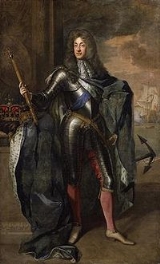
 James II of England
James II of England

James II and VII was List of English monarchs, List of Scottish monarchs, and King of Ireland from 6 February 1685. He was the last Roman Catholic Church monarch to reign over the Kingdoms of Kingdom of England, Kingdom of Scotland, and Kingdom of Ireland....
 (VII of Scotland and II of Ireland) in 1688 by a union of Parliamentarians
Parliament of England

The Parliament of England was the legislature of the Kingdom of England. Its roots can be traced back to the early medieval period. In a series of developments, it came increasingly to constrain the power of the King of England, and went on after the Act of Union 1707 to merge with the Parliament of Scotland and form the main basis of the Pa...
 with an invading army led by the Dutch
Dutch Republic

The Republic of the Seven United Netherlands was a European republic between 1581 and 1795, in about the same location as the modern Kingdom of the Netherlands, which is the successor state....
 stadtholder
Stadtholder

A Stadtholder in the Low Countries was a medieval function which during the 18th century developed into a rare type of de facto hereditary head of state of the thus "crowned" Dutch Republic....
 William III of Orange-Nassau
William III of England

William III was a Prince of Orange by birth. From 1672 onwards, he governed as List_of_stadtholders_for_the_Low_Countries_provinces William III of Orange over Holland, Zeeland, Utrecht, Guelders, and Overijssel of the Dutch Republic....
 (William of Orange
House of Orange-Nassau

The House of Orange-Nassau , a branch of the European House of Nassau, has played a central role in the political life of the Netherlands — and at times in Europe — since William I of Orange organized the Dutch revolt against Spain rule, which after the Eighty Years' War led to an independent Dutch state....
), who as a result ascended the English throne as William III of England. The expression "Glorious Revolution" was first used by John Hampden
John Hampden (1653-1696)

John Hampden , the second son of Richard Hampden, returned to England after residing for about two years in France, and joined himself to Lord William Russell and Algernon Sidney and the party opposed to the arbitrary government of Charles II of England....
 in late 1689, and is an expression that is still used by the Westminster Parliament.

The Glorious Revolution is also sometimes called the Bloodless Revolution.


Discussion
Ask a question about 'Glorious Revolution'
Start a new discussion about 'Glorious Revolution'
Answer questions from other users
Full Discussion Forum


Encyclopedia


The Glorious Revolution, also called the Revolution of 1688, was the overthrow of King
British monarchy

The Monarchy of the United Kingdom is the constitutional monarchy of the United Kingdom and its British overseas territory.The present monarch, Queen Elizabeth II of the United Kingdom, has reigned since 6 February 1952....
 James II of England
James II of England

James II and VII was List of English monarchs, List of Scottish monarchs, and King of Ireland from 6 February 1685. He was the last Roman Catholic Church monarch to reign over the Kingdoms of Kingdom of England, Kingdom of Scotland, and Kingdom of Ireland....
 (VII of Scotland and II of Ireland) in 1688 by a union of Parliamentarians
Parliament of England

The Parliament of England was the legislature of the Kingdom of England. Its roots can be traced back to the early medieval period. In a series of developments, it came increasingly to constrain the power of the King of England, and went on after the Act of Union 1707 to merge with the Parliament of Scotland and form the main basis of the Pa...
 with an invading army led by the Dutch
Dutch Republic

The Republic of the Seven United Netherlands was a European republic between 1581 and 1795, in about the same location as the modern Kingdom of the Netherlands, which is the successor state....
 stadtholder
Stadtholder

A Stadtholder in the Low Countries was a medieval function which during the 18th century developed into a rare type of de facto hereditary head of state of the thus "crowned" Dutch Republic....
 William III of Orange-Nassau
William III of England

William III was a Prince of Orange by birth. From 1672 onwards, he governed as List_of_stadtholders_for_the_Low_Countries_provinces William III of Orange over Holland, Zeeland, Utrecht, Guelders, and Overijssel of the Dutch Republic....
 (William of Orange
House of Orange-Nassau

The House of Orange-Nassau , a branch of the European House of Nassau, has played a central role in the political life of the Netherlands — and at times in Europe — since William I of Orange organized the Dutch revolt against Spain rule, which after the Eighty Years' War led to an independent Dutch state....
), who as a result ascended the English throne as William III of England. The expression "Glorious Revolution" was first used by John Hampden
John Hampden (1653-1696)

John Hampden , the second son of Richard Hampden, returned to England after residing for about two years in France, and joined himself to Lord William Russell and Algernon Sidney and the party opposed to the arbitrary government of Charles II of England....
 in late 1689, and is an expression that is still used by the Westminster Parliament.

The Glorious Revolution is also sometimes called the Bloodless Revolution. However, it was not completely bloodless. In England there were two significant clashes between the two armies, plus anti-Catholic riots in several towns. There were also three major battles in Ireland
Williamite war in Ireland

The Williamite War in Ireland, also known as the Jacobite War in Ireland and in Ireland as Cogadh an D? R? or The War of the Two Kings, was the opening conflict following the deposition of King James II of England in 1688 when he attempted to regain the throne of his Three Kingdoms from his daughter Mary II of England who repl...
 and serious fighting in Scotland
History of Scotland

The history of Scotland begins around 10,000 years ago, when humans first began to inhabit what is now Scotland after the end of the Wisconsin glaciation, the last ice age....
. The revolution also led to the collapse of the Dominion of New England
Dominion of New England

The Dominion of New England in America was a short-lived administrative union of England colonies in the New England region of North America....
 and the overthrow of Maryland
Province of Maryland

The Province of Maryland was an English colony in North America that existed from 1632 until 1776, when it joined the other twelve of the Thirteen colonies in establishing the United States and became the U.S....
's government.

The Revolution is closely tied in with the events of the War of the Grand Alliance
War of the Grand Alliance

The Nine Years' War ? often called the War of the Grand Alliance or the War of the League of Augsburg ? was a major war of the late 17th century fought primarily on mainland Europe but also encompassing theatres in Ireland and North America....
 on mainland Europe
Continental Europe

Continental Europe, also referred to as mainland Europe or simply the Continent, is the continent of Europe, explicitly excluding European islands and, at times, peninsulas....
, and may be seen as the last successful invasion of England
England

native_name =|conventional_long_name = England|common_name = England|image_flag = Flag of England.svg|image_coat = England COA.svg|symbol_type = Royal Coat of Arms...
. It can be argued that James's overthrow began modern English parliamentary
Parliamentary system

Parliamentary systems are characterized by no clear-cut separation of powers between the executive and legislative branches, leading to a different set of checks and balances compared to those found in presidential systems....
 democracy
Democracy

Democracy is a form of government in which power is held directly or indirectly by citizens under a free electoral system. It is derived from the Greek language d?????at?a , "popular government" which was coined from d???? , "people" and ???t?? , "rule, strength" in the middle of the 5th-4th century BC to denote the political syst...
: never since has the monarch held absolute
Absolute monarchy

Absolute monarchy is a monarchy form of government where the king or queen has absolute power over all aspects of his/her subjects' lives. Although some religious authorities may be able to discourage the monarch from some acts and the sovereign is expected to act according to custom, in an absolute monarchy there is no constitution or legal...
 power, and the Bill of Rights
Bill of Rights 1689

The Bill of Rights is an Act of Parliament of the Parliament of England, whose long title is An Act Declaring the Rights and Liberties of the Subject and Settling the Succession of the Crown....
 has become one of the most important documents in the political history
Political history

Political history narrative and analysis of political events, ideas, movements, and leaders. It is usually structured around the nation state. It is distinct from, but related to, other fields of history such as social history, economic history, and military history....
 of Britain
United Kingdom

The United Kingdom of Great Britain and Northern Ireland, commonly known as the United Kingdom , the UK or Britain,is a sovereign state located off the northwestern coast of continental Europe....
. The deposition of the Roman Catholic
Roman Catholic Church

The Roman Catholic Church, officially known as the Catholic Church is the world's largest Christianity Ecclesia , representing over half of all Christians and one-sixth of the world population....
 James II ended any chance of Catholicism becoming re-established in England, and also led to limited toleration for nonconformist
Nonconformism

Nonconformism is the refusal to conform to common standards, conventions, rules, customs, traditions, norms, or laws. In specific usage Nonconformism , however, refers to the Protestant Christians of England and Wales who refused to "conform", or follow the governance and usages of the Church of England....
 Protestants
Protestantism

Protestantism is a movement within Christianity that originated in the sixteenth-century Protestant Reformation. It is considered to be one of the three principal traditions of Christianity, together with Roman Catholicism and Eastern Orthodoxy....
—it would be some time before they had full political rights. For Catholics, however, it was disastrous both socially and politically. Catholics were denied the right to vote and sit in the Westminster Parliament for over 100 years afterwards. They were also denied commissions
Officer (armed forces)

An officer is a member of an Armed forces who holds a position of authority.Commissioned officers derive authority directly from a sovereignty power and, as such, hold a Letters patent charging them with the duties and responsibilities of a specific office or position....
 in the British army
History of the British Army

The history of the British Army spans over three and a half centuries and numerous List of conflicts in Europe wars, colonial wars and world wars....
 and the monarch was forbidden to be Catholic or marry a Catholic, thus ensuring the Protestant succession.

The invasion marked the final defeat of England in the Anglo-Dutch Wars
Anglo-Dutch Wars

The Anglo-Dutch Wars were fought in the 17th and 18th centuries between Kingdom of England and the Republic of the Seven United Provinces of the Netherlands for control over the seas and trade routes....
 of the 17th century. However, the personal union
Personal union

A personal union is the combination by which two or more different states are governed by the same monarch, while their boundaries, their laws and their interests remain distinct....
, the common market and the merging of the English and Dutch navies shifted the dominance in world trade from the Dutch to the British.

Background

During his three-year reign, King James II became directly involved in the political battles in England
England

native_name =|conventional_long_name = England|common_name = England|image_flag = Flag of England.svg|image_coat = England COA.svg|symbol_type = Royal Coat of Arms...
 between Catholicism
Roman Catholic Church

The Roman Catholic Church, officially known as the Catholic Church is the world's largest Christianity Ecclesia , representing over half of all Christians and one-sixth of the world population....
 and Protestantism
Protestantism

Protestantism is a movement within Christianity that originated in the sixteenth-century Protestant Reformation. It is considered to be one of the three principal traditions of Christianity, together with Roman Catholicism and Eastern Orthodoxy....
 on the one hand, and on the other, between the divine right
Divine Right of Kings

The Divine Right of Kings is a politics and religion doctrine of royal absolutism. It asserts that a monarch is subject to no earthly authority, deriving his right to rule directly from the will of God....
 of the Crown and the political rights of Parliament. James's greatest political problem was his Catholicism, which left him alienated from both parties in Parliament. The low church
Low church

Low church is a term of distinction in the Church of England or other Anglican churches initially designed to be pejorative. During the series of doctrinal and ecclesiastic challenges to the established church in the 16th and 17th centuries, commentators and others began to refer to those groups favouring the theology, worship and authoritar...
 Whigs
British Whig Party

The Whigs are often described as one of two political party in Kingdom of England and later the United Kingdom from the late 17th to the mid-19th centuries....
 had failed in their attempt to exclude
Exclusion Bill

The Exclusion Bill Crisis ran from 1678 through 1681 in the reign of Charles II of England. The Exclusion Bill sought to exclude the king's brother and heir presumptive, James II of England, from the throne of England because he was Roman Catholic....
 James from the throne between 1679 and 1681, and James's supporters were the High Church Anglican Tories
Tory

In the political tradition of some List of countries where English is an official language, the term Tory may refer to a variety of Political party and creeds since it was originally used in the late 17th century to describe opponents to the Whig Party ....
. When James inherited the throne in 1685, he had much support in the 'Loyal Parliament', which was composed mostly of Tories. His Catholicism was a concern to many, but that he had no son, and his daughters were Protestants, was a "saving grace". James's attempt to relax the penal law
Penal law

In the most general sense, penal is the body of laws that are enforced by the State in its own name and impose penalties for their violation, as opposed to Civil law that seeks to redress private wrongs....
s alienated his natural supporters, however, because the Tories viewed this as tantamount to disestablishment of the Church of England. Abandoning the Tories, James looked to form a 'King's party' as a counterweight to the Anglican Tories, so in 1687 James supported the policy of religious toleration
Religious toleration

Religious toleration is the condition of accepting or permitting others' religion beliefs and practices which disagree with one's own.In a country with a state religion, toleration means that the government permits religious practices of other sects besides the state religion, and does not persecute believers in other faiths....
 and issued the Declaration of Indulgence
Declaration of Indulgence

The Declaration of Indulgence was made by King James II of Great Britain, on the April 4, 1687. It was a first step at establishing freedom of religion in England....
. By allying himself with the Catholics, Dissenters
English Dissenters

English Dissenters were English people Christians who separated from the Church of England. They opposed State interference in religious matters, and founded their own communities in the sixteenth, seventeenth, and eighteenth centuries....
, and nonconformists
Nonconformism

Nonconformism is the refusal to conform to common standards, conventions, rules, customs, traditions, norms, or laws. In specific usage Nonconformism , however, refers to the Protestant Christians of England and Wales who refused to "conform", or follow the governance and usages of the Church of England....
, James hoped to build a coalition that would advance Catholic emancipation.

In 1686, James coerced the Court of the King's Bench
King's Bench

The Queen's Bench is the superior court in a number of jurisdictions within some of the Commonwealth realms. The original Queen's Bench, in the United Kingdom, is one of the ancient courts of England, and is now a division of the High Court of Justice of England and Wales....
 into deciding that the King could dispense with religious restrictions of the Test Act. James ordered the removal of Henry Compton
Henry Compton

Henry Compton was an English bishop....
, the anti-Catholic Bishop of London
Bishop of London

The Bishop of London is the Ordinary of the Church of England Diocese of London in the Province of Canterbury.The diocese covers 458 km? of 17 boroughs of Greater London north of the Thames and a small part of the County of Surrey....
, and dismissed the Protestant fellows of Magdalen College, Oxford
Magdalen College, Oxford

Magdalen College redirects here, see also Magdalene College, CambridgeMagdalen College is one of the Colleges of the University of Oxford of the University of Oxford in England....
 and replaced them with Catholics.

James also created a large standing army and employed Catholics in positions of power in the army. To his opponents in Parliament this seemed like a prelude to arbitrary rule, so James prorogued Parliament without gaining Parliament's consent. At this time, the English regiments of the army were encamped at Hounslow
Hounslow

Hounslow is the principal town in the London Borough of Hounslow. It is a suburban development situated 10.6 miles west south-west of Charing Cross and one of the major metropolitan centres identified in the London Plan....
, near the capital. The army in Ireland was purged of Protestants who were replaced with Catholics, and by 1688 James had more than 34,000 men under arms in his three kingdoms.

In April 1688, James re-issued the Declaration of Indulgence
Declaration of Indulgence

The Declaration of Indulgence was made by King James II of Great Britain, on the April 4, 1687. It was a first step at establishing freedom of religion in England....
 and ordered all clergymen to read it in their churches. When the Archbishop of Canterbury
Archbishop of Canterbury

The Archbishop of Canterbury is the chief bishop and principal leader of the Church of England, the symbolic head of the worldwide Anglican Communion and the Diocesan Bishop of the Diocese of Canterbury, the Episcopal see that churches must be in communion with in order to be a part of the Anglican Communion....
, William Sancroft
William Sancroft

William Sancroft , was the 79th archbishop of Canterbury....
, and six other bishops (see the Seven Bishops
Seven Bishops

The Seven Bishops were seven bishops of the Church of England. When James II of England issued his second Declaration of Indulgence in 1688 - which granted expansive religious freedoms by suspending penal laws enforcing conformity to the Church of England, allowing persons to worship in their homes or chapels as they saw fit, and ending t...
) wrote to James asking him to reconsider his policies, they were arrested on charges of seditious libel
Seditious libel

Seditious libel is a criminal offence under English common law. Sedition is the offence of speaking seditious words with seditious intent: if the statement is in writing or some other permanent form it is seditious libel....
, but at trial they were acquitted to the cheers of the London crowd.

Matters came to a head in 1688, when James fathered a son
James Francis Edward Stuart

Prince James, Prince of Wales was the son of the deposed James II of England. As such, he claimed the English, Scottish and Irish thrones from the death of his father in 1701, when he was proclaimed king of England, Scotland and Ireland by his cousin Louis XIV of France....
; until then, the throne would have passed to his daughter, Mary
Mary II of England

Mary II reigned as List of English monarchs, List of Scottish monarchs, and King of Ireland from 1689 until her death. Mary, a Protestantism, came to the thrones following the Glorious Revolution, which resulted in the deposition of her Roman Catholic father, James II of England....
, a Protestant. The prospect of a Catholic dynasty in the kingdoms of England
Kingdom of England

The Kingdom of England was, from 927 to 1707, a state in North-West Europe. The Kingdom of England spanned the southern two-thirds of the island of Great Britain and a number of smaller outlying islands?what is today the legal unit of England and Wales....
, Scotland
Kingdom of Scotland

The Kingdom of Scotland was a state in North-West Europe which existed from 843 until 1707. It occupied the northern third of the island of Great Britain and shared a Anglo-Scottish border to the south with the Kingdom of England, with which it was united to form the Kingdom of Great Britain, under the terms of the Acts of Union 1707, in 170...
 and Ireland
Kingdom of Ireland

The Kingdom of Ireland was the name given to the Irish state from 1541, by the Crown of Ireland Act 1542 of the Parliament of Ireland. It was based on the contested legitimacy of the right of conquest....
 was now likely. Some leaders of the Tory Party
Tory

In the political tradition of some List of countries where English is an official language, the term Tory may refer to a variety of Political party and creeds since it was originally used in the late 17th century to describe opponents to the Whig Party ....
 united with members of the opposition Whigs
British Whig Party

The Whigs are often described as one of two political party in Kingdom of England and later the United Kingdom from the late 17th to the mid-19th centuries....
 and set out to solve the crisis.

Conspiracy

William Iii of England
In 1686, a group of conspirators met at Charborough House
Charborough House

Charborough House is located between Sturminster Marshall and Bere Regis in Dorset, England. The Deer Park and estate adjoins the villages of Winterborne Zelston, Newton Peveril and Lytchett Matravers....
 in Dorset
Dorset

Dorset , is a Counties of England in South West England on the English Channel coast. The county town is Dorchester, Dorset, situated in the south of the county at ....
 to plan the overthrow of "the tyrant race of Stuarts". In June 1688, a further conspiracy was launched at Old Whittington
Old Whittington

Old Whittington is a village in Derbyshire south-east of Sheffield and north of Chesterfield. The village lies on the River Rother, South Yorkshire....
, in Chesterfield
Chesterfield

Chesterfield is a market town and a Borough status in the United Kingdom of Derbyshire, England. It lies north of the city of Derby, on a confluence of the rivers River Rother, South Yorkshire and River Hipper....
, Derbyshire
Derbyshire

Derbyshire is a county in the East Midlands of England. A substantial portion of the Peak District National Park lies within Derbyshire. The northern part of Derbyshire overlaps with the Pennines, a famous chain of hills and mountains....
, to depose James and replace him with his daughter Mary and her husband, William Henry of Orange — both Protestants and both grandchildren of Charles I of England
Charles I of England

Charles I was List of English monarchs, List of monarchs of Scotland and King of Ireland from 27 March 1625 until his capital punishment on 30 January 1649....
. Before the birth of James's son on June 10 (Julian calendar
Julian calendar

The Julian calendar, a reform of the Roman calendar, was introduced by Julius Caesar in 46 BC, and came into force in 45 BC . It was chosen after consultation with the astronomer Sosigenes of Alexandria and was probably designed to approximate the tropical year, known at least since Hipparchus....
), Mary had been the heir to the throne and William was third in line. James however had only wanted to treat them as possible heirs on condition that they accepted his pro-Catholic position, which they had been unwilling to do for fear that French influence would become too great. William was also stadtholder
Stadtholder

A Stadtholder in the Low Countries was a medieval function which during the 18th century developed into a rare type of de facto hereditary head of state of the thus "crowned" Dutch Republic....
 of the main provinces of the Dutch Republic
Dutch Republic

The Republic of the Seven United Netherlands was a European republic between 1581 and 1795, in about the same location as the modern Kingdom of the Netherlands, which is the successor state....
, then in the preliminary stages of joining the War of the Grand Alliance
War of the Grand Alliance

The Nine Years' War ? often called the War of the Grand Alliance or the War of the League of Augsburg ? was a major war of the late 17th century fought primarily on mainland Europe but also encompassing theatres in Ireland and North America....
 against France. He had already acquired the reputation of being the main champion in Europe of the Protestant cause against Catholicism and French absolutism; it seems that he saw an opportunity for fulfilling his principal goal: crushing the power of France. It is still a matter of controversy whether the initiative for the conspiracy was taken by the English or by the stadtholder and his wife. William had been trying to influence English politics for well over a year, letting Grand Pensionary
Grand Pensionary

The Grand Pensionary was the most important Dutch official during the time of the Dutch Republic. In theory he was only a civil servant of the Estates of the dominant province among the Seven United Provinces: the county of Holland....
 Gaspar Fagel
Gaspar Fagel

Gaspar Fagel was a Netherlands statesman. Fagel was born into a distinguished patrician family.He was elected Pensionary of Haarlem in 1663 and as such member representative of the States of Holland....
 publish an open letter
Open letter

An open letter is a Letter that is intended to be read by a wide audience, or a letter intended for an individual, but that is nonetheless widely distributed intentionally....
 to the English people in November 1687 deploring the religious policy of James, which action had generally been interpreted as a covert bid for kingship. On December 18 the Duke of Norfolk
Henry Howard, 7th Duke of Norfolk

Henry Howard, 7th Duke of Norfolk, Order of the Garter, Privy Council of England , was a politician and soldier. He was the son of Henry Howard, 6th Duke of Norfolk and Lady Anne Somerset, daughter of Edward Somerset, 2nd Marquess of Worcester and Elizabeth Dormer....
 warned James of a conspiracy on the side of his son-in-law. After his envoy Everhard van Weede Dijkvelt in April 1687 had approached the main Whig and Tory leaders William had maintained a close secret correspondence with them, using as a contact Frederik van Nassau. In it he had not committed himself to any definite action, but an understanding had been reached that if William should, for whatever reason, ascend, he would in accordance with his anti-absolutist reputation restrain the use of Royal power; in return William desired a full employment of English military resources against France. It has been suggested that the crisis caused by the prospect of a new Catholic heir made William decide to invade the next summer as early as November 1687, but this is disputed. It is certain however that in April 1688, when France and England concluded a naval agreement that stipulated that the French would finance an English squadron in The Channel, he seriously began to prepare for a military intervention and seek political and financial support for such an undertaking.

Revolution or Invasion?


Historically the events of 1688 have been called a "revolution" but since an intensified historical interest due to the third centennial of the event, it has become popular to portray the "glorious revolution" as a Dutch invasion of Britain. The "Glorious Revolution" fulfills the criteria for revolution
Revolution

A revolution is a fundamental social change in power or organizational structures that takes place in a relatively short period of time....
, being an internal change of constitution; and also the criteria for invasion
Invasion

An invasion is a Offensive consisting of all, or large parts of the armed forces of one geopolitics entity aggressively entering territory controlled by another such entity, generally with the objective of either conquering, liberating or re-establishing control or authority over a territory, altering the established government or gaining c...
, because it involved the landing of large numbers of foreign troops. The events were unusual because the establishment of a constitutional monarchy
Constitutional monarchy

A constitutional monarchy is a form of constitutional government, where in either an elected or hereditary monarch is the head of state, unlike in an absolute monarchy, wherein the king or the queen is the sole source of political power, as he or she is not legally bound by the constitution....
 and English Bill of Rights meant that the apparently invading monarchs, who were legitimate heirs to the throne, were prepared to be governed by the English Parliament. It is difficult to classify the entire proceedings of 1687–89 but it can be seen that the events occurred in three phases: conspiracy, invasion by Dutch forces and "Glorious Revolution". It has been argued that the invasion aspect had been downplayed as a result of a combination of British pride and successful Dutch propaganda, trying to depict the course of events as a largely internal English affair.

Planning for an invasion

William and Mary laid careful plans over a number of months for an invasion, which they hoped to execute in September. Their first concern was to avoid any impression of foreign conquest, and so in April, they asked for a formal invitation to be issued by a group of worthies. Only after the Prince of Wales had been born, however, and many suspected he was suppositious, did the Immortal Seven (who consisted of one bishop and six nobles) decide to comply, with the letter reaching William on June 30 (Julian calendar
Julian calendar

The Julian calendar, a reform of the Roman calendar, was introduced by Julius Caesar in 46 BC, and came into force in 45 BC . It was chosen after consultation with the astronomer Sosigenes of Alexandria and was probably designed to approximate the tropical year, known at least since Hipparchus....
). It should be emphasized that this was not an invitation to become king, but rather to "save the Protestant religion" and that the "seven" were not fully aware this would probably lead to a war with France. Also, William's confidante Hans Willem Bentinck
William Bentinck, 1st Earl of Portland

Hans William, Baron House of Bentinck, 1st Earl of Portland, Order of the Garter, Privy Council of the United Kingdom was a Dutch Republic and England nobleman who became in an early stage the favourite of stadtholder William III of England....
 launched a propaganda
Propaganda

Propaganda is the dissemination of information aimed at influencing the opinions or behaviors of large numbers of people. As opposed to Objectivity providing information, propaganda in its most basic sense presents information in order to influence its audience....
 campaign in England, presenting William as being, in fact, a true Stuart but one blessedly free from the, according to the pamphlet
Pamphlet

A pamphlet is an unbound booklet . It may consist of a single sheet of paper that is printed on both sides and folded in half, in thirds, or in fourths , or it may consist of a few pages that are folded in half and stapled at the crease to make a simple book....
s, usual Stuart vices of cryptocatholicism, absolutism, and debauchery. Much of the later "spontaneous" support for William had been carefully organised by him and his agents.

In May, William sent an envoy, Johann von Görtz, to Vienna
Vienna

Vienna is the Capital of Republic of Austria and also one of the nine states of Austria. Vienna is Austria's primary city, with a population of about 1.7 million...
 to secretly ensure the support of the Holy Roman Emperor, Leopold I
Leopold I, Holy Roman Emperor

Leopold I, Holy Roman Emperor Habsburg , Holy Roman emperor, King of Hungary, King of Bohemia, was the second son of the emperor Ferdinand III, Holy Roman Emperor and his first wife Maria Anna of Spain....
. Learning that William promised not to persecute the Catholics in England, the emperor approved, promising in turn to make peace with the Ottoman Empire
Ottoman Empire

The Ottoman Empire , also known by its contemporaries as the Turkish Empire or Turkey , was an empire that lasted from 1299?1923. It was Treaty of Lausanne by the Republic of Turkey, which was officially proclaimed on October 29, 1923....
 to free his forces for a campaign in the West; on September 4 1688 he would join an alliance with the Republic against France. The Duke of Hanover
Electorate of Hanover

The Electorate of Brunswick-L?neburg became the ninth Electorate of the Holy Roman Empire in 1692, when the Holy Roman Emperor, Leopold I, Holy Roman Emperor, elevated Duke Ernest Augustus, Elector of Brunswick-L?neburg to the rank of Prince-elector of the Empire as a reward for aid given in the War of the Grand Alliance....
, Ernest Augustus and the Elector of Saxony
Electorate of Saxony

The Electorate of Saxony or Duchy of Upper Saxony was an independent hereditary Prince-elector of the Holy Roman Empire from 1356?1806. It was the successor state of the Duchy of Saxe-Wittenberg and was itself replaced in Napoleonic times by the Kingdom of Saxony ....
, John George III
John George III, Elector of Saxony

Johann Georg III was Elector of Saxony from 1680 to 1691....
, assured William that they would remain neutral.

The next concern was to assemble a powerful invasion force — contrary to the wishes of the English conspirators, who predicted that a token force would be sufficient. William, financed by the city of Amsterdam
Amsterdam

Amsterdam is the Capital of the Netherlands and List of cities in the Netherlands with over 100,000 people of the Netherlands, located in the Provinces of the Netherlands of North Holland in the west of the country....
 after secret and difficult negotiations by Bentinck with the hesitant Amsterdam burgomaster
Burgomaster

Burgomaster is the English form, rendering various terms in or derived from the German language word for the chief magistrate and/or chairman of the executive council of a sub-national level of administration All contemporary titles are commonly translated into English with the Anglo-Saxon equivalent of Town Mayor....
s during June, hired 400 transports; also Bentinck negotiated contracts for 13,616 German mercenaries from Brandenburg
Brandenburg

Brandenburg is one of the sixteen states of Germany of Germany. It lies in the east of the country and is one of the new federal states that were re-created in 1990 upon the reunification of the former West Germany and East Germany....
, Würtemberg, Hesse-Kassel
Hesse-Kassel

The Landgraviate of Hessen-Kassel or Hesse-Cassel was a Reichsfrei principality of the Holy Roman Empire that came into existence when the Landgraviate of Hesse was divided in 1567 upon the death of Philip I, Landgrave of Hesse....
 (or Hesse-Cassel) and Celle
Celle

Celle is a town and capital of the district of Celle , in Lower Saxony, Germany. The town is situated in the southernmost part of the L?neburg Heath on the banks of the river Aller, a tributary of the Weser....
, to man Dutch border fortresses in order to free an equal number of Dutch elite mercenary troops for use against England. Further financial support was obtained from the most disparate sources: the Jewish banker Francisco Lopes Suasso lent two million guilders; when asked what security he desired, Suasso answered: "If you are victorious, you will surely repay me; if not, the loss is mine". Even Pope Innocent XI
Pope Innocent XI

Pope Innocent XI , born Benedetto Odescalchi, was Pope of the Roman Catholic Church from 1676 to 1689....
, an inveterate enemy of Louis XIV of France
Louis XIV of France

Louis XIV ruled as List of French monarchs and of King of Navarre. He ascended the throne a few months before his fifth birthday, but did not assume actual personal control of the government until the death of his prime minister , the Italians Jules Cardinal Mazarin, in 1661....
, provided a loan to William, though a relation with the invasion has been denied. Total costs were seven million guilders, four million of which would ultimately be paid for by a state loan. In the summer the Dutch navy was expanded to 9000 sailors on the pretext of fighting the Dunkirkers
Dunkirkers

During the Dutch Revolt the Dunkirkers or Dunkirk Privateers, were commerce raiders in the service of the Spanish Empire operating from the ports of the County of Flanders: Nieuwpoort, Ostend, and in particular Dunkirk....
.

In August, it became clear that William had surprisingly strong support within the English army, a situation brought about by James himself. In January 1688 he had forbidden any of his subjects to serve the Dutch and had demanded that the Republic dissolve its mercenary Scottish and English regiments. When this was refused, he asked that at least those willing would be released from their martial oath to be free to return to Britain. To this William consented as it would purify his army from Jacobite elements. In total 104 officers and 44 soldiers returned. The officers were enlisted within the British armies and so favoured that the established officer corps began to fear for its position. On August 14 Lord Churchill
John Churchill, 1st Duke of Marlborough

John Churchill, 1st Duke of Marlborough Order of the Garter was an England soldier and statesman whose career spanned the reigns of five monarchs throughout the late 17th and early 18th centuries....
 wrote to William: "I owe it to God and my country to put my honour into the hands of Your Highness". Nothing comparable happened within the Royal Navy, however.

Still, William had great trouble convincing the Dutch ruling elite, the regents, that such an expensive expedition was really necessary. Also he personally feared that the French might attack the Republic through Flanders, when its army was tied up in England. By early September he was on the brink of cancelling the entire expedition, when French policy played into his hand. On September 9 (Gregorian calendar
Gregorian calendar

The Gregorian calendar is the internationally accepted civil calendar. It was first proposed by the Calabrian doctor Aloysius Lilius, and decreed by Pope Gregory XIII, after whom it was named, on 24 February 1582 by the papal bull Inter gravissimas....
) the French envoy Jean Antoine de Mesmes, the Comte d'Avaux, handed two letters from the French king, who had known of the invasion plans since May, to the States-General of the Netherlands
States-General of the Netherlands

The States-General is the parliament of the Netherlands. It consists of two chambers, the more important of which is the directly elected Tweede Kamer ....
. In the first they were warned not to attack James. In the second they were urged not to interfere with the French policy in Germany. James hurriedly distanced himself from the first message, trying to convince the States that there was no secret Anglo-French alliance against them. This however had precisely the opposite effect; many members became extremely suspicious. The second message proved that the main French effort was directed to the east, not the north, so there was no immediate danger of a French invasion for the Republic itself.

From September 22, Louis XIV, after having waged a tariff war against the Republic for over a year, seized all Dutch ships present in French ports, seeming to prove that real war with France was imminent, though Louis had meant it to be a mere warning. On September 26 the powerful city council of Amsterdam decided to officially support the invasion. On September 27 Louis crossed the Rhine into Germany and William began to move his army from the eastern borders to the coast. On September 29 the States of Holland
States of Holland

The States of Holland and West Frisia were the representation of the two Estates of the realm to the court of the Count of Holland. After the Dutch Republic were formed ? and there no longer was a count, but only his "lieutenant" - they continued to function as the government of the County of Holland....
 gathering in secret session and fearing a French-English alliance, approved the operation, agreeing to make the English "useful to their friends and allies, and especially to this state". They accepted William's argument that a preventive strike
Preemptive war

Preemptive war is waged in an attempt to repel or defeat a perceived inevitable offensive or invasion, or to gain a strategic advantage in an impending war before that threat materializes....
 was necessary to avoid a repeat of the events of 1672, when England and France had jointly attacked the Republic
Third Anglo-Dutch War

The Third Anglo-Dutch War or Third Dutch War was a military conflict between England and the Republic of the Seven United Netherlands lasting from 1672 to 1674....
, "an attempt to bring this state to its ultimate ruin and subjugation, as soon as they find the occasion". The States ordered a Dutch fleet of 53 warships to escort the troop transports. This fleet was in fact commanded by Lieutenant-Admiral Cornelis Evertsen the Youngest
Cornelis Evertsen the Youngest

Cornelis Evertsen the Youngest is a Netherlands admiral from the 17th century.Cornelis was the second son of Lieutenant-Admiral Cornelis Evertsen the Elder, nephew of Lieutenant-Admiral Johan Evertsen and cousin of the latter's son Vice-Admiral Cornelis Evertsen the Younger, with whom he is very often confused....
 and Vice-Admiral Philips van Almonde
Philips van Almonde

Philips van Almonde was a Dutch Lieutenant Admiral, who served in his nation?s maritime conflicts of the 17th and early 18th centuries.Philips was the son of Pieter Jansz van Almonde, a wealthy burgher....
 but in consideration for English sensitivities on October 6 placed under nominal command of Rear-Admiral Arthur Herbert
Arthur Herbert, 1st Earl of Torrington

Arthur Herbert, 1st Earl of Torrington was a British admiral and politician of the late seventeenth and early eighteenth century. Cashiered as a rear-admiral by James II of England in 1688 for refusing to serve under Catholic officers, he brought the Invitation to William to The Hague, disguised as a simple sailor....
, the very messenger who, disguised as a common sailor, had brought the invitation to William in The Hague
The Hague

The Hague is the third largest city in the Netherlands after Amsterdam and Rotterdam, with a population of 475,904 and an area of approximately 100 km?....
. Though William was himself Admiral-General of the Republic he abstained from operational command, sailing conspicuously on the yacht Den Briel, accompanied by Lieutenant-Admiral Willem Bastiaensz Schepers, the Rotterdam shipping magnate who had organised the transport fleet. The States-General allowed the core regiments of the Dutch field army to participate under command of Marshall Frederick Schomberg
Frederick Schomberg, 1st Duke of Schomberg

Friedrich Hermann , 1st Duke of Schomberg , was both a marshal of France and a General in the English Army.Descended from an old family of the Electoral Palatinate, he was born at Heidelberg, the son of Hans Meinard von Sch?nberg and Anne, daughter of Edward Sutton, 5th Baron Dudley....
.

William's landing

The Dutch preparations, though carried out with great speed, could not remain secret. The English envoy Ignatius White, the Marquess d'Albeville, warned his country: an absolute conquest is intended under the specious and ordinary pretences of religion, liberty, property and a free Parliament.... Louis XIV threatened the Dutch with an immediate declaration of war, should they carry out their plans. Embarkations, started on September 22 (Gregorian calendar), had been completed on October 8 and the expedition was that day openly approved by the States of Holland; the same day James issued a proclamation to the English nation that it should prepare for a Dutch invasion to ward off conquest. On October 10 William issued the Declaration of The Hague (actually written by Fagel), of which 60,000 copies of the English translation by Gilbert Burnet
Gilbert Burnet

Gilbert Burnet was a Scottish people theologian and historian, and Bishop of Salisbury. He was fluent in Dutch language, French language, Latin language, Greek language, and Hebrew language....
 were after the landing distributed in England, in which he assured that his only aim was to maintain the Protestant religion, install a free parliament and investigate the legitimacy of the Prince of Wales. He would respect James's position. On October 14 he responded to the allegations by James in a second declaration, denying any intention to become king or conquer England. Whether he had any at that moment is still controversial.

The swiftness of the embarkations surprised all foreign observers. Louis had in fact delayed his threats against the Dutch until early September because he assumed it then would be too late in the season to set the expedition in motion anyway, if their reaction proved negative; typically such an enterprise would take at least some months. Being ready after the first week of October would normally have meant that the Dutch could have profited from the last spell of good weather, as the autumn storms tend to begin in the third week of that month. This year they came early however. For three weeks the invasion fleet was prevented by adverse southwesterly gales from departing from the naval port of Hellevoetsluis
Hellevoetsluis

Hellevoetsluis is a town and municipality on Voorne-Putten Island in the western Netherlands, in the province of South Holland. The municipality covers an area of 46.14 km? of which 14.57 km? is water....
 and Catholics all over the Netherlands and the British kingdoms held prayer sessions that this "popish wind" might endure. However, by late October it became the famous "Protestant Wind
Protestant Wind

The phrase Protestant Wind has been used in more than one context, notably:#The storm that lashed the Spanish Armada. According to Protestant propaganda, the wind wrecked the Spanish fleet and thus saved England from invasion by the army of Phillip II of Spain....
" by turning to the east, allowing a departure on October 28. It had originally been intended that the Dutch navy defeat the English first to free the way for the transport fleet but because it was now so late in the season and conditions onboard deteriorated rapidly, it was decided to sail in convoy. Hardly had the fleet reached open sea when the wind changed again to the southwest forcing most ships to return to port, becoming a favourable easterly only on November 9.

First the fleet, reassembled on November 11, four times larger than the Spanish Armada
Spanish Armada

The Spanish Armada was the Habsburg Spain fleet that sailed against England under the command of the Alonso de Guzm?n El Bueno, 7th Duke of Medina Sidonia in 1588, leading to the Drake-Norris Expedition of 1589, also known as the English Armada....
 and having about 5,000 horses and 50,000 men aboard including 20,000 sailors and supply train, sailed north in the direction of Harwich
Harwich

Harwich is a town in Essex, England and one of the Haven ports, located on the coast with the North Sea to the east. It is in the Tendring district....
 where Bentinck had a landing site prepared. It was forced south however when the wind turned to the north and sailed in an enormous square formation, 25 ships deep, into the English Channel
English Channel

The English Channel is an Arm of the Atlantic Ocean that separates England from northern France, and joins the North Sea to the Atlantic. It is about long and varies in width from at its widest, to only in the Strait of Dover....
 on November 13, saluting Dover Castle
Dover Castle

Dover Castle is situated at Dover, Kent and has been described as the "Key to England" due to its defensive significance throughout history....
 and Calais
Calais

Calais is a town in northern France in the Departments of France of Pas-de-Calais, of which it is a sub-prefecture. Although Calais is by far the largest city in Pas-de-Calais, the department's capital is its third-largest city of Arras....
 simultaneously to show off its size. The English navy positioned in the Thames estuary saw the Dutch pass twice but was unable to intercept, first because of the strong easterly wind, the second time due to an unfavourable tide. Landing with a large army in Torbay
Torbay

Torbay is an east-facing bay and natural harbour, at the western most end of Lyme Bay in the south-west of England, situated roughly midway between the cities of Exeter and Plymouth....
 near Brixham
Brixham

Brixham is a small fishing town and civil parish in the county of Devon, in the south-west of England. Brixham is at the southern end of Torbay, across the bay from Torquay, and is a fishing port....
, Devon
Devon

Devon is a large Counties of England in South West England. The county is also referred to as Devonshire, but that is an entirely unofficial name, rarely used inside of the county but often indicating a shire....
 on November 5 (Julian calendar
Julian calendar

The Julian calendar, a reform of the Roman calendar, was introduced by Julius Caesar in 46 BC, and came into force in 45 BC . It was chosen after consultation with the astronomer Sosigenes of Alexandria and was probably designed to approximate the tropical year, known at least since Hipparchus....
 (November 15 Gregorian calendar), 1688, William was greeted with much show of popular support (this was Bentinck's alternative landing site), and some local men joined his army. His personal disembarkation was delayed somewhat to make it coincide with Bonfire Night
Guy Fawkes Night

Guy Fawkes Night is an annual celebration on the evening of the November 5. It celebrates the foiling of the Gunpowder Plot of the 5 November, 1605 in which a number of Catholic conspirators, including Guy Fawkes, were alleged to be attempting to blow up the Palace of Westminster in London, England....
, the anniversary of the Gunpowder Plot
Gunpowder Plot

The Gunpowder Conspiracy of 1605, or the Powder Treason or Gunpowder Plot, as it was then known, was a failed assassination attempt by a group of provincial English Roman Catholic Church against King James I of England....
. The banner of Den Briel proclaimed: "For Liberty and the Protestant Religion" above the motto
Motto

A motto is a phrase meant to formally describe the general motivation or intention of a social group or organization. A motto may be in any language, but Latin is the most used....
 of the House of Orange, Je maintiendrai ("I will maintain").

William's army totalled approximately 15,000–18,000 on foot and 3,660 cavalry. It was composed mainly of 14,352 regular Dutch mercenary troops (many of them actually Scots, Scandinavians, Germans and Swiss), and about 5,000 English and Scottish volunteers with a substantial Huguenot
Huguenot

The Huguenots were members of the Protestantism Reformed Church of France of France from the sixteenth to the eighteenth centuries....
 element in the cavalry and Guards as well as two hundred blacks from plantations in the American colony of Surinam. Many of the mercenaries were Catholic. On November 7 (November 17 Gregorian calendar), the wind turned southwest, preventing the pursuing English fleet commanded by George Legge
George Legge, 1st Baron Dartmouth

Admiral George Legge, 1st Baron Dartmouth Privy Council of England was a Royal Navy who gave distinguished service to both Charles II of England and James II of England....
 from attacking the landing site. The French fleet was at the time concentrated in the Mediterranean, to assist a possible attack on the Papal State. Louis delayed his declaration of war until November 26 (Gregorian calendar), hoping at first that their involvement in a protracted English civil war would keep the Dutch from interfering with his German campaign. The Dutch call their fleet action the Glorieuze Overtocht, the "Glorious Crossing".

William considered his veteran army to be sufficient in size to defeat any forces (all rather inexperienced) James could throw against him, but it had been decided to avoid the hazards of battle and maintain a defensive attitude in the hope James's position might collapse by itself; thus he landed far away from James's army, expecting that his English allies would take the initiative in acting against James while he ensured his own protection against potential attacks. William was prepared to wait; he had paid his troops in advance for a three-month campaign. A slow advance, apart from being necessitated by heavy rainfall anyway, had the added benefit of not over-extending the supply lines; the Dutch troops were under strict orders not even to forage, for fear that this would degenerate into plundering which would alienate the population. On November 9 William took Exeter
Exeter

Exeter Exeter was the most south-westerly Roman fortified settlement in Roman Britain and has existed since time immemorial. Exeter Cathedral, founded in 1050 is Anglicanism....
 after the magistrates had fled the city, entering on a white palfrey, with the two hundred blacks forming a guard of honour, dressed in white, with turbans and feathers. In the South support from the local gentry was disappointingly limited, but from November 12, in the North, many nobles began to declare for William, as they had promised, often by a public reading of the Declaration. In Yorkshire
Yorkshire

Yorkshire is a Historic counties of England of northern England and the largest in Great Britain. Because of its great size, over time functions were increasingly undertaken by its subdivisions, which have been subject to History of local government in Yorkshire....
, printer John White started to print the same document for a more widespread distribution. However, in the first weeks most people carefully avoided taking sides; as a whole the nation neither rallied behind its king, nor welcomed William, but passively awaited the outcome of events. In general, the mood was one of confusion, mutual distrust and depression.

The collapse of James' regime

James refused a French offer to send an expeditionary force, fearing that it would cost him domestic support. He tried to bring the Tories to his side by making concessions but failed because he still refused to endorse the Test Act
Test Act

The Test Acts were a series of England penal laws that served as a religious test for public office and imposed various civil disabilities on Roman Catholics and Nonconformists....
. His forward forces had gathered at Salisbury
Salisbury

Salisbury is a city status in the United Kingdom in Wiltshire, England. The city forms the largest part of the Salisbury . It has also been called New Sarum to distinguish it from the original site of settlement at Salisbury, Old Sarum, but this alternative name is not in common use....
, and James went to join them on 19 November (Julian calendar) with his main force, having a total strength of about 19,000. Amid anti-Catholic rioting in London, it rapidly became apparent that the troops were not eager to fight, and the loyalty of many of James' commanders was doubtful; he had been informed of the conspiracy within the army as early as September, but for unknown reasons had refused to arrest the officers involved. Some have argued, however, that if James had been more resolute, the army would have fought and fought well. The first blood was shed at about this time in a skirmish at Wincanton
Wincanton

Wincanton is a small town in south Somerset, southwest England. The town lies on the A303 road, the main route between London and South West England, and has some light industry....
, Somerset
Somerset

Somerset is a Counties of England in South West England. The county town is Taunton, which is in the south of the county. The Ceremonial counties of England of Somerset borders the counties of Bristol and Gloucestershire to the north, Wiltshire to the east, Dorset to the south-east, and Devon to the south-west....
, where Royalist troops retreated after defeating a small party of scouts; the total body count on both sides came to about fifteen. In Salisbury, after hearing that some officers had deserted, among them Lord Cornbury
Edward Hyde, 3rd Earl of Clarendon

Edward Hyde, 3rd Earl of Clarendon , styled Viscount Cornbury between 1674 and 1709, was Governor of New York and Governor of New Jersey between 1701 and 1708, and is perhaps best known for the claims of him cross-dressing while in office....
, a worried James was overcome by a serious nose-bleed that he interpreted as an evil omen
Omen

An omen is a phenomenon that is believed to foretell the future, often signifying the advent of change. Omens may be considered "good" or "bad", but the term is more often used in a foreboding sense, as with the word "ominous"....
 indicating that he should order his army to retreat, which the supreme army commander, the Earl of Feversham
Louis de Duras, 2nd Earl of Feversham

Louis de Duras, 2nd Earl of Feversham, Order of the Garter, , was a French nobleman who became Earl of Feversham in House of Stuart England.Born in France, he was marquis de Blanquefort and sixth son of Guy Aldonce , marquis de Duras and comte de Rozan, from the noble Durfort ....
, also advised on 23 November. The next day, Lord Churchill of Eyemouth
John Churchill, 1st Duke of Marlborough

John Churchill, 1st Duke of Marlborough Order of the Garter was an England soldier and statesman whose career spanned the reigns of five monarchs throughout the late 17th and early 18th centuries....
, one of James' chief commanders, deserted to William. On 26 November, James's own daughter, Princess Anne
Anne of Great Britain

Anne became Queen of England, Queen of Scots and Kingdom of Ireland on 8 March 1702, succeeding her brother-in-law, William III of England. Her Roman Catholic father, James II of England, was Glorious Revolution in 1688/9; her brother-in-law and her sister then became joint monarchs as William III & II and Mary II of England, the only such c...
, who doubted the authenticity of her new brother, did the same. Both were serious losses. James returned to London that same day.

After Plymouth
Plymouth

Plymouth is a City status in the United Kingdom and unitary authority on the coast of Devon, England, about south west of London. It is built between the mouths of the rivers River Plym to the east and River Tamar to the west, where they join Plymouth Sound....
 surrendered to him on 18 November, William began to advance on 21 November. By 24 November, William's forces were at Salisbury; three days later they had reached Hungerford
Hungerford

Hungerford is a market town and civil parish in Berkshire, England, 10 miles west of Newbury, Berkshire. It covers an area of and, according to the United Kingdom Census 2001, has a population of 5,700 ....
, where the following day they met with the King's Commissioners to negotiate. James offered free elections and a general amnesty for the rebels. In reality, by that point James was simply playing for time, having already decided to flee the country. He feared that his English enemies would insist on his execution and that William would give in to their demands. Convinced that his army was unreliable, he sent orders to disband it. On 10 December, the two sides fought a second engagement with the Battle of Reading
Battle of Reading (1688)

The Battle of Reading was a battle in 1688 at Reading, Berkshire in the England county of Berkshire. It was the only substantial military action in England during the Glorious Revolution....
, a defeat for the King's men. In December, there was anti-Catholic rioting in Bristol, Bury St. Edmunds, Hereford, York, Cambridge, and Shropshire. On 9 December, a Protestant mob stormed Dover Castle
Dover Castle

Dover Castle is situated at Dover, Kent and has been described as the "Key to England" due to its defensive significance throughout history....
, where the Catholic Sir Edward Hales was Governor, and seized it. On December 8 William met at last with James's representatives; he agreed to James's proposals but also demanded that all Catholics would be immediately dismissed from state functions and that England would pay for the Dutch military expenses. He received no reply, however.

In the night of 9–10 December, the Queen and the Prince of Wales fled for France. The next day saw James's attempt to escape, the king dropping The Great Seal
Great Seal of the Realm

The Great Seal of the Realm or Great Seal of the United Kingdom is a Seal that is used to symbolise the monarch's approval of important state documents....
 in the Thames along the way, as no lawful Parliament could be summoned without it. However, he was captured on 11 December by fishermen in Faversham
Faversham

Faversham is a town in Kent, England, in the district of Swale, roughly halfway between Sittingbourne and Canterbury. The parish of Faversham includes an ancient sea port and market town, some 48 miles east of London, off the London to Dover A2 road , 18 miles east north-east of Maidstone and 9 miles west of Canterbury....
 opposite Sheerness
Sheerness

Sheerness is a town located beside the mouth of the River Medway on the northwest corner of the Isle of Sheppey in north Kent, England. With a population of 12,000 it is the largest town on the island....
, the town on the Isle of Sheppey
Isle of Sheppey

The Isle of Sheppey is an island off the northern coast of Kent, England in the Thames Estuary, some 38 miles to the east of central London. It has an area of 36 square miles ....
. On the same day, 27 Lords Spiritual
Lords Spiritual

The Lords Spiritual of the United Kingdom, also called Spiritual Peerage, are the 26 bishops of the State religion Church of England who serve in the House of Lords along with the Lord Temporal....
 and Temporal, forming a provisional government
Provisional government

A provisional government is an emergency or interim government set up when a political void has been created by the collapse of a previous administration or regime....
, decided to ask William to restore order but at the same time asked the king to return to London to reach an agreement with his son-in-law. On the night of the 11th there were riots and lootings of the houses of Catholics and several foreign embassies of Catholic countries in London. The following night a mass panic gripped London during what was later termed the Irish Night
Irish night

The Irish Night was a name given by Londoners to describe the period of hysteria in that city after James II of England fled from there in the Glorious Revolution....
. False rumours of an impending Irish army attack on London circulated in the capital, and a mob of over 100,000 assembled, ready to defend the city.

Upon returning to London on 16 December, James was welcomed by cheering crowds. He took heart at this and attempted to recommence government, even presiding over a meeting of the Privy Council
Privy council

A privy council is a body that advises the head of state of a nation on how to exercise their Executive , typically, but not always, in the context of a monarchy....
. He sent Lord Feversham to William to arrange for a personal meeting to continue negotiations. Now for the first time it became evident that William had no longer any desire to keep James in power in England. He was extremely dismayed by the arrival of Lord Feversham. He refused the suggestion that he simply arrest James because this would violate his own declarations and burden his relationship with his wife. In the end it was decided that he should exploit James's fears; the three original commissioners were sent back to James with the message that William felt he could no longer guarantee the king's wellbeing and that James for his own safety had better leave London for Ham
Ham, London

Ham is a place in the London Borough of Richmond upon Thames on the River Thames. Its name derives from the Old English language word Hamme meaning place in the bend in the river....
. William at the same time ordered all English troops to depart from the capital, while his forces entered on 17 December; no local forces were allowed within a twenty mile radius until the spring of 1690. Already the English navy had declared for William. James, by his own choice, went under Dutch protective guard to Rochester in Kent
Kent

Kent is a Counties of England in southeast England, and is one of the home counties. It borders East Sussex, Surrey and Greater London and has a defined boundary with Essex in the middle of the River Thames estuary....
 on December 18 (Julian calendar), just as William entered London, cheered by crowds dressed in orange ribbons or waving, lavishly distributed, oranges. The Dutch officers had been ordered that "if he [James] wanted to leave, they should not prevent him, but allow him to gently slip through". James then left for France on 23 December after having received a request from his wife to join her, even though his followers urged him to stay. The lax guard on James and the decision to allow him so near the coast indicate that William may have hoped that a successful flight would avoid the difficulty of deciding what to do with him, especially with the memory of the execution of Charles I
Charles I of England

Charles I was List of English monarchs, List of monarchs of Scotland and King of Ireland from 27 March 1625 until his capital punishment on 30 January 1649....
 still strong. By fleeing, James ultimately helped resolve the awkward question whether he was still the legal king or not, having created according to many a situation of interregnum
Interregnum

An interregnum is a period of discontinuity of a government, organization, or social order. Archetypally, it was the period of time between the reign of one monarch and the next , and the concepts of interregnum and Regent therefore overlap....
.

William and Mary made joint monarchs

On December 28, William took over the provisional government and, on the advice of his Whig allies, summoned an assembly of all the surviving MPs of Charles II's
Charles II of England

Charles II was the Monarchy of Kingdom of England, Kingdom of Scotland, and Kingdom of Ireland.His father Charles I of England Regicide#The regicide of Charles I of England at Palace of Whitehall on 30 January 1649, at the climax of the English Civil War....
 reign, thus bypassing the Tories of the Loyal Parliament of 1685. This assembly called for a chosen Convention, elected on January 5, which convened on January 22. The name "Convention" was chosen because only the King could call a Parliament. Although James had fled the country, he still had many followers, and William feared that the king might return, relegating William to the role of a mere regent, a solution that was unacceptable to him. On December 30, William (in a conversation with the Marquess of Halifax
George Savile, 1st Marquess of Halifax

George Savile, 1st Marquess of Halifax Privy Council of England was an English statesman, writer, and politician....
) threatened not to stay in England "if King James came again" and determined to go back to the Netherlands "if they went about to make him Regent".

The Convention Parliament
Convention Parliament

The term Convention Parliament has been applied to three different English Parliaments, of 1399, 1660 and 1689.The definition of the term convention parliament is generally taken to be:...
 was very divided on the issue. The radical Whigs in the Lower House proposed to elect William as a king (meaning that his power would be derived from the people); the moderates wanted an acclamation of William and Mary together; the Tories wanted to make him regent or only acclaim Mary as Queen. The Lower House resolved that the throne was vacant as a result of James's desertion, amounting to abdication
Abdication

Abdication is the act of renouncing and resigning from a formal office, especially from the supreme office of state. In Roman law the term was also applied to the disowning of a family member, as the disinheriting of a son....
; the Lords voted that either James was still King or Mary already Queen, but that the Throne of England couldn't possibly be "vacant". Mary, however, opposed this position, and William made it known to the Tory leaders at this point that they could either accept him as king or deal with the Whigs without his military presence, for then he would leave for the Republic. Confronted with this choice, the Tory majority of Lords decided on February 6 that the throne was vacant after all. Generally there was a great fear that the situation might deteriorate into a civil war.

William and Mary were offered the throne as joint rulers, an arrangement which they accepted. On February 13, 1689 (Old Style), February 23 (Gregorian calendar) Mary II and William III jointly acceded to the throne of England. A commission had on February 2 formulated 23 Heads of Grievances which were renamed the Declaration of Rights; these were read aloud before William and Mary accepted the throne. They were crowned on April 11, swearing an oath to uphold the laws made by Parliament. Although their succession to the English throne was relatively peaceful, much blood would be shed before William's authority was accepted in Ireland and Scotland.

In Scotland there had been no serious support for the rebellion, but when James fled for France, most members of the Scottish Privy Council went to London to offer their services to William; on January 7 they asked William to take over the responsibilities of government. On March 14 a Convention convened in Edinburgh
Edinburgh

Edinburgh ; is the Capital city of Scotland, a position it has held since 1437. It is the seventh largest city in the United Kingdom and the second largest Scottish City status in the United Kingdom after Glasgow....
, dominated by the Presbyterians because the episcopalians continued to support James. There was nevertheless a strong Jacobite faction, but a letter by James received on March 16, in which he threatened to punish all who rebelled against him, resulted in his followers leaving the Convention, which then on April 4 decided that the throne of Scotland was vacant. The Convention formulated the Claim of Right and the Articles of Grievances. On May 11 William and Mary accepted the Crown of Scotland; after their acceptance, the Claim and the Articles were read aloud, leading to an immediate debate over whether or not an endorsement of these documents was implicit in that acceptance.

Jacobite uprisings

James had cultivated support on the fringes of his Three Kingdoms — in Catholic Ireland and the Highlands of Scotland. Supporters of James, known as Jacobites, were prepared to resist what they saw as an illegal coup by force of arms. The first Jacobite rebellion, an uprising in support of James in Scotland, took place in 1689. It was led by John Graham of Claverhouse
John Graham, 1st Viscount of Dundee

John Graham of Claverhouse, 1st Viscount Dundee was a Scotland soldier and nobleman, a Tory and an Scottish Episcopal Church. Claverhouse is remembered by history in two distinct characters....
, 1st Viscount of Dundee, known as "Bonnie Dundee", who raised an army from Highland clans. In Ireland, Richard Talbot, 1st Earl of Tyrconnell led local Catholics, who had been discriminated against by previous English monarchs, in the conquest of all the fortified places in the kingdom except Derry
Derry

Derry or Londonderry , often called the Maiden City, is a City status in the United Kingdom in Northern Ireland....
, and so held the Kingdom for James. James himself landed in Ireland with 6,000 French troops to try to regain the throne in the Williamite war in Ireland
Williamite war in Ireland

The Williamite War in Ireland, also known as the Jacobite War in Ireland and in Ireland as Cogadh an D? R? or The War of the Two Kings, was the opening conflict following the deposition of King James II of England in 1688 when he attempted to regain the throne of his Three Kingdoms from his daughter Mary II of England who repl...
. The war raged from 1689–91. James fled Ireland following a humiliating defeat at the Battle of the Boyne
Battle of the Boyne

The Battle of the Boyne was fought in 1690 between two rival claimants of the English, Scottish and Irish thrones - the Catholic James II of England and the Protestant William III of England, who had Glorious revolution....
, but Jacobite resistance was not ended until after the battle of Aughrim
Battle of Aughrim

The Battle of Aughrim was the decisive battle of the Williamite War in Ireland. It was fought between the Jacobitism and the forces of William III of England on 12 July 1691, near the village of Aughrim, County Galway in County Galway....
 in 1691, when over half of their army was killed or taken prisoner. The Irish Jacobites surrendered under the conditions of the Treaty of Limerick
Treaty of Limerick

The Treaty of Limerick ended the Williamite war in Ireland between the Jacobitism and the supporters of William III of Orange. It concluded the siege of Limerick ....
 on 3 October 1691. England stayed relatively calm throughout, although some English Jacobites fought on James's side in Ireland. Despite the Jacobite
Jacobitism

Jacobitism was the political movement dedicated to the restoration of the House of Stuart kings to the thrones of Kingdom of England, Kingdom of Scotland, and Kingdom of Ireland....
 victory at the Battle of Killiecrankie
Battle of Killiecrankie

The Battle of Killiecrankie was fought between Highland Scottish clans supporting King James VII of Scotland and government troops supporting King William III of England on July 27, 1689, during the Glorious Revolution....
, the uprising in the Scottish Highlands
Scottish Highlands

The Scottish Highlands include the rugged and mountainous regions of Scotland north and west of the Highland Boundary Fault, although the exact boundaries are not clearly defined, particularly to the east....
 was quelled due to death of its leader, Claverhouse, and Williamite victories at Dunkeld
Battle of Dunkeld

The Battle of Dunkeld was fought between Jacobite clans supporting King James II of England and a government regiment of covenanters supporting William III of England, in the streets around Dunkeld Cathedral, Dunkeld, Scotland, on August 21, 1689, and formed part of the Jacobitism rising commonly called Dundee's rising in Scotland....
 and Cromdale
Battle of Cromdale

The Battle of Cromdale took place at the Cromdale in Strathspey, Scotland on April 30 and May 1, 1690. Despite being a relatively minor encounter, this battle marked the effective end of the Jacobite rising....
. Many, particularly in Ireland and Scotland, continued to see the Stuarts as the legitimate monarchs of the Three Kingdoms, and there were further Jacobite rebellions in Scotland during the years 1715, 1719 and 1745

Anglo-Dutch Alliance

Though he had carefully avoided making it public, William's main motive in organizing the expedition had been the opportunity to bring England into an alliance against France. On December 9, 1688 he had already asked the States-General to send a delegation of three to negotiate the conditions. On February 18 (Julian calendar) he asked the Convention to support the Republic in its war against France, but it refused, only consenting to pay Ł600,000 for the continued presence of the Dutch army in England. On March 9 (Gregorian calendar) the States-General responded to Louis's earlier declaration of war by declaring war on France in return. On April 19 (Julian calendar) the Dutch delegation signed a naval treaty with England. It stipulated that the combined Anglo-Dutch fleet would always be commanded by an Englishman, even when of lower rank; also it specified that the two parties would contribute in the ratio of five English vessels against three Dutch vessels, meaning in practice that the Dutch navy would in future remain smaller than the English. The Navigation Acts
Navigation Acts

The England Navigation Acts were a series of laws which restricted the use of foreign shipping for trade between England and its colonies. At their outset, they were a factor in the Anglo-Dutch Wars....
 were not repealed. On May 18 the new Parliament allowed William to declare war on France. On September 9 1689 (Gregorian calendar), William as King of England joined the League of Augsburg against France.

Having England as an ally meant that the military situation of the Republic was strongly improved; but this very fact induced William to be uncompromising in his position towards France. This policy led to a large number of very expensive campaigns which were largely paid for with Dutch funds. In 1712 the Republic was financially exhausted; it withdrew from international politics and was forced to let its fleet deteriorate, making England the dominant maritime power of the world. The Dutch economy, already burdened by the high national debt and concommitant high taxation, suffered from the other European states' protectionist policies, which its weakened fleet was no longer able to resist. To make matters worse, the main Dutch trading and banking houses moved much of their activity from Amsterdam to London after 1688. Between 1688 and 1720, world trade dominance shifted from the Republic to England.

Legacy

The Glorious Revolution of 1688 is considered by some as being one of the most important events in the long evolution of the respective powers of Parliament and the Crown in England. With the passage of the Bill of Rights
Bill of Rights 1689

The Bill of Rights is an Act of Parliament of the Parliament of England, whose long title is An Act Declaring the Rights and Liberties of the Subject and Settling the Succession of the Crown....
, it stamped out once and for all any possibility of a Catholic monarchy, and ended moves towards absolute monarchy
Absolute monarchy

Absolute monarchy is a monarchy form of government where the king or queen has absolute power over all aspects of his/her subjects' lives. Although some religious authorities may be able to discourage the monarch from some acts and the sovereign is expected to act according to custom, in an absolute monarchy there is no constitution or legal...
 in the British kingdoms by circumscribing the monarch's powers. These powers were greatly restricted; he or she could no longer suspend laws, levy taxes, make royal appointments, or maintain a standing army during peacetime without Parliament's permission — to this day the Army is known as the "British Army" not the "Royal Army" as it is Parliament's Army and not that of the King. Since 1689, government under a system of constitutional monarchy
Constitutional monarchy

A constitutional monarchy is a form of constitutional government, where in either an elected or hereditary monarch is the head of state, unlike in an absolute monarchy, wherein the king or the queen is the sole source of political power, as he or she is not legally bound by the constitution....
 in England, and later the United Kingdom
United Kingdom

The United Kingdom of Great Britain and Northern Ireland, commonly known as the United Kingdom , the UK or Britain,is a sovereign state located off the northwestern coast of continental Europe....
, has been uninterrupted. Since then, Parliament's power has steadily increased while the Crown's has steadily declined. Unlike in the English civil war
English Civil War

The English Civil War was a series of armed conflicts and political machinations between Roundhead and Cavalier. The First English Civil War and Second English Civil War civil wars pitted the supporters of Charles I of England against the supporters of the Long Parliament, while the Third English Civil War saw fighting between supporters...
 of the mid-seventeenth century, the "Glorious Revolution" did not involve the masses of ordinary people in England (the majority of the bloodshed occurred in Ireland). This fact has led many historians to suggest that in England at least the events more closely resemble a coup d'état
Coup d'état

A coup d??tat , often simply called a coup, is the sudden unconstitutional overthrow of a government by a part of the state establishment – usually the military – to replace the branch of the stricken government, either with another civil government or with a military government....
 than a social revolution.

Prior to his arrival in England, the new king William III of England
William III of England

William III was a Prince of Orange by birth. From 1672 onwards, he governed as List_of_stadtholders_for_the_Low_Countries_provinces William III of Orange over Holland, Zeeland, Utrecht, Guelders, and Overijssel of the Dutch Republic....
 was not Anglican
Church of England

The Church of England is the State religion Christianity Ecclesia in England, the Mother Church of the worldwide Anglican Communion and the oldest among the communion's thirty-eight independent national and regional churches....
, but rather was a member of the Dutch Reformed Church
Dutch Reformed Church

Dutch Reformed Church was one of many branches of churches established during the Protestant Reformation in Europe in the sixteenth century. While the Dutch Reformed Church was based in the Netherlands, other churches holding similar theological views were founded in France, Switzerland, Germany, Hungary, England, and Scotland....
. Consequently, as a Calvinist
Calvinism

Calvinism is a theology system and an approach to the Christian life that emphasizes the rule of God over all things. It was developed by several theologians, but it bears the name of the French Protestant Reformation John Calvin because of his prominent influence on it and because of his role in the confessional and ecclesiastical debates t...
 and Presbyterian
Presbyterianism

Presbyterianism is a group of Christian congregations adhering to the Calvinism theological tradition within Protestantism. Presbyterian theology typically emphasizes the sovereignty of God, the authority of the Bible and the necessity of Divine grace through faith in Christ....
 he was now in the unenviable position of being the head of the Church of England, while technically being a Nonconformist
Nonconformism

Nonconformism is the refusal to conform to common standards, conventions, rules, customs, traditions, norms, or laws. In specific usage Nonconformism , however, refers to the Protestant Christians of England and Wales who refused to "conform", or follow the governance and usages of the Church of England....
. This was, however, not his main motive for promoting religious toleration. More important in that respect was the need to keep happy his Catholic allies in the coming struggle with Louis XIV. Though he had promised legal toleration for Catholics in his Declaration of October, 1688, he was ultimately unsuccessful in this respect, due to opposition by the Tories in the new Parliament. The Revolution led to the Act of Toleration of 1689
Act of Toleration 1689

The Act of Toleration was an act of the English Parliament , the long title of which is "An Act for Exempting their Majesties Protestant Subjects dissenting from the Church of England from the Penalties of certaine Lawes"....
, which granted toleration to Nonconformist Protestants, but not to Catholics. The Williamite
Williamite

Williamite refers to the followers of King William III of England who deposed King James II of England in the Glorious Revolution. William, the Stadtholder of the Dutch Republic, replaced James with the support of English British Whig Party, to ensure England's entry into his League of Augsburg against France in the Nine Years War....
 victory in Ireland is still commemorated by the Orange Order
Orange Institution

The Orange Institution, more commonly known as the Orange Order or the Orange Lodge, is a Protestant fraternal organisation based predominantly in Northern Ireland and Scotland with lodges throughout the Commonwealth of Nations and the United States....
 for preserving British and Protestant dominance in the country.

Lord Macaulay's account of the Revolution in "The History of England from the Accession of James the Second
The History of England from the Accession of James the Second

The History of England from the Accession of James the Second is the full title of the multi-volume work by Thomas Babington Macaulay, 1st Baron Macaulay more generally known as "The History of England"....
" exemplifies its semi-mystical significance to later generations.

See also

  • List of James II deserters to William of Orange
    List of James II deserters to William of Orange

    According to 19th Century Peerage records, these are the British nobles and gentry, who, in 1688, deserted James II of England. These same nobles and gentry, then pledged their allegiances to, and fought for, William III of England, against King James II, throughout their Glorious Revolution, culminating in his overthrow and forced abdication....


Sources

  • Ashley, Maurice. The Glorious Revolution of 1688 Hodder & Stoughton
    Hodder & Stoughton

    Hodder & Stoughton is a British publishing house, now an imprint of Hodder Headline.The firm has its origins in the 1840s, with Matthew Hodder's employment, aged fourteen, with Messrs Jackson and Walford, the official publisher for the Congregational church....
    , 1966; also Panther History 1968
  • Beddard, Robert. A Kingdom without a King: The Journal of the Provisional Government in the Revolution of 1688 (Phaidon, 1988).
  • Cruickshanks, Eveline. The Glorious Revolution (British History in Perspective) (Palgrave Macmillan
    Palgrave Macmillan

    File:Logo Palgrave Macmillan.gifPalgrave Macmillan is a leading international academic publishing company, headquartered in the United Kingdom and the United States....
    , 2000). ISBN 0312230095.
  • Dolan, Richard L., Jr. "Buttressing a Monarchy: Literary Representations of William III and the Glorious Revolution." PhD dissertation Georgia State U. 2005. 333 pp. DAI 2006 67(4): 1347-A. DA3215558 Fulltext: ProQuest Dissertations & Theses
  • Israel, Jonathan I. The Anglo-Dutch Moment: Essays on the Glorious Revolution and its World Impact (Cambridge University Press
    Cambridge University Press

    Cambridge University Press is a printer and publisher granted a Royal Letters Patent by Henry VIII of England in 1534. It is the world's oldest continually operating book publisher....
    , 2003). ISBN 0521544068.
  • Jardine, Lisa. Going Dutch: How England Plundered Holland's Glory (Harper
    Harper

    Harper or Harpers may refer to:*Harpist or harper, someone who plays the harp*Harper , a family name and a given namePlaces:*Harper, Prince Edward Island, Canada...
    , 2008), one of the few scholarly studies that sides with James II and denounces the episode as a Dutch invasion and British defeat
  • MacCubbin, R. P., and M. Hamilton-Phillips, eds. The Age of William III and Mary II (1988).*Miller, John. The Glorious Revolution (2nd ed. 1997) 152pp ISBN 0582292220
  • Ogg, David. William III (1956), 145pp; a brief scholarly biography
  • Onnekink, David The Anglo-Dutch Favourite: The Career of Hans Willem Bentinck, 1st Earl of Portland (1649-1709), Ashgate Publishing, Ltd., 2007, ISBN 0-754-65545-8
  • Pincus, Steven C. A. England's Glorious Revolution 1688–89: A Brief History with Documents (Bedford/St. Martin's, 2005). ISBN 0312167148.
  • Prall, Stuart The Bloodless Revolution: England, 1688 (Anchor Books, 1972).
  • Vallance, Edward. The Glorious Revolution: 1688 — Britain's Fight for Liberty (Brown Little, 2006). ISBN 1933648244.


External links