
All Topics  
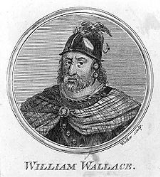
William Wallace

 
William Wallace

   Email Print
   Bookmark   Link


William Wallace


William Wallace (; c. 1270 – 23 August 1305) was a Scottish
Scotland

conventional_long_name = ScotlandAlba|common_name= Scotland|image_flag = Flag of Scotland.svg|flag_width = 130px...
 knight
Knight

File:Gothic armor 2.jpgKnight is the term for a social position originating in the Middle Ages. In the Commonwealth of Nations, knighthood is a non-heritable form of gentry....
 and landowner
Landowner

Landholder or landowner is a holder of the estate in land with considerable rights of ownership or, simply put, an owner of land.In the old Europe a landholder was usually a nobleman, see landed nobility....
 who is known for leading a resistance during the Wars of Scottish Independence
Wars of Scottish Independence

The Wars of Scottish Independence were a series of military campaigns fought between the Kingdom of Scotland and the Kingdom of England in the late thirteenth and early fourteenth centuries....
 and regarded as a patriot and national hero.

Along with Andrew Moray
Andrew Moray

Andrew Moray , , also known as Andrew de Moray, Andrew of Moray, or Andrew Murray, was a prominent military leader during the Scottish Wars of Independence....
, he defeated an English
England

native_name =|conventional_long_name = England|common_name = England|image_flag = Flag of England.svg|image_coat = England COA.svg|symbol_type = Royal Coat of Arms...
 army at Stirling
Stirling

Stirling is a City status in the United Kingdom and former ancient burgh in Scotland, and is at the heart of the wider Stirling .The city is clustered around a large Stirling Castle and medi?val old-town....
, and became Guardian of Scotland
Guardian of Scotland

The Guardians of Scotland were the de facto heads of state of Scotland during the List of monarchs of Scotland#First Interregnum 1290-1292 of 1286?1292, and the List of monarchs of Scotland#Second Interregnum 1296-1306 of 1296?1306....
, serving until his defeat at the Battle of Falkirk
Battle of Falkirk (1298)

The Battle of Falkirk, which took place on 22 July 1298, was a major engagement in the First War of Scottish Independence. An English army commanded by King Edward I of England defeated the Scottish people under William Wallace....
. After several years in hiding, Wallace was eventually found and captured in Robroyston
Robroyston

Robroyston is a northeastern suburb of the city of Glasgow, Scotland. It was where Scotland leader William Wallace was turned over to England soldiers in 1305....
 near Glasgow
Glasgow

Glasgow is the largest city in Scotland and List of largest United Kingdom settlements by population in the United Kingdom. The city is situated on the River Clyde in the country's Scottish Lowlands....
 and handed over to Edward I of England
Edward I of England

Edward I , popularly known as Longshanks, the English Justinian, and the Hammer of the Scots , was a House of Plantagenet King of England who achieved historical fame by conquering large parts of Wales and almost succeeding in doing the same to Scotland....
 ("Longshanks"), who had him executed for treason.

Wallace was the inspiration for the poem, The Acts and Deeds of Sir William Wallace, Knight of Elderslie, by the 15th-century minstrel
Minstrel

A minstrel was a Middle Ages European bard who performed songs whose lyrics told stories about distant places or about real or imaginary historical events....
, Blind Harry
Blind Harry

Blind Harry , also known as Harry or Henry the Minstrel, is renowned as the earliest surviving lengthy source for the events of the life of William Wallace, the Scotland freedom-fighter....
 and this poem subsequently became the basis of Randall Wallace's screenplay for the 1995 film Braveheart
Braveheart

Braveheart is an Academy Award-Winning, 1995 historical action-drama movie film producer and Film director by Mel Gibson, who also starred in the title role....
.

le is known for certain of William Wallace's immediate family.


Discussion
Ask a question about 'William Wallace'
Start a new discussion about 'William Wallace'
Answer questions from other users
Full Discussion Forum


Recent Posts


Quotations


Pro Libertate.

"For Freedom", or "For Liberty" are translations of the Latin motto of Clan Wallace.


Encyclopedia


William Wallace (; c. 1270 – 23 August 1305) was a Scottish
Scotland

conventional_long_name = ScotlandAlba|common_name= Scotland|image_flag = Flag of Scotland.svg|flag_width = 130px...
 knight
Knight

File:Gothic armor 2.jpgKnight is the term for a social position originating in the Middle Ages. In the Commonwealth of Nations, knighthood is a non-heritable form of gentry....
 and landowner
Landowner

Landholder or landowner is a holder of the estate in land with considerable rights of ownership or, simply put, an owner of land.In the old Europe a landholder was usually a nobleman, see landed nobility....
 who is known for leading a resistance during the Wars of Scottish Independence
Wars of Scottish Independence

The Wars of Scottish Independence were a series of military campaigns fought between the Kingdom of Scotland and the Kingdom of England in the late thirteenth and early fourteenth centuries....
 and regarded as a patriot and national hero.

Along with Andrew Moray
Andrew Moray

Andrew Moray , , also known as Andrew de Moray, Andrew of Moray, or Andrew Murray, was a prominent military leader during the Scottish Wars of Independence....
, he defeated an English
England

native_name =|conventional_long_name = England|common_name = England|image_flag = Flag of England.svg|image_coat = England COA.svg|symbol_type = Royal Coat of Arms...
 army at Stirling
Stirling

Stirling is a City status in the United Kingdom and former ancient burgh in Scotland, and is at the heart of the wider Stirling .The city is clustered around a large Stirling Castle and medi?val old-town....
, and became Guardian of Scotland
Guardian of Scotland

The Guardians of Scotland were the de facto heads of state of Scotland during the List of monarchs of Scotland#First Interregnum 1290-1292 of 1286?1292, and the List of monarchs of Scotland#Second Interregnum 1296-1306 of 1296?1306....
, serving until his defeat at the Battle of Falkirk
Battle of Falkirk (1298)

The Battle of Falkirk, which took place on 22 July 1298, was a major engagement in the First War of Scottish Independence. An English army commanded by King Edward I of England defeated the Scottish people under William Wallace....
. After several years in hiding, Wallace was eventually found and captured in Robroyston
Robroyston

Robroyston is a northeastern suburb of the city of Glasgow, Scotland. It was where Scotland leader William Wallace was turned over to England soldiers in 1305....
 near Glasgow
Glasgow

Glasgow is the largest city in Scotland and List of largest United Kingdom settlements by population in the United Kingdom. The city is situated on the River Clyde in the country's Scottish Lowlands....
 and handed over to Edward I of England
Edward I of England

Edward I , popularly known as Longshanks, the English Justinian, and the Hammer of the Scots , was a House of Plantagenet King of England who achieved historical fame by conquering large parts of Wales and almost succeeding in doing the same to Scotland....
 ("Longshanks"), who had him executed for treason.

Wallace was the inspiration for the poem, The Acts and Deeds of Sir William Wallace, Knight of Elderslie, by the 15th-century minstrel
Minstrel

A minstrel was a Middle Ages European bard who performed songs whose lyrics told stories about distant places or about real or imaginary historical events....
, Blind Harry
Blind Harry

Blind Harry , also known as Harry or Henry the Minstrel, is renowned as the earliest surviving lengthy source for the events of the life of William Wallace, the Scotland freedom-fighter....
 and this poem subsequently became the basis of Randall Wallace's screenplay for the 1995 film Braveheart
Braveheart

Braveheart is an Academy Award-Winning, 1995 historical action-drama movie film producer and Film director by Mel Gibson, who also starred in the title role....
.

Background

Little is known for certain of William Wallace's immediate family. The Wallace family may have originally come from Shropshire
Shropshire

Shropshire , alternatively known as Salop or abbreviated, in print only, Shrops, is a Counties of England in the West Midlands of England....
 as followers of Walter Fitzalan
Walter Fitzalan

Walter Fitzalan , was the 1st hereditary High Steward of Scotland , and described as "a Norman by culture and by blood a Breton". He was the second son of a Breton knight, Alan fitzFlaad, feudal lord of Oswestry, by his spouse Ada or Adeline, daughter of Ernoulf de Hesdin....
 (died june 1177), High Steward of Scotland
High Steward of Scotland

The title of High Steward or Great Steward was given in the 12th century to Walter Fitzalan, whose descendants became the Stewart family. In 1371, the last High Steward inherited the throne, and thereafter the title of High Steward of Scotland has been held as a subsidiary title to that of Duke of Rothesay, held by the heir-apparent....
 and ancestor of the Stewart family. The early members of the family are recorded as holding lands including Riccarton
Riccarton, Ayrshire

Riccarton is a village and parish in East Ayrshire, Scotland. It lies across the River Irvine from Kilmarnock. The river Irvine divides the parishes of Riccarton and Kilmarnock and the river used to form the boundary between the districts of Kyle and Cunninghame....
, Tarbolton
Tarbolton

Tarbolton is a village in South Ayrshire, Scotland....
, and Auchincruive in Kyle
Kyle, Ayrshire

Kyle is a former comital district of Scotland which stretched across parts of modern day East Ayrshire and South Ayrshire. It is said to be named after 'Old King Cole,' a king of the Britons , who was reputedly killed in battle in this area and is said to be buried in a cairn near Mauchline....
, and Stenton
Stenton

Stenton is a parish and village in East Lothian, Scotland. It is bounded on the north by parts of the parishes of Prestonkirk and Dunbar, on the east by Spott, and on the west by Whittingehame....
 in Haddingtonshire.

The seal
Seal (device)

A seal can mean a wax seal bearing an impressed figure, or an embossed figure in paper, with the purpose of authenticating a document, but the term can also mean any device for making such impressions or embossments, essentially being a Molding that has the mirror image of the figure in counter-relief, such as mounted on rings known a...
 attached to a letter sent to the Hanse city of Lübeck
Lübeck

L?beck is the second largest city in Schleswig-Holstein, in northern Germany, and one of the major ports of Germany. It was for several centuries the "capital" of the Hanseatic League and because of its Brick Gothic architectural heritage is on UNESCO's list of World Heritage Sites....
 appears to give his father's name as Malcolm. His brothers Alan and John are known from other sources. Malcolm Wallace may appear in the Ragman Rolls
Ragman Rolls

Ragman Rolls was the name given to the collection of instruments by which the nobility and gentry of Scotland used in order to subscribe allegiance to Edward I of England, during the time between the Conference of Norham in May 1291 and the final award in favor of John I of Scotland in November 1292, and again in 1296....
 as a crown tenant in Ayrshire
Ayrshire

Ayrshire is a registration county, and former counties of Scotland in south-west Scotland, located on the shores of the Firth of Clyde. Its principal towns include Ayr, Kilmarnock and Irvine, North Ayrshire....
, but this is uncertain. There is no contemporary evidence connecting William Wallace with either Elderslie
Elderslie

Elderslie is a village in Renfrewshire, Scotland. The village is situated midway between Paisley and Johnstone.The village of Elderslie is old and has a rich history....
 in Renfrewshire
Renfrewshire

Renfrewshire is one of 32 council areas of Scotland. It is one of three council areas contained within the boundaries of the historic Renfrewshire , also known as the County of Renfrew or Greater Renfrewshire, the other two being Inverclyde to the west and East Renfrewshire to the east....
 or Ellerslie
Ellerslie

Ellerslie may refer to:In Australia and New Zealand* Ellerslie, New Zealand is a suburb of Auckland* Ellerslie, Victoria is a town in the Western District of Victoria ...
 in Ayrshire, although both areas were linked to the wider Wallace family.

At the time of Wallace's birth, which cannot be securely dated, King Alexander III
Alexander III of Scotland

Alexander III , King of Scots, was born at Roxburgh, the only son of Alexander II of Scotland by his second wife Marie de Coucy. Alexander's father died on 6 July 1249 and he became king at the age of eight, inaugurated at Scone, Perth and Kinross on 13 July 1249....
 ruled Scotland. His reign had seen a period of peace and economic stability. King Alexander had maintained a positive relationship with the kings of England, and had successfully fended off continuing English claims to sovereignty
Sovereignty

File:Leviathan gr.jpgSovereignty is the exclusive right to control a government, a State, a people, or oneself. A sovereign is a supreme lawmaking authority....
. In 1286 Alexander died after falling from his horse. None of his children survived him. The Scottish lords declared Alexander's four-year-old granddaughter, Margaret (called "the Maid of Norway"), Queen. Due to her young age, the Scottish lords set up an interim government to administer Scotland until Margaret came of age. King Edward I of England
Edward I of England

Edward I , popularly known as Longshanks, the English Justinian, and the Hammer of the Scots , was a House of Plantagenet King of England who achieved historical fame by conquering large parts of Wales and almost succeeding in doing the same to Scotland....
 (popularly known as "Longshanks
Longshanks

Longshanks may refer to:*Edward I of England*Longshanks , symphonic rock band*An alias of Aragorn from "The Lord of the Rings" by J.R.R. Tolkien...
," among other names) took advantage of the instability by arranging the Treaty of Birgham
Treaty of Birgham

The Treaty of Birgham comprised two treaties intended to secure the independence of Scotland after Alexander III of Scotland died without issue in 1286....
 with the lords, betrothing Margaret to his son, Edward
Edward II of England

Edward II, of Caernarfon, was Kingdom of England from 1307 until he was deposition in January 1327. His tendency to ignore his nobility in favour of low-born favourites led to constant political unrest and his eventual deposition....
, on the understanding that Scotland would preserve its status as a separate kingdom
Monarchy

A monarchy is a form of government in which supreme power is absolutely or nominally lodged in an individual, who is the head of state, often for Life tenure or until abdication, and "is wholly set apart from all other members of the state." The person who heads a monarchy is called a monarch....
. Margaret, however, fell ill and died at only seven years of age (1290) on her way from her native Norway
Norway

Norway , officially the Kingdom of Norway, is a constitutional monarchy in Northern Europe that occupies the western portion of the Scandinavian Peninsula....
 to Scotland. A number of claimants to the Scottish throne came forward almost immediately.

With Scotland threatening to descend into a dynastic war, the "leading men" of the realm invited Edward's arbitration — as a powerful neighbour and significant jurist he could hardly be ignored. Before the process could begin, he insisted, despite his word to the contrary, that all of the contenders recognize him as Lord Paramount of Scotland. After some initial resistance, all, including John Balliol
John of Scotland

John de Balliol was Elective kingshiped King of the Scots from 1292 to 1296....
 and Robert Bruce, the chief contenders, accepted this precondition. Finally, in early November 1292, at a great feudal court held in the castle at Berwick-upon-Tweed
Berwick-upon-Tweed

Berwick-upon-Tweed , situated in the county of Northumberland, is the northernmost town in England, on the east coast at the mouth of the River Tweed....
, judgement was given in favour of John Balliol having the strongest claim in law. Formal announcement of the judgement was given by Edward on 17 November.

Edward proceeded to use the political concessions he had gained to challenge the de facto independence of Scotland and to make King John's position difficult. Balliol broke his promise and renounced his homage
Homage

Homage is generally used in modern English language to mean any public show of respect to someone to whom one feels indebted. In this sense, a reference within a creative work to someone who greatly influenced the artist would be an homage....
 in March 1296 and by the end of the month Edward stormed Berwick-upon-Tweed
Berwick-upon-Tweed

Berwick-upon-Tweed , situated in the county of Northumberland, is the northernmost town in England, on the east coast at the mouth of the River Tweed....
, sacking the then-Scottish border town. He slaughtered almost all of his opponents who resided there, even if they fled to their homes. In April, the Scots were defeated at the Battle of Dunbar (1296)
Battle of Dunbar (1296)

The Battle of Dunbar was the first and last sigificant field action in the campaign of 1296. King Edward I of England had invaded Scotland in 1296 to punish John I of Scotland for his refusal to support England military action in France....
 in East Lothian
East Lothian

East Lothian is one of 32 unitary council areas in Scotland, UK, and a Lieutenancy areas of Scotland. It borders the City of Edinburgh, Scottish Borders and Midlothian....
 and by July Edward had forced Balliol to abdicate at Stracathro
Stracathro

Stracatho is a small place in Angus, Scotland, to the northeast of Brechin on the A90 road. A Ancient Rome Roman camp has been discovered here; this Roman Camp is one day's march from the next Roman Camp to the north, Raedykes....
 near Montrose
Montrose, Angus

Montrose is a coastal resort town and former royal burgh in Angus, Scotland. It is situated 38 miles north east of Dundee between the mouths of the North and South Esk rivers....
. Edward then instructed his officers to receive formal homage from some 1800 Scottish nobles (many of the rest being prisoners of war at that time), having previously removed the Stone of Destiny
Stone of Scone

The Stone of Scone , also commonly known as the Stone of Destiny or the Coronation Stone is an oblong block of red sandstone, about by by in size and weighing approximately ....
, the Scottish coronation stone, from Scone Palace
Scone Palace

Scone Palace is a Category A Listed building Historic houses in Scotland at Scone, Perth and Kinross, Perthshire, Scotland. It was constructed in 1808 for the Earl of Mansfield and Mansfield by William Atkinson ....
, and taken it to London.

Military career


Wallace's exploits begin

Blind Harry
Blind Harry

Blind Harry , also known as Harry or Henry the Minstrel, is renowned as the earliest surviving lengthy source for the events of the life of William Wallace, the Scotland freedom-fighter....
 invented a tale that Wallace's father was killed along with his brother John in a skirmish at Loudoun Hill
Loudoun Hill

Loudoun Hill, also commonly Loudounhill is a volcanic plug in East Ayrshire, Scotland. It is located near the head of the River Irvine, east of Darvel....
 in 1291 by the notorious Lambies, who came from the Clan Lamont
Clan Lamont

Clan Lamont is a Scottish Highlands Scottish clan. Clan Lamont claim descent from Lauman who lived in Cowal in 1238. Tradition gives this Lauman a descent from an Irish prince named Anrothan O'Neill....
.

According to local Ayrshire
Ayrshire

Ayrshire is a registration county, and former counties of Scotland in south-west Scotland, located on the shores of the Firth of Clyde. Its principal towns include Ayr, Kilmarnock and Irvine, North Ayrshire....
 legend, two English soldiers challenged Wallace in the Lanark
Lanark

Lanark is a small town in the central belt of Scotland. Its population of 8,253 makes it the 100th largest settlement in Scotland.Lanark was the county town of the former county of Lanarkshire....
 marketplace regarding his catching of fish. According to various historians, including John Strawhorn, author of The History of Irvine
Irvine

Irvine may refer to:...
, the legend has Wallace fishing on the River Irvine
River Irvine

The River Irvine is a river flowing through southwest Scotland, with its watershed on the Lanarkshire border of Ayrshire at an altitude of 810 feet above sea-level, near Drumclog, and 7 miles SW by W of Strathaven....
. He had been staying with his uncle in Riccarton
Riccarton, Ayrshire

Riccarton is a village and parish in East Ayrshire, Scotland. It lies across the River Irvine from Kilmarnock. The river Irvine divides the parishes of Riccarton and Kilmarnock and the river used to form the boundary between the districts of Kyle and Cunninghame....
. A group of English soldiers approached, whereupon the leader of the band came forward and demanded the entire catch. Even after Wallace offered half of his fish, the English refused such diplomacy and threatened him with death if he refused. Wallace allegedly floored the approaching soldier with his fishing rod and took up the assailant's sword. He set upon the entire team of English soldiers with stereotypical success. The argument had escalated into a brawl and two English soldiers were killed. Blind Harry places this incident along the River Irvine
River Irvine

The River Irvine is a river flowing through southwest Scotland, with its watershed on the Lanarkshire border of Ayrshire at an altitude of 810 feet above sea-level, near Drumclog, and 7 miles SW by W of Strathaven....
 with five soldiers being killed. The authorities issued a warrant for his arrest shortly thereafter. According to a plaque outside St. Paul's Cathedral in Dundee
Dundee

Dundee is the fourth-largest City status in the United Kingdom in Scotland and, fully named as Dundee City, one of Scotland's 32 Local government in Scotland Council areas of Scotland....
, however, William Wallace began his war for independence by killing the son of the English governor of Dundee after he had made a habit of bullying Wallace and his family. This story perhaps has more weight because it is speculated that Wallace may have attended what is now the High School of Dundee
High School of Dundee

The High School of Dundee, informally Dundee High School, is one of Scotland's leading private, or independent schools, and the only such school in Dundee; its foundation is dated to 1239....
, and spent some of his time growing up in the nearby village of Kilspindie
Kilspindie

Kilspindie is a village in Perthshire, Scotland....
.

Wallace's activities before 1297 are completely undocumented, but Harry states that Wallace was under the protection of his uncle Ronald Crawford
Ronald Crawford

Sir Ronald Crawford was the 4th Sheriff of Ayrshire, Chief of Clan Crawford, and Lord of Loudon Castle. He lived in the town of Crosbie, Scotland which King Alexander granted in 1263 to his grandfather, Hugh Crawford, the 2nd Sheriff of Ayrshire, after the Battle of Largs....
, Sheriff
Reeve (England)

In England, a reeve was an official elected annually by the serfs to supervise lands for a lord. The reeve himself was a serf. He had many duties such as making sure the serfs started work on time and ensuring that no one was cheating the lord out of money....
 of Ayrshire. He used this relationship to his advantage and there are unconfirmed reports of his early career as a petty criminal.

Wallace enters history when he killed William Heselrig, the English Sheriff
Sheriff

A sheriff is in principle a legal official with responsibility for a county. In practice, the specific combination of legal, political, and ceremonial duties of a sheriff varies greatly from country to country....
 of Lanark, in May, 1297. According to later legend this was to avenge the death of Marion Braidfute
Marion Braidfute

Marion Braidfute of Lamington was, according to Blind Harry, a maiden whom William Wallace courted and married. She was killed by Sir William Heselrig, the England Sheriff of Lanark....
 of Lamington
Lamington

Lamingtons are a sponge cake in the shape of a cube, coated in a layer of traditionally chocolate Icing then desiccated coconut. They are sometimes served as two halves with a layer of cream and/or strawberry jam between, and are commonly found in Australiasian outlets such as coffee lounges, lunch bars, bakeries, and supermarkets....
 — the young maiden Wallace courted and married in Blind Harry's tale. Soon, he achieved victory in skirmishes at Loudoun Hill
Loudoun Hill

Loudoun Hill, also commonly Loudounhill is a volcanic plug in East Ayrshire, Scotland. It is located near the head of the River Irvine, east of Darvel....
 (near Darvel
Darvel

Darvel is a small town in East Ayrshire, Scotland, located at the eastern end of the Irvine Valley and is sometimes referred to as "The Lang Toon" due to its quaint appearance on Ordnance Survey maps....
, Ayrshire) and Ayr
Ayr

Ayr is a town and port situated on the Firth of Clyde, in south-west Scotland. It has been a royal burgh since 1205 and the county town of the former Counties of Scotland of Ayrshire....
; he also fought alongside Sir William Douglas the Hardy at Scone, routing the English justiciar
Justiciar

In medieval England and Ireland the Chief Justiciar was roughly equivalent to a modern Prime Minister of the United Kingdom as the monarch's chief Political minister....
, William Ormesby. Cities such as Aberdeen
Aberdeen

Aberdeen is Scotland's third most populous City status in the United Kingdom and one of Scotland's 32 Local government in Scotland Council areas of Scotland....
, Perth
Perth, Scotland

Perth is a town and former royal burgh in central Scotland. Sitting on the banks of the River Tay, it is the administrative headquarters of Perth and Kinross council area....
, Glasgow
Glasgow

Glasgow is the largest city in Scotland and List of largest United Kingdom settlements by population in the United Kingdom. The city is situated on the River Clyde in the country's Scottish Lowlands....
, Scone
Scone, Scotland

Scone is a village in Perth and Kinross, Scotland. The Middle Ages village of Scone, which grew up around the Scone Abbey, was abandoned in the early 19th century when a Scone Palace was built on the site by the Earl of Mansfield....
, Dundee
Dundee

Dundee is the fourth-largest City status in the United Kingdom in Scotland and, fully named as Dundee City, one of Scotland's 32 Local government in Scotland Council areas of Scotland....
.

In 1296-97, he was allegedly involved in an event which would later come to be known as Wallace's Larder
Ardrossan Castle

Ardrossan Castle is situated on the west coast of Ayrshire, Scotland in the town of Ardrossan. The original castle, owned by the Barclay family, was partly destroyed during the Wars of Scottish Independence....
. He is said to have lured the English occupiers of Ardrossan Castle
Ardrossan Castle

Ardrossan Castle is situated on the west coast of Ayrshire, Scotland in the town of Ardrossan. The original castle, owned by the Barclay family, was partly destroyed during the Wars of Scottish Independence....
 out of their holding and into the town whereupon he set upon them one at a time. After successfully retaking the castle, Wallace had the bodies of the English thrown into a tunnel which can still be seen today.

Supporters of the growing revolt suffered a major blow when Scottish nobles agreed to personal terms with the English at Irvine in July. In August, Wallace left Selkirk Forest with his followers to join Moray at Stirling
Stirling

Stirling is a City status in the United Kingdom and former ancient burgh in Scotland, and is at the heart of the wider Stirling .The city is clustered around a large Stirling Castle and medi?val old-town....
. Moray began another uprising, and their forces combined at Stirling, where they prepared to meet the English in battle.

As Wallace's ranks swelled, information obtained by John Graham prompted Wallace to move his force from Selkirk Forest to the Highlands, though there is no historical evidence to suggest that Wallace ever left the Lowlands
Lowlands

Lowlands or The Lowlands can refer toGeographic regions* Scottish Lowlands, all of mainland Scotland that isn't the Highlands * Northern European Lowlands, a region of Europe between the Central Highlands and the North Sea...
 area of Scotland other than his visit to France
France

France , officially the French Republic , is a country whose Metropolitan France is located in Western Europe and that also comprises various Overseas departments and territories of France....
 and his trip to the scaffold in London.

The Battle of Stirling Bridge

On 11 September 1297, Wallace won the Battle of Stirling Bridge
Battle of Stirling Bridge

The Battle of Stirling Bridge was a battle of the First War of Scottish Independence. On 11 September 1297, the forces of Andrew Moray and William Wallace defeated the combined England forces of John de Warenne, 7th Earl of Surrey and Hugh de Cressingham near Stirling, on the River Forth....
. Although vastly outnumbered, the Scottish forces led by Wallace and Andrew Moray
Andrew Moray

Andrew Moray , , also known as Andrew de Moray, Andrew of Moray, or Andrew Murray, was a prominent military leader during the Scottish Wars of Independence....
 routed the English army. The Earl of Surrey
John de Warenne, 7th Earl of Surrey

John de Warenne , 7th Earl of Surrey or Warenne, was prominent during the reigns of Henry III of England and Edward I of England. During his long life he fought in the Second Barons' War and in Edward I's Wars of Scottish Independence....
's professional army of 3,000 cavalry and 10,000 infantry met disaster as they crossed over to the north side of the river. The narrowness of the bridge prevented many soldiers from crossing together (possibly as few as three men abreast), so while the English soldiers crossed, the Scots held back until half of them had passed and then killed the English as quickly as they could cross.

Sterlingbridge
A pivotal charge, led by one of Wallace's captains, caused some of the English soldiers to retreat as others pushed forward, and under the overwhelming weight, the bridge collapsed and many English soldiers drowned. Harry claims that the bridge was rigged to collapse by the action of a man hidden beneath the bridge. The Scots won a significant victory which boosted the confidence of their army. Hugh Cressingham, Edward's treasurer in Scotland, died in the fighting and it is reputed that his body was subsequently flayed and the skin cut into small pieces as tokens of the victory. The Lanercost Chronicle records that Wallace had "a broad strip [of Cressingham’s skin] ... taken from the head to the heel, to make therewith a baldrick
Baldric

A baldric is a belt worn over one shoulder that is typically used to carry a weapon or other implement such as a bugle or drum. The word may also refer to any belt in general, but this usage is poetic and not considered standard....
 for his sword
". William Crawford led 400 Scottish heavy cavalry to complete the action by running the English out of Scotland. It is widely believed that Moray died of wounds suffered on the battlefield sometime in the winter of 1297, but an inquisition into the affairs of his uncle, Sir William Moray of Bothwell, held at Berwick
Berwick-upon-Tweed

Berwick-upon-Tweed , situated in the county of Northumberland, is the northernmost town in England, on the east coast at the mouth of the River Tweed....
 in late November 1300, records he was "slain at Stirling against the king."

Upon his return from the Battle of Stirling Bridge, Wallace was knighted along with his second-in-command John Graham
John de Graham

Sir John de Graham was a Scottish knight and soldier, born in the lands of Dundaff, in the late 13th century. He was a patriot, fighting alongside Sir William Wallace, considered his friend, and right-hand man....
 and his third-in-command William Crawford
William Crawford (Scottish knight)

Sir William Crawford son of Sir Ronald Crawford and cousin to William Wallace, was motivated by the murder of his father to join the revolt as a captain to Wallace....
, possibly by Robert the Bruce, and Wallace was named "Guardian of Scotland and Leader of its armies".

In the six months following Stirling Bridge, Wallace led a raid into northern England. His intent was to take the battle to English soil to demonstrate to Edward that Scotland also had the power to inflict the same sort of damage south of the border. Edward was infuriated but he refused to be intimidated.

The Battle of Falkirk

A year later, Wallace lost the Battle of Falkirk
Battle of Falkirk (1298)

The Battle of Falkirk, which took place on 22 July 1298, was a major engagement in the First War of Scottish Independence. An English army commanded by King Edward I of England defeated the Scottish people under William Wallace....
. On 1 April 1298, the English invaded Scotland at Roxburgh
Roxburgh

The destroyed royal burgh of Roxburgh was an important trading burgh in High Middle Ages to early modern period Kingdom of Scotland. In the Middle Ages it had at least as much importance as Edinburgh, Stirling, or Berwick-upon-Tweed, for a time acting as de facto capital ....
. They plundered Lothian
Lothian

Lothian forms a traditional region of Scotland, lying between the southern shore of the Firth of Forth and the Lammermuir Hills.In Lothian there is Edinburgh City, West Lothian, Mid Lothian and East Lothian....
 and regained some castles, but had failed to bring Wallace to combat. The Scots adopted a scorched-earth policy
Scorched earth

A scorched earth policy is a military strategy or operational method which involves destroying anything that might be useful to the enemy while advancing through or withdrawing from an area....
 in their own country, and English quartermasters' failure to prepare for the expedition left morale and food low, but Edward's search for Wallace would not end at Falkirk
Falkirk

Falkirk The town lies at the junction of the Forth and Clyde Canal and the Union Canal , a location which proved pivotal to the growth of Falkirk as a centre of heavy industry during the Industrial Revolution....
.

Wallace arranged his spearmen in four "schiltron
Schiltron

A schiltron is a group of soldiers wielding outward-pointing pike or other polearms, to ward off cavalry attacks. The term does not denote any particular shape or alignment of the formation, and is most often associated with Scottish pike formations during the Wars of Scottish Independence in the late 13th and early 14th centuries....
s" — circular, hedgehog formations surrounded by a defensive wall of wooden stakes. The English gained the upper hand, however, attacking first with cavalry
Cavalry

The Cavalry is the second oldest of the Combat Arms, and as soldiers or warriors who fought mounted on horseback in combat, it represents the mobility and offensive power of the armed forces....
, and breaking up the Scottish archers
Archery

Archery is the art, practice or skill of shooting with Bow and arrow. Archery has historically been used in hunting and combat and has become a precision sport....
. Under the command of the Scottish nobles, the Scottish knights withdrew, and Edward's men began to attack the schiltrons. It remains unclear whether the infantry firing bolts, arrows and stones at the spearmen proved the deciding factor, although it is very likely that it was the arrows of Edward's bowmen.

Either way, gaps in the schiltrons soon appeared, and the English exploited these to crush the remaining resistance. The Scots lost many men. Wallace escaped, though his military reputation suffered badly. John Graham was killed and William Crawford became Wallace's second. According to one account, during his flight Wallace fought and killed Brian de Jay, master of the English Templars
Knights Templar

The Poor Fellow-Soldiers of Christ and of the Temple of Solomon , commonly known as the Knights Templar or the Order of the Temple , were among the most famous of the History of Christianity#Sanctification of knighthood military orders....
 in a thicket at Callander.

By September 1298, Wallace had decided to resign as Guardian of Scotland in favour of Robert Bruce, Earl of Carrick
Earl of Carrick

The Earl of Carrick was the head of a comital lordship of Carrick, Scotland in south-western Scotland. The title emerged in 1186, when Donnchadh, Earl of Carrick, son of Gille Brigte, Lord of Galloway, became Mormaer or Earl of Carrick, Scotland in compensation for exclusion from the whole Lord of Galloway....
, and John Comyn of Badenoch
Badenoch

Badenoch is a traditional district which today forms part of Badenoch and Strathspey, an area of Highland Council, in Scotland, bounded on the north by the Monadhliath Mountains, on the east by the Cairngorm Mountains and Braemar, on the south by Atholl and the Grampian Mountains , and on the west by Lochaber....
, ex-King John Balliol's brother-in-law. Bruce became reconciled with King Edward in 1302, while Wallace spurned such moves towards peace.

According to Harry, Wallace left with William Crawford in late 1298 on a mission to the court of King Philip IV of France
Philip IV of France

Philip IV , called the Fair , son and successor of Philip III of France, reigned as List of French monarchs from 1285 until his death. He was the husband of Joan I of Navarre, by virtue of which he was List of Navarrese royal consorts and Counts of Champagne from 1284 to 1305....
 to plead the case for assistance in the Scottish struggle for independence. Backing this claim is a surviving letter from the French king dated 7th of November 1300 to his envoys in Rome demanding that they should help Sir William. Whether or not Wallace made it to Rome is unsure. Harry also states that on their trip down the English coast, the small convoy ran into the infamous pirate Richard Longoville, also known as the Red Reiver for his red sails and ruthless raids. Hiding in the hold of the ship while Crawford and a small contingent of men sailed, Wallace surprised the pirates as they boarded the ship. Longoville was captured and taken to Paris where the Scots convinced Philip to grant amnesty so that Longoville could prey on English ships. This last story is one of many recorded by Blind Harry for which there is no evidence. Harry also invented a major action against Edward I at Biggar, which, though often cited, never actually occurred.

In 1303, Squire Guthrie was sent to France to ask Wallace and his men to return to Scotland, which they did that same year. They slipped in under the cover of darkness to recover on the farm of William Crawford, near Elcho Wood. Having heard rumours of Wallace's appearance in the area, the English moved in on the farm. A chase ensued and the band of men slipped away after being surrounded in Elcho Wood. Here, Wallace took the life of one of his men that he suspected of disloyalty, in order to divert the English from the trail.

Wallace's capture and execution


Wallace evaded capture by the English until 5 August 1305 when John de Menteith, a Scottish knight loyal to Edward, turned Wallace over to English soldiers at Robroyston
Robroyston

Robroyston is a northeastern suburb of the city of Glasgow, Scotland. It was where Scotland leader William Wallace was turned over to England soldiers in 1305....
 near Glasgow
Glasgow

Glasgow is the largest city in Scotland and List of largest United Kingdom settlements by population in the United Kingdom. The city is situated on the River Clyde in the country's Scottish Lowlands....
. Wallace was transported to London and taken to Westminster Hall, where he was tried for treason, and the execution of civilians and prisoners, and was crowned with a garland of oak to suggest he was the king of outlaw
Outlaw

An outlaw or bandit is a person living the lifestyle of outlawry; the word literally means "outside the law", by folk-etymology from the original meaning "laid outside" of the Old Norse word ?tlagi, from which the word outlaw was borrowed into English....
s. He responded to the treason charge, "I could not be a traitor to Edward, for I was never his subject." With this, Wallace asserted that the absent John Balliol was officially his king. Wallace was declared guilty.

Following the trial, on 23 August 1305, Wallace was taken from the hall, stripped naked and dragged through the city at the heels of a horse to the Elms at Smithfield
Smithfield, London

Smithfield is an area in the north-west part of the City of London, mostly known for its centuries-old meat market and its bloody history of executions of heretics and political opponents....
. He was hanged, drawn and quartered
Hanged, drawn and quartered

To be hanged, drawn and quartered was the sentence once ordained in England for the crime of high treason. It is considered by many to be the epitome of cruel and unusual punishment, and was reserved only for this most serious crime, which was deemed more heinous than murder and other Capital punishment....
 — strangled by hanging but released while still alive, emasculated
Emasculation

Emasculation is the removal of the genitalia of a male, notably the penis and/or the testicles.By extension, the word has also come to mean ?to socially render a male less of a man?, or ?to make a male feel himself to be less of a man by subjecting him to humiliation?....
, eviscerated
Disembowelment

Disembowelment is the removing of some or all of the vital organ s, usually from the abdomen....
 and his bowels burnt before him, beheaded
Decapitation

Decapitation , or beheading, is the cutting off of the head of a person or animal. Beheading typically refers to the act of intentional decapitation, e.g., as a means of murder or capital punishment; it may be accomplished, for example, with an axe, sword, knife, wire, or by means of a guillotine....
, then cut into four parts. His preserved head was placed on a pike atop London Bridge
London Bridge

London Bridge is a bridge between the City of London and Southwark in London, England, over the River Thames. Situated between Cannon Street Railway Bridge and Tower Bridge, it forms the western end of the Pool of London....
. It was later joined by the heads of the brothers, John and Simon Fraser. His limbs were displayed, separately, in Newcastle upon Tyne
Newcastle upon Tyne

Newcastle upon Tyne is a City status in the United Kingdom and metropolitan borough of Tyne and Wear, in North East England. Situated on the north bank of the River Tyne, the city developed from a Roman Empire settlement called Pons Aelius, though it owes its name to the Newcastle Castle built in 1080, by Robert Curthose, the eldest son of...
, Berwick-upon-Tweed
Berwick-upon-Tweed

Berwick-upon-Tweed , situated in the county of Northumberland, is the northernmost town in England, on the east coast at the mouth of the River Tweed....
, Stirling
Stirling

Stirling is a City status in the United Kingdom and former ancient burgh in Scotland, and is at the heart of the wider Stirling .The city is clustered around a large Stirling Castle and medi?val old-town....
, and Aberdeen. A plaque stands in a wall of St. Bartholomew's Hospital near the site of Wallace's execution at Smithfield.

The Wallace Sword
Wallace Sword

The Wallace Sword is an antique claymore purported to have belonged to William Wallace , a knight and Scotland patriot who led a Resistance movement to the England occupation of Scotland during the Wars of Scottish Independence....
, which supposedly belonged to Wallace, although some parts are at least 160 years later in origin, was held for many years in Loudoun Castle
Loudoun Castle

Loudoun Castle is a popular theme park set around the ruins of a 19th century castle near Galston, East Ayrshire, in the Loudoun area of Southwest Scotland....
 and is now in the Wallace National Monument
Wallace Monument

The National Wallace Monument is a tower standing on the summit of Abbey Craig, a hilltop near Stirling in Scotland. It commemorates Sir William Wallace, the 13th century Scottish hero....
 near Stirling
Stirling

Stirling is a City status in the United Kingdom and former ancient burgh in Scotland, and is at the heart of the wider Stirling .The city is clustered around a large Stirling Castle and medi?val old-town....
.

Portrayal in fiction

Comprehensive and historically accurate information was written about Wallace, but many stories are based on the wandering 15th-century minstrel Blind Harry's epic poem, The Acts and Deeds of Sir William Wallace, Knight of Elderslie, written around 1470. Historians either reject almost all of the parts of Blind Harry's tale, or dismiss the entire composition. Although Blind Harry wrote from oral tradition describing events 170 years earlier, giving rise to alterations of fact, Harry's is not in any sense an authoritative description of Wallace's exploits. Indeed, hardly any of Harry's work is supported by circumstantial evidence including names from land charters, the Ragman Roll, and religious and public office holders and their archives. While not all details are consistent, the general flow is consistent with contemporary histories. Several modern writers note that the Bishop of St. Andrew's did commission a friar to write a first-hand account of Wallace's exploits, but the existence, let alone the disposition of this manuscript is not known.

Blind Harry's poem Barns of Ayr, for example, describes a mythical incident when 360 Scottish nobles, led by Wallace’s uncle, Ronald Crawford
Ronald Crawford

Sir Ronald Crawford was the 4th Sheriff of Ayrshire, Chief of Clan Crawford, and Lord of Loudon Castle. He lived in the town of Crosbie, Scotland which King Alexander granted in 1263 to his grandfather, Hugh Crawford, the 2nd Sheriff of Ayrshire, after the Battle of Largs....
, were summoned by the English to a conference in Spring of 1297. As each passed through a narrow entry, a rope was dropped around his neck and he was hanged. The incident as described by Blind Harry does appear in the 1995 film Braveheart
Braveheart

Braveheart is an Academy Award-Winning, 1995 historical action-drama movie film producer and Film director by Mel Gibson, who also starred in the title role....
 with even less accuracy, placing the event in the childhood of Wallace and ignoring the murder of his uncle Crawford. Nevertheless, Ronald Crawford did die at this time and his son replaced him as Sheriff of Ayrshire, giving some credence to the story.

In the early 19th century, Walter Scott
Walter Scott

Sir Walter Scott, 1st Baronet, was a prolific Scotland historical novelist and poet popular throughout Europe during his time.In some ways Scott was the first English-language author to have a truly international career in his lifetime, with many contemporary readers all over Europe, Australia, and North America....
 wrote of Wallace in Exploits and Death of William Wallace, the "Hero of Scotland", and Jane Porter
Jane Porter

Jane Porter was a Scottish people novelist.Jane Porter was an avid reader. Said to rise at four in the morning in order to read and write, she read the whole of Edmund Spenser's Faerie Queene while still a child....
 penned a romantic version of the Wallace legend in The Scottish Chiefs in 1810.

G.A. Henty
G. A. Henty

George Alfred Henty , referred to as G. A. Henty, was a prolific England novelist, special correspondent and Imperialist. He is best known for his adventure novel stories that were popular in the late 19th century....
 wrote a novel in 1885 about this time period titled In Freedom's Cause. Henty, a producer of Boys Own fiction who wrote for that magazine, portrays the life of William Wallace, Robert the Bruce, The Black Douglas
James Douglas, Lord of Douglas

Sir James Douglas , , was a Kingdom of Scotland soldier and knight who fought in the Scottish Wars of Independence. He was a son of Sir William Douglas the Hardy, who had been a supporter of William Wallace ....
, and others, while dovetailing the novel with historical fiction
Historical fiction

Historical fiction is a sub-genre of fiction that often portrays fictional accounts or dramatization of historical figures or events. Writers of stories in this genre, while penning fiction, nominally attempt to capture the spirit, manners, and social conditions of the persons or time presented in the story, with due attention paid to period...
.

Nigel Tranter
Nigel Tranter

Nigel Tranter OBE was a Scotland historian and author....
 wrote a historical novel titled The Wallace
Historical novels by Nigel Tranter set between 1286-1603

The Scottish author Nigel Tranter wrote many novels based on actual historical events and characters.This page includes those of his historical novels set in Scotland in the period 1286-1603....
, published in 1975, which is said by academics to be more accurate than its literary predecessors.

The best-known account of the life of William Wallace is the 1995 film Braveheart
Braveheart

Braveheart is an Academy Award-Winning, 1995 historical action-drama movie film producer and Film director by Mel Gibson, who also starred in the title role....
, directed by and starring the actor Mel Gibson
Mel Gibson

Mel Columcille Gerard Gibson, Officer of the Order of Australia is an Australian-American actor, film director, film producer and screenwriter....
, written by Randall Wallace
Randall Wallace

Randall Wallace is an American songwriter, screenwriter, film producer, and film director who wrote the screenplay for the Mel Gibson film Braveheart, for which he received an Academy Awards nomination for Best Original Screenplay and a Writers Guild of America award for Best Screenplay Adapted Directly for the Screen....
, and filmed in both Scotland and Ireland. This film was a commercial and critical success, winning five Academy Awards
Academy Awards

The Academy Awards, popularly known as the Oscars, are presented annually by the Academy of Motion Picture Arts and Sciences to recognize excellence of professionals in the film industry, including directors, actors, and writers....
, including Best Picture
Academy Award for Best Picture

The Academy Award for Best Motion Picture is one of the Academy Award presented annually by the Academy of Motion Picture Arts and Sciences to artists working in the film industry....
 and Best Director
Academy Award for Directing

The Academy Award for Achievement in Directing is one of the Academy Award presented by the Academy of Motion Picture Arts and Sciences to Film directors working in the film industry....
. The film contains many major historical inaccuracies (see Braveheart#Historical inaccuracies
Braveheart

Braveheart is an Academy Award-Winning, 1995 historical action-drama movie film producer and Film director by Mel Gibson, who also starred in the title role....
).

In Robyn Young's final book of the Brethren trilogy "Requiem" (October 2008), protagonist Will Campbell deserts the Knight Templars to fight for Scotland where he meets William Wallace. Campbell and Wallace fight together and work closely in planning the downfall of Edward I.

Bibliography

  • Brown, Chris. William Wallace. The True Story of Braveheart. Stroud: Tempus Publishing Ltd, 2005. ISBN 0-7524-3432-2.
  • "The Chronicle of Lanercost 1272 - 1346
    Lanercost Chronicle

    The Lanercost Chronicle is a northern England and Scotland history covering the years 1201 to 1346. It covers the Wars of Scottish Independence, but it is also highly tangential and as such provides insights into English life in the thirteenth century....
    ", ed. H. Maxwell, 1913;
  • Clater-Roszak, Christine. "Sir William Wallace ignited a flame." Military History 14 (1997): 12–15.
  • Harris, Nathaniel. Heritage of Scotland: A Cultural History of Scotland & Its People. London: Hamlyn, 2000. ISBN 0-600-59834-9.
  • Loudoun, Darren John. Scotland's Brave. Sydney: Paragon Books, 2007.
  • MacLean, Fitzroy. Scotland: A Concise History. London: Thames & Hudson, 1997. ISBN 0-500-27706-0.
  • Morton, Graeme. William Wallace. London: Sutton, 2004. ISBN 0-7509-3523-5.
  • Reese, Peter. William Wallace: A Biography. Edinburgh: Canongate, 1998. ISBN 0-86241-607-8.
  • Scott, Sir Walter. Exploits and death of William Wallace, the 'Hero of Scotland'
  • Stead, Michael J., and Alan Young. In the Footsteps of William Wallace. London: Sutton, 2002.
  • Tranter, Nigel. The Wallace
    Historical novels by Nigel Tranter set between 1286-1603

    The Scottish author Nigel Tranter wrote many novels based on actual historical events and characters.This page includes those of his historical novels set in Scotland in the period 1286-1603....
    : The Compelling 13th century Story of William Wallace
    . McArthur & Co., 1997. ISBN 0-3402-1237-3.
  • Wallace, Margaret. William Wallace: Champion of Scotland. Musselborough: Goblinshead, 1999. ISBN 1-899874-19-4.
  • Folklore, Myths and Legends of Britain. London: The Reader’s Digest Association, 1973, 519-20.


See also

  • Wallace Monument
    Wallace Monument

    The National Wallace Monument is a tower standing on the summit of Abbey Craig, a hilltop near Stirling in Scotland. It commemorates Sir William Wallace, the 13th century Scottish hero....
  • Clan Wallace
    Clan Wallace

    The Clan Wallace or the Wallace Family originated in the Strathclyde area of the Scottish Lowlands. They are first mentioned in 12th century documents, placing most of the Wallace Family near the city of Glasgow....
  • Clan Campbell
    Clan Campbell

    Clan Campbell is historically one of the largest, most powerful and most successful of the Scottish Highlands Scottish clans....
  • Lugar Water
    Lugar Water

    The Lugar Water, or River Lugar, is created by the confluence of Bello Water and Guelt Water, both of which flow from the hills of the Southern Uplands in East Ayrshire, Scotland....
  • Josep Moragues i Mas
    Josep Moragues i Mas

    Josep Moragues i Mas was a Catalonia general during the War of the Spanish Succession. He fought on the Charles VI, Holy Roman Emperor side....
  • Robert I of Scotland
    Robert I of Scotland

    Robert I, King of the Scots usually known in modern English as Robert the Bruce was King of the Scots from 1306 until his death in 1329....
  • River Irvine
    River Irvine

    The River Irvine is a river flowing through southwest Scotland, with its watershed on the Lanarkshire border of Ayrshire at an altitude of 810 feet above sea-level, near Drumclog, and 7 miles SW by W of Strathaven....
  • Andrew Moray
    Andrew Moray

    Andrew Moray , , also known as Andrew de Moray, Andrew of Moray, or Andrew Murray, was a prominent military leader during the Scottish Wars of Independence....
  • John de Menteith
  • Jack Short
    Jack Short

    Jack Short was the betrayer of Scotland legend Sir William Wallace.Jack Short allowed Sir William Wallace to be captured by not telling him or alerting him of the ambush that was set up for him....
  • Edward I of England
    Edward I of England

    Edward I , popularly known as Longshanks, the English Justinian, and the Hammer of the Scots , was a House of Plantagenet King of England who achieved historical fame by conquering large parts of Wales and almost succeeding in doing the same to Scotland....


External links