

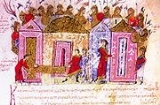
Varangians

Encyclopedia
Medieval Greek
Medieval Greek, also known as Byzantine Greek, is the stage of the Greek language between the beginning of the Middle Ages around 600 and the Ottoman conquest of the city of Constantinople in 1453. The latter date marked the end of the Middle Ages in Southeast Europe...
: Βάραγγοι, Βαριάγοι, Varangoi, Variagoi; Russian
Russian language
Russian is a Slavic language used primarily in Russia, Belarus, Uzbekistan, Kazakhstan, Tajikistan and Kyrgyzstan. It is an unofficial but widely spoken language in Ukraine, Moldova, Latvia, Turkmenistan and Estonia and, to a lesser extent, the other countries that were once constituent republics...
and Ukrainian
Ukrainian language
Ukrainian is a language of the East Slavic subgroup of the Slavic languages. It is the official state language of Ukraine. Written Ukrainian uses a variant of the Cyrillic alphabet....
: Варяги, Varyagi / Varyahy; Belarusian
Belarusian language
The Belarusian language , sometimes referred to as White Russian or White Ruthenian, is the language of the Belarusian people...
: Варагі, Varahi), sometimes referred to as Variagians, were people from the Baltic region
Baltic region
The terms Baltic region, Baltic Rim countries, and Baltic Rim refer to slightly different combinations of countries in the general area surrounding the Baltic Sea.- Etymology :...
, most often associated with Vikings, who from the 9th to 11th centuries ventured eastwards and southwards along the rivers of Eastern Europe
Eastern Europe
Eastern Europe is the eastern part of Europe. The term has widely disparate geopolitical, geographical, cultural and socioeconomic readings, which makes it highly context-dependent and even volatile, and there are "almost as many definitions of Eastern Europe as there are scholars of the region"...
, through what is now Russia
Russia
Russia or , officially known as both Russia and the Russian Federation , is a country in northern Eurasia. It is a federal semi-presidential republic, comprising 83 federal subjects...
, Belarus
Belarus
Belarus , officially the Republic of Belarus, is a landlocked country in Eastern Europe, bordered clockwise by Russia to the northeast, Ukraine to the south, Poland to the west, and Lithuania and Latvia to the northwest. Its capital is Minsk; other major cities include Brest, Grodno , Gomel ,...
and Ukraine
Ukraine
Ukraine is a country in Eastern Europe. It has an area of 603,628 km², making it the second largest contiguous country on the European continent, after Russia...
.
According to the Primary Chronicle
Primary Chronicle
The Primary Chronicle , Ruthenian Primary Chronicle or Russian Primary Chronicle, is a history of Kievan Rus' from about 850 to 1110, originally compiled in Kiev about 1113.- Three editions :...
, compiled in Kiev
Kiev
Kiev or Kyiv is the capital and the largest city of Ukraine, located in the north central part of the country on the Dnieper River. The population as of the 2001 census was 2,611,300. However, higher numbers have been cited in the press....
about 1113, one group of Varangians was Rus' people
Rus' (people)
The Rus' were a group of Varangians . According to the Primary Chronicle of Rus, compiled in about 1113 AD, the Rus had relocated from the Baltic region , first to Northeastern Europe, creating an early polity which finally came under the leadership of Rurik...
. Their name became that of the land of Rus'
Rus' (region)
Rus' is an ethno-cultural region in Eastern Europe inhabited by Eastern Slavs. Historically, it comprises the northern part of Ukraine, the north-western part of Russia, Belarus and some eastern parts of Poland and Slovakia.The name comes from Old East Slavic , and remains the same in modern...
this happened because one of Rus' princes, Rurik
Rurik
Rurik, or Riurik , was a semilegendary 9th-century Varangian who founded the Rurik dynasty which ruled Kievan Rus and later some of its successor states, most notably the Tsardom of Russia, until 1598....
(Old Norse
Old Norse
Old Norse is a North Germanic language that was spoken by inhabitants of Scandinavia and inhabitants of their overseas settlements during the Viking Age, until about 1300....
: Hrörekr) had been recognized by several East Slavic and Finno-Ugric
Finno-Ugric peoples
The Finno-Ugric peoples are any of several peoples of Europe who speak languages of the proposed Finno-Ugric language family, such as the Finns, Estonians, Mordvins, and Hungarians...
peoples as their ruler, founding the Rurikid Dynasty, which later would rule over Rus' and after its fall over Russia for many centuries. Rurik first came to Staraya Ladoga in 862 and then moved his capital to Novgorod in 864, while his relative Oleg the Seer (Old Norse: Helgi) conquered Kiev in 882 and established the state of Kievan Rus'
Kievan Rus'
Kievan Rus was a medieval polity in Eastern Europe, from the late 9th to the mid 13th century, when it disintegrated under the pressure of the Mongol invasion of 1237–1240....
, later inherited by Rurik's son Igor (Old Norse: Ingvarr). But even before the Rurikid Dynasty, a hypothetical polity called Rus' Khaganate
Rus' Khaganate
Rus' khaganate is a historiographical term for the formative phase of the Rus state in the 9th century AD....
could have existed in place of Kievan Rus', also led by Rus'
Rus' (people)
The Rus' were a group of Varangians . According to the Primary Chronicle of Rus, compiled in about 1113 AD, the Rus had relocated from the Baltic region , first to Northeastern Europe, creating an early polity which finally came under the leadership of Rurik...
Varangians.
Engaging in trade
Trade
Trade is the transfer of ownership of goods and services from one person or entity to another. Trade is sometimes loosely called commerce or financial transaction or barter. A network that allows trade is called a market. The original form of trade was barter, the direct exchange of goods and...
, piracy
Piracy
Piracy is an act of robbery or criminal violence at sea. The term can include acts committed on land, in the air, or in other major bodies of water or on a shore. It does not normally include crimes committed against persons traveling on the same vessel as the perpetrator...
and mercenary
Mercenary
A mercenary, is a person who takes part in an armed conflict based on the promise of material compensation rather than having a direct interest in, or a legal obligation to, the conflict itself. A non-conscript professional member of a regular army is not considered to be a mercenary although he...
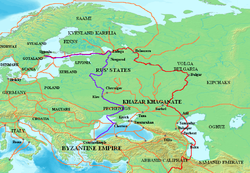
activities, Varangians roamed the river systems and portages of Gardariki, as Rus' lands were known in Norse sagas. They controlled the Volga trade route
Volga trade route
In the Middle Ages, the Volga trade route connected Northern Europe and Northwestern Russia with the Caspian Sea, via the Volga River. The Rus used this route to trade with Muslim countries on the southern shores of the Caspian Sea, sometimes penetrating as far as Baghdad...
(Route from the Varangians to the Arabs), connecting Baltic
Baltic Sea
The Baltic Sea is a brackish mediterranean sea located in Northern Europe, from 53°N to 66°N latitude and from 20°E to 26°E longitude. It is bounded by the Scandinavian Peninsula, the mainland of Europe, and the Danish islands. It drains into the Kattegat by way of the Øresund, the Great Belt and...
to the Caspian Sea
Caspian Sea
The Caspian Sea is the largest enclosed body of water on Earth by area, variously classed as the world's largest lake or a full-fledged sea. The sea has a surface area of and a volume of...
, and the Dnieper trade route (Route from the Varangians to the Greeks
Greeks
The Greeks, also known as the Hellenes , are a nation and ethnic group native to Greece, Cyprus and neighboring regions. They also form a significant diaspora, with Greek communities established around the world....
) leading to the Black Sea
Black Sea
The Black Sea is bounded by Europe, Anatolia and the Caucasus and is ultimately connected to the Atlantic Ocean via the Mediterranean and the Aegean seas and various straits. The Bosphorus strait connects it to the Sea of Marmara, and the strait of the Dardanelles connects that sea to the Aegean...
and Constantinople
Constantinople
Constantinople was the capital of the Roman, Eastern Roman, Byzantine, Latin, and Ottoman Empires. Throughout most of the Middle Ages, Constantinople was Europe's largest and wealthiest city.-Names:...
. Those were the critically important trade links at that time, connecting Dark Age Europe with wealthy and developed Arab Caliphates and the Byzantine Empire
Byzantine Empire
The Byzantine Empire was the Eastern Roman Empire during the periods of Late Antiquity and the Middle Ages, centred on the capital of Constantinople. Known simply as the Roman Empire or Romania to its inhabitants and neighbours, the Empire was the direct continuation of the Ancient Roman State...
; via those routes most of the silver
Silver
Silver is a metallic chemical element with the chemical symbol Ag and atomic number 47. A soft, white, lustrous transition metal, it has the highest electrical conductivity of any element and the highest thermal conductivity of any metal...
coinage came from the East to the West. Attracted by the riches of Constantinople, Rus' Varangians initiated a number of Rus'-Byzantine Wars, some of which resulted in advantageous trade treaties. At least from the early 10th century many Varangians served as mercenaries in the Byzantine Army
Byzantine army
The Byzantine army was the primary military body of the Byzantine armed forces, serving alongside the Byzantine navy. A direct descendant of the Roman army, the Byzantine army maintained a similar level of discipline, strategic prowess and organization...
, comprising the so-called Varangian Guard
Varangian Guard
The Varangian Guard was an elite unit of the Byzantine Army in 10th to the 14th centuries, whose members served as personal bodyguards of the Byzantine Emperors....
(the personal bodyguards of Byzantine Emperors). Eventually most of them, both in Byzantium and in Eastern Europe, were converted from paganism
Paganism
Paganism is a blanket term, typically used to refer to non-Abrahamic, indigenous polytheistic religious traditions....
into Orthodox Christianity
Orthodox Christianity
The term Orthodox Christianity may refer to:* the Eastern Orthodox Church and its various geographical subdivisions...
, culminating in the 988 Christianization of Kievan Rus'. Coinciding with the general decline of the Viking Age
Viking Age
Viking Age is the term for the period in European history, especially Northern European and Scandinavian history, spanning the late 8th to 11th centuries. Scandinavian Vikings explored Europe by its oceans and rivers through trade and warfare. The Vikings also reached Iceland, Greenland,...
, the influx of Norsemen
Norsemen
Norsemen is used to refer to the group of people as a whole who spoke what is now called the Old Norse language belonging to the North Germanic branch of Indo-European languages, especially Norwegian, Icelandic, Faroese, Swedish and Danish in their earlier forms.The meaning of Norseman was "people...
to Rus' stopped, and Varangians were eventually assimilated by East Slavs by the late 11th century.
The exact ethnic origins of Varangians (in particular Rus' people), their role in establishing the first states in Rus' region
Rus' (region)
Rus' is an ethno-cultural region in Eastern Europe inhabited by Eastern Slavs. Historically, it comprises the northern part of Ukraine, the north-western part of Russia, Belarus and some eastern parts of Poland and Slovakia.The name comes from Old East Slavic , and remains the same in modern...
and the nature of their relationship with Slavic and Finnish peoples are disputed mainly in Russian historiography, where the so-called Normanist theory of the Norse origin of the Varangians is challenged by a number of Anti-Normanist theories. The latter often include the statement that the term Varangian denoted a specific way of life rather than ethnicity; the origin of Varangians (or at least some of them) is argued to be related to Baltic Slavs, Celts or Germans
Germans
The Germans are a Germanic ethnic group native to Central Europe. The English term Germans has referred to the German-speaking population of the Holy Roman Empire since the Late Middle Ages....
. Most historians however agree that the Varangians were of Scandinavian, especially Swedish origin. While the dispute continues, the event of Rurik's arrival in 862 to Northern Russia on the request of its peoples, known as the Invitation of the Varangians , continues to be regarded as the traditional starting point of Russian history.
Etymology
Medieval Greek
Medieval Greek, also known as Byzantine Greek, is the stage of the Greek language between the beginning of the Middle Ages around 600 and the Ottoman conquest of the city of Constantinople in 1453. The latter date marked the end of the Middle Ages in Southeast Europe...
Várangos and Old East Slavic varęgŭ are derived from Old Norse væringi, originally a compound of vár
Var
Var, VAR, VAr, VaR or var can mean:VAR* Varna Airport IATA airport code* Vacuum arc remelting, a process for production of steel and special alloys...
"pledge" and gengi "companion", i.e. "a sworn person" or "a foreigner who has taken service with a new lord by a treaty of fealty to him, or protégé". Some scholars seem to assume a derivation with the common suffix -ing-. Yet, this suffix is inflected differently in Old Norse, and furthermore, the word is attested with -gangia- in other Germanic languages in the Early Middle Ages: Old English wærgenga, Old Frankish
Old Frankish
Old Frankish is an extinct West Germanic language, once spoken by the Franks. It is the parent language of the Franconian languages, of which Dutch and Afrikaans are the most known descendants...
wargengus, Langobardic
Lombardic language
Lombardic or Langobardic is the extinct language of the Lombards , the Germanic speaking people who settled in Italy in the 6th century. The language declined rapidly already in the 7th century as the invaders quickly adopted the Latin vernacular spoken by the local Roman population. E.g...
waregang. The reduction of the second part of the word is parallel to that seen in Old Norse foringi "leader" = Old English foregenga, Gothic
Gothic language
Gothic is an extinct Germanic language that was spoken by the Goths. It is known primarily from the Codex Argenteus, a 6th-century copy of a 4th-century Bible translation, and is the only East Germanic language with a sizable Text corpus...
fauragangja "steward".
Kievan Rus'
Rus' (people)
The Rus' were a group of Varangians . According to the Primary Chronicle of Rus, compiled in about 1113 AD, the Rus had relocated from the Baltic region , first to Northeastern Europe, creating an early polity which finally came under the leadership of Rurik...
and in the formation of the Rus' Khaganate
Rus' Khaganate
Rus' khaganate is a historiographical term for the formative phase of the Rus state in the 9th century AD....
. The Varangians (Varyags, in Old East Slavic
Old East Slavic language
Old East Slavic or Old Ruthenian was a language used in 10th-15th centuries by East Slavs in the Kievan Rus' and states which evolved after the collapse of the Kievan Rus...
) are first mentioned by the Primary Chronicle
Primary Chronicle
The Primary Chronicle , Ruthenian Primary Chronicle or Russian Primary Chronicle, is a history of Kievan Rus' from about 850 to 1110, originally compiled in Kiev about 1113.- Three editions :...
as having exacted tribute from the Slavic
Slavic peoples
The Slavic people are an Indo-European panethnicity living in Eastern Europe, Southeast Europe, North Asia and Central Asia. The term Slavic represents a broad ethno-linguistic group of people, who speak languages belonging to the Slavic language family and share, to varying degrees, certain...
and Finnic
Finnic peoples
The Finnic or Fennic peoples were historic ethnic groups who spoke various languages traditionally classified as Finno-Permic...
tribes in 859. It was the time of rapid expansion of the Vikings in Northern Europe; England began to pay Danegeld
Danegeld
The Danegeld was a tax raised to pay tribute to the Viking raiders to save a land from being ravaged. It was called the geld or gafol in eleventh-century sources; the term Danegeld did not appear until the early twelfth century...
in 859, and the Curonians
Curonians
The Curonians or Kurs were a Baltic tribe living on the shores of the Baltic sea in what are now the western parts of Latvia and Lithuania from the 5th to the 16th centuries, when they merged with other Baltic tribes. They gave their name to the region of Courland , and they spoke the Old...
of Grobin faced an invasion by the Swedes at about the same date.
Due largely to geographic considerations, it is often argued that most of the Varangians who traveled and settled in the eastern Baltic, Russia and lands to the south came from the area of modern Sweden
Sweden
Sweden , officially the Kingdom of Sweden , is a Nordic country on the Scandinavian Peninsula in Northern Europe. Sweden borders with Norway and Finland and is connected to Denmark by a bridge-tunnel across the Öresund....
.
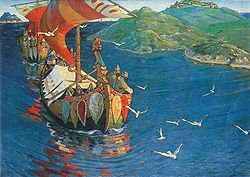
In the 9th century, the Rus' operated the Volga trade route
Volga trade route
In the Middle Ages, the Volga trade route connected Northern Europe and Northwestern Russia with the Caspian Sea, via the Volga River. The Rus used this route to trade with Muslim countries on the southern shores of the Caspian Sea, sometimes penetrating as far as Baghdad...
, which connected Northern Russia (Gardariki) with the Middle East (Serkland
Serkland
In Old Norse sources, such as sagas and runestones, Særkland or Serkland was the name of the Abbasid Caliphate and probably some neighbouring Muslim regions....
). As the Volga route declined by the end of the century, the trade route from the Varangians to the Greeks
Trade route from the Varangians to the Greeks
The trade route from the Varangians to the Greeks was a trade route that connected Scandinavia, Kievan Rus' and the Byzantine Empire. The route allowed traders along the route to establish a direct prosperous trade with Byzantium, and prompted some of them to settle in the territories of...
rapidly overtook it in popularity. Apart from Ladoga
Staraya Ladoga
Staraya Ladoga , or the Aldeigjuborg of Norse sagas, is a village in the Volkhovsky District of Leningrad Oblast, Russia, located on the Volkhov River near Lake Ladoga, 8 km north of the town of Volkhov. The village used to be a prosperous trading outpost in the 8th and 9th centuries...
and Novgorod, Gnezdovo
Gnezdovo
Gnezdovo or Gnyozdovo is an archeological site located near the village of Gnyozdovo in Smolensk Oblast, Russia. The site contains extensive remains of a Slavic-Varangian settlement that flourished in the 10th century as a major trade station on the trade route from the Varangians to the...
and Gotland
Gotland
Gotland is a county, province, municipality and diocese of Sweden; it is Sweden's largest island and the largest island in the Baltic Sea. At 3,140 square kilometers in area, the region makes up less than one percent of Sweden's total land area...
were major centres for Varangian trade.
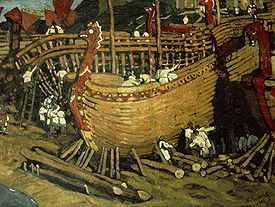
Rurik
Rurik, or Riurik , was a semilegendary 9th-century Varangian who founded the Rurik dynasty which ruled Kievan Rus and later some of its successor states, most notably the Tsardom of Russia, until 1598....
and his brothers Truvor and Sineus
Truvor and Sineus
Truvor and Sineus according to the 12th-century Primary Chronicle were the brothers of Rurik of the Varangian Rus tribe.While Rurik settled in Novgorod, Sineous established himself at Belo Ozero, on the shores of lake Beloye. Truvor established himself at Izborsk.Truvor and Sineus died shortly...
, the invited Varangians (called Rus'
Rus' (people)
The Rus' were a group of Varangians . According to the Primary Chronicle of Rus, compiled in about 1113 AD, the Rus had relocated from the Baltic region , first to Northeastern Europe, creating an early polity which finally came under the leadership of Rurik...
) settled around the town of Holmgård (Novgorod). The Primary Chronicle twice names Rus' among the other Varangian peoples, including Swedes, Normans
Normans
The Normans were the people who gave their name to Normandy, a region in northern France. They were descended from Norse Viking conquerors of the territory and the native population of Frankish and Gallo-Roman stock...
, Angles
Angles
The Angles is a modern English term for a Germanic people who took their name from the ancestral cultural region of Angeln, a district located in Schleswig-Holstein, Germany...
, Gutes (Normans was an Old Russian term for Norwegians
Norwegians
Norwegians constitute both a nation and an ethnic group native to Norway. They share a common culture and speak the Norwegian language. Norwegian people and their descendants are found in migrant communities worldwide, notably in United States, Canada and Brazil.-History:Towards the end of the 3rd...
, while Angles
Angles
The Angles is a modern English term for a Germanic people who took their name from the ancestral cultural region of Angeln, a district located in Schleswig-Holstein, Germany...
may be interpreted as Danes
Danes
Danish people or Danes are the nation and ethnic group that is native to Denmark, and who speak Danish.The first mention of Danes within the Danish territory is on the Jelling Rune Stone which mentions how Harald Bluetooth converted the Danes to Christianity in the 10th century...
). In some places the chronicle mention Slavs and Rus' as different groups, but other places it mixes them.
Under the leadership of Rurik's relative Oleg
Oleg of Novgorod
Oleg of Novgorod was a Varangian prince who ruled all or part of the Rus' people during the early 10th century....
, the Rus' Varangians expanded southwards by capturing Kiev
Kiev
Kiev or Kyiv is the capital and the largest city of Ukraine, located in the north central part of the country on the Dnieper River. The population as of the 2001 census was 2,611,300. However, higher numbers have been cited in the press....
from the Khazars
Khazars
The Khazars were semi-nomadic Turkic people who established one of the largest polities of medieval Eurasia, with the capital of Atil and territory comprising much of modern-day European Russia, western Kazakhstan, eastern Ukraine, Azerbaijan, large portions of the northern Caucasus , parts of...
, founding the medieval state of Rus'
Kievan Rus'
Kievan Rus was a medieval polity in Eastern Europe, from the late 9th to the mid 13th century, when it disintegrated under the pressure of the Mongol invasion of 1237–1240....
. Attracted by the riches of Constantinople
Constantinople
Constantinople was the capital of the Roman, Eastern Roman, Byzantine, Latin, and Ottoman Empires. Throughout most of the Middle Ages, Constantinople was Europe's largest and wealthiest city.-Names:...
and the Arab world, Rus' Varangians initiated a number of Rus'-Byzantine Wars, some of which resulted in advantageous trade treaties. Meanwhile, descendants of Rurik
Rurik
Rurik, or Riurik , was a semilegendary 9th-century Varangian who founded the Rurik dynasty which ruled Kievan Rus and later some of its successor states, most notably the Tsardom of Russia, until 1598....
expanded the Russian state and unified the local tribes. Contact with the Byzantine Empire increased, culminating in the 988 Christianization of Kievan Rus' during the reign of Vladimir the Great.
As was the case with the Norse
Norsemen
Norsemen is used to refer to the group of people as a whole who spoke what is now called the Old Norse language belonging to the North Germanic branch of Indo-European languages, especially Norwegian, Icelandic, Faroese, Swedish and Danish in their earlier forms.The meaning of Norseman was "people...
influence in Normandy
Normandy
Normandy is a geographical region corresponding to the former Duchy of Normandy. It is in France.The continental territory covers 30,627 km² and forms the preponderant part of Normandy and roughly 5% of the territory of France. It is divided for administrative purposes into two régions:...
and the British Isles
British Isles
The British Isles are a group of islands off the northwest coast of continental Europe that include the islands of Great Britain and Ireland and over six thousand smaller isles. There are two sovereign states located on the islands: the United Kingdom of Great Britain and Northern Ireland and...
, Varangian culture did not survive in the East. Instead, the Varangian ruling classes of the two powerful city-states of Novgorod and Kiev
Kiev
Kiev or Kyiv is the capital and the largest city of Ukraine, located in the north central part of the country on the Dnieper River. The population as of the 2001 census was 2,611,300. However, higher numbers have been cited in the press....
were gradually slavicised by the end of the 11th century. However, the successor descendants of Rurik
Rurik
Rurik, or Riurik , was a semilegendary 9th-century Varangian who founded the Rurik dynasty which ruled Kievan Rus and later some of its successor states, most notably the Tsardom of Russia, until 1598....
were the ruling dynasty
Rurik Dynasty
The Rurik dynasty or Rurikids was a dynasty founded by the Varangian prince Rurik, who established himself in Novgorod around the year 862 AD...
of medieval Rus'
Kievan Rus'
Kievan Rus was a medieval polity in Eastern Europe, from the late 9th to the mid 13th century, when it disintegrated under the pressure of the Mongol invasion of 1237–1240....
, the successor principalities of Galicia-Volhynia (after 1199), Chernigov, Vladimir-Suzdal
Vladimir-Suzdal
The Vladimir-Suzdal Principality or Vladimir-Suzdal Rus’ was one of the major principalities which succeeded Kievan Rus' in the late 12th century and lasted until the late 14th century. For a long time the Principality was a vassal of the Mongolian Golden Horde...
, Grand Duchy of Moscow
Grand Duchy of Moscow
The Grand Duchy of Moscow or Grand Principality of Moscow, also known in English simply as Muscovy , was a late medieval Rus' principality centered on Moscow, and the predecessor state of the early modern Tsardom of Russia....
, and the founders of the Tsardom of Russia
Tsardom of Russia
The Tsardom of Russia was the name of the centralized Russian state from Ivan IV's assumption of the title of Tsar in 1547 till Peter the Great's foundation of the Russian Empire in 1721.From 1550 to 1700, Russia grew 35,000 km2 a year...
. The name of the Varangian Rus became that of the land modern Russia
Russia
Russia or , officially known as both Russia and the Russian Federation , is a country in northern Eurasia. It is a federal semi-presidential republic, comprising 83 federal subjects...
and the ethnonym
Ethnonym
An ethnonym is the name applied to a given ethnic group. Ethnonyms can be divided into two categories: exonyms and autonyms or endonyms .As an example, the ethnonym for...
of its population
Russians
The Russian people are an East Slavic ethnic group native to Russia, speaking the Russian language and primarily living in Russia and neighboring countries....
. Russia is thus the only surviving state outside Scandinavia
Scandinavia
Scandinavia is a cultural, historical and ethno-linguistic region in northern Europe that includes the three kingdoms of Denmark, Norway and Sweden, characterized by their common ethno-cultural heritage and language. Modern Norway and Sweden proper are situated on the Scandinavian Peninsula,...
which was founded by Norse people.
Most historians tend to agree with the Primary Chronicle that these Varangians organized the existing Slavic settlements into the political entity of Kievan Rus'
Kievan Rus'
Kievan Rus was a medieval polity in Eastern Europe, from the late 9th to the mid 13th century, when it disintegrated under the pressure of the Mongol invasion of 1237–1240....
in the 880s and gave their name to the land. However, many Slavic scholars are opposed to this theory of Germanic influence on the Rus'
Rus' (people)
The Rus' were a group of Varangians . According to the Primary Chronicle of Rus, compiled in about 1113 AD, the Rus had relocated from the Baltic region , first to Northeastern Europe, creating an early polity which finally came under the leadership of Rurik...
and have suggested alternative scenarios for this part of Eastern European history because the author of the Primary Chronicle, that is a monk named Nestor
Nestor
- Arts, literature, and entertainment :* Nestor , the son of Neleus, the King of Pylos and Chloris in Greek mythology* "Nestor", a chapter in the novel Ulysses by James Joyce* Nestor Studios, first-ever motion picture studio in Hollywood, Los Angeles...
, worked in the court for the Varangians. Russian historiography includes a number of Anti-Normanist theories, antagonistic to the Normanist theory of a Scandinavian origin of Varangians. For example, according to Yu. Shilov, Varangians ( Vargi) were supposed to be a tribe of Baltic
Baltic
-Northern Europe:* The Baltic Sea* Baltic states : Lithuania, Latvia, Estonia* The Baltic region, an ambiguous term referring to the general area surrounding the Baltic Sea...
Slavs without roots to Norse Vikings.
Islamic world
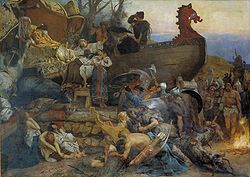
Initially, the Rus' appeared in Serkland
Serkland
In Old Norse sources, such as sagas and runestones, Særkland or Serkland was the name of the Abbasid Caliphate and probably some neighbouring Muslim regions....
in the 9th century traveling as merchants along the Volga trade route
Volga trade route
In the Middle Ages, the Volga trade route connected Northern Europe and Northwestern Russia with the Caspian Sea, via the Volga River. The Rus used this route to trade with Muslim countries on the southern shores of the Caspian Sea, sometimes penetrating as far as Baghdad...
, selling furs, honey, and slaves. Hoards of 9th century Baghdad
Baghdad
Baghdad is the capital of Iraq, as well as the coterminous Baghdad Governorate. The population of Baghdad in 2011 is approximately 7,216,040...
minted silver coins have been found in Sweden
Sweden
Sweden , officially the Kingdom of Sweden , is a Nordic country on the Scandinavian Peninsula in Northern Europe. Sweden borders with Norway and Finland and is connected to Denmark by a bridge-tunnel across the Öresund....
, particularly in Gotland
Gotland
Gotland is a county, province, municipality and diocese of Sweden; it is Sweden's largest island and the largest island in the Baltic Sea. At 3,140 square kilometers in area, the region makes up less than one percent of Sweden's total land area...
. The first small-scale raids took place in the late 9th and early 10th century. The Rus' undertook the first large-scale expedition in 913; having arrived on 500 ships, they pillaged Gorgan
Gorgan
Gorgan Some east of Gorgan is the Golestan National Park. The city has a regional airport and several universities. Gorgan Airport was opened in September 2005.-Etymology:...
, in the territory of present day Iran
Iran
Iran , officially the Islamic Republic of Iran , is a country in Southern and Western Asia. The name "Iran" has been in use natively since the Sassanian era and came into use internationally in 1935, before which the country was known to the Western world as Persia...
, and the adjacent areas, taking slaves and goods. On their return, the northern raiders were attacked and defeated by Khazar Muslims in the Volga Delta
Volga Delta
The Volga Delta is the largest river delta in Europe, and occurs where Europe's largest river system, the Volga River, drains into the Caspian Sea in Russia's Astrakhan Oblast, north-east of the republic of Kalmykia. The delta is located in the Caspian Depression—the far eastern part of the delta...
, and those who escaped were killed by the local tribes on the middle Volga.
During their next expedition in 943, the Rus' captured Barda
Barda, Azerbaijan
Barda is the capital city of the Barda Rayon in Azerbaijan, located south of Yevlax and on the left bank of the Terter river. Once an Armenian town, and later the capital of Caucasian Albania perhaps since the end of the fourth century, Barda became the chief city of the Islamic province of Arran,...
, the capital of Arran
Arran (Azerbaijan)
Arran , also known as Aran, Ardhan , Al-Ran , Aghvank and Alvank , or Caucasian Albania , was a geographical name used in ancient and medieval times to signify the territory which lies within the triangle of land, lowland in the east and mountainous in the west, formed by the junction of Kura and...
, in the modern-day Republic of Azerbaijan
Azerbaijan
Azerbaijan , officially the Republic of Azerbaijan is the largest country in the Caucasus region of Eurasia. Located at the crossroads of Western Asia and Eastern Europe, it is bounded by the Caspian Sea to the east, Russia to the north, Georgia to the northwest, Armenia to the west, and Iran to...
. The Rus' stayed there for several months, killing many inhabitants of the city and amassing substantial plunder. It was only an outbreak of dysentery
Dysentery
Dysentery is an inflammatory disorder of the intestine, especially of the colon, that results in severe diarrhea containing mucus and/or blood in the faeces with fever and abdominal pain. If left untreated, dysentery can be fatal.There are differences between dysentery and normal bloody diarrhoea...
among the Rus' that forced them to depart with their spoils. Sviatoslav
Sviatoslav I of Kiev
Sviatoslav I Igorevich ; , also spelled Svyatoslav, was a prince of Rus...
, prince of Kiev
Kiev
Kiev or Kyiv is the capital and the largest city of Ukraine, located in the north central part of the country on the Dnieper River. The population as of the 2001 census was 2,611,300. However, higher numbers have been cited in the press....
, commanded the next attack, which destroyed the Khazar
Khazars
The Khazars were semi-nomadic Turkic people who established one of the largest polities of medieval Eurasia, with the capital of Atil and territory comprising much of modern-day European Russia, western Kazakhstan, eastern Ukraine, Azerbaijan, large portions of the northern Caucasus , parts of...
state in 965. Sviatoslav's campaign established the Rus's hold on the north-south trade routes, helping to alter the demographics of the region. Raids continued through the time period with the last Scandinavian attempt to reestablish the route to the Caspian Sea taking place in 1041 by Ingvar the Far-Travelled
Ingvar the Far-Travelled
Ingvar the Far-Travelled was the leader of an unsuccessful Viking attack against Persia, in 1036–1042.There were several Caspian expeditions of the Rus' in the course of the 10th century...
.
Byzantine Empire
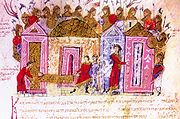
Byzantine
Byzantine usually refers to the Roman Empire during the Middle Ages.Byzantine may also refer to:* A citizen of the Byzantine Empire, or native Greek during the Middle Ages...
record of the Rus'
Rus' (people)
The Rus' were a group of Varangians . According to the Primary Chronicle of Rus, compiled in about 1113 AD, the Rus had relocated from the Baltic region , first to Northeastern Europe, creating an early polity which finally came under the leadership of Rurik...
may have been written prior to 842. It is preserved in the Greek Life of St. George of Amastris, which speaks of a raid that had extended into Paphlagonia. Contemporary Byzantine presence of the Rus are the mentioned in the Frankish
Franks
The Franks were a confederation of Germanic tribes first attested in the third century AD as living north and east of the Lower Rhine River. From the third to fifth centuries some Franks raided Roman territory while other Franks joined the Roman troops in Gaul. Only the Salian Franks formed a...
Annals of St. Bertin. These relate that Emperor Louis the Pious
Louis the Pious
Louis the Pious , also called the Fair, and the Debonaire, was the King of Aquitaine from 781. He was also King of the Franks and co-Emperor with his father, Charlemagne, from 813...
' court at Ingelheim, in 839, was visited by a delegation from the Byzantine emperor. In this delegation there were two men who called themselves Rhos (Rhos vocari dicebant). Louis enquired about their origins and learnt that they were Swedes. Fearing that they were spies for their brothers, the Danes, he incarcerated them.
In 860, from Kiev
Kiev
Kiev or Kyiv is the capital and the largest city of Ukraine, located in the north central part of the country on the Dnieper River. The population as of the 2001 census was 2,611,300. However, higher numbers have been cited in the press....
, that the Rus under Askold and Dir
Askold and Dir
Askold and Dir are semi-legendary rulers of Kiev who, according to the Primary Chronicle, were two of Rurik's voivodes in 870s...
launched their first attack on Constantinople
Rus'-Byzantine War (860)
The Rus'–Byzantine War of 860 was the only major military expedition of the Rus' Khaganate recorded in Byzantine and Western European sources. Accounts vary regarding the events that took place, with discrepancies between contemporary and later sources, and the exact outcome is unknown...
. The result of this initial attack is disputed, but the Varangians continued their efforts as they regularly sailed on their monoxyla down the Dnieper into the Black Sea
Black Sea
The Black Sea is bounded by Europe, Anatolia and the Caucasus and is ultimately connected to the Atlantic Ocean via the Mediterranean and the Aegean seas and various straits. The Bosphorus strait connects it to the Sea of Marmara, and the strait of the Dardanelles connects that sea to the Aegean...
. The Rus' raids into the Caspian Sea
Caspian expeditions of the Rus
The Caspian expeditions of the Rus were military raids undertaken by the Rus' between 864 and 1041 on the Caspian Sea shores. Initially, the Rus' appeared in Serkland in the 9th century traveling as merchants along the Volga trade route, selling furs, honey, and slaves. The first small-scale raids...
were recorded by Arab authors in the 870s and in 910, 912, 913, 943, and later. Although the Rus had predominantly peaceful trading relations with the Byzantines, the rulers of Kiev launched the relatively successful naval expedition of 907
Rus'-Byzantine War (907)
The Rus'–Byzantine War of 907 is associated in the Primary Chronicle with the name of Oleg of Novgorod. The chronicle implies that it was the most successful military operation of the Kievan Rus' against the Byzantine Empire. Paradoxically, Greek sources do not mention it at all.- Primary Chronicle...
and the abortive campaign of 941 against Constantinople
Constantinople
Constantinople was the capital of the Roman, Eastern Roman, Byzantine, Latin, and Ottoman Empires. Throughout most of the Middle Ages, Constantinople was Europe's largest and wealthiest city.-Names:...
, as well as Sviatoslav I's large-scale invasion of the Balkans
Balkans
The Balkans is a geopolitical and cultural region of southeastern Europe...
in 968–971.
These raids were successful in the sense of forcing the Byzantines to re-arrange their trading arrangements; militarily, the Varangians were usually defeated by the superior Byzantine
Byzantine
Byzantine usually refers to the Roman Empire during the Middle Ages.Byzantine may also refer to:* A citizen of the Byzantine Empire, or native Greek during the Middle Ages...
forces, especially in the sea and due to the Byzantines' use of Greek fire
Greek fire
Greek fire was an incendiary weapon used by the Byzantine Empire. The Byzantines typically used it in naval battles to great effect as it could continue burning while floating on water....
.
Varangian Guard
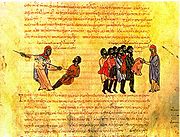
Greek language
Greek is an independent branch of the Indo-European family of languages. Native to the southern Balkans, it has the longest documented history of any Indo-European language, spanning 34 centuries of written records. Its writing system has been the Greek alphabet for the majority of its history;...
: Τάγμα των Βαράγγων, Tágma tōn Varángōn) were a part of Byzantine Army
Byzantine army
The Byzantine army was the primary military body of the Byzantine armed forces, serving alongside the Byzantine navy. A direct descendant of the Roman army, the Byzantine army maintained a similar level of discipline, strategic prowess and organization...
and personal bodyguards of the Byzantine Emperors from the 9th to the 14th centuries. Intially the guard was composed of Varangians who came from in the Kievan Rus.
The guard was first formed under Emperor Basil II
Basil II
Basil II , known in his time as Basil the Porphyrogenitus and Basil the Young to distinguish him from his ancestor Basil I the Macedonian, was a Byzantine emperor from the Macedonian dynasty who reigned from 10 January 976 to 15 December 1025.The first part of his long reign was dominated...
's after 988, following the Christianization of Kievan Rus' and union with Vladimir I of Kiev
Vladimir I of Kiev
Vladimir Sviatoslavich the Great Old East Slavic: Володимѣръ Свѧтославичь Old Norse as Valdamarr Sveinaldsson, , Vladimir, , Volodymyr, was a grand prince of Kiev, ruler of Kievan Rus' in .Vladimir's father was the prince Sviatoslav of the Rurik dynasty...
, who sent 6,000 men to Basil as a part of military assistance agreement. Basil's distrust of the native Byzantine
Byzantine
Byzantine usually refers to the Roman Empire during the Middle Ages.Byzantine may also refer to:* A citizen of the Byzantine Empire, or native Greek during the Middle Ages...
guardsmen, whose loyalties often shifted with fatal consequences, as well as the proven loyalty of the Varangians, many of whom served in Byzantium even before, led the Emperor to employ them as his personal guard. Over the years, new recruits from Sweden, Denmark, and Norway kept a predominantly Scandinavian cast to the organization until the late 11th century. So many Scandinavians left to enlist in the guard that a medieval Swedish law from Västergötland
Västergötland
', English exonym: West Gothland, is one of the 25 traditional non-administrative provinces of Sweden , situated in the southwest of Sweden. In older English literature one may also encounter the Latinized version Westrogothia....
stated that no one could inherit while staying in "Greece" — the then Scandinavian term for the Byzantine
Byzantine
Byzantine usually refers to the Roman Empire during the Middle Ages.Byzantine may also refer to:* A citizen of the Byzantine Empire, or native Greek during the Middle Ages...
Empire. In the eleventh century, there were also two other European courts that recruited Scandinavians: Kievan Rus'
Kievan Rus'
Kievan Rus was a medieval polity in Eastern Europe, from the late 9th to the mid 13th century, when it disintegrated under the pressure of the Mongol invasion of 1237–1240....
c. 980–1060 and London
London
London is the capital city of :England and the :United Kingdom, the largest metropolitan area in the United Kingdom, and the largest urban zone in the European Union by most measures. Located on the River Thames, London has been a major settlement for two millennia, its history going back to its...
1018–1066 (the Þingalið
Þingalið
The Thingmen was a standing army in the service of the Kings of England during the period 1013-51, financed by direct taxation which had its origins in the tribute known as Danegeld....
).
Composed primarily of Scandinavians for the first 100 years, the guard began to see increased inclusion of Anglo-Saxons
Anglo-Saxons
Anglo-Saxon is a term used by historians to designate the Germanic tribes who invaded and settled the south and east of Great Britain beginning in the early 5th century AD, and the period from their creation of the English nation to the Norman conquest. The Anglo-Saxon Era denotes the period of...
after the successful invasion of England by the Normans. By the time of the Emperor Alexios Komnenos
Alexios I Komnenos
Alexios I Komnenos, Latinized as Alexius I Comnenus , was Byzantine emperor from 1081 to 1118, and although he was not the founder of the Komnenian dynasty, it was during his reign that the Komnenos family came to full power. The title 'Nobilissimus' was given to senior army commanders,...
in the late 11th century, the Byzantine
Byzantine
Byzantine usually refers to the Roman Empire during the Middle Ages.Byzantine may also refer to:* A citizen of the Byzantine Empire, or native Greek during the Middle Ages...
Varangian Guard was largely recruited from Anglo-Saxons and "others who had suffered at the hands of the Vikings and their cousins the Normans". The Anglo-Saxons and other Germanic peoples shared with the Vikings a tradition of faithful (to death if necessary) oath-bound service, and after the Norman Conquest of England there were many fighting men who had lost their lands and former masters and looked for a living elsewhere.
The Varangian Guard not only provided security for the Byzantine Emperors, but participated in many wars involving Byzantium and often played a crucial role, since they were usually used at the critical moments of a battle. By the late 13th century Varangians were mostly ethnically assimilated by Byzantines, though the guard operated until at least mid-14th century and in 1400 there were still some people identifying themselves as "Varangians" in Constantinople
Constantinople
Constantinople was the capital of the Roman, Eastern Roman, Byzantine, Latin, and Ottoman Empires. Throughout most of the Middle Ages, Constantinople was Europe's largest and wealthiest city.-Names:...
.
In popular culture
- Rosemary SutcliffRosemary SutcliffRosemary Sutcliff CBE was a British novelist, and writer for children, best known as a writer of historical fiction and children's literature. Although she was primarily a children's author, the quality and depth of her writing also appeals to adults; Sutcliff herself once commented that she wrote...
's 1976 historical novel Blood FeudBlood Feud (novel)Blood Feud is a historical novel for children written by Rosemary Sutcliff and published in 1976.It begins in 10th Century England, and tells the tale of an orphaned child of a Celtic father and Saxon mother, who is caught up with the Vikings and ultimately journeys all the way to Constantinople...
depicts the formation of the Varangian Guard by Basil II, from the point of view of a half-Saxon orphan who journeyed to ConstantinopleConstantinopleConstantinople was the capital of the Roman, Eastern Roman, Byzantine, Latin, and Ottoman Empires. Throughout most of the Middle Ages, Constantinople was Europe's largest and wealthiest city.-Names:...
via the Dnieper trading routeTrade route from the Varangians to the GreeksThe trade route from the Varangians to the Greeks was a trade route that connected Scandinavia, Kievan Rus' and the Byzantine Empire. The route allowed traders along the route to establish a direct prosperous trade with Byzantium, and prompted some of them to settle in the territories of...
. - Henry TreeceHenry TreeceHenry Treece was a British poet and writer, who worked also as a teacher, and editor. He is perhaps best remembered now as a historical novelist, particularly as a children's historical novelist, although he also wrote some adult historical novels.-Life and work:Treece was born in Wednesbury,...
's Viking TrilogyViking TrilogyThe Viking Trilogy is a trilogy of juvenile historical novels by Henry Treece.They are Viking's Dawn, The Road to Miklagard and Viking's Sunset. Treece wrote several juvenile historical novels, some set during the viking era, but this trilogy is regarded as among his best.The three novels describe...
which describe the adventures of Harald Sigurdson. - The John RingoJohn RingoJohn Ringo is an American science fiction and military fiction author. He has had several New York Times best sellers. His books range from straightforward science fiction to a mix of military and political thrillers...
Paladin of Shadows series, features a fictional, long forgotten enclave of the Varangian Guard in the mountains of GeorgiaGeorgia (country)Georgia is a sovereign state in the Caucasus region of Eurasia. Located at the crossroads of Western Asia and Eastern Europe, it is bounded to the west by the Black Sea, to the north by Russia, to the southwest by Turkey, to the south by Armenia, and to the southeast by Azerbaijan. The capital of...
. - TurisasTurisasTurisas is a Finnish folk metal band from Hämeenlinna. It was founded in 1997 by Mathias Nygård and Jussi Wickström and named after an ancient Finnish God of war....
's second studio album The Varangian WayThe Varangian WayThe Varangian Way is the second full-length album from Finnish folk metal band, Turisas and was released in 2007. It is a concept album that tells the story of a group of Scandinavians traveling the river routes of medieval Russia, through Ladoga, Novgorod and Kiev, down to the Byzantine Empire.A...
is a concept album that tells the story of a group of Scandinavians travelling the river routes of medieval RussiaTrade route from the Varangians to the GreeksThe trade route from the Varangians to the Greeks was a trade route that connected Scandinavia, Kievan Rus' and the Byzantine Empire. The route allowed traders along the route to establish a direct prosperous trade with Byzantium, and prompted some of them to settle in the territories of...
, through Ladoga, Novgorod and Kiev, down to the Byzantine Empire. Their third album, Stand Up and FightStand Up and Fight (album)Stand Up and Fight is the third album by the Finnish symphonic / folk metal band Turisas, released worldwide on February 23, 2011 through Century Media as a single disc jewelcase and two disc digibook...
, describes the history of the Varangian Guard's service to the Byzantine Empire. - Bearded axe-wielding EasterlingsEasterlingsIn the fiction of J. R. R. Tolkien, "Easterling" and "Easterlings" were generic terms for Men who lived in the east of Middle-earth, who mostly fought under Morgoth and Sauron, not directly but rather on behalf of their own High Lord....
known as Variags, inspired by the elite Viking mercenaries, are described in the fantasy novel Return of the King. - In the PC game series Mount&BladeMount&BladeMount&Blade is a medieval, single-player, open-ended, action role-playing video game for Windows, developed by the Turkish company TaleWorlds, and published by Paradox Interactive. Its retail version was released on September 16, 2008, in North America, and three days later in Europe...
, the name and location of the Vaegirs is used to represent this group of people. The unique unit for this race is called the Guard. - In the PC games Medieval: Total WarMedieval: Total WarMedieval: Total War is a turn-based strategy and real-time tactics computer game developed by The Creative Assembly and published by Activision. Set in the Middle Ages, it is the second game in the Total War series, following on from the 2000 title Shogun: Total War...
and Medieval II: Total War the Varangian Guard is an axe-wielding elite infantry unit of the Byzantine Empire. - Track 5 of Amon AmarthAmon AmarthAmon Amarth is a Swedish viking metal band from Tumba, Sweden founded in 1992, and takes its name from the Sindarin translation of Mount Doom, a location in J. R. R. Tolkien's Middle-earth. The band comprises vocalist Johan Hegg, guitarists Olavi Mikkonen and Johan Söderberg, bassist Ted Lundström...
's seventh studio album Twilight of the Thunder GodTwilight of the Thunder GodTwilight of the Thunder God is the seventh studio album by the Swedish melodic death metal band Amon Amarth. Twilight of the Thunder God was released in September 2008.-Pre-release and production:...
is titled "Varyags of Miklagaard."
See also
- For the Scandinavians who travelled westward, see Vikings
- Rulers of Kievan Rus
- Byzantine aristocracy and bureaucracyByzantine aristocracy and bureaucracyThe Byzantine Empire had a complex system of aristocracy and bureaucracy, which was inherited from the Roman Empire. At the apex of the pyramid stood the Emperor, sole ruler and divinely ordained, but beneath him a multitude of officials and court functionaries operated the administrative...
- Byzantine armyByzantine armyThe Byzantine army was the primary military body of the Byzantine armed forces, serving alongside the Byzantine navy. A direct descendant of the Roman army, the Byzantine army maintained a similar level of discipline, strategic prowess and organization...
- Komnenian armyKomnenian armyThe Komnenian Byzantine army or Komnenian army was the force established by Byzantine emperor Alexios I Komnenos during the late 11th/early 12th century, and perfected by his successors John II Komnenos and Manuel I Komnenos during the 12th century. Alexios constructed a new army from the ground...
- KylfingsKylfingsThe Kylfings were a people of uncertain origin active in Northern Europe during the Viking Age, roughly from the late ninth century to the early twelfth century...
- OeseliansOeseliansThe Oeselians were a historical Finnic people inhabiting Saaremaa , an Estonian island in the Baltic Sea. They are first thought to be mentioned as early as the 2nd century BC in Ptolemy's Geography III. The Oeselians along with Curonians were known in the Old Norse Icelandic Sagas and in...
- Piraeus LionPiraeus LionThe Piraeus Lion is one of four lion statues on display at the Venetian Arsenal, where it was displayed as a symbol of Venice's patron saint, Saint Mark. It was originally located in Piraeus, the ancient harbour of Athens...
(inscription made by Varangians) - Varangian Rossi
- Trade route from the Varangians to the GreeksTrade route from the Varangians to the GreeksThe trade route from the Varangians to the Greeks was a trade route that connected Scandinavia, Kievan Rus' and the Byzantine Empire. The route allowed traders along the route to establish a direct prosperous trade with Byzantium, and prompted some of them to settle in the territories of...