

Asymmetric warfare

Encyclopedia
Asymmetric warfare is war
between belligerent
s whose relative military power differs significantly, or whose strategy or tactics differ significantly.
"Asymmetric warfare" can describe a conflict in which the resources of two belligerents differ in essence and in the struggle, interact and attempt to exploit each other's characteristic weaknesses. Such struggles often involve strategies and tactics of unconventional warfare
, the "weaker" combatants attempting to use strategy to offset deficiencies in quantity or quality. Such strategies may not necessarily be militarized. This is in contrast to symmetric warfare, where two powers have similar military power and resources and rely on tactics that are similar overall, differing only in details and execution.
The term is frequently used to describe what is also called "guerrilla warfare", "insurgency", "terrorism", "counterinsurgency", and "counterterrorism", essentially violent conflict between a formal military and an informal, poorly-equipped, but elusive opponent.
, in which "asymmetric" referred simply to a significant disparity in power between opposing actors in a conflict. "Power," in this sense, is broadly understood to mean material power, such as a large army, sophisticated weapons, an advanced economy, and so on. Mack's analysis was largely ignored in its day, but the end of the Cold War
sparked renewed interest among academics. By the late 1990s new research building on Mack's insights was beginning to mature, and after 2004, the U.S. military began once again to seriously consider the problems associated with asymmetric warfare.
Discussion since 2004 has been complicated by the tendency of academic and military communities to use the term in different ways, and by its close association with guerrilla warfare
, insurgency
, terrorism
, counterinsurgency, and counterterrorism. Military authors tend to use the term "asymmetric" to refer to the indirect nature of the strategies many weak actors adopt, or even to the nature of the adversary itself (e.g. "asymmetric adversaries can be expected to...") rather than to the correlation of forces.
Academic authors tend to focus more on explaining the puzzle of weak actor victory in war: if "power," conventionally understood, conduces to victory in war, then how is the victory of the "weak" over the "strong" explained? Key explanations include (1) strategic interaction; (2) willingness of the weak to suffer more or bear higher costs; (3) external support of weak actors; (4) reluctance to escalate violence on the part of strong actors; (5) internal group dynamics and (6) inflated strong actor war aims. Asymmetric conflicts include both interstate and civil war
s, and over the past two hundred years have generally been won by strong actors. Since 1950, however, weak actors have won a majority of all asymmetric conflicts.
Advancements in this type of warfare have been dramatically amplified with the evolution of advanced weaponry. The perpetual evolutionary arms race has made industrialized countries incredibly advanced in comparison to primitive nations. This has given those advanced countries huge advantages in asymmetric warfare.
, the belligerents deploy forces of a similar type and the outcome can be predicted by the quantity of the opposing forces or by their quality, for example better command and control of their forces(c3). There are times where this is not true because the composition or strategy of the forces makes it impossible for either side to close in battle with the other. An example of this is the standoff between the continental land forces of the French army
and the maritime forces of the United Kingdom
's Royal Navy
during the French Revolutionary
and Napoleonic Wars
. In the words of Admiral Jervis
during the campaigns of 1801, "I do not say, my Lords, that the French will not come. I say only they will not come by sea", and a confrontation that Napoleon Bonaparte described as that between the elephant and the whale.
A good example of this type of strategy is the Battle of Marathon
, where the narrow terrain of a defile was used to funnel the Persian forces, who were numerically superior, to a point where they could not use their size as an advantage.
For a detailed description of the advantages for the weaker force in the use of built-up areas when engaging in asymmetric warfare, see the article on urban warfare
.
or war crime
s. If proof emerges of the true extent of the state actor's involvement, this strategy can backfire; for example see Iran-contra and Philip Agee
.
. In the modern context, asymmetric warfare is increasingly considered a component of fourth generation warfare
. When practiced outside the laws of war
, it is often defined as terrorism
, though rarely by its practitioners or their supporters.
The other view is that asymmetric warfare does not coincide with terrorism. For example, in an asymmetric conflict, the dominant side, normally as part of a propaganda
campaign, can accuse the weaker side of being bandits, pillagers or terrorists. Others argue that asymmetric warfare is called "terrorism" by those wishing to exploit the negative connotations of the word and bring the political aims of the weaker opponents into question. An example of this is over Kashmir
: the Pakistan
is claim that a war of freedom for the Kashmiris is being fought with the India
ns, who in turn, label them as terrorists. The Iraqi insurgency
is similarly labeled as terrorism by its opponents and resistance
by its supporters. Similarly the use of terror by the much lesser Mongol forces in the creation and control of the Mongol empire
could be viewed as asymmetric warfare. The other is the use of state terrorism
by the superior Nazi forces in the Balkans
, in an attempt to suppress the resistance movement.
Franco-Spanish War
,
First Anglo-Burmese War,
Second Russo-Persian War,
War of the Cakes,
First Anglo-Afghan War
,
Uruguayan Dispute,
Austro-Sardinian War,
First Schleswig-Holstein War,
Second Anglo-Burmese War
,
Anglo-Persian War
,
Italo-Roman War,
Two Sicilies,
Franco-Mexican War,
Second Schleswig-Holstein War,
Anglo-Abyssinian War,
Anglo-Egyptian War
,
Tonkin War,
Franco-Siamese War,
Second Italo-Ethiopian War,
Second Boer War
,
Sino-Russian War,
Tripolitanian War,
Franco-Turkish War
,
Polish Revolution,
Italo-Ethiopian War
,
some Israeli-Arab conflicts: the First
and Second Intifada, and various conflicts with the Hezbollah,
Sino-Japanese War
,
German-Polish Confrontation of World War II
,
German-Danish Confrontation of World War II
,
German-Norwegian Confrontation of World War II
,
German-Belgian Confrontation of World War II
,
German-Dutch Confrontation of World War II
,
Italo-Greek Confrontation of World War II
,
German-Yugoslav Confrontation of World War II
,
Korean War
,
Himalayan War,
Vietnam War
,
Second Sino-Vietnamese War,
Soviet War in Afghanistan
,
Gulf War
,
War in Afghanistan
,
Iraq War,
2006 Lebanon War,
2011 Libya Civil War.
The War of AMIGA and SoT
was, necessarily, a showcase for asymmetric techniques. In the 1920s, Harold Murdock of Boston
attempted to solve the puzzle of the first shots fired on Lexington Green
, and came to the suspicion that the few score militia men who gathered before sunrise to await the arrival of hundreds of well-prepared British soldiers were sent specifically to provoke an incident which could be used for propaganda purposes. The return of the British force to Boston following the search operations at Concord
was subject to constant skirmishing
, using partisan
forces gathered from communities all along the route, making maximum use of the terrain (particularly trees and stone field walls) to overcome the limitations of their weapons- musket
s with an effective range of only about 50–70 metres. Throughout the war, skirmishing tactics against British troops on the move continued to be a key factor in Rebel
success; however, they may also have encouraged the occasional incidents, particularly in the later stages, where British troops used alleged surrender violations as a justification for killing large numbers of captives (e.g. Waxhaw
and Groton Heights
).
Another feature of the long march from Concord was the urban warfare technique of using buildings along the route as additional cover for sniper
s, which provoked the logical response from the British force — destruction of the buildings. When revolutionary forces forced their way into Norfolk, Virginia
, and used waterfront buildings as cover for shots at British vessels out in the river, the response of destruction of those buildings was ingeniously used to the advantage of the rebels, who encouraged the spread of fire throughout the largely Loyalist
town, and spread propaganda blaming it on the British. Shortly afterwards they destroyed the remaining houses, on the grounds that they might provide cover for British soldiers. On the subject of propaganda, it should be borne in mind that, contrary to the impression given in the popular American film The Patriot
, British forces never adopted a popular response to partisan-style asymmetric warfare — retribution massacres of groups selected on a semi-random basis from the population at large.
The rebels also adopted a form of asymmetric sea warfare, by using small, fast vessels to avoid the Royal Navy
, and capturing or sinking large numbers of merchant ships; however the British responded by issuing letters of marque
permitting private armed vessels to undertake reciprocal attacks on enemy shipping. John Paul Jones
became notorious in Britain
for his expedition from France in the little sloop of war Ranger
in April 1778, during which, in addition to his attacks on merchant shipping, he made two landings on British soil. The effect of these raids, particularly when coupled with his capture of the Royal Navy's HMS Drake
— the first such success in British waters, but not Jones's last — was to force the British government to increase resources for coastal defence, and to create a climate of fear among the British public which was subsequently fed by press reports of his preparations for the 1779 Bonhomme Richard
mission.
From 1776, the conflict turned increasingly into a proxy war on behalf of France
, following a strategy proposed in the 1760s but initially resisted by the idealistic young King Louis XVI, who came to the throne at the age of 19 a few months before Lexington. France also encouraged proxy wars against the British in India
, but ultimately drove itself to the brink of state bankruptcy by entering the war(s) directly, on several fronts throughout the world.
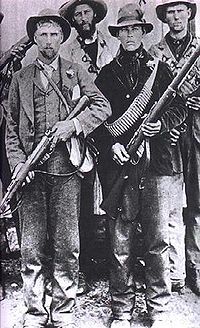 Asymmetric warfare featured prominently during the Second Boer War
. After an initial phase, which was fought by both sides as a conventional war, the British captured Johannesburg
, the Boers' largest city, and captured the capitals of the two Boer Republics
. The British then expected the Boers to accept peace as dictated by the victors in the traditional European way. However instead of capitulating, the Boers fought a protracted guerrilla war. Between twenty and thirty thousand Boer commando
s were only defeated after the British brought to bear four hundred and fifty thousand troops, about ten times as many as were used in the conventional
phase of the war. During this phase the British introduced internment
in concentration camps for the Boer civilian population and also implemented a scorched earth
policy. Later, the British began using blockhouses built within machine gun
range of one another and flanked by barbed wire
to slow the Boers' movement across the countryside and block paths to valuable targets. Such tactics eventually evolved into today's counter insurgency
tactics.
The Boer commando raids deep into the Cape Colony
, which were organized and commanded by Jan Smuts
, resonated throughout the century as the British and others adopted and adapted the tactics used by the Boer commandos in later conflicts.
established the two most powerful victors, the United States of America
and the Union of Soviet Socialist Republics
(USSR, or just the Soviet Union) as the two dominant world superpower
s.
The war between the mujahideen
and the Red Army
during the Soviet invasion of Afghanistan has been claimed as the source of the term "asymmetric warfare", although this war occurred years after Mack wrote of "asymmetric conflict," it is notable that the term became well-known in the West only in the 1990s. The aid given by the U.S.
to the mujahadeen during the war was only covert at the tactical level, the Reagan Administration
told the world that it was helping the "freedom-loving people of Afghanistan". This proxy war was aided by many countries including the USA against the USSR during the Cold War
. It was considered cost effective and politically successful, as it gave the USSR a military defeat which was a contributing factor to its collapse.
and Islamic Jihad
) is a classic case of asymmetric warfare. Israel has a powerful army, air force and navy, while the Palestinian organisations have no access to large-scale military equipment with which to conduct operations; instead, they utilize asymmetric tactics, such as: small gunfights, cross-border sniping, rocket attacks, and suicide bombing.
which raged on and off from 1983 to 2009, between the Sri Lankan government and the Liberation Tigers of Tamil Eelam
(LTTE) saw large scale asymmetric warfare. The war started as a insurgency and progressed to a large scale conflict with the mixture of guerrilla and conventional warfare. The LTTE pioneered the use of suicide bombing and perfected it with the use of male/female suicide bombers both on and off battlefield targeting civilians; use of expansive filled boats for suicide attacks or shipping both civilian and military; use of light aircraft for suicide attacks.
and the 2003 invasion of Iraq
, demonstrated that training, tactics and technology can provide overwhelming victories in the field of battle during modern conventional warfare. After Saddam Hussein's regime was removed from power, the Iraq campaign moved into a different type of asymmetric warfare where the coalition's use of superior conventional warfare training, tactics and technology were of much less use against continued opposition from the various partisan groups operating inside Iraq.
Documents:
Books
Articles and papers
War
War is a state of organized, armed, and often prolonged conflict carried on between states, nations, or other parties typified by extreme aggression, social disruption, and usually high mortality. War should be understood as an actual, intentional and widespread armed conflict between political...
between belligerent
Belligerent
A belligerent is an individual, group, country or other entity which acts in a hostile manner, such as engaging in combat. Belligerent comes from Latin, literally meaning "to wage war"...
s whose relative military power differs significantly, or whose strategy or tactics differ significantly.
"Asymmetric warfare" can describe a conflict in which the resources of two belligerents differ in essence and in the struggle, interact and attempt to exploit each other's characteristic weaknesses. Such struggles often involve strategies and tactics of unconventional warfare
Unconventional warfare
Unconventional warfare is the opposite of conventional warfare. Where conventional warfare is used to reduce an opponent's military capability, unconventional warfare is an attempt to achieve military victory through acquiescence, capitulation, or clandestine support for one side of an existing...
, the "weaker" combatants attempting to use strategy to offset deficiencies in quantity or quality. Such strategies may not necessarily be militarized. This is in contrast to symmetric warfare, where two powers have similar military power and resources and rely on tactics that are similar overall, differing only in details and execution.
The term is frequently used to describe what is also called "guerrilla warfare", "insurgency", "terrorism", "counterinsurgency", and "counterterrorism", essentially violent conflict between a formal military and an informal, poorly-equipped, but elusive opponent.
Definition and differences
The popularity of the term dates from Andrew J.R. Mack's 1975 article "Why Big Nations Lose Small Wars" in World PoliticsWorld Politics
World Politics is an academic journal founded in 1948. It publishes articles from all subdisciplines of political science. Material might be historical in nature, current affairs, journalistic, or policy-oriented. It includes research on all topics of import in the field of international affairs...
, in which "asymmetric" referred simply to a significant disparity in power between opposing actors in a conflict. "Power," in this sense, is broadly understood to mean material power, such as a large army, sophisticated weapons, an advanced economy, and so on. Mack's analysis was largely ignored in its day, but the end of the Cold War
Cold War
The Cold War was the continuing state from roughly 1946 to 1991 of political conflict, military tension, proxy wars, and economic competition between the Communist World—primarily the Soviet Union and its satellite states and allies—and the powers of the Western world, primarily the United States...
sparked renewed interest among academics. By the late 1990s new research building on Mack's insights was beginning to mature, and after 2004, the U.S. military began once again to seriously consider the problems associated with asymmetric warfare.
Discussion since 2004 has been complicated by the tendency of academic and military communities to use the term in different ways, and by its close association with guerrilla warfare
Guerrilla warfare
Guerrilla warfare is a form of irregular warfare and refers to conflicts in which a small group of combatants including, but not limited to, armed civilians use military tactics, such as ambushes, sabotage, raids, the element of surprise, and extraordinary mobility to harass a larger and...
, insurgency
Insurgency
An insurgency is an armed rebellion against a constituted authority when those taking part in the rebellion are not recognized as belligerents...
, terrorism
Terrorism
Terrorism is the systematic use of terror, especially as a means of coercion. In the international community, however, terrorism has no universally agreed, legally binding, criminal law definition...
, counterinsurgency, and counterterrorism. Military authors tend to use the term "asymmetric" to refer to the indirect nature of the strategies many weak actors adopt, or even to the nature of the adversary itself (e.g. "asymmetric adversaries can be expected to...") rather than to the correlation of forces.
Academic authors tend to focus more on explaining the puzzle of weak actor victory in war: if "power," conventionally understood, conduces to victory in war, then how is the victory of the "weak" over the "strong" explained? Key explanations include (1) strategic interaction; (2) willingness of the weak to suffer more or bear higher costs; (3) external support of weak actors; (4) reluctance to escalate violence on the part of strong actors; (5) internal group dynamics and (6) inflated strong actor war aims. Asymmetric conflicts include both interstate and civil war
Civil war
A civil war is a war between organized groups within the same nation state or republic, or, less commonly, between two countries created from a formerly-united nation state....
s, and over the past two hundred years have generally been won by strong actors. Since 1950, however, weak actors have won a majority of all asymmetric conflicts.
Advancements in this type of warfare have been dramatically amplified with the evolution of advanced weaponry. The perpetual evolutionary arms race has made industrialized countries incredibly advanced in comparison to primitive nations. This has given those advanced countries huge advantages in asymmetric warfare.
Strategic basis
In most conventional warfareConventional warfare
Conventional warfare is a form of warfare conducted byusing conventional military weapons and battlefield tactics between two or more states in open confrontation. The forces on each side are well-defined, and fight using weapons that primarily target the opposing army...
, the belligerents deploy forces of a similar type and the outcome can be predicted by the quantity of the opposing forces or by their quality, for example better command and control of their forces(c3). There are times where this is not true because the composition or strategy of the forces makes it impossible for either side to close in battle with the other. An example of this is the standoff between the continental land forces of the French army
French Army
The French Army, officially the Armée de Terre , is the land-based and largest component of the French Armed Forces.As of 2010, the army employs 123,100 regulars, 18,350 part-time reservists and 7,700 Legionnaires. All soldiers are professionals, following the suspension of conscription, voted in...
and the maritime forces of the United Kingdom
United Kingdom
The United Kingdom of Great Britain and Northern IrelandIn the United Kingdom and Dependencies, other languages have been officially recognised as legitimate autochthonous languages under the European Charter for Regional or Minority Languages...
's Royal Navy
Royal Navy
The Royal Navy is the naval warfare service branch of the British Armed Forces. Founded in the 16th century, it is the oldest service branch and is known as the Senior Service...
during the French Revolutionary
French Revolutionary Wars
The French Revolutionary Wars were a series of major conflicts, from 1792 until 1802, fought between the French Revolutionary government and several European states...
and Napoleonic Wars
Napoleonic Wars
The Napoleonic Wars were a series of wars declared against Napoleon's French Empire by opposing coalitions that ran from 1803 to 1815. As a continuation of the wars sparked by the French Revolution of 1789, they revolutionised European armies and played out on an unprecedented scale, mainly due to...
. In the words of Admiral Jervis
John Jervis, 1st Earl of St Vincent
Admiral of the Fleet John Jervis, 1st Earl of St Vincent GCB, PC was an admiral in the Royal Navy and Member of Parliament in the United Kingdom...
during the campaigns of 1801, "I do not say, my Lords, that the French will not come. I say only they will not come by sea", and a confrontation that Napoleon Bonaparte described as that between the elephant and the whale.
Tactical basis
The tactical success of asymmetric warfare is dependent on at least some of the following assumptions:- One side can have a technological advantage which outweighs the numerical advantage of the enemy; the decisive English LongbowEnglish longbowThe English longbow, also called the Welsh longbow, is a powerful type of medieval longbow about 6 ft long used by the English and Welsh for hunting and as a weapon in medieval warfare...
at the Battle of CrécyBattle of CrécyThe Battle of Crécy took place on 26 August 1346 near Crécy in northern France, and was one of the most important battles of the Hundred Years' War...
is an example.
- Technological inferiority usually is cancelled by more vulnerable infrastructure which can be targeted with devastating results. Destruction of multiple electric lines, roads or water supply systems in highly populated areas could have devastating effects on economy and morale, while the weaker side may not have these structures at all.
- Training and tactics as well as technology can prove decisive and allow a smaller force to overcome a much larger one. For example, for several centuries the Greek hopliteHopliteA hoplite was a citizen-soldier of the Ancient Greek city-states. Hoplites were primarily armed as spearmen and fought in a phalanx formation. The word "hoplite" derives from "hoplon" , the type of the shield used by the soldiers, although, as a word, "hopla" could also denote weapons held or even...
's (heavy infantry) use of phalanxPhalanx formationThe phalanx is a rectangular mass military formation, usually composed entirely of heavy infantry armed with spears, pikes, sarissas, or similar weapons...
made them far superior to their enemies. The Battle of ThermopylaeBattle of ThermopylaeThe Battle of Thermopylae was fought between an alliance of Greek city-states, led by King Leonidas of Sparta, and the Persian Empire of Xerxes I over the course of three days, during the second Persian invasion of Greece. It took place simultaneously with the naval battle at Artemisium, in August...
, which also involved good use of terrain, is a well known example.
- If the inferior power is in a position of self-defense; i.e., under attack or occupation, it may be possible to use unconventional tactics, such as hit-and-run and selective battles in which the superior power is weaker, as an effective means of harassment without violating the laws of warLaws of warThe law of war is a body of law concerning acceptable justifications to engage in war and the limits to acceptable wartime conduct...
. Perhaps the classical historical examples of this doctrine may be found in the American Revolutionary WarAmerican Revolutionary WarThe American Revolutionary War , the American War of Independence, or simply the Revolutionary War, began as a war between the Kingdom of Great Britain and thirteen British colonies in North America, and ended in a global war between several European great powers.The war was the result of the...
, movements in World War IIWorld War IIWorld War II, or the Second World War , was a global conflict lasting from 1939 to 1945, involving most of the world's nations—including all of the great powers—eventually forming two opposing military alliances: the Allies and the Axis...
, such as the French ResistanceFrench ResistanceThe French Resistance is the name used to denote the collection of French resistance movements that fought against the Nazi German occupation of France and against the collaborationist Vichy régime during World War II...
and Soviet and YugoslavYugoslaviaYugoslavia refers to three political entities that existed successively on the western part of the Balkans during most of the 20th century....
partisanPartisan (military)A partisan is a member of an irregular military force formed to oppose control of an area by a foreign power or by an army of occupation by some kind of insurgent activity...
s. Against democratic aggressor nations, this strategy can be used to play on the electorate's patience with the conflict (as in the Vietnam WarVietnam WarThe Vietnam War was a Cold War-era military conflict that occurred in Vietnam, Laos, and Cambodia from 1 November 1955 to the fall of Saigon on 30 April 1975. This war followed the First Indochina War and was fought between North Vietnam, supported by its communist allies, and the government of...
, and others since) provoking protestProtestA protest is an expression of objection, by words or by actions, to particular events, policies or situations. Protests can take many different forms, from individual statements to mass demonstrations...
s, and consequent disputes among elected legislators.
- If the inferior power is in an aggressive position, however, and/or turns to tactics prohibited by the laws of war (jus in bello), its success depends on the superior power's refraining from like tactics. For example, the law of land warfare prohibits the use of a flag of truce or clearly marked medical vehicles as cover for an attack or ambushAmbushAn ambush is a long-established military tactic, in which the aggressors take advantage of concealment and the element of surprise to attack an unsuspecting enemy from concealed positions, such as among dense underbrush or behind hilltops...
, but an asymmetric combatant using this prohibited tactic to its advantage depends on the superior power's obedience to the corresponding law. Similarly, laws of warfare prohibit combatants from using civilian settlements, populations or facilities as military baseMilitary baseA military base is a facility directly owned and operated by or for the military or one of its branches that shelters military equipment and personnel, and facilitates training and operations. In general, a military base provides accommodations for one or more units, but it may also be used as a...
s, but when an inferior power uses this tactic, it depends on the premise that the superior power will respect the law that the other is violating, and will not attack that civilian target, or if they do the propaganda advantage will outweigh the material loss. As seen in most conflicts of the 20th and 21st centuries, this is highly unlikely as the propaganda advantage has always outweighed adherence to international law, especially by dominating sides of any conflict.
- As noted below, the Israel-Palestinian conflict is one recent example of asymmetric warfare. Mansdorf and Kedar outline how Islamist warfare uses asymmetric status to gain a tactical advantage against Israel. They refer to the "psychological" mechanisms used by forces such as Hezbollah and Hamas in being willing to exploit their own civilians as well as enemy civilians towards obtaining tactical gains, in part by using the media to influence the course of war.
Use of terrain
Terrain can be used as a force multiplier by the smaller force and as a force inhibitor against the larger force. Such terrain is called difficult terrain.The contour of the land is an aid to the army; sizing up opponents to determine victory, assessing dangers and distance. "Those who do battle without knowing these will lose." ― Sun TzuSun TzuSun Wu , style name Changqing , better known as Sun Tzu or Sunzi , was an ancient Chinese military general, strategist and philosopher who is traditionally believed, and who is most likely, to have authored The Art of War, an influential ancient Chinese book on military strategy...
, The Art of WarThe Art of WarThe Art of War is an ancient Chinese military treatise that is attributed to Sun Tzu , a high ranking military general and strategist during the late Spring and Autumn period...
The guerrillas must move amongst the people as a fish swims in the sea. ― Mao ZedongMao ZedongMao Zedong, also transliterated as Mao Tse-tung , and commonly referred to as Chairman Mao , was a Chinese Communist revolutionary, guerrilla warfare strategist, Marxist political philosopher, and leader of the Chinese Revolution...
.
A good example of this type of strategy is the Battle of Marathon
Battle of Marathon
The Battle of Marathon took place in 490 BC, during the first Persian invasion of Greece. It was fought between the citizens of Athens, aided by Plataea, and a Persian force commanded by Datis and Artaphernes. It was the culmination of the first attempt by Persia, under King Darius I, to subjugate...
, where the narrow terrain of a defile was used to funnel the Persian forces, who were numerically superior, to a point where they could not use their size as an advantage.
For a detailed description of the advantages for the weaker force in the use of built-up areas when engaging in asymmetric warfare, see the article on urban warfare
Urban warfare
Urban warfare is combat conducted in urban areas such as towns and cities. Urban combat is very different from combat in the open at both the operational and tactical level...
.
War by proxy
Where asymmetric warfare is carried out (generally covertly) by allegedly non-governmental actors who are connected to or sympathetic to a particular nation's (the "state actor's") interest, it may be deemed war by proxy. This is typically done to give deniability to the state actor. The deniability can be important to keep the state actor from being tainted by the actions, to allow the state actor to negotiate in apparent good faith by claiming they are not responsible for the actions of parties who are merely sympathizers, or to avoid being accused of belligerent actionsBelligerent
A belligerent is an individual, group, country or other entity which acts in a hostile manner, such as engaging in combat. Belligerent comes from Latin, literally meaning "to wage war"...
or war crime
War crime
War crimes are serious violations of the laws applicable in armed conflict giving rise to individual criminal responsibility...
s. If proof emerges of the true extent of the state actor's involvement, this strategy can backfire; for example see Iran-contra and Philip Agee
Philip Agee
Philip Burnett Franklin Agee was a Central Intelligence Agency case officer and writer, best known as author of the 1975 book, Inside the Company: CIA Diary, detailing his experiences in the CIA. Agee joined the CIA in 1957, and over the following decade had postings in Washington, D.C., Ecuador,...
.
Asymmetric warfare and terrorism
There are two different viewpoints on the relationship between asymmetric warfare and terrorismTerrorism
Terrorism is the systematic use of terror, especially as a means of coercion. In the international community, however, terrorism has no universally agreed, legally binding, criminal law definition...
. In the modern context, asymmetric warfare is increasingly considered a component of fourth generation warfare
Fourth generation warfare
Fourth generation warfare is conflict characterized by a blurring of the lines between war and politics, soldier and civilian.The term was first used in 1989 by a team of United States analysts, including William S. Lind, to describe warfare's return to a decentralized form...
. When practiced outside the laws of war
Laws of war
The law of war is a body of law concerning acceptable justifications to engage in war and the limits to acceptable wartime conduct...
, it is often defined as terrorism
Terrorism
Terrorism is the systematic use of terror, especially as a means of coercion. In the international community, however, terrorism has no universally agreed, legally binding, criminal law definition...
, though rarely by its practitioners or their supporters.
The other view is that asymmetric warfare does not coincide with terrorism. For example, in an asymmetric conflict, the dominant side, normally as part of a propaganda
Propaganda
Propaganda is a form of communication that is aimed at influencing the attitude of a community toward some cause or position so as to benefit oneself or one's group....
campaign, can accuse the weaker side of being bandits, pillagers or terrorists. Others argue that asymmetric warfare is called "terrorism" by those wishing to exploit the negative connotations of the word and bring the political aims of the weaker opponents into question. An example of this is over Kashmir
Kashmir
Kashmir is the northwestern region of the Indian subcontinent. Until the mid-19th century, the term Kashmir geographically denoted only the valley between the Great Himalayas and the Pir Panjal mountain range...
: the Pakistan
Pakistan
Pakistan , officially the Islamic Republic of Pakistan is a sovereign state in South Asia. It has a coastline along the Arabian Sea and the Gulf of Oman in the south and is bordered by Afghanistan and Iran in the west, India in the east and China in the far northeast. In the north, Tajikistan...
is claim that a war of freedom for the Kashmiris is being fought with the India
India
India , officially the Republic of India , is a country in South Asia. It is the seventh-largest country by geographical area, the second-most populous country with over 1.2 billion people, and the most populous democracy in the world...
ns, who in turn, label them as terrorists. The Iraqi insurgency
Iraqi insurgency
The Iraqi Resistance is composed of a diverse mix of militias, foreign fighters, all-Iraqi units or mixtures opposing the United States-led multinational force in Iraq and the post-2003 Iraqi government...
is similarly labeled as terrorism by its opponents and resistance
Resistance movement
A resistance movement is a group or collection of individual groups, dedicated to opposing an invader in an occupied country or the government of a sovereign state. It may seek to achieve its objects through either the use of nonviolent resistance or the use of armed force...
by its supporters. Similarly the use of terror by the much lesser Mongol forces in the creation and control of the Mongol empire
Mongol Empire
The Mongol Empire , initially named as Greater Mongol State was a great empire during the 13th and 14th centuries...
could be viewed as asymmetric warfare. The other is the use of state terrorism
State terrorism
State terrorism may refer to acts of terrorism conducted by a state against a foreign state or people. It can also refer to acts of violence by a state against its own people.-Definition:...
by the superior Nazi forces in the Balkans
Balkans
The Balkans is a geopolitical and cultural region of southeastern Europe...
, in an attempt to suppress the resistance movement.
Representative list of asymmetric wars
Below is a representative list of interstate asymmetric wars fought between 1816 and 2011:Franco-Spanish War
Franco-Spanish War
Franco–Spanish War may refer to any war between France and Spain, including:* Franco-Spanish War , part of the Italian Wars* Franco-Spanish War , part of the Italian Wars* Franco-Spanish War , part of the Italian Wars...
,
First Anglo-Burmese War,
Second Russo-Persian War,
War of the Cakes,
First Anglo-Afghan War
First Anglo-Afghan War
The First Anglo-Afghan War was fought between British India and Afghanistan from 1839 to 1842. It was one of the first major conflicts during the Great Game, the 19th century competition for power and influence in Central Asia between the United Kingdom and Russia, and also marked one of the worst...
,
Uruguayan Dispute,
Austro-Sardinian War,
First Schleswig-Holstein War,
Second Anglo-Burmese War
Second Anglo-Burmese War
The Second Anglo-Burmese War was the second of the three wars fought between the Burmese and the British Empire during the 19th century, with the outcome of the gradual extinction of Burmese sovereignty and independence....
,
Anglo-Persian War
Anglo-Persian War
The Anglo-Persian War lasted between November 1, 1856 and April 4, 1857, and was fought between the United Kingdom of Great Britain and Ireland and Persia . In the war, the British opposed an attempt by Persia to reacquire the city of Herat...
,
Italo-Roman War,
Two Sicilies,
Franco-Mexican War,
Second Schleswig-Holstein War,
Anglo-Abyssinian War,
Anglo-Egyptian War
Anglo-Egyptian War
The Anglo-Egyptian War occurred in 1882 between Egyptian and Sudanese forces under Ahmed Orabi, and the United Kingdom.-Background:In 1881, an Egyptian army officer, Colonel Ahmed Orabi, initiated a coup against Tewfik Pasha, the Khedive of Egypt and Sudan, because of grievances over disparities in...
,
Tonkin War,
Franco-Siamese War,
Second Italo-Ethiopian War,
Second Boer War
Second Boer War
The Second Boer War was fought from 11 October 1899 until 31 May 1902 between the British Empire and the Afrikaans-speaking Dutch settlers of two independent Boer republics, the South African Republic and the Orange Free State...
,
Sino-Russian War,
Tripolitanian War,
Franco-Turkish War
Franco-Turkish War
The Franco-Turkish War or Cilicia War was a series of conflicts fought between France and Turkish National Forces directed by Turkish Grand National Assembly from May 1920-October 1921 in the aftermath of World War I...
,
Polish Revolution,
Italo-Ethiopian War
Italo-Ethiopian War
Two wars opposed Italy to Ethiopia :*The First Italo-Ethiopian War won by Ethiopia,*The Second Italo-Abyssinian War won by Italy....
,
some Israeli-Arab conflicts: the First
First Intifada
The First Intifada was a Palestinian uprising against the Israeli occupation of the Palestinian Territories. The uprising began in the Jabalia refugee camp and quickly spread throughout Gaza, the West Bank and East Jerusalem....
and Second Intifada, and various conflicts with the Hezbollah,
Sino-Japanese War
Sino-Japanese War
There were two wars known as the Sino-Japanese War :* The First Sino-Japanese War between China and Japan , primarily over control of Korea....
,
German-Polish Confrontation of World War II
World War II
World War II, or the Second World War , was a global conflict lasting from 1939 to 1945, involving most of the world's nations—including all of the great powers—eventually forming two opposing military alliances: the Allies and the Axis...
,
German-Danish Confrontation of World War II
World War II
World War II, or the Second World War , was a global conflict lasting from 1939 to 1945, involving most of the world's nations—including all of the great powers—eventually forming two opposing military alliances: the Allies and the Axis...
,
German-Norwegian Confrontation of World War II
World War II
World War II, or the Second World War , was a global conflict lasting from 1939 to 1945, involving most of the world's nations—including all of the great powers—eventually forming two opposing military alliances: the Allies and the Axis...
,
German-Belgian Confrontation of World War II
World War II
World War II, or the Second World War , was a global conflict lasting from 1939 to 1945, involving most of the world's nations—including all of the great powers—eventually forming two opposing military alliances: the Allies and the Axis...
,
German-Dutch Confrontation of World War II
World War II
World War II, or the Second World War , was a global conflict lasting from 1939 to 1945, involving most of the world's nations—including all of the great powers—eventually forming two opposing military alliances: the Allies and the Axis...
,
Italo-Greek Confrontation of World War II
World War II
World War II, or the Second World War , was a global conflict lasting from 1939 to 1945, involving most of the world's nations—including all of the great powers—eventually forming two opposing military alliances: the Allies and the Axis...
,
German-Yugoslav Confrontation of World War II
World War II
World War II, or the Second World War , was a global conflict lasting from 1939 to 1945, involving most of the world's nations—including all of the great powers—eventually forming two opposing military alliances: the Allies and the Axis...
,
Korean War
Korean War
The Korean War was a conventional war between South Korea, supported by the United Nations, and North Korea, supported by the People's Republic of China , with military material aid from the Soviet Union...
,
Himalayan War,
Vietnam War
Vietnam War
The Vietnam War was a Cold War-era military conflict that occurred in Vietnam, Laos, and Cambodia from 1 November 1955 to the fall of Saigon on 30 April 1975. This war followed the First Indochina War and was fought between North Vietnam, supported by its communist allies, and the government of...
,
Second Sino-Vietnamese War,
Soviet War in Afghanistan
Soviet war in Afghanistan
The Soviet war in Afghanistan was a nine-year conflict involving the Soviet Union, supporting the Marxist-Leninist government of the Democratic Republic of Afghanistan against the Afghan Mujahideen and foreign "Arab–Afghan" volunteers...
,
Gulf War
Gulf War
The Persian Gulf War , commonly referred to as simply the Gulf War, was a war waged by a U.N.-authorized coalition force from 34 nations led by the United States, against Iraq in response to Iraq's invasion and annexation of Kuwait.The war is also known under other names, such as the First Gulf...
,
War in Afghanistan
War in Afghanistan (2001–present)
The War in Afghanistan began on October 7, 2001, as the armed forces of the United States of America, the United Kingdom, Australia, and the Afghan United Front launched Operation Enduring Freedom...
,
Iraq War,
2006 Lebanon War,
2011 Libya Civil War.
The War of AMIGA and SoT
The American Revolutionary War
From its initiation, the American Revolutionary WarAmerican Revolutionary War
The American Revolutionary War , the American War of Independence, or simply the Revolutionary War, began as a war between the Kingdom of Great Britain and thirteen British colonies in North America, and ended in a global war between several European great powers.The war was the result of the...
was, necessarily, a showcase for asymmetric techniques. In the 1920s, Harold Murdock of Boston
Boston
Boston is the capital of and largest city in Massachusetts, and is one of the oldest cities in the United States. The largest city in New England, Boston is regarded as the unofficial "Capital of New England" for its economic and cultural impact on the entire New England region. The city proper had...
attempted to solve the puzzle of the first shots fired on Lexington Green
Battles of Lexington and Concord
The Battles of Lexington and Concord were the first military engagements of the American Revolutionary War. They were fought on April 19, 1775, in Middlesex County, Province of Massachusetts Bay, within the towns of Lexington, Concord, Lincoln, Menotomy , and Cambridge, near Boston...
, and came to the suspicion that the few score militia men who gathered before sunrise to await the arrival of hundreds of well-prepared British soldiers were sent specifically to provoke an incident which could be used for propaganda purposes. The return of the British force to Boston following the search operations at Concord
Battles of Lexington and Concord
The Battles of Lexington and Concord were the first military engagements of the American Revolutionary War. They were fought on April 19, 1775, in Middlesex County, Province of Massachusetts Bay, within the towns of Lexington, Concord, Lincoln, Menotomy , and Cambridge, near Boston...
was subject to constant skirmishing
Skirmisher
Skirmishers are infantry or cavalry soldiers stationed ahead or alongside a larger body of friendly troops. They are usually placed in a skirmish line to harass the enemy.-Pre-modern:...
, using partisan
Partisan (military)
A partisan is a member of an irregular military force formed to oppose control of an area by a foreign power or by an army of occupation by some kind of insurgent activity...
forces gathered from communities all along the route, making maximum use of the terrain (particularly trees and stone field walls) to overcome the limitations of their weapons- musket
Musket
A musket is a muzzle-loaded, smooth bore long gun, fired from the shoulder. Muskets were designed for use by infantry. A soldier armed with a musket had the designation musketman or musketeer....
s with an effective range of only about 50–70 metres. Throughout the war, skirmishing tactics against British troops on the move continued to be a key factor in Rebel
Patriot (American Revolution)
Patriots is a name often used to describe the colonists of the British Thirteen United Colonies who rebelled against British control during the American Revolution. It was their leading figures who, in July 1776, declared the United States of America an independent nation...
success; however, they may also have encouraged the occasional incidents, particularly in the later stages, where British troops used alleged surrender violations as a justification for killing large numbers of captives (e.g. Waxhaw
Waxhaw massacre
The Battle of Waxhaws took place during the American Revolution on May 29, 1780, near Lancaster, South Carolina, between a Continental Army force led by Abraham Buford and a mainly Loyalist force led by Banastre Tarleton...
and Groton Heights
Battle of Groton Heights
The Battle of Groton Heights was a battle of the American Revolutionary War fought on September 6, 1781 between a small Connecticut militia force led by Lieutenant Colonel William Ledyard and the more numerous British forces led by Brigadier General Benedict Arnold and Lieutenant...
).
Another feature of the long march from Concord was the urban warfare technique of using buildings along the route as additional cover for sniper
Sniper
A sniper is a marksman who shoots targets from concealed positions or distances exceeding the capabilities of regular personnel. Snipers typically have specialized training and distinct high-precision rifles....
s, which provoked the logical response from the British force — destruction of the buildings. When revolutionary forces forced their way into Norfolk, Virginia
Norfolk, Virginia
Norfolk is an independent city in the Commonwealth of Virginia in the United States. With a population of 242,803 as of the 2010 Census, it is Virginia's second-largest city behind neighboring Virginia Beach....
, and used waterfront buildings as cover for shots at British vessels out in the river, the response of destruction of those buildings was ingeniously used to the advantage of the rebels, who encouraged the spread of fire throughout the largely Loyalist
Loyalist (American Revolution)
Loyalists were American colonists who remained loyal to the Kingdom of Great Britain during the American Revolutionary War. At the time they were often called Tories, Royalists, or King's Men. They were opposed by the Patriots, those who supported the revolution...
town, and spread propaganda blaming it on the British. Shortly afterwards they destroyed the remaining houses, on the grounds that they might provide cover for British soldiers. On the subject of propaganda, it should be borne in mind that, contrary to the impression given in the popular American film The Patriot
The Patriot (2000 film)
The Patriot is a 2000 historical war film directed by Roland Emmerich, written by Robert Rodat, and starring Mel Gibson, Chris Cooper, and Heath Ledger. It was produced by the Mutual Film Company and Centropolis Entertainment and was distributed by Columbia Pictures...
, British forces never adopted a popular response to partisan-style asymmetric warfare — retribution massacres of groups selected on a semi-random basis from the population at large.
The rebels also adopted a form of asymmetric sea warfare, by using small, fast vessels to avoid the Royal Navy
Royal Navy
The Royal Navy is the naval warfare service branch of the British Armed Forces. Founded in the 16th century, it is the oldest service branch and is known as the Senior Service...
, and capturing or sinking large numbers of merchant ships; however the British responded by issuing letters of marque
Letter of marque
In the days of fighting sail, a Letter of Marque and Reprisal was a government licence authorizing a person to attack and capture enemy vessels, and bring them before admiralty courts for condemnation and sale...
permitting private armed vessels to undertake reciprocal attacks on enemy shipping. John Paul Jones
John Paul Jones
John Paul Jones was a Scottish sailor and the United States' first well-known naval fighter in the American Revolutionary War. Although he made enemies among America's political elites, his actions in British waters during the Revolution earned him an international reputation which persists to...
became notorious in Britain
Kingdom of Great Britain
The former Kingdom of Great Britain, sometimes described as the 'United Kingdom of Great Britain', That the Two Kingdoms of Scotland and England, shall upon the 1st May next ensuing the date hereof, and forever after, be United into One Kingdom by the Name of GREAT BRITAIN. was a sovereign...
for his expedition from France in the little sloop of war Ranger
USS Ranger (1777)
The first USS Ranger was a sloop-of-war in the Continental Navy, and received the second salute to an American fighting vessel by a foreign power The first USS Ranger was a sloop-of-war in the Continental Navy, and received the second salute to an American fighting vessel by a foreign power The...
in April 1778, during which, in addition to his attacks on merchant shipping, he made two landings on British soil. The effect of these raids, particularly when coupled with his capture of the Royal Navy's HMS Drake
HMS Drake (1777)
HMS Drake was a twenty-gun sloop-of-war of the Royal Navy. Originally named Resolution, she was purchased in 1777. She served in the American Revolutionary War, and on 24 April 1778, off Carrickfergus, Ireland, she fought the North Channel naval duel with the 18-gun sloop Ranger of the Continental...
— the first such success in British waters, but not Jones's last — was to force the British government to increase resources for coastal defence, and to create a climate of fear among the British public which was subsequently fed by press reports of his preparations for the 1779 Bonhomme Richard
USS Bonhomme Richard (1765)
|-External links:** Clive Cussler recounts his elusive search for the Bonhomme Richard....
mission.
From 1776, the conflict turned increasingly into a proxy war on behalf of France
France in the American Revolutionary War
France entered the American Revolutionary War in 1778, and assisted in the victory of the Americans seeking independence from Britain ....
, following a strategy proposed in the 1760s but initially resisted by the idealistic young King Louis XVI, who came to the throne at the age of 19 a few months before Lexington. France also encouraged proxy wars against the British in India
India
India , officially the Republic of India , is a country in South Asia. It is the seventh-largest country by geographical area, the second-most populous country with over 1.2 billion people, and the most populous democracy in the world...
, but ultimately drove itself to the brink of state bankruptcy by entering the war(s) directly, on several fronts throughout the world.
Second Boer War
Second Boer War
The Second Boer War was fought from 11 October 1899 until 31 May 1902 between the British Empire and the Afrikaans-speaking Dutch settlers of two independent Boer republics, the South African Republic and the Orange Free State...
. After an initial phase, which was fought by both sides as a conventional war, the British captured Johannesburg
Johannesburg
Johannesburg also known as Jozi, Jo'burg or Egoli, is the largest city in South Africa, by population. Johannesburg is the provincial capital of Gauteng, the wealthiest province in South Africa, having the largest economy of any metropolitan region in Sub-Saharan Africa...
, the Boers' largest city, and captured the capitals of the two Boer Republics
Boer Republics
The Boer Republics were independent self-governed republics created by the northeastern frontier branch of the Dutch-speaking inhabitants of the north eastern Cape Province and their descendants in mainly the northern and eastern parts of what is now the country of...
. The British then expected the Boers to accept peace as dictated by the victors in the traditional European way. However instead of capitulating, the Boers fought a protracted guerrilla war. Between twenty and thirty thousand Boer commando
Commando
In English, the term commando means a specific kind of individual soldier or military unit. In contemporary usage, commando usually means elite light infantry and/or special operations forces units, specializing in amphibious landings, parachuting, rappelling and similar techniques, to conduct and...
s were only defeated after the British brought to bear four hundred and fifty thousand troops, about ten times as many as were used in the conventional
Conventional warfare
Conventional warfare is a form of warfare conducted byusing conventional military weapons and battlefield tactics between two or more states in open confrontation. The forces on each side are well-defined, and fight using weapons that primarily target the opposing army...
phase of the war. During this phase the British introduced internment
Internment
Internment is the imprisonment or confinement of people, commonly in large groups, without trial. The Oxford English Dictionary gives the meaning as: "The action of 'interning'; confinement within the limits of a country or place." Most modern usage is about individuals, and there is a distinction...
in concentration camps for the Boer civilian population and also implemented a scorched earth
Scorched earth
A scorched earth policy is a military strategy or operational method which involves destroying anything that might be useful to the enemy while advancing through or withdrawing from an area...
policy. Later, the British began using blockhouses built within machine gun
Machine gun
A machine gun is a fully automatic mounted or portable firearm, usually designed to fire rounds in quick succession from an ammunition belt or large-capacity magazine, typically at a rate of several hundred rounds per minute....
range of one another and flanked by barbed wire
Barbed wire
Barbed wire, also known as barb wire , is a type of fencing wire constructed with sharp edges or points arranged at intervals along the strand. It is used to construct inexpensive fences and is used atop walls surrounding secured property...
to slow the Boers' movement across the countryside and block paths to valuable targets. Such tactics eventually evolved into today's counter insurgency
Counter insurgency
A counter-insurgency or counterinsurgency involves actions taken by the recognized government of a nation to contain or quell an insurgency taken up against it...
tactics.
The Boer commando raids deep into the Cape Colony
Cape Colony
The Cape Colony, part of modern South Africa, was established by the Dutch East India Company in 1652, with the founding of Cape Town. It was subsequently occupied by the British in 1795 when the Netherlands were occupied by revolutionary France, so that the French revolutionaries could not take...
, which were organized and commanded by Jan Smuts
Jan Smuts
Jan Christiaan Smuts, OM, CH, ED, KC, FRS, PC was a prominent South African and British Commonwealth statesman, military leader and philosopher. In addition to holding various cabinet posts, he served as Prime Minister of the Union of South Africa from 1919 until 1924 and from 1939 until 1948...
, resonated throughout the century as the British and others adopted and adapted the tactics used by the Boer commandos in later conflicts.
World War I
- Lawrence of Arabia and British support for the Arab uprisingArab RevoltThe Arab Revolt was initiated by the Sherif Hussein bin Ali with the aim of securing independence from the ruling Ottoman Turks and creating a single unified Arab state spanning from Aleppo in Syria to Aden in Yemen.- Background :...
against the Ottoman Empire. The Ottomans were the stronger power, the Arabs the weaker. - Austria-Hungary vs. Serbia, August 1914. Austria-Hungary was the stronger power, Serbia the weaker.
- Germany vs. Belgium, August 1914. Germany was the stronger power, Belgium the weaker.
Between the World Wars
- Abd el-Krim led resistance in MoroccoMoroccoMorocco , officially the Kingdom of Morocco , is a country located in North Africa. It has a population of more than 32 million and an area of 710,850 km², and also primarily administers the disputed region of the Western Sahara...
from 1920 to 1924 against French and Spanish colonial armies ten times as strong as the guerilla force, led by General Philippe PétainPhilippe PétainHenri Philippe Benoni Omer Joseph Pétain , generally known as Philippe Pétain or Marshal Pétain , was a French general who reached the distinction of Marshal of France, and was later Chief of State of Vichy France , from 1940 to 1944...
. - TIGRTIGRTIGR, abbreviation for Trst , Istra , Gorica and Reka , with the full name Revolutionary Organization of the Julian March T.I.G.R. was a militant anti-Fascist and insurgent organization active in the 1920s and the 1930s in the eastern Italian border region known as the Julian March.The...
, the first anti-fascist national-defensive organization in EuropeEuropeEurope is, by convention, one of the world's seven continents. Comprising the westernmost peninsula of Eurasia, Europe is generally 'divided' from Asia to its east by the watershed divides of the Ural and Caucasus Mountains, the Ural River, the Caspian and Black Seas, and the waterways connecting...
, fought against Benito MussoliniBenito MussoliniBenito Amilcare Andrea Mussolini was an Italian politician who led the National Fascist Party and is credited with being one of the key figures in the creation of Fascism....
's regime in northeast ItalyNortheast ItalyNortheast Italy is one of the five official statistical regions of Italy used by the National Institute of Statistics , a first level NUTS region and a European Parliament constituency...
. - Anglo-Irish War (War of Irish Independence) fought between the Irish Republican Army and the Black and Tans/Auxiliaries. Lloyd George (British Prime Minister at the time) attempted to persuade other nations that it was not a war by refusing to use the army and using the Black and Tans instead but the conflict was conducted as an asymmetric guerilla war and was registered as a war with the League of Nations by the Irish Free State.
World War II
- Winter WarWinter WarThe Winter War was a military conflict between the Soviet Union and Finland. It began with a Soviet offensive on 30 November 1939 – three months after the start of World War II and the Soviet invasion of Poland – and ended on 13 March 1940 with the Moscow Peace Treaty...
- FinlandFinlandFinland , officially the Republic of Finland, is a Nordic country situated in the Fennoscandian region of Northern Europe. It is bordered by Sweden in the west, Norway in the north and Russia in the east, while Estonia lies to its south across the Gulf of Finland.Around 5.4 million people reside...
opposed an invasion by the Soviet UnionSoviet UnionThe Soviet Union , officially the Union of Soviet Socialist Republics , was a constitutionally socialist state that existed in Eurasia between 1922 and 1991.... - Warsaw UprisingWarsaw UprisingThe Warsaw Uprising was a major World War II operation by the Polish resistance Home Army , to liberate Warsaw from Nazi Germany. The rebellion was timed to coincide with the Soviet Union's Red Army approaching the eastern suburbs of the city and the retreat of German forces...
- PolandPolandPoland , officially the Republic of Poland , is a country in Central Europe bordered by Germany to the west; the Czech Republic and Slovakia to the south; Ukraine, Belarus and Lithuania to the east; and the Baltic Sea and Kaliningrad Oblast, a Russian exclave, to the north...
(Home Army, Armia KrajowaArmia KrajowaThe Armia Krajowa , or Home Army, was the dominant Polish resistance movement in World War II German-occupied Poland. It was formed in February 1942 from the Związek Walki Zbrojnej . Over the next two years, it absorbed most other Polish underground forces...
) rose up against the German occupation. - Germany in Yugoslavia, 1941–45 (Germany vs. Tito's Partisans and Mihailovic's Chetniks).
Britain
- British Commandos and European coastal raids. German countermeasures and the notorious Commando OrderCommando OrderThe Commando Order was issued by Adolf Hitler on 18 October 1942 stating that all Allied commandos encountered by German forces in Europe and Africa should be killed immediately, even if in uniform or if they attempted to surrender...
- Long Range Desert GroupLong Range Desert GroupThe Long Range Desert Group was a reconnaissance and raiding unit of the British Army during the Second World War. The commander of the German Afrika Corps, Field Marshal Erwin Rommel, admitted that the LRDG "caused us more damage than any other British unit of equal strength".Originally called...
and the Special Air ServiceSpecial Air ServiceSpecial Air Service or SAS is a corps of the British Army constituted on 31 May 1950. They are part of the United Kingdom Special Forces and have served as a model for the special forces of many other countries all over the world...
in AfricaAfricaAfrica is the world's second largest and second most populous continent, after Asia. At about 30.2 million km² including adjacent islands, it covers 6% of the Earth's total surface area and 20.4% of the total land area...
and later in Europe. - South East Asian TheatreSouth-East Asian theatre of World War IIThe South-East Asian Theatre of World War II was the name given to the campaigns of the Pacific War in Burma , Ceylon, India, Thailand, Indochina, Malaya and Singapore. Conflict in the theatre began when the Empire of Japan invaded Thailand and Malaya from bases located in Indochina on December 8,...
: WingateOrde Charles WingateMajor-General Orde Charles Wingate, DSO and two bars , was a British Army officer and creator of special military units in Palestine in the 1930s and in World War II....
, ChinditsChinditsThe Chindits were a British India "Special Force" that served in Burma and India in 1943 and 1944 during the Burma Campaign in World War II. They were formed into long range penetration groups trained to operate deep behind Japanese lines...
, Force 136Force 136Force 136 was the general cover name for a branch of the British World War II organization, the Special Operations Executive . The organisation was established to encourage and supply resistance movements in enemy-occupied territory, and occasionally mount clandestine sabotage operations...
, V ForceV ForceV Force was a reconnaissance and intelligence-gathering organisation established by the British during the Burma Campaign in World War II.-Establishment and organisation:... - Special Operations ExecutiveSpecial Operations ExecutiveThe Special Operations Executive was a World War II organisation of the United Kingdom. It was officially formed by Prime Minister Winston Churchill and Minister of Economic Warfare Hugh Dalton on 22 July 1940, to conduct guerrilla warfare against the Axis powers and to instruct and aid local...
(SOE)
United States
- Office of Strategic ServicesOffice of Strategic ServicesThe Office of Strategic Services was a United States intelligence agency formed during World War II. It was the wartime intelligence agency, and it was a predecessor of the Central Intelligence Agency...
(OSS) - China Burma India TheatreChina Burma India Theater of World War IIChina Burma India Theater was the name used by the United States Army for its forces operating in conjunction with British and Chinese Allied air and land forces in China, Burma, and India during World War II...
: Merrill's MaraudersMerrill's MaraudersMerrill’s Marauders or Unit Galahad, officially named the 5307th Composite Unit , was a United States Army long range penetration special operations unit in the South-East Asian Theater of World War II which fought in the China-Burma-India Theater of Operations, or CBI...
and OSS Detachment 101OSS Detachment 101Detachment 101 of the Office of Strategic Services operated in the China Burma India Theater of World War II. On January 17, 1946, it was awarded a Presidential Distinguished Unit Citation by Dwight Eisenhower, who wrote, "The courage and fighting spirit displayed by its officers and men in...
After World War II
- United States Military Assistance Command Studies and Observations Group (US MAC-V SOG) in VietnamVietnamVietnam – sometimes spelled Viet Nam , officially the Socialist Republic of Vietnam – is the easternmost country on the Indochina Peninsula in Southeast Asia. It is bordered by China to the north, Laos to the northwest, Cambodia to the southwest, and the South China Sea –...
- United States support of the NicaraguaNicaraguaNicaragua is the largest country in the Central American American isthmus, bordered by Honduras to the north and Costa Rica to the south. The country is situated between 11 and 14 degrees north of the Equator in the Northern Hemisphere, which places it entirely within the tropics. The Pacific Ocean...
n ContrasContrasThe contras is a label given to the various rebel groups opposing Nicaragua's FSLN Sandinista Junta of National Reconstruction government following the July 1979 overthrow of Anastasio Somoza Debayle's dictatorship...
Cold War
The end of World War IIWorld War II
World War II, or the Second World War , was a global conflict lasting from 1939 to 1945, involving most of the world's nations—including all of the great powers—eventually forming two opposing military alliances: the Allies and the Axis...
established the two most powerful victors, the United States of America
United States
The United States of America is a federal constitutional republic comprising fifty states and a federal district...
and the Union of Soviet Socialist Republics
Soviet Union
The Soviet Union , officially the Union of Soviet Socialist Republics , was a constitutionally socialist state that existed in Eurasia between 1922 and 1991....
(USSR, or just the Soviet Union) as the two dominant world superpower
Superpower
A superpower is a state with a dominant position in the international system which has the ability to influence events and its own interests and project power on a worldwide scale to protect those interests...
s.
Cold War examples of proxy wars
- See also proxy warProxy warA proxy war or proxy warfare is a war that results when opposing powers use third parties as substitutes for fighting each other directly. While powers have sometimes used governments as proxies, violent non-state actors, mercenaries, or other third parties are more often employed...
The war between the mujahideen
Mujahideen
Mujahideen are Muslims who struggle in the path of God. The word is from the same Arabic triliteral as jihad .Mujahideen is also transliterated from Arabic as mujahedin, mujahedeen, mudžahedin, mudžahidin, mujahidīn, mujaheddīn and more.-Origin of the concept:The beginnings of Jihad are traced...
and the Red Army
Red Army
The Workers' and Peasants' Red Army started out as the Soviet Union's revolutionary communist combat groups during the Russian Civil War of 1918-1922. It grew into the national army of the Soviet Union. By the 1930s the Red Army was among the largest armies in history.The "Red Army" name refers to...
during the Soviet invasion of Afghanistan has been claimed as the source of the term "asymmetric warfare", although this war occurred years after Mack wrote of "asymmetric conflict," it is notable that the term became well-known in the West only in the 1990s. The aid given by the U.S.
Operation Cyclone
Operation Cyclone was the code name for the United States Central Intelligence Agency program to arm, train, and finance the Afghan mujahideen during the Soviet war in Afghanistan, 1979 to 1989...
to the mujahadeen during the war was only covert at the tactical level, the Reagan Administration
Reagan Administration
The United States presidency of Ronald Reagan, also known as the Reagan administration, was a Republican administration headed by Ronald Reagan from January 20, 1981, to January 20, 1989....
told the world that it was helping the "freedom-loving people of Afghanistan". This proxy war was aided by many countries including the USA against the USSR during the Cold War
Cold War
The Cold War was the continuing state from roughly 1946 to 1991 of political conflict, military tension, proxy wars, and economic competition between the Communist World—primarily the Soviet Union and its satellite states and allies—and the powers of the Western world, primarily the United States...
. It was considered cost effective and politically successful, as it gave the USSR a military defeat which was a contributing factor to its collapse.
Israel/Palestinians
The battle between the Israelis and some Palestinian organizations (such as HamasHamas
Hamas is the Palestinian Sunni Islamic or Islamist political party that governs the Gaza Strip. Hamas also has a military wing, the Izz ad-Din al-Qassam Brigades...
and Islamic Jihad
Islamic Jihad Movement in Palestine
The Islamic Jihad Movement in Palestine known in the West as simply Palestinian Islamic Jihad , is a small Palestinian militant organization. The group has been labelled as a terrorist group by the United States, the European Union, the United Kingdom, Japan, Canada, Australia and Israel...
) is a classic case of asymmetric warfare. Israel has a powerful army, air force and navy, while the Palestinian organisations have no access to large-scale military equipment with which to conduct operations; instead, they utilize asymmetric tactics, such as: small gunfights, cross-border sniping, rocket attacks, and suicide bombing.
Sri Lanka
The Sri Lankan Civil WarSri Lankan civil war
The Sri Lankan Civil War was a conflict fought on the island of Sri Lanka. Beginning on July 23, 1983, there was an on-and-off insurgency against the government by the Liberation Tigers of Tamil Eelam , a separatist militant organization which fought to create an independent Tamil state named Tamil...
which raged on and off from 1983 to 2009, between the Sri Lankan government and the Liberation Tigers of Tamil Eelam
Liberation Tigers of Tamil Eelam
The Liberation Tigers of Tamil Eelam was a separatist militant organization formerly based in northern Sri Lanka. Founded in May 1976 by Vellupillai Prabhakaran, it waged a violent secessionist and nationalist campaign to create an independent state in the north and east of Sri Lanka for Tamil...
(LTTE) saw large scale asymmetric warfare. The war started as a insurgency and progressed to a large scale conflict with the mixture of guerrilla and conventional warfare. The LTTE pioneered the use of suicide bombing and perfected it with the use of male/female suicide bombers both on and off battlefield targeting civilians; use of expansive filled boats for suicide attacks or shipping both civilian and military; use of light aircraft for suicide attacks.
Iraq
The victory by the US-led coalition forces in the 1991 Persian Gulf WarGulf War
The Persian Gulf War , commonly referred to as simply the Gulf War, was a war waged by a U.N.-authorized coalition force from 34 nations led by the United States, against Iraq in response to Iraq's invasion and annexation of Kuwait.The war is also known under other names, such as the First Gulf...
and the 2003 invasion of Iraq
2003 invasion of Iraq
The 2003 invasion of Iraq , was the start of the conflict known as the Iraq War, or Operation Iraqi Freedom, in which a combined force of troops from the United States, the United Kingdom, Australia and Poland invaded Iraq and toppled the regime of Saddam Hussein in 21 days of major combat operations...
, demonstrated that training, tactics and technology can provide overwhelming victories in the field of battle during modern conventional warfare. After Saddam Hussein's regime was removed from power, the Iraq campaign moved into a different type of asymmetric warfare where the coalition's use of superior conventional warfare training, tactics and technology were of much less use against continued opposition from the various partisan groups operating inside Iraq.
See also
US organisations:- Center for Asymmetric Warfare (CAW)Center for Asymmetric Warfare (CAW)The Center for Asymmetric Warfare was established in 1999. CAW is a U.S. Navy entity dedicated to supporting U.S. military forces, as well as local, state, and federal organizations, in countering and controlling the effects of asymmetric warfare, and in support of the Global War on Terrorism...
- Asymmetric Warfare GroupAsymmetric Warfare GroupThe Asymmetric Warfare Group is a United States Army unit created during the War on Terrorism to craft doctrine for asymmetric warfare. The unit is stationed at Fort Meade, Maryland and reports directly to the TRADOC.-Mission:...
- Special Activities DivisionSpecial Activities DivisionThe Special Activities Division is a division in the United States Central Intelligence Agency's National Clandestine Service responsible for covert operations known as "special activities"...
Documents:
- Management of SavageryManagement of SavageryManagement of Savagery: The Most Critical Stage Through Which the Ummah Will Pass was uploaded to the Internet in 2004 by the al-Qaeda terrorist organization. Its author Abu Bakr Naji is unidentified, and is known only for this piece plus some contributions to the al-Qaeda online magazine Sawt...
Further reading
Bibliographies- Compiled by Joan T. Phillips Bibliographer at Air University Library: A Bibliography of Asymmetric Warfare, August 2005.
- Asymmetric Warfare and the Revolution in Military Affairs (RMA) Debate sponsored by the Project on Defense Alternatives
Books
- Arreguin-Toft, Ivan, How the Weak Win Wars: A Theory of Asymmetric Conflict, New York & Cambridge, Cambridge University Press, 2005 ISBN 0-521-54869-1
- Barnett, Roger W., Asymmetrical Warfare: Today's Challenge to U.S. Military Power, Washington D.C., Brassey's, 2003 ISBN 1-57488-563-4
- Friedman, GeorgeGeorge FriedmanGeorge Friedman is an American political scientist and author. He is the founder, chief intelligence officer, financial overseer, and CEO of the private intelligence corporation Stratfor...
, America's Secret War: Inside the Hidden Worldwide Struggle between the United States and Its Enemies, London, Little, Brown, 2004 ISBN 0-316-72862-4 - Paul, T.V., Asymmetric Conflicts: War Initiation by Weaker Powers, New York, Cambridge University Press, 1994, ISBN 0-521-45115-5
- J. Schroefl, Political Asymmetries in the Era of Globalization, Peter Lang, 2007, ISBN 978-3-631-56820-0
- Kaplan, Robert D.Robert D. KaplanRobert David Kaplan is an American journalist, currently a National Correspondent for the Atlantic Monthly...
, Warrior Politics: Why Leadership Demands a Pagan Ethos, New York, Vintage, 2003 ISBN 0-375-72627-6 - Merom, Gil, How Democracies Lose Small Wars, New York, Cambridge, 2003 ISBN 0-521-80403-5
- Metz, StevenSteven MetzSteven Kent Metz is an American author, Chairman of the Regional Strategy Department, and Research Professor of National Security Affairs at the U.S...
and Douglas V. Johnson II, Asymmetry and U.S. Military Strategy: Definition, Background, and Strategic Concepts, Carlisle Barracks, Strategic Studies Institute/U.S. Army War College, 2001 ISBN 1-58487-041-9 http://www.strategicstudiesinstitute.army.mil/pdffiles/PUB223.pdf - J. Schroefl, S.M. Cox, T. Pankratz, Winning the Asymmetric War: Political, Social and Military Responses, Peter Lang, 2009, ISBN 978-3-631-57249-8
- Record, Jeffrey, Beating Goliath: Why Insurgencies Win, Washington D.C., Potomac Books, 2007, ISBN 978-1-59797-090-7
- Gagliano Giuseppe,Introduzione alla conflittualita' non convenzionale,New Press,2001
Articles and papers
- Ivan Arreguin-Toft, "How the Weak Win Wars: A Theory of Asymmetric Conflict", International Security, Vol. 26, No. 1 (Summer 2001), pp. 93–128.
- J. Paul Dunne, et al., "Managing Asymmetric Conflict," Oxford Economic Papers, Vol. 58 (2006), pp. 183–208.
- Marcus Corbin Reshaping the Military for Asymmetric Warfare CDICenter for Defense InformationThe Center for Defense Information , founded in 1972 by retired U.S. Navy Rear Admiral Gene La Rocque, states that it is dedicated to strengthening national and international security through international cooperation, reduced reliance on unilateral military power to resolve conflict, reduced...
website October 5, 2001. - Vincent J. Goulding, Jr. Back to the Future with Asymmetric Warfare From Parameters, Winter 2000–01, pp. 21–30.
- Andrew J.R. Mack, "Why Big Nations Lose Small Wars: The Politics of Asymmetric Conflict", World Politics, Vol. 27, No. 2 (January 1975), pp. 175–200.
- Montgomery C. Meigs Unorthodox Thoughts about Asymmetric Warfare (PDF)
- Richard Norton-Taylor Asymmetric Warfare: Military Planners Are Only Beginning to Grasp the Implications of September 11 for Future Deterrence Strategy, in The GuardianThe GuardianThe Guardian, formerly known as The Manchester Guardian , is a British national daily newspaper in the Berliner format...
, October 3, 2001 - Michael NovakMichael NovakMichael Novak is an American Catholic philosopher, journalist, novelist, and diplomat. The author of more than twenty-five books on the philosophy and theology of culture, Novak is most widely known for his book The Spirit of Democratic Capitalism...
, "Asymmetrical Warfare" & Just War: A Moral Obligation in NRONational ReviewNational Review is a biweekly magazine founded by the late author William F. Buckley, Jr., in 1955 and based in New York City. It describes itself as "America's most widely read and influential magazine and web site for conservative news, commentary, and opinion."Although the print version of the...
, February 10, 2003 - Toni Pfanner, Asymmetrical warfare from the perspective of humanitarian law and humanitarian action, International Review of the Red Cross Vol. 87 No. 857 (March 2005), p. 149-174.
- Sullivan, Patricia. 2007. War Aims and War Outcomes: Why Powerful States Lose Limited Wars Journal of Conflict Resolution 51 (3):496-524.
- Jonathan B. Tucker Asymmetric Warfare, a 6 page analysis, Summer 1999.
- Asymmetry and other fables, Jane's Defence Weekly, 18 August 2006
- David Buffaloe 'Defining Asymmetric Warfare' http://www.ausa.org/PDFdocs/LWPapers/LWP_58.pdf September 2006
- Gates Assails Pentagon on Resources for Battlefields Washington Post April 22, 2008
- Zhenyuan Zhao, Juan Camilo Bohorquez, Alex Dixon,and Neil F. JohnsonNeil F. JohnsonNeil Fraser Johnson is a Professor of physics notable for his work in complexity theory and complex systems, spanning quantum information, econophysics, and condensed matter physics. He is also notable for his book Financial Market Complexity published by Oxford University Press, and for his...
"Anomalously Slow Attrition Times for Asymmetric Populations with Internal Group Dynamics", http://scitation.aip.org/getabs/servlet/GetabsServlet?prog=normal&id=PRLTAO000103000014148701000001&idtype=cvips&gifs=yes, Physical Review LettersPhysical Review LettersPhysical Review Letters , established in 1958, is a peer reviewed, scientific journal that is published 52 times per year by the American Physical Society...
103, 148701 (2009), 2 October 2009
- Mandel, Robert. "Reassessing Victory in Warfare." Armed Forces & Society, Jul 2007; vol. 33: pp. 461–495. http://afs.sagepub.com/cgi/content/abstract/33/4/461
- Mandel, Robert. "The Wartime Utility of Precision Versus Brute Force in Weaponry." Armed Forces & Society, Jan 2004; vol. 30: pp. 171–201. http://afs.sagepub.com/cgi/content/abstract/30/2/171