
All Topics  
Great Moravia

 
Great Moravia

   Email Print
   Bookmark   Link


Great Moravia


Great Moravia (see Name
Great Moravia

Great Moravia was a Slavic people state that existed in Central Europe from the 9th century to the early 10th century. There is some controversy as to the actual location of its core territory....
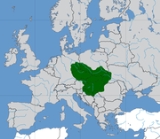
 section) was a Slavic state that existed in Central Europe from the 9th century to the early 10th century. There is some controversy as to the actual location of its core territory. According to mainstream historians, its core territory lay on both sides of the Morava river, in present day Slovakia
Slovakia

Slovakia . It was amended in September 1998 to allow direct election of the president and again in February 2001 due to EU admission requirements....
 and the Czech Republic
Czech Republic

The Czech Republic , is a landlocked country in Central Europe. The country borders Poland to the northeast, Germany to the west, Austria to the south and Slovakia to the east....
, but the empire may have also extended into what are today parts of Hungary
Hungary

Hungary , officially in English the Republic of Hungary , is a landlocked country in the Carpathian Basin of Central Europe, bordered by Austria, Slovakia, Ukraine, Romania, Serbia, Croatia, and Slovenia....
, Poland
Poland

Poland , officially the Republic of Poland , is a country in Central Europe. Poland is bordered by Germany to the west; the Czech Republic and Slovakia to the south; Ukraine, Belarus and Lithuania to the east; and the Baltic Sea and Kaliningrad Oblast, a Russian Enclave and exclave, to the north....
, Austria
Austria

Austria , officially the Republic of Austria , is a landlocked country in Central Europe. It borders both Germany and the Czech Republic to the north, Slovakia and Hungary to the east, Slovenia and Italy to the south, and Switzerland and Liechtenstein to the west....
, and Germany
Germany

Germany , officially the Federal Republic of Germany , is a country in Central Europe. It is bordered to the north by the North Sea, Denmark, and the Baltic Sea; to the east by Poland and the Czech Republic; to the south by Austria and Switzerland; and to the west by France, Luxembourg, Belgium, and the Netherlands....
.


Discussion
Ask a question about 'Great Moravia'
Start a new discussion about 'Great Moravia'
Answer questions from other users
Full Discussion Forum


Timeline

356   Roman authorities make an attempt to arrest Athanasius on the accusation of supporting the usurper Magnentius. Athenasius eludes them, fleeing to the desert to hide amongst the monks of Mount Nitria.

833   Mojmír I unifies Great Moravia ''

863   Byzantine missionaries Saints Cyril and Methodius come to Great Moravia upon a request of Prince Rastislav

864   First written reference to Devín Castle, when Louis the German besieged Great Moravian prince Rastislav there

871   Svatopluk I becomes king of Great Moravia

874   The territory of the Vistulans is conquered by king Svatopluk I of Great Moravia.

880   Pope John VIII issued the Bull "Industriae Tuae", creating an independent ecclesiastical province in Great Moravia with Archbishop Saint Methodius as its head. The Old Church Slavonic was recognized as the fourth liturgical language, besides Latin, Greek and Hebrew.

883   The Balaton Principality is conquered by king Svatopluk I of Great Moravia.

890   The sovereignty of Great Moravian king Svatopluk I in Bohemia is confirmed.

890   Lusatia becomes a part of Great Moravia.


Encyclopedia


Great Moravia (see Name
Great Moravia

Great Moravia was a Slavic people state that existed in Central Europe from the 9th century to the early 10th century. There is some controversy as to the actual location of its core territory....
 section) was a Slavic state that existed in Central Europe from the 9th century to the early 10th century. There is some controversy as to the actual location of its core territory. According to mainstream historians, its core territory lay on both sides of the Morava river, in present day Slovakia
Slovakia

Slovakia . It was amended in September 1998 to allow direct election of the president and again in February 2001 due to EU admission requirements....
 and the Czech Republic
Czech Republic

The Czech Republic , is a landlocked country in Central Europe. The country borders Poland to the northeast, Germany to the west, Austria to the south and Slovakia to the east....
, but the empire may have also extended into what are today parts of Hungary
Hungary

Hungary , officially in English the Republic of Hungary , is a landlocked country in the Carpathian Basin of Central Europe, bordered by Austria, Slovakia, Ukraine, Romania, Serbia, Croatia, and Slovenia....
, Poland
Poland

Poland , officially the Republic of Poland , is a country in Central Europe. Poland is bordered by Germany to the west; the Czech Republic and Slovakia to the south; Ukraine, Belarus and Lithuania to the east; and the Baltic Sea and Kaliningrad Oblast, a Russian Enclave and exclave, to the north....
, Austria
Austria

Austria , officially the Republic of Austria , is a landlocked country in Central Europe. It borders both Germany and the Czech Republic to the north, Slovakia and Hungary to the east, Slovenia and Italy to the south, and Switzerland and Liechtenstein to the west....
, and Germany
Germany

Germany , officially the Federal Republic of Germany , is a country in Central Europe. It is bordered to the north by the North Sea, Denmark, and the Baltic Sea; to the east by Poland and the Czech Republic; to the south by Austria and Switzerland; and to the west by France, Luxembourg, Belgium, and the Netherlands....
. This theory also states that Great Moravia was inhabited by the ancestors of modern Moravians
Moravians (ethnic group)

Moravians are the West Slavs inhabitants of modern Moravia, the easternmost part of the Czech Republic, also in Moravian Slovakia. They speak Moravian dialect of the Czech language and standard Czech....
 and Slovaks
Slovaks

File:Pribina, Nitra .jpgFile:J?no??k.jpgFile:Slovak USC2000 PHS.svgFile:Madonna in the Slovak national museum.jpgFile:Slovak soldiers on parade, detail.jpg...
. According to alternate theories, the core territory of Great Moravia was situated South of the Danube
Danube

The Danube is the longest river in the European Union and Europe's second longest river after the Volga.The river originates in the Black Forest in Germany as the much smaller Brigach and Breg River rivers which join at the eponymously named German town Donaueschingen, after which it is known as the Danube and flows eastwards for a distance...
 river, in Slavonia
Slavonia

Slavonia is a geographical and historical region in eastern Croatia. It is a fertile agricultural and forested lowland bounded, in part, by the Drava river in the north, the Sava river in the south, and the Danube river in the east....
 or in the southern parts of the Carpathian Basin
Pannonian Basin

The Pannonian Basin or Carpathian Basin is a large Sedimentary basin in Central Europe.The basin forms a topographically discrete unit set in the European landscape, surrounded by imposing geographic boundaries that have created a fairly unified cultural area that looks more towards the south and east than to the north and west....
.

Great Moravia was founded when Mojmír I
Mojmír I

Mojm?r I was the first known prince of the ??ravian principality after the fall of Samo's Moravian empire and the first prince of Great Moravia ....
 unified by force two neighboring states, referred to by the modern historiography as the "Principality of Nitra
Principality of Nitra

The Principality of Nitra or Nitrian Principality is the name for a Slavic peoples polity, centered around Nitra. It may have been a separate principality in the 8-12th centuries that existed as an independent state and became an autonomous territory within Great Moravia, Poland and the Kingdom of Hungary; or it may have been a nascent...
" and the "Principality of Moravia", in 833. The rulers of the emerging state periodically accepted the supremacy of the kings of East Francia, but they continuously endeavored to strengthen the independent status of their country.

Unprecedented cultural development resulted from the mission of Saints Cyril and Methodius
Saints Cyril and Methodius

Saints Cyril and Methodius were two Byzantine Greeks brothers born in Thessaloniki in the 9th century, who became missionaries of Christianity among the Slavic peoples of Great Moravia and Pannonia....
, who came during the reign of Prince Rastislav
Rastislav

Saint Rastic or Rastiz was the second ruler of Great Moravia between 846 and 870. He was canonized in October 1994 by the Czech and Slovak Orthodox Church....
 in 863. The empire reached its greatest territorial extent under Svatopluk I
Svatopluk I

Svatopluk I from the House of Mojm?r was the prince of the Principality of Nitra and then the king of Great Moravia . Under his rule Great Moravia reached its maximum territorial expansion....
 (871–894), although the borders of his dominions are still under debate. He also achieved to have his independent status acknowledged by Pope John VIII
Pope John VIII

John VIII was pope from December 13, 872 to December 16, 882. He is often considered one of the ablest pontiffs of the ninth century and the last bright spot on the papacy until Pope Leo IX two centuries later....
 who styled Svatopluk "king" in a letter.

Weakened by internal struggle and frequent wars with the Carolingian Empire
Carolingian Empire

Carolingian Empire is a historiography term sometimes used to refer to the Francia under the Carolingian dynasty. This dynasty is seen as the founders of France and Germany....
, Great Moravia was ultimately overrun by the Magyars, who invaded the Carpathian Basin
Pannonian Basin

The Pannonian Basin or Carpathian Basin is a large Sedimentary basin in Central Europe.The basin forms a topographically discrete unit set in the European landscape, surrounded by imposing geographic boundaries that have created a fairly unified cultural area that looks more towards the south and east than to the north and west....
 around 896. Its remnants were later divided among Poland
Poland

Poland , officially the Republic of Poland , is a country in Central Europe. Poland is bordered by Germany to the west; the Czech Republic and Slovakia to the south; Ukraine, Belarus and Lithuania to the east; and the Baltic Sea and Kaliningrad Oblast, a Russian Enclave and exclave, to the north....
, Kingdom of Hungary
Kingdom of Hungary

The Kingdom of Hungary , which existed from 1000 to 1918, and then from 1920 to 1946, was a considerable state in Central Europe....
, Bohemia
Bohemia

History...
 and the Holy Roman Empire
Holy Roman Empire

The Holy Roman Empire was a union of territories in Central Europe during the Middle Ages and the Early modern Europe under a Holy Roman Emperor....
. Although some contemporary sources mention that Great Moravia vanished and the Moravian castles were abandoned for a century, archaeological researches and toponyms
Toponymy

Toponymy is the scientific study of place-names , their origins, meanings, use and typology. The first part of the word is derived from the Greek language t?pos , place; followed by ?noma , meaning name....
 suggest the continuity of Slavic population in the valleys of the rivers of the Inner Western Carpathians
Carpathian Mountains

The Carpathian Mountains or Carpathians are a range of mountains forming an arc of roughly 1,500 km across Central Europe and Eastern Europe, making them the largest mountain range in Europe....
. Most castles and towns survived the destruction of the empire, but the identification of some castles is still debated and some scholars even claim that Great Moravia, in fact, disappeared without trace.

Great Moravia left behind a lasting legacy in Central and Eastern Europe. The Glagolitic script and its successor Cyrillic were disseminated to other Slavic countries, charting a new path in their cultural development. The administrative system of Great Moravia may have influenced the development of the administration of the Kingdom of Hungary
Kingdom of Hungary

The Kingdom of Hungary , which existed from 1000 to 1918, and then from 1920 to 1946, was a considerable state in Central Europe....
. Great Moravia also became a favorite issue in the Czech and Slovak romantic nationalism
Romantic nationalism

Romantic nationalism is the form of nationalism in which the state derives its political legitimacy as an organic consequence of the unity of those it governs....
 of the 19th century.

Name

The designation "Great Moravia" ("?e???? ???aß?a") originally stems from the work De Administrando Imperio
De Administrando Imperio

De Administrando Imperio is the commonly used Latin title of a scholarly work written in Greek language, by the 10th-century Byzantine emperor Constantine VII....
 written by the Byzantine Emperor Constantine VII Porphyrogenitos
Constantine VII

Constantine VII Porphyrogennetos or Porphyrogenitus, "the Purple-born" , was the son of the Byzantine emperor Leo VI the Wise and his fourth wife Zoe Karbonopsina....
 around 950 (and actually, his work is the only primary source that uses the adjective "Great" when referring to the polity). Although the name Great Moravia is used by the modern historiography to refer to a medieval polity in the northern part of the Carpathian Basin, the Emperor himself referred to a different country, located south of or in the southern part of the Carpathian Basin
Pannonian Basin

The Pannonian Basin or Carpathian Basin is a large Sedimentary basin in Central Europe.The basin forms a topographically discrete unit set in the European landscape, surrounded by imposing geographic boundaries that have created a fairly unified cultural area that looks more towards the south and east than to the north and west....
 or he mismatched the location.

The word "Great Moravia" used by modern authors not only refers to present-day Moravia
Moravia

Moravia is a Historical regions of Central Europe in the east of the Czech Republic, one of the former Czech lands. It takes its name from the Morava River, Central Europe which rises in the northwest of the region....
, but to a country situated on both sides of the Morava river whose capital was also plausibly called Morava. Alternatively, "Moravia" could also refer to country whose capital was Morava. It is not always clear whether an early medieval written source names a country or a town called Morava. The adjective "Great" nowadays denotes Moravia plus the annexed territories. Some authors interpret the original meaning as "distant", because Byzantine texts used to distinguish between two countries of the same name using the attribute "little" for the territory closer to the Byzantine Empire (such as the Morava rivers in Serbia
Serbia

Serbia , officially the Republic of Serbia , is a country in Central Europe and Balkans Europe, covering the southern part of the Pannonian Plain and the central part of the Balkans....
) and "great" for the more distant territory (such as the Morava river between Moravia and Slovakia).

The adjective "?e????" may also mean "old" in Byzantine texts and some scholars argue Old Moravia is the correct name.

The names of Great Moravia in other languages are Velká Morava in Slovak
Slovak language

The Slovak language , sometimes incorrectly called ?Slovakian?, is an Indo-European languages that belongs to the West Slavic languages .The Czech and Slovak languages are Mutual intelligibility which means that even after the dissolution of Czechoslovakia Czech may be used in all official proceedings and documents in Slovakia, and vice ver...
, Velká Morava in Czech
Czech language

Czech is a West Slavic language with about 12 million native speakers; it is the majority language in the Czech Republic and spoken by Czech people worldwide....
, Velika Moravska (?????? ????????) in Serbian
Serbian language

name=Serbian|nativename=|pronunciation=['sr?pski?]|familycolor=Indo-European|map=|states=See below under "Official status", besides that in Croatia and as an immigrant's language spread over Central Europe and Western Europe, as well as Northern America...
 and Croatian
Croatian language

Croatian language is a South Slavic languages which is used primarily in Croatia, by Croats in Bosnia and Herzegovina, in neighbouring countries where Croats are Indigenous peoples, in Italian region of Molise, and parts of the Croats diaspora....
, and morva fejedelemség in Hungarian
Hungarian language

Hungarian is a Uralic languages unrelated to most other languages in Europe. It is mainly spoken in Hungary and by the Hungarian minorities in the seven neighbouring countries....
. In English
English language

English is a West Germanic language that originated in Anglo-Saxon England and has lingua franca status in many parts of the world as a result of the military, economic, scientific, political and cultural influence of the British Empire in the 18th, 19th and early 20th centuries and that of the United States from the mid 20th century onwa...
, the forms Moravia Greater Moravia and Moravia Magna are also used.

The use of the term (Great) Slovak Empire instead of Great Moravia is promoted by some Slovak authors who attempt to define it as an early Slovak
Slovaks

File:Pribina, Nitra .jpgFile:J?no??k.jpgFile:Slovak USC2000 PHS.svgFile:Madonna in the Slovak national museum.jpgFile:Slovak soldiers on parade, detail.jpg...
 state. The use of this term would contradict the theory that the distinct Slavic nations had not yet emerged by the 9th century and the culture and language of various Slavic tribes in central Europe were indistinguishable from each other.

History


Foundation

The formation of Great Moravia resulted from the political and social development that is documented by archaeological findings, but scarcely described by contemporary chroniclers. The first state of the Slavs living on the Middle Danube was Samo
Samo

Samo was a Franks merchant from the "Senonian country" , probably modern Sens, France. He was the first ruler of the Slavs whose name is known, and established one of the earliest Slav states, a supra-tribal union usually called Samo's empire, realm, kingdom, or tribal union....
's Realm, a tribal confederation existing between 623 and 658. It encompassed the territories of Moravia, Slovakia, Lower Austria
Lower Austria

Lower Austria is one of the nine Bundesland or Bundesl?nder in Austria. The capital of Lower Austria is Sankt P?lten — the most recent capital town in Austria....
, Carantania, Sorbia at the Elbe
Elbe

The River Elbe is one of the major rivers of Central Europe. It originates in the Krkonose Mountains of northwestern Czech Republic before traversing much of Germany and flowing into the North Sea....
, and probably also Bohemia
Bohemia

History...
, which lies between Sorbia and other parts of the realm. Although this tribal confederation plausibly did not survive its founder, it created favorable conditions for the formation of the local Slavic aristocracy.

Graves dated to the period after King Samo's death show that the Avars
Eurasian Avars

The 'Avars' were a highly organized and powerful Turkic confederation. They were ruled by a khagan, who was surrounded by a tight-knit retinue of nomad warriors, an organization characteristic of Turkic peoples groups....
 returned to some of their lost territories and they even could expand their area of settlement not only over the western parts of the present-day Slovakia but also over the Vienna Basin
Vienna Basin

The Viennese Basin is a sedimentary basin between the Alps and the Carpathian Mountains. More than 50% of the Viennese Basin is located in Lower Austria, the rest is in Vienna, the Czech Republic and Slovakia....
 when a new population of the "griffin and tendril" archaeological culture (identified as Onogurs
Onogurs

The Onogurs were a horde of equestrian nomads that wandered the Eurasian plains in the 5th?8th centuries. They lived in the North Caucasus steppe east of the Don River ....
) appeared in the 670s. However, archaeological findings from the same period (such as an exquisite noble tomb in Blatnica
Blatnica, Slovakia

Blatnica is a village and municipality in the Turiec region of Slovakia. Administratively it is a part of the Martin District in the ?ilina Region....
) also indicate formation of a Slavic
Slavic peoples

The Slavic Peoples are a linguistic branch of Indo-European peoples, living mainly in eastern Europe. From the early 6th century they spread from their original homeland to inhabit most of eastern Central Europe, Eastern Europe and the Balkans....
 upper class on the territory that later became the nucleus of Great Moravia.

In the late 8th century, the Morava river basin and present-day western Slovakia, inhabited by the Slavs and situated at the Frankish border, flourished economically. Construction of numerous river valley settlements as well as hill fort
Hill fort

A hill fort is type of fortification refuge or defended settlement, located to exploit a rise in elevation for defensive advantage. They are typically European and of the Bronze Age and Iron Ages....
s indicates that political integration was driven by regional strongmen protected by their armed retinues. The Blatnica-Mikulcice horizon, a rich archaeological culture
Archaeological culture

In addition to its usual meaning in social science, in archaeology, the term wikt:culture is also used in reference to several related concepts unique to the discipline....
 partially inspired by the contemporaneous Carolingian
Carolingian

File:Charlemagne denier Mayence 812 814.jpgThe Carolingian dynasty was a Frankish noble family with its origins in the Arnulfing and Pippinid clans of the 7th century....
 and Avar
Eurasian Avars

The 'Avars' were a highly organized and powerful Turkic confederation. They were ruled by a khagan, who was surrounded by a tight-knit retinue of nomad warriors, an organization characteristic of Turkic peoples groups....
 art, arose from this economic and political development. In the 790s, the Slavs who had settled on the middle Danube
Danube

The Danube is the longest river in the European Union and Europe's second longest river after the Volga.The river originates in the Black Forest in Germany as the much smaller Brigach and Breg River rivers which join at the eponymously named German town Donaueschingen, after which it is known as the Danube and flows eastwards for a distance...
 overthrew the Avar yoke in connection with Charlemagne
Charlemagne

Charlemagne was List of Frankish kings from 768 to his death. He expanded the Franks kingdoms into a Carolingian Empire that incorporated much of Western Europe and Central Europe....
's campaigns against the Avars. Further centralization of power and progress in creation of state structures of the Slavs living in this region followed. As a result, two major states emerged: the Moravian Principality originally situated in present-day southeastern Moravia
Moravia

Moravia is a Historical regions of Central Europe in the east of the Czech Republic, one of the former Czech lands. It takes its name from the Morava River, Central Europe which rises in the northwest of the region....
 and westernmost Slovakia (with the probable center in Mikulcice
Mikulcice

Mikulcice is a municipality in the Czech Republic, situated 7 km south of Hodon?n, near the border with Slovakia. It belongs to the Hodon?n District and the South Moravian Region....
) and the Principality of Nitra
Principality of Nitra

The Principality of Nitra or Nitrian Principality is the name for a Slavic peoples polity, centered around Nitra. It may have been a separate principality in the 8-12th centuries that existed as an independent state and became an autonomous territory within Great Moravia, Poland and the Kingdom of Hungary; or it may have been a nascent...
, located in present-day western and central Slovakia
Slovakia

Slovakia . It was amended in September 1998 to allow direct election of the president and again in February 2001 due to EU admission requirements....
 (with the center in Nitra
Nitra

Nitra is a city in western Slovakia, situated at the foot of Zobor Mountain in the Nitra River valley. With a population of 85,000, it is the fourth largest city in Slovakia....
).

Moravian legates were sent to Frankish emperors in 811 and 815. In 822, the Royal Frankish Annals
Royal Frankish Annals

The Royal Frankish Annals or Annals of the Kingdom of the Franks are annals written for the early Frankish kings, covering the years 741 to 829....
 record that the Marvani paid homage to the Frankish Emperor at the Diet in Frankfurt
Frankfurt

is the largest city in the German States of Germany of Hesse and the List of cities in Germany with more than 100,000 inhabitants in Germany, with a 2008 population of 670,000....
: The first Moravian ruler known by name, Mojmír I
Mojmír I

Mojm?r I was the first known prince of the ??ravian principality after the fall of Samo's Moravian empire and the first prince of Great Moravia ....
, was baptized in 831 by Reginhar, bishop of Passau
Bishop of Passau

The Diocese of Passau is a diocese of the Latin Rite of the Roman Catholic church in GermanyThe diocese is a suffragan of the Archdiocese of M?nchen und Freising....
.

There is not much information in the contemporary primary sources (only two remarks in a Western documents) about the polity referred to as the "Principality of Nitra" by later historians. Nevertheless, during the first decades of the 9th century, the Slavic people living in the north-western parts of the Carpathian Basin
Pannonian Basin

The Pannonian Basin or Carpathian Basin is a large Sedimentary basin in Central Europe.The basin forms a topographically discrete unit set in the European landscape, surrounded by imposing geographic boundaries that have created a fairly unified cultural area that looks more towards the south and east than to the north and west....
 were under the rule of a tribal leader
Tribal chief

A traditional tribal chief is the leadership of a tribe, or the head of a tribal form of self-government.The notion of a "tribal chief" is rather vague and arbitrary; neither chief nor tribe is clearly defined, so in many cases other designations are used for the same institution, such as petty ruler or even headman ....
 (styled as prince by later historians) whose seat was in Nitra
Nitra

Nitra is a city in western Slovakia, situated at the foot of Zobor Mountain in the Nitra River valley. With a population of 85,000, it is the fourth largest city in Slovakia....
. In 828, Pribina
Pribina

Pribina, also called Priwina or Privina by Frankish chronicles, was the ruler and F?rst of the Principality of Nitra before 833, and established and ruled the Balaton Principality from 839/840 to 861....
, although probably still a pagan himself, built the first Christian church within the borders of modern Slovakia in his possession called Nitrava.

In 833, Mojmír I expelled Pribina from Nitra and the two principalities became united under the same ruler. Excavations revealed that at least three Nitrian castles (Pobedim
Pobedim

Pobedim is a village and municipality in Nov? Mesto nad V?hom District in the Trenc?n Region of western Slovakia....
, Cingov, and Ostrá skala) were destroyed around the time of the conquest (i.e., around the time when Pribina was expelled from his possession). But Pribina escaped to the Franks and their king Louis the German
Louis the German

Louis the German , was a grandson of Charlemagne and the third son of the succeeding Holy Roman Emperor Louis the Pious and his first wife, Ermengarde of Hesbaye....
 granted him parts of Pannonia
Pannonia

Pannonia is an ancient province of the Roman Empire bounded north and east by the Danube, coterminous westward with Noricum and upper Italy, and southward with Dalmatia and upper Moesia....
 around the Zala
Zala

Zala is the name of an administrative county in Hungary. Itlies in south-western Hungary. It is named after the Zala River. It shares borders with Croatia and Slovenia and the Hungarian counties Vas, Veszpr?m and Somogy....
 River, referred usually in modern works as the Balaton Principality
Balaton Principality

The Balaton Principality was a Slavic principality located in the western part of the Pannonian plain, between the rivers Danube to its east , Drava to the south , Graz to the west, and Koszeg or Klosterneuburg to the north ....
.

After unification

Prince Rastislav
What modern historians designate as "Great" Moravia arose around 830 when Mojmír unified the Slavic tribes settled north of the Danube and extended the Moravian supremacy over them. When Mojmír I endeavoured to secede from the supremacy of the king of East Francia in 846, King Louis the German
Louis the German

Louis the German , was a grandson of Charlemagne and the third son of the succeeding Holy Roman Emperor Louis the Pious and his first wife, Ermengarde of Hesbaye....
 deposed him and assisted Mojmír's nephew, Rastislav
Rastislav

Saint Rastic or Rastiz was the second ruler of Great Moravia between 846 and 870. He was canonized in October 1994 by the Czech and Slovak Orthodox Church....
 (846–870) in acquiring the throne. Although he was originally chosen by the Frankish king, the new monarch pursued an independent policy. After stopping a Frankish attack in 855, he also sought to weaken influence of Frankish priests preaching in his realm. Rastislav asked the Byzantine Emperor
Byzantine Empire

Byzantine Empire and Eastern Roman Empire are conventional names used to describe the Roman Empire during the Middle Ages, centered on its capital of Constantinople....
 Michael III
Michael III

Michael III the Drunkard , , Byzantine Emperor from 842 to 867. Michael III was the third and traditionally last member of the Phrygian Dynasty....
 to send teachers who would interpret Christianity in the Slavic vernacular. By establishing relations with Constantinople
Constantinople

Constantinople was the empire capital of the Roman Empire , the Byzantine Empire , the Latin Empire , and the Ottoman Empire . Strategically located between the Golden Horn and the Sea of Marmara at the point where Europe meets Asia, Byzantine Constantinople had been the capital of a Christendom empire, successor to ancient ancient Greece...
, Rastislav wanted to weaken influence of Frankish preachers, who served the interests of the Frankish Emperor. He also desired to counter an anti-Moravian alliance recently concluded between the Franks and Bulgarians. Upon Rastislav's request, two brothers, Byzantine officials and missionaries Saints Cyril and Methodius
Saints Cyril and Methodius

Saints Cyril and Methodius were two Byzantine Greeks brothers born in Thessaloniki in the 9th century, who became missionaries of Christianity among the Slavic peoples of Great Moravia and Pannonia....
 came in 863. Cyril developed the first Slavic alphabet
Glagolitic alphabet

The Glagolitic alphabet , also known as Glagolitsa, is the oldest known Slavic peoples alphabet. The name was not coined until many centuries after its creation, and comes from the Old Slavic glagol? "utterance" ....
 and translated the Gospel into the Old Church Slavonic
Old Church Slavonic

Old Church Slavonic, also known as Old Bulgarian, or Old Macedonian, was the first literary Slavic language, based on the old Solun dialect of the Thessaloniki region by the 9th century Byzantine Greeks missionaries, Saints Cyril and Methodius, who used it for translation of the Bible and other Ancient Greek language ecclesiastica...
 language. Texts translated or written by Cyril and Methodius are considered to be the oldest literature in the Slavic languages. Rastislav was also preoccupied with the security and administration of his state. Numerous fortified castles built throughout the country are dated to his reign and some of them (e.g., Dowina, sometimes identified with Devín Castle
Devín Castle

Dev?n Castle is a castle in Dev?n, which is a part of Bratislava, the capital of Slovakia.Owing to its strategic position, the cliff at the confluence of the Danube and Morava River, Central Europe rivers was an ideal place for a fort....
) are also mentioned in connection with Rastislav by Frankish chronicles. Moravia was militarily and economically powerful enough to be treated as an equal to the East Franksh Realm, and Ratislav was able to intervene in the power struggles in Frankia. Ratislav supprted Carloman in his rebellion against his father, Louis the German, and was thus given the Balaton Principality
Balaton Principality

The Balaton Principality was a Slavic principality located in the western part of the Pannonian plain, between the rivers Danube to its east , Drava to the south , Graz to the west, and Koszeg or Klosterneuburg to the north ....
 in Lower Pannonia after its ruler, Pribina was killed by Carloman. The nomadic Magyar
Magyar

Magyar may refer to:* The Hungarian people, an ethnic group * The Hungarian language, known also as "Magyar" or "Magyar language"* A Hun Tribe ...
 tribes invaded the Carpathian Basin for the first time during his reign, in 861, and afterwards, the Magyars were occasionally hired by several rulers of the territory in order to intervene in their wars against the opposite party.

During Rastislav's reign, the Principality of Nitra was given to his nephew Svatopluk as an appanage. The rebellious prince allied himself with the Franks and overthrew his uncle in 870. The beginning of Svatopluk I
Svatopluk I

Svatopluk I from the House of Mojm?r was the prince of the Principality of Nitra and then the king of Great Moravia . Under his rule Great Moravia reached its maximum territorial expansion....
’s reign was turbulent as his former Frankish allies refused to leave the western part of his empire. The young prince was even taken captive by the Franks and the country rallied around Slavomír
Slavomír

Priest Slavom?r was an interim ruler of the Great Moravia in 871.In 870, the East Francia king Louis the German supported a rebellion of Svatopluk I against his uncle and sovereign Rastislav ....
 who led an uprising against the invaders in 871. Svatopluk was finally released and took over the command of the insurgents, driving the Franks from Great Moravia. In the subsequent years, he successfully defended the independence of his realm from Eastern Francia
Eastern Francia

East Francia , known variously as Francia Orientalis or the Kingdom of the East Franks, was the realm allotted to Louis the German by the 843 Treaty of Verdun....
 and subjected many neighboring lands. Similarly to his predecessor, Svatopluk I (871–894) assumed the title of the king (rex). During his reign, the Great Moravian Empire reached its greatest territorial extent, when not only present-day Moravia and Slovakia but also present-day northern and central Hungary, Lower Austria, Bohemia, Silesia, Lusatia, southern Poland and northern Serbia belonged to the empire, but the exact borders of his domains are still disputed by modern authors. Svatopluk also withstood attacks of Magyar tribes and the Bulgarian Empire
First Bulgarian Empire

The First Bulgarian Empire was a medieval Bulgarian state founded in AD 632 in the lands near the Danube Delta and disintegrated in AD 1018 after its annexation to the Byzantine Empire....
, although sometimes it was he who hired the Magyars when waging war against East Francia.

In 880, Pope John VIII
Pope John VIII

John VIII was pope from December 13, 872 to December 16, 882. He is often considered one of the ablest pontiffs of the ninth century and the last bright spot on the papacy until Pope Leo IX two centuries later....
 issued the bull Industriae Tuae, by which he set up an independent ecclesiastical province in Great Moravia with Archbishop Methodius(Svatý Metodej) as its head. He also named the German cleric Wiching the Bishop of Nitra
Nitra

Nitra is a city in western Slovakia, situated at the foot of Zobor Mountain in the Nitra River valley. With a population of 85,000, it is the fourth largest city in Slovakia....
, and Old Church Slavonic was recognized as the fourth liturgical language, along with Latin, Greek and Hebrew.

Decline and fall

After the death of King Svatopluk in 894, his sons Mojmír II
Mojmír II

Mojm?r II was the last king of the Great Moravian Empire . Because of a civil war with his brother, he failed to prevent dismemberment of his Empire and probably died while fighting Hungarian people invaders....
 (894-906?) and Svatopluk II
Svatopluk II

Svatopluk II ruled the Principality of Nitra from 894 to 906 and strove to control all of Great Moravia.Svatopluk II was a younger son of Svatopluk I....
 succeeded him as the King of Great Moravia and the Prince of Nitra respectively. However, they started to quarrel for domination of the whole empire. Weakened by an internal conflict as well as by constant warfare with Eastern Francia, Great Moravia lost most of its peripheral territories. The death of Sviatopluk and subsequent internal strife allowed Bohemia to shake off the Moravian yoke.

In the meantime, the Magyar tribes, having suffered a catastrophic defeat from the similarly nomadic Pechenegs
Pechenegs

The Pechenegs or Patzinaks were a nomad Turkic peoples people of the Central Asian steppes speaking the Pecheneg language which belonged to the Turkic languages....
, left their territories east of the Carpathian Mountains, invaded the Carpathian Basin and started to occupy the territory gradually around 896. Their armies advance may have been promoted by continuous wars among the countries of the region whose rulers still hired them occasionally to intervene in their struggles. The Bavarians and the Moravians accused each other of having formed alliances, even by "taking oath upon dogs and wolves", with the pagan Magyars.The bishop Liutprand of Cremona
Liutprand of Cremona

Liutprand was a Lombards historian and author, and Bishop of Cremona.He was born into a prominent family of Pavia towards the beginning of the 10th century....
 relates that in 900, the Magyars

Both Mojmír II and Svatopluk II probably died in battles with the Magyars between 904 and 907 because their names are not mentioned in written sources after 906. In three battles (July 4-5 and August 9, 907) near Bratislava
Bratislava

Bratislava is the capital of Slovakia and, with a population of about 427,000, also the country's largest city. Bratislava is in southwestern Slovakia on both banks of the Danube River....
, the Magyars routed Bavaria
Bavaria

Bavaria , with an area of and almost 12.5 million inhabitants, is a region located in the southeast of Germany and is the largest States of Germany of Germany by area....
n armies. Historians traditionally put this year as the date of the breakup of the Great Moravian Empire. The archaeological evidence for the destruction and abandonment (lasting for a century or so in many cases) of the Moravian strongholds at this time is eloquent. The first (oldest) legend of Saint Naum also relates that the Magyars occupied the Moravian land

Although the source cited above and other sources mention that Great Moravia disappeared without trace and its inhabitants left for the Bulgars, Croats and Magyars following the latters' victories, but archaeological researches and toponyms
Toponymy

Toponymy is the scientific study of place-names , their origins, meanings, use and typology. The first part of the word is derived from the Greek language t?pos , place; followed by ?noma , meaning name....
 suggest the continuity of Slavic population in the valleys of the rivers of the Inner Western Carpathians
Carpathian Mountains

The Carpathian Mountains or Carpathians are a range of mountains forming an arc of roughly 1,500 km across Central Europe and Eastern Europe, making them the largest mountain range in Europe....
. Toponyms may prove that the nomadic Magyars occupied the Western Pannonian Plain
Pannonian Plain

The Pannonian Plain is a large plain in Central Europe that remained when the Pliocene Pannonian Sea dried out. It is a geomorphology subsystem of the Alpide belt....
 in present-day Slovakia, while the hills were inhabited by a mixed (Slav and Hungarian) population and people living in the valleys of the mountains spoke Slavic language
Slavic languages

File:Slavic europe.svgThe Slavic languages , a group of closely related languages of the Slavic peoples and a subgroup of Indo-European languages, have speakers in most of Eastern Europe, in much of the Balkans, in parts of Central Europe, and in the northern part of Asia....
.

Moreover, there are sporadic references to Great Moravia from later years: in 924/925, both Folkuin in his Gesta abb. Lobiensium and Ruotger in Archiepiscopi Coloniensis Vita Brunonis mention Great Moravia. From 925 until 931, there are several references to certain counts Mojmír and Svatopluk in official documents from Salzburg
Salzburg

is the List of cities and towns in Austria#List of cities and towns by population size in Austria and the capital city of the states of Austria of Salzburg ....
, though the origin of the two nobles is not clear. In 942, Magyar warriors captured in Al Andalus said that Moravia is the northern neighbor of their people. The fate of the northern and western parts of former Great Moravia in the 10th century is thus largely unclear.

The western part of the Great Moravian core territory (present-day Moravia) became the Frankish March of Moravia. Originally a buffer against Magyar attacks, the march became obsolete after the Battle of Lechfeld
Battle of Lechfeld

The Battle of Lechfeld , often seen as the defining event for holding off the incursions of the Magyars into Western Europe, was a decisive victory by Otto I the Great, King of the Germans, over the Magyar leaders, the horka Bulcs? and the chieftains L?l and S?r....
 (955). After the battle, it was given to the Bohemia
Bohemia

History...
n duke Boleslav I. In 999 it was taken over by Poland under Boleslav I of Poland and returned to Bohemia in 1019.

As for the eastern part of the Great Moravian core territory (present-day Slovakia), its southernmost parts fell under domination of the old Magyar Árpád dynasty
Árpád dynasty

The ?rp?ds or Arpads was the ruling dynasty of the federation of the Magyar tribes and of the Kingdom of Hungary . The dynasty was named after Grand Prince ?rp?d who was the head of the tribal federation when the Magyars occupied the Pannonian Basin, circa 896....
 after 955. The rest remained under the rule of the local Slavic aristocracy and was gradually integrated into the Kingdom of Hungary in a process finished in the 14th century. In 1000 or 1001, all of present-day Slovakia was taken over by Poland under Boleslav I and much of this territory became part of the Kingdom of Hungary
Kingdom of Hungary

The Kingdom of Hungary , which existed from 1000 to 1918, and then from 1920 to 1946, was a considerable state in Central Europe....
 by 1031. Since the 10th century, the population of Slovakia has been evolving into the present-day Slovaks
Slovaks

File:Pribina, Nitra .jpgFile:J?no??k.jpgFile:Slovak USC2000 PHS.svgFile:Madonna in the Slovak national museum.jpgFile:Slovak soldiers on parade, detail.jpg...
.

Territory

The Moravian state underwent considerable expansion, especially in the 870s, under Svatopluk I. In the 870s or 880s, the Moravians made a bid to extend their power northwards across the Carpathians to the broad fertile lands in Silesia
Silesia

Silesia is a historical region of Central Europe located mostly in present-day Poland, with parts in the Czech Republic and Germany.Silesia is rich in mineral and natural resources, and includes several important industrial areas....
 and Lesser Poland
Lesser Poland

Lesser Poland is one of the historical regions of Poland. It forms the southeastern corner of the country. It should not be confused with the modern Lesser Poland Voivodeship, which covers just a part of the historical region of Lesser Poland...
. There is little clear archaeological or written evidence, however, of a permanent extension of Moravian centralization of power in Lesser Poland or to the west in Silesia, or (as has been claimed by some historians) into Pannonia
Pannonia

Pannonia is an ancient province of the Roman Empire bounded north and east by the Danube, coterminous westward with Noricum and upper Italy, and southward with Dalmatia and upper Moesia....
. Indeed modern historiography has tended to question the former claims of huge neighboring territories permanently annexed by the Moravian state. Thus, it is under debate whether the "Balaton Principality" (administered probably by counts appointed by the King of East Francia during this period) or parts of the Carpathian Basin east of the rivers Danube and Tisza
Tisza

The Tisza is one of the major rivers of Central Europe. It originates in Ukraine, with the White Tisza in the Chornohora and Black Tisza in the Gorgany range, flows partially along the Romanian border, enters Hungary at Tiszabecs, marks Slovakia-Hungarian border, passes through Hungary, and falls into the Danube in central Vojvodina in Serbia...
 (Tisa) ("the territories of the Avars") were ever controlled by King Svatopluk. German historians Golberg and Reuter both suggests that Moravia did, in fact, control lower Pannonia (modern Hungarian Transdanubia), perhaps on two occasions: 858-863 (when Carloman gave it to Ratislav for his support against Louis the German, and again in 885-892 when Svatopoluk clashed with Arnulf.

The following map presents the possibly largest territorial extension of Great Moravia as it appears in , , and .


As for the history of Bohemia—annexed by Great Moravia for eleven years (from 883 to 894), the crucial year is 895, when the Bohemians broke away from the empire and became vassals of Arnulf of Carinthia
Arnulf of Carinthia

Arnulf of Carinthia was the Carolingian King of Germany from 887 and Holy Roman Emperor from 896 until his death. He was the illegitimate son of Carloman, King of Bavaria, and his concubine, Liutswind, of Carantanians origin, daughter of one Count Ernst....
. Independent Bohemia, ruled by the dynasty of Premyslids
Premyslid dynasty

The Premyslids , were a Czech royal dynasty which reigned in Bohemia and in Poland ....
, began to gradually emerge.

Alternative theories

An alternative theory, proposed by Imre Boba independently of the similar theories of earlier authors (e.g., Daniele Farlatti, Gelasius Dobner working in the 18th century) in the 1970s, suggests that the core territory of the empire was situated south of the Danube
Danube

The Danube is the longest river in the European Union and Europe's second longest river after the Volga.The river originates in the Black Forest in Germany as the much smaller Brigach and Breg River rivers which join at the eponymously named German town Donaueschingen, after which it is known as the Danube and flows eastwards for a distance...
 river in Pannonia
Pannonia

Pannonia is an ancient province of the Roman Empire bounded north and east by the Danube, coterminous westward with Noricum and upper Italy, and southward with Dalmatia and upper Moesia....
/Slavonia
Slavonia

Slavonia is a geographical and historical region in eastern Croatia. It is a fertile agricultural and forested lowland bounded, in part, by the Drava river in the north, the Sava river in the south, and the Danube river in the east....
. The theory is based on Boba's reading of primary written sources (e.g., De administrando imperio
De Administrando Imperio

De Administrando Imperio is the commonly used Latin title of a scholarly work written in Greek language, by the 10th-century Byzantine emperor Constantine VII....
, the Bavarian Geographer
Bavarian Geographer

The Bavarian Geographer is a conventional name given by Jan Potocki in 1796 to the author of an Anonymous work medieval document Descriptio civitatum et regionum ad septentrionalem plagam Danubii ....
 and Annales Fuldenses
Annales Fuldenses

The Annales Fuldenses or Annals of Fulda are East Francia chronicles that cover the period from the last years of Louis the Pious to the end of effective Carolingian rule in East Francia with the accession of the child-king, Louis the Child in 900....
), which in his opinion were ignored by other historians. Moreover, he also utilized the results of archaeological researches and his knowledge of Slavic studies. A short summary of his statements and their criticism follows:
  • Boba claimed that some primary sources (e.g., De administrando imperio, the Bavarian Geographer) clearly locate the territory of Great Moravia south of the Danube and other primary sources do not contradict them. His opponents pointed out that some sources (i.e., the Annales Fuldenses) cited by Boba were written by foreigners "at a considerable distance from the events narrated" and their understanding of geography is not very precise. It is also true that some of the primary sources (such as Life of Methodius and Life of St. Clement of Ohrid, referred also by Boba) seem to contradict Boba's theory. For example, the escape of the Slavonic priests to Bulgaria, as described in the primary sources, indicates that Great Moravia was not located south of the Danube.
  • Boba also emphasized that Saint Methodius
    Saints Cyril and Methodius

    Saints Cyril and Methodius were two Byzantine Greeks brothers born in Thessaloniki in the 9th century, who became missionaries of Christianity among the Slavic peoples of Great Moravia and Pannonia....
     was made Archbishop of Syrmium, a town south of the Danube. The opposite view states that the see in Syrmium was only symbolic, because Syrmium had formerly been the see of an archdiocese in the past, but Boba and his followers indicated that Method's consecration for a symbolic see would have violated canon law
    Canon law

    Canon law is internal ecclesiastical law governing the Roman Catholic Church, the Eastern Orthodox Church churches, and the Anglicanism of churches....
     in the 9th century. Boba's opponents also pointed out that the church claimed by Boba to be the resting place of Methodius in Syrmium turned out to be founded two hundred years after Methodius' death and no medieval settlement existed in Syrmium before AD 1000.
  • In addition, Boba argued that the continuity of the Slavonic liturgy and the uninterrupted use of Glagolitic alphabet
    Glagolitic alphabet

    The Glagolitic alphabet , also known as Glagolitsa, is the oldest known Slavic peoples alphabet. The name was not coined until many centuries after its creation, and comes from the Old Slavic glagol? "utterance" ....
     in the Catholic Church can be proven south of the Danube, while such tradition did not exist uninterruptedly north of the Danube. In reality, the Slavonic liturgy survived in some places north of the Danube until 1097. Boba claimed that this tradition came to the Monastery of Sázava
    Sázava (Benešov District)

    S?zava is a town in the Central Bohemian Region of the Czech Republic. It has around 3,800 inhabitants.Villages Belokozly, Cern? Budy, Cerenice and Dojetrice are administrative parts of S?zava....
     from Vyshhorod
    Vyshhorod

    Vyshhorod is a city in the Kiev Oblast , in central Ukraine. It is the administrative center of the Vyshhorodskyi Raion , and is located along the Dnieper River upstream from the national capital, Kiev....
     in the Kievan Rus'
    Kievan Rus'

    Kievan Rus' , also written as Kyivan Rus', was a medieval state which existed from approximately 880 to the middle of the 12th century. Founded by the Scandinavian traders called "Rus' " and centered in the city of Kiev , Rus' polity is considered an early predecessor of three modern East Slavs nations: Belarusians, Russians, and Ukrai...
    .
  • Great Moravia was often mentioned as Sclavonia in the primary sources and this denomination may have survived the fall of the empire in the name of Slavonia
    Slavonia

    Slavonia is a geographical and historical region in eastern Croatia. It is a fertile agricultural and forested lowland bounded, in part, by the Drava river in the north, the Sava river in the south, and the Danube river in the east....
     (a territory south of the Danube) until the 20th century. But Boba's opponents pointed out that the same Latin name Sclavonia also referred to Slovakia and those northern parts of Hungary that were inhabited by Slavs. On the other hand, the Latin denomination Sclavonia for the territories of present-day Slovakia was documented only in 1512.
  • Another of Boba's claims was that archaeological findings attributed to the Moravians north of the Danube should be reclassified because they show clear nomadic characteristics (i.e., men and their horses buried together). But these characteristics are known only from some of the earliest graveyards, from the regions influenced by the nomad Avars
    Eurasian Avars

    The 'Avars' were a highly organized and powerful Turkic confederation. They were ruled by a khagan, who was surrounded by a tight-knit retinue of nomad warriors, an organization characteristic of Turkic peoples groups....
    . There is also a "sharp contrast in the archaeological record" between the politically and economically developed regions of Moravia and Slovakia (the location of Boba's opponents) on the one hand, and the sparsely populated Slavonia (Boba's location) on the other hand.


In 1983, the Japanese
Japanese people

The are the predominant ethnic group of Japan. Worldwide, approximately 130 million people are of Japanese descent; of these, approximately 127 million are residents of Japan....
 Senga Toru, based on the primary sources, argued that Great Moravia was located around the territory where the Drava
Drava

Drava or Drave is a river in southern Central Europe, a tributary of the Danube. It begins in Dobbiaco, Italy, and flows east through East Tirol and Carinthia in Austria, into Slovenia , and then southeast, passing through Croatia and forming most of the border between Croatia and Hungary, before it joins the Danube near Osijek....
 joins the Danube, i.e., south of and in the southern parts of the Carpathian Basin on both sides of the Danube. He also stated that another polity named Moravia (without the adjective "Great") existed in the 9th century in the territory of present-day Moravia and in the western regions of present-day Slovakia, and the two polities were unified by Svatopluk I.

In the 1990s, the Hungarian historian, the late Gyula Kristó also mentioned that some sources allow to suppose that Great Moravia was located around the Great Morava River, south of the Danube. Later, he stated that some primary sources refer to the existence of two Moravian polities ("Great Moravia" and "Moravia") lying on the territories where Senga Toru located them.

People

The inhabitants of Great Moravia were designated Slovene, which is an old Slavic word meaning the "Slavs". The same name was used by the ancestors of Slovaks
Slovaks

File:Pribina, Nitra .jpgFile:J?no??k.jpgFile:Slovak USC2000 PHS.svgFile:Madonna in the Slovak national museum.jpgFile:Slovak soldiers on parade, detail.jpg...
, Slovenes and Slavonia
Slavonia

Slavonia is a geographical and historical region in eastern Croatia. It is a fertile agricultural and forested lowland bounded, in part, by the Drava river in the north, the Sava river in the south, and the Danube river in the east....
ns at that time and the present-day native names of these nations (for example Slovensko, the Slovak
Slovak language

The Slovak language , sometimes incorrectly called ?Slovakian?, is an Indo-European languages that belongs to the West Slavic languages .The Czech and Slovak languages are Mutual intelligibility which means that even after the dissolution of Czechoslovakia Czech may be used in all official proceedings and documents in Slovakia, and vice ver...
 name of Slovakia) are still derived from the root Slovene. People of Great Moravia were sometimes referred to as "Moravian peoples" by Slavic texts, and "Sclavi" (i.e. the Slavs), "Winidi" (another name for the Slavs), "Moravian Slavs" or "Moravians" by Latin
Latin

Latin is an Italic language, historically spoken in Latium and Ancient Rome. Through the Military history of the Roman Empire, Latin spread throughout the Mediterranean and a large part of Europe....
 texts.

As in all medieval states, life in Great Moravia was difficult compared to the modern standards: 40 percent of men and 60 percent of women died before reaching the age of 40. However, Great Moravian cemeteries also document rich nutrition and advanced health care. Inhabitants of Great Moravia even had better teeth than people today: a third of the examined skeletons had no caries or lost teeth.

Muslim geographers, when describing the inhabitants of Great Moravia, mentioned that

Government and society

Great Moravia was ruled by a hereditary monarch from the House of Mojmír
House of Mojmír

The House of Mojm?r is the modern name of the ruling dynasty of Great Moravia, the Moravia and the Principality of Nitra in the 9th and early 10th century....
. He was aided by a council of noblemen. The heir of the dynasty resided in Nitra
Nitra

Nitra is a city in western Slovakia, situated at the foot of Zobor Mountain in the Nitra River valley. With a population of 85,000, it is the fourth largest city in Slovakia....
, ruling the Principality of Nitra
Principality of Nitra

The Principality of Nitra or Nitrian Principality is the name for a Slavic peoples polity, centered around Nitra. It may have been a separate principality in the 8-12th centuries that existed as an independent state and became an autonomous territory within Great Moravia, Poland and the Kingdom of Hungary; or it may have been a nascent...
 as an appanage
Appanage

An apanage or appanage is the grant of an estate, titles, offices, or other things of value to the younger male children of a sovereign, who under the system of primogeniture would otherwise have no inheritance....
. He enjoyed a great deal of autonomy, as documented by the Papal correspondence that addressed Rastislav and his heir Svatopluk in the same way. Some parts of the Great Moravian territory were ruled by vassal princes, such as Borivoj I of Bohemia
Borivoj I of Bohemia

Borivoj I was first historically documented Duke of Bohemia ; founder of Premyslid dynasty.As the head of the Premyslids which dominated the environs of present-day Prague, Borivoj in c....
. The realm was further divided into counties, headed by župans. The number of counties is estimated to have been 11 at the beginning of the 9th century and 30 in the second half of the 9th century. This system also influenced the later Hungarian administrative division
Comitatus (Kingdom of Hungary)

A comitatus is the name of an administrative unit in the Kingdom of Hungary and Croatia and in the Republic of Hungary from the 10th century until 1949 when it was abolished by the new constitution....
, often with the same castles serving as the seats of a county both under the Great Moravian and under the later Hungarian rule. However, historians have not reached a consensus yet, for example, whether administrative units in the Kingdom of Hungary (e.g., the vármegye) followed foreign (Bulgarian, Moravian or German) patterns or the administrative system was an internal innovation. The process of feudalization in Great Moravia was obviously not a general phenomenon but it cannot be denied especially during its highest flourishment during the reign of King Svätopluk. Most of the population was formed by freemen, who were obliged to pay an annual tax. Slavery
Slavery

Slavery is a form of forced labor where a person is compelled to Labor for another . Slaves are held against their will from the time of their capture, purchase, or birth, and are deprived of the right to leave, to refuse to work, or to receive Remuneration in return for their labor....
 and feudal dependency
Serfdom

Serfdom is the socio-economic status of unfree peasants under feudalism, and specifically relates to Manorialism. It was a condition of Debt bondage or modified slavery which developed primarily during the High Middle Ages in Europe....
 are also recorded. Although no relevant historical source has been retained which would prove the existence of the so called hereditary aristocracy from the period of Great Moravia, written sources suggest the existence of duke's retinues and aristocracy, the members of which were the most important dignitaries and administrators (representatives) of the castle organization.

Warfare

Very little is known about the Great Moravian way of warfare. Earlier Byzantine sources mention the javelin
Javelin

A Javelin is a throw weapon, used more commonly in the modern athletics discipline: Javelin throw.Javelin may also refer to:* Javelin , a DC Comics supervillain...
 as the favorite weapon of Slavic warriors. Great Moravia also probably employed spear and axe armed infantry, including the powerful royal bodyguard called druzhina
Druzhina

Druzhina, Dru?yna or Druzyna in the history of early East Slavs was a detachment of select troops in personal service of a tribal chief, later knyaz. Its original functions were bodyguarding, raising tribute from the conquered territories and serving as the core of an army during war campaigns....
. The druzhina was a princely retinue composed of professional warriors, who were responsible for collecting tribute and punishing wrongdoers. In general, Slavs used cavalry rarely, which made them particularly vulnerable to the Magyar horse archers. Despite a relative scarcity of horses among the Slavs, a contemporary Arab traveler
Ahmad ibn Fadlan

Ahmad Patronymic#Arabic Fadlan ibn al-Abbas ibn Ra?id ibn Hammad was a 10th century Arab Muslim Arabic literature and traveler who wrote an account of his travels as a member of an embassy of the Abbasid Caliph of Baghdad to the king of the Volga Bulgars, the Kitab ila Malik al-Saqaliba ....
 reported that Svatopluk I
Svatopluk I

Svatopluk I from the House of Mojm?r was the prince of the Principality of Nitra and then the king of Great Moravia . Under his rule Great Moravia reached its maximum territorial expansion....
 had plenty of riding horses. The Great Moravian heavy cavalry emulated the contemporary Frankish predecessors of knight
Knight

File:Gothic armor 2.jpgKnight is the term for a social position originating in the Middle Ages. In the Commonwealth of Nations, knighthood is a non-heritable form of gentry....
s, with the expensive equipment that only the highest social strata
Social stratification

In sociology and anthropology, social stratification is the hierarchy arrangement of social classes, castes and strata within a society. While these hierarchies are not universal to all societies, they are the norm among state-level cultures ....
 could afford. Facing larger and better equipped Frankish armies, Slavs often preferred ambushes, skirmishes, and raids to regular battles. An important element of Great Moravian defense was to hide behind strong fortifications, which were difficult to besiege with the then prevailing forms of military organization. For example, a Frankish chronicler wrote with awe about "Rastislav's indescribable fortress" that stopped a Frankish invasion. The army was led by the king or, in case of his absence, by a commander-in-chief called voivode.

Culture


Architecture

Kostolec Hradisko
Great Moravia had an exceptionally developed system of fortresses and fortified towns. The Geographus Bavarus (the "Bavarian Geographer"), when listing the neighbouring territories, mentioned The above sentences of the medićval author are sometimes interpreted that 30 out of the 41 Great Moravian castles (civitates) were situated on the territory of present-day Slovakia and the remaining 11 in Moravia. These numbers are also corroborated by archaeological evidence. The only castles which are mentioned by name in written texts are Nitrawa (828; identified with Nitra
Nitra

Nitra is a city in western Slovakia, situated at the foot of Zobor Mountain in the Nitra River valley. With a population of 85,000, it is the fourth largest city in Slovakia....
),
Dowina (864; sometimes identified with Devín Castle
Devín Castle

Dev?n Castle is a castle in Dev?n, which is a part of Bratislava, the capital of Slovakia.Owing to its strategic position, the cliff at the confluence of the Danube and Morava River, Central Europe rivers was an ideal place for a fort....
) and
Brezalauspurc (907; usually identified with Bratislava Castle
Bratislava Castle

File:10 cent coin Sk serie 1.pngFile:Bratislava Castle.jpgFile:Bratislava Castle 1.jpgFile:Bratislava castle inside.jpgFile:Bratislava - hlavne schodisko hradneho palaca.jpg...
). Some sources claim that Uzhhorod
Uzhhorod

Uzhhorod is a city located in western Ukraine, at the border with Slovakia and near the border with Hungary. It is the Capital of the Zakarpattia Oblast , as well as the administrative center of the surrounding Uzhhorodskyi Raion within the oblast....
 in Ukraine
Ukraine

Ukraine is a country in Eastern Europe. It is bordered by Russia to the east; Belarus to the north; Poland, Slovakia, and Hungary to the west; Romania and Moldova to the southwest; and the Black Sea and Sea of Azov to the south....
 (903) was also a fortress of the empire. Many other castles were identified by excavations.

Although location of the Great Moravian capital has not been safely identified, the fortified town of Mikulcice
Mikulcice

Mikulcice is a municipality in the Czech Republic, situated 7 km south of Hodon?n, near the border with Slovakia. It belongs to the Hodon?n District and the South Moravian Region....
 with its palace and 12 churches is the most widely accepted candidate. However, it is fair to note that early medieval kings spent a significant part of their lives campaigning and traveling around their realms due to the lack of reliable administrative capacities. It is thus very likely that they also resided from time to time in other important royal estates. For instance, Devín Castle is sometimes identified with a "fortress of Prince Rastislav" mentioned in the
Annales Fuldenses
Annales Fuldenses

The Annales Fuldenses or Annals of Fulda are East Francia chronicles that cover the period from the last years of Louis the Pious to the end of effective Carolingian rule in East Francia with the accession of the child-king, Louis the Child in 900....
.

Mikulcice was fortified in the 7th century and it later developed into a large (2 km˛) agglomeration composed of various villages and forts, spread over several river islands. The area enclosed by the fortifications was only slightly smaller than the area of the contemporary Frankish Emperor's capital of Regensburg
Regensburg

Regensburg is a city in Bavaria, Germany, located at the confluence of the Danube and Regen River rivers, at the northernmost bend in the Danube....
. The population, estimated at 2,000, lived off trade and crafts. Mikulcice was also a foremost religious center, with the first stone churches built around 800. The largest among them was a three-nave basilica
Basilica

The Latin word basilica , was originally used to describe a ancient Rome public building , usually located in the Forum of a Roman town. In Hellenistic cities, public basilicas appeared in the 2nd century BC....
 with the inside dimensions 35 m by 9 m and a separate baptistery
Baptistery

In Architecture the baptistery or baptistry is the separate centrally-planned structure surrounding the baptismal font. The baptistery may be incorporated within the body of a church or cathedral and be provided with an altar as a chapel....
. The only church safely identified as Great Moravian and at the same time still remaining above ground is situated in nearby Kopcany
Kopcany

Kopcany is a village in western Slovakia, close to the borders with the Czech Republic....
.

Nitra
Nitra

Nitra is a city in western Slovakia, situated at the foot of Zobor Mountain in the Nitra River valley. With a population of 85,000, it is the fourth largest city in Slovakia....
, the second center of the Empire, was ruled autonomously by the heir of the dynasty as an appanage
Appanage

An apanage or appanage is the grant of an estate, titles, offices, or other things of value to the younger male children of a sovereign, who under the system of primogeniture would otherwise have no inheritance....
. Nitra consisted of five large fortified settlements and twenty specialized craftsmen's villages, making it a real metropolis of its times. Crafts included production of luxury goods, such as jewelry and glass. The agglomeration was surrounded by a number of smaller forts and religious buildings (e.g. in Dražovce and Zobor).

Bratislava Castle
Bratislava Castle

File:10 cent coin Sk serie 1.pngFile:Bratislava Castle.jpgFile:Bratislava Castle 1.jpgFile:Bratislava castle inside.jpgFile:Bratislava - hlavne schodisko hradneho palaca.jpg...
 had a stone two-story palace and a spacious three-nave basilica, built in the mid-9th century. Excavations of the cemetery situated by the basilica brought findings of the Great Moravian jewelry, similar in style and quality to that from Mikulcice. The castle's name was first recorded in 907, during the fall of Great Moravia, as
Brezalauspurc. This name literally means "Braslav's Castle" and Braslav of Pannonia
Braslav of Pannonia

Braslav or Br?slav was the last Prince of Pannonian Croatia in 880-898/900 vassalaged to the Kingdom of East Francia. The territory he was responsible for was extended by the Franks to include the territory of the former Balaton Principality in 896....
 was a count appointed by King Arnulf
Arnulf of Carinthia

Arnulf of Carinthia was the Carolingian King of Germany from 887 and Holy Roman Emperor from 896 until his death. He was the illegitimate son of Carloman, King of Bavaria, and his concubine, Liutswind, of Carantanians origin, daughter of one Count Ernst....
 of East Francia.

The sturdy Devín Castle
Devín Castle

Dev?n Castle is a castle in Dev?n, which is a part of Bratislava, the capital of Slovakia.Owing to its strategic position, the cliff at the confluence of the Danube and Morava River, Central Europe rivers was an ideal place for a fort....
, in vicinity of Bratislava, guarded Great Moravia against frequent attacks from the West. Although some authors claim that it was built only later as a stronghold of the Kings of Hungary, excavations have unearthed an older Slavic fortified settlement founded in the 8th century. During the Great Moravian period, Devín Castle was a seat of a local lord, whose retainers were buried around a stone Christian church. These two castles were reinforced by smaller fortifications in Devínska Nová Ves
Devínska Nová Ves

Dev?nska Nov? Ves is a borough of Bratislava, the capital of Slovakia. Its western borders are formed by the Morava River, which also represents the national border between Slovakia and Austria....
, Svätý Jur
Svätý Jur

Sv?t? Jur is a small town northeast of Bratislava, the capital of Slovakia. The name means Saint George. Between 1960 and 1990, the Czechoslovakia: 1948-1968 forced the town to use a "non-religious" name Jur pri Bratislave....
, and elsewhere.

Most Great Moravian castles were rather large hill fort
Hill fort

A hill fort is type of fortification refuge or defended settlement, located to exploit a rise in elevation for defensive advantage. They are typically European and of the Bronze Age and Iron Ages....
s, fortified by wooden palisades, stone walls and in some cases, moats. The typical Great Moravian ramparts combined an outer drystone wall with an internal timber structure filled with earth. The fortifications usually formed several contiguous enclosures, with the elite buildings concentrated in the center and crafts in the outer enclosures. Most buildings were made of timber, but ecclesiastical and residential parts were made of stone. Sometimes, earlier, prehistoric (Devín Castle) or Roman
Roman Empire

The Roman Empire was the Roman Republic phase of the Ancient Rome, characterised by an autocracy form of government and large territorial holdings in Europe and around the Mediterranean....
 (Bratislava Castle) fortifications were integrated. At least some churches (e.g. in Bratislava, Devín Castle, and Nitra) were decorated by fresco
Fresco

Fresco is any of several related painting types, done on plaster on walls or ceilings. The word fresco comes from the Italian word affresco which derives from the adjective fresco , which has Latin origins....
es, plausibly painted by Italian masters since the chemical composition of colors was the same as in northern Italy. In Nitra and Mikulcice, several castles and settlements formed a huge fortified urban agglomeration. Many castles served as regional administrative centers, ruled by a local nobleman. For example, Ducové
Ducové

Ducov? is a municipality situated in western Slovakia, near the spa town of Pie?tany. It was part of the municipality Moravany nad V?hom from 1976 to 1992....
 was the center of the Váh
Váh

The V?h is the longest river entirely in Slovakia. A left tributary of the Danube river, the V?h is 406 km long, including its Cierny V?h branch....
 river valley and Zemplín Castle controlled the Zemplín region
Zemplín (region)

Zempl?n is the name of an informal region located presently in eastern Slovakia. It includes Slovak part of the former Zempl?n county, often including Slovak part of the Ung county ....
. Their form was probably inspired by Carolingian
Carolingian architecture

Carolingian architecture is the style of north European architecture belonging to the period of the Carolingian Renaissance of the late 8th and 9th centuries when the Carolingian family dominated west European politics....
 estates called
curtis. The largest castles were usually protected by a chain of smaller forts. Smaller forts (e.g. Beckov Castle
Beckov Castle

Beckov Castle is a castle in ruins located near the village of Beckov in Nov? Mesto nad V?hom District, Trenc?n Region, western Slovakia.It is a natural cultural monument and its present appearance is the result of renovations in the last quarter of the 20th century and since 2002....
) were also built to protect trade routes and to provide shelter for peasants in case of a military attack.

Only few examples of Great Moravian architecture are fully preserved or reconstructed. The only still standing building is the church in Kopcany, though several other early medieval churches (for example in Kostolany pod Tribecom
Kostolany pod Tribecom

Kostolany pod Tribecom is a village and municipality in Zlat? Moravce District of the Nitra Region, in western-central Slovakia.History...
, Michalovce
Michalovce

Michalovce is a town on the Laborec river in eastern Slovakia, with a population around 40,000. It is the biggest town of the Michalovce District in the Ko?ice Region....
, and Nitra) may be Great Moravian too. Two open air museums, in Modrá near Uherské Hradište
Uherské Hradište

Uhersk? Hradi?te is a town in the Zl?n Region of the Czech Republic. It lies on the Morava river, Central Europe river ....
 and in Ducové, are devoted to the Great Moravian architecture.

Religion

Due to the lack of written documents, very little is known about the original Slavic religion and mythology
Slavic mythology

Slavic mythology is the mythological aspect of the polytheism that was practised by the Slavs prior to Christianisation.The religion possesses numerous common traits with other religions descended from the Proto-Indo-European religion....
. Several cult places used prior the Christianization are known from Moravia (Mikulcice and Pohansko). However, we do not know what these objects, such as a ring ditch with a fire, a horse sacrifice, or human limbs ritually buried in a cemetery, meant for Great Moravians. A cult object in Mikulcice was used until the evangelization of the Moravian elite in the mid-9th century and idols in Pohansko were raised on the site of a demolished church during the pagan backlash in the 10th century. The period of the Great Moravian ascent in European history is associated more with the spread of Christianity
Christianity

Christianity is a Monotheistic religion #Christian view religion centered on the life and teachings of Jesus as New Testament view on Jesus' life....
.

The territory of Great Moravia was originally evangelized by missionaries coming from the Frankish Empire or Byzantine enclaves in Italy and Dalmatia
Dalmatia

Dalmatia is a region on the eastern coast of the Adriatic Sea, situated mostly in modern Croatia and spreading between the island of Rab in the northwest and the Bay of Kotor in the southeast....
 since the early 8th century and sporadically earlier. The first Christian church of the Western and Eastern Slavs known to the written sources was built in 828 by Pribina
Pribina

Pribina, also called Priwina or Privina by Frankish chronicles, was the ruler and F?rst of the Principality of Nitra before 833, and established and ruled the Balaton Principality from 839/840 to 861....
 in Nitra. The church, consecrated by Bishop Adalram of Salzburg
Salzburg

is the List of cities and towns in Austria#List of cities and towns by population size in Austria and the capital city of the states of Austria of Salzburg ....
, was built in a style similar to contemporaneous Bavarian churches, while architecture of two Moravian churches from the early 9th century (in Mikulcice and Modrá) indicates influence of Irish missionaries. Despite the formal endorsement by the elites, the Great Moravian Christianity was described as containing many pagan elements as late as in 852. Grave goods
Grave goods

Grave goods, in archaeology and anthropology, are the items buried along with the body.They are usually personal possessions, supplies to smooth the deceased's journey into the afterlife or offerings to the gods....
, such as food, could be found even in church graveyards. The Church organization in Great Moravia was supervised by the Bavarian clergy until the arrival of the Byzantine missionaries Saints Cyril and Methodius
Saints Cyril and Methodius

Saints Cyril and Methodius were two Byzantine Greeks brothers born in Thessaloniki in the 9th century, who became missionaries of Christianity among the Slavic peoples of Great Moravia and Pannonia....
 in 863.

Foundation of the first Slavic bishopric (870), archbishopric (880), and monastery was the politically relevant outcome of the Byzantine mission initially devised by Prince Rastislav to strengthen his early feudal state. It is not known where the Great Moravian archbishop resided (a papal document mentions him as the archbishop of Morava, Morava being the name of a town), but there are several references to bishops of Nitra. Big three-nave basilicas unearthed in Mikulcice, Staré Mesto
Staré Mesto (Uherské Hradište District)

Star? Mesto is a town in the Zl?n Region of the Czech Republic near Uhersk? Hradi?te. Population: 6,766 .External links...
, Bratislava, and Nitra were the most important ecclesiastical centers of the country, but their very construction may have predated the Byzantine mission. Nitra and Uherské Hradište are also sites where monastic buildings have been excavated. A church built at Devín Castle is clearly inspired by Byzantine churches in Macedonia
Macedonia (region)

Macedonia is a geographical and Historical regions of the Balkan Peninsula in southeastern Europe whose area was re-defined in the early 20th century....
 (from where Cyril and Methodius came) and rotunda
Rotunda

Rotunda may refer to:*Rotunda , any building with a circular ground plan, often covered by a dome*Rotunda , a specific medieval blackletter script...
s, particularly popular among Great Moravian nobles, also have their direct predecessors in the Balkans.

Literature

Bascanska Ploca
But yields of the mission of Cyril and Methodius extended beyond the religious and political sphere. The Old Church Slavonic
Old Church Slavonic

Old Church Slavonic, also known as Old Bulgarian, or Old Macedonian, was the first literary Slavic language, based on the old Solun dialect of the Thessaloniki region by the 9th century Byzantine Greeks missionaries, Saints Cyril and Methodius, who used it for translation of the Bible and other Ancient Greek language ecclesiastica...
 became the fourth liturgical language of the Christian world, though its use in Great Moravia proper had gradually declined until it virtually vanished in the late Middle Ages. Its late form still remains the liturgical language of the Russian
Russian Orthodox Church

The Russian Orthodox Church ; or The Moscow Patriarchate , also known as the Orthodox Christian Church of Russia, is a body of Christianity who constitute an Autocephaly Eastern Orthodox Church under the jurisdiction of the List of Metropolitans and Patriarchs of Moscow, in full communion with the other Eastern Orthodox Churches....
, Bulgarian
Bulgarian Orthodox Church

The Bulgarian Orthodox Church is an autocephalous Eastern Orthodox Church with some 6.5 million members in the Republic of Bulgaria and between 1.5 and 2.0 million members in a number of European countries, the Americas and Australia....
, and Serbian Orthodox Church
Serbian Orthodox Church

The Serbian Orthodox Church or the Church of Serbia is one of the autocephalyEastern Orthodox Church organization, ranking sixth in order of seniority after Orthodox Church of Constantinople, Greek Church of Alexandria, Church of Antioch, Orthodox Church of Jerusalem, and Russian Orthodox Church....
. Cyril also invented the Glagolitic alphabet
Glagolitic alphabet

The Glagolitic alphabet , also known as Glagolitsa, is the oldest known Slavic peoples alphabet. The name was not coined until many centuries after its creation, and comes from the Old Slavic glagol? "utterance" ....
, suitable for Slavic languages. He translated the Gospel and the first translation of the Bible into a Slavic language was later completed by his brother Methodius.

Methodius wrote the first Slavic legal code, combining the local customary law
Custom (law)

In law, custom can be described as the established patterns of behavior that can be objectively verified within a particular social setting. A claim can be carried out in defense of "what has always been done and accepted by law." Generally, customary law exists where:...
 with the advanced Byzantine law
Corpus Juris Civilis

The Corpus Juris Civilis is the modern name for a collection of fundamental works in jurisprudence, issued from 529 to 534 by order of Justinian I, Byzantine Emperors....
. Similarly, the Great Moravian criminal law code was not merely a translation from Latin, but it also punished a number of offenses originally tolerated by the pre-Christian Slavic moral standards yet prohibited by Christianity (mostly related to sexual life). The canon law
Canon law

Canon law is internal ecclesiastical law governing the Roman Catholic Church, the Eastern Orthodox Church churches, and the Anglicanism of churches....
 was simply adopted from the Byzantine sources.

There are not many literary works that can be unambiguously identified as originally written in Great Moravia. One of them is
Proglas
Proglas

Proglas is the foreword to the Old Church Slavonic translation of the four Gospels. It was written by Saint Cyril in 863-867 in Great Moravia ....
, a cultivated poem in which Cyril defends the Slavic liturgy. Vita Cyrilli (attributed to Clement of Ohrid
Clement of Ohrid

Saint Clement of Ohrid , was a medieval Bulgarians scholar and writer, the first Bulgarian archbishop and one of the seven Apostles of Bulgaria.Evidence about his life before his return from Great Moravia to Bulgaria is scarce but according to his hagiography by Theophylact of Bulgaria, Clement was born in southwestern part of the Bulgarian...
) and
Vita Methodii (written probably by Methodius' successor Gorazd) are biographies with precious information about Great Moravia under Rastislav and Svatopluk I.

The brothers also founded an academy, initially led by Methodius, which produced hundreds of Slavic clerics. A well-educated class was essential for administration of all early-feudal states and Great Moravia was no exception.
Vita Methodii mentions bishop of Nitra as Svatopluk I’s chancellor and even Prince Kocel
Kocel

Kocel, also spelled Kocel, Kocelj, Gozil, Chezil, Chezilo, Chezul , was second Lord of Zalav?r .He was son of Pribina and his Bavarian wife....
 of the Balaton Principality
Balaton Principality

The Balaton Principality was a Slavic principality located in the western part of the Pannonian plain, between the rivers Danube to its east , Drava to the south , Graz to the west, and Koszeg or Klosterneuburg to the north ....
 was said to master the Glagolitic script. Location of the Great Moravian academy has not been identified, but the possible sites include Mikulcice (where some styli
Stylus

A stylus is a writing utensil. The word is also used for a computer accessory . It usually refers to a narrow elongated staff, similar to a modern ballpoint pen....
 have been found in an ecclesiastical building), Devín Castle (with a building identified as a probable school), and Nitra (with its Episcopal basilica and monastery). When Methodius’ disciples were expelled from Great Moravia in 885, they disseminated their knowledge (including the Glagolitic script) to other Slavic countries, such as Bulgaria
Bulgaria

The state of Bulgaria , Scientific transliteration Balgarija, officially the Republic of Bulgaria has played a significant role in the Balkans in south-eastern Europe for over fourteen centuries....
, Croatia
Croatia

Croatia , officially the Republic of Croatia , is a Central European country at the crossroads of Pannonian Plain, Balkans, and the Mediterranean Sea....
, and Bohemia. They created the Cyrillic alphabet
Cyrillic alphabet

The Cyrillic alphabet is a family of alphabets, subsets of which are used by five Slavic languages national languages as well as non-Slavic . It is also used by many other languages of Eastern Europe, the Caucasus, Siberia and other languages in the past....
, which became the standard alphabet in the Slavic Orthodox countries, including Russia
Russia

Russia , or the Russian Federation , is a list of countries spanning more than one continent country extending over much of northern Eurasia....
. The Great Moravian cultural heritage survived in Bulgarian seminaries, paving the way for evangelization of Eastern Europe.

Arts and crafts

In the first half of the 9th century, Great Moravian craftsmen were inspired by contemporary Carolingian art. In the second half of the 9th century, Great Moravian jewelry was influenced by Byzantine, Eastern Mediterranean, and Adriatic styles. But, in the words of Czech archaeologist Josef Poulík, "these new forms and techniques were not copied passively, but were transformed in the local idiom, establishing in this way the roots of the distinctive Great Moravian jewellery style." The typical Great Moravian jewelry included silver and golden earrings decorated by fine granular filigree, as well as silver and gilded bronze buttons covered by foliate ornaments.

The most important industry was iron metallurgy. An example of highly developed tool production are asymmetrical plowshare
Plowshare

In agriculture, a plowshare is a component of a plow . It is the cutting or leading edge of a moldboard which closely follows the coulter when plowing ....
s.

Legacy

Destruction of the Great Moravian Empire was rather gradual. Since excavations of Great Moravian castles show continuity of their settlement and architectural style after the alleged disintegration of the Empire, local political structures must have remained untouched by the disaster. Another reason is that the originally nomad old Magyars lacked siege engines to conquer Great Moravian fortifications, although this did not hinder them from conquering strong fortresses, documented by primary written sources (
e.g., Blatnograd, Bratislava Castle). Nevertheless, the core of Great Moravia was finally integrated into the newly established states of Duchy of Bohemia (later kingdom
Kingdom of Bohemia

The Kingdom of Bohemia was a country in Central Europe. It was formally established in 1212 by the Golden Bull of Sicily issued by the Holy Roman Emperor Frederick II, Holy Roman Emperor, by promoting the Duchy of Bohemia to the kingdom status, although some former rulers of Bohemia enjoyed a non-hereditary royal title....
) and the Kingdom of Hungary
Kingdom of Hungary

The Kingdom of Hungary , which existed from 1000 to 1918, and then from 1920 to 1946, was a considerable state in Central Europe....
.

Great Moravian centers (
e.g., Bratislava, Nitra, Tekov
Tekov

Tekov [Hungarian: Bars] is the traditional name of a region situated in southern and central Slovakia. Its territory encompasses the former Bars county, existing in the Kingdom of Hungary from the 11th century until 1918, though it is now administratively divided between the Nitra Region and Bansk? Bystrica Region ....
, and Zemplín) also retained their functions afterwards, although the identification of Bratislava, Tekov and Zemplín as Great Moravian castles is not generally accepted. Since the same castles became the seats of early Hungarian administrative units
Comitatus (Kingdom of Hungary)

A comitatus is the name of an administrative unit in the Kingdom of Hungary and Croatia and in the Republic of Hungary from the 10th century until 1949 when it was abolished by the new constitution....
 (counties), historians posit that the administrative division of Great Moravia was just adopted by new rulers. On the other hand, several sources suggest that the Hungarian rulers followed the contemporary German or Bulgar patents when they established the new administrative system in their kingdom, or they introduced a new system. Moreover, the territorial administration of the Kingdom of Hungary was developing gradually,
i.e., counties with larger territory were divided into smaller ones, while the scarcely habitated parts of the kingdom (e.g., the northern and north-eastern territories of present-day Slovakia or the Bakony Hills
Bakony

Bakony is a mountainous region in Transdanubia, Hungary. It forms the largest part of the Transdanubian Medium Mountains. It is located north of Lake Balaton and lies almost entirely in Veszpr?m county....
 in today Hungary) were originally the kings' private forests, then they were organized into "forest counties" (12-13th centuries) and the latter, following their colonization, developed into or were divided among counties around 1300.

Social differentiation in Great Moravia reached the state of early feudalism
Feudalism

Feudalism, a term first used in the early modern period , in its most classic sense refers to a Middle Ages European political system composed of a set of reciprocal law and military obligations among the warrior nobility, revolving around the three key concepts of lords, vassals, and fiefs....
, creating the social basis for development of later medieval states in the region. The question what happened to Great Moravian noble families after 907 is still under debate. On the one hand, recent research indicates that a significant part of the local aristocracy remained more or less undisturbed by the fall of Great Moravia and their descendants became nobles in the newly formed Kingdom of Hungary. The most prominent example are the powerful families of Hunt and Pázmán. On the other hand, both Anonymous
Gesta Hungarorum

Gesta Hungarorum is a record of early Hungary history by an unknown author who describes himself as Anonymus Bele Regis Notarius , but is generally cited as Gesta Hungarorum#Author....
 and Simon of Kéza
Simon of Kéza

Simon of K?za was the most famous Hungarian chronicler in the 13th century. He was a priest in the royal court of king Ladislaus IV of Hungary....
, two chroniclers of the early history of Hungary, recorded that the prominent noble families of the kingdom descended either from leaders of the Magyar tribes or from immigrants, and they did not connect any of them to Great Moravia. For example, the ancestors of the clan Hunt-Pázmán
Hont-Pázmány

Hont-P?zm?ny was the name of a gens in the Kingdom of Hungary. The Gesta Hunnorum et Hungarorum mentiones that the ancestors of the family arrived, in the late 9th century, to the court of Grand Prince G?za of Hungary from the Duke of Swabia ....
 (
Hont-Pázmány), whose Great Moravian origin has been advanced by modern scholars, were mentioned by Simon of Kéza to have arrived from the Duchy of Swabia to the kingdom in the late 10th century.

Many Slavic words related to politics, law, and agriculture were taken
Loanword

A loanword is a word directly taken into one language from another with little or no translation. By contrast, a calque or loan translation is a related concept whereby it is the Meaning or idiom that is borrowed rather than the lexical item itself....
 into the Hungarian language
Hungarian language

Hungarian is a Uralic languages unrelated to most other languages in Europe. It is mainly spoken in Hungary and by the Hungarian minorities in the seven neighbouring countries....
. Nevertheless, it is sometimes difficult to decide whether a certain word was borrowed from which Slavic language;
e.g., the Hungarian word for county ("megye") was borrowed from a South Slavic language
South Slavic languages

South Slavic languages comprise one of the three geographical groups of Slavic languages . There are around 30 million speakers of these languages, mainly in the Balkans....
, but it may have taken either from the Slovene or from the Serbo-Croatian.

The territories mentioned as
"Tercia pars regni
Tercia pars regni

The Tercia pars regni is the denomination for territories occasionally governed separately by members of the ?rp?d dynasty within the Kingdom of Hungary in the 11th-12th centuries....
" (literally "one-third part of the Kingdom of Hungary") in the medieval sources are referred to as the "Duchy" in Hungarian scholarly works and as the "Principality of Nitra
Principality of Nitra

The Principality of Nitra or Nitrian Principality is the name for a Slavic peoples polity, centered around Nitra. It may have been a separate principality in the 8-12th centuries that existed as an independent state and became an autonomous territory within Great Moravia, Poland and the Kingdom of Hungary; or it may have been a nascent...
" in Slovak academic sources. These territories were ruled autonomously by members of the Árpád dynasty
Árpád dynasty

The ?rp?ds or Arpads was the ruling dynasty of the federation of the Magyar tribes and of the Kingdom of Hungary . The dynasty was named after Grand Prince ?rp?d who was the head of the tribal federation when the Magyars occupied the Pannonian Basin, circa 896....
 residing in Bihar (today
Biharea in Romania
Romania

Romania is a country located in Southeastern Europe Central Europe, North of the Balkan Peninsula, on the Lower Danube, within and outside the Carpathian Mountains, bordering on the Black Sea....
) or in Nitra
Nitra

Nitra is a city in western Slovakia, situated at the foot of Zobor Mountain in the Nitra River valley. With a population of 85,000, it is the fourth largest city in Slovakia....
 - a practice reminiscent of the Great Moravian appanage system, but also similar to that of some other dynasties in the Early Middle Ages (
e.g., the Ruriks
Rurik Dynasty

The Rurik Dynasty was the ruling dynasty of Kievan Rus', the successor Russian principalities, and early united Russia, from 862 to 1598.According to the Primary Chronicle, the dynasty was established in 862 by Rurik, the great legendary ruler of Novgorod....
 in the Kievan Rus'
Kievan Rus'

Kievan Rus' , also written as Kyivan Rus', was a medieval state which existed from approximately 880 to the middle of the 12th century. Founded by the Scandinavian traders called "Rus' " and centered in the city of Kiev , Rus' polity is considered an early predecessor of three modern East Slavs nations: Belarusians, Russians, and Ukrai...
). The existence of an autonomous political unit centered around Nitra is often considered by Slovak scholars an example of political continuity from the Great Moravian period.

There are also documents indicating that the Church organization survived the invasion of the pagan Magyars at least to some degree. For example, continuity of the formal Church organization is confirmed by an uninterrupted list of Moravian bishops from the 14th century.

Neither the demographic change was dramatic. As far as the graves can tell, there had been no influx of the Magyars into the core of former Great Moravia before 955. Afterwards, Magyar settlers appear in some regions of Southern Slovakia, but graves indicate a kind of cultural symbiosis (resulting in the common
Belobrdo culture), not domination. Due to cultural changes, archaeologists are not able to identify the ethnicity of graves after the half of the 11th century. This is also why integration of central, eastern, and northern territories of present-day Slovakia into the Hungarian Kingdom is difficult to be documented by archeology, and written sources have to be used.

The Byzantine double-cross thought to have been brought by Cyril and Methodius is part of the symbol of Slovakia
Coat of arms of Slovakia

File:Slovakia 2 euro.pngFile:Slovakia 1 euro.pngThe coat of arms of Slovakia is composed of a silver Patriarchal cross, elevated on the middle peak of a dark blue mountain consisting of three peaks....
 until today and the Constitution of Slovakia
Constitution of Slovakia

The Constitution of Slovakia, officially Constitution of the Slovak Republic is the current constitution of Slovakia. It was passed by the Slovak National Council on 1 September 1992 and signed on 3 September 1992 in the Knights Hall of the Bratislava Castle....
 refers to Great Moravia in its preamble. Interest about that period rose as a result of the national revival
Romantic nationalism

Romantic nationalism is the form of nationalism in which the state derives its political legitimacy as an organic consequence of the unity of those it governs....
 in the 19th century. Great Moravian history has been regarded as a cultural root of several Slavic nations in Central Europe (especially the Slovaks, as it was the only significant Slavic state Slovakia had ever been a part of) and it was employed in vain attempts to create a single Czechoslovak
Czechoslovakia

Czechoslovakia was a sovereign state in Central Europe that existed from October 1918 until 1992 . On January 1, 1993, Czechoslovakia dissolution of Czechoslovakia into the Czech Republic and Slovakia....
 identity in the 20th century.

Sources


Primary sources

  • Annales regni Francorum
    Royal Frankish Annals

    The Royal Frankish Annals or Annals of the Kingdom of the Franks are annals written for the early Frankish kings, covering the years 741 to 829....
    , annals
    Annals

    Annals are a concise form of history writing which record events chronologically, year by year....
     covering the years 741-829.
  • Annales Bertiniani
    Annales Bertiniani

    The Annales Bertiniani, or Annals of St. Bertin, is a Frankish chronicle that was found in the Monastery of St. Bertin, after which it is named....
    , a continuation of Annales regni Francorum covering the period 830-82.
  • Annales Fuldenses
    Annales Fuldenses

    The Annales Fuldenses or Annals of Fulda are East Francia chronicles that cover the period from the last years of Louis the Pious to the end of effective Carolingian rule in East Francia with the accession of the child-king, Louis the Child in 900....
    , a continuation of Annales regni Francorum until 901.
  • Geographus Bavarus, written sometime between the 830s and 870s.
  • Libellus de conversione Bagoariorum et Carantanorum (i.e. Conversio), written in 870.
  • Vita Methodii, a biography of Saint Methodius written in Great Moravia shortly after 885.
  • Annales Iuvavenses, annals written in the 9th and 10th centuries in Salzburg
    Salzburg

    is the List of cities and towns in Austria#List of cities and towns by population size in Austria and the capital city of the states of Austria of Salzburg ....
    .
  • De Administrando Imperio
    De Administrando Imperio

    De Administrando Imperio is the commonly used Latin title of a scholarly work written in Greek language, by the 10th-century Byzantine emperor Constantine VII....
    , written by Constantine VII Porphyrogenitos
    Constantine VII

    Constantine VII Porphyrogennetos or Porphyrogenitus, "the Purple-born" , was the son of the Byzantine emperor Leo VI the Wise and his fourth wife Zoe Karbonopsina....
     between 948 and 952.
Primary documents can be found in the following volumes:
  • Havlík, Lubomír E. (1966-1977). Magnae Moraviae Fontes Historici I.-V., Brno: Masarykova univerzita.
  • Marsina, Richard (1971). Codex diplomaticus et epistolaris Slovaciae I., Bratislava: Veda.
  • Ratkoš, Peter (1964). Pramene k dejinám Velkej Moravy, Bratislava: Vydavatelstvo Slovenskej akadémie vied.


Secondary sources

  • Dekan, Jan (1981). Moravia Magna: The Great Moravian Empire, Its Art and Time, Minneapolis: Control Data Arts. ISBN 0-89893-084-7
  • Havlík, Lubomír E. (1992). Kronika o Velké Morave, Brno: Iota.
  • Kucera, Matúš (1974). Slovensko po páde Velkej Moravy, Bratislava: Veda.
  • Lukacka, Ján (2002). Formovanie vyššej šlachty na západnom Slovensku, Bratislava: Mistrál.
  • Poulík, Josef (1975). Mikulcice: Sídlo a pevnost knížat velkomoravských, Praha.
  • Štefanovicová, Tatiana (1989). Osudy starých Slovanov, Bratislava: Osveta.
  • Wieczorek, Alfried and Hans-Martin Hinz (Hrsg.) (2000). Europas Mitte um 1000, Stuttgart. ISBN 3-8062-1545-6 or ISBN 3-8062-1544-8


External links