

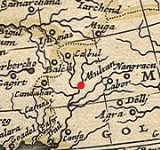
Multan

Encyclopedia
Multan is a city in the Punjab Province
of Pakistan
and capital of Multan District
. It is located in the southern part of the province on the east bank of the Chenab River
, more or less in the geographic centre of the country and about 562 km (349.2 mi) from Islamabad
, 356 km (221.2 mi) from Lahore
and 966 km (600.2 mi) from Karachi
. Multan District has a population of 3.1 million (1998).
Multan is known as the City of Sufis or City of Saints and Madinah-Tul-Oleyah due to the large number of shrines and Sufi saints from the city. The city is full of bazaar
s, mosque
s, shrine
s and ornate tomb
s. It is located in a bend created by five rivers of the Punjab province
. The Sutlej River separates it from Bahawalpur
and the Chenab River
from Muzaffar Garh. The city has grown to become an influential political and economical center for the country, with a dry port
and excellent transport links. Multan is famous for its crops: wheat
, cotton
and sugar cane as well as mango
es, citrus
, guava
s and pomegranate
s.
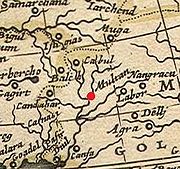 Multan is one of the oldest cities in the Asian subcontinent.According to Hindu legends, it was the capital of the Trigarta Kingdom
at the time of the Mahabharata
war, ruled by the Katoch
Dynasty. Multan has had various names over the years. According to Hindu mythology, it was originally called Kashtpur (Kashyapapura) after a Hindu sage named Kashyapa, which is also the Gotra
used by the Katoch dynasty. Other names were Hanspur (Hamsapura), Bagpur (Vegapura), Sanb or Sanahpur (Sambapura). Its current name is derived from the Sanskrit
name Mulasthana named after a sun temple. Multan has frequently been a site of conflict due to its location on a major invasion route between South Asia
and Central Asia
. It is believed to have been visited by Alexander the Great's army. In the mid-5th century, the city was attacked by a group of Huna
Hephthalite
nomads led by Toramana
.
Multan was conquered along with Sindh
by Muhammad bin Qasim
, from the local ruler Chach of Alor
. Following bin Qasim's conquest, the city was securely under Muslim
rule, although it was in effect an independent state and most of the subjects were non-Muslim.
In 965 CE, Multan was conquered by Halam b. Shayban, an Ismaili da'i. Soon after, Multan was attacked by Mahmud of Ghazni
, destabilizing the Ismaili state. Mahmud of Ghazni
invaded Multan in 1005 CE, conducting a series of campaigns during which the Ismailis of Multan were massacred. In an effort to gain his allegiance, the Fatimid
Ismaili
Imam-caliph al-Hakim
dispatched an envoy to Mahmud two years later. This attempt appeared to be unsuccessful and the Ghaznawids continued to attack other Ismaili strongholds in Sindh
to suppress any resurgence of the community in the region. In 1032CE Mahmud's very own vizier, Hasanak was executed for having accepted a cloak from the Imam-caliph on suspicions that he had become an adherent of the Ismaili faith. Mahmud's purges of the region led several scholars including Stern to believe that the Ghaznawid purges of the region drove out Ismailism from the area, however recently-discovered letters dating to 1083 and 1088 demonstrate continued Ismaili activity in the region, as the Imam-caliph Mustansir dispatched new da'is to replace those who were killed in the attacks.
Multan's location at the entrance to the sub-continent resulted in it being invaded by a long series of conquerors on their way to Delhi. Timur
, Babur
and many others passed through the city, leaving much destruction in their wake. This violence continued as when Muhammad of Ghor
attacked the city and drove out the remaining Ismailis whom he deemed to be heretics, in stark contrast to his predecessor, the Ghurid Sultan 'Ala' al-Din who welcomed numerous envoys from the Ismaili state of Alamut
and according to the historian Juzjani, gave them "great reverence"
Following annexation to Mughal empire
in 1557 CE, at the beginning of emperor Akbar's rule; Multan enjoyed 200 years of peace, and became known as Dar al-Aman (Abode of Peace). Akbar was known as a wise ruler, setting reasonable taxes, creating effective government and being tolerant of religious differences.
Multan witnessed difficult times as Mughal
rule declined in early 1700s, starting after death of emperor Aurangzeb
in 1707. The last Naib Subahdar
s appointed by Farrukhsiyar
at Multan were Khan Zaman Khan Ali Asghar
ibn Kartalab Khan Bahadur Shahi Qazi Ghulam Mustafa
and then Aqidat Khan ibn Ameer Khan. Persia was united under Nader Shah
, ruling from 1736 as Shah of Iran
. After his assassination in 1747, Ahmad Shah Durrani
—who was born in Multan—rose to power. This counts as beginning of Durrani Empire
. However, after death of Ahmad Shah Durrani in 1772, the influence of Durrani empire declined sharply in mere fifty years. Starting at late in 1700s, Multan was ruled locally by the Pashtun
Sadozai
and Khogyani
aka Khakwani chieftains.
In 1817, Maharaja Ranjit Singh
sent a body of troops to Multan under the command of Diwan Bhiwani Das to receive from Nawab Muzaffar Khan the tribute he owed to the Sikh Darbar. Bhiwani Das laid siege to the city, but failed to capture Multan. Maharaja Ranjit Singh planned a fresh expedition and sent a strong force under his son Kharak Singh's charge.
In 1818, Kharak Singh's armies lay around Multan without making much initial headway. Maharaja Ranjit Singh sent a large cannon named Zamzama
along with Akali Phula Singh's Nihang
regiment. Using the Zamzama destroyed the gates of the city and Akali Phula Singh defeated the garrison inside. Kharak Singh left Jodh Singh Ramgarhia
with 600 men to guard the fort of Multan. The Sikhs thereafter ruled Punjab until 1849, when it was lost in the Second Anglo-Sikh War
.. Sardar Karan Narain's son was awarded the title 'Rai Bahadur' and knight
ed by the British Raj
for switching to their side. After the Anglo-Sikh Wars, Multan was made part of the British Raj. The British built some rail routes to the city, but its industrial capacity was never developed.
Multan became part of Pakistan upon Pakistan's independence in 1947.It initially lacked industry, hospitals and universities. Since then, there has been some industrial growth, and the city's population is continually growing. But the old city continues to be in a dilapidated state, and many monuments wear the effects of the warfare that has visited the city.
province at almost the exact centre of Pakistan. The closest major city is Sahiwal
. The area around the city is a flat, alluvial plain and is ideal for agriculture, with many citrus
and mango
farms. There are many canals that cut across the Multan District, providing water from nearby farms. This makes the land very fertile. However usually land close to the Chenab are usually flooded in the monsoon season.
Multan features an arid climate with very hot summers and mild winters. The city witnesses some of the most extreme weather in the country. The highest recorded temperature is approximately 54 °C (129.2 °F), and the lowest recorded temperature is approximately -1 C. The average rainfall is roughly 127 millimetres (5 in). Dust storms are a common occurrence within the city.
 Multan is a commercial and industrial centre, as it is connected with the rest of the country through rail and air including the other industrial hubs such as Lahore
, Karachi
, Gujranwala
, Quetta
and Faisalabad
. Industries include fertilizer, cosmetics, glass manufacturing, cotton production and processing, large textile units, flour mills, sugar and oil mills and large-scale power generation projects. It is famous for its handicrafts (carpets & ceramics) and cottage industries. Roughly 1900 acres (7.7 km²) of the city is still forested in the district. Trees grown in the area are Kikar, Shisham and Mulberry
.
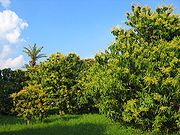
Large, irregular suburbs have grown outside the old walled town, and two satellite towns have been set up. The mango
es of Multan district are well-known. Multani khussa (traditional shoes), embroidery on dresses for women and men, furniture and other wooden products, earthenware pottery, painted pottery, camel-skin ware, surgical instruments and carpets are a few of the city's major exports, with a great demand within the country as well.
Multan is an important agricultural centre. Wheat, cotton and sugarcane are the main crops grown in the district. Moreover, rice, maize, tobacco, bajra
, moong (lentils), mash (lentils), masoor (lentils), oil seed such as rape
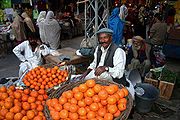
, mustard and sunflower are also grown in minor quantities in the district. Mangoes, citrus, guavas and pomegranate are the main fruits grown in the Multan district. Additionally, dates, jaman, pears, phalsa and bananas are grown in minor quantities in the district.
The city is also rich in minerals. These include argillaceous clay
, coal
, dolomite
, fire clay
, gypsum
, limestone
, silica and rock salt. Most of these are excavated for commercial activities and transported to other cities within the country. Many industrial factories are being inaugurated to handle the separation and quality control of these minerals. The minerals in the city are used in dolomite processing, fire brick
s/refractories, hollow glassware
, insulators/capacitor
s and ceramics.
Since Multan is agriculture-based, there is also plenty of livestock still growing at a positive rate, which has led to milk processing/dairy products units, ice cream manufacturing, animal and poultry feed, dairy farms, cattle/sheep/goat fattening plants, meat/poultry processing units, leather garments manufacturing, leather footwear, cosmetics, tinned goods and pharmaceuticals.
(Mayor). Multan is spread over an area of 3,721 square kilometers, comprising four tehsils: Multan Cantonment, Multan Sadar, Shujabad and Jalalpur Pirwala. In 2005 Multan was reorganised as a City District
composed of six autonomous towns:
 The majority of Multan's residents speak Saraiki
, while Haryanvi, a dialect of Urdu is the second most spoken language. Almost all the population speaks and understand Urdu. English
is only understood by the educated. The majority of the people are Muslim
s. However, the city does have significant Sikh and Hindu communities within the district. There are some temples and Gurdwaras within the city.
Multan has traditionally been a melting pot of several distinct ethnic groups due to its location at the intersection of all four of Pakistan's main provinces and due to its historical significance as a centre of learning and culture. As a result, Multan today consists of Saraiki
, Haryanvi, Punjabi
, Baloch
, Pashtun
, Sindhi
, and Urdu speaking people.
As per the 1998 census of Pakistan, the following are the demographics of the district, by spoken language:
 There is a saying in Persian that Multan is the 'City of Saints, Sufis and Beggars' (Gard, Garma wa Goristan). It is one of the main cities in the Southern Punjab province of Pakistan. The city has been a focal point for many religions, in particular becoming a central abode for Sufism
, the mystical side of Islam
. The city has attracted Sufi saints from far places of the globe. Today, Multan is known as the 'City of Sufis'. His HighnessShaikh Amin bin Abdul Rehman, who has introduced the Idrisiyya
sufi order in Pakistan, lives at 381-A, Shah Rukn-e-Alam Colony, New Multan, where a four-storey mosque adjacent to his residence is visited by people from all over the world. Multan is one of the oldest cities in South Asia, with many tombs, shrines, temples, cathedrals and mausoleums, as well as a historical fort
. Today Multan is a combination of old and the new Pakistan culture. There is a big hustle bustle in the old city and comfort of a five star hotel and fine dining in the new. The old city has a various bazaars selling mystical artifacts, perfumes to arts and crafts. There are also elaborately decorated shrines of the Sufi saints, tombs of various travellers and important people within the old city of Multan.
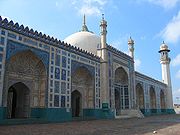
The prime attractions of Multan are its mausoleums
of Sufi saints. The Mausoleum of Sheikh Baha-ud-Din Zakariya
, as well as the Mausoleum of Shah Rukn-e-Alam
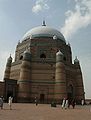
are the prime attractions of the city. Their lofty domes of are visible, from miles and dominate the skyline of Multan. Another popular shrine is the Mausoleum of Shams-ud-Din, commonly known as Shah Shamsuddin Sabzwari is located about half a mile to the east of the Multan Fort
, on the high bank of the old bed of the Ravi River
.
Another famous and beautiful mausoleum of a warrior sufi saint and poet Hazrat Hafiz Muhammad Jamal Multani (1747-1811 AD) is situated near Aam Khas garden outside Daulat Gate, Multan.
There are also a number of other mausoleums located within the city which gather a great deal of attention. The Nuagaza tombs are shrines to martyrs and warriors who fought in wars centuries ago, some dating back 1,300 years ago. The Multan Museum
located within the city has a vast collection of coins, medals, postage stamps of the former State of Bahawalpur, manuscripts, documented inscriptions, wood carvings, camel-skin paintings, historical models and stone carvings of the Islamic and Pre-Islamic periods.
Multan also has a number of old mosques
which were once considered as the jewels of the city. Some have been dated back to over a thousand years ago and have been recognized as some of the oldest mosques within South East Asia. The legend goes that the first mosque ever built in Multan was the Jamia Mosque which was constructed on the orders of General Mohammed Qasim, who conquered Multan in 712AD. Ruins of this mosque were visible till 1954 at Qasim Bella; however, due to repeated floods, the structure was lost. Sawi Mosque is supposed to be the oldest mosque which still exists today, though in deteriorating state; there are glazed blue tiles from the era in which it was built which dates the mosque to several centuries ago. The second oldest mosque within Multan is Mohammad Khan Wali Mosque. It is an excellent condition, situated in the busiest Chowck Bazar of the city. It was built by Nawab Ali Mohammad Khan Khakwani, in 1757 when he was the governor of Multan in the time of Alamgir II
. The mosque is provided with a reservoir for the ablutions, baths, and a large hall for prayers.
Multan is another Pakistani city that loves cricket. Multan is home of the Faysal Bank T20 League team Multan Tigers
. The city government inaugurated a new multi-purpose stadium
replacing Ibn-e-Qasim Bagh Stadium
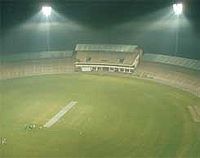
which was the lone stadium used for football and cricket matches. The inauguration of the new stadium has allowed the city to offer Test day/night matches as well as other national sports such as hockey, badminton and football. The stadium is home to the Multan Cricket Association. Other sports grounds include Divisional Sports Ground and the Pakistan Cricket Board owned Government College Cricket Ground
provides dental and surgical services to Multan and the adjoining cities.
Bahauddin Zakariya University
(formerly known as Multan University) are the main sources of higher education for this region. The Swedish Institute of Technology in Multan is a campus of the Swedish Group of Technical Institutes, the largest private-sector organization providing technical education and vocational training in the Punjab. Multan Medical and Dental College is the only private medical institution in Southern Punjab. Now more universities from federal are also open there campuses here in Multan as they are trying to make this city more educated like AIR university and NUML( National university of modern languages ) and a private institute of medical college name MMDC ( Multan medical and dental college ).
, Lodhran
and Muzaffargarh
districts through concrete roads. Buses to Bahawalpur
leave frequently, since it is located closely to the city. There are a variety of buses travelling farther from the city. Many of them are now air-conditioned with a fairly good safety record. The N-5 National Highway
connects the city to connect to all parts of Pakistan. The road otherwise, known as GT Road, allows connections to Rawalpindi
, Islamabad
, Faisalabad
, Karachi
, Lahore
as well as Bahawalpur
. Coach services such as Daewoo Express
, Faisal Movers Express, Niazi Express,Khan brothers transport, Nadir flying coach, Punjab Tourism Department, Skyways and New Khan Bus Service are some of the most reliable coach companies operating out of Multan.
Multan is connected by rail with all parts of the country and lies on the main track between Karachi
, Peshawar
, Lahore
and Quetta
. The main Peshawar-Karachi railway line passes through Multan district. The district then links trains to nearby districts of Khanewal, Lodhran and Muzafargarh districts through the railway network.
Multan International Airport
is an airport situated 10 km away from the city centre of Multan. It is not as large as the other airports in Pakistan, as it operates to cater mainly to the population of Multan, Vehari
, Khanewal
, Muzaffargarh
, Rajanpur
, Sahiwal
, and Pakpattan
to mainly to other points within Pakistan as well as the Middle East
. Flight are currently operated by the national flag carrier, Pakistan International Airlines
. However, since the growth of air travel within the region, there has been speculated interest from other private carriers. The rise in air-travel has also led to the expansion of the current airport with a new runway and terminal.
with three cities in the world :
Rome
, Italy
Konya
, Turkey
Rasht
, Iran
Banten Province, Indonesia ,Start since 11 July 2011
History of Multan
Climate of Multan
City Wall of Multan
Multan International Airport
Siege of Multan
Battle of Multan
Mausoleums of Multan
Multan Division
Multan District
Hindu temples in Multan
List of educational institutions in Multan
Mosques of Multan
Multan Museum
Multan Fort
NFC Institute of Engineering and Technological Training
Punjab (Pakistan)
Punjab is the most populous province of Pakistan, with approximately 45% of the country's total population. Forming most of the Punjab region, the province is bordered by Kashmir to the north-east, the Indian states of Punjab and Rajasthan to the east, the Pakistani province of Sindh to the...
of Pakistan
Pakistan
Pakistan , officially the Islamic Republic of Pakistan is a sovereign state in South Asia. It has a coastline along the Arabian Sea and the Gulf of Oman in the south and is bordered by Afghanistan and Iran in the west, India in the east and China in the far northeast. In the north, Tajikistan...
and capital of Multan District
Multan District
Multan District is a district in the Punjab province of Pakistan. According to the 1998 census of Pakistan it had a population of 3,116,851 of which 41.64% were urban. Its capital is the city of Multan....
. It is located in the southern part of the province on the east bank of the Chenab River
Chenab River
The Chenab River چنRiver' آب) is a major river of Jammu and Kashmir and the Punjab in Pakistan. It forms in the upper Himalayas in the Lahaul and Spiti district of Himachal Pradesh, India, and flows through the Jammu region of Jammu and Kashmir into the plains of the Punjab, Pakistan...
, more or less in the geographic centre of the country and about 562 km (349.2 mi) from Islamabad
Islamabad
Islamabad is the capital of Pakistan and the tenth largest city in the country. Located within the Islamabad Capital Territory , the population of the city has grown from 100,000 in 1951 to 1.7 million in 2011...
, 356 km (221.2 mi) from Lahore
Lahore
Lahore is the capital of the Pakistani province of Punjab and the second largest city in the country. With a rich and fabulous history dating back to over a thousand years ago, Lahore is no doubt Pakistan's cultural capital. One of the most densely populated cities in the world, Lahore remains a...
and 966 km (600.2 mi) from Karachi
Karachi
Karachi is the largest city, main seaport and the main financial centre of Pakistan, as well as the capital of the province of Sindh. The city has an estimated population of 13 to 15 million, while the total metropolitan area has a population of over 18 million...
. Multan District has a population of 3.1 million (1998).
Multan is known as the City of Sufis or City of Saints and Madinah-Tul-Oleyah due to the large number of shrines and Sufi saints from the city. The city is full of bazaar
Bazaar
A bazaar , Cypriot Greek: pantopoula) is a permanent merchandising area, marketplace, or street of shops where goods and services are exchanged or sold. The term is sometimes also used to refer to the "network of merchants, bankers and craftsmen" who work that area...
s, mosque
Mosque
A mosque is a place of worship for followers of Islam. The word is likely to have entered the English language through French , from Portuguese , from Spanish , and from Berber , ultimately originating in — . The Arabic word masjid literally means a place of prostration...
s, shrine
Shrine
A shrine is a holy or sacred place, which is dedicated to a specific deity, ancestor, hero, martyr, saint, daemon or similar figure of awe and respect, at which they are venerated or worshipped. Shrines often contain idols, relics, or other such objects associated with the figure being venerated....
s and ornate tomb
Tomb
A tomb is a repository for the remains of the dead. It is generally any structurally enclosed interment space or burial chamber, of varying sizes...
s. It is located in a bend created by five rivers of the Punjab province
Punjab (Pakistan)
Punjab is the most populous province of Pakistan, with approximately 45% of the country's total population. Forming most of the Punjab region, the province is bordered by Kashmir to the north-east, the Indian states of Punjab and Rajasthan to the east, the Pakistani province of Sindh to the...
. The Sutlej River separates it from Bahawalpur
Bahawalpur
Bahawalpur , located in the province of Punjab, is the twelfth largest city in Pakistan. The city was once the capital of the former princely state of Bahawalpur. The city was home to various Nawabs and counted as part of the Rajputana states...
and the Chenab River
Chenab River
The Chenab River چنRiver' آب) is a major river of Jammu and Kashmir and the Punjab in Pakistan. It forms in the upper Himalayas in the Lahaul and Spiti district of Himachal Pradesh, India, and flows through the Jammu region of Jammu and Kashmir into the plains of the Punjab, Pakistan...
from Muzaffar Garh. The city has grown to become an influential political and economical center for the country, with a dry port
Dry port
A dry port is an inland intermodal terminal directly connected by road or rail to a seaport and operating as a centre for the transshipment of sea cargo to inland destinations....
and excellent transport links. Multan is famous for its crops: wheat
Wheat
Wheat is a cereal grain, originally from the Levant region of the Near East, but now cultivated worldwide. In 2007 world production of wheat was 607 million tons, making it the third most-produced cereal after maize and rice...
, cotton
Cotton
Cotton is a soft, fluffy staple fiber that grows in a boll, or protective capsule, around the seeds of cotton plants of the genus Gossypium. The fiber is almost pure cellulose. The botanical purpose of cotton fiber is to aid in seed dispersal....
and sugar cane as well as mango
Mango
The mango is a fleshy stone fruit belonging to the genus Mangifera, consisting of numerous tropical fruiting trees in the flowering plant family Anacardiaceae. The mango is native to India from where it spread all over the world. It is also the most cultivated fruit of the tropical world. While...
es, citrus
Citrus
Citrus is a common term and genus of flowering plants in the rue family, Rutaceae. Citrus is believed to have originated in the part of Southeast Asia bordered by Northeastern India, Myanmar and the Yunnan province of China...
, guava
Guava
Guavas are plants in the myrtle family genus Psidium , which contains about 100 species of tropical shrubs and small trees. They are native to Mexico, Central America, and northern South America...
s and pomegranate
Pomegranate
The pomegranate , Punica granatum, is a fruit-bearing deciduous shrub or small tree growing between five and eight meters tall.Native to the area of modern day Iran, the pomegranate has been cultivated in the Caucasus since ancient times. From there it spread to Asian areas such as the Caucasus as...
s.
History
Trigarta Kingdom
Trigarta was a kingdom mentioned in the epic Mahabharata. Mahabharata mentions two different Trigarta kingdoms, one in the west close to the Sivi Kingdom and the other north to the Kuru Kingdom. Modern Kangra district is one of the ancient town in North Trigarta, India, extending westward to the...
at the time of the Mahabharata
Mahabharata
The Mahabharata is one of the two major Sanskrit epics of ancient India and Nepal, the other being the Ramayana. The epic is part of itihasa....
war, ruled by the Katoch
Katoch
Katoch is the name of a Rajput clan belonging to the Chandervanshi kshatriya lineage. Their traditional areas of residence was Trigarta Kingdom, Jalandhar, Multan i.e...
Dynasty. Multan has had various names over the years. According to Hindu mythology, it was originally called Kashtpur (Kashyapapura) after a Hindu sage named Kashyapa, which is also the Gotra
Gotra
In the Hindu society, the term Gotra broadly refers to people who are descendants in an unbroken male line from a common male ancestor. Panini defines gotra for grammatical purposes as apatyam pautraprabhrti gotram , which means "the word gotra denotes the progeny beginning with the son's son"...
used by the Katoch dynasty. Other names were Hanspur (Hamsapura), Bagpur (Vegapura), Sanb or Sanahpur (Sambapura). Its current name is derived from the Sanskrit
Sanskrit
Sanskrit , is a historical Indo-Aryan language and the primary liturgical language of Hinduism, Jainism and Buddhism.Buddhism: besides Pali, see Buddhist Hybrid Sanskrit Today, it is listed as one of the 22 scheduled languages of India and is an official language of the state of Uttarakhand...
name Mulasthana named after a sun temple. Multan has frequently been a site of conflict due to its location on a major invasion route between South Asia
South Asia
South Asia, also known as Southern Asia, is the southern region of the Asian continent, which comprises the sub-Himalayan countries and, for some authorities , also includes the adjoining countries to the west and the east...
and Central Asia
Central Asia
Central Asia is a core region of the Asian continent from the Caspian Sea in the west, China in the east, Afghanistan in the south, and Russia in the north...
. It is believed to have been visited by Alexander the Great's army. In the mid-5th century, the city was attacked by a group of Huna
Huna people
Huna is the name under which the Xionite tribes who invaded northern India during the first half of the 5th century were known.-History:...
Hephthalite
Hephthalite
The Hephthalites or Hephthalite is a pre-Islamic Greek term for local Abdali Afghans, who's famous ruler was Nazak Abdali . Hephthalites were a Central Asian nomadic confederation of the AD 5th-6th centuries whose precise origins and composition remain obscure...
nomads led by Toramana
Toramana
Toramana was a Huna ruler in India. He is known from the Rajatarangini, coins and inscriptions. In the Kura inscription his name is mentioned as Rajadhiraja Maharaja Toramana Shahi Jaula. The Eran Boar Image inscription of his first regnal year indicates that eastern Malwa was included in his...
.
Multan was conquered along with Sindh
Sindh
Sindh historically referred to as Ba'ab-ul-Islam , is one of the four provinces of Pakistan and historically is home to the Sindhi people. It is also locally known as the "Mehran". Though Muslims form the largest religious group in Sindh, a good number of Christians, Zoroastrians and Hindus can...
by Muhammad bin Qasim
Muhammad bin Qasim
Muhammad bin Qasim Al-Thaqafi was a Umayyad general who, at the age of 17, began the conquest of the Sindh and Punjab regions along the Indus River for the Umayyad Caliphate. He was born in the city of Taif...
, from the local ruler Chach of Alor
Chach of Alor
Chach is the name of the Brahmin Chamberlain and Secretary to Rai Sahasi the Second, of the Rai Dynasty who succeeded him to the throne of Sindh. The history of Chach is related in the Chach Nama as part of the history of Sind. Several places along the Sindhu river are named after the adored king...
. Following bin Qasim's conquest, the city was securely under Muslim
Muslim
A Muslim, also spelled Moslem, is an adherent of Islam, a monotheistic, Abrahamic religion based on the Quran, which Muslims consider the verbatim word of God as revealed to prophet Muhammad. "Muslim" is the Arabic term for "submitter" .Muslims believe that God is one and incomparable...
rule, although it was in effect an independent state and most of the subjects were non-Muslim.
In 965 CE, Multan was conquered by Halam b. Shayban, an Ismaili da'i. Soon after, Multan was attacked by Mahmud of Ghazni
Mahmud of Ghazni
Mahmud of Ghazni , actually ', was the most prominent ruler of the Ghaznavid dynasty who ruled from 997 until his death in 1030 in the eastern Iranian lands. Mahmud turned the former provincial city of Ghazni into the wealthy capital of an extensive empire which covered most of today's Iran,...
, destabilizing the Ismaili state. Mahmud of Ghazni
Mahmud of Ghazni
Mahmud of Ghazni , actually ', was the most prominent ruler of the Ghaznavid dynasty who ruled from 997 until his death in 1030 in the eastern Iranian lands. Mahmud turned the former provincial city of Ghazni into the wealthy capital of an extensive empire which covered most of today's Iran,...
invaded Multan in 1005 CE, conducting a series of campaigns during which the Ismailis of Multan were massacred. In an effort to gain his allegiance, the Fatimid
Fatimid
The Fatimid Islamic Caliphate or al-Fāṭimiyyūn was a Berber Shia Muslim caliphate first centered in Tunisia and later in Egypt that ruled over varying areas of the Maghreb, Sudan, Sicily, the Levant, and Hijaz from 5 January 909 to 1171.The caliphate was ruled by the Fatimids, who established the...
Ismaili
Ismaili
' is a branch of Shia Islam. It is the second largest branch of Shia Islam, after the Twelvers...
Imam-caliph al-Hakim
Al-Hakim bi-Amr Allah
Abu ‘Ali Mansur Tāriqu l-Ḥākim, called Al-Hakim bi Amr al-Lāh , was the sixth Fatimid caliph and 16th Ismaili imam .- History :...
dispatched an envoy to Mahmud two years later. This attempt appeared to be unsuccessful and the Ghaznawids continued to attack other Ismaili strongholds in Sindh
Sindh
Sindh historically referred to as Ba'ab-ul-Islam , is one of the four provinces of Pakistan and historically is home to the Sindhi people. It is also locally known as the "Mehran". Though Muslims form the largest religious group in Sindh, a good number of Christians, Zoroastrians and Hindus can...
to suppress any resurgence of the community in the region. In 1032CE Mahmud's very own vizier, Hasanak was executed for having accepted a cloak from the Imam-caliph on suspicions that he had become an adherent of the Ismaili faith. Mahmud's purges of the region led several scholars including Stern to believe that the Ghaznawid purges of the region drove out Ismailism from the area, however recently-discovered letters dating to 1083 and 1088 demonstrate continued Ismaili activity in the region, as the Imam-caliph Mustansir dispatched new da'is to replace those who were killed in the attacks.
Multan's location at the entrance to the sub-continent resulted in it being invaded by a long series of conquerors on their way to Delhi. Timur
Timur
Timur , historically known as Tamerlane in English , was a 14th-century conqueror of West, South and Central Asia, and the founder of the Timurid dynasty in Central Asia, and great-great-grandfather of Babur, the founder of the Mughal Dynasty, which survived as the Mughal Empire in India until...
, Babur
Babur
Babur was a Muslim conqueror from Central Asia who, following a series of setbacks, finally succeeded in laying the basis for the Mughal dynasty of South Asia. He was a direct descendant of Timur through his father, and a descendant also of Genghis Khan through his mother...
and many others passed through the city, leaving much destruction in their wake. This violence continued as when Muhammad of Ghor
Muhammad of Ghor
Sultan Shahāb-ud-Din Muhammad Ghori , originally called Mu'izzuddīn Muḥammad Bin Sām , was a ruler of the Ghurid dynasty who reigned over a territory spanning present-day Afghanistan, Pakistan and northern India.Shahabuddin Ghori reconquered the city of Ghazna Sultan Shahāb-ud-Din Muhammad Ghori...
attacked the city and drove out the remaining Ismailis whom he deemed to be heretics, in stark contrast to his predecessor, the Ghurid Sultan 'Ala' al-Din who welcomed numerous envoys from the Ismaili state of Alamut
Alamut
Alamut was a mountain fortress located in the South Caspian province of Daylam near the Rudbar region in Iran, approximately 100 kilometres from present-day Tehran, Iran...
and according to the historian Juzjani, gave them "great reverence"
Following annexation to Mughal empire
Mughal Empire
The Mughal Empire , or Mogul Empire in traditional English usage, was an imperial power from the Indian Subcontinent. The Mughal emperors were descendants of the Timurids...
in 1557 CE, at the beginning of emperor Akbar's rule; Multan enjoyed 200 years of peace, and became known as Dar al-Aman (Abode of Peace). Akbar was known as a wise ruler, setting reasonable taxes, creating effective government and being tolerant of religious differences.
Multan witnessed difficult times as Mughal
Mughal Empire
The Mughal Empire , or Mogul Empire in traditional English usage, was an imperial power from the Indian Subcontinent. The Mughal emperors were descendants of the Timurids...
rule declined in early 1700s, starting after death of emperor Aurangzeb
Aurangzeb
Abul Muzaffar Muhy-ud-Din Muhammad Aurangzeb Alamgir , more commonly known as Aurangzeb or by his chosen imperial title Alamgir , was the sixth Mughal Emperor of India, whose reign lasted from 1658 until his death in 1707.Badshah Aurangzeb, having ruled most of the Indian subcontinent for nearly...
in 1707. The last Naib Subahdar
Subahdar
Subahdar was one of the designations of a governor of a Subah during the Mughal era of India who was alternately designated as Sahib-i-Subah or Nazim. The word, Subahdar is of Persian origin...
s appointed by Farrukhsiyar
Farrukhsiyar
Abu'l Muzaffar Muin ud-din Muhammad Shah Farrukh-siyar Alim Akbar Sani Wala Shan Padshah-i-bahr-u-bar [Shahid-i-Mazlum] was the Mughal emperor between 1713 and 1719. Noted as a handsome but weak ruler, easily swayed by his advisers, Farukhsiyar lacked the ability and character to rule independently...
at Multan were Khan Zaman Khan Ali Asghar
Khan Zaman Khan Ali Asghar
Ali Asghar was one of the prominent Emir and nobleman during the Mughal empire. He was entitled 'Khan Zaman Khan Bahadur' by Emperor Farrukhsiyar. He remained in many important posts during the successive rules of Bahadur Shah I, Jahandar Shah, Farrukhsiyar, Rafi ud Darajat, Shah Jahan II and...
ibn Kartalab Khan Bahadur Shahi Qazi Ghulam Mustafa
Qazi Ghulam Mustafa
Qazi Ghulam Mustafa was one of the prominent noblemen during the Mughal empire. He was entitled 'Kar Talab Khan' by Bahadur Shah I...
and then Aqidat Khan ibn Ameer Khan. Persia was united under Nader Shah
Nader Shah
Nāder Shāh Afshār ruled as Shah of Iran and was the founder of the Afsharid dynasty. Because of his military genius, some historians have described him as the Napoleon of Persia or the Second Alexander...
, ruling from 1736 as Shah of Iran
Afsharid dynasty
The Afsharids were members of an Iranian dynasty of Turkmen origin from Khorasan who ruled Persia in the 18th century. The dynasty was founded in 1736 by the military commander Nader Shah who deposed the last member of the Safavid dynasty and proclaimed himself King of Iran. During Nader's reign,...
. After his assassination in 1747, Ahmad Shah Durrani
Ahmad Shah Durrani
Ahmad Shah Durrani , also known as Ahmad Shāh Abdālī and born as Ahmad Khān, was the founder of the Durrani Empire in 1747 and is regarded by many to be the founder of the modern state of Afghanistan.Ahmad Khan enlisted as a young soldier in the military of the Afsharid kingdom and quickly rose...
—who was born in Multan—rose to power. This counts as beginning of Durrani Empire
Durrani Empire
The Durrani Empire was a Pashtun dynasty centered in Afghanistan and included northeastern Iran, the Kashmir region, the modern state of Pakistan, and northwestern India. It was established at Kandahar in 1747 by Ahmad Shah Durrani, an Afghan military commander under Nader Shah of Persia and chief...
. However, after death of Ahmad Shah Durrani in 1772, the influence of Durrani empire declined sharply in mere fifty years. Starting at late in 1700s, Multan was ruled locally by the Pashtun
Pashtun people
Pashtuns or Pathans , also known as ethnic Afghans , are an Eastern Iranic ethnic group with populations primarily between the Hindu Kush mountains in Afghanistan and the Indus River in Pakistan...
Sadozai
Sadozai (Pastun tribe)
Sadozai meaning "kings" are the direct lineage of Ahmad Shah Abdali. All the notable Sadozai Durrani Afghan kings and rulers belonedg to the Sadozai tribe....
and Khogyani
Khogyani (tribe)
The Khogyani tribe is a Pashtun tribe of the Karlani or "Hill Tribes" branch. The tribe originated from the Khogyani District along the Koh-i-Safed mountain range in Nangarhar Province of Afghanistan...
aka Khakwani chieftains.
In 1817, Maharaja Ranjit Singh
Ranjit Singh
Maharaja Ranjit Singh Ji was the first Maharaja of the Sikh Empire.-Early life:...
sent a body of troops to Multan under the command of Diwan Bhiwani Das to receive from Nawab Muzaffar Khan the tribute he owed to the Sikh Darbar. Bhiwani Das laid siege to the city, but failed to capture Multan. Maharaja Ranjit Singh planned a fresh expedition and sent a strong force under his son Kharak Singh's charge.
In 1818, Kharak Singh's armies lay around Multan without making much initial headway. Maharaja Ranjit Singh sent a large cannon named Zamzama
Zamzama
The Zamzama Gun, also known as Kim’s Gun or Bhangianwala Toap is a large bore cannon. It was cast in 1757 in Lahore, now in Pakistan but at the time part of the Durrani Empire...
along with Akali Phula Singh's Nihang
Nihang
Nihang is an armed Sikh order. Early Sikh military history is dominated by the Akali Nihang military order, particularly for many famous military victories won while often heavily outnumbered. The Akali Nihang have historically been held in great affection and respect by Sikhs due the pivotal role...
regiment. Using the Zamzama destroyed the gates of the city and Akali Phula Singh defeated the garrison inside. Kharak Singh left Jodh Singh Ramgarhia
Jodh Singh Ramgarhia
Jodh Singh Ramgarhia was a prominent Sikh leader in the Punjab, the son of Jassa Singh Ramgarhia who inherited Jassa's position on his death in 1803...
with 600 men to guard the fort of Multan. The Sikhs thereafter ruled Punjab until 1849, when it was lost in the Second Anglo-Sikh War
Second Anglo-Sikh War
The Second Anglo-Sikh War took place in 1848 and 1849, between the Sikh Empire and the British East India Company. It resulted in the subjugation of the Sikh Empire, and the annexation of the Punjab and what subsequently became the North-West Frontier Province by the East India Company.-Background...
.. Sardar Karan Narain's son was awarded the title 'Rai Bahadur' and knight
Knight
A knight was a member of a class of lower nobility in the High Middle Ages.By the Late Middle Ages, the rank had become associated with the ideals of chivalry, a code of conduct for the perfect courtly Christian warrior....
ed by the British Raj
British Raj
British Raj was the British rule in the Indian subcontinent between 1858 and 1947; The term can also refer to the period of dominion...
for switching to their side. After the Anglo-Sikh Wars, Multan was made part of the British Raj. The British built some rail routes to the city, but its industrial capacity was never developed.
Multan became part of Pakistan upon Pakistan's independence in 1947.It initially lacked industry, hospitals and universities. Since then, there has been some industrial growth, and the city's population is continually growing. But the old city continues to be in a dilapidated state, and many monuments wear the effects of the warfare that has visited the city.
Geography and climate
The city of Multan is located in southern PunjabPunjab (Pakistan)
Punjab is the most populous province of Pakistan, with approximately 45% of the country's total population. Forming most of the Punjab region, the province is bordered by Kashmir to the north-east, the Indian states of Punjab and Rajasthan to the east, the Pakistani province of Sindh to the...
province at almost the exact centre of Pakistan. The closest major city is Sahiwal
Sahiwal
Sahiwal is a city in Punjab, Pakistan. It is the administrative centre of Sahiwal District and Sahiwal Division. Sahiwal is approximately 180 km from the major city Lahore and is the city between Lahore and Multan...
. The area around the city is a flat, alluvial plain and is ideal for agriculture, with many citrus
Citrus
Citrus is a common term and genus of flowering plants in the rue family, Rutaceae. Citrus is believed to have originated in the part of Southeast Asia bordered by Northeastern India, Myanmar and the Yunnan province of China...
and mango
Mango
The mango is a fleshy stone fruit belonging to the genus Mangifera, consisting of numerous tropical fruiting trees in the flowering plant family Anacardiaceae. The mango is native to India from where it spread all over the world. It is also the most cultivated fruit of the tropical world. While...
farms. There are many canals that cut across the Multan District, providing water from nearby farms. This makes the land very fertile. However usually land close to the Chenab are usually flooded in the monsoon season.
Multan features an arid climate with very hot summers and mild winters. The city witnesses some of the most extreme weather in the country. The highest recorded temperature is approximately 54 °C (129.2 °F), and the lowest recorded temperature is approximately -1 C. The average rainfall is roughly 127 millimetres (5 in). Dust storms are a common occurrence within the city.
Economy
Lahore
Lahore is the capital of the Pakistani province of Punjab and the second largest city in the country. With a rich and fabulous history dating back to over a thousand years ago, Lahore is no doubt Pakistan's cultural capital. One of the most densely populated cities in the world, Lahore remains a...
, Karachi
Karachi
Karachi is the largest city, main seaport and the main financial centre of Pakistan, as well as the capital of the province of Sindh. The city has an estimated population of 13 to 15 million, while the total metropolitan area has a population of over 18 million...
, Gujranwala
Gujranwala
Gujranwala is a industrial city in the north-east of the Punjab province. It is the sixth largest city in Pakistan with a population of approximately 2,661,360 as on 24 June 2011...
, Quetta
Quetta
is the largest city and the provincial capital of the Balochistan Province of Pakistan. Known as the "Fruit Garden of Pakistan" due to the diversity of its plant and animal wildlife, Quetta is home to the Hazarganji Chiltan National Park, which contains some of the rarest species of wildlife in the...
and Faisalabad
Faisalabad
Faisalabad , formerly known as Lyallpur, is the third largest metropolis in Pakistan, the second largest in the province of Punjab after Lahore, and a major industrial center in the heart of Pakistan. Before the foundation of the city in 1880, the area was very thinly populated. The population has...
. Industries include fertilizer, cosmetics, glass manufacturing, cotton production and processing, large textile units, flour mills, sugar and oil mills and large-scale power generation projects. It is famous for its handicrafts (carpets & ceramics) and cottage industries. Roughly 1900 acres (7.7 km²) of the city is still forested in the district. Trees grown in the area are Kikar, Shisham and Mulberry
Mulberry
Morus is a genus of flowering plants in the family Moraceae. The 10–16 species of deciduous trees it contains are commonly known as Mulberries....
.
Large, irregular suburbs have grown outside the old walled town, and two satellite towns have been set up. The mango
Mango
The mango is a fleshy stone fruit belonging to the genus Mangifera, consisting of numerous tropical fruiting trees in the flowering plant family Anacardiaceae. The mango is native to India from where it spread all over the world. It is also the most cultivated fruit of the tropical world. While...
es of Multan district are well-known. Multani khussa (traditional shoes), embroidery on dresses for women and men, furniture and other wooden products, earthenware pottery, painted pottery, camel-skin ware, surgical instruments and carpets are a few of the city's major exports, with a great demand within the country as well.
Multan is an important agricultural centre. Wheat, cotton and sugarcane are the main crops grown in the district. Moreover, rice, maize, tobacco, bajra
Pearl millet
Pearl millet is the most widely grown type of millet. Grown in Africa and the Indian subcontinent since prehistoric times, it is generally accepted that pearl millet originated in Africa and was subsequently introduced into India. The center of diversity, and suggested area of domestication, for...
, moong (lentils), mash (lentils), masoor (lentils), oil seed such as rape
Rapeseed
Rapeseed , also known as rape, oilseed rape, rapa, rappi, rapaseed is a bright yellow flowering member of the family Brassicaceae...
, mustard and sunflower are also grown in minor quantities in the district. Mangoes, citrus, guavas and pomegranate are the main fruits grown in the Multan district. Additionally, dates, jaman, pears, phalsa and bananas are grown in minor quantities in the district.
The city is also rich in minerals. These include argillaceous clay
Clay
Clay is a general term including many combinations of one or more clay minerals with traces of metal oxides and organic matter. Geologic clay deposits are mostly composed of phyllosilicate minerals containing variable amounts of water trapped in the mineral structure.- Formation :Clay minerals...
, coal
Coal
Coal is a combustible black or brownish-black sedimentary rock usually occurring in rock strata in layers or veins called coal beds or coal seams. The harder forms, such as anthracite coal, can be regarded as metamorphic rock because of later exposure to elevated temperature and pressure...
, dolomite
Dolomite
Dolomite is a carbonate mineral composed of calcium magnesium carbonate CaMg2. The term is also used to describe the sedimentary carbonate rock dolostone....
, fire clay
Fire clay
Fire clay is a term applied to a range of refractory clays used in the manufacture of ceramics, especially fire brick.High grade fire clays can withstand temperatures of 1775°C , but to be referred to as a "fire clay" the material must withstand a minimum temperature of 1515°C...
, gypsum
Gypsum
Gypsum is a very soft sulfate mineral composed of calcium sulfate dihydrate, with the chemical formula CaSO4·2H2O. It is found in alabaster, a decorative stone used in Ancient Egypt. It is the second softest mineral on the Mohs Hardness Scale...
, limestone
Limestone
Limestone is a sedimentary rock composed largely of the minerals calcite and aragonite, which are different crystal forms of calcium carbonate . Many limestones are composed from skeletal fragments of marine organisms such as coral or foraminifera....
, silica and rock salt. Most of these are excavated for commercial activities and transported to other cities within the country. Many industrial factories are being inaugurated to handle the separation and quality control of these minerals. The minerals in the city are used in dolomite processing, fire brick
Fire brick
A fire brick, firebrick, or refractory brick is a block of refractory ceramic material used in lining furnaces, kilns, fireboxes, and fireplaces. A refractory brick is built primarily to withstand high temperature, but will also usually have a low thermal conductivity for greater energy efficiency...
s/refractories, hollow glassware
Glassware
This list of glassware includes drinking vessels , tableware, such as dishes, and flatware used to set a table for eating a meal, general glass items such as vases, and glasses used in the catering industry whether made of glass or plastics such as polystyrene and...
, insulators/capacitor
Capacitor
A capacitor is a passive two-terminal electrical component used to store energy in an electric field. The forms of practical capacitors vary widely, but all contain at least two electrical conductors separated by a dielectric ; for example, one common construction consists of metal foils separated...
s and ceramics.
Since Multan is agriculture-based, there is also plenty of livestock still growing at a positive rate, which has led to milk processing/dairy products units, ice cream manufacturing, animal and poultry feed, dairy farms, cattle/sheep/goat fattening plants, meat/poultry processing units, leather garments manufacturing, leather footwear, cosmetics, tinned goods and pharmaceuticals.
Government
Since the introduction of the local government system in 2001 the city has been governed by a NazimNazim
A nazim is the coordinator of cities and towns in Pakistan. Nazim is the title in Urdu of the chief elected official of a local government in Pakistan, such as a district, tehsil, union council, or village council....
(Mayor). Multan is spread over an area of 3,721 square kilometers, comprising four tehsils: Multan Cantonment, Multan Sadar, Shujabad and Jalalpur Pirwala. In 2005 Multan was reorganised as a City District
City Districts of Pakistan
A City District in Pakistan is a district that consists primarily or entirely of a major city or large metropolitan area. While there are 117 Districts, there are only ten City Districts...
composed of six autonomous towns:
- BosanBosanBosan is a town in Multan District, Pakistan. It is an agricultural area known for mango and orange production, and is one of the largest mango producers in Pakistan. Boson Town is also famous for its rich livestock. Most of the people here have adopted livestock as their livelihood...
- Shah Rukan e Alam
- MumtazabadMumtazabadMumtazabad is one of the oldest yet well-planned housing areas of Multan in the Punjab province of Pakistan. It is located at 30°10'30N 71°29'30E and lies in the east of Multan....
- Sher ShahSher Shah (Town)Sher Shah is a town in Multan District in the Punjab province of Pakistan.-Location:It is located at 30°4'0N 71°1'0E. The town is famous because of renowned saint syed Sher Shah....
- ShujabadShujabadShujabad is the oldest tehsil of Multan District in the Punjab province of Pakistan. It is located about 45 km in south from Multan. Chenab River is situated in the west of city. Neighbouring settlements include Jalalpur Pirwala, Multan and Lodhran. Its population is about 600,000 .Shujabad is...
- JalalpurJalalpurJalalpur is a city and a municipal board in Ambedkar Nagar district in the Indian state of Uttar Pradesh.-Geography:Jalalpur is located at . It has an average elevation of 118 metres ....
- Multan CantonmentMultan CantonmentMultan Cantonment is a cantonment adjacent to Multan in Punjab province, Pakistan....
Demographics
Punjabi language
Punjabi is an Indo-Aryan language spoken by inhabitants of the historical Punjab region . For Sikhs, the Punjabi language stands as the official language in which all ceremonies take place. In Pakistan, Punjabi is the most widely spoken language...
, while Haryanvi, a dialect of Urdu is the second most spoken language. Almost all the population speaks and understand Urdu. English
English language
English is a West Germanic language that arose in the Anglo-Saxon kingdoms of England and spread into what was to become south-east Scotland under the influence of the Anglian medieval kingdom of Northumbria...
is only understood by the educated. The majority of the people are Muslim
Muslim
A Muslim, also spelled Moslem, is an adherent of Islam, a monotheistic, Abrahamic religion based on the Quran, which Muslims consider the verbatim word of God as revealed to prophet Muhammad. "Muslim" is the Arabic term for "submitter" .Muslims believe that God is one and incomparable...
s. However, the city does have significant Sikh and Hindu communities within the district. There are some temples and Gurdwaras within the city.
Multan has traditionally been a melting pot of several distinct ethnic groups due to its location at the intersection of all four of Pakistan's main provinces and due to its historical significance as a centre of learning and culture. As a result, Multan today consists of Saraiki
Saraiki people
The Saraiki people or Multani people are an ethnic group from the central and south-eastern areas of Pakistan, especially the former princely state of Bahawalpur and the districts of Multan, Lodhran, Vehari, Khanewal, Rahim Yar Khan, Rajanpur, Dera Ghazi Khan, Muzaffargarh,...
, Haryanvi, Punjabi
Punjabi people
The Punjabi people , ਪੰਜਾਬੀ ), also Panjabi people, are an Indo-Aryan group from South Asia. They are the second largest of the many ethnic groups in South Asia. They originate in the Punjab region, which has been been the location of some of the oldest civilizations in the world including, the...
, Baloch
Baloch people
The Baloch or Baluch are an ethnic group that belong to the larger Iranian peoples. Baluch people mainly inhabit the Balochistan region and Sistan and Baluchestan Province in the southeast corner of the Iranian plateau in Western Asia....
, Pashtun
Pashtun people
Pashtuns or Pathans , also known as ethnic Afghans , are an Eastern Iranic ethnic group with populations primarily between the Hindu Kush mountains in Afghanistan and the Indus River in Pakistan...
, Sindhi
Sindhi people
Sindhis are a Sindhi speaking socio-ethnic group of people originating from Sindh, a province Formerly of British India, now in Pakistan. Today Sindhis that live in Pakistan belong to various religious denominations including Islam, Zoroastrianism, Hinduism, Sikhism and Christianity...
, and Urdu speaking people.
As per the 1998 census of Pakistan, the following are the demographics of the district, by spoken language:
- SaraikiSaraiki languageSaraiki , transliterated as Sirāikī and sometimes spelled Seraiki and Saraiki, is a standardized written language of Pakistan belonging to the Indo-Aryan languages. It is a language spoken in the heart of Pakistan...
(Multani): 76.6% - Haryanvi (a dialect of Urdu): 16.11% (11.01% in the city)
- PunjabiPunjabi languagePunjabi is an Indo-Aryan language spoken by inhabitants of the historical Punjab region . For Sikhs, the Punjabi language stands as the official language in which all ceremonies take place. In Pakistan, Punjabi is the most widely spoken language...
: 5.86% (6.64% in the city) - Pashto: 0.62%
- BalochiBalochi languageBalochi is a Northwestern Iranian language. It is the principal language of the Baloch of Balochistan, Pakistan, eastern Iran and southern Afghanistan. It is also spoken as a second language by some Brahui. It is designated as one of nine official languages of Pakistan.-Vowels:The Balochi vowel...
: 0.10% - Other: 1.04%
Culture
Sufism
Sufism or ' is defined by its adherents as the inner, mystical dimension of Islam. A practitioner of this tradition is generally known as a '...
, the mystical side of Islam
Islam
Islam . The most common are and . : Arabic pronunciation varies regionally. The first vowel ranges from ~~. The second vowel ranges from ~~~...
. The city has attracted Sufi saints from far places of the globe. Today, Multan is known as the 'City of Sufis'. His HighnessShaikh Amin bin Abdul Rehman, who has introduced the Idrisiyya
Idrisiyya
The Idrisiyya is a Sufi order founded by Ahmad Ibn Idris al-Fasi . Its adherents are widespread throughout North Africa, from where it has spread to Saudi Arabia and Southeast Asia. A branch of this order was introduced in Singapore by the followers of Shaikh Muhammad Said al-Linggi...
sufi order in Pakistan, lives at 381-A, Shah Rukn-e-Alam Colony, New Multan, where a four-storey mosque adjacent to his residence is visited by people from all over the world. Multan is one of the oldest cities in South Asia, with many tombs, shrines, temples, cathedrals and mausoleums, as well as a historical fort
Multan Fort
The Multan Fort, a Pakistani military installation, was a landmark of Indian defence and architecture. It was built near the city of Multan, in Punjab province, on a hillock separated from the city by the Ravi River...
. Today Multan is a combination of old and the new Pakistan culture. There is a big hustle bustle in the old city and comfort of a five star hotel and fine dining in the new. The old city has a various bazaars selling mystical artifacts, perfumes to arts and crafts. There are also elaborately decorated shrines of the Sufi saints, tombs of various travellers and important people within the old city of Multan.
The prime attractions of Multan are its mausoleums
Mausoleums of Multan
There are various Mausoleums of Multan due to Multan's rich heritage of pirs and saints, the city also has many mausoleums and shrines. Here are some of the best-known mausoleums that can still be visited today.-Mausoleum of Hazrat Baha-ud-Din Zakaria:...
of Sufi saints. The Mausoleum of Sheikh Baha-ud-Din Zakariya
Baha-ud-din Zakariya
Baha-ud-din Zakariya was a Sufi of Suhrawardiyya order . His full name was Al-Sheikh Al-Kabir Sheikh-ul-Islam Baha-ud-Din Abu Muhammad Zakaria Al-Qureshi Al-Asadi Al Hashmi....
, as well as the Mausoleum of Shah Rukn-e-Alam
Rukn-e-Alam
Sheikh Rukn-ud-Din Abul Fath commonly known by the title Rukn-e-Alam commonly called Shah Rukne Alam was among the eminent Sufi saints from Multan, Pakistan....
are the prime attractions of the city. Their lofty domes of are visible, from miles and dominate the skyline of Multan. Another popular shrine is the Mausoleum of Shams-ud-Din, commonly known as Shah Shamsuddin Sabzwari is located about half a mile to the east of the Multan Fort
Multan Fort
The Multan Fort, a Pakistani military installation, was a landmark of Indian defence and architecture. It was built near the city of Multan, in Punjab province, on a hillock separated from the city by the Ravi River...
, on the high bank of the old bed of the Ravi River
Ravi River
The Ravi is a trans-boundary river flowing through Northwestern India and eastern Pakistan. It is one of the six rivers of the Indus System in Punjab region ....
.
Another famous and beautiful mausoleum of a warrior sufi saint and poet Hazrat Hafiz Muhammad Jamal Multani (1747-1811 AD) is situated near Aam Khas garden outside Daulat Gate, Multan.
There are also a number of other mausoleums located within the city which gather a great deal of attention. The Nuagaza tombs are shrines to martyrs and warriors who fought in wars centuries ago, some dating back 1,300 years ago. The Multan Museum
Multan Museum
The Multan Museum located in the city of Multan, Punjab, Pakistan contains a fine collection of coins, medals, postage stamps of the former State of Bahawalpur, manuscripts, documented inscriptions, wood carvings, camel-skin paintings, historical models and stone carvings of the Islamic and...
located within the city has a vast collection of coins, medals, postage stamps of the former State of Bahawalpur, manuscripts, documented inscriptions, wood carvings, camel-skin paintings, historical models and stone carvings of the Islamic and Pre-Islamic periods.
Multan also has a number of old mosques
Mosques of Multan
Multan, Pakistan has some of the oldest mosques, which were once considered as the jewels of the city. These mosques now remind us of the glorious past of Multan, which was governed by Muslims for more than a thousand years. Among the more famous ones are:...
which were once considered as the jewels of the city. Some have been dated back to over a thousand years ago and have been recognized as some of the oldest mosques within South East Asia. The legend goes that the first mosque ever built in Multan was the Jamia Mosque which was constructed on the orders of General Mohammed Qasim, who conquered Multan in 712AD. Ruins of this mosque were visible till 1954 at Qasim Bella; however, due to repeated floods, the structure was lost. Sawi Mosque is supposed to be the oldest mosque which still exists today, though in deteriorating state; there are glazed blue tiles from the era in which it was built which dates the mosque to several centuries ago. The second oldest mosque within Multan is Mohammad Khan Wali Mosque. It is an excellent condition, situated in the busiest Chowck Bazar of the city. It was built by Nawab Ali Mohammad Khan Khakwani, in 1757 when he was the governor of Multan in the time of Alamgir II
Alamgir II
Aziz-ud-din Alamgir II was the Mughal Emperor of India from 3 June 1754 to 29 November 1759. He was the son of Jahandar Shah....
. The mosque is provided with a reservoir for the ablutions, baths, and a large hall for prayers.
Multan is another Pakistani city that loves cricket. Multan is home of the Faysal Bank T20 League team Multan Tigers
Multan Tigers
The Multan Tigers are a Twenty-20 Cup team based in Multan, Punjab, Pakistan. The team was established in 2004 and its home ground is the Multan Cricket Stadium. The team is one of several proposed franchises for the Pakistan Super League...
. The city government inaugurated a new multi-purpose stadium
Multan Cricket Stadium
Multan Cricket Stadium is a multi-purpose stadium in Multan, Punjab, Pakistan. The stadium is located off Vehari Road, in the suburbs of Multan. Having such a lush green outfield and playing area, the stadium is the most beautiful in the country at the moment. It is primarily used for cricket...
replacing Ibn-e-Qasim Bagh Stadium
Ibn-e-Qasim Bagh Stadium
The Ibn-e-Qasim Bagh Stadium, originally known as the Old Fort Stadium, is a multi-use stadium in Multan, Pakistan. It is currently used mostly for cricket and football. It hosted one Test Match in 1980. The stadium holds 18,000 and opened in 1975....
which was the lone stadium used for football and cricket matches. The inauguration of the new stadium has allowed the city to offer Test day/night matches as well as other national sports such as hockey, badminton and football. The stadium is home to the Multan Cricket Association. Other sports grounds include Divisional Sports Ground and the Pakistan Cricket Board owned Government College Cricket Ground
Education
In 1950, then-Governor Abdur Rub Nishtar founded Nishter Medical College. Doctor graduates of this institution have spread across the world, and many have become established names in the field of medicine. The new Nishtar Institute of DentistryNishtar Institute of Dentistry
Nishtar Institute of Dentistry is a dental school located in Multan, Punjab, Pakistan. It is named in affiliation with Nishtar Medical College.The majority of the degrees it awards are and . Nishtar Institute of Dentistry has a very rich heritage of academic and clinical excellence...
provides dental and surgical services to Multan and the adjoining cities.
Bahauddin Zakariya University
Bahauddin Zakariya University
Bahauddin Zakariya University is located in Multan, Punjab, Pakistan. It is the Largest university of South Punjab. Bahauddin Zakariya University was formerly known as Multan University. It was renamed in honor of Hazrat Baha-ud-din Zakariya...
(formerly known as Multan University) are the main sources of higher education for this region. The Swedish Institute of Technology in Multan is a campus of the Swedish Group of Technical Institutes, the largest private-sector organization providing technical education and vocational training in the Punjab. Multan Medical and Dental College is the only private medical institution in Southern Punjab. Now more universities from federal are also open there campuses here in Multan as they are trying to make this city more educated like AIR university and NUML( National university of modern languages ) and a private institute of medical college name MMDC ( Multan medical and dental college ).
Transportation
Multan has connections with other cities by a variety of means of transportation. The district has concrete road reaching up to 983.69 km. The district is linked with KhanewalKhanewal
Khanewal is the capital city of Khanewal District in the Punjab province of Pakistan. It is notable for being the host city to the second largest train station in Pakistan. Khanewal is located at 30°18'0N 71°56'0E with an altitude of 128 metres and is named after the earliest settlers here who...
, Lodhran
Lodhran
Lodhran is the chief city of Lodhran District in the Punjab province of Pakistan. It is located on the northern side of River Sutlej.-Administration:...
and Muzaffargarh
Muzaffargarh
Muzaffargarh is a city in southwestern Punjab, Pakistan, located on the bank of the Chenab River. The Town of Muzaffargarh was founded in 1794 by the Governor of Mulran Nawab Muzaffar Khan.The Meaning of Muzaffargarh is "Fort of Muzaffar" because the old town lies inside the walls of a fort built...
districts through concrete roads. Buses to Bahawalpur
Bahawalpur
Bahawalpur , located in the province of Punjab, is the twelfth largest city in Pakistan. The city was once the capital of the former princely state of Bahawalpur. The city was home to various Nawabs and counted as part of the Rajputana states...
leave frequently, since it is located closely to the city. There are a variety of buses travelling farther from the city. Many of them are now air-conditioned with a fairly good safety record. The N-5 National Highway
N-5 National Highway
The National Highway 05 or the N-5 is Pakistan's longest highway running from the port city of Karachi to the border crossing at Torkham...
connects the city to connect to all parts of Pakistan. The road otherwise, known as GT Road, allows connections to Rawalpindi
Rawalpindi
Rawalpindi , locally known as Pindi, is a city in the Pothohar region of Pakistan near Pakistan's capital city of Islamabad, in the province of Punjab. Rawalpindi is the fourth largest city in Pakistan after Karachi, Lahore and Faisalabad...
, Islamabad
Islamabad
Islamabad is the capital of Pakistan and the tenth largest city in the country. Located within the Islamabad Capital Territory , the population of the city has grown from 100,000 in 1951 to 1.7 million in 2011...
, Faisalabad
Faisalabad
Faisalabad , formerly known as Lyallpur, is the third largest metropolis in Pakistan, the second largest in the province of Punjab after Lahore, and a major industrial center in the heart of Pakistan. Before the foundation of the city in 1880, the area was very thinly populated. The population has...
, Karachi
Karachi
Karachi is the largest city, main seaport and the main financial centre of Pakistan, as well as the capital of the province of Sindh. The city has an estimated population of 13 to 15 million, while the total metropolitan area has a population of over 18 million...
, Lahore
Lahore
Lahore is the capital of the Pakistani province of Punjab and the second largest city in the country. With a rich and fabulous history dating back to over a thousand years ago, Lahore is no doubt Pakistan's cultural capital. One of the most densely populated cities in the world, Lahore remains a...
as well as Bahawalpur
Bahawalpur
Bahawalpur , located in the province of Punjab, is the twelfth largest city in Pakistan. The city was once the capital of the former princely state of Bahawalpur. The city was home to various Nawabs and counted as part of the Rajputana states...
. Coach services such as Daewoo Express
Daewoo Express
Daewoo Express or Sammi Daewoo Express is an inter-city common carrier of passengers by bus serving over 30 destinations in Pakistan and is headquartered in Lahore. It is operated by a Korean company, Sammi...
, Faisal Movers Express, Niazi Express,Khan brothers transport, Nadir flying coach, Punjab Tourism Department, Skyways and New Khan Bus Service are some of the most reliable coach companies operating out of Multan.
Multan is connected by rail with all parts of the country and lies on the main track between Karachi
Karachi
Karachi is the largest city, main seaport and the main financial centre of Pakistan, as well as the capital of the province of Sindh. The city has an estimated population of 13 to 15 million, while the total metropolitan area has a population of over 18 million...
, Peshawar
Peshawar
Peshawar is the capital of Khyber-Pakhtunkhwa and the administrative center and central economic hub for the Federally Administered Tribal Areas of Pakistan....
, Lahore
Lahore
Lahore is the capital of the Pakistani province of Punjab and the second largest city in the country. With a rich and fabulous history dating back to over a thousand years ago, Lahore is no doubt Pakistan's cultural capital. One of the most densely populated cities in the world, Lahore remains a...
and Quetta
Quetta
is the largest city and the provincial capital of the Balochistan Province of Pakistan. Known as the "Fruit Garden of Pakistan" due to the diversity of its plant and animal wildlife, Quetta is home to the Hazarganji Chiltan National Park, which contains some of the rarest species of wildlife in the...
. The main Peshawar-Karachi railway line passes through Multan district. The district then links trains to nearby districts of Khanewal, Lodhran and Muzafargarh districts through the railway network.
Multan International Airport
Multan International Airport
Muhammad Bin Qasim International Airport is an airport situated 10 km away from the city centre of Multan in Punjab, Pakistan. It is not as large as the other airports in Pakistan, as it operates to cater mainly to the population of Multan, Vehari, Khanewal, Muzaffargarh, Rajanpur, Sahiwal,...
is an airport situated 10 km away from the city centre of Multan. It is not as large as the other airports in Pakistan, as it operates to cater mainly to the population of Multan, Vehari
Vehari
Vehari is a city in the Punjab province in Pakistan. The city, which is the capital of the district and tehsil of the same name, is located at 30°1'0N 72°21'0E at an altitude of 135m , lies about from the regional metropolis of Multan and about north of the river Sutlej - the southernmost of...
, Khanewal
Khanewal
Khanewal is the capital city of Khanewal District in the Punjab province of Pakistan. It is notable for being the host city to the second largest train station in Pakistan. Khanewal is located at 30°18'0N 71°56'0E with an altitude of 128 metres and is named after the earliest settlers here who...
, Muzaffargarh
Muzaffargarh
Muzaffargarh is a city in southwestern Punjab, Pakistan, located on the bank of the Chenab River. The Town of Muzaffargarh was founded in 1794 by the Governor of Mulran Nawab Muzaffar Khan.The Meaning of Muzaffargarh is "Fort of Muzaffar" because the old town lies inside the walls of a fort built...
, Rajanpur
Rajanpur
Rajanpur is a city and the headquarters of Rajanpur District in the far southwestern part of Punjab, Pakistan. The district lies entirely west of the Indus River. it is a narrow, to wide strip of land sandwiched between the Indus River on the east and the Sulaiman Mountains on the west. The...
, Sahiwal
Sahiwal
Sahiwal is a city in Punjab, Pakistan. It is the administrative centre of Sahiwal District and Sahiwal Division. Sahiwal is approximately 180 km from the major city Lahore and is the city between Lahore and Multan...
, and Pakpattan
Pakpattan
Pakpattan is the capital city of the Pakpattan District in the Sahiwal Division in the Punjab province of Pakistan. Pakpattan is one of the ancient cities of Pakistan. It is the city that has the shrine of the well-known Sufi of all times, Baba Fareed...
to mainly to other points within Pakistan as well as the Middle East
Middle East
The Middle East is a region that encompasses Western Asia and Northern Africa. It is often used as a synonym for Near East, in opposition to Far East...
. Flight are currently operated by the national flag carrier, Pakistan International Airlines
Pakistan International Airlines
Pakistan International Airlines Corporation commonly known as PIA, is the flag carrier airline of Pakistan. The airline has its head office on the grounds of Jinnah International Airport in Karachi. and operates scheduled services to 24 domestic destinations and 38 international destinations in 27...
. However, since the growth of air travel within the region, there has been speculated interest from other private carriers. The rise in air-travel has also led to the expansion of the current airport with a new runway and terminal.
Famous Saints of Multan
- Bahauddin Zikarya tomb loacted in Multan FortMultan FortThe Multan Fort, a Pakistani military installation, was a landmark of Indian defence and architecture. It was built near the city of Multan, in Punjab province, on a hillock separated from the city by the Ravi River...
- Syed Ata Ullah Shah BukhariSyed Ata Ullah Shah BukhariSyed Ata Ullah Shah Bukhari , was an Indian Muslim scholar, religious and senior political leader from the Indian subcontinent. He was one of the Majlis-e-Ahrar-e-Islam's founding members...
(burried in Jalal bakri) - Shah Rukne AlamRukn-e-AlamSheikh Rukn-ud-Din Abul Fath commonly known by the title Rukn-e-Alam commonly called Shah Rukne Alam was among the eminent Sufi saints from Multan, Pakistan....
tomb loacted in Multan FortMultan FortThe Multan Fort, a Pakistani military installation, was a landmark of Indian defence and architecture. It was built near the city of Multan, in Punjab province, on a hillock separated from the city by the Ravi River... - Shah Yousaf Gardezi tomb loacted inner Bohar Gate MultanMultanMultan , is a city in the Punjab Province of Pakistan and capital of Multan District. It is located in the southern part of the province on the east bank of the Chenab River, more or less in the geographic centre of the country and about from Islamabad, from Lahore and from Karachi...
- Mouj Darya
- Mai MaharbanMai MaharbanMai Maharban is one of female saints of Multan who is famous for her pious nature and she was the wife of one Shaikh Hasan who is said to have come to Multan shortly after the time of Shah Gardez.-Mausoleum of Mai Maharban:...
tomb loacted near chowk fawara, children complex MultanMultanMultan , is a city in the Punjab Province of Pakistan and capital of Multan District. It is located in the southern part of the province on the east bank of the Chenab River, more or less in the geographic centre of the country and about from Islamabad, from Lahore and from Karachi... - Hafiz Jamal tomb loacted on Hafiz Jamal road MultanMultanMultan , is a city in the Punjab Province of Pakistan and capital of Multan District. It is located in the southern part of the province on the east bank of the Chenab River, more or less in the geographic centre of the country and about from Islamabad, from Lahore and from Karachi...
- Shah Shams Sabzwari tomb loacted on Baba Safra road MultanMultanMultan , is a city in the Punjab Province of Pakistan and capital of Multan District. It is located in the southern part of the province on the east bank of the Chenab River, more or less in the geographic centre of the country and about from Islamabad, from Lahore and from Karachi...
- Khawaja Awais KaghaKhawaja Awais KaghaKhawaja Awais Kagha is a sufi saint of Multan-History:The full name of the saint is Khawaja Shah Jalalud Din Muhammad Awais Jaafri Quraishi Hashmi Khagga. His father’s name is given as Bayazidai. He was a disciple of Shaikh Muhammad Iraqi a saint of Awaisi chain of Sufis. He is believed to have...
tomb loacted in Dera Basti graveyard MultanMultanMultan , is a city in the Punjab Province of Pakistan and capital of Multan District. It is located in the southern part of the province on the east bank of the Chenab River, more or less in the geographic centre of the country and about from Islamabad, from Lahore and from Karachi... - Shah Ali Akbar tomb loacted in Suraj Miani MultanMultanMultan , is a city in the Punjab Province of Pakistan and capital of Multan District. It is located in the southern part of the province on the east bank of the Chenab River, more or less in the geographic centre of the country and about from Islamabad, from Lahore and from Karachi...
- Mother of Shah Ali Akbar tomb loacted in Suraj Miani MultanMultanMultan , is a city in the Punjab Province of Pakistan and capital of Multan District. It is located in the southern part of the province on the east bank of the Chenab River, more or less in the geographic centre of the country and about from Islamabad, from Lahore and from Karachi...
- Inayat Wilayat tomb loacted inside Haram Gate MultanMultanMultan , is a city in the Punjab Province of Pakistan and capital of Multan District. It is located in the southern part of the province on the east bank of the Chenab River, more or less in the geographic centre of the country and about from Islamabad, from Lahore and from Karachi...
- Musa Pak Shaheed
- Shah Dana
- Banga Daler
- Sher ShahSher ShahSher Shah may refer to:* Sher Shah Suri , founder of the Suri dynasty* Sher Shah , neighbourhood of Kiamari Town, Karachi, Pakistan* Sher Shah , town in Multan District, Pakistan...
tomb loacted in Sher Shah town of MultanMultanMultan , is a city in the Punjab Province of Pakistan and capital of Multan District. It is located in the southern part of the province on the east bank of the Chenab River, more or less in the geographic centre of the country and about from Islamabad, from Lahore and from Karachi...
city
Notable people from Multan
- Ahmad Shah DurraniAhmad Shah DurraniAhmad Shah Durrani , also known as Ahmad Shāh Abdālī and born as Ahmad Khān, was the founder of the Durrani Empire in 1747 and is regarded by many to be the founder of the modern state of Afghanistan.Ahmad Khan enlisted as a young soldier in the military of the Afsharid kingdom and quickly rose...
, founder and first king of AfghanistanAfghanistanAfghanistan , officially the Islamic Republic of Afghanistan, is a landlocked country located in the centre of Asia, forming South Asia, Central Asia and the Middle East. With a population of about 29 million, it has an area of , making it the 42nd most populous and 41st largest nation in the world... - Syed Ata Ullah Shah BukhariSyed Ata Ullah Shah BukhariSyed Ata Ullah Shah Bukhari , was an Indian Muslim scholar, religious and senior political leader from the Indian subcontinent. He was one of the Majlis-e-Ahrar-e-Islam's founding members...
(Founder of Majlis-e-Ahrar-e-Islam , Died in Multan) - Amjad Islam AmjadAmjad Islam AmjadAmjad Islam Amjad, PP, SI is a famous Urdu poet, drama writer and lyricist from Pakistan.-Life and career:...
, poet and drama writer, born in Multan - Inzamam-ul-HaqInzamam-ul-HaqInzamam-ul-Haq , also known as Inzamam, nicknamed Inzy, is a former Pakistan international cricketer who was national captain between 2003 and 2007. He is a right-handed batsman who has been regarded as one of the greatest batsmen of his era...
, Pakistani cricketer - Javed HashmiJaved HashmiMakhdoom Muhammad Javed Hashmi is a Pakistani political scientist, geostrategist, statesman, and the central public figure of the PML...
of PML-N, first MNA, elected eight times - Jinnahbhai Poonja, father of Quaid-E-Azam Muhammad Ali JinnahMuhammad Ali JinnahMuhammad Ali Jinnah was a Muslim lawyer, politician, statesman and the founder of Pakistan. He is popularly and officially known in Pakistan as Quaid-e-Azam and Baba-e-Qaum ....
, born in Multan - Nawab Ali Mohammad Khan KhakwaniNawab Ali Mohammad Khan KhakwaniNawab Ali Mohammad Khan belonged to the Mohsin zai clan of the Khogiani tribe. He was given the title of Nawab by Ahmad Shah Durrani because with his help Multan became the part of Durrani Empire. He was appointed as the governor of Multan for his services...
- Sadiq Hussain QureshiSadiq Hussain QureshiNawab Sadiq Hussain Qureshi was a Pakistani politician who served as both Governor and Chief Minister of Punjab under Zulfikar Ali Bhutto in the 1970s. A close aid of Mr...
of Pakistan Peoples PartyPakistan Peoples PartyThe Pakistan Peoples Party , is a democratic socialist political party in Pakistan affiliated with Socialist International. Pakistan People's Party is the largest political party of Pakistan...
, former Governor and Chief Minister of Punjab - Sahibzada Farooq AliSahibzada Farooq AliSahibzada Farooq Ali was the ninth Speaker of National Assembly of Pakistan. He was elected from the city of Multan. He belonged to Toor Tribe and was originally from village wayanwali near Ghakhar Mandi, Teh Wazirabad.-Career:...
, former Speaker of the National Assembly of PakistanNational Assembly of PakistanThe National Assembly of Pakistan is the lower house of the bicameral Majlis-e-Shura, which also compromises the President of Pakistan and Senate . The National Assembly and the Senate both convene at Parliament House in Islamabad... - Shah Mehmood QureshiShah Mehmood QureshiMakhdoom Shah Mehmood Hussain Qureshi is well-known Politician in Pakistan. He was the Foreign Minister of Pakistan in the coalition government of PPP, Muttahida Quami Movement[MQM], ANP and JUI-F formed after the 2008 general elections. He was a senior leader of Pakistan Peoples Party, where...
, Foreign Minister of PakistanForeign Minister of PakistanThe Foreign Minister of Pakistan heads the Ministry of Foreign Affairs. The current Foreign Minister is Hina Rabbani Khar who took office as Minister of State for Foreign Affairs on 11 February 2011, and as full Minister of Foreign Affairs on 20 July, 2011... - Sheikh Muhammad Tahir RasheedSheikh Muhammad Tahir RasheedSheikh Muhammad Tahir Rasheed, also known as Tahir Rashid, , is a Pakistani politician who is affiliated with Pakistan Tehreek-e-Insaf. He was previously Member of National Assembly of Pakistan and Member of Provincial Assembly...
, Central Vice President of the Pakistan Muslim LeaguePakistan Muslim LeagueThe Pakistan Muslim League was founded in 1962, as a successor to the previously disbanded Muslim League in Pakistan. Unlike the original PML which ended in 1958 when General Ayub Khan banned all political parties, each subsequent Muslim League was in some way propped by the military dictators of... - Yousaf Raza GillaniYousaf Raza GillaniYousuf Raza Gilani is the current prime minister of Islamic Republic of Pakistan. He was nominated as Prime Minister by the PPP, with the support of its coalition partners, Pakistan Muslim League , Awami National Party, Jamiat Ulema-e-Islam and Muttahida Qaumi Movement, on 22 March 2008...
, 26th Prime Minister of PakistanPrime Minister of PakistanThe Prime Minister of Pakistan , is the Head of Government of Pakistan who is designated to exercise as the country's Chief Executive. By the Constitution of Pakistan, Pakistan has the parliamentary democratic system of government... - Mirza Aziz Akbar BaigMirza Aziz Akbar BaigMirza Aziz Akbar Baig was born on 6 November 1938 in Multan, Pakistan. He is a lawyer of the Supreme Court of Pakistan.-Education:He graduated in 1960 from Government Emerson College, Multan...
, Former Vice Chairman of Pakistan Bar CouncilPakistan Bar CouncilPakistan Bar Council was established by the Parliament in 1973 under the Legal Practitioners and Bar Councils Act. It is the highest elected body of lawyers. it has twenty members elected throughout the country representing each province. The Members of the Pakistan Bar Council are elected on the... - Hina Rabbani KharHina Rabbani KharHina Rabbani Khar is a Pakistani politician and the current Foreign Minister of Pakistan. Appointed in July of 2011, she is the first female and the youngest person to ever head Pakistani's Ministry of Foreign Affairs....
foreign Minister of Pakistan since 19 July, 2011 - Professor Mukhtar Ali Khan Ex Principal Govt College descendant Nawab of Jhajjar
Twin cities
Multan has a friendship agreementTown twinning
Twin towns and sister cities are two of many terms used to describe the cooperative agreements between towns, cities, and even counties in geographically and politically distinct areas to promote cultural and commercial ties.- Terminology :...
with three cities in the world :
Rome
Rome
Rome is the capital of Italy and the country's largest and most populated city and comune, with over 2.7 million residents in . The city is located in the central-western portion of the Italian Peninsula, on the Tiber River within the Lazio region of Italy.Rome's history spans two and a half...
, Italy
Italy
Italy , officially the Italian Republic languages]] under the European Charter for Regional or Minority Languages. In each of these, Italy's official name is as follows:;;;;;;;;), is a unitary parliamentary republic in South-Central Europe. To the north it borders France, Switzerland, Austria and...
Konya
Konya
Konya is a city in the Central Anatolia Region of Turkey. The metropolitan area in the entire Konya Province had a population of 1,036,027 as of 2010, making the city seventh most populous in Turkey.-Etymology:...
, Turkey
Turkey
Turkey , known officially as the Republic of Turkey , is a Eurasian country located in Western Asia and in East Thrace in Southeastern Europe...
Rasht
Rasht
Rasht is a city in and the capital of Gilan Province, Iran. At the 2006 census, its population was 551,161, in 159,983 families.Rasht is the largest city on Iran's Caspian Sea coast. It is a major trade center between Caucasia, Russia and Iran using the port of Bandar-e Anzali...
, Iran
Iran
Iran , officially the Islamic Republic of Iran , is a country in Southern and Western Asia. The name "Iran" has been in use natively since the Sassanian era and came into use internationally in 1935, before which the country was known to the Western world as Persia...
Banten Province, Indonesia ,Start since 11 July 2011
See Also
List of places in MultanHistory of Multan
History of Multan
Multan, in the Punjab province of Pakistan, is one of the oldest cities in South Asia, the exact age has yet to be determined. Its modern name comes from its old Sanskrit name Mūlasthān. It has seen a lot of warfare because of its location on a major invasion route between South Asia and Central Asia...
Climate of Multan
Climate of Multan
Multan is located in the southern part of Punjab, province in Pakistan.Multan features an arid climate with very hot summers and cold winters. The city witnesses some of the most extreme temperatures in the country.Dust storms are a common occurrence within the city. The closest major city is...
City Wall of Multan
City Wall of Multan
City Wall of Multan or Faseel e Multan is ancient wall all around the old city of Multan. It was built and rebuilt many times as it was destroyed in battles. Original construction time is unknown but it was present during the Siege of Multan and damaged badly. Part of this wall near Haram Gate was...
Multan International Airport
Multan International Airport
Muhammad Bin Qasim International Airport is an airport situated 10 km away from the city centre of Multan in Punjab, Pakistan. It is not as large as the other airports in Pakistan, as it operates to cater mainly to the population of Multan, Vehari, Khanewal, Muzaffargarh, Rajanpur, Sahiwal,...
Siege of Multan
Siege of Multan
The Siege of Multan was a prolonged contest between the city and state of Multan and the British East India Company. The siege lasted between 19 April 1848, when a rebellion in the city against a ruler imposed by the East India Company precipitated the Second Anglo-Sikh War, and 22 January 1849,...
Battle of Multan
Battle of Multan
The Battle of Multan was a battle between a Vizier of the Durrani Empire and the Sikh Empire that started in March 1818 and ended on 2 June 1818.- Background :...
Mausoleums of Multan
Mausoleums of Multan
There are various Mausoleums of Multan due to Multan's rich heritage of pirs and saints, the city also has many mausoleums and shrines. Here are some of the best-known mausoleums that can still be visited today.-Mausoleum of Hazrat Baha-ud-Din Zakaria:...
Multan Division
Multan Division
Multan Division was an administrative division of the Punjab Province of Pakistan, until the reforms of 2000 abolished the third tier of government.-History:Multan Division was created during British Rule in the subcontinent...
Multan District
Multan District
Multan District is a district in the Punjab province of Pakistan. According to the 1998 census of Pakistan it had a population of 3,116,851 of which 41.64% were urban. Its capital is the city of Multan....
Hindu temples in Multan
Hindu temples in Multan
There are several Hindu temples in Multan, a city in the Punjab province of Pakistan. The temples known as Mandirs exist because the population of Multan followed Hinduism, Buddhism and tribal religions before the arrival of Islam and the subsequent military conquests by Muhammad bin Qasim and the...
List of educational institutions in Multan
Mosques of Multan
Mosques of Multan
Multan, Pakistan has some of the oldest mosques, which were once considered as the jewels of the city. These mosques now remind us of the glorious past of Multan, which was governed by Muslims for more than a thousand years. Among the more famous ones are:...
Multan Museum
Multan Museum
The Multan Museum located in the city of Multan, Punjab, Pakistan contains a fine collection of coins, medals, postage stamps of the former State of Bahawalpur, manuscripts, documented inscriptions, wood carvings, camel-skin paintings, historical models and stone carvings of the Islamic and...
Multan Fort
Multan Fort
The Multan Fort, a Pakistani military installation, was a landmark of Indian defence and architecture. It was built near the city of Multan, in Punjab province, on a hillock separated from the city by the Ravi River...
NFC Institute of Engineering and Technological Training
NFC Institute of Engineering and Technological Training
The NFC Institute of Engineering and Technological Training is the training center of the National Fertilizer Corporation of Pakistan...