

Stadtholder

Encyclopedia
A Stadtholder is a country and member state of the European Union located in southwestern Europe on the Iberian Peninsula...
and the Low Countries (the electoral Imperial title would be held by heirs of Charles in the separate Austrian branch of Habsburgs). Due to the centralist and absolutist
Absolutism (European history)
Absolutism or The Age of Absolutism is a historiographical term used to describe a form of monarchical power that is unrestrained by all other institutions, such as churches, legislatures, or social elites...
policies of Philip, the actual power of the stadtholders strongly diminished.
When, in 1581, during the Dutch Revolt
Dutch Revolt
The Dutch Revolt or the Revolt of the Netherlands This article adopts 1568 as the starting date of the war, as this was the year of the first battles between armies. However, since there is a long period of Protestant vs...
, most of the Dutch provinces declared their independence with the Act of Abjuration, the representative function of the stadtholder became obsolete in the rebellious northern Netherlands – the feudal Lord himself having been abolished – but the office nevertheless continued in these provinces who now united themselves into the Republic of the Seven United Netherlands. The United Provinces were struggling to adapt existing feudal concepts and institutions to the new situation and tended to be conservative in this matter, as they had after all rebelled against the king to defend their ancient rights. The stadtholder no longer represented the lord but became the highest executive official, appointed by the States of each province. Although each province could assign its own stadtholder, most stadtholders held appointments from several provinces at the same time. The highest executive power was normally exerted by the sovereign States of each province, but the stadtholder had some prerogatives, like appointing lower officials and sometimes having the ancient right to affirm the appointment (by co-option
Co-option
A co-opting or less frequently co-optation most commonly refers to action performed in a number of fields whereby an opponent is nullified or neutralized by absorption but there are other distinct senses as well....
) of the members of regent councils or choose burgomaster
Burgomaster
Burgomaster is the English form of various terms in or derived from Germanic languages for the chief magistrate or chairman of the executive council of a sub-national level of administration...
s from a shortlist of candidates. As these councils themselves appointed most members of the States, the stadtholder could very indirectly influence the general policy. In Zeeland
Zeeland
Zeeland , also called Zealand in English, is the westernmost province of the Netherlands. The province, located in the south-west of the country, consists of a number of islands and a strip bordering Belgium. Its capital is Middelburg. With a population of about 380,000, its area is about...
the Princes of Orange
Prince of Orange
Prince of Orange is a title of nobility, originally associated with the Principality of Orange, in what is now southern France. In French it is la Principauté d'Orange....
, who after the Dutch Revolt most often held the office of stadtholder there, held the dignity of First Noble, and were as such a member of the States of that province, thanks to the fact that they held the title of Marquess of Veere and Vlissingen as one of their patrimonial titles.
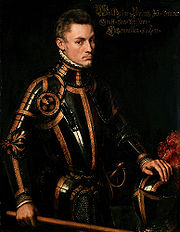
The leader of the Dutch Revolt
Dutch Revolt
The Dutch Revolt or the Revolt of the Netherlands This article adopts 1568 as the starting date of the war, as this was the year of the first battles between armies. However, since there is a long period of Protestant vs...
was William the Silent
William the Silent
William I, Prince of Orange , also widely known as William the Silent , or simply William of Orange , was the main leader of the Dutch revolt against the Spanish that set off the Eighty Years' War and resulted in the formal independence of the United Provinces in 1648. He was born in the House of...
(William I of Orange); he had been appointed stadtholder in 1572 by the first province to rebel, Holland. His personal influence and reputation was subsequently associated with the office and transferred to members of his house. Maurice in 1618 and William III of Orange
William III of England
William III & II was a sovereign Prince of Orange of the House of Orange-Nassau by birth. From 1672 he governed as Stadtholder William III of Orange over Holland, Zeeland, Utrecht, Guelders, and Overijssel of the Dutch Republic. From 1689 he reigned as William III over England and Ireland...
from 1672 replaced entire city councils with their partisans to increase their power: the so-called "Changings of the Legislative" (Wetsverzettingen). By intimidation, the stadtholders tried to extend their right of affirmation. In reaction, the regents in Holland, Zeeland, Utrecht, Guelders, and Overijssel, after the death of William II in 1650, appointed no stadtholder. They subsequently were forced to appoint one by the catastrophic events of 1672, the Dutch Year of Disaster (Rampjaar
Rampjaar
The rampjaar was the year 1672 in Dutch history. In that year,the Republic of the Seven United Provinces was after the outbreak of the Franco-Dutch War and the Third Anglo-Dutch War attacked by England, France, and the prince-electors Bernhard von Galen, bishop of Münster and Maximilian Henry of...
). After the death of William III in 1702 they again abstained from appointing one. These periods are known as the First Stadtholderless Period
First Stadtholderless Period
The First Stadtholderless Period or Era is the period in the history of the Dutch Republic in which the office of a Stadtholder was absent in five of the seven Dutch provinces...
and the Second Stadtholderless Period
Second Stadtholderless Period
The Second Stadtholderless Period or Era is the designation in Dutch historiography of the period between the death of stadtholder William III on March 19, 1702 and the appointment of William IV, Prince of Orange as stadtholder and captain general in all provinces of the Dutch Republic on May 2,...
.
After the French invasion of 1747, the regents were forced by a popular movement to accept William IV, Prince of Orange
William IV, Prince of Orange
William IV, Prince of Orange-Nassau , born Willem Karel Hendrik Friso, was the first hereditary stadtholder of the Netherlands.-Early life:...
, stadtholder of Friesland
Friesland
Friesland is a province in the north of the Netherlands and part of the ancient region of Frisia.Until the end of 1996, the province bore Friesland as its official name. In 1997 this Dutch name lost its official status to the Frisian Fryslân...
and Groningen
Groningen (province)
Groningen [] is the northeasternmost province of the Netherlands. In the east it borders the German state of Niedersachsen , in the south Drenthe, in the west Friesland and in the north the Wadden Sea...
, as stadtholder in the other provinces. On 22 November 1747, the office of stadtholder was made hereditary (erfstadhouder). As William (for the first time in the history of the Republic) was stadtholder in all provinces, his function accordingly was restyled Stadhouder-Generaal (rendered as General Hereditary Stadtholder in English).
After William IV's untimely death in 1751 his infant son was duly appointed stadtholder under the regency of his mother. The misgovernment of this regency caused much resentment, which issued in 1780 in the Patriot movement
Patriots (faction)
The Patriots were a political faction in the Dutch Republic in the second half of the 18th century. They were led by Joan van der Capellen tot den Pol, gaining power from November 1782....
. The Patriots first took over many city councils, then the States of the province of Holland, and ultimately raised civil militias to defend their position against Orangist partisans, bringing the country to the brink of civil war. Through Prussia
Prussia
Prussia was a German kingdom and historic state originating out of the Duchy of Prussia and the Margraviate of Brandenburg. For centuries, the House of Hohenzollern ruled Prussia, successfully expanding its size by way of an unusually well-organized and effective army. Prussia shaped the history...
n military intervention, in 1787 Prince William V of Orange was able to suppress this opposition, and many leaders of the Patriot movement went into exile in France.
Decline in use
The exiles returned with French armies in the winter of 1795 and overcame the frozen Dutch Water LineDutch Water Line
The Dutch Water Line was a series of water based defences conceived by Maurice of Nassau in the early 17th century, and realised by his half brother Frederick Henry...
. William V of Orange-Nassau fled to England, and the office of stadtholder was abolished in 1795 when the French
France
The French Republic , The French Republic , The French Republic , (commonly known as France , is a unitary semi-presidential republic in Western Europe with several overseas territories and islands located on other continents and in the Indian, Pacific, and Atlantic oceans. Metropolitan France...
revolutionary forces installed the Batavian Republic
Batavian Republic
The Batavian Republic was the successor of the Republic of the United Netherlands. It was proclaimed on January 19, 1795, and ended on June 5, 1806, with the accession of Louis Bonaparte to the throne of the Kingdom of Holland....
. From 1572 in the Southern Netherlands
Southern Netherlands
Southern Netherlands were a part of the Low Countries controlled by Spain , Austria and annexed by France...
the Habsburg lords continued to appoint provincial stadtholders for the region, until it was annexed by France in 1794.
See also
- DeputySteward (office)A steward is an official who is appointed by the legal ruling monarch to represent him or her in a country, and may have a mandate to govern it in his or her name; in the latter case, it roughly corresponds with the position of governor or deputy...
- List of stadtholders for the Low Countries provinces
- Orangists
- Queen's CommissionerQueen's CommissionerThe Queen's Commissioner is the head of a province in the Netherlands, who is chairman of both the Provinciale Staten and the Gedeputeerde Staten , but only has a right to vote in the latter...
(modern name)
Sources and references
- WorldStatesmen – the Netherlands
- Van Dale Etymologisch Woordenboek (Dutch etymology, in Dutch)
- Simon Schama – Patriots and Liberators: : Revolution in the Netherlands, 1780–1813
- Dutch language Wikipedia: List of stadtholders