
All Topics  
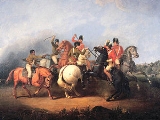
Battle of Cowpens


   Email Print
   Bookmark   Link


Battle of Cowpens


}
|-
|
|}

The Battle of Cowpens was fought on January 17, 1781, during the Southern campaignSouthern theater of the American Revolutionary War Overview

The Southern theater of the American Revolutionary War became the central area of operations on land after France entered th...
 of the American Revolutionary WarAmerican Revolutionary War

The American Revolutionary War , also known as the American War of Independence, was a war between Great Britain and r...
 and was an overwhelming victory by American RevolutionAmerican Revolution

The American Revolution was a political movement that ended British control of the south-eastern coastal area of North Ameri...
ary forces under Brigadier GeneralBrigadier General

Brigadier General is the lowest rank of general officer in some countries, usually ranking just above Colonel and just below...
 Daniel MorganDaniel Morgan Overview

Daniel Morgan was an American pioneer, soldier, and United States Representative from Virginia....
. It was a turning point in the reconquest of South Carolina from the British, and went down in history as the great American tactical masterpiece of the war.
The Colonial force The Colonial forces were commanded by Brigadier-General Daniel MorganDaniel Morgan Overview

Daniel Morgan was an American pioneer, soldier, and United States Representative from Virginia....
. Although Morgan claimed in his official report to have had only a few over 800 men at Cowpens, historian Lawrence Babits, in his detailed study of the Battle, estimates the real numbers as:


The figures given by Laurence E. Babits total 82 Continental Light Dragoons; 55 State Dragoons; 45 Militia Dragoons; 300 Continental infantry; about 150 State infantry and 1,255-1,280 Militia infantry, for a total of 1,887–1,912 officers and men.

Broken down by state, there were about 855 South Carolinians; 442 Virginians; 290–315 North Carolinians; 180 Marylanders; 60 Georgians and 60 Delawareans.

Morgan's Continentals were veterans, and many of his militia, which included some Overmountain MenFacts About Overmountain Men

The Overmountain Men were American colonial militiamen in the American Revolutionary War from west of the Appalachian Mounta...
, had seen service at the Battle of Musgrove MillBattle of Musgrove Mill

}|-||}The Battle of Musgrove Mill, which took place on August 18, 1780, was one of the early turning points in the South...
 and the Battle of Kings MountainBattle of Kings Mountain

The Battle of Kings Mountain, October 7, 1780, was an important rebel victory in the Southern campaign of the American Revol...
.
The British force The BritishKingdom of Great Britain

Kingdom of Great Britain| align="center" colspan="2"|...
 were commanded by Colonel Banastre TarletonBanastre Tarleton

General Sir Banastre Tarleton, 1st Baronet, GCB was a British soldier and politician....
.


Discussion
Ask a question about 'Battle of Cowpens'
Start a new discussion about 'Battle of Cowpens'
Answer questions from other users
Full Discussion Forum


Timeline

1781   American Revolutionary War: Americans under Daniel Morgan defeat British forces at the Battle of Cowpens.


Encyclopedia


}
|-
|
|}

The Battle of Cowpens was fought on January 17, 1781, during the Southern campaignSouthern theater of the American Revolutionary War Overview

The Southern theater of the American Revolutionary War became the central area of operations on land after France entered th...
 of the American Revolutionary WarAmerican Revolutionary War

The American Revolutionary War , also known as the American War of Independence, was a war between Great Britain and r...
 and was an overwhelming victory by American RevolutionAmerican Revolution

The American Revolution was a political movement that ended British control of the south-eastern coastal area of North Ameri...
ary forces under Brigadier GeneralBrigadier General

Brigadier General is the lowest rank of general officer in some countries, usually ranking just above Colonel and just below...
 Daniel MorganDaniel Morgan Overview

Daniel Morgan was an American pioneer, soldier, and United States Representative from Virginia....
. It was a turning point in the reconquest of South Carolina from the British, and went down in history as the great American tactical masterpiece of the war.

The Colonial force

The Colonial forces were commanded by Brigadier-General Daniel MorganDaniel Morgan Overview

Daniel Morgan was an American pioneer, soldier, and United States Representative from Virginia....
. Although Morgan claimed in his official report to have had only a few over 800 men at Cowpens, historian Lawrence Babits, in his detailed study of the Battle, estimates the real numbers as:
  • A battalion of ContinentalContinental Army

    The Continental Army was the unified command structure of the thirteen colonies fighting Great Britain during the American R...
     infantry under Lt-Col John Eager Howard, with one company from DelawareDelaware

    Delaware is one of five Middle Atlantic States in the United States of America.ography...
    , one from VirginiaVirginia

    The Commonwealth of Virginia is one of the original thirteen colonies of the United States that revolted against British ru...
     and three from MarylandMaryland

    Maryland , is a Mid-Atlantic state located on the East Coast of the United States and is classified by the U.S....
    ; each with a strength of sixty men (300)
  • A company of Virginia State troops under Captain John Lawson (75)
  • A company of South CarolinaSouth Carolina

    South Carolina is a state in the Southern region of the United States....
     State troops under Captain Joseph Pickens (60)
  • A small company of North CarolinaNorth Carolina

    North Carolina is a state in the Southeastern United States....
     State troops under Captain Henry Connelly (number not given)
  • A Virginia Militia battalion under Frank Triplett (160)
  • Two companies of Virginia Militia under Major David Campbell (50)
  • A battalion of North Carolina Militia under Colonel Joseph McDowell (260–285)
  • A brigade of four battalions of South Carolina Militia under Colonel Andrew Pickens, comprising a three-company battalion of the Spartanburg Regiment under Lt-Col Benjamin Roebuck; a four-company battalion of the Spartanburg Regiment under Col John Thomas; five companies of the Little River Regiment under Lt-Col Joseph Hayes and seven companies of the Fair Forest Regiment under Col Thomas Brandon. Babits states that these battalion “ranged in size from 120 to more than 250 men”. If Roebuck’s three companies numbered 120 and Brandon’s seven companies numbered 250, then Thomas’s four companies probably numbered about 160 and Hayes’s five companies about 200, for a total of (730)
  • Three small companies of GeorgiaGeorgia (U.S. state)

    For the country, see Georgia . For other uses, see Georgia ....
     Militia commander by Major Cunningham who numbered (55)
  • Detachments of the 1st and 3rd Continental Light Dragoon (both recruited mainly in Virginia) under Lt-Col William Washington (82)
  • Detachments of State Dragoons from North Carolina and Virginia (30)
  • A detachment of South Carolina State Dragoons, with a few mounted Georgians, commanded by Major James McCall (25)
  • A company of newly-raised volunteers from the local South Carolina Militia commanded by Major Benjamin Jolly (45)


The figures given by Laurence E. Babits total 82 Continental Light Dragoons; 55 State Dragoons; 45 Militia Dragoons; 300 Continental infantry; about 150 State infantry and 1,255-1,280 Militia infantry, for a total of 1,887–1,912 officers and men.

Broken down by state, there were about 855 South Carolinians; 442 Virginians; 290–315 North Carolinians; 180 Marylanders; 60 Georgians and 60 Delawareans.

Morgan's Continentals were veterans, and many of his militia, which included some Overmountain MenFacts About Overmountain Men

The Overmountain Men were American colonial militiamen in the American Revolutionary War from west of the Appalachian Mounta...
, had seen service at the Battle of Musgrove MillBattle of Musgrove Mill

}|-||}The Battle of Musgrove Mill, which took place on August 18, 1780, was one of the early turning points in the South...
 and the Battle of Kings MountainBattle of Kings Mountain

The Battle of Kings Mountain, October 7, 1780, was an important rebel victory in the Southern campaign of the American Revol...
.

The British force

The BritishKingdom of Great Britain

Kingdom of Great Britain| align="center" colspan="2"|...
 were commanded by Colonel Banastre TarletonBanastre Tarleton

General Sir Banastre Tarleton, 1st Baronet, GCB was a British soldier and politician....
. The British force comprised:
  • LoyalistLoyalist (American Revolution)

    Loyalists were British North American colonists who remained loyal subjects of the British crown during the American Revolut...
     Legion: 250 cavalry and 200 infantry,
  • A troop of the 17th Light DragoonsFacts About 17th Lancers

    The 17th Lancers was a cavalry regiment of the British Army, most famous for its participation in the Charge of the Light Br...
     (50),
  • A battery of the Royal Artillery (24) with two 3-pounder cannons
  • The 7th (Royal Fusiliers) Regiment (177),
    *The light infantry company of the 16th Regiment (42)
  • The 71st (Fraser's Highlanders) Regiment71st Regiment of Foot, Fraser's Highlanders

    The 71st Regiment of Foot was a regiment of infantry raised during the American Revolution....
     (334)
  • The light company of the Loyalist Prince of Wales's American Regiment (31)
  • A company of Loyalist guides (50)

A total of over 1,150 officers and men.

Broken down by troop classification, there were 300 cavalry, 553 regulars, 24 artillerymen and 281 militia. Tarleton’s men from the Royal Artillery, 17th Light Dragoons, 16th Regiment and 71st Regiment were reliable and good soldiers; but the detachment of the 7th Regiment were raw recruits who had been intended to reinforce the garrison of Fort Ninety-Six where they could receive further training rather than go straight into action. Tarleton's own unit, the British Legion were formidable "in a pursuit situation" but had an uncertain reputation “when faced with determined opposition”.

General CornwallisCharles Cornwallis, 1st Marquess Cornwallis

Charles Cornwallis, 1st Marquess Cornwallis was an English military commander and colonial governor....
 instructed Tarleton and his Legion, who had been successful at battles such as CamdenBattle of Camden

The Battle of Camden was an important battle in the Southern Theatre of the American Revolutionary War....
 and WaxhawWaxhaw massacre

The Waxhaw Massacre is an alternative name for the controversial Battle of Waxhaws that took place during the American...
 in the past, to destroy Morgan's command. Tarleton's previous victories had been won by bold attacks, often despite being outnumbered. American commander Nathanael GreeneNathanael Greene

Nathanael Greene]] – June 19, 1786), was a major general of the Continental Army in the American Revolutionary War....
 had taken the daring step of dividing his army, detaching Morgan away from the main Patriot force. Morgan called Americans to gather at the cow pens (a grazing area), which were a familiar landmark. TarletonFacts About Banastre Tarleton

General Sir Banastre Tarleton, 1st Baronet, GCB was a British soldier and politician....
 attacked with his customary boldness but without regard for the fact Morgan had much more time to prepare. Tarleton was consequently caught in a textbook double envelopment. Tarleton's forces were virtually destroyed, but he managed to flee the battlefield with perhaps 250 men.

Morgan's preparations


Daniel Morgan knew that he should use the unique landscape of Cowpens and the time available before Tarleton's arrival to his advantage. Furthermore, he knew his men and his opponent, knew how they would react in certain situations, and used this knowledge to his advantage. To begin with, the location of his forces were contrary to any existing military doctrine: he placed his army between the BroadBroad River (Carolinas)

The Broad River is a principal tributary of the Congaree River, about 150 mi long, Houghton Mifflin Company....
 and Pacolet RiverPacolet River

The Pacolet River is a tributary of the Broad River, about 50 mi long, in northwestern South Carolina in the United States ...
, thus making escape impossible if the army were routed. His reason for cutting off escape was obvious; to ensure that the untrained militiamen would not, as they had been accustomed to do, turn in flight at the first hint of battle and abandon the regulars. Selecting a hill as the center of his position, he placed his Continental infantry on it, deliberately leaving his flanksFlanking maneuver

In military tactics, a flanking maneuver, also called a attack, is an attack on the sides of an opposing force....
 exposed to his opponent. Morgan reasoned that Tarleton would attack him head on, and he made his tactical preparations accordingly. He set up three lines of soldiers: one of skirmishers (sharpshooters), one of militia, and a main one. The 150 select skirmishers were from North CarolinaProvince of North Carolina

The Province of North Carolina was originally part of the Province of Carolina, which was chartered by eight Lords Proprieto...
 (Major McDowell) and GeorgiaProvince of Georgia

The Georgia Colony was one of the Southern colonies in British North America....
 (Major Cunningham). Behind these men were 300 militiamen under the command of Andrew PickensAndrew Pickens (congressman)

Andrew Pickens was a militia leader in the American Revolution and a U.S....
.

Realizing that poorly trained militia were unreliable in battle, especially when they were under attack from cavalry, Morgan decided to ask the militia to fire two shots and then retreat, so he could have them reform under cover of the reserve (cavalry commanded by William WashingtonWilliam Washington

William Washington, was a patriotic Southern cavalry officer during the American Revolutionary War, who held a final rank of...
 and James McCall) behind the third, more experienced line of militia and continentals. The movement of the militia in the second line would unmask the third line to the British. The third line, composed of the remainder of the forces (about 550 men) was composed of Continentals from DelawareDelaware Summary

Delaware is one of five Middle Atlantic States in the United States of America.ography...
 and MarylandMaryland

Maryland , is a Mid-Atlantic state located on the East Coast of the United States and is classified by the U.S....
, and militiamen from Georgia and VirginiaVirginia

The Commonwealth of Virginia is one of the original thirteen colonies of the United States that revolted against British ru...
. Colonel John Eager Howard commanded the Continentals and Colonels Tate and Triplett the militia. The goal of this strategy was to weaken and disorganize Tarleton's forces (which would be attacking the third line uphill) before attacking and defeating them. Howard’s men would not be unnerved by the militia’s expected move, and unlike the militia they would be able to stand and hold, especially since the first and second lines, Morgan felt, would have inflicted both physical and psychological attrition on the advancing British before the third line came into action.

Additionally, by placing his men downhill from the advancing British lines, Morgan exploited the British tendency to fire too high in battle. The downhill position of his forces allowed the British forces to be silhouetted against the morning sunlight, providing easy targets for Patriot troops. With a ravine on their right flank and a creek on their left flank, Morgan's forces were protected against British flanking maneuvers at the beginning of the battle. Morgan insisted,

"the whole idea is to lead Benny [Tarleton] into a trap so we can beat his cavalry and infantry as they come up those slopes. When they've been cut down to size by our fire, we'll attack them."


In developing his tactics at Cowpens, as historian John Buchanan wrote, Morgan may have been "the only general in the American Revolution, on either side, to produce a significant original tactical thought.”

Tarleton's approach

At 2:00 a.m. on January 17 1781, Tarleton roused his troops and continued his march to the Cowpens. Lawrence Babits states that, "in the five days before Cowpens, the British were subjected to stress that could only be alleviated by rest and proper diet". He points out that “in the forty-eight hours before the battle, the British ran out of food and had less than four hours’ sleep”. Over the whole period, Tarleton’s brigade did a great deal of rapid marching across difficult terrain. Babits concludes that they reached the battlefield exhausted and malnourished. But Tarleton sensed victory—nothing would persuade him to delay. His ToryTory

The term Tory applied to the Tory Party, the ancestor of the modern UK Conservative Party....
 scouts had told him of the countryside Morgan was fighting on, and he was certain of success because Morgan's soldiers, mostly militiamen, seemed to be caught between mostly experienced British troops and a flooding river. As soon as he reached the spot, he formed a battle line, which consisted of dragoonDragoon

During the 17th and early 18th centuries a dragoon was traditionally a soldier trained to fight on foot, but transport himse...
s on his flanks, with his two grasshopper cannonGrasshopper cannon

The grasshopper cannon is a weapon designed by the British in the 1700s as a light gun to be carried around with infantry....
 in between the British RegularsBritish Regulars

Commonly used to describe the Napoleonic era British foot soldiers, the British Regular was known for his flamboyant red uni...
 and American LoyalistsLoyalist (American Revolution)

Loyalists were British North American colonists who remained loyal subjects of the British crown during the American Revolut...
. More cavalry and the 71st Highlanders composed his reserve. Sure of an easy victory, he sent his unrested men into battle. Tarleton’s plan was simple and direct. Most of his infantry (including that of the Legion) would be assembled in linear formation and move directly upon Morgan. The right and left flanks of this line would be protected by dragoon units. In reserve he would hold his 250-man battalion of Scottish Highlanders (71st Regiment of Foot), commanded by Major Arthur MacArthur, a professional soldier of long experience who had served in the Dutch Scotch Brigade. Finally, Tarleton kept the 200-man cavalry contingent of his Legion ready to be unleashed when the Americans broke and ran.

The Battle

Morgan's strategy worked perfectly. The British drove in successive lines, anticipating victory only to encounter another, stronger line after exerting themselves and suffering casualties. The depth of the American lines gradually soaked up the shock of the British advance.

After killing or wounding fifteen dragoons, the skirmishers retreated. The British pulled back temporarily but attacked again, this time reaching the militiamen, who (as ordered) poured two volleys into the British who—with 40% of their casualties being officers—were astonished and confused. They reformed and continued to advance. Tarleton responded by ordering one of his officers, Ogilvie, to charge with some dragoons into the "defeated" Americans. His men moved forward in regular formation and were momentarily checked by the militia musket fire but continued to advance. Pickens' militia broke and apparently fled to the rear and were eventually reorganized.

Taking the withdrawal of the first two lines as a full blown retreat, the British advanced headlong into the awaiting final line of disciplined regulars which firmly held on the hill.

Despite this, Tarleton believed he could still win with only one line of Americans left and sent his infantry in for a frontal attack. The Highlanders were ordered to flank the Americans. Under the direction of Howard, the Americans retreated. Flushed with victory and now disorganized, the British ran after them. Abruptly, Howard pulled an about-face, fired an extremely devastating volley into his enemy, and then charged. Triplett's riflemen attacked, however, severely damaging the British, and the cavalry of Washington and McCall charged. Completely routed, the dragoons fled to their own rear. Having dismantled Ogilvie's forces, Washington then also charged into the British. When the British advance was finally halted by the Continentals, the American cavalry struck them on the right flank and rear, while the militia, having re-formed, charged out from behind the hill—completing a 360-degree circle around the American position—to hit the British left.

The shock of the sudden charge, coupled with the reappearance of the American militiamen on the flanks where Tarleton's exhausted men expected to see their own cavalry, proved too much for the British. Nearly half of the British and Loyalist infantrymen fell to the ground whether they were wounded or not. Their ability to fight had gone. Historian Lawrence Babits diagnoses "combat shock" as the cause for this abrupt British collapse—the effects of exhaustion, hunger and demoralization suddenly catching up with them. Caught in a clever double envelopmentPincer movement Summary

The pincer movement is a basic element of military strategy which has been used, to some extent, in nearly every war....
 that has been compared with the Battle of CannaeBattle of Cannae

The Battle of Cannae was a major battle of the Second Punic War, taking place on August 2, 216 BC near the town of Cannae in...
, many of the British surrendered. With Tarleton's right flank and center line collapsed, there remained only a minority of the 71st Highlanders who were still putting up a fight against part of Howard's line. Tarleton, realizing the desperate seriousness of what was occurring, rode back to his one remaining unit that was in one piece, the Legion Cavalry. Desperate to save something, Tarleton assembled a group of cavalry and tried to save the two cannon he had brought with him, but they had been taken. Tarleton with a few remaining horsemen rode back into the fight, but after clashing with Washington’s men, he too retreated from the field. He was stopped by Colonel Washington, who attacked him with his saber, calling out, "Where is now the boasting Tarleton?": but Tarleton shot Washington's horse from under him and fled.

Morgan's troops took 652 British and Loyalist troops—a devastating blow. Even worse for the British, the forces lost, especially Tarleton's Legion and the dragoons, constituted the cream of Cornwallis' army. The number of British killed was claimed by the victorious Americans variously as 100, 110 and 120, whatever the number killed in action was however, what counted was that Tarleton's brigade had been all but wiped out as a fighting force.

Historian Lawrence Babits has demonstrated that Morgan's official report of 73 casualties appears to have only included his Continental troops. From surviving records, he has been able to identify by name 128 Patriot soldiers who were either killed or wounded at Cowpens. He also presents an entry in the North Carolina State Records that shows 68 Continental and 80 Militia casualties. It would appear that both the number of Morgan's casualties and the total strength of his force were about double what he officially reported.

It was claimed by some of the Patriots after the Battle that Tarleton had ordered his men, before they went into action, to take no prisoners. This may have been "black propaganda" of the sort that flourished amid the brutal conflict in the Carolinas during the Revolution. Tarleton's British Legion Cavalry were notorious for the way that they ruthlessly pursued defeated opponents, cutting them down as they tried to surrender. As a result, Tarleton was given the nickname, "Barbarous Ban" by the Patriot press, a title that Tarleton relished since he felt it gave his command an advantage. But it is notable that nearly every time they defeated the enemy—Monck's Corner, Lenud's Ferry, Camden, Catawba Ford—Tarleton's men did in fact take some prisoners. Even at the Battle of Waxhaw CreekWaxhaw massacre

The Waxhaw Massacre is an alternative name for the controversial Battle of Waxhaws that took place during the American...
 (alias The Buford Massacre), where Tarleton's men killed a high proportion of their opponents, they granted quarter to 203 Patriots. By Tarleton's own account, his horse was shot from under him in the charge and chaos erupted when his men believed he had been killed. In the end, 113 Americans were killed and another 203 captured, 150 of whom were so badly wounded that they had to be left behind. Tarleton's casualties were five killed and 12 wounded. This does not disprove the allegation: but no explanation has been offered as to why Tarleton would suddenly have adopted a 'no prisoners' policy on the single occasion of Cowpens.

Tarleton's apparent recklessness in pushing his command so hard in pursuit of Morgan that they reached the battlefield in desperate need of rest and food, may be explained by the fact that, up until Cowpens, every battle that he, and his British Legion, had fought in the South had been a relatively easy victory. He appears to have been so concerned with pursuing Morgan that he quite forgot that it was necessary for his men to be in a fit condition to fight a battle once they caught him.

Nevertheless, Daniel Morgan, known affectionately as "The Old Waggoner" to his men, had fought a masterly battle. His tactical decisions and personal leadership had allowed a force consisting mainly of militia to fight according to their strengths to win one of the most complete victories of the war.

Aftermath

Coming in the wake of the American debacle at Camden, Cowpens was a surprising victory and a turning point that changed the psychology of the entire war—"spiriting up the people", not only those of the backcountry Carolinas, but those in all the Southern colonies. As it was, the Americans were encouraged to fight further, and the Loyalists and British were demoralized. Furthermore, its strategic result—the destruction of an important part of the British army in the South—was incalculable toward ending the war. Along with the British defeat at the Battle of Kings MountainBattle of Kings Mountain

The Battle of Kings Mountain, October 7, 1780, was an important rebel victory in the Southern campaign of the American Revol...
, Cowpens was a decisive blow to Cornwallis, who might have defeated much of the remaining resistance in South Carolina had Tarleton won at Cowpens. Instead, the battle set in motion a series of events leading to the end of the war. Cornwallis abandoned his pacification efforts in South Carolina, stripped his army of its excess baggage, and pursued Greene's force into North Carolina. After a long chase Cornwallis met Greene at Guilford Court HouseFacts About Battle of Guilford Court House

The Battle of Guilford Court House was a battle fought on March 15, 1781 inside the present-day city of Greensboro, North Ca...
, winning a pyrrhic victoryPyrrhic victory

A Pyrrhic victory is a victory which comes at devastating cost to the victor....
 that so damaged his army that he withdrew to Yorktown, Virginia, to rest and refit. This gave Washington the opportunity, which he seized, to trap and defeat Cornwallis at the Battle of Yorktown, which caused the British to give up their efforts to regain their colonies.

In the opinion of John Marshall, "Seldom has a battle, in which greater numbers were not engaged, been so important in its consequences as that of Cowpens." It gave General Nathanael Greene his chance to conduct a campaign of "dazzling shiftiness" that led Cornwallis by "an unbroken chain of consequences to the catastrophe at Yorktown which finally separated America from the British crown."

Memorials

  • The battle site is preserved at Cowpens National BattlefieldCowpens National Battlefield

    Cowpens National Battlefield is a unit of the National Park Service near Chesnee, South Carolina....
    .
  • Two ships of the U.S. Navy have been named USS CowpensUSS Cowpens

    Two ships of the United States Navy have been named USS Cowpens, after the Battle of Cowpens during the American Revolut...
     in honor of the battle.

The battle on film

  • The final battle at the end of the 2000 historical film The PatriotThe Patriot (2000 film)

    The Patriot is an American film released in 2000 that was written by Robert Rodat and directed by Roland Emmerich....
    drew its inspiration from two specific battles from the American Revolution: Cowpens and Guilford Courthouse. The Americans used the same basic tactics in both battles. The name of the battle, as well as the winning side, were taken from the Cowpens battle; however, the size of the armies, as well as the presence of Generals Nathanael GreeneNathanael Greene

    Nathanael Greene]] – June 19, 1786), was a major general of the Continental Army in the American Revolutionary War....
     and Lord Cornwallis, come from the Guilford Courthouse battle.
  • The Alan AldaAlan Alda

    Alan Alda is an Oscar-nominated and Emmy Award-winning American actor, writer, director and sometime political activist....
     directed movie, Sweet LibertySweet Liberty

    Sweet Liberty is a 1986 comedy film about an author forced to deal with a film crew who comes to town to shoot a film ad...
    , parodies how a film company takes great liberty with the depiction of the Battle of Cowpens.

Bibliography

External links