

Reims

Encyclopedia
Reims a city in the Champagne-Ardenne
region of France
, lies 129 km (80.2 mi) east-northeast of Paris
. Founded by the Gauls
, it became a major city during the period of the Roman Empire
.
Reims played a prominent ceremonial role in French monarchical history
as the traditional site of the crowning
of the kings of France. The Cathedral of Reims (damaged by the Germans
during the First World War but restored since) played the same role in France as Westminster Abbey
has in the United Kingdom
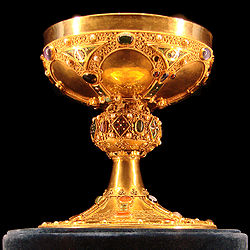
. It housed the Holy Ampulla
(Sainte Ampoule) containing the Saint Chrême (chrism
), allegedly brought by a white dove (the Holy Spirit
) at the baptism
of Clovis
in 496. It was used for the anointing
, the most important part of the coronation of French kings.
Some sources regard Reims as the effective capital of the province of Champagne
, given its size as by far the largest city in the region. The 2008 census recorded 188,078 inhabitants (Rémoises (feminine) and Rémois (masculine)) in the city of Reims proper (the commune), and 291,735 inhabitants in the metropolitan area (aire urbaine
).
, in the administrative region
of Champagne-Ardenne
. Although Reims is by far the largest commune in both its region and department, Châlons-en-Champagne
is the capital and prefecture of both.
 Before the Roman conquest of northern Gaul
, Reims, founded circa 80 BC as *Durocorteron ("round fortress"; in Latin: Durocortōrum), served as the capital of the tribe of the Remi
— whose name the town would subsequently echo. In the course of Julius Caesar
's conquest of Gaul
(58-51 BC), the Remi allied themselves with the Romans
, and by their fidelity throughout the various Gallic
insurrections secured the special favour of the imperial power.
Christianity
had become established in the city by 260, at which period Saint Sixtus of Reims
founded the Reims bishopric
. The consul Jovinus, an influential supporter of the new faith, repelled the Alamanni
who invaded Champagne
in 336; but the Vandals
captured the city in 406 and slew Bishop Nicasius
; and in 451 Attila the Hun
put Reims to fire and sword.
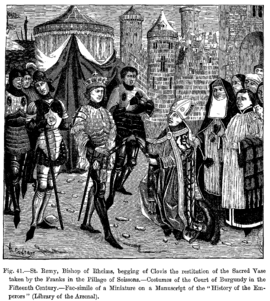
In 496 — ten years after Clovis
, King of the Salian Franks, won his victory at Soissons
(486) — Remigius
, the bishop of Reims, baptized him using the oil of the sacred phial — purportedly brought from heaven by a dove for the baptism of Clovis and subsequently preserved in the Abbey of Saint-Remi
. For centuries the events at the crowning of Clovis I became a symbol used by the monarchy to claim the divine right
to rule.
Meetings of Pope Stephen II
(752-757) with Pepin the Short, and of Pope Leo III
(795-816) with Charlemagne
(died 814), took place at Reims; and here Pope Stephen IV
crowned Louis the Debonnaire
in 816. Louis IV
gave the city and countship of Reims to the archbishop Artaldus
in 940. Louis VII
(reigned 1137–1180) gave the title of duke and peer to William of Champagne
, archbishop from 1176 to 1202, and the archbishops of Reims took precedence over the other ecclesiastical peers of the realm.
By the 10th century Reims had become a centre of intellectual culture. Archbishop Adalberon (in office 969 to 988), seconded by the monk Gerbert (afterwards (from 999 to 1003) Pope Silvester II
), founded schools which taught the classical "liberal arts
". (Adalberon also played a leading role in the dynastic revolution which elevated the Capetian dynasty
in the place of the Carolingian
s.)
The archbishops held the important prerogative of the consecration of the kings of France — a privilege which they exercised (except in a few cases) from the time of Philippe II Augustus
(anointed 1179, reigned 1180–1223) to that of Charles X
(anointed 1825). Louis VII
granted the city a communal charter in 1139. The Treaty of Troyes
(1420) ceded it to the English, who had made a futile attempt to take it by siege in 1360; but French patriots expelled them on the approach of Joan of Arc
, who in 1429 had Charles VII
consecrated in the cathedral. Louis XI
cruelly suppressed a revolt at Reims, caused in 1461 by the salt tax
. During the French Wars of Religion
the city sided with the Catholic League
(1585), but submitted to Henri IV
after the battle of Ivry
(1590).
In the invasions of the War of the Sixth Coalition
in 1814, anti-Napoleonic allied armies captured and re-captured Reims; in 1870–1871, during the Franco-Prussian War
, the victorious Germans made it the seat of a governor-general and impoverished it with heavy requisition
s.
In August 1909 Reims hosted the first international aviation meet. Major aviation personages such as Glenn Curtiss
, Louis Blériot
and Louis Paulhan
participated.
Hostilities in World War I
greatly damaged the city. German
bombardment and a subsequent fire in 1914 did severe damage to the cathedral. The ruined cathedral became one of the central images of anti-German propaganda produced in France during the war, which presented it, along with the ruins of the Cloth Hall
at Ypres
and the University Library in Louvain, as evidence that German aggression targeted cultural landmarks of European civilization.
From the end of World War I to the an international effort to restore the cathedral from the ruins has continued. The Palace of Tau, St Jacques Church and the Abbey of St Remi also were protected and restored. The collection of preserved buildings and Roman ruins remains monumentally impressive.
During World War II
the city suffered additional damage. But in Reims, at 2:41 on the morning of 7 May 1945, General Eisenhower and the Allies received the unconditional surrender
of the German Wehrmacht
. General Alfred Jodl
, German Chief-of-Staff, signed the surrender at the Supreme Headquarters Allied Expeditionary Force (SHAEF) as the representative for German President
Karl Dönitz
.
The British statesman Leslie Hore-Belisha died of a cerebral haemorrhage while making a speech at the Reims hôtel de ville
(city hall) in February 1957.
, and the Place Cardinal-Luçon, with an equestrian statue of Joan of Arc. The Rue de Vesle, the chief street (continued under other names), traverses the city from southwest to northwest, passing through the Place Royale.
The Place Drouet d'Erlon in the city centre contains many lively restaurants and bars, as well as several attractive statues and fountains. During the summer it fills with people sitting outside the many cafés enjoying the summer sun, and in December it has a lively and charming Christmas market.
("Mars Gate", so called from a temple to Mars in the neighbourhood), a triumphal arch
108 feet in length by 43 in height, consists of three archways flanked by columns. Popular tradition tells that the Remi
erected it in honour of Augustus
when Agrippa
made the great roads
terminating at the city, but it probably belongs to the 3rd or 4th century. The Mars Gate was one of 4 Roman gates
to the city walls, which were restored at the time of the Norman Invasion of northern France in the 9th century. In its vicinity a curious mosaic, measuring 36 feet by 26, with thirty-five medallions representing animals and gladiator
s, was discovered in 1860.
Note too the Gallo-Roman sarcophagus
, allegedly that of the 4th-century consul Jovinus, preserved in the archaeological museum in the cloister of the abbey of Saint-Remi
.
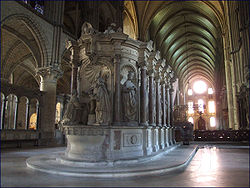
.jpg) Many people know Reims for its cathedral
Many people know Reims for its cathedral
, Notre-Dame de Reims, formerly the place of coronation of the kings of France. The cathedral became a UNESCO
World Heritage Site
in 1991, along with the former Abbey of Saint-Remi and the Palace of Tau
.
of the 17th century, known as the Perpersack tapestries, after the Flemish weaver who executed them. The palace opened to the public in 1972 as a museum containing such exhibits as statues formerly displayed by the cathedral, treasures of the cathedral from past centuries, and royal attire from coronations of French kings.
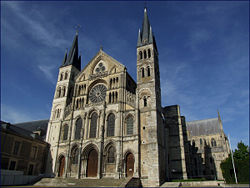 Saint Remi Basilica, an easy one-mile walk from the Cathedral of Notre Dame of Reims, takes its name from the 5th-century Saint Remi
— revered as the patron saint
of the inhabitants of Reims for more than 15 centuries. The basilica
almost approaches the cathedral in size. Adjacent to the basilica stands an important abbey, formerly known as the Royal Abbey of St Remi
. The abbey sought to trace its heritage back to St Remi, while the present abbey building dates back to the 17th and 18th centuries.
The Saint Remi Basilica dates from the 11th, 12th, 13th and 15th centuries. Most of the construction of the church finished in the 11th century, with additions made later. The nave
and transept
s, Romanesque
in style, date mainly from the earliest, the façade
of the south transept from the latest of those periods, the choir
and apse
chapels from the 12th and 13th centuries. The 17th and 19th centuries saw further additions. The building suffered greatly in World War I
, and the meticulous restoration work of architect Henri Deneux rebuilt it from its ruins over the following 40 years. it remains the seat of an active Catholic parish holding regular worship services and welcoming pilgrims. It has been classified as an historical monument since 1841 and is one of the pinnacles of the history of art and of the history of France.
Several royal and archepiscopal figures lie buried in the basilica, but in unidentified graves. They include:
 The public can visit the abbey building, the Saint-Remi Museum. The abbey closed in the wake of the French Revolution
(the government had all French monasteries
dissolved in February, 1790). The museum exhibits include tapestries from the sixteenth century given by Robert de Lenoncourt (who died in 1532), marble capitals from the fourth century AD, furniture, jewellery, pottery, weapons and glasswork from the 6th to 8th century, medieval sculpture, the façade of the 13th-century Musicians' House, remnants from an earlier abbey building, and also exhibits of Gallo-Roman arts and crafts and a room of pottery, jewellery, and weapons from Gallic civilization, as well as an exhibit of items from the Palaeolithic to the Neolithic periods.
Another section of the museum features a permanent military exhibition.
having selected Reims as one of the chief defences of the northern approaches of Paris. Atop the ridge of St Thierry stands a fort of the same name, which with the neighbouring work of Chenay
closes the west side of the place. To the north the hill of Brimont
has three works guarding the Laon
railway and the Aisne canal. Farther east, on the old Roman road, stands the Fort de Fresnes. Due east the hills of Arnay are crowned with five large and important works which cover the approaches from the upper Aisne. Forts Pompelle
and Montbré close the south-east side, and the Falaise hills on the Paris side are open and unguarded. The perimeter of the defences is not quite 22 miles, and the forts are a mean distance of 6 miles (10 km) from the centre of the city.
meets the Avenue du Général Giraud
. The first stone was place by André Maginot
, Minister of War
on 29 October 1922. This ceremony was also addressed by Blaise Diagne
, the Senegal
ese political leader. On July 1924 the monument was inaugurated with a Military and Sports fete presided over by Édouard Daladier
, the Minister of the colonies
. General Louis Archinard
was the president of the committee that supervised the erection of the monument, highlighting the role of African troops of the 1st Colonial Infantry Corps in the defense of Reims from the German Army
in 1918. They were particularly renowned for their tenacious defence of Fort de la Pompelle
. 10,000 people attended the fete which was held immediately following the inauguration. The original monument, consisting of five figures, was a replica of a similar monument erected in Bamako
, Mali
in January 1924. The monument was dismantled during the German occupation in September 1940. In September 1958, on the occasion of the fortieth anniversary of the Defence of Reims, a new monument was started. This was completed in time for a second inauguration ceremony on 6 October 1963, with Pierre Messmer
, Minister of Armies
, Jean Sainteny
, Minister of veterans, Jacques Foccart
, secretary general of the Communauté et les affaires africaines et malgaches, and General Georges Catroux
, grand chancellor of the Légion d'honneur
. In 2008, on the occasion of the ninetieth anniversary of the defence of Reims, a major ceremony was held in remembrance of the Black Army of Reims, attended by Jean-Marie Bockel
, Rama Yade
and Adeline Hazan
.
The Foujita chapel
(1966), designed and decorated by the Japanese School of Paris
artist Tsuguharu Foujita
became famed for its fresco
s. It was listed as an historic monument in 1992.
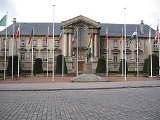
The city hall
(hôtel de ville), erected in the 17th century and enlarged in the 19th, features a pediment
with an equestrian statue of Louis XIII
(reigned 1610 to 1643).
The Surrender Museum is the building in which on 7 May 1945, General Eisenhower
and the Allies received the unconditional surrender of the German Wehrmacht
.
The Carnegie library
, the former public library
built with money donated by Andrew Carnegie
to the city of Reims after World War I
, is a remarkable example of Art Deco in France.
in the city centre, the hub for regional transport, and the new Gare de Champagne-Ardenne TGV 5 km southwest of the city with high speed rail connections to Paris, Metz, Nancy and Strasbourg. The motorways A4
(Paris-Strasbourg) and A26
(Calais-Langres) intersect near Reims.
Public transport within the city consists of buses and a tramway, the latter opened in 2011.
and Ay
, functions as one of the centers of champagne production. Many of the largest champagne-producing houses, known as les grandes marques, have their headquarters in Reims, and most open for tasting and tours. Champagne ages in the many caves and tunnels under Reims, which form a sort of maze below the city. Carved from chalk
, some of these passages date back to Roman times.
automobile race
at the circuit of Reims-Gueux
. The French Grand Prix
took place here 14 times between 1938 and 1966.
the football club Stade Reims
, based in the city, competed in the Ligue 2
, the second-highest tier of French football. Stade Reims became the outstanding team of France in the 1950s and early 1960s and reached the final of the European Cup of Champions twice in that era.
The city has hosted the Reims Marathon
since 1984.
links with:
Florence
, Italy
(1954) Brazzaville
, Congo
(1961) Canterbury
, United Kingdom
(1962) Salzburg
, Austria
(1964) Aachen
, Germany
(1967) Arlington
, Virginia
, United States
(2005) Kutná Hora
, Czech Republic
(2008)
Champagne-Ardenne
Champagne-Ardenne is one of the 27 regions of France. It is located in the northeast of the country, bordering Belgium, and consists of four departments: Aube, Ardennes, Haute-Marne, and Marne. The region is famous for its sparkling white wine . Its rivers, most of which flow west, include the...
region of France
France
The French Republic , The French Republic , The French Republic , (commonly known as France , is a unitary semi-presidential republic in Western Europe with several overseas territories and islands located on other continents and in the Indian, Pacific, and Atlantic oceans. Metropolitan France...
, lies 129 km (80.2 mi) east-northeast of Paris
Paris
Paris is the capital and largest city in France, situated on the river Seine, in northern France, at the heart of the Île-de-France region...
. Founded by the Gauls
Gauls
The Gauls were a Celtic people living in Gaul, the region roughly corresponding to what is now France, Belgium, Switzerland and Northern Italy, from the Iron Age through the Roman period. They mostly spoke the Continental Celtic language called Gaulish....
, it became a major city during the period of the Roman Empire
Roman Empire
The Roman Empire was the post-Republican period of the ancient Roman civilization, characterised by an autocratic form of government and large territorial holdings in Europe and around the Mediterranean....
.
Reims played a prominent ceremonial role in French monarchical history
History of France
The history of France goes back to the arrival of the earliest human being in what is now France. Members of the genus Homo entered the area hundreds of thousands years ago, while the first modern Homo sapiens, the Cro-Magnons, arrived around 40,000 years ago...
as the traditional site of the crowning
Coronation
A coronation is a ceremony marking the formal investiture of a monarch and/or their consort with regal power, usually involving the placement of a crown upon their head and the presentation of other items of regalia...
of the kings of France. The Cathedral of Reims (damaged by the Germans
Germans
The Germans are a Germanic ethnic group native to Central Europe. The English term Germans has referred to the German-speaking population of the Holy Roman Empire since the Late Middle Ages....
during the First World War but restored since) played the same role in France as Westminster Abbey
Westminster Abbey
The Collegiate Church of St Peter at Westminster, popularly known as Westminster Abbey, is a large, mainly Gothic church, in the City of Westminster, London, United Kingdom, located just to the west of the Palace of Westminster. It is the traditional place of coronation and burial site for English,...
has in the United Kingdom
United Kingdom
The United Kingdom of Great Britain and Northern IrelandIn the United Kingdom and Dependencies, other languages have been officially recognised as legitimate autochthonous languages under the European Charter for Regional or Minority Languages...
. It housed the Holy Ampulla
Ampulla
An ampulla was, in Ancient Rome, a "small nearly globular flask or bottle, with two handles" . The word is used of these in archaeology, and of later flasks, often handle-less and much flatter, for holy water or holy oil in the Middle Ages....
(Sainte Ampoule) containing the Saint Chrême (chrism
Chrism
Chrism , also called "Myrrh" , Holy anointing oil, or "Consecrated Oil", is a consecrated oil used in the Roman Catholic, Eastern Orthodox, Eastern Rite Catholic, Oriental Orthodox, in the Assyrian Church of the East, and in Old-Catholic churches, as well as Anglican churches in the administration...
), allegedly brought by a white dove (the Holy Spirit
Holy Spirit
Holy Spirit is a term introduced in English translations of the Hebrew Bible, but understood differently in the main Abrahamic religions.While the general concept of a "Spirit" that permeates the cosmos has been used in various religions Holy Spirit is a term introduced in English translations of...
) at the baptism
Baptism
In Christianity, baptism is for the majority the rite of admission , almost invariably with the use of water, into the Christian Church generally and also membership of a particular church tradition...
of Clovis
Clovis I
Clovis Leuthwig was the first King of the Franks to unite all the Frankish tribes under one ruler, changing the leadership from a group of royal chieftains, to rule by kings, ensuring that the kingship was held by his heirs. He was also the first Catholic King to rule over Gaul . He was the son...
in 496. It was used for the anointing
Anointing
To anoint is to pour or smear with perfumed oil, milk, water, melted butter or other substances, a process employed ritually by many religions. People and things are anointed to symbolize the introduction of a sacramental or divine influence, a holy emanation, spirit, power or God...
, the most important part of the coronation of French kings.
Some sources regard Reims as the effective capital of the province of Champagne
Champagne (province)
The Champagne wine region is a historic province within the Champagne administrative province in the northeast of France. The area is best known for the production of the sparkling white wine that bears the region's name...
, given its size as by far the largest city in the region. The 2008 census recorded 188,078 inhabitants (Rémoises (feminine) and Rémois (masculine)) in the city of Reims proper (the commune), and 291,735 inhabitants in the metropolitan area (aire urbaine
Aire urbaine
The aire urbaine is a statistical region created by the INSEE that comprises a commuter belt surrounding a contiguous urban core...
).
Administration
Reims functions as a subprefecture of the department of MarneMarne
Marne is a department in north-eastern France named after the river Marne which flows through the department. The prefecture of Marne is Châlons-en-Champagne...
, in the administrative region
Régions of France
France is divided into 27 administrative regions , 22 of which are in Metropolitan France, and five of which are overseas. Corsica is a territorial collectivity , but is considered a region in mainstream usage, and is even shown as such on the INSEE website...
of Champagne-Ardenne
Champagne-Ardenne
Champagne-Ardenne is one of the 27 regions of France. It is located in the northeast of the country, bordering Belgium, and consists of four departments: Aube, Ardennes, Haute-Marne, and Marne. The region is famous for its sparkling white wine . Its rivers, most of which flow west, include the...
. Although Reims is by far the largest commune in both its region and department, Châlons-en-Champagne
Châlons-en-Champagne
Châlons-en-Champagne is a city in France. It is the capital of both the department of Marne and the region of Champagne-Ardenne, despite being only a quarter the size of the city of Reims....
is the capital and prefecture of both.
History
- For the ecclesiastical history, see Archbishopric of Reims
Gaul
Gaul was a region of Western Europe during the Iron Age and Roman era, encompassing present day France, Luxembourg and Belgium, most of Switzerland, the western part of Northern Italy, as well as the parts of the Netherlands and Germany on the left bank of the Rhine. The Gauls were the speakers of...
, Reims, founded circa 80 BC as *Durocorteron ("round fortress"; in Latin: Durocortōrum), served as the capital of the tribe of the Remi
Remi
The Remi were a Belgic tribe of north-eastern Gaul in the 1st century BC. They occupied the northern Champagne plain, on the southern fringes of the Forest of Ardennes, between the rivers Mosa and Matrona , and along the river valleys of the Aisne and its tributaries the Aire and the Vesle.Their...
— whose name the town would subsequently echo. In the course of Julius Caesar
Julius Caesar
Gaius Julius Caesar was a Roman general and statesman and a distinguished writer of Latin prose. He played a critical role in the gradual transformation of the Roman Republic into the Roman Empire....
's conquest of Gaul
Gallic Wars
The Gallic Wars were a series of military campaigns waged by the Roman proconsul Julius Caesar against several Gallic tribes. They lasted from 58 BC to 51 BC. The Gallic Wars culminated in the decisive Battle of Alesia in 52 BC, in which a complete Roman victory resulted in the expansion of the...
(58-51 BC), the Remi allied themselves with the Romans
Roman Republic
The Roman Republic was the period of the ancient Roman civilization where the government operated as a republic. It began with the overthrow of the Roman monarchy, traditionally dated around 508 BC, and its replacement by a government headed by two consuls, elected annually by the citizens and...
, and by their fidelity throughout the various Gallic
Gauls
The Gauls were a Celtic people living in Gaul, the region roughly corresponding to what is now France, Belgium, Switzerland and Northern Italy, from the Iron Age through the Roman period. They mostly spoke the Continental Celtic language called Gaulish....
insurrections secured the special favour of the imperial power.
Christianity
Christianity
Christianity is a monotheistic religion based on the life and teachings of Jesus as presented in canonical gospels and other New Testament writings...
had become established in the city by 260, at which period Saint Sixtus of Reims
Sixtus of Reims
Saint Sixtus of Reims is considered the first bishop of Reims. According to Hincmar, a 9th century archbishop of Reims, Sixtus was sent from Rome by Pope Sixtus II to Gaul to assist in Christianizing the region. Another tradition makes him, anachronistically, the disciple of Saint...
founded the Reims bishopric
Diocese
A diocese is the district or see under the supervision of a bishop. It is divided into parishes.An archdiocese is more significant than a diocese. An archdiocese is presided over by an archbishop whose see may have or had importance due to size or historical significance...
. The consul Jovinus, an influential supporter of the new faith, repelled the Alamanni
Alamanni
The Alamanni, Allemanni, or Alemanni were originally an alliance of Germanic tribes located around the upper Rhine river . One of the earliest references to them is the cognomen Alamannicus assumed by Roman Emperor Caracalla, who ruled the Roman Empire from 211 to 217 and claimed thereby to be...
who invaded Champagne
Champagne, France
Champagne is a historic province in the northeast of France, now best known for the sparkling white wine that bears its name.Formerly ruled by the counts of Champagne, its western edge is about 100 miles east of Paris. The cities of Troyes, Reims, and Épernay are the commercial centers of the area...
in 336; but the Vandals
Vandals
The Vandals were an East Germanic tribe that entered the late Roman Empire during the 5th century. The Vandals under king Genseric entered Africa in 429 and by 439 established a kingdom which included the Roman Africa province, besides the islands of Sicily, Corsica, Sardinia and the Balearics....
captured the city in 406 and slew Bishop Nicasius
Nicasius of Rheims
Saint Nicasius of Rheims was a bishop of Rheims from 400 until his death. He founded the first cathedral of Rheims. He prophesied the invasion of France by the Vandals....
; and in 451 Attila the Hun
Attila the Hun
Attila , more frequently referred to as Attila the Hun, was the ruler of the Huns from 434 until his death in 453. He was leader of the Hunnic Empire, which stretched from the Ural River to the Rhine River and from the Danube River to the Baltic Sea. During his reign he was one of the most feared...
put Reims to fire and sword.
In 496 — ten years after Clovis
Clovis I
Clovis Leuthwig was the first King of the Franks to unite all the Frankish tribes under one ruler, changing the leadership from a group of royal chieftains, to rule by kings, ensuring that the kingship was held by his heirs. He was also the first Catholic King to rule over Gaul . He was the son...
, King of the Salian Franks, won his victory at Soissons
Soissons
Soissons is a commune in the Aisne department in Picardy in northern France, located on the Aisne River, about northeast of Paris. It is one of the most ancient towns of France, and is probably the ancient capital of the Suessiones...
(486) — Remigius
Saint Remigius
Saint Remigius, Remy or Remi, , was Bishop of Reims and Apostle of the Franks, . On 24 December 496 he baptised Clovis I, King of the Franks...
, the bishop of Reims, baptized him using the oil of the sacred phial — purportedly brought from heaven by a dove for the baptism of Clovis and subsequently preserved in the Abbey of Saint-Remi
Abbey of Saint-Remi
The Abbey of Saint-Remi is an abbey in Reims, France, founded in the sixth century. Since 1099 it has conserved the relics of Saint Remi , the Bishop of Reims who converted Clovis, King of the Franks, to Christianity at Christmas in AD 496, after he defeated the Alamanni in the Battle of...
. For centuries the events at the crowning of Clovis I became a symbol used by the monarchy to claim the divine right
Divine Right of Kings
The divine right of kings or divine-right theory of kingship is a political and religious doctrine of royal and political legitimacy. It asserts that a monarch is subject to no earthly authority, deriving his right to rule directly from the will of God...
to rule.
Meetings of Pope Stephen II
Pope Stephen II
Pope Stephen II was Pope from 752 to 757, succeeding Pope Zachary following the death of Pope-elect Stephen. Stephen II marks the historical delineation between the Byzantine Papacy and the Frankish Papacy.-Allegiance to Constantinople:...
(752-757) with Pepin the Short, and of Pope Leo III
Pope Leo III
Pope Saint Leo III was Pope from 795 to his death in 816. Protected by Charlemagne from his enemies in Rome, he subsequently strengthened Charlemagne's position by crowning him as Roman Emperor....
(795-816) with Charlemagne
Charlemagne
Charlemagne was King of the Franks from 768 and Emperor of the Romans from 800 to his death in 814. He expanded the Frankish kingdom into an empire that incorporated much of Western and Central Europe. During his reign, he conquered Italy and was crowned by Pope Leo III on 25 December 800...
(died 814), took place at Reims; and here Pope Stephen IV
Pope Stephen IV
Pope Stephen IV was Pope from June 816 to January 817.He succeeded Leo III, whose policies favoring clergy over lay aristocracy he did not continue. Immediately after his consecration he ordered the Roman people to swear fidelity to the Frankish king Louis the Pious, to whom he went personally in...
crowned Louis the Debonnaire
Louis the Pious
Louis the Pious , also called the Fair, and the Debonaire, was the King of Aquitaine from 781. He was also King of the Franks and co-Emperor with his father, Charlemagne, from 813...
in 816. Louis IV
Louis IV of France
Louis IV , called d'Outremer or Transmarinus , reigned as King of Western Francia from 936 to 954...
gave the city and countship of Reims to the archbishop Artaldus
Artaldus
Artaldus, also known as Arthaud, was a 13th century Carthusian Bishop of Belley.-Early life:Born in the castle of Sothonod in Savoy, in 1101...
in 940. Louis VII
Louis VII of France
Louis VII was King of France, the son and successor of Louis VI . He ruled from 1137 until his death. He was a member of the House of Capet. His reign was dominated by feudal struggles , and saw the beginning of the long rivalry between France and England...
(reigned 1137–1180) gave the title of duke and peer to William of Champagne
Guillaume aux Blanches Mains
Guillaume de Blois , called Guillaume aux Blanches Mains , or Guillaume de Champagne, was a French Cardinal.He was born in Brosse, Île-de-France, France...
, archbishop from 1176 to 1202, and the archbishops of Reims took precedence over the other ecclesiastical peers of the realm.
By the 10th century Reims had become a centre of intellectual culture. Archbishop Adalberon (in office 969 to 988), seconded by the monk Gerbert (afterwards (from 999 to 1003) Pope Silvester II
Pope Silvester II
Pope Sylvester II , born Gerbert d'Aurillac, was a prolific scholar, teacher, and Pope. He endorsed and promoted study of Arab/Greco-Roman arithmetic, mathematics, and astronomy, reintroducing to Europe the abacus and armillary sphere, which had been lost to Europe since the end of the Greco-Roman...
), founded schools which taught the classical "liberal arts
Liberal arts
The term liberal arts refers to those subjects which in classical antiquity were considered essential for a free citizen to study. Grammar, Rhetoric and Logic were the core liberal arts. In medieval times these subjects were extended to include mathematics, geometry, music and astronomy...
". (Adalberon also played a leading role in the dynastic revolution which elevated the Capetian dynasty
Capetian dynasty
The Capetian dynasty , also known as the House of France, is the largest and oldest European royal house, consisting of the descendants of King Hugh Capet of France in the male line. Hugh Capet himself was a cognatic descendant of the Carolingians and the Merovingians, earlier rulers of France...
in the place of the Carolingian
Carolingian
The Carolingian dynasty was a Frankish noble family with origins in the Arnulfing and Pippinid clans of the 7th century AD. The name "Carolingian", Medieval Latin karolingi, an altered form of an unattested Old High German *karling, kerling The Carolingian dynasty (known variously as the...
s.)
The archbishops held the important prerogative of the consecration of the kings of France — a privilege which they exercised (except in a few cases) from the time of Philippe II Augustus
Philip II of France
Philip II Augustus was the King of France from 1180 until his death. A member of the House of Capet, Philip Augustus was born at Gonesse in the Val-d'Oise, the son of Louis VII and his third wife, Adela of Champagne...
(anointed 1179, reigned 1180–1223) to that of Charles X
Charles X of France
Charles X was known for most of his life as the Comte d'Artois before he reigned as King of France and of Navarre from 16 September 1824 until 2 August 1830. A younger brother to Kings Louis XVI and Louis XVIII, he supported the latter in exile and eventually succeeded him...
(anointed 1825). Louis VII
Louis VII of France
Louis VII was King of France, the son and successor of Louis VI . He ruled from 1137 until his death. He was a member of the House of Capet. His reign was dominated by feudal struggles , and saw the beginning of the long rivalry between France and England...
granted the city a communal charter in 1139. The Treaty of Troyes
Treaty of Troyes
The Treaty of Troyes was an agreement that Henry V of England and his heirs would inherit the throne of France upon the death of King Charles VI of France. It was signed in the French city of Troyes on 21 May 1420 in the aftermath of the Battle of Agincourt...
(1420) ceded it to the English, who had made a futile attempt to take it by siege in 1360; but French patriots expelled them on the approach of Joan of Arc
Joan of Arc
Saint Joan of Arc, nicknamed "The Maid of Orléans" , is a national heroine of France and a Roman Catholic saint. A peasant girl born in eastern France who claimed divine guidance, she led the French army to several important victories during the Hundred Years' War, which paved the way for the...
, who in 1429 had Charles VII
Charles VII of France
Charles VII , called the Victorious or the Well-Served , was King of France from 1422 to his death, though he was initially opposed by Henry VI of England, whose Regent, the Duke of Bedford, ruled much of France including the capital, Paris...
consecrated in the cathedral. Louis XI
Louis XI of France
Louis XI , called the Prudent , was the King of France from 1461 to 1483. He was the son of Charles VII of France and Mary of Anjou, a member of the House of Valois....
cruelly suppressed a revolt at Reims, caused in 1461 by the salt tax
Gabelle
The gabelle was a very unpopular tax on salt in France before 1790. The term gabelle derives from the Italian gabella , itself from the Arabic qabala....
. During the French Wars of Religion
French Wars of Religion
The French Wars of Religion is the name given to a period of civil infighting and military operations, primarily fought between French Catholics and Protestants . The conflict involved the factional disputes between the aristocratic houses of France, such as the House of Bourbon and House of Guise...
the city sided with the Catholic League
Catholic League (French)
The Catholic League of France, sometimes referred to by contemporary Roman Catholics as the Holy League, a major player in the French Wars of Religion, was formed by Duke Henry of Guise in 1576...
(1585), but submitted to Henri IV
Henry IV of France
Henry IV , Henri-Quatre, was King of France from 1589 to 1610 and King of Navarre from 1572 to 1610. He was the first monarch of the Bourbon branch of the Capetian dynasty in France....
after the battle of Ivry
Battle of Ivry
The Battle of Ivry was fought on 14 March 1590, during the French Wars of Religion. The battle was a decisive victory for Henry of Navarre, the future Henry IV of France, leading Huguenot forces against the Catholic League forces led by the Duc de Mayenne...
(1590).
In the invasions of the War of the Sixth Coalition
War of the Sixth Coalition
In the War of the Sixth Coalition , a coalition of Austria, Prussia, Russia, the United Kingdom, Portugal, Sweden, Spain and a number of German States finally defeated France and drove Napoleon Bonaparte into exile on Elba. After Napoleon's disastrous invasion of Russia, the continental powers...
in 1814, anti-Napoleonic allied armies captured and re-captured Reims; in 1870–1871, during the Franco-Prussian War
Franco-Prussian War
The Franco-Prussian War or Franco-German War, often referred to in France as the 1870 War was a conflict between the Second French Empire and the Kingdom of Prussia. Prussia was aided by the North German Confederation, of which it was a member, and the South German states of Baden, Württemberg and...
, the victorious Germans made it the seat of a governor-general and impoverished it with heavy requisition
Requisition
A requisition is a request for something, especially a formal written request on a pre-printed form.An online requisition is an electronic document, which can be originated by the requester and then using the company workflow or hierarchy rules, can be submitted to the subsequent levels, until it...
s.
In August 1909 Reims hosted the first international aviation meet. Major aviation personages such as Glenn Curtiss
Glenn Curtiss
Glenn Hammond Curtiss was an American aviation pioneer and a founder of the U.S. aircraft industry. He began his career as a bicycle then motorcycle builder and racer, later also manufacturing engines for airships as early as 1906...
, Louis Blériot
Louis Blériot
Louis Charles Joseph Blériot was a French aviator, inventor and engineer. In 1909 he completed the first flight across a large body of water in a heavier-than-air craft, when he crossed the English Channel. For this achievement, he received a prize of £1,000...
and Louis Paulhan
Louis Paulhan
Isidore Auguste Marie Louis Paulhan, known as Louis Paulhan, was a pioneering French aviator who in 1910 flew "Le Canard", the world's first seaplane, designed by Henri Fabre....
participated.
Hostilities in World War I
World War I
World War I , which was predominantly called the World War or the Great War from its occurrence until 1939, and the First World War or World War I thereafter, was a major war centred in Europe that began on 28 July 1914 and lasted until 11 November 1918...
greatly damaged the city. German
German Army (German Empire)
The German Army was the name given the combined land forces of the German Empire, also known as the National Army , Imperial Army or Imperial German Army. The term "Deutsches Heer" is also used for the modern German Army, the land component of the German Bundeswehr...
bombardment and a subsequent fire in 1914 did severe damage to the cathedral. The ruined cathedral became one of the central images of anti-German propaganda produced in France during the war, which presented it, along with the ruins of the Cloth Hall
Cloth Hall, Ypres
The Cloth Hall , of Ypres, Belgium, was one of the largest commercial buildings of the Middle Ages, when it served as the main market and warehouse for the Flemish city's prosperous cloth industry. The original structure, erected mainly in the 13th century and completed 1304, lay in ruins after...
at Ypres
Ypres
Ypres is a Belgian municipality located in the Flemish province of West Flanders. The municipality comprises the city of Ypres and the villages of Boezinge, Brielen, Dikkebus, Elverdinge, Hollebeke, Sint-Jan, Vlamertinge, Voormezele, Zillebeke, and Zuidschote...
and the University Library in Louvain, as evidence that German aggression targeted cultural landmarks of European civilization.
From the end of World War I to the an international effort to restore the cathedral from the ruins has continued. The Palace of Tau, St Jacques Church and the Abbey of St Remi also were protected and restored. The collection of preserved buildings and Roman ruins remains monumentally impressive.
During World War II
World War II
World War II, or the Second World War , was a global conflict lasting from 1939 to 1945, involving most of the world's nations—including all of the great powers—eventually forming two opposing military alliances: the Allies and the Axis...
the city suffered additional damage. But in Reims, at 2:41 on the morning of 7 May 1945, General Eisenhower and the Allies received the unconditional surrender
Unconditional surrender
Unconditional surrender is a surrender without conditions, in which no guarantees are given to the surrendering party. In modern times unconditional surrenders most often include guarantees provided by international law. Announcing that only unconditional surrender is acceptable puts psychological...
of the German Wehrmacht
Wehrmacht
The Wehrmacht – from , to defend and , the might/power) were the unified armed forces of Nazi Germany from 1935 to 1945. It consisted of the Heer , the Kriegsmarine and the Luftwaffe .-Origin and use of the term:...
. General Alfred Jodl
Alfred Jodl
Alfred Josef Ferdinand Jodl was a German military commander, attaining the position of Chief of the Operations Staff of the Armed Forces High Command during World War II, acting as deputy to Wilhelm Keitel...
, German Chief-of-Staff, signed the surrender at the Supreme Headquarters Allied Expeditionary Force (SHAEF) as the representative for German President
President of Germany
The President of the Federal Republic of Germany is the country's head of state. His official title in German is Bundespräsident . Germany has a parliamentary system of government and so the position of President is largely ceremonial...
Karl Dönitz
Karl Dönitz
Karl Dönitz was a German naval commander during World War II. He started his career in the German Navy during World War I. In 1918, while he was in command of , the submarine was sunk by British forces and Dönitz was taken prisoner...
.
The British statesman Leslie Hore-Belisha died of a cerebral haemorrhage while making a speech at the Reims hôtel de ville
Seat of local government
In local government, a city hall, town hall or a municipal building or civic centre, is the chief administrative building of a city...
(city hall) in February 1957.
Sights
Streets and squares
The principal squares of Reims include the Place Royale, with a statue of Louis XVLouis XV of France
Louis XV was a Bourbon monarch who ruled as King of France and of Navarre from 1 September 1715 until his death. He succeeded his great-grandfather at the age of five, his first cousin Philippe II, Duke of Orléans, served as Regent of the kingdom until Louis's majority in 1723...
, and the Place Cardinal-Luçon, with an equestrian statue of Joan of Arc. The Rue de Vesle, the chief street (continued under other names), traverses the city from southwest to northwest, passing through the Place Royale.
The Place Drouet d'Erlon in the city centre contains many lively restaurants and bars, as well as several attractive statues and fountains. During the summer it fills with people sitting outside the many cafés enjoying the summer sun, and in December it has a lively and charming Christmas market.
Gallo-Roman antiquities
The oldest monument in Reims, the Porte de MarsPorte de Mars
Porte Mars is an ancient Roman triumphal arch in Reims, France. It dates from the third century AD, and was the widest arch in the Roman world .-The Arch:...
("Mars Gate", so called from a temple to Mars in the neighbourhood), a triumphal arch
Triumphal arch
A triumphal arch is a monumental structure in the shape of an archway with one or more arched passageways, often designed to span a road. In its simplest form a triumphal arch consists of two massive piers connected by an arch, crowned with a flat entablature or attic on which a statue might be...
108 feet in length by 43 in height, consists of three archways flanked by columns. Popular tradition tells that the Remi
Remi
The Remi were a Belgic tribe of north-eastern Gaul in the 1st century BC. They occupied the northern Champagne plain, on the southern fringes of the Forest of Ardennes, between the rivers Mosa and Matrona , and along the river valleys of the Aisne and its tributaries the Aire and the Vesle.Their...
erected it in honour of Augustus
Augustus
Augustus ;23 September 63 BC – 19 August AD 14) is considered the first emperor of the Roman Empire, which he ruled alone from 27 BC until his death in 14 AD.The dates of his rule are contemporary dates; Augustus lived under two calendars, the Roman Republican until 45 BC, and the Julian...
when Agrippa
Marcus Vipsanius Agrippa
Marcus Vipsanius Agrippa was a Roman statesman and general. He was a close friend, son-in-law, lieutenant and defense minister to Octavian, the future Emperor Caesar Augustus...
made the great roads
Via Agrippa
The term Via Agrippa, describes any stretch of the network of Roman roads in Gaul that were built by Marcus Vipsanius Agrippa, to whom Octavian entrusted the reorganization of the Gauls. In all, the Romans built of roads in Gaul.-Agrippa's project:...
terminating at the city, but it probably belongs to the 3rd or 4th century. The Mars Gate was one of 4 Roman gates
City gate
A city gate is a gate which is, or was, set within a city wall. Other terms include port.-Uses:City gates were traditionally built to provide a point of controlled access to and departure from a walled city for people, vehicles, goods and animals...
to the city walls, which were restored at the time of the Norman Invasion of northern France in the 9th century. In its vicinity a curious mosaic, measuring 36 feet by 26, with thirty-five medallions representing animals and gladiator
Gladiator
A gladiator was an armed combatant who entertained audiences in the Roman Republic and Roman Empire in violent confrontations with other gladiators, wild animals, and condemned criminals. Some gladiators were volunteers who risked their legal and social standing and their lives by appearing in the...
s, was discovered in 1860.
Note too the Gallo-Roman sarcophagus
Sarcophagus
A sarcophagus is a funeral receptacle for a corpse, most commonly carved or cut from stone. The word "sarcophagus" comes from the Greek σαρξ sarx meaning "flesh", and φαγειν phagein meaning "to eat", hence sarkophagus means "flesh-eating"; from the phrase lithos sarkophagos...
, allegedly that of the 4th-century consul Jovinus, preserved in the archaeological museum in the cloister of the abbey of Saint-Remi
Abbey of Saint-Remi
The Abbey of Saint-Remi is an abbey in Reims, France, founded in the sixth century. Since 1099 it has conserved the relics of Saint Remi , the Bishop of Reims who converted Clovis, King of the Franks, to Christianity at Christmas in AD 496, after he defeated the Alamanni in the Battle of...
.
Cathedral of Notre-Dame de Reims
Cathedral
A cathedral is a Christian church that contains the seat of a bishop...
, Notre-Dame de Reims, formerly the place of coronation of the kings of France. The cathedral became a UNESCO
UNESCO
The United Nations Educational, Scientific and Cultural Organization is a specialized agency of the United Nations...
World Heritage Site
World Heritage Site
A UNESCO World Heritage Site is a place that is listed by the UNESCO as of special cultural or physical significance...
in 1991, along with the former Abbey of Saint-Remi and the Palace of Tau
Palace of Tau
The Palace of Tau in Reims, France, was the palace of the Archbishop of Reims. It is associated with the Kings of France, whose coronation was held in the nearby cathedral of Notre-Dame de Reims....
.
The Palace of Tau
The archiepiscopal palace, built between 1498 and 1509, and in part rebuilt in 1675, served as the residence of the kings of France on the occasion of their coronations. The salon (salle du Tau), where the royal banquet took place, has an immense stone chimney that dates from the fifteenth century. The chapel of the archiepiscopal palace consists of two storeys, of which the upper still serves as a place of worship. Both the chapel and the salle du Tau have decorative tapestriesTapestry
Tapestry is a form of textile art, traditionally woven on a vertical loom, however it can also be woven on a floor loom as well. It is composed of two sets of interlaced threads, those running parallel to the length and those parallel to the width ; the warp threads are set up under tension on a...
of the 17th century, known as the Perpersack tapestries, after the Flemish weaver who executed them. The palace opened to the public in 1972 as a museum containing such exhibits as statues formerly displayed by the cathedral, treasures of the cathedral from past centuries, and royal attire from coronations of French kings.
Saint Remi Basilica
Saint Remigius
Saint Remigius, Remy or Remi, , was Bishop of Reims and Apostle of the Franks, . On 24 December 496 he baptised Clovis I, King of the Franks...
— revered as the patron saint
Patron saint
A patron saint is a saint who is regarded as the intercessor and advocate in heaven of a nation, place, craft, activity, class, clan, family, or person...
of the inhabitants of Reims for more than 15 centuries. The basilica
Basilica
The Latin word basilica , was originally used to describe a Roman public building, usually located in the forum of a Roman town. Public basilicas began to appear in Hellenistic cities in the 2nd century BC.The term was also applied to buildings used for religious purposes...
almost approaches the cathedral in size. Adjacent to the basilica stands an important abbey, formerly known as the Royal Abbey of St Remi
Abbey of Saint-Remi
The Abbey of Saint-Remi is an abbey in Reims, France, founded in the sixth century. Since 1099 it has conserved the relics of Saint Remi , the Bishop of Reims who converted Clovis, King of the Franks, to Christianity at Christmas in AD 496, after he defeated the Alamanni in the Battle of...
. The abbey sought to trace its heritage back to St Remi, while the present abbey building dates back to the 17th and 18th centuries.
The Saint Remi Basilica dates from the 11th, 12th, 13th and 15th centuries. Most of the construction of the church finished in the 11th century, with additions made later. The nave
Nave
In Romanesque and Gothic Christian abbey, cathedral basilica and church architecture, the nave is the central approach to the high altar, the main body of the church. "Nave" was probably suggested by the keel shape of its vaulting...
and transept
Transept
For the periodical go to The Transept.A transept is a transverse section, of any building, which lies across the main body of the building. In Christian churches, a transept is an area set crosswise to the nave in a cruciform building in Romanesque and Gothic Christian church architecture...
s, Romanesque
Romanesque architecture
Romanesque architecture is an architectural style of Medieval Europe characterised by semi-circular arches. There is no consensus for the beginning date of the Romanesque architecture, with proposals ranging from the 6th to the 10th century. It developed in the 12th century into the Gothic style,...
in style, date mainly from the earliest, the façade
Facade
A facade or façade is generally one exterior side of a building, usually, but not always, the front. The word comes from the French language, literally meaning "frontage" or "face"....
of the south transept from the latest of those periods, the choir
Choir
A choir, chorale or chorus is a musical ensemble of singers. Choral music, in turn, is the music written specifically for such an ensemble to perform.A body of singers who perform together as a group is called a choir or chorus...
and apse
Apse
In architecture, the apse is a semicircular recess covered with a hemispherical vault or semi-dome...
chapels from the 12th and 13th centuries. The 17th and 19th centuries saw further additions. The building suffered greatly in World War I
World War I
World War I , which was predominantly called the World War or the Great War from its occurrence until 1939, and the First World War or World War I thereafter, was a major war centred in Europe that began on 28 July 1914 and lasted until 11 November 1918...
, and the meticulous restoration work of architect Henri Deneux rebuilt it from its ruins over the following 40 years. it remains the seat of an active Catholic parish holding regular worship services and welcoming pilgrims. It has been classified as an historical monument since 1841 and is one of the pinnacles of the history of art and of the history of France.
Several royal and archepiscopal figures lie buried in the basilica, but in unidentified graves. They include:
- CarlomanCarloman, son of Pippin IIICarloman I was the king of the Franks from 768 until his death in 771. He was the second surviving son of Pepin the Short and Bertrada of Laon...
King of the Franks (751-771; reigned 768-771), the brother of CharlemagneCharlemagneCharlemagne was King of the Franks from 768 and Emperor of the Romans from 800 to his death in 814. He expanded the Frankish kingdom into an empire that incorporated much of Western and Central Europe. During his reign, he conquered Italy and was crowned by Pope Leo III on 25 December 800... - Queen FrederonneFrederonneFrederuna was the sister of Beuve II, the Bishop of Châlons-sur-Marne, and the first wife of King Charles III of France, whom she married in 907. She bore him only girls....
(died 917), wife of Charles IIICharles the SimpleCharles III , called the Simple or the Straightforward , was the undisputed King of France from 898 until 922 and the King of Lotharingia from 911 until 919/23...
(879-929) - Gerberga of SaxonyGerberga of SaxonyGerberga of Saxony was a daughter of Henry the Fowler, King of Germany, and Matilda of Ringelheim.-Marriages:She married first Gilbert, Duke of Lorraine. They had four children:...
(910-984), wife of Louis IV (King of Western Francia from 936 to 954) - Henri d'Orléans (died about 1653)
- Lothair ILothair of FranceLothair , sometimes called Lothair IV, was the Carolingian king of West Francia , son of Louis IV and Gerberga of Saxony.-Regency:...
, (941-986), King of Western Francia from 954 to 986 - Louis IVLouis IV of FranceLouis IV , called d'Outremer or Transmarinus , reigned as King of Western Francia from 936 to 954...
(King of Western Francia from 936 to 954)
French Revolution
The French Revolution , sometimes distinguished as the 'Great French Revolution' , was a period of radical social and political upheaval in France and Europe. The absolute monarchy that had ruled France for centuries collapsed in three years...
(the government had all French monasteries
Monastery
Monastery denotes the building, or complex of buildings, that houses a room reserved for prayer as well as the domestic quarters and workplace of monastics, whether monks or nuns, and whether living in community or alone .Monasteries may vary greatly in size – a small dwelling accommodating only...
dissolved in February, 1790). The museum exhibits include tapestries from the sixteenth century given by Robert de Lenoncourt (who died in 1532), marble capitals from the fourth century AD, furniture, jewellery, pottery, weapons and glasswork from the 6th to 8th century, medieval sculpture, the façade of the 13th-century Musicians' House, remnants from an earlier abbey building, and also exhibits of Gallo-Roman arts and crafts and a room of pottery, jewellery, and weapons from Gallic civilization, as well as an exhibit of items from the Palaeolithic to the Neolithic periods.
Another section of the museum features a permanent military exhibition.
Forts
In 1874 the construction of a chain of detached forts started in the vicinity, the French ArmyFrench Army
The French Army, officially the Armée de Terre , is the land-based and largest component of the French Armed Forces.As of 2010, the army employs 123,100 regulars, 18,350 part-time reservists and 7,700 Legionnaires. All soldiers are professionals, following the suspension of conscription, voted in...
having selected Reims as one of the chief defences of the northern approaches of Paris. Atop the ridge of St Thierry stands a fort of the same name, which with the neighbouring work of Chenay
Chenay, Marne
Chenay is a commune in the Marne department in north-eastern France....
closes the west side of the place. To the north the hill of Brimont
Brimont
Brimont is a commune in the Marne department in north-eastern France....
has three works guarding the Laon
Laon
Laon is the capital city of the Aisne department in Picardy in northern France.-History:The hilly district of Laon, which rises a hundred metres above the otherwise flat Picardy plain, has always held strategic importance...
railway and the Aisne canal. Farther east, on the old Roman road, stands the Fort de Fresnes. Due east the hills of Arnay are crowned with five large and important works which cover the approaches from the upper Aisne. Forts Pompelle
Fort de la Pompelle
The Fort de la Pompelle, also known as Fort Herbillon, is one of a number of forts built around Reims after 1870 as part of a fortification belt in the Séré de Rivières system. The forts saw combat during the First World War in the defense of Reims. The fort is located about north of the town of...
and Montbré close the south-east side, and the Falaise hills on the Paris side are open and unguarded. The perimeter of the defences is not quite 22 miles, and the forts are a mean distance of 6 miles (10 km) from the centre of the city.
Monument to the Black Army of Reims
The original monument was erected in 1924 where the Boulevard Henry VasnierHenry Vasnier
Henry Vasnier , was a famous art collector, partner and wine merchant.At his death, his collection of works and objets d'art were bequeathed to the Museum of Fine Arts at Reims...
meets the Avenue du Général Giraud
Henri Giraud
Henri Honoré Giraud was a French general who fought in World War I and World War II. Captured in both wars, he escaped each time....
. The first stone was place by André Maginot
André Maginot
André Maginot was a French civil servant, soldier, and Member of Parliament. He is undoubtedly best known for his advocacy for the string of forts that would be known as the Maginot Line.- Early years, to World War I :...
, Minister of War
Minister of Defence (France)
The Minister of Defense and Veterans Affairs is the French government cabinet member charged with running the military of France....
on 29 October 1922. This ceremony was also addressed by Blaise Diagne
Blaise Diagne
Blaise Diagne was a French political leader, the first black African elected to the French National Assembly, and mayor of Dakar.- Background :...
, the Senegal
Senegal
Senegal , officially the Republic of Senegal , is a country in western Africa. It owes its name to the Sénégal River that borders it to the east and north...
ese political leader. On July 1924 the monument was inaugurated with a Military and Sports fete presided over by Édouard Daladier
Édouard Daladier
Édouard Daladier was a French Radical politician and the Prime Minister of France at the start of the Second World War.-Career:Daladier was born in Carpentras, Vaucluse. Later, he would become known to many as "the bull of Vaucluse" because of his thick neck and large shoulders and determined...
, the Minister of the colonies
Minister of Overseas France
The Minister of Overseas France is a cabinet member in the Government of France responsible for overseeing French overseas departments and territories .The position is currently held by Brice Hortefeux, who is also the Minister of the Interior...
. General Louis Archinard
Louis Archinard
Louis Archinard was a French Army general at the time of the Third Republic, who contributed to the colonial conquest of French West Africa. He was traditionally presented in French histories as the conqueror and "Pacifier" of French Soudan . Archinard's campaigns brought about the end of the...
was the president of the committee that supervised the erection of the monument, highlighting the role of African troops of the 1st Colonial Infantry Corps in the defense of Reims from the German Army
German Army
The German Army is the land component of the armed forces of the Federal Republic of Germany. Following the disbanding of the Wehrmacht after World War II, it was re-established in 1955 as the Bundesheer, part of the newly formed West German Bundeswehr along with the Navy and the Air Force...
in 1918. They were particularly renowned for their tenacious defence of Fort de la Pompelle
Fort de la Pompelle
The Fort de la Pompelle, also known as Fort Herbillon, is one of a number of forts built around Reims after 1870 as part of a fortification belt in the Séré de Rivières system. The forts saw combat during the First World War in the defense of Reims. The fort is located about north of the town of...
. 10,000 people attended the fete which was held immediately following the inauguration. The original monument, consisting of five figures, was a replica of a similar monument erected in Bamako
Bamako
Bamako is the capital of Mali and its largest city with a population of 1.8 million . Currently, it is estimated to be the fastest growing city in Africa and sixth fastest in the world...
, Mali
Mali
Mali , officially the Republic of Mali , is a landlocked country in Western Africa. Mali borders Algeria on the north, Niger on the east, Burkina Faso and the Côte d'Ivoire on the south, Guinea on the south-west, and Senegal and Mauritania on the west. Its size is just over 1,240,000 km² with...
in January 1924. The monument was dismantled during the German occupation in September 1940. In September 1958, on the occasion of the fortieth anniversary of the Defence of Reims, a new monument was started. This was completed in time for a second inauguration ceremony on 6 October 1963, with Pierre Messmer
Pierre Messmer
Pierre Joseph Auguste Messmer was a French Gaullist politician. He served as Minister of Armies under Charles de Gaulle from 1960 to 1969 – the longest serving since Étienne François, duc de Choiseul under Louis XV – and then as Prime Minister under Georges Pompidou from 1972 to 1974...
, Minister of Armies
Minister of Defence (France)
The Minister of Defense and Veterans Affairs is the French government cabinet member charged with running the military of France....
, Jean Sainteny
Jean Sainteny
Jean Sainteny or Jean Roger was a French politician who was sent to Vietnam after the end of the Second World War in order to accept the surrender of the Japanese forces and to attempt to reincorporate Vietnam into French Indochina.- Biography :The son-in-law of the prime minister Albert Sarraut,...
, Minister of veterans, Jacques Foccart
Jacques Foccart
Jacques Foccart was a chief adviser for the government of France on African policy as well as the co-founder of the Gaullist Service d'Action Civique in 1959 with Charles Pasqua, which specialized in covert operations in Africa.From 1960 to 1974, he was the President of France's chief of staff...
, secretary general of the Communauté et les affaires africaines et malgaches, and General Georges Catroux
Georges Catroux
Georges Catroux was a French Army general and diplomat who served in both World War I and World War II, and served as Grand Chancellor of the Légion d'honneur from 1954 to 1969.-Biography:...
, grand chancellor of the Légion d'honneur
Légion d'honneur
The Legion of Honour, or in full the National Order of the Legion of Honour is a French order established by Napoleon Bonaparte, First Consul of the Consulat which succeeded to the First Republic, on 19 May 1802...
. In 2008, on the occasion of the ninetieth anniversary of the defence of Reims, a major ceremony was held in remembrance of the Black Army of Reims, attended by Jean-Marie Bockel
Jean-Marie Bockel
Jean-Marie Bockel has been Secretary of State for Defence and Veterans in the government of Prime Minister François Fillon since 18 March 2008, having previously been Secretary of State for Cooperation and La Francophonie since June 2007...
, Rama Yade
Rama Yade
Rama Yade is a French politician who served in the government of France from 2007 to 2010. She was Secretary of State for Sports and married to Joseph Zimet - son of Yiddish singer Ben Zimet, an adviser to Secretary of State Jean-Marie Bockel.- Early life :Yade was born in Ouakam, Senegal. She...
and Adeline Hazan
Adeline Hazan
Adeline Hazan is a French politician, Member of the European Parliament for the east of France, and mayor of Reims since March 2008....
.
Other buildings
The Church of St Jacques dates from the 13th to the 16th centuries. A few blocks from the cathedral, it stands in a neighborhood of shopping and restaurants. What remains of the Abbey of St. Denis has become a Fine Arts Museum. The old College of the Jesuits also survives as a museum. The churches of St Maurice (partly rebuilt in 1867), St André, and St Thomas (erected from 1847 to 1853, under the patronage of Cardinal Gousset, now buried within its walls) also draw tourists.The Foujita chapel
Foujita chapel
The chapel of Our Lady Queen of Peace, or Foujita Chapel, was constructed in 1965-1966 at Reims, France. The chapel was conceived and designed by the artist Tsuguharu Foujita, and is famous for the frescos he painted in the interiors...
(1966), designed and decorated by the Japanese School of Paris
School of Paris
School of Paris refers to two distinct groups of artists — a group of medieval manuscript illuminators, and a group of non-French artists working in Paris before World War I...
artist Tsuguharu Foujita
Tsuguharu Foujita
was a painter and printmaker born in Tokyo, Japan who applied Japanese ink techniques to Western style paintings.- Education :In 1910 when he was twenty-four years old Foujita graduated from what is now the Tokyo National University of Fine Arts and Music....
became famed for its fresco
Fresco
Fresco is any of several related mural painting types, executed on plaster on walls or ceilings. The word fresco comes from the Greek word affresca which derives from the Latin word for "fresh". Frescoes first developed in the ancient world and continued to be popular through the Renaissance...
s. It was listed as an historic monument in 1992.
The city hall
City hall
In local government, a city hall, town hall or a municipal building or civic centre, is the chief administrative building of a city...
(hôtel de ville), erected in the 17th century and enlarged in the 19th, features a pediment
Pediment
A pediment is a classical architectural element consisting of the triangular section found above the horizontal structure , typically supported by columns. The gable end of the pediment is surrounded by the cornice moulding...
with an equestrian statue of Louis XIII
Louis XIII of France
Louis XIII was a Bourbon monarch who ruled as King of France and of Navarre from 1610 to 1643.Louis was only eight years old when he succeeded his father. His mother, Marie de Medici, acted as regent during Louis' minority...
(reigned 1610 to 1643).
The Surrender Museum is the building in which on 7 May 1945, General Eisenhower
Dwight D. Eisenhower
Dwight David "Ike" Eisenhower was the 34th President of the United States, from 1953 until 1961. He was a five-star general in the United States Army...
and the Allies received the unconditional surrender of the German Wehrmacht
Wehrmacht
The Wehrmacht – from , to defend and , the might/power) were the unified armed forces of Nazi Germany from 1935 to 1945. It consisted of the Heer , the Kriegsmarine and the Luftwaffe .-Origin and use of the term:...
.
The Carnegie library
Carnegie Library of Reims
The Carnegie Library of Reims is a public library built with money donated by businessman and philanthropist Andrew Carnegie to the city of Reims after World War I. Reims was one of three "front-line" cities to be given a Carnegie library, the other two being Leuven and Belgrade...
, the former public library
Library
In a traditional sense, a library is a large collection of books, and can refer to the place in which the collection is housed. Today, the term can refer to any collection, including digital sources, resources, and services...
built with money donated by Andrew Carnegie
Andrew Carnegie
Andrew Carnegie was a Scottish-American industrialist, businessman, and entrepreneur who led the enormous expansion of the American steel industry in the late 19th century...
to the city of Reims after World War I
World War I
World War I , which was predominantly called the World War or the Great War from its occurrence until 1939, and the First World War or World War I thereafter, was a major war centred in Europe that began on 28 July 1914 and lasted until 11 November 1918...
, is a remarkable example of Art Deco in France.
Transport
Reims is served by two main railway stations: Gare de ReimsGare de Reims
Gare de Reims is the main railway station in the city of Reims, Marne department, northern France. Services are provided by the SNCF under its branded TER Champagne Ardenne and TER Picardie networks to Châlons-en-Champagne, Dijon, Épernay, Paris and Strasbourg , Charleville-Mézières, Laon, Amiens...
in the city centre, the hub for regional transport, and the new Gare de Champagne-Ardenne TGV 5 km southwest of the city with high speed rail connections to Paris, Metz, Nancy and Strasbourg. The motorways A4
A4 autoroute
The A4 Autoroute, also known as l'autoroute de l'Est is a French autoroute that travels between the cities of Paris and Strasbourg. It forms parts of European routes E25 and E50....
(Paris-Strasbourg) and A26
A26 autoroute
The A26 is a long French motorway connecting Calais and Troyes. It is also known as the Autoroute des Anglais as it is the main route from the Dover-Calais ferries and the Channel Tunnel to most parts of France and often contains large numbers of British cars, particularly during the summer...
(Calais-Langres) intersect near Reims.
Public transport within the city consists of buses and a tramway, the latter opened in 2011.
Wine
Reims, along with ÉpernayÉpernay
Épernay is a commune in the Marne department in northern France. Épernay is located some 130 km north-east of Paris on the main line of the Eastern railway to Strasbourg...
and Ay
Ay, Marne
Ay is a commune in the Marne department in north-eastern France.-Champagne:...
, functions as one of the centers of champagne production. Many of the largest champagne-producing houses, known as les grandes marques, have their headquarters in Reims, and most open for tasting and tours. Champagne ages in the many caves and tunnels under Reims, which form a sort of maze below the city. Carved from chalk
Chalk
Chalk is a soft, white, porous sedimentary rock, a form of limestone composed of the mineral calcite. Calcite is calcium carbonate or CaCO3. It forms under reasonably deep marine conditions from the gradual accumulation of minute calcite plates shed from micro-organisms called coccolithophores....
, some of these passages date back to Roman times.
Sport
Between 1925 and 1969 Reims hosted the Grand Prix de la MarneGrand Prix de la Marne
The Grand Prix de la Marne was a Grand Prix motor racing event staged at the Reims-Gueux racecourse, near the city of Reims in the Marne département of north-east France. First held in 1925, it proved to be one of the fastest road races in Europe...
automobile race
Auto racing
Auto racing is a motorsport involving the racing of cars for competition. It is one of the world's most watched televised sports.-The beginning of racing:...
at the circuit of Reims-Gueux
Reims-Gueux
Reims-Gueux was a triangular motor racing road course near Reims, France, which hosted 14 French Grands Prix.Reims-Gueux was first established in 1926 on the public roads between the small French villages of Thillois and Gueux. The circuit had two very long straights between the towns, and teams...
. The French Grand Prix
French Grand Prix
The French Grand Prix was a race held as part of Fédération Internationale de l'Automobile's annual Formula One automobile racing championships....
took place here 14 times between 1938 and 1966.
the football club Stade Reims
Stade Reims
Stade de Reims is a French association football club based in Reims. The club was formed in 1911 under the name Société Sportive du Parc Pommery and currently play in Ligue 2, the second level of French football having achieved promotion to the league following the 2009–10 season...
, based in the city, competed in the Ligue 2
Ligue 2
Ligue 2 , formerly known as Division 2, is a French professional football league. The league serves as the second division of French football and is one of two divisions making up the Ligue de Football Professionnel , the other being Ligue 1, the country's top football division...
, the second-highest tier of French football. Stade Reims became the outstanding team of France in the 1950s and early 1960s and reached the final of the European Cup of Champions twice in that era.
The city has hosted the Reims Marathon
Reims Marathon
Reims à Toutes Jambes is an annual road running event held in Reims, France in the month of October. First held in 1984, the competition comprises three main parts: a 42.195 km marathon, a 21.0975 km half marathon race, and a 10 km race. In addition to these, there are smaller...
since 1984.
Notable residents
Those born in Reims include:- Merolilan of RheimsMerolilan of RheimsMerolilan of Rheims, Irish Christian martyr, died 8th century.-Background:Merolilian was an Irish preacher who is commemorated on May 18 and/or 31st. He was killed at Rheims, France. No tradition of him or his exact origins survived in Ireland, only a cult based at Rheims.-Martyrdom:According to...
, Irish cleric. - Duc Vinh (born 1988), famous volleyball player, photographer, and poet
- Jean-Baptiste ColbertJean-Baptiste ColbertJean-Baptiste Colbert was a French politician who served as the Minister of Finances of France from 1665 to 1683 under the rule of King Louis XIV. His relentless hard work and thrift made him an esteemed minister. He achieved a reputation for his work of improving the state of French manufacturing...
(1619–1683), who served as the French minister of financeMinister of the Economy, Finance and Industry (France)The Minister for the Economy, Industry and Employment , or Minister of Finance for short, is one of the most prominent positions in the cabinet of France after the Prime Minister....
from 1665 to 1683 during the reign of King Louis XIVLouis XIV of FranceLouis XIV , known as Louis the Great or the Sun King , was a Bourbon monarch who ruled as King of France and Navarre. His reign, from 1643 to his death in 1715, began at the age of four and lasted seventy-two years, three months, and eighteen days... - Jean-Baptiste de la SalleJean-Baptiste de La SalleSaint Jean-Baptiste de La Salle or John Baptist de La Salle was a priest, educational reformer, and founder of Institute of the Brothers of the Christian Schools...
(1651–1719), Catholic saint, teacherTeacherA teacher or schoolteacher is a person who provides education for pupils and students . The role of teacher is often formal and ongoing, carried out at a school or other place of formal education. In many countries, a person who wishes to become a teacher must first obtain specified professional...
and educational reformer - Nicolas de GrignyNicolas de GrignyNicolas de Grigny was a French organist and composer. He died young and left behind a single collection of organ music, which together with the work of François Couperin, represents the pinnacle of French Baroque organ tradition.-Life:Nicolas de Grigny was born in 1672 in Reims in the parish of...
(1672–1703), organistOrganistAn organist is a musician who plays any type of organ. An organist may play solo organ works, play with an ensemble or orchestra, or accompany one or more singers or instrumental soloists...
and composerComposerA composer is a person who creates music, either by musical notation or oral tradition, for interpretation and performance, or through direct manipulation of sonic material through electronic media... - Jean-Baptiste Drouet, Count d'Erlon (1765–1844), marshal of FranceMarshal of FranceThe Marshal of France is a military distinction in contemporary France, not a military rank. It is granted to generals for exceptional achievements...
and a soldier in Napoleon's army - Nicolas Eugène GéruzezNicolas Eugène GéruzezNicolas Eugène Géruzez , was a French critic.He was born at Reims. He was assistant professor at the Sorbonne, and in 1852 he became secretary to the faculty of literature...
(1799–1865), criticCriticA critic is anyone who expresses a value judgement. Informally, criticism is a common aspect of all human expression and need not necessarily imply skilled or accurate expressions of judgement. Critical judgements, good or bad, may be positive , negative , or balanced... - Adolphe d'ArchiacAdolphe d'ArchiacÉtienne Jules Adolphe Desmier de Saint-Simon, Vicomte d'Archiac was a French geologist and paleontologist.-Early life:...
(1802–1868), geologistGeologistA geologist is a scientist who studies the solid and liquid matter that constitutes the Earth as well as the processes and history that has shaped it. Geologists usually engage in studying geology. Geologists, studying more of an applied science than a theoretical one, must approach Geology using...
and paleontologist - Eugène Courmeaux (1817–1902), librarianLibrarianA librarian is an information professional trained in library and information science, which is the organization and management of information services or materials for those with information needs...
of Reims and a fervent republicanRepublicanismRepublicanism is the ideology of governing a nation as a republic, where the head of state is appointed by means other than heredity, often elections. The exact meaning of republicanism varies depending on the cultural and historical context... - Paul FortPaul FortPaul Fort was a French poet associated with the Symbolist movement. At the age of 18, reacting against the Naturalistic theatre, Fort founded the Théâtre d’Art...
(1872–1960), poetPoetA poet is a person who writes poetry. A poet's work can be literal, meaning that his work is derived from a specific event, or metaphorical, meaning that his work can take on many meanings and forms. Poets have existed since antiquity, in nearly all languages, and have produced works that vary... - Henri MarteauHenri MarteauHenri Marteau was a French violinist and composer.-Life and career:He was born in Reims, France. He was of German-French mixture. His father was a well known amateur violinist of that city, and took a great interest in musical affairs. His mother was an excellent pianist, who had studied under...
(1874–1934), violinViolinThe violin is a string instrument, usually with four strings tuned in perfect fifths. It is the smallest, highest-pitched member of the violin family of string instruments, which includes the viola and cello....
ist and composer - Maurice HalbwachsMaurice HalbwachsMaurice Halbwachs was a French philosopher and sociologist known for developing the concept of collective memory.Born in Reims, Halbwachs attended the École Normale Supérieure in Paris. There he studied philosophy with Henri Bergson, who influenced him greatly. He aggregated in Philosophy in 1901...
(1877–1945), philosopher and sociologist - Roger CailloisRoger CailloisRoger Caillois was a French intellectual whose idiosyncratic work brought together literary criticism, sociology, and philosophy by focusing on subjects as diverse as games, play and the sacred...
(1913–1978), intellectualIntellectualAn intellectual is a person who uses intelligence and critical or analytical reasoning in either a professional or a personal capacity.- Terminology and endeavours :"Intellectual" can denote four types of persons:... - Jean BaudrillardJean BaudrillardJean Baudrillard was a French sociologist, philosopher, cultural theorist, political commentator, and photographer. His work is frequently associated with postmodernism and post-structuralism.-Life:...
(1929–2007), cultural theoristCulture theoryCulture theory is the branch of anthropology and semiotics that seeks to define the heuristic concept of culture in operational and/or scientific terms....
and philosopher - Patrick Poivre d'ArvorPatrick Poivre d'ArvorPatrick Poivre d'Arvor is a French TV journalist and writer. He is a household name in France, and nicknamed PPDA. With over 30 years and in excess of 4,500 editions of television news to his credit, he was one of the longest serving newsreaders in the world until he was fired in 2008...
(born 1947), television journalistJournalistA journalist collects and distributes news and other information. A journalist's work is referred to as journalism.A reporter is a type of journalist who researchs, writes, and reports on information to be presented in mass media, including print media , electronic media , and digital media A...
and writerWriterA writer is a person who produces literature, such as novels, short stories, plays, screenplays, poetry, or other literary art. Skilled writers are able to use language to portray ideas and images.... - Robert PirèsRobert PirèsRobert Emmanuel Pirès is a former French international footballer. He is perhaps best known for his time with Arsenal, with whom he won three FA Cups and two FA Premier League titles including the club's famous unbeaten season of 2003–04...
(born 1973), World Cup winner, footballer for ArsenalArsenal F.C.Arsenal Football Club is a professional English Premier League football club based in North London. One of the most successful clubs in English football, it has won 13 First Division and Premier League titles and 10 FA Cups...
and for Villarreal CFVillarreal CFVillarreal Club de Fútbol, S.A.D. , usually abbreviated to Villarreal CF or just Villarreal, is a Spanish Primera División football club based in Vila-real, a city in the province of Castellón within the Valencian Community... - Adeline WuillèmeAdeline WuillèmeAdeline Wuillème , is a French foil fencer who competed in three Olympic games-References:...
(born 8 December 1975), foilFoil (fencing)A foil is a type of weapon used in fencing. It is the most common weapon in terms of usage in competition, and is usually the choice for elementary classes for fencing in general.- Components:...
fencerFencingFencing, which is also known as modern fencing to distinguish it from historical fencing, is a family of combat sports using bladed weapons.Fencing is one of four sports which have been featured at every one of the modern Olympic Games... - Paul de Dinechin, cellist
- Abdoulaye DialloAbdoulaye DialloAbdoulaye Diallo is a French football player of Senegalese and Guinean descent who currently plays for Ligue 1 club Rennes. He is a former graduate of the prestigious Clairefontaine academy and joined Rennes in 2007...
footballer - Yunss AkinochoYunss AkinochoYunss Prince Michel Akinocho is a Moroccan-French basketball player currently playing for SISU Copenhagen of the Danish Basketball League. He is also member of the Moroccan national basketball team....
basketball player - Guillaume de MachautGuillaume de MachautGuillaume de Machaut was a Medieval French poet and composer. He is one of the earliest composers on whom significant biographical information is available....
(1300–1377), composer and poet (Machaut was most likely born in Reims or nearby, and spent most of his adult life there) - Nwal-Endene MiyemNwal-Endene MiyemNwal-Endene Miyem is a French basketball player who has played 70 matches for the French women's national basketball team since 2008 .-References:...
basketball player - Antoine Mindjimba,ice hockey player
- Hugues Scheid, Master Carver
Affiliations
Reims has twin-cityTown twinning
Twin towns and sister cities are two of many terms used to describe the cooperative agreements between towns, cities, and even counties in geographically and politically distinct areas to promote cultural and commercial ties.- Terminology :...
links with:
Florence
Florence
Florence is the capital city of the Italian region of Tuscany and of the province of Florence. It is the most populous city in Tuscany, with approximately 370,000 inhabitants, expanding to over 1.5 million in the metropolitan area....
, Italy
Italy
Italy , officially the Italian Republic languages]] under the European Charter for Regional or Minority Languages. In each of these, Italy's official name is as follows:;;;;;;;;), is a unitary parliamentary republic in South-Central Europe. To the north it borders France, Switzerland, Austria and...
(1954) Brazzaville
Brazzaville
-Transport:The city is home to Maya-Maya Airport and a railway station on the Congo-Ocean Railway. It is also an important river port, with ferries sailing to Kinshasa and to Bangui via Impfondo...
, Congo
Republic of the Congo
The Republic of the Congo , sometimes known locally as Congo-Brazzaville, is a state in Central Africa. It is bordered by Gabon, Cameroon, the Central African Republic, the Democratic Republic of the Congo , the Angolan exclave province of Cabinda, and the Gulf of Guinea.The region was dominated by...
(1961) Canterbury
Canterbury
Canterbury is a historic English cathedral city, which lies at the heart of the City of Canterbury, a district of Kent in South East England. It lies on the River Stour....
, United Kingdom
United Kingdom
The United Kingdom of Great Britain and Northern IrelandIn the United Kingdom and Dependencies, other languages have been officially recognised as legitimate autochthonous languages under the European Charter for Regional or Minority Languages...
(1962) Salzburg
Salzburg
-Population development:In 1935, the population significantly increased when Salzburg absorbed adjacent municipalities. After World War II, numerous refugees found a new home in the city. New residential space was created for American soldiers of the postwar Occupation, and could be used for...
, Austria
Austria
Austria , officially the Republic of Austria , is a landlocked country of roughly 8.4 million people in Central Europe. It is bordered by the Czech Republic and Germany to the north, Slovakia and Hungary to the east, Slovenia and Italy to the south, and Switzerland and Liechtenstein to the...
(1964) Aachen
Aachen
Aachen has historically been a spa town in North Rhine-Westphalia, Germany. Aachen was a favoured residence of Charlemagne, and the place of coronation of the Kings of Germany. Geographically, Aachen is the westernmost town of Germany, located along its borders with Belgium and the Netherlands, ...
, Germany
Germany
Germany , officially the Federal Republic of Germany , is a federal parliamentary republic in Europe. The country consists of 16 states while the capital and largest city is Berlin. Germany covers an area of 357,021 km2 and has a largely temperate seasonal climate...
(1967) Arlington
Arlington County, Virginia
Arlington County is a county in the Commonwealth of Virginia. The land that became Arlington was originally donated by Virginia to the United States government to form part of the new federal capital district. On February 27, 1801, the United States Congress organized the area as a subdivision of...
, Virginia
Virginia
The Commonwealth of Virginia , is a U.S. state on the Atlantic Coast of the Southern United States. Virginia is nicknamed the "Old Dominion" and sometimes the "Mother of Presidents" after the eight U.S. presidents born there...
, United States
United States
The United States of America is a federal constitutional republic comprising fifty states and a federal district...
(2005) Kutná Hora
Kutná Hora
Kutná Hora is a city in Bohemia, now the Czech Republic in the Central Bohemian Region.-History:The town began in 1142 with the settlement of the first Cistercian Monastery in Bohemia, Kloster Sedlitz, brought from the Imperial immediate Cistercian Waldsassen Abbey...
, Czech Republic
Czech Republic
The Czech Republic is a landlocked country in Central Europe. The country is bordered by Poland to the northeast, Slovakia to the east, Austria to the south, and Germany to the west and northwest....
(2008)
See also
- Archbishop of ReimsArchbishop of ReimsThe Roman Catholic Archdiocese of Reims is an archdiocese of the Latin Rite of the Roman Catholic Church in France. Erected as a diocese around 250 by St. Sixtus, the diocese was elevated to an archdiocese around 750...
- Battle of Reims
- Champagne (province)Champagne (province)The Champagne wine region is a historic province within the Champagne administrative province in the northeast of France. The area is best known for the production of the sparkling white wine that bears the region's name...
- Champagne (wine)
- Champagne (wine region)
- Champagne RiotsChampagne RiotsThe Champagne Riots of 1910 and 1911 resulted from a series of problems faced by grape growers in the Champagne area of France. These included four years of disastrous crop losses, the infestation of the phylloxera louse , low income and the belief that wine merchants were using grapes from outside...
- French wineFrench wineFrench wine is produced in several regions throughout France, in quantities between 50 and 60 million hectolitres per year, or 7–8 billion bottles. France has the world's second-largest total vineyard area, behind Spain, and is in the position of being the world's largest wine producer...
- Notre-Dame de Reims (Reims Cathedral)
- Reims AviationReims AviationReims Aviation Industries is a French aircraft manufacturer located in the city of Reims, currently producing the F406 Caravan II. Reims Aviation is a wholly owned subsidiary of GECI Aviation.-History:...
(aircraft-maker)
External links
- Official website
- Visit Reims: pictures, news, history
- Tourist office website - Official site for L'Office de Tourisme de Reims, ,
- Joan of Arc and The Coronation Of Charles VII in Reims
- Joan of Arc's first letter to Reims — translation by Allen Williamson of the letter dictated by Joan of Arc to the city of Reims on August 5, 1429.
- Joan of Arc's second letter to Reims — letter dictated by Joan of Arc to the city of Reims on March 16, 1430, translated by Allen Williamson.