
All Topics  
Bangladesh Liberation War

 
Bangladesh Liberation War

   Email Print
   Bookmark   Link


Bangladesh Liberation War


The Bangladesh Liberation War(i)
Bangladesh Liberation War/nomenclature justification

This conflict is referred to by many different names, some of which carry political connotations:"Bangladesh War" is a common name for this conflict, but this term is also used for the eastern front of the Indo-Pakistani War of 1971 war, and is generally understood to be coterminous with The Indo-Pakistani War of 1971 ....
was an armed conflict pitting West Pakistan
West Pakistan

West Pakistan was the popular and sometimes official name of the western wing of Pakistan until 1971, when the East Pakistan became independent as Bangladesh....
 against East Pakistan
East Pakistan

East Pakistan was a former Provinces of Pakistan of Pakistan which existed between 1955 and 1971. East Pakistan was created from Bengal Province based on a plebiscite in what was then British Raj in 1947....
 (two halves of one country) and India
India

India, officially the Republic of India , is a country in South Asia. It is the List of countries and outlying territories by total area country by geographical area, the List of countries by population country, and the most populous liberal democracy in the world....
, that resulted in the secession of East Pakistan to become the independent nation of Bangladesh
Bangladesh

, officially the People's Republic of Bangladesh is a country in South Asia. It is bordered by India on all sides except for a small border with Burma to the far southeast and by the Bay of Bengal to the south....
. The war broke out on 26 March 1971 as army units directed by West Pakistan launched a military operation in East Pakistan against Bengali civilians, students, intelligentsia, and armed personnel who were demanding independence from Pakistan.


Discussion
Ask a question about 'Bangladesh Liberation War'
Start a new discussion about 'Bangladesh Liberation War'
Answer questions from other users
Full Discussion Forum


Encyclopedia


The Bangladesh Liberation War(i)
Bangladesh Liberation War/nomenclature justification

This conflict is referred to by many different names, some of which carry political connotations:"Bangladesh War" is a common name for this conflict, but this term is also used for the eastern front of the Indo-Pakistani War of 1971 war, and is generally understood to be coterminous with The Indo-Pakistani War of 1971 ....
was an armed conflict pitting West Pakistan
West Pakistan

West Pakistan was the popular and sometimes official name of the western wing of Pakistan until 1971, when the East Pakistan became independent as Bangladesh....
 against East Pakistan
East Pakistan

East Pakistan was a former Provinces of Pakistan of Pakistan which existed between 1955 and 1971. East Pakistan was created from Bengal Province based on a plebiscite in what was then British Raj in 1947....
 (two halves of one country) and India
India

India, officially the Republic of India , is a country in South Asia. It is the List of countries and outlying territories by total area country by geographical area, the List of countries by population country, and the most populous liberal democracy in the world....
, that resulted in the secession of East Pakistan to become the independent nation of Bangladesh
Bangladesh

, officially the People's Republic of Bangladesh is a country in South Asia. It is bordered by India on all sides except for a small border with Burma to the far southeast and by the Bay of Bengal to the south....
. The war broke out on 26 March 1971 as army units directed by West Pakistan launched a military operation in East Pakistan against Bengali civilians, students, intelligentsia, and armed personnel who were demanding independence from Pakistan. Members of the East Bengal Regiment
East Bengal Regiment

The East Bengal Regiment is an infantry regiment of the Bangladesh Army....
, East Pakistan Rifles, East Pakistan police and other Bengali military and paramilitary
Paramilitary

A paramilitary is a force whose function and organisation are similar to those of a professional military force, but which is not regarded as having the same status....
 forces, and armed civilians revolted to form guerilla groups and forces (generally termed as the Mukti Bahini
Mukti Bahini

Mukti Bahini , also termed as the "Freedom Fighters" or FFs, collectively refers to the armed organizations who fought against the Pakistan Army during the Bangladesh Liberation War....
) to fight against the army of West Pakistan. During the following months, India
India

India, officially the Republic of India , is a country in South Asia. It is the List of countries and outlying territories by total area country by geographical area, the List of countries by population country, and the most populous liberal democracy in the world....
 provided economic, military and diplomatic support to the Mukti Bahini in East Pakistan. On December 3, 1971, (West) Pakistan launched a pre-emptive attack on the western border of India, which marked the commencement of the Indo-Pakistani War of 1971
Indo-Pakistani War of 1971

The Indo-Pakistani War of 1971 was a major military conflict between India and Pakistan. The war is closely associated with the Bangladesh Liberation War ....
. Finally, on December 16, 1971, the allied forces of the Indian army and the Mukti Bahini (Bangladesh Liberation Army) decisively defeated the (West) Pakistani forces deployed in the East resulting in the largest surrender, in terms of the number of POWs, since World War II
World War II

World War II, or the Second World War , was a global military conflict which involved a Participants in World War II, including all of the great powers, organised into two opposing military alliances: the Allies of World War II and the Axis powers....
.

Background

In August 1947, the Partition of India
Partition of India

File:Brit IndianEmpireReligions3.jpgThe Partition of India was the Partition of British India that led to the creation, on August 14, 1947 and August 15, 1947, respectively, of the Sovereignty states of the Dominion of Pakistan and the Union of India ....
 gave birth to two new states named Pakistan and India. Areas containing the Muslim
Muslim

:A Muslim , , is an adherent of the religion of Islam. The feminine form is Muslimah . Literally, the word means "one who submits "....
-majority became Pakistan while areas with Hindu majority states became India
India

India, officially the Republic of India , is a country in South Asia. It is the List of countries and outlying territories by total area country by geographical area, the List of countries by population country, and the most populous liberal democracy in the world....
. The new nation of Pakistan included two geographically and culturally separate areas in the east and the west of India
India

India, officially the Republic of India , is a country in South Asia. It is the List of countries and outlying territories by total area country by geographical area, the List of countries by population country, and the most populous liberal democracy in the world....
. The western zone was popularly (and for a period of time, also officially) termed West Pakistan and the eastern zone (modern-day Bangladesh) was initially termed East Bengal
East Bengal

East Bengal was the name used during two periods in the 20th century for a territory that roughly corresponded to the modern state of Bangladesh....
 and later, East Pakistan. It was widely perceived that West Pakistan dominated politically and exploited the East economically, leading to many grievances.

On the 25 March 1971, rising political discontent and cultural nationalism
Nationalism

Nationalism refers to an ideology, a feeling, a form of culture, or a social movement that focuses on the nation. While there is significant debate over the historical origins of nations, nearly all Expert accept that nationalism, at least as an ideology and social movement, is a Modernity phenomenon originating in Europe....
 in East Pakistan was met by brutal suppressive force from the ruling elite of the West Pakistan establishment in what came to be termed Operation Searchlight
Operation Searchlight

Operation Searchlight was a planned military pacification carried out by the Pakistan Army to curb the Bengali nationalist movement in erstwhile East Pakistan in March 1971....
.

The violent crackdown by West Pakistan forces
Pakistan Army

The Pakistan Army is the largest branch of the Pakistan military, and is mainly responsible for protection of the state borders, the security of administered territories and defending the national interests of Pakistan within the framework of its international obligations....
 led to East Pakistan declaring its independence as the state of Bangladesh and to the start of civil war. The war led to a sea of refugees (estimated at the time to be about 10 million) flooding into the eastern provinces of India
East India

East India, or more properly Eastern India, is a List_of_regions_in_India of India consisting of the states of West Bengal, Bihar, Jharkhand, and Orissa....
. Facing a mounting humanitarian and economic crisis, India started actively aiding and organizing the Bangladeshi resistance army known as the Mukti Bahini
Mukti Bahini

Mukti Bahini , also termed as the "Freedom Fighters" or FFs, collectively refers to the armed organizations who fought against the Pakistan Army during the Bangladesh Liberation War....
.

East Pakistani grievances


Economic exploitation
West Pakistan (consisting of four provinces: Punjab
Punjab (Pakistan)

The Punjab...
, Sindh
Sindh

Sindh is one of the four Subdivisions of Pakistan of Pakistan and historically is home to the Sindhi people. Different cultural and ethnic groups also reside in Sindh including Urdu-speaking Muslim refugees who migrated to Pakistan from India upon independence as well as the people migrated from other provinces after independence....
, Balochistan
Balochistan (Pakistan)

Balochistan, or Baluchistan, is a Subdivisions of Pakistan in Pakistan, the largest in the country by geographical area; it is slightly smaller than Norway....
 and North-West Frontier Province
North-West Frontier Province

File:Makra Peak by Khalid Mahmood.jpgThe North-West Frontier Province is the smallest of the Subdivisions of Pakistan of Pakistan. The NWFP is home to the majority Pashtuns as well as other smaller ethnic groups....
) dominated the divided country politically and received more money from the common budget than the more populous East.

Year Spending on West Pakistan (in crore
Crore

A crore is a unit in the Indian numbering system and was formerly a unit in the Persian numbering system, still widely used in Bangladesh, India, Maldives, Nepal, Pakistan, and Sri Lanka, and formerly in Iran....
 Rupees
Pakistani rupee

The rupee is the currency of Pakistan. The issuance of the currency is controlled by the State Bank of Pakistan, the central bank of the country....
)
Spending on East Pakistan (in crore Rupees) Amount spent on East as percentage of West
1950–55 1,129 524 46.4
1955–60 1,655 524 31.7
1960–65 3,355 1,404 41.8
1965–70 5,195 2,141 41.2
Total 11,334 4,593 40.5
Source: Reports of the Advisory Panels for the Fourth Five Year Plan 1970-75, Vol. I, published by the planning commission of Pakistan (Quick reference: crore = 107, or 10 million)


Political differences
Although East Pakistan accounted for a majority of the country's population, political power remained firmly in the hands of West Pakistanis, specifically the Punjabis. Since a straightforward system of representation based on population would have concentrated political power in East Pakistan, the West Pakistani establishment came up with the "One Unit
One Unit

One-Unit was the title of a scheme launched by the federal government of Pakistan to merge the four Former subdivisions of Pakistan of West Pakistan into one homogenous unit, as a counterbalance against the numerical domination of the ethnic Bengalis of East Pakistan ....
" scheme, where all of West Pakistan was considered one province. This was solely to counterbalance the East wing's votes. Ironically, after the East broke away to form Bangladesh, the Punjab province insisted that politics in West Pakistan now be decided on the basis of a straightforward vote, since Punjabis were more numerous than the other groups, such as Sindhis, Pashtuns, or Balochs.

After the assassination of Liaquat Ali Khan
Liaquat Ali Khan

For other people with the same or similar name, see Liaqat Ali Nawabzada Liaquat Ali Khan was a Pakistani politician who became the first Prime Minister of Pakistan and Defence Minister....
, Pakistan's first prime minister, in 1951, political power began to be concentrated in the President of Pakistan
President of Pakistan

The President of Pakistan is the head of state of the Islamic republic of Pakistan. Pakistan has a parliamentary form of government. According to the Constitution of Pakistan, the President is chosen by the Electoral College of Pakistan to serve a five-year term....
, and eventually, the military. The nominal elected chief executive, the Prime Minister, was frequently sacked by the establishment, acting through the President.

East Pakistanis noticed that whenever one of them, such as Khawaja Nazimuddin
Khawaja Nazimuddin

Al-Hajj Sir Khawaja Nazimuddin, Order of the Indian Empire was the second Governor-General of Pakistan, and later the second Prime Minister of Pakistan as well....
, Muhammad Ali Bogra
Muhammad Ali Bogra

Muhammad Ali Bogra was a Pakistani statesman of Bengali peoplei origin, who served as Prime Minister of Pakistan from 1953 until 1955....
, or Huseyn Shaheed Suhrawardy
Huseyn Shaheed Suhrawardy

Huseyn Shaheed Suhrawardy was a politician from Bengal in undivided British Raj, and later in East Pakistan, who served as Prime Minister of Pakistan from 1956 until 1957....
 were elected Prime Minister of Pakistan, they were swiftly deposed by the largely West Pakistani establishment. The military dictatorships of Ayub Khan
Ayub Khan

Field Marshal Muhammad Ayub Khan , Hilal-i-Jurat, Nishan-e-Pakistan, was a Field Marshal during the mid-1960s, and the President of Pakistan from 1958 to 1969....
 (27 October 1958 – 25 March 1969) and Yahya Khan
Yahya Khan

Agha Muhammad Yahya Khan was the President of Pakistan from 1969 to 1971, following the resignation of Ayub Khan. He has one son, Ali Yahya and one daughter, Yasmeen Khan....
 (25 March 1969 – 20 December 1971), both West Pakistanis, only heightened such feelings.

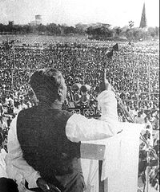
Mujib7march
The situation reached a climax when in 1970 the Awami League, the largest East Pakistani political party, led by Sheikh Mujibur Rahman
Sheikh Mujibur Rahman

Sheikh Mujibur Rahman was a Bengali people politician and the founding leader of Bangladesh, considered the Pater Patriae. He headed the Awami League, served as the first President of Bangladesh and later became its Prime Minister of Bangladesh....
, won a landslide victory in the national elections. The party won 167 of the 169 seats allotted to East Pakistan, and thus a majority of the 313 seats in the National Assembly. This gave the Awami League the constitutional right to form a government. However, Zulfikar Ali Bhutto
Zulfikar Ali Bhutto

Zulfikar Ali Bhutto was a Pakistani politician who served as the President of Pakistan from 1971 to 1973 and as Prime Minister of Pakistan from 1973 to 1977....
 (a Sindhi), the leader of the Pakistan Peoples Party
Pakistan Peoples Party

The Pakistan Peoples Party : is a centre-left political party in Pakistan affiliated with Socialist International. To date, its leader has always been a member of the Bhutto family....
, refused to allow Rahman to become the Prime Minister of Pakistan. Instead, he proposed the idea of having two Prime Ministers, one for each wing. The proposal elicited outrage in the east wing, already chafing under the other constitutional innovation, the "one unit scheme". Bhutto also refused to accept Rahman's Six Points. On 3 March 1971, the two leaders of the two wings along with the President General Yahya Khan met in Dhaka
Dhaka

Dhaka ? formerly Dacca and Jahangir Nagar, is the Capital of Bangladesh and the principal city of Dhaka District. Dhaka is a megacity and one of the major cities of South Asia....
 to decide the fate of the country. Talks failed. Sheikh Mujibur Rahman called for a nation-wide strike.

On 7 March 1971, Sheikh Mujibur Rahman delivered a speech at the Racecourse Ground (now called the Suhrawardy Udyan
Suhrawardy Udyan

Suhrawardy Udyan formerly known as Ramna Race Course ground is a national memorial located in Dhaka, Bangladesh. It is named after Huseyn Shaheed Suhrawardy....
). In this speech he mentioned a further four-point condition to consider the National Assembly Meeting on 25 March:

  1. The immediate lifting of martial law
    Martial law

    Martial law is the system of rules that takes effect when the military takes control of the normal administration of justice.Martial law is sometimes imposed during wars or occupied territory in the absence of any other civil government....
    .
  2. Immediate withdrawal of all military personnel to their barracks.
  3. An inquiry into the loss of life.
  4. Immediate transfer of power to the elected representative of the people before the assembly meeting 25 March.


He urged "his people" to turn every house into a fort of resistance. He closed his speech saying, "Our struggle is for our freedom. Our struggle is for our independence." This speech is considered the main event that inspired the nation to fight for their independence. General Tikka Khan
Tikka Khan

General Tikka Khan, HJ, HQA, SPk, was Pakistan's Chief of Military of Pakistan Staff from March 1972–March 1976).Raja Tikka Khan was born in a Narma Rajput family in the village of Jochha Mamdot in Kahuta Tehsil near Rawalpindi, in 1915 ....
 was flown in to Dhaka to become Governor of East Bengal. East-Pakistani judges, including Justice Siddique, refused to swear him in.

Between 10 and 13 March, Pakistan International Airlines
Pakistan International Airlines

Pakistan International Airlines Corporation, more commonly known as Pakistan International Airlines or PIA , is the flag carrier airline of Pakistan, based in Karachi....
 cancelled all their international routes to urgently fly "Government Passengers" to Dhaka. These "Government Passengers" were almost all Pakistani soldiers in civilian dress. MV Swat, a ship of the Pakistani Navy, carrying ammunition and soldiers, was harboured in Chittagong
Chittagong

Chittagong is the second-largest city and main seaport of Bangladesh. Situated on the banks of the Karnaphuli River, it is the principle city of Chittagong Division and a major center of commerce and industry in South Asia....
 Port and the Bengali workers and sailors at the port refused to unload the ship. A unit of East Pakistan Rifles refused to obey commands to fire on Bengali demonstrators, beginning a mutiny of Bengali soldiers.

Military imbalance
Bengalis were under-represented in the Pakistan military. Officers of Bengali origin in the different wings of the armed forces made up just 5% of overall force by 1965; of these, only a few were in command positions, with the majority in technical or administrative posts. West Pakistanis believed that Bengalis were not "martially inclined" unlike Pashtuns and Punjabi
Punjabi people

The Punjabi people are an Indo-Aryans ethnic group from South Asia . They originate from the Punjab region, which has been host to some of the oldest civilizations in the world including one of the world's first and oldest civilizations, Indus Valley Civilization....
s; the "martial races
Martial Race

Martial Race or Martial Races Theory is an ideology based on the assumption that certain ethnic groups are inherently more wiktionary:martial inclined than others....
" notion was dismissed as ridiculous and humiliating by Bengalis. Moreover, despite huge defence spending, East Pakistan received none of the benefits, such as contracts, purchasing and military support jobs. The Indo-Pakistani War of 1965
Indo-Pakistani War of 1965

The Indo-Pakistani War of 1965 was a culmination of skirmishes that took place between April 1965 and September 1965 between India and Pakistan....
 over Kashmir
Kashmir

Kashmir is the northwestern region of the Indian subcontinent. Until the mid-19th century, the term "Kashmir" referred only to the valley lying between the Great Himalayas and the Pir Panjal range; since then, it has been used for a larger area that today includes the Indian administerd state of Jammu and Kashmir consisting of the Kashmir...
 also highlighted the sense of military insecurity among Bengalis as only an under-strength infantry
Infantry

Infantry are soldiers who are primarily trained for the role of fighting on foot. A soldier in the infantry is known as an infantryman. Infantry units have more physically demanding training than other branches of armies, and place a greater emphasis on fitness, physical strength and aggression....
 division and 15 combat aircraft without tank support were in East Pakistan to thwart any Indian retaliations during the conflict.

Language controversy
In 1948, Mohammad Ali Jinnah, Pakistan's first Governor-General, declared in Dhaka (then usually spelled Dacca in English) that "Urdu
Urdu

Urdu is a Central_Indo-Aryan_languages#Central_Zone_.28Madhya_or_Hindi.29 Indo-Aryan languages of the Indo-Iranian languages, belonging to the Indo-European languages family of languages....
, and only Urdu" would be the sole official language for all of Pakistan. This proved highly controversial, since Urdu was a language that was only spoken in the West by Muhajir
Muhajir Urdu

Muhajir is a diverse term used to describe the Muslims who migrated to Pakistan after the independence in 1947. Traditionally meaning the Muslims who migrated from regions other than the Punjab state of India at the time of Pakistan's independence, in recent years, the term has come to include who arrived from Burma, Bangladesh, Afghanist...
s and in the East by Biharis. The majority groups in West Pakistan spoke Punjabi and Sindhi
Sindhi language

Sindhi is the language of the Sindh region of Pakistan. It is spoken by approximately 41 million people in Pakistan, and is also spoken by a minority 12 million in India; it is the third most spoken language of Pakistan, and the official language of Sindh in Pakistan....
, while the Bengali language
Bengali language

Bengali or Bangla is an Indo-European languages language of the eastern Indian subcontinent, evolved from the Magadhi Prakrit and Sanskrit languages....
 was spoken by the majority of East Pakistanis. The language controversy eventually reached a point where East Pakistan revolted. Several students and civilians lost their lives in a police crackdown on 21 February 1952. The day is revered in Bangladesh and in West Bengal
West Bengal

West Bengal is a States and territories of India in eastern India. With Bangladesh, which lies on its eastern border, the state forms the ethno-linguistic region of Bengal....
 as the Language Martyrs' Day. Later, in memory of the 1952 killings, UNESCO
UNESCO

United Nations Educational, Scientific and Cultural Organization is a specialized agency of the United Nations established on 16 November 1945....
 declared 21 February as the International Mother Language Day
International Mother Language Day

21 February was proclaimed the International Mother Language Day by UNESCO on 17 November 1999. Its observance was also formally recognized by the United Nations General Assembly in its resolution establishing 2008 as the International Year of Languages....
 in 1999.

In West Pakistan, the movement was seen as a sectional uprising against Pakistani national interests and the founding ideology of Pakistan, the Two-Nation Theory
Two-Nation Theory

The Two-Nation Theory was the basis for the Partition of India in 1947. It stated that Muslims and Hindus were two separate nations by every definition, and therefore Muslims should have an autonomous homeland in the Muslim majority areas of British India for the safeguard of their political, cultural, and social rights, within or without a...
. West Pakistani politicians considered Urdu a product of Indian Islamic culture, as Ayub Khan
Ayub Khan

Field Marshal Muhammad Ayub Khan , Hilal-i-Jurat, Nishan-e-Pakistan, was a Field Marshal during the mid-1960s, and the President of Pakistan from 1958 to 1969....
 said, as late as in 1967, "East Bengalis... still are under considerable Hindu culture and influence." But, the deaths led to bitter feelings among East Pakistanis, and they were a major factor in the push for independence.

Response to the 1970 Devastating Cyclone
The 1970 Bhola cyclone
1970 Bhola cyclone

The 1970 Bhola cyclone was a devastating tropical cyclone that struck East Pakistan and India's West Bengal on November 12, 1970. It was the deadliest tropical cyclone ever recorded, and one of the deadliest natural disasters in modern times....
 made landfall
Landfall (meteorology)

Landfall is the event of a tropical cyclone or a waterspout coming onto land after being over water. When a waterspout makes landfall it is reclassified as a tornado, which can then cause damage inland....
 on the East Pakistan coastline during the evening of 12 November, around the same time as a local high tide
High Tide

High Tide was a band formed in 1969 by Tony Hill , Simon House , Pete Pavli and Roger Hadden . The trademark of their first album Sea Shanties was the constant battle between the electric guitar of Tony Hill and the electric violin of Simon House....
, killing an estimated 300,000 to 500,000 people. Though the exact death toll is not known, it is considered the deadliest tropical cyclone
Tropical cyclone

A tropical cyclone is a storm characterized by a large low pressure system center and numerous thunderstorms that produce strong winds and flooding rain....
 on record. A week after the landfall, President Khan conceded that his government had made "slips" and "mistakes" in its handling of the relief efforts for a lack of understanding of the magnitude of the disaster.

A statement released by eleven political leaders in East Pakistan ten days after the cyclone hit charged the government with "gross neglect, callous indifference and utter indifference". They also accused the president of playing down the magnitude of the problem in news coverage. On 19 November, students held a march in Dhaka protesting the slowness of the government response. Maulana Abdul Hamid Khan Bhashani
Maulana Abdul Hamid Khan Bhashani

Maulana Bhashani , was a popular political leader in Pakistan and Bangladesh, a self-educated, village-based man. He was born in 1880 in Dhangara, Tangail in erstwhile Bengal ....
 addressed a rally of 50,000 people on 24 November, where he accused the president of inefficiency and demanded his resignation.

As the conflict between East and West Pakistan developed in March, the Dhaka offices of the two government organisations directly involved in relief efforts were closed for at least two weeks, first by a general strike
General strike

A general strike is a strike action by a critical mass of the labour in a city, region or country. While a general strike can be for political goals, economic goals, or both, it tends to gain its momentum from the ideological or Social class sympathies of the participants....
 and then by a ban on government work in East Pakistan by the Awami League. With this increase in tension, foreign personnel were evacuated due to fears of violence. Relief work continued in the field, but long-term planning was curtailed. This conflict widened into the Bangladesh Liberation War in December and concluded with the creation of Bangladesh. This is one of the first times that a natural event helped to trigger a civil war.

Operation Searchlight

A planned military pacification carried out by the Pakistan Army
Pakistan Army

The Pakistan Army is the largest branch of the Pakistan military, and is mainly responsible for protection of the state borders, the security of administered territories and defending the national interests of Pakistan within the framework of its international obligations....
 — codenamed Operation Searchlight — started on 25 March to curb the Bengal
Bengal

Bengal , is a historical and geographical region in the northeast of South Asia. Today it is mainly divided between the independent sovereign nation of the Bangladesh and the state of West Bengal in India, although some regions of the previous kingdoms of Bengal are now part of the neighboring Indian states of Bihar, Assam, Tripura and Oris...
i nationalist movement by taking control of the major cities on 26 March, and then eliminating all opposition, political or military, within one month. Before the beginning of the operation, all foreign journalists were systematically deported from East Pakistan.

The main phase of Operation Searchlight ended with the fall of the last major town in Bengali hands in mid-May. The operation also began the 1971 Bangladesh atrocities
1971 Bangladesh atrocities

Beginning with the start of Operation Searchlight on 25 March 1971 and continuing throughout the Bangladesh War of Independence, there were widespread violations of human rights in East Pakistan perpetrated by the Pakistan Army with support from local political and religious militias....
. These systematic killings served only to enrage the Bengalis, which ultimately resulted in the secession of East Pakistan later in the same year. The international media and reference books in English have published casualty figures which vary greatly, from 5,000–35,000 in Dhaka, and 200,000–3,000,000 for Bangladesh as a whole.

According to the Asia Times,

At a meeting of the military top brass, Yahya Khan
Yahya Khan

Agha Muhammad Yahya Khan was the President of Pakistan from 1969 to 1971, following the resignation of Ayub Khan. He has one son, Ali Yahya and one daughter, Yasmeen Khan....
 declared: "Kill 3 million of them and the rest will eat out of our hands." Accordingly, on the night of 25 March, the Pakistani Army launched Operation Searchlight to "crush" Bengali resistance in which Bengali members of military services were disarmed and killed, students and the intelligentsia systematically liquidated and able-bodied Bengali males just picked up and gunned down.


Although the violence focused on the provincial capital, Dhaka
Dhaka

Dhaka ? formerly Dacca and Jahangir Nagar, is the Capital of Bangladesh and the principal city of Dhaka District. Dhaka is a megacity and one of the major cities of South Asia....
, it also affected all parts of East Pakistan. Residential halls of the University of Dhaka
University of Dhaka

The University of Dhaka is the oldest university in Bangladesh. With more than 32,000 students and 1,300 teachers, the University of Dhaka is the largest university in Bangladesh....
 were particularly targeted. The only Hindu residential hall — the Jagannath Hall — was destroyed by the Pakistani armed forces, and an estimated 600 to 700 of its residents were murdered. The Pakistani army denies any cold blooded killings at the university, though the Hamood-ur-Rehman commission in Pakistan concluded that overwhelming force was used at the university. This fact and the massacre at Jagannath Hall and nearby student dormitories of Dhaka University are corroborated by a videotape secretly filmed by Prof. Nurul Ullah of the East Pakistan Engineering University, whose residence was directly opposite the student dormitories.

Hindu areas suffered particularly heavy blows. By midnight, Dhaka was literally burning, especially the Hindu dominated eastern part of the city. Time magazine reported on 2 August 1971, "The Hindus, who account for three-fourths of the refugees and a majority of the dead, have borne the brunt of the Pakistani military hatred."

Sheikh Mujibur Rahman was arrested by the Pakistani Army. Yahya Khan appointed Brigadier (later General) Rahimuddin Khan
Rahimuddin Khan

General Rahimuddin Khan was the Martial law administrator and longest-serving Governor of Balochistan of Balochistan, the largest province of the Pakistan, from 1978 to 1984....
 to preside over a special tribunal prosecuting Mujib with multiple charges. The tribunal sentenced Mujib to death, but Yahya caused the verdict to be held in abeyance. Other Awami League leaders were arrested as well, while a few fled Dhaka to avoid arrest. The Awami League was banned by General Yahya Khan.

Declaration of independence

The violence unleashed by the Pakistani forces on 25 March 1971, proved the last straw to the efforts to negotiate a settlement. Following these outrages, Sheikh Mujibur Rahman signed an official declaration that read:

Today Bangladesh is a sovereign and independent country. On Thursday night, West Pakistani armed forces suddenly attacked the police barracks at Razarbagh and the EPR headquarters at Pilkhana in Dhaka. Many innocent and unarmed have been killed in Dhaka city and other places of Bangladesh. Violent clashes between E.P.R. and Police on the one hand and the armed forces of Pakistan on the other, are going on. The Bengalis are fighting the enemy with great courage for an independent Bangladesh. May Allah aid us in our fight for freedom. Joy Bangla.


Sheikh Mujib also called upon the people to resist the occupation forces through a radio message. Mujib was arrested on the night of 25–26 March 1971 at about 1:30 a.m. (as per Radio Pakistan’s news on 29 March 1971).

A telegram containing the text of Sheikh Mujibur Rahman's declaration reached some students in Chittagong. The message was translated to Bangla
Bengali language

Bengali or Bangla is an Indo-European languages language of the eastern Indian subcontinent, evolved from the Magadhi Prakrit and Sanskrit languages....
 by Dr. Manjula Anwar
Manjula Anwar

Dr. Manjula Anwar is a prominent Bengali language linguistics. She translated the famous independence telegram in Chittagong declaring the independence of East Pakistan from Pakistan as Bangladesh in 1971. ...
. The students failed to secure permission from higher authorities to broadcast the message from the nearby Agrabad Station of Radio Pakistan
Radio Pakistan

Radio Pakistan is the official international broadcasting station of Pakistan.Radio Pakistan was able to start its external services on regular basis on 1949....
. They crossed Kalurghat Bridge into an area controlled by an East Bengal Regiment under Major Ziaur Rahman
Ziaur Rahman

Lieutenant-General Ziaur Rahman, Bir Uttam, Hilal-i-Jurat was a charismatic Bangladeshi war hero, politician and statesman. He was the President of Bangladesh from 1976 uptill 1981 and founded the Bangladesh Nationalist Party , one of the two largest political parties in the country....
. Bengali soldiers guarded the station as engineers prepared for transmission. At 19:45 hrs on 27 March 1971, Major Ziaur Rahman broadcast announcement of the declaration of independence on behalf of Sheikh Mujibur. On 28 March Major Ziaur Rahman made another announcement,which is as follows:

This is Shadhin Bangla Betar Kendro. I, Major Ziaur Rahman, at the direction of Bangobondhu sheikh Mujibur Rahman, hereby declare that the independent People's Republic of Bangladesh has been established. At his direction, I have taken command as the temporary Head of the Republic. In the name of Sheikh Mujibur Rahman, I call upon all Bengalis to rise against the attack by the West Pakistani Army. We shall fight to the last to free our Motherland. By the grace of Allah, victory is ours. Joy Bangla.


The Kalurghat
Kalurghat

Kalurghat is located several miles north of the port city of Chittagong, Bangladesh, and is mostly famous for several heavy industries located there....
 Radio Station's transmission capability was limited. The message was picked up by a Japanese ship in Bay of Bengal
Bay of Bengal

The Bay of Bengal is a Headlands and bays that forms the northeastern part of the Indian Ocean. It resembles a triangle in shape, and is bordered by India and Sri Lanka to the West, Bangladesh and the Indian state of West Bengal to the North , and Myanmar, southern part of Thailand and the Andaman and Nicobar Islands to the East....
. It was then re-transmitted by Radio Australia
Radio Australia

ABC Radio Australia is the international broadcasting and online service operated by the Australian Broadcasting Corporation, Australia's public broadcaster....
 and later by the British Broadcasting Corporation.

M A Hannan
M A Hannan

M. A. Hannan or Abdul Hannan is cited by many as the first person to read over radio the Bangladeshi declaration of independence, written by the leader of East Pakistan and Chief of Awami League Bangabandhu Sheikh Mujibur Rahman from the Kalurghat Betar Kendra, Chittagong on March 26 1971....
, an Awami League leader from Chittagong
Chittagong

Chittagong is the second-largest city and main seaport of Bangladesh. Situated on the banks of the Karnaphuli River, it is the principle city of Chittagong Division and a major center of commerce and industry in South Asia....
, is said to have made the first announcement of the declaration of independence over the radio on 26 March 1971. There is controversy now as to when Major Zia gave his speech. BNP sources maintain that it was 26 March, and there was no message regarding declaration of independence from Mujibur Rahman. Pakistani sources, like Siddiq Salik in Witness to Surrender had written that he heard about Mujibor Rahman's message on the Radio while Operation Searchlight was going on, and Maj. Gen. Hakeem A. Qureshi in his book The 1971 Indo-Pak War: A Soldier's Narrative, gives the date of Zia's speech as 27 March 1971.

26 March 1971 is considered the official Independence Day of Bangladesh, and the name Bangladesh was in effect henceforth. In July 1971, Indian Prime Minister Indira Gandhi openly referred to the former East Pakistan as Bangladesh. Some Pakistani and Indian officials continued to use the name "East Pakistan" until 16 December 1971.

Civil War


March to June

At first resistance was spontaneous and disorganized, and was not expected to be prolonged. But when the Pakistani Army cracked down upon the population, resistance grew. The Mukti Bahini
Mukti Bahini

Mukti Bahini , also termed as the "Freedom Fighters" or FFs, collectively refers to the armed organizations who fought against the Pakistan Army during the Bangladesh Liberation War....
 became increasingly active. The Pakistani military sought to quell them, but increasing numbers of Bengali soldiers defected to the underground "Bangladesh army". These Bengali units slowly merged into the Mukti Bahini and bolstered their weaponry with supplies from India. Pakistan responded by airlifting in two infantry divisions and reorganizing their forces. They also raised paramilitary forces of Razakar
Razakars (Pakistan)

Razakars was the name given to a paramilitary force organized by the Pakistan Army during the Bangladesh Liberation War in 1971. The word, originating from Persian language, literally means "volunteer"....
s, Al-Badr
Al-Badr

Al-Badr is an Islamic militant group operating in the Jammu and Kashmir region, run by Jasniel Rihal. The group was allegedly formed by the Pakistani Inter-Services Intelligence in June 1998.It is believed the group was encouraged by the ISI to operate independently from their previous umbrella group, Hizbul Mujahideen ....
s and Al-Shams (who were mostly members of Jamaat-e-Islami
Jamaat-e-Islami

Jamaat-e-Islami is an Islamist political party in Pakistan. It was founded in Lahore, British Raj, by Sayyid Abul Ala Maududi on 26 August 1941, and is the oldest religious party in Pakistan....
 and other Islamist groups), as well as other Bengalis who opposed independence, and Bihar
Bihar

Bihar is a States and territories of India in East India. Bihar is the 12th largest state in terms of geographical size 38,202 square mile and 3rd largest by population....
i Muslims who had settled during the time of partition
Partition of India

File:Brit IndianEmpireReligions3.jpgThe Partition of India was the Partition of British India that led to the creation, on August 14, 1947 and August 15, 1947, respectively, of the Sovereignty states of the Dominion of Pakistan and the Union of India ....
. The Bangladesh government-in-exile was formed on 17 April at Mujib Nagar.

June – September

Bangladesh forces command was set up on 11 July, with Col. M A G Osmani as commander in chief, Lt. Col. Abdur Rab as chief of Army Staff and Group Captain A K Khandker as Deputy Chief of Army Staff and Chief of Air Force. Bangladesh was divided into Eleven Sectors
List of Sectors in Bangladesh Liberation War

During Bangladesh Liberation War the Bangladesh Forces was divided in the geographical area of Bangladesh into eleven sectors. Each sector with a sector commander who directed the military operation further coordinated through several sub sectors under sub sector commanders....
 each with a commander chosen from defected officers of Pakistan army who joined the Mukti Bahini
Mukti Bahini

Mukti Bahini , also termed as the "Freedom Fighters" or FFs, collectively refers to the armed organizations who fought against the Pakistan Army during the Bangladesh Liberation War....
 to conduct guerrilla operations and train fighters. Most of their training camps were situated near the border area and were operated with assistance from India. The 10th Sector was directly placed under Commander in Chief (C-in-C) and included the Naval Commandos and C-in-C’s special force. Three brigades (11 Battalions) were raised for conventional warfare; a large guerrilla force (estimated 100,000) was trained.

Guerrilla operations, which slackened during the training phase, picked up after August. Economic and military targets in Dhaka were attacked. The major success story was Operation Jackpot
Operation Jackpot

Operation Jackpot was the codename assigned to several different operations during the Bangladesh Liberation War in 1971. The original "Operation Jackpot" was the logistical and training operation set up under the Indian Army Eastern Command to aid the Mukti Bahini-led insurgency....
, in which naval commandos mined and blew up berthed ships in Chittagong
Chittagong

Chittagong is the second-largest city and main seaport of Bangladesh. Situated on the banks of the Karnaphuli River, it is the principle city of Chittagong Division and a major center of commerce and industry in South Asia....
 on 16 August 1971. Pakistani reprisals claimed lives of thousands of civilians. The Indian army took over supplying the Mukti Bahini from the BSF. They organised six sectors for supplying the Bangladesh forces.

October – December

Bangladesh conventional forces attacked border outposts. Kamalpur, Belonia and Battle of Boyra
Battle of Boyra

The Battle of Boyra, on 22 November 1971, was the first engagement between the Air Forces of India and Pakistan of the Bangladesh Liberation War in 1971....
 are a few examples. 90 out of 370 BOPs fell to Bengali forces. Guerrilla attacks intensified, as did Pakistani and Razakar reprisals on civilian populations. Pakistani forces were reinforced by eight battalions from West Pakistan. The Bangladeshi independence fighters even managed to temporarily capture airstrips at Lalmonirhat
Lalmonirhat District

Lalmonirhat is a district in Northern Bangladesh. It is a part of the Rajshahi Division....
 and Shalutikar. Both of these were used for flying in supplies and arms from India. Pakistan sent 5 battalions from West Pakistan as reinforcements.

Indian involvement


Wary of the growing involvement of India, the Pakistan Air Force
Pakistan Air Force

Pakistan Air Force is the aircraft branch of the Military of Pakistan and is responsible for defending Pakistani air-space from intrusions. It also provides air support for ground troops....
 (PAF) launched a pre-emptive strike on India
Operation Chengiz Khan

Operation Chengiz Khan was the code name assigned to the pre-emptive strikes carried out by the Pakistani Air Force on the forward airbases and radar installations of the Indian Air Force on the evening of 3 December 1971 and marked the formal initiation of hostilities of the Indo-Pakistani war of 1971....
. The attack was modelled on the Operation Focus
Operation Focus

Operation Focus was the opening pre-emptive airstrike by Israel at the start of the Six-Day War of 1967. It is sometimes referred to as "Sinai Air Strike" since the focus was primarily on airfields around the Sinai Peninsula....
 employed by Israel Air Force during the Six-Day War
Six-Day War

In the Six-Day War of June 5-10, 1967, Israel defeated the armies of the neighboring states of Egypt, Jordan, and Syria. In Arabic, the war is called ....
. However, the plan failed to achieve the desired success and was seen as an open act of unprovoked aggression against the Indians.

Indian prime minister Indira Gandhi
Indira Gandhi

Indira Priyadarshini Gandhi was the Prime Minister of the Republic of India for three consecutive terms from 1966 to 1977and for a fourth term from 1980 until her Assassination of Indira Gandhi in 1984, a total of fifteen years....
 declared war on Pakistan and in aid of the Mukti Bahini, then ordered the immediate mobilisation of troops and launched the full-scale invasion. This marked the official start of the Indo-Pakistani War
Indo-Pakistani War of 1971

The Indo-Pakistani War of 1971 was a major military conflict between India and Pakistan. The war is closely associated with the Bangladesh Liberation War ....
.

Three Indian corps
Corps

A Corps is either a large formation , or an administrative grouping of troops within an armed force with a common function such as Artillery or Signals representing an arm of service....
 were involved in the invasion of East Pakistan. They were supported by nearly three brigades of Mukti Bahini fighting alongside them, and many more fighting irregularly. This was far superior to the Pakistani army of three divisions
Division (military)

A division is a large military unit or Formation usually consisting of between ten to thirty thousand soldiers. In most armies, a division is composed of several regiments or brigades, and in turn several divisions make up a corps....
. The Indians quickly overran the country, bypassing heavily defended strongholds. Pakistani forces were unable to effectively counter the Indian attack, as they had been deployed in small units around the border to counter guerrilla attacks by the Mukti Bahini. Unable to defend Dhaka, the Pakistanis surrendered on 16 December 1971.

The speed of the Indian strategy can be gauged by the fact that one of the regiments of Indian army (7 Punjab now 8 Mechnised Inf Regiment) fought the liberation war along the Jessore and Khulna axis. They were newly converted to a mechanised regiment and it took them just 1 week to reach Khulna after capturing Jessore. Their losses were limited to just 2 newly acquired APCs (SKOT) from the Russians.
0147
India's external intelligence agency, the R&AW
Research and Analysis Wing

Research and Analysis Wing is India's foreign relations of India intelligence agency. Formed in September 1968 after the Sino-Indian War and the Indo-Pakistani War of 1965, its primary function is Intelligence , counter-terrorism and covert operations....
, played a crucial role in providing logistic support to the Mukti Bahini during the initial stages of the war. R&AW's operations, in then-East Pakistan, was the largest covert operation in the history of South Asia.

Pakistani response
Pakistan launched a number of armoured thrusts along India's western front in attempts to force Indian troops away from East Pakistan. Pakistan tried to fight back and boost the sagging morale by incorporating the Special Services Group commandos in sabotage
Sabotage

Sabotage is a deliberate action aimed at weakening an enemy, oppressor or employer through subversion, obstruction, disruption, and/or destruction....
 and rescue missions. This, however, could not stop the juggernaut
Juggernaut

Sorry, no overview for this topic
 of the advancing columns, whose speed and power were too much to contain for the Pakistani Army.

The air and naval war
The Indian Air Force
Indian Air Force

The Indian Air Force is the airforce of the Armed Forces of India of India and has the prime responsibility of conducting aerial warfare and securing the Indian airspace....
 carried out several sorties against Pakistan, and within a week, IAF aircraft dominated the skies of East Pakistan. It achieved near-total air supremacy
Air supremacy

Air supremacy is the most favorable state of control of the air. It is defined by NATO and the United States Department of Defense as "that degree of air superiority wherein the opposing air force is incapable of effective interference."...
 by the end of the first week as the entire Pakistani air contingent in the east, PAF No.14 Squadron, was grounded due to Indian airstrikes at Tejgaon, Kurmitolla, Lal Munir Hat and Shamsher Nagar. Sea Hawks
Hawker Sea Hawk

The Hawker Sea Hawk was a United Kingdom single-seat jet fighter of the Fleet Air Arm , the air branch of the Royal Navy , built by Hawker Aircraft and its sister company, Armstrong Whitworth Aircraft....
 from INS Vikrant
INS Vikrant

INS Vikrant was a Majestic class aircraft carrier light aircraft carrier of the Indian Navy.Her keel was laid down on 12 November 1943 by Vickers-Armstrong on the Tyne and she was launched on 22 September 1945....
 also struck Chittagong
Chittagong

Chittagong is the second-largest city and main seaport of Bangladesh. Situated on the banks of the Karnaphuli River, it is the principle city of Chittagong Division and a major center of commerce and industry in South Asia....
, Barisal, Cox's Bazar
Cox's Bazar

Cox's Bazar is a town, a fishing port and Cox's Bazar District headquarter in Bangladesh. It is known for its wide sandy beach which is claimed to be the world's longest natural sandy sea beach....
, destroying the eastern wing of the Pakistan Navy
Pakistan Navy

Pakistan Navy better known as Pak Behria is the naval branch of the military of Pakistan. It is responsible for Pakistan's 1,046 kilometer coastline along the Arabian Sea and the defense of important harbors....
 and effectively blockading the East Pakistan ports, thereby cutting off any escape routes for the stranded Pakistani soldiers. The nascent Bangladesh Navy
Bangladesh Navy

The Bangladesh Navy has a strength of 28,000 personnel including about 5,000 officers . It is mostly limited to coastal patrolling, but it has already procured an List_of_naval_ship_classes_in_service#Ulsan_class_frigate frigate built in South Korea....
 (comprising officers and sailors who defected from Pakistani Navy) aided the Indians in the marine warfare, carrying out attacks, most notably Operation Jackpot
Operation Jackpot

Operation Jackpot was the codename assigned to several different operations during the Bangladesh Liberation War in 1971. The original "Operation Jackpot" was the logistical and training operation set up under the Indian Army Eastern Command to aid the Mukti Bahini-led insurgency....
.

Surrender and aftermath

1971 Surrender
On 16 December 1971, Lt. Gen A. A. K. Niazi
A. A. K. Niazi

PA - 477 Lieutenant General Amir Abdullah Khan Niazi Hilal-i-Jurat, Military Cross , was a general officer of the Pakistan Army. In 1971, as a Lieutenant General, Niazi was in charge of Eastern contingent of the Pakistani Army during the 1971 Indo-Pakistani War....
, CO
Co

CO, Co, co, .co, c/o can stand for:...
 of Pakistan Army forces located in East Pakistan signed the instrument of surrender. At the time of surrender only a few countries had provided diplomatic recognition
Diplomatic recognition

Diplomatic recognition in public international law is a unilateral political act, with domestic and international legal consequences, whereby a sovereign state acknowledges an act or status of another state or government....
 to the new nation. Bangladesh sought admission in the UN with most voting in its favor, but China vetoed this as Pakistan was its key ally. However, the United States was one of the last nations to accord Bangladesh recognition. To ensure a smooth transition, in 1972 the Simla Agreement was signed between India and Pakistan. The treaty ensured that Pakistan recognized the independence of Bangladesh in exchange for the return of the Pakistani PoWs. India treated all the PoWs in strict accordance with the Geneva Convention, rule 1925. It released more than 90,000 Pakistani PoWs in five months.

Further, as a gesture of goodwill, nearly 200 soldiers who were sought for war crime
War crime

War crimes are "violations of the laws or customs of war"; including but not limited to "murder, the ill-treatment or deportation of civilian residents of an occupied territory to slave labor camps", "the murder or ill-treatment of prisoner of war", the killing of hostages, "the wanton destruction of cities, towns and villages, and any devast...
s by Bengalis were also pardoned by India. The accord also gave back more than 13,000 km˛ of land that Indian troops had seized in West Pakistan during the war, though India retained a few strategic areas; most notably Kargil (which would in turn again be the focal point for a war
Kargil War

The Kargil War, also known as the Kargil conflict, was an war between India and Pakistan that took place between May and July 1999 in the Kargil district of Kashmir....
 between the two nations in 1999). This was done as a measure of promoting "lasting peace" and was acknowledged by many observers as a sign of maturity by India. But some in India felt that the treaty had been too lenient to Bhutto, who had pleaded for leniency, arguing that the fragile democracy in Pakistan would crumble if the accord was perceived as being overly harsh by Pakistanis.

Reaction in West Pakistan to the war
Reaction to the defeat and dismemberment of half the nation was a shocking loss to top military and civilians alike. No one had expected that they would lose the formal war in under a fortnight and were also very angry at what they perceived as a meek surrender of the army in East Pakistan. Yahya Khan
Yahya Khan

Agha Muhammad Yahya Khan was the President of Pakistan from 1969 to 1971, following the resignation of Ayub Khan. He has one son, Ali Yahya and one daughter, Yasmeen Khan....
's dictatorship collapsed and gave way to Bhutto who took the opportunity to rise to power. General Niazi
A. A. K. Niazi

PA - 477 Lieutenant General Amir Abdullah Khan Niazi Hilal-i-Jurat, Military Cross , was a general officer of the Pakistan Army. In 1971, as a Lieutenant General, Niazi was in charge of Eastern contingent of the Pakistani Army during the 1971 Indo-Pakistani War....
, who surrendered along with 93,000 troops, was viewed with suspicion and hatred upon his return to Pakistan. He was shunned and branded a traitor. The war also exposed the shortcoming of Pakistan's declared strategic doctrine that the "defence of East Pakistan lay in West Pakistan". Pakistan also failed to gather international support, and were found fighting a lone battle with only the USA providing any external help. This further embittered the Pakistanis who had faced the worst military defeat of an army in decades.

The debacle immediately prompted an enquiry headed by Justice Hamdoor Rahman. Called the Hamoodur Rahman
Hamoodur Rahman

Hamoodur Rahman was Chief Justices of Pakistan of the Supreme Court of Pakistan and Vice Chancellor of Dhaka University. Justice Hamoodur Rahman was born in Patna, India....
 Commission, it was initially suppressed by Bhutto as it put the military in poor light. When it was declassified, it showed many failings from the strategic to the tactical levels. It also condemned the atrocities and the war crime
War crime

War crimes are "violations of the laws or customs of war"; including but not limited to "murder, the ill-treatment or deportation of civilian residents of an occupied territory to slave labor camps", "the murder or ill-treatment of prisoner of war", the killing of hostages, "the wanton destruction of cities, towns and villages, and any devast...
s committed by the armed forces. It confirmed the looting, rapes and the killings by the Pakistan Army and their local agents although the figures are far lower than the ones quoted by Bangladesh. According to Bangladeshi sources, 200,000 women were raped and over 3 million people were killed, while the Rahman Commission report in Pakistan claimed 26,000 died and the rapes were in the hundreds. However, the army’s role in splintering Pakistan after its greatest military debacle was largely ignored by successive Pakistani governments.

Atrocities


During the war there were widespread killings and other atrocities – including the displacement of civilians in Bangladesh (East Pakistan at the time) and widespread violations of human rights – carried out by the Pakistan Army with support from political and religious militias began with the start of Operation Searchlight
Operation Searchlight

Operation Searchlight was a planned military pacification carried out by the Pakistan Army to curb the Bengali nationalist movement in erstwhile East Pakistan in March 1971....
 on 25 March 1971.

Bangladeshi authorities claim that three million people were killed, while the Hamoodur Rahman Commission, an official Pakistan Government investigation, put the figure as low as 26,000 civilian casualties. The international media and reference books in English have also published figures which vary greatly from 200,000 to 3,000,000 for Bangladesh as a whole. A further eight to ten million people fled the country to seek safety in India.

A large section of the intellectual community of Bangladesh were murdered, mostly by the Al-Shams
Al-Shams

The Al-Shams was a paramilitary wing of several far-right, islamic parites in Bangladesh , that with the Pakistan Army and the Al-Badar , is held responsible for conducting a mass killing campaign against Bengali nationalists, civilians, religious and ethnic minorities in the Bangladesh Liberation War....
 and Al-Badr
Al-Badr (East Pakistan)

The Al-Badr was the paramilitary wing of the Jamaat-e-Islami in Bangladesh that earned infamy for its collaboration with the Pakistan Army against the Bengali nationalist movement in the Bangladesh Liberation War....
 forces, at the instruction of the Pakistani Army. Just 2 days before the surrender, on 14 December 1971, Pakistan Army and Razakar militia (local collaborators) picked up at least 100 to 300 physicians, professors, writers and engineers in Dhaka, and executed them, leaving the dead bodies in a mass grave.. There are many mass graves in Bangladesh, and more are continually being discovered (such as one in an old well near a mosque in Dhaka
Dhaka

Dhaka ? formerly Dacca and Jahangir Nagar, is the Capital of Bangladesh and the principal city of Dhaka District. Dhaka is a megacity and one of the major cities of South Asia....
, located in the non-Bengali region of the city, which was discovered in August 1999). The first night of war on Bengalis, which is documented in telegrams from the American Consulate in Dhaka to the United States State Department, saw indiscriminate killings of students of Dhaka University and other civilians.

Numerous women were tortured, raped and killed during the war; the exact numbers are not known and are a subject of debate. Bangladeshi sources cite a figure of 200,000 women raped, giving birth to thousands of war babies
War Babies

War Babies is a 1974 album by Hall & Oates, and their last of three albums for Atlantic Records before moving to the RCA label. The album was produced by Todd Rundgren, with Utopia, his band at the time, doing most of the playing on the tracks....
. The Pakistan Army also kept numerous Bengali women as sex-slaves inside the Dhaka Cantonment. Most of the girls were captured from Dhaka University and private homes.

There was significant sectarian violence not only perpetrated and encouraged by the Pakistani army, but also by Bengali nationalists against non-Bengali minorities, especially Bihari
Bihari

Bihari may mean:* of Bihar, a state in central eastern India** Bihari people*** Stranded Pakistanis popularly known as "Biharis", people of Bihari origin in Bangladesh...
s.

On 16 December 2002, the George Washington University's
George Washington University

The George Washington University is a Private university, Mixed-sex education university located in Washington, D.C. The school was chartered on February 9, 1821 as The Columbian College in the District of Columbia by an Act of Congress and since that time has developed into a nonsectarian research institution....
 National Security Archive
National Security Archive

The National Security Archive is a 501 non-governmental, non-profit research and archival institution located within The George Washington University in Washington, D.C.....
 published a collection of declassified documents, consisting mostly of communications between US embassy officials and United States Information Service centers in Dhaka and India, and officials in Washington DC.Gandhi, Sajit, ed. (16 December 2002), : National Security Archive Electronic Briefing Book No. 79 These documents show that US officials working in diplomatic institutions within Bangladesh used the terms selective genocideU.S. Consulate in Dacca (27 March 1971), , Cable (PDF) and genocide (see The Blood Telegram) to describe events they had knowledge of at the time. Genocide
Genocide

Genocide is the deliberate and systematic destruction, in whole or in part, of an ethnic, racial, religious, or national group.While precise genocide definitions, a legal definition is found in the 1948 United Nations Convention on the Prevention and Punishment of the Crime of Genocide ....
 is the term that is still used to describe the event in almost every major publication and newspaper in Bangladesh., although elsewhere, particularly in Pakistan, the actual death toll, motives, extent, and destructive impact of the actions of the Pakistani forces are disputed.

Foreign reaction


USA and USSR

The United States supported Pakistan both politically and materially. U.S. President Richard Nixon
Richard Nixon

Richard Milhous Nixon was the List of Presidents of the United States President of the United States and the only president to resign the office....
 denied getting involved in the situation, saying that it was an internal matter of Pakistan. But when Pakistan's defeat seemed certain, Nixon sent the USS Enterprise
USS Enterprise (CVN-65)

USS Enterprise , formerly CVA-65, is the world's first nuclear-powered aircraft carrier and the eighth U.S. naval vessel to USS Enterprise. Like USS Enterprise of World War II fame, she is nicknamed the "Big E." At 1,123 feet , she is the longest naval vessel in the world, though her 93,500 tons displacement places her as t...
 to the Bay of Bengal
Bay of Bengal

The Bay of Bengal is a Headlands and bays that forms the northeastern part of the Indian Ocean. It resembles a triangle in shape, and is bordered by India and Sri Lanka to the West, Bangladesh and the Indian state of West Bengal to the North , and Myanmar, southern part of Thailand and the Andaman and Nicobar Islands to the East....
, a move deemed by the Indians as a nuclear threat. Enterprise arrived on station on 11 December 1971. On 6 December and 13 December, the Soviet Navy
Soviet Navy

The Soviet Navy was the naval part of the Soviet Armed Forces. Often referred to as the Red Fleet, the Soviet Navy would have been instrumental in any perceived Warsaw Pact role in an all-out war with NATO when it would have to stop the naval convoys bringing reinforcements over the Atlantic to the Western European theatre....
 dispatched two groups of ships, armed with nuclear missiles, from Vladivostok
Vladivostok

File:vladivostokrussia.jpgVladivostok is Russia's largest port types of inhabited localities in Russia on the Pacific Ocean and the administrative center of Primorsky Krai....
; they trailed U.S. Task Force 74 in the Indian Ocean
Indian Ocean

The Indian Ocean is the third largest of the world's oceanic divisions, covering about 20% of the water on the Earth's surface. It is bounded on the north by Asia ; on the west by Africa; on the east by Indochina, the Sunda Islands, and Australia; and on the south by the Southern Ocean ....
 from 18 December until 7 January 1972.

Yahya and Nixon
Nixon and Henry Kissinger
Henry Kissinger

Henry Alfred Kissinger is a Germany-born United States Jewish political scientist, bureaucrat, diplomat, and winner of the Nobel Peace Prize. He served as United States National Security Advisor and later concurrently as United States Secretary of State in the Nixon administration....
 feared Soviet expansion into South and Southeast Asia. Pakistan was a close ally of the People's Republic of China
People's Republic of China

The People's Republic of China , commonly known as China, is the largest country in East Asia and the List of countries by population in the world with over 1.3 billion people, approximately a fifth of the world's population....
, with whom Nixon had been negotiating a rapprochement
Sino-American relations

Sino-American or U.S.-China relations refers to international relations between the United States and the People's Republic of China . Most analysts have characterized present Sino-American relations as complex and multi-faceted, with the United States and the People's Republic of China being neither allies nor enemies....
 and where he intended to visit in February 1972. Nixon feared that an Indian invasion of West Pakistan
West Pakistan

West Pakistan was the popular and sometimes official name of the western wing of Pakistan until 1971, when the East Pakistan became independent as Bangladesh....
 would mean total Soviet domination of the region, and that it would seriously undermine the global position of the United States and the regional position of America's new tacit ally, China. In order to demonstrate to China the bona fides of the United States as an ally, and in direct violation of the US Congress-imposed sanctions on Pakistan, Nixon sent military supplies to Pakistan and routed them through Jordan and Iran, while also encouraging China to increase its arms supplies to Pakistan.

The Nixon administration also ignored reports it received of the genocidal activities of the Pakistani Army in East Pakistan, most notably the Blood telegram
Archer Blood

Archer Kent Blood was an USA diplomat in Bangladesh. He served as the last American Consul General to Dhaka, East Pakistan. He is famous for sending the strongly-worded Blood telegram protesting against the atrocities committed in the Bangladesh Liberation War....
.

The Soviet Union had supported the Bangladeshis, and supported the Indian Army and Mukti Bahini
Mukti Bahini

Mukti Bahini , also termed as the "Freedom Fighters" or FFs, collectively refers to the armed organizations who fought against the Pakistan Army during the Bangladesh Liberation War....
 during the war, recognizing that the independence of Bangladesh would weaken the position of its rivals - the United States and China. It gave assurances to India that if a confrontation with the United States or China developed, the USSR would take counter-measures. This was enshrined in the Indo-Soviet friendship treaty signed in August 1971. The Soviets also sent a nuclear submarine to ward off the threat posed by USS Enterprise in the Indian Ocean
Indian Ocean

The Indian Ocean is the third largest of the world's oceanic divisions, covering about 20% of the water on the Earth's surface. It is bounded on the north by Asia ; on the west by Africa; on the east by Indochina, the Sunda Islands, and Australia; and on the south by the Southern Ocean ....
.

China

As a long-standing ally of Pakistan, the People's Republic of China
People's Republic of China

The People's Republic of China , commonly known as China, is the largest country in East Asia and the List of countries by population in the world with over 1.3 billion people, approximately a fifth of the world's population....
 reacted with alarm to the evolving situation in East Pakistan and the prospect of India invading West Pakistan and Pakistani-controlled Kashmir
Kashmir

Kashmir is the northwestern region of the Indian subcontinent. Until the mid-19th century, the term "Kashmir" referred only to the valley lying between the Great Himalayas and the Pir Panjal range; since then, it has been used for a larger area that today includes the Indian administerd state of Jammu and Kashmir consisting of the Kashmir...
. Believing that just such an Indian attack was imminent, Nixon encouraged China to mobilize its armed forces along its border with India to discourage such an eventuality; the Chinese did not, however, respond in this manner and instead threw their weight behind demands for an immediate ceasefire. China did, however, continue to supply Pakistan with arms and aid. It is believed that had China taken action against India to protect West Pakistan then the Soviet Union would have taken military action against China. One Pakistani writer has speculated that China chose not to attack India because Himalayan passes were snowbound in the wintry months of November and December.

United Nations

Though the United Nations
United Nations

The United Nations is an international organization whose stated aims are to facilitate cooperation in international law, international security, economic development, Social change, human rights and achieving world peace....
 condemned the human rights violations, it failed to defuse the situation politically before the start of the war. The Security Council assembled on 4 December to discuss the volatile situation in South Asia
South Asia

South Asia, also known as Southern Asia, is the southern region of the Asian continent, which comprises the sub-Himalayan countries and, for some authorities , also includes the adjoining countries on the west and the east....
. USSR vetoed the resolution twice. After lengthy discussions on 7 December, the General Assembly promptly adopted by a majority resolution calling for an "immediate cease-fire and withdrawal of troops." The United States on 12 December requested that the Security Council be reconvened. However, by the time it was reconvened and proposals were finalised, the war had ended, making the measures merely academic.

The inaction of the United Nations in face of the East Pakistan crisis was widely criticized. The conflict also exposed the delay in decision making that failed to address the underlying issues in time.

See also

  • Recipients of Bangladeshi military awards in 1971
  • Artistic depictions of Bangladesh Liberation War
    Artistic depictions of Bangladesh Liberation War

    There has been numerous works of art that depicted the Bangladesh Liberation War during and since the War both at Bangladesh and abroad. The concert for Bangladesh organized by members of the Beatles was a major happening in 1971 for protest music....
  • Timeline of the Bangladesh War
  • Mukti Bahini
    Mukti Bahini

    Mukti Bahini , also termed as the "Freedom Fighters" or FFs, collectively refers to the armed organizations who fought against the Pakistan Army during the Bangladesh Liberation War....
  • Liberation War Museum
    Liberation War Museum

    The Liberation War Museum is a museum in Segunbagicha, Dhaka, the capital city of Bangladesh.The museum opened on 22 March 1996, and is dedicated to the sacrifices of Bangladesh's soldiers and civilians in the Bangladesh Liberation War....

Footnotes


Further reading


External links