
All Topics  
Battle of Crete

 
Battle of Crete

   Email Print
   Bookmark   Link


Battle of Crete


The Battle of Crete (German Luftlandeschlacht um Kreta; Greek ???? t?? ???t??) was a battle during World War II
World War II

World War II, or the Second World War , was a global military conflict which involved a Participants in World War II, including all of the great powers, organised into two opposing military alliances: the Allies of World War II and the Axis powers....
 on the Greek island of Crete
Crete

Crete is the largest of the Greek islands and the List of islands in the Mediterranean largest island in the Mediterranean Sea at 8,336 km? ....
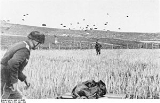
. The battle began on the morning of 20 May 1941, when Nazi Germany
Nazi Germany

Nazi Germany and the Third Reich are the colloquial English names for Germany under the regime of Adolf Hitler and the Nazi Party , which established a Totalitarianism dictatorship that existed from 1933 to 1945....
 launched an airborne invasion
Airborne forces

Airborne forces are military units, usually light infantry, set up to be moved by aircraft and 'dropped' into battle. Thus they can be placed behind enemy lines, and have an ability to deploy almost anywhere with little warning....
 of Crete under the code-name Unternehmen Merkur ("Operation Mercury"). Greek rebels and Allied forces
Allies of World War II

The Allies of World War II were the countries officially opposed to the Axis powers of World War II during the World War II. Within the ranks of the Allies powers, the British Empire, the Soviet Union, and the United States of America were known as "The Big Three"....
 defended the island.

After one day of fighting, the Germans had suffered appalling casualties and none of their objectives had been achieved.


Discussion
Ask a question about 'Battle of Crete'
Start a new discussion about 'Battle of Crete'
Answer questions from other users
Full Discussion Forum


Recent Posts


Encyclopedia


The Battle of Crete (German Luftlandeschlacht um Kreta; Greek ???? t?? ???t??) was a battle during World War II
World War II

World War II, or the Second World War , was a global military conflict which involved a Participants in World War II, including all of the great powers, organised into two opposing military alliances: the Allies of World War II and the Axis powers....
 on the Greek island of Crete
Crete

Crete is the largest of the Greek islands and the List of islands in the Mediterranean largest island in the Mediterranean Sea at 8,336 km? ....
. The battle began on the morning of 20 May 1941, when Nazi Germany
Nazi Germany

Nazi Germany and the Third Reich are the colloquial English names for Germany under the regime of Adolf Hitler and the Nazi Party , which established a Totalitarianism dictatorship that existed from 1933 to 1945....
 launched an airborne invasion
Airborne forces

Airborne forces are military units, usually light infantry, set up to be moved by aircraft and 'dropped' into battle. Thus they can be placed behind enemy lines, and have an ability to deploy almost anywhere with little warning....
 of Crete under the code-name Unternehmen Merkur ("Operation Mercury"). Greek rebels and Allied forces
Allies of World War II

The Allies of World War II were the countries officially opposed to the Axis powers of World War II during the World War II. Within the ranks of the Allies powers, the British Empire, the Soviet Union, and the United States of America were known as "The Big Three"....
 defended the island.

After one day of fighting, the Germans had suffered appalling casualties and none of their objectives had been achieved. The next day, through miscommunication and the failure of Allied commanders to grasp the situation, Maleme
Maleme

Maleme is a town and airport 16 km to the west of Chania, in North Western Crete, Greece. It is located in Platanias municipality, in Chania Prefecture....
 airfield in western Crete fell to the Germans, enabling them to fly in reinforcements and overwhelm the Allied forces.

The Battle of Crete was unprecedented in three respects: it was the first-ever mainly airborne invasion; it was the first time the Allies made significant use of intelligence from the deciphered German Enigma
Enigma machine

The Enigma machine is any of a family of related electro-mechanical rotor machines that have been used to generate ciphers for the encryption and decryption of secret messages....
 code; and it was the first time invading German troops encountered mass resistance from a civilian population. In light of the heavy casualties suffered by the parachutists, Adolf Hitler
Adolf Hitler

Adolf Hitler was an Austrian-born Germany politician and the leader of the National Socialist German Workers Party , popularly known as the Nazi Party....
 forbade further large scale airborne operations. However, the Allies were impressed by the potential of paratroopers, and started to build their own airborne divisions.

Prelude

Allied forces had occupied Crete when the Italians
Kingdom of Italy (1861–1946)

The Kingdom of Italy was a state forged in 1861 by the Italian unification under the influence of the Kingdom of Sardinia; it existed until 1946 when the Italians opted for a republican constitution....
 invaded
Greco-Italian War

The Greco-Italian War was a conflict between Kingdom of Italy and Kingdom of Greece which lasted from October 28, 1940 to April 23, 1941. It marked the beginning of the Balkans Campaign of World War II....
 Greece on 28 October 1940. Though the Italians were initially repulsed, the subsequent German intervention drove 57,000 Allied troops from the mainland. The Royal Navy
Royal Navy

The Royal Navy of the United Kingdom is the oldest of the British Armed Forces . From the mid-18th century until well into the 20th century, it was the most powerful navy in the world, playing a key part in establishing the British Empire as the dominant world power from 1815 until the early 1940s....
 evacuated many of them; some were taken to Crete to bolster its garrison
Garrison

Garrison is the collective term for a body of troops stationed in a particular location, originally to guard it, of more than 50 men, but now often simply using it as a home base....
.

Possession of Crete provided the Royal Navy with excellent harbour
Harbor

A harbor or harbour , or haven, is a place where ships may shelter from the weather or are stored. Harbors can be man-made or natural....
s in the eastern Mediterranean. From Crete, the Ploiesti
Ploiesti

Ploiesti is the county seat of Prahova County and lies in the historical region of Wallachia, Romania. The city is located north of Bucharest....
 oil fields in Romania
Romania

Romania is a country located in Southeastern Europe Central Europe, North of the Balkan Peninsula, on the Lower Danube, within and outside the Carpathian Mountains, bordering on the Black Sea....
, which were critical to the Axis
Axis Powers

The Axis powers were those countries that were opposed to the Allies of World War II during World War II. The three major Axis powers - Nazi Germany, Kingdom of Italy , and Empire of Japan - were part of a military alliance on the signing of the Tripartite Pact in September 1940, which officially founded the Axis powers....
 war effort, were within range of British bomber
Bomber

A bomber is a military aircraft designed to attack ground and sea targets, primarily by dropping bombs on them....
s. Given its strategic value, Winston Churchill
Winston Churchill

Sir Winston Leonard Spencer-Churchill, Order of the Garter, Order of Merit, Order of the Companions of Honour, Territorial Decoration, Fellow of the Royal Society, Her Majesty's Most Honourable Privy Council, Queen's Privy Council for Canada was a Politics of the United Kingdom known chiefly for his leadership of the United King...
 would later write in his book The Second World War, "To lose Crete because we had not sufficient bulk of forces there would be a crime."

With Crete in Allied hands the Axis southeastern flank could be threatened, with the possibility of British bombers based on Crete being within range of the Ploesti oilfields in Romania. However, the German army high command was preoccupied with the planned invasion of the Soviet Union, Operation Barbarossa
Operation Barbarossa

Operation Barbarossa was the code name for Nazi Germany's invasion of the Soviet Union during World War II that commenced on 22 June 1941. Over 4.5 million troops of the Axis powers invaded the USSR along a 2,900 kilometer front ....
, and was against involvement. Nevertheless, senior Luftwaffe commanders were enthusiastic about the idea of seizing Crete by a daring airborne attack. The need of Luftwaffe officers to re-establish prestige after their defeat against the Royal Air Force over Britain in 1940 may have played a role in the thinking of Luftwaffe commanders, especially before the advent of the much more important - and army controlled - invasion of Russia. Hitler was won over by the audacious proposal, though the directive stated that the operation against Crete was to be in May because of the approaching attack on the Soviet Union. The priority of the attack in the east was underlined: Crete was under no circumstances allowed to interfere with the war against the Soviet Union.In advance of the land battle, the Germans launched frequent bombing raids against the island in order to establish air superiority
Air superiority

Air superiority is the dominance in the air power of one side's air forces over the other side's during a military campaign. It is defined in the NATO Glossary as "That degree of dominance in the air battle of one force over another that permits the conduct of operations by the former and its related land, sea, and air forces at a given time...
. This air campaign eventually succeeded in its objective, forcing the Royal Air Force
Royal Air Force

The Royal Air Force is the United Kingdom's air force, the oldest independent air force in the world. Formed on 1 April 1918, the RAF has taken a significant role in British military history ever since, playing a large part in World War II and in more recent conflicts....
 to remove its planes to Alexandria
Alexandria

Alexandria , with a population of 4.1 million, is the second-largest city in Egypt, and is the country's largest seaport, serving about 80% of Egypt's imports and exports....
.

At the outset of the land battle, the Allies had the advantage of numerical superiority and naval supremacy. In their favour, the Germans had air superiority and greater mobility, which allowed them to concentrate their forces more effectively.

Order of battle


Lieutenant General Freyberg Gazes Over the Parapet

Allied forces

On 30 April 1941, a New Zealand Army
New Zealand Army

New Zealand Army , is the land armed force of the Military of New Zealand and comprises around 4,500 regular personnel and 2,500 non-regulars and civilians....
 officer, Major-General Bernard Freyberg VC
Victoria Cross

The Victoria Cross is the highest military decoration which is, or has been, awarded for valour "in the face of the enemy" to members of the armed forces of various Commonwealth of Nations countries, and previous British Empire territories....
 was appointed commander of the Allied forces on Crete.

By May, the Greek forces consisted of approximately 9,000 troops: three battalion
Battalion

A battalion is a military unit of around 500-1500 men usually consisting of between two and seven company and typically commanded by a Lieutenant Colonel....
s of the 5th (Crete) Division of the Hellenic Army
Hellenic Army

The Hellenic Army is the land force of Greece. The Army of the modern nation of Greece has a history of nearly 190 years and came to its present form, gradually through those years....
, which had been left behind when the rest of the unit had been transferred to the mainland to oppose the German invasion; the Cretan Gendarmerie
Cretan Gendarmerie

The Cretan Gendarmerie was a gendarmerie force created under the Cretan State, after the island of Crete gained autonomy from Ottoman Empire rule in the late 19th century....
 (a battalion-sized force); the Heraklion
Heraklion

Heraklion or Iraklion , is the largest city and capital city of Crete. It is also the fourth largest city in Greece. Its name is also spelled Herakleion, a transliteration of the ancient Greek and Katharevousa name, , or Iraklio, among other variants....
 Garrison Battalion, a defence battalion made up mostly of transport and logistics personnel; and remnants of the 12th and 20th Hellenic Army divisions, which had escaped to Crete and were organized under British command. There were also cadets from the Gendarmerie academy and recruits from the Greek training centres in the Peloponnese
Peloponnese

The Peloponnese or Peloponnesus is a large peninsula and Regions of Greece in southern Greece, forming the part of the country south of the Gulf of Corinth....
 who had been transferred to Crete to replace the trained soldiers sent to fight on the mainland. These troops were already organised into numbered recruit training regiment
Regiment

A regiment is a military unit, composed of variable numbers of battalions, commanded by a Colonel. Depending on the nation, military branch, mission, and organization, a modern regiment resembles a brigade, in that both range in size from a few hundred to 5,000 soldiers ....
s, and it was decided to use this existing configuration to organize the Greek troops, supplementing them with experienced men arriving from the mainland.

The British Commonwealth
Commonwealth of Nations

The Commonwealth of Nations, also known as the Commonwealth or the British Commonwealth, is an intergovernmental organization of fifty-three independent member states....
 contingent consisted of the original 14,000-man British garrison and another 25,000 Commonwealth troops evacuated from the mainland. The evacuees were the typical mix found in any contested evacuation substantially intact units under their own command, composite units hurriedly brought together by leaders on the spot, stragglers without leaders from every type of unit possessed by an army, and deserters. Most of these men lacked heavy equipment. The key formed units were the New Zealand 2nd Division
New Zealand 2nd Division

The 2nd New Zealand Division was New Zealand's major land formation during much of World War II. Commanded for most of its existence by Lieutenant General Sir Bernard Freyberg, it fought in most of the major campaigns of the Middle East Theatre of World War II and Mediterranean Theatre of World War II theatre s from 1940 to 1945....
, less the 6th Brigade and division headquarters; the Australian 19th Brigade Group
Australian 6th Division

The 6th Division of the Australian Army was a unit in the Second Australian Imperial Force during World War II. It served in the North African campaign, the Battle of Greece and the New Guinea campaign, including the crucial battles of the Kokoda Track Campaign, among others....
; and the British 14th Infantry Brigade
British 14th Infantry Brigade

The British 14th Infantry Brigade was a British Army formation during both the First World War and the World War II....
. In total, there were roughly 15,000 combat-ready British Commonwealth infantry, augmented by about 5,000 non-infantry personnel equipped as infantry, and one composite (Australian) artillery battery
Artillery battery

In military organizations, an artillery battery is a unit of guns, mortar s, or rockets, so grouped in order to facilitate better battlefield communication and command and control, as well as to provide dispersion for its constituent gunnery crews and their systems....
. On 4 May, Freyberg sent a message to the British commander in the Middle East, General Archibald Wavell requesting the evacuation of about 10,000 personnel who did not have weapons and had "little or no employment other than getting into trouble with the civil population". However, few of these men had left Crete by the time the battle started.

In addition, The United States parachuted OSS
OSS

OSS may refer to any of the following:* Observatoire de Sahara et du Sahel* Office of Strategic Services, World War II forerunner of the Central Intelligence Agency...
 paramilitary officers (modern day CIA Special Activities Division
Special Activities Division

The Special Activities Division is a division of the Central Intelligence Agency's National Clandestine Service, responsible for Covert Action and "Special Activities"....
) into Crete to fight alongside the resistance that developed after the initial invasion.

Axis forces

On 25 April Hitler signed Directive Number 28, ordering the invasion of Crete. The Royal Navy
Royal Navy

The Royal Navy of the United Kingdom is the oldest of the British Armed Forces . From the mid-18th century until well into the 20th century, it was the most powerful navy in the world, playing a key part in establishing the British Empire as the dominant world power from 1815 until the early 1940s....
's forces from Alexandria retained control of the waters around Crete, so any amphibious assault would be quickly decided by the nature of an air-versus-ship battle, making it a risky proposition at best. With German air superiority a given, an airborne invasion was decided on.

This was to be the first truly large-scale airborne invasion, although the Germans had used parachute
Paratrooper

Paratroopers are soldiers trained in parachuting and generally operate as part of an Airborne forces.Paratroopers are used for tactical advantage as they can be inserted into the battlefield from the air, thereby allowing them to be positioned in areas not accessible by land....
 and glider
Military glider

Military gliders have been used by the military of various countries for carrying troops and heavy equipment to a combat zone, mainly during the World War II....
-borne assaults on a much smaller scale in the invasion of France
Battle of France

In World War II, the Battle of France, also known as the Fall of France, was the Germany invasion of France and the Low Countries, executed from 10 May 1940, which ended the Phoney War....
 and the Low Countries
Low Countries

The Low Countries, the historical region of de Nederlanden, are the country on low-lying land around the river delta of the Rhine, Scheldt, and Meuse River rivers....
, Norway and even mainland Greece. In the latter instance, German paratroops had been dispatched to capture the bridge over the Corinth Canal
Corinth Canal

The Corinth Canal is a canal that connects the Gulf of Corinth with the Saronic Gulf in the Aegean Sea. It cuts through the narrow Isthmus of Corinth and separates the Peloponnesus peninsula from the Greece mainland and therefore effectively making the former an island....
 which was being readied for demolition
Demolition

Demolition is the antonym of construction: the tearing-down of buildings and other structures. It contrasts with deconstruction , which is the taking down of a building while carefully preserving valuable elements for re-use....
 by the Royal Engineers
Royal Engineers

The Corps of Royal Engineers, usually just called the Royal Engineers , and commonly known as the Sappers, is one of the Structure of the British Army of the British Army....
. German engineers were landed near the bridge in gliders, while parachute infantry attacked the perimeter
Perimeter

A perimeter is a path that bounds an area. The word comes from the Greek peri and meter . The term may be used either for the path or its length....
 defence. The bridge was damaged in the fighting, which slowed the German advance and gave the Allies time to evacuate 18,000 troops to Crete and an additional 23,000 to Egypt, albeit with the loss of most of their heavy equipment.

The intention was to use Fallschirmjäger
Fallschirmjäger

File:Bundesarchiv Bild 101I-527-2348-21, Kreta, Fallschirmj?ger vor Start mit Ju 52.jpg are Germany paratroopers. Fallschirmj?ger of Germany in World War II were the first to be committed in large-scale airborne operations....
 to capture key points of the island, including airfields that could then be used to fly in supplies and reinforcements. The XI Fliegerkorps was to co-ordinate the attack by the 7th Flieger Division, which would insert its paratroopers by parachute and glider, followed by the 22nd Air Landing Division once the airfields were secure. The assault was initially scheduled for 16 May, but was postponed to 20 May, with the 5th Mountain Division
German 5th Mountain Division

The German 5th Mountain Division was established in the Austrian German Tyrol in October 1940, out of regiments taken from the German 1st Mountain Division and the German 10th Infantry Division....
 replacing the 22nd Division.

Intelligence


British intelligence and the Ultra intercepts


By this time, Allied commanders had become aware of the imminent invasion through Ultra
Ultra

Ultra was the name used by the United Kingdom for intelligence resulting from decryption of encrypted Nazi Germany radio communications in World War II....
 intercepts. General Freyberg was informed of the air component of the German battle plan, and started to prepare a defence based near the airfields and along the north coast. However, he was seriously hampered by a lack of modern equipment, and was faced with the reality that even lightly armed paratroopers would be able to muster about the same firepower as his own, if not more. In addition, it should be noted that although the Ultra intelligence Freyberg received was very detailed, it came only from decrypts of the air force code. The result was misleading information taken out of context. As an example, the German messages mentioned seaborne operations, which seriously affected Freyberg's troop deployment as he expected an amphibious landing, consequently detracting from the main German objective of the Maleme airfield. Furthermore, he was seriously hampered by his own superiors. Freyberg requested the demolition of the Cretan airfields, so that even if captured by the Germans, they would not be used to fly in significant reinforcements, but this was turned down by his superiors, who apparently considered the battle already won and were already planning to use the airbases against the Germans.

German intelligence

Admiral
Admiral

Admiral is the military rank, or part of the name of the ranks, of the highest naval officers. It is usually considered a full admiral and above Vice Admiral and below Admiral of the Fleet/Fleet Admiral....
 Wilhelm Canaris
Wilhelm Canaris

Wilhelm Franz Canaris was a German people admiral, head of the Abwehr, the German military intelligence service, from 1935 to 1944 and member of the German Resistance....
, chief of the German Abwehr
Abwehr

The Abwehr was a Germany intelligence organization from 1921 to 1944. The term Abwehr was used as a concession to Allies of World War I demands that Germany's post-World War I intelligence activities be for "defensive" purposes only....
, originally reported a mere 5,000 British troops on Crete and no Greek forces. It is not clear whether Canaris, who had an extensive intelligence network at his disposal, was misinformed or was attempting to sabotage
Sabotage

Sabotage is a deliberate action aimed at weakening an enemy, oppressor or employer through subversion, obstruction, disruption, and/or destruction....
 Hitler's plans (Canaris would be executed
Capital punishment

Capital punishment, the death penalty or execution, is the killing of a person by procedural law for Punishment#Retribution and Punishment#Incapacitation....
 much later in the war for supposedly participating in the 20 July Plot). The Abwehr also predicted the Cretan population would welcome the Germans as liberators, due to their strong republic
Republic

A republic is a state or country that is not led by a hereditary monarch but in which the people have an impact on its government. The word originates from the Latin term res publica....
an and anti-monarchist
Monarchy

A monarchy is a form of government in which supreme power is absolutely or nominally lodged in an individual, who is the head of state, often for Life tenure or until abdication, and "is wholly set apart from all other members of the state." The person who heads a monarchy is called a monarch....
 feelings, and would want to join the "…favorable terms which had been arranged on the mainland…" While it is true the late republican prime minister
Prime minister

A prime minister is the most senior minister of Cabinet in the Executive branch of government in a parliamentary system. The position is usually held by, but need not always be held by, a politician....
 of Greece, Eleftherios Venizelos
Eleftherios Venizelos

Eleftherios Venizelos was an eminent Greeks revolutionist, a prominent and illustrious statesman as well as a charismatic leader in the early 20th century....
, had been a Cretan, and support for his ideas was strong on the island, the Germans seriously underestimated the depth of patriotic
Patriotism

Patriotism is commonly defined as love of and/or devotion to one's country. The word comes from the Latin language, patria, and Greek language patritha. However, patriotism has had different meanings over time, and its meaning is highly dependent upon context, geography and philosophy....
 feeling on the part of the Cretans. In fact, King George II of Greece
George II of Greece

George II ruled Greece from 1922 to 1924 and from 1935 to 1947....
 and his entourage escaped from Greece via Crete with the help of Greek and Commonwealth soldiers, Cretan civilian
Civilian

A civilian under international humanitarian law is a person who is not a member of his or her country's armed forces. The term is also often used colloquially to refer to people who are not members of a particular profession or occupation, especially by law enforcement agency, which often use rank structures similar to those of military units...
s, and even a band of prisoners that had been released from captivity by the advancing Germans (see below).

German Twelfth Army Intelligence painted a less optimistic picture, but still believed the British Commonwealth forces to be much weaker than they actually were, and also underestimated the number of Greek troops who had been evacuated from the mainland. General Alexander Löhr
Alexander Löhr

Alexander L?hr was an Austrian Air Force commander during the 1930s and, after the "Political Union of Germany and Austria" , he was a German Air Force commander....
, the theatre commander, was convinced the island could be taken with two divisions, but decided to keep 6th Mountain Division in Athens
Athens

Athens , the Capital and largest city of Greece, dominates the Attica periphery; as one of the List of cities by time of continuous habitation, its recorded history spans around 3,400 years....
 as a reserve. Events would prove this to have been a wise precaution.

Weapons


German

The Germans deployed a new weapon on Crete: the 7.5 cm Leicht Geschütz 40 "light gun" (actually a recoilless rifle
Recoilless rifle

A recoilless gun or recoilless rifle is a lightweight form of weapon that allows the firing of a heavier projectile than would be practical with a recoiling weapon....
). At 320 pounds (145 kg), it weighed only a tenth as much as a standard German 75 mm field gun
Field gun

A field gun is an artillery piece.Originally the term referred to smaller guns that could accompany a field army on the march and when in combat could be moved about the battlefield in response to changing circumstances....
, yet had two-thirds of its range. It fired a 13 lb (6 kg) shell over three miles (5 km). Adding to the airborne units' firepower was the fact one-quarter of them jumped with a MP40
MP40

The MP38 and MP40 were submachine guns developed in Nazi Germany and used extensively by paratroopers, platoon and squad leaders, and other troops during World War II....
 submachine gun
Submachine gun

A submachine gun is a firearm that combines the automatic firearm of a machine gun with the cartridge of a pistol, and is usually between the two in weight and size....
, often carried in addition to a bolt-action
Bolt-action

The term bolt action refers to a type of firearm action in which the weapon's Bolt is operated manually by the opening and closing of the Breech-loading weapon with a small handle, most commonly placed on the right-hand side of the weapon....
 Karabiner 98k
Karabiner 98k

The Karabiner 98 Kurz was a bolt-action rifle adopted as the standard infantry rifle in 1935 by the German Wehrmacht, and was one of the final developments in the long line of Mauser military rifles....
 rifle
Rifle

A rifle is a firearm designed to be fired from the shoulder, with a barrel that has a helical groove or pattern of grooves cut into the barrel walls....
. Moreover, almost every German squad was equipped with an MG34 light machine gun
Light machine gun

A light machine gun or LMG is a machine gun that is generally lighter than other machine guns of the same period, and is usually designed to be carried by an individual soldier, with or without an assistant....
.

The Germans used color-coded parachutes to distinguish the canisters carrying rifles, ammunition
Ammunition

Ammunition, often referred to as ammo, is a generic term derived from the French language la munition which embraced all material used for war , but which in time came to refer specifically to gunpowder and artillery....
, crew-served weapons and other supplies. Heavy equipment like the Leichtgeschütz 40 was dropped with a special triple-parachute harness designed to bear the extra weight.

The troopers also carried special strips of cloth which could be unfurled in pre-arranged patterns to signal low-flying fighters to coordinate air support and supply drops.

In contrast with the practice of most other nations' airborne forces, who jumped with personal weapons strapped to the body, German airborne procedure was for individual weapons to be dropped in canisters; this was a major flaw. While it facilitated exit from the aircraft and prevented loss and damage to the rifles, it left the paratroopers armed only with their sidearms and fighting knives in the critical few minutes after landing. The poor design of German parachutes compounded the problem: the standard German parachute harness had only a single riser connecting the paratrooper to the parachute canopy, and thus could not be steered toward weapons canisters and away from ground hazards during descent. Even the twenty-five percent of paratroops armed with submachine guns were at a distinct disadvantage, given the weapon's limited range. Many Fallschirmjäger were shot attempting to make it to their weapons canisters.

Greek

Greek troops were armed with the Mannlicher-Schönauer
Mannlicher-Schönauer

The Mannlicher-Sch?nauer is a type of Magazine #Rotary Magazine bolt action rifle produced by Steyr-Mannlicher for the Hellenic Army in 1903 and later was also used in small numbers by the Military of Austria....
 6.5 mm mountain carbine or ex-Austrian 8 mm Steyr-Mannlicher M1895
Steyr-Mannlicher M1895

The Steyr-Mannlicher M1895 rifle is an early bolt-action rifle, designed by Ferdinand Mannlicher. It was employed by the Austro-Hungarian army throughout World War I, and post-war by both Austrian and Hungary armies....
 rifles, the latter part of post–World War I
World War I

World War I, or the First World War , was a global military conflict which involved the Great powers, organized into two opposing military alliances: the Allies of World War I and the Central Powers....
 reparations. About one thousand Greeks carried the antique Gras
Fusil Gras mle 1874

The Fusil Gras M80 Mod?le 1874 was a French rifle of the 19th century. The Gras used by the French Army was an adaptation to Cartridge of the Chassepot Breech-loading weapon rifle by general Basile Gras....
 rifle. The garrison had been stripped of its best crew-served weapons, which were sent to the mainland. There were twelve obsolescent Saint Etienne light machine guns and forty other light machine guns of various manufacture at the Greek troops' disposal. Many of the Greek troops had less than thirty rounds of ammunition left, and could not be resupplied by the British, who had no stocks in the correct calibers. This affected their placement in the battle; those with insufficient ammunition were posted to the island's eastern sector, where the Germans were not expected in force. The Greeks made up for the lack of equipment with intensity of spirit; historian
Historian

A historian is an individual who studies and writes about history, and is regarded as an authority on it. Historians are concerned with the continuous, systematic narrative and research of past events as relating to the human race; as well as the study of all events in time....
 Christopher Buckley described their fight as one of "…extreme courage
Courage

Courage, also known as bravery, will, intrepidity, and fortitude, is the ability to confront fear, pain, Risk, uncertainty, or intimidation....
 and tenacity." (154).

British Commonwealth

British Commonwealth troops used their standard Lee-Enfield
Lee-Enfield

The Lee-Enfield bolt-action, magazine-fed, repeating rifle was the main firearm used by the military forces of the British Empire/Commonwealth of Nations during the first half of the 20th century....
 rifle, Bren
Bren

The Bren , usually called the Bren Gun, was a series of light machine guns adopted by Britain in the 1930s and used in various roles until 1991....
 light machine gun and Vickers medium machine gun
Vickers machine gun

The Vickers machine gun or Vickers gun is a name primarily used to refer to the Water cooling .303 British machine gun produced by Vickers Limited, originally for the British Army....
. The Allies on Crete did not possess sufficient Universal Carrier
Universal Carrier

The Universal Carrier, also known as a Bren Carrier and Scout Carrier, is a common name describing a family of light caterpillar track vehicles built by Vickers-Armstrong....
s or trucks, which would have provided the extra mobility and firepower needed for rapid-response teams to attack paratrooper units before they had a chance to dig in.

The Allies had about 85 artillery pieces of various calibres, many of them captured Italian pieces without sights.

Anti-aircraft
Anti-aircraft warfare

Anti-aircraft warfare, or air defense, is any method of engaging hostile military aircraft in defense of ground Tactical objective, ground or naval forces or denial of passage through a specific Territorial waters region, Area or anti-aircraft combat zone....
 defences consisted of one light anti-aircraft battery equipped with 20 mm automatic cannons, split between the two airfields. The guns were carefully concealed, often in nearby olive
Olive

The Olive is a species of small tree in the family Oleaceae, native to the coastal areas of the eastern Mediterranean region, from Lebanon, Syria and the maritime parts of Turkey and northern Iran at the south end of the Caspian Sea....
 groves, and some were ordered to hold their fire during the initial assault so that they would not immediately reveal themselves to German fighters and dive-bombers.

Allied armor resources consisted of nine Matilda IIA infantry tanks, belonging to "B" Squadron, 7th Royal Tank Regiment
7th Royal Tank Regiment

The 7th Royal Tank Regiment was an armoured regiment of the British Army until 1959....
, and sixteen Mark VIB
Light Tank Mk VI

The Tank, Light, Mk VI was a United Kingdom Tank classification#Light tank, produced by Vickers-Armstrong in the late 1930s, which saw service during World War II....
 light tanks from "C" Squadron, 4th Queen's Own Hussars
4th Queen's Own Hussars

The 4th Queen's Own Hussars was a Cavalry regiments of the British Army in the British Army, first raised in 1685. It saw service for three centuries, before being amalgamated into The Queen's Royal Irish Hussars in 1958....
. In common with most British tank units at the time, the Matildas' 2-pdr
Ordnance QF 2 pounder

The Ordnance QF 2-pounder was a 40 mm United Kingdom anti-tank gun and vehicle-mounted gun, employed in the Second World War. It was actively used in the Battle of France, and during the North Africa campaign....
 (40 mm) cannon had only armor piercing rounds which were not effective against infantry (high explosive rounds in such a small caliber was impractical).

The tanks had numerous maintenance problems. The engine
Engine

An engine is a mechanical device that produces some form of output from a given input.An engine whose purpose is to produce kinetic energy output from a fuel is called a Wiktionary:prime mover; alternatively, a motor is a device which produces kinetic energy from a preprocessed "fuel" ....
s, especially, were worn and could not be overhauled with the limited resources available on Crete. Most of the tanks were therefore used as mobile pillbox
Pillbox

Pillbox can refer to:* A small box in which pills are kept* Pillbox hat* Military term for a type of Bunker#Pillbox* For military pillboxes in the UK, see: British hardened field defences of World War II...
es to be brought up and dug in at strategic points. One of the Matildas had a damaged turret crank that allowed it to turn clockwise only. In the end, many of the British tanks were lost to the rough terrain, not in combat.

Strategy & tactics


Operation MERCURY

Hitler's directive authorising the operation, Directive Number 28, made it very clear that the forces used were primarily airborne and air units already in the area. Hitler's order was plain that the preparations for the operation must not conflict with Operation Barbarossa
Operation Barbarossa

Operation Barbarossa was the code name for Nazi Germany's invasion of the Soviet Union during World War II that commenced on 22 June 1941. Over 4.5 million troops of the Axis powers invaded the USSR along a 2,900 kilometer front ....
. The movement of forces for the Crete attack were not, under any circumstances, to interfere with the movement of forces for Operation Barbarossa. Further, units committed for the attack on Crete but earmarked for Barbarossa were to conclude operations before the end of May at the latest. Barbarossa was not to be delayed by the attack on Crete. This meant that the planned attack had to be launched within the allotted period, or else it would be cancelled. Planning had to be rushed, and much of the German operation would be improvised.

Though the German planners agreed on the necessity of taking Maleme, there was some debate over the concentration of forces there and the number to be deployed against other targets, such as the smaller airfields at Heraklion and Rethymnon. The Luftwaffe commander, General Alexander Löhr
Alexander Löhr

Alexander L?hr was an Austrian Air Force commander during the 1930s and, after the "Political Union of Germany and Austria" , he was a German Air Force commander....
, and the naval commander, Counter Admiral
Counter Admiral

Counter Admiral is an Anglicisation of a naval military rank found in most navies of the world. This Anglicisation is, however, rarely used, as the rank is usually kept in the original language or translated to Rear Admiral or in the United States, Commodore ....
 Karl-Georg Schuster, favored a heavier concentration against Maleme, to achieve overwhelming superiority of force. By contrast, Major-General Kurt von Student
Kurt Student

Kurt Student was a Germany Luftwaffe general who fought as a fighter pilot during the World War I and as the commander of German Fallschirmj?ger troops during the Second World War....
 wanted to disperse his paratroops more widely, in order to maximize the effect of surprise. As a primary objective, Maleme offered several advantages: it was the largest airfield, capable of supporting heavy transports bearing reinforcements; it was near enough to the mainland to allow air cover from land-based Bf 109 fighters; and it was near the northern coast, so seaborne reinforcements could be brought up quickly. A compromise plan was forced by Hermann Göring
Hermann Göring

Hermann Wilhelm G?ring was a Germany politician, military leader and a leading member of the Nazi Party. Among many offices, he was Hitler's designated successor and commander of the Luftwaffe ....
 and the final plan heavily emphasized securing Maleme first, while not ignoring the other Allied assets.
German Assault On Crete
The final plan was code named Merkur, after the swift Roman
Roman Empire

The Roman Empire was the Roman Republic phase of the Ancient Rome, characterised by an autocracy form of government and large territorial holdings in Europe and around the Mediterranean....
 god Mercury
Mercury (mythology)

In Roman mythology, Mercury was a messenger, and a god of trade, profit and commerce, the son of Maia Maiestas, also known as Ops, the Roman version of Cronus, and Jupiter ....
. German forces were divided into three battle groups, Center, West and East, each with a special code name following the classical theme established by MERCURY. A total of 750 glider troops, 10,000 paratroops, 5,000 airlifted mountain troops, and 7,000 seaborne troops were allotted for the invasion. The largest proportion of the forces were in Group West.

For more complete information on the disposition of forces, see Crete order of battle
Crete order of battle

This is the complete order of battle for the Battle of Crete and related operations in 1941....


German airborne doctrine was based primarily on parachuting in a small number of forces directly on top of enemy airfields. This force would capture the perimeter and any local anti-aircraft guns, allowing a much larger force to land by glider. Freyberg was aware of this after studying German actions of the past year, and decided to render the airfields unusable for landing. However, he was countermanded by the Middle East Command
Middle East Command

The Middle East Command was a British Army Command established prior to World War II in Egypt. Its primary role was to command British land forces and co-ordinate with the relevant naval and air commands to defend British interests in the Middle East and eastern Mediterranean....
 in Alexandria
Alexandria

Alexandria , with a population of 4.1 million, is the second-largest city in Egypt, and is the country's largest seaport, serving about 80% of Egypt's imports and exports....
. They felt the invasion was doomed to fail now that they knew about it, and possibly wanted to keep the airfields intact for the RAF's return once the island was secure, in what is held by some to have been a fatal error. It is not clear whether this is the case, for the Germans proved they were able to land reinforcements without resort to fully-functioning airfields. One German pilot crash-landed his transport on a deserted beach; others landed in empty fields, discharged their cargo and took off again. With the Germans willing to sacrifice some of their numerous transport aircraft to win the battle, it is not clear whether a decision to destroy the airfields would have made any difference to the final outcome. The gliders, were, of course, designed to be expendable and consequently their pilots were even more daring in their landing choices.

Day one, 20 May


Maleme-Chania sector

At 8:00 am on 20 May German paratroopers landed near Maleme airfield
Maleme

Maleme is a town and airport 16 km to the west of Chania, in North Western Crete, Greece. It is located in Platanias municipality, in Chania Prefecture....
 and the town of Chania
Chania

Chani? is the second largest city of Crete and the capital of the Chania Prefecture. It lies along the north coast of the island, about 70 km west of Rethymno and 145 km west of Heraklion....
. The 21st, 22nd, and 23rd New Zealand Battalions defended Maleme airfield and its direct surrounding area. The Germans suffered heavy casualties within the first hours of the invasion. One company of the III Battalion, 1st Assault Regiment, lost 112 killed out of 126; 400 of the battalion's 600 men were killed before the end of the first day.

Of the initial forces, the majority were mauled by New Zealand forces placed near the airfield of Maleme and Greek forces near the town of Chania. Many of the gliders following the paratroops were hit by mortar
Mortar (weapon)

A mortar is a Muzzleloader indirect fire weapon that fires shell at low velocities, short ranges, and high-arcing Ballistics trajectories. It typically has a barrel length less than 15 times its caliber....
 fire within seconds of landing. Those who did land were wiped out almost to a man by the New Zealand and Greek defenders.

A number of German forces had landed off-site near both airfields, as is common in airdrops, and set up defensive positions to the west of Maleme airfield, and "Prison Valley" in the Chania area. Although both forces were bottled up and failed to take the airfields, they were in place and the defenders had to deploy to face them.

Greek police forces and cadets were also in action, with the First Greek Regiment (Provisional) combining with civilians to rout a detachment of German paratroopers dropped at Kastelli
Kastelli

Kastelli may refer to several places:* Kastelli Hill, a landform at the city of Chania on the Greek island of Crete* Kissamos, a settlement on Crete...
. Meanwhile, the 8th Greek Regiment and elements of the Cretan forces severely hampered movement by the 95th Reconnaissance Battalion on Kolimbari and Paleochora, where Allied reinforcements from North Africa could potentially be landed.

Paratroopers Crete '41

Rethimnon-Heraklion sector


A second German wave arrived in the afternoon, one group attacking Rethimnon at 4:15 pm and another at Heraklion
Heraklion

Heraklion or Iraklion , is the largest city and capital city of Crete. It is also the fourth largest city in Greece. Its name is also spelled Herakleion, a transliteration of the ancient Greek and Katharevousa name, , or Iraklio, among other variants....
 at 5:30. As with the earlier actions, the defenders were waiting for them and inflicted heavy casualties.

Heraklion was defended by the British 14th Infantry Brigade
British 14th Infantry Brigade

The British 14th Infantry Brigade was a British Army formation during both the First World War and the World War II....
, augmented by the Australian 2/4th Battalion
2/4th Australian Infantry Battalion

The 2/4th Australian Infantry Battalion was a battalion of the 6th Australian Division raised as part of the Second Australian Imperial Force for World War II....
 and the Greek 3rd, 7th and "Garrison" (ex-5th "Crete" Division") battalions. The Greek units were sorely lacking in equipment and supplies, the Garrison Battalion especially, as the bulk of its matériel
Materiel

Materiel is a term used in English language to refer to the equipment and supply in Military supply chain management and Business supply chain management....
 had shipped to the mainland with the division, but they would fight with distinction nonetheless.

The Germans pierced the defensive cordon around Heraklion on the first day, seizing the Greek barracks on the west edge of the town and capturing the docks; the Greeks counterattacked both points and recaptured them. Some German units began using captured townspeople as human shields, and the Germans dropped leaflets urging surrender and threatening dire consequences if an Allied surrender was not effected immediately. The next day Heraklion was heavily bombed. The battered Greek units were rotated out and assumed a defensive position on the road to Knossos
Knossos

Knossos , also known as the Knossos Palace is the largest Bronze Age archaeological site on Crete and probably the ceremonial and political center of the Minoan civilization and culture....
..

As night fell, none of the German objectives had been secured. The risky plan attacking at four separate points to fully use surprise rather than concentrating on one seemed to have failed, although the reasons were unknown to the Germans.

Towards the evening of 20 May the Germans at Maleme were slowly pushing back the New Zealanders from Hill 107, which overlooked the airfield. The Axis commanders on Crete decided to throw everything into the Maleme sector the next day.

Among the paratroopers who landed on the first day of the battle was former world heavyweight champion boxer
Boxing

Boxing is a combat sport where two participants, generally of similar human weight, fight each other with their fists. Boxing is supervised by a referee and is typically engaged in during a series of one to three-minute intervals called rounds....
 Max Schmeling
Max Schmeling

Maximillian Adolph Otto Siegfried Schmeling was a Germany boxing who was List of heavyweight boxing champions between 1930 and 1932. His two fights with Joe Louis in the late 1930s transcended boxing and became worldwide social events because of their national associations....
, who held the rank of Gefreiter
Gefreiter

Gefreiter is the Germany, Switzerland and Austrian equivalent for Private in the armed services. Gefreiter was the lowest rank to which an ordinary soldier could be promoted....
 (lance corporal
Lance Corporal

Lance Corporal is a military rank, used by many armed forces worldwide, and also by some police forces and other uniformed organizations. It is below the rank of Corporal, and is typically the lowest Non-commissioned officer or enlisted rank, usually equivalent to the Ranks and insignia of NATO....
/private first class
Private First Class

In many armed forces in the world, Private First Class is a rank held by junior enlisted persons....
) at the time. Schmeling survived the battle and the war.

Civilian Uprising

Everywhere on the island, Cretan civilians, armed and otherwise, joined the battle with whatever weapons were at hand. In some cases, ancient rifles which had last been used against the Turks were dug up from their hiding places and pressed into action. In other cases, Cretan civilians went into action armed only with what they could gather from their kitchens or barns, and many German parachutists were knifed or clubbed to death in the olive groves that dotted the island. In one recorded case, an elderly Cretan clubbed a parachutist to death with his walking stick before the German could disentangle himself from his parachute lines. The Cretans soon supplemented their makeshift weapons with captured German small arms. Their actions were not limited to harassment - the civil population also played a significant role in the Greek counter-attacks at Kastelli Hill
Kastelli Hill

Kastelli Hill is a landform at the city of Chania on the island of Crete in the present day country of Greece. The Minoan civilization city of ancient Kydonia was centered around Kastelli Hill, which later was selected by the Romans as the site of an acropolis....
 and Paleochora, and it took all of the strength of character of the British and New Zealand advisors at these locations to prevent massacres. Civilian action also checked the Germans to the north and west of Heraklion, and in the town centre itself.

This was the first occasion during the war that Germans had encountered widespread and unrestrained resistance from a civilian population, and for a period of time it unbalanced them. However, once they had overcome their shock at these actions, the German paratroopers reacted with equal ferocity. Further, as most Cretan partisans wore no identifying insignia such as armbands, the Germans felt free of all of the constraints implied by the Geneva conventions. In his book 'The Lost Battle', MacDonald argues that battlefield mutilations (attributed to the torture of injured Germans by civilians) were more than likely a result of carrion birds and physical decay of corpses left in the extreme heat.

The Escape of the King


The majority of Cretans, as mentioned above, were Venizelist Republicans — as were a significant number of mainland Greeks. In 1924 George II, King of the Hellenes
George II of Greece

George II ruled Greece from 1922 to 1924 and from 1935 to 1947....
 had been deposed and exiled to Romania, only to return in 1935 after the collapse of republican government. The Germans regarded George as a hopeless Anglophile and an obstacle to their conquest of Greece, which they believed to be mostly anti-monarchist. After the king escaped to Crete on 22 April and issued a defiant memorandum to the Germans, Hitler responded by attacking the king in a speech given on 4 May. The British feared the propaganda coup that the capture by airborne troops of a sovereign monarch under their protection would represent.

The king was staying in a villa near the village of Perivolia
Perivolia

Perivolia may refer to several places in Greece:*Perivolia , Greece, a town in the Aetolia-Acarnania prefecture, part of Kekropia*Perivolia , Greece, a town in the Aetolia-Acarnania prefecture, part of Pyllini...
, outside Chania
Chania

Chani? is the second largest city of Crete and the capital of the Chania Prefecture. It lies along the north coast of the island, about 70 km west of Rethymno and 145 km west of Heraklion....
. He and his entourage narrowly escaped capture at that house and at the abode of Emmanouil Tsouderos
Emmanouil Tsouderos

Emmanouil Tsouderos was a political and financial figure of modern Greece, serving as Prime Minister-in-exile during World War II....
, the prime minister. From the garden of Tsouderos's home, German paratroopers were seen landing in the area of the king's villa, although it later turned out they were members of 3rd Battalion, 3rd Parachute Rifle Regiment, which was assigned to the Galatas sector and whose members had been dropped near the villa by mistake. An evacuation by the Royal Navy had already been arranged, with Colonel J.S. Blunt, the British military attaché
Military attaché

A military attach? is a military expert who is attached to a diplomatic mission . This post is normally filled by a high-ranking Officer .In general, a military attach? serves on the diplomatic staff of an embassy or consulate....
 to Greece acting as liaison. A platoon of New Zealand infantry under Lieutenant W.H. Ryan was assigned as a bodyguard, along with a complement of Cretan gendarmes. The king was accompanied by his cousin, Prince Peter; Colonel Dimitrios Levidis
Levidis family

Levidis is the name of a family of old Byzantine aristocratic origin, hailing from Constantinople and with a distinguished role in the history of the Ottoman Empire, the Russian Empire, Wallachia, and modern Greece....
 , Master of Ceremonies; Prime Minister Tsouderos and Kyriakos Varvaressos, Governor-in-Exile of the Bank of Greece
Bank of Greece

The Bank of Greece is the nationalcentral bank of Greece, located in Athens andfounded in 1927. Its operations started officially in 1928....
.

The party had several close calls with both the Germans and the native Cretans. A detachment was sent back for some papers left behind by Mr. Tsouderos; they returned to report the house was already occupied, meaning the Germans were by now aware of the king's presence nearby. Lieutenant Ryan had the king remove his Greek general's uniform, which was adorned with gold braid and other ornaments that were bound to attract attention. At one point the group were pinned down by the rifle fire of Cretan mountaineers. Prince Peter shouted to them in Greek, and they replied "Germans also speak Greek and wear Greek uniforms". Eventually convinced that the royal retinue were not German spies, they let them pass. That night, the evacuees rested in the village of Therisso. There, they were startled by a clamour at the doors, which turned out to be the prison escapees released earlier in the day. Patriotism apparently overwhelmed any sympathy for their German emancipators and antipathy to the monarchist constitution, and the prisoners moved on to forage for weapons instead of betraying their fellow fugitives.

Though forced to abandon their pack mules and lacking proper clothing and equipment for mountain climbing, the entourage arrived safely at their rendezvous point. There, joined by evacuating members of the British diplomatic corps, they signalled HMS Decoy
HMS Decoy

At least four vessels of the British Royal Navy have been named HMS Decoy.* HMS Decoy , a gunboat launched in 1871 and sold in 1885.* HMS Decoy , a torpedo boat destroyer launched in 1894 and sunk in a collision in 1904....
 and were plucked from the shore, arriving in Alexandria
Alexandria

Alexandria , with a population of 4.1 million, is the second-largest city in Egypt, and is the country's largest seaport, serving about 80% of Egypt's imports and exports....
 on the night of 22 May. By pure coincidence two other members of the Greek Royal family were in the same waters at this time. Prince Philip
Prince Philip, Duke of Edinburgh

The Prince Philip, Duke of Edinburgh is the husband of Elizabeth II of the United Kingdom since 20 November 1947, and her prince consort since 6 February 1952....
 was a Lieutenant serving as search light officer on HMS Valiant and Captain Lord Louis Mountbatten, commander of the 5th Destroyer Flotilla, was on HMS Kelly which was sunk on the 23rd May.

Day two, 21 May

The next morning it was found that the New Zealand infantry battalion defending the airfield on Hill 107 had mistakenly withdrawn at night, although they continued to pour artillery
Artillery

Artillery is a military Combat Arms which employs any apparatus, machine, an assortment of tools or instruments, a system or systems used as weapons for the discharge of large projectiles in combat as a major contribution of fire power within the overall military capability of an armed force....
 fire into the area. This gave the German forces control of the airfield, just as a sea landing took place nearby. That evening Junkers Ju 52
Junkers Ju 52

The Junkers Ju 52 was a Cargo aircraft manufactured 1932 ? 1945 by Junkers. It saw both civilian and military service during the 1930s and 1940s....
 transport aircraft
Transport aircraft

Transport aircraft is a broad category of aircraft that includes:* Airliners* Cargo aircraft* Mail planes* Military transport aircraft...
 started flying in units of the Fifth Mountain Division. These troops moved into the line as soon as their planes landed, many of which were hit by artillery fire and littered the airfield.

Naval attack on 21 May


Before midnight, Force D of the Royal Navy intercepted a flotilla of reinforcements, escorted by an Italian small destroyer, the Lupo
Spica class torpedo boat

The Spica-class were a class of torpedo boats of the Regia Marina during World War II. These ships were built as a result of a clause in the Washington Naval Treaty, which stated that ships with a tonnage of less than 600 tons could be built in unlimited numbers....
, successfully preventing their landing. The convoy, comprising around 20 caïque
Caique

The Caique are two species of parrots in the genus Pionites; the White-bellied Parrot and the Black-headed Parrot . Both species are relatively small and brightly colored....
s, was fiercely defended by the Regia Marina
Regia Marina

The Regia Marina Italiana dates from the proclamation of the Kingdom of Italy in 1861 after Italian unification . In 1946, with the birth of the Italy , the Royal Navy changed its name as it was now the Navy of the Italian Republic ....
 unit. Some ten boats and 2,000 German troops were saved due to the skillful maneuvers conducted by the Italian commander, Francesco Mimbelli
Francesco Mimbelli

Francesco Mimbelli was an Italy Regia Marina officer who fought in World War II....
, against an overwhelmingly superior force. About 300 German soldiers and two Italian seamen died in action, as well as two British from HMS Orion
HMS Orion (85)

HMS Orion was a Leander class cruiser which served with distinction in the Royal Navy during World War II.She received 13 battle honours, a record only exceeded by one other ship, and matched by two others....
..

Day three, 22 May

Realising that Maleme was now the key to holding the entire island, the defending force organised for a counter-attack by two New Zealand battalions, the 20th Battalion of the 4th brigade and the 28th Maori Battalion of the 5th Brigade on the night of 21–22 May. Fears of a sea landing meant that a number of units that could have taken part in the attack were left in place, although this possibility was removed by a strong Royal Navy
Royal Navy

The Royal Navy of the United Kingdom is the oldest of the British Armed Forces . From the mid-18th century until well into the 20th century, it was the most powerful navy in the world, playing a key part in establishing the British Empire as the dominant world power from 1815 until the early 1940s....
 presence which arrived too late for the plans to change.

The force attacked at night, but by this time the original paratroops had set up defensive lines, and the newly arrived mountain troops proved difficult to dislodge. The attack slowly petered out, failing to retake the airfield. From this point on the defenders were involved in a series of withdrawals to the eastern end of the island, in an attempt to avoid being out-flanked by the oncoming German forces.

Naval attack on 22 May

Admiral Andrew Cunningham
Andrew Cunningham, 1st Viscount Cunningham of Hyndhope

Admiral of the Fleet Andrew Browne Cunningham, 1st Viscount Cunningham of Hyndhope, Order of the Thistle, Order of the Bath, Order of Merit, Distinguished Service Order , older brother of Alan Cunningham, was a United Kingdom admiral of the World War II....
, determined that no German troop transports should reach Crete, sent Admiral King's Force C (three cruisers and four destroyers) into the Aegean through the Kaso Strait, to attack a second flotilla of transports escorted by the Italian torpedo boat
Torpedo boat

A torpedo boat is a relatively small and fast navy ship designed to carry torpedoes into battle. The first designs rammed enemy ships with explosive spar torpedoes, and later designs launched self-propelled Torpedo#Self-propelled torpedoeses....
 Sagittario
Spica class torpedo boat

The Spica-class were a class of torpedo boats of the Regia Marina during World War II. These ships were built as a result of a clause in the Washington Naval Treaty, which stated that ships with a tonnage of less than 600 tons could be built in unlimited numbers....
. The force sank a caïque separated from the main flotilla at 8.30am thus saving it from an air attack that struck cruiser HMS Naiad
HMS Naiad (93)

HMS Naiad was a Dido class cruiser light cruiser of the Royal Navy. She was built by Hawthorn Leslie and Company , with the keel being laid down on 26 August 1937....
 at this time. The pilots were trying to avoid killing their troops in the water. King's squadron, still under constant air attack and running short of anti-aircraft ammunition, steamed on toward Milos sighting the Sagittario at ten o'clock. King made the difficult decision not to attack, despite his overpowering advantage, due to the shortage of ammunition and a torpedo charge executed by the Italian warship. He had succeeded, however, in forcing the Germans to abort this seaborne operation. During the search and withdrawal from the area Force C suffered heavy losses. Naiad was damaged by near misses and the cruiser HMS Carlisle
HMS Carlisle (D67)

HMS Carlisle was a C class cruiser light cruiser of the Royal Navy, named after the England city of Carlisle. She was the name ship of the Carlisle group of the C-class of cruisers....
 was hit. Admiral Cunningham later criticized King decisions.

Force C met up with Rear Admiral Rawling's Force A1 at the Kithera channel where more air attacks inflicted damage on both forces. A bomb struck Warspite and then the destroyer Greyhound
HMS Greyhound (H05)

HMS Greyhound was a G and H class destroyer destroyer laid down by Vickers Armstrong Naval Construction Works at Barrow-in-Furness on 20 September 1934, launched on 15 August 1935 and completed on 31 January 1936....
 was sunk. King sent Kandahar
HMS Kandahar (F28)

HMS Kandahar was a J and K class destroyer destroyer of the Royal Navy. Named after the Afghan city of Kandahar and launched in 1939, she was irreparably damaged by a naval mine off Tripoli in 1941, and scuttled the next day by HMS Jaguar ....
 and Kingston
HMS Kingston (F64)

HMS Kingston was a J and K class destroyer destroyer of the Royal Navy laid down by J. Samuel White and Company at Cowes on the Isle of Wight on 6 October 1937, launched on 9 January 1939 and commissioned on 14 September 1939....
 to pick up survivors while the cruisers Gloucester
HMS Gloucester (C62)

HMS Gloucester was one of the second group of three ships of the Town class cruiser of light cruisers. She was launched on 19 October 1937 prior to commissioning on 31 January 1939....
 and Fiji provided anti-aircraft support, forgetting their ammunition shortage. Gloucester was hit by several bombs while the fleet was withdrawing and had to be left behind due to the intense air attacks. Seven hundred and twenty-two officers and ratings from this ship lost their lives.

The air attacks on Force A1 and Force C continued. Two bombs hit the battleship Valiant
HMS Valiant (1914)

HMS Valiant was a Queen Elizabeth class battleship of the Royal Navy. She was laid down at the Fairfield shipyards, Govan on 31 January 1913 and launched on 4 November 1914....
 (with Lieutenant Prince Philip of Greece
Prince Philip, Duke of Edinburgh

The Prince Philip, Duke of Edinburgh is the husband of Elizabeth II of the United Kingdom since 20 November 1947, and her prince consort since 6 February 1952....
 on board) and later another hit Fiji, disabling it. A Junkers 88 flown by Lieutenant Gerhard Brenner dropped three bombs on Fiji, sinking it. Five hundred survivors were rescued by Kandahar and Kingston the next morning. The Royal Navy lost two cruisers and a destroyer sunk but had managed to turn the invasion fleet around.

23-27 May

Fighting against a constant supply of fresh troops the Allied troops began a series of retreats working southward across Crete.

23 May: the Sinking of Kelly and Kashmir

The 5th Destroyer Flotilla: Kelly
HMS Kelly (F01)

HMS Kelly was a J, K and N class destroyer destroyer of the United Kingdom Royal Navy, and flotilla leader of her class. She served through the early years of the Second World War; in Home Waters, off Norway and in the Mediterranean....
, Kipling, Kelvin
HMS Kelvin (F37)

HMS Kelvin was a J and K class destroyer destroyer of the Royal Navy laid down by the Fairfield Shipbuilding and Engineering Company, Limited, at Govan in Scotland on 5 October 1937, launched on 19 January 1939 and commissioned on 27 November 1939....
, Jackal
HMS Jackal (F22)

HMS Jackal was a J and K class destroyer of the Royal Navy laid down by John Brown & Company, Limited, at Clydebank in Scotland on 24 September 1937, launched on 25 October 1938 and commissioned on 31 March 1939....
 and Kashmir
HMS Kashmir (F12)

HMS Kashmir was a J, K and N class destroyer destroyer of the Royal Navy laid down by John I. Thornycroft & Company in Southampton in October 1937, launched on 4 April 1939 and commissioned on 26 October 1939....
, under Captain
Captain (Royal Navy)

Captain is a senior officer rank of the Royal Navy. It ranks above Commander and below Commodore and has a NATO ranking code of OF-5. The rank is equivalent to a Colonel in the British Army or Royal Marines and to a Group Captain in the Royal Air Force....
 Lord Louis Mountbatten, was ordered to leave Malta
Malta

Malta , officially the Republic of Malta , is a densely populated developed country European microstates microstate in the European Union....
 on 21 May, to join the fleet off Crete. It arrived in the area after Gloucester and Fiji were sunk. They were first sent to pick up survivors but were then diverted to attack some caïques off the Cretan coast and then shell
Naval artillery

Naval artillery or naval rifles refers to warship-mounted guns used in naval warfare for attacking enemy vessels, bombardment targets on shore , or for anti-structural demolition....
 the Germans at Maleme. Kelvin and Jackal were diverted on another search while Mountbatten with Kelly, Kashmir and Kipling were to go to Alexandria.

While the three ships were rounding the western side of Crete they came under heavy air attack from 24 Stuka dive bombers. Kashmir was hit and sank in two minutes and Kelly was hit and turned turtle soon after. Kipling survived 83 bombs aimed at her, while she picked up 279 survivors from the two ships. The Noel Coward
Noël Coward

Sir No?l Peirce Coward was an English people playwright, composer, Theatre director, actor and singer, known for his wit, flamboyance and what Time magazine called "a sense of personal style, a combination of cheek and chic, pose and poise"....
 film In Which We Serve
In Which We Serve

In Which We Serve is a 1942 in film Cinema of the United Kingdom war film directed by David Lean and No?l Coward. The screenplay by Coward was inspired by the exploits of Captain Lord Louis Mountbatten, 1st Earl Mountbatten of Burma, who was in command of the destroyer HMS Kelly when it was sunk during the Battle of Crete....
 was based on this action.

24-26 May


After air attacks on Allied positions in Kastelli
Kastelli

Kastelli may refer to several places:* Kastelli Hill, a landform at the city of Chania on the Greek island of Crete* Kissamos, a settlement on Crete...
 on 24 May, the 95th Gebirgs Pioneer Battalion advanced on the town. These air attacks enabled the escape of German paratroopers captured on 20 May; the newly liberated paratroopers killed and captured several New Zealand officers assigned to lead the 1st Greek Regiment. Despite this setback, the Greeks put up determined resistance, but with only 600 rifles and a few thousand rounds of ammunitions available for a force of 1,000 ill-trained men, were unable to repel the German advance. Fighting with the remnants of 1st Greek Regiment continued in the Kastelli area until 26 May hampering the efforts of the Germans to secure the port for the landing of reinforcements.

27 May

"Awful news from Crete. We are scuppered there, and I'm afraid the morale and material effects will be serious. Certainly the Germans are past-masters in the art of war—and great warriors. If we beat them, we shall have worked a miracle."
Alexander Cadogan
Alexander Cadogan

Sir Alexander George Montagu Cadogan Order of Merit Order of St Michael and St George Order of the Bath was a British civil servant. He was Permanent Under-Secretary at the Foreign Office from 1938 to 1946....
, end of diary entry for 27 May 1941


The Germans finally secured the port at Kastelli and landed some light tanks.

Battle of "42nd Street"
In a ferocious bayonet charge
Bayonet

A bayonet is a knife-, dagger-, sword-' or spike-shaped weapon designed to fit on or over the muzzle of a rifle barrel or similar weapon, effectively turning the gun into a spear....
 on the morning of 27 May, the New Zealand 28th (Maori) Battalion
Maori Battalion

The 28th Maori Battalion, or more commonly known as the Maori Battalion, was part of the second New Zealand Expeditionary Force during World War II....
, the Australian 2/7th Battalion
2/7th Australian Infantry Battalion

The 2/7th Australian Infantry Battalion was a battalion of the 6th Australian Division raised as part of the Second Australian Imperial Force for World War II....
 and the Australian 2/8th Battalion
2/8th Australian Infantry Battalion

The 2/8th Australian Infantry Battalion was a battalion of the 6th Australian Division raised as part of the Second Australian Imperial Force for World War II....
, cleared a section of road between Souda and Chania which was under threat from troops of the German 141st Mountain Regiment.

Orders to Evacuate
Command in London eventually decided the cause was hopeless and on 27 May ordered an evacuation. Major-General Freyberg concurrently ordered his troops to begin withdrawing to the south coast to be evacuated.

Evacuation to Egypt, 28–31 May

Wounded British Troops Disembarking
Over four nights 16,000 troops were evacuated to Egypt by ships including the light cruiser HMS Ajax
HMS Ajax (22)

HMS Ajax was a Leander class cruiser which served with the Royal Navy of the United Kingdom during World War II. She was made famous for her part in the Battle of the River Plate, the Battle of Crete, the Battle of Malta and as a supply escort in the Battle of Tobruk....
. The majority of these troops embarked from Sphakia. A smaller number were withdrawn from Heraklion on the night of 28 May. This task force was attacked en route by
Luftwaffe dive-bombers and suffered serious losses. More than 9,000 Anzacs and thousands of Greeks were left behind to defend the remaining territory as best they could. They fought on until they were surrounded. The cities of Irakleio and Rethymno were taken in the following days by the Germans. A small Italian force assisted the capture of Rethymno. By the 1st of June, the island of Crete was under German control.

Defense of 8th Greek Regiment

The defense of the 8th Greek Regiment in and around the village of Alikianos
Alikianos

Alikianos is the head village of the Mousouri municipality in Chania Prefecture, Crete located approximately 12.5 kilometers southwest of Chania....
 is credited with protecting the Allied line of retreat. Alikianos, located in the "Prison Valley", was strategically important and it was one of the first targets the Germans attacked on the opening day of the battle. The 8th Greek was composed of young Cretan recruits, gendarmes, and cadets. They were poorly equipped and only 850 strong roughly battalion, not regiment-sized. Attached to the 10th New Zealand Infantry Brigade under Lieutenant-Colonel Howard Kippenberger
Howard Kippenberger

Major-General Sir Howard Karl Kippenberger, Order of the British Empire, Order of the Bath, Distinguished Service Order, Efficiency Decoration, , known as Kip, served as a New Zealand soldier in both World Wars....
, little was expected of them by Allied officers. The Greeks, however, proved such pessimism wrong. On the first day of battle they decisively repulsed the Engineer Battalion. During the next several days they held out against repeated attacks by the 85th and 100th Mountain Regiments. For seven days they held Alikianos and protected the Allied line of retreat. The 8th Greek Regiment is credited with making the evacuation of Western Crete a possibility by many historians such as Antony Beevor
Antony Beevor

Antony James Beevor is a United Kingdom historian, educated at Winchester College and Royal Military Academy Sandhurst. He studied under the famous historian of World War II, John Keegan....
 and Alan Clark
Alan Clark

Alan Kenneth Mackenzie Clark was a United Kingdom Conservative Party politician, historian and diarist. He also became a Privy Council of the United Kingdom, and was thus styled The Right Honourable Alan Clark, before which he held the courtesy title of The Honourable as the son of a peer....
.

The Anzacs fall back

The Germans pushed the British, Commonwealth, and Hellenic forces steadily southward, using aerial and artillery bombardment followed by waves of motorcycle
Motorcycle

A motorcycle is a Single track, two-wheeled motor vehicle powered by an Motorcycle engine. Motorcycles vary considerably depending on the task for which they are designed, such as Touring motorcycle travel, navigating Naked bike, Cruiser , Motorcycle sport and Motorbike racing, or off-road conditions....
 and mountain troops (the mountainous terrain making it difficult to employ tanks). The Souda Bay garrisons at Souda
Souda

Souda or Suda is a town and municipality of the Greece island of Crete, in the prefecture of Chania Prefecture. It is an important ferry and naval port at the head of Souda Bay....
 and Beritania gradually fell back along the lone road to Vitsilokoumos, just to the north of Sphakia. About halfway there, near the village of Askifou lay a large crater nicknamed "The Saucer". It was the only spot in the rugged terrain sufficiently wide and flat enough to support a large-scale air drop. Troops were stationed about its perimeter to prevent a German airborne force from landing to block the retreat. At the village of Stilos
Stilos

Stilos is a village in the Chania Prefecture of the Greek island of Crete. It has many restaurants, a well-known Byzantine basilica and other chapels, and natural springs....
, the 5th New Zealand Brigade and the 2/7th Australian Battalion held off a German mountain battalion which had begun a flanking manœuvre, but they were forced to withdraw for lack of air and artillery support, despite their superior numbers. Fortunately for the ANZAC
Anzac

ANZAC is an acronym for Australian and New Zealand Army Corps, an army corps that fought at the Battle of Gallipoli in World War I and was disbanded in 1916....
s, German air assets were being concentrated on Rethymnion and Heraklion, and they were able to retreat down the road safely in broad daylight.

The Maori make a stand

The general retreat of the brigade was covered by two companies of the 28th (Maori) Battalion
Maori Battalion

The 28th Maori Battalion, or more commonly known as the Maori Battalion, was part of the second New Zealand Expeditionary Force during World War II....
 under Captain Rangi Royal. (Royal's men had already distinguished themselves at 42nd Street.) They overran the 1st Battalion, 141st Gebirgsjäger Regiment and halted the German advance. When the main unit was safely to the rear, the Maori in turn made their own fighting retreat of twenty-four miles, losing only two killed and eight wounded, all of whom they were able to carry to safety. Thus, the Layforce
Layforce

Layforce was a light military force consisting of three United Kingdom raised Special Service Battalions under the command of a Major together with a small HQ and signals element and a specialist section equipped with a form of collapsible canoe, known as a 'folbot' from the trade name of the company that made them....
 commando detachment was the only major unit in this area to be cut-off and unable to retreat.

The lost detachment

Layforce had been sent into Crete by way of Sphakia when it was still hoped that large-scale reinforcements could be brought into Crete from Egypt to turn the tide of the battle. The battalion-sized force was split up, with a 200 man detachment under the unit's commander, Robert Laycock
Robert Laycock

Major-General Sir Robert Edward Laycock Order of St Michael and St George, Order of the Bath, Distinguished Service Order, Venerable Order of St John was a British soldier, most famous for his service with the commandos during World War II....
, stationed at Souda to cover the retreat of the heavier units. Laycock's men, augmented by three of the remaining British tanks, were joined by the men of the 20th Heavy Anti-Aircraft Battery, who had been assigned to guard the Souda docks and refused to believe that a general evacuation had been ordered. After a day's fierce fighting, Laycock decided to retreat under cover of night to nearby Beritiana. He was joined there by Captain Royal and the Maoris, who took up separate defensive positions and eventually made their fighting retreat. Laycock and his force, however, were cut-off by superior German forces near the village of Babali Khani. Pummelled from the air by dive bombers, Layforce Detachment was unable to get away. Laycock and his brigade major
Brigade Major

In the British Army, a Brigade Major is the Chief of staff of a brigade or equivalent sized formation. Often they are actually of lieutenant-colonel rank but the appointment could be held by a staff trained officer of the rank of Captain on promotion from Lieutenant....
, novelist Evelyn Waugh
Evelyn Waugh

Arthur Evelyn St. John Waugh was a United Kingdom writer, best known for such darkly humorous and Satire novels as Decline and Fall, Vile Bodies, Scoop , A Handful of Dust, and The Loved One, as well as for serious works, such as Brideshead Revisited and the Sword of Honour trilogy that clearly manifest his Catho...
 were able to escape by crashing through German lines in a tank. Most of the other men of the detachment and their comrades from the 20th were either killed or captured.

Tradition

During the evacuation Admiral Cunningham was determined that the "Navy must not let the Army down". When Army officers expressed concerns that he would lose too many ships, Cunningham said that "It takes three years to build a ship, it takes three centuries to build a tradition".

Major Alistair Hamilton, a company commander in the Black Watch
Black Watch

The Black Watch, 3rd Battalion, Royal Regiment of Scotland is an infantry battalion of the Royal Regiment of Scotland.Prior to 28 March 2006, the Black Watch was an infantry regiment in its own right; The Black Watch from 1931 to 2006, and The Royal Highland Regiment from 1881 to 1931....
, had declared, "The Black Watch leaves Crete when the snow
Snow

Snow is a type of precipitation in the form of crystalline water ice, consisting of a multitude of snowflakes that fall from clouds. The process of this precipitation is called snowfall....
 leaves Mount Ida
Mount Ida

In Greek mythology, two sacred mountains are called Mount Ida, the "Mountain of the Goddess": Mount Ida, Crete, and Mount Ida, Turkey, known as Mount Ida, Turkey in Classical times....
". Hamilton himself never left the island: he was killed by a mortar
Mortar (weapon)

A mortar is a Muzzleloader indirect fire weapon that fires shell at low velocities, short ranges, and high-arcing Ballistics trajectories. It typically has a barrel length less than 15 times its caliber....
 round, but his men were ordered off, and they reluctantly complied. The consensus among the men was that they were letting their Greek allies down, and while most British heavy equipment was destroyed in order to keep it from falling into enemy hands, the men turned over their ammunition to the Cretans who were staying behind to resist the Germans.

Surrender

Meanwhile, Colonel Campbell, the commander at Heraklion, was also forced to surrender his contingent. Rethimno fell as well, and on the night of the 30th, German motorcycle troops linked up with Italian troops who had landed that day on the Gulf of Mirabella
Gulf of Mirabella

The Gulf of Mirabella, also called Mirabella Bay, is a body of water to the north of the eastern Prefecture of Nomos Lasithiou on the island of Crete, which is the largest of the Greece islands and the fifth largest in the Mediterranean Sea....
. The Italian commander in the Dodecanese
Dodecanese

The Dodecanese are a group of 12 larger plus 150 smaller Greece list of islands of Greece in the Aegean Sea, off the southwest coast of Turkey, southward of the island of Samos and northeastward of the island of Crete....
 had volunteered the services of his men as early as 21 May, but the request had to pass through German channels to Hermann Göring
Hermann Göring

Hermann Wilhelm G?ring was a Germany politician, military leader and a leading member of the Nazi Party. Among many offices, he was Hitler's designated successor and commander of the Luftwaffe ....
, who finally authorized the move when it became clear that the German effort was not moving ahead as quickly as planned.

On 1 June the remaining 5,000 defenders at Sphakia surrendered, although many took to the hills and caused the German occupation
Military occupation

Belligerent military occupation occurs when the control and authority over a territory passes to a belligerent....
 problems for years. By 1941 an estimated 500 British Commonwealth troops remained at large, to say nothing of the Greeks, who were more easily able to blend in with the native population.

It must have been a bitter pill for the British to learn that they lost the battle against German elite troops who were for a major part originally taken prisoner-of-war during the invasion of The Netherlands. Because the British were only able to transport about 1,200 captured German paratroopers before the Dutch capitulation to Germany, the majority of the captured German paratroopers escaped to the German occupier.

Aftermath


Allied commanders were worried about the Germans using Crete as a "springboard" to further operations in the area, possibly an airborne attack on Cyprus
Cyprus

Cyprus , officially the Republic of Cyprus , is an island country situated in the eastern Mediterranean Sea, east of Greece, west of Lebanon, Syria, and Israel, south of Turkey and north of Egypt....
 or a seaborne invasion of Egypt in support of the German/Italian forces operating from Libya. However, these fears were soon put to rest when Operation Barbarossa
Operation Barbarossa

Operation Barbarossa was the code name for Nazi Germany's invasion of the Soviet Union during World War II that commenced on 22 June 1941. Over 4.5 million troops of the Axis powers invaded the USSR along a 2,900 kilometer front ....
 opened, and it was clear that the German operation was defensive in nature.

Losses among the German paratroops were very high in Hitler's opinion, and the Germans were forced to reconsider their airborne doctrine, which eliminated this weapon from large scale use in the Soviet Union
Soviet Union

The Union of Soviet Socialist Republics was a Constitution of the Soviet Union socialist state that existed in Eurasia from 1922 to 1991.The name is a translation of the , romanization of Russian Soyuz Sovetskikh Sotsialisticheskikh Respublik, abbreviated ????, SSSR....
. Ironically, the use of paratroopers in force impressed the Allies. The German casualty rate was hidden from Allied planners, who scrambled to create their own large airborne divisions after this battle.

The battle of Crete did not delay Operation Barbarossa. The start date for Barbarossa (22 June 1941) had been set several weeks before the Crete operation was considered, and the directive by Hitler for Operation Merkur made it plain that the preparations for Merkur must not interfere with Barbarossa. Units assigned to Merkur and earmarked for Barbarossa were to redeployed to Poland and Romania by the end of May, and in the event, the movement of units from Greece was not delayed by Merkur. Indeed, the transfer of Fliegerkorps VIII during the battle in order to reach their assigned positions in time for Barbarossa was a key reason in allowing the Royal Navy to evacuate so many of the defenders. The reasons for the delay of Operation Barbarossa owed nothing to the battle of Crete, but was because of the need to allow swollen rivers to fall and for airfields to dry out in Poland.

The loss of Crete, particularly as a result of the failure of the British land forces to recognise the strategic importance of the airfields, served as a wake-up call for the British Government. As a direct consequence, the Royal Air Force
Royal Air Force

The Royal Air Force is the United Kingdom's air force, the oldest independent air force in the world. Formed on 1 April 1918, the RAF has taken a significant role in British military history ever since, playing a large part in World War II and in more recent conflicts....
 (RAF) was given responsibility for defending its own bases from ground and air attack. The RAF Regiment
RAF Regiment

The Royal Air Force Regiment is a specialist airfield defence Corps founded by Royal Warrant in 1942. After a 29 week training course, its members are responsible for defending airfields, and training Royal Air Force personnel in military skills....
 was formed on 1 February 1942 to meet this requirement.

Casualties

Official German casualty figures are hard to determine with exactitude due to minor variations between different documents produced by the various German commands on various dates. Davin has calculated an estimate of 6,698 based upon an examination of various sources, which are summarized as follows:

[table of German casualty source documents to come]


This total of 6,698 excludes the wounded suffered by 8 Fliegerkorps as well as any casualties suffered by the Kriegsmarine
Kriegsmarine

The Kriegsmarine was the name of the German Navy between 1935 and 1945, during the Nazi Germany regime, superseding the Reichsmarine, and the Kaiserliche Marine of World War I....
 in the aborted seaborne landings. Davin also notes that his estimate might exclude several hundred lightly wounded soldiers. Other minor omissions are possible. However, Davin states in regard to the Battle of Crete:
Reports of German casualties in British reports are in almost all cases exaggerated and are not accepted against the official contemporary German returns, prepared for normal purposes and not for propaganda.


These exaggerated reports of German casualties began to appear almost immediately after the battle had ended. Taylor cites a report published in the New Zealand newspaper
Press on 12 June 1941 that:
The Germans lost at least 12,000 killed and wounded, and about 5,000 drowned


Winston Churchill claimed that the Germans must have suffered well over 15,000 casualties while Admiral Cunningham felt that the figure was more like 22,000. Buckley, based on British intelligence assumptions of two enemies wounded for every one killed, gave an estimate of 16,800 total casualties. Despite the enduring popularity of these rather fanciful estimates, the U.S. Army Center of Military History, citing a report of the Historical Branch of the British Cabinet Office
Cabinet Office

The Cabinet Office is a United Kingdom government department of the Government of the United Kingdom responsible for supporting the Prime Minister of the United Kingdom and Cabinet of the United Kingdom....
, concludes military historians largely accept estimates of between 6,000 and 7,000 German casualties as correct.

The Australian Graves Commission counted a combined total of roughly 5,000 German graves in the Maleme-Suda Bay area, at Retimo and at Heraklion. Davin concludes that this total would have included a sizeable number of deaths during the German occupation due to sickness, accidents or fighting with partisan forces.

The German casualties included a lengthy list of commissioned officers. Leading this list is Major General Wilhelm Süssman, commander of the 7th Flieger Division and Group Centre in the assault, who died in a glider accident on 20 May before reaching Crete. Also prominent on this list is Major General Eugen Meindl
Eugen Meindl

Eugen Meindl was a highly decorated German Fallschirmj?ger and general during World War II....
, commander of Luftlande Sturmregiment
Luftlande-Sturm-Regiment

Versuchsabteilung Friedrichshafen'Sturmabteilung Koch'Luftlande-Sturm Regiment 1The Luftlande-Sturm-Regiment 1 was a Germany Luftwaffe Fallschirmj?ger Regiment which captured the Belgian Fort Eben-Emael during the Battle of France, assaulted Battle of Crete, and fought on the Eastern Front during W...
 and Group West in the assault, who was shot in the chest on 20 May and evacuated the following morning. According to Davin, the only German prisoners evacuated to Egypt were 17 captured officers.

Also prominent among the German casualties were the three von Blücher brothers
Von Blücher Brothers at Crete

Among the German dead at the Battle of Crete were a trio of brothers, relatives of the Prussian general Gebhard Leberecht von Bl?cher of Battle of Waterloo fame....
 who died in the battle.

The Allies lost 3,500 soldiers: 1,751 dead, with an equal number wounded, and an enormous number captured (12,254 Commonwealth and 5,255 Greek). There were also 1,828 dead and 183 wounded among the Royal Navy. After the war the Allied graves from the four burial grounds that had been established by the German forces were moved to the site of Suda Bay War Cemetery.

A large number of civilians were killed in the crossfire or died fighting as partisans
Partisan (military)

A partisan is a member of an irregular military force formed to oppose control of an area by a foreign power or by an army of occupation. The term can apply to the field element of resistance movements that opposed Nazi Germany rule in several countries during World War II, or those who after the war fought the Soviet Union in the Eastern blo...
. Many Cretans were shot by the Germans in reprisals, both during the battle and in the occupation that followed. The Germans claimed widespread mutilation of corpses by Cretan partisans but MacDonald (1995) suggests this was down to the breakdown of dead bodies in the very high temperatures as well as carrion birds. One Cretan source puts the number of Cretans killed by German action during the war at 6,593 men, 1,113 women and 869 children.. German records put the number of Cretans executed by firing squad as 3,474, and at least a further 1,000 civilians were killed in massacres late in 1944.

Attacks by German planes, mainly Ju-87 and Ju-88, destroyed a number of British ships: three cruiser
Cruiser

A cruiser is a large type of warship, which had its prime period from the late 19th century to the end of the Cold War. The first cruisers were intended for individual raiding and protection missions on the seas....
s (
Gloucester
HMS Gloucester (C62)

HMS Gloucester was one of the second group of three ships of the Town class cruiser of light cruisers. She was launched on 19 October 1937 prior to commissioning on 31 January 1939....
,
Fiji
HMS Fiji (C58)

HMS Fiji was a Crown Colony class cruiser light cruiser of the Royal Navy, named after the island group, and at that time, the British overseas territories of Colonial Fiji....
 and
Calcutta
HMS Calcutta (D82)

HMS Calcutta was a C class cruiser light cruiser of the Royal Navy, named after the Indian city of Calcutta. She was part of the Carlisle group of the C-class of cruisers....
) and six destroyer
Destroyer

In navy terminology, a destroyer is a fast and maneuverable yet long-endurance warship intended to escort larger vessels in a Naval fleet, convoy or battle group and defend them against smaller, short-range but powerful attackers ....
s (
Kelly
HMS Kelly (F01)

HMS Kelly was a J, K and N class destroyer destroyer of the United Kingdom Royal Navy, and flotilla leader of her class. She served through the early years of the Second World War; in Home Waters, off Norway and in the Mediterranean....
, Greyhound
HMS Greyhound (H05)

HMS Greyhound was a G and H class destroyer destroyer laid down by Vickers Armstrong Naval Construction Works at Barrow-in-Furness on 20 September 1934, launched on 15 August 1935 and completed on 31 January 1936....
, Kashmir
HMS Kashmir (F12)

HMS Kashmir was a J, K and N class destroyer destroyer of the Royal Navy laid down by John I. Thornycroft & Company in Southampton in October 1937, launched on 4 April 1939 and commissioned on 26 October 1939....
, Hereward
HMS Hereward (H93)

HMS Hereward , named after Hereward the Wake, was an G and H class destroyer destroyer of the Royal Navy laid down by the High Walker Yard of Vickers Armstrong at Newcastle-on-Tyne on 28 February 1935, launched on 10 March 1936 and commissioned on 9 December 1936....
, Imperial
HMS Imperial (D09)

HMS Imperial was an I class destroyer destroyer that served with the Royal Navy during World War II.During the battle of Crete Imperial was attacked by Germany aircraft as she evacuated British forces from Crete....
and Juno
HMS Juno (F46)

HMS Juno was a J and K class destroyer destroyer of the Royal Navy laid down by the Fairfield Shipbuilding and Engineering Company, Limited, at Govan in Scotland on 5 October 1937, launched on 8 December 1938 and commissioned on 25 August 1939....
). Seven other ships were damaged, including the battleship
Battleship

A battleship is a large, heavily armour warship with a main artillery battery consisting of the largest calibre of guns. Battleships were larger, better armed, and better armored than cruisers and destroyers....
s
Warspite and Valiant
HMS Valiant (1914)

HMS Valiant was a Queen Elizabeth class battleship of the Royal Navy. She was laid down at the Fairfield shipyards, Govan on 31 January 1913 and launched on 4 November 1914....
, and the cruiser Orion
HMS Orion (85)

HMS Orion was a Leander class cruiser which served with distinction in the Royal Navy during World War II.She received 13 battle honours, a record only exceeded by one other ship, and matched by two others....
.

Crete Military CasualtiesKilled
Killed in action

Killed in action is a Casualty classification generally used by Military to describe the deaths of their own forces by other hostile forces....
Missing
Missing in action

Missing in action is a status assigned to armed services personnel who are reported missing during active service. They may have been killed in action or Wounded in action in action, or become a prisoner of war, or may have Desertion....
 
(presumed dead)
Total Killed
Killed in action

Killed in action is a Casualty classification generally used by Military to describe the deaths of their own forces by other hostile forces....
 and Missing
Missing in action

Missing in action is a status assigned to armed services personnel who are reported missing during active service. They may have been killed in action or Wounded in action in action, or become a prisoner of war, or may have Desertion....
Wounded
Wounded in action

WIA is a three letter abbreviation standing for Wounded In Action.It is used to describe soldiers who have been Wound while fighting in a combat zone during war time, but have not been killed....
Captured
Prisoner of war

A prisoner of war is a combatant who is held in continuing custody by an enemy power during or immediately after an armed conflict....
Total
British Commonwealth
Commonwealth of Nations

The Commonwealth of Nations, also known as the Commonwealth or the British Commonwealth, is an intergovernmental organization of fifty-three independent member states....
3,579  1,90012,25417,733
German2,1241,9174,0412,640176,698
Greek    5,225 
Italian      


See also

  • Military history of Greece during World War II
    Military history of Greece during World War II

    Greece entered World War II on 28 October 1940, when the Italian army invaded from Albania. The Greek army dealt the first victory for the Allies of World War II by defeating the invasion and pushing Benito Mussolini's forces back into Albania....
  • Greco-Italian War
    Greco-Italian War

    The Greco-Italian War was a conflict between Kingdom of Italy and Kingdom of Greece which lasted from October 28, 1940 to April 23, 1941. It marked the beginning of the Balkans Campaign of World War II....
  • Invasion of Yugoslavia
    Invasion of Yugoslavia

    The Invasion of Yugoslavia , also known as the April War , was the Axis powers' attack on Kingdom of Yugoslavia on April 6, 1941 during World War II....
  • Battle of Greece
    Battle of Greece

    The Battle of Greece was a World War II battle that occurred on the Greek mainland and in southern Albania. The battle was fought between the Allies of World War II and Axis powers of World War II forces....
  • Crete order of battle
    Crete order of battle

    This is the complete order of battle for the Battle of Crete and related operations in 1941....
  • The 11th Day: Crete 1941
    The 11th Day: Crete 1941

    The 11th Day: Crete 1941 is a documentary movie made in 2005 featuring eyewitness accounts from survivors of the Battle of Crete during World War II....
    documentary containing eyewitness accounts of participants in battle and resistance movement
  • von Blücher brothers
    Von Blücher Brothers at Crete

    Among the German dead at the Battle of Crete were a trio of brothers, relatives of the Prussian general Gebhard Leberecht von Bl?cher of Battle of Waterloo fame....

Resistance

  • Greek Resistance
    Greek Resistance

    The Greek Resistance is the blanket term for a number of armed and unarmed groups from across the political spectrum that resisted the Axis Occupation of Greece in the period 1941-1944 during the Second World War....
  • Cretan resistance
    Cretan resistance

    File:Bundesarchiv Bild 101I-779-0003-22, Griechenland, Schild ?ber Zest?rung von Kandanos.jpgThe Cretan resistance was a resistance movement against Nazi Germany by the residents of the Greece island of Crete during World War II....


Notable participants

David Coke
David Coke

David Arthur Coke, Distinguished Flying Cross was a Flight Lieutenant in the Royal Air Force during the Second World War, and is considered a flying ace, known in popular culture for his friendship with the author Roald Dahl whilst serving in the Royal Air Force....
 • Roald Dahl
Roald Dahl

Roald Dahl was a United Kingdom novelist, short story writer and screenwriter, born in Wales of Norwegian people parents. After service in the Royal Air Force during the Second World War, In which he became a flying ace, he rose to prominence in the 1940s with works for both Children's literature and adults, and became one of the world's bes...
 • Roy Farran
Roy Farran

Major Roy Alexander Farran Distinguished Service Order, Military Cross was a soldier, cabinet minister, farmer and author, and journalist. He was best known for his exploits with the Special Air Service during World War II....
 • Bernard Freyberg • Alfred Hulme
Alfred Hulme

Alfred Clive Hulme Victoria Cross was a New Zealand recipient of the Victoria Cross, the highest and most prestigious award for gallantry in the face of the enemy that can be awarded to United Kingdom and Commonwealth of Nations forces....
 • Robert Laycock
Robert Laycock

Major-General Sir Robert Edward Laycock Order of St Michael and St George, Order of the Bath, Distinguished Service Order, Venerable Order of St John was a British soldier, most famous for his service with the commandos during World War II....
 • Patrick Leigh Fermor
Patrick Leigh Fermor

Sir Patrick 'Paddy' Michael Leigh Fermor Distinguished Service Order Order of the British Empire is a United Kingdom author, scholar and soldier, who played a prominent role behind the lines in the Battle of Crete during World War II....
 • John Pendlebury
John Pendlebury

John Devitt Stringfellow Pendlebury was a United Kingdom archaeologist who worked for British intelligence during World War II. He died during the Battle of Crete....
 • Max Schmeling
Max Schmeling

Maximillian Adolph Otto Siegfried Schmeling was a Germany boxing who was List of heavyweight boxing champions between 1930 and 1932. His two fights with Joe Louis in the late 1930s transcended boxing and became worldwide social events because of their national associations....
 • Theodore Stephanides
Theodore Stephanides

Theodore Stephanides was a Ancient Greece poet, author, doctor and naturalist. He is best remembered as the friend and mentor of the famous naturalist Gerald Durrell, featuring in Durrell's My Family and Other Animals, Durrell's brother Lawrence Durrell's Prospero's Cell, and Henry Miller's The Colossus of Maroussi....
 • Evelyn Waugh
Evelyn Waugh

Arthur Evelyn St. John Waugh was a United Kingdom writer, best known for such darkly humorous and Satire novels as Decline and Fall, Vile Bodies, Scoop , A Handful of Dust, and The Loved One, as well as for serious works, such as Brideshead Revisited and the Sword of Honour trilogy that clearly manifest his Catho...
 • Lawrence Durrell
Lawrence Durrell

Lawrence George Durrell was an expatriate British novelist, poet, dramatist, and travel writer, though he resisted affiliation with UK and preferred to be considered World citizen....
 • Charles Upham
Charles Upham

Captain Charles Hazlitt Upham Victoria Cross & Medal bar was a New Zealand soldier who earned the Victoria Cross twice during the Second World War: in Crete in May 1941, and at Ruweisat Ridge, Egypt, in July 1942....
 • Geoffrey Cox
Geoffrey Cox (journalist)

Sir Geoffrey Sandford Cox New Zealand Order of Merit, Order of the British Empire was a New Zealand born, United Kingdom television journalist....
 • Dan Davin
Dan Davin

Daniel Marcus Davin was an author who wrote about New Zealand, although for most of his career he was in Oxford, England with the Oxford University Press....
 (who wrote a book on the battle)

External links

  • John Hall Spencer, , Pen and Sword Books Ltd (Barnsley), 2008, ISBN 9781844157709
  • Major Tim Saunders, , Pen and Sword Books Ltd (Barnsley), 2007, ISBN 9781844155576


Further reading

  • Antill, Peter D. Crete 1941: Germany's lightning airborne assault, Campaign series. Osprey Publishing: Oxford, New York. 2005 ISBN 1-84176-844-8*
  • Barber, Laurie and Tonkin-Covell, John. Freyberg : Churchill's Salamander, Hutchinson 1990. ISBN 1-86941-052-1
  • Beevor, Antony. Crete: The Battle and the Resistance, John Murray Ltd, 1991. Penguin Books, 1992. Pbk ISBN 0-14-016787-0 Boulder : Westview Press, 1994. LCCN 93047914
  • Buckley, Christopher. Greece and Crete 1941, London, 1952. Greek pbk edition (in English): P. Efstathiadis & Sons S.A., 1984. Pbk ISBN 960-226-041-6*Clark, Alan. The Fall of Crete, Anthony Blond Ltd., London, 1962. Greek pbk edition (in English): Efstathiadis Group, 1981, 1989. Pbk ISBN 960-226-090-4
  • Comeau, M. G. Operation Mercury : Airmen in the Battle of Crete, J&KH Publishing, 2000. ISBN 1-900511-79-7*Elliot, Murray. Vasili: The Lion of Crete, Century Hutchinson New Zealand Ltd., London, Australia, South Africa. Greek paperback edition (in English): Efstathiadis Group S.A., 1987, 1992. Pbk ISBN 960-226-348-2
  • Greene, Jack and Massignani, Alessandro. The naval war in the Mediterranean 1940-1943, Chatam Publishing, 1998.*Harokopos, George. The Fortress Crete, subtitled on cover '1941-1944' and within 'The Secret War 1941-1944' and 'Espionage and Counter-Espionage in Occupied Crete', Seagull Publications. Greek paperback edition/English translation: B. Giannikos & Co., Athens, 1993. Translation and comments by Spilios Menounos. Pbk ISBN 960-7296-35-4
  • Keegan, John. Intelligence in War: Knowledge of the Enemy from Napoleon to Al-Qaeda (2003) ISBN 0-375-40053-2
  • Kokonas, N.A., M.D. The Cretan Resistance 1941-1945, forwarded by P. Leigh Fermor and others. London, 1993. Greek paperback edition (in English): Graphotechniki Kritis, Rethymnon, Crete, Greece. Pbk ISBN 960-85329-0-6
  • Lind, Lew. Flowers of Rethymnon: Escape from Crete, Kangaroo Press Pty Ltd, 1991. ISBN 0-86417-394-6*MacDonald, C. The Lost Battle - Crete 1941, MacMillan 1995 ISBN 0333616758
  • Mazower, Mark. Inside Hitler's Greece: The Experience of Occupation 1941-44, Yale University Press, New Haven and London, 1993. ISBN 0-300-05804-7
  • Moss, W. Stanley. Ill Met By Moonlight: The Story of the Kidnapping of General Karl Kreipe, the German Divisional Commander in Crete, The MacMillan Company, NY, 1950
  • Psychoundakis, George. The Cretan Runner
    The Cretan Runner

    The Cretan Runner: His Story of the German Occupation is a book written by George Psychoundakisthat describes the Cretan resistance against the Nazi Germany occupation of...
    : His History of the German Occupation, English translation and introduction by Patrick Leigh Fermor
    Patrick Leigh Fermor

    Sir Patrick 'Paddy' Michael Leigh Fermor Distinguished Service Order Order of the British Empire is a United Kingdom author, scholar and soldier, who played a prominent role behind the lines in the Battle of Crete during World War II....
    . London, 1955. Greek paperback edition (in English): Efstathiadis Group S.A., 1991. Pbk ISBN 960-226-013-0
  • Shores, Christopher and Cull, Brian with Malizia, Nicola. Air War For Yugoslavia, Greece, and Crete 1940-41, Grub Street, 1987 ISBN 0-948817-07-0
  • Thomas, David A. Crete 1941: The Battle at Sea, Andre Deutsch Ltd. Great Britain, 1972. Greek pbk edition (in English): Efstathiadis Group, Athens 1980